IBPS RRB Office Assistant (Clerk) · Topic Collection

Quantitative Aptitude PYQs

Arithmetic, number systems, percentages, ratios, profit and loss, time and work, algebra, geometry, mensuration, and trigonometry.

1935 Total Questions49 Official PapersYears: 2018–2025Search in Quantitative Aptitude
Showing questions 381–400 of 1935Page 20 of 97
RRB Clerk Mains Memory Based Paper (Held On: 6 October 2024 Shift 1) (Previous Year Paper)·Numerical Ability
View full paper

Question 381

IBPS RRB Office Assistant (Clerk) 2024• Numerical Ability• Numerical Ability

Four shops—A, B, C, and D—manufacture and sell items of the same kind. Shop A sold twice as many items as it left unsold. The number of items produced in Shop B is 20 more than Shop A, Shop C produced 33.33% less items as number of items produced by A. Number of unsold items in shop B is 25% more than the same in shop A. Number of sold item in shop C is 2/3rd of total unsold items of shop A and B together. Number of unsold items in shop D is double of the number of unsold items in shop C. Shop D produced 12.5% more items than number of items produced in shop C. Number of item produced in shop A is 120.

The number of unsold items in Shop A is approximately what percentage of the total items produced in Shop B?

  1. AOption (a)

    44.44%

  2. BOption (b)

    28.57%

  3. COption (c)

    22.5%

  4. DOption (d)

    12.5%

  5. EOption (e)

    37.5%

View answer & explanation

Correct answer

Answer: (b)B.

28.57%

Why this answer is correct

Common Calculation

Shop A produced = 120

Shop A sold = 2× unsold

Let unsold = x ⇒ sold = 2x

So, total = x + 2x = 3x ⇒ 3x = 120 ⇒ x = 40, sold = 80

Shop B:

Produced = A + 20 = 120 + 20 = 140

Unsold in B = 25% more than unsold in A = 40 + 25% of 40 = 40 + 10 = 50

Sold = 140 - 50 = 90

Shop C:

Produced = 33.33% less than A = 120 - (1/3 × 120) = 120 - 40 = 80

Now:

Total unsold in A + B = 40 + 50 = 90

Sold in C = (2/3) × 90 = 60

So, Unsold = 80 - 60 = 20

Shop D:

Unsold = 2 × unsold in C = 2 × 20 = 40

Produced = 12.5% more than produced in C = 80 + 12.5% of 80 = 80 + 10 = 90

Sold = 90 - 40 = 50


ShopTotal number of items producedTotal number of items soldTotal number of items unsold
A1208040
B1409050
C806020
D905040

Calculation

Number of items unsold in A is 40

Number of items produced in B is 140

Percentage = (40 / 140) × 100 = 28.57%
RRB Clerk Mains Memory Based Paper (Held On: 6 October 2024 Shift 1) (Previous Year Paper)·Numerical Ability
View full paper

Question 382

IBPS RRB Office Assistant (Clerk) 2024• Numerical Ability• Numerical Ability

Four shops—A, B, C, and D—manufacture and sell items of the same kind. Shop A sold twice as many items as it left unsold. The number of items produced in Shop B is 20 more than Shop A, Shop C produced 33.33% less items as number of items produced by A. Number of unsold items in shop B is 25% more than the same in shop A. Number of sold item in shop C is 2/3rd of total unsold items of shop A and B together. Number of unsold items in shop D is double of the number of unsold items in shop C. Shop D produced 12.5% more items than number of items produced in shop C. Number of item produced in shop A is 120.

Let the difference in sold items between Shop A and B be a. The number of items sold by Shop C is 2y, Find the value of a + y?

  1. AOption (a)

    120

  2. BOption (b)

    40

  3. COption (c)

    60

  4. DOption (d)

    85

  5. EOption (e)

    90

View answer & explanation

Correct answer

Answer: (b)B.

40

Why this answer is correct

Common Calculation

Shop A produced = 120

Shop A sold = 2× unsold

Let unsold = x ⇒ sold = 2x

So, total = x + 2x = 3x ⇒ 3x = 120 ⇒ x = 40, sold = 80

Shop B:

Produced = A + 20 = 120 + 20 = 140

Unsold in B = 25% more than unsold in A = 40 + 25% of 40 = 40 + 10 = 50

Sold = 140 - 50 = 90

Shop C:

Produced = 33.33% less than A = 120 - (1/3 × 120) = 120 - 40 = 80

Now:

Total unsold in A + B = 40 + 50 = 90

Sold in C = (2/3) × 90 = 60

So, Unsold = 80 - 60 = 20

Shop D:

Unsold = 2 × unsold in C = 2 × 20 = 40

Produced = 12.5% more than produced in C = 80 + 12.5% of 80 = 80 + 10 = 90

Sold = 90 - 40 = 50

ShopTotal number of items producedTotal number of items soldTotal number of items unsold
A1208040
B1409050
C806020
D905040

Calculation

A sold = 80, B sold = 90

⇒ Difference a = 90 - 80 = 10

C sold = 60

⇒ 60 = 2y ⇒ y = 30

a + y = 10 + 30 = 40

RRB Clerk Mains Memory Based Paper (Held On: 6 October 2024 Shift 1) (Previous Year Paper)·Numerical Ability
View full paper

Question 383

IBPS RRB Office Assistant (Clerk) 2024• Numerical Ability• Numerical Ability

Four shops—A, B, C, and D—manufacture and sell items of the same kind. Shop A sold twice as many items as it left unsold. The number of items produced in Shop B is 20 more than Shop A, Shop C produced 33.33% less items as number of items produced by A. Number of unsold items in shop B is 25% more than the same in shop A. Number of sold item in shop C is 2/3rd of total unsold items of shop A and B together. Number of unsold items in shop D is double of the number of unsold items in shop C. Shop D produced 12.5% more items than number of items produced in shop C. Number of item produced in shop A is 120.

Number of items produced in Shop E is 33.33% more than the number produced in Shop D. If the ratio of sold to unsold items in E is 3:1, find the number of some unsold items in D and E.

  1. AOption (a)

    70

  2. BOption (b)

    75

  3. COption (c)

    65

  4. DOption (d)

    55

  5. EOption (e)

    80

View answer & explanation

Correct answer

Answer: (a)A.

70

Why this answer is correct

Common Calculation

Shop A produced = 120

Shop A sold = 2× unsold

Let unsold = x ⇒ sold = 2x

So, total = x + 2x = 3x ⇒ 3x = 120 ⇒ x = 40, sold = 80

Shop B:

Produced = A + 20 = 120 + 20 = 140

Unsold in B = 25% more than unsold in A = 40 + 25% of 40 = 40 + 10 = 50

Sold = 140 - 50 = 90

Shop C:

Produced = 33.33% less than A = 120 - (1/3 × 120) = 120 - 40 = 80

Now:

Total unsold in A + B = 40 + 50 = 90

Sold in C = (2/3) × 90 = 60

So, Unsold = 80 - 60 = 20

Shop D:

Unsold = 2 × unsold in C = 2 × 20 = 40

Produced = 12.5% more than produced in C = 80 + 12.5% of 80 = 80 + 10 = 90

Sold = 90 - 40 = 50

ShopTotal number of items producedTotal number of items soldTotal number of items unsold
A1208040
B1409050
C806020
D905040

Calculation

D produced = 90

⇒ E produced = 90 + 33.33% of 90 = 90 + 30 = 120

Sold : Unsold = 3:1 ⇒ Total = 4 parts

So, Unsold in E = (1/4) × 120 = 30

D unsold = 40

⇒ Total unsold in D and E = 40 + 30 = 70

RRB Clerk Mains Memory Based Paper (Held On: 6 October 2024 Shift 1) (Previous Year Paper)·Numerical Ability
View full paper

Question 384

IBPS RRB Office Assistant (Clerk) 2024• Numerical Ability• Numerical Ability

A boat can cover 120 km downstream in 2.5 hours, and the speed of the boat and speed of stream in the ratio 7:5. If the boat can cover d-24 km upstream in 7.5 hours, then find the time taken by the boat to cover d km in still water?

  1. AOption (a)

    7

  2. BOption (b)

    5

  3. COption (c)

    4

  4. DOption (d)

    3.5

  5. EOption (e)

    3

View answer & explanation

Correct answer

Answer: (e)E.

3

Why this answer is correct

Given:

Downstream distance = 120 km, Time taken = 2.5 hours

Speed ratio of boat and stream = 7:5

Upstream distance = d - 24 km, Time taken = 7.5 hours

Formula used:

Speed downstream = (Speed of boat + Speed of stream)

Speed upstream = (Speed of boat - Speed of stream)

Speed = Distance / Time

Calculations:

Speed downstream = 120 km / 2.5 hours = 48 km/h

Let the speed of the boat = 7x and speed of stream = 5x

⇒ Speed downstream = 7x + 5x = 12x

⇒ 12x = 48

⇒ x = 4

Speed of boat = 7x = 7 × 4 = 28 km/h

Speed of stream = 5x = 5 × 4 = 20 km/h

Now, Speed upstream = Speed of boat - Speed of stream = 28 - 20 = 8 km/h

Distance upstream = d - 24 km, Time taken = 7.5 hours

Speed upstream = (d - 24) / 7.5

⇒ 8 = (d - 24) / 7.5

⇒ 8 × 7.5 = d - 24

⇒ 60 = d - 24

⇒ d = 84 km

Now, the time taken to cover d km in still water is given by:

Time = Distance / Speed of boat

Time = 84 km / 28 km/h = 3 hours

∴ The time taken by the boat to cover d km in still water is 3 hours.

RRB Clerk Mains Memory Based Paper (Held On: 6 October 2024 Shift 1) (Previous Year Paper)·Numerical Ability
View full paper

Question 385

IBPS RRB Office Assistant (Clerk) 2024• Numerical Ability• Numerical Ability

P and Q started a business, and the investment of P is Rs 2000 more than that of Q. P investment for 8 months and Q investment for a year. If at the end of the year the total profit is Rs 6300, then find the investment of Q. (

Note:

The profit share of P is 16x, where x = 152 - 50]

  1. AOption (a)

    12500

  2. BOption (b)

    16500

  3. COption (c)

    18500

  4. DOption (d)

    10500

  5. EOption (e)

    10000

View answer & explanation

Correct answer

Answer: (e)E.

10000

Why this answer is correct

Calculation

P and Q start a business.

P's investment is ₹2000 more than Q's.

P invests for 8 months, Q for 12 months.

Total profit at the end of the year = ₹6300.

Profit share of P is 16x, where

x=152 – 50 = 225 – 50 = 175

So, P's share = 16 × 175 =₹2800

Total profit = 6300

⇒Q’s share = 6300 – 2800 =3500

Let investment of Q = ₹y

→ Then P’s investment = ₹(y + 2000)

So:

P = (y+2000) ×8

Q = y×12

Profit ratio = P : Q = 2800 : 3500 = 4 : 5

So:

[ (y+2000) × 8 ]/ 12y = 4/5

So, [(5 × 8) (y + 2000)] = 4 × 12y

⇒ 40y + 80000 = 48y

⇒ 80000 = [48y − 40y] = 8y

⇒ y = 80000/8 = 10,000

Investment of Q = 10,000

RRB Clerk Mains Memory Based Paper (Held On: 6 October 2024 Shift 1) (Previous Year Paper)·Numerical Ability
View full paper

Question 386

IBPS RRB Office Assistant (Clerk) 2024• Numerical Ability• Numerical Ability

The speed of Train E is 25% greater than that of Train B, while Train F moves 25% faster than Train A. Sum of speed of train A and B is 108 km/hr. If Trains E and F cross each other while traveling in the opposite direction in 96 seconds, and the ratio of their lengths is 3 : 2, what is the length of Train F?

  1. AOption (a)

    1260

  2. BOption (b)

    1650

  3. COption (c)

    1660

  4. DOption (d)

    1850

  5. EOption (e)

    1440

View answer & explanation

Correct answer

Answer: (e)E.

1440

Why this answer is correct

Calculation

Speed of Train E is 25% greater than Train B

→ Speed of E = 1.25B

Speed of Train F is 25% greater than Train A

→ Speed of F = 1.25A

Sum of speed of Train A and B = 108 km/h

→ A + B =108

Trains E and F cross each other in 96 seconds while moving in opposite directions

Ratio of lengths of E : F = 3 : 2

→ Let lengths be: E = 3x, F = 2x

→ So total distance to cross = 5x

Time = 96 seconds

So, (A + B) =108 ---------Equation (1)

Then:

Speed of E = 1.25b

Speed of F = 1.25a

So relative speed when they cross each other =

[1.25a + 1.25b] = 1.25(a + b) =1.25 × 108 = 135 km/h = [135 × [5/18] = 37.5 m/s

Distance=Speed × Time = 37.5 × 96 = 3600 meters

But distance = E + F = 5x

So, 5x=3600

⇒ x = 3600 / 5 = 720

Train F = 2x = 2 × 720 = 1440 meters

RRB Clerk Mains Memory Based Paper (Held On: 6 October 2024 Shift 1) (Previous Year Paper)·Numerical Ability
View full paper

Question 387

IBPS RRB Office Assistant (Clerk) 2024• Numerical Ability• Numerical Ability

Directions

Two quantities A and B are given in the following questions. You have to find the value to both A and B by using your knowledge of mathematics and choose the most suitable relation between the magnitude of A and B from the given options.

Quantity I - In a family, the father's age is 6 years more than the mother’s. The mother is twice as old as the daughter. The daughter is 4 years older than the son. The daughter’s age 5 years from now will be 30 years. What is the average age of the family (father, mother, daughter, and son)?

Quantity II – Person A is 5 years older than B. B is 3 years older than C. C is 30 years old. Person D is 2 years older than A.

What is the average age of persons C and D?

  1. AOption (a)

    Quantity I > Quantity II

  2. BOption (b)

    Quantity I < Quantity II

  3. COption (c)

    Quantity I ≥ Quantity II

  4. DOption (d)

    Quantity I ≤ Quantity II

  5. EOption (e)

    Quantity I = Quantity II or no relation

View answer & explanation

Correct answer

Answer: (a)A.

Quantity I > Quantity II

Why this answer is correct

Calculation

Quantity I:

Daughter’s age after 5 years = 30

So, current age = 30 – 5 =25

Son = Daughter − 4 = 25 − 4=21

Mother = 2 × Daughter = 2 × 25 = 50

Father = Mother + 6 = 50 + 6 = 56

Now add all the ages:

Father + Mother + Daughter + Son = 56 + 50 + 25 + 21 = 152

Average age of 4 family members = [152/4] = 38 years

Quantity II:

C = 30

B = C + 3 = 30 + 3 = 33

A = B + 5 = 33 + 5 = 38

D = A + 2 = 38 + 2 = 40

Now average of C and D = [30 + 40] / 2 = 70/2 = 35 year

Quantity I = 38 years

Quantity II = 35 years

Quantity I > Quantity II.

RRB Clerk Mains Memory Based Paper (Held On: 6 October 2024 Shift 1) (Previous Year Paper)·Numerical Ability
View full paper

Question 388

IBPS RRB Office Assistant (Clerk) 2024• Numerical Ability• Numerical Ability

Directions

Two quantities A and B are given in the following questions. You have to find the value to both A and B by using your knowledge of mathematics and choose the most suitable relation between the magnitude of A and B from the given options.

Let m be a perfect square less than 50, and n be a perfect cube greater than 50 but less than 100. The difference between m² and n2 is 1695. Another number, o, is a perfect square smaller than m and more than 20, but difference between m and o is more than difference between m and n. and p is a two-digit perfect square less than o.

Quantity I: find the value of m + n + 2p=?

Quantity II: Find the value of m + 2n + o=?

  1. AOption (a)

    Quantity I > Quantity II

  2. BOption (b)

    Quantity I < Quantity II

  3. COption (c)

    Quantity I ≥ Quantity I

  4. DOption (d)

    Quantity I ≤ Quantity II

  5. EOption (e)

    Quantity I = Quantity II or no relation

View answer & explanation

Correct answer

Answer: (b)B.

Quantity I < Quantity II

Why this answer is correct

Given:

m is a perfect square less than 50

n is a perfect cube greater than 50 but less than 100

The difference between m² and n² is 1695

Another number, o, is a perfect square smaller than m and more than 20, but the difference between m and o is more than the difference between m and n

p is a two-digit perfect square less than o

Formula used:

Perfect square: m = x²

Perfect cube: n = y³

Difference between squares: a² - b² = (a - b)(a + b)

Calculations:

Let m be a perfect square less than 50, so m can be 1, 4, 9, 16, 25, 36, or 49.

Let n be a perfect cube greater than 50 but less than 100. The perfect cubes between 50 and 100 are 64 and 125. So, n = 64.

We are given that the difference between m² and n² is 1695:

m² - n² = 1695

Using the difference of squares formula:

(m - n)(m + n) = 1695

Substitute n = 64:

(m - 64)(m + 64) = 1695

Let’s try different values for m (perfect squares less than 50) and see which one satisfies this equation.

For m = 49:

(49 - 64)(49 + 64) = (-15)(113) = -1695

This satisfies the equation. So, m = 49 and n = 64.

Next, we need to find the value of o, which is a perfect square smaller than m and more than 20. o must be a perfect square between 20 and 49. The possible values for o are 25 and 36. Since the difference between m and o is more than the difference between m and n, we choose o = 25 because the difference between m and 25 is 24, while the difference between m and n is 15.

Finally, p is a two-digit perfect square less than o. The perfect squares less than 25 are 1, 4, 9, 16. The largest two-digit perfect square less than 25 is 16, so p = 16.

Now, let’s compute the quantities:

Quantity I: m + n + 2p = 49 + 64 + 2 × 16 = 49 + 64 + 32 = 145

Quantity II: m + 2n + o = 49 + 2 × 64 + 25 = 49 + 128 + 25 = 202

Conclusion:

Quantity I = 145

Quantity II = 202

The relation between the magnitudes of Quantity I and Quantity II is that Quantity II is greater than Quantity I.

RRB Clerk Mains Memory Based Paper (Held On: 6 October 2024 Shift 1) (Previous Year Paper)·Numerical Ability
View full paper

Question 389

IBPS RRB Office Assistant (Clerk) 2024• Numerical Ability• Numerical Ability

Directions

Two quantities A and B are given in the following questions. You have to find the value to both A and B by using your knowledge of mathematics and choose the most suitable relation between the magnitude of A and B from the given options.

A and B can finish a task jointly in 20 days. B and C together can complete the same task in 40 days, while A and C can complete it in 30 days. Worker D is twice as efficient as C, and worker E has double the efficiency of B.

Quantity I: Find the total time taken by C and E together to complete the work?

Quantity II: Find the total time taken by A and D together to complete the work?

  1. AOption (a)

    Quantity I > Quantity II

  2. BOption (b)

    Quantity I < Quantity II

  3. COption (c)

    Quantity I ≥ Quantity II

  4. DOption (d)

    Quantity I ≤ Quantity II

  5. EOption (e)

    Quantity I = Quantity II or no relation

View answer & explanation

Correct answer

Answer: (b)B.

Quantity I < Quantity II

Why this answer is correct

Given:

A and B together can finish the task in 20 days

B and C together can complete the task in 40 days

A and C together can complete the task in 30 days

Worker D is twice as efficient as C

Worker E has double the efficiency of B

Formula used:

Work done = Efficiency × Time

Efficiency of workers can be represented as the reciprocal of the time taken by them to complete the task alone.

Calculations:

Let the amount of work done by A, B, C, D, and E in one day be denoted by A, B, C, D, and E, respectively.

From the given information:

  1. A + B = 1/20 (because they finish the task in 20 days)
  2. B + C = 1/40 (because they finish the task in 40 days)
  3. A + C = 1/30 (because they finish the task in 30 days)

Now, let's solve for A, B, and C's individual efficiencies (work rates):

From equations (1) and (2), subtract equation (2) from equation (1):

(A + B) - (B + C) = 1/20 - 1/40

⇒ A - C = (2 - 1) / 40

⇒ A - C = 1/40

So, A = C + 1/40.

Now, substitute A = C + 1/40 into equation (3):

(C + 1/40) + C = 1/30

⇒ 2C + 1/40 = 1/30

⇒ 2C = 1/30 - 1/40

To subtract the fractions, find the common denominator:

1/30 - 1/40 = (4 - 3) / 120 = 1/120

⇒ 2C = 1/120

⇒ C = 1/240

Now that we know C's efficiency, we can find the efficiencies of A, B, D, and E:

A = C + 1/40 = 1/240 + 1/40 = 1/240 + 6/240 = 7/240

B = (1/20 - A) = 1/20 - 7/240 = 12/240 - 7/240 = 5/240 = 1/48

D = 2 × C = 2 × 1/240 = 1/120

E = 2 × B = 2 × 1/48 = 1/24

Quantity I: Find the total time taken by C and E together to complete the work:

Efficiency of C + Efficiency of E = 1/240 + 1/24 = 1/240 + 10/240 = 11/240

Time taken by C and E together = 1 / (11/240) = 240/11 ≈ 21.82 days

Quantity II: Find the total time taken by A and D together to complete the work:

Efficiency of A + Efficiency of D = 7/240 + 1/120 = 7/240 + 2/240 = 9/240 = 3/80

Time taken by A and D together = 1 / (3/80) = 80/3 ≈ 26.67 days

Conclusion:

Quantity I = 240/11 ≈ 21.82 days

Quantity II = 80/3 ≈ 26.67 days

The relation between the magnitudes of Quantity I and Quantity II is that Quantity I is less than Quantity II.

RRB Clerk Mains Memory Based Paper (Held On: 6 October 2024 Shift 1) (Previous Year Paper)·Numerical Ability
View full paper

Question 390

IBPS RRB Office Assistant (Clerk) 2024• Numerical Ability• Numerical Ability

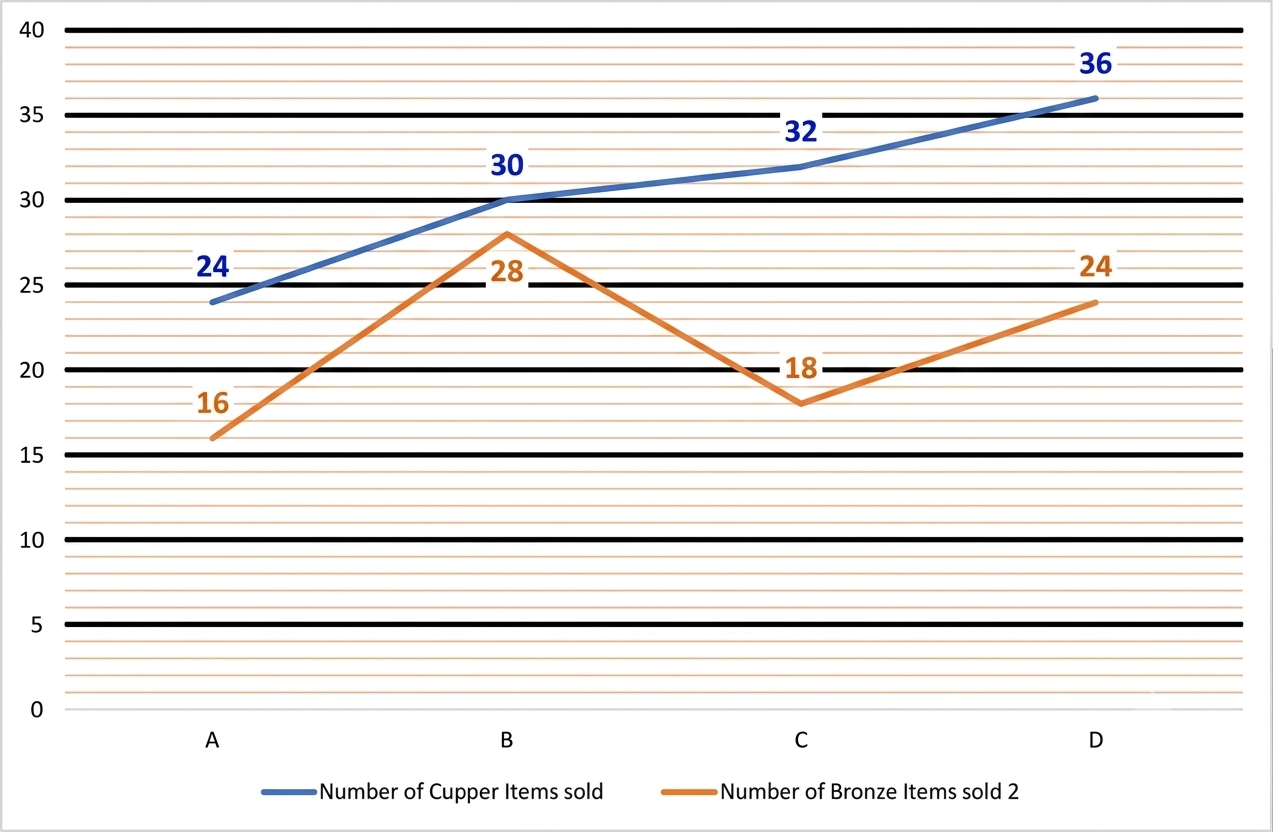
The line graph shows the number of copper and bronze items sold in four different shops [A, B, C, and D].

The given table shows the ratio between total number of [ copper + bronze] items sold to number silver items sold.

ShopRatio between total number of [ copper + bronze] items sold to number silver items sold.
A5:4
B29:12
C25:18
D3:2

Number of copper, bronze and silver items sold in shop E is 25%, 12.5% and 30% more than the same in shop D. Find the difference between total number of items sold in shop E and C?

  1. AOption (a)

    99

  2. BOption (b)

    85

  3. COption (c)

    38

  4. DOption (d)

    36

  5. EOption (e)

    44

View answer & explanation

Correct answer

Answer: (c)C.

38

Why this answer is correct

Common Calculation

For shop A,

Number of copper items sold in shop A is 24.

Number of bronze items sold in shop A is 16.

So, total number of copper and bronze items sold in shop A is 24 + 16 = 40.

So, Ratio between total number of [ copper + bronze] items sold to number silver items sold.

So, Number of silver items sold in shop A is 40 × 4 /5 = 32

Similarly, we can calculate others values also, which is given in the table.

ShopNumber of copper items soldNumber of Bronze items soldNumber of Silver items sold
A241632
B302824
C321836
D362440

Calculation

In Shop D:

Copper = 36

→ Shop E = 36 × 1.25 = 45

Bronze = 24

→ Shop E = 24 × 1.125 = 27

Silver = 40

→ Shop E = 40 × 1.30 = 52

Total in Shop E = 45 + 27 + 52 = 124

Total in Shop C = 32 + 18 + 36 = 86

Difference = 124 – 86 = 38

Answer: 38

RRB Clerk Mains Memory Based Paper (Held On: 6 October 2024 Shift 1) (Previous Year Paper)·Numerical Ability
View full paper

Question 391

IBPS RRB Office Assistant (Clerk) 2024• Numerical Ability• Numerical Ability

The line graph shows the number of copper and bronze items sold in four different shops [A, B, C, and D].

The given table shows the ratio between total number of [ copper + bronze] items sold to number silver items sold.

ShopRatio between total number of [ copper + bronze] items sold to number silver items sold.
A5:4
B29:12
C25:18
D3:2

Number of tin items sold in shop D is 25% more than the number of bronze and silver items sold in same shop. Find the average tin and copper items sold in shop D?

  1. AOption (a)

    55

  2. BOption (b)

    56

  3. COption (c)

    59

  4. DOption (d)

    62

  5. EOption (e)

    58

View answer & explanation

Correct answer

Answer: (e)E.

58

Why this answer is correct

Common Calculation

For shop A,

Number of copper items sold in shop A is 24.

Number of bronze items sold in shop A is 16.

So, total number of copper and bronze items sold in shop A is 24 + 16 = 40.

So, Ratio between total number of [ copper + bronze] items sold to number silver items sold.

So, Number of silver items sold in shop A is 40 × 4 /5 = 32

Similarly, we can calculate others values also, which is given in the table.

ShopNumber of copper items soldNumber of Bronze items soldNumber of Silver items sold
A241632
B302824
C321836
D362440

Calculation

In Shop D:

Bronze = 24, Silver = 40 ⇒ Total = 64

Tin items = 25% more than 64 = 1.25 × 64 = 80

Now, tin = 80, copper = 36

Average = (80 + 36) ÷ 2 = 116 ÷ 2 = 58

Answer: 58

RRB Clerk Mains Memory Based Paper (Held On: 6 October 2024 Shift 1) (Previous Year Paper)·Numerical Ability
View full paper

Question 392

IBPS RRB Office Assistant (Clerk) 2024• Numerical Ability• Numerical Ability

The line graph shows the number of copper and bronze items sold in four different shops [A, B, C, and D].

The given table shows the ratio between total number of [ copper + bronze] items sold to number silver items sold.

ShopRatio between total number of [ copper + bronze] items sold to number silver items sold.
A5:4
B29:12
C25:18
D3:2

Find the difference between number of copper sold in shop B and C together and number of silver items sold in shop B and C together?

  1. AOption (a)

    1

  2. BOption (b)

    3

  3. COption (c)

    4

  4. DOption (d)

    2

  5. EOption (e)

    5

View answer & explanation

Correct answer

Answer: (d)D.

2

Why this answer is correct

Common Calculation

For shop A,

Number of copper items sold in shop A is 24.

Number of bronze items sold in shop A is 16.

So, total number of copper and bronze items sold in shop A is 24 + 16 = 40.

So, Ratio between total number of [ copper + bronze] items sold to number silver items sold.

So, Number of silver items sold in shop A is 40 × 4 /5 = 32

Similarly, we can calculate others values also, which is given in the table.

ShopNumber of copper items soldNumber of Bronze items soldNumber of Silver items sold
A241632
B302824
C321836
D362440

Calculation

Copper in B + C = 30 + 32 = 62

Silver in B + C = 24 + 36 = 60

Difference = 62 – 60 = 2

Answer: 2

RRB Clerk Mains Memory Based Paper (Held On: 6 October 2024 Shift 1) (Previous Year Paper)·Numerical Ability
View full paper

Question 393

IBPS RRB Office Assistant (Clerk) 2024• Numerical Ability• Numerical Ability

The line graph shows the number of copper and bronze items sold in four different shops [A, B, C, and D].

The given table shows the ratio between total number of [ copper + bronze] items sold to number silver items sold.

ShopRatio between total number of [ copper + bronze] items sold to number silver items sold.
A5:4
B29:12
C25:18
D3:2

Average selling price of copper items is Rs. 750, average selling price of bronze items is Rs. 550 and average silver items is Rs. 1050 sold in shop B. Find the average (approx) selling price of all the items sold in shop B?

  1. AOption (a)

    880

  2. BOption (b)

    770

  3. COption (c)

    820

  4. DOption (d)

    920

  5. EOption (e)

    670

View answer & explanation

Correct answer

Answer: (b)B.

770

Why this answer is correct

Common Calculation

For shop A,

Number of copper items sold in shop A is 24.

Number of bronze items sold in shop A is 16.

So, total number of copper and bronze items sold in shop A is 24 + 16 = 40.

So, Ratio between total number of [ copper + bronze] items sold to number silver items sold.

So, Number of silver items sold in shop A is 40 × 4 /5 = 32

Similarly, we can calculate others values also, which is given in the table.

ShopNumber of copper items soldNumber of Bronze items soldNumber of Silver items sold
A241632
B302824
C321836
D362440

Calculation

In Shop B:

Copper = 30 × 750 = 22,500

Bronze = 28 × 550 = 15,400

Silver = 24 × 1050 = 25,200

Total value = 22,500 + 15,400 + 25,200 = 63,100

Total items = 30 + 28 + 24 = 82

Average selling price = 63100 ÷ 82 = Rs. 769.51 (approx)

Answer: Rs. 770

RRB Clerk Mains Memory Based Paper (Held On: 6 October 2024 Shift 1) (Previous Year Paper)·Numerical Ability
View full paper

Question 394

IBPS RRB Office Assistant (Clerk) 2024• Numerical Ability• Numerical Ability

The line graph shows the number of copper and bronze items sold in four different shops [A, B, C, and D].

The given table shows the ratio between total number of [ copper + bronze] items sold to number silver items sold.

ShopRatio between total number of [ copper + bronze] items sold to number silver items sold.
A5:4
B29:12
C25:18
D3:2

Two types silver items sold in shop A, x and y. Number of x type silver items sold in shop A is 3m + 2 and number of y type silver items sold in shop A is 2n + 6. Sum of m and n is 10. Find the ratio between m and n?

  1. AOption (a)

    4:5

  2. BOption (b)

    6:7

  3. COption (c)

    7:8

  4. DOption (d)

    2:3

  5. EOption (e)

    4:7

View answer & explanation

Correct answer

Answer: (d)D.

2:3

Why this answer is correct

Common Calculation

For shop A,

Number of copper items sold in shop A is 24.

Number of bronze items sold in shop A is 16.

So, total number of copper and bronze items sold in shop A is 24 + 16 = 40.

So, Ratio between total number of [ copper + bronze] items sold to number silver items sold.

So, Number of silver items sold in shop A is 40 × 4 /5 = 32

Similarly, we can calculate others values also, which is given in the table.

ShopNumber of copper items soldNumber of Bronze items soldNumber of Silver items sold
A241632
B302824
C321836
D362440

Calculation

In Shop A:

Total silver items = 32

Number of x-type silver items = 3m + 2

Number of y-type silver items = 2n + 6

So,

3m + 2 + 2n + 6 = 32

⇒ 3m + 2n = 24

Also, m + n = 10,

So, m = 4 and n = 6

⇒ Required ratio m : n

Answer: m : n = 4 : 6 = 2 : 3

RRB Clerk Mains Memory Based Paper (Held On: 6 October 2024 Shift 1) (Previous Year Paper)·Numerical Ability
View full paper

Question 395

IBPS RRB Office Assistant (Clerk) 2024• Numerical Ability• Numerical Ability

A 60-litre solution of milk and water is mixed in the ratio 3:1. Then, 8 litres of this mixture is removed. After that, p litres of milk and q litres of water are added. The resulting mixture has milk and water in a 9:5 ratio. Given that p + q = 11, find the difference between p and q.

  1. AOption (a)

    6

  2. BOption (b)

    9

  3. COption (c)

    2

  4. DOption (d)

    8

  5. EOption (e)

    7

View answer & explanation

Correct answer

Answer: (d)D.

8

Why this answer is correct

Calculation

Initial mixture (60 litres in 3:1 ratio)

Milk = (3/4) × 60 = 45 litres

Water = (1/4) × 60 = 15 litres

8 litres of mixture removed

Ratio = 3:1 → in 8 litres:

Milk removed = (3/4) × 8 = 6 litres

Water removed = (1/4) × 8 = 2 litres

Remaining:

Milk = 45 - 6 = 39 litres

Water = 15 - 2 = 13 litres

Add p litres of milk and q litres of water

Final milk = 39 + p

Final water = 13 + q

New ratio = (39 + p) / (13 + q) = 9 / 5

So, 5(39 + p) = 9(13 + q)

So, 195 + 5p = 117 + 9q

=> 5p - 9q = -78 → [Equation 1]

Also, p + q = 11 → [Equation 2]

From Equation 2: p = 11 - q

Substitute into Equation 1:

5(11 - q) - 9q = -78

So, 55 - 5q - 9q = -78

So, 55 - 14q = -78

=> -14q = -133

=> q = 9.5

=> p = 11 - 9.5 = 1.5

Difference between p and q is 9.5 – 1.5 = 8

RRB Clerk Mains Memory Based Paper (Held On: 6 October 2024 Shift 1) (Previous Year Paper)·Numerical Ability
View full paper

Question 396

IBPS RRB Office Assistant (Clerk) 2024• Numerical Ability• Numerical Ability

In each of the following number series, the wrong number is given, find out that number.

4, 12, 24, 96, 480, 2880, 20160

  1. AOption (a)

    12

  2. BOption (b)

    96

  3. COption (c)

    480

  4. DOption (d)

    2880

  5. EOption (e)

    20160

View answer & explanation

Correct answer

Answer: (a)A.

12

Why this answer is correct

Considering the given series,

4, 12, 24, 96, 480, 2880, 20160

The logic of above series can be explained as,

4 × 2 ≠ 12 (should be 8)

8 × 3 = 24

24 × 4 = 96

96 × 5 = 480

480 × 6 = 2880

2880 × 7 = 20160

∴ Wrong number is 12

RRB Clerk Mains Memory Based Paper (Held On: 6 October 2024 Shift 1) (Previous Year Paper)·Numerical Ability
View full paper

Question 397

IBPS RRB Office Assistant (Clerk) 2024• Numerical Ability• Numerical Ability

In the following number series, only one number is wrong. Find out the wrong number.

23, 30, 56, 118, 243, 458

  1. AOption (a)

    243

  2. BOption (b)

    56

  3. COption (c)

    118

  4. DOption (d)

    30

  5. EOption (e)

    458

View answer & explanation

Correct answer

Answer: (c)C.

118

Why this answer is correct

The pattern of the given series is:

⇒ 23

⇒ 23 + (23 – 1) = 30

⇒ 30 + (33 – 1) = 56

⇒ 56 + (43 – 1) = 119

⇒ 119 + (53 – 1) = 243

⇒ 243 + (63 – 1) = 458

∴ The wrong term is 118.

RRB Clerk Mains Memory Based Paper (Held On: 6 October 2024 Shift 1) (Previous Year Paper)·Numerical Ability
View full paper

Question 398

IBPS RRB Office Assistant (Clerk) 2024• Numerical Ability• Numerical Ability

In each of the following number series, a wrong number is given. Find out that number.

110, 136, 164, 194, 226, 260, 306

  1. AOption (a)

    136

  2. BOption (b)

    164

  3. COption (c)

    194

  4. DOption (d)

    306

  5. EOption (e)

    260

View answer & explanation

Correct answer

Answer: (d)D.

306

Why this answer is correct

Given:

110, 136, 164, 194, 226, 260, 306

Calculation:

The series follows the following pattern 

102 + 10 = 110

112 + 15 = 136

122 + 20 = 164

132 + 25 = 194

142 + 30 = 226

152 + 35 = 260

162 + 40 = 296 ≠ 306

∴ 306 is wrong and should be replaced by 296

RRB Clerk Mains Memory Based Paper (Held On: 6 October 2024 Shift 1) (Previous Year Paper)·Numerical Ability
View full paper

Question 399

IBPS RRB Office Assistant (Clerk) 2024• Numerical Ability• Numerical Ability

Find the Wrong number in the given number series:

50, 25, 15, 6.25, 3.125, 1.5625

  1. AOption (a)

    15

  2. BOption (b)

    1.5625

  3. COption (c)

    25

  4. DOption (d)

    50

  5. EOption (e)

    6.25

View answer & explanation

Correct answer

Answer: (a)A.

15

Why this answer is correct

Given:

The number series:

50, 25, 15, 6.25, 3.125, 1.5625

Concept Used:

Number series following a fixed pattern.

Calculation;

The given number series follows the pattern:

50 ÷ 2 = 25

25 ÷ 2 = 12.5

12.5 ÷ 2 = 6.25

6.25 ÷ 2 = 3.125

3.125 ÷ 2 = 1.5625

∴ The Wrong Number in the given number series is 15

RRB Clerk Mains Memory Based Paper (Held On: 6 October 2024 Shift 1) (Previous Year Paper)·Numerical Ability
View full paper

Question 400

IBPS RRB Office Assistant (Clerk) 2024• Numerical Ability• Numerical Ability

In each of the following number series, the wrong number is given, find out that number.

6, 9, 30, 86, 216, 528, 1248

  1. AOption (a)

    30

  2. BOption (b)

    86

  3. COption (c)

    216

  4. DOption (d)

    1248

  5. EOption (e)

    528

View answer & explanation

Correct answer

Answer: (b)B.

86

Why this answer is correct

The series follows the following pattern:

6 × 1.5 = 9

12 × 2.5 = 30

24 × 3.5 = 84

48 × 4.5 = 216

96 × 5.5 = 528

192 × 6.5 = 1248

∴ wrong number of the series is 86

How should I prepare for Quantitative Aptitude in IBPS RRB Office Assistant (Clerk)?

Solving previous year questions by topic helps identify recurring concepts, question patterns, and frequently asked sub-topics. Attempt each question, review the step-by-step explanation, and note down key formulas or facts for quick revision before the exam.