IBPS RRB Office Assistant (Clerk) · Topic Collection

Quantitative Aptitude PYQs

Arithmetic, number systems, percentages, ratios, profit and loss, time and work, algebra, geometry, mensuration, and trigonometry.

1935 Total Questions49 Official PapersYears: 2018–2025Search in Quantitative Aptitude
Showing questions 361–380 of 1935Page 19 of 97
IBPS PO Prelims Memory Based Paper (Held On: 19 October 2024 Shift 1) (Previous Year Paper)·Quantitative Aptitude
View full paper

Question 361

IBPS RRB Office Assistant (Clerk) 2024• Quantitative Aptitude• Quantitative Aptitude

A , B and C started a business with capital in the ratio of 8 : 6 : 5. After 8 months A withdrew 25% of his capital while C increased 20% of his investment if at the end of the year total profit of the business is Rs14000 then what is the profit share of C?

  1. AOption (a)

     12000

  2. BOption (b)

     7000

  3. COption (c)

     4000

  4. DOption (d)

     8000

  5. EOption (e)

     6000

View answer & explanation

Correct answer

Answer: (c)C.

 4000

Why this answer is correct

Shortcut Trick

Ratio of Profit = Σ(Capital × Time)

A : B : C = (8 × 8 + 6 × 4) : (6 × 12) : (5 × 8 + 6 × 4)

A : B : C = (64 + 24) : 72 : (40 + 24) = 88 : 72 : 64

Simplified Ratio = 11 : 9 : 8. Total units = 11 + 9 + 8 = 28 units.

28 units = Rs. 14000 ⇒ 1 unit = Rs. 500. Profit of C = 8 × 500 = Rs. 4000. ∴ The correct answer is Rs. 4000.

Alternate Method

Given → Initial Capital Ratio A:B:C = 8:6:5. Time = 12 months.
Formulas → Profit Share = Capital × Time Period

⇒ A's investment: (8 × 8 months) + (8 × 75% × 4 months) = 64 + 24 = 88.
⇒ B's investment: (6 × 12 months) = 72.
⇒ C's investment: (5 × 8 months) + (5 × 120% × 4 months) = 40 + 24 = 64.
⇒ Total Investment Ratio A:B:C = 88 : 72 : 64 = 11 : 9 : 8.
⇒ Sum of ratios = 11 + 9 + 8 = 28.
⇒ C's share = (8 ÷ 28) × 14000 = 8 × 500 = 4000.

∴ The correct answer is Rs. 4000.

Additional Information

Partnership Basics

Profit is distributed based on the product of Capital and Time. If time is constant, profit ratio equals capital ratio.

Percentage Changes

To calculate a 25% decrease, multiply by 0.75. For a 20% increase, multiply by 1.20.
IBPS PO Prelims Memory Based Paper (Held On: 19 October 2024 Shift 1) (Previous Year Paper)·Quantitative Aptitude
View full paper

Question 362

IBPS RRB Office Assistant (Clerk) 2024• Quantitative Aptitude• Quantitative Aptitude

In an election, 5% of the applicants were found ineligible and 85% of the eligible candidates belonged to the general category. If 4275 eligible candidates belonged to other categories, then how many voters appeared for the elections?

  1. AOption (a)

    30,000

  2. BOption (b)

    35,000

  3. COption (c)

    37,000

  4. DOption (d)

    35,500

  5. EOption (e)

    None of these

View answer & explanation

Correct answer

Answer: (a)A.

30,000

Why this answer is correct

Shortcut Trick

Let the total number of applicants be 100 units.

Eligible candidates = 95% of 100 = 95 units.

Other categories = (100% − 85%) of eligible = 15% of 95 = 14.25 units.

Given: 14.25 units = 4275 ⇒ 1 unit = 300.

Total applicants = 100 × 300 = 30,000.

∴ The correct answer is 30,000.

Alternate Method

Given:

Ineligible = 5% ⇒ Eligible = 95%

General Category = 85% of eligible ⇒ Other Categories = 15% of eligible

Other Categories candidates = 4275

Calculations:

Let the total number of voters be x.

⇒ Eligible candidates = x × (95/100)

⇒ Other categories = x × (95/100) × (15/100) = 4275

⇒ x × 0.95 × 0.15 = 4275

⇒ x × 0.1425 = 4275

⇒ x = 4275 ÷ 0.1425

⇒ x = 30,000

∴ The correct answer is 30,000.

Additional Information

Successive Percentage change

When a value is reduced by a% and then further by b%, the remaining value is P × (1 − a/100) × (1 − b/100).

Base change in Election problems

Always identify the base for each percentage. Here, 85% is of the eligible candidates, not the total applicants.

Ratio Method

Fractions can be used for faster calculation: 95% = 19/20 and 15% = 3/20. Total = 4275 × (20/19) × (20/3).

IBPS PO Prelims Memory Based Paper (Held On: 19 October 2024 Shift 1) (Previous Year Paper)·Quantitative Aptitude
View full paper

Question 363

IBPS RRB Office Assistant (Clerk) 2024• Quantitative Aptitude• Quantitative Aptitude

A container contains 100 litres of milk. If 10 % of milk was replaced by water and this process was repeated two times more, then find the quantity of the milk in the final mixture.

  1. AOption (a)

    82.9 litres

  2. BOption (b)

    72.9 litres

  3. COption (c)

    62.9 litres

  4. DOption (d)

    72 litres

  5. EOption (e)

    None of these

View answer & explanation

Correct answer

Answer: (b)B.

72.9 litres

Why this answer is correct

Shortcut Trick

Initial quantity = 100 litres

Replacement fraction = 10% = 1/10

Remaining fraction after 1 process = 1 − 1/10 = 9/10

Since the process is repeated two times more (total 3 times):

Final Milk = 100 × (9/10)3 = 100 × 729/1000 = 72.9 litres

∴ The correct answer is 72.9 litres.

Alternate Method

Given:

Initial quantity of milk (x) = 100 litres

Quantity replaced (y) = 10% of 100 = 10 litres

Number of times the process is performed (n) = 3

Formula Used:

Final quantity = x × (1 − y/x)n

Calculations:

⇒ Final Quantity = 100 × (1 − 10/100)3

⇒ Final Quantity = 100 × (1 − 1/10)3

⇒ Final Quantity = 100 × (9/10) × (9/10) × (9/10)

⇒ Final Quantity = 100 × 0.9 × 0.9 × 0.9

⇒ Final Quantity = 100 × 0.729

⇒ Final Quantity = 72.9 litres

∴ The correct answer is 72.9 litres.

Additional Information

Successive Replacement Formula

The formula Final Quantity = Initial × (1 − r/100)n is used when a fixed percentage r is replaced n times.

Mixture Replacement with Different Quantities

If different amounts a, b, c are replaced each time, the final quantity is x × (1 − a/x) × (1 − b/x) × (1 − c/x).

Ratio of Milk to Water

After the process, the quantity of water = Total Capacity − Final Milk. In this case, 100 − 72.9 = 27.1 litres.

IBPS PO Prelims Memory Based Paper (Held On: 19 October 2024 Shift 1) (Previous Year Paper)·Quantitative Aptitude
View full paper

Question 364

IBPS RRB Office Assistant (Clerk) 2024• Quantitative Aptitude• Quantitative Aptitude

What approximate value should come in the place of the question mark ‘?’ in the following question?

(5.96)3 ÷ 17.98 + 47.88 – ? × 1.95 = 19.93

  1. AOption (a)

    15

  2. BOption (b)

    12

  3. COption (c)

    25

  4. DOption (d)

    20

  5. EOption (e)

    18

View answer & explanation

Correct answer

Answer: (d)D.

20

Why this answer is correct

Concept Used:

Follow the BODMAS rule according to the table given below:

Calculation:

(5.96)3 ÷ 17.98 + 47.88 – ? × 1.95 = 19.93

⇒ 63 ÷ 18 + 48 – ? × 2 = 20

⇒ 216 ÷ 18 + 48 – ? × 2 = 20

⇒ 12 + 48 – ? × 2 = 20

⇒ – ?× 2 = 20 – 60

⇒ -2 × ? = -40

⇒ ? = 20

∴ The value of ? is 20

IBPS PO Prelims Memory Based Paper (Held On: 19 October 2024 Shift 1) (Previous Year Paper)·Quantitative Aptitude
View full paper

Question 365

IBPS RRB Office Assistant (Clerk) 2024• Quantitative Aptitude• Quantitative Aptitude

What approximate value should come in place of ‘?’ in the following equation:

350.97 ÷ 27.02 + (13.99)2 ÷ 28.04 = ?

  1. AOption (a)

    13

  2. BOption (b)

    20

  3. COption (c)

    7

  4. DOption (d)

    15

  5. EOption (e)

    None of these

View answer & explanation

Correct answer

Answer: (b)B.

20

Why this answer is correct

Solution:

Rules of Approximation:

  1. If a number has digits to the right of the decimal less than 5, then just drop the digits to the right of the decimal. The number so obtained will be the approximated value.
  2. If a number has digits to the right of the decimal more than 5, then just drop the digits to the right of the decimal and raise the remaining number by '1'.The number so obtained will be the approximated value.

Concept Used:       

Follow BODMAS rule to solve this question, as per the order given below,

Calculation:

351 ÷ 27 + (14)2 ÷ 28 = ?

⇒ 351 ÷ 27 + 196 ÷ 28 = ?

⇒ 13 + 7 = ?

∴ ? = 20

IBPS PO Prelims Memory Based Paper (Held On: 19 October 2024 Shift 1) (Previous Year Paper)·Quantitative Aptitude
View full paper

Question 366

IBPS RRB Office Assistant (Clerk) 2024• Quantitative Aptitude• Quantitative Aptitude

What approximate will come in the place of the question mark ‘?’ in the following question?

{(17.09 + 2.01) × 107.6 ÷ 75.6} + 71.40 × 11.90 = ?

  1. AOption (a)

    859

  2. BOption (b)

    889

  3. COption (c)

    879

  4. DOption (d)

    825

  5. EOption (e)

    881

View answer & explanation

Correct answer

Answer: (c)C.

879

Why this answer is correct

Concept used:

Follow BODMAS rule to solve this question, as per the order given below,

Calculations:

{(17.09 + 2.01) × 107.6 ÷ 75.6} + 71.40 × 11.90 = ?

⇒ {(17 + 2) × 108 ÷ 76} + 71 × 12 = ?

⇒ 19 × 108 ÷ 76 + 852 = ?

⇒ 27 + 852 = ?

⇒ ? = 879

∴ The value of ? is 879

IBPS PO Prelims Memory Based Paper (Held On: 19 October 2024 Shift 1) (Previous Year Paper)·Quantitative Aptitude
View full paper

Question 367

IBPS RRB Office Assistant (Clerk) 2024• Quantitative Aptitude• Quantitative Aptitude

What approximate value should come in place of “?” in the following equation:

{(784.03)1/2 × 3.97} + (29.07 × 12.96) = (?)2 – (7.92 × 5.01)

  1. AOption (a)

    529

  2. BOption (b)

    8

  3. COption (c)

    24

  4. DOption (d)

    23

  5. EOption (e)

    None of these

View answer & explanation

Correct answer

Answer: (d)D.

23

Why this answer is correct

Rules of Approximation:

  1. If a number has digits to the right of the decimal less than 5, then just drop the digits to the right of the decimal. The number so obtained will be the approximated value.
  2. If a number has digits to the right of the decimal more than 5, then just drop the digits to the right of the decimal and raise the remaining number by '1'.The number so obtained will be the approximated value.

Concept Used:       

Follow BODMAS rule to solve this question, as per the order given below,

Calculation:

{(784)1/2 × 4} + (29 × 13) = (?)2 – (8 × 5)

⇒ {28 × 4} + (29 × 13) = (?)2 – (8 × 5)

⇒ {28 × 4} + 377 = (?)2 – 40

⇒ 112 + 377 = (?)2 – 40

⇒ 489 = (?)2 – 40

⇒ (?)2 = 489 + 40

⇒ (?)2 = 529

∴ ? = 23

IBPS PO Prelims Memory Based Paper (Held On: 19 October 2024 Shift 1) (Previous Year Paper)·Quantitative Aptitude
View full paper

Question 368

IBPS RRB Office Assistant (Clerk) 2024• Quantitative Aptitude• Quantitative Aptitude

What approximate value will come in the place of the question mark ‘?’ in the following question?

49.99% of 799.897 + 24.99% of 200.012 = 9 × ?

  1. AOption (a)

    80

  2. BOption (b)

    60

  3. COption (c)

    50

  4. DOption (d)

    70

  5. EOption (e)

    None

View answer & explanation

Correct answer

Answer: (c)C.

50

Why this answer is correct

Concept used:

Follow BODMAS rule to solve this question, as per the order given below:

Calculation:

49.99% of 799.897 + 24.99% of 200.012 = 9 × ?

On taking the approximate values, we get:

⇒ 50% of 800 + 25% of 200 = 9 × ?

⇒ (50/100) × 800 + (25/100) × 200 = 9 × ?

⇒ 400 + 50 = 9 × ?

⇒ ? = 450/9 = 50

∴ The value of ? is 50

IBPS PO Prelims Memory Based Paper (Held On: 19 October 2024 Shift 1) (Previous Year Paper)·Quantitative Aptitude
View full paper

Question 369

IBPS RRB Office Assistant (Clerk) 2024• Quantitative Aptitude• Quantitative Aptitude

A shopkeeper allows two successive discounts of X% on a shirt which is marked at Rs 2500 and sells it at Rs 1764. Find the selling price of the shirt if the shopkeeper would have given X  + 2 % of two equal successive discounts?

  1. AOption (a)

     1681

  2. BOption (b)

     2025

  3. COption (c)

     1936

  4. DOption (d)

     1600

  5. EOption (e)

     1849

View answer & explanation

Correct answer

Answer: (a)A.

 1681

Why this answer is correct

Shortcut Trick

For two equal successive discounts of X%, the ratio of Marked Price (MP) to Selling Price (SP) is (100)2 : (100 − X)2.

Given MP = 2500 and SP = 1764 ⇒ √2500 : √1764 = 50 : 42.

Discount X% = (50 − 42) ÷ 50 × 100 = 16%.

New discount rate = 16% + 2% = 18%.

New SP = 2500 × (82 ÷ 100) × (82 ÷ 100) = 25 × 0.82 × 82 = 1681.

∴ The correct answer is Rs 1681.

Alternate Method

Formulas: SP = MP × (1 − d1/100) × (1 − d2/100) | Net Discount = a + b − ab/100

⇒ 1764 = 2500 × (1 − X/100)2

⇒ (1 − X/100)2 = 1764 ÷ 2500 = 0.7056

⇒ 1 − X/100 = √0.7056 = 0.84 ⇒ X/100 = 0.16 ⇒ X = 16%

⇒ New Discount rate = X + 2 = 18%

⇒ New SP = 2500 × (1 − 18/100)2 = 2500 × (0.82)2

⇒ New SP = 2500 × 0.6724 = 1681

∴ The correct answer is Rs 1681.

Additional Information

Successive Discounts

When two discounts 'a' and 'b' are given one after another, the single equivalent discount is (a + b − ab/100)%.

Relation between MP and SP

SP is always calculated on the Marked Price. SP = MP × (100 − D%)/100.

IBPS PO Prelims Memory Based Paper (Held On: 19 October 2024 Shift 1) (Previous Year Paper)·Quantitative Aptitude
View full paper

Question 370

IBPS RRB Office Assistant (Clerk) 2024• Quantitative Aptitude• Quantitative Aptitude

If the price of an Iphone is reduced by 20% during the festival season, its sale is increased by 80%. If the percentage by which the net sale is increased be m, then what will be the square root of m+5 ? 

  1. AOption (a)

    7

  2. BOption (b)

    11

  3. COption (c)

    13

  4. DOption (d)

    17

  5. EOption (e)

    5

View answer & explanation

Correct answer

Answer: (a)A.

7

Why this answer is correct

Shortcut Trick

Net change % = x + y + (x × y)/100 where x = −20% (reduction) and y = +80% (increase).

m = −20 + 80 + (−20 × 80)/100 = 60 − 16 = 44%.

Required value = √(m + 5) = √(44 + 5) = √49 = 7.

∴ The correct answer is 7.

Alternate Method

Given:

Initial Price = 100, Initial Sale = 100 ⇒ Initial Revenue = 100 × 100 = 10000

Calculations:

⇒ New Price = 100 − 20% of 100 = 80

⇒ New Sale = 100 + 80% of 100 = 180

⇒ New Revenue = 80 × 180 = 14400

⇒ Increase in Revenue = 14400 − 10000 = 4400

⇒ Percentage increase (m) = (4400 ÷ 10000) × 100 = 44%

⇒ Value to find = √(m + 5) = √(44 + 5) = √49 = 7

∴ The correct answer is 7.

Additional Information

Successive Percentage Change

When a quantity is changed by x% and then by y%, the overall change is given by [x + y + (xy/100)]%.

Revenue Relationship

Revenue is the product of Price and Consumption (or Sale). If both change, the product change follows the successive percentage rule.

Percentage to Fraction

20% reduction = 4/5 multiplier; 80% increase = 9/5 multiplier. Net multiplier = (4/5) × (9/5) = 36/25. Increase = 11/25 = 44%.

IBPS PO Prelims Memory Based Paper (Held On: 19 October 2024 Shift 1) (Previous Year Paper)·Quantitative Aptitude
View full paper

Question 371

IBPS RRB Office Assistant (Clerk) 2024• Quantitative Aptitude• Quantitative Aptitude

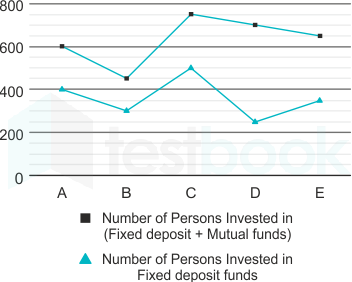
Directions: Study the following direction shows the total number of persons invested in Fixed deposits and mutual funds and number of persons invested in mutual funds in five different banks A, B, C, D and E.


20% of the persons who invested in Fixed deposit in Bank A are females and remaining are males and 30% of the persons invested in Mutual funds are in Bank A males , Find the number of males invested in both Fixed deposit and Mutual funds in bank A.

  1. AOption (a)

    460

  2. BOption (b)

    380

  3. COption (c)

    390

  4. DOption (d)

    420

  5. EOption (e)

    520

View answer & explanation

Correct answer

Answer: (b)B.

380

Why this answer is correct

General solution:

Bank A:

Number of persons invested in (Fixed deposit + Mutual Funds) = 600

Number of persons invested in Fixed deposit = 400

Number of persons invested in Mutual Funds = (600 - 400) =200


Bank B:

Number of persons invested in (Fixed deposit + Mutual Funds) = 450

Number of persons invested in Fixed deposit = 300

Number of persons invested in Mutual Funds = (450 - 300) =150


Bank C:

Number of persons invested in (Fixed deposit + Mutual Funds) = 750

Number of persons invested in Fixed deposit = 500

Number of persons invested in Mutual Funds = (750 - 500) =250


Bank D:

Number of persons invested in (Fixed deposit + Mutual Funds) = 700

Number of persons invested in Fixed deposit = 250

Number of persons invested in Mutual Funds = (700 - 250) = 450


Bank E:

Number of persons invested in (Fixed deposit + Mutual Funds) = 650

Number of persons invested in Fixed deposit = 350

Number of persons invested in Mutual Funds = (650 - 350) = 300 


Name of the bankNumber of persons invested in Fixed depositNumber of persons invested in Mutual Fund
Bank A400200
Bank B300150
Bank C500250
Bank D250450
Bank E350300

Solution:

Number of persons invested in Fixed deposition Bank A = 400

Number of females invested in Fixed deposit in Bank A= 400 ×  20/100 = 80

Number of males invested in Fixed deposit in Bank A = (400 - 80) = 320

Number of males invested in Mutual funds in Bank A = 200 ×  (30/100) = 60

Total males invested in both Mutual funds and Fixed deposit in Bank A = (320 + 60) = 380

IBPS PO Prelims Memory Based Paper (Held On: 19 October 2024 Shift 1) (Previous Year Paper)·Quantitative Aptitude
View full paper

Question 372

IBPS RRB Office Assistant (Clerk) 2024• Quantitative Aptitude• Quantitative Aptitude

Directions: Study the following direction shows the total number of persons invested in Fixed deposits and mutual funds and number of persons invested in mutual funds in five different banks A, B, C, D and E.


If 1/3 and 1/5 of the number of persons invested in Fixed deposit in Bank B and C respectively for 2 years and remaining are invested for 5 years. Find the difference between the total number of persons invested in Mutual funds in Bank  B and Bank C together and the number of persons invested in fixed deposits for the time period of 5 years from the Bank B and C.

  1. AOption (a)

    220

  2. BOption (b)

    180

  3. COption (c)

    150

  4. DOption (d)

    250

  5. EOption (e)

    200

View answer & explanation

Correct answer

Answer: (e)E.

200

Why this answer is correct

General solution:

Bank A:

Number of persons invested in (Fixed deposit + Mutual Funds) = 600

Number of persons invested in Fixed deposit = 400

Number of persons invested in Mutual Funds = (600 - 400) =200


Bank B:

Number of persons invested in (Fixed deposit + Mutual Funds) = 450

Number of persons invested in Fixed deposit = 300

Number of persons invested in Mutual Funds = (450 - 300) =150


Bank C:

Number of persons invested in (Fixed deposit + Mutual Funds) = 750

Number of persons invested in Fixed deposit = 500

Number of persons invested in Mutual Funds = (750 - 500) =250


Bank D:

Number of persons invested in (Fixed deposit + Mutual Funds) = 700

Number of persons invested in Fixed deposit = 250

Number of persons invested in Mutual Funds = (700 - 250) = 450


Bank E:

Number of persons invested in (Fixed deposit + Mutual Funds) = 650

Number of persons invested in Fixed deposit = 350

Number of persons invested in Mutual Funds = (650 - 350) = 300 


Name of the bankNumber of persons invested in Fixed depositNumber of persons invested in Mutual Fund
Bank A400200
Bank B300150
Bank C500250
Bank D250450
Bank E350300

Solution:

Number of persons invested in Fixed deposit in Bank B = 300

Number of persons invested in Fixed deposit in Bank C = 500

Number of persons invested in Fixed deposit in Bank B for 2 years = 300 ×  1/3 = 100

Number of persons invested in Fixed deposit in Bank B for 5 years = (300 - 100) = 200

Number of persons invested in Fixed deposit in Bank C for 2 years = 500 ×  1/5 = 100

Number of persons invested in Fixed deposit in Bank C for 5 years = (500 - 100) = 400

Total number of persons invested in Mutual funds in Bank B and C = (150 + 250) = 400

Required difference = (600 - 400) = 200

IBPS PO Prelims Memory Based Paper (Held On: 19 October 2024 Shift 1) (Previous Year Paper)·Quantitative Aptitude
View full paper

Question 373

IBPS RRB Office Assistant (Clerk) 2024• Quantitative Aptitude• Quantitative Aptitude

Directions: Study the following direction shows the total number of persons invested in Fixed deposits and mutual funds and number of persons invested in mutual funds in five different banks A, B, C, D and E.


If the number of persons invested in Fixed deposit from Bank D is increased by x the ratio between the number of persons invested in Fixed deposits to Mutual funds in Bank D is 13: 18. Find the value of x.

  1. AOption (a)

    95

  2. BOption (b)

    60

  3. COption (c)

    75

  4. DOption (d)

    125

  5. EOption (e)

    80

View answer & explanation

Correct answer

Answer: (c)C.

75

Why this answer is correct

General solution:

Bank A:

Number of persons invested in (Fixed deposit + Mutual Funds) = 600

Number of persons invested in Fixed deposit = 400

Number of persons invested in Mutual Funds = (600 - 400) =200


Bank B:

Number of persons invested in (Fixed deposit + Mutual Funds) = 450

Number of persons invested in Fixed deposit = 300

Number of persons invested in Mutual Funds = (450 - 300) =150


Bank C:

Number of persons invested in (Fixed deposit + Mutual Funds) = 750

Number of persons invested in Fixed deposit = 500

Number of persons invested in Mutual Funds = (750 - 500) =250


Bank D:

Number of persons invested in (Fixed deposit + Mutual Funds) = 700

Number of persons invested in Fixed deposit = 250

Number of persons invested in Mutual Funds = (700 - 250) = 450


Bank E:

Number of persons invested in (Fixed deposit + Mutual Funds) = 650

Number of persons invested in Fixed deposit = 350

Number of persons invested in Mutual Funds = (650 - 350) = 300 


Name of the bankNumber of persons invested in Fixed depositNumber of persons invested in Mutual Fund
Bank A400200
Bank B300150
Bank C500250
Bank D250450
Bank E350300

Solution:

Number of persons invested in Fixed deposit from Bank D = 250

Number of persons invested  in Mutual deposits from Bank D = 450

Number of persons invested in Bank D is increased by x in Fixed deposit then the ratio becomes 13: 18

(250 + x)/(450) = 13/18

(4500 +18x) = 5850

1350/18 = x

x = 75

IBPS PO Prelims Memory Based Paper (Held On: 19 October 2024 Shift 1) (Previous Year Paper)·Quantitative Aptitude
View full paper

Question 374

IBPS RRB Office Assistant (Clerk) 2024• Quantitative Aptitude• Quantitative Aptitude

Directions: Study the following direction shows the total number of persons invested in Fixed deposits and mutual funds and number of persons invested in mutual funds in five different banks A, B, C, D and E.


Find the difference between the average number of persons invested in Fixed deposit in Bank B, Bank D and Bank E and the average number of persons invested in Mutual funds in Bank A, Bank C and Bank E.

  1. AOption (a)

    45

  2. BOption (b)

    65

  3. COption (c)

    30

  4. DOption (d)

    50

  5. EOption (e)

    40

View answer & explanation

Correct answer

Answer: (d)D.

50

Why this answer is correct

General solution:

Bank A:

Number of persons invested in (Fixed deposit + Mutual Funds) = 600

Number of persons invested in Fixed deposit = 400

Number of persons invested in Mutual Funds = (600 - 400) =200


Bank B:

Number of persons invested in (Fixed deposit + Mutual Funds) = 450

Number of persons invested in Fixed deposit = 300

Number of persons invested in Mutual Funds = (450 - 300) =150


Bank C:

Number of persons invested in (Fixed deposit + Mutual Funds) = 750

Number of persons invested in Fixed deposit = 500

Number of persons invested in Mutual Funds = (750 - 500) =250


Bank D:

Number of persons invested in (Fixed deposit + Mutual Funds) = 700

Number of persons invested in Fixed deposit = 250

Number of persons invested in Mutual Funds = (700 - 250) = 450


Bank E:

Number of persons invested in (Fixed deposit + Mutual Funds) = 650

Number of persons invested in Fixed deposit = 350

Number of persons invested in Mutual Funds = (650 - 350) = 300 


Name of the bankNumber of persons invested in Fixed depositNumber of persons invested in Mutual Fund
Bank A400200
Bank B300150
Bank C500250
Bank D250450
Bank E350300

Solution:

 Number of persons invested in Fixed deposits in Bank B = 300

Number of persons invested in Fixed deposits in Bank D = 250

Number of persons invested in Fixed deposits in Bank E = 350

Average number of persons  invested in Fixed deposits in Bank B, D and E = (300 + 250 + 350)/3 = 900/3 = 300

Number of persons invested in Mutual deposits in Bank  A = 200

Number of persons invested in Mutual deposits in Bank C = 250

Number of persons invested in Mutual deposits in Bank E = 300

Average  number of persons invested in Mutual funds in Bank A, C and E = (200 + 250 + 300) = 750/3 = 250

Required difference = (300 - 250) = 50

IBPS PO Prelims Memory Based Paper (Held On: 19 October 2024 Shift 1) (Previous Year Paper)·Quantitative Aptitude
View full paper

Question 375

IBPS RRB Office Assistant (Clerk) 2024• Quantitative Aptitude• Quantitative Aptitude

Directions: Study the following direction shows the total number of persons invested in Fixed deposits and mutual funds and number of persons invested in mutual funds in five different banks A, B, C, D and E.


Find the ratio between the number of persons invested in Mutual funds in Bank E to the number of persons invested in Fixed deposits in same Bank. 

  1. AOption (a)

    7: 9

  2. BOption (b)

    6: 7

  3. COption (c)

    3: 5

  4. DOption (d)

    4: 5

  5. EOption (e)

    5: 6

View answer & explanation

Correct answer

Answer: (b)B.

6: 7

Why this answer is correct

General solution:

Bank A:

Number of persons invested in (Fixed deposit + Mutual Funds) = 600

Number of persons invested in Fixed deposit = 400

Number of persons invested in Mutual Funds = (600 - 400) =200


Bank B:

Number of persons invested in (Fixed deposit + Mutual Funds) = 450

Number of persons invested in Fixed deposit = 300

Number of persons invested in Mutual Funds = (450 - 300) =150


Bank C:

Number of persons invested in (Fixed deposit + Mutual Funds) = 750

Number of persons invested in Fixed deposit = 500

Number of persons invested in Mutual Funds = (750 - 500) =250


Bank D:

Number of persons invested in (Fixed deposit + Mutual Funds) = 700

Number of persons invested in Fixed deposit = 250

Number of persons invested in Mutual Funds = (700 - 250) = 450


Bank E:

Number of persons invested in (Fixed deposit + Mutual Funds) = 650

Number of persons invested in Fixed deposit = 350

Number of persons invested in Mutual Funds = (650 - 350) = 300 


Name of the bankNumber of persons invested in Fixed depositNumber of persons invested in Mutual Fund
Bank A400200
Bank B300150
Bank C500250
Bank D250450
Bank E350300

Solution:

Number of persons invested in Mutual funds in Bank E = 300

Number of persons invested in Fixed deposits in Bank E = 350

Required ratio = 300: 350 = 6: 7

RRB Clerk Mains Memory Based Paper (Held On: 6 October 2024 Shift 1) (Previous Year Paper)·Numerical Ability
View full paper

Question 376

IBPS RRB Office Assistant (Clerk) 2024• Numerical Ability• Numerical Ability

The ratio of difference between CI and SI at r% for three years and 2 years is 25:8. Find the compound interest for Rs. 3200 2 years at [r + 7.5] % for 2 years?

  1. AOption (a)

    1160

  2. BOption (b)

    1408

  3. COption (c)

    1250

  4. DOption (d)

    1640

  5. EOption (e)

    1860

View answer & explanation

Correct answer

Answer: (b)B.

1408

Why this answer is correct

Calculation

The difference between CI and SI for 2 years at rate r% on principal P:

CI - SI (2 years) = [P × r2 / 1002]

For 3 years:

CI - SI (3 years) = [P × r2 / 1002] × [(300 + r) / 100]

Take ratio:

[ CI - SI for 3 years]/[CI - SI for 2 years] = 25/8

[(300 + r) / 100] ​= 25/8​

So, 2400 + 8r = 2500

So, ⇒ r = 100 / 8 = 12.5%​

Now rate of interest is 12.5 + 7.5 = 20%

Successive CI for 2 years at 20% per annum is 44%

So, required interest amount is 3200 × 44 /100 = 1408

RRB Clerk Mains Memory Based Paper (Held On: 6 October 2024 Shift 1) (Previous Year Paper)·Numerical Ability
View full paper

Question 377

IBPS RRB Office Assistant (Clerk) 2024• Numerical Ability• Numerical Ability

Volume of the cylinder is 9240 m3. Radius of the cylinder [r + 4] m and height is 15 m. Find the sum of the volume of the cube and sphere if the side of the cube is 2r - 4 m and the radius of the sphere is r + 11?

  1. AOption (a)

    48907

  2. BOption (b)

    44504

  3. COption (c)

    46504

  4. DOption (d)

    45804

  5. EOption (e)

    42904

View answer & explanation

Correct answer

Answer: (e)E.

42904

Why this answer is correct

Calculation

Volume of cylinder = 9240 m³

Radius of cylinder = r+4

Height of cylinder = 15 m

Volume of cylinder = πr2h

Or, π(r + 4)2 × 15 = 9240

Or, ⇒ r + 4 = √196​ = 14

⇒ r = 14 – 4 =10​

Side of cube = 2r – 4 = 2 × 10 – 4 = 16

Volume = s3 =163 = 4096 m³

Radius = r + 11 = 10 + 11 = 21 m

Volume = [4/3] π r3 = [4/3] × [22/7] × 213 = 38808 m³

Total Volume (Cube + Sphere) = 4096 + 38808 = 42904 m³

RRB Clerk Mains Memory Based Paper (Held On: 6 October 2024 Shift 1) (Previous Year Paper)·Numerical Ability
View full paper

Question 378

IBPS RRB Office Assistant (Clerk) 2024• Numerical Ability• Numerical Ability

The cost of a cap and sunglass is Rs 140 and Rs 110, respectively. The marked price of the cap and the sunglass is the same, and the discount allowed on the cap and the sunglass is 20% and 30%, respectively. If the overall profit is 20%, then find the marked price of the sunglass?

  1. AOption (a)

    240

  2. BOption (b)

    200

  3. COption (c)

    250

  4. DOption (d)

    350

  5. EOption (e)

    320

View answer & explanation

Correct answer

Answer: (b)B.

200

Why this answer is correct

Given:

Cost of cap = ₹140

Cost of sunglass = ₹110

Discount on cap = 20%

Discount on sunglass = 30%

Overall profit = 20%

Formula used:

Marked price (M) = Cost price / (1 - Discount%)

Overall profit = (Total selling price - Total cost price) / Total cost price

Calculations:

Let the marked price of both cap and sunglass be M.

Selling price of cap = M × (1 - 0.20) = 0.80M

Selling price of sunglass = M × (1 - 0.30) = 0.70M

Overall profit = 20% ⇒ (Total selling price - Total cost price) / Total cost price = 0.20

⇒ (0.80M + 0.70M - 140 - 110) / (140 + 110) = 0.20

⇒ (1.50M - 250) / 250 = 0.20

⇒ 1.50M - 250 = 50

⇒ 1.50M = 300

⇒ M = 300 / 1.50 = 200

∴ The marked price of the sunglass is ₹200.

RRB Clerk Mains Memory Based Paper (Held On: 6 October 2024 Shift 1) (Previous Year Paper)·Numerical Ability
View full paper

Question 379

IBPS RRB Office Assistant (Clerk) 2024• Numerical Ability• Numerical Ability

Four shops—A, B, C, and D—manufacture and sell items of the same kind. Shop A sold twice as many items as it left unsold. The number of items produced in Shop B is 20 more than Shop A, Shop C produced 33.33% less items as number of items produced by A. Number of unsold items in shop B is 25% more than the same in shop A. Number of sold item in shop C is 2/3rd of total unsold items of shop A and B together. Number of unsold items in shop D is double of the number of unsold items in shop C. Shop D produced 12.5% more items than number of items produced in shop C. Number of item produced in shop A is 120.

Out of the total items produced by Shop A, the ratio of gadget items to plastic items is 5:3. If the number of plastic items sold by Shop A is 12, then find the number of unsold gadget items in Shop A.

  1. AOption (a)

    2

  2. BOption (b)

    7

  3. COption (c)

    5

  4. DOption (d)

    4

  5. EOption (e)

    3

View answer & explanation

Correct answer

Answer: (b)B.

7

Why this answer is correct

Common Calculation

Shop A produced = 120

Shop A sold = 2× unsold

Let unsold = x ⇒ sold = 2x

So, total = x + 2x = 3x ⇒ 3x = 120 ⇒ x = 40, sold = 80

Shop B:

Produced = A + 20 = 120 + 20 = 140

Unsold in B = 25% more than unsold in A = 40 + 25% of 40 = 40 + 10 = 50

Sold = 140 - 50 = 90

Shop C:

Produced = 33.33% less than A = 120 - (1/3 × 120) = 120 - 40 = 80

Now:

Total unsold in A + B = 40 + 50 = 90

Sold in C = (2/3) × 90 = 60

So, Unsold = 80 - 60 = 20

Shop D:

Unsold = 2 × unsold in C = 2 × 20 = 40

Produced = 12.5% more than produced in C = 80 + 12.5% of 80 = 80 + 10 = 90

Sold = 90 - 40 = 50

ShopTotal number of items producedTotal number of items soldTotal number of items unsold
A1208040
B1409050
C806020
D905040

Calculation

In shop A,  Gadget : Plastic = 5 : 3 in 120 items

Total parts = 5 + 3 = 8

Gadget items = (5/8) × 120 = 75

Plastic items = (3/8) × 120 = 45

Plastic sold = 12 ⇒ Plastic unsold = 45 - 12 = 33

Total unsold in A = 40

⇒ Gadget unsold = 40 - 33 = 7

RRB Clerk Mains Memory Based Paper (Held On: 6 October 2024 Shift 1) (Previous Year Paper)·Numerical Ability
View full paper

Question 380

IBPS RRB Office Assistant (Clerk) 2024• Numerical Ability• Numerical Ability

Four shops—A, B, C, and D—manufacture and sell items of the same kind. Shop A sold twice as many items as it left unsold. The number of items produced in Shop B is 20 more than Shop A, Shop C produced 33.33% less items as number of items produced by A. Number of unsold items in shop B is 25% more than the same in shop A. Number of sold item in shop C is 2/3rd of total unsold items of shop A and B together. Number of unsold items in shop D is double of the number of unsold items in shop C. Shop D produced 12.5% more items than number of items produced in shop C. Number of item produced in shop A is 120.

If the number of items sold by Shop F is [2/​3]rd  of the total number of items sold by Shop B and C together, Shop F sold 50% of items. Find the number of items produced in F?

  1. AOption (a)

    290

  2. BOption (b)

    300

  3. COption (c)

    200

  4. DOption (d)

    250

  5. EOption (e)

    260

View answer & explanation

Correct answer

Answer: (c)C.

200

Why this answer is correct

Common Calculation

Shop A produced = 120

Shop A sold = 2× unsold

Let unsold = x ⇒ sold = 2x

So, total = x + 2x = 3x ⇒ 3x = 120 ⇒ x = 40, sold = 80

Shop B:

Produced = A + 20 = 120 + 20 = 140

Unsold in B = 25% more than unsold in A = 40 + 25% of 40 = 40 + 10 = 50

Sold = 140 - 50 = 90

Shop C:

Produced = 33.33% less than A = 120 - (1/3 × 120) = 120 - 40 = 80

Now:

Total unsold in A + B = 40 + 50 = 90

Sold in C = (2/3) × 90 = 60

So, Unsold = 80 - 60 = 20

Shop D:

Unsold = 2 × unsold in C = 2 × 20 = 40

Produced = 12.5% more than produced in C = 80 + 12.5% of 80 = 80 + 10 = 90

Sold = 90 - 40 = 50

ShopTotal number of items producedTotal number of items soldTotal number of items unsold
A1208040
B1409050
C806020
D905040

Calculation

Given:

Number of items sold by Shop B = 90 (from the table)

Number of items sold by Shop C = 60 (from the table)

Number of items sold by Shop F = (2/3) × (Total items sold by Shop B and C together)

Shop F sold 50% of the items it produced

Calculations:

Total items sold by Shop B and C together = 90 + 60 = 150

Number of items sold by Shop F = (2/3) × 150 = 100

Since Shop F sold 50% of the items it produced, let the total number of items produced by Shop F be x:

50% of x = 100

⇒ x = 100 × 2 = 200

The total number of items produced in Shop F is 200.

How should I prepare for Quantitative Aptitude in IBPS RRB Office Assistant (Clerk)?

Solving previous year questions by topic helps identify recurring concepts, question patterns, and frequently asked sub-topics. Attempt each question, review the step-by-step explanation, and note down key formulas or facts for quick revision before the exam.