IBPS Probationary Officer (PO) · Topic Collection

Quantitative Aptitude PYQs

Arithmetic, number systems, percentages, ratios, profit and loss, time and work, algebra, geometry, mensuration, and trigonometry.

1305 Total Questions38 Official PapersYears: 2021–2026Search in Quantitative Aptitude
Showing questions 741–760 of 1305Page 38 of 66
IBPS PO Prelims Memory Based Paper (Held On: 30 September 2023 Shift 2) (Previous Year Paper)·Quantitative Aptitude
View full paper

Question 741

IBPS Probationary Officer (PO) 2023• Quantitative Aptitude• Quantitative Aptitude

In the given question, two equations numbered l and II are given. You have to solve both the equations and mark the appropriate answer-

I. x2 - 12x + 11 = 0

II. 3y2 + 12y + 9 = 0

  1. AOption (a)

    x > y

  2. BOption (b)

    x ≥ y

  3. COption (c)

    x < y

  4. DOption (d)

    x ≤ y

  5. EOption (e)

    x = y or the relation cannot be determined

View answer & explanation

Correct answer

Answer: (a)A.

x > y

Why this answer is correct

Equation I:

x2 – 12x + 11 = 0

⇒ x2 – x – 11x + 11 = 0

⇒ (x – 11) (x – 1) = 0

⇒ x = 11 or x = 1

Equation II:

3y2 + 12y + 9 = 0

⇒ 3y2 + 3y + 9y + 9 = 0

⇒ (3y + 9) (y + 1) = 0

⇒ y = - 3 or y = - 1

Comparing the values of x and y we get,

x > y

IBPS PO Prelims Memory Based Paper (Held On: 30 September 2023 Shift 2) (Previous Year Paper)·Quantitative Aptitude
View full paper

Question 742

IBPS Probationary Officer (PO) 2023• Quantitative Aptitude• Quantitative Aptitude

Train passes a platform in 30 seconds and the speed of train is 72 kmph. If the same train crosses another platform which is triple the length of first platform is 45 sec, then find the length of train ?

  1. AOption (a)

     480 

  2. BOption (b)

     450

  3. COption (c)

     510

  4. DOption (d)

     420

  5. EOption (e)

     360

View answer & explanation

Correct answer

Answer: (b)B.

 450

Why this answer is correct

Shortcut Trick

Speed = 72 kmph = 72 × 5/18 = 20 m/s.

Distance 1 (T + P) = 20 × 30 = 600 m.

Distance 2 (T + 3P) = 20 × 45 = 900 m.

Subtracting both: (T + 3P) − (T + P) = 2P = 900 − 600 = 300 m ⇒ P = 150 m.

Length of train (T) = 600 − 150 = 450 m.

∴ The correct answer is 450 m.

Alternate Method

Given:

Speed of train = 72 kmph

Time to cross platform 1 (P1) = 30 sec

Time to cross platform 2 (P2 = 3P1) = 45 sec

Formula Used:

Distance = Speed × Time

Calculations:

⇒ Speed in m/s = 72 × (5/18) = 20 m/s

⇒ Let length of train be L and length of first platform be P

⇒ L + P = 20 × 30 = 600 m ----(Eq 1)

⇒ L + 3P = 20 × 45 = 900 m ----(Eq 2)

⇒ (Eq 2) − (Eq 1) ⇒ 2P = 300

⇒ P = 150 m

⇒ Substitute P in Eq 1: L + 150 = 600

⇒ L = 600 − 150 = 450 m

∴ The correct answer is 450 m.

Additional Information

Unit Conversion

To convert km/hr to m/s, multiply by 5/18. To convert m/s to km/hr, multiply by 18/5.

Relative Speed

When two objects move in the same direction, relative speed = S1 − S2. In opposite directions, relative speed = S1 + S2.

Crossing Objects

When a train crosses a platform/bridge, total distance = Length of train + Length of platform.

IBPS PO Prelims Memory Based Paper (Held On: 30 September 2023 Shift 2) (Previous Year Paper)·Quantitative Aptitude
View full paper

Question 743

IBPS Probationary Officer (PO) 2023• Quantitative Aptitude• Quantitative Aptitude

Pipe A and B can fill the tank in 9 hours and 15 hours respectively and pipe C can empty the tank in 25 hours. If pipe A , B and C are opened simultaneously, pipe A was closed after four hours , pipe B was closed one hour before pipe A was closed and pipe C was closed after 10 hours. Then, Find what part of tank is filled ?

  1. AOption (a)

    \(\frac{11}{45}\)

  2. BOption (b)

    \(\frac{22}{45}\)

  3. COption (c)

    \(\frac{11}{40}\)

  4. DOption (d)

    \(\frac{10}{45}\)

  5. EOption (e)

    \(\frac{14}{45}\)

View answer & explanation

Correct answer

Answer: (a)A.

\(\frac{11}{45}\)

Why this answer is correct

Shortcut Trick

Total Capacity (LCM of 9, 15, 25) = 225 units.

Efficiencies: A = 25, B = 15, C = −9.

Work done: A (4 hrs) + B (3 hrs) + C (10 hrs) = (25 × 4) + (15 × 3) − (9 × 10).

Filled part = 55 ÷ 225 = 11/45.

∴ The correct answer is 11/45.

Alternate Method

PersonTime (hrs)Total CapacityEfficiency
Pipe A922525
Pipe B1515
Pipe C (Outlet)25−9

Given:

Pipe A is opened for 4 hours.

Pipe B is closed 1 hour before Pipe A ⇒ 4 − 1 = 3 hours.

Pipe C is opened for 10 hours.

Calculations:

⇒ Water filled by A = 25 × 4 = 100 units

⇒ Water filled by B = 15 × 3 = 45 units

⇒ Water emptied by C = 9 × 10 = 90 units

⇒ Net water filled = 100 + 45 − 90 = 55 units

⇒ Part of tank filled = 55 ÷ 225

⇒ Simplified fraction = 11/45

∴ The correct answer is 11/45.

Additional Information

Pipes and Cisterns Concept

Efficiency of an inlet pipe is taken as positive (+), while the efficiency of an outlet (leakage) pipe is taken as negative (−).

Work-Time Relationship

Total Work = Efficiency × Time. The part filled is the ratio of actual units filled to the total capacity of the tank.

IBPS PO Prelims Memory Based Paper (Held On: 30 September 2023 Shift 2) (Previous Year Paper)·Quantitative Aptitude
View full paper

Question 744

IBPS Probationary Officer (PO) 2023• Quantitative Aptitude• Quantitative Aptitude

Directions: The given caselet gives the information about the number of managers (Male + Female)  and number of clerks (Male + Female) working in the three different companies X, Y and Z.

The total  number of managers working in company X is 90 and the number of female clerks working in Company X is 10 less than the total number of managers working in company X. Number of male clerks to female clerks in company X are in the ratio 9: 8. Number of male managers working in company Z is 10 more than the female manager in the same company. Total number of managers in company Z is the same as the number of female clerks in company X. Number of male clerks in company Z is 10 more than the number of male clerks in company X. Total clerks in company Z is 165. Average number of male and female managers in company Z is the same as the number of female clerks in company Y which is 30 less than that of males in the same company. Number of male managers to female managers in company Y are in the ratio 4: 5. Difference between the number of male and female managers in company Y is 15. Number of male managers to female managers in company X is 5: 4.

Number of male clerks in Company X and Y is what percentage of the total number of female clerks in all the companies. 

  1. AOption (a)

    78.90%

  2. BOption (b)

    78.89%

  3. COption (c)

    78.80%

  4. DOption (d)

    83.89%

  5. EOption (e)

    86.48%

View answer & explanation

Correct answer

Answer: (e)E.

86.48%

Why this answer is correct

General Solution:


Total number of managers (Male + Female) in company X = 90

Number of male managers in company X= 90/9 ×  5 = 50

Number of female managers in company X = 90 - 50 = 40

Number of female clerks working in Company X is 10 less than the total number of managers working in company X 

Number of female clerks working in Company X = (90 - 10) = 80

Number of male clerks working in company X = 80/8 ×  9 = 90

Number of male managers working in company Z = (x + 10)

Number of female managers working in company Z = x

Total number of managers in company Z is the same as the number of female clerks in company X

Number of managers in company Z = 80

x + x + 10 = 80

2x = 70

x = 35

Number of male managers in company Z = (35 + 10) = 45

Number of female managers in company Z = 35

Number of male clerks in company Z is 10 more than the number of male clerks in company X

Number of male clerks in company Z = 90 + 10 = 100

Number of female clerks in company Z = 165 - 100 = 65

Average number of male and female managers in company Z is the same as the number of female clerks in company Y which is 30 less than that of males in the same company.

Number of female clerks in company Y = (45 + 35)/2 = 80/2 = 40

Number of male clerks in company Y = (40 + 30) = 70

Number of male managers to female managers in company Y are in the ratio 4: 5

Number of male managers in company Y = 4 ×  15 = 60

Number of female managers in company Y = 5 ×  15 = 75


CompaniesNumber of male managersNumber of female managersNumber of male clerksNumber of female clerks
X50409080
Y60757040
Z453510065


Solution:

Number of male clerks in company X = 90

Number of male clerks in company Y = 70

Total female clerks in all the company = (80 + 40 + 65)

Required percentage = (160/185) ×  100 = 86.48%

IBPS PO Prelims Memory Based Paper (Held On: 30 September 2023 Shift 2) (Previous Year Paper)·Quantitative Aptitude
View full paper

Question 745

IBPS Probationary Officer (PO) 2023• Quantitative Aptitude• Quantitative Aptitude

Directions: The given caselet gives the information about the number of managers (Male + Female)  and number of clerks (Male + Female) working in the three different companies X, Y and Z.

The total  number of managers working in company X is 90 and the number of female clerks working in Company X is 10 less than the total number of managers working in company X. Number of male clerks to female clerks in company X are in the ratio 9: 8. Number of male managers working in company Z is 10 more than the female manager in the same company. Total number of managers in company Z is the same as the number of female clerks in company X. Number of male clerks in company Z is 10 more than the number of male clerks in company X. Total clerks in company Z is 165. Average number of male and female managers in company Z is the same as the number of female clerks in company Y which is 30 less than that of males in the same company. Number of male managers to female managers in company Y are in the ratio 4: 5. Difference between the number of male and female managers in company Y is 15. Number of male managers to female managers in company X is 5: 4.

If the number of male managers and female managers in company Z is increased by 20% and 40% respectively. Find the difference between total male managers in all the given companies and total female managers in all the given companies.

  1. AOption (a)

    20

  2. BOption (b)

    0

  3. COption (c)

    10

  4. DOption (d)

    15

  5. EOption (e)

    5

View answer & explanation

Correct answer

Answer: (b)B.

0

Why this answer is correct

General Solution:


Total number of managers (Male + Female) in company X = 90

Number of male managers in company X= 90/9 ×  5 = 50

Number of female managers in company X = 90 - 50 = 40

Number of female clerks working in Company X is 10 less than the total number of managers working in company X 

Number of female clerks working in Company X = (90 - 10) = 80

Number of male clerks working in company X = 80/8 ×  9 = 90

Number of male managers working in company Z = (x + 10)

Number of female managers working in company Z = x

Total number of managers in company Z is the same as the number of female clerks in company X

Number of managers in company Z = 80

x + x + 10 = 80

2x = 70

x = 35

Number of male managers in company Z = (35 + 10) = 45

Number of female managers in company Z = 35

Number of male clerks in company Z is 10 more than the number of male clerks in company X

Number of male clerks in company Z = 90 + 10 = 100

Number of female clerks in company Z = 165 - 100 = 65

Average number of male and female managers in company Z is the same as the number of female clerks in company Y which is 30 less than that of males in the same company.

Number of female clerks in company Y = (45 + 35)/2 = 80/2 = 40

Number of male clerks in company Y = (40 + 30) = 70

Number of male managers to female managers in company Y are in the ratio 4: 5

Number of male managers in company Y = 4 ×  15 = 60

Number of female managers in company Y = 5 ×  15 = 75


CompaniesNumber of male managersNumber of female managersNumber of male clerksNumber of female clerks
X50409080
Y60757040
Z453510065


Solution:

Male managers in company Z = 45 ×  120/100 = 54

Female managers in company Z = 35 ×  140/100 = 49

Total male managers in all companies = (50 + 60  + 54) = 164

Total female managers in all companies = (40 + 75 + 49) = 164

Required difference = (164 - 164) = 0
IBPS PO Prelims Memory Based Paper (Held On: 30 September 2023 Shift 2) (Previous Year Paper)·Quantitative Aptitude
View full paper

Question 746

IBPS Probationary Officer (PO) 2023• Quantitative Aptitude• Quantitative Aptitude

Directions: The given caselet gives the information about the number of managers (Male + Female)  and number of clerks (Male + Female) working in the three different companies X, Y and Z.

The total  number of managers working in company X is 90 and the number of female clerks working in Company X is 10 less than the total number of managers working in company X. Number of male clerks to female clerks in company X are in the ratio 9: 8. Number of male managers working in company Z is 10 more than the female manager in the same company. Total number of managers in company Z is the same as the number of female clerks in company X. Number of male clerks in company Z is 10 more than the number of male clerks in company X. Total clerks in company Z is 165. Average number of male and female managers in company Z is the same as the number of female clerks in company Y which is 30 less than that of males in the same company. Number of male managers to female managers in company Y are in the ratio 4: 5. Difference between the number of male and female managers in company Y is 15. Number of male managers to female managers in company X is 5: 4.

Find the ratio between the number of male managers in Company X and Y to the number of male clerks in company X and Y.

  1. AOption (a)

    13: 17

  2. BOption (b)

    11: 16

  3. COption (c)

    11: 20

  4. DOption (d)

    19: 21

  5. EOption (e)

    19: 25

View answer & explanation

Correct answer

Answer: (b)B.

11: 16

Why this answer is correct

General Solution:


Total number of managers (Male + Female) in company X = 90

Number of male managers in company X= 90/9 ×  5 = 50

Number of female managers in company X = 90 - 50 = 40

Number of female clerks working in Company X is 10 less than the total number of managers working in company X 

Number of female clerks working in Company X = (90 - 10) = 80

Number of male clerks working in company X = 80/8 ×  9 = 90

Number of male managers working in company Z = (x + 10)

Number of female managers working in company Z = x

Total number of managers in company Z is the same as the number of female clerks in company X

Number of managers in company Z = 80

x + x + 10 = 80

2x = 70

x = 35

Number of male managers in company Z = (35 + 10) = 45

Number of female managers in company Z = 35

Number of male clerks in company Z is 10 more than the number of male clerks in company X

Number of male clerks in company Z = 90 + 10 = 100

Number of female clerks in company Z = 165 - 100 = 65

Average number of male and female managers in company Z is the same as the number of female clerks in company Y which is 30 less than that of males in the same company.

Number of female clerks in company Y = (45 + 35)/2 = 80/2 = 40

Number of male clerks in company Y = (40 + 30) = 70

Number of male managers to female managers in company Y are in the ratio 4: 5

Number of male managers in company Y = 4 ×  15 = 60

Number of female managers in company Y = 5 ×  15 = 75


CompaniesNumber of male managersNumber of female managersNumber of male clerksNumber of female clerks
X50409080
Y60757040
Z453510065


Solution:

Number of male managers in company X and Y = (50 + 60) = 110

Number of male clerks in company  and Y = (90 + 70) = 160

Required percentage = 11: 16

IBPS PO Prelims Memory Based Paper (Held On: 30 September 2023 Shift 2) (Previous Year Paper)·Quantitative Aptitude
View full paper

Question 747

IBPS Probationary Officer (PO) 2023• Quantitative Aptitude• Quantitative Aptitude

At present, the ratio of the age of Hrick and Oindrila is x ∶ y. If Hirck's age is increased by 4 years and Oindrila's age is increased by 2 years, then the new ratio of their age will be 2 ∶ 3. If the sum of their present age is 44 years, find the original ratio of their age.

  1. AOption (a)

    7 ∶ 4

  2. BOption (b)

    4 ∶ 7

  3. COption (c)

    4 ∶ 5

  4. DOption (d)

    5 ∶ 4

  5. EOption (e)

    None of these

View answer & explanation

Correct answer

Answer: (b)B.

4 ∶ 7

Why this answer is correct

Shortcut Trick

Sum of ages after increases = 44 + 4 + 2 = 50 years.

New ratio is 2 ∶ 3 → Total parts = 5.

5 units = 50 ⇒ 1 unit = 10.

New ages: Hrick = 2 × 10 = 20, Oindrila = 3 × 10 = 30.

Present ages: Hrick = 20 − 4 = 16, Oindrila = 30 − 2 = 28.

Original ratio = 16 ∶ 28 = 4 ∶ 7.

∴ The correct answer is 4 ∶ 7.

Alternate Method

Given: Sum of Present Ages = 44 years. New Ratio = 2 ∶ 3 after adding 4 and 2 years respectively.

Calculations:

⇒ Let Hrick's present age be H and Oindrila's be O.

⇒ H + O = 44 — (Equation 1)

⇒ (H + 4) ÷ (O + 2) = 2 ÷ 3

⇒ 3(H + 4) = 2(O + 2)

⇒ 3H + 12 = 2O + 4 ⇒ 3H − 2O = −8 — (Equation 2)

⇒ From (1), O = 44 − H. Substitute in (2):

⇒ 3H − 2(44 − H) = −8

⇒ 3H − 88 + 2H = −8 ⇒ 5H = 80 ⇒ H = 16

⇒ O = 44 − 16 = 28

⇒ Ratio x ∶ y = 16 ∶ 28 = 4 ∶ 7

∴ The correct answer is 4 ∶ 7.

Additional Information

Ratio and Sum Relation

If the sum of two quantities is S and their ratio is a ∶ b, then the quantities are [a ÷ (a+b)] × S and [b ÷ (a+b)] × S.

Age Problems Shift

When ages are increased or decreased, the sum of ages changes by the total number of years added to or subtracted from each individual.

IBPS PO Prelims Memory Based Paper (Held On: 30 September 2023 Shift 2) (Previous Year Paper)·Quantitative Aptitude
View full paper

Question 748

IBPS Probationary Officer (PO) 2023• Quantitative Aptitude• Quantitative Aptitude

A boat starts travelling from point P, travels to point Q then returns to point P. The boat takes 12 hours to complete the journey. The speed of the stream is 5 km/hour and the speed of the boat in still water is 10 km/hour. What is the distance between P and Q?

  1. AOption (a)

    45

  2. BOption (b)

    25

  3. COption (c)

    35

  4. DOption (d)

    55

  5. EOption (e)

    60

View answer & explanation

Correct answer

Answer: (a)A.

45

Why this answer is correct

Shortcut Trick

Downstream speed (u) = 10 + 5 = 15 km/hr

Upstream speed (v) = 10 − 5 = 5 km/hr

Distance (D) = [Total Time × (u × v)] ÷ (u + v)

⇒ D = [12 × (15 × 5)] ÷ (15 + 5) = (12 × 75) ÷ 20 = 45 km

∴ The correct answer is 45 km.

Alternate Method

Given:

Speed of boat in still water (x) = 10 km/hr

Speed of stream (y) = 5 km/hr

Total time taken = 12 hours

Formula Used:

Time = Distance ÷ Speed

Downstream Speed = x + y | Upstream Speed = x − y

Calculations:

⇒ Downstream speed = 10 + 5 = 15 km/hr

⇒ Upstream speed = 10 − 5 = 5 km/hr

⇒ Total Time = (Distance ÷ Downstream Speed) + (Distance ÷ Upstream Speed)

⇒ 12 = (D ÷ 15) + (D ÷ 5)

⇒ 12 = (D + 3D) ÷ 15

⇒ 12 = 4D ÷ 15

⇒ 4D = 12 × 15

⇒ D = (12 × 15) ÷ 4

⇒ D = 3 × 15 = 45 km

∴ The correct answer is 45 km.

Additional Information

Relative Speed in Water

When a boat moves with the flow (downstream), speeds are added: U = B + S. Against the flow (upstream), speeds are subtracted: V = B − S.

Average Speed for Round Trip

For a round trip between two points, Average Speed = (2 × U × V) ÷ (U + V). Total Distance = Average Speed × Total Time ÷ 2.

Speed Conversion

To convert km/hr to m/s, multiply by 5/18. To convert m/s to km/hr, multiply by 18/5.

IBPS PO Prelims Memory Based Paper (Held On: 30 September 2023 Shift 2) (Previous Year Paper)·Quantitative Aptitude
View full paper

Question 749

IBPS Probationary Officer (PO) 2023• Quantitative Aptitude• Quantitative Aptitude

A shopkeeper has two items X and Y. Marked price of item Y is 40% more than the marked price of item X. The shopkeeper sold item X at 30% discount and item Y at 15% discount. On this transaction he made 20% loss on item X and 12% profit on item Y. If the total loss of the shopkeeper was Rs. 228, then find the marked price of the item Y?

  1. AOption (a)

    Rs. 6520

  2. BOption (b)

    Rs. 6410

  3. COption (c)

    Rs. 6720

  4. DOption (d)

    Rs. 6820

  5. EOption (e)

    Rs. 6020

View answer & explanation

Correct answer

Answer: (c)C.

Rs. 6720

Why this answer is correct

Shortcut Trick

Let MP of X = 100u, then MP of Y = 140u.

SP of X = 100u × 0.7 = 70u | CP of X = 70u ÷ 0.8 = 87.5u | Loss X = 17.5u.

SP of Y = 140u × 0.85 = 119u | CP of Y = 119u ÷ 1.12 = 106.25u | Profit Y = 12.75u.

Net loss = 17.5u − 12.75u = 4.75u. Given 4.75u = Rs. 228. 1u = 228 ÷ 4.75 = 48. MP of Y = 140 × 48 = Rs. 6720. ∴ The correct answer is Rs. 6720.

Alternate Method

Given: MPY = 1.4 × MPX, DiscountX = 30%, DiscountY = 15%, Loss%X = 20%, Profit%Y = 12%, Total Loss = Rs. 228. Formulas: SP = MP × (100 − D)% | CP = SP × 100 ÷ (100 ± P/L)% | Profit/Loss = |CP − SP|

⇒ Let Marked Price of X = 100x and Y = 140x.

⇒ Selling Price X = 70x, Selling Price Y = 140x × 0.85 = 119x.

⇒ Cost Price X = 70x ÷ 0.80 = 87.5x. Cost Price Y = 119x ÷ 1.12 = 106.25x.

⇒ Loss on X = 87.5x − 70x = 17.5x. Profit on Y = 119x − 106.25x = 12.75x.

⇒ Total Loss = 17.5x − 12.75x = 4.75x = 228 ⇒ x = 48.

⇒ Marked Price of Y = 140 × 48 = 6720.

∴ The correct answer is Rs. 6720.

Additional Information

Relationship between CP and MP

The ratio of CP to MP can be expressed as CP/MP = (100 − D%)/(100 ± P/L%).

Mark-up Percentage

Mark-up% = [(MP − CP) / CP] × 100. It represents how much higher the MP is compared to the CP.

IBPS PO Prelims Memory Based Paper (Held On: 30 September 2023 Shift 2) (Previous Year Paper)·Quantitative Aptitude
View full paper

Question 750

IBPS Probationary Officer (PO) 2023• Quantitative Aptitude• Quantitative Aptitude

Time taken by P to finish a piece of work is twice the time taken Q and thrice the time taken by R. If all three of them work together, it takes them 9 days to complete the entire work. How much time will 'R' need to finish the work alone?

  1. AOption (a)

    18 days

  2. BOption (b)

    19 days

  3. COption (c)

    23 days

  4. DOption (d)

    21 Days

  5. EOption (e)

    15 Days

View answer & explanation

Correct answer

Answer: (a)A.

18 days

Why this answer is correct

Shortcut Trick

Ratio of Time taken by P : Q : R = 6 : 3 : 2 (Taking LCM of 1, 2, 3 as 6).

Ratio of Efficiency (Inverse of Time) = 1/6 : 1/3 : 1/2 ⇒ 1 : 2 : 3.

Total Work = Total Efficiency × Total Days = (1 + 2 + 3) × 9 = 54 units.

Time for R = Total Work ÷ Efficiency of R = 54 ÷ 3 = 18 days.

∴ The correct answer is 18 days.

Alternate Method

Given: Time(P) = 2 × Time(Q) = 3 × Time(R). Combined time = 9 days.

Formula Used: Efficiency ∝ 1/Time; Total Work = Combined Efficiency × Time.

PersonRelative TimeTotal WorkEfficiency
P6x18x3
Q3x6
R2x9

⇒ Let the time taken by P be 6x, Q be 3x, and R be 2x.

⇒ One day work of P, Q, and R: 1/6x + 1/3x + 1/2x = 1/9.

⇒ (1 + 2 + 3) / 6x = 1/9.

⇒ 6 / 6x = 1/9 ⇒ 1/x = 1/9 ⇒ x = 9.

⇒ Time taken by R alone = 2x = 2 × 9 = 18 days.

∴ The correct answer is 18 days.

Additional Information

Efficiency and Time Relation

Efficiency is inversely proportional to the time taken. If the ratio of time is a:b, the ratio of efficiency is b:a.

Work and Wages

Wages are distributed in the ratio of efficiency or the ratio of work done by each person.

Combined Work Formula

If A takes 'a' days and B takes 'b' days, together they take (a × b) / (a + b) days to complete the work.

IBPS PO Prelims Memory Based Paper (Held On: 30 September 2023 Shift 1) (Previous Year Paper)·Quantitative Aptitude
View full paper

Question 751

IBPS Probationary Officer (PO) 2023• Quantitative Aptitude• Quantitative Aptitude

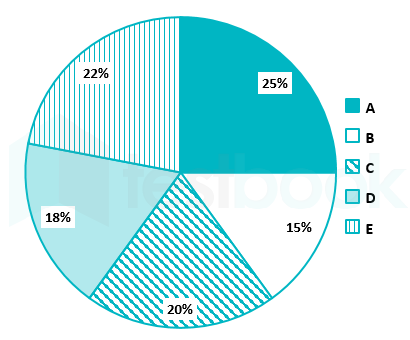
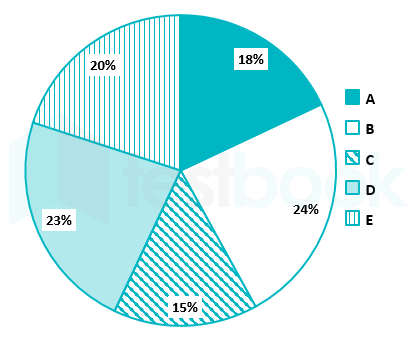
Directions: The following direction shows the percentage distribution of number of (Male + Female) studying in five different colleges and the second pie chart shows the percentage distribution of the number of males studying in five different colleges A, B, C, D and E.


Total number of students (Male + Female) = 2500


Total number of male students = 1200


Find the ratio between the number of male students studying in A and B to the number of female students studying in A and B.

  1. AOption (a)

    43: 78

  2. BOption (b)

    31: 57

  3. COption (c)

    59: 78

  4. DOption (d)

    48: 57

  5. EOption (e)

    38: 43

View answer & explanation

Correct answer

Answer: (d)D.

48: 57

Why this answer is correct

General solution:


College A:

Number students studying in college  = 2500 ×  (18/100) = 450

Number of male students studying = 1200 ×  (25/100) = 300

Number of female students studying = (450 - 300) = 150


College B:

Number students studying in college  = 2500 ×  (24/100) = 600

Number of male students studying = 1200 ×  (15/100) = 180

Number of female students studying = (600 - 180) = 420


College C:

Number students studying in college  = 2500 ×  (15/100) = 375

Number of male students studying = 1200 ×  (20/100) = 240

Number of female students studying = (375 - 240) = 135


College D:

Number students studying in college  = 2500 ×  (23/100) = 575

Number of male students studying = 1200 ×  (18/100) = 216

Number of female students studying = (575 - 216) = 359


College E:

Number students studying in college  = 2500 ×  (20/100) = 500

Number of male students studying = 1200 ×  (22/100) = 264

Number of female students studying = (500 - 264) = 236


CollegesNumber of male studentsNumber of female students
A300150
B180420
C240135
D216359
E264236


Solution:

Number of male students studying in A = 300

Number of male students studying in B = 180

Number of female students studying in A = 150

Number of female students studying B = 420

Required ratio = (300 + 180): (150+ 420) = (480 : 570) = 48: 57

IBPS PO Prelims Memory Based Paper (Held On: 30 September 2023 Shift 1) (Previous Year Paper)·Quantitative Aptitude
View full paper

Question 752

IBPS Probationary Officer (PO) 2023• Quantitative Aptitude• Quantitative Aptitude

Directions: The following direction shows the percentage distribution of number of (Male + Female) studying in five different colleges and the second pie chart shows the percentage distribution of the number of males studying in five different colleges A, B, C, D and E.


Total number of students (Male + Female) = 2500


Total number of male students = 1200


In college A, ages of 1/4th of total males is more than 30 years and ages of 3/5th of total females is less than 30 years. Find the difference between number of males who are less than or equal to 30 yrs and the number of females who are more than or equal to 30 years in college A.

  1. AOption (a)

    200

  2. BOption (b)

    110

  3. COption (c)

    165

  4. DOption (d)

    160

  5. EOption (e)

    230

View answer & explanation

Correct answer

Answer: (c)C.

165

Why this answer is correct

General solution:


College A:

Number students studying in college  = 2500 ×  (18/100) = 450

Number of male students studying = 1200 ×  (25/100) = 300

Number of female students studying = (450 - 300) = 150


College B:

Number students studying in college  = 2500 ×  (24/100) = 600

Number of male students studying = 1200 ×  (15/100) = 180

Number of female students studying = (600 - 180) = 420


College C:

Number students studying in college  = 2500 ×  (15/100) = 375

Number of male students studying = 1200 ×  (20/100) = 240

Number of female students studying = (375 - 240) = 135


College D:

Number students studying in college  = 2500 ×  (23/100) = 575

Number of male students studying = 1200 ×  (18/100) = 216

Number of female students studying = (575 - 216) = 359


College E:

Number students studying in college  = 2500 ×  (20/100) = 500

Number of male students studying = 1200 ×  (22/100) = 264

Number of female students studying = (500 - 264) = 236


CollegesNumber of male studentsNumber of female students
A300150
B180420
C240135
D216359
E264236


Solution:

Number of males more than 30 years from college A = 300 × 1/4 = 75

Number of males less than 30 years from college A = (300 - 75) = 225

Number of females less than 30 years from college A = 3/5 ×  150 = 90

Number of females more than 30 years = (150 - 90) = 60

Required difference = 225 - 60 = 165

IBPS PO Prelims Memory Based Paper (Held On: 30 September 2023 Shift 1) (Previous Year Paper)·Quantitative Aptitude
View full paper

Question 753

IBPS Probationary Officer (PO) 2023• Quantitative Aptitude• Quantitative Aptitude

Directions: The following direction shows the percentage distribution of number of (Male + Female) studying in five different colleges and the second pie chart shows the percentage distribution of the number of males studying in five different colleges A, B, C, D and E.


Total number of students (Male + Female) = 2500


Total number of male students = 1200


Out of the total number of females in college A, the number of females who are from cities is 40% of the total female students in that college and rest are from villages. Find the sum of number of females in college A who are from villages and total number of females who are in college D.

  1. AOption (a)

    379

  2. BOption (b)

    346

  3. COption (c)

    449

  4. DOption (d)

    426

  5. EOption (e)

    422

View answer & explanation

Correct answer

Answer: (c)C.

449

Why this answer is correct

General solution:


College A:

Number students studying in college  = 2500 ×  (18/100) = 450

Number of male students studying = 1200 ×  (25/100) = 300

Number of female students studying = (450 - 300) = 150


College B:

Number students studying in college  = 2500 ×  (24/100) = 600

Number of male students studying = 1200 ×  (15/100) = 180

Number of female students studying = (600 - 180) = 420


College C:

Number students studying in college  = 2500 ×  (15/100) = 375

Number of male students studying = 1200 ×  (20/100) = 240

Number of female students studying = (375 - 240) = 135


College D:

Number students studying in college  = 2500 ×  (23/100) = 575

Number of male students studying = 1200 ×  (18/100) = 216

Number of female students studying = (575 - 216) = 359


College E:

Number students studying in college  = 2500 ×  (20/100) = 500

Number of male students studying = 1200 ×  (22/100) = 264

Number of female students studying = (500 - 264) = 236


CollegesNumber of male studentsNumber of female students
A300150
B180420
C240135
D216359
E264236


Solution:

Total females in college A = 150

Number of females from college A from cities = 150 ×  40/100 = 60

Number of females from college A from village = (150 - 60) = 90

Number of females from college D = 359

Required total = (359 + 90) = 449

IBPS PO Prelims Memory Based Paper (Held On: 30 September 2023 Shift 1) (Previous Year Paper)·Quantitative Aptitude
View full paper

Question 754

IBPS Probationary Officer (PO) 2023• Quantitative Aptitude• Quantitative Aptitude

Directions: The following direction shows the percentage distribution of number of (Male + Female) studying in five different colleges and the second pie chart shows the percentage distribution of the number of males studying in five different colleges A, B, C, D and E.


Total number of students (Male + Female) = 2500


Total number of male students = 1200


If 2/5th of the female students in college C and 1/2 of the female students in college E are participating in a sports competition and 2/3rd of the total students in college C and 3/5th of the total students in college E are participating in the sports competition, find number of males participating in sports competition from C and E.

  1. AOption (a)

    324

  2. BOption (b)

    378

  3. COption (c)

    346

  4. DOption (d)

    392

  5. EOption (e)

    356

View answer & explanation

Correct answer

Answer: (b)B.

378

Why this answer is correct

General solution:


College A:

Number students studying in college  = 2500 ×  (18/100) = 450

Number of male students studying = 1200 ×  (25/100) = 300

Number of female students studying = (450 - 300) = 150


College B:

Number students studying in college  = 2500 ×  (24/100) = 600

Number of male students studying = 1200 ×  (15/100) = 180

Number of female students studying = (600 - 180) = 420


College C:

Number students studying in college  = 2500 ×  (15/100) = 375

Number of male students studying = 1200 ×  (20/100) = 240

Number of female students studying = (375 - 240) = 135


College D:

Number students studying in college  = 2500 ×  (23/100) = 575

Number of male students studying = 1200 ×  (18/100) = 216

Number of female students studying = (575 - 216) = 359


College E:

Number students studying in college  = 2500 ×  (20/100) = 500

Number of male students studying = 1200 ×  (22/100) = 264

Number of female students studying = (500 - 264) = 236


CollegesNumber of male studentsNumber of female students
A300150
B180420
C240135
D216359
E264236


Solution:


Number of female students in college C participating in sports competition = 2/5 ×  135 = 54

Number of female students in college E participating in sports competition =236 ×  1/2 = 118

Total number of students participating in sports from college C = 375 ×  2/3 = 250

Total number of students participating in sports from college E = 500 ×  3/5 = 300

Number of male participating in sports from college C = 250 - 54 = 196

Number of male participating in sports from college E = 300 - 118 = 182

Total number of males participating in sports competition from C and E = (196 + 182) = 378

IBPS PO Prelims Memory Based Paper (Held On: 30 September 2023 Shift 1) (Previous Year Paper)·Quantitative Aptitude
View full paper

Question 755

IBPS Probationary Officer (PO) 2023• Quantitative Aptitude• Quantitative Aptitude

Directions: The following direction shows the percentage distribution of number of (Male + Female) studying in five different colleges and the second pie chart shows the percentage distribution of the number of males studying in five different colleges A, B, C, D and E.


Total number of students (Male + Female) = 2500


Total number of male students = 1200


Out of the total female students in college B, the number of female who are doing post graduation in Evening shift is equal to the average of the number of male students in college D and E. The rest of the female students are doing post graduation in the morning shift. Find the difference between the number of females who are doing post graduation in morning shift from college B and the number of female students in college A.

  1. AOption (a)

    40

  2. BOption (b)

    90

  3. COption (c)

    30

  4. DOption (d)

    10

  5. EOption (e)

    80

View answer & explanation

Correct answer

Answer: (c)C.

30

Why this answer is correct

General solution:


College A:

Number students studying in college  = 2500 ×  (18/100) = 450

Number of male students studying = 1200 ×  (25/100) = 300

Number of female students studying = (450 - 300) = 150


College B:

Number students studying in college  = 2500 ×  (24/100) = 600

Number of male students studying = 1200 ×  (15/100) = 180

Number of female students studying = (600 - 180) = 420


College C:

Number students studying in college  = 2500 ×  (15/100) = 375

Number of male students studying = 1200 ×  (20/100) = 240

Number of female students studying = (375 - 240) = 135


College D:

Number students studying in college  = 2500 ×  (23/100) = 575

Number of male students studying = 1200 ×  (18/100) = 216

Number of female students studying = (575 - 216) = 359


College E:

Number students studying in college  = 2500 ×  (20/100) = 500

Number of male students studying = 1200 ×  (22/100) = 264

Number of female students studying = (500 - 264) = 236


CollegesNumber of male studentsNumber of female students
A300150
B180420
C240135
D216359
E264236


Solution:

Total number of female in college B = 420

Number of female doing Post graduate evening shift in college B = (216 + 264)/2 = 240

Number of female doing Post graduate Morning shift in college B = (420 - 240) = 180

Number of female students in college A = 150

Required difference = (180 - 150) = 30

IBPS PO Prelims Memory Based Paper (Held On: 30 September 2023 Shift 1) (Previous Year Paper)·Quantitative Aptitude
View full paper

Question 756

IBPS Probationary Officer (PO) 2023• Quantitative Aptitude• Quantitative Aptitude

There are two candidates participated in an election. It was found that 25% of votes were invalid. One who won the election got 70% of total valid votes, if the total number of votes are 84000. Find the number of valid votes that the other candidate got.

  1. AOption (a)

    17500

  2. BOption (b)

    18500

  3. COption (c)

    17800

  4. DOption (d)

    18900

  5. EOption (e)

    None of these 

View answer & explanation

Correct answer

Answer: (d)D.

18900

Why this answer is correct

Shortcut Trick

Total Votes = 84000

Valid Votes = 75% of 84000 = 63000

Winner got 70% of Valid Votes → Other candidate got 30% of Valid Votes.

Other Candidate Votes = 30% of 63000 = 18900.

∴ The correct answer is 18900.

Alternate Method

Given:

Total number of votes = 84000

Invalid votes = 25%

Winner's share = 70% of valid votes

Calculations:

⇒ Valid votes = Total votes − 25% of Total votes

⇒ Valid votes = 84000 × (75/100) = 63000

⇒ Since the winner got 70% of valid votes, the other candidate got (100 − 70) = 30% of valid votes.

⇒ Other candidate's votes = 30% of 63000

⇒ Other candidate's votes = (30/100) × 63000 = 18900

∴ The correct answer is 18900.

Additional Information

Election Based Percentages

In election problems, always distinguish between total votes, votes cast, and valid votes. The winning margin is usually calculated on valid votes.

Successive Percentage

The calculation can be combined as: Final Value = Total × (Valid % / 100) × (Candidate % / 100).

IBPS PO Prelims Memory Based Paper (Held On: 30 September 2023 Shift 1) (Previous Year Paper)·Quantitative Aptitude
View full paper

Question 757

IBPS Probationary Officer (PO) 2023• Quantitative Aptitude• Quantitative Aptitude

Sunita can finish a project in 21 days and Sarita can finish the same project in 15 days. Sarita worked for 10 days and left the job. How many days would it take Sunita to finish the remaining work alone?

  1. AOption (a)

    10 days

  2. BOption (b)

    7 days

  3. COption (c)

    12 days

  4. DOption (d)

    11 days

  5. EOption (e)

    8 days

View answer & explanation

Correct answer

Answer: (b)B.

7 days

Why this answer is correct

Shortcut Trick

Total Work (LCM of 21 and 15) = 105 units.

Efficiency of Sunita = 105 ÷ 21 = 5 units/day.

Efficiency of Sarita = 105 ÷ 15 = 7 units/day.

Work done by Sarita in 10 days = 7 × 10 = 70 units.

Remaining work = 105 − 70 = 35 units.

Time taken by Sunita = 35 ÷ 5 = 7 days.

∴ The correct answer is 7 days.

Alternate Method

PersonDaysTotal WorkEfficiency
Sunita211055
Sarita157

Given:

Time taken by Sunita = 21 days

Time taken by Sarita = 15 days

Calculations:

⇒ Total work = LCM(21, 15) = 105 units

⇒ 1 day work of Sarita = 105 ÷ 15 = 7 units

⇒ Work completed by Sarita in 10 days = 7 × 10 = 70 units

⇒ Remaining work = 105 − 70 = 35 units

⇒ 1 day work of Sunita = 105 ÷ 21 = 5 units

⇒ Time taken by Sunita to complete remaining work = 35 ÷ 5 = 7 days

∴ The correct answer is 7 days.

Additional Information

Work and Efficiency Relation

Total Work = Efficiency × Time. Efficiency is inversely proportional to the time taken to complete the work.

Remaining Work Formula

Time for remaining work = (Total Work − Work already done) ÷ Efficiency of the person completing it.

LCM Method

Assuming Total Work as the Least Common Multiple (LCM) of the given number of days simplifies calculations by avoiding fractions.

IBPS PO Prelims Memory Based Paper (Held On: 30 September 2023 Shift 1) (Previous Year Paper)·Quantitative Aptitude
View full paper

Question 758

IBPS Probationary Officer (PO) 2023• Quantitative Aptitude• Quantitative Aptitude

What should come in the place of (?) in the given series?

244, 100, 269, 73, 298, (?)

  1. AOption (a)

    38

  2. BOption (b)

    56

  3. COption (c)

    65

  4. DOption (d)

    42

  5. EOption (e)

    50

View answer & explanation

Correct answer

Answer: (d)D.

42

Why this answer is correct

Given series:

244, 100, 269, 73, 298, (?)

The logic followed here is:

⇒ 244 - (12)2 = 100

⇒ 100 + (13)2 = 269

⇒ 269 - (14)2 = 73

⇒ 73 + (15)2 = 298

⇒ 298 - (16)2 = 42

Hence, 42 will come in the place of (?).

IBPS PO Prelims Memory Based Paper (Held On: 30 September 2023 Shift 1) (Previous Year Paper)·Quantitative Aptitude
View full paper

Question 759

IBPS Probationary Officer (PO) 2023• Quantitative Aptitude• Quantitative Aptitude

What should come in the place of (?) in the given series?

121, 130, 119, 132, (?), 134

  1. AOption (a)

    120

  2. BOption (b)

    115

  3. COption (c)

    116

  4. DOption (d)

    117

  5. EOption (e)

    118

View answer & explanation

Correct answer

Answer: (d)D.

117

Why this answer is correct

Given Series:

121, 130, 119, 132, (?), 134

The logic followed here is as follows:

⇒ 121 + 9 = 130

⇒ 130 - 11 = 119

⇒ 119 + 13 = 132

⇒ 132 - 15 = 117

⇒ 117 + 17 = 134

Hence, 117 will come in the place of (?).

IBPS PO Prelims Memory Based Paper (Held On: 30 September 2023 Shift 1) (Previous Year Paper)·Quantitative Aptitude
View full paper

Question 760

IBPS Probationary Officer (PO) 2023• Quantitative Aptitude• Quantitative Aptitude

What should come in place of the question mark '?' in the following number series?

2, 3, 5, 9, 17, (?), 65

  1. AOption (a)

    30

  2. BOption (b)

    28

  3. COption (c)

    35

  4. DOption (d)

    33

  5. EOption (e)

    32

View answer & explanation

Correct answer

Answer: (d)D.

33

Why this answer is correct

Given Series:

2, 3, 5, 9, 17, (?), 65

The logic followed here is as follows:

⇒ 2 + 1 = 3

⇒ 3 + 2 = 5

⇒ 5 + 4 = 9

⇒ 9 + 8 = 17

⇒ 17 + 16 = 33

⇒ 33 + 32 = 65

Hence, 33 will come in the place of (?).

How should I prepare for Quantitative Aptitude in IBPS Probationary Officer (PO)?

Solving previous year questions by topic helps identify recurring concepts, question patterns, and frequently asked sub-topics. Attempt each question, review the step-by-step explanation, and note down key formulas or facts for quick revision before the exam.