IBPS Probationary Officer (PO) · Topic Collection

Quantitative Aptitude PYQs

Arithmetic, number systems, percentages, ratios, profit and loss, time and work, algebra, geometry, mensuration, and trigonometry.

1305 Total Questions38 Official PapersYears: 2021–2026Search in Quantitative Aptitude
Showing questions 421–440 of 1305Page 22 of 66
IBPS PO Prelims Memory Based Paper (Held On: 19 October 2024 Shift 2) (Previous Year Paper)·Quantitative Aptitude
View full paper

Question 421

IBPS Probationary Officer (PO) 2024• Quantitative Aptitude• Quantitative Aptitude

Directions: Study the following information carefully and answer the questions.

Following information shows the data regarding number of runs scored by A, B, C and D in Test, ODI and T20 matches.

The runs scored by C in T20 matches are 40 more than one-third of the runs scored by A in Test matches. The average of the total runs scored by A is 230, and the runs scored by him in ODIs are 55% of the runs scored in Test matches. In ODIs, D scored 42 runs fewer than C, while B scored exactly one-third of the runs scored by A, and the total sum of runs scored by B, C, and D in ODIs is 471. In Test matches, D scored 4 times the runs he scored in ODIs, while C scored 8 more runs than D in the same format. In T20 matches, C and D scored 180 and 95 runs respectively. The runs scored by C in Test matches are twice the runs scored by B in the same format. The runs scored by B in T20 matches are one-seventh of the runs scored by him in ODIs.

If 25% of B's total runs were disqualified due to a rule violation, and 20% of D's T20 runs were added to A's T20 runs, what would be the new total runs of A and B together?

  1. AOption (a)

    1041

  2. BOption (b)

    1042

  3. COption (c)

    1047

  4. DOption (d)

    1409

  5. EOption (e)

    1408

View answer & explanation

Correct answer

Answer: (b)B.

1042

Why this answer is correct

General Solution:

Let the runs scored by A in Test matches = x

Then:

ODIs = 55% of x = 0.55x

T20s = Total of A’s average = 230 × 3 = 690

So, A's T20 runs = 690 − (x + 0.55x) = 690 − 1.55x

C's T20 runs = 40 more than one-third of A’s Test runs:

C's T20 = (1/3) × x + 40

We're told:

C and D scored 180 and 95 runs respectively in T20

So:

C's T20 = 180 = (1/3)x + 40

⇒ (1/3)x = 140 ⇒ x = 420

Now that we know x = 420, substitute values for A:

A's Test = 420

A's ODI = 0.55 × 420 = 231

A's T20 = 690 − (420 + 231) = 39

ODI data:

C's ODI = c

D's ODI = c − 42

B's ODI = (1/3) × A ODI = (1/3) × 231 = 77

Total ODI by B, C, D = 471

⇒ 77 + c + (c − 42) = 471

⇒ 2c + 35 = 471 ⇒ 2c = 436 ⇒ c = 218

So:

C's ODI = 218

D's ODI = 176

B's ODI = 77

Test Match Data:

D's Test = 4 × D ODI = 4 × 176 = 704

C's Test = D's Test + 8 = 712

Also:

C's Test = 2 × B's Test ⇒ B's Test = 712 / 2 = 356

T20 Data:

C's T20 = 180 (already given)

D's T20 = 95

B's T20 = (1/7) × B ODI = (1/7) × 77 = 11

Thus,

PlayerTestODIT20
A42023139
B3567711
C712218180
D70417695


Calculations:

A's Original Total:

Test: 420

ODI: 231

T20: 39

Total A = 420 + 231 + 39 = 690

B's Original Total:

Test: 356

ODI: 77

T20: 11

Total B = 356 + 77 + 11 = 444

Adjustments:

B’s Disqualified Runs:

25% of 444 =

→ 444 × (25/100) = 111

→ New B total = 444 − 111 = 333

A gets 20% of D’s T20 runs added:

→ D’s T20 = 95

→ 20% of 95 = 19

→ New A total = 690 + 19 = 709

New Total = 333 + 709 = 1042

Thus, the correct answer is 1042.
IBPS PO Prelims Memory Based Paper (Held On: 19 October 2024 Shift 2) (Previous Year Paper)·Quantitative Aptitude
View full paper

Question 422

IBPS Probationary Officer (PO) 2024• Quantitative Aptitude• Quantitative Aptitude

Priya and Rahul started a project together, and after 'k' days, Priya left and Rahul finished the remaining project in 8 days. The time taken by Rahul and Priya alone to complete the whole project are in the ratio 2:1 respectively. If Rahul can complete the entire project in 20 days, then calculate the value of 'k'.

  1. AOption (a)

    3 days

  2. BOption (b)

    4 days

  3. COption (c)

    5 days

  4. DOption (d)

    6 days

  5. EOption (e)

    7 days

View answer & explanation

Correct answer

Answer: (b)B.

4 days

Why this answer is correct

Shortcut Trick

Ratio of Time for Rahul and Priya = 2 : 1

Ratio of Efficiency (Inverse of time) = 1 : 2

Total work = Rahul efficiency × Rahul days = 1 × 20 = 20 units

Work done by Rahul in last 8 days = 8 × 1 = 8 units

Work done by both in k days = 20 − 8 = 12 units

k = 12 ÷ (1 + 2) = 4 days

∴ The correct answer is 4 days.

Alternate Method

Given: Time taken by Rahul = 20 days. Ratio of time (Rahul : Priya) = 2 :

  1. Formula Used: Total Work = Efficiency × Time; Work Done = (Combined Efficiency) × Time
PersonDaysTotal WorkEfficiency
Rahul202020 ÷ 20 = 1
Priya1020 ÷ 10 = 2

⇒ Time for Priya = 20 × (1/2) = 10 days.

⇒ Total work (LCM of 20, 10) = 20 units.

⇒ Rahul finished the remaining work in 8 days.

⇒ Work done by Rahul alone = 8 × 1 = 8 units.

⇒ Remaining work done by Priya and Rahul together = 20 − 8 = 12 units.

⇒ Combined efficiency = 1 + 2 = 3 units/day.

⇒ k = 12 ÷ 3 = 4 days.

∴ The correct answer is 4 days.

Additional Information

Efficiency and Time Relationship

Efficiency is inversely proportional to the time taken to complete a task. If time ratio is a:b, efficiency ratio is b:a.

Work and Wages

Wages are generally distributed in the ratio of the work done by each individual, which is (Efficiency × Time).

Alternate Day Work

In problems where people work on alternate days, find the work done in one complete cycle (e.g., 2 days) and then calculate total time.

IBPS PO Prelims Memory Based Paper (Held On: 19 October 2024 Shift 2) (Previous Year Paper)·Quantitative Aptitude
View full paper

Question 423

IBPS Probationary Officer (PO) 2024• Quantitative Aptitude• Quantitative Aptitude

Three times the length of a rectangle is equal to seven times its breadth. The area of the rectangle is 2352 sq. cm. What is the area of a square whose perimeter is equal to that of the rectangle?

  1. AOption (a)

    2500 sq. cm

  2. BOption (b)

    3025 sq. cm

  3. COption (c)

    2800 sq. cm

  4. DOption (d)

    3600 sq. cm

  5. EOption (e)

    None of these

View answer & explanation

Correct answer

Answer: (c)C.

2800 sq. cm

Why this answer is correct

Shortcut Trick

Ratio of Length (L) to Breadth (B) is 7 : 3.

Product of ratios = 7 × 3 = 21 units2. Given Area = 2352 cm2.

1 unit2 = 2352 ÷ 21 = 112 ⇒ 1 unit = √112 = 4√7.

Perimeter = 2(7 + 3) units = 20 units = 20 × 4√7 = 80√7 cm.

Square side = Perimeter ÷ 4 = 20√7 cm. Square Area = (20√7)2 = 400 × 7 = 2800 cm2.

∴ The correct answer is 2800 sq. cm.

Alternate Method

Given: 3 × L = 7 × B ⇒ L = 7x, B = 3x. Area = 2352 sq. cm.

Formula: Area = L × B | Perimeter = 2(L + B) | Square Area = (Perimeter/4)2

⇒ 7x × 3x = 2352

⇒ 21x2 = 2352

⇒ x2 = 112 ⇒ x = √112 = 4√7

⇒ Perimeter of Rectangle = 2(7x + 3x) = 20x = 20 × 4√7 = 80√7 cm

⇒ Side of Square (a) = Perimeter ÷ 4 = 80√7 ÷ 4 = 20√7 cm

⇒ Area of Square = a2 = (20√7)2 = 400 × 7 = 2800 sq. cm

∴ The correct answer is 2800 sq. cm.

Additional Information

Rectangle Properties

Area = Length × Breadth. Perimeter = 2 × (Length + Breadth). Diagonal = √(L2 + B2).

Square Properties

Area = side2. Perimeter = 4 × side. For a fixed perimeter, a square has the maximum area among all rectangles.

Ratio Application in Geometry

When dimensions are in ratio m:n, Area is proportional to (m×n) and Perimeter is proportional to (m+n).

IBPS PO Prelims Memory Based Paper (Held On: 19 October 2024 Shift 2) (Previous Year Paper)·Quantitative Aptitude
View full paper

Question 424

IBPS Probationary Officer (PO) 2024• Quantitative Aptitude• Quantitative Aptitude

Direction: In the given question, two equations numbered l and II are given. Solve both equations and mark the appropriate answer.

I. x² − 22x + 105 = 0

II. y² − 20y + 96 = 0

  1. AOption (a)

    x > y

  2. BOption (b)

    x < y

  3. COption (c)

    x ≤ y

  4. DOption (d)

    x ≥ y

  5. EOption (e)

    x = y or Relation cannot be determined

View answer & explanation

Correct answer

Answer: (e)E.

x = y or Relation cannot be determined

Why this answer is correct

Equation I: x² − 22x + 105 = 0

Find two numbers whose product = 105 and sum = 22:

⇒ Factors: (x − 15)(x − 7) = 0

⇒ x = 15, 7

Equation II: y² − 20y + 96 = 0

Find two numbers whose product = 96 and sum = 20:

⇒ Factors: (y − 12)(y − 8) = 0

⇒ y = 12, 8

Compare roots:

x₁ = 15 vs y₁ = 12 ⇒ x > y

x₂ = 7 vs y₂ = 8 ⇒ x < y

Since one x > y and one x < y ⇒ Relationship cannot be established

Thus, the correct answer is x = y or Relationship cannot be established.

IBPS PO Prelims Memory Based Paper (Held On: 19 October 2024 Shift 2) (Previous Year Paper)·Quantitative Aptitude
View full paper

Question 425

IBPS Probationary Officer (PO) 2024• Quantitative Aptitude• Quantitative Aptitude

Direction: In the given question, two equations numbered l and II are given. Solve both equations and mark the appropriate answer.

I. 4x² − 25 = 0

II. y² − 10y + 25 = 0

  1. AOption (a)

    x ≥ y

  2. BOption (b)

    x ≤ y

  3. COption (c)

    x < y

  4. DOption (d)

    x = y or Relation cannot be determined

  5. EOption (e)

    x > y

View answer & explanation

Correct answer

Answer: (c)C.

x < y

Why this answer is correct

Equation I: 4x² − 25 = 0

⇒ 4x² = 25 ⇒ x² = 25⁄4 ⇒ x = ±5⁄2

Equation II: y² − 10y + 25 = 0

⇒ (y − 5)² = 0 ⇒ y = 5

Possible x values: −2.5 and 2.5

y = 5

Both −2.5 < 5 and 2.5 < 5 ⇒ in every case x < y

Thus, the correct answer is x < y.

IBPS PO Prelims Memory Based Paper (Held On: 19 October 2024 Shift 2) (Previous Year Paper)·Quantitative Aptitude
View full paper

Question 426

IBPS Probationary Officer (PO) 2024• Quantitative Aptitude• Quantitative Aptitude

Direction: In the given question, two equations numbered l and II are given. Solve both equations and mark the appropriate answer.

I. x² − 11x + 24 = 0

II. y² + 6y − 135 = 0

  1. AOption (a)

    x ≥ y

  2. BOption (b)

    x < y

  3. COption (c)

    x ≤ y

  4. DOption (d)

    x = y or Relation cannot be determined

  5. EOption (e)

    x > y

View answer & explanation

Correct answer

Answer: (d)D.

x = y or Relation cannot be determined

Why this answer is correct

Equation I: x² − 11x + 24 = 0

Factor: Find two numbers that multiply to 24 and add up to −11

⇒ (x − 3)(x − 8) = 0

⇒ x = 3, 8

Equation II: y² + 6y − 135 = 0

Factor: Find two numbers that multiply to −135 and add up to 6

⇒ (y + 15)(y − 9) = 0

⇒ y = −15, 9

Now compare:

x = 3, 8

y = −15, 9

Compare each x with both y values:

3 < 9 and 3 > −15

8 < 9 and 8 > −15

So: x is less than y in one case and greater in another → No definite relation

Thus, the correct answer is x = y or Relationship cannot be established.

IBPS PO Prelims Memory Based Paper (Held On: 19 October 2024 Shift 2) (Previous Year Paper)·Quantitative Aptitude
View full paper

Question 427

IBPS Probationary Officer (PO) 2024• Quantitative Aptitude• Quantitative Aptitude

Direction: In the given question, two equations numbered l and II are given. Solve both equations and mark the appropriate answer.

I. x² − 35x + 294 = 0

II. y² − 38y + 345 = 0

  1. AOption (a)

    x > y

  2. BOption (b)

    x ≥ y

  3. COption (c)

    x < y

  4. DOption (d)

    x ≤ y

  5. EOption (e)

    x = y or Relation cannot be determined

View answer & explanation

Correct answer

Answer: (e)E.

x = y or Relation cannot be determined

Why this answer is correct

Equation I: x² − 35x + 294 = 0

⇒ Discriminant = 35² − 4×294 = 1225 − 1176 = 49

⇒ Roots: x = [35 ± 7] ÷ 2 ⇒ x = 21 or 14

Equation II: y² − 38y + 345 = 0

⇒ Discriminant = 38² − 4×345 = 1444 − 1380 = 64

⇒ Roots: y = [38 ± 8] ÷ 2 ⇒ y = 23 or 15

Possible values:

x ∈ {14, 21}

y ∈ {15, 23}

Since sometimes x < y (e.g. 14 < 15) and sometimes x > y (e.g. 21 > 15), the relationship between x and y cannot be uniquely determined.

Thus, the correct answer is x = y or relationship cannot be established.

IBPS PO Prelims Memory Based Paper (Held On: 19 October 2024 Shift 2) (Previous Year Paper)·Quantitative Aptitude
View full paper

Question 428

IBPS Probationary Officer (PO) 2024• Quantitative Aptitude• Quantitative Aptitude

Direction: In the given question, two equations numbered l and II are given. Solve both equations and mark the appropriate answer.

I. 12x² + 7x − 12 = 0

II. 8y² − 18y + 9 = 0

  1. AOption (a)

    x > y

  2. BOption (b)

    x = y or Relation cannot be determined

  3. COption (c)

    x < y

  4. DOption (d)

    x ≥ y

  5. EOption (e)

    x ≤ y

View answer & explanation

Correct answer

Answer: (e)E.

x ≤ y

Why this answer is correct

Equation I: 12x² + 7x − 12 = 0

⇒ Discriminant = 7² − 4 × 12 × (−12) = 49 + 576 = 625, √625 = 25

⇒ x = [−7 ± 25] ÷ (2 × 12) = [−7 ± 25] ÷ 24

x₁ = (18) ÷ 24 = 3/4 = 0.75

x₂ = (−32) ÷ 24 = −4/3 ≈ −1.333

Equation II: 8y² − 18y + 9 = 0

⇒ Discriminant = (−18)² − 4 × 8 × 9 = 324 − 288 = 36, √36 = 6

⇒ y = [18 ± 6] ÷ (2 × 8) = [18 ± 6] ÷ 16

y₁ = 24 ÷ 16 = 3/2 = 1.5

y₂ = 12 ÷ 16 = 3/4 = 0.75

Comparison of roots:

x₂ = −1.333 < y₂ = 0.75

x₁ = 0.75 = y₂ = 0.75

x₁ = 0.75 < y₁ = 1.5

x₂ = −1.333 < y₁ = 1.5

All x-values are ≤ all y-values.

Thus, the correct answer is x ≤ y.

IBPS PO Prelims Memory Based Paper (Held On: 19 October 2024 Shift 2) (Previous Year Paper)·Quantitative Aptitude
View full paper

Question 429

IBPS Probationary Officer (PO) 2024• Quantitative Aptitude• Quantitative Aptitude

Directions: Study the following information carefully and answer the questions.

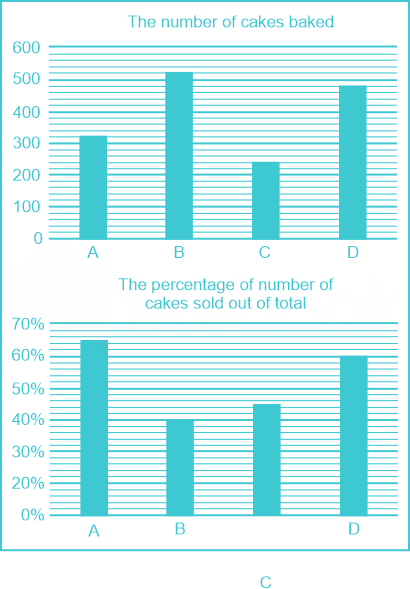
The given bar charts show the number of cakes baked (sold + unsold) in four different bakeries, i.e., A, B, C, and D, and also show the number of cakes sold out of the total number of cakes baked. 

If the unsold cakes from Bakery C and Bakery D are equally distributed among Bakery A and Bakery B, then what will be the new total number of cakes with Bakery A (sold + unsold + received)?

  1. AOption (a)

    412

  2. BOption (b)

    462

  3. COption (c)

    472

  4. DOption (d)

    388

  5. EOption (e)

    482

View answer & explanation

Correct answer

Answer: (e)E.

482

Why this answer is correct

General Solution:

Use the formula:

Cakes Sold = Total Baked × (Percentage Sold / 100)

Cakes Unsold = Total Baked − Cakes Sold

BakeryTotal Baked% SoldCakes SoldCakes Unsold
A32065%320 × 65 ÷ 100 = 208320 − 208 = 112
B52040%520 × 40 ÷ 100 = 208520 − 208 = 312
C24045%240 × 45 ÷ 100 = 108240 − 108 = 132
D48060%480 × 60 ÷ 100 = 288480 − 288 = 192


Calculations:

Find unsold cakes of Bakery C and D:

C (unsold) = 132

D (unsold) = 192

Total to distribute = 132 + 192 = 324

Divide equally between A and B:

Each receives = 324 ÷ 2 = 162

Find the original total cakes with Bakery A = 320

New total = 320 + 162 = 482

Thus, the correct answer is 482.

IBPS PO Prelims Memory Based Paper (Held On: 19 October 2024 Shift 2) (Previous Year Paper)·Quantitative Aptitude
View full paper

Question 430

IBPS Probationary Officer (PO) 2024• Quantitative Aptitude• Quantitative Aptitude

Directions: Study the following information carefully and answer the questions.

The given bar charts show the number of cakes baked (sold + unsold) in four different bakeries, i.e., A, B, C, and D, and also show the number of cakes sold out of the total number of cakes baked. 

If the average number of cakes, cup cakes and brownies baked in bakery A is 320 and the ratio of the number of brownies baked in bakery A to that of cakes are 3:4, then find the difference between the number of cup cakes baked in bakery A and the number of cakes sold by bakery D?

  1. AOption (a)

    75

  2. BOption (b)

    84

  3. COption (c)

    112

  4. DOption (d)

    96

  5. EOption (e)

    104

View answer & explanation

Correct answer

Answer: (c)C.

112

Why this answer is correct

General Solution:

Use the formula:

Cakes Sold = Total Baked × (Percentage Sold / 100)

Cakes Unsold = Total Baked − Cakes Sold

BakeryTotal Baked% SoldCakes SoldCakes Unsold
A32065%320 × 65 ÷ 100 = 208320 − 208 = 112
B52040%520 × 40 ÷ 100 = 208520 − 208 = 312
C24045%240 × 45 ÷ 100 = 108240 − 108 = 132
D48060%480 × 60 ÷ 100 = 288480 − 288 = 192


Calculations:

Given Information:

Average number of cakes, cupcakes, and brownies in Bakery A = 320

So, total items baked in A = 320 × 3 = 960

Out of this, the number of cakes baked = 320 (already given)

Let the number of brownies = b

Given: Ratio of brownies to cakes = 3:4

⇒ b / 320 = 3 / 4 ⇒ b = (3/4) × 320 = 240

Find the number of cupcakes in A:

Total baked = cakes + brownies + cupcakes = 960

⇒ Cupcakes = 960 − (320 + 240) = 400

Number of cakes sold by Bakery D:

Total cakes baked by D = 480

Sold % = 60%

⇒ Cakes sold = 60% of 480 = (60/100) × 480 = 288

Find the required difference:

Difference = Cupcakes in A − Cakes sold by D = 400 − 288 = 112

Thus, the correct answer is 112.

IBPS PO Prelims Memory Based Paper (Held On: 19 October 2024 Shift 2) (Previous Year Paper)·Quantitative Aptitude
View full paper

Question 431

IBPS Probationary Officer (PO) 2024• Quantitative Aptitude• Quantitative Aptitude

Directions: Study the following information carefully and answer the questions.

The given bar charts show the number of cakes baked (sold + unsold) in four different bakeries, i.e., A, B, C, and D, and also show the number of cakes sold out of the total number of cakes baked. 

If the number of cakes baked in bakery D increased by 20% and the number of cakes sold in bakery D is 6 less, then find the ratio of the number of cakes sold that of unsold in bakery D, now?

  1. AOption (a)

    35:31

  2. BOption (b)

    52:57

  3. COption (c)

    27:23

  4. DOption (d)

    47:49

  5. EOption (e)

    51:59

View answer & explanation

Correct answer

Answer: (d)D.

47:49

Why this answer is correct

General Solution:

Use the formula:

Cakes Sold = Total Baked × (Percentage Sold / 100)

Cakes Unsold = Total Baked − Cakes Sold

BakeryTotal Baked% SoldCakes SoldCakes Unsold
A32065%320 × 65 ÷ 100 = 208320 − 208 = 112
B52040%520 × 40 ÷ 100 = 208520 − 208 = 312
C24045%240 × 45 ÷ 100 = 108240 − 108 = 132
D48060%480 × 60 ÷ 100 = 288480 − 288 = 192


Calculations:

Original Data for Bakery D:

Baked = 480

Sold = 60% of 480 = 288

Unsold = 480 − 288 = 192

Changes Given:

Baked increases by 20%

→ New baked = 480 + (20% of 480)

→ 480 + 96 = 576

Cakes sold decrease by 6:

→ New sold = 288 − 6 = 282

→ New unsold = 576 − 282 = 294

Required Ratio: Sold : Unsold = 282 : 294

Thus, the correct answer is 47:49.

IBPS PO Prelims Memory Based Paper (Held On: 19 October 2024 Shift 2) (Previous Year Paper)·Quantitative Aptitude
View full paper

Question 432

IBPS Probationary Officer (PO) 2024• Quantitative Aptitude• Quantitative Aptitude

Directions: Study the following information carefully and answer the questions.

The given bar charts show the number of cakes baked (sold + unsold) in four different bakeries, i.e., A, B, C, and D, and also show the number of cakes sold out of the total number of cakes baked. 

The difference between the number of cakes sold by bakeries A and C is how much percent of the number of cakes baked by bakery B?

  1. AOption (a)

    68.63%

  2. BOption (b)

    19.23%

  3. COption (c)

    46.56%

  4. DOption (d)

    36.5%

  5. EOption (e)

    17.35%

View answer & explanation

Correct answer

Answer: (b)B.

19.23%

Why this answer is correct

General Solution:

Use the formula:

Cakes Sold = Total Baked × (Percentage Sold / 100)

Cakes Unsold = Total Baked − Cakes Sold

BakeryTotal Baked% SoldCakes SoldCakes Unsold
A32065%320 × 65 ÷ 100 = 208320 − 208 = 112
B52040%520 × 40 ÷ 100 = 208520 − 208 = 312
C24045%240 × 45 ÷ 100 = 108240 − 108 = 132
D48060%480 × 60 ÷ 100 = 288480 − 288 = 192


Calculations:

Find cakes sold by A and C:

A Sold = 320 × 65 ÷ 100 = 208

C Sold = 240 × 45 ÷ 100 = 108

Find the difference:

⇒ 208 − 108 = 100

Find % of cakes baked by B (which is 520):

⇒ (100 ÷ 520) × 100 = 19.23%

Thus, the correct answer is 19.23%.

IBPS PO Prelims Memory Based Paper (Held On: 19 October 2024 Shift 2) (Previous Year Paper)·Quantitative Aptitude
View full paper

Question 433

IBPS Probationary Officer (PO) 2024• Quantitative Aptitude• Quantitative Aptitude

Directions: Study the following information carefully and answer the questions.

The given bar charts show the number of cakes baked (sold + unsold) in four different bakeries, i.e., A, B, C, and D, and also show the number of cakes sold out of the total number of cakes baked. 

If 50% of the unsold cakes in bakery D were donated to a charity and 25% of the sold cakes in bakery B were returned due to quality issues, what is the difference between the number of donated cakes from bakery D and the number of returned cakes from bakery B?

  1. AOption (a)

    46

  2. BOption (b)

    28

  3. COption (c)

    44

  4. DOption (d)

    32

  5. EOption (e)

    34

View answer & explanation

Correct answer

Answer: (c)C.

44

Why this answer is correct

General Solution:

Use the formula:

Cakes Sold = Total Baked × (Percentage Sold / 100)

Cakes Unsold = Total Baked − Cakes Sold

BakeryTotal Baked% SoldCakes SoldCakes Unsold
A32065%320 × 65 ÷ 100 = 208320 − 208 = 112
B52040%520 × 40 ÷ 100 = 208520 − 208 = 312
C24045%240 × 45 ÷ 100 = 108240 − 108 = 132
D48060%480 × 60 ÷ 100 = 288480 − 288 = 192


Calculations:

Bakery D:

Unsold cakes = 192

Donated cakes = 50% of 192 = 192 × 0.5 = 96

Bakery B:

Sold cakes = 208

Returned cakes = 25% of 208 = 208 × 0.25 = 52

Required difference = 96 − 52 = 44

Thus, the correct answer is 44.

IBPS PO Prelims Memory Based Paper (Held On: 19 October 2024 Shift 2) (Previous Year Paper)·Quantitative Aptitude
View full paper

Question 434

IBPS Probationary Officer (PO) 2024• Quantitative Aptitude• Quantitative Aptitude

Two containers X and Y contain a mixture of milk and water. In container X, the ratio of milk to water is 5:2. In container Y, the ratio of milk to water is 3:4. The mixtures from X and Y are mixed together in the ratio 7:5 respectively to form a new mixture. How much milk is present in 84 liters of the new mixture?

  1. AOption (a)

    49 litres

  2. BOption (b)

    50 litres

  3. COption (c)

    60 litres

  4. DOption (d)

    35 litres

  5. EOption (e)

    None of these

View answer & explanation

Correct answer

Answer: (b)B.

50 litres

Why this answer is correct

Shortcut Trick

Milk in X = 5/7 and Milk in Y = 3/7.

Since X and Y are mixed in ratio 7:5, let volumes be 7 and 5 units.

Total Milk = (7 × 5/7) + (5 × 3/7) = 5 + 15/7 = 50/7 units.

Total Mixture = 7 + 5 = 12 units.

Milk in 84 litres = (Total Milk / Total Mixture) × 84 = (50/7 / 12) × 84 = 50 litres.

∴ The correct answer is 50 litres.

Alternate Method

Given: Ratio in X = 5:2, Ratio in Y = 3:4, Mixing Ratio X:Y = 7:5, Total New Mixture = 84 litres.

⇒ Quantity of X in new mixture = (7 / 12) × 84 = 49 litres

⇒ Quantity of Y in new mixture = (5 / 12) × 84 = 35 litres

⇒ Milk from X = 49 × (5 / 7) = 35 litres

⇒ Milk from Y = 35 × (3 / 7) = 15 litres

⇒ Total Milk in new mixture = 35 + 15 = 50 litres

∴ The correct answer is 50 litres.

Additional Information

Alligation Method

Used to find the ratio in which two ingredients are mixed. Mean concentration = (Quantity1 × C1 + Quantity2 × C2) / (Quantity1 + Quantity2).

Ratio of Fractions

When mixing containers of different ratios, always convert the component (Milk or Water) into a fraction of the total volume before applying the mixing ratio.

IBPS PO Prelims Memory Based Paper (Held On: 19 October 2024 Shift 2) (Previous Year Paper)·Quantitative Aptitude
View full paper

Question 435

IBPS Probationary Officer (PO) 2024• Quantitative Aptitude• Quantitative Aptitude

The average weight of 12 bags of rice is 45 kg. When the weights of 3 bags of rice with weights (w+5) kg, (w−15) kg, and (w+40) kg are added, the average weight is increased by 2 kg. Find the value of 'w'.

  1. AOption (a)

    30 kg

  2. BOption (b)

    35 kg

  3. COption (c)

    40 kg

  4. DOption (d)

    45 kg

  5. EOption (e)

    50 kg

View answer & explanation

Correct answer

Answer: (d)D.

45 kg

Why this answer is correct

Shortcut Trick

Initial average for 12 bags = 45 kg.

New average for 15 bags = 45 + 2 = 47 kg.

Sum of 3 new bags = (New average × Total count) − (Old average × Old count)

Sum = (47 × 15) − (45 × 12) = 705 − 540 = 165 kg.

3w + 30 = 165 ⇒ 3w = 135 ⇒ w = 45 kg.

∴ The correct answer is 45 kg.

Alternate Method

Given:

Number of initial rice bags = 12

Initial average weight = 45 kg

Weights of added bags = (w + 5), (w − 15), (w + 40)

Calculations:

⇒ Total weight of 12 bags = 12 × 45 = 540 kg

⇒ Sum of 3 new bags = (w + 5) + (w − 15) + (w + 40) = 3w + 30 kg

⇒ New total count of bags = 12 + 3 = 15

⇒ New average weight = 45 + 2 = 47 kg

⇒ Total weight of 15 bags = 15 × 47 = 705 kg

⇒ 540 + (3w + 30) = 705

⇒ 3w + 570 = 705

⇒ 3w = 705 − 570 = 135

⇒ w = 135 ÷ 3 = 45 kg

∴ The correct answer is 45 kg.

Additional Information

Average formula

Average = (Sum of all observations) ÷ (Number of observations). Sum = Average × Count.

Deviation method

Net change in average = (Total surplus/deficit) ÷ (Total number of items). This is useful for finding the value of new entrants.

Weighted Average

Combined Average = (n1 × a1 + n2 × a2) ÷ (n1 + n2), where n is count and a is average.

IBPS PO Prelims Memory Based Paper (Held On: 19 October 2024 Shift 4) (Previous Year Paper)·Quantitative Aptitude
View full paper

Question 436

IBPS Probationary Officer (PO) 2024• Quantitative Aptitude• Quantitative Aptitude

10 years ago, Age of Shagun's grandfather is 5 times the Shagun's age and after 5 years from now, age of Shagun's Grandfather will be 3 times the age of Shagun. Find the ratio and Shagun and her grandfather's age before 5 years.

  1. AOption (a)

    1 : 3

  2. BOption (b)

    2 : 5

  3. COption (c)

    1 : 4

  4. DOption (d)

    3 : 5

  5. EOption (e)

    1 : 5

View answer & explanation

Correct answer

Answer: (c)C.

1 : 4

Why this answer is correct

Shortcut Trick

Ratio of Grandfather : Shagun was 5 : 1 (10 years ago) and will be 3 : 1 (after 5 years).

Gap between ratios = 10 + 5 = 15 years.

Equating differences: (5−1) × 1 = 4; (3−1) × 2 = 4 ⇒ New ratios: 5 : 1 and 6 : 2.

Difference of 1 unit = 15 years. Current ages: (5×15)+10 = 85 and (1×15)+10 = 25.

5 years ago ages: 80 and 20 ⇒ Ratio = 20 : 80 = 1 : 4.

∴ The correct answer is 1 : 4.

Alternate Method

Let Shagun's age 10 years ago be x and Grandfather's age be 5x.

⇒ Present ages: Shagun = x + 10, Grandfather = 5x + 10.

⇒ After 5 years: Shagun = x + 15, Grandfather = 5x + 15.

⇒ According to question: 5x + 15 = 3 × (x + 15)

⇒ 5x + 15 = 3x + 45

⇒ 2x = 30 ⇒ x = 15.

⇒ 5 years ago, Shagun's age = (x + 10) − 5 = x + 5 = 15 + 5 = 20.

⇒ 5 years ago, Grandfather's age = (5x + 10) − 5 = 5x + 5 = 75 + 5 = 80.

⇒ Ratio = 20 : 80 = 1 : 4.

∴ The correct answer is 1 : 4.

Additional Information

Ratio Difference Method

When the time gap is the same for two people, the difference between their ages remains constant. Use this to balance ratios.

Age Linear Equations

Always define variables at a specific point in time (like 10 years ago) to simplify calculations.

IBPS PO Prelims Memory Based Paper (Held On: 19 October 2024 Shift 4) (Previous Year Paper)·Quantitative Aptitude
View full paper

Question 437

IBPS Probationary Officer (PO) 2024• Quantitative Aptitude• Quantitative Aptitude

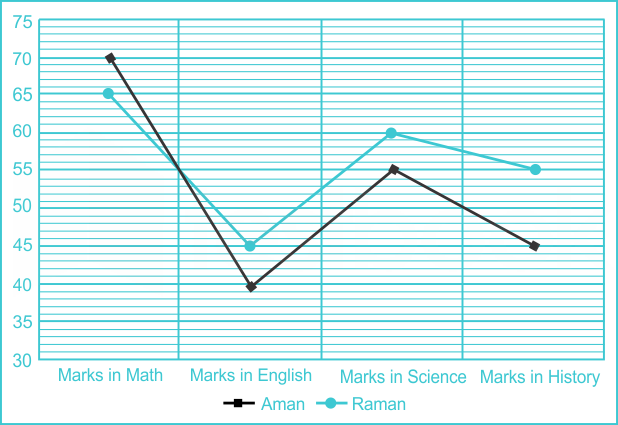
The line graphs shows the marks of Aman and Raman in four different subjectes in class IX exams.

What is the percentage difference between Aman’s average marks and Raman’s average marks in Class IX?

  1. AOption (a)

    7.14%

  2. BOption (b)

    2.22%

  3. COption (c)

    11.01%

  4. DOption (d)

    9%

  5. EOption (e)

    3.14%

View answer & explanation

Correct answer

Answer: (a)A.

7.14%

Why this answer is correct

Calculation

Aman’s total = 70 + 40 + 55 + 45 = 210

Raman’s total = 65 + 45 + 60 + 55 = 225

Aman’s average = 210 ÷ 4 = 52.5

Raman’s average = 225 ÷ 4 = 56.25

Percentage difference = [[56.25 − 52.5] /52.5 ] ×100

= [3.75/52.5] × 100 ≈ 7.14%

IBPS PO Prelims Memory Based Paper (Held On: 19 October 2024 Shift 4) (Previous Year Paper)·Quantitative Aptitude
View full paper

Question 438

IBPS Probationary Officer (PO) 2024• Quantitative Aptitude• Quantitative Aptitude

The line graphs shows the marks of Aman and Raman in four different subjectes in class IX exams.

Raman scored 45 marks in Class IX English. In Class X, he scored 30% more marks in Geography than what he scored in Class IX English. If total marks in Geography is 90, what is his percentage in Class X Geography?

  1. AOption (a)

    65%

  2. BOption (b)

    66%

  3. COption (c)

    88%

  4. DOption (d)

    42%

  5. EOption (e)

    445

View answer & explanation

Correct answer

Answer: (a)A.

65%

Why this answer is correct

Calculation

Class IX English = 45

Class X Geography = 45 × 1.30 = 58.5

Percentage = (58.5 / 90) × 100 = 65%

IBPS PO Prelims Memory Based Paper (Held On: 19 October 2024 Shift 4) (Previous Year Paper)·Quantitative Aptitude
View full paper

Question 439

IBPS Probationary Officer (PO) 2024• Quantitative Aptitude• Quantitative Aptitude

The line graphs shows the marks of Aman and Raman in four different subjectes in class IX exams.

Aman scored 20% more marks in each subject in Class X than he did in Class IX. Find Aman’s average marks in Class X.

  1. AOption (a)

    55

  2. BOption (b)

    63

  3. COption (c)

    57

  4. DOption (d)

    78

  5. EOption (e)

    69

View answer & explanation

Correct answer

Answer: (b)B.

63

Why this answer is correct

Calculations:

Math = 70 + 20% of 70 = 70 + 14 = 84

English = 40 + 20% of 40 = 40 + 8 = 48

Science = 55 + 20% of 55 = 55 + 11 = 66

History = 45 + 20% of 45 = 45 + 9 = 54

Total = 84 + 48 + 66 + 54 = 252

Average = 252 ÷ 4 = 63

∴ Aman’s average marks in Class X = 63

IBPS PO Prelims Memory Based Paper (Held On: 19 October 2024 Shift 4) (Previous Year Paper)·Quantitative Aptitude
View full paper

Question 440

IBPS Probationary Officer (PO) 2024• Quantitative Aptitude• Quantitative Aptitude

The line graphs shows the marks of Aman and Raman in four different subjectes in class IX exams.

The average marks of Aman and Raman in Class X History is 62. If Aman scored 66 marks, Find sum of marks did Raman score in history in class IX and X?

  1. AOption (a)

    113

  2. BOption (b)

    147

  3. COption (c)

    129

  4. DOption (d)

    327

  5. EOption (e)

    149

View answer & explanation

Correct answer

Answer: (a)A.

113

Why this answer is correct

Calculation

Let Raman’s marks = x

(66 + x) / 2 = 62 → 66 + x = 124 → x = 58

So, total 58 + 55 = 113

How should I prepare for Quantitative Aptitude in IBPS Probationary Officer (PO)?

Solving previous year questions by topic helps identify recurring concepts, question patterns, and frequently asked sub-topics. Attempt each question, review the step-by-step explanation, and note down key formulas or facts for quick revision before the exam.