Exam Guides
UPPSC PCS 2026: Complete Guide for UP State Civil Services
A detailed guide to UPPSC PCS 2026 covering SDM, DSP, and BDO posts, eligibility criteria, Prelims and Mains exam pattern, UP-specific topics that go beyond UPSC, salary structure, recommended books, and how to efficiently balance UPPSC and UPSC preparation simultaneously.
This legacy article was owner-approved for publication. Verify time-sensitive claims against current official sources before acting.

UPPSC PCS 2026: Complete Guide for UP State Civil Services
The Uttar Pradesh Public Service Commission (UPPSC) Provincial Civil Services (PCS) examination is the gateway to becoming a gazetted officer in India's most populous state. Covering prestigious posts like Sub-Divisional Magistrate (SDM), Deputy Superintendent of Police (DSP), Block Development Officer (BDO), and District Basic Education Officer (DBEO), PCS is a life-changing opportunity for lakhs of aspirants across UP.
With over 250+ posts typically notified and thousands of dedicated aspirants competing, UPPSC PCS requires a distinctly UP-focused preparation strategy — one that goes significantly beyond standard UPSC preparation.
---
| Post | Abbreviation | Department |
|---|---|---|
| Sub-Divisional Magistrate | SDM | Revenue / General Administration |
| Deputy Superintendent of Police | DSP | Police Department |
| Block Development Officer | BDO | Panchayati Raj / Rural Development |
| District Commandant Homeguard | — | Home Department |
| District Basic Education Officer | DBEO | Basic Education |
| Assistant Registrar (Cooperative) | — | Co-operative Department |
| Treasury Officer / Accounts Officer | TO/AO | Finance |
| District Cane Officer | — | Sugar Industry & Cane Development |
Posts Under UPPSC PCS
Post | Abbreviation | Department |
|---|---|---|
Sub-Divisional Magistrate | SDM | Revenue / General Administration |
Deputy Superintendent of Police | DSP | Police Department |
Block Development Officer | BDO | Panchayati Raj / Rural Development |
District Commandant Homeguard | — | Home Department |
District Basic Education Officer | DBEO | Basic Education |
Assistant Registrar (Cooperative) | — | Co-operative Department |
Treasury Officer / Accounts Officer | TO/AO | Finance |
District Cane Officer | — | Sugar Industry & Cane Development |
The SDM and DSP posts are the most coveted — they carry executive powers and are the direct UP equivalent of IAS and IPS at the sub-divisional level.
---
Eligibility Criteria
Educational Qualification: Any Graduate from a recognized University. Some posts have specific degree requirements (e.g., Law degree for certain legal posts).
Age Limit:
General (Male): 21–40 years
General (Female): 21–40 years (with additional relaxations for UP domicile)
OBC (Male): 21–45 years
SC/ST: 21–45 years
PwD: Additional 15-year relaxation
Domicile Requirement: For most posts, the candidate must be a UP domicile (permanent resident of Uttar Pradesh).
---
Preliminary Examination Pattern
Prelims is an objective screening test conducted on a single day:
Paper 1 — General Studies
Attribute | Detail |
|---|---|
Questions | 150 MCQs |
Marks | 200 |
Duration | 2 hours |
Negative Marking | 1/3rd mark per wrong answer |
Paper 2 — General Studies (CSAT)
Attribute | Detail |
|---|---|
Questions | 100 MCQs |
Marks | 200 |
Duration | 2 hours |
Qualifying Marks | 33% (66 marks) — Qualifying only |
Key difference from UPSC: Both papers have negative marking. CSAT is qualifying (like UPSC), but its structure is slightly different with more emphasis on mathematical aptitude and reasoning over reading comprehension.
Prelims GS Paper 1 Cutoff Trends:
Year | General | OBC | SC | ST |
|---|---|---|---|---|
2021 | 96.67 | 89.33 | 82.67 | 72.00 |
2022 | 102.33 | 94.67 | 88.00 | 76.00 |
2023 | 108.00 | 100.67 | 93.33 | 80.67 |
---
Mains Examination Pattern
Mains is a written/descriptive exam. Shortlisted candidates (typically 15× vacancies) appear:
Paper | Subject | Marks | Duration |
|---|---|---|---|
Paper 1 | General Hindi | 150 | 3 hours |
Paper 2 | Essay (Hindi) | 150 | 3 hours |
Paper 3 | General Studies I (History, Culture, Geography) | 200 | 2 hours |
Paper 4 | General Studies II (Economy, Agriculture, Commerce, Science) | 200 | 2 hours |
Paper 5 | General Studies III (Polity, Public Admin, Law, Social Justice) | 200 | 2 hours |
Paper 6 | General Studies IV (Ethics, Energy, Environment, Disaster) | 200 | 2 hours |
Paper 7 | Optional Subject Paper 1 | 200 | 2 hours |
Paper 8 | Optional Subject Paper 2 | 200 | 2 hours |
Total Marks: 1,500 (General Hindi + Essay + GS I–IV + Optional I & II)
General Hindi (Paper 1) is crucial and often ignored. A strong Hindi writing score (120+/150) significantly boosts overall rank.
---
Interview (Personality Test)
Marks: 100 (reduced from previous 200, making Mains more dominant in merit)
The Interview assesses personality, presence of mind, knowledge of current events, understanding of UP governance, and administrative aptitude. Knowing about UP-specific issues (farmers' problems, UP's industrial corridors, Purvanchal & Bundelkhand development) is highly appreciated.
Final Merit: Mains (1,500) + Interview (100) = 1,600 marks
---
UP-Specific Topics That Differ from UPSC
This is where most UPSC-focused aspirants make a critical mistake — they assume UPPSC preparation is a subset of UPSC. It is not. UPPSC has a distinct UP-centric syllabus that demands dedicated additional study:
UP History & Culture
Awadh (history, culture, cuisine, architecture — Lucknow, Faizabad, Sultanate period)
Braj Culture (Mathura-Vrindavan, Braj Bhasha literature, festivals)
Kashi Tradition (Varanasi — silk, music, Ganga Arti, Ghat culture)
UP's role in the 1857 Revolt (Meerut, Lucknow, Jhansi, Kanpur specificities)
Medieval UP under Nawabs of Awadh, Mughal administration in UP
Major dynasties: Gahadavalas, early Sultanate governors of UP
UP Geography & Economy
Doab regions: Ganga-Yamuna Doab, Ganga-Ghaghra Doab — agricultural importance
UP's rivers: Ganga, Yamuna, Ghaghra, Rapti, Betwa, Chambal — tributaries and usage
Agro-Industrial Zones: Sugarcane belt (Ganna Patti), Meerut-Moradabad handicrafts cluster
ODOP — One District One Product scheme (a highly exam-relevant topic)
UP's GDP composition, contribution to national food grain production
Bundelkhand Development — water scarcity, special package, backward area development
Expressways in UP: Yamuna Expressway, Agra-Lucknow Expressway, Purvanchal Expressway, Ganga Expressway
UP Governance & Schemes
Mission Shakti (women safety + empowerment in UP)
UP-RERA and real estate regulation
CM Fellowship Programme, Mukhyamantri Kisan Sarvhit Bima Yojana
Kisan Karj Mafi Yojana — farm loan waiver implementation in UP
UP's Panchayati Raj structure: Three-tier Gram Panchayat, Kshetra Panchayat, Zila Panchayat
UP Police reform and Dial 112 initiative
Industrial corridors: Defense Corridor (Lucknow-Agra-Aligarh), Semiconductor cluster proposals
UP Current Affairs (2024–2026)
UP Yoga Mahotsav, cultural festivals of international importance
Maha Kumbh 2025 (Prayagraj — administrative management, significance)
UP Global Investors Summit outcomes
New district formations, Urban Local Body developments
---
Recommended Books for UPPSC PCS 2026
Subject | Book |
|---|---|
UP History & Culture | Dr. Shyam Bahadur Verma — UP Special (Lucent Publications or equivalent) |
UP Geography | UP Bhugol by Mahesh Kumar Barnwal |
UP Current Affairs | Ghatna Chakra UP Special Magazine (Monthly) |
General Hindi | Hardev Bahri — Saral Hindi Vyakaran + previous year Mains papers |
Essay (Hindi) | Sanjeev Verma — Nibandh Mala |
Polity | Laxmikanth (same as UPSC, UP Polity supplement from GC) |
Economy | Ramesh Singh + UP Budget documents |
Geography | NCERT + GC Leong + Majid Hussain (India) |
History | Spectrum (Modern) + Bipin Chandra (Freedom Struggle) |
Ethics (GS IV) | Lexicon Ethics + ARC Reports |
---
How to Balance UPPSC and UPSC Preparation
Many aspirants target both exams simultaneously. Here's how to do it efficiently:
Common Syllabus (70–75% Overlap):
Modern History, Geography, Polity, Economy, Environment, Ethics — prepare once, use for both.
GS answer writing practice serves both (adjust UP-specific points for UPPSC answers).
NCERTs are the foundation for both exams.
UPPSC-Exclusive Preparation (25–30% Additional):
Dedicate 30–45 minutes daily to UP-specific topics (UP History, ODOP, UP schemes, UP Current Affairs)
Subscribe to Ghatna Chakra UP Special for monthly current affairs
Write Mains answers in Hindi (mandatory for UPPSC) — practice 2 answers/day in Hindi
General Hindi Paper preparation (grammar, essay writing) — no UPSC equivalent
Calendar Alignment:
UPPSC Prelims typically falls in October–November and UPSC Prelims in June. The 4–5 month gap allows UPSC-focused aspirants to add UP-specific prep after UPSC Prelims.
---
PCS Salary and Career Path
Starting Pay (SDM — Pay Level 11)
Basic Pay: ₹67,700/month
DA + HRA + TA: ₹25,000–35,000 additional
Total In-Hand: ₹1,00,000–1,20,000/month (varies by posting)
Government accommodation: Bungalow/official residence at subsidized/no rent
Staff/vehicle: Official vehicle for field duties
Career Progression
SDM / DSP (Entry) — Immediate executive powers
ADM / SP — 5–8 years on merit/DPC
DM (District Magistrate) / SSP — 12–18 years
Commissioner / IG — 18–25 years
ACS / DGP — Top-level state administration
PCS officers with distinguished service records are also empanelled for Central Deputation to IAS cadre posts, offering further career growth.
---
Final Strategy Tips
Hindi is non-negotiable — Unlike UPSC, UPPSC Mains is conducted in Hindi. Practice writing quality Hindi answers from Month 1.
ODOP and UP Expressways are almost certain to appear in Mains GS — know every detail.
Previous 5-year Mains papers are your best study resource — UPPSC tends to repeat question themes.
Ghatna Chakra monthly magazine is the single most-used resource by UP toppers for current affairs.
Target Prelims 115+ (General) to clear with margin; Mains 950+/1500 to be interview-eligible with a strong rank.
UPPSC PCS 2026 is your opportunity to serve Uttar Pradesh and make a tangible impact at the grassroots level. Prepare with commitment, stay UP-aware, and write every Mains answer as if you are already the SDM of your district.
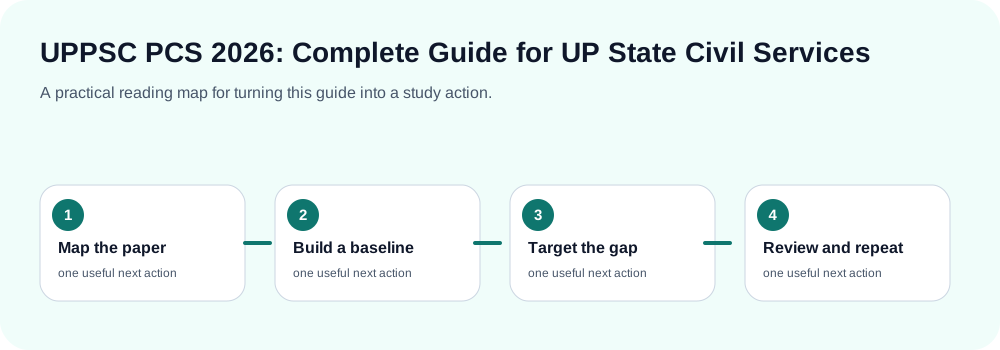
- Map the paperUse the exam pattern and eligibility details in this guide.
- Build a baselineTake a timed diagnostic mock before changing your routine.
- Target the gapChoose one weak section and practise it deliberately.
- Review and repeatLog errors, revise, and retest under time pressure.
Revision note: Published after explicit owner approval; official-source verification remains recommended for time-sensitive claims.
Keep YourMockTest in your Google results
Add us as a Preferred Source to see fresh exam updates and preparation guidance more often in Google Search.
Add YourMockTest as a Preferred Source