Exam Guides
The Ultimate Guide to UPSC Civil Services Preparation
A practical, beginner-to-advanced roadmap for UPSC CSE 2026. Covers the 3-stage selection process, a 12-month phase-wise plan, the definitive book list per subject, and the common mistakes that end first attempts before they begin.
This legacy article was owner-approved for publication. Verify time-sensitive claims against current official sources before acting.
What you will be able to decide after reading this
By the end of this guide you will know: how the three UPSC CSE stages work, what to study in each phase of a 12-month preparation cycle, which books to pick per subject, and the five mistakes that end most first attempts before the Prelims. If you have just decided to appear for the UPSC Civil Services Examination, start here.
| Stage | Format | What it tests | Qualifying or merit? |
|---|---|---|---|
| **Preliminary Examination** | 2 papers, objective MCQ, 400 marks total | Paper 1: GS (100q, 200 marks). Paper 2: CSAT (80q, 200 marks — qualifying only, 33% minimum) | Paper 1 scores rank you; Paper 2 is pass/fail |
| **Main Examination** | 9 papers, descriptive written | GS I-IV, Essay, Optional Subject (2 papers), Indian Language, English | Merit-deciding; marks from GS + Essay + Optional count toward the final merit list |
| **Personality Test (Interview)** | 275 marks, board-based discussion | Communication, analytical thinking, personal background | Added to Mains marks for the final rank |
The 3-stage UPSC CSE selection process
Stage | Format | What it tests | Qualifying or merit? |
|---|---|---|---|
Preliminary Examination | 2 papers, objective MCQ, 400 marks total | Paper 1: GS (100q, 200 marks). Paper 2: CSAT (80q, 200 marks — qualifying only, 33% minimum) | Paper 1 scores rank you; Paper 2 is pass/fail |
Main Examination | 9 papers, descriptive written | GS I-IV, Essay, Optional Subject (2 papers), Indian Language, English | Merit-deciding; marks from GS + Essay + Optional count toward the final merit list |
Personality Test (Interview) | 275 marks, board-based discussion | Communication, analytical thinking, personal background | Added to Mains marks for the final rank |
At a glance: The Prelims is a filter (only ~1–2% of applicants qualify). The Mains and Interview determine your final all-India rank and the service you are allocated. Clearing Prelims is the first milestone — build your entire early preparation toward it.
The 12-month phase-wise preparation plan
This schedule assumes you are starting from scratch. Adjust it by compressing phases if your Prelims date is closer.
Phase 1 — Foundation (Months 1–4): NCERT and concept clarity
Goal: Understand the topics, not memorise them.
History: NCERT Class 6–12 (Ancient → Medieval → Modern). Focus on Modern History (Freedom Struggle) most — it generates 15–20 Prelims questions annually.
Polity: NCERT Civics Class 9–12, then Laxmikanth's Indian Polity. Understand Articles, Parliament procedure, fundamental rights, DPSPs, and constitutional bodies.
Geography: NCERT Physical Geography (Class 11) + India: People and Economy (Class 12). Map work — know the rivers, mountain passes, and biosphere reserves.
Economy: NCERT Class 11 Introductory Macroeconomics + Class 12 Macroeconomics. Then Ramesh Singh's Indian Economy for depth.
Science: NCERT Class 8–10 Science for Prelims. Environment: Shankar IAS Academy's Environment book (a single, well-organised source).
Start your newspaper habit now: Read one of The Hindu or Indian Express every morning. Do not try to take comprehensive notes yet — just read to build context.
Phase 2 — Core Depth (Months 5–8): Standard references + daily current affairs
Goal: Go beyond NCERT into exam-level depth. Begin sectional practice.
Complete Laxmikanth (Polity), Ramesh Singh (Economy), and Shankar Environment.
For GS Paper 1 (History, Geography, Society): Read Bipin Chandra's India's Struggle for Independence for Modern History depth.
Start making your own notes — not copying, synthesising. One A4 page per topic maximum.
Current affairs: Maintain a structured monthly notes file. Focus areas: Government schemes, Science and Technology, India's foreign policy, Environment news, Awards and appointments.
Begin CSAT preparation: Practice Reading Comprehension passages (12–13 questions in Paper 2), Data Interpretation, and Basic Math. Most aspirants neglect CSAT and fail on a qualifying paper.
Phase 3 — Answer Writing and Mock Tests (Months 9–12): Performance calibration
Goal: Convert knowledge into marks under exam conditions.
Prelims mocks: At least 15 full-length GS Paper 1 mocks. Track your accuracy and topic-wise performance.
Answer writing: Write at least 2 Mains-style answers per day. Use the UPSC Previous Year Questions (PYQ) as the source — they reveal exactly what the examiner wants.
Optional Subject: If you have not started your Optional, begin in Month 7–8. It carries 500 marks — second only to GS in merit impact. Choose based on your academic background and availability of coaching/material.
Final 3 weeks before Prelims: Only revision — no new topics. Revise current affairs notes, important Articles, and frequently-tested static GK.
Recommended books per subject
Subject | Foundation book | Advanced / depth book | When to start |
|---|---|---|---|
Polity | NCERT Civics (9–12) | M. Laxmikanth — Indian Polity | Month 1 |
Modern History | NCERT 8–12 | Bipin Chandra — India's Struggle for Independence | Month 1 |
Ancient and Medieval History | NCERT 6–8 | R.S. Sharma — Ancient India (selective chapters) | Month 2 |
Indian Economy | NCERT Macro 11–12 | Ramesh Singh — Indian Economy | Month 2 |
Physical Geography | NCERT 11 (Physical) | G.C. Leong — Physical and Human Geography (selective) | Month 2 |
Indian Geography | NCERT 12 (India) | Orient Blackswan Atlas | Month 3 |
Environment and Ecology | NCERT Biodiversity chapters | Shankar IAS — Environment | Month 3 |
Science and Technology | NCERT Class 8–10 Science | Monthly current affairs notes | Month 4 |
CSAT (Paper 2) | RS Aggarwal — Verbal and Nonverbal Reasoning | Previous year CSAT papers | Month 5 |
Current Affairs | The Hindu or Indian Express | Vision IAS Monthly CA compilation | Month 1 (ongoing) |
The 5 mistakes that end most first attempts
Common first-attempt pitfalls: > > 1. Ignoring CSAT (Paper 2): It is qualifying-only, so aspirants skip it. A 32% score (one mark below the 33% cut-off) eliminates even the highest GS Paper 1 scorer. > > 2. Starting with coaching material before NCERTs: Standard books assume NCERT-level clarity. Skipping the foundation makes advanced material confusing and quickly forgotten. > > 3. No mock tests before Month 9: Prelims is as much a time management and elimination-strategy test as a knowledge test. You need at least 15 practice runs before the real exam. > > 4. Choosing an Optional Subject by peer pressure: The Optional carries 500 marks. Choose based on your genuine comfort and available study material — not because everyone around you is choosing Public Administration. > > 5. Measuring progress in hours, not topics covered: "I studied for 8 hours today" is a process measure. "I finished Indian Parliament procedures and can answer 10 PYQs on it" is an outcome measure. Track outcomes.
What happens after Prelims
Once you clear Prelims, the Mains syllabus (GS I–IV, Essay, Optional) expands significantly. Begin reading PYQ Mains questions during your foundation phase — not to answer them, but to understand the type of thinking the exam rewards: multi-dimensional, balanced, and evidence-grounded answers.
The Interview is the final stage. It tests whether you can hold a composed conversation about your life, your optional, your state, and current events — not your ability to memorise facts. Preparation starts after your Mains result.
Next step
Before starting Phase 1, take a UPSC Prelims practice test to establish your current baseline. The score will tell you which subjects need the most attention in Month 1 — making your Phase 1 plan data-driven rather than guesswork.
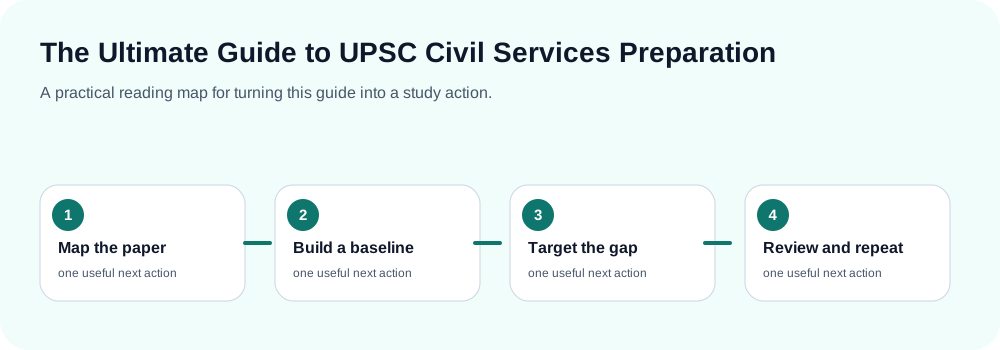
- Map the paperUse the exam pattern and eligibility details in this guide.
- Build a baselineTake a timed diagnostic mock before changing your routine.
- Target the gapChoose one weak section and practise it deliberately.
- Review and repeatLog errors, revise, and retest under time pressure.
Revision note: Published after explicit owner approval; official-source verification remains recommended for time-sensitive claims.
Keep YourMockTest in your Google results
Add us as a Preferred Source to see fresh exam updates and preparation guidance more often in Google Search.
Add YourMockTest as a Preferred Source