Exam Guides
Top 5 Strategies to Crack SSC CGL in Your First Attempt
Five strategies for SSC CGL first-attempt success — with the exam pattern table, mock-test cadence by phase, an error classification method that actually improves scores, and section-wise attempt-order guidance.
This legacy article was owner-approved for publication. Verify time-sensitive claims against current official sources before acting.
Quick facts before the strategies
SSC CGL is a 2-tier Computer-Based Test (CBT). Before reading the strategies, make sure these numbers are fixed in your mind:
Parameter | Tier 1 | Tier 2 Paper 1 (compulsory for all posts) |
|---|---|---|
Total questions | 100 | 150 (approx.) |
Total marks | 200 | 390 |
Duration | 60 minutes | 2 hours 30 minutes |
Negative marking | 0.50 per wrong answer | 1.00 per wrong answer |
Sectional time limit | 15 minutes per section | No sectional timer |
Mode | CBT (TCS iON platform) | CBT (TCS iON platform) |
Tier 1 sections: General Intelligence & Reasoning (25q/50 marks), General Awareness (25q/50 marks), Quantitative Aptitude (25q/50 marks), English Comprehension (25q/50 marks).
Tier 1 is the qualifier and screen. Tier 2 is where merit is decided. Most aspirants under-invest in Tier 2. This is the most common reason for a failed first attempt.
Read the chart as a quick comparison, not as a replacement for the official source or the detailed explanation below.
Strategy 1: Know the exam pattern deeply — not just the syllabus
The syllabus tells you what to study. The exam pattern tells you how the exam will test you.
For Tier 1, 15-minute sectional timers mean you cannot recover time from one section in another. If you spend 18 minutes on Quant, you will be timed out of it and the damage cannot be undone. This is fundamentally different from most state PSC exams.
Implication: Train with sectional timers switched on from Day 1. Every sectional practice set should be done in 15 minutes, not in "whatever time I need."
For Tier 2, the absence of sectional timers gives flexibility — but also the rope to hang yourself with. Create your own internal time budget (e.g., 45 min for Mathematical Abilities, 40 min for Reasoning, 35 min for English, 15 min for GA, 15 min for Computer) and practise to that budget.
Strategy 2: Build strong fundamentals before speed
Every shortcut in Quant, every grammar rule in English, and every pattern in Reasoning is built on a core concept. Aspirants who skip fundamentals and jump directly to tricks find that their accuracy collapses under the 36-second-per-question pressure of the real exam.
What to cover in the foundation phase (first 2 months):
Quant: Tables up to 25, squares up to 30, cubes up to 15. Percentage ↔ fraction equivalents. BODMAS. Ratio, Proportion, Profit & Loss, Time-Work, Time-Speed-Distance.
English: Subject-Verb Agreement, Tense Consistency, Modifiers, Active-Passive rules, Prepositions, Articles. These 6 grammar areas cover 70–80% of Spotting Errors and Fill-in-the-Blanks questions.
Reasoning: Analogies, Series (letter, number, mixed), Coding-Decoding, Blood Relations, Direction Sense, Non-Verbal (Mirror Image, Paper Folding, Embedded Figures).
General Awareness: Modern History, Indian Polity (Parliament and Constitution basics), Geography (rivers, states, capitals), Basic Biology and Chemistry (Class 9-10 level).
Strategy 3: Mock tests — progressive cadence, not random tests
Taking a mock test every day from Month 1 is not the same as taking one at the right time for the right purpose. Mock tests should be scheduled by phase:
Preparation phase | Recommended mock cadence | Focus |
|---|---|---|
Foundation (Months 1–2) | 1 full mock every 2 weeks | Interface familiarity, sectional timing awareness |
Speed building (Months 3–4) | 1 full mock per week + sectional tests daily | Accuracy under time pressure, attempt strategy |
Final phase (Month 5+) | 3 full mocks per week | Peak performance, weak-area targeting, percentile tracking |
Final 7 days | Only revision; no new mock after Day 4 | Consolidation, not acquisition |
After every mock, classify every wrong answer into one of three types:
Error classification — the step most aspirants skip: > > - Concept gap: You did not know the underlying rule or formula. Action: Go back to the topic and revise it. > - Silly mistake: You knew the answer but made a calculation or reading error. Action: Slow down 5% in that section next attempt. > - Time crunch: You knew the concept but ran out of time. Action: Change your attempt order — skip that question type earlier and return to it last. > > Classifying errors transforms a mock review from "I got 148, I need to get 155" into "I have 3 concept gaps in Geometry, 2 silly mistakes in English Grammar, and 1 time crunch in DI." The second version gives you a study plan.
Take a full SSC CGL Tier 1 mock on YourMockTest and classify your errors using this method after your first attempt.
Strategy 4: Manage time with a section-wise attempt order
The 15-minute sectional timer means your attempt order within a section matters enormously. Use this decision guide:
Section | Recommended attempt order | Rationale |
|---|---|---|
General Intelligence & Reasoning | Attempt all — fast section if practiced | Most questions yield to pattern recognition; skip only puzzles that take >60 sec |
General Awareness | Attempt known questions first; skip unknown; never guess | No shortcut exists for questions you don't know; protect your score from negative marking |
Quantitative Aptitude | Arithmetic → Algebra → Geometry → Data Interpretation | Attempt easier, faster types first; DI takes time so leave it for after arithmetic |
English Comprehension | Spotting Errors + Fill-in-Blanks first → Cloze Test → RC | Grammar questions are fastest; RC requires passage reading so leave it for last |
The general rule: Within any section, attempt the questions you know in 20–25 seconds each, skip the uncertain ones, and return to them in the remaining time. Never spend more than 60 seconds on a single Tier 1 question in your first pass.
Strategy 5: Revise with intent — not just coverage
The final month should be a consolidation sprint, not a new-topic rush. Aspirants who try to cover new topics in the last 30 days typically see their scores fall, not rise, because they activate awareness of everything they do not know.
The final-month revision framework:
Revise your error log from all mock tests — these are your exact weaknesses, not a guess.
Revise the 300-question SSC-specific English word bank (One-Word Substitutions, Idioms and Phrases that repeat heavily across years).
Revise Static GK: Polity Articles, Science formulae, Important Acts, Awards, and Current Affairs from the past 12 months.
Take 2–3 full mocks per week to maintain speed; do not take any new mock in the final 3 days.
Sleep 7–8 hours without exception in the final 2 weeks — cognitive speed and retrieval accuracy drop measurably without adequate sleep.
Recommended next action
Map yourself to Phase 1, 2, or 3 using the mock cadence table above. Then take a full-length SSC CGL Tier 1 practice test to establish your current baseline before you begin any of the 5 strategies. The baseline score will tell you exactly which of the five areas — pattern knowledge, fundamentals, mock frequency, attempt order, or revision — needs the most urgent attention.
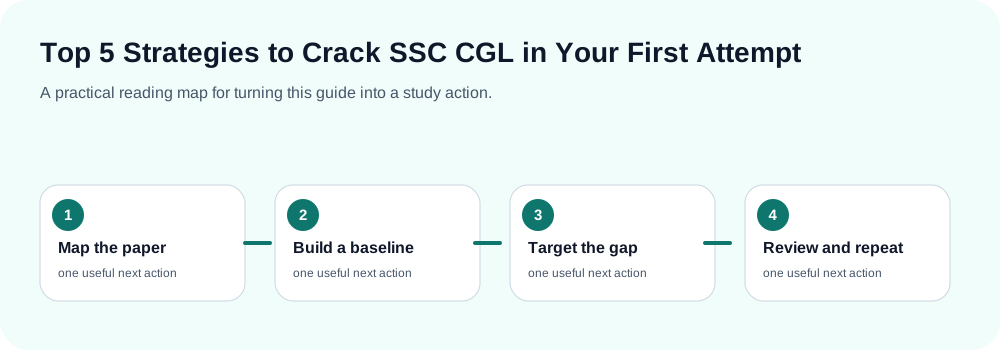
- Map the paperUse the exam pattern and eligibility details in this guide.
- Build a baselineTake a timed diagnostic mock before changing your routine.
- Target the gapChoose one weak section and practise it deliberately.
- Review and repeatLog errors, revise, and retest under time pressure.
Revision note: Published after explicit owner approval; official-source verification remains recommended for time-sensitive claims.
Keep YourMockTest in your Google results
Add us as a Preferred Source to see fresh exam updates and preparation guidance more often in Google Search.
Add YourMockTest as a Preferred Source