Exam Guides
TCS NQT 2026: Complete Guide to National Qualifier Test for Freshers
TCS NQT is the gateway to TCS Ninja and TCS Digital roles for 2026 freshers. This complete guide covers the full test structure, section-wise strategies, TCS Digital vs Ninja cutoff differences, the 3-week sprint plan, programming logic mastery, and everything you need to ace the TCS iON-powered exam.
This legacy article was owner-approved for publication. Verify time-sensitive claims against current official sources before acting.

The TCS NQT (National Qualifier Test) is Tata Consultancy Services' standardized, scalable assessment platform for hiring fresh engineering and non-engineering graduates. It is your single most important ticket to one of India's largest and most prestigious IT employers — a company that on-boards 40,000–60,000 freshers annually.
Understanding the NQT deeply — its structure, scoring, cutoffs, and what distinguishes TCS Digital from TCS Ninja — can be the difference between landing an ₹3.36 LPA offer and an ₹7–9 LPA Digital role. This guide covers everything.
---
| Role | Designation | CTC (2025–26) | NQT Band Required |
|---|---|---|---|
| **TCS Ninja** | Systems Engineer | ₹3.36 LPA | Standard NQT score (Bands 3–5) |
| **TCS Digital** | Systems Engineer (Digital) | ₹7 LPA | High NQT score + Strong Coding |
What is TCS NQT?
TCS NQT (formerly called TCS CodeVita-adjacent assessment or direct campus drives) is a national-level aptitude and skill test conducted by TCS iON (TCS's digital learning and assessment platform). It serves as the primary hiring gateway for TCS across both campus and off-campus applicants.
Two Key Roles Hired via NQT:
Role | Designation | CTC (2025–26) | NQT Band Required |
|---|---|---|---|
TCS Ninja | Systems Engineer | ₹3.36 LPA | Standard NQT score (Bands 3–5) |
TCS Digital | Systems Engineer (Digital) | ₹7 LPA | High NQT score + Strong Coding |
TCS Prime/Research (₹9 LPA+) is a separate advanced hiring track, typically requiring exceptional coding and algorithmic skills beyond the standard NQT pathway.
NQT Score Validity: Your NQT score is valid for 2 years from the date of the test. This means if you appear in 2025, you can use the same score for TCS applications in 2026 as well.
---
Who Can Appear for TCS NQT?
Eligible Streams:
B.E. / B.Tech (All branches)
M.E. / M.Tech
MCA / M.Sc. (CS / IT / allied)
B.Sc. (CS, IT, Electronics) — selected batches
BCA — selected batches
MBA — for specific business roles (not standard IT track)
Eligibility Conditions:
Academic performance: Minimum 60% or 6.0 CGPA aggregate across 10th, 12th, and graduation (no rounding off)
Backlog policy: No active backlog at the time of application; history of backlogs varies by batch
Gap year: Maximum 2 years of academic gap allowed
Graduation year: Typically 2024 and 2025 pass-outs are eligible for the current cycle
---
TCS NQT 2026: Complete Test Structure
The TCS NQT is a multi-section adaptive assessment delivered on the TCS iON platform. Here's the full breakdown:
Section 1: Traits (Personality Assessment)
Questions: ~40
Duration: No fixed time limit (usually 15–20 minutes)
Nature: Not scored or ranked; used only for profile matching during HR round
What it measures: Personality type (introvert/extrovert, team player vs. independent, risk tolerance, ethical decision-making)
Strategy: Answer honestly and consistently. There are built-in lie-detection questions (same question asked differently). Inconsistency flags your profile.
Section 2: Numerical Ability
Questions: 20
Duration: 40 minutes
Difficulty: Moderate to High
Topics Covered:
- Number System (HCF, LCM, divisibility) - Percentages, Profit & Loss - Ratio & Proportion, Mixtures - Time, Speed & Distance (incl. relative speed, trains) - Time & Work, Pipe & Cistern - Simple & Compound Interest - Data Interpretation (Tables, Bar Graphs, Pie Charts) - Permutations & Combinations, Probability - Geometry: Area, Perimeter, Volume - Progressions (AP, GP basics)
Tip: TCS Numerical questions often involve 2–3 step reasoning. The key is speed and accuracy — 40 minutes for 20 questions (2 min/question) is tight if you get stuck. Skip and return.
Most Frequently Asked Question Types:
Train A and Train B problems (relative speed, crossing time)
Compound Interest with annual/half-yearly compounding comparison
Pie chart DI with percentage and ratio calculation
Permutation: Ways to arrange letters in a word with repeats
Probability from card/dice/ball drawing problems
Section 3: Verbal Ability
Questions: 24
Duration: 30 minutes
Difficulty: Easy to Moderate
Topics Covered:
- Reading Comprehension (1–2 passages, 4–6 questions each) - Sentence Completion / Fill in the Blanks - Error Identification (Grammar: Subject-Verb Agreement, Tense, Articles) - Para Jumbles / Sentence Rearrangement - Synonyms & Antonyms - Idioms & Phrases - Cloze Test
Tip: RC is the highest-scoring area — read carefully but don't spend more than 8–9 minutes per passage. For grammar questions, trust your reading instinct over rules.
Section 4: Reasoning Ability
Questions: 30
Duration: 50 minutes
Difficulty: Moderate to High (includes advanced level for Digital aspirants)
Topics Covered:
- Logical Reasoning: Syllogism, Statements & Conclusions - Analytical Reasoning: Puzzles, Seating Arrangements, Scheduling - Critical Reasoning: Strengthen/Weaken arguments - Data Sufficiency - Blood Relations, Directions - Coding-Decoding (letter/number based) - Series (Number, Letter, Mixed) - Clocks & Calendars - Venn Diagrams
Tip: Puzzles and seating arrangement questions in TCS NQT are paragraph-based, not tabular. Read carefully and draw diagrams on rough paper.
Section 5: Programming Logic
Questions: 10
Duration: 15 minutes
Difficulty: Easy to Moderate (no actual coding required)
What it tests: Ability to trace, understand, and interpret algorithms, pseudocode, and flowcharts
Topics Covered:
Pseudocode Analysis: Read a pseudocode block and predict output
Flowchart Tracing: Follow flowchart paths to find output values
Basic Algorithm Understanding: Sorting concepts (Bubble sort steps), searching (Binary search conditions)
Array/Loop Tracing: Trace through for/while loops with specific initial values
Function Output: Given function definitions, predict return values
Sample Pseudocode Question: ``` FUNCTION mystery(n): result = 0 FOR i = 1 TO n: result = result + i * i RETURN result
What does mystery(4) return? A) 10 B) 20 C) 30 D) 16 ``` > Answer: 1² + 2² + 3² + 4² = 1 + 4 + 9 + 16 = 30 → Option C
Flowchart tracing example:
Start with X = 5
While X > 0: Print X, X = X - 2
Output: 5, 3, 1 (trace each iteration)
Tip: You do NOT need to write code. This section tests logical reading of programs. Practice flowchart exercises and pseudocode walkthroughs systematically.
---
TCS Ninja vs. TCS Digital: Understanding the Cutoff Difference
This is the most misunderstood aspect of TCS NQT. Here's the reality:
Parameter | TCS Ninja | TCS Digital |
|---|---|---|
CTC | ₹3.36 LPA | ₹7 LPA |
NQT Cognitive Score | Moderate cutoff (70–75th percentile est.) | High cutoff (85–90th percentile est.) |
Programming Logic | Standard performance acceptable | High performance required |
Coding Round (Post-NQT) | 1 coding question (Easy–Medium level) | 2 coding questions (Medium–Hard) |
Technical Interview | 1 round (moderate depth) | 1–2 rounds (advanced topics required) |
Technologies Focus | Core Java/Python, SQL basics | DSA, Cloud, APIs, Dev tools, SDLC |
Key insight: For TCS Digital, the Programming Logic section AND post-NQT coding round are the key differentiators. A candidate scoring 90%+ in Numerical and Reasoning but poor in Programming will likely receive a Ninja offer, not Digital.
Post-NQT Coding Round (if applicable):
For Digital shortlists: 2 coding problems in 60 minutes (any programming language)
For Ninja shortlists: 1 problem in 30 minutes
Language choices: C, C++, Java, Python, JavaScript
---
TCS NQT Score and NQT Band System
TCS NQT generates a percentile-based NQT Band score (not raw marks) reported on your TCS iON profile:
NQT Band | Approximate Percentile | Interpretation |
|---|---|---|
Band 6 | Top 5% | Exceptional — eligible for all tracks |
Band 5 | Top 10–15% | Excellent — Digital eligible |
Band 4 | 70–85th percentile | Good — Ninja track eligible |
Band 3 | 50–70th percentile | Average — may qualify for some drives |
Band 1–2 | Below 50th percentile | Below cutoff for most drives |
Your NQT Band appears on your TCS iON certificate, which is shared directly with TCS HR and can be shared with other companies that accept NQT scores.
---
TCS iON Exam Interface: What to Expect
TCS NQT is conducted on the TCS iON Remote Proctoring Platform — the same interface used by YourMockTest for mock exam simulations. Familiarizing yourself with this interface BEFORE the exam day is crucial.
Key Interface Features:
Question palette on the right (color-coded: Answered, Not Answered, Marked for Review)
Section-wise navigation (some sections are locked/timed independently)
Rough sheet area or physical rough paper provided
Calculator NOT allowed (manual mental math required)
Copy-paste disabled for text areas
Webcam monitoring + screen recording throughout
AI proctoring flags unusual behavior (looking away, second monitor, audio detection)
Day-of-exam tips:
Join 30 minutes early for system check
Ensure stable internet (wired preferred)
Valid government photo ID ready for verification
Clear room background, good lighting, single monitor
No phone/smartwatch on the desk
---
Campus vs. Off-Campus Application
Campus (On-Campus Drive)
TCS visits colleges with TCS PACE/ELITE tie-ups
Your Training & Placement Officer (TPO) registers the batch on TCS Next Step portal
NQT is conducted at your college or a designated TCS center
Entire process managed through TPO
Off-Campus Application
Register at TCS NextStep Portal (nextstep.tcs.com) → Create profile with CT reference number
Upload documents: Resume, Marksheets, Photo
Apply for TCS National Qualifier Test from the dashboard
Receive hall ticket → Appear at a TCS iON-authorized test center near you
NQT score reflected on profile → TCS HR picks candidates meeting cutoff
Pro Tip: Apply as early as possible in the cycle. TCS rolls out interview calls on a rolling basis — early applicants with good NQT scores often get calls before the cycle closes.
---
TCS NQT 2026: Difference Between NQT and BPS Drive
Parameter | NQT (National Qualifier Test) | BPS (Business Process Services) Drive |
|---|---|---|
Role Type | IT (Systems Engineer) | Non-IT (Process roles, customer support) |
CTC | ₹3.36 LPA (Ninja) / ₹7 LPA (Digital) | ₹2.5–₹3 LPA |
Exam Pattern | Full NQT (5 sections) | Aptitude + Verbal (shorter) |
Coding Required? | Yes (post-NQT round) | No |
Eligible streams | Engineering + select science/BCA | Arts, Commerce, Science, Engineering |
Work Type | Software development, testing, support | Back-office, data processing, customer ops |
BPS is a separate track and does not count for TCS Ninja/Digital. If you're from an engineering or CS background, focus exclusively on the NQT path.
---
3-Week Sprint Preparation Plan
If you have 3 weeks before TCS NQT, here's an intensive, structured plan:
Week 1: Foundation
Day | Focus |
|---|---|
Day 1–2 | Numerical: Number System, Percentages, Ratios, Profit & Loss |
Day 3–4 | Reasoning: Syllogism, Blood Relations, Directions, Series |
Day 5 | Verbal: Reading Comprehension practice (2 passages/day) |
Day 6 | Programming Logic: Flowchart basics + 20 pseudocode exercises |
Day 7 | Full Mock Test #1 + Error analysis |
Week 2: Acceleration
Day | Focus |
|---|---|
Day 8–9 | Numerical: TSD, Time & Work, Probability, DI |
Day 10–11 | Reasoning: Puzzles, Seating Arrangements, Critical Reasoning |
Day 12 | Verbal: Grammar rules + Para Jumbles + Cloze Test |
Day 13 | Programming Logic: Array/Loop tracing + Function output |
Day 14 | Full Mock Test #2 + Full Mock Test #3 + Error analysis |
Week 3: Exam-Mode
Day | Focus |
|---|---|
Day 15–16 | Weak section targeted practice (from mock analysis) |
Day 17 | Current TCS NQT question pattern revision (last 2 years) |
Day 18–19 | Full Mock Tests #4 and #5 — simulate exam-day conditions |
Day 20 | Rapid revision: Key formulas, pseudocode patterns, grammar rules |
Day 21 | Rest + Light revision — avoid cramming. Prepare ID documents. |
---
Post-NQT: TCS Placement Process
Once you clear NQT with a qualifying band, the placement process continues:
Round 1: Technical Round (TR)
Duration: 45–60 minutes (video interview)
Focus: Programming fundamentals, Data Structures, OOP concepts, SQL, OS basics
Expect questions like:
- "Write a program to reverse a string without using a library function." - "Explain the difference between a stack and a queue with examples." - "What is normalization? Explain 1NF, 2NF, 3NF." - "What is polymorphism in OOP? Give an example."
Round 2: Managerial Round (MR) — Digital/Prime tracks
Duration: 30–45 minutes
Focus: Project experience, situational problem-solving, teamwork, client handling scenarios
Often skipped for Ninja track
Round 3: HR Round
Duration: 20–30 minutes
Focus: Company knowledge, compensation discussion, joining timeline, background verification consent
Common questions:
- "Why TCS? Why not a startup?" - "Where do you see yourself in 5 years?" - "Are you willing to relocate?" - "What do you know about TCS's Agile transformation?"
HR tip: Demonstrate familiarity with TCS's recent projects — TCS BaNCS, TCS HOBS, TCS iON, recent partnership announcements, and TCS's revenue trajectory as India's largest IT company.
---
Most Asked Questions with Examples
Numerical: Classic TCS Question Type
Q: A train 200m long passes a pole in 20 seconds and passes another train 300m long coming from the opposite direction in 15 seconds. Find the speed of the second train.
Train 1 speed = 200/20 = 10 m/s
Relative speed (opposite) = (200+300)/15 = 500/15 = 33.33 m/s
Speed of Train 2 = 33.33 − 10 = 23.33 m/s ≈ 84 km/h
Verbal: Commonly Tested Grammar Error
Q: Identify the error — "Neither the students nor the teacher were present in the class."
Error: Subject-verb agreement. "Neither...nor" with last subject (teacher, singular) → was not were
Corrected: "Neither the students nor the teacher was present in the class."
Programming Logic: Pseudocode Output
SET x = 1 WHILE x <= 5: IF x MOD 2 == 0: PRINT x * 2 x = x + 1 > Output: 4, 8 (when x=2: 2×2=4; when x=4: 4×2=8; odd values skipped)
---
Why YourMockTest for TCS NQT Prep?
YourMockTest's TCS NQT practice module is built on the TCS iON interface architecture — the same platform you'll face on exam day. This means:
Zero interface anxiety on exam day — you've seen every button, timer, and section-lock mechanism before
Timed section-level practice mirrors real exam pacing
Detailed performance analytics identify your weakest question types
Programming Logic simulation includes authentic pseudocode and flowchart question sets
Post-mock AI-generated feedback highlights patterns you're missing
The TCS NQT 2026 cycle is intensely competitive. With over 5 lakh applicants every year, preparation quality — not just effort — determines outcomes. Use every tool available, start early, and make each mock test count.
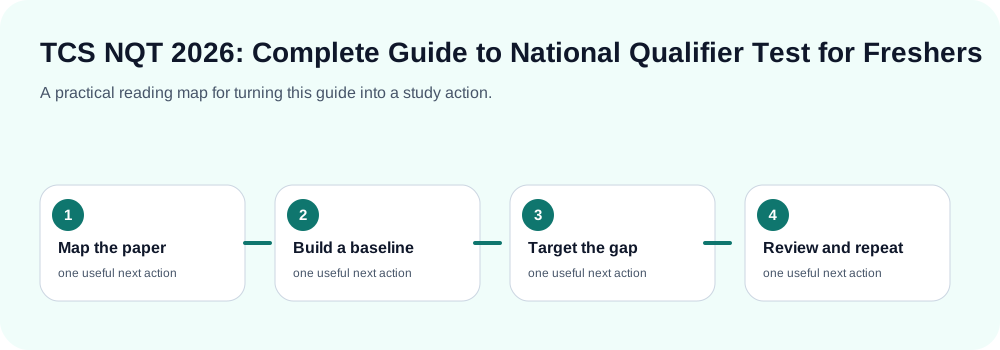
- Map the paperUse the exam pattern and eligibility details in this guide.
- Build a baselineTake a timed diagnostic mock before changing your routine.
- Target the gapChoose one weak section and practise it deliberately.
- Review and repeatLog errors, revise, and retest under time pressure.
Revision note: Published after explicit owner approval; official-source verification remains recommended for time-sensitive claims.
Keep YourMockTest in your Google results
Add us as a Preferred Source to see fresh exam updates and preparation guidance more often in Google Search.
Add YourMockTest as a Preferred Source