Study Tips
10 Proven Study Techniques to Ace Your Competitive Exams
The right technique matters as much as the hours you put in. This guide applies science-backed study methods — spaced repetition, active recall, interleaved practice — directly to SSC CGL, UPSC, IBPS PO, and Railway exam preparation.
This legacy article was owner-approved for publication. Verify time-sensitive claims against current official sources before acting.
Who this guide is for
If you are preparing for SSC CGL, UPSC CSE, IBPS PO, RRB NTPC, or any state PSC, the techniques in this guide will help you move faster and retain more. Each method below is applied to the exam context — not kept as an abstract theory.
| Time after learning | Approximate retention |
|---|---|
| 1 hour | ~44% |
| 1 day | ~34% |
| 6 days | ~25% |
| 1 month | ~20% |
- Spaced Repetition: the most powerful technique you are probably ignoring
German psychologist Hermann Ebbinghaus mapped the Forgetting Curve in the 1880s. Without any review, this is what happens to newly learned material:
Time after learning | Approximate retention |
|---|---|
1 hour | ~44% |
1 day | ~34% |
6 days | ~25% |
1 month | ~20% |
Source: Ebbinghaus H., Über das Gedächtnis (Memory: A Contribution to Experimental Psychology), 1885. Subsequent replications confirm the general decay pattern.
The antidote is spaced repetition: reviewing material at increasing intervals, just before you would forget it. Each review pushes the forgetting curve further out.
For exam prep, a practical 7-day spaced cycle looks like this:
Day | Action |
|---|---|
Day 1 | Study the topic; do 10 practice questions on it |
Day 2 | Quick 10-minute review (notes or flashcards); do 5 questions |
Day 4 | Review again; do 5 harder questions |
Day 7 | Self-test without notes; move to the next section |
Day 14 | Brief revision (5 minutes); topic is now in long-term memory |
At a glance: Spaced repetition is most useful for General Awareness, English Vocabulary, and Mathematical formulae — content that must be recalled instantly under a 36-second-per-question time limit.
- Active Recall: test yourself instead of re-reading
Re-reading your notes feels productive but is one of the least effective study methods. Active recall — forcing your brain to retrieve information — is consistently the top performer in memory research.
How to apply active recall to exam prep:
After studying a chapter, close the book and write down everything you remember.
Use flashcards (physical or Anki) for vocabulary, formulas, and static GK.
Solve 10 questions on a topic before reading the theory — this primes your brain to notice the relevant information when you do read.
In mock test review, cover the solution and try to solve the question again from scratch before reading the explanation.
Callout: Aspirants who use active recall outperform passive re-readers on retention and exam performance. The effort of retrieval is itself the learning event.
- The Feynman Technique: understand or expose the gap
Richard Feynman's method has a single test: can you explain the concept in plain language, without jargon?
For UPSC, this is especially powerful. If you cannot explain "What is a money bill and how does it differ from a financial bill?" to someone unfamiliar with Indian Polity, you have not understood it well enough to answer a Prelims question under time pressure. Write the explanation. Find where it breaks. Go back to the source.
For SSC/IBPS Reasoning, use Feynman to test your understanding of syllogisms, blood relations, and data sufficiency — not just your ability to pattern-match.
- Pomodoro for lighter tasks; Ultradian blocks for heavy ones
Do not use a one-size-fits-all timer. Match the session length to the cognitive weight of the task.
Task type | Recommended session | Examples for exam prep |
|---|---|---|
Light, habitual | 25-minute Pomodoro | Current affairs reading, vocabulary flashcards, GK revision |
Deep, complex | 90-minute Ultradian block | Full mock test, Quantitative Aptitude problem sets, Essay/answer writing |
90-minute blocks are aligned with the brain's natural Basic Rest-Activity Cycle (BRAC), identified by sleep researcher Nathaniel Kleitman. Attempting a full Tier 1 mock in a 25-minute Pomodoro session is counterproductive — the exam itself is 60 minutes continuous.
- Mind Mapping for connecting large syllabi
Mind maps are useful for subjects with heavy interconnections — UPSC Polity, Economy, and Environment especially. A single map of "Parliament → Bill types → Money Bill → Loksabha-only passage → Article 110" captures a chain that often generates 3–5 Prelims questions.
Use mind mapping to plan your revision, not your initial learning. First understand the topic linearly, then map the connections.
- Mock Tests: simulate before the day
Taking 20+ full-length mock tests before the actual exam means the exam environment — the timer, the question palette, the sectional switches — feels familiar rather than threatening. This is the exam-prep application of systematic desensitisation: repeated, controlled exposure reduces the anxiety response.
Practice CTA: Start a full-length SSC CGL or UPSC Prelims mock on YourMockTest to experience the TCS iON interface before the actual exam.
- Interleaved Practice: mix subjects in one session
Blocking — studying one subject for hours — creates an illusion of mastery. Interleaving — rotating subjects within a session — produces better long-term retention, as shown in research by Robert Bjork at UCLA.
For SSC CGL, a 3-hour session of: 60 min Quant → 60 min Reasoning → 60 min English is more effective than 3 hours of only Quant, even though the latter feels more comfortable.
- Eat the Frog: hardest subject first
Schedule your most demanding subject — for most aspirants, that is Mathematics / Quantitative Aptitude or UPSC Essay — at your biological peak hour (see point 9 below). Willpower and working memory are finite. They are highest at the start of the day for most people.
- Identify your chronotype: morning lark, intermediate, or night owl
Not everyone peaks in the morning. Measure your performance: for 2 weeks, attempt the same 20-question Quant set at 7 AM, 11 AM, 4 PM, and 8 PM. Track your accuracy and time. Your biological peak will become clear from the data.
Schedule your hardest sessions at your peak. Schedule current affairs reading, flashcard review, and GK at your low-energy hours.
- Daily Review: 15 minutes each evening
Each evening, spend 15 minutes answering:
What did I study today?
What is one thing I would get wrong in tomorrow's test?
What is tomorrow's first priority?
This closes the learning loop and converts passive study hours into deliberate preparation. The daily review habit also prevents the "I've been studying for weeks but feel no progress" drift that causes many aspirants to lose motivation.
Next step
Apply technique 6 right now: take a free SSC CGL Tier 1 mock test and use the analysis to identify which of the 10 techniques you need most — before you plan your next study session.
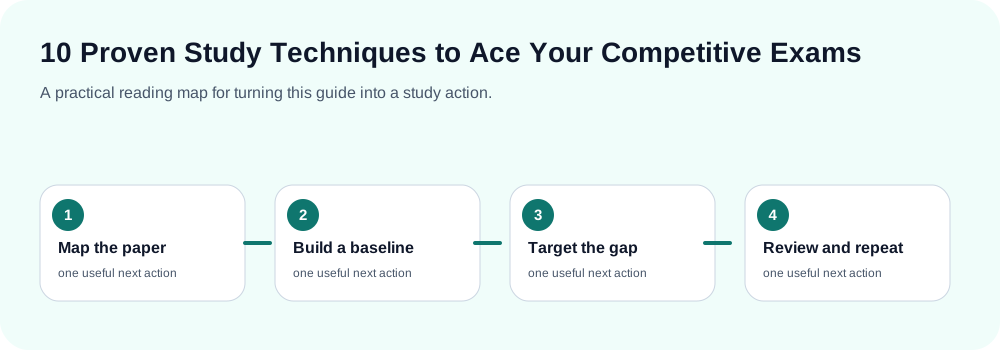
- Map the paperUse the exam pattern and eligibility details in this guide.
- Build a baselineTake a timed diagnostic mock before changing your routine.
- Target the gapChoose one weak section and practise it deliberately.
- Review and repeatLog errors, revise, and retest under time pressure.
Revision note: Published after explicit owner approval; official-source verification remains recommended for time-sensitive claims.
Keep YourMockTest in your Google results
Add us as a Preferred Source to see fresh exam updates and preparation guidance more often in Google Search.
Add YourMockTest as a Preferred Source