Exam Guides
SBI PO 2026 Complete Guide: Prelims to Interview
Your definitive roadmap for SBI PO 2026 — covering all 3 stages (Prelims, Mains, Interview/GD), a 90-day preparation strategy, syllabus breakdown, cutoff trends, and expert tips to land India's most prestigious banking job.
This legacy article was owner-approved for publication. Verify time-sensitive claims against current official sources before acting.

The State Bank of India Probationary Officer (SBI PO) exam is the crown jewel of Indian banking recruitment. An SBI PO starts at a CTC of approximately ₹14–17 lakhs per annum (including perquisites), gets fast-track promotion opportunities, and holds one of the most respected designations in public sector banking. With roughly 2,000 vacancies and over 20 lakh applicants, the competition is fierce — but absolutely beatable with the right strategy.
This guide walks you through every stage of the SBI PO 2026 selection process: eligibility, exam pattern, syllabus, a 90-day preparation plan, historical cutoffs, and interview preparation.
---
| Parameter | Requirement |
|---|---|
| Educational Qualification | Graduate in any discipline from a recognized university |
| Age | 21–30 years (as of April 1, 2026) |
| Age Relaxation | SC/ST: 5 years; OBC: 3 years; PwD: 10 years |
| Nationality | Indian Citizen |
| Final Year Students | Eligible to apply (must have degree at joining) |
Eligibility Criteria
Parameter | Requirement |
|---|---|
Educational Qualification | Graduate in any discipline from a recognized university |
Age | 21–30 years (as of April 1, 2026) |
Age Relaxation | SC/ST: 5 years; OBC: 3 years; PwD: 10 years |
Nationality | Indian Citizen |
Final Year Students | Eligible to apply (must have degree at joining) |
Vacancy expectation for 2026: Based on the trend of 2000 vacancies in 2023 and 2024, SBI PO 2026 is expected to announce 2,000–2,400 vacancies.
---
Exam Structure: 3 Stages
SBI PO is unique among banking exams because it has a Group Discussion + Interview stage, not just an interview.
Stage 1: Preliminary Examination
Section | Questions | Marks | Duration |
|---|---|---|---|
English Language | 30 | 30 | 20 minutes |
Quantitative Aptitude | 35 | 35 | 20 minutes |
Reasoning Ability | 35 | 35 | 20 minutes |
Total | 100 | 100 | 60 minutes |
Negative marking: 1/4th mark per wrong answer.
Stage 2: Main Examination
Section | Questions | Marks | Duration |
|---|---|---|---|
Reasoning & Computer Aptitude | 45 | 60 | 60 minutes |
Data Analysis & Interpretation | 35 | 60 | 45 minutes |
General/Economy/Banking Awareness | 40 | 40 | 35 minutes |
English Language | 35 | 40 | 40 minutes |
Descriptive Paper (Letter + Essay) | 2 | 50 | 30 minutes |
Total | 157+2 | 250 | 3 hrs 30 min |
Stage 3: Group Discussion + Personal Interview
GD: 20 marks (topics from economics, banking, current affairs, social issues)
Interview: 30 marks
Combined GD + Interview: 50 marks (20% weightage in final merit)
Final Merit: 80% Mains (objective + descriptive) + 20% GD-Interview.
---
Detailed Syllabus
Reasoning & Computer Aptitude (Mains)
Puzzles & Seating Arrangements (3–4 variables)
Blood Relations, Directions, Coding-Decoding
Syllogisms, Inequalities, Input-Output
Critical Reasoning, Statement-Assumption
Computer: MS Office, Internet, Networking Basics, Operating Systems
Data Analysis & Interpretation
Data Interpretation: Bar Graph, Line Graph, Pie Chart, Table, Mixed
Quantity Comparison (Quantity 1 vs Quantity 2)
Data Sufficiency
Arithmetic: Percentage, Ratio, Profit-Loss, SI/CI, Time-Speed-Distance
Approximation, Quadratic Equations, Number Series
General/Economy/Banking Awareness
RBI: Monetary Policy, Functions, Committees
Banking Terms: NPA, CRAR, CRR, SLR, MCLR, Basel III
Government Schemes (PM-KISAN, Mudra, PMJDY, etc.)
Current Affairs: Last 6 months (appointments, summits, sports)
Financial regulators: SEBI, IRDAI, PFRDA, NHB
Static GK: Capitals, currencies, important organisations
Descriptive English
Letter Writing: Formal/Official letters (Complaint, Request, Bank-related)
Essay: 250–350 words on economic/social/banking topics
Typed on keyboard — practice on a physical keyboard, not mobile.
---
90-Day Preparation Strategy
Month 1: Foundation (Days 1–30)
Week 1–2: Quantitative Aptitude Basics
Arithmetic fundamentals: Percentage, Ratio, Averages, Mixtures, Profit-Loss
Memorize: Tables to 30, Squares to 40, Cubes to 20, Fraction-% conversions
Target: Solve 30 arithmetic questions daily with 85% accuracy
Week 3–4: Reasoning Foundations + English
Reasoning: Puzzles (linear, circular), Blood Relations, Directions, Inequalities
English: Grammar rules, RC strategies, error spotting
Read one editorial daily from The Hindu or Indian Express
Month 2: Depth & Speed (Days 31–60)
Quantitative Aptitude:
Begin DI practice — 2 sets daily. Cover all DI types.
Quadratic Equations: Use sum/product of roots method.
Data Sufficiency: Practice combining statements logically.
Reasoning:
Complex puzzles (4–5 variables with constraints)
Input-Output machines: Identify the operation pattern in 2 steps
Critical Reasoning: 10 questions daily — strengthen inference skills
Banking Awareness:
Read banking news daily (RBI.org.in releases, Economic Times)
Make a notebook of: RBI rate decisions, bank merger updates, new government schemes
Study static banking terms — create flashcards for 200 key terms
Mocks: 1 sectional mock every 2 days. Review each mock for 2 hours.
Month 3: Mock Mastery + Mains-Specific Prep (Days 61–90)
Week | Focus |
|---|---|
Week 9 | 1 Full Prelims Mock daily + GD topic practice |
Week 10 | Shift focus to Mains — DI sets, Descriptive practice |
Week 11 | 1 Full Mains Mock every 2 days + Essay writing (1 per day) |
Week 12 | Final revision, current affairs, light mocks, interview prep |
---
Historical Cutoff Analysis
Prelims Cutoffs (General Category)
Year | Overall | English | Quant | Reasoning |
|---|---|---|---|---|
2023 | 63.50 | 8.50 | 8.75 | 9.00 |
2024 | 65.25 | 9.00 | 9.25 | 9.75 |
2025 (est.) | 67.00 | 9.25 | 9.50 | 10.00 |
Mains Cutoffs (General Category)
Year | Out of 250 | Cutoff Score |
|---|---|---|
2023 | 250 | 86.50 |
2024 | 250 | 89.75 |
2025 (est.) | 250 | 92.00 |
Target: Score 70+ in Prelims (safe margin) and 95+ in Mains to proceed to GD-Interview.
---
Data Interpretation: The Mains Differentiator
DI in SBI PO Mains is tougher than most exams. Expect Caselet DI (paragraph-based data), Mixed charts, and 2-statement comparison sets. Here is how to master it:
Practice speed reading of data tables — spend max 90 seconds reading before answering.
Approximation discipline: Never calculate more than 2 decimal places. Round aggressively.
Caselet DI strategy: Underline all numerical data in the paragraph and redraw as a table before solving.
Attempt order: Easy DI sets → Arithmetic → Hard DI. Never get stuck on a single set.
---
Group Discussion Tips
SBI GD topics in recent years: Digital Rupee, Neo-banking vs Traditional Banking, Financial Inclusion, MSME Credit, Green Finance.
GD Do's:
Enter the discussion early with a factual point (quote an RBI statistic or policy number).
Listen actively — build on others' points rather than repeating your own.
Summarize the group's consensus if given the opportunity.
GD Don'ts:
Never interrupt aggressively or dominate for more than 60 seconds at a stretch.
Avoid vague points like "it is good for the economy" — support every point with data.
---
Interview Preparation
Key topics for SBI PO Interview:
Your graduation background and how it relates to banking
Why SBI specifically? (Largest bank, PSU stability, scale of operations)
Recent RBI policy decisions (Repo Rate, CRR, Inflation targeting)
SBI's digital initiatives: YONO, SBI Pay, SBI Card
NPA situation in Indian banking and resolution mechanisms (IBC, SARFAESI)
Situational: "A customer insists on a transaction you know is suspicious — what do you do?"
---
How Mock Tests Change Everything
Students who attempt 20+ full-length mocks before SBI PO Mains consistently score 8–12 marks higher than those who attempt fewer than 10. Here is why:
Time calibration: You learn exactly how many minutes you can spend per DI set.
Negative marking awareness: Mock data shows you where you are over-attempting and losing marks.
Stress simulation: The real exam feels like another mock if you've done 20 already.
YourMockTest provides SBI PO-specific mocks with difficulty calibrated to the actual exam, real-time AIR ranking, and a Mains descriptive essay evaluator powered by AI. Start your mock journey today — your SBI PO badge awaits.
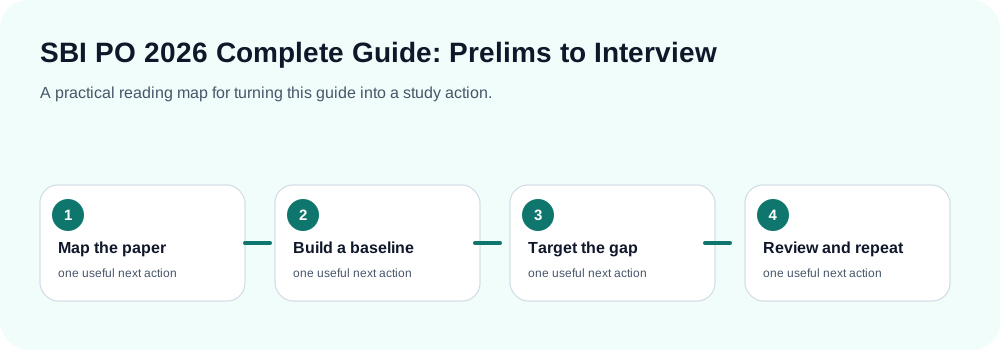
- Map the paperUse the exam pattern and eligibility details in this guide.
- Build a baselineTake a timed diagnostic mock before changing your routine.
- Target the gapChoose one weak section and practise it deliberately.
- Review and repeatLog errors, revise, and retest under time pressure.
Revision note: Published after explicit owner approval; official-source verification remains recommended for time-sensitive claims.
Keep YourMockTest in your Google results
Add us as a Preferred Source to see fresh exam updates and preparation guidance more often in Google Search.
Add YourMockTest as a Preferred Source