Exam Guides
RRB Group D 2026: From CBT to PET - Complete Selection Process
RRB Group D 2026 is your gateway to a secure Indian Railways job. Learn the complete selection process — CBT exam pattern, Physical Efficiency Test (PET) requirements, science syllabus breakdown, medical exam, and a 3-month study plan built for 10th-pass candidates.
This legacy article was owner-approved for publication. Verify time-sensitive claims against current official sources before acting.

RRB Group D is the most inclusive and accessible Railways recruitment open to candidates who have passed their Class 10 board exams. Every cycle attracts over 1 crore applicants — making it one of the largest competitive exams on Earth. With the 2026 notification expected to announce positions across all major railway zones, understanding the complete selection pipeline is your first step toward landing one of India's most prized entry-level government jobs.
---
| Post | Department |
|---|---|
| Track Maintainer Grade IV | Engineering |
| Helper/Assistant (Loco Pilot & Technician) | Mechanical / Electrical |
| Helper (Signal & Telecommunication) | S&T |
| Hospital Attendant | Medical |
| Porter | Commercial |
| Gateman | Engineering |
| Pointsman | Operations & BD |
| Safaiwala (Sanitation) | Engineering |
| Welder Helper | Mechanical Works |
What is RRB Group D?
RRB Group D recruits candidates for Level 1 posts in Indian Railways under Pay Matrix Level 1 (₹18,000 basic pay). These are the operational workhorses of the railway network — the people who keep tracks maintained, yards functional, and workshops running.
Key Posts Under Group D
Post | Department |
|---|---|
Track Maintainer Grade IV | Engineering |
Helper/Assistant (Loco Pilot & Technician) | Mechanical / Electrical |
Helper (Signal & Telecommunication) | S&T |
Hospital Attendant | Medical |
Porter | Commercial |
Gateman | Engineering |
Pointsman | Operations & BD |
Safaiwala (Sanitation) | Engineering |
Welder Helper | Mechanical Works |
The Track Maintainer is the single largest vacancy category in almost every Group D cycle, often accounting for 30–40% of total posts.
---
Eligibility Criteria
Educational Qualification
Minimum: Class 10 pass (Matriculation) from a recognized board
OR ITI (Industrial Training Institute) certificate from a NCVT/SCVT-recognized institution in the relevant trade
Candidates pursuing graduation or higher degrees are equally eligible
Age Limit (as on the notification date)
Minimum: 18 years
Maximum: 36 years
Age Relaxation:
- OBC (NCL): 3 years → max 39 years - SC/ST: 5 years → max 41 years - PwBD: 10 years additional relaxation - Ex-Servicemen: As per government norms
Nationality
Indian citizen
Subject of Nepal/Bhutan (under specific conditions)
Tibetan refugee (who came before January 1, 1962)
---
Complete Selection Process
CBT (Computer-Based Test)
↓
Physical Efficiency Test (PET)
↓
Document Verification (DV)
↓
Medical Examination
↓
Final Appointment
---
Stage 1: CBT — Computer-Based Test
Group D has a single-stage CBT (unlike NTPC's two-stage CBT), but it is more rigorous than NTPC CBT-1 in terms of General Science questions.
Exam Pattern
Section | No. of Questions | Marks | Duration |
|---|---|---|---|
Mathematics | 25 | 25 | |
General Intelligence & Reasoning | 30 | 30 | |
General Awareness & Current Affairs | 25 | 25 | |
General Science | 20 | 20 | |
Total | 100 | 100 | 90 minutes |
Negative Marking: 1/3 mark deducted per incorrect answer
Medium: Available in 15 languages including Hindi, English, and major regional languages
Mode: Online (Computer-Based)
Qualifying: Separate cutoffs for each category (UR/OBC/SC/ST)
Section-Wise Topic Breakdown
#### Mathematics (25 Questions)
Number System, BODMAS, Decimals, Fractions
LCM, HCF, Ratio & Proportion
Percentage, Profit & Loss, Simple & Compound Interest
Time & Work, Time & Distance
Elementary Algebra, Geometry, Mensuration
Trigonometry basics
Basic Statistics (Mean, Median, Mode)
#### General Intelligence & Reasoning (30 Questions)
Analogies, Alphabetical and Number Series
Coding & Decoding
Mathematical Operations
Relationships (Blood Relations)
Syllogism, Jumbling
Venn Diagram, Data Interpretation & Sufficiency
Conclusions & Decision Making
Similarities & Differences
Analytical Reasoning, Classification
#### General Awareness & Current Affairs (25 Questions)
Science & Technology, Sports, Culture
Personalities in news, Economics
Politics, significant dates
Current Affairs (last 6 months)
---
General Science: The Group D Differentiator
The 20-question General Science section is what separates Group D from other Railways exams. This section covers Class 9–10 NCERT-level Science across three domains:
Physics (6–8 Questions)
Laws of Motion (Newton's Laws):
First Law (Inertia): An object at rest stays at rest unless acted upon by a net external force. Example: Passengers jerk forward when a bus brakes suddenly.
Second Law (F = ma): Force equals mass times acceleration. The heavier the object, the more force required for the same acceleration.
Third Law (Action-Reaction): Every action has an equal and opposite reaction. Example: A gun recoils when fired.
Other key Physics topics:
Units & Measurements: SI units (meter, kilogram, second, ampere, kelvin)
Work, Energy & Power: Kinetic energy = ½mv², Potential energy = mgh
Sound: Reflection of sound (echo), ultrasound applications
Light: Reflection, refraction, total internal reflection
Electricity: Ohm's Law (V=IR), series vs. parallel circuits, Joule's Law of Heating
Magnetism: Electromagnets, magnetic field lines
Sources of Energy: Renewable vs. non-renewable
Chemistry (6–8 Questions)
Metals and Non-Metals:
Physical properties: Metals are lustrous, malleable, ductile, good conductors
Non-metals: Brittle (solid), poor conductors (except graphite)
Reactivity Series: K > Na > Ca > Mg > Al > Zn > Fe > Pb > H > Cu > Au
Corrosion: Rusting of iron — 4Fe + 3O₂ + 2H₂O → 2Fe₂O₃·H₂O (rust)
Other key Chemistry topics:
Acids, Bases & Salts: pH scale, neutralization reactions
Carbon Compounds: Hydrocarbons, functional groups, organic chemistry basics
Periodic Table: Groups, periods, atomic number vs. atomic mass
Chemical Reactions: Types — combination, decomposition, displacement, double displacement
Cleaning Agents: Soaps and detergents, emulsification
Biology (5–7 Questions)
Cell Structure:
Cell = basic unit of life; Plant cells have cell wall + chloroplast; Animal cells have centrioles
Cell organelles: Nucleus (control center), Mitochondria (powerhouse), Ribosome (protein synthesis), Endoplasmic Reticulum
Disease & Health:
Disease | Pathogen | Spread Via |
|---|---|---|
Malaria | Plasmodium (protozoan) | Female Anopheles mosquito |
Dengue | Dengue virus | Aedes mosquito |
Tuberculosis (TB) | Mycobacterium tuberculosis | Air/droplets |
Cholera | Vibrio cholerae | Contaminated water |
COVID-19 | SARS-CoV-2 (virus) | Respiratory droplets |
Typhoid | Salmonella typhi | Food/water |
Other key Biology topics:
Nutrition in plants (photosynthesis: 6CO₂ + 6H₂O → C₆H₁₂O₆ + 6O₂)
Reproduction: Asexual vs. sexual
Hormones: Insulin (pancreas), Thyroxine (thyroid), Adrenaline (adrenal)
Nervous System: Brain, spinal cord, reflex arc
Heredity & Evolution: Mendel's laws
---
Stage 2: Physical Efficiency Test (PET)
The PET is a mandatory qualifying round — candidates who fail PET are eliminated regardless of their CBT score. It is not scored; it is purely pass/fail.
PET Standards for Male Candidates
35 kg weight lift: Carry 35 kg for 100 meters in one go, without putting it down — to be done in 2 minutes
1000 meter run: Complete in 4 minutes 15 seconds
PET Standards for Female Candidates
20 kg weight lift: Carry 20 kg for 100 meters in one go — to be done in 2 minutes
1000 meter run: Complete in 5 minutes 40 seconds
Exemptions: Ex-Servicemen are exempted from PET. PwBD candidates applying for identified suitable posts are also exempted.
How to Prepare for PET Alongside Academic Study
Running Training (Start 12 weeks before exam):
Week 1–3: Brisk walking 2 km daily, transitioning to slow jogging
Week 4–6: Jog 1 km in under 8 minutes daily
Week 7–9: Target 1 km in 5 minutes; add interval training
Week 10–12: Full PET simulation twice weekly; maintain pace and breathing technique
Weight Carrying Training:
Begin with lighter loads (10–15 kg) and gradually build up to 35 kg over 8 weeks
Practice walking with a balanced load (backpack or sandbag) to develop grip strength and posture
Strengthen lower back and legs: squats, lunges, deadlifts
Combined Study + Fitness Schedule:
Time Slot | Activity |
|---|---|
5:30 AM – 7:00 AM | Running/Physical training |
8:00 AM – 12:00 PM | Academic study (Math + Science) |
2:00 PM – 5:00 PM | Academic study (Reasoning + GK) |
6:00 PM – 7:00 PM | Weight practice / strength training |
8:00 PM – 9:30 PM | Mock tests / Revision |
---
Stage 3: Document Verification
After PET, shortlisted candidates must submit original documents:
10th Marksheet and Certificate (proof of DOB + qualification)
ITI Certificate (if applicable)
Caste Certificate (OBC/SC/ST as applicable)
PWD Certificate (if applicable)
Aadhar Card, Voter ID, or any government photo ID
Passport-size photographs
Ex-Servicemen discharge certificate (if applicable)
---
Stage 4: Medical Examination
Railway medical standards are strict due to the safety-critical nature of Group D roles:
Vision Standards:
For Track Maintainer, Pointsman: Distant vision 6/9 each eye (without glasses), no color blindness
For other posts: Distant vision correctable to 6/9 with glasses acceptable
Hearing Standards:
Must not have hearing impairment that affects normal communication
General Medical:
Absence of physical deformities
No history of major surgeries that affect functional mobility
Height, chest, and weight within functional norms
Medical fitness is classified as A1, A2, A3, B1, B2, C1, C2 based on vision, hearing, and general health. Most Group D posts require at least B1 classification.
---
Zone Preferences and Salary Structure
Salary: Pay Level 1 (7th CPC)
Basic Pay: ₹18,000/month
DA (Dearness Allowance): ~46% of basic ≈ ₹8,280
HRA: 8–24% based on city classification
Transport Allowance: ₹900–₹3,600/month
Gross Salary: Approximately ₹22,000–₹28,000/month in hand (varies by posting location)
Additional Benefits:
Free annual passes for self and family on Indian Railways
Government accommodation (quarters) in many zones
Medical benefits for self, spouse, dependent children, and parents
Pension under NPS (National Pension System)
30 days earned leave, 20 days casual leave per year
Zone-Wise Preference Tips
Post your preference to your home state's RRB zone for posting near family
Track Maintainer postings often go to remote and rural sections of railway lines — consider this when applying
Urban centers (Mumbai, Chennai, Kolkata, Delhi) have higher HRA but more competitive cutoffs within zones
---
3-Month Beginner Preparation Plan
Month | Academic Focus | Physical Focus |
|---|---|---|
Month 1 | NCERT Science (Chapters 1–7 each of Phy/Chem/Bio Class 9) + Number System + Basic Reasoning | Start morning walks (2 km daily) |
Month 2 | NCERT Science (Class 10 chapters) + All Math topics + Current Affairs habit + Mock test start | Jogging 1 km in 6 min; begin load carrying with 15 kg |
Month 3 | Daily 2 full mocks + Error analysis + Rapid GK revision + Science quick notes | PET simulation twice weekly; target full distance and weight |
Recommended Resources:
Science: NCERT Class 9 & 10 (Physics, Chemistry, Biology)
Math: R.S. Aggarwal (Elementary Mathematics)
Reasoning: R.S. Aggarwal (Verbal & Non-Verbal Reasoning)
Current Affairs: Monthly magazines or app-based daily capsules
Mocks: YourMockTest RRB Group D full-length practice tests
---
Expert Tips to Maximize Your Score
General Science is your score booster — 20 marks from 10th NCERT is 100% achievable with 3 weeks of focused reading.
Don't neglect PET timing — many academically strong candidates fail PET because they underestimate the physical requirements. Start training early.
Negative marking strategy — skip questions you're less than 60% sure about. Unattempted = 0, wrong = -0.33. Play it smart.
Language choice — attempt the exam in your most comfortable language to save reading time.
Medical awareness — if you wear glasses, get your vision checked early. Certain posts require uncorrected vision.
Group D 2026 is the largest employment opportunity in Indian Railways. With disciplined study and physical preparation running in parallel, you can secure your position in one of India's most stable and rewarding public sector careers.
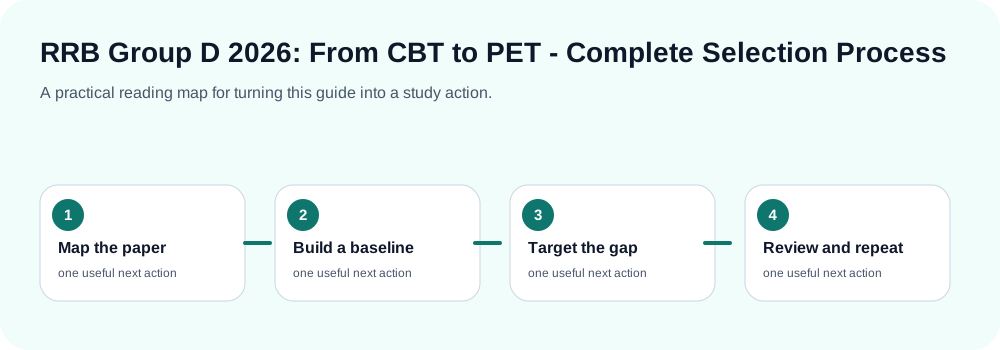
- Map the paperUse the exam pattern and eligibility details in this guide.
- Build a baselineTake a timed diagnostic mock before changing your routine.
- Target the gapChoose one weak section and practise it deliberately.
- Review and repeatLog errors, revise, and retest under time pressure.
Revision note: Published after explicit owner approval; official-source verification remains recommended for time-sensitive claims.
Keep YourMockTest in your Google results
Add us as a Preferred Source to see fresh exam updates and preparation guidance more often in Google Search.
Add YourMockTest as a Preferred Source