Exam Guides
NDA 1 2026: Complete Preparation Guide for Mathematics & GAT
Comprehensive preparation guide for NDA 1 2026 covering exam pattern, syllabus, mathematics strategy, GAT sections, SSB interview process, and a 6-month study plan for Class 12 students aiming for Army, Navy, and Air Force.
This legacy article was owner-approved for publication. Verify time-sensitive claims against current official sources before acting.

The National Defence Academy (NDA) exam is one of the most prestigious competitive examinations in India, opening the doors to the Army, Navy, and Indian Air Force for students who have just completed or are appearing in their Class 12 board exams. Conducted twice a year by the Union Public Service Commission (UPSC), NDA 1 2026 is a golden opportunity for young aspirants to serve the nation in uniform.
---
Read the chart as a quick comparison, not as a replacement for the official source or the detailed explanation below.
Who Can Apply for NDA 1 2026?
Before diving into preparation, it's essential to understand the eligibility criteria:
Age: 17.5 to 23 years as of the date of commencement of the course (born between 02 July 2003 and 01 January 2009 for NDA 1 2026).
Educational Qualification:
- For Army Wing: Class 12 pass or appearing in any stream from a recognised board. - For Navy & Air Force: Class 12 pass or appearing with Physics and Mathematics as compulsory subjects.
Gender: Open to both males and females since the Supreme Court's landmark 2021 ruling that allowed women to appear for NDA.
Marital Status: Must be unmarried at the time of joining the NDA.
Nationality: Must be an Indian citizen.
Key Insight: Female candidates are now eligible for all three wings — Army, Navy, and Air Force — making NDA 1 2026 a landmark opportunity for women aspiring for a military career.
---
NDA 1 2026 Exam Pattern
The NDA written exam consists of two papers conducted on a single day:
Paper | Sections | No. of Questions | Total Marks | Duration |
|---|---|---|---|---|
Paper I – Mathematics | Pure Mathematics | 120 | 300 | 2.5 Hours |
Paper II – GAT (General Ability Test) | English + GK (Physics, Chemistry, Maths, Biology, History, Geography, Current Affairs) | 150 | 600 | 2.5 Hours |
Total | 270 | 900 | 5 Hours |
Marking Scheme
Each correct answer in Mathematics: +2.5 marks
Each correct answer in GAT: +4 marks
Negative Marking: 1/3rd of marks deducted for every wrong answer (0.83 marks for Maths, 1.33 marks for GAT)
---
GAT Paper: Section-wise Breakup
The GAT paper is further divided into two main parts:
Part A – English (50 Questions, 200 Marks)
Spotting Errors, Sentence Completion, Synonyms & Antonyms
Reading Comprehension, Cloze Tests, Ordering of Sentences
Part B – General Knowledge (100 Questions, 400 Marks)
Subject | Approx. Weightage |
|---|---|
Physics | 25% |
Chemistry | 15% |
General Science (Biology) | 10% |
History, Freedom Struggle & Culture | 20% |
Geography | 20% |
Current Affairs & Defence | 10% |
---
Mathematics: The Hardest Topics and How to Master Them
NDA Mathematics Paper (120 questions, 300 marks) is based entirely on Class 11–12 syllabus. However, the difficulty level is high because questions are conceptual, not formula-rote.
Most Challenging Topics:
1. Matrices and Determinants (10–12 questions)
This is the highest-scoring and most frequently tested topic in recent NDA papers.
Master operations on matrices, types of matrices, adjoint, inverse, solving equations using Cramer's rule.
Practice: At least 200 questions from standard references.
2. Integral Calculus (12–15 questions)
Indefinite and definite integrals, area under curves.
Many students lose marks here due to calculation errors — practise without a calculator.
Standard form: ∫ sinⁿx · cosᵐx dx problems are common.
3. Probability (8–10 questions)
Conditional probability, Bayes' theorem, Binomial distribution.
Questions often have tricky language — read carefully before computing.
4. Differential Calculus (12–14 questions)
Continuity, differentiability, maxima–minima, tangent and normal.
Questions on L'Hôpital's Rule and curve sketching appear frequently.
5. Vector Algebra & 3D Geometry (10–12 questions)
Scalar triple product, lines and planes in 3D space.
These questions appear conceptually straightforward but require accurate visualisation.
6. Trigonometry (10–12 questions)
Identities, inverse functions, properties of triangles, height and distance.
One of the most scoring topics — never skip it.
Mathematics Preparation Strategy:
Use R.S. Aggarwal's NDA/NA Mathematics as the primary textbook.
Solve previous 10 years' NDA papers specifically for Mathematics.
Target completing 40 questions per hour during practice (paper has 120 questions in 150 minutes).
---
Physics in GAT: What the NDA Actually Asks
Physics is the most-weighted science subject in GAT. The questions are based on Class 9–12 NCERT Physics but framed conceptually:
Mechanics: Newton's laws, projectile motion, work-energy theorem, circular motion
Optics: Reflection, refraction, lenses, mirrors, optical instruments
Heat & Thermodynamics: Laws of thermodynamics, specific heat, calorimetry
Electricity & Magnetism: Ohm's law, Kirchhoff's laws, magnetic effects of current
Modern Physics: Photoelectric effect, radioactivity, nuclear fission/fusion
Defence Application Questions: Radar, sonar, satellites — unique to NDA!
Pro Tip: Read the 'Science in Defence' sections of NCERT Class 12 — NDA regularly asks questions about radar range, sonar depth, and missile guidance systems.
---
SSB Interview: The 5-Day Process
Clearing the written exam is just the first hurdle. The Services Selection Board (SSB) interview carries 900 marks and is a comprehensive 5-day assessment:
Day 1 – Screening (OIR + PPDT)
Officer Intelligence Rating (OIR): Verbal and non-verbal reasoning tests
Picture Perception & Discussion Test (PPDT): Group storytelling exercise
Only ~30–40% of candidates proceed to Day 2
Days 2–4 – Psychological Tests + GTO + Interview
Psychological Tests: TAT (Thematic Apperception Test), WAT (Word Association Test), SRT (Situation Reaction Test), SDT (Self Description Test)
GTO Tasks: Group Discussion, Group Planning Exercise, Progressive Group Tasks, Half Group Tasks, Individual Obstacles, Command Task, Lecturette
Personal Interview: Conducted by a Senior Assessor — covers personal background, current affairs, motivation for joining
Day 5 – Conference
Final Board Conference where all assessors discuss your performance collectively.
Result declared on Day 5 itself.
What Assessors Look For (Officer Like Qualities – OLQs):
Effective Intelligence, Reasoning Ability
Organising Ability, Power of Expression
Social Adaptability, Cooperation, Sense of Responsibility
Initiative, Self-Confidence, Speed of Decision
Ability to Influence Group, Liveliness, Determination
---
Physical Fitness Requirements
Physical fitness is tested at the Medical Examination stage post-SSB:
Height (Male): Minimum 157 cm (Army), 157 cm (Navy), 162.5 cm (Air Force)
Height (Female): Minimum 152 cm for Army and Navy
Weight: Proportionate to height as per medical standards
Vision: 6/6 in each eye without correction for flying branches
No colour blindness for Navy/Air Force
For SSB, physical activities like Group Planning, PGT, and HGT require reasonable fitness. Start daily jogging (5 km), push-ups (40+), and yoga for mental composure well before your SSB date.
---
6-Month Preparation Plan (Class 12 Level)
Month | Focus Areas |
|---|---|
Month 1 | NCERT Class 11–12 Maths (complete Algebra, Trigonometry), NCERT Physics 11 |
Month 2 | Calculus (Differential + Integral), Matrices, NCERT Physics 12 |
Month 3 | GAT – English (grammar rules, RC practice), History (NCERT 8–12) |
Month 4 | GAT – Geography, Science (Biology + Chemistry NCERTs), Current Affairs |
Month 5 | Full-length mock tests (alternate day), target 120+ in Maths, 350+ in GAT |
Month 6 | Revision, weak area focus, previous papers (2016–2025), SSB prep reading |
Daily Study Hours Recommended: 6–8 hours Mock Tests: 1 full test every 3 days from Month 4 onwards
---
Career Path After NDA Selection
Post successful SSB and medical, candidates join the National Defence Academy, Khadakwasla, Pune for a 3-year joint training program followed by 1 year at their respective service academy (IMA/INA/AFA).
Rank on Commissioning: Lieutenant (Army) / Sub-Lieutenant (Navy) / Flying Officer (Air Force)
Pay and Perks at Entry Level:
Basic Pay: ₹56,100 per month (Level 10 of 7th Pay Commission)
Military Service Pay (MSP): ₹15,500 per month
Free accommodation in service quarters or HRA
Free ration and subsidised canteen (CSD) benefits
Leave Travel Concession (LTC)
Full medical cover for self and family
Free uniform and kit allowance
Pension after 20 years of service
Career Progression: Lieutenant → Captain (2 yrs) → Major (6 yrs) → Lieutenant Colonel (13 yrs) → Colonel (15 yrs) → Brigadier → Major General → Lieutenant General → General
The NDA route is one of the earliest entry points into the defence forces and provides an unparalleled foundation for a distinguished military career.
---
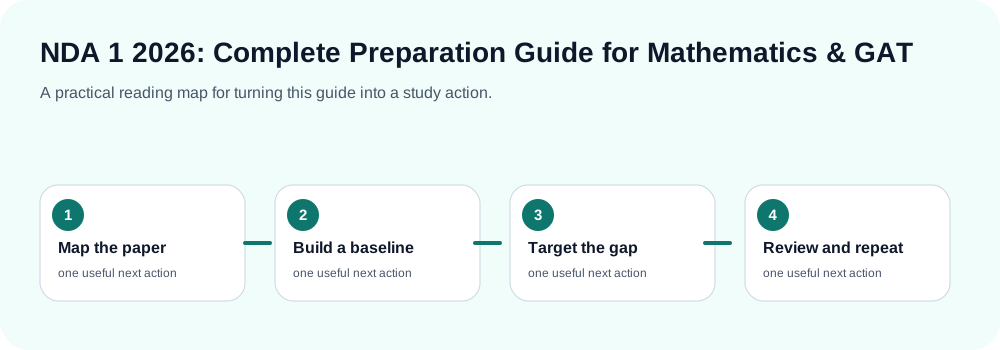
- Map the paperUse the exam pattern and eligibility details in this guide.
- Build a baselineTake a timed diagnostic mock before changing your routine.
- Target the gapChoose one weak section and practise it deliberately.
- Review and repeatLog errors, revise, and retest under time pressure.
Final Advice
Stick to NCERT books as the primary source; do not rely on shortcuts.
Join YourMockTest for NDA-specific chapter tests and full mock papers with detailed solutions.
Practice time management rigorously — 120 maths questions in 150 minutes = 75 seconds per question.
Don't ignore current affairs — read one national newspaper daily and note defence news specifically.
Start SSB preparation alongside written exam prep — reading 'SSB Interview' by Maj. Gen. J.S. Sandhu helps build the right mindset.
With consistent effort and disciplined preparation, NDA 1 2026 can be your first step toward a life of honour, adventure, and service to the nation.
Revision note: Published after explicit owner approval; official-source verification remains recommended for time-sensitive claims.
Keep YourMockTest in your Google results
Add us as a Preferred Source to see fresh exam updates and preparation guidance more often in Google Search.
Add YourMockTest as a Preferred Source