Study Tips
Why Digital Mock Tests Beat Offline Practice Papers: A Data-Driven Case
Offline practice papers feel productive but leave critical gaps. This guide explains why full-length digital mock tests — taken on a real CBT interface — are the single highest-leverage preparation activity for SSC CGL, IBPS PO, UPSC Prelims, and Railway exams.
This legacy article was owner-approved for publication. Verify time-sensitive claims against current official sources before acting.
The offline paper illusion
An offline practice paper tells you whether you know the answer. A digital mock test tells you whether you can get the answer in 36 seconds, on a screen, under countdown pressure, with a 100-question palette staring at you from the sidebar.
For SSC CGL, IBPS PO, and UPSC Prelims — all delivered on computer-based platforms — offline preparation without digital interface training is preparation with the wrong tool. This guide explains the four specific advantages of digital mocks and shows you how to extract maximum value from each one.
| Interface element | What aspirants who haven't practised digitally get wrong |
|---|---|
| **Question palette** | Don't know the colour-coding (Answered, Marked for Review, Not Visited). Miss the strategic value of "Mark for Review" for uncertain questions |
| **Sectional timer** (SSC CGL Tier 1) | Don't notice it counting down per section. Lose time in one section without realising it can't be recovered in another |
| **Save & Next vs. Mark for Review** | Accidentally save unconfident answers when they intended to mark for review — or vice versa |
| **Subject switching** (where allowed) | Don't know whether switching mid-section is permitted. Miss the strategic option of starting with their strongest subject |
| **Question navigation** | Navigate question by question instead of using the palette to jump directly — wasting 2–3 minutes per exam |
Why the interface matters more than most aspirants realise
Government exam Computer-Based Tests (CBTs) have specific interface behaviours that must be learned before the exam day:
Interface element | What aspirants who haven't practised digitally get wrong |
|---|---|
Question palette | Don't know the colour-coding (Answered, Marked for Review, Not Visited). Miss the strategic value of "Mark for Review" for uncertain questions |
Sectional timer (SSC CGL Tier 1) | Don't notice it counting down per section. Lose time in one section without realising it can't be recovered in another |
Save & Next vs. Mark for Review | Accidentally save unconfident answers when they intended to mark for review — or vice versa |
Subject switching (where allowed) | Don't know whether switching mid-section is permitted. Miss the strategic option of starting with their strongest subject |
Question navigation | Navigate question by question instead of using the palette to jump directly — wasting 2–3 minutes per exam |
The cost of interface unfamiliarity: In a 60-minute Tier 1 exam with 100 questions, a 3-minute interface navigation penalty reduces your available time per question from 36 seconds to 34 seconds. That's a 5.5% reduction in available time — before you've answered a single question.
The 4 measurable advantages of digital mocks
Advantage 1: Timing calibration under real conditions
Offline practice tells you the right answer with no time pressure. A digital mock with a live countdown forces you to make the critical exam decision: answer now (possibly wrong), skip (lose the question), or mark for review (costs time on second pass).
Aspirants who have taken 15+ digital mocks develop an internal calibration for this trade-off that offline practice cannot build. They know, from repeated exposure, that a hard Geometry question takes 90 seconds and should be skipped on the first pass in favour of three 25-second Arithmetic questions.
Advantage 2: Realistic percentile tracking
An offline practice paper gives you a raw score. A digital mock from a quality platform gives you:
Your score vs. the distribution of all other aspirants who took the same mock
Section-wise percentile ("Your English is 89th percentile, your Quant is 54th percentile")
Difficulty-adjusted comparison (how did you do on the hard questions vs. peers)
Time-per-question analysis (where did you spend disproportionate time)
This analytics layer is unavailable from an offline paper. It is the difference between knowing your score and knowing what to fix.
Advantage 3: Error pattern detection
Over a series of digital mocks, patterns emerge that are invisible in offline practice:
Pattern | What it reveals | Corrective action |
|---|---|---|
Consistent accuracy drop in the final 8 minutes | Cognitive fatigue — you run out of working memory | Practice 70-minute full sessions to build endurance |
High accuracy in attempts, low overall score | Over-skipping — you attempt fewer questions than peers at similar accuracy | Build confidence on medium-difficulty questions to increase attempt count |
Accuracy falls below 70% in one specific section | Concept gap in that section | Return to fundamentals for that topic |
High accuracy in practice but low in mocks | Test anxiety or interface unfamiliarity | More full-length digital mocks, fewer topic-level practice sets |
Advantage 4: Desensitisation to exam pressure
The exam environment is a threat environment. The countdown timer, the question palette showing unanswered questions, the no-exit fullscreen mode — these activate a stress response that degrades performance for aspirants who have not experienced them repeatedly.
Psychological desensitisation requires repeated controlled exposure. Each digital mock you take under real conditions (no pause, no phone, timed from the start, reviewed only after submission) reduces the novelty of the exam environment on the actual day.
Digital mock vs. offline practice paper: comparison
Feature | Digital mock | Offline practice paper |
|---|---|---|
Interface familiarity | ✓ Builds real exam interface skills | ✗ No interface exposure |
Timing calibration | ✓ Per-question timing enforced | ✗ Self-paced, artificial |
Percentile comparison | ✓ vs. real aspirant pool | ✗ Only vs. answer key |
Analytics | ✓ Section, topic, time-per-question | ✗ Raw score only |
Proctoring simulation | ✓ Fullscreen, no pause | ✗ Open environment |
Negative marking enforcement | ✓ Automatic deduction | ✗ Manually counted |
Immediate detailed explanation | ✓ Solution with source after submit | ✗ Must look up separately |
Repeat testing on same set | ✗ Less effective on familiar questions | ✓ Can re-test on paper |
Offline papers remain useful for one purpose: targeted topic-level drilling (50 Quant questions on Percentage in a focused 45-minute session). They are not a substitute for full-length digital mocks.
How to extract maximum value from each digital mock
Most aspirants take a mock, see their score, feel good or bad about it, and move on. This is the least effective way to use a mock test.
The high-extraction mock review protocol:
Attempt classification (15 min): Categorise every wrong answer as (a) concept gap, (b) silly mistake, or (c) time crunch. Write these categories next to each wrong question.
Concept gap remediation (30 min): For concept gaps, identify the exact formula or rule you were missing and write it in your notes. Solve 5 similar questions on that specific concept immediately.
Pattern check (10 min): Look for any section or time period where your accuracy consistently dropped. This is your correction target for the next mock.
Next mock intention (5 min): Write one specific thing you will do differently in your next mock based on this one's results.
This protocol takes 60 minutes per mock. Aspirants who skip it use the mock only as a score measurement. Those who do it use it as a coaching session.
When to start digital mocks
Phase | Mock frequency | Purpose |
|---|---|---|
Foundation (Month 1–2) | 1 full mock every 2 weeks | Interface familiarisation only; score is irrelevant |
Speed building (Month 3–4) | 1 full mock per week + 2 sectional mocks | Accuracy under timer; error pattern identification |
Peak prep (Month 5+) | 3 full mocks per week | Performance peak, percentile tracking, desensitisation |
Final 7 days | No new mock after Day 4 | Consolidation only; maintain, do not stress-test |
Start now
Take a full-length SSC CGL or UPSC Prelims mock on YourMockTest today — not in "final prep mode" but as an interface familiarisation run. Time yourself. Use the question palette. Submit without pausing. Then spend 60 minutes on the review protocol above. This single session will reveal more about your preparation than a week of offline paper practice.
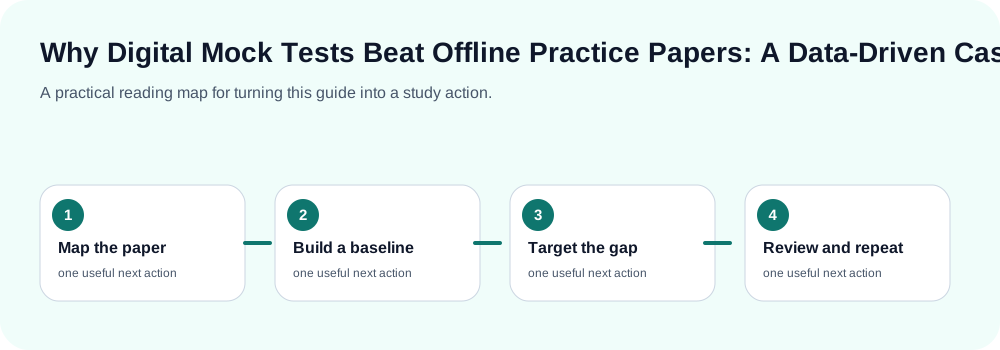
- Map the paperUse the exam pattern and eligibility details in this guide.
- Build a baselineTake a timed diagnostic mock before changing your routine.
- Target the gapChoose one weak section and practise it deliberately.
- Review and repeatLog errors, revise, and retest under time pressure.
Revision note: Published after explicit owner approval; official-source verification remains recommended for time-sensitive claims.
Keep YourMockTest in your Google results
Add us as a Preferred Source to see fresh exam updates and preparation guidance more often in Google Search.
Add YourMockTest as a Preferred Source