Exam Guides
AFCAT 1 2026: Complete Guide to Join Indian Air Force as Officer
Complete preparation guide for AFCAT 1 2026 — exam pattern, Military Aptitude Test, EKT for Technical branch, AFSB selection process, physical standards, training at AFA Hyderabad, and section-wise preparation strategy to join the Indian Air Force as an officer.
This legacy article was owner-approved for publication. Verify time-sensitive claims against current official sources before acting.

The Air Force Common Admission Test (AFCAT) is the Indian Air Force's primary examination for selecting officers into Flying, Technical, and Ground Duty branches. Conducted twice a year by the Indian Air Force (IAF), AFCAT 1 2026 is one of the most sought-after officer entry schemes for graduates, offering a career that combines professional excellence with adventure at 30,000 feet.
---
| Branch | Qualification | Age |
|---|---|---|
| Flying | Graduation with 60% marks; Physics + Maths in Class 12 | 20–24 years |
| Technical (Mech/Elec) | BE/B.Tech in relevant engineering discipline with 60% | 20–26 years |
| Ground Duty (Admin/Logi/Accounts) | Graduation with 60% marks | 20–26 years |
| Ground Duty (Education) | PG degree with 50% marks | 20–26 years |
| Ground Duty (Meteorology) | PG in Science/Maths/Statistics/Geography with 50% | 20–25 years |
What is AFCAT? Branches Available
AFCAT offers three distinct career tracks:
- Flying Branch
Train as a Fighter Pilot, Transport Pilot, or Helicopter Pilot
Most competitive and prestigious branch
Only Short Service Commission (14 years extendable)
Requires exceptional eyesight and physical standards
- Technical Branch
Two sub-branches: Aeronautical Engineering (Mechanical) and Aeronautical Engineering (Electronics)
Work on maintenance, development, and overhaul of IAF aircraft systems
Permanent Commission available
Additional test: Engineering Knowledge Test (EKT)
- Ground Duty Branch
Covers Administration, Logistics, Accounts, Education, and Meteorology branches
Permanent Commission for most streams
No EKT required
---
Eligibility Criteria for AFCAT 1 2026
Branch | Qualification | Age |
|---|---|---|
Flying | Graduation with 60% marks; Physics + Maths in Class 12 | 20–24 years |
Technical (Mech/Elec) | BE/B.Tech in relevant engineering discipline with 60% | 20–26 years |
Ground Duty (Admin/Logi/Accounts) | Graduation with 60% marks | 20–26 years |
Ground Duty (Education) | PG degree with 50% marks | 20–26 years |
Ground Duty (Meteorology) | PG in Science/Maths/Statistics/Geography with 50% | 20–25 years |
Gender: Open to both males and females in all branches including Flying (female pilots inducted since 2016).
Note: Candidates in their final year of graduation can also apply, subject to fulfilling qualification criteria before joining.
---
AFCAT 1 2026 Exam Pattern
AFCAT is a computer-based test (CBT) of 100 questions in 120 minutes (2 hours):
Section | No. of Questions | Marks |
|---|---|---|
General Awareness | 25 | 75 |
Verbal Ability in English | 25 | 75 |
Numerical Ability | 18 | 54 |
Reasoning & Military Aptitude Test (RMATS) | 32 | 96 |
Total | 100 | 300 |
Marking Scheme
+3 marks per correct answer
-1 mark per incorrect answer (1/3rd negative marking)
No marks for unattempted questions
Key Insight: AFCAT has the highest marks per question (3 marks) among defence exams but also a significant penalty. Attempting 75–80 questions with 85%+ accuracy is better than attempting all 100.
---
EKT (Engineering Knowledge Test) — Technical Branch Only
Candidates applying for the Technical branch must additionally qualify the EKT, conducted immediately after AFCAT:
Parameter | Details |
|---|---|
Duration | 45 Minutes |
Questions | 50 (MCQ) |
Marks | 150 (3 marks each) |
Negative Marking | -1 per wrong answer |
Subjects | AE(M): Mechanical Engineering fundamentals; AE(E): Electronics/Communication/Computers |
EKT (Mechanical) Key Topics:
Engineering Mechanics, Strength of Materials
Thermodynamics, Fluid Mechanics
Manufacturing Technology, Theory of Machines
Aircraft structures, propulsion basics
EKT (Electronics) Key Topics:
Electronic Devices and Circuits
Digital Electronics, Microprocessors
Communication Systems, Signals & Systems
Computer Networks, Control Systems
Both EKT and AFCAT scores are combined for shortlisting — a high EKT score can compensate for a moderate AFCAT score for Technical branch aspirants.
---
Section-wise AFCAT Preparation Strategy
- General Awareness (25 Questions)
This section has a distinct IAF flavour unlike standard GK sections. Focus areas:
Defence Technology & IAF History (8–10 questions)
IAF aircraft fleet: Rafale, Su-30 MKI, Tejas Mk1A, MiG-29 UPG, Jaguar, Mirage 2000
Helicopter fleet: Apache AH-64E, Chinook CH-47F, ALH Dhruv, Mi-17
Missile systems: BrahMos (air-launched), ASTRA, Rudram anti-radiation missile
IAF milestones: 1971 war, Operation Safed Sagar (Kargil), Operation Parakram
Famous IAF Aces: Air Marshal Arjan Singh, Wing Commander Abhinandan Varthaman
Science & Technology (5–6 questions)
Space science: ISRO missions (Chandrayaan-3, Aditya-L1, NISAR)
Physics applications: sonar, radar, GPS technology
Indian History, Polity, Economy (8–10 questions)
Standard NCERT-level questions; no deep specialisation required
Focus on post-1947 political history
Current Affairs (4–5 questions)
Last 6 months: major national/international events
Defence acquisitions, bilateral exercises, new IAF bases
- Verbal Ability in English (25 Questions)
Sub-topic | Approx. Questions |
|---|---|
Reading Comprehension | 5–8 |
Error Detection | 4–5 |
Sentence Completion | 4–5 |
Synonyms/Antonyms | 5–6 |
Idioms & Phrases | 2–3 |
Preparation Resources:
Objective English by S.P. Bakshi
Daily editorial reading from The Hindu or Indian Express
Word Power Made Easy for vocabulary building
Practice 30 minutes of English every day without fail
- Numerical Ability (18 Questions)
AFCAT Mathematics covers Class 10 level concepts — less advanced than CDS or NDA:
Topic | Expected Questions |
|---|---|
Ratio, Proportion, Percentages | 3–4 |
Time, Work, Distance | 3–4 |
Profit & Loss, SI/CI | 2–3 |
Number Systems | 2–3 |
Average, Mixture & Alligation | 2–3 |
Data Interpretation | 2–3 |
Strategy: With only 18 questions, attempt all with care. Use shortcut techniques for percentage (multiplier method), ratio (unitary method). Data Interpretation questions involve simple tables/charts — read carefully.
- Reasoning & Military Aptitude Test (RMATS) — 32 Questions
This is the unique section of AFCAT that differentiates it from all other competitive exams. It combines standard reasoning with spatial intelligence tests:
Standard Reasoning (~15 questions):
Series completion (number, letter, figure)
Analogies, coding-decoding
Venn diagrams, blood relations
Syllogisms, direction sense
Military Aptitude / Spatial Reasoning (~17 questions):
Map Reading: Interpret topographic maps, identify coordinates, read contours
Spatial Reasoning: Rotate 3D objects mentally, identify folded cube patterns
Formation Flying: Identify which aircraft formation is correct from a description
Figure Series: Identify the next figure in a spatial sequence
Clock and Mirror Images: Visual rotation and reflection problems
AFCAT Unique Tip: Spatial reasoning in AFCAT specifically tests your mental rotation ability — a skill pilots use to visualise aircraft orientation. Practise this daily with AFCAT-specific mock tests. It is significantly harder than general reasoning for most candidates.
Resources: AFCAT EKT by Arihant Publications; YourMockTest AFCAT section-wise tests (spatial reasoning module).
---
AFSB: Air Force Selection Board Process (2 Stages)
After clearing AFCAT written test, candidates appear at one of six Air Force Selection Boards (AFSB) located at Dehradun, Mysore, Varanasi, Gandhinagar, Jorhat, or Guwahati:
Stage 1 (Day 1) — Screening
Officer Intelligence Rating (OIR): Verbal and non-verbal IQ tests
Picture Perception & Discussion Test (PPDT): View a blurry image for 30 seconds, write a story, then discuss in a group of 10–15 candidates
~40% of candidates are retained after Stage 1
Stage 2 (Days 2–5) — Full Assessment
Psychological Tests (Day 2):
Thematic Apperception Test (TAT) — 11 pictures, write stories
Word Association Test (WAT) — 60 words in 15 seconds each
Situation Reaction Test (SRT) — 60 situations in 30 minutes
Self Description Test (SDT) — essay on self as described by parents, friends, teacher, self
Group Testing Officer (GTO) Tasks (Days 3–4):
Group Discussion (2 topics)
Group Planning Exercise
Progressive Group Task (PGT) and Half Group Task (HGT)
Individual Obstacles Course (10 obstacles)
Command Task
Lecturette (3-minute talk on a chosen topic)
Final Group Task
Personal Interview (Day 4–5):
45–60 minute deep interview with a Senior Assessor
Cover: family background, graduation subject, motivation for IAF, current events, personal challenges overcome
Conference (Day 5):
All assessors meet, discuss, and finalise the result
Recommended candidates proceed to medical examination
---
Physical Standards for AFCAT 2026
Parameter | Flying Branch | Ground Duty/Technical |
|---|---|---|
Height (Male) | Min 162.5 cm | Min 157 cm |
Height (Female) | Min 152 cm | Min 152 cm |
Weight | Proportional to height | Proportional |
Vision (Flying) | 6/6 each eye without glasses | Relaxed standards |
Colour Vision | Normal (isochromatic plates) | Normal |
Hearing | Normal | Normal |
Additional for Flying Branch:
No myopia or hypermetropia beyond permissible limits
No history of psychiatric illness
No colour blindness (critical — disqualifies from flying)
---
Training at AFA Hyderabad: What Awaits You
Officers commissioned through AFCAT who join the Air Force Academy (AFA), Dundigal, Hyderabad undergo:
74-week (18.5 months) pre-commissioning training for Flying branch
52-week training for Ground Duty and Technical officers
Training includes:
Flying training on HPT-32 Deepak and then Kiran Mk-II jet trainers (Flying branch)
Military drill, leadership exercises, weapons training
Aviation medicine, aerodynamics, meteorology theory
Sports, swimming, athletics — all mandatory
Commissioning Ceremony: The prestigious Passing Out Parade (POP) at AFA where officers receive their wings and epaulettes — one of the most celebrated moments in an IAF officer's life.
---
Salary, Lifestyle, and Perks
Rank at Commissioning | Flying Officer |
|---|---|
Basic Pay (Level 10) | ₹56,100/month |
Military Service Pay | ₹15,500/month |
Flying Allowance | ₹25,000/month (flying branch only) |
Technical Allowance | ₹3,000–5,000/month |
Free Accommodation | Service quarters or HRA |
Medical | Free for self and family |
Lifestyle Perks:
Subsidised CSD canteen (fuel, groceries, electronics at military rates)
Mess facilities: Food, recreation, sports at minimal cost
Adventure activities: Paragliding, mountaineering, sailing — at IAF expense
International postings and UN peacekeeping missions
Free uniform kit and allowances
---
3-Month Targeted Preparation Plan
Week | Focus |
|---|---|
Week 1–2 | General Awareness: Defence + IAF history complete; AFCAT sample paper analysis |
Week 3–4 | Spatial Reasoning: 1 hour daily; English grammar rules |
Week 5–6 | Numerical Ability: All topics; EKT basics (if Technical branch) |
Week 7–8 | Full mock tests weekly; current affairs compilation |
Week 9–10 | EKT subject deep-dive; weak area focused tests |
Week 11–12 | Daily mocks; previous 5-year AFCAT papers; SSB awareness preparation |
---
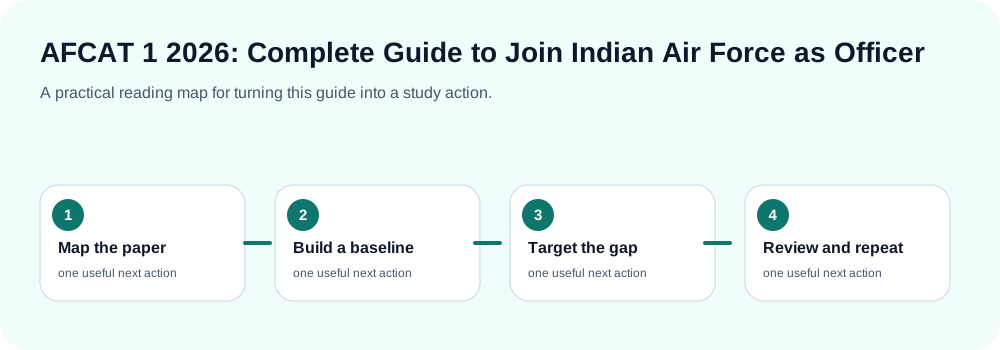
- Map the paperUse the exam pattern and eligibility details in this guide.
- Build a baselineTake a timed diagnostic mock before changing your routine.
- Target the gapChoose one weak section and practise it deliberately.
- Review and repeatLog errors, revise, and retest under time pressure.
Conclusion
AFCAT 1 2026 is your pathway to donning the IAF uniform and experiencing a career that few professions can match. The Military Aptitude and Spatial Reasoning section is what makes AFCAT unique — and mastering it is the key differentiator for serious aspirants.
Start your AFCAT journey on YourMockTest with dedicated spatial reasoning drills, full-length AFCAT mock tests, and EKT practice papers to ensure you arrive on exam day fully prepared to take flight.
Revision note: Published after explicit owner approval; official-source verification remains recommended for time-sensitive claims.
Keep YourMockTest in your Google results
Add us as a Preferred Source to see fresh exam updates and preparation guidance more often in Google Search.
Add YourMockTest as a Preferred Source