Previous Year Paper

UPPSC Polytechnic Lecturer Electrical 22 Nov 2021 Official Paper II (Previous Year Paper)

Held in 2021

125 questions150 minutes
With answers
Free

Paper last updated:

Practise under exam conditions

Take this paper as a timed mock test. Review your answers after you submit.

Attempt timed test

Questions & answers

Read the paper at your pace. Open an explanation when you need it.

General Studies (25 questions)

Question 1

The "Chandra Prabha Wildlife Sanctuary" a major wildlife sanctuary of Uttar Pradesh is situated in which of the following?

  1. AOption (a)

    Pilibhit District

  2. BOption (b)

    Chandauli District

  3. COption (c)

    Unnao District

  4. DOption (d)

    Maharajganj District

View answer & explanation

Correct answer

Answer: (b)B.

Chandauli District

Why this answer is correct

The Correct Answer is Chandauli District.

Key Points

  • The Chandra Prabha Wildlife Sanctuary is situated in the Chandauli district of Uttar Pradesh state in central India.
  • It is well endowed with beautiful picnic spots, dense forests, and scenic waterfalls like Rajdari and Devdari that attract tourists every year to its vicinity.
  • Chandra Prabha Wildlife Sanctuary is situated about 70 kilometers from the historic city of Varanasi.
  • The area was made a hunting preserve for the rulers of Benares in the second half of the 18th century.
  • The wildlife sanctuary was established in May 1957. Asiatic lions were introduced at Chandra Prabha in 1958.

Additional Information

  • Importance of Wildlife Sanctuaries: There are a number of reasons for establishing wildlife sanctuaries. Some of the reasons are listed below:
  • The wildlife sanctuaries are established to protect endangered species.
  • It is quite difficult to always relocate the animals from their natural habitat, therefore, protecting them in their natural environment is advantageous.
  • The endangered species are specially monitored in the wildlife sanctuaries. If they reproduce and grow in number while under protection, few specimens can be kept for breeding in the conservation parks for their survival.
  • Biologist activities and researches are permitted in the wildlife sanctuaries so that they can learn about the animals living there.
  • A few sanctuaries take in injured and abandoned animals and rehabilitate them to health before releasing them in the forest.
  • Wildlife sanctuaries preserve endangered species and protect them from humans and predators.
Question 2

How many lok sabha members are there in the Committee on Privileges?

  1. AOption (a)

    12

  2. BOption (b)

    15

  3. COption (c)

    20

  4. DOption (d)

    22

View answer & explanation

Correct answer

Answer: (b)B.

15

Why this answer is correct

The correct answer is 15.

Key Points

S. No.CommitteeMembersObjective
1Rules committeeIn Lok sabha 15 members including the speaker as its chairman. In Rajya sabha 16 members including the chairman as its ex officio chairman.Consider the matters of procedure and conduct of business in the House and recommends necessary amendments or additions to the rules of the house.
2Library committeeIt consists of 9 members ( six from Lok sabha and three from Rajya sabha)Considers all matters related to the library of the parliament
3General-purpose committeeIn each house, it consists of the presiding officer, deputy speaker/ vice-chairman, the panel of chairpersons in both houses, chairpersons of all departmental committees, leaders of the recognized party.It considers and advises on matters concerning affairs of the house which do not fall under any committee
4Committee on privilegesIt consists of 15 members from Lok Sabha and 10 from Rajya sabhaExamines the cases of breach of privileges of the House

Question 3

With reference to Nobel Peace Prize announced in October 2021, which of the following statement(s) is/are correct?

  1. Maria Ressa and Dmitry Muratov have jointly won this prize.
  2. Both the winners of this year's award are journalists.

Select the correct answer from the codes given below:

  1. AOption (a)

    Only 1

  2. BOption (b)

    Only 2

  3. COption (c)

    Both 1 and 2

  4. DOption (d)

    Neither 1 nor 2

View answer & explanation

Correct answer

Answer: (c)C.

Both 1 and 2

Why this answer is correct

The correct answer is Only 1.

Key Points

  • Journalists Maria Ressa, of the Philippines, and Dmitry Muratov, of Russia, have won the 2021 Nobel Peace Prize.
  • They have been honored for their efforts to safeguard freedom of expression, which is a precondition for democracy and lasting peace.
  • Maria Angelita Ressa is a Filipino-American journalist and author, the co-founder and CEO of Rappler, and the first Filipino recipient of the Nobel Peace Prize.
  • Dmitry Andreyevich Muratov is a Russian journalist, television presenter, and editor-in-chief of the Russian newspaper Novaya Gazeta.

Additional Information 

  • Nobel prize in chemistry was won by Benjamin List and David MacMillan in 2021.
  • Nobel prize in Medicine was won by David Julius and Ardem Patapoutian in 2021.

Question 4

Which of the following Articles empowers the President to grant pardon?

  1. AOption (a)

    Article 72

  2. BOption (b)

    Article 74

  3. COption (c)

    Article 78

  4. DOption (d)

    Article 80

View answer & explanation

Correct answer

Answer: (a)A.

Article 72

Why this answer is correct

The correct answer is Article 72.

Key Points

  • Pardoning Power of the President:
  • Constitution’s Article 72 empowers the President to grant pardons to persons tried and convicted of any offence where:
  • The Sentence is for an offence against a Union Law;
  • A sentence is by a court-martial (military court); and
  • It is a sentence of death.
  • This pardoning power is independent of the Judiciary;
  • It is executive power.
  • But, the President does not sit as a court of appeal, while exercising this power.
  • We may point out that, it is a power which the Sovereign exercises against its judicial mandate.
  • Hence option 4 is NOT correct.

 Important Points

  • The pardoning power of the President includes the following:
  • Pardon: Completely frees the convict from all sentences, punishments, and disqualifications.
  • Commutation: Substitution of punishment into a lighter form.
  • For example, a death sentence may be substituted for rigorous imprisonment.
  • Remission: Implies reducing the period of a sentence without changing its character.
  • For example, a sentence of rigorous imprisonment for two years may be remitted to rigorous imprisonment for one year.
  • Respite: It means awarding a lesser sentence in place of one originally awarded due to some special fact, such as the pregnancy of a woman offender or the physical disability of a convict.
  • Reprieve: It denotes a stay of the execution of a sentence (especially that of death) for a temporary period to enable the convict to have time to seek pardon or commutation.

Question 5

The Tropic of Cancer passes through which of the following States?

  1. Tripura
  2. Mizoram
  3. Manipur
  4. West Bengal

Select the correct answer from the codes given below:

  1. AOption (a)

    1, 2 and 3

  2. BOption (b)

    2, 3 and 4

  3. COption (c)

    1, 2 and 4

  4. DOption (d)

    1, 3 and 4

View answer & explanation

Correct answer

Answer: (c)C.

1, 2 and 4

Why this answer is correct

The correct answer is 1, 2, and 4.

 Key Points

  • The latitude approximately 23°27′ N of the terrestrial equator is called tropic of cancer.
  • There are 17 countries(Including Taiwan) through which the tropic of cancer passes.
  • The tropic of cancer is the only latitude pass through India.
  • The tropic of cancer passes through 8 Indian states.

Important Points

  • The 8 Indian states through which tropic of cancer passes through are:
  1. Gujarat.
  2. Rajasthan.
  3. Madhya Pradesh.
  4. Chhatisgarh.
  5. Jharkhand.
  6. West Bengal.
  7. Tripura.
  8. Mizoram.
  • Mahi River is the only river in India that passes the tropic of cancer twice.
  • The city nearest to the tropic of cancer in India is Udaipur city in Tripura.

Question 6

Match List-I with List-II and select the correct answer using the codes given below the lists.

List-I
(Vedas)
List-II
(Brahmans)
A.Rigveda1.Gopath Brahman
B.Yajurveda2.Kaushitaki Brahman
C.Samveda3.Satpath Brahman
D.Atharvaveda4.Panchvish Brahman
  1. AOption (a)

    A - 2, B - 3, C - 4, D - 1

  2. BOption (b)

    A - 3, B - 4, C - 2, D - 1

  3. COption (c)

    A - 2, B - 1, C - 3, D - 4

  4. DOption (d)

    A - 1, B - 2, C - 4, D - 3

View answer & explanation

Correct answer

Answer: (a)A.

A - 2, B - 3, C - 4, D - 1

Why this answer is correct

The correct answer is A - 2, B - 3, C - 4, D - 1.

Key Points

List - IList - II
RigvedaKaushitaki Brahman
SamavedaPanchvisha
AtharvavedaGopatha
YajurvedaShatpatha

Additional Information 

  • Rigveda - The oldest Veda is the Rigveda. It has 1028 hymns called ‘Suktas’ and is a collection of 10 books called ‘Mandalas.’
  • Samaveda - Known as the Veda of melodies and chants, Samaveda dates back to 1200-800 BCE. This Veda is related to public worship.
  • Yajurveda - Stands to mean ‘Worship Knowledge’, Yajurveda dates back to 1100-800 BCE; corresponding with Samaveda. It compiles ritual-offering mantras/chants. These chants were offered by the priest alongside a person who used to perform a ritual (in most cases yajna fire.)
  • Atharvaveda - Stands to mean a tatpurusha compound of Atharvan, an ancient sage, and knowledge (atharvan+knowledge), it dates back to 1000-800 BCE.

Question 7

Which Part of the Indian Constitution contains the Union-State Relations?

  1. AOption (a)

    Part - V

  2. BOption (b)

    Part - VII

  3. COption (c)

    Part - VIII

  4. DOption (d)

    Part - XI

View answer & explanation

Correct answer

Answer: (d)D.

Part - XI

Why this answer is correct

The correct answer is Part XI.

Key Points

  • India is a  "Union of States" according to the Constitution of India.
  • Center-state relation is mentioned in Part XI of the constitution.
  • It divides into the legislative, executive, and financial powers between the centre and the states.
  • The center-state relations are divided into three parts - 
  • Legislative Relations (Article 245-255)
  • Administrative Relations (Article 256-263)
  • Financial Relations (Article 268-293)
  • Part XIII - consists of Articles on trade and Commerce inside the territory of India.
  • Articles 301 - 305 on Freedom of Trade and Commerce.
  • Article 306 - Repealed - Replaced by the Constitution (Seventh Amendment) Act, 1956.

Additional Information 

  • Originally the constitution contained 395 articles divided into 22 parts and 8 schedules.
  • At present, there are 448 articles in 25 parts, 12 schedules.​


Sl No.PartHeadingArticles
1Part IUnion and its Territory1 to 4
2Part IICitizenship5 to 11
3Part IIIFundamental Rights12 to 35
4Part IVDirective Principles of State Policy36 to 51
5Part IVAFundamental Duties51A
6Part VThe Union52 to 151
7Part VIThe States152 to 237
8Part VII (Repealed)The State in Part B of the Schedule238
9Part VIIIThe Union Territories239 to 242
10Part IXThe Panchayats243 to 243O
11Part IXAThe Municipalities243P to 243ZG
12Part IXBThe Co-operative Societies243ZH to 243ZT
13Part XThe scheduled and Tribal Areas244 to 244A
14Part XIRelations between the Union and the States245 to 263
15Part XIIFinance, Property, Contracts, and Suits264 to 300A
16Part XIIITrade and Commerce within the territory of India301 to 307
17Part XIVServices Under the Union, the States308 to 323
18Part XIVATribunals323A to 323B
19Part XVElections324 to 329A
20Part XVISpecial Provisions Relating to certain Classes330 to 342
21Part XVIILanguages343 to 351
22Part XVIIIEmergency Provisions352 to 360
23Part XIXMiscellaneous361 to 367
24Part XXAmendment of the Constitution368
25Part XXITemporary, Transitional, and Special Provisions369 to 392
26Part XXIIShort title, date of commencement, etc.393 to 395

Question 8

Which of the following country was elected to the United Nations Human Rights Council for 2022-24 period its election held in October 2021?

  1. AOption (a)

    Honduras

  2. BOption (b)

    France

  3. COption (c)

    Canada

  4. DOption (d)

    Japan

View answer & explanation

Correct answer

Answer: (a)A.

Honduras

Why this answer is correct

The correct answer is Honduras.

Key PointsUN Human Rights Council Elections for 2022-2024 and the Responsibility to Protect

  • On 14 October 2021, the UN General Assembly elected Argentina, Benin, Cameroon, Eritrea, Finland, The Gambia, Honduras, India, Kazakhstan, Lithuania, Luxembourg, Malaysia, Montenegro, Paraguay, Qatar, Somalia, United Arab Emirates, and the United States of America to the Human Rights Council (HRC) for the 2022-2024 term. With the elections of Argentina, Finland, Lithuania, Luxembourg, Montenegro, Paraguay, Qatar, and the United States of America, 19 of the 47 Council members in 2022 will be “Friends of the Responsibility to Protect” – having appointed an R2P Focal Point and/or joined the Group of Friends of R2P in New York and Geneva.
  • The Human Rights Council and its mechanisms and procedures – including the Universal Periodic Review (UPR), investigative mechanisms, special procedures and treaty bodies, as well as the technical assistance provided by the Office of the High Commissioner for Human Rights (OHCHR) – all play an essential role in providing early warning of the risk factors that can lead to crimes against humanity, ethnic cleansing, war crimes and genocide, and provide recommendations to prevent their recurrence. 

Additional Information

The Global Centre for the Responsibility to Protect encourages all HRC members to:

  • Improve the link between human rights and peace and security:
  • Ask the UN Secretary-General to bring to the attention of the Security Council relevant decisions and reports by the HRC;
  • Encourage the UN General Assembly to ensure information collected by HRC-mandated special procedures and international investigative mechanisms, is relayed to the Security Council in a timely manner;
  • Encourage the Security Council to request regular briefings by OHCHR and relevant HRC mechanisms and procedures;
  • Promote continued dialogue on human rights and the prevention of mass atrocities.
  • Make better use of the UPR to detect early warning signs of potential mass atrocity crimes:
  • In preparation for your national report, consider what action your government has taken to uphold its primary responsibility to protect all populations in your territory;
  • Use the UPR to ask relevant questions regarding the ratification and implementation of core human rights treaties, as well as regarding risk factors related to systematic violations and abuses of human rights.
  • Ensure the HRC responds in a timely and effective manner to atrocity situations:
  • Actively support the adoption of resolutions addressing serious violations of human rights;
  • Support HRC-mandated investigative mechanisms;
  • Mandate that special procedures and investigative mechanisms conduct country-specific atrocity risk assessments, including by utilizing the UN Framework of Analysis for Atrocity Crimes;
  • Where an imminent risk of mass atrocity crimes is detected, hold a special session in order to help mobilize appropriate international diplomatic action.
  • Make use of the Irish Principles, which layout independent and objective considerations to guide decisions on whether and when the HRC should respond to a country-specific situation.

Question 9

Who was the advisor of Constituent Assembly of India?

  1. AOption (a)

    Dr. B. R .Ambedkar

  2. BOption (b)

    Dr. Rajendra Prasad

  3. COption (c)

    Sh. B. N. Rao

  4. DOption (d)

    Dr. K. M. Munshi

View answer & explanation

Correct answer

Answer: (c)C.

Sh. B. N. Rao

Why this answer is correct

The correct answer is B. N. Rao.

Key Points

The drafting of the document called the constitution was done by an assembly of elected representatives called the Constituent Assembly.

  • Elections to the Constituent Assembly were held in July 1946.
  • Its first meeting was held in December 1946.

Important Points

Sir Benegal Narsing Rau, CIE, (26 February 1887 - 30 November 1953) was an Indian civil servant, jurist, diplomat and statesman known for his key role in drafting the Constitution of India.

  • He was the Constitutional Advisor to Constituent Assembly.
  • He was also India's representative to the United Nations Security Council from 1950 to 1952.
  • One of the foremost Indian jurists of his time, Rau helped draft the constitutions of Burma in 1947 and India in 1950.
  • As India's representative on the United Nations Security Council (1950–52), he was serving as president of the council when it recommended armed assistance to South Korea (June 1950).
  • Later he was a member of the Korean War post-Armistice United Nations Command Military Armistice Commission (UNCMAC).

Thus, we can say that B. N. Rao was the constitutional advisor to the Constituent Assembly of India.

Additional Information

  • Kavalam Madhava Panikkar (3 June 1895 - 10 December 1963), popularly known as Sardar K. M. Panikkar, was an Indian statesman and diplomat. He was also a professor, newspaper editor, historian and novelist.
  • K.T Shah was elected to the Constituent Assembly from Bihar. He was an active member of the Assembly who made immense contributions during the debates. He was a socialist and intervened on issues ranging from freedom of speech, presidential elections, citizenship and separation of powers.

Question 10

Which one of the following Revolutionaries was NOT associated with the "Kakori Train Incident"?

  1. AOption (a)

    Rajendra Lahiri

  2. BOption (b)

    Ashfakullah Khan

  3. COption (c)

    Khudiram Bose

  4. DOption (d)

    Roshan Singh

View answer & explanation

Correct answer

Answer: (c)C.

Khudiram Bose

Why this answer is correct

The correct answer is Khudiram Bose.

​ Important Points

  • Khudiram Bose was hanged for his attempt to assassinate a British judge, Magistrate Kingsford.
  • Bose was executed on August 11, 1908, after being held guilty for the famous Muzaffarpur conspiracy where he, made an attempt on the life of Douglas Kingsford, a British judge in colonial India.
  • Prafulla and Khudiram Bose tried to assassinate the District Judge, Mr. Kingsford by throwing bombs at the carriage in which Kingsford was supposed to travel but he was not in the carriage and two British women were killed.

 Key Points

  • Khudiram Bose was born on 3 December 1889, He was an Indian revolutionary from the Bengal Presidency who opposed British rule of India.
  • At the age of 15, Bose joined the Anushilan Samiti, an early 20th-century organization that propounded revolutionary activities in Bengal.
  • At the time of his hanging, Khudiram was 18 years old making him one of the 2nd youngest revolutionaries in India.
  • On July 13, 1908, Bose was finally sentenced to death.

Additional Information

  • Douglas Kingsford colonial British judicial officer, former
  • Chief Presidency Magistrate of  Calcutta was a Kingsford was the Chief Magistrate of the Presidency Court of Alipore and had overseen the trials of Bhupendranath Dutta and other editors of Jugantar, sentencing them to rigorous imprisonment.
  • During  Kingsford time Bengal was a hotbed of revolutionaries and freedom fighters, and freedom movements were more visible in Bengal than in other regions.

Important Points about Kakori

  • Kakori Conspiracy is also known as Kakori Kand, Kakori Conspiracy Case, or The Kakori Train Robbery.
  • It was an armed robbery that took place on August 9, 1925, on a train in central Uttar Pradesh.
  • The robbery occurred at the town of Kakori, about 16 km from Lucknow which was where the train was headed.
  • The objectives of the Kakori Kand/Conspiracy were to:
  • Gain funds for the HRA by taking money from the British Administration through force.
  • Create a positive image of the HRA among Indians by attacking a high-profile British government target with minimum collateral damage.
  • The robbery was planned by Ram Prasad Bismil and Ashfaqullah Khan.
  • It was executed by Bismil, Khan, Chandrashekhar Azad, Rajendra Lahiri, Shachindra Bakshi, Keshab Chakravarty, Murari Lal Khanna(Gupta), Banwari Lal, Mukundi Lal Gupta, and Manmathnath Gupta.
  • Though no passengers were targeted by the revolutionaries, one passenger named Ahmed Ali was killed in the crossfire between the guards and revolutionaries.
  • This made it a manslaughter case.
  • The final verdict of the Kakori Kand was pronounced in July 1927. Around 15 people were let off by the court for lack of evidence. Death sentences were awarded to:
  • Ram Prasad Bismil
  • Ashfaqullah Khan
  • Thakur Roshan Singh
  • Rajendra Lahiri

Question 11

When was "Ek Bharat Shreshtha Bharat" announced?

  1. AOption (a)

    2014

  2. BOption (b)

    2015

  3. COption (c)

    2017

  4. DOption (d)

    2018

View answer & explanation

Correct answer

Answer: (b)B.

2015

Why this answer is correct

The correct answer is 2015.

Important Points

  • Ek Bharat Shreshtha Bharat’s campaign was started in October 2015 A. D.
  • The initiative Ek Bharat Shreshtha Bharat was announced by the Hon'ble Prime Minister on the occasion of the 140th birth anniversary of Sardar Vallabhbhai Patel.
  • Ek Bharat Shreshtha Bharat (EBSB) has been one of the major flagship programs of the Government to bring in cultural integration of the country as a part of the vision to build a New India by 2022.

Key Points

  • Ek Bharat Shreshtha Bharat program aims to enhance interaction & promote mutual understanding between people of different states/UTs through the concept of state/UT pairing.
  • The aim of online Ek Bharat Shresth Bharat Saptah was to foster the spirit of National Integration and solidarity by overcoming cultural, religious, geographical, environmental, and linguistic barriers from all state NCC cadets.
  • Ek Bharat Shrestha Bharat of NCC is an annual camp for national integration conducted between paired states.

Additional Information 

  • M/o Human Resource Development (HRD) is the nodal ministry for the EBSB program.
  • The Minister of Education, formerly the Minister of Human Resources Development (1985-2020), is the head of the Ministry of Education and one of India's cabinet ministers.
  • The current minister is Dharmendra Pradhan and its Headquater is located in New Delhi.

Question 12

In the reign of which Chola King first trade delegation was sent to China?

  1. AOption (a)

    Rajendra I

  2. BOption (b)

    Raja Raja

  3. COption (c)

    Vikram Chola

  4. DOption (d)

    Raja Mahendra

View answer & explanation

Correct answer

Answer: (b)B.

Raja Raja

Why this answer is correct

The correct answer is Raja Raja.

 Key Points

  • A delegation sent to China by the great Chola emperor Rajaraja over trade relations 1,000 years ago, a Shiva temple in China, and the use of Chinese umbrellas centuries ago shed light on ancient links between Tamil Nadu and the dragon land.
  • During the reign of the Song dynasty (960-1279), Raja Raja Chola the Great sent a delegation of emissaries to China by 1014 following a representation from the Chinese rulers, seeking trade ties.

Additional Information

  • Rajaraja Chola(985-1014AD)
  • The original name, Arumolivarman, who crowned himself as Rajaraja I in 985 A D the next thirty years of his rule formed the formative period of Chola imperialism.
  • He was the successor of Parantaka II,
  • The Chola kingdom grew under him into an extensive and well-knit empire, efficiently organized and administered and possessing a powerful standing army and navy.
  • Rajaraja began his conquests by attacking the confederation between the rulers of the Pandya and Kerala kingdoms and of Ceylon.
  • Polonnaruva became the capital of Chola province in North Ceylon after the defeat of Mahinda V, the Ceylonese king.
  • He also annexed the Maldives. Elsewhere, several parts of modern Mysore were conquered and annexed which intensified their rivalry with the Chalukyas.
  • Rajaraja built the magnificent Shiva temple of Brihadeshwara or Rajaraja temple at Thanjavur which was com­pleted in 1010.
  • It is considered a remarkable piece of architecture in the South Indian style.
  • Rajaraja I also encouraged Sri Mara Vijayottungavarman, the Sailendra ruler of Sri Vijaya to build a Buddhist Vihara at Negapatam.
  • This vihara was called ‘Chudamani Vihara’ after the father of Sri Mara.

Question 13

The Citizenship (Amendment) Bill 2019 was passed by the Parliament on which date?

  1. AOption (a)

    11 December 2019

  2. BOption (b)

    10 December 2019

  3. COption (c)

    9 December 2019

  4. DOption (d)

    8 December 2019

View answer & explanation

Correct answer

Answer: (a)A.

11 December 2019

Why this answer is correct

The correct answer is 11 December 2019.

Key Points 

  • The Citizenship Amendment Bill, 2019 has been passed by the Parliament, with the Rajya Sabha approving it on 11 December 2019.
  • The bill amends the Citizenship Act, 1955 to make illegal migrants of six communities from Afghanistan, Bangladesh, and Pakistan eligible for Indian citizenship.
  • The communities are:
  • Hindus, Sikhs, Buddhists, Jains, Parsis, and Christians.

Question 14

Which one of the following pairs is NOT correctly matched?

Wildlife SanctuaryLocation
a.Mahavir Swami SanctuaryLalitpur District
b.Lakh Bahosi SanctuaryKannauj District
c.Kishanpur Wildlife SanctuaryBalrampur District
d.Kaimoor SanctuaryMirzapur and Sonbhadra District
  1. AOption (a)

    a

  2. BOption (b)

    b

  3. COption (c)

    c

  4. DOption (d)

    d

View answer & explanation

Correct answer

Answer: (c)C.

c

Why this answer is correct

The correct answer is c.

Key Points

Wildlife SanctuaryLocation
a.Mahavir Swami SanctuaryLalitpur District
b.Lakh Bahosi SanctuaryKannauj District
c.Kishanpur Wildlife SanctuaryLakhimpur Kheri District.
d.Kaimoor SanctuaryMirzapur and Sonbhadra District

Additional Information

  • Mahavir Swami Wildlife Sanctuary:-
  • Established in the year 1977.
  • Total area: 05 sq km
  • It is located in the Lalitpur district.
  • This sanctuary is home to Wolves, Wild cats, Hyenas, Wild Dogs, Mongoose, etc.
  • Kaimur Wildlife Sanctuary:-
  • ​Established in the year 1982.
  • Total area: 501 sq km.
  • It is located in the Mirzapur district.
  • It is famous for Black Bucks.
  • Kishanpur Wildlife Sanctuary:
  • It is in the Lakhimpur Kheri district not in Lucknow.
  • Kishanpur Wildlife Sanctuary was founded in 1972.
  • Katarniaghat Wildlife Sanctuary is in Bahraich.
  • Katarniaghat Wildlife Sanctuary was established in 1975.
  • Lakh Bahosi Sanctuary is in Kannauj.
  • Lakh Bahosi Sanctuary was founded in 1972.
  • ​Lakh Bahosi Sanctuary.
  • The largest bird Sanctuary of Uttar Pradesh is Lakh Bahosi Sanctuary.
  • Lakh Bahosi Sanctuary is situated in the Kannauj district of UP
  • Lakh Bahosi Sanctuary covers 80 square km.
  • Lakh Bahosi Sanctuary is home to various migratory birds.
  • Jackal, blue bull, mongoose, fishing cat, and monkeys are also found in Lakh Bahosi Sanctuary.

Important Points

  • There is a total of 11 Wildlife sanctuaries in Uttar Pradesh.
  • First Wildlife Sanctuary: Chandraprabha
  • Set up in 1957 in Chandauli.
  • Largest Wildlife Sanctuary: Hastinapur
  • Total area: 2073 sq km.
  • Smallest Wildlife Sanctuary: Mahavir Swami
  • Total area: 05 sq km.

Question 15

With reference to the inauguration of the International Airport at Kushinagar in October 2021, which of the following statement(s) is/are correct?

  1. The first inaugural flight to land was of Sri Lankan Airlines.
  2. Kushinagar became the Fourth International Airport of Uttar Pradesh.

Select the correct answer from the codes given below:

  1. AOption (a)

    Only 1

  2. BOption (b)

    Only 2

  3. COption (c)

    Both 1 and 2

  4. DOption (d)

    Neither 1 nor 2

View answer & explanation

Correct answer

Answer: (a)A.

Only 1

Why this answer is correct

The correct answer is Only 1.

Key Points

  • Prime Minister Narendra Modi inaugurated the Kushinagar International Airport on 20 October 2021.
  • The inaugural flight will land at the airport from Colombo, Sri Lanka carrying 125 dignitaries & Buddhist Monks.
  • Inauguration of the Kushinagar Airport will facilitate the pilgrims from across different parts of the world by providing seamless connectivity to various Buddhist sites in the region.
  • Tourism inflow is expected to rise by up to 20% with the inauguration of the flight.
  • The Kushinagar International Airport will not only put the pilgrimage site on International Aviation Map but also give a boost to the economic development of the region.
  • It will have a multiplier effect on the hospitality industry by promoting hotel business, tourism agencies, restaurants, etc.
  • It will create employment for local people by opening an immense amount of opportunities in feeder transport services, local guide jobs, etc.
  • The development of the airport at Kushinagar will help in developing Kushinagar as one of the four principal places of Buddhist Pilgrimage.
  • The airport will serve a population of more than two crores since the airport has a hinterland of around10-15 Districts and will be a great support for the large migrant population of Eastern Uttar Pradesh and Western / Northern Part of Bihar.
  • This will also boost the opportunities for the export of horticultural products like bananas, strawberries, and mushrooms.
  • The Kushinagar Airport is spread across 3600sqm. It is built at an estimated cost of ₹260 crores.
  • The new terminal is equipped to handle 300 passengers during peak hours.
  • At present, two international airports - Chaudhary Charan Singh International Airport at Lucknow and Lal Bahadur Shastri International Airport at Varanasi -- are operational in the state while another one is coming up at Jewar in Gautam Budh Nagar.
  • Now Kushinagar became the Third International Airport of Uttar Pradesh.

Question 16

Which one of the following city was selected as 100th Smart City in India?

  1. AOption (a)

    Srinagar

  2. BOption (b)

    Shivamogga

  3. COption (c)

    Shillong

  4. DOption (d)

    Satna

View answer & explanation

Correct answer

Answer: (c)C.

Shillong

Why this answer is correct

The correct answer is Shillong.

Key Points

  • Shillong, the capital city of Meghalaya, has been selected as the 100th Smart City of India by the Ministry of Housing and Urban Affairs after evaluating the proposal submitted by it.
  • With the selection of Shillong, the total proposed investment in the finally selected 100 cities under the Smart Cities Mission would be Rs.2,05,018 crores.
  • Till now, 99 smart cities have been selected in four rounds of competition, and with this announcement; the selection of 100 cities has been completed under the Smart Cities Mission.
  • Previously, 20 cities were selected in January 2016, 13 cities in May 2016, 27 cities in September 2016, 30 cities in June 2017, and nine cities in January this year.
  • The Smart Cities Mission was launched on June 25, 2015, with the objective of strengthening urban infrastructure through the application of smart solutions and giving a decent quality of life to citizens.

Question 17

To whom the credit is given to organize the labour movements in India?

  1. AOption (a)

    Bal Gangadhar Tilak

  2. BOption (b)

    Narain Medhji Lokhande

  3. COption (c)

    N. M. Joshi

  4. DOption (d)

    Swami Sahjanand Saraswati

View answer & explanation

Correct answer

Answer: (b)B.

Narain Medhji Lokhande

Why this answer is correct

The correct answer is  Narayan Meghaji Lokhande.

Key Points

  • Narayan Meghaji Lokhande was the pioneer in organizing the labor movement in British India.
  • Lokhande is acclaimed as the Father of the Trade Union Movement in India.
  • The first labor association in India,  'Bombay Mill Hands Association' was started by him.
  • The Government of India issued a postage stamp with his photograph in 2005.

Question 18

Which one of the following is NOT a Andaman and Nicobar groups of Islands?

  1. AOption (a)

    Rutland Island

  2. BOption (b)

    Narcondum Island

  3. COption (c)

    Bompoka Island

  4. DOption (d)

    Amin Divi Island

View answer & explanation

Correct answer

Answer: (d)D.

Amin Divi Island

Why this answer is correct

The correct answer is Amin Divi Island.

 Key Points

Amindivi Islands, Lakshadweep

  • Amindivi Islands build up the northern part of Lakshadweep and consists of several small islands that are popular tourist attractions around the place.
  • These islands are namely – Chetlat, Kadmat, Bitra, Amini, and Kiltan.
  • Amindivi Islands are one of the three major island groups in Lakshadweep.
  • Lakshadweep is an exotic archipelago, sun-kissed amidst the gigantic Arabian Sea boasting soft white sands, and crystal blue water accompanied with some of the best seafood delights.
  • The main attraction of Amindivi Islands is hidden in its very name, the name comes from the word ‘Amini’ which roughly translates to a heavenly place
  • Kadmat Island offers a bountiful of water sports options like scuba diving, swimming.

Nearby Attractions of Amindivi Islands

  • Amindivi is a group of islands with each island being slightly more unique than the other. So, most nearby attractions include natural beauty at its best with friendly natives, eager to help, and the overall vibe of complete relaxation.
  • The nearby attractions in Amindivi are:
  • Dolphin Dive Centre, Kavaratti
  • Minicoy Dive Centre
  • Kadmat Scuba Diving Centre
  • Kiltan
  • Chetlat
  • Bitra

Additional Information

  • Rutland Island is an island of the Andaman Islands. It belongs to the South Andaman administrative district, part of the Indian union territory of Andaman and Nicobar Islands. the island lies 20 km south from Port Blair.
  • Narcondam, India's easternmost island, is a small volcanic island located in the northern Andaman Sea. The island's peak rises to 710 m above mean sea level, and it is formed of andesite.
  • Bompoka island lies about 1,8 NM east from the southern end of nearby Teressa Island in the Nicobar group of islands. The hills on the island rise up to 193 m. The island has dense forest and some portions have grass growth.

Question 19

In which year was the National Development Council formed?

  1. AOption (a)

    1947

  2. BOption (b)

    1952

  3. COption (c)

    1965

  4. DOption (d)

    1966

View answer & explanation

Correct answer

Answer: (b)B.

1952

Why this answer is correct

The correct answer is 1952.

Key Points

  • National Development Council (NDC) is the apex body that gives approval to five-year plans in India.
  • It was established on 6th August 1952.
  • The Prime minister is serving as the chairman of the National Development Council.
  • The headquarters of the National Development Council (NDC) is in New Delhi.
  • The first five-year plan is the only five-year plan adopted without the consent of the National Development Council.
  • The first meeting of the NDC was chaired by Jawaharlal Nehru in November 1952.

Question 20

Who among the following became the first Indian women wrestler to win silver medal in World Wrestling Championship in October 2021?

  1. AOption (a)

    Vinesh Phogat

  2. BOption (b)

    Gita Phogat

  3. COption (c)

    Anshu Malik

  4. DOption (d)

    Jyoti Tripathi

View answer & explanation

Correct answer

Answer: (c)C.

Anshu Malik

Why this answer is correct

The correct answer is Anshu Malik.

Key Points

  • At the 2021 World Wrestling Championships, Indian wrestler Anshu Malik created history as she became the first Indian women finalist at the World Championship.
  • And also the first female player from India to claim a silver medal.
  • The 19-year old Anshu settled for a silver medal after losing to 2016 Olympic champion Helen Lousie Maroulis of the United States in a 57kg freestyle bout.

Additional Information

  • To date, Indian women wrestlers Alka Tomar (2006), Geeta Phogat (2012), Babita Phogat (2012), Pooja Dhanda (2018), and Vinesh Phogat (2019) have been able to win a bronze each.
  • Wrestler Sushil Kumar (2010) is the lone wrestler from India to win World Championship to date.
  • Besides this, Sarita Mor claimed her maiden medal by winning bronze in the 59kg category at the 2021 World Wrestling Championships being held at Oslo, Norway from October 02 to 10, 2021.

Question 21

Patron of Literature, Jahangir awarded the title of "Pandit Raj" to whom?

  1. AOption (a)

    Munishwar Das

  2. BOption (b)

    Bhagwathi Swami

  3. COption (c)

    Jagannath

  4. DOption (d)

    Raghunath

View answer & explanation

Correct answer

Answer: (c)C.

Jagannath

Why this answer is correct

The correct answer is Jagannath.

Key Points

  • Jagannātha, also known as Jagannātha Paṇḍita or Jagannātha Paṇḍitarāja, or Jagannatha Pandita Rayalu, was a famous poet and literary critic who lived in the 17th century.
  • As a poet, he is known for writing the Bhāminī-vilāsa. He was a Telugu Brahmin from the Khandrika family and a junior contemporary of Emperor Akbar.
  • Pandit Jagannath was a famous poet and literary critic in the courts of the Mughal emperors Jehangir and Shah Jahan.
  • As a literary theorist or rhetorician, he is renowned for his Rasagagadhara, a work on poetic theory. He was granted the title of Paanditaraja by the Mughal emperor, at whose court he received patronage.
  • Sanskrit scholars of Jahangir’s time, Jaganath, who later became  Jahangir’s court pandit and was called ‘Pandit Raj’ was patronized by Asaf Khan 1 and wrote ‘Asaf Vijaya’ a eulogy of Asaf Khan.

Additional Information

Question 22

Consider the following events and arrange these in chronological order.

  1. Simon Commission
  2. Cabinet Mission Plan
  3. First Meeting of Indian Constitution Assembly
  4. Quit India Movement

Select the correct answer from the codes given below:

  1. AOption (a)

    1, 4, 2, 3

  2. BOption (b)

    1, 2, 3, 4

  3. COption (c)

    2, 1, 3, 4

  4. DOption (d)

    2, 1, 4, 3

View answer & explanation

Correct answer

Answer: (a)A.

1, 4, 2, 3

Why this answer is correct

The correct answer is 

Key Points

  • Simon Commission:​

  • In 1927, the British government appointed Simon Commission to look into the working of the Government of India Act,1919.

  • All its seven members were Englishmen.

  • On 3 February 1928 when the Commission reached Bombay, a general hartal was observed all over the country.

  • And they were greeted with black flags and the cries of 'Simon Go Back'.

  • The Simon Commission Report became the basis for enacting the Government of India Act of 1935.

  • Quit India Movement

  • On 8 August 1942 at the All-India Congress Committee session in Bombay, Mohandas Karamchand Gandhi launched the 'Quit India' movement.

  • The next day, Gandhi, Nehru, and many other leaders of the Indian National Congress were arrested by the British Government.

  • The Quit India Movement, also known as the August Movement, was a movement launched at the Bombay session of the All-India Congress Committee by Mahatma Gandhi during World War II, demanding an end to British rule in India.

  • The slogan 'Quit India' was given by Yusuf Meherally.

  • The viceroy during the Quit India movement was Lord Linlithgow.

  • During the 'Quit India' movement, Mahatma Gandhi gave the slogan 'Do or Die'​

  • The cabinet mission plan was formed in the year 1946.

  • The main purpose of this plan was to transfer the power from the British government to the Indian government.

  • The three British cabinet members were - Pethick Lawrence, Stafford Cripps, and A.V Alexander.

  • The elections were held for the first time for the constituent assembly.

  • The members of the constituent assembly were elected by the provincial assemblies by a single, transferable-vote system of proportional representation.

  • First Meeting of Indian Constitution Assembly​

  • The first meeting of the Constituent Assembly of India was held on 9 December 1946 at the Constitutional Hall, New Delhi.

  • The Indian National Congress won 208 seats, the Muslim League won 73 seats.

  • The Constitution came into force on 26 January 1950 which became the Republic Day of India.

  • It was passed by the Constituent Assembly on 26 November 1949.

  • In the first meeting, the Assembly adopted an 'Objectives Resolution' which later became the Preamble to the Constitution.

  • The constitution-making body was elected by the Provincial Legislative Assembly consisting of 389 members, 93 from princely states, and 296 from British India.

  • Dr. Satchidanand Sinha was the first president of the Constituent Assembly.

Question 23

Match List-I with List-II and select the correct answer from the codes given below.

List-I
(Minerals)
List-II
(Mines)
A.Copper1.Bailadila
B.Iron ore2.Balaghat
C.Manganese3.Taloja
D.Mica4.Nellor
  1. AOption (a)

    A - 3, B - 2, C - 4, D - 1

  2. BOption (b)

    A - 2, B - 1, C - 4, D - 3

  3. COption (c)

    A - 4, B - 1, C - 2, D - 3

  4. DOption (d)

    A - 3, B - 1, C - 2, D - 4

View answer & explanation

Correct answer

Answer: (d)D.

A - 3, B - 1, C - 2, D - 4

Why this answer is correct

The correct answer is A - 3, B - 1, C - 2, D - 4.

Confusion Points

  • Although the Balaghat mine produces 52% of India's Copper production.
  • However, Manganese ore fines are generated at Balaghat and Ukwa mines of MOIL.

Key Points

List-I
(Minerals)
List-II
(Mines)
A.CopperTaloja
B.Iron oreBailadila
C.ManganeseBalaghat
D.MicaNellor

Additional Information

  • Balaghat is the largest source of manganese in Madhya Pradesh.
  • Madhya Pradesh is India's foremost source of manganese ore with a reserve of around 23.64 million tonnes.
  • It accounts for near about 14.13% of the national reserve.
  • The country's largest Open Cast Copper Mine is at Malajkhand in the Balaghat district of the state.
  • The "Bharveli manganese mine" in Balaghat district is the largest underground mine operating in the Asian sub-continent.
  • Rajasthan has the highest reserve of copper in India followed by Madhya Pradesh.
  • Copper plants in India:
  • Ghatsila (Jharkhand).
  • Korba (Chattisgarh).
  • Taloja (Maharastra).
  • Chilpi, Malanjkhand (Madhya Pradesh).
  • Bailadila-14 mine is the first large-scale open cast mechanized iron ore mine in India for which DPR was prepared by NMDC.
  • The mine has the distinction of having a unique down-the-hill conveyor system passing through a tunnel to transport iron ore from the crushing plant to the processing plant.
  • The iron ore mined at Bailadila is mostly haematite.
  • Nellore is a city located on the banks of the Penna River.
  • It is in the Nellore district of the Indian state of Andhra Pradesh.
  • ​Nellore district produces most of the crude mica in India.

Question 24

Consider the following events and arrange them into chronological order.

I. Construction of Dhai Din Ka Jhopra

II. Construction of Quwat-ul-Islam Mosque

III. Construction of Siri Fort

IV. Construction of Sultan Garhi

Select the correct answer from the codes given below:

  1. AOption (a)

    II, I, III and IV

  2. BOption (b)

    II, I, IV and III

  3. COption (c)

    I, II, IV and III

  4. DOption (d)

    I, II, III and IV

View answer & explanation

Correct answer

Answer: (c)C.

I, II, IV and III

Why this answer is correct

The correct answer is 

Key Points

  • Dhai din ka Jhopra is situated in Ajmer.
  • Dhai din ka Jhopra was constructed by Qutb-Ud-Din-Aibak in 1192 CE.
  • ​Groundbreaking: 1192 CE
  • Completed: 1199 CE

​

  • The  Quwwat-Ul-Islam Mosque was built along with the Qutub Minar in 1193 AD and finished in 1197 AD by Sultan Qutb-ud-din Aibak of the Slave dynasty as a Jami Masjid.
  • Quwat-ul-Islam mosque in the Qutub Minar Premises was converted from a Jain temple.

​

​​

  • Sultan Ghari was the first Islamic Mausoleum built in 1231 AD for Prince Nasiru'd-Din Mahmud, eldest son of Iltumish, in the "funerary landscape of Delhi" in the Nangal Dewat Forest, Near Nangal Dewat Vasant Kunj.

  • Iltumish was the third Sultan of the Slave Dynasty who ruled in Delhi from 1210 to 1236 AD.

  • Siri Fort was built by Allauddin Khilji to defend the city of Delhi from the Mongol attack.

  • Siri Fort is one of the many forts of Delhi, which were built during the time of the Delhi Sultanate (AD 1191-1526) in the medieval age.

  • It is situated between Hauz Khas and Mehrauli.

  • The fort was said to be a part of the city of Siri.

  • Built: 1303

  • Demolished: 1540 - 1545

​

Question 25

When did World Health Organisation declare COVID-19 a pandemic?

  1. AOption (a)

    11 March 2020

  2. BOption (b)

    13 January 2020

  3. COption (c)

    22 February 2020

  4. DOption (d)

    21 January 2020

View answer & explanation

Correct answer

Answer: (a)A.

11 March 2020

Why this answer is correct

The correct answer is 11 March 2020.

Key Points

  • Pandemic 
  • A pandemic is an outbreak of infectious disease that occurs over a wide geographical area and that is of high prevalence, generally affecting a significant proportion of the world’s population, usually over the course of several months.
  • Pandemics arise from epidemics, which are outbreaks of disease confined to one part of the world, such as a single country.
  • Pandemics, especially those involving influenza, sometimes occur in waves, so that a post-pandemic phase, marked by decreased disease activity, may be followed by another period of high disease prevalence.
  • In March 2020, an ongoing outbreak of a novel coronavirus known as severe acute respiratory syndrome coronavirus-2 (SARS-CoV2) was declared a pandemic by WHO officials on 11 March 2020.
  • Infection with SARS-CoV2 produced an illness known as coronavirus disease 2019 (COVID-19).
  • The illness was characterized primarily by fever, cough, and shortness of breath.

Technical (100 questions)

Question 26

The electrically-controlled magnetic materials used in machines should have:

  1. AOption (a)

    low permeability and high saturation flux density

  2. BOption (b)

    high permeability and high saturation flux density 

  3. COption (c)

    Low permeability and low saturation flux density

  4. DOption (d)

    high permeability and low saturation flux density

View answer & explanation

Correct answer

Answer: (b)B.

high permeability and high saturation flux density 

Why this answer is correct

  • Magnetic permeability is the ability of magnetic material to support magnetic field development.
  • A material selected for a magnetic core in the electrical machine should have “high permeability” so that required magnetic flux can be produced in the core by fewer ampere-turns.
  • Saturation is the state reached when an increase in applied external magnetic field H cannot increase the magnetization of the material further.
  • The magnetic core should have high saturation flux density because when we use low saturation material then after a certain level of field current, the core saturates and the flux induced is constant even if the field current increases.


NOTE:

Materials with high saturation flux density and high permeability reduce the induction size as it allows for a lower number of turns and therefore directly reduces copper loss and capacitance, thus improving filter performance at high frequency.

Question 27

Four quadrant drive is NOT generally used for driving

  1. AOption (a)

    Compressor

  2. BOption (b)

    Lift

  3. COption (c)

    Rolling mill machine

  4. DOption (d)

    Coal mining machine

View answer & explanation

Correct answer

Answer: (a)A.

Compressor

Why this answer is correct

Four Quadrant Operations:

  • A four-quadrant or multiple-quadrant operation is required in industrial as well as commercial applications.
  • These applications require both driving and braking, i.e., motoring and generating capability.
  • The different quadrant operations drive the motor with normal as well as reversal of both voltage and currents so as to run as well as to break the motor either in forward or reverse directions.
<br>

Applications of Four-quadrant Operation:

  • Electric traction system
  • Battery operated vehicles
  • Lifts and cranes
  • Minings and mills
  • Engine test loading systems
  • Spindle and tool drives in machine tools
  • Auxiliary drives in robotic systems
  • Position control systems
<br>

Important Points 

  • Compressor, pump and fan type load requires operation in the I quadrant only.
  • As their operation is unidirectional, they are called one quadrant drive systems.

Question 28

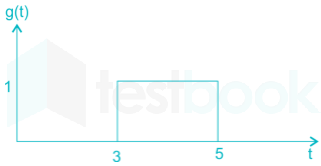
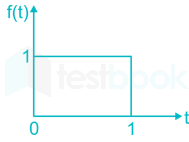
Given f(t) and g(t) as shown below

g(t) can be expressed as

  1. AOption (a)

    g(t) = f (2t - 3)

  2. BOption (b)

    g(t)=f(t2−3)g\left( t \right) = f\left( {\frac{t}{2} - 3} \right)

  3. COption (c)

    g(t)=f(2t−32)g\left( t \right) = f\left( {2t - \frac{3}{2}} \right)

  4. DOption (d)

    g(t)=f(t2−32)g\left( t \right) = f\left( {\frac{t}{2} - \frac{3}{2}} \right)

View answer & explanation

Correct answer

Answer: (d)D.

g(t)=f(t2−32)g\left( t \right) = f\left( {\frac{t}{2} - \frac{3}{2}} \right)

Why this answer is correct

Concept:

Time-shifting property: When a signal is shifted in time domain it is said to be delayed or advanced based on whether the signal is shifted to the right or left. 

For example:

Time scaling property: A signal is scaled in the time domain with the scaling factor 'a'. 

If a > 1, then the signal is contracted by a factor of 'a' along the time axis. 

if a < 1, then the signal is expanded by a factor of 'a' along the time axis. 

For example:

Analysis:

We can observe that if we scale f(t) by a factor of ½ and then shift, we will get g(t).

First scale f(t) by a factor of ½ ,

g1(t) = f (t/2)

Shift g1(t) by 3

g(t)=g1(t−3)=f(t−32)g\left( t \right) = g_1\left( {t - 3} \right) = f\left( {\frac{{t - 3}}{2}} \right)

g(t)=f(t2−32)g\left( t \right) = f\left( {\frac{t}{2} - \frac{3}{2}} \right)

Question 29

The capacitor start-capacitor run single phase induction motor is operationally a

  1. AOption (a)

    Single phase motor

  2. BOption (b)

    Two phase motor

  3. COption (c)

    Three phase motor

  4. DOption (d)

    A.C. series motor

View answer & explanation

Correct answer

Answer: (b)B.

Two phase motor

Why this answer is correct

Capacitor start capacitor run motor:

The capacitor start capacitor run motor has a cage rotor and its stator has two windings known as main and auxiliary windings and these windings are displaced by 90°. Therefore, this motor act as a two-phase motor.

Important Points:

  • There are two capacitors in this motor represented by CS and CR.
  • At the start, the two capacitors are connected in parallel.
  • Capacitor CS is the starting capacitor and is short time rated. It is electrolytic having large value.
  • Run capacitor CR has small value with long-time rated and is made of oil-filled paper.
  • This type of motor is quiet and smooth running.
  • They have higher efficiency than the motors that run only on the main windings.
  • They are used for loads of higher inertia requiring frequent starts where the maximum pull-out torque and efficiency required are higher.

Question 30

Surge impedance of Phase, 400 kV transmission line is 200 Ω. The surge impedance loading of the transmission line is

  1. AOption (a)

    400 MW

  2. BOption (b)

    1600 MW

  3. COption (c)

    200 MW

  4. DOption (d)

    800 MW

View answer & explanation

Correct answer

Answer: (d)D.

800 MW

Why this answer is correct

Concept:

The surge impedance or characteristic impedance of a long transmission line is given by,

ZC=ZY{Z_C} = \sqrt {\frac{Z}{Y}}

Z is series impedance per unit length per phase

Y is shunt admittance per unit length per phase

Surge impedance loading (SIL):

Surge impedance loading is defined as the power load in which the total reactive power of the lines becomes zero. The reactive power generated by the shunt capacitance is consumed by the series inductance of the line.

SIL =V2ZC;MW = \frac{{{V^2}}}{{{Z_C}}};MW

Calculation:

Given that, surge impedance (ZC) = 200 Ω

Voltage (V) = 400 kV

Surge impedance loading =(400×103)2200=800;MW = \frac{{{{\left( {400 \times {{10}^3}} \right)}^2}}}{{200}} = 800;MW

Question 31

Which one of the following is the advantage of FIR filter over IIR filter?

  1. AOption (a)

    FIR filter is always unstable

  2. BOption (b)

    In case of FIR filter, the design methods are non-linear

  3. COption (c)

    FIR filter can have an exact linear phase

  4. DOption (d)

    FIR filter can not be realized efficiently in hardware

View answer & explanation

Correct answer

Answer: (c)C.

FIR filter can have an exact linear phase

Why this answer is correct

FIR filtering has these advantages over IIR filtering:

1.It can implement linear-phase filtering. This means that the filter has no phase shift across the frequency band. Alternately, the phase can be corrected independently of the amplitude.

2. They are guaranteed to be stable. 3. It can be used to correct frequency-response errors in a loudspeaker to a finer degree of precision than using IIR Filter.

Note:

IIR FiltersFIR filters
1. IIR filters are difficult to control and have no particular phase.1. FIR filters make a linear phase always possible.
2. IIR can be unstable.2. FIR is always stable.
3. IIR filters are used for applications that are not linear.3. FIR filters are dependent upon linear-phase characteristics.
4. IIR filters are dependent on both i / p and o / p.4. FIR is dependent upon i / p only
5. IIR filters consist of zeros and poles and require less memory than FIR filters.5. FIR only consists of zeros so they require more memory.
6. Where the system response is infinite, we use IIR filters.6. where the system response is zero, we use FIR filters.
7. IIR filters are recursive, and feedback is also involved.7. FIR filters are non-recursive and no feedback is involved.

Question 32

A DC servomotor is similar to a regular DC motor except that its design is modified to cope with _________

  1. AOption (a)

    Electronic switching

  2. BOption (b)

    Slow speeds

  3. COption (c)

    Static conditions 

  4. DOption (d)

    Both (b) & (c)

View answer & explanation

Correct answer

Answer: (d)D.

Both (b) & (c)

Why this answer is correct

A servomotor is a rotary actuator or linear actuator that allows for precise control of angular or linear position, velocity and acceleration

A DC servomotor is similar to a regular DC motor except that its design is modified to cope with slow speeds and static conditions

Question 33

Which device is present in power line carrier communication system?

  1. AOption (a)

    Tuning unit

  2. BOption (b)

    Multiplexer

  3. COption (c)

    SCADA

  4. DOption (d)

    None of the above

View answer & explanation

Correct answer

Answer: (a)A.

Tuning unit

Why this answer is correct

Power Line Carrier Communication:

  • A mean of transmitting information over a power transmission line by using a carrier frequency superimposed on the normal power frequency.
  • This is a type of communication which is used to do the
  • communication between the electric substations with the help of electric cables.
  • So with the help of this, we can do telecommunication, telemonitoring, and tele-protection between the electric substations.
  • Tuning unit or line tuner is the device present in power line carrier communication system.
  • The line tuner is connected with the coupling capacitor in a series.

Question 34

The type of commutation used in single phase parallel inverter is

  1. AOption (a)

    Self commutation

  2. BOption (b)

    Natural commutation

  3. COption (c)

    Auxiliary commutation

  4. DOption (d)

    Complementary commutation

View answer & explanation

Correct answer

Answer: (d)D.

Complementary commutation

Why this answer is correct

Concept:

In complementary commutation used in a parallel inverter:

  • Two sets of switching devices (like transistors or thyristors) are used in a complementary fashion. When one set is conducting (ON state), the other set is non-conducting (OFF state), and vice versa.
  • The commutation process relies on the charge and discharge of capacitors, which are strategically placed in the circuit to momentarily support the transfer of current from one set of devices to the other. This ensures a smooth transition and allows each set of switches to recover (return to a non-conducting state) before being turned on again.
  • This method helps in creating an alternating output from a direct current source efficiently and is crucial for maintaining the sinusoidal output waveform quality in single-phase parallel inverter.

Commutation of SCR:

  • Commutation is nothing but the turn OFF method of an SCR.
  • It is one method used to bring an SCR or thyristor from ON state to OFF state.
  • We know that an SCR can be activated by using a gate signal toward an SCR when it is in forwarding bias.
  • But SCR needs to turn off when required for power controlling otherwise power conditioning.


The commutation techniques of thyristors are classified into two types:

  • Natural Commutation
  • Forced Commutation:

further classified as:

  1. Class A: Self commutated by a resonating load
  2. Class B: Self commutated by an LC circuit
  3. Class C: Cor L-C switched by another load-carrying SCR
  4. Class D: C or L-C switched by an auxiliary SCR
  5. Class E: An external pulse source for commutation
  6. Class F: AC line commutation
<br>

Important Points Load commutation or self commutation is used in inverter in which L and C are connected in series with the load or C in parallel with the load such that the overall load circuit is underdamped.

Question 35

The main advantage of Pulse Code Modulation (PCM) is

  1. AOption (a)

    Less bandwidth

  2. BOption (b)

    Reduced power

  3. COption (c)

    Better performance in presence of noise

  4. DOption (d)

    Possibility of multiplexing

View answer & explanation

Correct answer

Answer: (c)C.

Better performance in presence of noise

Why this answer is correct

PCM (Pulse Code Modulation):

  • PCM (Pulse Code Modulation) is a digital scheme for transmitting analog data.
  • The amplitude of an analog signal can take any value over a continuous range, i.e. it can take on infinite values.
  • But, digital signal amplitude can take on finite values.
  • Analog signals can be converted into digital by sampling and quantizing.


Advantages of PCM:

  • Encoding is possible in PCM.
  • Very high noise immunity, i.e. better performance in the presence of noise.
  • Convenient for long-distance communication.
  • Good signal to noise ratio.


Disadvantage of PCM:

  • The circuitry is complex.
  • It requires a large bandwidth.
  • Synchronization is required between transmitter and receiver.

Question 36

Which of the following switch-mode converters is suitable for high power application?

  1. AOption (a)

    Flyback converter

  2. BOption (b)

    Forward converter

  3. COption (c)

    Push pull converter

  4. DOption (d)

    Full Bridge converter

View answer & explanation

Correct answer

Answer: (d)D.

Full Bridge converter

Why this answer is correct

AC-DC Converter (or full-bridge converter) SMPS Working:

  • In this type of SMPS, the input supply is AC and in the output, we get DC supply.
  • Rectifiers and filters are used to convert this AC power to DC.
  • This uncontrollable DC voltage is given to the affected power factor correction circuits.
  • This includes high-frequency energy which influences to reduce the power factor.
  • This is due to power conversion but we have used AC input instead of DC input supply.
  • Therefore, a combination of rectifier and filter, this block diagram is used to convert AC to DC, and switching an operation is done using a power muffle amplifier.
  • MOSFET transistors use low resistance and are capable of resisting high currents.
  • The switching frequency is chosen so that normal humans (above 20KHz) must be kept low and the operation of the switch is controlled using a PWM oscillator.


Power Ratings of given SMPS:

SMPsPower Rating (in W)
Flyback converter0–250
Forward converter100–200
Push-pull converter100–1,000
Full Bridge converter400–5,000


Important Points Topologies of SMPS (Switch Mode Power Supply) :

The topology of SMPS is classified into different types which are as follows:


Sr. No.Topologies of SMPS
1AC-DC converter
2DC-DC converter
3Fly-back Converter
4Forward Converter

Question 37

A metal-semiconductor junction where semiconductor is highly doped behaves like

  1. AOption (a)

    Rectifying junction

  2. BOption (b)

    Ohmic junction

  3. COption (c)

    LED

  4. DOption (d)

    Laser diode

View answer & explanation

Correct answer

Answer: (b)B.

Ohmic junction

Why this answer is correct

Metal semiconductor Junction:

  • Metal–semiconductor junctions are crucial to the operation of all semiconductor devices.
  • Usually, an ohmic contact is desired, so that electrical charge can be conducted easily between the active region of a transistor and the external circuitry.
  • M–S junctions can either be rectifying or non-rectifying.
  • The rectifying metal-semiconductor junction forms a Schottky barrier, making a device known as a Schottky diode, while the non-rectifying junction is called an ohmic junction.
  • Whether a given metal-semiconductor junction is an ohmic contact or a Schottky barrier depends on the Schottky barrier height
  • For lower Schottky barrier heights, the semiconductor is not depleted and instead forms an ohmic contact to the metal.


For the formation of rectifying junction:

  • The contact between the metal and the semiconductor must be intimate and without the presence of any other material layer (such as an oxide).
  • No interdiffusion of the metal and the semiconductor is taken into account.
  • There are no impurities at the interface between the two materials.

Here, in the question, it is given that we are going for more doping, which means more impurities, so it can't form a rectifying junction it can form an ohmic junction only.

Question 38

The leakage flux paths are ________ on the angular position of the rotor.

  1. AOption (a)

    Dependent

  2. BOption (b)

    Proportional

  3. COption (c)

    Independent

  4. DOption (d)

    None of the above

View answer & explanation

Correct answer

Answer: (c)C.

Independent

Why this answer is correct

  • Leakage flux and leakage reactance are constant irrespective of rotor angular position.
  • Armature reaction though is dependent on the angular position of the rotor in salient pole machine but in cylindrical rotor machine, both the quantities are independent of rotor position.

Question 39

Which of these is incorrect for an operations amplifier?

  1. AOption (a)

    It has a high voltage gain

  2. BOption (b)

    It is a direct coupled amplifier

  3. COption (c)

    It is only useful for amplifying AC signals

  4. DOption (d)

    It was originally designed to perform mathematical operation

View answer & explanation

Correct answer

Answer: (c)C.

It is only useful for amplifying AC signals

Why this answer is correct

  • It is a high voltage gain direct coupled amplifier.
  • It can be used to perform mathematical operations on analog signals, hence it is called an operational amplifier.
  • Op-amp is available as IC 741.
  • The open-loop voltage gain of an ideal Op-amp is infinite.
  • Op-amp consists of two terminals inverting(-ve) and non-inverting(+ve).

Additional Information

 Characteristics of an ideal Op-Amp:

  • Infinite voltage gain Vd.
  • Infinite input resistance Ri, so that almost any signal source can drive it and there is no loading of the input source.
  • Zero output resistance R0, so that output can drive an infinite number of other devices.
  • Infinite bandwidth, so that any frequency signals from 0 to infinite Hz can be amplified without attenuation.
  • Infinite common-mode rejection ratio, so that the output common-mode noise voltage is zero.
  • Zero output voltage when the input voltage is zero.
  • Infinite slew rate, so that output voltage changes occur simultaneously with input voltage changes.

Question 40

In the state of saturation, a MOSFET act as

  1. AOption (a)

    An amplifier

  2. BOption (b)

    An open switch

  3. COption (c)

    Pure resistor

  4. DOption (d)

    A closed switch

View answer & explanation

Correct answer

Answer: (a)A.

An amplifier

Why this answer is correct

MOSFET:

MOSFET stands for Metal Oxide Semiconductor Field Effect Transistor.

It is a majority carrier device and also called as Voltage controlled current device (VGS control the current ID)

Operation of the MOSFET:

The drain characteristics or the plot between ID and VDS is shown below

The drain characteristics are shown in below tabular form.

Mode of operationConditionApplication
Cut-off RegionVGS = 0; No current flow through itOFF switch
Ohmic region or Linear regionCurrent ID increases with VDSvariable resistor
Saturation regionID constant in spite of the increase in VDS (VDS exceeds Pinch-off voltage VP)Amplifier


VGS = Gate-Source voltage

ID = Drain current

VDS = Drain-Source voltage

Question 41

The inverse Laplace transform of F(S)=3S+1S(S+1)F(S)=\frac{3S+1}{S(S+1)} is

  1. AOption (a)

    3 + e-t

  2. BOption (b)

    1 - 2e-t

  3. COption (c)

    1 + 2e-t

  4. DOption (d)

    2 + e-t

View answer & explanation

Correct answer

Answer: (c)C.

1 + 2e-t

Why this answer is correct

Concept:

The inverse Laplace transform of function can also be obtained using the partial fraction method.

And It is the Region of convergence (ROC) that completes the description of the Laplace Transform-

i.e. For example: if H(f)=1s+aH\left( f \right) = \frac{1}{{s + a}}

h(t) = e-at. u(t), with ROC > - a

‘or’ - e-at u(-t), with ROC <-a

Calculation:

Given T.F=3s+1s(s+1)T.F = \frac{{3s + 1}}{{s(s+1)}}

Using partial fraction

⇒3s+1s(s+1)=3s+1(s)(s+1)⇒ \frac{{3s + 1}}{{s(s+1)}} = \frac{{3s + 1}}{{\left( {s } \right)\left( {s + 1} \right)}}

⇒3s+1s(s+1)=As+Bs+1⇒ \frac {3s + 1}{s(s+1)} = \frac{A}{{s }} + \frac{B}{{s + 1}}

⇒3s+1s(s+1)=1s+2s+1⇒ \frac {3s + 1}{s(s+1)} = \frac{1}{{s }} + \frac{2}{{s + 1}}

Apply inverse transform, we get

f(t) = 1 + 2 e-t

Question 42

Which of the following is the main advantage of SMPS over linear power supply?

  1. AOption (a)

    No transformer is required

  2. BOption (b)

    Higher efficiency

  3. COption (c)

    No filter required

  4. DOption (d)

    Only one stage of conversion

View answer & explanation

Correct answer

Answer: (b)B.

Higher efficiency

Why this answer is correct

Key differences between Linear Power Supply and Switch Mode Power Supply:

  1. The main difference between the linear power supply and SMPS is that linear power supply converts the high voltage of AC into low voltage AC first then the rectification procedure takes place.
<br>

On the contrary, the SMPS converts the AC signal into DC signal first then the stepping down of voltage signal takes place.

  1. The linear power supply uses a voltage regulator for voltage regulation of the output voltage while SMPS uses a feedback circuit for voltage regulation.
  2. Power dissipation also plays a key role in differentiating linear power supply and SMPS.
<br>

The linear power supply also dissipates power and thus requires a heat sink, but SMPS does not require heat sink as there is no power dissipation.

  1. The step-down transformer used in linear supply is bulky while in SMPS the step-down transformer is light in weight.
  2. The noise disturbance is more in SMPS due to switching action; this makes SMPS inappropriate for audio and radiofrequency applications.
<br>

The linear power supply is immune to noise disturbance and thus used in audio and radiofrequency applications.

  1. There is a major difference between the efficiency of the linear power supply and SMPS.
<br>

The efficiency of the linear power supply is low about 20-25% due to ohmic losses while that of SMPS is high, i.e. about 65-75%.

PARAMETERSLINEAR POWER SUPPLYSWITCH MODE POWER SUPPLY (SMPS)
DefinitionIt completes the stepping down of AC voltage first then it converts it into DC.It converts the AC input signal into DC first then it steps down the voltage up to the desired level.
EfficiencyLow efficiency i.e. about 20-25%High Efficiency i.e. about 60-65%
Voltage RegulationVoltage regulation is done by voltage regulator.Voltage regulation is done by the feedback circuit.
Magnetic material usedCRGO core is usedThe ferrite core is used
WeightIt is bulky.It is less bulky in comparison to the linear power supply.
ReliabilityMore reliable in comparison to SMPS.Its reliability depends on the transistors used for switching
ComplexityLess complex than SMPS.More complex than the Linear power supply.
Transient responseIt possess faster response.It possesses a slower response.
RF interferenceNo RF interferenceRF shielding is required as switching produces more RF interference.
Noise and Electromagnetic interferenceIt is immune to noise and electromagnetic interference.Effect of noise and electromagnetic interference is quite significant, thus EMI filters are required.
ApplicationsUsed in Audio frequency applications and RF applications.Used in chargers of mobile phones, DC motors, etc.

Question 43

Which of the following materials has permanent magnetic dipoles?

  1. AOption (a)

    Ferromagnetic material

  2. BOption (b)

    Anti-ferromagnetic material

  3. COption (c)

    Diamagnetic material

  4. DOption (d)

    Paramagnetic material

View answer & explanation

Correct answer

Answer: (a)A.

Ferromagnetic material

Why this answer is correct

Ferromagnetic Materials:

  • The ferromagnetic materials are those substances that exhibit strong magnetism in the same direction of the field when a magnetic field is applied to it.
  • when we consider some unpaired electrons, they will interact with each other between two atoms and they line up themselves in a tiny region with the direction of the magnetic field.
  • This mechanism of the ferromagnetic material is ferromagnetism.
  • It can be defined as some materials (cobalt, gadolinium, iron etc) that will become permanent magnets with the use of a magnetic field.
<br>

Properties of Ferromagnetic Materials:

  • When a rod of this material is placed in a magnetic field, it rapidly aligns itself in the track of the field.
  • It is strongly attracted by the magnet.
  • The ferromagnetism mechanism is not present in liquids and gases.
  • Some materials show permanent magnetic properties as after application of external field the moment in dipole is permanent i.e. they show permanent dipole moment.

Question 44

A full adder circuit has

  1. AOption (a)

    Two inputs and one output

  2. BOption (b)

    Two inputs and two outputs

  3. COption (c)

    Three inputs and three outputs

  4. DOption (d)

    Three inputs and two outputs

View answer & explanation

Correct answer

Answer: (d)D.

Three inputs and two outputs

Why this answer is correct

The basic block diagram for a Full Adder is as shown:

A Full adder can be realized using two half adders as shown:

We, therefore, conclude that a full adder combinational circuit has 3 inputs and 2 outputs.

A full adder can be implemented using 2 XOR, 2 AND, 1 OR as shown in figure:

The truth table of a full adder logic is:

ABCCinS
00000
00101
01001
01110
10001
10110
11010
11111


S = A ⊕ B ⊕ C

The Sum output bit of a full adder is given by:

The carry output bit of a full adder is given by:

X1 = AB + BC + AC

Question 45

In a step-up chopper, if Vs is the source voltage and α is duty cycle, then the output voltage is

  1. AOption (a)

    Vs/(1 + α)

  2. BOption (b)

    Vs(1 + α)

  3. COption (c)

    Vs(1 - α)

  4. DOption (d)

    Vs/(1 - α)

View answer & explanation

Correct answer

Answer: (d)D.

Vs/(1 - α)

Why this answer is correct

Explanation:

The circuit diagram of a boost converter is shown below.

Step Up or Boost converter is used to obtain the output voltage greater than the input voltage.

The relation between the output voltage and the input voltage is given by

Vo=Vs1−αVo=\frac{{{V}_{s}}}{1-α}

Where α is the duty cycle of the chopper. 

<br>

Additional Information

ConverterCircuit diagramOutput voltage
Buck converterVo = δ Vin
Boost converterVo=Vin1−δ{V_o} = \frac{{{V_{in}}}}{{1 - \delta }}
Buck-Boost converterVo=−δ1−δVin{V_o} = - \frac{\delta }{{1 - \delta }}{V_{in}}
Cuk converterVo=−δ1−δVin{V_o} = - \frac{\delta }{{1 - \delta }}{V_{in}}

Question 46

The capacitor current switching is easily done with

  1. AOption (a)

    Vacuum circuit breaker

  2. BOption (b)

    Bulk oil circuit breaker

  3. COption (c)

    Air blast circuit breaker

  4. DOption (d)

    None of these

View answer & explanation

Correct answer

Answer: (a)A.

Vacuum circuit breaker

Why this answer is correct

Rate of Rise of Recovery Voltage (RRRV):

It is defined as peak transient recovery voltage divided by the total time from zero voltage to peak voltage.

  • For vacuum circuit breakers RRRV is almost negligible.
  • Whereas for other circuit breakers the value of RRRV is relatively high.


​During capacitance switching, other circuit breakers (except vacuum circuit breaker) produces a restrike. 

That restrike can generate an overvoltage of 3 pu between the terminals of the capacitor bank.

Due to which the operation of other circuit breakers may damage the capacitor bank.

Hence Capacitor switching is easily done with a Vacuum circuit breaker

Points to remember:

TypeArc Quenching MediumVoltage Range And Breaking Capacity
Miniature circuit breakerAir at atmospheric pressure400 – 600 V; for the small current rating
Air brake circuit breakerAir at atmospheric pressure400 – 11 kV; 5 – 750 MVA
Minimum Oil Circuit BreakerTransformer Oil3.3 kV – 220 kV; 150 – 25000 MVA
Vacuum circuit breakerVacuum3.3 kV – 765 kV; 1000 – 50000 MVA
SF6 circuit breakersSF6 at 5 kg/cm23.3 kV – 765 kV; 1000 – 50000 MVA


Even the voltage range is mentioned, they will work as follows:

Rated VoltageChoice of Circuit breakerRemark
Below 1 kVAir Break C.B-----
3.3 kV – 33 kVVacuum C.B., SF6 C.B.Vacuum is preferred
132 kV – 220 kVMinimum Oil, SF6 C.B., Airblast C.B.SF6 is preferred
400 kV – 760 kVSF6 C.B, Airblast C.B.SF6 is preferred

Question 47

An ideal OP-AMP has the following characteristics

  1. AOption (a)

    Rin = ∞, A = ∞, R0 = ∞

  2. BOption (b)

    Rin = ∞, A = ∞, R0 = 0

  3. COption (c)

    Rin = 0, A = ∞, R0 = 0

  4. DOption (d)

    Rin = 0, A = ∞, R0 = ∞

View answer & explanation

Correct answer

Answer: (b)B.

Rin = ∞, A = ∞, R0 = 0

Why this answer is correct

The ideal op-amp has the following characteristics:

  • Input impedance (Differential or Common-mode) Rin = Infinity
  • Output impedance (open loop) R0= 0
  • Gain A = Infinity
  • Infinite Bandwidth
  • Common-mode voltage gain = 0
  • Vout = 0 when both inputs are at the same voltage, i.e. (zero "offset voltage")
  • Output can change instantaneously (Infinite Slew Rate)
  • The purpose of bias current is to achieve the ideal behavior in op-amp which is high CMRR, high differential gain, and high input impedance

​


CMRR (Common mode rejection ratio) is defined as the ratio of differential-mode voltage gain (Ad) and the common-mode voltage gain (Ac).

Mathematically, this is expressed as:

CMRR=AdAcCMRR = \frac{A_d}{A_c}

Ad = Differential gain

Ac = Common mode gain

Note: Ideally, the common-mode gain of the Op--Amp should be zero., i.e. it must give a zero output for common input at both the inverting and non-inverting terminal. ∴ The CMRR of an ideal Op-Amp is infinity.

Question 48

Which of the following diodes uses a metal-semiconductor junction?

  1. AOption (a)

    General purpose diodes

  2. BOption (b)

    Fast recovery diodes

  3. COption (c)

    Schottky diode

  4. DOption (d)

    None of the above

View answer & explanation

Correct answer

Answer: (c)C.

Schottky diode

Why this answer is correct

In a unipolar device, the current is due to only one type of carrier (i.e. electrons or holes), while in a bipolar device current is due to both holes and electrons.

The Schottky diode or hot-carrier diode is a junction of n-type semiconductor and metal, in it, electrons are sole carriers.

Important Points

Schottky Diode:

It is not a typical diode because it does not have a p-n junction.

Instead, it consists a doped semiconductor (usually n-type) and metal, bound together as shown:


  • When the metal comes into contact with an n-type semiconductor the majority carriers, electrons, are infused into metal commonly called "Hot carrier" since injected electrons from a semi-conductor have very high kinetic energy compared to electrons in a metal.
  • ​The Schottky diode’s significant characteristic is its fast switching speed as it doesn't allow the diode to reach saturation.
  • This makes the Shottky diode useful for high-frequencies and digital applications.
  • Schottky diode is also known as the Schottky barrier diode, surface barrier diode, majority carrier device, hot-electron diode, or hot carrier diode.
  • Its symbolic representation is as shown:-


  • The Schottky diode is a semiconductor formed by the junction of a semiconductor with metal. It has a low forward voltage drop and near-zero reverse recovery time hence used in very fast switching circuits.
  • Schottky barrier diode can be used as a low noise amplifier due to metal-semiconductor junction.

Question 49

A system has a sampling rate of 50,000 samples per second. The maximum frequency of the signal it can acquire to reconstruct is

  1. AOption (a)

    25 kHz

  2. BOption (b)

    50 kHz

  3. COption (c)

    100 kHz

  4. DOption (d)

    10 kHz

View answer & explanation

Correct answer

Answer: (a)A.

25 kHz

Why this answer is correct

Nyquist Sampling Theorem: 

A continuous-time signal can be represented in its samples and can be recovered back when sampling frequency fs is greater than or equal to twice the highest frequency component of the message signal, i.e.

fs ≥ 2fm

Therefore when we want to convert continuous signals to discrete signals, the sampling must be done at the Nyquist rate.

Application:

Given fs = 50 k

We can write:

50k≥2×fm50k \ge 2 \times f_m

fm≤25k{f_m} \leq 25k

∴ The maximum frequency of the signal it can acquire to reconstruct is 25 kHz

Question 50

The SCS is a four layer, four terminal thyristor, can be turned on by

  1. AOption (a)

    The anode gate

  2. BOption (b)

    The cathode gate

  3. COption (c)

    Either of the gate

  4. DOption (d)

    Gating both the gates together

View answer & explanation

Correct answer

Answer: (c)C.

Either of the gate

Why this answer is correct

Silicon Controlled Switch:

  • A silicon-controlled switch, or SCS, is essentially an SCR with an extra gate terminal.
  • Typically, the load current through an SCS is carried by the anode gate and cathode terminals, with the cathode gate and anode terminals sufficing as control leads.
  • An SCS is turned on by applying a positive voltage between the cathode gate and cathode terminals. It may be turned off (forced commutation) by applying a negative voltage between the anode and cathode terminals, or simply by shorting those two terminals together. The anode terminal must be kept positive with respect to the cathode in order for the SCS to latch.
  • The SCS has two gates, anode-gate and cathode-gate. Either of the gates could be used to turn on the device.

Question 51

In a class B amplifier, it is found that D.C. power is 25 W, find the A.C. power.

  1. AOption (a)

    10 W

  2. BOption (b)

    62.5 W

  3. COption (c)

    25 W

  4. DOption (d)

    50 W

View answer & explanation

Correct answer

Answer: (b)B.

62.5 W

Why this answer is correct

Concept:

The maximum efficiency of a class A amplifier is 50%

The maximum efficiency of a class B amplifier is 78.5%

The maximum efficiency of a class C amplifier is 90%.

Hence, The transistor amplifier with 85% efficiency is likely to be Class C.

Note:

Power AmplifierConduction AngleMaximum EfficiencyFigure of Merit
Class A360°50%2
Class B180°78.5%0.4
Class AB180° - 360°50 - 78.5%0.4 -– 2
Class C< 180°≥ 90%< 0.25


Calculation: 

We know that figure of merit for class B power amplifier = .4

Figure of merit = dc power / ac power

⇒ .4 = 25/ AC Power

⇒ AC Power = 62.5 W

Question 52

The forbidden energy gap in silicon at 300°K is

  1. AOption (a)

    0.72 eV

  2. BOption (b)

    0.785 eV

  3. COption (c)

    1.1 eV

  4. DOption (d)

    1.41 eV

View answer & explanation

Correct answer

Answer: (c)C.

1.1 eV

Why this answer is correct

Concept: 

  • The separation between the valence band and the conduction band is known as the forbidden energy gap.
  • If an electron is to be transferred from valence band to conduction band, external energy is required, which is equal to the forbidden energy gap.
  • In conductors, like metals the valence band overlaps the conduction band or the difference between the bands is very small, as a result of which, electrons can easily get excited and conduct electricity.

Explanation:

  • The energy gap of silicon at room temperature(300 K) is 1.1 eV and it is 0.67 eV for germanium.
  • The forbidden energy gap between the valence band and conduction band is the least in the case of impure silicon.

Question 53

Which of the following is a main relay for protection upto 80% of the transmission line length in the forward direction?

  1. AOption (a)

    Directional over-current relay

  2. BOption (b)

    Mho relay

  3. COption (c)

    Carrier current protection relay

  4. DOption (d)

    Impedance relay

View answer & explanation

Correct answer

Answer: (b)B.

Mho relay

Why this answer is correct

Mho relay because inherently a directional relay as it detects the fault only in the forward direction.

<br>

Mho Relay:

  • Mho relay is referred to as voltage-controlled directional relay or admittance relay or high-speed relay.
  • The operating torque can be determined by the V-I (voltage-ampere) element and the voltage element develops the controlling element.
  • These types of relays are used to detect phase faults for long transmission lines, and at the point where there is an occurrence of synchronizing power surges.
  • The mho relay is more sensitive and reliable because it is a combined unit of both distance measurement and direction.
<br>

Operating Characteristic of Mho Relay:

​The diameter of the circle is practically independent of V and I, except at a very low magnitude of the voltage and current when the spring effect is considered, which causes the diameter to decrease.

Question 54

In bilinear transformation, the left-half S-plane is mapped to which of the following in the z-domain?

  1. AOption (a)

    Entirely outside unit circle |z| = 1

  2. BOption (b)

    Partially outside the unit circle |z| = 1

  3. COption (c)

    Partially inside the unit circle |z| = 1

  4. DOption (d)

    Entirely insider the unit circle |z| = 1

View answer & explanation

Correct answer

Answer: (d)D.

Entirely insider the unit circle |z| = 1

Why this answer is correct

Bilinear Transformation:

After the frequency scaling and transformation into a desirable type of filter have been performed, it is necessary to transform the resulting analog filter into a digital one.

Analog filter is stable if the poles of the transfer function are located in the left half of s plane, whereas digital filter is stable if the poles are located within the unit circle. 

For this reason, the transformation must provide that the left half of s plane coincides with the area within the unit circle of z plane, as shown:

One of the most commonly used methods of transforming analog filters into appropriate IIR filters is known as bilinear transformation. It is defined via expression:

s=2T1−z−11+z−1s=\frac{2}{T}\frac{1-z^{-1}}{1+z^{-1}}

  • In Bilinear Transformation, we carry out conformal mapping in which the jΩ axis is mapped onto the unit circle in the ‘z’ plane. This is a one-to-one mapping that does not bring along with it the issue of aliasing.
  • All points in the left-hand side of the s-plane get mapped inside the unit circle in the z-plane. And all points in the right-hand side of the s-plane get mapped outside the circle in the z-plane.
  • First, we will transform an analog filter, get H(z), and then get a relationship between s and z.

Question 55

The temperature at which a conductor becomes superconductor is called

  1. AOption (a)

    Superconducting temperature

  2. BOption (b)

    Curie temperature

  3. COption (c)

    Meel temperature

  4. DOption (d)

    Transition temperature

View answer & explanation

Correct answer

Answer: (d)D.

Transition temperature

Why this answer is correct

  • Super Conductors are those materials whose resistivity becomes zero or very small below a critical temperature.
  • The temperature at which transition of state occurs from superconducting to normal or vice versa is known as critical or transition temperature.
  • In a superconducting state,

χM = -1

Where,

χM is magnetic susceptibility.

Type I Semiconductor:

1.Type I superconductors are those superconductors that lose their superconductivity very easily or abruptly when placed in the external magnetic field. As you can see from the graph of the intensity of magnetization (M) versus applied magnetic field (H), when the Type I superconductor is placed in the magnetic field, it suddenly or easily loses its superconductivity at the critical magnetic field (Hc).

After Hc, the Type I superconductor will become a conductor.

2.Type I superconductors are also known as soft superconductors because of this reason that is they lose their superconductivity easily.

3.Type I superconductors perfectly obey the Meissner effect.

Examples of Type I semiconductor:

Pb, Pd Al, Zn, Hg, In.

As Type I superconductor is a conductor with very large conductivity below a critical temperature only,

Hence statement 1 is false and all others are true.

Note:

Meissner's Effect:

The repulsion of magnetic flux lines from superconducting material when the material is in the superconducting state is known as Meissner's effect.

Important Points

Type II Semiconductor:

  • Type II superconductors are those superconductors that lose their superconductivity gradually but not easily or abruptly when placed in the external magnetic field.
  • As you can see from the graph of the intensity of magnetization (M) versus applied magnetic field (H), when the Type II superconductor is placed in the magnetic field, it gradually loses its superconductivity.
  • Type II superconductors start to lose their superconductivity at the lower critical magnetic field (Hc1) and completely lose their superconductivity at the upper critical magnetic field (Hc2).
  • The state between the lower critical magnetic field (Hc1) and upper critical magnetic field (Hc2) is known as the vortex state or intermediate state.
  • After Hc2, the Type II superconductor will become a conductor.
  • Type II superconductors are also known as hard superconductors because of this reason that is they lose their superconductivity gradually but not easily.
  • Type II superconductors do not obey the Meissner effect.

Examples of type II semiconductors:

Ex: NbTi, Nb3Al

Question 56

In a dual converter, if the firing angle of one bridge is 30°, then the firing angle of second bridge is ______.

  1. AOption (a)

    30°

  2. BOption (b)

    180°

  3. COption (c)

    120°

  4. DOption (d)

    150°

View answer & explanation

Correct answer

Answer: (d)D.

150°

Why this answer is correct

Concept:

  • A dual converter is an electronic converter or circuit which comprises of two converters.
  • One performs as a rectifier and the other performs as the inverter.
  • Two full converters are arranged in an anti-parallel pattern and linked to the same DC load.
  • These converters can provide four-quadrant operations.


Modes of operation of Dual converter:

Non-circulating current mode:

  • There is no circulating current between the converters in this mode as only one converter will perform at a time
  • During converter 1 operation, firing angle (α1) will be between 0 to 90°
  • During converter 2 operation, firing angle (α2) will be between 0 and 90°
<br>

Circulating current Mode:

  • In this mode, there is a circulating current as the two converters will be in the ON condition at the same time.
  • The firing angles are adjusted such that
  • Firing angle of converter 1 (α1) + firing angle of converter 2 (α2) = 180°
  • Converter 1 as rectifier when 0° < α1 < 90° and converter 2 as inverter when 90° < α2 < 180°
  • Converter 1 as inverter when 90° < α1 < 180° and converter 2 as rectifier when 0° < α2 < 90°
  • Four quadrant operation of dual converter is shown below


Application of dual converter:

  • Direction and speed control of DC motors
  • Applicable wherever the reversible DC required
  • Industrial variable speed DC drives.
<br>

Calculation:

Given that, firing angle of one bridge is 30° (i.e. α1 = 30°)

We know that firing angles can never be greater than 180°.

i.e. α1 + α2 = 180°

∴ 30° + α2 = 180°

α2 = 180° - 30°

α2 = 150°

Question 57

A broadcast radio transmitter radiates 10 kW when the modulation index is 0.6. The carrier power is

  1. AOption (a)

    8.47 kW

  2. BOption (b)

    10 kW

  3. COption (c)

    8 kW

  4. DOption (d)

    5 kW

View answer & explanation

Correct answer

Answer: (a)A.

8.47 kW

Why this answer is correct

Concept:

The total transmitted power for an AM system is given by:

Pt=Pc(1+μ22){P_t} = {P_c}\left( {1 + \frac{{{μ^2}}}{2}} \right)

Pc = Carrier Power

μ = Modulation Index

Calculation:

Given Pt = 10 kW

μ = 0.6

10 kW=Pc(1+0.622)10~kW = {P_c}\left( {1 + \frac{{{0.6^2}}}{2}} \right)

10 kW=Pc×1.1810~kW = {P_c}\times{1.18}

\(P_c=\frac{10k}{1.18}=8.47kW\)

Pc ≈ 3.47 kW

Question 58

In a four-quadrant operation of an electric machine, the third quadrant operation is:

  1. AOption (a)

    forward motoring

  2. BOption (b)

    reverse braking

  3. COption (c)

    forward braking

  4. DOption (d)

    reverse motoring

View answer & explanation

Correct answer

Answer: (d)D.

reverse motoring

Why this answer is correct

Multiquadrant Operation of Electric Drives:

A quadrant diagram is drawn by plotting the speed-torque characteristics of the load/motor for all four quadrant operations.

There are basically two modes of operation:

(i) Motoring Mode: The electrical energy is converted into mechanical energy and supports the motion.

(ii) Braking mode: The mechanical energy is converted into electrical energy and the motor works as a generator and opposes the motion. The fig. below shows the torque and speed coordinates for both forward and reverse motions.

We know that motor can provide motoring and braking operation for both forward and reverse directions.

The power is given as Power = Speed × Torque.

Now, if the power developed is positive then the operation is motoring. If the power developed is negative, the operation is braking.

Quadrant I - Forward Motoring:

In this region, the power and torque are both positive, so the power developed is positive and the machine works as a motor supplying mechanical energy.

Quadrant II - Forward Braking:

In this region, the speed is positive, but torque is negative, so power developed is negative and the machine works under braking opposing the motion.

Quadrant III - Reverse Motoring:

In this region, the speed is negative and the torque is also negative, so power developed is positive and so the machine works under reverse motoring mode.

Quadrant IV - Reverse Braking:

In this region, the torque is positive and the speed is negative, so the power developed is negative, so the machine works as a braking mode in the reverse direction.


Four-Quadrant Operation of the Hoist:

The hoist consists of a rope wound on a drum coupled to the motor shaft. There are two ends of the rope, on one end, there is a cage and on the other end there is a counter weight. The counter-weight is higher than the weight of the empty cage and lower than the weight of the fully-loaded cage. When there is an upward motion of the cage, then it represents the forward direction of the motor.

In quadrant I and IV, load torque shows the speed-torque characteristics of the loaded hoist. The torque is a difference of torque due to loaded hoist and counter-weight.

In quadrant lI and III, load torque shows the speed-torque characteristics of the empty hoist. The torque is a difference of torque due to counter-weight and empty hoist.

The operation in all four quadrants can be explained as follows: 

Quadrant 1- Forward Motoring:

The cage moves upward, so the speed of the motor is positive in the counter-clockwise direction. This condition is obtained if the motor has positive torque in counter-clockwise direction equal to the magnitude of load torque TL1

Quadrant II - Forward Braking:

In this region, the empty cage is moved up. The motor Should produce a braking torque equal to TL2 in the clockwise direction to limit the speed to a safe limit.

Quadrant III - Reverse motoring:

In this region, the empty cage is moved down. The motor should produce torque in a clockwise direction because an empty cage has a lesser weight than a counter-weight.

Quadrant IV - Reverse Braking:

In this region, the loaded cage is moved down. The motor should produce a positive torque T equal to TL2 in an anticlockwise direction to limit the cage cag in safe value.  As the weight of the loaded cage is higher than counter-weight, so it is able to overcome due to gravity itself.

Question 59

The starting current in a three phase induction motor is five times the full load current while the full load slip is 4%. The ratio of starting to full load torque is

  1. AOption (a)

    1.0

  2. BOption (b)

    0.8

  3. COption (c)

    0.6

  4. DOption (d)

    0.5

View answer & explanation

Correct answer

Answer: (a)A.

1.0

Why this answer is correct

Concept:

The ratio between the starting torque to full load torque is given by:

\(\frac{{{T}{st}}}{{{T}{fl}}}={{s}{fl}}\times {{\left( \frac{{{I}{st}}}{{{I}_{fl}}} \right)}^{2}}\)

Where Tst is the starting torque

Tfl is the full load torque

sfl is the slip at full load

Ist is the starting current

Ifl is the rated current

Calculation:

The starting current of a 3-ϕ induction motor is 3 times the rated current. i.e.

Ist = 5 Ifl

Full load slip (sfl) = 4 %

\(\frac{{{T}{st}}}{{{T}{fl}}}={0.04}\times {{\left( \frac{{5}}{{1}} \right)}^{2}}\)

=0.04×(51)2=1.0= 0.04 \times {\left( {\frac{5}{1}} \right)^2} = 1.0

Question 60

A 33 KV, 2000 MVA oil circuit breaker is rated at 1500 A. The making current of circuit breaker will be

  1. AOption (a)

    34.99 KA

  2. BOption (b)

    69.98 KA

  3. COption (c)

    89.22 KA

  4. DOption (d)

    66.60 KA

View answer & explanation

Correct answer

Answer: (c)C.

89.22 KA

Why this answer is correct

Concept:

Breaking current: It expresses the highest number of short-circuit currents that the breakers are capable of breaking under specified conditions of transient recovery voltage and power frequency voltage. It is expressed in kA (RMS) at contact separation. The breaking capacities are divided into two types.

  • Symmetrical breaking capacity of a circuit breaker
  • Asymmetrical breaking capacity of a circuit breaker

Symmetrical breaking capacity =3VLIB= \sqrt 3 {V_{L}}{I_{B}}

Rated symmetrical breaking current IB=S3VL{I_B} = \frac{S}{{\sqrt 3 {V_L}}}

Making current of a circuit breaker is the peak value of the maximum current loop during sub transient condition including the DC component when the breaker closes.

Symmetrical making current = 2.55 × symmetrical breaking current

Calculation:

Symmetrical breaking capacity = 2000 MVA

VL=33kV ⇒IB=2000×1063×33×103\begin{array}{l} {V_{L}} = 33kV\ \Rightarrow {I_{{B}}} = \frac{{2000 \times {{10}^6}}}{{\sqrt 3 \times 33 \times {{10}^3}}} \end{array}

IB = 34.99 kA  

Making current = 2.55 × Symmetrical breaking current

= 2.55 × IB

= 2.55 × 34.99  kA

= 89.22 kA

Question 61

Which of the following materials has the highest dielectric strength ?

  1. AOption (a)

    Marble

  2. BOption (b)

    Polystyrene

  3. COption (c)

    Transformer oil

  4. DOption (d)

    Cotton

View answer & explanation

Correct answer

Answer: (d)D.

Cotton

Why this answer is correct

dielectric strength 

The dielectric strength is the ratio of the permittivity of a substance to the permittivity of free space.

It is an expression of the extent to which a material concentrates electric flux, and is the electrical equivalent of relative magnetic permeability.

Dielectric strength or constant of different materials:

MaterialsDielectric constant kDielectric strength (V/m)
Air (dry)1.000593 × 10⁶
Bakelite4.924 × 106
Fused quartz3.788 × 106
Soft rubber6.712 × 106
Nylon3.414 × 106
Paper3.716 × 106
Polystyrene2.5624 × 106
Polyvinyl chloride3.440 × 106
Porcelain612 × 106
Glass5.614 × 106
Silicone oil2.515 × 106
Strontium titanate2338 × 106
Teflon2.160 × 106
Vaccum1.00000-
Water80-
Mica118 × 106
cotton75 MV/m
Transformer Oil24MV/m

Question 62

In a common base configuration, the alpha of the transistor is 0.99, its collector current is 1 mA and the collector to base current with emitter open is 1 μA. The value of base current is  

  1. AOption (a)

    29 μA

  2. BOption (b)

    19 μA

  3. COption (c)

    9 μA

  4. DOption (d)

    39 μA

View answer & explanation

Correct answer

Answer: (c)C.

9 μA

Why this answer is correct

Concept:

In a common base connection,

IE = IB + IC

And IC = α IE + ICBO

Where α is the current amplification factor

IC=α1−αIB+11−αICBOI_C= \frac{α}{1-α} I_B+\frac {1}{1-α}I_{CBO}

Calculation:

Given that,

α = .99

ICBO = 1 μA

IC = 1 mA

⇒ IC=α1−αIB+11−αICBOI_C= \frac{α}{1-α} I_B+\frac {1}{1-α}I_{CBO}

⇒ 1mA=.991−.99IB+11−.99×1μA1 mA= \frac{.99}{1-.99} I_B+\frac {1}{1-.99} \times 1 μ A

⇒ IB ≈ 9 μA

Question 63

IGBT and BJT both possess

  1. AOption (a)

    Low on-state power losses

  2. BOption (b)

    High on-state power losses

  3. COption (c)

    Low switching losses

  4. DOption (d)

    High input impedance

View answer & explanation

Correct answer

Answer: (a)A.

Low on-state power losses

Why this answer is correct

BJTMOSFETIGBT
Bipolar deviceUnipolar deviceThe bipolar device, Three terminal device (emitter-collector and gate)
Low input impedanceHigh input impedanceHigh input impedance
Current controlled deviceVoltage-controlled deviceVoltage-controlled device
Low on-state voltage drop and low conduction lossHigh on-state voltage drop and higher conduction lossLow forward voltage drop, low ON state power loss than MOSFET, low conduction loss than MOSFET
Secondary breakdown occursFree from the secondary breakdownThe secondary breakdown does not occur
Negative temperature coefficientPositive temperature coefficientPositive temperature coefficient
Not advisable for parallel operationadvisable for parallel operationUsed for parallel operation
Lower operating frequency(10kHz)higher operating frequency(100kHz)
On state in the saturation regionOn state in the ohmic region
Controlled turn on and turn off the deviceControl turn on and turn off the deviceControlled turn on and turn off the device
Turn on and turn off time depend on junction capacitanceSmaller turn off time
Controlled signal requirement continuouslyControlled signal requirement continuouslyControlled signal requirement continuously

Question 64

Which component of the power system is least prone to faults ?

  1. AOption (a)

    Alternator

  2. BOption (b)

    Transformer

  3. COption (c)

    Overhead transmission line

  4. DOption (d)

    Underground cable

View answer & explanation

Correct answer

Answer: (a)A.

Alternator

Why this answer is correct

Fault Statistics:

​⇒ The Overhead lines have more prone to fault than other equipment and it is 50 %  

⇒ The Alternator has least  prone to fault than the above option

Equipment% type of faults
Overhead line50
Switchgear15
Transformer12
Cables10
CTs & PTs2
Control Equipment3
Miscellaneous(Alternator)8


Key Points

→ Majorly alternator affected by the internal fault like overloading, reverse power, Negative phase sequence

→ The alternator protected by the use of  "Merz prize differential relay ''

Question 65

All energy signals will have an average Power of

  1. AOption (a)

    infinite

  2. BOption (b)

    zero

  3. COption (c)

    positive

  4. DOption (d)

    Cannot be calculated

View answer & explanation

Correct answer

Answer: (b)B.

zero

Why this answer is correct

Power and Energy Signals:

Energy Signal:

The energy of a signal for a continuous-time signal is defined as:

\({E_{x\left( t \right)}} = \mathop {\lim }\limits_{T \to \infty } \mathop \smallint \nolimits_{ - T}^T {\left| {x\left( t \right)} \right|^2}dt\)

For a discrete-time signal, this is defined as:

\({E_{x\left[ n \right]}} = \mathop {\lim }\limits_{N \to \infty } \mathop \sum \limits_{n = - N}^N {\left| {x\left[ n \right]} \right|^2}\)

For energy signals, as t → ±∞, amplitude → 0 and the energy lies between 0 and ∞.

Power Signal:

The power of a signal for a continuous-time signal is defined as:

\(\underbrace {{P_{avg;x\left( t \right)}}}{\left( {not;periodic} \right)} = \mathop {\lim }\limits{T \to \infty } \frac{1}{{2T}}\mathop \smallint \nolimits_{ - T}^T {\left| {x\left( t \right)} \right|^2}dt\)

For periodic signals, it is calculated for one period.

For discrete signal, it is defined as:

\({P_{avg;x\left[ n \right]}} = \mathop {\lim }\limits_{N \to \infty } \frac{1}{{2N + 1}}\mathop \sum \limits_{n = - N}^N {\left| {x\left[ n \right]} \right|^2}\)

  • A signal x(t) is said to be an energy signal if and only if the energy of that signal is finite, and so power is equal to zero.
  • A signal x(t) is said to be a power signal if and only if its average power is finite, thus implying that energy is infinite.
  • Signals that satisfy neither property are referred to as neither energy signals nor power signals.

Important Points

  • A periodic signal is a power signal if its energy content per period is finite. Normally for power signal energy is infinite but for a periodic energy signal, energy per period is finite.
  • All periodic signals are power signals but vice versa may not be true.

Additional Information

  • The finite area under the curve of a signal represents an energy signal.
  • Infinite duration bounded signal represents power signal.
  • The scaling of the signal will change the energy. But power is not going to change with scaling.
  • The power and energy of a signal will not change with time-shifting.

Question 66

Slip of an induction motor increases with

  1. AOption (a)

    Increase in current and decrease in torque

  2. BOption (b)

    Increase in current and torque

  3. COption (c)

    decrease in current and torque

  4. DOption (d)

    decrease in current and increase in torque

View answer & explanation

Correct answer

Answer: (b)B.

Increase in current and torque

Why this answer is correct

The torque equation of the three-phase induction motor is given as

T=32πNssE22R22+(sX2)2T = \frac{3}{{2\pi {N_s}}}\frac{{sE_2^2}}{{R_2^2 + {{(s{X_2})}^2}}}

Rotor current I2=sE2Z2{I_2} = \frac{{s{E_2}}}{{{Z_2}}}

Ns = speed of the motor

s = slip of the motor

R2 = rotor resistance

X2 = rotor reactance

E2 = rotor induced emf

From the torque equation, we can say that the slip is directly proportional to the torque and the synchronous speed of the motor.

From the current expression, slip is also directly proportional to the rotor current.

So, the Slip of an induction motor increases with an increase in current and torque

Question 67

The most suitable circuit breaker for high voltage line without switching resistor is

  1. AOption (a)

    Air blast circular breaker

  2. BOption (b)

    Minimum oil circuit breaker

  3. COption (c)

    SF6 circuit breaker

  4. DOption (d)

    None of these

View answer & explanation

Correct answer

Answer: (c)C.

SF6 circuit breaker

Why this answer is correct

Bulk oil circuit breaker:

The plain-break circuit breakers or bulk oil circuit breakers are used widely on low voltage d.c. circuits and on low voltage distribution a.c. circuits.

For higher voltages, they become unduly large and require huge amounts of transformer oil.

Air circuit breaker:

Air circuit breakers are widely used for the low voltage circuits as well as the highest transmission voltages. Simple air circuit breakers that do not incorporate any arc-control devices are used for low voltages, below 1 kV.

Air-Blast Circuit Breaker:

These are used for the highest system voltages i.e., between 400 kV and above.

Vacuum Circuit-Breaker:

As the maintenance required is the least, these breakers are most suitable in a country like India where there is a very big complex rural electrification program. The distribution network is mostly at 11 kV or 33 kV, and therefore, they will be more suitable than any other type of C.Bs.

Selection of circuit breakers:

Rated voltageChoice of circuit breakersRemarks
Below 1 kVAir-break CB
3.3 kV – 33 kVVacuum CB, SF6 CB, minimum oil CBVacuum preferred
13.2 kV – 220 kVSF6 CB, air blast CB, minimum oil CBSF6 is preferred
400 kV – 760 kVSF6­ CB, air blast CBSF6 is preferred

Additional Information Resistance Switching:

A fixed connection of resistance in parallel with the contact space or arc is called the resistance switching. Resistance switching is employed in circuit breakers having a high post zero resistance of contact space. The resistance switching is mainly used for reducing the re-striking voltage and the transient voltage surge.

SF6 circuit breaker is most suitable for interrupting short line fault without resistance switching.

Question 68

Slip of an IM does not depend upon

  1. AOption (a)

    rotor speed

  2. BOption (b)

    Ns

  3. COption (c)

    shaft Torque

  4. DOption (d)

    core loss component

View answer & explanation

Correct answer

Answer: (d)D.

core loss component

Why this answer is correct

Concept:


The slip in an induction motor is the difference between the main flux speed and their rotor speed.

Fractional slip (s) is given by,

s=Ns−NrNss = \frac{{{N_s} - {N_r}}}{{{N_s}}}

The torque equation of the three-phase induction motor is given as

T=32πNssE22R22+(sX2)2T = \frac{3}{{2\pi {N_s}}}\frac{{sE_2^2}}{{R_2^2 + {{(s{X_2})}^2}}}

Rotor current I2=sE2Z2{I_2} = \frac{{s{E_2}}}{{{Z_2}}}

Ns = speed of the motor

s = slip of the motor

R2 = rotor resistance

X2 = rotor reactance

E2 = rotor induced emf

Explanation:

From the slip equation, the slip depends upon the rotor speed and synchronous speed.

From the torque equation, the slip is directly proportional to the torque of the motor.

∴ slip doesn't depend on the core loss component.

Question 69

The z-transform of the following exponential function is \(\rm f(t)=\left{\begin{matrix}e^{\alpha t}&;t\ge0\\ 0&;t<0\end{matrix}\right.;\)

  1. AOption (a)

    1z−e−αt;\frac{1}{z-e^{-\alpha t}};

  2. BOption (b)

    z1−e−αt\frac{z}{1-e^{-\alpha t}}

  3. COption (c)

    1z(1−e−αt)\frac{1}{z(1-e^{-\alpha t})}

  4. DOption (d)

    zz−e−αt\frac{z}{z-e^{-\alpha t}}

View answer & explanation

Correct answer

Answer: (d)D.

zz−e−αt\frac{z}{z-e^{-\alpha t}}

Why this answer is correct

Concept:

Z-transform converts a discrete-time signal, which is a sequence of real or complex numbers, into a complex frequency-domain representation.

It can be considered as a discrete-time analogous of the Laplace transform. 

Z- transform for a signal x[n] is given by the following equation.

In considering the z transform of a time function x(t), we consider the sampled value of x(t) that is x(nT).

where, 

n = 0,1 ,2..... is sample number

T = time period of x(T).

<br>

Solution:

f(t) =  \(\rm f(nt)=\left{\begin{matrix}e^{\alpha n t}&;n\ge0\\ 0&;n<0\end{matrix}\right.\)

<br>

X(z)=Zx[n]=∑n=0∞eantz−n;X(z) = \mathcal{Z}{x[n]} = \sum_{n=0}^{\infty} e^{ant} z^{-n};

<br>

X(z)=Zx[n]=∑n=0∞(eatz−1)n;X(z) = \mathcal{Z}{x[n]} = \sum_{n=0}^{\infty} {(e^{at}z^{-1}})^{n};

<br>

Which is the sum of infinite GP:

<br>

X(z)=Zx[n]=11−(eatz−1);X(z) = \mathcal{Z}{x[n]} = \frac{1}{1-(e^{at}z^{-1})};

<br>

X(z)=Zx[n]=zz−(eat);X(z) = \mathcal{Z}{x[n]} = \frac{z}{z-(e^{at})};

<br>

Important Points

The formula to find the sum of an infinite geometric progression is 

S∞=a1–rS_∞ = \frac{a}{1 – r}

where a is the first term and r is the common ratio.

Question 70

Which of the following motors is the most suitable for urban and sub urban services of electric traction?

  1. AOption (a)

    Separately excited D. C. motor

  2. BOption (b)

    D. C. series motor

  3. COption (c)

    Three phase Induction motor

  4. DOption (d)

    Three phase synchronous motor

View answer & explanation

Correct answer

Answer: (b)B.

D. C. series motor

Why this answer is correct

The dc series motor is most suitable for traction services but more particularly for urban/suburban services because it has the following properties:

  1. DC series motors are capable of withstanding rapid fluctuations in supply voltage.
  2. DC series motors are capable of developing high torque at the start.
  3. DC series motors are capable of withstanding temporary interruptions of supply without the undue rush of current.
<br>

Important Points

TYPES OF SERVICES 

There are mainly three types of passenger services, by which the type of traction system has to be selected, namely:

<br>

Mainline services:

  • In the mainline service, the distance between two stops is usually more than 10 km.
  • High balancing speeds should be required. Acceleration and retardation are not so important.
<br>

Urban service:

  • In the urban service, the distance between two stops is very less and it is less than 1 km.
  • It requires a high average speed for frequent starting and stopping.
<br>

Suburban service:

  • In the suburban service, the distance between the two stations is between 1 and 8 km.
  • This service requires rapid acceleration and retardation as frequent starting and stopping is required.

Question 71

An inverting OP-AMP is shown in the following figure. It has an open loop gain of 1000. The closed loop gain is

  1. AOption (a)

    -8

  2. BOption (b)

    -9

  3. COption (c)

    -10

  4. DOption (d)

    -11

View answer & explanation

Correct answer

Answer: (c)C.

-10

Why this answer is correct

Given:


Open loop gain = G

Open loop gain is finite so virtual ground or short circuit concept can’t be applicable here.

V0 = G ⋅ Vd

V0 = G ⋅ (V+ - V-)

V0 = -G V-      ---(1)            ∵ V+ = 0

Now, apply KCL at node A,

V−−ViR2+V−−V0R1=0\frac{{{V^ - } - {V_i}}}{{{R_2}}} + \frac{{{V^ - } - {V_0}}}{{{R_1}}} = 0

V−R1+V−R2=V0R1+ViR2\frac{{{V^ - }}}{{{R_1}}} + \frac{{{V^ - }}}{{{R_2}}} = \frac{{{V_0}}}{{{R_1}}} + \frac{{{V_i}}}{{{R_2}}}

v−=R2V0+R1ViR1+R2{v^ - } = \frac{{{R_2}{V_0} + {R_1}{V_i}}}{{{R_1} + {R_2}}}

From equation (1)

v0=−GR2V0R1+R2−GR1ViR1+R2{v_0} = \frac{{ - G{R_2}{V_0}}}{{{R_1} + {R_2}}} - \frac{{G{R_1}{V_i}}}{{{R_1} + {R_2}}}

V0Vi=−GR1R1+R2+GR2\frac{{{V_0}}}{{{V_i}}} = \frac{{ - G{R_1}}}{{{R_1} + {R_2} + G{R_2}}}

V0Vi=−GR1R1+R2(1+G)\frac{{{V_0}}}{{{V_i}}} = \frac{{ - G{R_1}}}{{{R_1} + {R_2}\left( {1 + G} \right)}}

Calculation:

Given that,

V0Vi=−1000×1000010000+1000(1+1000)\frac{{{V_0}}}{{{V_i}}} = \frac{{ - 1000\times {10000}}}{{{10000} + {1000}\left( {1 + 1000} \right)}}= -9.89

≈ -10

Question 72

Induction generator delivers powers at

  1. AOption (a)

    Lagging power factor

  2. BOption (b)

    Zero power factor

  3. COption (c)

    Unity power factor

  4. DOption (d)

    Leading power factor

View answer & explanation

Correct answer

Answer: (d)D.

Leading power factor

Why this answer is correct

Induction generator always works with leading power factor since it will take large amount of reactive power to produce sufficient amount of working flux so that armature reaction is always magnetizing hence it will work always with leading pf

Important Point

  • induction generator is basically an induction motor, which runs above the synchronous speed
  • when it acts as a generator it will supply the active power back to source, but for this supply of active power it needs reactive power as input to keep its winding excited
  • in case if the induction motor is connected to the grid, it will draw the required reactive power for the excitation of windings, but if it is standalone system (ie. not connected to grid) then a capacitor bank will be always connected, and this will provide leading reactive power to keep the winding excited for the process of mechanical to electrical energy conversion
  • since the reactive power is supplied by the capacitor, the induction generator is operating in leading power factor

Question 73

An iron with high-silicon content is a

  1. AOption (a)

    White iron

  2. BOption (b)

    Grey iron

  3. COption (c)

    Malleable iron

  4. DOption (d)

    Pig iron

View answer & explanation

Correct answer

Answer: (b)B.

Grey iron

Why this answer is correct

  • Silicon causes cementite to behave in an unstable manner, which decomposes and releases graphite.
  • If there is a high-silicon presence, more graphite is released and makes it a grey iron.
  • If low-silicon is available, then it becomes a white iron.
  • Addition of the Silicon in cast iron promotes the formation of free graphite which makes the iron soft and machinable.
  • Addition of Silicon in cast iron shifts the Fe-C curve on the left side.
  • Due to this, the graphitization will appear at much lower % of carbon.
  • The left side of Fe-C having less % of carbon means the hardness of the material is less.

Question 74

A 400 W carrier is modulated to a depth of 40%, the total power in the modulated wave is

  1. AOption (a)

    420 W

  2. BOption (b)

    432 W

  3. COption (c)

    436 W

  4. DOption (d)

    444 W

View answer & explanation

Correct answer

Answer: (b)B.

432 W

Why this answer is correct

Concept:

The total transmitted power for an AM system is given by:

Pt=Pc(1+μ22){P_t} = {P_c}\left( {1 + \frac{{{μ^2}}}{2}} \right)

Pc = Carrier Power

μ = Modulation Index

Calculation:

With PC = 400 W and μ = 0.40, the total power in the modulated wave will be:

Pt=400(1+(0.4)22){P_t} = {400}\left( {1 + \frac{{{(0.4)^2}}}{2}} \right)

Pt = 432 W

Note: The transmitted power is independent of the modulation index in the case of FM and PM.

Question 75

Which one of the following is best suitable motor for “CEILING FAN" ?

  1. AOption (a)

    1 - ϕ shaded pole type

  2. BOption (b)

    1 - ϕ reluctance type

  3. COption (c)

    1 - ϕ capacitor start and capacitor run type

  4. DOption (d)

    1 - ϕ capacitor run type

View answer & explanation

Correct answer

Answer: (d)D.

1 - ϕ capacitor run type

Why this answer is correct

Single-phase permanent capacitor induction motor is used in ceiling fans.


Single phase motorApplication
Split phase motorSmall drill presses, Shop grinders, Small belt-driven conveyors, Washing machine,
Permanent capacitor or Capacitor run motorCompressors, Conveyors, Refrigerators, Air conditioners, Ceiling fans
Shaded pole motorHair dryers, Toys, Record players, Small fans, Electric clocks
AC series motorSewing machines, Kitchen applications, Table fans, Food Mixers, Vacuum cleaner


MotorApplication
DC series motorTraction system, Cranes, air compressors
DC shunt motorLathe Machines, Centrifugal Pumps, Blowers, Conveyors, Weaving Machine, Spinning machines
DC compounded motorPresses, Shears, Elevators, Rolling Mills
Stepper motor3D printing equipment, Small robotics, CNC milling machines


Mistake Points

  • Here, one may choose capacitor start capacitor run machine also as an answer for this question, as one model of capacitor start and capacitor run motor is similar to capacitor run or permanent capacitor motor.
  • But in another model of capacitor start and capacitor run the motor, one of the capacitors (starting capacitor) needs to be removed with the help of a centrifugal switch once the machine reaches about 75% of rated speed.
  • If the permanent capacitor or capacitor run motor is not there in the options, only the capacitor start and capacitor run is given in the options, in that case, we can go with capacitor start and capacitor run.
  • But if both are given, in that case, the best possible answer is permanent capacitor or capacitor run motor

Question 76

Which one of the following is NOT a method of arc extinction ?

  1. AOption (a)

    High resistance method

  2. BOption (b)

    Current zero interruption method

  3. COption (c)

    Power balance method

  4. DOption (d)

    Energy balance method

View answer & explanation

Correct answer

Answer: (c)C.

Power balance method

Why this answer is correct

The power balance method is not a method of arc extinction.

Key PointsArc is a sparking current in the circuit breaker when the two contacts of it are open. The methods of arc extinction in circuit breakers are as follows:

1) High resistance method: In the high resistance method, the arc resistance is made to increase gradually with time so that the current force in between the two contacts is insufficient to maintain the arc. Hence the current is interrupted by high resistance the arc is extinguished without creating any damage to the circuit breaker compartment.

So that arc resistance decreases with an increase in arc current & arc resistance increases with a decrease in arc current.

The different methods to increase the resistance are:

a) Increase the length of the arc

b) Reducing the cross-section area of the arc

c) Arc cooling method

d) Arc splitting method

2) Low resistance method: In this method, the arc resistance is kept low until the current magnitude becomes zero. The arc extinguishes naturally and is prevented by restricting by making the medium dielectric strength high compared to the voltage between contacts. The different methods to achieve this are

a) Increase the length of the contact gap

b) Cooling the ac medium

c) High pressure in the arc chamber

d) Blast effect of ions

  1. Energy Balance Method:
  • When the contact of the circuit breaker is about to open, restriking voltage is zero, hence generated heat would be zero, and when the contacts are fully open there is infinite resistance which again makes no production of heat.
  • We can conclude from this that the maximum generated heat is lying between these two cases and can be approximated.
  • This method is based on the fact that the rate of generation of heat between the contacts of the circuit breaker is lower than the rate at which heat between the contact is dissipated.
  • Thus if it is possible to remove the generated heat by cooling, lengthening, and splitting the arc at a high rate the generation, the arc can be extinguished.

Question 77

Surge absorbers are used for protection against

  1. AOption (a)

    High-voltage low-frequency oscillations

  2. BOption (b)

    Low-voltage low-frequency oscillations

  3. COption (c)

    Low-voltage high-frequency oscillations

  4. DOption (d)

    High-voltage high-frequency oscillations

View answer & explanation

Correct answer

Answer: (c)C.

Low-voltage high-frequency oscillations

Why this answer is correct

Surge Absorbers:

  • A surge absorber is a device to protect electrical equipment from over-voltage transients caused by external (lightning) or internal (switching) events.
  • Surge absorber reduces the steepness of wave front of a surge.
  • Surge absorbers are used for protection against low-voltage high-frequency oscillations.
  • Surge arresters are not generally designed to protect against a direct lightning strike to a conductor, but rather against electrical transients resulting from lightning strikes occurring in the vicinity of the conductor.

Question 78

UJT is known as

  1. AOption (a)

    Voltage-controlled device

  2. BOption (b)

    Current-controlled device

  3. COption (c)

    Relaxation oscillator

  4. DOption (d)

    A transistor

View answer & explanation

Correct answer

Answer: (c)C.

Relaxation oscillator

Why this answer is correct

Uni Junction Transistor (UJT):

  • The uni-junction transistor is a solid-state three-terminal device that can be used in gate pulse, timing circuits, and trigger generator applications to switch and control both thyristors and triacs for AC power control type applications.

  • When a UJT is used for triggering an SCR, the wave shape of the voltage obtained from the UJT circuit is a saw-tooth wave.

  • The UJT is a three-terminal, semiconductor device which exhibits negative resistance and switching characteristics for use as a relaxation oscillator in phase control applications.


Applications of UJT:

  • Uses negative oscillator resistance property for the generation of the sawtooth waveform
  • Used as a Relaxation oscillator.
  • Used as a Voltage regulator.
  • Used as a switching circuit.
  • Widely used as a triggering device for silicon control rectifiers (SCR).
  • Used as a phase control circuit.
  • Used as a timing circuit.
  • Used in a sawtooth generator.
  • Used to generate magnetic flux.

Question 79

Calculate the average power dissipated If the value of duty cycle is 0.5 and Pmax = 12 W.

  1. AOption (a)

    6 W

  2. BOption (b)

    5 W

  3. COption (c)

    4 W

  4. DOption (d)

    3 W

View answer & explanation

Correct answer

Answer: (a)A.

6 W

Why this answer is correct

Concept: 

Duty Cycle:

Duty cycle is the proportion of time during which a component, device, or system is operated in the total time:

Mathematically,

Duty cycle = TonTon+Toff\frac{T_{on}}{T_{on}+T_{off}}  ---(1)

In the case of a continuous wave radar system, 

The duty cycle is also defined as the ratio of average power to peak power.

Duty cycle = Average PowerPeak Power\frac{Average \ Power}{Peak \ Power}  ---(2)

Calculation:

Given:

Average Power = P Watts

Peak Power = 12 W

Duty cycle = 0.5

Duty Cycle=P12=0.5Duty \ Cycle=\frac{P}{12}=0.5

⇒ Average power = 6 W

Question 80

The Inverse fourler transform of δ(ω) is

  1. AOption (a)

    1

  2. BOption (b)

    u(t)

  3. COption (c)

    δ(t)

  4. DOption (d)

    12π\frac{1}{2\pi}

View answer & explanation

Correct answer

Answer: (d)D.

12π\frac{1}{2\pi}

Why this answer is correct

Concept:

Fourier Transform:

It is used for frequency analysis of any Bounded Input and Bounded Output (BIBO) signal.

Fourier Transform for any function x(t) is given by

\(X\left( \omega \right) = \mathop \smallint \limits_{ - \infty }^{ + \infty } x\left( t \right){e^{ - j\omega t}}dt\)

Inverse Fourier Transform for any function X(ω) is given by

\(x\left( t \right) = \frac{1}{{2\pi }}\mathop \smallint \limits_{ - \infty }^{ + \infty } X\left( \omega \right){e^{j\omega t}}dw\)

Frequency shifting

If X(ω) has the inverse Fourier transform as x(t).

X(ω−ω0)↔x(t)ejω0tX\left( \omega-\omega_0 \right) \leftrightarrow x\left( t \right){e^{j{\omega _0}t}}

Calculation:

δ (ω) is impulse function that exists only at t = 0

so its inverse Fourier transform will be

\(x\left( t \right) = \frac{1}{{2\pi }}\mathop \smallint \limits_{ - \infty }^{ + \infty } \delta \left( \omega \right){e^{j\omega t}}d\omega\)

x(t)=12πejω0dω=12πx\left( t \right) = \frac{1}{{2\pi }}{e^{j\omega0}}d\omega = \frac{1}{{2\pi }}

Question 81

A zener diode is used as

  1. AOption (a)

    Current regulator

  2. BOption (b)

    Voltage booster

  3. COption (c)

    Voltage regulator

  4. DOption (d)

    Power regulator

View answer & explanation

Correct answer

Answer: (c)C.

Voltage regulator

Why this answer is correct

CONCEPT:​

Zener diode: 

  • A Semiconductor Diode blocks current in the reverse direction but will suffer from premature breakdown or damage if the reverse voltage applied across becomes too high.


EXPLANATION:

Zener diode as a voltage regulator: 

  • The Zener diode is connected with its cathode terminal connected to the positive rail of the DC supply so it is reverse biased and will be operating in its breakdown condition.

  • Resistor Rs is selected so as to limit the maximum current flowing in the circuit.

  • A Zener diode is used as a voltage regulator in reverse biased mode.

  • The breakdown voltage in the Zener diode when connected in the reverse-biased is called Zener voltage. This Zener voltage so steady and constant, it has huge applications in circuits, most importantly, voltage regulation. Therefore option 4 is correct.

Question 82

What do TRIP steels stand for ?

  1. AOption (a)

    Transformation Induced porosity

  2. BOption (b)

    Transformation Induced plasticity

  3. COption (c)

    Transformation induced pearlite

  4. DOption (d)

    Transformation induced property

View answer & explanation

Correct answer

Answer: (b)B.

Transformation Induced plasticity

Why this answer is correct

  • TRIP steels are high-strength steels. TRIP stands for ‘transformation induced plasticity.
  • They are a new generation of low alloy steels.
  • These steels offer an outstanding combination of strength and ductility as a result of their microstructure.
  • TRIP steels rely on the transformation of austenite grains into the harder phase of martensite during deformation for achieving their mechanical properties.
  • The locations of these grains in the microstructure are of major importance because they influence the impact of the TRIP effect, the microstructural localization, and therefore the macroscopical deformability of the material.

Question 83

Resistance switching is used in case of

  1. AOption (a)

    Bulk oil circuit breaker

  2. BOption (b)

    Minimum oil circuit breaker

  3. COption (c)

    Air blast circular breaker

  4. DOption (d)

    All types of circular breakers

View answer & explanation

Correct answer

Answer: (c)C.

Air blast circular breaker

Why this answer is correct

Resistance switching is normally employed in air-blast circuit breakers.

Resistance switching:

Circuit diagram for the resistance switching of circuit breaker is shown below.

  • Resistance Switching in Circuit Breaker refers to a method adopted for dampening the over voltage transients due to current chopping, capacitive current breaking etc.

  • In this method, a shunt resistance is connected across the contacts of circuit breaker.

  • The main role of shunt resistance R is to limit the growth of re-strike voltage and cause it to grow exponentially up to recovery voltage.

  • R is so selected that the circuit becomes critically damped then re-strike voltage rises exponentially till recovery voltage is reached.

  • The value of R for critical damping is R=0.5LCR = 0.5\sqrt {\frac{L}{C}}

  • Resistance Switching also reduces the oscillatory growth of Re-striking Voltage

  • Voltage appearing across the electrodes of circuit breaker or switching voltage =iLC = i\sqrt {\frac{L}{C}}

Question 84

An 8-pole, 3-phase, 50 Hz induction motor is operating at 720 rpm. The frequency of rotor current is

  1. AOption (a)

    2 Hz

  2. BOption (b)

    4 Hz

  3. COption (c)

    3 Hz

  4. DOption (d)

    1 Hz

View answer & explanation

Correct answer

Answer: (a)A.

2 Hz

Why this answer is correct

Concept:

The synchronous speed is given by

Ns=120fP{N_s} = \frac{{120f}}{P}

Where,

f is the supply frequency in Hz or C/s

P is the number of poles

The induction motor rotates at a speed (Nr) close but less than the synchronous speed.

Slip of an induction motor is given by,

s=Ns−NrNss = \frac{{{N_s} - {N_r}}}{{{N_s}}}

Where,

Ns is the synchronous speed

and Nr is the rotor speed

Rotor current frequency (fr) = (s)(f)

The slip is negative when the rotor speed is more than the synchronous speed of the rotor field and is in the same direction.

Calculation:

Synchronous speed (NS) = (120 × 50/8) = 750 rpm

Rotor speed (Nr) = 720 rp m

Slip s=750−720750=0.04s = \frac{{750- 720}}{{750}} = 0.04

Rotor current frequency (fr) = 0.04 x 50

fr = 2 Hz

Question 85

The surge impedance of 50 km long underground cable is 50 ohm. For a 100 km. length of cable the surge impedance will be

  1. AOption (a)

    100 ohm

  2. BOption (b)

    200 ohm

  3. COption (c)

    50 ohm

  4. DOption (d)

    150 ohm

View answer & explanation

Correct answer

Answer: (c)C.

50 ohm

Why this answer is correct

Surge impedance:

The surge impedance or characteristic impedance of a long transmission line is given by,

Zs=ZY=R+jωLG+jωC{Z_s} = \sqrt {\frac{Z}{Y}} = \sqrt {\frac{{R + j\omega L}}{{G + j\omega C}}}

Where,

Z is series impedance per unit length per phase

Y is shunt admittance per unit length per phase

In case of a lossless line (i.e. R = 0, G=0), the surge impedance is given by

Zs=LC{Z_s} = \sqrt {\frac{L}{C}}

  • Surge impedance does not depend upon the length of the transmission line.
  • Surge impedance depends on the characteristics of the transmission line like diameter & spacing between the conductors.
  • So that surge impedance of 100 km and 50km long underground cable is 50 Ω.

Important Points

​Surge impedance loading (SIL):

Surge impedance loading is defined as the power load in which the total reactive power of the lines becomes zero. The reactive power generated by the shunt capacitance is consumed by the series inductance of the line.

SIL=V2ZS;;;MWSIL = \frac{{{V^2}}}{{{Z_S}}};;;MW

Question 86

Ideally the voltage drop across a conducting diode must be

  1. AOption (a)

    ∞

  2. BOption (b)

    0

  3. COption (c)

    Higher than the forward biased voltage

  4. DOption (d)

    Equal to the forward biased voltage

View answer & explanation

Correct answer

Answer: (b)B.

0

Why this answer is correct

  • A diode is an electrical device allowing current to move through it only in one direction.
  • Current flow is permitted when the diode is forward biased.
  • Current flow is prohibited when the diode is reversed biased.
  • The direction of the arrow represents the direction of conventional current flow when the diode is forward biased


In the figure given below, the symbol represents the circuit symbol of a semiconductor junction diode.

<br>

In forwarding bias the diode conducts current like a good conductor (with low resistance), it is similar to ON switch in networks. But if the diode is ideal then the resistance will be zero and voltage drop across the conduction diode will be zero.

Question 87

The minimum number of flip-flops needed to construct a BCD decode counter is

  1. AOption (a)

    3

  2. BOption (b)

    4

  3. COption (c)

    6

  4. DOption (d)

    10

View answer & explanation

Correct answer

Answer: (b)B.

4

Why this answer is correct

Concept:

A counter having N states requires m counters where

m ≥ log2 N

Application:

A BCD counter has 10 states and counts from 0 to 9

m ≥ log2 10

m = 4

Hence BCD counter requires 4 flip flops

Question 88

When temperature exceeds the transition temperature, a ferromagnetic material becomes similar to

  1. AOption (a)

    Anti-ferromagnetic material

  2. BOption (b)

    Diamagnetic material

  3. COption (c)

    Paramagnetic material

  4. DOption (d)

    None of the above

View answer & explanation

Correct answer

Answer: (c)C.

Paramagnetic material

Why this answer is correct

Curie temperature:

Curie Temperature is a critical temperature at which material loses its magnetic behavior due to thermal agitation.

When the temperature becomes more than the curie temperature, a ferromagnetic material becomes a paramagnetic material, because randomness in the orientation of dipoles increases due to increased temperature and ferromagnetic material lose their magnetic property.

Question 89

The inductance and capacitance of a transmission line upto circuit breaker end are 1 H and 0.01 μF a respectively. The value of shunt resistance needed across the circuit breaker for critical damping will

  1. AOption (a)

    5 KΩ

  2. BOption (b)

    10 KΩ

  3. COption (c)

    25 KΩ

  4. DOption (d)

    50 KΩ

View answer & explanation

Correct answer

Answer: (a)A.

5 KΩ

Why this answer is correct

Concept:

The circuit diagram for the resistance switching of the circuit breaker is shown below.

  • Resistance Switching in Circuit Breaker refers to a method adopted for dampening the over-voltage transients due to current chopping, capacitive current breaking, etc.
  • In this method, a shunt resistance is connected across the contacts of the circuit breaker.
  • The main role of shunt resistance R is to limit the growth of re-strike voltage and cause it to grow exponentially up to recovery voltage.
  • R is so selected that the circuit becomes critically damped then re-strike voltage rises exponentially till recovery voltage is reached.
  • The value of R for critical damping is R=0.5LCR = 0.5\sqrt {\frac{L}{C}}
  • Resistance Switching also reduces the oscillatory growth of Re-striking Voltage
  • The voltage appearing across the electrodes of a circuit breaker or switching voltage =iLC = i\sqrt {\frac{L}{C}}

Calculation:

Given that  C = 0.01 μF, L = 4 H

Critical resistance, =12LC=1210.01×10−6=5;kΩ = \frac{1}{2}\sqrt {\frac{L}{C}} = \frac{1}{2}\sqrt {\frac{1}{{0.01 \times {{10}^{ - 6}}}}} = 5;k{\rm{\Omega }}

Question 90

The bonding in ceramics is

  1. AOption (a)

    Ionic

  2. BOption (b)

    Metallic

  3. COption (c)

    Covalent

  4. DOption (d)

    Partially ionic and partially covalent

View answer & explanation

Correct answer

Answer: (d)D.

Partially ionic and partially covalent

Why this answer is correct

Explanation:

Ceramic Properties

  • The properties of ceramic materials, like all materials, are dictated by the types of atoms present, the types of bonding between the atoms, and the way the atoms are packed together.
  • The atoms in ceramic materials are held together by a chemical bond.
  • The two most common chemical bonds for ceramic materials are covalent and ionic.
  • For metals, the chemical bond is called the metallic bond.
  • The bonding of atoms together is much stronger in covalent and ionic bonding than in metallic. That is why, generally speaking, metals are ductile and ceramics are brittle.
  • Due to ceramic material's wide range of properties, they are used for a multitude of applications.
  • In general, most ceramics are:
  • hard
  • wear-resistant
  • brittle
  • refractory
  • thermal insulators
  • electrical insulators
  • nonmagnetic
  • oxidation resistant
  • prone to thermal shock
  • chemically stable

Question 91

Negative resistance is incorporated in oscillator for

  1. AOption (a)

    Sustained oscillation

  2. BOption (b)

    Damped oscillation

  3. COption (c)

    Biasing the oscillator

  4. DOption (d)

    Increasing amplitude of oscillation

View answer & explanation

Correct answer

Answer: (a)A.

Sustained oscillation

Why this answer is correct

  • Negative resistance are incorporated in oscillator for sustained oscillation.
  • Negative resistance will cancel the damping by positive (normal) resistance.
<br>

Negative Resistance Oscillators:

  • Negative resistance oscillators make use of negative resistance elements such as tetrodes, tunnel diodes, uni-junction transistors etc.
  • There are two types of negative resistance oscillators, which are commonly used for high frequency generation.
  1. Dynatron
  2. Tunnel diode oscil­lators

Question 92

A 3-ϕ 50 Hz full wave converter, the ripple frequency in output voltage is

  1. AOption (a)

    50 Hz

  2. BOption (b)

    100 Hz

  3. COption (c)

    200 Hz

  4. DOption (d)

    300 Hz

View answer & explanation

Correct answer

Answer: (d)D.

300 Hz

Why this answer is correct

Concept:

If input supplied frequency is ‘f’ then output ripple frequency of ‘n’ pulse converter is ‘nf’

Output ripple frequency = Number of pulse converter × input supply frequency

f0 = n⋅f

Consider 1-pulse converter (half-wave rectifier), the output voltage waveform is shown below (n = 1)

Consider 2-pulse converter (full-wave rectifier), the output voltage waveform is shown below (n = 2)

For 6 pulse converters (p = 6), the output voltage waveform is

Similarly, for n pulse converter output ripple frequency is ‘nf’.

Note: With the increase in pulse number, the output ripple decreases.

Calculation:

Given rectifier is a 3-phase Full-wave rectifier. It is a 6 pulse rectifier.

Therefore, the ripple frequency = 6f

Supply frequency = 50 Hz

Ripple frequency = 6 ×  50 = 300 Hz

Question 93

The waveform is given by V(t) = 10 sin (2π 100t). What will be the magnitude of the second harmonics in its Fourier series representation

  1. AOption (a)

    0 V

  2. BOption (b)

    20 V

  3. COption (c)

    100 V

  4. DOption (d)

    200 V

View answer & explanation

Correct answer

Answer: (a)A.

0 V

Why this answer is correct

  • The given waveform is itself in a trigonometric Fourier series form having only fundamental components.
  • All other harmonics are absent.
  • Hence the magnitude of the second harmonic is 0 V

Question 94

The number of atoms per unit cell and the number of slip systems, respectively, for a face- centred cubic (FCC) crystal are

  1. AOption (a)

    3, 3

  2. BOption (b)

    3, 12

  3. COption (c)

    4, 12

  4. DOption (d)

    4, 48

View answer & explanation

Correct answer

Answer: (c)C.

4, 12

Why this answer is correct

Concept:

In the FCC unit cell effective number of atoms = 8 corner atoms x (1/8) (each atom is shared by 8-unit cells) + 6 face cantered atoms x (1/2) (each shared by two-unit cells) = 4

Unit CellCoordination No.No. of Atoms Per Unit CellAtomic packing factor
Simple Unit Cell6152%
Body-centred Cubic8268%
Face-centred Cubic12474%
Hexagonal Closest Packed12674%


Diagram
Effective no. of lattice points⇒18×8=1\Rightarrow \frac{1}{8} \times 8 = 118×8+1=2\frac{1}{8} \times 8 + 1 = 218×8+12×6=4\frac{1}{8} \times 8 + \frac{1}{2} \times 6 = 4


Slip systems: The combination of a slip plane and its direction of slip is known as slip system. Each pattern of atomic arrangements results in different number of slip systems.

  • For BCC crystal structure: 48
  • For FCC crystal structure: 12
  • For Hexagonal close packed structure: 3

Question 95

Reactance relay is normally preferred for protection against which of the following faults ?

  1. AOption (a)

    Earth fault only

  2. BOption (b)

    Phase fault only

  3. COption (c)

    Both (1) and (2)

  4. DOption (d)

    None of the above

View answer & explanation

Correct answer

Answer: (a)A.

Earth fault only

Why this answer is correct

  • Reactance relay is normally preferred for protection against earth faults. Because ground resistance can be so variable, a ground distance relay must be practically unaffected by large variations in fault resistance. Consequently, reactance relays are generally preferred for ground relaying.
  • For very short line sections, the reactance type is preferred for the reason that more of the line can be protected at high speed. This is because the reactance relay is practically unaffected by arc resistance which may be large compared with the line impedance.
  • On the other hand, reactance-type distance relays at certain locations in a system are the most likely to operate undesirably on severe synchronizing power surges unless additional relay equipment is provided to prevent such operation.

Question 96

The value of output voltage of an integrator when input is a step voltage  0 ≤ t ≤ 2 and R1CF = 3 Sec, Vin = 6 V

  1. AOption (a)

    -6 V

  2. BOption (b)

    -8 V

  3. COption (c)

    -10 V

  4. DOption (d)

    -4 V

View answer & explanation

Correct answer

Answer: (d)D.

-4 V

Why this answer is correct

Given that,

Time constant τ = 3 s

Integrator input voltage (V i­) = 6 V

For an integrator, the output voltage is given by

\({V_0} = - \frac{1}{{RC}}\mathop \smallint \limits_0^t {V_i}dt\)

\( = - \frac{1}{{3}}\mathop \smallint \limits_0^2 6dt = - 4;V\)

Question 97

Zener diodes allow a current to flow in the reverse when the

  1. AOption (a)

    Voltage reached above a certain value

  2. BOption (b)

    Temperature reached above a certain value

  3. COption (c)

    Current always flows in the reverse direction only

  4. DOption (d)

    Current cannot flow in the reverse direction

View answer & explanation

Correct answer

Answer: (a)A.

Voltage reached above a certain value

Why this answer is correct

Zener diodes:

  • Zener diodes are a special kind of diode, which permits current to flow not only in the forward direction but also allow current to flow in the reverse direction when the reverse voltage is above a certain value, due to the Zener and avalanche effect.
  • The Zener effect is a type of electrical breakdown that occurs in a reverse-biased p - n diode when the electric field due to high reverse bias voltage 4 - 6 V(near 5 V) enables tunneling of electrons from the valence to the conduction band of a semiconductor, leading to a large number of free minority carriers which suddenly increase the reverse current.
  • At even higher reverse voltages (> 8 V) the Zener diode minority carriers accelerated by reverse voltage collide with the stationary atoms and break covalent bonds freeing electrons for conduction. This effect that drastically increases current is called avalanche breakdown.

Additional Information

The working of the Zener diode is explained in the below figures.

  • Zener diode: A Semiconductor diode blocks current in the reverse direction, but will suffer from premature breakdown or damage if the reverse voltage applied across becomes too high.
  • It can operate continuously without being damaged in the region of reverse biased.


Functions:

  1. It acts as a voltage regulator

  2. In forward biasing it acts as an ordinary diode.

The current flowing through the Zener diode is given by the following formula:

\({{\rm{I}}{\rm{Z}}} = {{\rm{I}}{{{\rm{R}}{\rm{i}}}}} - {{\rm{I}}{{{\rm{R}}_{\rm{L}}}}}\)

Question 98

In an a.c. circuit breaker, the arc is interrupted at

  1. AOption (a)

    Zero current

  2. BOption (b)

    Peak current

  3. COption (c)

    Zero voltage

  4. DOption (d)

    Peak voltage

View answer & explanation

Correct answer

Answer: (a)A.

Zero current

Why this answer is correct

Methods of Arc Extinction:

There are two methods of extinguishing the arc in circuit breakers:

Sr. NoMethodApplication
1Low Resistance or Current Zero MethodAC Circuit Breakers
2High Resistance MethodDC Circuit Breakers, Low Capacity AC Circuit Breakers

Additional Information

  1. High resistance method:
  • In this method, arc resistance is made to increase with time so that current is reduced to a value insufficient to maintain the arc.
  • Consequently, the current is interrupted or the arc is extinguished.
  • The principal disadvantage of this method is that enormous energy is dissipated in the arc. Therefore, it is employed only in DC circuit breakers and low-capacity AC circuit breakers.
  • The resistance of the arc may be increased by:
  • Lengthening the arc
  • Cooling the arc
  • Reducing X-section of the arc
  • Splitting the arc
  1. Low resistance or Current zero Method
  • This method is employed for arc extinction in AC circuits only.
  • In this method, arc resistance is kept low until the current is zero where the arc extinguishes naturally and is prevented from restriking in spite of the rising voltage across the contacts.
  • All modern high-power AC circuit breakers employ this method for arc extinction.
  • In an AC system, the current drops to zero after every half-cycle.
  • At every current zero, the arc extinguishes for a brief moment.
  • Now the medium between the contacts contains ions and electrons so that it has small dielectric strength and can be easily broken down by the rising contact voltage known as restriking voltage. If such a breakdown does occur, the arc will persist for another half cycle.
  • If immediately after current zero, the dielectric strength of the medium between contacts is built up more rapidly than the voltage across the contacts, the arc fails to restrike, and the current will be interrupted.

Question 99

The dvdt\rm \frac{dv}{dt} protection in a SCR is provided in order to

  1. AOption (a)

    Limit the power loss

  2. BOption (b)

    Reduce the junction temperature

  3. COption (c)

    Avoid accidental turn-on of the device

  4. DOption (d)

    Avoiding sudden large voltage across the load

View answer & explanation

Correct answer

Answer: (c)C.

Avoid accidental turn-on of the device

Why this answer is correct

dv/dt protection:

  • When the SCR is forward biased, junctions J1 and J3 are forward biased and junction J2 is reverse biased. This reverse-biased junction J2 exhibits the characteristics of a capacitor.
  • If the rate of forward voltage applied is very high across the SCR, charging current flows through the junction J2 is high. This current is enough to turn ON the SCR even without any gate signal.
  • This is called as dv/dt triggering of the SCR. This can be reduced by using the RC snubber network across the SCR.
  • A snubber circuit consists of a series combination of resistance Rs and capacitance Cs in parallel with the thyristor.
  • False turn – ON of an SCR by large dv/dt, even without application of the gate signal can be prevented by using a snubber circuit.

di/dt protection:

  • The anode current starts flowing through the SCR when it is turned ON by the application of the gate signal. This anode current takes some finite time to spread across the junctions of an SCR.
  • If the rate of rising of anode current (di/dt) is high results a non-uniform spreading of current over the junction. Due to the high current density, this further leads to form local hot spots near the gate-cathode junction. This effect may damage the SCR due to overheating.
  • Hence, during the turn ON process of SCR, the di/dt must be kept below the specified limits. To prevent the high rate of change of current, an inductor is connected in series with a thyristor.

Question 100

The material used for formation of salient poles of variable reluctance stepper motor is

  1. AOption (a)

    Paramagnetic material

  2. BOption (b)

    Ferrimagnetic material

  3. COption (c)

    Ferromagnetic material

  4. DOption (d)

    ​Diamagnetic material

View answer & explanation

Correct answer

Answer: (c)C.

Ferromagnetic material

Why this answer is correct

Variable reluctance stepper motor:

It is the motor that has motion in steps with respect to increase in time and constructed of ferromagnetic material with salient poles.

Construction:

  • The stator of this motor consists of a three-phase wounded type. It has six salient poles with concentrated windings around each one of them.
  • The rotor has 4 slots to produce the effects of 4 poles.
  • The two stator windings which are in the opposite direction are connected in series. These windings are then energized by three different switches.


Principle of operation: The principle of this motor is based on the property of the flux lines which capture the low reluctance path. The stator and the rotor of the motor are aligned in such a way that the magnetic reluctance is minimum.

Types:

There are two types of the Variable Reluctance Stepper Motor.

  • Single Stack Variable Reluctance Motor
  • Multi Stack Variable Reluctance Motor


Advantages:

  • High torque to inertia ratio
  • High rates of acceleration
  • Fast dynamic response
  • Simple and low-cost machine
  • Rotor construction is robust due to the absence of brushes

Question 101

Given that CMRR is 100 dB. Input common-mode voltage is 12 V. Differential voltage gain is 4000. Calculate output common-mode voltage

  1. AOption (a)

    48 V

  2. BOption (b)

    0.48 V

  3. COption (c)

    20 V

  4. DOption (d)

    11 V

View answer & explanation

Correct answer

Answer: (b)B.

0.48 V

Why this answer is correct

Concept:

For an op-amp, the output is given by:

Vo = Ad Vd + Ac Vc

Vd is the differential voltage at the input of the Op-Amp, i.e.

Vd = V1 – V2

Vc is the common-mode input of the Op-Amp, i.e.

Vc=V1+V22{V_c} = \frac{{{V_1} + {V_2}}}{2}

Also, the CMRR (Common mode rejection ratio) for a differential amplifier is defined as:

CMRR=AdAcCMRR=\frac{A_d}{A_c}

Calculation:

Given: Ad = 4000,

CMRR = 100 db 

⇒ CMRR in db = 20 log |CMRR| = 100

⇒ CMRR = 100000

100000=4000Ac100000=\frac {4000}{A_c}

Input common-mode voltage is 12 V

⇒ Vc

Output common-mode voltage of Op-Amp will be:

Vo =  Ac Vc

= .04 × 12 = .48 V

Question 102

Which of the following attributes explain why pure metals are NOT frequently used in engineering applications ?

  1. AOption (a)

    Hardness

  2. BOption (b)

    Brittleness

  3. COption (c)

    Softness

  4. DOption (d)

    Lustre

View answer & explanation

Correct answer

Answer: (c)C.

Softness

Why this answer is correct

Engineering Materials:

  • Engineering materials refers to the group of materials that are used in the construction of manmade structures and components.
  • The primary function of an engineering material is to withstand applied loading without breaking and without exhibiting excessive deflection.
<br>

Mechanical Properties of Engineering Materials:

  • Strength.
  • Toughness.
  • Hardness.
  • Hardenability.
  • Brittleness.
  • Malleability.
  • Ductility.
  • Creep and Slip.
<br>

Important Points

  • Pure metals are soft and ductile, which is not ideal for most engineering applications.
  • Therefore, alloys are used to fulfill the requirements.

Question 103

Carrier current protection scheme is normally used for

  1. AOption (a)

    HV overhead transmission lines only

  2. BOption (b)

    HV cables only

  3. COption (c)

    HV overhead transmission lines and cables

  4. DOption (d)

    None of the above

View answer & explanation

Correct answer

Answer: (a)A.

HV overhead transmission lines only

Why this answer is correct

Carrier current protection is the most widely used scheme for the protection of Extra High Voltage (EHV) and Ultra High Voltage (UHV) power lines. The carrier signal is directly coupled to the power line itself  which his to be protected.

Question 104

For an SCR in the reverse blocking mode, (Practically)

  1. AOption (a)

    leakage current does not flow

  2. BOption (b)

    leakage current flows from anode to cathode

  3. COption (c)

    leakage current flows from cathode to anode

  4. DOption (d)

    leakage current flows from gate to anode

View answer & explanation

Correct answer

Answer: (c)C.

leakage current flows from cathode to anode

Why this answer is correct

The correct answer is 'option 2'

Concept:

There are three modes of operation for an SCR depending upon the biasing given to it.

Forward blocking mode:

  • In this mode of operation, the Silicon Controlled Rectifier is connected such that the anode terminal is made positive with respect to the cathode while the gate terminal is kept open.
  • In these state junctions, J1 and J3 are forward biased and the junction J2 reverse biased.


Forward Conduction mode:

  • In this mode, SCR or thyristor comes into the conduction mode from blocking mode.
  • It can be done in two ways either by applying a positive pulse to the gate terminal or by increasing the forward voltage (or voltage across the anode and cathode) beyond the break-over voltage of the SCR.


Reverse blocking mode: 

  • In this mode of operation, the cathode is made positive with respect to the anode.
  • Then the junctions J1 and J3 are reverse biased and J2 is forward biased.
  • This reverse voltage drives the SCR into the reverse blocking region results to flow a small leakage current through it from cathode to anode and acting as an open switch.


Solution: 

The question has asked about the condition where the cathode is given positive voltage w.r.t anode, this is the case of reverse blocking mode. The number of junctions that are blocked is 2(J1 and J2).

Question 105

For protection of rotating machines against lightning surges a combination of following equipments are used

  1. AOption (a)

    Lightning conductor and capacitor

  2. BOption (b)

    Lightning conductor and lightning arrestor

  3. COption (c)

    Lightning arrestor and capacitor

  4. DOption (d)

    Lightning arrestor only

View answer & explanation

Correct answer

Answer: (c)C.

Lightning arrestor and capacitor

Why this answer is correct

  • The rotating machine should be protected against major and minor insulations.
  • Major insulation is the insulation between winding and the frame and minor insulation means inter-turn insulation.
  • The major insulation is normally determined by the expected line-to-ground voltage across the terminal of the machine whereas the minor insulation is determined by the rate of rise of the voltage.
  • Therefore, in order to protect the rotating machine against surges requires limiting the surge voltage magnitude at the machine terminals and sloping the wave front of the incoming surge.
  • To protect the major insulation a special lightning arrester is connected at the terminal of the machine and to protect the minor insulation a condenser of suitable rating is connected at the terminals of the machine.

Question 106

The continuous time system described by y(t) = x(t2) is

  1. AOption (a)

    causal, linear and time varying

  2. BOption (b)

    causal, non-linear and time varying

  3. COption (c)

    non causal, non-linear and time-invariant

  4. DOption (d)

    non causal, linear and time-variant

View answer & explanation

Correct answer

Answer: (d)D.

non causal, linear and time-variant

Why this answer is correct

Concept:

Linearity: Necessary and sufficient condition to prove the linearity of the system is that the linear system follows the laws of superposition i.e. the response of the system is the sum of the responses obtained from each input considered separately.

y{ax1[n] + bx2[t]} = a y{x1[n]} + b y{x2[n]}

Conditions to check whether the system is linear or not.

  • The output should be zero for zero input
  • There should not be any non-linear operator present in the system


Causality: A system is causal, if the output of the system does not depend on future inputs, but only on past input.

Time-variance check:

y (t) =  x (t2)

Shifting the input first,

y (t,k) = x(t2- k)

Shifting the output,

y (t-k) = x((t-k)2)

y(t,k) ≠  y(t-k)

Given system is time variant.

Application:

The continuous-time system described by y(t) = x(t2)

The system depends on the future inputs and hence it is non-causal.

A time shift of t0 in the input does not give the t0 shift in the output and hence it is time-variant.

As there are no non-linear operators present, it is linear.

Therefore, the given system is non-causal, linear and time-variant

Question 107

The equivalent circuit of SUS (Silicon Unilateral Switch) consists of

  1. AOption (a)

    A diode in series with a PUT

  2. BOption (b)

    A diode in parallel with a PUT

  3. COption (c)

    A diode in anti-parallel with a PUT

  4. DOption (d)

    Two diodes

View answer & explanation

Correct answer

Answer: (c)C.

A diode in anti-parallel with a PUT

Why this answer is correct

Silicon Unilateral Switch:

  • It is a unilateral four layer silicon diode with two electrodes.
  • It is a member of a thyristor family.
  • And available with the current rating about 200 mA, and reverse voltage blocking rating of about 30 V, switching voltage rating of 6 to 10 V.
  • It resembles the SCR in construction which having anode and cathode.
  • Thus, SUS has only two electrodes, namely anode A and cathode K.
  • The SUS is like a PUT but with an internally built low voltage avalanche diode between gate and cathode. Addition of diode in SUS makes it turn-on for a fixed anode gate voltage

Question 108

Which of these are applications of high carbon steel ?

  1. AOption (a)

    Gears, valves

  2. BOption (b)

    Steel wires, sheets, screws

  3. COption (c)

    Clutch discs, valve springs

  4. DOption (d)

    Machine tools, leaf and coil springs

View answer & explanation

Correct answer

Answer: (d)D.

Machine tools, leaf and coil springs

Why this answer is correct

Explanation:

Low Carbon Steel (Mild Steel):

  • Low carbon steel is an alloy of iron and carbon. The carbon content varies from 0.05 to 0.15 % for dead mild steel and 0.15 to 0.3 % for mild steel.
  • The dead mild steel is very much ductile and is used for making various components like sheets, strips, wires, rods etc.
  • The mild steel is soft and ductile. It is used for making various structural sections like angles, channels, beams, rods, pins, etc.

Medium carbon steel:

  • For medium carbon steel, the carbon percentage varies from 0.3 to 0.8%.
  • These steels have better strength and not very easy to shape as mild steel. The hardness is slightly higher, and the ductility is poor.
  • The machine parts requiring strength like springs, automobile parts, shafts, dies for forging etc. are made from medium carbon steel.

High Carbon steel:

  • The carbon percentage varies from 0.8 to 1.5%.
  • A high percentage of carbon gives hardness and strength to the metal.
  • It is mainly used for tools like chisels, hammers, dies, punches, broaches, reamers, drills, taps, etc. and the machine parts like springs, mandrels and similar parts requiring high strength and hardness.

High-speed steel (HSS):

  • This is high alloy steel which can be used to cut metal at a cutting speed of 2 to 3 times that of high carbon steel.
  • The most commonly used HSS has a composition called 18 – 4 – 1 i.e. tungsten 18%, chromium 4%, vanadium 1%.
  • The HSS is used for cutting tools in lathes, shapers, planers, milling machines, drilling machines, broaching machines etc.

Question 109

If the memory chip size is 1024 × 4, the number of memory chips required to design 8 k bytes of memory is

  1. AOption (a)

    8

  2. BOption (b)

    256

  3. COption (c)

    16

  4. DOption (d)

    32

View answer & explanation

Correct answer

Answer: (c)C.

16

Why this answer is correct

Size of memory = 8 k = 8 × 210 × 8 bits

Size of each memory chip = 1024 × 4 = 210 × 4

Number of memory chips required = Size of memory/Size of each memory chip

=8×210×8210×4=16 = \frac{{8 \times {2^{10}} \times 8}}{{{2^{10}} \times 4}} = 16

Question 110

A multi vibrator which has both quasi-stable states is called

  1. AOption (a)

    Monostable multi vibrator

  2. BOption (b)

    Bistable multi vibrator

  3. COption (c)

    Astable multi vibrator

  4. DOption (d)

    Schmitt trigger

View answer & explanation

Correct answer

Answer: (c)C.

Astable multi vibrator

Why this answer is correct

A multi-vibrator circuit oscillates between a “HIGH” state and a “LOW” state producing a continuous output.

There are basically three types of multi-vibrator circuits:

  1. Astable – A free-running multi-vibrator that has NO stable states but switches continuously between “HIGH” and a “LOW” states this action produces a train of square wave pulses at a fixed frequency.
  2. Monostable – A one-shot multi-vibrator that has only ONE stable state and is triggered externally with it returning back to its first stable state.
  • Bistable – A multi-vibrator that has TWO stable states that produce a single pulse either of “HIGH” or “LOW” value.

Question 111

What is the dielectric strength of mica ?

  1. AOption (a)

    118 MV/cm

  2. BOption (b)

    0.02 MV/cm

  3. COption (c)

    3 MV/cm

  4. DOption (d)

    1012 MV/cm

View answer & explanation

Correct answer

Answer: (a)A.

118 MV/cm

Why this answer is correct

Concept:

  • The SI unit of the dielectric strength is volts per meter (KV/cm) or MV/cm
  • It is also common to see related units as volts per cm(V/cm), megavolts per meter(MV/m)
  • Mica is widely known for its high dielectric strength, which is typically around 100–200 MV/cm, depending on the quality and type of mica. A dielectric strength of 0.02 MV/cm (20 kV/cm) is far too low for mica and would not represent its properties as an insulator. Hence, 118 MV/cm is the most appropriate answer.
  • Dielectric strength is defined as for a pure electrically insulating material, the maximum electric field that the material can withstand under ideal conditions without undergoing electrical breakdown and becoming electrically conductive (i.e. without failure of its insulating properties)
  • The most common dielectric materials include aluminum & tantalum oxide, ceramic, plastic film, polymer, glass, mica, and paper.
  • For high-frequency applications, ceramic capacitors are a good option. However, these capacitors have a poor aging performance.
  • Mica and glass capacitors are suitable for applications that demand extremely high stability, reliability, and tolerance to high voltages and temperatures. However, these capacitors are typically expensive and are, therefore, not commonly used in low-cost devices.
  • Aluminum or tantalum plate capacitors with an oxide dielectric material are widely used for applications that require high capacitance.
  • Silicon-based dielectrics such as silicon dioxide and silicon nitride are commonly used in high-density capacitors.
  • Capacitors with silicon dielectrics are ideal for applications that demand high stability, reliability, and tolerance to high temperatures.
  • The performance characteristics of these capacitors make them a suitable choice for use in harsh environment applications.

Strengths of silicon-based dielectrics

  1. High stability at high temperature
  2. High potential for miniaturization
  3. Leakage current stability at high temperature
  4. Low failure rate

Limitations

  • Limited maximum capacitance
  • Charge leakage

Conclusion:

For more information: https://aximmica.com/micas-dielectric-shock-properties-a-key-to-electrical-safety/

Question 112

Oscillators are used _______AC voltage.

  1. AOption (a)

    to prevent

  2. BOption (b)

    to generate

  3. COption (c)

    to amplify

  4. DOption (d)

    to rectify

View answer & explanation

Correct answer

Answer: (b)B.

to generate

Why this answer is correct

Oscillators are used to generate AC voltage in the form of a sinusoidal, square wave, or triangular wave, etc.

Phase shift oscillator:

  • The phase shift oscillator is a linear electronic circuit that produces a sine wave output.
  • It consists of an inverting amplifier element such as a transistor or op-amp with its output feedback to its input through a phase shift network consisting of resistors and capacitors in a ladder network.
  • The feedback network shifts the phase of the amplifier output by 1800 at the oscillation frequency to give positive feedback.


Wein bridge oscillator :

  • The Wein bridge oscillator uses two RC networks connected together to produce a sinusoidal oscillator.
  • The Wein bridge oscillator uses a feedback circuit consisting of a series RC circuit connected with a parallel RC of the same component values producing a phase delay or phase advance depending upon the circuit frequency
  • At the resonant frequency, the phase shift is 00.


Clapp oscillator:

  • The Clapp oscillator is an LC oscillator that uses a particular combination of an inductor and three capacitors to set the oscillator frequency.
  • The Clapp is often drawn as a Colpitts oscillator that has an additional capacitor placed in series with the inductor.
  • This comes under linear or harmonic oscillators, which produces a sine wave output.
  • Clapp oscillator is also one kind of phase shift oscillator containing L, C elements, and a transistor or op-amp along with feedback, so it provides phase shift.


​Relaxation oscillator:

  • A relaxation oscillator is a nonlinear electronic oscillator circuit that produces nonsinusoidal repetitive output signals such as a triangle wave or square wave.
  • Relaxation oscillators are generally used to produce low-frequency signals.
  • These oscillators will not provide any phase shift in their output
  • Examples of Relaxation oscillators are Astable multivibrator, flyback or sweep oscillator, etc.

Question 113

The two-transistor model of the SCR can be obtained by:

  1. AOption (a)

    Bisecting the SCR vertically

  2. BOption (b)

    Bisecting the SCRs middle two layers

  3. COption (c)

    Bisecting the SCR horizontally

  4. DOption (d)

    Bisecting the SCRs top two & bottom two layers

View answer & explanation

Correct answer

Answer: (b)B.

Bisecting the SCRs middle two layers

Why this answer is correct

Two transistor model of the SCR bisecting the SCRs middle two layers.

  • The two-transistor equivalent circuit shows that the collector current of the NPN transistor TR2 feeds directly into the base of the PNP transistor TR1, while the collector current of TR1 feeds into the base of TR2.
  • These two inter-connected transistors rely upon each other for conduction as each transistor gets its base-emitter current from the other’s collector-emitter current.
  • So, until one of the transistors is given some base current nothing can happen even if an anode-to-cathode voltage is present.

Question 114

Out of the following, the fastest A/D converter is

  1. AOption (a)

    Counter type A/D converter

  2. BOption (b)

    Successive approximation type A/D converter

  3. COption (c)

    Simultaneous A/D converter

  4. DOption (d)

    Dual slope integrating type A/D converter

View answer & explanation

Correct answer

Answer: (c)C.

Simultaneous A/D converter

Why this answer is correct

ParametersFlash or Simultaneous type ADCSuccessive Approximation type ADCDual Slope type ADC
CONVERSION TIMEShortestModerately longLongest
SPEEDFastestFaster than the dual-slopeSlowest
ACCURACY OF CONVERSIONLess accurateModerately accurateVery accurate
COSTVery costlyModerately highLow
ADVANTAGESHigh speed and no input hold timeConstant conversion of time, good speedHigh accuracy low cost
DISADVANTAGESLow accuracy, high costNot manyLong conversion time, low speed
APPLICATIONSAll high-speed applications such as CRO, fiber optic communicationAll data acquisition systemsAll those application which need very high accuracy


Counter type ADC:

  • Counter-type ADC is very simple to understand and also easy to operate.
  • Counter-type ADC design is less complex, so the cost is also less.
  • ·Speed is less, since each time the counter has to begin from ZERO.
  • There may be conflicts if the next input is sampled before the completion of one process.
  • In a Counter type ADC, the conversion time varies.

IMPORTANT POINTS:

Comparison (best to worst)

ResolutionSpeed
Dual-slope integratingFlash
CounterTracking
TrackingSuccessive Approximation
Successive approximationCounter
FlashDual-slope integrating

Question 115

Which of the following motors can have highest operating speed ?

  1. AOption (a)

    Stepper motor

  2. BOption (b)

    Capacitor start motor

  3. COption (c)

    Brushless D.C. motor

  4. DOption (d)

    Universal motor

View answer & explanation

Correct answer

Answer: (c)C.

Brushless D.C. motor

Why this answer is correct

Brushless DC motor:

  • A brushless DC motor is a permanent magnet synchronous electric motor that is driven by direct current (DC) electricity and it accomplishes an electronically controlled commutation system instead of a mechanical commutation system
  • It has a permanent magnet rotor.
  • Unlike conventional brushed type DC motor, wherein the brushes make the mechanical contact with a commutator on the rotor so as to form an electric path between a DC electric source and rotor armature windings, BLDC motor employs electrical commutation with a permanent magnet rotor and a stator with a sequence of coils.
  • In this motor, permanent magnet (or field poles) rotates and current-carrying conductors are fixed.
  • The torque-speed characteristics of the BLDC motor are similar to the DC motor.


Advantages:

  • Brushless motors are more efficient because their velocity is determined by the frequency at which the current is supplied, not by the voltage.
  • As brushes are absent, the mechanical energy loss due to friction is less which enhanced the efficiency.
  • BLDC motor can operate at high-speed under any condition.
  • There is no sparking and much less noise during operation.
  • More electromagnets could be used on the stator for more precise control.
  • BLDC motors accelerate and decelerate easily as they are having low rotor inertia.
  • It is a high-performance motor that provides large torque per cubic inch over a vast speed range.
  • BLDC motors do not have brushes which make them more reliable, have high life expectancies, and maintenance-free operation.
  • There are no ionizing sparks from the commutator, and electromagnetic interference is also get reduced.
  • BLDC motors cooled by conduction and no airflow are required for inside cooling.

Disadvantages:

  • BLDC motors are more expensive than brushed DC motors.
  • The limited high power could be supplied to the BLDC motor, otherwise, too much heat weakens the magnets and the insulation of winding may get damaged.


Mistake Points Some aspirants may pick universal motor as an answer as it can be operated at a speed of about 20000 rpm, but we can operate BLDC motor at a speed of 50000 rpm, so the best possible answer is BLDC motor

Question 116

If for an IDMT relay with a plug setting of 50% and a CT ration of 400/5, the current is 3000 A, then the plug setting multiplier would be:

  1. AOption (a)

    7.5

  2. BOption (b)

    15.0

  3. COption (c)

    18.75

  4. DOption (d)

    37.5

View answer & explanation

Correct answer

Answer: (b)B.

15.0

Why this answer is correct

Concept:

Plug setting multiplier:

Plug setting multiplier is the ratio of fault current and the product of plug setting and CT ratio.

Plug setting multiplier =fault;currentplug;setting×CT;ratio= \frac{{fault;current}}{{plug;setting \times CT;ratio}}

Calculation:

Plug setting = relay setting × secondary CT current

= 0.5 × 5 = 2.5

CT ratio =4005=80= \frac{{400}}{5} = 80

Plug setting multiplier =30002.5×80=15= \frac{{3000}}{{2.5 \times 80}} = 15

Question 117

What is the attribute of a material which resists the flow of electricity ?

  1. AOption (a)

    Conductivity

  2. BOption (b)

    Thermoelectricity

  3. COption (c)

    Dielectric strength

  4. DOption (d)

    Resistivity

View answer & explanation

Correct answer

Answer: (d)D.

Resistivity

Why this answer is correct

CONCEPT:

Resistivity (ρ):

  • The property of a conductor that opposes the flow of electric current through them and is independent of the shape and size of the materials but depends on the nature and temperature of the materials is called resistivity.
  • The unit for resistivity is the ohm-meter (Ω-m).
  • The resistivity of a material depends on its nature and the temperature of the conductor.
  • The resistivity of a material doesn't depend on its shape and size (length and area).
  • The resistivity of the conductor increases as the temperature increases.
  • The resistivity of any material depends on the temperature as

⇒ ρt = ρ0 [1 + α (T - T0)]

where, ρ0 = resistivity at standard temperature, ρt = resistivity at temperature t0 C, T0 = reference temperature, α  = the temperature coefficient of resistivity.

  • The resistivity of a material doesn't depend on its shape and size (length and area).
  • The resistivity of the conductor increases as the temperature increases.
  • So by the above explanation, we can say that only the statement a is correct.
  • Hence, option 1 is correct.

Important Points

Resistance is given as

R=ρlAR =\rho \frac{l}{A}

l is the length of the conductor, A is the cross-sectional area.

It does not mean, resistivity depends on the resistance.

Resistance depends upon resistivity, but the opposite is not true.

Question 118

Keeping in view of the cost and overall efficiency the following circuit breaker is best suited for capacitor bank switching

  1. AOption (a)

    Vacuum circuit breaker

  2. BOption (b)

    SF6 circuit breaker

  3. COption (c)

    Air blast circuit breaker

  4. DOption (d)

    Bulk oil circuit breaker

View answer & explanation

Correct answer

Answer: (a)A.

Vacuum circuit breaker

Why this answer is correct

Rate of Rise of Recovery Voltage (RRRV):

It is defined as peak transient recovery voltage divided by the total time from zero voltage to peak voltage.

  • For vacuum circuit breakers RRRV is almost negligible.
  • Whereas for other circuit breakers the value of RRRV is relatively high.


​During capacitance switching, other circuit breakers (except vacuum circuit breaker) produces a restrike. 

That restrike can generate an overvoltage of 3 pu between the terminals of the capacitor bank.

Due to which the operation of other circuit breakers may damage the capacitor bank.

Hence Capacitor switching is easily done with a Vacuum circuit breaker

Points to remember:

TypeArc Quenching MediumVoltage Range And Breaking Capacity
Miniature circuit breakerAir at atmospheric pressure400 – 600 V; for the small current rating
Air brake circuit breakerAir at atmospheric pressure400 – 11 kV; 5 – 750 MVA
Minimum Oil Circuit BreakerTransformer Oil3.3 kV – 220 kV; 150 – 25000 MVA
Vacuum circuit breakerVacuum3.3 kV – 765 kV; 1000 – 50000 MVA
SF6 circuit breakersSF6 at 5 kg/cm23.3 kV – 765 kV; 1000 – 50000 MVA


Even the voltage range is mentioned, they will work as follows:

Rated VoltageChoice of Circuit breakerRemark
Below 1 kVAir Break C.B-----
3.3 kV – 33 kVVacuum C.B., SF6 C.B.Vacuum is preferred
132 kV – 220 kVMinimum Oil, SF6 C.B., Airblast C.B.SF6 is preferred
400 kV – 760 kVSF6 C.B, Airblast C.B.SF6 is preferred

Question 119

A static Ward-Leonard Scheme used for speed control of separately excited D.C. motor has

  1. AOption (a)

    Only one fully controlled converter

  2. BOption (b)

    One quadrant chopper

  3. COption (c)

    Cyclo-converter

  4. DOption (d)

    Dual-converter

View answer & explanation

Correct answer

Answer: (b)B.

One quadrant chopper

Why this answer is correct

Ward Leonard System:

  • This control system is consisting of a DC motor M1 powered by a DC generator G.
  • In this method, the speed of the DC motor (M1) is controlled by applying a variable voltage across its armature.
  • This variable voltage is obtained using a motor-generator set which consists of a motor M2 (either AC or DC motor) directly coupled with the generator G.
  • It is a very widely used method of speed control of DC motors.


Solid-State Control or Static Ward Leonard System:

  • Nowadays Static Ward Leonard system is mostly used.
  • In this system, the rotating motor-generator (M-G) set is replaced by a solid-state converter to control the speed of the DC motor.
  • Controlled Rectifiers and choppers are used as a converter.
  • In the case of an AC supply, controlled rectifiers are used to convert fixed AC supply voltage into a variable AC supply voltage.
  • In the case of DC supply, choppers are used to obtain variable DC voltage from the fixed DC voltage.

Question 120

In case of 3-ϕ short circuit fault in a power system, the power fed into the system will be

  1. AOption (a)

    Mostly active

  2. BOption (b)

    Mostly reactive

  3. COption (c)

    Both (1) and (2)

  4. DOption (d)

    None of the above

View answer & explanation

Correct answer

Answer: (b)B.

Mostly reactive

Why this answer is correct

Nature of power during Short circuit:

  • Under short circuit conditions, the fault current is limited by the impedance of the supply system upstream of the fault. This impedance can be modeled as a resistance in series with an inductance.
  • The resistance is ohmic of the upstream supply cables, transformer windings, switchgear, and connections.
  • The inductance is caused by supply line spacing and leakage inductance of the supply transformer. Sometimes the inductor is deliberately included to help in limiting the fault current.
  • So as a result, the fault current lags behind the supply voltage, at a lagging power factor. So, the power is partly active and partly reactive power flow.
  • Generally, the higher the fault capacity of a system, the more the reactive current is in proportion to active current so the lower the power factor of the fault current.

Question 121

The total response of a linear system will be

  1. AOption (a)

    Zero input response

  2. BOption (b)

    Zero state response

  3. COption (c)

    Response that results from input only

  4. DOption (d)

    Combination of zero-input response and zero-state response

View answer & explanation

Correct answer

Answer: (d)D.

Combination of zero-input response and zero-state response

Why this answer is correct

Zero input and zero state response:

Consider a network with input x(k), impulse response h(k), and response y(k). The total response y(k) can be divided into two components:

  • The response with the input applied and no initial conditions in the circuit (the zero-state response) and
  • The response with no input and all initial conditions present (the zero-input response).

Question 122

One of the basic requirements of servomotor is that it must produce high torque at all

  1. AOption (a)

    Loads

  2. BOption (b)

    Frequencies

  3. COption (c)

    Speeds

  4. DOption (d)

    Voltages

View answer & explanation

Correct answer

Answer: (c)C.

Speeds

Why this answer is correct

Servomotors:

  • They are also called control motors and have high-torque capabilities. Unlike large industrial motors, they are not used for continuous energy conversion but only for precise speed and precise position control at high torques.
  • The basic principle of operation is the same as that of other electromagnetic motors. However, their construction, design and mode of operation are different.
  • Their power ratings vary from a fraction of a watt up to a few 100 W.
  • Due to their low inertia, they have high speed of response. That is why they are smaller in diameter but longer in length.
  • They generally operate at very low speeds or sometimes zero speed.
  • They find wide applications in radar, tracking and guidance systems, process controllers, computers, and machine tools. Both dc and a.c. (2-phase and 3-phase) servomotors are used at present.


Servomotors differ in application capabilities from large industrial motors in the following respects:

  • They produce high torque at all speeds including zero speed.
  • They are capable of holding a static (i.e. no motion) position.
  • They do not overheat at standstill or lower speeds.
  • Due to low-inertia, they are able to reverse directions quickly.
  • They are able to accelerate and de-accelerate quickly.
  • They are able to return to a given position time after time without any drift.

Question 123

Which type of circuit breaker has a higher rating ?

  1. AOption (a)

    Air blast circuit breaker

  2. BOption (b)

    Vacuum circuit breaker

  3. COption (c)

    Miniature oil circuit breaker

  4. DOption (d)

    Bulk oil circuit breaker

View answer & explanation

Correct answer

Answer: (a)A.

Air blast circuit breaker

Why this answer is correct

Circuit breakerRating
Oil circuit breaker3.3 kV – 220 kV
Miniature circuit breaker240 V
Air blast circuit breaker132 kV – 800 kV
Vacuum circuit breaker3.3 kV – 33 kV

Question 124

A Mho relay is a:

  1. AOption (a)

    Voltage restrained directional relay

  2. BOption (b)

    Voltage controlled over-current relay

  3. COption (c)

    Directional restrained over-current relay

  4. DOption (d)

    Directional restrained over-voltage relay

View answer & explanation

Correct answer

Answer: (a)A.

Voltage restrained directional relay

Why this answer is correct

Impedance relay is a voltage restrained overcurrent relay.

Reactance relay is an overcurrent relay with directional restraint.

Mho relay is a voltage restrained directional relay.

Important Points:

  • Reactance relay is suitable for the protection of a short transmission line because its operation is independent of arc resistance.
  • The relay which is selected for a long transmission line should be less affected due to power swings. Hence Mho relay is preferred.
  • Impedance relay is suitable for medium transmission lines.

Question 125

A precise phase control of an A.C. load can be controlled by a (an)

  1. AOption (a)

    Triac

  2. BOption (b)

    SCR

  3. COption (c)

    GTO

  4. DOption (d)

    IGBT

View answer & explanation

Correct answer

Answer: (a)A.

Triac

Why this answer is correct

Explanation:

  • TRIAC (Triode for AC) is the semiconductor device widely used in power control and switching applications.
  • It finds applications in switching, phase control, chopper designs, brilliance control in lamps, speed control of motors, etc.


Important Points

  • TRIAC is used in the domestic fan speed control circuits.
  • In the TRIAC based electronic fan regulator circuit, the main components used are a resistor, capacitor, DIAC, and TRIAC.
  • TRIAC is directly used to control the speed by holding and releasing the current flow.


Additional Information

TRIAC:

  • A TRIAC is equivalent to two SCRs joined together in anti parallel; It has two main terminal and one gate
  • In the TRIACs, there will be single gate control conduction in both the directions
  • It is a bidirectional device and in both the directions it will conduct
  • It is available in high voltage ratings
  • It is a 5-layer bi-directional device that can be triggered into conduction by both, positive and negative voltage at its anodes and with both, positive and negative triggering pulses at its gate.

125 questions in the full paper