Previous Year Paper

UPPSC Lecturer Mechanical Official Paper I (Held on 23 Dec 2021) (Previous Year Paper)

Held in 2021

125 questions150 minutes
With answers
Free

Paper last updated:

Practise under exam conditions

Take this paper as a timed mock test. Review your answers after you submit.

Attempt timed test

Questions & answers

Read the paper at your pace. Open an explanation when you need it.

General Hindi (25 questions)

Question 1

'दान की बछिया के दाॅंत नहीं देखे जाते' - इस लोकोक्ति का सही अर्थ है

  1. AOption (a)

    उपकार करते समय पैसे का लोभ उचित नहीं।

  2. BOption (b)

    मुफ्त के माल में दोष नहीं देखे जाते।

  3. COption (c)

    दान उपयुक्त वस्तु का होना चाहिए।

  4. DOption (d)

    दान की बछिया से मोह नहीं करना चाहिए।

View answer & explanation

Correct answer

Answer: (b)B.

मुफ्त के माल में दोष नहीं देखे जाते।

Why this answer is correct

उपर्युक्त विकल्पों में से विकल्प "मुफ़्त के माल में दोष नहीं देखे जाते।" सही है तथा अन्य विकल्प असंगत हैं।

Key Points

  • दान की बछिया के दाँत नहीं देखे जाते
  • अर्थ :- मुफ़्त के माल में दोष नहीं देखे जाते।
  • वाक्य प्रयोग
  • जब परिवार के सदस्य शादी की विदाई में मिले सूट के कपड़े की कीमत आंकने लगे तो पिताजी बोले कि दान की बछिया के दांत नहीं देखे जाते।

Additional Information

  • प्रमुख लोकोक्तियाँ
  • बुढि़या मरी तो आगरा तो देखा :- प्रत्येक घटना के दो पहलू होते हैं - अच्छा और बुरा।
  • लिखे ईसा पढ़े मूसा :- गंदी लिखावट।
  • अंधा सिपाही कानी घोड़ी, विधि ने खूब मिलाई जोड़ी :- जहां दो व्यक्ति हों और दोनों ही एक समान मूर्ख, दुष्ट या अवगुणी हों वहां ऐसा कहते हैं।
  • अपना रख पराया चख :- निजी वस्तु की रक्षा एवं अन्य वस्तु का उपभोग।
  • अच्छी मति जो चाहो बूढ़े पूछन जाओ :- बड़े बूढ़ों की सलाह से कार्य सिद्ध हो सकते हैं।
  • अब की अब, जब की जब के साथ :- सदा वर्तमान की ही चिन्ता करनी चाहिए।
  • छप्पर पर फूंस नहीं, ड्योढ़ी पर नाच :- दिखावटी ठाट-वाट परन्तु वास्तविकता में कुछ भी नहीं।
  • छछूंदर के सर पर चमेली का तेल :- अयोग्य के पास योग्य वस्तु का होना।
  • जिसके हाथ डोई, उसका सब कोई :- धनी व्यक्ति के सब मित्र होते हैं।
  • योगी था सो उठ गया आसन रहा भभूत :- पुराण गौरव समाप्त।
Question 2

'अनवधान' शब्द का विलोम है

  1. AOption (a)

    वरदान

  2. BOption (b)

    सावधानी

  3. COption (c)

    निरभिमान

  4. DOption (d)

    अननुमत

View answer & explanation

Correct answer

Answer: (b)B.

सावधानी

Why this answer is correct

उपर्युक्त विकल्पों में से विकल्प "सावधानी" सही है तथा अन्य विकल्प असंगत हैं।

Key Points

  • अनवधान शब्द का विलोम सावधानी होगा।
  • अनवधान का विलोम 
  • अवधान या सावधानी।
  • अनवधान
  • पुल्लिंग 
  • अवधान का अभाव,
  • असावधानी।
  • अवधान
  • पुल्लिंग
  • ध्यान।
  • मनोयोग।

Additional Information

  • प्रमुख विलोम शब्द
  • अदोष :- सदोष
  • अधम :-उत्तम
  • अधर्म :-सध्दर्म
  • अधुनातन :- पुरातन
  • उपाय :- निरुपाय
  • उषा :- संध्या
  • एकता :- अनेकता
  • एकांगी :- सर्वांगीण
  • कनिष्ठ :- ज्येष्ठ
  • कृतज्ञ :- कृतघ्न
  • कृष :- स्थूल
  • कृष्ण :- शुक्ल
  • क्रय :- विक्रय
  • क्षणिक :- शाश्वत
  • खेद :- प्रसन्नता
  • गुप्त :- प्रकट
  • ग्रामीण :- शहरी
  • घात :- प्रतिघात
  • घृणा :- प्रेम
  • छली :- निश्चल
  • छूत :- अछूत
  • जंगली :- पालतू
  • दयालु :- निर्दयी
  • दाता :- याचक
  • निंदा :- स्तुति
  • निरक्षर :- साक्षर
  • नूतन :- पुरातन
  • प्रत्यक्ष :- परोक्ष
  • बंधन :- मुक्ति
  • मूक :- वाचाल
  • लगभग :- पूरा
  • लगाव :- हटाना
  • लहू :-पसीना

Question 3

निम्नलिखित में से 'अपादान तत्पुरुष' का उदाहरण है

  1. AOption (a)

    यथाशक्ति

  2. BOption (b)

    शरणागति

  3. COption (c)

    वज्राहत

  4. DOption (d)

    चोर-भयम् 

View answer & explanation

Correct answer

Answer: (d)D.

चोर-भयम् 

Why this answer is correct

उपर्युक्त विकल्पों में से विकल्प "चोर-भयम्" सही है तथा अन्य विकल्प असंगत हैं।

Key Points

  • चोरभयम् :- चोर से भय
  • पंचमी तत्पुरुष समास अथवा अपादान तत्पुरुष होगा।
  • परिभाषा:
  • ऐसे समास शब्द जिनमें अपादान कारक चिन्ह “से” का लोप हो , उन्हें अपादान तत्पुरुष समास कहा जाता है।

Important Points

  • अपादान तत्पुरुष समास के अन्य उदाहरण
  • अन्नहीन :- अन्न से हीन
  • ऋणमुक्त :- ऋण से मुक्त
  • कर्जमुक्त :- कर्ज से मुक्त।
  • कर्मरहित :- कर्म से रहित
  • कर्महीन :- कर्म से हीन
  • जीवनमुक्त :- जीवन से मुक्त
  • दूरागत :- दूर से आगत
  • देशनिकाला :- देश से  निकाला
  • देशनिर्वासित :- देश से निर्वासित
  • धनहीन :- धन से हीन

Additional Information

  • शरणागति
  • शरण को आया हुआ
  • कर्म तत्पुरुष समास
  • वज्राहत
  • वज्र से आहत
  • करण तत्पुरुष समास
  • यथाशक्ति 
  • शक्ति के अनुसार
  • अव्ययी भाव समास

Question 4

अनेकार्थक शब्द 'आराम' का इनमें से एक अर्थ है

  1. AOption (a)

    सरोवर

  2. BOption (b)

    बगीचा

  3. COption (c)

    समीर

  4. DOption (d)

    लहर

View answer & explanation

Correct answer

Answer: (b)B.

बगीचा

Why this answer is correct

उपर्युक्त विकल्पों में से विकल्प "बगीचा" सही है तथा अन्य विकल्प असंगत हैं।

Key Points

  • बगीचा शब्द आराम का अनेकार्थी शब्द है।
  • आराम के अनेकार्थी
  • बाग, विश्राम, रोग का दूर होना।

Important Points

  • प्रमुख अनेकार्थी शब्द
  • कुशल :- खैरियत, चतुर ।
  • कल :- बीता हुआ दिन, आने वाला दिन, मशीन।
  • खग :- पक्षी, तारा, गन्धर्व, बाण।
  • कर्ण :- कर्ण (नाम), कान।
  • काम :- वासना, कामदेव, कार्य, पेशा, धंधा।
  • खल :- दुष्ट, धतूरा, दवा कूटने का खरल।
  • गण :- समूह, मनुष्य, भूतप्रेतादि, शिव के गण, पिंगल के गण।
  • अधर :- धरती (आकाश के बीच का स्थान), पाताल, नीचा, होंठ।
  • अंक :- भाग्य, गिनती के अंक, नाटक के अंक, चिन्ह संख्या, गोद।

Additional Information

  • सर के अनेकार्थी
  • तालाब, जलाशय, सरोवर, तड़ाग।
  • वायु के पर्यायवाची
  • पवन , हवा , वात , मारुत , अनिल , पवमान , समीर, स्पर्शन।
  • तरंग का अनेकार्थी शब्द
  • स्वर लहरी, लहर, उमंग।

Question 5

निम्नलिखित वाक्यों में से एक में सकर्मक क्रिया है, वह वाक्य है

  1. AOption (a)

    श्याम सोता है।

  2. BOption (b)

    विद्यार्थी कहानी लिखता है।

  3. COption (c)

    चिड़िया उड़ती है।

  4. DOption (d)

    बच्चा रोता है।

View answer & explanation

Correct answer

Answer: (b)B.

विद्यार्थी कहानी लिखता है।

Why this answer is correct

उपर्युक्त विकल्पों में से विकल्प "विद्यार्थी कहानी लिखता है।" सही है तथा अन्य विकल्प असंगत हैं।

Key Points

  • "विद्यार्थी कहानी लिखता है।" वाक्य में सकर्म��� क्रिया है।
  • विद्यार्थी क्या लिखता है? उत्तर में हमें प्राप्त होता है कहानी।
  • अतः किसी वाक्य में क्या, किसे तथा किसको लगाकर उत्तर प्राप्त होता है तो वहाँ सकर्मक क्रिया होगी।

Additional Information

  • अकर्मक क्रिया
  • जिस क्रिया का फल कर्ता पर ही पड़ता है वह क्रिया अकर्मक क्रिया कहलाती हैं।
  • इस क्रिया में कर्म का अभाव होता है।
  • उदाहरण
  • राजेश दौड़ता है।
  • सांप रेंगता है।
  • पूजा हंसती है।
  • श्याम सोता है।
  • बच्चा रोता है।

Question 6

'परीक्षा' शब्द का सन्धि-विच्छेद है

  1. AOption (a)

    पर + ईक्षा

  2. BOption (b)

    परि + ईक्षा

  3. COption (c)

    परि + इक्षा

  4. DOption (d)

    परः + ईक्षा

View answer & explanation

Correct answer

Answer: (b)B.

परि + ईक्षा

Why this answer is correct

परि + ईक्षा = 'परीक्षा' शब्द का सन्धि-विच्छेद है।

  • रि (इ) + (ई) ई = ई

Key Points

  • दीर्घ संधि : 
  • ​जब दो शब्दों की संधि करते समय (अ, आ) के साथ (अ, आ) हो तो 'आ' बनता है
  • जब (इ, ई) के साथ (इ, ई) हो तो 'ई' बनता है
  • जब (उ, ऊ) के साथ (उ, ऊ) हो तो 'ऊ' बनता है।
  • इस संधि को हम ह्रस्व संधि भी कह सकते हैं।
  • जैसे: पुस्तक + आलय : पुस्तकालय बनता है।
  • यहाँ अ+आ मिलकर आ बनाते हैं।

Important Points​ 

  • ​(ई + इ = ई) मही + इंद्र = महींद्र
  • नारी + इंदु = नारींदु ।
  • (ई + ई = ई) नदी + ईश = नदीश
  • मही + ईश = महीश । (
  • उ + उ = ऊ) भानु + उदय = भानूदय
  • विधु + उदय = विधूदय ।
  • (उ + ऊ = ऊ) लघु + ऊर्मि = लघूर्मि
  • सिधु + ऊर्मि = सिंधूर्मि ।

Question 7

कोष्ठक में अंकित (^) विराम चिन्ह का इनमें से एक नाम गलत है, वह है:-

  1. AOption (a)

    योजक - चिन्ह

  2. BOption (b)

    विस्मरण - चिन्ह

  3. COption (c)

    हंसपद चिन्ह

  4. DOption (d)

    काकपद चिन्ह

View answer & explanation

Correct answer

Answer: (a)A.

योजक - चिन्ह

Why this answer is correct

कोष्ठक में अंकित (^) विराम चिन्ह का इनमें से एक नाम गलत है, वह है: योजक - चिन्ह

उपर्युक्त विकल्पों में से विकल्प "योजक चिह्न" सही है, क्योंकि यह अलग अथवा गलत चिह्न है और प्रश्न में पूछा हुआ है की कौनसा चिह्न अलग है।

Key Points 

  • योजक चिह्न (-)
  • इस चिह्न को विभाजक या समास बोधक चिह्न भी कहते हैं।
  • इसका प्रयोग प्राय: द्वंद्व समास के बीच किया जाता है।
  • जैसे
  • माता-पिता दोनों खुश थे।

Additional Information

  • त्रुटिबोधक/हंसपद/काकपद/विस्मरण - चिन्ह (^)
  • वाक्य में जब कोई शब्द बीच में छूट जाता है तो इस चिह्न का प्रयोग करके छूटे हुए शब्द को लिखते हैं।
  • जैसे
  • 7
  • वह रोज^ बजे स्कूल जाता है।

Question 8

'युद्ध करने की इच्छा रखनेवाला' - इस वाक्यांश के लिए एक उपयुक्त शब्द है

  1. AOption (a)

    मुमुक्षु

  2. BOption (b)

    विजिगीषु

  3. COption (c)

    युयुत्सु

  4. DOption (d)

    उत्साही

View answer & explanation

Correct answer

Answer: (c)C.

युयुत्सु

Why this answer is correct

उपर्युक्त विकल्पों में से विकल्प "युयुत्सु" सही है तथा अन्य विकल्प असंगत हैं।

Key Points

  • युद्ध करने की इच्छा रखने वाला वाक्य के लिए एक शब्द युयुत्सु है।
  • युयुत्सु
  • पुल्लिंग
  • योद्धा।

Additional Information

  • मुमुक्षु
  • विशेषण
  • मोक्ष की कामना करनेवाला।
  • विजिगीषु
  • जिसे विजय पाने की इच्छा हो।
  • उत्साही (जो उत्साह रखता हो)
  • विशेषण
  • उत्साह युक्त।
  • उद्यमी।

Important Points

  • अनेक शब्दों के लिए एक शब्द
  • जो उपासना करता हो :- उपासक
  • देखने योग्य :- दर्शनीय
  • युग परिवर्तन की चेतना :- युगान्तकारी
  • सुनने योग्य :- श्रव्य
  • जंगल की आग :- दावानल
  • मर्म को भेदने वाला :- मर्मभेदी
  • श्रम पर जीने वाला    :- श्रमजीवी
  • जिसका कोई उपाय नही हो :- निरुपाय
  • प्रवास करने वाला :- प्रवासी
  • पेट की आग :- जठरानल
  • जिसकी चिंता संभव नही :- अचिंत्य
  • जिसकी कल्पना नही की जा सके :- अकल्पनीय
  • इन्द्रियों को जितने वाला  :- जितेन्द्रिय
  • एक समय में विद्यमान :- समसमायिक
  • जितने की इच्छा :- जिगीषा
  • पूछने योग्य :- प्रष्टव्य

Question 9

निम्नलिखित में से शुद्ध वर्तनी का शब्द है

  1. AOption (a)

    संग्रहीत

  2. BOption (b)

    हिरण्यकश्यपु

  3. COption (c)

    अन्तर्धान

  4. DOption (d)

    अपन्हुति

View answer & explanation

Correct answer

Answer: (c)C.

अन्तर्धान

Why this answer is correct

उपर्युक्त विकल्पों में से विकल्प "अंतर्धान" सही है तथा अन्य विकल्प असंगत हैं।

Key Points

  • अंतर्धान शब्द शुद्ध शब्द है।
  • अंतर्धान शब्द अंतर्ध्यान शब्द का शुद्ध रूप है।
  • अंतर्धान
  • पुल्लिंग
  • लोप हो जाना।

Additional Information

  • अशुद्ध शब्द :- संग्रहित 
  • शुद्ध शब्द :- संगृहीत
  • संगृहीत
  • संग्रह किया हुआ, एकत्र किया हुआ; जमा किया हुआ, संकलित
  • ग्रस्त, जकड़ा हुआ
  • निगृहीत या संयत किया हुआ, शासित , आगत, प्राप्त, स्वीकृत।
  • अशुद्ध शब्द :- हिरण्यकश्यपु
  • शुद्ध शब्द :- हिरण्यकशिपु
  • अशुद्ध शब्द :- अपन्हुति
  • शुद्ध शब्द :- अपह्नुति
  • (अर्थ :- अलंकार का एक भाग)

Question 10

निम्नलिखित में से अन्तस्थ व्यंजन हैं

  1. AOption (a)

    श्, ष्, स्, ह्

  2. BOption (b)

    अ्, ब्, स्, द

  3. COption (c)

    ञ्, ण्, न्, म्

  4. DOption (d)

    य्, र्, ल्, व्

View answer & explanation

Correct answer

Answer: (d)D.

य्, र्, ल्, व्

Why this answer is correct

य्, र्, ल्, व्... अन्तस्थ व्यंजन हैं।

  • अंत करण के माध्यम से उच्चारित होने वाले व्यंजनों को अंतस्थ व्यंजन कहा जाता है।
  • अंतस्थ व्यंजन के उदाहरण- य', 'र', 'ल' और 'व'।
  • अंतर शब्द के अर्थ अंदर का, बीच में स्थित, भीतर रहने वाला, भीतरी, अन्त:स्थ, मध्य में रहने वाला इत्यादि होते हैं।

Important Points

उच्चारण स्थान (ध्वनि वर्ग)उच्चरित ध्वनि
द्वयोष्ठ्यप, फ, ब, भ, म
दन्त्योष्ठ्यफ़
दन्त्यत, थ, द, ध
वर्त्स्यन, स, ज़, र, ल, ळ
मूर्धन्यट, ठ, ड, ढ, ण, ड़, ढ़, र, ष
कठोर तालव्यश, च, छ, ज, झ
कोमल तालव्यक, ख, ग, घ, ञ, ख़, ग़
पश्च-कोमल-तालव्यक़
स्वरयंत्रामुखीह

Question 11

इनमें से किस वाक्य में 'अच्छा' शब्द विशेषण के रूप में प्रयुक्त हुआ है?

  1. AOption (a)

    आपने अच्छा किया, जो वहाँ नहीं गये।

  2. BOption (b)

    अच्छा, तुम अब घर जाओ।

  3. COption (c)

    अच्छा है, वह आज नहीं आया।

  4. DOption (d)

    यह काम बहुत अच्छा है।

View answer & explanation

Correct answer

Answer: (d)D.

यह काम बहुत अच्छा है।

Why this answer is correct

उपर्युक्त विकल्पों में से विकल्प "यह काम बहुत अच्छा हुआ।" सही है तथा अन्य विकल्प असंगत हैं।

Key Points

  • "यह काम बहुत अच्छा हुआ।" वाक्य में काम के अच्छा होने की विशेषता बताई गई है।
  • अतः यहाँ 'अच्छा' शब्द विशेषण के रूप में प्रयुक्त हुआ है।

Important Points

  • विशेषण की परिभाषा
  • जो संज्ञा अथवा सर्वनाम की विशेषता बताए उस शब्द को 'विशेषण' कहते है।
  • जैसे :- 'कालाकोट' और 'अच्छा लड़का' में 'काला' तथा 'अच्छा' शब्द विशेषण है।

Additional Information

  • विशेषण के भेद 
  • संख्यावाचक विशेषण (संख्या के रूप में विशेषता बतलाने वाले)
  • परिमाणवाचक विशेषण (मात्रा के रूप में विशेषता)
  • गुणवाचक विशेषण (गुण के रूप में)
  • सार्वनामिक विशेषण (सर्वनाम शब्द के रूप में, जैसे :- यह , वह , कौन , क्या , कोई , कुछ आदि।)

Question 12

'दुर्व्यवहार' शब्द में कितने उपसर्ग हैं?

  1. AOption (a)

    एक

  2. BOption (b)

    दो

  3. COption (c)

    तीन

  4. DOption (d)

    चार

View answer & explanation

Correct answer

Answer: (c)C.

तीन

Why this answer is correct

उपर्युक्त विकल्पों में से विकल्प "तीन" सही है तथा अन्य विकल्प असंगत हैं।

Key Points

  • दुर्व्यवहार शब्द में तीन उपसर्ग है।
  • दुर्व्यवहार :- दुर् + वि + अव + हार।
  • दुर्व्यवहार 
  • किसी शक्ति या अधिकार के अन्यायपूर्ण या अनौचित्यपूर्ण प्रयोग से किसी अन्य व्यक्ति, समूह, प्राणी, जीव या अन्य चीज़ के साथ करे गये बुरे या हानिकारक व्यवहार को कहते हैं।

Additional Information

  • एक से अधिक उपसर्गों का प्रयोग
  • कुछ शब्द एक से अधिक उपसर्गों के प्रयोग से बने होते हैं।
  • जैसे 
  • परोपकार :- पर + उप + कार
  • स्वावलम्बन :- स्व + अव + लम्बन
  • समालोचना :- सम् + आ + लोचना
  • समाचार :- सम् + आ + चार
  • अव्यवस्था :- अ + वि + अव + स्था

Question 13

इनमें से तद्भव-तत्सम का एक युग्म अशुद्ध है

  1. AOption (a)

    ओस - अवश्याय

  2. BOption (b)

    काढ़ा - क्वाथ

  3. COption (c)

    उबटन - उद्वर्तन

  4. DOption (d)

    रहट - अरहट्ट

View answer & explanation

Correct answer

Answer: (d)D.

रहट - अरहट्ट

Why this answer is correct

उपर्युक्त विकल्पों में से विकल्प "रहट-अरहट्ट" एक अशुद्ध युग्म है तथा अन्य विकल्प असंगत हैं।

Key Points

  • रहट का तत्सम ��रघट्ट है।
  • रहँट
  • पुल्लिंग
  • कुएँ से पानी निकालने का यंत्र विशेष।

Additional Information

  • अन्य उदाहरण
  • अम्बा :-अम्मा
  • अग्नि :- आग
  • अक्षी :- आंख
  • क्लेश :- कलेश
  • ग्रीष्म :- गर्मी
  • घृत :- घी
  • चूर्ण :- चूरन
  • उलूक :- उल्लू
  • कृपा :- किरपा
  • कुंभकार :- कुम्हार
  • कादलीपाली :- केला

Question 14

इनमें से एक वाक्य में 'अपादान कारक' नहीं है, वह

  1. AOption (a)

    उसके हाथ से कलम गिरा।

  2. BOption (b)

    पतझड़ में पीपल के पेड़ों से पत्ते झड़ने लगते हैं।

  3. COption (c)

    वह कलम से लिखता है।

  4. DOption (d)

    नूतन को गंदगी से बहुत घृणा है।

View answer & explanation

Correct answer

Answer: (c)C.

वह कलम से लिखता है।

Why this answer is correct

उपर्युक्त विकल्पों में से विकल्प "वह कलम से लिखता है।" सही है तथा अन्य विकल्प असंगत हैं।

Key Points

  • वह कलम से लिखता है। इस वाक्य में 'कलम' करण है, क्योंकि लिखने का काम कलम से किया गया है।
  • करण कारक
  • इसके हिन्दी पर्याय 'से' के 'द्वारा' है।
  • जिसकी सहायता से कोई कार्य किया जाए, उसे करण कारक कहते हैं।

Additional Information

  • अपादान कारक
  • वाक्य में जिस स्थान या वस्तु से किसी व्यक्ति या वस्तु की पृथकता अथवा तुलना का बोध होता है, वहाँ अपादान कारक होता है।
  • प्रेम, घृणा, लज्जा, ईर्ष्या, भय और सीखने आदि भावों की अभिव्यक्ति के लिए अपादान कारक का ही प्रयोग किया जाता है।
  • क्योंकि उक्त कारणों से अलग होने की क्रिया किसी-न-किसी रूप में जरूर होती है।

Question 15

निम्नलिखित में से 'गुफा' का पर्यायवाची शब्द नहीं है

  1. AOption (a)

    गुहा

  2. BOption (b)

    दरी

  3. COption (c)

    गहवर

  4. DOption (d)

    विजन

View answer & explanation

Correct answer

Answer: (d)D.

विजन

Why this answer is correct

विजन : 'गुफा' का पर्यायवाची शब्द नहीं है।

Key Points

  • 'गुफा' का पर्यायवाची : गोह, खोह, गुहा, कंदरा, सुरंग, गार, गड्ढा, कंदरा, गुहा, दरी, गह्वर/गहवर
  • विजन के पर्याय : सूनापन, एकांत, सुनसान, जनशून्य।

Additional Information

  • पति-- भर्ता, वल्लभ, स्वामी, आर्यपुत्र
  • पक्षी-- विहंग, विहग, खग, पखेरू, परिंदा, चिड़िया, शकुंत, अंडज, पतंग, द्विज
  • पंडित-- सुधी, विद्वान, कोविद, बुध, धीर, मनीषी, प्राज्ञ, विचक्षण
  • पुष्प-- फूल, सुमन, कुसुम, प्रसून
  • बाण-- तीर, शर, विशिख, आशुग, शिलीमुख, इषु, नाराच
  • ब्रह्मा-- आत्मभू, स्वयंभू, चतुरानन, पितामह, हिरण्यगर्भ, लोकेश, विधि, विधाता
  • वृक्ष-- तरु, द्रुम, पादप, विटप, अगम, पेड़, गाछ
  • मछली-- मत्स्य, झख, मीन, जलजीवन, सफरी, झष, जलीय जीव
  • महादेव-- शंभु, ईश, पशुपति, शिव, महेश्वर, शंकर, चंद्रशेखर, भव, भूतेश, गिरीश, हर, त्रिलोचन
  • मेघ-- घन, जलधर, वारिद, बादल, नीरद, वारिधर, पयोद, अंबुद, पयोधर
  • मुनि-- यती, अवधूत, संन्यासी, वैरागी, तापस, संत, भिक्षु, महात्मा, साधु, मुक्तपुरुष

Question 16

'अण्डे का शहजादा' इस मुहावरे का सही अर्थ है

  1. AOption (a)

    बहुत चालाक व्यक्ति

  2. BOption (b)

    अनुभवी व्यक्ति

  3. COption (c)

    अनुभवहीन व्यक्ति

  4. DOption (d)

    महामूर्ख व्यक्ति

View answer & explanation

Correct answer

Answer: (c)C.

अनुभवहीन व्यक्ति

Why this answer is correct

'अंडे का शहजादा’ मुहावरे का सही अर्थ है – अनुभवहीन व्यक्ति। अन्य विकल्प असंगत हैं। 

Key Points

स्पष्टीकरण:- 

मुहावरेअर्थवाक्य प्रयोग
अंडे का शहजादाअनुभवहीन व्यक्ति‌‌‌अजीत सिंह अपने पिता की सिफ़ारिश पर प्रमोशन तो पा गए लेकिन काम ढंग का नहीं आता, बस समझो कि वो अंडे का शहजादा है।

अन्य:-

  • अनुभवी व्यक्ति : घाट घाट का पानी पिया हुआ
  • महामूर्ख व्यक्ति : काठ का उल्लू

Additional Information

मुहावरा परिभाषाउदाहरण
किसी भाषा की अभिव्यंजना के विशिष्ट रूप को 'मुहावरा' कहते हैं। एक अन्य पक्ष है कि विशिष्ट शब्दों विचित्र प्रयोगों एवं प्रयोग-सिद्ध विशिष्ट वाक्यांशों वाक्य-पद्धति को 'मुहावरा' कहते हैं।मुहावरा - अन्धे के हाथ बटेर लगना अर्थ - इच्छित वस्तु का अचानक प्राप्त होना वाक्य - रहीम की लटरी खुलते ही ऐसा लगा मानो अन्धे के हाथ बटेर लग गई हो।

Question 17

'कपिश-कपीश' का सही शब्द-युग्म चुनें?

  1. AOption (a)

    तपन-वानर

  2. BOption (b)

    जलता हुआ-हनुमान्

  3. COption (c)

    मटमैला-सुग्रीव

  4. DOption (d)

    मलिन-खजाना 

View answer & explanation

Correct answer

Answer: (c)C.

मटमैला-सुग्रीव

Why this answer is correct

उपर्युक्त विकल्पों में से विकल्प "मटमैला-सुग्रीव" सही है तथा अन्य विकल्प असंगत हैं।

Key Points

  • कपिश-कपीश :- मटमैला-सुग्रीव
  • कपिश
  • विशेषण
  • भूरे रंग का।
  • सुग्रीव के पर्याय
  • दाढ़वाला, जबड़ेवाला, संकटमोचन, प्लवगद्र, रामदूत, अंगद, हनुमंत, पवनपुत्र, मारुति
  • भीम, कपींद्र, कपीश, हरीश, सुरपति, इंद्र, मरुत्वान, पवनसुत, बजरंग।

Additional Information

  • प्रमुख शब्द युग्म:-
  • अध्ययन :- पढ़ना
  • अध्यापन :- पढ़ाना
  • अधम :- नीच
  • अधर्म :- पाप
  • अली :- सखी
  • अलि :- भौंरा
  • अन्त :- समाप्ति
  • अन्त्य :- नीच, अन्तिम
  • अम्बुज :- कमल
  • अम्बुधि :- सागर
  • असन :- भोजन
  • आसन :- बैठने की वस्तु
  • कटिबद्ध :- तैयार, कमर बाँधे
  • कटिबन्ध :- कमरबन्द, करधनी
  • कृशानु :- आग
  • कृषाण :- किसान
  • कटीली :- तीक्ष्ण, धारदार
  • कँटीली :- काँटेदार
  • कोष :- खजाना
  • कोश :- शब्द-संग्रह (डिक्शनरी)
  • कदन :- हिंसा
  • कदन्न :- खराब अन्न
  • कुच :- स्तन    
  • कूच :- प्रस्थान
  • गण :- समूह
  • गण्य :- गिनने योग्य
  • गुड़ :-  शक्कर
  • गुड़ :- गम्भीर

Question 18

विलोम शब्दों की दृष्टि से इनमें से एक युग्म अशुद्ध है, वह है

  1. AOption (a)

    आतप - निरातप

  2. BOption (b)

    उदय - अस्त

  3. COption (c)

    कुटिल - जटिल

  4. DOption (d)

    गहरा - छिछला

View answer & explanation

Correct answer

Answer: (c)C.

कुटिल - जटिल

Why this answer is correct

उपर्युक्त विकल्पों में से विकल्प "कुटिल-जटिल" सही है तथा अन्य विकल्प असंगत हैं।

Key Points

  • कुटिल व जटिल दोनों का विलोम "सरल" होगा।
  • कुटिल
  • विशेषण
  • टेढ़ा।
  • छली, चालबाज।
  • जटिल
  • विशेषण
  • कठिन दुर्बोध
  • उलझा हुआ, पेचीदा।

Additional Information

  • प्रमुख विलोम शब्द
  • आध्यात्मिक :- आधिभौतिक
  • आम :- ऱवास
  • आकुँचन    :- प्रसारण
  • आलस्य :- स्फूर्ति
  • आदत्त :- प्रदत्त
  • अनृत :- ऋत, तथ्य
  • अभिमुख    :- विमुख
  • उदीची :- प्रतीची
  • उत्साह :- निरुत्साह, अनुत्साह
  • उपार्जित :- स्वयंप्राप्त
  • उत्पतन :- निपतन, अवतरण
  • उदात्त :- अनुदात्त
  • औद्धत्य    :- अनौद्धत्य
  • औदार्य :- अनौदार्य
  • अंतर  :- सतत
  • औपचारिक :- अनौपचारिक
  • गमन :- आगमन
  • गरल :-सुधा, अमृत

Question 19

निम्नलिखित में से एक शुद्ध वाक्य है

  1. AOption (a)

    तुम्हारे सब काम गलत होते हैं।

  2. BOption (b)

    मैं अपनी स्वेच्छा से आया हूँ।

  3. COption (c)

    आपके साथ उचित न्याय किया जाएगा।

  4. DOption (d)

    आज वर्षा होने की संभावना की जा रही है।

View answer & explanation

Correct answer

Answer: (a)A.

तुम्हारे सब काम गलत होते हैं।

Why this answer is correct

उपर्युक्त विकल्पों में से विकल्प "तुम्हारे सब काम गलत होते हैं।" सही है तथा अन्य विकल्प असंगत हैं।

Key Points

  • "तुम्हारे सब काम गलत होते हैं।" वाक्य सही है।
  • वाक्य के अंत में "हैं" में लगने वाली अनुस्वार बिंदु बहुवचन के लिए प्रयुक्त की जाती है।
  • किसी व्यक्ति को सम्मान देने अथवा किसी बड़े व्यक्ति को इज्जत देने के लिए भी "है" में अनुस्वार बिंदु का प्रयोग किया जाता है।

Additional Information

  • अशुद्ध वाक्य :- मैं अपनी स्वेच्छा से आया हूँ।
  • शुद्ध वाक्य :- मैं स्वेच्छा से आया हूँ।
  • 'अपनी' शब्द अनावश्यक प्रयुक्त हुआ है।
  • अशुद्ध वाक्य :- आपके साथ उचित न्याय किया जाएगा।
  • शुद्ध वाक्य :- आपके साथ न्याय किया जाएगा।
  • (न्याय कभी अनुचित नहीं हो सकता है। अतः उचित शब्द अनावश्यक प्रयुक्त हुआ है।)
  • अशुद्ध वाक्य :- आज वर्षा होने की संभावना की जा रही है।
  • शुद्ध वाक्य :- आज वर्षा होने की संभावना है।

Question 20

तत्सम शब्दों की दृष्टि से एक शब्द अशुद्ध है, वह है

  1. AOption (a)

    अंगरक्षक

  2. BOption (b)

    अमृत

  3. COption (c)

    आर्द्रक

  4. DOption (d)

    ग्यारह 

View answer & explanation

Correct answer

Answer: (d)D.

ग्यारह 

Why this answer is correct

उपर्युक्त विकल्पों में से विकल्प "ग्यारह" सही है, क्योंकि यह अशुद्ध है। तथा अन्य विकल्प तत्सम शब्द के हैं।

Key Points

  • तत्सम शब्द : एकादश
  • तद्भव शब्द : ग्यारह

Additional Information

  • तत्सम - तद्भव

अंगरक्षक :- अंगरखा

अमृत - अमिय

अक्षोट :- अखरोट

ग्रन्थि :- गाँठ

गर्गर :- गागर

एकादश :- ग्यारह

गोपाल :- ग्वाला

Question 21

'सहर-शहर' का सही शब्द-युग्म चुनें?

  1. AOption (a)

    सवेरा-नगर

  2. BOption (b)

    नगर-प्रातःकाल

  3. COption (c)

    शैर-जीत

  4. DOption (d)

    सरल-नगर

View answer & explanation

Correct answer

Answer: (a)A.

सवेरा-नगर

Why this answer is correct

उपर्युक्त विकल्पों में से विकल्प "सवेरा-नगर" सही है तथा अन्य विकल्प असंगत हैं।

Key Points

  • 'सहर' शब्द का अर्थ 'सवेरा' तथा 'शहर' शब्द का अर्थ 'नगर' होता है।
  • अतः सहर-शहर युग्म का अर्थ सवेरा-नगर होगा।
  • सहर
  • पुल्लिंग
  • प्रातःकाल, सवेरा।
  • शहर
  • पुल्लिंग
  • नगर।

Additional Information

  • प्रमुख शब्द युग्म
  • अंचल :- साड़ी का छोर
  • अंचला :- साधुओँ का एक वस्त्र
  • अंचित :- गूंथा हुआ, पूजित
  • अचित् :- जड़, चेतन रहित
  • आकर :- खजाना
  • आकार :- बनावट
  • आभरण :- गहना
  • आवरण :- ढकना
  • इतर :- दूसरा
  • इत्र :- पुष्पसार
  • इति :- समाप्ति
  • ईति :- दैव आपत्ति
  • उद्योत :- प्रकाश
  • उद्योग :- उपाय
  • उतर :- नीचे आना
  • उत्तर :- जवाब
  • ऋत :- सत्य
  • ऋतु :- मौसम
  • ओर :- तरफ
  • और :- दूसरा, तथा
  • कंथा :- गुदड़ी
  • कथा :- कहानी

Question 22

'किसी के पास रखी हुई दुसरे की वस्तु' - इस वाक्यांश के लिए इनमें से एक सही शब्द नहीं है

  1. AOption (a)

    रिक्थ

  2. BOption (b)

    थाती

  3. COption (c)

    अमानत

  4. DOption (d)

    धरोहर

View answer & explanation

Correct answer

Answer: (a)A.

रिक्थ

Why this answer is correct

उपर्युक्त विकल्पों में से विकल्प "रिक्थ" सही है,क्योंकि यह सही विकल्प नहीं है। तथा अन्य विकल्प असंगत हैं।

Key Points

  • 'किसी के पास रखी हुई दूसरे की वस्तु' के लिए एक शब्द रिक्थ नहीं है।
  • 'वह जिसे उत्तराधिकार में धन या सम्पत्ति मिले या मिलने को हो' के लिए एक शब्द - रिक्थ होगा।
  • 'किसी के पास रखी हुई दूसरे की वस्तु' के लिए एक शब्द  : थाती/अमानत/धरोहर होगा।

Additional Information

  • रिक्थ
  • पुल्लिंग
  • वह सम्पत्ति जो उत्तराधिकारी को दी जाय।
  • वह धन-संपत्ति या ऐसी ही कोई और चीज जो किसी को उत्तराधिकारी के रूप में मिली हो या मिले।

Confusion Points

  • रिक्त का पर्यायवाची
  • ख़ाली, शून्य, कोतल, खाली, शून्यगर्भ, सारहीन।

Additional Information

  • अमानत का पर्यायवाची
  • थाती, धरोहर, उपनिधि, न्यास।
  • धरोहर शब्द स्त्रीलिंग शब्द है।

Question 23

अनेकार्थी शब्द 'अर्क' का इनमें से एक अर्थ नहीं है।

  1. AOption (a)

    पारा

  2. BOption (b)

    मदार

  3. COption (c)

    ताॅंबा 

  4. DOption (d)

    स्फटिक

View answer & explanation

Correct answer

Answer: (a)A.

पारा

Why this answer is correct

उपर्युक्त विकल्पों में से विकल्प "पारा" सही है तथा अन्य विकल्प असंगत हैं।

Key Points

  • पारा अर्क का अनेकार्थी शब्द नहीं है।
  • पारा शब्द ईश्वर का अनेकार्थी है।
  • ईश्वर के अनेकार्थी
  • परमात्मा, स्वामी, शिव, पारा, पीतल।
  • अर्क के अनेकार्थी
  • सूर्य, सत्त्व, ताँबा, बिजली की चमक, स्फटिक, मदार, क्वाथ (काढ़ा) रविवार।

Additional Information

  • अन्य अनेकार्थी शब्द
  • गुरु :- शिक्षक, ग्रहविशेष, श्रेष्ठ, बृहस्पति, भारी, बड़ा, भार।
  • गो :- बाण, आँख, वज्र, गाय, स्वर्ग, पृथ्वी, सरस्वती, सूर्य, बैल, इत्यादि।
  • गुण :- कौशल, शील, रस्सी, स्वभाव, धनुष की डोरी।
  • गति :- चाल, दशा, मोक्ष, हालत।
  • कनक :- सोना, धतूरा, गेंहूँ।
  • कुशल :- खैरियत, चतुर ।
  • अवकाश :- छुटटी, अवसर, अंतराल
  • आम :- आम का फल, सर्वसाधारण, मामूली, सामान्य।
  • अन्तर :-  शेष, दूरी, हृदय, भेद।
  • आराम :- विश्राम, निरोग होना।
  • उत्तर :- उत्तर दिशा, जवाब, हल, अतीत, पिछला, बाद का इत्यादि।

Question 24

'विष्णु' शब्द में इनमें से कौन-सा प्रत्यय लगकर 'वैष्णव' शब्द बनता है?

  1. AOption (a)

    एव

  2. BOption (b)

    अव

  3. COption (c)

    आ

  4. DOption (d)

    अ

View answer & explanation

Correct answer

Answer: (d)D.

अ

Why this answer is correct

उपर्युक्त विकल्पों में से विकल्प "अ" सही है तथा अन्य विकल्प असंगत हैं।

Confusion Points

  • यहाँ आप अव , विष्णु + अव, नहीं समझ लेना क्योंकि अव  कोई प्रत्यय ही नही होता है।

Key Points

  • वैष्णव शब्द में "अ" प्रत्यय है।
  • अ :- शैव, वैष्णव, तैल, पार्थिव।
  • इसमें सम्बन्धवाचक तद्धित प्रत्यय है।
  • सम्बन्धवाचक तद्धित प्रत्यय
  • सम्बन्धवाचक तद्धित प्रत्यय से सम्बन्ध का बोध होता है। इसमें भी कहीं-कहीं पर आदि-स्वर की वृद्धि हो जाती है।

Important Points

  • सम्बन्धवाचक तद्धित प्रत्यय के उदाहरण
  • इक :- लौकिक, धार्मिक, वार्षिक, ऐतिहासिक।
  • इत :- पीड़ित, प्रचलित, दुःखित, मोहित।
  • इम :-  स्वर्णिम, अन्तिम, रक्तिम।
  • इल :- जटिल, फेनिल, बोझिल, पंकिल।
  • ईय :- भारतीय, प्रान्तीय, नाटकीय, भवदीय।
  • य :- ग्राम्य, काम्य, हास्य, भव्य।

Additional Information

  • विष्णु
  • विष् + नु
  • व्यंजन संधि
  • विष्णु के पर्यायवाची
  • नारायण, दामोदर, पीताम्बर, चक्रपाणी, जनार्दन, मुकुंद, गोविन्द, कमलाकांत, लक्ष्मीपति, उपेन्द्र।

Question 25

इनमें से 'आकाश' का पर्यायवाची शब्द है

  1. AOption (a)

    पुष्कर

  2. BOption (b)

    अपरिमित

  3. COption (c)

    प्रपंच

  4. DOption (d)

    अवलम्ब

View answer & explanation

Correct answer

Answer: (a)A.

पुष्कर

Why this answer is correct

'आकाश' का पर्यायवाची शब्द है: पुष्कर

आकाश के अन्य: अंबर, अनंत, अंतरिक्ष, अभ्र, आसमान, गगन, दिव, नभ

Confusion Points

  • पुष्कर अनेकार्थी शब्द है, इसलिए आकाश का पर्यायवाची शब्द माना जाएगा।
  • पुष्कर के एक से अधिक अर्थ – तालाब, कमल, आकाश, तलवार।

Key Points

  • अपरिमित : जो बहुत अधिक हो, ज्यादा हो
  • प्रपंच : स्वांग, ढोंग, आडंबर, दिखावा, ढ़कोसला
  • अवलम्ब : भरोसा , पनाह , प्रश्रय आश्रम , आसरा

Additional Information

  • फूल- पुष्प, कुसुम,पुहुप, सुमन, प्रसून।
  • कमल– पंकज, राजीव, पद्म, सरोज, नलिन, जलज।
  • पेड़– वृक्ष, पादप, शाखी, तरु, विटप।
  • पानी-  नीर, सलिल, जीवन, तोय, उदक, पय,अंबु, अंभ, रस, आप, आब, वारि ।
  • राजा – क्षत्र, क्षत्री, द्विजलिंगी, नाभि, नृप, पार्थिव, बाहुज, मूर्द्धक, मूद्र्धाभिषिक्त, राजन्य, वर्म, विराज, विराट, वीर, सार्वभौम।
  • हवा– वायु, अनिल, समीर, पवन।
  • आम – अतिसौरभ, रसाल, फलराज, आम्र, सहकार, पिकबंधु, च्युतफल।
  • दिन-  अह:, दिवस, वासर, दिवा, वार।
  • हाथी – गज, हस्ती, मतंग, द्विरद, गयंद, सिंधुर, दंती, कुंभी, वितुण्ड

Technical (100 questions)

Question 26

Match List I with List II and select the correct answer from the codes given below:

List I (Gear type)List II (Applications)
a. Worm gears1. Parallel shafts
b. Cross helical gears2. Non-parallel intersecting shafts
c. Bevel gears3. Non-parallel, non-intersecting shafts
d. Spur gears4. Large speed ratio
  1. AOption (a)

    a - 1, b - 2, c - 3, d - 4

  2. BOption (b)

    a - 2, b - 3, c - 4, d - 1

  3. COption (c)

    a - 3, b - 4, c - 1, d - 2

  4. DOption (d)

    a - 4, b - 3, c - 2, d - 1

View answer & explanation

Correct answer

Answer: (d)D.

a - 4, b - 3, c - 2, d - 1

Why this answer is correct

Explanation:

Spur gears

  • Spur gears are used to connect two shafts when they are transmitting the power in a parallel direction.
  • In spur gears when the teeth start getting engaged the contact between the teeth extends across the entire width on a line parallel to the axis of the rotation this results in the sudden application of the load, high impact stresses.
  • It is used to transmit low power.

Bevel Gear: 

  • Bevel gears are used to transmit motion between shafts at various angles to each other, thus they are non-parallel but intersecting.
  • The teeth profile may be straight or spiral.

Worm shaft and worm gear: 

  • The worm shaft has spiral teeth cut on the shaft and a worm wheel is a special form of gear teeth cut to mesh with the worm shaft.
  • In worm and worm wheel, a very high-speed reduction is possible even up to 1248:1.

Helical gear:

  • Helical gears are used to connect two parallel shafts, it gives an advantage over the spur gears that the contact between meshing tooth is gradual.
  • The teeth of helical gears are cut in the form of a helix on the pitch cylinder.
  • In helical gears the teeth are curved.
  • In this gear, the engagement starts at the point of leading-edge only, therefore, loading and unloading are gradual and happen more smoothly and less noisily.
  • It is used to transmit heavy loads.


Cross helical gear:

Crossed helical gear sets are used to transmit power and motion between non-intersecting and non-parallel axes.

Both of the gears that mesh with each other are involute helical gears, and a point contact is made between them.

Question 27

The tapered roller bearings can take 

  1. AOption (a)

    Radial load only

  2. BOption (b)

    Axial load only

  3. COption (c)

    Both radial and axial loads

  4. DOption (d)

    None of the above

View answer & explanation

Correct answer

Answer: (c)C.

Both radial and axial loads

Why this answer is correct

Explanation:

Tapered roller bearings

  • Tapered roller bearings are capable of carrying both radial and axial loads but largely used for applications where axial load component predominates. They are often used in pairs to take the thrust load in both directions.
  • The taper roller bearing consists of rolling elements in the form of a frustum of a cone. They are arranged in such a way that the axes of individual rolling elements intersect in a common apex point on the axis of the bearing.
  • The taper roller bearing consists of rolling part and inner and outer raceways in the form of conical surfaces. The outer raceway or outer ring is called ‘cup’ and inner raceway is called ‘cone’.

Important Points

Following Points are to be noted about the load-carrying capacity of different types of rolling contact bearings: 

  • Thrust Ball Bearing: Thrust ball bearing cannot take the radial load.
  • Taper Roller Bearing: can take heavy radial and thrust loads.
  • Angular Contact Bearing: can take both radial and thrust loads.
  • Cylindrical Roller Bearing: can take radial load only
  • Deep Groove Ball Bearing: takes load in radial as well as an axial direction

Question 28

For applied load P kg, diameter of ball D mm and diameter of indentation d mm, the Brinell hardness number is given by

  1. AOption (a)

    BHN=Pπ2(D−D2−d2){B_{HN}} = \frac{P}{{\frac{\pi }{2}\left( {D - \sqrt {{D^2} - {d^2}} } \right)}}

  2. BOption (b)

    BHN=Dπ2(D−D2−d2){B_{HN}} = \frac{D}{{\frac{\pi }{2}\left( {D - \sqrt {{D^2} - {d^2}} } \right)}}

  3. COption (c)

    BHN=PDπ2(D−D2−d2){B_{HN}} = \frac{PD}{{\frac{\pi }{2}\left( {D - \sqrt {{D^2} - {d^2}} } \right)}}

  4. DOption (d)

    BHN=P(πD2)(D−D2−d2){B_{HN}} = \frac{P}{{(\frac{\pi D }{2})\left( {D - \sqrt {{D^2} - {d^2}} } \right)}}

View answer & explanation

Correct answer

Answer: (d)D.

BHN=P(πD2)(D−D2−d2){B_{HN}} = \frac{P}{{(\frac{\pi D }{2})\left( {D - \sqrt {{D^2} - {d^2}} } \right)}}

Why this answer is correct

Explanation:

Hardness and Hardness Tests - Hardness of the material can be defined as the property of a material which resist the scratching or indentation or wear.

There is no absolute scale to measure the hardness of a material. So the hardness values are expressed generally in terms of scale associated with particular test.

Brinell hardness test - In this test a hardened steel ball presses the flat surface of specimen under constant load P. This ball produces a spherical indentation on the surface. Here the hardness of the surface is defined as the ratio of applied load to the area of spherical indentation. 


Brinell Hardness Number

BHN=Pπ2D(D−D2−d2)=PπDhBHN = \frac{P}{{\frac{\pi }{2}D\left( {D - \sqrt {{D^2} - {d^2}} } \right)}} = \frac{P}{{\pi Dh}}

Additional Information

Brinell hardness TestIndenter tool materialHardened steel
Tool ShapeSpherical D = 10 mm
Applicable materialLow Hard material
PrincipleBased on Area Penetration
FormulaBHN=2PπD;[D−D2−d2]BHN = \frac{{2P}}{{\pi D;\left[ {D - \sqrt {{D^2} - {d^2}} } \right]}}
Vicker’s hardness TestIndenter tool materialDiamond
Tool ShapePyramid (θ = 136°)
Applicable materialHigh Hard material
PrincipleBased on the diagonal length
FormulaVHN=1.854;PDavg2;DavgVHN = \frac{{1.854;P}}{{D_{avg}^2}};{D_{avg}}
Rockwell hardness testIndenter tool materialDiamond
Tool ShapeConical (θ = 120°)
Applicable materialAll type of material
PrincipleBased on the depth of penetration
FormulaRHN∝1DpRHN \propto \frac{1}{{{D_p}}}

Question 29

Which of the following statements with reference to a generic microprocessor is correct?

  1. AOption (a)

    Instruction cycle time period is exactly to machine cycle time period

  2. BOption (b)

    Instruction cycle time period is shorter than machine cycle time period

  3. COption (c)

    Machine cycle time period is shorter than instruction cycle time period

  4. DOption (d)

    Instruction cycle time period is exactly half of machine cycle time period

View answer & explanation

Correct answer

Answer: (c)C.

Machine cycle time period is shorter than instruction cycle time period

Why this answer is correct

Explanation:

The time required by the microprocessor to complete an operation of accessing memory or input/output devices is called ‘machine cycle’.

 One time period of frequency of microprocessor is called t-state. 

Instruction cycle

It is the process executed by the CPU to execute the single instruction.

NOTE:

  • Machine cycle is the part of the instruction cycle
  • Fetch cycle takes 4 t-states and Execution cycle takes 3 t-states

The timing diagram is shown below:

Conclusion:

Machine cycle time period is shorter than the instruction cycle time period.

Extra concept:

The timing diagram of the op-code fetch in 8085 processor is shown below:

Question 30

A circular disc rolls down without slipping on an inclined plane. The ratio of its rotational kinetic energy to the total kinetic energy is

  1. AOption (a)

    1/4

  2. BOption (b)

    1/2

  3. COption (c)

    1/3

  4. DOption (d)

    2/3

View answer & explanation

Correct answer

Answer: (c)C.

1/3

Why this answer is correct

Concept:

Rotational kinetic energy KER=12Iω2{\rm{KE_R}} = \frac{1}{2}I{\omega ^2}

KER=12MR22ω2{\rm{K}}{{\rm{E}}_{\rm{R}}} = \frac{1}{2}\frac{{M{R^2}}}{2}{\omega ^2}

∴ Rotational kinetic energy (KER)=14Mv2\left( {{\rm{K}}{{\rm{E}}_{\rm{R}}}} \right) = \frac{1}{4}M{v^2} (∵ v = Rω)

Translational Kinetic energy KET = 12Mv2\frac{1}{2}M{v^2}

Total kinetic energy = KER + KET

Total kinetic energy = 34Mv2\frac{3}{4}M{v^2}

Calculation:

Given:

∴Rotational;kinetic;energyTotal;Kinetic;energy=14Mv2;;34Mv2\therefore \frac{{{\rm{Rotational;kinetic;energy}}}}{{{\rm{Total;Kinetic;energy}}}} = \frac{{\frac{1}{4}M{v^2}{\rm{;;}}}}{{\frac{3}{4}M{v^2}}}

∴Rotational;kinetic;energyTotal;Kinetic;energy=13\therefore \frac{{{\rm{Rotational;kinetic;energy}}}}{{{\rm{Total;Kinetic;energy}}}} = \frac{1}{3}

Question 31

The time variation of the position of a particle in rectilinear motion is given by x = 2t3 + t2 + 2t. If ‘V’ is the velocity and ‘a’ acceleration of the particle in consistent units, the motion started with

  1. AOption (a)

    V = 0, a = 0

  2. BOption (b)

    V = 0, a = 2

  3. COption (c)

    V = 2, a = 0

  4. DOption (d)

    V = 2, a = 2

View answer & explanation

Correct answer

Answer: (d)D.

V = 2, a = 2

Why this answer is correct

Concept: 

  • The rate of change of displacement of a body is called the velocity of that body.
  • Velocity is a vector quantity that has both magnitudes as well as direction.
  • The rate of change of velocity is called an acceleration of the body.
  • Acceleration is also a vector quantity.
  • The type of motion in which an object has constant velocity is called uniform velocity motion.
  • The type of motion in which an object has constant acceleration is called uniform accelerated motion.

Given that;

x = 2t3 + t2 + 2t

Velocity;(V)=distance;(x);time;(t){\rm{Velocity;}}\left( {\rm{V}} \right) = \frac{{{\rm{distance;}}\left( {\rm{x}} \right){\rm{;}}}}{{{\rm{time;}}\left( {\rm{t}} \right)}}

⇒ V = dxdt\frac{{{\rm{dx}}}}{{{\rm{dt}}}} = 6t2 + 2t + 2

And acceleration (a)=Vtacceleration ~(a) = \frac{V}{t}

⇒ a = dVdt\frac{{{\rm{dV}}}}{{{\rm{dt}}}}= 12t + 2

At t = 0

Velocity, V = 2, acceleration a = 2

Question 32

Following test is also known as microhardness test

  1. AOption (a)

    Brinell hardness test

  2. BOption (b)

    Vickers hardness test

  3. COption (c)

    Rockwell hardness test

  4. DOption (d)

    Knoop hardness test

View answer & explanation

Correct answer

Answer: (d)D.

Knoop hardness test

Why this answer is correct

Explanation:

Brinell Hardness:

  • In Brinell hardness tests, hard, hardened steel (or Tungsten carbide) spherical indenter is forced into the surface of a metal to be tested.
  • In the Brinell hardness test a hard spherical indenter of 10 mm diameter is used, and the load varies between 500 and 3000 kg. Harder materials require a greater applied load.

Rockwell hardness test:

  • This test is also a microhardness test. In this test, a hardened steel ball indenter and a conical diamond (Brale) indenter, is used for the indentation of the material.
  • Rockwell A scale, 60 kg with diamond indenter is used for steels and similar hard alloys.
  • Rockwell B scale, 100 kg with 1/16 inch (1.6 mm) diameter sphere indenter are used for aluminum alloys.
  • Rockwell C scale, 150 kg with the diamond pyramid indenter are used for steel and similar hard alloys.

Knoop Hardness Test

  • The test is the micro indentation hardness test. For each test here, a small diamond indenter of pyramidal shape is forced into the specimen.
  • For precise measurement, the sample must be polished properly. In the Knoop test, only the longer diagonal is measured, and the Knoop hardness is calculated based on the projected area of the indent.

Vickers hardness test:

  • In Vickers hardness test both diagonals of indentation are measured for calculation of Vickers hardness number (HV).

Question 33

Consider the following statements:

Coriolis component of acceleration depends on

  1. velocity of the slider
  2. angular velocity of the link
  3. acceleration of slider 
  4. angular acceleration of link

Of these statements

  1. AOption (a)

    1 and 2 are correct

  2. BOption (b)

    1 and 3 are correct

  3. COption (c)

    2 and 4 are correct

  4. DOption (d)

    1 and 4 are correct

View answer & explanation

Correct answer

Answer: (a)A.

1 and 2 are correct

Why this answer is correct

Coriolis acceleration: Coriolis component of acceleration exists when there is a sliding motion of a slider which is sliding on a link which itself is rotating. The magnitude of the Coriolis component is given by 2Vω in the direction obtained by rotating the velocity vector by 90° in the direction of rotation of the link.

ac = 2Vω  

ac = Coriolis Acceleration

V = Component of velocity which causes sliding or velocity of the slider

ω = Angular velocity of the link on which slider is present

Question 34

A clutch has outer and inner diameters 100 mm and 40 mm respectively. Assuming a uniform pressure of 2 MPa and coefficient of friction of liner material 0.4, the torque carrying capacity of the clutch is

  1. AOption (a)

    148 Nm

  2. BOption (b)

    196 Nm

  3. COption (c)

    372 Nm

  4. DOption (d)

    490 Nm

View answer & explanation

Correct answer

Answer: (b)B.

196 Nm

Why this answer is correct

Concept:

Total frictional force acting in a clutch:

F=2π∫riropr drF=2\pi\int_{r_i}^{r_o}pr\ dr

Total torque carrying capacityin a clutch:

T=2πμ∫riropr2 drT=2\pi μ\int_{r_i}^{r_o}pr^2\ dr

Assuming uniform pressure theory (p = constant)

F=πp(ro2;−;ri2)F=\pi p(r_o^2;-;r_i^2)

T=23πμp(ro3;−;ri3)T=\frac{2}{3}\pi μ p(r_o^3;-;r_i^3)

Calculation:

Given:

di = 40 mm ⇒ ri = 20 mm, do = 100 mm ⇒ ro = 50 mm, p = 2 MPa ⇒ 2 N/mm2 and μ = 0.4 

Using uniform pressure theory, torque carrying capacity of clutch is given by:

T=23πμp(ro3;−;ri3)T=\frac{2}{3}\pi μ p(r_o^3;-;r_i^3)

T=23π×;0.4×2;×(503;−;203)T=\frac{2}{3}\pi \times;0.4\times 2;\times(50^3;-;20^3)

∴ T = 196035.381 Nmm ≈ 196 Nm.

Additional Information

Assuming Uniform wear theory (pr = constant)

F=2πpri(ro;−;ri)F=2\pi pr_i(r_o;-;r_i)

T=πμpri(ro2;−;ri2)T=\pi \mu pr_i(r_o^2;-;r_i^2)

Question 35

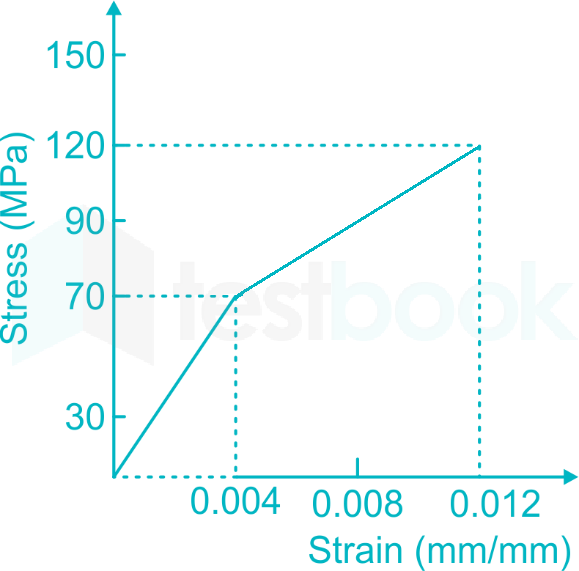
The stress strain behavior of a material is shown in figure. Its resilience and toughness, in Nm/m3 are respectively

  1. AOption (a)

    28 × 104, 76 × 104

  2. BOption (b)

    28 × 104, 48 × 104

  3. COption (c)

    14 × 104, 90 × 104

  4. DOption (d)

    76 × 104, 28 × 104

View answer & explanation

Correct answer

Answer: (c)C.

14 × 104, 90 × 104

Why this answer is correct

Concept:

Modulus of resilience:

Resilience per unit volume is known as the modulus of resilience which is the area under the stress-strain curve up to the elastic limit.

Modulus of toughness:

Toughness per unit volume is known as the modulus of toughness which is the total area under the stress-strain curve.

Calculation:

Given:

Ures=12σeϵ=12×70×106×0.004=14×104;Nm/m3{U_{res}} = \frac{1}{2}{\sigma _e}\epsilon = \frac{1}{2} \times 70 \times {10^6} \times 0.004 = 14 \times {10^4};Nm/{m^3}


Utough={U_{tough}} =  The total area under the stress-strain diagram.

=[12×70×0.004+12×(120−70)(0.012−0.004)+70(0.012−0.004)]×106 = \left[ {\frac{1}{2} \times 70 \times 0.004 + \frac{1}{2} \times \left( {120 - 70} \right)\left( {0.012 - 0.004} \right) + 70\left( {0.012 - 0.004} \right)} \right] \times {10^6}

=[12×70×0.004+12×50×0.008+70×0.008]×106=90×104;Nm/m3= \left[ {\frac{1}{2} \times 70 \times 0.004 + \frac{1}{2} \times 50 \times 0.008 + 70 \times 0.008} \right] \times {10^6} = 90 \times {10^4};Nm/{m^3}

Additional Information

Proof resilience

  • It is defined as the maximum strain energy stored in a body.
  • So, it is the quantity of strain energy stored in a body when strained up to the elastic limit (ability to store or absorb energy without permanent deformation).

Modulus of resilience

  • It is defined as proof resilience per unit volume.
  • It is the area under the stress-strain curve up to the elastic limit.

Modulus of toughness

  • It is the ability to absorb energy up to fracture.
  • From the stress-strain diagram, the area under the complete curve gives the measure of modules of toughness.

Question 36

An X̅ chart uses the following data

  1. AOption (a)

    count data

  2. BOption (b)

    attribute measurement data

  3. COption (c)

    variable measurement data

  4. DOption (d)

    None of the above

View answer & explanation

Correct answer

Answer: (c)C.

variable measurement data

Why this answer is correct

In a weaving operation, the parameter to be controlled is the number of defects per 10 square yards of material. Control chart appropriate for this task is C chart.

Explanation:

Control charts are statistical tool, showing whether a process is in control or not.

Two types of process data:

  • Variable is a continuous data, things we can measure; Example includes length, weight, time, temperature, diameter, etc.
  • Attribute is a discrete data, things we count; Examples include number or percent defective items in a lot, number of defects per item etc.
<br>

Types of Control Charts:

Variable charts are meant for variable type of data. X bar and R Chart, X bar and sigma chart, chart for the individual units

Attribute charts are meant for attribute type of data. p chart, np chart, c chart, u chart, U chart

Control charts for the variable type of data (X bar and R charts)

  • In the x bar chart, the sample means are plotted in order to control the mean value of a variable
  • In R chart, the sample ranges are plotted in order to control the variability of a variable

Control charts for Attribute type data (p, c, u charts)

  • p-charts calculates the percent defective in sample; p-charts are used when observations can be placed in two categories such as yes or no, good or bad, pass or fail etc.
  • c-charts counts the number of defects in an item; c-charts are used only when the number of occurrences per unit of measure can be counted such as number of scratches, cracks etc.
  • u-chart counts the number of defects per sample; The u chart is used when it is not possible to have a sample size of a fixed size

Question 37

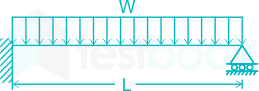
A beam of length L is carrying a uniformly distributed load w per unit length. The flexural rigidity of the beam is EI. The reaction at the simple support at the right end is

  1. AOption (a)

    WL/2

  2. BOption (b)

    3WL/8

  3. COption (c)

    WL/4

  4. DOption (d)

    WL/8

View answer & explanation

Correct answer

Answer: (b)B.

3WL/8

Why this answer is correct

Concept:

Deflection in cantilever beam due to

→uniformly;distributed;load=WL48EI\to uniformly;distributed;load = \frac{{W{L^4}}}{{8EI}}

→point;load;at;end;point=WL33EI\to point;load;at;end;point = \frac{{W{L^3}}}{{3EI}}

Deflection due to uniformly distributed load and deflection due to reaction at simple support will be equal and opposite.

Calculation:

Deflection due to uniform load W over the span of length L will be WL48EI\frac{{W{L^4}}}{{8EI}}

Let R be the reaction at simple support at the right end so it is acting as a point load on beam hence deflection due to it will be RL33EI\frac{{R{L^3}}}{{3EI}}

Net deflection at the simple support will be zero since from both the sides force is equal and opposite. Hence equating them.

WL48EI=RL33EI\frac{{W{L^4}}}{{8EI}} = \frac{{R{L^3}}}{{3EI}}

∴R=3WL8\therefore R = \frac{{3WL}}{8}

Question 38

Consider the following workpiece materials 

i. Glass

ii. Carbides

iii. Copper

iv. Ceramics

Materials best suited for ultrasonic machining are

  1. AOption (a)

    i only

  2. BOption (b)

    i and ii

  3. COption (c)

    i, ii and iii

  4. DOption (d)

    i, ii and iv

View answer & explanation

Correct answer

Answer: (d)D.

i, ii and iv

Why this answer is correct

Explanation:

  • During ultrasonic machining, the metal removal is achieved by hammering action of abrasive particles.

  • In ultrasonic machining, a tool of the desired shape vibrates at an ultrasonic frequency (19 ∼ 25 kHz) with an amplitude of around 15 – 50 μm over the workpiece.

  • Generally, the tool is pressed downward with a feed force, F.

  • Between the tool and workpiece, the machining zone is flooded with hard abrasive particles generally in the form of a water-based slurry.

  • As the tool vibrates over the workpiece, the abrasive particles act as the indenters and indent both the work material and the tool.

  • The abrasive particles, as they indent the work material, would remove the work material, particularly if the work material is brittle (due to crack initiation, propagation and brittle fracture of the material).

Applications of USM

  • USM process is used in machining hard and brittle metallic alloys, semiconductors, glass, ceramics, carbides etc
  • In machining of advanced ceramics for applications in auto-engine components
  • In machining, wire drawing, punching or blanking of small dies

Question 39

Which one of the following is the most conservative fatigue failure criterion?

  1. AOption (a)

    Soderberg

  2. BOption (b)

    Modified Goodman

  3. COption (c)

    ASME Elliptic

  4. DOption (d)

    Gerber

View answer & explanation

Correct answer

Answer: (a)A.

Soderberg

Why this answer is correct

Soderberg line is the most conservative fatigue failure criterion. Even yielding is not considered in soderberg criterion. 

The Gerber parabola is the best fit for the failure points of the test data.

The Goodman is safer from design consideration since it lies completely inside the Geber parabola and failure points.

Question 40

In a Eutectic system, two elements are completely :

  1. AOption (a)

    Insoluble in solid and liquid states

  2. BOption (b)

    Soluble in liquid states

  3. COption (c)

    Soluble in solid state

  4. DOption (d)

    Insoluble in liquid state

View answer & explanation

Correct answer

Answer: (b)B.

Soluble in liquid states

Why this answer is correct

Explanation:

Eutectic System: 

  • Two metals are completely soluble in the liquid state and completely insoluble in the solid-state.
  • A eutectic system is a homogeneous mixture of substances that melts or solidifies at a single temperature lower than any of the constituents melting point.
  • This temperature is known as the eutectic temperature.

Thus, option 2 is the correct Answer.


Isomorphous System: 

  • ​Metals that are completely miscible in each other in both liquid and solid states are referred to as isomorphous.
  • The two components in isomorphous systems have unlimited solubility, which means that whey always form a solid solution

regardless of the atom/molecule ratio when they mix.

  • The copper-nickel system is an example of an isomorphous system.

Peritectic System:

  • A peritectic reaction occurs at a specific temperature and composition,
  • where a solid phase and a liquid phase combine to form a second solid phase.

Monotectic System: 

  • In the solidification of metallic alloys, peritectic solidification is a very common type of system.
  • A liquid phase transforms into a solid phase and another liquid phase.

Question 41

An unbalanced couple of magnitude 300 N-m is noticed on a shaft of length 200 cm. The dynamic reactions at the bearings are

  1. AOption (a)

    300 N and -300 N

  2. BOption (b)

    300 N and 300 N

  3. COption (c)

    150 N and 150 N

  4. DOption (d)

    150 N and -150 N

View answer & explanation

Correct answer

Answer: (d)D.

150 N and -150 N

Why this answer is correct

Concept:

The dynamic reaction is due to the unbalanced couple, the static reaction is due to the weight of the shaft.

The dynamic reaction due to the couple on the shaft will be equal and opposite of each other.

This reaction is given by

R=±CLR = \pm \frac{C}{L}

Where R is the reaction and C is the unbalanced couple and L is the length between the supports.

Calculation:

Given that the unbalanced couple magnitude is 300 N-m;

L = 200 cm = 2 m;

∴ Reactions will be R=;±300;N−m2;m=;±;150;NR = ; \pm \frac{{300;N - m}}{{2;m}} = ; \pm ;150;N

Question 42

Two equal forces acting on a body in different directions have their resultant equal to the magnitude of one of the force. Find the angle between them?

  1. AOption (a)

    θ = 120° 

  2. BOption (b)

    θ = 180° 

  3. COption (c)

    θ = 0° 

  4. DOption (d)

    θ = 160° 

View answer & explanation

Correct answer

Answer: (a)A.

θ = 120° 

Why this answer is correct

option(1)

CONCEPT:

  • Vector quantities are those physical quantities that have both magnitude and direction and obey the vector law of addition.
  • Example Displacement, Velocity, Force, Momentum, etc

The magnitude of resultant of two vectors is given by:

 R=A2+B2+2ABcosθR =\sqrt{A^2 + B^2 + 2ABcosθ }

Where A and B are the magnitudes of two vectors and θ is the angle between them

CALCULATION:

Let's assume two forces A and B having two equal force have their resultant equal to either.

A =B = R

R=A2+B2+2ABcosθR =\sqrt{A^2 + B^2 + 2ABcosθ }  

A=A2+A2+2AAcosθA =\sqrt{A^2 + A^2 + 2AAcosθ }

A2=2A2(1+cosθ)A^2= 2A^2(1+cosθ )

1 + cosθ = 1/2 

cosθ = -1/2,  Since (cos -1/2 = 120° )

  • The angle between them is, θ = 120°

Additional Information

Special case: If two vectors A⃗\vec Aand B⃗\vec Bare acting along the same direction, θ =0. Therefore the magnitude of the resultant is given by mathematically:

 R=A2+B2+2ABcosθR =\sqrt{A^2 + B^2 + 2ABcosθ } = A2+B2+2AB\sqrt{A^2+ B^2 +2AB} = (A+B)2\sqrt{(A+ B)^2 }

R = A+B

  • If two vectors A⃗\vec Aand B⃗\vec Bare acting along the opposite direction, θ =180°. Therefore the magnitude of the resultant is given by mathematically

R=A2+B2+2ABcosθR =\sqrt{A^2 + B^2 + 2ABcosθ } = A2+B2+2ABcos180=A2+B2−2AB\sqrt{A^2+B^2+2ABcos180}=\sqrt{A^2+B^2-2AB}   


R = A - B

Question 43

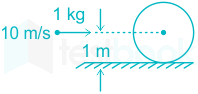
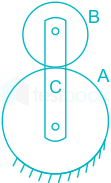
A 1 kg mass clay, moving with a velocity of 10 m/s, strikes a stationary wheel and sticks to it as shown in figure. The solid wheel has a mass of 20 kg and radius of 1 m. Due to impact, wheel starts rolling without slip. The angular speed of the wheel at the start is ___ (Assume that the mass of the clay is very less in comparison to the wheel)

  1. AOption (a)

    0

  2. BOption (b)

    13\frac{1}{3} rad/s

  3. COption (c)

    103\sqrt{\frac{10}{3}} rad/s

  4. DOption (d)

    1031\frac{10}{31} rad/s

View answer & explanation

Correct answer

Answer: (b)B.

13\frac{1}{3} rad/s

Why this answer is correct

Concept:

Angular momentum is a vector quantity.

The magnitude of the angular momentum of an orbiting object is equal to its linear momentum (product of its mass ‘m' and linear velocity ‘v’) times the perpendicular distance ‘r’  from the center of rotation to a line drawn in the direction of its instantaneous motion and passing through the object’s center of gravity.

Angular momentum = m × v × r

Angular momentum before Impact (Li) = Angular momentum after Impact (Lf)

Calculation:

Given:

m = 1 kg, u = 10 m/s, M = 20 kg, r = 1 m

Li = m × u × r = 1 × 10 × 1 = 10 

Since the wheel will start rolling motion after the impact so this will have the pure rotation about the point of contact as the point of contact will be in the state of rest (Center of instantaneous rotation or CIR). Let the final angular velocity of the system (clay and wheel) is ω. 

Lf = ICIR × ω 

Since the mass of the clay is very less in comparison to the wheel so this can be neglected while taking the moment of inertia about CIR

 ICIR=MR22+MR2=3MR22I_{CIR} = \frac{MR^2}{2} + MR^2 = \frac{3MR^2}{2}

Now, (Li) = Angular momentum after Impact (Lf)

⇒10=3MR22ω\Rightarrow 10 = \frac{3MR^2}{2} \omega

⇒10=3×20×122ω=30ω\Rightarrow 10 = \frac{3 \times 20 \times 1^2}{2} \omega = 30 \omega

ω=13 rad/secω = \frac 13~ rad/sec

Question 44

For full depth of involute spur gears, minimum number of teeth on pinion to avoid interference depends upon

  1. AOption (a)

    Pressure angle

  2. BOption (b)

    Speed ratio

  3. COption (c)

    Circular pitch

  4. DOption (d)

    Pitch diameter

View answer & explanation

Correct answer

Answer: (a)A.

Pressure angle

Why this answer is correct

Explanation:

  • When two gears are in mesh at one instant there is a chance to mate an involute portion with a non-involute portion of the mating gear.
  • This phenomenon is known as INTERFERENCE and occurs when the number of teeth on the smaller of the two meshing gears is less than a required minimum.

Where, Gear ratio,, ϕ is pressure angle and aw is the addendum coefficient.

Methods of elimination of Gear tooth Interference:

  • The use of a larger pressure angle results in a smaller base circle, as a result, more of the tooth profiles become involute.
  • Increasing the number of teeth on the gear can also eliminate the chances of interference.
  • Increasing slightly the center distance between the meshing gears would also eliminate interference.
  • Tooth profile modification or profile shifting i.e. gears with non-standard profiles can also be an option to eliminate interference. In profile shifted meshing gears, the addendum on the pinion is shorter compared with standard gears.
  • Under-cutting of the tooth.

Additional Information

Minimum number of teeth required on the wheel in order to avoid interference

System of gear teethMinimum number of teeth on the pinion
14-1/2° composite12
14-1/2° full depth involute32
20° full depth involute18
20° Stub involute14

Question 45

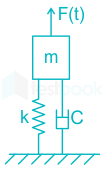
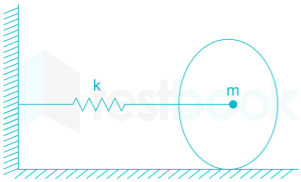
A single-degree-of freedom oscillator is subjected to harmonic excitation F(t) = F0 cos(ωt) as shown in the figure.

The non-zero value of ω, for which the amplitude of the force transmitted to the ground will be F0, is

  1. AOption (a)

    k2m\sqrt {\frac{k}{{2m}}}

  2. BOption (b)

    km\sqrt {\frac{k}{m}}

  3. COption (c)

    2km\sqrt {\frac{{2k}}{m}}

  4. DOption (d)

    2km2\sqrt {\frac{k}{m}}

View answer & explanation

Correct answer

Answer: (c)C.

2km\sqrt {\frac{{2k}}{m}}

Why this answer is correct

Concept:

In vibration system, transmissibility is given by

\(\epsilon =\frac{{{F}{T}}}{{{F}{O}}}\)

Where FT = maximum force transmitted to the ground

\(\epsilon =\frac{\sqrt{1+{{\left( 2\xi \frac{\omega }{{{\omega }{n}}} \right)}^{2}}}}{\sqrt{{{\left( 1-{{\left( \frac{\omega }{{{\omega }{n}}} \right)}^{2}} \right)}^{2}}+{{\left( \frac{2\xi \omega }{{{\omega }_{n}}} \right)}^{2}}}}\)

Natural frequency ωn=Km{{\omega }_{n}}=\sqrt{\frac{K}{m}}

K = spring stiffness, m = mass

Calculation:

Given, Harmonic excitation force: F(t) = F0cos(ωt)

FT = FO

\(\epsilon =\frac{{{F}{T}}}{{{F}{O}}}\)

∴ Transmissibility, ϵ = 1

Also, \(\epsilon =\frac{\sqrt{1+{{\left( 2\xi \frac{w}{{{w}{n}}} \right)}^{2}}}}{\sqrt{{{\left( 1-{{\left( \frac{w}{{{w}{n}}} \right)}^{2}} \right)}^{2}}+{{\left( \frac{2\xi w}{{{w}_{n}}} \right)}^{2}}}}=1\)

Let ωωn=x\frac{\omega }{{{\omega }_{n}}}=x

So, 1 + (2ξ x)2 = (1 – x2)2 + (2ξ x)2

(1 – x2)2 = 1

1 – x2 = ± 1

Taking +ve sign x2 = 0

∴ Taking –ve sign

x2 = 2

Putting value of x:

(ω/ωn)2 = 2

ωωn=2\frac{\omega }{{{\omega }_{n}}}=\sqrt{2}

∴ ω = √2ωn

∵ Natural frequency ωn=Km{{\omega }_{n}}=\sqrt{\frac{K}{m}}

ω=2Km\omega =\sqrt{\frac{2K}{m}}

Question 46

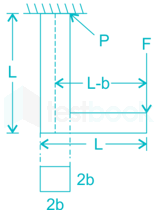
For the component loaded with a force F as shown in the figure, the maximum stress at the corner point P is

  1. AOption (a)

    F(3L−b)4b3\frac{{F\left( {3L - b} \right)}}{{4{b^3}}}

  2. BOption (b)

    F(3L+b)4b3\frac{{F\left( {3L + b} \right)}}{{4{b^3}}}

  3. COption (c)

    F(3L+2b)4b3\frac{{F\left( {3L + 2b} \right)}}{{4{b^3}}}

  4. DOption (d)

    F(3L−2b)4b3\frac{{F\left( {3L - 2b} \right)}}{{4{b^3}}}

View answer & explanation

Correct answer

Answer: (d)D.

F(3L−2b)4b3\frac{{F\left( {3L - 2b} \right)}}{{4{b^3}}}

Why this answer is correct

Concept:

The bending moment equation is given as, MI=σy=ER\frac{M}{I} = \frac{σ }{y}=\frac{E}{R}

Total stress at point P is due to axial force and due to bending, i.e. σ = σa + σb 

⇒ σb=3F(L−b)4b3{{\rm{σ }}_{\rm{b}}} = \frac{{3{\rm{F}}\left( {{\rm{L}} - {\rm{b}}} \right)}}{{4{{\rm{b}}^3}}}(due to bending)

⇒ σa=F4b2{{\rm{σ }}_{\rm{a}}} = \frac{{\rm{F}}}{{4{{\rm{b}}^2}}}(due to axial force)

∴ Total axial stress

σ =3F(L−b)4b3+F4b2= \frac{{3F\left( {L - b} \right)}}{{4{{\rm{b}}^3}}} + \frac{F}{{4{b^2}}}

=3F(L−b)4b3+Fb4b3= \frac{{3F\left( {L - b} \right)}}{{4{{\rm{b}}^3}}} + \frac{{Fb}}{{4{b^3}}}

=3FL−3Fb+Fb4b3=F(3L−2b)4b3= \frac{{3FL - 3Fb + Fb}}{{4{{\rm{b}}^3}}} = \frac{{F\left( {3L - 2b} \right)}}{{4{{\rm{b}}^3}}}

Question 47

A thin walled cylindrical vessel of wall thickness 't' and diameter 'd' is filled with gas to a gauge pressure of p, the maximum shear stress on the pressure wall will be

  1. AOption (a)

    pd4t+p2\frac{pd}{4t}+\frac{p}{2}

  2. BOption (b)

    pd8t + p/2\frac{pd}{8t}\ +\ p/2

  3. COption (c)

    pd8t\frac{pd}{8t}

  4. DOption (d)

    pd4t\frac{pd}{4t}

View answer & explanation

Correct answer

Answer: (c)C.

pd8t\frac{pd}{8t}

Why this answer is correct

Concept:

At any point in the material of the thin cylinder shell, there are two principal stresses.

Longitudinal stress: σL=pd4t{σ _L} = \frac{{pd}}{{4t}}

Hoop stress: σh=pd2t=2σL{σ _h} = \frac{{pd}}{{2t}} = 2{σ _L}

These two stresses are tensile and perpendicular to each other.

Calculation:

Given:

Internal pressure, pi = p , diameter = d, thickness = t

Maximum shear stress on the surface is maximum in-plane shear stress and is given by:

τmax=σ1−σ22=σh−σL2=pd2t−pd4t2=pd4t2=pd8t{\tau _{max}} = \frac{{{σ _1} - {σ _2}}}{2} = \frac{{{σ _h} - {σ _L}}}{2} = \frac{\frac{pd}{2t}-\frac{pd}{4t}}{2}=\frac{\frac{pd}{4t}}{2}=\frac{pd}{8t}

Mistake Points

  • Whenever we are told maximum shear stress at any point or in-plane shear stress there we have to ignore the third principal stress and the value of maximum shear stress will be pd/8t.
  • When we asked absolute maximum shear stress then the third principal stress will also be in there, whose value will be zero. In that case the maximum shear stress is pd/4t.

Question 48

The most important parameter for EDM is

  1. AOption (a)

    Geometry

  2. BOption (b)

    Strength

  3. COption (c)

    Hardness

  4. DOption (d)

    Thermal capacity

View answer & explanation

Correct answer

Answer: (d)D.

Thermal capacity

Why this answer is correct

Electro-Discharge Machining (EDM):

  • Electrical Discharge Machining (EDM) is a manufacturing process whereby a desired shape is obtained by using electrical discharges (sparks).
  • Material is removed from the workpiece by a series of rapidly recurring current discharges between two electrodes, separated by a dielectric liquid which controls spark discharges and is subject to an electric voltage.
  • In EDM, the workpiece is connected to the positive terminal, and the tool is connected to the negative terminal.
  • EDM has the lowest specific power requirement and can achieve sufficient accuracy.

Characteristics of EDM

  • The process can be used to machine any work material if it is electrically conductive
  • Material removal depends on mainly thermal properties of the work material rather than its strength, hardness, etc
  • In EDM there is a physical tool and the geometry of the tool is the positive impression of the hole or geometric feature machined
  • The tool has to be electrically conductive as well. The tool wear once again depends on the thermal properties of the tool material
  • Though the local temperature rise is rather high, still due to a very small pulse on time, there is not enough time for the heat to diffuse and thus almost no increase in bulk temperature takes place. Thus the heat-affected zone is limited to 2 – 4 μm of the spark crater.
  • However rapid heating and cooling and local high temperature leads to surface hardening which may be desirable in some applications
  • Though there is a possibility of taper cut and overcut in EDM, they can be controlled and compensated.

Question 49

The frictional torque, transmitted in the case of flat pivot bearing for uniform pressure is equal to

Where, W → total axial load carrled by pivot

μ → coefficient of friction

R → radius of bearing surface

  1. AOption (a)

    μWR

  2. BOption (b)

    23\frac{2}{3} μWR

  3. COption (c)

    13\frac{1}{3} μWR

  4. DOption (d)

    12\frac{1}{2} μWR

View answer & explanation

Correct answer

Answer: (b)B.

23\frac{2}{3} μWR

Why this answer is correct

Explanation:

Flat pivot bearing:

  • Frictional torque transmitted (Uniform Pressure Theory), T=23μWRT =\frac{2}{3}\mu WR
  • Frictional torque transmitted (Uniform Wear Theory), T=12μWRT =\frac{1}{2}\mu WR

Conical pivot bearing:

  • Frictional torque transmitted (Uniform Pressure Theory), T=23μWR.csc⁡αT=\frac{2}{3}\mu WR.\csc α
  • Frictional torque transmitted (Uniform Wear Theory), T=12μWR.csc⁡αT=\frac{1}{2}\mu WR.\csc α

where, W = Axial load, R = Bearing radius, α = Semi angle of cone

From the above expressions, We can conclude that the frictional torque transmitted in a conical or flat pivot bearing assuming uniform pressure in comparison to the assumption of uniform wear is more.

Additional Information

Sr. No.ParticularFrictional torque
Uniform PressureUniform Wear
1Flat Pivot Bearing23μWR\frac{2}{3}\mu WR12μWR\frac{1}{2}\mu WR
2Conical Pivot Bearing23μWR.csc⁡α\frac{2}{3}\mu WR.\csc \alpha 12μWR.csc⁡α\frac{1}{2}\mu WR.\csc \alpha
3Trapezoidal or Truncated Conical Pivot Bearing23μW.csc⁡α[r13−r23r12−r22]\frac{2}{3}\mu W.\csc \alpha \left[ {\frac{{r_1^3 - r_2^3}}{{r_1^2 - r_2^2}}} \right]12μW.csc⁡α(r1+r2)\frac{1}{2}\mu W.\csc \alpha \left( {{r_1} + {r_2}} \right)
4Flat Collar Bearing23μW[r13−r23r12−r22]\frac{2}{3}\mu W\left[ {\frac{{r_1^3 - r_2^3}}{{r_1^2 - r_2^2}}} \right]12μW(r1+r2)\frac{1}{2}\mu W\left( {{r_1} + {r_2}} \right)
5Single Disc or Plate Clutch23μW[r13−r23r12−r22]\frac{2}{3}\mu W\left[ {\frac{{r_1^3 - r_2^3}}{{r_1^2 - r_2^2}}} \right]12μW(r1+r2)\frac{1}{2}\mu W\left( {{r_1} + {r_2}} \right)
6Cone Clutch23μW.csc⁡α[r13−r23r12−r22]\frac{2}{3}\mu W.\csc \alpha \left[ {\frac{{r_1^3 - r_2^3}}{{r_1^2 - r_2^2}}} \right]12μW.csc⁡α(r1+r2)\frac{1}{2}\mu W.\csc \alpha \left( {{r_1} + {r_2}} \right)

Question 50

Number of effective atoms in a unit cell of HCP lattice is

  1. AOption (a)

    1

  2. BOption (b)

    2

  3. COption (c)

    3

  4. DOption (d)

    6

View answer & explanation

Correct answer

Answer: (d)D.

6

Why this answer is correct

Explanation:

Unit CellCoordination No.No. of Atoms Per Unit CellAtomic packing factor
Simple Unit Cell6152%
Body-centred Cubic8268%
Face-centred Cubic12474%
Hexagonal Closest Packed12674%


Diagram
Effective no. of lattice points⇒18×8=1\Rightarrow \frac{1}{8} \times 8 = 118×8+1=2\frac{1}{8} \times 8 + 1 = 218×8+12×6=4\frac{1}{8} \times 8 + \frac{1}{2} \times 6 = 4


The unit cell of BCC crystal = 2

The unit cell of HCP crystal = 6

The difference between the number of atoms in a unit cell of HCP crystal and BCC crystal is 6 - 2 = 4

Question 51

Polar moment of inertia of a circle of diameter D is

  1. AOption (a)

    πD432\frac{\pi D^4}{32}

  2. BOption (b)

    πD464\frac{\pi D^4}{64}

  3. COption (c)

    πD332\frac{\pi D^3}{32}

  4. DOption (d)

    πD364\frac{\pi D^3}{64}

View answer & explanation

Correct answer

Answer: (a)A.

πD432\frac{\pi D^4}{32}

Why this answer is correct

Explanation:

  • Polar Moment of Inertia is a measure of an object’s capacity to oppose or resist torsion when some amount of torque is applied to it on a specified axis.
  • Polar Moment of Inertia also known as the second polar moment of area is a quantity used to describe resistance to torsional deformation.
  • It is denoted as Iz or J.
  • The moment of inertia for a solid circular shaft with diameter d is

  ⇒Ixx=Iyy=π(d4)64⇒ I_{xx}=I_{yy}= \frac{{\pi \left( {d^4} \right)}}{{64}} 

Where Ix-x and Iyy are moments of inertial w.r.t. x-x axis and y-axis respectively.

We know that,

Polar moment of inertia. 

For objects that have rotational symmetry, such as a cylinder or hollow tube, the equation can be simplified to

⇒ Jz = Ixx + Iyy = 2Ixx = 2Iyy

⇒Jz=2×π(d4)64=π(d4)32\Rightarrow J_z = 2 \times \frac{{{\rm{\pi }}\left({{\rm{d}}^4} \right)}}{{64}} = \frac{{{\rm{\pi }}\left({{\rm{d}^4}} \right)}}{{32}}

Important Points

Polar moment of inertia of some important sections are as follows: 

<br>

Question 52

The relationship between true strain (εT) and engineering strain (εE) in a uniaxial tension test is given as

  1. AOption (a)

    εE = ln (1 - εT)

  2. BOption (b)

    εE = ln (1 + εT)

  3. COption (c)

    εT = ln (1 + εE)

  4. DOption (d)

    εT = ln (1 - εE)

View answer & explanation

Correct answer

Answer: (c)C.

εT = ln (1 + εE)

Why this answer is correct

Concept:

Engineering stress: It is the stress obtained by dividing the load applied to the original cross-section area.

σe=loadinitial;area{\sigma _e} = \frac{{load}}{{initial;area}}

True stress: It is the stress obtained by dividing load applied to instantaneous cross-section area.

σt=loadinstantaneous;area{\sigma _t} = \frac{{load}}{{instantaneous;area}}

Engineering strain: It is the ratio of change in dimension to the original dimension.

ϵe = ΔLL0\frac{{{\rm{\Delta }}L}}{L_0}

True strain: It is the ratio of instantaneous elongation to instantaneous dimension.

dϵt = dLL\frac{{dL}}{L}

Total true strain can be concluded by:

ϵt = \(\mathop \smallint \limits_{{L_o}}^{{L_f}} \frac{{dL}}{L}\)

Calculation:

\(\begin{array}{l} {\varepsilon T} = \mathop \smallint \limits{{L_0}}^{{L_f}} \frac{{dL}}{L} = \ln \left[ {\frac{{{L_f}}}{{{L_0}}}} \right]\ \Rightarrow {\varepsilon _T} = \ln \left[ {\frac{{{L_0} + \Delta L}}{{{L_0}}}} \right]\ \Rightarrow {\varepsilon _T} = \ln \left[ {1 + \frac{{\Delta L}}{{{L_0}}}} \right]\ \Rightarrow {\varepsilon _T} = ln\left[ {1 + {\varepsilon _E}} \right] \end{array}\)

Question 53

The speed of an engine varies from 210 rad/s to 190 rad/s. During a cycle the change in kinetic energy is found to be 400 Nm. The inertia of the flywheel in kgm2 is

  1. AOption (a)

    0.10

  2. BOption (b)

    0.20

  3. COption (c)

    0.30

  4. DOption (d)

    0.40

View answer & explanation

Correct answer

Answer: (a)A.

0.10

Why this answer is correct

Concept:

For a flywheel, the change in kinetic energy is given by:

ΔE=12I(ω12−ω22){\rm{Δ }}E = \frac{1}{2}I\left( {ω _1^2 - ω _2^2} \right)

Calculation:

Given:

ω1 = 210 rad/sec, ω2 = 190 rad/sec, and ΔE = 400 Nm

ΔE=12I(ω12−ω22){\rm{Δ }}E = \frac{1}{2}I\left( {ω _1^2 - ω _2^2} \right)

400=12×I×(2102−1902)400 = \frac{1}{2} \times I\times\left( {{{210}^2} - {{190}^2}} \right)

I=400×22102−1902=0.1;kg/m2I = \frac{{400 \times 2}}{{{{210}^2} - {{190}^2}}} = 0.1;kg/{m^2}

Question 54

The equation of motion of a spring-mass-damper system is given by

d2xdt2+3dxdt+9x=10sin⁡(5t)\frac{{{d^2}x}}{{d{t^2}}} + 3\frac{{dx}}{{dt}} + 9x = 10\sin \left( {5t} \right)

The damping factor for the system is

  1. AOption (a)

    0.25

  2. BOption (b)

    0.5

  3. COption (c)

    2

  4. DOption (d)

    3

View answer & explanation

Correct answer

Answer: (b)B.

0.5

Why this answer is correct

Concept:

Damping;factor;=ζ=c2km{\rm{Damping;factor;}} = \zeta = \frac{c}{{2\sqrt {km} }}

Where,

ζ = damping factor, c = coefficient of damping, k = spring constant, m = mass

Calculation:

Given:

d2xdt2+3dxdt+9x=10sin⁡(5t)\frac{{{d^2}x}}{{d{t^2}}} + 3\frac{{dx}}{{dt}} + 9x = 10\sin \left( {5t} \right)

By comparing this equation with mx¨+cx˙+kx=F(t)m\ddot x + c\dot x + kx = F(t)

m = 1 kg, c = 3 N s/m, k = 9 N/m,

ζ=32;9×1;{\rm{\zeta }} = \frac{3}{{2;\sqrt {9 \times 1} ;}}

ζ;=36{\rm{\zeta ;}} = \frac{3}{6}

∴ ζ = 0.5

Question 55

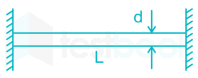
An initially stress-free massless elastic beam of length L and circular cross-section with diameter d (d ≪ L) is held fixed between two walls as shown. The beam material has Young’s modulus E and coefficient of thermal expansion α. If the beam is slowly and uniformly heated, the temperature rise required to cause the beam to buckle is proportional to

  1. AOption (a)

    d

  2. BOption (b)

    d2

  3. COption (c)

    d3

  4. DOption (d)

    d4

View answer & explanation

Correct answer

Answer: (b)B.

d2

Why this answer is correct

Concept:

Crippling load:

P=π2EILe2P = \frac{{{\pi ^2}EI}}{{L_e^2}}

End ConditionBoth end hingedOne end fixed other freeBoth end fixedOne end fixed and other hinged
Effective length (Le)L2LL/2L2\frac{L}{{\sqrt 2 }}

If Rod is free to expand

Free elongation ΔL  = LαΔT

∴ ΔL/L = αΔT

Here Rod is fixed at both ends so strain will be zero but due to restriction given by fixed ends, there will be reaction force at the end.

That reaction force per unit area is known as thermal stress. It is given by- 

σ=Eϵσ = E\epsilon

or, σ = E(ΔL/L) = Eα(ΔT)

Calculation:

Given:

At the time when the rod just starts to buckle, the load required to buckle will be equal to the reaction force due to thermal stress.

i.e. Pthermal = Pbuckling

∴Pthermal=σA⇒Eα(ΔT)πd24\therefore P_{thermal}=\sigma A\Rightarrow E\alpha(\Delta T)\frac{\pi d^2}{4}

∴ Pthermal = σA ⇒ EAα(ΔT)

Pbuckling=π2EILe2P_{buckling} = \frac{{{\pi ^2}EI}}{{L_e^2}}

∵ both ends are fixed, Le=L2L_{e}=\frac{L}{2}

∴Pbuckling=4π2EIL2⇒4π2EL2×πd464=(π3E16L2)d4\therefore P_{buckling} = \frac{{{4\pi ^2}EI}}{{L^2}}\Rightarrow\frac{4\pi^2E}{L^2}\times\frac{\pi d^4}{64}=\left(\frac{\pi^3E}{16L^2}\right)d^4

∵ Pthermal = Pbuckling

Eα(ΔT)πd24=(π3E16L2)d4E\alpha(\Delta T)\frac{\pi d^2}{4}=\left(\frac{\pi^3E}{16L^2}\right)d^4

(ΔT)=(π24αL2)d2(\Delta T)=\left(\frac{\pi^2}{4\alpha L^2}\right)d^2

∴;ΔT∝d2\therefore;\Delta T \propto d^2

Question 56

A hole of 1 mm is to be drilled in glass. It could be best done by

  1. AOption (a)

    Plasma drilling

  2. BOption (b)

    Laser drilling

  3. COption (c)

    Electron beam drilling

  4. DOption (d)

    Ultrasonic drilling

View answer & explanation

Correct answer

Answer: (d)D.

Ultrasonic drilling

Why this answer is correct

Explanation:

  • During ultrasonic machining, the metal removal is achieved by hammering action of abrasive particles.

  • In ultrasonic machining, a tool of the desired shape vibrates at an ultrasonic frequency (19 ∼ 25 kHz) with an amplitude of around 15 – 50 μm over the workpiece.

  • Generally, the tool is pressed downward with a feed force, F.

  • Between the tool and workpiece, the machining zone is flooded with hard abrasive particles generally in the form of a water-based slurry.

  • As the tool vibrates over the workpiece, the abrasive particles act as the indenters and indent both the work material and the tool.

  • The abrasive particles, as they indent the work material, would remove the work material, particularly if the work material is brittle (due to crack initiation, propagation and brittle fracture of the material).

Applications of USM

  • USM process is used in machining hard and brittle metallic alloys, semiconductors, glass, ceramics, carbides etc
  • In machining of advanced ceramics for applications in auto-engine components
  • In machining, wire drawing, punching or blanking of small dies
  • For drilling minor holes

Question 57

In centrifugal casting, the impurities are ,

  1. AOption (a)

    Uniformly Distributed

  2. BOption (b)

    Forced towards  the outer surface

  3. COption (c)

    Trapped near the mean radius of the casting

  4. DOption (d)

    Collected at the centre of the casting

View answer & explanation

Correct answer

Answer: (d)D.

Collected at the centre of the casting

Why this answer is correct

Explanation:

Centrifugal casting

  • This is a process where the mould is rotated rapidly about its central axis as the metal is poured into it.
  • Because of the centrifugal force, continuous pressure will be acting on the metal as it solidifies.
  • The slag, oxides, and other inclusion being lighter get separated from the metal and segregates towards the center.
  • There three main types of centrifugal casting processes
  1. True centrifugal casting: Horizontal or vertical axis of rotation
  2. Semi centrifugal casting
  3. Centrifuging

​

Question 58

Which of the following is the most appropriate theory of failure for mild steel?

  1. AOption (a)

    Maximum principal stress theory

  2. BOption (b)

    Maximum principal strain theory

  3. COption (c)

    Maximum shear stress theory

  4. DOption (d)

    Maximum shear strain energy theory

View answer & explanation

Correct answer

Answer: (d)D.

Maximum shear strain energy theory

Why this answer is correct

Explanation:

Maximum principal stress theory (Rankine’s theory)

  • According to this theory, a permanent set takes place under a state of complex stress, when the value of maximum principal stress is equal to that of yield point stress as found in a simple tensile test.
  • For design criterion, the maximum principal stress (σ1) must not exceed the working stress ‘σy’ for the material.
  • \({{\rm{\sigma }}{1,2}} \le {{\rm{\sigma }}{\rm{y}}}\) for no failure
  • σ1,2≤σFOS{{\rm{\sigma }}_{1,2}} \le \frac{{\rm{\sigma }}}{{{\rm{FOS}}}} for design
  • Note: For no shear failure τ ≤ 0.57 σy

Graphical representation

  • For brittle material, which do not fail by yielding but fail by brittle fracture, this theory gives satisfactory result.
  • The graph is always square even for different values of σ1 and σ2.

Maximum principal strain theory (ST. Venant’s theory)

  • According to this theory, a ductile material begins to yield when the maximum principal strain reaches the strain at which yielding occurs in simple tension.
  • ϵ1,2≤σyE1{\epsilon_{1,2}} \le \frac{{{{\rm{\sigma }}_{\rm{y}}}}}{{{{\rm{E}}_1}}} For no failure in uni – axial loading.
  • \(\frac{{{{\rm{\sigma }}_1}}}{{\rm{E}}} - {\rm{\mu }}\frac{{{{\rm{\sigma }}_2}}}{{\rm{E}}} - {\rm{\mu }}\frac{{{{\rm{\sigma }}3}}}{{\rm{E}}} \le \frac{{{{\rm{\sigma }}{\rm{y}}}}}{{\rm{E}}}\) For no failure in tri – axial loading.
  • \({{\rm{\sigma }}_1} - {\rm{\mu }}{{\rm{\sigma }}_2} - {\rm{\mu }}{{\rm{\sigma }}3} \le \left( {\frac{{{{\rm{\sigma }}{\rm{y}}}}}{{{\rm{FOS}}}}} \right)\) For design, Here, ϵ = Principal strain
  • σ1, σ2 and σ3 = Principal stresses

Graphical Representation

  • This story over estimate the elastic strength of ductile material.

Maximum shear stress theory (Guest & Tresca’s Theory)

  • According to this theory, failure of specimen subjected to any combination of load when the maximum shearing stress at any point reaches the failure value equal to that developed at the yielding in an axial tensile or compressive test of the same material.

Graphical Representation

  • \({{\rm{\tau }}{{\rm{max}}}} \le \frac{{{{\rm{\sigma }}{\rm{y}}}}}{2}\) For no failure
  • \({{\rm{\sigma }}_1} - {{\rm{\sigma }}2} \le \left( {\frac{{{{\rm{\sigma }}{\rm{y}}}}}{{{\rm{FOS}}}}} \right)\) For design
  • σ1 and σ2 are maximum and minimum principal stress respectively.
  • Here, τmax = Maximum shear stress
  • σy = permissible stress
  • This theory gives satisfactory result for ductile material.

Maximum strain energy theory (Haigh’s theory)

  • According to this theory, a body complex stress fails when the total strain energy at elastic limit in simple tension.

Graphical Representation.

  • \(\left{ {{\rm{\sigma }}_1^2 + {\rm{\sigma }}_2^2 + {\rm{\sigma }}_3^2 - 2{\rm{\mu }}\left( {{{\rm{\sigma }}_1}{{\rm{\sigma }}_2} + {{\rm{\sigma }}_2}{{\rm{\sigma }}_3} + {{\rm{\sigma }}_3}{{\rm{\sigma }}1}} \right)} \right} \le {\rm{\sigma }}{\rm{y}}^2\) for no failure
  • \(\left{ {{\rm{\sigma }}_1^2 + {\rm{\sigma }}_2^2 + {\rm{\sigma }}_3^2 - 2{\rm{\mu }}\left( {{{\rm{\sigma }}_1}{{\rm{\sigma }}_2} + {{\rm{\sigma }}_2}{{\rm{\sigma }}_3} + {{\rm{\sigma }}_3}{{\rm{\sigma }}1}} \right)} \right} \le {\left( {\frac{{{{\rm{\sigma }}{\rm{y}}}}}{{{\rm{FOS}}}}} \right)^2}\) for design
  • This theory does not apply to brittle material for which elastic limit stress in tension and in compression are quite different.

Maximum shear strain energy / Distortion energy theory / Mises – Henky theory.

  • It states that inelastic action at any point in body, under any combination of stress begging, when the strain energy of distortion per unit volume absorbed at the point is equal to the strain energy of distortion absorbed per unit volume at any point in a bar stressed to the elastic limit under the state of uniaxial stress as occurs in a simple tension / compression test.

  • \(\frac{1}{2}\left[ {{{\left( {{{\rm{\sigma }}_1} - {{\rm{\sigma }}_2}} \right)}^2} + {{\left( {{{\rm{\sigma }}_2} - {{\rm{\sigma }}_3}} \right)}^2} + {{\left( {{{\rm{\sigma }}_3} - {{\rm{\sigma }}1}} \right)}^2}} \right] \le {\rm{\sigma }}{\rm{y}}^2\) for no failure

  • \(\frac{1}{2}\left[ {{{\left( {{{\rm{\sigma }}_1} - {{\rm{\sigma }}_2}} \right)}^2} + {{\left( {{{\rm{\sigma }}_2} - {{\rm{\sigma }}_3}} \right)}^2} + {{\left( {{{\rm{\sigma }}_3} - {{\rm{\sigma }}1}} \right)}^2}} \right] \le {\left( {\frac{{{{\rm{\sigma }}{\rm{y}}}}}{{{\rm{FOS}}}}} \right)^2}\) For design

  • It gives very good result in ductile material.

  • It cannot be applied for material under hydrostatic pressure.

  • All theories will give same results if loading is uniaxial​

Question 59

Match the List – I with the List-II and select the correct answer using the codes given below

List-I (Crystal Structure)List-II (Packing Efficiency)
A. Simple cubic1. 34
B. Diamond cubic2. 74
C. Body centered cubic3. 52
D. Face centered cubic4. 68

Select the correct answer using the codes given below:

  1. AOption (a)

    A-4, B-3, C-1, D-2

  2. BOption (b)

    A-3, B-1, C-4, D-2

  3. COption (c)

    A-1, B-2, C-4, D-3

  4. DOption (d)

    A-3, B-2, C-1, D-4

View answer & explanation

Correct answer

Answer: (b)B.

A-3, B-1, C-4, D-2

Why this answer is correct

Concept:

In the crystal structure, atomic packing factor (APF) or packing efficiency or packing fraction is the fraction of volume in a crystal structure that is occupied by constituent particles. It is a dimensionless quantity and always less than unity.

The atomic packing factor of different crystal structures is given in the table below:

StructureAtomic packing factor
BCC0.68
HCP0.74
FCC0.74
Diamond cubic0.34
Simple Cubic0.52

Question 60

Consider the following statements with reference to SCARA Robot:

  1. It has four degrees of freedom.
  2. It has only one forward kinematic solution.
  3. It has two inverse kinematic solutions

Which of the above statements are correct?

  1. AOption (a)

    1 and 2 only

  2. BOption (b)

    1 and 3 only

  3. COption (c)

    2 and 3 only

  4. DOption (d)

    1, 2 and 3

View answer & explanation

Correct answer

Answer: (d)D.

1, 2 and 3

Why this answer is correct

SCARA ROBOT

  • SCARA is an acronym for Selective Compliance Articulated Robot Arm, meaning it is compliant in the X-Y axis, and rigid in the Z-axis. It has 4 degree of freedom
  • The SCARA configuration is unique and designed to handle a variety of material handling operations.
  • SCARA Robots are a popular option for small robotic assembly applications.
  • The SCARA robot is most commonly used for pick-and-place or assembly operations where high speed and high accuracy is required.
  • It has only one forward kinematic solution and two inverse kinematic solution.

Question 61

Annual demand for a product costing 200 per piece is 900. Ordering cost is Rs 100 and inventory holding cost Rs, 2 per unit per year. The Economic order quantity is

  1. AOption (a)

    200

  2. BOption (b)

    300

  3. COption (c)

    400

  4. DOption (d)

    500

View answer & explanation

Correct answer

Answer: (b)B.

300

Why this answer is correct

Concept:

Economic order quantity (EOQ): 

Economic Order Quantity (EOQ) =;2DCoCh= ;\sqrt {\frac{{2D{C_o}}}{{{C_h}}}}

Where D = annual demand, Co = ordering Cost, Ch = Holding cost

Calculation:

Given:

D = 900, Co= 100 and Ch = 2 Rs.

EOQ=2DC0cn=2×900×1002=300EOQ = \sqrt {\frac{{2D{C_0}}}{{cn}}} = \sqrt {\frac{{2 \times 900 \times 100}}{2}} = 300

Question 62

A simple pendulum of length 5 m with a bob of mass 1 kg, is in simple harmonic motion. As it passes through its mean position, the bob has a speed of 5 m/s. The net force on the bob at the mean position is

  1. AOption (a)

    0

  2. BOption (b)

    2.5 N

  3. COption (c)

    5 N

  4. DOption (d)

    25 N

View answer & explanation

Correct answer

Answer: (c)C.

5 N

Why this answer is correct

Concept:

  • Here, T is the tension in the string, W = mg is the weight of the bob,
  • The tangential force is Zero.
  • The radial force is non-zero
  • So, the net force at the mean position along the radial direction is given as,

T=mg+mv2rT=mg+\frac{mv^2}{r}

Fnet=T−mgF_{net}=T-mg

Fnet=mv2rF_{net}=\frac{mv^2}{r}

​Fnet=1×525=5 NF_{net}=\frac{1 \times 5^2}{5 }= 5~N​


∴ Net force = 5 N

Question 63

With respect to the epicyclic gear train shown in the figure below, A has 75 teeth and B has 25 teeth; A is fixed and arm C makes 5 revolutions:

The number of revolutions made by B is

  1. AOption (a)

    10

  2. BOption (b)

    15

  3. COption (c)

    20

  4. DOption (d)

    25

View answer & explanation

Correct answer

Answer: (c)C.

20

Why this answer is correct

Concept:

The velocity ratio between two mating gears is given by

N2N1=T1T2\frac{N_2}{N_1}=\frac{T_1}{T_2}

Where ω is the angular velocity and T is the number of teeth. 

Calculation:

The given gear train is an epicyclic gear train 

Sr. No.Condition of motionRevolutions of elements
Arm CGear AGear B
1Arm fixed, gear A rotates through + 1 (CCW)0+1−TATB - \frac{{{T_A}}}{{{T_B}}}
2Arm fixed, gear A rotates through + x revolutions0+x−x×TATB - x \times \frac{{{T_A}}}{{{T_B}}}
3Add +y revolutions to all elements+y+y+y
4Total Motion+yx + yy−xTATBy - x\frac{{{T_A}}}{{{T_B}}}


Given TA = 75, TB = 25, NC = y = 5

NA = 0 = x + y ⇒ x = -y

\({{\rm{N}}{\rm{B}}}{\rm{;}} = {\rm{;y;}}-{\rm{;x}}\frac{{{T_A}}}{{{T_B}}} = {\rm{y}} + {\rm{y}}\frac{{{{\rm{T}}{\rm{A}}}}}{{{{\rm{T}}_{\rm{B}}}}} = 5 + 5 \times \frac{{75}}{{25}} = 20\)

Question 64

Following alloying element improves strength of steel at elevated temperature

  1. AOption (a)

    Copper

  2. BOption (b)

    Tungsten

  3. COption (c)

    Aluminium

  4. DOption (d)

    Zinc

View answer & explanation

Correct answer

Answer: (b)B.

Tungsten

Why this answer is correct

Concept:

Effects of Various Elements in Steels

  • Boron improves hardenability without the loss of (or even with some improvement in) machinability and formability.
  • Calcium deoxidizes steels, improves toughness, and may improve formability and machinability.
  • Carbon improves hardenability, strength, hardness, and wear resistance; it reduces ductility, weldability, and toughness.
  • Chromium improves toughness, hardenability, wear and corrosion resistance, and high-temperature strength.
  • Cobalt improves strength and hardness at elevated temperatures.
  • Copper improves resistance to atmospheric corrosion and, to a lesser extent, increases strength with little loss in ductility.
  • Lead improves machinability, it causes liquid-metal embrittlement.
  • Magnesium has the same effects as cerium.
  • Manganese improves hardenability, strength, abrasion resistance, and machinability.
  • Molybdenum improves hardenability, wear resistance, toughness, elevated temperature strength, creep resistance, and hardness.
  • Nickel improves strength, toughness, corrosion resistance, and hardenability.
  • Phosphorus improves strength, hardenability, corrosion resistance, and machinability; it severely reduces ductility and toughness.
  • Silicon improves strength, hardness, corrosion resistance, and electrical conductivity; it decreases magnetic-hysteresis loss, machinability, and cold formability
  • Sulfur improves machinability when combined with manganese; it lowers impact strength and ductility and impairs the surface quality and weldability
  • Titanium improves hardenability; it deoxidizes steels.
  • Tungsten has the same effects as cobalt.
  • Vanadium improves fatigue strength, toughness, abrasion resistance, and hardness at elevated temperatures; it inhibits grain growth during heat treatment.

Question 65

If C1 is the coefficient of speed fluctuation of a flywheel then the ratio of ωmaxωmin\frac{{{\omega _{max}}}}{{{\omega _{min}}}} will be

  1. AOption (a)

    1−2C11;+;2C1\frac{{1 - 2{C_1}}}{{1; + ;2{C_1}}}

  2. BOption (b)

    2−2C12;+;2C1\frac{{2 - 2{C_1}}}{{2; + ;2{C_1}}}

  3. COption (c)

    1;+;2C11−2C1\frac{{1; + ;2{C_1}}}{{1 - 2{C_1}}}

  4. DOption (d)

    2;+;C12−C1\frac{{2; + ;{C_1}}}{{2 - {C_1}}}

View answer & explanation

Correct answer

Answer: (d)D.

2;+;C12−C1\frac{{2; + ;{C_1}}}{{2 - {C_1}}}

Why this answer is correct

We know that coefficient of fluctuation of speed (C1) is

C1;=;(ωmax−ωmin)ωmean C1;=;(ωmax−ωmin)(ωmax;+;ωmin2)\begin{array}{l} {C_1}; = ;\frac{{\left( {{\omega _{max}} - {\omega _{min}}} \right)}}{{{\omega _{mean}}}}\ {C_1}; = ;\frac{{\left( {{\omega _{max}} - {\omega _{min}}} \right)}}{{\left( {\frac{{{\omega _{max}}; + ;{\omega _{min}}}}{2}} \right)}} \end{array}

Or, C1 ωmax + C1 ωmin = 2ωmax – 2ωmin

∴ωmaxωmin;=;2;+;C12−C1\therefore \frac{{{\omega _{max}}}}{{{\omega _{min}}}}; = ;\frac{{2; + ;{C_1}}}{{2 - {C_1}}}

Question 66

The cross-section of two solid bars made of the same material is shown in the figure. The square cross-section has flexural (bending) rigidity EI1, while the circular cross-section has flexural rigidity EI2. Both sections have the same cross-sectional area. The ratio I1/I2 is

  1. AOption (a)

    1/π

  2. BOption (b)

    2/π 

  3. COption (c)

    π/3

  4. DOption (d)

    π/6 

View answer & explanation

Correct answer

Answer: (c)C.

π/3

Why this answer is correct

Concept:

Flexural rigidity = EI

Both the solid material bars are made of the same material

∴ E1 = E2

Calculation:

I1=a412{I_1} = \frac{{{a^4}}}{{12}}

I2=πd464{I_2} = \frac{{\pi {d^4}}}{{64}}

Given:

A1 = A2

a2=π4d2{a^2} = \frac{\pi }{4}{d^2}

d = 2a/√π

Now we are taking the ratio of I1 and I2 and substituting the value of d in I2

I1I2=a412πd4/64=a412π64(2aπ)4\frac{{{I_1}}}{{{I_2}}} = \frac{{\frac{{{a^4}}}{{12}}}}{{\pi {d^4}/64}} = \frac{{\frac{{{a^4}}}{{12}}}}{{\frac{\pi }{{64}}{{\left( {\frac{{2a}}{{\sqrt \pi }}} \right)}^4}}}

∴I1I2=π3\therefore \frac{{{I_1}}}{{{I_2}}} = \frac{\pi }{3}

Question 67

Which of the following is a technique used for forecasting?

  1. AOption (a)

    PERT/CPM

  2. BOption (b)

    Exponential smoothing

  3. COption (c)

    Gantt Chart

  4. DOption (d)

    Control Chart

View answer & explanation

Correct answer

Answer: (b)B.

Exponential smoothing

Why this answer is correct

Explanation:

Forecasting

  • Forecasting is defined as estimating the future value that a parameter will take. Most scientific forecasting methods forecast the future value using past data.
  • Some simple forecasting models using time series data are simple average, moving average and simple exponential smoothing.

Moving average Method or rolling average Method: 

  • In this method, fresh average is calculated at the end of each period by adding the actual demand data for the most recent period and deleting the data for the order period. It gives equal weight to each of the most recent observations.

Fn+1=D1+D2+D3+D4+………………+Dnn{F_{n+1}} = \frac{{{D_1} + {D_2} + {D_3} + {D_4} + \ldots \ldots \ldots \ldots \ldots \ldots + {D_n}}}{n}

Weighted moving average Method: 

  • This method gives unequal weight to each demand data with more weight to recent data.

Fn+1=[w1×D1+w2×D2+..........+wn×Dn]{F_{n+1}} = \left[ {{w_{1}} \times {D_{1}} +{w_{2}\times {D_{2}}} +..........+ {w_{n}} \times {D_{n}}} \right]

Exponential Smoothing Method: 

  • This method gives weight to all the previous data and the pattern of weight assigned is exponentially decreasing in order with most recent data is given the highest weight.
  • In exponential smoothing method of forecast, the forecast for the next period is equal to

F**t = α Dt-1** + (1 - α) F**t-1 **

where, D**t-1** = latest figure sale or latest demand,  Ft-1 = old forecast, α = exponential smoothing constant

Additional Information

Project

  • A project may be defined as a combination of interrelated activities which must be executed in a certain order before the entire task can be completed.
  • The aim of planning is to develop a sequence of activities of the project so that the project completion time and cost are properly balanced.
  • To meet the objective of systematic planning, the management has evolved several techniques applying network strategy.
  • PERT (Programme Evaluation and Review Technique) and CPM (Critical Path Method) are network techniques which have been widely used for planning, scheduling and controlling the large and complex projects.

Difference between PERT and CPM (Critical Path Method)

PERTCPM
1. Probabilistic approach1. Deterministic approach
2. Three-time estimate2. One - time estimate
3. Event oriented network model3. Activity-oriented network model
4. The slack concept is used4. Float concept is used
5. Project crashing is not possible5. Project crashing is possible
6. Deals with probabilistic time estimates6. Deals with deterministic time estimates

Gantt charts:

  • Gantt charts are mainly used to allocate resources to activities.
  • The resources allocated to activities include staff, hardware, and software.
  • Gantt charts are useful for resource planning. A Gantt chart is a special type of bar chart where each bar represents an activity.
  • The bars are drawn along a timeline.
  • The length of each bar is proportional to the duration of time planned for the corresponding activity.

Control charts:

  • Control chart is a graphical representation of the collected information.
  • It indicates whether a process is in control or out of control.
  • It determines process variability and detects unusual variations taking place in a process.
  • It ensures product quality level.
  • It provides information about the selection and setting of tolerance limits.

Question 68

Breakeven point (BEP) indicates

  1. AOption (a)

    Recovery of fixed cost

  2. BOption (b)

    Recovery of variable cost

  3. COption (c)

    Recovery of both of above costs

  4. DOption (d)

    Recovery of fixed, variable costs and margin of profit

View answer & explanation

Correct answer

Answer: (c)C.

Recovery of both of above costs

Why this answer is correct

Explanation:

Breakeven analysis is used to find the minimum level of production required. It evaluates both fixed and variable costs.

A breakeven analysis is used to determine how much sales volume your business needs to start making a profit, based on your fixed costs, variable costs, and selling price.

Break-even analysis consists of:

  1. Fixed cost (F)
  2. Variable cost (V)
  3. Sales revenue (S)


BEP=(FS−V)BEP = \left( {\frac{F}{{S - V}}} \right)

Break-even point is the point where total cost and sales revenue lines intersect.

Breakeven point (BEP) indicates recovery of both fixed cost and variable cost.

Question 69

Corrosion resistance of steel is increased by addition of

  1. AOption (a)

    phosphorous and vanadium

  2. BOption (b)

    Chromium and nickel

  3. COption (c)

    sulphur and lead

  4. DOption (d)

    tungsten and vanadium

View answer & explanation

Correct answer

Answer: (b)B.

Chromium and nickel

Why this answer is correct

Chromium is one of the important metals which is used to improve the following characteristics of a material.

  • To increase the abrasion resistance
  • To provide the better hardness
  • To improve the corrosion and the oxidation resistance
  • To improve the temperature resistance
  • With high C resists wear and abrasion

Nickel: It is an austenite stabilizer, it increases the corrosion resistance of steel, it also increases impact resistance at low temperatures.

Effect of other alloying elements on steel: 

Manganese is used to improve the hardness and strength of the material. It also acts as a desulfurizing agent.

Vanadium is used to refine grain size. Steels containing vanadium have a much finer grain structure than steels of similar compositions without vanadium. Vanadium is used to improve the mechanical properties of the materials such as hardness and toughness.

Cobalt improves strength at high temperatures and magnetic permeability. It contributes to red hardness by hardening ferrite. It is an alloying element in certain high-speed steels. Cobalt is used in martensitic steels, where it increases hardness and tempering resistance, especially at higher temperatures.

Question 70

Friction at the sleeve of a governor

  1. AOption (a)

    increases the sensitivity of the governor

  2. BOption (b)

    decreases the sensitivity of the governor

  3. COption (c)

    has no effect on the sensitiveness of governor

  4. DOption (d)

    none of the above

View answer & explanation

Correct answer

Answer: (b)B.

decreases the sensitivity of the governor

Why this answer is correct

Explanation:

  • Consider two governors A and B running at the same speed
  • When this speed increases or decreases by a certain amount, the lift of the sleeve of governor A is greater than the lift of the sleeve of governor B
  • It is then said that governor A is more sensitive than the governor B
  • In general, the greater the lift of the sleeve corresponding to a given fractional change in speed, the greater is the sensitiveness of the governor
  • The sensitiveness is defined as the ratio of the difference between the maximum and minimum equilibrium speeds to the mean equili​brium speed.

Sensitiveness=Range,of,SpeedMean,Speed=ωmax⁡;−;ωmin⁡ωmean{\rm{Sensitiveness = }}\frac{{{\rm{Range}},{\rm{of}},{\rm{Speed}}}}{{{\rm{Mean}},{\rm{Speed}}}} = \frac{{{\omega _{\max }};-;{\omega _{\min }}}}{{{\omega _{{\mathop{\rm m}\nolimits} ean}}}}

  • A governor is said to be isochronous when the equilibrium speed is constant (i.e. the range of speed is zero) for all radii of rotation of the balls within the working range, neglecting friction.
  • The Friction at the sleeve of a governor, decreases the sensitivity of the governor

Question 71

A rigid ball of weight 100 N is suspended with the help of a string. The ball is pulled by a horizontal force F such that the string makes an angle of 30° with the vertical. The magnitude of force F is 

  1. AOption (a)

    47.33 N

  2. BOption (b)

    50.82 N

  3. COption (c)

    57.73 N

  4. DOption (d)

    67.82 N

View answer & explanation

Correct answer

Answer: (c)C.

57.73 N

Why this answer is correct

Concept:

Lami's Theorem:

If a body is in equilibrium under the effect of three forces, then each force is proportional to the sine of the angle between the other two.

i.ePsin⁡∝=Qsin⁡β=Rsin⁡γi.e\frac{P}{{\sin \propto }} = \frac{Q}{{\sin \beta }} = \frac{R}{{\sin\gamma }}

Also,

TQRsin⁡(180 − α)=Wsin⁡(β + α)=TPRsin⁡(180 − β)\frac {T_{QR}}{\sin (180\ -\ \alpha)} = \frac {{W}}{\sin (\beta \ +\ \alpha)} = \frac {T_{PR}}{\sin(180\ -\ \beta)}

sin(180° - θ) = sin θ 

Calculation:

Let T be tension is spring.

Lami’s Theorem

Tsin⁡90∘=100sin⁡120∘=Fsin⁡150∘\frac{T}{{\sin 90^\circ }} = \frac{{100}}{{\sin 120^\circ }} = \frac{F}{{\sin 150^\circ }}

F=100sin⁡150sin⁡120F = \frac{{100\sin 150}}{{\sin 120}}

F = 57.73 N

Question 72

What is the minimum number of operations required, for a microprocessor with 8 data pins, to read a 32-bit word?

  1. AOption (a)

    1

  2. BOption (b)

    2

  3. COption (c)

    4

  4. DOption (d)

    8

View answer & explanation

Correct answer

Answer: (c)C.

4

Why this answer is correct

Each data pin of the microprocessor can read or write 1 bit at a time. Since a 32-bit word consists of 32 bits, we would need to perform 32 read operations to retrieve the full word.

However, since the microprocessor has only 8 data pins, it can read or write only 8 bits at a time.

Therefore, we would need to break down the 32-bit word into 4 chunks of 8 bits each and perform 4 read operations to retrieve the full word.

So the minimum number of operations required to read a 32-bit word using a microprocessor with 8 data pins would be 4.

Hence, the correct answer is option 3.

Question 73

A truss ABCD is shown in the figure. It carries a load W at joint D. Area of the cross-section of all members of the truss is equal to 100 mm2. If the maximum stress in any member does not exceed 100 MPa, what is the maximum magnitude of W?

  1. AOption (a)

    100 kN

  2. BOption (b)

    10 kN

  3. COption (c)

    5 kN

  4. DOption (d)

    8.66 kN

View answer & explanation

Correct answer

Answer: (b)B.

10 kN

Why this answer is correct

Concept:

A truss ABCD is shown in the figure. Member BD carries load W.

FBD = W N

Maximum;stress=FmaxAreaMaximum;stress = \frac{{{F_{max}}}}{{Area}}

And, Maximum stress ≤ 100 MPa

Calculation:

Given:

Fmax = W N, Area = 100 mm2

Maximum;stress=FmaxArea=W100 MPaMaximum;stress = \frac{{{F_{max}}}}{{Area}}= \frac {W}{100}~MPa

Maximum stress ≤ 100 MPa

W100≤100\frac{W}{100} \leq 100 

W = 10000 N

W = 10 kN

Question 74

The rivet head used for boiler plate riveting is usually 

  1. AOption (a)

    Snap head

  2. BOption (b)

    Pan head

  3. COption (c)

    Counter sink head

  4. DOption (d)

    Conical head

View answer & explanation

Correct answer

Answer: (a)A.

Snap head

Why this answer is correct

Explanation:

The Snap Heads are usually employed for structural work and machine riveting and for boiler shell.

The Counter sunk heads are mainly used for ship building where flush surface are necessary.

The Conical heads are mainly used in case of hand hammering.

The Pan head have maximum strength, but these are difficult to shape.

Question 75

A 60 mm long and 6 mm thick fillet weld carries a steady load of 15 kN along the weld. The shear strength of the weld material is equal to 200 MPa. The factor of safety is

  1. AOption (a)

    2.4

  2. BOption (b)

    3.4

  3. COption (c)

    4.8

  4. DOption (d)

    6.8

View answer & explanation

Correct answer

Answer: (b)B.

3.4

Why this answer is correct

Concept:

PPFW = 0.707 ×  t × L × τs , (where PFW = Parallel fillet weld)

Calculation:

Given:

L = 60 mm, t = 6 mm, PPFW = 15 kN, τs = 200 MPa

⇒15×1030.707×6×60=τs\Rightarrow \frac{{15 × {{10}^3}}}{{0.707 × 6 × 60}} = {τ _s}

∴ τs = 58.9344 Mpa

Given the shear strength of the material = 200 MPa

∴ Factor of safety =20058.9344=3.4= \frac{{200}}{{58.9344}} = 3.4

Question 76

In Electro Discharge Machining better surface finish is obtained at

  1. AOption (a)

    low frequency and low discharge current

  2. BOption (b)

    low frequency and high discharge current

  3. COption (c)

    high frequency and low discharge current

  4. DOption (d)

    high frequency and high discharge current

View answer & explanation

Correct answer

Answer: (c)C.

high frequency and low discharge current

Why this answer is correct

Electrical discharge machining (EDM) is a manufacturing process whereby a desired shape is obtained by using electrical discharges (sparks). Material is removed from the work-piece by a series of rapidly recurring current discharges between two electrodes, separated by a dielectric liquid and subject to an electric voltage.

EDM has the lowest specific power requirement and can achieve sufficient accuracy.

  • The accuracy and surface finish which are dependent on the overcut produced can be easily controlled by varying the frequency and current. The overcut is increased by increasing current and by decreasing frequency.
  • For optimum metal removal and better surface finish, high frequency and minimum possible current is used.
  • For roughing operation, low frequency and high current are used and for finishing application, high frequency and low current settings are used.

Question 77

A feasible solution to the linear programming problem should

  1. AOption (a)

    Satisfy the problem constraint

  2. BOption (b)

    Optimize the objective function

  3. COption (c)

    Satisfy the problem constraints and non-negatively restrictions

  4. DOption (d)

    None of the above

View answer & explanation

Correct answer

Answer: (c)C.

Satisfy the problem constraints and non-negatively restrictions

Why this answer is correct

Explanation:

Solution of a LPP. A set of values of the variables x1, x2,...,n satisfying the constraints of a LPP is called a solution of the LPP.

Feasible Solution of a LPP. A set of values of the variables x1, x2,.. xn satisfying the constraints and non-negative restrictions of a LPP is called feasible solution of the LPP.

Optimal Solution of a LPP. A feasible solution of a LPP is said to be optimal (or optimum) if it also optimizes (i.e., maximizes or minimizes as the case may be) the objective function of the problem.

Graphical Solution of a LPP. The solution of a LPP obtained by graphical method i.e., by drawing the graphs corresponding to the constraints and the non-negative restrictions is called the graphical solution of a LPP.

Unbounded Solution. If the value of objective function can be increased or deceased indefinitely, such solutions are called unbounded solutions.

Fundamental Extreme Point Theorem. An optimum solution of a LPP, if it exists, occurs at one of the extreme points (i.e., corner points) of the convex of the set of all feasible solutions.

Question 78

In a cam – follower mechanism, the follower needs to rise through 20 mm during 60° of cam rotation the first 30° with a constant acceleration and then with a deceleration of the same magnitude. The initial and final speeds of the follower are zero. The cam rotates at a uniform speed of 300 rpm. The maximum speed of the follower is

  1. AOption (a)

    0.60 m/s

  2. BOption (b)

    1.20 m/s

  3. COption (c)

    1.68 m/s

  4. DOption (d)

    2.40 m/s

View answer & explanation

Correct answer

Answer: (b)B.

1.20 m/s

Why this answer is correct

Concept:

The maximum speed of the follower for a cam with constant acceleration is given by-

vmax=2ωSθov_{max}=\frac{2ω S}{θ_o}

Calculation:

Given:

θo = 60°, S = 20 mm ⇒ 20 × 10-3 m, N = 300 rpm

ω=2πN60=2π×30060=10π;rad/sω = \frac{{2\pi N}}{{60}} = \frac{{2\pi × 300}}{{60}} = 10\pi ;rad/s

vmax=2ωSθov_{max}=\frac{2ω S}{θ_o}

vmax=2;×;10π;×;20;×;10−3π180×;60⇒1.2;m/sv_{max}=\frac{2;\times;10\pi ;\times;20;\times;10^{-3}}{\frac{\pi}{180}\times;60}\Rightarrow1.2;m/s

Question 79

A thick cylinder is subjected to an internal pressure of 60 MPa. Hoop stress on the outer surface is 150 MPa. Hoop stress on the internal surface is

  1. AOption (a)

    105 MPa

  2. BOption (b)

    180 MPa

  3. COption (c)

    210 MPa

  4. DOption (d)

    135 MPa

View answer & explanation

Correct answer

Answer: (c)C.

210 MPa

Why this answer is correct

Concept:

In case of thin cylinders, the hoop stress is determined by assuming it to be uniform across the thickness of the cylinder but in thick cylinders, the hoop stress is not uniform across the thickness, it varies from a maximum value at the inner circumference to a minimum value at the outer circumference.

For a thick cylinder hoop stress (tangential stress) is given by,

σh=P;(ri)2(r0)2−(ri)2[1+(r0)2x2]{σ _h} = \frac{{P;{{\left( {{r_i}} \right)}^2}}}{{{{\left( {{r_0}} \right)}^2} - {{\left( {{r_i}} \right)}^2}}}\left[ {1 + \frac{{{{\left( {{r_0}} \right)}^2}}}{{{x^2}}}} \right]

For a thick cylinder Radial stress is given by,

σr=P;(ri)2(r0)2−(ri)2[1−(r0)2x2]{σ _r} = \frac{{P;{{\left( {{r_i}} \right)}^2}}}{{{{\left( {{r_0}} \right)}^2} - {{\left( {{r_i}} \right)}^2}}}\left[ {1 - \frac{{{{\left( {{r_0}} \right)}^2}}}{{{x^2}}}} \right]

ri ≤ x ≤ ro

Where, ri and ro are inner and outer radius, respectively

A thick cylinder is subjected to an internal pressure

From the above, \((\sigma h){out}=(\sigma h){in}-P\)

Calculation:

Given:

\((\sigma h){out}=150~MPa\), P = 60 MPa

\((\sigma h){out}=(\sigma h){in}-P\)

\(150=(\sigma h){in}-60\)

\((\sigma h){in}=210 ~MPa\)

Additional Information A thick cylinder is subjected to an External pressure

From the above, \((\sigma h){out}=(\sigma h){in}+P\)

Question 80

The force induced in the string AB due to the load W, as shown in figure is

  1. AOption (a)

    W sin θ

  2. BOption (b)

    W cos θ

  3. COption (c)

    W sec θ

  4. DOption (d)

    W cosec θ

View answer & explanation

Correct answer

Answer: (d)D.

W cosec θ

Why this answer is correct

FAB sin θ = W

FAB = W cosec θ

FBC = FAB cos θ = W cosec θ × cos θ

FAB=W cosec θ{F_{AB}} = W~cosec ~\theta

Question 81

In ABC analysis, 'A' items are responsible to share approximately the following percentage of cost

  1. AOption (a)

    20

  2. BOption (b)

    40

  3. COption (c)

    60

  4. DOption (d)

    80

View answer & explanation

Correct answer

Answer: (d)D.

80

Why this answer is correct

Explanation:

ABC analysis:

ABC analysis provides a mechanism for identifying items which will have a significant impact on overall inventory cost whilst also providing a mechanism for identifying different categories of stock that will require different management and controls. 

  • "A class" Inventory will typically contain items that account for 80-85% of the total value, or 05-10% of total items
  • "B class" Inventory will have around 15% of the total value of 10-20% of total items
  • "C class" Inventory will account for the remaining 05-10% or 80-85% of total items

Tight management control of ordering procedures is essential for Type A items; individual demand forecasts should be made for each Type A item. Also, every effort should be made to lower the lead time needed to receive orders or produce the item.

‘A’ class items need the attention of higher officials and demand extreme control regarding the cost.

Question 82

Co-ordination number of a crystalline solid is

  1. AOption (a)

    Number of atoms in unit cell

  2. BOption (b)

    Number of nearest neighbours to a given atom in the unit cell

  3. COption (c)

    Number of face centered atoms in the cell

  4. DOption (d)

    None of the above

View answer & explanation

Correct answer

Answer: (b)B.

Number of nearest neighbours to a given atom in the unit cell

Why this answer is correct

Explanation:

Coordination number

  • The coordination number, which is the number of closest neighbors to which an atom is bonded.
Unit CellCoordination No.No. of Atoms Per Unit CellAtomic packing factor
Face-centred Cubic1240.74
Simple Unit Cell610.52
Body-centred Cubic820.68
Hexagonal Closest Packed1260.74

Question 83

Match the items in List-I with the corresponding items in the List-II.

List-I
(Heat treatment)
List-II
(Effect on properties)
A.Annealing1.Grain refinement
B.Nitriding2.Improves hardness of the whole mass
C.Martempering3.Improves surface hardness
D.Normalizing4.Reduce ductility
<br>

Choose the correct option from the following:

  1. AOption (a)

    A - 3, B - 1, C - 4, D - 2

  2. BOption (b)

    A - 1, B - 3, C - 2, D - 4

  3. COption (c)

    A - 3, B - 1, C - 2, D - 4

  4. DOption (d)

    A - 1, B - 3, C - 4, D - 2

View answer & explanation

Correct answer

Answer: (b)B.

A - 1, B - 3, C - 2, D - 4

Why this answer is correct

Explanation:

Annealing:

  • Annealing is heating of steel to austenite temperature and then cooling slowly in the furnace.
  • Annealing results in the formation of ferrite, spheroidal cementite and coarse pearlite.
  • All the phase constituents are relatively soft and therefore this is known as softening treatment and produces relatively lower hardness values while ductility increases.
  • Purpose of annealing:
  • to reduce hardness, relieve internal stress
  • improves machinability
  • it refines grain size.

Nitriding:

  • Nitriding is a case of the hardening process in which nitrogen (Ammonia) instead of carbon is added to the surface of the steel.
  • Nitriding heats the steel part to 482-621°C (900 -1,150°F) in an atmosphere of ammonia gas and dissociated ammonia.
  • The time the part spends in this environment dictates the depth of the case.
  • No quenching is done after nitriding.

Normalizing: 

  • Heat the steel from 30°C to 50°C above its upper critical temp, hold about fifteen minutes, and then allow to cool down in still air.
  • The homogeneous structure provides a higher yield point, ultimate tensile strength, and impact strength with lower ductility to steel.
  • The main purpose of normalizing is to refine grain size.
  • Main objective:
  1. Refine grain size in metal, improve strength and hardness, reduce ductility
  2. Remove cold work stress.
  3. Remove dislocations due to hot working.

Martempering:

  • In this martensite is formed and quenching is done in two medium
  • First quenched in water to a temperature of 300 - 400°C and then quickly transferred to a less intensive medium like oil or air where they are held until they are completely cooled.
  • The purpose of the second medium is to reduce internal stress associated with the austenite to martensite transformation.
  • Used for the heat treatment of C-steel tools like taps, disc, milling cutters, etc. to improve hardness of the whole mass

Question 84

When the primary direct crank of a reciprocating engine positioned at 30° clockwise, the secondary reverse crank for balancing will be at

  1. AOption (a)

    30° anticlockwise

  2. BOption (b)

    60° anticlockwise

  3. COption (c)

    30° clockwise

  4. DOption (d)

    60° clockwise

View answer & explanation

Correct answer

Answer: (b)B.

60° anticlockwise

Why this answer is correct

Concept:

Direct and reverse crank method of analysis

  • In this, all the forces exist in the same plane and hence no couple exists.

For the primary force is given by, Fp = mrω2cosθ which acts along the line of stroke, a force identical to this force is generated by two masses as follows:

  1. A mass m/2, placed at the crankpin A and rotating at an angular velocity ω in the counter-clockwise direction.
  2. A mass m/2, placed at the crankpin of an imaginary crank OA’ at the same angular position as the real crank but in the opposite direction of the line of stroke.It is assumed to rotate at an angular velocity ω in the clockwise direction (opposite).

​At any instant, the components of the centrifugal forces of these masses normal to the line of stroke will be equal and opposite.

The crank rotating in the direction of engine rotation is known as the direct crank and the imaginary crank rotating in the opposite direction is known as the reverse crank.

Now for balancing the secondary force, Fs = mω2rcos⁡2θn{m}{ω ^2}r\frac{{\cos 2θ }}{n}  force identical to it can also be generated by two masses in a similar way as follows:

  1. A mass m/2, placed at the end of the direct secondary crank of length r4n\frac{r}{4n} at an angle 2θ in  the counter-clockwise direction.
  2. A mass m/2, placed at the end of the reverse secondary crank of length ​r4n\frac{r}{4n}​ at an angle -2θ in the clockwise direction.

​

Calculation:

Given:

The angle made by the crank θ = 30°  clockwise.

To completely balance the secondary forces a reverse crank at angle 2θ is applied in the anticlockwise direction.

Therefore, the reverse crank is at 60° in the anticlockwise direction.

Important Points

Secondary force balancing 

The conditions to be satisfied for the partial secondary force balancing are as follows:

  • The imaginary crank length required is r4n\frac{r}{4n}
  • The speed of imaginary crank is 2ω
  • Angle made by an imaginary secondary crank with inner dead center = 2θ

Additional Information

Reciprocating masses

  • Reciprocating masses occur in internal combustion engines and steam engines.
  • The reciprocating masses are due to the mass of the piston, piston pin, and part of the mass of the connecting rod considered as reciprocating.

The unbalanced force Fu, due to the reciprocating mass m, varies in magnitude but is constant in direction. It is given by,

Fu=mrω2[cosθ+cos2θn]F_u = mrω^2[cos θ + \frac{cos 2θ}{n} ]

Fu=mω2rcos⁡θ+mω2rcos⁡2θn{F_u} = {m}{ω ^2}r\cos θ + {m}{ω ^2}r\frac{{\cos 2θ }}{n}

Fu=Fp+Fs{F_u} = {F_p} + {F_s}

Where primary force Fp = mω2rcos⁡θ{m}{ω ^2}r\cos θ  which represents the inertia force of reciprocating mass having simple harmonic motion.

and secondary force Fs = mω2rcos⁡2θn{m}{ω ^2}r\frac{{\cos 2θ }}{n} which represents the correction required to account for the obliquity of the connecting rod.

Question 85

A body is moving upwards with an acceleration 'a' and its weight increases by 50%. The acceleration 'a' of the body is:

(where g is the acceleration due to gravity).

  1. AOption (a)

    g

  2. BOption (b)

    g2\frac{g}{2}

  3. COption (c)

    32g\frac{3}{2}\rm g

  4. DOption (d)

    54g\frac{5}{4}\rm g

View answer & explanation

Correct answer

Answer: (b)B.

g2\frac{g}{2}

Why this answer is correct

Concept:

Weight: It is a relative force acting on an object due to gravity or some other force acting on an object.

  • Its Unit is Newton (N).
  • Weight of an object = mass of object × gravity = m × g

The apparent weight of a person inside a lift

Calculation:

Given: Acceleration = 'a', increase in weight = 50% 

If a body moves upwards with some acceleration, then the weight of the body Increases.

In final state, lets balance the forces,

W' = m(g+a)

⇒ 1.5 mg = m(g+a)

⇒ 1.5g = g + a

⇒ a = 0.5g = g2\frac{g}{2}

Question 86

If the radius of a hemisphere is a, then its centre of gravity from its centre is at a distance

  1. AOption (a)

    3a8\dfrac{3a}{8}

  2. BOption (b)

    5a8\dfrac{5a}{8}

  3. COption (c)

    a2\dfrac{a}{2}

  4. DOption (d)

    2a5\dfrac{2a}{5}

View answer & explanation

Correct answer

Answer: (a)A.

3a8\dfrac{3a}{8}

Why this answer is correct

CONCEPT:

Centre of gravity:

  • The centre of gravity is a theoretical point in the body where the total weight of the body is thought to be concentrated.
  • The centre of gravity of a body is a point where the total gravitational torque on the body is zero.
  • The centre of gravity of a body may lie inside or outside the body.
  • The centre of gravity of the body coincides with the centre of mass in uniform gravity or gravity-free space.
  • If the body is so extended that gravitational acceleration varies from part to part of the body, then the centre of gravity and centre of mass will not coincide.
  • Let a body consists of n number of particles and the gravitational acceleration is uniform for all the particles of the body.
  • Then the position of the centre of gravity is given as,
<br>

⇒r=w1r1+w2r2+...+wnrnw1+w2+...+wn\Rightarrow r=\dfrac{w_1r_1+w_2r_2+...+w_nr_n}{w_1+w_2+...+w_n}

Where w1, w2,..., and wn = weight of the particles

EXPLANATION:

We know that the centre of gravity of a solid hemisphere of radius r lies at a distance of 3a8\frac{3a}{8} from its base. Hence, option 1 is correct.

Similarly, the centre of gravity for different shapes are:

Question 87

The Poisson’s ratio for a perfectly incompressible linear elastic material is

  1. AOption (a)

    1

  2. BOption (b)

    0.5

  3. COption (c)

    0

  4. DOption (d)

    Infinity

View answer & explanation

Correct answer

Answer: (b)B.

0.5

Why this answer is correct

Concept:

Volumetric strain

ϵv=ΔVV{\epsilon_v} = \frac{{{\rm{\Delta }}V}}{V}

ϵv=(1−2μ)E(σx+σy+σz){\epsilon_v} = \frac{{\left( {1 - 2\mu } \right)}}{E}\left( {{\sigma _x} + {\sigma _y} + {\sigma _z}} \right)

Where μ = Poisson’s ratio

Calculation:

ϵv=(1−2μ)E(σx+σy+σz){\epsilon_v} = \frac{{\left( {1 - 2\mu } \right)}}{E}\left( {{\sigma _x} + {\sigma _y} + {\sigma _z}} \right)

For an incompressible material, change in volume (ΔV) = 0 ⇒ ϵv = 0

0=(1−2μ)E(σx+σy+σz)0 = \frac{{\left( {1 - 2\mu } \right)}}{E}\left( {{\sigma _x} + {\sigma _y} + {\sigma _z}} \right)

⇒1−2μ=0⇒μ=12=0.5 \Rightarrow 1 - 2\mu = 0 \Rightarrow \mu = \frac{1}{2} = 0.5

Question 88

In a four bar planar mechanism shown in the figure, AB = 5 cm, AD = 4 cm and DC = 2 cm. In the configuration shown, both AB and DC are perpendicular to AD. The bar AB rotates with an angular velocity of 10 rad/s. The magnitude of angular velocity (in rad/s) of bar DC at this instant is ______

  1. AOption (a)

    0

  2. BOption (b)

    10

  3. COption (c)

    15

  4. DOption (d)

    25

View answer & explanation

Correct answer

Answer: (d)D.

25

Why this answer is correct

Concept:

i) Instantaneous Centre → It is a point in common between two members where the velocities are equal in direction & magnitude

ii) Relative velocity method → Velocity of any point on a link is always perpendicular to the line joining these points on the configuration diagram

Calculation:

Given mechanism;

ω2 = 10 radsec\frac{{rad}}{{sec}}, ω4 = ?, AB = 5 cm, CD = 2 cm, AD = 4 cm

let’s locate I – centre 24.

Extend the lines joining the I centres 14,12 and 34, 23, The point of intersection of these two lines will be i24.

Now, linear velocity of I – center(24) can be calculated as;

V24 = (AI) ω2 = (DI) ω4

\(\Rightarrow {{\omega }{4}}=\frac{AI}{DI}.{{\omega }{2}}\)    ...(1)

From similarity of triangles BAI and CDI;

ABAI=CDDI⇒AIDI=ABCD=52\frac{AB}{AI}=\frac{CD}{DI}\Rightarrow \frac{AI}{DI}=\frac{AB}{CD}=\frac{5}{2}

⇒ω4=52.10=25 rad/s\Rightarrow {{\omega }_{4}}=\frac{5}{2}.10=25~rad/s

Angular velocity of bar DC (ω4) = 25 rad/s

Key Points

In these problems, apply geometrical relations carefully.

Question 89

A rigid uniform rod AB of length L and mass m is hinged at C such that AC = L/3, CB = 2L/3. Ends A and B are supported by springs of spring constant k. The natural frequency of the system is given by

  1. AOption (a)

    K2m\sqrt {\frac{K}{{2m}}}

  2. BOption (b)

    Km\sqrt {\frac{K}{m}}

  3. COption (c)

    2Km\sqrt {\frac{{2K}}{m}}

  4. DOption (d)

    5Km\sqrt {\frac{{5K}}{m}}

View answer & explanation

Correct answer

Answer: (d)D.

5Km\sqrt {\frac{{5K}}{m}}

Why this answer is correct

Concept:

Iθ..+k×2l3×2l3×θ+k×l3×l3×θ=0I\mathop {\theta }\limits^{..} + k \times \frac{{2l}}{3} \times \frac{{2l}}{3} \times \theta + k \times \frac{l}{3} \times \frac{l}{3} \times \theta = 0

Iθ..+(4kL29+kl29)θ=0I\mathop {\theta }\limits^{..} + \left( {\frac{{4k{L^2}}}{9} + \frac{{k{l^2}}}{9}} \right)\theta = 0

mass moment of inertia

, IO=IC+m(2L3−L2)2 IC=mL212 IO=mL212+mL236 ∴I=mL29\begin{array}{l} {I_O} = {I_C} + m{\left( {\frac{{2L}}{3} - \frac{L}{2}} \right)^2}\ {I_C} = \frac{{m{L^2}}}{{12}}\ {I_O} = \frac{{m{L^2}}}{{12}} + \frac{{m{L^2}}}{{36}}\ \therefore I = \frac{{m{L^2}}}{9} \end{array}

∴ml29θ..+5kl29θ=0\therefore \frac{{m{l^2}}}{9}\mathop \theta \limits^{..} + \frac{{5k{l^2}}}{9}\theta = 0

Then, \({\omega n} = \sqrt {\frac{{{k{eq}}}}{{{m_{eq}}}}} \)

ωn=5kl29ml29=5km{\omega _n} = \sqrt {\frac{{\frac{{5k{l^2}}}{9}}}{{\frac{{m{l^2}}}{9}}}} = \sqrt {\frac{{5k}}{m}}

Alternate Method

By Torque Method,

I=ml212+m;(l2−l3)2=ml212+ml236=ml29I = \frac{{m{l^2}}}{{12}} + m;{\left( {\frac{l}{2} - \frac{l}{3}} \right)^2} = \frac{{m{l^2}}}{{12}} + \frac{{m{l^2}}}{{36}} = \frac{{m{l^2}}}{9}

k1=k(2l3)2=4l2k9,;k2=k(l3)2=kl2;9{k_1} = k{\left( {\frac{{2l}}{3}} \right)^2} = \frac{{4{l^2}k}}{9},;{k_2} = k{\left( {\frac{l}{3}} \right)^2} = \frac{{k{l^2};}}{9}

∴k=k1+k2=4l2k;9+kl29\therefore k = {k_1} + {k_2} = \frac{{4{l^2}k;}}{9} + \frac{{k{l^2}}}{9}

k=5kl29;k = \frac{{5k{l^2}}}{9};

Equ. 1 gives,

(ml29)θ¨+(5kl29)θ=0\left( {\frac{{m{l^2}}}{9}} \right)\mathop {\ddot \theta }\limits + \left( {\frac{{5k{l^2}}}{9}} \right)\theta = 0

θ¨+(5kl29ml29)θ=0\mathop {{\rm{\ddot \theta }}}\limits + {\rm{}}\left( {\frac{{\frac{{5{\rm{k}}{{\rm{l}}^2}}}{9}}}{{\frac{{{\rm{m}}{{\rm{l}}^2}}}{9}}}} \right){\rm{\theta }} = 0

θ¨+(5km)θ=0\mathop {{\rm{\ddot \theta }}}\limits + {\rm{}}\left( {\frac{{5k}}{m}} \right){\rm{\theta }} = 0

∴ωn=km=;5km1=5km;;\therefore {\omega _n} = \sqrt {\frac{k}{m}} = ;\sqrt {\frac{{\frac{{5k}}{m}}}{1}} = \sqrt {\frac{{5k}}{m}} ;;

Question 90

The dielectric fluid used in the electro discharge machining is

  1. AOption (a)

    Sodium hydroxide

  2. BOption (b)

    Water

  3. COption (c)

    Aqueous salt solution

  4. DOption (d)

    Kerosene

View answer & explanation

Correct answer

Answer: (d)D.

Kerosene

Why this answer is correct

Explanation:

Electro-Discharge Machining (EDM):

  • Electrical Discharge Machining (EDM) is a manufacturing process whereby a desired shape is obtained by using electrical discharges (sparks).

  • Material is removed from the work-piece by a series of rapidly recurring current discharges between two electrodes, separated by a dielectric liquid which controls spark discharges and subject to an electric voltage.

  • In EDM, the workpiece is connected to positive terminal and tool is connected to the negative terminal.

  • EDM has the lowest specific power requirement and can achieve sufficient accuracy.

  • The accuracy and surface finish which are dependent on the overcut produced can be easily controlled by varying the frequency and current. The over cut is increased by increasing current and by decreasing frequency.

  • For optimum metal removal and better surface finish, high frequency and maximum possible current is used.

  • For roughing operation, low frequency and high current are used and for finishing application, high frequency and low current settings are used.

  • In EDM a fluid is used to act as a dielectric and to help carry away debris.

  • Quite often kerosene-based oil is used as dielectric in EDM.

  • The dielectric fluid is circulated through the tool at a pressure of 0.35 N/m2 or less to free it from eroded metal particles, it is circulated through a filter and acts as a coolant.

  • Only electrically conducting material can be machined by EDM like steel, cast iron, Titanium and some other metals.

Question 91

If a test specimen is stressed slightly beyond the yield point and then unloaded, the yield strength will

  1. AOption (a)

    decrease

  2. BOption (b)

    increase

  3. COption (c)

    remain same

  4. DOption (d)

    becomes equal to ultimate tensile strength

View answer & explanation

Correct answer

Answer: (b)B.

increase

Why this answer is correct

Yield point: If the stress is too large, the strain deviates from being proportional to the stress. The point at which this happens is the yield point because there the material yields, deforming permanently (plastically). The yield stress measures the resistance to plastic deformation.

  • If a material is taken beyond the yield point (it is deformed plastically) and the stress is then released, the material ends up with a permanent strain.
  • If the stress is reapplied, the material again responds elastically at the beginning up to a new yield point that is higher than the original yield point.
  • The amount of elastic strain that it will take before reaching the yield point is called elastic strain recovery.

Question 92

The truss shown in the figure has four members of length l and flexural rigidity EI, and one member of length l2l\sqrt 2 and flexural rigidity 4EI. The truss is loaded by a pair of forces of magnitude P, as shown in the figure.

The smallest value of P, at which any of the truss members will buckle is

  1. AOption (a)

    2π2EIl2\frac{{\sqrt 2 {\pi ^2}EI}}{{{l^2}}}

  2. BOption (b)

    π2EIl2\frac{{{\pi ^2}EI}}{{{l^2}}}

  3. COption (c)

    2π2EIl2\frac{{2{\pi ^2}EI}}{{{l^2}}}

  4. DOption (d)

    π2EI2l2\frac{{{\pi ^2}EI}}{{2{l^2}}}

View answer & explanation

Correct answer

Answer: (c)C.

2π2EIl2\frac{{2{\pi ^2}EI}}{{{l^2}}}

Why this answer is correct

Considering the forces in whole truss:

So, we can observe that member maximum load is on member PR

So, considering member PR

Resultant compressive load at point P and R

=(P2)2+(P2)2=P= \sqrt {{{\left( {\frac{P}{{\sqrt 2 }}} \right)}^2} + {{\left( {\frac{P}{{\sqrt 2 }}} \right)}^2}} = P

Now, resultant diagram

So minimum value of P for which any member will buckle

(Euler’s crippling load)

P=nπ2EIPRℓPR2P = \frac{{n{\pi ^2}E{I_{PR}}}}{{\ell _{PR}^2}}    

Where (EI)PR = 4EI, n = 1 (for hinge joint)

ℓPR=2;ℓ{\ell _{PR}} = \sqrt 2 ;\ell

∴P=π2(4EI)(2ℓ)2\therefore P = \frac{{{\pi ^2}\left( {4EI} \right)}}{{{{\left( {\sqrt 2 \ell } \right)}^2}}}

P=2π2EIℓ2P = \frac{{2{\pi ^2}EI}}{{{\ell ^2}}}

Question 93

A cantilever beam OP is connected to another beam PQ with a pin joint as shown in the figure. A load of 10kN is applied at the mid-point of PQ. The magnitude of bending moment (in kN-m) at fixed end O is

  1. AOption (a)

    2.5

  2. BOption (b)

    5

  3. COption (c)

    10

  4. DOption (d)

    25

View answer & explanation

Correct answer

Answer: (c)C.

10

Why this answer is correct

Concept:

RP+RQ=10

ΣMP = 0, RQ × 1 - 10 × 0.5 = 0

RQ = 5 kN and RP 5 kN (upward force)

Since this is a case of a propped cantilever, deflection δ at point P will be zero, which will give an opposite 5 kN force acting in the downward direction at point P as shown in the last diagram.

Thus, MO = RP × OP = 5 × 2 = 10 kN-m

Question 94

3 - 2 - 1 principle is related to

  1. AOption (a)

    Work sampling

  2. BOption (b)

    Tool design

  3. COption (c)

    Plant layout design

  4. DOption (d)

    Design of locating devices

View answer & explanation

Correct answer

Answer: (d)D.

Design of locating devices

Why this answer is correct

Explanation:

3-2-1 Principle :

  • There are 12 degree of freedom of a work piece i.e., movement about negative and positive axis and clockwise and anti-clockwise rotation about the three axis.
  • By providing three pins in the base, five degree of freedom will be arrested i.e. movement about negative Z-axis and the clockwise and anti-clockwise rotation about X and Y axis.
  • These three pins also ensure that machining always takes place on single plane perpendicular to the base, long the length direction.
  • This arrests movement of work piece along negative Y-direction in clockwise and anti-clock wise rotation about Z-axis.
  • A sixth pin is provided on a plane perpendicular to the previous two planes, which also arrests movement about negative X-axis.
  • By providing six pins, nine degree of freedom is arrested. Two more Degree of freedom will be arrested by providing clamping elements and from 12th direction, tool comes for machining. A smaller size of pin is called button and are used in walls.
  • Hence we can see that this principle helps us in locating the devices.

Question 95

Ornaments are cast by _____. 

  1. AOption (a)

    continuous casting

  2. BOption (b)

    slush casting

  3. COption (c)

    die casting

  4. DOption (d)

    centrifugal casting

View answer & explanation

Correct answer

Answer: (b)B.

slush casting

Why this answer is correct

Concept:

Slush casting: 

Slush casting is a variation of the permanent mold process in which the metal is permitted to remain in the mold only until a shell of the desired thickness has formed. The mold is then inverted and the remaining liquid is poured out. Used for Hollow chin casting, toys, decorative items, statues, lampshades, thin section ornaments, etc.


Centrifugal casting: 

Molten metal is introduced into a rotating sand, metal, or graphite mould, and held against the mould wall by centrifugal force until it is solidified. Used for Hollow pipes, large bushings, gun barrels, etc.

Die casting:

It is a moulding process in which the molten metal is injected under high pressure and velocity into a split mould die.

Die casting is categorized two types namely -

  • Hot chamber and cold Chamber.
  • Metals like Zinc, tin, and lead alloys are cast in hot chamber die casting having melting point below 390°C whereas aluminum alloys are cast in cold chamber die casting machine.

Investment casting: 

It is a process also called the lost-wax process begins with the production of wax replicas or patterns of the desired shape of the castings. These wax patterns are further destroyed to take out the final component hence they are also called an expendable patterns.

Question 96

A (200 × 100 × 50) mm3 steel block is subjected to a hydrostatic pressure of 15 MPa. The Young’s modulus and Poisson’s ratio of the material are 200 GPa and 0.3 respectively. The change in the volume of the block in mm3 is

  1. AOption (a)

    85

  2. BOption (b)

    90

  3. COption (c)

    100

  4. DOption (d)

    110

View answer & explanation

Correct answer

Answer: (b)B.

90

Why this answer is correct

Concept:

Volumetric Strain:

Whenever there is stress applied on an object from all the sides or some sides then there will be a change in its volume (dV) and if its original volume is V then according to the definition of strain volumetric strain = dVV\frac{dV}{V}


i.e. Volumetric strain = change in volume / original volume

It is given by ϵv=(1−2μ)E(σx+σy+σz){ϵ_v} = \frac{{\left( {1 - 2μ} \right)}}{E}\left( {{σ _x} + {σ _y} + {σ _z}} \right)

Hydrostatic stress: σx = σy = σz

ϵv=(1−2μ)E(3σ)=ΔVV{ϵ_v} = \frac{{\left( {1 - 2μ} \right)}}{E}\left( {3σ} \right)=\frac{Δ V}{V}

By the relation

ΔVV=3σE(1−2μ)\frac{{{\rm{Δ }}V}}{V} = \frac{{3σ }}{E}\left( {1 - 2μ} \right)

where ΔV = change in volume, V = original volume, σ = direct stress, μ = Poisson's ratio, E = Young's Modulus. 

Calculation:

Given:

The dimension of steel block = 200 × 100 × 50 mm3, μ = 0.3, σ = 15 MPa, E = 200 GPa = 2 × 10⁵ MPa.

Change;in;volume=ΔV=V×3σE(1−2μ)Change;in;volume = {\rm{Δ }}V = V × \frac{{3σ }}{E}\left( {1 - 2μ} \right)

ΔV=(200×100×50)×3×152×105(1−2×0.3)Δ V= \left( {200 × 100 × 50} \right) × \frac{{3 × 15}}{{2 × {{10}^5}}}\left( {1 - 2 × 0.3} \right)

ΔV = 106 × 22.5 × 10-5 × 0.4

∴ ΔV = 90 mm3

Question 97

A straight rod of length L(t), hinged at one end and freely extensible at the other end, rotates through an angle θ(t) about the hinge.  At time t,L(t)=1 m, L˙(t)=1 m/s,;θ(t)=π4;rad and;θ˙(t)=1 rad/sL(t) = 1\ m,\ \dot L\left( t \right) = 1\ m/s,;\theta \left( t \right) = \frac{\pi }{4};rad\ and ;\dot \theta \left( t \right) = 1 \ rad/s. The magnitude of the velocity at the other end of the rod is

  1. AOption (a)

    1 m/s

  2. BOption (b)

    2 m/s\sqrt 2\ m/s

  3. COption (c)

    3; m/s\sqrt {3;} \ m/s

  4. DOption (d)

     2 m/s

View answer & explanation

Correct answer

Answer: (b)B.

2 m/s\sqrt 2\ m/s

Why this answer is correct

Concept:

Radial velocity, 

L˙(t)=Vr {\dot L(t)} = V_{r}

Tangential velocity,

 Vt=ωr=θ˙(t)×L(t);;;;;…(1){V_t} = \omega r=\dot\theta(t)\times L(t){{;;;;;}} \ldots \left( 1 \right)

∴ Resultant velocity,

⇒V=((Vt)2+(Vr)2);;;;;…(2)\Rightarrow V= \sqrt{({(V_{t})^2 + {(V_{r})}^2})} {{;;;;;}} \ldots \left( 2 \right)

Calculation:

Given:

L(t)=1 m, L˙(t)=1 m/s,;θ(t)=π4;rad and;θ˙(t)=1 rad/sL(t) = 1\ m,\ \dot L\left( t \right) = 1\ m/s,;\theta \left( t \right) = \frac{\pi }{4};rad\ and ;\dot \theta \left( t \right) = 1 \ rad/s

L˙(t)=Vr=1 m/s {\dot L(t)} = V_{r} = 1 \ m/s

Using equation (1),

Vt=ωr=1×1=1 m/s{V_t} = \omega r=1\times 1 = 1 \ m/s

Using equation (2),

​⇒V=(12+12)=2  m/s\Rightarrow V= \sqrt{({1^2 + {1}^2})} = \sqrt2\ \ m/s

Question 98

Endurance limit of a beam subjected to pure bending decreases with

  1. AOption (a)

    decrease in the surface roughness and decrease in the size of the beam

  2. BOption (b)

    increase in the surface roughness and decrease in the size of the beam

  3. COption (c)

    increase in the surface roughness and increase in the size of the beam

  4. DOption (d)

    decrease in the surface roughness and increase in the size of the beam

View answer & explanation

Correct answer

Answer: (c)C.

increase in the surface roughness and increase in the size of the beam

Why this answer is correct

Explanation:

Corrected endurance strength is defined as

σe = Ka Kb Kc Kd.σ’e

where, σ’e = Endurance strength and Ka = size factor, Kb = surface factor, Kc = load factor, Kd = Temperature factor

{Ka, Kb, Kc, Kd} < 1

So, with the increases in surface roughness and size of the beam, endurance strength will decrease.

Question 99

German silver contains

  1. AOption (a)

    Fe, Cr, Ni

  2. BOption (b)

    Ag, Cu, Au

  3. COption (c)

    Cu, Ni, Zn

  4. DOption (d)

    Cu, Zn, Sn

View answer & explanation

Correct answer

Answer: (c)C.

Cu, Ni, Zn

Why this answer is correct

Explanation:

German silver 

  • German silver is an alloy of zinc, copper, and nickel metals, sometimes it also contains lead and tin metals in it.
  • German silver varies in composition, the percentage of the three elements ranging approximately as follows:
  • Copper from 50% to 61.6%
  • Zinc from 19% to 17.2%
  • Nickel from 30% to 21.1%.

Question 100

Seven degree of freedom robot is NOT used in industry because

  1. AOption (a)

    it requires high computing power and time because there is no unique solution for 7 DOF robot

  2. BOption (b)

    same can not be realised

  3. COption (c)

    it is not required

  4. DOption (d)

    of high cost

View answer & explanation

Correct answer

Answer: (a)A.

it requires high computing power and time because there is no unique solution for 7 DOF robot

Why this answer is correct

Explanation:

  • Humans deals with billions of degree of freedom, A robot manipulator has a considerably lower number of degrees of freedom.
  • A redundant manipulator has a minimum of seven degrees of freedom. A redundant manipulator has a minimum of seven degrees of freedom.
  • To manipulate an object, a robot needs three degrees of freedom in Cartesian task space and three degrees of freedom for orientation- pitch, yaw and roll. With six degrees of freedom, a robot arm can manipulate an object properly. But if one increases this by one i.e a seven degrees of freedom robot manipulator becomes redundant because this can reach a reachable target in theoretically infinite possible kinematic configurations. Thus with redundancy, comes the challenge of dealing with infinite choices. Therefore it requires high computing power and time because there is no unique solution for 7 DOF robots.

Question 101

 Four forces P, 2P, 3P & 4P act along the sides of a square, taken in order. The resultant force is

  1. AOption (a)

    0

  2. BOption (b)

    5P\sqrt {5}P

  3. COption (c)

    22P2\sqrt {2}P

  4. DOption (d)

    2P2P

View answer & explanation

Correct answer

Answer: (c)C.

22P2\sqrt {2}P

Why this answer is correct

Concept:

According to Parallelogram law of forces

The resultant is given by 

R=P2+Q2+2PQcos⁡θR = \sqrt {{P^2} + {Q^2} + 2PQ \cos \theta }

Calculation:

Given:

Take upward as +ve and downward as –ve

  • P – 3P = - 2P (↓)

Take right as +ve and left as –ve

We get,

  •  4P + 2P = - 2P (←)          

Now we can represent the above forces as

The resultant force between these two forces will be

R=P2+Q2+2PQcos⁡θR = \sqrt {{P^2} + {Q^2} + 2 P Q \cos \theta }

R=(2P)2+(2P)2+2×2P×2P×cos⁡90∘R = \sqrt {{{\left( {2P} \right)}^2} + {{\left( {2P} \right)}^2} + 2 \times 2P \times 2P \times \cos 90^\circ }

R=2×(2P)2=22PR = \sqrt {2 \times {{\left( {2P} \right)}^2}} = 2\sqrt {2}P

Question 102

Two books of mass 1 kg each are kept on a table one over the other. The coefficient of friction on every pair of containing surfaces is 0.3. The lower book is pulled with a horizontal force F. The minimum value of F for which slip occurs between the two books is.

  1. AOption (a)

    Zero

  2. BOption (b)

    1.06 N

  3. COption (c)

    5.74 N

  4. DOption (d)

    8.83 N

View answer & explanation

Correct answer

Answer: (d)D.

8.83 N

Why this answer is correct

Concept:

Friction: The property of a surface that opposes the relative motion between two surfaces is called friction.

Friction (f) = μ N

Where, μ = Coefficient of friction; N = Normal force;

Calculation:

Given:

m1 = m2 = 1 kg; μ = 0.3;

Let N1 = Reaction between the 1st book and the 2nd book.

N1 = mg = 1 × g = g

N2 = Reaction between the second book and the ground.

N2 = 2mg = 2 × 1 × g = 2g 

Static friction force

f = μ N1 + μ N2 

f = μg + 2μg 

f = 3μg 

For the motion to occur between the books, external force F must be greater than the static friction force

F > f 

F > 3μg

F > 3 × 0.3 × 9.81

F > 8.829

F = 8.83 N

Question 103

Binding material in cemented carbide tool is

  1. AOption (a)

    lead

  2. BOption (b)

    carbon

  3. COption (c)

    cobalt

  4. DOption (d)

    graphite

View answer & explanation

Correct answer

Answer: (c)C.

cobalt

Why this answer is correct

Explanation:

Cemented carbide

  • It is a compound of carbon, cobalt, and tungsten or titanium or tantalum or niobium
  • It is the hardest cutting tool material normally used
  • It is capable of withstanding temperature even above 1000°C

Cobalt is used as a binder to the carbide for the following reasons:

  • Cobalt has a very high melting point at 1493° C
  • Cobalt has a high-temperature strength
  • Cobalt forms a liquid phase with WC at 1275° C, pulling sintered parts together, and eliminating voids
  • Cobalt forms a eutectic with WC at 1275° C dissolving 10% WC.
  • Upon cooling, WC re-precipitates in the bond conferring hardness and toughness.
  • Cobalt can be ground to a very fine powder reverting to a brittle, close-packed form. The fine powder can be easily mixed with hard carbide particles, reverting to a ductile cubic form at room temperature.

Question 104

The unbalanced force acting vertically upward or downward due to balancing of reciprocating parts in a locomotive varies

  1. AOption (a)

    directly with speed

  2. BOption (b)

    directly with square of speed

  3. COption (c)

    inversely with speed

  4. DOption (d)

    inversely with square of speed

View answer & explanation

Correct answer

Answer: (b)B.

directly with square of speed

Why this answer is correct

Explanation:

The unbalanced force due to reciprocating masses varies in magnitude but constant in direction while due to the revolving masses, the unbalanced force is constant in magnitude but varies in direction.

Unbalanced force:

FU=mω2R(cos⁡θ+cos⁡2θn){F_U}= m{ω ^2}R\left( {\cosθ + \frac{{\cos2θ }}{n}} \right)

FU=mω2Rcos⁡θ+mω2R×cos⁡2θnF_U= m{ω ^2}R\cosθ + m{ω ^2}R \times \frac{{\cos2θ }}{n}

FP=mω2Rcos⁡θF_P=m{ω ^2}R\cosθ = Primary unbalance force.

FS=mω2R×cos⁡2θnF_S=m{ω ^2}R \times \frac{{\cos2θ }}{n} = Secondary unbalance force.

From the above,  

∴ FU∝ω2F_U \propto \omega ^2

Question 105

Electro chemical machining is used to

  1. AOption (a)

    Remove material from workpiece

  2. BOption (b)

    Clean the internal surface

  3. COption (c)

    Clean the external surface

  4. DOption (d)

    None of the above

View answer & explanation

Correct answer

Answer: (a)A.

Remove material from workpiece

Why this answer is correct

Explanation:

ECM (Electrochemical Machining):

  • The mechanism in the ECM process is like EDM concept-wise. In ECM, a high current is passed between the tool (cathode) and the workpiece (anode), through a conductive fluid (electrolyte), instead of a dielectric in case of EDM.
  • The ECM process makes use of an electrolyte and high electric – current to ionize and remove metal atoms yielding a burr-free surface.

Advantages

  • Like EDM, the ECM method has also been developed for machining new hard, and tough materials (for rocket and aircraft industry) and also hard refractory materials.
  • ECM has the following outstanding advantages :
  1. ECM is simple, fast and versatile method.
  2. The metal removal is entirely by metallic ion exchange and so there are no cutting forces and the workpiece is left in an undisturbed, stress-free state. It is never subjected to high temperatures or stresses. Also. due to the absence of cutting forces, very thin sections can be machined. Again, there will be no residual stresses in the workpiece as a result of the operation.
  3. If proper electrolytes arc used. there is no tool wear at all.
  4. The process character does not depend at all upon the physical properties of the metal (hardness, toughness, etc.).
  5. Surface finish can be extremely good.
  6. No burrs are produced.
  7. Fairly good tolerances can be obtained.
  8. The process can be easily automated.

Limitations of ECM

  1. Large power consumption, and the related problems.
  2. Sharp internal corners cannot be achieved.
  3. Post machining cleaning is a must, to reduce the corrosion of the work-pieces.
  4. Tool design is complicated and needs cut and try method to achieve the final shape.
  5. Maintenance of higher tolerances requires complicated controls.

Question 106

In a linearly hardening plastic material, the true stress beyond initial yielding

  1. AOption (a)

    increases linearly with the true strain

  2. BOption (b)

    decreases linearly with the true strain

  3. COption (c)

    first increases linearly and then decreases linearly with the true strain

  4. DOption (d)

    remains constant

View answer & explanation

Correct answer

Answer: (a)A.

increases linearly with the true strain

Why this answer is correct

Explanation:

In a linearly hardening plastic material**, the true stress beyond initial yielding increases linearly with the true strain.**

A rigid, linearly strain hardening material requires an increasing stress level to undergo further strain, thus, its flow stress (the magnitude of the stress required to maintain plastic deformation at a given strain) increases with increasing strain.

Question 107

The mathematics technique for finding the best use of limited resources of a company in the optimum manner is known as

  1. AOption (a)

    Queuing theory

  2. BOption (b)

    Linear programming

  3. COption (c)

    Value analysis

  4. DOption (d)

    Network analysis

View answer & explanation

Correct answer

Answer: (b)B.

Linear programming

Why this answer is correct

Explanation:

LINEAR PROGRAMMING

It is the mathematical technique used to select the best choice among several alternatives. When applied to an industry linear programming is used to find the best use of the limited resources of the industry is an optimum manner (e.g., maximum or minimum) to achieve the industry objectives which may be maximum overall profit or minimum overall cost.

Applications. Such optimization problems arise many a time in production system engineering, e.g., while (a) deciding about the optimum product-mix during resource allocation in a plant where demand exceeds capacity (Product Mix Problem), (b) deciding about the optimum location of a proposed plant (Transportation Problem), and in (c) deciding about the optimum assignment of jobs to machines (Assignment Problem) etc. The linear programming problems are solved by the following methods :

(i) (Graphical method, (ii) Simplex method, (iii) Index distribution, (iv) Modified distribution (MODI). The first two are commonly used.

Additional InformationQueuing theory

  • It is the mathematical study of waiting lines or queues. A queueing model is constructed so that queue lengths and waiting time can be predicted.

Value Analysis:

  • The value analysis is a cost preventive techniques which eliminate unnecessary cost build up into the product.
  • The object of value analysis is to reduce the cost, and to increase the profit and not to improve the quality, because if you want to improve quality then the cost will increase here in value analysis we have to reduce the cost by maintaining the current quality.

Question 108

ABC analysis is used in

  1. AOption (a)

    Production schedule

  2. BOption (b)

    Simulation

  3. COption (c)

    Job analysis

  4. DOption (d)

    Inventory control

View answer & explanation

Correct answer

Answer: (d)D.

Inventory control

Why this answer is correct

Explanation:

ABC Analysis shows: Divides on-hand inventory into three classes based on Annual consumption value:

ABC analysis is known as Always Better Control analysis. This is also known as the principal of the Law of Vital Few and Trivial Many.

Class A:

  • Only 10% in the number
  • Accounts for 75% of the annual inventory usage value
  • It requires high attention for maintenance
  • Needs continuous rigorous control
  • Fixed-interval inventory control system might be used
<br>

Class B:

  • Next 20% in the number
  • Accounts for 15% of the annual inventory usage value
  • Need relaxed control (periodic review)
  • It requires high attention for maintenance
<br>

Class C:

  • Next 70% in the number
  • Accounts for 10% of the annual inventory usage value
  • Can be managed in a more casual manner
  • Fixed-order inventory control system might be used
<br>

Annual Usage Value = Annual Usage rate × Unit Cost

Question 109

Flexural rigidity of a cantilever beam is EI. A load P and bending moment of PL/2 is applied at the free end of the beam as shown in the figure. The length of the beam is L. Slope at the free end of the beam is

  1. AOption (a)

    PL22EI\frac{PL^2}{2EI}

  2. BOption (b)

    5PL22EI\frac{5PL^2}{2EI}

  3. COption (c)

    3PL22EI\frac{3PL^2}{2EI}

  4. DOption (d)

    PL2EI\frac{PL^2}{EI}

View answer & explanation

Correct answer

Answer: (d)D.

PL2EI\frac{PL^2}{EI}

Why this answer is correct

Explanation:

Slope at the free end of the beam due to point load P, θ=PL22EI{\theta } = \frac{{P{L^2}}}{{2EI}}

Slope at the free end of the beam due to point moment M, θ=MLEI{\theta } = \frac{{ML}}{{EI}}

Slope at the free end of the beam due to point load P and point moment M, θ=PL22EI+MLEI{\theta } = \frac{{P{L^2}}}{{2EI}}+ \frac{{ML}}{{EI}}

θ=PL22EI+(PL/2)LEI{\theta } = \frac{{P{L^2}}}{{2EI}}+ \frac{{(PL/2)L}}{{EI}}

θ=2PL22EI=PL2EI{\theta } = \frac{{2P{L^2}}}{{2EI}}= \frac{{P{L^2}}}{{EI}}

Additional Information

Deflection and slope of various beams are given by:

yB=PL33EI{y_B} = \frac{{P{L^3}}}{{3EI}}θB=PL22EI{\theta _B} = \frac{{P{L^2}}}{{2EI}}
yB=wL48EI{y_B} = \frac{{w{L^4}}}{{8EI}}θB=wL36EI{\theta _B} = \frac{{w{L^3}}}{{6EI}}
yB=ML22EI{y_B} = \frac{{M{L^2}}}{{2EI}}θB=MLEI{\theta _B} = \frac{{ML}}{{EI}}
yB=wL430EI{y_B} = \frac{{w{L^4}}}{{30EI}}θB=wL324EI{\theta _B} = \frac{{w{L^3}}}{{24EI}}
yc=PL348EI{y_c} = \frac{{P{L^3}}}{{48EI}}θB=wL216EI;{\theta _B} = \frac{{w{L^2}}}{{16EI;}}

yc=5384wL4EI{y_c} = \frac{5}{{384}}\frac{{w{L^4}}}{{EI}}θB=wL324EI{\theta _B} = \frac{{w{L^3}}}{{24EI}}

yc=0{y_c} = 0θB=ML24EI{\theta _B} = \frac{{ML}}{{24EI}}
yc=ML28EI{y_c} = \frac{{M{L^2}}}{{8EI}}θB=ML2EI{\theta _B} = \frac{{ML}}{{2EI}}

yc=PL3192EI{y_c} = \frac{{P{L^3}}}{{192EI}}θA=θB=θC=0{\theta _A} = {\theta _B} = {\theta _C} = 0
yc=wL4384EI{y_c} = \frac{{w{L^4}}}{{384EI}}θA=θB=θC=0{\theta _A} = {\theta _B} = {\theta _C} = 0


Where, y = Deflection of beam, θ = Slope of beam

Question 110

A circular disc of radius R rolls without slipping at a velocity V as shown in the figure. The magnitude of the velocity of point P is

  1. AOption (a)

    V√3

  2. BOption (b)

    V32\frac{V\sqrt{3}}{2}

  3. COption (c)

    V2\frac{V}{2}

  4. DOption (d)

    2V3\frac{2V}{\sqrt{3}}

View answer & explanation

Correct answer

Answer: (a)A.

V√3

Why this answer is correct

Concept:

The instantaneous centre method of analysing the motion in a mechanism is based upon the concept that any displacement of a body having motion in one plane, can be considered as a pure rotational motion of a rigid link as a whole about some centre, known as an instantaneous centre.

Point Q can be considered as the instantaneous centre for a given circular disk.

So the velocity is, w=VRw = \frac{V}{R}

Therefore, the velocity at point P is given as,

VP = ω × (QP)

From the above figure, We can find

∴ QP = 2 R cos30 = √3 R

∴VP=VR×√3R=√3V\therefore {V_P} = \frac{V}{R} \times √ 3R=√ {3}V

Question 111

The probability law used for calculating the control limits of 'P' chart is

  1. AOption (a)

    Poisson

  2. BOption (b)

    Normal

  3. COption (c)

    Binomial

  4. DOption (d)

    Exponential

View answer & explanation

Correct answer

Answer: (c)C.

Binomial

Why this answer is correct

Explanation:

P-chart (Proportion or Fraction Defective Chart):

  • It is used to monitor and control the fraction produced in a process that is defective or non-conforming.
  • It follows a binomial distribution.
  • This chart is best suited in cases where inspection is carried out to classify articles as either excepted or rejected.

Fraction;defective=Number;of;defective;articlesSize;of;sample⇒P=∑dNFraction;defective = \frac{{Number;of;defective;articles}}{{Size;of;sample}} \Rightarrow P = \frac{{\sum d}}{N}

Working rule

  • Calculate the average fraction defective.
  • Compute σ the standard error of fraction defective.
  • Standard;error;of;p⃗;(σp)=p⃗×q⃗n⃗;,;(q⃗=(1−p⃗)Standard;error;of;\vec p;\left( {{\sigma _p}} \right) = \sqrt {\frac{{\vec p \times \vec q}}{{\vec n}};} ,;(\vec q = \left( {1 - \vec p} \right)
  • Now calculate both the limits.

Additional Information

Control charts:

  • A control chart is a graphical representation of the collected information.
  • It indicates whether a process is in control or out of control.
  • It determines process variability and detects unusual variations taking place in a process.
  • It ensures the product quality level.
  • It provides information about the selection and setting of tolerance limits.

Types of Control Charts:

Variable charts are meant for the variable type of data. X bar and R Chart, X bar and sigma chart, the chart for the individual units

Attribute charts are meant for attribute type of data. p chart, np chart, c chart, u chart, U chart.

Control charts for the variable type of data (X bar and R charts)

  • In the x bar chart, the sample means are plotted in order to control the mean value of a variable.
  • In the R chart, the sample ranges are plotted in order to control the variability of a variable.
  • R charts are used to monitor the variation of a process based on samples taken from the process at given times (hours, shifts, days, weeks, months, etc.).
  • The measurements of the samples at a given time constitute a subgroup.

Control charts for Attribute type data (p, c, u charts)

  • p-charts calculates the percentage defective in the sample; p-charts are used when observations can be placed in two categories such as yes or no, good or bad, pass or fail etc.
  • c-charts counts the number of defects in an item; c-charts are used only when the number of occurrences per unit of measure can be counted such as the number of scratches, cracks etc.
  • u-chart counts the number of defects per sample; The u chart is used when it is not possible to have a sample size of a fixed size.

Question 112

Babbit metal is an alloy of

  1. AOption (a)

    Sn and Cu

  2. BOption (b)

    Sn, Cu and Pb

  3. COption (c)

    Sn, Cu and Sb

  4. DOption (d)

    Sn, Cu and Mg

View answer & explanation

Correct answer

Answer: (c)C.

Sn, Cu and Sb

Why this answer is correct

Explanation:

Babbitt metal:

  • Babbitt metal is a soft, white non-ferrous alloy that is used to provide a bearing surface.
  • Babbitt metal also has properties that help it reduce friction which makes it a good material for use in a plain bearing.
  • Babbitt metal is tin and lead-based alloy:

Tin based Babbitt metal: 

  • It contains Sn (Tin) = 88%, Sb (antimony) = 8%, Cu (copper) = 4%.
  • It possesses excellent anti-friction properties and sufficient mechanical strength, so most commonly used in bearing metal.

Question 113

In a cam drive, it is essential to offset the axis of a follower to

  1. AOption (a)

    Decrease the side thrust between the follower and guide

  2. BOption (b)

    Decrease the wear between follower and cam surface

  3. COption (c)

    Take care of space limitation

  4. DOption (d)

    Reduce the cost

View answer & explanation

Correct answer

Answer: (b)B.

Decrease the wear between follower and cam surface

Why this answer is correct

Explanation:

When the motion of the follower is along an axis away from the axis of the cam center, it is called off-set follower.

If the follower movement is a displacement from the cam centre then the follower is called as an offset follower, offsetting results in reduced forces and stresses.

The offsetting eccentricity should be in the direction to improve force components tending to jam the translating follower in its bearing guide and decrease the wear between follower and cam surface.

Question 114

If a fillet weld has a size 'h', the effective throat thickness will be

  1. AOption (a)

    h

  2. BOption (b)

    2h

  3. COption (c)

    h2\frac{h}{\sqrt{2}}

  4. DOption (d)

    2h\sqrt{2h}

View answer & explanation

Correct answer

Answer: (c)C.

h2\frac{h}{\sqrt{2}}

Why this answer is correct

Explanation:

Transverse fillet weld:

Let t is the throat length and h is the thickness of weld.

t=h(cos⁡θ;+;sin⁡θ)t={h\over (cos⁡ θ;+;sin⁡\theta )}

Ps = P sin θ

τ=Ps(sin⁡θ;+;cos⁡θ)hl=Psin⁡θ(sin⁡θ;+;cos⁡θ)hl \tau = \frac{{{P_s}\left( {\sin \theta; + ;\cos \theta } \right)}}{{hl}} = \frac{{P\sin \theta \left( {\sin \theta ;+; \cos \theta } \right)}}{{hl}}

 ∂τ∂θ=0⇒θ=67.5∘\ \frac{{\partial \tau }}{{\partial \theta }} = 0 \Rightarrow \theta = 67.5^\circ

The condition for the plane with the maximum shear stress is θ = 67.5° for transverse fillet weld.

t=h(cos⁡θ;+;sin⁡ϑ)t={h\over (cos⁡θ;+;sin⁡ϑ )}

put θ=67.5θ=67.5 in the above equation

we get

t=h(cos⁡67.5;+;sin⁡67.5)t={h\over (cos⁡67.5;+;sin⁡67.5 )}

t=h1.3065t={h\over1.3065}

h=1.3065th=1.3065 t

h≈√2th≈ √2 t

t=h2t = \frac{h}{\sqrt{2}}​​

Question 115

What is the number of instantaneous centres of rotation for a 6-link mechanism?

  1. AOption (a)

    4

  2. BOption (b)

    6

  3. COption (c)

    12

  4. DOption (d)

    15

View answer & explanation

Correct answer

Answer: (d)D.

15

Why this answer is correct

The number of instantaneous centres in a constrained kinematic chain is equal to the number of possible combinations of two links.

The number of instantaneous centres:

N=n(n−1)2=6×52=15N = \frac{{n\left( {n - 1} \right)}}{2} = \frac{{6 \times 5}}{2} = 15

where n is the number of links.

Question 116

A cutting tool having a tool signature as 10, 10, 6, 6, 8, 8, 2 will have back rake angle of

  1. AOption (a)

    10°

  2. BOption (b)

    6°

  3. COption (c)

    8°

  4. DOption (d)

    2°

View answer & explanation

Correct answer

Answer: (a)A.

10°

Why this answer is correct

Concept:

Tool designation or tool signature under ASA (American Standards Association) system is given in this order:

Back rake angle (αb) – Side rake angle (αs) – End relief angle (γe) – Side relief angle (γs) – End cutting edge angle (Ce) – Side cutting edge angle (Cs) – Nose radius (R)

αb – αs – γe – γs – Ce – Cs – R

10, 10, 6, 6, 8, 8, 2

Back rake angle (αb) = 10°

Side rake angle (αs) = 10°

End relief angle (γe) = 6°

Side relief angle (γs) = 6°

End cutting edge angle (Ce) = 8°

Side cutting edge angle (Cs) = 8°

Nose radius (R) = 2

Question 117

A flywheel connected to a punching machine has to supply energy of 400 Nm while running at a mean angular speed of 20 radians/s. If the total fluctuation of speed is not to exceed ±2%, the mass moment of inertia of the flywheel in kg – m2 is

  1. AOption (a)

    25

  2. BOption (b)

    50

  3. COption (c)

    100

  4. DOption (d)

    125

View answer & explanation

Correct answer

Answer: (a)A.

25

Why this answer is correct

Concept:

The difference between the maximum and minimum speeds during a cycle is called the maximum fluctuation of speed. The ratio of the maximum fluctuation of speed to the mean speed is called the coefficient of fluctuation of speed (Cs)

Cs=ωmax−ωminω=±2%=0.04C_s=\frac{\omega_{max}-\omega_{min}}{\omega}=\pm2\%=0.04

As the speed of the flywheel changes from ωmax to ωmin, the maximum fluctuation of energy:

ΔE=Iω2Cs\Delta E=I\omega^2 C_s

Calculation:

Given:

Cs = 0.04, ΔE = 400 Nm, ω = 20 rad/sec

ΔE=Iω2Cs\Delta E=I\omega^2 C_s

⇒I=ΔEω2×Cs=400202×0.04=25 kg−m2\Rightarrow I = \frac{\Delta E}{\omega^2\times C_s}=\frac{{400}}{{{{20}^2} \times 0.04}} = 25\ kg - {m^2}

Question 118

The instrument used to measure smoothness of a metallic surface is

  1. AOption (a)

    Co-ordinate measuring machine

  2. BOption (b)

    Profile projector

  3. COption (c)

    Talysurf

  4. DOption (d)

    None of the above

View answer & explanation

Correct answer

Answer: (c)C.

Talysurf

Why this answer is correct

Explanation:

Talysurf

  • Talysurf is electronic equipment which is used to measure surface roughness.
  • It works on the carrier modulating principle.

Coordinate Measuring Machine

  • It is one of the most powerful metrological instruments; coordinate measuring machines are widely used in most manufacturing plants, large and small.
  • CMMs are referred to as those machines that give physical representations of a three-dimensional rectilinear Cartesian coordinate system.
  • The basic hardware elements of a typical CMM include structural elements, supporting bearings, drive systems, feedback elements, probe head, and control systems.

​Profile projector/ Optical profile projector

  • Profile projector is also called an optical projector; is a versatile comparator which is widely used for the purpose of inspection.
  • It projects a two-dimensional magnified image of the workpiece onto a viewing screen to facilitate measurement.
  • A profile projector is made up of 3 main elements. The projector comprises a light source, and a set of lenses housed inside an enclosure, a worktable to hold the workpiece is placed and their transparent screen with or without the chart gauge for comparison or measurement of the part is done.
  • This arrangement of lenses is a Telecentric arrangement which is used in the optical profile projector.

Question 119

Statement I): The cam in contact with a follower is a case of complete constraint

Statement II): The pair, cam and follower, by itself does not guarantee continuity of contact all the time.

  1. AOption (a)

    Both Statement I) and Statement II) are individually true and Statement II) is the correct explanation of Statement I)

  2. BOption (b)

    Both Statement I) and Statement II) are individually true but Statement II) is not the correct explanation of Statement I)

  3. COption (c)

    Statement I) is true but Statement II) is false

  4. DOption (d)

    Statement I) is false but Statement II) is true

View answer & explanation

Correct answer

Answer: (d)D.

Statement I) is false but Statement II) is true

Why this answer is correct

  • If the motion between two elements is definite irrespective of the direction of the applied force then it is the case of complete constraint.
  • In a cam and follower pair, the follower motion is limited to reciprocation or oscillation while the cam is rotating about a given axis, if the follower loses the contact there will be the rotation of the cam but it will not be called a mechanism, therefore the cam and follower by itself does not guarantee the continuity of contact all the time but it needs to be successfully constrained by using some external means.

Therefore the only statement II) is true

Question 120

A stepper motor is to be used to drive the linear axis of a certain Mechatronics system. The motor output shaft is connected to a screw thread with a 30 mm pitch. Linear resolution of 0.5 mm is stipulated. What is the needed step angle?

  1. AOption (a)

    9°

  2. BOption (b)

    8°

  3. COption (c)

    7°

  4. DOption (d)

    6°

View answer & explanation

Correct answer

Answer: (d)D.

6°

Why this answer is correct

Concept:

Step angle of the stepper motor is defined as the angle traversed by the motor in one step.

step;angle=;Linear;resolutionpitch;×360∘step;angle = ;\frac{{Linear;resolution}}{{pitch}}; \times 360^\circ

Calculation:

Pitch = 30 mm, Linear resolution = 0.5 mm

step;angle=;0.530×360∘=6∘step;angle = ;\frac{{0.5}}{{30}} \times 360^\circ = 6^\circ

Question 121

The difference between tensions on the tight and slack slides of a belt drive is 3000 N. If the belt speed is 15 m/sec, the transmitted power, in kW, is

  1. AOption (a)

    45

  2. BOption (b)

    22.5

  3. COption (c)

    90

  4. DOption (d)

    100

View answer & explanation

Correct answer

Answer: (a)A.

45

Why this answer is correct

Concept:

Power transmitted by a belt:

P = (Tt – Ts) × v

where Tt the tension on the tight side (N), Ts is the tension on the slack side (N), V is the velocity of the belt in m/s

Calculation:

Given:

Tt – Ts = 3000 N, v = 15 m/s

Therefore, P = (3000 ) × 15

P = 45000 W = 45 kW

Question 122

A disc of mass m is attached to a spring of stiffness k as shown in the figure. The disc rolls without slipping on a horizontal surface. The natural frequency of vibration of the system is

  1. AOption (a)

    12πkm\frac{1}{{2\pi }}\sqrt {\frac{k}{m}}

  2. BOption (b)

    12π2km\frac{1}{{2\pi }}\sqrt {\frac{{2k}}{m}}

  3. COption (c)

    12π2k3m\frac{1}{{2\pi }}\sqrt {\frac{{2k}}{{3m}}}

  4. DOption (d)

    12π3k2m\frac{1}{{2\pi }}\sqrt {\frac{{3k}}{{2m}}}

View answer & explanation

Correct answer

Answer: (c)C.

12π2k3m\frac{1}{{2\pi }}\sqrt {\frac{{2k}}{{3m}}}

Why this answer is correct

Calculation:

Taking moments about instantaneous centre ‘A’

IA θ¨\ddot \theta  + (kx) r = 0

⇒ (Io + mr2) θ¨\ddot \theta  + k (θr)r = 0

⇒(12mr2+mr2)θ¨+k(θr2)=0 ⇒θ¨+kr232mr2θ=0⇒θ¨+2k3mθ=0; ∴fn=12π2k3m\begin{array}{l} \Rightarrow \left( {\frac{1}{2}m{r^2} + m{r^2}} \right)\ddotθ + k\left( {θ {r^2}} \right) = 0 \ \Rightarrow \ddot θ + \frac{{k{r^2}}}{{\frac{3}{2}m{r^2}}}θ = 0 \Rightarrow \ddotθ + \frac{{2k}}{{3m}}θ = 0; \ \therefore {f _n} = \frac{1}{{2\pi }}\sqrt {\frac{{2k}}{{3m}}} \end{array}


Total energy of the system is:

\(\begin{array}{l} E = \frac{1}{2}k{x^2} + \frac{1}{2}m{V^2} + \frac{1}{2}I{\omega ^2}\ E = \frac{1}{2}k{x^2} + \frac{1}{2}m{V^2} + \frac{1}{2}\frac{{M{r^2}}}{2} \times \frac{{{V^2}}}{{{r^2}}}\E = \frac{1}{2}k{x^2} + \frac{3}{2}m{V^2}\ \frac{{dE}}{{dt}} = 0 \Rightarrow {f _n} = \frac{1}{{2\pi }}\sqrt {\frac{k}{{\frac{3}{2}m}}} \ \Rightarrow {f _n} = \frac{1}{{2\pi }}\sqrt {\frac{{2k}}{{3m}}} \end{array}\)

Shortcut Trick

For a cylinder of radius 'r' with surface contact at point 'p',

natural frequency is given by

fn=;12πk⋅(r)232mr2;=;12π;2k3m{{\bf{f}}_{\bf{n}}} = ;\frac{1}{{2{\bf{\pi }}}}\sqrt {\frac{{{\bf{k}} \cdot {{\left( {\bf{r}} \right)}^2}}}{{\frac{3}{2}{\bf{m}}{{\bf{r}}^2}}}} {\rm{;}} = {\rm{;}}\frac{1}{{2{\rm{\pi }}}}{\rm{;}}\sqrt {\frac{{2{\rm{k}}}}{{3{\rm{m}}}}}

Question 123

An eccentrically loaded riveted joint is shown with 4 rivets at P, Q, R and S.

Which of the rivets are the most loaded?

  1. AOption (a)

    P and Q

  2. BOption (b)

    Q and R

  3. COption (c)

    R and S

  4. DOption (d)

    S and P

View answer & explanation

Correct answer

Answer: (b)B.

Q and R

Why this answer is correct

Concept:

Eccentric Loading of Riveted Joints:

  • An eccentrically loaded joint is one in which line of application of load does not pass through centre of gravity (c.g) of rivets.
  • It passes away from c.g axis.
  • This has two effects, primary/direct load and secondary load.
<br>

Direct Load:

  • This load acts parallel to the load acting and vertically downwards.
  • The magnitude for the direct load is P′=Load;actingNo.;of;rivets\rm P'=\frac{Load;acting}{No.;of;rivets}
  • It is represented by P'.
<br>

Secondary load:

  • It acts perpendicular to the line joining the centre of gravity of rivets assembly to individual rivets.
  • The direction of the secondary load is the same as given by external load i.e. the moment produced due to external load is clockwise so the secondary load will also be clockwise.
  • The magnitude for the secondary load is P"=P;×;e;×;r1r12;+;r22;+;r32;+;r42P"=\frac{P;\times ;e;\times;r_1}{{r_1^2;+;r_2^2;+;r_3^2;+;r_4^2}}for rivet 1 and similarly for other rivets by changing r2, r3 and r4 in the numerator.

Now, both the load are added vectorially.

Calculation:

Given:

Direct load and secondary load diagram is given above.

The resultant of two forces acting at an angle is given by R=(P′)2;+;(P")2;+;2P′P"cos;θR=\sqrt{(P')^2;+;(P")^2;+;2P'P"cos;\theta}

The angle made by primary shear force causing direct shear and secondary force causing bending stress is minimum for Q and R, ∴ these two rivets are heavily stressed.

Question 124

The cross head velocity in the slider crank mechanism, for the position shown in figure is

  1. AOption (a)

    Vc cos{90-(α+β)}cosβ

  2. BOption (b)

    Vc cos{90-(α+β)}secβ

  3. COption (c)

    Vc cos{90-(α-β)}cosβ

  4. DOption (d)

    Vc cos{90-(α-β)}secβ

View answer & explanation

Correct answer

Answer: (b)B.

Vc cos{90-(α+β)}secβ

Why this answer is correct

OAC represents the velocity triangle (Klein's construction)

∴ w = VAOA=VPOC=VPAAC\rm \frac{V_A}{OA}=\frac{V_P}{OC}=\frac{V_{PA}}{AC}

⇒VP=VAOCOA\rm \Rightarrow V_P=V_A\frac{OC}{OA}     (1)

From ΔOAC, OAC = α+β‾\rm \overline{\alpha +β}

From ΔPCO, ∠PCO = ∠ACO

= 180° - (90° + β ) = (90°  - β )

Also from ΔOAC,

OAsin⁡ACO=OCsin⁡OAC\rm \frac{OA}{\sin ACO}=\frac{OC}{\sin OAC}

⇒sin⁡OACsin⁡ACO=OCAC\rm \Rightarrow \rm \frac{\sin OAC}{\sin ACO}=\frac{OC}{AC}

⇒sin⁡α+β‾sin⁡(90∘−β)=OCOA\rm \Rightarrow \frac{\sin \overline{\alpha +\beta}}{\sin(90^{\circ}-\beta)}=\frac{OC}{OA}

∴ OCOA=sin⁡α+β‾cos⁡β=cos⁡(90∘−α+β‾cos⁡β\rm \frac{OC}{OA}=\frac{\sin \overline {\alpha +\beta}}{\cos \beta}=\frac{\cos (90^{\circ}-\overline{\alpha +\beta}}{\cos \beta}

= cos(90∘−α+β‾sec⁡β\rm cos(90^{\circ}-\overline{\alpha +\beta}\sec \beta

∴ (2) → VP = VA  cos(90∘−α+β‾sec⁡β\rm cos(90^{\circ}-\overline{\alpha +\beta}\sec \beta

Question 125

In a 4-stroke IC engine, the turning moment during the compression stroke is

  1. AOption (a)

    Positive throughout

  2. BOption (b)

    Negative throughout

  3. COption (c)

    Positive during major portion of the stroke

  4. DOption (d)

    Negative during major portion of the stroke

View answer & explanation

Correct answer

Answer: (b)B.

Negative throughout

Why this answer is correct

Explanation:

Turning moment diagram:

  • The turning moment diagram is also known as the crank effort diagram.
  • It is the graphical representation of the turning moment or torque or crank effort (Y-axis) for the various position of the crank (X-axis).

During the compression stroke, work is being done on the gas, hence work being produced during combustion, is going to be consumed for compression of gas.

As seen from the graph, we can conclude the in a 4-stroke IC engine, the turning moment during the compression stroke is negative throughout.

Additional Information

  • The area under the turning moment diagram gives the work done per cycle.
  • The work done per cycle when divided by the crank angle per cycle gives mean torque Tm.

125 questions in the full paper