Previous Year Paper

UPPSC AE Mechanical 13 Dec 2020 Official Paper II (Previous Year Paper)

Held in 2020

125 questions150 minutes
With answers
Free

Paper last updated:

Practise under exam conditions

Take this paper as a timed mock test. Review your answers after you submit.

Attempt timed test

Questions & answers

Read the paper at your pace. Open an explanation when you need it.

General Studies (25 questions)

Question 1

Match List-I with List-II and select the correct answer using the codes given below the lists:

List – I (Tribes)List – II (States)
(A) Tharus1. Madhya Pradesh
(B) Todas2. Jharkhand
(C) Santhal3. Uttarakhand
(D) Gond4. Tamil Nadu


Choose the correct option from those given below:

  1. AOption (a)

    (A) - (1), (B) - (3), (C) - (4), (D) - (2)

  2. BOption (b)

    (A) - (4), (B) - (2), (C) - (1), (D) - (3)

  3. COption (c)

    (A) - (2), (B) - (1), (C) - (3), (D) - (4)

  4. DOption (d)

    (A) - (3), (B) - (4), (C) - (2), (D) - (1)

View answer & explanation

Correct answer

Answer: (d)D.

(A) - (3), (B) - (4), (C) - (2), (D) - (1)

Why this answer is correct

The correct answer is option 4.

Key Points

  • Gond is a tribe of Madhya Pradesh.
  • Gond tribe is one of the largest Adivasi communities.
  • The Gond called themselves Koi or Koiture.
  • They inhabited the dense forests of the Vindhyas, Satpura and Mandla in the Narmada region of the Amarkantak range for centuries.
  • Tharus is a tribe of Uttarakhand.
  • They are live in Khatima and Sitarganj tehsil of UdhamSingh Nagar district (Uttarakhand).
  • Todas is a tribe of Tamil Nadu.
  • Todas is a tribal group in the higher altitudes of the Nilgiris.
  • Santhal is a tribe of Jharkhand.
  • They are also called Manjhi.
  • The third-largest tribes of India are the Santhal Tribe.
  • This tribe habitation is mainly in the states of West Bengal, Bihar, Odisha, Jharkhand and Assam.

Additional Information

Important tribes of :

StateTribes
Madhya PradeshKharia, Bhils, Murias, Birhors, Bharia, Khond, Gonds
UttarakhandBhotia, Buksa, Jaunsari, Kol, Raji,  Khas, Raji, Tharu
Tamil Nadu.Kadar, Kanikar, Kotas, Todas
JharkhandSavar, Mundas, Santhals, Khaira

Question 2

‘Poshan Maah’ was celebrated by Government of India in the year 2020, in which of the following months?

  1. AOption (a)

    September

  2. BOption (b)

    August

  3. COption (c)

    July

  4. DOption (d)

    June

View answer & explanation

Correct answer

Answer: (a)A.

September

Why this answer is correct

The correct answer is September.

Key Points

  • Rashtriya Poshan Maah was celebrated in September 2020.
  • It was celebrated to promote nutrition among Women and Children.
  • Poshan Maah is celebrated every year to encourage Jan Bhagidaari in order to ensure health and nutrition for everyone.
  • Every year Poshan Maah is celebrated all over the country under POSHAN Abhiyaan, launched in 2018.
  • The importance of Nutrition in our lives was emphasized by Prime Minister Shri Narendra Modi in his popular programme “Mann ki Baat” on 30th August 2020.

Question 3

Match List-I with List-II and select the correct answer using the codes given below the lists:

List – I (States)List – II (Highest Peaks)
(A) Tamil Nadu1. Dhoopgarh
(B) Rajasthan2. Saramati
(C) Nagaland3. Guru Shikhar
(D) Madhya Pradesh4. Doda Betta
<br>

Choose the correct option from those given below:

  1. AOption (a)

    (A) - (3), (B) - (4), (C) - (1), (D) - (2)

  2. BOption (b)

    (A) - (1), (B) - (2), (C) - (4), (D) - (3)

  3. COption (c)

    (A) - (4), (B) - (3), (C) - (2), (D) - (1)

  4. DOption (d)

    (A) - (2), (B) - (1), (C) - (3), (D) - (4)

View answer & explanation

Correct answer

Answer: (c)C.

(A) - (4), (B) - (3), (C) - (2), (D) - (1)

Why this answer is correct

The correct answer is (A) - (4), (B) - (3), (C) - (2), (D) - (1).

  • The highest Peak of Tamil Nadu is Doda Betta.
  • The highest peak of Tamil Nadu is Doddabetta and is a part of the Nilgiri Hills at the junction of the Western Ghats as well as the Eastern Ghats.
  • ​The highest peak of Rajasthan is Guru Shikhar.
  • ​Guru Shikhar, a peak in the Arbuda Mountains of Rajasthan, is the highest point of the Aravalli Range. The peak is named Guru Shikhar or “peak of the guru” after Dattatreya, an incarnation of Vishnu.
  • ​The highest Peak of Nagaland is Saramati.
  • ​Standing at an altitude of 3841 m, Saramati is the highest peak in the state of Nagaland and occupies a place of pride in the heart of its residents.
  • ​The highest peak of Madhya Pradesh is Dhoopgarh.
  • The Dhupgarh Peak (1,350 metres), near Pachmarhi in south-central Madhya Pradesh, is the state's highest point.

Question 4

‘Five Star Village Scheme’ started by Government of India in September 2020 relates to which one of the following?

  1. AOption (a)

    Electricity Supply

  2. BOption (b)

    Postal Service Schemes

  3. COption (c)

    Health Services

  4. DOption (d)

    Primary Education

View answer & explanation

Correct answer

Answer: (b)B.

Postal Service Schemes

Why this answer is correct

The correct answer is Postal Service Schemes.

  • The Department of Posts launched a scheme called Five Star Villages.
  • It is to ensure universal coverage of flagship postal schemes in rural areas of the country.
  • The scheme is being launched on a pilot basis in Maharashtra.
  • It bridges the gaps for generating public awareness and reach of postal products and services, mainly in interior villages.
  • Under the Five Star Village scheme, all postal products and services are going to be made available and marketed, and publicized at the village level.
  • The schemes covered under the Five Star scheme include:
  • ​Savings Bank accounts, Recurrent Deposit Accounts, NSC / KVP certificates.
  • Sukanya Samridhi Accounts/ PPF Accounts.
  • Funded Post Office Savings Account linked India Post Payments Bank Accounts.
  • Postal Life Insurance Policy/Rural Postal Life Insurance Policy.
  • Pradhan Mantri Suraksha Bima Yojana Account / Pradhan Mantri Jeevan Jyoti Bima Yojana Account.

Question 5

Match List-I with List-II and select the correct answer using the codes given below the lists:

List – IList – II
(A) Nokrek1. Uttarakhand
(B) Agasthyamalai2. Arunachal Pradesh
(C) Nandadevi3. Kerala
(D) Dehang Debang4. Meghalaya


Choose the correct option from those given below:

  1. AOption (a)

    (A) - (4), (B) - (3), (C) - (1), (D) - (2)

  2. BOption (b)

    (A) - (4), (B) - (3), (C) - (2), (D) - (1)

  3. COption (c)

    (A) - (3), (B) - (4), (C) - (1), (D) - (2)

  4. DOption (d)

    (A) - (2), (B) - (3), (C) - (4), (D) - (1)

View answer & explanation

Correct answer

Answer: (a)A.

(A) - (4), (B) - (3), (C) - (1), (D) - (2)

Why this answer is correct

The correct answer is (A) - (4), (B) - (3), (C) - (1), (D) - (2).

Key Points

 In the given table, Biosphere reserves are given.  These are biosphere reserve of states:

  • Nokrek is a biosphere reserve in Meghalaya.

  • The Nokrek Biosphere Reserve is located in the northeast of India on the Tura Range, which forms part of the Meghalaya Plateau.

  • ​Agasthyamalai is a biosphere reserve in Kerala.

  • ​The Agasthyamala Biosphere Reserve (ABR) has got its name into UNESCO’s World Network of Biosphere Reserves (BR).

  • It was established in 2001 and straddles the border of Kollam and Thiruvananthapuram Districts in Kerala and Tirunelveli and Kanyakumari Districts in Tamil Nadu, South India at the southern end of the Western Ghats.

  • Nandadevi is a biosphere reserve in Uttarakhand.

  • Nanda Devi Biosphere Reserve, located in the Himalayan Mountains in the northern part of the country.

  • It includes core areas of the Nanda Devi and Valley of Flowers National Parks, which are one World Heritage site.

  • ​​​Dehang Debang is a biosphere reserve in Arunachal Pradesh.

  • Dihang-Dibang or Dehang-Debang is a biosphere reserve constituted in 1998.

  • It is in the Indian state of Arunachal Pradesh.

  • Biosphere reserves are areas of terrestrial and coastal ecosystems promoting solutions to reconcile the conservation of biodiversity with its sustainable use.

  • They are internationally recognized, nominated by national governments, and remain under the sovereign jurisdiction of the states where they are located.

  • They often include one or more National Parks and/or preserves, along with buffer zones that are open to some economic uses. Protection is granted not only to the flora and fauna of the protected region, but also to the human communities who inhabit these regions, and their ways of life.

Question 6

How many teachers from Uttar Pradesh were selected for ‘National Award’ on Teachers day 5th Sept. 2020?

  1. AOption (a)

    Six

  2. BOption (b)

    Five

  3. COption (c)

    Four

  4. DOption (d)

    Three

View answer & explanation

Correct answer

Answer: (d)D.

Three

Why this answer is correct

The correct answer is Three.

Key Points

  • Three teachers from Uttar Pradesh were selected for the 'National Award' on teacher day.
  • The three from UP are — Mohammed Ishrat Ali, head teacher in a primary school, Rajwana in Mainpuri; Snehil Pandey, head teacher in a primary school Soharamau, Nawabganj in Unnao; and Vikas Kumar, principal, SD Inter College Meerapur, in Muzaffarnagar
  • Union Education Ministry inferred the National Award to Teachers as a way of recognizing their achievements in the field of education.
  • The awards were conferred by President Ram Nath Kovind on the occasion of Teacher's Day on September 5, 2020.
  • 47 teachers have been selected by the government for 'National Awards to Teachers 2020.


Additional Information

  • Teacher’s Day is celebrated across India today to honour Dr. Sarvepalli Radhakrishnan.
  • It is observed annually on September 5, as Dr. Radhakrishnan was born on September 5, 1888.
  • Dr. Sarvepalli Radhakrishnan was India's first Vice President and second President.
  • Teachers' Day was first celebrated in 1962, the year he became the second President of India.
  • Since then, the day has been celebrated every year. Dr. Radhakrishnan highly believed that teachers should be the best minds in the country.

Question 7

‘Leopold Matrix’ is associated with

  1. AOption (a)

    Weather Forecasting

  2. BOption (b)

    Disaster Management

  3. COption (c)

    Environmental Impact Assessment Method

  4. DOption (d)

    Environmental Law

View answer & explanation

Correct answer

Answer: (c)C.

Environmental Impact Assessment Method

Why this answer is correct

The correct answer is Environmental Impact Assessment Method.

  • 'Leopold Matrix’ is associated with Environmental Impact Assessment Method.
  • It is a procedure for the evaluation of the effect or impact of a proposed development on the environment.​


Important Points

  • Environmental Impact Assessment (EIA) is a process of evaluating the likely environmental impacts of a proposed project or development, taking into account inter-related socio-economic, cultural and human-health impacts, both beneficial and adverse.
  • It is statutorily backed by the Environment Protection Act, 1986 which contains various provisions on EIA methodology and process.
  • UNEP defines Environmental Impact Assessment (EIA) as a tool used to identify the environmental, social and economic impacts of a project prior to decision-making.
  • It aims to predict environmental impacts at an early stage in project planning and design, find ways and means to reduce adverse impacts, shape projects to suit the local environment and present the predictions and options to decision-makers.

Question 8

As per the results of ‘Swachh Sarvekshan 2020’, announced by Ministry of Housing and Urban Affairs on 20th August 2020, which is the cleanest City in Uttar Pradesh?

  1. AOption (a)

    Agra

  2. BOption (b)

    Ghaziabad

  3. COption (c)

    Lucknow

  4. DOption (d)

    Prayagraj

View answer & explanation

Correct answer

Answer: (c)C.

Lucknow

Why this answer is correct

The correct answer is Lucknow​.

Key Points

  • As announced by the Ministry of Housing and Urban Affairs, Lucknow is the cleanest city in Uttar Pradesh.
  • Swachh Survekshan 2020 report was released by the Union Housing and Urban Affairs Ministry.
  • Swachh Survekshan 2020 covered 4,242 cities, 62 cantonment boards and 92 Ganga towns.
  • This survey was carried out in 28 days.


Additional Information

Swachh Survekshan 2020

  • Indore was ranked the cleanest city in the overall category this year followed by Surat and Navi Mumbai.
  • Chhattisgarh is the cleanest state in the category of states with more than 100 urban local bodies.
  • Ahmedabad is India’s cleanest Megacity.
  • New Delhi is the cleanest capital city.
  • Chhattisgarh’s Ambikapur is the cleanest smallest city.
  • Cleanest Cantonment: Jalandhar Cantt, Punjab.

Question 9

States get share of the revenue from

  1. AOption (a)

    Income Tax

  2. BOption (b)

    Customs Revenue

  3. COption (c)

    Excise Tax

  4. DOption (d)

    Surcharge on Income Tax

View answer & explanation

Correct answer

Answer: (c)C.

Excise Tax

Why this answer is correct

The correct answer is Excise tax.

Key Points

  • The state gets a share of the revenue from the Excise tax.
  • Excise tax is a form of indirect tax that is levied by the Central Government of India for the production, sale, or license of certain goods.
  • It is also collected by state governments for alcohol and narcotics.
  • GST has now subsumed a number of indirect taxes including excise tax.
  • This means excise tax, does not exist in India except on a few items such as **liquor and petroleum. **​

Additional Information

Income taxIncome tax is a type of tax that governments impose on income generated by businesses and individuals within their jurisdiction. Income taxes are a source of revenue for governments.
Custom revenueCustoms revenue is a tax imposed on imports and exports of goods
Surcharge on Income TaxSurcharge on income tax is levied on the tax payable, and not on the income generated.

Question 10

Who won the US Open Mens Tennis Singles Title on 14 th September, 2020?

  1. AOption (a)

    Alex Zverev

  2. BOption (b)

    Dominic Thiem

  3. COption (c)

    D. Medvedev

  4. DOption (d)

    P.C. Busta

View answer & explanation

Correct answer

Answer: (b)B.

Dominic Thiem

Why this answer is correct

The correct answer is Dominic Thiem.

Key Points

  • US Open Men's single title- Dominic Thiem (from Austria).
  • US Open Women's single- Naomi Osaka (from Japan).
  • The 2020 US Open was the 140th edition of tennis US open and the second Grand Slam event of the year.
  • It was held on outdoor hard courts at the USTA Billie Jean King National Tennis Center in Queens, New York.
  • It was held without spectators due to the COVID 19 pandemic.

Question 11

The Joint Sitting of the Indian Parliament for transacting a legislative business is presided over by

  1. AOption (a)

    The President of India

  2. BOption (b)

    The senior most Member of Parliament

  3. COption (c)

    The Chairman of the Rajya Sabha

  4. DOption (d)

    The Speaker of the Lok Sabha

View answer & explanation

Correct answer

Answer: (d)D.

The Speaker of the Lok Sabha

Why this answer is correct

The correct answer is The speaker of the Lok Sabha.

Key Points

  • The joint sitting of the Indian Parliament for transacting a legislative business is presided over by The speaker of the Lok sabha.
  • The joint sitting is called by the President.
  • In his absence of the speaker of the Lok sabha, the sitting is presided over by the Deputy Chairman of the Rajya Sabha.
  • The quorum to constitute a joint sitting: 1/10th of the total number of members of the House.
  • A joint sitting of both Houses of Parliament of the Indian Constitution given in Article 108.


Additional Information

Speaker of Lok Sabha

  • The speaker of Lok Sabha is a member who elected from amongst the members of the house. He chairs the house and no proceedings in the house take place in his absence.
  • 1st Lok Sabha Speaker – Ganesh Vasudev Mavalankar
  • 17th Lok Sabha elections (2019 General Elections), Om Birla is the speaker of Lok Sabha.

Question 12

Which of the following pairs is NOT correctly matched? Ancient name of the cities Modern name of the Cities?

  1. AOption (a)

    Esipattan-Saranath

  2. BOption (b)

    Dashapur-Mandsaur

  3. COption (c)

    Banvasi-Talkad

  4. DOption (d)

    Mahoday-Kannauj

View answer & explanation

Correct answer

Answer: (a)A.

Esipattan-Saranath

Why this answer is correct

The correct answer is Esipattan-Saranath.

Key Points

  • The anicient name of Kannauj is Mahoday.
  • Kannauj is one of the most ancient place in India having a rich archeological and cultural heritage.
  • The ancient name of this place is Kanyakubja or Mahodya (as per Balmiki Ramayana, Mahabharat and Puran) later name kanyakubja was changed as Kannauj the present name of the District.
  • ​The ancient name of Mandsaur is Dashpur.
  • ​Mandsaur was known as Dashpur in ancient times.
  • It is also said that the name originated from Mandodri, wife of Ravana. And the ancient name Dashpur was named after her husband Dashanand, the other name of Ravana.
  • The ancient name of Sarnath is Isipatana.
  • ​Sarnath has been variously known as Mrigadava.
  • Just 10 km north-east of Varanasi, near the confluence of the Ganga and Varuna Rivers in Uttar Pradesh, was Initially known as Isipatana.
  • The ancient name of Talkad is Banvasi.
  • Banavasi is an ancient town in Uttara Kannada in the state of Karnataka.

Question 13

Which Article of the Indian Constitution empowers Parliament to make law for implementing international agreements?

  1. AOption (a)

    Article 249

  2. BOption (b)

    Article 250

  3. COption (c)

    Article 252

  4. DOption (d)

    Article 253

View answer & explanation

Correct answer

Answer: (d)D.

Article 253

Why this answer is correct

The correct answer is Article 253.

  • Article 253 of the Indian Constitution empowers Parliament to make laws for implementing international agreements.
  • Article 253- empowers Parliament to make any law for the whole or any part of the territory of India for implementing treaties, international agreements, and conventions.
  • It enables the Government of India to implement all international obligations and commitments.

Additional Information

  • Article 249- empowers the parliament to legislate with respect to a matter in the State List in the national interest.
  • Article 250- According to this parliament is empowered to make laws on any item that is included in the State List for the whole or part of India, while a Proclamation of emergency is in operation.
  • Article 252- It is about the Power of Parliament to legislate for two or more States by consent and adoption of such legislation by any other State.

Question 14

Match List-I with List-II and select the correct answer using the codes given below the lists:

List – I (Text)List-II (Author)
(A) Kiratarjuniyam1. Dandi
(B) Dashakumar Charitam2. Kalidas
(C) Buddha Charitam3. Bharavi
(D) Vikramorvashiyam4. Ashvagosha

Choose the correct option from those given below:

  1. AOption (a)

    (A) - (3), (B) - (4), (C) - (1), (D) - (2)

  2. BOption (b)

    (A) - (3), (B) - (1), (C) - (4), (D) - (2)

  3. COption (c)

    (A) - (2), (B) - (3), (C) - (1), (D) - (4)

  4. DOption (d)

    (A) - (1), (B) - (3), (C) - (2), (D) - (4)

View answer & explanation

Correct answer

Answer: (b)B.

(A) - (3), (B) - (1), (C) - (4), (D) - (2)

Why this answer is correct

The correct answer is (A) - (3), (B) - (1), (C) - (4), (D) - (2)​.

Key Points

  • Kiratarjuniyam- It is a Sanskrit epic written in the 6th century by Bharavi.
  • It is his only recognized work.
  • It is an epic poem with eighteen cantos in which Lord Shiva tests the power of Arjuna, one of the Pandavas in the Mahabharata.
  • Dashakumar Charitam-  It is authored by renowned Sanskrit poet Dandi.
  • It relates the adventures of ten princes in their pursuit of love and royal power.
  • Buddha Charitam-  It is an epic poem in the Sanskrit maha kavya style on the life of Gautam Budha by Ashvagosha, composed in the early second century.
  • Vikramorvashiya-  It is a five-act Sanskrit play by ancient Indian poet Kalidasa who flourished in the 4th Century CE, on the Vedic love story of king Pururavas and an Apsara, a celestial nymph named Urvashi.

Question 15

Who appoints the acting Chief Justice of India?

  1. AOption (a)

    Chief Justice of India

  2. BOption (b)

    Chief Justice of India with previous consent of the President

  3. COption (c)

    President of India

  4. DOption (d)

    President in consultation with the Chief Justice of India

View answer & explanation

Correct answer

Answer: (c)C.

President of India

Why this answer is correct

The correct answer is the President of India.

Key Points

  • The appointment of acting Chief Justice is to be made by the President under Article 126 of the Constitution.
  • Vacancy in the office of the Chief Justice must be filled whatever the period of vacancy.
  • Article 126 – Appointment of acting Chief justice.
  • Justice D Y Chandrachud is the current and 50th CJI.

Additional Information

Role of Chief Justice of India


  • The Chief Justice is responsible for the allocation of work to other judges.
  • The Chief Justice administers the oath of office to the President In the absence of the President and the Vice-President, the Chief Justice sits as the Acting President of India
  • The Chief Justice is the ex-officio Chancellor to most autonomous law schools in India.

Eligiblity

  • The individual must be a citizen of India.
  • The person must not exceed 65 years of age.
  • In order to be eligible to be Chief Justice of India, the person must serve as a judge at High Court for at least five years or the person should be an advocate in the High court or the Supreme court for at least 10 years or a distinguished jurist.

Question 16

The early farming site which is located on the bank of a lake is

  1. AOption (a)

    Mehargarh

  2. BOption (b)

    Laharadeva

  3. COption (c)

    Chirand

  4. DOption (d)

    T. Narsipur

View answer & explanation

Correct answer

Answer: (c)C.

Chirand

Why this answer is correct

The correct answer is Chirand​.

Key Points

  • Chirand is the early farming site located on the northern bank of the river Ganga together with two other rivers Sarayu and Son.
  • Chirand is an archaeological site in the Saran district of Bihar.
  • It is the first known site of the Neolithic age.
  • It has a large pre-historic mound (a rounded mass projecting above a surface) containing various artifacts.
  • The mound is known for its continuous archaeological record from the Neolithic age (about 2500–1345 BC) to the reign of the Pala Dynasty, which ruled this place during the pre-medieval period.
  • This is probably one of the youngest date of early farming known from the Gangetic basin.

Additional Information

  • T. Narsipur is a place located in the Mysore district in the Indian state of Karnataka.
  • This is the place in South India where Kumbhamela is held every three years.
  • The word 'Narasipura' is the name of the town, which is derived from the famous Gunja Narasimhaswamy temple that is located on the right bank of the Kabini river.

Question 17

The term ‘Office of profit’ has been defined by the

  1. AOption (a)

    Constitution

  2. BOption (b)

    Parliament

  3. COption (c)

    Supreme Court

  4. DOption (d)

    Union Council of Ministers

View answer & explanation

Correct answer

Answer: (a)A.

Constitution

Why this answer is correct

The correct answer is the Constitution.

Key Points

  • The term 'Office of profit' has not been directly defined by the Constitution.
  • But The Constitution of India, apart from enlisting certain qualifications for Members of Parliament and Legislative Assembly, also enumerates certain disqualifications. One of these disqualifications is holding an “office of profit”.
  • Under the provisions of Article 102 (1) and Article 191 (1) of the Constitution, an MP or an MLA (or an MLC) is barred from holding any office of profit under the central or state government.
  • The articles clarify that “a person shall not be deemed to hold an office of profit under the government of India or the government of any state by reason only that he is a minister”.
  • A person will be disqualified if he holds any office of profit under the central or state government, other than an office declared not to disqualify its holder by a law passed by Parliament or state legislature.

 Principles for including ‘office of profit’ as a criterion for disqualification are:

  • Makers of the Constitution wanted that legislators should not feel obligated to the Executive in any way, which could influence them while discharging legislative functions.
  • In other words, an MP or MLA should be free to carry out her duties without any kind of governmental pressure. The intent is that there should be no conflict between the duties and interests of an elected member.
  • The office of profit law simply seeks to enforce a basic feature of the Constitution- the principle of separation of power between the legislature and the executive.

Question 18

A large tank near Mahoba, temples at Ajaygarh and Mahoba and city of Rajavasini were built by a Chandella king_____.

  1. AOption (a)

    Nannuk

  2. BOption (b)

    Vakpati

  3. COption (c)

    Rahil

  4. DOption (d)

    Jayashakti

View answer & explanation

Correct answer

Answer: (c)C.

Rahil

Why this answer is correct

The correct answer is Rahil. 


  • A large tank near Mahoba, temples at Ajaygarh and Mahoba and the city of Rajavsini were built by Chandella King Rahil.
  • The town Rahilya which is three km southwest of Mohaba was named after Rahil.
  • The Chandela or Chandel is a Rajput clan in Central India.
  • An area of the Chandelas which was otherwise called Chandela Dynasty led a great part of the Bundelkhand district of central India for a long period of time between the 10th and the thirteenth century AD.
  • Chandel Dynasty is known in Indian history for Maharaja Rao Vidyadhara, who spurned the assaults of Mahmud of Ghazni.

Question 19

While deciding any question relating to the disqualification of a Member of Parliament, the President shall obtain the opinion of

  1. AOption (a)

    Election Commission

  2. BOption (b)

    Chief Justice of India

  3. COption (c)

    Attorney General

  4. DOption (d)

    Speaker of the Lok Sabha

View answer & explanation

Correct answer

Answer: (a)A.

Election Commission

Why this answer is correct

The correct answer is Election Commission.

  • While deciding any question relating to the disqualification of a Member of Parliament, the President shall obtain the opinion of the Election Commission.
  • Election Commission of India is a permanent Constitutional Body.
  • The Constitution provides for an independent election commission to ensure free and fair election to the Parliament, the State legislature,and the offices of President and Vice-President.
  • Consists of Chief Election Commissioner +2 Election Commissioners.
  • The Chief Election Commissioner is appointed by the President and the other Election Commissioners are appointed by the President after consultation with the Chief Election Commissioner, Article 324 also provides for the appointment of Regional Commissioners at the time of General Elections after consultation with the Election Commission.
  • Election Commissioners are appointed for a term of 6 years.
  • They are not eligible for re-appointment. Also, they cannot hold any office of profit after their retirement.
  • In article 324 of the Indian constitution, it envisages the Election Commission of India (ECI).


Additional Information

Chief Justice of IndiaThe Chief Justice of India (CJI) is the head of the judiciary of India and the Supreme Court of India. The CJI also heads the administrative functions of the judiciary.Current- Arvind Bobde
Attorney GeneralAttorney General of India is the chief legal advisor to the government of India and advises the union government on all legal matters. The Attorney General of India is the highest law officer in the countryCurrent- KK Venugopal
Speaker of the Lok SabhaThe Speaker of Lok Sabha is both a member of the House and its Presiding Officer. The Speaker conducts the business in the HouseCurrent- Om Birla

Question 20

Author of the ‘Dastane Mazahib’ which discusses about the Din-i-Ilahi of Akbar, was

  1. AOption (a)

    Mohammad Rabbani

  2. BOption (b)

    Mohsin Fanni

  3. COption (c)

    Badauni

  4. DOption (d)

    Afif

View answer & explanation

Correct answer

Answer: (b)B.

Mohsin Fanni

Why this answer is correct

The correct answer is Mohsin Fanni.

  • The author of the ‘Dastane Mazahib’ which discusses the Din-i-Ilahi of Akbar, was Mohsin Fanni.
  • Din-i Ilahi “the religion of God,” was a system of religious beliefs introduced by the Mughal emperor Akbar in 1582 CE.
  • Akbar's idea was to combine Islam and Hinduism into one faith, but also to add aspects of Christianity, Zoroastrianism, and Jainism.
  • Akbar took a deep personal interest in religious matters.
  • He founded an academy, the Ibadat Khana, “the House of Worship,” in 1575, where representatives of all major faiths could meet to discuss questions of theology.

​


Akbar

  • Akbar was born as Abu'l-Fath Jalal ud-din Muhammad Akbar on October 15, 1542.
  • Akbar succeeded his father, Humayun, in 1556 when he was 13 years old.
  • Akbar was given the nickname 'the Great' because of his many accomplishments.
  • Akbar started a new religion that was based on the teachings of major religions like Hinduism, Christianity, Zoroastrianism, etc.
  • This religious path was later referred to as the Din-i-illahi or Divine Monotheism.
  • Historian Vinset Smith called Akbar's Din-i-ilahi as a monument of his folly not of wisdom.

Question 21

Which of the following is not a Kharif crop?

  1. AOption (a)

    Soyabean

  2. BOption (b)

    Lentil

  3. COption (c)

    Cotton

  4. DOption (d)

    Bajra

View answer & explanation

Correct answer

Answer: (b)B.

Lentil

Why this answer is correct

The correct answer is Lentil.

  • Lentil is not a Kharif Crop among the given options.

Key Points

  • India has many growing seasons due to the prevalence of high temperatures over a long period. The different crop seasons are:​
  • Kharif Crop​
  • Crops are sown at the beginning of the southwest monsoon and harvested at the end of the South-West monsoon.
  • Sown in June-July when rains first begin.
  • Harvested in September-October.
  • Requires a lot of water and hot weather to grow.
  • Important crops: Jowar, Bajra, Soybean, Rice, Maize, Cotton, Jute, Groundnut, Sugarcane.
  • Rabi crop
  • Crops need a relatively cool climate during the period of growth but a warm climate during the germination of their seed and maturation.
  • Sown in October-November.
  • Harvested in April-May.
  • Important Crops: Wheat, Barley, Gram, Linseed, Mustard, Masur, Lentil and Potatoes, Tobacco.

Question 22

Which of the following Rights a cultivator enjoyed on his own land during the Mughal period?

  1. AOption (a)

    Right to mortgage only

  2. BOption (b)

    Right to sell and gift

  3. COption (c)

    Right to mortgage and gift

  4. DOption (d)

    All the above rights

View answer & explanation

Correct answer

Answer: (c)C.

Right to mortgage and gift

Why this answer is correct

The correct answer is Right to mortgage and gift.


  • Cultivators during the Mughal period enjoyed the Right to mortgage and gift their land.
  • The Mughal dynasty was founded by Babur.
  • He was a Chagatai Turkic prince and was descended from the Turkic conqueror Timur (Tamerlane) on his father’s side and Genghis Khan, on his mother’s side.
  • The Mughal period was between 1526-1857.
  • Mughal Empire controlled almost the entire Indian subcontinent.
  • It stretched from the edges of the Indus river basin, northern Afghanistan and Kashmir in the north west to the now-Assam and Bangladesh highlands in the east, and down to the uplands of Deccan plateau in the south.

Question 23

Soyabean seed contains

  1. AOption (a)

    20% protein and 40% oil

  2. BOption (b)

    40% protein and 10% oil

  3. COption (c)

    40% protein and 20% oil

  4. DOption (d)

    20% protein and 20% oil

View answer & explanation

Correct answer

Answer: (c)C.

40% protein and 20% oil

Why this answer is correct

The correct answer is 40% protein and 20% oil.

Key Points

  • Soybean seeds contain 40% of crude protein and about 20% of fat.
  • The soybean is one of the most economical and valuable agricultural commodities because of its unique chemical composition.
  • Since time immemorial, Soyabean has served as meat, milk, cheese, bread as well as oil for people across the globe.
  • Soyabean is India’s one of the fastest-growing crops and a significant foreign exchange earner.

Question 24

Who was appointed the Minister of ‘Ministry of Rehabilitation’ set up on 06 September, 1947?

  1. AOption (a)

    S. P. Mukerji

  2. BOption (b)

    Sardar Vallabhabhai Patel

  3. COption (c)

    J. L. Nehru

  4. DOption (d)

    K. C. Niyogy

View answer & explanation

Correct answer

Answer: (d)D.

K. C. Niyogy

Why this answer is correct

The correct answer is KC Niyogi.

Key Points

  • KC Niyogi was appointed the Minister of 'Ministry of Rehabilitation' set up on 6 September 1947.
  • Kshitish Chandra Neogy (1888–1970), also known as KC Neogi, was an Indian politician from West Bengal.
  • He was a member of the Constituent Assembly of India, a member of the first Cabinet of independent India, and the chairman of the first Finance Commission of India.
  • Neogy was elected as a member of the Constituent Assembly of India and after independence became a member of the First Cabinet of Independent India under Jawaharlal Nehru as the Minister of Relief and Rehabilitation and later as Minister for Commerce.

Question 25

The rotation intensity of Maize – Mustard – Mung crop is

  1. AOption (a)

    100%

  2. BOption (b)

    200%

  3. COption (c)

    300%

  4. DOption (d)

    400%

View answer & explanation

Correct answer

Answer: (c)C.

300%

Why this answer is correct

The correct answer is 300%.


  • Crop intensity is referred to as the number of crops grown in the same field in one agriculture year.
  • The formula to calculate any crop intensity is:
  • ​Crop intensity= Total cropped area / Total sown Area)X100
  • ​In this case, the number of different crops is 3.
  • So, here the rotation intensity of Maize – Mustard – Mung crop is 300%.

Technical (100 questions)

Question 26

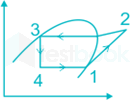
The vapor compression refrigeration cycle is represented as shown in the figure below, with state 1 being the exit of the evaporator. The coordinate system used in this figure is

  1. AOption (a)

    P-h

  2. BOption (b)

    T–s

  3. COption (c)

    p–s

  4. DOption (d)

    T–h

View answer & explanation

Correct answer

Answer: (d)D.

T–h

Why this answer is correct

Explanation:

T–h diagram of Vapour Compression Refrigeration Cycle:

The above-mentioned figure is a schematic diagram of vapour compression refrigeration cycle.

  • Process 1-2: Isentropic compression in Compressor.
  • Process 2-3: Constant pressure heat rejection in Condensor.
  • Process 3-4: Isenthalpic expansion in expander (throttling valve).
  • Process 4-1: Constant pressure heat absorption in Evaporator.


∴ the given figure represents T-h as its coordinate system.

Question 27

Refrigerant R–717 is

  1. AOption (a)

    Air

  2. BOption (b)

    Ammonia

  3. COption (c)

    Carbon dioxide

  4. DOption (d)

    Freon-12

View answer & explanation

Correct answer

Answer: (b)B.

Ammonia

Why this answer is correct

Explanation:

Saturated HydrocarbonsUn-saturated Hydrocarbons
Representation:R - (m - 1) (n + 1) PR - 1(m - 1) (n + 1) P
Chemical formula:CmHnFpClqCmHnFpClq
Relation:n + p + q = 2m + 2n + p + q = 2m

where m = No. of Carbon atoms, n = No. of Hydrogen atoms, p = No. of Florine atoms, q = No. of Chlorine atoms.

If the refrigerant is Inorganic Compound

R – (Molecular Weight + 700)

Ammonia NH3 whose molecular weight is 17 and the chemical formula is R – 717.

Water H20 whose molecular weight is 18 and the chemical formula is R – 718.

Carbon dioxide CO2 whose molecular weight is 44 and the chemical formula is R – 744.

Question 28

If a pure substance is below the triple point temperature, the solid on being heated will only

  1. AOption (a)

    solidify or freeze

  2. BOption (b)

    liquefy

  3. COption (c)

    vaporize or sublimate

  4. DOption (d)

    have its temperature increased

View answer & explanation

Correct answer

Answer: (c)C.

vaporize or sublimate

Why this answer is correct

Explanation:

When a pure substance is below the triple point temperature, it will undergo a phase transition directly from the solid phase to the vapor phase upon heating. This process is known as sublimation.


  1. Triple Point:

The triple point is the unique combination of temperature and pressure at which all three phases (solid, liquid, and vapor) of a substance coexist in equilibrium. Below the triple point temperature, the liquid phase cannot exist.

  1. Below the Triple Point Temperature:

When the temperature of a pure substance is below the triple point, the substance cannot exist in the liquid phase. As a result, heating the solid will lead directly to sublimation, bypassing the liquid phase.

Phase Transitions Below Triple Point:

When a substance is below its triple point temperature, any heating of the solid phase will cause it to sublimate:

Sublimation:

Definition: Sublimation is the direct transition from the solid phase to the vapor phase without passing through the liquid phase.

Mechanism: As the solid is heated, the molecules gain enough energy to overcome the intermolecular forces holding them in the solid state and move directly into the vapor phase.

Examples: Dry ice (solid CO₂) sublimates at temperatures and pressures below its triple point, and iodine sublimates when heated under atmospheric pressure.

Detailed Steps of Heating a Solid Below Triple Point:

  1. Starting from Solid:

The substance is initially in the solid phase with temperature below the triple point, making the liquid phase unstable.

  1. Heating the Solid:

As heat is applied to the solid, its temperature increases, and the kinetic energy of the molecules increases, making them vibrate more vigorously.

  1. Sublimation Occurs:

Upon reaching a certain temperature (still below the triple point but sufficient for sublimation), the molecules at the surface of the solid gain enough energy to break free from the solid structure and enter the vapor phase.

Conclusion:

When a pure substance is below its triple point temperature, it will:

3) Vaporize or sublimate

This is because the conditions do not allow the existence of the liquid phase, and heating the solid will directly convert it to vapor.

Question 29

If the specific humidity of moist air remains same but its dry bulb temperature increases

  1. AOption (a)

    its dew point temperature increases

  2. BOption (b)

    its dew point temperature decreases

  3. COption (c)

    its dew point temperature remains same

  4. DOption (d)

    its dew point temperature may increase or decrease depending upon increase or decrease of relative humidity

View answer & explanation

Correct answer

Answer: (c)C.

its dew point temperature remains same

Why this answer is correct

Explanation:

Dry Bulb Temperature: 

  • Actual temperature of gas or mixture of gases.
  • On the psychrometric chart, it is represented on X-axis. Going from left to right, the temperature increases while going from right to left the temperature decreases.

Specific humidity/humidity ratio (ω):

  • It is defined as the mass of water vapour per unit mass of dry air in a mixture of air and water vapour. It is represented by Y-axis as shown in the chart.

Dew point temperature: 

  • The temperature at which the liquid droplets just appear when the moist air is cooled continuously. It is represented by a horizontal line in the chart.

Wet-bulb temperature: 

  • The temperature obtained by an accurate thermometer having a wick moistened with distilled water, represented by a horizontal line on the psychrometric chart.


According to the figure, we can see if we keep the specific humidity/humidity ratio constant and increase or decrease the dry-bulb temperature, then its dew-point temperature remains the same.

A psychrometric chart is represented as shown in the figure.

Additional Information

Relative humidity:

It is defined as the mass of water vapour (or moisture) per unit mass of dry air in a mixture of air and water vapour.

It is represented by a curved line as shown in the figure below. While going from left to right i.e. away from the saturation line the relative humidity decreases and vice-versa.

Relative humidity along the saturation line is 100%.

Basic Processes in Conditioning of Air:

Sensible heating: Moisture content of air remains constant so the specific humidity/humidity ratio is constant, and dry bulb temperature increases as it flows over a heating coil.

Sensible cooling: Moisture content of air remains constant so specific humidity/humidity ratio is constant, but its dry bulb temperature decreases as it flows over a cooling coil.

Cooling and dehumidification: When moist air is cooled below its dew-point by bringing it in contact with a cold surface, some of the water vapour in the air condenses and leaves the air stream as a liquid, as a result, both the temperature and humidity ratio of air decreases.

Heating and Humidification: During winter it is essential to heat and humidify the room air for comfort. It is done by first sensibly heating the air and then adding water vapour to the air stream through steam nozzles, as a result, both the temperature and humidity ratio of air increases.

Cooling & humidification: Air temperature drops and its humidity increases. 

Heating and de-humidification: This process can be achieved by using a hygroscopic material, which absorbs the water vapour from the moisture. If this process is thermally isolated, then the enthalpy of air remains constant, as a result, the temperature of air increases.

Question 30

If specific heat ratio for a gas is γ, the change in internal energy of a mass of gas at constant pressure P, when volume changes from V to 2V is,

  1. AOption (a)

    PVγ−1\frac{{PV}}{{\gamma - 1}}

  2. BOption (b)

    Rγ−1\frac{R}{{\gamma - 1}}

  3. COption (c)

    PV

  4. DOption (d)

    γPVγ−1\frac{{\gamma PV}}{{\gamma - 1}}

View answer & explanation

Correct answer

Answer: (a)A.

PVγ−1\frac{{PV}}{{\gamma - 1}}

Why this answer is correct

Concept:

The change in internal energy is given by, ΔU=mcvΔTΔ U = m{c_v}Δ T

Calculation:

Given:

V2 = 2V; V1 = V, and P1 = P2 = P

ΔU=mRγ−1(T2−T1)Δ U = m\frac{R}{{\gamma - 1}}\left( {{T_2} - {T_1}} \right)

where Cv=Rγ−1{C_v} = \frac{R}{{\gamma - 1}} and ΔT = T2 – T1

ΔU=1γ−1(mRT2−mRT1)Δ U = \frac{1}{{\gamma - 1}}\left( {mR{T_2} - mR{T_1}} \right)

As we know from the ideal gas equation PV = mRT.

ΔU=1γ−1(P2V2−P1V1)Δ U = \frac{1}{{\gamma - 1}}\left( {{P_2}{V_2} - {P_1}{V_1}} \right)

ΔU=Pγ−1(2V−V)Δ U = \frac{P}{{\gamma - 1}}\left( {{}{2V} - {}{V}} \right)

∴ we get, ΔU=PVγ−1Δ U = \frac{{PV}}{{\gamma - 1}}.

Mistake Points

In the Isobaric process, pressure is constant throughout the process.

ΔW = P2V2 - P1V1 = mR(T2 -T1)

ΔQ = mCp(T2 -T1)

ΔU = mCv(T2 -T1)

Hence for isobaric process also, the change in internal energy is given by ΔU = mCv(T2 -T1)

Question 31

The room sensible heat loss is 30000 kJIhr and the latent heat loss is 20000 kJIhr. Then the sensible heat factor is

  1. AOption (a)

    0.667

  2. BOption (b)

    0.60

  3. COption (c)

    0.30

  4. DOption (d)

    3.00

View answer & explanation

Correct answer

Answer: (b)B.

0.60

Why this answer is correct

Concept:

SHF (Sensible Heat Factor):

It is defined as a sensible heat load divided by total heat load.

S.H.F=S.HT.H=S.HS.H;+;L.H{{S}}.{{H}}.{{F}} = \frac{{{{S}}.{{H}}}}{{{{T}}.{{H}}}}=\frac{S.H}{S.H;+;L.H}

where T.H = S.H + L.H

S.H = Sensible heat T.H = Total heat L.H ⇒ Latent heat 

Calculation:

Given:

S.H = 30000 kJIhr L.H = 20000 kJIhr.

S.H.F=S.HS.H;+;L.H{{S}}.{{H}}.{{F}} =\frac{S.H}{S.H;+;L.H}

S.H.F=30,00030,000+20,000=35=0.60;{\rm{S}}.{\rm{H}}.{\rm{F}} = \frac{{30,000}}{{30,000 + 20,000}} = \frac{3}{5} = 0.60;

Question 32

A 2 kW electric resistance heater submerged in 5 kg water is turned on and kept on for 10 min. During the process 300 kJ of heat is lost from the water the temperature rise of water is

  1. AOption (a)

    57.4°C

  2. BOption (b)

    71.8°C

  3. COption (c)

    43.1°C

  4. DOption (d)

    180°C

View answer & explanation

Correct answer

Answer: (c)C.

43.1°C

Why this answer is correct

Concept:

The heater acts as a work input to the system. 

Work done by heater = Power × time

According to First Law of Thermodynamics:

δQ = dU + δW

Calculation:

Given:

δQ = -300 kJ (Heat is lost), t = 10 min ⇒ 10 × 60 = 600 sec, mass m = 5 kg.

Work is done to the system, by heater:

Work done by heater (δW) = Power × time = 2 × 600 ⇒ 1200 kJ.

δQ = dU + δW

-300 = dU + (-1200)

dU = 900 kJ

We know that;

dU = mcΔT

900 = 5 × 4.18 × ΔT

ΔT = 43.06 ≈ 43.1°C.

Question 33

Environment friendly refrigerant R 134a is used in the new generation domestic refrigerators. Its chemical formula is

  1. AOption (a)

    CHCIF2

  2. BOption (b)

    C2CI3F3

  3. COption (c)

    C2CL2F4

  4. DOption (d)

    C2H2F4

View answer & explanation

Correct answer

Answer: (d)D.

C2H2F4

Why this answer is correct

Concept:

Nomenclature of refrigerants:

Saturated hydrocarbon refrigerant is given as CmHnFpClq where 2m + 2 = n + p + q must be satisfied. Nomenclature is then written as R - (m - 1)(n + 1)p.

Unsaturated hydrocarbon refrigerant must satisfy 2m = n + p + q and nomenclature is then written as R - 1(m - 1)(n + 1)p.

Inorganic refrigerant uses nomenclature R - (700 + Molecular mass).

Calculation:

Given:

For R-134a, we have

m – 1 = 1 i.e. m = 2.

n + 1 = 3 i.e. n = 2 and p = 4.

It must satisfy this 2m + 2 = n + p + q therefore, we get q = 0.

∴ we get, C2H2F4

Additional Information

C2H2F4 has two structures out of which one is symmetrical and one is asymmetrical the 'a' in 134a stands for asymmetrical structure.

Question 34

The pressure and temperature of mixture of 4 kg O2 and 6 kg N2 are 4 bar and 27°C. What will be the value of molecular weight of mixture?

  1. AOption (a)

    40.67

  2. BOption (b)

    39.87

  3. COption (c)

    29.47

  4. DOption (d)

    None of the above

View answer & explanation

Correct answer

Answer: (c)C.

29.47

Why this answer is correct

Concept:

Mmix=1X1M1+X2M2{{\rm{M}}_{{\rm{mix}}}} = \frac{1}{{\frac{{{{\rm{X}}_1}}}{{{{\rm{M}}_1}}} + \frac{{{{\rm{X}}_2}}}{{{{\rm{M}}_2}}}}}

Where

Mmix = Molecular weight of the mixture.

X1 X2 = Mass fraction of oxygen and nitrogen.

Mass fraction = The mass fraction is the ratio of the mass of a component in the mixture to the total mass of the mixture. 

M1 M2 = Molecular weight of oxygen and nitrogen.

Calculation:

Given:

Mass of oxygen and nitrogen is 4 kg and 6 kg.

∴ X1=410=0.4,;X2=610=0.6;{{\rm{X}}_1} = \frac{4}{{10}} = 0.4,;{{\rm{X}}_2} = \frac{6}{{10}} = 0.6;

M1 M2 = 32 28.

By using the above formula

Mmix=10.432+0.628=29.47{{\rm{M}}_{{\rm{mix}}}} = \frac{1}{{\frac{{0.4}}{{32}} + \frac{{0.6}}{{28}}}} = 29.47

Question 35

A refrigerator working on a reversed Carnot cycle has a COP of 4. If it works as a heat pump and consumes 1 kW, the heating effect will be

  1. AOption (a)

    1 kW

  2. BOption (b)

    4 kW

  3. COption (c)

    5 kW

  4. DOption (d)

    6 kW

View answer & explanation

Correct answer

Answer: (c)C.

5 kW

Why this answer is correct

Concept :

Coefficient Of Performance (COP) Or Energy Performance Ratio:

It is defined as, “The ratio of the desired effect to the work input.”

COP=Desired;EffectWork;input{{COP}} = \frac{{{{Desired; Effect}}}}{{{{Work;input}}}}

Relationship between COPHP and COPRef (For same temperature Limits)

COPHeat Pump = 1 + COPRef

Calculation:

Given:

Work Input = 1 kW, COPRef = 4.

COPHeat Pump = 1 + COPRef

COPHeat Pump=Desired;Effect;(Heating;Effect)Work;InputCO{P_{Heat\ Pump}} = \frac{{Desired;Effect;\left( {Heating;Effect} \right)}}{{Work;Input}}

Desired effect (Heating effect) = COPHeat Pump × Work Input = 5 × 1 ⇒ 5 kW.

Question 36

A vapour while condensing at 420°C transfers heat to water evaporating at 250°C. If ambient is at 35°C, what fraction of available energy is lost in the process?

  1. AOption (a)

    0.18

  2. BOption (b)

    0.22

  3. COption (c)

    0.26

  4. DOption (d)

    0.30 

View answer & explanation

Correct answer

Answer: (c)C.

0.26

Why this answer is correct

Concept :

Available energy’ is the maximum portion of energy that could be converted into useful work by ideal processes that reduce the system to a dead state (a state in equilibrium with the earth and its atmosphere).

The fraction of available energy is lost in the process is given by

ΔE=(T0T1−T0)×(T1−T2T2)\Delta E = \left( {\frac{{{T_0}}}{{{T_1-T_0}}}} \right)\times \left( {\frac{{{T_1-T_2}}}{{{T_2}}}} \right)

T1 = Condensing Temperature K, T2  = Evaporating Temperature K, To = Ambient Temperature K.

Calculation:

Given:

To  = 273 + 35 = 308 K; T1 = 273 + 420 = 693 K; T2 = 273 + 250 = 523 K.

ΔE=(T0T1−T0)×(T1−T2T2)\Delta E = \left( {\frac{{{T_0}}}{{{T_1-T_0}}}} \right)\times \left( {\frac{{{T_1-T_2}}}{{{T_2}}}} \right)

ΔE=(308693−308)×(693−523523)=0.26\Delta E = \left( {\frac{{{308}}}{{{693-308}}}} \right)\times \left( {\frac{{{693-523}}}{{{523}}}} \right)=0.26

Question 37

Choose undesirable properties of a secondary refrigerants.

  1. AOption (a)

    low freezing point

  2. BOption (b)

    high viscosity

  3. COption (c)

    good stability

  4. DOption (d)

    low temperature pressure

View answer & explanation

Correct answer

Answer: (b)B.

high viscosity

Why this answer is correct

Explanation:

Secondary refrigerants:

Usually, liquids and air are used to transfer heat from the substance being cooled to a heat exchanger where the heat is absorbed by a primary refrigerant. In an air conditioning system, it could be said that air is acting as a secondary refrigerant.

Properties of Refrigerants:

  • Low freezing point: When the refrigerant goes through the expansion valve in the refrigeration cycle, it experiences a tremendous pressure drop and hence a tremendous decrease in temperature as well. It is therefore important that the refrigerant has a low freezing point than the normal operating conditions.
  • Low viscosity: For the easy flow of refrigerants.
  • Good stability: It should be chemically stable for the operating ranges of temperature. Also, it should not react with the materials of the refrigeration system or with which it comes into contact.
  • Low vapor pressure: Condenser pressure of the refrigerator should be moderate and the evaporator pressure of the refrigerator should be around atmospheric pressure.

Additional Information

Other Important Properties of Refrigerants:

Thermodynamic PropertiesChemical PropertiesPhysical Properties
High Critical TemperatureNon-ToxicLow Viscosity
Specific heat of vapor should be high. Specific heat of liquid should be low.Non-FlammableLeak detection - Freon  leaks is detected by Halide Torch Test - Ammonia leaks is detected by sulpher stick method. - SO2  detected by ammonia swab Test.
High enthalpy of Vaporization Lower compression Ratio is RequiredAction with the material of construction Wrought Iron is favorable with ammonia Copper is favorable with Freon.Low Cost
Freezing Point should be low.Miscibility with oils. Oil separator is installed between the compressor and condenser.Conductivity should be high

Question 38

In which of the following situations, the entropy change is negative?

  1. AOption (a)

    Air expands isothermally from 6 bar to 3 bar

  2. BOption (b)

    Air is compressed to half of it volume at constant pressure

  3. COption (c)

    Air is supplied with heat at constant volume till its pressure is doubled

  4. DOption (d)

    Air expands adiabatically from 6 bar to 3 bar

View answer & explanation

Correct answer

Answer: (b)B.

Air is compressed to half of it volume at constant pressure

Why this answer is correct

Concept:

Change in entropy for Ideal gas is given by :

Δs=cpln⁡(T2T1)−Rln⁡(P2P1)Δ s = {c_p} \ln \left( {\frac{{{T_2}}}{{{T_1}}}} \right) - R \ln \left( {\frac{{{P_2}}}{{{P_1}}}} \right)

Δs=cvln⁡(T2T1)+Rln⁡(V2V1)Δ s = {c_v} \ln \left( {\frac{{{T_2}}}{{{T_1}}}} \right) + R\ln \left( {\frac{{{V_2}}}{{{V_1}}}} \right)

Δs=cpln⁡(V2V1)+cvln⁡(P2P1)Δ s = {c_p} \ln \left( {\frac{{{V_2}}}{{{V_1}}}} \right) + {c_v}\ln \left( {\frac{{{P_2}}}{{{P_1}}}} \right)

Calculation:

Given:

Option (1)

P1 = 6 bar, P2 = 3 bar, T1 = T2, and R = 0.287 kJ/kg-K. 

Δs=cpln⁡(T2T1)−Rln⁡(P2P1)Δ s = {c_p} \ln \left( {\frac{{{T_2}}}{{{T_1}}}} \right) - R \ln \left( {\frac{{{P_2}}}{{{P_1}}}} \right)

Δs=cpln⁡(T2T2)−0.287ln⁡(36) Δ s = {c_p}\ln \left( {\frac{{{T_2}}}{{{T_2}}}} \right) - 0.287\ln \left( {\frac{3}{6}} \right)

= 0.1989 kJ/kg (change in entropy is positive).

Option (2) 

P1 = P2;  V2=V12{V_2} = \frac{{{V_1}}}{2}

Δs=cpln⁡(V2V1)+cvln⁡(P2P1)Δ s = {c_p} \ln \left( {\frac{{{V_2}}}{{{V_1}}}} \right) + {c_v}\ln \left( {\frac{{{P_2}}}{{{P_1}}}} \right)

Δs=1.005ln⁡(12)+cvln⁡(P1P1)Δ s = 1.005\ln \left( {\frac{1}{2}} \right) + {c_v}\ln \left( {\frac{{{P_1}}}{{{P_1}}}} \right)

Δs = -0.6966 kJ/kg-K (change in entropy is negative).

Correct answer

Option (3) 

P2 = 2P1; V1 = V2

Δs=cpln⁡(V2V1)+cvln⁡(P2P1)Δ s = {c_p} \ln \left( {\frac{{{V_2}}}{{{V_1}}}} \right) + {c_v}\ln \left( {\frac{{{P_2}}}{{{P_1}}}} \right)

Δs=cpln⁡(V1V1)+cvln⁡(21)Δ s = {c_p} \ln \left( {\frac{{{V_1}}}{{{V_1}}}} \right) + {c_v} \ln \left( {\frac{2}{1}} \right)

= 0.49698 kJ/kg-K (change in entropy is positive).

Option (4) 

for the reversible adiabatic process of an ideal gas

Δs = 0 (change in entropy is zero).

Question 39

The primary factors responsible for human comfort are

  1. AOption (a)

    dry bulb temperature, relative humidity and air motion

  2. BOption (b)

    dry bulb temperature, dew point temperature and air motion

  3. COption (c)

     dry bulb temperature, relative humidity and latitude of the place

  4. DOption (d)

    dry bulb temperature, relative humidity, air motion and elevation of the place

View answer & explanation

Correct answer

Answer: (a)A.

dry bulb temperature, relative humidity and air motion

Why this answer is correct

Explanation:

Human Comfort:

The physical comfort of the human being which can be adjusted by adjusting the temperature, humidity, air velocity, and purity of the air is called human comfort.

Dry Bulb Temperature:

It is the normal temperature measured by an ordinary thermometer.

Dew Point Temperature:

The temperature of the air up to which the air should be cooled so that the water vapour present in the air starts condensing when cooled at constant pressure.

Relative humidity (RH):

Relative humidity refers to the moisture content (i.e. water vapour) of the atmosphere, as a percentage of the amount of moisture that can be retained by the atmosphere (moisture-holding capacity) at a given temperature and pressure without condensation.

Effective temperature:

  • It is the temperature of the saturated environment with negligible air velocity at which the person feels the same level of comfort as the normal person.
  • Effective temperature for winter is 20˚C and for summer it is 21.6˚C.

Question 40

Biot number signifies

  1. AOption (a)

    the ratio of heat conducted to heat convected

  2. BOption (b)

    the ratio of heat conducted to heat conducted

  3. COption (c)

    the ratio of heat convective resistance to internal conductive resistance

  4. DOption (d)

    the ratio of internal conductive resistance to external convective resistance

View answer & explanation

Correct answer

Answer: (d)D.

the ratio of internal conductive resistance to external convective resistance

Why this answer is correct

Explanation:

Biot number:

It is defined as the ratio of internal conductive resistance offered by the body to the external convective resistance.

Bi=LkA1hA=hLkBi=\frac{\frac{L}{kA}}{\frac{1}{hA}}=\frac{hL}{k}

Biot number properties:

  • Biot number is used as a criterion for lumped heat analysis.
  • Low biot number values signify that the body offers very little conductive resistance for any internal heat transfer within the body.
  • During unsteady-state heat transfer if the biot number is less than 0.1 then the temperature is the function of time only, it is not the function of space.
  • On the other hand, if the biot number is more than 0.1 then the temperature is the function of space and time.

Additional Information

Lumped heat analysis:

In this analysis it is assumed that the temperature of the body is uniform throughout its mass at any instant of time i.e., Internal temperature gradient are negligibly small at any instant of time.

i.e.,

T = f(time), T ≠ f(space)

where, T ⇒ Temperature.

Question 41

Partial pressure of water vapour at dew point temperature of moist air is 1.5 × 10⁻³ MPa. The barometric pressure is 0.1 MPa. The specific humidity of air is

  1. AOption (a)

    15.225 gm/kg da

  2. BOption (b)

    9.47 gm/kg da

  3. COption (c)

    15.00 gm/kg da

  4. DOption (d)

    9.33 gm/kg da

View answer & explanation

Correct answer

Answer: (b)B.

9.47 gm/kg da

Why this answer is correct

Concept:

Specific humidity (ω) or Absolute humidity or humidity ratio:

Mass of water vapor in a unit mass of dry air usually expressed as grams of vapor (v) per kilogram of dry air (d.a).

\({{\omega }} = \left( {\frac{{{{\rm{m}}{\rm{v}}}}}{{{{\rm{m}}{\rm{a}}}}}} \right)\frac{{{\rm{gm}}\left( {\rm{v}} \right)}}{{{\rm{kg}}\left( {{\rm{d}}.{\rm{a}}} \right)}}\)

It is also given by:

\(\omega = 0.622 \times \left( {\frac{{{{\bf{P}}{\bf{v}}}}}{{{{\bf{P}}{\bf{t}}} - {{\bf{P}}_{\bf{v}}}}}} \right)\frac{{{\bf{gm}}\left( {\bf{v}} \right)}}{{{\bf{kg}}\left( {{\bf{d}}.{\bf{a}}} \right)}}\)

Pt = Pv + Pa

where, Pt = total pressure, Pv = partial pressure of vapour, Pa = partial pressure of air.

Calculation:

Given:

Pt = 0.1 MPa, Pv = 1.5 × 10⁻³ MPa.

\(\omega = 0.622 \times \left( {\frac{{{{\bf{P}}{\bf{v}}}}}{{{{\bf{P}}{\bf{t}}} - {{\bf{P}}_{\bf{v}}}}}} \right)\)

ω=0.622×(1.5×10−30.1−1.5×10⁻³)\omega = 0.622 \times \left( {\frac{{1.5 \times {{10}^{ - 3}}}}{{0.1 - 1.5 \times {{10}^{ - 3}}}}} \right)

ω = 9.47 gm/kg-da.

Question 42

For a glass plate, transmissivity and reflectivity are specified as 0.86 and 0.08 respectively, the absorptivity of the plate is

  1. AOption (a)

    0.86

  2. BOption (b)

    0.08

  3. COption (c)

    1.00

  4. DOption (d)

    0.06

View answer & explanation

Correct answer

Answer: (d)D.

0.06

Why this answer is correct

Concept:

Absorptivity (α):

Fraction of radiant energy incident upon a surface which is absorbed by it.

Reflectivity (ρ):

 Fraction of radiant energy incident upon a surface which is reflected by it.

Transmissivity (τ):

Fraction of radiant energy incident upon a surface which is transmitted through it.

For any Surface,

α + ρ + τ = 1

Calculation:

Given:

τ = 0.86, ρ = 0.08

substituting all the values in the equation we have;

α + 0.08 + 0.86 = 1

α = 1 – 0.08 – 0.86

α = 0.06

Question 43

For an air-conditioned space, RTH = 100 kW, RSHF = 0.75, volume flow rate of air is 100 m3/minute and room specific humidity is 0.01 kg/kg of dry air. The specific humidity of supply air in kg/kg of dry air is

  1. AOption (a)

    0.0100

  2. BOption (b)

    0.0075

  3. COption (c)

    0.0050

  4. DOption (d)

    0.0025

View answer & explanation

Correct answer

Answer: (c)C.

0.0050

Why this answer is correct

Concept:

RSHF (Room Sensible Heat Factor): It is defined as sensible heat load divided by total heat load in a room.

RTH = Room Total Heat, RSH = Room Sensible Heat, RLH = Room Latent Heat.

RTH = RSH + RLH ……….(I)

RSHF=RSHRTH{\bf{RSHF}} = \frac{{{\bf{RSH}}}}{{{\bf{RTH}}}}  ..... (II)

RLH = 50 × cmm × (ω1 – ω2) .....(III) 

where, cmm is cubic meter per minute i.e., air changes per minute.

ω1, ω2 = specific humidity of the room and supplied air.

Calculation:

Given:

RSHF = 0.75, RTH = 100 kW, Air changes per minute = 100 m3/min ⇒ 100 × 106 cm3/min.

By using equation (II)

RSHF=RSHRTH{{RSHF}} = \frac{{{{RSH}}}}{{{{RTH}}}}

RSH = 0.75 × 100 kW = 75 kW.

By using equation (I)

RTH = RSH + RLH

RLH = 100 – 75 = 25 kW.     

By using equation (III)

RLH = 50 × cm; × (ω1 – ω2)

25 = 50 × 100 × (ω1 - ω2)

(ω1 - ω2) = 0.005

0.01 - ω2 = 0.005

ω2 = 0.005 kg/kg of dry air**.**

Question 44

In certain heat exchanger, both the fluids have identical mass flow rate-specific heat product. The hot fluid enters at 76°C and leaves at 47°C and the cold fluid entering at 28°C leaves at 57°C. The effectiveness of the heat exchanger is

  1. AOption (a)

    0.16

  2. BOption (b)

    0.60

  3. COption (c)

    0.72

  4. DOption (d)

    1.00

View answer & explanation

Correct answer

Answer: (b)B.

0.60

Why this answer is correct

Concepts:

Effectiveness of the heat exchanger: 

The effectiveness (ϵ) of a heat exchanger is defined as the ratio of the actual heat transfer to the maximum possible heat transfer.

Actual heat transfer = Q = mhcph(th1 − th2) = mccpc(tc2 − tc1) 

where mhcph = Ch = hot fluid capacity rate; mccpc = Cc = Cold fluid capacity rate.

Maximum possible heat transfer = Cmin(th1 - tc1); where Cmin is minimum of (Ch, Cc)

ε=Ch(th1−th2)Cmin⁡(th1−tc1)=Cc(tc2−tc1)Cmin⁡(th1−tc1)\varepsilon = \frac{{{C_h}\left( {{t_{h1}} - {t_{h2}}} \right)}}{{{C_{\min }}\left( {{t_{h1}} - {t_{c1}}} \right)}} = \frac{{{C_c}\left( {{t_{c2}} - {t_{c1}}} \right)}}{{{C_{\min }}\left( {{t_{h1}} - {t_{c1}}} \right)}}

Calculation:

Given:

th1 = 76°C; th2 = 47°C; tc2 = 57°C ; tc1 = 28°C; Ch = Cc

ε=Ch(th1−th2)Cmin⁡(th1−tc1)=Cc(tc2−tc1)Cmin⁡(th1−tc1)\varepsilon = \frac{{{C_h}\left( {{t_{h1}} - {t_{h2}}} \right)}}{{{C_{\min }}\left( {{t_{h1}} - {t_{c1}}} \right)}} = \frac{{{C_c}\left( {{t_{c2}} - {t_{c1}}} \right)}}{{{C_{\min }}\left( {{t_{h1}} - {t_{c1}}} \right)}}

ε=(76−47)(76−28)=0.60\varepsilon = \frac{{\left( {76 - 47} \right)}}{{\left( {76 - 28} \right)}} = 0.60

Question 45

During the adiabatic cooling of moist air which of the following remains constant?

  1. AOption (a)

    DBT

  2. BOption (b)

    Specific humidity

  3. COption (c)

    Relative humidity

  4. DOption (d)

    WBT

View answer & explanation

Correct answer

Answer: (d)D.

WBT

Why this answer is correct

Adiabatic Cooling is a psychrometric process that involves the cooling of air without heat loss or gain. Sensible heat lost by the air is converted to latent heat in the added water vapour.

During Adiabatic cooling enthalpy remains constant and in the psychometric chart the WBT lines and the enthalpy lines have the same slope therefore the WBT will also remain constant during the adiabatic cooling process.

Question 46

Uniform heat generation takes place in a symmetric slab so that heat flows towards both side in contact with fluid. The zero gradient boundary condition δTδx=0 \frac{{\delta T}}{{\delta x}} = 0 occurs at

  1. AOption (a)

    centre line of slab

  2. BOption (b)

     left wall of slab

  3. COption (c)

    right wall of slab

  4. DOption (d)

    nowhere in slab

View answer & explanation

Correct answer

Answer: (a)A.

centre line of slab

Why this answer is correct

Explanation:

Plane wall with Internal Heat Generation

Temperature distribution of plane wall with uniform internal heat generation is given by:

T=T∞+qg(2L)2h+qg8k(4L2−4x2)T = {T_∞ } + \frac{{{q_g}(2L)}}{{2h}} + \frac{{{q_g}}}{{8k}}\left( {{4L^2} - 4{x^2}} \right) (parabolic Equation)

where, slab thickness = 2L, in the region 0 < x < 2L ; k = thermal conductivity (W/mK), h = heat transfer coefficient (W/m2K), qg = uniform heat generation (W/m3), and T∞ = ambient temperature.

At x = L; T = Tmax    

Tmax=T∞+qg(2L)2hT_{max} = {T_∞ } + \frac{{{q_g}(2L)}}{{2h}}

∴ δTδx=0 \frac{{\delta T}}{{\delta x}} = 0.

At x = L, signifies the centre line of the slab.

Question 47

Which one of the following is the effect of suction vapour superheat?

  1. AOption (a)

    Decreases the refrigeration effect

  2. BOption (b)

    Decreases the specific volume

  3. COption (c)

    Decreases the energy for compression

  4. DOption (d)

    Increases the refrigeration effect

View answer & explanation

Correct answer

Answer: (d)D.

Increases the refrigeration effect

Why this answer is correct

Explanation:

V - C cycle is represented by 1-2-3-4-1

V - C cycle with superheating in the evaporator is represented by 1'-2'-3-4-1'

Following points are to be noted after the superheating in the evaporator

  • Refrigeration effect → increases as [h1′−h4>h1−h4]\left[ {h_1' - {h_4} > {h_1} - {h_4}} \right]
  • Wc i.e. compressor work depends on the compressor inlet temperature, as

  Wc=γRT1γ−1[(P2P1)γ−1γ−1]{W_c} = \frac{{\gamma R{T_1}}}{{\gamma - 1}}\left[ {{{\left( {\frac{{{P_2}}}{{{P_1}}}} \right)}^{\frac{{\gamma - 1}}{\gamma }}} - 1} \right]. So, Wc = increases

  • COP=REWcCOP = \frac{{RE}}{{{W_c}}} = May increase or decrease depending upon the refrigerant used.

Question 48

The shape factor of a hemispherical body placed on a flat surface with respect to itself is

  1. AOption (a)

    0

  2. BOption (b)

    0.25

  3. COption (c)

    0.5

  4. DOption (d)

    1.0

View answer & explanation

Correct answer

Answer: (c)C.

0.5

Why this answer is correct

Concept:

Shape Factor is defined as the fraction of radiation energy leaving a surface that reaches another surface, for example, F12 means the fraction of energy leaving the surface 1 reaches surface 2.

Summation Rule: F11 + F12 = 1

Reciprocity theorem: A1 F12 = A2 F21 (A is the surface area)

Calculation:

Given:

Let us denote the hemishpherical body as body 1, and the flat surafce as body 2

From the summation rule F22 + F21 = 1, 

Since no radiation leaving the surface 2 will reach surface 2 again 

∴ F22 = 0, F21 = 1

Now from reciprocity theorem,

A1 F12 = A2 F21

2 x π x r2 x F12 = π x r2 x1

∴ F12 = 0.5,

Now from summation rule F12 + F11 = 1, F11 = 1 - 0.5 = 0.5

Therefore the shape factor of hemispherical body with respect to itself is 0.5.

Question 49

If air at dry bulb temperature of 35°C and dew point temperature of 20°C passes through an air washer in which water is sprayed at 25°C, then the process would be

  1. AOption (a)

    sensible cooling

  2. BOption (b)

    cooling and dehumidification

  3. COption (c)

    cooling and humidification

  4. DOption (d)

    cooling and constant dew point temperature

View answer & explanation

Correct answer

Answer: (c)C.

cooling and humidification

Why this answer is correct

Concept:

Air washer:


  • Air washer is a device for conditioning air.
  • In an air washer air comes in direct contact with a spray of water and there will be an exchange of heat and mass (water vapour) between air and water.
  • The outlet condition of air depends upon the temperature of the water sprayed in the air washer.
  • By controlling the water temperature externally, it is possible to control the outlet condition of air, which then can be used for conditioning purpose.

Various processes that take place in the air washer:

Let, tw = water sprayed temperature, DPT→ Dew point temperature, DBT→ Dry bulb temperature.

  • Cooling and Dehumidification, tw < DPT
  • Adiabatic saturation, tw = tWBT
  • Cooling and humidification, tDPT < tW < tDBT

Calculation:

Given:

tw = 25°C, DBT = 35°C, DPT = 20°C

In the above data  tDPT < tW < tDBT

Hence it is the case of cooling and humidification.

Question 50

The overall heat transfer coefficient for a shell and tube heat exchange for clean surfaces is Uo = 400 W/m2K. The fouling factor after one year of operation is found to be 12000m2KW\frac{1}{{2000}}\frac{m^2K}{{{}W}}. The overall heat transfer coefficient at this time is

  1. AOption (a)

    333 W/m2K

  2. BOption (b)

    287 W/m2K

  3. COption (c)

    2000 W/m2K

  4. DOption (d)

    666 W/m2K

View answer & explanation

Correct answer

Answer: (a)A.

333 W/m2K

Why this answer is correct

Explanation:

Overall heat transfer coefficient (OHTC):

  • OHTC is defined as the quantity of rate of heat transfer takes place due to any mode per unit area for unit temperature difference.
  • It doesn’t have any physical meaning, it’s an experimentally determined coefficient value.
  • The concept of OHTC is valid for a steady-state.
  • In the case of a heat exchanger, there is a combined mode of heat transfer or multiple resistances present therefore we use,

​Q=;UAΔT⇒UA=1RTotalQ = ;UA{\bf{\Delta }}T \Rightarrow UA = \frac{1}{{{R_{Total}}}}, 

where R Total is total resistance and U = OHTC

  • Unit of ‘U’ is W/m2K
  • U indicates the quantity of rate of heat transfer takes place due to any mode per unit area for the unit temperature difference.

Fouling factor indicates the resistance offered due to chemical deposits and scaling.

So, 1Uwith;fouling=1Uwithout;fouling+F\frac{1}{{{U_{with;fouling}}}} = \frac{1}{{{U_{without;fouling}}}} + F

Calculation:

Given:

Uo = 400 W/m2K, F=12000m2KWF=\frac{1}{{2000}}\frac{m^2K}{{{}W}}

∴1Uwith;fouling=1400+12000 ⇒Uwith;fouling=333Wm2k\begin{array}{l} \therefore \frac{1}{{{U_{with;fouling}}}} = \frac{1}{{400}} + \frac{1}{{2000}}\ \Rightarrow {U_{with;fouling}} = 333\frac{W}{{{m^2}k}} \end{array}

Question 51

The ratio of the partial pressure of water vapour (Pv) to the saturation pressure of water vapour (Ps) at the same temperature is

  1. AOption (a)

    relative humidity

  2. BOption (b)

    degree of saturation

  3. COption (c)

    specific humidity

  4. DOption (d)

    absolute humidity

View answer & explanation

Correct answer

Answer: (a)A.

relative humidity

Why this answer is correct

Explanation:

Humidity ratio/Specific humidity (ω ) (kg/kg) of a given moist air sample is defined as the ratio of the mass of water vapour (mw) to the mass of dry air (ma) contained in the sample.

w=mwma=0.622PvP−Pvw = \frac{{{m_w}}}{{{m_a}}} = 0.622\frac{{{P_v}}}{{P - {P_v }}}

Relative humidity (ϕ):

It is defined as the ratio of partial pressure of water vapour (pv)in a mixture to the saturation pressure (ps) of pure water at the same temperature of the mixture.

ϕ=pvpvs\phi = \frac{{{p_v}}}{{{p_{vs}}}}

Degree of saturation (μ) is the ratio of the humidity ratio (w) to the humidity ratio of a saturated mixture (ws) at the same temperature and pressure. It is also called saturation ratio or percentage humidity.

w=kg;of;water;vapourkg;of;dry;air=0.622pvpa−pv μ=wws=PvPvs(P−PvsP−Pv)\begin{array}{l} {\rm{w}} = \frac{{{\rm{kg;of;water;vapour}}}}{{{\rm{kg;of;dry;air}}}} = 0.622\frac{{{p_v}}}{{{p_a} - {p_v}}}\ \mu = \frac{w}{{{w_s}}} = \frac{{{P_v}}}{{{P_{vs}}}}\left( {\frac{{P - {P_{vs}}}}{{P - {P_v}}}} \right) \end{array}

Question 52

Ina counter flow heat exchanger, hot fluid enters at 60°C and cold fluid leaves at 30°C. The mass flow rate of the hot fluid is 1 kg/s and that of the cold fluid is 2 kg/s. specific heat of the hot fluid is 10 kJ/kgK and that of cold fluid is 5 kJ/kgK. The Log Mean Temperature Difference (LMTD) for the heat exchanger in °C is

  1. AOption (a)

    15

  2. BOption (b)

    30

  3. COption (c)

    35

  4. DOption (d)

    45

View answer & explanation

Correct answer

Answer: (b)B.

30

Why this answer is correct

Concept:

For counterflow heat exchanger:

Log mean temperature difference is given by:

LMTD=ΔTi;−;ΔTeln⁡(ΔTiΔTe)LMTD = \frac{{{\rm{Δ }}{T_i}; - ;{\rm{Δ }}{T_e}}}{{\ln \left( {\frac{{{\rm{Δ }}Ti}}{{{\rm{Δ }}Te}}} \right)}}

Where ΔTi = Thi – Tce

ΔTe = The - Tci

Thi & Tci = Temperature at which hot or and cold water enters respectively

The & Tce = Temperature at which hot air & cold water exits respectively

In case of the balanced counter flow heat exchanger, 

ṁhch = ṁccc = C

ṁh and ṁc are mass flow rate of hot and cold fluid, and ch and cc specific heat capacity of hot and cold fluid.

LMTD for counter-flow heat exchanger, ΔTi = ΔTe

Calculation:

Given:

Thi = 60 °C , Tce = 30 °C

ṁh = 1 kg/s and ṁc =  2 kg/s, ch = 10 kJ/kgK, cc = 5 kJ/kgK

Here, ṁhch = ṁccc = 2 × 5 = 1 × 10 = 10

Hence it is a balanced counter-flow heat exchanger

∴ LMTD = ΔTi = Thi – Tce = 60 - 30 = 30 °C

Question 53

An engine operating on the Otto cycle has clearance volume as 10% of the swept volume. If γ = 1.4, the air standard cycle efficiency is

  1. AOption (a)

    38.3%

  2. BOption (b)

    39.8%

  3. COption (c)

    60.2%

  4. DOption (d)

    61.7%

View answer & explanation

Correct answer

Answer: (d)D.

61.7%

Why this answer is correct

Concept:

In an Otto, cycle efficiency is given as

η=1−(1r)γ−1η = 1 - {\left( {\frac{1}{r}} \right)^{\gamma - 1}}

Where r is the compression ratio and γ is the ratio of specific heat

Also compression ratio

r=volume;before;compressionvolume;after;compression=Vs+VcVcr = \frac{{volume;before;compression}}{{volume;after;compression}} = \frac{{{V_s} + {V_c}}}{{{V_c}}}

Vs = Stroke volume or volume of cylinder = π4;d2;l\frac{\pi }{4};{d^2};l

Vc = Clearance volume

Calculation:

Given:

Vc = 10% of Vs = 0.1Vs

Compression ratio, r = Vc + Vs/Vc = 0.1Vs + Vs/0.1Vs = 11

η=1−(111)1.4−1η = 1 - {\left( {\frac{1}{11}} \right)^{1.4 - 1}}

η = 61.67%

Question 54

For flow over a flat plate the hydrodynamic boundary layer thickness is 0.5 mm. The dynamic viscosity is 25 × 10-6 Pa-s, specific heat is 2.0 kJ/kgK and thermal conductivity is 0.05 W/mK. The thermal boundary layer thickness would be

  1. AOption (a)

    0.1 mm

  2. BOption (b)

    0.5 mm

  3. COption (c)

    1 mm

  4. DOption (d)

    2 mm

View answer & explanation

Correct answer

Answer: (b)B.

0.5 mm

Why this answer is correct

Concept:

Prandtl Number: It is defined as the ratio of momentum diffusivity to thermal diffusivity.

Pr=να=momentum;diffusivityThermal;diffusivty=μρkcpρ=μcpkPr = \frac{\nu }{\alpha } = \frac{{momentum;diffusivity}}{{Thermal;diffusivty}} = \frac{{\frac{\mu }{\rho }}}{{\frac{k}{{{c_p}\rho }}}} = \frac{{\mu {c_p}}}{k}

The relationship between the thermal boundary layer and the hydrodynamic boundary layer is given by the Prandtl number.

δt=δ(Pr)13{δ _t} = \frac{δ }{{{{\left( {Pr} \right)}^{\frac{1}{3}}}}}

where δ = hydrodynamic boundary layer thickness and δt = thermal boundary layer thickness.

Calculation:

Given:

δ = 0.5 mm.

Pr=μCpk=25×10−6×2×1030.05=1Pr = \frac{{\mu {C_p}}}{k} = \frac{{25 \times {{10}^{ - 6}} \times 2 \times 10^3}}{{0.05}} = 1

δt=δ(Pr)13{δ _t} = \frac{δ }{{{{\left( {Pr} \right)}^{\frac{1}{3}}}}}

δt = δ = 0.5 mm.

Question 55

Knocking tendency in a SI engine reduces with increasing

  1. AOption (a)

    Compression ratio

  2. BOption (b)

    Wall temperature

  3. COption (c)

    Supercharging

  4. DOption (d)

    Engine speed

View answer & explanation

Correct answer

Answer: (d)D.

Engine speed

Why this answer is correct

Concept:

When the spark is advanced, burning gas is compressed by the rising piston and therefore temperature and pressure are increased, thus, the tendency to knock increases.

In spark ignition (SI) engines, the possibility of knocking can be reduced by decreasing the compression ratio as a reduction in the compression ratio will result in the generation of lower peak temperatures. In SI engine, knocking occurs before TDC and because of early combustion of charge/more than one flame propagation.

Factors affecting knocking in SI engine:

Compression ratio:

  • Higher compression ratio will result in the higher temperature of the charge, the tendency to knock will increase.

Inlet air temperature:

  • The effect of inlet air temp is the same as compression ratio. High inlet temp of the air-fuel mixture will increase knocking.

Advancing the spark:

  • Advancing the spark will result in more compression during sparking. The increase in temperature during the sparking will be higher. Hence tendency to knock will increase and so by retarding the spark, the tendency to knock will decrease.

Coolant water temperature: 

  • By increasing coolant water temperature, less heat will be carried from the engine which will increase the engine temperature. So the knocking will increase.

Engine Speed:

  • To avoid the knocking in the SI engine the engine speed should be high.

Octane rating:

  • It should be as high as possible.

Question 56

A wall of thickness 0.6 m has a normal area 1.5 m2 and is made up of material of thermal conductivity 0.4 W/mK. The temperature on the two sides are 800°C and 100°C. What is the thermal resistance of the wall?

  1. AOption (a)

    1 W/K

  2. BOption (b)

    1.8 W/K

  3. COption (c)

    1 K/W

  4. DOption (d)

    1.8 K/W

View answer & explanation

Correct answer

Answer: (c)C.

1 K/W

Why this answer is correct

Concept:

According to Fourier’s law, the rate of heat flow, Q through a homogeneous solid is directly proportional to the area A, of the section at the right angles to the direction of the heat flow, and to the temperature gradient (dT/dx) along the path of heat flow.

Q=−kAdTdx;Q = - kA\frac{{dT}}{{dx}};

Q˙=kA(T1−T2)L=ΔTRcond\dot Q = kA\frac{{\left( {{T_1} - {T_2}} \right)}}{L} = \frac{{{\rm{\Delta }}T}}{{{R_{cond}}}}


Heat Transfer in the wall is given as Q=ΔTRthQ = \frac{{{\rm{\Delta }}T}}{{{R_{th}}}}

∴ Rth=lkA{R_{th}} = \frac{l}{{kA}}

Calculation:

Given:

l = 0.6 m, A = 1.5 m2 ,k = 0.4 W/mK

Rth=lkA =0.60.4×1.5=1;K/W\begin{array}{l} {R_{th}} = \frac{{l}}{kA}\ = \frac{{0.6}}{{0.4 \times 1.5}} = 1;K/W \end{array}

Question 57

Chance of occurrence of cavitation are high if the

  1. AOption (a)

    Local pressure becomes very high

  2. BOption (b)

    Local pressure falls below the vapour pressure

  3. COption (c)

    Thoma cavitation parameter exceeds a certain limit

  4. DOption (d)

    Local temperature becomes low

View answer & explanation

Correct answer

Answer: (b)B.

Local pressure falls below the vapour pressure

Why this answer is correct

Explanation:

  • Cavitation is the phenomenon of the formation of vapour bubbles of a flowing liquid in a region where the pressure of the liquid falls below the vapour pressure and sudden collapsing of these vapour bubbles in a region of higher pressure.
  • When the vapour bubbles collapse, very high pressure is created.
  • The metallic surfaces, above which the liquid is flowing, is subjected to these high pressure which causes pitting action on the surface.
  • Thus cavities are formed on the metallic surface and hence the name is cavitation.
  • In centrifugal pumps, the cavitation may occur at the inlet of the impeller of the pump or at the suction side of the pumps, where the pressure is considerably reduced.
  • Hence if the pressure at the suction side of the pump drops below the vapour pressure of the liquid then the cavitation may occur.

Question 58

In a counter flow heat exchanger, the product of specific heat and mass flow rate is same for the hot and cold fluids. If NTU is equal to 0.5 then the effectiveness of the heat exchanger is

  1. AOption (a)

    1.0

  2. BOption (b)

    0.5

  3. COption (c)

    0.33

  4. DOption (d)

    0.2

View answer & explanation

Correct answer

Answer: (c)C.

0.33

Why this answer is correct

Concept:

Effectiveness – The effectiveness of the heat exchanger is defined as the ratio between the actual heat transfer rate taking place between hot and cold fluids and the maximum possible heat transfer rate between them.

\(\varepsilon = \frac{{{{\dot q}{act}}}}{{{{\dot q}{max}}}}\)

Effectiveness for a counter flow heat exchanger:

εcounter=1−e−(1−C)NTU1−Ce−(1−C)NTU{\varepsilon _{counter}} = \frac{{1 - {e^{ - \left( {1 - C} \right)NTU}}}}{{1 - C{e^{ - \left( {1 - C} \right)NTU}}}}

where C = Heat capacity ratio Cmin/Cmax.

Number of Transfer Unit (NTU)

NTU=UA(m˙Cp)smallNTU = \frac{{UA}}{{{{\left( {\dot m{C_p}} \right)}_{small}}}}

When hot and cold fluids have equal capacity rate, C = 1

εcounterflow=NTU1+NTU{\varepsilon _{counterflow}} = \frac{{NTU}}{{1 + NTU}}

Calculation:

Given:

NTU = 0.5, Cph = Cpc, ∴ C = 1.

εcounterflow=NTU1+NTU{\varepsilon _{counterflow}} = \frac{{NTU}}{{1 + NTU}}

εcounter;flow=0.50.5+1=13=0.33\varepsilon_{counter;flow} = \frac{{0.5}}{{0.5+1}} = \frac{1}{3} = 0.33

Question 59

If methane undergoes combustion with the stoichiometric quantity of air, the air-fuel ratio on molar basis would be :

  1. AOption (a)

    15.22 : 1

  2. BOption (b)

    12.30 : 1

  3. COption (c)

    14.56 : 1

  4. DOption (d)

    9.52 : 1

View answer & explanation

Correct answer

Answer: (d)D.

9.52 : 1

Why this answer is correct

CH4 + 2O2 → CO2 + 2H2O

2 Volume of O2 is present in 100×221=9.352;by;volume;of;air\frac{{100 \times 2}}{{21}} = 9.352;by;volume;of;air

Question 60

An average Nusselt number in laminar natural convection from a vertical wall at 180°C with still air at 20°C is found to be 48. If the wall temperature becomes 30°C, all other parameters remaining same, the average Nusselt number will be

  1. AOption (a)

    16

  2. BOption (b)

    8

  3. COption (c)

    24

  4. DOption (d)

    32

View answer & explanation

Correct answer

Answer: (c)C.

24

Why this answer is correct

**Concept:**​​​

Nu=hDK{N_u} = \frac{{hD}}{K}

where D is the characteristic dimension of the body.

For vertical plate case D = L

Rayleigh Number (Ra) = Gr.Pr

=gβΔTL3v2×Pr = \frac{{g\beta {\rm{\Delta }}T{L^3}}}{{{v^2}}} × Pr

Nu = K(Ra)1/4

​Nu=K[gβΔTL3v2×Pr]1/4Nu = K{\left[ {\frac{{g\beta {\rm{\Delta }}T{L^3}}}{{{v^2}}} × Pr} \right]^{1/4}}​

Considering all other parameters remaining the same

Gr ∝ (Ts - T∞)

∴ Nu ∝ (Ts - T∞)1/4

Calculation:

Given:

Ts1 = 180°C, Ts2 = 30°C, and T∞ = 20°C, Nu1 = 48.

Nu ∝ (Ts - T∞)1/4

\(\frac{(Nu)2}{(Nu)1}=\frac{(T{s2}-T\infty)^{1/4}}{(T_{s1}-T_\infty)^{1/4}}\)

(Nu)2(Nu)1=(30−20)1/4(180−20)1/4\frac{(Nu)_2}{(Nu)_1}=\frac{(30-20)^{1/4}}{(180-20)^{1/4}}

Nu2 = 0.5Nu1

∴ Nu2 = 0.5 × 48 ⇒ 24.

Question 61

In a Rankine cycle, with the maximum steam temperature being fixed form metallurgical considerations, as the boiler pressure increases.

  1. AOption (a)

    the condenser load will increases

  2. BOption (b)

    the quality of turbine exhaust will decrease

  3. COption (c)

    the quality of turbine exhaust will increase

  4. DOption (d)

    the quality of turbine exhaust will remain unchanged 

View answer & explanation

Correct answer

Answer: (b)B.

the quality of turbine exhaust will decrease

Why this answer is correct

Explanation:

Let us consider the Rankine cycle.

1-2-3-4-1 is a normal Rankine cycle process

Process 1 - 2 → Isentropic expansion (Turbine)

Process 2 – 3 → Constant pressure heat rejection (Condenser)

Process 3 - 4 → Pump work

Process 4 – 1 → Constant pressure heat addition (Boiler)

1´- 2´- 3 - 4´- 1 is a Rankine cycle when the maximum steam temperature is fixed.

As the maximum steam temperature is fixed because of the metallurgical condition and the boiler pressure is increased.

The process 1 – 2 shifted to a process 1´ - 2´ and the boiler pressure changed from PB to P'B.

∴ we can conclude from the Rankine cycle that the quality of turbine exhaust will decrease i.e., from 2 to 2´.

Question 62

Boigas is predominantly

  1. AOption (a)

    Hydrogen  

  2. BOption (b)

    Carbon monoxide 

  3. COption (c)

    Carbon dioxide 

  4. DOption (d)

    Methane 

View answer & explanation

Correct answer

Answer: (d)D.

Methane 

Why this answer is correct

Explanation:

Biogas:

  • Biogas is the mixture of gases produced by the breakdown of organic matter in the absence of oxygen (anaerobically), primarily consisting of methane.
  • Biogas can be produced from raw materials such as agricultural waste, manure, municipal waste, plant material, sewage, green waste, or food waste.

​ 

Additional Information   

Biomass energy:

  • Biomass energy refers to the direct burning of wood, waste paper, manure, agriculture or converting them into fuel by certain micro-organisms when they digest them in the absence of air. They produce either alcohol or methane gas, which themselves give energy on combustion.
  • Since biomass is obtained through the process of photosynthesis, therefore it is considered indirect use of solar energy.

Biomass energy conversion processes and end product.

S.noBiomass ResourcesConversion                ProcessEnergy ProductsUsers
1.Dry biomass - Wood - Residue1. Combustion 1. Pyrolysis 1. HydrolysisHeat steam electricity Oil, Chair, Gas Ethanol (Ethyl alcohol)- Industry - Domestic - Transport
2.Wet biomass - Sewage Sugars from fruits, beet, molasses1. Anaerobic digestion 2. Fermentation and distillationMethane Ethanol (Ethyl alcohol)- Industry - Domestic - Transport - Chemical
3.Water1. Photochemical 2. Photobiological 3. CatalysticHydrogen- Industry - Chemical

Question 63

The work ratio in a simple gas turbine plant in terms of pressure ratio rp is

  1. AOption (a)

    1−T3T1(rp)γ−1γ1 - \frac {T_3}{T_1} (r_p)^\frac {\gamma - 1}{\gamma}

  2. BOption (b)

    1−T1T3(rp)γ−1γ1 - \frac {T_1}{T_3} (r_p)^\frac {\gamma - 1}{\gamma}

  3. COption (c)

    1−T1T3(rp)γγ−11 - \frac {T_1}{T_3} (r_p)^\frac {\gamma}{\gamma - 1}

  4. DOption (d)

    1−T1T3(rp)1γ1 - \frac {T_1}{T_3} (r_p)^\frac 1 {\gamma}

View answer & explanation

Correct answer

Answer: (b)B.

1−T1T3(rp)γ−1γ1 - \frac {T_1}{T_3} (r_p)^\frac {\gamma - 1}{\gamma}

Why this answer is correct

Concept:

Work ratio: 

  • It is defined as the ratio of net-work to turbine work.
  • The gas turbine works on the Brayton cycle.
  • This cycle consists of two adiabatic processes and two isobaric processes.

​

WorkRatio=WnetWT=WT−WCWTWork Ratio=\frac{W_{net}}{W_T}=\frac{W_T-W_C}{W_T}

where, Turbine work, WT = Cp(T3 - T4), Compressor work, WC = Cp(T2 - T1)

∴Work Ratio=Cp(T3−T4)−Cp(T2−T1)Cp(T3−T4)⇒1−T2−T1T3−T4\therefore Work ~Ratio=\frac{C_p(T_3-T_4)-C_p(T_2-T_1)}{C_p(T_3-T_4)}\Rightarrow1-\frac{T_2-T_1}{T_3-T_4}​

Work ratio=1−T1(T2T1−1)T4(T3T4−1)Work~ratio=1-\frac{T_1(\frac{T_2}{T_1}-1)}{T_4(\frac{T_3}{T_4}-1)}

Here, T2T1=T3T4=rpγ−1γ\frac{T_2}{T_1}=\frac{T_3}{T_4}=r_p^{\frac{\gamma -1}{\gamma}}

∴Work ratio=1−T1T4\therefore Work~ratio=1-\frac{T_1}{T_4}

Work ratio=1−T1T4×T3T3Work~ratio=1-\frac{T_1}{T_4}\times\frac{T_3}{T_3}

Work ratio=1−T1T3×T3T4Work~ratio=1-\frac{T_1}{T_3}\times\frac{T_3}{T_4}

Work ratio=1−T1T3(rp)γ−1γWork~ratio=1 - \frac {T_1}{T_3} (r_p)^\frac {\gamma - 1}{\gamma}

Question 64

Higher efficiency during the regeneration process in ‘Rankine cycle’ is because of: 

  1. AOption (a)

    Heat is added before steam enters the low-pressure turbine

  2. BOption (b)

    The average temperature of heat addition in the boiler increases

  3. COption (c)

    The total work delivered by the turbine increases

  4. DOption (d)

    The pressure inside the boiler increases

View answer & explanation

Correct answer

Answer: (b)B.

The average temperature of heat addition in the boiler increases

Why this answer is correct

Explanation:

Concept of Regeneration in the Rankine cycle:

  • Regeneration means to take some part of the heat from the expanding steam in the turbine to decrease the overall heat supplied in the process.
  • The thermal efficiency of the Rankine cycle can be increased by the use of a regenerative heat exchanger.
  • In the regenerative cycle, a portion of the partially expanded steam is drawn off between the high and low-pressure turbines.
  • The steam is used to preheat the condensed liquid before it returned to the boiler.
  • In this way, the amount of heat added at the low temperatures is reduced and the mean effective temperature of heat addition is increased, thus cycle efficiency is increased.
  • At point 2 some amount of steam is taken out for the heating purpose of water.

Effect of Regeneration:

  • Decrease in turbine work due to a decrease in the mass flow rate of steam.
  • Decrease in heat rejection in condenser due to a reduction in mass flow rate.
  • Increased of efficiency and mean temperature of heat addition (Tm).

Question 65

A four-stroke engine having a brake power of 105 kW is supplied with fuel at the rate of 4.4 kg per 10 minutes. The brake specific fuel consumption of the engine is

  1. AOption (a)

    0.18 kg/kW-hr

  2. BOption (b)

    0.25 kg/kW-hr

  3. COption (c)

    0.36 kg/kW-hr

  4. DOption (d)

    0.42 kg/kW-hr

View answer & explanation

Correct answer

Answer: (b)B.

0.25 kg/kW-hr

Why this answer is correct

Concept:

Brake specific fuel consumption =Mass;of;fuel/HourBrake;power;(kW) = \frac{{Mass;of;fuel/Hour}}{{Brake;power;\left( {kW} \right)}}

Calculation:

Given:

Brake power = 105 kW, ṁ = 4.4 kg per 10 min = 0.44 kg/min ⇒ 0.44 × 60 = 26.4 kg/hr.

BSFC=Mass;of;fuel/HourBrake;power;(kW)BSFC = \frac{{Mass;of;fuel/Hour}}{{Brake;power;\left( {kW} \right)}}

BFSC=0.44×60105BFSC = \frac{{0.44 × 60}}{{105}}

BSFC = 0.251 kg/kW-hr.

Question 66

A diesel engine is usually more efficient than a spark ignition engine because

  1. AOption (a)

    Diesel being heavier hydrocarbon, releases more heat per kg than gasoline

  2. BOption (b)

    The air standard efficiency of diesel cycle is higher than the Otto cycle, at a fixed compression ratio

  3. COption (c)

    The  compression ratio of a diesel engine is higher than that of an SI engine

  4. DOption (d)

    Self-ignition temperature of diesel is higher than that of gasoline

View answer & explanation

Correct answer

Answer: (c)C.

The  compression ratio of a diesel engine is higher than that of an SI engine

Why this answer is correct

Explanation:

Diesel engines have more compression ratio (16-22) compared to SI engines (6-10).

As the compression ratio increases, we got more compressed air in the cylinder which results in an increase in the thermal efficiency of the diesel engine even though the thermodynamic cycle of the diesel engine is less efficient than the thermodynamic cycle of SI engine.

Some of the major differences between the diesel engine and SI engine are mentioned in the table below.

DescriptionSpark Ignition EngineCompression-Ignition Engine
Basic cycleOtto cycleDiesel cycle
FuelGasoline (a highly volatile fuel, self-ignition temperature must be high.Diesel ( a non-volatile fuel, self-ignition temperature must be low)
IgnitionSpark plugSelf-ignition
Compression ratio6 to 1016 to 22
Air-fuel ratio10 to 1718 to 100
SpeedHighLow
WeightLight weightHeavy weight
Initial costLowHigh due to heavy weight and sturdy (strong) construction
Running costHighLow
Operating lifeLessMore due to sturdy (strong) construction
Load controlThrottle controls the quantity of air-fuel mixture introducedQuantity of fuel is recognised, air quantity is not controlled

Question 67

Which of the following are the effects of nozzle friction?

  1. Enthalpy drop decreases
  2. Exit velocity reduces
  3. Decreases in the specific volume
  4. Decrease in mass flow rate

Select correct code.

  1. AOption (a)

    (1), (2) and (3)

  2. BOption (b)

    (2), (3) and (4)

  3. COption (c)

    (1), (3) and (4)

  4. DOption (d)

    (1), (2) and (4)

View answer & explanation

Correct answer

Answer: (d)D.

(1), (2) and (4)

Why this answer is correct

Explanation:

Nozzle:

  • A nozzle is a device, a duct of smoothly varying cross-section area, that increases the velocity of a fluid at the expense of pressure.
  • The chief use of nozzle is to produce a jet of steam (or gas) of high velocity to produce thrust for the propulsion of rocket motors and jet engines and to drive steam or gas turbines.

Friction losses in a nozzle depend upon various aspects, the effects of nozzle friction are as follows:

Reduction in enthalpy drop:

  • Friction in nozzle affects its efficiency. As the efficiency of the nozzle is the ratio of actual enthalpy drop to ideal enthalpy drop in the nozzle, the friction in nozzle decreases the enthalpy drop.

Reduction in exit velocity:

  • The kinetic energy of the steam increases at the expense of its pressure energy in a steam nozzle. Some kinetic energy gets lost to overcome the friction in the nozzle. Therefore, the exit velocity of steam decreases due to nozzle friction.

Increase in specific volume:

  • The specific volume of steam can be defined as the volume of steam per unit weight of the steam. Specific volume increases due to nozzle friction.The specific volume of steam is increased due to frictional reheating

Decrease in mass flow rate:

  • As the friction in the nozzle slows down the flow of steam in it, the mass flow rate also decreases due to nozzle friction.

Reheating of steam i.e., improving the quality of vapour at the exit:

Question 68

If η­1 and η2 are the thermal efficiencies of two individual power plants. When they are coupled series, the overall thermal efficiency η0 of the combined plant is given by

  1. AOption (a)

    η0 = η1 η2

  2. BOption (b)

    η0 = η1 + η2

  3. COption (c)

    η0 = η1 + η2 – η1 η2

  4. DOption (d)

    η0=η1;+;η2η1η2{\eta _0} = \frac{{{\eta _1} ;+; {\eta _2}}}{{{\eta _1}{\eta _2}}}

View answer & explanation

Correct answer

Answer: (c)C.

η0 = η1 + η2 – η1 η2

Why this answer is correct

Explanation:

Let us consider combined cycle plants connected in series, One is the Gas turbine (Brayton cycle) and another is the  Steam turbine (Rankine cycle) power plant.

It is assumed that all the heat rejected by the topping cycle is absorbed by the bottoming cycle.

\({{\rm{η }}{{\rm{brayton}}}} = 1 - \frac{1}{{{\rm{r}}{\rm{p}}^{\left( {\frac{{{\rm{\gamma }} - 1}}{{\rm{\gamma }}}} \right)}}}\)

Topping cycle → Brayton cycle → Working fluid → Helium

Bottoming cycle →  Rankine cycle → Working fluid → Water

Overall efficiency,

η0 = η1 + η2 - η1η2 

η1 = efficiency of the Brayton cycle

η2 = efficiency of the Rankine cycle 

η0 is always more than η1 and η2.

Question 69

The quality of vapour at the exit of nozzle _______ due to nozzle friction.

  1. AOption (a)

    increases

  2. BOption (b)

    decreases

  3. COption (c)

    does not change

  4. DOption (d)

    unpredictable 

View answer & explanation

Correct answer

Answer: (a)A.

increases

Why this answer is correct

Explanation:

Nozzle:

  • A nozzle is a device, a duct of smoothly varying cross-section area, that increases the velocity of a fluid at the expense of pressure.
  • The chief use of nozzle is to produce a jet of steam (or gas) of high velocity to produce thrust for the propulsion of rocket motors and jet engines and to drive steam or gas turbines.

Friction losses in a nozzle depend upon various aspects, the effects of nozzle friction are as follows:

Reduction in enthalpy drop:

  • Friction in the nozzle affects its efficiency. As the efficiency of the nozzle is the ratio of the actual enthalpy drop to the ideal enthalpy drop in the nozzle, the friction in the nozzle decreases the enthalpy drop.

Reduction in exit velocity:

  • The kinetic energy of the steam increases at the expense of its pressure energy in a steam nozzle. Some kinetic energy gets lost to overcome the friction in the nozzle. Therefore, the exit velocity of steam decreases due to nozzle friction.

Increase in specific volume:

  • The specific volume of steam can be defined as the volume of steam per unit weight of the steam. Specific volume increases due to nozzle friction.

Decrease in mass flow rate:

  • As the friction in the nozzle slows down the flow of steam in it, the mass flow rate also decreases due to nozzle friction.

Reheating of steam i.e., improving the quality of vapour at the exit:

The effects of steam nozzle friction are:

  • Reduction in enthalpy drop.
  • Increase in the specific volume
  • Steam is reheated i.e. quality of vapour at the exit is improved means dryness fraction increases.
  • The decrease in mass flow rate
  • Reduction in exit velocity.

Question 70

Decrease of air-fuel ratio in spark ignition engines results in

  1. AOption (a)

    increase of NOx

  2. BOption (b)

    a decrease of CO and unburnt hydrocarbon

  3. COption (c)

    an increase of CO and unburnt hydrocarbon

  4. DOption (d)

    none of the above

View answer & explanation

Correct answer

Answer: (c)C.

an increase of CO and unburnt hydrocarbon

Why this answer is correct

Explanation:

Air fuel ratio:

The air-fuel has an important effect on engine power, efficiency, and emissions. The ratio of air to fuel in the combustible mixture is a key design parameter for spark-ignition engines. An air-fuel mixture that has exactly enough air to burn the fuel, with neither air nor fuel left over, is stoichiometric and has a normalized air-fuel ratio (λ) of 1.0.

The stoichiometric combustion reaction is given by 

  • CH4 + 2{O2 + (79/21)N2→ 2H2O + CO2 + 3 × (79/21)N2

Mixture with more air than fuel is lean, with λs higher than 1.0.

  • CH4 + 3{O2 + (79/21)N2→ 2H2O + CO2 + 3 × (79/21)N2 + O2

Those with more fuel are rich, with λs less than 1.0.

  • If 25 percent of air is less as compared to the stoichiometric ratio then there is a production of carbon monoxide.
  • CH4 + 1.5{O2 + (79/21)N2→ 2H2O + CO + 1.5 × (79/21)N2
  • If 50 percent of air is less as compared to the stoichiometric ratio then there is a production of unburned hydrocarbon and carbon monoxide.
  • CH4 + 1{O2 + (79/21)N2→ 2H2O + C + (79/21)N2

Additional Information  

  • A mixture with a λ of 1.5 has 50 percent more air than needed to burn all the fuel.
  • Engine using lean mixtures are more efficient than those using stoichiometric mixtures. There is a number of reasons for this, including less heat, higher compression ratos (lean mixture knock less readily), lower throttling losses at part load, and favorable thermodynamic properties in burned gases.
  • Engine designed to burn very lean mixture-λ more than 1.2 (numeric air-fuel ratio of 17.60:1)-are lean burn.

The generalized variation of emission with the air-fuel ratio for a spark-ignition is shown in the figure.

Question 71

Which one is NOT a reason behind the fact that the ideal regenerative cycle is practically not possible?

  1. AOption (a)

    The reversible heat transfer takes infinite time

  2. BOption (b)

    It is mechanically impossible to exchange heat in the turbine

  3. COption (c)

    The moisture content in the turbine will be high

  4. DOption (d)

    The steam specific volume will be too high

View answer & explanation

Correct answer

Answer: (d)D.

The steam specific volume will be too high

Why this answer is correct

Explanation:

Regeneration:

In an ideal regeneration cycle, the efficiency can be increased by exchanging the heat internally between the expanding steam in the turbine and the feedwater entering the boiler. The ideal regenerative cycle is not practically possible because a heat exchanger cannot be installed inside the turbine as there are more chances for the erosion of the turbine blade (last stage).

  • The thermal efficiency of the ideal regenerative cycle is equal to that of the Carnot cycle. But, this regenerative cycle is impractical.
  • In the practical power plant, high-temperature steam is extracted from the intermediate stages of a turbine which is utilized to increase the temperature of turbine water before entering the boiler.

The ideal regenerative cycle is practically not possible because​.

  • It would not be possible to affect the required heat transfer from the vapor in the turbine to the liquid feed water.
  • The moisture content of the vapor at the turbine exit is increased considerably.
  • The reversible heat transfer cannot be realised in a finite time span.

Question 72

A centrifugal pump driven by a directly coupled 3 kW motor of 1450 rpm speed, is proposed to be connected to a motor of 2900 rpm speed. The power of the motor should be

  1. AOption (a)

    6 kW

  2. BOption (b)

    12 kW

  3. COption (c)

    18 kW

  4. DOption (d)

    24 kW

View answer & explanation

Correct answer

Answer: (d)D.

24 kW

Why this answer is correct

Concept:

Velocity in pump:

V=π×D×N60=2ghV = \frac{{\pi \times D \times N}}{{60}} = \sqrt {2gh}

From above, h=π2×D2×N23600×2gh = \frac{{{\pi ^2} \times {D^2} \times {N^2}}}{{3600 \times 2g}}

Discharge of a pump:

Q = A × V

Q=π2×D3×N240Q = \frac{{{\pi ^2} \times {D^3} \times N}}{{240}}

Power of a pump:

P = ρ × g × Q × h

P=ρ×g×π2×D3×N240×π2×D2×N23600×2gP = \rho \times g \times \frac{{{\pi ^2} \times {D^3} \times N}}{{240}} \times \frac{{{\pi ^2} \times {D^2} \times {N^2}}}{{3600 \times 2g}}

P = K × N3

P1P2=N13N23\frac{{{P_1}}}{{{P_2}}} = \frac{{N_1^3}}{{N_2^3}}

Calculation:

Given:

P1 = 3 kW, N1 = 1450 rpm, and N2 = 2900 rpm.

From, P1P2=N13N23\frac{{{P_1}}}{{{P_2}}} = \frac{{N_1^3}}{{N_2^3}}

3P2=(14502900)3\frac{3}{{{P_2}}} = {\left( {\frac{{1450}}{{2900}}} \right)^3}

P2 = 24 kW.

Question 73

An ideal closed-cycle gas turbine plant is working between the temperatures 927 °C and 27 °C using air as working fluid. The pressure ratio for maximum output is

  1. AOption (a)

    11.3

  2. BOption (b)

    13.3

  3. COption (c)

    15.3

  4. DOption (d)

    17.3

View answer & explanation

Correct answer

Answer: (a)A.

11.3

Why this answer is correct

Concept:

Gas turbines operate on the Brayton cycle/Joule cycle. The Joule cycle consists of four internally reversible processes:

  • Isentropic compression (in a compressor)
  • Constant-pressure heat addition
  • Isentropic expansion (in a turbine)
  • Constant-pressure heat rejection

Thermal Efficiency of Brayton cycle is given by 

 ηth=1−1(rp)γ−1γ{\eta _{th}} = 1 - \frac{1}{{{{\left( {{r_p}} \right)}^{\frac{{\gamma - 1}}{\gamma }}}}}where rp = pressure ratio = P2/P1

Pressure ratio for maximum output is given by rp=(TmaxTmin)γ2(γ−1){r_p} = {\left( {\frac{{{T_{max}}}}{{{T_{min}}}}} \right)^{\frac{\gamma }{{2\left( {\gamma - 1} \right)}}}}

Where Tmax is the maximum temperature in the cycle which is at the inlet of the turbine, and Tmin is the minimum temperature in the cycle which is at the inlet of the compressor

Calculation:

Given, Tmax = 927°C = 1200 K, Tmin = 27 °C = 300 K

rp=(1200300)1.42(1.4−1){r_p} = {\left( {\frac{{1200}}{{300}}} \right)^{\frac{{1.4}}{{2\left( {1.4 - 1} \right)}}}}

rp = 11.31

Question 74

An automobile moving at a velocity of 40 km/hr is experiencing a wind resistance of 2 kN. If the automobile is moving at a velocity of 50 km/hr, the power required to overcome the wind resistance is

  1. AOption (a)

    43.1 kW

  2. BOption (b)

    3.125 W

  3. COption (c)

    2.5 kW

  4. DOption (d)

    27.77 kW

View answer & explanation

Correct answer

Answer: (a)A.

43.1 kW

Why this answer is correct

Concept:

Froude Model Law:

Force = Mass × Acceleration 

Force = ρL3;×;VT=ρL2;×;LT;×;V=ρL2V2ρ L^3;\times;\frac{V}{T}=ρ L^2;\times;\frac{L}{T};\times;V=ρ L^2V^2

Calculation:

Given:

F1 = 2 kN, V1 = 40 km/hr, V2 = 50 km/hr.

From Froude Model Law:

F=ρL2V2F=ρ L^2V^2

F2F1=(V2V1)2\frac{F_2}{F_1}=\left(\frac{V_2}{V_1}\right)^2   ...[∵ L1 = L2 and ρ1 = ρ2]

F22=(5040)2\frac{F_2}{2}=\left(\frac{50}{40}\right)^2

F2 = 3.125 kN.

Power = F2 × V2

=3.125×50×10003600;kW= \frac{{3.125 × 50 × 1000}}{{3600}};kW

= 43.1 kW.

Question 75

Air is drawn in a compressor at the rate of 0.8 kg/s at a pressure of 1 bar and temperature of 20 °C, and is delivered at a pressure of 10 bar and temperature of 90 °C. This air delivery is through an exit valve of area 2 × 10⁻³ m2. If R is 287 J/kg-K, the exit velocity of the air is

  1. AOption (a)

    41.7 m/s

  2. BOption (b)

    35.8 m/s

  3. COption (c)

    29.7 m/s

  4. DOption (d)

    27.3 m/s

View answer & explanation

Correct answer

Answer: (a)A.

41.7 m/s

Why this answer is correct

Concept:

Ideal gas equation:

PV = mRT

P = ρRT

ρ=PRTρ = \frac{P}{{RT}}

Mass of the air leaving the exit valve per unit time is given by:

ṁ = ρAV

ρ is the density of the air, A is the area of the exit valve and V is the exit velocity of the air.

Calculation:

Given:

At the exit of compressor

ṁ = 0.8 kg/s, P = 10 bar = 1000 kPa, T = 90°C = 363 K, Area = 2 × 10⁻³ m2

From the equation, P = ρRT

1000 = ρ × 0.287 × 363

ρ = 9.59 kg/m3

Now, ṁ = ρ × A × V

0.8 = 9.59 × 2 × 10-3 × V

V = 41.71 m/s.

Do not find the density at the inlet as the density is different.

Question 76

The pressure at a point is equal to all direction

  1. AOption (a)

    only when the fluid is inviscid 

  2. BOption (b)

    when the fluid is incompressible

  3. COption (c)

    when the fluid is at rest

  4. DOption (d)

    in a laminar flow 

View answer & explanation

Correct answer

Answer: (c)C.

when the fluid is at rest

Why this answer is correct

Explanation:

Pascal's law:

According to Pascal’s Law, the pressure or intensity of pressure at a point in a static fluid is equal in all directions.

This law is valid for the cases of fluid flow where shear stresses do not exist. The cases are

  • Fluid at rest
  • No relative motion exists between different fluid layers. For example, fluid at a constant linear acceleration in a container
  • Ideal fluid flow where viscous force is negligible

Question 77

Mach angle α and Mach number M are related as

  1. AOption (a)

    M=sin⁡−1(1α)M = {\sin ^{ - 1}}\left( {\frac{1}{\alpha }} \right)

  2. BOption (b)

    α=cos⁡−1(M2−1M2)\alpha = {\cos ^{ - 1}}\left( {\sqrt {\frac{{{M^2} - 1}}{{{M^2}}}} } \right)

  3. COption (c)

    tan⁡α(M2−1)\tan \alpha \left( {\sqrt {{M^2} - 1} } \right)

  4. DOption (d)

    α=cosec−1(1M)\alpha = cose{c^{ - 1}}\left( {\frac{1}{M}} \right)

View answer & explanation

Correct answer

Answer: (b)B.

α=cos⁡−1(M2−1M2)\alpha = {\cos ^{ - 1}}\left( {\sqrt {\frac{{{M^2} - 1}}{{{M^2}}}} } \right)

Why this answer is correct

Explanation:

Mach number:

Mach number has been defined as the square root of the ratio of the inertia force of a flowing fluid to the elastic force.

Mach Number (M) = Inertia;ForceElastic;Force=ρAV2KA=VK/ρ=VC\sqrt{\frac{Inertia;Force}{Elastic;Force}}=\sqrt{\frac{\rho AV^2}{KA}}=\frac{V}{\sqrt{K/\rho}}=\frac{V}{C} 

Mach Angle:

It is defined as the half of the angle of the Mach cone. It is given by 

sin⁡α=CV=1M\sinα=\frac{C}{V}=\frac{1}{M}

cos2α = 1 - sin2α

cos⁡2α=1−1M2\cos^2\alpha=1-\frac{1}{M^2}

cos⁡2α=M2−1M2\cos^2\alpha=\frac{M^2-1}{M^2}

cos⁡α=M2−1M2\cos\alpha=\sqrt{\frac{M^2-1}{M^2}}

α=cos⁡−1(M2−1M2)\alpha = {\cos ^{ - 1}}\left( {\sqrt {\frac{{{M^2} - 1}}{{{M^2}}}} } \right)

Additional Information

Flow can be classified on the basis of Mach number:

FlowMach number
SubsonicM < 1
SonicM = 1
Supersonic1 < M < 3
HypersonicM > 3

Question 78

When the depth of immersion of a plane surface is increased the centre of pressure will

  1. AOption (a)

    come closer to the centroid

  2. BOption (b)

    move farther away from the centroid

  3. COption (c)

    will remain unchanged

  4. DOption (d)

    depends on the specific weight of the liquid 

View answer & explanation

Correct answer

Answer: (a)A.

come closer to the centroid

Why this answer is correct

Concept:

We know that the centre of pressure is the point at which resultant pressure force due to fluid acts and it is given by-

h=xˉ+IGAxˉ(sin⁡θ)2{\rm{h}} = {\rm{\bar x}} + \frac{{{{\rm{I}}_{\rm{G}}}}}{{{\rm{A\bar x}}}}{\left( {\sin {\rm{\theta }}} \right)^2}

Where, h represents the centre of pressure, IG = second moment of area, A = area, and x̅ = centre of gravity.

Now, as the depth of immersion increases, x̅ increases which results into increase in h but the rate of increment would be decreased because the factor IGAxˉ(sin⁡θ)2\frac{{{{\rm{I}}_{\rm{G}}}}}{{{\rm{A\bar x}}}}{\left( {\sin {\rm{\theta }}} \right)^2} has x̅ in the denominator.

Hence h will come closer to x̅.

Important Points

For θ = 90°, means vertical, the centre of pressure is farthest to the centre of gravity.

For θ = 0°, means horizontal, the centre of pressure is coinciding with the centre of gravity.

Question 79

The flow of a fluid in a pipe takes place from

  1. AOption (a)

    Higher level to lower level

  2. BOption (b)

    Small end to large end

  3. COption (c)

    Higher pressure to lower pressure

  4. DOption (d)

    Higher energy to lower energy

View answer & explanation

Correct answer

Answer: (d)D.

Higher energy to lower energy

Why this answer is correct

Explanation:

Statement of Bernoulli's Theorem:

It states that in a steady, ideal flow of an incompressible fluid, the total energy at any point of the fluid is constant. The total energy consists of pressure energy, kinetic energy, and potential energy or datum energy. These energies per unit weight of the fluid are:

pρg\frac{p}{\rho g} = Pressure energy per unit weight.

V22g\frac{V^2}{2g} = Kinetic energy per unit weight.

z = Datum

∴ for flow to take place between two points, their energies must be different i.e. fluid flow from higher energy to lower energy.

Question 80

Velocity at a point in a pipe flow may be measured by installing

  1. AOption (a)

    a Pitot probe at that point

  2. BOption (b)

    a wall trap

  3. COption (c)

    a stagnation pressure probe at that point

  4. DOption (d)

    a Prandtl probe at that point 

View answer & explanation

Correct answer

Answer: (a)A.

a Pitot probe at that point

Why this answer is correct

Explanation:

Pitot Tube or a Pitot probe is a device that is used to measure velocity at a particular point. 

Basic Principle: When we insert a pitot tube at any point

  • The velocity of flow at that point reduces to zero, which is called the stagnation point (No motion).
  • Kinetic Energy at that point is converted into Pressure Energy, and by measuring the pressure energy at this point, the velocity of flow can be calculated.

​p1γ;+V122g+z1=;p2γ;+;z2+h\frac{{{p_1}}}{\gamma }; + \frac{{V_1^2}}{{2g}} + {z_1} = ;\frac{{{p_2}}}{\gamma }; + ;{z_2} + h​

​Since piezometric head at point 1 and 2 is the same, i.e. ​​

p1γ+;z1=;p2γ;+;z2 \frac{{{p_1}}}{\gamma } + ;{z_1} = ;\frac{{{p_2}}}{\gamma }; + ;{z_2}

​V122g=h \frac{{V_1^2}}{{2g}} = h​

V1=2gh {V_1} =\sqrt {2gh}

Vactual=Cv;2gh {V_{actual}}=C_v ;\sqrt {2gh}

(Cv = coefficient of velocity = 0.98 for pitot tube).

Question 81

A potential function

  1. AOption (a)

    is constant along a streamline

  2. BOption (b)

    is defined, if streamline function is available for the flow

  3. COption (c)

    describe the flow, if it is rotational

  4. DOption (d)

    describe the flow, if it is irrotational 

View answer & explanation

Correct answer

Answer: (d)D.

describe the flow, if it is irrotational 

Why this answer is correct

Concept:

Velocity Potential function: This function is defined as a function of space and time in flow such that the negative derivation of this function with respect to any direction gives the velocity of the fluid in that direction.

If velocity potential (ϕ) exist, there will be a flow.

u=−∂ϕ∂xu = - \frac{{\partial ϕ }}{{\partial x}}

v=−∂ϕ∂yv = - \frac{{\partial ϕ }}{{\partial y}}

w=−∂ϕ∂zw = - \frac{{\partial ϕ }}{{\partial z}}

Now, Angular velocity is given by:

ωz=12(∂v∂x−∂u∂y){\omega _z} = \frac{1}{2}\left( {\frac{{\partial v}}{{\partial x}} - \frac{{\partial u}}{{\partial y}}} \right)

ωz=12[∂∂x(−∂ϕ∂y)−∂∂y(−∂ϕ∂x)]{\omega _z} = \frac{1}{2}\left[ {\frac{\partial }{{\partial x}}\left( { - \frac{{\partial ϕ }}{{\partial y}}} \right) - \frac{\partial }{{\partial y}}\left( { - \frac{{\partial ϕ }}{{\partial x}}} \right)} \right]

ωz=12[−∂2ϕ∂x∂y;+∂2ϕ∂y∂x;]{\omega _z} = \frac{1}{2}\left[ { - \frac{{{\partial ^2}ϕ }}{{\partial x\partial y}}; + \frac{{{\partial ^2}ϕ }}{{\partial y\partial x}};} \right]

Since ϕ is a continuous function

∂2ϕ∂x∂y=;∂2ϕ∂y∂x;\frac{{{\partial ^2}\phi }}{{\partial x\partial y}} = ;\frac{{{\partial ^2}\phi }}{{\partial y\partial x}};

Therefore, ωz  = 0

It implies that if velocity potential function exists for flow then the flow must be irrotational whether compressible or incompressible .

Question 82

If the stream function is given by ψ = 3xy then the velocity at a point (2, 3) will be

  1. AOption (a)

    7.21 unit

  2. BOption (b)

    18 unit

  3. COption (c)

    10.82 unit

  4. DOption (d)

    54 unit

View answer & explanation

Correct answer

Answer: (c)C.

10.82 unit

Why this answer is correct

Stream Function:

It is defined as the scalar function of space and time, such that its partial derivative with respect to any direction gives the velocity component at right angles to that direction.

It is denoted by ψ and defined only for two-dimensional flow.

v=∂ψ∂x;u=−∂ψ∂yv = \frac{{\partial \psi }}{{\partial x}};u = - \frac{{\partial \psi }}{{\partial y}}

Calculation:

u=−∂∂y(3xy)u = - \frac{\partial }{{\partial y}}\left( {3xy} \right)

u = -3x ⇒ at (2, 3)

u = -3 × 2 = -6 unit

v=∂∂x(3xy)v = \frac{\partial }{{\partial x}}\left( {3xy} \right)

v = 3y ⇒ at (2, 3)

v = 3 × 3 = 9 unit

Resultant

=u2+v2=36+81=10.82;unit= \sqrt {{u^2} + {v^2}} = \sqrt {36 + 81} = 10.82;unit

Question 83

Shear strain rate in a fluid is given by

  1. AOption (a)

    12(∂u∂x+∂v∂y)\frac{1}{2}\left( {\frac{{\partial u}}{{\partial x}} + \frac{{\partial v}}{{\partial y}}} \right)

  2. BOption (b)

    12(∂v∂x+∂u∂y)\frac{1}{2}\left( {\frac{{\partial v}}{{\partial x}} + \frac{{\partial u}}{{\partial y}}} \right)

  3. COption (c)

    (∂u∂x+∂v∂y)\left( {\frac{{\partial u}}{{\partial x}} + \frac{{\partial v}}{{\partial y}}} \right)

  4. DOption (d)

    (∂v∂x+∂u∂y)\left( {\frac{{\partial v}}{{\partial x}} + \frac{{\partial u}}{{\partial y}}} \right)

View answer & explanation

Correct answer

Answer: (b)B.

12(∂v∂x+∂u∂y)\frac{1}{2}\left( {\frac{{\partial v}}{{\partial x}} + \frac{{\partial u}}{{\partial y}}} \right)

Why this answer is correct

Explanation:

A fluid particle while moving may undergo any one or combination of the following four types of displacements:

Linear translation:

It is defined as the movement of a fluid element in such a way that it moves bodily from one position to another position and the two axes are parallel.

Linear deformation:

It is defined as the deformation of a fluid element in a linear direction when the element moves. The axes are parallel in deformed and undeformed positions but their length changes.

Angular deformation:

It is the average change in the angle contained by two adjacent sides. It is given by:

Shear;strain;rate=12[∂v∂x+∂u∂y]Shear;strain;rate=\frac{1}{2}\left[\frac{\partial v}{\partial x}+\frac{\partial u}{\partial y}\right]

Rotation:

It is defined as the movement of a fluid element in such a away that both of its axis (horizontal as well as vertical) rotate in the same direction.

ωz=12(∂v∂x−∂u∂y)ω_z=\frac{1}{2}\left(\frac{\partial v}{\partial x}-\frac{\partial u}{\partial y}\right)

ωx=12(∂w∂y−∂v∂z)ω_x=\frac{1}{2}\left(\frac{\partial w}{\partial y}-\frac{\partial v}{\partial z}\right)

ωy=12(∂u∂z−∂w∂x)ω_y=\frac{1}{2}\left(\frac{\partial u}{\partial z}-\frac{\partial w}{\partial x}\right)

Vorticity:

It is defined as the value twice of the rotation and hence it is given as 2ω.

Question 84

The shear stress between two fixed parallel plates with a laminar flow between them

  1. AOption (a)

    a constant across the gap

  2. BOption (b)

    varies parabolically as the distance from the mid plane

  3. COption (c)

    varies inversely as the distance from the mid plane

  4. DOption (d)

    varies directly as the distance from the mid plane

View answer & explanation

Correct answer

Answer: (d)D.

varies directly as the distance from the mid plane

Why this answer is correct

Explanation:

For the flow between two parallel spaced plates (as shown in the figure below): 

The velocity distribution is given by:

v=12μ(−∂p∂x)(By−y2)\rm{v = \frac{1}{{2\mu }}\left( {\frac{{ - \partial p}}{{\partial x}}} \right)\left( {By - {y^2}} \right)}

Shear stress is given by:

τ=μdudy τ=12×(−∂p∂x)(B−2y) y=B2,;τ=0\rm{\begin{array}{l} \rm{\tau = \mu \frac{{du}}{{dy}}}\ \rm{\tau= \frac{1}{2} \times \left( { - \frac{{\partial p}}{{\partial x}}} \right)\left( {B - 2y} \right)}\ y = \frac{B}{2},;\tau = 0 \end{array}}

At y = 0, τ = τmax

Hence, shear stress varies directly as the distance from the midplane.

Thus, the stress distribution across a section is depicted below:

∴ The shear stress is maximum at the boundaries and zero at the centre.

Question 85

An object weighing 100 N in the air was found to weight 75 N when fully submerged in water. The relative density of the object is

  1. AOption (a)

    4.0

  2. BOption (b)

    4.5

  3. COption (c)

    2.5

  4. DOption (d)

    1.125

View answer & explanation

Correct answer

Answer: (a)A.

4.0

Why this answer is correct

Concept:

Weight(W) = mg = Vρg

where V = volume of body, ρ = density of body material, g = acceleration due to gravity

Buoyant force = FB = Vd × ρl × g

where Vd = Volume of fluid displaced by the body, ρl = density of fluid

Weight feels in fluid = W - FB

specific gravity = ρρw\frac {\rho}{\rho _w}

Calculation:

Given:

W = 100 N, Weight in water = 75 N

W - FB = 75 N 

100 - FB = 75

FB = 25

V × ρw × g = 25

V=25ρwgV =\frac {25}{ρ_wg}

W = 100

Vρg = 100

25ρwgρg=100\frac {25}{ρ_wg}ρ g=100

ρ = 4ρw

specific gravity = ρρw=4\frac {\rho}{\rho_w}=4

Question 86

Given power ‘P’ of a pump the head ‘H’ the discharge ‘Q’ and specific weight ‘w’ of the liquid dimensional analysis would lead to the result that ‘P’ is proportional to

  1. AOption (a)

    H1I2Q2 w

  2. BOption (b)

    H1I2 Qw

  3. COption (c)

    HQ1I2 w

  4. DOption (d)

    HQw

View answer & explanation

Correct answer

Answer: (d)D.

HQw

Why this answer is correct

Explanation

Power 'P' is a function of Head (H) Discharge (Q) and specific weight (w)

∴ P ∝ HaQbwc

P = KHaQbwc

Unit of Head (H) is m which in dimensional form can be written as [L].

Unit of Discharge (Q) is m3Isec which in dimensional form can be written as [L3T1].

Unit of Specific weight (w) is NIm3 which in dimensional form can be written as [ML2T2].

Unit of Power (P) is JIsec which in dimensional form can be written as [ML2T3].

P = KHaQbwc

ML2T3 = K(L)a × (L3T1)b × (ML2T2)c

ML2T3 = Mc × La + 3b  2c × Tb 2c

By comparing

c = 1

b 2c = 3

∴ b = 1

a + 3b 2c = 2

∴ a = 1

P = KHaQbwc = KHQw

∴ P ∝ HQw

Question 87

A vacuum gauge fixed on steam condenser reads 80 kPa vacuum. The barometer indicates 1.013 bar. The absolute pressure in terms of mercury head is, nearly

  1. AOption (a)

    160 mm of Hg

  2. BOption (b)

    190 mm of Hg

  3. COption (c)

    380 mm of Hg

  4. DOption (d)

    760 mm of Hg

View answer & explanation

Correct answer

Answer: (a)A.

160 mm of Hg

Why this answer is correct

Concept:

According to the Hydrostatic law, at any point inside a static fluid, the vertical rate of increase of pressure must equal the local specific weight of the fluid.

∴ P0 = ρ × g × h

Where, P = pressure, g = gravitational acceleration (9.8 m/s2), h = height below the static fluid surface.

Absolute pressure = Atmospheric pressure + Gauge pressure

Pa = Po + Pg

Calculation:

Given:

ρm = Density of manometric fluid (Hg) = 13.6 × 10³ kg/m3

g = Acceleration due to gravity = 9.81 m/s2

condenser pressure is vacuum, Pg = - 80 kPa

Po = 1.013 bar = 101.3 kPa

∴ Pa = Po + Pg

Pa = 101.3 – 80 = 21.3 kPa

Now,

Pa = ρm × g × hm 

ρm × g × hm = 21.3 × 10³ Pa

13.6 ×103 × 9.81 × hm = 21.3 × 10³ Pa

hm=21.3×10313.6×103×9.81=0.15965;m{h_m} = \frac{{21.3 \times {{10}^3}}}{{13.6 \times {{10}^3} \times 9.81}} = 0.15965;m

∴ hm = 159.65 mm ≈ 160 mm of Hg

Question 88

A dimensionless group formed with the variables ρ (density), ω (angular velocity), μ (dynamic viscosity) and D (characteristic diameter) is

  1. AOption (a)

    ρμD/ω

  2. BOption (b)

    ρωμ/D2

  3. COption (c)

    ωμD2/ρ

  4. DOption (d)

    μ/ρωD2

View answer & explanation

Correct answer

Answer: (d)D.

μ/ρωD2

Why this answer is correct

Explanation:

Dimensions:

Density (ρ) = [ML-3]

Angular velocity (ω) = [T-1]

Dynamic viscosity (μ) = [ML-1T-1]

Characterstic diameter (D) = [L]

By Buckingham π - method:

π = [ρa, ωb, Dc] μ 

Where,

π = dimensionless number

π = [ML-3]a [T-1]b [L]c [ML-1T-1]

Equating the dimention of both side;

a = -1

b = -1

c = -2

μ/ρωD2 is the dimensionless term.

Question 89

If the surface tension of water-air interface is 0.073 N/m, the gauge pressure inside a rain drop of 1 mm diameter will be

  1. AOption (a)

    0.146 N/m2

  2. BOption (b)

    73 N/m2

  3. COption (c)

    292 N/m2

  4. DOption (d)

    146 N/m2

View answer & explanation

Correct answer

Answer: (c)C.

292 N/m2

Why this answer is correct

Concept:

Pressure intensity inside a droplet:

∵Bursting;force=P×πd24 \because Bursting;force = P × \frac{{\pi {d^2}}}{4}

Resisting force = σ × πd

At equilibrium 

B.F = R.F

P×πd24=σ;×;dP × \frac{{\pi {d^2}}}{4}=σ;×;d

P=4σdP = \frac{{4σ }}{d}

Calculation:

Given:

d = 1 mm ⇒ 1 × 10-3 mm, σ = 0.073 N/m.

P=4σdP = \frac{{4σ }}{d}

P=4σd=4×0.07310−3=292;N/m2 P = \frac{{4σ }}{d} = \frac{{4 × 0.073}}{{{{10}^{ - 3}}}} = 292;N/m^2

Question 90

The centre of pressure of a vertical rectangular plate with height of 'h' m from its base is at

  1. AOption (a)

    h/2 from base

  2. BOption (b)

    h/3 from base

  3. COption (c)

    2h/3 from base

  4. DOption (d)

    3h/4 from base 

View answer & explanation

Correct answer

Answer: (b)B.

h/3 from base

Why this answer is correct

Concept:

  • According to Pascal’s Law, the pressure or intensity of pressure at a point in a static fluid is equal in all directions.
  • For a plane surface of arbitrary shape immersed in a liquid in such a way that the plane of the surface makes an angle θ with the free surface of the liquid:

A = Total area of an inclined surface, h̅ = Depth of centre of gravity of inclined area from a free surface, h* = Distance of centre of pressure from the free surface of a liquid

\({h^*} = \frac{{{I_G}{{\sin }^2}\theta }}{{A̅ h}} + \bar h\)

For vertical plane surface: θ = 90°

h∗=IGAhˉ+hˉ{h^*} = \frac{{{I_G}}}{{A \bar h}} + \bar h

The following facts can be concluded from the above equations:

  • Center of pressure lies below the centroid because for any plane surface, the factor IGAhˉ\frac{I_G}{A \bar h} is always positive
  • Deeper the surface is lowered into the liquid (i.e. greater is the value of h̅), closer comes the centre of pressure to the centroid of the area
  • Depth of the centre of pressure is independent of the specific weight of the liquid and is consequently same for all liquids

Centre of the pressure of rectangular plate:

Consider a rectangular plate of width b and height h is immersed in water.

h̅ = Depth of centre of gravity of rectangular plate from free surface = h/2

Area = bh2 Moment of inertia through centre of gravity. IG = bh3/12

h* = Distance of centre of pressure from the free surface of a liquid = \({h^*} = \frac{{{I_G}{{\sin }^2}\theta }}{{A̅ h}} + \bar h\)

For vertical plane surface: θ = 90°

\({h^*} = \frac{{{I_G}{{\sin }^2}\theta }}{{A̅ h}} + \bar h=\frac{{\frac{{bh^3}}{{12}}}}{{bh~\times~\frac{{h}}{{2}}}}+\frac{{h}}{{2}}=\frac{{2h}}{{3}}\)

The distance of centre of pressure from base = h - 2h/3 = h/3

Question 91

A piece of wood of volume V and specific gravity 0.87 floats on the surface of a liquid of a specific gravity 1.31. The portion of the body which is submerged in the liquid will be

  1. AOption (a)

    0.355 V

  2. BOption (b)

    0.665 V

  3. COption (c)

    0.87 V

  4. DOption (d)

    0.13 V

View answer & explanation

Correct answer

Answer: (b)B.

0.665 V

Why this answer is correct

Concept:

Archimedes principle: 

Weight of a partial or fully submerged body is equal to the buoyancy force acting on the body.

Weight of the block (W) = Buoyancy force (FB)

The buoyancy force FB = Weight of the fluid displaced by the body.

FB = ρfgVfd 

where Vfd is the displaced fluid volume.

∴ W = ρfgVfd

Calculation:

Given:

For wood: S.G.= ρb/ρw = 0.87, ρb = 870 kg/m3 and Vtotal = V m3

For liquid: S.G.= ρf/ρw = 1.31, ρf = 1310 kg/m3

W = ρfgVfd

ρb × g × V = ρf × g × Vfd

ρb × V = ρf × Vfd

870 × V = 1310 × Vfd

Vfd = 0.664 V

Vsubmerged = 0.664 Vtotal

Question 92

Turbulence in a flow implies

  1. AOption (a)

    random component of velocity superimposed on the mean flow

  2. BOption (b)

    unsteadiness of flow

  3. COption (c)

    non-uniformity of flow

  4. DOption (d)

    unsteadiness and non-uniformity of flow 

View answer & explanation

Correct answer

Answer: (a)A.

random component of velocity superimposed on the mean flow

Why this answer is correct

Explanation:

Characteristics Of Turbulent Flow:

  • The most important characteristic of turbulent motion is the fact that velocity and pressure at a point fluctuate with time in a random manner.

  • The mixing in turbulent flow is more due to these fluctuations. As a result, we can see more uniform velocity distributions in turbulent pipe flows as compared to the laminar flows.

Turbulence can be generated by:

  • Frictional forces at the confining solid walls
  • The flow of layers of fluids with different velocities over one another or **superimposition of the random component of velocity on the mean flow.**​

The turbulence generated in these two ways is considered to be different.

Turbulence generated and continuously affected by fixed walls is designated as wall turbulence, and turbulence generated by two adjacent layers of fluid in absence of walls is termed as free turbulence. One of the effects of viscosity on turbulence is to make the flow more homogeneous and less dependent on direction.

Turbulence can be categorised as below:

Homogeneous Turbulence: Turbulence has the same structure quantitatively in all parts of the flow field.

Isotropic Turbulence: The statistical features have no directional preference and perfect disorder persists.

Anisotropic Turbulence: The statistical features have a directional preference and the mean velocity has a gradient.

Question 93

Which one of the following is an irrotational flow?

  1. AOption (a)

    Free vortex flow

  2. BOption (b)

    Forced vortex flow

  3. COption (c)

    Coutte flow

  4. DOption (d)

    Wake flow

View answer & explanation

Correct answer

Answer: (a)A.

Free vortex flow

Why this answer is correct

Explanation:

Vortex flow:

The motion of a fluid in a curved path is known as vortex flow.

When a cylindrical vessel containing some liquid is rotated about its vertical axis, the vortex flow will be followed by liquid.

Vortex motion is of two types:

  1. Forced vortex:
  • In the forced vortex, fluid moves on the curve under the influence of external torque.
  • Due to the external torque, a forced vortex is a rotational flow.
  • As there is the continuous expenditure of energy, Bernoulli's equation is not valid for forced vortex.
  • For forced vortex, v = rω is applicable.
  • Examples: 
  • The flow of water through a runner of the turbine.
  • Rotation of water in the washing machine.
  1. Free vortex:
  • When no external torque is required to rotate the fluid mass, that type of flow is called a free vortex.
  • As there is no torque in the free vortex, so free vortex is an irrotational flow.
  • For free vortex, a moment of momentum is constant i.e. vr = constant.
  • Examples:
  • The flow of liquid through a hole provided at the bottom of a container.
  • Draining the bathtub.

∴ vortex flow is both rotational and irrotational flow depending on the torque applied.

Couette Flow:

In fluid dynamics, Couette flow is the laminar flow of a viscous fluid in the space between two parallel plates, one of which is moving relative to the other.

The flow is driven by virtue of viscous drag force acting on the fluid and the applied pressure gradient parallel to the plates.

Shear stress on the upper surface is given as

τ=μUtτ = \mu \frac {U }{t}

where U = velocity of moving plate, t = distance between moving and fixed plate.

Question 94

An object weighs 50 N in water. Its volume is 15.3 litre. Its weight when fully immersed in oil by specific gravity 0.8 will be

  1. AOption (a)

    40 N

  2. BOption (b)

    62.5 N

  3. COption (c)

    80 N

  4. DOption (d)

    65 N

View answer & explanation

Correct answer

Answer: (c)C.

80 N

Why this answer is correct

Concept:

Weight (W):

  • The weight of an object is defined as the force of gravity on the object and may be calculated as the mass times the acceleration of gravity, i.e.,
  • W = mg
<br>

Where m = mass of the object and g = acceleration due to gravity

  • Since the weight is a force, its SI unit is the Newton.
<br>

Archimedes principle:

  • The principle of Archimedes states “When a body is immersed in a liquid, an upward thrust, equal to the weight of the liquid displaced, acts on it.”

  • Thus, when a solid is fully immersed in a liquid, it loses weight which is equal to the weight of the liquid it displaces.

Apparent weight = Actual weight - Buoyant force = mg - ρgV

Where m is mass of the object, ρ is the density of the fluid, V is submerged volume.

Calculation:

Given:

The apparent weight of an object in water = 50 N, V = 15.3 litre = 15 × 10-3 m3, specific gravity of oil = 0.8 or density of oil = 800 kg/m3

Actual weight of the object = 

The apparent weight of the object in water = Actual weight - Buoyant force by water

ρogV - ρwgV = 50 = gV (ρo - ρw)

10 × 15 × 10-3 × (ρo - 1000) = 50

ρo = 1326 kg/m3

The apparent weight of the object in oil = Actual weight - Buoyant force by oil

The apparent weight of the object in oil = ρogV - ρoilgV =gV × (ρo - ρoil) = 10 × 15.3 × 10-3 × (1326 - 800) = 80.47 N

Question 95

The velocity distribution in the boundary layer is given by uU=yδ,\frac{u}{U} = \frac{y}{\delta }, where u is the velocity at distance of y from the boundary and u – U at y = δ, δ being boundary layer thickness. Then the value of momentum thickness will be

  1. AOption (a)

    δ2\frac{\delta }{2}

  2. BOption (b)

    δ4\frac{\delta }{4}

  3. COption (c)

    δ6\frac{\delta }{6}

  4. DOption (d)

    δ8\frac{\delta }{8}

View answer & explanation

Correct answer

Answer: (c)C.

δ6\frac{\delta }{6}

Why this answer is correct

Concept:

The momentum thickness, θ is given by the following expression:

\(\theta = \mathop \smallint \nolimits_0^\delta \frac{u}{U}\left( {1 - \frac{u}{U}} \right)dy\)

Calculation:

Given:

uU=yδ\frac{u}{U} = \frac{y}{\delta }

Momentum thickness is given by:

\(\theta = \mathop \smallint \nolimits_0^\delta \frac{u}{U}\left( {1 - \frac{u}{U}} \right)dy\)

\(\theta = \mathop \smallint \nolimits_0^\delta \frac{y}{\delta }{\rm{;}}\left( {1 - \frac{y}{\delta }{\rm{;}}} \right)dy\)

\(\theta = \mathop \smallint \nolimits_0^\delta \left{ {\frac{y}{\delta } - {{\left( {\frac{{\rm{y}}}{{\rm{\delta }}}} \right)}^2}} \right}dy\)

\(\theta = \left{ {\frac{{{y^2}}}{{2\delta }} - \frac{{{y^3}}}{{3{\delta ^2}}}} \right}|_0^\delta \)

\(\theta = {\rm{;}}\left{ {\frac{{{{\rm{\delta }}^2}}}{{2{\rm{\delta }}}} - \frac{{{{\rm{\delta }}^3}}}{{3{{\rm{\delta }}^2}}}} \right}\) = δ/6

∴ Momentum thickness, θ = δ/6

Important Points 

1. Displacement thickness:

\({\delta ^*} = ;\mathop \smallint \nolimits_0^{\rm{\delta }} \left( {1 - \frac{{\rm{u}}}{{\rm{U}}}} \right){\rm{dy}}\)

2. Energy thickness:

\({\delta ^{**}} = ;\mathop \smallint \nolimits_0^\delta \frac{u}{U}\left( {1 - {{\left( {\frac{{\rm{u}}}{{\rm{U}}}} \right)}^2}} \right)dy\)

Question 96

The efficiency of a pin fin with insulated tip is

  1. AOption (a)

    tanh⁡mLhAkP\frac{{\tanh mL}}{{\sqrt {\frac{{hA}}{{kP}}} }}

  2. BOption (b)

    tanh⁡mLmL\frac{{\tanh mL}}{{mL}}

  3. COption (c)

    mLtanh⁡mL\frac{{mL}}{{\tanh mL}}

  4. DOption (d)

    hAkPtanh⁡mL\frac{{\sqrt {\frac{{hA}}{{kP}}} }}{{\tanh mL}}

View answer & explanation

Correct answer

Answer: (b)B.

tanh⁡mLmL\frac{{\tanh mL}}{{mL}}

Why this answer is correct

Explanation:

Fin efficiency:

The efficiency of a fin is defined as the ratio of the actual heat transferred by the fin to the maximum heat transferable by fin, if the entire fin area were at base temperature, for an infinitely long fin.

\(\eta_{fin}=\frac{(\dot Q_{fin}){actual}}{(\dot Q{fin})_{maximum}}\)

where (˙Qfin)maximum(̇ Q_{fin})_{maximum} = hAfin(T0 - T∞);

where Afin = surface area of the fin = Perimeter × Length.

Case I:

Insulated tip:

\((\dot Q_{fin}){actual}=\sqrt{hPkA_c}(T_o-T{\infty})\tan h(mL)\)

\(\eta_{fin}=\frac{(\dot Q_{fin}){actual}}{(\dot Q{fin})_{maximum}}\)

ηfin=hPkAc(To−T∞)tan⁡h(mL)h(pL)(To−T∞)=tanh⁡(mL)mL\eta_{fin}=\frac{\sqrt{hPkA_c}(T_o-T_{\infty})\tan h(mL)}{h(pL)(T_o-T_{\infty})}=\frac{\tanh(mL)}{mL}

where m=hPkAcm=\sqrt \frac{hP}{kA_c}

Case II:

Infinitely long fin:

\((\dot Q_{fin}){actual}=\sqrt{hPkA_c}(T_o-T{\infty})\)

\(\eta_{fin}=\frac{(\dot Q_{fin}){actual}}{(\dot Q{fin})_{maximum}}\)

ηfin=hPkAc(To−T∞)h(pL)(To−T∞)=1mL\eta_{fin}=\frac{\sqrt{hPkA_c}(T_o-T_{\infty})}{h(pL)(T_o-T_{\infty})}=\frac{1}{mL}

where m=hPkAcm=\sqrt \frac{hP}{kA_c}

Question 97

A circular plate of diameter 1.6 m is placed vertically in water in such a way that the centre of the plate is 2.5 m below the free surface of the water. The location of the centre of pressure is

  1. AOption (a)

    2.564 m

  2. BOption (b)

    2.5 m

  3. COption (c)

    2.864 m

  4. DOption (d)

    2.654 m

View answer & explanation

Correct answer

Answer: (a)A.

2.564 m

Why this answer is correct

Concept:

For a plane surface of arbitrary shape immersed in a liquid in such a way that the plane of the surface makes an angle θ with the free surface of the liquid:

where A = Total area of an inclined surface, h̅ = Depth of centre of gravity of inclined area from a free surface, h* = Distance of centre of pressure from the free surface of a liquid.

Centre of pressure:

\({h^*} = \frac{{{I_G}{{\sin }^2}θ }}{{A̅ h}} +̅ h \)

For vertical body θ = 90° 

h∗=IGAhˉ+hˉ{h^*} = \frac{{{I_G}}}{{A \bar{h}}} + \bar{h}

where IG = Moment of Inertia of the body from its centoidal axis

Calculation:

Given:

d = 1.6 m, h̅ = 2.5 m

Area;(A)=πd24=π;×;1.624=2.0106;m2Area;(A)=\frac{\pi d^2}{4}=\frac{\pi ;\times;1.6^2}{4}=2.0106;m^2

IG=πd464I_G=\frac{\pi d^4}{64}

IG=π;×;1.6464=0.3217;m4I_G=\frac{\pi ;\times ;1.6^4}{64}=0.3217;m^4

h∗=IGAhˉ+hˉ{h^*} = \frac{{{I_G}}}{{A \bar{h}}} + \bar{h}

h∗=0.32172.0106;×;2.5+2.5=2.564;m{h^*} = \frac{{{0.3217}}}{{2.0106; \times;{2.5}}} + {2.5}=2.564;m

Question 98

In the case of turbulent flow through a horizontal isothermal cylinder of diameter ‘D’, the free convection heat transfer coefficient for the cylinder will

  1. AOption (a)

    be independent of diameter

  2. BOption (b)

    vary as D3/4

  3. COption (c)

    vary as D1/4

  4. DOption (d)

    vary as D1/2

View answer & explanation

Correct answer

Answer: (a)A.

be independent of diameter

Why this answer is correct

Explanation:

For Turbulent flow in natural convection, the Nusselt number (Nu) is given by:

Nu = C [Gr, Pr]1/3

The Grashoff number (Gr) is given by

(Gr)=gβ(ΔT)Le3ν2\left( {Gr} \right) = \frac{{g \beta \left( {{\rm{\Delta }}T} \right)L_e^3}}{{{\nu ^2}}}

i.e. Gr ∝ L3

where L = characteristic length.

For various setups, the characteristic length changes and some are given below:

For vertical plate = L (length of the plate)

For Vertical cylinder = L (length of the cylinder)

For Horizontal cylinder = D (diameter of the cylinder)

For square plate - 0.25 a (a is side of the square plate)

Now;

Nu = C [Gr, Pr]1/3

hDk=C[gβ(ΔT)D3ν2]13(Pr)1/3\frac{{hD}}{k} = C{\left[ {\frac{{g \beta \left( {{\rm{\Delta }}T} \right){D^3}}}{{{\nu ^2}}}} \right]^{\frac{1}{3}}}{\left( {Pr} \right)^{1/3}}

∴hDk∝D\therefore \frac{{hD}}{k} \propto {D}

i.e. h is independent of characteristic length or diameter of the cylinder.

Question 99

For a heat engine operating on a Carnot cycle, the work output is 1/4th of the heat rejected to the sink. The thermal efficiency of the engine would be

  1. AOption (a)

    10%

  2. BOption (b)

    20%

  3. COption (c)

    30%

  4. DOption (d)

    50%

View answer & explanation

Correct answer

Answer: (b)B.

20%

Why this answer is correct

Concept:

The function of a heat engine is to produce work (Wnet) continuously at the expense of heat input (Q1) to it.

The fraction of heat input (Q1) that is converted to net-work output (Wnet) is a measure of performance of a heat engine and is called thermal efficiency.

Q1 is the heat taken from the source (TH) and Q2 is the heat transferred to the sink (TL).

Net-work done by the engine, Wnet = Q1 - Q2.

Thermal efficiency of heat engine:

\(\eta_{thermal} = \frac{Workoutput}{Heatinput}=\frac{W}{Q_1}\Rightarrow \frac{{Q_1};-;{Q_2}}{Q_1}=1-\frac{Q_2}{Q_1}\)

Calculation:

Given:

Wnet = Q24\frac{Q_2}{4}

We know that Wnet = Q1 - Q2

Q24=Q1−Q2\frac{Q_2}{4}=Q_1-Q_2

Q2Q1=45\frac{Q_2}{Q_1}=\frac{4}{5}

ηthermal=1−Q2Q1\eta_{thermal} = 1-\frac{Q_2}{Q_1}

ηthermal=1−45⇒20;%\eta_{thermal} = 1-\frac{4}{5}\Rightarrow20;\%

Question 100

A flat plate has thickness 5 cm, thermal conductivity 1 W/mK, convective heat transfer coefficients on its two flat faces of 10 W/m2K and 20 W/m2K. The overall heat transfer coefficient for such a flat plate is

  1. AOption (a)

    5 W/m2K

  2. BOption (b)

    6.33 W/m2K

  3. COption (c)

    20 W/m2K

  4. DOption (d)

    30 W/m2K

View answer & explanation

Correct answer

Answer: (a)A.

5 W/m2K

Why this answer is correct

Concept:

Overall heat transfer coefficient:

The thermal resistance network associated with this heat transfer process involves two convection and one conduction resistances.

It is convenient to combine all the thermal resistances in the path of heat flow into a single resistance R and to express the rate of heat transfer between the two fluids as:

\(̇ q = \frac{{{\rm{\Delta T}}}}{{\rm{R}}} = U{\rm{\Delta }}T ⇒ R = \frac{1}{{U}}\)

U=1ΣR=11hi+lk+1hoU = \frac{1}{{\Sigma R}} = \frac{1}{\frac{1}{h_i} + \frac{l}{k} + \frac{1}{h_o}}

where q̇ is the heat flux, U is the overall heat transfer coefficient.

Calculation:

Given:

l = 5 cm ⇒ 0.05 m, k = 1 W/mK, hi = 10 W/m2K, ho = 20 W/m2K

U=1ΣR=11hi+lk+1hoU = \frac{1}{{\Sigma R}} = \frac{1}{\frac{1}{h_i} + \frac{l}{k} + \frac{1}{h_o}}

U=1ΣR=1110+0.051+120=5;W/m2KU = \frac{1}{{\Sigma R}} = \frac{1}{\frac{1}{10} + \frac{0.05}{1} + \frac{1}{20}}=5;W/m^2K

Question 101

An ideal gas of mass m and temperature T1 undergoes a reversible isothermal process from an initial pressure P1 to a final pressure P2. The heat loss during the process is Q. The entropy change ΔS of the gas is

  1. AOption (a)

    mRln⁡(P2P1)mR\ln \left( {\frac{{{P_2}}}{{{P_1}}}} \right)

  2. BOption (b)

    mRln⁡(P1P2)mR\ln \left( {\frac{{{P_1}}}{{{P_2}}}} \right)

  3. COption (c)

    mRln⁡(P2P1)−QT1mR\ln \left( {\frac{{{P_2}}}{{{P_1}}}} \right) - \frac{Q}{{{T_1}}}

  4. DOption (d)

    Zero

View answer & explanation

Correct answer

Answer: (b)B.

mRln⁡(P1P2)mR\ln \left( {\frac{{{P_1}}}{{{P_2}}}} \right)

Why this answer is correct

Explanation:

Entropy change for an ideal gas can be calculated by:

S2−S1=mcpln⁡(T2T1)−mRln(P2P1){S_2} - {S_1} = m{c_p}\ln \left( {\frac{{{T_2}}}{{{T_1}}}} \right) - mRln\left( {\frac{{{P_2}}}{{{P_1}}}} \right)

where m = mass of the gas, cp = specific heat at constant pressure, R = gas constant

T1 = initial temperature, T2 = final temperature, P1 = initial pressure, P2 = final pressure

 As the process is isothermal i.e. T1 = T2

∴ S2−S1=mcpln⁡(1)−Rln(P2P1){S_2} - {S_1} = m{c_p}\ln \left( 1 \right) - Rln\left( {\frac{{{P_2}}}{{{P_1}}}} \right)  

S2−S1=Rln(P1P2){S_2} - {S_1} = Rln\left( {\frac{{{P_1}}}{{{P_2}}}} \right)     {∵ ln(1) = 0} 

Entropy change for an ideal gas can also be calculated by:

S2−S1=mcvln⁡(T2T1)+mRln(V2V1){S_2} - {S_1} = m{c_v}\ln \left( {\frac{{{T_2}}}{{{T_1}}}} \right) + mRln\left( {\frac{{{V_2}}}{{{V_1}}}} \right)

where cv = specific heat at constant volume, V1 = initial volume, V2 = final volume

Question 102

A solid copper ball of mass 500 gm when quenched in a water bath at 30°C, cools from 530°C to 430°C in 10 sec. What will be the temperature of the ball after the next 10 seconds?

  1. AOption (a)

    300°C

  2. BOption (b)

    320°C

  3. COption (c)

    350°C

  4. DOption (d)

    Cannot be determine

View answer & explanation

Correct answer

Answer: (c)C.

350°C

Why this answer is correct

Concept

This is a case of an unsteady-state heat transfer problem.

In order to obtain the temperature after t time the formula is given by

T−T∞Ti−T∞;=exp(−hAρVC×τ)\frac{{T - {T_∞ }}}{{{T_i} - {T_{∞ ;}}}} = {\rm{exp}}\left( { - \frac{{hA}}{{ρ VC}} \times τ } \right)

where T = temperature after time t, T∞ = temperature of bath or environment, Ti = initial temperature, τ is the time,

h is heat transfer coefficient, A is the area of cross-section, ρ is the density of ball, V is the volume of ball, C is the heat capacity.

Calculation:

Given: 

T∞ = 30°C, Ti = 530°C , T = 430°C ,τ = 10 sec .

T−T∞Ti−T∞;=exp(−hAρVC×τ)\frac{{T - {T_∞ }}}{{{T_i} - {T_{∞ ;}}}} = {\rm{exp}}\left( { - \frac{{hA}}{{ρVC}} \times τ } \right)

putting the value,

430−30530−30=exp(−hAρVC×10)\frac{{430 - 30}}{{530 - 30}} = {\rm{exp}}\left( { - \frac{{hA}}{{ρVC}} \times 10} \right)

hAρVC\frac{{hA}}{{ρVC}} = 0.022314

Now temperature of the ball after the next 10 sec means the total time is 20 sec (τ = 20 sec)

Note: Time is always taken from initial.

T−T∞Ti−T∞;=exp(−hAρVC×τ)\frac{{T - {T_∞ }}}{{{T_i} - {T_{∞ ;}}}} = {\rm{exp}}\left( { - \frac{{hA}}{{ρVC}} \times τ } \right)

T−30530−30=exp(−hAρVC×20)\frac{{T - 30}}{{530 - 30}} = {\rm{exp}}\left( { - \frac{{hA}}{{ρVC}} \times 20} \right)

put the value of hAρVC\frac{{hA}}{{ρVC}} from the above 

T−30530−30=exp(−0.022314×20)\frac{{T - 30}}{{530 - 30}} = {\rm{exp}}\left( { - 0.022314 \times 20} \right)

T - 30 = 320

T = 350°C.

Question 103

What will be the loss of available energy associated with the transfer of 1000 kJ of heat from constant temperature system at 600 K to another at 400 K when the environment temperature is 300 K?

  1. AOption (a)

    150 kJ

  2. BOption (b)

    250 kJ

  3. COption (c)

    500 kJ

  4. DOption (d)

    700 kJ

View answer & explanation

Correct answer

Answer: (b)B.

250 kJ

Why this answer is correct

Concept:

Loss of available energy = T0(S2 – S1)

Here, S1=QT1=1000600=53=1.67{S_1} =\frac{{Q}}{{T_1}} = \frac{{1000}}{{600}} = \frac{5}{3} = 1.67

S2=QT2=1000400=52=2.5{S_2} =\frac{Q}{T_2} = \frac{{1000}}{{400}} = \frac{5}{2} = 2.5

T0 = 300

Loss of available energy = 300 (2.5 - 1.67) =  249 kJ

Question 104

Critical radius of insulation of a hollow cylinder is

  1. AOption (a)

    2kh\frac{2k}{h}

  2. BOption (b)

    k2h\frac{k}{2h}

  3. COption (c)

    kh\frac{k}{h}

  4. DOption (d)

    kh\sqrt \frac{k}{h}

View answer & explanation

Correct answer

Answer: (c)C.

kh\frac{k}{h}

Why this answer is correct

Explanation:

The critical radius of insulation:

The critical radius of insulation can be defined in many ways. Let's see them all together.

  • The value of Router for which the heat transfer rate is maximum is called the critical radius of insulation.
  • The thickness up to which heat flow increases and after which heat flow decreases is termed as critical thickness.
  • The insulation radius at which resistance to heat flow is minimum and consequently heat flow rate is maximum is called “critical radius”.

Note that the critical radius of insulation depends on the thermal conductivity of the insulation k and the external convection heat transfer coefficient h.

The critical radius of insulation for a cylindrical body:

rcr,cylinder=kh{r_{cr,cylinder}} = \frac{k}{h}

The critical radius of insulation for a spherical shell:

rcr,sphere=2kh{r_{cr,sphere}} = \frac{{2k}}{h}

Additional Information

The rate of heat transfer from the cylinder increases with the addition of insulation for r2 < rcr, reaches a maximum when r2 = rcr, and starts to decrease for r2 > rcr. Thus, insulating the pipe may increase the rate of heat transfer from the pipe instead of decreasing it when r2 < rcr.

Question 105

Consider the following properties:

1. Energy5. Pressure
2. Entropy6. Temperature
3. Gibbs energy7. Viscosity
4. Volume8. Elasticity

Which of the above are intensive properties?

  1. AOption (a)

    1, 3, 5, 6

  2. BOption (b)

    5, 6, 7, 8

  3. COption (c)

    1, 3, 5, 6, 7, 8

  4. DOption (d)

    4, 5, 6 8

View answer & explanation

Correct answer

Answer: (b)B.

5, 6, 7, 8

Why this answer is correct

Explanation:

All measurable characteristics of a system are known as properties. 

There are two types of properties.

  1. Extensive property
  • Those properties which depend on mass are known as extensive properties.
  • Examples: volume, energy, enthalpy, entropy, Gibbs energy etc.
  1. Intensive property
  • Those properties which don't depend on mass are known as intensive properties.
  • Examples: pressure, temperature, density, viscosity, elasticity etc.

Additional Information

Some Important points regarding properties are:

The ratio of two extensive properties is an intensive property.

Example: Energy/Mass = specific energy

  • Specific properties are intensive properties. For example specific volume, specific energy etc.
  • If property divides with space then it is extensive property otherwise the property will be intensive.
  • Property is a point function.
  • Property is independent of past history.
  • In a cyclic change in property is equal to zero.
  • Properties are exact differential.

Question 106

In a long cylindrical rod of radius R and a surface heat flux of q0, the uniform internal heat generation rate is

  1. AOption (a)

    2q0R\frac{{2{q_0}}}{R}

  2. BOption (b)

    2q0

  3. COption (c)

    q0R\frac{{{q_0}}}{R}

  4. DOption (d)

    2q0R2\frac{{2{q_0}}}{{{R^2}}}

View answer & explanation

Correct answer

Answer: (a)A.

2q0R\frac{{2{q_0}}}{R}

Why this answer is correct

Explanation:

The temperature distribution in a solid cylinder of radius R with uniform internal heat generation is given by

T=Tw+qg˙R24k[1−(rR)2]T=T_w+\frac{\dot{q_g}R^2}{4k}\left[1-\left(\frac{r}{R}\right)^2\right]

where, 

Tw = temperature at the outer radius (R), q̇s = uniform heat generation, k = thermal conductivity

T = Temperature at radius r

At steady state, heat going out of the cylinder by conduction is absorbed by the atmosphere through convection whose temperature is T∞ (Tw > T∞).

Heat conducted:

Q˙=−kAdTdr\dot{Q}=-kA\frac{dT}{dr}

At r = R

Q˙=−k(2πRL)[−qg˙R2k]\dot Q=-k(2\pi RL)\left[-\frac{\dot {q_g}R}{2k}\right]

Q˙=qg˙(πR2L) \dot Q=\dot{q_g}(\pi R^2L)

Heat convected:

Q˙=hA(Tw−T∞)\dot {Q}=hA(T_w-T_{\infty})

Q˙=h×2πRL×(Tw−T∞)\dot {Q}=h\times 2\pi RL \times(T_w-T_{\infty})

At steady-state heat conducted is equal to heat convected:

\(̇ q_g(\pi R^2L)=h\times 2\pi RL \times(T_w-T_{\infty})\)

(Tw−T∞)=qg˙R2h(T_w-T_{\infty})=\frac{\dot {q_g}R}{2h}

Given heat flux is q0;

qo=Q˙A=h(Tw−T∞)q_o=\frac{\dot {Q}}{A}=h(T_w-T_{\infty})

qo=Q˙A=h×qg˙R2h=qg˙R2q_o=\frac{\dot {Q}}{A}=h\times\frac{\dot {q_g}R}{2h}=\frac{\dot {q_g}R}2{}

∴qg˙=2q0R\therefore \dot{q_g}=\frac{2 q_{0}}{R}

Question 107

For a given value TH (source temperature) for a reversed Carnot cycle, the variation of TL (sink temperature) for different values of COP is represented by which one of the following graphs?

  1. AOption (a)

  2. BOption (b)

  3. COption (c)

  4. DOption (d)

View answer & explanation

Correct answer

Answer: (b)B.

Why this answer is correct

Concept:

A reversed Carnot cycle yield a refrigeration cycle, whose COP is given by:

COP=Desired;effectwork;input;;;=;TLTH−TLCOP = \frac{{Desired;effect}}{{work;input}};;; = ;\frac{{{T_L}}}{{{T_H} - {T_L}}}

where TL = temperature of the sink and TH = temperature of the source.

Explanation:

\(COP = ;\frac{{{{\rm{T}}{\rm{L}}}}}{{{{\rm{T}}{\rm{H}}} - {{\rm{T}}{\rm{L}}}}}{\rm{;;}} = \frac{1}{{\frac{{{{\rm{T}}{\rm{H}}}}}{{{{\rm{T}}_{\rm{L}}}}} - 1}}\)

As TL increases, the ratio THTL\frac{T_H}{T_L} decreases, therefore COP increases.

Slope = d(COP)d(TL)\frac{d(COP)}{d(T_L)}

d(COP)d(TL)=(TH;−;TL)×1−(TL)×(−1)(TH−TL)2\frac{d(COP)}{d(T_L)}=\frac{(T_H;-;T_L)\times 1-(T_L)\times (-1)}{(T_H-T_L)^2}

\(\frac{d(COP)}{d(T_L)}= ;\frac{{{{\rm{T}}{\rm{H}}}}}{{{{\rm{(T}}{\rm{H}}} - {{\rm{T}}_{\rm{L}}}})^2}{\rm{;;}}\)

i.e. slope increase as TL increases.

COP=Desired;effectwork;input;;;=;TLTH−TLCOP = \frac{{Desired;effect}}{{work;input}};;; = ;\frac{{{T_L}}}{{{T_H} - {T_L}}}

Also, if we assume COP in y-axis and TL in x-axis then the above formula will look like

COP=Desired;effectwork;input;;;=;xy−xCOP = \frac{{Desired;effect}}{{work;input}};;; = ;\frac{{{x}}}{{{y} - {x}}}

Thus when x = 0, y = 0 i.e. COP will be zero when TL is zero.

According to the above relation, the best-suited curve is option B, i.e. passing through origin and increasing.

Question 108

A 40 cm diameter disk with an emissivity of 0.65 is placed in a large enclosure at 30°C and is effectively a black body. If the disc has a temperature of 55°C, calculate the radiosity of its upper surface.

  1. AOption (a)

    604 W/m2

  2. BOption (b)

    594 W/m2

  3. COption (c)

    560 W/m2

  4. DOption (d)

    749 W/m2

View answer & explanation

Correct answer

Answer: (b)B.

594 W/m2

Why this answer is correct

Concept:

Radiosity (J):

Radiosity is the term used to indicate the total energy leaving a surface per unit time and per unit surface area. Energy leaving can be due to its own temperature or due to the reflected energy which incident on it.

J = E + GR

where E = ϵEb = ϵσT4= energy leaving per unit area due to its own temperature and GR = (1 - ϵ)σT4atm = reflected energy due to the energy falling from atmosphere.

Calculation:

Given:

d = 40 cm,  ϵ = 0.65 , Tatm = 30°C = 30 + 273 = 303 K ,T = 55°C = 55 + 273 = 328 K

σ = Stefan Boltzman Constant = 5.67 × 10⁻⁸  W/m2K4

J =  ϵσT4 + (1 - ϵ)σT4atm

J =  0.65 × 5.67 × 10-8 × 3284 + ( 1 – 0.65) × 5.67 × 10-8 × 3034

J =  594 W/m2

Question 109

If the value of n is infinitely large in a polytropic process PVn = C, then the process is known as constant

  1. AOption (a)

    volume

  2. BOption (b)

    pressure

  3. COption (c)

    temperature

  4. DOption (d)

    entropy

View answer & explanation

Correct answer

Answer: (a)A.

volume

Why this answer is correct

Explanation:

Polytropic Process is represented by

PVn = C

  • n = 0 ⇒ P = C ⇒ Constant Pressure Process (Isobaric Process)
  • n = 1 ⇒ PV = C ⇒ Constant Temperature Process (Isothermal process)
  • n = γ ⇒ PVγ = C ⇒ Adiabatic Process
  • n = ∞ ⇒ V = C ⇒ Constant Volume Process (Isochoric process)

Important point:

  • For n = 0, it is a constant pressure process and it is a horizontal line.
  • For n = ∞, it is a constant volume process and it is a vertical line.
  • So, as the value of n increases, the process line will come closer to the y-axis.

Question 110

Which one of the following configurations has the highest fin effectiveness?

  1. AOption (a)

    Thin, closely spaced fins

  2. BOption (b)

    Thin, widely spaced fins

  3. COption (c)

    Thick widely spaced fins

  4. DOption (d)

    Thick, closely spaced fins

View answer & explanation

Correct answer

Answer: (a)A.

Thin, closely spaced fins

Why this answer is correct

Explanation:

Effectiveness (ϵ)

Effectiveness is defined as the ratio of heat transfer rate with a fin to heat transfer rate without fin.

\(\epsilon = \frac{{{{\dot Q}{with;fin}};}}{{{{\dot Q}{without;fin}}}}\)

For a long fin

\(\epsilon = \frac{{{{\dot Q}{with;fin}};}}{{{{\dot Q}{without;fin}}}} = \sqrt {\frac{{KP}}{{h{A_c}}}} \)

where K = thermal conductivity of fin, P = perimeter of fin

h = heat transfer coefficient, Ac = cross-section area of fin

From the above formula, we can conclude:

Case 1: If PAc\frac{P}{{{A_c}}} increases, the effectiveness of fin increases.

  • Ac must be small (thin fin) and fins must be closed (not too close).
  • If fins are too closed it will abstract flow of air which will decrease the effectiveness of fin.

Case 2: if K increases, the effectiveness of fin increases.

  • If K is large, the temperature drop along the length will be less.
  • And the temperature drop between fin and surrounding will be more and heat transfer will be more.

Case 3: if h decreases, the effectiveness of fin increases.

  • Fins are more effective under free convection ( h is less).

Question 111

Change in enthalpy in a closed system is equal to the heat transferred, if the reversible process takes place at constant 

  1. AOption (a)

    Temperature

  2. BOption (b)

    Internal energy

  3. COption (c)

    Pressure

  4. DOption (d)

    Entropy

View answer & explanation

Correct answer

Answer: (c)C.

Pressure

Why this answer is correct

Explanation:

Enthalpy of a substance is defined as:

h = u + pV

According to the First Law of Thermodynamics for a process 

δQ = du + δW

δQ = du + p.dV     [process involving just pdV work]

At constant pressure,

p.dV = d(pV)

(δQ)p = du + d(pV)

(δQ)p = d(u + pV)

(δQ)p = dh

i.e. heat transferred at constant pressure increases the enthalpy of the system.

Additional Information

For an ideal gas pV = RT

h = u + pV

∴ h = u + RT

The internal energy (u) of an ideal gas is a function of temperature i.e. u = f(T) since there are no intermolecular forces of attraction and repulsion.

∴ the enthalpy of an ideal gas also depends on the temperature i.e. h = f(T).

Question 112

The radioactive heat transfer per unit area (W/m2) between two plane-parallel gray surfaces (emissivity = 0.9) maintained at 400 K and 300 K is

  1. AOption (a)

    992

  2. BOption (b)

    812

  3. COption (c)

    464

  4. DOption (d)

    567

View answer & explanation

Correct answer

Answer: (b)B.

812

Why this answer is correct

Concept:

When two plates are kept parallel then the net heat transfer between plates is

Q˙=σ(T14−T24)1ε1+1ε2−1\dot Q = \frac{{σ \left( {T_1^4 - T_2^4} \right)}}{{\frac{1}{{{\varepsilon _1}}} + \frac{1}{{{\varepsilon _2}}} - 1}}

where Q̇ = heat transfer per unit area, σ = Stefan Boltzman Constant = 5.67 × 10⁻⁸   W/m2K4.

Calculation:

Given:

ε1 = ε2 = 0.9,T1 = 400 K, T2 = 300 K.

σ = Stefan Boltzman Constant = 5.67 × 10⁻⁸  W/m2K4

Q˙=σ(T14−T24)1ε1+1ε2−1\dot Q = \frac{{σ \left( {T_1^4 - T_2^4} \right)}}{{\frac{1}{{{\varepsilon _1}}} + \frac{1}{{{\varepsilon _2}}} - 1}}

Q˙=5.67×10−8×(4004−3004)10.9+10.9−1=811.84;≈812;W/m2\dot Q = \frac{{5.67 × 10^{-8} \times\left( {400^4 - 300^4} \right)}}{{\frac{1}{{{0.9}}} + \frac{1}{{{0.9}}} - 1}}=811.84;\approx812;W/m^2

Question 113

The value of compressibility factor, Z at the critical state of a Van der Waal’s gas is

  1. AOption (a)

    3.735

  2. BOption (b)

    0.735

  3. COption (c)

    3.375

  4. DOption (d)

    0.375

View answer & explanation

Correct answer

Answer: (d)D.

0.375

Why this answer is correct

Concept:

Compressibility factor Z  is given by

Z=PVRTZ = \frac{{PV}}{{RT}}

Where P is pressure, V is the molar volume of the gas, R is Universal gas constant, T is temperature.

At critical point:

P=a27b2P = \frac{a}{{27{b^2}}}

V = 3b

T=8a27RbT= \frac{8a}{{ 27{R b }}}

Calculation:

Given:

Z=PVRTZ = \frac{{PV}}{{RT}}

Putting the value of P, V, T in Z.

Z=a27b2×;3bR;×;8a27Rb=38=0.375Z = \frac{{\frac{a}{{27b^2}}\times;3b}}{{R;\times;\frac{8a}{27Rb}}}=\frac{3}{8}=0.375

Question 114

For the same pressure the saturation temperature of ammonia is

  1. AOption (a)

    higher than saturation temperature of water

  2. BOption (b)

    lower than saturation temperature of water

  3. COption (c)

    same as the saturation temperature of water

  4. DOption (d)

    depends on concentration of ammonia in water 

View answer & explanation

Correct answer

Answer: (b)B.

lower than saturation temperature of water

Why this answer is correct

Explanation:

Saturation temperature:

  • The saturation temperature is the temperature for a corresponding saturation pressure at which a liquid boils into its vapor phase.
  • At atmospheric pressure, the saturation temperature of the ammonia is -33.6°C.
  • At atmospheric pressure saturation temperature of the water is 100°C.

from the above data, we conclude that for the same pressure the saturation temperature of ammonia is lower than the saturation temperature of the water.

Application: 

This phenomenon is used in Vapour Absorption Refrigeration System(VARS), as ammonia is used as a refrigerant, and water is used as an absorber in VARS. In the generator mixture of ammonia and water is heated. The saturation temperature of ammonia is lower than the saturation temperature of the water hence ammonia vapor goes to the condenser first and separate from the mixture. water goes back to the absorber.

Question 115

A perfect gas having P1 = 0.1 N/mm2, V1 = 0.18 m3, T1 = 20°C is compressed to 110\frac{1}{10} of its volume in an isothermal process. The change in entropy is

  1. AOption (a)

    – 141.45 J/K

  2. BOption (b)

    141.45 J/K

  3. COption (c)

     – 4144.23 J/K

  4. DOption (d)

    Zero

View answer & explanation

Correct answer

Answer: (a)A.

– 141.45 J/K

Why this answer is correct

Concept:

Change in entropy for a process:

Δs=cpln⁡(T2T1)−Rln⁡(P2P1)Δ s = {c_p} \ln \left( {\frac{{{T_2}}}{{{T_1}}}} \right) - R \ln \left( {\frac{{{P_2}}}{{{P_1}}}} \right)

Δs=cvln⁡(T2T1)+Rln⁡(V2V1)Δ s = {c_v} \ln \left( {\frac{{{T_2}}}{{{T_1}}}} \right) + R\ln \left( {\frac{{{V_2}}}{{{V_1}}}} \right)

Δs=cpln⁡(V2V1)+cvln⁡(P2P1)Δ s = {c_p} \ln \left( {\frac{{{V_2}}}{{{V_1}}}} \right) + {c_v}\ln \left( {\frac{{{P_2}}}{{{P_1}}}} \right)

where Δs = specific entropy of the process in (kJ/kg-K) and R̅ = Universal gas constant (8.314 kJ/kg-K)

As per the end-points, any-one of the given equations can be used to calculate the entropy change.

Calculation:

Given:

P1 = 0.1 N/mm2 ⇒ 0.1 MPa, V1 = 0.18 m3, V2=V110V_2=\frac{V_1}{10}, T1 = 20°C ⇒ 293 K

Since the process is isothermal (T1 = T2) and we have both the volume, we will use

Δs=cvln⁡(T2T1)+Rln⁡(V2V1)Δ s = {c_v} \ln \left( {\frac{{{T_2}}}{{{T_1}}}} \right) + R\ln \left( {\frac{{{V_2}}}{{{V_1}}}} \right)

Δs=Rln⁡(V2V1)Δ s = R\ln \left( {\frac{{{V_2}}}{{{V_1}}}} \right)  .... [T1 = T2 = constant]

Δs=8.314×ln⁡(V110V1)=−19.1437;kJ/kgKΔ s = 8.314 × \ln \left( {\frac{{{V_1}}}{{{10V_1}}}} \right)=-19.1437;kJ/kgK

We know that PV = mR̅T

m=P1V1RˉT1m=\frac{P_1V_1}{\bar RT_1}

m=0.1;×;106;×;0.188.314;×;103;×;293=0.00739;kgm=\frac{0.1;×;10^6;×;0.18}{8.314 ;× ;10^3;× ;293}=0.00739;kg

ΔS = mΔs = 0.00739 × (-19.1437) = - 0.141455 kJ/K = -141.45 J/K.

Question 116

In a vapour absorption refrigerator, the temperature of evaporator and ambient are 10°C and 30°C respectively. If the COP of the system is 2, estimate the generator temperature.

  1. AOption (a)

    90°C

  2. BOption (b)

    85°C

  3. COption (c)

    80°C

  4. DOption (d)

    75°C

View answer & explanation

Correct answer

Answer: (c)C.

80°C

Why this answer is correct

Concept:

\(C.O{.P_{VARS}} = {{\rm{\eta }}{{\rm{carnot}}}} \times {\rm{C.O}}{{\rm{.P}}{{\rm{carnot}}}} \)

\(C.O.P_{VARS}= \frac{{{{\rm{T}}{\rm{g}}} - {{\rm{T}}{\rm{o}}}}}{{{{\rm{T}}{\rm{g}}}}} \times \frac{{{{\rm{T}}{\rm{e}}}}}{{{{\rm{T}}{\rm{o}}} - {{\rm{T}}{\rm{e}}}}}\)

where, Tg = Generator Temperature; To = Ambient Temperature; Te = Evaporator Temperature

Calculation:​

Given:

To = 30° C + 273 = 303 K, Te = 10° C + 273 = 283 K,

COPVARS = 2, and Tg = ??

\(C.O.P_{VARS}= \frac{{{{\rm{T}}{\rm{g}}} - {{\rm{T}}{\rm{o}}}}}{{{{\rm{T}}{\rm{g}}}}} \times \frac{{{{\rm{T}}{\rm{e}}}}}{{{{\rm{T}}{\rm{o}}} - {{\rm{T}}{\rm{e}}}}}\)


\(2 = \frac{{{{\rm{T}}{\rm{g}}} - 303}}{{{{\rm{T}}{\rm{g}}}}} \times \frac{{283}}{{303 - 283}}\)

∴ Tg = 352.87 = 352.87 - 273 = 79.87 = 80° C​.

Question 117

A substance whose Joule-Thomson coefficient is negative, is throttled to lower pressure. During this process ______

  1. AOption (a)

    the entropy of the substances will decrease

  2. BOption (b)

    the entropy of the substance will remain constant

  3. COption (c)

    the temperature of the substance will decrease

  4. DOption (d)

    the temperature of the substance will increase

View answer & explanation

Correct answer

Answer: (d)D.

the temperature of the substance will increase

Why this answer is correct

Explanation:

Joule–Thomson coefficient:

When the gas in steady flow passes through a constriction, e.g. in an orifice or valve, it normally experiences a change in temperature. From the first law of thermodynamics, such a process is isenthalpic and one can usefully define a Joule – Thomson coefficient as

μ=(∂T∂P)H\mu = {\left( {\frac{{\partial T}}{{\partial P}}} \right)_H}

As a measure of the change in temperature which results from a drop in pressure across the construction.

  • For an ideal gas, μ = 0, because ideal gases neither warm not cool upon being expanded at constant enthalpy.
  • If μ is +ve, then the temperature will fall during throttling.
  • If μ is -ve, then the temperature will rise during throttling.

Question 118

In an air-handling unit, air enters the cooling coil at a temperature of 30 °C. The surface temperature of the coil is –10 °C. If the bypass factor of the coil is 0.45, then the temperature of the air at the exit will be

  1. AOption (a)

    6 °C

  2. BOption (b)

    8 °C

  3. COption (c)

    10 °C

  4. DOption (d)

    12 °C

View answer & explanation

Correct answer

Answer: (b)B.

8 °C

Why this answer is correct

Concept:

Bypass Factor represents the fractional part of total inlet air which is not in contact with the coil.

The bypass factor of a cooling coil is given by:

BPF=Toutlet−TcoilTinlet−TcoilBPF = \frac{{{T_{outlet}} - {T_{coil}}}}{{{T_{inlet}} - {T_{coil}}}}

Calculation:

Given:

BPF = 0.45, Tinlet = 30°C, and Tcoil = -10°C

BPF=Toutlet−TcoilTinlet−TcoilBPF = \frac{{{T_{outlet}} - {T_{coil}}}}{{{T_{inlet}} - {T_{coil}}}}

0.45=Toutlet−(−10)30−(−10)0.45 = \frac{{T_{outlet} -(- 10)}}{{30 -(- 10)}}

⇒Toutlet=;8∘C \Rightarrow T_{outlet} = ;8^\circ C

Question 119

A mass of 5 kg of water at 293 K is turned completely to ice at 273 K. The entropy change in the process is

  1. AOption (a)

    6.13479 kJ/K

  2. BOption (b)

    -1.4847 kJ/K

  3. COption (c)

    -7.6195 kJ/K

  4. DOption (d)

    8.3195 kJ/K

View answer & explanation

Correct answer

Answer: (c)C.

-7.6195 kJ/K

Why this answer is correct

Concept:

Entropy change for a process (without phase change):

ΔS=∫dQT=∫T1T2mcdTT=mcln⁡T2T1Δ S=\int \frac{dQ}{T}=\int_{T_1}^{T_2}\frac{mcdT}{T}=mc \ln\frac{T_2}{T_1}

where c = specific heat of water (4.183 kJ/kg-K)

Entropy change (with phase change):

ΔS=QT=mLTΔ S=\frac{Q}{T}=\frac{mL}{T}

where L = latent heat of fusion (334 kJ/K)

Calculation:

Given:

m = 5 kg, T1 = 293 K, T2 = 273 K

When water is changed from 293 K of water to 273 K of water no phase change is involved.

ΔS=mcln⁡T2T1Δ S=mc \ln\frac{T_2}{T_1}

ΔS=5×4.183×ln⁡273293=−1.478;kJ/KΔ S=5 \times 4.183 \times \ln\frac{273}{293}=-1.478;\rm{kJ/K}

When water is changed from 273 K water to 273 K ice phase change is involved.

ΔS=mLTΔ S=\frac{mL}{T}

ΔS=5;×;334273=−6.117;kJ/KΔ S=\frac{5;\times;334}{273}=-6.117;\rm{kJ/K}

∴ the entropy change of the process will be 

ΔSprocess = -1.478 - 6.117 ⇒ 7.595 kJ/K ≈ 7.6195 kJ/K.

Question 120

During an adiabatic saturation process of an unsaturated air, the parameters which remains constant is

  1. AOption (a)

    Dry bulb temperature

  2. BOption (b)

    Dew point temperature

  3. COption (c)

    Thermodynamic wet bulb temperature

  4. DOption (d)

    Relative humidity

View answer & explanation

Correct answer

Answer: (c)C.

Thermodynamic wet bulb temperature

Why this answer is correct

Explanation:

Adiabatic saturation:

  • When unsaturated air flows over a long sheet of water in an insulated chamber, the water evaporates, and the specific humidity of the air increases.
  • Both the air and water are cooled as evaporation takes place. The process continues until the energy transferred from the air to the water is equal to the energy required to vaporize the water.
  • During adiabatic saturation, sensible heat transfer from air to water is exactly equal to latent heat transfer from water to air. Hence, no external cooling or heating of water is required. That is this is a case of pure water recirculation and the property which remains constant is wet bulb temperature.

Additional Information

Dry bulb temperature:

It is the temperature of air recorded by a thermometer when it is not affected by the moisture present in the air.

Dew point temperature:

  • It is the temperature of air recorded by a thermometer when the moisture present in it begins to condense.
  • It is the saturation temperature corresponding to the partial pressure of the water vapor.

Relative humidity: 

it is the ratio of the actual mass of water vapor in a given volume of moist air to the mass of water vapor in the same volume of saturated air at the same temperature and pressure.

Question 121

One reversible heat engine operates between 1000 K and T K and another reversible heat engine operates between T and 400 K. If both heat engine have same heat input and output, the value of T is

  1. AOption (a)

    582.7 K

  2. BOption (b)

    632.5 K

  3. COption (c)

    682.8 K

  4. DOption (d)

    732.5 K

View answer & explanation

Correct answer

Answer: (b)B.

632.5 K

Why this answer is correct

Concept:

Efficiency of a heat engine is given by

\({\rm{\eta }} = 1 - \frac{{{{\rm{Q}}{{\rm{rejected}}}}}}{{{{\rm{Q}}{{\rm{supplied}}}}}}\)

If two heat engines have the same heat input (heat supplied) and heat output (heat rejected) then efficiency is also the same.

For a reversible heat engine:

\(\frac{{{{\rm{Q}}2}}}{{{\rm{}}{{\rm{Q}}{1{\rm{}}}}}} = \frac{{{T_2}}}{{{T_1}}}\)

So the efficiency is

\({\rm{\eta }} = 1 - \frac{{{{\rm{T}}{{\rm{2}}}}}}{{{{\rm{T}}{{\rm{1}}}}}}\)

Let two engines operating in series in which the first heat engine operating between temperature TH1 and TH2  and the second heat engine operating between temperature TH2 and TH3.

The efficiency of engine 1 is given by:

\({\rm{\eta }} = 1 - \frac{{{{\rm{T}}{{\rm{H2}}}}}}{{{{\rm{T}}{{\rm{H1}}}}}}\)

The efficiency of engine 2 is given by:

\({\rm{\eta }} = 1 - \frac{{{{\rm{T}}{{\rm{H3}}}}}}{{{{\rm{T}}{{\rm{H2}}}}}}\)

Since both have the same efficiencies.

1−TH2TH1=1−TH3TH21 - \frac{{{T_{H2}}}}{{{T_{H1}}}} = 1 - \frac{{{T_{H3}}}}{{{T_{H2}}}}

TH2TH1=TH3TH2 \frac{{{T_{H2}}}}{{{T_{H1}}}} = \frac{{{T_{H3}}}}{{{T_{H2}}}}

TH2=TH1TH3T_{H2}=\sqrt{T_{H1}T_{H3}}

Calculation:

Given:

TH1 = 1000 K, TH2 = T  and TH3 = 400 K     

TH2=TH1TH3T_{H2}=\sqrt{T_{H1}T_{H3}}  

TH2=1000×400T_{H2}=\sqrt{1000\times400}

TH2 = 632.455  K.

Question 122

If the volume of moist air with 50% RH is isothermally reduced to half its original volume then relative humidity of moist air becomes

  1. AOption (a)

    25%

  2. BOption (b)

    60%

  3. COption (c)

    70%

  4. DOption (d)

    100%

View answer & explanation

Correct answer

Answer: (d)D.

100%

Why this answer is correct

Concept:

Relative humidity is given by

ϕ=PvPvsϕ = \frac{{{P_v}}}{{{P_{vs}}}}

where P v is pressure of water vapour and Pvs is pressure of water vapour at saturation point.

For isothermal process:

PV = constant

Calculation:

Given:

ϕ1 = 50%, Pv1

Since volume is reduced to half so the pressure has become twice.

Pv2 = 2Pv1

\(\frac{{{ϕ 2}}}{{{ϕ 1}}} = \frac{{{P{{v_2}}}}}{{{P{v1;}}}}\)

ϕ2ϕ1=2\frac{{{ϕ _2}}}{{{ϕ _1}}} = 2

ϕ2 = 2ϕ1

ϕ2 = 2 × 50 ⇒ 100%.

Additional InformationHere, the initial condition is given as Moist air, but we cannot apply ideal gas to it. Technically the wording is incorrect but here we have to assume it as ideal and solve accordingly.

Question 123

A tank containing air is stirred by a paddle wheel. The work input to the paddle wheel is 8000 kJ and the heat transferred to the surroundings from the tank is 5000 kJ. The external work done by the system is

  1. AOption (a)

    3000 kJ

  2. BOption (b)

    8000 kJ

  3. COption (c)

    5000 kJ

  4. DOption (d)

    Zero

View answer & explanation

Correct answer

Answer: (d)D.

Zero

Why this answer is correct

Explanation:

In this case, the volume is constant.

δQ = -5000 kJ, and Work done into the system = -8000 kJ.

As per First Law of Thermodynamics:

δQ = dU + δW

-5000 = dU + (-8000)

dU = 3000 kJ.

Due to this change in internal energy, the system temperature will be raised but this is due to the work done on the system (by paddle wheel).

Here the boundary is rigid, the work done by the system is not changing its control volume, therefore the work done by the system (pdV work) is zero.

Question 124

Moist air at 35°C and 100% relative humidity is entering a psychometric device and leaving at 25°C and 100% relative humidity. The name of the device is

  1. AOption (a)

    Humidifier

  2. BOption (b)

    Dehumidifier

  3. COption (c)

    Sensible heater

  4. DOption (d)

    Sensible cooler

View answer & explanation

Correct answer

Answer: (b)B.

Dehumidifier

Why this answer is correct

Concept:

A psychrometric chart is represented as shown in the figure.

Dry Bulb Temperature: Actual temperature of gas or mixture of gases

Wet bulb temperature: Temperature obtained by an accurate thermometer having a wick moistened with distilled water

Dew point temperature: Temperature at which the liquid droplets just appear when the moist air is cooled continuously.

Relative humidity along saturation line is 100%.

Basic Processes in Conditioning of Air:

Sensible heating: Moisture content of air remains constant so specific humidity is constant, temperature increases as it flows over a heating coil

Sensible cooling: Moisture content of air remains constant so specific humidity is constant, but its temperature decreases as it flows over a cooling coil

Cooling and dehumidification: When moist air is cooled below its dew-point by bringing it in contact with a cold surface, some of the water vapour in the air condenses and leaves the air stream as a liquid, as a result, both the temperature and humidity ratio of air decreases.

Heating and Humidification: During winter it is essential to heat and humidify the room air for comfort. It is done by first sensibly heating the air and then adding water vapour to the air stream through steam nozzles, as a result, both the temperature and humidity ratio of air increases.

Cooling & humidification: Air temperature drops and its humidity increases. 

Heating and de-humidification: This process can be achieved by using a hygroscopic material, which absorbs the water vapour from the moisture. If this process is thermally isolated, then the enthalpy of air remains constant, as a result, the temperature of air increases.

Calculation:

Inlet (State 1): 35°C and 100% RH

Outlet (State 2): 25°C and 100% RH

From the above figure, relative humidity is same but as the temperature is decreasing and specific humidity is also decreasing. So the process 1-2 is cooling and dehumidification process.

The name of the device is dehumidifier.

Question 125

In the figure shown above, E is the heat engine with efficiency of 0.4 and R is the refrigerator. If Q2 + Q4 = 3Q1 The COP of the refrigerator will be

  1. AOption (a)

    3.0

  2. BOption (b)

    4.5

  3. COption (c)

    5.0

  4. DOption (d)

    5.5

View answer & explanation

Correct answer

Answer: (c)C.

5.0

Why this answer is correct

Explanation:

According to the question, the efficiency of the heat engine E is 0.4.

Hence

;0.4;=;1−Q2Q1{\rm{;}}0.4{\rm{;}} = {\rm{;}}1 - \frac{{{Q_2}}}{{{Q_1}}}

Or,;;Q2Q1=1−0.4=;=;0.6{\rm{Or}},{\rm{;;}}\frac{{{Q_2}}}{{{Q_1}}} = 1 - 0.4 = ; = {\rm{;}}0.6

Or, Q2 = 0.6 Q1

Now, work output from the engine = Work input of the refrigerator

= W = Q1 – Q2 = Q1 – 0.6Q1 = 0.4Q1

COP of the refrigerator =;Q3Win=Q3W=Q30.4Q1= {\rm{;}}\frac{{{Q_3}}}{{{W_{in}}}} = \frac{{{Q_3}}}{W} = \frac{{{Q_3}}}{{0.4{Q_1}}}

Now,

Q3 + W = Q4 [According to energy conservation for the refrigerator]

Or, Q3 = Q4 - W

And

Q2 + Q4 = 3Q1 [given]

Q4 = 3Q1 – Q2 = 3Q1 – 0.6Q1 = 2.4Q1

Q3 = Q­4 - W = Q4 – 0.4Q1 = 2.4Q1 – 0.4Q1

∴ Q3 = 2Q1

Now,

COPref=Q30.4Q1=2Q10.4Q1CO{P_{ref}} = \frac{{{Q_3}}}{{0.4{Q_1}}} = \frac{{2{Q_1}}}{{0.4{Q_1}}}

∴ COPref­ = 5

125 questions in the full paper