Previous Year Paper

UPPSC AE Civil 13 Dec 2020 Official Paper - I (Previous Year Paper)

Held in 2020

125 questions150 minutes
With answers
Free

Paper last updated:

Practise under exam conditions

Take this paper as a timed mock test. Review your answers after you submit.

Attempt timed test

Questions & answers

Read the paper at your pace. Open an explanation when you need it.

General Hindi (25 questions)

Question 1

समास-योजना की दृष्टी से इनमें से एक अशुद्ध युग्म है

  1. AOption (a)

    सतसई – द्विगु समास

  2. BOption (b)

    तुलसीकृत – तत्पुरुष समास

  3. COption (c)

    मंदोदरी – बहुव्रीहि समास

  4. DOption (d)

    मरणासन्न – अव्ययीभाव समास

View answer & explanation

Correct answer

Answer: (d)D.

मरणासन्न – अव्ययीभाव समास

Why this answer is correct

  • "मरणासन्न – अव्ययीभाव समास" यह समास - युग्म बिलकुल गलत है।  अत: प्रश्नानुसार सही विकल्प 4 'मरणासन्न – अव्ययीभाव समास' है।

  • मरणासन्न का समास विग्रह :- जो मृत्यु के आसन पर हो अर्थात जो मृत्यु के निकट हो

  • अत: यहाँ उत्तर पद 'आसन' प्रधान पद है, इसलिए यह तत्पुरुष समास होगा।

  • जबकि "जिस समास में पहला पद प्रधान हो और समस्त शब्द अव्यय का काम करे।" वह 'अव्ययी भाव समास' होता है।

Key Points

  • सतसई – द्विगु समास ---> "���ात का समाहार अथवा समूह"
  • तुलसीकृत – तत्पुरुष समास ---> "तुलसी द्वारा कृत अथवा तुलसी द्वारा लिखा"
  • मंदोदरी – बहुव्रीहि समास  ---> "मंद उदर हो जिसका अर्थात मन्दोदरी"

Additional Information

समास - समास उस प्रक्रिया को कहते हैं, जिसमें दो शब्द मिलाकर उनके बीच के संबंधसूचक आदि का लोप करके नया शब्द बनाया जाता है। समास से तात्पर्य 'संक्षिप्तीकरण' से है। समास के माध्यम से कम शब्दों में अधिक अर्थ प्रकट किया जाता है। जैसे - राजा का पुत्र – राजपुत्र, समास के छःप्रकार हैं -
समास का नामपरिभाषाउदाहरण
तत्पुरुष समासजिस समास में उत्तरपद प्रधान हो तथा समास करने के उपरांत विभक्ति (कारक चिन्ह) का लोप हो।धर्म का ग्रन्थ = धर्मग्रन्थ, तुलसीदास द्वारा कृत = तुलसीदासकृत।
बहुव्रीहि समासजिस समास में दोनों पद प्रधान नहीं होते हैं और दोनों पद मिलकर किसी अन्य विशेष अर्थ की ओर संकेत कर रहे होते हैं।जो महान वीर है = महावीर अर्थात हनुमान, तीन आँखों वाला = त्रिलोचन अर्थात शिव।
कर्मधारय समासजिस समास के दोनों शब्दों के बीच विशेषण-विशेष्य अथवा उपमान-उपमेय का सम्बन्ध हो, पहचान: विग्रह करने पर दोनों पद के मध्य में 'है जो', 'के समान' आदि आते हैं।कमल के समान नयन = कमलनयन, महान है जो देव = महादेव।
द्विगु समासजिस समास में पूर्वपद (पहला पद) संख्यावाचक विशेषण हो।दो पहरों का समूह = दोपहर, तीनों लोकों का समाहार = त्रिलोक।
अव्यययीभाव समासजिस समास में पहला पद प्रधान हो और समस्त शब्द अव्यय का काम करे।प्रति + दिन = प्रतिदिन, एक + एक = एकाएक

Question 2

अलग होने के अर्थ में ‘से’ कारक-चिह्न का प्रयोग होता है

  1. AOption (a)

    अपादान कारक में

  2. BOption (b)

    करण कारक में

  3. COption (c)

    करण कारक तथा अपादान कारक दोनों में

  4. DOption (d)

    सम्बन्ध कारक में

View answer & explanation

Correct answer

Answer: (a)A.

अपादान कारक में

Why this answer is correct

  • अलग होने के अर्थ में 'अपादान कारक' का प्रयोग किया जाता है।

  • जैसे:- पेड़ से पत्ता गिरा, अर्थात पेड़ से पत्ते के अलग होने के भाव में यहाँ अपादान कारक का प्रयोग किया जाता है।

  • करण कारक और अपादान कारक दोनों की विभक्ति 'से' होती है।

  • परन्तु अपादान कारक की 'से' विभक्ति अलग होने के अर्थ में प्रयोग की जाती है और करण कारक की 'से',  "के द्वारा" के अर्थ में प्रयोग की जाती है।

  • जैसे:- पृथ्वी सूर्य 'से' दूर है। (अपादान कारक)

  • जैसे:- बच्चा बोतल 'से' दूध पीता है। (करण कारक)

​

Additional Information  

कारक- संज्ञा या सर्वनाम का क्रिया से सम्बन्ध जिस रूप से जाना जाता है, उसे कारक कहते हैं।

हिंदी में जिनकी संख्या आठ मानी गई है। जो निम्नलिखित हैं:-

कारकचिह्नअर्थ
कर्तानेकाम करने वाला
कर्मकोजिस पर काम का प्रभाव पड़ रहा हो
करणसेजिसके द्वारा कर्ता काम करे
संप्रदानको, के लिएजिसके लिए क्रिया की जाए
अपादानसे (अलग होना)जिससे अलगाव हो
संबंधका, की, के, न, नी, ने, रा, री, रेअन्य पदों से संबंध
अधिकरणमें, परक्रिया का आधार
संबोधनहे, अरेकिसी को पुकारना, बुलाना आदि

Question 3

‘पवन’ शब्द का सन्धि-विच्छेद है

  1. AOption (a)

    पौ + अन

  2. BOption (b)

    पो + अन

  3. COption (c)

    प + अवन

  4. DOption (d)

    प + वन

View answer & explanation

Correct answer

Answer: (b)B.

पो + अन

Why this answer is correct

‘पवन’ शब्द का सन्धि-विच्छेद 'पो + अन' होगा। अतः सही विकल्प 'पो + अन' है।


Key Points

  • 'पवन' में 'अयादि स्वर संधि' है।
  • 'पवन' का विच्छेद करने पर 'पो + अन = पवन' होगा और नियम 'ओ + अ = अव्' है।


संधिपरिभाषाउदाहरण
अयादि संधिए, ऐ तथा ओ, औ का मेल किसी अन्य स्वर के साथ होने से क्रमशः ए का अय्, ऐ का आय्, ओ का अव् तथा औ का आव् हो जाता है।ने + अन (ए + अ) = नयन, गै + अक (ऐ + अ) = गायक।


Additional Information

संधि - दो शब्दों के मेल से जो विकार (परिवर्तन) होता है, उसे संधि कहते हैं। संधि के तीन प्रकार हैं - 1. स्वर, 2. व्यंजन और 3. विसर्ग।
संधिपरिभाषाउदाहरण
स्वर संधिदो स्वरों के मेल से उत्पन्न होने वाले विकार को स्वर संधि कहते हैं। इसके इसके पाँच भेद हैं- दीर्घ, गुण, वृद्धि, यण, अयादि।महाशय = महा + आशय।
व्यंजन संधिव्यंजन के बाद किसी स्वर या व्यंजन के आने से उस व्यंजन में जो परिवर्तन होता है, वह व्यंजन संधि कहलाता है।दिग्गज = दिक् + गज।
विसर्ग संधिविसर्ग के साथ स्वर अथवा व्यंजन के मिलने से जो विकार उत्पन्न होता है, उसे विसर्ग संधि कहते हैं।शिरोमणि = शिर: + मणि।

Question 4

इनमें से शुद्ध वर्तनी का रूप है

  1. AOption (a)

    निरझरणी

  2. BOption (b)

    निरझरिणी

  3. COption (c)

    निर्झरिणी

  4. DOption (d)

    निर्झरणी

View answer & explanation

Correct answer

Answer: (c)C.

निर्झरिणी

Why this answer is correct

  • 'निर्झरिणी' शब्द वर्तनी और उच्चारण की दृष्टि से शुद्ध और सार्थक है। अत: सही विकल्प 3 'निर्झरिणी' है।

Key Points 

  • निर्झरिणी का अर्थ :- नदी होता है।
  • नदी के पर्यायवाची शब्द:-  सरिता, तटिनी, सरि, सारंग, तरंगिणी, दरिया, निर्झरिणी होते है।

Question 5

निम्नलिखित में से एक शब्द में उपसर्ग का प्रयोग नहीं हुआ है, वह शब्द है:

  1. AOption (a)

    सहज

  2. BOption (b)

    अनुभव

  3. COption (c)

    संचार

  4. DOption (d)

    नयन

View answer & explanation

Correct answer

Answer: (d)D.

नयन

Why this answer is correct

  • 'नयन' मूल शब्द है, इसमें कोई उपसर्ग प्रयोग नही होता है। अत: सही विकल्प 4 'नयन' होता है।

Mistake Points

  • नयन शब्द में 'न्' मूल शब्द है, और 'अन' प्रत्यय लगा हुआ है
  • नयन में उपसर्ग नही बल्कि प्रत्यय का प्रयोग हुआ है।

Key Points

  • सहज --> स + हज,  स उपसर्ग
  • अनुभव --> अनु + भव, अनु उपसर्ग
  • संचार ---> सन् + चार, सन् उपसर्ग

Additional Information

उपसर्गऐसे शब्दांश जो किसी शब्द के पूर्व जुड़कर उसके अर्थ में परिवर्तन कर देते हैं।प्रति + क्ष�� = प्रतिक्षण सम् + गम = संगम

Question 6

इनमें से ‘अनघ’ का विलोम शब्द है

  1. AOption (a)

    निरघ

  2. BOption (b)

    अघ

  3. COption (c)

    कृती

  4. DOption (d)

    आदि

View answer & explanation

Correct answer

Answer: (b)B.

अघ

Why this answer is correct

  • उपरोक्त में से ‘अनघ’ का विलोम शब्द:- "अघ" होता है।

Important Points

  • ‘अनघ’ का अर्थ:- निष्पाप, शुद्ध, सही, पूर्ण, निर्दोष, दोषरहित" होता है।
  • ‘अघ’ का अर्थ:- पापी, नीच

Key Points

शब्दविलोम
निरघअघ
आदिअंत

Additional Information

शब्दपरिभाषाउदाहरण
विपरीतार्थक/ विलोमजो शब्द किसी दुसरे शब्द का विपरीत अर्थ ज्ञात कराते हैं उसे विलोम या विपरीतार्थक शब्द कहते हैं।जैसे – अमृत-विष, आदि-अंत, आदान-प्रदान आदि।

Question 7

इनमें से ‘पक्षी’ शब्द का पर्यायवाची नहीं है

  1. AOption (a)

    पिशुन

  2. BOption (b)

    विहंग

  3. COption (c)

    शकुनि

  4. DOption (d)

    द्विज

View answer & explanation

Correct answer

Answer: (a)A.

पिशुन

Why this answer is correct

  • 'पिशुन' पक्षी का पर्यायवाची शब्द नही होता है। अत: प्रश्नानुसार सही विकल्प 1 'पिशुन' होगा।
  • पक्षी के सभी पर्यायवाची शब्द:- खग, चिडिया, गगनचर, पखेरू, विहंग, नभचर
  • विहंग, शकुनि, द्विज :- यह तीनो पक्षी के अन्य समानार्थी अर्थात पर्यायवाची शब्द होते है।

​


  • द्विज का वैसे अन्य अर्थ :- दो जन्म लेने वाला भी होता है।
  • जैसे:- हनुमान जी का अन्य नाम भी द्विज है।
  • परन्तु यहाँ प्रश्नानुसार पक्षी का पर्यायवाची भी द्विज होता है।

Important Points

  • 'पिशुन' भी एक पक्षी होता है, जिसके पर्यायवाची निम्न है:-
  • पिशुन:- काक, वायस, काग, करठ, पिशुन।

​

Additional Information 

शब्दपरिभाषाउदाहरण
पर्यायवाचीएक ही अर्थ में प्रयुक्त होने वाले शब्द जो बनावट में भले ही अलग हों, पर्यायवाची या समानार्थी शब्द कहलाते हैं।आग-अनल, पावक, दहन। हवा-समीर, अनिल, वायु।

Question 8

नीचे दिये गये वाक्यांश और उसके लिए प्रयुक्त होने वाले एक शब्द का एक युग्म गलत है, वह है

  1. AOption (a)

    उत्तराधिकार में प्राप्त सम्पत्ति – धरोहर

  2. BOption (b)

    जिसे प्रमाण द्वारा सिद्ध न किया जा सके – अप्रमेय

  3. COption (c)

    सीमा का अनुचित रूप से किया गया उल्लंघन – अतिक्रमण

  4. DOption (d)

    पूरब और उत्तर (दिशा) के बीच का कोना – ईशान

View answer & explanation

Correct answer

Answer: (a)A.

उत्तराधिकार में प्राप्त सम्पत्ति – धरोहर

Why this answer is correct

  • "उत्तराधिकार में प्राप्त सम्पत्ति – धरोहर" यह विकल्प युग्म गलत है। अत: प्रश्नानुसार सही विकल्प 1 'उत्तराधिकार में प्राप्त सम्पत्ति – धरोहर' है।
  • "उत्तराधिकार में प्राप्त सम्पत्ति" के लिए सही वाक्यांश :-  "रिक्थ" कहलाता है।
  • साथ ही इसे "पैतृक धन" भी कहा जाता है।

Additional Information

Question 9

निम्नलिखित में से तत्सम शब्द है-

  1. AOption (a)

    विवाह

  2. BOption (b)

    ईख

  3. COption (c)

    खीर

  4. DOption (d)

    गिद्ध

View answer & explanation

Correct answer

Answer: (a)A.

विवाह

Why this answer is correct

'विवाह' तत्सम शब्द है। अन्य विकल्प असंगत है। अत: सही विकल्प 1 'विवाह' है। 'विवाह' शब्द संस्कृत से ज्यों का त्यों ग्रहण किया गया है।

Key Points

  • ईख का तत्सम शब्द ---> इक्षु
  • खीर का तत्सम शब्द ---> क्षीर
  • गिद्ध का तत्सम शब्द ---> गृद्ध

Additional Information

शब्दपरिभाषाउदाहरण
तत्सम शब्दऐसे शब्द जो संस्कृत से ज्यों - के - त्यों ले लिए गए हैं।आम्र, उष्ट्र, ऐश्वर्य, षष्ठी आदि।
अर्धतत्सम शब्दऐसे शब्द जो संस्कृत से थोड़ा परिवर्तित होकर हिंदी में आये हैं।कार्य से कारज, धैर्य से धीरज आदि।
तद्भव शब्दऐसे शब्द जो संस्कृत से हिंदी में आने पर उनका रूप बदल गया।आग, खीर, छत आदि।

Question 10

निम्नलिखित में से ‘महीसुर’ शब्द का अर्थ है

  1. AOption (a)

    पृथ्वी का रक्षक

  2. BOption (b)

    महिषासुर

  3. COption (c)

    राक्षस

  4. DOption (d)

    ब्राह्मण

View answer & explanation

Correct answer

Answer: (d)D.

ब्राह्मण

Why this answer is correct

  • उपरोक्त में से ‘महीसुर’ शब्द का अर्थ:- 'ब्राह्मण' है।
  • ‘महीसुर’ का अर्थ:- मही के सुर अर्थात 'पृथ्वी का देवता' अर्थात ब्राह्मण सन्दर्भ में प्रयोग किया जाता है।

Additional Information

  • पृथ्वी के रक्षक यहाँ सही विकल्प नहीं है।
  • महिषासुर:- यह एक राक्षस का नाम है।
  • राक्षस:- पृथ्वी के रक्षक कार्य करने न वाले अर्थात भक्षक को राक्षस कहा जाता है।

Question 11

‘ने + अन’ = ‘नयन’ में सन्धि है

  1. AOption (a)

    यण सन्धि

  2. BOption (b)

    गुण सन्धि

  3. COption (c)

    अयादि सन्धि

  4. DOption (d)

    वृद्धि सन्धि

View answer & explanation

Correct answer

Answer: (c)C.

अयादि सन्धि

Why this answer is correct

  • ‘ने + अन’ = ‘नयन’ में 'अयादि सन्धि' है। अत: सही विकल्प 3 'अयादि संधि' है।

Key Points

संधिपरिभाषाउदाहरण
अयादि संधिए, ऐ और ओ औ से परे किसी भी स्वर के होने पर क्रमशः अय्, आय्, अव् और आव् हो जाता है। इसे अयादि संधि कहते हैं ।नयन – ने + अन

Additional Information

यण संधिइ, ई, उ, ऊ या ऋ का मेल यदि असमान स्वर से हो तो इ, ई का 'य'; उ, ऊ का 'व' और ऋ का 'र' हो जाता है।जैसे - यदि + अपि (इ + अ) = यद्यपि, अनु + एषण = अन्वेषण।
दीर्घ सन्धिदो सवर्ण ह्रस्व दीर्घ स्वरों के संयोग से दीर्घ स्वर प्राप्त हो वहाँ दीर्घ सन्धि होती है।राम + अवतार = रामावतार (अ + अ = आ) गुरु + उपदेश = गुरूपदेश (उ + उ = ऊ)
गुण सन्धिअ,आ का संयोग इ, उ, ऋ से हो तो क्रमशः इ को ए, उ को ओ तथा ऋ को अर् आदेश हो जाता है।गण + ईश = गणेश (अ + ई = ए) एक + ऊन = एकोन (अ + उ = ओ)
वृद्धि सन्धिअ,आ से परे ए,ऐ,ओ,औ तो ए,ऐ को ऐ तथा ओ औ को औ आदेश हो जाता है।तत्र + एव = तत्रैव (अ + ए = ऐ) जल + ओघः = जलौघः (अ + ओ = औ)

Question 12

निम्नलिखित में से शुद्ध वर्तनी है

  1. AOption (a)

    उज्ज्वल

  2. BOption (b)

    उज्जवल

  3. COption (c)

    उजवल

  4. DOption (d)

    उज्वल

View answer & explanation

Correct answer

Answer: (a)A.

उज्ज्वल

Why this answer is correct

  • 'उज्ज्वल' शब्द शुद्ध वर्तनी का शब्द है। अत: सही विकल्प 1 'उज्ज्वल' है।

Key Points

  • उज्ज्वल का अर्थ :- स्वच्छ, शुद्ध, साफ़
  • उज्ज्वल शब्द में व्यंजन संधि है।
  • उज्ज्वल का शुद्ध संधि विच्छेद है= उत् + ज्वल।

Question 13

‘बुद्धिहीन’ शब्द व्याकरण की दृष्टी से इनमें से किस संवर्ग में है?

  1. AOption (a)

    संज्ञा

  2. BOption (b)

    सर्वनाम

  3. COption (c)

    विशेषण

  4. DOption (d)

    क्रिया

View answer & explanation

Correct answer

Answer: (c)C.

विशेषण

Why this answer is correct

  • ‘बुद्धिहीन’ शब्द व्याकरण की दृष्टी से इनमें से:- विशेषण के अंतर्गत आते है।
  • जो शब्द किसी की विशेषता बताते है, वो विशेषण कहलाते है। जैसे:- राकेश बुद्धिहीन लड़का है।
  • अत: बुद्धिहीन राकेश के बारे में विशेष है।

Additional Information

परिभाषाउदाहरण
संज्ञाजो शब्द किसी वस्तु स्थान अथवा प्राणी के होने का भाव प्रदान करते है, संज्ञा कहलाते है।राधा, मोहन,
सर्वनामजो शब्द संज्ञा के स्थान पर प्रयोग किए जाते हैं।ये, मैं, तुम
क्रियाजो संज्ञा या सर्वनाम द्वारा कार्य किया जाता है, वो क्रिया शब्द होते हैं।लिखना, पढ़ना, दौड़ना

Question 14

इनमें से एक वाक्य शुद्ध है, वह है

  1. AOption (a)

    मेरा प्राण संकट में है।

  2. BOption (b)

    सोमवार को रेलवे के कई कर्मचारी गिरफ़्तार हुए।

  3. COption (c)

    अपराधी को मृत्युदंड की सजा दी गयी है।

  4. DOption (d)

    महादेवी वर्मा छायावाद की प्रसिद्ध कवयित्री हैं।

View answer & explanation

Correct answer

Answer: (d)D.

महादेवी वर्मा छायावाद की प्रसिद्ध कवयित्री हैं।

Why this answer is correct

  • "महादेवी वर्मा छायावाद की प्रसिद्ध कवयित्री हैं।" सिर्फ यह वाक्य उच्चारण और व्याकरणिक दृष्टि से शुद्ध है।

Key Points

  • मेरा प्राण संकट में है  -----> मेरे प्राण संकट में हैं।
  • सोमवार को रेलवे के कई कर्मचारी गिरफ़्तार हुए। --> सोमवार को कई रेलवे कर्मचारी गिरफ़्तार हुए।
  • अपराधी को मृत्युदंड की सजा दी गयी है। --->अपराधी को मृत्युदंड दिया गया।

Question 15

इनमें से दन्त्य ध्वनियाँ हैं

  1. AOption (a)

    च, छ, ज, झ

  2. BOption (b)

    प, फ, ब, भ

  3. COption (c)

    त, थ, द, ध

  4. DOption (d)

    ट, ठ, ड, ढ

View answer & explanation

Correct answer

Answer: (c)C.

त, थ, द, ध

Why this answer is correct

  • इनमें से दन्त्य ध्वनियाँ:- "त, थ, द, ध" है। अन्य विकल्प असंगत है। अत: सही विकल्प 3 "त, थ, द, ध" है।

Key Points

दन्त्य- दांतों को मिलाकर बोले जाने वर्ण दन्त्य व्यंजन कहलाते है। इसमें जीभ की ऊपर की नोक द्वारा दांतों का स्पर्श होता ही है। जैसे- त, थ, द, ध।

Additional Information

परिभाषाउदाहरण
तालव्य वर्णजो व्यंजन कठोर तालु की सहायता से उच्चरित होते हैं, वे तालव्य व्यंजन कहलाते हैं।च, छ, ज आदि
ओष्ठ्य वर्णजिन वर्णों का उच्चारण दोनों होठों के स्पर्श से हो वे ओष्ठ्य वर्ण कहलाते हैं।प, फ, ब, भ आदि
मूर्धन्य वर्णजिसका उच्चारण स्थान मूर्धा होता हैट, ठ, ड, ढ आदि

Question 16

इनमें से व्यंजन संधि आधारित शब्द है -

  1. AOption (a)

    अन्वेषण

  2. BOption (b)

    उद्धार

  3. COption (c)

    लघूर्मि

  4. DOption (d)

    पुरोहित

View answer & explanation

Correct answer

Answer: (b)B.

उद्धार

Why this answer is correct

दिए गए विकल्पों में 'उद्धार' शब्द व्यंजन संधि आधारित शब्द है। अतिरिक्त विकल्प स्वर तथा विसर्ग संधि हैं। अतः सही विकल्प 2 'उद्धार' है।

Key Points

  • व्यंजन संधि में त् + ह आये तो त् का द् तथा ह का ध में रूपांतरण होगा। जैसे – उत् + हरण = उद्धरण, पद् + हती = पद्धति।


अन्य विकल्प

अनु + एषण (यण संधि)यण संधि में इ, ई, उ, ऊ या ऋ का मेल यदि असमान स्वर से हो तो इ, ई का 'य'; उ, ऊ का 'व' और ऋ का 'र' हो जाता है। जैसे - यदि + अपि (इ + अ) = यद्यपि, अनु + एषण = अन्वेषण।
लघु + ऊर्मि (दीर्घ संधि)जब दो सवर्ण, ह्रस्व या दीर्घ, स्वरों के मेल होने पर दीर्घ स्वर बन जाता है, तब उसे दीर्घ संधि कहते हैं। जैसे – शिव + आलय (अ + आ) = शिवालय, गिरि + इन्द्र (इ + इ) = गिरीन्द्र।
पुरः + हित (विसर्ग संधि)यदि विसर्ग से पहले ‘अ’ हो और बाद में घोष व्यंजन हो तो विसर्ग ‘ओ’ में बदल जाता है। जैसे – मनः + भाव = मनोभाव, यशः + दा = यशोदा।


Additional Information

संधि - दो शब्दों के मेल से जो विकार (परिवर्तन) होता है उसे संधि कहते हैं। संधि के तीन प्रकार हैं - 1. स्वर, 2. व्यंजन और 3. विसर्ग,
संधिपरिभाषा
स्वरस्वर वर्ण के साथ स्वर वर्ण के मेल से विकार उत्पन्न होता है। जैसे - विद्या + अर्थी = विद्यार्थी; महा + ईश = महेश।
व्यंजनएक व्यंजन से दूसरे व्यंजन या स्वर के मेल से विकार उत्पन्न होता है। जैसे - अहम् + कार = अहंकार; उत् + लास = उल्लास।
विसर्गविसर्ग के साथ स्वर या व्यंजन के मेल से विकार उत्पन्न होता है। जैसे - दुः + आत्मा = दुरात्मा; निः + कपट = निष्कपट।

Question 17

‘चौराहा’ शब्द में समास है

  1. AOption (a)

    तत्पुरुष

  2. BOption (b)

    बहुव्रीहि

  3. COption (c)

    अव्ययीभाव

  4. DOption (d)

    द्विगु

View answer & explanation

Correct answer

Answer: (d)D.

द्विगु

Why this answer is correct

  • ‘चौराहा’ का समास विग्रह :-  चार राहो का समूह होता है। अत: सही विकल्प 4 'द्विगु' समास है।
  • द्विगु समास में प्रथम वर्ण संख्या वाचक होता है।

Key Points 

समास - समास से तात्पर्य 'संक्षिप्तीकरण' से है। जब दो या दो से अधिक शब्दों के योग से जो छोटा शब्द बने उसे समास कहते हैं। समास के माध्यम से कम शब्दों में अधिक अर्थ प्रकट किया जाता है। जैसे - रजा का पुत्र – राजपुत्र, समास के छःप्रकार हैं -
समासपरिभाषाउदाहरण
बहुब्रीहिजिस समास में दोनों पद प्रधान नहीं होते हैं और दोनों पद मिलकर किसी अन्य विशेष अर्थ की ओर संकेत कर रहे होते हैं।जो महान वीर है = महावीर अर्थात हनुमान, तीन आँखों वाला = त्रिलोचन अर्थात शिव।
तत्पुरुषजिस समास में उत्तरपद प्रधान हो तथा समास करने के उपरांत विभक्ति (कारक चिन्ह) का लोप हो।राम का अनुज= रामानुज, धर्म का ग्रन्थ = धर्मग्रन्थ, तुलसीदास द्वारा कृत = तुलसीदासकृत।
अव्ययीभावजिस समास में पहला पद (पूर्वपद) अव्यय तथा प्रधान हो'।जैसे – जन्म से लेकर = आजन्म, मति के अनुसार = यथामति।

Question 18

‘निवृत्ति’ शब्द का विलोम है

  1. AOption (a)

    सद्वृत्ति

  2. BOption (b)

    सुवृत्ति

  3. COption (c)

    प्रवृत्ति

  4. DOption (d)

    कुवृत्ति

View answer & explanation

Correct answer

Answer: (c)C.

प्रवृत्ति

Why this answer is correct

  • ‘निवृत्ति’ शब्द का विलोम:- प्रवृत्ति है। अत: सही विकल्प 3 'प्रवृत्ति' है।
  • ‘निवृत्ति’ का अर्थ:- छुटकारा, मुक्ति
  • 'प्रवृत्ति' का अर्थ:- किसी चीज से जुड़े होने की अवस्था

Key Points

  • सद्वृत्ति (सदाचार) का विलोम - असद्वृत्ति

Additional Information

शब्दपरिभाषाउदाहरण
विलोमजो शब्द एक – दूसरे शब्दों का उल्टा अर्थ प्रकट करते है विलोम शब्द कहलाते हैlकाला -गोरा अनुकूल – प्रतिकूल आदिl

Question 19

निम्नलिखित में से ‘शारदा’ का पर्यायवाची शब्द है

  1. AOption (a)

    कमला

  2. BOption (b)

    कौमुदी

  3. COption (c)

    वारुणी

  4. DOption (d)

    गिरा

View answer & explanation

Correct answer

Answer: (d)D.

गिरा

Why this answer is correct

  • ‘शारदा’ का पर्यायवाची शब्द:- गिरा है।
  • शारदा के अन्य पर्यायवाची:- भारती, सरस्वती, वाग्देवी, वीणावादिनी, विद्या, वागेश्वरी, वागीशा।

Key Points

  • कमला के पर्यायवाची:- पद्मा, रमा, लक्ष्मी,हरिप्रिया, श्री, इंदिरा
  • कौमुदी के पर्यायवाची:- चन्द्रिका, चाँदनी, ज्योत्स्ना, चन्द्रमरीचि, उजियारी, चन्द्रप्रभा, जुन्हाई।
  • वारुणी के पर्यायवाची:- मदिरा, मधु, शराब, आसव, सुरा, मद्य, हाला, मद।

Additional Information

शब्दपरिभाषाउदाहरण
पर्यायवाचीएक ही अर्थ में प्रयुक्त होने वाले शब्द जो बनावट में भले ही अलग हों, पर्यायवाची या समानार्थी शब्द कहलाते हैं।आग-अनल, पावक, दहन। हवा-समीर, अनिल, वायु।

Question 20

‘मृत्यु के इच्छुक’ – इस वाक्यांश के लिए एक शब्द है

  1. AOption (a)

    मुमुक्षा

  2. BOption (b)

    मुमूर्षु

  3. COption (c)

    युयुत्सा

  4. DOption (d)

    मुमुक्षु

View answer & explanation

Correct answer

Answer: (b)B.

मुमूर्षु

Why this answer is correct

  • 'मुमूर्षु' उसे कहते है जो मृत्यु के निकट हो या मृत्यु माँग रहा हो। अत: प्रश्नानुसार सही विकल्प 2 ''मुमूर्षु'' होगा। अन्य विकल्प असंगत है।

Key Points

  • मुमुक्षा --> जो मोक्ष की इच्छा रखें, उसके लिए प्रयुक्त शब्द मुमुक्षा होता है।
  • मुमुक्षु --> जो मोक्ष की इच्छा रखें, उस भव्यात्मा के लिए भी प्रयुक्त शब्द मुमुक्षा होता है।
  • युयुत्सा --> जो युद्ध के लिए तत्पर अथवा युद्ध की कामना रखता हो।

Additional Information

वाक्यांशभाषा को सुंदर, आकर्षक और प्रभावशाली बनाने के लिए अनेक शब्दों के स्थान पर एक शब्द का प्रयोग किया जाता है तो वह वाक्यांश के लिए एक शब्द कहलाता है। जैसे- जिसे देखकर डर लगे- डरावना

Question 21

‘चीनांशुक’ शब्द का अर्थ है:-

  1. AOption (a)

    तंतु

  2. BOption (b)

    रेणु

  3. COption (c)

    रेशम वस्त्र

  4. DOption (d)

    चीनी मिट्टी

View answer & explanation

Correct answer

Answer: (c)C.

रेशम वस्त्र

Why this answer is correct

  • ‘चीनांशुक’ शब्द का सही अर्थ:- "रेशम वस्त्र" है। अत: सही विकल्प 3 'रेशम वस्त्र' होगा।

​ 

  • ‘चीनांशुक’ का वास्तविक अर्थ 'रेशम' से जुदा हुआ होता है, परन्तु इसका अर्थ मिट्टी से जुड़ा हुआ बिल्कुल भी नही होता है।
  • ‘चीनांशुक’ को हम रेशमी कपड़ा, चीन से आया वस्त्र आदि के रूप में किताबो में पढ़ सकते हैं।
  • परन्तु चीनी मिट्टी इसका उत्तर नही होगा।​

Additional Information

  • तंतु --> सूत अथवा तागा, रेशा
  • रेणु --> धूल , रेत
  • चीनी मिट्टी :- यह एक सफेद मिट्टी होती है, जिसे पकाकर बर्तन या खिलौने बनाये जाते है।

Question 22

निम्नलिखित में से तद्भव शब्द है।

  1. AOption (a)

    वानर

  2. BOption (b)

    तेल

  3. COption (c)

    पीत

  4. DOption (d)

    घोटक

View answer & explanation

Correct answer

Answer: (b)B.

तेल

Why this answer is correct

  • उपरोक्त विकल्पों में से 'तेल' तद्भव शब्द है। अत: सही विकल्प 2 'तेल' है।
  • तद्भव शब्द, वे होते है जो संस्कृत से उत्पन्न शब्दों के नये रूप ���ोते है, जिनका उच्चारण समय के साथ बदल गया है।
  • अत: तेल का तद्भव शब्द - तैल होता है।
  • इसी प्रकार आँसू भी तद्भव है जिसका तत्सम शब्द 'अश्रु' होता है।

Important Points

  • तत्सम शब्दों के तद्भव रूप 
  • वानर - बन्दर
  • पीत - पीला
  • घोटक - घोड़ा

Additional Information

शब्दपरिभाषाउदाहरण
तत्समऐसे शब्द जो ,संस्कृत से आये हुए हैं , जब उनका प्रयोग हिंदी में किया जाता है , तब उन शब्दों का प्रयोग ज्यों का त्यों होता है । ऐसे शब्द को हम तत्सम शब्द कहते हैं ।ग्रह, अक्षि, कार्य, ग्राम, प्रस्तर आदि।
तद्भवऐसे शब्द जो संस्कृत से आये हुए तो हैं, परन्तु जब उनका प्रयोग हम हिंदी में करते हैं तो उनका रूप बदल जाता है।  इन शब्दों को तदभव शब्द कहा जाता है।घर, आँख, पहाड़, काम आदि।

Question 23

अनेकार्थक शब्द ‘सारंग’ का निम्नलिखित में से एक अर्थ नहीं है:-

  1. AOption (a)

    भौंरा

  2. BOption (b)

    कामदेव

  3. COption (c)

    हाथी

  4. DOption (d)

    तलवार

View answer & explanation

Correct answer

Answer: (d)D.

तलवार

Why this answer is correct

  • उपरोक्त विकल्पों में से 'तलवार', 'सारंग' का कोई अर्थ नही है, दोनों के मध्य कोई सम्बन्ध नही है। अत: सही विकल्प 3 'तलवार' है।
  • सारंग का अर्थ:- सुहावना, सुंदर, मन भावन होता है।
  • भौंरा, कामदेव, ज्योतिषी, सभी सारंग के अनेकार्थक शब्द है।
  • सारंग के एक से अधिक अर्थ –
  • हाथी, कोयल, कामदेव, सिंह, धनुष, भौंरा, मृग, मयूर, स्त्री, नानावर्ण
  • सुन्दर, सरस, बादल, वृक्ष, छाता, वस्त्र, बाल, शंख
  • शिव, कपूर, चन्दन, आभूषण, स्वर्ण, मधुमक्खी, कमल।
  • ज्योतिषी भी सारंग का अनेकार्थी शब्द होता है क्योंकि सारंग का अर्थ है विभिन्न रंगो वाला जैसे सारंग हिरन, सारंग सिंह उसी प्रकार ज्योतिषी भी के विद्वान् का प्रकार है अत: यह भी अनेकार्थी शब्द होगा।
  • अनेकार्थी शब्द अर्थो से नही भावार्थ से भी निकाले जाते है।

Confusion Points

  • अनेकार्थक शब्द में एक ही शब्द के भिन्न भिन्न अर्थ होते है।
  • जैसे:- कनक का मतलब 'सोना (स्वर्ण)' , गेंहू, और धतूरा तीनो होता है।

Additional Information

शब्दपरिभाषाउदाहरण
अनेकार्थी शब्दऐसे शब्द, जिनके अनेक अर्थ होते है, अनेकार्थी शब्द कहलाते है।अवकाश- छुट्टी, अंतराल

Question 24

‘अंदर-अंदर कड़ाही में गुड़ पगना’ – इस मुहावरे का सही अर्थ है

  1. AOption (a)

    ज्ञान होना

  2. BOption (b)

    गुप्त मंत्रणा होना

  3. COption (c)

    स्वसीमित होना

  4. DOption (d)

    किसी काम न आना

View answer & explanation

Correct answer

Answer: (b)B.

गुप्त मंत्रणा होना

Why this answer is correct

  • ‘अंदर-अंदर कड़ाही में गुड़ पगना’ – इस मुहावरे का सही अर्थ 2 'गुप्त मंत्रणा होना' है।
  • वाक्य प्रयोग:- कौरवो ने पांडवो के खिलाफ ‘अंदर-अंदर कड़ाही में गुड़ पग लिये थे। अर्थात अंदर ही अंदर गुप्त चालाकी कर ली थी।

Key Points

परिभाषाउदाहरण
मुहावराऐसे वाक्यांश जो अपने सामान्य अर्थ के स्थान पर विशेष अर्थ प्रकट करते हैं, मुहावरा कहलाते हैं।प्रतिष्ठित व्यक्ति की निंदा करना- आसमान पर थूकना बहुत प्यारा होना - आँख का तारा  आदि।

Additional Information

मुहावरेअर्थवाक्य प्रयोग
उल्लू बोलनावीरान स्थान होनाजब पुलिस उस घर में घुसी तो वहाँ कोई नहीं था, उल्लू बोल रहे थे।
ऊँट के गले में बिल्ली बाँधनाहर वक्त मूर्खता का काम करना Iकम उम्र की लड़की का अधेड़ उम्र के व्यक्ति के साथ विवाह करना ऊँट के गले में बिल्ली बाँधना हैं।
ऊपर की आमदनीनियमित स्रोत से न होने वाली आयपुलिस की नौकरी में तनख्वाह भले ही कम हो पर ऊपर की आमदनी का तो कोई हिसाब ही नहीं हैं।
एक ही नाव में सवार होनाएक जैसी परिस्थिति में होनादेखते हैं आतंकवादी क्या करते हैं - इस होटल में हम सब एक ही नाव में सवार हैं। अब जो होगा, सबके साथ होगा।

Question 25

निम्नलिखित में से शुद्ध वर्तनी का शब्द है

  1. AOption (a)

    अनाधिकार

  2. BOption (b)

    रचइता

  3. COption (c)

    सहस्र

  4. DOption (d)

    संग्रहीत

View answer & explanation

Correct answer

Answer: (c)C.

सहस्र

Why this answer is correct

सहस्र शब्द वर्तनी और उच्चारण की दृष्टि से शुद्ध और सही विकल्प है। अन्य विकल्प अशुद्ध है। 

Key Points

  • सहस्र का अर्थ:-  गिनती में हजार गुना

Additional Information

  • अनाधिकार --> शुद्ध रूप 'अनधिकार'  ---> जिसमे योग्यता की कमी हो
  • रचइता --->  शुद्ध रूप 'रचयिता' ---> जो रचना करता है
  • संग्रहीत ---> शुद्ध रूप 'संग्रहित'  ---> एकत्र किया हुआ,

Technical (100 questions)

Question 26

For a singly reinforced balanced section, Mu,lim = Ru,lim.b.d2; for M-20 grade concrete and Fe-415 steel, the value of Ru,lim will be

  1. AOption (a)

    1.995

  2. BOption (b)

    2.660

  3. COption (c)

    2.761

  4. DOption (d)

    2.978

View answer & explanation

Correct answer

Answer: (c)C.

2.761

Why this answer is correct

Explanation:

Given that: Mu, lim = Ru, lim bd2

Mu, lim \( = 0.36{\rm{;}}{{\rm{f}}{{\rm{ck}}}}{\rm{;}}\frac{{{{\rm{X}}{\rm{u}}}}}{{\rm{d}}}{\rm{;}}\left( {1 - \frac{{0.42{\rm{;}}{{\rm{X}}_{\rm{u}}}}}{{\rm{d}}}} \right){\rm{;b}}{{\rm{d}}^2}\)

For Fe-415 Steel:

Xu = 0.48d

Mu, lim =0.36;×20×;0.48dd;(1−0.42;×0.48dd);bd2 = 0.36{\rm{;}} \times 20 \times {\rm{;}}\frac{{0.48{\rm{d}}}}{{\rm{d}}}{\rm{;}}\left( {1 - \frac{{0.42{\rm{;}} \times 0.48{\rm{d}}}}{{\rm{d}}}} \right){\rm{;b}}{{\rm{d}}^2}

Mu, lim = 2.7592 bd2

Ru, lim = 2.7592

Additional Information

Grade of SteelFy (N/mm2)Xu
Fe 2502500.53d
Fe 4154150.48d
Fe 5005000.46d

Question 27

The lateral ties in reinforced concrete rectangular column under axial tension are used to

  1. AOption (a)

    Avoid the buckling of the longitudinal steel under compression

  2. BOption (b)

    Provide adequate shear capacity

  3. COption (c)

    Provide adequate confinement to concrete

  4. DOption (d)

    Reduce the axial deformation of the column

View answer & explanation

Correct answer

Answer: (b)B.

Provide adequate shear capacity

Why this answer is correct

Explanation

Lateral ties

  • Lateral ties are the transverse (horizontal) steel reinforcement bars wrapped around the vertical (longitudinal) main bars in a reinforced concrete column.
  • In a rectangular column, they look like closed rectangular loops or links.
  • General purposes in a standard (compression) column are: Positioning, Anti-buckling and Confinement.
  • In a reinforced concrete member: Concrete's Shear Strength (vu) depends heavily on the aggregate interlock and the "clamping" force of compression. When a column is under axial tension, the concrete develops cracks that go all the way through the section. This reduces the shear capacity of the concrete to almost zero.

Question 28

As per IS: 1892 – 1979; what should be the maximum thickness of cutting edge of sampling tube of 70 mm external diameter which is required for sampling in undisturbed stiff clay soil?

  1. AOption (a)

    2.15 mm

  2. BOption (b)

    3.05 mm

  3. COption (c)

    3.95 mm

  4. DOption (d)

    6.10 mm

View answer & explanation

Correct answer

Answer: (b)B.

3.05 mm

Why this answer is correct

Concept:

Area ratio:

It can be defined as the ratio of the maximum cross-sectional area of the cutting edge to the area of the soil sample.

The area ratio can be expressed as

Ar=D22−D12D12{A_r} = \frac{{D_2^2 - D_1^2}}{{D_1^2}}

where

D1 = inner diameter of cutting edge

D2 = outer diameter of cutting edge

Note:

For stiff formation (Ar)max = 20%

Soft sensitive clay (Ar)max = 10%

Maximum thickness of cutting edge = D2 − D12\frac{D_2 \ - \ D_1}{2}

Calculation:

Given, D2 = 70 mm 

Soil is stiff clay, So (Ar)max = 20%

Ar=D22−D12D12{A_r} = \frac{{D_2^2 - D_1^2}}{{D_1^2}}

0.2=702−D12D12{0.2} = \frac{{70^2 - D_1^2}}{{D_1^2}}

D1 = 63.9 mm

Maximum thickness of cutting edge = D2 − D12\frac{D_2 \ - \ D_1}{2}

= 70 − 63.92\frac{70 \ - \ 63.9}{2} = 3.05 mm

Question 29

In the design of a reinforced concrete beam the requirement for bond is not getting satisfied. The economical option to satisfy the requirement for bond is by

  1. AOption (a)

    Bundling of bars

  2. BOption (b)

    Providing smaller diameter bars more in number

  3. COption (c)

    Providing larger diameter bars less in number

  4. DOption (d)

    Providing smaller diameter bars less in number

View answer & explanation

Correct answer

Answer: (b)B.

Providing smaller diameter bars more in number

Why this answer is correct

Concept:

Flexural Bond develops due to variation in BM along the reinforcement. (or) Presence of shear force produces flexure bond.

We know Bond stress (τ bd) is given by

τbd=V(n×π×ϕ)×L.A{\tau _{bd}} = \frac{V}{{\left( {n \times \pi \times \phi } \right) \times L.A}}

Where, n is number of bars

 Shear force (V ) = dM/dx

 ϕ is diameter of the bar

 L.A is lever arm

 τbd should be less than permissible value,

 Following are the permissible design bond strength

Grade of concreteM20M25M30M35
τbd (N/mm2)1.21.41.51.7

As, τ ∝ 1/n

τ ∝ 1/ϕ

If it is greater than (τbd) permissible then best economical solution is to reduce the diameter of bar and increase in number.

∴ In case of bond failure most economical way to make structure safe in bond is by providing more number of bars of smaller diameter instead of less number of bars of larger diameter, for the same amount of steel (As, Surface area increases τ decreases which makes the structure safe.)

Question 30

What is the correct mathematical expression for the assumption ‘consolidation is occurring under small changes in effective stress’ made in arriving the differential equation for transient flow during one-dimensional consolidation?

  1. AOption (a)

    av = constant

  2. BOption (b)

    1(1+e0)\frac{1}{{\left( {1 + {e_0}} \right)}}.dx.dy.dz = constant

  3. COption (c)

    γw = constant

  4. DOption (d)

    h=uγWh = \frac{u}{{{\gamma _W}}}

View answer & explanation

Correct answer

Answer: (a)A.

av = constant

Why this answer is correct

Explanation:

Assumptions made in arriving at the Differential Equation for Transient Flow:

S. No.AssumptionMathematical Expression
1One dimensional flow in the z-directionav=constant{a_v} = constant
2Darcy’s Law is validVz=kz∂h∂z{V_z} = {k_z}\frac{{\partial h}}{{\partial z}}
3Soil is homogenouskz≠f(z){k_z} \ne f\left( z \right)
4Flow occurs on account of excess pore water pressureh=;uγwh = ;\frac{u}{{{\gamma _w}}}
5Water is incompressibleγw=constant{\gamma _w} = constant
6The volume of soil solids is constant11+e0dxdydz=constant\frac{1}{{1 + {e_0}}}{d_x}{d_y}{d_z} = constant
7Consolidation is occurring under small changes in effective stress∂vx∂x=;∂vy∂y=0\frac{{\partial {v_x}}}{{\partial x}} = ;\frac{{\partial {v_y}}}{{\partial y}} = 0

Question 31

Fire resistance of RCC member depends upon

1. ​Member size 2. Cover of steel reinforcement 3. ​Type of aggregate

  1. AOption (a)

    Only on 2

  2. BOption (b)

    Both 1 & 2

  3. COption (c)

    Only on 2 and 3

  4. DOption (d)

    1, 2 and 3

View answer & explanation

Correct answer

Answer: (d)D.

1, 2 and 3

Why this answer is correct

Explanation:

Clause 21.1 of IS 456: 2000 informs us that a structure should be fire-resistant and it depends on the Size of the member, Cover of steel reinforcement, and aggregate type.

The minimum cover for fire resistance is 20 mm and is given in table 16A of IS 456: 2000.

  • IS 456 states that the reinforcing details should reflect the changing pattern of the structural section and ensure that both individual elements and the structure as a whole contain adequate support, ties, bonds, and anchorages for the required fire resistance.
  • The type of aggregates also has much influence. Such that the ‘carbonate’ aggregates [limestone, dolomite] consists of calcium carbonates or magnesium carbonates or both. During exposure to fire, these aggregates react and release CO2. The reaction starts at the most exposed face and slowly progresses towards the opposite end. The result is that these aggregates behave somewhat better than normal aggregates in case of a fire.

Question 32

A 16-pile group has to be proportioned in a uniform pattern in a soft clay with equal spacing in both directions. Assuming any value of cohesion, taking α = 0.7, neglecting the end bearing effect and assuming pile circular of diameter ‘d’, the optimum spacing (s) of piles in group will be

  1. AOption (a)

    1.6d

  2. BOption (b)

    2.6d

  3. COption (c)

    3.3d

  4. DOption (d)

    4d

View answer & explanation

Correct answer

Answer: (b)B.

2.6d

Why this answer is correct

Concept:

The load-carrying capacity(Friction) of a single pile driven in clay is given by

QF = α × CU × AF

⇒ QF = α × CU × π × D × L

The load-carrying capacity(Friction), when piles act as a group is given by

QFG = α × CU × AFG

⇒ QFG = 1 × CU × (3S + D) × 4L

Where, QF = capacity of a single pile, QFG = Capacity when piles act as a group,

AF = Area for friction of single pile, CU = Unconfined compressive strength of soil, 

α = Adhesion factor, D = Diameter, L = Length of the pile,

AFG = Area under friction for a group of piles

Calculation:

Given:

α = 0.7, N = 16

For finding the optimum spacing between the pile, we can say that

Capacity of single pile × Number of piles = Group capacity of piles

⇒ N × QF = QFG

⇒ N ×  α × CU × π × D × L = 1 × CU × (3S + D) × 4L

⇒ 16 × 0.7 × π × D = (3S + D) × 4

⇒ 8.796 × D = 3S + D

⇒ S = 2.5988D ≈ 2.6D

∴ The optimum spacing between the piles is 2.6D

Question 33

The principle used in finding the recoil velocity of a gun is

  1. AOption (a)

    Work-energy principle

  2. BOption (b)

    Energy conservation principle

  3. COption (c)

    Conservation of linear momentum

  4. DOption (d)

    Newton’s law of collision

View answer & explanation

Correct answer

Answer: (c)C.

Conservation of linear momentum

Why this answer is correct

Explanation:

Law of conservation of momentum:

For a collision occurring between two objects in an isolated system, the total momentum of the two objects before the collision is equal to the total momentum of the two objects after the collision.

So from the law of conservation of momentum, we get m1v1 = m2v2

m1 = Mass of 1st object

m2 = Mass of 2nd object

v1 = Velocity of 1st object

v2 = velocity of 2nd object

From this, we can find the recoil velocity.

Let’s assume both bodies start from rest. So when the shot is fired, the bullet of mass m1 gains a velocity of v1 and that impacts the larger body m2. Hence it will have recoil and will move backward.

So now the recoil velocity will be (v2) = m1v1 / m1

<sub>

Important Points</sub>

In this regard, Newton’s laws of motion must be known. There are three laws, which are as follows

  • Newton's first law states that, if a body is at rest or moving at a constant speed in a straight line, it will remain at rest or keep moving in a straight line at constant speed unless it is acted upon by a force.

It gives us an idea about Inertia.

  • Force is equal to the rate of change of momentum. For a constant mass, force equals mass times acceleration
  • For every action, there is an equal and opposite reaction.

Question 34

What is the critical height of the slope of infinite extent having a slope angle = 25°, if it is made of clay having C = 30 kN / m2, ϕ = 20°, e = 0.65 and GS = 2.7, when the slope is submerged?

  1. AOption (a)

    22.25 m

  2. BOption (b)

    6.51 m

  3. COption (c)

    35.40 m

  4. DOption (d)

    40.23 m

View answer & explanation

Correct answer

Answer: (c)C.

35.40 m

Why this answer is correct

Concept:

Critical Height (Hc)

  • It is the maximum height at which the slope will stand unsupported without failure under the given set of conditions.
  • It is also the maximum height at which the slope is on the verge of failure i.e. FOS = 1.

We know,

For infinite slope when the slope is submerged,

FOS=C+γsubzcos⁡2βtan⁡ϕγsubzcos⁡βsin⁡βFOS = \frac{{C + {\gamma _{sub}}z{{\cos }^2}\beta \tan \phi }}{{{\gamma _{sub}}z\cos \beta \sin \beta }}

Here,

C – cohesion value (kN/m2)

β – slope angle (degrees)

ϕ – the angle of internal friction (degrees)

γsub – the submerged unit weight of soil (kN/m3)

At FOS = 1, z = Hc

Hc=Cγsubcos⁡β(sin⁡β−cos⁡βtan⁡ϕ){H_c} = \frac{C}{{{\gamma _{sub}}\cos \beta \left( {\sin \beta - \cos \beta \tan \phi } \right)}}                                   …..(1)

Calculation:

Given,

β = 25°

C = 30 kN / m2, ϕ = 20°, e = 0.65 and GS = 2.7

Submerge unit weight of soil,

γsub=Gs−11+eγw=2.7−11+0.65×9.81=10.107;kN/m2{\gamma _{sub}} = \frac{{{G_s} - 1}}{{1 + e}}{\gamma _w} = \frac{{2.7 - 1}}{{1 + 0.65}} \times 9.81 = 10.107;kN/{m^2}

γw = 9.81 kN/m3

Critical Height,

From (1)

Hc=3010.107×cos⁡25∘(sin⁡25∘−cos⁡25∘tan⁡20∘)=35.31;m{H_c} = \frac{{30}}{{10.107 \times \cos 25^\circ \left( {\sin 25^\circ - \cos 25^\circ \tan 20^\circ } \right)}} = 35.31;m

Question 35

A simply supported beam of span ‘l’ carries a uniformly variable load of intensity w0x over its entire span. Maximum bending moment in the beam is

  1. AOption (a)

    w0l327\frac{{{w_0}{l^3}}}{{27}}

  2. BOption (b)

    w0l3(3)27\frac{{{w_0}{l^3}\left( {\sqrt 3 } \right)}}{{27}}

  3. COption (c)

    w0l3(2)9\frac{{{w_0}{l^3}\left( {\sqrt 2 } \right)}}{9}

  4. DOption (d)

    w0l39\frac{{{w_0}{l^3}}}{9}

View answer & explanation

Correct answer

Answer: (b)B.

w0l3(3)27\frac{{{w_0}{l^3}\left( {\sqrt 3 } \right)}}{{27}}

Why this answer is correct

Concept:

The bending moment will be maximum when,

dMxdx=0\frac{{d{M_x}}}{{dx}} = 0

Calculation:

From the equilibrium equation,

Taking moment about A,

ΣMA = 0

⟹ RBL−12(woL2×2L3)=0{R_B}L - \frac{1}{2}\left( {{w_o}{L^2} \times \frac{{2L}}{3}} \right) = 0

⟹ RB=wol2/3R_B=w_ol^2/3

Also,

RA=wol22−wol23=wol26R_A=\frac{w_ol^2}{2} -\frac{w_ol^2}{3}=\frac{w_ol^2}{6}

Taking moment at section x-x,

Mx=RAx−12(wox2×x3){M_x} = {R_A}x - \frac{1}{2}\left( {{w_o}{x^2} \times \frac{x}{3}} \right)

For the maximum bending moment,

dMxdx=0 ⇒RA−12(wox2)=0 ⇒x=±L3\begin{array}{l} \frac{{d{M_x}}}{{dx}} = 0\ \Rightarrow {R_A} - \frac{1}{2}\left( {{w_o}{x^2}} \right) = 0\ \Rightarrow x = \pm \frac{L}{{\sqrt 3 }} \end{array}

∴ Maximum bending moment,

Mmax=woL26(L3)−12(wo(L3)2×L33)=woL393=3woL327{M_{max}} = \frac{{{w_o}{L^2}}}{6}\left( {\frac{L}{{\sqrt 3 }}} \right) - \frac{1}{2}\left( {{w_o}{{\left( {\frac{L}{{\sqrt 3 }}} \right)}^2} \times \frac{L}{{3\sqrt 3 }}} \right) = \frac{{{w_o}{L^3}}}{{9\sqrt 3 }} = \frac{{\sqrt 3 {w_o}{L^3}}}{{27}}

Question 36

The principal design criteria for foundations for reciprocating machinery are as follows:

  1. The natural frequency should be at least 40% away from the operating speed of the machine.
  2. The amplitude of motion of the foundation should not exceed 0.2 mm.
  3. The pressure on soil should be within the respective permissible values.
  4. For preliminary design, the maximum pressure on soil due to static load, alone may be taken as 0.4 times the corresponding safe bearing capacity.
  1. AOption (a)

    1, 2, 3, and 4 are correct

  2. BOption (b)

    1, 3, and 4 are correct

  3. COption (c)

    3 and 4 are correct

  4. DOption (d)

    2, 3, and 4 are correct

View answer & explanation

Correct answer

Answer: (a)A.

1, 2, 3, and 4 are correct

Why this answer is correct

Concept:

Design criteria for foundations for reciprocating type machines:

As per IS 2974 (Part 1):1982, cl.5.

The following are the design criteria for foundations for reciprocating machinery:

  • When the number of similar machines to be installed side by side in close spacing and soil conditions, a mat foundation should be provided such that deformation is minor as compared to the resultant of vibration.
  • The mass of the foundation should be greater than the mass of the whole machine.
  • The foundation shall be so dimensioned such that resultant force due to mass of the machine and foundation passes through the CG of the base of the contact area.
  • The eccentricity of the foundation system along both directions should not exceed 5% of the length of the corresponding side of the contact area.
  • The highest natural frequency of foundation shall be higher than 40% of the highest disturbing frequency while the lowest natural frequency of the foundation shall be lower than 150% of the lowest disturbing frequency.
  • The amplitudes of the vibrations at the upper edge shall not exceed 0.20mm in both directions.
  • The soil stress below the foundation under dead loads only shall not exceed 80% of the allowable bearing pressure of the static loading.
  • For preliminary design, the maximum pressure on soil due to static load alone may be taken as 0.4 times the corresponding safe bearing capacity

Additional Information

Frequency Ratio (f/fn):

  • It is the ratio of operating frequency to the natural frequency.
  • For reciprocating machinery, it should be greater than 0.40.

Question 37

The distance of centroid of a semi-circular lamina of radius R form the straight edge of this semi-circular lamina will be:

  1. AOption (a)

    8R3π\frac{{8R}}{{3\pi }}

  2. BOption (b)

    4R3π\frac{{4R}}{{3\pi }}

  3. COption (c)

    2R3π\frac{{2R}}{{3\pi }}

  4. DOption (d)

    R3π\frac{R}{{3\pi }}

View answer & explanation

Correct answer

Answer: (b)B.

4R3π\frac{{4R}}{{3\pi }}

Why this answer is correct

Explanation:

Centroid – It is defined as a point on which, we can concentrate the entire area A of any arbitrary shape.

The centroid of the semi-circular lamina is given by,

xˉ=MyA=23Rsin⁡αα\bar x = \frac{{{M_y}}}{{A}} = \frac{2}{3}\frac{{R\sin \alpha }}{\alpha }

Due to symmetry y – coordinate of the area, because the sector is symmetrical to X-axis.

The centroid of the semi-circular  area

For semicircle θ varies from \(\frac{{ - \pi }}{2}to\frac{\pi }{2}\), Hence its centroid is obtained by putting α=π2\alpha = \frac{\pi }{2}

 xˉ=4R3π\bar x = \frac{{4R}}{{3\pi }} and yˉ=0\bar y = 0

ShapeFigureAreaxˉ\bar xyˉ\bar y
SemicircleπR22\frac{{\pi {R^2}}}{2}4R3π\frac{{4R}}{{3\pi }}0
SemicircleπR22\frac{{\pi {R^2}}}{2}04R3π\frac{{4R}}{{3\pi }}
QuadrantπR24\frac{{\pi {R^2}}}{4}4R3π\frac{{4R}}{{3\pi }}4R3π\frac{{4R}}{{3\pi }}
Semi – elliptical Areaπab2\frac{{\pi ab}}{2}04b3π\frac{{4b}}{{3\pi }}
Parabola13bh\frac{1}{3}bh3b4\frac{{3b}}{4}3h10\frac{{3h}}{{10}}

Question 38

Due to rise in temperature, the viscosity and unit weight of a fluid percolating through a soil mass, are reduced to 80% and 90% respectively, if other factors remain unaltered, the coefficient of permeability

  1. AOption (a)

    Increases by 12.5%

  2. BOption (b)

    Decreases by 12.5%

  3. COption (c)

    Increases by 28%

  4. DOption (d)

    Decreases by 28%

View answer & explanation

Correct answer

Answer: (a)A.

Increases by 12.5%

Why this answer is correct

Concept:

The coefficient of permeability ‘k’ is given by:

k=C×γμ×e31+e×D2k = C \times \frac{γ }{μ } \times \frac{{{e^3}}}{{1 + e}} \times {D^2}

where

e = void ratio

D = effective size of soil particle

γ = weight density of fluid

μ = viscosity of fluid

c = constant (depends upon the shape of particle)

Calculation:

Given,

Viscosity reduced to 80% i.e μ2 = 0.8 μ1

Unit Weight reduced to 90%  γ2 = 0.9 γ1  

As 'k' is directly proportional to γ / μ

∴ k2k1=γ2×μ1γ1×μ2=0.9γ1×μ1γ1×0.8μ1=1.125\frac{{{k_2}}}{{{k_1}}} = \frac{{{γ _2} \times {μ _1}}}{{{γ _1} \times {μ _2}}} = \frac{{0.9{γ _1} \times {μ _1}}}{{{γ _1} \times 0.8{μ _1}}} = 1.125

k2 = 1.125 k1

i.e k2 is increased by 12.5%.

Question 39

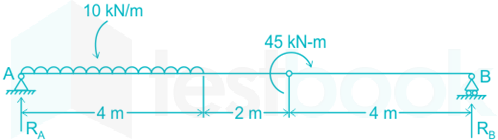
The vertical support reactions RA and RB for the given beam is

  1. AOption (a)

    RA = 25 kN, RB = 15 kN

  2. BOption (b)

    RA = 15 kN, RB = 25 kN

  3. COption (c)

    RA = 12.5 kN, RB = 27.5 kN

  4. DOption (d)

    RA = 27.5 kN, RB = 12.5 kN

View answer & explanation

Correct answer

Answer: (d)D.

RA = 27.5 kN, RB = 12.5 kN

Why this answer is correct

Concept:

  • Shear force is the resultant of all the transverse forces to the right or left of the beam.
  • Bending moment is the resultant moment at a section due to all the transverse forces either to the left or to the right of the section.

Calculation:

Given

UDL intensity = W1 = 10 kN/M , Moment = M = 45 kN-m

∑MA = 0 ,Moment about point  A 

= 10 × 4 × 4/2 + 45 - RB × 10 = 0

= RB = 12.5 kN

∑V = 0, Taking sum of all the vertical forces as 0

= RA + RB = 10 × 4

= RA = 40 - 12.5 = 27.5 kN

Additional Information 

  • Slope of the shear force diagram = intensity of distributed load.

         dVdx=W\frac{{dV}}{{dx}} = W

  • Sope at any section of bending moment diagram = shear force at that section.

         dMdx=V\frac{{dM}}{{dx}} = V

  • ​The point of contra flexure is the point where the bending moment changes its sign.
  • The point of inflexion is the point where deflected shape of the beam changes its curvature.

Question 40

The grip length for well foundation of railway bridges is taken as _________ of maximum scour depth, generally, while for road bridges _________ of maximum scour depth is considered adequate.

  1. AOption (a)

    30% and 30% respectively

  2. BOption (b)

    50% and 30% respectively

  3. COption (c)

    30% and 50% respectively

  4. DOption (d)

    50% and 50% respectively

View answer & explanation

Correct answer

Answer: (b)B.

50% and 30% respectively

Why this answer is correct

Explanation:

  • Well foundation is a type of deep foundation which is generally provided below the water level for bridges. Cassions or well have been in use for foundations of bridges and other structures since the Roman and Mughal periods.
  • Depth of scour is the depth at which scouring occurs, below the high flood level.
  • A well foundation should be sunk below the maximum scour depth, such that there is adequate lateral stability and this embedded length which is called the grip length.
  • The grip length is required for developing sufficient passive resistance to counteract the overturning moment due to horizontal force at well top.
  • Grip length for well foundation of railway bridges is generally taken as 50 %
  • Grip length for well foundation of road bridges is generally taken as 30 %

Additional Information

Different shapes of well foundation are as follows:

  1. ​ Circular shape is the most commonly used shape, as it has high circular strength and is convenient in sinking, and chances of tilting are also less. Maximum diameter limited to 9m.
  2. Double D wells are generally used for the piers and the abutments of bridges which are too long to be accommodated on a circular well of 9 m diameter. This well of this shape can be sunk easily.
  3. Double octagonal wells are better than double D well. The square corners are eliminated and bending stresses are reduced and also provide greater resistance to sinking.
  4. Rectangular wells are generally used for bridge foundations having depth up to 7-8 m.

Question 41

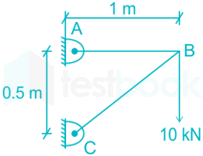
A two members truss ABC as shown in figure. The axial force (in kN) transmitted in member AB is

  1. AOption (a)

    40 kN

  2. BOption (b)

    10 kN

  3. COption (c)

    20 kN

  4. DOption (d)

    30 kN

View answer & explanation

Correct answer

Answer: (c)C.

20 kN

Why this answer is correct

Concept:

  • The analysis of trusses is usually based on the following simplifying assumptions.
  1. The centroidal axis of each member coincides with the line connecting the centers of the adjacent members and the members only carry axial force.
  2. All members are connected only at their ends by frictionless hinges in plane trusses.
  3. All loads and support reactions are applied only at the joints.
  • The reason for making these assumptions is to obtain an ideal truss, i.e., a truss whose members are subjected only to axial forces
  • Types of forces in a truss are as follows
  1. Primary Forces =member axial forces determined from the analysis of an ideal truss.
  2. Secondary Forces = deviations from the idealized forces, i.e., shear and bending forces in a truss member.

         Our focus will be on primary forces. If large secondary forces are anticipated, the truss should be analyzed as a frame.

Calculation:

Given 

Load, P = 10 kN acts on joint B, AB = 1 m, AC = 0.5 m,

Let reactions at A in a vertical and horizontal direction as vA and HA  respectively

NOTE: Forces in truss as generally assumed as tensile. So, in truss analysis, positive member force means tensile force in that member and negative member force means compressive force in that member.

 ∑ MC = 0, Taking moment about point C

= HA×0.5 + 10×1 = 0 ( Moment of VA  about C  will be 0 )

= HA = -10/0.5 = -20 kN

∑ HA = 0, Take sum of Horizontal forces as zero at joint A

= HA + FAB = 0

= - 20 + FAB = 0

= FAB = 20 kN and the nature of force is tensile as force comes out positive.

Important Points

  • Method to identify zero force members in a given truss
  1. If only two noncollinear members are connected to a joint that has no external loads or reactions applied to it, then the force in both members is zero.
  2. If three members, two of which are collinear, are connected to a joint that has no external loads or reactions applied to it, then the force in the member that is not collinear is zero.

Question 42

The total and effective vertical normal stresses at a depth of 5 m below the top level of water in a 7 m deep fresh water lake are respectively

  1. AOption (a)

    Zero and zero

  2. BOption (b)

    0.5 kg / cm2 and 0.5 kg / cm2

  3. COption (c)

    0.5 kg / cm2 and zero

  4. DOption (d)

    1.0 kg / cm2 and 0.5 kg / cm2

View answer & explanation

Correct answer

Answer: (c)C.

0.5 kg / cm2 and zero

Why this answer is correct

Concept:

Relationship between total stress, effective stress, and pore water pressure:

σ=;σˉ+u\sigma = ;\bar \sigma + u

σˉ=effetive;stress \bar \sigma = effetive;stress

σ = Total stress

u= Pore pressure

Given:

h = 5 m = 500 cm 

ρw = 1000 kg/m3 = 10-3 kg/cm3 =10-3 kg/cm3

σ = ρwh = 10-3 × 500 = 0.5 kg/cm2

u = ρwh = 10-3  × 500 = 0.5 kg/cm2

σˉ=σ−u=0.5−0.5=0\bar \sigma = \sigma - u = 0.5 - 0.5 = 0

Question 43

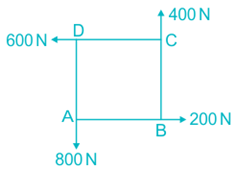
Four forces having magnitudes of 200 N, 400 N, 600 N and 800 N respectively acting along four sides (1 m each) of a square ABCD as shown in Figure. Determine the magnitude and direction of the resultant force from A along the line AB.

  1. AOption (a)

    400√3 N, 3.2 m from A

  2. BOption (b)

    400√2 N, 2.5 m from A

  3. COption (c)

    300√2 N, 2 m from A

  4. DOption (d)

    300√3 N, 2.5 m from A

View answer & explanation

Correct answer

Answer: (b)B.

400√2 N, 2.5 m from A

Why this answer is correct

Concept:

Parallelogram law of forces:

This law states that if two forces are acting simultaneously on a body at a point are represented in magnitude and direction by the two adjacent sides of a parallelogram, their resultant is represented in magnitude and direction by the diagonal of the parallelogram which passes through the point of intersection of the two sides representing the forces.

Net resultant force, R=a2+b2{{R}} = \sqrt {{{{a}}^2} + {{{b}}^2}}  %MathType!MTEF!2!1!+−%feaagKart1ev2aqatCvAUfeBSjuyZL2yd9gzLbvyNv2CaerbuLwBLn%hiov2DGi1BTfMBaeXatLxBI9gBaerbd9wDYLwzYbItLDharqqtubsr%4rNCHbGeaGqiVu0Je9sqqrpepC0xbbL8F4rqqrFfpeea0xe9Lq−Jc9%vqaqpepm0xbba9pwe9Q8fs0−yqaqpepae9pg0FirpepeKkFr0xfr−x%fr−xb9adbaqaaeGaciGaaiaabeqaamaabaabaaGcbaaeaaaaaaaaa8%qacaqGsbGaeyypa0ZaaOaaa8aabaWdbiaabggapaWaaWbaaSqabeaa%peGaaGOmaaaakiabgUcaRiaabkgapaWaaWbaaSqabeaapeGaaGOmaa%aaaeqaaaaa!3CE6!R=a2+b2\% MathType!MTEF!2!1!+- \% feaagKart1ev2aqatCvAUfeBSjuyZL2yd9gzLbvyNv2CaerbuLwBLn \% hiov2DGi1BTfMBaeXatLxBI9gBaerbd9wDYLwzYbItLDharqqtubsr \% 4rNCHbGeaGqiVu0Je9sqqrpepC0xbbL8F4rqqrFfpeea0xe9Lq-Jc9 \% vqaqpepm0xbba9pwe9Q8fs0-yqaqpepae9pg0FirpepeKkFr0xfr-x \% fr-xb9adbaqaaeGaciGaaiaabeqaamaabaabaaGcbaaeaaaaaaaaa8 \% qacaqGsbGaeyypa0ZaaOaaa8aabaWdbiaabggapaWaaWbaaSqabeaa \% peGaaGOmaaaakiabgUcaRiaabkgapaWaaWbaaSqabeaapeGaaGOmaa \% aaaeqaaaaa!3CE6! {\rm{R}} = \sqrt {{{\rm{a}}^2} + {{\rm{b}}^2}}

Calculation:

Given:

Let;a⃗=800;N,;b⃗=200;N,;c⃗=400;N,;d⃗=600;N\rm Let;{\rm{\vec a}} = 800{\rm{;N}},{\rm{;\vec b}} = 200{\rm{;N}},{\rm{;\vec c}} = 400{\rm{;N}},{\rm{;\vec d}} = 600{\rm{;N}}(% MathType!MTEF!2!1!+- % feaagKart1ev2aqatCvAUfeBSjuyZL2yd9gzLbvyNv2CaerbuLwBLn % hiov2DGi1BTfMBaeXatLxBI9gBaerbd9wDYLwzYbItLDharqqtubsr % 4rNCHbGeaGqiVu0Je9sqqrpepC0xbbL8F4rqqrFfpeea0xe9Lq-Jc9 % vqaqpepm0xbba9pwe9Q8fs0-yqaqpepae9pg0FirpepeKkFr0xfr-x % fr-xb9adbaqaaeGaciGaaiaabeqaamaabaabaaGcbaaeaaaaaaaaa8 % qaceqGHbWdayaalaWdbiabg2da9iaaiIdacaaIWaGaaGimaiaabcka % caqGobGaaiilaiaabckaceqGIbWdayaalaWdbiabg2da9iaaikdaca % aIWaGaaGimaiaabckacaqGobGaaiilaiaabckaceqGJbWdayaalaWd % biabg2da9iaaisdacaaIWaGaaGimaiaabckacaqGobGaaiilaiaabc % kaceqGKbWdayaalaWdbiabg2da9iaaiAdacaaIWaGaaGimaiaabcka % aaa!53CD! {\rm{\vec a}} = 800{\rm{;N}},{\rm{;\vec b}} = 200{\rm{;N}},{\rm{;\vec c}} = 400{\rm{;N}},{\rm{;\vec d}} = 600{\rm{;}}\)

ΣX = 200 – 600 = -400 N

ΣY = 400 – 800 = -400 N

θ=tan⁡−1ΣXΣY=tan⁡−1400400=45∘{\rm{\theta }} = {\tan ^{ - 1}}\frac{{Σ {\rm{X}}}}{{Σ {\rm{Y}}}} = {\tan ^{ - 1}}\frac{{400}}{{400}} = 45^\circ , as shown in the figure.

R=(ΣX)2+(ΣY)2=4002+4002=4002;N{\rm{R}} = \sqrt {{{\left( {Σ {\rm{X}}} \right)}^2} + {{\left( {Σ {\rm{Y}}} \right)}^2}} = \sqrt {{{400}^2} + {{400}^2}} = 400\sqrt 2 {\rm{;N}}

ΣMA = 400 × 1 + 600 × 1 = 1000 Nm.

Let x be the distance from A along the x-axis, where the resultant cuts AB. Then,

x=ΣMAΣY=1000400=2.5;m{\rm{x}} = \frac{{\Sigma {{\rm{M}}_{\rm{A}}}}}{{\Sigma {\rm{Y}}}} = \frac{{1000}}{{400}} = 2.5{\rm{;m}}

Question 44

Group of the constituents of cement in decreasing order of their contribution to the strength of cement is

  1. AOption (a)

    C3S, C2S, C3A and C4AF

  2. BOption (b)

    C3S, C2S, C4AF and C3A

  3. COption (c)

    C2S, C4AF, C3A and C3S

  4. DOption (d)

    C3S, C3A, C2S and C4AF

View answer & explanation

Correct answer

Answer: (a)A.

C3S, C2S, C3A and C4AF

Why this answer is correct

Concept

There are four compounds (Called Bogue's Compounds) formed as a result of hydration of cement:

Alite: C3S, or Tricalcium Silicate

Belite: C2S, or Dicalcium Silicate

Aluminate phase: C3A, or Tricalcium Aluminate

Ferrite phase: C4AF, or Tetracalcium Aluminoferrite

Bogue Compounds

a) Dicalcium Silicate (C2S): This compound will undergo a reaction slowly. It is responsible for the progressive strength of concrete. This is also called as Belite. 

A higher percentage of C2S results in slow hardening, less heat of hydration, and great resistance to chemical attack.

b) Tricalcium silicate (C3S): This is also called as Alite. It undergoes hydration within one week and helps in the development of strength in the early stages of concrete (aka hardening).

It has the best cementitious property among all the other Bogue's Compounds. Tricalcium Silicate (C3S) hardens rapidly and is largely responsible for the initial set and early strength.

 The cement that has more C­­­­3S content is good for cold weather concreting. 

c) Tricalcium aluminate (C3A): Celite is the quickest one to react when water is added to the cement. It is responsible for the flash setting. The increase of this content will help in the manufacture of Quick Setting Cement. 

It provides weak resistance against sulphate attack and contribution to the development of strength is significantly less than the above two bogue compounds.

d) Tetra calcium Alumino ferrite (C4AF): This is called Felite. It has the poorest cementing value but it responsible for the long-term gain of strength of the cement.

Question 45

A bullet of mass 30 gm leaves the barrel of a gun with a velocity of 500 m/s. Suppose, the force lasted, for 0.0018 seconds, the average impulsive force is

  1. AOption (a)

    5333.33 N

  2. BOption (b)

    6333.33 N

  3. COption (c)

    7333.33 N

  4. DOption (d)

    8333.34 N

View answer & explanation

Correct answer

Answer: (d)D.

8333.34 N

Why this answer is correct

Concept:

Impulse:

  • When a large force works on a body for a very small time interval, it is called impulsive force.
  • An impulsive force does not remain constant, but changes first from zero to maximum and then from maximum to zero. In such a case we measure the total effect of force.
  • The impulse caused by a force during a specific time interval is equal to the body's change of momentum during that time interval.
  • Impulse, effectively, is a measure of the change in momentum.
  • Impulse of a force is a measure of total effect of force.

\(\vec I = \mathop \smallint \nolimits_{{t_1}}^{{t_2}} \overrightarrow {F;} \cdot dt = {\overrightarrow {F;} _{av}}{\rm{\Delta }}t\)  or

  Where, I = impulse, F = force and Δt = very small time interval

  Force = m × dv/dt

  • Impulse is a vector quantity and its direction is the same as that of force.
  • SI unit of impulse is Newton-second or kg-m-s-1.

Calculation:

Given,

 Mass (m) = 30 g = 0.03 kg,

 v = 500 m/s and t = 0.0018 sec

 Force = 0.03 × 500/0.018 = 8333.34 N

Question 46

The time which results in the least possible construction cost of an activity is known as

  1. AOption (a)

    Normal time

  2. BOption (b)

    Optimum time

  3. COption (c)

    Crash time

  4. DOption (d)

    Standard time

View answer & explanation

Correct answer

Answer: (b)B.

Optimum time

Why this answer is correct

Concept:

​Optimum time:

  • We know that Total project cost = Direct cost + Indirect cost.

  • If direct and indirect cost varies with time is shown in the figure below, then total project cost versus time curve has the shape as indicated in the figure below

  • Such a curve will have a point A where the tangent drawn to the curve would be horizontal.

  • The total cost of the project will be minimum at this point which is called as optimum cost of the project and the time corresponding to this point A is called as optimum project duration.

  • If the project duration is increased total cost will increase, while if project duration is equal to the crash time, the project cost will be the highest.

  • In the process of reducing the project time, efforts should be made to achieve optimum duration such that project cost is min

Additional Information

  • Normal time: It is the standard time that an estimator will assign to an activity.
  • Crash time: It is the minimum possible time in which an activity can be completed by assigning extra resources.

Question 47

A particle undergoes a simple harmonic motion, the acceleration of the particle at a distance of 1.5 m from the center of motion being 6 m / s2, the time of oscillation in seconds is

  1. AOption (a)

    2.00

  2. BOption (b)

    4.00

  3. COption (c)

    3.14

  4. DOption (d)

    6.28

View answer & explanation

Correct answer

Answer: (c)C.

3.14

Why this answer is correct

Concept:

Simple harmonic motion:

it is a special type of periodic motion where the restoring force on the moving object is directly proportional to the object's displacement magnitude and acts towards the object's equilibrium position. It results in an oscillation which, if uninhibited by friction or any other dissipation of energy

a = ω2 x and ;ω=2πT;\omega = \frac{{2\pi }}{T}

Where, a = acceleration, x = distance, T = time period, ω = angular velocity 

Calculation:

Given: a = 6 m/s2, x = 1.5 m

6 = ω2 × 1.5

ω = 2 rad/sec

T=2πω=2π2=3.14 secT = {\frac{{2\pi}}{ \omega}} =\frac{2\pi}{2}=3.14 ~sec

Question 48

Which of the following constituent, present in excess quantity, changes the colour of the brick from red to yellow?

  1. AOption (a)

    Alumina

  2. BOption (b)

    Silica

  3. COption (c)

    Limestone

  4. DOption (d)

    Iron Pyrite

View answer & explanation

Correct answer

Answer: (c)C.

Limestone

Why this answer is correct

Explanation:

Harmful ingredient in bricks:

1. Lime:

  • If lime is present in clay brick excess amount it causes a change of colour of brick from red to yellow and when lime is burn-in lamp it absorbs water and swells and brick becomes disintegrated.
  • So lime should be present in bricks as finely graded material if there is present it might be removed in the beginning process.

2. Iron Pyrite:

  • Iron pyrites tend to oxidize and decompose the brick during burning. The brick may split into pieces.
  • Pyrites discolourises the bricks

3. Pebbles gravels And grits:

  • It can not be allowed to mix with pebbles gravels and grit , because it can make brick porous and lose its strength and water-absorbing capacity is increased.

4. Alkalies:

  • Excess of alkali metal causes bricks to melt and lose their shape this causes efflorescence.
  • When bricks with alkalies come in contact with moisture is absorb and alkali material crystallized on drying of bricks when water is evaporated and crystallized material form white powder deposit on the bricks which destroy and spoil the appearance of bricks this phenomenon is known as effluorescence.
  1. Sulphur:
  • If sulphur is present in the clay or brick it provides oxidation of carbon and sulphur.
  • During burning sulphur provides the spongy and swelling structure of white patches on brick and brick become discolored due to white patches.

Important Points Magnesia rarely exceeding 1 percent. In burning; it causes the clay to soften at slower rate than in most case is lime and reduces warping.

Question 49

Coefficient of friction is a ratio of the

  1. AOption (a)

    Limiting friction to normal reaction

  2. BOption (b)

    Limiting friction to the weight of the body to be moved

  3. COption (c)

    Sliding friction to the normal reaction

  4. DOption (d)

    None of the above

View answer & explanation

Correct answer

Answer: (a)A.

Limiting friction to normal reaction

Why this answer is correct

Explanation:

Coefficient of friction is the ratio of limiting friction to the normal reaction, between the two bodies, and is generally denoted by μ.

μ=FN\mu = \frac{F}{N}

F = μ N

The frictional force is directly proportional to the normal force. So, if the normal force is doubled then the frictional force will also double. Hence their ratio will remain the same.

Question 50

Addition of fibers in concrete results in

  1. AOption (a)

    Modest increase in compressive strength

  2. BOption (b)

    Increase in ductility

  3. COption (c)

    Enhanced toughness

  4. DOption (d)

    All of the above

View answer & explanation

Correct answer

Answer: (d)D.

All of the above

Why this answer is correct

Explanation:

Fibre reinforced concrete is a composite material consisting of mixtures of cement, mortar or concrete and discontinuous, discrete, uniformly dispersed suitable fibres.

Fibre reinforced concrete (FRC) is concrete containing fibrous material which increases its structural integrity. It contains short discrete fibres that are uniformly distributed and randomly oriented.  Different types of fibres include steel fibres, glass fibres, synthetic fibres and natural fibres.

Following are the benefits one can obtain of a fibre reinforced concrete:

i) It increases the tensile strength, Compressive strength, flexural strength of the concrete.

ii) It reduce the air voids and water voids the inherent porosity of gel.

iii) It increases the toughness, ductility of the concrete.

iv) Fibres such as graphite and glass have excellent resistance to creep. Therefore, the orientation and volume of fibres have a significant influence on the creep performance of reinforcement.

Question 51

D’Alembert’s principle is used for

  1. AOption (a)

    reducing the problem of kinetics to equivalent statics problem

  2. BOption (b)

    determining stresses in the truss

  3. COption (c)

    the stability of floating bodies

  4. DOption (d)

    designing safe structures

View answer & explanation

Correct answer

Answer: (a)A.

reducing the problem of kinetics to equivalent statics problem

Why this answer is correct

Explanation:

D’Alembert’s principle:

  • D’Alembert’s principle states that For a system of mass of particles, the sum of the difference of the force acting on the system and the time derivatives of the moment is zero when projected onto any virtual displacement.
  • D’Alembert’s principle is used for analyzing the dynamic problem which can reduce it into a static equilibrium problem.
  • It is also known as the Lagrange-d’Alembert principle, named after the French mathematician and physicist Jean le Rond d’Alembert.
  • It is an alternative form of Newton’s second law of motion.
  • According to the 2nd law of motion, F = ma while it is represented as F – ma = 0 in D’Alembert’s law.
  • So it can be said that the object is in equilibrium when a real force is acting on it.
  • Here, F is the real force while -ma is the fictitious force known as inertial force.

Question 52

A pozzolanic material must be composed mainly of

  1. AOption (a)

    Microscopic silica

  2. BOption (b)

    Microscopic and Amorphous silica

  3. COption (c)

    Microscopic and Crystalline silica

  4. DOption (d)

    All of the above

View answer & explanation

Correct answer

Answer: (b)B.

Microscopic and Amorphous silica

Why this answer is correct

Concept: -

Pozzolana may be defined as a siliceous material that itself does not possess any cementitious properties but when reacts with lime in presence of lime forms compounds of low solubility having cementitious properties.

All pozzolanas are rich in silica and alumina and contain only a small quantity of alkalis.

The most commonly used pozzolans today are industrial by-products such as fly ash, silica fume from silicon smelting, highly reactive metakaolin, and burned organic matter residues rich in silica such as rice husk ash.

A pozzolanic material must be composed of microscopic and amorphous silica. As crystalline silica is not reactive with Portland cement which does not cause an alkali-silica reaction.

Question 53

Lame’s equations are applicable for

  1. AOption (a)

    Thick cylinder

  2. BOption (b)

    Thin cylinder

  3. COption (c)

    Beams

  4. DOption (d)

    Thin spherical vessel

View answer & explanation

Correct answer

Answer: (a)A.

Thick cylinder

Why this answer is correct

Explanation

Lame's equation is used to find the thickness of the thick cylinder subjected to internal pressure, it is given by,

t=Di2[σt+Piσt−Pi−1]t = \frac{{{D_i}}}{2}\left[ {\sqrt {\frac{{{\sigma _t} + {P_i}}}{{{\sigma _t} - {P_i}}}} - 1} \right]

Where,

t = thickness of thick cylinder,

Di = Internal diameter of the thick cylinder, σt = Allowable tensile stress in the material of thick cylinder, Pi = Internal pressure in the thick cylinder

Important Points

  • Lame's equation is based on the maximum principal stress theory of failure, as this theory is more suitable for brittle materials, Lame's equation is also applicable to brittle materials like Cast iron or Cast Steel.

Additional Information

Clavarino's equation is used to find the thickness of the cylinder when the material is ductile and the cylinder has closed ends, it is given by

t=Di2[σt+(1−2μ)Piσt−(1+μ)Pi−1]t = \frac{{{D_i}}}{2}\left[ {\sqrt {\frac{{{\sigma _t} + \left( {1 - 2μ } \right){P_i}}}{{{\sigma _t} - \left( {1 + μ } \right){P_i}}}} - 1} \right]

Birnie's equation is used to find the thickness of thick cylinders, which are made up of ductile material and has open ends, it is given by

t=Di2[σt+(1−μ)Piσt−(1+μ)Pi−1]t = \frac{{{D_i}}}{2}\left[ {\sqrt {\frac{{{\sigma _t} + \left( {1 - μ } \right){P_i}}}{{{\sigma _t} - \left( {1 + μ } \right){P_i}}}} - 1} \right]

μ is the Poisson's ratio

Question 54

Blow holes in concreting are result of

  1. AOption (a)

    Excess water-cement ratio

  2. BOption (b)

    Insufficient workability

  3. COption (c)

    Improper design of shuttering

  4. DOption (d)

    None of the above

View answer & explanation

Correct answer

Answer: (c)C.

Improper design of shuttering

Why this answer is correct

Explanation

(i) Blow holes are cavities on the vertical surface of the concrete. These are caused by air in concrete being trapped against the form face or sometimes due to insufficient vibration.

(ii) The occurrence of blowholes can be minimized by the use of a suitable air release agent on the surface of the formwork or by providing adequate vibrations. In addition to this concrete should have adequate workability. Blows holes does not affect the long-term performance of the concrete structures.

(iii) Improper design of shuttering may cause trapping of air against form face which can lead to blow holes.

Question 55

In terms of bulk modulus (K) and modulus of rigidity (C), the Poisson’s ratio can be expressed as

  1. AOption (a)

    3K − 4C6K + 4C\frac{3K\ -\ 4C}{6K\ +\ 4C}

  2. BOption (b)

    3K + 4C6K − 4C\frac{3K\ +\ 4C}{6K\ -\ 4C}

  3. COption (c)

    3K − 2C6K + 2C\frac{3K\ -\ 2C}{6K\ +\ 2C}

  4. DOption (d)

    3K + 2C6K − 2C\frac{3K\ +\ 2C}{6K\ -\ 2C}

View answer & explanation

Correct answer

Answer: (c)C.

3K − 2C6K + 2C\frac{3K\ -\ 2C}{6K\ +\ 2C}

Why this answer is correct

Concept:

Elastic Modulus (E): When the body is loaded within its elastic limit, the ratio of stress and strain is constant. This constant is known as Elastic modulus

E=StressStrain=σϵ{\rm{E}} = \frac{{{\rm{Stress}}}}{{{\rm{Strain}}}} = \frac{{\rm{\sigma }}}{\epsilon}

S.I unit: N/m2

Rigidity modulus (C): When a body is loaded within its elastic limit, the ratio of shear stress and shear strain is constant, this constant is known as the shear modulus.

C=Shear;stress;Shear;strain=τϕ{\rm{C}} = \frac{{{\rm{Shear;stress;}}}}{{{\rm{Shear;strain}}}} = \frac{{\rm{\tau }}}{\phi }

S.I unit: N/m2

Bulk modulus (K): When a body is subjected to three mutually perpendicular like stresses of the same intensity then the ratio of direct stress and the volumetric strain of the body is known as bulk modulus

K=Direct;stressVolumetric;strain=σδVV{\rm{K}} = \frac{{{\rm{Direct;stress}}}}{{{\rm{Volumetric;strain}}}} = \frac{{\rm{\sigma }}}{{\frac{{{\rm{\delta V}}}}{{\rm{V}}}}}

S.I unit: N/m2

Explanation:

The relation between E, C, μ is

E = 2C (1 + μ)           ---(1)

Relation Between E, K, μ is

E = 3K (1 – 2μ)         ---(2)

Equating (1) & (2)

2C (1 + μ) = 3K(1 – 2μ)

2C + 2μC = 3K – 6μK

μ (2C + 6K) = 3K – 2C

μ=3K;−;2C2C;+;6K\mu = \frac{{3K; -; 2C}}{{2C; + ;6K}}

Important Points

Poisson’s ratio: 

 When the body is loaded within its elastic limit, the ratio of lateral strain and linear strain is constant. This constant is known as Poisson's ratio.

μ=lateral;strainlinear;strain{\rm{\mu }} = \frac{{{\rm{lateral;strain}}}}{{{\rm{linear;strain}}}}

Other relations between elastic constants are,

  1. E = 2C (1 + μ)

  2. E = 3K (1 – 2μ)

3) E=9KC3K;+;C{\bf{E}} = \frac{{9{\bf{KC}}}}{{3{\bf{K}}; + ;{\bf{C}}}}

Question 56

Match List – I and List – II, and select the correct answer using the codes in given below list.

List-IList-II
i.Preliminary estimate1.Probable variation for quantity rate and amount for each items
ii.Revised estimate2.Material deviation of a structural nature
iii.Supplementary estimate3.Complete estimate
iv.Quantity estimate4.Approximate cost of the project
  1. AOption (a)

    i – 4, ii – 1, iii – 2, iv - 3

  2. BOption (b)

    i – 4, ii – 2, iii – 1, iv - 3

  3. COption (c)

    i – 3, ii – 1, iii – 2, iv - 4

  4. DOption (d)

    i – 3, ii – 2, iii – 1, iv - 4

View answer & explanation

Correct answer

Answer: (a)A.

i – 4, ii – 1, iii – 2, iv - 3

Why this answer is correct

Types of estimatesCharacteristics/Properties
1. Preliminary estimateApproximate estimated made to find out approximate cost in a short time.
2. Quantity estimateComplete estimate of quantities of materials that may be required to complete the project.
3. Revised estimateWhen sanctioned estimate is exceeded by more than 5% either from rates being found insufficient due to change in price level or from any cause except important structural alterations.
4. Supplementary estimateWhile a work in progress some additional works may be though necessary for development of a project which was not foreseen when the original estimate was framed, the estimate when prepared to cover all such works is known as supplementary estimate.
5. Complete estimateAn estimate of all the items which are related to the work in addition to the main contract or the detailed estimate.
6. Detailed EstimateIncludes the quantities and cost of everything required for satisfactory completion of work.

Question 57

A cylindrical boiler 1.5 m diameter and made up of 10 mm thick plate is subjected to a steam pressure of 2 N / mm2. The hoop tension and longitudinal stresses will be

  1. AOption (a)

    150 N / mm2 and 75 N / mm2

  2. BOption (b)

    150 N / mm2 and 150 N / mm2

  3. COption (c)

    75 N / mm2 and 75 N / mm2

  4. DOption (d)

    75 N / mm2 and 150 N / mm2

View answer & explanation

Correct answer

Answer: (a)A.

150 N / mm2 and 75 N / mm2

Why this answer is correct

Explanation

Given

Diameter of boiler, D = 1.5 m

Thickness, t = 10 mm

Steam pressure, p = 2 MPa

Since,

t / D = 1 / 150 < 1 / 10, thin cylindrical section.

For thin cylindrical section,

Hoop stress is given by - 

σh=pD2t=2×15002×10=150;MPa{\sigma _h} = \frac{{pD}}{{2t}} = \frac{{2 \times 1500}}{{2 \times 10}} = 150;MPa

Longitudinal stress is given by – 

σL=pD4t=2×15004×10=;75MPa{\sigma _L} = \frac{{pD}}{{4t}} = \frac{{2 \times 1500}}{{4 \times 10}} = ;75MPa

Note:- Due to internal fluid pressure hoop and longitudinal stresses both are tensile in nature.

Question 58

The probability distribution to represent the completion time of the project as per the PERT analysis is

  1. AOption (a)

    Normal distribution

  2. BOption (b)

    beta distribution

  3. COption (c)

    gamma distribution

  4. DOption (d)

    log-normal distribution

View answer & explanation

Correct answer

Answer: (a)A.

Normal distribution

Why this answer is correct

Explanation:

PERT is almost identical to the critical path method (CPM) technique except it assumes each activity duration has a range that follows a statistical distribution.

  • In PERT the Normal distribution is used for the completion time of Project.

  • PERT uses three-time estimates for each activity. Basically, this means each activity duration can range from an optimistic time to a pessimistic time, and a weighted avenge can be computed for each activity.

  • Because project activities usually represent work, and because work tends to stay behind once it gets behind, the PERT developers chose an approximation of the beta distribution to represent activity durations.

  • The activity durations can be skewed more toward the high or low end of the data range.

  • Figure A depicts a beta distribution for activity duration that is skewed toward the right and is representative of work that tends to stay late once it is behind.

  • The distribution for the project duration is represented by a normal (symmetrical) distribution shown in Figure B.

  • The project distribution represents the sum of the weighted avenges of the activities on the critical path.

Confusion Points In PERT individual activities follows Beta distribution whereas whole project duration follows Normal distribution.

Question 59

Two shafts of same length and material are joined in series. If the ratio of their diameters is 2, then the ratio angle of twist will be______

  1. AOption (a)

    2

  2. BOption (b)

    4

  3. COption (c)

    8

  4. DOption (d)

    16

View answer & explanation

Correct answer

Answer: (d)D.

16

Why this answer is correct

Concept:

Torsion Equation:

TJ=τr=GθL\frac{T}{J} = \frac{\tau }{r} = \frac{{G\theta }}{L}

θ=TLGJ=TLGπD432=32TLGπD4\theta = \frac{{TL}}{{GJ}} = \frac{{TL}}{{G\frac{{\pi {D^4}}}{{32}}}} = \frac{{32TL}}{{G\pi {D^4}}}

θ∝1D4\theta \propto \frac{1}{{{D^4}}}

Calculation:

θ2θ1=(D1D2)4=(2)4=16\frac{{{\theta _2}}}{{{\theta _1}}} = {\left( {\frac{{{D_1}}}{{{D_2}}}} \right)^4} = {\left( 2 \right)^4} = 16

Ratio will vary with D4. It can be either 16 : 1 or 1 : 16.

Question 60

The mortar used for masonry construction are classified based on strength in IS : 2250 and IS : 1905 according to their designations L1, L2, H1, H2, M1 and M­2. The correct sequence of increasing order of their strength is

  1. AOption (a)

    L1, L2, H1, H2, M1 and M­2

  2. BOption (b)

    L2, L1, M2, M1, H2 and H­1

  3. COption (c)

    L1, L2, M1, M2, H1 and H2

  4. DOption (d)

    M1, M2, L1, L2, H1 and H2

View answer & explanation

Correct answer

Answer: (b)B.

L2, L1, M2, M1, H2 and H­1

Why this answer is correct

As per IS1905:1987, Cl. 3.2.1, Table 1,

Grade of mortarMinimum compressive strength at 28day (N / mm2)
H110
H­26.0 or 7.5
M13.0 or 5.0
M22.0 or 3.0
M31.50
L10.70
L20.50

Question 61

A prismatic bar in compression has a cross-sectional area A = 1200 mm2 and carries a load P = 90 kN. Normal and shear stresses acting on a plane cut through the bar at θ = 25°, are respectively

  1. AOption (a)

    61.6 MPa and 28.7 MPa

  2. BOption (b)

    49.5 MPa and 23.8 MPa

  3. COption (c)

    78.2 MPa and 20.7 MPa

  4. DOption (d)

    73.4 MPa and 29.2 MPa

View answer & explanation

Correct answer

Answer: (a)A.

61.6 MPa and 28.7 MPa

Why this answer is correct

Explanation:

Given: -

Prismatic bar,

Area of c/s, A = 1200 mm2

Axial compressive Load, P = 90 kN

Section cut angle, θ = 25°

Since, cut angle reference is not given. Assuming, that the plane is cut at 25° with a major stress plane (Always)

Now,

σn=σx+σy2±σx−σy2cos⁡2θ=−752+−752cos⁡50∘=−61.61;MPa{\sigma _n} = \frac{{{\sigma _x} + {\sigma _y}}}{2} \pm \frac{{{\sigma _x} - {\sigma _y}}}{2}\cos 2\theta = \frac{{ - 75}}{2} + \frac{{ - 75}}{2}\cos 50^\circ = - 61.61;MPa

Here, θ – is the angle of the plane considered making with major principal stress plane i.e. 25°.

τ=;−(σx−σy2)sin⁡2θ=752sin⁡50∘=28.72;MPa\tau = ; - \left( {\frac{{{\sigma _x} - {\sigma _y}}}{2}} \right)\sin 2\theta = \frac{{75}}{2}\sin 50^\circ = 28.72;MPa

Hence,

The normal stress on the plane considered = 61.61 MPa (Compressive)

Shear stress on the plane considered = 28.72 MPa

option (1) is correct.

Question 62

The total number of grades of ordinary concrete stipulated in IS : 456 – 2000 are

  1. AOption (a)

    10

  2. BOption (b)

    8

  3. COption (c)

    3

  4. DOption (d)

    6

View answer & explanation

Correct answer

Answer: (c)C.

3

Why this answer is correct

Explanation:

  • Ordinary concrete grades include grades of M10, M15, and M20. (i.e. 3 Number of Grades)
  • Standard grades include M25, M30, M35, M40, M45, M50, M55 and M60.
  • High strength concrete grades include greater than M60.

​

Additional Information

  • The nominal mixes of fixed cement-aggregate ratio (by volume) vary widely in strength and may result in under- or over-rich mixes. For this reason, the minimum compressive strength has been included in many specifications. These mixes are termed standard mixes.
  • IS 456-2000 has designated the concrete mixes into a number of grades as M10, M15, M20, M25, M30, M35, and M40. In this designation, the letter M refers to the mix and the number to the specified 28-day cube strength of mix in N/mm2.

The mixes of grades are as follows:

StrengthNominal Mix Design
M 51:5:10
M 7.51:4:8
M101:3:6
M151:2:4
M201:1.5:3
M251:1:2

Question 63

A cast iron column of external diameter of 300 mm is 20 mm thick. Find safe compressive load on column with factor of safety of 5, if the crushing strength of material is 550 N / mm2

  1. AOption (a)

    1925.21 kN

  2. BOption (b)

    1935.21 kN

  3. COption (c)

    1945.21 kN

  4. DOption (d)

    1955.21 kN

View answer & explanation

Correct answer

Answer: (b)B.

1935.21 kN

Why this answer is correct

Explanation:

Given: -

External diameter, Do = 300mm

Thickness, t = 20mm

Internal diameter, Di = 300 – 40 = 260mm

Factor of safety, FOS = 5

Crushing strength of material, σc = 550 MPa

Safe compressive load,

Psafe=σcAFOS=(550×π(3002−2602)4)5=1934240;N;≈1934.24;kN{P_{safe}} = \frac{{{\sigma _c}A}}{{FOS}} = \frac{{\left( {550 \times \frac{{\pi \left( {{{300}^2} - {{260}^2}} \right)}}{4}} \right)}}{5} = 1934240;N; \approx 1934.24;kN 

∴ Safe Load is 1934.24 kN

Question 64

The minimum width of tread without nosing for staircase of residential building shall be

  1. AOption (a)

    150 mm

  2. BOption (b)

    190 mm

  3. COption (c)

    200 mm

  4. DOption (d)

    300 mm

View answer & explanation

Correct answer

Answer: (c)C.

200 mm

Why this answer is correct

Explanation

Staircase cross-section

Tread:

  • For residential building: 220 – 250 mm,
  • Public: 250 – 300 mm,

Riser:

  • For Residential building: 150 – 180 mm, and (∴ As asked about minimum it is 150 m
  • Public Building: 120 – 150 mm.

Additional Information

There is no direct specification for maximum pitch and minimum pitch in IS 456, however, the maximum and minimum pitch can be calculated as follows:

tan⁡θ=RT\tan {\rm{\theta }} = \frac{{\rm{R}}}{{\rm{T}}}

Maximum pitch:

tan⁡θ=Maximum;RiserMinimum;Tread\tan {\rm{\theta }} = \frac{{{\rm{Maximum;Riser}}}}{{{\rm{Minimum;Tread}}}}

Minimum pitch:

tan⁡θ=Minimum;riserMaximum;tread\tan {\rm{\theta }} = \frac{{{\rm{Minimum;riser}}}}{{{\rm{Maximum;tread}}}}

Question 65

A simply supported beam of length 6 m carries a point load at the centre of the beam such that the maximum bending moment there is 12 kN-m, if ‘EI’ is the flexural rigidity of the beam, the deflection at the centre is

  1. AOption (a)

    9EI\frac{9}{{EI}}

  2. BOption (b)

    18EI\frac{18}{{EI}}

  3. COption (c)

    36EI\frac{36}{{EI}}

  4. DOption (d)

    45EI\frac{45}{{EI}}

View answer & explanation

Correct answer

Answer: (c)C.

36EI\frac{36}{{EI}}

Why this answer is correct

Explanation:

Given:-

Maximum bending moment, Mmax = 12 kNm

Length of the beam, L ­ = 6 m

For a concentrated point load at center of a simply supported beam, BMD is given by –

Hence,

WL/4 = 12

⟹ W = 8 kN.

We know,

Deflection at centre of the simply supported beam subjected to point load is given by –

∆max = WL3 / 48EI

⟹ ∆max = (8 × 63) / 48EI = 36 / EI.

Question 66

The water-cement ratio for ferrocement mix should be

  1. AOption (a)

    Less than 0.35

  2. BOption (b)

    Between 0.35 to 0.40

  3. COption (c)

    Between 0.40 to 0.50

  4. DOption (d)

    Greater than 0.60

View answer & explanation

Correct answer

Answer: (c)C.

Between 0.40 to 0.50

Why this answer is correct

Concept

Ferroecement

  • Developed by P.L. Nervi, an Italian architect, and engineer, in 1940.
  • It consists of closely spaced wire meshes that are impregnated with rich cement mortar mix.
  • The wire mesh is usually of 0.5 to 1.0 mm diameter wire at 5 mm to 10 mm spacing and cement mortar is of the cement-sand ratio of 1: 2 or 1: 3 with a water/cement ratio of 0.4 to 0.45.
  • The basic idea behind this material is that concrete can undergo large strains in the neighborhood of the reinforcement and the magnitude of strains depends on the distribution and subdivision of reinforcement throughout the mass of concrete.
  • It is impervious in nature, has the capacity to resist shock and no formwork is required to gain initial strength.

Question 67

When a body is subjected to direct tensile stress (p), in one plane accompanied by a simple shear stress (q), the maximum normal stress is

  1. AOption (a)

    p2;+;12p2;+;4q2\frac{{{p}}}{2}; + ;\frac{1}{2}\sqrt {p^2; + ;4q^2}

  2. BOption (b)

    p2;−;12p2;+;4q2\frac{{{p}}}{2}; - ;\frac{1}{2}\sqrt {p^2; + ;4q^2}

  3. COption (c)

    p2;+;12p2;−;4q2\frac{{{p}}}{2}; + ;\frac{1}{2}\sqrt {p^2; - ;4q^2}

  4. DOption (d)

    p2;−;12p2;−;4q2\frac{{{p}}}{2}; - ;\frac{1}{2}\sqrt {p^2; - ;4q^2}

View answer & explanation

Correct answer

Answer: (a)A.

p2;+;12p2;+;4q2\frac{{{p}}}{2}; + ;\frac{1}{2}\sqrt {p^2; + ;4q^2}

Why this answer is correct

Concept:

The maximum and minimum normal stress is given by

σmax,;;min=σx+σy2;±(σx;−;σy2)2+τxy2{\sigma _{max,;;min}} = \frac{{{\sigma _x} + {\sigma _y}}}{2}; \pm \sqrt {{{\left( {\frac{{{\sigma _x}; - ;{\sigma _y}}}{2}} \right)}^2} + τ _{xy}^2}

where σx and σy are direct stress and τxy is the shear stress

Calculation:

Given:

From the given condition we have,

σx = p, σy = 0, τxy = q

Now maximum normal stress is:

σmax=σx+σy2+(σx;−;σy2)2+τxy2{\sigma _{max}} = \frac{{{\sigma _x} + {\sigma _y}}}{2} + \sqrt {{{\left( {\frac{{{\sigma _x}; - ;{\sigma _y}}}{2}} \right)}^2} + τ _{xy}^2}

σmax=p2+12p2+4q2\sigma_{max}= \frac{p }{2} + \frac{1}{2}\sqrt {{p ^2} + 4{q ^2}}

Question 68

The minimum depth of the reinforced band provided as strengthen arrangement in masonry building is

  1. AOption (a)

    75 mm

  2. BOption (b)

    60 mm

  3. COption (c)

    50 mm

  4. DOption (d)

    40 mm

View answer & explanation

Correct answer

Answer: (a)A.

75 mm

Why this answer is correct

Explanation

Bands are provided in the walls to tie them together and to impart horizontal bending strength in them.

Based on the location, Bands are classified into three categories 

  • Lintel band – provided at lintel levels.
  • Roof band – provided immediately below the roof or floor.
  • Gable band – provided at the top of gable masonry below the purlins.

As per IS4326:1993, cl. 8.4.5, Table 6,

The vertical thickness (i.e. depth) of RC band be kept 75 mm, while width of RC band is assumed same as the thickness of the wall which should not be less than 200 mm.

Question 69

A ductile structure is defined as one for which the plastic deformation before fracture:

  1. AOption (a)

    Is smaller than the elastic deformation.

  2. BOption (b)

    Vanishes.

  3. COption (c)

    Is equal to the elastic deformation.

  4. DOption (d)

    Is much larger than the elastic deformation.

View answer & explanation

Correct answer

Answer: (d)D.

Is much larger than the elastic deformation.

Why this answer is correct

Concept:

​Ductility: 

  • A metal is said to be ductile when it can be drawn out into wires under tension without rupture.
  • Wire drawing depends upon the ductility of a metal.
  • A ductile metal must be both strong and plastic.
  • The percentage elongation or percentage reduction in the area before rupture of a test specimen is the measure of ductility. Normally if percentage elongation exceeds 15% the material is ductile and if it is less than 5% the material is brittle.
  • Lead, copper, aluminum, mild steel are typical ductile materials.

Explanation:

  • For a ductile structure, the plastic deformation is much larger than elastic deformation without failure.

Question 70

Technical term ‘Eaves’ is defined as

  1. AOption (a)

    The apex line of the sloping roof

  2. BOption (b)

    The lower edge of the inclined roof surface

  3. COption (c)

    Sloped triangular surface formed at the end of a roof

  4. DOption (d)

    The ridge formed by the intersection of two sloping surfaces

View answer & explanation

Correct answer

Answer: (b)B.

The lower edge of the inclined roof surface

Why this answer is correct

Concept: -

Elements of pitched roof –

  1. Ridge: - It is defined as the apex line of sloping roof.
  2. Eaves : - The lower edge of the inclined roof is called Eaves. From eaves, the rain water from the roof surface drops down.
  3. Hip : - It is the ridge formed by the intersection of two slopping surfaces where the exterior angle is greater than 180°.
  4. Hipped end : - Slopped triangular surface formed at the end of the roof.
  5. Verge:- The edge of a gable, running between the eaves and ridge is known as a verge
  6. Cleats: -These are short sections of wood or steal (angle iron) which is fixed on the principal rafters of trusses to support the purlins.
  7. Valley:- It is a reverse of a hip. It is formed by the intersection of two roof surfaces, making an external angle less than 180°.

Question 71

The first moment of area of a rectangular section of width ‘b’ and depth ‘h’ about centre of gravity is

  1. AOption (a)

    b.h22\frac{{b.{h^2}}}{2}

  2. BOption (b)

    b.h24\frac{{b.{h^2}}}{4}

  3. COption (c)

    Zero

  4. DOption (d)

    b.h2

View answer & explanation

Correct answer

Answer: (c)C.

Zero

Why this answer is correct

Explanation:

First moment of area of any type of section about CG of the section is always zero.

First moment of area about CG for section above CG is –

 = BD2 / 4

First moment of area about CG for section below CG is –

= - BD2 / 4

Hence.

Total first moment of area of whole section about CG = 0.

Question 72

The method suitable for measuring the workability of dry concrete mix having very low workability is

  1. AOption (a)

    Slump test

  2. BOption (b)

    Compaction factor test

  3. COption (c)

    Vee-bee consistometer test

  4. DOption (d)

    Vicat test

View answer & explanation

Correct answer

Answer: (c)C.

Vee-bee consistometer test

Why this answer is correct

Concept:

Workability of concrete:

Workability is the relative ease with which concrete can be mixed, transported, molded, and compacted. we can also say, it is the energy to overcome friction while compacting.

The workability of concrete can be measured using the following methods,

  1. Slump test:

The slump test is a measure of consistency or the wetness of the concrete mix. It is suitable for field applications, suitable for concrete of high and medium workability. Slumps for various types of concrete is measured in mm.

  1. Compacting factor test:

It is more accurate than a slump test. It is suitable for concrete mixes of medium and low workability. It is suitable for determining workability in the laboratory.

  1. Vee-bee consistometer:

The time required for complete remoulding of concrete in seconds after being placed in the mould with a slump cone. It is expressed in seconds. It is the method used to determine the workability of very dry mixes with low workability.

  1. Flow table test:

Based on the percentage flow the workability of the concrete is determined. The values could range from 0 to 150 %

  1. Kelly ball test:

It is a simple field testing machine that determines the depth to which a 15 cm diameter metal hemisphere weighing 13.6 kg, will sink under its own weight into the fresh concrete. Based on the depth of the penetration workability of concrete is determined

Explanation:

Type for workability testDegree of Workability
Flow Table testVery High (Having Slump Value > 150 mm)
Vee-Bee ConsistometerVery Low (Having Slump Value < 50 mm)
Compaction factor testLow to medium (Having Slump Value 25 to 100 mm)
Slump testMedium to High (Having Slump Value 50 to 150 mm)

Question 73

The ratio (st)\left( {\frac{s}{t}} \right) of, (s) stiffness of a beam (of constant EI) at the near end when the far end is hinged, to (t) the stiffness of the same beam at the near end when the far end is fixed, is

  1. AOption (a)

    12\frac{1}{2}

  2. BOption (b)

    34\frac{3}{4}

  3. COption (c)

    11\frac{1}{1}

  4. DOption (d)

    43\frac{4}{3}

View answer & explanation

Correct answer

Answer: (b)B.

34\frac{3}{4}

Why this answer is correct

SL No.DescriptionStiffness formula (s)
(1)When for end is fixeds=4EILs = \frac{{4EI}}{L}
(2)When for end is pinneds=3EILs = \frac{{3EI}}{L}
(3)When for end is Guided rollers=EILs = \frac{{EI}}{L}


Based on the above table,

s = 3EI/L (far end is hinged)

t = 4EI/L (far end is fixed)

The desired ratio:

st=3EIL4EIL\frac{s}{t} = \frac{{\frac{{3EI}}{L}}}{{\frac{{4EI}}{L}}}

Or 

st=34\frac{s}{t} = \frac{3}{4}

Question 74

According to National Building Code 2016, the slope of a ramp in the building shall NOT exceed

  1. AOption (a)

    1 in 12

  2. BOption (b)

    1 in 10

  3. COption (c)

    1 in 8

  4. DOption (d)

    1 in 6

View answer & explanation

Correct answer

Answer: (a)A.

1 in 12

Why this answer is correct

Explanation:

According to NBC 2016

Development Control Rules and General Building Requirements

All ramps should have minimum width of 1.20 m, excluding edge protection. The cross slope of ramp should not exceed 1 in 50 and the longitudinal slope of ramp may not exceed 1 in 12.

The ramp surface may be rough finished. All ramp and landing may be designed so that water does not collect on the surface of the ramp or landing.”

Question 75

The maximum deflection of a cantilever due to pure moment 'M' at its free end, is:

  1. AOption (a)

    ML2128EI\frac{{M{L^2}}}{{128EI}}

  2. BOption (b)

    ML23EI\frac{{M{L^2}}}{{3EI}}

  3. COption (c)

    ML28EI\frac{{M{L^2}}}{{8EI}}

  4. DOption (d)

    ML22EI\frac{{M{L^2}}}{{2EI}}

View answer & explanation

Correct answer

Answer: (d)D.

ML22EI\frac{{M{L^2}}}{{2EI}}

Why this answer is correct

Concept:

EId2ydx2=M{EI}\frac{{{d^2}y}}{{d{x^2}}} = M

upon integration

EIdydx=Mx+C1EI\frac{{dy}}{{dx}} = Mx + {C_1}

Once again integrating, we get

EI;y=Mx22+C1x+C2EI;y = \frac{{M{x^2}}}{2} + {C_1}x + {C_2}

For cantilever beam at \(x = 0,\frac{{dy}}{{dx}} = 0;& ;x = 0;y = 0\)

From this we get C1 = C2 = 0, Hence

y=Mx22EIy = \frac{{M{x^2}}}{{2EI}} ; Maximum deflection ymax=ML22EI{y_{max}} = \frac{{M{L^2}}}{{2EI}}

Additional Information

Deflection and slope of various beams are given by:


yB=PL33EI{y_B} = \frac{{P{L^3}}}{{3EI}}θB=PL22EI{\theta _B} = \frac{{P{L^2}}}{{2EI}}
yB=wL48EI{y_B} = \frac{{w{L^4}}}{{8EI}}θB=wL36EI{\theta _B} = \frac{{w{L^3}}}{{6EI}}
yB=ML22EI{y_B} = \frac{{M{L^2}}}{{2EI}}θB=MLEI{\theta _B} = \frac{{ML}}{{EI}}
yB=wL430EI{y_B} = \frac{{w{L^4}}}{{30EI}}θB=wL324EI{\theta _B} = \frac{{w{L^3}}}{{24EI}}
yc=PL348EI{y_c} = \frac{{P{L^3}}}{{48EI}}θB=wL216EI;{\theta _B} = \frac{{w{L^2}}}{{16EI;}}

yc=5384wL4EI{y_c} = \frac{5}{{384}}\frac{{w{L^4}}}{{EI}}θB=wL324EI{\theta _B} = \frac{{w{L^3}}}{{24EI}}

yc=0{y_c} = 0θB=ML24EI{\theta _B} = \frac{{ML}}{{24EI}}
yc=ML28EI{y_c} = \frac{{M{L^2}}}{{8EI}}θB=ML2EI{\theta _B} = \frac{{ML}}{{2EI}}

yc=PL3192EI{y_c} = \frac{{P{L^3}}}{{192EI}}θA=θB=θC=0{\theta _A} = {\theta _B} = {\theta _C} = 0
yc=wL4384EI{y_c} = \frac{{w{L^4}}}{{384EI}}θA=θB=θC=0{\theta _A} = {\theta _B} = {\theta _C} = 0


Where, y = Deflection of beam, θ = Slope of beam

Question 76

Match List-I and List-II, and select the correct answer using the codes given below the lists.

List - IList – II
i.Index plan1Details of plumbing service, water supply, and sewage disposal system
ii.Key plan2The relative position of all the different units
iii.Service plan3The general layout of a new town showing the position of roads, market, hospital, parks, etc.
iv.Layout plan4Details of the particular building
  1. AOption (a)

     i – 4, ii – 3, iii – 2, iv - 1

  2. BOption (b)

    i – 3, ii – 4, iii – 1, iv - 2

  3. COption (c)

    i – 3, ii – 1, iii – 2, iv - 4

  4. DOption (d)

    i – 4, ii – 1, iii – 2, iv - 3

View answer & explanation

Correct answer

Answer: (b)B.

i – 3, ii – 4, iii – 1, iv - 2

Why this answer is correct

Explanation:

Layout Plan: 

  • Plans are used to identify sites in relation to town plans or other wider contexts.
  • The layout plan is a plan of a layout that includes the site plan, parks, gardens, community drainage, etc.
  • It is a plan used for the construction of commercial buildings.

Index Plan: 

  • Location of building Important details Numbered area Located at the entrance
  • Index map should show the general topography of the area like the position of roads, market, hospital, parks, etc.

Key Plan: 

  • Key Plans are floor plans showing primary architectural elements of each building by floor level.
  • They graphically represent walls, doors, windows, room numbers, and other feature

Service plan:

  • Services plans allow you to manage all the systems within your plant room and factory in the most efficient manner possible.
  • It includes different types of services such as Details of plumbing service, water supply, sewage disposal system, Electrical services, Mechanical services, Fire services, etc.

Site plans: 

  • Plans are used to locate the position of buildings in relation to setting out points, means of access, and the general layout of the site.
  • These plans may also contain information on services, drainage networks, etc.

General location plans:

  • Plans are used to show the position occupied by various spaces in a building, the general construction, and the location of principal elements, components, and assembly details.

Question 77

A three-hinged parabolic arch ABC has a span of 20 m and a central rise of 4.0 m. The arch has hinges at the ends and at the crown. A train of two point loads of 20 kN and 10 kN, 5 m apart, crosses this arch from left to right, with the 20 kN load leading. The maximum thrust induced at the supports is

  1. AOption (a)

    25.0 kN

  2. BOption (b)

    28.13 kN

  3. COption (c)

    31.26 kN

  4. DOption (d)

    32.81 kN

View answer & explanation

Correct answer

Answer: (c)C.

31.26 kN

Why this answer is correct

To solve this problem, first we need to draw Influence line diagram (ILD) of horizontal thrust when a unit load moves throughout the arch as shown in figure.

L = 20 mm h = 4 m   [given]

L4h=1.25\frac{L}{{4h}} = 1.25

ILD for ‘H due to unit load

In ΔADD’ and ACC’

tan⁡θ=DD′AD′=CC′AC\tan \theta = \frac{{DD'}}{{AD'}} = \frac{{CC'}}{{AC}}

⇒DD′=1.2510×5=0.625\Rightarrow DD' = \frac{{1.25}}{{10}} \times 5 = 0.625

It is clear from ILD that to get Maximum ‘M’ we need to place 20 kN at creon and consequently apart from it i.e. at D

H = ∑ (load) × (coordinate of ILD whose Load is acting)

H = 20 × 1.25 + 10 × 0.625

H = 31.25 kN

Question 78

A property fetch a net annual income of Rs. 80,000/- after deducting all outgoings. Rate of interest is 6% per annum. What is the capitalized value of the property?

  1. AOption (a)

    Rs. 13,33,333 /-

  2. BOption (b)

    Rs. 9,60,000 /-

  3. COption (c)

    Rs. 16,63,500 /-

  4. DOption (d)

    Rs. 9,33,900 /-

View answer & explanation

Correct answer

Answer: (a)A.

Rs. 13,33,333 /-

Why this answer is correct

Concept:

The capitalized value of a property is the amount of money whose annual interest at the highest prevailing rate of interest will be equal to the net income from the property.

To determine the capitalized value of a property, it is required to know the net income from the property and the highest prevailing rate of interest.

capitalized value = Net annual income × Year's purchase.

Where Year's purchase = 100/rate of interest

Net annual income = Capitalized value of property × ROI/100

Calculation:

Given,

Rate of Interest = 6%

Annual income = 80,000/- after deducting all outings.

80,000 = Capitalized value × (6/100)

Capitalized Value = 80,000 × (100/6)

Capitalized Value = 13,33,333.33/-

Question 79

Influence line for redundant structures can be obtained by

  1. AOption (a)

    Castigliano's theorem

  2. BOption (b)

    Muller-Breslau principle

  3. COption (c)

    Unit load method

  4. DOption (d)

    Maxwell-Betti reciprocal theorem

View answer & explanation

Correct answer

Answer: (b)B.

Muller-Breslau principle

Why this answer is correct

Explanation:

Influence line diagram represents the variation of stress function such as Bending moment, reaction, shear force, slope, or deflection at a fixed section when a unit load moves from one end to another end.

Muller Breslau's Principle

  • The principle gives ILD of any structure either statically determinate or indeterminate structure.
  • According to the principle, "**The ILD of any stress function in a structure is represented by its detected shape obtained by removing the restrained offered by that stress function and introducing a directly generalized displacement in the positive direction of that stress function."**​

Extra Points:

Castigliano's theorem

1. Castigliano's First Theorem: In any structure, the material which is linearly elastic, the temperature is constant, supports are unyielding, then "The partial derivative of total strain energy with respect to any displacement component is equal to an external force applied at that point in the direction of that displacement".

∂U∂Δ=P ∂U∂θ=M\begin{array}{l} \frac{{\partial U}}{{\partial \Delta }} = P\ \frac{{\partial U}}{{\partial \theta }} = M \end{array}

2. Castigliano's Second Theorem: In any structure, the material which is linearly elastic, the temperature is constant, supports are unyielding, then "The partial derivative of total strain energy with respect to any force is equal to deflection at that point in the direction of that force".

∂U∂P=Δ ∂U∂M=θ\begin{array}{l} \frac{{\partial U}}{{\partial P}} = \Delta \ \frac{{\partial U}}{{\partial M}} = \theta \end{array}

Maxwell-Betti reciprocal theorem: In any structure, the material which is linearly elastic, the temperature is constant, supports are unyielding, then the external virtual work done by P during the distortion caused by Q system of forces is equal to the external virtual work done by Q during the distortion caused by P system of forces.

P1y1+P2y2=Q1Y1+Q2Y2{P_1}{y_1} + {P_2}{y_2} = {Q_1}{Y_1} + {Q_2}{Y_2}

Unit load method

  • The element deform or rotate or dθ = (M / EI) dx.
  • The external virtual work done by the unit load is 1.
  • The internal virtual work done by the moment, m.
  • θ,Δ=∫0LmMEIdx\theta ,\Delta = \int\limits_0^L {\frac{{mM}}{{EI}}} dx

Question 80

The base of a paint is

  1. AOption (a)

    Linseed oil

  2. BOption (b)

    Poppy oil

  3. COption (c)

    Sulphates of zinc and manganese

  4. DOption (d)

    White lead

View answer & explanation

Correct answer

Answer: (d)D.

White lead

Why this answer is correct

Concept:

Paints:

It is the mechanical dispersion of one or more fine pigments in a medium (thinner + vehicle). When the paint is applied to a metal surface, the thinner evaporates, while the vehicle undergoes slow oxidation leading to the formation of a pigmented film.

Constituents of paint:

  1. Base: 

It is a metallic oxide which is the principal constituent of a paint. It makes the paint film opaque & processes binding properties which reduce the shrinkage cracks in the film on drying.

E.g- White lead, Red lead, Zinc oxide, Iron oxide, etc

  1. Vehicle or drying oils: 

It is a liquid that binds the pigment to the surface and protects pigment from decay e.g. linseed oil, dehydrated castor oil, etc.

E.g- Linseed oil, Tung oil, Poppy oil, Nut oil, etc

  1. Extenders or fillers: 

The function of the addition of filler in paint is that it improves the properties of the paint and mainly reduces the cost. The main purpose is to increase pigment volume concentration.

E.g- Gypsum, Calcium carbonate, Aluminium silicate, Magnesium silicate, Talc, Diatomite, etc

4. Thinners or solvents: 

It is a volatile solvent, which is often added to paint which helps to adjust the consistency of the paint.

Solvents of oil paints are used to thin the paints and increase the spread.

E.g- Turpentine, White spirit, Naptha, Benzine, Petroleum, etc

  1. Drier: 

The main function of a drier is to increase the drying power of the vehicle. They act as oxygen-carrying catalysts.

E.g- Litharge, Red lead, Sulphate of manganese, etc

  1. Plasticizer: 

They remain permanently in paints and varnishes. They improve the elasticity of the paint film which prevents cracking of the film.

Question 81

A single-bay portal frame of height h, fixed at the base, is subjected to a horizontal displacement Δ at the top. The base moments developed are each proportional to

  1. AOption (a)

    1h\frac{1}{h}

  2. BOption (b)

    1h2\frac{1}{{{h^2}}}

  3. COption (c)

    1h3\frac{1}{{{h^3}}}

  4. DOption (d)

    1h4\frac{1}{{{h^4}}}

View answer & explanation

Correct answer

Answer: (b)B.

1h2\frac{1}{{{h^2}}}

Why this answer is correct

Concept:

When a beam is swayed horizontally, fixed end moments re developed as shown in following figure under different support conditions:

The above moments 6EJL2Δ;or3EJL2Δ\frac{{6EJ}}{{{L^2}}}{\rm{\Delta }};or\frac{{3EJ}}{{{L^2}}}{\rm{\Delta }} will be developed only when support is either purely fixed or purely binned.

Explanation:

But in care of portal frame joint B and C are not entirely fined so, moments developed are between 3EJL2Δ;to6EJL2Δ;orKEIΔL2\frac{{3EJ}}{{{L^2}}}{\rm{\Delta }};to\frac{{6EJ}}{{{L^2}}}{\rm{\Delta }};or\frac{{KEI{\rm{\Delta }}}}{{{L^2}}} (say) as shown below:

∴ Base moments 1h2\frac{1}{{{h^2}}}

Question 82

Part of brick which has a half-header face and half-stretcher face is known as

  1. AOption (a)

    Bevelled closer

  2. BOption (b)

    King closer

  3. COption (c)

    Queen closer

  4. DOption (d)

    Bat

View answer & explanation

Correct answer

Answer: (b)B.

King closer

Why this answer is correct

Explanation:

King closer:

  • It is the portion of a brick that is so cut that the width of one of its ends is half that of full brick, while the width at the other end is equal to the full width.
  • It is thus obtained by cutting the triangular piece between the centre of one end and the centre of the adjacent side. It has a half header and half stretcher face.

Queen closer:

  • It is the portion of brick obtained by cutting a brick lengthwise into two portions. Thus, a queen closer is a brick that is half as wide as the full brick.
  • This is also known as the queen's closer half. When a queen closer is broken into two pieces, it is known as queen closer quarter.

Mitered closer:

  • It is a portion of a brick whose one end is cut splayed or mitered for full width. The angle of splay may vary from 45⁰ to 60⁰.
  • Thus, one longer face of the mitered closer is of the full length of the brick while the other longer face is smaller in length.

Bat:

  • It is the portion of the brick cut across the width. Thus, a bat is smaller in length than a full brick.
  • If the length of the bat is equal to half the length of the original brick, it is known as a half bat. A three-quarter bat is the one having its length equal to three-quarters of the length of a full brick.

Question 83

Which is the unit matrix or identity matrix in the following?

  1. AOption (a)

    \(\left( {\begin{array}{*{20}{c}} {1.0}&{0.0}&{1.0}\ {0.0}&{1.0}&{0.0}\ {1.0}&{0.0}&{1.0} \end{array}} \right)\)

  2. BOption (b)

    \(\left( {\begin{array}{*{20}{c}} {1.0}&{0.0}&{0.0}\ {1.0}&{0.0}&{0.0}\ {1.0}&{0.0}&{0.0} \end{array}} \right)\)

  3. COption (c)

    \(\left( {\begin{array}{*{20}{c}} {0.0}&{1.0}&{0.0}\ {0.0}&{1.0}&{0.0}\ {0.0}&{1.0}&{0.0} \end{array}} \right)\)

  4. DOption (d)

    \(\left( {\begin{array}{*{20}{c}} {1.0}&{0.0}&{0.0}\ {0.0}&{1.0}&{0.0}\ {0.0}&{0.0}&{1.0} \end{array}} \right)\)

View answer & explanation

Correct answer

Answer: (d)D.

\(\left( {\begin{array}{*{20}{c}} {1.0}&{0.0}&{0.0}\ {0.0}&{1.0}&{0.0}\ {0.0}&{0.0}&{1.0} \end{array}} \right)\)

Why this answer is correct

Explanation:

Unit Matrix:

(i) A square matrix in which all the main diagonal elements are 1's and all the remaining elements are 0's is called an Identity Matrix. Identity Matrix is also called Unit Matrix or Elementary Matrix.

\(\left( {\begin{array}{*{20}{c}} {1.0}&{0.0}&{0.0}\ {0.0}&{1.0}&{0.0}\ {0.0}&{0.0}&{1.0} \end{array}} \right)\)

Additional Information Zero matrices:

  • A zero matrix is a matrix with all entries are zero.
  • It is a rectangular array or table of numbers, symbols, or expressions, arranged in rows and columns.

Question 84

In a ‘PERT’ analysis, if the probability factor is negative, the chances of completing the project in time is

  1. AOption (a)

    Less than 50%

  2. BOption (b)

    Fifty-fifty %

  3. COption (c)

    More than 50%

  4. DOption (d)

    Zero

View answer & explanation

Correct answer

Answer: (a)A.

Less than 50%

Why this answer is correct

Concept-

Probability factor z=x−x‾σz = \frac{{x - \overline x }}{\sigma }

Where x̅ = mean, σ = std. deviation.

For z = 0, P(z) = 50%

For z < 0, P(z) < 50%

For z > 0, P(z) > 50%

In this probability distribution, the curve is symmetric about mean that is

The area covered under the entire curve is 1 unit. So area covered upto a point which is less than mean will be less than 50%.

Question 85

Neglecting axial changes is lengths, determine the kinematic indeterminacy of the following frame ‘ABC’.

  1. AOption (a)

    3

  2. BOption (b)

    2

  3. COption (c)

    1

  4. DOption (d)

    9

View answer & explanation

Correct answer

Answer: (c)C.

1

Why this answer is correct

Concept-

When a structure is loaded, it undergoes deflection at the joints i.e. translation and rotation.

In displacement method of analysis, these deflections are treated as unknown quantities. If these unknown quantities can be found by applying compatibility conditions alone then the structure is Kinematically Determinate.

However, if these unknown deflections cannot be found by compatibility conditions then the structure is Kinematically Indeterminate (KI),.

Neglecting axial changes in length, the deformed shape will be

Question 86

Match List – I and List – II and select correct answer using the codes given below the list.

List - IList – II
i.Building lease1The lease holder does not have right to spend money on construction
ii.Occupational lease2The lease holder can erect a building
iii.Sub-lease3Duration of lease is given until death
iv.Life lease4The lease holder may render lease hold property
  1. AOption (a)

    i – 1, ii – 2, iii – 4, iv - 3

  2. BOption (b)

    i – 2, ii – 1, iii – 4, iv - 3

  3. COption (c)

    i – 3, ii – 1, iii – 2, iv - 4

  4. DOption (d)

    i – 3, ii – 2, iii – 2, iv - 4

View answer & explanation

Correct answer

Answer: (b)B.

i – 2, ii – 1, iii – 4, iv - 3

Why this answer is correct

Concept-

Building Lease: In this type of lease, the owner of a freehold open plot of land lets outs his land to the lessee on an agreed amount of premium or ground rent or a combination of both.

The leaseholder may then erect a building over there up to a specified amount and within a specified time and he maintains the property and can reside or earn income through such property.

Occupational Lease: In this type, a lease is granted against premium or rent or a combination of the two by an owner of property consisting of land and building or other structures for occupancy for a fixed period to another person.

Sub-lease-The lease holder may render lease hold property.

Life lease- Duration of lease is given until death.

Question 87

For a linear elastic structural analysis system, minimization of potential energy yields:

  1. AOption (a)

    compatibility conditions

  2. BOption (b)

    constitutive relations

  3. COption (c)

    equilibrium equations 

  4. DOption (d)

     strain-displacement relations

View answer & explanation

Correct answer

Answer: (a)A.

compatibility conditions

Why this answer is correct

Concept-

Compatibility condition-

A body that deforms without developing any gaps/overlaps is called a compatible body. Compatibility conditions are mathematical conditions that determine whether a particular deformation will leave a body in a compatible state.

For a linear elastic structural system, minimization of potential energy yields compatibility condition.

Constitutive relationship-

A constitutive relation approximates the observed physical behaviour of a material under specific conditions of interest. Constitutive relations are required for two reasons:

To bring in the material dependence in the force displacement relation.

To bridge the gap between the number of unknowns and the available equations while trying to develop a force displacement relation.

Equilibrium equations-

In order for a system to be in equilibrium, it must satisfy all three equations of equilibrium,

Sum of Fx = 0, Sum of Fy = 0 and Sum of M = 0.

Strain displacement relations –

The strain displacement relation allows one to compute the strain given a displacement.

Basic concepts and equations used in mechanics is given below.

Question 88

In steel structures, the thickness of the base plate in a column base is determined from the 

  1. AOption (a)

    Flexural strength of plate

  2. BOption (b)

    Shear strength of plate

  3. COption (c)

    Bearing strength of concrete pedestal

  4. DOption (d)

    Punching criteria

View answer & explanation

Correct answer

Answer: (a)A.

Flexural strength of plate

Why this answer is correct

Concept-

The thickness of the slab base is dependent upon the flexural strength of the plate.

A column base consists of a column, a base plate, and an anchoring assembly. In general, they are designed with unstiffened base plates, but stiffened base plates may be used where the connection is required to transfer high bending moments.

Size of Base plate:

(1) Find the bearing strength of concrete which is given by = 0.45 fck

(2) Therefore, area of base plate required =Pu0.45;fck,= \frac{{{P_u}}}{{0.45;{f_{ck}}}}, where Pu is factored load.

(3) Select the size of base plate. For economy, as far as possible keep the projection ‘a’ and ‘b’ equal.

Thickness of Base Plate:

(1) Find the intensity of pressure

w=PuArea;of;base;platew = \frac{{{P_u}}}{{Area;of;base;plate}}

(2) Minimum thickness required is given by

ts=[2.5w(a2−0.362)ymofy]0.5>tf{t_s} = {\left[ {\frac{{2.5w\left( {{a^2} - {{0.36}^2}} \right){y_{mo}}}}{{{f_y}}}} \right]^{0.5}} > {t_f}

Where

ts = thickness of the base plate

and tf = thickness of the flange.

The above formula may be derived by taking μ = 0.3 and using plate theory for finding the bending moment

From the above formula it is clear that the thickness of slab base is dependent upon the flexural strength of the plate.

Question 89

The influence line for support reaction RC for the beam shown in figure will be as

  1. AOption (a)

  2. BOption (b)

  3. COption (c)

  4. DOption (d)

View answer & explanation

Correct answer

Answer: (d)D.

Why this answer is correct

Explanation:

The influence line diagram represents variation in the values of a particular stress function such as reactions, shear force, bending moment, slope, or deflections when a unit concentrated load moves from one end to the other end of the span.

Assume a support at 'D'.

To draw the ILD for Rc, lift by 1 unit at point c in the direction of Rc. so the deflected shape will be,

Question 90

The limit state of serviceability includes

  1. Deflection
  2. Repairable damage or crack due to fatigue
  3. Vibration
  4. Fire
  1. AOption (a)

    Only 1 and 3

  2. BOption (b)

    Only 1 and 4

  3. COption (c)

    Only 1, 3 and 4

  4. DOption (d)

    1, 2, 3 and 4

View answer & explanation

Correct answer

Answer: (d)D.

1, 2, 3 and 4

Why this answer is correct

Explanation:

As per IS 800: 2007, CL: 5.2.2.2, Limit state of serviceability includes the following:

  1. Crack due to fatigue
  2. Repairable damage
  3. Corrosion
  4. Fire
  5. Deformation and Deflections
  6. Vibrations in structure

Hence, ’fracture due to fatigue’ cannot be considered as limit state of serviceability of a steel structure as it is considered in Limit State of Strength.

<br>

Additional Information

Limit State of Collapse includes the following:

  1. Fracture due to fatigue.
  2. Brittle fracture.
  3. Loss of Equilibrium of structure.
  4. Loss of stability of structure.

Question 91

A horizontal beam is shown below The distance of the point of contra flexure from the end ‘A’ is

  1. AOption (a)

    0.333 m

  2. BOption (b)

    0.666 m

  3. COption (c)

    1.50 m

  4. DOption (d)

    0.50 m

View answer & explanation

Correct answer

Answer: (b)B.

0.666 m

Why this answer is correct

Explanation:

Given,

Reaction at Support B, RB = 16 kN

Let 'x' be the distance from Support 'C'

BM at a distance x from the free end

BMx = 0

(10 × x) – (16 × (x - 0.5)) = 0

10 × (x) = 16 × (x) - 8

6x = 8

∴ x = 1.33 m

∴ From end A, distance = 2 - 1.333 = 0.667 m

Question 92

A propped cantilever beam of span l and constant plastic moment capacity Mp carries a concentrated load at mid-span. The load at collapse will be

  1. AOption (a)

    2;Mpl\frac{{2;{M_p}}}{l}

  2. BOption (b)

    4;Mpl\frac{{4;{M_p}}}{l}

  3. COption (c)

    6;Mpl\frac{{6;{M_p}}}{l}

  4. DOption (d)

    8;Mpl\frac{{8;{M_p}}}{l}

View answer & explanation

Correct answer

Answer: (c)C.

6;Mpl\frac{{6;{M_p}}}{l}

Why this answer is correct

Number of possible plastic hinges (N) = 2

Degree of indeterminacy = Ds = 3 - 2 = 1

Plastic hinge required to form mechanism (n) = Ds + 1 = 1 + 1 = 2

Now,

External Work = We = Pu × δ

Internal Work = Wi = 3 MP × θ = 3Mp×δL/23{{\rm{M}}_{\rm{p}}} \times \frac{{\rm{\delta }}}{{{\rm{L}}/2}}

Equating external work done with the internal work done for the system

We = Wi

Pu×δ=3Mp×δL/2{\rm{Pu}} \times {\rm{\delta }} = 3{{\rm{M}}_{\rm{p}}} \times \frac{{\rm{\delta }}}{{{\rm{L}}/2}}

∴ \({{\rm{P}}{\rm{u}}} = \frac{{6{{\rm{M}}{\rm{p}}}}}{{\rm{L}}}\)

Question 93

Excavation was being carried out for a foundation on plastic clay with a unit weight of 22.5 kN/m3. Failure occurred when a depth of 8.10 m was reached. What is the value of cohesion if ϕ = 0° ?

  1. AOption (a)

    11.4 kN/m2

  2. BOption (b)

    22.8 kN/m2

  3. COption (c)

    45.6 kN/m2

  4. DOption (d)

    None of these

View answer & explanation

Correct answer

Answer: (c)C.

45.6 kN/m2

Why this answer is correct

Concept:

Active earth pressure distribution of clay:

Here ka = Earth pressure coefficient (Active)

γ = unit wt of soil

H = Height from G.L

C = Cohesion

Depth of unsupported cut =Huc=4cγka = {H_{uc}} = \frac{{4c}}{{γ\sqrt {{k_a}} }}

(Total pressure = 0) (∵ +ve area = -ve area).

Given Data,

H = 8.10 m

γ  = 22.5 kN/m3

ϕ = 0°

ka=1−sin⁡0∘1+sin⁡0∘=1{k_a} = \frac{{1 - \sin 0^\circ }}{{1 + \sin 0^\circ }} = 1

Huc=8.10=4×c22.5×1⇒c=22.5×8.104=45.6;kN/m2{H_{uc}} = 8.10 = \frac{{4 \times c}}{{22.5 \times 1}} \Rightarrow c = \frac{{22.5 \times 8.10}}{4} = 45.6;kN/{m^2}

Question 94

Rivets under combined stresses must be subjected to a limit as Where, τv and σt = The actual shear and tensile stresses in the rivets, respectively. τvf and σtf = Allowable shear and tensile stresses in the rivets, respectively.

  1. AOption (a)

    τvτvf+σtσtf≤2.0\frac{{{\tau _v}}}{{{\tau _{vf}}}} + \frac{{{\sigma _t}}}{{{\sigma _{tf}}}} \le 2.0

  2. BOption (b)

    τvτvf+σtσtf≤1.5\frac{{{\tau _v}}}{{{\tau _{vf}}}} + \frac{{{\sigma _t}}}{{{\sigma _{tf}}}} \le 1.5

  3. COption (c)

    τvτvf+σtσtf≤1.0\frac{{{\tau _v}}}{{{\tau _{vf}}}} + \frac{{{\sigma _t}}}{{{\sigma _{tf}}}} \le 1.0

  4. DOption (d)

    τvτvf+σtσtf≤1.4\frac{{{\tau _v}}}{{{\tau _{vf}}}} + \frac{{{\sigma _t}}}{{{\sigma _{tf}}}} \le 1.4

View answer & explanation

Correct answer

Answer: (d)D.

τvτvf+σtσtf≤1.4\frac{{{\tau _v}}}{{{\tau _{vf}}}} + \frac{{{\sigma _t}}}{{{\sigma _{tf}}}} \le 1.4

Why this answer is correct

Concept-

As per IS code-

Rivets under combined stresses must be subjected to a limit as

τvτvf+σtσtf≤1.4\frac{{{\tau _v}}}{{{\tau _{vf}}}} + \frac{{{\sigma _t}}}{{{\sigma _{tf}}}} \le 1.4

Where, τv and σt = The actual shear and tensile stresses in the rivets, respectively.

τvf and σtf = Allowable shear and tensile stresses in the rivets, respectively.    

As per IS 800:2007 clause no 10.3.6

A bolt required to resist both design shear force (Vsb) and design tensile force (Tb) at the same time shall satisfy:

(VsbVdb)2;+(TbTdb)2;;≤1.0{(\frac{{{V_{sb}}}}{{{V_{db}}}})^{2;}} + {\left( {\frac{{{T_b}}}{{{T_{db}}}}} \right)^{2;}}; \le 1.0

Where Vsb = factored shear force acting on the bolt

vdb = design shear capacity

Tb = factored tensile force acting on the bolt

Tdb = design tension capacity

Question 95

The Poisson’s ratio for soil sample 1 and 2 are μ1 and μ2 respectively. If μ1μ2=1.5\frac{{{\mu _1}}}{{{\mu _2}}} = 1.5 and  1−μ11−μ2=0.875\frac{{1 - {\mu _1}}}{{1 - {\mu _2}}} = 0.875, then ratio of coefficient of earth pressure at rest for soil sample 1 (K1) to coefficient. Of earth pressure at rest for soil sample 2 (K2), K1/K2 will be:

  1. AOption (a)

    1.3125

  2. BOption (b)

    1.7143

  3. COption (c)

    1.9687

  4. DOption (d)

    1.8213

View answer & explanation

Correct answer

Answer: (b)B.

1.7143

Why this answer is correct

Concept-

Coefficient of earth pressure at rest condition,

k0=μ1−μ{k_0} = \frac{\mu }{{1 - \mu }}

μ = poisson’s ratio for soil.

Active earth pressure coefficient ka=1−sin⁡ϕ1+sin⁡ϕ{k_a} = \frac{{1 - \sin \phi }}{{1 + \sin \phi }}

Where ϕ = Angle of internal friction for soil.

Passive earth pressure coefficient, kp=1+sin⁡ϕ1−sin⁡ϕ{k_p} = \frac{{1 + \sin \phi }}{{1 - \sin \phi }}

Calculation:

Given, 

μ1μ2=1.5,1−μ11−μ2=0.875\frac{{{\mu _1}}}{{{\mu _2}}} = 1.5,\frac{{1 - {\mu _1}}}{{1 - {\mu _2}}} = 0.875

k1=μ11−μ1,;k2=μ21−μ2{k_1} = \frac{{{\mu _1}}}{{1 - {\mu _1}}},;{k_2} = \frac{{{\mu _2}}}{{1 - {\mu _2}}}

k1k2=μ1(1−μ1)×(1−μ2)μ2=μ1μ2×(1−μ21−μ1)\frac{{{k_1}}}{{{k_2}}} = \frac{{{\mu _1}}}{{\left( {1 - {\mu _1}} \right)}} \times \frac{{\left( {1 - {\mu _2}} \right)}}{{{\mu _2}}} = \frac{{{\mu _1}}}{{{\mu _2}}} \times \left( {\frac{{1 - {\mu _2}}}{{1 - {\mu _1}}}} \right)

=1.5×10.875=1.7143 = 1.5 \times \frac{1}{{0.875}} = 1.7143

Question 96

Match List – I with List-II and select the correct answer using the codes given below

List – IList – II
1. Dead loadi. IS: 875 – 2015 (Part – 4)
2. Imposed loadii. IS: 875 – 2015 (Part – 3)
3. Wind Loadiii. IS: 875 – 2015 (Part – 2)
4. Snow Loadiv. IS: 875 – 2015 (Part – 1)
  1. AOption (a)

    1 – iv, 2 – iii, 3 – ii, 4 - i

  2. BOption (b)

    1 – iv, 2 – iii, 3 – i, 4 - ii

  3. COption (c)

    1 – iii, 2 – iv, 3 – ii, 4 - i

  4. DOption (d)

    1 – iii, 2 – iv, 3 – i, 4 - ii

View answer & explanation

Correct answer

Answer: (a)A.

1 – iv, 2 – iii, 3 – ii, 4 - i

Why this answer is correct

Explanation:

Some Important Codes:

I. IS 456 : 2000 : Code of practice for plain and Reinforced concrete

II. IS 800 : 2007 : Code of practice for general construction in steel

III. IS 875 (Part - 1) : 1987 : Dead loads

IV. IS 875 (Part - 2) : Imposed loads

V. IS 875 (Part - 3) : Wind loads

VI. IS 875 (Part - 4) : Snow loads

VII. IS 1343 : Code of practice for Prestressed concrete

VIII. IS 13920 : Code of practice for ductile detailing of reinforced concrete structure subjected to seismic forces.

Question 97

For sand of uniform spherical particles, the void ratio in the loosest and densest stage, are respectively

  1. AOption (a)

    0.91, 0.35

  2. BOption (b)

    0.35, 0.91

  3. COption (c)

    0.65, 0.09

  4. DOption (d)

    0.09, 0.65

View answer & explanation

Correct answer

Answer: (a)A.

0.91, 0.35

Why this answer is correct

Concept-


The soil will have maximum possible voids when its grains are arranged in a cubical array of spheres. Consider a unit cube of soil having spherical particles of diameter d.

Volume of each spherical particle =π6d3 = \frac{\pi }{6}{d^3}

Total volume of container = 1 × 1 × 1 = 1

∴ No. of solids in the container =1d.1d.1d=1d3 = \frac{1}{d}.\frac{1}{d}.\frac{1}{d} = \frac{1}{{{d^3}}}

∴ Volume of solids (Vs)=(π6d3)×1d3=π6\left( {{V_s}} \right) = \left( {\frac{\pi }{6}{d^3}} \right) \times \frac{1}{{{d^3}}} = \frac{\pi }{6}

∴ Volume of voids (Vv)=1−π6\left( {{V_v}} \right) = 1 - \frac{\pi }{6}

∴ Voids ratio, e=1−π6π6=0.9099e = \frac{{1 - \frac{\pi }{6}}}{{\frac{\pi }{6}}} = 0.9099

Porosity, n=e1+e=0.90991+0.9099=0.4764=47.64%n = \frac{e}{{1 + e}} = \frac{{0.9099}}{{1 + 0.9099}} = 0.4764 = 47.64\%

Solution: consider a unit cube of soil having spherical particle of diameter d. The soil will have maximum possible voids in this packing wherein the angle α = 90° (Fig). Now rearrange the sphere so that the sphere centres form a rhombohedral array with angle α = 60°. The soil will attain densest state of packing in this arrangement. By such as rearrangement the volume of solids will remain the same, while the volume of voids will change, thus changing the total volume V.

If d is the diameter of each sphere, each of volume πd36\frac{{\pi {d^3}}}{6}, the number of solids in the original unit cube 1d.1d.1d=1d3\frac{1}{d}.\frac{1}{d}.\frac{1}{d} = \frac{1}{{{d^3}}}

∴ Volume of solids, V=π6d3×1d3=π6V = \frac{\pi }{6}{d^3} \times \frac{1}{{{d^3}}} = \frac{\pi }{6}

Now the change volume of rhombohedrum is given by Eq.

V=1+2cos⁡α(1−cos⁡α)V = \sqrt {1 + 2\cos \alpha } (1 - \cos \alpha )

Here, for densest state of packing, α = 60°

V=1+2cos⁡α(1−cos⁡α)=0.7071V = \sqrt {1 + 2\cos \alpha } (1 - \cos \alpha ) = 0.7071

Thus, the original unit volume is changed to 00.7071 due to densest packing, since the volume of solids remain the same, we have Vs=π6=0.5236{V_s} = \frac{\pi }{6} = 0.5236

∴ Volume of voids, Vv = V – Vs = 0.7071 – 0.5236 = 0.1835

∴ Voids ratio e=VvVs=0.18350.5236=0.35e = \frac{{{V_v}}}{{{V_s}}} = \frac{{0.1835}}{{0.5236}} = 0.35

Hence porosity

n=e1+e=0.351+0.35=0.2595=25.95%n = \frac{e}{{1 + e}} = \frac{{0.35}}{{1 + 0.35}} = 0.2595 = 25.95\%

For sand of uniform spherical particles, the void ratio in the loosest and densest stages is 0.91 and 0.35.

Question 98

In the design of steel structure, for the purpose of designing any member, the load generated due to secondary effects include

  1. Due to contraction or expansion from the temperature
  2. Due to differential settlement of structure
  3. Due to accidental loads
  4. Due to eccentric connections
  1. AOption (a)

    Only 1 and 3

  2. BOption (b)

    Only 1, 2 and 3

  3. COption (c)

    Only 1, 2 and 4

  4. DOption (d)

    1, 2, 3 and 4

View answer & explanation

Correct answer

Answer: (c)C.

Only 1, 2 and 4

Why this answer is correct

Concept-

For the purpose of designing any element, member or a structure, the following loads (actions) and their effects shall be taken into account, where applicable, with partial safety factors find combinations

  • Dead loads
  • Imposed loads (live load, crane load, snow load, dust load, wave load, earth pressures, etc)
  • Wind loads
  • Earthquake loads
  • Erection loads
  • Accidental loads such as those due to blast, impact of vehicles, etc and
  • Secondary effects due to contraction or expansion resulting from temperature changes, differential settlements of the structure as a whole or of its components, eccentric connections, rigidity of joints differing from design assumptions.

Expansion and contraction due to changes in temperature of the members and elements of a structure shall be considered and adequate provision made for such effect.

Question 99

The constant of proportionality between seepage velocity and hydraulic gradient is called

  1. AOption (a)

    Seepage coefficient

  2. BOption (b)

    Coefficient of transmissibility

  3. COption (c)

    Coefficient of percolation

  4. DOption (d)

    Modified coefficient of permeability

View answer & explanation

Correct answer

Answer: (c)C.

Coefficient of percolation

Why this answer is correct

Concept-

Coefficient of transmissibility (T)-

The rate of flow of water through the entire medium of unit width under unit hydraulic gradient is termed as coefficient of transmissibility 

Darcy's law states that there is a linear relationship between flow velocity (v) and hydraulic gradient (i) for any given saturated soil under steady laminar flow conditions.

If the rate of flow is q (volume/time) through cross-sectional area (A) of the soil mass, Darcy's Law can be expressed as

<br>

v = q/A = k.i

<br>

where k = permeability of the soil

i = Dh/L

Dh = difference in total heads

L = length of the soil mass

The flow velocity (v) is also called the Darcian velocity or the superficial velocity.

It is different from the actual velocity inside the soil pores, which is known as the seepage velocity, vS.

At the particulate level, the water follows a tortuous path through the pores.

Seepage velocity is always greater than the superficial velocity, and it is expressed as:

Vs=qAv=qAv×AA≈vn{V_s} = \frac{q}{{{A_v}}} = \frac{q}{{{A_v}}} \times \frac{A}{A} \approx \frac{v}{n}

<br>

where AV = Area of voids on a cross section normal to the direction of flow

n = porosity of the soil

Seepage velocity can be written as,

v = kp i

kp = Coefficient of percolation

The constant of proportionality between seepage velocity and hydraulic gradient is called coefficient of percolation.

Question 100

Prying forces are:

  1. AOption (a)

    Shearing forces on the bolts because of the joints.

  2. BOption (b)

    Tensile forces due to the flexibility of connected parts.

  3. COption (c)

    Bending forces on the bolts because of the joints.

  4. DOption (d)

    Forces due the friction between connected parts.

View answer & explanation

Correct answer

Answer: (b)B.

Tensile forces due to the flexibility of connected parts.

Why this answer is correct

Prying forces:

The flexibility of connected parts can lead to deformations that increases the tension applied to the bolts. The additional tension is called prying force.

The prying forces can be kept small  by using a thick plate or by limiting the distance between the bolt and plate edge.

The corresponding prying force can be calculated as follows

Q=Mpn{\rm{Q}} = \frac{{{{\rm{M}}_{\rm{p}}}}}{{\rm{n}}}

Where,

n = Number of bolts

Mp = Plastic moment

\({{\rm{M}}{\rm{p}}} = \frac{{{{\rm{f}}{\rm{y}}}}}{{1.15}}\frac{{{\rm{W}}{{\rm{t}}^2}}}{4}\)

t = Thickness of end plate

Question 101

A 300 mm square bearing plate settles by 21 mm in a plate load test on a cohesive soil, when the intensity of loading is 0.2 N/mm2. The settlement of a prototype shallow footing 1 m square (1 m × 1 m) under the same intensity of loading (considering both plate and footing are placed at same depth) is:

  1. AOption (a)

    15 mm

  2. BOption (b)

    70 mm

  3. COption (c)

    50 mm

  4. DOption (d)

    167 mm

View answer & explanation

Correct answer

Answer: (b)B.

70 mm

Why this answer is correct

Concept:

For Cohesive soil or clay 

SfSp=BfBp\dfrac{{{S_f}}}{{{S_p}}} = \dfrac{{{B_f}}}{{{B_p}}}

But for Cohesionless soil or sand,

Where,

Bp = Size of the square bearing plate

Bf​ = Size of square bearing footing

Sp = Settlement of bearing plate

Sf = Settlement of bearing footing

Calculation:

Given data: 

Size of square bearing plate, Bp = 0.3 m = 300 mm

Size of square bearing footing, Bf = 1 m = 1000 mm

Settlement of bearing plate, Sp = 21 mm

Intensity of loading on bearing plate =  0.2 N/mm2

Using the relation,

SfSp=BfBp⇒Sf21=1000300⇒Sf=70;mm\dfrac{{{S_f}}}{{{S_p}}} = \dfrac{{{B_f}}}{{{B_p}}} \Rightarrow \dfrac{{{S_f}}}{{21}} = \dfrac{{1000}}{{300}} \Rightarrow {S_f} = 70;mm

∴ Settlement of prototype footing = 70 mm

Question 102

In a steel plate with bolted connection the rupture of the net section is a mode of failure under

  1. AOption (a)

    Tension

  2. BOption (b)

    Compression

  3. COption (c)

    Flexure

  4. DOption (d)

    Shear

View answer & explanation

Correct answer

Answer: (a)A.

Tension

Why this answer is correct

Concept-

The design strength of a tension member is based on two limit states-

(a) Limit state based on the yield strength of the member due to its large elongation.

(b) Limit state based on the ultimate strength of the member.

The design strength of a tension member is the minimum of the following:

a) Design strength due to yielding of the gross section (Tdg)-

In this type of failure wherein yielding of the gross section occurs there a significant amount of deformation occurs before the material actually gets fractured. This significant amount of deformation makes the structure unserviceable.

b) Rupture strength of the critical section (Tdn)-

When the net section of the member reaches the ultimate stress, then rupture (or fracture) of the member takes place.

c) Block shear strength (Tdb)-

Here a segment of the block of the material at the corner of the connection shears out due to possible high bearing strength of steel and high strength of bolts.

In a steel plate with bolted connection, the rupture of the net section is a mode of failure under tension.


Additional Information

Question 103

In a drained triaxial compression test conducted on dry sand, failure occurred when the deviator stress was 218 kN/m2 at a confining pressure of 61 kN/m2. The pore pressure at failure was observed to be 10 kPa. The effective angle of shearing resistance and the inclination of the failure plane to the major principal plane will be:

  1. AOption (a)

    34°, 62°  

  2. BOption (b)

    34°, 28°  

  3. COption (c)

    40°, 25°  

  4. DOption (d)

    43°, 66.5°  

View answer & explanation

Correct answer

Answer: (d)D.

43°, 66.5°  

Why this answer is correct

Concept:

In a triaxial test,

σˉ1=;σˉ3tan⁡2(45+ϕ2)+2ctan⁡(45+ϕ2){\bar σ _1} = ;{\bar σ _3}{\tan ^2}\left( {45 + \frac{\phi }{2}} \right) + 2c\tan \left( {45 + \frac{\phi }{2}} \right)

Where σ1 = Major Principal stress, σ 3 = Minor principal stress

σ̅3 = confining pressure

σ̅1 = σ̅3 + σ̅d

σ̅d = deviator stress

c = Effective cohesion

ϕ = angle of internal friction.

α = inclination of failure plane to major principal plane.

α=45∘+ϕ2\alpha = 45^\circ + \frac{\phi }{2}

Calculation:

Given,

Dry sand is given, so c = 0. u = 10 kPa

σd = 218 kN/m2, σc = 61 kN/m2

σ 1 = 61 + 218 = 279 kN/m2

σ 3 = 61 kN/m2

σ̅3 = 61 - 10 = 51 kN/m2, σ̅1 = 279 - 10 = 269 kN/m2.

σˉ1=σˉ3tan⁡2(45+ϕ2){\bar σ _1} = {\bar σ _3}{\tan ^2}\left( {45 + \frac{\phi }{2}} \right)

269=51×tan⁡2(45+ϕ2)269 = 51 \times {\tan ^2}\left( {45 + \frac{\phi }{2}} \right)

45∘+ϕ2=66.41∘45^\circ + \frac{\phi }{2} = 66.41^\circ

ϕ2=21.41∘\frac{\phi }{2} = 21.41^\circ

ϕ = 42.82° ≈  43°

α=45∘+432=66.5∘\alpha = 45^\circ + \frac{{43}}{2} = 66.5^\circ

Question 104

The flange splice in plate girders is preferably placed near about

  1. AOption (a)

    Mid span section

  2. BOption (b)

    Quarter span section

  3. COption (c)

    End section

  4. DOption (d)

    Any section

View answer & explanation

Correct answer

Answer: (b)B.

Quarter span section

Why this answer is correct

Concept-

When plate girders are longer the elements of their flanges, i.e., flange angles and flange plates may not be available in the required lengths so their splicing becomes necessary.

A joint in the flange element provided to increase the length of the flange angle or plate is known as flange splice.

In locating the flange splice, care should be taken to see that it is not located at the points of maximum stress.

The centre of gravity of the splice plate should be kept as close to the c.g. of the flange element spliced as possible.

There shall be enough rivets or welds on each side of the splice to develop the load in the element spliced plus 5 per cent, but in no case should the strength developed be less than 50 per cent of the effective strength of the material spliced.

In welded connection the flange splice is done through a full strength butt weld or through a single cover butt or double cover butt joint for the flange force at the section.

The flange splice in plate girders is preferably placed near about quarter span section.

Question 105

A pile 450 mm in diameter and 15 m long is driven into a soft clay. The undrained strength of soil varies linearly with depth such that Su = 0.22 σz. Determine the allowable pile load capacity using total stress  analysis. The factor of safety required is 2 and Ysat = 17 kN/m3. Ground water is at surface.

  1. AOption (a)

    286.1 kN

  2. BOption (b)

    252.0 kN

  3. COption (c)

    95.4 kN

  4. DOption (d)

    84.0 kN

View answer & explanation

Correct answer

Answer: (a)A.

286.1 kN

Why this answer is correct

Concept:

The ultimate load capacity of the pile is estimated by Pu = qub Ab + fs As

Ab, As – Base area and the area on which skin friction acts respectively

In clays, qub = Cub Nc     fs = αcu

Cub is the undrained cohesion at the base of the pile and Nc is the bearing capacity factor for deep foundation, generally taken as 9

α is the adhesion factor

cu is the undrained cohesion in the embedded length of the pile.

Values of Reduction Factor, α

ConsistencyN valueBored pilesDriven cast in situ piles
Soft to very soft<40.71.0
Medium4.80.50.7
Stiff8.150.40.4
Stiff to hard> 150.30.3

Calculation:

Given data and 

Dia of pile = 450 mm

Length = 15 m

Undrained strength varies as su = 0.22 σz.

γsat = 17 kN/m3, FOS = 2

Cu = 0.22 × 17 × z = 3.74 z.

Ab = π/4 × (0.45)2 = 0.159 m2

As = π × 0.45 × 15 = 21.025 m2

Qub = CNs = 9 × 3.74 × 15

QubAb = Qb = 9 × 3.74 × 15 × 0.159 = 80.28 kN

qs = α CusAs

α = 1 for soft clay.

cus=3.74×152=28.05{c_{us}} = \frac{{3.74 \times 15}}{2} = 28.05

Qs = 28.05 × 21.205 = 594.80

Pu = 80.28 + 594.80 = 675.08

Psafe=675.082=337.54;kN;(286.1;kN;is;nearest){P_{safe}} = \frac{{675.08}}{2} = 337.54;kN;\left( {286.1;kN;is;nearest} \right)

Question 106

A steel section is subjected to a combination of shear and bending actions. The applied shear force is V and the shear capacity of the section is Vs. For such a section, high shear force (as per IS : 800 - 2007) is defined as,

  1. AOption (a)

    V > 0.6 Vs

  2. BOption (b)

    V > 0.7Vs

  3. COption (c)

    V > 0.8Vs

  4. DOption (d)

    V > 0.9Vs

View answer & explanation

Correct answer

Answer: (a)A.

V > 0.6 Vs

Why this answer is correct

Explanation:

As per IS 800 : 2007, CL : 9.2.1,

The high shear case is V > 0.6 Vs and it says that there is no reduction in moment capacity of cross-section as long as it is not subjected to high shear.

Question 107

What will be the natural frequency of a machine foundation which has a base area of 2.20 m × 2.20 m and a weight of 155 kN including the weight of the machine? Take the value of the coefficient of elastic uniform compression as 4.4 × 10⁴ kN/m3.

  1. AOption (a)

    29/π 

  2. BOption (b)

    58/π 

  3. COption (c)

    116/π 

  4. DOption (d)

    None of these

View answer & explanation

Correct answer

Answer: (b)B.

58/π 

Why this answer is correct

Concept-

Natural frequency of machine foundation is given by

ωn=cuAM{\omega _n} = \sqrt {\frac{{{c_u}A}}{M}}

cu = coefficient of elastic uniform compression

A = Base area

M = Mass

Given Data & Calculation:

Base area = 2.20 m × 2.20 m

Weight = 155 kN

Mass=1559.81=15.8kNm;sec.2Mass = \frac{{155}}{{9.81}} = 15.8\frac{{kN}}{m};sec{.^2}

cu = 4.4 × 10⁴ kN/m3

ωn=4.4×104×(2.2)215.8=116.096;rad/sec{\omega _n} = \sqrt {\frac{{4.4 \times {{10}^4} \times {{\left( {2.2} \right)}^2}}}{{15.8}}} = 116.096;rad/sec

Frequency;(in;Hz)=f=ωn2π=116.0962πFrequency;\left( {in;Hz} \right) = f = \frac{{{\omega _n}}}{{2\pi }} = \frac{{116.096}}{{2\pi }}

f=58.048πHz=58πHz.f = \frac{{58.048}}{\pi }Hz = \frac{{58}}{\pi }Hz.

Question 108

Torsion resisting capacity of a given RC section:

  1. AOption (a)

    Decrease with decrease in stirrup spacing.

  2. BOption (b)

    Decrease with increase in longitudinal bars.

  3. COption (c)

    Does not depend upon stirrup and longitudinal steels.

  4. DOption (d)

    Increases with the increase in stirrup and longitudinal steel.

View answer & explanation

Correct answer

Answer: (d)D.

Increases with the increase in stirrup and longitudinal steel.

Why this answer is correct

Explanation:

The torsion resisting capacity of a given RC section increases with the increase in the stirrup and longitudinal steel.

Mathematically,

\({{\rm{V}}{{\rm{ue}}}} = {{\rm{V}}{\rm{u}}} + 1.6\frac{{{{\rm{T}}_{\rm{u}}}}}{{\rm{b}}}\)

where,

Vue = Equivalent shear

Vu = shear

Tu = Torsional Moment

b = Breadth of beam

Question 109

Rankine’s formula to fix the minimum depth of foundation for wall with usual notation is

  1. AOption (a)

    qγ[1−sin⁡ϕ1+sin⁡ϕ]2\frac{q}{\gamma }{{\left[ \frac{1-\sin \phi }{1+\sin \phi } \right]}^{2}}

  2. BOption (b)

    qγ[1+sin⁡ϕ1−sin⁡ϕ]2\frac{q}{\gamma }{{\left[ \frac{1+\sin \phi }{1-\sin \phi } \right]}^{2}}

  3. COption (c)

    qγ[1−sin⁡ϕ1+sin⁡ϕ]\frac{q}{\gamma }{{\left[ \frac{1-\sin \phi }{1+\sin \phi } \right]}}

  4. DOption (d)

    qγ[1+sin⁡ϕ1−sin⁡ϕ]\frac{q}{\gamma }{{\left[ \frac{1+\sin \phi }{1-\sin \phi } \right]}}

View answer & explanation

Correct answer

Answer: (a)A.

qγ[1−sin⁡ϕ1+sin⁡ϕ]2\frac{q}{\gamma }{{\left[ \frac{1-\sin \phi }{1+\sin \phi } \right]}^{2}}

Why this answer is correct

Concept: 

Rankine’s formula provides guidance on the minimum depth of foundation based on the bearing capacity of the soil.

qu=γDf(1+sin⁡φ1−sin⁡φ)2 q_u={\gamma } {D_{f}}\left( {\frac{{1 + \sin \varphi }}{{1 - \sin \varphi }}} \right)^2

Therefore, the depth of the foundation can be expressed as

Df=quγ(1−sin⁡φ1+sin⁡φ)2D_f = \frac{q_u}{\gamma }\left( {\frac{{1 - \sin \varphi }}{{1 + \sin \varphi }}} \right)^2

Where Df = minimum depth of foundation,

qu = ultimate bearing capacity of the soil, γ = density of soil,

ϕ = angle of repose or internal friction of soil.

Question 110

An isolated T-beam is used as a walkway. The beam is simply supported with an effective span of 6 m. The effective width of the flange for the cross-section shown in the figure is:


  1. AOption (a)

    900 mm

  2. BOption (b)

    1000 mm

  3. COption (c)

    1259 mm

  4. DOption (d)

    2200 mm

View answer & explanation

Correct answer

Answer: (a)A.

900 mm

Why this answer is correct

Concept:

Effective Width of Flange
Monolithic BeamsT - Beamsbf=bw+lo6+6df{b_f} = {b_w} + \frac{{{l_o}}}{6} + 6{d_f}
L - Beamsbf=bw+0.5(lo6+6df){b_f} = {b_w} + 0.5\left( {\frac{{{l_o}}}{6} + 6{d_f}} \right)
Isolated BeamsT - Beamsbf=bw+lolob+4{b_f} = {b_w} + \frac{{{l_o}}}{{\frac{{{l_o}}}{b} + 4}}
L - Beamsbf=bw+0.5×lolob+4{b_f} = {b_w} + \frac{{0.5 \times {l_o}}}{{\frac{{{l_o}}}{b} + 4}}
<br>

Where

bf = effective width of flange

lo = distance between points of zero moments in the beam

bw = breadth of the web

df = thickness of the flange

b = actual width of the flange

For the given isolated T beam

Calculation:

Given,

The beam is Isolated T - Beam

From the figure

bf = 1000 mm, bw = 300 mm, df = 150 mm, b = 1000 mm, lo = 6 m = 6000 mm

bf=bw+lolob+4{b_f} = {b_w} + \frac{{{l_o}}}{{\frac{{{l_o}}}{b} + 4}} ⇒ bf=300+600060001000+4=900;mm{b_f} = 300 + \frac{{6000}}{{\frac{{6000}}{{1000}} + 4}} = 900;{\rm{mm}}

∴ Effective Flange width is 900 mm

Question 111

The net ultimate bearing capacity of a Purely cohesive soil

  1. AOption (a)

    Depends on both, width and depth of footing

  2. BOption (b)

    Depends on only width of footing

  3. COption (c)

    Depends on only depth of footing

  4. DOption (d)

    Is independent of both, depth and width of footing

View answer & explanation

Correct answer

Answer: (d)D.

Is independent of both, depth and width of footing

Why this answer is correct

Explanation:

The ultimate bearing capacity of any soil is given as

Q = CNc + qNq + ½ BγNγ

Note:

For purely cohesive soil (Clay)

ϕ = 0, Nc = 5.7, Nq = 1, Nγ = 0

Ultimate bearing capacity, Qu = 5.7C + q

Net ultimate bearing capacity, Qnu = Qu - q = 5.7C

Net ultimate bearing capacity of a foundation placed on purely cohesive soil is independent of width and depth of footing (as Nγ = 0).

Net ultimate bearing capacity is nearly unaffected by the rise of the water table to ground level (GL).

Question 112

Factored shear force of 140 kN is applied on a beam having breadth 250 mm. The beam is also subjected to factored torsional moment of 20 kN-m. The equivalent shear force on the beam is:

  1. AOption (a)

    298 kN

  2. BOption (b)

    348 kN

  3. COption (c)

    268 kN

  4. DOption (d)

    300 kN

View answer & explanation

Correct answer

Answer: (c)C.

268 kN

Why this answer is correct

Concept

Equivalent Shear force (Ve) is given by

Ve=V+1.6TB{V_e} = V + \dfrac{{1.6T}}{B}

Where, T = Torque

B = Width of the section, V = shear force

Calculation:

Given,

B = 250 mm = 0.25 m,

V = 140 kN, T = 20 kN-m

Equivalent shear force is given by,

Ve=V+1.6:×:TB{V_e} = V + \dfrac{{1.6:\times :T}}{B}

Ve=140+1.6×200.25{V_e} = 140 + \dfrac{{1.6 \times 20}}{{0.25}} = 268 kN

<br>

Additional Information

Equivalent Moment (Me) is given by

Me=M+T1.7(1+DB){M_e} = M + \dfrac{T}{{1.7}}\left( {1 + \dfrac{D}{B}} \right)

Where, M = Bending moment, D = Overall dept, T is Torque

Question 113

The test conducted on foundation soil gives SPT value; N ≤ 5 and density index, ID < 20, the foundation will fail in

  1. AOption (a)

    General shear

  2. BOption (b)

    Local shear

  3. COption (c)

    Punching shear

  4. DOption (d)

    Sinking shear

View answer & explanation

Correct answer

Answer: (b)B.

Local shear

Why this answer is correct

Concept-

General Shear Failure

  • This type of failure is seen in dense and stiff soil.
  • Continuous, well-defined, and distinct failure surface develops between the edge of footing and ground surface.
  • Dense or stiff soil that undergoes low compressibility experiences this failure.
  • General shear failure is accompanied by low strain (< 5 %) in soil with considerable φ (φ > 36o) and large N (N > 30) having high relative density (ID > 70%).

Local Shear Failure

  • This type of failure is seen in relatively loose and soft soil.
  • Significant compression of soil below the footing and partial development of plastic equilibrium is observed.
  • Failure is not sudden and there is no tilting of footing.
  • Local shear failure is accompanied by large strain (> 10 to 20 %) in soil with considerably low (< 28 ֯**) and low N (N < 5) having low relative density (ID <  20 %).**

Punching Shear Failure

  • This type of failure is seen in loose and soft soil and at deeper elevations.
  • This type of failure occurs in soil with very high compressibility.

Important Points

StrainΦ valueN valueId
General Shear FailureLow (< 5 %)> 36˚High (> 30)> 70%
Local Shear FailureLarge (>10 -20 %)< 26˚Low (< 5)< 20%

Question 114

A reinforced concrete wall carrying vertical loads, is generally designed as per recommendations given for columns. The ratio of minimum reinforcement in the vertical and horizontal direction is

  1. AOption (a)

    2 ∶ 1

  2. BOption (b)

    1 ∶ 1

  3. COption (c)

    5 ∶ 3

  4. DOption (d)

    3 ∶ 5

View answer & explanation

Correct answer

Answer: (d)D.

3 ∶ 5

Why this answer is correct

Concept-

The reinforced concrete wall is designed as a compression member. The reinforced concrete wall is used in a case where the beam is not provided and load from the slab is heavy or when the masonry wall thickness is restricted.

As per clause 32.5 of IS 456:2000

  • The minimum ratio of vertical reinforcement to the gross concrete area shall be
  • 0.0012 for deformed bars not larger than 16 mm in diameter.
  • 0.0015 for another type of bar.

The minimum ratio of horizontal reinforcement to the gross concrete area shall be

  • 0.0020 for deformed bars not larger than 16 mm in diameter.
  • 0.0025 for other types of bars.

The ratio of minimum vertical reinforcement to minimum horizontal reinforcement = 0.00120.0020=35\frac{{0.0012}}{{0.0020}} = \frac{3}{5}

Question 115

The optimum moisture content of a clay soil is 24%, whom compaction test is conducted at 30% moisture content, its structure will be

  1. AOption (a)

    Flocculated

  2. BOption (b)

    Single grained

  3. COption (c)

    Honey comb

  4. DOption (d)

    Dispersed

View answer & explanation

Correct answer

Answer: (d)D.

Dispersed

Why this answer is correct

Concept-

Compaction of soil is the pressing of soil particles close to each other by mechanical methods. Air during compaction of soil is expelled from the void space in the soil mass and therefore the mass density is increased.

Compaction of soil is done to improve the engineering properties of the soil. Compaction of soil is required for the construction of earth dams, canal embankments, highways, runways and many other structures.

Effect of Compaction on Soil Structure-

Soils compacted at a water content less than the optimum generally have a flocculated structure. Soils compacted at water content more than the optimum usually have a dispersed structure.

Effect of Compaction of Soil on Permeability

The permeability of soil depends upon the size of voids. The permeability of soil decreases with an increase in water content on the dry side of optimum water content.

Given Data and Analysis-

The optimum moisture content of clay soil is 24%, whom compaction test is conducted at 30% moisture content.

The moisture content is more than the optimum moisture content, so the soil will have a dispersed structure of the soil.

Question 116

As per IS: 456 - 2000, the range of standard concrete is:

  1. AOption (a)

    M25 - M55

  2. BOption (b)

    M20 - M55

  3. COption (c)

    M25 - M50

  4. DOption (d)

    None of these

View answer & explanation

Correct answer

Answer: (a)A.

M25 - M55

Why this answer is correct

Concept:

The range of Standard Concrete is M25 - M55

GroupGrade DesignationSpecified Characteristic compressive strength of 150 mm cube at 20 days in N/mm2
Ordinary Concrete (3)M1010
M1515
M2020
Standard Concrete (7)M2525
M3030
M3535
M4040
M4545
M5050
M5555
High Strength Concrete (5)M6060
M6565
M7070
M7575
M8080

Mistake PointsQuestion is asking the range of standard concrete As per IS: 456 - 2000. So We should not be confused with the new amendment.

Question 117

For any applied stress, zone of influence refers to isobar corresponding to

  1. AOption (a)

    20%

  2. BOption (b)

    15%

  3. COption (c)

    10%

  4. DOption (d)

    5%

View answer & explanation

Correct answer

Answer: (a)A.

20%

Why this answer is correct

Concept:

  • An isobar or pressure bulb is a stress contour or a line that connects all points below the ground surface at which the vertical pressure is the same.
  • Pressure at points inside the bulb is greater than that at a point on the surface of the bulb and pressures at points outside the bulb are smaller than that value.


An isobar of n% represents that the vertical pressure at all points of isobar is n% of load applied.

5% isobar means, vertical stress = 5% of load applied 

10% isobar means, vertical stress = 10% of load applied

It is evident from the diagram that vertical stress reduces with increasing depth.

Effect of vertical stress beyond the zone of 0.2Q (vertical stress is 20% of applied load) isobar is neglected.

Zone of influence refers to zone within which the stresses have a significant effect on the settlement of the structure

Zone of influence is assumed to an isobar corresponding to 20% of the applied load.

Question 118

As per IS: 1893 - 2016, the storey drift in any storey due to minimum specified, design lateral force, with a partial load factor of 1, shall NOT exceed ‘X’ times the storey height. The value of ‘X’ is:

  1. AOption (a)

    0.020

  2. BOption (b)

    0.002

  3. COption (c)

    0.040

  4. DOption (d)

    0.004

View answer & explanation

Correct answer

Answer: (d)D.

0.004

Why this answer is correct

Concept:

AS per IS 1893 (part 1) : 2002 CI. 7.11.3, The storey drift in any storey due to the minimum specified design lateral force, with partial load factor of 1.0, shall not exceed 0.004 times the storey height.

<br>

Additional Information

Any appreciable lateral or side-ward movement of top of a vertical member relative to itsbottom is called side sway, sway or lateral drift.

It can takes place due to following causes

  • Length of different columns in a frame structure is different.
  • Sections of columns having different cross sectional properties. For example if moment of inertia of one vertical member is different from the other.
  • Due to un-symmetrical loading.
  • Lateral loads are acting.
<br>
  • As per IS: 456-2000 the lateral sway at the top of the building shall not exceed H/500 for transient wind loads, where H is total height of the building.
  • As per IS 1893 under seismic loading the lateral sway at the top should not be more than H/250.

Question 119

In a flow net drown below a sheet pile wall, the number of flow channels and head drops is 4 and 12 respectively. If the difference in the upstream and downstream water level is 3 m, what is the discharge per meter width of a sheet? k = 0.1 m/sec

  1. AOption (a)

    1 m3/s/m

  2. BOption (b)

    0.1 m3/s/m

  3. COption (c)

    0.01 m3/s/m

  4. DOption (d)

    0.001 m3/s/m

View answer & explanation

Correct answer

Answer: (b)B.

0.1 m3/s/m

Why this answer is correct

Concept:

The total discharge through the complete flow per unit length is given as

q=k×H×NfNdq = k\times H \times\dfrac{{{N_f}}}{{{N_d}}}

where,

k = Coefficient of permeability, H = Head loss

Nf = Number of flow channel, Nd = Number of equipotential drop

Calculation:

Given,

k= 0.1 m/sec , H = 3 m

Nf = 4, Nd = 12

For homogenous isotropic soil, q=k×H×NfNdq = k\times H \times\dfrac{{{N_f}}}{{{N_d}}}

q=k×H×NfNd=0.1×3×412q = k\times H \times\dfrac{{{N_f}}}{{{N_d}}} = 0.1 × 3 × \dfrac{4}{{12}} = 0.1 m3/sec/m

q = 0.1 m3/sec/m

Question 120

The ring beam of a Intze tank carries a hoop tension of 120 kN.The beam cross-section is 250 mm wide and 400 mm deep, and it is reinforced with 4 bars of 20 mm dia of Fe – 415 grade. The modular ratio of concrete is 10. The tensile stress (N/mm2) in the concrete is

  1. AOption (a)

    1.02

  2. BOption (b)

    1.07

  3. COption (c)

    1.20

  4. DOption (d)

    1.32

View answer & explanation

Correct answer

Answer: (b)B.

1.07

Why this answer is correct

Concept:

The tensile stress in concrete (σT) is given by

\({{\bf{\sigma }}{\bf{T}}} = \frac{{\bf{T}}}{{{\bf{b}} \times {\bf{d}} + \left( {{\bf{m}} - 1} \right) \times {{\bf{A}}{{\bf{st}}}}}}\)

T - Hoop tension in the ring beam

b - Width of ring beam

d – Depth of ring beam

Ast - Area of tensile reinforcement

Ast=n×π4×d2{{\rm{A}}_{{\rm{st}}}} = {\rm{n}} \times \frac{{\rm{\pi }}}{4} \times {{\rm{d}}^2}

m - Modular ratio of concrete

n – Number of bars

d – Diameter of bars

Calculation:

Given:

T = 120 kN, depth = 400 mm

m = 10, b = 250 mm, ϕ = 20 mm

n – Number of bars

ϕ  – Diameter of bars

Ast=n×π4×ϕ2=4×π4×202=1256;mm2{{\rm{A}}_{{\rm{st}}}} = {\rm{n}} \times \frac{{\rm{\pi }}}{4} \times {{\rm{\phi}}^2} = 4 \times \frac{{\rm{\pi }}}{4} \times {20^2} = 1256{\rm{;m}}{{\rm{m}}^2}

σT=120250×400+(10−1)×1256=1.07;N/mm2{{\rm{\sigma }}_{\rm{T}}} = \frac{{120}}{{250 \times 400 + \left( {10 - 1} \right) \times 1256}} = 1.07;{\bf{N}}/{\bf{m}}{{\bf{m}}^2}

Question 121

Shrinkage limit of clay whose void ratio in dry state is 0.55 and Sp. Gravity is 2.75, will be

  1. AOption (a)

    20%

  2. BOption (b)

    5%

  3. COption (c)

    5.5%

  4. DOption (d)

    10.0%

View answer & explanation

Correct answer

Answer: (a)A.

20%

Why this answer is correct

Concept:

The relation between void ratio (e), Saturation (S), water content (w) and Specific Gravity is given by:

e × S = w × G

Calculation:

Given,

G = 2.75, e = 0.55

At shrinkage limit,  Saturation = 100% i.e. S = 1

∴ 0.55 × 1  = w × 2.75

w=0.552.75×100=20%w = \frac{{0.55}}{{2.75}} × 100 = 20\%

Question 122

A concrete beam of rectangular cross-section of 200 mm × 400 mm is prestressed with a force of 400 kN at an eccentricity 100 mm. The maximum compressive strength in concrete is

  1. AOption (a)

    2.5 N/mm2

  2. BOption (b)

    5.0N/mm2

  3. COption (c)

    7.5 N/mm2

  4. DOption (d)

    12.5 N/mm2

View answer & explanation

Correct answer

Answer: (d)D.

12.5 N/mm2

Why this answer is correct

Concept:

When a prestressing force is acting at an eccentricity e, the stresses are given by

σs=PA+P×eZ;;{{\rm{\sigma }}_{\rm{s}}} = \frac{{\rm{P}}}{{\rm{A}}} + \frac{{{\rm{P}} \times {\rm{e}}}}{{\rm{Z}}}{\rm{;;}}

(+ve sign indicates the stress due to eccentricity  is compressive at bottom of beam)

P - Prestressing force

e - Eccentricity of prestressing force

A - Area of cross-section of beam

Z - Section modulus of beam

Z=b×d26{\rm{Z}} = \frac{{b \times {d^2}}}{6}

Calculation:

Given:

b = 200 mm, A = b × d = 80000 mm2

P = 400 kN, e = 100 mm

d = 400 mm

σs=400×10380000+400×103×100200×40026=12.5;N/mm2{{\rm{\sigma }}_{\rm{s}}} = \frac{{400 \times {{10}^3}}}{{80000}} + \frac{{400 \times {{10}^3} \times 100}}{{\frac{{200 \times {{400}^2}}}{6}}} = 12.5;{\bf{N}}/{\bf{m}}{{\bf{m}}^2}

Important Points

In prestress compressive stress is considered as positive

Tensile stress is considered as negative

When self weight (dead load) and live load is considered

In soffit Eccentric load causes compressive stress, self weight and live load causes tensile stress.

\({{\rm{\sigma }}{{\rm{soffit}}}} = \frac{{\rm{P}}}{{\rm{A}}} + \frac{{{\rm{P}} \times {\rm{e}}}}{{\rm{Z}}} - \frac{{{{\rm{M}}{\rm{D}}}}}{{\rm{Z}}} - \frac{{{{\rm{M}}_{\rm{L}}}}}{{\rm{Z}}}\)

In top Eccentric load causes tensile stress, self weight and live load causes compressive stress.

\({{\rm{\sigma }}{{\rm{top}}}} = \frac{{\rm{P}}}{{\rm{A}}} - \frac{{{\rm{P}} \times {\rm{e}}}}{{\rm{Z}}} + \frac{{{{\rm{M}}{\rm{D}}}}}{{\rm{Z}}} + \frac{{{{\rm{M}}_{\rm{L}}}}}{{\rm{Z}}}\)

MD – Moment due to dead load

ML – Moment due to live load

P – Prestressing force

e – Eccentricity of prestressing force

Z – Section modulus of beam

Question 123

For the clay with an OCR of greater than 4 in a CD test, the A-factor at failure will be. 

  1. AOption (a)

    Zero

  2. BOption (b)

    Positive (less than 1)

  3. COption (c)

    Negative

  4. DOption (d)

    Positive (more than 1)

View answer & explanation

Correct answer

Answer: (c)C.

Negative

Why this answer is correct

Concept:

Over Consolidation Ratio:

Over Consolidation Ratio ( OCR ) is defined as the ratio of maximum pressure experienced in the past

( Preconsoildation pressure ) to the present overburden pressure.

OCR=Maximum;pressure;in;pastPresent;overburden;pressure{\bf{OCR}} = \frac{{{\bf{Maximum}};{\bf{pressure}};{\bf{in}};{\bf{past}}}}{{{\bf{Present}};{\bf{overburden}};{\bf{pressure}}}}

OCR > 1 ⇒ It is Over consolidated soil

OCR = 1 It is Normally consolidated soil

OCR < 1It is Under consolidated soil

Calculation:

OCR of clay = 4

Since the OCR of the given soil is greater than 1, it is overconsolidated clay.

A-factor:

A – factor is a function of the over-consolidation ratio in the case of overconsolidated clay.

For OC clays, A = f (OCR)

For heavily overconsolidated clay A < 0, the typical value of A are –0.2 to –0.3

Question 124

The flexural strength of M-30 concrete as per IS : 456 – 2000 is

  1. AOption (a)

    3.83 MPa

  2. BOption (b)

    5.47 MPa

  3. COption (c)

    21.23 MPa

  4. DOption (d)

    30.00 MPa

View answer & explanation

Correct answer

Answer: (a)A.

3.83 MPa

Why this answer is correct

Concept:

Modulus of rupture: It is a measure of the tensile strength of concrete beams or slabs.

Flexural strength of concrete/ Bending tensile strength of concrete/Modulus of rupture of concrete (fcr) is given by

\({{\text{f}}{\text{cr}}}\text{ }!!!!\text{ }=\text{ }!!!!\text{ }0.7× √{{{\text{f}}{\text{ck}}}}\)

∴ Flexure strength of concrete is determined as a modulus of rupture.

Calculation:

Given,

Grade of concrete is M30 

i.e. fck = 30 MPa

Flexural Strength = 0.7 × √30 = 3.834 MPa 

Additional Information

Modulus of Elasticity of Concrete: It can be defined as the ratio of applied stress to corresponding strain within elastic limits.

It may be given as:

i) Short Term Modulus of elasticity = 5000 √fck

ii) Long Term Modulus of elasticity =5000√fck1+θ=\frac{5000√{{{f}_{ck}}}}{1+\theta }

where θ is the creep coefficient

Modulus of rigidity: It is defined as the ratio of shear stress to shear strain. It is also called shear modulus.

Question 125

The most useful geosynthetic physical property which is closely related to engineering performance is

  1. AOption (a)

    Thickness

  2. BOption (b)

    Mass per unit area

  3. COption (c)

    Strength

  4. DOption (d)

    Stiffness

View answer & explanation

Correct answer

Answer: (d)D.

Stiffness

Why this answer is correct

Concept:

Geosynthetics:

Geosynthetics are man-made materials used to improve soil conditions.

They include the functions of separation, filtration, reinforcement, stiffening, drainage, barrier, and protection of roadways.

The important physical properties of Geosynthetic are,

  • Thickness
  • Unit Weight
  • Stiffness or flexural stiffness or flexural rigidity
  • Specific gravity
<br>

The most useful geosynthetic physical property which is closely related to engineering performance is Stiffness.

125 questions in the full paper