Previous Year Paper

UGC NET Paper 2: Economics July 2018 Shift 2 (Previous Year Paper)

Held in 2018

100 questions120 minutes
With answers
Free

Paper last updated:

Practise under exam conditions

Take this paper as a timed mock test. Review your answers after you submit.

Attempt timed test

Questions & answers

Read the paper at your pace. Open an explanation when you need it.

Question 1

Which of the following is the cause of disequilibrium between warranted rate of growth and actual rate of growth in the Harrod model ?

  1. AOption (a)

    Discrepancy between Ex-ante investment and Ex-post investment.

  2. BOption (b)

    Discrepancy between Ex-ante investment and Ex-ante savings.

  3. COption (c)

    Discrepancy between Ex-ante savings and Ex-post savings.

  4. DOption (d)

    Discrepancy between Ex-post investment and Ex-post savings.

View answer & explanation

Correct answer

Answer: (a)A.

Discrepancy between Ex-ante investment and Ex-post investment.

Why this answer is correct

Key Points

  • Ex-ante investment: It refers to the planned or expected level of investment to be made during a given period.
  • Ex-post investment: It refers to the actual level of investment made during a given period.

Harrod's model: Harrod's model highlights the essential conditions for achieving and maintaining a steady growth rate in an economy. The model stresses the importance of savings and investment as key determinants of growth.

Standard equation of Harrod model

  • G = Gw and C = Cr

Important PointsActual growth rate (G)

  • It is the ratio of change in income (δY) to the total income (Y).
  • It is represented as G = δY / Y

Warranted growth rate (Gw)

  • It refers to the growth rate of the economy when it is working at full capacity and making optimum use of physical and human capital resources.
  • It is also known as full capacity growth rate or potential growth rate.

Disequilibrium between G and Gw

  • When G > Gw, the growth rate of income exceeds the growth rate of output, as a result, the economy experiences inflation.
  • When G < Gw, the growth rate of output exceeds the growth rate of income, as a result, the economy experiences the problem of overproduction.

Hence, in Harrod's model, a discrepancy between Ex-ante investment and Ex-post investment is the cause of disequilibrium between the warranted rate of growth and the actual rate of growth

Additional Information

Actual Capital-Output ratio (C)

  • The actual capital-output ratio is the amount of capital required to produce one unit of output.
  • It is represented as C = δ K / δ Y

​Required Capital-Output ratio (Cr)

  • It refers to the amount of capital required to maintain a warranted growth rate in an economy.

Question 2

Which one of the following is true for the demand side vicious circle of poverty ?

  1. AOption (a)

    Low income → Low demand → Low investment → Capital deficiency → Low

    productivity → Low income

  2. BOption (b)

    Low productivity → Low income → Low savings → Low investment → Capital

    deficiency

  3. COption (c)

    Low income → Low investment → Low demand → Low Capital deficiency

  4. DOption (d)

    Low demand → Low saving → Low productivity → Low investment → Capital

    deficiency

View answer & explanation

Correct answer

Answer: (a)A.

Low income → Low demand → Low investment → Capital deficiency → Low

productivity → Low income

Why this answer is correct

The correct answer is Low income → Low demand → Low investment → Capital deficiency → Low

productivity → Low income

Key Points Vicious Circle of Poverty:

  • The cycle of poverty is defined in economics as the "collection of conditions or occurrences that, once poverty begins, are likely to endure without outside intervention."
  • The poverty cycle is a phenomenon in which impoverished households remain there for at least three generations.
  • These households either have few resources or none at all.

Important Points Demand side vicious circle of poverty:

The demand-side of the vicious circle is that the low level of real income leads to a low level of demand which, in turn, leads to a low rate of investment and hence back to deficiency of capital, low productivity and low income.

Question 3

Which one of the following committees recommended establishing the National Bank for Agriculture and Rural Development (NABARD) in India ?

  1. AOption (a)

    Narsimham Committee

  2. BOption (b)

    Chakravarti Committee

  3. COption (c)

    Abhijit Sen Committee

  4. DOption (d)

    Shivaraman Committee

View answer & explanation

Correct answer

Answer: (d)D.

Shivaraman Committee

Why this answer is correct

The correct answer is Shivaraman Committee

Key Points

Shri B. Sivaraman Committee:

  • At the insistence of the Indian government, the Reserve Bank of India (RBI) established a committee to review the Institutional Credit Arrangement for Agriculture and Rural Development (CRAFICARD).
  • The Committee was formed on 30 March 1979, under the Chairmanship of Shri B. Sivaraman, a former member of the Planning Commission, Government of India.
  • The Committee’s interim report, submitted on 28 November 1979, outlined the need for a new organizational device for providing undivided attention, forceful direction, and a pointed focus to credit-related issues linked with rural development.
  • Its recommendation was the formation of a unique development financial institution that would address these aspirations and the formation of the National Bank for Agriculture and Rural Development (NABARD) was approved by the Parliament through Act 61 of 1981.

Important Points

National Bank for Agriculture and Rural Development (NABARD):

  • ​NABARD is a development bank that focuses primarily on the rural areas of the country.
  • It is the largest banking institution providing funds for agriculture and rural development.
  • Headquarters:- Mumbai.
  • It is a statutory body established on 12 July 1982 under the Parliamentary Law, the National Bank for Agriculture and Rural Development Act of 1981.
  • It is responsible for the development of small industries, artisan industries, and any other rural or rural project.

Question 4

Which of the following option(s) is/are true for National Action Plan for Climate Change ?

  1. AOption (a)

    It was launched in 2008

  2. BOption (b)

    It has 8 vertical missions for pollution control.

  3. COption (c)

    Both (1) and (2) are true

  4. DOption (d)

    Neither (1) nor (2) is true

View answer & explanation

Correct answer

Answer: (c)C.

Both (1) and (2) are true

Why this answer is correct

The correct answer is Both (1) and (2) are true

Key Points National Action Plan for Climate Change:

  • On June 30th, 2008, the National Action Plan on Climate Change was formally introduced.
  • The NAPCC identifies actions that advance development goals and have added advantages for successfully combating climate change.
  • The foundation of the National action plan is made up of eight "National Missions."
  • They emphasise raising awareness of climate change, its adaptation and mitigation, energy efficiency, and the preservation of natural resources.

Important Points The eight missions for pollution control are:

  • National Solar Mission
  • National Mission for Enhanced Energy Efficiency
  • National Mission on Sustainable Habitat
  • National Water Mission
  • National Mission for Sustaining the Himalayan Ecosystem
  • National Mission for a Green India
  • National Mission for Sustainable Agriculture
  • National Mission on Strategic Knowledge for Climate Change

Question 5

Which of the following is portrayed in the population pyramid of a country ?

  1. AOption (a)

    Rural - urban distribution of population

  2. BOption (b)

    Young - old distribution of population.

  3. COption (c)

    Age and sex distribution of population.

  4. DOption (d)

    Gender distribution of population.

View answer & explanation

Correct answer

Answer: (c)C.

Age and sex distribution of population.

Why this answer is correct

The correct answer is Age and sex distribution of population.

Key Points Population Pyramid

  • The population pyramid shows how the population is divided by gender and age at any given time.
  • It consists of two histograms with the numbers displayed horizontally, and the ages displayed vertically, one for each gender (by convention, males are on the left and women are on the right).
  • The gender and age breakdowns are influenced by the relationships between migration, mortality, and fertility.
  • The pyramid's shape and its changes throughout time are mostly influenced by differences in fertility.

Image unavailable

Question 6

In the long period, which one of the following curves would aptly represent the time path of population for a developing economy ?

  1. AOption (a)

    Exponential curve

  2. BOption (b)

    Logistic curve

  3. COption (c)

    Lorenz curve

  4. DOption (d)

    Hyperbolic curve

View answer & explanation

Correct answer

Answer: (b)B.

Logistic curve

Why this answer is correct

The correct answer is Logistic curve

Key Points Logistic Curve:

  • In an ideal situation, population growth is exponential.
  • These populations' growth curves are smooth and gradually get higher over time.
  • However, due to essentials like food shortages, competition for other resources, sickness, etc., exponential development is not possible.
  • Populations eventually achieve their carrying capacity or saturation capacity, which results in a nearly zero growth rate.
  • The logistic curve—a population growth curve with an S shape—is the result of this.

Question 7

Which one of the following schemes is not included in the Rashtriya Krishi Vikas Yojana (RKVY) ?

  1. AOption (a)

    National Mission for Protein Supplements

  2. BOption (b)

    Saffron Mission

  3. COption (c)

    Accelerated Fodder Development Programme

  4. DOption (d)

    None of the above

View answer & explanation

Correct answer

Answer: (d)D.

None of the above

Why this answer is correct

The correct answer is None of the above

Key Points Rashtriya Krishi Vikas Yojana (RKVY):

  • RKVY scheme was initiated in 2007 as an umbrella scheme for ensuring holistic development of agriculture and allied sectors.
  • The scheme has come a long way since its inception and has been implemented across two plan periods (11th and 12th).
  • The scheme incentivizes States to increase public investment in Agriculture & allied sectors.

 Objectives Of The Scheme:

  • The main objective of the scheme is to develop agriculture as a main source of economic activity.
  • To incentivize the states that increase their investments in agriculture and allied services.
  • To provide states flexibility and autonomy in planning and executing programmes for agriculture.
  • To realise the goal of reducing yield gaps in important crops.
  • To maximise returns to farmers.
  • To address agriculture and allied sectors in an integrated manner.

Important Points Schemes included under RKVY:

  • Bringing Green Revolution to Eastern India (BGREI)
  • Integrated Development of 60,000 Pulses Villages in Rainfed Areas
  • Promotion of Oil Palm
  • Initiative on Vegetable Clusters
  • Nutri-cereals
  • National Mission for Protein Supplements
  • Accelerated Fodder Development Programme
  • Rainfed Area Development Programme
  • National Saffron Mission
  • Vidarbha Intensified Irrigation Development Programme

Hence, the correct option is option 4

Confusion Points

  • As per UGC Official answer key, all students will be given marks for this question and no correct answer was mentioned there.

Question 8

Identify the correct statement about the relationship between total fertility rate and gross reproduction rate.

  1. AOption (a)

    TFR < GRR

  2. BOption (b)

    TFR = GRR

  3. COption (c)

    TFR > GRR

  4. DOption (d)

    All of the above

View answer & explanation

Correct answer

Answer: (c)C.

TFR > GRR

Why this answer is correct

The correct answer is TFR > GRR

Key Points

Total Fertility Rate (TFR):

  • Measures the average number of children a woman would have in her lifetime based on current age-specific fertility rates.
  • Includes both male and female children.
  • Indicates overall population growth and replacement levels.
  • A TFR of 2.1 is considered the replacement level.

Gross Reproduction Rate (GRR):

  • Measures the average number of daughters a woman would have in her lifetime based on current age-specific fertility rates.
  • Includes only female children.
  • Focuses on the replacement of the female population.
  • Does not account for offspring mortality.

Important Points In most circumstances GRR equals roughly half the TFR.

Therefore, TFR > GRR

Question 9

Which of the following is often referred to as the ‘hedonic price’ method for valuing environmental assets ?

  1. AOption (a)

    Using linkages between variations in-house prices and geographical proximity to an

    environmental asset.

  2. BOption (b)

    Using ‘existence value ‘to estimate the value of an environmental asset.

  3. COption (c)

    Using travel costs to estimate the value of an environmental asset.

  4. DOption (d)

    Using ‘willingness to pay’ to value an environmental asset.

View answer & explanation

Correct answer

Answer: (a)A.

Using linkages between variations in-house prices and geographical proximity to an

environmental asset.

Why this answer is correct

The correct answer is Using linkages between variations in-house prices and geographical proximity to an

environmental asset.

Key Points Hedonic Price:

  • The hedonic pricing method is used to estimate economic values for ecosystem or environmental services that directly affect market prices.
  • It is most commonly applied to variations in housing prices that reflect the value of local environmental attributes.
  • It can be used to estimate economic benefits or costs associated with:
  • Environmental quality, including air pollution, water pollution, or noise.
  • Environmental amenities, such as aesthetic views or proximity to recreational sites.

Question 10

Which of the following is not a scheme for the upliftment of women in India ?

  1. AOption (a)

    Beti Bachao, Beti Padhao

  2. BOption (b)

    Sukanya Samridhi Yojana

  3. COption (c)

    Gender Budgeting

  4. DOption (d)

    UJALA Scheme

View answer & explanation

Correct answer

Answer: (d)D.

UJALA Scheme

Why this answer is correct

UJALA Scheme is not a scheme for the upliftment of women in India 

Key Points UJALA Scheme:

In May 2015, the Ministry of Power announced the UJALA scheme to encourage consumers to utilize LED bulbs instead of incandescent or CFL bulbs.

Objectives of Ujala Scheme

  • To set up a phase-by-phase LED distribution system across the country.
  • The goal is to raise public awareness about the necessity of energy efficiency.
  • To promote energy efficiency at the household level throughout India.
  • To convey the notion that energy efficiency has a long-term influence on environmental preservation.

Important Points Scheme for the upliftment of women in India:

1. Beti Bachao Beti Padhao Scheme

  • The Beti Bachao Beti Padhao Scheme, introduced on January 22, 2015, by the Prime Minister of India in Haryana, ensures the survival, protection, and education of girl children.
  • The programme intends to address issues related to the recent decline in the gender ratio, raise public awareness, and improve the effectiveness of welfare services designed for girls.

2. Sukanya Samridhi Yojana

  • A savings programme known as Sukanya Samriddhi Yojana (SSY) was first introduced in 2015 as a component of the government effort Beti Bachao, Beti Padhao campaign.
  • With the help of this programme, parents can open a savings account at an authorised commercial bank or India Post branch for their girl child.
  • SSY accounts will offer an interest rate of 7.6 percent.

3. Gender Budgeting

  • Gender-sensitive legislation, programmes, and schemes are important to GB, as are resource allocation, implementation, and execution, as well as auditing, impact assessments, and subsequent remedial action to alleviate gender inequities.
  • A powerful tool for achieving gender main streaming, which will ensure that both men and women benefit equally from growth.

Question 11

Match List - I with List - II and select the correct answer from the codes given below :

List - I (Growth Model)List – II (Equation)
(1) SolowΔNN×ΔKK\frac{\Delta N}{N} \times \frac{\Delta K}{K}
(2) DomarGw.Cr=s
(3) Joan Robinsonsf(k)=(δ+n)k
(4) HarrodΔII=ασ\frac{\Delta I}{I} = \alpha \sigma
  1. AOption (a)

    (a) – (iii), (b) – (iv), (c – (i), (d) – (ii)

  2. BOption (b)

    (a) – (iv), (b) – (ii), (c – (iii), (d) – (i)

  3. COption (c)

    (a) – (iii), (b) – (i), (c – (ii), (d) – (iv)

  4. DOption (d)

    (a) – (ii), (b) – (iv), (c – (iii), (d) – (i)

View answer & explanation

Correct answer

Answer: (a)A.

(a) – (iii), (b) – (iv), (c – (i), (d) – (ii)

Why this answer is correct

The correct answer is (a) – (iii), (b) – (iv), (c – (i), (d) – (ii)

Key Points The correct match is given below:

List - I (Growth Model)List – II (Equation)
(1) Solow(iii) sf(k)=(δ+n)k
(2) Domar(iv) ΔII=ασ\frac{\Delta I}{I} = \alpha \sigma
(3) Joan Robinson(i) ΔNN×ΔKK\frac{\Delta N}{N} \times \frac{\Delta K}{K}
(4) Harrod(ii) Gw.Cr=s


Important Points Solow Growth Model:

  • The Solow growth model focuses on long-run economic growth.
  • Solow sets up a mathematical model of long-run economic growth.
  • He assumes full employment of capital and labour.
  • Given assumptions about population growth, saving, technology, he works out what happens as time passes.
  • The Solow model is consistent with the stylized facts of economic growth
  • For Solow growth model: k = sf(k) − (δ + n)k

Domar Growth Model: 

  • Domar presented his growth model in his pioneer work expansion and employment in 1947.
  • Domar's Model makes the effort to calculate the pace at which investment spending must rise in an economy in order to maintain full employment levels of production.
  • Domar argues that investment both increases total demand in terms of total income and simultaneously increases productive capacity.
  • Only when there is an equal demand for the items produced can productive capacity be used to its full potential.
  • That is, for there to be economic equilibrium, total supply (or productive capacity) must equal entire demand (or income).
  • The condition for achieving steady growth is △II=σα\frac {\triangle I}{I} = \sigma\alpha

Joan Robinson’s Model of Growth:

The population problem in a developing economy is clearly taken into account in Joan Robinson's model, which also examines how population affects the role of capital accumulation and production growth.

The two fundamental propositions of the model are as under:

  • The pattern in which income is distributed affects capital formation.
  • The supply of capital and labour both affect how quickly labour is used up.

In a closed model, to achieve full employment of labour the growth rate of population must be equal to the growth rate of capital i.e. △NN=△KK\frac {\triangle N}{N} = \frac {\triangle K}{K}

Harrod Model of growth:

Prof. R.F. Harrod has raised three main issues on which he concentrates in his growth model. They are:

  1. With a fixed capital production ratio, or capital co-efficient, and a fixed saving income ratio, or saving propensity, how can stable growth rate be achieved?
  2. How can a constant growth rate be kept? What are the major factors sustaining stable growth, in other words?
  3. How does the economy's growth rate get capped by natural factors?

According to Harrod, the rate of growth that "producers will be satisfied with what they are doing" is the warranted rate of growth. It's the "entrepreneurial equilibrium; it's the path of progress that, if attained, will reassure profit-seekers that they made the proper choice."

Warranted growth rate can be expressed as: GwCr = s

Question 12

In the context of oligopoly, consider the following statements :

(a) Cournot’s equilibrium is a Nash equilibrium.

(b) Stackelberg equilibrium is a Nash equilibrium.

Select the correct answer from the code given below :

  1. AOption (a)

    Only (a)

  2. BOption (b)

    Only (b)

  3. COption (c)

    Both (a) and (b)

  4. DOption (d)

    Neither (a) nor (b)

View answer & explanation

Correct answer

Answer: (c)C.

Both (a) and (b)

Why this answer is correct

Key PointsCournot equilibrium

  • The Cournot model of oligopoly assumes that rival firms produce homogenous products, and each firm attempts to maximise individual profits by choosing the output levels.
  • All firms choose output level simultaneously.
  • The basic Cournot assumption is that each firm chooses its output level, assuming that the output levels of rival firms will remain unchanged.
  • The resulting equilibrium is a Nash equilibrium called a Cournot Nash equilibrium.

Stackelberg equilibrium

  • Stackelberg model attempts to solve the leader-follower problem and is an extension of Cournot model.
  • Stackelberg equilibrium is also a Nash equilibrium.

Hence, both the given statements are correct.

Question 13

Match List - I with List - II and point out the correct answer from the codes below :

List – I (Concept)List – II (Economist)
(a)Profit as a dynamic surplus(i)J. Schumpeter
(b)Profit as reward for innovation(ii)M. Kalecki
(c)Profit as reward for uncertainty bearing(iii)F.H. Knight
(d)Profit arise due to monopoly power enjoyed by the producers(iv)J.B. Clark
  1. AOption (a)

    (a) - (ii), (b) - (i), (c) - (iii), (d) - (iv)

  2. BOption (b)

    (a) - (iv), (b) - (i), (c) - (iii), (d) - (ii)

  3. COption (c)

    (a) - (iv), (b) - (ii), (c) - (iii), (d) - (i)

  4. DOption (d)

    (a) - (iii), (b) - (iv), (c) - (ii), (d) - (i)

View answer & explanation

Correct answer

Answer: (b)B.

(a) - (iv), (b) - (i), (c) - (iii), (d) - (ii)

Why this answer is correct

Important Points

ConceptEconomist
Profit as a dynamic surplus- The concept of 'Profit as a dynamic surplus' was introduced by American economist John Bates Clark. - J.B. Clark propounded the dynamic theory of profit in the year 1990. - According to this theory, profits arise only in a dynamic economy.
Profit as a reward for innovation- According to Joseph Alois Schumpeter, profit is the reward for innovation. - J. Schumpeter propounded the innovation theory of profit which posits that the main function of an entrepreneur is to introduce innovations and profit is given as a reward for his performance.
Profit as a reward for uncertainty bearing- The concept of 'Profit as a reward for uncertainty bearing' was introduced by American economist Frank Hyneman Knight. - F.H. Knight propounded the uncertainty-bearing theory of profits and advocated that profit is a reward for bearing non-insurable risks and uncertainties.
Profit arises due to the monopoly power enjoyed by the producers- The statement 'Profit arises due to monopoly power enjoyed by the producers' relates to Michal Kalecki's theory of macro distribution. - According to this theory, the higher the degree of monopoly power, the higher the markup of prices over direct costs, and the lower the share of wages in national output or income.

Hence, the correct matching is (a) - (iv), (b) - (i), (c) - (iii), (d) - (ii)

Question 14

When the marginal cost is equal to average cost, the slope of the average cost is :

  1. AOption (a)

    positive

  2. BOption (b)

    negative

  3. COption (c)

    zero

  4. DOption (d)

    infinite

View answer & explanation

Correct answer

Answer: (c)C.

zero

Why this answer is correct

Key Points

Average Cost: Average cost refers to the cost per unit of output. It is the ratio of the total cost to the total output.

Average Cost (AC) = Total Cost / Output = TC / Q

Marginal cost: Marginal cost refers to the addition made to the total cost on account of the production of one more unit of output.

Marginal Cost (MC) = Change in total cost / Change in output = δ C / δ Q

Important Points

  • The zero slope of the average cost curve implies that the cost has reached its minimum level.
  • At the minimum level, the average cost becomes equal to the marginal cost.

Relationship between Average Cost and Marginal Cost

  • If the slope of AC is less than zero or negative, then MC < AC.
  • If the slope of AC is equal to zero or constant, then MC = AC
  • If the slope of AC is greater than zero or positive, then, MC > AC

Diagrammatic presentation of the relationship between AC and MC

  • At point M in the figure, MC = AC, and the MC curve is intersecting the AC curve at the minimum level of the average cost curve.
  • At this point, the slope of the AC curve becomes zero, implying constancy of average cost.

Hence, on the basis of the above relationship, it is clear that when marginal cost is equal to average cost, the slope of average cost is zero.

Question 15

Which of the following statements are correct regarding Finance Commission in India ?

(a) Finance commission is constituted under Article 275 of the Constitution.

(b) The provision for Grants-in-aids to the states are provided for under Article 280.

Which of the above statement(s) is/are correct. Choose the correct answer from the codes given below :

  1. AOption (a)

    Only (a)

  2. BOption (b)

    Only (b)

  3. COption (c)

    Both (a) and (b)

  4. DOption (d)

    Neither (a) nor (b)

View answer & explanation

Correct answer

Answer: (d)D.

Neither (a) nor (b)

Why this answer is correct

The correct answer is Neither (a) nor (b)

Key Points Finance Commission:

  • Finance Commission is a constitutional body for the purpose of allocation of certain revenue resources between the Union and the State Governments.
  • It was established under Article 280 of the Indian Constitution by the Indian President.
  • It was created to define the financial relations between the Centre and the states.
  • It was formed in 1951.

Important Points Article 280 of the Indian Constitution:

  • A Finance Commission of India must be established by the President within two years of the start of the Indian Constitution and then every five years after that.
  • It shall be the duty of the Commission to make recommendations to the President in relation to the:
  • the distribution between the Union and the States of the net proceeds of taxes which are to be, or maybe, divided between them and the allocation between the States of the respective shares of such proceeds;
  • the principles which should govern the grants in aid of the revenues of the States out of the Consolidated Fund of India;
  • any other matter referred to the Commission by the President in the interests of sound finance
  • The Commission shall determine their procedure and shall have such powers in the performance of their functions as Parliament may by law confer on them.

 Article 275 of the Indian Constitution:

Article 275 is related to Grants in aid from the Union government to certain States at the time of requirement.

  • This fund allocation depends on the discretion of the central government.
  • It shall be charged on the Consolidated Fund of India.

Question 16

The share of agriculture in the GDP of India has declined over the years. Which of the following is not a correct reason for this ?

  1. AOption (a)

    Relatively faster rate of growth of non-agricultural sectors in the economy.

  2. BOption (b)

    Stagnant or slow rise in yield of agriculture commodities.

  3. COption (c)

    Educated rural youths are not opting for agriculture as an occupation.

  4. DOption (d)

    Low value addition in case of agricultural commodities.

View answer & explanation

Correct answer

Answer: (c)C.

Educated rural youths are not opting for agriculture as an occupation.

Why this answer is correct

The correct answer is Educated rural youths are not opting for agriculture as an occupation.

Key Points

The share of agriculture in the GDP of India has declined over the years. Following are the reasons for the same:

  • Growing share of other sectors as well as lack of technology, irrigation and energy facilities in the rural areas have led to falling growth in agricultural sector.
  • Since India is a developing economy, the share of other sectors towards GDP has risen in India.
  • While agriculture’s share in India’s economy has progressively declined to less than 15% due to the high growth rates of the industrial and services sectors, the sector’s importance in India’s economic and social fabric goes well beyond this indicator.

Hence, Educated rural youths are not opting for agriculture as an occupation is not reason for decline of share of agriculture in GDP.

Question 17

As per census 2011, rank the following states in descending order of degree of urbanisation.

(a) Tamil Nadu

(b) Maharashtra

(c) Goa

(d) Punjab

Select the correct answer from the codes given below :

  1. AOption (a)

    (b), (a), (d), (c)

  2. BOption (b)

    (c), (a), (b), (d)

  3. COption (c)

    (a), (c), (d), (b)

  4. DOption (d)

    (d), (b), (a), (c)

View answer & explanation

Correct answer

Answer: (b)B.

(c), (a), (b), (d)

Why this answer is correct

The correct answer is (c), (a), (b), (d)

Key Points Urbanisation:

Urbanisation is the process through which cities grow, and higher and higher percentages of the population comes to live in the city.

Important Points

The 2011 Census put the urban percentage of India as a whole at 31.1 percent:

State% of urbanisation
Goa62.2 %
Tamil Nadu48.5 %
Maharashtra45.2 %
Punjab37.5 %


  • Goa is now the most urbanised State with 62.2% urban population among states.
  • Among all the States and Union territories, the National Capital Territory of Delhi and the Union territory of Chandigarh are most urbanised with 97.5% and 97.25% urban population respectively, followed by Daman and Diu (75.2%) and Puducherry (68.3%).
  • Among major states, Tamil Nadu continues to be the most urbanised state with 48.4% of the population living in urban areas followed now by Kerala (47.7%) upstaging Maharashtra (45.2%).

Additional Information

  • Census 2011 was the seventh census after the independence and fifteenth census overall.
  • 2011 Census Commissioner of India – C. Chandramouli​.
  • Motto of Census – 'Our Census, Our Future'.

Question 18

Market failure can occur because of :

  1. AOption (a)

    Imperfect competition

  2. BOption (b)

    Externalities

  3. COption (c)

    Both (1) and (2)

  4. DOption (d)

    Neither (1) nor (2)

View answer & explanation

Correct answer

Answer: (c)C.

Both (1) and (2)

Why this answer is correct

The correct answer is Both (1) and (2)

Key Points Market Failure:

  • An ineffective distribution of commodities and services on the open market is referred to as market failure.
  • Additionally, the group does not experience rational outcomes as a result of the individual incentives for rational action.

Important Points Reasons for Market Failure:

1. Externalities:

  • A cost or benefit resulting from the creation or consumption of a good or service is known as an externality.
  • Externalities, which can have positive or bad effects, can have an impact on a single person or entity, or they can have an impact on society as a whole.
  • The externality's beneficiary, typically a third party, is not in charge of and never choose to bear the cost or benefit.
  • Externalities lead to market failure because a product or service's price equilibrium does not accurately reflect the true costs and benefits of that product or service.

2. Imperfect Competition:

  1. Imperfect competition refers to a situation where the characteristics of an economic market do not fulfil all the necessary conditions of a perfectly competitive market.
  2. Market failure will emerge from imperfect competition, which will lead to market inefficiencies.

Question 19

Capital gains means :

  1. AOption (a)

    An increase in the value of an asset.

  2. BOption (b)

    An increase in the stock of capital.

  3. COption (c)

    An increase in the yield of an asset.

  4. DOption (d)

    An increase in the amount of foreign capital.

View answer & explanation

Correct answer

Answer: (a)A.

An increase in the value of an asset.

Why this answer is correct

The correct answer is An increase in the value of an asset.

Key Points Capital gains:

  • A capital gain is an increase in an asset's or investment's value as a result of the asset's or investment's price appreciation.
  • In other terms, a gain happens when an asset's current or selling price exceeds its original purchase price.
  • All kinds of capital assets, including but not restricted to stocks, bonds, goodwill, and real estate, are attributed with capital gains.

Important Points Classifications of Capital Gain:

  • Capital gain can be realized or unrealized.
  • The realized gain is the gain from the final sale of an asset or investment.
  • Conversely, an unrealized gain arises when the current price of an asset or investment exceeds its purchase price, but the asset or investment is still unsold.
  • Realized capital gains are usually classified as short-term gains or long-term gains.
  • Short-term (capital) gains occur if an asset or investment was held for less than a year.
  • Long-term (capital) gains are gains from an asset or investment that was held for more than one year.

Question 20

(A) : The production possibility Frontier can be a straight line.

(R) : The factors are not specialised and can be substituted at no extra cost.

  1. AOption (a)

    Both (A) and (R) are true and (R) is the correct explanation of (A).

  2. BOption (b)

    Both (A) and (R) are true, but (R) is not the correct explanation of (A).

  3. COption (c)

    (A) is true, but (R) is false.

  4. DOption (d)

    (A) is false, but (R) is true.

View answer & explanation

Correct answer

Answer: (a)A.

Both (A) and (R) are true and (R) is the correct explanation of (A).

Why this answer is correct

The correct answer is Both (A) and (R) are true and (R) is the correct explanation of (A).

Key Points Production Possibility Frontier:

  • The graph known as the Production Possibilities Frontier (PPF) illustrates all the possible output combinations of two items that can be created with the resources and technologies currently in use.
  • The PPF effectively expresses the ideas of choice, tradeoffs, and scarcity.
  • Since, society has limited resources (e.g., labour, land, capital, raw materials) at any point in time, there is a limit to the quantities of goods and services it can produce.

Important Points (A) : The production possibility Frontier can be a straight line:

The Assertion is true as 

  • The production possibility Frontier can be a straight line but in reality, this scenario is uncommon and the PPF is more often shown as an outward bending curve.

(R) : The factors are not specialised and can be substituted at no extra cost.

The Assertion is true as 

  • Production possibility Frontier can be a straight line only if factors are not specialised and can be substituted at no extra cost.
  • If the production possibilities curve is a straight line: economic resources are perfectly substitutable between the production of the two products.
  • The two products are equally important to consumers and opportunity cost is zero.

Question 21

(A) : Devaluation results in expenditure switching in an economy.

(R) : Devaluation alters the composition of the current account of the balance of payments.

  1. AOption (a)

    Both (A) and (R) are true and (R) is the correct explanation of (A).

  2. BOption (b)

    Both (A) and (R) are true, but (R) is not the correct explanation of (A).

  3. COption (c)

    (A) is true, but (R) is false.

  4. DOption (d)

    (A) is false, but (R) is true.

View answer & explanation

Correct answer

Answer: (a)A.

Both (A) and (R) are true and (R) is the correct explanation of (A).

Why this answer is correct

The correct answer is Both (A) and (R) are true and (R) is the correct explanation of (A).

Key Points Devaluation:

  • A devaluation occurs when the government of a country makes a conscious decision to purposely lower its exchange rate to a fixed or semi-fixed exchange rate.
  • Devaluation is employed to eliminate persistent balance-of-payments deficits.

Important Points (A) : Devaluation results in expenditure switching in an economy.

  • Expenditure switching is a macroeconomic policy that affects the composition of a country’s expenditure on foreign and domestic goods.
  • Devaluation increases the domestic price of imports and decreases the foreign price of exports; therefore, it decreases imports and increases exports
  • Hence, Assertion (A) is true.

(R) : Devaluation alters the composition of the current account of the balance of payments.

  • The country's trade balance, or the difference between its imports and exports of goods and services, plus the income from foreign investments less any payments made to foreign investors, is what is known as the current account.
  • The immediate effects of devaluation are increase in exports and reduction in imports so that the balance of payments deficit can either be reduced or completely eliminated.
  • Hence, composition of the current account of the balance of payments is altered.
  • Therefore, Reason is correct and is also the correct explanation of (A).

Question 22

Which of the following is the condition of economic viability and technological feasibility of Leontief’s static system ?

  1. AOption (a)

    Marshall - Edgeworth conditions

  2. BOption (b)

    Kuhn - Tucker conditions

  3. COption (c)

    Hawkins - Simon conditions

  4. DOption (d)

    Value of the objective function of primal problem should equal the value of the objective function of the dual of the primal

View answer & explanation

Correct answer

Answer: (c)C.

Hawkins - Simon conditions

Why this answer is correct

The correct answer is Hawkins - Simon conditions

Key Points

Input - Output Analysis:

  • Input–output analysis, economic analysis developed by the 20th century Russian-born U.S. economist Wassily W. Leontief, in which the interdependence of an economy’s various productive sectors is observed by viewing the product of each industry both as a commodity demanded for final consumption and as a factor in the production of itself and other goods.
  • Input Output analysis is a form of economic analysis based on the interdependencies between economic sectors.
  • The method is most commonly used for estimating the impacts of positive or negative economic shocks and analysing the ripple effects throughout an economy.

Important Points

The Hawkins – Simon conditions:

  • Hawkins – Simon conditions ensure the viability of the system.
  • If B is the technology matrix Hawkins – Simon conditions are
  • the main diagonal elements in I – B must be positive and​
  • |I – B| must be positive.

Question 23

Simplex method of solving Linear Programming problems was developed by :

  1. AOption (a)

    Koopmans

  2. BOption (b)

    Dantzig

  3. COption (c)

    Leontief

  4. DOption (d)

    Solow

View answer & explanation

Correct answer

Answer: (b)B.

Dantzig

Why this answer is correct

The correct answer is Dantzig

Key Points

**Simplex Method of Linear Programming:**​

  • The simplex method was developed by G.B. Dantzig, an American mathematician.
  • Any linear programming problem involving two variables can be easily solved with the help of graphical method as it is easier to deal with two dimensional graph.
  • If number of variables increase from two, it becomes very difficult to solve the problem by drawing its graph as the problem becomes too complex.
  • The simplex method significantly reduces the number of corner points that must be examined by employing a very efficient technique that gets us to the ideal solution corner point in a very short amount of repetitions.

Important Points To solve a linear programming model using the Simplex method the following steps are necessary:

  • Standard form
  • Introducing slack variables
  • Creating the tableau
  • Pivot variables
  • Creating a new tableau
  • Checking for optimality
  • Identify optimal values

Question 24

If a sample of 100 is to be taken from a population of 1000 farmers consisting of marginal small and large farmers, which of the following will be the most appropriate sampling method ?

  1. AOption (a)

    Simple random sampling

  2. BOption (b)

    Cluster sampling

  3. COption (c)

    Stratified random sampling

  4. DOption (d)

    Systematic sampling

View answer & explanation

Correct answer

Answer: (c)C.

Stratified random sampling

Why this answer is correct

The correct answer is Stratified random sampling

Key Points Stratified random sampling

  • Stratified random sampling is a type of probability sampling using which a research organization can branch off the entire population into multiple non-overlapping, homogeneous groups (strata) and randomly choose final members from the various strata for research which reduces cost and improves efficiency.
  • Members in each of these groups should be distinct so that every member of all groups get equal opportunity to be selected using simple probability.
  • This sampling method is also called “random quota sampling”.
  • Age, socioeconomic divisions, nationality, religion, educational achievements and other such classifications fall under stratified random sampling.

Important Points Types of Stratified Random Sampling

  • Proportionate Stratified Random Sampling: In this method, the sample size for each stratum is directly proportionate to the total population of the strata. This implies that the sampling fraction is the same for all strata samples.

Proportionate Stratified Random Sampling Formula: nh = ( Nh / N ) * n

nh= Sample size for hth stratum

Nh= Population size for hth stratum

N = Size of entire population

n = Size of entire sample

  • Disproportionate Stratified Random Sampling: The main distinction between proportionate and disproportionate stratified random sampling is the sampling fraction. Each stratum will have a distinct sampling fraction in disproportionate sampling.

Question 25

Match the following lists and select the correct answer from codes below :

List - IList - II
(a) Contingency Table(i) Stationarity
(b) Unit root test(ii) Causality
(c) Fisher’s F test(iii) X2 test
(d) Granger test(iv) Test of significance of over-all regression
  1. AOption (a)

    (a) – (iii), (b) – (i), (c – (iv), (d) – (ii)

  2. BOption (b)

    (a) – (i), (b) – (ii), (c – (iii), (d) – (iv)

  3. COption (c)

    (a) – (iv), (b) – (iii), (c – (ii), (d) – (i)

  4. DOption (d)

    (a) – (ii), (b) – (iii), (c – (i), (d) – (iv)

View answer & explanation

Correct answer

Answer: (a)A.

(a) – (iii), (b) – (i), (c – (iv), (d) – (ii)

Why this answer is correct

The correct answer is (a) – (iii), (b) – (i), (c – (iv), (d) – (ii)

Key Points The correct match is given below:

List - IList - II
(a) Contingency Table(iii) X2 test
(b) Unit root test(i) Stationarity
(c) Fisher’s F test(iv) Test of significance of over-all regression
(d) Granger test(ii) Causality


Important Points (a) Contingency Table: 

Contingency tables are frequency tables with two variables presented simultaneously.

  • When creating a contingency table, all the levels of one variable are listed as rows in the table and the levels of the other variables are listed as columns.
  • The joint or cell frequency for each cell is then calculated.
  • After that, the cell frequencies are added over all rows and columns.
  • Marginal frequencies are the values of the sums that are placed in the margins.
  • The value in the lower right corner is the total of the marginal frequencies for either the rows or columns, both of which must equal N.
  • A special form of the χ² test is particularly common in practice and quick to calculate. It is applicable when the results of an investigation can be set out in a “fourfold table” or “2 x 2 contingency table”.

(b) Unit root test:

  • A time series with a unit root exhibits an unpredictable systematic pattern and is frequently referred to as a "random walk with drift."
  • A time series with a unit root is also known as a unit root process or a difference stationary process.
  • Unit root tests are tests for stationarity in a time series.
  • A time series has stationarity if a shift in time doesn’t cause a change in the shape of the distribution; unit roots are one cause for non-stationarity.

(c) Fisher’s F test:

  • Any test that makes use of the F-distribution is referred to as a "F Test".
  • Most of the time, when someone refers to the F-Test, they are really referring to the F-Test to Compare Two Variances.
  • However, a number of tests, such as regression analysis, the Chow test, and the Scheffe Test, use the f-statistic (a post-hoc ANOVA test).

(d) Granger test: 

  • A statistical theory of causation that is based on prediction is called Granger causality.
  • Granger causality states that if a signal X1 "Granger-causes" (or "G-causes") a signal X2, then past values of X1 should provide information that aids in predicting X2 in addition to that provided by past values of X2 alone.
  • Its mathematical approach is based on stochastic process modelling using linear regression (Granger 1969).
  • There are more intricate extensions to nonlinear instances, but they are frequently more challenging to use in actual applications.

Question 26

Which of the following is not correctly matched for Union Budget 2018 - 19, announced on 01.02.2018 ? 

(As % of GDP)
(1) Fiscal Deficit3.5
(2) Revenue Deficit2.2
(3) Primary Deficit1.2
(4) Effective Revenue Deficit0.3
  1. AOption (a)

    1

  2. BOption (b)

    2

  3. COption (c)

    3

  4. DOption (d)

    4

View answer & explanation

Correct answer

Answer: (a)A.

1

Why this answer is correct

The incorrectly matched option is 1

 Key Points

Fiscal Deficit for Union Budget 2018 - 19: In 2017-18, there is a fiscal slippage of 0.3 per cent of Gross Domestic Product (GDP) in the revised estimates from the budgeted 3.2 per cent. For 2018-19, the Gross Fiscal Deficit (GFD) is budgeted at 3.3 per cent of GDP.

Revenue Deficit: Revenue deficit for 2019-20 is targeted at 2.3% of GDP, which is higher than the revised estimate of 2.2% in 2018-19.

(As % of GDP)
(1) Fiscal Deficit3.3
(2) Revenue Deficit2.2
(3) Primary Deficit1.2
(4) Effective Revenue Deficit0.3

Question 27

Consider the following matrix which describes the respective strategies and the corresponding pay-offs of firms A and B operating in a duopoly :

Which of the following statement(s) is/are true for the above game?

Select the correct answer from the codes given below :

(a) Firm A has no dominant strategy.

(b) Firm B has a dominant strategy.

(c) The game has a Nash equilibrium.

(d) Neither Firm A nor Firm B has a dominant strategy.

  1. AOption (a)

    (a), (c)

  2. BOption (b)

    (b), (c)

  3. COption (c)

    (d) only

  4. DOption (d)

    (a), (b) and (c)

View answer & explanation

Correct answer

Answer: (d)D.

(a), (b) and (c)

Why this answer is correct

Important Points

Statement (a); Firm A has no dominant strategy

  • On the basis of the given pay-off matrix, If firm B advertises, firm A will also choose the advertising strategy.
  • On the other hand, if firm B chooses not to advertise, firm A will also adopt the no-advertising strategy.
  • As decision regarding choice of strategy by firm A is changing as a result of strategy chosen by firm B, this shows that firm A has no dominant strategy.

Hence, statement (a) is true.

Statement (b): Firm B has a dominant strategy

  • On the basis of the given payoff matrix, if firm A advertises, firm B will also choose the advertising strategy.
  • On the other hand, if firm A chooses not to advertise, firm B will still choose the advertising strategy.
  • As decision regarding choice of strategy by firm B is not changing in response to the strategy chosen by firm A, this shows that firm B has a dominant strategy.

Hence, statement (b) is true.

Statement (c): The game has a Nash equilibrium

  • The game has a Nash equilibrium when both firms A and B choose the advertising strategy.

Hence, statement (c) is true.

Hence, for the above game it is true that firm A do not has a dominant strategy, firm B has a dominant strategy, and the game has a Nash equilibrium.

Additional Information 

Dominant strategy 

  • When payoff matrix of a game is such that a choice of one strategy is optimal regardless of the strategy chosen by the other firm, , then the strategy is known as dominant strategy.
  • It is the strategy that will result in best outcome no matter how the other players act.

Nash Equilibrium

  • Nash equilibrium defines a set of strategies where each firm believes it is taking the best possible decision, given the strategy of other firms in the market.

Question 28

Which amongst the following is a correct description of inverse demand function ?

Where p = price, D = demand and y = income.

  1. AOption (a)

    p = f (D)

  2. BOption (b)

    D = f (p)

  3. COption (c)

    D = f(1P)\rm f\left(\frac{1}{P}\right)

  4. DOption (d)

    p=f(D,1y)\rm p=f\left(D, \frac{1}{y}\right)

View answer & explanation

Correct answer

Answer: (a)A.

p = f (D)

Why this answer is correct

Key Points 

Inverse demand function

  • The inverse demand function shows how a change in quantity demanded affects the price of a commodity.
  • The inverse demand function is denoted as P = f (D)
  • In this inverse demand function, P denotes the highest price that can be charged to generate the quantity demanded D
  • In the inverse demand function, price becomes the function of quantity demanded, and, changes in quantity demanded lead to changes in price levels.

Important PointsDerivation of inverse demand function from the direct demand function

Suppose, a hypothetical direct demand function is given as QD = 70 - 5 PX in which quantity demanded is the function of price.

But, in the case of an inverse demand function, price is the function of quantity demanded.

Thus, by manipulating the direct demand function, we get the inverse demand function as under-

QD = 70 - 5 PX      (Given direct demand function)

(-5) PX = 70 - QD

PX = [(-70) / (-5)] - [QD / 5]

PX = 14 - 0.20 QD

Hence, PX = 14 - 0.20 Q**D  is the inverse demand function

Thus, P = f(D) is the correct description of the inverse demand function.

Question 29

The first fundamental Theorem of Welfare Economics requires :

  1. AOption (a)

    that there be an efficient market for every commodity.

  2. BOption (b)

    that the economy operates at some point on the utility possibility curve.

  3. COption (c)

    producers and consumers to be price takers.

  4. DOption (d)

    All of the above.

View answer & explanation

Correct answer

Answer: (d)D.

All of the above.

Why this answer is correct

Key Points

The first fundamental theorem of welfare economics

The first fundamental theorem of welfare economics postulates that general competitive equilibrium is Pareto Optimal, i.e., General equilibrium attained in a perfect competition market for goods and factors exhausts all the possibilities of increasing the welfare of the individuals from an exchange between them or the use and allocation of resources in the production of different goods.

Important PointsEfficient market for every commodity

  • An efficient market is one in which all the economic participants have equal access to market information, all the firms and consumers are price takers, and firms are free to enter and exit the industry.
  • A competitive market economy provides an efficient means of allocating scarce resources.

Producers and consumers to be price takers

  • In the case of perfectly competitive markets, prices of commodities are determined through the interplay of demand and supply forces operating in the economy.
  • All the firms sell their produce at a price determined by the industry, and all the buyers are free to purchase any quantity at the prevailing price.
  • Hence, all the producers and consumers are price takers in a perfectly competitive market.

The economy operates at some point on the utility possibility curve


  • The curve OAOB in the image is the utility possibility curve which represents the Pareto optimal allocation of resources in an economy.
  • Points lying on the utility possibility curve (E, F, and G) depict Pareto optimal allocations.
  • Point H depicts Pareto-inefficient allocation as it lies below the utility possibility frontier.

Thus, the first fundamental theorem of welfare economics requires that there should be an efficient market for every commodity, producers and consumers should be price takers, and, the economy should operate at some point on the utility possibility curve.

Question 30

The Theory in which trade cycle is generated due to excess of actual over the desired investment has been given by who amongst the following ?

  1. AOption (a)

    R. G. Hawtry

  2. BOption (b)

    F. Hayek

  3. COption (c)

    P. Samuelson

  4. DOption (d)

    J. Schumpeter

View answer & explanation

Correct answer

Answer: (b)B.

F. Hayek

Why this answer is correct

Key Points 

  1. Trade cycle refers to fluctuations in economic activities especially in employment, output and income, prices, profits etc.
  2. Actual investment is the amount of investment actually undertaken during a year.
  3. Desired investment or planned investment is the investment expenditure which is intended to be made in the economy during the period of one year. 

Important Points

Monetary over-investment theory focuses mainly on the imbalance between actual and desired investments. This theory was given by Hayek.

According to Hayek **– **Monetary forces causes fluctuations in investment which are the prime cause of business cycles. 

For Example:

  • Suppose that the economy is in recession. Lower demand for bank credit in times of recession pushes down the money rate of interest below the natural rate because of which businessmen will be able to borrow funds.
  • This stimulates investment in capital which causes the investment to exceed saving. With the increase in investment expenditure, the expansion of the economy begins.

Therefore, the theory in which trade cycle is generated due to excess of actual over the desired investment has been given by F. Hayek.

Question 31

Consider the following statements regarding the Marginal Standing Facility (MSF).

(a) MSF is on the line of the existing LAF and is part of it.

(b) MSF is a costlier route than Repo.

(c) MSF functions as the last resort for Banks to borrow short term funds.

(d) MSF is linked to the net demand and time liabilities of the Banks.

Choose the correct code given below.

  1. AOption (a)

    (b), (c) and (d)

  2. BOption (b)

    (a), (b) and (c)

  3. COption (c)

    (a), (c) and (d)

  4. DOption (d)

    (a), (b), (c) and (d)

View answer & explanation

Correct answer

Answer: (a)A.

(b), (c) and (d)

Why this answer is correct

Key Points Marginal standing facility rate: It is a provision made by RBI through which scheduled commercial banks can obtain liquidity overnight, if inter-bank liquidity completely dries up.

Important Points

Features of MSF are:

  • This is a facility for emergencies, through which banks obtain liquidity support at the MSF rate, which is costlier than repo rate.

Hence, Statement (B) is true.

  • MSF is a short term arrangement as banks generally do not run out of liquidity for long time.
  • MSF is a scheme launched by RBI while reforming the monetary policy in 2011-12.
  • Under MSF, banks can borrow funds up to one percent of their net demand and time liabilities.

Hence, Statement (D) is false.

  • Banks borrow money from RBI by pledging government securities at a rate greater than repo rate under LAF.
  • MSF is not on the line of LAF and is not a part of it. 

Hence, Statement (A) is false.

  • MSF functions as last resort for banks to borrow short term funds.

Hence, Statement (C) is true.

Thus, it can be concluded from features of MSF that statement B, C and D are correct

Question 32

“The absorption approach” of analyzing balance of payments was formulated by :

  1. AOption (a)

    M. Friedman

  2. BOption (b)

    Marshall and Lerner

  3. COption (c)

    Sydney Alexander

  4. DOption (d)

    Haberler

View answer & explanation

Correct answer

Answer: (c)C.

Sydney Alexander

Why this answer is correct

Key Points

The Absorption Approach

  • Sydney Stuart Alexander was an American economist who developed the absorption approach to the balance of payments adjustments.
  • According to this approach, the balance of payments is defined as the difference between national income and domestic expenditure.
  • The theory states that if a country has a deficit on BOP, it implies that people are absorbing more than they produce, i.e., domestic expenditure on consumption and investment is greater than national income.
  • On the other hand, if there is a surplus in BOP, people are absorbing less than they produce, i.e., domestic expenditure on consumption and investment is less than national income.

Important Points​BOP equation based on the absorption approach is B =Y - A

Here, (B) denotes BOP on the current account; (Y) denotes national income; and (A) denotes total absorption.

  • This equation shows that the BOP situation can be improved either by increasing national income or by reducing the total absorption.
  • ***Sydney S. Alexander advocated the technique of devaluation as a measure to improve the BOP situation of a country.*​

Additional Information

  • The Elasticity approach to BOP adjustment is based on Marshall-Lerner conditions.
  • Gottfried Haberler introduced the theory of opportunity costs.
  • Milton Friedman advocated free-market capitalism and monetarism.

Question 33

Let elasticity of demand for exports for a certain country be ex and the elasticity of demand for imports be em. Assume that the country devalues its currency. Its balance of payments will almost certainly show an improvement if :

  1. AOption (a)

    ex + em > 1

  2. BOption (b)

    ex + em < 1

  3. COption (c)

    ex + em = 1

  4. DOption (d)

    ex = em = 1

View answer & explanation

Correct answer

Answer: (a)A.

ex + em > 1

Why this answer is correct

Key Points Marshall-Lerner condition: 

  • It is the situation where exchange rate devaluation will cause balance of payment improvement if the absolute sum of the long term export and import demand elasticities is greater than 1.
  • If the domestic currency devalues, imports become more expensive, and exports become cheaper due to the change in relative prices.
  • Elasticity of demand for exports- ex
  • Elasticity of demand for imports- em
  • BOP will show an improvement if ex +e m>1.

Thus, option 1 is correct.

Question 34

Which of the following would cause Rupee to depreciate against U.S. Dollar, other things being equal ?

  1. AOption (a)

    A rise in interest rates in India.

  2. BOption (b)

    A fall in incomes in U.S.A.

  3. COption (c)

    An expected rise in the external value of rupee.

  4. DOption (d)

    An increased flow of foreign investment into India.

View answer & explanation

Correct answer

Answer: (b)B.

A fall in incomes in U.S.A.

Why this answer is correct

Key Points Currency depreciation: Currency depreciation is a fall in the value of a currency in a floating exchange rate system. Rupee depreciation means that the rupee has become less valuable with respect to the dollar.

Important Points

The causes of depreciation of rupee are:

  • Depreciation of rupee will fall interest rates in India.
  • The external value of rupee will fall down.
  • Flow of foreign investment into India will fall down.
  • A fall in the Income in USA will cause Rupee to depreciate against U.S. Dollar.

Thus, option 2 is correct.

Additional Information Reasons for current depreciation of Indian rupee: 

  • Sell-off equity
  • Outflow of dollar
  • Tightening of monetary policy

Question 35

According to Mercantilists, trade is a :

  1. AOption (a)

    Positive sum game

  2. BOption (b)

    Infinite sum game

  3. COption (c)

    Zero sum game

  4. DOption (d)

    Negative sum game

View answer & explanation

Correct answer

Answer: (c)C.

Zero sum game

Why this answer is correct

Key Points Mercantilists: Mercantilists came into existence between 15th to 18th century.

  • They believed that national interests are definitely conflicting.
  • They advocated zero-sum game which states that as one nation can increase its trade only at the cost of other nation.
  • For them, labour is the main source of value
  • They aim at increasing exports and reducing imports.
  • They replaced the feudal economic system in western Europe.

Hence, according to Mercantilists, trade is a Zero-sum game.

 Additional InformationPositive sum game: This concept is given by Adam smith.

  • It means when both countries gain from both importing and exporting.
  • International trade is a positive sum game according to Adam smith.
  • There is no such term as infinite sum game or negative sum game
  • Therefore, it can be concluded that mercantilists are a zero-sum game.

Question 36

There is incomplete specialization in production when country faces :

  1. AOption (a)

    constant opportunity costs

  2. BOption (b)

    decreasing opportunity costs

  3. COption (c)

    increasing opportunity costs

  4. DOption (d)

    indeterminate opportunity costs

View answer & explanation

Correct answer

Answer: (c)C.

increasing opportunity costs

Why this answer is correct

Key Points Incomplete specialization: 

  • It means that after opening up to trade, production is increased in the good where a country has comparative advantage, and the production of good in which the country has comparative disadvantage is decreased to level equal to 0.
  • This states that if each nation specializes in what it can produce at lower opportunity cost, more can be produced, and everyone will benefit- decreasing opportunity costs.
  • In case of increasing opportunity costs, specialization in production is incomplete, even in small nation.

Thus, it can be concluded that option 3 is correct.

Question 37

Income tax is generally based on the principle of :

  1. AOption (a)

    Benefit received principle

  2. BOption (b)

    Ability to pay principle

  3. COption (c)

    Willingness to pay principle

  4. DOption (d)

    None of these

View answer & explanation

Correct answer

Answer: (b)B.

Ability to pay principle

Why this answer is correct

Key Points

Income tax:

  • Governments apply income taxes as a sort of tax on the income produced by people and businesses under their control.
  • Government duties, public services, and citizen goods are all paid for through income tax revenue.
  • Income tax norms in India are governed by Income Tax Act, 1961.

Important PointsPrinciples of Income tax:

 Benefit received principle:

  • The benefit received principle says that people should pay taxes based on the benefits they receive from the Government.

This principle argues that  those who receive the greatest benefit from the government, either directly or indirectly, in principle of fairness.

Ability to pay principle: 

  • The ability to pay principle states that taxes should be levied on a person according to how well that person can shoulder the pain.
  • This principal claim that all citizens should make an equal sacrifice to support the government.
  • This principle is levied on the basis of income and thus, Income tax came under ability to pay principle.

Willingness to pay principle:

  • Willingness to pay principle states that taxes should be levied on those who are willing to pay.
  • It is based on their potential whether they are willing to pay the amount of tax or not.

Hence, Income tax is generally levied under ability to pay principle.

Question 38

Which method can help in obtaining a welfare improvement if externalities exist ?

  1. AOption (a)

    Regulation

  2. BOption (b)

    Assigning property rights and permitting bargaining

  3. COption (c)

    Pigovian taxes

  4. DOption (d)

    All of the above

View answer & explanation

Correct answer

Answer: (d)D.

All of the above

Why this answer is correct

Key Points

Externality: An externality is a cost/benefit which is incurred by a third party. Positive externality increases welfare, but negative externality reduces welfare.

Important Points

Method of addressing externalities:

  • Government provision/ regulation: It regulates the rules and laws and protects against the unfair happens to the firms.
  • Pigovian tax: It is a tax that is applied to individuals or businesses for engaging in negative externalities. These taxes are equal to negative externalities.
  • Ronald Coase: It offers a useful way to think about how to best resolve the confronts between competing businesses on other economic uses of limited resources. It will help to assign property rights and permit bargaining.

Hence, regulation, assigning property rights, and permitting bargaining and Pigovian taxes can help in obtaining a welfare improvement if externalities exist.

Question 39

The relationship described by the Expectations - Augmented Phillips curve is correct in which of the following ?

  1. AOption (a)

    Only in the long run.

  2. BOption (b)

    Only in the short run.

  3. COption (c)

    Both in the short run and in the long run. 

  4. DOption (d)

    Neither in the short run nor in the long run.

View answer & explanation

Correct answer

Answer: (a)A.

Only in the long run.

Why this answer is correct

Key Points

Expectations - Augmented Phillips curve:

  • It is the modern version of the Phillips curve which is also known as the adaptive expectations hypothesis.
  • Here decision will be made on the basis of the previous information available.
  • The adaptive theory explains that there may be a tradeoff between the rate of inflation and unemployment in the short run but not in the long run.
  • In the long run, the Phillips curve will be vertical and the natural rate of unemployment exist in the economy.
  • Adaptive expectation theory says that any rate of inflation can occur in the long run with the natural rate of inflation.

Important Points 

Explanation of Diagram:

  • In the diagram, the initial equilibrium is at A.
  • The government opts for an expansionary monetary policy.
  • It will shift equilibrium points A to B.
  • Here unemployment will be reduced but there is the trade-off of inflation.
  • After a short span, agents will associate with inflation, and it will push higher wages.
  • It will stop consumption and de-incentivize hiring. Expectations will shift at point C and the process goes on.
  • Adaptive expectation theory says that any rate of inflation can occur in the long run with the natural rate of inflation.

Hence, the relationship described by the Expectations - Augmented Phillips curve is correct in the long run.

Question 40

Non Accelerating Inflation Rate of Unemployment (NAIRU) means :

  1. AOption (a)

    a rate of unemployment for which the change in the rate of inflation is zero.

  2. BOption (b)

    a rate of inflation which makes the rate of unemployment zero.

  3. COption (c)

    a rate of inflation for which the change in the rate of unemployment is zero.

  4. DOption (d)

    a rate of unemployment which is equal to the rate of inflation.

View answer & explanation

Correct answer

Answer: (a)A.

a rate of unemployment for which the change in the rate of inflation is zero.

Why this answer is correct

Key Points

The non-accelerating inflation rate of unemployment:

  • It is also known as the long-run Phillips curve and was developed by Friedman and Phelps.
  • It is a vertical line and there is no tradeoff between inflation and unemployment in the long run.
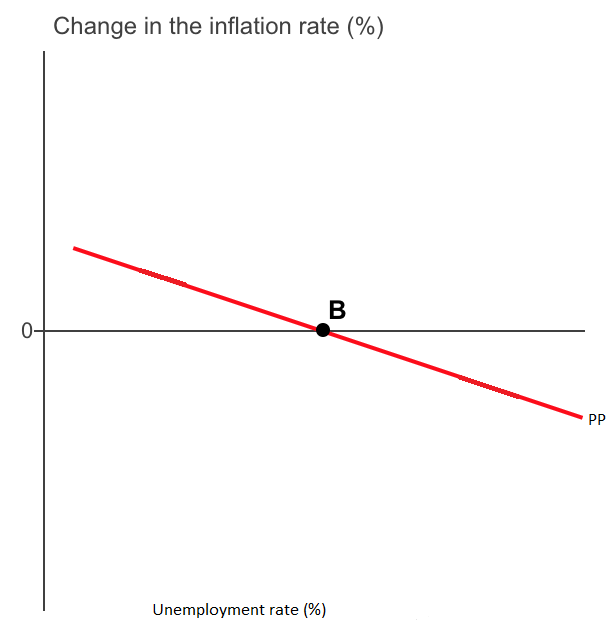
  • Long run Phillips curve is connected to the steady rate of inflation.

Important Points

  • Here PP is the long-run Phillips curve.
  • Point B is the point non-accelerating inflation rate of unemployment where the rate of unemployment for which the change in the rate of inflation is zero.

Hence, option A is the correct answer.

Question 41

New Keynesians use which of the following to explain price and wage stickyness ?

  1. AOption (a)

    Staggered labour contracts

  2. BOption (b)

    Menu Costs

  3. COption (c)

    Behaviour based on bounded rationality

  4. DOption (d)

    All of the above

View answer & explanation

Correct answer

Answer: (d)D.

All of the above

Why this answer is correct

Key Points

New Keynesian economics:

  • It deals with imperfect competition.
  • The new Keynesian model is proposed by N. Gregory Mankiw.
  • It focuses on price and wage stickiness.
  • Output is demand determined.
  • Wage rigidity causes unemployment.

Important PointsMenu costs:

  • Through a concept known as menu costs and the assertion that menu expenses contribute to market inefficiencies, New Keynesian economics also supports the idea of sticky prices.
  • Costs must be incurred, such as updating the pricing in catalogues or a menu, for a business to alter the price of a good or service.
  • Some contend that menu costs are insignificant and unimportant in terms of macroeconomics.

Staggered labours contracts:

  • Staggered labours contracts also explain price and wage stickyness.
  • This model emphasizes the overlapping of individual prices and wages due to staggered price and wage setting.
  • It could explain not only why changes in money impact real output, but also why the other properties mentioned above are found to hold in many countries.

Behaviour based on bounded rationality:

  • The concept of bounded rationality holds that each person's capacity for rational decision-making is constrained by the knowledge they possess, their cognitive capacities, and the limiting amount of time available to them.
  • According to George Akerlof and Janet Yellen's theory, firms won't want to change their price unless the benefit is more than a modest amount because of bounded rationality due to this restricted rationality, nominal prices and wages become inert, which can cause output to fluctuate while nominal prices and salaries remain constant.

Hence, new Keynesians use Staggered labour contracts, menu costs and behaviour based on bounded rationality to explain price and wage stickyness.

Question 42

Consider the following production function forms with a technical progress term A(t).

(a) Q = f (Kt, A(t) ⋅ Lt)

(b) Q = f (A(t) ⋅ Kt, Lt)

(c) Q = A(t) f (Kt, Lt)

Of the above which production function, with labour augmenting technology will keep the distribution of output between labour and capital as constant ? Answer from the code below :

  1. AOption (a)

    Only (a)

  2. BOption (b)

    Both (a) and (b)

  3. COption (c)

    Only (c)

  4. DOption (d)

    Both (a) and (c)

View answer & explanation

Correct answer

Answer: (a)A.

Only (a)

Why this answer is correct

Important PointsTechnical progress:

  • Technical progress refers to the discovery of new and improved methods of producing goods. changes in technology lead to an increase in productivity of labor, capital and other factors of production.

Labor augmenting technology:

  • The rate of labor augmenting technological progress is the growth rate of the efficiency of labor.
  • Assuming that technological progress increases the efficiency of labour at constant rate is called labour augmenting technological progress.​
  • The production function with labour augmenting technology will keep the distribution of output between labour and capital is: 

Q = f (Kt, A(t) ⋅ Lt)

Thus, option 1 is correct.

Question 43

Which one of the following statements is correct ?

  1. AOption (a)

    Global warming is simply another term for greenhouse effect.

  2. BOption (b)

    Global warming is an entirely natural phenomenon.

  3. COption (c)

    Global warming means melting down of glaciers.

  4. DOption (d)

    Global warming is the rise in average temperature at earth’s surface.

View answer & explanation

Correct answer

Answer: (d)D.

Global warming is the rise in average temperature at earth’s surface.

Why this answer is correct

The correct answer is Global warming is the rise in average temperature at earth’s surface.

Key Points Global Warming:

“Global warming is a gradual increase in the earth’s temperature generally due to the greenhouse effect caused by increased levels of carbon dioxide, CFCs, and other pollutants. “

Global warming is caused by both man-made and natural causes

Important Points Causes of Global Warming

Man-made Causes:

  • Deforestation
  • Use of Vehicles
  • Chlorofluorocarbon
  • Industrial Development
  • Overpopulation

Natural Causes:

  • Volcanoes
  • Water Vapour
  • Melting Permafrost
  • Forest Blazes


Green house Effect

  • The greenhouse effect is a phenomenon that happens when heat from a planet's host star passes through its atmosphere and heats the planet's surface but is prevented from radiating back into space by the atmosphere, making the planet warmer.

Question 44

In 2016 - 2017 the Centrally Sponsored Schemes (CSS’s) were restructured by the Government of India. Select the correct statements related to the restructuring, using the codes given below :

(a) The decision of restructuring was taken by the Governing Council of the NITI Aayog

(b) This will avoid overlaping of expenditure and provide visibility and impact to the CSS’s.

(c) The CSS’s have been classified into flagship and extra flagship categories.

(d) The existing number of the CSS’s is 37.

  1. AOption (a)

    (a), (b), (c) and (d)

  2. BOption (b)

    (b), (c) and (d)

  3. COption (c)

    (a) and (b)

  4. DOption (d)

    (a), (b) and (c)

View answer & explanation

Correct answer

Answer: (c)C.

(a) and (b)

Why this answer is correct

The correct answer is (a) and (b)

Key Points

Centrally Sponsored Schemes:

Centrally Sponsored Schemes are schemes that are funded fully or partly by the central government, but implemented by the states.

This is because they address subjects that are included in the state list. CSS as defined by the National Development Council are: “those schemes that are funded directly by the central ministries/ departments and implemented by states or their agencies, irrespective of their pattern of financing, unless they fall under the centre’s sphere of responsibility i.e. the union list.” This assistance is deliberately in areas that are State subjects, with the centre wishing to motivate the States to take up such programs

Important Points

  • Centrally Sponsored Schemes (CSS) was constituted on 9 March 2015 by the Hon'ble Prime Minister.
  • This was in pursuance of the decision taken in the first meeting of the Governing Council of NITI Aayog on 8 February 2015.
  • At present, there are 30 centrally-sponsored schemes, but these are umbrella programmes, and they have many sub-schemes under them.
  • Centrally sponsored schemes can be further divided into two sections — core of core schemes and core schemes

Question 45

In relation to considerations of demographic dividend, there appears to be ‘demographic dualism’ exhibited by the Indian states. In this regard consider the following factors :

(a) Total Fertility Rate

(b) Sex Ratio

(c) Per capita income

Of the above, which factor(s) is/are correct. Answer from the codes below :

  1. AOption (a)

    Only (a)

  2. BOption (b)

    Both (a) and (b)

  3. COption (c)

    Both (b) and (c)

  4. DOption (d)

    Only (b)

View answer & explanation

Correct answer

Answer: (a)A.

Only (a)

Why this answer is correct

The correct answer is Only (a)

Key Points Demographic Dividend:

  • Economic growth brought on by a shift in a nation's population structure—typically the outcome of declining fertility and mortality rates—is known as the demographic dividend.
  • The demographic dividend correlates with a rise in the productivity of the working population, which raises per capita income.

Demographic Dualism

  • The two effects of population are essentially described as demographic dualism.
  • A country's resources are under increased pressure when its population grows in one way or another since more people will need housing, food, healthcare, and other necessities.
  • On the other side, the country's changing demographics may present a chance for economic growth due to the country's growing population.

Important Points In relation to considerations of demographic dividend, there appears to be ‘demographic dualism’ exhibited by the Indian states.  In this regard Total Fertility Rate is the only factor 

This is because Demographers use the concept of Total Fertility Rate or TFR as the key indicator of population growth

Question 46

(A): International trade along the lines of comparative advantage improves the allocative efficiency of existing resources.

(R): International trade is an engine of growth.

  1. AOption (a)

    Both (A) and (R) are true and (R) is the correct explanation of (A).

  2. BOption (b)

    Both (A) and (R) are true, but (R) is not the correct explanation of (A).

  3. COption (c)

    (A) is true, but (R) is false.

  4. DOption (d)

    (A) is false, but (R) is true.

View answer & explanation

Correct answer

Answer: (b)B.

Both (A) and (R) are true, but (R) is not the correct explanation of (A).

Why this answer is correct

The correct answer is Both (A) and (R) are true, but (R) is not the correct explanation of (A).

Important Points (A) : International trade along the lines of comparative advantage improves the allocative efficiency of existing resources.

  • The economic theory of comparative advantage was created by British economist David Ricardo in the 19th century.
  • A comparative advantage occurs when a country can produce a good or service at a lower opportunity cost than another country.
  • The theory of comparative advantage demonstrates that trade can still be advantageous to both trading partners even when one country has an absolute advantage in producing goods.
  • Since, by using comparative advantage, both the countries can make the best use of their respective resources, it improves the allocative efficiency of existing resources.
  • Hence, (A) is true.

(R): International trade is an engine of growth.

  • International Trade encourages growth and improves economic welfare by encouraging the more effective use of different regions' resource endowments for factors of production and enabling individuals to buy commodities from reliable sources of supply.
  • Trade also makes available to people goods which cannot be produced in their country due to various reasons.
  • International trade growth can be a foundation for economic growth and poverty reduction, but it must be inclusive and consistent with sustainable development
  • Hence, (R) is true.

(R) is not the correct explanation of (A) because Reason does not specify why comparative advantage theory improves the allocative efficiency of existing resources. (R) only considers international trade as fuel for growth.

Hence, the correct answer is Both (A) and (R) are true, but (R) is not the correct explanation of (A).

Question 47

If a sample survey of the same 100 households is conducted in a particular village, annually for five years, the data so collected will be described as :

  1. AOption (a)

    Time Series Data

  2. BOption (b)

    Cross-section Data

  3. COption (c)

    Panel Data

  4. DOption (d)

    Pooled Time Series and Cross-section Data

View answer & explanation

Correct answer

Answer: (c)C.

Panel Data

Why this answer is correct

The correct answer is Panel Data

Key PointsPanel data:

  • Panel data, often known as longitudinal data, is a type of data that includes observations on various cross-sections over time.
  • Examples of the types of groupings that can make up panel data series are nations, businesses, people, or demographic categories.
  • Panel data also includes observations that were chronologically collected at regular intervals, just as time series data.
  • Similar to cross-sectional data, panel data includes observations made across a group of people.

Important Points Advantages of Panel data:

  • Panel data can be used to simulate both the typical and unique behaviour of groups.
  • Compared to cross-sectional or pure time series data, panel data is more efficient, more variable, and more informational.
  • Pure time series or cross-sectional data cannot detect or measure statistical effects, however panel data can.
  • When groups are combined into a single time series, estimate biases may occur. Panel data helps reduce these biases.

Question 48

If in a distribution mean is 40, mode is 60 and the standard deviation is 10, then the coefficient of skewness will be :

  1. AOption (a)

    -2

  2. BOption (b)

    2

  3. COption (c)

    -20

  4. DOption (d)

    5

View answer & explanation

Correct answer

Answer: (a)A.

-2

Why this answer is correct

The correct answer is -2

Key Points Mean:

  • The mean, which measures the central tendency of the data, is the average or computed central value of a set of numbers.
  • The statistical metric known as central tendency identifies the complete collection of data or distribution by a single value.

Mode: Mode means a value or a number that appears most frequently in a dataset.

Standard deviation: 

  • The standard deviation is a metric that reveals how much variance from the mean there is, including spread, dispersion, and spread.
  • A "typical" variation from the mean is shown by the standard deviation. Because it uses the data set's original units of measurement, it is a well-liked measure of variability.

Coefficient of skewness: The coefficient of skewness can be used to assess the degree and direction of skewness in a sample distribution by employing descriptive statistics like the mean, median, or mode.

Coefficient of Skewness formula:

  sk=Mean−modeStandard Deviationsk = {\text {Mean}-\text {mode}\over {\text {Standard Deviation}}}

Important Points

sk=Mean−modeStandard Deviationsk = {\text {Mean}-\text {mode}\over {\text {Standard Deviation}}}

sk=40−6010sk = {\text {40}-\text {60}\over {\text {10}}}

sk=−2sk = -2

Question 49

Which of the following statements are valid concerning a recursive system ?

(a) The parameters can be validly estimated using separate application of OLS to each equation.

(b) The independent variables may be correlated with the error terms in other equations.

Code :

  1. AOption (a)

    (a) only

  2. BOption (b)

    (b) only

  3. COption (c)

    Both (a) and (b)

  4. DOption (d)

    Neither (a) nor (b)

View answer & explanation

Correct answer

Answer: (c)C.

Both (a) and (b)

Why this answer is correct

Important PointsRecursive system

  • A recursive system is a system in which the current level of output depends upon the levels of previous output and inputs.

Major features of a recursive system 

  • The parameters can be validly estimated using separate applications of OLS to each equation.
  • The independent variables may be correlated with the error terms in other equation.
  • An application of two-stage least squares lead to unbiased but efficient parameter estimation.

Hence, on the basis of the above features of a recursive system, it can be concluded that both the given statements are valid.

Question 50

Generalized Least Squares method of estimation will not be suitable for dealing with which of the following problems :

(a) Autocorrelated disturbances (b) Heteroscedastic disturbances (c) Multi collinearity (d) Errors in variables

  1. AOption (a)

    (a) only

  2. BOption (b)

    (b) only

  3. COption (c)

    (c) and (d)

  4. DOption (d)

    (a) and (b)

View answer & explanation

Correct answer

Answer: (c)C.

(c) and (d)

Why this answer is correct

The correct answer is (c) and (d)

Key Points Generalized Least Squares:

  • The classical regression is based on rather restrictive assumptions concerning the behaviour of the error term.
  • An. alternate model, known as 'generalised linear regression model', is considerably less restrictive in this respect.
  • If we do not make these assumptions, but retain all other assumptions of the classical normal linear regression model, we have the so-called generalised linear regression model.

Important Points

  • Generalized Least Squares method of estimation will not be suitable for dealing with Multicollinearity or Errors in variables
  • Multicollinearity occurs when independent variables in a regression model are correlated.
  • This correlation is a problem because independent variables should be independent. If the degree of correlation between variables is high enough, it can cause problems when you fit the model and interpret the results.

Question 51

When an information asymmetry is observed after an agreement is obtained between individuals, it is called :

  1. AOption (a)

    Signalling

  2. BOption (b)

    Moral hazard

  3. COption (c)

    None of the above

  4. DOption (d)

    Both (1) and (2) above

View answer & explanation

Correct answer

Answer: (b)B.

Moral hazard

Why this answer is correct

Key Points

Information asymmetry (Asymmetrical Information)

  • The varying degrees of accessibility, availability and accuracy of market information to the two parties in the market is termed information asymmetry.

Moral Hazard

  • Moral hazard arises when one party to a contract passes the cost of his/her behaviour onto the other party to the contract, for which the latter is not compensated.
  • This cost is the consequence of the irrational behaviour of one of the two parties.

Example of Moral Hazard

  • If the seller of a motor car sells the car and offers a one-year warranty of free of cost repairs to the buyer, and, the buyer, taking the advantage of the warranty, may indulge in ruthless driving, knowing that, in case the car gets damaged, the cost will be borne by the seller. In this case, ruthless driving denotes irrational behaviour by the buyer.
  • If the seller had known beforehand about the possible irrational behaviour, he would not have offered the warranty to the buyer.
  • Moral hazard is the consequence of asymmetric information.

Hence, when an information asymmetry is observed after an agreement is obtained between individuals, it is called a moral hazard.

Additional Information

Signalling:

  • Signalling is used as a mechanism to resolve the problem of adverse selection caused by asymmetric information.
  • For example, in the case of the job market with asymmetric information, the educational qualification serves as a signalling device regarding the productivity of potential employees.
  • In order to minimize the potential costs that may arise on account of asymmetric information, employers can use educational qualifications as a signal of the productivity of potential employees.

Question 52

In the given diagram, after the price change, the price line shifts from PQ to PQ'. And consumer comes to equilibrium at point B instead of point A. Then what is true for potatoes ?

  1. AOption (a)

    It is a normal good.

  2. BOption (b)

    It is an inferior good.

  3. COption (c)

    It is a Giffen good.

  4. DOption (d)

    Nothing can be said about the nature of the good.

View answer & explanation

Correct answer

Answer: (c)C.

It is a Giffen good.

Why this answer is correct

Key Points

 Giffen Goods

  • Giffen goods are those goods in the case of which, demand increases with an increase in price, and, decreases with a decrease in price, regardless of the consumer's income level.
  • These are the goods that do not have any close substitutes. That is why, even when the price of these goods increases, the quantity demanded also increases.
  • Examples of giffen goods include rice, bread, potatoes, etc.
  • Giffen goods exhibit a direct price-demand relationship and hence, are an exception to the law of demand.

​

Important Points

Diagrammatic Explanation

  • In the given diagram, the initial budget line is PQ, and the consumer is in equilibrium at point A.
  • The new price line after the price change is PQ' and the new consumer equilibrium is at point B.
  • As a result of the price change, the budget line rotates outward on the X-axis which implies that the price of potatoes has fallen.
  • Movement from point A to point B depicts that with a fall in the price of potatoes, the quantity demanded has also fallen.

Thus, on the basis of the above price-demand relationship, it can be concluded that potatoes are giffen goods.

Additional Information

  • The demand curve for giffen goods has a positive slope, i.e. it slopes upward from left to right.
  • Inferior goods are those which have an inverse income-demand relationship, i.e., with an increase in consumer's income, demand for inferior goods decreases and vice-versa.
  • Normal goods are those which have a positive income-demand relationship, i.e., with an increase in consumer's income, demand for normal goods increases and vice-versa.

Question 53

According to M. Friedman, Quantity Theory of Money is the theory of :

  1. AOption (a)

    Value of money

  2. BOption (b)

    Price determination

  3. COption (c)

    Nominal income

  4. DOption (d)

    Demand for money

View answer & explanation

Correct answer

Answer: (d)D.

Demand for money

Why this answer is correct

Key Points

Friedman's quantity theory of money

  • Milton Friedman’s quantity theory of money highlights the role of money as an asset and treats the demand for money as a major part of wealth theory.
  • Milton Friedman has classified the holders of money as ultimate wealth-holders and business enterprises.
  • Milton Friedman has given more importance to ultimate wealth-holders

Important PointsFive different forms of wealth

  • Money (M) which includes currency, demand deposits, and interest-bearing time deposits.
  • Bonds (B) are defined as claims to time streams of payments that are fixed in nominal units.
  • Equities (E) are defined as claims to a time stream of payments that are fixed in real units.
  • Physical or non-human goods (G) which include inventories of producer and consumer durables.
  • Human capital (H), i.e., the productive capacity of human beings.

The equation for quantity theory of money

M/P = f ( y, w, Rm, Rb, Re, gp, u )

Here, M is the total stock of money demanded; P is price level; y is real income; Rm is the expected nominal rate of return on money; Rb is the expected rate of return on bonds; Re is the expected nominal rate of return on equities; gp is expected rate of change in prices of physical assets; u denotes variables other than income that affect the utility of money.

Hence, based on the above explanation, the quantity theory of money is the theory of demand for money.

Question 54

Prebisch - Singer hypothesis relates to :

  1. AOption (a)

    Balance of payments problem of developing countries.

  2. BOption (b)

    Terms of trade of developing countries. 

  3. COption (c)

    Prevalency of poverty among developing countries.

  4. DOption (d)

    Inequality of income in developing countries. 

View answer & explanation

Correct answer

Answer: (b)B.

Terms of trade of developing countries. 

Why this answer is correct

Key Points

  • Raul Prebisch showed that the terms of trade had a secular trend to move away from basic items and in favour of manufactured and capital goods using export figures for the United Kingdom between 1870 and 1940.
  • H. W. Singer has backed this position quite firmly.
  • The core of the Prebisch-Singer argument is that in order to import manufactured goods from the industrially advanced nations, the periphery or LDC countries had to export significant amounts of their raw exports.

Important Points

 Prebisch-Singer hypothesis:

  • Prebisch- Singer hypothesis suggests that over the long run, prices of primary goods such as coffee and cocoa decline in proportion to prices of manufactured goods such as car and washing hypothesis.
  • It is related to secular deterioration in terms of trade of developing countries.
  • It do not relates to balance of payments problem of developing countries.
  • The prevalency of poverty and income inequality is not related to singer hypothesis.

Thus, it can be concluded that prebisch singer hypothesis is related to terms of trade of developing countries.

Question 55

Which of the following statement about the India’s balance of payments is not correct ?

  1. AOption (a)

    If a foreign citizen deposits some money in a bank in India, the accounts regard this as a credit.

  2. BOption (b)

    The current account balance shows only the balance for the trade in goods and services combined.

  3. COption (c)

    Allowing for errors and omissions, the accounts always balance.

  4. DOption (d)

    If the country’s reserves of foreign currencies increase then there is a minus sign for this entry.

View answer & explanation

Correct answer

Answer: (b)B.

The current account balance shows only the balance for the trade in goods and services combined.

Why this answer is correct

Key Points

Balance of payments: 

  • The country's economic dealings with the rest of the world for a given time period, often a year, are documented in the balance of payments (BoP).
  • It is a balance sheet of the nation's systematic accounting that includes both debit and credit activities.
  • Balance of payment is an annual record.
  • Payments received from foreign countries enter as credit.
  • Payments made to other countries enter as debit.
  • **Balance of payment is divided into- **Trade account, **Capital account, **Current account
  • The current account in BOP includes unilateral transfers, interest, profits and dividend receipts and payments, export and import of both goods and services.
  • The capital account of BOP includes foreign direct investments, borrowings, foreign portfolio investment etc.

Important Points

As per statements: 

  • If a foreign citizen deposits some money in a bank, in India, it is regarded as credit item.
  • The current account balance does not show only the balance of goods and services, it includes unilateral transfers also.
  • The account always balances in errors and omissions.
  • If a country's reserves of foreign currencies increase, then there is negative sign for this entry.

Thus, statement 2 is incorrect.

Question 56

Statutory incidence of a tax deals with :

  1. AOption (a)

    the person(s) legally responsible for paying the tax.

  2. BOption (b)

    the amount of revenue left over after taxes.

  3. COption (c)

    the amount of taxes paid after accounting for inflation

  4. DOption (d)

    the amount of tax revenue generated after a tax is levied.

View answer & explanation

Correct answer

Answer: (a)A.

the person(s) legally responsible for paying the tax.

Why this answer is correct

Key Points

Statutory incidence of tax:

  • It measures the true cost of a tax levied by the government in terms of lost utility or welfare. It is a legal liability.
  • If tax falls on the entity that is legally responsible for remitting the tax revenues to the taxing government.
  • It deals with the person who is legally responsible for paying a tax or who has the ultimate burden of the tax.
  • It can't be shifted to others.

Question 57

In an economy, the GDP deflator is found to be 110 for the current year. If the GDP has registered an annual growth rate of 15 percent in the same year, then, the rate of growths of real GDP will be :

  1. AOption (a)

    5%

  2. BOption (b)

    1.5%

  3. COption (c)

    25%

  4. DOption (d)

    2.5%

View answer & explanation

Correct answer

Answer: (a)A.

5%

Why this answer is correct

Key Points GDP Deflator: The GDP deflator is a measure of inflation.

  • It is the ratio of the value of goods and services an economy produces in a particular year at current prices to that of prices that prevailed during base year.
  • This ratio shows the extent to which the increase in GDP has happened on account of higher prices than increase in output.
  • GDP deflator measures the difference between real GDP and nominal GDP.
  • Nominal GDP: measures GDP at current prices
  • Real GDP: measures GDP at constant prices.

Important Points From question given above, The growth of real GDP= growth of nominal GDP- growth of real GDP.

GDP deflator=110

Base year = 100

Rate of inflation = (110-100)/100=10%

Thus, the growth of real GDP= 15% - 10% = 5%

Question 58

What is the nature of equilibrium in the IS - LM model ?

  1. AOption (a)

    Stock equilibrium

  2. BOption (b)

    Flow equilibrium

  3. COption (c)

    Stock and flow equilibrium

  4. DOption (d)

    Oscillating equilibrium

View answer & explanation

Correct answer

Answer: (c)C.

Stock and flow equilibrium

Why this answer is correct

Key Points IS-LM Model: 

  • IS curve is the locus of all equilibrium points of good market.
  • LM curve is the locus of al equilibrium points of money market.
  • John hicks was the first economist who introduced IS-LM model in 1936.
  • The three exogenous variables in IS-LM model are liquidity, investment and consumption.
  • This model shows how the market for economic good interacts with the loanable funds market.
  • IS curve has stock equilibrium i.e. savings and investment are measured at particular point of time.
  • LM curve has flow equilibrium i.e. liquidity and money supply are measured over a period of time.


Hence, IS and LM model has both stock and flow equilibrium.

Question 59

If marginal propensity to import is 0.1 and the marginal propensity to consume is 0.7, the value of the income multiplier will be :

  1. AOption (a)

    1.25

  2. BOption (b)

    2.33

  3. COption (c)

    2.5

  4. DOption (d)

    3.33

View answer & explanation

Correct answer

Answer: (c)C.

2.5

Why this answer is correct

Key Points Income multiplier: Income multiplier is also known as foreign trade multiplier. 

  • It is defined as the amount by which the national income of a country will be raised by a unit increase in domestic investment on exports.
  • Foreign trade multiplier is dependent upon Marginal propensity to save(MPS) and marginal propensity to import(MPI).
  • The smaller these two marginal propensities are, the larger will be the value of multiplier and vice versa.

The formula of foreign trade multiplier is: 11−MPC+MPI\frac{1}{1-MPC+MPI}

Where, MPC = marginal propensity to consume

1 - MPC= marginal propensity to save

MPI=Marginal propensity to import

Important Points From question given above, MPI=0.1, MPC=0.7

Income multiplier= 11−MPC+MPI\frac{1}{1-MPC+MPI}

= 11 − 0.7 + 0.1\frac{1}{1\ -\ 0.7\ +\ 0.1}

= 10.4\frac{1}{0.4}

= 2.5

Question 60

Which amongst the following is not a feature of J.E. Meade’s model ?

  1. AOption (a)

    Perfect competition prevails.

  2. BOption (b)

    Economy produces consumption goods and producer goods.

  3. COption (c)

    Perfect substitution is possible between consumption and capital goods.

  4. DOption (d)

    It examines the relationship between the growth rate of population and growth rate of savings.

View answer & explanation

Correct answer

Answer: (d)D.

It examines the relationship between the growth rate of population and growth rate of savings.

Why this answer is correct

Important Points Meade's model of economic growth:

  • Meade's model analyses the relationship between income, capital and labour and technology.
  • This model is also known as "Model of steady growth".
  • He explain the relationship between growth rate of population and income growth not growth rate of savings.
  • Features/assumptions of Meade's model:
  • There is a closed economy.
  • Perfect competition prevails in economy.
  • Production is subject to law of constant returns.
  • Only two commodities- consumption good and capital good is produced and there is perfect substitution available in these goods.
  • Full employment of land, labour and machinery.

Hence, it can be concluded Meade's model do not explain the relationship between growth rate of population and growth rate of savings.

Question 61

Leibenstein in his critical minimum effort thesis treats population as a factor that is : 

  1. AOption (a)

    Income - generating

  2. BOption (b)

    Investment - inducing

  3. COption (c)

    Income - depressing

  4. DOption (d)

    Market - expanding

View answer & explanation

Correct answer

Answer: (c)C.

Income - depressing

Why this answer is correct

Important Points

Leibenstein's critical minimum effort theory: 

  • This theory is based on the relationship between three factors- per capita income, population growth and investment.
  • He identified population as an income-depressing factors (as a shock) whereas investment is an income generating factor (as a stimulant).
  • He mentioned that growth in an economy is possible when the income generating factors turnout to be more powerful than the income depressing factors.
  • He stated that it is not necessary to make critical minimum effort in a single stroke.
  • Leibenstein says that every economy is subject to shocks and stimulants.

Thus, it can be concluded that leibenstein in his critical minimum effort thesis treat population as an income depressing factor.

Question 62

In the context of doubling of farmer's income objective, which of the following is not correct ?

  1. AOption (a)

    The target year is 2022 - 23.

  2. BOption (b)

    It is real income which is to be doubled.

  3. COption (c)

    Income from cultivation alone is to be doubled.

  4. DOption (d)

    Diversification of agriculture is to be promoted to achieve this objective.

View answer & explanation

Correct answer

Answer: (c)C.

Income from cultivation alone is to be doubled.

Why this answer is correct

The incorrect statement is Income from cultivation alone is to be doubled.

Key Points Doubling of farmer's income objective

  • Narendra Modi to double farmers' income by 2022-23 is central to promote farmers' welfare, reduce agrarian distress and bring parity between income of farmers and those working in non-agricultural professions.
  • Doubling real income of farmers till 2022-23 over the base year of 2015-16, requires annual growth of 10.41 per cent in farmers income.

The major sources of growth operating within agriculture sector are:

  • improvement in productivity
  • resource use efficiency or saving in cost of production
  • increase in cropping intensity
  • diversification towards high value crops

Hence, Income from cultivation alone is to be doubled is incorrect

Question 63

Arrange the following events in the Indian economy in chronological order :

(a) First phase of nationalisation of 14 Banks

(b) Establishment of Narshimhan Committee I on Banking system

(c) Enactment of FEMA Act

(d) Establishment of EXIM Bank of India

  1. AOption (a)

    (a), (c), (d), (b)

  2. BOption (b)

    (a), (d), (b), (c)

  3. COption (c)

    (a), (c), (b), (d)

  4. DOption (d)

    (a), (d), (c), (b)

View answer & explanation

Correct answer

Answer: (b)B.

(a), (d), (b), (c)

Why this answer is correct

The correct sequence is (a), (d), (b), (c)

Key Points

EventsYear/Date
First phase of nationalisation of 14 BanksJuly 1969
Establishment of EXIM Bank of India1982
Establishment of Narshimhan Committee I on Banking system14th August 1991
Enactment of FEMA Act1st June 2000

Important Points

1. First phase of nationalisation of 14 Banks:

  • The first bank in India to be nationalized was the Reserve Bank of India which happened in January 1949.
  • Further, 14 other banks were nationalized on 19th July 1969.
  • The 14 banks were: Allahabad Bank, Bank of Baroda, Bank of India,  Bank of Maharashtra, Canara Bank, Central Bank of India, Dena Bank, Indian Bank, Indian Overseas Bank, Punjab National Bank, Syndicate Bank, UCO Bank, Union Bank of India, United Bank of India

2. Establishment of EXIM Bank of India

  • Exim Bank of India represents a rare case of an institution where the concept and need for such an institution had been debated for a long period-more than two decades – before it was finally set up in 1982.
  • It was set up for the purpose of financing, facilitating and promoting India’s foreign trade.
  • It is the principal financial institution in the country for coordinating the working of institutions engaged in financing exports and imports.

3. Establishment of Narshimhan Committee on Banking system:

  • The banks were not functioning properly during India’s economic liberalisation in 1991.
  • India recognised the need of an effective banking system for a country's economic growth.
  • That is why ex-Finance Minister of India Dr. Manmohan Singh established the Narasimham committee to examine the functioning of banks.
  • Government of India appointed the Narasimham Committee I, a nine-person group, on August 14th, 1991. Maidavolu Narasimham served as its chairman.

4. Enactment of FEMA Act:

  • Foreign Exchange Management Act, or FEMA, is an official Act that changes and codifies rules governing foreign exchange in India.
  • In order to oversee foreign commerce and exchange activities, the RBI proposed FEMA in 1999.
  • On June 1st, 2000, the Foreign Exchange Management Act became law.
  • FEMA's primary goal was to aid in the facilitation of Indian payments and trade abroad.

Question 64

(A) : In Solow’s growth model under equilibrium conditions capital labour ratio does not change.

(R) : Substitution between capital and labour is possible.

  1. AOption (a)

    Both (A) and (R) are true and (R) is the correct explanation of (A).

  2. BOption (b)

    Both (A) and (R) are true, but (R) is not the correct explanation of (A).

  3. COption (c)

    (A) is true, but (R) is false.

  4. DOption (d)

    (A) is false, but (R) is true.

View answer & explanation

Correct answer

Answer: (a)A.

Both (A) and (R) are true and (R) is the correct explanation of (A).

Why this answer is correct

Key Points Solow Growth Model: The Solow Growth Model, an exogenous model of economic increase, examines changes in an economy's output level over time as a result of variations in the rates of population growth, savings growth, and technological advancement.

Important Points

(A): In Solow’s growth model under equilibrium conditions capital-labour ratio does not change.

  • The basic equation of the Solow model is given as K' = sF(K, L0ent)
  • In the Solow model, the equilibrium growth path is a steady state in which variables such as capital (K) and output (Y) grow at constant rates, and the capital-labour ratio among key variables remains stable.

Hence, the assertion is correct

(R) : Substitution between capital and labour is possible.

  • The unitary elasticity of substitution is one of the basic assumptions of the Solow model.
  • The elasticity of substitution is the ratio of change in capital-output ratio to change in the marginal rate of technical substitution.
  • Unitary elasticity of substitution = percentage change in (K / L) / percentage change in MRTS = 1

Hence, the reason is correct.

On the basis of the above discussion, it can be concluded that both assertion and reason are correct, and the reason is the correct explanation of the assertion.

Question 65

A bag contains 5 red, 7 white and 3 green balls. One ball is randomly drawn from the bag. What is the probability that it is green ?

  1. AOption (a)

    1215\frac{12}{15}

  2. BOption (b)

    15\frac{1}{5}

  3. COption (c)

    715\frac{7}{15}

  4. DOption (d)

    13\frac{1}{3}

View answer & explanation

Correct answer

Answer: (b)B.

15\frac{1}{5}

Why this answer is correct

The correct answer is 15\frac{1}{5}

Key Points Probability:

  • The estimated frequency of occurrence of an event among similar events is what is meant by the term "probability" for a given event.
  • The probability theory provides a means of getting an idea of the likelihood of occurrence of different events resulting from a random experiment in terms of quantitative measures ranging between zero and one.
  • The probability is zero for an impossible event and one for an event which is certain to occur

Important Points Red balls = 5

White Balls = 7

Green balls = 3


P(green)=Number of favourable outcomesTotal outcomesP(green) = \frac {\text{Number of favourable outcomes}} {\text {Total outcomes}}


P(green)=315=15P(green) = \frac {3} {15} = {1\over 5}


Probability that it is green = 1/5

Question 66

In the adjacent diagram, Government should fix the price at which of the following points to make monopoly result in a socially optimal outcome ?

  1. AOption (a)

    At point A

  2. BOption (b)

    At point B

  3. COption (c)

    At point C

  4. DOption (d)

    At point D

View answer & explanation

Correct answer

Answer: (c)C.

At point C

Why this answer is correct

Key Points

Monopoly 

  • A monopoly is a market structure in which there exists a single seller (monopolist) and a large number of buyers of the commodity produced by the monopolist.
  • Monopolist has absolute control over the supply and price of the commodity due to the absence of close substitutes for the commodity.
  • Examples of monopoly markets are railways and Microsoft.

Additional InformationSocially Optimal Output

  • A socially optimal level of output is one that reflects both the private and social costs and benefits associated with the production of a commodity.
  • A socially optimal level of output is where the demand equals marginal cost, but the monopolist produces too little output as compared to the socially optimal level which results in deadweight loss.
  • Therefore, socially optimal level of output is where social marginal benefit us equal to social marginal cost.
  • Monopolist charges a price higher than the socially optimal level.

In the diagram:

The Socially optimum level is at the point where MC=AC. 

Hence, for a socially optimal outcome, the government should fix the price at point C.

Confusion Points The given figure by UGC NET is little confusing in its presentation as it is difficult to ascertain the position of point A, B and C.

  • Point A is where AC curve intersects the MR curve.
  • Point B is where MC curve intersects the MR curve.
  • Point C is where MC curve intersects the AC curve.

Question 67

If the producer pays the price for each of the inputs that is used is equal to its value of Marginal product, then which one of the following does he earn ?

  1. AOption (a)

    Zero supernormal profit

  2. BOption (b)

    Monopoly profit

  3. COption (c)

    Positive supernormal profit

  4. DOption (d)

    Negative supernormal profit

View answer & explanation

Correct answer

Answer: (a)A.

Zero supernormal profit

Why this answer is correct

The correct answer is Zero supernormal profit

Key PointsMarginal product: Marginal product is the increase in the total product when one more unit of a factor input is employed.

Super Normal Profit:

  • Supernormal profit is all the excess profit a firm makes above the minimum return necessary to keep a firm in business.
  • Positive supernormal profit is the excess of Total Revenue over Total Costs.
  • Negative Super Normal profit is excess of Total cost over Total Revenue.

Important Points

  • The producer is paying price for each input used in equalizing Marginal Product.
  • The Marginal Product is the change in output resulting by employing one more unit of a particular factor.
  • Since MP is equal to price paid, The extra income generated is utilised in payment of factor input. Hence, producer is left with 0 Super normal profit.

Question 68

Which of the following will be true for both monopoly and monopolistic competition in the short run ?

  1. AOption (a)

    Price is greater than marginal revenue.

  2. BOption (b)

    Price is equal to marginal revenue.

  3. COption (c)

    Price is equal to marginal cost.

  4. DOption (d)

    Price is equal to average cost.

View answer & explanation

Correct answer

Answer: (a)A.

Price is greater than marginal revenue.

Why this answer is correct

Key Points

Monopoly 

  • Monopoly is a market structure in which there is a single seller of the product for which there are no close substitutes.
  • Being a single seller of the product for which there is a large number of buyers, a monopolist has complete control over the supply of the commodity and thus he is the price maker.

Monopolistic competition

  • Monopolistic competition is a market structure in which there is a large number of sellers dealing in differentiated products which are close substitutes for each other.
  • Each firm in this market has control over the supply or price of its specific product and thus sellers enjoy some degree of monopoly power.

Important Points

Similarities between monopoly and monopolistic competition

  • In both markets, the demand curve (average revenue curve) and marginal revenue curve slope downwards.
  • The average revenue curve lies above the marginal revenue curve.
  • In monopoly and monopolistic competition, equilibrium is determined when marginal revenue equates marginal cost, i.e., MR=MC, and, afterward, MC is rising.
  • In the case of both market structures, the price exceeds the marginal cost.
  • As in the case of equilibrium, marginal cost is equal to marginal revenue, and price exceeds marginal cost, it is evident that the price also exceeds the marginal revenue, i.e., P = AR > MC = MR

Thus, in the short run, the price is greater than the marginal revenue in both monopoly and monopolistic competition.

Question 69

For the function Q = AKα Lβ , which of the following is correct?

  1. AOption (a)

    The degree of homogeneity is 1

  2. BOption (b)

    Elasticity of substitution is equal to α + β

  3. COption (c)

    Output elasticity with respect to capital is α

  4. DOption (d)

    Marginal product of a factor = Average product of the factor

View answer & explanation

Correct answer

Answer: (c)C.

Output elasticity with respect to capital is α

Why this answer is correct

 Key Points

Output elasticity (Capital (EK)): It is the ratio of change in output to change in capital input.

Cobb Douglas Function:

  • In the case of Cobb Douglas production function, the elasticity of substitution is equal to unity.
  • The value of the marginal product of the factor is the product of relative shares of factors in national income and the average product of the factor.
  • Q = A.KαLβ:This production function is an example of Cobb Douglas Production Function

Important PointsCoefficient α 

  • Coefficient α represents the share of capital in national income.
  • Share of capital in national income = [K.{δQ / δK}] / Q]
  • Share of capital in national income = K α Kα-1 Lβ K-α  L-β = K0α L0 = α

Calculation of elasticity coefficient(EK) = (δQ / Q) / (δK / K)

(EK) = (δQ / δK) / (K / Q)

(EK) = [(α A.Kα-1Lβ).K] / A.KαLβ = α

Question 70

Which of the following is likely to be most inflationary in its impact ?

  1. AOption (a)

    Repayment of public debt

  2. BOption (b)

    Borrowings from the public to finance a budget deficit

  3. COption (c)

    Borrowings from banks to finance a budget deficit

  4. DOption (d)

    Creating new money to finance a budget deficit

View answer & explanation

Correct answer

Answer: (d)D.

Creating new money to finance a budget deficit

Why this answer is correct

Key Points

  • A budget deficit occurs when government expenditure exceeds government receipts during a financial year.

Techniques of deficit financing and their impact on the economy

  • Budget deficit ⇒ Printing of new currency ⇒ Increase in money supply ⇒ Increase in aggregate demand level ⇒ Aggregate supply < Aggregate demand ⇒ Increase in prices⇒Inflation
  • Budget deficit ⇒ Repayment of public debt ⇒ Increase in tax rates ⇒ Decrease in disposable income ⇒ Fall in aggregate demand ⇒ Aggregate demand < Aggregate supply ⇒ Fall in the general price level
  • Budget deficit ⇒ Borrowings from the public ⇒ Fall in money supply ⇒ Fall in consumption levels ⇒ Fall in aggregate demand level
  • Budget deficit ⇒ Borrowings from banks ⇒ Fall in funds with commercial banks ⇒ Increase in the interest rate on loans ⇒ Reduced borrowings ⇒ Fall in consumption and investments.

Hence, creating new money (printing of new currency) to finance the budget deficit is likely to be the most inflationary in its impact.

Additional Information

  • Deficit financing is the technique used to finance budget deficits through government borrowings and the printing of new money or currency.

Types of the budget deficit:

  • Revenue deficit: It is the excess of revenue expenditure over revenue receipts.
  • Fiscal deficit: It is the total expenditure(revenue + capital) over total receipts (revenue + capital other than borrowings).
  • Primary deficit: It is the difference between fiscal deficit and interest payments.​

Question 71

Tax buoyancy is expressed as :

Where, ETYb\rm E^b_{TY} = Buoyancy of tax revenue to income

Tb = Total Tax revenue

∆Tb = Change in total tax revenue

Y = Income

∆Y = Change in income

  1. AOption (a)

    ETYb=ΔTbΔY×YTb\rm E^b_{TY}=\frac{\Delta T^b}{\Delta Y}\times\frac{Y}{T^b}

  2. BOption (b)

    ETYb=ΔYΔTb×TbY\rm E^b_{TY}=\frac{\Delta Y}{\Delta T^b}\times\frac{T^b}{Y}

  3. COption (c)

    ETYb=ΔYΔTb÷TbY\rm E^b_{TY}=\frac{\Delta Y}{\Delta T^b}\div\frac{T^b}{Y}

  4. DOption (d)

    ETYb=ΔTbΔY÷YTb\rm E^b_{TY}=\frac{\Delta T^b}{\Delta Y}\div\frac{Y}{T^b}

View answer & explanation

Correct answer

Answer: (a)A.

ETYb=ΔTbΔY×YTb\rm E^b_{TY}=\frac{\Delta T^b}{\Delta Y}\times\frac{Y}{T^b}

Why this answer is correct

Important Points Tax buoyancy:

  • It is the relationship between variations in Government's tax income change and the potential in GDP.
  • When a tax collects greater revenue without changing the rate of taxing, it is said to be buoyant.
  • It is influenced by various factors such as- volume of tax base, rationale and transparency of tax rates.
  • The formula for tax buoyancy is: ETYb=ΔTbΔY×YTb\rm E^b_{TY}=\frac{\Delta T^b}{\Delta Y}\times\frac{Y}{T^b}
  • It is described as, (income divided by total tax revenue) multiply by (change in total tax revenue divided by change in income).

Therefore, option 1 is correct.

Question 72

Which of the following statements about the AK model (Y = AK) of growth is false?

  1. AOption (a)

    This is a part of endogeneous growth theories.

  2. BOption (b)

    The model assumes that an increase in the physical stock of capital will shift the production function upwards.

  3. COption (c)

    The model assumes diminishing returns to capital.

  4. DOption (d)

    The model suggest that if the level of investment is higher than depreciation, there would be sustained growth.

View answer & explanation

Correct answer

Answer: (c)C.

The model assumes diminishing returns to capital.

Why this answer is correct

Important Points AK Model:

  • The AK model of economic growth is an endogenous growth model came in 1980's.
  • The AK model assumes that when people accumulate capital, learning by doing generates technological progress that tends to raise the marginal product of capital, thus on setting the tendency for the marginal product to diminish when technology is unchanged.
  • The model results in a production function of the form Y = AK; in which the marginal product of capital is equal to the constant A.

Features/ assumptions of AK growth model:

  • Many firms are there in the market.
  • knowledge and technical know-how are a non-rival good.
  • There is increasing returns to scale to all factors taken together.
  • Hence, this model assumes increasing returns to capital not diminishing returns to capital.
  • This model assumes that an increase in physical stock of capital will shift the production function upwards.
  • Technological advance emerges from what people learn by doing.
  • This model states that if the investment level is higher than the depreciation, there would be sustained growth in economy.

Therefore it can be concluded that "diminishing returns to capital" is not an assumption of AK model.

Question 73

In Solow’s growth model, the output per capita is a function of :

  1. AOption (a)

    Labour - Output ratio

  2. BOption (b)

    Capital - Output ratio

  3. COption (c)

    Technical progress

  4. DOption (d)

    Capital - Labour ratio

View answer & explanation

Correct answer

Answer: (d)D.

Capital - Labour ratio

Why this answer is correct

Key Points

Solow model: Solow model came into existence in 1956.

  • Solow's model is a neo-classical growth model.
  • He got noble prize for this model and stated during his speech that his model has started a cottage industry of model building in growth theory.

Important Points

Assumptions of Solow model are:

  1. Produces one composite good which can be consumed or accumulated as a stock of capital.
  2. Labor supply is homogenous.
  3. Production function is continuous and exhibit CRS.
  4. No government interference.

Solow model is a function of: Y = f (L, K)

Output per capita is a function of Capital-labour ratio- i.e., k=K/L- Capital-labour ratio

Hence, in Solow’s growth model, the output per capita is a function of Capital - Labour ratio.

Question 74

‘Workers must own the capital to which their savings has given rise.’ This is an important assumption of the growth model, developed by :

  1. AOption (a)

    L. Pasinetti

  2. BOption (b)

    N. Kaldor

  3. COption (c)

    R. Solow

  4. DOption (d)

    J. E. Meade

View answer & explanation

Correct answer

Answer: (a)A.

L. Pasinetti

Why this answer is correct

Important Points

L. Pasinetti model: Pasinetti model came into existence in 1962.

  • He argues that Kaldor has neglected to take into account the fact that wage earners who save did not receive a return on their wealth.
  • Pasinetti's model has attracted a deal of attention because it addresses the important question of how the distribution of assets evolves in a capitalist economy and implies that rate of profit is given by r = P/K
  • Income distribution depends only on the saving rate of capitalists and not on saving rate of workers and has taken into account the inability of workers.

Hence, workers must own the capital to which their savings has given rise, this is an assumption given by Pasinetti.

Question 75

Which amongst the following pairs is not correctly matched ?

(Concept)(Organization)
(1) Gender Development IndexUNDP
(2) Ease of Doing BusinessWorld Bank
(3) Inclusion IndexWorld Economic Forum
(4) World Hunger IndexUnited Nations
  1. AOption (a)

    1

  2. BOption (b)

    2

  3. COption (c)

    3

  4. DOption (d)

    4

View answer & explanation

Correct answer

Answer: (d)D.

4

Why this answer is correct

The incorrect match is World Hunger Index - United Nations

Key Points 1. Gender Development Index:

  • The Gender Development Index (GDI) is an index designed to measure gender equality.
  • GDI and the Gender Empowerment Measure (GEM) were first mentioned in the United Nations Development Program's 1995 Human Development Report.
  • The GDI uses the same components of the Human Development Index (HDI) – longevity, education and income – revealing whether human development achievements are distributed between the two genders.
  • Hence, it is correctly matched.

2. Ease of Doing Business: 

  • The World Bank Group developed a ranking system called the Ease of Doing Business (EoDB) index.
  • Higher rankings in the EODB index (a lower numerical number) denote better, typically simpler business rules and more robust property rights safeguards.
  • It is an aggregate figure that includes different parameters which define the ease of doing business in a country.
  • Hence, it is correctly matched. 3. Inclusion Index:
  • The World Economic Forum System Initiative on Shaping the Future of Economic Progress developed the Inclusive Development Index (IDI), an annual economic index, in 2017.
  • This initiative seeks to inform and enable sustained and inclusive economic success by enhanced public-private partnership, thought leadership and analysis, strategic dialogue, and practical cooperation, including the acceleration of social impact through business action.
  • Hence, it is correctly matched. 4. World Hunger Index:
  • The Global Hunger Index (GHI) is a tool created to fully assess and monitor hunger on a global, regional, and national level.
  • It outlines the achievements and shortcomings in reducing hunger and offers insights into the causes of hunger and nutritional insecurity.
  • The Global Hunger Index (GHI), which is determined annually by the International Food Policy Research Institute (IFPRI), aims to increase understanding of regional and national inequalities.
  • Hence, it is not correctly matched.

Question 76

Which of the following statement(s) is/are true?

(a) a common resource is rival and non-excludable.

(b) a public good is non-rival and non-excludable.

Select the correct answer from the codes given below :

  1. AOption (a)

    Both (a) and (b)

  2. BOption (b)

    Only (a)

  3. COption (c)

    Only (b)

  4. DOption (d)

    Neither (a) and (b)

View answer & explanation

Correct answer

Answer: (a)A.

Both (a) and (b)

Why this answer is correct

The correct answer is Both (a) and (b)

Key Points Common Resource:

  • A common resource is a non-excludable but rival good; that is, an item that people cannot be forcibly stopped from consuming yet whose consumption reduces the consumption of another person's
  • Examples of common goods are coal and timber because they can only be possessed or consumed by a single user at one time but access is not restricted.
  • Hence, (a) is true

Public Good:

  • Public commodities that are consumed by people but whose supply is unaffected by use are known as non-rivalrous products.
  • In other words, the quantity of a given good that is available for use by others is unaffected when a person or group of people consumes it.
  • Therefore, non-rivalrous commodities can be used again without worrying about the supply running out.
  • Public goods are described as non-excludable and non-rivalrous.
  • Therefore, if a specific good is both non-excludable and non-rivalrous, it is considered a public good. This means that all people benefit equally from it, and no one is denied access to it.
  • An example of this is a public park being accessible to everyone, even to people who are not from that city
  • Hence, (b) is also true.

Question 77

‘Menu costs’ in relation to inflation refers to :

  1. AOption (a)

    Cost of revaluing currency.

  2. BOption (b)

    Cost of altering price lists.

  3. COption (c)

    Cost of the maintenance of monetary base.

  4. DOption (d)

    Cost of finding better rates of return.

View answer & explanation

Correct answer

Answer: (b)B.

Cost of altering price lists.

Why this answer is correct

Key Points

 Menu costs: Menu costs are the costs incurred by firms on account of changes in the prices of goods and services produced. It refers to cost of altering price lists.

Menu costs include the following-

  • Costs incurred on printing of new price lists.
  • Costs incurred on printing of new promotional material.
  • Costs incurred on meetings and phone calls for negotiations with suppliers and other stakeholders.

Important PointsMankiw's sticky prices model (Menu costs hypothesis)

  • Menu cost is a concept related to Mankiw's sticky prices model which is based on the new Keynesian terminology.
  • According to this hypothesis, it is profitable for firms to react to small changes in demand by keeping the prices constant during the short period and making changes in output level.
  • Menu costs explain the short-run stickiness of prices.
  • Due to menu costs, in the short run, firms do not change the prices whenever there occurs a change in demand conditions.

Thus, Menu costs refer to the costs of altering price lists.

Question 78

Which amongst the following is not correctly matched with regard to balance of payments account ?

ItemNature
(1)Import of goods and servicesDebit in current account
(2)Receipt of transfer paymentsCredit in the current account
(3)Direct investment receiptsCredit in the capital account
(4)Portfolio investment redemptionDebit in the current account
  1. AOption (a)

    (1)

  2. BOption (b)

    (2)

  3. COption (c)

    (3)

  4. DOption (d)

    (4)

View answer & explanation

Correct answer

Answer: (d)D.

(4)

Why this answer is correct

Key Points Current account: Current account is an account in which there is a record of country's international transaction with rest of world.

  • It includes both goods and services.
  • It includes trade account(balance of trade), these are also known as visible or tangible trade.
  • It includes transfer payments, also known as unilateral transfers.

Capital account: Capital account is a measurement of financial flows, or the country's  flow of assets and liabilities in and out of the country.

  • it includes foreign investments , foreign loans, banking balances and other forms of capital.

Debit items: Debit items in current and capital account includes payments made to other countries or flow of capital from our country to other.

Credit items: Credit items in current and capital account includes receipts received from other country or inflow of capital to our country.

Important Points

ITEMSNATURE
Import of goods and services- Capital outflow from our country (payments-debit, Goods and services-current account) - So, it is debited in current account.
Receipt of transfer payments- Capital inflow to our country (receipts-credit, transfer payments- current account) - So, it is credited in current account.
Direct investment receipts- Capital receipts to our country (receipts- credit, Direct investment- capital account) - So, it is credited in capital account.
Portfolio investment redemption- Do not include in current account because portfolio investment redemption is a part of capital account. - So, it is debited in capital account.
Thus, option 4 does not match.

Question 79

Which of the following is a capital receipt in the Government budget?

  1. AOption (a)

    Interest receipts on loans given by the Government to other parties.

  2. BOption (b)

    Dividend and profit of public enterprises.

  3. COption (c)

    Borrowings of the government from the public.

  4. DOption (d)

    Property tax receipts.

View answer & explanation

Correct answer

Answer: (c)C.

Borrowings of the government from the public.

Why this answer is correct

Key Points

Government budget:

  • The government budget is an annual financial statement showing the fiscal year's income and expenses.
  • It is frequently proposed by the legislature, approved by the C.E.O. or President, and presented to the nation by the finance minister.
  • The nation's annual financial statement is also referred to as the budget.

Important Points

Capital receipt:

  • These receipts create liabilities.
  • It reduces financial assets.
  • It can be both debt and non-debt receipts.
  • Non-debt capital receipts are such as the recovery of loans and advances, disinvestment, and issue of bonus shares.
  • It refers to the incoming cash flows.
  • Examples of capital receipts are loans from the public, foreign governments, and central banks.

Hence, borrowings of the government from the public is a capital receipt in the Government budget.

Additional Information Revenue Receipts:

  • Revenue receipts are those that neither increase a government's liabilities nor decrease its assets.
  • They are routine and ongoing in nature, and the government receives them as part of daily operations.

Examples:

  • Interest receipts on loans given by the Government to other parties.
  • Dividend and profit of public enterprises.
  • Property tax receipts

Question 80

Maximum social advantage is achieved when :

  1. AOption (a)

    Total Social Sacrifice = Total Social Benefits

  2. BOption (b)

    Marginal Social Sacrifice = Marginal Social Benefits

  3. COption (c)

    Net Social Sacrifice = Net Social Benefits

  4. DOption (d)

    Average Social Sacrifice = Average Social Benefits 

View answer & explanation

Correct answer

Answer: (b)B.

Marginal Social Sacrifice = Marginal Social Benefits

Why this answer is correct

Key Points

Maximum Social Advantage:

  • Hugh Dalton explains the principle of maximum social advantage with reference to Marginal Social Sacrifice and Marginal Social Benefits.
  • The principle of maximum social advantage is as we all know that government does some expenditures like expenditure on roads, education, defense, etc.
  • For this government impose some taxes. We can say that government does expenditures for the benefit of society and when government imposes taxes then it will be the sacrifice of society.
  • The maximum social advantage is achieved when marginal social sacrifice is equal to the marginal social benefits.

Principal of Maximum Social Advantage

Here P is the point where the maximum social advantage is obtained.

Question 81

Consider the following statements :

(a) Effective demand in a market is the demand for a product or service which occurs when purchasers are constrained in a different market.

(b) Notional demand is the demand that occurs when purchasers are not constrained in any market.

Which of the above statements is/are correct ? Answer from the code below :

  1. AOption (a)

    Only (a) is correct

  2. BOption (b)

    Only (b) is correct

  3. COption (c)

    Both (a) and (b) are correct

  4. DOption (d)

    Neither (a) nor (b) is correct

View answer & explanation

Correct answer

Answer: (c)C.

Both (a) and (b) are correct

Why this answer is correct

Important Points

Effective demand:

  • The aggregate demand at which a level of employment is also equal to the aggregate supply is called effective demand.
  • There is an aggregate demand function for an economy that shows aggregate demand at various price levels.
  • Here, purchasers are constrained in different markets.
  • Here aggregate demand price can be more or less than the aggregate supply price.

Notional demand:

  • These are the market where goods are demanded if all markets are in equilibrium.
  • Here, purchasers are not constrained to different markets.

Hence both statements are correct.

Question 82

For the capitalist economy, the primary objective of the New Classical Economics is to explain which of the following ?

  1. AOption (a)

    Business cycle phenomenon

  2. BOption (b)

    Underemployment

  3. COption (c)

    Wage - price rigidity

  4. DOption (d)

    Effectiveness of Government policy

View answer & explanation

Correct answer

Answer: (a)A.

Business cycle phenomenon

Why this answer is correct

Key Points New Classical Economics: Neo classical economics is also known as Radicalists, Rational expectations or RATEX model.

  • The new classical economists are- Robert Lucas, Thomas sergeant, Robert Barro.
  • They stressed upon the rational expectations of people about future events.
  • The rational expectations determine AD and AS curves such that real output remains the same, but wages and prices increases.
  • They stressed to explain the phenomenon of business cycles.
  • In a business cycle, these are wave like fluctuations in aggregate employment, income, output and price level.
  • New classical school of the "real business cycle" led by Prescott and Kydland regards changes in productivity as the driving forces in business cycles.

Additional Information Wage-price rigidity:

  • Wage-price rigidity are rigidities in real pries and wages that fail to adjust to the level indicated by equilibrium or if something holds one price or wage fixed to a relative price of other.

Question 83

In the last decade, which one among the following sectors has attracted the highest Foreign Direct Investment (FDI) inflow into India ?

  1. AOption (a)

    Telecommunication sector

  2. BOption (b)

    Defence sector

  3. COption (c)

    Service sector

  4. DOption (d)

    Insurance sector

View answer & explanation

Correct answer

Answer: (c)C.

Service sector

Why this answer is correct

The correct answer is Service sector

Key Points

  • Foreign Direct Investments or FDI refers to the investment that is made by a business from one country into a business of another country.
  • The main aim of FDI is the control of the business' ownership.
  • These investments are generally made by a developed nation into a developing nation;
  • FDI policy is an enabling policy which is uniformly applicable in the country.
  • Government has put in place a liberal and transparent policy for Foreign Direct Investment (FDI), wherein most of the sectors are open to FDI under the automatic route.

Sector-wise FDI Equity Inflows from April 2000 to December 2019.

Sector% of Total Inflows
Service sector17.66
Computer hardware and software9.54
Telecommunication8.13
Trading5.81
Construction Development5.55
Automobile Industry5.23
Chemicals3.82
Drugs and Pharmaceuticals3.59
Construction3.54

Question 84

Consider the following diagram which shows the production of a commodity under the condition of increasing cost. If a unit tax is imposed on the commodity, what will be the amount of the burden of the tax on the buyers?

  1. AOption (a)

    NL

  2. BOption (b)

    LQ

  3. COption (c)

    LR

  4. DOption (d)

    RQ

View answer & explanation

Correct answer

Answer: (d)D.

RQ

Why this answer is correct

The correct answer is RQ

Important Points

 It is evident from the graph that

At price "OP" the quantity sold was OM

Since a unit tax has been imposed, this will increase the price of the product.

The price increased from OP to OP'

As the condition of increasing cost is prevailing, the seller would not be able to increase the profit, so the supply will decrease.

The new supply curve will be towards the left of the initial supply curve represented by S'S'

The demand curve and the supply curve meet at point Q and equilibrium quantity is ON

Since, the increase in price is brought by imposition of unit tax, this tax burden will fall on the buyer which is represented by RQ.

Question 85

Arrange the following books in chronological order of their publication. Select the correct answer from the codes given below :

(a) The Affluent Society

(b) Asian Drama

(c) The General Theory of Employment, Interest and Money

(d) Development as Freedom

  1. AOption (a)

    (c), (b), (a), (d)

  2. BOption (b)

    (c), (a), (b), (d)

  3. COption (c)

    (a), (b), (c), (d)

  4. DOption (d)

    (d), (c), (b), (a)

View answer & explanation

Correct answer

Answer: (b)B.

(c), (a), (b), (d)

Why this answer is correct

The correct chronological order is (c), (a), (b), (d)

Key Points 

PublicationsYear/Date
The General Theory of Employment, Interest and MoneyFebruary 1936
The Affluent Society1958
Asian Drama: An Inquiry into the Poverty of Nations1968
Development as Freedom1999

Important Points1. The General Theory of Employment, Interest and Money

  • English economist John Maynard Keynes wrote a book titled The General Theory of Employment, Interest, and Money, which was released in February 1936.
  • Through this book Keynes provided an economical basis for government jobs programs as a solution to high unemployment.

2. The Affluent Society: 

  • Harvard economist John Kenneth Galbraith published The Affluent Society in 1958
  • The goal of the book was to clearly explain how the United States after World War II went from being impoverished to becoming prosperous in the private sector while maintaining its underdeveloped social and physical infrastructure and maintaining income disparities.

3. Asian Drama: An Inquiry into the Poverty of Nations:

  • The book Asian Drama: An Inquiry into the Poverty of Nations (1968) represents a 10-year study of poverty in Asia by Gunnar Myrdal.
  • Mydral was a Malthusian who believed that population growth in Asia would slow economic growth; nevertheless, data from the first decade of the twenty-first century indicate that many Asian nations have seen both population growth and rapid economic growth.

4. Development as Freedom: 

  • Development as Freedom is a 1999 book about international development by Indian economist and philosopher Amartya Sen.
  • Development as Freedom was published one year later and argues that development entails a set of linked freedoms:
  • Political freedoms and transparency in relations between people
  • freedom of opportunity, including freedom to access credit; and
  • economic protection from abject poverty, including through income supplements and unemployment relief.

Question 86

Palma ratio is a measure of :

  1. AOption (a)

    Inequality of income

  2. BOption (b)

    Stock market volatility

  3. COption (c)

    Morbidity in a region

  4. DOption (d)

    Volatility of crop prices

View answer & explanation

Correct answer

Answer: (a)A.

Inequality of income

Why this answer is correct

The correct answer is Inequality of income

Key Points Palma Ratio:

  • Palma ratio is a measure of Inequality of income
  • The Palma ratio is the ratio between the share of gross national income earned by the top 10% of the population and that earned by the bottom 40%.
  • It is based on research by Chilean economist Gabriel Palma, who discovered that middle class incomes typically account for about half of gross national income, with the remaining half going to the richest 10% of people and the poorest 40%, though the proportions of those two groups vary widely across nations.

Question 87

Consider the following statements :

(a) ‘Liquidity trap‘ is a situation when people prefer to hold money rather than investing it.

(b) ‘Liquidity preference’ is the situation when people prefer to invest money rather than hold it.

(c) ‘Liquidity crunch’ is a situation of short supply of money in the money market.

(d) ‘Credit crunch’ is a situation of short supply of money in the loan market.

Select the correct statements using the code given below:

  1. AOption (a)

    (a), (b) and (d)

  2. BOption (b)

    (a), (c) and (d)

  3. COption (c)

    (b), (c) and (d)

  4. DOption (d)

    (a), (b) and (c)

View answer & explanation

Correct answer

Answer: (b)B.

(a), (c) and (d)

Why this answer is correct

Key Points (a) Liquidity trap:

  • Liquidity trap is a situation when expansionary monetary policy does not increase the interest rate, income and hence does not promote economic growth.
  • It is a situation in which general public is prepared to hold money in cash due to the fear of adverse effects like deflation, war etc.
  • When interest rate is zero, public do not invest money in bonds as they will also give zero percent interest, so they have advantage in holding money rather than investing it.

Hence, statement (A) is correct. 

(b) Liquidity preference:

  • The concept of liquidity preference is given by Keynes.
  • Liquidity preference is a concept in which people prefer to hold money in cash rather than investing it.
  • In liquidity preference theory, Keynes introduced three motives: Transaction motive, precautionary motive and speculative motive.

Hence, statement (B) is incorrect. 

(c) Liquidity crunch:

  • Liquidity crunch is a situation in which cash resources are in short supply and demand is high.
  • Liquidity crunch arises due to deficit in balance of payment and trade.
  • It is a situation of short-term supply of money in money market.

Hence, statement (C) is correct. 

(d) Credit crunch: 

  • Credit crunch is a situation of decline in lending activity by financial institutions due to sudden shortage of funds.
  • It a situation of short supply of money in loan market.
  • It often occurs in recession.

Hence, statement (D) is correct. 

Thus, it can be concluded that statements A, C and D are correct.

Question 88

Gilt - edged market means :

  1. AOption (a)

    Bullion Market

  2. BOption (b)

    Market of pure metals

  3. COption (c)

    Market of government securities

  4. DOption (d)

    Market of commodities

View answer & explanation

Correct answer

Answer: (c)C.

Market of government securities

Why this answer is correct

Key Points

Gilt-edged market

  • The gilt-edged market is the market for the sale and purchase of government and semi-government securities (also termed gilt-edged securities).
  • Gilt-edged securities are high-grade bonds issued by the government authority.
  • In the gilt-edged market, the Reserve Bank of India executes the exchange of gilt-edged securities through open market operations.
  • The gilt-edged market is also termed the government securities market.

Important Points

Major features of the gilt-edged market

  • The investors in the gilt-edged market include institutions such as commercial banks, provident funds, Life Insurance Corporation of India, and General Insurance Corporation of India.
  • As government securities are high-value risk-free investments, these are known as gilt-edged securities, i.e., the best-quality securities.

Thus, the gilt-edged market means the market of government securities.

Additional Information

  • A bullion market is a market where buyers and sellers exchange gold, silver, and other derivatives.
  • The market of commodities or commodity market is the market for the trade of raw materials and primary products such as agricultural products, coal, crude oil, etc.

Question 89

Which amongst the following would be most effective in mitigating the effect of externalities ?

  1. AOption (a)

    Fiscal policy

  2. BOption (b)

    Regulation of monopoly

  3. COption (c)

    Active monetary policy

  4. DOption (d)

    Freeing the markets

View answer & explanation

Correct answer

Answer: (a)A.

Fiscal policy

Why this answer is correct

Key Points

 Externality:

  • An externality is the accompanying impact of one agent's consumption or production activity on the utility or technology of another, where this impact is independent of market or prices.
  • Externalities are of two types: positive externalities and negative externalities.

Important Points

Fiscal policy:

  • Fiscal policy deals with the taxation and expenditure of the government.
  • Fiscal policy feeds into economic trends and influences monetary policy.
  • When the government receives more than it spends, it has a surplus. and when government spends more than it receives, it turns into deficit.
  • To meet the additional expenditure, Government resorts to internal and external borrowings.
  • Fiscal policy is effective in mitigating the effects of externalities.

Monetary policy: 

  • Monetary policy is a set of actions to control a nation's overall money supply and achieve economic growth.
  • It includes revising interest rates and changing bank reserve requirements.
  • It is classified as an expansionary and contractionary monetary policy.
  • It does not take into account the effectiveness of externalities.
  • Regulation of monopoly does not deal with the effectiveness of externalities.

Freeing the markets: It generally means markets are free to operate with market forces such as demand and supply conditions.

Hence, fiscal policy is effective in mitigating the effects of externalities.

Question 90

According to Economic Survey 2017 - 18, the Indian economy is becoming more formalized. This is indicated by which of the following shifts? Select the correct answer from the codes given below :

(a) The introduction of GST has brought more firms into the indirect tax net.

(b) After demonetization, a significant increase has taken place in the number of individuals filing income tax returns.

(c) An increase in savings in the formal financial sector.

Code :

  1. AOption (a)

    (a) and (b)

  2. BOption (b)

    Only (c)

  3. COption (c)

    (a), (b) and (c)

  4. DOption (d)

    (b), (c)

View answer & explanation

Correct answer

Answer: (c)C.

(a), (b) and (c)

Why this answer is correct

The correct answer is (a), (b) and (c)

 Key Points

According to Economic Survey 2017 - 18, the Indian economy is becoming more formalised. This is indicated by shifts in :

  • More firms paying indirect tax.
  • More individual filling income tax return.
  • A big increase in the proportion of formal Jobs.
  • Increase in savings in the formal financial sector

Important PointsThe economic Survey 2017-18 says the following about Indian economy:

  • One, the roll-out of India’s GST has resulted in a “50% increase in unique indirect taxpayers under the GST compared with the pre-GST system”.
  • Chief economic advisor Arvind Subramanian and his team also carried out a rigorous assessment of the impact of demonetisation and found that the note ban and GST resulted in an additional 1.8 million individual tax papers, representing 3% of existing taxpayers.
  • It says that the financialisation of savings – in particular examining how the Indian stock market has soared in the last two years in large part due to the popularity of mutual funds.

Question 91

In the context of the ‘twin balance sheet problem’ in India, consider the following statements :

(a) Over leveraged corporate debt.

(b) High Non-Performance Assets of nationalised banks.

(c) High fiscal deficit.

Select the correct answer from the codes given below :

  1. AOption (a)

    (a) and (c)

  2. BOption (b)

    (a) and (b)

  3. COption (c)

    (b) and (c)

  4. DOption (d)

    (a), (b) and (c)

View answer & explanation

Correct answer

Answer: (b)B.

(a) and (b)

Why this answer is correct

The correct answer is (a) and (b)

Key Points Twin balance sheet problem:

The Twin Balance Sheet problem refers to the situation of overleveraged companies on the one hand and bad-loan-encumbered banks on the other.

Important Points TBS is two two-fold problem for Indian economy which deals with:

  1. Overleveraged companies: Companies have a high rate of debt build-up, making it impossible for them to make loan interest payments. 40 percent of corporate debt is held by businesses that do not generate enough revenue to cover interest payments. Technically, this indicates that their interest coverage ratio is below 1.
  2. Bad-loan-encumbered-banks – Non-Performing Assets (NPA) of the banks is 9% for the total banking system of India. It is as high as 12.1% for Public Sector Banks. As companies fail to pay back principal or interest, banks are also in trouble.

Question 92

As on 31st, March 2017, external debt of India was in which of the following range as a percentage of GDP ?

  1. AOption (a)

    14 to 16 percent

  2. BOption (b)

    16 to 18 percent

  3. COption (c)

    18 to 20 percent

  4. DOption (d)

    20 to 22 percent

View answer & explanation

Correct answer

Answer: (d)D.

20 to 22 percent

Why this answer is correct

The correct answer is 20 to 22 percent

Key Points India’s External Debt as at the end of March 2017:

  • At end-March 2017, India’s external debt witnessed a decline of 2.7 per cent over its level at end-March 2016, primarily on account of a decline in Non-resident Indian (NRI) deposits and commercial borrowings.
  • The external debt to GDP ratio stood at 20.2 per cent as at end-March 2017, lower than its level of 23.5 per cent at end-March 2016.
  • Commercial borrowings continued to be the largest component of external debt with a share of 36.7 per cent, followed by NRI deposits (24.8 per cent) and short-term trade credit (18.3 per cent).
  • The share of long-term debt in total external debt as at end-March 2017 was 81.4 per cent, lower than 82.8 per cent at end-March 2016

Question 93

(A) : External forces are of singular importance to economic activities of the developing states.

(R) : Relations between the dominant and dependent states are dynamic to reinforce an unequal pattern.

  1. AOption (a)

    Both (A) and (R) are true and (R) is the correct explanation of (A).

  2. BOption (b)

    Both (A) and (R) are true, but (R) is not the correct explanation of (A).

  3. COption (c)

    (A) is true, but (R) is false.

  4. DOption (d)

    (A) is false, but (R) is true.

View answer & explanation

Correct answer

Answer: (b)B.

Both (A) and (R) are true, but (R) is not the correct explanation of (A).

Why this answer is correct

The correct answer is Both (A) and (R) are true, but (R) is not the correct explanation of (A).

Key Points (A) : External forces are of singular importance to economic activities of the developing states.

According to Dependency theory of "Dependency is a historical condition which shapes a certain structure of the world economy such that it favours some countries to the detriment of others and limits the development possibilities of the subordinate economics...a situation in which the economy of a certain group of countries is conditioned by the development and expansion of another economy, to which their own is subjected"

  • The assumption to this theory is that external forces are of singular importance to the economic activities within the dependent states.
  • These external forces include multinational corporations, international commodity markets, foreign assistance, communications, and any other means by which the advanced industrialized countries can represent their economic interests abroad.
  • Hence, Assertion (A) is true.

(R) : Relations between the dominant and dependent states are dynamic to reinforce unequal pattern

  • Definitions of dependency all indicate that the relations between dominant and dependent states are dynamic because the interactions between the two sets of states tend to not only reinforce but also intensify the unequal patterns.
  • Moreover, dependency is a very deep-seated historical process, rooted in the internationalization of capitalism. Dependency is an ongoing process.

 Both (A) and (R) are true, but (R) is not the correct explanation of (A) because the Assertion is based on the importance of External forces in economic activities but the (R) does not specify the true reason for this.

Question 94

Given the Demand function of a consumer D = 10 − 2p, the consumer’s surplus at price = 2 is :

  1. AOption (a)

    2

  2. BOption (b)

    10

  3. COption (c)

    9

  4. DOption (d)

    15

View answer & explanation

Correct answer

Answer: (c)C.

9

Why this answer is correct

The correct answer is 9

Key Points Consumer Surplus:

  • The economic measurement of a customer's excess benefit is called consumer surplus, also known as buyer's surplus.
  • It is determined by examining the difference between the equilibrium price—also known as the price at which consumers are willing to purchase a good—and the price they actually pay.
  • When a product's market price is higher than the consumer's willingness to pay for it, a surplus is created.

Important Points Equation of demand curve: D = 10 − 2p

At Price = 0At D = 0At p = 2
D = 10 - 2p
D = 10 - 0
D = 10 units
0 = 10 - 2p
2p= 10 
p = ₹ 5
0 = 10 - 2x2
D= 6 units


Using the above table the graph has been plotted

Consumer surplus = Area of △\triangleABC


Area of triangle = 12×base×height{1\over 2}\times {\text base \times height}

Area of triangle = 12×BC×AB{1\over 2}\times {\text BC \times AB}

Area of triangle = 12×6×3{1\over 2}\times {\text 6 \times 3}

Area of triangle = 9

Consumer Surplus = 9

Question 95

Total cost function of a producer is C = 10 + 5Q + 2Q2. If price is 15, what is the marginal cost of the producer in equilibrium?

  1. AOption (a)

    10

  2. BOption (b)

    5

  3. COption (c)

    15

  4. DOption (d)

    4

View answer & explanation

Correct answer

Answer: (c)C.

15

Why this answer is correct

The correct answer is 15

Key Points

Marginal Cost:

  • The additional expense incurred in producing one more unit of an item or service is known as the marginal cost.
  • It is derived from the variable cost of production because, once production has begun, there are no additional-fixed costs associated with manufacturing another unit of a thing or service because fixed costs do not change as output does.

Important Points

Equilibrium point = K = MR = P = MC (where MC curve cuts MR curve from below)

Total Cost function:  C = 10 + 5Q + 2Q2  Price = ₹15. 

  • At equilibrium, Price = Marginal Cost as this is a case of Perfect Competition.
  • Demand has no role in determining prices or quantity supplied.
  • Therefore, Marginal cost = ₹ 15

Question 96

In a multiple linear regression with 4 independent variables, the overall regression’s significance is to be tested. Which test would be used ?

  1. AOption (a)

    Z test

  2. BOption (b)

    F test

  3. COption (c)

    X2 test

  4. DOption (d)

    t test

View answer & explanation

Correct answer

Answer: (b)B.

F test

Why this answer is correct

The correct answer is F test

Key Points F test of Linear Regression:

  • A n F-test in regression generally evaluates how well several linear models fit each other.
  • The F-test can evaluate many regression coefficients at once in contrast to t-tests, which can only evaluate one regression coefficient at a time.

The hypotheses for the F-test of the overall significance are as follows:

  • Null hypothesis: The fit of the intercept-only model and your model are equal.
  • Alternative hypothesis: The fit of the intercept-only model is significantly reduced compared to your model.

Important Points A linear regression model that contains more than one predictor variable is called a multiple linear regression model. 

The following model is a multiple linear regression model with two predictor variables and x1 and x2

 Y = ß0 + ß1x1 +  ß2x2  + ϵϵ

Question 97

Which of the following growth model(s) assume(s) Neutral Technical Progress ? 

  1. AOption (a)

    Harrod model

  2. BOption (b)

    Solow model

  3. COption (c)

    Both (1) and (2)

  4. DOption (d)

    Neither (1) nor (2)

View answer & explanation

Correct answer

Answer: (c)C.

Both (1) and (2)

Why this answer is correct

Important Points Harrod model: Harrod published his work in 1939. Harrod model is based on Keynesian growth model.

The assumptions of Harrod model are:

  1. An initial full employment level of income exists.
  2. There is no government interference in the economy.
  3. The exogenous growth factors do not influence the growth variables, i.e.. it is a closed economy model.
  4. There is no technological progress.
  5. Savings and investment are equal in ex-ante and ex-post sense.

Solow model: Solow model came into existence in 1956. Solow model is an improvement over Harrod model. Solow model does not address macroeconomic stability but only employment stability.

The assumptions of Solow model are: 

  1. Labor supply is homogenous.
  2. Production function is continuous and exhibit CRS.
  3. No foreign trade.
  4. Neutral technical progress.
  5. No Government interference.

Hence, it can be concluded that both Harrod and Solow model assumes neutral technological progress.

Question 98

According to neo-classical theory of distribution, constancy in the wage share in national income would come about only when the elasticity of factor substitution :

  1. AOption (a)

    is less than one

  2. BOption (b)

    is equal to one

  3. COption (c)

    is zero

  4. DOption (d)

    is greater than one

View answer & explanation

Correct answer

Answer: (b)B.

is equal to one

Why this answer is correct

Key Points

  • The extent to which relative factor prices are affected by changes in relative factor prices depends upon elasticity of factor substitution.
  • The concept of elasticity of factor substitution is given by J.R. Hicks. It is regarded as the foundation of modern neo-classical theory of distribution and relative share prices.
  • According to Ferguson, the concept of elasticity of substitution lies at the heart of neo classical theory of distribution.
  • Elasticity of substitution=1 implies two factors can be proportionately substituted for one another.
  • Es > 1 implies one factor can be substituted with another to a larger extent.
  • Es < 1 implies degree of substitutability between two factors is very low.

Thus, it can be concluded that according to neo classical theory of distribution, constancy in wage share of national income would come about only when elasticity of substitution is equal to one.

Question 99

Dusenberry was of the opinion that less developed countries will have serious and adverse effect on their balance of payments due to :

  1. AOption (a)

    demonstration effect

  2. BOption (b)

    multiplier effect

  3. COption (c)

    backwash effect

  4. DOption (d)

    spread effect

View answer & explanation

Correct answer

Answer: (a)A.

demonstration effect

Why this answer is correct

Key PointsDusenberry:

Dussenberry in 1949, authored a book titled " Income, saving and theory of consumer behaviour" where he argued that consumption function is long run and proportional.

Dusenberry gave Relative income hypothesis in 1949.

Important Points

  • According to relative income hypothesis, consumption depends not on the absolute level of income but on the relative income.
  • Consumption is determined by the income and expenditure pattern of the neighbours, as people tend to imitate the consumption standards to keep up with the Joneses. This is termed as demonstration effect.

Thus, it can be concluded that Dusenberry was of the opinion that less developed countries will have serious and adverse effect on their balance of payments due to Demonstration effect.

Question 100

Which of the following is not a correct feature for the absolute convergence to hold good ?

  1. AOption (a)

    Same population growth rate

  2. BOption (b)

    Same savings propensity

  3. COption (c)

    Same capital - labour ratio

  4. DOption (d)

    Different capital - labour ratio

View answer & explanation

Correct answer

Answer: (c)C.

Same capital - labour ratio

Why this answer is correct

Important Points

  • A central concept in neo classical growth theory is convergence.
  • The Solow model has provided the basis for examining convergence.
  • Absolute convergence means that different countries with same population growth rate, growth rate, same savings propensity, access to same technology  but different capital-labor ratio will converge to the same growth rate.
  • Conditional convergence: It means that countries which differ in saving propensities and capital-labour ratio will converge to same growth rate ratio but not necessarily to same capital- labour ratio and output per capita.

 ***Thus, it can be concluded that same capital-labour ratio is not a correct feature for the absolute convergence to hold good.***​

100 questions in the full paper