Previous Year Paper

UGC NET Paper 2: Computer Science 18th June 2024 Shift 1 (Cancelled) (Previous Year Paper)

Held in 2024

100 questions120 minutes
With answers
Free

Paper last updated:

Practise under exam conditions

Take this paper as a timed mock test. Review your answers after you submit.

Attempt timed test

Questions & answers

Read the paper at your pace. Open an explanation when you need it.

Question 1

The Cardinality of a fuzzy set is : 

  1. AOption (a)

    0

  2. BOption (b)

    finite

  3. COption (c)

    infinite

  4. DOption (d)

    not known

View answer & explanation

Correct answer

Answer: (b)B.

finite

Why this answer is correct

The correct answer is finite.

Key Points

  • The cardinality of a fuzzy set refers to the number of elements in the fuzzy set.
  • In a fuzzy set, the cardinality is defined as the sum of the membership values of all elements in the fuzzy set.
  • Since the membership values range between 0 and 1, and there is a finite number of elements in the set, the cardinality of a fuzzy set is finite.

Question 2

For the fuzzy sets A = {(x1, 0.3), (x2, 0.7), (x3, 0.4)} and B = {(x1, 0.5), (x2, 0.2), (x3, 0.5)}, the A ∩ B would be:

  1. AOption (a)

    {(x1, 0.3), (x2, 0.7), (x3, 0.4)}

  2. BOption (b)

    {(x1, 0.5), (x2, 0.2), (x3, 0.5)}

  3. COption (c)

    {(x1, 0.5), (x2, 0.7), (x3, 0.5)}

  4. DOption (d)

    {(x1, 0.3), (x2, 0.2), (x3, 0.4)}

View answer & explanation

Correct answer

Answer: (d)D.

{(x1, 0.3), (x2, 0.2), (x3, 0.4)}

Why this answer is correct

The correct answer is {(x1, 0.3), (x2, 0.2), (x3, 0.4)}

Key Points

To find the intersection (denoted by ∩) of two fuzzy sets, we take the minimum membership value for each corresponding element in the sets. Given the fuzzy sets:

  • A = {(x1, 0.3), (x2, 0.7), (x3, 0.4)}
  • B = {(x1, 0.5), (x2, 0.2), (x3, 0.5)}

The intersection ( A ∩ B ) is:

  • For ( x1 ), the minimum membership value is min(0.3, 0.5) = 0.3.
  • For ( x2 ), the minimum membership value is min(0.7, 0.2) = 0.2.
  • For ( x3 ), the minimum membership value is min(0.4, 0.5) = 0.4.

Thus, the fuzzy set ( A ∩ B ) is: ( {(x1, 0.3), (x2, 0.2), (x3, 0.4)} )

The correct answer is: 4) {(x1, 0.3), (x2, 0.2), (x3, 0.4)}

Question 3

An ambiguous grammar is one which has :

A. More than one derivations

B. More than one left most derivations

C. More than one right most derivations

D. More than one Parse tree

E. More than one syntax tree

Choose the correct answer from the options given below:

  1. AOption (a)

    A and D Only

  2. BOption (b)

    B and C Only

  3. COption (c)

    D and E Only

  4. DOption (d)

    A and E Only

View answer & explanation

Correct answer

Answer: (b)B.

B and C Only

Why this answer is correct

The correct answer is B and C Only

Key Points

A context-free grammar (CFG) is considered ambiguous if there exists a string in the language generated by the grammar that has more than one derivation tree, meaning it can have multiple Leftmost Derivation Trees (LMDTs) or Rightmost Derivation Trees (RMDTs). 

Definition:

A CFG G = (V, T, P, S) is said to be ambiguous if and only if there is a string in T* that can be derived in more than one way, resulting in more than one parse tree.

    • V is a finite set of variables (non-terminal symbols).
    • T is a finite set of terminals (terminal symbols).
    • P is a finite set of productions of the form A→αA \rightarrow \alpha , where A is a variable and \alpha is a string of symbols from the set  (V∪T)(V \cup T)*.
    • S is the designated start symbol from the set of variables.

Question 4

Arrange the steps of Mathematical Modeling :

A. Solution fitting with data

B. Formulation Mathematically

C. Solve Mathematically

D. Repeat formulation if it fit worst with data

E. Interpretation results

Choose the correct answer from the options given below:

  1. AOption (a)

    B, C, A, D, E

  2. BOption (b)

    B, A, D, C, E

  3. COption (c)

    D, A, B, C, E

  4. DOption (d)

    E, D, C, A, B

View answer & explanation

Correct answer

Answer: (a)A.

B, C, A, D, E

Why this answer is correct

The correct answer is B, C, A, D, E

Key Points

To arrange the steps of Mathematical Modeling in the correct order, let's understand the logical sequence:

  • Formulation Mathematically (B)
  • The first step is to create a mathematical representation of the problem.
  • Solve Mathematically (C)
  • After formulating the problem mathematically, the next step is to solve the mathematical equations or model.
  • Solution fitting with data (A)
  • Once a solution is found, it needs to be compared with real-world data to check its accuracy.
  • Repeat formulation if it fit worst with data (D)
  • If the solution does not fit well with the data, the model needs to be revised and reformulated.
  • Interpretation results (E)
  • Finally, the results are interpreted to draw conclusions or make decisions based on the model.

So, the correct order is: B, C, A, D, E

Question 5

The sequence of fields is an IP datagram will be :

A. flags

B. options

C. Protocol

D. Identification

E. Service type

Choose the correct answer from the options given below :

  1. AOption (a)

    E, D, A, C, B

  2. BOption (b)

    D, A, B, C, E

  3. COption (c)

    D, E, C, B, A

  4. DOption (d)

    E, C, D, A, B

View answer & explanation

Correct answer

Answer: (a)A.

E, D, A, C, B

Why this answer is correct

The correct answer is E, D, A, C, B

Key Points

To understand the sequence of fields in an IP datagram header, let's break down each component:

  • Service Type (E)
  • This field specifies the quality of service desired for the datagram.
  • Identification (D)
  • This field is used for uniquely identifying the fragments of an original IP datagram.
  • Flags (A)
  • The flags field is used to control or identify fragments.
  • Protocol (C)
  • This field indicates the protocol used in the data portion of the IP datagram.
  • Options (B)
  • This field is optional and used for network testing, debugging, security, and more.

So, the correct order is: E, D, A, C, B

Question 6

An IPv4 packet has arrived with the first few hexadecimal digits as shown below. How many hops can this packet travel before being dropped ? The data belong to what upper-layer protocol?

(5 4 0 0 0 0 1 8 0 0 1 0 0 1 1 0 0 4 0 6 0 1 .....}16

  1. AOption (a)

    01 hops, TCP

  2. BOption (b)

    02 hops, UDP

  3. COption (c)

    03 hops, ICMP

  4. DOption (d)

    4 hops, TCP

View answer & explanation

Correct answer

Answer: (d)D.

4 hops, TCP

Why this answer is correct

The correct answer is 4 hops, TCP

Key Points

To determine the number of hops remaining for the packet and the upper-layer protocol, we need to interpret the given hexadecimal representation of the IPv4 header. Let's break it down step by step.

The given hexadecimal sequence is:  54 00 00 18 00 00 10 00 11 00 04 06 00 01 ...

1. Determine the Time to Live (TTL)

  • The TTL is located at the 9th byte of the IPv4 header. In the provided sequence, the 9th and 10th digits are 04.
  • Convert 04 from hexadecimal to decimal:
  • 04 in hexadecimal is 4 in decimal.

This indicates that the packet can travel 4 more hops before being dropped.

2. Determine the Upper-Layer Protocol

  • The protocol field is located at the 10th byte of the IPv4 header. In the provided sequence, the 10th byte is 06.
  • The protocol number 06 corresponds to TCP.

Conclusion

  • The packet can travel 4 more hops, and it belongs to the TCP upper-layer protocol.

Thus, the correct answer is: 4 hops, TCP

Question 7

Match List-I with List-II :

LIST - ILIST - II
A.Channelization protocolI.ALOHA
B.Bit-oriented protocolII.TDMA
C.Random-access protocolIII.Reservation
D.Controlled-access protocolIV.HDLC
<br>

Choose the correct answer from the options given below :

  1. AOption (a)

    A - I, B - III, C - IV, D - II

  2. BOption (b)

    A - II, B - IV, C - I, D - III

  3. COption (c)

    A - IV, B - III, C - II, D - I

  4. DOption (d)

    A - III, B - IV, C - I, D - II

View answer & explanation

Correct answer

Answer: (b)B.

A - II, B - IV, C - I, D - III

Why this answer is correct

The correct answer is A - II, B - IV, C - I, D - III

Key Points

  • A. Channelization protocol
  • This refers to methods for channel allocation to users in a multiple-access network.
  • TDMA (Time Division Multiple Access) is a common channelization protocol.
  • Correct match: II. TDMA
  • B. Bit-oriented protocol
  • This refers to protocols that use bits or sequences of bits for communication and control.
  • HDLC (High-Level Data Link Control) is a bit-oriented protocol.
  • Correct match: IV. HDLC
  • C. Random-access protocol
  • This refers to methods where any device can transmit data without prior coordination, often leading to potential collisions.
  • ALOHA is a well-known random-access protocol.
  • Correct match: I. ALOHA
  • D. Controlled-access protocol
  • This refers to methods where access to the communication channel is regulated to prevent collisions.
  • Reservation methods are a type of controlled-access protocol.
  • Correct match: III. Reservation

Therefore, the correct answer is: A - II, B - IV, C - I, D - III

Question 8

For line drawing, which of the following algorithms are used ?

A. DDA algorithm

B. Bresenham algorithm

C. Mid point algorithm

D. Curve algorithm

Choose the most appropriate answer from the options given below :

  1. AOption (a)

    B and C Only

  2. BOption (b)

    C and D Only

  3. COption (c)

    A and B Only

  4. DOption (d)

    D and A Only

View answer & explanation

Correct answer

Answer: (c)C.

A and B Only

Why this answer is correct

The correct answer is A and B Only.

Key Points

  • The DDA (Digital Differential Analyzer) algorithm and the Bresenham algorithm are both used for line drawing in computer graphics.
  • The DDA algorithm is a simple and basic algorithm that increments one coordinate at a time while solving the line equation for the other coordinate.
  • The Bresenham algorithm is an efficient algorithm that uses integer arithmetic to determine the points of an intermediate pixel, making it faster and more accurate than the DDA algorithm.

Additional Information

  • The Midpoint algorithm is typically used for drawing circles and ellipses, not lines. It is an efficient algorithm for rasterizing circles by determining the midpoints between pixels.
  • The Curve algorithm is used for drawing curves, such as Bezier curves or B-splines, and is not suitable for line drawing.

Question 9

Which of the following structures of knowledge representation are the most purely syntactic?

A. Conceptual dependency

B. predicate logic

C. slot-and-filler

D. nonmonotonic systems

Choose the correct answer from the options given below :

  1. AOption (a)

    A and B Only

  2. BOption (b)

    B and C Only

  3. COption (c)

    B and D Only

  4. DOption (d)

    C and D Only

View answer & explanation

Correct answer

Answer: (b)B.

B and C Only

Why this answer is correct

The correct answer is B and C Only.

Key Points

  • Conceptual dependency: While it captures some semantic relationships (meaning), it also incorporates syntactic elements like roles and case relations.
  • Predicate logic: Focuses on the structure of propositions and logical connectives. It defines valid arguments based on syntactic rules, regardless of the specific meaning of the symbols.
  • Slot-and-filler: Represents knowledge as entities (objects) with attributes (slots) filled with values (fillers). It emphasizes the structure of the knowledge representation, not the inherent meaning.
  • Nonmonotonic systems: Deal with reasoning and inference in situations where new information might invalidate previous conclusions. This involves semantics (meaning) as new information needs to be interpreted and integrated.

Both predicate logic and slot-and-filler prioritize the structure and organization of knowledge, making them primarily syntactic in nature. They define the form of knowledge without necessarily specifying the underlying meaning.

Question 10

For the regular languages and context free languages which is not correct ?

A. both are closed under union operation

B. both are closed under concatenation operation

C. both are closed under intersection operation

D. both are closed under complementation operation

E. both are closed under keen star operation

Choose the most appropriate answer from the options given below :

  1. AOption (a)

    A and B Only

  2. BOption (b)

    B and C Only

  3. COption (c)

    C and D Only

  4. DOption (d)

    D and E only

View answer & explanation

Correct answer

Answer: (c)C.

C and D Only

Why this answer is correct

The correct answer is 3) C and D Only.

Key Points

  • Regular languages and context-free languages are both classes of formal languages used in automata theory and formal language theory.
  • Option A: Both regular languages and context-free languages are closed under union operation. This means if L1 and L2 are regular (or context-free) languages, then L1 ∪ L2 is also a regular (or context-free) language.
  • Option B: Both regular languages and context-free languages are closed under concatenation operation. This means if L1 and L2 are regular (or context-free) languages, then L1L2 (concatenation of L1 and L2) is also a regular (or context-free) language.
  • Option C: Regular languages are closed under intersection operation, but context-free languages are not necessarily closed under intersection. This means if L1 and L2 are regular languages, then L1 ∩ L2 is also a regular language, but if L1 and L2 are context-free languages, L1 ∩ L2 may not be context-free.
  • Option D: Regular languages are closed under complementation operation, but context-free languages are not necessarily closed under complementation. This means if L is a regular language, then its complement L' is also a regular language, but if L is a context-free language, L' may not be context-free.
  • Option E: Both regular languages and context-free languages are closed under Kleene star operation. This means if L is a regular (or context-free) language, then L* (Kleene star of L) is also a regular (or context-free) language.

Additional Information

  • Closure properties are important in the study of formal languages as they help in understanding the limitations and capabilities of different language classes.
  • Understanding these closure properties aids in the design of efficient algorithms for language recognition and parsing.
  • Regular languages can be recognized by finite automata, while context-free languages can be recognized by pushdown automata.

Question 11

The number of tokens in the following line :

for i in range (begin : end : step) : 

is :

  1. AOption (a)

    4

  2. BOption (b)

    7

  3. COption (c)

    8

  4. DOption (d)

    12

View answer & explanation

Correct answer

Answer: (d)D.

12

Why this answer is correct

The correct answer is 12.

Key Points

  • The given line is a Python for loop: for i in range (begin : end : step) :.
  • To determine the number of tokens, we need to break down the line into its individual components.
  • Tokens in the given line are: for, i, in, range, (, begin, :, end, :, step, ), :.
  • Counting these tokens, we get a total of 12 tokens.

Question 12

The sequence of steps for a page replacement algorithm will be :

A. find a frame that is not currently being used

B. change the page table

C. use freed frame

D. no frame is free

E. free a frame

Choose the correct answer from the options given below :

  1. AOption (a)

    D, A, E, B, C

  2. BOption (b)

    E, B, A, C, D

  3. COption (c)

    B, E, A, D, C

  4. DOption (d)

    D, E, B, A, C

View answer & explanation

Correct answer

Answer: (a)A.

D, A, E, B, C

Why this answer is correct

The correct answer is D, A, E, B, C

Key PointsThe sequence of steps in a page replacement algorithm:

  • D. No frame is free: Check if there are no free frames available.
  • A. Find a frame that is not currently being used: If no free frame is available, identify a frame that can be replaced (one that is not currently in use).
  • E. Free a frame: If a frame is found that is not currently being used, free this frame by writing its contents to disk if necessary.
  • B. Change the page table: Update the page table to reflect the fact that the new page will be loaded into the freed frame.
  • C. Use freed frame: Finally, use the freed frame to load the new page.

Thus, the correct sequence is D, A, E, B, C.

Question 13

Match List-I with List-II :

LIST - ILIST - II
A.Back TrackingI.Automata
B.Infinite languages with matching numbersII.Undecidable Problem
C.Canonical LR ParserIII.Predictive Parser
D.Post Correspondence ProblemIV.Large number of states
<br>

Choose the correct answer from the options given below:

  1. AOption (a)

    A - I, B - II, C - III, D - IV

  2. BOption (b)

    A - II, B - IV, C - I, D - III

  3. COption (c)

    A - IV, B - III, C - II, D - I

  4. DOption (d)

    A - III, B - I, C - IV, D - II

View answer & explanation

Correct answer

Answer: (d)D.

A - III, B - I, C - IV, D - II

Why this answer is correct

The correct answer is A - III, B - I, C - IV, D - II

Key Points

  • A. Back Tracking
  • Back Tracking is a method used in solving constraint satisfaction problems, puzzles, and other recursive algorithmic scenarios.
  • Correct match: III. Predictive Parser
  • B. Infinite languages with matching numbers
  • This pertains to languages that can have an infinite number of strings, often dealt with in automata theory.
  • Correct match: I. Automata
  • C. Canonical LR Parser
  • A Canonical LR parser is an efficient bottom-up parser that can handle large and complex grammars but generates a large number of states in its parsing table.
  • Correct match: IV. Large number of states
  • D. Post Correspondence Problem
  • The Post Correspondence Problem is a well-known undecidable problem in computer science.
  • Correct match: II. Undecidable Problem

Therefore, the correct answer is: A - III, B - I, C - IV, D - II

Question 14

Which of the following is not correct about the virtual memory segmentation ?

  1. AOption (a)

    It is not necessary to load all of the segments of a process.

  2. BOption (b)

    It has no internal fragmentation.

  3. COption (c)

    It has large virtual address space.

  4. DOption (d)

    It provides lower degree of multiprogramming.

View answer & explanation

Correct answer

Answer: (d)D.

It provides lower degree of multiprogramming.

Why this answer is correct

The correct answer is It provides lower degree of multiprogramming..

Key Points

  • Virtual memory segmentation is a memory management technique that divides the memory into different segments, each segment being a logical unit such as a function, object, or data structure.
  • Option 1: It is not necessary to load all of the segments of a process. This is correct because virtual memory allows for the loading of only the necessary segments into physical memory, leaving the rest on disk until needed.
  • Option 2: It has no internal fragmentation. This is correct because segmentation divides memory into variable-sized segments, which avoids internal fragmentation as opposed to fixed-sized paging.
  • Option 3: It has large virtual address space. This is correct because segmentation can make use of a large virtual address space, allowing processes to address more memory than physically available.
  • Option 4: It provides lower degree of multiprogramming. This is incorrect. Virtual memory segmentation actually allows for a higher degree of multiprogramming by enabling more processes to reside in memory simultaneously, as not all segments need to be loaded at once.

Additional Information

  • Segmentation is often combined with paging to provide the benefits of both techniques.
  • Virtual memory allows for the execution of processes that may not be completely in the physical memory, thus efficiently utilizing the available physical memory.
  • Internal fragmentation occurs when fixed-sized memory blocks are allocated to processes, leading to wasted space within the allocated blocks. Segmentation avoids this by using variable-sized segments.

Question 15

Match List-I with List-II :

LIST - ILIST - II
A.A → aB ∣ a, a ∈ T, A, B ∈ V.I.Recursive Descent Parser
B.A → BC ∣ a, a ∈ T, A, B, C ∈ VII.Turing Machine
C.LL (1) grammarIII.Choamsky Normal Form
D.Halting problemIV.Finite Automate
<br>

Choose the correct answer from the options given below :

  1. AOption (a)

    A - IV, B - III, C - I, D - II

  2. BOption (b)

    A - III, B - I, C - II, D - IV

  3. COption (c)

    A - II, B - IV, C - III, D - I

  4. DOption (d)

    A - IV, B - III, C - II, D - I

View answer & explanation

Correct answer

Answer: (a)A.

A - IV, B - III, C - I, D - II

Why this answer is correct

The correct answer is A - IV, B - III, C - I, D - II

Key Points

  • A. A → aB ∣ a, a ∈ T, A, B ∈ V.
  • This represents a rule in a context-free grammar where A can be replaced by either 'aB' or 'a'.
  • This type of rule is suitable for Finite Automata.
  • Correct match: IV. Finite Automate
  • B. A → BC ∣ a, a ∈ T, A, B, C ∈ V
  • This represents a rule in a context-free grammar where A can be replaced by 'BC' or 'a'.
  • This type of rule is suitable for Chomsky Normal Form.
  • Correct match: III. Chomsky Normal Form
  • C. LL (1) grammar
  • LL(1) grammar is a type of context-free grammar that can be parsed by a recursive descent parser.
  • Correct match: I. Recursive Descent Parser
  • D. Halting problem
  • The Halting problem is a decision problem about whether a given program will finish running or continue to run forever.
  • This problem is associated with Turing Machines.
  • Correct match: II. Turing Machine

Therefore, the correct answer is: A - IV, B - III, C - I, D - II

Question 16

Multiple Inheritance is permitted directly in.....

A. C++

B. Java

C. Python

D. VB.NET

E. BASIC

Choose the most appropriate answer from the options given below :

  1. AOption (a)

    A and B Only

  2. BOption (b)

    A and C Only

  3. COption (c)

    B and D Only

  4. DOption (d)

    A, C and E Only

View answer & explanation

Correct answer

Answer: (b)B.

A and C Only

Why this answer is correct

The correct answer is Option 2) A and C Only.

Key Points

  • Multiple Inheritance is a feature of some object-oriented programming languages in which a class can inherit behaviors and features from more than one parent class.
  • C++ supports multiple inheritance directly. A class in C++ can be derived from more than one base class.
  • Python also supports multiple inheritance directly. A class in Python can inherit from multiple classes, allowing it to combine behaviors and attributes from those classes.

Additional Information

  • Java does not support multiple inheritance directly through classes. Instead, Java uses interfaces to achieve multiple inheritance of type.
  • VB.NET (Visual Basic .NET) does not support multiple inheritance through classes. It uses interfaces for this purpose.
  • BASIC is a family of high-level programming languages and does not inherently support multiple inheritance.

Question 17

Arrange the following in correct order, so that they can follow a proper run time environment :

A. Programming statement

B. Compilation

C. Memory allocation

D. Type of variable

E. Memory deallocation

Choose the correct answer from the options given below :

  1. AOption (a)

    A, B, C, D, E

  2. BOption (b)

    A, B, D, C, E

  3. COption (c)

    B, A, D, C, E

  4. DOption (d)

    C, D, B, E, A

View answer & explanation

Correct answer

Answer: (b)B.

A, B, D, C, E

Why this answer is correct

The correct answer is A, B, D, C, E

Key Points

To arrange the steps of a proper runtime environment in the correct order, let's understand the logical sequence:

  • Programming statement (A): Writing the code that includes the instructions and logic for the application.
  • Compilation (B): Compiling the written code into an executable form, while also checking for syntax and semantic errors.
  • Type of variable (D): During or before compilation, the types of variables are determined (declaring the variable types which is usually part of programming and compilation).
  • Memory allocation (C): At runtime, memory is allocated for the variables and data structures.
  • Memory deallocation (E): After the program completes execution, memory is deallocated to free up resources.

So, the correct order is: A, B, D, C, E

Question 18

Which of the following genetic algorithm operation is computationally most expensive ?

  1. AOption (a)

    Convergence testing

  2. BOption (b)

    Initial population creation

  3. COption (c)

    Selection of sub-population for mating

  4. DOption (d)

    Reproduction to produce next generation

View answer & explanation

Correct answer

Answer: (d)D.

Reproduction to produce next generation

Why this answer is correct

The correct answer is Reproduction to produce next generation.

Key Points

  • Reproduction to produce next generation is the process in genetic algorithms where new offspring are generated through crossover and mutation operations.
  • This step is computationally intensive because it involves multiple operations, such as selecting pairs of parent individuals, performing crossover to generate new offspring, and applying mutation operations to introduce variability.
  • The computational cost of reproduction increases with the size of the population and the complexity of the genetic representation.

Additional Information

  • Convergence testing involves checking if the algorithm has reached a solution or if the population has become homogeneous. This is relatively less computationally expensive.
  • Initial population creation is the process of generating the initial set of individuals randomly. This step is usually straightforward and not very computationally demanding.
  • Selection of sub-population for mating involves choosing individuals from the current population based on their fitness scores. This operation is typically less computationally intensive compared to reproduction.

Question 19

Which of the followings are true for a complete binary tree ?

A. It has always odd number of vertices.

B. With i internal vertices, it has i + 1 leaves.

C. With ℓ leaves it has ℓ - 1 vertices.

D. With 2n - 1 vertices, it has n leaves.

Choose the correct answer from the options given below :

  1. AOption (a)

    A, B, C Only

  2. BOption (b)

    B, C Only

  3. COption (c)

    A, D Only

  4. DOption (d)

    A, B, C, D

View answer & explanation

Correct answer

Answer: (b)B.

B, C Only

Why this answer is correct

The correct answer is 2) B, C Only.

Key Points

  • Statement B: In a complete binary tree, with i internal vertices, it has i + 1 leaves. This is true because in a complete binary tree, every internal node has exactly two children. Therefore, if there are i internal nodes, there will be i + 1 leaves.
  • Statement C: In a complete binary tree, with ℓ leaves it has ℓ - 1 internal vertices. This is true because in a complete binary tree, the number of internal vertices is always one less than the number of leaves.

Additional Information

  • Statement A: It has always odd number of vertices. This is incorrect. A complete binary tree can have an odd or even number of vertices.
  • Statement D: With 2n - 1 vertices, it has n leaves. This is incorrect. The correct relationship between the number of vertices and leaves in a complete binary tree does not follow this formula.

Question 20

How much time does an algorithm using 250 bit operations need if each bit operation take 2-38 second of time?

  1. AOption (a)

    1 hour

  2. BOption (b)

    10 minutes

  3. COption (c)

    30 minutes

  4. DOption (d)

    1.5 hour

View answer & explanation

Correct answer

Answer: (d)D.

1.5 hour

Why this answer is correct

The correct answer is 1.5 hour

Key PointsTo determine how much time an algorithm using 250 bit operations needs if each bit operation takes 2-38 seconds, we can follow these steps:

Calculate the total time: Total time=(number of bit operations)×(time per bit operation)\text{Total time} = (\text{number of bit operations}) \times (\text{time per bit operation})

Substitute the given values: Total time=250×2−38\text{Total time} = 2^{50} \times 2^{-38}

Simplify the expression: 250×2−38=2(50−38)=2122^{50} \times 2^{-38} = 2^{(50-38)} = 2^{12}

Compute 2122^{12}: 212=4096 seconds2^{12} = 4096 \text{ seconds}

Convert 4096 seconds to minutes and hours: 4096 seconds÷60≈68.27 minutes4096 \text{ seconds} \div 60 \approx 68.27 \text{ minutes}  68.27 minutes÷60≈1.1378 hours68.27 \text{ minutes} \div 60 \approx 1.1378 \text{ hours}

This is slightly more than 1 hour but less than 1.5 hours.

The closest and most appropriate choice is: 4) 1.5 hour

Question 21

Which of the following statements is/are false ?

A. A user can assign privileges to any user on any relation.

B. A user can assign privileges to any user on its own relations only.

C. System error that leads to accessibility to the portion of database is an example of malicious attack.

D. Passwords itself need to be secured from unauthorized access.

Choose the correct answer from the options given below :

  1. AOption (a)

    A and C Only

  2. BOption (b)

    A and B Only

  3. COption (c)

    B and D Only

  4. DOption (d)

    B and C Only

View answer & explanation

Correct answer

Answer: (a)A.

A and C Only

Why this answer is correct

The correct answer is A and C Only

Key Points

A. A user can assign privileges to any user on any relation.

  • This statement is typically false. In most database systems, a user cannot assign privileges to others on relations (tables, views, etc.) they do not own unless they have been granted specific administrative rights.

B. A user can assign privileges to any user on its own relations only.

  • This statement is generally true. In most database systems, users can assign privileges on the relations they own.

C. System error that leads to accessibility to the portion of database is an example of malicious attack.

  • This statement is false. A system error leading to unintended access is typically considered a security vulnerability or accidental exposure rather than a malicious attack. A malicious attack implies intentional actions by an attacker.

D. Passwords itself need to be secured from unauthorized access.

  • This statement is true. Protecting passwords from unauthorized access is a fundamental security practice.
<br>

Therefore, the correct answer is: A and C Only

Question 22

Lower-triangular sparse matrix is one : 

  1. AOption (a)

    in which all the non-zero elements lie only on the leading diagonal.

  2. BOption (b)

    in which all the non-zero elements lie above leading diagonal.

  3. COption (c)

    in which all the non-zero elements lie below leading diagonal.

  4. DOption (d)

    which is not defined for sparse matrix.

View answer & explanation

Correct answer

Answer: (c)C.

in which all the non-zero elements lie below leading diagonal.

Why this answer is correct

The correct answer is in which all the non-zero elements lie below leading diagonal.

Key Points

  • A lower-triangular sparse matrix is a type of sparse matrix where all the non-zero elements are located on or below the leading diagonal.
  • This means that for any element aijaij

in the matrix, if i<ji<j

, then aij=0aij=0

.

  • Sparse matrices are matrices in which most of the elements are zero. They are used in areas such as scientific computing and engineering due to their efficiency in storage and computation.

Additional Information

  • Option 1: In which all the non-zero elements lie only on the leading diagonal.

This describes a diagonal matrix, not specifically a lower-triangular matrix.

  • Option 2: In which all the non-zero elements lie above the leading diagonal.

This describes an upper-triangular matrix, not a lower-triangular matrix.

  • Option 4: Which is not defined for sparse matrix.

This option is incorrect because lower-triangular matrices can indeed be sparse.

Question 23

Arrange in appropriate order, the construction of a finite automata :

A. Minimum State DFA

B. Regular Expression

C. NFA - ϵ

D. Problem Statement

E. DFA

Choose the correct answer from the options given below :

  1. AOption (a)

    B, C, E, A, D

  2. BOption (b)

    D, B, C, E, A

  3. COption (c)

    C, E, B, A, D

  4. DOption (d)

    A, D, C, B, E

View answer & explanation

Correct answer

Answer: (b)B.

D, B, C, E, A

Why this answer is correct

The correct answer is D, B, C, E, A

Key Points

To arrange the steps of constructing a finite automaton in the correct order, let's understand the logical sequence:

  • Problem Statement (D)
  • The first step is to clearly define the problem that needs to be solved. This involves understanding the requirements and constraints.
  • Regular Expression (B)
  • Once the problem is defined, the next step is to represent it using a regular expression, which provides a concise way to describe the language of the problem.
  • NFA - ϵ (C)
  • After defining the regular expression, it is converted into a Non-deterministic Finite Automaton with epsilon transitions (NFA-ϵ), which is easier to construct from a regular expression.
  • DFA (E)
  • The NFA-ϵ is then converted into a Deterministic Finite Automaton (DFA), which is easier to work with in terms of state transitions.
  • Minimum State DFA (A)
  • Finally, the DFA is minimized to produce a Minimum State DFA, which has the least number of states required to recognize the same language.

So, the correct order is: D, B, C, E, A

Question 24

Which of the following is not a characteristics of a specialized embedded OS ?

  1. AOption (a)

    real time scheduling policy.

  2. BOption (b)

    responds to external interrupts

  3. COption (c)

    provides special non-sequential files.

  4. DOption (d)

    provides fixed or variable sized partitions.

View answer & explanation

Correct answer

Answer: (c)C.

provides special non-sequential files.

Why this answer is correct

The correct answer is provides special non-sequential files..

Key Points

  • Specialized embedded operating systems are designed with specific characteristics that make them suitable for embedded systems.
  • Real-time scheduling policy is crucial for ensuring that tasks are completed within specific time constraints, which is a common requirement in embedded systems.
  • Responding to external interrupts is essential for embedded systems to handle real-time events and changes in the environment efficiently.
  • Providing fixed or variable sized partitions is important for memory management in embedded systems, where resources are limited and need to be managed efficiently.
  • However, providing special non-sequential files is not a typical characteristic of specialized embedded operating systems, as these systems do not usually require complex file management structures like those found in general-purpose operating systems.

Additional Information

  • Embedded systems are often used in applications where performance, reliability, and efficiency are critical, such as in automotive systems, industrial machines, and consumer electronics.
  • Real-time operating systems (RTOS) are a subset of embedded operating systems designed to handle real-time tasks, ensuring that operations are performed within strict timing constraints.
  • Memory management in embedded systems is crucial due to the limited resources available, making efficient partitioning and usage of memory essential for optimal performance.
  • Interrupt handling allows embedded systems to respond promptly to external events, which is vital for applications that require immediate attention to changes in the environment.

Question 25

Match List-I with List-II :

LIST - ILIST - II
A.RAID level-2I.block-interleaved
B.RAID level-3II.error-correcting-code
C.RAID level-4III.reed-solomon codes
D.RAID level-6IV.bit-interleaved
<br>

Choose the correct answer from the options given below :

  1. AOption (a)

    A - I, B - III, C - IV, D - II

  2. BOption (b)

    A - II, B - IV, C - I, D - III

  3. COption (c)

    A - IV, B - I, C - II, D - III

  4. DOption (d)

    A - II, B - III, C - IV, D - I

View answer & explanation

Correct answer

Answer: (b)B.

A - II, B - IV, C - I, D - III

Why this answer is correct

The correct answer is A - II, B - IV, C - I, D - III

<br>

Key Points

To match RAID levels from List-I with their correct characteristics from List-II, let's examine each RAID level:

  • A. RAID level-2
  • RAID 2 uses error-correcting codes (ECC) to provide fault tolerance, specifically Hamming codes.
  • Correct match: II. error-correcting-code
  • B. RAID level-3
  • RAID 3 uses a dedicated parity disk and is bit-interleaved.
  • Correct match: IV. bit-interleaved
  • C. RAID level-4
  • RAID 4 uses a dedicated parity disk but is block-interleaved, meaning data is striped across disks in blocks.
  • Correct match: I. block-interleaved
  • D. RAID level-6
  • RAID 6 uses Reed-Solomon codes for fault tolerance, allowing for the failure of two disks.
  • Correct match: III. reed-solomon codes

Therefore, the correct answer is: A - II, B - IV, C - I, D - III

Question 26

The height of a binary search tree for the words banana, peach, apple, pear, coconut, mango and papaya using alphabetical order is :

  1. AOption (a)

    2

  2. BOption (b)

    3

  3. COption (c)

    4

  4. DOption (d)

    5

View answer & explanation

Correct answer

Answer: (c)C.

4

Why this answer is correct

The correct answer is 4

Explanation:

To determine the height of a binary search tree (BST) constructed with the given words (banana, peach, apple, pear, coconut, mango, and papaya) in alphabetical order, we'll insert the words into the BST one by one according to BST insertion rules.

  1. Insert "banana":


<br>

              (Height = 0, since it's the only node and root)

  1. Insert "peach":


<br>

              (Height = 1, right child of the root)

  1. Insert "apple":


<br>

              (Height = 1, apple is the left child of banana)

  1. Insert "pear":


<br>

             (Height = 2, pear is the right child of peach)

  1. Insert "coconut":


<br>

             (Height = 2, coconut is the left child of peach)

  1. Insert "mango":


<br>

             (Height = 3, mango is the right child of coconut)

  1. Insert "papaya":


<br>

             (Height = 4, papaya is the right child of mango)

So, the height of the resulting binary search tree is 4, which is the number of edges from the root to the deepest leaf node.

The correct answer is: 3) 4

Question 27

Arrange the following examples of Artificial Intelligence (AI) in the order of increasing complexity :

A. Spam email detection using rule-based systems.

B. Handwritten digit recognition using shallow neural networks.

C. Image classification using convolutional neural networks.

D. Autonomous driving using reinforcement learning algorithms.

Choose the correct answer from the options given below :

  1. AOption (a)

    A, B, C, D

  2. BOption (b)

    B, A, C, D

  3. COption (c)

    A, B, D, C

  4. DOption (d)

    B, C, A, D

View answer & explanation

Correct answer

Answer: (a)A.

A, B, C, D

Why this answer is correct

The correct answer is A, B, C, D

Key Points

To arrange the examples of Artificial Intelligence (AI) in the order of increasing complexity, let's understand the logical sequence:

  • Spam email detection using rule-based systems (A)
  • This is the simplest form of AI among the given options. Rule-based systems use predefined rules to identify spam emails.
  • Handwritten digit recognition using shallow neural networks (B)
  • This involves a basic neural network with a few layers to recognize handwritten digits. It is more complex than rule-based systems but simpler than convolutional neural networks.
  • Image classification using convolutional neural networks (C)
  • Convolutional neural networks (CNNs) are specialized for processing structured grid data like images. They are more complex due to their layered architecture designed to capture spatial hierarchies in images.
  • Autonomous driving using reinforcement learning algorithms (D)
  • This is the most complex form of AI among the options provided. Reinforcement learning involves training an agent to make a sequence of decisions by rewarding desired behaviors and penalizing undesirable ones. Autonomous driving requires real-time decision-making and adaptation to dynamic environments.

So, the correct order is: A, B, C, D

Question 28

Which of the followings sequence {an} are the solution of recurrence relation an = 8an-1 - 16an-2?

A. an = 1

B. an = 2n

C. an = 4n

D. an = n4n

E. an = (-4)n

Choose the most appropriate answer from the options given below:

  1. AOption (a)

    A, B, C Only

  2. BOption (b)

    B, C, D Only

  3. COption (c)

    C, D Only 

  4. DOption (d)

    C, D, E Only

View answer & explanation

Correct answer

Answer: (c)C.

C, D Only 

Why this answer is correct

The correct answer is C, D Only

Explanation:

To find which sequences an {a_n} are solutions to the recurrence relation an=8an−1−16an−2 a_n = 8a_{n-1} - 16a_{n-2}, let's analyze each option:

A. an = 1

For constant sequences, the relation would imply an equality like: [1=8⋅1−16⋅1 1 = 8 \cdot 1 - 16 \cdot 1] [ 1 = 8 - 16 ] [ 1 = -8 ] This is clearly false.

B. an = 2n

Let's substitute an = 2n into the recurrence relation: [2n=8⋅2n−1−16⋅2n−2 2^n = 8 \cdot 2^{n-1} - 16 \cdot 2^{n-2} ]

=> [ 2n=8⋅2n−1−16⋅2n−22^n = 8 \cdot 2^{n-1} - 16 \cdot 2^{n-2} ]

=> [ 2n=8⋅2n−1−16⋅2n−2=8⋅2n2−16⋅2n42^n = 8 \cdot 2^{n-1} - 16 \cdot 2^{n-2} = 8 \cdot \frac{2^n}{2} - 16 \cdot \frac{2^n}{4} ]

=> [ 2n=4⋅2n−4⋅2n2^n = 4 \cdot 2^n - 4 \cdot 2^n ] [ 2n=02^n = 0 ] This is also false.

C. an = 4n

Let's check this one:

=> [ 4n=8⋅4n−1−16⋅4n−24^n = 8 \cdot 4^{n-1} - 16 \cdot 4^{n-2} ]

=> [ 4n=8⋅4n−1−16⋅4n−2=8⋅4n4−16⋅4n164^n = 8 \cdot 4^{n-1} - 16 \cdot 4^{n-2} = 8 \cdot \frac{4^n}{4} - 16 \cdot \frac{4^n}{16} ]

=> [ 4n=2⋅4n−4n4^n = 2 \cdot 4^n - 4^n ]

=> [ 4n=4n4^n = 4^n ] This is true, so ( an=4na_n = 4^n ) is a solution.

D. an = n4n

Let's check this one:

=> [ an=n4na_n = n4^n ]

=> [ n⋅4n=8(n−1)⋅4n−1−16(n−2)⋅4n−2n \cdot 4^n = 8(n-1) \cdot 4^{n-1} - 16(n-2) \cdot 4^{n-2}

=8(n−1)⋅4n−1−16(n−2)⋅4n−2= 8(n-1) \cdot 4^{n-1} - 16(n-2) \cdot 4^{n-2}

=8(n−1)⋅4n4−16(n−2)⋅4n16= 8(n-1) \cdot \frac{4^n}{4} - 16(n-2) \cdot \frac{4^n}{16}

=8(n−1)×4n4−16(n−2)⋅4n16= 8(n-1) \times \frac{4^n}{4} - 16(n-2) \cdot \frac{4^n}{16} ]

=> [ n⋅4n=2(n−1)4n−(n−2)4n n \cdot 4^n = 2(n-1)4^n - (n-2)4^n ]

=> [ n⋅4n=2(n−1)4n−(n−2)4nn \cdot 4^n = 2(n-1)4^n - (n-2)4^n ]

=> [ n⋅4n=(2n−2−n+2)4nn \cdot 4^n = (2n-2- n + 2)4^n ]

=> [ n⋅4n=n4nn \cdot 4^n = n4^n ] This relation holds, so ( n4nn4^n ) is a solution.

E. an = (-4)n

Let's check: [ (−4)n=8⋅(−4)n−1−16⋅(−4)n−2(-4)^n = 8 \cdot (-4)^{n-1} - 16 \cdot (-4)^{n-2} ]

[ (−4)n=8⋅((−4)n−4)−16⋅((−4)n16)(-4)^n = 8 \cdot \left(\frac{(-4)^n}{-4}\right) - 16 \cdot \left(\frac{(-4)^n}{16}\right) ]

[ (−4)n=−2(−4)n−(−4)n(-4)^n = -2(-4)^n - (-4)^n ]

[ (−4)n=−3(−4)n(-4)^n = -3(-4)^n ]

[ (−4)n=−3(−4)n(-4)^n = -3(-4)^n ] This is invalid, so it is also a solution.

Given the solutions, the correct option is: C, D Only

Question 29

The instructions

ADD R1, A, B

ADD R2, C, D

MUL X, R1, R2

evaluates the X = (A + B)*(C + D) in which of the following ?

  1. AOption (a)

    3 - Address instructions

  2. BOption (b)

    2 - Address instructions

  3. COption (c)

    1 - Address instructions

  4. DOption (d)

    RISC instructions

View answer & explanation

Correct answer

Answer: (a)A.

3 - Address instructions

Why this answer is correct

The correct answer is 3 - Address instructions.

Key Points

  • Three-address instructions are a type of computer architecture instruction where each instruction specifies three addresses (or operands). In the given example, the instructions ADD R1, A, B, ADD R2, C, D, and MUL X, R1, R2 use three operands each.
  • The instruction ADD R1, A, B adds the values of A and B and stores the result in R1.
  • The instruction ADD R2, C, D adds the values of C and D and stores the result in R2.
  • The instruction MUL X, R1, R2 multiplies the values of R1 and R2 and stores the result in X.
  • These instructions together evaluate the expression X = (A + B) * (C + D).

Additional Information

  • 2 - Address instructions: In this type of instruction, two addresses (or operands) are specified. Typically, one of the addresses serves as both an input and an output. For example, ADD A, B would add the value of B to A and store the result in A.
  • 1 - Address instructions: Here, only one address is specified, usually involving an accumulator. For example, ADD A would add the value of A to the accumulator.
  • RISC instructions: Reduced Instruction Set Computing (RISC) instructions typically use a load/store architecture where operations are performed between registers, and memory access is done through separate load and store instructions. While the given instructions could be part of a RISC architecture, the term "three-address instructions" more specifically describes the addressing mode used.

Question 30

Which of the following is not the goal of reverse Engineering ?

  1. AOption (a)

    Cope with complexity

  2. BOption (b)

    Recover lost information

  3. COption (c)

    Detect side effect

  4. DOption (d)

    Data flow

View answer & explanation

Correct answer

Answer: (d)D.

Data flow

Why this answer is correct

The correct answer is Data flow

Key Points

  • Cope with complexity: One of the goals of reverse engineering is to simplify and understand complex systems by breaking them down into more manageable parts.
  • Recover lost information: Reverse engineering aims to retrieve and understand lost or undocumented information about a system or component.
  • Detect side effect: Reverse engineering can help in understanding unintended consequences or side effects within a system, which can be crucial for improving and maintaining the system.
  • Data flow: While understanding data flow can be a part of reverse engineering to understand how data moves through a system, "data flow" itself is not a primary goal of reverse engineering. The primary goals are more about understanding the overall structure, behavior, and functionality of the system.

Therefore, "data flow" is not listed as a primary goal of reverse engineering.

Question 31

Arrange the following so that they can be placed in perfect/appropriate order.

A. Planning

B. Construction

C. Modeling

D. Communication

E. Deployment

Choose the correct answer from the options given below :

  1. AOption (a)

    A, B, C, D, E

  2. BOption (b)

    D, A, C, B, E

  3. COption (c)

    A, D, B, C, E

  4. DOption (d)

    B, C, D, A, E

View answer & explanation

Correct answer

Answer: (b)B.

D, A, C, B, E

Why this answer is correct

The correct answer is D, A, C, B, E

Key Points

To arrange the steps of a typical software development lifecycle in the correct order, let's understand the logical sequence:

  • Communication (D)
  • The first step is to communicate with stakeholders to gather requirements and understand the project scope.
  • Planning (A)
  • Once the requirements are gathered, the next step is to plan the project, which includes scheduling, resource allocation, and defining milestones.
  • Modeling (C)
  • After planning, the next step is to create models and designs that represent the system architecture and components.
  • Construction (B)
  • Following the modeling phase, the actual construction or coding of the software takes place.
  • Deployment (E)
  • Finally, the software is deployed to the production environment, making it available for use.

So, the correct order is: D, A, C, B, E

Question 32

Match List-I with List-II :

LIST - ILIST - II
A.Batch MultiprogrammingI.allows more efficient use of main memory
B.Time sharingII.user no longer has direct access to the processor
C.MonitorIII.Maximize processor use
D.Reentrant ProceduresIV.minimize response time
<br>

​Choose the correct answer from the options given below :

  1. AOption (a)

    A - III, B - II, C - IV, D - I

  2. BOption (b)

    A - III, B - IV, C - II, D - I

  3. COption (c)

    A - I, B - III, C - IV, D - II

  4. DOption (d)

    A - II, B - I, C - IV, D - III

View answer & explanation

Correct answer

Answer: (b)B.

A - III, B - IV, C - II, D - I

Why this answer is correct

The correct answer is A - III, B - IV, C - II, D - I

Key Points

  • A. Batch Multiprogramming
  • Batch Multiprogramming is designed to maximize processor use by running multiple jobs simultaneously.
  • Correct match: III. Maximize processor use
  • B. Time sharing
  • Time sharing systems allow multiple users to interact with the system simultaneously, aiming to minimize response time for users.
  • Correct match: IV. Minimize response time
  • C. Monitor
  • A monitor in computing refers to a program or a set of programs used to control the execution of other programs, ensuring that users no longer have direct access to the processor.
  • Correct match: II. User no longer has direct access to the processor
  • D. Reentrant Procedures
  • Reentrant procedures are designed to be safely executed by multiple threads simultaneously, allowing more efficient use of main memory.
  • Correct match: I. Allows more efficient use of main memory

Therefore, the correct answer is: A - III, B - IV, C - II, D - I

Question 33

Which of the following is not an object Oriented Programming language ?

  1. AOption (a)

    Pearl

  2. BOption (b)

    Python

  3. COption (c)

    Small talk

  4. DOption (d)

    SQL Plus

View answer & explanation

Correct answer

Answer: (d)D.

SQL Plus

Why this answer is correct

The correct answer is SQL Plus.

Key Points

  • SQL Plus is a command-line tool used for interacting with the Oracle Database. It is not an object-oriented programming language.

Additional Information

  • Python is widely used in various domains such as web development, data science, artificial intelligence, and scientific computing due to its simplicity and versatility.
  • Smalltalk influenced the development of many other programming languages, including Objective-C, Java, and Ruby, due to its pioneering concepts in object-oriented programming.
  • Perl is often used for text processing, system administration, web development, and network programming. It is known for its powerful regular expression capabilities.

Question 34

The order of steps of Address Translation in Linux Virtual Memory Scheme will be :

A. register

B. offset

C. Page directory

D. Page table

E. Page middle directory

Choose the correct answer from the options given below :

  1. AOption (a)

    B, A, D, E, C

  2. BOption (b)

    A, C, E, D, B

  3. COption (c)

    D, C, A, B, E

  4. DOption (d)

    C, A, D, E, B

View answer & explanation

Correct answer

Answer: (b)B.

A, C, E, D, B

Why this answer is correct

The correct answer is A, C, E, D, B

Key Points

To arrange the steps of Address Translation in the Linux Virtual Memory Scheme in the correct order, let's understand the logical sequence:

  • Register (A)
  • The process starts with the CPU register which holds the base address of the page directory.
  • Page Directory (C)
  • The page directory is accessed using the base address from the register to locate the page middle directory.
  • Page Middle Directory (E)
  • The page middle directory is then used to find the appropriate page table.
  • Page Table (D)
  • The page table contains the frame number where the actual page resides in physical memory.
  • Offset (B)
  • Finally, the offset within the page is used to access the exact memory location within the frame.

So, the correct order is: A, C, E, D, B

Question 35

Services provided by point-to-point protocol (PPP) :

A. frame format

B. establishment of the link

C. flow control

D. sequence numbering

E. authentication

Choose the correct answer from the options given below :

  1. AOption (a)

    A, B and E Only

  2. BOption (b)

    A, C and D Only

  3. COption (c)

    D, E and B Only

  4. DOption (d)

    B, C and D Only

View answer & explanation

Correct answer

Answer: (a)A.

A, B and E Only

Why this answer is correct

The correct answer is 1) A, B and E Only.

Key Points

  • Point-to-Point Protocol (PPP) is a data link layer communication protocol used to establish a direct connection between two network nodes.
  • PPP can provide connection authentication, transmission encryption (using ECP, RFC 1968), and compression.
  • PPP uses a frame format to encapsulate network layer datagrams.
  • PPP also provides mechanisms for establishing and configuring the link.

Question 36

What is a perceptron in ANN ? 

  1. AOption (a)

    A double layer auto-associative neural network.

  2. BOption (b)

    A neural network that contains feedback.

  3. COption (c)

    An auto-associative neural network.

  4. DOption (d)

    A single layer feed-forward neural network with pre-processing.

View answer & explanation

Correct answer

Answer: (d)D.

A single layer feed-forward neural network with pre-processing.

Why this answer is correct

The correct answer is A single layer feed-forward neural network with pre-processing.

Key Points

  • A perceptron is the simplest type of artificial neural network, which consists of a single layer of output nodes connected to a layer of input nodes.
  • It is feed-forward, meaning that data moves in one direction from the input nodes to the output nodes.
  • It includes pre-processing of the input data, typically involving a weighted sum and an activation function.

Additional Information

  • Option 1: A double layer auto-associative neural network is incorrect because a perceptron has only one layer.
  • Option 2: A neural network that contains feedback is incorrect as it describes a recurrent neural network, not a perceptron.
  • Option 3: An auto-associative neural network is incorrect because auto-associative networks are typically used for memory-related tasks, not classification tasks like perceptrons.

Question 37

A least integer n such that f(x) is O(xn) for each of the following functions. Arrange follow according to the value of n in increasing order :

A. f(x) = 3x3 + (log x)4

B. f(x) = (x5 + x2 + 1)/(x3 + 1)

C. f(x) = (x3 + x2 + 1)/(x2 + 1)

D. f(x) = (x2 + 5 log x)/(x2 + 1)

Choose the correct answer from the options given below :

  1. AOption (a)

    D, C, A, B

  2. BOption (b)

    D, C, B, A

  3. COption (c)

    B, C, A, D

  4. DOption (d)

    B, A, C, D

View answer & explanation

Correct answer

Answer: (b)B.

D, C, B, A

Why this answer is correct

The correct answer is D, C, B, A

Key Points

To determine the least integer ( n ) such that f(x) is O(xn)O(x^n) for each function, we need to analyze the growth of each function as x→∞x \to \infty.

Let's examine each function:

A. f(x)=3x3+(log⁡x)4f(x) = 3x^3 + (\log x)^4

  • The term 3x33x^3 dominates as x→∞x \to \infty since (log⁡x)4(\log x)^4  grows much slower than 3x33x^3. Therefore, f(x) is dominated by 3x33x^3 and f(x) is O(x3)O(x^3).
  • n = 3

B. f(x)=x5+x2+1x3+1f(x) = \frac{x^5 + x^2 + 1}{x^3 + 1}

  • To find the dominant term, we note that as x→∞x \to \infty:
  • x5 in the numerator dominates x2 + 1.
  • x3 in the denominator dominates 1.
  • Thus, f(x)∼x5x3=x2f(x) \sim \frac{x^5}{x^3} = x^2
  • So, f(x) is O(x2).
  • n = 2

C. f(x)=x3+x2+1x2+1f(x) = \frac{x^3 + x^2 + 1}{x^2 + 1}

  • Similarly, as x→∞ x \to \infty:
  • x3 in the numerator dominates x2 + 1.
  • x2 in the denominator dominates 1.
  • Thus, f(x)∼x3x2=x f(x) \sim \frac{x^3}{x^2} = x
  • So, f(x) is O(x).
  • n = 1

D. f(x)=x2+5log⁡xx2+1f(x) = \frac{x^2 + 5 \log x}{x^2 + 1}

  • As x→∞x \to \infty:
  • x2 in the numerator dominates 5log⁡x5 \log x.
  • x2 in the denominator dominates 1.
  • Thus, f(x)∼x2x2=1f(x) \sim \frac{x^2}{x^2} = 1
  • So, f(x) is O(1).
  • n = 0

Now, we arrange the functions in increasing order of ( n ):

  • ( D: n = 0 )
  • ( C: n = 1 )
  • ( B: n = 2 )
  • ( A: n = 3 )

Thus, the correct answer is: D, C, B, A

The integer ( n ) ordering is correct for the first option according to the dominance factors determined.

Question 38

The cyclomatic complexity of the following flow graph is: 

  1. AOption (a)

    3

  2. BOption (b)

    4

  3. COption (c)

    10

  4. DOption (d)

    2

View answer & explanation

Correct answer

Answer: (b)B.

4

Why this answer is correct

The correct answer is 4

Key Points

To determine the cyclomatic complexity of the given flow graph, we can use McCabe's formula: V(G) = E - N + 2P

where:

  • V(G) is the cyclomatic complexity.
  • E is the number of edges in the graph.
  • N is the number of nodes in the graph.
  • P is the number of connected components (for a single connected graph, P = 1.

Let's count the number of edges (E) and nodes (N) in the provided flow graph.

  1. Count the Nodes (N):

   There are 9 nodes labeled from 1 to 10.

  1. Count the Edges (E): Counting these, we get 11 edges.

3. Calculate the Cyclomatic Complexity:

   Using the formula: V(G) = E - N + 2P

   Here, E = 11, N = 9, and P = 1.

   V(G) = 11 - 9 + 2 x 1

   V(G) = 11 - 9 + 2

   V(G) = 4

So, the cyclomatic complexity of the given flow graph is: 2) 4

Question 39

Arrange the following simple graphs based on number of spanning tree they have :

A. K3 [Complete Graph with 3 nodes]

B. K4 [Complete Graph with 4 nodes]

C. K2, 2 (Complete bipartite graph of the 2 nodes in each partition)

D. C5 (Cycle graph of 5 nodes)

Choose the correct answer from the options given below :

  1. AOption (a)

    A, B, C, D

  2. BOption (b)

    A, C, B, D

  3. COption (c)

    A, C, D, B

  4. DOption (d)

    D, B, C, A

View answer & explanation

Correct answer

Answer: (c)C.

A, C, D, B

Why this answer is correct

The correct answer is A, C, D, B

Key Points

To arrange the given simple graphs based on the number of spanning trees they have, let's understand the properties of each graph:

  • A. K3 (Complete Graph with 3 nodes):
  • A complete graph with 3 nodes has 3 spanning trees.
  • B. K4 (Complete Graph with 4 nodes):
  • A complete graph with 4 nodes has 16 spanning trees.
  • C. K2,2 (Complete bipartite graph with 2 nodes in each partition):
  • A complete bipartite graph K2,2 has 4 spanning trees.
  • D. C5 (Cycle graph with 5 nodes):
  • A cycle graph with 5 nodes has 5 spanning trees.

Based on the above information, we can arrange the graphs in ascending order of the number of spanning trees they have:

  1. A. K3 (3 spanning trees)
  2. C. K2,2 (4 spanning trees)
  3. D. C5 (5 spanning trees)
  4. B. K4 (16 spanning trees)

So, the correct order is: A, C, D, B

Question 40

The least values of a signed and unsigned data type variables requiring 8 bits, would be ______

  1. AOption (a)

    0, 128

  2. BOption (b)

    -128, 127

  3. COption (c)

    0, 0

  4. DOption (d)

    -128, 0

View answer & explanation

Correct answer

Answer: (d)D.

-128, 0

Why this answer is correct

The correct answer is -128, 0

Key Points

The least values of a signed and unsigned 8-bit data type variables are:

  • -128 for a signed variable
  • 0 for an unsigned variable

Explanation:

  • Signed variables: With 8 bits, a signed variable can represent both positive and negative numbers. The leftmost bit is used for the sign (0 for positive, 1 for negative). Leaving 7 bits for the value, it can range from -2^(7-1) (which is -128) to 2^(7-1) - 1 (which is 127).
  • Unsigned variables: Since unsigned variables only represent non-negative numbers, all 8 bits are available for the value. This allows it to range from 0 (all bits 0) to 2^8 - 1 (which is 255).

Question 41

Match List-I with List-II :

LIST - I Line coding schemeLIST - II Bandwidth (average)
A.NRZ-LI.B = N/4
B.2 B1QII.B = N/8
C.4.D-PAM 5III.B = N/3
D.MLT-3IV.B = N/2
<br>

Choose the correct answer from the options given below :

  1. AOption (a)

    A - II, B - I, C - IV, D - III

  2. BOption (b)

    A - IV, B - II, C - I, D - III

  3. COption (c)

    A - IV, B - I, C - II, D - III

  4. DOption (d)

    A - III, B - IV, C - II, D - I

View answer & explanation

Correct answer

Answer: (c)C.

A - IV, B - I, C - II, D - III

Why this answer is correct

The correct answer is A - IV, B - I, C - II, D - III

Key Points

  • A. NRZ-L
  • NRZ-L (Non-Return-to-Zero Level) is a line coding scheme where the signal level does not return to zero between bits.
  • It has a bandwidth of B = N/2.
  • Correct match: IV. B = N/2
  • B. 2 B1Q
  • 2B1Q (2 Binary 1 Quaternary) is a line coding scheme where two binary bits are represented by one quaternary symbol.
  • It has a bandwidth of B = N/4.
  • Correct match: I. B = N/4
  • C. 4.D-PAM 5
  • 4.D-PAM5 (4 Dimensional 5-level Pulse Amplitude Modulation) is a line coding scheme used in high-speed data transmission.
  • It has a bandwidth of B = N/8.
  • Correct match: II. B = N/8
  • D. MLT-3
  • MLT-3 (Multi-Level Transmit-3) is a line coding scheme that uses three voltage levels.
  • It has a bandwidth of B = N/3.
  • Correct match: III. B = N/3

Therefore, the correct answer is: A - IV, B - I, C - II, D - III

Question 42

Match List - I with List - II.

LIST - I Boolean ExpressionLIST - II Dual of Boolean Expression
A.x·(y + 0)I.(x̅ + 0) (y̅ · z)
B.x̅·1 + (y̅ + z)II.x + y·1
C.x̅·(y̅ + 0)III.x̅ + y̅·1
D.x·1 + (y + z̅)IV.(x + 0)·(y + z̅)
<br>

Choose the correct answer from the options given below:

  1. AOption (a)

    A - III, B - IV, C - II, D - I

  2. BOption (b)

    A - III, B - IV, C - I, D - II

  3. COption (c)

    A - II, B - I, C - III, D - IV

  4. DOption (d)

    A - II, B - I, C - IV, D - III

View answer & explanation

Correct answer

Answer: (c)C.

A - II, B - I, C - III, D - IV

Why this answer is correct

The correct answer is A - II, B - I, C - III, D - IV

Key PointsTo find the dual of a Boolean expression, you replace AND operations (·) with OR operations (+), OR operations (+) with AND operations (·), 0 with 1, and 1 with 0. Let's do this for each expression:

Step-by-Step Calculation:

  • Boolean Expression: x·(y + 0)
  • Dual: x + y.1
  • Boolean Expression: x̅·1 + (y̅ + z)
  • Dual: (x̅ + 0) (y̅ · z)
  • Boolean Expression: x̅·(y̅ + 0)
  • Dual: x̅ + y̅·1
  • Boolean Expression: x·1 + (y + z̅)
  • Dual: (x + 0)·(y + z̅)

So, the correct answer is  A - II, B - I, C - III, D - IV

Question 43

Which of the following is the function of the semantic analysis phase of compilation process: 

  1. AOption (a)

    Type conversion

  2. BOption (b)

    Tokenization

  3. COption (c)

    Loop optimization

  4. DOption (d)

    Data flow Analysis

View answer & explanation

Correct answer

Answer: (a)A.

Type conversion

Why this answer is correct

The correct answer is Type conversion.

Key Points

  • The semantic analysis phase of compilation is responsible for ensuring that the source code is semantically correct. This involves checking for type consistency, scope resolution, and type conversions.
  • Type conversion is a critical part of the semantic analysis phase as it ensures that operations are performed on compatible data types.

Additional Information

  • Tokenization is part of the lexical analysis phase, where the source code is broken down into tokens.
  • Loop optimization is part of the code optimization phase, where the efficiency of loops in the code is improved.
  • Data flow analysis is part of the intermediate code generation and optimization phase, focusing on the flow of data within the program.

Question 44

The techniques used to handle the phantom problem are ________.

A. Time stamping

B. Index locking

C. Predicate locking

D. Execution indexing

Choose the correct answer from the options given below:

  1. AOption (a)

    A and B Only

  2. BOption (b)

    B and C Only

  3. COption (c)

    A and D Only

  4. DOption (d)

    C and D Only

View answer & explanation

Correct answer

Answer: (b)B.

B and C Only

Why this answer is correct

The correct answer is 2) B and C Only.

Key Points

  • The phantom problem occurs in database systems when a transaction reads a set of rows that satisfy a condition, but another transaction inserts or deletes rows that would have satisfied the condition. This can lead to inconsistent results.
  • Index Locking is a technique where locks are placed on the index entries that match the search condition. This prevents other transactions from inserting or deleting rows that would affect the result set.
  • Predicate Locking involves locking the entire set of rows that satisfy a condition. This ensures that no new rows can be inserted or deleted that would affect the result set.

Additional Information

  • Time Stamping is a concurrency control mechanism that assigns a unique timestamp to each transaction. It is not specifically designed to handle the phantom problem.
  • Execution Indexing is not a standard term in database concurrency control and is not related to solving the phantom problem.

Question 45

Techniques for performing I/O :

A. Programmed I/O

B. Interrupt-driven I/O

C. Rotational I/O

D. Direct memory access

E. Channelized I/O

Choose the correct answer from the options given below :

  1. AOption (a)

    A and C Only

  2. BOption (b)

    A, B and D Only

  3. COption (c)

    A, D and E Only

  4. DOption (d)

    B and E Only

View answer & explanation

Correct answer

Answer: (b)B.

A, B and D Only

Why this answer is correct

The correct answer is A, B and D Only.

Key Points

  • Programmed I/O: This is a technique where the CPU is in direct control of the I/O operations. It waits for the I/O operation to complete, which can make the CPU idle for a significant amount of time.
  • Interrupt-driven I/O: In this method, the CPU can execute other instructions while an I/O operation is in progress. When the I/O operation is complete, an interrupt is generated to inform the CPU.
  • Direct Memory Access (DMA): This technique allows certain hardware subsystems to access main system memory independently of the CPU. It is used to transfer data directly between I/O devices and memory without continuous CPU intervention.

Additional Information

  • Rotational I/O: This term does not correspond to a recognized I/O technique in the context of computer architecture. It might be a confusion with rotational latency, which is a term related to the time it takes for the desired sector of a disk to rotate under the read-write head.
  • Channelized I/O: This is an I/O technique used in mainframes where dedicated I/O channels handle the I/O operations. Although it is a valid I/O technique, it is less commonly discussed in the context of general computing compared to the other options.

Question 46

Arrange the following from fastest to slowest in speed.

A. DRAM

B. SRAM

C. CPU Registers

D. Magnetic tapes

E. Hard disk

Choose the correct answer from the options given below :

  1. AOption (a)

    A, B, C, D, E

  2. BOption (b)

    C, B, A, E, D

  3. COption (c)

    C, D, B, A, E

  4. DOption (d)

    B, C, D, A, E

View answer & explanation

Correct answer

Answer: (b)B.

C, B, A, E, D

Why this answer is correct

The correct answer is C, B, A, E, D

Key Points

To arrange the given memory and storage devices from fastest to slowest in speed, let's understand their characteristics:

  • CPU Registers (C)
  • CPU Registers are the fastest memory in a computer system. They are used to quickly store and retrieve data that the CPU is currently processing.
  • SRAM (B)
  • Static Random-Access Memory (SRAM) is faster than DRAM and is used for cache memory in the CPU.
  • DRAM (A)
  • Dynamic Random-Access Memory (DRAM) is slower than SRAM but is used for the main memory in most computers due to its higher density and lower cost.
  • Hard Disk (E)
  • Hard disks are much slower compared to RAM but provide a large amount of non-volatile storage.
  • Magnetic Tapes (D)
  • Magnetic tapes are the slowest among the given options. They are used for archival storage and backup due to their high capacity and low cost.

So, the correct order is: C, B, A, E, D

Question 47

The output of the following C++ Program is:

#include <stdio.h>

int main (void)

{

int x, *p;

x = 30;

p = x;

print f ("%d", *p);

return 0;

}

  1. AOption (a)

    30

  2. BOption (b)

    value of x

  3. COption (c)

    address of x

  4. DOption (d)

    Error

View answer & explanation

Correct answer

Answer: (d)D.

Error

Why this answer is correct

The correct answer is Error

Explanation:

Let's analyze the provided C++ program:

#include <stdio.h>

int main (void)

{

    int x, *p;

    x = 30;

    p = x;       // Error here

    printf("%d", *p);

    return 0;

}

In the given code:

  • int x, *p; declares an integer x and a pointer to an integer p.
  • x = 30; assigns the value 30 to x.
  • p = x; attempts to assign the integer value x to the pointer p, which is incorrect.
  • In C++, p should be assigned the address of x using p = &x;.
<br>

The line printf("%d", *p); attempts to print the value pointed to by p, but since p is not correctly assigned a valid address, this will result in an error.

Because p = x; is invalid in C++ (you cannot assign an integer directly to a pointer without casting or referencing), the program will not compile successfully and will result in a compilation error.

Thus, the correct answer is: Error

Question 48

Which of the following is not the most common property in social network ?

  1. AOption (a)

    Degree distribution follows scale free.

  2. BOption (b)

    Average shortest path lengths are shorten in connected network.

  3. COption (c)

    Most of them are directed network.

  4. DOption (d)

    Follows small world property.

View answer & explanation

Correct answer

Answer: (c)C.

Most of them are directed network.

Why this answer is correct

The correct answer is Most of them are directed network..

Key Points

  • Most social networks are undirected. This means that if person A is connected to person B, person B is also connected to person A, representing mutual relationships.
  • Directed networks represent relationships where the connection is one-way, such as Twitter where one user can follow another without reciprocation. However, this is less common in general social networks.

Additional Information

  • Degree distribution follows scale free: In social networks, a few nodes (people) have a very high number of connections (hubs), while most have a few, following a power-law distribution.
  • Average shortest path lengths are shorter in connected networks: This means that in a well-connected social network, the average number of steps needed to connect any two nodes is relatively small, reflecting the "six degrees of separation" concept.
  • Follows small world property: Social networks exhibit the small world property, which indicates that most nodes can be reached from every other by a small number of steps.

Question 49

Shift-Reduce conflicts are resolved by :

  1. AOption (a)

    Left recurssion

  2. BOption (b)

    Left factoring

  3. COption (c)

    Ambiguity

  4. DOption (d)

    Associativity and Precedence

View answer & explanation

Correct answer

Answer: (d)D.

Associativity and Precedence

Why this answer is correct

The correct answer is Associativity and Precedence.

Key Points

  • Shift-Reduce conflicts occur in parsing when the parser cannot decide whether to shift (read more input) or to reduce (apply a grammar rule) based on the current input and stack.
  • These conflicts are typically resolved using associativity and precedence rules to dictate how operators of the same precedence are grouped in the absence of parentheses.
  • Associativity determines how operators of the same precedence are grouped in the absence of parentheses. For example, left associativity means operators are grouped from the left.
  • Precedence determines the order in which different operators are applied. For example, multiplication has higher precedence than addition.

Additional Information

  • Left recursion is a technique used in grammar rules to help eliminate left recursive productions, which can lead to infinite loops in certain parsers. However, it does not help in resolving shift-reduce conflicts.
  • Left factoring is a grammar transformation technique used to remove common prefixes from grammar rules to make them suitable for predictive parsing. It does not directly address shift-reduce conflicts.
  • Ambiguity in grammar means that there is more than one way to derive a string, leading to multiple parse trees. While ambiguity can lead to shift-reduce conflicts, resolving it requires modifying the grammar rather than using precedence and associativity.

Question 50

Regarding the subroutines, see the following sequence of tasks to be performed:

A. Turn on the interrupt facility on.

B. Service the device whose flag is set.

C. Save the contents of processor registers.

D. Check which flag is set.

E. Restore the contents of processor registers.

Choose the correct answer from the options given below :

  1. AOption (a)

    A, D, C, B, E

  2. BOption (b)

    D, A, B, C, E

  3. COption (c)

    C, D, B, E, A

  4. DOption (d)

    B, D, A, C, E

View answer & explanation

Correct answer

Answer: (c)C.

C, D, B, E, A

Why this answer is correct

The correct answer is C, D, B, E, A

Key Points

To arrange the steps of handling subroutines in the correct order, let's understand the logical sequence:

  • Save the contents of processor registers (C)
  • The first step is to save the current state of the processor registers to ensure that the current process can be resumed correctly after the interrupt is serviced.
  • Check which flag is set (D)
  • Next, identify which device or event has triggered the interrupt by checking the flags.
  • Service the device whose flag is set (B)
  • Then, perform the necessary actions to service the device or handle the event that triggered the interrupt.
  • Restore the contents of processor registers (E)
  • After the device has been serviced, restore the processor registers to their previous state so that the interrupted process can continue correctly.
  • Turn on the interrupt facility on (A)
  • Finally, re-enable the interrupt facility to allow the system to handle future interrupts.

So, the correct order is: C, D, B, E, A

Question 51

Match List-I with List-II :

LIST - ILIST - II
A.UnionI.Virtual Reality
B.FunctionII.Shadow mask
C.Interactive EnvironmentIII.Subroutine
D.Output deviceIV.User defined data type
<br>

Choose the correct answer from the options given below :

  1. AOption (a)

    A - IV, B - III, C - I, D - II

  2. BOption (b)

    A - IV, B - II, C - III, D - I

  3. COption (c)

    A - II, B - IV, C - I, D - III

  4. DOption (d)

    A - I, B - III, C - IV, D - II

View answer & explanation

Correct answer

Answer: (a)A.

A - IV, B - III, C - I, D - II

Why this answer is correct

The correct answer is A - IV, B - III, C - I, D - II

Key Points

  • A. Union - IV. User defined data type: In computer programming, a union is a user-defined data type that allows storing different data types in the same memory location.
  • B. Function - III. Subroutine: A function in programming is a type of subroutine that performs a specific task and can return a value.
  • C. Interactive Environment - I. Virtual Reality: An interactive environment like virtual reality allows users to interact with a simulated environment in real-time.
  • D. Output device - II. Shadow mask: A shadow mask is a component used in CRT monitors (a type of output device) to ensure that the electron beams hit the correct phosphor dots on the screen to produce the desired colors.

Question 52

Which of the followings are sequential circuit?

A. Flip flop

B. Multiplexer

C. Counter

D. Decoder

E. Adder

Choose the correct answer from the options given below :

  1. AOption (a)

    B, D Only

  2. BOption (b)

    A, C Only

  3. COption (c)

    C, E Only

  4. DOption (d)

    D, A Only

View answer & explanation

Correct answer

Answer: (b)B.

A, C Only

Why this answer is correct

The correct answer is 2) A, C Only.

Key Points

  • Sequential circuits are types of circuits where the output depends not just on the current inputs, but also on the history of inputs. This means they have memory elements that store previous states.
  • Flip flop is a basic memory element used in sequential circuits, which can store one bit of data.
  • Counter is a sequential circuit that goes through a prescribed sequence of states upon the application of input pulses.

Additional Information

  • Multiplexer (MUX) is a combinational circuit that selects one of many input signals and forwards the selected input into a single line. It does not store any state information, hence it is not a sequential circuit.
  • Decoder is also a combinational circuit that converts binary information from n input lines to a maximum of 2^n unique output lines. It does not have memory, so it is not a sequential circuit.
  • Adder is a combinational circuit used for adding binary numbers. It does not store any state information, hence it is not a sequential circuit.

Question 53

Arrange the following sets in increasing order, on the basis of their cardinality :

A. A1 = {{1, 2}, {3}},

B. A2 = {{1}, {2}, {3}, {4}}

C. A3 = {{1, 2, 3, 4, 5, 6}}

D. A4 = {{1, 2}, {2, 3, 4}, {5}}

E. A5 =  {{1}, {2}, {3}, {4}, {5}}

Choose the correct answer from the options given below :

  1. AOption (a)

    A, B, D, E, C

  2. BOption (b)

    A, B, E, D, C

  3. COption (c)

    A, C, D, B, E

  4. DOption (d)

    C, A, D, B, E

View answer & explanation

Correct answer

Answer: (d)D.

C, A, D, B, E

Why this answer is correct

The correct answer is C, A, D, B, E

Explanation:

To determine the correct answer, we can find the cardinality (i.e., the number of elements) of each set.

  • A1 = {{1, 2}, {3}} has 2 elements.
  • A2 = {{1}, {2}, {3}, {4}} has 4 elements.
  • A3 = {{1, 2, 3, 4, 5, 6}} has 1 element.
  • A4 = {{1, 2}, {2, 3, 4}, {5}} has 3 elements.
  • A5 = {{1}, {2}, {3}, {4}, {5}} has 5 elements.

Now, we arrange them in increasing order of their cardinalities:

  • A3 = {{1, 2, 3, 4, 5, 6}} has 1 element.
  • A1 = {{1, 2}, {3}} has 2 elements.
  • A4 = {{1, 2}, {2, 3, 4}, {5}} has 3 elements.
  • A2 = {{1}, {2}, {3}, {4}} has 4 elements.
  • A5 = {{1}, {2}, {3}, {4}, {5}} has 5 elements.

The correct order is A3, A1, A4, A2, A5.

So, the correct answer is: C, A, D, B, E

Question 54

If f(n) = 5 f(n/2) + 3 and f(1) = 7 is a recurrence relation where K is positive integer, then f(2K) =

  1. AOption (a)

    5K(31/4) - 3/4

  2. BOption (b)

    5K(29/4)

  3. COption (c)

    2K(31/4) - 3/4

  4. DOption (d)

    2K(29/4)

View answer & explanation

Correct answer

Answer: (a)A.

5K(31/4) - 3/4

Why this answer is correct

The correct answer is 5K(31/4) - 3/4

To solve the recurrence relation f(n) = 5 f(n/2) + 3 with f(1) = 7 , we will use the method of iteration to find f(2K) .

First, let's iterate the recurrence:

1. f(2K)=5f(2K−1)+3f(2^K) = 5 f(2^{K-1}) + 3
2. f(2K−1)=5f(2K−2)+3f(2^{K-1}) = 5 f(2^{K-2}) + 3
3. Continue this process until f(21)=5f(20)+3f(2^1) = 5 f(2^0) + 3

We know f(20)=f(1)=7.f(2^0) = f(1) = 7 .

By substituting back, we can express f(2K) in terms of f(1) :

f(2K)=5f(2K−1)+3f(2^K) = 5 f(2^{K-1}) + 3

<br>

f(2K−1)=5f(2K−2)+3f(2^{K-1}) = 5 f(2^{K-2}) + 3

<br>

⋮\vdots

<br>

f(21)=5f(20)+3=5⋅7+3=35+3=38f(2^1) = 5 f(2^0) + 3 = 5 \cdot 7 + 3 = 35 + 3 = 38

Now we see a pattern:

f(22)=5f(21)+3=5⋅38+3=190+3=193f(2^2) = 5 f(2^1) + 3 = 5 \cdot 38 + 3 = 190 + 3 = 193

Continuing this process, we can generalize the solution. Each time we apply the recurrence, we multiply the previous term by 5 and add 3.

We can express this as:

f(2K)=5Kf(1)+3∑i=0K−15if(2^K) = 5^K f(1) + 3 \sum_{i=0}^{K-1} 5^i

The sum ∑i=0K−15i\sum_{i=0}^{K-1} 5^i is a geometric series, which can be summed as:

∑i=0K−15i=5K−15−1=5K−14\sum_{i=0}^{K-1} 5^i = \frac{5^K - 1}{5 - 1} = \frac{5^K - 1}{4}

So the expression becomes:

<br>

f(2K)=5K⋅7+3⋅5K−14f(2^K) = 5^K \cdot 7 + 3 \cdot \frac{5^K - 1}{4}

<br> <br>

f(2K)=5K⋅7+3(5K−1)4f(2^K) = 5^K \cdot 7 + \frac{3(5^K - 1)}{4}

<br>

f(2K)=5K⋅7+3⋅5K−34f(2^K) = 5^K \cdot 7 + \frac{3 \cdot 5^K - 3}{4}

<br> <br>

f(2K)=4⋅7⋅5K+3⋅5K−34f(2^K) = \frac{4 \cdot 7 \cdot 5^K + 3 \cdot 5^K - 3}{4}

<br>

f(2K)=28⋅5K+3⋅5K−34f(2^K) = \frac{28 \cdot 5^K + 3 \cdot 5^K - 3}{4}

<br> <br>

f(2K)=31⋅5K−34f(2^K) = \frac{31 \cdot 5^K - 3}{4}

Thus, the correct answer is: 1)5K(314)−341) 5^K \left(\frac{31}{4}\right) - \frac{3}{4}

Question 55

For the software quality assurance, which of the followings are correct ?

A. Execution of code

B. No execution of code

C. Preventive technique

D. A corrective technique

Choose the correct answer from the options given below :

  1. AOption (a)

    A, B Only

  2. BOption (b)

    B, C Only

  3. COption (c)

    C, D Only

  4. DOption (d)

    D, A Only

View answer & explanation

Correct answer

Answer: (b)B.

B, C Only

Why this answer is correct

The correct answer is 2) B, C Only.

Key Points

  • Software Quality Assurance (SQA) involves ensuring that software processes and products adhere to defined standards and procedures.
  • It is a preventive technique (Option C) because it focuses on preventing defects in the software development process rather than detecting defects after they occur.
  • SQA activities typically involve no execution of code (Option B) but focus on process implementation, audits, and reviews.

Additional Information

  • Option A: Execution of code - This is typically associated with software testing, which is a part of quality control, not quality assurance.
  • Option D: A corrective technique - This refers to addressing defects after they have been identified, which is more aligned with quality control rather than quality assurance.

Question 56

Match List - I with List - II. f(n) = af(n/b) + g(n) is a divide-and-conquer recurrence relation the Listed-I algorithms, match their recurrence in Listed-II.

LIST - I Divide-and-conquer based algorithmsLIST - II Recurrence Relation
A.Binary SearchI.f(n) = 7f(n/2) + 15 n2/4
B.Find maximum and minimum of a sequenceII.f(n) = 2f(n/2) + n
C.Merge SortIII.f(n) = 2f(n/2) + 2
D.Fast Matrix MultiplicationIV.f(n) = f(n/2) + 2
<br>

Choose the correct answer from the options given below:

  1. AOption (a)

    A - I, B - II, C - III, D - IV

  2. BOption (b)

    A - II, B - III, C - IV, D - I

  3. COption (c)

    A - III, B - IV, C - I, D - II

  4. DOption (d)

    A - IV, B - III, C - II, D - I

View answer & explanation

Correct answer

Answer: (d)D.

A - IV, B - III, C - II, D - I

Why this answer is correct

The correct answer is A - IV, B - III, C - II, D - I

Key Points

  • A. Binary Search
  • Binary Search is a divide-and-conquer algorithm that works by repeatedly dividing the search interval in half.
  • The recurrence relation for Binary Search is: f(n) = f(n/2) + 2
  • Correct match: IV. f(n) = f(n/2) + 2
  • B. Find maximum and minimum of a sequence
  • This problem involves dividing the sequence into two halves, finding the maximum and minimum in each half, and then combining the results.
  • The recurrence relation is: f(n) = 2f(n/2) + 2
  • Correct match: III. f(n) = 2f(n/2) + 2
  • C. Merge Sort
  • Merge Sort is a divide-and-conquer algorithm that divides the array into two halves, sorts them, and then merges the sorted halves.
  • The recurrence relation for Merge Sort is: f(n) = 2f(n/2) + n
  • Correct match: II. f(n) = 2f(n/2) + n
  • D. Fast Matrix Multiplication
  • Fast Matrix Multiplication algorithms, such as Strassen's algorithm, divide the matrices into smaller sub-matrices and then combine the results.
  • The recurrence relation for Fast Matrix Multiplication is: f(n) = 7f(n/2) + 15 n2/4
  • Correct match: I. f(n) = 7f(n/2) + 15 n2/4

Therefore, the correct answer is: A - IV, B - III, C - II, D - I

Question 57

Z is set of integers, <Z, ∗> forms group if ∗ is: 

  1. AOption (a)

    ∗(a, b) = a  + b + 2

  2. BOption (b)

    ∗(a, b) = 2a + b

  3. COption (c)

    ∗(a, b) = (a + b)/2

  4. DOption (d)

    ∗(a, b) = a2 + b

View answer & explanation

Correct answer

Answer: (a)A.

∗(a, b) = a  + b + 2

Why this answer is correct

The correct answer is ∗(a, b) = a  + b + 2

Explanation:

  1. Define: * (a, b) = a + b + 2
  • Closure: If you add any two integers, a and b, then add 2, you still get an integer. So, this operation is closed.
  • Associativity: Check if * (a, * (b, c)) is the same as * (* (a, b), c):
  • First, find * (b, c): b + c + 2
  • Now, * (a, (b + c + 2)): a + (b + c + 2) + 2 = a + b + c + 4
  • Next, find * (a, b): a + b + 2
  • Now, * ((a + b + 2), c): (a + b + 2) + c + 2 = a + b + c + 4
  • Since a + b + c + 4 is equal to a + b + c + 4, the operation is associative.
  • Identity: Find an element e such that * (a, e) = a for all a:
  • a + e + 2 = a
  • Solving for e: e + 2 = 0 which gives e = -2
  • The identity element is -2.
  • Invertibility: For each a, find b such that * (a, b) = -2:
  • a + b + 2 = -2
  • Solving for b: b = -4 - a
  • For each a, b = -4 - a is an integer, so invertibility holds.

This operation forms a group.

  1. Define: * (a, b) = 2a + b
  • Closure: If you multiply an integer a by 2 and then add another integer b, you get an integer. So, this operation is closed.
  • Associativity: Check if * (a, * (b, c)) is the same as * (* (a, b), c):
  • First, find * (b, c): 2b + c
  • Now, * (a, (2b + c)): 2a + (2b + c) = 2a + 2b + c
  • Next, find * (a, b): 2a + b
  • Now, * ((2a + b), c): 2(2a + b) + c = 4a + 2b + c
  • Since 2a + 2b + c is not equal to 4a + 2b + c, the operation is not associative.

This operation does not form a group.

  1. Define: * (a, b) = (a + b) / 2
  • Closure: If a and b are integers, (a + b) / 2 is not always an integer (for example, if a = 1 and b = 2). So, this operation is not closed.

This operation does not form a group.

  1. Define: * (a, b) = a² + b
  • Closure: If a and b are integers, a² + b is an integer. So, this operation is closed.
  • Associativity: Check if * (a, * (b, c)) is the same as * (* (a, b), c):
  • First, find * (b, c): b² + c
  • Now, * (a, (b² + c)): a² + (b² + c) = a² + b² + c
  • Next, find * (a, b): a² + b
  • Now, * ((a² + b), c): (a² + b)² + c
  • Since a² + b² + c is not equal to (a² + b)² + c, the operation is not associative.

This operation does not form a group.

So, Out of the given operations, only * (a, b) = a + b + 2 forms a group on the set of integers Z.

Question 58

The ratio of error found before s/w delivery and to the total errors (before and after) is called: 

  1. AOption (a)

    Accuracy

  2. BOption (b)

    Specificity

  3. COption (c)

    Defect Removal efficiency

  4. DOption (d)

    Through put

View answer & explanation

Correct answer

Answer: (c)C.

Defect Removal efficiency

Why this answer is correct

The correct answer is Defect Removal efficiency.

Key Points

  • Defect Removal Efficiency (DRE) is a measure used in software engineering to quantify the effectiveness of defect detection processes.
  • It is calculated as the ratio of defects found before delivery to the total defects (both before and after delivery).
  • The formula for DRE is:

DRE = (Defects found before delivery) / (Total defects found before and after delivery).

Additional Information

  • Accuracy generally refers to the degree of closeness of measurements of a quantity to its actual (true) value, which is not directly related to defect detection in software.
  • Specificity is a term often used in statistical classification to refer to the ability of a test to correctly identify true negatives, which is not typically used in the context of software defect measurement.
  • Throughput refers to the rate at which a system can process tasks. It is more related to performance metrics rather than defect measurement.

Question 59

For making a memory of size 2048 × 8 bytes, by using the chips of size 128 × 4 bytes, the number of chips required is : 

  1. AOption (a)

    8

  2. BOption (b)

    16

  3. COption (c)

    32

  4. DOption (d)

    64

View answer & explanation

Correct answer

Answer: (c)C.

32

Why this answer is correct

The correct answer is 32

Key Points

To determine the number of chips needed, we need to analyze the given memory size and the chip size, then calculate how many chips are required to construct the desired memory.

Given:

  • Desired memory size: (2048 x 8) bytes
  • Chip size: (128 x 4) bytes

Step-by-Step Calculation:

Determine the total memory size in bits: Total Memory Size=2048×8 bytes\text{Total Memory Size} = 2048 \times 8 \text{ bytes}

Convert bytes to bits (since each byte is 8 bits):

  • Total Memory Size in bits=2048×8×8 bits \text{Total Memory Size in bits} = 2048 \times 8 \times 8 \text{ bits}
  • Total Memory Size in bits=2048×64 bits\text{Total Memory Size in bits} = 2048 \times 64 \text{ bits}
  • Total Memory Size in bits=131072 bits\text{Total Memory Size in bits} = 131072 \text{ bits}

Determine the total chip size in bits:

  • Chip Size=128×4 bytes\text{Chip Size} = 128 \times 4 \text{ bytes}
  • Chip Size in bits=128×4×8 bits\text{Chip Size in bits} = 128 \times 4 \times 8 \text{ bits}
  • Chip Size in bits=128×32 bits\text{Chip Size in bits} = 128 \times 32 \text{ bits}
  • Chip Size in bits=4096 bits\text{Chip Size in bits} = 4096 \text{ bits}

Calculate the number of chips required:

  • Number of Chips=Total Memory Size in bitsChip Size in bits\text{Number of Chips} = \frac{\text{Total Memory Size in bits}}{\text{Chip Size in bits}}
  • Number of Chips=131072 bits4096 bits \text{Number of Chips} = \frac{131072 \text{ bits}}{4096 \text{ bits}}
  • Number of Chips=32\text{Number of Chips} = 32

Therefore, the number of chips required is: 3) 32

Question 60

Which of the followings are tautology ? 

A. (p ∨ r) → p

B. p → (p ∧ r)

C. ∼ p →(p → r)

D. (p ∧ r) → (p → r)

E. ∼(p → r) → p

Choose the correct answer from the options given below :

  1. AOption (a)

    A, B Only

  2. BOption (b)

    A, B, C Only

  3. COption (c)

    B, C, D Only

  4. DOption (d)

    C, D, E Only

View answer & explanation

Correct answer

Answer: (d)D.

C, D, E Only

Why this answer is correct

The correct answer is C, D, E Only

Explanation:

To determine which statements are tautologies, we need to analyze the truth tables for each of them. A tautology is a formula that is true in every possible interpretation.

pr∼ pp ∨ rp ∧ rp → r∼(p → r)(p ∨ r) → pp → (p ∧ r)∼ p →(p → r)(p ∧ r) → (p → r)∼(p → r) → p
001001011111
011101001111
100100110111
110111011111

Option C, D and E are tautology.

Question 61

The chairs of an auditorium are to be labelled with a letter followed by a positive two digits integer where labelling is starting with A01. How many maximum possible chair could be labelled in this way?

  1. AOption (a)

    2600

  2. BOption (b)

    2574

  3. COption (c)

    2340

  4. DOption (d)

    2366

View answer & explanation

Correct answer

Answer: (b)B.

2574

Why this answer is correct

The correct answer is 2574

Key Points

To determine the maximum possible number of chairs that could be labeled with a letter followed by a positive two-digit integer, let's break down the problem:

  • Letters: There are 26 letters in the English alphabet (A to Z).
  • Two-digit positive integers: These range from 01 to 99, inclusive. Therefore, there are 99 - 01 + 1 = 99 possible two-digit numbers.

Now, we need to multiply the number of letters by the number of possible two-digit integers:

  • Number of letters: 26
  • Number of two-digit integers: 99
  • So the total number of possible labels is: [ 26 x 99 = 2574 ]

Therefore, the maximum possible number of chairs that could be labeled this way is 2574.

The correct answer is: 2) 2574

Question 62

The parameter Actual count is used in Genetic Algorithm (GA) for :

  1. AOption (a)

    Crossover

  2. BOption (b)

    Mutation

  3. COption (c)

    Selecting population

  4. DOption (d)

    Encoding the Genetic Algorithm

View answer & explanation

Correct answer

Answer: (c)C.

Selecting population

Why this answer is correct

The correct answer is Selecting population.

Key Points

  • The parameter Actual count in a Genetic Algorithm (GA) is used for selecting the population.
  • In Genetic Algorithms, selecting the population refers to the process of choosing individuals from the current generation to be parents for the next generation.
  • This selection process is critical as it affects the convergence and performance of the algorithm.

Additional Information

  • Crossover is a genetic operator used to combine the genetic information of two parents to generate new offspring.
  • Mutation introduces random changes to individual genes, which helps to maintain genetic diversity within the population.
  • Encoding in Genetic Algorithms involves representing the solution to the problem in a format that the algorithm can work with, often as a string of bits or characters.

Question 63

The I/O methods in which memory addresses and I/O addresses are distinct, is called :

A. Isolated I/O

B. Memory-Mapped I/O

C. Strobe Control

D. Handshaking

E. Interrupt

Choose the most appropriate answer from the options given below:

  1. AOption (a)

    A, B Only

  2. BOption (b)

    C, D Only 

  3. COption (c)

    C, E Only  

  4. DOption (d)

    B, E Only

View answer & explanation

Correct answer

Answer: (a)A.

A, B Only

Why this answer is correct

The correct answer is A, B Only

Key Points

  • Isolated I/O (A): Also known as port-mapped I/O, this method uses separate address spaces for memory and I/O devices. The CPU has distinct instructions to access I/O addresses.
  • Memory-Mapped I/O (B): In this method, I/O devices are treated as if they were part of the memory. This means that the same address space is used for both memory and I/O devices, but it still fits under the context of addressing distinction in terms of the method of access.

While both methods are distinct in their approach to addressing, they both relate to the concept of addressing I/O, making the combination of these answers appropriate for understanding distinct I/O methods.

Additional Information

  • Strobe Control: This method involves a signal called a "strobe" to synchronize the data transfer between the CPU and peripherals.
  • Handshaking: It is a method used to control the transfer of data between two devices by using control signals to ensure proper timing and coordination.
  • Interrupt: An interrupt is a signal to the processor indicating that an event needs immediate attention. It temporarily halts the current processes, saves its state, and executes a function called an interrupt handler to deal with the event.

Question 64

What is the total delay (latency) for a frame size of 10 million bits that is being set up on a link with 20 routers, each having a queuing time of 2 μs and a processing time of 1 μs ? The length of link 5000 km. The speed of light inside the link is 2 × 10⁸m/s. The link has bandwidth of 6 Mbps.

  1. AOption (a)

    0.624050 s.

  2. BOption (b)

    1.691726 s.

  3. COption (c)

    2.425080 s.

  4. DOption (d)

    1.714030 s.

View answer & explanation

Correct answer

Answer: (b)B.

1.691726 s.

Why this answer is correct

The correct answer is 1.691726 s.

Explanation:

To determine the total delay (latency) for the frame size of 10 million bits, we will consider transmission delay, propagation delay, queuing delay, and processing delay. Let's break it down step-by-step.

Given Data:

  • Frame size: 10 million bits (107 bits)
  • Number of routers: 20
  • Queuing time per router: 2 μs (2 × 10⁻⁶ s)
  • Processing time per router: 1 μs (1 × 10⁻⁶ s)
  • Length of the link: 5000 km (5 × 10⁶ m)
  • Speed of light inside the link: 2 × 10⁸ m/s
  • Link bandwidth: 6 Mbps (6 × 106 bits/s)

Steps to Calculate Delay:

Transmission Delay: [Transmission Delay=Frame SizeLink Bandwidth][Transmission Delay=107 bits6×106 bits/s=106 seconds≈1.6667 seconds \text{Transmission Delay} = \frac{\text{Frame Size}}{\text{Link Bandwidth}} ] [ \text{Transmission Delay} = \frac{10^7 \text{ bits}}{6 \times 10^6 \text{ bits/s}} = \frac{10}{6} \text{ seconds} \approx 1.6667 \text{ seconds}

Propagation Delay: Propagation Delay=Length of LinkSpeed of Light in the Medium][Propagation Delay=5×10⁶ m2×108 m/s=0.025 seconds\text{Propagation Delay} = \frac{\text{Length of Link}}{\text{Speed of Light in the Medium}} ] [ \text{Propagation Delay} = \frac{5 \times 10^6 \text{ m}}{2 \times 10^8 \text{ m/s}} = 0.025 \text{ seconds}

Queuing Delay per Router:

  • Total Queuing Delay=Number of Routers×Queuing Time per Router\text{Total Queuing Delay} = \text{Number of Routers} \times \text{Queuing Time per Router}
  • Total Queuing Delay=20×2×10−6 s=40×10−6 s=40 μs=0.00004 s\text{Total Queuing Delay} = 20 \times 2 \times 10^{-6} \text{ s} = 40 \times 10^{-6} \text{ s} = 40 \text{ μs} = 0.00004 \text{ s}

Processing Delay per Router:

  • Total Processing Delay=Number of Routers×Processing Time per Router\text{Total Processing Delay} = \text{Number of Routers} \times \text{Processing Time per Router}
  • Total Processing Delay=20×1×10−6 s=20×10−6 s=20 μs=0.00002 s\text{Total Processing Delay} = 20 \times 1 \times 10^{-6} \text{ s} = 20 \times 10^{-6} \text{ s} = 20 \text{ μs} = 0.00002 \text{ s}

Total Delay:

  • Total Delay=Transmission Delay+Propagation Delay+Total Queuing Delay+Total Processing Delay \text{Total Delay} = \text{Transmission Delay} + \text{Propagation Delay} + \text{Total Queuing Delay} + \text{Total Processing Delay}
  • Total Delay=1.6667 s+0.025 s+0.00004 s+0.00002 s=1.69176 s \text{Total Delay} = 1.6667 \text{ s} + 0.025 \text{ s} + 0.00004 \text{ s} + 0.00002 \text{ s} = 1.69176 \text{ s}

Upon reviewing the answer choices, it is closest to: 2) 1.691726 s

Therefore, the total delay for the frame is approximately 1.691726 seconds.

Question 65

In Genetic Algorithm's cross over operation, mask is used in ?

  1. AOption (a)

    Three parent crossover

  2. BOption (b)

    Two parent crossover

  3. COption (c)

    Uniform crossover

  4. DOption (d)

    N point crossover

View answer & explanation

Correct answer

Answer: (c)C.

Uniform crossover

Why this answer is correct

The correct answer is Uniform crossover.

Key Points

  • Uniform crossover is a genetic algorithm crossover operation where a mask is used to determine which parent will contribute each gene to the offspring.
  • In this crossover method, a binary mask of the same length as the parents' chromosomes is generated, where each bit in the mask decides the parent from which the gene will be taken.
  • If the bit is 1, the gene is taken from the first parent; if the bit is 0, the gene is taken from the second parent.

Additional Information

  • Two parent crossover and N point crossover are other types of crossover methods but do not typically use a mask. Instead, they use specific points on the chromosome to decide where to split and exchange segments between parents.
  • Three parent crossover involves three parents but typically uses a different approach, such as selecting the median value of the genes from three parents.

Question 66

The following code :

stmt → if expr then stmt else stmt

| if expr then stmt

suffers from :

  1. AOption (a)

    Ambiguity

  2. BOption (b)

    Left factoring

  3. COption (c)

    Left Recurssion

  4. DOption (d)

    λ-moves

View answer & explanation

Correct answer

Answer: (a)A.

Ambiguity

Why this answer is correct

The correct answer is Ambiguity

Explanation:

Ambiguity in a grammar means that there is more than one parse tree (or leftmost derivation) for the same string produced by the grammar. In this case, the ambiguity arises because it is unclear to which "if" an "else" should be matched when there are nested "if-then" statements without explicit braces to indicate the block structure.

Consider the input string: if expr1 then if expr2 then stmt else stmt

There are two possible ways to interpret this string:

  1. The "else" is associated with the nearest "if" (expr2). This interpretation is as follows:
  • if expr1 then [if expr2 then stmt else stmt]
  1. The "else" is associated with the outer "if" (expr1). This interpretation is as follows:
  • if expr1 then [if expr2 then stmt] else stmt

Both interpretations are valid in the given CFG, leading to ambiguity.

Therefore, the correct answer is: Ambiguity

Question 67

Which of the following control problem does not exist, when processes unaware of each during interaction?

  1. AOption (a)

    Mutual exclusion

  2. BOption (b)

    Data coherence

  3. COption (c)

    Starvation

  4. DOption (d)

    Deadlock

View answer & explanation

Correct answer

Answer: (a)A.

Mutual exclusion

Why this answer is correct

The correct answer is Mutual exclusion

Key PointsWhen processes are unaware of each other during interaction, certain control problems that require some form of process coordination or awareness do not arise. 

  • Mutual Exclusion: This problem revolves around ensuring that only one process accesses a critical section of code at one time. This requires processes to be aware of each other to some extent to enforce the exclusivity.
  • When processes are entirely unaware of each other, mutual exclusion does not arise as a concern because there is no mechanism for them to contest access to a shared resource or critical section—it assumes there is no such shared resource.

Thus, the control problem that does not exist in this situation is: Mutual exclusion

Additional Information

  • Data Coherence: This involves maintaining consistency of data accessed by multiple processes. If processes are unaware of each other, ensuring data coherence can be challenging because there’s no mechanism to coordinate the updates and reads.
  • Starvation: This is a situation where a process never gets a chance to execute its critical section because other processes are continuously allowed to enter. This problem typically requires some level of interaction or awareness among processes.
  • Deadlock: This occurs when a set of processes are blocked because each process holds a resource and waits for another resource held by another process. Processes need to be aware of each other's resource holding and requesting statuses to create a deadlock.

Question 68

The instruction LD ADR(X) which is equivalent to AC ← M[ADR + XR] is in : 

  1. AOption (a)

    Direct Addressing Mode

  2. BOption (b)

    Indirect Addressing Mode

  3. COption (c)

    Index Addressing Mode

  4. DOption (d)

    Immediate Addressing Mode

View answer & explanation

Correct answer

Answer: (c)C.

Index Addressing Mode

Why this answer is correct

The correct answer is Index Addressing Mode.

Key Points

  • The instruction LD ADR(X) which is equivalent to AC ← M[ADR + XR] is using the Index Addressing Mode.
  • In Index Addressing Mode, the effective address of the operand is generated by adding a constant value (ADR) to the contents of an index register (XR).
  • This mode is particularly useful for accessing array elements and iterating through data structures.

Additional Information

  • Direct Addressing Mode: The operand's address is given explicitly within the instruction. For example, LD 500 means load the content of memory location 500 into the AC.
  • Indirect Addressing Mode: The address field of the instruction points to a memory location that contains the effective address of the operand. For example, LD (500) means load the content of the memory location whose address is stored in memory location 500.
  • Immediate Addressing Mode: The operand is specified within the instruction itself. For example, LD #10 means load the value 10 directly into the AC.

Question 69

Which of the followings are White box Testing ?

A. Path Testing

B. Loop Testing

C. Regression Testing

D. Non functional Testing

Choose the correct answer from the options given below :

  1. AOption (a)

    A and B Only

  2. BOption (b)

    B and C Only

  3. COption (c)

    C and D Only

  4. DOption (d)

    A and D Only

View answer & explanation

Correct answer

Answer: (a)A.

A and B Only

Why this answer is correct

The correct answer is 1) A and B Only.

Key Points

  • Path Testing is a type of White Box Testing that involves testing the paths within the code to ensure all possible paths are executed at least once.
  • Loop Testing is another form of White Box Testing that focuses on the validation of loops within the code to ensure they function correctly under various conditions.

Additional Information

  • Regression Testing (Option C) is a type of Black Box Testing that ensures that new code changes do not adversely affect the existing functionalities of the software. It's not considered White Box Testing.
  • Non-functional Testing (Option D) is also a type of Black Box Testing that focuses on the non-functional aspects of the software such as performance, usability, and reliability. It is not related to White Box Testing.

Question 70

IP is responsible for __________ communication while TCP is responsible for __________ communication.

  1. AOption (a)

    Node-to-node, Host-to-host

  2. BOption (b)

    Process-to-process, Host-to-host

  3. COption (c)

    Socket-to-socket, Host-to-node

  4. DOption (d)

    Host-to-Host, Process-to-process

View answer & explanation

Correct answer

Answer: (d)D.

Host-to-Host, Process-to-process

Why this answer is correct

The correct answer is Host-to-Host, Process-to-process.

Key Points

  • IP (Internet Protocol) is responsible for host-to-host communication. This means that IP handles the addressing and routing of packets from one host to another across different networks.
  • TCP (Transmission Control Protocol) is responsible for process-to-process communication. This means that TCP ensures reliable delivery of data between processes running on different hosts.

Additional Information

  • Node-to-node communication refers to the transfer of data between adjacent nodes in a network. This is typically managed by protocols operating at the Data Link Layer, such as Ethernet.
  • Socket-to-socket communication is a more specific form of process-to-process communication, where sockets are endpoints for sending and receiving data at the transport layer.

Question 71

For the following Parents in figure (1) and (2) :

<br>

Which is correct?

  1. AOption (a)

    figure (2) is the two point crossover of figure (1)

  2. BOption (b)

    figure (2) is one point crossover of figure (1)

  3. COption (c)

    figure (2) is N point crossover of figure (1)

  4. DOption (d)

    figure (2) is uniform crossover of figure (1)

View answer & explanation

Correct answer

Answer: (b)B.

figure (2) is one point crossover of figure (1)

Why this answer is correct

The correct answer is figure (2) is one point crossover of figure (1)

Explanation:

The image contains a genetics problem about crossover in offspring. It shows two parents and their possible offspring. Crossover is a genetic mechanism where chromosomes swap genetic material during meiosis (sexual reproduction) in eukaryotes.  Here's how to solve the problem:

  1. Identify the parents' genotypes:
  • Parent 1: 10110 (with crossover points) 010
  • Parent 2: 10101 (with crossover points) 111
  1. Analyze the offspring (Figure 2):
  • The offspring has the following genotype: 10110  111
  • The offspring has the following genotype: 10101  010
  1. Identify the type of crossover:

In a one-point crossover, a single crossover point is chosen along the chromosome, and the parental chromosomes exchange genetic material beyond that point. This is what we see in the image where the offspring inherits the first two genes from parent 1 and the last three genes from parent 2.

Looking at the parents and the offspring, we can see that there's a single crossover point between the second and third genes. This eliminates options (3) N point crossover and (4) uniform crossover, which involve multiple crossover points or probabilistic crossover throughout the chromosome. Option (1) two point crossover is also not possible because a two-point crossover would have two crossover points.

Therefore, the answer is (2) one point crossover of figure (1).

Question 72

Match List-I with List-II :

LIST - ILIST - II
A.Thread spawnI.to convert a blocking system call into a nonblocking call.
B.Block threadII.to reclaim pages
C.JacketingIII.processor turn to the execution of another ready thread.
D.FlushIV.thread is provided with its own register context.
<br>

Choose the correct answer from the options given below:

  1. AOption (a)

    A - I, B - III, C - IV, D - II

  2. BOption (b)

    A - IV, B - III, C - II, D - I

  3. COption (c)

    A - IV, B - III, C - I, D - II

  4. DOption (d)

    A - II, B - I, C - IV, D - III

View answer & explanation

Correct answer

Answer: (c)C.

A - IV, B - III, C - I, D - II

Why this answer is correct

The correct answer is A - IV, B - III, C - I, D - II

Key Points

  • A. Thread spawn
  • This refers to the creation of a new thread, and the thread is provided with its own register context.
  • Correct match: IV. thread is provided with its own register context.
  • B. Block thread
  • This refers to the action of putting a thread in a waiting state, allowing the processor to turn to the execution of another ready thread.
  • Correct match: III. processor turn to the execution of another ready thread.
  • C. Jacketing
  • This refers to the technique used to convert a blocking system call into a nonblocking call.
  • Correct match: I. to convert a blocking system call into a nonblocking call.
  • D. Flush
  • This refers to the action to reclaim pages in memory management.
  • Correct match: II. to reclaim pages.

Therefore, the correct answer is: A - IV, B - III, C - I, D - II

Question 73

Which of the followings are type of interface in an ATM network ?

A. user-to-user

B. user-to-network

C. network-to-network

D. host-to-network

E. user-to-host

Choose the correct answer from the options given below :

  1. AOption (a)

    A and B Only

  2. BOption (b)

    B and C Only

  3. COption (c)

    C and D Only

  4. DOption (d)

    D and E Only

View answer & explanation

Correct answer

Answer: (b)B.

B and C Only

Why this answer is correct

The correct answer is Option 2) B and C Only.

Key Points

  • An ATM (Asynchronous Transfer Mode) network typically has the following types of interfaces:
  • User-to-Network Interface (UNI): This interface connects end users to the ATM network. It is essential for the user to access the network services.
  • Network-to-Network Interface (NNI): This interface connects different ATM switches within the network. It is used for interconnecting different parts of the network to ensure smooth data transfer.

Additional Information

  • Option A: User-to-User - This is not a standard interface type in ATM networks. Communication between users generally goes through the network.
  • Option D: Host-to-Network - While similar to user-to-network, this term is not typically used in the context of ATM networks.
  • Option E: User-to-Host - This is not a specific interface type in ATM networks. It may refer to user communication with a host, but not a standard ATM interface.

Question 74

A bit string of length four is generated at random. What is probability that it contains at least two consecutive 0 's given that first bit is 0 ?

  1. AOption (a)

    12\frac{1}{2}

  2. BOption (b)

    516\frac{5}{16}

  3. COption (c)

    58\frac{5}{8}

  4. DOption (d)

    14\frac{1}{4}

View answer & explanation

Correct answer

Answer: (c)C.

58\frac{5}{8}

Why this answer is correct

The correct answer is 58\frac{5}{8}

Key Points

To determine the probability that a randomly generated bit string of length 4 contains at least two consecutive 0's given that the first bit is 0, we proceed as follows:

  1. List all possible bit strings of length 4 that start with 0:

   Since the first bit is fixed as 0, there are 2^3 = 8 possible bit strings: 

                              0000, 0001, 0010, 0011, 0100, 0101, 0110, 0111 \begin{aligned} &0000, \ &0001, \ &0010, \ &0011, \ &0100, \ &0101, \ &0110, \ &0111 \end{aligned}

  1. Identify bit strings with at least two consecutive 0's:
  • 0000(contains three consecutive 0's)
  • 0001 (contains three consecutive 0's)
  • 0010 (contains two consecutive 0's)
  • 0011 (contains two consecutive 0's)
  • 0100 (contains two consecutive 0's)
  1. Count the total number of strings with at least two consecutive 0's:

   There are 5 such strings: 0000, 0001, 0010, 0011, 0100.

  1. Calculate the probability:
  • Total number of possible bit strings (starting with 0) = 8
  • Number of favorable outcomes (with at least two consecutive 0's) = 5
  • Hence, the probability is: Number of favorable outcomesTotal number of outcomes=58\frac{\text{Number of favorable outcomes}}{\text{Total number of outcomes}} = \frac{5}{8}

Therefore, the probability that a randomly generated bit string of length 4 contains at least two consecutive 0's given that the first bit is 0 is: 58\frac{5}{8}

Question 75

A computer system with cache access time of 100 ns, a main memory access time of 1100 ns, and a hit ratio of 0.9, then average access time would be:

  1. AOption (a)

    200 ns

  2. BOption (b)

    190 ns

  3. COption (c)

    210 ns

  4. DOption (d)

    120 ns

View answer & explanation

Correct answer

Answer: (a)A.

200 ns

Why this answer is correct

The correct answer is 200 ns

Explanation:

  • Hit ratio: 0.9 (This means 90% of the time, the data is found in the cache)
  • Cache access time: 100 ns
  • Miss ratio: 1 - 0.9 = 0.1 (This means 10% of the time, the data is not found in the cache and needs to be retrieved from main memory)
  • Main memory access time: 1100 ns

The average access time is a weighted average of the access times for cache hits and cache misses. We can calculate it using the following formula:

  • Average access time = (Hit ratio × Cache access time) + (Miss ratio × Main memory access time)

Plugging in the values:

  • Average access time = (0.9 × 100 ns) + (0.1 × 1100 ns)
  • Average access time = 90 ns + 110 ns
  • Average access time = 200 ns

Therefore, the average access time for this system is 200 ns. This value is significantly lower than the main memory access time because the cache hits are much faster and happen more frequently (90% of the time).

Question 76

According to the Nyquist theorem, to produce the original analog signal, one necessary condition is : 

  1. AOption (a)

    Sampling rate must be at least 2 times the highest frequency contained in the signal.

  2. BOption (b)

    Sampling rate must be at least 2 times the lowest frequency contained in the signal.

  3. COption (c)

    Sampling rate must be at least 12\frac{1}{2} times the highest frequency contained in the signal.

  4. DOption (d)

    Sampling rate must be at least 12\frac{1}{2} times the lowest frequency contained in the signal.

View answer & explanation

Correct answer

Answer: (a)A.

Sampling rate must be at least 2 times the highest frequency contained in the signal.

Why this answer is correct

The correct answer is Sampling rate must be at least 2 times the highest frequency contained in the signal.

Key Points

  • The Nyquist theorem, also known as the Nyquist-Shannon sampling theorem, states that in order to accurately reconstruct an analog signal from its samples, the sampling rate must be at least twice the highest frequency present in the original signal.
  • This minimum sampling rate is known as the Nyquist rate. If the sampling rate is lower than this, aliasing can occur, which means different signal frequencies become indistinguishable and the original signal cannot be properly reconstructed.

Therefore, the correct condition is: Sampling rate must be at least 2 times the highest frequency contained in the signal.

Question 77

What will be the ordering of typical steps when processing a high-level query ?

A. Query optimizer

B. Runtime database processor

C. Scanning, passing and validating

D. Query code generator

Choose the correct answer from the options given below :

  1. AOption (a)

    D, A, C, B

  2. BOption (b)

    C, A, D, B

  3. COption (c)

    C, D, B, A

  4. DOption (d)

    D, C, B, A

View answer & explanation

Correct answer

Answer: (b)B.

C, A, D, B

Why this answer is correct

The correct answer is C, A, D, B

Key Points

To arrange the steps of processing a high-level query in the correct order, let's understand the logical sequence:

  • Scanning, Parsing, and Validating (C)
  • The first step is to scan the query, parse it to understand its structure, and validate it to ensure it follows the correct syntax.
  • Query Optimizer (A)
  • Once the query is validated, the query optimizer comes into play to find the most efficient way to execute the query.
  • Query Code Generator (D)
  • After optimization, the query code generator translates the optimized query plan into executable code.
  • Runtime Database Processor (B)
  • Finally, the runtime database processor executes the generated code to retrieve the required data from the database.

So, the correct order is: C, A, D, B

Question 78

Which of the following is/are true in case of tree locking ?

A. It ensures shorter waiting times.

B. It ensures freedom from deadlock.

C. Transaction can lock data items earlier.

D. It does not ensure greater amount of concurrency.

Choose the correct answer from the options given below :

  1. AOption (a)

    A and B Only

  2. BOption (b)

    C and D Only

  3. COption (c)

    B and C Only

  4. DOption (d)

    A and D Only

View answer & explanation

Correct answer

Answer: (c)C.

B and C Only

Why this answer is correct

The correct answer is 3) B and C Only.

Key Points

  • Tree locking is a locking protocol used in databases to manage concurrent transactions.
  • In tree locking, transactions must lock nodes in a tree structure, following a specific order to prevent circular wait conditions, which ensures freedom from deadlock (Option B).
  • Tree locking allows a transaction to lock data items earlier in its execution, which helps in maintaining the required order of locking (Option C).

Additional Information

  • Option A: Tree locking does not necessarily ensure shorter waiting times. Waiting times depend on various factors including the workload and the specific implementation of the locking protocol.
  • Option D: Tree locking can actually ensure a greater amount of concurrency because it allows for more flexible lock acquisition compared to strict two-phase locking.

Question 79

In windows scheduling, which of the following option is correct?

  1. AOption (a)

    4 non-real-time priorities

  2. BOption (b)

    8 non-real-time priorities

  3. COption (c)

    12 non-real-time priorities

  4. DOption (d)

    16 non-real-time priorities

View answer & explanation

Correct answer

Answer: (d)D.

16 non-real-time priorities

Why this answer is correct

The correct answer is 16 non-real-time priorities.

Key Points

  • Windows scheduling uses a priority-driven, preemptive scheduling algorithm.
  • In Windows operating systems, there are 16 different priority levels for non-real-time tasks.
  • These priority levels range from 0 (lowest priority) to 15 (highest priority).
  • Tasks are assigned a priority level, and the scheduler selects the task with the highest priority to run next.

Question 80

The language of the following PDA would be:

δ(q0, a, z0) = (q0, aaaz0)

δ(q0, a, a) = (q0, aaaa)

δ(q0, b, a) = (q1, λ)

δ(q1, b, a) = (q1, λ)

δ(q1, ∈, z0) = (qf, z0), where qf is a final state.

  1. AOption (a)

    {anbn|n > 0}

  2. BOption (b)

    {anb2n|n > 0}

  3. COption (c)

    {anb3n|n > 0}

  4. DOption (d)

    {anb4n|n > 0}

View answer & explanation

Correct answer

Answer: (c)C.

{anb3n|n > 0}

Why this answer is correct

The correct answer is {anb3n|n > 0} 

Explanation:

To determine the language accepted by the given Pushdown Automaton (PDA), we need to analyze its transitions and the behavior of its stack.

To determine the language accepted by the given Pushdown Automaton (PDA), we need to analyze its transitions and the behavior of its stack.

The PDA transitions are given as follows:

δ(q0, a, z0) = (q0, aaaz0)

δ(q0, a, a) = (q0, aaaa)

δ(q0, b, a) = (q1, λ)

δ(q1, b, a) = (q1, λ)

δ(q1, ∈, z0) = (qf, z0), where qf is a final state. 

Let's interpret these transitions:

  • From q0, upon seeing an a with z0 on the stack, it pushes three a's onto the stack.
  • From q0, upon seeing an a with a on the stack, it pushes three a's onto the stack.
  • From q0, upon seeing a b with a on the stack, it removes a from the stack (using λ \lambda).
  • From q1, upon seeing a b with a on the stack, it continues to remove a from the stack.
  • When q1 reaches ϵ\epsilon (empty input) with z0 on the stack, it transitions to qf and empties the stack.

Now, let's analyze the language recognized by this PDA:

  • The PDA starts in state q0 with z0 on the stack.
  • For every a read in state q0, it adds aaa to the stack, depending on whether z0 or a is on the stack initially.
  • For every b encountered, it removes an a from the stack.
  • When no input is left (ϵ\epsilon), if z0 is on the stack, it accepts (moves to qf).

The key observation here is the balanced nature of the stack operations:

  • For each a, the stack grows by three a's.
  • For each b, the stack decreases by one a.

The language accepted by the PDA is . {anb3n|n > 0} 

Therefore, the correct answer is: {anb3n|n > 0}

Question 81

What will be the order of the following fields in a frame relay 'frame format?

A. Flag

B. FCS

C. address

D. information

Choose the correct answer from the options given below:

  1. AOption (a)

    A, C, D, B

  2. BOption (b)

    D, A, C, D

  3. COption (c)

    C, B, A, D

  4. DOption (d)

    A, B, D, C

View answer & explanation

Correct answer

Answer: (a)A.

A, C, D, B

Why this answer is correct

The correct answer is A, C, D, B

Key Points

To determine the correct order of fields in a Frame Relay frame format, let's understand the structure of a typical Frame Relay frame:

  • Flag (A)
  • The frame starts with a Flag field, which indicates the beginning of the frame.
  • Address (C)
  • The Address field follows the Flag field and contains the Data Link Connection Identifier (DLCI) and other control information.
  • Information (D)
  • Next is the Information field, which carries the payload data.
  • Frame Check Sequence (FCS) (B)
  • The frame ends with the FCS field, which is used for error detection.

So, the correct order is: A, C, D, B

Question 82

Match List - I with List - II.

LIST - ILIST - II
A.ComplementI.Adder
B.Ex-ORII.Instruction decoding
C.AccumulatorIII.Negative number representation
D.Control UnitIV.Arithmetic and Logic operations
<br>

Choose the correct answer from the options given below :

  1. AOption (a)

    A - I, B - II, C - III, D - IV

  2. BOption (b)

    A - III, B - II, C - I, D - IV

  3. COption (c)

    A - III, B - I, C - IV, D - II

  4. DOption (d)

    A - IV, B - II, C - III, D - I

View answer & explanation

Correct answer

Answer: (c)C.

A - III, B - I, C - IV, D - II

Why this answer is correct

The correct answer is A - III, B - I, C - IV, D - II

Key Points

  • A. Complement
  • Complement is often used in the representation of negative numbers, particularly in binary systems.
  • Correct match: III. Negative number representation
  • B. Ex-OR
  • Ex-OR (Exclusive OR) gate is commonly used in adder circuits for binary addition.
  • Correct match: I. Adder
  • C. Accumulator
  • An accumulator is a register in a CPU that stores intermediate arithmetic and logic results.
  • Correct match: IV. Arithmetic and Logic operations
  • D. Control Unit
  • The control unit is responsible for decoding instructions in a CPU and coordinating the execution of these instructions.
  • Correct match: II. Instruction decoding

Therefore, the correct answer is: A - III, B - I, C - IV, D - II

Question 83

Back propagation is a learning technique that adjusts weights in the neural network by propagating weight changes:

  1. AOption (a)

    Forward from source to hidden nodes

  2. BOption (b)

    Backward from sink to source

  3. COption (c)

    Forward from source to sink

  4. DOption (d)

    Backward from sink to hidden nodes

View answer & explanation

Correct answer

Answer: (b)B.

Backward from sink to source

Why this answer is correct

The correct answer is Backward from sink to source.

Key Points

  • Back propagation is a supervised learning technique used for training artificial neural networks.
  • It involves adjusting the weights of the network to minimize the error between the actual output and the expected output.
  • The process works by propagating the error backward from the output layer (sink) to the input layer (source), thereby updating the weights in the opposite direction of the forward pass.

Additional Information

  • Option 1: Forward from source to hidden nodes - This describes the forward pass of data through the network, not the backpropagation process.
  • Option 3: Forward from source to sink - Again, this describes the forward pass of data from the input layer to the output layer, not the backpropagation process.
  • Option 4: Backward from sink to hidden nodes - While partially correct, this option does not fully describe the backpropagation process as it stops at the hidden nodes and does not mention the input layer (source).

Question 84

Match List-I with List-II :

LIST - ILIST - II
A.VerificationI.White box Testing
B.ValidationII.Black box Testing
C.Internal logic exerciseIII.Quality Control
D.Software requirement exerciseIV.Quality Assurance
<br>

Choose the correct answer from the options given below:

  1. AOption (a)

    A - IV, B - III, C - I, D - II

  2. BOption (b)

    A - I, B - II, C - III, D - IV

  3. COption (c)

    A - IV, B - III, C - II, D - I

  4. DOption (d)

    A - III, B - IV, C - I, D - II

View answer & explanation

Correct answer

Answer: (a)A.

A - IV, B - III, C - I, D - II

Why this answer is correct

The correct answer is A - IV, B - III, C - I, D - II

Key Points

  • A. Verification
  • Verification is the process of evaluating software to ensure it meets the requirements at a certain stage of development.
  • It focuses on Quality Assurance.
  • Correct match: IV. Quality Assurance
  • B. Validation
  • Validation is the process of evaluating the final product to ensure it meets the business needs and expectations.
  • It focuses on Quality Control.
  • Correct match: III. Quality Control
  • C. Internal logic exercise
  • An internal logic exercise involves testing the internal paths of the system.
  • This is done through White box Testing.
  • Correct match: I. White box Testing
  • D. Software requirement exercise
  • A software requirement exercise ensures that the software meets specified requirements.
  • This is done through Black box Testing.
  • Correct match: II. Black box Testing

Therefore, the correct answer is: A - IV, B - III, C - I, D - II

Question 85

For the fuzzy set A = {(x1, 0.3), (x2, 0.7), (x3, 0.4)}, the complement of A would be represented as:

  1. AOption (a)

    {(x1, 0.4), (x2, 0.3), (x3, 0.1)}

  2. BOption (b)

    {(x1, 0.3), (x2, 0.7), (x3, 0.4)}

  3. COption (c)

    {(x1, 0.7), (x2, 0.3), (x3, 0.6)}

  4. DOption (d)

    ((x1, 0.21), (x2, 0.28), (x3, 0.12)}

View answer & explanation

Correct answer

Answer: (c)C.

{(x1, 0.7), (x2, 0.3), (x3, 0.6)}

Why this answer is correct

The correct answer is {(x1, 0.7), (x2, 0.3), (x3, 0.6)}

Key Points

The complement of a fuzzy set ( A ) is found by subtracting the membership degree of each element from 1. For fuzzy set ( A = {(x1, 0.3), (x2, 0.7), (x3, 0.4)} ), the complement ( A' ) would have elements with membership degrees calculated as follows:

  • For ( x1 ), the complement membership degree is ( 1 - 0.3 = 0.7 ).
  • For ( x2 ), the complement membership degree is ( 1 - 0.7 = 0.3 ).
  • For ( x3 ), the complement membership degree is ( 1 - 0.4 = 0.6 ).
  • So, the complement of ( A ) should be ( A' = {(x1, 0.7), (x2, 0.3), (x3, 0.6)} ).

Among the given options, Option 3 correctly represents the complement of ( A ): ({(x1, 0.7), (x2, 0.3), (x3, 0.6)})

So the correct answer is: ({(x1, 0.7), (x2, 0.3), (x3, 0.6)})

Question 86

Which of the following is the Markup language?

A. HTML

B. XML

C. DHTML

D. LML

E. PML

Choose the correct answer from the options given below:

  1. AOption (a)

    B, C, D Only 

  2. BOption (b)

    A, C, D Only 

  3. COption (c)

    A, C, D, E Only

  4. DOption (d)

    A, B, C Only

View answer & explanation

Correct answer

Answer: (d)D.

A, B, C Only

Why this answer is correct

The correct answer is 4) A, B, C Only.

Key Points

  • HTML (HyperText Markup Language) is the standard markup language used to create web pages.
  • XML (eXtensible Markup Language) is a markup language that defines a set of rules for encoding documents in a format that is both human-readable and machine-readable.
  • DHTML (Dynamic HTML) is not a markup language itself but a combination of HTML, CSS, and JavaScript used to create dynamic and interactive web pages.

Additional Information

  • LML and PML are not standard or widely recognized markup languages in the context of web development or data representation.

Question 87

The Boolean expression for the following would be:

F(A, B, C) = Σ(0, 2, 6)

d(A, B, C) = Σ(1, 3, 5)

  1. AOption (a)

    A'C' + BC'

  2. BOption (b)

    B + AC'

  3. COption (c)

    A + BC'

  4. DOption (d)

    A' + BC'

View answer & explanation

Correct answer

Answer: (d)D.

A' + BC'

Why this answer is correct

The correct answer is A' + BC'

Key PointsA Karnaugh Map (K-map) is a visual method used for simplifying Boolean expressions. It provides a straightforward way to minimize expressions with two, three, four, or more variables. The map is a grid where each cell represents a min-term of the Boolean function. By organizing these min-terms in a specific pattern, it becomes easier to spot opportunities for simplification.

Don't-care terms (denoted as (x)) are used in Boolean functions to indicate that for certain combinations of variables, the output value can be either 0 or 1 without affecting the overall functionality of the circuit or logic. These terms provide flexibility for further simplification and optimization of the Boolean expression.

Solution:

=> (A'B'C' + A'B'C + A'BC + A'BC') + (A'BC' + ABC')

=> A(B'C' + B'C + BC + BC') + BC'(A' + A)

=> A' + BC'

So, the correct answer is A' + BC'

Question 88

Which of the following have truth values if universe of discourse consists of all integers ?

A. n∃m (n2 < m)

B. ∃nm (n < m2)

C. ∃n∃m(n2 + m2 = 5)

D. ∃n∃m (n2 + m2 = 6)

E. ∃n∃m (m + n = 4 ∧ n - m = 1)

Choose the correct answer from the options given below :

  1. AOption (a)

    A, B, C Only

  2. BOption (b)

    B, C, E Only

  3. COption (c)

    C, D, E Only 

  4. DOption (d)

    B, D Only

View answer & explanation

Correct answer

Answer: (a)A.

A, B, C Only

Why this answer is correct

The correct answer is A, B, C Only

Key Points

To determine which of the statements have truth values when the universe of discourse is all integers, we need to evaluate each statement:

  • A. ∀n∃m(n2<m) \forall n \exists m (n^2 < m)
  • This means: For every integer n, there exists an integer m such that n² < m.
  • This is always true because we can always choose m = n² + 1, which will always be greater than n².
  • B. ∃n∃m(n<m2)\exists n \exists m (n < m^2)
  • This means: There exist integers n and m such that n < m².
  • True: Example — let n = 0, m = 1, then 0 < 1² = 1.
  • C. ∃n∃m(n2+m2=5)\exists n \exists m (n^2 + m^2 = 5)
  • This means: There exist integers n and m such that n² + m² = 5.
  • True: Example — n = 1, m = 2 → 1² + 2² = 1 + 4 = 5.
  • D. ∃n∃m(n2+m2=6)\exists n \exists m (n^2 + m^2 = 6)
  • This is false because there are no integer values of n and m whose squares sum to 6.
  • E. ∃n∃m(m+n=4∧n−m=1)\exists n \exists m (m + n = 4 \land n - m = 1)
  • Solving:
  • From n - m = 1, get n = m + 1
  • Substitute in m + n = 4: m + (m + 1) = 4 → 2m + 1 = 4 → m = 1.5
  • Then n = 2.5. These are not integers.
  • So, no integer solution exists. ❌

The correct answer is: 1) A, B, C Only

NOTE:  Some confusion may arise by misinterpreting statement A as false. However, it is true since for every integer n, there always exists a greater integer m such that n² < m.

Question 89

For the given two machines which of the following is correct? 

  1. AOption (a)

    both Machines are DFAs

  2. BOption (b)

    both are non-equivalent Machines

  3. COption (c)

    both are equivalent Machines

  4. DOption (d)

    cannot be determined

View answer & explanation

Correct answer

Answer: (c)C.

both are equivalent Machines

Why this answer is correct

The correct answer is both are equivalent Machines

Explanation:

First Machine (Top Diagram):

  • States: A, B
  • Alphabet: {a, b}
  • Final State: B
  • Transitions:

From A:

'a' -> stays at A

From B:

'a' -> moves to A

'b' -> stays at B

​Second Machine (Bottom Diagram):

  • States: A, B, C
  • Alphabet: {a, b}
  • Final State: B, C
  • Transitions:

From A:

'a' -> moves to B

From B:

'a' -> stays at B

'b' -> moves to C

From C:

'a' -> moves to B

'b' -> stays at C

Bothe machines are NFA and both are accept same string.

Question 90

Arrange the following prefix expressions based on their values in increasing order :

A. + - * 2/ 8 4 3 2

B. ↑ - * 3 3 * 4 2 5 

C. + - ↑ 3 2 ↑ 2 3 / 6 - 4 2

D. * + 3 + 3 ↑ 3 + 1 1 3 

Choose the correct answer from the options given below :

  1. AOption (a)

    A, B, C, D

  2. BOption (b)

    B, A, C, D

  3. COption (c)

    D, C, B, A

  4. DOption (d)

    C, D, A, B

View answer & explanation

Correct answer

Answer: (b)B.

B, A, C, D

Why this answer is correct

The correct answer is 2) B, A, C, D

Key Points

To arrange the given prefix expressions based on their values in increasing order, let's evaluate each expression:

  • A. + - * 2 / 8 4 3 2
  • First, evaluate the innermost operations: / 8 4 = 2
  • Next, * 2 2 = 4
  • Then, - 4 3 = 1
  • Finally, + 1 2 = 3
  • B. ↑ - * 3 3 * 4 2 5
  • First, evaluate the innermost operations: * 3 3 = 9
  • Next, * 4 2 = 8
  • Then, - 9 8 = 1
  • Finally, ↑ 1 5 = 1^5 = 1
  • C. + - ↑ 3 2 ↑ 2 3 / 6 - 4 2
  • First, evaluate the innermost operations: ↑ 3 2 = 9
  • Next, ↑ 2 3 = 8
  • Then, - 9 8 = 1
  • Next, - 4 2 = 2
  • Then, / 6 2 = 3
  • Finally, + 1 3 = 4
  • D. * + 3 + 3 ↑ 3 + 1 1 3
  • First, evaluate the innermost operations: * + 3 + 3 ↑ 3 2 3
  • Next, * + 3 + 3 9 3
  • Then, * + 3 12 3
  • Finally, * 15 3 = 45

So, the correct order based on increasing values is: B (1), A (3), C (4), D (45)

Answer the following 5 questions based on the passage.

A firm can produce two type of cloth say A and B. Three kind of wool are required for it, say red wool, green wool and blue wool. One unit length of type A cloth needs 2 yards of red and 3 yards of green wool. One unit length of type B cloth needs 3 yards of red wool, 2 yards of green wool and 2 yards blue wool. The firm has only a stock of 8 yards of red wool, 10 yards of green wool and 15 yards of blue wool. It is assumed that the income obtained from one unit length of type A and type B cloths are Rs. 30 and Rs. 50, respectively.

Question 91

On the basis of available material, maximum total income is :

  1. AOption (a)

    Rs. 133.3

  2. BOption (b)

    Rs. 124 

  3. COption (c)

    Rs. 100

  4. DOption (d)

    Rs. 153.3

View answer & explanation

Correct answer

Answer: (a)A.

Rs. 133.3

Why this answer is correct

The correct answer is Rs. 133.3

Explanation:

To find the maximum total income, we need to solve the linear programming problem formulated based on the given constraints and objective function.

Objective function: Maximize Z=30x+50y\text{Maximize } Z = 30x + 50y

Constraints:

  • 2x+3y≤82x + 3y \leq 8 Red wool constraint
  • 3x+2y≤103x + 2y \leq 10 Green wool constraint
  • 2y≤152y \leq 15 Blue wool constraint, which simplifies to y≤7.5y \leq 7.5
  • x≥0x \geq 0
  • y≥0y \geq 0

First, let's graph these constraints and identify the feasible region.

For 2x+3y≤82x + 3y \leq 8 :

When x = 0 : 3y = 8 so y=83y = \frac{8}{3}

When y = 0 : 2x = 8 so x = 4

For 3x+2y≤103x + 2y \leq 10 :

When x = 0 : 2y = 10 so y = 5

When y = 0 : 3x = 10 so x=103x = \frac{10}{3}

For y≤7.5y \leq 7.5 :

This line is a horizontal line at y = 7.5

Now we need to find the intersection points of these lines to determine feasible points.

Intersection of 2x + 3y = 8 and 3x + 2y = 10 :

Solve the system: 2x + 3y = 8 3x + 2y = 10

Multiply the first equation by 3: 6x + 9y = 24

Multiply the second equation by 2: 6x + 4y = 20

Subtract the second equation from the first: 5y=4→y=455y = 4 \rightarrow y = \frac{4}{5}

Substitute y=45y = \frac{4}{5} into 2x + 3y = 8:

  • 2x+3(45)=82x + 3 \left(\frac{4}{5}\right) = 8
  • 2x+125=82x + \frac{12}{5} = 8
  • 2x=8−1252x = 8 - \frac{12}{5}
  • 2x=405−125 2x = \frac{40}{5} - \frac{12}{5}
  • 2x=2852x = \frac{28}{5}
  • x=145x = \frac{14}{5}

Therefore, the intersection point is \left \frac{14}{5}, \frac{4}{5} \right .

Other boundary points to consider:

  • (0, 0)
  • (0,830, \frac{8}{3})
  • (0, 5)
  • (4, 0)
  • (103,0)\left( \frac{10}{3}, 0 \right)

Finally, evaluate the objective function Z = 30x + 50y at these points to find the maximum income.

At (0, 0) : Z=30(0)+50(0)=0Z = 30(0) + 50(0) = 0

At (0,83)(0, \frac{8}{3}) : Z=30(0)+50(83)=50×83=4003≈133.33Z = 30(0) + 50\left(\frac{8}{3}\right) = 50 \times \frac{8}{3} = \frac{400}{3} \approx 133.33

At (0, 5) : Z=30(0)+50(5)=250Z = 30(0) + 50(5) = 250 The point (0, 5)  is not a feasible point, it lies outside considering 3x + 2y = 10

At (4, 0) : Z=30(4)+50(0)=120Z = 30(4) + 50(0) = 120

At (103,0) \left( \frac{10}{3}, 0 \right): Z=30(103)+50(0)=100 Z = 30 \left( \frac{10}{3} \right) + 50(0) = 100

At (145,45)\left( \frac{14}{5}, \frac{4}{5} \right) : Z = Z=30(145)+50(45)=84+40=124Z = 30 \left( \frac{14}{5} \right) + 50 \left( \frac{4}{5} \right) = 84 + 40 = 124

Therefore, the maximum total income is at (0,83)(0, \frac{8}{3}) and is equal to ≈133.33\approx 133.33 .

So the correct answer is: Rs. 133.3
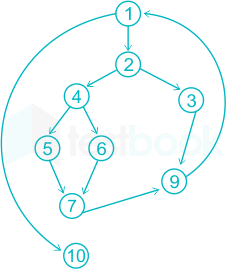
Question 92

If x unit length of type A cloths and y unit length of type B cloths, then contrains formulate for the LPP, is :

  1. AOption (a)

    y ≤ 7.5, 2x + 3 y ≤ 8, 3y + 2x ≤ 10

  2. BOption (b)

    y ≤ 7.5, 2x + 3y ≤ 8, 3x + 2y ≤ 10

  3. COption (c)

    2x + 3y ≤ 8, 3x + 2y + 2z < 15

  4. DOption (d)

    2x + 3y ≤ 10, 3x + 2y ≤ 10, 2y ≤ 15 

View answer & explanation

Correct answer

Answer: (b)B.

y ≤ 7.5, 2x + 3y ≤ 8, 3x + 2y ≤ 10

Why this answer is correct

The correct answer is y ≤ 7.5, 2x + 3y ≤ 8, 3x + 2y ≤ 10

Key Points

To formulate the constraints for the linear programming problem (LPP), we need to consider the availability of the three kinds of wool (red, green, and blue) and the requirements for each type of cloth.

The constraints are based on the following:

  • One unit length of type A cloth needs 2 yards of red wool and 3 yards of green wool.
  • One unit length of type B cloth needs 3 yards of red wool, 2 yards of green wool, and 2 yards of blue wool.
  • The firm has a stock of 8 yards of red wool, 10 yards of green wool, and 15 yards of blue wool.

Here are the constraints broken down:

  • Red wool constraint: 2x+3y≤82x + 3y \leq 8
  • Green wool constraint: 3x+2y≤103x + 2y \leq 10
  • Blue wool constraint: 2y≤152y \leq 15  =>  y ≤ 7.5

Given these constraints, the correct formulation is: y ≤ 7.5, 2x + 3y ≤ 8, 3x + 2y ≤ 10

Question 93

Which of the following will be appropriate objectives function for the given problem?

  1. AOption (a)

    2x + 3y

  2. BOption (b)

    3x + 2y + 2z

  3. COption (c)

    30x + 50y 

  4. DOption (d)

    3x + 2y

View answer & explanation

Correct answer

Answer: (c)C.

30x + 50y 

Why this answer is correct

The correct answer is 30x + 50y 

Key Points

  • The objective function represents the income obtained from producing the two types of cloth, which the firm wants to maximize.
  • The income obtained from one unit length of type A cloth is Rs. 30, and from one unit length of type B cloth is Rs. 50.
  • Thus, the objective function should focus on maximizing this income.

The correct objective function is: 30x + 50y

Question 94

When we formulate the LPP from the above given passage. Which of the following is a objective function for its dual problem?

  1. AOption (a)

    Min P = 5u + 8v + 15w

  2. BOption (b)

    Min P = 8u + 10v + 15w

  3. COption (c)

    Min P = 15u + 5v + 8w

  4. DOption (d)

    Max P = 10u + 8v + 15w

View answer & explanation

Correct answer

Answer: (b)B.

Min P = 8u + 10v + 15w

Why this answer is correct

The correct answer is Min P = 8u + 10v + 15w

Explanation:

To identify the objective function for the dual problem of the given linear programming problem (LPP), we need to understand the primal and the dual relationship.

Primal Problem: [ Maximize Z=30x+50y\text{Maximize } Z = 30x + 50y ] Subject to: [ 2x+3y≤82x + 3y \leq 8 ] [ 3x+2y≤103x + 2y \leq 10 ] [ 2y≤15(which simplifies to y≤7.5)2y \leq 15 \quad \text{(which simplifies to } y \leq 7.5 \text{)} ] [ x,y≥0x, y \geq 0 ]

Dual Problem:

From a primal problem in standard form (Maximize objective function, subject to ≤ constraints), the dual problem will be: Minimize P=8u+10v+15w\text{Minimize } P = 8u + 10v + 15w Subject to:

  • [ 2u+3v≥302u + 3v \geq 30 ]
  • [ 3u+2v+2w≥503u + 2v + 2w \geq 50 ]
  • [ u,v,w≥0u, v, w \geq 0 ]
  • The coefficients of the objective function in the primal (30 and 50) become the right-hand side constants in the dual constraints.
  • The right-hand side coefficients in the primal constraints (8, 10, and 7.5/15) become the coefficients in the dual objective function.
  • The matrix of coefficients in the primal constraints is transposed to become the coefficients in the dual constraints.

Given this, the correct dual objective function to minimize is: Min P = 8u + 10v + 15w

Question 95

How many unit length used for cloth A when income is maximized?

  1. AOption (a)

    0.8 unit

  2. BOption (b)

    2.4 unit

  3. COption (c)

    2.8 unit

  4. DOption (d)

    3.0 unit

View answer & explanation

Correct answer

Answer: (c)C.

2.8 unit

Why this answer is correct

The correct answer is 2.8 unit

Explanation:

To accurately answer how many unit lengths of cloth A denotedas(x)denoted as ( x ) are used when income is maximized, we need to revisit solving the primal problem with the correct constraints and objective function.

Primal Problem: Maximize Z=30x+50y\text{Maximize } Z = 30x + 50y Subject to: [ 2x+3y≤82x + 3y \leq 8 ] [ 3x+2y≤103x + 2y \leq 10 ] [ 2y≤15(which simplifies to y≤7.5)2y \leq 15 \quad \text{(which simplifies to } y \leq 7.5 \text{)} ] [ x,y≥0x, y \geq 0 ]

We previously identified the critical intersection point by solving the system of equations:

  • 2x + 3y = 8
  • 3x + 2y = 10

Let's solve this system again to verify:

  • Multiply the first equation by 3: 6x+9y=246x + 9y = 24
  • Multiply the second equation by 2: 6x+4y=206x + 4y = 20
  • Subtract the second equation from the first: 5y = 4 =  y=45y = \frac{4}{5}
  • Substitute ( y ) back into the first equation: [ 2x+3(45)=82x + 3\left(\frac{4}{5}\right) = 8 ]
  • [ 2x+125=82x + \frac{12}{5} = 8 ]
  • [ 2x=8−1252x = 8 - \frac{12}{5} ]
  • [ 2x=405−1252x = \frac{40}{5} - \frac{12}{5} ]
  • [ 2x=2852x = \frac{28}{5} ]
  • [ x=145x = \frac{14}{5} ]
  • [ x=2.8x = 2.8 ]
  • Thus, when income is maximized, 2.8 units of cloth A are used.

Therefore, the correct answer is: 2.8 unit

Answer the following 5 questions based on the passage. 

A company is implementing a new database system to manage its customer information. The database contains tables for customers, orders, products and sales representatives. Each customer can place multiple orders and each order can contain multiple products. Each order is associated with a specific sales representatives who manages the account. The database is designed to improve efficiency in tracking sales and customer interactions.

Question 96

Which SQL query retrieves the total number of distinct customers who have placed orders ?

  1. AOption (a)

    Select COUNT (DISTINCT customer_id) As total_customers From orders;

  2. BOption (b)

    Select COUNT (*) As total_customers from customers;

  3. COption (c)

    Select COUNT (DISTINCT order_id) As total_customers from orders;

  4. DOption (d)

    Select COUNT (DISTINCT customer_id) As total_customers from customers;

View answer & explanation

Correct answer

Answer: (a)A.

Select COUNT (DISTINCT customer_id) As total_customers From orders;

Why this answer is correct

The correct answer is 1) Select COUNT (DISTINCT customer_id) As total_customers From orders;.

Key Points

  • The SQL query Select COUNT (DISTINCT customer_id) As total_customers From orders; retrieves the total number of distinct customers who have placed orders. This is achieved by using the COUNT function combined with DISTINCT to ensure that only unique customer IDs are counted from the orders table.
  • This query is useful to determine the number of unique customers who have made at least one order in the system.

Additional Information

  • Option 2: Select COUNT (*) As total_customers from customers; - This query counts the total number of records in the customers table, not the distinct customers who have placed orders. It will include all customers regardless of whether they have placed an order or not.
  • Option 3: Select COUNT (DISTINCT order_id) As total_customers from orders; - This query counts the total number of distinct orders, not customers. It will give the number of unique orders placed, not the number of unique customers.
  • Option 4: Select COUNT (DISTINCT customer_id) As total_customers from customers; - This query counts the number of distinct customer IDs in the customers table, which includes all customers regardless of whether they have placed an order.

Question 97

Which of the following best describes the relationship between the "orders" table and the "Customers" table in the company's database system ? 

  1. AOption (a)

    One-to-One

  2. BOption (b)

    One-to-Many

  3. COption (c)

    Many-to-One

  4. DOption (d)

    Many-to-Many

View answer & explanation

Correct answer

Answer: (b)B.

One-to-Many

Why this answer is correct

The correct answer is One-to-Many.

Key Points

  • The relationship between the "orders" table and the "Customers" table in the company's database system is best described as One-to-Many.
  • In a One-to-Many relationship, a single record in one table (Customers) can be associated with one or more records in another table (Orders).
  • This is a common relationship in databases where one customer can place multiple orders over time.

Additional Information

  • One-to-One: This type of relationship exists when a single record in one table is associated with a single record in another table. For example, a table of employees and a table of employee details where each employee has one detail record.
  • Many-to-One: This is essentially the inverse of a One-to-Many relationship. For example, multiple orders could be placed by a single customer. In terms of the relationship from the orders table to the customers table, it is Many-to-One.
  • Many-to-Many: This relationship exists when multiple records in one table are associated with multiple records in another table. For example, a table of students and a table of courses where each student can enroll in multiple courses and each course can have multiple students.

Question 98

Which of the following tables is likely to have a foreign key referencing another table in the database system implemented by the company ?

  1. AOption (a)

    Customers

  2. BOption (b)

    Orders

  3. COption (c)

    Products

  4. DOption (d)

    Sales representatives

View answer & explanation

Correct answer

Answer: (b)B.

Orders

Why this answer is correct

The correct answer is Orders.

Key Points

  • The Orders table is likely to have foreign keys because it typically references other tables in a database such as Customers, Products, and Sales representatives.
  • A foreign key is a field (or collection of fields) in one table, that uniquely identifies a row of another table or the same table.
  • This key relationship helps maintain referential integrity within the database.

Additional Information

  • Customers: This table typically stores customer information such as names, addresses, and contact details. It usually doesn't reference other tables but can be referenced by other tables like Orders.
  • Products: This table contains information about products such as product names, descriptions, and prices. While it can be referenced by the Orders table, it generally does not have foreign keys to other tables.
  • Sales representatives: This table holds information about the sales reps such as their names, contact information, and regions they cover. It can be referenced by Orders but usually does not have foreign keys to other tables.

Question 99

Which SQL query retrieves the total number of orders placed by a specific customer ? 

  1. AOption (a)

    Select COUNT (*) As total_orders from orders where customer_id = [Customer_ID];

  2. BOption (b)

    Select COUNT (order_id) As total_orders from orders where customer_id = [Customer_ID];

  3. COption (c)

    Select COUNT (DISTINCT order_id) As total_orders from orders Where customer_id = [ Customer_ID];

  4. DOption (d)

    Select SUM (order_Id) As total_orders from orders where customer_id = [Customer_ID];

View answer & explanation

Correct answer

Answer: (b)B.

Select COUNT (order_id) As total_orders from orders where customer_id = [Customer_ID];

Why this answer is correct

The correct answer is Option 2: Select COUNT (order_id) As total_orders from orders where customer_id = [Customer_ID];.

Key Points

  • The query Select COUNT (order_id) As total_orders from orders where customer_id = [Customer_ID]; accurately counts the total number of orders placed by a specific customer identified by [Customer_ID].
  • The COUNT(order_id) function counts the number of rows where order_id is not null, effectively giving the total number of orders for that customer.

Additional Information

  • Option 1: Select COUNT (*) As total_orders from orders where customer_id = [Customer_ID]; also counts the total number of orders but includes all rows regardless of whether order_id is null or not. Generally, order_id is not null, so this option might still give the correct count but is less specific.
  • Option 3: Select COUNT (DISTINCT order_id) As total_orders from orders Where customer_id = [ Customer_ID]; counts the number of distinct order_id, which would be correct if there are no duplicate order_ids for a single customer. This option is more specific but redundant if order_ids are unique by default.
  • Option 4: Select SUM (order_Id) As total_orders from orders where customer_id = [Customer_ID]; is incorrect because it sums the values of order_id rather than counting them, which does not provide the number of orders.

Question 100

Based on the passage, which of the following statements is true ?

  1. AOption (a)

    Each customer can place only one order.

  2. BOption (b)

    Each sales representative can manage multiple customer accounts.

  3. COption (c)

    Each order can be assodiated with only one product.

  4. DOption (d)

    The database does not include a table for products.

View answer & explanation

Correct answer

Answer: (b)B.

Each sales representative can manage multiple customer accounts.

Why this answer is correct

The correct answer is Each sales representative can manage multiple customer accounts..

Key Points

  • Option 2 is correct because it states that each sales representative can manage multiple customer accounts, which indicates a one-to-many relationship between sales representatives and customers.

Additional Information

  • Option 1: This statement is incorrect because it suggests that each customer can place only one order, which is typically not the case in most business scenarios.
  • Option 3: This statement is incorrect as it implies that each order can be associated with only one product, which is unlikely since orders often contain multiple products.
  • Option 4: This statement is incorrect because the database usually includes a table for products to manage inventory and sales.

100 questions in the full paper