Official Paper

SSC Stenographer 2025 Official Paper (Held On: 07 Aug, 2025 Shift 3) (Previous Year Paper)

200 questions · 120 minutes · with answers · free

General Intelligence & Reasoning (50 questions)

1

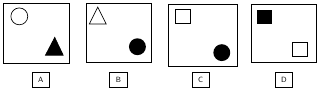
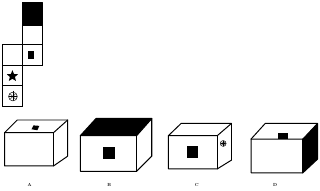
Select the possible cubes that can be formed by folding the given sheet.

  1. ((a))

    A and C only 

  2. ((b))

    A, B,D only

  3. ((c))

    B and C Only

  4. ((d))

    A only

Show Answer
Answer: ((a))

A and C only 

Given: 

Solid black face ↔ small black square face.

Star face ↔ (inline) blank face.

Circled plus ( ⊕ ) face ↔ (side) blank face.

Figure A 

 Can be made, because all the surfaces are adjacent

Figure B 

 Can not be made, because the Solid black face  and the small black square face are on opposite sides.

Figure C

Can be made, because all the surfaces are adjacent

Figure D

Can not be made, because the Solid black face  and the small black square face are on opposite sides.

Thus, both Dice A and C can be formed.

Hence, the correct answer is "Option 1".

2

What will be the next figure?

  1. ((a))

    A

  2. ((b))

    B

  3. ((c))

    C

  4. ((d))

    D

Show Answer
Answer: ((c))

C

The logic followed here is:

Logic: Edges of 1st figure - 1 = edges of 2nd figure, and dot moved to forward.

Figure 1 to figure 2: 

Similarly, 

Figure 3 to figure 4:

Hence, the correct answer is "Option 3".

3

Apple, Banana, Carrot, Mango - which is the odd one?

  1. ((a))

    Mango

  2. ((b))

    Banana

  3. ((c))

    Carrot

  4. ((d))

    Apple 

Show Answer
Answer: ((c))

Carrot

The logic followed here is:

Apple, Banana, and Mango are all fruits, whereas Carrot is a vegetable.

Therefore, Carrot is different from the rest.

Hence, the correct answer is "Option 3".

4

Read each scenario carefully, evaluate all options, identify the action that best navigates the various competing factors and values.

You're enjoying a casual evening gathering at a close friend's home. During the evening, your friend decides to put on a movie that you immediately recognize as a pirated copy they downloaded illegally. Your friend excitedly asks you to help connect their laptop to the TV, and everyone else at the gathering seems oblivious or unconcerned. You personally disapprove of piracy but don't want to create an awkward situation or offend your friend.

  1. ((a))

    Publicly refuse to help and explain loudly to your friend and the group why piracy is wrong.

  2. ((b))

    Watch the movie, but later, report your friend to copyright authorities.

  3. ((c))

    Discreetly excuse yourself from participating in the setup or watching the movie, perhaps by saying you need to make a call or step outside for a moment.

  4. ((d))

    Go along with it and help connect the laptop, avoiding any discomfort or confrontation.

Show Answer
Answer: ((c))

Discreetly excuse yourself from participating in the setup or watching the movie, perhaps by saying you need to make a call or step outside for a moment.

The logic followed here is:

In this situation, the competing values are: personal ethics against piracy, maintaining harmony in a social gathering, and avoiding unnecessary conflict or embarrassment for the friend. Each option must be evaluated carefully.

1) Publicly refuse to help and explain loudly to your friend and the group why piracy is wrong. – Not suitable, because while it upholds your ethical stance, it embarrasses your friend publicly and creates unnecessary conflict in a casual gathering.

2) Watch the movie, but later, report your friend to copyright authorities. – Not suitable, because it is a disproportionate response, damages the friendship, and involves external punishment rather than personal responsibility.

3) Discreetly excuse yourself from participating in the setup or watching the movie, perhaps by saying you need to make a call or step outside for a moment. – Suitable, because it avoids direct confrontation, allows you to maintain your ethical boundaries, and prevents embarrassment or conflict in the group setting.

4) Go along with it and help connect the laptop, avoiding any discomfort or confrontation. – Not suitable, because it compromises your values by actively supporting piracy, even if it avoids immediate conflict.

Hence, the correct choice is "Option 3".

5

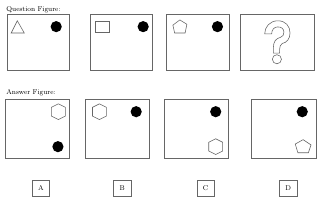
What should come at the place of question figure?

Question Figure:

Answer Figure:

  1. ((a))

    D

  2. ((b))

    C

  3. ((c))

    B

  4. ((d))

    A

Show Answer
Answer: ((b))

C

The logic followed here is:

Hence, the correct answer is "Option 2".

6

What should be at the place of question mark?

  1. ((a))

    B

  2. ((b))

    A

  3. ((c))

    C

  4. ((d))

    D

Show Answer
Answer: ((a))

B

The logic followed here is:

Logic: Number of the edges of first figure + 1 = 2nd figure.

From figure 1 to figure 2:

From figure 3 to figure 4:

Hence, the correct answer is "Option 1".

7

What will be the next number in the series:

19, 37, 73, 145, ?

  1. ((a))

    248

  2. ((b))

    289

  3. ((c))

    290

  4. ((d))

    286

Show Answer
Answer: ((b))

289

The logic followed here is:


Thus, the missing term in the series is 289.

Hence, the correct answer is "Option 2".

8

Find the next number in the series: 2, 6, 12, 20, 30, ?

  1. ((a))

    40

  2. ((b))

    44

  3. ((c))

    42

  4. ((d))

    36

Show Answer
Answer: ((c))

42

The logic followed here is:

Thus, the missing term in the series is 42.

Hence, the correct answer is "Option 3".

9

Figure A and B are related in a particular manner. Establish the same relationship between figures C and D by choosing the figure amongst these four options which would replace the question mark in figure D.

  1. ((a))

  2. ((b))

  3. ((c))

  4. ((d))

Show Answer
Answer: ((b))

The logic followed here is:

Hence, the correct answer is "Option 2".

10

A shape is shown below, followed by four options. One of them is the correct mirror image of the shape. Choose the CORRECT option.

<br>

Which of the following is the correct mirror image?

  1. ((a))

  2. ((b))

  3. ((c))

  4. ((d))

Show Answer
Answer: ((c))

The mirror image of the given figure is:

Hence, the correct answer is "Option 3".

11

What will come in place of the question mark (?) in the following equation?

100 ÷ 10 - 7 + 2 × 6 = ?

  1. ((a))

    12

  2. ((b))

    5

  3. ((c))

    20

  4. ((d))

    15

Show Answer
Answer: ((d))

15

BODMAS Rule:

The given equation is: 100 ÷ 10 − 7 + 2 × 6 = ?

Perform operations according to BODMAS:

100 ÷ 10 − 7 + 2 × 6

10 − 7 + 12

3 + 12

⇒ 15

Hence, the correct answer is "Option 4".

12

A figure consists of a square divided into 9 equal smaller squares (3x3), and 2 diagonals are drawn in the outer square. How many triangles are there?

  1. ((a))

    20

  2. ((b))

    16

  3. ((c))

    24

  4. ((d))

    28

Show Answer
Answer: ((d))

28

Formula used:

Count triangles by types and add:

Type I: small right triangles formed inside unit squares where an outer diagonal passes (corner unit triangles).

Type II: right triangles whose hypotenuse lies along a long diagonal segment of the big-square diagonal (spanning 1,2 or 3 unit lengths).

Type III: triangles having two sides along the two big diagonals (they meet at the center) and base along a grid line (horizontal or vertical).

Calculations:

Type I: corners — each of 4 corner unit squares is split by a diagonal → 2 triangles each.

⇒ 4 × 2 = 8

Type II: triangles with hypotenuse on a big diagonal. For one diagonal there are 3 adjacent lattice-step hypotenuses (k=1) + 2 step-2 hypotenuses (k=2) + 1 step-3 hypotenuse (k=3). Each hypotenuse gives 2 right triangles (above and below).

⇒ per diagonal: (3 + 2 + 1) × 2 = 6 × 2 = 12

⇒ two diagonals would seem to give 12 × 2 = 24, but that double-counts triangles symmetric to both diagonals that were already counted in Type I (the small corner unit triangles). Those 4 corner unit triangles were included twice, so unique Type II total = 24 − 4 = 20.

However it is simpler to combine consistently as:

Per diagonal unique right-triangles (excluding the 4 corner unit triangles already in Type I) = 6 ⇒ both diagonals = 12.

So take:

⇒ Type II (unique) = 12

Type III: apex at center (intersection of diagonals). For each of the 4 rows and 4 columns where the two diagonal lattice-points lie on same row/column, there is one triangle with base that row/column and apex at center.

⇒ 4 (horizontal rows) + 4 (vertical columns) = 8

Total triangles = Type I + Type II + Type III

⇒ 8 + 12 + 8 = 28

∴ The correct answer is 28.
13

Post: Content Head - EdTech Division Eligibility Criteria (as on 15-02-2025):

Master's in English/Linguistics / Education with minimum 68% marks.

Must have minimum 6 years of experience, with 3 years in academic content creation.

Should have managed a team of 5 or more members for at least 1 year.

Must have published at least 2 educational research articles in recognized journals.

Special Clause:

If candidate has only 1 research article, but has 8+ years of experience and holds an M.Ed. or B.Ed. degree, refer to Board of Academic Excellence.

If academic marks are below 68%, but has 3+ research papers and training certifications, refer to Chief Editor.

Case:

Aditya has 66% in MA English, 9 years of experience (4 in content creation), led a team for 2 years, has 3 published academic research papers, and holds a B.Ed. degree.

Question: What should be done in Aditya's case?

  1. ((a))

    Reject the candidate

  2. ((b))

    Refer to Chief Editor

  3. ((c))

    Select the candidate

  4. ((d))

    Refer to Board of Academic Excellence

Show Answer
Answer: ((b))

Refer to Chief Editor

Case Analysis for Aditya:

Eligibility CriteriaRequirementAditya's ProfileFulfillment
Master's in English/Linguistics/EducationMinimum 68% marks66% in MA EnglishNot fulfilled
ExperienceMinimum 6 years, with 3 years in academic content creation9 years total, 4 years in content creationFulfilled
Team ManagementLed a team of 5+ members for at least 1 yearLed a team for 2 yearsFulfilled
Research PublicationsAt least 2 academic research papers3 published research papersFulfilled
Special Clause (Marks below 68%)3+ research papers and training certifications → refer to Chief Editor3 research papers, holds B.Ed.Refer to Chief Editor

Decision: Refer to Chief Editor.

Note:  The requirement '3+' research papers means '3 or more'.

Hence, the correct answer is "Option 2".

14

In each of the following questions, two numbers are given which follow a certain logical or arithmetic relationship. Identify the same pattern and apply it to find the missing number in the second pair. Choose the correct option from the given alternatives.

15 : 8 :: 31 : ?

  1. ((a))

    8

  2. ((b))

    16

  3. ((c))

    14

  4. ((d))

    15

Show Answer
Answer: ((b))

16

The logic followed here is:

Logic: Second number = (First number + 1) ÷ 2.

15 : 8

→ (15 + 1) ÷ 2

→ 16 ÷ 2

→ 8 = Second number. This holds.

31 : ?

→ (31 + 1) ÷ 2

→ 32 ÷ 2

→ 16 = Missing number.

Hence, the correct answer is "Option 2".

15

Which figure is different from others?

  1. ((a))

    A

  2. ((b))

    D

  3. ((c))

    C

  4. ((d))

    B

Show Answer
Answer: ((b))

D

The logic followed here is:

Option 1) 

Option 2) 

Option 3) 

Option 4) 

Hence, the correct answer is "Option 2".

16

How many triangles are there in the given figure.

  1. ((a))

    9

  2. ((b))

    12

  3. ((c))

    8

  4. ((d))

    7

Show Answer
Answer: ((d))

7

The number of the triangle in the given fogure is:

Thus, the number of triangle are 7.

Hence, the correct answer is "Option 4".

17

Criteria to be selected as Librarian (as on 01-08-2023):

Must have a Bachelor's degree in Library Science (B.Lib.Sc) with at least 55% marks.

Age must be between 24 and 32 years.

Must have basic computer skills.

Must possess at least 1 year of experience in a library.

Special Clause:

If the candidate has no experience but has a Master's in Library Science with 60% marks, refer to Library Director.

Case:

Neelam is 27 years old, has completed B.Lib.Sc with 58%, holds a Master's in Library Science (62%) but has no experience. She is computer literate.

Question: What should be done in Neelam's case?

  1. ((a))

    Select the candidate

  2. ((b))

    Refer to Library Director

  3. ((c))

    Refer to HR

  4. ((d))

    Reject the candidate

Show Answer
Answer: ((b))

Refer to Library Director

Case Analysis for Neelam:

Eligibility CriteriaRequirementNeelam's ProfileFulfillment
Bachelor's degree in Library ScienceMinimum 55% marksB.Lib.Sc 58%Fulfilled
AgeBetween 24 and 32 years27 years oldFulfilled
Computer SkillsBasic computer literacyComputer literateFulfilled
ExperienceAt least 1 year in a libraryNo experienceNot fulfilled
Special ClauseNo experience but Master's in Library Science with 60%+ → Refer to Library DirectorMaster's in Library Science 62%Refer to Library Director

Decision: Refer to Library Director.

Hence, the correct answer is : "Option 2".

18

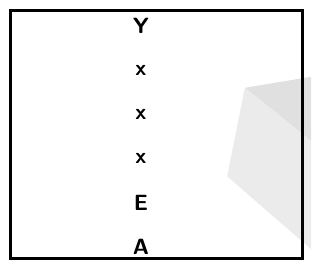
What will come at the place of question mark?

  1. ((a))

  2. ((b))

  3. ((c))

  4. ((d))

Show Answer
Answer: ((a))

The logic followed here is:

Logic: The five-letter line rotates clockwise by 45° in each step, while the 'X's are sequentially replaced by new letters alternating from both outer ends inward (1st → A, 5th → Y, 2nd → E).

Hence, the correct answer is "Option 1".

19

In each of the following questions, a specific relationship is given between two words. Identify the word that shares a similar semantic relationship with the given pair. Choose the most appropriate option from the four choices given below.

Knight :  Armor :: Astronaut : ?

  1. ((a))

    Jetpack

  2. ((b))

    Spacesuit

  3. ((c))

    Shuttle

  4. ((d))

    Oxygen Tank

Show Answer
Answer: ((b))

Spacesuit

The logic followed here is:

Logic: Protective gear or equipment used by a professional.

Here,

Knight : Armor → Armor is protective equipment worn by a Knight.

Similarly,

Astronaut : Spacesuit → Spacesuit is protective equipment worn by an Astronaut to survive in the space environment.

Hence, the correct answer is "Option 2".

20

Find the next term in the given series. 3A, 6C, 13F, 28J, ?

  1. ((a))

    59O

  2. ((b))

    56P

  3. ((c))

    54N

  4. ((d))

    62L

Show Answer
Answer: ((a))

59O

The pattern followed here is.

Thus, the missing term in the series is 59O.

Hence, the correct answer is Option 1.

21

At a banquet, every 2 people shared a cake, every 6 people shared a bowl of soup, and every 8 people shared a platter of fruit. There were a total of 38 items. How many people were present at the banquet ?

  1. ((a))

    30

  2. ((b))

    20

  3. ((c))

    24

  4. ((d))

    48

Show Answer
Answer: ((d))

48

Given:

Every 2 people → 1 cake

Every 6 people → 1 bowl of soup

Every 8 people → 1 platter of fruit

Total items = 38

Calculations:

Total items = n2+n6+n8\dfrac{n}{2} + \dfrac{n}{6} + \dfrac{n}{8}

Where n = number of people

⇒ Total items = (12n + 4n + 3n)/24 = 38

⇒ 19n/24 = 38

⇒ 19n = 38 × 24

⇒ n = 48

∴ Number of people present at the banquet = 48

22

Post: Security Guard

Eligibility Criteria (as on 01-06-2025):

Must be between 25 and 35 years of age.

Must have passed 10th standard.

Must be physically fit and have no criminal record.

Case:

Suresh is 29 years old, has passed Class 10, is physically fit, and has no police record.

What should be done in Suresh's case?

  1. ((a))

    Refer to Police Verification

  2. ((b))

    Data incomplete

  3. ((c))

    Select the candidate

  4. ((d))

    Reject the candidate

Show Answer
Answer: ((c))

Select the candidate

Case Analysis for Suresh:

Eligibility CriteriaRequirementSuresh's ProfileFulfillment
AgeBetween 25 and 35 years29 years oldFulfilled
Educational QualificationPassed 10th standardPassed Class 10Fulfilled
Physical Fitness & Criminal RecordPhysically fit and no criminal recordPhysically fit, no police recordFulfilled

Decision: Select the candidate.

Hence, the correct answer is "Option  3".

23

In each of the following questions, two numbers are given which follow a certain logical or arithmetic relationship. Identify the same pattern and apply it to find the missing number in the second pair. Choose the correct option from the given alternatives.

51728 : 73940 :: 38641 : ?

  1. ((a))

    50863

  2. ((b))

    59853

  3. ((c))

    50862

  4. ((d))

    60974

Show Answer
Answer: ((a))

50863

The logic followed here is

Logic: each digit of the second number is obtained by adding 2 to the corresponding digit of the first number.

Logic: Each digit + 2.

51728 : 73940

5 + 2 = 7

1 + 2 = 3

7 + 2 = 9

2 + 2 = 4

8 + 2 = 10 (unit digit is 0)

→ 73940 = 73940. This holds.

38641 : ?

3 + 2 = 5

8 + 2 = 10 (unit digit is 0)

6 + 2 = 8

4 + 2 = 6

1 + 2 = 3

→ 50863 = Missing number.

Hence, the correct answer is "Option 1".

24

Choose the CORRECT option.

Address 1: Mr. Rohit Sharma, 123/A, Rose Villa, Green Park, Delhi - 110016

Address 2: Mr. R. Sharma, 123-A, Rose Villa, Green Park, New Delhi-110016

Are the two addresses likely to refer to the same person?

  1. ((a))

    No, the cities are different

  2. ((b))

    No, the names are different

  3. ((c))

    No, the house numbers don't match

  4. ((d))

    Yes, both addresses are the same

Show Answer
Answer: ((d))

Yes, both addresses are the same

The logic followed here is:

Address ComponentAddress 1Address 2Comparison / Comment
NameMr. Rohit SharmaMr. R. SharmaSame person, first name abbreviated in Address 2
House Number123/A123-ASame house number, minor format variation
LocalityGreen ParkGreen ParkIdentical
CityDelhiNew DelhiUsed interchangeably in postal addresses
PIN Code110016110016Identical

Conclusion: All key details match with minor variations in formatting.

Thus, 4) Yes, both addresses are the same.

Hence, the correct answer is "Option 4".

25

What will come at the place of question mark?

  1. ((a))

  2. ((b))

  3. ((c))

  4. ((d))

Show Answer
Answer: ((d))

The logic followed here is:

Logic: Added the same number of lines as figure one have.

From figure 1 to figure 2:

Similarly,

From figure 3 to figure 4:

Hence, the correct answer is "Option 4".

26

Read the information carefully and identify the correct relationship between the persons mentioned in the question.

Rita is the mother of Deepa.

Deepa is the sister of Aman.

Aman is the father of Kabir.

Question: How is Rita related to Kabir?

  1. ((a))

    Aunt

  2. ((b))

    Sister

  3. ((c))

    Grandmother

  4. ((d))

    Mother

Show Answer
Answer: ((c))

Grandmother

Given: 

Rita is the mother of Deepa.

Deepa is the sister of Aman.

Aman is the father of Kabir.

Thus, Rita is grandmother of Kabir.

Hence, the correct answer is "Option 3".

27

If + means ÷, ÷ means -, - means +, × means × then, what is (200 ÷ 50 -10) × 5 + 25 ?

  1. ((a))

    32

  2. ((b))

    34

  3. ((c))

    36

  4. ((d))

    30

Show Answer
Answer: ((a))

32

BODMAS Rule:

Original Symbol+÷×
New Symbol÷+×

Now, given the equation: (200 ÷ 50 − 10) × 5 + 25 = ?

After interchanging the specified signs, the new equation is:

(200 − 50 + 10) × 5 ÷ 25 = ?

Perform operations according to BODMAS:

(200 − 50 + 10) × 5 ÷ 25

160 × 5 ÷ 25

800 ÷ 25

⇒ 32

Hence, the correct answer is "Option 1".

28

Noc 28 How many dots lie opposite to the face having five dots, when the given figure is folded to form a cube?

  1. ((a))

    4

  2. ((b))

    3

  3. ((c))

    2

  4. ((d))

    1

Show Answer
Answer: ((a))

4

Given: 

Four dots and five dots are on opposite sides.

Two dots and one dot are on opposite sides.

Six dots and Three dots are on opposite sides.

Thus, Four dots and five dots are on opposite sides.

Hence, the correct answer is "Option 1".

29

Which of the following figures will complete the figural series given below?

  1. ((a))

  2. ((b))

  3. ((c))

  4. ((d))

Show Answer
Answer: ((c))

The logic followed here is:

Hence, the correct answer is "Option 3".

30

In each of the following questions, a number series is given. In each series, only one number is incorrect. Identify the wrong number.

1, 4, 9, 16, 26, 36.

  1. ((a))

    16

  2. ((b))

    4

  3. ((c))

    9

  4. ((d))

    26

Show Answer
Answer: ((d))

26

The logic followed here is:

The number 26 does not follow this pattern; it should be 25 to continue the series correctly.

Thus, the wrong number in the series is 26.

Hence, the correct answer is "Option 4".

31

Criteria to be selected as Assistant Teacher Eligibility Criteria (as on 31-03-2024):

Must have a B.Ed. degree with minimum 50% marks.

Age must be between 25 and 35 years.

Must have 2 years teaching experience.

Must be willing to work in rural schools. Special Rule:

If candidate has 1 year teaching experience but a Master's in Education, refer to Vice Principal.

Case:

Sonal is 28 years old with a B.Ed. (55%), a Master's in Education, and 1 year experience. She agrees to work in rural areas.

What should be done in Sonal's case?

  1. ((a))

    Reject the candidate

  2. ((b))

    Refer to Vice Principal

  3. ((c))

    Case cannot be considered

  4. ((d))

    Select the candidate

Show Answer
Answer: ((b))

Refer to Vice Principal

Case Analysis for Sonal:

Eligibility CriteriaRequirementSonal's ProfileFulfillment
B.Ed. DegreeMinimum 50% marksB.Ed. 55%Fulfilled
AgeBetween 25 and 35 years28 years oldFulfilled
Teaching Experience2 years minimum1 year experienceNot fulfilled
Willingness to work in rural schoolsYesAgrees to work in rural areasFulfilled
Special Rule1 year experience + Master's in Education → Refer to Vice PrincipalMaster's in Education + 1 year experienceRefer to Vice Principal

Decision: Refer to Vice Principal.

Hence, the correct answer is "Option 2".

32

If a dice has numbers 1 to 6 on its faces and face 1 is opposite to 6, 3 is opposite to 4, then what will be the number on the face opposite to the face showing '2'?

  1. ((a))

    3

  2. ((b))

    5

  3. ((c))

    4

  4. ((d))

    6

Show Answer
Answer: ((b))

5

Given:

1 is opposite to 6,

3 is opposite to 4,

Now, only two number left 2 and 5. 

so, the opposite of 2 is 5.

Hence, the correct answer is "Option 2".

33

3, 7, 11, 15, 19, 22 which is the odd one out ?

  1. ((a))

    7

  2. ((b))

    22

  3. ((c))

    15

  4. ((d))

    3

Show Answer
Answer: ((b))

22

The logic followed here is:

Sequence: 3, 7, 11, 15, 19, 22

Observing the numbers in terms of even and odd:

3 → Odd

7 → Odd

11 → Odd

15 → Odd

19 → Odd

22 → Even

All numbers are odd except 22, which is even.

Hence, the correct answer is "Option 2".

34

In each of the following questions, a specific pattern is followed for both the letters and the numbers. Identify the set of numbers that correctly fills the blanks in the given sequence.

  C, 6, F, 24, I, 54, L ___, O,, R, 216, U, 294, X, 384

  1. ((a))

    (90, 145)

  2. ((b))

    (132, 210)

  3. ((c))

    (140, 220)

  4. ((d))

    (96, 150)

Show Answer
Answer: ((d))

(96, 150)

The series consists of two logical patterns, one for the letters and one for the numbers.

<br>

Thus, the missing terms are 96 and 150.

Hence, the correct answer is Option 4.

35

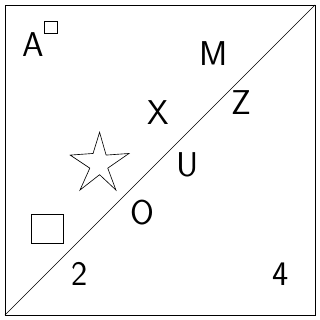
Among the given figures, identify the one that does not belong to the group based on the pattern.

  1. ((a))

    B

  2. ((b))

    D

  3. ((c))

    C

  4. ((d))

    A

Show Answer
Answer: ((b))

D

The logic followed here is:

Here letter A, Y, and Z are drawn using 3 lines but letter L has only 2 lines.

Thus letter L is the odd figure.

Hence, the correct answer is "Option 2".

36

Complete the analogy:

CAB : EDC :: ONM : ?

  1. ((a))

    TSR

  2. ((b))

    QPO

  3. ((c))

    RQP

  4. ((d))

    QQN

Show Answer
Answer: ((d))

QQN

The logic followed here is a specific positional shift for each letter.

For CAB to EDC

For ONM

Thus, the code for ONM is QQN.

Hence, the correct answer is "Option 4".

37

Read the situation and choose the best judgment:

You've just finished eating at a busy restaurant and pay for your meal with cash. As the server hands you the change, you notice they have mistakenly given you significantly more money back than you were owed. The server seems overwhelmed and rushes to attend | to another table.

Question: Given this situation, which of the following is the most ethical and responsible action?

  1. ((a))

    Politely get the server's attention, point out the mistake, and return the excess change.

  2. ((b))

    Quietly leave the exact amount of the overpayment on the table as an extra tip.

  3. ((c))

    Announce loudly that the server made a mistake with your change, so others are aware.

  4. ((d))

    Discreetly put the extra change in your pocket and leave assuming it's the restaurant's mistake.

Show Answer
Answer: ((a))

Politely get the server's attention, point out the mistake, and return the excess change.

The logic followed here is:

Situation: You received significantly more change than you were owed at a busy restaurant, and the server is preoccupied.

Ethical Considerations and Option Analysis:

Option 1: Politely get the server's attention, point out the mistake, and return the excess change. - This is the most ethical action because the money belongs to the restaurant and the server. It demonstrates honesty and responsibility while maintaining politeness.

Option 2: Quietly leave the excess money as a tip. - While leaving a tip is generally acceptable, giving the overpayment as a tip is not ethical because it is not a voluntary tip but someone else's money given by mistake.

Option 3: Announce loudly about the mistake. - Publicly announcing the error can embarrass the server and disrupt the restaurant. It is unnecessary and not considered polite or responsible.

Option 4: Keep the extra change and leave. - This is unethical as it involves taking money that does not belong to you, even if the server is busy.

Thus,  Politely get the server's attention and return the excess change.

Hence, the correct answer is "Option 1".

38

In this figure, how many squares are there?

  1. ((a))

    9

  2. ((b))

    30

  3. ((c))

    36

  4. ((d))

    14

Show Answer
Answer: ((d))

14

The number of the square of the given figure are:

Thus, The number of the square are 14.

Hence, the correct answer is "Option 4".

39

Which word is different from the rest?

  1. ((a))

    Gun

  2. ((b))

    Spoon

  3. ((c))

    Knife

  4. ((d))

    Sword

Show Answer
Answer: ((b))

Spoon

The logic followed here is:

Gun, Spoon, Knife, Sword

  • Gun, Knife, and Sword are all weapons.
  • Spoon is a kitchen utensil and not a weapon.

Thus,  The word that is different from the rest is Spoon.

Hence, the correct answer is "Option 2".

40

In each of the following questions, a specific relationship is given between two words. Identify the word that shares a similar semantic relationship with the given pair. Choose the most appropriate option from the four choices given below.

Fire : Heat :: Friction : ?

  1. ((a))

    Temperature

  2. ((b))

    Motion

  3. ((c))

    Burn

  4. ((d))

    Energy 

Show Answer
Answer: ((d))

Energy 

The logic followed here is:

Logic: Product or effect produced by a cause.

Here,

Fire : Heat → Heat is the effect or product produced by Fire.

Similarly,

Friction : Temperature →  Friction is the cause/source that produces Energy (specifically, converting mechanical kinetic energy into thermal energy/heat).

Hence, the correct answer is "Option 4".

41

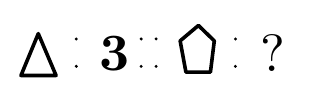
If

  1. ((a))

    5

  2. ((b))

    6

  3. ((c))

    7

  4. ((d))

    4

Show Answer
Answer: ((a))

5

The logic followed here is:

Logic: Number of side of the figure = number.

For, 

 has 3 sides = 3.

Similarly,

 has 5 sides = 5.

Hence, the correct answer is "Option 1".

42

In the given sequence what is the missing shape?

  1. ((a))

  2. ((b))

  3. ((c))

  4. ((d))

Show Answer
Answer: ((a))

The logic followed here is:

Hence, the correct answer  is "Option 1".

43

In each of the following questions, two numbers are given which follow a certain logical or arithmetic relationship. Identify the same pattern and apply it to find the missing number in the second pair. Choose the correct option from the given alternatives.

25 : 30 :: 36 : ?

  1. ((a))

    43

  2. ((b))

    42

  3. ((c))

    41

  4. ((d))

    46

Show Answer
Answer: ((b))

42

The logic followed here is that the second number is the product of the square root of the first number and one more than its square root.

Logic: Second number = (√First number) × (√First number + 1).

25 : 30

→ (√25) × (√25 + 1)

→ 5 × (5 + 1)

→ 5 × 6

→ 30 = 30. This holds.

36 : ?

→ (√36) × (√36 + 1)

→ 6 × (6 + 1)

→ 6 × 7

→ 42 = Missing number.

Hence, the correct answer is "Option 2".

44

If :2 × 3 = 13, 4 × 5 = 41, 6 × 7 = ?

  1. ((a))

    83

  2. ((b))

    89

  3. ((c))

    87

  4. ((d))

    85

Show Answer
Answer: ((d))

85

The logic followed here is:

Logic: a × b = c × 2 + 1 = Code.

For, 2 × 3 = 13

⇒ 2 × 3 = 6 × 2 = 12 + 1 = 13.

For, 4 × 5 = 41

⇒ 4 × 5 = 20 × 2 = 40 + 1 = 41.

Similarly,  6 × 7 = ?

⇒ 6 × 7 = 42 × 2 = 84 + 1 = 85.

Hence, the correct answer is "Option 4".

45

Choose the figure which is different from the rest?

  1. ((a))

  2. ((b))

  3. ((c))

  4. ((d))

Show Answer
Answer: ((c))

The logic followed here is:

Logic: All the option has the straight line at the top of the figure except Option 3 has slant line.

Hence, the correct answer is "Option 3".

46

In each of the following questions, a specific relationship is given between two words. Identify the word that shares a similar semantic relationship with the given pair. Choose the most appropriate option from the four choices given below.

Theory : Practice :: Hypothesis : ?

  1. ((a))

    Observation

  2. ((b))

    Result

  3. ((c))

    Experiment

  4. ((d))

    Proof

Show Answer
Answer: ((c))

Experiment

The logic followed here is:

Logic: Application or method used to test a preceding theoretical statement.

Here,

Theory : Practice → Practice is the application or implementation of a Theory.

Similarly,

Hypothesis : Experiment → Experiment is the method used to test or apply a Hypothesis.

Hence, the correct answer is "Option 3".

47

If 4x + 5y = 34 and 3x - 2y = 14 what is x - y?

  1. ((a))

    4

  2. ((b))

    1

  3. ((c))

    3

  4. ((d))

    2

Show Answer
Answer: ((a))

4

Given:

4x + 5y = 34 … (1)

3x - 2y = 14 … (2)

Calculations:

From (1): 4x + 5y = 34

From (2): 3x - 2y = 14

Multiply (1) by 3 ⇒ 12x + 15y = 102

Multiply (2) by 4 ⇒ 12x - 8y = 56

Subtract equations:

(12x + 15y) − (12x − 8y) = 102 − 56

⇒ 23y = 46

⇒ y = 2

Substitute y = 2 into (2):

3x − 2 × 2 = 14

⇒ 3x − 4 = 14

⇒ 3x = 18

⇒ x = 6

Now, x − y = 6 − 2 = 4

∴ x − y = 4

48

Address A: Riya Kapoor, 7/2, Lake View Road, Kolkata - 700029

Address B: R. Kapoor, 7/2A, Lake View Rd, Kolkata-700029

What is the most significant difference between the two addresses?

  1. ((a))

    Different road

  2. ((b))

    ​Different house number

  3. ((c))

    Different surname

  4. ((d))

    Different city

Show Answer
Answer: ((b))

​Different house number

The logic followed here is:

Address ComponentAddress AAddress BComparison / Comment
NameRiya KapoorR. KapoorSame surname, first name abbreviated in Address B
House Number7/27/2ADifferent house number (A added in Address B)
Road / StreetLake View RoadLake View RdMinor abbreviation, effectively the same
CityKolkataKolkataIdentical
PIN Code700029700029Identical

Conclusion: The most significant difference is in the house number.

Thus,  Different house number

Hence, the correct answer is "Option 2".

49

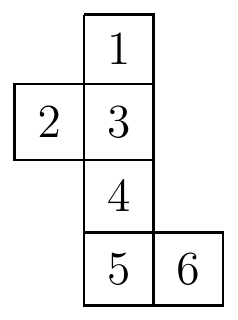
An unfolded box ( cube or cuboid) appeared as shown in the figure, when sheet is folded to form a box find the number on the face  opposite to 5.

  1. ((a))

    4

  2. ((b))

    1

  3. ((c))

    2

  4. ((d))

    3

Show Answer
Answer: ((d))

3

Given:

So, opposite pairs are:

4 → 1

6 → 2

3 → 5

Thus, The opposit of 5 is 3.

Hence, the correct answer is "Option 4".

50

A squash championship has 111 participants. In a knockout format, what is the total number of matches played ?

  1. ((a))

    110

  2. ((b))

    109

  3. ((c))

    111

  4. ((d))

    112

Show Answer
Answer: ((a))

110

Given:

Participants = 111

Tournament type = Knockout

Formula used:

In a knockout tournament, each match eliminates exactly 1 player.

Total matches = (Total participants − 1)

Calculation:

⇒ Total matches = 111 − 1 = 110

∴ The total number of matches played = 110

General Awareness (50 questions)

51

Which Indian woman was the pioneer in winning a silver medal at the Olympic Games?

  1. ((a))

    Saina Nehwal

  2. ((b))

    Karnam Malleswari

  3. ((c))

    Mary Kom

  4. ((d))

    P.V. Sindhu

Show Answer
Answer: ((d))

P.V. Sindhu

The correct answer is P.V. Sindhu.

Key Points

  • P.V. Sindhu became the first Indian woman to win a silver medal at the Olympic Games during the 2016 Rio Olympics.
  • She secured the silver medal in the sport of badminton, competing in the women's singles category.
  • Sindhu faced Spain's Carolina Marin in the final match, which was a highly competitive and closely fought game.
  • Her achievement marked a historic moment for Indian sports, making her a national icon and inspiring many young athletes.
  • P.V. Sindhu is also the second Indian athlete to win an Olympic medal in badminton, following Saina Nehwal's bronze medal in the 2012 London Olympics.

Additional Information

  • Olympic Medal in Badminton: Badminton became an Olympic sport in 1992, and India has since gained significant recognition in the sport, producing world-class players like P.V. Sindhu and Saina Nehwal.
  • Women's Singles Badminton: This event requires exceptional agility, speed, and precision. P.V. Sindhu is known for her powerful smashes and tactical gameplay.
  • Achievements of P.V. Sindhu: Besides her Olympic silver, Sindhu has won multiple medals at the World Badminton Championships, including a gold in 2019.
  • Recognition: P.V. Sindhu has been honored with prestigious awards like the Padma Bhushan, Padma Shri, and the Rajiv Gandhi Khel Ratna for her contributions to Indian sports.
  • Training and Mentor: Sindhu trained under the guidance of renowned coach Pullela Gopichand, a former All England Open champion, at his academy in Hyderabad.
52

Match the columns:

Column A (Land-Use Category)Column B (Description - Shuffled)
A.Miscellaneous Tree Crops & Groves1.Land left fallow for more than 1 year but less than 5 years
B.Culturable Wasteland2.Privately owned land under orchards and fruit trees
C.Current Fallow3.Land left uncultivated for over 5 years
D.Fallow other than Current Fallow4.Land left fallow for one or less than one year
  1. ((a))

    A - 2, B - 3, C - 4, D - 1

  2. ((b))

    A - 3, B - 2, C - 1, D - 4

  3. ((c))

    A - 1, B - 4, C - 2, D - 3

  4. ((d))

    A - 4, B - 1, C - 3, D - 2

Show Answer
Answer: ((a))

A - 2, B - 3, C - 4, D - 1

The correct answer is Option 1: A - 2, B - 3, C - 4, D - 1.

Key Points

  • Miscellaneous Tree Crops & Groves: This category represents privately owned land under orchards and fruit trees, making it match with description 2.
  • Culturable Wasteland: Refers to land left uncultivated for more than five years, aligning with description 3.
  • Current Fallow: Describes land left fallow for one or less than one year, which corresponds to description 4.
  • Fallow other than Current Fallow: Indicates land left fallow for more than one year but less than five years, matching description 1.

Additional Information

  • Land-Use Categories: A classification system used in geography and agriculture to define how different land types are utilized for various purposes like cultivation, forestry, and habitation.
  • Fallow Land: Land that is temporarily not cultivated to allow soil recovery and maintain fertility.
  • Culturable Wasteland: Land that is available for cultivation but has not been used for agriculture for a prolonged period due to various reasons like lack of irrigation or poor soil quality.
  • Miscellaneous Tree Crops & Groves: Represents land utilized for growing fruit-bearing trees, orchards, or other grove plantations, generally for commercial purposes.
  • Current vs. Non-Current Fallow: Current fallow refers to land left unused for a short period (less than a year), while non-current fallow pertains to land left idle for longer durations (1-5 years or more).
53

Which of the following factors contributes to the low child sex ratio in some economically developed Northern states of India?

  1. Increased accessibility to prenatal sex-determination methods

  2. High levels of female literacy and empowerment

  3. Societal preference for male children in inheritance and family support

  4. Strengthened enforcement of gender-equal policies

  1. ((a))

    2 and 3

  2. ((b))

    2 and 4

  3. ((c))

    1 and 3

  4. ((d))

    1 and 4

Show Answer
Answer: ((c))

1 and 3

The correct answer is 1 and 3.

Key Points

  • Increased accessibility to prenatal sex-determination methods has contributed to the declining child sex ratio in some states due to misuse for sex-selective abortions.
  • A societal preference for male children persists in Northern states, driven by cultural norms favoring sons for inheritance, lineage, and old-age support.
  • Despite economic development, deeply rooted patriarchal attitudes often result in discriminatory practices against female children.
  • The misuse of medical technologies such as ultrasound imaging for prenatal sex determination has led to skewed sex ratios in economically developed regions.
  • Legal frameworks like the Pre-Conception and Pre-Natal Diagnostic Techniques (PCPNDT) Act exist but face challenges in enforcement, allowing misuse to persist.

Additional Information

  • Child Sex Ratio (CSR): CSR refers to the number of girls per 1,000 boys in the 0-6 age group. It is a key indicator of gender equality and societal attitudes toward female children.
  • Pre-Conception and Pre-Natal Diagnostic Techniques (PCPNDT) Act: Enacted in 1994, this law aims to prevent the misuse of prenatal diagnostic techniques for sex-selective abortions.
  • Gender Preferences: Cultural factors in India often place higher value on male children due to their role in family lineage, economic support, and rituals such as funeral rites.
  • Skewed Sex Ratio Consequences: A declining child sex ratio can lead to long-term societal issues, including gender-based violence, trafficking, and imbalanced marriage markets.
  • Government Initiatives: Campaigns such as "Beti Bachao, Beti Padhao" aim to address gender-based discrimination and promote the survival, protection, and education of girls.
54

Sattriya, one of the classical dances of India, was introduced by which saint?

  1. ((a))

    Sankardev

  2. ((b))

    Chaitanya Mahaprabhu

  3. ((c))

    Kabir

  4. ((d))

    Tulsidas 

Show Answer
Answer: ((a))

Sankardev

The correct answer is Sankardev.

Key Points

  • Sattriya is one of the eight recognized classical dance forms of India.
  • It was introduced by the Vaishnavite saint Sankardev in the 15th-16th centuries in Assam.
  • The dance form was originally a medium to narrate and propagate Vaishnavism and teachings of Lord Krishna.
  • Sattriya derives its name from “Satras,” the monasteries established by Sankardev to promote Vaishnavism.
  • In 2000, the Sattriya dance was recognized as a classical dance form by the Sangeet Natak Akademi, India’s National Academy for Music, Dance, and Drama.

Additional Information

  • Sankardev:
  • A 15th-century saint-scholar, poet, and cultural icon from Assam.
  • He was the pioneer of the Neo-Vaishnavite movement in the region.
  • His contributions include writings like the "Kirtan Ghoxa" and translations of scriptures into Assamese.
  • Sattras:
  • Monastic institutions established by Sankardev to promote Vaishnavism.
  • They serve as cultural and religious centers, preserving traditional art forms like Sattriya dance and music.
  • Vaishnavism:
  • A sect of Hinduism focused on the devotion to Lord Vishnu and his avatars, particularly Krishna and Rama.
  • Sankardev emphasized the path of Bhakti (devotion) as a means to attain spiritual salvation.
  • Sattriya Dance Elements:
  • It incorporates both Nritta (pure dance) and Nritya (expressive dance).
  • Costumes are traditional, made of "Pat" silk, and adorned with Assamese jewelry.
55

How did India's trade policy reforms post-1991 impact the import of capital goods ? 

  1. ((a))

    Linked capital imports only to foreign companies

  2. ((b))

    Reduced tariffs and removed licensing

  3. ((c))

    Imposed import quotas on machinery

  4. ((d))

    Banned all capital imports

Show Answer
Answer: ((b))

Reduced tariffs and removed licensing

The correct answer is Reduced tariffs and removed licensing.

Key Points

  • India's 1991 trade policy reforms included significant liberalization measures such as reducing tariffs on imports to encourage greater economic integration with the global market.
  • The abolition of import licensing requirements for several categories of goods, including capital goods, made it easier for businesses to procure advanced machinery and technology.
  • These reforms aimed to improve the competitiveness and efficiency of domestic industries by enabling access to high-quality imported capital goods.
  • Prior to 1991, India's trade policy was characterized by high import tariffs and restrictive licensing, which limited the availability of modern machinery for industries.
  • The reforms were part of a broader strategy to shift from an import-substitution model to an export-oriented growth model, promoting industrialization and economic growth.

Additional Information

  • Capital Goods: These are physical assets like machinery, tools, and equipment used by industries to produce goods and services. They are essential for industrial development and economic growth.
  • Tariff Reduction: A key aspect of trade liberalization, it involves lowering taxes on imported goods to make them more affordable and accessible, fostering competition and innovation.
  • Import Licensing: A regulatory measure that required businesses to obtain government approval to import certain goods. Its removal streamlined trade processes and reduced bureaucratic delays.
  • Balance of Payments Crisis (1991): The economic crisis that triggered India's liberalization reforms, marked by a severe shortage of foreign exchange reserves and high fiscal deficits.
  • New Economic Policy (1991): The policy framework introduced by the Indian government, focusing on liberalization, privatization, and globalization to revive the economy and promote long-term growth.
56

Who was the first woman to be the president of the Indian National Congress?

  1. ((a))

    Kasturba Gandhi

  2. ((b))

    Kamala Nehru

  3. ((c))

    Annie Besant

  4. ((d))

    Sarojini Naidu

Show Answer
Answer: ((c))

Annie Besant

The correct answer is Annie Besant.

Key Points

  • Annie Besant was the first woman to become the President of the Indian National Congress in 1917.
  • She was a British social reformer, theosophist, and supporter of Indian self-rule.
  • Her presidency marked a significant milestone in the Indian freedom struggle, emphasizing the role of women in leadership.
  • As a leader of the Home Rule Movement, she strongly advocated for India's autonomy from British rule.
  • Annie Besant's contribution to the Indian independence movement earned her immense respect and admiration from Indians.

Additional Information

  • Indian National Congress (INC):
  • Founded in 1885, it was the first modern nationalist movement in the colonies of the British Empire.
  • The INC played a pivotal role in India's freedom struggle against British rule.
  • It was initially a platform for educated Indians to discuss political and social issues under British administration.
  • Home Rule Movement:
  • Started by Annie Besant and Bal Gangadhar Tilak in 1916 to demand self-governance for India within the British Empire.
  • The movement laid the groundwork for future mass movements led by the Congress.
  • Theosophical Society:
  • An organization Annie Besant was deeply involved with, promoting spiritual and philosophical ideas.
  • It influenced her belief in India's cultural and spiritual heritage.
  • Women's Role in the Freedom Struggle:
  • Annie Besant's presidency highlighted the significance of women's participation in leadership roles during the independence movement.
  • Later leaders like Sarojini Naidu followed her path, becoming prominent figures in the INC.
57

Which of the following is a benefit of measuring happiness in a country?

  1. ((a))

    Tracking crime rates

  2. ((b))

    Improving economic statistics only

  3. ((c))

    Understanding citizens' mental and emotional well-being

  4. ((d))

    Predicting election results

Show Answer
Answer: ((c))

Understanding citizens' mental and emotional well-being

The correct answer is Understanding citizens' mental and emotional well-being.

Key Points

  • Measuring happiness helps governments assess the mental health and emotional state of their citizens, which is essential for overall societal well-being.
  • It provides insights into the quality of life, including factors like job satisfaction, social relationships, and life purpose.
  • Happiness metrics can guide policymakers to design better social programs focused on improving community health and psychological support systems.
  • Countries like Bhutan use Gross National Happiness (GNH) instead of GDP as a measure of progress, emphasizing the importance of emotional and mental well-being.
  • This approach fosters a holistic understanding of societal development beyond economic statistics.

Additional Information

  • Gross National Happiness (GNH):
  • GNH is a development philosophy introduced by Bhutan that prioritizes collective happiness and well-being over economic measures like GDP.
  • It includes domains such as psychological well-being, health, education, cultural diversity, and ecological resilience.
  • Subjective Well-Being (SWB):
  • SWB refers to how individuals experience and evaluate their lives, including emotional responses and life satisfaction.
  • It is widely used in studies measuring happiness and quality of life.
  • World Happiness Report:
  • An annual publication by the United Nations ranking countries based on happiness levels using criteria such as GDP per capita, social support, healthy life expectancy, and freedom to make life choices.
  • It helps in comparing global happiness trends and identifying areas for improvement.
  • Importance of Mental Health:
  • Good mental health is directly linked to higher levels of happiness and productivity.
  • Governments often allocate resources to improve mental health services to enhance societal happiness.
  • Happiness Index:
  • Happiness indices are tools used to measure the general well-being and contentment of populations.
  • They factor in social, psychological, and economic elements to provide a multidimensional perspective on development.
58

In which year did Toni Morrison become the first African-American woman to win the Nobel Prize in Literature?

  1. ((a))

    1991

  2. ((b))

    1995

  3. ((c))

    1993

  4. ((d))

    1987

Show Answer
Answer: ((c))

1993

The correct answer is 1993.

Key Points

  • Toni Morrison became the first African-American woman to win the Nobel Prize in Literature in 1993.
  • The Nobel Prize was awarded to her for her profound contributions to literature, including works like "Beloved," "Song of Solomon," and "The Bluest Eye."
  • Morrison's writing is celebrated for its rich language and deep exploration of African-American identity, history, and culture.
  • The Nobel Committee praised her for her "visionary force and poetic import" in depicting the lives of African-Americans.
  • She was the eighth woman and the first African-American to receive the Nobel Prize in Literature.

Additional Information

  • Nobel Prize in Literature: It is one of the five original Nobel Prizes established by Alfred Nobel's will in 1895, awarded annually to authors with outstanding contributions to the field of literature.
  • Beloved: One of Morrison's most acclaimed novels, "Beloved" won the Pulitzer Prize for Fiction in 1988 and is considered a masterpiece exploring themes of slavery, motherhood, and identity.
  • Other Works: Toni Morrison’s other notable works include "The Bluest Eye," "Sula," "Tar Baby," and "Jazz," which delve into themes of race, gender, and societal norms.
  • Legacy: Beyond her literary achievements, Morrison was a professor at Princeton University and played a significant role in advancing African-American literature in academic and public spheres.
  • Impact: Morrison’s Nobel win marked a milestone in recognizing African-American voices in global literature and inspired many writers from marginalized communities worldwide.
59

According to Section 21 of the Bharatiya Nagarik Suraksha sanhita, 2023, which of the following statements is correct regarding the | trial of offences under Sections 64 to 71 of the Bharatiya Nyaya Sanhita, 2023?

  1. ((a))

    The trial must be conducted by any police officer of the rank of DSP and above.

  2. ((b))

    These offences must be tried only in a High Court under a male judge.

  3. ((c))

    Such offences are exclusively triable by Executive Magistrates.

  4. ((d))

    These offences shall, as far as practicable, be tried by a court presided over by a woman.

Show Answer
Answer: ((d))

These offences shall, as far as practicable, be tried by a court presided over by a woman.

The correct answer is These offences shall, as far as practicable, be tried by a court presided over by a woman.

Key Points

  • Section 21 of the Bharatiya Nagarik Suraksha Sanhita, 2023 emphasizes gender inclusivity in judicial proceedings.
  • Offences under Sections 64 to 71 of the Bharatiya Nyaya Sanhita, 2023 are recommended to be tried by courts presided over by women to ensure sensitivity in handling specific cases.
  • The provision aims to promote a gender-balanced judiciary and foster trust among vulnerable communities.
  • Although not mandatory, this guideline is designed to ensure fairness and representation in the trial process.

Additional Information

  • Bharatiya Nagarik Suraksha Sanhita, 2023: This code consolidates laws related to criminal procedures, emphasizing efficiency and justice.
  • Bharatiya Nyaya Sanhita, 2023: A comprehensive legal framework replacing the Indian Penal Code, focusing on modernization and inclusivity.
  • Gender Inclusivity in Judiciary: Promoting female judges ensures sensitivity in handling gender-based crimes and fosters balanced representation.
  • Executive Magistrates: Officials with administrative authority who occasionally oversee specific legal matters, distinct from judicial magistrates.
  • Judicial Reforms in India: The introduction of updated legal codes like Bharatiya Nyaya Sanhita and Bharatiya Nagarik Suraksha Sanhita reflects a shift toward modernizing India's judicial system.
60

Match the column:

Column A (Status Category)Column B (Public Sector Enterprise)
A.Maharatna1.Mahanagar Telephone Nigam Limited
B.Navratna2.Indian Railway Catering and Tourism Corporation
C.Miniratna3.Steel Authority of India Limited
  1. ((a))

    A - 1, B - 2, C - 3

  2. ((b))

    A - 2, B - 3, C - 1

  3. ((c))

    A - 3, B - 1, C - 2

  4. ((d))

    A - 1, B - 3, C - 2

Show Answer
Answer: ((c))

A - 3, B - 1, C - 2

The correct answer is Option 3.

Key Points

  • Maharatna: Steel Authority of India Limited (SAIL) is designated as a Maharatna Public Sector Enterprise due to its significant financial and operational autonomy.
  • Navratna: Mahanagar Telephone Nigam Limited (MTNL) holds Navratna status for its moderate level of autonomy compared to Maharatna companies.
  • Miniratna: Indian Railway Catering and Tourism Corporation (IRCTC) is categorized as a Miniratna Public Sector Enterprise due to its smaller scale and limited operational independence.
  • Maharatna, Navratna, and Miniratna classifications were introduced to provide autonomy to Public Sector Enterprises based on their financial performance and operational efficiency.
  • Option 3 correctly matches these enterprises with their respective status categories: A - 3 (SAIL), B - 1 (MTNL), C - 2 (IRCTC).

Additional Information

  • Maharatna Status: Companies with Maharatna status are granted greater financial and operational autonomy, enabling them to make large-scale investments of up to Rs. 5,000 crore without government approval.
  • Navratna Status: Navratna companies have moderate autonomy, allowing them to invest up to Rs. 1,000 crore without government intervention.
  • Miniratna Status: Miniratna enterprises are divided into two categories (Category I and II) based on profitability and have limited autonomy in comparison to Maharatna and Navratna companies.
  • Public Sector Enterprises (PSEs): These are organizations wholly or partially owned by the Government of India, established to achieve socio-economic objectives and promote industrial growth.
  • Classification Criteria: The classification into Maharatna, Navratna, and Miniratna depends on factors such as net worth, profitability, and revenue, as defined by the Department of Public Enterprises (DPE).
61

Bihu is a folk music and dance form associated with which Indian state?

  1. ((a))

    Kerala

  2. ((b))

    Gujarat

  3. ((c))

    Assam 

  4. ((d))

    Punjab

Show Answer
Answer: ((c))

Assam 

The correct answer is Assam.

Key Points

  • Bihu is the most celebrated folk music and dance form of Assam, symbolizing the cultural identity of the Assamese people.
  • It is performed during the Rongali Bihu festival, which marks the Assamese New Year and the arrival of spring.
  • The dance is characterized by brisk steps, rapid hand movements, and vibrant costumes.
  • Musical instruments such as the dhol (drum), pepa (buffalo horn pipe), and gagana (a reed instrument) are commonly used in Bihu performances.
  • Bihu is not just a dance but a celebration of Assam’s agrarian roots, as it is closely linked to the harvest season.

Additional Information

  • Types of Bihu: There are three major types of Bihu celebrated in Assam – Rongali (Bohag) Bihu, Kongali (Kati) Bihu, and Bhogali (Magh) Bihu, each corresponding to different agricultural cycles.
  • Rongali Bihu: This is the most popular form of Bihu, celebrated in April, marking the Assamese New Year and the sowing season.
  • Traditional Attire: During Bihu performances, women wear traditional Assamese attire called Mekhela Chador, while men wear Dhoti and Gamosa.
  • UNESCO Recognition: Bihu dance has gained international recognition and is often performed at global cultural festivals to represent India’s rich heritage.
  • Folk Significance: Beyond entertainment, Bihu dance serves as a platform to express joy, unity, and gratitude towards nature and the harvest.
62

What is used to measure the health dimension in HDI?

  1. ((a))

    Life expectancy at birth

  2. ((b))

    Infant mortality rate

  3. ((c))

    Access to clean water

  4. ((d))

    Nutritional status 

Show Answer
Answer: ((a))

Life expectancy at birth

The correct answer is Life expectancy at birth.

Key Points

  • Life expectancy at birth is the primary indicator used to measure the health dimension in the Human Development Index (HDI).
  • It reflects the average number of years a newborn is expected to live if current mortality rates continue.
  • This indicator is crucial for understanding the overall health and quality of life in a country or region.
  • The data for life expectancy is typically sourced from institutions like the United Nations or the World Health Organization (WHO).
  • It is a composite measure that incorporates the impact of healthcare systems, nutrition, and living conditions.

Additional Information

  • Human Development Index (HDI):
  • HDI is a composite index used to rank countries based on human development levels.
  • It includes three dimensions: health (measured by life expectancy), education, and standard of living.
  • Other Dimensions of HDI:
  • Education is measured by mean years of schooling and expected years of schooling.
  • Standard of living is measured using Gross National Income (GNI) per capita.
  • Importance of Life Expectancy:
  • Life expectancy indicates the effectiveness of healthcare, sanitation, and social policies in a country.
  • It serves as a predictor for the quality of life and overall development of a population.
  • Global Patterns:
  • Countries with higher HDI scores tend to have higher life expectancy due to better healthcare and living standards.
  • Sub-Saharan Africa and South Asia historically report lower life expectancy due to poverty, disease, and limited healthcare access.
63

Bihu, the festival of Assam, is celebrated to mark:

  1. ((a))

    The winter solstice

  2. ((b))

    The new harvest

  3. ((c))

    The victory of good over evil 

  4. ((d))

    The end of the monsoon 

Show Answer
Answer: ((b))

The new harvest

The correct answer is The new harvest.

Key Points

  • Bihu is the most prominent cultural festival of Assam, celebrated with enthusiasm by all communities.
  • The festival marks the harvest season and is celebrated to express gratitude to nature and honor the hard work of farmers.
  • There are three main types of Bihu – Bohag Bihu (Rongali Bihu), Magh Bihu (Bhogali Bihu), and Kati Bihu (Kongali Bihu).
  • Bohag Bihu, celebrated in April, marks the Assamese New Year and the beginning of the sowing season.
  • Magh Bihu, celebrated in January, marks the end of the harvesting season and is accompanied by feasting and bonfires.

Additional Information

  • Rongali Bihu: Celebrated in April, this is the most vibrant and widely celebrated Bihu. It marks the Assamese New Year and the start of the agricultural cycle.
  • Bhogali Bihu: Also known as Magh Bihu, it is celebrated in January after the harvest, signifying a time of abundance and community feasting.
  • Kongali Bihu: Celebrated in October, this marks the end of the sowing season and is a quieter festival with prayers for a good harvest.
  • The word "Bihu" originates from the Sanskrit word "Vishuv", signifying the solar equinox. It is closely tied to the agrarian lifestyle of Assam.
  • During Bihu, traditional folk dances and songs like the Bihu dance and Bihu geet are performed to celebrate joy and prosperity.
64

Where was the National Cadets Judo Championships 2024-25 held? 

  1. ((a))

    ​Odisha

  2. ((b))

    Delhi

  3. ((c))

    Maharashtra

  4. ((d))

    Goa

Show Answer
Answer: ((c))

Maharashtra

The correct answer is Maharashtra.

Key Points

  • The National Cadets Judo Championships 2024-25 were held in Maharashtra, which is known for hosting numerous national and international sports events.
  • Maharashtra is a prominent state in India with well-developed sports infrastructure, including facilities for judo and other martial arts.
  • The event brought together young judo talents from across the country to compete and showcase their skills.
  • Such events are aimed at identifying and nurturing talent for international competitions like the Olympics and Asian Games.
  • Judo, as a sport, is being actively promoted in India with initiatives by the Judo Federation of India and support from the Ministry of Youth Affairs and Sports.

Additional Information

  • Judo:
  • Judo is a modern martial art, combat, and Olympic sport that originated in Japan in 1882, founded by Jigoro Kano.
  • It emphasizes techniques of throwing, pinning, and submission rather than striking or kicking.
  • Judo is recognized globally and is part of the Summer Olympics since 1964.
  • Judo Federation of India (JFI):
  • JFI is the apex body for managing and promoting judo in India.
  • It organizes national-level championships and selects athletes for international competitions.
  • Sports Infrastructure in Maharashtra:
  • Maharashtra has several state-of-the-art sports facilities, including the Balewadi Sports Complex in Pune and the DY Patil Stadium in Navi Mumbai.
  • It has hosted multiple national and international tournaments across various sports.
  • Government Initiatives:
  • The Government of India and states like Maharashtra have launched programs to promote sports and physical fitness, such as Khelo India and Fit India Movement.
  • These initiatives aim to improve sports facilities and encourage youth participation in sports.
  • Importance of National Championships:
  • National championships serve as a platform for young athletes to gain experience and exposure.
  • They play a critical role in talent identification and preparation for international events.
65

Read the following statements carefully:

Statement I: A pressure cooker operates by decreasing the pressure inside, which lowers the boiling point of water.

Statement II: Food cooks faster in a pressure cooker because the higher pressure allows water to boil at a temperature above 100°C.

Statement III: The superheated steam within the cooker increases the rate of heat transfer to the food, leading to faster cooking.

Which of the statements given above is/are correct?

  1. ((a))

    Only II and III are correct

  2. ((b))

    All I, II, and III are correct

  3. ((c))

    Only I and II are correct

  4. ((d))

    Only I and III are correct

Show Answer
Answer: ((a))

Only II and III are correct

The correct answer is Option 1 (Only II and III are correct).

Key Points

  • Statement II: Food cooks faster in a pressure cooker because the higher pressure increases the boiling point of water above 100°C, enabling faster heat transfer to the food.
  • Statement III: Superheated steam generated within the pressure cooker accelerates cooking due to enhanced heat transfer efficiency.
  • Statement I: Incorrect, as a pressure cooker operates by increasing pressure inside, not decreasing it, which raises the boiling point of water.
  • Pressure cooking is widely used to save time and energy while preparing food due to its efficient heat utilization.

Additional Information

  • Boiling Point Elevation: At higher pressure, water boils at temperatures above 100°C, allowing food to cook faster.
  • Superheated Steam: Steam produced at elevated pressure carries more heat energy, leading to efficient cooking processes.
  • Working Principle: Pressure cookers use sealed lids to trap steam, increasing internal pressure and temperature for faster cooking.
  • Thermodynamics: The higher pressure and temperature improve thermal conductivity and heat absorption by the food inside.
  • Pressure cooking reduces cooking times significantly compared to conventional methods, making it energy-efficient.
66

What is the name of the satellite launched by ISRO's GSLV-F09 that was a gift to SAARC nations ? 

  1. ((a))

    GSAT-9

  2. ((b))

    GSAT-19

  3. ((c))

    INSAT-3DR 

  4. ((d))

    IRNSS-1G

Show Answer
Answer: ((a))

GSAT-9

The correct answer is GSAT-9.

Key Points

  • GSAT-9, also known as the South Asia Satellite, was launched by ISRO on May 5, 2017 using the GSLV-F09 rocket.
  • The satellite is a communication satellite specifically designed as a gift to the SAARC nations, excluding Pakistan.
  • It provides various services like telecommunication, television broadcasting, and disaster management support to participating countries.
  • GSAT-9 weighs around 2,230 kg and was developed at an estimated cost of Rs. 235 crore.
  • The participating countries include India, Afghanistan, Bangladesh, Bhutan, Maldives, Nepal, and Sri Lanka.

Additional Information

  • SAARC (South Asian Association for Regional Cooperation):
  • SAARC was established in 1985 and includes eight member nations: Afghanistan, Bangladesh, Bhutan, India, Maldives, Nepal, Pakistan, and Sri Lanka.
  • The organization aims to promote economic and regional integration among South Asian countries.
  • GSLV (Geosynchronous Satellite Launch Vehicle):
  • It is a launch vehicle developed by ISRO to deploy satellites into geostationary orbits.
  • GSLV-F09 marks the ninth flight of the GSLV series and uses an indigenously developed cryogenic upper stage.
  • Communication Satellites:
  • Communication satellites enable the transmission of data, voice, and video across vast distances.
  • They play a crucial role in applications such as television broadcasting, internet services, and disaster management.
  • Regional Collaboration via GSAT-9:
  • The satellite fosters regional cooperation by enabling shared technological benefits among SAARC countries.
  • It helps strengthen India's diplomatic ties with its neighbors through technological assistance.
67

Which of the following is NOT TRUE about Tribhuvandas Patel?

  1. ((a))

    He was the founder of the Kaira Milk Union (Amul).

  2. ((b))

    Lok Sabha has passed a bill to setup Tribhuvan Sahkari University in Gujarat.

  3. ((c))

    He was awarded Padma Vibhushan for his social service.

  4. ((d))

    He was awarded Ramon Magsaysay award for community leadership.

Show Answer
Answer: ((c))

He was awarded Padma Vibhushan for his social service.

The correct answer is Tribhuvandas Patel was awarded Padma Vibhushan for his social service..

Key Points

  • Tribhuvandas Patel was the founder of the Kaira Milk Union, which later became known as Amul, a globally recognized cooperative brand.
  • The Lok Sabha passed a bill to set up the Tribhuvan Sahkari University in Gujarat to honor his contributions to cooperative movements.
  • Tribhuvandas Patel was awarded the Ramon Magsaysay Award in 1963 for community leadership and his work in empowering rural farmers.
  • Contrary to the statement, he was not awarded the Padma Vibhushan. This is an incorrect attribution.
  • He played a significant role in establishing the cooperative model in India, which transformed the dairy industry.

Additional Information

  • Amul Cooperative: Founded in 1946 under Tribhuvandas Patel's leadership, it became a model for cooperative success in India and globally.
  • White Revolution: Amul played a crucial role in India's White Revolution, making the country self-sufficient in milk production.
  • Ramon Magsaysay Award: This prestigious award is given annually to individuals or groups who have achieved excellence in community leadership and public service.
  • Cooperative Model: Tribhuvandas Patel’s efforts in organizing farmers into cooperatives helped alleviate poverty and brought economic empowerment to rural India.
  • Padma Awards: India's highest civilian awards recognize contributions in various fields, but there is no record of Tribhuvandas Patel receiving the Padma Vibhushan.
68

How did the administrative roles of rajas differ from those of zamindars under the Mughal system

  1. ((a))

    Zamindars were subordinate tax officers under the rajas, appointed directly by the emperor.

  2. ((b))

    Rajas and zamindars performed identical roles but differed in their religious affiliations.

  3. ((c))

    Rajas governed broader regions and held a higher status, while zamindars primarily managed land revenue collection.

  4. ((d))

    Zamindars exercised complete political control, whereas rajas held only ceremonial titles.

Show Answer
Answer: ((c))

Rajas governed broader regions and held a higher status, while zamindars primarily managed land revenue collection.

The correct answer is Rajas governed broader regions and held a higher status, while zamindars primarily managed land revenue collection.

Key Points

  • The administrative roles of rajas and zamindars were distinct under the Mughal system, with rajas holding broader territorial and administrative responsibilities.
  • Zamindars were primarily responsible for collecting land revenue on behalf of the Mughal emperor and acted as intermediaries between the peasants and the state.
  • Rajas often governed larger regions and were seen as local rulers or chieftains with higher status and power compared to zamindars.
  • Zamindars did not exercise complete political control but were vital for the revenue system, while rajas had both administrative and ceremonial roles.
  • This hierarchical structure ensured a decentralized but efficient administration under the Mughal empire.

Additional Information

  • Zamindars:
  • Zamindars were landowners or revenue collectors who were granted the right to collect taxes from peasants.
  • They retained a portion of the revenue as their income and remitted the rest to the state treasury.
  • They did not have sovereignty but played a crucial role in the agrarian economy.
  • Rajas:
  • Rajas were local or regional rulers who often held hereditary titles.
  • They enjoyed a higher status compared to zamindars and had a broader administrative role, including managing military and governance affairs.
  • Many rajas retained their autonomy under the Mughal system by acknowledging Mughal supremacy and paying tribute.
  • Mughal Revenue System:
  • The Mughal administration used a hierarchical system of governance to ensure efficient tax collection and local control.
  • Zamindars were an integral part of this system, ensuring the flow of revenue from the grassroots to the empire.
  • Decentralized Governance:
  • The Mughal empire relied on a decentralized system, allowing local rulers like rajas and zamindars to handle regional administration while maintaining allegiance to the emperor.
  • This model helped manage the vast and diverse territories of the Mughal empire efficiently.
69

Read the following statements and choose the correct option:

Statement 1: Karnataka has the highest elephant population among Southern States.

Statement 2: A high number of juvenile elephant deaths in Karnataka are due to Elephant Endotheliotropic Herpesvirus (EEHV).

  1. ((a))

    Only Statement 1 is correct

  2. ((b))

    Only Statement 2 is correct

  3. ((c))

    Both Statements 1 and 2 are correct

  4. ((d))

    Neither Statement 1 nor 2 is correct

Show Answer
Answer: ((c))

Both Statements 1 and 2 are correct

The correct answer is Both Statements 1 and 2 are correct.

Key Points

  • Karnataka has the highest elephant population among Southern states, as per the latest elephant census conducted by the Ministry of Environment, Forest and Climate Change.
  • According to reports, Karnataka is home to over 6,000 elephants, the largest population in Southern India.
  • Juvenile elephant deaths in Karnataka have been linked to Elephant Endotheliotropic Herpesvirus (EEHV), a fatal viral disease affecting young elephants.
  • EEHV primarily impacts elephants aged between 1 and 8 years, causing severe internal hemorrhaging and often death within days of infection.
  • Efforts are being made to improve monitoring, diagnosis, and treatment of EEHV, including collaborations between veterinarians, conservationists, and wildlife organizations.

Additional Information

  • Asian Elephants: India is home to the largest population of Asian elephants, and they are protected under Schedule I of the Wildlife Protection Act, 1972.
  • Elephant Endotheliotropic Herpesvirus (EEHV): A highly fatal virus that affects young elephants, with symptoms including lethargy, reduced appetite, and hemorrhagic symptoms.
  • Conservation Efforts: The government has initiated projects like Project Elephant, which aims to ensure the long-term survival of elephants in their natural habitats.
  • Elephant Corridors: Karnataka has several elephant corridors that are crucial for the free movement and migration of elephants, reducing human-elephant conflict.
  • Wildlife Health Monitoring: Advanced veterinary facilities and research are being deployed to tackle diseases like EEHV and improve elephant health care.
70

In the lac operon model, what is the primary role of the allolactose molecule?

  1. ((a))

    It functions as an inducer, binding to the repressor protein and inactivating it.

  2. ((b))

    It acts as a corepressor, binding with the repressor protein.

  3. ((c))

    It binds to the promoter to initiate transcription.

  4. ((d))

    It directly codes for the enzymes involved in lactose metabolism.

Show Answer
Answer: ((a))

It functions as an inducer, binding to the repressor protein and inactivating it.

The correct answer is It functions as an inducer, binding to the repressor protein and inactivating it..

Key Points

  • Allolactose acts as an inducer in the lac operon, which is a genetic regulatory system in bacteria.
  • It binds to the repressor protein, causing a conformational change that inactivates the repressor.
  • When the repressor is inactivated, it can no longer bind to the operator region, allowing transcription of genes responsible for lactose metabolism.
  • This process ensures that the enzymes needed for lactose metabolism are produced only when lactose is present in the environment.

Additional Information

  • Lac operon: It is a cluster of genes in Escherichia coli that are involved in lactose metabolism. It includes structural genes like lacZ, lacY, and lacA.
  • Repressor protein (lacI): A regulatory protein that binds to the operator region of the lac operon to block transcription when lactose is absent.
  • Operator region: A segment of DNA in the lac operon where the repressor protein binds to prevent transcription.
  • Allolactose: A derivative of lactose formed by the action of β-galactosidase. It serves as the signaling molecule (inducer) for the lac operon.
  • Inducible operon: The lac operon is an example of an inducible operon, which is activated in the presence of an inducer molecule like allolactose.
71

Match Column A (Denudational Processes) with column B ( Their Driving Forces/Energy):

Column A (Denudational Processes)Column B (Their Driving Forces/Energy)
A.Weathering1.kinetic Energy
B.Mass Movement2.Gravitational / Molecular stresses / chemical Actions
C.Erosion and Transportation3.Gravitational Force
D.Denudation (overall process)4.External Forces acting on Earth surface
  1. ((a))

    A - 2, B - 3, C - 1, D - 4

  2. ((b))

    A - 2, B - 1, C - 3, D - 4

  3. ((c))

    A - 4, B - 3, C - 2, D - 1

  4. ((d))

    A - 1, B - 2, C - 3, D - 4

Show Answer
Answer: ((a))

A - 2, B - 3, C - 1, D - 4

The correct answer is Option 1 (A - 2, B - 3, C - 1, D - 4).

Key Points

  • Weathering is primarily driven by gravitational, molecular stresses, and chemical actions, which operate at a micro-level to disintegrate rocks (A - 2).
  • Mass Movement is caused by the gravitational force acting on weathered materials, leading to downhill movement (B - 3).
  • Erosion and Transportation involve the action of kinetic energy, typically from water, wind, or ice, to remove and relocate surface materials (C - 1).
  • Denudation is the overall process driven by external forces, including weathering, erosion, and mass movement, acting on Earth's surface (D - 4).

Additional Information

  • Weathering:
  • A natural process where rocks disintegrate without any major movement.
  • Can be mechanical (physical), chemical, or biological in nature.
  • Examples include frost action, oxidation, and root growth.
  • Mass Movement:
  • Involves the downward movement of soil, rock, and debris due to gravity.
  • Examples include landslides, rockfalls, and soil creep.
  • Factors like water saturation and slope steepness influence the rate of movement.
  • Erosion and Transportation:
  • Refers to the detachment and movement of surface materials by agents like water, wind, glaciers, and waves.
  • Transportation distributes the eroded material to different locations.
  • River systems, coastal waves, and windstorms are common examples.
  • Denudation:
  • It is the collective term for processes like weathering, mass movement, erosion, and transportation.
  • Denudation contributes to the reduction of Earth's surface by leveling highlands and filling basins.
  • It is a key factor in shaping landforms over geological time.
72

Which entities are eligible to register under the FCRA?

  1. ((a))

    Political parties

  2. ((b))

    Government departments

  3. ((c))

    Only private companies

  4. ((d))

    Section 8 companies, trusts, and societies

Show Answer
Answer: ((d))

Section 8 companies, trusts, and societies

The correct answer is Section 8 companies, trusts, and societies.

Key Points

  • The Foreign Contribution (Regulation) Act (FCRA) allows Section 8 companies, trusts, and societies to register for receiving foreign contributions.
  • Section 8 companies are non-profit entities established under the Companies Act, 2013, with the objective of promoting charitable, educational, or social welfare activities.
  • Trusts and societies are also eligible under FCRA, provided they are registered and fulfill the prescribed norms.
  • The primary purpose of FCRA registration is to ensure that foreign contributions are used for legal, transparent, and socially beneficial purposes.
  • Entities like political parties, government departments, and private companies are not eligible for FCRA registration.

Additional Information

  • Foreign Contribution Regulation Act (FCRA), 2010:
  • FCRA regulates the acceptance and utilization of foreign funds by individuals, associations, or companies in India.
  • The primary objective is to prevent the misuse of foreign contributions and ensure that they are not used for activities detrimental to national interest.
  • Section 8 Companies:
  • These are non-profit organizations incorporated under the Companies Act, 2013.
  • Their main goal is to promote commerce, art, science, education, research, social welfare, religion, or environmental protection.
  • Registration under FCRA:
  • Entities must apply to the Ministry of Home Affairs (MHA) for FCRA registration.
  • Once registered, these entities are allowed to receive foreign contributions for approved projects.
  • Prohibited Entities:
  • Political parties, electoral candidates, media organizations, and government employees are prohibited from accepting foreign funds under FCRA.
  • Recent Updates:
  • The FCRA rules were amended in 2020 to tighten regulations, including restrictions on administrative expenses and mandatory use of an SBI account for foreign fund transactions.
73

What evidence supports the Big Bang theory of universe origin? 

  1. ((a))

    Sunspot cycles

  2. ((b))

    Redshift of galaxies

  3. ((c))

    Solar wind

  4. ((d))

    Volcanic eruptions on Earth

Show Answer
Answer: ((b))

Redshift of galaxies

The correct answer is Redshift of galaxies.

Key Points

  • The redshift of galaxies indicates that the universe is expanding, which supports the Big Bang theory.
  • The phenomenon of redshift was first observed by Edwin Hubble, who discovered a direct relationship between a galaxy's distance and its velocity of recession (Hubble's Law).
  • This redshift occurs due to the Doppler effect, where light waves stretch as objects (galaxies) move away from the observer.
  • The discovery of the cosmic microwave background radiation also aligns with the redshift observations, further corroborating the theory.
  • Redshift is measured by observing the displacement of spectral lines toward the red end of the spectrum in light emitted from distant galaxies.

Additional Information

  • Big Bang Theory: The theory states that the universe originated approximately 13.8 billion years ago from an extremely hot and dense singularity, followed by rapid expansion.
  • Cosmic Microwave Background Radiation (CMB): Discovered in 1965 by Arno Penzias and Robert Wilson, CMB is the faint radiation left over from the Big Bang, providing strong evidence for the theory.
  • Hubble's Law: This law states that the recessional velocity of a galaxy is directly proportional to its distance from the observer, confirming the expanding nature of the universe.
  • Doppler Effect: A change in the frequency or wavelength of light or sound waves caused by the relative movement of the source and the observer. In astronomy, it explains the redshift of galaxies moving away.
  • Redshift (z): A dimensionless measure used in astronomy to quantify the extent to which light from a celestial object has been stretched due to its motion away from the observer.
74

Who was the Chairman of the "Advisory Committee on Fundamental Rights, Minorities, and Tribal and Excluded Areas in the Constituent Assembly?

  1. ((a))

    Sardar Vallabhbhai Patel

  2. ((b))

    Jawaharlal Nehru

  3. ((c))

    K.M. Munshi

  4. ((d))

    Dr. B.R. Ambedkar 

Show Answer
Answer: ((a))

Sardar Vallabhbhai Patel

The correct answer is Sardar Vallabhbhai Patel.

Key Points

  • Sardar Vallabhbhai Patel was the Chairman of the Advisory Committee on Fundamental Rights, Minorities, and Tribal and Excluded Areas in the Constituent Assembly.
  • The Advisory Committee was formed to address the critical issues of minorities and fundamental rights during the drafting of the Indian Constitution.
  • Under his leadership, the committee played a key role in shaping the provisions related to equality, justice, and protection of minority rights.
  • The committee's recommendations significantly influenced the drafting of Part III (Fundamental Rights) and Part IV (Directive Principles of State Policy) of the Indian Constitution.
  • Sardar Patel’s leadership ensured a balanced approach to addressing the concerns of various communities while maintaining national unity.

Additional Information

  • Sardar Vallabhbhai Patel
  • Known as the Iron Man of India, Patel played a pivotal role in the integration of princely states into the Indian Union.
  • He was the first Deputy Prime Minister and Home Minister of independent India.
  • Patel's efforts in unifying the country earned him the title of Bismarck of India.
  • Advisory Committee on Fundamental Rights
  • This committee was one of the most important committees in the Constituent Assembly.
  • It was tasked with addressing sensitive issues such as minority rights, tribal welfare, and excluded areas.
  • Fundamental Rights
  • These rights are enshrined in Part III of the Indian Constitution.
  • They guarantee civil liberties and ensure equality, justice, and freedom for Indian citizens.
  • Examples include the Right to Equality, Right to Freedom, and Right against Exploitation.
  • Directive Principles of State Policy
  • These principles are included in Part IV of the Indian Constitution.
  • They aim to establish a framework for creating a just society in India.
  • Although not enforceable by law, they serve as guidelines for the government in policymaking.
75

Match the following Schedules of the Indian Constitution with their respective features:

Column A (Schedule)Column B (Feature)
1.First Schedulea.Allocation of powers and responsibilities between Union and States
2.Third scheduleb.Forms of Oaths or Affirmations
3.Fifth Schedulec.Administration and control of Scheduled Areas and Tribes (excluding NE states)
4.Seventh Scheduled.Names of the States and Union Territories and their territorial jurisdiction
  1. ((a))

    1 - b, 2 - d, 3 - a, 4 - c

  2. ((b))

    1 - a, 2 - c, 3 - b, 4 - d

  3. ((c))

    1 - c, 2 - a, 3 - d, 4 - b

  4. ((d))

    1 - d, 2 - b, 3 - c, 4 - a

Show Answer
Answer: ((d))

1 - d, 2 - b, 3 - c, 4 - a

The correct answer is Option 4.

Key Points

  • The First Schedule of the Indian Constitution lists the names of States and Union Territories along with their territorial jurisdiction.
  • The Third Schedule contains the Forms of Oaths or Affirmations for various constitutional posts.
  • The Fifth Schedule provides details regarding the administration and control of Scheduled Areas and Tribes (excluding the North-Eastern states).
  • The Seventh Schedule lays down the allocation of powers and responsibilities between the Union and States through three lists: Union List, State List, and Concurrent List.

Additional Information

  • Schedules in the Indian Constitution: There are 12 schedules in the Indian Constitution, each addressing specific aspects of governance and administration.
  • First Schedule: It originally listed 29 States and 7 Union Territories, but the numbers have changed with subsequent amendments.
  • Seventh Schedule: The three lists (Union, State, and Concurrent) define legislative competencies to ensure a clear demarcation of powers.
  • Fifth Schedule: It focuses on safeguarding the rights and interests of Scheduled Tribes living in Scheduled Areas by providing special provisions for their governance.
  • Third Schedule: This schedule emphasizes the importance of oaths or affirmations in upholding constitutional integrity and ensuring accountability in public offices.
76

Consider the following statements comparing the Simon Commission (1927) and the Nehru Report (1928):

  1. The Simon Commission was boycotted by Indian political parties primarily due to its all-Indian composition.
  2. The Nehru Report proposed complete independence for India as its immediate objective.

Which of the above is / are correct?

  1. ((a))

    Neither 1 nor 2

  2. ((b))

    1 only

  3. ((c))

    2 only

  4. ((d))

    Both 1 and 2

Show Answer
Answer: ((a))

Neither 1 nor 2

The correct answer is Neither 1 nor 2.

Key Points

  • Statement 1 is incorrect: The Simon Commission (1927) was boycotted by Indian political parties primarily because it lacked any Indian representation, not because of its "all-Indian composition." The commission consisted solely of British members, leading to widespread protests.
  • Statement 2 is incorrect: The Nehru Report (1928), authored by Motilal Nehru, advocated for "Dominion Status" for India within the British Empire, not complete independence. The demand for complete independence was officially adopted later in 1929 during the Lahore Session of the Indian National Congress.
  • The Simon Commission was tasked with reviewing the Government of India Act, 1919, and recommending constitutional reforms, but it was met with hostility due to its exclusion of Indians from the process.
  • The Nehru Report marked a significant effort by Indian leaders to draft a constitution for self-governance, but it fell short of the aspirations of younger leaders like Jawaharlal Nehru and Subhas Chandra Bose, who sought complete independence.

Additional Information

  • Simon Commission (1927):
  • Officially known as the Indian Statutory Commission, it was led by Sir John Simon and consisted entirely of British members, which was a major point of contention.
  • Its arrival in India was met with protests and slogans like "Simon Go Back." Leaders like Lala Lajpat Rai played a key role in opposing it.
  • The commission's recommendations eventually led to the Government of India Act, 1935.
  • Nehru Report (1928):
  • This was the first attempt by Indians to draft a constitutional framework for India.
  • It proposed a parliamentary system of governance, protection of minority rights, and fundamental rights but fell short of demanding complete independence.
  • Its rejection by the British and the failure to meet the aspirations of younger leaders led to a shift in Congress's stance toward the demand for complete independence.
  • Lahore Session (1929):
  • In this session, presided over by Jawaharlal Nehru, the Indian National Congress officially adopted "Purna Swaraj" (Complete Independence) as its goal.
  • 26th January 1930 was declared as Independence Day, which is now celebrated as Republic Day in remembrance of this declaration.
  • Government of India Act, 1935:
  • This act was influenced by the Simon Commission's recommendations and introduced provincial autonomy and the federal structure in India.
  • It served as a precursor to India's constitutional development leading up to independence.
77

Name the state in which The Bhitarkanika Mangroves are located? 

  1. ((a))

    Odisha

  2. ((b))

    ​Andhra Pradesh

  3. ((c))

    Tamil Nadu

  4. ((d))

    ​West Bengal

Show Answer
Answer: ((a))

Odisha

The correct answer is Odisha.

Key Points

  • Bhitarkanika Mangroves are located in Kendrapara district of Odisha, India.
  • It is the second-largest mangrove ecosystem in India after the Sundarbans in West Bengal.
  • The area is home to the Bhitarkanika National Park, a biodiversity hotspot known for its rich flora and fauna.
  • Bhitarkanika Mangroves are famous for hosting saltwater crocodiles, including one of the largest crocodiles ever recorded.
  • This region is protected under the Ramsar Convention as a wetland of international importance.

Additional Information

  • Mangroves: These are coastal vegetation found in tropical and subtropical regions, characterized by their ability to thrive in saline and brackish waters.
  • Ramsar Convention: An international treaty signed in 1971 for the conservation and sustainable use of wetlands.
  • Bhitarkanika National Park: It spans over 672 square kilometers and is known for its estuarine ecosystem, mudflats, and tidal rivers.
  • The region is also recognized for its diverse avian population, including migratory birds from Europe and Central Asia.
  • Bhitarkanika is home to rare species like the Indian Python, King Cobra, and Olive Ridley Turtles, which nest on nearby beaches.
78

Which of the following pairs is correctly matched? 

  1. ((a))

    Mission Shakti - Startup grants for rural men 

  2. ((b))

    PM-AAGY - Railway safety in backward areas

  3. ((c))

    Swadesh Darshan 2.0 - Theme-based tourism circuits

  4. ((d))

    PM-JANMAN Urban housing for tribals

Show Answer
Answer: ((c))

Swadesh Darshan 2.0 - Theme-based tourism circuits

The correct answer is Swadesh Darshan 2.0 - Theme-based tourism circuits.

Key Points

  • Swadesh Darshan 2.0 is an upgraded version of the Swadesh Darshan Scheme, focusing on sustainable and theme-based tourism circuits.
  • Launched by the Ministry of Tourism, it aims to enhance tourism infrastructure and create employment opportunities in tourism-focused areas.
  • The scheme prioritizes the development of circuits based on themes such as cultural heritage, ecotourism, adventure, and wellness tourism.
  • It aligns with the vision of promoting responsible tourism, ensuring environmental sustainability and socio-economic benefits to local communities.
  • Funding is provided for infrastructure development, capacity building, and marketing under this initiative to bolster India's tourism sector.

Additional Information

  • Swadesh Darshan Scheme (Original Version)
  • Launched in 2014-15, the original scheme aimed at developing theme-based tourist circuits across India.
  • Some of the circuits include Buddhist Circuit, Himalayan Circuit, Coastal Circuit, and Tribal Circuit.
  • It focused on integrated development of tourism infrastructure in specific destinations.
  • Incredible India Campaign
  • A flagship campaign by the Ministry of Tourism to promote India's rich cultural heritage globally.
  • It emphasizes India's diversity, historical landmarks, and unique experiences for international tourists.
  • National Tourism Policy 2022
  • Aims to position India as a global tourism hub and strengthen domestic tourism.
  • Focuses on sustainable tourism, digitalization, and supporting local businesses in the tourism sector.
  • Eco-Tourism in India
  • Promotes responsible travel to natural areas, conserving the environment and improving the well-being of locals.
  • Popular destinations include Kaziranga National Park, Sundarbans, and Silent Valley National Park.
79

Which of the below statements is/are correct?

Statement 1: India supports connectivity through the North-South Transport Corridor.

Statement 2: The corridor strengthens India's trade with the Pacific Islands.

  1. ((a))

    Only Statement 2 is correct

  2. ((b))

    Only Statement 1 is correct

  3. ((c))

    Both 1 and 2 are correct

  4. ((d))

    Neither 1 nor 2 is correct

Show Answer
Answer: ((b))

Only Statement 1 is correct

The correct answer is Only Statement 1 is correct.

Key Points

  • The North-South Transport Corridor (INSTC) is a multi-modal transportation network connecting India, Iran, and Russia to Europe through Central Asia.
  • India actively supports the INSTC as part of its strategy to enhance trade and connectivity with Eurasian countries.
  • The corridor is designed to reduce transit time and transportation costs for goods moving between India and Europe.
  • Statement 1 is correct as India has been a key proponent of the INSTC to improve trade connectivity with Eurasian and European countries.
  • Statement 2 is incorrect because the INSTC does not strengthen trade with the Pacific Islands; it focuses on connectivity with regions like Central Asia, the Caucasus, and Europe.

Additional Information

  • International North-South Transport Corridor (INSTC): A 7,200 km long multi-modal transport network established to promote economic integration between India, Iran, Russia, and Europe.
  • Connectivity Goals: The INSTC aims to reduce shipment times by up to 40% and transportation costs by 30% compared to the traditional Suez Canal route.
  • Pacific Islands Trade: India's trade with the Pacific Islands is supported through other bilateral initiatives and forums, such as the Forum for India-Pacific Islands Cooperation (FIPIC), rather than the INSTC.
  • Key Participants: The INSTC involves over 13 countries, including India, Russia, Iran, Azerbaijan, and others, contributing to enhanced trade and economic cooperation.
  • Strategic Importance: The INSTC strengthens India's geopolitical influence in Central Asia and aligns with India's "Connect Central Asia" policy.
80

With whose participation did the Anushilan group join forces when the Bengal Congress broke up into two factions after the death of |CR Das ?

  1. ((a))

    Ganesh Ghosh

  2. ((b))

    Surya Sent

  3. ((c))

    JM Sengupta 

  4. ((d))

    Subhash Bose 

Show Answer
Answer: ((c))

JM Sengupta 

The correct answer is JM Sengupta.

Key Points

  • The Anushilan Samiti was a prominent revolutionary organization in Bengal during the early 20th century, known for its nationalist and anti-colonial activities.
  • Following the death of CR Das in 1925, the Bengal Congress split into two factions: one led by Subhash Chandra Bose and the other by JM Sengupta.
  • The Anushilan group aligned with the faction led by JM Sengupta, who was regarded as a moderate nationalist leader.
  • JM Sengupta’s faction was more focused on constructive political strategies and less inclined towards radical measures compared to Bose’s faction.
  • This collaboration between the Anushilan group and JM Sengupta’s faction aimed to strengthen nationalist efforts in Bengal during the critical phase of India's freedom struggle.

Additional Information

  • Anushilan Samiti: Founded in 1902, the Anushilan Samiti played a crucial role in revolutionary activities against British rule, focusing on militant nationalism.
  • CR Das: Chittaranjan Das was a prominent nationalist leader, lawyer, and the founder of the Swaraj Party, advocating for self-rule and constitutional reforms.
  • Subhash Chandra Bose: Known as Netaji, he was a radical leader of the Indian National Congress and later formed the Indian National Army to fight British colonial rule.
  • Moderates vs. Extremists: The early 20th-century Congress was divided into moderates, who sought gradual reforms, and extremists, who advocated for immediate independence through direct action.
  • Political Context: The post-1925 period marked a significant shift in Bengal’s nationalist movement, with emerging factions influencing strategies and alliances in the fight against colonial rule.
81

The "emoluments, allowances, and privileges of constitutional officeholders" are governed under which schedule of the Indian Constitution?

  1. ((a))

    Fifth Schedule

  2. ((b))

    Seventh Schedule

  3. ((c))

    Eleventh Schedule

  4. ((d))

    Second Schedule

Show Answer
Answer: ((d))

Second Schedule

The correct answer is Second Schedule.

Key Points

  • The Second Schedule of the Indian Constitution deals with the provisions relating to emoluments, allowances, and privileges of constitutional officeholders.
  • It covers the President, Governors, Judges of Supreme Court and High Courts, Speaker, Deputy Speaker, and members of Parliament, among others.
  • The schedule specifies the salaries and allowances for these officeholders to ensure transparency and uniformity.
  • The provisions in this schedule are subject to amendments by Parliament as per constitutional needs.
  • The Second Schedule is pivotal for maintaining the financial independence of constitutional authorities.

Additional Information

  • Schedules in Indian Constitution:
  • The Indian Constitution initially had 8 schedules, which have now increased to 12.
  • Schedules are used to provide detailed information on various provisions like administration, representation, and governance.
  • Second Schedule Details:
  • It ensures constitutional officeholders receive appropriate remuneration, promoting independence and impartiality.
  • Officeholders like the President and Governors are barred from earning salaries from other sources during their tenure.
  • Related Articles:
  • Articles 59 and 158 restrict the President and Governors from holding any other profit-making positions.
  • Articles 125 and 221 deal with the salaries of Judges of the Supreme Court and High Courts, respectively.
  • Amendments:
  • The Second Schedule can be amended by Parliament to adjust emoluments as per changing economic and administrative needs.
  • Such amendments help maintain the financial viability of these provisions.
82

What was the main occupation of the majority of the Indian population during the period immediately after independence (around 1947)?

  1. ((a))

    Agriculture

  2. ((b))

    Information Technology

  3. ((c))

    Manufacturing

  4. ((d))

    Services

Show Answer
Answer: ((a))

Agriculture

The correct answer is Agriculture.

Key Points

  • Agriculture was the primary occupation of the Indian population immediately after independence, with the majority of the workforce engaged in farming-related activities.
  • India's economy was predominantly agrarian during the 1947 period, with over 70% of the population relying on agriculture for their livelihood.
  • The agricultural sector contributed significantly to the GDP of India, as industries and services were underdeveloped at the time.
  • Most farmers practiced subsistence farming, growing food crops like rice, wheat, and millet to meet their own needs rather than for commercial purposes.
  • The Indian government introduced land reforms and policies post-independence to improve agricultural productivity and address rural poverty.

Additional Information

  • Subsistence Farming: A type of farming in which farmers grow crops primarily for their own consumption rather than for sale or trade.
  • Land Reforms: After independence, the Indian government implemented measures like the abolition of the Zamindari system and redistribution of land to promote equitable land ownership.
  • Green Revolution: Initiated in the 1960s, it significantly boosted agricultural production through the use of high-yield crop varieties, fertilizers, and irrigation techniques.
  • Challenges in Agriculture: Post-independence, Indian agriculture faced issues such as outdated farming techniques, low productivity, and dependence on monsoons for irrigation.
  • Rural Economy: The agricultural sector was the backbone of India's rural economy, with the majority of villages relying on farming and related activities for their sustenance.
83

How many total medals did India win at the International Shooting Sport Federation ( ISSF ) Rifle / Pistol world cup 2023 held in Bhopal?

  1. ((a))

    6

  2. ((b))

    5

  3. ((c))

    7

  4. ((d))

    8

Show Answer
Answer: ((d))

8

The correct answer is 8.

Key Points

  • India secured a total of 8 medals at the International Shooting Sport Federation (ISSF) Rifle/Pistol World Cup 2023 held in Bhopal.
  • The medal tally included 4 golds, 3 silvers, and 1 bronze, showcasing India's strong performance in shooting sports.
  • This event was held in Bhopal, Madhya Pradesh, India, and marked a significant milestone for Indian shooting athletes.
  • India finished at the top of the medal tally, outperforming other participating nations.
  • The event was organized by the ISSF, which governs international shooting competitions worldwide.

Additional Information

  • ISSF World Cup:
  • The ISSF World Cup is an annual series of shooting competitions organized by the International Shooting Sport Federation.
  • It features events in rifle, pistol, and shotgun shooting disciplines.
  • The competition serves as a platform for shooters to earn Olympic quotas and rankings.
  • India’s Rising Dominance in Shooting:
  • India has emerged as a strong contender in shooting sports over the last decade, consistently performing well in ISSF events.
  • The nation's shooting talent has been nurtured through initiatives like the Target Olympic Podium Scheme (TOPS) and the Khelo India program.
  • Key Indian Medalists:
  • Indian shooters such as Divya TS, Sarabjot Singh, and Rhythm Sangwan were among the standout performers in the Bhopal ISSF World Cup.
  • They contributed significantly to India’s overall medal haul, earning both individual and team medals.
  • Bhopal as the Host City:
  • The ISSF World Cup 2023 was hosted in Bhopal at the MP State Shooting Academy, a world-class facility for shooting sports.
  • The event witnessed participation from over 30 countries, highlighting India’s capability to organize international competitions.
84

The Vesara style of temple architecture is a combination of which two styles?

  1. ((a))

    Gandhara and French

  2. ((b))

    Nagara and Gothic

  3. ((c))

    Dravidian and Nagara

  4. ((d))

    Mughal and Dravidian

Show Answer
Answer: ((c))

Dravidian and Nagara

The correct answer is Dravidian and Nagara.

Key Points

  • The Vesara style of temple architecture is a fusion of Dravidian and Nagara styles, prominently seen in the Deccan region of India.
  • This style emerged during the rule of the Chalukyas of Badami (6th-8th centuries CE) and further evolved under the Hoysalas (12th-13th centuries CE).
  • Dravidian style originated in South India, known for its pyramidal towers (vimanas) and intricately carved structures.
  • Nagara style is a North Indian architectural tradition, characterized by beehive-shaped towers (shikharas) and the absence of elaborate boundary walls.
  • The Vesara style incorporates a mix of both elements, with curvilinear towers and intricate carvings, making it distinct and versatile.

Additional Information

  • Terminology:
  • Vimana: The pyramidal tower above the sanctum in Dravidian temples.
  • Shikhara: The curvilinear or pyramidal tower in Nagara temples.
  • Garbha Griha: The sanctum sanctorum where the deity resides in temples.
  • The Chalukyas of Badami were instrumental in blending the Nagara and Dravidian styles, resulting in the Vesara style. Examples include the temples at Pattadakal, a UNESCO World Heritage Site.
  • Examples of Vesara temples include the Virupaksha Temple at Pattadakal and the Chennakesava Temple at Belur (Hoysala era).
  • The Hoysalas further refined the Vesara style, introducing soapstone carvings and star-shaped platforms in their temples.
  • The Vesara style is often referred to as the "middle style" due to its geographical and stylistic position between the Dravidian South and Nagara North.
85

Whom Hiuen Tsang called "one of the four lights of world", who's also called Indian Einstein ? 

  1. ((a))

    ​Charak

  2. ((b))

    Vasumitra

  3. ((c))

    Ashvaghosha

  4. ((d))

    Nagarjuna

Show Answer
Answer: ((d))

Nagarjuna

The correct answer is Nagarjuna.

Key Points

  • Hiuen Tsang, the Chinese traveler and Buddhist scholar, referred to Nagarjuna as "one of the four lights of the world" for his exceptional contributions to Buddhist philosophy.
  • Nagarjuna was a renowned Indian philosopher, often regarded as the founder of the Madhyamaka school of Mahayana Buddhism.
  • His philosophical concepts, particularly the doctrine of "Shunyata" (emptiness), are considered revolutionary in Buddhist thought.
  • Due to his profound intellect and transformative contributions to philosophy and metaphysics, Nagarjuna is often referred to as the "Indian Einstein."
  • He lived during the 2nd–3rd century CE and his works significantly influenced Buddhist traditions and Indian intellectual history.

Additional Information

  • Shunyata (Emptiness): Nagarjuna's doctrine that nothing possesses inherent existence and all phenomena arise due to dependent origination.
  • Madhyamaka Philosophy: Nagarjuna's school of thought emphasized the "Middle Way," avoiding extremes of eternalism and nihilism.
  • Scientific Analogies: Nagarjuna's philosophical inquiries into causality and interdependence are compared to modern scientific principles, earning him the title "Indian Einstein."
  • Contributions to Medicine and Alchemy: Nagarjuna is also credited with advancements in Ayurveda and early Indian alchemical traditions.
  • Works: His major treatises include "Mula-Madhyamaka-Karika" (Fundamental Verses on the Middle Way) and other texts exploring Buddhist metaphysics.
86

Which of the following sectors contributes the most to India's GDP? 

  1. ((a))

    ​Agriculture

  2. ((b))

    Manufacturing

  3. ((c))

    Services

  4. ((d))

    Mining 

Show Answer
Answer: ((c))

Services

The correct answer is Services.

Key Points

  • The Services sector is the largest contributor to India’s GDP, accounting for approximately 53% as of the latest estimates (2023).
  • It encompasses industries such as information technology (IT), financial services, healthcare, education, tourism, and retail.
  • The sector has shown consistent growth over the years due to urbanization, increasing incomes, and global outsourcing trends.
  • India is a global hub for IT and business process outsourcing (BPO) services, contributing significantly to the sector's growth.
  • The Services sector also generates substantial employment opportunities, both directly and indirectly, across various industries.

Additional Information

  • Gross Domestic Product (GDP):
  • GDP is the total monetary value of all finished goods and services produced within a country's borders in a specific time period.
  • It is a key indicator used to gauge the health of a country's economy.
  • Other Contributors to GDP:
  • Agriculture contributes around 15-18% of India’s GDP, playing a vital role in rural employment and food security.
  • Manufacturing accounts for approximately 16-20%, with sectors like automobile, textiles, and steel being significant contributors.
  • Reasons for Services Sector Dominance:
  • Growth in urbanization and rising disposable incomes have led to an increase in demand for services.
  • India’s strong position in IT exports and global outsourcing has boosted the sector globally.
  • Government initiatives like Digital India and Make in India have further supported the sector's growth.
  • Future Projections:
  • The Services sector is expected to grow further due to digital transformation, infrastructure development, and policy reforms.
  • Emerging sub-sectors like fintech, e-commerce, and renewable energy services are poised to contribute significantly.
87

Earth remote sensing satellites (EOS) are primarily designed to: 

  1. ((a))

    Drill into Earth's crust for mineral samples

  2. ((b))

    ​Monitor weather, land use, and environmental changes on Earth

  3. ((c))

    ​Build underground transport systems

  4. ((d))

    ​Study the internal structure of Earth using seismic waves

Show Answer
Answer: ((b))

​Monitor weather, land use, and environmental changes on Earth

The correct answer is Monitor weather, land use, and environmental changes on Earth.

Key Points

  • Earth Observation Satellites (EOS) are primarily used to monitor and collect data on weather patterns, land use, and environmental changes.
  • EOS provide crucial data for disaster management, including monitoring hurricanes, floods, droughts, and forest fires.
  • They play a critical role in climate change studies, helping scientists analyze changes in Earth's atmosphere, oceans, and land over time.
  • These satellites are equipped with advanced sensors like optical, radar, and thermal imaging systems to capture high-resolution images and data.
  • EOS data is widely utilized in agriculture, urban planning, and resource management for sustainable development.

Additional Information

  • Remote Sensing: It refers to the use of satellite or airborne sensor technologies to gather information about the Earth’s surface without direct contact.
  • Geostationary and Polar Satellites: Geostationary satellites remain fixed over one location, while polar satellites orbit Earth from pole to pole, covering the entire surface.
  • Applications of EOS: These include monitoring deforestation, glacier retreat, urban expansion, and marine ecosystems.
  • Global Initiatives: Programs like NASA’s Landsat and ESA’s Copernicus Sentinel missions provide critical Earth observation data globally.
  • Indian Contributions: The Indian Space Research Organisation (ISRO) operates EOS like Cartosat, Resourcesat, and RISAT to support various developmental and scientific endeavors.
88

What is the maximum time limit for completing the trial of a case under the POCSO Act?

  1. ((a))

    6 months

  2. ((b))

    3 years

  3. ((c))

    2 years 

  4. ((d))

    1 year 

Show Answer
Answer: ((d))

1 year 

The correct answer is 1 year.

Key Points

  • Under the Protection of Children from Sexual Offences (POCSO) Act, trials of cases involving child sexual abuse must be completed within one year from the date of cognizance by the court.
  • The time limit aims to ensure speedy justice to the victims of child abuse and prevent prolonged trauma.
  • This provision is mandated under Section 35 of the POCSO Act, 2012, which emphasizes the importance of expediting child-related cases.
  • The Act requires that all proceedings, including evidence collection and judgment, are conducted in a child-friendly manner to minimize distress for the victim.
  • The one-year time frame is part of broader measures introduced to strengthen the judicial framework for protecting children’s rights.

Additional Information

  • Protection of Children from Sexual Offences (POCSO) Act, 2012:
  • The POCSO Act was enacted to address the issue of sexual exploitation and abuse of children and provides safeguards for children at every stage of the judicial process.
  • It defines a "child" as any person below the age of 18 years.
  • The Act is gender-neutral and applies to offenses committed against both boys and girls.
  • Amendments to the POCSO Act:
  • The POCSO Act was amended in 2019 to include stricter punishments, including the death penalty, for sexual offenses against children.
  • The amendment also aimed at ensuring faster trials and reducing delays in delivering justice.
  • Special Courts under POCSO:
  • The Act mandates the establishment of Special Courts to exclusively handle POCSO cases to ensure a child-sensitive judicial process.
  • These courts are equipped with trained professionals to handle child witnesses and evidence collection.
  • Child-friendly Procedures:
  • POCSO emphasizes that the statement of the child victim should be recorded at their residence or a place of their choice in the presence of a trusted adult.
  • Cross-examinations are conducted in-camera to prevent further trauma to the child.
  • Reporting Obligations:
  • The Act makes it mandatory for any person with knowledge of a child being sexually abused to report the incident to the police.
  • Failure to report such cases can lead to penalties under the Act.
89

Which discretionary power allows a Governor to reserve a bill passed by the state legislature for the consideration of the President?

  1. ((a))

    To send a report to the President for the imposition of President's Rule.

  2. ((b))

    To reserve a bill for the President's consideration.

  3. ((c))

    To grant pardon in certain cases.

  4. ((d))

    To summon, prorogue, and dissolve the state legislative assembly.

Show Answer
Answer: ((b))

To reserve a bill for the President's consideration.

The correct answer is To reserve a bill for the President's consideration.

Key Points

  • The Governor has a discretionary power under Article 200 of the Indian Constitution to reserve certain types of bills passed by the State Legislature for the consideration of the President.
  • This power is exercised when the bill in question may violate the Constitution or conflict with the Union Laws.
  • Once reserved, the President can either give assent, withhold assent, or return the bill for reconsideration (except for money bills).
  • Such bills can only become a law if the President grants their assent, making it a critical aspect of the balance between the State and Union governments.
  • The Governor does not need the advice of the Council of Ministers when deciding to reserve a bill for the President.

Additional Information

  • Article 200 of the Indian Constitution: This article empowers the Governor to take specific actions on bills passed by the State Legislature, including withholding assent, reserving the bill for the President, or returning it (except money bills).
  • Scope of Discretionary Power: The Governor exercises this power independently, without consulting the State Council of Ministers.
  • President's Role: Once a bill is reserved, the President can assent, withhold assent, or return the bill (if not a money bill) for reconsideration by the State Legislature.
  • Significance: This mechanism ensures that state legislation adheres to the provisions of the Constitution and does not encroach upon Union powers.
  • Limitation: The Governor cannot reserve every bill; the bill must meet certain conditions, such as potential conflict with the Constitution or Union interests.
90

Which of the following statement is incorrect regarding global indices as of July 2025?

  1. ((a))

    The World Happiness Report 2024 highlights social support, life expectancy, and GDP per capita as key happiness factors.

  2. ((b))

    AQI consistently above 200 signals general health risks and requires urgent policy action.

  3. ((c))

    Despite being discontinued, the Ease of Doing Business report remains influential for investors assessing startup procedures.

  4. ((d))

    A rise in GNI per capita alone can significantly improve HDI, even with falling life expectancy and education.

Show Answer
Answer: ((d))

A rise in GNI per capita alone can significantly improve HDI, even with falling life expectancy and education.

The correct answer is Option 4.

Key Points

  • The Human Development Index (HDI) is calculated using three primary indicators: life expectancy, education (mean years and expected years), and GNI per capita (Gross National Income).
  • A rise in GNI per capita alone cannot significantly improve the HDI score if other parameters like life expectancy and education decline.
  • The HDI approach emphasizes balanced improvement across all dimensions for holistic human development assessment.
  • Global HDI rankings and trends reflect a country's socio-economic and public health development over time.
  • The claim that "a rise in GNI per capita alone can significantly improve HDI, even with falling life expectancy and education" is incorrect, as HDI depends on simultaneous performance across all indicators.

Additional Information

  • Human Development Index (HDI):
  • Developed by the United Nations Development Programme (UNDP) to measure a country's overall achievement in its social and economic dimensions.
  • HDI is a composite index based on three dimensions: health (life expectancy), education, and standard of living (GNI per capita).
  • It is widely used to compare development levels among nations and regions.
  • Gross National Income (GNI):
  • GNI represents the total income earned by a country's residents and businesses, including income from abroad.
  • It is an important economic indicator used in HDI calculation to reflect the standard of living.
  • Life Expectancy:
  • Life expectancy serves as a proxy for the health dimension in HDI.
  • It reflects the average number of years a person is expected to live, based on current mortality rates.
  • Education Indicators in HDI:
  • Mean years of schooling (average years of education received by people aged 25 and older).
  • Expected years of schooling (number of years a child of school-entry age is expected to spend in school).
  • Balanced Development:
  • Improvement in one dimension (e.g., GNI) cannot compensate for declines in others (e.g., education or health).
  • Holistic growth across all dimensions is crucial for sustainable human development.
91

What is the purpose of the 'Beti Bachao Beti Padhao' scheme ?

  1. ((a))

    Saving and educating the girl child

  2. ((b))

    Women's health insurance 

  3. ((c))

    Employment for women

  4. ((d))

    Financial support for girl's marriage

Show Answer
Answer: ((a))

Saving and educating the girl child

The correct answer is Saving and educating the girl child.

Key Points

  • Beti Bachao Beti Padhao (BBBP) is a flagship scheme launched by the Government of India in January 2015.
  • The primary aim of the scheme is to address the declining Child Sex Ratio (CSR) and promote the survival, protection, and education of the girl child.
  • It is a joint initiative by three ministries: Ministry of Women and Child Development (MWCD), Ministry of Health and Family Welfare (MoHFW), and Ministry of Education (MoE).
  • The scheme focuses on community-level engagement and awareness campaigns to challenge societal norms and discrimination against girls.
  • It also emphasizes ensuring girls' access to quality education and improving their overall status in society.

Additional Information

  • Child Sex Ratio (CSR): CSR refers to the number of girls per 1,000 boys in the age group of 0–6 years. As per the 2011 Census, the CSR in India was 919, indicating a declining trend.
  • Implementation Strategy: The scheme operates in multi-sectoral districts with poor CSR, focusing on community mobilization, institutional support, and stringent enforcement of laws like the PCPNDT Act (Pre-Conception and Pre-Natal Diagnostic Techniques Act).
  • Increased Awareness: BBBP has popularized slogans like "Beti Bachao, Beti Padhao" and campaigns that encourage gender equality and educate parents about the importance of girls' education.
  • Key Achievements: The scheme has led to an improvement in CSR in certain districts and increased enrollment of girls in schools, particularly at the secondary level.
  • Related Programs: BBBP is synergized with other schemes like Sukanya Samriddhi Yojana (a savings scheme for girl children) to provide financial security and encourage education.
92

Which of the following is the correct sequence in the life cycle of a star like the Sun?

  1. ((a))

    Protostar - White Dwarf - Red Giant - Main Sequence

  2. ((b))

    Nebula - Red Giant - Main Sequence - White Dwarf

  3. ((c))

    Main Sequence - Red Giant - White Dwarf

  4. ((d))

    Red Giant - Protostar - White Dwarf

Show Answer
Answer: ((c))

Main Sequence - Red Giant - White Dwarf

The correct answer is Main Sequence - Red Giant - White Dwarf.

Key Points

  • A star like the Sun begins its life in the Main Sequence stage, where it fuses hydrogen into helium in its core, releasing energy.
  • Once the hydrogen in the core is exhausted, the star expands into a Red Giant, where helium fusion occurs in the core, and hydrogen fusion continues in a shell around the core.
  • After the Red Giant phase, the outer layers of the star are ejected, forming a planetary nebula, leaving behind the core as a White Dwarf.
  • A White Dwarf is a dense, dim, and cooling remnant composed mostly of carbon and oxygen.
  • The Sun-like star's life cycle ends with the White Dwarf gradually cooling over billions of years.

Additional Information

  • Nebula: A nebula is a cloud of gas and dust in space, which can collapse under gravity to form a protostar, the initial stage of a star's life.
  • Main Sequence: This is the longest and most stable phase in a star's life cycle, where it spends most of its life fusing hydrogen into helium.
  • Red Giant: A stage where the star expands significantly and becomes cooler and brighter as it starts fusing helium.
  • White Dwarf: The final stage of a Sun-like star, where nuclear fusion has ceased, and the star is supported by electron degeneracy pressure.
  • Planetary Nebula: A colorful shell of ionized gas ejected from a Red Giant at the end of its life, surrounding the newly formed White Dwarf.
93

A conductor of length L and resistance R is cut into two equal halves. These two halves are then connected in parallel. Find the equivalent resistance of this parallel combination?

  1. ((a))

    R/4

  2. ((b))

    R

  3. ((c))

    R/2

  4. ((d))

    R/8

Show Answer
Answer: ((a))

R/4

The correct answer is R/4.

Key Points

  • When a conductor of length L and resistance R is cut into two equal halves, the resistance of each half becomes R/2.
  • If these two halves are connected in parallel, the equivalent resistance of the parallel combination is given by the formula for parallel resistors: 1/Req = 1/R1 + 1/R2.
  • Substituting R1 = R/2 and R2 = R/2, the calculation becomes 1/Req = 2/(R/2) = 4/R.
  • Therefore, the equivalent resistance of the combination is Req = R/4.
  • This result arises due to the inverse relationship of resistance in parallel circuits, which reduces the overall resistance.

Additional Information

  • Resistance in Parallel Combination:
  • In a parallel circuit, the reciprocal of the total resistance is the sum of the reciprocals of individual resistances: 1/Req = 1/R1 + 1/R2 + ....
  • Parallel connections lead to a decrease in the overall resistance due to the multiple paths for current flow.
  • Resistance and Length Relationship:
  • The resistance of a conductor is directly proportional to its length (R ∝ L).
  • When the conductor is divided into two equal parts, the resistance of each part becomes half of the original.
  • Ohm’s Law:
  • Ohm’s Law states that the current through a conductor between two points is directly proportional to the voltage across the two points and inversely proportional to the resistance.
  • The formula is V = IR, where V is the voltage, I is the current, and R is the resistance.
  • Applications: Understanding parallel and series resistance is crucial in designing electrical circuits for household appliances, power distribution, and electronic systems.
  • Practical Observation: In real-world scenarios, parallel circuits are preferred in many cases as they ensure that a failure in one path does not disrupt the entire circuit.
94

Which of the following states has the lowest population in India, according to the 2011 Census of India?

  1. ((a))

    Maharashtra

  2. ((b))

    Odisha

  3. ((c))

    Sikkim

  4. ((d))

    Madhya Pradesh

Show Answer
Answer: ((c))

Sikkim

The correct answer is Sikkim.

Key Points

  • As per the 2011 Census of India, Sikkim has the lowest population among all states in India.
  • The total population of Sikkim in 2011 was approximately 6,10,577, making it the least populous state.
  • Sikkim is located in the northeastern part of India and is known for its picturesque landscapes and biodiversity.
  • The state has a low population density of about 86 persons per square kilometer, which is among the lowest in the country.
  • Gangtok, the capital of Sikkim, is the largest city in the state and serves as its administrative and political hub.

Additional Information

  • Population Distribution in India: According to the 2011 Census, India's total population stood at approximately 1.21 billion, with Uttar Pradesh being the most populous state and Sikkim the least populous.
  • Demographic Features of Sikkim: Sikkim has a diverse population, including ethnic groups such as Lepchas, Bhutias, and Nepalis. The literacy rate in the state is about 81.42%, higher than the national average.
  • Geographical Context: Sikkim is a Himalayan state bordering Nepal, Bhutan, and Tibet. It is India's first organic state, focusing on sustainable agriculture and environmental conservation.
  • Economic Profile: The state primarily relies on agriculture, horticulture, and tourism. Sikkim is renowned for its production of cardamom and organic farming practices.
  • Challenges of Low Population: While a low population density ensures minimal stress on resources, it also poses challenges in terms of infrastructure development, connectivity, and economic opportunities.
95

During the period of 1947-1990, India's trade policy was largely characterized by:

  1. ((a))

    An inward-looking strategy emphasizing import substitution and protection of domestic industries.

  2. ((b))

    A policy of free trade with minimal government intervention in international transactions.

  3. ((c))

    A liberal import policy aimed at providing consumers with a wide range of goods.

  4. ((d))

    An aggressive export-oriented strategy focused on global competitiveness.

Show Answer
Answer: ((a))

An inward-looking strategy emphasizing import substitution and protection of domestic industries.

The correct answer is An inward-looking strategy emphasizing import substitution and protection of domestic industries..

Key Points

  • India's trade policy between 1947-1990 was focused on self-reliance, aiming to reduce dependence on foreign goods and foster domestic industries.
  • The strategy of import substitution industrialization (ISI) was adopted to protect and promote local industries by imposing high tariffs and quantitative restrictions on imports.
  • This policy was driven by the belief that economic independence was essential for political independence and to avoid exploitation by foreign powers.
  • India emphasized the development of heavy industries and basic infrastructure through public sector enterprises, which were seen as a means to achieve self-sufficiency.
  • The trade policy was restrictive, with controls on foreign exchange and limited engagement in global trade, aiming to insulate the domestic economy from external influences.

Additional Information

  • Import Substitution Industrialization (ISI):
  • This strategy focuses on replacing imported goods with domestically produced goods to strengthen local industries.
  • It was widely adopted by newly independent countries, including India, during the mid-20th century.
  • While it initially boosted industrial growth, ISI often led to inefficiencies and a lack of competitiveness in global markets.
  • Key Features of India's Pre-1991 Trade Policy:
  • High tariffs and import licensing to discourage imports.
  • Focus on heavy industries, public sector dominance, and central planning under the Five-Year Plans.
  • Limited foreign direct investment (FDI) and restricted access to foreign technology.
  • Protectionism:
  • Protective measures such as tariffs, quotas, and subsidies were used to shield domestic industries from international competition.
  • This approach aimed to nurture infant industries but often resulted in inefficiencies and lack of innovation.
  • Shift Post-1991:
  • India shifted to a liberalized trade regime in 1991, focusing on globalization, privatization, and economic reforms.
  • The introduction of reforms marked a departure from protectionism to outward-oriented policies, integrating India into the global economy.
96

Which of the following is a characteristic feature of meristematic tissues in plants? 

  1. ((a))

    Large vacuoles and thick cell walls

  2. ((b))

    Absence of nucleus and presence of lignified walls

  3. ((c))

    Actively dividing cells with dense cytoplasm and prominent nuclei

  4. ((d))

    Dead cells that provide mechanical support

Show Answer
Answer: ((c))

Actively dividing cells with dense cytoplasm and prominent nuclei

The correct answer is Actively dividing cells with dense cytoplasm and prominent nuclei.

Key Points

  • Meristematic tissues consist of actively dividing cells that are responsible for plant growth.
  • Cells in meristematic tissues have a dense cytoplasm and lack large vacuoles, which allows efficient division.
  • These cells possess prominent nuclei to control cell division and metabolic activities.
  • The cell walls in meristematic tissues are thin and non-lignified, facilitating flexibility during cell division.
  • Meristematic tissues are located in specific regions such as apical meristems, lateral meristems, and intercalary meristems.

Additional Information

  • Apical Meristems: Found at the tips of roots and shoots, responsible for primary growth (increase in length).
  • Lateral Meristems: Located in the sides of stems and roots, responsible for secondary growth (increase in thickness).
  • Intercalary Meristems: Present at the base of leaves or internodes, aiding in regrowth of grass and other monocots.
  • Meristematic cells lack large vacuoles because vacuoles are primarily used for storage, which is not needed during active division.
  • Meristematic cells eventually differentiate into permanent tissues, which perform specific functions such as support, transport, or photosynthesis.
97

What does the "invisible hand' concept, as proposed by Adam Smith, primarily signify?

  1. ((a))

    Control of monopolies

  2. ((b))

    Government control in markets

  3. ((c))

    Market equilibrium achieved via self-interest

  4. ((d))

    International trade regulation 

Show Answer
Answer: ((c))

Market equilibrium achieved via self-interest

The correct answer is Market equilibrium achieved via self-interest.

Key Points

  • The "invisible hand" is a metaphor introduced by Adam Smith in his seminal work "The Wealth of Nations" (1776).
  • It signifies how individual self-interest in a free-market economy leads to the efficient allocation of resources, benefiting society as a whole.
  • The concept emphasizes that when individuals pursue their own economic interests, they unintentionally contribute to the overall economic welfare.
  • Market equilibrium is achieved without explicit intervention due to the natural adjustment of supply and demand forces.
  • This self-regulating mechanism is a cornerstone of classical economics, advocating minimal government interference in markets.

Additional Information

  • Adam Smith: Known as the "Father of Economics," Adam Smith introduced foundational concepts in economics, including the division of labor and free-market principles.
  • Free Market Economy: An economic system where prices and production are determined by unrestricted competition between privately owned businesses.
  • Self-Interest: In economics, self-interest refers to individuals focusing on their personal gain, which indirectly drives innovation, productivity, and societal benefits.
  • Market Equilibrium: The state in which market supply equals demand, resulting in stable prices and optimal resource allocation.
  • Criticism of the Invisible Hand: Critics argue that unchecked markets can lead to inequality, monopolies, and negative externalities, necessitating some level of government intervention.
98

Which of the following High Courts has jurisdiction over more than one state? 

  1. ((a))

    Kerala High Court

  2. ((b))

    Guwahati High Court 

  3. ((c))

    Delhi High Court

  4. ((d))

    Patna High Court

Show Answer
Answer: ((b))

Guwahati High Court 

The correct answer is Guwahati High Court.

Key Points

  • Guwahati High Court has jurisdiction over multiple states, including Assam, Nagaland, Mizoram, and Arunachal Pradesh.
  • It was originally established as the High Court of Assam in 1948 and later renamed as the Guwahati High Court in 1971.
  • The court operates through its principal seat in Guwahati and has permanent benches in Nagaland, Mizoram, and Arunachal Pradesh.
  • This multi-state jurisdiction is unique and ensures legal administration across the northeastern region of India.
  • The Guwahati High Court plays a crucial role in addressing legal matters pertinent to the northeastern states, which have distinct cultural and legal frameworks.

Additional Information

  • Jurisdiction: Jurisdiction refers to the official power of a court to make legal decisions and judgments. In India, High Courts generally have jurisdiction over one state or union territory.
  • Permanent Benches: Permanent benches are established in cities other than the principal seat of the High Court to cater to specific regions for better access to justice.
  • High Courts in India: India has 25 High Courts, each serving one or more states/union territories. They are the principal civil courts and have appellate jurisdiction over lower courts.
  • Assam Accord: The Guwahati High Court has played a pivotal role in interpreting legal aspects of the Assam Accord, signed in 1985, which addresses issues related to illegal immigration and citizenship in Assam.
  • Legal Framework in Northeast India: The northeastern states have unique legal frameworks, including customary laws and special provisions under the Sixth Schedule of the Constitution, which are often adjudicated by the Guwahati High Court.
99

Which of the following correctly matches the population growth phase in India with its key characteristic?

  1. ((a))

    Phase IV (Post-1981) sudden increase in fertility rate due to migration

  2. ((b))

    Phase III (1951-1981) Population explosion caused by falling death rate and high fertility

  3. ((c))

    Phase I (1901-1921) - Rapid population explosion due to low mortality and high fertility

  4. ((d))

    Phase II (1921-1951) High mortality rate and declining birth rate

Show Answer
Answer: ((b))

Phase III (1951-1981) Population explosion caused by falling death rate and high fertility

The correct answer is Phase III (1951-1981) Population explosion caused by falling death rate and high fertility.

Key Points

  • Phase III (1951-1981) marked a significant population explosion in India due to a sharp decline in the death rate while fertility rates remained high.
  • Improved healthcare services, advancements in medical technology, and public health measures reduced mortality rates significantly during this period.
  • Developmental policies and food security measures like the Green Revolution ensured better nutrition and survival rates.
  • This phase saw rapid urbanization and migration to cities, contributing to population growth in urban areas.
  • The increase in population during Phase III laid the groundwork for economic changes and challenges in resource distribution, education, and employment.

Additional Information

  • Phase I (1901-1921): Characterized by stagnant population growth due to high mortality rates caused by epidemics, famines, and poor living conditions.
  • Phase II (1921-1951): Showed a gradual decline in mortality rates, but birth rates remained high, leading to slow population growth.
  • Phase IV (Post-1981): Marked by declining fertility rates due to increased awareness, family planning measures, and improved socio-economic conditions.
  • Demographic Transition Theory: Explains how population growth transitions from high birth and death rates to low birth and death rates as a country develops economically and socially.
  • Population Explosion: Refers to a rapid increase in population due to a combination of falling death rates and sustained high birth rates, often associated with improved healthcare and living conditions.
100

Which of the following is an erosional landform created primarily by river action?

  1. ((a))

    ​Moraine

  2. ((b))

    Delta

  3. ((c))

    Gorge

  4. ((d))

    Levee

Show Answer
Answer: ((c))

Gorge

The correct answer is Gorge.

Key Points

  • A gorge is a deep, narrow valley with steep sides, primarily formed by the erosional action of a river cutting through hard rocks over geological timescales.
  • It is characterized by vertical walls and is often associated with high-energy rivers that erode the bedrock quickly.
  • Gorges are commonly found in mountainous regions where rivers flow with high velocity, carving out narrow channels.
  • Famous examples include the Grand Canyon in the USA, formed by the Colorado River, and Kali Gandaki Gorge in Nepal.
  • Gorges differ from canyons in their narrower dimensions and steeper walls, making them distinct erosional landforms.

Additional Information

  • Moraine: Moraines are depositional landforms created by glaciers, consisting of accumulated debris (rocks and sediments) left behind after glacial movement.
  • Delta: A delta is a depositional landform formed at the mouth of a river where it meets a standing water body like a sea or lake, causing sediment deposition.
  • Levee: Levees are natural or artificial embankments along riverbanks, formed by sediment deposition during flood events.
  • River Erosion: River erosion involves processes like hydraulic action, abrasion, and solution, where water flows remove material from the riverbed and banks.
  • Fluvial Landforms: Erosional landforms like gorges and valleys, and depositional landforms like floodplains and deltas, are collectively termed fluvial landforms.

English Language and Comprehension (100 questions)

101

Which sentence contains a word that is spelled incorrectly?

  1. ((a))

    The actors had a final rehearsel before the big show.

  2. ((b))

    The soldier jumped out of the plane using a parachute.

  3. ((c))

    The students gathered together in the assembly hall.

  4. ((d))

    She carefully placed the vase on the shelf.

Show Answer
Answer: ((a))

The actors had a final rehearsel before the big show.

The correct answer is option 1.

Key Points

The misspelled word is 'rehearsel'.

  • The correct spelling would be 'rehearsal'.
  • The word 'rehearsal' is a noun which means 'a practice or trial performance of a play or other work for later public performance'. (पूर्वाभ्यास)
  • For Example -
  • The actors had a final rehearsal before the big show.

Therefore, the correct answer would be 'rehearsel'.

Additional Information

Let's understand the meanings of the other key terms in the options -

  • Parachute - a device used to slow down motion through the air (पैराशूट)
  • Assembly - a group of people gathered together for a common purpose (सभा)
  • Shelf - a flat, horizontal surface used to store or display items (शेल्फ)

Read the following passage carefully and answer the questions that follow by selecting the most appropriate option from the given alternatives.

In the age of endless options-from streaming services to social media platforms-modern individuals face what psychologists call "decision fatigue." Unlike earlier generations who had limited choices, today's youth are constantly required to decide: what to watch, whom to follow, what to share, and how to respond. While freedom of choice is often celebrated, too many choices can lead to stress, dissatisfaction, and even paralysis. Ironically, abundance can become overwhelming. Algorithms, designed to predict preferences, often narrow exposure rather than broaden it, creating digital bubbles. People may feel in control, yet their choices are subtly shaped by unseen patterns. Over time, the constant need to choose can drain mental energy, leaving individuals anxious or indifferent. True digital freedom may lie not in limitless options, but in mindful engagement and setting personal boundaries. Recognising when to choose-and when to step back-could be the new wisdom of the connected age.

102

What is the main issue discussed in the passage?

  1. ((a))

    Rise of social media trends

  2. ((b))

    Overuse of mobile apps

  3. ((c))

    Stress caused by excessive digital choices

  4. ((d))

    Lack of internet literacy

Show Answer
Answer: ((c))

Stress caused by excessive digital choices

The correct answer is Option 3.


Key Points

  • The passage primarily discusses the problem of decision fatigue caused by the overwhelming number of digital choices available today.
  • It highlights how constant decision-making related to streaming, social media, and online platforms can create stress, dissatisfaction, and even anxiety.
  • Although freedom of choice is celebrated, the passage explains that too many options can have negative psychological effects.
  • Therefore, the central issue is not social media trends or mobile app overuse, but the stress caused by excessive digital choices.

Therefore, the correct answer is Option 3.


Additional Information

  • Option 1: Rise of social media trends – Incorrect, as the passage does not focus on trends but on the psychological impact of choices.
  • Option 2: Overuse of mobile apps – Incorrect, because the passage is not about overuse of apps but about decision overload.
  • Option 4: Lack of internet literacy – Incorrect, since the issue discussed is not about digital knowledge but about stress from excessive options.
103

What does the author imply about algorithms?

  1. ((a))

    They always give better choices

  2. ((b))

    They expand one's interests

  3. ((c))

    They limit exposure to diverse content

  4. ((d))

    They reduce online ads

Show Answer
Answer: ((c))

They limit exposure to diverse content

The correct answer is Option 3.


Key Points

  • The passage states that algorithms, though designed to predict preferences, narrow exposure rather than broaden it.
  • This implies that instead of expanding horizons, algorithms often trap users in digital bubbles.
  • Thus, they tend to limit diverse content and repeatedly show similar types of material.
  • Hence, the correct answer is that algorithms limit exposure to diverse content.

Therefore, the correct answer is Option 3.


Additional Information

  • Option 1: “They always give better choices” – Incorrect, as the passage does not claim algorithms always provide better choices.
  • Option 2: “They expand one's interests” – Incorrect, because the passage says the opposite; they narrow exposure.
  • Option 4: “They reduce online ads” – Incorrect, as there is no mention of online ads in the passage.
104

What paradox is presented in the passage? 

  1. ((a))

    Choice leads control but also exhaustion

  2. ((b))

    Technology helps only the rich 

  3. ((c))

    More apps mean less productivity  

  4. ((d))

    Following more influencers Less data brings more security  

Show Answer
Answer: ((a))

Choice leads control but also exhaustion

The correct answer is Option 1.


Key Points

  • The paradox in the passage is that freedom of choice, which is usually seen as positive, can also create stress and exhaustion when options become excessive.
  • It highlights the irony that abundance can actually make people feel less free, as they struggle with “decision fatigue.”
  • Although choices give a sense of control, algorithms subtly limit exposure, adding to the paradox of control versus manipulation.
  • Thus, the correct paradox is: Choice leads to control but also exhaustion.

Therefore, the correct answer is Option 1.


Additional Information

  • Option 2: “Technology helps only the rich” – Not mentioned in the passage.
  • Option 3: “More apps mean less productivity” – Too narrow and not the central paradox.
  • Option 4: “Following more influencers Less data brings more security” – Irrelevant to the context of the passage.
105

According to the author, what may be a solution? 

  1. ((a))

    Faster internet plans 

  2. ((b))

    Reducing social media apps 

  3. ((c))

    Mindful engagement and limit  

  4. ((d))

    Following more influencers 

Show Answer
Answer: ((c))

Mindful engagement and limit  

The correct answer is Option 3.


Key Points

  • The passage highlights that excessive choices cause decision fatigue leading to stress and dissatisfaction.
  • The author suggests that true digital freedom lies not in having unlimited options, but in mindful engagement.
  • This means setting personal boundaries and knowing when to choose and when to step back.
  • Hence, the solution is mindful engagement and limiting choices.

Therefore, the correct answer is Option 3.


Additional Information

  • Option 1: Faster internet plans – Not mentioned in the passage.
  • Option 2: Reducing social media apps – Reduction is not emphasized, but mindful usage is.
  • Option 4: Following more influencers – This would increase choices and decision fatigue, not solve it.
106

What is the tone of the passage?  

  1. ((a))

    Sarcastic 

  2. ((b))

    Cautionary

  3. ((c))

    Indifferent 

  4. ((d))

    Aggressive 

Show Answer
Answer: ((b))

Cautionary

The correct answer is Option 2.


Key Points

  • The passage highlights the overwhelming nature of excessive choices in the digital age.
  • It warns readers about decision fatigue, mental stress, and the illusion of freedom created by algorithms.
  • The author suggests that true digital freedom lies in mindful engagement and setting boundaries, rather than indulging in limitless options.
  • Thus, the tone of the passage is cautionary, as it alerts readers about the risks of uncontrolled digital engagement.

Therefore, the correct answer is Option 2.


Additional Information

  • Option 1: Sarcastic – Incorrect, as the passage does not ridicule or mock.
  • Option 3: Indifferent – Incorrect, since the author clearly cares about the issue.
  • Option 4: Aggressive – Incorrect, because the tone is calm and advisory, not hostile.

Read the passage and answer the questions:

Much of the discussion in this book is about biases of intuition. However, the focus on biases does not mean that intuition is always wrong-far from it. Most of the time, the quick judgments of our intuitive mind, what I call System 1, are accurate enough to help us navigate the world. This system operates automatically and quickly, with little or no effort.

On the other hand, System 2 is the slower, more deliberate mode of thinking. It allocates attention to effortful mental activities, such as solving complex problems or evaluating logical arguments. System 2 is more methodical and rational, but it is also lazier-it prefers to endorse the intuitions of System 1 rather than question them.

This division of labour works well most of the time, but it also creates predictable errors. Because System 1 is prone to biases and snap judgments, we often make decisions that are not as rational as we believe. Understanding these two systems can help us recognize when we are relying too much on intuition and when we need to engage in more deliberate thinking.

107

Identify the sentence with correct subject-verb agreement:

  1. ((a))

    The quick judgments of our intuitive mind, what I call System 1, is accurate enough to help us navigate the world.

  2. ((b))

    This division of labor work well most of the time, but it also creates predictable errors.

  3. ((c))

    Understanding these two systems can helps us recognize when we are relying too much on intuition.

  4. ((d))

    System 2 allocates attention to effortful mental activities, such as solving complex problems or evaluating logical arguments.

Show Answer
Answer: ((d))

System 2 allocates attention to effortful mental activities, such as solving complex problems or evaluating logical arguments.

The correct answer is Option 4.


Key Points

  • In Option 4, the subject System 2 is singular, and the verb allocates is correctly used in singular form. This makes the sentence grammatically correct.

Therefore, the correct answer is Option 4.


Additional Information

  • In Option 1, the subject is plural (judgments), so the verb should be are instead of is. Hence, it is incorrect.
  • In Option 2, the subject is singular (division), so the verb should be works instead of work. Hence, it is incorrect.
  • In Option 3, the base verb can should be followed by the root form help, not helps. Hence, it is incorrect.
108

Choose the sentence that correctly uses a relative pronoun:

  1. ((a))

    System 1 is the intuitive mode of thinking, who operates automatically and quickly.

  2. ((b))

    The biases, which influence our judgments, often lead to predictable errors.

  3. ((c))

    Understanding the two systems, whom have different roles, is crucial for decision-making.

  4. ((d))

    The effortful mental activities whose System 2 performs include solving complex problems.

Show Answer
Answer: ((b))

The biases, which influence our judgments, often lead to predictable errors.

The correct answer is Option 2.


Key Points

  • Relative pronouns such as who, whom, whose, which, that are used to introduce relative clauses.
  • In option 2, the sentence “The biases, which influence our judgments, often lead to predictable errors” correctly uses the relative pronoun which to add extra information about “the biases.”

Therefore, the correct answer is Option 2.


Additional Information

  • Option 1 is incorrect because who cannot be used for things; “System 1” is not a person.
  • Option 3 is incorrect because whom is wrongly used; the subject should be “which” or “that.”
  • Option 4 is incorrect because whose is wrongly applied; “System 2 performs” should be rephrased without “whose.”
109

What is the meaning of the word "deliberate" in the sentence:

"System 2 is the slower, more deliberate mode of thinking."

  1. ((a))

    Accidental 

  2. ((b))

    Careful and Intentional

  3. ((c))

    Quick and effortless 

  4. ((d))

    Biased 

Show Answer
Answer: ((b))

Careful and Intentional

The correct answer is Option 2.


Key Points

  • The word “deliberate” in the passage is used to describe the mode of thinking of System 2.
  • Here, “deliberate” means careful, intentional, and planned rather than quick or accidental.
  • System 2 is described as methodical and rational, which aligns with the meaning of careful and intentional.
  • Thus, the correct answer is Careful and Intentional.

Therefore, the correct answer is Option 2.


Additional Information

  • Option 1: Accidental – Incorrect, as “deliberate” means the opposite of accidental.
  • Option 3: Quick and effortless – Incorrect, this describes System 1, not System 2.
  • Option 4: Biased – Incorrect, while System 1 is prone to biases, “deliberate” does not mean biased.
110

Choose the best synonym for the word "endorse" in the sentence:

"System 2 is more methodical and rational, but it is also lazier—it prefers to endorse the intuitions of System 1 rather than question them."

  1. ((a))

    Approve

  2. ((b))

    Reject

  3. ((c))

    Citicize

  4. ((d))

    Delay

Show Answer
Answer: ((a))

Approve

The correct answer is Option 1.


Key Points

  • The word “endorse” means to support, approve, or give backing to something.
  • In the passage, System 2 “endorses” the intuitions of System 1, meaning it approves or accepts them without questioning.
  • Other options like reject, criticize, delay convey opposite or unrelated meanings, so they are incorrect.
  • Thus, the synonym for “endorse” in this context is approve.

Therefore, the correct answer is Option 1.


Additional Information

  • Option 2: Reject – opposite of endorse, hence incorrect.
  • Option 3: Criticize – means to find fault, not a synonym of endorse.
  • Option 4: Delay – unrelated in meaning, so incorrect.
111

According to the passage, what is one drawback of System 1 thinking?  

  1. ((a))

    It always leads to incorrect decisions. 

  2. ((b))

    It requires too much mental effort.  

  3. ((c))

    It can be prone to biases and snap judgments. 

  4. ((d))

    It completely replaces System 2 in decision-making. 

Show Answer
Answer: ((c))

It can be prone to biases and snap judgments. 

The correct answer is Option 3.


Key Points

  • System 1 is described as quick and intuitive, but it is also prone to biases and snap judgments.
  • It does not always lead to wrong decisions, but its reliance on instinct can sometimes reduce rational accuracy.
  • This drawback is important because it shows why System 2 must occasionally step in with deliberate reasoning.
  • Thus, the correct drawback is that System 1 can be biased and impulsive.

Therefore, the correct answer is Option 3.


Additional Information

  • Option 1: “It always leads to incorrect decisions” – Incorrect, because the passage clearly says System 1 is often accurate.
  • Option 2: “It requires too much mental effort” – Incorrect, System 1 works automatically with little or no effort.
  • Option 4: “It completely replaces System 2” – Incorrect, the passage shows that both systems share a division of labour.

In the following passage, some words have been omitted. Read the passage carefully and choose the most appropriate option from the given alternatives to fill in each blank. Mark your answer for each question.

As technology continues to advance, space exploration is no longer limited to astronauts and scientists. In the coming decades, space could become a place for engineers, architects, doctors, and even artists. The idea of working beyond Earth, once considered science fiction, is slowly becoming a realistic (1) ______ Many countries have already started investing in training programs that prepare students for space-related fields. These programs not only focus on science, but also build problem-solving and leadership skills. Working in space will bring its own challenges-long durations, isolation, and technical failures will require (2) ______ preparation. Yet, the chance to be part of something bigger than oneself is what draws many young minds. With space tourism rising and private companies joining the race, the job market is expected to (3) _______ However, to succeed in this field, one must stay curious, adaptable, and (4) ________ In the future, reaching for the stars might not be a dream, but a (5) ______

112

What would come in (1)

  1. ((a))

    ambition

  2. ((b))

    Option

  3. ((c))

    mystery

  4. ((d))

    illusion

Show Answer
Answer: ((b))

Option

The correct answer is 'Option'.


Key Points

  • The passage highlights how space exploration is shifting from a distant dream to something practical and achievable.
  • The missing word should logically convey that working in space is no longer just imagination but a realistic possibility.
  • "Option" best fits here, as it indicates that working in space is now a viable career choice.
  • Other options like "ambition", "mystery", or "illusion" do not match the context of something becoming realistic and achievable.

Therefore, the correct answer is 'Option 2'.


Additional Information

  • Ambition: Refers to a personal desire or goal, but the sentence is about a practical reality, not just aspiration.
  • Mystery: Implies something unknown, which doesn’t fit the context of realism.
  • Illusion: Suggests something false or deceptive, the opposite of what the passage conveys.
113

What would come in (2)

  1. ((a))

    casual

  2. ((b))

    emotional

  3. ((c))

    intense

  4. ((d))

    frequent

Show Answer
Answer: ((c))

intense

The correct answer is 'intense'.


Key Points

  • The passage explains that working in space will bring serious challenges such as long durations, isolation, and technical failures.
  • To deal with such extreme conditions, one would need intense preparation, not casual or emotional preparation.
  • “Intense” indicates thorough, rigorous, and serious preparation, which matches the context perfectly.
  • Other options do not fit well: casual is too light, emotional doesn’t suit the logical context, and frequent is about repetition, not depth.

Therefore, the correct answer is 'Option 3'.


Additional Information

  • Casual: Too relaxed and unsuitable for the seriousness of space challenges.
  • Emotional: Refers to feelings, not the kind of preparation required.
  • Frequent: Means happening often, not the level of depth or rigor required.
114

What would come in (3)

  1. ((a))

    Collapse

  2. ((b))

    expand

  3. ((c))

    decline

  4. ((d))

    compete

Show Answer
Answer: ((b))

expand

The correct answer is 'expand'.


Key Points

  • The passage discusses how space jobs are increasing due to tourism and private companies entering the field.
  • The verb that logically fits the context is "expand", because the job market is expected to grow, not decline or collapse.
  • Words like "collapse" and "decline" indicate reduction, which contradicts the optimistic tone of the passage.
  • "Compete" is not suitable, as the passage is about growth in opportunities, not competition.

Therefore, the correct answer is 'Option 2'.


Additional Information

  • Collapse – means fall apart or break down; opposite of the passage’s meaning.
  • Decline – means decrease or reduce; again, opposite of the context.
  • Compete – means to contest or strive against others, which does not fit the idea of job opportunities increasing.
115

What would come in (4)

  1. ((a))

    reliable

  2. ((b))

    silent

  3. ((c))

    proud

  4. ((d))

    stubborn

Show Answer
Answer: ((a))

reliable

The correct answer is 'reliable'.


Key Points

  • The passage is about the future of space-related careers and the qualities required to succeed in them.
  • It highlights that apart from curiosity and adaptability, individuals need to be trustworthy and dependable to handle challenges like long durations, isolation, and technical failures.
  • The word reliable fits perfectly as it reflects the quality of being dependable in tough and uncertain situations.
  • Other options such as silent, proud, and stubborn do not match the context of required professional qualities.

Therefore, the correct answer is 'Option 1'.


Additional Information

  • Silent – refers to not speaking, irrelevant to the context.
  • Proud – shows emotion, not a skill required for space professions.
  • Stubborn – indicates rigidity, which is negative in problem-solving contexts.
116

What would come in (5)

  1. ((a))

    mistake

  2. ((b))

    memory

  3. ((c))

    reality

  4. ((d))

    direction

Show Answer
Answer: ((c))

reality

The correct answer is 'reality'.


Key Points

  • The passage talks about how space careers, once a dream, are now becoming achievable.
  • The sentence states: “In the future, reaching for the stars might not be a dream, but a ______.”
  • Reality fits perfectly because it contrasts with “dream” and conveys the idea of becoming real and attainable.
  • Other options like mistake, memory, or direction do not logically match the meaning of the sentence.

Therefore, the correct answer is 'Option 3'.


Additional Information

  • Mistake – does not fit the positive and futuristic tone of the passage.
  • Memory – suggests something from the past, while the passage is about the future.
  • Direction – refers to guidance or path, but here the context is about possibility turning into reality.
117

Find the incorrect part of the sentence:

He divided the sweets between his five friends.

  1. ((a))

    He divided

  2. ((b))

    between his five friends

  3. ((c))

    No error

  4. ((d))

    the sweets

Show Answer
Answer: ((b))

between his five friends

The correct answer is Option 2.


Key Points

  • The word "between" is used when referring to two entities, not more than two.
  • Since there are five friends mentioned in the sentence, the correct word should be "among" instead of "between."
  • Thus, the error is located in Option 2 of the sentence.

Therefore, the correct answer is Option 2.


Correct Sentence: "He divided the sweets among his five friends."

118

Select the option that expresses the given sentence in Direct to Indirect Speech.

He said, "I have completed the task."

  1. ((a))

    He said that he has completed the task.

  2. ((b))

    He said that he was completing the task.

  3. ((c))

    He said that he completed the task.

  4. ((d))

    He said that he had completed the task.

Show Answer
Answer: ((d))

He said that he had completed the task.

The correct answer is Option 4.


Key Points

  • Indirect Speech: He said that he had completed the task.
  • Key Conversions:
  • "I have completed the task" becomes "He had completed the task"
  • Pronoun "I" is changed to "he" to match the subject of the indirect sentence.
  • Verb "have completed" is converted to "had completed" to shift the tense from present perfect to past perfect.
  • Reporting verb:
  • Indirect: "He said that" introduces the reported speech.
  • Punctuation and Format:
  • Direct speech is converted into a subordinate clause introduced by "that".
  • Quotation marks are removed, and the sentence is transformed into a declarative statement.

Therefore, the correct answer is Option 4.


Correct Sentence: "He said that he had completed the task."


Additional Information

  • Option 1: "He said that he has completed the task."
  • Incorrect tense: "has completed" remains in the present perfect instead of shifting to past perfect.
  • Option 2: "He said that he was completing the task."
  • Incorrect tense: "was completing" suggests an action in progress, altering the meaning.
  • Option 3: "He said that he completed the task."
  • Incorrect tense: "completed" does not match the required past perfect tense.
119

What does the idiom 'To leave no stone unturned' mean?

  1. ((a))

    Search thoroughly

  2. ((b))

    Avoid effort

  3. ((c))

    Relax completely

  4. ((d))

    Ignore issues

Show Answer
Answer: ((a))

Search thoroughly

The correct answer is: Option 1 i.e. Search thoroughly.

Key Points

  • The idiom "To leave no stone unturned" means to search for something very thoroughly or try every possible way to achieve something. (हर संभव प्रयास करना)
  • Example: The police left no stone unturned in their investigation to solve the case.
  • "Search thoroughly" refers to exploring every possible area or method in a detailed manner to ensure nothing is missed. (पूरी तरह से तलाश करना)
  • Example: He searched thoroughly for his keys but couldn’t find them anywhere.
  • Hence, we can conclude that the correct interpretation of the idiom is 'Search thoroughly'.

Therefore, the correct answer is: Search thoroughly.

Additional Information

Here are the other options explained along with their Hindi meanings and example sentences:

  • Avoid effort (प्रयास से बचना): To deliberately not put in any effort or avoid trying.
  • Example: He avoids effort when it comes to studying for exams.
  • Relax completely (पूरी तरह से आराम करना): To let go of all worries and be completely at ease.
  • Example: After a long day, she likes to relax completely with a good book.
  • Ignore issues (मुद्दों को अनदेखा करना): To deliberately not address or acknowledge problems.
  • Example: Ignoring issues at the workplace can lead to bigger problems later.
120

Choose the correct direct speech form of the following sentence.

He asked if I had been aware of the policies of the company.

  1. ((a))

    He said, "Did you be aware of the policies of the company?"

  2. ((b))

    He said, "Were you awared of the policies of the company?" 

  3. ((c))

    He said, "Was you aware of the policies of the company?"

  4. ((d))

    He said, "Were you aware of the policies of the company?"

Show Answer
Answer: ((d))

He said, "Were you aware of the policies of the company?"

The correct answer is Option 4.


Key Points

  • Indirect Speech: He asked if I had been aware of the policies of the company.
  • Key Conversions:
  • "if I had been aware" becomes "Were you aware"
  • Indirect question "if I had been aware" is converted to direct question "Were you aware."
  • Pronoun "I" is changed to "you" to match direct speech.
  • Verb tense "had been" is changed to "were" to match direct speech format.
  • Punctuation and Format:
  • Direct speech is enclosed in quotation marks.
  • Starts with a capital letter "Were" and ends with a question mark "?".
  • Reporting clause follows the quoted speech, starting with a lowercase letter after the comma.

Therefore, the correct answer is Option 4.


Correct Sentence: "Were you aware of the policies of the company?" he asked.


Additional Information

  • Option 1: "Did you be aware of the policies of the company?"
  • Incorrect verb usage: "Did you be aware" is grammatically incorrect.
  • Option 2: "Were you awared of the policies of the company?"
  • Incorrect verb form: "awared" is not a valid word.
  • Option 3: "Was you aware of the policies of the company?"
  • Incorrect subject-verb agreement: "Was you" is grammatically incorrect.
121

Select the most appropriate option to improve the bold part of the sentence.

He is one of those players who has scored the most goals.

  1. ((a))

    ​have scored

  2. ((b))

    had been scoring

  3. ((c))

    Scores

  4. ((d))

    had scored

Show Answer
Answer: ((a))

​have scored

The correct answer is Option 1.


Key Points

  • In the sentence, "He is one of those players who has scored the most goals," the pronoun "who" refers to "players," which is plural.
  • When referring to plural antecedents, the correct verb form is "have scored" rather than "has scored."
  • Thus, "have scored" is the grammatically correct option, ensuring subject-verb agreement.
  • Options like "had been scoring" or "had scored" imply past perfect tense, which does not fit the context here.

Therefore, the correct answer is Option 1.


Correct Sentence: "He is one of those players who have scored the most goals."


Additional Information

  • Option 2: "had been scoring" – This option implies continuous action in the past, which is not appropriate in this sentence.
  • Option 3: "Scores" – This option uses present tense, which does not fit the context of the sentence referring to past achievements.
  • Option 4: "had scored" – This option uses past perfect tense, which implies a completed action before another past event, but the sentence does not require this tense.
122

Arrange the sentence parts:

(A) met

(B) his friend

(C) at the station

(D) Rohit

  1. ((a))

    DCBA

  2. ((b))

    DBAC

  3. ((c))

    DACB

  4. ((d))

    DABC

Show Answer
Answer: ((d))

DABC

The correct answer is Option (4) i.e. DABC


Key Points

  • The sentence begins with the subject "Rohit", which is correctly indicated by part (D).
  • Following the subject, "met" continues the logical sequence, making it clear what Rohit did, indicated by part (A).
  • Next comes "his friend," which provides more context to the sentence, indicated by part (B).
  • Finally, "at the station" completes the sentence by specifying the location, indicated by part (C).

Therefore, the correct answer is DABC.


Additional Information

  • Option 1 (DCBA): This option starts with "Rohit at the station his friend met," which creates an incorrect and awkward sentence structure.
  • Option 2 (DBAC): This option starts with "Rohit his friend at the station met," which disrupts the logical sequence of the sentence.
  • Option 3 (DACB): This option starts with "Rohit met at the station his friend," which places the location before the object, making the sentence unclear.
123

Transform the following sentence into active voice.

All the structures built in that area had been demolished due to encroachment.

  1. ((a))

    They had demolished all the structures build in that area due to encroachment.

  2. ((b))

    They had demolished all the structures that were built in that area due to encroachment. 

  3. ((c))

    They had demolished all the structures built in that area due to encroachment.

  4. ((d))

    They had demolished all the structures built in that area due to encroachment by the people.

Show Answer
Answer: ((c))

They had demolished all the structures built in that area due to encroachment.

The correct answer is Option 3.


Key Points

  • Passive voice structure: The subject in the passive voice becomes the object in the active voice sentence.
  • The given sentence in the passive voice is: "All the structures built in that area had been demolished due to encroachment."
  • To convert to active voice: Place the implied doer of the action, "they," as the subject of the active sentence.
  • Retain the tense of the verb "had been demolished" as "had demolished" in the active voice.
  • Ensure clarity by keeping the phrase "due to encroachment" at the end of the sentence.

Therefore, the correct answer is Option 3.


Correct Sentence: "They had demolished all the structures built in that area due to encroachment."


Additional Information

  • Option 1: "They had demolished all the structures build in that area due to encroachment." – Incorrect verb form "build" instead of "built."
  • Option 2: "They had demolished all the structures that were built in that area due to encroachment." – Correct but unnecessarily wordy.
  • Option 4: "They had demolished all the structures built in that area due to encroachment by the people." – Adds unnecessary information ("by the people") not present in the original sentence.
124

Select the most appropriate option to fill in the blank.

He speaks English ______ than I do.

  1. ((a))

    best

  2. ((b))

    better

  3. ((c))

    more good

  4. ((d))

    good

Show Answer
Answer: ((b))

better

The correct answer is 'better'.


Key Points

  • The word "better" is the comparative form of "good."
  • In this sentence, a comparison is being made between how the subject and another person speak English.

Therefore, the correct answer is Option 2.


Complete Sentence: "He speaks English better than I do."


Additional Information

  • Option 1 ("best") is incorrect because "best" is the superlative form, which is used when comparing more than two entities.
  • Option 3 ("more good") is grammatically incorrect because "better" is the correct comparative form of "good."
  • Option 4 ("good") is incorrect because the base form of the adjective cannot be used in a comparative context.
125

In the following question, a sentence has been given in Indirect Speech. Choose the correct Direct Speech form.

The climatologist said that if global temperatures kept rising, sea levels would threaten major coastal cities.

  1. ((a))

    The climatologist said, "If global temperatures kept rising, sea levels will threaten major coastal cities."

  2. ((b))

    The climatologist said, "If global temperatures had kept rising, sea levels would have threatened major coastal cities."

  3. ((c))

    The climatologist said, "If global temperatures kept rising, sea levels would threaten major coastal cities."

  4. ((d))

    The climatologist said, "If global temperatures keep rising, sea levels threaten major coastal cities."

Show Answer
Answer: ((c))

The climatologist said, "If global temperatures kept rising, sea levels would threaten major coastal cities."

The correct answer is Option 3.


Key Points

  • Indirect Speech: The climatologist said that if global temperatures kept rising, sea levels would threaten major coastal cities.
  • Key Conversions:
  • "if global temperatures kept rising, sea levels would threaten" becomes "If global temperatures kept rising, sea levels would threaten"
  • The conditional clause remains unchanged, as it is already in the correct tense for Direct Speech.
  • Reporting verb:
  • Indirect: "The climatologist said that"
  • Converted to: "The climatologist said," while maintaining proper punctuation.
  • Punctuation and Format:
  • Direct speech is enclosed in quotation marks.
  • Starts with a capital letter "If" and ends with a period ".".

Therefore, the correct answer is Option 3.


Correct Sentence: "The climatologist said, "If global temperatures kept rising, sea levels would threaten major coastal cities.""


Additional Information

  • Option 1: "If global temperatures kept rising, sea levels will threaten major coastal cities."
  • Incorrect tense: "will threaten" is inconsistent with the past conditional "if global temperatures kept rising."
  • Option 2: "If global temperatures had kept rising, sea levels would have threatened major coastal cities."
  • Incorrect: Changes the condition to past perfect, altering the meaning of the original sentence.
  • Option 4: "If global temperatures keep rising, sea levels threaten major coastal cities."
  • Incorrect: Changes the tense to present, altering the original meaning of the conditional statement.
126

What does the idiom 'On cloud nine' mean?

  1. ((a))

    Lazy

  2. ((b))

    Extremely happy

  3. ((c))

    Very angry

  4. ((d))

    Confused

Show Answer
Answer: ((b))

Extremely happy

The correct answer is: Option 2) Extremely happy.

Key Points

  • The idiom "On cloud nine" means being in a state of extreme happiness and elation. It represents a feeling of great joy or ecstasy. (बेहद खुश)
  • Example: She was on cloud nine after receiving a promotion at work.
  • "Extremely happy" refers to a state of intense joy and contentment. (अत्यधिक खुश)
  • Example: He was extremely happy to reunite with his childhood friends after a decade.
  • Hence, the idiom "On cloud nine" is correctly associated with the meaning "Extremely happy."

Therefore, the correct answer is: Option 2) Extremely happy.

Additional Information

Here are the other options explained along with their Hindi meanings and example sentences:

  • Lazy (आलसी): Unwilling to work or use energy.
  • Example: He is so lazy that he avoids even simple household chores.
  • Very angry (बहुत गुस्सा): In a state of strong displeasure or rage.
  • Example: She was very angry when she found out someone had scratched her car.
  • Confused (भ्रमित): Unable to think clearly or understand something.
  • Example: He looked confused when the teacher explained the complex math problem.
127

Which sentence contains a word that is spelled incorrectly?

  1. ((a))

    The weather forecast mentioned a change in meterological patterns. 

  2. ((b))

    He is passionate about anthropology and human cultures.

  3. ((c))

    The scientist wrote a paper on marine biology and its ecosystems.

  4. ((d))

    she is studying zoology at the university to become a biologist.

Show Answer
Answer: ((a))

The weather forecast mentioned a change in meterological patterns. 

The correct answer is option 1.

Key Points

The misspelled word is 'meterological'.

  • The correct spelling would be 'meteorological'.
  • The word 'meteorological' is an adjective which pertains to the study of weather and atmospheric conditions. (मौसम विज्ञान)
  • For Example -
  • The meteorological department predicted heavy rainfall next week.

Therefore, the correct answer would be 'meterological'.

Additional Information

Let's understand the meanings of the other marked words - 

  • Anthropology - the study of human societies, cultures, and their development (मानवशास्त्र)
  • Marine biology - the scientific study of organisms in the ocean or other marine environments (समुद्री जीवविज्ञान)
  • Zoology - the scientific study of animals and their behavior (प्राणीशास्त्र)
128

Select the option that expresses the given sentence in Direct to Indirect Speech. He said, "I don't like spicy food."

  1. ((a))

    He said that he hadn't liked spicy food.

  2. ((b))

    He said that he likes spicy food.

  3. ((c))

    He said that he didn't like spicy food.

  4. ((d))

    He said that he doesn't like spicy food.

Show Answer
Answer: ((c))

He said that he didn't like spicy food.

The correct answer is Option 3.


Key Points

  • Indirect Speech: He said that he didn’t like spicy food.
  • Key Conversions:
  • "I don’t like" becomes "he didn’t like"
  • Pronoun "I" is changed to "he" to match the subject of the reporting verb.
  • Verb "don’t like" in present tense is converted to "didn’t like" in past tense, as the reporting verb "said" is in the past tense.
  • Punctuation and Format:
  • Quotation marks are removed in indirect speech.
  • The sentence is restructured to match the indirect format, using conjunction "that" to connect the reporting clause.

Therefore, the correct answer is Option 3.


Correct Sentence: "He said that he didn’t like spicy food."


Additional Information

  • Option 1: "He said that he hadn’t liked spicy food."
  • Incorrect tense: "hadn’t liked" implies a past perfect tense, which is not appropriate as the original sentence is in present simple tense.
  • Option 2: "He said that he likes spicy food."
  • Incorrect meaning: This option changes the sentence to an affirmative statement, which contradicts the original negative statement.
  • Option 4: "He said that he doesn’t like spicy food."
  • Incorrect tense: "doesn’t like" is in present tense, but the reporting verb "said" is in past tense, so the verb should also be in past tense.
129

Select the synonym of Perfunctory.

  1. ((a))

    Diligent

  2. ((b))

    Careless

  3. ((c))

    Painstaking

  4. ((d))

    Detailed

Show Answer
Answer: ((b))

Careless

The correct answer is: Careless.

Key Points

  • The word "Perfunctory" refers to an action carried out with minimal effort, interest, or reflection. It is something done as a routine or duty without genuine attention or enthusiasm. (उदासीन, जल्दी-जल्दी किया गया)
  • Example: His perfunctory response to her heartfelt question showed his lack of interest.
  • "Careless" means showing a lack of care, attention, or thoroughness in doing something. It is often associated with negligence or a casual attitude. (लापरवाह)
  • Example: The careless handling of the documents resulted in their loss.
  • Thus, we can understand that "Perfunctory" is synonymous with "Careless."

Therefore, the correct answer is: Careless.

Additional Information

Here are the other options explained along with their Hindi meanings and example sentences:

  • Diligent (मेहनती): Showing care and effort in one's work or duties.
  • Example: She is diligent in her studies and always achieves high grades.
  • Painstaking (परिश्रमी): Done with great care and thoroughness.
  • Example: The artist spent months on the painstaking details of the painting.
  • Detailed (विस्तृत): Marked by careful attention to detail.
  • Example: He provided a detailed explanation of the project requirements.
130

Choose the option that completes the sentence using the correct spelling.

The newly fallen snow ______  transformed the landscape.

  1. ((a))

    magicaly

  2. ((b))

    magically

  3. ((c))

    magickelly

  4. ((d))

    majicelly

Show Answer
Answer: ((b))

magically

The correct answer is option 2.

Key Points

The misspelled word is 'magicaly', 'magickelly', and 'majicelly'.

  • The correct spelling is 'magically'.
  • The word 'magically' is an adverb which means 'in a way that seems to use magic or be impossible according to the laws of nature'. (जादुई तरीके से)
  • For Example -
  • The magician magically made the rabbit disappear.

Therefore, the correct answer would be 'magically'.

131

In the following question, the first and the last parts of the sentence/passage are numbered 1 and 6. The rest of the sentence/passage is split into four parts-P, Q, R, and S. These four parts are not given in their proper order. Read the sentence/passage and find the most logical order of the parts between 1 and 6.

  1. I visited a zoo last weekend.

P: The lions were resting under trees.

Q: I saw many wild animals there.

R: Monkeys were swinging on branches.

S: The elephants were eating sugarcane.

  1. It was a fun and learning experience.
  1. ((a))

    QSPR

  2. ((b))

    PQSK

  3. ((c))

    PRSQ

  4. ((d))

    QPSR

Show Answer
Answer: ((d))

QPSR

The correct answer is Option 4.


Key Points

  • The opening sentence states that the speaker visited a zoo.
  • The sentence Q: "I saw many wild animals there" logically follows the opening because it introduces what the speaker observed at the zoo.
  • After this general statement, the passage describes the animals one by one: P: lions, S: elephants, and R: monkeys.
  • Thus, the most logical sequence is Q → P → S → R.
  • The complete sequence becomes: 1-Q-P-S-R-6.

Therefore, the correct answer is Option 4: QPSR.


Correct Paragraph: "I visited a zoo last weekend. I saw many wild animals there. The lions were resting under trees. The elephants were eating sugarcane. Monkeys were swinging on branches. It was a fun and learning experience."


Additional Information

  • Option 1 (QSPR): Incorrect. The sequence places the monkeys before the elephants without a clear logical progression.
  • Option 2 (PQSK): Incorrect. "K" is not one of the given parts.
  • Option 3 (PRSQ): Incorrect. It begins with specific animals before the general statement "I saw many wild animals there."
  • Option 4 (QPSR): Correct. The general observation in Q naturally follows the opening, followed by descriptions of the animals.
132

Select the option that expresses the given sentence in Direct to Indirect Speech.

She said to me, "Would you like some coffee?"

  1. ((a))

    She asked that I would like some coffee.

  2. ((b))

    She asked me if I would like some coffee.

  3. ((c))

    She asked me would I like some coffee.

  4. ((d))

    She offered me some coffee.

Show Answer
Answer: ((b))

She asked me if I would like some coffee.

The correct answer is Option 2.


Key Points

  • Indirect Speech: She asked me if I would like some coffee.
  • Key Conversions:
  • "Would you like some coffee" becomes "if I would like some coffee"
  • The question form is converted into a statement by using "if."
  • The pronoun "you" is changed to "I" to match indirect speech.
  • The modal verb "would" remains unchanged as it is in the past tense.
  • Reporting verb:
  • Direct: "said to me"
  • Converted to: "asked me" to reflect the nature of the question.
  • Punctuation and Format:
  • Direct speech is converted into an indirect statement without quotation marks.
  • The reporting verb is followed by the conjunction "if."

Therefore, the correct answer is Option 2.


Correct Sentence: She asked me if I would like some coffee.


Additional Information

  • Option 1: "She asked that I would like some coffee."
  • Incorrect because "that" is not used in indirect questions.
  • Option 3: "She asked me would I like some coffee."
  • Incorrect word order for indirect speech.
  • Option 4: "She offered me some coffee."
  • Changes the intent from a question to an offer, altering the meaning.
133

Select the option that expresses the given sentence in Direct Speech.

She said that she was learning French.

  1. ((a))

    She said, "I learn French."

  2. ((b))

    She said, "I am learning French."

  3. ((c))

    She said, "I was learning French."

  4. ((d))

    She said, "I have learned French."

Show Answer
Answer: ((b))

She said, "I am learning French."

The correct answer is Option 2.


Key Points

  • Indirect Speech: She said that she was learning French.
  • Key Conversions:
  • "she was learning French" becomes "I am learning French"
  • Pronoun "she" is changed to "I" to match direct speech.
  • Verb "was learning" is changed to "am learning" to reflect the present continuous tense.
  • Reporting verb:
  • Indirect: "She said"
  • Converted to: "She said," maintaining the reporting clause format.
  • Punctuation and Format:
  • Direct speech is enclosed in quotation marks.
  • Starts with a capital letter "I" and ends with a period ".".
  • Reporting clause follows the quoted speech, separated by a comma.

Therefore, the correct answer is Option 2.


Correct Sentence: "I am learning French,” she said."


Additional Information

  • Option 1: "I learn French," she said.
  • Incorrect tense: "learn" suggests a habitual action instead of the ongoing action described in the original sentence.
  • Option 3: "I was learning French," she said.
  • Incorrect tense: "was learning" reflects past continuous, which does not match the original meaning.
  • Option 4: "I have learned French," she said.
  • Incorrect tense: "have learned" suggests a completed action, altering the meaning of the sentence.
134

Select the most appropriate option to improve the bold part of the sentence. He insisted to go home.

  1. ((a))

    ​going on

  2. ((b))

    upon going

  3. ((c))

    that he goes

  4. ((d))

    on going

Show Answer
Answer: ((d))

on going

The correct answer is Option 4.


Key Points

  • The verb "insisted" is typically followed by the preposition "on" when indicating a persistent demand or decision.
  • The phrase "insisted to go" is grammatically incorrect because "to go" does not align with the preposition "on" used with "insisted."
  • The correct phrase should be "insisted on going," ensuring proper grammatical structure and clarity.
  • Thus, the error is corrected by selecting "on going" as the appropriate option.

Therefore, the correct answer is Option 4.


Correct Sentence: "He insisted on going home."


Additional Information

  • Option 1: "going on" – This option is incorrect as it does not fit the sentence contextually or grammatically.
  • Option 2: "upon going" – This option is incorrect as "upon going" suggests a different meaning and does not align with "insisted."
  • Option 3: "that he goes" – This option is incorrect because "insisted" does not pair well with "that he goes" in this context.
135

Select the correct passive form of the given sentence.

"They might be repairing the engine now."

  1. ((a))

    The engine might be repaired now.

  2. ((b))

    The engine may be repairing now.

  3. ((c))

    The engine might be being repaired now.

  4. ((d))

    The engine might repaired now.

Show Answer
Answer: ((c))

The engine might be being repaired now.

The correct answer is Option 3.


Key Points

  • Passive voice structure: The object of the active voice sentence becomes the subject of the passive voice sentence.
  • In the active voice, the sentence is: "They might be repairing the engine now."
  • To convert to passive voice: Place the object "the engine" at the beginning.
  • Change the active verb form "might be repairing" to "might be being repaired" (present continuous passive).
  • Ensure the time phrase "now" remains at the end of the sentence for clarity.

Therefore, the correct answer is Option 3.


Correct Sentence: "The engine might be being repaired now."


Additional Information

  • Option 1: "The engine might be repaired now." – Incorrect tense (simple passive instead of continuous passive).
  • Option 2: "The engine may be repairing now." – Incorrect structure (active voice instead of passive).
  • Option 4: "The engine might repaired now." – Grammatically incorrect (missing "be").
136

Find the incorrect part of the sentence:

Neither of the two brothers are trustworthy.

  1. ((a))

    Neither of the two brothers

  2. ((b))

    are

  3. ((c))

    trustworthy

  4. ((d))

    No error

Show Answer
Answer: ((b))

are

The correct answer is Option 2.


Key Points

  • The primary issue in the sentence is the incorrect use of the verb "are."
  • The subject "Neither of the two brothers" is singular, so the verb should be "is" instead of "are."
  • The corrected sentence should read "Neither of the two brothers is trustworthy."
  • Thus, the error is located in Option 2.

Therefore, the correct answer is Option 2.


Correct Sentence: "Neither of the two brothers is trustworthy."

137

In the following question, the first and the last parts of the sentence/passage are numbered 1 and 6. The rest of the sentence/passage is split into four parts P, Q, R, and S. These four parts are not given in their proper order. Read the sentence/passage and find the most logical order of the parts between 1 and 6.

  1. A triangle has three sides.

P: The angles can be equal or different.

Q: It is one of the basic shapes.

R: Every triangle has three angles.

S: The sum of angles is always 180 degrees

  1. Triangles are important in geometry.
  1. ((a))

    QPRS

  2. ((b))

    PRSQ

  3. ((c))

    RPQS

  4. ((d))

    QRPS

Show Answer
Answer: ((d))

QRPS

The correct answer is Option 4.


Key Points

  • The sentence starts with the basic introduction to the triangle, mentioning its three sides.
  • Sentence Q is the first sentence because it introduces the triangle as one of the basic shapes:
  • "It is one of the basic shapes."
  • Sentence R follows as it elaborates that every triangle has three angles:
  • "Every triangle has three angles."
  • Sentence P comes next as it explains the relationship between the angles of a triangle:
  • "The angles can be equal or different."
  • Sentence S is the last because it concludes with the sum of the angles being 180 degrees:
  • "The sum of angles is always 180 degrees."
  • The correct sequence is QRPS.


Coherent paragraph after rearrangement:

"A triangle has three sides. It is one of the basic shapes. Every triangle has three angles. The angles can be equal or different. The sum of angles is always 180 degrees. Triangles are important in geometry."

138

Choose the antonym of 'Lax'.

  1. ((a))

    Reliable

  2. ((b))

    Stack

  3. ((c))

    Careless

  4. ((d))

    Loose

Show Answer
Answer: ((a))

Reliable

The correct answer is: Reliable.

Key Points

  • The word "Lax" means not sufficiently strict, severe, or careful; lacking attention or diligence. (असंयमी)
  • Example: The security measures at the airport were lax, leading to safety concerns.
  • "Reliable" refers to someone or something that can be trusted or depended upon; it is the opposite of being lax as it implies diligence and responsibility. (विश्वसनीय)
  • Example: He is a reliable employee who always completes his work on time with accuracy.
  • Hence, we can infer that the antonym of 'Lax' is 'Reliable'.

Therefore, the correct answer is: Reliable.

Additional Information

Here are the other options explained along with their Hindi meanings and example sentences:

  • Stack (ढेर): A pile or accumulation of objects, typically organized in a neat way.
  • Example: There was a stack of books on the desk waiting to be read.
  • Careless (लापरवाह): Showing lack of attention or thought; negligent.
  • Example: His careless handling of the documents led to their damage.
  • Loose (ढीला): Not tightly fixed or held; free or detached.
  • Example: The screw was loose, causing the chair to wobble.
139

Rearrange the parts of this sentence:

(A) rising inflation

(B) causes difficulties

(C) for middle-class families

(D) everywhere

  1. ((a))

    BCAD

  2. ((b))

    BACD

  3. ((c))

    ABCD

  4. ((d))

    BACD 

Show Answer
Answer: ((c))

ABCD

The correct answer is Option (3) i.e. ABCD


Key Points

  • The sentence begins with part (A), "rising inflation," which is the subject of the sentence.
  • Following the subject, part (B), "causes difficulties," logically explains what rising inflation leads to.
  • Next, part (C), "for middle-class families," specifies who faces these difficulties.
  • Finally, part (D), "everywhere," concludes the sentence by indicating the universality of the problem.

Therefore, the correct answer is ABCD.


Additional Information

  • Option 1 (BCAD): This sequence starts with "causes difficulties rising inflation for middle-class families everywhere," which disrupts the subject-verb agreement and logical flow.
  • Option 2 (BACD): This sequence begins with "rising inflation difficulties causes for middle-class families everywhere," which is grammatically incorrect.
  • Option 4 (BACD): This is identical to Option 2 and therefore incorrect for the same reason.
140

Arrange the sentence parts:

(A) every week

(B) we

(C) play

(D) cricket

  1. ((a))

    BCDA

  2. ((b))

    BADC

  3. ((c))

    DACB

  4. ((d))

    CADB

Show Answer
Answer: ((a))

BCDA

The correct answer is Option (1) i.e. BCDA


Key Points

  • The sentence follows the Subject-Verb-Object-Adverb (SVOA) pattern.
  • Subject (B): "we" is the doer of the action.
  • Verb (C): "play" is the action being performed.
  • Object (D): "cricket" is the object receiving the action.
  • Adverb (A): "every week" is the adverbial phrase indicating frequency.

Therefore, the grammatically correct sequence is BCDA: "We play cricket every week."


Additional Information

  • Option 2 (BADC): "We play every week cricket" is incorrect because the object usually comes before the adverb of frequency in this context.
  • Option 3 (DACB): This sequence does not follow proper English syntax.
  • Option 4 (CADB): This sequence results in a fragmented and incorrect structure.
141

Choose the one which can be substituted for the given sentence.

A person who writes books

  1. ((a))

    ​Publisher

  2. ((b))

    Editor

  3. ((c))

    Orator

  4. ((d))

    Author

Show Answer
Answer: ((d))

Author

The correct answer is: Author.

Key Points

  • The word "Author" refers to a person who writes books, articles, or literary works. (लेखक)
  • Example: J.K. Rowling is the author of the famous "Harry Potter" series.
  • An author is someone who creates original written content, whether it be fiction, non-fiction, poetry, or other forms of literature. (लेखक)
  • Example: The author of this novel has a unique storytelling style.

Therefore, the correct answer is: Author.

Additional Information

Here are the other options explained along with their Hindi meanings and example sentences:

  • Publisher (प्रकाशक): A person or organization that prepares and issues books, journals, or other works for sale.
  • Example: Penguin Random House is a well-known publisher of books worldwide.
  • Editor (संपादक): A person who is responsible for preparing content for publication, making corrections, and ensuring quality.
  • Example: The editor reviewed the manuscript before it was sent for printing.
  • Orator (वक्ता): A person who delivers speeches or talks, especially in a public setting.
  • Example: Martin Luther King Jr. was a great orator who inspired millions with his speeches.
142

In the following question, the first and the last parts of the sentence/passage are numbered 1 and 6. The rest of the sentence/passage is split into four parts-P, Q, R, and S. These four parts are not given in their proper order. Read the sentence/passage and find the most logical order of the parts between 1 and 6.

Solar energy is gaining popularity worldwide.

P: It is available in abundance.

Q: This makes it a sustainable option.

R: Unlike fossil fuels, it doesn't emit harmful gases.

S: Also, it reduces dependency on non-renewable sources.

  1. Hence, governments are investing in solar technology.
  1. ((a))

    PRSQ

  2. ((b))

    QPSR

  3. ((c))

    RSPQ

  4. ((d))

    PQRS

Show Answer
Answer: ((d))

PQRS

The correct answer is Option 4.


Key Points

  • The passage focuses on the growing popularity of solar energy worldwide and highlights its benefits.
  • Sentence P comes first as it introduces the main advantage of solar energy:
  • "It is available in abundance."
  • Sentence Q follows as it explains why solar energy is sustainable:
  • "This makes it a sustainable option."
  • Sentence R is the third because it compares solar energy with fossil fuels:
  • "Unlike fossil fuels, it doesn’t emit harmful gases."
  • Sentence S comes last as it emphasizes the reduced dependency on non-renewable sources:
  • "Also, it reduces dependency on non-renewable sources."
  • The correct sequence is PQRS.


Coherent paragraph after rearrangement:

"Solar energy is gaining popularity worldwide. It is available in abundance. This makes it a sustainable option. Unlike fossil fuels, it doesn’t emit harmful gases. Also, it reduces dependency on non-renewable sources. Hence, governments are investing in solar technology."

143

In the following question, the first and the last parts of the sentence/passage are numbered 1 and 6. The rest of the sentence/passage is split into four parts-P, Q, R, and S. These four parts are not given in their proper order. Read the sentence/passage and find the most logical order of the parts between 1 and 6.

Science fiction fuels technological imagination.

P: It inspires young minds to innovate.

Q: Many past inventions were once fictional ideas.

R: It encourages thinking beyond limits.

S: Stories often explore future societies.

  1. Thus, sci-fi has real-world influence.
  1. ((a))

    PQRS

  2. ((b))

    SRQP

  3. ((c))

    QPRS

  4. ((d))

    RQPS

Show Answer
Answer: ((c))

QPRS

The correct answer is Option 3.


Key Points

  • Science fiction fuels technological imagination and serves as a powerful tool to inspire innovation.
  • Sentence Q comes first as it establishes how past inventions were once fictional ideas:
  • "Many past inventions were once fictional ideas."
  • Sentence P follows as it emphasizes the influence of science fiction on young minds:
  • "It inspires young minds to innovate."
  • Sentence R is the third as it highlights the limitless thinking encouraged by science fiction:
  • "It encourages thinking beyond limits."
  • Sentence S is the fourth as it explores how science fiction delves into future societies:
  • "Stories often explore future societies."
  • The correct sequence is QPRS.


Coherent paragraph after rearrangement:

"Science fiction fuels technological imagination. Many past inventions were once fictional ideas. It inspires young minds to innovate. It encourages thinking beyond limits. Stories often explore future societies. Thus, sci-fi has real-world influence."

144

Choose the part of the sentence that contains an error: The child is afraid from the dark.

  1. ((a))

    ​The child is

  2. ((b))

    the dark

  3. ((c))

    No error

  4. ((d))

    afraid from

Show Answer
Answer: ((d))

afraid from

The correct answer is Option 4.


Key Points

  • The phrase "afraid from" is incorrect. The correct preposition to use after "afraid" is "of".
  • The expression should be "afraid of the dark" to convey proper meaning and grammatical accuracy.
  • Thus, the error lies in Option 4 of the sentence.

Therefore, the correct answer is Option 4.


Correct Sentence: "The child is afraid of the dark."

145

Choose the part of the sentence that contains an error:

You should avail of every opportunity.

  1. ((a))

    every opportunity

  2. ((b))

    No error

  3. ((c))

    avail of

  4. ((d))

    You should

Show Answer
Answer: ((c))

avail of

The correct answer is Option 3.


Key Points

  • The error in the sentence lies in the phrase "avail of."
  • The verb "avail" should be used reflexively, meaning it requires a reflexive pronoun (e.g., "yourself," "himself") to complete the meaning.
  • The correct usage should be "avail yourself of" to ensure grammatical correctness.
  • Thus, the error is located in part 3 of the sentence.

Therefore, the correct answer is Option 3.


Correct Sentence: "You should avail yourself of every opportunity."

146

Select the option that expresses the given sentence in Direct Speech.

She told us that she had not seen the movie.

  1. ((a))

    She said, "I didn't see the movie."

  2. ((b))

    she said, "I haven't seen the movie."

  3. ((c))

    She said, "I had not seen the movie."

  4. ((d))

    She said, "She hadn't seen the movie."

Show Answer
Answer: ((c))

She said, "I had not seen the movie."

The correct answer is Option 3.


Key Points

  • Indirect Speech: She told us that she had not seen the movie.
  • Key Conversions:
  • "she had not seen the movie" becomes "I had not seen the movie"
  • Pronoun "she" is changed to "I" to match the speaker's point of view in direct speech.
  • Verb tense "had not seen" remains unchanged as it reflects the past perfect tense.
  • Reporting verb:
  • Indirect: "She told us"
  • Converted to: "She said," in direct speech.
  • Punctuation and Format:
  • Direct speech is enclosed in quotation marks.
  • Starts with a capital letter "I" and ends with a period "."
  • Reporting clause follows the quoted speech, starting with a lowercase letter after the comma.

Therefore, the correct answer is Option 3.


Correct Sentence: "I had not seen the movie," she said."


Additional Information

  • Option 1: "I didn't see the movie," she said.
  • Incorrect tense: "didn't see" changes the meaning to simple past instead of past perfect.
  • Option 2: "I haven't seen the movie," she said.
  • Incorrect tense: "haven't seen" changes the meaning to present perfect instead of past perfect.
  • Option 4: "She hadn't seen the movie," she said.
  • Incorrect pronoun: "She" does not match the speaker's perspective in direct speech.

Note: This is a PYP question, and the official answer key has marked (correct option) as the correct answer, hence we cannot make any changes to it.

147

Select the most appropriate homonym.

He will bat for his friend's innocence.

  1. ((a))

    ​Criticize

  2. ((b))

    Play cricket

  3. ((c))

    Hit

  4. ((d))

    Support

Show Answer
Answer: ((d))

Support

The correct answer is: Option 4 i.e. Support.

Key Points

  • The word "bat" in English can have multiple meanings depending on its context. It is a homonym (a word with the same spelling or pronunciation but different meanings). (समरूप शब्द)
  • English Meaning: In this context, "bat" is used as a verb meaning "to support or defend someone or something."
  • Hindi Meaning: समर्थन करना या बचाव करना।
  • Example: The lawyer will bat for his client in the court of law.
  • Correct word explanation: "Support" means to stand by or assist someone or something, often in difficult situations. (समर्थन करना)
  • Example: She always supports her friends when they are in need.
  • Hence, in the given sentence, "He will bat for his friend's innocence" means he will support or defend his friend regarding their innocence.

Therefore, the correct answer is: Support.

Additional Information

Here are the other options explained along with their Hindi meanings and example sentences:

  • Criticize (आलोचना करना): To express disapproval of someone or something by pointing out faults or flaws.
  • Example: The teacher criticized the student's essay for its lack of structure.
  • Play cricket (क्रिकेट खेलना): To participate in the sport of cricket.
  • Example: We often play cricket in the park during the weekends.
  • Hit (मारना): To strike someone or something with force.
  • Example: He hit the ball so hard that it went over the fence.
148

Select the option that expresses the given sentence in Direct to Indirect Speech.

She said, "Can I ask a question?"

  1. ((a))

    she asked whether she could ask a question.

  2. ((b))

    She asked whether she might ask a question.

  3. ((c))

    She said whether she could ask a question.

  4. ((d))

    She asked whether she can ask a question.

Show Answer
Answer: ((a))

she asked whether she could ask a question.

The correct answer is Option 1.


Key Points

  • Indirect Speech: She asked whether she could ask a question.
  • Key Conversions:
  • "Can I ask a question?" becomes "she asked whether she could ask a question."
  • Modal verb "Can" changes to "could" to match the past tense in indirect speech.
  • Pronoun "I" is changed to "she" to align with the subject of the reporting verb.
  • Question format is converted into a statement format for indirect speech.
  • Reporting verb:
  • Direct: "said"
  • Converted to: "asked" to reflect the interrogative nature of the statement.
  • Punctuation and Format:
  • Direct speech is enclosed in quotation marks.
  • Indirect speech removes quotation marks and transforms the sentence into a declarative statement.

Therefore, the correct answer is Option 1.


Correct Sentence: "She asked whether she could ask a question."


Additional Information

  • Option 2: "She asked whether she might ask a question."
  • The modal verb "might" is not a direct conversion of "can" in this context, making it less appropriate.
  • Option 3: "She said whether she could ask a question."
  • The reporting verb "said" does not match the interrogative nature of the original sentence.
  • Option 4: "She asked whether she can ask a question."
  • The verb "can" is not changed to "could" to reflect the shift to past tense in indirect speech.
149

Select the correct active form of the given sentence:

"The assignment work has been successfully finished ahead of time by Pragna."

  1. ((a))

    Pragna has finished her assignment work ahead of time.

  2. ((b))

    Pragna has successfully finished her assignment ahead of time.

  3. ((c))

    Pragna have successfully finished her assignment work ahead of time.

  4. ((d))

    Pragna has successfully finished her assignment work ahead of time.

Show Answer
Answer: ((d))

Pragna has successfully finished her assignment work ahead of time.

The correct answer is Option 4.


Key Points

  • Passive voice structure: The object of the active voice sentence becomes the subject of the passive voice sentence.
  • In the active voice, the sentence is: "Pragna has successfully finished her assignment work ahead of time."
  • To convert to active voice: Ensure the subject "Pragna" performs the action.
  • Ensure the verb "has been successfully finished" is converted to "has successfully finished" (active voice structure).
  • Maintain the time phrase "ahead of time" at the end of the sentence for clarity.

Therefore, the correct answer is Option 4.


Correct Sentence: "Pragna has successfully finished her assignment work ahead of time."


Additional Information

  • Option 1: "Pragna has finished her assignment work ahead of time." – Missing the word "successfully."
  • Option 2: "Pragna has successfully finished her assignment ahead of time." – Missing the word "work."
  • Option 3: "Pragna have successfully finished her assignment work ahead of time." – Incorrect subject-verb agreement ("have" instead of "has").
150

Rearrange the parts of this sentence:

(A) before the heavy rains

(B) the villagers

(C) repaired the damaged bridge

(D) with the help of officials

  1. ((a))

    DACB

  2. ((b))

    BACD

  3. ((c))

    BCAD

  4. ((d))

    ABCD

Show Answer
Answer: ((c))

BCAD

The correct answer is Option (3) i.e. BCAD


Key Points

  • The sentence begins with the subject "The villagers," which is correctly indicated by part (B).
  • Following the subject, "repaired the damaged bridge" (BC) continues the logical sequence, making it clear what the villagers did.
  • The next part, "before the heavy rains," adds information by providing the context of time, indicated by (A).
  • Ending with "with the help of officials" (D) completes the sentence by showing how the action was completed

Therefore, the correct answer is BCAD.


Additional Information

  • Option 1 (DACB): This option starts with "with the help of officials the villagers before the heavy rains repaired the damaged bridge," which creates a confusing and grammatically incorrect sequence.
  • Option 2 (BACD): This option starts with "the villagers with the help of officials before the heavy rains repaired the damaged bridge," which disrupts the logical flow of the sentence.
  • Option 4 (ABCD): This option starts with "before the heavy rains the villagers with the help of officials repaired the damaged bridge," which makes the sentence awkward and unclear.
151

Choose the antonym of 'commendable":

  1. ((a))

    Notable

  2. ((b))

    Blameworthy

  3. ((c))

    Laudable

  4. ((d))

    Admirable

Show Answer
Answer: ((b))

Blameworthy

The correct answer is: Blameworthy.

Key Points

  • The word "commendable" means deserving praise or approval; something worthy of admiration. (सराहनीय)
  • Example: Her dedication to helping the underprivileged is truly commendable.
  • "Blameworthy" refers to something deserving of blame or criticism; something that is not praiseworthy. (दोष के योग्य)
  • Example: His negligent behavior during the project was blameworthy.
  • Hence, we can infer that the antonym of "commendable" is "blameworthy".

Therefore, the correct answer is: Blameworthy.

Additional Information

Here are the other options explained along with their Hindi meanings and example sentences:

  • Notable (उल्लेखनीय): Worthy of attention or notice; significant.
  • Example: The scientist made notable contributions to the field of genetics.
  • Laudable (प्रशंसनीय): Worthy of praise and admiration.
  • Example: Her efforts to raise awareness about environmental issues are laudable.
  • Admirable (आदरणीय): Inspiring approval, respect, or affection.
  • Example: His courage in the face of adversity is admirable.
152

Select the most appropriate option to improve the bold part of the sentence.

I am used to eat late at night.

  1. ((a))

    ​for eating

  2. ((b))

    eating

  3. ((c))

    to eating

  4. ((d))

    in eating

Show Answer
Answer: ((c))

to eating

The correct answer is Option 3.


Key Points

  • The primary issue in the sentence is the incorrect usage of "eat" after "used to."
  • The phrase "used to" is followed by a gerund form of the verb (verb + -ing) when referring to an accustomed habit.
  • The correct phrase should be "used to eating," ensuring proper grammatical structure.
  • Thus, the correct replacement for the bold part is Option 3: "to eating."

Therefore, the correct answer is Option 3.


Correct Sentence: "I am used to eating late at night."


Additional Information

  • Option 1: "for eating" – This option is incorrect because "used to" does not pair with "for."
  • Option 2: "eating" – This option is grammatically incorrect as it does not follow "used to" appropriately.
  • Option 4: "in eating" – This option is incorrect because "in" is not the correct preposition to follow "used to."
153

Select the correct passive form of the given sentence.

"The director should announce the results today.

  1. ((a))

    The results should being announced.

  2. ((b))

    The results should be announced today.

  3. ((c))

    The results should be announce today.

  4. ((d))

    The results should have been announced.

Show Answer
Answer: ((b))

The results should be announced today.

The correct answer is Option 2.


Key Points

  • Passive voice structure: The object of the active voice sentence becomes the subject of the passive voice sentence.
  • In the active voice, the sentence is: "The director should announce the results today."
  • To convert to passive voice: Place the object "the results" at the beginning.
  • Change the active verb form "should announce" to "should be announced" (modal + be + past participle).
  • Ensure the time phrase "today" remains at the end of the sentence for clarity.

Therefore, the correct answer is Option 2.


Correct Sentence: "The results should be announced today."


Additional Information

  • Option 1: "The results should being announced." – Incorrect use of "being" instead of "be."
  • Option 3: "The results should be announce today." – Incorrect verb form ("announce" instead of "announced").
  • Option 4: "The results should have been announced." – Incorrect tense (past modal passive).
154

Select the synonym of Exaggerate.

  1. ((a))

    Amplify

  2. ((b))

    Minimize

  3. ((c))

    Suppress

  4. ((d))

    Understate

Show Answer
Answer: ((a))

Amplify

The correct answer is: Amplify.

Key Points

  • The word "Exaggerate" means to represent something as being larger, greater, or more important than it actually is. (बढ़ा-चढ़ाकर कहना)
  • Example: He tends to exaggerate his achievements in front of others.
  • "Amplify" means to increase the magnitude or strength of something, often by adding details or making it more intense. (विस्तार देना)
  • Example: The speaker used a microphone to amplify his voice for the large audience.
  • Thus, the synonym of 'Exaggerate' is 'Amplify'.

Therefore, the correct answer is: Amplify.

Additional Information

Here are the other options explained along with their Hindi meanings and example sentences:

  • Minimize (कम करना): To reduce something to the smallest possible amount or degree.
  • Example: The company is trying to minimize expenses to increase profitability.
  • Suppress (दबाना): To restrain or put an end to something by force.
  • Example: The government tried to suppress the protests with strict measures.
  • Understate (कम महत्व देना): To present something as being smaller, less important, or less serious than it really is.
  • Example: He understated the impact of the storm on his business.
155

Arrange the sentence parts:

(A) the headmaster

(B) for his punctuality

(C) praised

(D) the student

  1. ((a))

    ABCD

  2. ((b))

    ADCB

  3. ((c))

    BDCA

  4. ((d))

    ACDB

Show Answer
Answer: ((d))

ACDB

The correct answer is Option (4) i.e. ACDB


Key Points

  • The sentence begins with the subject "The headmaster," which is correctly indicated by part (A).
  • Following the subject, "praised" (AC) continues the logical sequence, making it clear what the headmaster did.
  • The next part, "the student" is the object receiving the praise, indicated by (ACD).
  • Ending with "for his punctuality," (ACDB) completes the sentence by adding information about the reason for the praise.

Therefore, the correct answer is ACDB.


Additional Information

  • Option 1 (ABCD): This option starts with "the headmaster for his punctuality praised the student." This sequence is incorrect as it does not follow grammatical order.
  • Option 2 (ADCB): This option starts with "the headmaster the student for his punctuality praised." This sequence disrupts logical flow and is grammatically incorrect.
  • Option 3 (BDCA): This option starts with "for his punctuality praised the student the headmaster." This sequence is fragmented and confusing.
156

Select the synonym of Gratify.

  1. ((a))

    ​Satisfy

  2. ((b))

    Insult

  3. ((c))

    Displease

  4. ((d))

    Annoy

Show Answer
Answer: ((a))

​Satisfy

The correct answer is: Option 1 i.e. Satisfy.

Key Points

  • The word "Gratify" means to give pleasure or satisfaction to someone. It refers to the act of fulfilling a desire or making someone happy. (संतुष्ट करना)
  • Example: The teacher's praise gratified the hardworking student.
  • "Satisfy" means to meet the needs, expectations, or desires of someone, making them content or happy. (संतोष करना)
  • Example: The delicious meal satisfied my hunger completely.
  • Hence, the synonym of 'Gratify' is 'Satisfy'.

Therefore, the correct answer is: Option 1 i.e. Satisfy.

Additional Information

Here are the other options explained along with their Hindi meanings and example sentences:

  • Insult (अपमान): To speak or treat with disrespect or scorn.
  • Example: He felt insulted by the rude comment made during the meeting.
  • Displease (नाराज़ करना): To make someone feel unhappy or annoyed.
  • Example: Her late arrival displeased the manager.
  • Annoy (परेशान करना): To irritate or make someone slightly angry.
  • Example: The constant noise from the construction site annoyed the residents.
157

Rearrange the parts of this sentence:

(A) for higher education

(B) many students

(C) prefer to go abroad

(D) these days

  1. ((a))

    ABCD

  2. ((b))

    BDAC

  3. ((c))

    BADC

  4. ((d))

    BACD

Show Answer
Answer: ((d))

BACD

The correct answer is Option (4) i.e. BACD


Key Points

  • The sentence begins with the subject "Many students," which is correctly indicated by part (B).
  • Following the subject, "for higher education" (AC) adds the purpose of the action, indicated by (A).
  • The next part, "prefer to go abroad," continues the logical sequence, indicating the action the students prefer.
  • Ending with "these days" (D) completes the sentence by providing a time frame for the action.

Therefore, the correct answer is BACD.


Additional Information

  • Option 1 (ABCD): This option starts with "for higher education many students these days prefer to go abroad," which does not follow a logical sequence as the subject is not introduced first.
  • Option 2 (BDAC): This option starts with "many students these days for higher education prefer to go abroad," which creates an incomplete and awkward sentence structure.
  • Option 3 (BADC): This option starts with "many students for higher education these days prefer to go abroad," which disrupts the flow of the sentence.
158

in the following question, the first and the last parts of the sentence/passage are numbered 1 and 6. The rest of the sentence/passage is split into four parts-P, Q, R, and S. These four parts are not given in their proper order. Read the sentence/passage and find the most logical order of the parts between 1 and 6.

Ravi opened his new geometry box.

P: It had a ruler, compass, and protractor.

Q: He used it in his maths class.

R: He showed it to his friends.

S: It was made of metal and looked shiny.

  1. He liked his new box very much.
  1. ((a))

    SRPQ

  2. ((b))

    PSRQ

  3. ((c))

    PRQS

  4. ((d))

    PRSQ

Show Answer
Answer: ((c))

PRQS

The correct answer is Option 3.


Key Points

  • The paragraph begins by introducing Ravi and his new geometry box.
  • Sentence P comes first as it describes the contents of the geometry box:
  • "It had a ruler, compass, and protractor."
  • Sentence R follows as Ravi shows the box to his friends:
  • "He showed it to his friends."
  • Sentence Q comes next as Ravi uses the box in his maths class:
  • "He used it in his maths class."
  • Sentence S is placed last before the concluding sentence, describing the box’s appearance:
  • "It was made of metal and looked shiny."
  • The correct sequence is PRQS.


Coherent paragraph after rearrangement:

"Ravi opened his new geometry box. It had a ruler, compass, and protractor. He showed it to his friends. He used it in his maths class. It was made of metal and looked shiny. He liked his new box very much."

159

Select the most appropriate option to improve the bold part of the sentence.

Hardly I had entered the room when the phone rang.

  1. ((a))

    Hardly had I entered

  2. ((b))

    Hardly was I entering

  3. ((c))

    I had hardly entered

  4. ((d))

    I hardly had entered

Show Answer
Answer: ((a))

Hardly had I entered

The correct answer is Option 1.


Key Points

  • The sentence contains an error in its structure, specifically in the placement of the auxiliary verb "had" and the subject "I."
  • In sentences with "hardly" followed by a past perfect tense, the auxiliary verb "had" must precede the subject.
  • The correct structure is "Hardly had I entered" to ensure grammatical accuracy and proper sentence construction.
  • Thus, the bold part needs to be replaced with Option 1: Hardly had I entered.

Therefore, the correct answer is Option 1.


Correct Sentence: "Hardly had I entered the room when the phone rang."


Additional Information

  • Option 2: Hardly was I entering – This option is incorrect as it uses the past continuous tense, which does not fit the context of the sentence.
  • Option 3: I had hardly entered – This option changes the structure and meaning of the sentence, making it less precise.
  • Option 4: I hardly had entered – This option incorrectly places "hardly" before "had," which disrupts the intended meaning.
160

Select the most appropriate option to fill in the blank.

His actions are incompatible ______ his words.

  1. ((a))

    to

  2. ((b))

    for

  3. ((c))

    with

  4. ((d))

    by

Show Answer
Answer: ((c))

with

The correct answer is 'with'.


Key Points

  • The word "with" is the correct preposition to use with the adjective "incompatible" in this context.
  • The sentence implies that the subject's actions do not align or agree with their words.
  • Options 1, 2, and 4 are grammatically incorrect in this context.

Therefore, the correct answer is Option 3.


Complete Sentence: "His actions are incompatible with his words."


Additional Information

  • Option 1: "to" is incorrect because "incompatible" is not used with "to" in standard English.
  • Option 2: "for" is incorrect because "incompatible" does not pair with "for" to describe disagreement.
  • Option 4: "by" is incorrect because it does not convey the intended meaning of disagreement or non-alignment.
161

Select the most appropriate homonym.

The judge will pass the verdict.

  1. ((a))

    Cross

  2. ((b))

    Fail 

  3. ((c))

    Shift

  4. ((d))

    Announce

Show Answer
Answer: ((d))

Announce

The correct answer is: Option 4 (Announce).

Key Points

  • The word "Announce" means to make something known publicly or officially, often through a declaration. (घोषणा करना)
  • Example: The principal will announce the results tomorrow during the assembly.
  • In the context of the sentence, "The judge will pass the verdict," the correct synonym or homonym is "announce," as a judge declares or announces the final decision in a case. (घोषणा करना)
  • Example: The judge will announce his decision after reviewing the evidence presented in court.

Therefore, the correct answer is: Option 4 (Announce).

Additional Information

Here are the other options explained along with their Hindi meanings and example sentences:

  • Cross (क्रॉस): To move across or intersect something, or to oppose.
  • Example: The players had to cross the river to reach the finish line.
  • Fail (विफल): To be unsuccessful in achieving a goal or outcome.
  • Example: If you don’t study, you might fail the exam.
  • Shift (स्थानांतरित करना): To move or change position.
  • Example: The workers will shift the boxes to the storage room.
162

Choose the antonym of 'assert":

  1. ((a))

    Deny

  2. ((b))

    Maintain

  3. ((c))

    Proclaim

  4. ((d))

    Declare

Show Answer
Answer: ((a))

Deny

The correct answer is: Deny.

Key Points

  • The word "assert" means to state a fact or belief confidently and forcefully. (दृढ़तापूर्वक कहना)
  • Example: She asserted her innocence during the investigation.
  • "Deny" refers to the act of refusing to accept or admit something. It is the opposite of asserting. (अस्वीकार करना)
  • Example: He denied stealing the money despite the evidence against him.
  • Hence, we can infer that the antonym of 'assert' is 'deny'.

Therefore, the correct answer is: Deny.

Additional Information

Here are the other options explained along with their Hindi meanings and example sentences:

  • Maintain (बनाए रखना): To keep something in its existing state or to continue to affirm something.
  • Example: She maintained her claim despite the objections.
  • Proclaim (घोषणा करना): To announce something publicly or officially.
  • Example: The president proclaimed a new policy for economic growth.
  • Declare (घोषित करना): To make something known formally or officially.
  • Example: He declared his intention to run for office.
163

Choose the correct meaning of Idiom "Flog a dead horse".

  1. ((a))

    Beat an opponent unfairly

  2. ((b))

    Repeat a settled argument

  3. ((c))

    Chase an impossible goal

  4. ((d))

    Waste time on a lost cause

Show Answer
Answer: ((d))

Waste time on a lost cause

The correct answer is: Option 4 i.e. "Waste time on a lost cause".

Key Points

  • The idiom "Flog a dead horse" means to waste effort on something that has no chance of success. (बेकार काम में समय बर्बाद करना)
  • Example: Trying to convince him to change his decision is like flogging a dead horse.
  • The correct meaning of the idiom is to persist with an action or argument that is no longer relevant or productive. (अप्रासंगिक या अनुपयोगी कार्य में लगे रहना)
  • Example: Debating this topic again is pointless – we’re just flogging a dead horse.

Therefore, the correct answer is: Option 4.

Additional Information

Here are the other options explained along with their Hindi meanings and example sentences:

  • Option 1: Beat an opponent unfairly (प्रतिद्वंद्वी को अनुचित तरीके से हराना): To use dishonest methods to win against someone.
  • Example: He was accused of beating his opponent unfairly in the game.
  • Option 2: Repeat a settled argument (एक सुलझी हुई बहस को दोहराना): To bring up a discussion that has already been resolved.
  • Example: There’s no point in repeating this settled argument; it’s already been decided.
  • Option 3: Chase an impossible goal (असंभव लक्ष्य का पीछा करना): To pursue something that is unrealistic or unattainable.
  • Example: Trying to find a unicorn in the forest is chasing an impossible goal.
164

Select the synonym of 'Carnal'.

  1. ((a))

    Demand

  2. ((b))

    Greed

  3. ((c))

    Jealousy

  4. ((d))

    Earthly

Show Answer
Answer: ((d))

Earthly

The correct answer is: Option 4 i.e. Earthly.

Key Points

  • The word "Carnal" refers to something related to the physical body, particularly with reference to sensual or sexual appetites, or things that are worldly rather than spiritual. (शारीरिक / भौतिक)
  • English Meaning: Pertaining to the body, especially its sexual or sensual needs and desires.
  • Hindi Meaning: शारीरिक या इंद्रिय-संबंधी
  • Example: His thoughts were more carnal than spiritual, focused on earthly pleasures rather than higher ideals.
  • The correct word "Earthly" also refers to something related to the physical world or life on earth, often in contrast to spiritual or divine matters. (भौतिक)
  • English Meaning: Relating to the physical world or human experiences.
  • Hindi Meaning: सांसारिक / भौतिक
  • Example: She was more concerned with earthly matters like money and possessions than with spiritual growth.
  • Hence, "Earthly" is synonymous with "Carnal" as both words focus on physical or worldly concerns.

Therefore, the correct answer is: Option 4 i.e. Earthly.

Additional Information

Here are the other options explained along with their Hindi meanings and example sentences:

  • Demand (मांग): A strong request or need for something.
  • Example: The workers made a demand for higher wages during the negotiation.
  • Greed (लालच): An intense and selfish desire for something, especially wealth or power.
  • Example: His greed for money led him to take unethical decisions.
  • Jealousy (ईर्ष्या): A feeling of envy or resentment toward someone because of their achievements or possessions.
  • Example: Her jealousy of her friend’s success was evident in her behavior.
165

Select the correct active form.

"Was your phone being charged by someone?"

  1. ((a))

    Has someone charged your phone?

  2. ((b))

    Did someone charge your phone?

  3. ((c))

    Was someone charging your phone?

  4. ((d))

    is someone charging your phone?

Show Answer
Answer: ((c))

Was someone charging your phone?

The correct answer is Option 3.


Key Points

  • Passive voice structure: The object of the active voice sentence becomes the subject of the passive voice sentence.
  • In the passive voice sentence: "Was your phone being charged by someone?"
  • To convert to active voice: Identify the subject of the passive sentence ("someone"), and make it the subject of the active voice sentence.
  • Change the passive verb form "was being charged" to "was charging" to reflect the active voice form.
  • The object "your phone" remains the same in the sentence.

Therefore, the correct answer is Option 3.


Correct Sentence: "Was someone charging your phone?"


Additional Information

  • Option 1: "Has someone charged your phone?" – Incorrect tense (present perfect).
  • Option 2: "Did someone charge your phone?" – Incorrect tense (past simple).
  • Option 4: "Is someone charging your phone?" – Incorrect tense (present continuous).
166

Choose the correct sequence to form a meaningful sentence:

(A) has a long

(B) India

(C) and rich

(D) cultural history

  1. ((a))

    ​BDCA

  2. ((b))

    BCAD

  3. ((c))

    BACD

  4. ((d))

    BADC

Show Answer
Answer: ((c))

BACD

The correct answer is Option (3) i.e. BACD


Key Points

  • The sentence begins with the subject "India," which is correctly indicated by part (B).
  • Following the subject, "has a long" (BA) continues the logical sequence, indicating India's possession of something.
  • The next part, "and rich" (AC) adds more context to what India has, and it further qualifies the possession.
  • Ending with "cultural history" (CD) completes the sentence by specifying what is being described.

Therefore, the correct answer is BACD.


Additional Information

  • Option 1 (BDCA): This option places "cultural history" before "and rich," which disrupts the logical flow of the sentence.
  • Option 2 (BCAD): This option places "and rich" after "cultural history," making the sentence grammatically incorrect.
  • Option 4 (BADC): This option places "has a long" after "and rich," which makes the structure awkward and illogical.
167

Choose the one which can be substituted for the given sentence. The murder of a king

  1. ((a))

    ​Regicide

  2. ((b))

    Patricide

  3. ((c))

    Fratricide

  4. ((d))

    Homicide

Show Answer
Answer: ((a))

​Regicide

The correct answer is: Regicide.

Key Points

  • The word "Regicide" means the act of killing a king. (राजा की हत्या)
  • Example: The notorious event of regicide during the French Revolution marked the execution of King Louis XVI.
  • "Regicide" is derived from the Latin words "rex" (king) and "cidium" (killing), referring specifically to the killing of a monarch. (राजहत्या)
  • Example: The conspirators plotted regicide to overthrow the tyrannical monarchy.
  • Thus, the term 'Regicide' perfectly matches the description of "The murder of a king."

Therefore, the correct answer is: Regicide.

Additional Information

Here are the other options explained along with their Hindi meanings and example sentences:

  • Patricide (पितृहत्य): The act of killing one's father.
  • Example: In Greek mythology, Orestes committed patricide by killing his father, King Agamemnon.
  • Fratricide (भ्रातृहत्या): The act of killing one's brother.
  • Example: The epic of Mahabharata depicts instances of fratricide during the Kurukshetra war.
  • Homicide (हत्या): The act of killing another person.
  • Example: The detective investigated the homicide that occurred in the small town.
168

Select the most appropriate option to fill in the blank.

The ________ of the movie was unexpected.

  1. ((a))

    ends

  2. ((b))

    ending

  3. ((c))

    ended

  4. ((d))

    end

Show Answer
Answer: ((b))

ending

The correct answer is 'ending'.


Key Points

  • The word "ending" is the correct noun form to describe the conclusion of a movie.
  • The sentence refers to the finale of the movie, and "ending" is the most suitable term in this context.
  • Options 1, 3, and 4 are grammatically incorrect or do not fit logically in this sentence.

Therefore, the correct answer is Option 2.


Complete Sentence: "The ending of the movie was unexpected."


Additional Information

  • Option 1: "ends" is incorrect because "ends" refers to multiple conclusions or the verb form, which does not fit here.
  • Option 3: "ended" is incorrect because it is a past tense verb, not a noun.
  • Option 4: "end" is incorrect because while "end" is a noun, "ending" is more appropriate for describing the conclusion of a story or movie.
169

Select the option that expresses the given sentence in Direct to Indirect Speech.

She said, "I had eaten breakfast."

  1. ((a))

    She said that she ate breakfast.

  2. ((b))

    She said that she would have eaten breakfast.

  3. ((c))

    she said that she had eaten breakfast.

  4. ((d))

    She said that she has eaten breakfast.

Show Answer
Answer: ((c))

she said that she had eaten breakfast.

The correct answer is Option 3.


Key Points

  • Indirect Speech: She said that she had eaten breakfast.
  • Key Conversions:
  • "I had eaten breakfast" becomes "she had eaten breakfast"
  • Pronoun "I" is changed to "she" to match the subject of the reporting verb.
  • Past perfect tense "had eaten" remains unchanged in indirect speech.
  • Reporting verb:
  • Indirect: "She said" introduces the statement.
  • No change is required for the reporting verb in this case.
  • Punctuation and Format:
  • Direct speech is converted to indirect speech by removing quotation marks.
  • Conjunction "that" is used to connect the reporting verb and the reported speech.

Therefore, the correct answer is Option 3.


Correct Sentence: "She said that she had eaten breakfast."


Additional Information

  • Option 1: "She said that she ate breakfast."
  • Incorrect tense: "ate" (simple past) changes the meaning of the original sentence, which is in past perfect tense.
  • Option 2: "She said that she would have eaten breakfast."
  • Incorrect modal verb: "would have" alters the original meaning, implying a conditional action.
  • Option 4: "She said that she has eaten breakfast."
  • Incorrect tense: "has eaten" (present perfect) does not match the past perfect tense in the original sentence.
170

Select the correct active form of the given sentence.

"The dining hall was being thoroughly cleaned by the workers."

  1. ((a))

    The workers were thoroughly cleaned the dinning hall.

  2. ((b))

    The workers were thoroughly cleaning the dinning hall.

  3. ((c))

    The workers had thoroughly cleaning the dinning hall.

  4. ((d))

    The workers was thoroughly cleaning the dinning hall.

Show Answer
Answer: ((b))

The workers were thoroughly cleaning the dinning hall.

The correct answer is Option 2.


Key Points

  • Passive voice structure: The object of the active voice sentence becomes the subject of the passive voice sentence.
  • In the given sentence, the passive voice is: "The dining hall was being thoroughly cleaned by the workers."
  • To convert to active voice: Place the original subject "the workers" at the beginning.
  • Change the verb form "was being thoroughly cleaned" to "were thoroughly cleaning" (past continuous active).
  • Ensure the object "the dining hall" remains at the end of the sentence for clarity.

Therefore, the correct answer is Option 2.


Correct Sentence: "The workers were thoroughly cleaning the dining hall."


Additional Information

  • Option 1: "The workers were thoroughly cleaned the dining hall." – Incorrect verb form.
  • Option 3: "The workers had thoroughly cleaning the dining hall." – Incorrect tense (past perfect).
  • Option 4: "The workers was thoroughly cleaning the dining hall." – Incorrect subject-verb agreement.
171

Select the correct passive form of the given sentence.

"The judge is hearing the final arguments."

  1. ((a))

    The final arguments were heard.

  2. ((b))

    The final arguments has heard.

  3. ((c))

    The final arguments was being heard.

  4. ((d))

    The final arguments are being heard by the judge.

Show Answer
Answer: ((d))

The final arguments are being heard by the judge.

The correct answer is Option 4.


Key Points

  • Passive voice structure: The object of the active voice sentence becomes the subject of the passive voice sentence.
  • In the active voice, the sentence is: "The judge is hearing the final arguments."
  • To convert to passive voice: Place the object "the final arguments" at the beginning.
  • Change the active verb form "is hearing" to "are being heard" (present continuous passive).
  • Add the preposition "by" followed by the original subject "the judge."

Therefore, the correct answer is Option 4.


Correct Sentence: "The final arguments are being heard by the judge."


Additional Information

  • Option 1: "The final arguments were heard." – Incorrect tense (past simple passive).
  • Option 2: "The final arguments has heard." – Grammatically incorrect.
  • Option 3: "The final arguments was being heard." – Incorrect tense (past continuous passive).
172

Choose the one which can be substituted for the given sentence.

A political disorder and absence of government

  1. ((a))

    ​Plutocracy

  2. ((b))

    Monarchy

  3. ((c))

    Anarchy

  4. ((d))

    Oligarchy

Show Answer
Answer: ((c))

Anarchy

The correct answer is: Anarchy.

Key Points

  • The word "Anarchy" refers to a state of political disorder, chaos, or absence of government and authority. (अराजकता)
  • Example: After the collapse of the regime, the country descended into anarchy.
  • "Political disorder" means a situation where there is a lack of governance, law, or order in a society. (राजनीतिक अव्यवस्था)
  • Example: The prolonged political disorder led to widespread unrest and protests.
  • Hence, the correct word for "A political disorder and absence of government" is Anarchy.

Therefore, the correct answer is: Anarchy.

Additional Information

Here are the other options explained along with their Hindi meanings and example sentences:

  • Plutocracy (धनतंत्र): A government system where the wealthy hold power.
  • Example: In a plutocracy, policies tend to favor the rich and powerful.
  • Monarchy (राजतंत्र): A system of government ruled by a king or queen.
  • Example: The United Kingdom is a constitutional monarchy with a parliamentary system.
  • Oligarchy (अल्पतंत्र): A form of government where a small group of people hold power.
  • Example: The country was ruled by an oligarchy of influential businessmen and politicians.
173

What does the idiom 'Barking up the wrong tree' mean?

  1. ((a))

    ​Apologizing

  2. ((b))

    Praising someone

  3. ((c))

    Accusing wrongly

  4. ((d))

    Succeeding quickly

Show Answer
Answer: ((c))

Accusing wrongly

The correct answer is: Option 3 i.e. Accusing wrongly.

Key Points

  • The idiom "Barking up the wrong tree" means to pursue a mistaken or misguided course of action, particularly in accusing someone or something wrongly. (गलत दिशा में प्रयास करना या गलत आरोप लगाना)
  • Example: The detective was barking up the wrong tree by suspecting the wrong person in the case.
  • "Accusing wrongly" refers to blaming someone for something they did not do or making a false accusation. (गलत तरीके से आरोप लगाना)
  • Example: She accused him wrongly of stealing her phone, but later found it in her bag.
  • Hence, the idiom "Barking up the wrong tree" means accusing wrongly, making option 3 the correct answer.

Therefore, the correct answer is: Option 3.

Additional Information

Here are the other options explained along with their Hindi meanings and example sentences:

  • Apologizing (माफी मांगना): Expressing regret or saying sorry for wrongdoing.
  • Example: He apologized for arriving late to the meeting.
  • Praising someone (किसी की प्रशंसा करना): Expressing admiration or approval for someone’s qualities or actions.
  • Example: The teacher praised the student for her excellent performance in class.
  • Succeeding quickly (जल्दी सफलता प्राप्त करना): Achieving a goal or accomplishment in a short period of time.
  • Example: He succeeded quickly in his new job due to his hard work and dedication.
174

Select the most appropriate option to fill in the blank.

They arrived _______ the airport on time.

  1. ((a))

    over

  2. ((b))

    at

  3. ((c))

    in

  4. ((d))

    on

Show Answer
Answer: ((b))

at

The correct answer is 'at'.


Key Points

  • The preposition "at" is used to indicate a specific point or location, such as "the airport."
  • The sentence requires a preposition that fits the context of a specific location, making "at" the most appropriate choice.
  • Options 1, 3, and 4 are not suitable as they do not correctly describe arriving at a specific location.

Therefore, the correct answer is Option 2.


Complete Sentence: "They arrived at the airport on time."


Additional Information

  • Option 1: "over" is incorrect because "over" indicates movement above something, not arrival at a specific location.
  • Option 3: "in" is incorrect because "in" is used for being inside a place, not for arrival at a location.
  • Option 4: "on" is incorrect because "on" typically refers to surfaces, not specific points of arrival.
175

Select the most appropriate option to improve the bold part of the sentence.

It is high time you leave the room.

  1. ((a))

    have left the room

  2. ((b))

    had left the room

  3. ((c))

    left the room

  4. ((d))

    leaves the room

Show Answer
Answer: ((c))

left the room

The correct answer is Option 3.


Key Points

  • The phrase "It is high time" is typically followed by the past tense to indicate urgency or necessity.
  • Using the present tense "leave" is incorrect in this context.
  • The correct verb form is "left" to align with the idiomatic usage of "It is high time."
  • Thus, the bold part of the sentence should be replaced with left the room.

Therefore, the correct answer is Option 3.


Correct Sentence: "It is high time you left the room."


Additional Information

  • Option 1: "have left the room" – This is incorrect because the present perfect tense does not fit the idiomatic expression "It is high time."
  • Option 2: "had left the room" – This is incorrect because the past perfect tense implies a completed action, which does not match the intended meaning of urgency.
  • Option 4: "leaves the room" – This is incorrect because the present tense does not fit the idiomatic expression "It is high time."
176

Choose the antonym of 'eminent":

  1. ((a))

    Prominent

  2. ((b))

    Celebrated

  3. ((c))

    Distinguished

  4. ((d))

    Obscure

Show Answer
Answer: ((d))

Obscure

The correct answer is: Obscure.

Key Points

  • The word "eminent" means someone or something that is famous, respected, or outstanding in a particular field. (प्रतिष्ठित, प्रसिद्ध)
  • Example: The eminent scientist received a prestigious award for her groundbreaking research.
  • "Obscure" refers to something that is not well-known, unclear, or difficult to understand. It is the opposite of eminent. (अस्पष्ट, अज्ञात)
  • Example: The poet remained obscure during his lifetime but gained recognition after his death.
  • Hence, the antonym of "eminent" is "obscure".

Therefore, the correct answer is: Obscure.

Additional Information

Here are the other options explained along with their Hindi meanings and example sentences:

  • Prominent (प्रसिद्ध, प्रमुख): Something or someone that is important or easily noticeable.
  • Example: He is a prominent figure in the world of politics.
  • Celebrated (प्रसिद्ध, सम्मानित): Widely admired and praised.
  • Example: The celebrated author was invited to speak at the literary festival.
  • Distinguished (विशिष्ट, प्रतिष्ठित): Marked by excellence, known for achievements.
  • Example: The distinguished professor has published numerous research papers.
177

Select the most appropriate homonym.

The king sat on a throne.

  1. ((a))

    ​Crown

  2. ((b))

    Chair

  3. ((c))

    Rule

  4. ((d))

    Sword

Show Answer
Answer: ((b))

Chair

The correct answer is: Option 2.

Key Points

  • The word "throne" refers to a special chair used by a king, queen, or ruler, symbolizing their authority and power. (सिंहासन)
  • Example: The king ascended the throne after his father's abdication.
  • The word "chair" refers to a piece of furniture for sitting, typically having four legs and a backrest, and is often used for regular seating. (कुर्सी)
  • Example: He pulled out a chair and sat down to enjoy his meal.
  • Hence, the word "chair" is the most appropriate homonym for "throne" in this context, as both are forms of seating.

Therefore, the correct answer is: Option 2.

Additional Information

Here are the other options explained along with their Hindi meanings and example sentences:

  • Crown (ताज): A decorative headpiece worn by royalty as a symbol of authority.
  • Example: The queen's crown was encrusted with precious jewels.
  • Rule (शासन): The act of governing or controlling a country or group of people.
  • Example: The king's rule brought peace and prosperity to the kingdom.
  • Sword (तलवार): A weapon with a long, sharp blade used in combat.
  • Example: The knight unsheathed his sword and prepared for battle.
178

Select the most appropriate option to improve the bold part of the sentence.

This session is an improvement rather the previous one.

  1. ((a))

    ​best

  2. ((b))

    more good

  3. ((c))

    very better  

  4. ((d))

    over

Show Answer
Answer: ((d))

over

The correct answer is Option 4.


Key Points

  • The sentence compares two sessions and implies that the current session is better than the previous one.
  • The word "rather" is incorrect and lacks grammatical clarity.
  • Using "over" appropriately indicates a comparison, making the sentence grammatically correct and concise.
  • Thus, "over" is the most appropriate replacement for the bold part of the sentence.

Therefore, the correct answer is Option 4.


Correct Sentence: "This session is an improvement over the previous one."


Additional Information

  • Option 1: "best" – This does not fit the context as the sentence is comparing two sessions, not describing the best quality.
  • Option 2: "more good" – This phrase is grammatically incorrect. "Better" should be used instead of "more good" for comparison.
  • Option 3: "very better" – This phrase is redundant and grammatically incorrect, as "better" already implies improvement.
179

Identify the part containing a grammatical or structural error:

The father with his sons are arriving soon

  1. ((a))

    with his sons

  2. ((b))

    No error

  3. ((c))

    The father

  4. ((d))

    are arriving soon

Show Answer
Answer: ((d))

are arriving soon

The correct answer is Option 4.


Key Points

  • The main issue in the sentence lies in the subject-verb agreement.
  • The subject is "The father," which is singular, but it is incorrectly followed by the plural verb "are."
  • The correct verb should be "is" to match the singular subject.
  • The phrase "with his sons" is a prepositional phrase and does not affect the number of the subject.

Therefore, the correct answer is Option 4.


Correct Sentence: "The father with his sons is arriving soon."

180

What is the one-word substitute for "A poem of mourning"?

  1. ((a))

    ​Ballad

  2. ((b))

    Ode

  3. ((c))

    Elegy

  4. ((d))

    Sonnet

Show Answer
Answer: ((c))

Elegy

The correct answer is: Option 3 (Elegy).

Key Points

  • An Elegy is a poem written to express sorrow or lamentation, especially for someone who has died. (विलाप कविता)
  • Example: The poet wrote a moving elegy in memory of his close friend who passed away.
  • The word “Elegy” is associated with themes of mourning, loss, and reflection. It often reflects on the impermanence of life. (विलाप / शोक कविता)
  • Example: Thomas Gray’s “Elegy Written in a Country Churchyard” is one of the most famous elegies in English literature.

Therefore, the correct answer is: Option 3 (Elegy).

Additional Information

Here are the other options explained along with their Hindi meanings and example sentences:

  • Ballad (गाथा): A narrative poem or song that tells a story, often set to music and passed down orally.
  • Example: The old sailor sang a ballad about his adventures at sea.
  • Ode (गान): A type of lyrical poem that expresses praise or admiration for a person, thing, or event.
  • Example: John Keats’ “Ode to a Nightingale” is a classic example of an ode.
  • Sonnet (सॉनेट): A 14-line poem with a specific rhyme scheme, often expressing love or personal emotions.
  • Example: Shakespeare’s Sonnet 18 begins with the famous line, “Shall I compare thee to a summer’s day?”
181

Select the correct passive form of the given sentence.

"I will complete the work tomorrow."

  1. ((a))

    The work will have completed by me.

  2. ((b))

    the work will be completed by me tomorrow.

  3. ((c))

    The work shall completed by me.

  4. ((d))

    The work is completed tomorrow by me.

Show Answer
Answer: ((b))

the work will be completed by me tomorrow.

The correct answer is Option 2.


Key Points

  • Passive voice structure: The object of the active voice sentence becomes the subject of the passive voice sentence.
  • In the active voice, the sentence is: "I will complete the work tomorrow."
  • To convert to passive voice: Place the object "the work" at the beginning.
  • Change the active verb form "will complete" to "will be completed" (future simple passive).
  • Add the preposition "by" followed by the original subject "me."
  • Ensure the time phrase "tomorrow" remains at the end of the sentence for clarity.

Therefore, the correct answer is Option 2.


Correct Sentence: "The work will be completed by me tomorrow."


Additional Information

  • Option 1: "The work will have completed by me." – Incorrect tense (future perfect passive).
  • Option 3: "The work shall completed by me." – Incorrect verb form.
  • Option 4: "The work is completed tomorrow by me." – Incorrect tense (present instead of future).
182

Choose the correct meaning of the idiom:

'Cut no ice'

  1. ((a))

    Have no effect

  2. ((b))

    Create trouble

  3. ((c))

    Be sharp

  4. ((d))

    Stop something

Show Answer
Answer: ((a))

Have no effect

The correct answer is: Option 1 i.e. Have no effect.

Key Points

  • The idiom "Cut no ice" means to have no influence or effect on someone or something; it implies that the argument or action fails to convince or make an impact. (कोई प्रभाव नहीं डालना)
  • Example: His excuses cut no ice with the teacher, and he was still punished for being late.
  • "Effect" refers to a change that is a result or consequence of an action or other cause. (प्रभाव)
  • Example: The new policy had a positive effect on the company’s growth.
  • Hence, the idiom 'Cut no ice' means 'Have no effect'.

Therefore, the correct answer is: Option 1 i.e. Have no effect.

Additional Information

Here are the other options explained along with their Hindi meanings and example sentences:

  • Create trouble (मुसीबत पैदा करना): Refers to causing problems or disturbances.
  • Example: His careless actions often create trouble in the team.
  • Be sharp (तीक्ष्ण होना): Refers to being intellectually quick or alert.
  • Example: She is known to be sharp and always finds clever solutions to difficult situations.
  • Stop something (कुछ रोकना): Refers to bringing something to an end or halting its progress.
  • Example: The manager decided to stop the project due to budget constraints.
183

Find the incorrect part of the sentence:

The judge ordered the prisoner to hung till death.

  1. ((a))

    to hung till death

  2. ((b))

    No error

  3. ((c))

    The judge ordered

  4. ((d))

    the prisoner

Show Answer
Answer: ((a))

to hung till death

The correct answer is Option 1.


Key Points

  • The issue in the sentence is the use of the verb "hung." The correct verb in this context should be "hanged."
  • The word "hung" is used when referring to objects, such as a picture or coat, while "hanged" is used specifically in the context of execution.
  • The correct phrase should be "to be hanged till death," ensuring grammatical accuracy and proper usage.
  • Thus, the error is located in Option 1.

Therefore, the correct answer is Option 1.


Correct Sentence: "The judge ordered the prisoner to be hanged till death."

184

Choose the correct direct speech form of the following sentence.

Simran said that she had been writing a letter to the principal.

  1. ((a))

    Simran said, "I have writing a letter to the principal."

  2. ((b))

    Simran said, 'I have been writing a letter to the principal."

  3. ((c))

    Simran said, "I was being writing a letter to the principal." 

  4. ((d))

    Simran said, "I was written a letter to the principal."

Show Answer
Answer: ((b))

Simran said, 'I have been writing a letter to the principal."

The correct answer is Option 2.


Key Points

  • Indirect Speech: Simran said that she had been writing a letter to the principal.
  • Key Conversions:
  • "she had been writing" becomes "I have been writing"
  • The past perfect continuous tense "had been writing" is converted to the present perfect continuous tense "have been writing" in direct speech.
  • The pronoun "she" is converted to "I" in direct speech as Simran is referring to herself.
  • Reporting verb:
  • In indirect speech, the reporting verb is "said that".
  • In direct speech, "said" is followed by the direct quote.
  • Punctuation and Format:
  • Direct speech is enclosed in quotation marks.
  • The first word of the quoted sentence begins with a capital letter.

Therefore, the correct answer is Option 2.


Correct Sentence: "I have been writing a letter to the principal," said Simran.


Additional Information

  • Option 1: "I have writing a letter to the principal," said Simran.
  • Incorrect grammar: "have writing" is not a valid tense.
  • Option 3: "I was being writing a letter to the principal," said Simran.
  • Incorrect tense: "was being writing" is grammatically incorrect.
  • Option 4: "I was written a letter to the principal," said Simran.
  • Incorrect verb form: "was written" is passive voice and does not match the original sentence.
185

Select the most appropriate option to fill in the blank.

The patient was devoid ________ any hope of recovery.

  1. ((a))

    in

  2. ((b))

    with

  3. ((c))

    of

  4. ((d))

    at

Show Answer
Answer: ((c))

of

The correct answer is 'of'.


Key Points

  • The preposition "of" is used to indicate possession or association.
  • In this context, "devoid of" is the correct phrase to describe the absence of something (in this case, hope of recovery).
  • Options 1, 2, and 4 are incorrect because they do not fit the grammatical structure of the sentence.

Therefore, the correct answer is Option 3.


Complete Sentence: "The patient was devoid of any hope of recovery."


Additional Information

  • Option 1: "in" is incorrect as "devoid in" is not a valid phrase.
  • Option 2: "with" is incorrect because "devoid" does not collocate with "with."
  • Option 4: "at" is incorrect as it does not make sense in this context.
186

In the following question, the first and the last parts of the sentence/passage are numbered 1 and 6. The rest of the sentence/passage is split into four parts-P, Q, R, and S. These four parts are not given in their proper order. Read the sentence/passage and find the most logical order of the parts between 1 and 6.

Email has changed modern communication. P: It is faster than traditional letters. Q: Instant messaging is also gaining popularity. R: Emails allow file sharing and formal contact. S: However, they may lack personal touch. 6. Choosing the right medium depends on context.

  1. ((a))

    PRSQ

  2. ((b))

    PQSR

  3. ((c))

    RPSQ

  4. ((d))

    QPRS

Show Answer
Answer: ((a))

PRSQ

The correct answer is Option 1.


Key Points

  • The sentence begins by establishing how email has transformed modern communication.
  • Sentence P comes first as it highlights the speed advantage of emails:
  • "It is faster than traditional letters."
  • Sentence R follows as it elaborates on the functional benefits of emails:
  • "Emails allow file sharing and formal contact."
  • Sentence S comes next as it acknowledges a drawback of emails:
  • "However, they may lack personal touch."
  • Sentence Q is the last as it transitions to another popular form of communication, instant messaging:
  • "Instant messaging is also gaining popularity."
  • The correct sequence is PRSQ.


Coherent passage after rearrangement:

"Email has changed modern communication. It is faster than traditional letters. Emails allow file sharing and formal contact. However, they may lack personal touch. Instant messaging is also gaining popularity. Choosing the right medium depends on context."

187

What does the idiom 'To grasp at straws' mean?

  1. ((a))

    To win easily

  2. ((b))

    To try desperate measures

  3. ((c))

    To show courage

  4. ((d))

    To make careful decisions

Show Answer
Answer: ((b))

To try desperate measures

The correct answer is: Option 2.

Key Points

  • The idiom "To grasp at straws" means to try desperate or unlikely measures in a hopeless situation. (असफल स्थिति में निराशा में कुछ करने की कोशिश करना)
  • Example: He was grasping at straws, hoping to find a way to save his failing business.
  • The phrase suggests an act of desperation when someone is out of options and tries anything, even if it seems irrational or unlikely to work. (यह किसी भी चीज़ को आज़माने की निराशाजनक स्थिति को दर्शाता है, भले ही वह अव्यावहारिक या असंभव हो।)

Therefore, the correct answer is: Option 2.

Additional Information

Here are the other options explained along with their Hindi meanings and example sentences:

  • To win easily (आसानी से जीतना): Achieving success or victory without much difficulty.
  • Example: The team managed to win the match easily due to their excellent preparation.
  • To show courage (साहस दिखाना): Demonstrating bravery or fearlessness in difficult situations.
  • Example: She showed great courage during the rescue operation.
  • To make careful decisions (सावधानीपूर्वक निर्णय लेना): To think thoroughly and act cautiously before making a choice.
  • Example: The CEO made careful decisions to ensure the company’s growth.
188

Select the most appropriate option to fill in the blank.

She was credited _____ inventing the device.

  1. ((a))

    for

  2. ((b))

    with

  3. ((c))

    by

  4. ((d))

    to

Show Answer
Answer: ((b))

with

The correct answer is 'with'.


Key Points

  • The preposition "with" is used to indicate association or attribution in this context.
  • The sentence talks about crediting someone for their contribution, and "with" is the correct preposition to use here.
  • Options 1, 3, and 4 are grammatically incorrect in this context.

Therefore, the correct answer is Option 2.


Complete Sentence: "She was credited with inventing the device."


Additional Information

  • Option 1: "for" is incorrect because "for" is not typically used in this construction when talking about crediting someone.
  • Option 3: "by" is incorrect as it refers to the agent performing an action, not the attribution of credit.
  • Option 4: "to" is incorrect because it does not convey the intended meaning of attribution.
189

in the following question, the first and the last parts of the sentence/passage are numbered 1 and 6. The rest of the sentence/passage is split into four parts-P, Q, R, and S. These four parts are not given in their proper order. Read the sentence/passage and find the most logical order of the parts between 1 and 6.

<br>

Computers help us in many ways.

P: Writing reports is easier.

Q: Data is stored safely.

R: Meetings happen online.

S: Calculations are done fast.

  1. Offices depend on them daily.
  1. ((a))

    PRSQ

  2. ((b))

    QRPS

  3. ((c))

    PQRS

  4. ((d))

    PQSR

Show Answer
Answer: ((c))

PQRS

The correct answer is Option 3.


Key Points

  • The passage discusses how computers assist in various office tasks and highlights their importance in daily office operations.
  • Sentence P comes first as it introduces the first benefit of computers: writing reports is easier.
  • Sentence Q follows as it logically explains another benefit: data is stored safely, which is crucial for office work.
  • Sentence R is the third sentence as it highlights the modern benefit of conducting meetings online, which is a key contribution of computers in today's work environment.
  • Sentence S comes last as it concludes the benefits by mentioning the speed of calculations, leading to the final statement about the daily dependence on computers in offices.
  • The correct sequence is PQRS.


Coherent passage after rearrangement:

"Computers help us in many ways. Writing reports is easier. Data is stored safely. Meetings happen online. Calculations are done fast. Offices depend on them daily."

190

Transform the following sentence into active voice:

Were you instructed by them how to fill in the form?

  1. ((a))

    Did you instruct them how to fill in the form?

  2. ((b))

    Was he informed how to fill in the form by them?

  3. ((c))

    Were they informing you how to fill in the form?

  4. ((d))

    Did they instruct you how to fill in the form?

Show Answer
Answer: ((d))

Did they instruct you how to fill in the form?

The correct answer is Option 4.


Key Points

  • Active voice structure: The subject performs the action, and the object receives the action.
  • In the passive voice, the sentence is: "Were you instructed by them how to fill in the form?"
  • To convert to active voice: Place "they" (the original subject) at the beginning.
  • Change the passive verb form "were instructed" to "did instruct" (past simple active).
  • Ensure the question structure remains intact while converting to active voice.

Therefore, the correct answer is Option 4.


Correct Sentence: "Did they instruct you how to fill in the form?"


Additional Information

  • Option 1: "Did you instruct them how to fill in the form?" – Incorrect subject-object placement.
  • Option 2: "Was he informed how to fill in the form by them?" – This is still in passive voice.
  • Option 3: "Were they informing you how to fill in the form?" – Incorrect tense (past continuous).
191

Spot the misspelt word.

  1. ((a))

    Acheived

  2. ((b))

    Accessible

  3. ((c))

    Committee

  4. ((d))

    Accommodate

Show Answer
Answer: ((a))

Acheived

The correct answer is option 1.

Key Points

The misspelled word is 'Acheived'.

  • The correct spelling would be 'Achieved'.
  • The word 'Achieved' is a verb which means 'to successfully bring about or reach (a desired objective, level, or result) by effort, skill, or courage'. (प्राप्त करना)
  • For Example -
  • She achieved her goal of becoming a doctor.

Therefore, the correct answer would be 'Acheived'.

Additional Information

Let's understand the meanings of the other marked words - 

  • Accessible - able to be reached or entered (सुगम)
  • Committee - a group of people appointed for a specific function (समिति)
  • Accommodate - to provide space or facilities for someone or something (समायोजित करना)
192

Select the most appropriate option to improve the bold part of the sentence.

The teacher asked that who was absent.

  1. ((a))

    that whom

  2. ((b))

    which student

  3. ((c))

    who

  4. ((d))

    whose

Show Answer
Answer: ((c))

who

The correct answer is Option 3.


Key Points

  • The phrase “that who was absent” is grammatically incorrect because the use of “that” in this context is unnecessary and redundant.
  • The correct form would simply use “who” to directly indicate the subject being referred to.
  • The sentence should thus be revised to “The teacher asked who was absent.”
  • This revision ensures clarity, proper grammar, and eliminates redundancy.

Therefore, the correct answer is Option 3.


Correct Sentence: "The teacher asked who was absent."


Additional Information

  • Option 1: “that whom” – Incorrect because “that” is redundant, and “whom” is not appropriate in the context of the subject of the question.
  • Option 2: “which student” – Incorrect as it changes the meaning and adds unnecessary specificity.
  • Option 4: “whose” – Incorrect because “whose” indicates possession, which is unrelated to the sentence context.
193

Select the most appropriate option to fill in the blank.

He congratulated me _______ my success.

  1. ((a))

    of

  2. ((b))

    off

  3. ((c))

    at

  4. ((d))

    on

Show Answer
Answer: ((d))

on

The correct answer is 'on'.


Key Points

  • The preposition "on" is used to indicate the subject or focus of the congratulation.
  • In this context, the congratulation is related to "my success," making "on" the most appropriate choice.
  • Options 1, 2, and 3 are grammatically incorrect in this context.

Therefore, the correct answer is Option 4.


Complete Sentence: "He congratulated me on my success."


Additional Information

  • Option 1: "of" is incorrect because "congratulate" is not followed by "of" in standard English.
  • Option 2: "off" is incorrect as it does not convey the intended meaning in this context.
  • Option 3: "at" is incorrect because "at" does not fit grammatically with "congratulate."
194

In the following question, a sentence has been given in Indirect Speech. Choose the correct Direct Speech form.

The analyst stated that inflation could have been controlled if monetary policies had been revised earlier.

  1. ((a))

    The analyst stated, "Inflation could have been controlled if monetary policies had been revised earlier."

  2. ((b))

    The analyst stated, "Inflation could be controlled if monetary policies were revised earlier."

  3. ((c))

    The analyst stated, "Inflation had been controlled if monetary policies had been revised earlier."

  4. ((d))

    The analyst stated, "Inflation can be controlled if monetary policies are revised earlier."

Show Answer
Answer: ((a))

The analyst stated, "Inflation could have been controlled if monetary policies had been revised earlier."

The correct answer is Option 1.


Key Points

  • Indirect Speech: The analyst stated that inflation could have been controlled if monetary policies had been revised earlier.
  • Key Conversions:
  • "could have been controlled" remains "could have been controlled"
  • The modal verb "could" stays the same, as it reflects a past possibility or hypothetical situation.
  • "if monetary policies had been revised earlier" remains "if monetary policies had been revised earlier"
  • The conditional clause remains unchanged, as it reflects a past hypothetical condition.
  • Reporting verb:
  • Indirect: "stated"
  • Converted to: "stated," maintaining the neutral tone of the report.
  • Punctuation and Format:
  • Direct speech is enclosed in quotation marks.
  • Starts with a capital letter "Inflation" and ends with a period ".".
  • Reporting clause follows the quoted speech, starting with a lowercase letter after the comma.

Therefore, the correct answer is Option 1.


Correct Sentence: "“Inflation could have been controlled if monetary policies had been revised earlier,” stated the analyst."


Additional Information

  • Option 2: "Inflation could be controlled if monetary policies were revised earlier."
  • Changes the modal verb "could have been" to "could be," altering the past hypothetical meaning to a present possibility.
  • Option 3: "Inflation had been controlled if monetary policies had been revised earlier."
  • Incorrect verb tense: "had been controlled" suggests an event that already happened, which changes the hypothetical context.
  • Option 4: "Inflation can be controlled if monetary policies are revised earlier."
  • The modal verb "can" is inappropriate here, as it changes the hypothetical past context to a present possibility.
195

Choose the correctly spelt word:

  1. ((a))

    Entreprenure

  2. ((b))

    Entroprenure

  3. ((c))

    Entrepreneur

  4. ((d))

    Enterprenuer

Show Answer
Answer: ((c))

Entrepreneur

The correct answer is option 3.

Key Points

The correctly spelt word is 'Entrepreneur'.

  • The word 'Entrepreneur' refers to a person who organizes and operates a business or businesses, taking on greater than normal financial risks to do so. (उद्यमी)
  • For Example -
  • She is a successful entrepreneur who started her own company at a young age.

Therefore, the correct answer is 'Entrepreneur'.

196

Select the correct active form.

"Why was the match postponed by the organizers?"

  1. ((a))

    Why have the organizers postponed the match?

  2. ((b))

    Why do the organizers postpone the match?

  3. ((c))

    Why did the organizers postpone the match?

  4. ((d))

    Why are the organizers postponing the match?

Show Answer
Answer: ((c))

Why did the organizers postpone the match?

The correct answer is Option 3.


Key Points

  • Passive voice structure: The object of the active voice sentence becomes the subject of the passive voice sentence.
  • In the passive voice, the sentence is: "Why was the match postponed by the organizers?"
  • To convert it into active voice: Identify the subject (the organizers) and the verb (postponed).
  • Rearrange the sentence in active voice: "Why did the organizers postpone the match?"
  • Ensure the tense remains consistent between the passive and active forms.

Therefore, the correct answer is Option 3.


Correct Sentence: "Why did the organizers postpone the match?"


Additional Information

  • Option 1: "Why have the organizers postponed the match?" – Incorrect tense (present perfect instead of past simple).
  • Option 2: "Why do the organizers postpone the match?" – Incorrect tense (present simple instead of past simple).
  • Option 4: "Why are the organizers postponing the match?" – Incorrect tense (present continuous instead of past simple).
197

Arrange the sentence parts:

(A) read

(B) the instructions

(C) before filling

(D) carefully

  1. ((a))

    ABDC

  2. ((b))

    BACD

  3. ((c))

    BCAD

  4. ((d))

    BDCA

Show Answer
Answer: ((a))

ABDC

The correct answer is 'ABDC'.

Key Points

  • To form a meaningful and grammatically correct sentence, the parts should be arranged logically.
  • The correct arrangement is:
  • A) read
  • B) the instructions
  • D) carefully
  • C) before filling
  • Thus, the complete sentence becomes: "Read the instructions carefully before filling."
  • Options 2, 3, and 4 do not form grammatically correct or meaningful sentences.

Therefore, the correct answer is Option 1.

Correct Sentence: "Read the instructions carefully before filling."

Additional Information

  • Imperative sentences generally begin with a verb.
  • Adverbs like "carefully" are placed after the object they describe.
198

Select the most appropriate homophone for the word hear.

The old man could barely hear.

  1. ((a))

    Hair

  2. ((b))

    Here

  3. ((c))

    Smell

  4. ((d))

    See

Show Answer
Answer: ((b))

Here

The correct answer is: Option 2.

Key Points

  • The word "hear" means to perceive sound with the ears. (सुनना)
  • Example: The students could hear the teacher's instructions clearly.
  • "Listen" is a homonym that refers to sound with the ears. (सुनना)
  • Example: He is listening with full attention during the conversation.
  • In the context of the sentence, "The old man could barely hear," the most appropriate homonym is "Listen," as it relates to the act of hearing or listening.

Therefore, the correct answer is: Option 2.

Additional Information

Here are the other options explained along with their Hindi meanings and example sentences:

  • Hair (बाल): The strands that grow on the head or body of humans and animals.
  • Example: She brushed her hair before leaving for the party.
  • Smell (गंध): To perceive an odor or scent using the nose.
  • Example: The smell of freshly baked bread filled the kitchen.
  • See (देखना): To perceive with the eyes.
  • Example: I can see the mountains from my window.
199

Select the most appropriate option to fill in the blank.

The boy was punished ______  his disobedience.

  1. ((a))

    in

  2. ((b))

    for

  3. ((c))

    to

  4. ((d))

    at

Show Answer
Answer: ((b))

for

The correct answer is 'for'.


Key Points

  • The preposition "for" is used to indicate a reason or cause.
  • In this context, the boy was punished due to his disobedience, so "for" is the most appropriate choice.
  • Options 1, 3, and 4 are grammatically incorrect in this context.

Therefore, the correct answer is Option 2.


Complete Sentence: "The boy was punished for his disobedience."


Additional Information

  • Option 1: "in" is incorrect because "in" does not convey the sense of a reason or cause.
  • Option 3: "to" is incorrect because "to" does not fit the sentence structure or meaning here.
  • Option 4: "at" is incorrect because "at" is used to indicate a location or time, not a reason.
200

Find the misspelt word.

  1. ((a))

    Beligerant

  2. ((b))

    excellent

  3. ((c))

    existence

  4. ((d))

    Belligerent

Show Answer
Answer: ((a))

Beligerant

The correct answer is option 1.

Key Points

The misspelled word is 'Beligerant'.

  • The correct spelling would be 'Belligerent'.
  • The word 'Belligerent' is an adjective which means 'hostile and aggressive'. (युद्धकारी, आक्रामक)
  • For Example -
  • The belligerent nations refused to negotiate a peace deal.

Therefore, the correct answer would be 'Beligerant'.

Additional Information

Let's understand the meanings of the other marked words - 

  • Excellent - extremely good; outstanding. (उत्कृष्ट)
  • Existence - the fact or state of living or having objective reality. (अस्तित्व)

Attempt this paper under real exam conditions

Timed interface, section switching, instant scoring, and question-by-question analytics — free.

Start Timed Attempt