Previous Year Paper

SSC Stenographer 2024 Official Paper (Held On: 11 Dec, 2024 Shift 2) (Previous Year Paper)

Held in 2024

200 questions120 minutes
With answers
Free

Paper last updated:

Practise under exam conditions

Take this paper as a timed mock test. Review your answers after you submit.

Attempt timed test

Questions & answers

Read the paper at your pace. Open an explanation when you need it.

General Intelligence & Reasoning (50 questions)

Question 1

Select the set in which the numbers are related in the same way as the numbers of the following set.

(13, 41, 89)

(4, 14, 26)

(NOTE: Operations should be performed on the whole numbers, without breaking down the numbers into its constituent digits. E.g. 13 – Operations on 13 such as adding/subtracting/multiplying etc. to 13 can be performed. Breaking down 13 into 1 and 3 and then performing mathematical operations on 1 and 3 is not allowed.)

  1. AOption (a)

    (8, 26, 54) 

  2. BOption (b)

    (9, 29, 63)

  3. COption (c)

    (11, 31, 75) 

  4. DOption (d)

    (12, 38, 80)

View answer & explanation

Correct answer

Answer: (a)A.

(8, 26, 54) 

Why this answer is correct

Logic followed here is,

Logic: First number × 10 = Second number + Third number

Given, 

(13, 41, 89)

13 × 10 = 41 + 89 

130 = 130

And,

(4, 14, 26)

4 × 10 = 14 + 26

40 = 40

Check the each option,

Option 1) (8, 26, 54) 

8 × 10 = 26 + 54

80 = 80 

Option 2) (9, 29, 63)

9 × 10 ≠ 29 + 63

Option 3) (11, 31, 75) 

11 × 10 ≠ 31 + 75)

Option 4) (12, 38, 80)

 12× 10 ≠ 38 + 80

Hence the correct answer is "Option 1"

Question 2

Which of the following numbers will replace the question mark (?) in the given series? 983, 975, 948, 884, 759, ? 

  1. AOption (a)

    433

  2. BOption (b)

    733

  3. COption (c)

    543

  4. DOption (d)

    633

View answer & explanation

Correct answer

Answer: (c)C.

543

Why this answer is correct

Concept:

23 = 8

33 = 27

43 = 64

53 = 125

63 = 216

Logic followed here is 

983 - (23) = 975 

975 - (33) = 948

948 - (43) = 884

884 - (53) = 759

759 - (63) = 543

Hence, the correct answer is "Option (3)".

Question 3

Among seven people A, B, C, D, E, F and G, scored different marks (out of 100) in an exam. A scored the highest. G’s marks were a multiple of 9, but more than 85. Nobody scored more than 92. The sum of the marks of G and F was 150. D scored more than only E. C scored more than F and less than B. E scored 33 marks. Which of the following can be a possible score for D? 

  1. AOption (a)

    62

  2. BOption (b)

    48

  3. COption (c)

    30

  4. DOption (d)

    63

View answer & explanation

Correct answer

Answer: (b)B.

48

Why this answer is correct

Given,

Among seven people A, B, C, D, E, F and G, scored different marks (out of 100) in an exam.

A scored the highest. Nobody scored more than 92.

G’s marks were a multiple of 9, but more than 85.

The sum of the marks of G and F was 150.

D scored more than only E.

C scored more than F and less than B.

E scored 33 marks, then 


A92
G90
B
C
F60
D
E33


Possible score for D is between 60 and 33, from option 48 is correct answer.

Hence the correct answer is Option 2

Question 4

Rahul's father is the only son of Monica's mother. How is Monica's husband's mother-in-law related to Rahul?

  1. AOption (a)

    Aunt

  2. BOption (b)

    Mother

  3. COption (c)

    Grandmother

  4. DOption (d)

    Sister

View answer & explanation

Correct answer

Answer: (c)C.

Grandmother

Why this answer is correct

Concept:

​

Given:

Rahul's father is the only son of Monica's mother.

Monica's husband's mother-in-law is related to Rahul as Grandmother

Hence the correct answer is Option 3.

Question 5

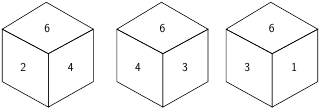
Two different positions of the same die are shown below. What is the number on the face opposite to the one having 2?

  1. AOption (a)

    1

  2. BOption (b)

    6

  3. COption (c)

    4

  4. DOption (d)

    5

View answer & explanation

Correct answer

Answer: (b)B.

6

Why this answer is correct

For find the opposite surface of ' 2', we need to compare the common surface in the given dices,

Now, symbol 6 is given in Dice 1 and Dice 2, 

So, From Dice 1 and Dice 2,

→ 6 is the common surface and 1, 4, 5, 3 is the adjacent surface.

So, the remaining '2' will be the opposite face of '6'.

Hence, the correct answer is "Option 2".

Question 6

Select the number that will come in the place of the question mark(?), if ‘+’ and ‘ – ‘ are interchanged and ‘×’ and ‘÷’ are interchanged?

42 × 7 ÷ 13 – 67 + 13 = ?

  1. AOption (a)

    145

  2. BOption (b)

    121

  3. COption (c)

    132

  4. DOption (d)

    129

View answer & explanation

Correct answer

Answer: (c)C.

132

Why this answer is correct

BODMAS Rule:

Given,

Sign-+×÷
Meaning+-÷×


Replacing the sign in equation, 

42 × 7 ÷ 13 – 67 + 13 = ?

We, get 

42 ÷ 7 × 13 + 67 - 13 

→ 6 × 13 + 67 - 13

→ 78 +67 - 13

→ 145 - 13 = 132

The correct answer is "option 3".

Question 7

Select the option that is related to the third word in the same way as the second word is related to the first word. (The words must be considered as meaningful English words and must NOT be related to each other based on the number of letters/number of consonants/vowels in the word)

Sugar : Diabetes :: Fat : ________

  1. AOption (a)

    Insomnia

  2. BOption (b)

    Obesity

  3. COption (c)

    Thyroid

  4. DOption (d)

    Lethargy

View answer & explanation

Correct answer

Answer: (b)B.

Obesity

Why this answer is correct

Given, 

Sugar : Diabetes 

Sugar → Diabetes: Overconsumption of sugar can lead to diabetes, a metabolic disorder.

Fat : ________

Similarly, excessive fat consumption or accumulation in the body leads to obesity, a health condition characterized by excessive body fat.

Hence, the correct answer is "Obesity". Option 2.

Question 8

Which letter-cluster will replace the question mark (?) to complete the given series?

ZLPT, LABI, XPNX, ?, VTLB

  1. AOption (a)

    LEYL

  2. BOption (b)

    KFAN

  3. COption (c)

    IDAM

  4. DOption (d)

    JEZM

View answer & explanation

Correct answer

Answer: (d)D.

JEZM

Why this answer is correct

Concept:

Solution:

The logic followed here is - first and third letter increase by 12 letter and second and fourth decreased by 11.

Hence, the correct answer is JEZM

Hence, the correct answer is "Option 4".

Question 9

If ‘A’ stands for ‘+’, ‘B’ stands for ‘–‘, ‘C’ stands for ‘×’ and ‘D’ stands for ‘÷’, what will come in place of the question mark in the following equation?

7 C 9 B 35 D 5 A 3 = ?

  1. AOption (a)

    49

  2. BOption (b)

    55

  3. COption (c)

    52

  4. DOption (d)

    59

View answer & explanation

Correct answer

Answer: (d)D.

59

Why this answer is correct

BODMAS rule

Given,

SignABCD
Meaning+-×÷


Replacing the sign in equation, 

7 C 9 B 35 D 5 A 3 = ?

We, get 

7 × 9 - 35 ÷ 5+ 3 

→ 7 × 9 - 7 + 3

→ 63 - 7 + 3 = 59

The correct answer is "option 4".

Question 10

Select the term from among the given options that can replace the question mark (?) in the following series.

PQS, ?, ZAC, EFH, JKM

  1. AOption (a)

    UWX

  2. BOption (b)

    UVX

  3. COption (c)

    TUZ

  4. DOption (d)

    SUV

View answer & explanation

Correct answer

Answer: (b)B.

UVX

Why this answer is correct

Concept:

Solution:

The logic followed here is - every letter increase by 3 letter.

Hence, the correct answer is UVX

Hence, the correct answer is "Option 2".

Question 11

In this question, two statements are followed by four conclusions given as options. Decide which conclusion is definitely true, based on the given statements.

Statements:

P ≤ Q < R < S

T > S > V ≥ W

  1. AOption (a)

    P < V

  2. BOption (b)

    R > W

  3. COption (c)

    Q < W

  4. DOption (d)

    P < T

View answer & explanation

Correct answer

Answer: (d)D.

P < T

Why this answer is correct

Given Statement: 

P ≤ Q < R < S

T > S > V ≥ W

Now,

Conclusions:

  1. P < V → False (P ≤ Q < R < S > V ≥ W  No relation can be established between P and V)
  2. R > W → False (P ≤ Q < R < S > V ≥ W No relation can be established between R and W)
  3. Q < W → False (P ≤ Q < R < S > V ≥ W No relation can be established between Q and W)
  4. P < T → True (P ≤ Q < R < S < T It gives P < T)

Here, Conclusions 4 follows.

Hence, the correct answer is "Option 4".

Question 12

Select the pair from among the given options that is analogous to the given pair.

9 : 725

3 : 23

(NOTE: Operations should be performed on the whole numbers, without breaking down the numbers into its constituent digits. E.g. 13 – Operations on 13 such as adding/subtracting/multiplying etc. to 13 can be performed. Breaking down 13 into 1 and 3 and then performing mathematical operations on 1 and 3 is not allowed.)

  1. AOption (a)

    5 : 128

  2. BOption (b)

    4 : 60

  3. COption (c)

    8 : 315

  4. DOption (d)

    6 : 220 

View answer & explanation

Correct answer

Answer: (b)B.

4 : 60

Why this answer is correct

Logic followed here is,

(First number)3 - 4 = Second number 

Given, 

9 : 725

93 - 4 = 725 (Second number)

And,

3 : 23

33 - 4 = 23(Second number)

Check the option,

Option 1: (5 : 128)

53 - 4 = 121 ≠ 128

Option 2: (4 : 60)

43 - 4 = 60 (Second number)

Option 3: (8 : 315)

83 - 4 = 508 ≠ 315 

Option 4: (6 : 220 )

63 - 4 = 212  ≠ 220

Hence the correct answer is "Option 2"

Question 13

In a certain code language, 'LEMON' is coded as OQPIQ and 'BASIL' is coded as MKVEG. How will 'CHILI' be coded in the same language?

  1. AOption (a)

    JNNLH

  2. BOption (b)

    HLLNJ

  3. COption (c)

    JNLLH

  4. DOption (d)

    HMLNL

View answer & explanation

Correct answer

Answer: (c)C.

JNLLH

Why this answer is correct

Concept:

Solution:

Given,  'LEMON' is coded as OQPIQ

 'BASIL' is coded as MKVEG

The logic followed here is - letter are reversed and increased by 1, 2, 3, 4, 5 respectively. 

For  'CHILI'

JNLLH

Hence, the correct answer is option 3.

Question 14

Ramesh wants to visit his childhood friend’s house. Ramesh’s friend explained his house directions over a text message. See the below text sent to Ramesh about the direction of his friend’s house and answer the following question accordingly. “When you step out of your house, you are facing north. Take a right and walk 3 km, you will see a T-point/junction. Take a right and walk 2 km. There will be a roundabout with four roads. Take the second left from the roundabout and walk 1 km. Take a right and walk 3 km. Take a right and walk 1 km. You will find my house at the front.” In which direction is Ramesh facing at the destination?

  1. AOption (a)

    North

  2. BOption (b)

    West

  3. COption (c)

    South

  4. DOption (d)

    East

View answer & explanation

Correct answer

Answer: (a)A.

North

Why this answer is correct

Given,

“When you step out of your house, you are facing north.

Take a right and walk 3 km, you will see a T-point/junction.

Take a right and walk 2 km.

There will be a roundabout with four roads. Take the second left from the roundabout and walk 1 km.

Take a right and walk 3 km.

Take a right and walk 1 km.

You will find my house at the front.”

From diagram we conclude that Ramesh facing at the destination In north direction

Hence, the correct answer is "Option 1"
Question 15

Read the given statements and conclusions carefully. Assuming that the information given in the statements is true, even if it appears to be at variance with commonly known facts, decide which of the given conclusions logically follow from the statements.

Statements:

Some balloons are nitrogen.

All balloons are hydrogen.

All hydrogens are helium.

Conclusions:

I. All balloons are helium

II. All nitrogens are heliums.

III. Some heliums are nitrogen.

  1. AOption (a)

    Only conclusions II and III follow 

  2. BOption (b)

    All the conclusions follow

  3. COption (c)

    Only conclusions I and III follow

  4. DOption (d)

    Only conclusions I and II follow

View answer & explanation

Correct answer

Answer: (c)C.

Only conclusions I and III follow

Why this answer is correct

Solution:

From above statement,

Some balloons**(B)** are nitrogen**(N).**

All balloons are hydrogen**(Hy)**.

All hydrogens are helium**(He).**

The venn diagram is,

Conclusions venn diagram is,

(I):  All balloons are helium

(II): All nitrogens are heliums.

(III): Some heliums are nitrogen. 

From venn diagram, we conclude that the Only conclusions I and III follow

Hence, the correct answer is "Option 3"

Question 16

Six babies are sitting around a circular dining table, facing the centre. Jo is an immediate neighbour of both Lucy and Stacy. Eva is sitting second to the right of Lucy. Keith is sitting third to the left of Stacy. Carol is an immediate neighbour of both Eva and Stacy. Who among the following is the immediate neighbour of both Jo and Carol?

  1. AOption (a)

    Keith

  2. BOption (b)

    Lucy

  3. COption (c)

    Eva

  4. DOption (d)

    Stacy

View answer & explanation

Correct answer

Answer: (d)D.

Stacy

Why this answer is correct

Given, 

Six babies are sitting around a circular dining table, facing the centre.

Jo is an immediate neighbour of both Lucy and Stacy.

Eva is sitting second to the right of Lucy.

Keith is sitting third to the left of Stacy.

Carol is an immediate neighbour of both Eva and Stacy.

Stacy is the immediate neighbour of both Jo and Carol.

Hence, the correct answer is "Option 4".

Question 17

Which of the following numbers will replace the question mark (?) in the given series?

4, 9, 19, 39, 79, ?

  1. AOption (a)

    152

  2. BOption (b)

    159

  3. COption (c)

    151

  4. DOption (d)

    153

View answer & explanation

Correct answer

Answer: (b)B.

159

Why this answer is correct

Logic followed here is 

First number × 2 + 1 = ne×t number

Given, 4, 9, 19, 39, 79, ? 

4 × 2 + 1 = 9

9 × 2 + 1 = 19

19 × 2 + 1 = 39

39 × 2 + 1 = 79

79 × 2 + 1 = 159.

Hence, the correct answer is "Option 2".

Question 18

Select the number from among the given options that can replace the question mark (?) in the following series.

1, 65, 114, ?, 175, 191

  1. AOption (a)

    144

  2. BOption (b)

    160

  3. COption (c)

    154

  4. DOption (d)

    150

View answer & explanation

Correct answer

Answer: (d)D.

150

Why this answer is correct

Given 1, 65, 114, ?, 175, 191 

Logic followed here is 

1 + 82 = 65

65 + 72 = 114

114 + 62 = 150

150 + 52 = 175

175 + 42 = 191

Hence the correct answer is Option 4.

Question 19

Select the triad from among the given options that is analogous to the given triad.

668 – 776 – 992

  1. AOption (a)

    488 – 398 – 299

  2. BOption (b)

    144 – 225 – 729 

  3. COption (c)

    725 – 623 – 542  

  4. DOption (d)

    195 – 285 – 348

View answer & explanation

Correct answer

Answer: (a)A.

488 – 398 – 299

Why this answer is correct

Logic followed here is that the sum of digit is same and equal to 20.

Given, 

668 – 776 – 992

⇒ 6 + 6 + 8 = 20

⇒ 7 + 7 + 6 = 20

⇒ 9 + 9 + 2 = 20

Check the option,

Option 1 - 488 – 398 – 299

⇒ 4 + 8 + 8 = 20

⇒ 3 + 9 + 8 = 20

⇒ 2 + 9 + 9 = 20

Option  2 - 144 – 225 – 729 

⇒ 1 + 4 + 4 = 9 ≠ 20

⇒  2 + 2 + 5 = 9 ≠ 20

⇒ 7 + 2 + 9 = 19 ≠ 20

Option 3 - 725 – 623 – 542  

⇒ 7 + 2 + 5 = 14 ≠ 20

⇒ 6 + 2 + 3 = 11 ≠ 20

⇒ 5 + 4 + 2 = 11 ≠ 20 

Option 4 - 195 – 285 – 348

⇒ 1 + 9 + 5 = 15 ≠ 20

⇒ 2 + 8 + 5 = 15 ≠ 20

⇒ 3 + 4 + 8 = 15 ≠ 20

Option 1 follow the pattern.

Hence the correct answer is Option 1.

Question 20

Select the triad from among the given options that is analogous to the given triad.

339 – 663 – 555

348 – 636 – 555

  1. AOption (a)

    161 – 512 – 710

  2. BOption (b)

    164 – 542 – 614

  3. COption (c)

    195 – 285 – 348  

  4. DOption (d)

    432 – 513 – 711

View answer & explanation

Correct answer

Answer: (c)C.

195 – 285 – 348  

Why this answer is correct

Logic followed here is that the sum of digit is same and equal to 15

Given, 

339 – 663 – 555

3 + 3 + 9 = 15

6 + 6 + 3 = 15

5 + 5 + 5 = 15

For, 348 – 636 – 555

3 + 4 + 8 = 15

6 + 6 + 3 = 15

 5 + 5 + 5 = 15

Check the option,

Option 1 - 161 – 512 – 710

1 + 6 + 1 = 8 ≠ 15

5 + 1 + 2 = 8 ≠ 15

7 + 1 + 0 = 8 ≠ 15

Option  2 - 164 – 542 – 614

1 + 6 + 4 = 11 ≠ 15

5 + 4 + 2 = 11 ≠ 15

6 + 1 + 4 = 11 ≠ 15

Option 3 - 195 – 285 – 348

1 + 9 + 5 = 15

2 + 8 + 5 = 15

3 + 4 + 8 = 15

Option 4 - 432 – 513 – 711

4 + 3 + 2 = 9 ≠ 15

5 + 1 + 3 = 9 ≠ 15

7 + 1 + 1 = 9 ≠ 15

Option 3 follow the pattern.

Hence the correct answer is Option 3.

Question 21

What will come in place of the question mark (?) in the given series?

8, 17, 35, 71, ?, 287

  1. AOption (a)

    150

  2. BOption (b)

    143

  3. COption (c)

    156

  4. DOption (d)

    131

View answer & explanation

Correct answer

Answer: (b)B.

143

Why this answer is correct

Logic followed here is 

First number × 2 + 1 = next number

Given, 8, 17, 35, 71, ?, 287

8 × 2 + 1 = 17

17 × 2 + 1 = 35

35 × 2 + 1 = 71

71 × 2 + 1 = 143

143 × 2 + 1 = 287.

Hence, the correct answer is "Option 2".

Question 22

Select the pair from among the given options that is analogous to the given pair.

12 : 141

8 : 61

(NOTE: Operations should be performed on the whole numbers, without breaking down the numbers into its constituent digits. E.g. 13 – Operations on 13 such as adding/subtracting/multiplying etc. to 13 can be performed. Breaking down 13 into 1 and 3 and then performing mathematical operations on 1 and 3 is not allowed.)

  1. AOption (a)

    14 : 197

  2. BOption (b)

    13 : 165

  3. COption (c)

    18 : 321

  4. DOption (d)

    11 : 121 

View answer & explanation

Correct answer

Answer: (c)C.

18 : 321

Why this answer is correct

Logic followed here is,

(First number)2 - 3 = Second number 

Given, 

12 : 141

122 - 3 = 141 (Second number)

And,

8 : 61

82 - 3 = 61 (Second number)

Check the option,

Option 1: (14 : 197)

142 - 3 = 191 ≠ 197

Option 2: (13 : 165)

132 - 3 = 166 ≠ 165

Option 3: (18 : 321)

182 - 3 = 321 (Second number)

Option 4: (11 : 121 )

112 - 3 = 118 ≠ 121

Hence the correct answer is "Option 3"

Question 23

Pointing to a photograph Rani said, “She is the daughter of the only son of my grandfather.” How is the girl in the photograph related to Rani?

  1. AOption (a)

    Brother

  2. BOption (b)

    Daughter

  3. COption (c)

    Sister

  4. DOption (d)

    Cousin 

View answer & explanation

Correct answer

Answer: (c)C.

Sister

Why this answer is correct

Family Chart:

Given:

She is the daughter of the only son of my grandfather**(GF).**

The girl in the photograph sister to Rani

Hence, the correct answer is "Option 3"

Question 24

Three different positions of the same dice are shown. Find the number on the face opposite the face showing the number ‘6’.

  1. AOption (a)

    5

  2. BOption (b)

    4

  3. COption (c)

    2

  4. DOption (d)

    3

View answer & explanation

Correct answer

Answer: (a)A.

5

Why this answer is correct

For find the opposite surface of ' 6', we need to compare the common surface in the given dices,

Now, symbol 6 is given in Dice 1 and Dice 2, 

So, From Dice 1 and Dice 2 and Dice 3

→ 6 is the common surface and 1, 2, 3, 4 is the adjacent surface.

So, the remaining '5' will be the opposite face of '6'.

Hence, the correct answer is "Option 1".

Question 25

Which of the following terms will replace the question mark (?) in the given series?

NDJP, PBMM, RZPJ, ?, VVVD

  1. AOption (a)

    SZTF

  2. BOption (b)

    UXTG

  3. COption (c)

    SYSF

  4. DOption (d)

    TXSG

View answer & explanation

Correct answer

Answer: (d)D.

TXSG

Why this answer is correct

Concept:

Solution:

The logic followed here is - every letter increase by 3 letter.

Hence, the correct answer is TXSG

Hence, the correct answer is "Option 4".

Question 26

Which of the following numbers will replace the question mark (?) in the given series?

7, 13, 27, 53, 107, ?

  1. AOption (a)

    103

  2. BOption (b)

    213

  3. COption (c)

    203

  4. DOption (d)

    113

View answer & explanation

Correct answer

Answer: (b)B.

213

Why this answer is correct

Given, 

7, 13, 27, 53, 107, ?

Logic followed here is,

7 × 2 - 1 = 13

13 × 2 + 1 = 27

27 × 2 - 1 = 53

53 × 2 + 1 = 107

107 × 2 - 1 = 213.

Hence the correct answer is Option 2.

Question 27

P, Q, R, S, T and U are sitting around a circular table facing the centre (but not necessarily in the same order). U sits to the immediate right of Q. Only two people sit between U and R. P sits to the immediate left of S. Which of the following represents the position of T with respect to S? 

  1. AOption (a)

    Immediate right

  2. BOption (b)

    Second to the right 

  3. COption (c)

    Second to the left 

  4. DOption (d)

    Third to the left

View answer & explanation

Correct answer

Answer: (b)B.

Second to the right 

Why this answer is correct

Given P, Q, R, S, T and U are sitting around a circular table facing the centre (but not necessarily in the same order).

U sits to the immediate right of Q.

Only two people sit between U and R.

P sits to the immediate left of S. 

And T sits on the remaining place.

Second to the right is the position of T with respect to S.

Hence correct answer is Option 2.

Question 28

What will be the day of the week on 08 June 2030?

  1. AOption (a)

    Friday

  2. BOption (b)

    Monday

  3. COption (c)

    Saturday

  4. DOption (d)

    Sunday 

View answer & explanation

Correct answer

Answer: (c)C.

Saturday

Why this answer is correct

Concept:

YearOdd Days
1005 odd days
2003 odd days
3001 odd days
4000 odd days


Leap Year2 Odd days
Ordinary Year1 Odd day

Given date: 08 June 2030.

In 2000 Years the odd day is 0,

Now, calculate the odd days from 2000 to 2029:

Normal years (non-leap) = 23 years → 23 odd days

Leap years = 7 years → 7 × 2 = 14 odd days

Total odd days = 23 + 14 = 37

Since 37 ÷ 7 = remainder 2,

The number of odd days from 2000 to 2029 is 2

Now,

Total odd days from January 2030 to June 08, 2030

  • January = 31 days → 3 odd days
  • February = 28 days → 0 odd days
  • March = 31 days → 3 odd days
  • April = 30 days → 2 odd days
  • May = 31 days → 3 odd days
  • June 1-7 = 7 days → 0 odd days
  • June 8 = 1 day → 1 odd day


= 3 + 0 + 3 + 2 + 3 + 0 + 1 = 12

Since 12 ÷ 7 = remainder 5,

The odd days from January to June 8, 2030, are 5.

Now, add up all the odd days:

Odd days from 2000 to 2029 = 2

Odd days from January to June 08, 2030 = 5

Total odd days = 2 + 5 = 7

Since 7 odd days = 0 (Sunday cycle), the day on 08 June 2030 is Saturday.

Hence, the correct answer is "Saturday".

Question 29

Which option represents the correct order of the given words as they would appear in an English dictionary?

  1. Mimic
  2. Million
  3. Minaret
  4. Millstone
  5. Mimicry
  1. AOption (a)

    2, 4, 1, 5, 3

  2. BOption (b)

    2, 1, 4, 5, 3

  3. COption (c)

    2, 3, 1, 5, 4

  4. DOption (d)

    2, 4, 1, 3, 5 

View answer & explanation

Correct answer

Answer: (a)A.

2, 4, 1, 5, 3

Why this answer is correct

The correct order of words as they would appear in the English dictionary is:

  1. Million
  2. Millstone
  3. Mimic
  4. Mimicry
  5. Minaret

The correct order is '2, 4, 1, 5, 3'.

Hence, the correct answer is "Option (1)".

Question 30

What will come in place of the question mark (?) in the following equation if ‘a’ means ‘÷’, ‘b’ means ‘+’, ‘c’ means ‘−’ and ‘d’ means ‘×’?

11 b 15 c 8 a 4 d 5 = ?

  1. AOption (a)

    16

  2. BOption (b)

    14

  3. COption (c)

    17

  4. DOption (d)

    15

View answer & explanation

Correct answer

Answer: (a)A.

16

Why this answer is correct

BODMAS rule

Given,

Signabcd
Meaning÷+-×


Replacing the sign in equation, 

11 b 15 c 8 a 4 d 5 = ?

We, get 

11 + 15 - 8 ÷ 4 × 5

→11 + 15 - 2 × 5 

→11 + 15 - 10 = 16

The correct answer is "option 1".

Question 31

Three of the following four are alike in a certain way and thus form a group. Which is the one that does NOT belong to that group?

(NOTE: The odd one out is not based on the number of vowels/consonants or their position in the letter-cluster).

  1. AOption (a)

    YVT

  2. BOption (b)

    LHF

  3. COption (c)

    GDB

  4. DOption (d)

    ROM

View answer & explanation

Correct answer

Answer: (b)B.

LHF

Why this answer is correct

Concept:

Solution:

Check each option

Option 1 - YVT

Option 2 - LHF

Option 3 - GDB

Option 4 - ROM

​

Option 2 LHF does not follow the same pattern.

Hence, the correct answer is option 2.

Question 32

In a certain code language, ‘BEAUTY’ is coded as 71 and ‘RIVER’ is coded as 70. How will ‘PEOPLE’ be coded in the same language?

  1. AOption (a)

    66

  2. BOption (b)

    65

  3. COption (c)

    67

  4. DOption (d)

    69

View answer & explanation

Correct answer

Answer: (a)A.

66

Why this answer is correct

Concept:

Logic followed here is,

Code = Sum of place value of letter - number of vowels

Given, ‘BEAUTY’ is coded as 71

‘B = 2, E = 5, A = 1, U = 21, T = 20, Y = 25’ and number of vowels = 3

2 + 5 + 1 + 21 + 20 + 25 = 74

now, 74 - 3 = 71

‘RIVER’ is coded as 70

R = 18, I = 9, V = 22, E = 5, R = 18, and number of vowels = 2

18 + 9 + 22 + 5 + 18 = 72

72 - 2 - 70

For ‘PEOPLE’

P = 16, E = 5, O = 15, P = 16, L = 12, E = 5, and number of vowels = 3

16 + 5 + 15 + 16 + 12 + 5 = 69

69 - 3 = 66.

Hence the correct answer is Option 1

Question 33

If + means ×, × means −, − means ÷, and ÷ means +, what will be the value of the given expression?

15 − 3 ÷ 25 × 7 + 3

  1. AOption (a)

    9

  2. BOption (b)

    27

  3. COption (c)

    69

  4. DOption (d)

    18

View answer & explanation

Correct answer

Answer: (a)A.

9

Why this answer is correct

BODMAS rule

Given,

Sign+×-÷
Meaning×-÷+


Replacing the sign in equation, 

15 − 3 ÷ 25 × 7 + 3

We, get 

15 ÷ 3 + 25 - 7 × 3

→5 + 25 - 7 × 3

→5 + 25 - 21 = 9

The correct answer is "option 1".

Question 34

Select the option that is related to the third word in the same way as the second word is related to the first word. (The words must be considered as meaningful English words and must NOT be related to each other based on the number of letters/number of consonants/vowels in the word)

Carpenter : Wood :: Mason : _________

  1. AOption (a)

    Pipe

  2. BOption (b)

    Stone

  3. COption (c)

    Builder

  4. DOption (d)

    Iron

View answer & explanation

Correct answer

Answer: (b)B.

Stone

Why this answer is correct

Explanation:

Logic followed here is the relationship between Carpenter and Wood is based on the material they primarily work with:

A Carpenter is a skilled worker who works with wood to make furniture, doors, and other wooden structures.

Now, we need to find a word related to Mason in a similar way.

A Mason is a skilled worker who builds structures using stones.

Hence the correct answer is Option 2.

Question 35

If ‘A’ stands for ‘+’, ‘B’ stands for ‘–‘, ‘C’ stands for ‘×’ and ‘D’ stands for ‘÷’ what will come in place of the question mark in the following equation?

60 D 10 A 4 C 6 B 25 = ?

  1. AOption (a)

    5

  2. BOption (b)

    9

  3. COption (c)

    6

  4. DOption (d)

    10

View answer & explanation

Correct answer

Answer: (a)A.

5

Why this answer is correct

BODMAS rule

Given,

SignABCD
Meaning+-×÷


Replacing the sign in equation, 

60 D 10 A 4 C 6 B 25 = ?

We, get 

60 ÷ 10 + 4 × 6 - 25 

→6 + 4 × 6 - 25 

→6 + 24 - 25 = 5

The correct answer is "option 1".

Question 36

In the word ‘AMBIDEXTROUS’, if the first letter is interchanged with the last letter, the second letter is interchanged with the eleventh letter, the third letter is interchanged with the tenth letter and so on, then which letter would immediately follow R in the new arrangement when read from left to right?

  1. AOption (a)

    T

  2. BOption (b)

    E

  3. COption (c)

    O

  4. DOption (d)

    X

View answer & explanation

Correct answer

Answer: (a)A.

T

Why this answer is correct

Given the word ‘AMBIDEXTROUS’

If the first letter is interchanged with the last letter, the second letter is interchanged with the eleventh letter, the third letter is interchanged with the tenth letter and so on then word become,

S U O R T X E D I B M A

then letter T immediately follow R in the new arrangement when read from left to right.

Hence the correct answer is Option 1.

Question 37

Two different positions of the same die are shown below. What is the number on the face opposite to the one having 5?

  1. AOption (a)

    6

  2. BOption (b)

    3

  3. COption (c)

    1

  4. DOption (d)

    4

View answer & explanation

Correct answer

Answer: (d)D.

4

Why this answer is correct

For find the opposite surface of ' 5', we need to compare the common surface in the given dices,

Now, symbol 4 is given in Dice 1 and Dice 2, 

So, From Dice 1 and Dice 2

→ 4 is the common surface and 1, 2, 3, 6 is the adjacent surface.

So, the remaining '5' will be the opposite face of '4'.

Hence, the correct answer is "Option 4".

Question 38

Read the given statements and conclusions carefully. You have to consider the given statements to be true even if they seem to be at variance from commonly known facts. You have to decide which of the given conclusions logically follow/s from the given statements.

Statements:

Some pins are clips.

Some clips are papers.

No paper is a book.

Conclusions:

(I) : No book is a pin.

(II) : At least some pins are papers.

  1. AOption (a)

    Only conclusion (I) follows. 

  2. BOption (b)

    Neither conclusion (I) nor (II) follows. 

  3. COption (c)

    Only conclusion (II) follows.

  4. DOption (d)

    Both conclusions (I) and (II) follow. 

View answer & explanation

Correct answer

Answer: (b)B.

Neither conclusion (I) nor (II) follows. 

Why this answer is correct

From above statement,

Some pins are clips.

Some clips are papers.

No paper is a book.

The venn diagram is,

Conclusions venn diagram is,

(I) : No book is a pin.

(II) : At least some pins are papers.

From venn diagram, we conclude that the Neither conclusion (I) nor (II) follows. 

Hence, the correct answer is "Option 2"

Question 39

Select the pair which is related to each other in the same way as the following –

9:69

11:109

(NOTE: Operations should be performed on the whole numbers, without breaking down the numbers into its constituent digits. E.g. 13 – Operations on 13 such as adding/subtracting/multiplying etc. to 13 can be performed. Breaking down 13 into 1 and 3 and then performing mathematical operations on 1 and 3 is not allowed.)

  1. AOption (a)

    24:576

  2. BOption (b)

    16:244 

  3. COption (c)

    14:209 

  4. DOption (d)

    8:76

View answer & explanation

Correct answer

Answer: (b)B.

16:244 

Why this answer is correct

Logic followed here is,

(First number)2 - 12 = Second number 

Given, 

9:69

92 - 12 = 69 (Second number)

And,

11:109

112 - 12 = 109 (Second number)

Check the option,

Option 1: (24:576)

242 - 12 = 564 ≠ 576

Option 2: (16:244)

162 - 12 = 244 (second number)

Option 3: (14:209 )

142 - 184 ≠ 209 

Option 4: (8:76)

82 - 12 = 52 ≠ 76

Hence the correct answer is "Option 2"

Question 40

Select the pair from among the given options that is analogous to the given pair.

2 : 11

1 : 4

(NOTE: Operations should be performed on the whole numbers, without breaking down the numbers into its constituent digits. E.g. 13 – Operations on 13 such as adding/subtracting/multiplying etc. to 13 can be performed. Breaking down 13 into 1 and 3 and then performing mathematical operations on 1 and 3 is not allowed.)

  1. AOption (a)

    4 : 65

  2. BOption (b)

    5 : 128

  3. COption (c)

    3 : 27

  4. DOption (d)

    6 : 217

View answer & explanation

Correct answer

Answer: (b)B.

5 : 128

Why this answer is correct

Logic followed here is,

(First number)3 + 3 = Second number 

Given, 

2 : 11

23 + 3 = 11 (Second number)

And,

1 : 4

13 + 3 = 4 (Second number)

Check the option,

Option 1: (4 : 65)

43 + 3 = 67 ≠ 65

Option 2: (5 : 128)

53 + 3 = 128 (second number)

Option 3: (3 : 27)

33 + 3 = 30 ≠ 27 

Option 4: (6 : 217)

63 + 3 = 219 ≠ 217

Hence the correct answer is "Option 2"

Question 41

Which figure should replace the question mark (?) if the following series were to be continued?

  1. AOption (a)

  2. BOption (b)

  3. COption (c)

  4. DOption (d)

View answer & explanation

Correct answer

Answer: (b)B.

Why this answer is correct

Logic followed here is,

Hence the correct answer is Option 2.

Question 42

Select the option figure that will replace the question mark (?) in the figure given below and complete the pattern.

  1. AOption (a)

  2. BOption (b)

  3. COption (c)

  4. DOption (d)

View answer & explanation

Correct answer

Answer: (c)C.

Why this answer is correct

The completion of the given figure is,

Hence the correct answer is Option 3.

Question 43

Select the option figure that will replace the question mark (?) in the figure given below and complete the pattern.

  1. AOption (a)

  2. BOption (b)

  3. COption (c)

  4. DOption (d)

View answer & explanation

Correct answer

Answer: (d)D.

Why this answer is correct

The completion of the given figure is,

Hence the correct answer is Option 4.

Question 44

Three statements are given, followed by two conclusions numbered I and II. Assuming the statements to be true, even if they seem to be at variance with commonly known facts, decide which of the conclusion(s) logically follow(s) from the statements.

Statements:

All papers are books.

Some books are notebooks.

All notebooks are files.

Conclusions:

I. Some papers are notebooks.

II. All books are files.

  1. AOption (a)

    Neither conclusion I nor II follows.

  2. BOption (b)

    Both conclusions I and II follow.

  3. COption (c)

    Only conclusion I follows. 

  4. DOption (d)

    Only conclusion II follows

View answer & explanation

Correct answer

Answer: (a)A.

Neither conclusion I nor II follows.

Why this answer is correct

From above statement,

All papers**(P)** are books**(B)**.

Some books are notebooks(N).

All notebooks are files**(F)**.

The venn diagram is,

Conclusion I: Some papers are notebooks.(False)

We only know that all papers are books and some books are notebooks, but it is not necessary that any paper is a notebook.

There is no direct or indirect link confirming that any paper is also a notebook.

Conclusion II: All books are files. (False)

Some books are notebooks, and all notebooks are files.

However, this does not mean that all books are files—only some books (those that are notebooks) are files.

So, the correct answer is Neither Conclusion I nor II follows.

Hence, the correct answer is "Option 4"

Question 45

A man travels 10 km towards the west and turns left and travels 4 km and then travels another 4 km towards the east. He then turns to his right and travels 5 kms. Then, he turns to his left and travels 6 kms. In which direction is he from his starting position?

  1. AOption (a)

    North

  2. BOption (b)

    South

  3. COption (c)

    West

  4. DOption (d)

    East

View answer & explanation

Correct answer

Answer: (b)B.

South

Why this answer is correct

Given,

A man travels 10 km towards the west and turns left and travels 4 km

And then travels another 4 km towards the east.

He then turns to his right and travels 5 kms.

Then, he turns to his left and travels 6 kms.

From diagram we conclude that he is in south direction from his starting position

Hence, the correct answer is "Option 2"

Question 46

Three of the following four letter-clusters are alike in a certain way and one is different. Pick the odd one out.

(NOTE: The odd one out is not based on the number of vowels or consonants in the word)

  1. AOption (a)

    NRI

  2. BOption (b)

    JQF

  3. COption (c)

    SHO

  4. DOption (d)

    VER

View answer & explanation

Correct answer

Answer: (a)A.

NRI

Why this answer is correct

Concept:

Solution:

Check each option

Option 1 - NRI

Option 2 - JQF

Option 3 - SHO

Option 4 - VER

Option 1 NRI does not follow the same pattern.

Hence, the correct answer is option 1.

Question 47

Two statements are given, followed by two conclusions numbered I and II. Assuming the statements to be true, even if they seem to be at variance with commonly known facts, decide which of the conclusions logically follow(s) from the statements.

Statements:

All milk are white.

Some white are red.

Conclusions:

I. All red are milk.

II. No red is a milk.

  1. AOption (a)

    Only conclusion II follows

  2. BOption (b)

    Both conclusions I and II follow

  3. COption (c)

    Neither conclusion I nor II follows. 

  4. DOption (d)

    Only conclusion I follows. 

View answer & explanation

Correct answer

Answer: (c)C.

Neither conclusion I nor II follows. 

Why this answer is correct

From above statement,

All milk**(M)** are white**(W)**.

Some white are red**(R)**.

The venn diagram is,

Conclusions venn diagram is,

I. All red are milk.

II. No red is a milk. 

From venn diagram, we conclude that the Neither conclusion I nor II follows. 

Hence, the correct answer is "Option 3"

Question 48

How many triangles are there in the given figure? 

  1. AOption (a)

    13

  2. BOption (b)

    15

  3. COption (c)

    14

  4. DOption (d)

    12

View answer & explanation

Correct answer

Answer: (a)A.

13

Why this answer is correct

Number of triangles in given figure is,

Thus the number of triangle is 13

Hence the correct answer is Option 1.

Question 49

What will come in place of the ‘?’ in the following equation, if ‘+’ and ‘−’ are interchanged and ‘×’ and ‘÷’ are interchanged?

56 + 12 − 54 × 18 ÷ 6 = ?

  1. AOption (a)

    86

  2. BOption (b)

    62

  3. COption (c)

    50

  4. DOption (d)

    26

View answer & explanation

Correct answer

Answer: (b)B.

62

Why this answer is correct

BODMAS rule

Given,

Sign+-×÷
Meaning-+÷×


Replacing the sign in equation, 

56 + 12 − 54 × 18 ÷ 6 = ?

We, get 

56 - 12 + 54 ÷ 18 × 6 

→56 - 12 + 3 × 6 

→56 - 12 + 18 = 62

The correct answer is "option 2".

Question 50

Select the figure from among the given options that can replace the question mark (?) in the following series.

  1. AOption (a)

  2. BOption (b)

  3. COption (c)

  4. DOption (d)

View answer & explanation

Correct answer

Answer: (d)D.

Why this answer is correct

Logic followed here is,

From the first figure to second figure, the arrow remain at the same place and circle change in triangle.

And from the second figure to third figure, the arrow move to opposite side and triangle change in diamond.

From the third figure to fourth figure, the arrow remain at the same place and diamond change in circle.

Now, from the fourth figure to fifth figure, the arrow move to opposite side and circle change in triangle.

Hence the correct answer is Option 4.

General Awareness (50 questions)

Question 51

Which of the following administrative units was introduced during the reign of Shahjahan?

  1. AOption (a)

    Chakla

  2. BOption (b)

    Mahals

  3. COption (c)

    Paraganas

  4. DOption (d)

    Subah

View answer & explanation

Correct answer

Answer: (a)A.

Chakla

Why this answer is correct

The correct answer is Chakla.

Key Points

  • During the reign of Shahjahan, the administrative unit called Chakla was introduced.
  • Chakla was a subdivision of a province (Subah) in the Mughal administrative system.
  • Each Chakla was further divided into smaller units called Paraganas.
  • The Chakla system aimed to streamline revenue collection and local governance.
  • This administrative reform helped in better management and control of the vast Mughal Empire.

Additional Information

  • Subah
  • Subah was the largest administrative division in the Mughal Empire, similar to a province.
  • Each Subah was governed by a Subahdar who was responsible for law and order, as well as revenue collection.
  • Paragana
  • Paragana was a smaller administrative unit within a Chakla.
  • It comprised several villages and was managed by local officials for tax collection and judicial matters.
  • Mahals
  • Mahals referred to revenue circles or estates within a Paragana.
  • They were the basic units for land revenue assessment and collection.
  • Zamindars
  • Zamindars were landowners who collected taxes from the peasants and paid a portion to the Mughal administration.
  • They played a crucial role in the revenue system of the Mughal Empire.

Question 52

The last Indian Olympic games were held in ________. 

  1. AOption (a)

    Delhi

  2. BOption (b)

    Calcutta

  3. COption (c)

    Lahore 

  4. DOption (d)

    Bombay

View answer & explanation

Correct answer

Answer: (b)B.

Calcutta

Why this answer is correct

The correct answer is Calcutta.

Key Points

  • The last Indian Olympic Games, known as the All India Olympic Games, were held in Calcutta.
  • The event took place in 1948, post-independence, and was a precursor to the modern-day National Games of India.
  • These games were organized by the Indian Olympic Association (IOA), established in 1927.
  • The event aimed to promote sports and identify talent for international competitions, including the Olympics.
  • Delhi has historically been a significant venue for various national and international sports events in India.

Additional Information

  • National Games of India
  • These games are a multi-sport event held every four years in India.
  • The Indian Olympic Association organizes the event, and the first edition was held in Lahore in 1924.
  • The games are designed to promote sports and provide a platform for athletes to showcase their talent.
  • Various states and Union territories of India participate in the National Games.
  • Indian Olympic Association (IOA)
  • It is the governing body for the Olympic Movement and the Commonwealth Games in India.
  • The IOA is responsible for selecting athletes to represent India at the Olympic Games, Asian Games, and other international competitions.
  • The association also works to develop and promote sports throughout the country.
  • Post-Independence Sports Development
  • Post-independence, India has made significant strides in sports, with increased government support and infrastructure development.
  • Various sports schemes and programs have been launched to nurture young talent.
  • India has hosted and participated in numerous international sports events, gaining recognition and success in various disciplines.
  • Sports Infrastructure in Delhi
  • Delhi has several world-class sports facilities, including the Jawaharlal Nehru Stadium and the Indira Gandhi Arena.
  • The city hosted the 2010 Commonwealth Games, showcasing its capability to organize large-scale international events.

Question 53

The Primary Deficit is zero in which of the following situations?

A. Fiscal Deficit is zero.

B. Interest payment is equal to Fiscal Deficit.

  1. AOption (a)

    Both A and B

  2. BOption (b)

    Neither A nor B

  3. COption (c)

    Only A

  4. DOption (d)

    Only B

View answer & explanation

Correct answer

Answer: (d)D.

Only B

Why this answer is correct

The correct answer is Only B.

Key Points

  • Primary Deficit is the fiscal deficit of a country excluding the interest payments on previous borrowings.
  • The Primary Deficit is calculated as: Primary Deficit = Fiscal Deficit - Interest Payments.
  • If the interest payment is equal to the fiscal deficit, then Primary Deficit would be zero, since the entire fiscal deficit is accounted for by interest payments.
  • Therefore, the Primary Deficit is zero when interest payment is equal to the fiscal deficit (Option B).

Additional Information

  • Fiscal Deficit: The difference between the government's total expenditure and its total receipts (excluding borrowing).
  • Interest Payments: Payments made by the government to service its debt, i.e., the interest on loans taken in the past.
  • Budget Deficit: When total government spending exceeds the revenue that the government generates, excluding money from borrowings.
  • Revenue Deficit: The difference between the government's revenue expenditure and revenue receipts.
  • Understanding Deficits: Tracking various types of deficits helps in understanding the financial health of the government and its ability to manage and service its debt.

Question 54

Which of the following States is a part of Panjnad (land of five rivers)?

  1. AOption (a)

    Gujarat 

  2. BOption (b)

    Punjab

  3. COption (c)

    Kerala

  4. DOption (d)

    Sikkim

View answer & explanation

Correct answer

Answer: (b)B.

Punjab

Why this answer is correct

The correct answer is Punjab.

Key Points

  • Punjab is known as the land of five rivers: Beas, Ravi, Sutlej, Chenab, and Jhelum.
  • The name "Punjab" is derived from the Persian words "panj" (five) and "ab" (water), referring to the five major rivers in the region.
  • The five rivers contribute significantly to the agricultural fertility of the state, making Punjab one of the most prosperous agricultural regions in India.
  • These rivers eventually merge to form the Panjnad, which is a point where all five rivers combine.

Additional Information

  • Beas River
  • The Beas River is one of the five rivers of Punjab and flows through the states of Himachal Pradesh and Punjab.
  • It is known for its historical significance as it marked the eastern extent of Alexander the Great's invasion in 326 BCE.
  • Ravi River
  • The Ravi River flows through the Indian state of Punjab and the Pakistani province of Punjab.
  • It is one of the major tributaries of the Indus River system.
  • Sutlej River
  • The Sutlej River is the longest of the five rivers of Punjab.
  • It originates from Lake Rakshastal in Tibet and flows through Himachal Pradesh and Punjab before entering Pakistan.
  • Chenab River
  • The Chenab River flows through the Indian state of Jammu and Kashmir and the Pakistani province of Punjab.
  • It is a major river of the Indus River system, and it merges with the Jhelum and Sutlej rivers in Pakistan.
  • Jhelum River
  • The Jhelum River flows through the Indian-administered territory of Jammu and Kashmir and the Pakistani province of Punjab.
  • It is notable for its scenic beauty and historical importance as it passes through the Kashmir Valley.

Question 55

The Vernacular Press Act was enacted in which year in British India to limit the freedom of the Indian-language press?

  1. AOption (a)

    1876

  2. BOption (b)

    1879

  3. COption (c)

    1875

  4. DOption (d)

    1878

View answer & explanation

Correct answer

Answer: (d)D.

1878

Why this answer is correct

The correct answer is 1878.

Key Points

  • The Vernacular Press Act was enacted in 1878 by the British colonial government in India.
  • It was implemented by the then Viceroy of India, Lord Lytton, to curb the freedom of the Indian-language press.
  • The Act was aimed at stifling the criticism of British policies by the Indian press, especially those written in vernacular languages.
  • Under this Act, the government had the authority to confiscate the printing press, paper, and other materials of a publication if it was found guilty of publishing seditious material against the British government.
  • The Act faced severe opposition and criticism from Indian intellectuals and leaders, leading to its eventual repeal in 1881 by Lord Ripon.

Additional Information

  • Lord Lytton
  • He served as the Viceroy of India from 1876 to 1880.
  • His tenure was marked by controversial policies, including the Vernacular Press Act and the handling of the Great Famine of 1876–78.
  • Lord Ripon
  • He served as the Viceroy of India from 1880 to 1884.
  • He is known for his liberal policies and for repealing the Vernacular Press Act in 1881.
  • He also introduced the Ilbert Bill, which sought to allow Indian judges to try British offenders.
  • Indian Nationalism
  • The period during which the Vernacular Press Act was enacted saw a rise in Indian nationalism and the demand for civil liberties.
  • Indian leaders and intellectuals used the press as a means to mobilize public opinion against colonial rule.
  • Press Freedom
  • The Vernacular Press Act is an important historical example of the struggle for press freedom in colonial India.
  • It highlights the role of the press in advocating for political and social reforms.

Question 56

Madhavi Mudgal is a famous _______ dancer

  1. AOption (a)

    Bharatnatyam

  2. BOption (b)

    Kathak

  3. COption (c)

    Odissi 

  4. DOption (d)

    Manipuri 

View answer & explanation

Correct answer

Answer: (c)C.

Odissi 

Why this answer is correct

The correct answer is Odissi.

Key Points

  • Madhavi Mudgal is renowned for her expertise in Odissi dance, one of the eight classical dance forms of India.
  • She has received numerous awards, including the prestigious Sangeet Natak Akademi Award in 2000 for her contribution to Odissi dance.
  • Madhavi Mudgal has been instrumental in popularizing Odissi dance on global platforms through her performances and teaching.
  • She trained under the guidance of Guru Kelucharan Mohapatra, a legendary figure in Odissi dance.
  • Her choreography and performances are known for their grace, technical precision, and adherence to the traditional Odissi style.

Additional Information

  • Odissi Dance
  • Odissi is one of the oldest surviving dance forms of India, originating from the state of Odisha.
  • It is characterized by its fluid movements, intricate footwork, and expressive gestures (mudras).
  • Odissi dance is traditionally performed as a form of worship and storytelling, often depicting tales from Hindu mythology.
  • The dance form is known for its distinct postures, such as the Tribhangi, which involves three bends in the body.
  • Odissi music is based on classical Indian ragas and talas, adding a melodic dimension to the dance performances.
  • Sangeet Natak Akademi Award
  • It is the highest Indian recognition given to practicing artists for their outstanding contribution to performing arts.
  • The award was established by the Sangeet Natak Akademi, India's National Academy for Music, Dance, and Drama, in 1952.
  • Recipients of this award are honored for their work in fields such as music, dance, theater, and other performing arts.
  • The award includes a citation, a plaque, and a cash prize, reflecting the recipient's exceptional talent and dedication.
  • Guru Kelucharan Mohapatra
  • He was a legendary Odissi dancer, choreographer, and teacher who played a crucial role in reviving and popularizing Odissi dance.
  • Guru Kelucharan Mohapatra trained many renowned dancers, including Madhavi Mudgal and Sonal Mansingh.
  • His contributions to Odissi dance earned him numerous accolades, including the Padma Vibhushan, India's second-highest civilian award.
  • He is remembered for his innovative choreography, dedication to preserving traditional techniques, and nurturing new talent.

Question 57

Hill Area Development Programmes were initiated during the ______________ FiveYear Plan covering 15 districts. 

  1. AOption (a)

    Second

  2. BOption (b)

    Fifth

  3. COption (c)

    Fourth

  4. DOption (d)

    Sixth

View answer & explanation

Correct answer

Answer: (b)B.

Fifth

Why this answer is correct

The correct answer is Fifth.

Key Points

  • The Hill Area Development Programme (HADP) was initiated during the Fifth Five-Year Plan in India.
  • The program aimed at the development of hilly regions and covered 15 districts initially.
  • The primary objective was to ensure the socio-economic development of these regions which are generally less developed compared to plains.
  • Special emphasis was placed on improving infrastructure, agriculture, forestry, and human resource development in these areas.
  • The program recognized the unique geographical and environmental challenges faced by hill areas and aimed to address them through targeted interventions.

Additional Information

  • Five-Year Plans in India
  • The Five-Year Plans were centralized and integrated national economic programs.
  • They were developed and executed by the Planning Commission of India, which was established in 1950.
  • The plans aimed to boost the economy through various sector-specific schemes and policies.
  • Each plan focused on different sectors like agriculture, industry, services, and social development.
  • Fifth Five-Year Plan (1974-1979)
  • This plan focused on poverty alleviation and self-reliance as the main objectives.
  • It emphasized employment generation and the development of infrastructure.
  • It also focused on agricultural growth and improving the living standards of the rural population.
  • Hill Area Development
  • Hill areas often face issues like soil erosion, deforestation, and inadequate infrastructure.
  • Development programs aim to address these issues through sustainable practices.
  • Efforts include promoting terrace farming, reforestation, and developing road connectivity.
  • Sustainable Development
  • Sustainable development in hill areas focuses on balancing economic growth with environmental conservation.
  • It involves using resources in a way that meets current needs without compromising future generations.
  • Key practices include eco-friendly tourism, organic farming, and renewable energy projects.

Question 58

What is the percentage of the disabled population in India according to the 2011 census?

  1. AOption (a)

    2.21%

  2. BOption (b)

    2.97%

  3. COption (c)

    3.63%

  4. DOption (d)

    1.33%

View answer & explanation

Correct answer

Answer: (a)A.

2.21%

Why this answer is correct

The correct answer is 2.21%

Key Points

  • According to the 2011 Census of India, approximately 2.21**% of the population** was recorded as disabled.
  • This percentage translates to around 26.8 million people with disabilities.
  • The disabled population includes individuals with various types of disabilities like seeing, hearing, speech, movement, mental retardation, mental illness, multiple disabilities, and other disabilities.
  • The census data is crucial for understanding the distribution and needs of the disabled population for policy formulation.

Additional Information

  • Types of Disabilities
  • Seeing Disability: Includes blindness and low vision.
  • Hearing Disability: Includes deafness and hard of hearing.
  • Movement Disability: Includes locomotor disabilities affecting limbs, spine, etc.
  • Mental Disability: Includes mental retardation and mental illness.
  • Policies for Disabled
  • The Rights of Persons with Disabilities Act, 2016 aims to uphold the dignity of every person in society and prevent discrimination.
  • The Act increased the number of recognized disabilities from 7 to 21.
  • It guarantees access to inclusive education, employment, and social security for persons with disabilities.
  • Global Perspective
  • The World Health Organization (WHO) estimates that over 1 billion people globally live with some form of disability.
  • Approximately 15% of the world's population experiences moderate to severe disability.
  • Government Initiatives
  • Initiatives like the Accessible India Campaign aim to make public spaces accessible to persons with disabilities.
  • The Deendayal Disabled Rehabilitation Scheme (DDRS) supports services for persons with disabilities.
  • Various scholarships and vocational training programs are available for empowering the disabled population.

Question 59

Identify a structure that plays a role in motility. 

  1. AOption (a)

    Flagella

  2. BOption (b)

    Pili

  3. COption (c)

    Villi

  4. DOption (d)

    Fimbria

View answer & explanation

Correct answer

Answer: (a)A.

Flagella

Why this answer is correct

The correct answer is Flagella.

Key Points

  • Flagella are long, whip-like structures that protrude from the cell body of certain prokaryotic and eukaryotic cells, aiding in cell motility.
  • They are primarily composed of a protein called flagellin in prokaryotes and microtubules arranged in a 9+2 arrangement in eukaryotes.
  • Flagella move in a propeller-like motion to propel the cell through its environment, essential for the locomotion of many bacteria and sperm cells.
  • In bacteria, flagella can be located at one end of the cell (polar), both ends (amphitrichous), or all over the cell surface (peritrichous).
  • The rotation of the flagella is powered by a motor protein complex located at the base of the flagellum, driven by the flow of protons across the cell membrane.

Additional Information

  • Pili
  • Pili are short, hair-like structures on the surface of prokaryotic cells that are involved in attachment to surfaces and in conjugation (DNA transfer between cells).
  • Pili are made of a protein called pilin and are not involved in motility.
  • Villi
  • Villi are small, finger-like projections found in the small intestine of many vertebrates.
  • They increase the surface area for absorption of nutrients.
  • Fimbriae
  • Fimbriae are similar to pili but are typically more numerous and shorter.
  • They are used by bacteria to adhere to host cells and surfaces, aiding in colonization and infection.
  • Cilia
  • Cilia are short, hair-like structures found on the surface of eukaryotic cells.
  • They can move in a coordinated manner to move fluid or mucus over the cell surface or to propel single-celled organisms.

Question 60

Which of the following statements is/are correct about the rule of Chandragupta II?

A) Chandragupta II adopted the title ‘Vikramaditya’.

B) Kalidasa and Amarasimha were part of his court.

  1. AOption (a)

    Only B

  2. BOption (b)

    Only A

  3. COption (c)

    Neither A nor B

  4. DOption (d)

    Both A and B

View answer & explanation

Correct answer

Answer: (d)D.

Both A and B

Why this answer is correct

The correct answer is option 4.

Key Points

  • Chandragupta II was one of the most powerful emperors of the Gupta Empire in India.
  • He adopted the title 'Vikramaditya', which signifies valor and is associated with a legendary king of ancient India.
  • His reign is often considered a golden age of cultural and scholarly achievements in ancient India.
  • Renowned scholars and poets such as Kalidasa and Amarasimha were part of his court.
  • Chandragupta II's rule was marked by significant advancements in science, art, and literature.

Additional Information

  • Gupta Empire:
  • The Gupta Empire existed from approximately 320 to 550 CE and is known for its significant contributions to arts, science, and political organization.
  • This period is often referred to as the Golden Age of India due to its advancements and prosperity.
  • Kalidasa:
  • He was a classical Sanskrit writer, widely regarded as the greatest poet and dramatist in the Sanskrit language.
  • Notable works include 'Shakuntala,' 'Meghaduta,' and 'Raghuvamsha.'
  • Amarasimha:
  • He was an ancient Indian scholar and author of the 'Amarakosha,' a lexicon in Sanskrit.
  • The 'Amarakosha' is an important source for understanding classical Sanskrit and Indian culture.
  • Vikramaditya:
  • The title 'Vikramaditya' is often used by Indian kings to signify their valor and heroism.
  • Chandragupta II's adoption of this title reflected his status and achievements.
  • Golden Age of India:
  • This term refers to a period of great cultural, scientific, and economic prosperity in Indian history.
  • The Gupta period is considered the epitome of this era.

Question 61

Sardar Vallabhbhai Patel was the leader of which major peasant movement in 1928?

  1. AOption (a)

    Champaran Satyagraha

  2. BOption (b)

    Dandi Satyagraha

  3. COption (c)

    Bardoli Satyagraha 

  4. DOption (d)

    Jungle Satyagraha

View answer & explanation

Correct answer

Answer: (c)C.

Bardoli Satyagraha 

Why this answer is correct

The correct answer is Bardoli Satyagraha.

Key Points

  • The Bardoli Satyagraha of 1928 was a major peasant movement in India led by Sardar Vallabhbhai Patel.
  • The movement was a non-violent protest against the increased land revenue assessment by the British government.
  • Patel successfully organized the peasants of Bardoli taluka in Gujarat to refuse payment of the increased taxes.
  • Due to his successful leadership, Patel earned the title "Sardar" which means leader or chief.
  • The success of the Bardoli Satyagraha played a key role in the Indian independence movement by highlighting the strength of non-violent resistance.

Additional Information

  • Sardar Vallabhbhai Patel
  • Sardar Patel was an influential leader in the Indian independence movement and later became the first Deputy Prime Minister and Home Minister of India.
  • He played a crucial role in the integration of over 500 princely states into the Indian Union after independence.
  • Patel is often referred to as the "Iron Man of India" for his decisive leadership and efforts in unifying India.
  • He was awarded the Bharat Ratna, India's highest civilian award, posthumously in 1991.
  • Non-Violent Resistance
  • Non-violent resistance, also known as Satyagraha, was a fundamental strategy in the Indian independence movement led by Mahatma Gandhi.
  • This approach involved peaceful protests, civil disobedience, and non-cooperation with the British authorities.
  • The philosophy of non-violence was rooted in the idea of achieving political and social change without the use of force.
  • Satyagraha movements, such as the Bardoli Satyagraha, demonstrated the power of collective non-violent action.
  • Land Revenue System in British India
  • The British colonial administration in India implemented various land revenue systems, such as the Zamindari, Ryotwari, and Mahalwari systems.
  • These systems often led to high tax burdens on peasants, resulting in widespread discontent and resistance.
  • The Bardoli Satyagraha was a direct response to the excessive tax demands under the British land revenue policies.
  • Movements against land revenue assessments became a significant part of the broader struggle for independence.
  • Impact of Bardoli Satyagraha
  • The success of the Bardoli Satyagraha boosted the morale of the Indian independence movement and demonstrated the effectiveness of non-violent resistance.
  • It also led to the rollback of the increased land revenue assessment by the British government.
  • The movement strengthened Sardar Patel's position as a key leader in the Indian National Congress.
  • The Bardoli Satyagraha became a model for future peasant movements and non-violent protests in India.

Question 62

Who has assumed charge as the Chairman of ISRO in January 2022? 

  1. AOption (a)

    KM Rao

  2. BOption (b)

    K Sivan

  3. COption (c)

    P Muralidhar

  4. DOption (d)

    S Somanath

View answer & explanation

Correct answer

Answer: (d)D.

S Somanath

Why this answer is correct

Source Code:

The correct answer is S Somanath.

Key Points

  • S Somanath assumed charge as the Chairman of the Indian Space Research Organisation (ISRO) in January 2022.
  • Prior to this role, he was the Director of the Vikram Sarabhai Space Centre (VSSC) in Thiruvananthapuram.
  • S Somanath succeeded K Sivan, who served as ISRO Chairman from January 2018 to January 2022.
  • S Somanath has a strong background in aerospace engineering, particularly in the area of launch vehicle design and development.
  • He has been associated with ISRO since 1985 and has contributed significantly to various space missions, including the Polar Satellite Launch Vehicle (PSLV) and the Geosynchronous Satellite Launch Vehicle (GSLV).

Additional Information

  • Indian Space Research Organisation (ISRO)
  • ISRO is the space agency of the Government of India, headquartered in Bengaluru.
  • Founded in 1969, its vision is to "harness space technology for national development while pursuing space science research and planetary exploration."
  • ISRO has launched numerous missions, including the Chandrayaan and Mangalyaan missions, which have significantly contributed to space research and exploration.
  • ISRO operates a series of satellite launch vehicles, including the PSLV and GSLV, to deploy satellites into various orbits.
  • Launch Vehicles
  • The PSLV (Polar Satellite Launch Vehicle) is known for its reliability and versatility in deploying satellites into polar orbits.
  • The GSLV (Geosynchronous Satellite Launch Vehicle) is used for launching heavier payloads into geostationary orbits.
  • ISRO is also developing the GSLV Mk III, which is intended for future crewed space missions under the Gaganyaan program.
  • Chandrayaan Missions
  • Chandrayaan-1, launched in 2008, was India's first lunar probe and helped confirm the presence of water/hydroxyl on the Moon.
  • Chandrayaan-2, launched in 2019, aimed to explore the lunar south pole region with an orbiter, lander, and rover, although the lander crash-landed.
  • Mangalyaan (Mars Orbiter Mission)
  • Launched in 2013, it made India the first Asian country to reach Mars orbit and the first nation globally to do so on its first attempt.
  • The mission's primary objective was to develop the technologies required for interplanetary missions.

Question 63

Which type of rocks is formed at relatively high temperatures and by crystallization of solids?

  1. AOption (a)

    Volcanic rocks

  2. BOption (b)

    Metamorphic rocks

  3. COption (c)

    Igneous rocks 

  4. DOption (d)

    Sedimentary rocks 

View answer & explanation

Correct answer

Answer: (c)C.

Igneous rocks 

Why this answer is correct

The correct answer is Igneous rocks.

Key Points

  • Igneous rocks are formed by the solidification and crystallization of molten magma or lava.
  • These rocks can form beneath the Earth's surface (intrusive) or on the surface as a result of volcanic activity (extrusive).
  • They are primarily composed of silicate minerals, including quartz, feldspar, and mica.
  • Igneous rocks are classified based on their texture and composition, with common types being granite (intrusive) and basalt (extrusive).

Additional Information

  • Types of Igneous Rocks:
  • Intrusive Igneous Rocks: These rocks form from magma that cools slowly beneath the Earth's surface, resulting in coarse-grained textures. Example: Granite.
  • Extrusive Igneous Rocks: These rocks form from lava that cools quickly on the Earth's surface, resulting in fine-grained textures. Example: Basalt.
  • Formation Process: The formation of igneous rocks involves the cooling and solidification of molten material, which can originate from deep within the Earth's mantle or crust.
  • Mineral Composition: Common minerals found in igneous rocks include quartz, feldspar, mica, and olivine. The specific mineral composition determines the rock's properties and classification.
  • Uses of Igneous Rocks: Due to their hardness and durability, igneous rocks are widely used in construction (e.g., granite for countertops and building stones) and in the production of aggregates for concrete.

Question 64

Which of the following states emerged as a champion state under the Van Dhan Vikas Yojana in 2021?

  1. AOption (a)

    Assam

  2. BOption (b)

    Meghalaya

  3. COption (c)

    Tripura

  4. DOption (d)

    Manipur

View answer & explanation

Correct answer

Answer: (d)D.

Manipur

Why this answer is correct

The correct answer is Manipur.

Key Points

  • Manipur emerged as a champion state under the Van Dhan Vikas Yojana in 2021 due to its effective implementation of the scheme.
  • The state set up numerous Van Dhan Vikas Kendras (VDVKs) to empower tribal communities by promoting value addition to forest products.
  • Manipur's success was driven by its focus on capacity building, skill development, and market linkages for tribal entrepreneurs.
  • The state has a significant tribal population that benefited from the initiatives aimed at improving their socio-economic status.

Additional Information

  • Van Dhan Vikas Yojana
  • It is an initiative of the Ministry of Tribal Affairs and TRIFED (Tribal Cooperative Marketing Development Federation of India).
  • The scheme aims to improve the livelihood of tribal communities by establishing VDVKs for value addition, branding, and marketing of Minor Forest Produce (MFP).
  • Tribal communities are encouraged to collect, process, and sell forest products to enhance their income.
  • The scheme also focuses on skill upgradation and capacity building among tribal members to create sustainable livelihoods.
  • Minor Forest Produce (MFP)
  • MFP includes all non-timber forest products such as bamboo, tamarind, honey, and medicinal plants.
  • These products are crucial for the subsistence and economy of tribal communities.
  • The collection and sale of MFPs provide significant income to tribal families, especially in forest-rich regions.
  • Tribal Cooperative Marketing Development Federation of India (TRIFED)
  • TRIFED was established in 1987 under the Multi-State Cooperative Societies Act, 1984.
  • Its primary objective is to promote the socio-economic development of tribal communities through marketing development activities.
  • TRIFED assists in the creation of market linkages for tribal products, ensuring fair trade and better income for tribal producers.

Question 65

Indian men's national cricket team created a record by defeating Sri Lanka by 317 runs in the final third match in January 2023 in _________.

  1. AOption (a)

    Kolkata

  2. BOption (b)

    Rajkot

  3. COption (c)

    Guwahati

  4. DOption (d)

    Thiruvananthapuram

View answer & explanation

Correct answer

Answer: (d)D.

Thiruvananthapuram

Why this answer is correct

The correct answer is Thiruvananthapuram.

Key Points

  • On January 15, 2023, India defeated Sri Lanka by 317 runs in the third and final ODI match held at the Greenfield International Stadium in Thiruvananthapuram.
  • This victory set a new record for the largest margin of victory in terms of runs in One Day Internationals (ODIs).
  • Virat Kohli scored an unbeaten 166 runs off 110 balls, contributing significantly to India's record-breaking total.
  • India posted a score of 390/5 in 50 overs, while Sri Lanka was bowled out for just 73 runs in 22 overs.

Additional Information

  • Greenfield International Stadium
  • Located in Thiruvananthapuram, Kerala, it is a multi-purpose stadium primarily used for cricket and football matches.
  • The stadium has a seating capacity of approximately 55,000 spectators.
  • It is known for its state-of-the-art facilities and has hosted several international and domestic matches.
  • One Day International (ODI) Cricket
  • ODI cricket is a format of limited-overs cricket, played between two teams with each team facing a fixed number of overs, usually 50.
  • The first ODI match was played between Australia and England on January 5, 1971, at the Melbourne Cricket Ground.
  • ODI matches are known for their fast-paced and strategic gameplay, often resulting in high scores and exciting finishes.
  • Virat Kohli
  • Virat Kohli is an Indian cricketer and former captain of the Indian national team in all formats of the game.
  • He is widely regarded as one of the best batsmen in the world and holds numerous records in international cricket.
  • Kohli has been awarded several prestigious accolades, including the ICC Cricketer of the Year and the Rajiv Gandhi Khel Ratna award.
  • Sri Lanka National Cricket Team
  • The Sri Lankan national cricket team represents Sri Lanka in international cricket and is governed by Sri Lanka Cricket (SLC).
  • Sri Lanka won the ICC Cricket World Cup in 1996 and has also won the ICC T20 World Cup in 2014.
  • The team is known for its talented players and competitive spirit in all formats of the game.

Question 66

The term ‘square leg’ is related to which of the following games?

  1. AOption (a)

    Volleyball

  2. BOption (b)

    Cricket

  3. COption (c)

    Baseball 

  4. DOption (d)

    Football 

View answer & explanation

Correct answer

Answer: (b)B.

Cricket

Why this answer is correct

The correct answer is Cricket.

Key Points

  • 'Square leg' is a fielding position in the sport of cricket.
  • This position is on the leg side (left side of a right-handed batsman) of the field.
  • The player at square leg typically stands perpendicular to the batsman, near the boundary line.
  • This position is crucial for catching and stopping shots that are played on the leg side.

Additional Information

  • Fielding Positions in Cricket
  • Other fielding positions include slip, gully, cover, mid-off, mid-on, and fine leg.
  • Fielding positions are strategic and vary depending on the bowler and batsman.
  • Cricket Basics
  • Cricket is played between two teams of eleven players each.
  • The game involves batting, bowling, and fielding, with the primary objective being to score more runs than the opposing team.
  • Formats of Cricket
  • Cricket is played in various formats, including Test matches, One Day Internationals (ODIs), and Twenty20 (T20) matches.
  • Each format has different rules, durations, and strategies.
  • Cricket Governing Bodies
  • The International Cricket Council (ICC) is the global governing body for cricket.
  • National cricket boards manage the sport within their respective countries, like the Board of Control for Cricket in India (BCCI).

Question 67

The major aspect of financial inclusion is enabling the flow of credit to small businesses. In pursuance of the announcement in the Union Budget 2015-16, the Micro Units Development finance Agency (MUDRA) was set up and this led to which of the below mentioned schemes? 

  1. AOption (a)

    Mission Indradhanush 

  2. BOption (b)

    Pradhan Mantri Mudra Yojana (PMMY)

  3. COption (c)

    Bhasha Sangam Initiative

  4. DOption (d)

    Rashtriya Yuva Sashaktikaran Karyakram

View answer & explanation

Correct answer

Answer: (b)B.

Pradhan Mantri Mudra Yojana (PMMY)

Why this answer is correct

The correct answer is Pradhan Mantri Mudra Yojana (PMMY).

Key Points

  • The Pradhan Mantri Mudra Yojana (PMMY) was launched on 8th April 2015 by Prime Minister Narendra Modi.
  • PMMY aims to provide loans up to Rs. 10 lakh to non-corporate, non-farm small/micro enterprises.
  • The loans under PMMY are classified into three categories: Shishu (up to Rs. 50,000), Kishore (Rs. 50,001 to Rs. 5 lakh), and Tarun (Rs. 5,00,001 to Rs. 10 lakh).
  • MUDRA (Micro Units Development and Refinance Agency) provides refinance support to Banks / MFIs for lending to micro units.
  • The scheme promotes entrepreneurship among new generation aspiring youth, targeting both urban and rural areas.

Additional Information

  • MUDRA Bank:
  • Set up as a subsidiary of SIDBI (Small Industries Development Bank of India).
  • Provides funding to the non-corporate small business sector.
  • Offers refinance to banks and microfinance institutions (MFIs) that provide loans to micro units.
  • Financial Inclusion:
  • Aims to ensure access to financial services and timely and adequate credit where needed by vulnerable groups.
  • Includes initiatives like Pradhan Mantri Jan Dhan Yojana (PMJDY), which provides universal access to banking facilities.
  • Union Budget 2015-16:
  • Significant focus on financial inclusion and support for small businesses.
  • Introduced several schemes including PMMY to promote economic growth and support micro-entrepreneurs.
  • Categories of Loans under PMMY:
  • Shishu: Loans up to Rs. 50,000 for starting small businesses.
  • Kishore: Loans between Rs. 50,001 to Rs. 5 lakh for mid-level enterprises.
  • Tarun: Loans between Rs. 5,00,001 to Rs. 10 lakh for established businesses seeking expansion.

Question 68

Who among the following coined the name oxygen for the element released by mercury oxide in 1779?

  1. AOption (a)

    Antoine Lavoisier

  2. BOption (b)

    Martin Klaproth

  3. COption (c)

    Jons Jacob Berzelius

  4. DOption (d)

    John Dalton

View answer & explanation

Correct answer

Answer: (a)A.

Antoine Lavoisier

Why this answer is correct

The correct answer is Antoine Lavoisier.

Key Points

  • Antoine Lavoisier is known as the "Father of Modern Chemistry".
  • He coined the term "oxygen" in 1779 after conducting experiments with mercury oxide.
  • Lavoisier demonstrated that oxygen is a key component in combustion and respiration.
  • He also named hydrogen and helped reform chemical nomenclature.
  • Lavoisier's work laid the foundation for the law of conservation of mass.

Additional Information

  • Mercury Oxide Experiment:
  • Lavoisier heated mercury oxide and observed the release of a gas, which he identified as oxygen.
  • This experiment debunked the phlogiston theory, which was the prevailing theory of combustion at the time.
  • Law of Conservation of Mass:
  • Lavoisier established that mass is neither created nor destroyed in a chemical reaction.
  • This principle is fundamental to modern chemical equations and stoichiometry.
  • Chemical Nomenclature:
  • Lavoisier collaborated with other chemists to create a systematic method for naming chemical substances.
  • This new nomenclature helped standardize chemical language and improve communication among scientists.
  • Lavoisier's Publications:
  • His notable works include "Traité Élémentaire de Chimie" (Elementary Treatise of Chemistry) published in 1789.
  • This book is considered one of the first comprehensive chemistry textbooks and outlines the principles of the new chemistry.

Question 69

________ dance icon Vedantam Satyanarayana Sarma enjoys a pre-eminent place in the ‘stree-vesham’ hall of fame.

  1. AOption (a)

    Mohiniyattam

  2. BOption (b)

    Bharatnatyam

  3. COption (c)

    Kuchipudi

  4. DOption (d)

    Kathak

View answer & explanation

Correct answer

Answer: (c)C.

Kuchipudi

Why this answer is correct

The correct answer is Kuchipudi.

Key Points

  • Vedantam Satyanarayana Sarma is a renowned icon in the Kuchipudi dance form.
  • He is particularly famous for his expertise in stree-vesham, which involves male dancers performing female roles.
  • His contributions have earned him a pre-eminent place in the Kuchipudi dance hall of fame.
  • Vedantam Satyanarayana Sarma has played a significant role in popularizing Kuchipudi both in India and globally.
  • He has received numerous awards for his exceptional skills and dedication to the art form.

Additional Information

  • Kuchipudi
  • Kuchipudi is one of the eight major Indian classical dances.
  • It originated in a village named Kuchipudi in Andhra Pradesh.
  • The dance form combines fast rhythms and fluid movements, creating a unique style that is both expressive and graceful.
  • Kuchipudi performances often include intricate footwork, dramatic expressions, and complex hand gestures.
  • It traditionally involves both dance and acting, often telling stories from Hindu epics and scriptures.
  • Stree-vesham
  • Stree-vesham refers to the portrayal of female characters by male dancers.
  • This practice is rooted in ancient Indian theater and dance traditions.
  • It requires exceptional skill in mimicking female mannerisms and expressions.
  • Vedantam Satyanarayana Sarma is celebrated for his mastery of stree-vesham in Kuchipudi.
  • Stree-vesham performances are often used to depict mythological stories and characters.
  • Indian Classical Dance Forms
  • India has eight recognized classical dance forms: Bharatanatyam, Kathak, Kuchipudi, Odissi, Manipuri, Kathakali, Mohiniyattam, and Sattriya.
  • Each dance form has its own unique style, history, and technique.
  • These dances are known for their intricate footwork, expressive hand gestures, and elaborate costumes.
  • They often narrate stories from Hindu mythology and Indian folklore.
  • Classical dances play a significant role in preserving and promoting India's rich cultural heritage.

Question 70

Generally, with development, the share of agricultural sector ______.

  1. AOption (a)

    remains stable 

  2. BOption (b)

    increases 

  3. COption (c)

    remains constant

  4. DOption (d)

    decreases 

View answer & explanation

Correct answer

Answer: (d)D.

decreases 

Why this answer is correct

The correct answer is decreases.

Key Points

  • As economies develop, there is a structural shift from agriculture to industry and services, leading to a decrease in the agricultural sector's share in GDP.
  • This shift is attributed to higher productivity and income levels in the industrial and service sectors compared to agriculture.
  • Employment also moves from agriculture to more productive sectors, further reducing the agricultural sector's contribution.
  • Developed countries typically have a very small percentage of their workforce employed in agriculture compared to developing countries.

Additional Information

  • Economic Development:
  • Economic development is the process by which the overall health, well-being, and academic level of the general population improves.
  • It involves a transition from primary activities like agriculture to secondary and tertiary activities like manufacturing and services.
  • GDP Composition:
  • Gross Domestic Product (GDP) composition by sector typically includes agriculture, industry, and services.
  • In developed economies, the service sector often dominates GDP composition.
  • Labor Shift:
  • As countries develop, labor shifts from agriculture to more productive sectors, resulting in higher wages and better living standards.
  • This shift is driven by technological advancements and increased educational opportunities.
  • Productivity:
  • Productivity in agriculture is generally lower than in industry and services, which leads to a natural shift as countries develop.
  • Higher productivity in non-agricultural sectors attracts labor and investment, reducing agriculture's share.

Question 71

Identify another name of Choanocytes. 

  1. AOption (a)

    Sperm cells

  2. BOption (b)

    Flame cells 

  3. COption (c)

    Collar cells

  4. DOption (d)

    Stem cells

View answer & explanation

Correct answer

Answer: (c)C.

Collar cells

Why this answer is correct

Source Code:

The correct answer is Collar cells.

Key Points

  • Choanocytes, also known as collar cells, are specialized cells found in sponges.
  • These cells have a central flagellum surrounded by a collar of microvilli which help in the movement of water through the sponge's body.
  • Choanocytes play a crucial role in feeding by trapping and phagocytizing food particles from the water.
  • The structure of choanocytes is similar to choanoflagellates, which are considered the closest living relatives of animals.

Additional Information

  • Sponges (Phylum Porifera)
  • Sponges are simple, multicellular animals that lack true tissues and organs.
  • They have porous bodies and a unique feeding system driven by choanocytes.
  • Sponges play an important ecological role in filtering water and providing habitat for other marine organisms.
  • Feeding Mechanism
  • Water enters the sponge through pores called ostia and flows through internal canals.
  • Choanocytes capture food particles from the water, which is then expelled through an opening called the osculum.
  • Reproduction in Sponges
  • Sponges can reproduce both sexually and asexually.
  • Asexual reproduction often occurs through budding or fragmentation.
  • Sexual reproduction involves the release of sperm into the water, which is captured by another sponge's choanocytes and used to fertilize eggs internally.
  • Choanoflagellates
  • These are single-celled and colonial flagellate eukaryotes considered the closest living relatives of animals.
  • Their cell structure is remarkably similar to that of choanocytes in sponges.
  • Studies of choanoflagellates provide insights into the origin and evolution of multicellular animals.

Question 72

Where was the 2022 FIFA World Cup held? 

  1. AOption (a)

    Qatar

  2. BOption (b)

    France

  3. COption (c)

    England

  4. DOption (d)

    Tokyo

View answer & explanation

Correct answer

Answer: (a)A.

Qatar

Why this answer is correct

The correct answer is Qatar.

Key Points

  • The 2022 FIFA World Cup was held in Qatar, marking the first time the tournament was hosted in the Middle East.
  • The tournament took place from November 20 to December 18, 2022, to avoid the extreme summer heat in the region.
  • Qatar invested heavily in infrastructure, including building new stadiums and modernizing transport facilities.
  • The final match was held at the Lusail Iconic Stadium in Lusail, a city that was specifically developed for the World Cup.
  • The event featured 32 teams and was the last World Cup with this number of participating teams before expanding to 48 teams in 2026.

Additional Information

  • FIFA World Cup
  • The FIFA World Cup is an international football competition contested by the senior men's national teams of the members of FIFA.
  • It is held every four years, and it is the most prestigious tournament in the sport.
  • The first FIFA World Cup was held in 1930, and it was won by Uruguay.
  • As of 2022, Brazil holds the record for the most World Cup victories, with a total of five titles.
  • Qatar's Preparation
  • Qatar spent over $200 billion on infrastructure projects to prepare for the World Cup, including stadiums, roads, and new cities.
  • The tournament's venues were designed with advanced cooling technology to ensure player and spectator comfort.
  • Seven new stadiums were constructed, and one existing stadium was renovated for the event.
  • Environmental Initiatives
  • Qatar aimed to make the 2022 World Cup the first carbon-neutral tournament in history.
  • Efforts included the use of renewable energy sources and the implementation of extensive recycling programs.
  • Stadiums were designed with sustainability in mind, featuring modular structures that can be partially dismantled and repurposed after the event.
  • Historical Significance
  • The 2022 World Cup was the first to be held in November and December, breaking the traditional June and July schedule.
  • This change was made to avoid the extreme heat of the Qatari summer.
  • The tournament also highlighted the cultural and economic significance of the Middle East on the global stage$.

Question 73

 Chad Laho is a dance-festival, primarily celebrated by which of the following tribes of Meghalaya?

  1. AOption (a)

    Garo

  2. BOption (b)

    Hojang

  3. COption (c)

    Khasi

  4. DOption (d)

    Jaintia

View answer & explanation

Correct answer

Answer: (d)D.

Jaintia

Why this answer is correct

The correct answer is Jaintia.

Key Points

  • The Chad Laho dance-festival is celebrated primarily by the Jaintia tribe of Meghalaya.
  • This festival is a significant cultural event for the Jaintia community, involving traditional music and dance.
  • Chad Laho serves as a medium to preserve and promote the rich cultural heritage of the Jaintia tribe.
  • The festival often features elaborate costumes and ornaments, highlighting the artistic craftsmanship of the tribe.
  • It is celebrated with much enthusiasm and participation from all members of the Jaintia community, reflecting their unity and cultural pride.

Additional Information

  • Jaintia Tribe:
  • The Jaintia tribe is one of the major tribes in Meghalaya, alongside the Khasi and Garo tribes.
  • The Jaintia Hills region is named after this tribe, which has a distinct cultural and historical significance.
  • They speak the Pnar language, which is part of the Austroasiatic language family.
  • Jaintia people are known for their matrilineal society, where lineage and inheritance are traced through the mother's line.
  • Cultural Significance:
  • Festivals like Chad Laho play a crucial role in maintaining the social fabric and cultural identity of the Jaintia tribe.
  • Such events are platforms for intergenerational transmission of traditional knowledge and practices.
  • Traditional Attire:
  • The traditional dress worn during Chad Laho is colorful and often includes intricate beadwork and patterns.
  • Men and women wear distinct costumes that reflect their cultural heritage and social status.
  • Music and Dance:
  • Music and dance are integral parts of the Chad Laho festival, with performances that have been passed down through generations.
  • Traditional instruments such as drums and bamboo flutes are commonly used during the festival.

Question 74

Which physicist was famous for the gold foil experiment? 

  1. AOption (a)

    John Dalton

  2. BOption (b)

    JJ Thomson

  3. COption (c)

    Ernest Rutherford 

  4. DOption (d)

    Niels Bohr

View answer & explanation

Correct answer

Answer: (c)C.

Ernest Rutherford 

Why this answer is correct

The correct answer is Ernest Rutherford.

Key Points

  • Ernest Rutherford, a New Zealand-born physicist, is widely recognized for the gold foil experiment conducted in 1909.
  • This experiment led to the discovery of the atomic nucleus, fundamentally changing the understanding of atomic structure.
  • Rutherford's work demonstrated that atoms consist of a small, dense, positively charged nucleus surrounded by electrons.
  • The gold foil experiment disproved the plum pudding model proposed by J.J. Thomson, suggesting instead the nuclear model of the atom.

Additional Information

  • Gold Foil Experiment:
  • Conducted by Hans Geiger and Ernest Marsden under Rutherford's supervision at the University of Manchester.
  • Involved the bombardment of thin gold foil with alpha particles, leading to unexpected deflections observed on a fluorescent screen.
  • Atomic Model:
  • The experiment led to the proposal of the Rutherford model of the atom in 1911.
  • This model suggested that electrons orbit a dense, positively charged nucleus, much like planets orbit the sun.
  • Nobel Prize:
  • Rutherford was awarded the Nobel Prize in Chemistry in 1908 for his investigations into the disintegration of elements and the chemistry of radioactive substances.
  • Legacy:
  • Rutherford is often referred to as the "father of nuclear physics" due to his pioneering work in the field.
  • His discoveries laid the groundwork for future research in atomic and nuclear physics.

Question 75

According to the Census of India 2011, which group of states is correct about the lowest density of population?

  1. AOption (a)

    Mizoram, Haryana

  2. BOption (b)

    Meghalaya, Tripura

  3. COption (c)

    Arunachal Pradesh, Mizoram

  4. DOption (d)

    Mizoram, Manipur

View answer & explanation

Correct answer

Answer: (c)C.

Arunachal Pradesh, Mizoram

Why this answer is correct

Source Code:

The correct answer is Arunachal Pradesh, Mizoram.

Key Points

  • According to the Census of India 2011, Arunachal Pradesh has the lowest population density among Indian states, with a density of 17 persons per square kilometer.
  • Mizoram is the second lowest, with a population density of 52 persons per square kilometer.
  • These states are characterized by their hilly terrain and extensive forest cover, leading to lower habitation areas.
  • Other states with low population densities include Sikkim and Nagaland, but they are higher than Arunachal Pradesh and Mizoram.

Additional Information

  • Population Density
  • Population density is measured as the number of persons per square kilometer.
  • It helps in understanding the distribution of population in a given geographical area.
  • High population density areas typically have better infrastructure and services but can face challenges like overcrowding.
  • Low population density areas might have rich natural resources but can lack in terms of accessibility and infrastructure.
  • Geographical Factors
  • Geographical factors such as terrain, climate, and availability of resources significantly influence population density.
  • Hilly and forested areas tend to have lower population densities due to the difficulty in establishing large settlements.
  • Areas with fertile plains and access to water sources generally have higher population densities.
  • Socio-Economic Factors
  • Economic activities, job opportunities, and educational facilities also impact population distribution.
  • Urban areas with more job prospects and better living conditions attract higher populations.
  • Government policies and development programs can influence population density by promoting infrastructure and services in less populated areas.

Question 76

What is the vitamin deficiency in milk?

  1. AOption (a)

    D

  2. BOption (b)

    B Complex

  3. COption (c)

    A

  4. DOption (d)

    C

View answer & explanation

Correct answer

Answer: (d)D.

C

Why this answer is correct

The correct answer is C.

Key Points

  • Milk is a poor source of Vitamin C.
  • Vitamin C, also known as ascorbic acid, is essential for the repair of tissues and the enzymatic production of certain neurotransmitters.
  • Human bodies cannot synthesize Vitamin C, thus it must be obtained from the diet.
  • Common sources of Vitamin C include fruits like oranges, strawberries, kiwi, and vegetables like bell peppers and spinach.

Additional Information

  • Vitamin C Deficiency (Scurvy)
  • Scurvy is a disease resulting from a deficiency of Vitamin C.
  • Symptoms of scurvy include anemia, debility, exhaustion, spontaneous bleeding, pain in the limbs, and especially the legs, swelling in some parts of the body, and ulceration of the gums and loss of teeth.
  • Scurvy can be prevented and treated with adequate intake of Vitamin C.
  • Importance of Vitamin C
  • Vitamin C is important for the biosynthesis of collagen, L-carnitine, and certain neurotransmitters.
  • It is also involved in protein metabolism.
  • Vitamin C is a potent antioxidant and helps in the regeneration of other antioxidants within the body.
  • Dietary Sources of Vitamin C
  • Citrus fruits like oranges, lemons, and grapefruits are rich sources of Vitamin C.
  • Other fruits such as strawberries, kiwi, and guava also contain high levels of Vitamin C.
  • Vegetables like bell peppers, broccoli, Brussels sprouts, and spinach are good sources of Vitamin C.
  • Recommended Dietary Allowance (RDA)
  • The RDA for Vitamin C varies by age, gender, and life stage.
  • For example, adult men are recommended to consume 90 mg per day while adult women should consume 75 mg per day.
  • Smokers are advised to consume an additional 35 mg per day due to the increased oxidative stress from smoking.

Question 77

Who discovered the nucleus of the cell?

  1. AOption (a)

    Robert Hook 

  2. BOption (b)

    Anton van Leeuwenhoek

  3. COption (c)

    Robert Brown

  4. DOption (d)

    Watson

View answer & explanation

Correct answer

Answer: (c)C.

Robert Brown

Why this answer is correct

The correct answer is Robert Brown.

Key Points

  • Robert Brown, a Scottish botanist, is credited with the discovery of the cell nucleus in 1831.
  • He made this groundbreaking observation while studying the cells of orchids and other plants.
  • Brown's discovery of the nucleus significantly contributed to the development of cell theory.
  • This discovery highlighted the importance of the nucleus in cellular functions and paved the way for future research in cell biology.

Additional Information

  • Cell Theory
  • Cell theory is a fundamental principle in biology that describes the properties of cells.
  • It states that all living organisms are composed of cells, and all cells arise from pre-existing cells.
  • Key contributors to cell theory include Matthias Schleiden, Theodor Schwann, and Rudolf Virchow.
  • Structure of the Cell Nucleus
  • The nucleus is a membrane-bound organelle found in eukaryotic cells.
  • It contains most of the cell's genetic material, organized as DNA molecules, along with proteins to form chromosomes.
  • The nucleus regulates gene expression and mediates the replication of DNA during the cell cycle.
  • Historical Context
  • Robert Brown's discovery of the nucleus predated the full formulation of cell theory.
  • His work was crucial in shifting the scientific focus towards the detailed study of cell structures.
  • Modern Cell Biology
  • Contemporary research in cell biology continues to explore the complexities of the nucleus and its functions.
  • Advancements in microscopy and molecular biology have expanded our understanding of nuclear processes.

Question 78

Who among the following is a famous Sitar player?

  1. AOption (a)

    Imrat Khan

  2. BOption (b)

    Asad Ali Khan

  3. COption (c)

    Rashid Khan

  4. DOption (d)

    Begum Akhtar 

View answer & explanation

Correct answer

Answer: (a)A.

Imrat Khan

Why this answer is correct

The correct answer is Imrat Khan.

Key Points

  • Imrat Khan was a renowned Sitar and Surbahar player from India.
  • He belonged to the Etawah Gharana of music, which is a significant school for sitar and surbahar players.
  • Imrat Khan was the younger brother of the famous sitar maestro Ustad Vilayat Khan.
  • He performed globally, contributing to the spread of Indian classical music across the world.

Additional Information

  • Sitar
  • The sitar is a plucked stringed instrument used mainly in Indian classical music.
  • It is known for its deep, rich sound and is a prominent instrument in Hindustani classical music.
  • Sitar has been popularized globally by musicians like Ravi Shankar and George Harrison of the Beatles.
  • Etawah Gharana
  • Also known as the Imdadkhani Gharana, it is one of the oldest schools of sitar and surbahar playing.
  • It was founded by Imdad Khan, the grandfather of Imrat Khan.
  • The Gharana is known for its intricate and expressive style of playing.
  • Sur Bahar
  • Sur Bahar is a plucked string instrument, similar to but larger than the sitar.
  • It produces a deeper and more resonant sound compared to the sitar.
  • It is often used in the dhrupad style of Indian classical music.
  • Ustad Vilayat Khan
  • He was an Indian classical sitar player and the elder brother of Imrat Khan.
  • Vilayat Khan is considered one of the greatest sitar players of the 20th century.
  • He contributed significantly to the modern sitar repertoire and technique.

Question 79

Right to Protection of Life and Personal Liberty is given under which Article of the Indian Constitution?

  1. AOption (a)

    Article 21

  2. BOption (b)

    Article 22

  3. COption (c)

    Article 20 

  4. DOption (d)

    Article 23

View answer & explanation

Correct answer

Answer: (a)A.

Article 21

Why this answer is correct

The correct answer is Article 21.

Key Points

  • Article 21 of the Indian Constitution states that no person shall be deprived of his life or personal liberty except according to procedure established by law.
  • This article is a part of the Fundamental Rights guaranteed by the Constitution.
  • It ensures the protection of life and personal liberty for every individual in India.
  • The right to life under Article 21 is not merely confined to animal existence but extends to the right to live with human dignity.
  • Article 21 has been interpreted broadly by the Supreme Court to include various derivative rights like the right to privacy, right to a clean environment, and right to health.

Additional Information

  • Article 20
  • Article 20 deals with the protection in respect of conviction for offences.
  • It provides safeguards against arbitrary and excessive punishment to an individual who is accused of a crime.
  • It includes provisions related to ex-post-facto laws, double jeopardy, and protection against self-incrimination.
  • Article 22
  • Article 22 provides protection against arrest and detention in certain cases.
  • It guarantees the rights of individuals who are arrested to be informed of the grounds of their arrest and to consult and be defended by a legal practitioner of their choice.
  • It also includes provisions for preventive detention laws.
  • Article 23
  • Article 23 prohibits traffic in human beings and forced labor.
  • This article aims to abolish practices such as human trafficking, begar (forced labor without payment), and other similar forms of forced labor.
  • Right to Privacy
  • The right to privacy has been recognized as a part of the right to life and personal liberty under Article 21 by the Supreme Court of India.
  • In the landmark judgment of Justice K.S. Puttaswamy (Retd) vs Union Of India (2017), the Supreme Court declared the right to privacy as a fundamental right.

Question 80

Which constitutional body conducts recruitments for All India Services?

  1. AOption (a)

    National Commission for Backward Classes

  2. BOption (b)

    Special Officer for Linguistic Minorities

  3. COption (c)

    National Commission for Scheduled Tribes 

  4. DOption (d)

     Union Public Service Commission

View answer & explanation

Correct answer

Answer: (d)D.

 Union Public Service Commission

Why this answer is correct

The correct answer is Union Public Service Commission.

Key Points

  • The Union Public Service Commission (UPSC) is a constitutional body in India, responsible for conducting examinations for recruitment to the various civil services of the Government of India.
  • UPSC is mandated by Articles 315 to 323 of Part XIV of the Constitution of India.
  • The commission is tasked with the recruitment of All India Services, Central Services, and Cadres, as well as the Armed Forces of the Union.
  • Examinations conducted by UPSC include the Civil Services Examination, Engineering Services Examination, Combined Defence Services Examination, National Defence Academy Examination, and others.
  • UPSC ensures a merit-based selection process through a rigorous and transparent examination system.

Additional Information

  • All India Services (AIS)
  • These include the Indian Administrative Service (IAS), Indian Police Service (IPS), and Indian Forest Service (IFS).
  • Officers of these services serve both the Union and the State Governments.
  • They are recruited through a highly competitive examination process conducted by UPSC.
  • Constitutional Provisions
  • UPSC operates under the provisions of Articles 315 to 323 of the Indian Constitution.
  • Article 320 outlines the functions of the UPSC, including conducting examinations and advising the government on matters related to personnel management.
  • UPSC Examination Process
  • The Civil Services Examination is conducted in three stages: Preliminary, Mains, and Interview.
  • The Preliminary examination consists of objective-type questions, while the Mains examination comprises descriptive-type questions.
  • Successful candidates from the Mains examination are called for a personal interview.
  • Role of UPSC
  • UPSC plays a critical role in maintaining the integrity and efficiency of the public administration system in India.
  • It ensures that the recruitment process is free from biases and is based purely on merit.

Question 81

Who among the following was the first independent Gupta king to hold the title of Maharajadhiraj?

  1. AOption (a)

    Ghatotkach Gupta 

  2. BOption (b)

    Srigupta I

  3. COption (c)

    Ramagupta

  4. DOption (d)

    Chandragupta I

View answer & explanation

Correct answer

Answer: (d)D.

Chandragupta I

Why this answer is correct

The correct answer is Chandragupta I.

Key Points

  • Chandragupta I was the first independent Gupta king to hold the title of Maharajadhiraj, which means "King of Kings".
  • His reign marked the beginning of the Gupta Empire's expansion, which is often referred to as the Golden Age of India due to significant achievements in arts, science, and political administration.
  • Chandragupta I ruled from circa 320 to 335 CE, succeeding his father, Ghatotkach Gupta.
  • He strengthened his position and extended his empire through matrimonial alliances, notably by marrying Kumaradevi, a Lichchhavi princess.

Additional Information

  • Gupta Empire
  • The Gupta Empire was an ancient Indian empire that existed from approximately 320 to 550 CE.
  • It is known for a period of prosperity and cultural flourishing, particularly in fields such as literature, architecture, and sciences.
  • The period of Gupta rule is often referred to as the Golden Age of India.
  • Chandragupta I's Contributions
  • Chandragupta I's reign laid the foundation for the future expansion and consolidation of the Gupta Empire.
  • His strategic matrimonial alliances bolstered the empire's political strength and stability.
  • Successors
  • Chandragupta I was succeeded by his son, Samudragupta, who expanded the empire through military conquests.
  • Samudragupta is often considered one of the greatest rulers of the Gupta dynasty.
  • Historical Sources
  • Information about Chandragupta I and the Gupta Empire comes from various sources, including inscriptions, coins, and contemporary literary works.
  • Archaeological findings have also provided insights into the Gupta period's socio-economic and cultural life.

Question 82

Which of the following is the correct explanation of painting and sculpture of Ajanta and Elora caves?

  1. AOption (a)

    They are designed in Persian art form

  2. BOption (b)

    They are representations of medieval Islamic art

  3. COption (c)

    They are symbolic representations of Gods in Judaism. 

  4. DOption (d)

    They are depiction of Buddhist religious art. 

View answer & explanation

Correct answer

Answer: (d)D.

They are depiction of Buddhist religious art. 

Why this answer is correct

The correct answer is They are depiction of Buddhist religious art.

Key Points

  • The Ajanta caves, which date back to the 2nd century BCE to 480 CE, are renowned for their exquisite Buddhist murals and sculptures.
  • The Ellora caves, constructed between the 6th and 9th centuries, also include significant Buddhist artwork alongside Hindu and Jain art.
  • These caves were used as monasteries, worship halls, and living quarters for Buddhist monks and are rich in iconography of the Buddha and various Bodhisattvas.
  • The paintings and sculptures in these caves depict scenes from the life of the Buddha as well as Jataka tales, which are stories of the Buddha's previous lives.

Additional Information

  • Ajanta Caves:
  • Located in Maharashtra, India, the Ajanta caves are a UNESCO World Heritage Site.
  • The caves were rediscovered in 1819 by a British officer on a hunting expedition.
  • The artworks are considered masterpieces of Buddhist religious art, influencing Indian art that followed.
  • Ellora Caves:
  • Ellora is also located in Maharashtra and is a UNESCO World Heritage Site.
  • The site includes 34 caves excavated from the basalt cliffs, featuring Buddhist, Hindu, and Jain temples and monasteries.
  • The Kailasa temple (Cave 16) is the largest single monolithic rock excavation in the world.
  • Buddhist Iconography:
  • Buddhist art in these caves typically includes depictions of the Buddha, Bodhisattvas, and various scenes from Buddhist scriptures.
  • The use of symbols such as the lotus flower, the wheel, and the Bodhi tree are prevalent in Buddhist art.
  • Jataka Tales:
  • These are a voluminous body of literature concerning the previous births of Gautama Buddha in both human and animal form.
  • The tales are intended to convey moral lessons and are often depicted in the artwork of the Ajanta caves.

Question 83

Who among the following is the author of the book ‘The Thousand Faces of Night’? 

  1. AOption (a)

    Githa Hariharan

  2. BOption (b)

    Meena Alexander

  3. COption (c)

    Urvashi Butalia

  4. DOption (d)

    Namita Gokhale

View answer & explanation

Correct answer

Answer: (a)A.

Githa Hariharan

Why this answer is correct

The correct answer is Githa Hariharan.

Key Points

  • Githa Hariharan is an acclaimed Indian author known for her contributions to contemporary Indian literature.
  • Her novel, 'The Thousand Faces of Night', was published in 1992.
  • The book won the prestigious Commonwealth Writers' Prize for Best First Book in 1993.
  • Githa Hariharan's writing often explores themes of gender, identity, and social issues in India.
  • 'The Thousand Faces of Night' is a narrative that interweaves the lives of three generations of Indian women, focusing on their struggles and resilience.

Additional Information

  • Commonwealth Writers' Prize
  • It is an annual award presented by the Commonwealth Foundation.
  • The prize aims to recognize and promote new voices in fiction from the Commonwealth countries.
  • There are two categories: Best First Book and Best Book.
  • Winners are selected from four regions: Africa, Asia, Canada and the Caribbean, and Europe and South Pacific.
  • Githa Hariharan's Other Works
  • Her notable works include 'The Ghosts of Vasu Master', 'When Dreams Travel', 'In Times of Siege', and 'Fugitive Histories'.
  • Her writing spans across novels, short stories, essays, and articles.
  • Hariharan's work often critiques societal norms and challenges the status quo.
  • Indian Women's Literature
  • It encompasses a wide range of themes including social issues, gender roles, and cultural identity.
  • Prominent authors in this genre include Arundhati Roy, Kiran Desai, and Jhumpa Lahiri.
  • Indian women's literature has gained international recognition for its depth and diversity.
  • Impact of 'The Thousand Faces of Night'
  • The novel has been praised for its rich narrative style and its portrayal of women's inner lives.
  • It has been included in various academic curricula to study gender and post-colonial literature.
  • The book remains an important work for understanding contemporary Indian society and women's issues.

Question 84

Guruvayur Dorai is associated with playing the ________. 

  1. AOption (a)

    Sarangi

  2. BOption (b)

    Mridangam

  3. COption (c)

    Rudra Veena

  4. DOption (d)

    Tabla

View answer & explanation

Correct answer

Answer: (b)B.

Mridangam

Why this answer is correct

The correct answer is Mridangam.

Key Points

  • Guruvayur Dorai is a renowned Indian percussionist known for playing the Mridangam, a classical South Indian drum.
  • He has performed extensively in the Carnatic music tradition, which is a major genre of Indian classical music.
  • Guruvayur Dorai has collaborated with numerous leading Carnatic musicians, enhancing their performances with his rhythmic expertise.
  • He has received multiple awards and recognitions for his contributions to Indian classical music, including the prestigious Sangeet Natak Akademi Award.
  • His style is characterized by a blend of traditional techniques and innovative rhythmic patterns, making him a celebrated figure in the world of Mridangam.

Additional Information

  • Mridangam
  • The Mridangam is a double-sided drum traditionally used in Carnatic music and other South Indian music forms.
  • It is made from wood and has drumheads made of leather, which are tuned to different pitches.
  • The Mridangam is essential for keeping the rhythm in Carnatic music performances, providing both a timekeeping and a dynamic element to the music.
  • The instrument is played with both hands, with the right hand playing the treble side and the left hand playing the bass side.
  • Carnatic Music
  • Carnatic music is one of the oldest systems of music in the world, originating from South India.
  • It is characterized by its complex rhythmic and melodic structures, with a strong emphasis on improvisation.
  • Common instruments in Carnatic music include the veena, violin, flute, and mridangam.
  • Vocal performances are also a key aspect, with compositions called "kriti" being central to the repertoire.
  • Sangeet Natak Akademi Award
  • This is the highest Indian recognition given to practicing artists.
  • It is awarded by the Sangeet Natak Akademi, India's National Academy for Music, Dance, and Drama.
  • The award recognizes exceptional contributions to the fields of music, dance, and drama.
  • Recipients of this award are considered to have achieved the highest standards of excellence in their respective fields.
  • Rhythmic Patterns in Carnatic Music
  • Carnatic music uses intricate rhythmic cycles known as "talas."
  • There are hundreds of talas, each with a specific number of beats and unique structure.
  • Musicians often engage in rhythmic improvisation called "tani avartanam" during performances, showcasing their mastery over complex patterns.
  • The Mridangam player plays a crucial role in maintaining and enhancing these rhythmic cycles throughout a performance.

Question 85

For the financial year 2022-23, which of the following schemes of the Central Government provides an assured pension rate of 7.40% per annum, payable monthly?

  1. AOption (a)

    Varishtha Pension Bima Yojana

  2. BOption (b)

    Niryat Rin Vikas Yojana 

  3. COption (c)

    Pradhan Mantri Vaya Vandana Yojana 

  4. DOption (d)

    Ayushman Sahakar Yojana

View answer & explanation

Correct answer

Answer: (c)C.

Pradhan Mantri Vaya Vandana Yojana 

Why this answer is correct

The correct answer is Pradhan Mantri Vaya Vandana Yojana.

Key Points

  • Pradhan Mantri Vaya Vandana Yojana (PMVVY) is a pension scheme for senior citizens introduced by the Government of India.
  • The scheme was launched by the Life Insurance Corporation of India (LIC) and is available to individuals aged 60 years and above.
  • For the financial year 2022-23, PMVVY provides an assured pension rate of 7.40% per annum, payable monthly.
  • The policy term under PMVVY is 10 years, and the pension is payable at the end of each period as per the mode chosen by the subscriber (monthly, quarterly, half-yearly, or yearly).

Additional Information

  • Varishtha Pension Bima Yojana
  • This scheme was launched in 2003 and again in 2014 by the Government of India to provide financial security to senior citizens.
  • It offers a pension based on a guaranteed return on the purchase price.
  • Niryat Rin Vikas Yojana (NIRVIK)
  • Also known as the Export Credit Insurance Scheme, it aims to provide high insurance cover, reduce premium for small exporters, and simplify the claim settlement process.
  • The scheme seeks to enhance accessibility and affordability of credit for exporters.
  • Ayushman Sahakar Yojana
  • Launched by the Ministry of Agriculture & Farmers' Welfare in 2020 to assist cooperatives in playing an important role in the creation of healthcare infrastructure in the country.
  • The scheme provides financial assistance to cooperatives to set up hospitals, medical colleges, and healthcare facilities.
  • Pradhan Mantri Vaya Vandana Yojana (PMVVY)
  • The scheme was first launched in 2017 and later extended up to 31st March 2023.
  • The maximum purchase price under the scheme is ₹15 lakhs per senior citizen.
  • The scheme also provides for the return of the purchase price to the beneficiary on the death of the pensioner during the policy term.

Question 86

For domestic tariff, one unit of electrical energy consumption is equal to:

  1. AOption (a)

    kilo joule hour 

  2. BOption (b)

    kilowatt-hour 

  3. COption (c)

    milliamps hour

  4. DOption (d)

    kilo volt ampere hour 

View answer & explanation

Correct answer

Answer: (b)B.

kilowatt-hour 

Why this answer is correct

The correct answer is kilowatt-hour.

Key Points

  • One unit of electrical energy consumption is equivalent to one kilowatt-hour (kWh).
  • 1 kilowatt-hour is equal to 3.6 million joules (3.6 MJ).
  • It is a common unit of energy used by utility companies to measure electricity consumption.
  • This unit is often seen on electricity bills indicating the amount of energy consumed.
  • 1 kilowatt-hour represents the energy consumption of a device with a power of 1 kilowatt running for 1 hour.

Additional Information

  • Joule (J)
  • It is the SI unit of energy.
  • One joule is defined as the energy transferred when applying a force of one newton over a distance of one meter.
  • 1 kilowatt-hour is equal to 3.6 million joules (3.6 MJ).
  • Watt (W)
  • It is the SI unit of power.
  • One watt is equal to one joule per second.
  • It measures the rate at which energy is used or produced.
  • Power and Energy Relationship
  • Power is the rate at which energy is consumed or produced.
  • Energy consumption over time can be calculated by multiplying power by the duration of time.
  • For example, a 100-watt bulb running for 10 hours consumes 1 kilowatt-hour of energy.
  • Electricity Billing
  • Electricity bills are typically calculated based on the number of kilowatt-hours consumed.
  • Utility companies charge a specific rate per kilowatt-hour of energy used.
  • Energy consumption is monitored through electricity meters installed at consumer premises.

Question 87

Which of the following organisations was NOT associated with Vinayak Damodar Savarkar?

  1. AOption (a)

    Servants of India Society 

  2. BOption (b)

    Hindu Mahasabha

  3. COption (c)

    Abhinav Bharat Society

  4. DOption (d)

    Free India Society

View answer & explanation

Correct answer

Answer: (a)A.

Servants of India Society 

Why this answer is correct

The correct answer is Servants of India Society.

Key Points

  • Servants of India Society was founded by Gopal Krishna Gokhale in 1905 and was aimed at promoting social and human welfare.
  • Vinayak Damodar Savarkar, also known as Veer Savarkar, was not associated with the Servants of India Society.
  • Savarkar was primarily associated with revolutionary movements and organizations that were directly involved in the Indian independence struggle.
  • He was notably involved with organizations like the Hindu Mahasabha, Abhinav Bharat Society, and Free India Society.

Additional Information

  • Hindu Mahasabha:
  • A right-wing Hindu nationalist organization in India founded in 1915.
  • Savarkar served as the president of the Hindu Mahasabha and played a significant role in its activities.
  • Abhinav Bharat Society:
  • A secret society founded by Savarkar in 1904 aimed at revolutionary activities against British rule in India.
  • It was initially called Mitra Mela and later renamed Abhinav Bharat.
  • Free India Society:
  • An organization formed by Indian students in England with the objective of seeking India's independence.
  • Savarkar was a prominent member and leader of this society.
  • Servants of India Society:
  • Founded by Gopal Krishna Gokhale with the aim of training Indians to work for the country’s social upliftment.
  • Focused on promoting education, health, and welfare among the Indian populace.

Question 88

Biotic potential is defined as:

  1. AOption (a)

    the tendency of a population to decrease under extreme environmental conditions

  2. BOption (b)

    the tendency of a population to remain constant under extreme environmental conditions

  3. COption (c)

    the ability of a population to survive and remain constant under ideal environmental conditions 

  4. DOption (d)

    the ability of a population to increase under ideal environmental conditions

View answer & explanation

Correct answer

Answer: (d)D.

the ability of a population to increase under ideal environmental conditions

Why this answer is correct

The correct answer is the ability of a population to increase under ideal environmental conditions.

Key Points

  • Biotic potential refers to the maximum reproductive capacity of a population under optimal environmental conditions.
  • It is an indicator of how quickly a species can reproduce and expand its population size.
  • Under ideal conditions, with no limiting factors such as food scarcity or disease, populations can grow exponentially.
  • Biotic potential is influenced by factors like the number of offspring per reproductive event, the frequency of reproduction, and the age at first reproduction.

Additional Information

  • Carrying Capacity
  • The maximum population size that an environment can sustain indefinitely given the available resources such as food and water.
  • Carrying capacity is determined by both biotic and abiotic factors.
  • Environmental Resistance
  • The sum of environmental factors that restrict the biotic potential of an organism and impose a limit on the number of individuals in a population.
  • Includes factors like predation, disease, and competition for resources.
  • Exponential Growth
  • A pattern of data that shows greater increases with passing time, creating a curve that represents exponential growth.
  • Occurs when resources are abundant and environmental conditions are ideal.
  • Logistic Growth
  • Population growth that is initially exponential, but slows as the population approaches the carrying capacity of the environment.
  • Results in an S-shaped curve when population size is plotted over time.

Question 89

Itmad-ud-daula tomb is situated in which of the following cities?

  1. AOption (a)

    Guntur

  2. BOption (b)

    Delhi

  3. COption (c)

    Agra

  4. DOption (d)

    Lucknow

View answer & explanation

Correct answer

Answer: (c)C.

Agra

Why this answer is correct

The correct answer is Agra.

Key Points

  • The Itmad-ud-Daula tomb, also known as the "Baby Taj," is a Mughal mausoleum located in Agra, India.
  • The tomb was commissioned by Nur Jahan, the wife of Jahangir, for her father Mirza Ghiyas Beg, who was given the title of Itmad-ud-Daula (Pillar of the State).
  • Construction of the tomb started in 1622 and was completed in 1628.
  • The structure is considered a precursor to the Taj Mahal as it was the first Mughal structure to be built entirely of marble and feature extensive use of pietra dura inlay work.

Additional Information

  • Mughal Architecture:
  • Mughal architecture is a distinct style that combines elements of Islamic, Persian, Turkish, and Indian architecture.
  • Notable features include large bulbous domes, slender minarets at the corners, large halls, massive vaulted gateways, and delicate ornamentation.
  • Pietra Dura:
  • Pietra dura is an Italian term for the technique of using cut and fitted, highly polished colored stones to create images.
  • This technique was extensively used in Mughal architecture, especially in structures like the Taj Mahal and Itmad-ud-Daula's tomb.
  • Nūr Jahān:
  • Nūr Jahān, originally named Mehr-un-Nissa, was the twentieth and most beloved wife of Mughal Emperor Jahangir.
  • She was an influential empress who held significant power in the Mughal court and was known for her administrative skills, architectural patronage, and contributions to Persian culture in India.
  • Agra:
  • Agra is a city on the banks of the river Yamuna in the northern state of Uttar Pradesh, India.
  • It is famously known for the Taj Mahal, one of the New Seven Wonders of the World, and is a major tourist destination.

Question 90

Which of the following National Waterways is the longest in India?

  1. AOption (a)

    West Coast Canal (Kottapuram - Kollam), Champakara and Udyogmandal Canals

  2. BOption (b)

    Ganga-Bhagirathi-Hooghly River System (Haldia - Allahabad)

  3. COption (c)

    Brahmaputra River (Dhubri - Sadiya)

  4. DOption (d)

    North Buckingham Canal (Peddaganjam to Central Station of Chennai)

View answer & explanation

Correct answer

Answer: (b)B.

Ganga-Bhagirathi-Hooghly River System (Haldia - Allahabad)

Why this answer is correct

The correct answer is Ganga-Bhagirathi-Hooghly River System (Haldia - Allahabad).

Key Points

  • The Ganga-Bhagirathi-Hooghly river system, also known as National Waterway 1, is the longest waterway in India.
  • It extends from Haldia in West Bengal to Allahabad in Uttar Pradesh, covering a length of 1,620 kilometers.
  • This waterway plays a crucial role in connecting the eastern and northern parts of India, facilitating transportation of goods and passengers.
  • The waterway passes through major cities such as Kolkata, Patna, and Varanasi, making it an important route for trade and commerce.

Additional Information

  • National Waterways in India
  • National waterways are important for the development of inland water transport in India.
  • They offer an eco-friendly and cost-effective mode of transportation for bulk goods.
  • India has 111 National Waterways as declared by the National Waterways Act, 2016.
  • These waterways are managed by the Inland Waterways Authority of India (IWAI).
  • Inland Waterways Authority of India (IWAI)
  • The IWAI is the statutory authority responsible for the development and regulation of inland waterways in India.
  • It was established in 1986 under the Ministry of Ports, Shipping and Waterways.
  • The IWAI works to promote and enhance water transport infrastructure in the country.
  • It also ensures the maintenance of navigable channels and the implementation of navigation safety measures.
  • Significance of Inland Water Transport (IWT)
  • IWT reduces congestion on road and rail networks, offering an alternative mode of transport.
  • It contributes to the reduction of carbon emissions and fuel consumption.
  • IWT provides a cost-effective solution for the transportation of heavy and bulk cargo.
  • It enhances connectivity to remote and rural areas, promoting regional development.
  • Challenges in Inland Water Transport
  • Seasonal variations in water levels affect navigability and consistency of water transport.
  • Infrastructure development for IWT is capital-intensive and requires significant investment.
  • Maintenance of waterways and ensuring safety standards pose ongoing challenges.
  • Coordination among various stakeholders is essential for the effective management of inland waterways.

Question 91

The unit of density is: 

  1. AOption (a)

    kilogram metre per second

  2. BOption (b)

    metre cubed

  3. COption (c)

    kilogram per cubic metre

  4. DOption (d)

    metre squared

View answer & explanation

Correct answer

Answer: (c)C.

kilogram per cubic metre

Why this answer is correct

The correct answer is kilogram per cubic metre.

Key Points

  • Density is a measure of mass per unit volume of a substance.
  • The SI unit of density is kilogram per cubic metre (kg/m³).
  • Density (ρ) is calculated using the formula: ρ = mass/volume.
  • Common materials have different densities, e.g., water has a density of 1000 kg/m³ at 4°C.

Additional Information

  • Units of Density
  • The CGS unit of density is grams per cubic centimetre (g/cm³).
  • 1 g/cm³ is equivalent to 1000 kg/m³.
  • Applications of Density
  • Density is used in buoyancy calculations for ships and submarines.
  • It helps in identifying substances and determining their purity.
  • Related Concepts
  • Specific Gravity: The ratio of the density of a substance to the density of water.
  • Buoyancy: The ability of an object to float in a fluid due to density differences.
  • Important Figures
  • Archimedes: Discovered the principle of buoyancy which relates to density.

Question 92

The sculptures under the Gandhara School of Art were made of stone, terracotta and _________.

  1. AOption (a)

    concrete

  2. BOption (b)

    granite

  3. COption (c)

    clay

  4. DOption (d)

    ivory

View answer & explanation

Correct answer

Answer: (d)D.

ivory

Why this answer is correct

The correct answer is ivory.

Key Points

  • The Gandhara School of Art flourished during the Kushan period, particularly under the rule of Kanishka the Great in the 1st and 2nd centuries CE.
  • It is known for blending Greek, Roman, and Indian artistic influences, creating a unique style of Buddhist art.
  • Sculptures from this school were primarily made from materials like stone, terracotta, and notably ivory.
  • Ivory was a prized material used for its smooth texture and fine grain, which allowed for intricate detailing in the artwork.
  • The use of ivory in Gandhara art reflects the high level of craftsmanship and the trade connections of the region with distant lands.

Additional Information

  • Gandhara Region
  • The Gandhara region covered parts of modern-day Pakistan and Afghanistan, particularly the Peshawar Valley and the Swat Valley.
  • It served as a cultural crossroads for numerous civilizations including Greek, Persian, and Indian.
  • Features of Gandhara Art
  • Gandhara art is characterized by realistic representation of human figures, attention to anatomical details, and elaborate drapery styles.
  • The art often depicts scenes from the life of Buddha, along with other Buddhist themes.
  • Influences
  • The Gandhara School of Art was heavily influenced by Hellenistic (Greek) art, evident in the naturalistic treatment of human figures and the use of contrapposto stance.
  • Roman art also influenced the style, particularly in the depiction of clothing and physical features.
  • Important Sites
  • Key archaeological sites of Gandhara art include Taxila, Peshawar, Swat, and Bamiyan.
  • These sites have yielded numerous artifacts including sculptures, stupas, and monasteries.
  • Significance
  • The Gandhara School of Art played a crucial role in the spread of Buddhist iconography and religious art across Asia.
  • Its influence can be seen in the Buddhist art traditions of Central Asia, China, and Japan.

Question 93

‘Justice for the Judge’ is the autobiographical work of which retired Chief Justice of India?

  1. AOption (a)

    Nuthalapati Venkata Ramana

  2. BOption (b)

    Ranjan Gogoi

  3. COption (c)

    Deepak Misra

  4. DOption (d)

    Madam Mohan Punchhi 

View answer & explanation

Correct answer

Answer: (b)B.

Ranjan Gogoi

Why this answer is correct

The correct answer is Ranjan Gogoi.

Key Points

  • Justice Ranjan Gogoi served as the 46th Chief Justice of India from October 3, 2018, to November 17, 2019.
  • He is known for his pivotal role in landmark judgments, including the Ayodhya land dispute case.
  • His autobiography, "Justice for the Judge," provides an insider's perspective on his tenure in the Indian judiciary.
  • The book addresses various significant events and controversies during his time in office, offering a detailed account of his judicial philosophy and decisions.

Additional Information

  • Ayodhya Verdict:
  • Justice Gogoi headed the five-judge bench that delivered the historic verdict on the Ayodhya land dispute on November 9, 2019.
  • The judgment allotted the disputed land for the construction of a Ram temple and provided an alternative site for a mosque.
  • Assam NRC:
  • He played a crucial role in the finalization of the National Register of Citizens (NRC) in Assam.
  • The NRC aimed to identify illegal immigrants in the state and was a significant and contentious exercise.
  • Office of the Chief Justice (RTI):
  • The Supreme Court under his tenure ruled that the office of the Chief Justice of India is a public authority under the Right to Information (RTI) Act.
  • This decision was seen as a step towards greater transparency in the judiciary.
  • Rajya Sabha Nomination:
  • In March 2020, Justice Gogoi was nominated to the Rajya Sabha by the President of India.
  • His nomination sparked debates about the independence of the judiciary and post-retirement roles of judges.

Question 94

The book ‘All Roads Lead to Ganga’ has been written by which famous author?

  1. AOption (a)

    Ruskin Bond

  2. BOption (b)

    Amish Tripathi 

  3. COption (c)

    Sudha Murthy

  4. DOption (d)

    Devdutt Pattanaik

View answer & explanation

Correct answer

Answer: (a)A.

Ruskin Bond

Why this answer is correct

The correct answer is Ruskin Bond.

Key Points

  • Ruskin Bond is a renowned Indian author of British descent, well-known for his contributions to children's literature.
  • The book 'All Roads Lead to Ganga' is one of Bond's notable works, reflecting his deep connection with the Himalayan region.
  • Published in 2005, the book is a collection of essays that capture the beauty and serenity of the Indian Himalayas.
  • Bond's writings often draw from his personal experiences and his life in the hill stations of India, particularly in Mussoorie.

Additional Information

  • Ruskin Bond's Background
  • Born on May 19, 1934, in Kasauli, Himachal Pradesh, India.
  • He received the Padma Shri in 1999 and the Padma Bhushan in 2014 for his contributions to literature.
  • Literary Works
  • Some of his other famous books include 'The Room on the Roof', 'The Blue Umbrella', and 'A Flight of Pigeons'.
  • His works have been adapted into films and television series, bringing his stories to a wider audience.
  • Themes in Bond's Writings
  • Bond's works often explore themes of nature, love, and the simplicity of rural life.
  • He frequently writes about the beauty of the Indian landscape, particularly the mountains and forests.
  • Bond's Influence
  • Ruskin Bond has inspired generations of readers and writers with his storytelling and descriptive writing style.
  • He remains a beloved figure in Indian literature, especially among young readers.

Question 95

Match the following rivers with their tributaries.

RiverTributary
i.Indusa.Gori
ii.Yamunab.Dudhi
iii.Kalic.Ravi
iv.Narmadad.Hindon
  1. AOption (a)

    i-a,ii-b, iii-c, iv-d 

  2. BOption (b)

    i-c,ii-d, iii-a, iv-b

  3. COption (c)

    i-d,ii-b, iii-c, iv-a

  4. DOption (d)

    i-a,ii-d, iii-c, iv-b

View answer & explanation

Correct answer

Answer: (b)B.

i-c,ii-d, iii-a, iv-b

Why this answer is correct

The correct answer is option 2.

Key Points

  • Indus and Ravi: The Ravi River is one of the five rivers of Punjab in northwestern India and eastern Pakistan. It is a significant tributary of the Indus River.
  • Yamuna and Hindon: The Hindon River is a tributary of the Yamuna River in India, contributing to the Yamuna's flow.
  • Kali and Gori: The Kali River, also known as the Sharda River, has a notable tributary called the Gori River.
  • Narmada and Dudhi: The Dudhi River is a tributary of the Narmada River, which flows westwards across central India.

Additional Information

  • Indus River System
  • The Indus River is one of the longest rivers in the world, flowing through China, India, and Pakistan.
  • Major tributaries include the Jhelum, Chenab, Ravi, Beas, and Sutlej rivers.
  • The river plays a crucial role in the agricultural economy of Pakistan.
  • Yamuna River
  • The Yamuna is the second-largest tributary river of the Ganges by discharge and the longest tributary in India.
  • It flows through several states, including Uttarakhand, Haryana, Uttar Pradesh, and Delhi.
  • Major tributaries include the Tons, Chambal, Sindh, Betwa, and Ken rivers.
  • Kali River (Sharda River)
  • The Kali River flows through the Kumaon region of Uttarakhand, forming a natural border between India and Nepal.
  • It is known as the Sharda River in the lower course and is vital for hydroelectric power generation and irrigation.
  • Narmada River
  • The Narmada is one of the major rivers in central India, flowing westwards over a distance of about 1,312 km.
  • It is also known as the "Life Line of Madhya Pradesh and Gujarat" for its significant contribution to the state's water resources.
  • Major tributaries include the Tawa, Hiran, Barna, and Dudhi rivers.

Question 96

Birsa Munda International Hockey Stadium, which is also the largest seated hockey stadium in the world, is situated in which of the following states?

  1. AOption (a)

    Uttar Pradesh

  2. BOption (b)

    Gujrat

  3. COption (c)

    Maharashtra 

  4. DOption (d)

     Odisha

View answer & explanation

Correct answer

Answer: (d)D.

 Odisha

Why this answer is correct

The correct answer is Odisha.

Key Points

  • The Birsa Munda International Hockey Stadium is located in Rourkela, Odisha, India.
  • It is recognized as the largest seated hockey stadium in the world, with a capacity of over 20,000 spectators.
  • The stadium was built to host the 2023 Men's FIH Hockey World Cup, alongside the Kalinga Stadium in Bhubaneswar.
  • Named after the tribal freedom fighter Birsa Munda, the stadium aims to promote hockey in the region and provide world-class facilities for players and fans.
  • The stadium is part of the Biju Patnaik University of Technology campus, ensuring accessibility and integration with local infrastructure.

Additional Information

  • 2023 Men's FIH Hockey World Cup
  • The 2023 Men's FIH Hockey World Cup was hosted in Odisha, India, from January 13 to January 29, 2023.
  • The tournament was played at two venues: Kalinga Stadium in Bhubaneswar and Birsa Munda International Hockey Stadium in Rourkela.
  • The event featured 16 teams from around the world, competing for the prestigious title.
  • India has a rich history in field hockey, having won multiple Olympic medals and World Cups.
  • Birsa Munda
  • Birsa Munda was a prominent tribal leader and freedom fighter in India.
  • He played a significant role in the Indian independence movement against British colonial rule.
  • His legacy is celebrated, particularly in the states of Jharkhand and Odisha, where he led the Munda Rebellion.
  • The stadium is named in his honor to commemorate his contributions to the country and his fight for tribal rights.
  • Hockey in Odisha
  • Odisha has emerged as a significant hub for hockey in India, with substantial investments in infrastructure and player development.
  • The state government has partnered with Hockey India to promote the sport at the grassroots level.
  • Odisha's commitment to hockey includes sponsoring the Indian national hockey teams and hosting major international tournaments.
  • The development of world-class facilities like the Birsa Munda International Hockey Stadium is part of this broader strategy.
  • Biju Patnaik University of Technology (BPUT)
  • BPUT is a public state university located in Rourkela, Odisha.
  • Established in 2002, it offers undergraduate and postgraduate degrees in various engineering and technical disciplines.
  • The Birsa Munda International Hockey Stadium is situated within the university campus, providing easy access for students and the local community.
  • The university plays a crucial role in supporting the development of sports and other extracurricular activities in the region.

Question 97

Which of the following festivals is celebrated to welcome the spring season in India?

  1. AOption (a)

    Makar Sankranti 

  2. BOption (b)

    Deepawali 

  3. COption (c)

    Raja Parba

  4. DOption (d)

    Holi

View answer & explanation

Correct answer

Answer: (d)D.

Holi

Why this answer is correct

The correct answer is Holi.

Key Points

  • Holi, also known as the "Festival of Colors," is celebrated to welcome the arrival of spring in India.
  • This festival usually falls in the month of March, marking the end of winter and the beginning of the spring harvest season.
  • Holi signifies the victory of good over evil, commemorating the legend of Prahlad and Holika.
  • People celebrate by throwing colored powders, singing and dancing, and enjoying festive foods and sweets.

Additional Information

  • Historical Significance:
  • The festival has its roots in ancient Indian mythology, particularly the legend of King Hiranyakashipu, his son Prahlad, and Holika.
  • It symbolizes the triumph of good (Prahlad) over evil (Hiranyakashipu and Holika).
  • Cultural Practices:
  • On the eve of Holi, people light bonfires, known as Holika Dahan, to symbolize the burning away of evil spirits.
  • The next day, people celebrate with vibrant colors, water balloons, and joyous gatherings.
  • Regional Variations:
  • Holi is celebrated differently across various regions of India, with unique traditions and customs.
  • In Mathura and Vrindavan, the festival is celebrated with great fervor, commemorating the divine love of Radha and Krishna.
  • Global Celebration:
  • Holi has gained international popularity, with celebrations taking place in many countries around the world.
  • It serves as a cultural bridge, promoting Indian traditions and values globally.

Question 98

What is the name of the solution that is employed to identify the existence of starch in food?

  1. AOption (a)

    Ammonium chloride 

  2. BOption (b)

    Copper sulphate solution

  3. COption (c)

    Iodine solution

  4. DOption (d)

    Chlorine solution

View answer & explanation

Correct answer

Answer: (c)C.

Iodine solution

Why this answer is correct

The correct answer is Iodine solution.

Key Points

  • Iodine solution is used to test for the presence of starch in food items.
  • When iodine solution is added to a sample containing starch, the solution changes its color to blue-black.
  • This color change is due to the formation of a starch-iodine complex.
  • The test is simple and widely used in both educational and laboratory settings.
  • It is a qualitative test, indicating the presence or absence of starch rather than measuring the amount.

Additional Information

  • Starch
  • Starch is a carbohydrate consisting of a large number of glucose units joined by glycosidic bonds.
  • It is produced by most green plants as an energy store.
  • Common sources of starch include potatoes, rice, and wheat.
  • In the human diet, starch is a major source of energy.
  • Iodine Solution
  • Iodine solution, also known as Lugol's iodine, consists of iodine and potassium iodide dissolved in water.
  • It is commonly used in medical and biological applications.
  • Besides testing for starch, it is used as a disinfectant and antiseptic.
  • Starch-Iodine Complex
  • The blue-black color observed in the test is due to the formation of a starch-iodine complex.
  • This complex forms when iodine molecules fit inside the helical structure of the amylose component of starch.
  • The exact nature of this complex is still a subject of research, but it is believed that the iodine gets trapped in the helical structure, leading to the color change.
  • Other Tests for Carbohydrates
  • Benedict's test is used to identify reducing sugars.
  • Fehling's test also identifies reducing sugars.
  • Barfoed's test differentiates between monosaccharides and disaccharides.
  • Each test has a specific reagent and mechanism for detecting different types of carbohydrates.

Question 99

Which of the following is a reason for India trade deficit? 

  1. AOption (a)

    India’s exports and imports are equal

  2. BOption (b)

    India’s imports are less than its exports

  3. COption (c)

    India has stopped imports

  4. DOption (d)

    India’s exports are less than its imports 

View answer & explanation

Correct answer

Answer: (d)D.

India’s exports are less than its imports 

Why this answer is correct

The correct answer is India's exports are less than its imports.

Key Points

  • India has a trade deficit when the value of its imports exceeds the value of its exports.
  • The trade deficit indicates that India is spending more on foreign trade than it is earning.
  • This situation can be due to higher demand for foreign goods and services compared to domestic production.
  • Persistent trade deficits can lead to a depletion of foreign exchange reserves and impact the overall economic stability.
  • Major contributors to India's imports include crude oil, gold, and electronics, which often surpass export revenues.

Additional Information

  • Balance of Trade (BoT):
  • It is the difference between a country's exports and imports of goods over a specific period.
  • A positive BoT is known as a trade surplus, while a negative BoT is known as a trade deficit.
  • Current Account Deficit (CAD):
  • It occurs when a country’s total imports of goods, services, and transfers exceed its total export revenues.
  • CAD is a broader measure than the trade deficit as it includes trade in goods and services as well as unilateral transfers.
  • Foreign Exchange Reserves:
  • These are assets held by a country's central bank in foreign currencies, used to back liabilities and influence monetary policy.
  • They include foreign banknotes, deposits, bonds, treasury bills, and other government securities.
  • Impact of Trade Deficit:
  • Prolonged trade deficits can weaken a country’s currency value relative to other currencies.
  • It can lead to increased borrowing from foreign sources, contributing to national debt.
  • Trade Policy Measures:
  • Governments may implement tariffs, quotas, and subsidies to control the trade deficit.
  • Encouraging domestic production and export-oriented industries are common strategies to reduce trade deficits.

Question 100

Select the correct combination of the novel and its respective writer.

  1. AOption (a)

    Untouchable – RK Narayan

  2. BOption (b)

    The White Tiger – Anita Desai

  3. COption (c)

    The Blue Umbrella – Ruskin Bond

  4. DOption (d)

    The Guide – Mulk Raj Anand

View answer & explanation

Correct answer

Answer: (c)C.

The Blue Umbrella – Ruskin Bond

Why this answer is correct

The correct answer is The Blue Umbrella – Ruskin Bond.

Key Points

  • The Blue Umbrella is a novel written by Ruskin Bond, one of India's most beloved authors known for his works for children and adults alike.
  • The story centers around a young girl named Binya who lives in a small village in the hills of Garhwal.
  • Binya exchanges her leopard-claw pendant for a beautiful blue umbrella, which becomes the envy of the village.
  • The novel explores themes of innocence, jealousy, and the simple joys of life in a rural setting.
  • The Blue Umbrella was adapted into a film in 2005, directed by Vishal Bhardwaj, which won the National Film Award for Best Children's Film.

Additional Information

  • Ruskin Bond
  • He is an Indian author of British descent, born on May 19, 1934.
  • Bond has written over 500 short stories, essays, and novels, including 64 books for children.
  • He received the Sahitya Akademi Award in 1992 for his novel "Our Trees Still Grow in Dehra".
  • In 1999, he was awarded the Padma Shri, and in 2014, he received the Padma Bhushan for his contributions to literature.
  • Other Notable Works by Ruskin Bond
  • "The Room on the Roof" – His first novel, which won the John Llewellyn Rhys Prize in 1957.
  • "A Flight of Pigeons" – A historical novella set during the Indian Rebellion of 1857.
  • "The Night Train at Deoli and Other Stories" – A collection of short stories that capture the essence of life in small Indian towns.
  • "Rusty, the Boy from the Hills" – A series of stories about Rusty, a young boy growing up in Dehradun.
  • Adaptations of Ruskin Bond's Works
  • Several of Bond's stories have been adapted into films and television series, such as "The Blue Umbrella" and "7 Khoon Maaf".
  • His story "Susanna's Seven Husbands" was adapted into the film "7 Khoon Maaf" directed by Vishal Bhardwaj.
  • "Ek Tha Rusty", a television series based on his Rusty stories, aired on Doordarshan in the 1990s.
  • The Blue Umbrella – Film Adaptation
  • The film adaptation was released in 2005 and directed by Vishal Bhardwaj.
  • It won the National Film Award for Best Children's Film in 2007.
  • The film stars Shreya Sharma as Binya and Pankaj Kapur as Nand Kishore, a shopkeeper who becomes obsessed with the umbrella.

English Language and Comprehension (100 questions)

Question 101

Select the option that expresses the given sentence in direct speech.

She told her friend that she had been studying for her examination.

  1. AOption (a)

    She told her friend, “I had studied for my examination.”

  2. BOption (b)

    She tells her friend, “I have been studying for my examination.”

  3. COption (c)

    She told her friend, “I am studying for my examination.”

  4. DOption (d)

    She told her friend, “I was studying for my examination.” 

View answer & explanation

Correct answer

Answer: (d)D.

She told her friend, “I was studying for my examination.” 

Why this answer is correct

The correct answer is Option 4.


Key Points

  • Indirect Speech: She told her friend that she had been studying for her examination.
  • Key Conversions:
  • "she had been studying" becomes "I was studying"
  • The past perfect continuous "had been studying" is converted to the past continuous "was studying" to match direct speech.
  • Pronoun "she" is changed to "I" to match direct speech.
  • Punctuation and Format:
  • Direct speech is enclosed in quotation marks.
  • Starts with a capital letter "I".
  • Reporting clause follows the quoted speech, starting with a lowercase letter after the comma.

Therefore, the correct answer is Option 4.


Correct Sentence: "I was studying for my examination,” she told her friend.


Additional Information

  • Option 1: "I had studied for my examination,” she told her friend."
  • Incorrect tense conversion: "had been studying" should convert to "was studying" in direct speech.
  • Option 2: “I have been studying for my examination,” she tells her friend."
  • Incorrect reporting verb and tense: "have been studying" is present perfect continuous, not past perfect continuous.
  • Option 3: "I am studying for my examination,” she told her friend."
  • Incorrect tense: "am studying" is present continuous, not past perfect continuous.

Question 102

Sentences of a paragraph are given below in jumbled order. Arrange the sentences in the correct order to form a meaningful and coherent paragraph.

A. Positive thinking leads a man to success. One who thinks that he can achieve the things will put his best to achieve.

B. Self-confidence, determination, perseverance, and hard work are the key factors of success.

C. He will not fetter by the problems in the path of success and one day he will win positively.

D. Every small or big, easy, or complex problem has its solution. There is a way out of every labyrinth, there is an answer to every enigma.

  1. AOption (a)

    D, C, B, A

  2. BOption (b)

    A, C, B, D

  3. COption (c)

    B, C, A, D

  4. DOption (d)

    C, D, B, A 

View answer & explanation

Correct answer

Answer: (b)B.

A, C, B, D

Why this answer is correct

The correct answer is Option 1.


Key Points

  • The paragraph begins by introducing the central vision of India and sets an optimistic tone about its democratic and non-threatening global leadership.
  • Sentence A is the first sentence as it sets the vision and current perspective:
  • "Positive thinking leads a man to success. One who thinks that he can achieve the things will put his best to achieve."
  • Sentence C follows as it highlights modern soft power assets, reflecting how this vision translates into contemporary influence:
  • "He will not fetter by the problems in the path of success and one day he will win positively."
  • Sentence B is the third sentence because it connects these modern influences with historical figures and the values they promoted:
  • "Self-confidence, determination, perseverance, and hard work are the key factors of success."
  • Sentence D is the fourth as it delves into the deep historical context, providing a foundation for the modern vision and influence:
  • "Every small or big, easy, or complex problem has its solution. There is a way out of every labyrinth, there is an answer to every enigma."
  • The correct sequence is ACBD.


Coherent paragraph after rearrangement:

"Positive thinking leads a man to success. One who thinks that he can achieve the things will put his best to achieve. He will not fetter by the problems in the path of success and one day he will win positively. Self-confidence, determination, perseverance, and hard work are the key factors of success. Every small or big, easy, or complex problem has its solution. There is a way out of every labyrinth, there is an answer to every enigma."

Question 103

Parts of a sentence are given below in jumbled order. Arrange the parts in the correct order to form a meaningful sentence.

P. some experienced teachers say that

Q. teaching about English is easy and

R. teaching English is difficult as

S. the latter needs dedication, resources and many more

  1. AOption (a)

    PRSQ

  2. BOption (b)

    PSQR

  3. COption (c)

    PSRQ

  4. DOption (d)

    PQRS

View answer & explanation

Correct answer

Answer: (d)D.

PQRS

Why this answer is correct

The correct answer is Option (4) i.e. PQRS

Key Points

  • The sentence begins with "some experienced teachers say that," which is correctly indicated by part (P).
  • It is followed by "teaching about English is easy and," which introduces the comparison, making (Q) the next logical part.
  • Then, "teaching English is difficult as" follows, which logically contrasts the previous statement, making (R) the correct sequence.
  • Finally, "the latter needs dedication, resources and many more" completes the sentence, explaining why teaching English is difficult, which is (S).

Therefore, the correct answer is PQRS.


Additional Information

  • Option 1 (PRSQ): This order disrupts the logical flow, as it places "teaching English is difficult" before mentioning "teaching about English is easy," making the contrast unclear.
  • Option 2 (PSQR): This order incorrectly places "the latter needs dedication, resources and many more" before the full explanation of why teaching English is difficult.
  • Option 3 (PSRQ): This order is incorrect because it places "teaching English is difficult" too early, without first introducing the contrast.

Question 104

Select the most appropriate ANTONYM of the underlined word in the given sentence.

She looked tired and sallow after the long day she’d had.

  1. AOption (a)

    Pallid

  2. BOption (b)

    Livid

  3. COption (c)

    Flushed

  4. DOption (d)

    Paled

View answer & explanation

Correct answer

Answer: (c)C.

Flushed

Why this answer is correct

The correct answer is: Option 3 i.e. Flushed.

Key Points

  • The word "sallow" means having a yellow or pale brown color, often indicating illness or lack of vitality. (पीला या मटमैला रंग)
  • Example: Her sallow complexion made it clear that she was unwell.
  • "Flushed" refers to having a red or rosy color, often indicating good health, excitement, or embarrassment. (लाल या गुलाबी रंग)
  • Example: His face was flushed with excitement after winning the game.
  • Hence, we can infer that the opposite of 'sallow' is 'flushed'.

Therefore, the correct answer is: Option 3 i.e. Flushed.

Additional Information

Here are the other options explained along with their Hindi meanings and example sentences:

  • Pallid (फीका): Lacking color or liveliness, often indicating poor health.
  • Example: The patient's pallid face worried the doctors.
  • Livid (क्रोधित): Furiously angry, or having a dark, bluish appearance.
  • Example: She was livid when she found out about the betrayal.
  • Paled (फीका पड़ा हुआ): Became less intense in color, often due to illness or shock.
  • Example: His face paled when he heard the bad news.

Question 105

Select the most appropriate ANTONYM of the given word.

Intent

  1. AOption (a)

    rigid

  2. BOption (b)

    involved 

  3. COption (c)

    uncertain

  4. DOption (d)

    alert

View answer & explanation

Correct answer

Answer: (c)C.

uncertain

Why this answer is correct

The correct answer is: Option 3 i.e. uncertain.

Key Points

  • The word "Intent" means having a purpose or goal in mind; being resolved or determined to do something. (इरादा)
  • Example: She was intent on finishing her project before the deadline.
  • "Uncertain" refers to something that is not known or definite; it indicates doubt or lack of sureness. (अनिश्चित)
  • Example: He felt uncertain about the outcome of his job interview.
  • Hence, we can infer that the opposite of 'intent' is 'uncertain'.

Therefore, the correct answer is: Option 3 i.e. uncertain.

Additional Information

Here are the other options explained along with their Hindi meanings and example sentences:

  • Rigid (कठोर): Not flexible or pliable; unable to be changed.
  • Example: The rules of the competition were rigid and non-negotiable.
  • Involved (लिप्त): Complicated or intricate; engaged or participating in something.
  • Example: She was deeply involved in the community outreach program.
  • Alert (चौकस): Fully aware and attentive; quick to notice any unusual or potential danger.
  • Example: The guard remained alert throughout the night.

Question 106

The following sentence has been split into four segments. Identify the segment that contains a grammatical error.

Though the / global financial crisis, / China's economy continues / to grow at an impressive rate.

  1. AOption (a)

    Though the

  2. BOption (b)

    global financial crisis,

  3. COption (c)

    china's economy continues 

  4. DOption (d)

    to grow at an impressive rate. 

View answer & explanation

Correct answer

Answer: (a)A.

Though the

Why this answer is correct

The correct answer is Option 1.


Key Points

  • The primary issue in the sentence is the use of the word "Though" without a proper clause to follow it.
  • The word "Though" should be followed by a clause that explains what is happening despite the global financial crisis.
  • The correct phrase should be "Despite the global financial crisis," ensuring grammatical correctness and clarity.
  • Thus, the error is located in part A of the sentence.

Therefore, the correct answer is Option 1.


Correct Sentence: "Despite the global financial crisis, China's economy continues to grow at an impressive rate."

Question 107

Select the option that expresses the given sentence in active voice.

When is this car driven by you?

  1. AOption (a)

    When did you drive this car?

  2. BOption (b)

    When should you drive this car?

  3. COption (c)

    When do you drive this car?

  4. DOption (d)

    When will you drive this car?

View answer & explanation

Correct answer

Answer: (c)C.

When do you drive this car?

Why this answer is correct

The correct answer is Option 3.


Key Points

  • Passive voice structure: The object of the active voice sentence becomes the subject of the passive voice sentence.
  • In the active voice, the sentence is: "When do you drive this car?"
  • To convert to passive voice: Place the object "this car" at the beginning.
  • Change the active verb form "do drive" to "is driven" (present simple passive).
  • Add the preposition "by" followed by the original subject "you."
  • Ensure the interrogative format is maintained.

Therefore, the correct answer is Option 3.


Correct Sentence: "When do you drive this car?"


Additional Information

  • Option 1: "When did you drive this car?" – This changes the tense to past.
  • Option 2: "When should you drive this car?" – This changes the modal verb.
  • Option 4: "When will you drive this car?" – This changes the tense to future.

Question 108

Select the option that expresses the given sentence in active voice.

The questions were framed by the content creators just to assess the skills of the test takers.

  1. AOption (a)

    The content creators framed the questions just to assess the skills of the test takers. 

  2. BOption (b)

    The content creators could frame the questions just to assess the skills of the test takers

  3. COption (c)

    The content creators were framing the questions just to assess the skills of the test takers. 

  4. DOption (d)

    The content creators had framed the questions just to assess the skills of the test takers. 

View answer & explanation

Correct answer

Answer: (a)A.

The content creators framed the questions just to assess the skills of the test takers. 

Why this answer is correct

The correct answer is Option 1.


Key Points

  • Passive voice structure: The object of the active voice sentence becomes the subject of the passive voice sentence.
  • In the passive voice, the sentence is: "The questions were framed by the content creators just to assess the skills of the test takers."
  • To convert to active voice: Place the subject "the content creators" at the beginning.
  • Change the passive verb form "were framed" to "framed" (past simple active).
  • Ensure the object "the questions" follows the verb for clarity.

Therefore, the correct answer is Option 1.


Correct Sentence: "The content creators framed the questions just to assess the skills of the test takers."


Additional Information

  • Option 2: "The content creators could frame the questions just to assess the skills of the test takers." – Incorrect because it changes the meaning by using "could" instead of past tense.
  • Option 3: "The content creators were framing the questions just to assess the skills of the test takers." – Incorrect tense (past continuous).
  • Option 4: "The content creators had framed the questions just to assess the skills of the test takers." – Incorrect tense (past perfect).

Question 109

Select the option that gives the most appropriate meaning of the underlined word.

Jack was given the responsibility of driving, as he was the only teetotaller.

  1. AOption (a)

    Person with imagination and creative potential

  2. BOption (b)

    Person who completely abstains from intoxicating drinks like alcohol

  3. COption (c)

    Person who habitually drinks to the point of losing control 

  4. DOption (d)

    Responsible citizen of the country with high self-esteem

View answer & explanation

Correct answer

Answer: (b)B.

Person who completely abstains from intoxicating drinks like alcohol

Why this answer is correct

The correct answer is: Option 2 i.e. "Person who completely abstains from intoxicating drinks like alcohol".

Key Points

  • The word "Teetotaller" refers to a person who abstains from consuming alcohol completely. (शराब न पीने वाला व्यक्ति)
  • Example: As a teetotaller, he prefers fruit juice over wine at social gatherings.
  • Here, Jack was given the responsibility of driving because he does not consume alcohol, which aligns with the meaning of "teetotaller".

Therefore, the correct answer is: Person who completely abstains from intoxicating drinks like alcohol.

Additional Information

Here are the other options explained along with their Hindi meanings and example sentences:

  • Person with imagination and creative potential (कल्पनाशील और रचनात्मक क्षमता वाला व्यक्ति)
  • Example: A writer is often a person with great imagination and creative potential.
  • Person who habitually drinks to the point of losing control (नियमित रूप से अत्यधिक शराब पीने वाला व्यक्ति)
  • Example: His habit of drinking excessively led to serious health issues.
  • Responsible citizen of the country with high self-esteem (देश का जिम्मेदार नागरिक जिसमें उच्च आत्म-सम्मान हो)
  • Example: A responsible citizen always abides by the laws of the country.

Question 110

The following sentence has been divided into parts. One of them contains an error. Select the part that contains the error from the given options.

I am sorry / to intrude by / you at / such a time.

  1. AOption (a)

    you at 

  2. BOption (b)

    to intrude by 

  3. COption (c)

    such a time

  4. DOption (d)

    I am sorry

View answer & explanation

Correct answer

Answer: (b)B.

to intrude by 

Why this answer is correct

The correct answer is Option 2.


Key Points

  • The primary issue in the sentence is the use of the preposition "by" instead of "on."
  • The correct preposition to use with "intrude" in this context is "on."
  • The correct phrase should be "to intrude on," ensuring grammatical correctness and clarity.
  • Thus, the error is located in part 2 of the sentence.

Therefore, the correct answer is Option 2.


Correct Sentence: "I am sorry to intrude on you at such a time."

Question 111

Select the most appropriate ANTONYM of the underlined word.

Amrit felt a chill run down his spine as Mrityu gazed at him mid-conversation.

  1. AOption (a)

    shouted

  2. BOption (b)

    shot

  3. COption (c)

    glanced

  4. DOption (d)

    stared 

View answer & explanation

Correct answer

Answer: (c)C.

glanced

Why this answer is correct

The correct answer is: Option 3 i.e. glanced.

Key Points

  • The word "gazed" means to look steadily and intently, especially in admiration, surprise, or thought. (टकटकी लगाकर देखना)
  • Example: She gazed at the beautiful sunset, lost in its colors.
  • "Glanced" refers to taking a brief or hurried look. It is the opposite of gazing, which involves a prolonged and steady look. (झलक देखना)
  • Example: He glanced at his watch and realized he was late for the meeting.
  • Hence, we can infer that the opposite of 'gazed' is 'glanced'.

Therefore, the correct answer is: glanced.

Additional Information

Here are the other options explained along with their Hindi meanings and example sentences:

  • Shouted (चिल्लाया): To utter a loud call or cry, typically as an expression of a strong emotion.
  • Example: He shouted for help when he saw the fire.
  • Shot (गोली मारी): The act of firing a gun or another projectile weapon.
  • Example: The hunter shot the deer from a distance.
  • Stared (घूरना): To look fixedly or vacantly at someone or something with one's eyes wide open.
  • Example: He stared at the painting, trying to understand its meaning.

Question 112

Select the option that expresses the given sentence in passive voice.

Leo Tolstoy wrote many stories for children.

  1. AOption (a)

    Many stories have been written for children by Leo Tolstoy. 

  2. BOption (b)

    Many stories were written by children for Leo Tolstoy. 

  3. COption (c)

    Many stories were written for children by Leo Tolstoy. 

  4. DOption (d)

    Many children wrote stories for Leo Tolstoy

View answer & explanation

Correct answer

Answer: (c)C.

Many stories were written for children by Leo Tolstoy. 

Why this answer is correct

The correct answer is Option 3.


Key Points

  • Passive voice structure: The object of the active voice sentence becomes the subject of the passive voice sentence.
  • In the active voice, the sentence is: "Leo Tolstoy wrote many stories for children."
  • To convert to passive voice: Place the object "many stories" at the beginning.
  • Change the active verb form "wrote" to "were written" (past simple passive).
  • Add the preposition "by" followed by the original subject "Leo Tolstoy."

Therefore, the correct answer is Option 3.


Correct Sentence: "Many stories were written for children by Leo Tolstoy."


Additional Information

  • Option 1: "Many stories have been written for children by Leo Tolstoy." – Incorrect tense (present perfect passive).
  • Option 2: "Many stories were written by children for Leo Tolstoy." – Incorrect subject and object placement.
  • Option 4: "Many children wrote stories for Leo Tolstoy." – Incorrect transformation to passive voice (remains active voice).

Question 113

Select the option that expresses the given sentence in passive voice.

Somebody paid the workers 2000 rupees.

  1. AOption (a)

    2000 rupees has been paid to the workers. 

  2. BOption (b)

    The workers were being paid 2000 rupees. 

  3. COption (c)

    The workers were paid 2000 rupees. 

  4. DOption (d)

    2000 rupees is paid to the workers. 

View answer & explanation

Correct answer

Answer: (c)C.

The workers were paid 2000 rupees. 

Why this answer is correct

The correct answer is Option 3.


Key Points

  • Passive voice structure: The object of the active voice sentence becomes the subject of the passive voice sentence.
  • In the active voice, the sentence is: "Somebody paid the workers 2000 rupees."
  • To convert to passive voice: Place the object "the workers" at the beginning.
  • Change the active verb form "paid" to "were paid" (past simple passive).
  • Add the amount "2000 rupees" after the verb for clarity.

Therefore, the correct answer is Option 3.


Correct Sentence: "The workers were paid 2000 rupees."


Additional Information

  • Option 1: "2000 rupees has been paid to the workers." – Incorrect tense (present perfect passive).
  • Option 2: "The workers were being paid 2000 rupees." – Incorrect aspect (past continuous passive).
  • Option 4: "2000 rupees is paid to the workers." – Incorrect tense (present simple passive).

Question 114

Select the most appropriate option to fill in the blank.

The business operates ________ the same way as the other businesses did.

  1. AOption (a)

    very

  2. BOption (b)

    had

  3. COption (c)

    such

  4. DOption (d)

    much

View answer & explanation

Correct answer

Answer: (d)D.

much

Why this answer is correct

The correct answer is 'much'.


Key Points

  • The word "much" is an appropriate adverb here to indicate the extent or degree of similarity in the way the business operates compared to other businesses.
  • The other options are grammatically incorrect or do not fit the context of the sentence.

Therefore, the correct answer is Option 4.


Complete Sentence: "The business operates much the same way as the other businesses did."


Additional Information

  • Option 1: "very" is incorrect because it typically modifies adjectives or other adverbs, not verbs in this context.
  • Option 2: "had" is incorrect as it is not an adverb and does not fit the context.
  • Option 3: "such" is incorrect because it typically modifies nouns, not verbs in this context.

Question 115

Select the option that expresses the given sentence in indirect speech.

They said, "We were planning to visit you next week."

  1. AOption (a)

    They said that they have been planning to visit him next week. 

  2. BOption (b)

    They said that they had planned to visit him next week. 

  3. COption (c)

    They said that they had been planning to visit him the following week.

  4. DOption (d)

    They said that they are planning to visit him the coming week. 

View answer & explanation

Correct answer

Answer: (c)C.

They said that they had been planning to visit him the following week.

Why this answer is correct

The correct answer is Option 3.


Key Points

  • Indirect Speech: They said that they had been planning to visit him the following week.
  • Key Conversions:
  • Pronoun Change: "We" becomes "they" and "you" becomes "him."
  • Tense Change: "were planning" becomes "had been planning" to reflect past continuous tense.
  • Time Change: "next week" becomes "the following week."
  • Punctuation and Format:
  • Direct speech is converted to indirect speech.
  • Quotation marks are removed.
  • Appropriate tense and pronoun changes are made.

Therefore, the correct answer is Option 3.


Correct Sentence: They said that they had been planning to visit him the following week.


Additional Information

  • Option 1: They said that they have been planning to visit him next week.
  • Incorrect tense "have been planning" does not match the past tense context.
  • Option 2: They said that they had planned to visit him next week.
  • Incorrect tense "had planned" changes the meaning to a completed action rather than ongoing planning.
  • Option 4: They said that they are planning to visit him the coming week.
  • Incorrect tense "are planning" does not match the past tense context.

Question 116

Parts of a sentence are given below in jumbled order. Select the option that gives their correct logical sequence and forms a meaningful sentence. The first part

'He wrapped himself' is fixed. He wrapped himself / two sweatshirts (P) / with a blanket, (Q) / was wearing (R) / though he (S)

  1. AOption (a)

    Q, S, R, P

  2. BOption (b)

    Q, R, P, S 

  3. COption (c)

    P, Q, S, R

  4. DOption (d)

    S, P, Q, R 

View answer & explanation

Correct answer

Answer: (a)A.

Q, S, R, P

Why this answer is correct

The correct answer is Option (1) i.e. QSRP

Key Points

  • The sentence starts with the fixed phrase "He wrapped himself," which is followed logically by Q ("with a blanket").
  • Next, S ("though he") introduces a contrast, setting up the sentence structure.
  • Then, R ("was wearing") follows naturally, linking the subject to the next phrase.
  • Finally, P ("two sweatshirts") completes the sentence by specifying what he was wearing.

Therefore, the correct answer is QSRP.


Additional Information

  • Option 2 (QRPS): This order disrupts the logical sequence by introducing "was wearing" before establishing contrast with "though he."
  • Option 3 (PQSR): This option misplaces "two sweatshirts" at the beginning, making the sentence sound unnatural.
  • Option 4 (SPRQ): Starting with "though he" disrupts the natural sentence flow, leading to incorrect structure.

Question 117

Parts of the following sentence have been given as options. Select the option that contains an error.

I shall be cook my favourite dish tonight for the party.

  1. AOption (a)

    my favourite dish

  2. BOption (b)

    I shall be cook

  3. COption (c)

    the party

  4. DOption (d)

    tonight for

View answer & explanation

Correct answer

Answer: (b)B.

I shall be cook

Why this answer is correct

The correct answer is Option 2.


Key Points

  • The primary issue in the sentence is the incorrect use of the verb "cook" after "I shall be."
  • The correct form should be "cooking" to match the future continuous tense.
  • The correct phrase should be "I shall be cooking" ensuring grammatical correctness and clarity.
  • Thus, the error is located in part 2 of the sentence.

Therefore, the correct answer is Option 2.


Correct Sentence: "I shall be cooking my favourite dish tonight for the party."

Question 118

The following sentence contains four underlined words and are given as options. Identify the option that contains an error.

They were sitting on the chairs in the class talking to each other when they entered in a heated argument.

  1. AOption (a)

    in

  2. BOption (b)

    on

  3. COption (c)

    When

  4. DOption (d)

    To

View answer & explanation

Correct answer

Answer: (a)A.

in

Why this answer is correct

The correct answer is Option 1.


Key Points

  • The primary issue in the sentence is the use of the preposition "in" before the term "a heated argument."
  • The correct preposition to use in this context is "into" instead of "in".
  • The correct phrase should be "entered into a heated argument," ensuring grammatical correctness and clarity.
  • Thus, the error is located in Option 1 of the sentence.

Therefore, the correct answer is Option 1.


Correct Sentence: "They were sitting on the chairs in the class talking to each other when they entered into a heated argument."

Question 119

Select the most appropriate ANTONYM of the given word.

Mutely

  1. AOption (a)

    Silently

  2. BOption (b)

    Promptly

  3. COption (c)

    Loudly

  4. DOption (d)

    Forcefully 

View answer & explanation

Correct answer

Answer: (c)C.

Loudly

Why this answer is correct

The correct answer is: Option 3.

Key Points

  • The word "mutely" means in a way that is silent or without speaking. (चुपचाप)
  • Example: She nodded mutely, unable to find the words to respond.
  • "Loudly" refers to making a lot of noise or speaking in a way that can be easily heard. (जोर से)
  • Example: He shouted loudly to get everyone's attention.
  • Hence, we can infer that the opposite of 'mutely' is 'loudly'.

Therefore, the correct answer is: Option 3.

Additional Information

Here are the other options explained along with their Hindi meanings and example sentences:

  • Silently (चुपचाप): In a quiet and soundless manner.
  • Example: She silently read the book, not wanting to disturb anyone.
  • Promptly (तुरंत): With little or no delay; immediately.
  • Example: He promptly replied to the email within minutes.
  • Forcefully (जोरदार): In a strong and assertive manner.
  • Example: She spoke forcefully to make her point clear.

Question 120

Select the option that expresses the given sentence in passive voice.

People think the government will change the economic policies

  1. AOption (a)

    The government has been thinking to change the economic policies.

  2. BOption (b)

    The government will think to change the economic policies. 

  3. COption (c)

    It is thought that the economic policies will be changed by the government.

  4. DOption (d)

    People thought that the government will change the economic policies.

View answer & explanation

Correct answer

Answer: (c)C.

It is thought that the economic policies will be changed by the government.

Why this answer is correct

The correct answer is Option 3.


Key Points

  • Passive voice structure: The object of the active voice sentence becomes the subject of the passive voice sentence.
  • In the active voice, the sentence is: "People think the government will change the economic policies."
  • To convert to passive voice: Place the object "the economic policies" at the beginning.
  • Change the active verb form "will change" to "will be changed" (future simple passive).
  • Add the preposition "by" followed by the original subject "the government."
  • Ensure the introductory phrase "It is thought that" is added for clarity.

Therefore, the correct answer is Option 3.


Correct Sentence: "It is thought that the economic policies will be changed by the government."


Additional Information

  • Option 1: "The government has been thinking to change the economic policies." – This is not in passive voice.
  • Option 2: "The government will think to change the economic policies." – This is not in passive voice.
  • Option 4: "People thought that the government will change the economic policies." – This is not in passive voice.

Question 121

Select the option that expresses the given sentence in passive voice.

When will you play the musical instrument in the event?

  1. AOption (a)

    When will the music instrument be played in the event? 

  2. BOption (b)

    When was the music instrument played by you in the event? 

  3. COption (c)

    When will the music instrument be played by you in the event?

  4. DOption (d)

    When should the music instrument be played by you in the event? 

View answer & explanation

Correct answer

Answer: (c)C.

When will the music instrument be played by you in the event?

Why this answer is correct

The correct answer is Option 3.


Key Points

  • Passive voice structure: The object of the active voice sentence becomes the subject of the passive voice sentence.
  • In the active voice, the sentence is: "When will you play the musical instrument in the event?"
  • To convert to passive voice: Place the object "the musical instrument" at the beginning.
  • Change the active verb form "will play" to "will be played" (future simple passive).
  • Add the preposition "by" followed by the original subject "you."
  • Ensure the time phrase "in the event" remains at the end of the sentence for clarity.

Therefore, the correct answer is Option 3.


Correct Sentence: "When will the music instrument be played by you in the event?"


Additional Information

  • Option 1: "When will the music instrument be played in the event?" – Missing the agent "by you."
  • Option 2: "When was the music instrument played by you in the event?" – Incorrect tense (past simple passive).
  • Option 4: "When should the music instrument be played by you in the event?" – Incorrect modal verb (should instead of will).

Question 122

Select the most appropriate ANTONYM to replace the italicised word in the given sentence.

I am astonished to see her mercurial demeanour in making any task a success.

  1. AOption (a)

    invariable 

  2. BOption (b)

    fluctuant

  3. COption (c)

    capricious 

  4. DOption (d)

    erratic

View answer & explanation

Correct answer

Answer: (a)A.

invariable 

Why this answer is correct

The correct answer is: Option 1 i.e. Invariable.

Key Points

  • The word "mercurial" means someone who is subject to sudden or unpredictable changes of mood or mind. (अस्थिर)
  • Example: Her mercurial nature makes it difficult to predict how she will react to any situation.
  • "Invariable" refers to something that is unchanging and constant. (अपरिवर्तनीय)
  • Example: His invariable commitment to his work earned him great respect among his peers.
  • Hence, we can infer that the opposite of 'mercurial' is 'invariable'.

Therefore, the correct answer is: Option 1 i.e. Invariable.

Additional Information

Here are the other options explained along with their Hindi meanings and example sentences:

  • Fluctuant (अस्थिर): Something that changes frequently and unpredictably.
  • Example: The stock market is quite fluctuant these days.
  • Capricious (मनमौजी): Given to sudden and unaccountable changes of mood or behavior.
  • Example: The capricious weather has made it hard to plan outdoor events.
  • Erratic (अनिश्चित): Not even or regular in pattern or movement; unpredictable.
  • Example: His erratic driving behavior caused concern among other drivers.

Question 123

Select the option that expresses the given sentence in reported speech.

The father said, “Ramu, try again”.

  1. AOption (a)

    The father said that Ramu tries again.

  2. BOption (b)

    The father advised Ramu to try again

  3. COption (c)

    The father told Ramu that he tried again. 

  4. DOption (d)

    The father requested Ramu to try again.

View answer & explanation

Correct answer

Answer: (b)B.

The father advised Ramu to try again

Why this answer is correct

The correct answer is Option 2.


Key Points

  • Direct Speech: The father said, “Ramu, try again”.
  • Indirect Speech: The father advised Ramu to try again.
  • Key Conversions:
  • The imperative sentence "Try again" changes into "to try again" in indirect speech.
  • The verb "said" changes to "advised" since the sentence conveys a suggestion.
  • The pronoun remains the same.
  • The quotation marks are removed.

Therefore, the correct answer is Option 2.


Correct Sentence: The father advised Ramu to try again.


Additional Information

  • Option 1: "The father said that Ramu tries again."
  • Incorrect because "tries" is in the present tense, which does not match the reported speech rules.
  • Option 3: "The father told Ramu that he tried again."
  • Incorrect because "told" is not the correct reporting verb for advice, and "he tried again" alters the meaning.
  • Option 4: "The father requested Ramu to try again."
  • Incorrect because "requested" is used when making polite or formal requests, not giving advice.

Question 124

The following sentence has been divided into parts. One of them may contain an error. Select the part that contains the error from the given options. If you don’t find any error, mark ‘No error’ as your answer.

Villagers / who approached the agriculture officer / are uneducated and poor.

  1. AOption (a)

    No error

  2. BOption (b)

    are uneducated and poor

  3. COption (c)

    who approached the agriculture officer 

  4. DOption (d)

    Villagers 

View answer & explanation

Correct answer

Answer: (d)D.

Villagers 

Why this answer is correct

The correct answer is Option 4.


Key Points

  • The error lies in the subject part "Villagers".
  • The noun "Villagers" should be preceded by a determiner such as "The" to make the reference specific.
  • The correct form should be "The villagers" since we are referring to a particular group who approached the agriculture officer.
  • Thus, the mistake is found in part D of the sentence.

Therefore, the correct answer is D.


Correct Sentence: “The villagers who approached the agriculture officer are uneducated and poor.”

Question 125

Select the option that expresses the given sentence in active voice.

The experiment is being completed by the whole class.

  1. AOption (a)

    The whole class is completing the experiment.

  2. BOption (b)

    The whole class has been completing experiment. 

  3. COption (c)

    The whole class completes the experiment. 

  4. DOption (d)

    The whole class has completed the experiment.

View answer & explanation

Correct answer

Answer: (a)A.

The whole class is completing the experiment.

Why this answer is correct

The correct answer is Option 1.


Key Points

  • Passive voice structure: The object of the active voice sentence becomes the subject of the passive voice sentence.
  • In the active voice, the sentence is: "The whole class is completing the experiment."
  • To convert to passive voice: Place the object "the experiment" at the beginning.
  • Change the active verb form "is completing" to "is being completed" (present continuous passive).
  • Add the preposition "by" followed by the original subject "the whole class."
  • Ensure the sentence structure remains clear and maintains the same meaning.

Therefore, the correct answer is Option 1.


Correct Sentence: "The whole class is completing the experiment."


Additional Information

  • Option 2: "The whole class has been completing the experiment." – Incorrect tense (present perfect continuous).
  • Option 3: "The whole class completes the experiment." – Incorrect tense (simple present).
  • Option 4: "The whole class has completed the experiment." – Incorrect tense (present perfect).

Question 126

The following sentence has been split into four segments. Identify the segment that contains a grammatical error.

So Mahesh is much sensitive, / we are very careful / when communicating with him / about his failures.

  1. AOption (a)

    about his failures

  2. BOption (b)

    So Mahesh is much sensitive, 

  3. COption (c)

    when communicating with him

  4. DOption (d)

    we are very careful 

View answer & explanation

Correct answer

Answer: (b)B.

So Mahesh is much sensitive, 

Why this answer is correct

The correct answer is Option 2.


Key Points

  • The primary issue in the sentence is the use of "much sensitive" instead of "very sensitive."
  • The word "sensitive" is an adjective and should be modified by "very" instead of "much" in this context.
  • The correct phrase should be "very sensitive," ensuring grammatical correctness and clarity.
  • Thus, the error is located in part 2 of the sentence.

Therefore, the correct answer is Option 2.


Correct Sentence: "So Mahesh is very sensitive, we are very careful when communicating with him about his failures."

Question 127

The following sentence has been divided into parts. One of them may contain an error. Select the part that contains the error from the given options. If you don’t find any error, mark ‘No error’ as your answer.

Raghu did not get the job / because he did not have / experience enough for the post.

  1. AOption (a)

    experience enough for the post 

  2. BOption (b)

    because he did not have

  3. COption (c)

    Raghu did not get the job

  4. DOption (d)

    No error

View answer & explanation

Correct answer

Answer: (a)A.

experience enough for the post 

Why this answer is correct

The correct answer is Option 1.


Key Points

  • The primary issue in the sentence is the incorrect placement of the word "enough."
  • In English, adjectives typically come before the nouns they modify.
  • The correct phrase should be "enough experience for the post," ensuring grammatical correctness and clarity.
  • Thus, the error is located in part 1 of the sentence.

Therefore, the correct answer is 1.


Correct Sentence: "Raghu did not get the job because he did not have enough experience for the post."

Question 128

Select the option that expresses the given sentence in active voice.

He must be written to by us.

  1. AOption (a)

    We can write

  2. BOption (b)

    I have been writing to him.

  3. COption (c)

    We must write to him.

  4. DOption (d)

    We are writing to him.

View answer & explanation

Correct answer

Answer: (c)C.

We must write to him.

Why this answer is correct

The correct answer is Option 3.


Key Points

  • Passive voice structure: The object of the active voice sentence becomes the subject of the passive voice sentence.
  • In the active voice, the sentence is: "We must write to him."
  • To convert to passive voice: Place the object "him" at the beginning.
  • Change the active verb form "must write" to "must be written" (modal passive).
  • Add the preposition "by" followed by the original subject "us."

Therefore, the correct answer is Option 3.


Correct Sentence: "We must write to him."


Additional Information

  • Option 1: "We can write." – This is not a complete sentence and does not convey the same meaning.
  • Option 2: "I have been writing to him." – Incorrect tense and subject.
  • Option 4: "We are writing to him." – Incorrect tense.

Question 129

Select the most appropriate meaning of the underlined idiom.

It was just an action in the nick of time that prepared all of us for further arrangements.

  1. AOption (a)

    Just in time

  2. BOption (b)

    Delayed as expected

  3. COption (c)

    Unnatural happenings

  4. DOption (d)

    Forceful labour 

View answer & explanation

Correct answer

Answer: (a)A.

Just in time

Why this answer is correct

The correct answer is: Option 1 i.e. Just in time.

Key Points

  • The idiom "in the nick of time" means something that happens at the last possible moment before it is too late. (समय रहते)
  • Example: We got to the station just in the nick of time to catch the train.
  • "Just in time" refers to something happening exactly at the necessary or last possible moment. (समय पर)
  • Example: The ambulance arrived just in time to save the patient's life.

Therefore, the correct answer is: Option 1 i.e. Just in time.

Additional Information

Here are the other options explained along with their Hindi meanings and example sentences:

  • Delayed as expected (जैसा अपेक्षित था विलंबित): Refers to something that happens later than planned or anticipated.
  • Example: The flight was delayed as expected due to bad weather.
  • Unnatural happenings (अप्राकृतिक घटनाएं): Refers to events that do not occur naturally or are out of the ordinary.
  • Example: The sudden appearance of the eclipse was considered an unnatural happening by the villagers.
  • Forceful labour (जबरदस्ती का श्रम): Refers to work that is done under compulsion or with great effort.
  • Example: The construction workers were subjected to forceful labour to meet the tight deadline.

Question 130

Identify the errors in the given sentence and choose the sentence that rectifies these errors.

Doctor she spoke to at a exhibition was very knowledgeable. The medicines prescribed by him have proved excellent for my father.

  1. AOption (a)

    The doctor she spoke to at exhibition was very knowledgeable. The medicines prescribed by him have proved excellent for my father. 

  2. BOption (b)

    The doctor she spoke to at the exhibition was very knowledgeable. A medicines prescribed by him have proved excellent for my father.

  3. COption (c)

    The doctor she spoke to at the exhibition was very knowledgeable. The medicines prescribed by him have proved excellent for my father.

  4. DOption (d)

    Doctor she spoke to at the exhibition was very knowledgeable. The medicines prescribed by him have proved excellent for my father.

View answer & explanation

Correct answer

Answer: (c)C.

The doctor she spoke to at the exhibition was very knowledgeable. The medicines prescribed by him have proved excellent for my father.

Why this answer is correct

The correct answer is Option 3.


Key Points

  • The primary issue in the sentence is the omission of the article "the" before the term "exhibition."
  • Definite articles like "the" are necessary to specify a particular noun.
  • The correct phrase should be "at the exhibition," ensuring grammatical correctness and clarity.

Therefore, the correct answer is Option 3.


Correct Sentence: "The doctor she spoke to at the exhibition was very knowledgeable. The medicines prescribed by him have proved excellent for my father."


Additional Information

  • Option 1: "The doctor she spoke to at exhibition was very knowledgeable." – This sentence is missing the article "the" before "exhibition."
  • Option 2: "The doctor she spoke to at the exhibition was very knowledgeable. A medicines prescribed by him have proved excellent for my father." – This sentence has an incorrect article "A" before "medicines" instead of "The."
  • Option 4: "Doctor she spoke to at the exhibition was very knowledgeable." – This sentence is missing the article "The" before "Doctor."

Question 131

Select the most appropriate ANTONYM of the underlined word.

The enemy, even if it is a child, is a challenge and needs to be removed from his path.

  1. AOption (a)

    nuisance

  2. BOption (b)

    threat

  3. COption (c)

    solution

  4. DOption (d)

    problem

View answer & explanation

Correct answer

Answer: (c)C.

solution

Why this answer is correct

The correct answer is: Option 3 i.e. solution.

Key Points

  • The word "challenge" means something that requires great mental or physical effort to be done successfully and therefore tests a person's ability. (चुनौती)
  • Example: The marathon was a great challenge for all the participants.
  • "Solution" refers to a means of solving a problem or dealing with a difficult situation. (समाधान)
  • Example: Finding a solution to the complex equation took hours of effort.
  • Hence, we can infer that the opposite of 'challenge' is 'solution'.

Therefore, the correct answer is: Option 3 i.e. solution.

Additional Information

Here are the other options explained along with their Hindi meanings and example sentences:

  • Nuisance (परेशानी): A person, thing, or situation that is annoying or causes trouble or problems.
  • Example: The loud music from the party was a nuisance to the neighbors.
  • Threat (खतरा): A person or thing likely to cause damage or danger.
  • Example: The approaching storm is a serious threat to the coastal regions.
  • Problem (समस्या): A matter or situation regarded as unwelcome or harmful and needing to be dealt with.
  • Example: We need to find a way to solve this problem quickly.

Question 132

Select the most appropriate option to substitute the underlined segment in the given sentence.

While I was waiting for Asha for shopping, I spilled lemonade on my new trousers

  1. AOption (a)

    to hold shop

  2. BOption (b)

    to see shopping 

  3. COption (c)

    to shop

  4. DOption (d)

    to shopper

View answer & explanation

Correct answer

Answer: (c)C.

to shop

Why this answer is correct

The correct answer is Option 3.


Key Points

  • The primary issue in the sentence is the incorrect usage of the phrase "for shopping".
  • To convey the action of waiting to go shopping, the phrase should be "to shop".
  • The phrase "to shop" correctly conveys the intended meaning and maintains grammatical accuracy.
  • Thus, the error is located in the segment "for shopping".

Therefore, the correct answer is Option 3.


Correct Sentence: "While I was waiting for Asha to shop, I spilled lemonade on my new trousers."


Additional Information

  • Option 1: "to hold shop" – This option is incorrect as it does not fit the context of the sentence.
  • Option 2: "to see shopping" – This option is incorrect as it is grammatically inaccurate and does not convey the intended meaning.
  • Option 4: "to shopper" – This option is incorrect as "shopper" is a noun and does not fit the context of the sentence.

Question 133

Select the option that expresses the given sentence in indirect speech.

He said, “My mother will be here tomorrow.”

  1. AOption (a)

    He said that his mother would be there the next day. 

  2. BOption (b)

    He said that his mother would be here tomorrow. 

  3. COption (c)

    He said that my mother will be here tomorrow. 

  4. DOption (d)

    He said that my mother will be here the next day. 

View answer & explanation

Correct answer

Answer: (a)A.

He said that his mother would be there the next day. 

Why this answer is correct

The correct answer is Option 1.


Key Points

  • Indirect Speech: He said that his mother would be there the next day.
  • Key Conversions:
  • "My mother will be here tomorrow" becomes "his mother would be there the next day"
  • Pronoun "My" is changed to "his" to match indirect speech.
  • Future tense "will be" is changed to "would be".
  • "here" is changed to "there".
  • "tomorrow" is changed to "the next day".
  • Punctuation and Format:
  • Indirect speech does not use quotation marks.
  • Proper sequence of pronoun, verb, and time expression changes.

Therefore, the correct answer is Option 1.


Correct Sentence: He said that his mother would be there the next day.


Additional Information

  • Option 2: He said that his mother would be here tomorrow.
  • Incorrect time expression; "tomorrow" should be "the next day" in indirect speech.
  • Option 3: He said that my mother will be here tomorrow.
  • Incorrect pronoun; "my" should be "his".
  • Incorrect time expression; "tomorrow" should be "the next day".
  • Incorrect verb tense; "will be" should be "would be".
  • Option 4: He said that my mother will be here the next day.
  • Incorrect pronoun; "my" should be "his".
  • Incorrect verb tense; "will be" should be "would be".

Question 134

Select the most appropriate meaning of the following idiom.

Milk of human kindness

  1. AOption (a)

    Luck

  2. BOption (b)

    Victory

  3. COption (c)

    Compassion

  4. DOption (d)

    Bravery

View answer & explanation

Correct answer

Answer: (c)C.

Compassion

Why this answer is correct

The correct answer is: Option 3 i.e. Compassion.

Key Points

  • The idiom "milk of human kindness" means compassion or benevolence. (दया या परोपकारिता)
  • Example: She is known for her milk of human kindness, always helping those in need.
  • "Compassion" refers to sympathetic pity and concern for the sufferings or misfortunes of others. (सहानुभूति)
  • Example: His compassion towards the homeless is commendable.
  • Hence, we can infer that the meaning of the idiom "milk of human kindness" is "compassion".

Therefore, the correct answer is: Option 3 i.e. Compassion.

Additional Information

Here are the other options explained along with their Hindi meanings and example sentences:

  • Luck (भाग्य): Success or failure apparently brought by chance rather than through one's own actions.
  • Example: He won the lottery purely by luck.
  • Victory (जीत): An act of defeating an enemy or opponent in a battle, game, or other competition.
  • Example: They celebrated their victory in the championship.
  • Bravery (साहस): Courageous behavior or character.
  • Example: The firefighter's bravery saved many lives.

Question 135

Select the option that expresses the given sentence in reported speech.

“Why is he crying?” he asked.

  1. AOption (a)

    He asked why he was crying.

  2. BOption (b)

    She asked why he is crying.

  3. COption (c)

    She asked why he was crying. 

  4. DOption (d)

    He asked why she crying. 

View answer & explanation

Correct answer

Answer: (a)A.

He asked why he was crying.

Why this answer is correct

The correct answer is Option 1.


Key Points

  • Direct Speech: “Why is he crying?” he asked.
  • Indirect Speech: He asked why he was crying.
  • The tense changes from “is crying” (present continuous) to “was crying” (past continuous) as per the rules of tense conversion in reported speech.
  • The question word "why" remains unchanged in the indirect speech.
  • The sentence is correctly structured without the need for additional conjunctions.

Therefore, the correct answer is Option 1.


Correct Sentence: He asked why he was crying.


Additional Information

  • Option 2: "She asked why he is crying." - Incorrect because the subject "he" should be in past tense.
  • Option 3: "She asked why he was crying." - Incorrect because the reporting verb is "he asked," not "she asked."
  • Option 4: "He asked why she crying." - Incorrect due to missing verb "was."

Question 136

Select the most appropriate ANTONYM of the underlined word in the given sentence.

His request was overlooked by the management.

  1. AOption (a)

    Neglected

  2. BOption (b)

    Disdained

  3. COption (c)

    Ignored

  4. DOption (d)

    Considered

View answer & explanation

Correct answer

Answer: (d)D.

Considered

Why this answer is correct

The correct answer is: Option 4 i.e. Considered.

Key Points

  • The word "overlooked" means to fail to notice or consider something or someone. (अनदेखा करना)
  • Example: In the rush of the meeting, her contribution was overlooked.
  • "Considered" means to think about something carefully, especially before making a decision. (विचार किया)
  • Example: The management carefully considered his request before making a decision.
  • Hence, we can infer that the opposite of 'overlooked' is 'considered'.

Therefore, the correct answer is: Option 4 i.e. Considered.

Additional Information

Here are the other options explained along with their Hindi meanings and example sentences:

  • Neglected (उपेक्षित): Fail to care for properly.
  • Example: The garden looked overgrown and neglected.
  • Disdained (तिरस्कार किया): To regard or treat with haughty contempt; to scorn.
  • Example: He disdained their offer of help, feeling he could manage alone.
  • Ignored (नज़रअंदाज किया): Refuse to take notice of; disregard intentionally.
  • Example: She ignored the warning signs and continued on her way.

Question 137

Select the most appropriate meaning of the given idiom.

To have sticky fingers

  1. AOption (a)

    To be suspicious

  2. BOption (b)

    To punish for a crime

  3. COption (c)

    To remain joyful in a difficult situation

  4. DOption (d)

    To have a tendency to steal

View answer & explanation

Correct answer

Answer: (d)D.

To have a tendency to steal

Why this answer is correct

The correct answer is: Option 4 i.e. To have a tendency to steal.

Key Points

  • The idiom "To have sticky fingers" refers to someone who has a habit of stealing. (चोरी करने की प्रवृत्ति होना)
  • Example: The cashier was fired because he had sticky fingers and was caught taking money from the register.
  • Sticky fingers metaphorically represent a person’s inability to resist taking things that do not belong to them. (अन्य लोगों की वस्तुएं चुराने की आदत होना)
  • Example: The shopkeeper became suspicious of the boy with sticky fingers when items started disappearing.

Therefore, the correct answer is: To have a tendency to steal.

Additional Information

Here are the other options explained along with their Hindi meanings and example sentences:

  • To be suspicious (संदेहास्पद होना): To have doubts about something or someone.
  • Example: His sudden change in behavior made his friends suspicious.
  • To punish for a crime (अपराध के लिए दंडित करना): To impose a penalty on someone for committing a crime.
  • Example: The judge decided to punish the thief for his crime.
  • To remain joyful in a difficult situation (कठिन परिस्थिति में प्रसन्न रहना): To stay happy even during tough times.
  • Example: Despite losing his job, he managed to remain joyful in the difficult situation.

Question 138

Select the option that expresses the given sentence in passive voice.

Mr. Suman opened the door.

  1. AOption (a)

    The door is being opened by Mr. Suman

  2. BOption (b)

    The door is opened by Mr. Suman.

  3. COption (c)

    The door was being opened by Mr. Suman.

  4. DOption (d)

    The door was opened by Mr. Suman.

View answer & explanation

Correct answer

Answer: (d)D.

The door was opened by Mr. Suman.

Why this answer is correct

The correct answer is Option 4.


Key Points

  • Passive voice structure: The object of the active voice sentence becomes the subject of the passive voice sentence.
  • In the active voice, the sentence is: "Mr. Suman opened the door."
  • To convert to passive voice: Place the object "the door" at the beginning.
  • Change the active verb form "opened" to "was opened" (past simple passive).
  • Add the preposition "by" followed by the original subject "Mr. Suman."

Therefore, the correct answer is Option 4.


Correct Sentence: "The door was opened by Mr. Suman."


Additional Information

  • Option 1: "The door is being opened by Mr. Suman." – Incorrect tense (present continuous passive).
  • Option 2: "The door is opened by Mr. Suman." – Incorrect tense (present simple passive).
  • Option 3: "The door was being opened by Mr. Suman." – Incorrect tense (past continuous passive).

Question 139

Select the sentence that requires the article ‘the’. 

  1. AOption (a)

    She has an abundance of cake at home.

  2. BOption (b)

    She is ignorant of her social standing.

  3. COption (c)

    They share rent of house equally. 

  4. DOption (d)

    He lives somewhere in southern Germany.

View answer & explanation

Correct answer

Answer: (c)C.

They share rent of house equally. 

Why this answer is correct

The correct answer is Option 3.

Key Points

  • In sentence Option 3, the phrase "rent of house" is incorrect. The correct usage requires the article 'the' before "house" to specify a particular house.
  • The correct sentence should be: "They share rent of the house equally."
  • Articles are used to define whether something is specific ('the') or general ('a'/'an').
  • In this case, 'the' is required as we are talking about a particular house whose rent is being shared.

Hence, the correct answer is Option 3.

Correct sentence: They share rent of the house equally.

Additional Information

  • Option 1: "She has an abundance of cake at home." - No article needed as "cake" is uncountable.
  • Option 2: "She is ignorant of her social standing." - No article needed before "social standing."
  • Option 4: "He lives somewhere in southern Germany." - No article needed before "southern Germany" as geographical regions don't always take 'the'.

Question 140

Select the most appropriate option that can substitute the underlined segment in the given sentence.

The bridge that connect the two sides of the city broke today.

  1. AOption (a)

    that have been connecting

  2. BOption (b)

    that have connect

  3. COption (c)

    that connects 

  4. DOption (d)

    that has connect 

View answer & explanation

Correct answer

Answer: (c)C.

that connects 

Why this answer is correct

The correct answer is Option 3.


Key Points

  • The primary issue in the sentence is the verb form "connect" which does not agree with the singular subject "bridge."
  • When the subject is singular, the verb should be "connects" to ensure subject-verb agreement.
  • The correct phrase should be "that connects," ensuring grammatical correctness and clarity.
  • Thus, the correct answer is Option 3.

Correct Sentence: "The bridge that connects the two sides of the city broke today."


Additional Information

  • Option 1: "that have been connecting" – This option is incorrect as it suggests a continuous action that does not fit the context of the sentence.
  • Option 2: "that have connect" – This option is grammatically incorrect as it mixes present perfect with an incorrect verb form.
  • Option 4: "that has connect" – This option is incorrect as it uses an incorrect verb form.

Question 141

Select the option that expresses the given sentence in direct speech.

Calling me a friend, Surjit Singh encouraged me and advised me not to lose heart.

  1. AOption (a)

    Surjit Singh demanded, “Cheer up, friend. Do not lose heart.”

  2. BOption (b)

    Surjit Singh ordered me, “Cheer up, friend. Do not lose heart.”

  3. COption (c)

    Surjit Singh asked me, “Cheer up, friend. Do not lose heart.”

  4. DOption (d)

    Surjit Singh said, “Cheer up, friend. Do not lose heart.”

View answer & explanation

Correct answer

Answer: (d)D.

Surjit Singh said, “Cheer up, friend. Do not lose heart.”

Why this answer is correct

The correct answer is Option 4.


Key Points

  • Indirect Speech: Calling me a friend, Surjit Singh encouraged me and advised me not to lose heart.
  • Key Conversions:
  • "encouraged me and advised me" becomes "Cheer up, friend. Do not lose heart."
  • Indirect suggestion "encouraged me and advised me" is converted to direct advice "Cheer up, friend. Do not lose heart."
  • The pronoun "me" is understood and omitted in direct speech.
  • "Calling me a friend" remains "friend"
  • Directly addressing as "friend" retains the informal and encouraging tone.
  • Reporting verb:
  • Indirect: "encouraged me and advised me"
  • Converted to: "said," which is a neutral reporting verb suitable for friendly advice.
  • Punctuation and Format:
  • Direct speech is enclosed in quotation marks.
  • Starts with a capital letter "Cheer" and ends with a period ".".
  • Reporting clause follows the quoted speech, starting with a lowercase letter after the comma.

Therefore, the correct answer is Option 4.


Correct Sentence: "“Cheer up, friend. Do not lose heart.” said Surjit Singh."


Additional Information

  • Option 1: "Surjit Singh demanded, “Cheer up, friend. Do not lose heart.”"
  • The verb "demanded" suggests a forceful tone, which is inappropriate for friendly encouragement.
  • Option 2: "Surjit Singh ordered me, “Cheer up, friend. Do not lose heart.”"
  • The verb "ordered" implies a command rather than a friendly piece of advice.
  • Option 3: "Surjit Singh asked me, “Cheer up, friend. Do not lose heart.”"
  • The verb "asked" is not suitable as it typically introduces questions, not advice or encouragement.

Question 142

Select the most appropriate synonym of the underlined word.

His lecture was terse and interesting.

  1. AOption (a)

    overt

  2. BOption (b)

    braggart

  3. COption (c)

    short 

  4. DOption (d)

    inert 

View answer & explanation

Correct answer

Answer: (c)C.

short 

Why this answer is correct

The correct answer is: Option 3 i.e. short.

Key Points

  • The word "terse" means sparing in the use of words; abrupt. (संक्षिप्त)
  • Example: Her email was terse and to the point, leaving no room for misunderstanding.
  • "Short" refers to something brief in duration, length, or extent. (छोटा)
  • Example: The meeting was short, lasting only fifteen minutes.
  • Hence, we can infer that the synonym of 'terse' is 'short'.

Therefore, the correct answer is: Option 3 i.e. short.

Additional Information

Here are the other options explained along with their Hindi meanings and example sentences:

  • Overt (प्रत्यक्ष): Done or shown openly; plainly apparent.
  • Example: His overt hostility made everyone uncomfortable.
  • Braggart (डींग मारने वाला): A person who boasts about achievements or possessions.
  • Example: He was such a braggart that no one wanted to hear his stories.
  • Inert (जड़): Lacking the ability or strength to move.
  • Example: The inert figure lay on the ground, unmoving.

Question 143

Select the most appropriate option to substitute the underlined word segment in the given sentence.

Take a lot of care in writing official letters because they leave a trail behind.

  1. AOption (a)

    a temporary exposure

  2. BOption (b)

    a longing desire

  3. COption (c)

    a lasting impression

  4. DOption (d)

    a sound effect

View answer & explanation

Correct answer

Answer: (c)C.

a lasting impression

Why this answer is correct

The correct answer is Option 3.


Key Points

  • The given sentence discusses the importance of taking care when writing official letters.
  • The phrase "they leave a trail behind" implies that the letters have a lasting impact or impression.
  • Among the given options, "a lasting impression" (Option 3) is the most appropriate substitute for the underlined segment.

Therefore, the correct answer is Option 3.


Correct Sentence: "Take a lot of care in writing official letters because they leave a lasting impression."


Additional Information

  • Option 1: "a temporary exposure" – This does not fit the context as it suggests something brief and not lasting.
  • Option 2: "a longing desire" – This is unrelated to the context of writing letters.
  • Option 4: "a sound effect" – This is not relevant to the impact of written letters.

Question 144

Select the most appropriate option to fill in the blank.

The seven ________ for accreditation were presented in a seminar organised by the university.

  1. AOption (a)

    criterias

  2. BOption (b)

    criteria

  3. COption (c)

    criterions

  4. DOption (d)

    criterion

View answer & explanation

Correct answer

Answer: (b)B.

criteria

Why this answer is correct

The correct answer is 'criteria'.


Key Points

  • The word "criteria" is the plural form of "criterion."
  • The sentence mentions "seven", indicating the use of a plural form.
  • Options 1, 3, and 4 are grammatically incorrect in this context.

Therefore, the correct answer is Option 2.


Complete Sentence: "The seven criteria for accreditation were presented in a seminar organised by the university."


Additional Information

  • Option 1: "criterias" is incorrect because "criteria" is already the plural form.
  • Option 3: "criterions" is incorrect as it is not a standard plural form in English.
  • Option 4: "criterion" is incorrect because it is the singular form.

Question 145

Select the option that expresses the given sentence in active voice.

The letter had been posted by me before I met him.

  1. AOption (a)

    I met him after posting the letter. 

  2. BOption (b)

    I had posted the letter before I met him.

  3. COption (c)

    I had posted the letter after meeting him. 

  4. DOption (d)

    The letter has been posted by me before I had met him. 

View answer & explanation

Correct answer

Answer: (b)B.

I had posted the letter before I met him.

Why this answer is correct

The correct answer is Option 2.


Key Points

  • In passive voice, the sentence is: "The letter had been posted by me before I met him."
  • To convert to active voice, the subject 'I' must take the action directly.
  • The correct active structure is: "I had posted the letter before I met him."
  • This maintains the same tense and meaning as the original sentence.

Therefore, the correct answer is Option 2.


Correct Sentence: "I had posted the letter before I met him."


Additional Information

  • Option 1: "I met him after posting the letter." – Incorrect sequence of events.
  • Option 3: "I had posted the letter after meeting him." – Changes the meaning.
  • Option 4: "The letter has been posted by me before I had met him." – Incorrect verb tense.

Question 146

Select the most appropriate ANTONYM of the given word.

Inquisitive

  1. AOption (a)

    Dull 

  2. BOption (b)

    Indolent

  3. COption (c)

    Curious 

  4. DOption (d)

    Uninterested

View answer & explanation

Correct answer

Answer: (d)D.

Uninterested

Why this answer is correct

The correct answer is: Option 4 i.e. Uninterested.

Key Points

  • The word "Inquisitive" means having or showing an interest in learning things; curious. (जिज्ञासु)
  • Example: The inquisitive child asked many questions about the world around her.
  • "Uninterested" refers to having or showing no feeling of interest; indifferent. (उदासीन)
  • Example: She was uninterested in the conversation and kept looking at her phone.
  • Hence, we can infer that the opposite of 'Inquisitive' is 'Uninterested'.

Therefore, the correct answer is: Option 4 i.e. Uninterested.

Additional Information

Here are the other options explained along with their Hindi meanings and example sentences:

  • Dull (नीरस): Lacking interest or excitement.
  • Example: The lecture was so dull that many students fell asleep.
  • Indolent (आलसी): Wanting to avoid activity or exertion; lazy.
  • Example: His indolent attitude towards work made him very unproductive.
  • Curious (जिज्ञासु): Eager to know or learn something.
  • Example: She was curious about the new technology and wanted to learn more about it.

Note: This is a PYP question, and the official answer key has marked (correct option) as the correct answer, hence we cannot make any changes to it.

Question 147

Select the most appropriate synonym of the given word.

Abandon

  1. AOption (a)

    Reclaim

  2. BOption (b)

    Desert 

  3. COption (c)

    Possess

  4. DOption (d)

    Commence 

View answer & explanation

Correct answer

Answer: (b)B.

Desert 

Why this answer is correct

The correct answer is: Option 2 i.e. Desert.

Key Points

  • The word "Abandon" means to give up completely or to leave someone or something behind, often with no intention of returning. (त्याग देना)
  • Example: He decided to abandon his old car because it was no longer worth repairing.
  • "Desert" refers to leaving a place, person, or thing that you are responsible for, with no intention of returning. (छोड़ देना)
  • Example: The soldiers were accused of deserting their posts during the battle.
  • Therefore, the correct answer is- Desert.

Additional Information

Here are the other options explained along with their Hindi meanings and example sentences:

  • Reclaim (पुनः प्राप्त करना): To retrieve or recover something previously lost.
  • Example: She went to reclaim her lost luggage at the airport.
  • Possess (अधिकार में रखना ): To have or own something.
  • Example: He possesses a rare collection of vintage stamps.
  • Commence (प्रारंभ करना): To begin or start something.
  • Example: The meeting will commence at 10 AM sharp.

Question 148

Select the option that expresses the given sentence in active voice.

Stones were thrown at the dog.

  1. AOption (a)

    They throw stones at the dog.

  2. BOption (b)

    They threw stones at the dog.

  3. COption (c)

    They were throwing stones at the dog. 

  4. DOption (d)

    They had been throwing stones at the dog.

View answer & explanation

Correct answer

Answer: (b)B.

They threw stones at the dog.

Why this answer is correct

The correct answer is Option 2.


Key Points

  • Passive voice structure: The object of the active voice sentence becomes the subject of the passive voice sentence.
  • In passive voice, the sentence is: "Stones were thrown at the dog."
  • To convert to active voice, introduce the implied subject 'They'.
  • Change the verb form: "were thrown" (past passive) → "threw" (past active).
  • Thus, the correct active sentence is: "They threw stones at the dog."

Therefore, the correct answer is Option 2.


Correct Sentence: "They threw stones at the dog."


Additional Information

  • Option 1: "They throw stones at the dog." – Incorrect tense (present instead of past).
  • Option 3: "They were throwing stones at the dog." – Incorrect continuous tense.
  • Option 4: "They had been throwing stones at the dog." – Incorrect use of past perfect continuous tense.

Question 149

Change the sentence from direct speech to indirect speech:

She said, “Don’t the children like the cake?”

  1. AOption (a)

    She asked whether the children liked the cake.

  2. BOption (b)

    She wondered why the children didn’t like the cake. 

  3. COption (c)

    she asked me whether the children didn’t like the cake.

  4. DOption (d)

    She enquired about whether the children liked the cake. 

View answer & explanation

Correct answer

Answer: (c)C.

she asked me whether the children didn’t like the cake.

Why this answer is correct

The correct answer is Option 3.


Key Points

  • Indirect Speech: She asked me whether the children didn’t like the cake.
  • Key Conversions:
  • "Don’t the children like" becomes "whether the children didn’t like"
  • The question "Don’t the children like" is converted to the indirect speech format "whether the children didn’t like".
  • The pronoun "the children" remains the same in indirect speech.
  • The verb tense is adjusted to fit indirect speech.
  • Reporting clause:
  • Direct: She said
  • Converted to: She asked me, adding the reporting clause for indirect questioning.
  • Punctuation and Format:
  • Indirect speech does not require quotation marks.
  • Ensures proper punctuation and format for readability.

Therefore, the correct answer is Option 3.


Correct Sentence: "She asked me whether the children didn’t like the cake."


Additional Information

  • Option 1: "She asked whether the children liked the cake."
  • The question is changed to a positive form, losing the original negative question.
  • Option 2: "She wondered why the children didn’t like the cake."
  • Changes the verb from "asked" to "wondered", altering the meaning.
  • Option 4: "She enquired about whether the children liked the cake."
  • Uses the verb "enquired" instead of "asked" and changes the structure, making it less direct.

Question 150

Select the option that expresses the given sentence in indirect speech.

He said, “Alas! I am a ruined man.”

  1. AOption (a)

    He cried out with sorrow that he was a ruined man

  2. BOption (b)

    He wished that he was a ruined man. 

  3. COption (c)

    He applauded with sorrow that he was a ruined man.

  4. DOption (d)

    He confessed with sorrow that he was a ruined man. 

View answer & explanation

Correct answer

Answer: (a)A.

He cried out with sorrow that he was a ruined man

Why this answer is correct

The correct answer is Option 1.


Key Points

  • Indirect Speech: He cried out with sorrow that he was a ruined man.
  • Key Conversions:
  • "Alas!" becomes "cried out with sorrow"
  • The expression of grief "Alas!" is converted to "cried out with sorrow" to maintain the emotional tone in indirect speech.
  • "I am" becomes "he was"
  • Pronoun "I" is changed to "he" to match the third person in indirect speech.
  • Verb "am" is changed to "was" to reflect the past tense in indirect speech.
  • Reporting verb:
  • Direct: "said"
  • Converted to: "cried out" to reflect the emotional expression.
  • Punctuation and Format:
  • Indirect speech does not require quotation marks.
  • Sentence structure changes to incorporate the reporting verb and emotional tone.

Therefore, the correct answer is Option 1.


Correct Sentence: He cried out with sorrow that he was a ruined man.


Additional Information

  • Option 2: "He wished that he was a ruined man."
  • Incorrect interpretation: "wished" changes the meaning to a desire rather than an expression of sorrow.
  • Option 3: "He applauded with sorrow that he was a ruined man."
  • Incorrect verb choice: "applauded" implies approval or praise, which is not appropriate for expressing sorrow.
  • Option 4: "He confessed with sorrow that he was a ruined man."
  • Incorrect verb choice: "confessed" implies admitting guilt, which does not fit the context of expressing sorrow.

Question 151

Select the option that expresses the given sentence in indirect speech.

The manager said to the peon, “Why were you absent yesterday?”

  1. AOption (a)

    The manager asked the peon why he was absent the previous day. 

  2. BOption (b)

    The manager asked the peon why had he been absent the previous day. 

  3. COption (c)

    The manager enquired why the peon was absent the previous day

  4. DOption (d)

    The manager asked the peon why he had been absent the previous day

View answer & explanation

Correct answer

Answer: (d)D.

The manager asked the peon why he had been absent the previous day

Why this answer is correct

The correct answer is Option 1.


Key Points

  • Indirect Speech: The manager asked the peon why he had been absent the previous day.
  • Key Conversions:
  • "Why were you absent" becomes "why he had been absent"
  • Pronoun "you" is changed to "he" to match indirect speech.
  • Verb "were" is changed to "had been" to match the past perfect tense in indirect questions.
  • "yesterday" becomes "the previous day"
  • Adverb "yesterday" is converted to "the previous day" to align with the indirect speech format.
  • Punctuation and Format:
  • Direct speech is enclosed in quotation marks.
  • Starts with a capital letter "Why" and ends with a question mark "?".
  • Reporting clause follows the quoted speech, starting with a lowercase letter after the comma.

Therefore, the correct answer is Option 1.


Correct Sentence: "The manager asked the peon why he had been absent the previous day."


Additional Information

  • Option 2: "The manager asked the peon why had he been absent the previous day."
  • Incorrect word order for indirect questions.
  • Option 3: "The manager enquired why the peon was absent the previous day."
  • Incorrect tense; "was absent" does not match the past perfect tense needed in indirect speech.
  • Option 4: "The manager asked the peon why he had been absent the previous day."
  • This is actually the correct option. The initial statement was wrong.

Question 152

Select the most appropriate option to fill in the blank.

Adult Education is a great step that must be taken by all the countries as it will __________ a lot of issues. The third world countries must especially work to make this happen so they can prosper.

  1. AOption (a)

    stagnate 

  2. BOption (b)

    permeate 

  3. COption (c)

    resolve 

  4. DOption (d)

    contradict

View answer & explanation

Correct answer

Answer: (c)C.

resolve 

Why this answer is correct

The correct answer is 'resolve'.


Key Points

  • The word "resolve" means to find a solution to a problem or contentious matter. (समाधान करना)
  • Adult education can help in solving or resolving many issues such as unemployment, poverty, and lack of awareness.
  • The other options: "stagnate," "permeate," and "contradict" do not fit the context as appropriately.

​Therefore, the correct answer is 'Option 3'.

Complete Sentence: Adult Education is a great step that must be taken by all the countries as it will resolve a lot of issues. The third world countries must especially work to make this happen so they can prosper.

Additional Information

  • Stagnate (ठहराव): means to stop developing, growing, progressing, or advancing.
  • Permeate (व्याप्त होना): means to spread throughout something.
  • Contradict (विरोधाभास): means to assert the opposite of a statement.

Question 153

Select the most appropriate meaning of the given idiom.

On the ball

  1. AOption (a)

    To not understand a situation well 

  2. BOption (b)

    To be inattentive

  3. COption (c)

    To be aware of any changes or developments and quick to react to them

  4. DOption (d)

    To be unaware of any changes happening around

View answer & explanation

Correct answer

Answer: (c)C.

To be aware of any changes or developments and quick to react to them

Why this answer is correct

The correct answer is: Option 3 i.e. To be aware of any changes or developments and quick to react to them.

Key Points

  • The idiom "On the ball" means to be quick to understand and react to new ideas or situations. (समय पर सतर्क और जागरूक होना)
  • Example: The manager was really on the ball during the meeting and quickly handled all the questions.
  • It describes someone who is aware of changes, developments, or events and is quick to respond. (परिस्थितियों के प्रति जागरूक और तुरंत प्रतिक्रिया देने वाला)
  • Example: The journalist is always on the ball, reporting news as soon as it happens.
  • Therefore, the correct answer is: To be aware of any changes or developments and quick to react to them.

Additional Information

Here are the other options explained along with their Hindi meanings and example sentences:

  • Option 1: To not understand a situation well (स्थिति को अच्छी तरह से न समझ पाना)
  • Example: He was completely lost in the discussion and did not understand anything.
  • Option 2: To be inattentive (असावधान होना)
  • Example: She was inattentive during the lecture and missed important points.
  • Option 4: To be unaware of any changes happening around (आसपास हो रहे परिवर्तनों से अनजान होना)
  • Example: He was unaware of the recent changes in company policy.

Question 154

The following sentence has been split into four segments. Identify the segment that contains an error.

A Himalayas stretch across / the north-east part / of India and pass / through many countries.

  1. AOption (a)

    the north-east part

  2. BOption (b)

    A Himalayas stretch across

  3. COption (c)

    of India and pass 

  4. DOption (d)

    through many countries

View answer & explanation

Correct answer

Answer: (b)B.

A Himalayas stretch across

Why this answer is correct

The correct answer is Option 2.


Key Points

  • The primary issue in the sentence is the incorrect use of the article "A" before the term "Himalayas."
  • The term "Himalayas" is a proper noun and should not be preceded by the article "A."
  • The correct phrase should be "The Himalayas stretch across," ensuring grammatical correctness and clarity.
  • Thus, the error is located in Option 2 of the sentence.

Therefore, the correct answer is Option 2.


Correct Sentence: "The Himalayas stretch across the north-east part of India and pass through many countries."

Question 155

Select the most appropriate option to fill in the blank.

There ______ been too many incidents of thefts lately.

  1. AOption (a)

    was

  2. BOption (b)

    has not

  3. COption (c)

    have

  4. DOption (d)

    has

View answer & explanation

Correct answer

Answer: (c)C.

have

Why this answer is correct

The correct answer is 'have'.


Key Points

  • The verb "have" is used to indicate the presence of a plural noun or multiple instances.
  • The sentence describes multiple incidents of thefts, thus requiring the use of the plural form "have."
  • Options 1, 2, and 4 are grammatically incorrect in this context.

Therefore, the correct answer is Option 3.


Complete Sentence: "There have been too many incidents of thefts lately."


Additional Information

  • Option 1: "was" is incorrect because "was" is a singular past tense verb and does not match the plural subject.
  • Option 2: "has not" is incorrect because it changes the meaning of the sentence to a negative form.
  • Option 4: "has" is incorrect because "has" is used with singular nouns or uncountable nouns, not plural nouns as in this sentence.

Question 156

Identify the segment that contains an error in the given sentence.

Gandhi ji considered it wrongly to use unfair means even for fair ends.

  1. AOption (a)

    even for fair ends

  2. BOption (b)

    Gandhi ji considered 

  3. COption (c)

    it wrongly

  4. DOption (d)

    to use unfair means

View answer & explanation

Correct answer

Answer: (c)C.

it wrongly

Why this answer is correct

The correct answer is Option 3.


Key Points

  • The primary issue in the sentence is the phrase "it wrongly" which is incorrect.
  • The correct expression should be "it wrong."
  • "Wrongly" is an adverb and does not fit well in this context. "Wrong" is an adjective and is the appropriate form to use.
  • Thus, the error is located in part 3 of the sentence.

Therefore, the correct answer is 3.


Correct Sentence: "Gandhi ji considered it wrong to use unfair means even for fair ends."

Question 157

Select the option that expresses the given sentence in indirect speech.

The boss said to the secretary, “Don’t forget to order A3 size paper.”

  1. AOption (a)

    The boss told the secretary that she didn’t forget to order A3 size paper

  2. BOption (b)

    The boss told the secretary that she should not forget to order A3 size paper

  3. COption (c)

    The boss asked the secretary to order A3 size paper.

  4. DOption (d)

    The boss instructed the secretary not to forget to order A3 size paper. 

View answer & explanation

Correct answer

Answer: (d)D.

The boss instructed the secretary not to forget to order A3 size paper. 

Why this answer is correct

The correct answer is Option 4.


Key Points

  • Indirect Speech: The boss instructed the secretary not to forget to order A3 size paper.
  • Key Conversions:
  • "Don’t forget to order" becomes "instructed not to forget to order"
  • Direct command "Don’t forget" is converted to "instructed not to forget" to match indirect speech.
  • The verb remains in the infinitive form "to order".
  • Punctuation and Format:
  • Direct speech is enclosed in quotation marks.
  • Indirect speech does not use quotation marks.
  • Reporting clause follows the indirect speech statement.

Therefore, the correct answer is Option 4.


Correct Sentence: "The boss instructed the secretary not to forget to order A3 size paper."


Additional Information

  • Option 1: "The boss told the secretary that she didn’t forget to order A3 size paper."
  • Incorrect tense and meaning: The use of "didn’t forget" implies an action already completed, which changes the original request's future-oriented instruction.
  • Option 2: "The boss told the secretary that she should not forget to order A3 size paper."
  • Acceptable but less precise: The use of "should not forget" implies advice rather than a direct instruction.
  • Option 3: "The boss asked the secretary to order A3 size paper."
  • Incomplete conversion: This sentence misses the critical element of "not forgetting," thus altering the original command's full meaning.

Question 158

Sentences of a paragraph are given below in jumbled order. Arrange the sentences in the correct order to form a meaningful and coherent paragraph.

(A) Ask your employer for information on the child care scheme.

(B) If the employer does not contribute to the costs, the government will do so.

(C) The employers of both parents are expected to contribute to child care.

(D) The Government policy on child care was designed as a welfare scheme for citizens.

  1. AOption (a)

    BACD

  2. BOption (b)

    BDAC

  3. COption (c)

    DCAB

  4. DOption (d)

    CDBA

View answer & explanation

Correct answer

Answer: (c)C.

DCAB

Why this answer is correct

The correct answer is Option 3.


Key Points

  • The paragraph begins with the government policy on child care, which is introduced as a welfare scheme for citizens.
  • Sentence D is the first sentence as it introduces the Government policy:
  • "The Government policy on child care was designed as a welfare scheme for citizens."
  • Sentence C follows as it explains the role of employers in the scheme:
  • "The employers of both parents are expected to contribute to child care."
  • Sentence A is the third sentence because it advises parents to seek information from their employers:
  • "Ask your employer for information on the child care scheme."
  • Sentence B is the fourth as it provides information on government support if employers do not contribute:
  • "If the employer does not contribute to the costs, the government will do so."
  • The correct sequence is DCAB.


Coherent paragraph after rearrangement:

"The Government policy on child care was designed as a welfare scheme for citizens. The employers of both parents are expected to contribute to child care. Ask your employer for information on the child care scheme. If the employer does not contribute to the costs, the government will do so."

Question 159

Select the most appropriate meaning of the given idiom.

Call it a day

  1. AOption (a)

    To decide to stop doing something

  2. BOption (b)

    To stop worrying over something

  3. COption (c)

    To reach the destination

  4. DOption (d)

    To avoid meeting someone

View answer & explanation

Correct answer

Answer: (a)A.

To decide to stop doing something

Why this answer is correct

The correct answer is: Option 1 i.e. To decide to stop doing something.

Key Points

  • The idiom "Call it a day" means to decide to stop doing something, usually because you have done enough or because it is time to stop. (आज के लिए काम समाप्त करना)
  • Example: After working on the project for several hours, we decided to call it a day.
  • "Call it a day" refers to the decision to end work or an activity for the rest of the day. (आज का काम ख़त्म करना)
  • Example: It's already 8 PM, let's call it a day and continue tomorrow.

Therefore, the correct answer is: Option 1 i.e. To decide to stop doing something.

Additional Information

Here are the other options explained along with their Hindi meanings and example sentences:

  • To stop worrying over something (किसी चीज़ के बारे में चिंता करना बंद करना): To cease being anxious about an issue.
  • Example: You should stop worrying over the exam results and relax.
  • To reach the destination (गंतव्य तक पहुंचना): To arrive at the place you were traveling to.
  • Example: We finally reached our destination after a long journey.
  • To avoid meeting someone (किसी से मिलने से बचना): To deliberately not meet or interact with someone.
  • Example: He tried to avoid meeting his ex-girlfriend at the party.

Question 160

Select the option that expresses the following sentence in indirect speech.

“I have not completed the assignment yet,” the student admitted.

  1. AOption (a)

    The student admitted that he/she hadn’t completed the assignment yet.

  2. BOption (b)

    The student admitted that he/she hasn’t completed the assignment yet

  3. COption (c)

     The student admitted that he/she hasn't been able to complete the assignment yet. 

  4. DOption (d)

    The student admitted that he/she hadn’t been able to complete the assignment yet.

View answer & explanation

Correct answer

Answer: (a)A.

The student admitted that he/she hadn’t completed the assignment yet.

Why this answer is correct

The correct answer is Option 1.


Key Points

  • When converting direct speech into indirect speech:
  • The reporting verb "admitted" suggests that the tense needs to be changed to the past form.
  • The present perfect tense "have not completed" in direct speech changes to "had not completed" in indirect speech.
  • "Yet" remains unchanged in indirect speech.
  • Pronouns may change based on context ("I" changes to "he/she").

Therefore, the correct answer is Option 1.


Correct Sentence: "The student admitted that he/she hadn’t completed the assignment yet."


Additional Information

  • Option 2: "The student admitted that he/she hasn’t completed the assignment yet." – Incorrect because the present perfect tense "hasn’t completed" should be changed to the past perfect "hadn’t completed" in indirect speech.
  • Option 3: "The student admitted that he/she hasn't been able to complete the assignment yet." – Incorrect because "hasn't been able to complete" remains in the present perfect, which should shift to past perfect.
  • Option 4: "The student admitted that he/she hadn’t been able to complete the assignment yet." – Incorrect because "hadn’t been able to complete" changes the meaning slightly by emphasizing inability rather than incompletion.

Question 161

Select the option that expresses the given sentence in passive voice.

I shared a clipping of myself dead-lifting and doing back squats.

  1. AOption (a)

    Dead-lifting and back squats are being done by myself.

  2. BOption (b)

    A clipping of myself doing dead-lifting and back squats was shared by me. 

  3. COption (c)

    A clipping of myself doing dead-lifting and back squats is shared by me

  4. DOption (d)

    A clipping of myself doing dead-lifting and back squats are being shared by me.

View answer & explanation

Correct answer

Answer: (b)B.

A clipping of myself doing dead-lifting and back squats was shared by me. 

Why this answer is correct

The correct answer is Option 2.


Key Points

  • Passive voice structure: The object of the active voice sentence becomes the subject of the passive voice sentence.
  • In the active voice, the sentence is: "I shared a clipping of myself dead-lifting and doing back squats."
  • To convert to passive voice: Place the object "a clipping of myself dead-lifting and doing back squats" at the beginning.
  • Change the active verb form "shared" to "was shared" (past simple passive).
  • Add the preposition "by" followed by the original subject "me."

Therefore, the correct answer is Option 2.


Correct Sentence: "A clipping of myself doing dead-lifting and back squats was shared by me."


Additional Information

  • Option 1: "Dead-lifting and back squats are being done by myself." – Incorrect structure and verb tense.
  • Option 3: "A clipping of myself doing dead-lifting and back squats is shared by me." – Incorrect verb tense; "is shared" instead of "was shared."
  • Option 4: "A clipping of myself doing dead-lifting and back squats are being shared by me." – Subject-verb agreement error; "A clipping" is singular but "are" is used.

Question 162

Select the most appropriate meaning of the given idiom.

Made his mark

  1. AOption (a)

    To make a colourful exit 

  2. BOption (b)

    To distinguish himself

  3. COption (c)

    To take a stand 

  4. DOption (d)

    To fail in the task

View answer & explanation

Correct answer

Answer: (b)B.

To distinguish himself

Why this answer is correct

The correct answer is: Option 2 i.e. To distinguish himself.

Key Points

  • The idiom "Made his mark" means to achieve something notable or to become recognized for one's accomplishments. (अपनी छाप छोड़ना)
  • Example: He made his mark in the industry by creating innovative software solutions.
  • Distinguish himself refers to someone making themselves notable or remarkable in some way. (अपना नाम कमाना)
  • Example: She distinguished herself in the competition with her outstanding performance.

Therefore, the correct answer is: Option 2 i.e. To distinguish himself.

Additional Information

Here are the other options explained along with their Hindi meanings and example sentences:

  • To make a colourful exit (धूमधाम से बाहर निकलना): To leave in a noticeable or dramatic way.
  • Example: He made a colourful exit from the party, dancing and singing.
  • To take a stand (मजबूती से अपने विचार रखना): To assert an opinion or position firmly.
  • Example: She decided to take a stand against the unfair policies at work.
  • To fail in the task (कार्य में असफल होना): To not succeed in completing a task.
  • Example: Despite his efforts, he failed in the task assigned to him.

Question 163

Select the most appropriate option to fill in the blank.

It may seem __________ that the hours of women’s chores at home have not declined inspite of the availability of many appliances (gas, electric ranges, washing machines, etc.)

  1. AOption (a)

    promising

  2. BOption (b)

    perceiving 

  3. COption (c)

    persisting

  4. DOption (d)

    perplexing 

View answer & explanation

Correct answer

Answer: (d)D.

perplexing 

Why this answer is correct

The correct answer is 'perplexing'.


Key Points

  • The word "perplexing" means completely baffling or very puzzling. (उलझाऊ)
  • It highlights the surprising or confusing fact that the hours of women’s chores have not decreased despite modern appliances.
  • The other options: "promising," "perceiving," and "persisting" do not fit the context as appropriately.

​Therefore, the correct answer is 'Option 4'.

Complete Sentence: It may seem perplexing that the hours of women’s chores at home have not declined in spite of the availability of many appliances (gas, electric ranges, washing machines, etc.).

Additional Information

  • Promising (आशाजनक): means showing signs of future success.
  • Perceiving (अनुभव करना): means becoming aware or conscious of something.
  • Persisting (दृढ़ रहना): means continuing firmly or obstinately in an opinion or course of action.

Question 164

Select the option that expresses the given sentence in direct speech.

Tom said that he had a strange experience the day before.

  1. AOption (a)

    Tom said, “I must have a strange experience the day before.” 

  2. BOption (b)

    Tom exclaimed, "What a strange experience it was!" 

  3. COption (c)

    Tom said, “I will have a strange experience the day before.” 

  4. DOption (d)

    Tom said, “I had a strange experience yesterday.” 

View answer & explanation

Correct answer

Answer: (d)D.

Tom said, “I had a strange experience yesterday.” 

Why this answer is correct

The correct answer is Option 4.


Key Points

  • Indirect Speech: Tom said that he had a strange experience the day before.
  • Key Conversions:
  • "he had a strange experience" becomes "I had a strange experience"
  • Pronoun "he" is changed to "I" to match the direct speech.
  • Maintains the past tense of the verb "had".
  • "the day before" becomes "yesterday"
  • Time expression "the day before" is changed to "yesterday" in direct speech.
  • Punctuation and Format:
  • Direct speech is enclosed in quotation marks.
  • Starts with a capital letter "I" and ends with a period ".".

Therefore, the correct answer is Option 4.


Correct Sentence: "“I had a strange experience yesterday,” Tom said."


Additional Information

  • Option 1: "Tom said, “I must have a strange experience the day before.”"
  • Incorrect modal verb "must" changes the meaning of the sentence.
  • Option 2: "Tom exclaimed, "What a strange experience it was!""
  • Changes the reporting verb to "exclaimed" and alters the structure and meaning of the sentence.
  • Option 3: "Tom said, “I will have a strange experience the day before.”"
  • Incorrect future tense "will have" changes the meaning of the sentence.

Question 165

Select the correct version of the following sentence.

He would be meet us next week

  1. AOption (a)

    He would not be met us next week.

  2. BOption (b)

    He will be meet us next week.

  3. COption (c)

    He will be meeting us next week. 

  4. DOption (d)

    He would be meets us next week. 

View answer & explanation

Correct answer

Answer: (c)C.

He will be meeting us next week. 

Why this answer is correct

The correct answer is Option 3.


Key Points

  • The correct usage of the future continuous tense is “He will be meeting us next week.”
  • This tense is used to indicate an action that will be happening at a certain time in the future.
  • The given sentence is talking about a planned meeting in the future.
  • Therefore, the correct option is “He will be meeting us next week.”

Therefore, the correct answer is Option 3.


Correct Sentence: "He will be meeting us next week."


Additional Information

  • Option 1: “He would not be met us next week.” – Incorrect due to improper use of conditional tense and incorrect verb form.
  • Option 2: “He will be meet us next week.” – Incorrect due to incorrect verb form “meet” instead of “meeting”.
  • Option 4: “He would be meets us next week.” – Incorrect due to improper use of conditional tense and incorrect verb form.

Question 166

Parts of a sentence are given below in jumbled order. Select the option that arranges the parts in the correct sequence to form a meaningful sentence.

(P) the paintings of Sayed Haider Raza blended

(Q) considered as one of the

(R) foremost pioneers of Indian modern art

(S) parisian modernism with the colours of Indian Rajput art

  1. AOption (a)

    P, Q, R, S 

  2. BOption (b)

    R, P, S, Q

  3. COption (c)

    P, S, Q, R

  4. DOption (d)

    Q, R, P, S

View answer & explanation

Correct answer

Answer: (c)C.

P, S, Q, R

Why this answer is correct

The correct answer is Option 3.


Key Points

  • The sentence must have a clear subject and predicate first so the reader can follow the idea.
  • Parts (P) and (S) form a complete main clause: “the paintings of Sayed Haider Raza blended Parisian modernism with the colours of Indian Rajput art.”
  • Parts (Q) + (R) together form a descriptive phrase: “considered as one of the foremost pioneers of Indian modern art.” — this can follow the main clause as a non-restrictive appended remark.
  • Ordering the main clause first and then the descriptive tag gives the most natural flow here: P → S → Q → R.

Therefore, the correct answer is Option 3.


Reconstructed sentence (readable form):

“The paintings of Sayed Haider Raza blended Parisian modernism with the colours of Indian Rajput art, considered as one of the foremost pioneers of Indian modern art.”

Question 167

Parts of a sentence are given below in jumbled order. Arrange the parts in the correct order to form a meaningful sentence.

O) arid deserts

P) from lush forests to

Q) hikers encountered diverse ecosystems

R) trekking through the wilderness

  1. AOption (a)

    RQPO

  2. BOption (b)

    PRQO

  3. COption (c)

    QPOR

  4. DOption (d)

    OPQR 

View answer & explanation

Correct answer

Answer: (a)A.

RQPO

Why this answer is correct

The correct answer is Option 1.


Key Points

  • The paragraph describes the experiences of hikers as they encounter various ecosystems while trekking.
  • Sentence R is the first sentence as it introduces the activity of trekking:
  • "Trekking through the wilderness"
  • Sentence Q follows as it talks about what the hikers encountered:
  • "hikers encountered diverse ecosystems"
  • Sentence P is the third sentence because it starts describing the range of ecosystems:
  • "from lush forests to"
  • Sentence O is the fourth as it completes the description of the range of ecosystems:
  • "arid deserts"
  • The correct sequence is RQPO.


Coherent paragraph after rearrangement:

"Trekking through the wilderness, hikers encountered diverse ecosystems from lush forests to arid deserts."

Question 168

Select the word segment that can substitute the bracketed word segment correctly and complete the sentence meaningfully.

(Everyone carefully were trying to) reason with the CEO regarding the need for worklife balance during the upcoming festivals.

  1. AOption (a)

    Everyone was carefully trying to

  2. BOption (b)

    Everyone had carefully trying to

  3. COption (c)

    Everyone did carefully tried to

  4. DOption (d)

    Everyone were carefully trying to

View answer & explanation

Correct answer

Answer: (a)A.

Everyone was carefully trying to

Why this answer is correct

The correct answer is Option 1.


Key Points

  • The original sentence contains a grammatical error with the verb tense agreement. "Everyone carefully were trying to" is incorrect because "everyone" is a singular subject and requires a singular verb form.
  • Option 1 correctly uses "was" which agrees with the singular subject "everyone".
  • Other options either use incorrect verb forms or are grammatically incorrect.

Therefore, the correct answer is Option 1.


Correct Sentence: "Everyone was carefully trying to reason with the CEO regarding the need for work-life balance during the upcoming festivals."


Additional Information

  • Option 2: "Everyone had carefully trying to" is incorrect because "had" should be followed by "been" to form the correct past perfect continuous tense ("had been trying").
  • Option 3: "Everyone did carefully tried to" is incorrect because "did" should be followed by the base form of the verb ("try").
  • Option 4: "Everyone were carefully trying to" is incorrect because "were" does not agree with the singular subject "everyone".

Question 169

Identify the error in the following sentence.

I always love to eat snacks at the evening.

  1. AOption (a)

    always

  2. BOption (b)

    at

  3. COption (c)

    to

  4. DOption (d)

    snacks

View answer & explanation

Correct answer

Answer: (b)B.

at

Why this answer is correct

The correct answer is Option 2.


Key Points

  • The primary issue in the sentence is the incorrect preposition "at" before the term "the evening."
  • The correct preposition to use with "the evening" is "in".
  • The correct phrase should be "in the evening," ensuring grammatical correctness and clarity.
  • Thus, the error is located in option 2 of the sentence.

Therefore, the correct answer is Option 2.


Correct Sentence: "I always love to eat snacks in the evening."

Question 170

Select the most appropriate meaning of the underlined word.

Sarika’s husband had been undergoing vicissitudes in his fortune since 2002.

  1. AOption (a)

    hibernation

  2. BOption (b)

    consolations

  3. COption (c)

    tribulations

  4. DOption (d)

    compilations

View answer & explanation

Correct answer

Answer: (c)C.

tribulations

Why this answer is correct

The correct answer is: Option 3 i.e. tribulations.

Key Points

  • The word "vicissitudes" refers to the changes and fluctuations, especially those that are unwelcome or unpleasant. (उतार-चढ़ाव)
  • Example: The vicissitudes of life can be challenging, but they also make us stronger.
  • "tribulations" refers to great troubles or suffering. (कठिनाइयों)
  • Example: Despite the tribulations he faced, he never gave up on his dreams.
  • Hence, we can infer that the correct meaning of 'vicissitudes' is 'tribulations'.

Therefore, the correct answer is: Option 3 i.e. tribulations.

Additional Information

Here are the other options explained along with their Hindi meanings and example sentences:

  • Hibernation (शीतनिद्रा): A state of inactivity and metabolic depression in endotherms.
  • Example: Bears go into hibernation during the winter months.
  • Consolations (सांत्वना): Comfort received by a person after a loss or disappointment.
  • Example: Her kind words were a great consolation to me during my difficult times.
  • Compilations (संकलन): The action or process of collecting or assembling something.
  • Example: The book is a compilation of her best short stories.

In the following passage, some words have been deleted. Read the passage carefully and select the most appropriate option to fill in each blank.

Child prodigies are a miraculous category of children that (1)________ bestowed with undying attention because of their exceptional skills in every domain of their curricula. When we speak of (2)________ changes in society, we grant its responsibility to child prodigies. (3)________ these are children who thrive everywhere, their parents are overjoyed when they win the lottery, and their peers are envious of them, research shows that young prodigies rarely go on to change the course of history. According to psychologists, many of history’s most (4)________ and important figures weren’t particularly talented as kids. To paraphrase TS Eliot, their careers tend to end not with a bang, but (5)________. Although child prodigies frequently possess a wealth of intelligence and ambition, their inability to develop unique thoughts prevents them from advancing society

Question 171

Based on Passage: View directions & passage

Select the most appropriate option to fill in blank number 1

  1. AOption (a)

    were

  2. BOption (b)

    is

  3. COption (c)

    are

  4. DOption (d)

    was

View answer & explanation

Correct answer

Answer: (c)C.

are

Why this answer is correct

The correct answer is 'are'.


Key Points

  • The subject of the sentence is "Child prodigies," which is plural.
  • Since the sentence is in the present tense, the correct auxiliary verb should also be in the present tense.
  • "Are" is the correct present tense form that agrees with the plural subject.
  • Other options ("is", "was", "were") do not correctly match the subject-verb agreement in the present tense.

Therefore, the correct answer is 'Option 3'.

Question 172

Based on Passage: View directions & passage

Select the most appropriate option to fill in blank number 2.

  1. AOption (a)

    forgotten

  2. BOption (b)

    ordinary

  3. COption (c)

    remarkable

  4. DOption (d)

    professional

View answer & explanation

Correct answer

Answer: (c)C.

remarkable

Why this answer is correct

The correct answer is 'remarkable'.


Key Points

  • The passage discusses the impact of child prodigies on societal development.
  • The appropriate adjective should describe significant or noteworthy changes in society.
  • "Remarkable" fits well as it conveys the idea of extraordinary or significant changes brought by child prodigies.
  • Other options ("forgotten", "ordinary", "professional") do not align with the context of highlighting exceptional societal changes.

Therefore, the correct answer is 'Option 3'.

Question 173

Based on Passage: View directions & passage

Select the most appropriate option to fill in blank number 3. 

  1. AOption (a)

    So that

  2. BOption (b)

    Which

  3. COption (c)

    Neither

  4. DOption (d)

    Nonetheless

View answer & explanation

Correct answer

Answer: (d)D.

Nonetheless

Why this answer is correct

The correct answer is 'Nonetheless'.


Key Points

  • The passage discusses the reality of child prodigies and how they are perceived versus the actual impact they make in history.
  • The sentence before the blank mentions that these children thrive everywhere, their parents are happy, and their peers envy them.
  • "Nonetheless" fits well here as it introduces a contrast, indicating that despite these positive perceptions, research shows they rarely change history.
  • Other options ("So that", "Which", "Neither") do not fit logically in the context.

Therefore, the correct answer is 'Option 4'.

Question 174

Based on Passage: View directions & passage

Select the most appropriate option to fill in blank number 4. 

  1. AOption (a)

    researcher

  2. BOption (b)

    notable

  3. COption (c)

    dumb 

  4. DOption (d)

    lame

View answer & explanation

Correct answer

Answer: (b)B.

notable

Why this answer is correct

The correct answer is 'notable'.


Key Points

  • The passage discusses the achievements of historical figures in contrast to child prodigies.
  • The appropriate word should describe figures who had a significant impact on history.
  • "Notable" fits well as it refers to people who are remarkable or worthy of attention.
  • Other options ("researcher", "dumb", "lame") do not fit the context of describing historically significant individuals.

Therefore, the correct answer is 'Option 2'.


Additional Information

  • Researcher (अन्वेषक): "Researcher" refers to someone conducting studies or investigations, which does not fit the context.
  • Dumb (मूर्ख): "Dumb" means lacking intelligence, which is the opposite of the intended meaning.
  • Lame (कमजोर): "Lame" means weak or unconvincing, which does not describe historical figures.

Question 175

Based on Passage: View directions & passage

Select the most appropriate option to fill in blank number 5.

  1. AOption (a)

    an impalpable 

  2. BOption (b)

    a reconcile 

  3. COption (c)

    an indomitable 

  4. DOption (d)

    a whimper

View answer & explanation

Correct answer

Answer: (d)D.

a whimper

Why this answer is correct

The correct answer is 'a whimper'.


Key Points

  • The phrase “not with a bang, but a whimper” originates from TS Eliot’s poem "The Hollow Men" and is commonly used to describe an anticlimactic or quiet ending.
  • In the context of the passage, it implies that while child prodigies show early promise, their impact on history tends to fade rather than culminate in something grand.
  • "A whimper" fits best as it conveys the idea of an underwhelming or unremarkable conclusion.
  • Other options do not fit the idiomatic phrase or the intended meaning of the sentence.

Therefore, the correct answer is 'Option 4'.


Additional Information

  • "An impalpable" (अस्पृश्य) means something that cannot be touched or grasped, which does not fit in the context of describing an ending.
  • "A reconcile" (समाधान) is grammatically incorrect and does not fit the context.
  • "An indomitable" (अजय) means impossible to subdue, which contradicts the idea of fading away quietly.

In the following passage, some words have been deleted. Read the passage carefully and select the most appropriate option to fill in each blank.

A savanna is a kind of rolling grassland dotted with isolated trees and shrubs. The grasslands of Australia are known as the bush. The grassland plains of North America are referred to as the prairie. A vast plain with hills and forests is called savanna. Africa has the (1)______ savannas. In the savanna of Africa, wet and dry are the two seasons. The dry season is shorter for two to three months near the equator, longer for nine to ten months near the tropics, and longer for five to six months in the majority of the savanna. Heavy downpours (2)______ during the wet seasons. In the dry seasons,vegetative life develops exceptionally quickly. Savanna grass rises two to three metres whereas forests are sparse. There are places where there aren’t many trees. Strong evaporation (3)_______ tree leaves to fall off and bushes and grass to wither during the dry season. It frequently starts a fire that spreads to large areas. Everything (4)_______ so lovely during the wet season—grass sprouts, trees and bushes turn green, and so on. Take a stroll through the savanna to see a (5)________ of animals, including elephants, giraffes, and zebras. The savanna is also home to the lion, the animal king.

Question 176

Based on Passage: View directions & passage

Select the most appropriate option to fill in blank number 1.

  1. AOption (a)

    biggest

  2. BOption (b)

    cleverest 

  3. COption (c)

    fattest

  4. DOption (d)

    heaviest 

View answer & explanation

Correct answer

Answer: (a)A.

biggest

Why this answer is correct

The correct answer is 'biggest'.


Key Points

  • The passage describes the savanna, particularly mentioning Africa's savannas.
  • The adjective in the blank should describe the scale or size of the savannas in Africa.
  • "Biggest" is the most appropriate word because it refers to the vast size of the African savannas.
  • Other options like "cleverest", "fattest", and "heaviest" do not logically fit the context.

Therefore, the correct answer is 'Option 1'.


Additional Information

  • Cleverest (सबसे चालाक): "Cleverest" means the most intelligent, which does not fit the context of discussing size.
  • Fattest (सबसे मोटा): "Fattest" means the most overweight, which does not align with the general comparison of size.
  • Heaviest (सबसे भारी): "Heaviest" means the most weighty, which does not specifically denote the largest in size.

Question 177

Based on Passage: View directions & passage

Select the most appropriate option to fill in blank number 2

  1. AOption (a)

    pass

  2. BOption (b)

    materialise 

  3. COption (c)

    occur

  4. DOption (d)

    conquer

View answer & explanation

Correct answer

Answer: (c)C.

occur

Why this answer is correct

The correct answer is 'occur'.


Key Points

  • The sentence discusses how heavy downpours take place during the wet season.
  • The verb should correctly indicate an event that happens naturally in a specific season.
  • "Occur" is the best fit as it means something takes place or happens, which aligns with the context of rainfall in the savanna.

Therefore, the correct answer is 'Option 3'.


Additional Information

  • "Pass" does not fit as it implies movement rather than an event happening.
  • "Materialise" means to become real or visible, which does not match the natural occurrence of rain.
  • "Conquer" means to take control, which is incorrect in this context.

Question 178

Based on Passage: View directions & passage

Select the most appropriate option to fill in blank number 3. 

  1. AOption (a)

    causes 

  2. BOption (b)

    source

  3. COption (c)

    root

  4. DOption (d)

    reason

View answer & explanation

Correct answer

Answer: (a)A.

causes 

Why this answer is correct

The correct answer is 'causes'.


Key Points

  • The sentence discusses the impact of strong evaporation during the dry season.
  • The correct verb should indicate that evaporation leads to leaves falling off trees and bushes and grass withering.
  • "Causes" is the most appropriate option because it means to bring about an effect, which fits the context.
  • Other options like "source", "root", and "reason" do not fit grammatically as they do not function as action verbs in this context.

Therefore, the correct answer is 'Option 1'.


Additional Information

  • Source (स्रोत): "Source" means the point of origin, which could fit but is not as specific as "causes" in this context.
  • Root (मूल): "Root" means the fundamental cause or basis, which can work but isn't as precise as "causes".
  • Reason (कारण): "Reason" means an explanation or justification, which is close but "causes" conveys the idea more directly.

Question 179

Based on Passage: View directions & passage

Select the most appropriate option to fill in blank number 4

  1. AOption (a)

    gapes

  2. BOption (b)

    studies

  3. COption (c)

    examines 

  4. DOption (d)

    looks

View answer & explanation

Correct answer

Answer: (d)D.

looks

Why this answer is correct

The correct answer is 'looks'.


Key Points

  • The sentence describes the transformation of the savanna during the wet season, highlighting how it appears beautiful.
  • The verb should indicate a change in appearance rather than an action like studying or examining.
  • "Looks" fits naturally, as it means "appears" or "seems," which aligns with the context of describing the savanna’s beauty.
  • Other options ("gapes", "studies", "examines") do not fit well in the sentence.

Therefore, the correct answer is 'Option 4'.


Additional Information

  • Gapes (मुंह खुला रखना): "Gapes" means to stare with one's mouth open wide, which does not fit the context of inspecting or observing closely.
  • Studies (अध्ययन करता है): "Studies" means to devote time and attention to acquiring knowledge on an academic subject, which is too formal for the context.
  • Examines (जांच करता है): "Examines" means to inspect closely, which is a good fit but "looks" is more natural and commonly used in this context.

Question 180

Based on Passage: View directions & passage

Select the most appropriate option to fill in blank number 5.

  1. AOption (a)

    array

  2. BOption (b)

    peak

  3. COption (c)

    variety

  4. DOption (d)

    mixture

View answer & explanation

Correct answer

Answer: (c)C.

variety

Why this answer is correct

The correct answer is 'variety'.


Key Points

  • The sentence describes the diverse wildlife found in the savanna.
  • The appropriate noun should indicate the presence of different species of animals.
  • "Variety" fits well as it denotes a range of different animals in the savanna.
  • Other options ("array", "peak", "mixture") do not appropriately describe the diversity of wildlife in this context.

Therefore, the correct answer is 'Option 3'.


Additional Information

  • Array (सरणी): While "array" can mean a collection, it is more commonly used for organized or structured arrangements, which is not the best fit here.
  • Peak (चोटी): "Peak" means the highest point, which does not fit the context of describing different animals.
  • Mixture (मिश्रण): "Mixture" refers to combining different elements but does not specifically imply different species.

In the following passage, some words have been deleted. Read the passage carefully and select the most appropriate option to fill in each blank.

Shan's mother passed away a month ago. From that very moment, his life underwent a drastic change. Life became (1)_______ for him. He would often lock himself (2)______ in his room and did not come out for hours together. That was a usual day, he locked himself. When the day turned into night and he did not come out, his elder sister got anxious and knocked at the door (3). She struggled with the lock of the door but when she failed, she called some people for help. While those people were busy in breaking the lock of the door, they heard the (4)__ of porcelain from inside. They tried hard to open the door and ultimately succeeded. On entering, they found Shan's body lying on the floor with arms and legs (5)___. His sister wondered who could have broken the plate. All she wished Shan to rest in peace and meet their dead mother .

Question 181

Based on Passage: View directions & passage

Select the most appropriate option to fill in blank no. 1.

  1. AOption (a)

    comfortable

  2. BOption (b)

    satisfactory

  3. COption (c)

    intolerable

  4. DOption (d)

    ecstatic

View answer & explanation

Correct answer

Answer: (c)C.

intolerable

Why this answer is correct

The correct answer is 'intolerable'.


Key Points

  • The passage describes Shan’s emotional distress after his mother’s passing.
  • The appropriate word should indicate extreme difficulty and suffering.
  • "Intolerable" fits well as it means something unbearable, aligning with the context of his grief.
  • Other options ("comfortable", "satisfactory", "ecstatic") do not fit the theme of loss and suffering.

Therefore, the correct answer is 'Option 3'.


Additional Information

  • Comfortable (आरामदायक): "Comfortable" means providing ease and relaxation, which does not suit the context of emotional pain.
  • Satisfactory (संतोषजनक): "Satisfactory" means acceptable or fulfilling requirements, which does not describe extreme grief.
  • Ecstatic (उत्साही): "Ecstatic" means extremely happy, which contradicts the tone of loss and suffering in the passage.

Question 182

Based on Passage: View directions & passage

Select the most appropriate option to fill in blank no. 2. 

  1. AOption (a)

    off

  2. BOption (b)

    over

  3. COption (c)

    out

  4. DOption (d)

    up

View answer & explanation

Correct answer

Answer: (d)D.

up

Why this answer is correct

The correct answer is 'up'.


Key Points

  • The phrase “lock himself up” means to confine oneself in a place, usually a room, due to distress or isolation.
  • The word “up” is commonly used with “lock” to indicate complete isolation or seclusion.
  • "Up" fits well as it conveys Shan’s emotional state and his withdrawal from the world.
  • Other options ("off", "over", "out") do not correctly fit the meaning of shutting oneself inside.

Therefore, the correct answer is 'Option 4'.


Additional Information

  • Off: Usually means to leave or depart, which does not fit in this context.
  • Over: Indicates movement across something, which does not convey the meaning of locking oneself in.
  • Out: Means leaving a place rather than staying locked inside.

Question 183

Based on Passage: View directions & passage

Select the most appropriate option to fill in blank no. 3.

  1. AOption (a)

    conscientiously 

  2. BOption (b)

    unconsciously

  3. COption (c)

    relentlessly

  4. DOption (d)

    sincerely

View answer & explanation

Correct answer

Answer: (c)C.

relentlessly

Why this answer is correct

The correct answer is 'relentlessly'.


Key Points

  • The passage describes Shan’s sister knocking at the door repeatedly due to concern for him.
  • The word "relentlessly" means without stopping or giving up, which fits the context of her anxious and continuous knocking.
  • Other options: "conscientiously" (carefully and responsibly) does not fit as she is acting out of urgency, not careful planning.
  • "Unconsciously" does not fit because she is actively knocking with purpose.
  • "Sincerely" means with honesty or genuine feeling, but it does not convey the intensity of her actions.

Therefore, the correct answer is 'Option 3'.


Additional Information

  • "Conscientiously" (ईमानदारी से): It means responsibly or carefully, which does not match the urgency in the passage.
  • "Unconsciously" (बिना होश-हवास के): It means without awareness, which does not fit the sister’s deliberate actions.
  • "Sincerely" (ईमानदारी से): While it means with genuine feeling, it does not convey the intensity of knocking.

Question 184

Based on Passage: View directions & passage

Select the most appropriate option to fill in blank no. 4.

  1. AOption (a)

    rattling

  2. BOption (b)

    jingling

  3. COption (c)

    spinning

  4. DOption (d)

    smashing

View answer & explanation

Correct answer

Answer: (d)D.

smashing

Why this answer is correct

The correct answer is 'smashing'.


Key Points

  • The passage describes a tense moment where people outside the room hear a sudden sound from inside.
  • The word should indicate a loud and forceful noise, fitting the scene of urgency and distress.
  • "Smashing" is the most appropriate choice as it refers to the sound of something breaking violently, which aligns with the noise of porcelain breaking.
  • Other options ("rattling", "jingling", "spinning") do not convey the forceful breaking sound necessary for the context.

Therefore, the correct answer is 'Option 4'.


Additional Information

  • Rattling: Suggests a continuous shaking noise, which does not fit the breaking sound in the passage.
  • Jingling: Refers to a light ringing sound, which does not match the urgency and impact of the event.
  • Spinning: Describes a motion, not a sound, making it unsuitable for the context.

Question 185

Based on Passage: View directions & passage

Select the most appropriate option to fill in blank no. 5.

  1. AOption (a)

    outspread

  2. BOption (b)

    poles apart 

  3. COption (c)

    momentum 

  4. DOption (d)

    spacious

View answer & explanation

Correct answer

Answer: (a)A.

outspread

Why this answer is correct

The correct answer is 'outspread'.


Key Points

  • The passage describes Shan’s body lying on the floor, indicating his arms and legs were spread out.
  • The word "outspread" means stretched out or extended, which fits the context well.

Therefore, the correct answer is 'Option 1'.


Additional Information

  • "Poles apart" refers to a great difference in opinion or characteristics, which does not fit here.
  • "Momentum" refers to motion, which does not describe Shan’s position.
  • "Spacious" means having ample space, which does not relate to a person lying down.

In the following passage, some words have been deleted. Read the passage carefully and select the most appropriate option to fill in each blank.

Centuries ago, Aryabhata, one of the most famous Indian mathematicians and astronomers (1)__________ the concept of zero, the base of the present (2)_______ system. With time, zero became a stepping stone to (3)_______ simplified computations, (4)______ the ways for development of algebra, algorithms and calculus, three pillars of modern mathematics, while eventually laying the (5)______ for computers.

Question 186

Based on Passage: View directions & passage

Select the most appropriate option to fill in blank 1.

  1. AOption (a)

    propounds

  2. BOption (b)

    propounded 

  3. COption (c)

    propound 

  4. DOption (d)

    has propounded

View answer & explanation

Correct answer

Answer: (b)B.

propounded 

Why this answer is correct

The correct answer is 'propounded'.


Key Points

  • The sentence refers to an event that happened centuries ago, indicating past tense.
  • The verb "propounded" is the correct past tense form, meaning to put forward an idea or theory for consideration.

Therefore, the correct answer is 'Option 2'.


Additional Information

  • "Propounds" is the present tense form, which does not fit the past time frame.
  • "Propound" is the base form of the verb, which is incorrect in this context.
  • "Has propounded" is in the present perfect tense, which suggests a connection to the present, making it inappropriate for an event that occurred centuries ago.

Question 187

Based on Passage: View directions & passage

Select the most appropriate option to fill in blank 2.

  1. AOption (a)

    numeral

  2. BOption (b)

    numerological 

  3. COption (c)

    numerology

  4. DOption (d)

    numerically

View answer & explanation

Correct answer

Answer: (a)A.

numeral

Why this answer is correct

The correct answer is 'numeral'.


Key Points

  • The passage talks about the development of the numerical system, where zero played a crucial role.
  • The word "numeral" refers to a symbol or group of symbols representing a number, which fits well in the context.
  • "Numerological" and "numerology" relate to the mystical study of numbers, which is unrelated to the mathematical system discussed here.
  • "Numerically" is an adverb and does not fit grammatically in the blank.

Therefore, the correct answer is 'Option 1'.

Question 188

Based on Passage: View directions & passage

Select the most appropriate option to fill in blank 3.

  1. AOption (a)

    many

  2. BOption (b)

    sadly

  3. COption (c)

    much

  4. DOption (d)

    scarcely

View answer & explanation

Correct answer

Answer: (a)A.

many

Why this answer is correct

The correct answer is 'many'. 


Key Points

  • The phrase "stepping stone to ______ simplified computations" requires a determiner that correctly modifies "simplified computations."
  • "Many" is the correct choice because it is used with countable nouns like "computations."

Therefore, the correct answer is 'Option 1'.


Additional Information

  • "Much" is incorrect because it is generally used with uncountable nouns, and "computations" is countable.
  • "Sadly" is an adverb, which does not fit in the context of this sentence.
  • "Scarcely" means "barely" or "hardly," which does not align with the meaning of the sentence.

Question 189

Based on Passage: View directions & passage

Select the most appropriate option to fill in blank 4.

  1. AOption (a)

    has been paved

  2. BOption (b)

    have paved

  3. COption (c)

    was paved 

  4. DOption (d)

    paving

View answer & explanation

Correct answer

Answer: (d)D.

paving

Why this answer is correct

The correct answer is 'paving'.


Key Points

  • The sentence structure suggests that the blank requires a present participle (verb+ing) to maintain grammatical accuracy.
  • "Paving" correctly fits the context, as it indicates the continuous process of creating opportunities for the development of algebra, algorithms, and calculus.
  • "Has been paved" and "Have paved" are incorrect because they are passive and do not fit the active construction of the sentence.
  • "Was paved" is incorrect as it implies a completed action in the past, whereas the sentence describes an ongoing influence.

Therefore, the correct answer is 'Option 4'.

Question 190

Based on Passage: View directions & passage

Select the most appropriate option to fill in blank 5. 

  1. AOption (a)

    activation

  2. BOption (b)

    origin

  3. COption (c)

    creation

  4. DOption (d)

    foundation

View answer & explanation

Correct answer

Answer: (d)D.

foundation

Why this answer is correct

The correct answer is 'foundation'. 


Key Points

  • The phrase "laying the ______ for computers" suggests the need for a noun that signifies a base or groundwork.
  • "Foundation" is the correct choice because it refers to the fundamental basis on which something is built or developed.

Therefore, the correct answer is 'Option 4'.


Additional Information

  • "Activation" is incorrect because it refers to the process of making something active, not establishing a groundwork.
  • "Origin" refers to the beginning of something, but in this context, "foundation" is more suitable as it emphasizes a structural base.
  • "Creation" means bringing something into existence, but "foundation" better fits the idea of forming a base for further development.

Read the given passage and answer the questions that follow.

“It is not a lip or eye we beauty call/ But the joint force and full result of all,” wrote Alexander Pope, the English intellectual poet and contemporary of John Dryden. The very idea of beauty is subjective because we never take it in totality.

Years ago, one saw a painting at an art museum in Warsaw, Poland. Some unknown Polish painter made it during World War I. It was about an undraped woman, who had a chiselled body but no face. There was a comment in the corner of that painting: Impose your idea of beauty on it and think of a face for her

Everyone will visualise according to his one idea of beauty. This is indeed intriguing. Beauty, especially feminine beauty, is always stereotyped and reduced to concrete and unaltered idioms. The core concept of beauty lies in being abstract. ‘Koi soorat de do ke tarasta hoon main/ Meri taameer ki mitti abhi narm hai dekho’ – Give me a face, an appearance; my clay’s still wet. The moment we try to concretise and quantify beauty, it loses its aura and its appeal. There is a term in French – ‘Je ne sais quoi’, I know not what. Beauty ought to have this quality that cannot be adequately described or expressed, yet that makes somebody or something more attractive and interesting.

Beauty is always an open-ended idea. Neither can you bind it, nor can you define it. It is like love, indefinable, yet so desirable. And like love, it can only be felt and experienced. You can never appreciate it superficially. Then it becomes voyeuristic and too quotidian.

Question 191

Based on Passage: View directions & passage

What does the French term ‘Je ne sais quoi’ mean? 

  1. AOption (a)

    I know not where is it

  2. BOption (b)

    I know where is it 

  3. COption (c)

    I know not what

  4. DOption (d)

    I know what 

View answer & explanation

Correct answer

Answer: (c)C.

I know not what

Why this answer is correct

The correct answer is Option 3.


Key Points

  • The French term "Je ne sais quoi" translates to "I know not what."
  • It refers to an indescribable or elusive quality that makes something attractive or interesting.
  • In the passage, beauty is described as something abstract and indefinable, aligning with the meaning of this phrase.

Therefore, the correct answer is Option 3.


Additional Information

  • Option 1: "I know not where is it" – Incorrect because "Je ne sais quoi" does not refer to a location.
  • Option 2: "I know where is it" – Incorrect as it changes the meaning entirely.
  • Option 4: "I know what" – Incorrect because the phrase implies uncertainty rather than certainty.

Question 192

Based on Passage: View directions & passage

The central theme of the passage is ___________.

  1. AOption (a)

    one should enjoy beauty in youth 

  2. BOption (b)

    beauty is indefinable but can be felt and experienced

  3. COption (c)

    physical health is more important than beauty

  4. DOption (d)

    beautiful women can inspire others 

View answer & explanation

Correct answer

Answer: (b)B.

beauty is indefinable but can be felt and experienced

Why this answer is correct

The correct answer is Option 2.


Key Points

  • The passage primarily discusses the idea that beauty is subjective and cannot be strictly defined.
  • It emphasizes that beauty is something to be felt and experienced rather than concretely described.
  • The reference to the faceless painting in Warsaw further illustrates that beauty is open to interpretation.
  • The passage also compares beauty to love, stating that both are indefinable yet desirable.

Therefore, the central theme of the passage is best represented by Option 2: Beauty is indefinable but can be felt and experienced.


Additional Information

  • Option 1: "One should enjoy beauty in youth" – This is not the central theme, as the passage does not discuss beauty in the context of age.
  • Option 3: "Physical health is more important than beauty" – The passage does not focus on health versus beauty.
  • Option 4: "Beautiful women can inspire others" – While beauty is discussed, it is not limited to women or inspiration.

Question 193

Based on Passage: View directions & passage

Which of the following statements is not true according to the passage?

  1. AOption (a)

    Physical beauty is more impressive than inner beauty. 

  2. BOption (b)

    One visualises according to his idea of beauty

  3. COption (c)

    Beauty is an open-ended idea

  4. DOption (d)

    Beauty is like love. 

View answer & explanation

Correct answer

Answer: (a)A.

Physical beauty is more impressive than inner beauty. 

Why this answer is correct

The correct answer is Option 1.


Key Points

  • The passage emphasizes that beauty is an open-ended and subjective concept.
  • It states that beauty cannot be bound or defined, making it similar to love.
  • It also mentions that one visualizes beauty according to their own idea of it.
  • However, the passage does not suggest that physical beauty is more impressive than inner beauty.

Therefore, the correct answer is Option 1.


Additional Information

  • Option 2: The passage explicitly states that one visualizes beauty based on their own perception.
  • Option 3: The passage describes beauty as an open-ended idea, reinforcing its indefinable nature.
  • Option 4: The passage draws a direct comparison between beauty and love, stating that both are abstract and can only be felt.

Question 194

Based on Passage: View directions & passage

Select the most appropriate ANTONYM of the given word.

Intriguing

  1. AOption (a)

    Boring

  2. BOption (b)

    Interesting

  3. COption (c)

    Gripping 

  4. DOption (d)

    Historical 

View answer & explanation

Correct answer

Answer: (a)A.

Boring

Why this answer is correct

The correct answer is: Boring.

Key Points

  • The word "Intriguing" means something that arouses one's curiosity or interest; fascinating. (रोचक)
  • Example: The plot of the novel was so intriguing that I couldn't put it down.
  • "Boring" refers to something that is not interesting; tedious. (नीरस)
  • Example: The lecture was so boring that many students fell asleep.
  • Hence, we can infer that the opposite of 'Intriguing' is 'Boring'.

Therefore, the correct answer is: Boring.

Additional Information

Here are the other options explained along with their Hindi meanings and example sentences:

  • Interesting (दिलचस्प): Arousing curiosity or interest; holding or catching the attention.
  • Example: The documentary on wildlife was very interesting.
  • Gripping (कसनेवाला): Firmly holding the attention or interest; exciting.
  • Example: The movie was so gripping that I was on the edge of my seat the whole time.
  • Historical (ऐतिहासिक): Concerning past events or the study of history.
  • Example: We visited many historical monuments during our trip to India.

Question 195

Based on Passage: View directions & passage

Select an appropriate title for the passage. 

  1. AOption (a)

    Beauty is what strikes the soul 

  2. BOption (b)

    Poets and beauty 

  3. COption (c)

    Alexander Pope and his beauty 

  4. DOption (d)

    Beauty of women is inspiring 

View answer & explanation

Correct answer

Answer: (a)A.

Beauty is what strikes the soul 

Why this answer is correct

The correct answer is Option 1.


Key Points

  • The passage primarily discusses the subjective nature of beauty and how it is perceived differently by individuals.
  • It highlights that beauty cannot be concretely defined, much like love, and is an open-ended idea.
  • The phrase "Beauty is what strikes the soul" best encapsulates the essence of the passage.
  • Thus, the most suitable title for the passage is Option 1.

Therefore, the correct answer is Option 1.

Read the given passage carefully and answer the questions that follow

The use of plastic bags has been a contentious issue for many years. On one hand, they are convenient for carrying groceries and other items. On the other hand, they are a major contributor to pollution and can have devastating effects on the environment. 

One of the main causes of plastic bag pollution is their widespread use. They are given out for free at almost every store and are used for just a few minutes before being discarded. This means that there are billions of plastic bags in circulation at any given time, many of which end up as litter on streets, in parks, and in waterways.

Another cause of plastic bag pollution is their slow degradation. Plastic bags can take up to 1,000 years to decompose, which means that they will continue to pollute the environment for centuries to come. This is especially problematic in oceans where they can harm marine life and damage ecosystems

The effects of plastic bag pollution are wide-ranging and can be devastating. They can harm wildlife and marine life, damage ecosystems, and even contribute to the spread of disease. Plastic bags that end up in oceans can be mistaken as food by marine animals, leading to starvation or suffocation. They can also entangle animals, making it difficult for them to move or escape predators. Plastic bags can also damage coral reefs, which are vital habitats for many species of marine life.

In addition to harming wildlife, plastic bags can also affect human health. Plastic bags that end up in waterways can contaminate drinking water and food sources, leading to the spread of disease. They can also block drainage systems, causing flooding and other problems. To address the problem of plastic bag pollution, many cities and countries have implemented plastic bag bans or fees. These policies have been effective in reducing the use of plastic bags and in turn reducing pollution. Consumers can also take action by choosing to bring reusable bags when shopping, or by using paper bags instead of plastic bags. In conclusion, the use of plastic bags has severe consequences on the environment and human health. The cause of the problem is the widespread use and slow degradation of plastic bags, while the effects are wide-ranging and can be devastating. To mitigate these effects, individuals and governments can take actions such as implementing plastic bag bans, choosing to use reusable bags or paper bags instead of plastic bags.

Question 196

Based on Passage: View directions & passage

What is the main cause of plastic bag pollution?

  1. AOption (a)

    Careful recycling

  2. BOption (b)

    Their easy decomposition

  3. COption (c)

    Lots of proper disposal methods

  4. DOption (d)

    Their widespread use and slow degradation

View answer & explanation

Correct answer

Answer: (d)D.

Their widespread use and slow degradation

Why this answer is correct

The correct answer is Option 4.


Key Points

  • The main cause of plastic bag pollution is their widespread use and slow degradation.
  • Plastic bags are distributed freely at stores and used for only a short period before disposal.
  • They take hundreds of years to decompose, leading to long-term environmental pollution.
  • Plastic bags contribute to marine pollution, harming wildlife and ecosystems.

Therefore, the correct answer is Option 4.


Additional Information

  • Option 1: Careful recycling – Incorrect because recycling is a solution, not a cause of plastic pollution.
  • Option 2: Their easy decomposition – Incorrect because plastic bags take a long time to decompose, contributing to pollution.
  • Option 3: Lots of proper disposal methods – Incorrect because plastic bags are often improperly disposed of, leading to pollution.

Question 197

Based on Passage: View directions & passage

Select the most appropriate ANTONYM of the given word.

Contaminate

  1. AOption (a)

    Collect

  2. BOption (b)

    Pollute

  3. COption (c)

    Extract 

  4. DOption (d)

    Purify

View answer & explanation

Correct answer

Answer: (d)D.

Purify

Why this answer is correct

The correct answer is: Option 4 i.e. Purify.

Key Points

  • The word "contaminate" means to make something impure or dirty by exposure to or addition of a poisonous or polluting substance. (प्रदूषित करना)
  • Example: The river was contaminated with toxic waste from the factory.
  • "Purify" refers to the process of making something pure by removing contaminants or pollutants. (शुद्ध करना)
  • Example: We need to purify the water before drinking it to ensure it is safe.
  • Hence, we can infer that the opposite of 'contaminate' is 'purify'.

Therefore, the correct answer is: Purify.

Additional Information

Here are the other options explained along with their Hindi meanings and example sentences:

  • Collect (संग्रह करना): To bring or gather together things or people.
  • Example: She likes to collect stamps from different countries.
  • Pollute (प्रदूषित करना ): To contaminate with harmful or poisonous substances.
  • Example: The factory's emissions pollute the air in the surrounding area.
  • Extract (निकालना): To remove or take out, especially by effort or force.
  • Example: The dentist had to extract a tooth that was causing pain.

Question 198

Based on Passage: View directions & passage

According to the passage, which of the following is NOT an effect of plastic bag pollution on the environment?

  1. AOption (a)

    Air pollution

  2. BOption (b)

    Harm to wildlife and marine life

  3. COption (c)

    Damage to ecosystems

  4. DOption (d)

    Contamination of drinking water and food sources

View answer & explanation

Correct answer

Answer: (a)A.

Air pollution

Why this answer is correct

The correct answer is Option 1.


Key Points

  • The passage discusses the negative effects of plastic bag pollution, including harm to wildlife and marine life, damage to ecosystems, and contamination of drinking water and food sources.
  • However, it does not mention air pollution as one of the effects.
  • Plastic bags primarily contribute to land and water pollution rather than air pollution.
  • The passage focuses on the physical and ecological impacts of plastic waste rather than emissions or air quality concerns.

Therefore, the correct answer is Option 1.

Question 199

Based on Passage: View directions & passage

Identify the structure of the passage.

  1. AOption (a)

    Descriptive

  2. BOption (b)

    Compare and Contrast

  3. COption (c)

    Classification

  4. DOption (d)

    Chronological 

View answer & explanation

Correct answer

Answer: (a)A.

Descriptive

Why this answer is correct

The correct answer is Option 1.


Key Points

  • The passage provides a detailed explanation of plastic bag pollution, including its causes, effects, and possible solutions.
  • A descriptive passage focuses on explaining a topic in detail without making direct comparisons or following a specific timeline.
  • The passage does not compare and contrast different concepts, classify information into categories, or present events in chronological order.
  • Thus, the structure of the passage is descriptive.

Therefore, the correct answer is Option 1.

Question 200

Based on Passage: View directions & passage

Select the most appropriate title for the passage. 

  1. AOption (a)

    The Causes and Effects of Plastic Bag Pollution

  2. BOption (b)

    The Convenience of Plastic Bags: Ignoring the Negative Impact

  3. COption (c)

    The future of Marine Life

  4. DOption (d)

    The Consequences of a Damaged Ecosystem

View answer & explanation

Correct answer

Answer: (a)A.

The Causes and Effects of Plastic Bag Pollution

Why this answer is correct

The correct answer is Option 1.


Key Points

  • The passage discusses both the causes and effects of plastic bag pollution in detail.
  • It explains how plastic bags are widely used, their slow degradation, and the environmental damage they cause.
  • The title "The Causes and Effects of Plastic Bag Pollution" accurately summarizes the key aspects of the passage.
  • Other options, such as "The Convenience of Plastic Bags: Ignoring the Negative Impact," focus only on one aspect of the issue, making them less appropriate.

Therefore, the correct answer is Option 1.

200 questions in the full paper