Previous Year Paper

SSC Stenographer 2024 Official Paper (Held On: 10 Dec, 2024 Shift 3) (Previous Year Paper)

Held in 2024

200 questions120 minutes
With answers
Free

Paper last updated:

Practise under exam conditions

Take this paper as a timed mock test. Review your answers after you submit.

Attempt timed test

Questions & answers

Read the paper at your pace. Open an explanation when you need it.

General Intelligence & Reasoning (50 questions)

Question 1

Which of the following numbers will replace the question marks (?) in the given series?

324, 289, 256, 225, ?

  1. AOption (a)

    180

  2. BOption (b)

    196 

  3. COption (c)

    169

  4. DOption (d)

    200

View answer & explanation

Correct answer

Answer: (b)B.

196 

Why this answer is correct

The logic followed here is:

Hence, "Option 2" is the correct answer.

Question 2

Select the option that is related to the fifth letter-cluster in the same way as the second letter-cluster is related to the first letter-cluster and the fourth letter-cluster is related to the third letter-cluster.

BOIL : DRMQ :: SCAR : UFEW :: MAIL : ?

  1. AOption (a)

    ODMQ 

  2. BOption (b)

    ODNR 

  3. COption (c)

    ODLR 

  4. DOption (d)

    ODMS

View answer & explanation

Correct answer

Answer: (a)A.

ODMQ 

Why this answer is correct

The logic followed here is:

BOIL : DRMQ

And,

SCAR : UFEW

Similarly,

MAIL : ?

Hence, "Option 1" is the correct answer.

Question 3

Read the given statements and conclusions carefully. You have to consider the given statements to be true even if they seem to be at variance from commonly known facts. You have to decide which of the given conclusions logically follow/s from the given statements.

Statements:

Some devices are electronics.

All electronics are mobiles.

No mobile is a phone.

Conclusions:

(I) : No phone is a device.

(II) : At least some electronics are phones.

  1. AOption (a)

    Both conclusions (I) and (II) follow.

  2. BOption (b)

    Only conclusion (II) follows. 

  3. COption (c)

    Only conclusion (I) follows.

  4. DOption (d)

    Neither conclusion (I) nor (II) follows.

View answer & explanation

Correct answer

Answer: (d)D.

Neither conclusion (I) nor (II) follows.

Why this answer is correct

The least possible Venn diagram for the given statements is as shown below :

Conclusions:

(I) No phone is a device → Does not follow (As some devices are electronics, all electronics are mobiles and no mobile is a phone. So it is possible but not definite)

(II) At least some electronics are phones → Does not follow (As all electronics are mobiles and no mobile is a phone. As whole electronics comes in mobiles which cannot be phone, therefore it is false)

∴ Here, Neither conclusion (I) nor (II) follows.​

Hence, the correct answer is "Option 4".

Question 4

Select the triad from among the given options that is analogous to the given triad.

251 – 332 – 422

  1. AOption (a)

    144 – 225 – 729 

  2. BOption (b)

    125 – 223 – 342

  3. COption (c)

    432 – 523 – 712

  4. DOption (d)

    161 – 512 – 710 

View answer & explanation

Correct answer

Answer: (d)D.

161 – 512 – 710 

Why this answer is correct

The logic followed here is:

Given:

251 – 332 – 422 

2 + 5 + 1 = 8

3 + 3 + 2 = 8

4 + 2 + 2 = 8

So, checking each option one by one:

Option 1) 144 – 225 – 729 

1 + 4 + 4 = 9 ≠ 8

2 + 2 + 5 = 9 ≠ 8

7 + 2 + 9 = 18 ≠ 8

Option 2) 125 – 223 – 342

1 + 2 + 5 = 8

2 + 2 + 3 = 7 ≠ 8

3 + 4 + 2 = 9 ≠ 8

Option 3) 432 – 523 – 712

4 + 3 + 2 = 9 ≠ 8

5 + 3 + 2 = 10 ≠ 8

7 + 1 + 2 = 10 ≠ 8

220 = 220 (LHS = RHS)

Option 4) 161 – 512 – 710

1 + 6 + 1 = 8

5 + 1 + 2 = 8

7 + 1 + 0 = 8

Thus, out of all the options '161 – 512 – 710' follows the same logic as given.

Hence, "Option 4" is the correct answer.

Question 5

Read the given statements and conclusions carefully. Assuming that the information given in the statements is true, even if it appears to be at variance with commonly known facts, decide which of the given conclusions logically follow from the statements.

Statements:

All cushions are quilts.

All pillows are quilts.

All quilts are beds.

Conclusions:

I. Some cushions are beds.

II. Some pillows are beds.

III. Some cushions are pillows.

  1. AOption (a)

    Only conclusions II and III follow

  2. BOption (b)

    Only conclusions I and III follow

  3. COption (c)

    Only conclusions I and II follow

  4. DOption (d)

    All the conclusions follow

View answer & explanation

Correct answer

Answer: (c)C.

Only conclusions I and II follow

Why this answer is correct

The least possible Venn diagram for the given statements is as shown below :

Conclusions:

I. Some cushions are beds → Follow (As all cushions are quilts and all quilts are beds. As whole cushions comes in quilts which whole comes in beds, therefore it is true.)

II. Some pillows are beds → Follow (As all pillows are quilts and all quilts are beds. As whole pillows comes in quilts which whole comes in beds, therefore it is true.)

III. Some cushions are pillows → Does not follow (As all cushions are quilts and all pillows are quilts. So it is possible but not definite)

∴ Here, Only conclusions I and II follow.​

Hence, the correct answer is "Option 3".

Question 6

What will be the day of the week on 05 December 2045? 

  1. AOption (a)

    Saturday 

  2. BOption (b)

    Monday 

  3. COption (c)

    Tuesday 

  4. DOption (d)

    Sunday

View answer & explanation

Correct answer

Answer: (c)C.

Tuesday 

Why this answer is correct

Given date: 05 December 2045

So, calculating total number of odd days:

Total odd days till 5 December 2045 = 22 + 33 + 3 ⇒ 58 ÷ 7 = 2

Thus, "2" is the code for 'Tuesday'.

Hence, "Option 3" is the correct answer.

Additional Information

No. of odd daysOrdinary yearLeap year
365 ÷ 7 = 52 weeks + 1 odd day366 ÷ 7 = 52 weeks + 2 odd day

And,

YearsNo. of odd days
1005
2003
3001
4000

Note : Multiple of 400 years i.e 800, 1200, 1600, 2000 will also have 0 odds days.

DaysNo. of odd days
Sunday0
Monday1
Tuesday2
Wednesday3
Thursday4
Friday5
Saturday6

Question 7

Which two numbers (not digits) should be interchanged to make the given equation correct?

21 × 8 – 18 + (64 ÷ 2) + 32 = 64

  1. AOption (a)

    32 and 64

  2. BOption (b)

    8 and 18

  3. COption (c)

    18 and 32

  4. DOption (d)

    8 and 2

View answer & explanation

Correct answer

Answer: (d)D.

8 and 2

Why this answer is correct

Given: 21 × 8 – 18 + (64 ÷ 2) + 32 = 64 

According to the question, after interchanging the numbers:

Option 1) 32 and 64

21 × 8 – 18 + (64 ÷ 2) + 32 = 64 ⇒ 21 × 8 – 18 + (32 ÷ 2) + 64 = 64

⇒ 21 × 8 – 18 + (32 ÷ 2) + 64 = 64

⇒ 21 × 8 – 18 + 16 + 64 = 64

⇒ 168 + 16 + 64 – 18 = 64

⇒ 248 – 18 = 64

⇒ 230 ≠ 64 (LHS ≠ RHS)

Option  2) 8 and 18

21 × 8 – 18 + (64 ÷ 2) + 32 = 64 ⇒ 21 × 18 – 8 + (64 ÷ 2) + 32 = 64

⇒ 21 × 18 – 8 + (64 ÷ 2) + 32 = 64

⇒ 21 × 18 – 8 + 32 + 32 = 64

⇒ 378 + 32 + 32 – 8 = 64

⇒ 442 – 8 = 64

⇒ 434 ≠ 64 (LHS ≠ RHS)

Option  3) 18 and 32

21 × 8 – 18 + (64 ÷ 2) + 32 = 64 ⇒ 21 × 8 – 32 + (64 ÷ 2) + 18 = 64

⇒ 21 × 8 – 32 + (64 ÷ 2) + 18 = 64

⇒ 21 × 8 – 32 + 32 + 18 = 64

⇒ 168 + 32 + 18 – 32 = 64

⇒ 218 – 32 = 64

⇒ 186 ≠ 64 (LHS ≠ RHS)

Option  4) 8 and 2

21 × 8 – 18 + (64 ÷ 2) + 32 = 64 ⇒ 21 × 2 – 18 + (64 ÷ 8) + 32 = 64

⇒ 21 × 2 – 18 + (64 ÷ 8) + 32 = 64

⇒ 21 × 2 – 18 + 8 + 32 = 64

⇒ 42 + 8 + 32 – 18 = 64

⇒ 82 – 18 = 64

⇒ 64 = 64 (LHS = RHS)

Hence, "Option 4" is the correct answer.

Question 8

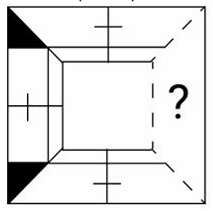
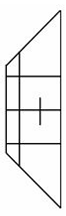
The sequence of folding a piece of paper and the manner in which the folded paper has been cut is shown below. Select a figure from among the given options, which would most closely resemble the unfolded form of the paper.

  1. AOption (a)

  2. BOption (b)

  3. COption (c)

  4. DOption (d)

View answer & explanation

Correct answer

Answer: (a)A.

Why this answer is correct

The figure which will look like the paper when unfolded is shown below:

Thus, option Figure 1 will look like the paper when unfolded.

Hence, "Option 1" is the correct answer.

Question 9

The two expressions on either side of the equal sign will have the same value if two numbers on the left-hand side are interchanged and two signs on the right-hand side are interchanged.

What are those two numbers (not digits) and the two signs?

9 × 1 ÷ 3 + 8 – 7 = 12 ÷ 3 + 2 × 33 – 13

  1. AOption (a)

    3 and 8; + and -

  2. BOption (b)

    1 and 9; ÷ and ×

  3. COption (c)

    3 and 7; + and ÷

  4. DOption (d)

    1 and 3; + and ×

View answer & explanation

Correct answer

Answer: (d)D.

1 and 3; + and ×

Why this answer is correct

Given: 9 × 1 ÷ 3 + 8 – 7 = 12 ÷ 3 + 2 × 33 – 13  

According to the question, after numbers on the left-hand side are interchanged and two signs on the right-hand side are interchanged:

Option 1) 3 and 8; + and -

9 × 1 ÷ 3 + 8 – 7 = 12 ÷ 3 + 2 × 33 – 13 ⇒ 9 × 1 ÷ 3 + 8 – 7 = 12 ÷ 3 - 2 × 33 + 13

⇒ 9 × 1 ÷ 3 + 8 – 7 = 12 ÷ 3 - 2 × 33 + 13

⇒ 9 × 0.33 + 8 – 7 = 4 - 2 × 33 + 13

⇒ 3 + 8 – 7 = 4 + 13 - 66

⇒ 11 – 7 = 17 - 66

⇒ 4 ≠ -49 (LHS ≠ RHS)

Option  2) 1 and 9; ÷ and ×

9 × 1 ÷ 3 + 8 – 7 = 12 ÷ 3 + 2 × 33 – 13 ⇒ 1 × 9 ÷ 3 + 8 – 7 = 12 × 3 + 2 ÷ 33 – 13

⇒ 1 × 9 ÷ 3 + 8 – 7 = 12 × 3 + 2 ÷ 33 – 13

⇒ 1 × 3 + 8 – 7 = 12 × 3 + 0.06 – 13

⇒ 3 + 8 – 7 = 36 + 0.06 – 13

⇒ 11 – 7 = 36.06 – 13

⇒ 4 ≠ 13.06 (LHS ≠ RHS)

Option  3) 3 and 7; + and ÷

9 × 1 ÷ 3 + 8 – 7 = 12 ÷ 3 + 2 × 33 – 13 ⇒ 9 × 1 ÷ 7 + 8 – 3 = 12 + 3 ÷ 2 × 33 – 13

⇒ 9 × 1 ÷ 7 + 8 – 3 = 12 + 3 ÷ 2 × 33 – 13

⇒ 9 × 0.14 + 8 – 3 = 12 + 1.5 × 33 – 13

⇒ 1.26 + 8 – 3 = 12 + 49.5 – 13

⇒ 9.26 – 3 = 61.5 – 13

⇒ 6.26 ≠ 48.5 (LHS ≠ RHS)

Option  4) 1 and 3; + and ×

9 × 1 ÷ 3 + 8 – 7 = 12 ÷ 3 + 2 × 33 – 13 ⇒ 9 × 3 ÷ 1 + 8 – 7 = 12 ÷ 3 × 2 + 33 – 13

⇒ 9 × 3 ÷ 1 + 8 – 7 = 12 ÷ 3 × 2 + 33 – 13

⇒ 9 × 3 + 8 – 7 = 4 × 2 + 33 – 13

⇒ 27 + 8 – 7 = 8 + 33 – 13

⇒ 35 – 7 = 41 – 13

⇒ 28 = 28 (LHS = RHS)

Hence, "Option 4" is the correct answer.

Question 10

In a certain code language, 'CAT' is coded as 9 and 'MOUSE' is coded as 25. How will 'TROUBLE' be coded in the same language? 

  1. AOption (a)

    45 

  2. BOption (b)

    49 

  3. COption (c)

    36 

  4. DOption (d)

    14

View answer & explanation

Correct answer

Answer: (b)B.

49 

Why this answer is correct

The logic followed here is:

'CAT' is coded as 9

(Number of letter in the word 'CAT')2 → (3)2 ⇒ 9

And,

'MOUSE' is coded as 25

(Number of letter in the word 'MOUSE')2 → (5)2 ⇒ 25

Similarly,

'TROUBLE' be coded

(Number of letter in the word 'TROUBLE')2 → (7)2 ⇒ 49

Hence, "Option 2" is the correct answer.

Question 11

Five players (A, B, C, D, and E) are fielding on a cricket ground in such a way that all are equidistant from each other. B is to the East of A, while C is to the South of A. If D is to the East of C and to the West of E, then what is the position of B with respect to E?

  1. AOption (a)

    South-East

  2. BOption (b)

    South 

  3. COption (c)

    East 

  4. DOption (d)

    North-West

View answer & explanation

Correct answer

Answer: (d)D.

North-West

Why this answer is correct

Given: Five players (A, B, C, D, and E) are fielding on a cricket ground in such a way that all are equidistant from each other.

B is to the East of A, while C is to the South of A.

D is to the East of C and to the West of E.

Thus, B is to the north west of E.

Hence, "Option 4" is the correct answer.

Question 12

Select the option that indicates the correct arrangement of the following words in a logical and meaningful order.

  1. Square
  2. Hexagon
  3. Heptagon
  4. Triangle
  5. Pentagon
  1. AOption (a)

    4, 1, 5, 2, 3

  2. BOption (b)

    3, 1, 2, 4, 5

  3. COption (c)

    1, 2, 3, 4, 5 

  4. DOption (d)

    2, 4, 5, 1, 3

View answer & explanation

Correct answer

Answer: (a)A.

4, 1, 5, 2, 3

Why this answer is correct

The correct order of words in a logical and meaningful order is:

  1. Triangle → Three sided polygon.
  2. Square → Four sided polygon.
  3. Pentagon → Five sided polygon.
  4. Hexagon → Six sided polygon.
  5. Heptagon → Seven sided polygon.

The correct order is '4, 1, 5, 2, 3'.

Hence, the correct answer is "Option 1".

Question 13

Which of the following terms will replace the question mark (?) in the given series?

CRHT, GQLS, KPPR, ?, SNXP

  1. AOption (a)

    OOTQ 

  2. BOption (b)

    NQSP 

  3. COption (c)

    OQTS 

  4. DOption (d)

    NOSQ

View answer & explanation

Correct answer

Answer: (a)A.

OOTQ 

Why this answer is correct

The logic followed here is:

Hence, "Option 1" is the correct answer.

Question 14

Select the option that indicates the correct arrangement of the following words in a logical and meaningful order.

  1. The United Kingdom
  2. World
  3. Buckingham Palace
  4. London
  5. Europe
  1. AOption (a)

    4, 1, 5, 3, 2

  2. BOption (b)

    3, 4, 1, 5, 2

  3. COption (c)

    1, 3, 5, 2, 4

  4. DOption (d)

    3, 4, 1, 2, 5

View answer & explanation

Correct answer

Answer: (b)B.

3, 4, 1, 5, 2

Why this answer is correct

The correct order of words in a logical and meaningful order is:

  1. Buckingham Palace → A specific landmark.
  2. London → The city where Buckingham Palace is located.
  3. The United Kingdom → The country in which London is situated.
  4. Europe →The continent encompassing the United Kingdom.
  5. World → The largest entity that includes all continents.

The correct order is '3, 4, 1, 5, 2'.

Hence, the correct answer is "Option 2".

Question 15

Three of the following four are alike in a certain way and thus form a group. Which is the one that does NOT belong to that group?

(NOTE: The odd one out is not based on the number of vowels or consonants in the word)

  1. AOption (a)

    HEI 

  2. BOption (b)

    VSW 

  3. COption (c)

    MJL 

  4. DOption (d)

    QNR

View answer & explanation

Correct answer

Answer: (c)C.

MJL 

Why this answer is correct

The logic followed here is:

Option 1) HEI 

Option 2) VSW 

Option 3) MJL 

Option 4) QNR

Thus, out of all the options, 'MJL' is the odd one out.

Hence, "Option 3" is the correct answer.

Question 16

Select the number from among the given options that can replace the question mark (?) in the following series.

6, 5, 18, 10, 54, 20, ?, 40

  1. AOption (a)

    158 

  2. BOption (b)

    170 

  3. COption (c)

    162 

  4. DOption (d)

    168

View answer & explanation

Correct answer

Answer: (c)C.

162 

Why this answer is correct

The logic followed here is:

Hence, "Option 3" is the correct answer.

Question 17

Q is married to P. M is the husband of K. R is the brother of Q. T is the daughter of K. P is the father of M. How is Q related to T? 

  1. AOption (a)

    Mother’s father

  2. BOption (b)

    Son’s daughter

  3. COption (c)

    Father’s mother

  4. DOption (d)

    Son’s son

View answer & explanation

Correct answer

Answer: (c)C.

Father’s mother

Why this answer is correct

Given: 

1) Q is married to P. 

2) P is the father of M. 

3)  R is the brother of Q.

4) T is the daughter of K. 

5) M is the husband of K.

Thus, Q is T's paternal grandmother or father’s mother.

Hence, the correct answer is "Option 3"

Question 18

13 is related to 44 following a certain logic. Following the same logic, 15 is related to 50. To which of the following is 21 related, following the same logic?

(NOTE: Operations should be performed on the whole numbers, without breaking down the numbers into its constituent digits. E.g. 13 – Operations on 13 such as adding/subtracting/multiplying etc. to 13 can be performed. Breaking down 13 into 1 and 3 and then performing mathematical operations on 1 and 3 is not allowed.)

  1. AOption (a)

    68 

  2. BOption (b)

    66 

  3. COption (c)

    78 

  4. DOption (d)

    58

View answer & explanation

Correct answer

Answer: (a)A.

68 

Why this answer is correct

The logic followed here is:

13 is related to 44

13 × 3 + 5 = 44

39 + 5 = 44

44 = 44 (LHS = RHS)

And,

15 is related to 50

15 × 3 + 5 = 50

45 + 5 = 50

50 = 50 (LHS = RHS)

Similarly,

21 is related to

21 × 3 + 5 = ?

63 + 5 = ?

68 = ?

Hence, "Option 1" is the correct answer.

Question 19

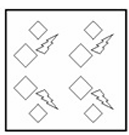
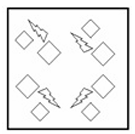
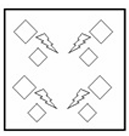
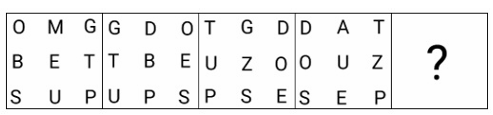
Which figure should replace the question mark (?) if the following series were to be continued?

  1. AOption (a)

  2. BOption (b)

  3. COption (c)

  4. DOption (d)

View answer & explanation

Correct answer

Answer: (c)C.

Why this answer is correct

The logic followed here is:

  1. First box series →

The corner elements of the first row interchange positions.

The top row center element is replaced by new element.

The second row elements shift clockwise.

The bottom row elements shift anticlockwise.

  1. Second box series →

The center element is replaced by new element.

The rest of the elements shift clockwise.

Thus, final series is:

Hence, "Option 3" is the correct answer.

Question 20

Six students (Ritu, Vinayak, Arnab, Maya, Fathima and Ankur) are sitting around a circular table facing the centre(but not necessarily in the same order). Ritu is an immediate neighbour of both Vinayak and Arnab. Arnab is sitting second to the left of Fathima. Fathima is sitting second to the left of Vinayak. Vinayak is an immediate neighbour of both Ritu and Maya. Who is the immediate neighbour of both Fathima and Arnab? 

  1. AOption (a)

    Ankur 

  2. BOption (b)

    Maya 

  3. COption (c)

    Vinayak 

  4. DOption (d)

    Ritu

View answer & explanation

Correct answer

Answer: (a)A.

Ankur 

Why this answer is correct

Given: Six students (Ritu, Vinayak, Arnab, Maya, Fathima and Ankur) are sitting around a circular table facing the centre.

1) Arnab is sitting second to the left of Fathima. 

2) Fathima is sitting second to the left of Vinayak. 

3) Ritu is an immediate neighbour of both Vinayak and Arnab.

  1. Vinayak is an immediate neighbour of both Ritu and Maya. 

After positioning Maya only one position is left which will be occupied by the only person left i.e. Ankur.

Thus, according to the final arrangement Ankur is the immediate neighbour of both Fathima and Arnab.

Hence, "Option 1" is the correct answer.

Question 21

Select the option figure that will replace the question mark (?) in the figure given below to complete the pattern.

  1. AOption (a)

  2. BOption (b)

  3. COption (c)

  4. DOption (d)

View answer & explanation

Correct answer

Answer: (d)D.

Why this answer is correct

The figure which when put in place of '?' will logically complete the pattern is shown below:

Thus, option Figure 4 will logically complete the pattern given.

Hence, "Option 4" is the correct answer.

Question 22

In a certain code language,

‘M & N’ means ‘M is the wife of N’

‘M @ N’ means ‘M is the paternal grandfather of N’,

‘M % N’ means ‘M is the brother of N’,

‘M # N’ means ‘M is the son of N’

Based on the above, how is P related to T if ‘P @ Q # R & S % T’?

  1. AOption (a)

    Brother 

  2. BOption (b)

    Father’s brother

  3. COption (c)

    Father 

  4. DOption (d)

    Wife’s father

View answer & explanation

Correct answer

Answer: (c)C.

Father 

Why this answer is correct

Decoding symbols:

M is
Symbol&@%#
MeaningWifePaternal grandfatherBrotherSon
to N

Given: P @ Q # R & S % T

P @ Q → P is the parental grandfather of Q.


Q # R → Q is the son of R.

R & S → R is the wife of S.

S % T → S is the brother of T.

Thus, P is the father of T.

Hence, the correct answer is "Option 3"

Question 23

42 is related to 36 following a certain logic. Following the same logic, 57 is related to 144. Which of the following numbers is related to 81 related using the same logic? 

  1. AOption (a)

    45

  2. BOption (b)

    46 

  3. COption (c)

    56 

  4. DOption (d)

    44

View answer & explanation

Correct answer

Answer: (a)A.

45

Why this answer is correct

The logic followed here is:

42 is related to 36 

(4 + 2)2 = 36

(6)2 = 36

36 = 36 (LHS = RHS)

And,

57 is related to 144

(5 + 7)2 = 144

(12)2 = 144

144 = 144 (LHS = RHS)

Similarly,

? is related to 81

Let the two digit number (?) be → pq

(p + q)2 = 81

(p + q) = √81

9 = (p + q)

So, checking each option one by one:

Option 1) 45 → (4 + 5) = 9 

Option 2) 46 → (4 + 6) = 10 ≠ 9

Option 3) 56 → (5 + 6) = 11 ≠ 9

Option 4) 44 → (4 + 4) = 8 ≠ 9

Hence, "Option 1" is the correct answer.

Question 24

Select the numbers from among the given options that can replace the question marks (?) in the same sequence and make the series logically complete.

16, 22, 13, 19, 10, ?, 7, ?

  1. AOption (a)

    13, 17 

  2. BOption (b)

    16, 13

  3. COption (c)

    17, 14

  4. DOption (d)

    19, 15

View answer & explanation

Correct answer

Answer: (b)B.

16, 13

Why this answer is correct

The logic followed here is:

Hence, "Option 2" is the correct answer.

Alternate Method ​

Question 25

Which of the following letter-clusters will replace the question mark (?) in the given series to make it logically complete?

HUD, LXE, PAF, TDG, ?

  1. AOption (a)

    AGH 

  2. BOption (b)

    AGI 

  3. COption (c)

    AGG

  4. DOption (d)

    XGH

View answer & explanation

Correct answer

Answer: (d)D.

XGH

Why this answer is correct

The logic followed here is:

​

Hence, "Option 4" is the correct answer.

Question 26

Which of the following numbers will replace the question mark (?) in the given series?

18, 71, 21, 76, 24, 81, 27, 86, 30, ?

  1. AOption (a)

    91 

  2. BOption (b)

    82 

  3. COption (c)

    83 

  4. DOption (d)

    80

View answer & explanation

Correct answer

Answer: (a)A.

91 

Why this answer is correct

The logic followed here is:

Hence, "Option 1" is the correct answer.

Alternate Method

Question 27

Select the pair from among the given options that is analogous to the given pair.

3 : 31

2 : 12

(NOTE: Operations should be performed on the whole numbers, without breaking down the numbers into its constituent digits. E.g. 13 – Operations on 13 such as adding/subtracting/multiplying etc. to 13 can be performed. Breaking down 13 into 1 and 3 and then performing mathematical operations on 1 and 3 is not allowed.)

  1. AOption (a)

    5 : 128

  2. BOption (b)

    4 : 65

  3. COption (c)

    6 : 220

  4. DOption (d)

    8 : 315

View answer & explanation

Correct answer

Answer: (c)C.

6 : 220

Why this answer is correct

The logic followed here is:

3 : 31

(3)3 + 4 = 31

27 + 4 = 31

31 = 31 (LHS = RHS)

And,

2 : 12

(2)3 + 4 = 12

8 + 4 = 12

12 = 12 (LHS = RHS)

So, checking each option one by one:

Option 1) 5 : 128

(5)3 + 4 = 128

125 + 4 = 128

129 ≠ 128 (LHS ≠ RHS)

Option 2) 4 : 65

(4)3 + 4 = 65

64 + 4 = 65

68 ≠ 65 (LHS ≠ RHS)

Option 3) 6 : 220

(6)3 + 4 = 220

216 + 4 = 220

220 = 220 (LHS = RHS)

Option 4) 8 : 315

(8)3 + 4 = 315

512 + 4 = 315

516 ≠ 315 (LHS ≠ RHS)

Thus, out of all the options '6 : 220' follows the same logic as given.

Hence, "Option 3" is the correct answer.

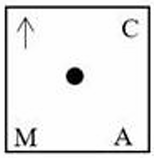
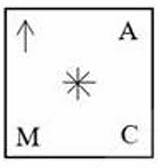
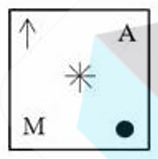
Question 28

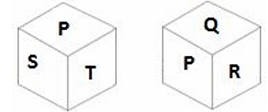
Six letters P, Q, R, S, T and U are written on different faces of a dice. Two positions of this dice are shown in the following figure. Find the letter on the face opposite to S.

  1. AOption (a)

    U

  2. BOption (b)

    Q

  3. COption (c)

    P

  4. DOption (d)

    R

View answer & explanation

Correct answer

Answer: (d)D.

R

Why this answer is correct

From the given two different cubes the adjacent sides are as shown below :

As P is common on both the dice, it is clear that S, T, R, and Q are adjacent to it, and the remaining i.e., U will be opposite to it.

Opposite pairs:

T → Q

S → R

P → U

So, the opposite side of "S" will be side "R".

Hence, the correct answer is "Option 4".

Question 29

What will come in place of the question mark (?) in the following equation if ‘+’ and ‘÷’are interchanged and ‘×’ and ‘−’ are interchanged?

3 ÷ 4 − 5 × 6 + 2 = ?

  1. AOption (a)

    22 

  2. BOption (b)

    19 

  3. COption (c)

    20 

  4. DOption (d)

    18

View answer & explanation

Correct answer

Answer: (c)C.

20 

Why this answer is correct

Given: 3 ÷ 4 − 5 × 6 + 2 = ?

According to the question, after ‘+’ and ‘÷’are interchanged and ‘×’ and ‘−’ are interchanged:

3 ÷ 4 − 5 × 6 + 2 = ? ⇒ 3 + 4 × 5 - 6 ÷ 2 = ?

⇒ 3 + 4 × 5 - 6 ÷ 2 = ?

⇒ 3 + 4 × 5 - 3 = ?

⇒ 3 + 20 - 3 = ?

⇒ 23 - 3 = ?

⇒ 20 = ?

Hence, "Option 3" is the correct answer.

Question 30

If + means − , − means × , × means ÷ , ÷ means +, what will come in place of the question mark (?) in the given equation?

70 × 2 – 4 ÷ 60 + 150 = ?

  1. AOption (a)

    100 

  2. BOption (b)

    150 

  3. COption (c)

    50 

  4. DOption (d)

    125

View answer & explanation

Correct answer

Answer: (c)C.

50 

Why this answer is correct

Decoding signs:

Sign+−×÷
Means−×÷+

Given: 70 × 2 – 4 ÷ 60 + 150 = ? 

70 × 2 – 4 ÷ 60 + 150 = ? ⇒ 70 ÷ 2 × 4 + 60 – 150 = ?

⇒ 70 ÷ 2 × 4 + 60 – 150 = ?

⇒ 35 × 4 + 60 – 150 = ?

⇒ 140 + 60 – 150 = ?

⇒ 200 – 150 = ?

⇒ 50 = ?

Hence, "Option 3" is the correct answer.

Question 31

Select the pair from among the given options that is analogous to the given pair.

10 : 101

6 : 37

(NOTE: Operations should be performed on the whole numbers, without breaking down the numbers into its constituent digits. E.g. 13 – Operations on 13 such as adding/subtracting/multiplying etc. to 13 can be performed. Breaking down 13 into 1 and 3 and then performing mathematical operations on 1 and 3 is not allowed.)

  1. AOption (a)

    7 : 50

  2. BOption (b)

    14 : 196 

  3. COption (c)

    11 : 120 

  4. DOption (d)

    8 : 64

View answer & explanation

Correct answer

Answer: (a)A.

7 : 50

Why this answer is correct

The logic followed here is:

10 : 101

(10)2 + 1 = 101

100 + 1 = 101

101 = 101 (LHS = RHS)

And,

6 : 37

(6)2 + 1 = 37

36 + 1 = 37

37 = 37 (LHS = RHS)

So, checking each option one by one:

Option 1) 7 : 50

(7)2 + 1 = 50

49 + 1 = 50

50 = 50 (LHS = RHS)

Option 2) 14 : 196 

(14)2 + 1 = 196

196 + 1 = 196

197 ≠ 196 (LHS ≠ RHS)

Option 3) 11 : 120

(11)2 + 1 = 120

121 + 1 = 120

122 ≠ 120 (LHS ≠ RHS)

Option 4) 8 : 64

(8)2 + 1 = 64

64 + 1 = 64

65 ≠ 64 (LHS ≠ RHS)

Thus, out of all the options '7 : 50' follows the same logic as given.

Hence, "Option 1" is the correct answer.

Question 32

Which two numbers (not digits) and which two signs should be interchanged to make the following equation valid?

55 × 5 ÷ 1 – 3 + 14 = 0

  1. AOption (a)

    1, 3 and '–', '÷' 

  2. BOption (b)

    1, 5 and '+', '–' 

  3. COption (c)

    5, 14 and '–', '×'

  4. DOption (d)

    3, 5 and '+', '÷'

View answer & explanation

Correct answer

Answer: (b)B.

1, 5 and '+', '–' 

Why this answer is correct

Given: 55 × 5 ÷ 1 – 3 + 14 = 0 

According to the question, after interchanging two signs and two numbers (not digits):

Option 1) 1, 3 and '–', '÷' 

55 × 5 ÷ 1 – 3 + 14 = 0 ⇒ 55 × 5 - 3 ÷ 1 + 14 = 0

⇒ 55 × 5 - 3 ÷ 1 + 14 = 0

⇒ 55 × 5 - 3 + 14 = 0

⇒ 275 + 14 - 3 = 0

⇒ 289 - 3 = 0

⇒ 286 ≠ 0 (LHS ≠ RHS)

Option  2) 1, 5 and '+', '–'

55 × 5 ÷ 1 – 3 + 14 = 0 ⇒ 55 × 1 ÷ 5 + 3 - 14 = 0

⇒ 55 × 1 ÷ 5 + 3 - 14 = 0

⇒ 55 × 0.2 + 3 - 14 = 0

⇒ 11 + 3 - 14 = 0

⇒ 14 - 14 = 0

⇒ 0 = 0 (LHS = RHS)

Option  3) 5, 14 and '–', '×'

55 × 5 ÷ 1 – 3 + 14 = 0 ⇒ 55 - 14 ÷ 1 × 3 + 5 = 0

⇒ 55 - 14 ÷ 1 × 3 + 5 = 0

⇒ 55 - 14 × 3 + 5 = 0

⇒ 55 + 5 - 42 = 0

⇒ 60 - 42 = 0

⇒ 18 ≠ 0 (LHS ≠ RHS)

Option  4) 3, 5 and '+', '÷'

55 × 5 ÷ 1 – 3 + 14 = 0 ⇒ 55 × 3 + 1 – 5 ÷ 14 = 0

⇒ 55 × 3 + 1 – 5 ÷ 14 = 0

⇒ 55 × 3 + 1 – 0.35 = 0

⇒ 165 + 1 – 0.35 = 0

⇒ 166 – 0.35 = 0

⇒ 165.65 ≠ 0 (LHS ≠ RHS)

Hence, "Option 2" is the correct answer.

Question 33

Select the option that is related to the third number in the same way as the second number is related to the first number.

335 : 216 :: 987 : ?

(NOTE: Operations should be performed on the whole numbers, without breaking down the numbers into its constituent digits. E.g. 13 – Operations on 13 such as adding/subtracting/multiplying etc. to 13 can be performed. Breaking down 13 into 1 and 3 and then performing mathematical operations on 1 and 3 is not allowed.)

  1. AOption (a)

    872 

  2. BOption (b)

    867 

  3. COption (c)

    868 

  4. DOption (d)

    888

View answer & explanation

Correct answer

Answer: (c)C.

868 

Why this answer is correct

Solution:

335 : 216 :: 987 : ?

The logic followed here is

335 : 216

⇒ 335 - 119 = 216

So, 987 : ?

⇒ ? = 987 - 119 = 868

Hence, the correct answer is option (3).

Question 34

Select the option that is related to the third word, just as the second word is related to the first word. (Words should not be considered as meaningful words of Hindi and these words should not be related to each other based on the number of letters / numbers / number of letters)

Embroidery: Thread :: weave: ______

  1. AOption (a)

    Cloth

  2. BOption (b)

    Hook

  3. COption (c)

    Needle

  4. DOption (d)

    Wool

View answer & explanation

Correct answer

Answer: (d)D.

Wool

Why this answer is correct

The logic followed here is:

Embroidery : Thread

Embroidery is done using thread.

Similarly,

Weaving : ?

Weaving is done using wool.

Hence, "Option 4" is the correct answer.

Question 35

In a code language, ‘BROWN’ is coded as DTMYP and ‘PLACE’ is coded as RNYEG. How will ‘RIGHT’ be coded in the same language? 

  1. AOption (a)

    TKEJU 

  2. BOption (b)

    TKIJV 

  3. COption (c)

    TKEJV 

  4. DOption (d)

    TKFJV

View answer & explanation

Correct answer

Answer: (c)C.

TKEJV 

Why this answer is correct

The logic followed here is:

​‘BROWN’ is coded as DTMYP

And,

‘PLACE’ is coded as RNYEG

Similarly,

‘RIGHT’ is coded as

Hence, "Option 3" is the correct answer.

Question 36

Three of the following four letter-clusters are alike in a certain way and one is different. Pick the odd one out.

(NOTE: The odd one out is not based on the number of vowels or consonants in the word)

  1. AOption (a)

    LMIQ 

  2. BOption (b)

    GHDV 

  3. COption (c)

    STPJ 

  4. DOption (d)

    NOPQ

View answer & explanation

Correct answer

Answer: (d)D.

NOPQ

Why this answer is correct

The logic followed here is:

Option 1) LMIQ 

Option 2) GHDV 

Option 3) STPJ 

Option 4) NOPQ

Thus, out of all the options, 'NOPQ' is the odd one out.

Hence, "Option 4" is the correct answer.

Question 37

K, L, M, W, X, Y and Z scored different marks in an exam. K scored more than only three people. Y scored less than only L and M. W scored more than Z but less than X. L did not score the highest marks. How many people scored less than X?

  1. AOption (a)

    Two 

  2. BOption (b)

    One 

  3. COption (c)

    None 

  4. DOption (d)

    Four

View answer & explanation

Correct answer

Answer: (a)A.

Two 

Why this answer is correct

Given: K, L, M, W, X, Y and Z scored different marks in an exam. 

1) K scored more than only three people. 

_ > _ > _ > K > _ > _ > _

2) Y scored less than only L and M. 

L/M > L/M > Y > K > _ > _ > _

3) W scored more than Z but less than X.

L/M > L/M > Y > K > X > W > Z

  1. L did not score the highest marks.

M > L > Y > K > X > W > Z

Thus, according to the final arrangement two people scored less than X.

Hence, "Option 1" is the correct answer.

Question 38

Which letter cluster will replace the question mark (?) to complete the given series?

ABCD, BCDE, ?, DEFG, EFGH

  1. AOption (a)

    CBDE 

  2. BOption (b)

    CDEF 

  3. COption (c)

    CBGH 

  4. DOption (d)

    CDFE 

View answer & explanation

Correct answer

Answer: (b)B.

CDEF 

Why this answer is correct

The logic followed here is:

Hence, "Option 2" is the correct answer.

Question 39

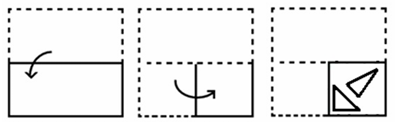
The sequence of folding a piece of paper and the manner in which the folded paper has been cut is shown in the following figures. How would this paper look when unfolded?

  1. AOption (a)

  2. BOption (b)

  3. COption (c)

  4. DOption (d)

View answer & explanation

Correct answer

Answer: (a)A.

Why this answer is correct

The figure which will look like the paper when unfolded is shown below:

Thus, option Figure 1 will look like the paper when unfolded.

Hence, "Option 1" is the correct answer.

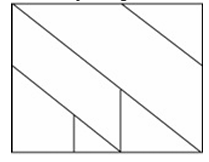
Question 40

How many triangles are there in the given figure?

  1. AOption (a)

    5

  2. BOption (b)

    4

  3. COption (c)

    6

  4. DOption (d)

    7

View answer & explanation

Correct answer

Answer: (c)C.

6

Why this answer is correct

The number of triangles in the given figure is shown below:

Thus, as marked there are a total of 6 triangles.

Hence, "Option 3" is the correct answer.

Question 41

Select the figure from among the given options that can replace the question mark (?)and complete the pattern.

  1. AOption (a)

  2. BOption (b)

  3. COption (c)

  4. DOption (d)

View answer & explanation

Correct answer

Answer: (b)B.

Why this answer is correct

The logic followed here is:

  1. First box series →

First row elements interchange positions.

The rest of the elements shift clockwise.

The top left corner element is replaced by new element.

  1. Second box series →

The bottom row elements interchange positions.

The rest of the elements shift anticlockwise.

The bottom left corner element is replaced by new element.

Thus, final series is:

Hence, "Option 2" is the correct answer.

Question 42

Which of the following numbers will replace the question mark (?) in the given series?

7, 18, 40, 73, 117, ?

  1. AOption (a)

    173 

  2. BOption (b)

    171 

  3. COption (c)

    172 

  4. DOption (d)

    170

View answer & explanation

Correct answer

Answer: (c)C.

172 

Why this answer is correct

The logic followed here is:

Hence, "Option 3" is the correct answer.

Question 43

Ramesh wants to visit his childhood friend’s house. Ramesh’s friend explained his house directions over a text message. See the below text sent to Ramesh about the direction of his friend’s house and answer the following question accordingly. “When you step out of your house, you are facing north. Take a right and walk 3 km, you will see a T-point/junction. Take a right and walk 2 km. There will be a roundabout with four roads. Take the second left from the roundabout and walk 1 km. Take a right and walk 3 km. Take a right and walk 1 km. You will find my house at the front.” In which direction is Ramesh facing when he takes the second left from the roundabout? 

  1. AOption (a)

    East 

  2. BOption (b)

    North 

  3. COption (c)

    South 

  4. DOption (d)

    West

View answer & explanation

Correct answer

Answer: (c)C.

South 

Why this answer is correct

Given: Ramesh wants to visit his childhood friend’s house. Ramesh’s friend explained his house directions over a text message.

When you step out of your house, you are facing north.

Take a right and walk 3 km, you will see a T-point/junction.

Take a right and walk 2 km. There will be a roundabout with four roads. 

Take the second left from the roundabout and walk 1 km. 

Take a right and walk 3 km. 

Take a right and walk 1 km. You will find my house at the front.

Thus, Ramesh is facing in the south direction when he takes the second left from the roundabout.

Hence, "Option 3" is the correct answer.

Additional Information

Here, specifically "Roundabout" is mentioned, so accordingly counting clockwise from the roundabout - 2nd left will be in the south direction.

Furthermore, it is also mentioned "There will be a roundabout with four roads.", so 4 roads are of the four direction, therefore at the roundabout when counted clockwise:

Ramesh (Facing south) → 1st road

1st left (east) → 2nd road

2nd left (south) → 3rd road

3rd left (west) → 4th road

Question 44

Three statements are given followed by three conclusions numbered I, II and III. Assuming the statements to be true, even if they seem to be at variance with commonly known facts, decide which of the conclusions logically follow(s) from the statements.

Statements:

All dogs are sheep.

All wolves are foxes.

All sheep are wolves.

Conclusions:

I. All wolves are sheep.

II. All dogs are foxes.

III. All dogs are wolves.

  1. AOption (a)

    Only conclusions I and III follow. 

  2. BOption (b)

    None of the conclusions follow. 

  3. COption (c)

    Only conclusions I and II follow.

  4. DOption (d)

    Only conclusions II and III follow.

View answer & explanation

Correct answer

Answer: (d)D.

Only conclusions II and III follow.

Why this answer is correct

The least possible Venn diagram for the given statements is as shown below :

Conclusions:

I. All wolves are sheep → Does not follow (As all sheep are wolves. So it is possible but not definite)

II. All dogs are foxes → Follow (As all dogs are sheep, all sheep are wolves and all wolves are foxes. As whole dogs comes in sheep which whole comes in wolves which whole comes in foxes, therefore it is true.)

III. All dogs are wolves → Follow (As all dogs are sheep and all sheep are wolves. As whole dogs comes in sheep which whole comes in wolves, therefore it is true.)

∴ Here, Only conclusions II and III follow.​

Hence, the correct answer is "Option 4".

Question 45

Two statements are given followed by conclusions. Assuming the statements to be true ,even if they seem to be at variance with commonly known facts, decide which of the conclusions logically follow ( s ) from the statements.

Statements:

Some elephants are chairs.

All elephants are doors.

Conclusions:

  1. At least some chairs are doors.
  2. All doors are elephants.
  1. AOption (a)

    Only conclusion 2 follow 

  2. BOption (b)

    Both conclusions 1 and 2 follow 

  3. COption (c)

    Only conclusion 1 follow 

  4. DOption (d)

    Neither conclusion 1 nor 2 follow

View answer & explanation

Correct answer

Answer: (c)C.

Only conclusion 1 follow 

Why this answer is correct

The least possible Venn diagram for the given statements is as shown below :

Conclusions:

  1. At least some chairs are doors → Follow (As some elephants are chairs and all elephants are doors. As some part of chairs is common with elephants which whole comes in doors, therefore it is true)
  2. All doors are elephants → Does not follow (As all elephants are doors. So it is possible but not definite)

∴ Here, Only conclusion 1 follow.​

Hence, the correct answer is "Option 3".

Question 46

In this question, two statements are followed by four conclusions given as options. Decide which conclusion is definitely true, based on the given statements.

Statements:

P ≤ Q = R > S; Q ≤ T ≤ U = V

  1. AOption (a)

    S > P 

  2. BOption (b)

    V < S

  3. COption (c)

    S ≥ U

  4. DOption (d)

    V ≥ P

View answer & explanation

Correct answer

Answer: (d)D.

V ≥ P

Why this answer is correct

Given statement: P ≤ Q = R > S; Q ≤ T ≤ U = V

Conclusions:

Option 1) S > P  → Does not follow (As P ≤ Q = R > S. Here, no relation can be determined between S and P, therefore it is false)

Option 2) V < S → Does not follow (As S < R = Q ≤ T ≤ U = V. So, it can be concluded as 'V > S', therefore it is false)

Option 3) S ≥ U → Does not follow (As S < R = Q ≤ T ≤ U = V. So, it can be concluded as 'U > S', therefore it is false)

Option 4) V ≥ P → Follow (As P ≤ Q ≤ T ≤ U = V. So, it can be concluded as 'V ≥ P', therefore is true)

Hence, the correct answer is "Option 4".

Question 47

R, S, T, U, V and W are sitting around a circular table facing the centre (but not necessarily in the same order). R sit second to the left of V. Only one person sits between R and S. Only two persons sit between S and W. T is not an immediate neighbour of R. Who sits second to the left of U? 

  1. AOption (a)

    W

  2. BOption (b)

    R

  3. COption (c)

    S

  4. DOption (d)

    T

View answer & explanation

Correct answer

Answer: (d)D.

T

Why this answer is correct

Given: R, S, T, U, V and W are sitting around a circular table facing the centre.

1) R sit second to the left of V.

  1. Only one person sits between R and S.

3) Only two persons sit between S and W.

4) T is not an immediate neighbour of R.

After positioning T only one position is left which will be occupied by the only person left i.e. U.

Thus, according to the final arrangement, T sits second to the left of U.

Hence, "Option 4" is the correct answer.

Question 48

Select the set in which the numbers are related in the same way as the numbers of the following set.

(13, 57, 111)

(11, 49, 95)

(NOTE: Operations should be performed on the whole numbers, without breaking down the numbers into its constituent digits. E.g. 13 – Operations on 13 such as adding/subtracting/multiplying etc. to 13 can be performed. Breaking down 13 into 1 and 3 and then performing mathematical operations on 1 and 3 is not allowed.)

  1. AOption (a)

    (9, 41, 79) 

  2. BOption (b)

    (12, 53, 109) 

  3. COption (c)

    (8, 37, 73)

  4. DOption (d)

    (10, 54, 11)

View answer & explanation

Correct answer

Answer: (a)A.

(9, 41, 79) 

Why this answer is correct

The logic followed here is:

(13, 57, 111)

(13 × 4) + (57 + 2) = 111

52 + 59 = 111

111 = 111 (LHS = RHS)

And,

(11, 49, 95)

(11 × 4) + (49 + 2) = 95

44 + 51 = 95

95 = 95 (LHS = RHS)

So, checking each option one by one:

Option 1) (9, 41, 79) 

(9 × 4) + (41 + 2) = 79

36 + 43 = 79

79 = 79 (LHS = RHS)

Option 2) (12, 53, 109) 

(12 × 4) + (53 + 2) = 109

48 + 55 = 109

113 ≠ 109 (LHS ≠ RHS)

Option 3) (8, 37, 73)

(8 × 4) + (37 + 2) = 73

32 + 39 = 73

72 ≠ 73 (LHS ≠ RHS)

Option 4) (10, 54, 11)

(10 × 4) + (54 + 2) = 11

40 + 56 = 11

96 ≠ 11 (LHS ≠ RHS)

Thus, out of all the options '(9, 41, 79)' follows the same logic as given.

Hence, "Option 1" is the correct answer.

Question 49

Select the option figure that will replace the question mark (?) in the figure given below and complete the pattern.

  1. AOption (a)

  2. BOption (b)

  3. COption (c)

  4. DOption (d)

View answer & explanation

Correct answer

Answer: (b)B.

Why this answer is correct

The figure which when put in place of '?' will logically complete the pattern is shown below:

Thus, option Figure 2 will logically complete the pattern given.

Hence, "Option 2" is the correct answer.

Question 50

Two statements are given, followed by two conclusions numbered I and II. Assuming the statements to be true, even if they seem to be at variance with commonly known facts, decide which of the conclusions logically follow(s) from the statements.

Statements:

All cats are animals.

All animals are black.

Conclusions:

I. Some black are cats.

II. All cats are black.

  1. AOption (a)

    Only conclusion I follows. 

  2. BOption (b)

    Neither conclusion I nor II follows.

  3. COption (c)

    Only conclusion II follows.

  4. DOption (d)

    Both conclusions I and II follow.

View answer & explanation

Correct answer

Answer: (d)D.

Both conclusions I and II follow.

Why this answer is correct

The least possible Venn diagram for the given statements is as shown below :

Conclusions:

I. Some black are cats → Follow (As all cats are animals and all animals are black. As whole cats comes in animals which whole comes in black, therefore it is true.)

II. All cats are black → Follow (As all cats are animals and all animals are black. As whole cats comes in animals which whole comes in black, therefore it is true.)

∴ Here, Both conclusions I and II follow.​

Hence, "Option 4" is the correct answer.

General Awareness (50 questions)

Question 51

In Vrindavan, near Mathura, temples were constructed in architectural styles that were very similar to the Mughal palaces in ________.  

  1. AOption (a)

    Fatehpur Sikri

  2. BOption (b)

    Jhansi 

  3. COption (c)

    Golconda 

  4. DOption (d)

    Mandu

View answer & explanation

Correct answer

Answer: (a)A.

Fatehpur Sikri

Why this answer is correct

The correct answer is Fatehpur Sikri

Key Points

  • Temples in Vrindavan, near Mathura, were built in a style similar to the Mughal palaces in Fatehpur Sikri.
  • The architecture of the temples in Vrindavan was influenced by the style of the Sultanates of Bijapur and Golconda.
  • Many buildings in Fatehpur Sikri were influenced by the architectural styles of Gujarat and Malwa.
  • Mughal rulers were skilled at adapting regional architectural styles in their buildings.

Additional Information

  • Akbar build Fatehpur Sikri in honour of Sheikh Salim Chisti.
  • It enshrines the burial place of the Sufi saint, Salim Chisti (1478 – 1572), a descendant of Khwaja Moinuddin Chishti of Ajmer, and who lived in a cavern on the ridge at Sikri.
  • The mausoleum was constructed by Akbar as a mark of his respect for the Sufi saint.
  • Fatehpur Sikri is a town in the Agra District of Uttar Pradesh, India.
  • The city itself was founded as the capital of the Mughal Empire in 1571 by Emperor Akbar, serving this role from 1571 to 1585, when Akbar abandoned it due to a campaign in Punjab and was later completely abandoned in 1610.

Question 52

Sangeet Natak Akademi awardee Jatin Goswami is a famous ______ dancer. 

  1. AOption (a)

    Mohiniyattam 

  2. BOption (b)

    Kathak

  3. COption (c)

    Sattriya 

  4. DOption (d)

    Kathakali

View answer & explanation

Correct answer

Answer: (c)C.

Sattriya 

Why this answer is correct

The correct answer is Sattriya 

Key Points

  • Jatin Goswami
  • A well-known veteran classical dancer from Assam is Jatin Goswami.
  • In 1933, Jatin Goswami was born in Dergaon, Upper Assam.
  • Jatin Goswami began his first lesson of Satriya dance at home with the help of his father.
  • Later, he received expert gurus' instruction in dance and music on the Vaishnava Satras.
  • In order to advance and expand the Satriya dancing style, he also founded a dance group.
  • In 1962, the Kalaguru Bishnu Prasad Rabha and Roseswar Saikia Borbayan collaborated to form the dancing group known as Pragati Kala Parishad.
  • Jatin Goswami has received numerous recommendations and titles.
  • During the Khajuraho Dance Festival, Jatin Goswami was given the National Kalidas Samman, Madhya Pradesh's most prestigious cultural award, for 2017.

Additional Information

  • Sangeet Natak Akademi
  • Sangeet Natak Akademi, the apex body in the field of performing arts in the country, was formed in 1953.
  • It was set up for the preservation and promotion of the vast intangible heritage of India's diverse culture expressed in forms of music, dance, and drama.
  • The management of the Akademi vests in its General Council.
  • Ariyakudi Ramanuja Iyengar Karaikudi was the first to receive the Sahitya Natak Akademi award.
  • Sangeet Natak Akademi Puraskar is an award given by the Sangeet Natak Akademi, India's National Academy of Music, Dance & Drama.
  • The Sangeet Natak Academy was established on 31 May 1952 by a resolution of the Ministry of Human Resource development.
  • The Akademi was officially inaugurated on 28 January 1953 by the first President of India Rajendra Prasad and PV Rajmannar was appointed as its first Chairman.

Question 53

What is the name of the desert that is located in North-west India?

  1. AOption (a)

    Deccan 

  2. BOption (b)

    Malva 

  3. COption (c)

    Thar 

  4. DOption (d)

    Ghat

View answer & explanation

Correct answer

Answer: (c)C.

Thar 

Why this answer is correct

The correct answer is Thar

Key Points

  • The Thar Desert is located in India (Rajasthan) and is also known as the Great Indian Desert.
  • The Thar Desert extends between the Aravalli Hills in the northeast and the Rann of Kutch in the west and the alluvial plains of the Indus River in the northwest.
  • It is located partly in the Rajasthan state of India and partly in the Punjab and Sindh provinces of Pakistan.
  • The Aravalli Range is the oldest range of fold mountains in India.
  • The Great Rann of Kutch is a salt marsh in the Thar Desert in the Kutch District of Gujarat.
  • It is one of the largest salt deserts in the world.
  • The Black Buck is a species of antelope found mainly in the Thar region.

Additional Information

AspectDeccan PlateauMalwa PlateauThar Desert
LocationSouth of the Vindhya Range, covering parts of Maharashtra, Karnataka, Andhra Pradesh, Telangana, and Tamil NaduCentral India, primarily in Madhya Pradesh and RajasthanNorthwestern India, mostly in Rajasthan, extending into Pakistan
GeographyMostly a large, elevated region with volcanic basalt formationsFlat, slightly elevated region, part of the larger Vindhya RangeArid desert landscape with sand dunes, sparse vegetation
ClimateSemi-arid to tropical climate, with a mix of dry and wet regionsModerate climate, with a mix of dry and cool wintersHot, dry desert climate with extreme temperatures
AgricultureMajor crops include cotton, groundnut, rice, sugarcane, and pulsesKnown for wheat, barley, and pulses cultivationLimited agriculture due to extreme dryness, some crops like millets and pulses
Water SourcesNumerous rivers like Godavari, Krishna, and MahanadiChambal and Narmada rivers provide waterScarcity of water; seasonal rainfall and reliance on wells

Question 54

Chandragupta Maurya’s capital was: 

  1. AOption (a)

    Pataliputra 

  2. BOption (b)

    Magadha 

  3. COption (c)

    Nalanda 

  4. DOption (d)

    Vaishali

View answer & explanation

Correct answer

Answer: (a)A.

Pataliputra 

Why this answer is correct

The correct answer is Pataliputra.

Key Points 

  • Mauryan empire lasted from about 321 to 185 BCE.
  • Pataliputra was the capital of the Mauryan empire.
  • The area around Pataliputra was under the direct control of the emperor.
  • There were five major political centres in the Mauryan empire including the capital Pataliputra and the provincial centres of Taxila, Ujjayini, Tosali, and Suvarnagiri.

Additional Information

  • The third Buddist council was held at Pataliputra.
  • Kautilya's Artha-shastra was the most important literary source for the Maurya's.
  • Chandragupta Maurya is the founder of the Mauryan dynasty.
  • Ashoka was the most famous Mauryan ruler and he was the first ruler who tried to take his message to the people through inscriptions.
  • Mauryan empire started declining due to the invasions, defections by southern princes after the death of Ashoka.

Question 55

In which of the following years was the Energy Conservation Amendment Bill passed to mandate non-fossil sources of energy and establish a domestic carbon market in India? 

  1. AOption (a)

    2022 

  2. BOption (b)

    2004 

  3. COption (c)

    1999 

  4. DOption (d)

    2015

View answer & explanation

Correct answer

Answer: (a)A.

2022 

Why this answer is correct

The correct answer is 2022

Key Points

  • The Energy Conservation Amendment Bill, which mandates non-fossil sources of energy and establishes a domestic carbon market in India, was passed in 2022.
  • The "Energy Conservation (Amendment) Act, 2022" was passed to enable the government to set up a carbon trading system within the country.
  • The bill aims to promote the use of renewable energy sources like green hydrogen, biomass, and ethanol.
  • It empowers the government to set up a domestic carbon market where companies can trade carbon credits.
  • The Act came into force on January 1, 2023

Additional Information

  • The Energy Conservation Act, 2001 was the original act aimed at promoting energy efficiency and conservation in India.
  • The Bureau of Energy Efficiency (BEE) was established under this act to implement various policies and programs.
  • Energy conservation is crucial for reducing the carbon footprint and combating climate change.
  • India has committed to reducing its carbon emissions intensity as part of its Nationally Determined Contributions (NDCs) under the Paris Agreement.
  • The amendment bill is part of India's efforts to meet its climate goals and promote sustainable development.

Question 56

What is the name of a cycling track?

  1. AOption (a)

    Velosuper 

  2. BOption (b)

    Astroturf 

  3. COption (c)

    Aerodrome 

  4. DOption (d)

    Velodrome

View answer & explanation

Correct answer

Answer: (d)D.

Velodrome

Why this answer is correct

The correct answer is Velodrome

Key Points

  • Velodrome:
  • A velodrome is an arena for track cycling.
  • Modern velodromes feature steeply banked oval tracks, consisting of two 180-degree circular bends connected by two straights.
  • The straights transition to the circular turn through a moderate easement curve.
  • The first velodromes were constructed during the late 1870s, the oldest of which is Preston Park Velodrome, Brighton, United Kingdom, built-in 1877 by the British Army.
  • Indoor velodromes were also common, particularly in the late 19th and early 20th centuries.

Additional Information

  • The important terms used in sports and games
SportTerms
TennisAce, Advantage, Back-Hand-Drive, Volley
FencingAssault, Black Card, Bout, En Garde
BoxingHook, Jab, Kidney Knock-Out, Punch
ArcheryBolt, Boss, Bowman, Bullseye, Draw
BilliardsCannon, Backspin, Bed of Table, Bolting
GolfTee, Put, Bunker, Caddie, Caddy, Iron
BadmintonDeuce, Let, Love, Service, Smash
VolleyballDeuce, Deuce-Booster, Dribbling
SwimmingButterfly, Back-Stroke, Breast-Stroke

Question 57

Which of the following periods was declared ‘Plan Holiday’ by the government? 

  1. AOption (a)

    1965-1968

  2. BOption (b)

    1967-1969

  3. COption (c)

    1966-1971

  4. DOption (d)

    1966-1969 

View answer & explanation

Correct answer

Answer: (d)D.

1966-1969 

Why this answer is correct

The correct answer is 1966-19969.

Key Points

  • The Plan Holidays were decided in the Third Year Five Year Plan. The time period for the third year five year plan was 1961-1966.
  • Aim and Objective of the Third Year Five Year Plan: 
  • The focus was on agriculture and improvement in the production of wheat.
  • States were entrusted with additional development responsibilities. Ex- States were made responsible for secondary and higher education.
  • Panchayat elections were introduced to bring democracy to the grassroots level.
  • The target growth rate was 5.6% and the actual growth rate only achieved 2.4%.
  • This indicated a miserable failure of the Third Plan, and the government had to declare "Plan Holidays" (1966-67, 1967-68, and 1968-69). The Sino-Indian War and the Indo-Pak War, which caused the Third Five Year Plan to fail, were the **primary causes of the plan holidays.**​

Additional Information

Five Year PlansYearAssessmentObjective
First Five-Year Plan1951-56Targets and objectives are more or less achieved. With an active role of the state in all economic sectors. Five Indian Institutes of Technology (IITs) were started as major technical institutions.Rehabilitation of refugees, rapid agricultural development to achieve food self-sufficiency in the shortest possible time, and control of inflation.
Second Five year Plan1956-1961It could not be implemented fully due to the shortage of foreign exchange. Targets had to be pruned. Yet, Hydroelectric power projects and five steel mills at Bhilai, Durgapur, and Rourkela were established.The Nehru-Mahalanobis model was adopted.‘Rapid industrialization with particular emphasis on the development of basic and heavy industries Industrial Policy of 1956 accepted the establishment of a socialistic pattern of society as the goal of economic policy.
Third Five year Plan1961-1966Failure. Wars and droughts. Yet, Panchayat elections were started.• State electricity boards and state secondary education boards were formed.‘establishment of a self-reliant and self-generating economy
Plan Holidays – Annual Plans1966-1969A new agricultural strategy was implemented. It involved the distribution of high-yielding varieties of seeds, extensive use of fertilizers, exploitation of irrigation potential, and soil conservation measures.crisis in agriculture and serious food shortage required attention
Fourth Five year Plan1969-1974Was ambitious. Failure. Achieved growth of 3.5 percent but was marred by Inflation. The Indira Gandhi government nationalized 14 major Indian banks and the Green Revolution in India advanced agriculture.‘growth with stability and progressive achievement of self-reliance Garibi HataoTarget: 5.5 pc
Fifth Five year Plan1974-1979High inflation. Was terminated by the Janta govt. Yet, the Indian national highway system was introduced for the first time.‘removal of poverty and attainment of self-reliance’
Sixth Five year Plan1980-1985Most targets achieved. Growth: 5.5 pc.Family planning was also expanded in order to prevent overpopulation.‘direct attack on the problem of poverty by creating conditions of an expanding economy
Seventh Five year Plan1985-1990With a growth rate of 6 pc, this plan was proved successful in spite of severe drought conditions for the first three years consecutively. This plan introduced programs like Jawahar Rozgar Yojana.Emphasis on policies and programs that would accelerate the growth in foodgrains production, increase employment opportunities and raise productivity
Annual Plans1989-1991It was the beginning of privatization and liberalization in India.No plan due to political uncertainties
Eighth Five year Plan1992-1997Partly success. An average annual growth rate of 6.78% against the target of 5.6% was achieved.Rapid economic growth, high growth of agriculture and allied sector, and the manufacturing sector, growth in exports and imports, improvement in trade, and current account deficit. to undertake an annual average growth of 5.6%
Ninth Five year Plan1997-2002It achieved a GDP growth rate of 5.4%, lower than the target. Yet, industrial growth was 4.5% which was higher than the targeted 3%.  The service industry had a growth rate of 7.8%. An average annual growth rate of 6.7% was reached.Quality of life, generation of productive employment, regional balance, and self-reliance.Growth with social justice and equality. growth target 6.5%

Question 58

The 23rd FIFA World Cup Football will be jointly organised by:

  1. AOption (a)

    Germany, Poland and Austria

  2. BOption (b)

    France, Germany and Italy

  3. COption (c)

    Canada, USA and Mexico

  4. DOption (d)

    France, Germany and Spain

View answer & explanation

Correct answer

Answer: (c)C.

Canada, USA and Mexico

Why this answer is correct

The correct answer is Canada, USA and Mexico

Key Points

  • The 23rd FIFA World Cup (2026) will be jointly organized by Canada, Mexico, and the United States.
  • This will be the first time the tournament is hosted by three countries
  • It also marks the first time since 1994 that the event is returning to North America.
  • The 2026 World Cup will feature 48 teams, an increase from the 32 teams that have participated in previous tournaments.
  • The decision to expand the tournament was made to allow more countries to compete and make the event even more inclusive.

Additional Information

  • The FIFA World Cup, often called the World Cup, is an international association football competition among the senior men's national teams of the members of the Fédération Internationale de Football Association (FIFA), the sport's global governing body.
  • The tournament has been held every four years since the inaugural tournament in 1930, with the exception of 1942 and 1946 due to the Second World War.
  • The reigning champions are Argentina, who won their third title at the 2022 tournament by defeating France.
  • After FIFA was founded in 1904, it tried to arrange an international football tournament between nations outside the Olympic framework in Switzerland in 1906

Question 59

Which of the following elements is responsible for high Blood Pressure? 

  1. AOption (a)

    Potassium

  2. BOption (b)

    Calcium 

  3. COption (c)

    Sodium 

  4. DOption (d)

    Magnesium 

View answer & explanation

Correct answer

Answer: (c)C.

Sodium 

Why this answer is correct

The correct answer is Sodium

Key Points

  • The element primarily responsible for high blood pressure is sodium.
  • Eating too much sodium, which is found in table salt, can directly contribute to increased blood pressure.
  • When sodium levels in the blood rise, it can lead to increased water retention
  • The atomic number of sodium is 11.

Additional Information

ElementRole in Blood Pressure RegulationSources
PotassiumHelps balance sodium levels in the body, relaxes blood vessel walls, and reduces strain on the cardiovascular system.Bananas, oranges, potatoes, spinach, avocados, beans, and sweet potatoes.
CalciumSupports proper blood vessel contraction and relaxation, contributing to stable blood pressure.Dairy products, leafy greens (like kale and broccoli), almonds, and tofu.
MagnesiumRelaxes blood vessels and improves blood flow, playing a critical role in maintaining normal blood pressure.Nuts, seeds, whole grains, spinach, dark chocolate, and legumes.

Question 60

Who among the following Assamese playback singers was conferred with Bharat Ratna in 2019? 

  1. AOption (a)

    Zubeen Garg

  2. BOption (b)

    Bhupen Hazarika

  3. COption (c)

    Zoi Barua

  4. DOption (d)

    Jayanta Hazarika

View answer & explanation

Correct answer

Answer: (b)B.

Bhupen Hazarika

Why this answer is correct

The correct answer is Bhupen Hazarika.

Key Points

  • Bhupen Hazarika 
  • Bhupen Hazarika, better known by his stage name Xudha kontho, was an Indian playback singer, lyricist, musician, poet, actor, and filmmaker who was born in Assam on September 8, 1926.
  • His songs, which he wrote and sang mainly in Assamese, are characterised by humanism and a sense of universal brotherhood.
  • They have been translated into various languages and performed, most notably in Bengali and Hindi.
  • He is also credited for introducing Assamese and Northeast Indian folk music and culture to Hindi movies on a national scale.
  • From December 1998 to December 2003, Hazarika served as the Sangeet Natak Akademi's chairman.
  • Awards and Honour
  • Padma Shri in 1977
  • Sangeet Natak Akademi Award in 1987
  • Bharat Ratna in 2019
  • Padma Bhushan in 2001
  • Padma Vibhushan in 2012

Additional Information

NameProfessionContribution/Notable WorkEra/Timeline
Zubeen GargSinger, Composer, ActorKnown for Assamese songs, Bollywood hits like "Ya Ali," and contributions to Assamese cinemaActive since the 1990s
Zoi BaruaSinger, LyricistNoted for melodious Assamese songs and artistic contributions to regional music20th Century
Jayanta HazarikaSinger, ComposerPioneer of modern Assamese music, known for soulful compositions and socially conscious lyricsActive in the 1960s-1970s

Question 61

The pilot project for UPI was launched in which year? 

  1. AOption (a)

    2016 

  2. BOption (b)

    2014 

  3. COption (c)

    2004 

  4. DOption (d)

    2010

View answer & explanation

Correct answer

Answer: (a)A.

2016 

Why this answer is correct

The correct answer is 2016

Key Points

  • The pilot project for Unified Payments Interface (UPI) was launched on April 11, 2016 in Mumbai.
  • The National Payments Corporation of India (NPCI) operated the pilot project.
  • UPI is a system that allows users to make payments using multiple bank accounts through a mobile app.
  • It combines several banking features, fund routing, and merchant payments into one platform.

Additional Information

  • UPI is an advanced version of the Immediate Payment Service (IMPS).
  • UPI allows users to make peer-to-peer requests, which can be scheduled and paid as needed.
  • Banks began uploading their UPI-enabled apps to the Google Play store on August 25, 2016.
  • In March 2022, the Reserve Bank of India (RBI) launched UPI123Pay, a UPI payment facility for feature phones.
  • Participants in UPI
  • Payer PSP (Payment service Provider)
  • Payee PSP
  • Remitter Bank
  • Beneficiary Bank
  • NPCI (National Payments Corporation of India)
  • Bank Account holders
  • Merchant

Question 62

Identify the INCORRECT statement regarding the halogens group in the periodic table.

  1. AOption (a)

    They are reactive non-metals.

  2. BOption (b)

    They form diatomic molecules in their elemental states. 

  3. COption (c)

    They have the largest atomic size in their period.

  4. DOption (d)

    They are located on the left of the noble gases on the periodic table.

View answer & explanation

Correct answer

Answer: (c)C.

They have the largest atomic size in their period.

Why this answer is correct

The correct answer is They have the largest atomic size in their period.

Key Points

  • The incorrect statement regarding the halogens group is "They have the largest atomic size in their period".
  • Halogens are located on the right side of the periodic table compared to other elements in their period,
  • It means they have smaller atomic sizes than other elements in the same period.
  • In their elemental state**, halogens exist as diatomic molecules like F2, Cl2, Br2, and I2.**

Additional Information

  • The Halogens are the elements belonging to Group 17 in the periodic table.
  • A periodic table is an arrangement of elements based on their atomic numbers and chemical properties.
  • It is divided into 18 groups and 7 periods running vertically and horizontally respectively.
  • The periodic table accommodates a discrete combination of metal, non-metals, and metalloids.
  • The elements in the periodic table are arranged horizontally in ascending order of their atomic numbers known as periods.
  • Vertically the elements having identical chemical properties are clubbed together known as groups.
  • The 18 groups are also known as columns and the 7 periods are also known as the rows.

Question 63

Khajuraho was one of the capitals of which of the following dynasties? 

  1. AOption (a)

    Pratihara Dynasty

  2. BOption (b)

    Pala Dynasty

  3. COption (c)

    Chandela Dynasty

  4. DOption (d)

    Kalachuri Dynasty

View answer & explanation

Correct answer

Answer: (c)C.

Chandela Dynasty

Why this answer is correct

The correct answer is the Chandela Dynasty

Key Points

  • Khajuraho was an ancient city in Madhya Pradesh.
  • It was the capital of the Chandelas from the 10th to 12th century.
  • The majority of temples at Khajuraho are either Hindu (Saiva or Vaisnava) or Jain.
  • Khajuraho is listed by UNESCO as a World Heritage Site.
  • The temples at Khajuraho are famous for their erotic sculptures.
  • They were built during the reign of the Chandela dynasty.​

Additional Information

  • Pratihara Dynasty​
  • The Gurjara-Pratihara (Pratihara) was a dynasty that ruled much of Northern India from the mid-8th to the 11th century.
  • They ruled first at Ujjain and later at Kannauj.
  • The Gurjara Pratihara dynasty was founded by Harichandra.
  • Nagabhata I was the first prominent ruler of Pratiharas.
  • Mihira Bhoja was one of the most important rulers of the Gurjara-Pratihara dynasty.
  • Pala Dynasty
  • The Pala Dynasty is known for its contributions to the art, culture, and architecture of Bengal and Bihar regions.
  • The dynasty's name "Pala" means "protector" and was used as a suffix to the names of all Pala monarchs.
  • Dharmapala, one of the most prominent rulers of the Pala Dynasty, was instrumental in establishing the Pala influence over northern India.
  • The Pala period is often regarded as a high point in the history of Bengal and Bihar, marked by prosperity and cultural flourishing.
  • The Pala rulers were also known for their military prowess and diplomatic relations with other regional powers.
  • Kalachuri Dynasty​
  • The Kalchuri dynasty was formed by Kokalla(1st) in 845 AD ruled in the (7th-13th) century in the central region.
  • He made Tripuri as its capital. At present, it is located in the Jabalpur district.
  • He defeated the ruler of the Pratihara Dynasty Bhoj. They are also known as the Kalchuri of Chedi.
  • The Kalchuri dynasty was the contemporary of Gurjara-Pratihara, Rashtrakuta, and the Chalukyas of Kalyani.
  • This dynasty reached its zenith under the ruler Lakshmikarna.

Question 64

Which of the following is NOT a constitutional body? 

  1. AOption (a)

    Comptroller and Auditor General

  2. BOption (b)

    Special Officer for Linguistic Minorities

  3. COption (c)

    Attorney General of India 

  4. DOption (d)

    National Commission for Minorities

View answer & explanation

Correct answer

Answer: (d)D.

National Commission for Minorities

Why this answer is correct

The correct answer is the National Commission for Minorities

Key Points

  • The National Commission for Minorities (NCM) is not a constitutional body, but rather a statutory body.
  • The NCM was established by the National Commission for Minorities Act of 1992.
  • The NCM's functions include: 
  • Monitoring the safeguards for minorities in the Constitution and in laws
  • Ensuring that the Prime Minister's 15-Point Programme for the Welfare of Minorities is implemented
  • Evaluating the development of minorities in the Union and States

Additional Information

  • Comptroller and Auditor General of India 
  • The CAG is responsible for auditing the accounts of the government of India.
  • The current CAG is K**. Sanjay Murthy**.
  • Special Officer for Linguistic Minorities
  • Also known as the Commissioner for Linguistic Minorities (CLM), this officer investigates issues related to linguistic minorities in India.
  • The CLM is appointed by the President of India.
  • The CLM reports to the President, who then shares the reports with Parliament and the state governments.
  • Attorney General of India 
  • ​The Attorney General of India (AGI) is the country's chief law officer.
  • The AGI advises the Union government on legal issues referred by the President.
  • The AGI is the government's main lawyer in the Supreme Court of India.​

Question 65

Identify the scientific name of sea pen that belongs to phylum Cnidaria. 

  1. AOption (a)

    Gorgonia 

  2. BOption (b)

    Pennatula 

  3. COption (c)

    Obelia 

  4. DOption (d)

    Adamsia

View answer & explanation

Correct answer

Answer: (b)B.

Pennatula 

Why this answer is correct

The correct answer is Pennatula

Key Points

  • The scientific name of the sea pen that belongs to the phylum Cnidaria is Pennatula.
  • Pennatula is a genus of sea pens that includes the phosphorescent sea pen (Pennatula phosphorea).
  • Pennatula is also known as the sea feather.
  • It has a stalk, a "rachis", and appendages with branches, which gives it a feather-like appearance.
  • Pennatula is a member of the phylum Cnidaria, which also includes corals.
  • Pennatula can be bioluminescent, and some species include Pennatula rubra, Pennatula phosphorea, and Pennatula aculeata.

Additional Information

  • Gorgonia
  • A genus of soft corals that are also known as sea fans.
  • For example, Gorgonia mariae is a species of sea fan that lives in the Caribbean Sea and the tropical western Atlantic Ocean.
  • Obelia
  • A genus of invertebrate marine animals that are part of the Hydrozoa class.
  • Obelia has two forms in its life cycle: polyp and medusa.
  • The polyp form is attached to a solid surface or the ocean bottom and resembles a small sea anemone.
  • Adamsia
  • A genus of sea anemones that are part of the Cnidaria phylum.
  • Adamsia is also known as the sea anemone.

Question 66

Who among the following is the author of the book ‘The Great Indian Novel’?

  1. AOption (a)

    Shashi Tharoor

  2. BOption (b)

    Vikram Seth

  3. COption (c)

    Amish Tripathi

  4. DOption (d)

    Amitav Ghosh

View answer & explanation

Correct answer

Answer: (a)A.

Shashi Tharoor

Why this answer is correct

The correct answer is Shashi Tharoor.

Key Points

  • The Great Indian Novel is a satirical novel by Shashi Tharoor.
  • It is first published by Viking Press in 1989.
  • It is a fictional work that takes the story of the Mahabharata, the Indian epic.
  • Figures from Indian history are transformed into characters from mythology, and the mythical story of India is retold as a history of Indian independence.
  • The work includes numerous puns and allusions to famous works about India.
  • The phrase "great Indian novel" is an allusion to the long-standing idea of the "Great American Novel".

Additional Information

  • Shashi Tharoor is an Indian former international diplomat, politician, writer and public intellectual.
  • He has been serving as a Member of Parliament for Thiruvananthapuram, Kerala, since 2009.
  • He was formerly Under-Secretary-General of the United Nations and ran for the post of Secretary-General in 2006.
  • He also serves as Chairman of the Parliamentary Standing Committee on Information Technology and All India Professionals Congress.
  • He formerly served as Chairman of the Parliamentary Standing Committee on External Affairs.

Question 67

The Car Festival or Festival of Chariots (Rath Yatra) of Puri is a famous festival associated with which God? 

  1. AOption (a)

    Jagannath 

  2. BOption (b)

    Shiva 

  3. COption (c)

    Kartikeya 

  4. DOption (d)

    Ganesh

View answer & explanation

Correct answer

Answer: (a)A.

Jagannath 

Why this answer is correct

The correct answer is Jagannath.

Key Points

  • The Rath Yatra or Car Festival is a famous festival celebrated in Puri, Odisha, and is associated with Lord Jagannath.
  • The festival involves the procession of Lord Jagannath, along with his siblings, Lord Balabhadra and Goddess Subhadra, in chariots or raths.
  • The chariots are pulled by devotees, and the procession moves from the Jagannath temple to the Gundicha temple, where the deities stay for nine days before returning to the Jagannath temple.
  • The Rath Yatra is an important festival for devotees of Lord Jagannath, and it is believed that pulling the chariots during the festival is a way to attain moksha or liberation.

Additional Information

  • Lord Shiva is worshipped in Puri.
  • There is a famous temple dedicated to him called the Lokanath temple.
  • Kartikeya
  • ​Kartikeya is the Hindu god of war and victory.
  • He is also known by the names Skanda, Kumara, Shanmukha, and Murugan.
  • Ganesh 
  • ​Ganesha also spelled Ganesh, and also known as Ganapati, Vinayaka, and Lambodara,
  • He is one of the best-known and most worshipped deities in the Hindu pantheon

Question 68

When was the voting age in India reduced from 21 years to 18 years? 

  1. AOption (a)

    1989 

  2. BOption (b)

    1987 

  3. COption (c)

    1988 

  4. DOption (d)

    1990

View answer & explanation

Correct answer

Answer: (a)A.

1989 

Why this answer is correct

The correct answer is In 1989.

Key Points

  • The voting age was reduced to 18 from 21 years in the year 1989.
  • In India, the voting age has been reduced from 21 years to 18 years by the 61st Constitutional Amendment Act of 1988.
  • It comes into force by amending Article 326.
  • It concerns elections to the Lok Sabha and the Assemblies.

Additional Information 

  • The bill was passed by the Lok Sabha on 15th December 1988.
  • The bill was passed by the Rajya Sabha on 20th December 1988.
  • The bill was assented by President Venkaraman on 28th March 1989.
  • The bill came into force on 28th March 1989.
  • The Prime Minister who reduced the voting age from 21 to 18 years - Rajiv Gandhi.
  • The first general elections to the Lok Sabha were held in India - Between 25th October 1951 and 21st February 1952.

Question 69

Which organelle is common between a eukaryotic and a prokaryotic cell? 

  1. AOption (a)

    Cell organelle

  2. BOption (b)

    Nucleus 

  3. COption (c)

    Cell membrane

  4. DOption (d)

    Ribosomes

View answer & explanation

Correct answer

Answer: (d)D.

Ribosomes

Why this answer is correct

The correct answer is Ribosome.

Key Points

  • Living organisms are made up of several cells.
  • Cells are the basic functional unit of a body that is capable of independent reproduction.
  • A cell can be either a prokaryotic cell or a eukaryotic cell.
  • Prokaryotic cell lacks well-defined nuclear membrane-bound nucleus and organelles.
  • A bacterial cell is a prokaryotic cell.
  • A eukaryotic cell has a well-defined nucleus and membrane-bound cell organelles.
  • Humans have eukaryotic cells.
  • Thus Ribosome is found both in eukaryotic and prokaryotic cells.
  • Cell organelles are sub-cellular structures that have characteristic morphological forms and specific functions.
  • Mitochondria, ribosomes, plastids, ER, Golgi body, etc. are some examples of cell organelles.

Additional Information

  • Nucleus 
  • ​The nucleus is a prominent organelle in a cell.
  • It is surrounded by a double-layered membrane called the nuclear envelope.
  • The nuclear envelope separates the nucleus from the cytoplasm.
  • The nucleus contains chromosomes, which are made up of DNA.
  • The nucleus is filled with a semi-solid substance called nucleoplasm.
  • Cell organelle
  • ​A cell organelle is a subcellular structure that performs a specific function in a cell.
  • Organelles are similar to organs in the body.
  • Cell membrane
  • ​The cell membrane, also known as the plasma membrane, is a semipermeable barrier that separates the inside of a cell from its outside environment.
  • It's made of a lipid bilayer, which is a double layer of phospholipids.
  • The cell membrane is responsible for regulating what enters and exits the cell.

Question 70

Who arranged the 56 elements in an ascending order of their atomic mass and found that each 8th element had the same properties? 

  1. AOption (a)

    Van Spronsen

  2. BOption (b)

    Dmitri Mendeleev

  3. COption (c)

    John Newlands

  4. DOption (d)

    Lothar Meyer 

View answer & explanation

Correct answer

Answer: (c)C.

John Newlands

Why this answer is correct

The correct answer is John Newlands

Key Points

  • In 1866, John Newlands, an English scientist, arranged the then-known elements in order of increasing atomic mass.
  • He started with the element with the lowest atomic mass (hydrogen) and ended with Thorium which was the 56th element.
  • He found that every eighth element has the same properties as the first. He compared it to the octave found in music.
  • That's why he called it the 'law of octaves.
  • This is known as 'Newlands' Law of Octaves'.
  • The properties of lithium and sodium were found to be similar in Newlands' octave.

Additional Information

  • It was assumed by Newlands that only 56 elements existed in nature and no more elements would be discovered in the future.
  • But, later on, several new elements were discovered, whose properties did not fit into the Law of Octaves.
  • In 1869, just five years after John Newlands put forward his Law of Octaves, a Russian chemist called Dmitri Mendeleev published a periodic table.
  • Mendeleev also arranged the elements known at the time in order of relative atomic mass, but he did some other things that made his table much more successful.
  • Marie Curie is best remembered for discovering radium and polonium, and for her huge contribution to finding treatments for cancer.
  • In 1829, Johann Döbereiner grouped the elements with similar chemical properties into clusters of three called 'Triads'.
  • Döbereiner invented the first lighter, which was known as the Döbereiner's lamp.

Question 71

Which element is the first element in group 13 of the periodic table?

  1. AOption (a)

    Boron 

  2. BOption (b)

    Aluminium 

  3. COption (c)

    Indium 

  4. DOption (d)

    Gallium

View answer & explanation

Correct answer

Answer: (a)A.

Boron 

Why this answer is correct

The correct answer is Boron

Key Points

  • Boron (B) is the first element in group 13 of the periodic table.
  • Group 13 is also known as the Boron family.
  • The boron family is named after boron because it is the first element in the group.
  • Boron is generally unreactive with many elements, but it can form compounds with hydrogen, called boranes.
  • Boron can be used to make sodium perborate, a bleach alternative.​

Additional Information

  • Aluminum
  • The third most abundant element in the Earth's crust.
  • It's resistant to corrosion and is recyclable.
  • Gallium
  • It Has an atomic number of 31 and a boiling point of 2,400C
  • It's used in semiconductors, transistors, LEDs, thermometers, and mirrors.
  • Indium
  • It Has an atomic number of 49.
  • It can adopt a +1 or +3 oxidation state, but the +3 state is more common.

Question 72

What are the best examples of Phyllosilicates?

  1. AOption (a)

    Pyrite, galena, sphalerite

  2. BOption (b)

    Mercury, graphite, diamond

  3. COption (c)

    Calcite, magnesite, dolomite.

  4. DOption (d)

    Micas, chlorite, talc, and serpentine

View answer & explanation

Correct answer

Answer: (d)D.

Micas, chlorite, talc, and serpentine

Why this answer is correct

The correct answer is Micas, chlorite, talc, and serpentine

Key Points

  • Phyllosilicates are sheet silicates, meaning their crystal structure is made up of stacked silicate layers.
  • They exhibit perfect cleavage along these layers due to weak van der Waals forces.
  • Micas (e.g., Muscovite, Biotite) – Common phyllosilicates with excellent basal cleavage.
  • Chlorite – A group of phyllosilicates with similar properties to micas.
  • Talc – The softest mineral on the Mohs scale, used in talcum powder.
  • Serpentine – Includes minerals like chrysotile (a form of asbestos).

Additional Information

  • Pyrite, galena, and sphalerite are important minerals, each with distinct compositions and uses:
  • Pyrite (FeS₂) –
  • Also known as "fool's gold" due to its metallic luster and pale brass-yellow color, pyrite is an iron sulfide mineral.
  • Galena (PbS) –
  • The primary ore of lead, galena has a high density, metallic luster, and a lead-gray color.
  • Sphalerite (ZnS) –
  • The most important ore of zinc, sphalerite occurs in various colors, including brown, yellow, red, and black, depending on the presence of impurities like iron.
  • Mercury (Hg)
  • It is a metal but exists in liquid form at room temperature.
  • It is a good conductor of electricity.
  • It is highly dense and toxic in nature.
  • Used in thermometers, barometers, and electrical switches.
  • Graphite
  • It is a form of carbon (an allotrope).
  • It has a layered structure, making it soft and slippery.
  • It is a good conductor of electricity due to free-moving electrons.
  • Used in pencil leads, lubricants, and batteries.
  • Diamond
  • Another allotrope of carbon, but with a different structure.
  • It is the hardest natural substance.
  • It does not conduct electricity, unlike graphite.
  • Used in jewelry, cutting tools, and industrial applications.

Question 73

Sun temple at Modhera was built by which of the following rulers? 

  1. AOption (a)

    Krishna Deva Raya

  2. BOption (b)

    Aditya I 

  3. COption (c)

    Govinda II 

  4. DOption (d)

    Raja Bhimdev I

View answer & explanation

Correct answer

Answer: (d)D.

Raja Bhimdev I

Why this answer is correct

The correct answer is Raja Bhimdev I

Key Points

  • The Sun Temple at Modhera was built by King Bhimdev I of the Solanki dynasty in 1026 AD.
  • The temple is located in the village of Modhera, in the Mehsana district of Gujarat, India.
  • The Solanki dynasty were descendants of the Sun and built the temple to honor Suryadeva, the Hindu sun god.
  • The temple is considered a remarkable example of Gujarat's rich architectural and cultural heritage.
  • The temple is located on the banks of the Pushpavati river, about 100 kilometers north of Ahmedabad.
  • The temple is considered an endangered monument by the Archaeological Survey of India (ASI).

Additional Information

RulerDynastyPeriod of RuleKey Achievements/Notes
Krishna Deva RayaVijayanagara1509–1529Greatest ruler of the Vijayanagara Empire; Expanded the empire; Patron of Telugu, Sanskrit, and Kannada literature; Defeated Bahmani Sultans & Gajapati Kingdom.
Aditya ICholac. 871–907Laid the foundation of the Chola Empire's expansion; Defeated Pallavas & Pandyas; Strengthened Chola rule in South India.
Govinda IIRashtrakutac. 774–780Eldest son of Krishna I; Known for his luxurious lifestyle; Overthrown by his younger brother Dhruva Dharavarsha.

Question 74

In which year, and with what aim, was the Simon Commission appointed? 

  1. AOption (a)

    In 1927, to recommend a further reform of India’s Constitution 

  2. BOption (b)

    In 1924, to reform Swaraj

  3. COption (c)

    In 1939, to evaluate India’s war preparedness

  4. DOption (d)

    In 1942, to enhance troop movements during the war

View answer & explanation

Correct answer

Answer: (a)A.

In 1927, to recommend a further reform of India’s Constitution 

Why this answer is correct

The correct answer is In 1927, to recommend a further reform of India’s Constitution 

Key Points

  • The Simon Commission was appointed by the British government in 1927 to assess the working of the Government of India Act, 1919, and suggest further constitutional reforms for India.
  • However, it faced strong opposition because it did not include any Indian members.
  • The Simon commission or the Indian Statutory Commission arrived in India in 1928 to study constitutional reform.
  • The Simon commission was headed by Sir John Simon with 7 Englishmen as its members.
  • In 1927, Viceroy Lord Irwin called Mahatma Gandhi to Delhi and informed him that a report was being prepared to bring statutory reforms in India.
  • As per the Government of India Act 1919, it was decided that after 10 years from 1919 a Commission will be set which will study the working of this act and will see the progress of this act.

Additional Information

  • Government of India Act 1919 said that the participation of Indians in the British Parliament will increase.
  • This commission was supposed to be appointed in 1929 but was appointed in 1928 itself and since there were no Indian members in it, Indians saw this as an insult as they thought that some Britishers cannot determine their destiny so this Commission was boycotted.
  • Thus the Simon Commission was appointed to see the Indian constitutional reforms.

Question 75

Which the following of statements is/are correct?

  1. The Peninsular region of India does not have any well-defined cold weather season.

  2. By the end of December (that is, by 22 December), the Sun shines vertically over the Tropic of Capricorn in the Southern Hemisphere.

  1. AOption (a)

    Only statement 1 is correct 

  2. BOption (b)

    Only statement 2 is correct

  3. COption (c)

    Both the statements are incorrect

  4. DOption (d)

    Both the statements are correct

View answer & explanation

Correct answer

Answer: (d)D.

Both the statements are correct

Why this answer is correct

The correct answer is Both statements are correct

Key Points

  • Statement 1: The Peninsular region of India does not have any well-defined cold weather season.
  • ✅This statement is  Correct
  • The Peninsular region of India (which includes states like Tamil Nadu, Kerala, Karnataka, Andhra Pradesh, and Maharashtra) is surrounded by large water bodies like the Arabian Sea, Bay of Bengal, and Indian Ocean.
  • This surrounding water moderates the climate, preventing extreme temperature variations.
  • As a result, winters are not severe, and there is no well-defined cold season like in North India, where temperatures drop significantly in winter.
  • In contrast, regions like Punjab, Haryana, Rajasthan, and Uttar Pradesh experience distinct winter months (December–February) due to cold winds from the Himalayas.
  • Statement 2: By the end of December (that is, by 22 December), the Sun shines vertically over the Tropic of Capricorn in the Southern Hemisphere.
  • ✅This statement is Correct
  • December 21 or 22 marks the Winter Solstice, which is the shortest day in the Northern Hemisphere and the longest day in the Southern Hemisphere.
  • On this date, the Sun is directly overhead at noon over the Tropic of Capricorn (23.5° South latitude).
  • This happens because of the tilt of Earth's axis (23.5°) and its revolution around the Sun.
  • As a result:
  • The Southern Hemisphere experiences summer, and countries like Australia, South Africa, and Argentina have their hottest months.
  • The Northern Hemisphere experiences winter, with shorter daylight hours and colder temperatures.

Question 76

Which of the following steps promoted the growth of the economy as a whole by stimulating the development of industrial and tertiary sectors?

  1. AOption (a)

    Independence 

  2. BOption (b)

    Planning 

  3. COption (c)

    Green Revolution

  4. DOption (d)

    Colonial rule

View answer & explanation

Correct answer

Answer: (b)B.

Planning 

Why this answer is correct

The correct answer is Planning

Key Points

  • Planning was the key factor that promoted overall economic growth by stimulating the industrial and tertiary sectors.
  • After independence, India adopted a planned economic approach, mainly through the Five-Year Plans initiated in 1951.
  • These plans focused on systematic development across all sectors, including agriculture, industry, and services (tertiary sector).
  • Planning directly contributed to industrial growth through:
  • Public Sector Enterprises (PSUs): Heavy industries like steel, coal, and petroleum were set up under government control.
  • Infrastructure Development: Dams, power plants, and transport networks were developed to support industries.
  • Industrial Policies: The Industrial Policy of 1956 encouraged the growth of core industries and limited private sector participation.
  • Small and Cottage Industries: Special support was given to small-scale industries to boost employment and production.

Additional Information

  • The tertiary sector (services sector) also expanded due to planning:
  • Banking & Finance: Nationalization of banks (1969) improved credit availability for industries.
  • Transport & Communication: Roads, railways, and telecommunication networks were expanded.
  • Education & Healthcare: Planned investments led to better literacy rates and healthcare, improving the workforce quality.
  • Trade & Commerce: Economic planning led to urbanization, increasing demand for retail, tourism, and IT services.

Question 77

Which of the below mentioned elements is NOT a way to finance the government deficits? 

  1. AOption (a)

    Non-tax revenues

  2. BOption (b)

    Higher taxation

  3. COption (c)

    Borrowings from domestic and international sources

  4. DOption (d)

    Deficit financing

View answer & explanation

Correct answer

Answer: (a)A.

Non-tax revenues

Why this answer is correct

The correct answer is Non-tax revenues

Key Points

  • Non-tax revenues, such as income from public sector enterprises, fines, or licenses, are typically considered as revenue sources, but they are not usually a primary method for financing government deficits.
  • A government deficit occurs when a government spends more money than it receives in revenue.
  • This deficit can indicate how well a country's economy is doing financially.
  • Types of government deficits
  • Budget deficit: The total amount by which a government's spending exceeds its revenue in a given year
  • Revenue deficit: When a government spends more on revenue than it receives in revenue
  • Primary deficit: The difference between a government's total expenses and its total revenue, excluding interest payments ​

Additional Information

  • Higher taxation:
  • When the government increases taxes, it boosts its revenue.
  • This can help reduce or eliminate a deficit, but it's more of a preventive measure (increasing revenue) than a method of financing an existing deficit.
  • Borrowings from domestic and international sources:
  • This is a direct method of financing deficits.
  • Governments often issue bonds, borrow from international institutions like the World Bank or IMF, or obtain loans from domestic banks to raise funds and cover deficits.
  • Deficit financing:
  • This involves the government borrowing from its central bank or printing money to cover the deficit.
  • This increases the money supply and can lead to inflation if done excessively.
  • It's a common method for financing deficits, especially in situations where borrowing from external sources is not viable.

Question 78

Yamini Krishna Murti is a dancer of which of the following dance forms? 

  1. AOption (a)

    Kuchipudi and Bharatanatyam

  2. BOption (b)

    Kuchipudi and Odissi

  3. COption (c)

    Kuchipudi and Mohiniyattam

  4. DOption (d)

    Kuchipudi and Kathak

View answer & explanation

Correct answer

Answer: (a)A.

Kuchipudi and Bharatanatyam

Why this answer is correct

The correct answer is Kuchipudi and Bharatanatyam

Key Points

  • Yamini Krishnamurthy was a classical Indian dancer who performed Bharatanatyam, Kuchipudi
  • Yamini Krishnamurthy was a prominent dancer in India for decades.
  • She was born in Madanapalle, Andhra Pradesh on December 20, 1940 and died in New Delhi on August 3, 2024.
  • She was a recipient of the Padma Shri, Padma Bhushan, and Padma Vibhushan awards.
  • She also received the Sangeet Natak Akademi Award in 1977

Additional Information

DancesOriginMain Reviving PersonalsFamous Proponents
BharatnatyamTamil NaduE. Krishna Iyer, Rukmini devi ArindelYamini Krishnamurthy, Lakshmi Vishwanathan, Padma Subramaniam, Mrinalini Sarabhai, Mallika Sarabhai
KuchipudiAndhra PradeshRagini deviRadha Reddy And Raja Reddy, Yamini Krishnamurthy, Indrani Rehman
KathakaliKeralaV. N. MenonGuru Kunchu Kurup, Gopinath, Kottakal Sivaraman, Rita Ganguly
OdissiOdishaIndrani Rehman, Charles FabriGuru Pankaj Charan Das, Kelu Charan Mohapatra, Sonal Mansingh, Sharon Lowen, MYrla Barvie
ManipuriManipurRaja bhag Chandra, Rabindranath TagoreNayana, Suverna, Ranjana and Darshna, Guru Bipin Singha
KathakUttar PradeshLady Leela SokheyBirju Maharaj, Lacchu Maharaj, Sitara Devi, Damyanti Joshi
SattriyaAssamShankaradeva-
MohiniattamKeralaV. N. Menon, kalayani AmmaSunanda Nair, Kalamandalam kshmavathy, Madhuri Amma, Jayaprabha Menon

Question 79

Which of the following does NOT belong to the cytoskeleton filaments?

  1. AOption (a)

    Microtubules 

  2. BOption (b)

    Centrioles 

  3. COption (c)

    Actin 

  4. DOption (d)

    Intermediate

View answer & explanation

Correct answer

Answer: (b)B.

Centrioles 

Why this answer is correct

The correct answer is Centrioles

Key Points

  • Centrioles are involved in cell division and organizing microtubules but are not classified as cytoskeletal filaments.
  • Centrioles are small organelles involved in cell division
  • A cytoskeleton is found in the cytoplasm as a network of protein filaments.
  • Centrioles are composed of nine triplets of microtubules arranged in a circular pattern.
  • During cell division, they duplicate to form two centrioles, which move to opposite poles of the cell, assisting in the formation of the spindle fibers that help in chromosome segregation.

Additional Information

  • There are three types of cytoskeletons found in the cytoplasm- microtubules, microfilaments, and intermediate filaments.
  • They are found only in eukaryotic cells.
  • Cytoskeleton provides mechanical support to the cell and helps maintain the shape of the cell.
  • They are important for cell division and movements inside the cell.
  • They also function in supporting the cell organelle and allow cell motility.

Question 80

Which of the following books was NOT written by Jyotiba Phule? 

  1. AOption (a)

    The Untouchables

  2. BOption (b)

    Gulamgiri 

  3. COption (c)

    Shetkaryacha Asud

  4. DOption (d)

    Brahmananche Kasab

View answer & explanation

Correct answer

Answer: (a)A.

The Untouchables

Why this answer is correct

The correct answer is The Untouchables

Key Points

  • The Untouchables was not written by Jyotiba Phule.
  • Jyotiba Phule wrote Gulamgiri, Shetkaryacha Asud, and other books.
  • Jyotirao Govindrao Phule (1827-1890) was a social reformer and writer from Maharashtra, India.
  • He was a leader of the non-Brahmin movement and fought against caste restrictions.
  • He also worked for women's education and the rights of low-caste people.

Additional Information

  • The Untouchables
  • This refers to the group of people historically known as "Dalits" or "untouchables" in the caste system of India.
  • The term was used by social reformers to describe those outside the traditional four-fold caste system.
  • Gulamgiri
  • "Gulamgiri" (translated as "Slavery") is a famous book written by Jyotirao Phule in 1873.
  • In this work, Phule critiques the social structure of caste discrimination and exposes the exploitation of the lower castes by the higher castes and the Brahminical system.
  • Shetkaryacha Asud
  • "Shetkaryacha Asud" (translated as "The Farmer’s Whipcord") is a Marathi book written by Narayan Meghaji Lokhande.
  • The book is a call to action for the rights and betterment of farmers, focusing on their struggles and exploitation.
  • Brahmananche Kasab
  • "Brahmananche Kasab" (translated as "The Brahmin's Slave") is another work by Jyotirao Phule.
  • It critiques the upper caste Brahmins who held power and perpetuated the social and economic exploitation of lower castes.

Question 81

Select the correct combination of novelist and their works. 

  1. AOption (a)

    Tamas – Shrilal Shukla

  2. BOption (b)

    Jhootha Sach – Yashpal

  3. COption (c)

    Maila Anchal – Bhisham Sahani

  4. DOption (d)

    Chitralekha – Phanishwar Nath Renu

View answer & explanation

Correct answer

Answer: (b)B.

Jhootha Sach – Yashpal

Why this answer is correct

The correct answer is Jhootha Sach – Yashpal

Key Points

  • Jhootha Sach – Yashpal
  • ​This pair is Correct.
  • Jhootha Sach (translated as False Truth) is indeed written by Yashpal.
  • This novel is one of the important works in Hindi literature,
  • It reflects the struggle of people during the Indian independence movement and the post-independence period.
  • The novel explores the disillusionment that people faced in the post-independence period in India.

Additional Information

  • Tamas – Shrilal Shukla
  • This is incorrect.
  • The novel Tamas was written by Bhisham Sahani, not Shrilal Shukla.
  • Tamas is a powerful novel that portrays the violence and chaos during the partition of India in 1947.
  • The novel's focus is on how religious and social divisions led to brutal conflicts during the partition period.
  • Maila Anchal – Bhisham Sahani
  • This is incorrect.
  • Maila Anchal (translated as The Soiled Breeze) was written by Phanishwar Nath Renu, not Bhisham Sahani.
  • Renu is well-known for his depiction of rural India in his writing.
  • Maila Anchal deals with the lives of rural communities in Bihar, capturing the simplicity, struggles, and joys of their existence.
  • It is a significant work in Hindi literature that reflects the socio-political issues of the time.
  • Chitralekha – Phanishwar Nath Renu
  • This is incorrect.
  • Chitralekha was actually written by Ravindra Kiran (also known as R.K. Laxman) and is not a work of Phanishwar Nath Renu.
  • The novel deals with themes of love, spirituality, and the complexities of human desires.
  • It is set against the backdrop of ancient Indian culture and is a philosophical exploration of human life.

Question 82

In which year did India win the men's Hockey World Cup? 

  1. AOption (a)

    1979 

  2. BOption (b)

    1983 

  3. COption (c)

    1975 

  4. DOption (d)

    1984

View answer & explanation

Correct answer

Answer: (c)C.

1975 

Why this answer is correct

The correct answer is 1975.

Key Points

  • India won the first World Cup title in Hockey in 1975, which was held in Kuala Lumpur, Malaysia.
  • In the final match, India defeated Pakistan by 2-1 to lift the trophy.
  • This was a historic moment for Indian hockey as it marked the first time that India had won a major international tournament in 15 years.
  • The captain of the Indian team at that time was Ajit Pal Singh, who led the team to victory and was also awarded the Player of the Tournament title.

Additional Information

  • In 1971, India won the the bronze medal, Lost to West Germany in the semi-finals, but defeated France in the bronze medal match.
  • India did not win the World Cup title in 1982.
  • In fact, India did not even qualify for the 1982 World Cup, which was held in Mumbai, India.

Achievements:

  • World Cup: Won their only title in 1975.
  • Olympics: Hold a record eight gold medals (1928, 1932, 1936, 1948, 1952, 1956, 1964, 1980).
  • Asian Games: Won 4 gold medals, 9 Silver medals, 3 Bronze medals
  • Commonwealth Games: Won 3 Silver medals (2010*, 2014, 2022) and 2 times fourth place (1998, 2018)

Current Status:

  • Ranked 5th in the world by the International Hockey Federation (FIH).
  • Facing challenges like lack of infrastructure and funding, but also has a strong youth development program.

Question 83

Which of the following natural ports is known as the 'Queen of the Arabian Sea'? 

  1. AOption (a)

    Mumbai 

  2. BOption (b)

    Mormugao 

  3. COption (c)

    New Mangalore

  4. DOption (d)

    Kochi

View answer & explanation

Correct answer

Answer: (d)D.

Kochi

Why this answer is correct

The correct answer is Kochi.

Key Points The  ‘Queen of Arabian Sea’:

  • Kochi port is known as the 'Queen of Arabian Sea' as it was an important trade center for species on the western coast of India from the 14th century.
  • Occupied by the Portuguese Empire in 1503, Kochi was the first of the European colonies in colonial India.
  • Kochi:
  • It is a part of the Ernakulam district.
  • Kochi was the first of the European colonies in Colonial India.
  • It remained the main seat of Portuguese until 1530.
  • It is called the Judicial Capital of Kerala as the High Court of Kerala is situated here.

Additional Information​

Port NameLocation
Mumbai PortMumbai, Maharashtra
Jawaharlal Nehru PortNavi Mumbai, Maharashtra
Chennai PortChennai, Tamil Nadu
Kolkata PortKolkata, West Bengal
Visakhapatnam PortVisakhapatnam, Andhra Pradesh
Tuticorin PortTuticorin, Tamil Nadu
Mormugao PortGoa, Goa
Paradip PortParadip, Odisha
New Mangalore PortMangalore, Karnataka
Port BlairAndaman and Nicobar Islands
Deendayal PortKandla, Gujarat
Dhamra PortDhamra, Odisha

Question 84

Which ministry governs the Sahakar Pragya initiative?

  1. AOption (a)

    Ministry of Finance 

  2. BOption (b)

    Ministry of Agriculture & Farmers’ Welfare 

  3. COption (c)

    Ministry of Home Affairs

  4. DOption (d)

    Ministry of Education

View answer & explanation

Correct answer

Answer: (b)B.

Ministry of Agriculture & Farmers’ Welfare 

Why this answer is correct

The correct answer is the Ministry of Agriculture & Farmers’ Welfare 

Key Points

  • The Sahakar Pragya Initiative is an important program introduced by India's Ministry of Agriculture and Farmers' Welfare.
  • It aims to promote and strengthen the cooperative movement in the country.
  • The initiative focuses on creating awareness about the cooperative sector and its potential for socio-economic development.
  • It includes training programs, workshops, seminars, and capacity-building initiatives to empower cooperative societies and their members.

Additional Information

  • Sahakar Pragya Initiative: Objectives
  • To train the cooperative societies in rural areas with 45 new training modules with the support of
  • NCDC Schemes
  • 1000 Farmers Producer Organizations
  • Dairy Infrastructure Development Scheme
  • Fisheries Infrastructure Development Scheme
  • Agriculture Infrastructure Funding Scheme
  • Pradhan Mantri Matasya Sampada Yojana
  • Pradhan Mantri Formalization of Micro food Processing Enterprise (PMFME) Program
  • To educate the farmers about agricultural management using Primary Cooperatives.
  • To strengthen the cooperative sector and make it capable of shielding the farmers from unfair trade practices and unscrupulous traders.
  • To enhance the training capacity of NCDC by establishing 18 Regional Training Centers.
  • To educate and make the farmer community self-aware and self-sufficient to make the rural economy sustainable and aatmanirbhar.

Question 85

According to Census of India 2011, in which of the following states was the Scheduled Caste (SC) population NOT recorded?

  1. AOption (a)

    Nagaland 

  2. BOption (b)

    Gujarat 

  3. COption (c)

    Punjab

  4. DOption (d)

    Manipur

View answer & explanation

Correct answer

Answer: (a)A.

Nagaland 

Why this answer is correct

The correct answer is Nagaland

Key Points

  • According to the 2011 Census of India, Nagaland had no Scheduled Caste (SC) population.
  • The 2011 Census of India recorded no SC population in Nagaland.
  • Nagaland is the only state in India that recorded a negative population growth rate of -0.58%.
  • The total population of Nagaland in 2011 was 1,980,602

Additional Information

State with the highest proportion of Scheduled TribesMizoram (94.5 %)
State with the lowest proportion of Scheduled TribesGoa (0.04 %)
UT with the highest proportion of Scheduled TribesLakshadweep (94.5 %)
UT with the lowest proportion of Scheduled TribesA & N Islands (8.3 %)
District with the highest proportion of Scheduled TribesSarchhip, Mizoram ( 98.1%)
District with the lowest proportion of Scheduled TribesHathras, Uttar Pradesh (0.01%)

Question 86

In which year did the government of British India pass a law according to which those who converted into Christianity got the right in their ancestral property?

  1. AOption (a)

    1855 

  2. BOption (b)

    1839 

  3. COption (c)

    1850 

  4. DOption (d)

    1846

View answer & explanation

Correct answer

Answer: (c)C.

1850 

Why this answer is correct

The correct answer is 1850

Key Points

  • The Lex Loci Act of 1850 was passed by the British government of India, allowing converts to Christianity to inherit their ancestral property.
  • This law was passed to make it easier for Indians to convert to Christianity.
  • The Lex Loci Act of 1850 allowed Hindus who converted to Christianity to inherit their ancestral property.
  • Before this law was passed, it was not permitted for converts to inherit ancestral property.
  • Some people felt that the law went against Hindu religious law of property.
  • In 1830, Christian missionaries were allowed to own land and property, and to operate freely in the East India Company's territories.

Additional Information

  • The new Act allowed Hindus who converted from the Hindu religion to another religion equal rights under the new law, especially in the case of inheritance.
  • The Caste Disabilities Removal Act, of 1850 was passed to make the conversion to Christianity easier.
  • This law allowed an Indian who had converted to Christianity to inherit the property of his ancestors.
  • Many Indians began to feel that the British were destroying their religion, their social customs, and their traditional way of life.
  • There were of course other Indians who wanted to change existing social practices.

Question 87

Which of the following Mahajanapadas emerged as the most powerful at the end of a prolonged conflict for supremacy?

  1. AOption (a)

    Vatsa 

  2. BOption (b)

    Magadha 

  3. COption (c)

    Gandhara 

  4. DOption (d)

    Kosala

View answer & explanation

Correct answer

Answer: (b)B.

Magadha 

Why this answer is correct

The correct answer is Magadha

Key Points

  • According to historical records, Magadha emerged as the most powerful Mahajanapada after a prolonged conflict for supremacy among the various kingdoms
  • For many years**, Pataliputra was the capital of** Magadha.
  • The kingdom was bounded by the Ganges in the north, river Champa in the east, and river Son in the west.
  • According to ancient texts, Brihadratha was the earliest known ruler of Magadha.
  • The kingdom was also ruled by King Bimbisara, under whom Magadha flourished.
  • Great Indian empires including the famous Maurya Dynasty originated in Magadha.
  • Gautama Buddha spent much of his life in Magadha, hence the region is believed to hold great significance to Buddhists.

Additional Information

  • Gandhara:-
  • This great kingdom was served graciously by the river Indus and its capital Taksashila (Taxila) housed the renowned center of learning, the ‘Taksashila University.’
  • Scholars came to the university from all over the world in order to seek greater knowledge and wisdom.
  • Kosala:-
  • The kingdom of Kosala was located close to the kingdom of Magadha.
  • With Ayodhya as its capital, Kosala was bound by the river Ganges in the south, river Gandak in the east, and the Himalaya mountains in the north.
  • Vamsa / Vatsa:-
  • Considered to be an offshoot of the Kurus, the kingdom of Vatsa or Vamsa was roughly situated at the location of modern-day Allahabad in Uttar Pradesh.
  • The capital city was known as Kaushambi, which was a prosperous city.

Question 88

Who among the following is the author of the book ‘The Glassblower’s Breath’? 

  1. AOption (a)

    Shobha De

  2. BOption (b)

    Bharati Mukherjee

  3. COption (c)

    Sunetra Gupta

  4. DOption (d)

    Chitra Banerjee Divakaruni

View answer & explanation

Correct answer

Answer: (c)C.

Sunetra Gupta

Why this answer is correct

The correct answer is Sunetra Gupta

Key Points

  • Sunetra Gupta has written several other novels, including The Glassblower's Breath and A Sin of Colour.
  • She has received numerous accolades for her work, including the Sahitya Akademi Award.
  • In addition to her literary achievements, Gupta is also recognized for her contributions to science, particularly in the field of infectious disease research.
  • Her writing is often praised for its rich, poetic language and deep psychological insight.

Additional Information

AuthorBooks
Shobha De1. Socialite Evenings
2. Starry Nights
3. Second Thoughts
4. Sisters
5. The Mother-in-Law
6. Spouse
Bharati Mukherjee1. The Tiger's Daughter
2. Jasmine
3. The Holder of the World
4. Desirable Daughters
5. The Middleman and Other Stories
Chitra Banerjee Divakaruni1. The Mistress of Spices
2. Sister of My Heart
3. One Amazing Thing
4. The Palace of Illusions
5. Before We Visit the Goddess

Question 89

In the context of cell organelles, a centriole is: 

  1. AOption (a)

    a stack of small flat sacs formed by membranes inside the cell's cytoplasm

  2. BOption (b)

    a heterogeneous family of organelles found ubiquitously in plant cells 

  3. COption (c)

    a paired barrel-shaped organelle located in the cytoplasm of animal cells near the nuclear envelope

  4. DOption (d)

    a membrane-bound cell organelle that contains digestive enzymes

View answer & explanation

Correct answer

Answer: (c)C.

a paired barrel-shaped organelle located in the cytoplasm of animal cells near the nuclear envelope

Why this answer is correct

The correct answer is a paired barrel-shaped organelle located in the cytoplasm of animal cells near the nuclear envelope

Key Points

  • A centriole is a barrel-shaped organelle found in animal cells,
  • It primarily responsible for organizing microtubules and playing a crucial role in cell division by forming the poles of the mitotic spindle
  • It is typically located near the nucleus within a structure called the centrosome.
  • It is Composed of nine sets of microtubule triplets arranged in a cylindrical pattern.

Additional Information

  • In the context of cell biology, an "organelle" refers to a specialized structure within a cell that performs a specific function, essentially acting like a tiny organ within the cell, with examples including the nucleus (which stores DNA), mitochondria (which produce energy), and the endoplasmic reticulum (involved in protein synthesis).
  • Each organelle has a dedicated task to contribute to the overall function of the cell, similar to how organs in a body have specific roles.
  • Examples of organelles:
  • Nucleus: Stores genetic material (DNA) and controls cellular activities.
  • **Mitochondria: "**Powerhouse of the cell," produces energy in the form of ATP.
  • Endoplasmic reticulum (ER): A network of membranes involved in protein synthesis and lipid production.
  • Golgi apparatus: Modifies and packages proteins for transport within the cell.
  • Lysosomes: Contain enzymes to break down waste materials.
  • Ribosomes: Small structures responsible for protein synthesis.

Question 90

Who among the following musicians plays Carnatic music and also known as ‘God of Ghatam’? 

  1. AOption (a)

    TH Vinayakram

  2. BOption (b)

    Asad Ali Khan 

  3. COption (c)

    RV Raghvan

  4. DOption (d)

    Ram Narayan

View answer & explanation

Correct answer

Answer: (a)A.

TH Vinayakram

Why this answer is correct

The correct answer is TH Vinayakram.

Key Points

  • T H Vinayakram (also known as Vikku Vinayakram) is a legendary ghatam player who use clay pot percussion instrument in the Indian classical music.
  • He is known as the "God of Ghatam".
  • His was honoured with prestigious awards like the Padma Shri and the Sangeet Natak Akademi Award.
  • Carnatic music originates in south India back over 2000 years.
  • Some of the most revered composers in Carnatic music include: Tyagaraja (1767–1847), Muthuswami Dikshitar (1775–1835), Syama Sastri (1762–1827), Papanasam Sivan (1890–1973), Swathi Thirunal (1813-1846).
  • The primary elements of music are: Raga, Tala, Kriti.
  • Carnatic music features several instruments. Some of the main ones include: Veena, Mridangam, Violin, Flute, Ghatam

Additional Information

NameProfession/FieldDetails
Asad Ali KhanClassical Musician (Sitar)A renowned sitar player from India, Asad Ali Khan is part of the famous Imdadkhani gharana and has contributed to Hindustani classical music. He is known for his rich interpretation of ragas and his innovative techniques.
Ram NarayanClassical Musician (Sarangi)A legendary sarangi maestro, Ram Narayan has made significant contributions to Indian classical music, elevating the status of the sarangi as a solo instrument. He is internationally acclaimed for his expertise.

Question 91

According to the Census of India 2011, which state has the highest number of Hindu population? 

  1. AOption (a)

    Kerala

  2. BOption (b)

    Madhya Pradesh

  3. COption (c)

    Uttar Pradesh 

  4. DOption (d)

    Maharashtra

View answer & explanation

Correct answer

Answer: (c)C.

Uttar Pradesh 

Why this answer is correct

The correct answer is Uttar Pradesh

Key Points

  • According to the Census of India 2011, Uttar Pradesh has the highest number of Hindu population among the options provided.
  • On the basis of religion, the population in 2011 was Hindu 79.73 percent, Muslim 19.26 percent, Sikh 0.32 percent, Christian 0.18 percent, Jain 0.11 percent, Buddhist 0.10 percent and others 0.30 percent.
  • The state's literacy rate was 67.7 percent, lower than the national average of 74 percent.
  • The literacy rate for males is 79 percent and that of females is 59 percent.
  • The sex ratio in 2011 was 908 females to 1000 males, which is lower than the national figure of 933.

Additional Information

Census 2011

  • The Indian Census is the most credible source of information on Demography (Population characteristics), Economic Activity, Literacy and Education, Housing Household Amenities, Urbanisation, Fertility and Mortality, etc.
  • Census 2011 was the 15th National Census of the Country.
  • Census was introduced in India during the era of Lord Mayo in the year 1872. It came into force in 1881.
  • This census was conducted under the guidance of Mr. C. Chandramouli.
  • The slogan of census 2011 was ‘Our Census, Our future’.
  • The population of the nation as per the provisional figures of Census 2011 was 1210.19 million of which 623.7 million (51.54%) were males and 586.46 million (48.46%) were females. Uttar Pradesh is the most populous state in India its population is more than the population of Brazil.

Question 92

Which of the following Judges was NOT appointed by the President to the Supreme Court in 2023 after the Centre cleared the proposal by the Collegium that was shared in December last year?

  1. AOption (a)

    PV Sanjay Kumar

  2. BOption (b)

    Sudhir Singh

  3. COption (c)

    Manoj Misra

  4. DOption (d)

    Pankaj Mithal

View answer & explanation

Correct answer

Answer: (b)B.

Sudhir Singh

Why this answer is correct

The correct answer is Sudhir Singh

Key Points

  • In 2023, the Supreme Court Collegium recommended several names for elevation to the Supreme Court, and the President cleared these appointments.
  • However, Sudhir Singh was not one of the judges appointed to the Supreme Court from that list.
  • Sudhir Singh is a respected advocate who has been part of several high-profile cases in Indian courts.
  • He has been involved in shaping public law discourse and has represented clients in cases of national importance.

Additional Information

  • The Supreme Court has a sanctioned strength of 34 Judges.
  • With both the Executive and Judiciary, in their own ways, highlighting the importance of filling the judicial vacancies, finally there is some good news in this regard. In exercise of the powers conferred under Art. 124 (2) of the Constitution, the President of India gave her seal of approval to the appointment of 5 Judges to the Supreme Court, thus paving way for elevation of 3 High Court Chief Justices and 2 High Court Judges.
  • The Ministry of Law and Justice notified the appointment of the following Chief Justices and Judges who were recommended for elevation by the Supreme Court Collegium in December 2022
  • Shri Justice Pankaj Mithal, - Chief Justice- Rajasthan High Court Shri
  • Justice Sanjay Karol,- Chief Justice-Patna High Court
  • Shri Justice P.V. Sanjay Kumar- Chief Justice- -Manipur High Court
  • Shri Justice Ahsanuddin Amanullah, Judge, Patna High Court,
  • Shri Justice Manoj Misra, Judge, Allahabad High Court

Question 93

Chennai Open 2022 Tennis Singles was won by _______. 

  1. AOption (a)

    Gabriela Dabrowski

  2. BOption (b)

    Sania Mirza

  3. COption (c)

    Luisa Stefani

  4. DOption (d)

    Linda Fruhvirtova

View answer & explanation

Correct answer

Answer: (d)D.

Linda Fruhvirtova

Why this answer is correct

The correct answer is Linda Fruhvirtova

Key Points

  • Linda Fruhvirtova won the 2022 Chennai Open WTA 250 tennis singles title.
  • The 17-year-old Czech tennis player beat Magda Linette of Poland in the final.
  • The 2022 Chennai Open was held at the SDAT Tennis Stadium in Nungambakkam.
  • Fruhvirtova came back from a set down to beat Linette 5-7, 6-2, 6-4.
  • Fruhvirtova was also down a break in the third set, but won the next four games.

Additional Information

Player NameCountrySpecializationCareer Highlights
Gabriela DabrowskiCanadaDoubles & Mixed Doubles1 WTA title in Women's Doubles, 1 Grand Slam Mixed Doubles title (2017 Australian Open)
Sania MirzaIndiaDoubles & Mixed Doubles6 Grand Slam titles, former World No. 1 in Women's Doubles, multiple Asian Games golds
Luisa StefaniBrazilDoubles2 WTA titles, reached the Australian Open quarterfinals (2021) in Women's Doubles

Question 94

Ambubachi Mela is held in the premises of which temple in Assam? 

  1. AOption (a)

    Doul Govinda Mandir

  2. BOption (b)

    Kamakhya Temple

  3. COption (c)

    Umananda Temple

  4. DOption (d)

    Aswaklanta Temple

View answer & explanation

Correct answer

Answer: (b)B.

Kamakhya Temple

Why this answer is correct

The correct answer is Kamakhya temple

Key Points

  • Ambubachi Mela (Fair):-
  • It is held in Kamakhya temple, which is located in Guwahati, Assam.
  • The fair is celebrated during the monsoon season, usually in the month of June or July, and marks the annual menstruation of the goddess Kamakhya.
  • During the fair, the temple remains closed for three days, and devotees are not allowed to worship the deity.
  • After three days, the temple is reopened, and devotees offer prayers and seek blessings.
  • The fair attracts a large number of devotees from all over India and abroad, and is considered one of the most important festivals in North-East India.

Additional Information

TempleLocationSignificance
Doul Govinda MandirMajuli, AssamKnown for its celebration of the festival of Holi and associated with the worship of Lord Krishna.
Umananda TempleUmananda Island, AssamDedicated to Lord Shiva, it is situated on a small island in the Brahmaputra River and is one of the smallest riverine islands in the world.
Aswaklanta TempleGuwahati, AssamDedicated to Lord Vishnu, it is believed to be the place where Lord Krishna performed a ritual with horses (Ashvamedha Yajna).

Question 95

In which running event in athletics are hurdles used? 

  1. AOption (a)

    400 meters Race

  2. BOption (b)

    5000 meters race 

  3. COption (c)

    1500 meters race

  4. DOption (d)

    800 meters race

View answer & explanation

Correct answer

Answer: (a)A.

400 meters Race

Why this answer is correct

The correct answer is 400 meters Race

Key Points

  • Hurdles are used in the 110-meter and 400-meter races in the sport of athletics.
  • Both races are Olympic events
  • 400-meter hurdles
  • This race is open to both men and women.
  • The hurdles are 91.4 cm high for men and 76.2 cm high for women.

Additional Information

  • 110-meter hurdles
  • This race is open to both men and women.
  • The hurdles are 107 cm high in this race.
  • In both races, the hurdles are placed at intervals across the running lanes.
  • The runners must jump over the hurdles before reaching the finish line.
  • Another track and field event that involves hurdles is the 3,000-meter steeplechase.
  • This race includes 28 hurdles and seven water jumps.

Question 96

The species which invade barren areas are called _______ species.

  1. AOption (a)

    original inventor

  2. BOption (b)

    Secondary

  3. COption (c)

    ruderal

  4. DOption (d)

    Primary

View answer & explanation

Correct answer

Answer: (a)A.

original inventor

Why this answer is correct

The correct answer is original inventor

Key Points

  • The species that invade barren areas are called pioneer /original species.
  • They are the first organisms to colonize a disturbed or newly created environment.
  • Pioneer species are hardy and adaptable organisms that can tolerate harsh conditions.
  • They are often plants, fungi, or lichens.
  • They reproduce and grow quickly, allowing them to take advantage of resources before larger competitors arrive.
  • They play a vital role in the ecosystem by improving soil quality and modifying the climate.
  • They pave the way for other species to establish themselves.

Additional Information

  • Pioneer species are involved in primary and secondary succession.
  • Primary succession occurs when no plant life is present, such as after a glacial retreat or lava flow.
  • Secondary succession occurs after a disturbance like a flood, fire, or human activities.

Question 97

Which of the following architectural features were NOT a part of Harappan cities?

  1. AOption (a)

    Drainage systems

  2. BOption (b)

    Streets and pathways

  3. COption (c)

    Well backed brick houses 

  4. DOption (d)

    Industrial and commercial buildings

View answer & explanation

Correct answer

Answer: (d)D.

Industrial and commercial buildings

Why this answer is correct

The correct answer is Industrial and commercial buildings

Key Points

  • Fortified citadels were not a common feature of Harappan cities.
  • Harappan cities, also known as Indus Valley cities, were well-planned and featured a grid pattern, streets, drainage systems, and brick houses.
  • The Indus Valley Civilization was spread from present-day North-East Afghanistan to Pakistan and North-West India.
  • The civilization flourished in the river basins of the Ghaggar-Hakra river and the Indus.
  • Indus valley civilization is one of the four oldest civilizations in the world.

Additional Information

  • Name of the major cities are given below:
  • Mohenjodaro (Sind)-It is located on the right bank of the Indus.
  • Kalibangan (Rajasthan)-It was on the banks of the river Ghaggar river.
  • Chanhudaro - It lies on the left bank of the Indus in the south of Mohenjodaro.
  • Lothal(Gujarat) - It is located at the head of the Gulf of Cambay.
  • Surkotada (Gujarat) - It is at the head of the Rann of Kutch.
  • Banawali (Haryana) - It was situated on the banks of the now-extinct Sarasvati.
  • Dholavira (Gujarat) - It excavated is in the Kutch district.
  • Social features-
  • Indus valley civilization is the first urbanization in India.
  • It has a well-planned drainage system, grid pattern, and town planning.
  • They have possessed equality in society.
  • Religious Facts-
  • Matridevi or Shakti is the Mother goddess.
  • Yoni worship and Nature worship existed.
  • They worshipped trees like Peepal.
  • People also worshipped Fire worship called Havan Kund.
  • Pashupati Mahadeva is known as the lord of Animals.
  • The people of Indus Valley Civilization worshipped Animal worship like Unicorn and ox.

Question 98

Which of the following type of roads in India carry the highest road traffic? 

  1. AOption (a)

    National Highways

  2. BOption (b)

    District Roads

  3. COption (c)

    Border Roads

  4. DOption (d)

    State Highways

View answer & explanation

Correct answer

Answer: (a)A.

National Highways

Why this answer is correct

The correct answer is National Highways

Key Points

  • In India, National Highways generally carry the highest road traffic among the options listed.
  • National Highways connect major cities across the country and are designed to handle large volumes of traffic, making them the busiest road type compared to District Roads, Border Roads, or State Highways.
  • The letter NH is used to identify national highways, followed by the highway number.
  • The width of the carriageway determines the further classification of Indian national highways.
  • India has the following kinds of national highways:
  • Single-lane highway
  • Double-lane highway
  • Four-lane highway
  • Six-lane highway
  • Eight-lane highway
  • The organizations in charge of building, maintaining, and overseeing India’s national highway system are the National Highways Authority of India (NHAI) and the National Highways and Infrastructure Development Corporation Limited (NHIDCL).

Additional Information

  • Types of Roads in India
  • With India’s continuous push for infrastructure development, road connectivity and surface transport in India are at their highest levels.
  • A road network of over 63.73 lakh kilometres has already made India 2nd in the world, narrowly behind the US.
  • Roads are necessary for the movement of commodities and for transportation.
  • The much-needed connectivity between states, cities, towns, and villages is provided by various types of highways.
  • It has been essential to the social, cultural, and economic advancement of our country.
  • The location, utility, and availability of materials determine the kind of road that can be found in an area.
  • There are seven different types of roads in India, as listed below, each with a specific function.
  • Expressways
  • State Highways
  • District Roads
  • Village Roads
  • Border Roads
  • International Highways

Question 99

In acetylene (C2H2), hybridzation of carbon atoms is:

  1. AOption (a)

    sp 

  2. BOption (b)

    sp2 

  3. COption (c)

    sp3 

  4. DOption (d)

    sp2d

View answer & explanation

Correct answer

Answer: (a)A.

sp 

Why this answer is correct

The correct answer is sp

Key Points

  • In acetylene (C2H2), the hybridization of carbon atoms is sp.
  • In acetylene, the carbon atoms are connected by a triple bond, consisting of one sigma bond and two pi bonds.
  • To form the linear structure of acetylene and accommodate the triple bond, each carbon atom undergoes sp hybridization.
  • The sp hybridization involves mixing one s orbital and one p orbital, leaving two unhybridized p orbitals that form the two pi bonds.
  • The bond angle in sp hybridization is 180°, giving acetylene its linear shape.

Additional Information

  • Hybridization is the process of combining carbon atom's atomic orbitals to form new hybrid orbitals.
  • These hybrid orbitals have different shapes and energies than the original orbitals.
  • Benefits of hybridization
  • Hybridization allows carbon to form strong sigma bonds, which contributes to the structural integrity of organic compounds.
  • Hybridization gives carbon the flexibility to form a variety of geometries and chemical and physical properties.

Question 100

Which of the following books is written by Sanjiv Sahota, a winner of the European Union Prize for Literature?

  1. AOption (a)

    The God of Small Things

  2. BOption (b)

    The White Tiger

  3. COption (c)

    The Year of the Runaways

  4. DOption (d)

    Midnight’s Children

View answer & explanation

Correct answer

Answer: (c)C.

The Year of the Runaways

Why this answer is correct

The correct answer is The Year of the Runaways

Key Points

  • The Year of the Runaways
  • 'The Year of the Runaways is Sunjeev Sahota's second book, and he is a British novelist.
  • After being released in June 2015, it was shortlisted for the 2015 Man Booker Prize and received the 2017 European Union Prize for Literature (for the UK).
  • The book follows the lives of three migrant workers who flee India to look for work in England.
  • The plot of the book centres on the interactions between three young men and one woman over the period of four seasons, during which their aspirations, physical capabilities, and religious beliefs are tested.
  • The Year of the Runaways was ranked among the top 12 Indian novels by Emma Lee-Potter of The Independent in 2020.

Additional Information

Book TitleAuthorYear of Publication
The God of Small ThingsArundhati Roy1997
The White TigerAravind Adiga2008
Midnight’s ChildrenSalman Rushdie1981

English Language and Comprehension (100 questions)

Question 101

Select the option that expresses the given sentence in passive voice.

Mr. Prakash writes short stories.

  1. AOption (a)

    Short stories were written by Mr. Prakash. 

  2. BOption (b)

    Short stories are being written by Mr. Prakash. 

  3. COption (c)

    Short stories have been written by Mr. Prakash. 

  4. DOption (d)

    Short stories are written by Mr. Prakash.

View answer & explanation

Correct answer

Answer: (d)D.

Short stories are written by Mr. Prakash.

Why this answer is correct

The correct answer is Option 4.


Key Points

  • Passive voice structure: The object of the active voice sentence becomes the subject of the passive voice sentence.
  • In the active voice, the sentence is: "Mr. Prakash writes short stories."
  • To convert to passive voice: Place the object "short stories" at the beginning.
  • Change the active verb form "writes" to "are written" (present simple passive).
  • Add the preposition "by" followed by the original subject "Mr. Prakash."

Therefore, the correct answer is Option 4.


Correct Sentence: "Short stories are written by Mr. Prakash."


Additional Information

  • Option 1: "Short stories were written by Mr. Prakash." – Incorrect tense (past simple passive).
  • Option 2: "Short stories are being written by Mr. Prakash." – Incorrect tense (present continuous passive).
  • Option 3: "Short stories have been written by Mr. Prakash." – Incorrect tense (present perfect passive).

Question 102

Select the most appropriate option to fill in the blank.

_______ the teacher entered the classroom, all the students stood up to greet him.

  1. AOption (a)

    Whereas 

  2. BOption (b)

    As soon as 

  3. COption (c)

    Rather 

  4. DOption (d)

    Yet

View answer & explanation

Correct answer

Answer: (b)B.

As soon as 

Why this answer is correct

The correct answer is 'As soon as'.


Key Points

  • The phrase "As soon as" is used to show that something happens immediately after another event.
  • The sentence describes an action that occurs right after the teacher enters the classroom, so "As soon as" is appropriate.
  • Options 1, 3, and 4 are grammatically incorrect in this context.

Therefore, the correct answer is Option 2.


Complete Sentence: "As soon as the teacher entered the classroom, all the students stood up to greet him."


Additional Information

  • Option 1: "Whereas" is incorrect because it is used to contrast two different situations and does not fit the context.
  • Option 3: "Rather" is incorrect because it is used to indicate preference or contrast, which is not suitable here.
  • Option 4: "Yet" is incorrect because it is used to indicate something that has not happened up until now, which does not fit the context.

Question 103

Select the option that expresses the given sentence in passive voice.

Why did your manager refuse to give you the pay raise?

  1. AOption (a)

    Why has the pay raise been refused to be given to you by your manager?

  2. BOption (b)

    Why was the pay raise refused to be given to you by your manager? 

  3. COption (c)

    Why had your manager refused to give you the pay raise? 

  4. DOption (d)

    Why have you been refused the pay raise by your manager?

View answer & explanation

Correct answer

Answer: (b)B.

Why was the pay raise refused to be given to you by your manager? 

Why this answer is correct

The correct answer is Option 2.


Key Points

  • Passive voice structure: The object of the active voice sentence becomes the subject of the passive voice sentence.
  • In the active voice, the sentence is: "Why did your manager refuse to give you the pay raise?"
  • To convert to passive voice: Place the object "the pay raise" at the beginning.
  • Change the active verb form "did refuse" to "was refused" (past simple passive).
  • Add the preposition "by" followed by the original subject "your manager."
  • Ensure the question format remains correct for clarity.

Therefore, the correct answer is Option 2.


Correct Sentence: "Why was the pay raise refused to be given to you by your manager?"


Additional Information

  • Option 1: "Why has the pay raise been refused to be given to you by your manager?" – Incorrect tense (present perfect passive).
  • Option 3: "Why had your manager refused to give you the pay raise?" – This is the active voice version of the sentence.
  • Option 4: "Why have you been refused the pay raise by your manager?" – Incorrect tense (present perfect passive).

Question 104

Select the option that expresses the given sentence in direct speech.

The principal said that he would hold a meeting the next day.

  1. AOption (a)

    “Tomorrow, I will hold a meeting,” says the principal. 

  2. BOption (b)

    “A meeting will be held by me,” said the principal.

  3. COption (c)

    “I will be holding a meeting tomorrow,” the principal said.

  4. DOption (d)

    “I will hold a meeting tomorrow,” said the principal.

View answer & explanation

Correct answer

Answer: (d)D.

“I will hold a meeting tomorrow,” said the principal.

Why this answer is correct

The correct answer is Option 4.


Key Points

  • Indirect Speech: The principal said that he would hold a meeting the next day.
  • Key Conversions:
  • "that he would hold a meeting" becomes "I will hold a meeting"
  • Pronoun "he" is changed to "I" to match direct speech.
  • Verb "would" is changed to "will" to match the future tense in direct speech.
  • "the next day" becomes "tomorrow"
  • Time expression "the next day" is converted to "tomorrow" for direct speech.
  • Reporting verb:
  • Indirect: "said that"
  • Converted to: "said", maintaining the reporting structure.
  • Punctuation and Format:
  • Direct speech is enclosed in quotation marks.
  • Starts with a capital letter "I" and ends with a period ".".
  • Reporting clause follows the quoted speech, starting with a lowercase letter after the comma.

Therefore, the correct answer is Option 4.


Correct Sentence: "“I will hold a meeting tomorrow,” said the principal."


Additional Information

  • Option 1: "Tomorrow, I will hold a meeting," says the principal.
  • Uses present tense "says" instead of past tense "said".
  • Option 2: "A meeting will be held by me," said the principal.
  • Changes the active voice to passive voice, which is not a direct speech conversion.
  • Option 3: "I will be holding a meeting tomorrow," the principal said.
  • Uses continuous future tense "will be holding" instead of simple future tense "will hold".

Question 105

Sentences of a paragraph are given below in jumbled order. Arrange the sentences in the correct order to form a meaningful and coherent paragraph.

(A) They do taste kind of funny.

(B) I’ve done so all my life.

(C) But it keeps them on the knife.

(D) I always eat peas with honey.

  1. AOption (a)

    ABDC 

  2. BOption (b)

    BACD 

  3. COption (c)

    DBAC 

  4. DOption (d)

    CBAD

View answer & explanation

Correct answer

Answer: (c)C.

DBAC 

Why this answer is correct

The correct answer is Option (3) i.e. DBAC

Key Points

  • The sentence begins with the subject "I always eat peas with honey," which is correctly indicated by part (D).
  • Following the subject, "I've done so all my life" (DB) continues the logical sequence, making it clear what the writer has always done.
  • The next part, "But it keeps them on the knife," starts the explanation about the reason, indicated by (A).
  • Ending with "They do taste kind of funny" (C) completes the sentence by stating the effect of the action.

Therefore, the correct answer is DBAC.


Additional Information

  • Option 1 (ABDC): This option starts with "They do taste kind of funny But it keeps them on the knife," which makes the sentence incorrect as the explanation starts too early, missing contextual flow.
  • Option 2 (BACD): This option starts with "I've done so all my life They do taste kind of funny," which makes the sentence incorrect as it does not start with the subject.
  • Option 4 (CBAD): This option starts with "But it keeps them on the knife I've done so all my life," which creates a fragmented and confusing sentence structure.

Question 106

The following sentence has been divided into parts. One of them may contain an error. Select the part that contains the error from the given options. If you don’t find any error, select ‘No error’ as your answer.

(a) The more it rains,/ (b) worse/ (c) the roads become/ (d) No error

  1. AOption (a)

    c

  2. BOption (b)

    b

  3. COption (c)

    d

  4. DOption (d)

    a

View answer & explanation

Correct answer

Answer: (b)B.

b

Why this answer is correct

The correct answer is Option 2.


Key Points

  • The error in the sentence is the omission of the article "the" before "worse."
  • In comparative sentences, when using "the more" or "the less," the corresponding part should include "the" as well.
  • The correct phrase should be "the worse," ensuring grammatical correctness.
  • Thus, the error is located in part B of the sentence.

Therefore, the correct answer is B.


Correct Sentence: "The more it rains, the worse the roads become."

Question 107

Select the most appropriate idiom that can substitute the underlined segment in the given sentence.

Though the speaker used flowery expressions to convince the audience, they were intelligent enough to find out his ulterior intentions.

  1. AOption (a)

    to cast pearls before swine

  2. BOption (b)

    to not judge a book by its cover

  3. COption (c)

    to read between the lines

  4. DOption (d)

    to be under somebody’s thumb

View answer & explanation

Correct answer

Answer: (c)C.

to read between the lines

Why this answer is correct

The correct answer is: Option 3 i.e. to read between the lines.

Key Points

  • "To read between the lines" means to understand the hidden meaning or subtext of something. (छिपे हुए या अप्रकटित अर्थ को समझना)
  • Example: You need to read between the lines to understand what the author is truly saying.

Therefore, the correct answer is: to read between the lines.

Additional Information

Here are the other options explained along with their Hindi meanings and example sentences:

  • To cast pearls before swine (मूर्खों के सामने मूल्यवान वस्तु प्रस्तुत करना): Offering valuable things to those who can't appreciate them.
  • Example: Sharing profound wisdom with uninterested students is like casting pearls before swine.
  • To not judge a book by its cover (केवल बाहरी रूप देखकर किसी का मूल्यांकन न करना): Avoid judging based on appearances.
  • Example: That old house looks shabby, but don't judge a book by its cover; inside it's beautiful.
  • To be under somebody’s thumb (किसी के नियंत्रण या प्रभाव में होना): Being dominated or controlled by someone.
  • Example: John is under his wife’s thumb and rarely makes decisions on his own.

Question 108

Select the option that expresses the given sentence in indirect speech.

Gita said, “I lost my umbrella.”

  1. AOption (a)

    Gita said that she had lost her umbrella. 

  2. BOption (b)

    Gita said that I lost my umbrella.

  3. COption (c)

    Gita told me that he lost her umbrella.

  4. DOption (d)

    Gita expressed that she has lost her umbrella.

View answer & explanation

Correct answer

Answer: (a)A.

Gita said that she had lost her umbrella. 

Why this answer is correct

The correct answer is Option 1.


Key Points

  • Indirect Speech: It is used to report what someone said without using their exact words.
  • Key Conversions:
  • In indirect speech, the past simple tense "lost" changes to past perfect "had lost."
  • The pronoun "I" is changed to "she" to match the subject "Gita."
  • The possessive "my" changes to "her" to reflect Gita’s ownership of the umbrella.
  • Correct Indirect Speech: "Gita said that she had lost her umbrella."

Therefore, the correct answer is Option 1.


Additional Information

  • Option 2: "Gita said that I lost my umbrella."
  • Incorrect because "I" should change to "she" (referring to Gita).
  • Option 3: "Gita told me that he lost her umbrella."
  • Incorrect because "he" is wrongly used instead of "she" for Gita.
  • Option 4: "Gita expressed that she has lost her umbrella."
  • Incorrect because "has lost" should be in past perfect "had lost."

Question 109

Select the most appropriate meaning of the underlined idiom.

The sergeant ordered the soldiers to be armed to the teeth as he expected it to be a tough fight.

  1. AOption (a)

    Separated from the worthless

  2. BOption (b)

    Active without any goals

  3. COption (c)

    Working in a great hurry

  4. DOption (d)

    Well-equipped or prepared

View answer & explanation

Correct answer

Answer: (d)D.

Well-equipped or prepared

Why this answer is correct

The correct answer is: Option 4.

Key Points

  • The idiom "armed to the teeth" means to be fully equipped or prepared for a difficult situation. (पूरी तरह से सुसज्जित या तैयार होना)
  • Example: The security team was armed to the teeth to handle any threat during the event.
  • "Well-equipped or prepared" refers to having all the necessary tools, resources, or information to handle a task or situation effectively. (अच्छी तरह से सुसज्जित या तैयार)
  • Example: The students were well-equipped for their exams with all the required study materials and notes.
  • Hence, we can infer that the idiom 'armed to the teeth' means 'well-equipped or prepared'.

Therefore, the correct answer is: Option 4.

Additional Information

Here are the other options explained along with their Hindi meanings and example sentences:

  • Separated from the worthless (अमूल्य से अलग): To distinguish or segregate valuable things from those that are worthless.
  • Example: The expert was able to separate the valuable artifacts from the worthless imitations.
  • Active without any goals (कोई लक्ष्य न होने पर सक्रिय): Engaging in activities without any specific purpose or objectives.
  • Example: He was active without any goals, participating in various clubs but never committing to any.
  • Working in a great hurry (बहुत जल्दी में काम करना): Performing tasks quickly, often with a sense of urgency and sometimes carelessly.
  • Example: She was working in a great hurry to meet the project deadline.

Question 110

Select the most appropriate option that can substitute the underlined segment in the given sentence.

What are there reasons for refusing the offer?

  1. AOption (a)

    is there reasons

  2. BOption (b)

    is their reasons

  3. COption (c)

    are their reasons

  4. DOption (d)

    are there reason

View answer & explanation

Correct answer

Answer: (c)C.

are their reasons

Why this answer is correct

The correct answer is Option 3.


Key Points

  • The main issue in the sentence is the use of the correct pronoun "their" instead of "there".
  • "Their" is a possessive pronoun, which correctly refers to ownership or association.
  • Additionally, "are" correctly matches with the plural noun "reasons".
  • Thus, the correct phrase should be "What are their reasons for refusing the offer?"

Therefore, the correct answer is Option 3.


Correct Sentence: "What are their reasons for refusing the offer?"


Additional Information

  • Option 1: "is there reasons" – This is incorrect because "is" does not agree with the plural noun "reasons".
  • Option 2: "is their reasons" – This is incorrect because "is" does not agree with the plural noun "reasons".
  • Option 4: "are there reason" – This is incorrect because "reason" should be in the plural form "reasons".

Question 111

Select the option that expresses the following sentence in indirect speech.

“I am going to play with my friends,” the child says to his mother.

  1. AOption (a)

    The child tells his mother that he is going to play with his friends.

  2. BOption (b)

    The child asked his mother that he is going to play with his friends.

  3. COption (c)

    The child told his mother that I am going to play with my friends.

  4. DOption (d)

    The child said to his mother that he was going to play with his friends.

View answer & explanation

Correct answer

Answer: (a)A.

The child tells his mother that he is going to play with his friends.

Why this answer is correct

The correct answer is Option 1.


Key Points

  • Indirect Speech: The child tells his mother that he is going to play with his friends.
  • Key Conversions:
  • "I am going to play with my friends" becomes "he is going to play with his friends"
  • Pronoun "I" is changed to "he" to match the indirect speech.
  • Verb "am" is changed to "is" to match the third person singular pronoun.
  • Possessive pronoun "my" is changed to "his" to match the third person singular pronoun.
  • Punctuation and Format:
  • Indirect speech does not require quotation marks.
  • The reporting verb "tells" is in the present tense as it matches the original sentence's context.

Therefore, the correct answer is Option 1.


Correct Sentence: "The child tells his mother that he is going to play with his friends."


Additional Information

  • Option 2: "The child asked his mother that he is going to play with his friends."
  • Incorrect reporting verb: "asked" should be "tells".
  • Option 3: "The child told his mother that I am going to play with my friends."
  • Incorrect pronouns: "I" and "my" should be "he" and "his" respectively.
  • Option 4: "The child said to his mother that he was going to play with his friends."
  • Incorrect tense: "was" should be "is".

Question 112

The following sentence has been divided into four segments. Identify the segment that contains a grammatical error.

Since 1988, / the people of Rajasthan / have been searching / for 25-year-old man.

  1. AOption (a)

    the people of Rajasthan

  2. BOption (b)

    Since 1988, 

  3. COption (c)

    have been searching

  4. DOption (d)

    for 25-year-old man.

View answer & explanation

Correct answer

Answer: (d)D.

for 25-year-old man.

Why this answer is correct

The correct answer is Option 4.


Key Points

  • The primary issue in the sentence is the omission of the article "a" before the term "25-year-old man."
  • Singular countable nouns typically require an article ("a" or "an").
  • The correct phrase should be "for a 25-year-old man," ensuring grammatical correctness and clarity.
  • Thus, the error is located in Option 4 of the sentence.

Therefore, the correct answer is Option 4.


Correct Sentence: "Since 1988, the people of Rajasthan have been searching for a 25-year-old man."

Question 113

Select the correct interrogative sentence. 

  1. AOption (a)

    What is the name of a next station?

  2. BOption (b)

    What is a name of a next station? 

  3. COption (c)

    What is a name of the next station?

  4. DOption (d)

    What is the name of the next station? 

View answer & explanation

Correct answer

Answer: (d)D.

What is the name of the next station? 

Why this answer is correct

The correct answer is 'What is the name of the next station?'.


Key Points

  • The sentence should use the definite article "the" before "next station" to specify the particular station being referred to.
  • The interrogative pronoun "What" is correctly placed at the beginning of the sentence to ask for specific information.
  • Option 4 is grammatically correct, whereas Options 1, 2, and 3 are incorrect due to the improper use of articles or structure.

Therefore, the correct answer is Option 4.


Complete Sentence: "What is the name of the next station?"


Additional Information

  • Option 1: "What is the name of a next station?" is incorrect because "a" should be "the" when referring to a specific station.
  • Option 2: "What is a name of a next station?" is incorrect due to the improper use of the article "a" and the redundancy of two indefinite articles.
  • Option 3: "What is a name of the next station?" is incorrect because "a name" should be "the name" to specify the particular name being asked for.

Question 114

Select the option that expresses the given sentence in indirect speech.

The reporter reported, “The US President is arriving to India this week.”

  1. AOption (a)

    The reporter reported that the US President was arriving to India this week.

  2. BOption (b)

    The reporter reports that the US President is arriving to India that week. 

  3. COption (c)

    The reporter reported that the US President is arriving to India next week.

  4. DOption (d)

    The reporter reported that the US President was arriving to India that week.

View answer & explanation

Correct answer

Answer: (d)D.

The reporter reported that the US President was arriving to India that week.

Why this answer is correct

The correct answer is Option 4.


Key Points

  • Indirect Speech: The reporter reported that the US President was arriving to India that week.
  • Key Conversions:
  • "The US President is arriving" becomes "the US President was arriving"
  • Present continuous tense "is arriving" is converted to past continuous tense "was arriving" in indirect speech.
  • "this week" becomes "that week"
  • Time indicator "this" is changed to "that" to match the indirect speech.
  • Reporting verb:
  • Direct: "reported"
  • Remains unchanged in the indirect sentence.
  • Punctuation and Format:
  • Indirect speech does not require quotation marks.
  • Time indicators are adjusted to match the indirect speech context.

Therefore, the correct answer is Option 4.


Correct Sentence: "The reporter reported that the US President was arriving to India that week."


Additional Information

  • Option 1: "The reporter reported that the US President was arriving to India this week."
  • Incorrect time indicator "this week" instead of "that week".
  • Option 2: "The reporter reports that the US President is arriving to India that week."
  • Incorrect reporting verb tense "reports" instead of "reported".
  • Option 3: "The reporter reported that the US President is arriving to India next week."
  • Incorrect time indicator "next week" instead of "that week".

Question 115

The following sentence has been split into four segments. Identify the segment that contains a grammatical error.

I looked / of the newspaper headlines / but I didn’t read / carefully.

  1. AOption (a)

    of the newspaper headlines

  2. BOption (b)

    carefully 

  3. COption (c)

    but I didn’t read

  4. DOption (d)

    I looked

View answer & explanation

Correct answer

Answer: (a)A.

of the newspaper headlines

Why this answer is correct

The correct answer is Option 1.


Key Points

  • The primary issue in the sentence is the incorrect preposition "of" used in the phrase "of the newspaper headlines."
  • The correct preposition to use here is "at".
  • The correct phrase should be "at the newspaper headlines," ensuring grammatical correctness and clarity.
  • Thus, the error is located in part 1 of the sentence.

Therefore, the correct answer is 1.


Correct Sentence: "I looked at the newspaper headlines but I didn’t read carefully."

Question 116

Select the most appropriate ANTONYM of the bracketed word in the following sentence to fill in the blank.

My friend is not stubborn with regard to opinions; in fact, she is ________ (intransigent).

  1. AOption (a)

    pertinacious 

  2. BOption (b)

    subservient

  3. COption (c)

    obstinate

  4. DOption (d)

    tenacious

View answer & explanation

Correct answer

Answer: (b)B.

subservient

Why this answer is correct

The correct answer is: Option 2 i.e. subservient.

Key Points

  • The word "intransigent" means refusing to change one's views or to agree about something. (अडिग)
  • Example: The intransigent leader refused to compromise on any of the party's policies.
  • "Subservient" refers to being prepared to obey others unquestioningly; submissive. (अधीन)
  • Example: The subservient employee followed every order without question.
  • Hence, we can infer that the opposite of 'intransigent' is 'subservient'.

Therefore, the correct answer is: Option 2 i.e. subservient.

Additional Information

Here are the other options explained along with their Hindi meanings and example sentences:

  • Pertinacious (हठी): Holding firmly to an opinion or a course of action.
  • Example: Her pertinacious attitude helped her achieve her goals despite many obstacles.
  • Obstinate (हठी): Stubbornly refusing to change one's opinion or chosen course of action.
  • Example: The obstinate child refused to eat his vegetables.
  • Tenacious (दृढ़): Tending to keep a firm hold of something; clinging or adhering closely.
  • Example: Her tenacious grip on the rope saved her from falling.

Question 117

Select the option that correctly expresses the following sentence in indirect speech.

Ritu said, “I am eating apples.”

  1. AOption (a)

    Ritu said that she had been eating apples. 

  2. BOption (b)

    Ritu told that she was eating apples.

  3. COption (c)

    Ritu said that she has been eating apples. 

  4. DOption (d)

    Ritu said that she was eating apples.

View answer & explanation

Correct answer

Answer: (d)D.

Ritu said that she was eating apples.

Why this answer is correct

The correct answer is Option 4.


Key Points

  • Indirect Speech: Ritu said that she was eating apples.
  • Key Conversions:
  • Present continuous "am eating" becomes past continuous "was eating"
  • Verb "am eating" is changed to "was eating" to match the past continuous tense in indirect speech.
  • Pronoun "I" is changed to "she"
  • Pronoun "I" is converted to "she" to match the third-person perspective in indirect speech.
  • Punctuation and Format:
  • No quotation marks are used in indirect speech.
  • The reporting clause "Ritu said that" precedes the statement.

Therefore, the correct answer is Option 4.


Correct Sentence: Ritu said that she was eating apples.


Additional Information

  • Option 1: Ritu said that she had been eating apples.
  • Incorrect tense: "had been eating" changes the meaning to past perfect continuous.
  • Option 2: Ritu told that she was eating apples.
  • Incorrect reporting verb: "told" should be followed by an object, e.g., "told me".
  • Option 3: Ritu said that she has been eating apples.
  • Incorrect tense: "has been eating" suggests present perfect continuous, which is incorrect in this context.

Question 118

Select the most appropriate option that can substitute the underlined segment in the given sentence.

Doctor wants Tony to cut back down junk foods.

  1. AOption (a)

    to cut back on

  2. BOption (b)

    to cut back over

  3. COption (c)

    to cut back out 

  4. DOption (d)

    to cut back off 

View answer & explanation

Correct answer

Answer: (a)A.

to cut back on

Why this answer is correct

The correct answer is 'to cut back on'.


Key Points

  • The phrase "to cut back on" means to reduce the amount of something, which is the intended meaning in the given sentence.
  • Options 2, 3, and 4 are incorrect because they do not fit the context of reducing the intake of junk foods.

Therefore, the correct answer is Option 1.


Complete Sentence: "Doctor wants Tony to cut back on junk foods."


Additional Information

  • Option 2: "to cut back over" is incorrect because "cut back over" is not a standard phrase in English.
  • Option 3: "to cut back out" is incorrect because "cut back out" is not a standard phrase in English.
  • Option 4: "to cut back off" is incorrect because "cut back off" is not a standard phrase in English.

Question 119

Select the most appropriate meaning of the given idiom.

To flog a dead horse

  1. AOption (a)

    To waste one’s energy on a lost cause

  2. BOption (b)

    To remain valid

  3. COption (c)

    To escape from the situation

  4. DOption (d)

    To achieve something easily

View answer & explanation

Correct answer

Answer: (a)A.

To waste one’s energy on a lost cause

Why this answer is correct

The correct answer is: Option 1 i.e. To waste one’s energy on a lost cause.

Key Points

  • The idiom "To flog a dead horse" means:
  • To waste one's energy on a lost cause. (एक खोए हुए कारण पर अपनी ऊर्जा बर्बाद करना)
  • Example: Trying to change his mind about the project is like flogging a dead horse; he's already made up his decision.

Therefore, the correct answer is: Option 1 i.e. To waste one’s energy on a lost cause.

Additional Information

Here are the other options explained along with their Hindi meanings and example sentences:

  • To remain valid (वैध बने रहना):
  • Example: The contract will remain valid for the next five years.
  • To escape from the situation (स्थिति से बचना):
  • Example: He tried to escape from the situation by making an excuse.
  • To achieve something easily (आसानी से कुछ हासिल करना):
  • Example: With his experience, he can achieve the task easily.

Question 120

Select the most appropriate ANTONYM of the underlined word in the sentence given below.

Do not linger in the corridor.

  1. AOption (a)

    trifle 

  2. BOption (b)

    idle 

  3. COption (c)

    hasten 

  4. DOption (d)

    delay

View answer & explanation

Correct answer

Answer: (c)C.

hasten 

Why this answer is correct

The correct answer is: Option 3 i.e. hasten.

Key Points

  • The word "linger" means to stay in a place longer than necessary because of a reluctance to leave. (देर करना)
  • Example: Don't linger at the park, we need to get home soon.
  • "Hasten" means to be quick to do something or to move or act swiftly. (जल्दी करना)
  • Example: Please hasten your steps; we are running late.
  • Hence, we can infer that the opposite of 'linger' is 'hasten'.

Therefore, the correct answer is: Option 3 i.e. hasten.

Additional Information

Here are the other options explained along with their Hindi meanings and example sentences:

  • Trifle (तुच्छ): Something of little value or importance.
  • Example: He spent his time on trifles instead of focusing on his work.
  • Idle (बेकार): Avoiding work; lazy or not active.
  • Example: The machine sat idle for months before being repaired.
  • Delay (विलंब): The act of postponing or slowing down.
  • Example: The flight was delayed due to bad weather.

Question 121

Sentences of a paragraph are given below in jumbled order. Arrange the sentences in the correct order to form a meaningful and coherent paragraph.

a. Freedom of thought and expression are fundamental human rights.

b. There are two important human rights.

c. Through good deeds, one can gain dignity.

d. Everyone has the inherent right to be treated with dignity and courtesy at all times.

  1. AOption (a)

    bcad 

  2. BOption (b)

    bcda 

  3. COption (c)

    acdb 

  4. DOption (d)

    dcba

View answer & explanation

Correct answer

Answer: (d)D.

dcba

Why this answer is correct

The correct answer is Option 4.


Key Points

  • The paragraph begins with the importance of dignity and respect for all individuals.
  • Sentence D is the first sentence as it introduces the idea of inherent dignity:
  • "Everyone has the inherent right to be treated with dignity and courtesy at all times."
  • Sentence C follows as it expands on how dignity can be earned:
  • "Through good deeds, one can gain dignity."
  • Sentence B comes next as it generalizes the concept to human rights:
  • "There are two important human rights."
  • Sentence A is the last as it specifies the fundamental rights:
  • "Freedom of thought and expression are fundamental human rights."
  • The correct sequence is DCBA.


Coherent paragraph after rearrangement:

"Everyone has the inherent right to be treated with dignity and courtesy at all times. Through good deeds, one can gain dignity. There are two important human rights. Freedom of thought and expression are fundamental human rights."

Question 122

Select the most appropriate option that can substitute the underlined segment in the given sentence.

There are being several psychological theories that aid the diagnosis of a mental disorder or illness.

  1. AOption (a)

    have being several

  2. BOption (b)

    are several

  3. COption (c)

    are severally

  4. DOption (d)

    is several

View answer & explanation

Correct answer

Answer: (b)B.

are several

Why this answer is correct

The correct answer is 'are several'.


Key Points

  • The phrase "are several" correctly indicates the presence of multiple theories.
  • The original segment "are being several" is incorrect because "are being" is used for continuous actions, which does not fit here.
  • Options 1, 3, and 4 are grammatically incorrect in this context.

Therefore, the correct answer is Option 2.


Complete Sentence: "There are several psychological theories that aid the diagnosis of a mental disorder or illness."


Additional Information

  • Option 1: "have being several" is incorrect because "have being" is not a valid construction.
  • Option 3: "are severally" is incorrect; "severally" means separately or individually, which does not fit the context.
  • Option 4: "is several" is incorrect because "is" is singular, while "several" implies plurality.

Question 123

The following sentence has been split into four segments. Identify the segment that contains a grammatical error.

Dr. Paramahamsa has been working / as a Assistant Professor / of Mathematics / in IIT Madras for five years.

  1. AOption (a)

    as a Assistant Professor

  2. BOption (b)

    of Mathematics

  3. COption (c)

    Dr. Paramahamsa has been working

  4. DOption (d)

    in IIT Madras for five years 

View answer & explanation

Correct answer

Answer: (a)A.

as a Assistant Professor

Why this answer is correct

The correct answer is Option 1.


Key Points

  • The primary issue in the sentence is the incorrect article usage before the term "Assistant Professor."
  • The term "Assistant Professor" should be preceded by the article "an" instead of "a."
  • The correct phrase should be "as an Assistant Professor," ensuring grammatical correctness and clarity.
  • Thus, the error is located in part 1 of the sentence.

Therefore, the correct answer is 1.


Correct Sentence: "Dr. Paramahamsa has been working as an Assistant Professor of Mathematics in IIT Madras for five years."

Question 124

In the following passage, some words have been deleted. Read the passage carefully and select the most appropriate option to fill in each blank.

Mount Vesuvius is (1) _______ near Pompeii. It began to erupt and covered everything with stones and hot ash which fell like (2) _______ from the sky. It (3) ______ the city almost under 2 metres of volcanic molten material.

  1. AOption (a)

    (1) located; (2) a blizzard; (3) buried

  2. BOption (b)

    (1) situated; (2) tornado; (3) treasured

  3. COption (c)

    (1) found; (2) hail; (3) ignored

  4. DOption (d)

    (1) placed; (2) volcano; (3) hid

View answer & explanation

Correct answer

Answer: (a)A.

(1) located; (2) a blizzard; (3) buried

Why this answer is correct

The correct answer is 'located', 'a blizzard', and 'buried'.


Key Points

  • The verb "located" is the appropriate form to describe the position of Mount Vesuvius near Pompeii.
  • The noun "a blizzard" aptly describes the way stones and hot ash fell from the sky, creating a chaotic scene similar to a snowstorm.
  • The verb "buried" correctly describes how the city was covered under volcanic material.

Therefore, the correct answer is Option 1.


Complete Passage: "Mount Vesuvius is located near Pompeii. It began to erupt and covered everything with stones and hot ash which fell like a blizzard from the sky. It buried the city almost under 2 metres of volcanic molten material."


Additional Information

  • Option 2: "situated" is a possible synonym for "located", but "tornado" and "treasured" do not fit contextually.
  • Option 3: "found" is less specific than "located", and "hail" doesn't capture the intensity of the falling debris; "ignored" is incorrect.
  • Option 4: "placed" is less specific than "located", "volcano" is redundant, and "hid" is incorrect.

Question 125

Select the most appropriate synonym of the given word.

Wanton

  1. AOption (a)

    Habit 

  2. BOption (b)

    Obscene 

  3. COption (c)

    Abrogation 

  4. DOption (d)

    Prevent

View answer & explanation

Correct answer

Answer: (b)B.

Obscene 

Why this answer is correct

The correct answer is: Obscene.

Key Points

  • The word "wanton" means deliberate and unprovoked; often refers to cruelty or violence that is unjustified and excessive. (अनियंत्रित)
  • Example: The soldier was court-martialed for his wanton destruction of property during the mission.
  • "Obscene" refers to something that is offensive or disgusting by accepted standards of morality and decency. (अश्लील)
  • Example: The film was banned for its obscene content.
  • Hence, we can infer that a synonym for 'wanton' is 'obscene'.

Therefore, the correct answer is: Obscene.

Additional Information

Here are the other options explained along with their Hindi meanings and example sentences:

  • Habit (आदत): A settled or regular tendency or practice.
  • Example: Smoking is a bad habit that is difficult to break.
  • Abrogation (निरसन): The repeal or abolition of a law, right, or agreement.
  • Example: The abrogation of the treaty was met with widespread disapproval.
  • Prevent (रोकना): To keep something from happening or arising.
  • Example: Vaccination can help prevent the spread of infectious diseases.

Question 126

Parts of a sentence are given below in jumbled order. Arrange the parts in the correct order to form a meaningful sentence.

(P) and innovative solutions

(Q) creativity is the driving force

(O) behind new ideas

(R) for progress and change

  1. AOption (a)

    ORQP 

  2. BOption (b)

    ROQP 

  3. COption (c)

    PQRO 

  4. DOption (d)

    QROP

View answer & explanation

Correct answer

Answer: (d)D.

QROP

Why this answer is correct

The correct answer is Option 4.


Key Points

  • The sentence should start with the subject, which is "Creativity is the driving force."
  • Sentence Q is the first part as it introduces the subject:
  • "Creativity is the driving force"
  • Sentence R comes next as it explains the purpose of these ideas:
  • "for progress and change"
  • Sentence O follows as it explains what creativity drives:
  • "behind new ideas"
  • Sentence P completes the sentence.
  • The correct sequence is QROP.


Coherent sentence after rearrangement:

"Creativity is the driving force for progress and change behind new ideas and innovative solutions."

Question 127

Select the most appropriate ANTONYM of the given word.

Latent

  1. AOption (a)

    Punctual 

  2. BOption (b)

    Antique 

  3. COption (c)

    Early 

  4. DOption (d)

    Manifest

View answer & explanation

Correct answer

Answer: (d)D.

Manifest

Why this answer is correct

The correct answer is: Option 4 (Manifest).

Key Points

  • The word "latent" means something that is existing but not yet developed or manifest; hidden or concealed. (अव्यक्त)
  • Example: She has a latent talent for drawing that she has not yet explored.
  • "Manifest" means clear or obvious to the eye or mind. (प्रत्यक्ष)
  • Example: His happiness was manifest in the wide smile on his face.
  • Hence, we can infer that the opposite of "latent" is "manifest".

Therefore, the correct answer is: Option 4 (Manifest).

Additional Information

Here are the other options explained along with their Hindi meanings and example sentences:

  • Punctual (समय पर): Happening or doing something at the agreed or proper time.
  • Example: She is always punctual for her meetings.
  • Antique (प्राचीन): A collectible object such as a piece of furniture or work of art that has a high value because of its considerable age.
  • Example: They bought an antique clock from the auction.
  • Early (जल्दी): Happening or done before the usual or expected time.
  • Example: He arrived early for the event.

Question 128

The following sentence has been divided into parts. One of them may contain an error. Select the part that contains the error from the given options. If you don’t find any error, select ‘No error’ as your answer.

(a) Show me file/ (b) which has been given/ (c) to you by the lawyer . / (d) No error

  1. AOption (a)

    c

  2. BOption (b)

    d

  3. COption (c)

    a

  4. DOption (d)

    b

View answer & explanation

Correct answer

Answer: (c)C.

a

Why this answer is correct

The correct answer is Option 3.


Key Points

  • The phrase should be "Show me the file" instead of "Show me file".
  • Here, the speaker is talking about a certain file so the definite article "the" should be used before the noun "file".
  • Thus, the error is located in part A of the sentence.

Therefore, the correct answer is A.


Correct Sentence: "Show me the file which has been given to you by the lawyer."

Question 129

Select the most appropriate ANTONYM of the underlined word to fill in the blank.

A true friend always _______, but a selfish friend tries to mislead.

  1. AOption (a)

    guides 

  2. BOption (b)

    deplores 

  3. COption (c)

    deludes 

  4. DOption (d)

    imbibes

View answer & explanation

Correct answer

Answer: (a)A.

guides 

Why this answer is correct

The correct answer is: Option 1 i.e. guides.

Key Points

  • The word "mislead" means to cause someone to have a wrong idea or impression about someone or something. (गुमराह करना)
  • Example: The advertisement was designed to mislead consumers into thinking they were getting a bargain.
  • "Guide" refers to showing or indicating the way to someone; it is the opposite of mislead. (मार्गदर्शन करना)
  • Example: A teacher's role is to guide students through their academic journey.
  • Hence, we can infer that the opposite of 'mislead' is 'guide'.

Therefore, the correct answer is: Option 1 i.e. guides.

Additional Information

Here are the other options explained along with their Hindi meanings and example sentences:

  • Deplores (निंदा करना): To express strong disapproval of something.
  • Example: She deplores violence of any kind.
  • Deludes (धोखा देना): To impose a misleading belief upon someone; to deceive.
  • Example: He deludes himself into thinking he can quit smoking whenever he wants.
  • Imbibes (अवशोषित करना): To absorb or assimilate ideas or knowledge.
  • Example: She imbibes new information with great enthusiasm.

Question 130

Select the most appropriate ANTONYM of the given word.

Languishing

  1. AOption (a)

    Flourishing 

  2. BOption (b)

    Mesmerising 

  3. COption (c)

    Temporary 

  4. DOption (d)

    Diminutive

View answer & explanation

Correct answer

Answer: (a)A.

Flourishing 

Why this answer is correct

The correct answer is: Option 1.

Key Points

  • The word "languishing" means to be or become weak or feeble; to lose strength or vigor. (कमजोर होना)
  • Example: She has been languishing in her old job for years without any opportunity for growth.
  • "Flourishing" refers to growing or developing in a healthy or vigorous way, especially as the result of a particularly favorable environment; thriving. (फलना-फूलना)
  • Example: The small business is flourishing despite the economic downturn, thanks to its loyal customer base.
  • Hence, we can infer that the opposite of 'languishing' is 'flourishing'.

Therefore, the correct answer is: Option 1.

Additional Information

Here are the other options explained along with their Hindi meanings and example sentences:

  • Mesmerising (मंत्रमुग्ध करना): Capturing one's complete attention as if by magic.
  • Example: The mesmerizing performance left the audience spellbound.
  • Temporary (अस्थायी ): Lasting for only a limited period of time; not permanent.
  • Example: They found a temporary solution to the problem while working on a permanent fix.
  • Diminutive (छोटा): Extremely or unusually small.
  • Example: Despite his diminutive size, he was a formidable opponent on the wrestling mat.

Question 131

The following sentence has been split into four segments. Identify the segment that contains a grammatical error.

In August next year, / she will been / studying / for four years.

  1. AOption (a)

    for four years

  2. BOption (b)

    she will been

  3. COption (c)

    studying 

  4. DOption (d)

    In August next year,

View answer & explanation

Correct answer

Answer: (b)B.

she will been

Why this answer is correct

The correct answer is "she will been".

Key Points

  • The sentence refers to an action that will continue up to a specific point in the future ("In August next year").
  • Therefore, the Future Perfect Continuous Tense should be used.
  • The structure of the Future Perfect Continuous Tense is: Subject + will have been + Verb + ing + duration.
  • The segment "she will been" is incorrect because it omits the auxiliary verb "have".
  • The correct sentence is: "In August next year, she will have been studying for four years."

Therefore, the grammatical error is in Segment (2).

Correct Sentence: "In August next year, she will have been studying for four years."

Additional Information

  • The Future Perfect Continuous Tense is used to describe an action that will have been continuing for a period of time before a specific point in the future.
  • Examples:
  • By next June, they will have been living here for ten years.
  • Next month, I will have been working in this company for five years.

Question 132

Select the option that expresses the given sentence in passive form.

He will visit the orphanage tomorrow.

  1. AOption (a)

    The orphanage must be visited by him tomorrow. 

  2. BOption (b)

    The orphanage is visited by him tomorrow.

  3. COption (c)

    The orphanage will be visited by him tomorrow. 

  4. DOption (d)

    The orphanage should be visited by him tomorrow.

View answer & explanation

Correct answer

Answer: (c)C.

The orphanage will be visited by him tomorrow. 

Why this answer is correct

The correct answer is Option 3.


Key Points

  • Passive voice structure: The object of the active voice sentence becomes the subject of the passive voice sentence.
  • In the active voice, the sentence is: "He will visit the orphanage tomorrow."
  • To convert to passive voice: Place the object "the orphanage" at the beginning.
  • Change the active verb form "will visit" to "will be visited" (future simple passive).
  • Add the preposition "by" followed by the original subject "him."
  • Ensure the time phrase "tomorrow" remains at the end of the sentence for clarity.

Therefore, the correct answer is Option 3.


Correct Sentence: "The orphanage will be visited by him tomorrow."


Additional Information

  • Option 1: "The orphanage must be visited by him tomorrow." – Incorrect modal verb (must instead of will).
  • Option 2: "The orphanage is visited by him tomorrow." – Incorrect tense (present simple passive instead of future simple passive).
  • Option 4: "The orphanage should be visited by him tomorrow." – Incorrect modal verb (should instead of will).

Question 133

Select the most appropriate option to fill in the blank.

Our chemistry teacher taught us how, through a chemical reaction, milk ________ into curd.

  1. AOption (a)

    diverts 

  2. BOption (b)

    progresses 

  3. COption (c)

    happens 

  4. DOption (d)

    converts

View answer & explanation

Correct answer

Answer: (d)D.

converts

Why this answer is correct

The correct answer is 'converts'.


Key Points

  • The verb "converts" means to change from one form to another.
  • In the context of the sentence, the chemical reaction changes milk into curd, so "converts" is the most appropriate word.
  • Options 1, 2, and 3 do not correctly convey the transformation process described.

Therefore, the correct answer is Option 4.


Complete Sentence: "Our chemistry teacher taught us how, through a chemical reaction, milk converts into curd."


Additional Information

  • Option 1: "diverts" is incorrect because it means to change direction, which does not fit the context.
  • Option 2: "progresses" is incorrect because it means to move forward, which is not suitable for describing the conversion process.
  • Option 3: "happens" is incorrect because it does not correctly convey the idea of transformation.

Question 134

Select the option that will improve the underlined part of the given sentence.

He behaves if he were a king.

  1. AOption (a)

    has been behaving as

  2. BOption (b)

    could be behaving as 

  3. COption (c)

    behaves as if

  4. DOption (d)

    will be behaving as

View answer & explanation

Correct answer

Answer: (c)C.

behaves as if

Why this answer is correct

The correct answer is Option 3.


Key Points

  • The original sentence, "He behaves if he were a king," is missing the word "as" after "behaves."
  • The correct phrase should be "behaves as if," ensuring grammatical correctness and clarity.

Therefore, the correct answer is Option 3.


Correct Sentence: "He behaves as if he were a king."


Additional Information

  • Option 1: "has been behaving as" – This option is incorrect because it changes the tense of the sentence.
  • Option 2: "could be behaving as" – This option is incorrect because it changes the meaning and structure of the sentence.
  • Option 4: "will be behaving as" – This option is incorrect because it changes the tense of the sentence.

Question 135

Select the option that expresses the given sentence in active voice.

She was laughed at by all her friends.

  1. AOption (a)

    All her friends had been laughing at her.

  2. BOption (b)

    All her friends laugh at her. 

  3. COption (c)

    All her friends had laughed at her. 

  4. DOption (d)

    All her friends laughed at her. 

View answer & explanation

Correct answer

Answer: (d)D.

All her friends laughed at her. 

Why this answer is correct

The correct answer is Option 4.


Key Points

  • Passive voice structure: The object of the active voice sentence becomes the subject of the passive voice sentence.
  • In the active voice, the sentence is: "All her friends laughed at her."
  • To convert to passive voice: Place the object "her" at the beginning.
  • Change the active verb form "laughed" to "was laughed" (past simple passive).
  • Add the preposition "by" followed by the original subject "all her friends."
  • Ensure the sentence structure remains clear and intact.

Therefore, the correct answer is Option 4.


Correct Sentence: "All her friends laughed at her."


Additional Information

  • Option 1: "All her friends had been laughing at her." – Incorrect tense (past perfect continuous).
  • Option 2: "All her friends laugh at her." – Incorrect tense (present simple).
  • Option 3: "All her friends had laughed at her." – Incorrect tense (past perfect).

Question 136

Select the most appropriate ANTONYM of the underlined word to fill in the blank.

Only Mr. Sen’s emotions were genuine, while others showed _______ sadness at grandmother’s death.

  1. AOption (a)

    friendly 

  2. BOption (b)

    fake 

  3. COption (c)

    precise

  4. DOption (d)

    authentic

View answer & explanation

Correct answer

Answer: (b)B.

fake 

Why this answer is correct

The correct answer is: Option 2 i.e. fake.

Key Points

  • The word "genuine" means something that is truly what it is said to be; authentic. (असली)
  • Example: The painting is genuine, not a reproduction.
  • "Fake" refers to something that is not genuine; it is an imitation or counterfeit. (नकली)
  • Example: The handbag she bought was fake, not a real designer product.
  • Hence, the correct antonym of 'genuine' is 'fake'.

Therefore, the correct answer is: Option 2 i.e. fake.

Additional Information

Here are the other options explained along with their Hindi meanings and example sentences:

  • Friendly (मित्रवत): Characteristic of or befitting a friend; showing friendship.
  • Example: He gave me a friendly smile as I entered the room.
  • Precise (सटीक): Marked by exactness and accuracy of expression or detail.
  • Example: She gave a precise description of the event.
  • Authentic (प्रामाणिक): Of undisputed origin and not a copy; genuine.
  • Example: The document is authentic and has been verified by experts.

Question 137

Select the most appropriate option that expresses the given sentence in passive voice.

Seema will have told you the truth.

  1. AOption (a)

    You will have been told the truth by Seema.

  2. BOption (b)

    You are told the truth by Seema. 

  3. COption (c)

    You would have told the truth to Seema. 

  4. DOption (d)

    Seema had told you the truth.  

View answer & explanation

Correct answer

Answer: (a)A.

You will have been told the truth by Seema.

Why this answer is correct

The correct answer is Option 1.


Key Points

  • Passive voice structure: The object of the active voice sentence becomes the subject of the passive voice sentence.
  • In the active voice, the sentence is: "Seema will have told you the truth."
  • To convert to passive voice: Place the object "you" at the beginning.
  • Change the active verb form "will have told" to "will have been told" (future perfect passive).
  • Add the preposition "by" followed by the original subject "Seema."

Therefore, the correct answer is Option 1.


Correct Sentence: "You will have been told the truth by Seema."


Additional Information

  • Option 2: "You are told the truth by Seema." – Incorrect tense (present simple passive).
  • Option 3: "You would have told the truth to Seema." – Incorrect structure and meaning.
  • Option 4: "Seema had told you the truth." – Incorrect tense (past perfect active).

Question 138

Select the option that gives the most appropriate meaning of the underlined word.

The women of this country never questioned anything. Why are they so credulous?

  1. AOption (a)

    Indifferent to the basic necessities of life

  2. BOption (b)

    Reluctant to face the difficulties of life with courage 

  3. COption (c)

    Suspicious of everything surrounding them

  4. DOption (d)

    Willing to believe promptly without adequate evidence

View answer & explanation

Correct answer

Answer: (d)D.

Willing to believe promptly without adequate evidence

Why this answer is correct

The correct answer is Option 4.


Key Points

  • The word "credulous" means willing to believe or trust too readily without proper evidence.
  • In the context of the sentence, the women of the country never questioning anything implies that they are easily convinced or believe things without questioning.
  • Options 1, 2, and 3 do not fit the context of the sentence as they do not describe the trait of being easily convinced.
  • Therefore, the most appropriate meaning of "credulous" in this context is "Willing to believe promptly without adequate evidence."

Therefore, the correct answer is Option 4.

Question 139

Select the option that expresses the given sentence in active voice.

A blog page has been created by the head of the department for the conference.

  1. AOption (a)

    The head of the department has been creating a blog page for the conference. 

  2. BOption (b)

    The head of the department has created a blog page for the conference. 

  3. COption (c)

    The head of the department was creating a blog page for the conference.

  4. DOption (d)

    The head of the department created a blog page for the conference.

View answer & explanation

Correct answer

Answer: (b)B.

The head of the department has created a blog page for the conference. 

Why this answer is correct

The correct answer is Option 2.


Key Points

  • Passive voice structure: The object of the active voice sentence becomes the subject of the passive voice sentence.
  • In the given passive voice sentence: "A blog page has been created by the head of the department for the conference."
  • To convert it into active voice, place the original subject ("the head of the department") at the beginning.
  • Change the verb "has been created" to "has created" to maintain the present perfect tense.
  • Ensure that the object ("a blog page") and the phrase "for the conference" remain in place.

Therefore, the correct answer is Option 2.


Correct Sentence: "The head of the department has created a blog page for the conference."


Additional Information

  • Option 1: "The head of the department has been creating a blog page for the conference." – Incorrect as it changes the meaning by implying an ongoing action.
  • Option 3: "The head of the department was creating a blog page for the conference." – Incorrect as it changes the tense to past continuous.
  • Option 4: "The head of the department created a blog page for the conference." – Incorrect as it changes the tense to simple past.

Question 140

Identify the error in the given sentence and select the correct sentence from the given options.

Tide pool is a isolated pocket of water that is formed when sea water becomes trapped as tide goes out.

  1. AOption (a)

    Tide pool is isolated pocket of water that is formed when sea water becomes trapped as a tide goes out. 

  2. BOption (b)

    A tide pool is an isolated pocket of water that is formed when sea water becomes trapped as the tide goes out.

  3. COption (c)

    A tide pool is a isolated pocket of water that is formed when sea water becomes trapped as a tide goes out. 

  4. DOption (d)

    The tide pool is isolated pocket of water that is formed when sea water becomes trapped as tide goes out.

View answer & explanation

Correct answer

Answer: (b)B.

A tide pool is an isolated pocket of water that is formed when sea water becomes trapped as the tide goes out.

Why this answer is correct

The correct answer is Option 2.


Key Points

  • The primary issue in the sentence is the omission of the article "a" before the term "isolated pocket of water."
  • Singular countable nouns typically require an article ("a" or "an").
  • The correct phrase should be "an isolated pocket of water," ensuring grammatical correctness and clarity.
  • The article "the" should be used before "tide" to indicate a specific instance.

Therefore, the correct answer is Option 2.


Correct Sentence: "A tide pool is an isolated pocket of water that is formed when sea water becomes trapped as the tide goes out."


Additional Information

  • Option 1: "Tide pool is isolated pocket of water that is formed when sea water becomes trapped as a tide goes out." – Missing articles "a" before "isolated pocket" and "the" before "tide".
  • Option 3: "A tide pool is a isolated pocket of water that is formed when sea water becomes trapped as a tide goes out." – Incorrect article "a" should be "an" before "isolated pocket".
  • Option 4: "The tide pool is isolated pocket of water that is formed when sea water becomes trapped as tide goes out." – Missing articles "a" before "isolated pocket" and "the" before "tide".

Question 141

Replace the underlined word in the given sentence with the most appropriate synonym from the options listed below.

A slow, languid smile crossed her face, as if to voice the contentment of her heart.

  1. AOption (a)

    Sluggish 

  2. BOption (b)

    Hurried 

  3. COption (c)

    Lively 

  4. DOption (d)

    Energetic

View answer & explanation

Correct answer

Answer: (a)A.

Sluggish 

Why this answer is correct

The correct answer is: Sluggish.

Key Points

  • The word "languid" means displaying or having a disinclination for physical exertion or effort; slow and relaxed. (सुस्त)
  • Example: After a long day of work, she enjoyed a languid afternoon by the pool.
  • "Sluggish" refers to moving, reacting, or working more slowly than usual. (मंद)
  • Example: The sluggish stream flowed gently through the meadow.
  • Hence, we can infer that the synonym of 'languid' is 'sluggish'.

Therefore, the correct answer is: Sluggish.

Additional Information

Here are the other options explained along with their Hindi meanings and example sentences:

  • Hurried (जल्दबाज़ी): Done in a hurry or with excessive speed.
  • Example: She gave a hurried explanation before running out the door.
  • Lively (जीवंत): Full of life and energy.
  • Example: The lively music got everyone dancing at the party.
  • Energetic (ऊर्जावान): Showing or involving great activity or vitality.
  • Example: The energetic puppy played in the yard for hours.

Question 142

Select the most appropriate synonym of the given word.

Prerogative

  1. AOption (a)

    Bias 

  2. BOption (b)

    Privilege 

  3. COption (c)

    Satisfaction 

  4. DOption (d)

    Predisposition

View answer & explanation

Correct answer

Answer: (b)B.

Privilege 

Why this answer is correct

The correct answer is: Option 2 i.e. Privilege.

Key Points

  • The word "Prerogative" means a right or privilege exclusive to a particular individual or class. (विशेष अधिकार)
  • Example: It is the manager's prerogative to make decisions regarding hiring new employees.
  • "Privilege" refers to a special right, advantage, or immunity granted or available only to a particular person or group. (विशेषाधिकार)
  • Example: He enjoys the privilege of free meals at the restaurant because he is a close friend of the owner.
  • Hence, we can infer that the synonym of 'Prerogative' is 'Privilege'.

Therefore, the correct answer is: Option 2 i.e. Privilege.

Additional Information

Here are the other options explained along with their Hindi meanings and example sentences:

  • Bias (पक्षपात): Inclination or prejudice for or against one person or group, especially in a way considered to be unfair.
  • Example: The referee was accused of bias towards the home team.
  • Satisfaction (संतोष): Fulfillment of one's wishes, expectations, or needs, or the pleasure derived from this.
  • Example: She smiled with satisfaction after completing her project successfully.
  • Predisposition (पूर्वाग्रह): A liability or tendency to suffer from a particular condition, hold a particular attitude, or act in a particular way.
  • Example: Her predisposition to anxiety made her nervous about the upcoming exam.

Question 143

The given sentence is divided into four segments. Select the option that has the segment with a grammatical error.

Ravi always / boasts at / his / achievements.

  1. AOption (a)

    his 

  2. BOption (b)

    boasts at 

  3. COption (c)

    Ravi always

  4. DOption (d)

    achievements.

View answer & explanation

Correct answer

Answer: (b)B.

boasts at 

Why this answer is correct

The correct answer is Option 2.


Key Points

  • The verb "boasts" should be followed by the preposition "of" instead of "at".
  • The correct sentence should read "Ravi always boasts of his achievements."
  • Thus, the error is located in part 2 of the sentence.

Therefore, the correct answer is Option 2.


Correct Sentence: "Ravi always boasts of his achievements."

Question 144

Select the option that expresses the given sentence in active form.

The entire cake was eaten by Maria.

  1. AOption (a)

    Maria is eating the entire cake.

  2. BOption (b)

    Maria was eating the entire cake. 

  3. COption (c)

    Maria had eaten the entire cake. 

  4. DOption (d)

    Maria ate the entire cake.

View answer & explanation

Correct answer

Answer: (d)D.

Maria ate the entire cake.

Why this answer is correct

The correct answer is Option 4.


Key Points

  • Passive voice structure: The object of the active voice sentence becomes the subject of the passive voice sentence.
  • In the given passive voice sentence: "The entire cake was eaten by Maria."
  • To convert it into active voice, place the original subject ("Maria") at the beginning.
  • Change the verb "was eaten" to "ate" to maintain the past simple tense.
  • Ensure that the object ("the entire cake") remains in place.

Therefore, the correct answer is Option 4.


Correct Sentence: "Maria ate the entire cake."


Additional Information

  • Option 1: "Maria is eating the entire cake." – Incorrect as it changes the tense to present continuous.
  • Option 2: "Maria was eating the entire cake." – Incorrect as it changes the tense to past continuous.
  • Option 3: "Maria had eaten the entire cake." – Incorrect as it changes the tense to past perfect.

Question 145

Select the most appropriate meaning of the given idiom.

Nipped in the bud

  1. AOption (a)

    To remove unnecessary items

  2. BOption (b)

    To cut the bud

  3. COption (c)

    Very promising at a young age

  4. DOption (d)

    To stop something immediately so that it does not become a worse problem

View answer & explanation

Correct answer

Answer: (d)D.

To stop something immediately so that it does not become a worse problem

Why this answer is correct

The correct answer is: Option 4.

Key Points

  • The idiom "nipped in the bud" means to stop something immediately so that it does not become a worse problem. (समस्या बढ़ने से पहले उसे रोक लेना)
  • Example: The company nipped the potential scandal in the bud by addressing the issue promptly.
  • To stop something immediately refers to taking quick action to prevent a problem from escalating. (तुरंत रोकना)
  • Example: He nipped the argument in the bud by changing the topic.

Therefore, the correct answer is: Option 4.

Additional Information

Here are the other options explained along with their Hindi meanings and example sentences:

  • To remove unnecessary items (अनावश्यक वस्तुओं को हटाना):
  • Example: She decided to remove unnecessary items from her closet to make more space.
  • To cut the bud (कली को काटना):
  • Example: The gardener cut the bud to encourage the plant to grow more flowers.
  • Very promising at a young age (किसी के लिए बहुत आशाजनक होना):
  • Example: The young athlete was very promising at a young age and showed great potential.

Question 146

Select the option that expresses the given sentence in direct speech.

My sister requested me to bring her a watch.

  1. AOption (a)

    “Please bring my sister a watch,” said she.

  2. BOption (b)

    “Please bring me a watch,” said my sister. 

  3. COption (c)

    She said, “My sister, please bring me a watch.” 

  4. DOption (d)

    My sister said, “Will you bring me a watch?”

View answer & explanation

Correct answer

Answer: (b)B.

“Please bring me a watch,” said my sister. 

Why this answer is correct

The correct answer is Option 2.


Key Points

  • Indirect Speech: My sister requested me to bring her a watch.
  • Key Conversions:
  • "requested me" becomes "Please"
  • Change the reporting verb "requested" to "please" for a direct request.
  • "her" becomes "me"
  • Pronoun "her" is changed to "me" to match the direct speech.
  • Punctuation and Format:
  • Direct speech is enclosed in quotation marks.
  • Starts with a capital letter "Please" and ends with a period ".".
  • Reporting clause follows the quoted speech, with the speaker’s name.

Therefore, the correct answer is Option 2.


Correct Sentence: "“Please bring me a watch,” said my sister."


Additional Information

  • Option 1: "Please bring my sister a watch,” said she."
  • Incorrect as it suggests someone else is asking for the sister's watch, not the sister herself.
  • Option 3: “My sister, please bring me a watch.” said she."
  • Unnecessary addition of "My sister" which is not present in the original sentence.
  • Option 4: "Will you bring me a watch?” said my sister.”
  • Changes the request into a question, altering the original meaning.

Question 147

The following sentence has been divided into parts. One of them contains an error. Select the part that contains the error from the given options.

Mr. Unkerton glanced / to the inspector, / who merely snorted / and looked at the ceiling.

  1. AOption (a)

    and looked at the ceiling. 

  2. BOption (b)

    who merely snorted

  3. COption (c)

    Mr. Unkerton glanced

  4. DOption (d)

    to the inspector,

View answer & explanation

Correct answer

Answer: (d)D.

to the inspector,

Why this answer is correct

The correct answer is Option 4.


Key Points

  • The primary issue in the sentence is the preposition used with the verb "glanced".
  • The correct preposition to use with "glanced" is "at" instead of "to".
  • The correct phrase should be "glanced at the inspector", ensuring grammatical correctness and clarity.
  • Thus, the error is located in part 4 of the sentence.

Therefore, the correct answer is Option 4.


Correct Sentence: "Mr. Unkerton glanced at the inspector, who merely snorted and looked at the ceiling."

Question 148

Select the option that expresses the given sentence in passive voice.

Ms. Jyothi will finish the task in a week.

  1. AOption (a)

    The task will be finished by Ms. Jyothi in a week. 

  2. BOption (b)

    The task was being finished by Ms. Jyothi in a week.

  3. COption (c)

    The task will have been finished by Ms. Jyothi in a week.

  4. DOption (d)

    The task is being finished by Ms. Jyothi in a week.  

View answer & explanation

Correct answer

Answer: (a)A.

The task will be finished by Ms. Jyothi in a week. 

Why this answer is correct

The correct answer is Option 1.


Key Points

  • Passive voice structure: The object of the active voice sentence becomes the subject of the passive voice sentence.
  • In the active voice, the sentence is: "Ms. Jyothi will finish the task in a week."
  • To convert to passive voice: Place the object "the task" at the beginning.
  • Change the active verb form "will finish" to "will be finished" (future simple passive).
  • Add the preposition "by" followed by the original subject "Ms. Jyothi."
  • Ensure the time phrase "in a week" remains at the end of the sentence for clarity.

Therefore, the correct answer is Option 1.


Correct Sentence: "The task will be finished by Ms. Jyothi in a week."


Additional Information

  • Option 2: "The task was being finished by Ms. Jyothi in a week." – Incorrect tense (past continuous passive).
  • Option 3: "The task will have been finished by Ms. Jyothi in a week." – Incorrect tense (future perfect passive).
  • Option 4: "The task is being finished by Ms. Jyothi in a week." – Incorrect tense (present continuous passive).

Question 149

Select the option that correctly expresses the following sentence in indirect speech.

“I am not feeling well,” said Mary.

  1. AOption (a)

    Mary says that she is not feeling well. 

  2. BOption (b)

    Mary said that she is not feeling well. 

  3. COption (c)

    Mary said that she was not feeling well. 

  4. DOption (d)

    Mary says that she wasn’t feeling well.

View answer & explanation

Correct answer

Answer: (c)C.

Mary said that she was not feeling well. 

Why this answer is correct

The correct answer is Option 3.


Key Points

  • Indirect Speech: Mary said that she was not feeling well.
  • Key Conversions:
  • "I am not feeling well" becomes "she was not feeling well"
  • Pronoun "I" is changed to "she" to match the third person.
  • The verb "am" is changed to "was" to match the past tense in reported speech.
  • Reporting verb:
  • Direct: "said"
  • Indirect speech also uses "said".

Therefore, the correct answer is Option 3.


Correct Sentence: "Mary said that she was not feeling well."


Additional Information

  • Option 1: "Mary says that she is not feeling well."
  • Incorrect reporting verb tense; "says" should be "said" to match the past tense context.
  • Option 2: "Mary said that she is not feeling well."
  • Incorrect verb tense "is" should be "was" to match the past tense in reported speech.
  • Option 4: "Mary says that she wasn’t feeling well."
  • Incorrect reporting verb tense; "says" should be "said" to match the past tense context.
  • Mixed tenses; "says" and "wasn't" should both reflect past tense for consistency.

Question 150

Replace the underlined word in the given sentence with the most appropriate synonym from the options listed below.

Morality is contextual; therefore, it is foolish to believe that one’s moral judgement would be perfect and immaculate .

  1. AOption (a)

    grubby

  2. BOption (b)

    indelicate 

  3. COption (c)

    tarnished 

  4. DOption (d)

    impeccable

View answer & explanation

Correct answer

Answer: (d)D.

impeccable

Why this answer is correct

The correct answer is: Option 4 i.e. impeccable.

Key Points

  • The word "immaculate" means perfectly clean, neat, or tidy; free from flaws or mistakes. (निर्मल)
  • Example: Her kitchen was immaculate, with every utensil in its place.
  • "Impeccable" refers to something that is in accordance with the highest standards of propriety; faultless. (निष्कलंक)
  • Example: His manners were impeccable, always polite and respectful to everyone.
  • Hence, we can infer that the synonym of 'immaculate' is 'impeccable'.

Therefore, the correct answer is: impeccable.

Additional Information

Here are the other options explained along with their Hindi meanings and example sentences:

  • Grubby (मैला): Covered with dirt; grimy.
  • Example: His hands were grubby after working in the garden all day.
  • Indelicate (अशिष्ट): Lacking sensitivity or tact; coarse.
  • Example: He made an indelicate remark that offended many people at the dinner party.
  • Tarnished (कलंकित): Having lost its luster, especially as a result of exposure to air or moisture.
  • Example: The silverware was tarnished and needed to be polished.

Question 151

Select the option that expresses the given sentence in passive voice.

They think that the Governor will resign.

  1. AOption (a)

    It is thought that the Governor will be resigning.

  2. BOption (b)

    It is thought that the Governor will resign.

  3. COption (c)

    They thought that the Governor would be resigning. 

  4. DOption (d)

    They think that the Governor is resigning.

View answer & explanation

Correct answer

Answer: (b)B.

It is thought that the Governor will resign.

Why this answer is correct

The correct answer is Option 2.


Key Points

  • The active sentence is: “They think that the Governor will resign.”
  • In the passive voice, the structure is: It is thought that + clause.
  • The verb “think” is changed to its passive form “is thought”.
  • The clause “the Governor will resign” remains unchanged because it is already in the future tense.
  • Thus, the sentence becomes: “It is thought that the Governor will resign.”

Therefore, the correct answer is Option 2.


Correct Sentence: “It is thought that the Governor will resign.”


Additional Information

  • Option 1: “It is thought that the Governor will be resigning.” – Incorrect because the future continuous tense (“will be resigning”) changes the original meaning.
  • Option 3: “They thought that the Governor would be resigning.” – Incorrect; it changes the tense to past (“thought”) and alters the meaning.
  • Option 4: “They think that the Governor is resigning.” – Incorrect; it remains in the active voice and uses the present continuous tense.

Question 152

Select the option that expresses the given sentence in indirect speech.

He said to her, “Do you know French?”

  1. AOption (a)

    He asked her if she knew French.

  2. BOption (b)

    He asked her whether she has known French. 

  3. COption (c)

    He asked her that does she know French.

  4. DOption (d)

    He asked her if she knows French.

View answer & explanation

Correct answer

Answer: (a)A.

He asked her if she knew French.

Why this answer is correct

The correct answer is Option 1.


Key Points

  • Direct speech to indirect speech conversion follows a specific structure.
  • The given sentence is an interrogative sentence.
  • In indirect speech, "said to" is changed to "asked" in reported speech.
  • The question word “Do” is removed, and "if" or "whether" is used to introduce the reported clause.
  • The verb tense changes from present simple ("know") to past simple ("knew") because of the reporting verb in the past tense.

Therefore, the correct answer is Option 1.


Correct Sentence: "He asked her if she knew French."


Additional Information

  • Option 2: "He asked her whether she has known French." – Incorrect as "has known" is present perfect, which is not needed here.
  • Option 3: "He asked her that does she know French." – Incorrect structure; "that" is not used in reported questions.
  • Option 4: "He asked her if she knows French." – Incorrect as it does not change the verb tense properly.

Question 153

Identify the errors in the given sentence and choose the sentence that rectifies these errors.

A youth must respect the elderly, the rich must help the needy and a powerful must help the weak. If we keep up this trend, then the world can be a beautiful place.

  1. AOption (a)

    The youth must respect the elderly, the rich must help the needy and the powerful must help the weak. If we keep up this trend, then the world can be a beautiful place.

  2. BOption (b)

    The youth must respect the elderly, rich must help needy and the powerful must help the weak. If we keep up this trend, then the world can be a beautiful place.

  3. COption (c)

    The youth must respect the elderly, the rich must help the needy and the powerful must help weak. If we keep up this trend, then the world can be a beautiful place. 

  4. DOption (d)

    The youth must respect the elderly, the rich must help the needy and powerful must help the weak. If we keep up this trend, then the world can be a beautiful place

View answer & explanation

Correct answer

Answer: (a)A.

The youth must respect the elderly, the rich must help the needy and the powerful must help the weak. If we keep up this trend, then the world can be a beautiful place.

Why this answer is correct

The correct answer is Option 1.


Key Points

  • The primary issue in the sentence is the inconsistency in the use of the definite article "the" before the nouns.
  • In English, when referring to specific groups such as "the elderly," "the rich," and "the powerful," the definite article "the" should be used consistently.
  • The correct sentence should use "the" before all these groups to ensure grammatical correctness and clarity.

Therefore, the correct answer is Option 1.


Correct Sentence: "The youth must respect the elderly, the rich must help the needy and the powerful must help the weak. If we keep up this trend, then the world can be a beautiful place."


Additional Information

  • Option 2: "The youth must respect the elderly, rich must help needy and the powerful must help the weak." – This option omits "the" before "rich" and "needy," making it grammatically incorrect.
  • Option 3: "The youth must respect the elderly, the rich must help the needy and the powerful must help weak." – This option omits "the" before "weak," making it grammatically incorrect.
  • Option 4: "The youth must respect the elderly, the rich must help the needy and powerful must help the weak." – This option omits "the" before "powerful," making it grammatically incorrect.

Question 154

Select the most appropriate meaning of the given idiom.

A storm in a teacup

  1. AOption (a)

    A hidden advantage 

  2. BOption (b)

    An easy and pleasant job

  3. COption (c)

    Unnecessary anger or worry

  4. DOption (d)

    More than expected or required

View answer & explanation

Correct answer

Answer: (c)C.

Unnecessary anger or worry

Why this answer is correct

The correct answer is: Option 3 i.e. Unnecessary anger or worry.

Key Points

  • The idiom "A storm in a teacup" means a lot of unnecessary anger or worry about something that is not important. (बेकार की चिंता या गुस्सा)
  • Example: The whole argument was just a storm in a teacup; it didn't really matter in the end.
  • "Unnecessary anger or worry" refers to being upset or anxious about something trivial or insignificant. (अनावश्यक गुस्सा या चिंता)
  • Example: His reaction to the small delay was unnecessary anger or worry.
  • Hence, we can infer that the meaning of the idiom "A storm in a teacup" is "Unnecessary anger or worry".

Therefore, the correct answer is: Option 3.

Additional Information

Here are the other options explained along with their Hindi meanings and example sentences:

  • A hidden advantage (छिपा हुआ लाभ): An unseen or unexpected benefit.
  • Example: The new software has a hidden advantage that makes data processing faster.
  • An easy and pleasant job (आसान और सुखद काम): A task that is both simple and enjoyable.
  • Example: Being a tour guide in a beautiful city is an easy and pleasant job.
  • More than expected or required (उम्मीद से अधिक या आवश्यक से अधिक): Exceeding expectations or requirements.
  • Example: The students' performance in the exam was more than expected or required.

Question 155

Select the most appropriate synonym that can replace the underlined word in the given sentence.

She could sense something ominous in the darkness of the night.

  1. AOption (a)

    propitious 

  2. BOption (b)

    profane 

  3. COption (c)

    blissful 

  4. DOption (d)

    inauspicious

View answer & explanation

Correct answer

Answer: (d)D.

inauspicious

Why this answer is correct

The correct answer is: Option 4 i.e. inauspicious.

Key Points

  • The word "ominous" means giving the impression that something bad or unpleasant is going to happen; threatening; inauspicious. (अशुभ)
  • Example: The dark clouds in the sky looked ominous, indicating that a storm was approaching.
  • "Inauspicious" refers to something that is not conducive to success; unpromising. (अशुभ)
  • Example: The inauspicious start to the day made her worry about the outcome of her important meeting.
  • Hence, we can infer that the synonym of 'ominous' is 'inauspicious'.

Therefore, the correct answer is: inauspicious.

Additional Information

Here are the other options explained along with their Hindi meanings and example sentences:

  • Propitious (अनुकूल): Giving or indicating a good chance of success; favorable.
  • Example: It was a propitious moment to ask for a raise.
  • Profane (अपवित्र): Relating or devoted to that which is not sacred or biblical; secular rather than religious.
  • Example: His profane language shocked the congregation.
  • Blissful (आनंदमय): Extremely happy; full of joy.
  • Example: They enjoyed a blissful vacation in the mountains.

Question 156

Select the most appropriate option to fill in the blank.

I always believe that _______ is the best policy.

  1. AOption (a)

    honesty 

  2. BOption (b)

    complexity 

  3. COption (c)

    immorality 

  4. DOption (d)

    sanctity

View answer & explanation

Correct answer

Answer: (a)A.

honesty 

Why this answer is correct

I always believe that 'honesty' is the best policy.


Key Points

  • The word "honesty" is a noun that refers to the quality of being truthful and sincere.
  • The sentence is a common phrase emphasizing that being honest is always the best approach.
  • Options 2, 3, and 4 do not fit the context of the sentence.

Therefore, the correct answer is Option 1.


Complete Sentence: "I always believe that honesty is the best policy."


Additional Information

  • Option 2: "complexity" is incorrect because it refers to the state of being intricate or complicated, which does not fit the context.
  • Option 3: "immorality" is incorrect as it refers to the quality of being immoral, which is contrary to the intended meaning.
  • Option 4: "sanctity" is incorrect because it refers to the state of being holy or sacred, which does not match the context.

Question 157

Select the most appropriate option to substitute the underlined segment in the given sentence.

We should help each other to make a society that will be not concerned with any particular religious doctrines.

  1. AOption (a)

    a secular society 

  2. BOption (b)

    a prejudiced society

  3. COption (c)

    a harmonious society

  4. DOption (d)

    a humanist society

View answer & explanation

Correct answer

Answer: (a)A.

a secular society 

Why this answer is correct

The correct answer is Option 1.


Key Points

  • The phrase "a society that will be not concerned with any particular religious doctrines" can be concisely expressed.
  • The term "secular" precisely captures the intended meaning of being unconcerned with religious doctrines.
  • "Secular" means not connected with religious or spiritual matters, making it the most suitable substitution.

Therefore, the correct answer is Option 1.


Correct Sentence: "We should help each other to make a secular society that will be not concerned with any particular religious doctrines."


Additional Information

  • B: "a prejudiced society" – This option is incorrect because "prejudiced" implies bias, which is not the intended meaning.
  • C: "a harmonious society" – While "harmonious" indicates peace, it does not specifically address the aspect of religious neutrality.
  • D: "a humanist society" – "Humanist" focuses on human values and interests, which is not the precise context needed here.

Question 158

The following sentence has been split into four segments. Identify the segment that contains a grammatical error.

A first / Indian who / went to space / was Rakesh Sharma.

  1. AOption (a)

    was Rakesh Sharma 

  2. BOption (b)

    A first

  3. COption (c)

    Indian who

  4. DOption (d)

    went to space

View answer & explanation

Correct answer

Answer: (b)B.

A first

Why this answer is correct

The correct answer is Option 2.


Key Points

  • The primary issue in the sentence is the incorrect use of the article "A" before "first."
  • The correct article to use before "first" is "the".
  • The correct phrase should be "The first Indian who went to space was Rakesh Sharma," ensuring grammatical correctness and clarity.
  • Thus, the error is located in Option 2 of the sentence.

Therefore, the correct answer is Option 2.


Correct Sentence: "The first Indian who went to space was Rakesh Sharma."

Question 159

Select the option that expresses the given sentence in direct speech.

The student requested them to take him to the reception.

  1. AOption (a)

    “Take me to the reception now,” said the student. 

  2. BOption (b)

    “Take me to the reception,” said the student. 

  3. COption (c)

    “Please take me to the reception," said the student.

  4. DOption (d)

    “Please take me in the reception,” said the student.

View answer & explanation

Correct answer

Answer: (c)C.

“Please take me to the reception," said the student.

Why this answer is correct

The correct answer is Option 3.


Key Points

  • Indirect Speech: The student requested them to take him to the reception.
  • Key Conversions:
  • "requested them" becomes "Please"
  • The polite request "requested" is converted to "Please" in direct speech.
  • "to take him" becomes "take me"
  • Pronoun "him" is changed to "me" to match direct speech.
  • Punctuation and Format:
  • Direct speech is enclosed in quotation marks.
  • Starts with a capital letter "Please" and ends with a comma before the reporting clause.
  • Reporting clause follows the quoted speech, starting with a lowercase letter after the comma.

Therefore, the correct answer is Option 3.


Correct Sentence: "Please take me to the reception," said the student.


Additional Information

  • Option 1: "Take me to the reception now," said the student."
  • Adds "now" which is not present in the original sentence.
  • Option 2: "Take me to the reception," said the student."
  • Lacks the polite request "please" from the original sentence.
  • Option 4: "Please take me in the reception," said the student."
  • Incorrect preposition "in" instead of "to".

Question 160

Sentences of a paragraph are given below in jumbled order. Arrange the sentences in the correct order to form a meaningful and coherent paragraph.

a. Peace of mind is commonly correlated with happiness, contentment, tranquility, contemplation, exercise and relaxation.

b. Thus, we all need peace of mind in our lives.

c. Peace of mind, thus, give us all these attributes.

d. One of the most important aspects of the mind is getting peace.

  1. AOption (a)

    dacb 

  2. BOption (b)

    bdca 

  3. COption (c)

    bcda 

  4. DOption (d)

    dcba

View answer & explanation

Correct answer

Answer: (a)A.

dacb 

Why this answer is correct

The correct answer is Option (1) i.e. dacb

Key Points

  • The paragraph discusses the importance of peace of mind and its relation to happiness, contentment, and relaxation.
  • The logical sequence starts with the importance of peace of mind (d).
  • It then explains the attributes correlated with peace of mind (a).
  • Following this, it states that peace of mind provides these attributes (c).
  • Finally, it concludes with the necessity of peace of mind in our lives (b).

Therefore, the correct answer is dacb.


Additional Information

  • Option 2 (bdca): This option starts with the necessity of peace of mind, which skips the introduction of the importance and attributes related to it.
  • Option 3 (bcda): This option also starts with the necessity of peace of mind, creating a disjointed sequence.
  • Option 4 (dcba): This option starts correctly but ends with the necessity of peace of mind, which should be the concluding sentence.

Question 161

Select the option that expresses the given sentence in active form.

A lot of masks have been distributed by the social workers.

  1. AOption (a)

    The social workers are distributing a lot of masks.

  2. BOption (b)

    The social workers have distributed a lot of masks.

  3. COption (c)

    The social workers had distributed a lot of masks. 

  4. DOption (d)

    The social workers would distribute a lot of masks.

View answer & explanation

Correct answer

Answer: (b)B.

The social workers have distributed a lot of masks.

Why this answer is correct

The correct answer is Option 2.


Key Points

  • The given sentence is in passive voice.
  • Passive voice structure: object + auxiliary verb (has/have been) + past participle + by + subject.
  • The given sentence: "A lot of masks have been distributed by the social workers."
  • To convert it into active voice, make "the social workers" the subject.
  • Change the verb "have been distributed" to "have distributed."

Therefore, the correct answer is Option 2.


Correct Sentence: "The social workers have distributed a lot of masks."


Additional Information

  • Option 1: "The social workers are distributing a lot of masks." – Incorrect as it changes the tense to present continuous.
  • Option 3: "The social workers had distributed a lot of masks." – Incorrect as it changes the tense to past perfect.
  • Option 4: "The social workers would distribute a lot of masks." – Incorrect as it changes the tense to conditional.

Question 162

Select the option that expresses the given sentence in direct speech.

He exclaimed with delight that he had won the first prize.

  1. AOption (a)

    “Hurrah! I have won the first prize,” said he. 

  2. BOption (b)

    “Hurrah! I win the first prize,” said he. 

  3. COption (c)

    “Hurrah! I will win the first prize,” said he.

  4. DOption (d)

    “Wow! I might win the first prize,” said he.

View answer & explanation

Correct answer

Answer: (a)A.

“Hurrah! I have won the first prize,” said he. 

Why this answer is correct

The correct answer is Option 1.


Key Points

  • Direct speech retains the original words spoken by the speaker and is enclosed in quotation marks.
  • In indirect speech, “He exclaimed with delight that he had won the first prize” needs to be converted to direct speech.
  • Exclamatory words such as “Hurrah!” remain the same in direct speech.
  • The verb “had won” (past perfect) changes to “have won” (present perfect) in direct speech.
  • The correct format for direct speech is: “Hurrah! I have won the first prize,” said he.

Therefore, the correct answer is Option 1.


Correct Sentence: “Hurrah! I have won the first prize,” said he.


Additional Information

  • Option 2: “Hurrah! I win the first prize,” said he. – Incorrect, as “win” (simple present) does not match the original past perfect tense.
  • Option 3: “Hurrah! I will win the first prize,” said he. – Incorrect, as “will win” (future) changes the meaning of the sentence.
  • Option 4: “Wow! I might win the first prize,” said he. – Incorrect, as “Wow!” changes the exclamatory expression, and “might win” changes the meaning.

Question 163

Select the option that expresses the given sentence in active voice.

His finger had been cut by the sharp knife.

  1. AOption (a)

    The sharp knife had been cutting his finger. 

  2. BOption (b)

    The sharp knife cuts his finger. 

  3. COption (c)

    The sharp knife has cut his finger.

  4. DOption (d)

    The sharp knife had cut his finger.

View answer & explanation

Correct answer

Answer: (d)D.

The sharp knife had cut his finger.

Why this answer is correct

The correct answer is Option 4.


Key Points

  • Passive voice structure: The object of the active voice sentence becomes the subject of the passive voice sentence.
  • In the active voice, the sentence is: "The sharp knife had cut his finger."
  • To convert to passive voice: Place the object "his finger" at the beginning.
  • Change the active verb form "had cut" to "had been cut" (past perfect passive).
  • Add the preposition "by" followed by the original subject "the sharp knife."
  • Ensure the sentence structure remains clear and correct.

Therefore, the correct answer is Option 4.


Correct Sentence: "The sharp knife had cut his finger."


Additional Information

  • Option 1: "The sharp knife had been cutting his finger." – Incorrect because it changes the tense and meaning.
  • Option 2: "The sharp knife cuts his finger." – Incorrect because it uses the simple present tense.
  • Option 3: "The sharp knife has cut his finger." – Incorrect because it uses the present perfect tense.

Question 164

Select the option that expresses the given sentence in indirect speech.

“You were warned by us three days ago,” the manager shouted at him.

  1. AOption (a)

    The manager shouted at him that he was warned by them three days earlier.

  2. BOption (b)

    The manager shouted at him that he had been warned by them three days before. 

  3. COption (c)

    The manager shouted at him that he was warned by them three days before. 

  4. DOption (d)

    The manager shouted at him that he was warned by them three days ago.

View answer & explanation

Correct answer

Answer: (b)B.

The manager shouted at him that he had been warned by them three days before. 

Why this answer is correct

The correct answer is Option 2.


Key Points

  • Indirect Speech: The manager shouted at him that he had been warned by them three days before.
  • Key Conversions:
  • "You were warned by us" becomes "he had been warned by them"
  • Pronoun "You" is changed to "he" to match indirect speech.
  • Verb "were warned" is converted to "had been warned" to match past perfect tense in indirect speech.
  • Pronoun "us" is changed to "them" to match indirect speech.
  • "three days ago" becomes "three days before"
  • Time expression "three days ago" is converted to "three days before" in indirect speech.
  • Punctuation and Format:
  • Indirect speech does not use quotation marks.
  • The reporting clause "The manager shouted at him" is followed by the conjunction "that".

Therefore, the correct answer is Option 2.


Correct Sentence: "The manager shouted at him that he had been warned by them three days before."


Additional Information

  • Option 1: "The manager shouted at him that he was warned by them three days earlier."
  • The verb form "was warned" does not accurately reflect the past perfect tense required in indirect speech.
  • Option 3: "The manager shouted at him that he was warned by them three days before."
  • The verb form "was warned" does not accurately reflect the past perfect tense required in indirect speech.
  • Option 4: "The manager shouted at him that he was warned by them three days ago."
  • Time expression "three days ago" should be converted to "three days before" in indirect speech.

Question 165

Select the option that expresses the given sentence in indirect speech.

My friend said to me, “Do you want to accompany us on this tour?”

  1. AOption (a)

    My friend asked me if I wanted to accompany us on that tour.

  2. BOption (b)

    My friend asked me if he wanted to accompany them on that tour. 

  3. COption (c)

    My friend asked me if I wanted to accompany them on that tour? 

  4. DOption (d)

    My friend asked me if I wanted to accompany them on that tour.

View answer & explanation

Correct answer

Answer: (d)D.

My friend asked me if I wanted to accompany them on that tour.

Why this answer is correct

The correct answer is Option 4.


Key Points

  • Indirect Speech: My friend asked me if I wanted to accompany them on that tour.
  • Key Conversions:
  • "Do you want" becomes "if I wanted"
  • Question "Do you want" is converted to an indirect question "if I wanted."
  • Pronoun "you" is changed to "I" to match the indirect speech.
  • Verb "want" is changed to "wanted" to match the past tense in indirect speech.
  • "us" becomes "them"
  • Pronoun "us" is converted to "them" to match the indirect speech pronoun change.
  • Reporting verb:
  • Direct: "said to me"
  • Converted to: "asked me", maintaining the questioning tone.
  • Punctuation and Format:
  • Direct speech is enclosed in quotation marks.
  • Indirect speech does not use quotation marks and ends with a period.

Therefore, the correct answer is Option 4.


Correct Sentence: "My friend asked me if I wanted to accompany them on that tour."


Additional Information

  • Option 1: "My friend asked me if I wanted to accompany us on that tour."
  • Pronoun "us" is incorrect; it should be "them" to match the indirect speech.
  • Option 2: "My friend asked me if he wanted to accompany them on that tour."
  • Pronoun "he" is incorrect; it should be "I" to match the direct speech.
  • Option 3: "My friend asked me if I wanted to accompany them on that tour?"
  • Incorrect punctuation; indirect speech should end with a period, not a question mark.

Question 166

Select the most appropriate option that can substitute the underlined segment without changing its meaning in the given sentence.

The resort manager planned to welcome the guests with open arms when they arrived.

  1. AOption (a)

    in a secretive way

  2. BOption (b)

    in a melancholy spirit 

  3. COption (c)

    in a cordial manner

  4. DOption (d)

    without any delay

View answer & explanation

Correct answer

Answer: (c)C.

in a cordial manner

Why this answer is correct

The correct answer is: Option (3) i.e. in a cordial manner.

Key Points

  • The phrase "with open arms" means to welcome someone warmly and with friendliness. (खुले दिल से स्वागत करना)
  • Example: She accepted the new job offer with open arms, excited for the opportunity.
  • "Cordial manner" refers to being warm, friendly, and polite in behavior. (सौहार्दपूर्ण ढंग से)
  • Example: The host greeted all the guests in a cordial manner, making them feel at home.
  • Since "with open arms" and "in a cordial manner" both convey warmth and friendliness, the best substitution is "in a cordial manner".

Therefore, the correct answer is: Option (3) i.e. in a cordial manner.

Additional Information

Here are the other options explained along with their Hindi meanings and example sentences:

  • In a secretive way (गुप्त तरीके से): Doing something in a way that is not openly shared or disclosed.
  • Example: He made a deal in a secretive way, hiding it from his colleagues.
  • In a melancholy spirit (उदास मन से): Doing something in a sad or sorrowful mood.
  • Example: She left her hometown in a melancholy spirit, knowing she might never return.
  • Without any delay (बिना किसी देरी के): Doing something immediately or without waiting.
  • Example: The doctor attended to the emergency case without any delay.

Question 167

Select the option that expresses the given sentence in active voice.

Geography is taught to us by Mr. Anand.

  1. AOption (a)

    Mr. Anand will be teaching us Geography. 

  2. BOption (b)

    Mr. Anand will teach us Geography.

  3. COption (c)

    Mr. Anand teaches us Geography.

  4. DOption (d)

    Mr. Anand shall teach us Geography.

View answer & explanation

Correct answer

Answer: (c)C.

Mr. Anand teaches us Geography.

Why this answer is correct

The correct answer is Option 3.


Key Points

  • Passive voice structure: Object + is/am/are + past participle + by + Subject.
  • Given passive voice sentence: "Geography is taught to us by Mr. Anand."
  • To convert to active voice, move the subject "Mr. Anand" to the beginning.
  • Change the verb "is taught" to its present simple form "teaches."
  • Keep the object "us" and the subject "Geography" in their respective places.

Therefore, the correct answer is Option 3.


Correct Sentence: "Mr. Anand teaches us Geography."


Additional Information

  • Option 1: "Mr. Anand will be teaching us Geography." – Incorrect because it changes the tense to future continuous.
  • Option 2: "Mr. Anand will teach us Geography." – Incorrect because it changes the tense to future simple.
  • Option 4: "Mr. Anand shall teach us Geography." – Incorrect because "shall" is used formally or legally, which is unnecessary here.

Question 168

Parts of a sentence are given below in jumbled order. Arrange the parts in the correct order to form a meaningful sentence.

A. Booming with private developers

B. And it is changing the landscape of the urban and semi-urban habitat

C. Making the Indian elevator industry the second highest market in the world

D. India’s real estate business is

  1. AOption (a)

    DABC 

  2. BOption (b)

    DBAC 

  3. COption (c)

    ABCD 

  4. DOption (d)

    BACD

View answer & explanation

Correct answer

Answer: (a)A.

DABC 

Why this answer is correct

The correct answer is Option (1) i.e. DABC

Key Points

  • The sentence begins with the subject "India's real estate business is," which is correctly indicated by part (D).
  • Following the subject, "booming with private developers" (DA) continues the logical sequence, making it clear what the real estate business is doing.
  • The next part, "and it is changing the landscape of the urban and semi-urban habitat," (DAB) starts the explanation about the impact of the booming business.
  • Ending with "making the Indian elevator industry the second highest market in the world" (DABC) completes the sentence by stating the result of the booming real estate business.

Therefore, the correct answer is DABC.


Additional Information

  • Option 2 (DBAC): This option starts with "India's real estate business is and it is changing the landscape of the urban and semi-urban habitat," which makes the sentence incomplete and confusing.
  • Option 3 (ABCD): This option starts with "booming with private developers and it is changing the landscape of the urban and semi-urban habitat," which misses the subject and creates an unclear sentence.
  • Option 4 (BACD): This option starts with "and it is changing the landscape of the urban and semi-urban habitat making the Indian elevator industry the second highest market in the world," which lacks the proper introduction of the subject.

Question 169

Select the most appropriate option to fill in the blank.

Survival of mankind ________ is in danger due to pollution.

  1. AOption (a)

    itself 

  2. BOption (b)

    himself 

  3. COption (c)

    herself 

  4. DOption (d)

    yourself

View answer & explanation

Correct answer

Answer: (a)A.

itself 

Why this answer is correct

The correct answer is 'itself'.


Key Points

  • The word "itself" is a reflexive pronoun used to emphasize the subject "mankind".
  • The sentence describes a situation where the survival of mankind is in danger, and "itself" is the appropriate pronoun to use in this context.
  • Options 2, 3, and 4 are incorrect because they use the wrong pronouns ("himself", "herself", and "yourself" respectively) which do not match the subject "mankind".

Therefore, the correct answer is Option 1.


Complete Sentence: "Survival of mankind itself is in danger due to pollution."


Additional Information

  • Option 2: "himself" is incorrect because "himself" is a reflexive pronoun used for a male subject, which does not match "mankind".
  • Option 3: "herself" is incorrect because "herself" is a reflexive pronoun used for a female subject, which does not match "mankind".
  • Option 4: "yourself" is incorrect because "yourself" is a reflexive pronoun used for the second person, which does not match "mankind".

Question 170

Identify the error in the following sentence.

The swimmer jumped on the pool with the whistle.

  1. AOption (a)

    with 

  2. BOption (b)

    jumped 

  3. COption (c)

    whistle

  4. DOption (d)

    on

View answer & explanation

Correct answer

Answer: (d)D.

on

Why this answer is correct

The correct answer is Option 4.


Key Points

  • The primary issue in the sentence is the incorrect preposition "on" used with "the pool." The correct preposition should be "into."
  • Prepositions are essential for indicating the relationship between words in a sentence, and using the wrong one can change the meaning or make the sentence grammatically incorrect.
  • The corrected phrase should be "jumped into the pool" to ensure proper grammatical construction and clarity.
  • Thus, the error is located in part D of the sentence.

Therefore, the correct answer is Option 4.


Correct Sentence: "The swimmer jumped into the pool with the whistle."

In the following passage, some words have been deleted. Read the passage carefully and select the most appropriate option to fill in each blank.

Food brings people together and cooking at home is a great way to unite your family over the 1. _________ table. Everyone loves a home-cooked meal— even moody teenagers or picky eaters. And, if you live alone, that doesn’t mean you have to cook or eat 2. _________. If you live alone, invite a friend, co-worker or neighbour over. Sharing meals with others is a great way to 3. _________ your social network. Getting appreciative feedback on a 4. _________you’ve prepared for someone can bring a real boost to your self-esteem too. The simple act of talking to a friend or loved-one over food can play a big role in relieving stress and 5. _________ mood. Gather the family together and stay up to date with each other’s daily lives

Question 171

Select the most appropriate option to fill in blank number 1.

  1. AOption (a)

    dining 

  2. BOption (b)

    console 

  3. COption (c)

    study 

  4. DOption (d)

    vanity

View answer & explanation

Correct answer

Answer: (a)A.

dining 

Why this answer is correct

The correct answer is 'dining'.


Key Points

  • The passage discusses the idea of bringing people together through food and cooking at home.
  • The most appropriate word to complete the phrase "over the _______ table" is "dining" because it refers to the table where people eat meals together.
  • "Dining" fits well as it aligns with the context of sharing meals and bonding with family or friends.
  • Other options ("console", "study", "vanity") do not fit naturally in this context.

Therefore, the correct answer is 'Option 1'.


Additional Information

  • Console (कंसोल): A console is a piece of furniture or a control panel, which does not fit in the context of a meal table.
  • Study (अध्ययन): A study refers to a room or an act of learning, which is irrelevant to the idea of dining and sharing meals.
  • Vanity (दर्पण मेज): A vanity is a table used for grooming or makeup, which does not relate to the idea of eating together.

Question 172

Select the most appropriate option to fill in blank number 2. 

  1. AOption (a)

    alone 

  2. BOption (b)

    together 

  3. COption (c)

    healthy 

  4. DOption (d)

    every day

View answer & explanation

Correct answer

Answer: (a)A.

alone 

Why this answer is correct

The correct answer is 'alone'.


Key Points

  • The sentence discusses the scenario of someone living alone and emphasizes that it does not mean they have to cook or eat by themselves.
  • The appropriate word should reflect the idea of being by oneself, making "alone" the most suitable option.
  • "Alone" fits well as it directly contrasts with the suggestion of inviting someone over for a meal.
  • Other options ("together", "healthy", "every day") do not fit the context of describing the situation of living alone and eating by oneself.

Therefore, the correct answer is 'Option 1'.


Additional Information

  • Together (साथ में): "Together" means being with others, which contradicts the context of living alone.
  • Healthy (स्वस्थ): "Healthy" refers to well-being and does not relate to the concept of eating alone.
  • Every day (हर दिन): "Every day" refers to frequency and does not fit the context of discussing eating alone.

Question 173

Select the most appropriate option to fill in blank number 3. 

  1. AOption (a)

    reduce 

  2. BOption (b)

    break 

  3. COption (c)

    harm 

  4. DOption (d)

    expand

View answer & explanation

Correct answer

Answer: (d)D.

expand

Why this answer is correct

The correct answer is 'expand'.


Key Points

  • The passage discusses the benefits of cooking and eating together, highlighting social interactions.
  • The blank refers to what happens when one shares meals with others, implying an increase in social connections.
  • "Expand" is the most suitable choice as it means to increase or grow, aligning with the idea of broadening one's social network.
  • Other options ("reduce", "break", "harm") do not fit the context of enhancing social interactions.

Therefore, the correct answer is 'Option 4'.

Question 174

Select the most appropriate option to fill in blank number 4. 

  1. AOption (a)

    card 

  2. BOption (b)

    biscuits 

  3. COption (c)

    tea 

  4. DOption (d)

    meal

View answer & explanation

Correct answer

Answer: (d)D.

meal

Why this answer is correct

The correct answer is 'meal'.


Key Points

  • The passage discusses cooking and sharing food with others.
  • The appropriate noun should indicate something that is prepared for eating.
  • "Meal" fits well as it refers to food that has been cooked and prepared for consumption.
  • Other options ("card", "biscuits", "tea") do not fit the context of preparing a dish for others.

Therefore, the correct answer is 'Option 4'.


Additional Information

  • Card (कार्ड): A card is unrelated to food preparation.
  • Biscuits (बिस्कुट): While biscuits are food, they are not a complete meal.
  • Tea (चाय): Tea is a beverage, not a prepared meal.

Question 175

Select the most appropriate option to fill in blank number 5. 

  1. AOption (a)

    lowering 

  2. BOption (b)

    depreciating 

  3. COption (c)

    boosting 

  4. DOption (d)

    falling

View answer & explanation

Correct answer

Answer: (c)C.

boosting 

Why this answer is correct

The correct answer is 'boosting'.


Key Points

  • The passage discusses how food and social interaction contribute to well-being.
  • The appropriate verb should indicate an improvement in mood.
  • "Boosting" fits well as it means to enhance or improve, which aligns with the idea of food and conversation uplifting one's mood.
  • Other options ("lowering", "depreciating", "falling") do not convey the idea of a positive impact on mood.

Therefore, the correct answer is 'Option 3'.


Additional Information

  • Lowering (कम करना): "Lowering" means reducing or decreasing, which does not fit the context of improving mood.
  • Depreciating (मूल्य में कमी): "Depreciating" refers to a decrease in value, which is unrelated to mood improvement.
  • Falling (गिरना): "Falling" indicates a decline or drop, which does not align with the idea of uplifting mood.

In the following passage, some words have been deleted. Fill in the blanks with the help of the alternatives given.

A landslip refers to the (1)_________ of rock, soil or other materials as they descend along an inclined surface of terrain. Landslides can be triggered by several factors such as precipitation, seismic activity, volcanic eruptions or other destabilising elements affecting the slope. (2), being scholars specialising in the examination of the Earth's physical structures, occasionally classify landslides as a sort of mass wasting. Mass wasting refers to any process in which there is a downward shift of the Earth's surface resulting in erosion. Additional forms of mass wasting are rockfalls and the movement of coastal sediments known as alluvium. Landslides pose (3) risks to both, human lives and property in close proximity to densely inhabited regions. Landslides result in an approximate annual toll of 25 to 50 fatalities and generate economic losses amounting to $3.5 billion inside the United States. The (4)_________ of landslides can be heightened by human activities, including but not (5)____________ to agriculture and building. Several operations, such as irrigation, deforestation, excavation and water leakage, have the potential to induce slope destabilisation or weakening

Question 176

Select the most appropriate option to fill in blank number 1. 

  1. AOption (a)

    displacement 

  2. BOption (b)

    abduction 

  3. COption (c)

    altercation 

  4. DOption (d)

    embezzlement

View answer & explanation

Correct answer

Answer: (a)A.

displacement 

Why this answer is correct

The correct answer is 'displacement'.


Key Points

  • The passage defines a landslip as the movement of rock, soil, or other materials down a slope.
  • The word "displacement" refers to the shifting or movement of something from its original position, which accurately describes the movement of soil and rocks in a landslip.
  • "Displacement" fits well in the sentence as it aligns with the context of landslides causing the downward movement of terrain materials.
  • Other options ("abduction", "altercation", "embezzlement") do not fit the meaning of landslip.

Therefore, the correct answer is 'Option 1'.


Additional Information

  • Abduction (अपहरण): "Abduction" refers to forcibly taking someone away, which is unrelated to the movement of land or rocks.
  • Altercation (विवाद): "Altercation" means a heated argument or disagreement, which does not fit the context of a landslip.
  • Embezzlement (गबन): "Embezzlement" refers to the theft of funds, which is entirely irrelevant to the topic of landslides.

Question 177

Select the most appropriate option to fill in blank number 2.

  1. AOption (a)

    Geologists 

  2. BOption (b)

    Botanists 

  3. COption (c)

    Pathologists 

  4. DOption (d)

    Archaeologists

View answer & explanation

Correct answer

Answer: (a)A.

Geologists 

Why this answer is correct

The correct answer is 'Geologists'.


Key Points

  • The passage discusses the study of landslides and mass wasting, which involves the Earth's physical structures.
  • The correct term for specialists who examine Earth's physical formations, including landslides, is "Geologists."
  • "Botanists" study plants, "Pathologists" study diseases, and "Archaeologists" study human history through artifacts, making them incorrect choices.

Therefore, the correct answer is 'Option 1'.


Additional Information

  • Botanists (वनस्पतिशास्त्री): They study plants, which is unrelated to the study of landslides.
  • Pathologists (रोगविज्ञानी): They study diseases, which is not relevant to geophysical studies.
  • Archaeologists (पुरातत्ववेत्ता): They study human history through artifacts and excavations, which does not relate to landslides.

Question 178

Select the most appropriate option to fill in blank number 3. 

  1. AOption (a)

    small 

  2. BOption (b)

    minimal 

  3. COption (c)

    significant 

  4. DOption (d)

    zero

View answer & explanation

Correct answer

Answer: (c)C.

significant 

Why this answer is correct

The correct answer is 'significant'.


Key Points

  • The passage discusses the impact of landslides on human lives and property.
  • The appropriate adjective should indicate a high level of risk posed by landslides.
  • "Significant" fits well as it conveys a major or notable level of risk, which aligns with the context of fatalities and economic losses caused by landslides.
  • Other options ("small", "minimal", "zero") do not accurately reflect the severe consequences described in the passage.

Therefore, the correct answer is 'Option 3'.


Additional Information

  • Small (छोटा): "Small" means minor or negligible, which contradicts the passage's mention of deaths and financial losses.
  • Minimal (न्यूनतम): "Minimal" suggests an insignificant impact, which is incorrect given the described consequences.
  • Zero (शून्य): "Zero" implies no risk, which is inaccurate as landslides cause casualties and economic damage.

Question 179

Select the most appropriate option to fill in blank number 4.

  1. AOption (a)

    name 

  2. BOption (b)

    form 

  3. COption (c)

    occurrence 

  4. DOption (d)

    show

View answer & explanation

Correct answer

Answer: (c)C.

occurrence 

Why this answer is correct

The correct answer is 'occurrence'.


Key Points

  • The passage discusses the causes and consequences of landslides.
  • The correct word should describe the frequency or happening of landslides.
  • "Occurrence" fits well as it refers to the fact or frequency of something happening, which aligns with the context of landslides being triggered by various factors.
  • Other options ("name", "form", "show") do not fit appropriately in describing the phenomenon of landslides.

Therefore, the correct answer is 'Option 3'.


Additional Information

  • Name (नाम): "Name" refers to a title or designation, which does not fit the context.
  • Form (रूप): "Form" refers to a structure or shape, which does not convey the intended meaning of frequency.
  • Show (दिखाना): "Show" means to display or exhibit something, which does not relate to the concept of landslides occurring.

Question 180

Select the most appropriate option to fill in blank number 5.

  1. AOption (a)

    named 

  2. BOption (b)

    freed 

  3. COption (c)

    limited 

  4. DOption (d)

    escaped

View answer & explanation

Correct answer

Answer: (c)C.

limited 

Why this answer is correct

The correct answer is 'limited'.


Key Points

  • The sentence discusses how human activities contribute to landslides.
  • The phrase "including but not..." suggests that the list is not exhaustive.
  • "Limited" fits well in the blank as it correctly conveys the idea that human activities contributing to landslides are not restricted to just agriculture and building.
  • Other options ("named", "freed", "escaped") do not logically fit the context of restriction or extent.

Therefore, the correct answer is 'Option 3'.


Additional Information

  • Named (नामित): "Named" means identified or labeled, which does not fit the phrase "including but not..."
  • Freed (मुक्त किया गया): "Freed" means released, which does not match the context of restriction.
  • Escaped (भाग निकला): "Escaped" means evaded or avoided, which does not logically fit the sentence.

In the following passage, some words have been deleted. Read the passage carefully and select the most appropriate option to fill in each blank.

The concept of (1)______ intelligence has intrigued psychologists for decades. It refers to the ability to understand and manage one’s emotions, as well as (2)______ the emotions of others. Emotional intelligence plays a crucial role in personal and professional success. Individuals with high emotional intelligence tend to excel in (3)______ situations, showing empathy and effective communication. They can also navigate through (4)______ with resilience and adaptability. Developing emotional intelligence involves self-awareness, selfregulation, motivation, empathy, and social skills. Cultivating these skills can lead to improved relationships and better (5)______ outcomes.

Question 181

Select the most appropriate option to fill in blank number 1. 

  1. AOption (a)

    artificial 

  2. BOption (b)

    media 

  3. COption (c)

    emotional 

  4. DOption (d)

    computer

View answer & explanation

Correct answer

Answer: (c)C.

emotional 

Why this answer is correct

The correct answer is 'emotional'.


Key Points

  • The passage discusses understanding and managing emotions, which is related to emotional intelligence.
  • The correct term should align with the theme of emotions, personal growth, and social interaction.
  • "Emotional" fits well as the correct answer because emotional intelligence refers to the ability to perceive, control, and evaluate emotions.
  • Other options ("artificial", "media", "computer") do not logically relate to intelligence in the context of emotions.

Therefore, the correct answer is 'Option 3'.


Additional Information

  • Artificial (कृत्रिम): "Artificial intelligence" refers to machine learning and computing, not emotions.
  • Media (मीडिया): "Media intelligence" relates to information and communication, which does not fit the context.
  • Computer (कंप्यूटर): "Computer intelligence" is linked to computing power, not human emotions.

Question 182

Select the most appropriate option to fill in blank number 2. 

  1. AOption (a)

    manage 

  2. BOption (b)

    amplify 

  3. COption (c)

    ignore 

  4. DOption (d)

    overlook

View answer & explanation

Correct answer

Answer: (a)A.

manage 

Why this answer is correct

The correct answer is 'manage'.


Key Points

  • The sentence describes emotional intelligence, which involves both understanding and handling emotions.
  • The correct verb should indicate dealing with or handling emotions effectively.
  • "Manage" fits well in the blank as it conveys the idea of regulating and handling emotions appropriately.
  • Other options ("amplify", "ignore", "overlook") do not align with the context of emotional intelligence, which requires understanding and handling emotions rather than exaggerating or ignoring them.

Therefore, the correct answer is 'Option 1'.


Additional Information

  • Amplify (बढ़ाना): "Amplify" means to increase or intensify, which does not fit the idea of handling emotions.
  • Ignore (अनदेखा करना): "Ignore" means to disregard, which contradicts the purpose of emotional intelligence.
  • Overlook (ध्यान न देना): "Overlook" means to miss or fail to notice, which is opposite to the idea of understanding and handling emotions effectively.

Question 183

Select the most appropriate option to fill in blank number 3.

  1. AOption (a)

    theoretical 

  2. BOption (b)

    solitary 

  3. COption (c)

    complication 

  4. DOption (d)

    social

View answer & explanation

Correct answer

Answer: (d)D.

social

Why this answer is correct

The correct answer is 'social'.


Key Points

  • The passage discusses emotional intelligence and its impact on various aspects of life.
  • The blank follows the phrase “excel in,” which suggests a context where emotional intelligence is beneficial.
  • "Social" fits well as emotional intelligence is crucial in social situations where empathy and communication are required.
  • Other options ("theoretical", "solitary", "complication") do not logically fit the context.

Therefore, the correct answer is 'Option 4'.


Additional Information

  • Theoretical (सैद्धांतिक): "Theoretical" means related to theory, which does not fit the context of practical social interactions.
  • Solitary (एकांत): "Solitary" means alone, which contradicts the idea of social interactions where emotional intelligence is most useful.
  • Complication (जटिलता): "Complication" refers to difficulty or complexity, which does not fit the sentence structure.

Question 184

Select the most appropriate option to fill in blank number 4. 

  1. AOption (a)

    witness 

  2. BOption (b)

    challenges 

  3. COption (c)

    harness

  4. DOption (d)

    routine

View answer & explanation

Correct answer

Answer: (b)B.

challenges 

Why this answer is correct

The correct answer is 'challenges'.


Key Points

  • The passage discusses emotional intelligence and its role in handling various situations.
  • The missing word should describe what emotionally intelligent individuals navigate through effectively.
  • "Challenges" fits best because it refers to difficulties or obstacles, which align with resilience and adaptability.
  • Other options ("witness", "harness", "routine") do not logically fit the context of overcoming difficulties.

Therefore, the correct answer is 'Option 2'.


Additional Information

  • Witness (गवाह): "Witness" means to observe, which does not fit the idea of navigating through difficulties.
  • Harness (नियंत्रण करना): "Harness" means to control or make use of, which does not match the context of overcoming obstacles.
  • Routine (नियमित दिनचर्या): "Routine" refers to daily activities, which does not align with the idea of resilience and adaptability.

Question 185

Select the most appropriate option to fill in blank number 5.

  1. AOption (a)

    financial 

  2. BOption (b)

    self-centred

  3. COption (c)

    interpersonal 

  4. DOption (d)

    academic

View answer & explanation

Correct answer

Answer: (c)C.

interpersonal 

Why this answer is correct

The correct answer is 'interpersonal'.


Key Points

  • The passage discusses emotional intelligence and its impact on relationships and communication.
  • The missing word should relate to the benefits of emotional intelligence in interactions with others.
  • "Interpersonal" fits well as it relates to relationships and social interactions, which aligns with the context of emotional intelligence.
  • Other options ("financial", "self-centred", "academic") do not fit the context of emotional intelligence and relationship-building.

Therefore, the correct answer is 'Option 3'.


Additional Information

  • Financial (वित्तीय): "Financial" refers to money-related matters, which is unrelated to emotional intelligence.
  • Self-centred (आत्मकेंद्रित): "Self-centred" means focused on oneself, which contradicts the idea of emotional intelligence.
  • Academic (शैक्षिक): "Academic" relates to studies and education, which does not fit the context of relationships.

In the following passage, some words have been deleted. Read the passage carefully and select the most appropriate option to fill in each blank.

The two children lost their way in the woods. They had heard tales about a witch residing in a remote corner of _____[A] woods. The witch was notorious for eating children. They became afraid as the sky _______[B] dark. They were getting hungry and tired as well. Soon after, they came across _____[C] old cottage. The chimney of the house was emitting smoke. It started to rain heavily, and they rushed inside the cottage without giving it a second thought. To _______[D] surprise, they found a ______[E1], __________[E2], _______________[E3] woman inside the house. She offered them chocolates to eat

Question 186

Fill in the blank marked [A] using the most appropriate option. 

  1. AOption (a)

    them 

  2. BOption (b)

    those 

  3. COption (c)

    that 

  4. DOption (d)

    this

View answer & explanation

Correct answer

Answer: (b)B.

those 

Why this answer is correct

The correct answer is 'those'.


Key Points

  • The word "woods" is a plural noun, and it requires a demonstrative pronoun that correctly matches in number.
  • "Those" is used to refer to plural nouns that are distant, which makes it the appropriate choice.
  • "Those" fits well as it correctly refers to a specific but distant group of woods mentioned in the story.
  • Other options ("them", "that", "this") do not fit grammatically or contextually.

Therefore, the correct answer is 'Option 2'.


Additional Information

  • Them (उन्हें): "Them" is an object pronoun, which cannot function as a determiner for "woods."
  • That (वह): "That" is a singular demonstrative pronoun, which does not match the plural "woods."
  • This (यह): "This" is also singular and does not fit the context of referring to distant woods.

Question 187

Fill in the blank marked [B] using the most appropriate option. 

  1. AOption (a)

    does turn

  2. BOption (b)

    were turning

  3. COption (c)

    have turned

  4. DOption (d)

    turned

View answer & explanation

Correct answer

Answer: (d)D.

turned

Why this answer is correct

The correct answer is 'turned'.


Key Points

  • The passage is written in the past tense, as indicated by phrases like "lost their way" and "became afraid."
  • The verb in blank [B] should also be in the past tense to maintain consistency.
  • "Turned" is the correct choice as it correctly follows the past tense structure of the passage.
  • Other options ("does turn", "were turning", "have turned") do not fit the past tense narrative properly.

Therefore, the correct answer is 'Option 4'.


Additional Information

  • Does turn (वर्तमान काल): "Does turn" is in the present tense, which does not fit the past tense narrative.
  • Were turning (अपूर्ण भूतकाल): "Were turning" suggests an ongoing action, but the sentence requires a simple past action.
  • Have turned (पूर्ण भूतकाल): "Have turned" is present perfect tense, which does not fit the past story structure.

Question 188

Fill in the blank marked [C] using the most appropriate option. 

  1. AOption (a)

    no article

  2. BOption (b)

    a

  3. COption (c)

    the 

  4. DOption (d)

    an

View answer & explanation

Correct answer

Answer: (d)D.

an

Why this answer is correct

The correct answer is 'an'.


Key Points

  • The blank [C] is followed by the word "old," which starts with a vowel sound.
  • In English grammar, the article "an" is used before words beginning with a vowel sound.
  • "An old cottage" is the correct phrase, as "old" starts with a vowel sound (o).
  • Other options do not fit grammatically:
  • "No article" would make the sentence incorrect.
  • "A old cottage" is incorrect because "a" is used before consonant sounds.
  • "The old cottage" would imply a specific cottage already known to the children, but this is their first encounter with it.

Therefore, the correct answer is 'Option 4'.


Additional Information

  • "A" is used before words beginning with consonant sounds, e.g., "a book, a car."
  • "An" is used before words beginning with vowel sounds, e.g., "an apple, an hour, an old man."
  • "The" is used when referring to something specific or previously mentioned.

Question 189

Fill in the blank marked [D] using the most appropriate option. 

  1. AOption (a)

    there are

  2. BOption (b)

    there 

  3. COption (c)

    their 

  4. DOption (d)

    they’re

View answer & explanation

Correct answer

Answer: (c)C.

their 

Why this answer is correct

The correct answer is 'their'.


Key Points

  • The sentence describes the children’s reaction upon entering the cottage.
  • The possessive pronoun "their" is used to indicate that the surprise belongs to the children.
  • "There" refers to a place, "they're" is a contraction of "they are," and "there are" is grammatically incorrect in this context.

Therefore, the correct answer is 'Option 3'.


Additional Information

  • There are (वहाँ हैं): This phrase introduces a fact about existence but does not fit grammatically in the sentence.
  • There (वहाँ): Refers to a place but does not indicate possession.
  • They’re (वे हैं): A contraction for "they are," which does not fit the context.

Question 190

Select the most appropriate option to sequentially fill in the blanks marked [E1], [E2], [E3]. 

  1. AOption (a)

    old, skinny, sweet

  2. BOption (b)

    sweet, skinny, old

  3. COption (c)

    sweet, old, skinny

  4. DOption (d)

    skinny, old, sweet

View answer & explanation

Correct answer

Answer: (b)B.

sweet, skinny, old

Why this answer is correct

The correct answer is 'sweet, skinny, old'.


Key Points

  • The adjectives should be arranged in the correct order according to the standard English adjective sequence (opinion, size, age, shape, color, origin, material, purpose).
  • In this case, "sweet" (opinion) comes first, followed by "skinny" (size/shape), and finally "old" (age).
  • "Sweet, skinny, old" is the correct order because it follows the natural adjective sequence in English.
  • Other options do not follow this sequence correctly.

Therefore, the correct answer is 'Option 2'.


Additional Information

  • Old, skinny, sweet: Incorrect because "old" (age) should not come before "skinny" (size) and "sweet" (opinion).
  • Skinny, old, sweet: Incorrect because "sweet" (opinion) should come first.
  • Sweet, old, skinny: Incorrect because "skinny" (size) should come before "old" (age).

Read the given passage carefully and answer the questions that follow.

<br>

As a graduate student, it is important for them to remember that the skills and knowledge they gain during their studies will be valuable not only in their chosen field, but also in their future career. In addition to mastering the subject matter of their program, they should also strive to develop critical thinking, problem-solving, and communication skills. These abilities are highly valued by employers and will serve them well in any career path they choose. Furthermore, as a graduate student, they will have the opportunity to conduct research and make original contributions to their field. This experience will not only help them gain a deeper understanding of the subject matter, but will also give them the opportunity to publish their findings and build their professional network.

Additionally, it is important for them to take advantage of any opportunities to gain practical experience in their field. This can include internships, co-op programs, or volunteer work. These experiences will not only help them to develop valuable skills, but they will also help them to gain a better understanding of the real-world applications of their field, and they can also help them to make important connections in the industry.

Finally, it is important for them to remember that graduate school is a challenging and demanding experience, but it is also an incredibly rewarding one. With hard work, dedication, and a positive attitude, they will be well on their way to achieving their goals and making a meaningful impact in their field.

Question 191

Identify the main theme of the passage. 

  1. AOption (a)

    Methods to include experiential learning in graduate school to inculcate discipline

  2. BOption (b)

    The importance of developing various skills and gaining practical experience as a graduate student in order to achieve academic and professional success

  3. COption (c)

    The ways in which graduate school can be utilised to create political opportunities

  4. DOption (d)

    The importance of experience-based knowledge to increase the learning potential of graduate students 

View answer & explanation

Correct answer

Answer: (b)B.

The importance of developing various skills and gaining practical experience as a graduate student in order to achieve academic and professional success

Why this answer is correct

The correct answer is: The importance of developing various skills and gaining practical experience as a graduate student in order to achieve academic and professional success.

Key Points

  • Explanation: The main theme of the passage revolves around the significance of graduate students developing a variety of skills and gaining practical experience to succeed both academically and professionally. This aligns with option 2, which highlights the importance of skill development and practical experience for achieving success.
  • Why the other options are incorrect:
  • Methods to include experiential learning in graduate school to inculcate discipline: While experiential learning is mentioned, the broader focus is on the overall skill and experience development rather than just discipline inculcation.
  • The ways in which graduate school can be utilised to create political opportunities: This option does not align with the passage's emphasis on skill and experience development for academic and professional success.
  • The importance of experience-based knowledge to increase the learning potential of graduate students: Although relevant, this option is more specific and does not fully capture the broader theme of overall skill development and practical experience for success.
  • In summary, option 2 best captures the main theme of the passage, emphasizing the importance of developing various skills and gaining practical experience for academic and professional success. Options 1, 3, and 4 either focus on narrower aspects or different themes not central to the passage's discussion on graduate student development.

Question 192

Select the most appropriate ANTONYM of the given word.

Rewarding

  1. AOption (a)

    stimulating 

  2. BOption (b)

    comforting 

  3. COption (c)

    inspiring 

  4. DOption (d)

    discouraging

View answer & explanation

Correct answer

Answer: (d)D.

discouraging

Why this answer is correct

The correct answer is: discouraging

Key Points

  • Explanation: The word "rewarding" implies that something provides satisfaction or benefit as a result of effort or action. The antonym of "rewarding" would be something that does not provide satisfaction or benefit, but rather has a negative or disheartening effect. The word "discouraging" fits this description as it means causing someone to lose confidence or enthusiasm.
  • Why the other options are incorrect:
  • Stimulating: This word means encouraging interest or enthusiasm, which is somewhat related to "rewarding" rather than being its opposite.
  • Comforting: This word means providing solace or comfort, which is not an antonym of "rewarding".
  • Inspiring: This word means giving someone the desire, confidence, or enthusiasm to do something, which is also related to "rewarding" rather than being its opposite.
  • In summary, option 4 "discouraging" is the most appropriate antonym for "rewarding", as it conveys the opposite effect of causing a loss of confidence or enthusiasm.

Question 193

Select the most appropriate title for the passage. 

  1. AOption (a)

    Skills and Experience: The Key to Success as a Graduate Student

  2. BOption (b)

    The Importance of Positive Attitude during Graduate Days

  3. COption (c)

    The Role of Research in Graduate School

  4. DOption (d)

    Career Advancement Schemes for Graduate Students

View answer & explanation

Correct answer

Answer: (a)A.

Skills and Experience: The Key to Success as a Graduate Student

Why this answer is correct

The correct answer is: Skills and Experience: The Key to Success as a Graduate Student

Key Points

  • Explanation: The passage emphasizes the importance of skills and experience in achieving success as a graduate student. It discusses how these elements play a critical role in navigating graduate school effectively and preparing for future career opportunities. This aligns with option 1, which highlights that skills and experience are essential for success during graduate studies.
  • Why the other options are incorrect:
  • The Importance of Positive Attitude during Graduate Days: While a positive attitude is beneficial, the passage primarily focuses on skills and experience as key components for success, rather than just the attitude.
  • The Role of Research in Graduate School: Although research is a significant aspect of graduate school, the passage does not limit itself to discussing research alone but rather encompasses a broader range of skills and experiences.
  • Career Advancement Schemes for Graduate Students: The passage does not specifically address career advancement schemes but rather the general importance of skills and experience for success in graduate school and beyond.
  • In summary, option 1 best captures the main theme of the passage, which is the importance of skills and experience for achieving success as a graduate student. Options 2, 3, and 4 either focus on different aspects of graduate life or are not central to the passage's discussion on what leads to success during graduate studies.

Question 194

Which of the following is NOT an important aspect of a graduate student’s experience to achieve academic and professional success?

  1. AOption (a)

    Building a professional network

  2. BOption (b)

    Gaining practical experience through internships, co-op programs or volunteer work 

  3. COption (c)

    Conducting research and making original contributions to their field 

  4. DOption (d)

    Forming support groups from different ethnic groups to stay connected

View answer & explanation

Correct answer

Answer: (d)D.

Forming support groups from different ethnic groups to stay connected

Why this answer is correct

The correct answer is: Forming support groups from different ethnic groups to stay connected.

Key Points

  • Explanation: The question asks which aspect is NOT important for a graduate student's academic and professional success. Building a professional network, gaining practical experience through internships, and conducting research are all critical elements that contribute to a graduate student’s success in their field. These activities help students gain necessary skills, knowledge, and connections that are vital for their careers.
  • Why the other options are incorrect:
  • Building a professional network: Networking is crucial as it allows students to connect with professionals in their field, which can lead to job opportunities, collaborations, and mentorship.
  • Gaining practical experience through internships, co-op programs or volunteer work: Practical experience is essential as it provides hands-on learning opportunities, helping students apply their knowledge in real-world settings and improve their employability.
  • Conducting research and making original contributions to their field: Research is fundamental for academic success as it helps students develop critical thinking, problem-solving skills, and contribute new knowledge to their field.
  • In summary, forming support groups from different ethnic groups, while beneficial for personal and social support, is not directly related to the academic and professional success of a graduate student. Therefore, option 4 is the correct answer.

Question 195

Which of the following is NOT important for a graduate student to achieve academic and professional success? 

  1. AOption (a)

    Having a corporate job 

  2. BOption (b)

    Having a positive attitude 

  3. COption (c)

    Developing critical thinking, problem-solving, and communication skills

  4. DOption (d)

    Mastering the subject matter of their program

View answer & explanation

Correct answer

Answer: (a)A.

Having a corporate job 

Why this answer is correct

The correct answer is: Having a corporate job

Key Points

  • Explanation: The question asks which of the listed options is not important for a graduate student to achieve academic and professional success. Having a corporate job (option 1) is not necessarily important for a graduate student during their studies, as academic and professional success can be achieved through other means such as developing critical thinking, problem-solving, and communication skills, mastering the subject matter, and maintaining a positive attitude.
  • Why the other options are important:
  • Having a positive attitude: A positive attitude is crucial for overcoming challenges and staying motivated throughout the academic journey.
  • Developing critical thinking, problem-solving, and communication skills: These skills are essential for analyzing complex problems, finding solutions, and effectively communicating ideas, which are vital for academic and professional success.
  • Mastering the subject matter of their program: A deep understanding of the subject matter is fundamental to achieving academic excellence and being competent in one's field.
  • In summary, option 1 (Having a corporate job) is the correct answer as it is not essential for a graduate student to achieve academic and professional success, while the other options are important factors contributing to their success.

Read the given passage carefully and answer the questions that follow.

Everything that departs from righteousness could be considered corrupt, taken in a broad sense. However, we all possess traits like fear, egotism, greed, sloth, and wrath. We tend to travel in the wrong direction when the proportion of negative qualities is noticeably higher than the positive ones like honesty, purity, and serenity. The core cause of corruption is the innate tendency to be affected by external factors. Since the beginning of time, it has existed. However, sincerity and integrity are crucial in many aspects of life, including interpersonal relationships, the workplace, commerce, government, and the legal system. The abuse of authority for personal gain is corruption. We believe that the cost of food, access to clean drinking water, economic possibilities, and housing amenities are fundamental needs for every citizen. However, the government spends a lot of money on infrastructure initiatives like constructing flyovers, modernising airports, and fostering economic growth.

Have you ever wondered why this is the case? Why can’t we address social ills like poverty and illiteracy? It’s because we’ve grown accustomed to living with corruption as the standard. The integrity of our own and other people’s behaviour bothers us the least. Therefore, there is a loss of integrity on a monetary, intellectual, and moral level. Even after years of independence, we still worry about societal bias, safety, and economic slowdowns. In today’s world, bribery is used to obtain government contracts, licences, and patents, avoid paying taxes, and other things. Low and mid-level authorities frequently abuse their authority to provide necessary products and services. We typically take into account bribes in addition to the agreed-upon price. However, high-level corruption in both the public and corporate sectors leads to the manipulation of laws and regulations, which may have a negative impact on the general public. The prevalence of widespread corruption in the system puts a country's economy in jeopardy. Negative factors impeding our growth include the massive mountain of non-performing assets, a lack of foreign investment, and schedule and cost overruns on infrastructure projects. Additionally, our administrative processes are drenched in red tape and require bribes at every turn. To begin any business activity, a lot of paperwork is required, and hundreds of rules must be followed. It makes us unwelcoming and makes it challenging for foreigners to invest here. Project delays and cancellations are also brought on by red tape. The fundamental cause of social disparity is corruption. The poor are particularly hard hit. Not everyone has the financial means to pay bribes. Additionally, although there are more pipeline, dam, and refinery developments in our area, not everyone has access to basic necessities like roads, schools, and hospitals. The stability of the nation may suffer from a divided community. Criminals are produced as a result, and they pose a threat to the rule of law. The entire population needs to be made aware of the problem, and those who wish to fight corruption should come together. We should determine the overall amount of money lost as a result of unethical behaviour and inform everyone of it. It is imperative that we monitor the money raised by political parties. Politicians’ earnings and wealth should be made available to the public. The Jan Lokpal bill revolutionised the war against corruption. However, just like earlier measures, it was modified to suit unscrupulous individuals. The general population has grown so accustomed to the wrongdoings that we now put up with unfair treatment and corrupt behaviour. Businesses and long-term thinkers dislike conflict with bureaucracy.
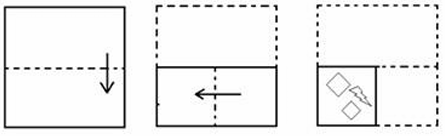
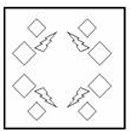
Question 196

Identify the tone of the passage. 

  1. AOption (a)

    Optimistic 

  2. BOption (b)

    Curious 

  3. COption (c)

    Worried 

  4. DOption (d)

    Friendly

View answer & explanation

Correct answer

Answer: (c)C.

Worried 

Why this answer is correct

The correct answer is: Worried

Key Points

  • Explanation: The passage conveys deep concern about the pervasiveness of corruption in society. It highlights various ways corruption has infiltrated governmental and corporate institutions, affecting economic growth, social equality, and infrastructure development. The author expresses anxiety about the loss of integrity at multiple levels and the negative consequences that corruption has on society.
  • Why the other options are incorrect:
  • Optimistic: The passage does not express hopefulness or confidence in overcoming corruption. Instead, it outlines the severity of the issue and its long-term consequences.
  • Curious: The passage does not pose enquiries or display an inquisitive tone. It presents a detailed critique of corruption without seeking answers in an open-ended manner.
  • Friendly: The tone of the passage is serious and critical rather than warm or amicable. It addresses corruption as a critical issue rather than approaching it with a friendly perspective.
  • In summary, the tone of the passage is worried, as it reflects concern and distress over the widespread corruption affecting multiple facets of society.

Question 197

Select the most appropriate summary of the passage. 

  1. AOption (a)

    The instances of social disparity among individuals in Indian society are existing because of corruption and other financial irregularities, which are legal. 

  2. BOption (b)

    Politicians’ earnings and wealth should be made available to the public through revolutions like Jan Lokpal Bill which will enhance the transparency 

  3. COption (c)

    The entire population should be made aware of the problem of corruption and join hands together to fight against corruption.

  4. DOption (d)

    It is true to say that high-level corruption in both the public and corporate sectors leads to the integration of laws and regulations.

View answer & explanation

Correct answer

Answer: (c)C.

The entire population should be made aware of the problem of corruption and join hands together to fight against corruption.

Why this answer is correct

Based on the given CSV data and the instructions, here's the solution for the question "Select the most appropriate summary of the passage":

The correct answer is: 3) The entire population should be made aware of the problem of corruption and join hands together to fight against corruption.

Key Points

  • Explanation: The passage emphasizes the importance of raising awareness about corruption among the general populace and encouraging collective efforts to combat it. This aligns with option 3, which highlights the need for widespread awareness and united action against corruption.
  • Why the other options are incorrect:
  • Option 1: While addressing social disparity and corruption, it focuses more on legal corruption and financial irregularities, which is not the central theme of the passage.
  • Option 2: This option emphasizes transparency of politicians' earnings through initiatives like the Jan Lokpal Bill, which is more specific and not the broader summary of the passage's main message.
  • Option 4: This option talks about high-level corruption leading to the integration of laws and regulations, which is not the central focus of the passage.
  • In summary, option 3 best captures the essence of the passage, stressing the importance of public awareness and collective action in the fight against corruption. Options 1, 2, and 4 either focus on different aspects or do not fully encapsulate the main message of the passage.

Question 198

Why can’t we address social evils like poverty and illiteracy?

  1. AOption (a)

    Because of unethical behaviour and divided community

  2. BOption (b)

    Because of the massive mountain of non-performing assets

  3. COption (c)

    Because we have been conditioned to accept corruption as the norm

  4. DOption (d)

    Because of high integrity on monetary and moral level

View answer & explanation

Correct answer

Answer: (c)C.

Because we have been conditioned to accept corruption as the norm

Why this answer is correct

The correct answer is: Because we have been conditioned to accept corruption as the norm.

Key Points

  • Explanation: The statement asks why social evils like poverty and illiteracy cannot be addressed. Option 3 states that it is because we have been conditioned to accept corruption as the norm, which aligns with the idea that societal and systemic issues such as corruption impede efforts to tackle these social evils. This is a plausible reason as corruption can undermine educational systems, economic opportunities, and social services, perpetuating poverty and illiteracy.
  • Why the other options are incorrect:
  • Option 1 (Because of unethical behaviour and divided community): While unethical behavior and a divided community can contribute to social evils, they are broader concepts and do not directly address the systemic issue of corruption as highlighted in option 3.
  • Option 2 (Because of the massive mountain of non-performing assets): This option pertains more to financial and banking sectors rather than directly addressing the root causes of social evils like poverty and illiteracy.
  • Option 4 (Because of high integrity on monetary and moral level): High integrity on monetary and moral levels would actually help address social evils, making this option contradictory to the statement.
  • In summary, option 3 best explains why we cannot address social evils like poverty and illiteracy, emphasizing the conditioning to accept corruption as the norm. Options 1, 2, and 4 either address broader issues or are not directly related to the conditioning mentioned in the question.

Question 199

Select the most appropriate meaning of the given word in the context of the passage.

Unscrupulous

  1. AOption (a)

    Overtly 

  2. BOption (b)

    Principled 

  3. COption (c)

    Dishonest 

  4. DOption (d)

    Ethical

View answer & explanation

Correct answer

Answer: (c)C.

Dishonest 

Why this answer is correct

The correct answer is: Dishonest

Key Points

  • Explanation: The word "unscrupulous" in the context of the passage means lacking moral principles or being dishonest. This aligns with option 3, which states "Dishonest" as the meaning of unscrupulous.
  • Why the other options are incorrect:
  • Overtly: This option means openly or publicly, which does not fit the context of the word "unscrupulous."
  • Principled: This option means having strong moral principles, which is the opposite of the meaning of "unscrupulous."
  • Ethical: This option means being morally right or good, which contrasts with the meaning of "unscrupulous."
  • In summary, option 3 best expresses the meaning of "unscrupulous" in the context of the passage. Options 1, 2, and 4 do not align with the definition of "unscrupulous."

Question 200

Which of the following factors is negatively impeding our growth?

  1. AOption (a)

    Administrative processes drenched in red tape 

  2. BOption (b)

    The collection of performing assets 

  3. COption (c)

    Abundance of foreign investment 

  4. DOption (d)

    Schedule and cost cutting on infrastructure projects

View answer & explanation

Correct answer

Answer: (a)A.

Administrative processes drenched in red tape 

Why this answer is correct

The correct answer is: Administrative processes drenched in red tape

Key Points

  • Explanation: The statement asks which factor is negatively impeding growth. Option 1, "Administrative processes drenched in red tape," is the correct answer because it indicates bureaucratic inefficiencies that can slow down decision-making and implementation, thereby hindering growth. This aligns with the common understanding that excessive red tape can be a significant barrier to efficient business operations and economic development.
  • Why the other options are incorrect:
  • The collection of performing assets: This option is not typically seen as a negative factor. Collecting performing assets generally means acquiring assets that are generating income or value, which is positive for growth.
  • Abundance of foreign investment: An abundance of foreign investment is usually viewed positively as it brings in capital, technology, and expertise, contributing to growth rather than impeding it.
  • Schedule and cost cutting on infrastructure projects: While cost-cutting can sometimes lead to quality issues, in general, efficient schedule and cost management on infrastructure projects are seen as positive efforts to optimize resources and enhance growth.
  • In summary, option 1 "Administrative processes drenched in red tape" is the most accurate answer as it directly points to bureaucratic inefficiencies that can slow down growth. Options 2, 3, and 4 either focus on factors that are generally positive for growth or are not typically viewed as significant impediments.

200 questions in the full paper