Previous Year Paper

SSC Steno 2017 Official Paper (Held on: 13 Sep 2017 Shift 1) (Previous Year Paper)

Held in 2017

200 questions120 minutes
With answers
Free

Paper last updated:

Practise under exam conditions

Take this paper as a timed mock test. Review your answers after you submit.

Attempt timed test

Questions & answers

Read the paper at your pace. Open an explanation when you need it.

General Intelligence & Reasoning (50 questions)

Question 1

In the following question, select the missing number from the given series.

5, 8, 12, 17, 23, ?

  1. AOption (a)

    28

  2. BOption (b)

    30

  3. COption (c)

    31

  4. DOption (d)

    29

View answer & explanation

Correct answer

Answer: (b)B.

30

Why this answer is correct

The relation between the numbers is as follows,

5 + 3 = 8

8 + 4 = 12

12 + 5 = 17

17 + 6 = 23

Hence, the next number is 23 + 7 = 30.

Question 2

In the following question, select the missing number from the given series.

43, 45, 50, 60, ?, 103

  1. AOption (a)

    79

  2. BOption (b)

    77

  3. COption (c)

    64

  4. DOption (d)

    69

View answer & explanation

Correct answer

Answer: (b)B.

77

Why this answer is correct

The relation between the numbers is as follows,

43 + (12 + 1) = 43 + 2 = 45.

45 + (22 + 1) = 45 + 5 = 50.

50 + (32 + 1) = 50 + 10 = 60.

Similarly,

60 + (42 + 1) = 60 + 17 = 77.

77 + (52 + 1) = 77 + 26 = 103.

Hence, the missing number is 77.

Question 3

In the following question, select the missing number from the given series.

12, 18, 27, 40.5, ?

  1. AOption (a)

    58.75

  2. BOption (b)

    64.25

  3. COption (c)

    60.75

  4. DOption (d)

    72.5

View answer & explanation

Correct answer

Answer: (c)C.

60.75

Why this answer is correct

The relation between the numbers is as follows,

12 + (0.5 × 12) = 12 + 6 = 18.

18 + (0.5 × 18) = 18 + 9 = 27.

27 + (0.5 × 27) = 27 + 13.5 = 40.5.

12 + (0.5 × 12) = 12 + 6 = 18.

Similarly,

40.5 + (0.5 × 40.5) = 40.5 + 20.25 = 60.75.

Hence, the next number is 60.75.

Question 4

In the following question, select the missing number from the given series.

543, 327, 202, ?, 111, 103

  1. AOption (a)

    138

  2. BOption (b)

    142

  3. COption (c)

    146

  4. DOption (d)

    152

View answer & explanation

Correct answer

Answer: (a)A.

138

Why this answer is correct

The relation between the numbers is as follows,

543 - 63 = 543 - 216 = 327.

327 - 53 = 327 - 125 = 202.

Similarly,

202 - 43 = 202 - 64 = 138.

138 - 33 = 138 - 27 = 111.

111 - 23 = 111 - 8 = 103.

Hence, the next number is 138.

Question 5

In the following question select the wrong term from the given series.

C9K, E19I, G39G, I79E, L159C

  1. AOption (a)

    E19I

  2. BOption (b)

    L159C

  3. COption (c)

    I79E

  4. DOption (d)

    G39G

View answer & explanation

Correct answer

Answer: (b)B.

L159C

Why this answer is correct

The pattern is as follows,

The numbers in between the letters are as follows,

(9 × 2) + 1 = 18 + 1 = 19.

(19 × 2) + 1 = 39.

(39 × 2) + 1 = 79.

(79 × 2) + 1 = 159.

Thus, L159C is wrong term since the first letter of L159C does not follow the +2 pattern.

Question 6

In the following question, which one set of numbers when sequentially placed at the gaps in the given number series shall complete it?

1 2 _ 1 _ 2 2 1 _ 2 _ 1

  1. AOption (a)

    2122

  2. BOption (b)

    1221

  3. COption (c)

    2112

  4. DOption (d)

    1211

View answer & explanation

Correct answer

Answer: (c)C.

2112

Why this answer is correct

The pattern here is such that each number is written twice consecutively in a repeated manner i.e.

→ 122112211221.

Thus, only third alternative i.e. 2112 is the correct set of numbers that will complete the series successfully.

Question 7

In the following question, which one set of letters when sequentially placed at the gaps in the given letter series shall complete it?

P _ R P P Q R _ P Q R P P _ _ P

  1. AOption (a)

    RPRQ

  2. BOption (b)

    PQPQ

  3. COption (c)

    QPQR

  4. DOption (d)

    QPQP

View answer & explanation

Correct answer

Answer: (c)C.

QPQR

Why this answer is correct

The pattern here is such that it forms a letter sequence of PQRP which is repeated. i.e.

→ P Q R P P Q R P P Q R P P Q R P

Thus, only third alternative i.e. QPQR is the correct set of letters that will complete the series successfully.

Question 8

Which word will appear second when arranged in order of dictionary?

  1. Stubborn
  2. Stalemate
  3. Stocking
  4. Straight
  5. Stromy
  1. AOption (a)

    Straight

  2. BOption (b)

    Stromy

  3. COption (c)

    Stocking

  4. DOption (d)

    None of these

View answer & explanation

Correct answer

Answer: (c)C.

Stocking

Why this answer is correct

The dictionary sequence is:

  1. Stalemate3. Stocking
  2. Straight
  3. Stromy
  4. Stubborn

Thus, the second word will be Stocking.

Question 9

Arrange the given words in the sequence in which they occur in the dictionary.

  1. Bailed
  2. Brown
  3. Boxer
  4. Bring
  5. Brain
  1. AOption (a)

    13542

  2. BOption (b)

    13524

  3. COption (c)

    13245

  4. DOption (d)

    13254

View answer & explanation

Correct answer

Answer: (a)A.

13542

Why this answer is correct

The dictionary sequence is:

  1. Bailed
  2. Boxer
  3. Brain
  4. Bring
  5. Brown.

Thus, 13542 will be the correct sequence.

Question 10

Which word will appear third when arranged in order of dictionary?

  1. AOption (a)

    Mandatory

  2. BOption (b)

    Magician

  3. COption (c)

    Mango

  4. DOption (d)

    Magical

View answer & explanation

Correct answer

Answer: (a)A.

Mandatory

Why this answer is correct

The dictionary sequence is:

  1. Magical
  2. Magician
  3. Mandatory
  4. Mango.

Thus, the third word will be Mandatory.

Question 11

Which of the following is the correct logical sequence of the given words?

  1. Tree
  2. Book
  3. Paper
  4. Binding
  1. AOption (a)

    2, 1, 3, 4

  2. BOption (b)

    2, 4, 1, 3

  3. COption (c)

    1, 2, 3, 4

  4. DOption (d)

    1, 3, 2, 4

View answer & explanation

Correct answer

Answer: (d)D.

1, 3, 2, 4

Why this answer is correct

The arrangement is as follows:

At First, comes the tree as the paper is derived from the tree.

A bunch of paper together comprises a book.

Binding of book is done in order to increase its durability.

So, the correct sequence will be Tree → Paper → Book → Binding.

Thus, 1, 3, 2, 4 is the correct alternative.

Question 12

In the following question, select the odd number pair from the given alternatives.

  1. AOption (a)

    11 - 1331

  2. BOption (b)

    10 - 1000

  3. COption (c)

    12 - 1728

  4. DOption (d)

    7 - 363

View answer & explanation

Correct answer

Answer: (d)D.

7 - 363

Why this answer is correct

The pattern following here is:

The 2nd term is the cube of the 1st term i.e.

11 - 1331 → 113 = 1331.

10 - 1000 → 103 = 1000.

12 - 1728 → 123 = 1728.

But in, 7 - 363 → 73 = 343 which is not equal to 363.

Thus, 7 - 363 is the odd one.

Question 13

In the following question, select the odd number pair from the given alternatives.

  1. AOption (a)

    7 - 56

  2. BOption (b)

    9 - 90

  3. COption (c)

    11 - 132

  4. DOption (d)

    13 - 195

View answer & explanation

Correct answer

Answer: (d)D.

13 - 195

Why this answer is correct

The pattern following here is:

The 2nd term is product of the 1st term and the number exceeding the 1st term by 1 i.e.

7 - 56 → 7 × 8 = 56.

9 - 90 → 9 × 10 = 90.

11 - 132 → 11 × 12 = 132.

13 - 195 → 13 × 14 = 182 which is not equal to 195.

Thus, 13 - 195 is the odd one.

Question 14

In the following question, select the odd letters from the given alternatives.

  1. AOption (a)

    CDF

  2. BOption (b)

    IJL

  3. COption (c)

    MNQ

  4. DOption (d)

    STV

View answer & explanation

Correct answer

Answer: (c)C.

MNQ

Why this answer is correct

Here, it follows a pattern of +1 between 1st and 2nd characters and of +2 between 2nd and 3rd characters as shown below:

Thus, MNQ is the odd one.

Question 15

In the following question, select the odd letters from the given alternatives.

  1. AOption (a)

    JIH

  2. BOption (b)

    RQP

  3. COption (c)

    WVU

  4. DOption (d)

    ZXY

View answer & explanation

Correct answer

Answer: (d)D.

ZXY

Why this answer is correct

Here, it follows a pattern of -1 between two consecutive characters as shown below:

Thus, ZXY is the odd one.

Question 16

In the following question, select the odd word from the given alternatives.

  1. AOption (a)

    Bottle

  2. BOption (b)

    Cup

  3. COption (c)

    Jar

  4. DOption (d)

    Funnel

View answer & explanation

Correct answer

Answer: (d)D.

Funnel

Why this answer is correct

Bottle, Cup and Jar are all the utilities that are used to hold the matter while the Funnel is used to transmit the matter from one place to another i.e. it cannot hold the matter.

Thus, Funnel is the odd one.

Question 17

In the following question, select the odd word pair from the given alternatives.

  1. AOption (a)

    White : Ocean

  2. BOption (b)

    Earth : Planet

  3. COption (c)

    Onion : Vegetable

  4. DOption (d)

    Grapes : Fruit

View answer & explanation

Correct answer

Answer: (a)A.

White : Ocean

Why this answer is correct

In all the pairs, the 2nd word is a category while the 1st word is the example of that category i.e.

Earth : Planet → Earth is an example of Planet.

Onion : Vegetable → Onion is an example of Vegetable.

Grapes : Fruit → Grapes are an example of Fruits.

But in White : Ocean → White is not an example of Ocean.

Thus, White : Ocean is the odd pair.

Question 18

In the following question, select the odd word from the given alternatives.

  1. AOption (a)

    White

  2. BOption (b)

    Colour

  3. COption (c)

    Red

  4. DOption (d)

    Green

View answer & explanation

Correct answer

Answer: (b)B.

Colour

Why this answer is correct

Here, the alternatives are types of colour.

Since, Colour is not a type of colour.

Thus, Colour is the odd word.

Question 19

In the following question, select the related number from the given alternatives.

107 : 11449 ∷ 109 : ?

  1. AOption (a)

    11881

  2. BOption (b)

    10881

  3. COption (c)

    12991

  4. DOption (d)

    13891

View answer & explanation

Correct answer

Answer: (a)A.

11881

Why this answer is correct

Here pattern is such that 2nd number is the square of the 1st number i.e.

107 : 11449 → 1072 = 11449.

Similarly, 1092 = 11881.

Thus, 11881 is the correct alternative.

Question 20

In the following question, select the related number from the given alternatives.

17 : 290 ∷ 11 : ?

  1. AOption (a)

    122

  2. BOption (b)

    36

  3. COption (c)

    170

  4. DOption (d)

    190

View answer & explanation

Correct answer

Answer: (a)A.

122

Why this answer is correct

Here pattern is such that 2nd number is one exceeding the square of the 1st number i.e.

17 : 290 → 172 + 1 = 289 + 1 = 290.

Similarly, 112 + 1 = 121 + 1 = 122.

Thus, 122 is the correct alternative.

Question 21

In the following question, select the related number from the given alternatives.

7 : 49 ∷ 11 : ?

  1. AOption (a)

    121

  2. BOption (b)

    101

  3. COption (c)

    111

  4. DOption (d)

    131

View answer & explanation

Correct answer

Answer: (a)A.

121

Why this answer is correct

Here pattern is such that 2nd number is the square of the 1st number i.e.

7 : 49 → 72 = 49.

Similarly, 112 = 121.

Thus, 121 is the correct alternative.

Question 22

In the following question, select the related letters from the given alternatives.

MOBILE : NQEMQK ∷ PHONE : ?

  1. AOption (a)

    QJRRJ

  2. BOption (b)

    QJRSJ

  3. COption (c)

    QJRTJ

  4. DOption (d)

    QKRRJ

View answer & explanation

Correct answer

Answer: (a)A.

QJRRJ

Why this answer is correct

In 1st word, the first letter from left is coded by the letter one place (+1) next to it in the alphabetical series. Similarly, the second letter from left is coded by the letter two place (+2) next to it in the alphabetical series and so on for the next letters.

Thus, QJRRJ is the correct alternative.

Question 23

In the following question, select the related letters from the given alternatives.

CORD : BNQC ∷ LESS : ?

  1. AOption (a)

    KDRR

  2. BOption (b)

    KFRR

  3. COption (c)

    MDRR

  4. DOption (d)

    KCRR

View answer & explanation

Correct answer

Answer: (a)A.

KDRR

Why this answer is correct

In 1st word, all the letters are coded by the letter immediately preceding them in the alphabetical series.

Thus, KDRR is the correct alternative.

Question 24

In the following question, select the related letters from the given alternatives.

BOTTLE : APSUKF ∷ FILLED : ?

  1. AOption (a)

    EJKMDE

  2. BOption (b)

    EJKMFE

  3. COption (c)

    EJLMDE

  4. DOption (d)

    EIKMDE

View answer & explanation

Correct answer

Answer: (a)A.

EJKMDE

Why this answer is correct

In 1st word, the letters at the odd place are coded by the letters immediately preceding them in alphabetical series while the letters at the even place are coded by letters immediately following them in alphabetical series.

Thus, EJKMDE is the correct alternative.

Question 25

In the following question, select the related word from the given alternatives.

Gain : Loss ∷ Sorrow : ?

  1. AOption (a)

    Anger

  2. BOption (b)

    Happiness

  3. COption (c)

    Disheartened

  4. DOption (d)

    Unhappy

View answer & explanation

Correct answer

Answer: (b)B.

Happiness

Why this answer is correct

Here, the 2nd word is the antonym of the 1st word i.e.

Gain : Loss → Loss is the opposite or antonym of Gain.

Similarly, antonym of Sorrow is Happiness.

Thus, Happiness is the correct alternative.

Question 26

In the following question, select the related word pair from the given alternatives.

Pray : Temple ∷ ? : ?

  1. AOption (a)

    Priest : Church

  2. BOption (b)

    Doctor : Hospital

  3. COption (c)

    Teacher : School

  4. DOption (d)

    Study : School

View answer & explanation

Correct answer

Answer: (d)D.

Study : School

Why this answer is correct

Here, the 2nd word denotes the public structure or building while the 1st word denotes the purpose of that building i.e.

Pray : Temple → Temple is the building which serves the purpose of praying.

Similarly,

Study : School → School is the building which serves the purpose of studying.

Thus, Study : School is the correct alternative.

Question 27

In the following question, select the related word from the given alternatives.

Milk : Litre ∷ Mango : ?

  1. AOption (a)

    Yellow

  2. BOption (b)

    Kilogram

  3. COption (c)

    Summer

  4. DOption (d)

    Centimetre

View answer & explanation

Correct answer

Answer: (b)B.

Kilogram

Why this answer is correct

Here, the 1st word denotes the consumable entity while the 2nd word denotes the measuring unit of the 1st word i.e.

Milk : Litre → Milk is the consumable entity which is measured in litres.

Similarly,

Mango is measured in Kilogram.

Thus, Kilogram is the correct alternative.

Question 28

If 14 L 7 A 2 = 49 and 18 L 4 A 2 = 36, then 15 L 5 A 3 = ?

  1. AOption (a)

    25

  2. BOption (b)

    81

  3. COption (c)

    16

  4. DOption (d)

    9

View answer & explanation

Correct answer

Answer: (a)A.

25

Why this answer is correct

Here, L means x and A means ÷ i.e.

14 L 7 A 2 = 14 × 7 ÷ 2 = 49.

18 L 4 A 2 = 18 × 4 ÷ 2 = 36.

Similarly,

15 L 5 A 3 = 15 × 5 ÷ 3 = 25.

Thus, 25 is the correct alternative.

Question 29

If ‘×’ means ‘ + ’, ‘÷’ means ‘-’, ‘ + ’ means ‘÷’ and ‘-’ means ‘×’, then

78 - 13 + 6 × 7 ÷ 23 = ?

  1. AOption (a)

    121

  2. BOption (b)

    153

  3. COption (c)

    133

  4. DOption (d)

    -13

View answer & explanation

Correct answer

Answer: (b)B.

153

Why this answer is correct

Given, ‘×’ means ‘ + ’, ‘÷’ means ‘-’, ‘ + ’ means ‘÷’ and ‘-’ means ‘×’.

So,

78 - 13 + 6 × 7 ÷ 23 → 78 × 13 ÷ 6 + 7 - 23 = 153.

Thus, 153 is the correct alternative.

Question 30

In the following question, select the word which cannot be formed using the letters of the given word.

RETROGADE

  1. AOption (a)

    READY

  2. BOption (b)

    GRADE

  3. COption (c)

    TRADE

  4. DOption (d)

    GREAT

View answer & explanation

Correct answer

Answer: (a)A.

READY

Why this answer is correct

Let’s check each option,

  1. READY → cannot be formed as there is no ‘Y’ in RETROGADE.

  2. GRADE → can be formed as RETROGADE.

  3. TRADE → can be formed as RETROGADE.

  4. GREAT → can be formed as RETROGADE.

Hence, READY can’t be formed from word RETROGADE.

Question 31

In the following question, select the word which cannot be formed using the letters of the given word.

PERFORMANCE

  1. AOption (a)

    FORM

  2. BOption (b)

    ROMANCE

  3. COption (c)

    DIME

  4. DOption (d)

    ROME

View answer & explanation

Correct answer

Answer: (c)C.

DIME

Why this answer is correct

Let’s check each option,

  1. FORM → can be formed as PERFORMANCE.

  2. ROMANCE → can be formed as PERFORMANCE.

  3. DIME → cannot be formed as there is no “D” in PERFORMANCE.

  4. ROME → can be formed as PERFORMANCE.

Hence, DIME can’t be formed from word PERFORMANCE.

Question 32

In the following question below are given some statements followed by some conclusions. Taking the given statements to be true even if they seem to be at variance from commonly known facts, read all the conclusions and then decide which of the given conclusion logically follows the given statements.

Statements:

I. All stars are blue.

II. All blue are black.

Conclusions:

I. Some black are stars.

II. All black are stars.

  1. AOption (a)

    Only I

  2. BOption (b)

    Only II

  3. COption (c)

    Neither I nor II

  4. DOption (d)

    Both I and II

View answer & explanation

Correct answer

Answer: (a)A.

Only I

Why this answer is correct

Consider the following least possible Venn diagram,

Conclusions:

I. Some black are stars → True (It is definitely true as some black are clearly stars).

II. All black are stars → False (It is possible but not definite).

Hence, only I follows.

Question 33

In the following question below are given some statements followed by some conclusions. Taking the given statements to be true even if they seem to be at variance from commonly known facts, read all the conclusions and then decide which of the given conclusion logically follows the given statements.

Statements:

I. All coal are black.

II. All black are red.

Conclusions:

I. All coal are red.

II. All red are coal.

III. No red is coal.

  1. AOption (a)

    Only I

  2. BOption (b)

    Only I and II

  3. COption (c)

    Only III

  4. DOption (d)

    All conclusions follow.

View answer & explanation

Correct answer

Answer: (a)A.

Only I

Why this answer is correct

Consider the following least possible Venn diagram,

Conclusions:

I. All coal are red → True (It is definitely true as all coal are clearly red).

II. All red are coal → False (It is possible but not definite).

III. No red is coal → False (It is definitely false as all coal are red).

Hence, only I follows.

Question 34

In a certain code language, “COUNTRY” is written as “BPTOSSX”. How is “STATE” written in that code language?

  1. AOption (a)

    TSBSF

  2. BOption (b)

    RUZUD

  3. COption (c)

    RSBUD

  4. DOption (d)

    TUBUD

View answer & explanation

Correct answer

Answer: (b)B.

RUZUD

Why this answer is correct

The letters at the odd place are coded by the letters immediately preceding them in alphabetical series while the letters at the even place are coded by letters immediately following them in alphabetical series.

Hence, RUZUD is the correct alternative.

Question 35

In a certain code language, “SENSEX” is written as “VHQVHA”. How is “TRIUMPH” written in that code language?

  1. AOption (a)

    WULXPSK

  2. BOption (b)

    KSPXLUW

  3. COption (c)

    LWUSPXK

  4. DOption (d)

    JXUSPYK

View answer & explanation

Correct answer

Answer: (a)A.

WULXPSK

Why this answer is correct

All the letters are coded by the letter which are three places next to them in the alphabetical series.

Hence, WULXPSK is the correct alternative.

Question 36

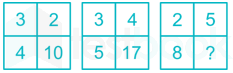
In the following question, select the number which can be placed at the sign of question mark (?) from the given alternatives.

  1. AOption (a)

    26

  2. BOption (b)

    27

  3. COption (c)

    30

  4. DOption (d)

    32

View answer & explanation

Correct answer

Answer: (c)C.

30

Why this answer is correct

The pattern used here is the number inside the triangle is obtained by adding the squares of the numbers on its vertices i.e.

12 + 22 + 32 = 1 + 4 + 9 = 14.

12 + 32 + 42 = 1 + 9 + 16 = 26.

Similarly,

12 + 22 + 52 = 1 + 4 + 25 = 30.

Hence, 30 is the correct answer.

Question 37

In the following question, select the number which can be placed at the sign of question mark (?) from the given alternatives.

  1. AOption (a)

    12

  2. BOption (b)

    16

  3. COption (c)

    18

  4. DOption (d)

    20

View answer & explanation

Correct answer

Answer: (c)C.

18

Why this answer is correct

Let the elements of matrix be A11, A12, A21, and A22 as shown

A11A12
A21A22


Then,

A11 × A12 + A21 = A22

In Matrix 1 → 3 × 2 + 4 = 10.

In Matrix 2 → 3 × 4 + 5 = 17.

Similarly,

In Matrix 3 → 2 × 5 + 8 = 18.

Hence, 18 is the correct answer.

Question 38

In the following question, select the number which can be placed at the sign of question mark (?) from the given alternatives.

32517
61743
532?
  1. AOption (a)

    12

  2. BOption (b)

    13

  3. COption (c)

    15

  4. DOption (d)

    17

View answer & explanation

Correct answer

Answer: (b)B.

13

Why this answer is correct

Here the pattern followed in each row is:

1st number × 3rd number + 2nd number = 4th number

In row 1 → 3 × 5 + 2 = 17.

In row 2 → 6 × 7 + 1 = 43.

Similarly,

In row 3 → 5 × 2 + 3 = 13.

Hence, 13 is the correct answer.

Question 39

In the following question, select the number which can be placed at the sign of question mark (?) from the given alternatives.

  1. AOption (a)

    72

  2. BOption (b)

    76

  3. COption (c)

    75

  4. DOption (d)

    74

View answer & explanation

Correct answer

Answer: (b)B.

76

Why this answer is correct

The pattern used here is:

1 + {1 + (2 × 1)} = 1 + 3 = 4

4 + {3 + (2 × 2)} = 4 + 7 = 11

11 + {7 + (2 × 3)} = 11 + 13 = 24

24 + {13 + (2 × 4)} = 24 + 21 = 45

45 + {21 + (2 × 5)} = 45 + 31 =76

OR

1 + (1 + 2) = 1 + 3 = 4

4 + (3 + 4) = 4 + 7 = 11

11 + (7 + 6) = 11 + 13 = 24

24 + (13 + 8) = 24 + 21 = 45

45 + (21 + 10) = 45 + 31 = 76

Hence, 76 will be the next number.

Question 40

P, Q, R, S and T are sitting in a line facing west. P and Q are sitting together. R is sitting at south end and S is sitting at north end. T is neighbour of Q and R. Who is second from south end?

  1. AOption (a)

    P

  2. BOption (b)

    R

  3. COption (c)

    S

  4. DOption (d)

    T

View answer & explanation

Correct answer

Answer: (d)D.

T

Why this answer is correct

  1. R is sitting at south end and S is sitting at north end.

  2. T is neighbour of Q and R. P and Q are sitting together.

Hence, T is sitting second from the south end.

Question 41

Present age of A is 52 years. 8 years hence ages of A and B will be in ratio 4 : 5. What is the present age (in years) of B?

  1. AOption (a)

    67

  2. BOption (b)

    75

  3. COption (c)

    72

  4. DOption (d)

    60

View answer & explanation

Correct answer

Answer: (a)A.

67

Why this answer is correct

Present age of A is 52 years.

Age of A after 8 years is 60 years.

Ratio of ages of A and B after 8 years is 4 : 5.

So, Let the age of B after 8 years will be x,

Hence,

60x=45 x=75\begin{array}{l} \frac{{60}}{x} = \frac{4}{5}\ x = 75 \end{array}

Thus, present age of B is (75 - 8) = 67 years.

Question 42

Weight of A is thrice that of B. Weight of B is 1/4 of C. Weight of C is 5 times of D. Weight of D is 1/6 of E. Who is the lightest?

  1. AOption (a)

    A

  2. BOption (b)

    B

  3. COption (c)

    C

  4. DOption (d)

    D

View answer & explanation

Correct answer

Answer: (d)D.

D

Why this answer is correct

According to the question the relation between the weight of A, B, C, D and E are

A = 3 × B

B=14CB = \frac{1}{4}C

C = 5 × D

D=16ED = \frac{1}{6}E

Let the weight of E be 12 kilograms.

D=16×12D = \frac{1}{6} \times 12 = 2 kilograms.

C = 5 × 2 = 10 kilograms.

B=14×10B = \frac{1}{4} \times 10 = 2.5 kilograms.

A = 3 × 2.5 = 7.5 kilograms.

Hence, D is the lightest.

Question 43

Present ages of Ram and his father are in ratio of 2 : 3. After 5 years ratio of ages of Ram’s father and his mother will be 13 : 12. If the present age of his mother is 55 years, then what will be the age of Ram (in years) 7 years from now?

  1. AOption (a)

    43

  2. BOption (b)

    47

  3. COption (c)

    42

  4. DOption (d)

    45

View answer & explanation

Correct answer

Answer: (b)B.

47

Why this answer is correct

Ratio of present ages of Ram and his father is 2 : 3.

Ratio of ages of Ram’s father and his mother after 5 years will be 13 : 12.

Present age of Ram’s mother is 55 years.

Age of Ram’s mother after 5 years will be 60 years which equal to ratio 12.

So age of Ram’s father after 5 years will be-

13 × 60 ÷ 12 = 65 years.

Present age of Ram’s father will be-

65 - 5 = 60 years which is equal to ratio 3.

Present age of Ram is-

2 × 60 ÷ 3 = 40 years.

Thus, age of Ram after 7 years from present will be (40 + 7) = 47 years.

Question 44

Which answer figure will complete the pattern in the question figure?

  1. AOption (a)

  2. BOption (b)

  3. COption (c)

  4. DOption (d)

View answer & explanation

Correct answer

Answer: (b)B.

Why this answer is correct

Hence, option 2 completes the pattern in the question figure.

Question 45

From the given answer figures, select the one in which the question figure is hidden/embedded.

  1. AOption (a)

  2. BOption (b)

  3. COption (c)

  4. DOption (d)

View answer & explanation

Correct answer

Answer: (d)D.

Why this answer is correct

The question figure is hidden in the following figure:

Hence, option 4 is the correct alternative.

Question 46

A piece of paper is folded and cut as shown below in the question figures. From the given answer figures, indicate how it will appear when opened?

  1. AOption (a)

  2. BOption (b)

  3. COption (c)

  4. DOption (d)

View answer & explanation

Correct answer

Answer: (a)A.

Why this answer is correct

Hence, answer is figure 1.

Question 47

If a mirror is placed on the line AB, then which of the answer figures is the right image of the given figure?

  1. AOption (a)

  2. BOption (b)

  3. COption (c)

  4. DOption (d)

View answer & explanation

Correct answer

Answer: (d)D.

Why this answer is correct

The mirror image of the question will be:

Hence, we can say that option 4 is the correct mirror image of the given question.

Question 48

In the figure, what will come opposite to face containing ‘A’?

  1. AOption (a)

    N

  2. BOption (b)

    G

  3. COption (c)

    B

  4. DOption (d)

    F

View answer & explanation

Correct answer

Answer: (b)B.

G

Why this answer is correct

If we consider face with “C” as centre and fold its surrounding faces inside, we find that face with “B” and “F” are opposite to each other and face with “A” and “G” opposite to each other.

Thus, face opposite to “A” is face containing “G”.

Question 49

A word is represented by only one set of numbers as given in any one of the alternatives. The sets of numbers given in the alternatives are represented by two classes of alphabets as shown in the given two matrices. The columns and rows of Matrix-I are numbered from 0 to 4 and that of Matrix-II are numbered from 5 to 9. A letter from these matrices can be represented first by its row and next by its column, for example ‘A’ can be represented by 24, 95, etc., and ‘M’ can be represented by 11, 66, etc. similarly. You have to identify the set for the word “PARTY”.

Matrix I
01234
0PCWRI
1AMOQS
2UXYBA
3EHJLN
4ARTVU
Matrix II
56789
5TKPFU
6GMNHV
7EOYJT
8CFWLR
9ASUNX
  1. AOption (a)

    00, 10, 03, 86, 32

  2. BOption (b)

    00, 95, 32, 31, 89

  3. COption (c)

    57, 40, 89, 79, 78

  4. DOption (d)

    57, 24, 41, 55, 22

View answer & explanation

Correct answer

Answer: (d)D.

57, 24, 41, 55, 22

Why this answer is correct

Let’s check all the options,

  1. 00, 10, 03, 86, 32 → PARFJ

  2. 00, 95, 32, 31, 89 → PAJHR

  3. 57, 40, 89, 79, 78 → PARTJ

  4. 57, 24, 41, 55, 22 → PARTY

Thus, the correct option is 57, 24, 41, 55, 22.

Question 50

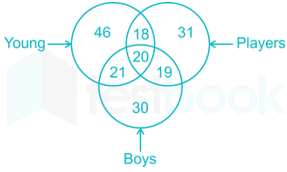
In the figure, how many players are young?

  1. AOption (a)

    18

  2. BOption (b)

    20

  3. COption (c)

    38

  4. DOption (d)

    46

View answer & explanation

Correct answer

Answer: (c)C.

38

Why this answer is correct

The players who are young = intersection of Young and Player

Clearly, the players that are young are 18 + 20 = 38.

General Awareness (50 questions)

Question 51

Who among the following is author of the book “An Inquiry into the Nature and Causes of the Wealth of Nations”?

  1. AOption (a)

    Marshall

  2. BOption (b)

    Pigou

  3. COption (c)

    Gresham

  4. DOption (d)

    Adam Smith

View answer & explanation

Correct answer

Answer: (d)D.

Adam Smith

Why this answer is correct

Adam Smith is the author of the book “An Inquiry into the Nature and Causes of the Wealth of Nations”. He is a moral philosopher and a Scottish economist.

Alfred MarshallPrinciples of Economics
A.C PigouThe Economics of Welfare
Clint GreshamThe Law Partners
Adam SmithThe Wealth of Nations

Question 52

“Yojana” magazine is being published by which of the following?

  1. AOption (a)

    Planning Commission

  2. BOption (b)

    National Development Council

  3. COption (c)

    Directorate of Advertising and Visual Publicity

  4. DOption (d)

    Ministry of Information and Broadcasting

View answer & explanation

Correct answer

Answer: (d)D.

Ministry of Information and Broadcasting

Why this answer is correct

Yojana is a monthly journal which is published by the Ministry of Information and Broadcasting. It is devoted to the socio-economic issues and is published in 13 languages. Its publication first started in the year 1957, with Mr. Khushwant Singh being the Chief Editor.

Question 53

Who was the Chairman of the First Finance Commission?

  1. AOption (a)

    K. Santhanam

  2. BOption (b)

    K.C. Neogy

  3. COption (c)

    A.K. Chanda

  4. DOption (d)

    P. V. Rajamannar

View answer & explanation

Correct answer

Answer: (b)B.

K.C. Neogy

Why this answer is correct

The First Finance Commission was established in the year 1951 and K.C. Neogy was its Chairman.

First Finance Commission 1951K.C. Neogy
Second Finance Commission 1956K. Santhanam
Third Finance Commission 1960A.K. Chanda
Fourth Finance Commission 1964P. V. Rajamannar

Question 54

From which of following taxes does the Government of India earn the most?

  1. AOption (a)

    Income Tax

  2. BOption (b)

    Custom Duty

  3. COption (c)

    Wealth Tax

  4. DOption (d)

    Corporate Tax

View answer & explanation

Correct answer

Answer: (d)D.

Corporate Tax

Why this answer is correct

The Government of India earns the most from Corporate Tax, while the second and third are the Income and Wealth Tax respectively.

Question 55

What is the appropriate priority (ascending) order of the following?

  1. Panchayat Samiti
  2. Gram Sabha
  3. District Council
  1. AOption (a)

    3 - 2 - 1

  2. BOption (b)

    2 - 1 - 3

  3. COption (c)

    1 - 2 - 3

  4. DOption (d)

    3 - 1 - 2

View answer & explanation

Correct answer

Answer: (b)B.

2 - 1 - 3

Why this answer is correct

The appropriate priority order is as follows: Gram Sabha< Panchayat Samiti< District Council.

Gram Sabha: A gram panchayat (village council) is the only grassroots-level of panchayati raj formalised local self-governance system in India at the village or small-town level, and has a sarpanch as its elected head.

Panchayat Samiti: Mandals, taluka panchayats, block panchayats, or panchayat samiti are rural local governments (panchayats) at the intermediate level in panchayat raj institutions (PRI).

District Council: The Zila Panchayat or District Council or Zilla Parishad or District Panchayat, is the third tier of the Panchayati Raj system.

Question 56

When was the National Commission for Backward Classes established?

  1. AOption (a)

    1963

  2. BOption (b)

    1973

  3. COption (c)

    1983

  4. DOption (d)

    1993

View answer & explanation

Correct answer

Answer: (d)D.

1993

Why this answer is correct

  • The National Commission for Backward Classes was established on 14th August 1993.
  • It is a constitutional body(102nd amendment in the constitution to make it a constitutional body).
  • The National Commission for Backward Classes comes under the Ministry of Social Justice and Empowerment.

Question 57

The concept “creamy layer” refers to ______.

  1. AOption (a)

    Classification based on the level of education

  2. BOption (b)

    Classification based on income level

  3. COption (c)

    Classification based on social level

  4. DOption (d)

    None of the option is correct

View answer & explanation

Correct answer

Answer: (b)B.

Classification based on income level

Why this answer is correct

  • Creamy layer is a term used in Indian politics to refer to the relatively forward and better educated members of the Other Backward Classes (OBCs) who are not eligible for government-sponsored educational and professional benefit programs.
  • The term was introduced by the Sattanathan Commission in 1971, which directed that the "creamy layer" should be excluded from the reservations (quotas) of civil posts.
  • The creamy layer (income) criteria is defined as annual family income from all sources more than Rs. 8 lakh (2017).

Question 58

Which of the following is not a national political party?

  1. AOption (a)

    Indian National Lok Dal

  2. BOption (b)

    Bahujan Samaj Party

  3. COption (c)

    Bharatiya Janata Party

  4. DOption (d)

    Indian National Congress

View answer & explanation

Correct answer

Answer: (a)A.

Indian National Lok Dal

Why this answer is correct

The five parties that are recognized as the National political parties are: ​

  • Indian National Congress
  • Bharatiya Janata Party
  • Bahujan Samaj Party
  • Communist Party of India (Marxist)
  • Communist Party of India

Question 59

In which articles of the Indian Constitution is the right to freedom described?

  1. AOption (a)

    Article 14-18

  2. BOption (b)

    Article 19-22

  3. COption (c)

    Article 23-28

  4. DOption (d)

    Article 29-30

View answer & explanation

Correct answer

Answer: (b)B.

Article 19-22

Why this answer is correct

The right to freedom is described under the articles 19-22 of the Indian Constitution.

Article 14-18Right to equality
Article 19-22Right to freedom
Article 23-28Prohibition of traffic and forced labour, Prohibition of child labour, and Right to freedom of religion
Article 29-30Cultural and Educational rights, and many more

Question 60

According to the Indian Constitution, who is the head of the executive?

  1. AOption (a)

    Prime Minister

  2. BOption (b)

    Cabinet Secretary of Government of India

  3. COption (c)

    President

  4. DOption (d)

    Union Home Minister

View answer & explanation

Correct answer

Answer: (c)C.

President

Why this answer is correct

The Correct Answer is President.

Key Points

  • As per Article 53 (1) of the Indian Constitution, the head of the executive is the President of India.
  • He has all the constitutional powers and can exercise them directly or through subordinate officers.
  • He is, however, only a Constitutional Head of State acting on the aid and advice of the Council of Ministers and as such only the formal Executive.
  • Also, the President works on the suggestions by the PM.
  • The term 'Executive' has been defined both in its broad and narrow forms.
  • In its broad form, it is taken to mean all the functionaries, political power-holders (Political Executive), and permanent civil servants who undertake the execution of laws and policies and run the administration of the state.

Question 61

Who among the following was the founder of the Banaras Hindu University?

  1. AOption (a)

    Rajarshi Purushottam Das Tandon

  2. BOption (b)

    Dr. S. Radhakrishnan

  3. COption (c)

    Madan Mohan Malaviya

  4. DOption (d)

    Swami Vivekananda

View answer & explanation

Correct answer

Answer: (c)C.

Madan Mohan Malaviya

Why this answer is correct

  • Madan Mohan Malviya was the founder of the Banaras Hindu University.
  • He was an Indian Independence activist and also a prominent lawyer.

Question 62

Who is known as the father of “Civil Services” in India?

  1. AOption (a)

    Governor General Warren Hastings

  2. BOption (b)

    Lord Cornwallis

  3. COption (c)

    Lord William Bentinck

  4. DOption (d)

    Lord Canning

View answer & explanation

Correct answer

Answer: (b)B.

Lord Cornwallis

Why this answer is correct

  • Warren Hastings laid the foundation of civil service and Charles Cornwallis reformed, modernized and rationalized it. Hence, Charles Cornwallis is known as the 'Father of Civil Service in India'.
  • He introduced Covenanted Civil Services (Higher Civil Services) and Uncovenanted Civil Services (Lower Civil Services).
Lord CornwallisCharles Cornwallis, 1st Marquess Cornwallis KG, PC, styled Viscount Brome between 1753 and 1762 and known as Earl Cornwallis between 1762 and 1792, was a British Army general and official.
Lord William BentinckLieutenant-General Lord William Henry Cavendish-Bentinck, known as Lord William Bentinck, was a British soldier and statesman. He served as Governor-General of India from 1828 to 1835.
Lord Charles MetcalfeCharles Theophilus Metcalfe, known as Sir Charles Metcalfe, Bt between 1822 and 1845, was a British colonial administrator.
Sir Henry HardingeField Marshal Henry Hardinge was a British Army officer and politician. After serving in the Peninsular War and the Waterloo Campaign he became Secretary at War in Wellington's ministry.

Question 63

Who among of the following was called the “Fighter Peshwa”?

  1. AOption (a)

    Bajirao I

  2. BOption (b)

    Bajirao II

  3. COption (c)

    Balaji Baji Rao

  4. DOption (d)

    Balaji Vishwanath

View answer & explanation

Correct answer

Answer: (a)A.

Bajirao I

Why this answer is correct

  • Bajirao I was known as the Fighter Peshwa. Baji Rao was a general of the Maratha Empire in India.
  • He served as Peshwa (Prime Minister) to the fifth Maratha Chhatrapati (Emperor) Shahu from 1720 until his death.
  • He is also known by the name Bajirao Ballal.

Question 64

Who was the last ruler of the Mauryan dynasty?

  1. AOption (a)

    Kunala

  2. BOption (b)

    Brihadratha

  3. COption (c)

    Susima

  4. DOption (d)

    Samprati

View answer & explanation

Correct answer

Answer: (b)B.

Brihadratha

Why this answer is correct

The correct answer is Brihadratha.

  • Brihadratha Maurya was the last ruler of the Mauryan dynasty.
  • He was killed by his own general, Pushyamitra Shunga, who later established the Shunga empire.

Additional Information

  • Mauryan Empire was established by Chandragupta Maurya by Defeating Dhanananda of the Nanda Dynasty during 322-21 BC.
  • Mauryan Period (322 BC- 185 BC) was one of the most important periods of Ancient Indian History. The literary sources related to this period were Kautilya"s Arthasastra, Megasthenese's 'Indica', and Visakha Datta's 'Mudra Rakshasa'.
  • Buddhist Literature text Jatakas ( a part of Khuddaknikaya of Suttapitaka which describes 549 stories of Buddha's previous births ) reveals the general picture of socio-economic conditions of the Mauryan period.

Question 65

Where are the evergreen rain forests found?

  1. AOption (a)

    Indonesia

  2. BOption (b)

    Brazil

  3. COption (c)

    Sri Lanka

  4. DOption (d)

    Myanmar (Burma)

View answer & explanation

Correct answer

Answer: (b)B.

Brazil

Why this answer is correct

  • The evergreen rain forests are found in the areas of southeastern Brazil, Southern China, Morocco, Lebanon, North America, Australia, Siberia, Africa, Canada, and more.
  • Evergreen forests are made up of evergreen trees and occur across various climatic zones.

Question 66

What is the main purpose of inclusion of Directive Principles in the Constitution of India?

  1. AOption (a)

    to establish socio-economic democracy

  2. BOption (b)

    to establish social democracy

  3. COption (c)

    to establish Gandhian democracy

  4. DOption (d)

    to establish political democracy

View answer & explanation

Correct answer

Answer: (a)A.

to establish socio-economic democracy

Why this answer is correct

Directive principles are guidelines or directions set for framing of policies and passing of laws by the government.

These guidelines are based on the fundamental rights stated in the Constitution and thus help to establish and maintain socio-economic democracy.

Question 67

Which of the following crops are grown in group during Rabi season in India?

  1. AOption (a)

    Rice, Maize, Wheat

  2. BOption (b)

    Barley, Maize, Rice

  3. COption (c)

    Wheat, Mustard, Gram

  4. DOption (d)

    Millet, Gram, Rice

View answer & explanation

Correct answer

Answer: (c)C.

Wheat, Mustard, Gram

Why this answer is correct

  • There are 3 major crop seasons in India, which are Rabi, Kharif, and Zaid.
  • The crops grown in the Rabi season include wheat, mustard, and gram. The Rabi crops are sown between October and December and harvested in the month of April and May.
  • Kharif crops are sown in the monsoon in June and July and harvested in September and October. rice, jowar, cotton, maize are kharif crops
  • Zaid crops are sown in the summer season, which includes rice, maize, groundnut, and vegetables.

Question 68

How many satellites does Uranus have?

  1. AOption (a)

    16

  2. BOption (b)

    33

  3. COption (c)

    27

  4. DOption (d)

    24

View answer & explanation

Correct answer

Answer: (c)C.

27

Why this answer is correct

Uranus has got 27 satellites or moons. Most of these were not discovered until the space age.

Question 69

Popular beverage “coffee” is obtained from which part of the plant?

  1. AOption (a)

    Root

  2. BOption (b)

    Leaf

  3. COption (c)

    Flower

  4. DOption (d)

    Seed

View answer & explanation

Correct answer

Answer: (d)D.

Seed

Why this answer is correct

  • Coffee is obtained from the seed of the plant.
  • The plant of coffee is a tropical evergreen shrub or small tree which found its origin in Africa.
  • Coffee is grown in rainy and dry season, and required altitude must be between 1800-3600 feet.
  • India accounts for 4% of the world’s coffee production.
  • Indian coffee is known in the world for its good quality, Arabica and Robusta coffee are famous variety of coffee.

Question 70

Which plant did Gregor Mendel use for hybridization or crossbreeding?

  1. AOption (a)

    Potato

  2. BOption (b)

    Pea

  3. COption (c)

    Beet

  4. DOption (d)

    Apple

View answer & explanation

Correct answer

Answer: (b)B.

Pea

Why this answer is correct

Gregor Mendel used the pea plant for hybridization or crossbreeding. This is now referred to as the law of Mendelian inheritance. He worked on 7 characteristics of the pea plants, which include seed shape and color, flower position and color, plant height, pod shape and color. 

Question 71

Which work will not be done properly in the absence of ribosome in a cell?

  1. AOption (a)

    Emission

  2. BOption (b)

    Cell division

  3. COption (c)

    Protein synthesis

  4. DOption (d)

    Photosynthesis

View answer & explanation

Correct answer

Answer: (c)C.

Protein synthesis

Why this answer is correct

The correct answer is Protein synthesis.

  • Protein synthesis will not occur if the ribosome in a cell is absent.
  • Ribosomes are the sites for protein synthesis, which help in processing many chemical processes in the cell and also repair damaged parts of the cell.

Additional Information

Concept:

Cells: The cell is the basic structural, functional, and biological unit of all known organisms.

  • There are different shapes of the cells.
  • The size and shape of the cells might be different in different organism.
  • Some cells have a nucleus (Eukaryotic cells) while the other does not have a defined nucleus (prokaryotic cells)
<br>

In the plant cells there are different components and organelles for specific functions-

  • Cell Wall – It is a rigid layer composed of cellulose. It is the outermost layer of the cell, below this cell membrane is present. The primary function of the cell wall is to protect and provide structural support to the cell.
  • Cell Membrane – It is a semi-permeable membrane helps in regulating and the substance for entry and exit inside and outside the cell.
  • Nucleus – It is a vital part of the cell as it contains all the information or DNA of the cell and their heredity information for growth and cell division.
  • Vacuole – Most of the part of the plant cell is occupied by the vacuole. It is surrounded by Tonoplast. The vital role of the vacuole is to provide support again the pressure of the cell wall.
  • Golgi apparatus – They act like a transport system in the cell, as they transport various molecules to different part of the cell.
  • Ribosomes – They are the sites of protein synthesis, also termed as protein factory of the cell.
  • Mitochondrion – They break the complex molecules and produce energy and hence called the powerhouse of the cell.
  • Lysosomes – They are termed as suicidal bags as they hold the enzymes that are capable to digest the whole cell itself.

Question 72

On which tree are the silkworms usually nurtured?

  1. AOption (a)

    Apple

  2. BOption (b)

    Mulberry

  3. COption (c)

    Guava

  4. DOption (d)

    Blackberry

View answer & explanation

Correct answer

Answer: (b)B.

Mulberry

Why this answer is correct

Silkworms are usually nurtured on a mulberry tree by eating leaves of the white mulberry tree. 

Question 73

Which of the following enzymes is found in saliva?

  1. AOption (a)

    Lactase

  2. BOption (b)

    Diastase

  3. COption (c)

    Sucrase

  4. DOption (d)

    Ptyalin

View answer & explanation

Correct answer

Answer: (d)D.

Ptyalin

Why this answer is correct

Saliva contains Ptyalin, also called as amylase, which breaks down starch into simpler sugars such as dextrin and maltose, which get further broken down in the small intestine.

Question 74

Which of the following nutrients help a player or an athlete to get quick and ample energy?

  1. AOption (a)

    Protein

  2. BOption (b)

    Carbohydrate

  3. COption (c)

    Fats

  4. DOption (d)

    Vitamins

View answer & explanation

Correct answer

Answer: (b)B.

Carbohydrate

Why this answer is correct

In order to get quick and ample energy, athletes or players take carbohydrates. Carbohydrates are important in an athletes' diet. They help reach peak performance during physical activity because they provide muscle gain and adequate energy.

Question 75

Which of the following is not sublime material?

  1. AOption (a)

    Camphor

  2. BOption (b)

    Naphthalene

  3. COption (c)

    Alum

  4. DOption (d)

    Ammonium Chloride

View answer & explanation

Correct answer

Answer: (c)C.

Alum

Why this answer is correct

Sublimation is a process of transition of a solid substance directly to gas, without passing liquid phase. Camphor, naphthalene, and ammonium chloride are sublime materials. Alum is not a sublime material. 

Question 76

Newton’s first law is also known as _______.

  1. AOption (a)

    Law of rotation

  2. BOption (b)

    Law of displacement

  3. COption (c)

    Law of momentum

  4. DOption (d)

    None of the option is correct

View answer & explanation

Correct answer

Answer: (d)D.

None of the option is correct

Why this answer is correct

There are three Newton’s laws of motion.

  • Newton’s first law is also known as the law of inertia. It states that ‘an object will continue to stay at rest and an object in motion will remain in motion in the same direction and speed unless an unbalanced force acts upon it’.
  • Newton’s second law of motion states that ‘for a constant mass, force is equal to the product of mass and acceleration. Force is also equal to the change in momentum per change in time.
  • Newton’s third law of motion states that ‘for every action, there is an equal and opposite reaction.

Question 77

The lens that collects the rays is called _______ lens.

  1. AOption (a)

    converging

  2. BOption (b)

    diverging

  3. COption (c)

    plano lens

  4. DOption (d)

    meniscus lens

View answer & explanation

Correct answer

Answer: (a)A.

converging

Why this answer is correct

  • The lens that collects the rays is called a converging or convex lens.
  • A concave lens is a diverging lens since it causes the beam of parallel light rays to diverge after refraction.
  • Plano lens is an eyeglass lens that provides no vision correction.
  • Meniscus lens is concave-convex lens.

Question 78

On which of the following principles does a fuse work?

  1. AOption (a)

    On the mechanical effect of electricity

  2. BOption (b)

    On the magnetic effect of electricity

  3. COption (c)

    On the chemical effects of electricity

  4. DOption (d)

    On the thermal effects of electricity

View answer & explanation

Correct answer

Answer: (d)D.

On the thermal effects of electricity

Why this answer is correct

  • A fuse is a low resistance wire which works on the principle of the thermal effect of electricity.
  • As soon as the current exceeds a particular limit, the fuse wire melts and cuts-off the supply due to which excessive amount of current is prevented to enter the system.

Question 79

What is the full form of “RAM”?

  1. AOption (a)

    Rare Access Memory

  2. BOption (b)

    Random Access Memory

  3. COption (c)

    Real Access Memory

  4. DOption (d)

    None of the option is correct.

View answer & explanation

Correct answer

Answer: (b)B.

Random Access Memory

Why this answer is correct

The full form of “RAM” is Random Access Memory. It is a kind of computer data storage.

Question 80

Which one of the following is an example of output computer device?

  1. AOption (a)

    Mouse

  2. BOption (b)

    Scanner

  3. COption (c)

    Speaker

  4. DOption (d)

    Digital Camera

View answer & explanation

Correct answer

Answer: (c)C.

Speaker

Why this answer is correct

Speaker is an example of output computer device. Output devices are those which receive data from the computer for physical reproduction, projection, or display. Other examples of output devices are printer, headphones, monitor, plotter, TV, video card, and more.

Question 81

When the volume of a gas is reduced on constant heat, its pressure ________.

  1. AOption (a)

    First increases, but decreases later

  2. BOption (b)

    Increases

  3. COption (c)

    Decreases

  4. DOption (d)

    Remains unchanged

View answer & explanation

Correct answer

Answer: (b)B.

Increases

Why this answer is correct

When the volume of a gas is reduced on constant heat, its pressure increases and vice versa. This relationship between volume and pressure is known as the Boyle’s law.

Question 82

A positive catalyst is a substance that ______ the rate of chemical reactions.

  1. AOption (a)

    first increases, but decreases later

  2. BOption (b)

    increases

  3. COption (c)

    decreases

  4. DOption (d)

    keeps remain unchanged

View answer & explanation

Correct answer

Answer: (b)B.

increases

Why this answer is correct

Substances, which accelerate the rate of a chemical reaction and themselves remain chemically and quantitatively unchanged after the reaction, are known as catalysts, and the phenomenon is known as catalysis.

Refer Page no 8 of this link (http://ncert.nic.in/ncerts/l/lech105.pdf)

Question 83

Who among the following first classified the elements in a periodic table?

  1. AOption (a)

    Mendeleev

  2. BOption (b)

    Lavoisier

  3. COption (c)

    John Newlands

  4. DOption (d)

    Lothar Meyer

View answer & explanation

Correct answer

Answer: (a)A.

Mendeleev

Why this answer is correct

The Russian chemist Dmitri Mendeleev was first one who classified the elements in a periodic table in 1869. He made a periodic table similar to the one used today and arranged the elements by atomic masses.

Question 84

What is the substance that provides energy in the form of heat during combustion process called?

  1. AOption (a)

    CNG

  2. BOption (b)

    Igniter

  3. COption (c)

    Fuel

  4. DOption (d)

    Heater

View answer & explanation

Correct answer

Answer: (c)C.

Fuel

Why this answer is correct

  • Fuel is the substance that provides energy in form of heat during the combustion process.
  • CNG is compressed natural gas which is a kind of fuel.
  • Igniter is a device which is used to ignite a mixture of fuel in an engine.
  • Heater is a device which is used for heating up water or air.

Question 85

In which of the following states is the Kanha Kisli Reserve located?

  1. AOption (a)

    Chhattisgarh

  2. BOption (b)

    Madhya Pradesh

  3. COption (c)

    Telangana

  4. DOption (d)

    Uttar Pradesh

View answer & explanation

Correct answer

Answer: (b)B.

Madhya Pradesh

Why this answer is correct

  • Kanha Kisli Reserve, also known as Kanha National Park is located in Madhya Pradesh.
  • It is one of the tiger reserves of India which was created in 1955. It stretches over 940 km2 area in Balaghat and Mandla districts and is divided into sanctuaries, Banjar and Hallon.

Question 86

Where is the National Botanical Research Institute located?

  1. AOption (a)

    Dehradun

  2. BOption (b)

    Kochi

  3. COption (c)

    Lucknow

  4. DOption (d)

    Guwahati

View answer & explanation

Correct answer

Answer: (c)C.

Lucknow

Why this answer is correct

The National Botanical Research Institute is located in Lucknow, Uttar Pradesh. It is engaged in the field of modern biology and taxonomy. 

Question 87

What was the main objective of Bachat Lamp Scheme run by Ministry of Power (MoP)?

  1. AOption (a)

    Encourage the use of CFLs

  2. BOption (b)

    Distribution of CFL

  3. COption (c)

    reduce power consumption

  4. DOption (d)

    All options are correct

View answer & explanation

Correct answer

Answer: (d)D.

All options are correct

Why this answer is correct

  • The main objective of Bachat Lamp Scheme run by Ministry of Power (MoP) was to encourage the use of CFLs, distribute CFLs, and reduce power consumption. The price of each lamp was Rs. 15.
  • Lamps were available in three different Watt ranges, i.e. 9-10 W, 12-15 W, and 20-23 W under the scheme.

Question 88

How much cash incentive as maternity benefit is endowed to a woman above the age of 19 years under Pradhan Mantri Matritva Vandana Yojana launched in 2010?

  1. AOption (a)

    Rs. 4000

  2. BOption (b)

    Rs. 6000

  3. COption (c)

    Rs. 8000

  4. DOption (d)

    Rs. 10000

View answer & explanation

Correct answer

Answer: (b)B.

Rs. 6000

Why this answer is correct

  • Rs. 6000 is endowed as a maternity benefit to a woman above the age of 19 years under Pradhan Mantri Matritva Vandana Yojana launched in 2010.
  • The scheme was implemented by the Ministry of Women and Child Development that transfers conditional cash to lactating and pregnant women above the age of 19 years on the birth of their first child.

Question 89

Which scientist of India had discovered the instrument to measure the growth of plants?

  1. AOption (a)

    CV Raman

  2. BOption (b)

    Jagdish Chandra Bose

  3. COption (c)

    Jayant Narlikar

  4. DOption (d)

    Birbal Sahni

View answer & explanation

Correct answer

Answer: (b)B.

Jagdish Chandra Bose

Why this answer is correct

Jagdish Chandra Bose is the Indian scientist who invented Crescograph, an instrument that can measure the growth of plants. The instrument showed some striking results, such as it was able to demonstrate the feeling of plants. Dr. J.C. Bose hypothesised that the plants also understand affection, feel pain, etc.

Question 90

Which pair is correctly matched in the following?

  1. AOption (a)

    Aga Khan Cup - Hockey

  2. BOption (b)

    Uber Cup - Golf

  3. COption (c)

    Durand Cup - Hockey

  4. DOption (d)

    Ryder Cup - Badminton

View answer & explanation

Correct answer

Answer: (a)A.

Aga Khan Cup - Hockey

Why this answer is correct

Aga Khan CupHockey
Uber CupBadminton
Durand CupFootball
Ryder CupGolf

Question 91

“Rovers Cup” is related to which game?

  1. AOption (a)

    Tennis

  2. BOption (b)

    Football

  3. COption (c)

    Volleyball

  4. DOption (d)

    Hockey

View answer & explanation

Correct answer

Answer: (b)B.

Football

Why this answer is correct

  • Rovers Cup is related to football.
  • It was a Football tournament started by British football lovers in 1891 in Bombay.
  • The inaugural year witnessed 1st Worcester Regiment as the winner.

Question 92

Which is the oldest language of South India?

  1. AOption (a)

    Malayalam

  2. BOption (b)

    Tamil

  3. COption (c)

    Telugu

  4. DOption (d)

    Kannada

View answer & explanation

Correct answer

Answer: (b)B.

Tamil

Why this answer is correct

  • The oldest language of South India is Tamil (200 BC). It is also one of the 7 ancient languages in the world that is still spoken.
  • Malayalam is a dialect of Tamil which dates back to 9th century, Kannada to 400 AD, and Telugu to 571 AD.

Question 93

In which state is the “Bhimbetka” cave located?

  1. AOption (a)

    Telangana

  2. BOption (b)

    Karnataka

  3. COption (c)

    Odisha

  4. DOption (d)

    Madhya Pradesh

View answer & explanation

Correct answer

Answer: (d)D.

Madhya Pradesh

Why this answer is correct

  • Bhimbetka caves or Bhimbetka rock shelters are located in Madhya Pradesh.
  • It is situated 45 km to the south of Bhopal.
  • It is also a UNESCO World Heritage Site, designated in the year 2003.

Question 94

Who among the following has not received Booker Prize?

  1. AOption (a)

    Vikram Seth

  2. BOption (b)

    Salman Rushdie

  3. COption (c)

    V.S. Naipaul

  4. DOption (d)

    Arundhati Roy

View answer & explanation

Correct answer

Answer: (a)A.

Vikram Seth

Why this answer is correct

  • The recipients of Booker Prize are Salman Rushdie, V.S. Naipaul, Arundhati Roy, Kiran Desai, and Aravind Adiga.
  • Booker Prize is a literary award that is presented every year to the best original novel that has been written in English and published in the UK.

Question 95

In which of the following fields was Prof. Amartya Sen awarded the Nobel Prize?

  1. AOption (a)

    Chemistry

  2. BOption (b)

    Global Peace

  3. COption (c)

    Economics

  4. DOption (d)

    Medicine

View answer & explanation

Correct answer

Answer: (c)C.

Economics

Why this answer is correct

Prof. Amartya Sen was awarded the Nobel Prize in the year 1998 in Economics. He is an Indian economist and a philosopher.

Question 96

Who is the author of “Gita Govinda”?

  1. AOption (a)

    Vidyapati

  2. BOption (b)

    Jayadeva

  3. COption (c)

    Ved Vyas

  4. DOption (d)

    Vishnu Sharma

View answer & explanation

Correct answer

Answer: (b)B.

Jayadeva

Why this answer is correct

“Gita Govinda” has been written by Jayadeva, who was a 12th century Indian poet. The work describes the relationship between Krishna, Gopis, and Radha in Vrindavan.

JayadevaGita Govinda
VidyapatiPurusha Pariksha
Ved VyasThe Mahabharata
Vishnu SharmaPanchatantra

Question 97

Which country is not related to the “Doklam Issues”?

  1. AOption (a)

    India

  2. BOption (b)

    China

  3. COption (c)

    Bangladesh

  4. DOption (d)

    Bhutan

View answer & explanation

Correct answer

Answer: (c)C.

Bangladesh

Why this answer is correct

The “Doklam Issues” is related to India, China, and Bhutan. The issue arose in the year 2017 when the Chinese army violated the agreement made with Bhutan by trying to construct a road in the Doklam area.

Question 98

Where was the “Indian Ocean Conference 2017” held recently?

  1. AOption (a)

    Singapore

  2. BOption (b)

    Colombo

  3. COption (c)

    Jakarta

  4. DOption (d)

    Male

View answer & explanation

Correct answer

Answer: (b)B.

Colombo

Why this answer is correct

The “Indian Ocean Conference 2017” was organised by the Indian Foundation and held at Colombo, Sri Lanka from 31 August-2nd September 2017.

Question 99

Which of the following Indian states does not meet the border with Bhutan?

  1. AOption (a)

    Sikkim

  2. BOption (b)

    Meghalaya

  3. COption (c)

    Arunachal Pradesh

  4. DOption (d)

    West Bengal

View answer & explanation

Correct answer

Answer: (b)B.

Meghalaya

Why this answer is correct

The Indian states that meet with the border with Bhutan are Assam, West Bengal, Arunachal Pradesh, and Sikkim. The border is 699 km long.

Question 100

What is the popular name of the world’s highest peak “Mt. Everest” in Nepal?

  1. AOption (a)

    Mahalangur

  2. BOption (b)

    Sagarmatha

  3. COption (c)

    Chomolungma

  4. DOption (d)

    Khumbutse

View answer & explanation

Correct answer

Answer: (b)B.

Sagarmatha

Why this answer is correct

The world’s highest peak “Mt. Everest” is popularly known as Sagarmatha in Nepal. In Tibet, it is known as Chomolungma.

English Language and Comprehension (100 questions)

Question 101

In the following question, some part of the sentence may have errors. Find out which part of the sentence has an error and select the appropriate option. If a sentence is free from error, select ‘No Error’.

Many a man have (1)/ come to India from Canada (2)/ to live here permanently. (3)/ No error (4).

  1. AOption (a)

    1

  2. BOption (b)

    2

  3. COption (c)

    3

  4. DOption (d)

    4

View answer & explanation

Correct answer

Answer: (a)A.

1

Why this answer is correct

The correct answer is Option 1, i.e., ‘Many a man have’.

Part 1 has an error as it doesn’t observe the agreement of the verb with the subject.

‘Many a’ is always followed by a singular verb.

Part 1 uses ‘have’, or the plural verb, instead of the singular verb ‘has’ after ‘many a man’.

Therefore, the correct sentence will be:

Many a man has come to India from Canada to live here permanently.

Question 102

In the following question, some part of the sentence may have errors. Find out which part of the sentence has an error and select the appropriate option. If a sentence is free from error, select ‘No Error’.

Our cricket team (1)/ comprises of (2)/ eleven skilled players. (3)/ No error (4).

  1. AOption (a)

    1

  2. BOption (b)

    2

  3. COption (c)

    3

  4. DOption (d)

    4

View answer & explanation

Correct answer

Answer: (b)B.

2

Why this answer is correct

The correct answer is option 2, i.e., ‘comprises of’.

Part 2 has an error as the correct expression is ‘comprises’ and not ‘comprises of’. The verb ‘comprise’, whenever used in the Active Voice (like here), is never followed by the preposition ‘of’.

Therefore, the correct sentence will be:

Our cricket team comprises eleven skilled players.

Question 103

In the following question, some part of the sentence may have errors. Find out which part of the sentence has an error and select the appropriate option. If a sentence is free from error, select ‘No Error’.

Ashutosh leapt at (1)/ the opportunity (2) that came his way. (3)/ No error (4).

  1. AOption (a)

    1

  2. BOption (b)

    2

  3. COption (c)

    3

  4. DOption (d)

    4

View answer & explanation

Correct answer

Answer: (d)D.

4

Why this answer is correct

The correct answer is Option 4, i.e., ‘No error’.

The given sentence has no grammatical errors.

Question 104

In the following question, some part of the sentence may have errors. Find out which part of the sentence has an error and select the appropriate option. If a sentence is free from error, select ‘No Error’.

I worked (1)/ as a verbal trainer (2)/ for eight months. (3)/ No error (4).

  1. AOption (a)

    1

  2. BOption (b)

    2

  3. COption (c)

    3

  4. DOption (d)

    4

View answer & explanation

Correct answer

Answer: (a)A.

1

Why this answer is correct

The correct answer is Option 1 i.e. 'error lies in the first part of the sentence.'

According to rule, With time reference in which the preposition 'For,' we use the present perfect tense.

Hence, Instead of using 'worked' use 'have worked' 

Let's see an example for more clarity:

He has learned English for 1 year. (To show the completion of time we have present perfect tense.)

So the correct sentence is:

I have worked as a verbal trainer for eight months.

Question 105

In the following question, some part of the sentence may have errors. Find out which part of the sentence has an error and select the appropriate option. If a sentence is free from error, select ‘No Error’.

Every student have (1)/ to submit the assignment (2)/ by this afternoon. (3)/ No error (4).

  1. AOption (a)

    1

  2. BOption (b)

    2

  3. COption (c)

    3

  4. DOption (d)

    4

View answer & explanation

Correct answer

Answer: (a)A.

1

Why this answer is correct

The correct answer is Option 1, i.e., ‘Every student have’.

Part 1 has an error as it doesn’t observe the agreement of the verb with the subject.

‘Every’ is always followed by a singular verb.

Part 1 uses ‘have’, or the plural verb, instead of the singular verb ‘has’ after ‘every student’.

Therefore, the correct sentence will be:

Every student has to submit the assignment by this afternoon.

Question 106

In the following question, some part of the sentence may have errors. Find out which part of the sentence has an error and select the appropriate option. If a sentence is free from error, select ‘No Error’.

Mrs. Gupta invited (1)/ all her daughter-in-laws (2)/ to the grand party last Sunday. (3)/ No error (4)

  1. AOption (a)

    1

  2. BOption (b)

    2

  3. COption (c)

    3

  4. DOption (d)

    4

View answer & explanation

Correct answer

Answer: (b)B.

2

Why this answer is correct

The correct answer is Option 2, i.e., ‘all her daughter-in laws’.

Key Points

  • Part 2 has an error because it uses the incorrect plural form of the noun 'daughter-in-law'.
  • The correct sentence will therefore be: Mrs. Gupta invited all her daughters-in-law to the grand party last Sunday.

Question 107

In the following question, some part of the sentence may have errors. Find out which part of the sentence has an error and select the appropriate option. If a sentence is free from error, select ‘No Error’.

Our social science teacher told to (1)/ study the map of the world (2)/ for a test. (3)/ No error (4).

  1. AOption (a)

    1

  2. BOption (b)

    2

  3. COption (c)

    3

  4. DOption (d)

    4

View answer & explanation

Correct answer

Answer: (a)A.

1

Why this answer is correct

The correct answer is option 1, i.e., ‘Our social science teacher told to’.

Part 1 has an error as the verb ‘tell/told’ must always be immediately followed by a noun or a pronoun.

Here, the verb ‘told’ is followed by the to-infinitive (‘to study’) and not any noun or pronoun.

Therefore, the correct sentence will be:

Our social science teacher told us to study the map of the world.

Question 108

In the following question, some part of the sentence may have errors. Find out which part of the sentence has an error and select the appropriate option. If a sentence is free from error, select ‘No Error’.

My sister-in-law (1)/ who lives in Chennai (2)/ have come to stay with us. (3)/ No error (4)

  1. AOption (a)

    1

  2. BOption (b)

    2

  3. COption (c)

    3

  4. DOption (d)

    4

View answer & explanation

Correct answer

Answer: (c)C.

3

Why this answer is correct

The correct answer is option 3, i.e., ‘have come to stay with us’.

Part 3 has an error as it doesn’t follow the agreement of the verb with the subject.

A singular noun requires a singular verb.

Here, the subject (my sister-in-law) is singular but the verb (have) is plural (instead of the singular verb ‘has’), which is incorrect as the verb must agree with its subject in number.

Therefore, the correct sentence will be:

My sister-in-law who lives in Chennai has come to stay with us.

Question 109

In the following question, some part of the sentence may have errors. Find out which part of the sentence has an error and select the appropriate option. If a sentence is free from error, select ‘No Error’.

My friend Sahib (1)/ is one of the best football player (2)/ in the country. (3)/ No error (4).

  1. AOption (a)

    1

  2. BOption (b)

    2

  3. COption (c)

    3

  4. DOption (d)

    4

View answer & explanation

Correct answer

Answer: (b)B.

2

Why this answer is correct

The correct answer is Option 2, i.e., ‘is one of the best football players’.

The quantifier ‘one of’ always requires a plural noun.

Part 2 has an error as the quantifier ‘one of’ is followed by the singular noun ‘player’ (and not the plural noun ‘players’).

Therefore, the correct answer is:

My friend Sahib is one of the best football players in the country.

Question 110

In the following question, some part of the sentence may have errors. Find out which part of the sentence has an error and select the appropriate option. If a sentence is free from error, select ‘No Error’.

When she left the (1)/ house at 10 o’clock her (2)/ daughter was still at home. (3)/ No error (4).

  1. AOption (a)

    1

  2. BOption (b)

    2

  3. COption (c)

    3

  4. DOption (d)

    4

View answer & explanation

Correct answer

Answer: (d)D.

4

Why this answer is correct

The correct answer is Option 4, i.e., ‘No error’.

The given sentence has no grammatical error.

Question 111

Improve the bracketed part of the sentence.

For the (first time from) 2009, fans in Pakistan may have a reason to celebrate.

  1. AOption (a)

    first time after

  2. BOption (b)

    first time since

  3. COption (c)

    first time along

  4. DOption (d)

    No improvement

View answer & explanation

Correct answer

Answer: (b)B.

first time since

Why this answer is correct

The correct answer is Option 2, i.e., ‘first time since’.

The given sentence needs improvement as the bracketed part uses the wrong preposition.

Whenever we describe the time that has elapsed from a specified point of time (2009, here), the correct preposition used before that point of time is ‘since’.

Therefore, ‘first time from’ will be replaced by ‘first time since’.

The correct sentence will be:

For the first time since 2009, fans in Pakistan may have a reason to celebrate.

Question 112

Improve the bracketed part of the sentence.

Gayle’s call-up follows a relaxation in Cricket West Indies’ criteria (in orderly to be) eligible for selection.

  1. AOption (a)

    in order to be

  2. BOption (b)

    from order to be

  3. COption (c)

    ordering

  4. DOption (d)

    No improvement

View answer & explanation

Correct answer

Answer: (a)A.

in order to be

Why this answer is correct

The correct answer is option 1, i.e., ‘in order to be’.

The bracketed part requires improvement as ‘in orderly to be’ is an invalid and meaningless expression.

‘In order to be’ means ‘so that’, which fits the context of the sentence.

Therefore, ‘in orderly to be’ will be replaced by ‘in order to be’.

The correct sentence will be:

Gayle’s call-up follows a relaxation in Cricket West Indies’ criteria in order to be eligible for selection.

Question 113

Improve the bracketed part of the sentence.

The patriots had a comparatively modest start, (scoring as much) 38 in the power play.

  1. AOption (a)

    Scoring only

  2. BOption (b)

    Scoring enough

  3. COption (c)

    But scores

  4. DOption (d)

    No improvement

View answer & explanation

Correct answer

Answer: (a)A.

Scoring only

Why this answer is correct

The correct answer is Option 1, i.e., ‘scoring only’.

The bracketed part requires improvement as it uses ‘scoring as much 38’, which is grammatically incorrect. The correct expression is ‘scoring as much as 38’.

Out of the given options, it is ‘scoring only’ which, on replacing the bracketed part in the sentence, doesn’t make it grammatically incorrect.

The sentence becomes:

The patriots had a comparatively modest start, scoring only 38 in the power play.

All other options- ‘scoring enough’ and ‘but scores’- make the sentence either grammatically incorrect or meaningless.

Question 114

Improve the bracketed part of the sentence.

(No sooner after) she was jailed for her conviction on corruption charges, they began taking keen interest in her.

  1. AOption (a)

    No soon after

  2. BOption (b)

    Soon after

  3. COption (c)

    Sooner after

  4. DOption (d)

    No improvement

View answer & explanation

Correct answer

Answer: (b)B.

Soon after

Why this answer is correct

The correct answer is option 2, i.e., ‘soon after’.

The bracketed part requires improvement as it uses ‘no sooner after’- an invalid expression. The grammatically correct expression is ‘no sooner than’.

Out of the given options, ‘soon after’ is grammatically correct and means the same as ‘no sooner than’.

The sentence becomes:

Soon after she was jailed for her conviction on corruption charges, they began taking keen interest in her. 

Options 1 and 3- ‘no soon after’ and ‘sooner after’- are both incorrect as these are invalid expressions.

Question 115

Improve the bracketed part of the sentence.

Asking stock exchanges (to examine) possible lapses in their corporate governance.

  1. AOption (a)

    to testing

  2. BOption (b)

    examining

  3. COption (c)

    for examining

  4. DOption (d)

    No improvement

View answer & explanation

Correct answer

Answer: (d)D.

No improvement

Why this answer is correct

The correct answer is Option 4, i.e., ‘No improvement’.

The given has no grammatical errors and therefore requires no improvement.

Question 116

Improve the bracketed part of the sentence.

He (is a killing) combination of looks and talent.

  1. AOption (a)

    is a killer

  2. BOption (b)

    is a killed

  3. COption (c)

    was a killing

  4. DOption (d)

    No improvement

View answer & explanation

Correct answer

Answer: (a)A.

is a killer

Why this answer is correct

The correct answer is option 1, i.e., ‘is a killer’.

The bracketed part requires improvement as ‘a killing combination’ literally means ‘a fatal combination’, which is meaningless when used for a real person.

On the other hand, ‘a killer combination’ means ‘an amazing combination of two things put together’, which makes perfect sense here as the sentence intends to say that his looks and talent together make an amazing combination.

Therefore, ‘a killing combination’ should be replaced by ‘a killer combination’.

The sentence becomes:

He is a killer combination of looks and talent.

Question 117

Improve the bracketed part of the sentence.

The project is running behind schedule (for around) three years.

  1. AOption (a)

    in around

  2. BOption (b)

    at around

  3. COption (c)

    by around

  4. DOption (d)

    No improvement

View answer & explanation

Correct answer

Answer: (c)C.

by around

Why this answer is correct

The correct answer is Option 3, i.e., ‘by around’.

The bracketed part requires improvement as it uses the wrong preposition (‘for’).

The sentence intends to tell us the number of years by which the project is late from the time it should have rightfully started at.

The correct preposition to be used in this context is ‘by’.

Therefore, the correct sentence is:

The project is running behind by around three years.

Question 118

Improve the bracketed part of the sentence.

The mosquito which spreads chikungunya and dengue (breeds on) fresh water.

  1. AOption (a)

    breeds at

  2. BOption (b)

    breeds in

  3. COption (c)

    breeds above

  4. DOption (d)

    No improvement

View answer & explanation

Correct answer

Answer: (b)B.

breeds in

Why this answer is correct

The correct answer is Option 2, i.e., ‘breeds in’.

The bracketed part requires improvement because it uses the wrong preposition (‘on’).

The sentence intends to say that the said mosquito mates and then lays its eggs in freshwater. The correct preposition in this case will be ‘in’.

Thus, the correct sentence is:

The mosquito which spreads chikungunya and dengue breeds in fresh water.

Question 119

Improve the bracketed part of the sentence.

These incidents tend to pick-up post monsoon, (there could be) urgent need to focus on preventive measures.

  1. AOption (a)

    there is an

  2. BOption (b)

    there was an

  3. COption (c)

    there could have been an

  4. DOption (d)

    No improvement

View answer & explanation

Correct answer

Answer: (a)A.

there is an

Why this answer is correct

The correct answer is Option 1, i.e., ‘there is an’.

The bracketed part requires improvement because it doesn’t use the article ‘an’ before ‘urgent need’.

While Options 1, 2, and 3 all use the article ‘an’, only Option 1 uses the right tense.

The first half of the sentence is in present tense (‘tend to pick-up’) and the second half, which follows as a result of the first, cannot be in the Past tense.

Options 2 and 3 use the Past tense (‘was’ and ‘could have been’) which is incorrect.

Thus, the correct sentence is:

These incidents tend to pick-up post monsoon, there is an urgent need to focus on preventive measures.

Question 120

Improve the bracketed part of the sentence.

A surprisingly high number of cases of the flu are (being seen) this year.

  1. AOption (a)

    Being taken care

  2. BOption (b)

    Being witnessed

  3. COption (c)

    Being shown

  4. DOption (d)

    No improvement

View answer & explanation

Correct answer

Answer: (b)B.

Being witnessed

Why this answer is correct

The correct answer is Option 2, i.e., ‘being witnessed’.

The verb ‘witness’ is often used in formal or technical contexts and ‘to witness something’ is ‘to observe and have knowledge of a serious or unpleasant experience or event’.

'Cases of flu’ conveys that the context is serious as it deals with a disease.

In such a context, ‘witness’ is a better verb to use.

Thus, the sentence can be improved and written as:

A surprisingly high number of cases of the flu are being witnessed this year.

Question 121

In the following question, the sentence given with blank to be filled in with an appropriate word. Select the correct alternative out of the four and indicate it by selecting the appropriate option.

Did you find anybody ______ there?

  1. AOption (a)

    Beside

  2. BOption (b)

    Else

  3. COption (c)

    Or

  4. DOption (d)

    No

View answer & explanation

Correct answer

Answer: (b)B.

Else

Why this answer is correct

The correct answer is Option 2, i.e., ‘else’.

The adverb ‘else’ means ‘in addition, besides, other than you’, and it makes perfect sense in the given sentence as the sentence then means ‘Did you find anybody other than you there?’, which is coherent.

Option 1 or ‘beside’ is incorrect as it is a preposition that means ‘next to, along with’ and is always followed by a noun/pronoun which isn’t the case here.

Options 3 and 4 are incorrect as they make the sentence meaningless and grammatically incorrect.

Question 122

In the following question, the sentence given with blank to be filled in with an appropriate word. Select the correct alternative out of the four and indicate it by selecting the appropriate option.

You think really hard, _______ ?

  1. AOption (a)

    Doesn’t you

  2. BOption (b)

    Do you

  3. COption (c)

    Didn’t you

  4. DOption (d)

    Don’t you

View answer & explanation

Correct answer

Answer: (d)D.

Don’t you

Why this answer is correct

The correct answer is option 4, i.e., ‘don’t you’.

Clearly, the blank has to be filled with the appropriate question-tag for the given sentence.

Whenever a sentence begins with the second person pronoun (‘you’) and is followed by the infinitive of a verb (‘think’ in this case), the question-tag is formed by adding ‘don’t you?’ at the end of the sentence.

Thus, the complete sentence will be:

You think really hard, don’t you?

So, the correct answer is Option 4.

All other options are incorrect.

Question 123

In the following question, the sentence given with blank to be filled in with an appropriate word. Select the correct alternative out of the four and indicate it by selecting the appropriate option.

I stayed ______ Jaipur for some time.

  1. AOption (a)

    In

  2. BOption (b)

    On

  3. COption (c)

    Of

  4. DOption (d)

    To

View answer & explanation

Correct answer

Answer: (a)A.

In

Why this answer is correct

The correct answer is Option 1, i.e., ‘in’.

One always stays ‘in’ a particular city.

Thus, the correct answer is ‘in’.

All other options are incorrect.

Question 124

In the following question, the sentence given with blank to be filled in with an appropriate word. Select the correct alternative out of the four and indicate it by selecting the appropriate option.

Just wait and see ______ happens.

  1. AOption (a)

    What

  2. BOption (b)

    Where

  3. COption (c)

    How

  4. DOption (d)

    Which

View answer & explanation

Correct answer

Answer: (a)A.

What

Why this answer is correct

The correct answer is Option 1, i.e., ‘what’.

The correct determiner here is ‘what’.

All other determiners (‘where’, ‘how’, and ‘which’) require additional words- a noun or a pronoun, e.g., ‘Just wait and see where/how it/this happens’ or ‘Just wait and see which (+ a noun) happens’.

Only ‘what’ completes the sentence without requiring any additional words.

Question 125

In the following question, the sentence given with blank to be filled in with an appropriate word. Select the correct alternative out of the four and indicate it by selecting the appropriate option.

Have you visited the Chowki Dhani ______?

  1. AOption (a)

    Closely

  2. BOption (b)

    Lately

  3. COption (c)

    Nearly

  4. DOption (d)

    Surely

View answer & explanation

Correct answer

Answer: (b)B.

Lately

Why this answer is correct

The correct answer is Option 2, i.e., ‘lately’.

‘Lately’ means ‘recently’ and it fits the context.

All other options are incorrect.

The adverbs ‘closely’ and ‘nearly’ aren’t used with the verb ‘visited’.

The adverb ‘surely’ is placed before the verb and not after it.

Question 126

In the following question, out of the four given alternatives, select the one which best expresses the meaning of the given word.

Intoxicating

  1. AOption (a)

    Stigmatising

  2. BOption (b)

    Stimulating

  3. COption (c)

    Saddening

  4. DOption (d)

    Sojourning

View answer & explanation

Correct answer

Answer: (b)B.

Stimulating

Why this answer is correct

The correct answer is Option 2, i.e., ‘stimulating’.

‘Intoxicating’ is an adjective which means ‘exhilarating or exciting’, and is also used to describe the effects of alcohol.

‘Stimulating’ is an adjective which is used to describe something that encourages or arouses interest, or raises the levels of physiological or nervous activity in the body.

Therefore, ‘stimulating’ best expresses the meaning of ‘intoxicating’.

All other options are incorrect.

‘Stigmatising’ is not an adjective. It is the present participle of the verb ‘stigmatise’ which means ‘to regard with great disapproval’.

‘Saddening’ means ‘causing someone to become unhappy’.

‘Sojourning’ is the present participle of the verb ‘sojourn’ which means ‘stay somewhere temporarily’.

Question 127

In the following question, out of the four given alternatives, select the one which best expresses the meaning of the given word.

Peripheral

  1. AOption (a)

    Inessential

  2. BOption (b)

    Middle

  3. COption (c)

    Important

  4. DOption (d)

    Central

View answer & explanation

Correct answer

Answer: (a)A.

Inessential

Why this answer is correct

The correct answer is option 1, i.e., ‘inessential’.

‘Peripheral’ is an adjective that means ‘marginal, of secondary or minor importance’.

‘Inessential’ is an adjective that means ‘not absolutely necessary’.

Therefore, ‘peripheral’ is the word that best expresses the meaning of ‘inessential’ out of the given options.

All other options are incorrect.

‘Middle’ means ‘central’.

‘Important’ means ‘significant and valuable’.

‘Central’ is an adjective which means ‘at the point or in the area that is in the middle of something.

Question 128

In the following question, out of the four given alternatives, select the one which best expresses the meaning of the given word.

Agitated

  1. AOption (a)

    Still

  2. BOption (b)

    Gloomy

  3. COption (c)

    Aroused

  4. DOption (d)

    Beginner

View answer & explanation

Correct answer

Answer: (c)C.

Aroused

Why this answer is correct

The correct answer is Option 3, i.e., ‘aroused’.

‘Agitated’ means ‘disturbed or concerned over something’.

‘Aroused’ means ‘excited and provoked’.

Therefore, it is ‘aroused’ that best expresses the meaning of ‘agitated’.

All other options are incorrect.

‘Still’ means ‘motionless’.

‘Gloomy’ means ‘sad’.

‘Beginner’ is ‘a person just starting to learn a skill’.

Question 129

In the following question, out of the four given alternatives, select the one which best expresses the meaning of the given word.

Concise

  1. AOption (a)

    Sympathetic

  2. BOption (b)

    Redundant

  3. COption (c)

    Abridged

  4. DOption (d)

    Expensive

View answer & explanation

Correct answer

Answer: (c)C.

Abridged

Why this answer is correct

The correct answer is option 3, i.e., ‘abridged’.

‘Concise’ means ‘brief, giving a lot of information clearly and in a few words’.

‘Abridged’ is used to describe a book, film, etc. which is ‘shortened without losing its essential sense’.

Therefore, ‘abridged’ best expresses the meaning of ‘concise’.

All other options are incorrect because they have meanings quite different from that of ‘concise’.

‘Sympathetic’ means ‘showing sympathy’.

‘Redundant’ means ‘irrelevant and no longer important’.

‘Expensive’ means ‘costing a lot of money’.

Question 130

In the following question, out of the four given alternatives, select the one which is opposite in meaning of the given word.

Wrath

  1. AOption (a)

    Glee

  2. BOption (b)

    Garland

  3. COption (c)

    Anticipation

  4. DOption (d)

    Exasperation

View answer & explanation

Correct answer

Answer: (a)A.

Glee

Why this answer is correct

The correct answer is Option 1, i.e., ‘glee’.

‘Wrath’ is ‘extreme anger’.

‘Glee’ is ‘great delight and pleasure’.

‘Garland’ is ‘a wreath of flowers and leaves’.

‘Anticipation’ is ‘the action of anticipating or expecting something’.

‘Exasperation’ is ‘anger or annoyance’.

Therefore, it is ‘glee’ which is the opposite in meaning of ‘wrath’.

Question 131

In the following question, out of the four given alternatives, select the one which is opposite in meaning of the given word.

Degenerate

  1. AOption (a)

    Corrupt

  2. BOption (b)

    Mean

  3. COption (c)

    Worsen

  4. DOption (d)

    Moral

View answer & explanation

Correct answer

Answer: (d)D.

Moral

Why this answer is correct

The correct answer is Option 4, i.e., ‘moral’.

‘Degenerate’ means ‘full of vices and sins, lacking moral qualities’.

‘Corrupt’ means ‘showing a willingness to act dishonestly, lacking morality’.

‘Mean’ means ‘not generous or kind’.

To ‘worsen’ is ‘to become worse’.

‘Moral’ means ‘full of virtues, principles, and moral qualities’.

Therefore, it is ‘moral’ which is the opposite in meaning of ‘degenerate’.

Question 132

In the following question, out of the four given alternatives, select the one which is opposite in meaning of the given word.

Derive

  1. AOption (a)

    Collect

  2. BOption (b)

    Develop

  3. COption (c)

    Infer

  4. DOption (d)

    Create

View answer & explanation

Correct answer

Answer: (d)D.

Create

Why this answer is correct

The correct answer is Option 4, i.e., ‘create’.

To ‘derive’ is to obtain, acquire, or extract something. It carries the connotations of taking away something which already exists.

To ‘collect’ is to ‘gather’ a number of things. It also carries the connotations of taking away something which already exists.

To ‘develop’ is to ‘grow and become more advanced’.

To ‘infer’ is to ‘conclude or deduce’.

To ‘create’ is to bring something into existence. It carries the connotations of bringing something new into existence.

Thus, ‘create’ is the opposite of ‘derive’ in meaning as the other options- ‘collect’, ‘develop’, or ‘infer’ have similar or completely unrelated meanings.

Question 133

In the following question, out of the four given alternatives, select the one which is opposite in meaning of the given word.

Intolerance

  1. AOption (a)

    Hatred

  2. BOption (b)

    Justness

  3. COption (c)

    Partial

  4. DOption (d)

    Madness

View answer & explanation

Correct answer

Answer: (b)B.

Justness

Why this answer is correct

The correct answer is Option 2, i.e., ‘justness’.

‘Intolerance’ is ‘the unwillingness to accept views, beliefs, behaviour that is different from one’s own’.

‘Hatred’ is ‘extreme dislike’.

‘Justness’ is ‘the quality of being just and fair to all’.

‘Partial’ means ‘biased, favouring one side over another’.

‘Madness’ is ‘the state of having a serious mental illness’.

Therefore, out of the given options, it is ‘justness’ which is the opposite of ‘intolerance’.

Question 134

In the following question, out of the four given alternatives, select the one which is opposite in meaning of the given word.

Condense

  1. AOption (a)

    Chop

  2. BOption (b)

    Curtail

  3. COption (c)

    Expand

  4. DOption (d)

    Trim

View answer & explanation

Correct answer

Answer: (c)C.

Expand

Why this answer is correct

The correct answer is Option 3) i.e. Expand

Key Points 

Let's see the meaning of all the given options:

  • To ‘condense’ is ‘to express something in fewer words and make it concise’. (कम शब्दों में कुछ व्यक्त करना और उसे संक्षिप्त करना)
  • To ‘chop’ is ‘to cut something into pieces or reduce its size’. (किसी चीज को टुकड़ों में काटना या उसका आकार कम करना)
  • To ‘expand’ is ‘to make something larger and more extensive’. (कुछ बड़ा और अधिक व्यापक बनाने के लिए)
  • To ‘trim’ is ‘to cut off the unwanted parts from something or reduce its size’. (किसी चीज से अवांछित भागों को काटना या उसका आकार कम करना)

Therefore, out of the given options, it is ‘expand’ which is the opposite in the meaning of ‘condense’.

Question 135

In the following question, out of the four given alternatives, select the one which is opposite in meaning of the given word.

Crucial

  1. AOption (a)

    Trivial

  2. BOption (b)

    Acute

  3. COption (c)

    Essential

  4. DOption (d)

    Decisive

View answer & explanation

Correct answer

Answer: (a)A.

Trivial

Why this answer is correct

The correct answer is Option 1, i.e., ‘trivial’.

‘Crucial’ is ‘important, vital, and decisive’.

‘Trivial’ is ‘unimportant’.

‘Acute’ is ‘severe, critical, and serious’.

‘Essential’ is ‘necessary and vital’.

‘Decisive’ is ‘significant and conclusive, showing a definite result’.

Therefore, out of the given options, it is ‘trivial’ which is the opposite in meaning of ‘crucial’.

Question 136

In the following question, out of the four given alternatives, select the alternative which best expresses the meaning of the Idiom/Phrase.

Wide of the mark

  1. AOption (a)

    Inaccurate

  2. BOption (b)

    Inquisitive

  3. COption (c)

    Expensive

  4. DOption (d)

    Brightened

View answer & explanation

Correct answer

Answer: (a)A.

Inaccurate

Why this answer is correct

The correct answer is option 1, i.e., ‘inaccurate’.

When something is described as ‘wide of the mark’, it means that it is a long way from its intended target.

Usage- Most of the archer’s arrows were wide of the mark.

Question 137

In the following question, out of the four given alternatives, select the alternative which best expresses the meaning of the Idiom/Phrase.

To have a bee in one's bonnet

  1. AOption (a)

    To have something to fall back on

  2. BOption (b)

    To be obsessed with something

  3. COption (c)

    To miss an opportunity

  4. DOption (d)

    To find fault in others

View answer & explanation

Correct answer

Answer: (b)B.

To be obsessed with something

Why this answer is correct

The correct answer is option 2, i.e., ‘to be obsessed with something’.

‘To have a bee in one’s bonnet’ is ‘to be preoccupied with something’.

Usage- He gets a bee in his bonnet every time the elections are around.

Question 138

In the following question, out of the four given alternatives, select the alternative which best expresses the meaning of the Idiom/Phrase.

Crying for the moon

  1. AOption (a)

    Without any aim

  2. BOption (b)

    Really and truly

  3. COption (c)

    To want the impossible

  4. DOption (d)

    Delaying doing the work

View answer & explanation

Correct answer

Answer: (c)C.

To want the impossible

Why this answer is correct

The correct answer is Option 3, i.e., ‘to want the impossible’.

‘To cry for the moon’ is ‘to ask for what cannot be attained’.

Usage- If you hope for an immediate resolution for this conflict, you’re crying for the moon.

Question 139

In the following question, out of the four given alternatives, select the alternative which best expresses the meaning of the Idiom/Phrase.

Utopian

  1. AOption (a)

    Idealistic

  2. BOption (b)

    Weak spot

  3. COption (c)

    Top priority

  4. DOption (d)

    Source of strength

View answer & explanation

Correct answer

Answer: (a)A.

Idealistic

Why this answer is correct

The correct answer is option 1, i.e., ’idealistic’.

‘Utopian’ means ‘modelled on a state in which everything is perfect; idealistic’.

Usage- Your worldview is rather Utopian and impractical.

Question 140

In the following question, out of the four given alternatives, select the alternative which best expresses the meaning of the Idiom/Phrase.

Come to grief

  1. AOption (a)

    Seemed eager to continue

  2. BOption (b)

    To experience something unpleasant

  3. COption (c)

    In spite of all difficulties

  4. DOption (d)

    Making one stubborn

View answer & explanation

Correct answer

Answer: (b)B.

To experience something unpleasant

Why this answer is correct

The correct answer is Option 2, i.e., ‘to experience something unpleasant’.

‘To come to grief’ is ‘to have an accident or meet with disaster’.

Usage- The entire family came to grief in the earthquake last year.

Question 141

Rearrange the parts of the sentence in correct order.

India surprised

P: the world’s fastest

Q: growing major economy

R: the world by becoming

  1. AOption (a)

    RPQ

  2. BOption (b)

    RQP

  3. COption (c)

    PQR

  4. DOption (d)

    QPR

View answer & explanation

Correct answer

Answer: (a)A.

RPQ

Why this answer is correct

The correct answer is Option 1, i.e., RPQ.

The part of the sentence given to us is ‘India surprised’.

The next set of words must tell us who it was that India surprised, and by doing what.

Therefore, the next in order is R or ‘the world by becoming’, as R answers both those questions.

R ends with ‘by becoming’. The next set of words must tell us what it is that India became.

This is done by P, or ‘the world’s fastest’.

Q, or ‘growing major economy’, is therefore the last in order as it supplies a subject to the adjective ‘fastest’ with which P ends.

The correct answer is RPQ and the resultant sentence is:

India surprised the world by becoming the world’s fastest growing major economy.

Question 142

Rearrange the parts of the sentence in correct order.

We can save paper

P: in electronic format

Q: and by not printing emails

R: by keeping documents

  1. AOption (a)

    QPR

  2. BOption (b)

    PRQ

  3. COption (c)

    RQP

  4. DOption (d)

    RPQ

View answer & explanation

Correct answer

Answer: (d)D.

RPQ

Why this answer is correct

The correct answer is Option 4, i.e., RPQ.

The part of the sentence given to us is ‘We can save paper’,

The next set of words must tell us how we can save paper.

This is done by R, or ‘by keeping documents’, and it is next in order.

The next set of words should tell us how we should keep documents so that we can save paper.

This is told to us by P, or ‘in electronic format’.

Therefore, the last in the sequence will be Q, or ‘and by not printing emails’, which provides additional information.

Thus, the sequence is RPQ and the resultant sentence is:

We can save paper by keeping documents in electronic format and by not printing emails.

Question 143

Rearrange the parts of the sentence in correct order.

Some people

P: the presence of peers

Q: feel intimidated by

R: during the learning process

  1. AOption (a)

    PRQ

  2. BOption (b)

    QPR

  3. COption (c)

    RQP

  4. DOption (d)

    RPQ

View answer & explanation

Correct answer

Answer: (b)B.

QPR

Why this answer is correct

The correct answer is Option 2, i.e., QPR.

The part of the sentence given to us is ‘Some people’.

The next set of words should tell us something about these ‘some people’.

This is done by Q, or ‘feel intimidated by’.

The next few words should tell us what it is that those ‘some people feel intimidated by’.

This is told to us by P, or ‘the presence of peers’.

The last in the sequence is R, or ‘during the learning process’, which provides additional information about P.

Thus, the correct sequence is QPR and the resultant sentence is ‘Some people feel intimidated by the presence of peers during the learning process’, which is grammatically correct as well as coherent.

Question 144

Rearrange the parts of the sentence in correct order.

The object

P: is undoubtedly

Q: something fairly new

R: of adaptive e-learning

  1. AOption (a)

    PQR

  2. BOption (b)

    QRP

  3. COption (c)

    RQP

  4. DOption (d)

    RPQ

View answer & explanation

Correct answer

Answer: (d)D.

RPQ

Why this answer is correct

The correct answer is Option 4, i.e., RPQ.

The part of the sentence given to us is ‘The object’.

Once we go through all the options given to us, we realize that the first in order must be R, or ‘of adaptive e-learning’, as it helps complete the subject of the sentence.

The next set of words must tell us what ‘the object of adaptive e-learning’ is.

This is done by P, or ‘is undoubtedly’.

Thus, the last in order is Q, or ‘something fairly new’ and it completes the sentence.

Therefore, the correct order is RPQ and the resultant sentence is ‘The object of adaptive e-learning is undoubtedly something fairly new’, which is both coherent and grammatically correct.

Question 145

Rearrange the parts of the sentence in correct order.

Walking is the

P: exercise to

Q: best form of

R: remain healthy

  1. AOption (a)

    RPQ

  2. BOption (b)

    QPR

  3. COption (c)

    PQR

  4. DOption (d)

    RQP

View answer & explanation

Correct answer

Answer: (b)B.

QPR

Why this answer is correct

The correct answer is Option 2, i.e., QPR.

The part of the sentence given to us is ‘Walking is the’.

The next set of words must describe what walking is, and therefore should start begin with an adjective.

Thus, the next in order is Q, or ‘best form of’, as it answers the above question and begins with an adjective ‘best’.

The next set of words should tell us what it is that ‘walking is the best form of’.

This is done by P, or ‘exercise to’.

The last in order is R, or ‘remain healthy’, and completes the sentence.

Thus, the correct order is QPR, and the resultant sentence is ‘Walking is the best form of exercise to remain healthy’, which is coherent as well as grammatically correct.

Question 146

A sentence has been given in Active/Passive Voice. Out of the four given alternatives, select the one which best expresses the same sentence in Passive/Active Voice.

Was the story written by you?

  1. AOption (a)

    Are you writing the story?

  2. BOption (b)

    Were you writing the story?

  3. COption (c)

    Did you write the story?

  4. DOption (d)

    Do you write the story?

View answer & explanation

Correct answer

Answer: (c)C.

Did you write the story?

Why this answer is correct

The correct answer is Option 3, i.e., ‘Did you write the story?’.

The given sentence is in Passive voice, as the form of the verb (‘was...written’) shows that something was done by the subject (‘you’) and it was ‘passive’.

Therefore, it has to be changed to Active voice, where the subject did something, and it was ‘active’.

In order to do that,

a. The object of the transitive verb in the Passive voice should become the subject of the verb in the Passive voice (‘you’ becomes the subject in place of ‘the story’).

b. The verb should be changed from the Passive voice to the Active voice without changing its tense (‘was...written’ to ‘did...write’).

Thus, the same sentence in the Active voice is ‘Did you write the story?’.

Therefore, the correct answer is Option 3.

Options 1,2, and 4 are incorrect because they violate rule b).

Question 147

A sentence has been given in Active/Passive Voice. Out of the four given alternatives, select the one which best expresses the same sentence in Passive/Active Voice.

Someone stole my clutch with all its contents.

  1. AOption (a)

    My clutch was stolen by someone with all its contents.

  2. BOption (b)

    My clutch with all its contents was stolen.

  3. COption (c)

    My clutch stolen by someone with all its contents.

  4. DOption (d)

    My clutch with all its contents were stolen.

View answer & explanation

Correct answer

Answer: (b)B.

My clutch with all its contents was stolen.

Why this answer is correct

The correct answer is Option 2, i.e., ‘My clutch with all its contents was stolen’.

The given sentence is in the Active voice, as the form of the verb (‘stole’) shows that its subject (‘Someone’) did something and was ‘active’.

Therefore, it has to be changed to the Passive voice, where something was done by the subject, and it was ‘passive’.

In order to do that,

a. The object of the transitive verb in the Active voice should become the subject of the verb in the Passive voice (‘my clutch with all its contents’ becomes the subject in place of ‘someone’).

b. The verb should be changed from the Active voice to the Passive voice without changing its tense (‘stole’ to ‘was stolen’).

Thus, the same sentence in the Passive voice is ‘My clutch with all its contents was stolen by someone’.

Therefore, the correct answer is Option 2 as it comes the closest to the above sentence.

Options 1 and 3 are incorrect because they split the single object ‘my clutch with all its contents’ into two and don’t retain them as one single subject in the Passive voice.

Option 4 is incorrect because it doesn’t observe the agreement the agreement of the verb with the subject (two nouns joined by ‘with’ take a singular verb). Option 4 uses the plural verb ‘were’ and not the singular verb ‘was’ when the nouns ‘my clutch’ and ‘all its contents’ are joined by ‘with’, which is incorrect.

Question 148

A sentence has been given in Active/Passive Voice. Out of the four given alternatives, select the one which best expresses the same sentence in Passive/Active Voice.

We could see the young men of the village at the corner shop every Sunday night.

  1. AOption (a)

    The young men could see by us at the corner shop every Sunday night.

  2. BOption (b)

    The young men of the village at the corner shop could be seen every Sunday night.

  3. COption (c)

    The young men could see the corner shop every Sunday night by us.

  4. DOption (d)

    The young men of the village could be seen at the corner shop every Sunday night.

View answer & explanation

Correct answer

Answer: (d)D.

The young men of the village could be seen at the corner shop every Sunday night.

Why this answer is correct

The correct answer is Option 4, i.e., ‘The young men of the village could be seen at the corner shop every Sunday night’.

The given sentence is in the Active voice, as the form of the verb (‘could see’) shows that its subject (‘We’) could do something and was ‘active’.

Therefore, it has to be changed to the Passive voice, where something could be done by the subject, and it was ‘passive’.

In order to do that,

a. The object of the transitive verb in the Active voice should become the subject of the verb in the Passive voice (‘the young men of the village’ becomes the subject in place of ‘we’).

b. The verb should be changed from the Active voice to the Passive voice without changing its tense (‘could see’ to ‘could be seen’).

Thus, the same sentence in the Passive voice is ‘The young men of the village could be seen at the corner shop every Sunday night’.

Therefore, the correct answer is Option 4.

All other options are incorrect as they don’t observe the above rules.

Question 149

A sentence has been given in Active/Passive Voice. Out of the four given alternatives, select the one which best expresses the same sentence in Passive/Active Voice.

Open the window.

  1. AOption (a)

    The window must be opened.

  2. BOption (b)

    The window will be opened.

  3. COption (c)

    The window is opened.

  4. DOption (d)

    Let the window be opened.

View answer & explanation

Correct answer

Answer: (d)D.

Let the window be opened.

Why this answer is correct

The correct answer is Option 4, i.e., ‘Let the window be opened’.

The given sentence is in the Active voice, as the form of the verb (‘open’) shows that its subject is expected to do something and be ‘active’.

Therefore, it has to be changed to the Passive voice, where something is expected to be done by the subject, and it will be ‘passive’.

In order to do that,

a. The object of the transitive verb in the Active voice should become the subject of the verb in the Passive voice. Thus, ‘the window’ becomes the subject in the Passive voice. It has to be noted that the given sentence is a command addressed to someone and begins with the verb itself. This in turn means that the subject in the Active voice is not named (and remains unnamed in the Passive voice). In such a case, the sentence in the Passive voice is started with ‘Let’, followed by the subject of the Passive voice.

b. The verb should be changed from the Active voice to the Passive voice without changing its tense (‘open’ to ‘be opened’).

Thus, the same sentence in the Passive voice is ‘Let the window be opened’.

Therefore, the correct answer is Option 4.

All other options are incorrect as they don’t observe the above rules.

Question 150

A sentence has been given in Active/Passive Voice. Out of the four given alternatives, select the one which best expresses the same sentence in Passive/Active Voice.

She did not trust anybody.

  1. AOption (a)

    Nobody was trusted by her.

  2. BOption (b)

    Any body had been trusted by her.

  3. COption (c)

    Nobody would be trusted by her.

  4. DOption (d)

    Nobody has been trusted by her.

View answer & explanation

Correct answer

Answer: (a)A.

Nobody was trusted by her.

Why this answer is correct

The correct answer is Option 1, i.e., ‘Nobody was trusted by her’.

The given sentence can also be written as ‘She trusted nobody’, which shows us that it is in the Active voice, as the form of the verb (‘trusted’) shows that its subject (‘she’) did something and was ‘active’.

Therefore, it has to be changed to the Passive voice, where something was done by the subject, and it was ‘passive’.

In order to do that,

a. The object of the transitive verb in the Active voice should become the subject of the verb in the Passive voice (‘nobody’ becomes the subject in place of ‘she’).

b. The verb should be changed from the Active voice to the Passive voice without changing its tense (‘trusted’ to ‘was trusted’).

Thus, the same sentence in the Passive voice is ‘Nobody was trusted by her’.

Therefore, the correct answer is Option 1.

All other options are incorrect as they don’t observe the above rules.

Question 151

A sentence has been given in Active/Passive Voice. Out of the four given alternatives, select the one which best expresses the same sentence in Passive/Active Voice.

The children were digging a hole in the ground.

  1. AOption (a)

    A hole had been dug in the ground by the children.

  2. BOption (b)

    In the ground, the children dug a hole.

  3. COption (c)

    A hole in the ground has been dug by the children.

  4. DOption (d)

    A hole was being dug by the children in the ground.

View answer & explanation

Correct answer

Answer: (d)D.

A hole was being dug by the children in the ground.

Why this answer is correct

The correct answer is Option 4, i.e., ‘A hole was being dug by the children in the ground’.

The given sentence is in the Active voice, as the form of the verb (‘were digging’) shows that its subject (‘The children’) was doing something and was ‘active’.

Therefore, it has to be changed to the Passive voice, where something was done by the subject, and it was ‘passive’.

In order to do that,

a. The object of the transitive verb in the Active voice should become the subject of the verb in the Passive voice (‘a hole’ becomes the subject in place of ‘the children’).

b. The verb should be changed from the Active voice to the Passive voice without changing its tense (‘were digging’ to ‘was being dug’).

Thus, the same sentence in the Passive voice is ‘A hole was being dug by the children in the ground’.

Therefore, the correct answer is Option 4.

Option 2 is incorrect because it violates rule a).

Options 1 and 3 are incorrect because they change the tense of the verb.

Question 152

A sentence has been given in Active/Passive Voice. Out of the four given alternatives, select the one which best expresses the same sentence in Passive/Active Voice.

They must now deal with these problems.

  1. AOption (a)

    These problems must now be dealt with by them.

  2. BOption (b)

    These problems must now be dealing with by them.

  3. COption (c)

    These problems must now deal with by them.

  4. DOption (d)

    These problems are to be dealt with by them.

View answer & explanation

Correct answer

Answer: (a)A.

These problems must now be dealt with by them.

Why this answer is correct

The correct answer is Option 1, i.e., ‘These problems must now be dealt with by them’.

The given sentence is in the Active voice, as the form of the verb (‘must deal’) shows that its subject (‘They’) has to do something and be ‘active’.

Therefore, it has to be changed to the Passive voice, where something has to be done by the subject, and it is ‘passive’.

In order to do that,

a. The object of the transitive verb in the Active voice should become the subject of the verb in the Passive voice (‘these problems’ becomes the subject in place of ‘they’).

b. The verb should be changed from the Active voice to the Passive voice without changing its tense (‘must now deal with’ to ‘must now be dealt with’).

Thus, the same sentence in the Passive voice is ‘These problems must now be dealt with by them’.

Therefore, the correct answer is Option 1.

Option 3 is incorrect because it violates rule b).

Options 2 and 4 are incorrect because they change the tense of the verb.

Question 153

A sentence has been given in Active/Passive Voice. Out of the four given alternatives, select the one which best expresses the same sentence in Passive/Active Voice.

I was recommended another doctor.

  1. AOption (a)

    Somebody recommended another doctor.

  2. BOption (b)

    Somebody recommender me to another doctor.

  3. COption (c)

    Somebody recommended me another doctor.

  4. DOption (d)

    Somebody recommends me another doctor.

View answer & explanation

Correct answer

Answer: (c)C.

Somebody recommended me another doctor.

Why this answer is correct

The correct answer is Option 3, i.e., ‘Somebody recommended me another doctor’.

The given sentence is in the Passive voice, as the form of the verb (‘was recommended’) shows that something is done by its subject.

Therefore, it has to be changed to the Active voice, where the subject does something and is ‘active’.

In order to do that,

a. The verb should be changed from the Passive voice to the Active voice without changing its tense (‘was recommended’ to ‘recommended’)

b. The subject of the transitive verb in the Passive voice should become the object of the verb in the Active voice ( ‘I’ is changed to ‘me’ which becomes the subject). It must be noted that the object of the verb in the Passive voice, which has to be made the subject in the Active voice, is not named. Thus, we have to supply a subject in the Active voice. In such cases, ‘somebody/someone’ is usually used as the subject in the Active voice.

Thus, the sentence in the Active voice is ‘Somebody recommended me another doctor’.

Therefore, the correct answer is Option 3.

Option 1 is incorrect as it omits the object of the Active voice (‘me’).

Option 2 is incorrect as it uses the unnecessary preposition ‘to’.

Option 4 is incorrect as it changes the tense of the verb.

Question 154

A sentence has been given in Active/Passive Voice. Out of the four given alternatives, select the one which best expresses the same sentence in Passive/Active Voice.

Didn’t they tell you to be here by ten o’clock

  1. AOption (a)

    Weren’t you told by them to be here by ten o’clock?

  2. BOption (b)

    Haven’t they told you to be here by ten o’clock?

  3. COption (c)

    You were expected to be here by ten o’clock?

  4. DOption (d)

    They expected you to be here by ten o’clock?

View answer & explanation

Correct answer

Answer: (a)A.

Weren’t you told by them to be here by ten o’clock?

Why this answer is correct

The correct answer is Option 1, i.e., ‘Weren’t you told by them to be here by ten o’clock?’

The given sentence is a question in the Active voice, as the form of the verb (‘didn’t...tell’) shows that its subject (‘they’) is doing something and is ‘active’.

Therefore, it has to be changed to the Passive voice, where something is done by the subject, and it is ‘passive’.

In order to do that,

a. The verb should be changed from the Active voice to the Passive voice without changing its tense (‘didn’t...tell’ to ‘weren’t...told’). The tense is Simple Past.

b. The object of the transitive verb in the Active voice should become the subject of the verb in the Passive voice, and vice-versa for the subject in the Active voice.

Here, the subject and the object in the Active voice are ‘they’ and ‘you’ respectively.

The given sentence in the Passive voice will be ‘Weren’t you told by them to be here by ten o’clock?’.

Therefore, Option 1 is the correct answer.

The other options are incorrect as they do not observe the above rules.

Question 155

A sentence has been given in Active/Passive Voice. Out of the four given alternatives, select the one which best expresses the same sentence in Passive/Active Voice.

Don’t touch this bag.

  1. AOption (a)

    This bag does not be touched.

  2. BOption (b)

    This bag must not be touched.

  3. COption (c)

    This bag don’t be touched.

  4. DOption (d)

    This bag need not be touched.

View answer & explanation

Correct answer

Answer: (d)D.

This bag need not be touched.

Why this answer is correct

The correct answer is ‘This bag need not be touched’.

Key Points

  • The given sentence is in the Active voice, as the form of the verb (‘don’t touch’) shows that its subject is expected to do something and be ‘active’.
  • Therefore, it has to be changed to the Passive voice, where something is expected to be done by the subject, and it will be ‘passive’.
  • In order to do that,
  • a. The object of the transitive verb in the Active voice should become the subject of the verb in the Passive voice. Thus, ‘this bag’ becomes the subject in the Passive voice. It has to be noted that the given sentence is a command addressed to someone and begins with the pattern ‘don’t + verb infinitive’ (‘don’t touch’). This in turn means that the subject in the Active voice is not named (and remains unnamed in the Passive voice). In such a case, the sentence in the Passive voice is started with the subject of the Passive voice followed by ‘need not’.
  • b. The verb should be changed from the Active voice to the Passive voice without changing its tense (‘touch’ to ‘be touched’).
  • Thus, the same sentence in the Passive voice is ‘This bag need not be touched’.

Therefore, the correct answer is Option 4.

All other options are incorrect as they don’t observe the above rules.

Question 156

A sentence has been given in Direct/Indirect Speech. Out of the four given alternatives, select the one which best expresses the same sentence in Indirect/Direct Speech.

Tripti said to me, “I’m going shopping. Can I get you something”?

  1. AOption (a)

    Tripti said she was going shopping and said to me if I wanted something.

  2. BOption (b)

    Tripti said she was going shopping and asked if I wanted something.

  3. COption (c)

    Tripti said she was going shopping and asked if she could get me something.

  4. DOption (d)

    Tripti said she is going shopping and asked if she could get me something.

View answer & explanation

Correct answer

Answer: (c)C.

Tripti said she was going shopping and asked if she could get me something.

Why this answer is correct

The correct answer is Option 3, i.e., ‘Tripti said she was going shopping and asked if she could get me something’.

The given sentence is in the Direct Speech because it quotes actual words.

Therefore, it has to be changed into Indirect Speech.

We notice that the reporting verb is in the Past tense (‘said’).

Moreover, the part in Direct Speech consists of two sentences- a statement and a question- both of which have to be changed to Indirect Speech.

When the Reporting verb is in the Past tense, the Simple Present tense is changed to the Simple Past tense (‘am going’ to ‘was going’ and ‘can’ to ‘could’).

If the reporting verb ‘said’ is followed by a noun/pronoun, it is usually replaced by ‘told’ followed by the same noun/pronoun in the Indirect Speech.

When a question is reported in the Indirect Speech, it is introduced by a verb like ‘asked’ in place of the reporting verb. And when it is a Yes/No question, ‘asked’ is followed by ‘if’ or ‘whether’.

The second sentence in the Direct Speech is reported in the Indirect Speech by joining it with the first sentence with a conjunction.

Therefore, the same sentence in Indirect Speech will be ‘She told me that she was going shopping and asked me if she could get me something’.

Option 3 is the right answer as it comes the closest to the above sentence.
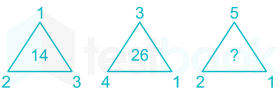
Question 157

A sentence has been given in Direct/Indirect Speech. Out of the four given alternatives, select the one which best expresses the same sentence in Indirect/Direct Speech.

Atul informed his friend that he could make use of his bike while he was away.

  1. AOption (a)

    Atul said to his friend, “You will make use of my bike while I was away”.

  2. BOption (b)

    Atul said to his friend, “Use my bike while I go away”.

  3. COption (c)

    Atul said to his friend, “You can make use of my bike while I am away”.

  4. DOption (d)

    Atul asked his friend, “Will you make use of my bike while I am away”.

View answer & explanation

Correct answer

Answer: (c)C.

Atul said to his friend, “You can make use of my bike while I am away”.

Why this answer is correct

The correct answer is Option 3, i.e., Atul said to his friend, “You can make use of my bike while I am away”.

The given sentence is in Indirect Speech as it uses a that- clause, which means that it reports words.

Therefore, it has to be changed into Direct Speech.

In order to do that, the verb ‘informed’ has to be changed to the reporting verb ‘said’. ‘That’ will be omitted in Direct Speech.

All verbs in the Past tense in the part that is reported will be changed to the Present tense (‘could’ to ‘can’).

All the third person pronouns used for the person addressed have to be changed to second person pronouns, while those used for the speaker have to be changed to first person pronouns.

Thus, the first ‘he’ is changed to ‘you’ and ‘his’ and the second ‘he’ are changed to ‘my’ and ‘I’ respectively.

Therefore, the same sentence in Direct Speech will be Atul said to his friend, “You can make use of my bike while I am away”.

So, the correct answer is Option 3.

All other options are incorrect because they don’t observe the above rules.

Question 158

A sentence has been given in Direct/Indirect Speech. Out of the four given alternatives, select the one which best expresses the same sentence in Indirect/Direct Speech.

“Don’t do this at home”, the teacher told the students.

  1. AOption (a)

    “You should not be doing this at home” said the teacher.

  2. BOption (b)

    The teacher advised the students not to do that at home.

  3. COption (c)

    The teacher scolded students for doing it at home.

  4. DOption (d)

    The teacher told students that it was risky to be done at home.

View answer & explanation

Correct answer

Answer: (b)B.

The teacher advised the students not to do that at home.

Why this answer is correct

The correct answer is Option 2, i.e., ‘The teacher advised the students not to do that at home’.

The given sentence is in the Direct Speech because it quotes actual words.

Therefore, it has to be changed into Indirect Speech.

We notice that the reporting verb is in the Past tense (‘said’).

The sentence in the Direct Speech is an advice.

When an advice is reported in the Indirect Speech, it is introduced by a verb like ‘advised’ (without ‘that’ after it) in place of the reporting verb.

The words ‘don’t do’ are replaced by ‘not to do’.

Moreover, ‘this’ in the Direct Speech is changed to ‘that’.

Therefore, the same sentence in Indirect Speech will be ‘The teacher advised the students not to do that at home’.

Thus, the correct answer is Option 2.

All other options are incorrect as they don’t observe the above rules.

Question 159

A sentence has been given in Direct/Indirect Speech. Out of the four given alternatives, select the one which best expresses the same sentence in Indirect/Direct Speech.

The captain said to his soldiers, “Do not be afraid of the enemy. Face them bravely”.

  1. AOption (a)

    The captain ordered his soldiers to not be afraid of the enemy and that they had to be faced bravely.

  2. BOption (b)

    The captain asked his soldiers to not be afraid of the enemy but they should be faced bravely.

  3. COption (c)

    The captain advised his soldiers not to be afraid of the enemy but to face them bravely.

  4. DOption (d)

    The captain told his soldiers not to be afraid of the enemy and they had faced them bravely.

View answer & explanation

Correct answer

Answer: (c)C.

The captain advised his soldiers not to be afraid of the enemy but to face them bravely.

Why this answer is correct

The correct answer is Option 3, i.e., ‘The captain advised his soldiers not to be afraid of the enemy but to face them bravely’.

The given sentence is in the Direct Speech because it quotes actual words.

Therefore, it has to be changed into Indirect Speech.

We notice that the reporting verb is in the Past tense (‘said’).

The sentence in the Direct Speech is a command.

When a command is reported in the Indirect Speech, it is introduced by a verb like ‘commanded’, ‘ordered’, ‘asked’, or ‘advised’ (without ‘that’ after it) in place of the reporting verb.

The words ‘do not be’ are replaced by ‘not to be’.

The second sentence in the Direct Speech is reported in the Indirect Speech by joining it with the first sentence with a conjunction.

Therefore, the same sentence in Indirect Speech will be ‘The captain advised his soldiers not to be afraid of the enemy but to face them bravely’.

Thus, the correct answer is Option 3.

All other options are incorrect as they don’t observe the above rules.

Question 160

A sentence has been given in Direct/Indirect Speech. Out of the four given alternatives, select the one which best expresses the same sentence in Indirect/Direct Speech.

Ashish said to Ashima, “I’ll return the book after I have read it”.

  1. AOption (a)

    Ashish told Ashima that he will return the book after he has read it.

  2. BOption (b)

    Ashish told Ashima that he would return the book after he has read it.

  3. COption (c)

    Ashish told Ashima that he will return the book after he read it.

  4. DOption (d)

    Ashish told Ashima that he would return the book after he had read it.

View answer & explanation

Correct answer

Answer: (d)D.

Ashish told Ashima that he would return the book after he had read it.

Why this answer is correct

The correct answer is Option 4, i.e., ‘Ashish told Ashima that he would return the book after he had read it’.

The given sentence is in the Direct Speech because it quotes actual words.

Therefore, it has to be changed into Indirect Speech.

We notice that the reporting verb is in the Past tense (‘said’).

When the Reporting verb is in the Past tense, the ‘will’ of the Future tense is changed into ‘would’, and it is always placed after the noun/pronoun.

If the reporting verb ‘said’ is followed by a noun/pronoun, it is usually replaced by ‘told’ followed by the same noun/pronoun in the Indirect Speech.

Since the reporting verb is in the Past tense, all verbs in the Present tense have to be changed to the Past tense (‘have read’ to ‘had read’).

Therefore, the same sentence in Indirect Speech will be ‘Ashish told Ashima that he would return the book after he had read it’.

Option 4 is the right answer as it observes all the above rules.

Question 161

A sentence has been given in Direct/Indirect Speech. Out of the four given alternatives, select the one which best expresses the same sentence in Indirect/Direct Speech.

Rohan said to his assistant, “Did you discuss this matter with the manager”?

  1. AOption (a)

    Rohan asked his assistant whether he discussed that matter with the manager.

  2. BOption (b)

    Rohan asked his assistant if you have discussed that matter with the manager.

  3. COption (c)

    Rohan asked his assistant if he had discussed that matter with the manager.

  4. DOption (d)

    Rohan asked his assistant whether he has discussed that matter with the manager.

View answer & explanation

Correct answer

Answer: (c)C.

Rohan asked his assistant if he had discussed that matter with the manager.

Why this answer is correct

The correct answer is Option 3, i.e., ‘Rohan asked his assistant if he had discussed that matter with the manager’.

The given sentence is a question in the Direct Speech because it quotes actual words.

Therefore, it has to be changed into Indirect Speech.

We notice that the reporting verb is in the Past tense (‘said’).

The sentence in the Direct Speech is a question.

When a question is reported in the Indirect Speech, it is introduced by a verb like ‘asked’ in place of the reporting verb. And when it is a Yes/No question, ‘asked’ is followed by ‘if’ or ‘whether’.

When the Reporting verb is in the Past tense, the Simple Past becomes the Past Perfect in the Indirect (‘did...discuss’ becomes ‘had discussed’).

Moreover, ‘this’ in the Direct Speech is changed to ‘that’.

Therefore, the same sentence in Indirect Speech will be ‘Rohan asked his assistant if he had discussed that matter with the manager’.

Thus, the correct answer is Option 3.

All other options are incorrect as they don’t observe the above rules.

Question 162

A sentence has been given in Direct/Indirect Speech. Out of the four given alternatives, select the one which best expresses the same sentence in Indirect/Direct Speech.

Yogesh said to his boss, “Please allow me to do the presentation”.

  1. AOption (a)

    Yogesh requested his boss to allow him to do the presentation.

  2. BOption (b)

    Yogesh requested his boss to please allow him to do the presentation.

  3. COption (c)

    Yogesh requested his boss to let him to do the presentation.

  4. DOption (d)

    Yogesh said to his boss to please allow him to do the presentation.

View answer & explanation

Correct answer

Answer: (a)A.

Yogesh requested his boss to allow him to do the presentation.

Why this answer is correct

The correct answer is Option 1, i.e., ‘Yogesh requested his boss to allow him to do the presentation’.

The given sentence is in the Direct Speech because it quotes actual words.

Therefore, it has to be changed into Indirect Speech.

We notice that the reporting verb is in the Past tense (‘said’).

The sentence in the Direct Speech is a request (it starts with ‘please’).

When a request is reported in the Indirect Speech, it is introduced by a verb like ‘requested’, ‘urged’, ‘pleaded’, or ‘begged’ (with the to-infinitive and not ‘that’ after it) in place of the reporting verb.

The word ‘please’ is omitted in Indirect Speech.

Therefore, the same sentence in Indirect Speech will be ‘Yogesh requested his boss to allow him to do the presentation’.

Thus, the correct answer is Option 1.

All other options are incorrect as they don’t observe the above rules.

Question 163

A sentence has been given in Direct/Indirect Speech. Out of the four given alternatives, select the one which best expresses the same sentence in Indirect/Direct Speech.

She asked me, “How is your sister”?

  1. AOption (a)

    She asked me how was my sister.

  2. BOption (b)

    She asked him how my sister is.

  3. COption (c)

    She asked how sister was.

  4. DOption (d)

    She asked me how my sister was.

View answer & explanation

Correct answer

Answer: (d)D.

She asked me how my sister was.

Why this answer is correct

The correct answer is Option 4, i.e., ‘She asked me how my sister was’.

The given sentence is a question in the Direct Speech because it quotes actual words.

Therefore, it has to be changed into Indirect Speech.

We notice that the reporting verb is in the Past tense (‘asked’).

When the Reporting verb is in the Past tense, the Simple Present in the Direct Speech becomes the Simple Past in the Indirect (‘is’ becomes ‘was’).

While a verb in a question in the Direct Speech is placed before the noun/pronoun (‘how is your sister’), it is placed after the noun/pronoun in the Indirect Speech

Therefore, the same sentence in Indirect Speech will be ‘She asked me how my sister was’.

Thus, the correct answer is Option 4.

All other options are incorrect as they don’t observe the above rules.

Question 164

A sentence has been given in Direct/Indirect Speech. Out of the four given alternatives, select the one which best expresses the same sentence in Indirect/Direct Speech.

My cousin said, “I will be here again tomorrow”.

  1. AOption (a)

    My cousin said that he would be here again tomorrow.

  2. BOption (b)

    My cousin said that he would be there again the next day.

  3. COption (c)

    My cousin said that he would be here again the next day.

  4. DOption (d)

    My cousin said that I will be here again tomorrow.

View answer & explanation

Correct answer

Answer: (b)B.

My cousin said that he would be there again the next day.

Why this answer is correct

The correct answer is Option 2, i.e., ‘My cousin said that he would be there again the next day’.

The given sentence is in the Direct Speech because it quotes actual words.

Therefore, it has to be changed into Indirect Speech.

We notice that the reporting verb is in the Past tense (‘said’) and in the Indirect Speech, it is followed by ‘that’.

When the Reporting verb is in the Past tense, the ‘will’ of the Future tense is changed into ‘would’, and it is always placed after the noun/pronoun.

‘Tomorrow’ and ‘here’ in the Direct Speech are changed to ‘the next day’ and ‘there’ respectively in the Indirect Speech.

Therefore, the same sentence in Indirect Speech will be ‘My cousin said that he would be there again the next day’.

Option 2 is the right answer as it observes all the above rules.

Question 165

A sentence has been given in Direct/Indirect Speech. Out of the four given alternatives, select the one which best expresses the same sentence in Indirect/Direct Speech.

Niharika said to the teacher, “Could you please repeat the question”?

  1. AOption (a)

    Niharika requested the teacher whether she could please repeat the question.

  2. BOption (b)

    Niharika asked the teacher whether, if she could repeat the question.

  3. COption (c)

    Niharika requested the teacher to repeat the question.

  4. DOption (d)

    Niharika asked the teacher, if please she could repeat the question.

View answer & explanation

Correct answer

Answer: (c)C.

Niharika requested the teacher to repeat the question.

Why this answer is correct

The correct answer is Option 3, i.e., ‘Niharika requested the teacher to repeat the question’.

The given sentence is in the Direct Speech because it quotes actual words.

Therefore, it has to be changed into Indirect Speech.

We notice that the reporting verb is in the Past tense (‘said’).

The sentence in the Direct Speech is a request (it starts with ‘could’).

When a request is reported in the Indirect Speech, it is introduced by a verb like ‘requested’, ‘urged’, ‘pleaded’, or ‘begged’ (with the to-infinitive and not ‘that’ after it) in place of the reporting verb.

The word ‘could’ is omitted in Indirect Speech.

Therefore, the same sentence in Indirect Speech will be ‘Niharika requested the teacher to repeat the question’.

Thus, the correct answer is Option 3.

All other options are incorrect as they don’t observe the above rules.

Read the given passage carefully and select the best answer to each question out of the four given alternatives.

Ruskin Bond is an Indian author of British descent. India’s most adored writer Ruskin Bond, was born in Kasauli. Bond spent his early childhood in Jamnagar and Shimla. At the age of ten, Ruskin went to live at his grandmother's house in Dehradun after his father's death that year from jaundice. Ruskin was raised by his mother and stepfather. He did his schooling from Bishop Cotton School in Shimla, from where he graduated in 1950 after winning several writing competitions in the school including the Irwin Divinity Prize and the Hailey Literature Prize. He wrote one of his first short stories, 'Untouchable', at the age of sixteen in 1951. He moved to London and worked in a photo studio while searching for a publisher. After getting it published, Bond used the advance money to pay the sea passage to Bombay and settle in Dehradun. Since 1963 he has lived as a freelance writer in Mussorie, a town in the Himalayan foothills in Uttarakhand and lives with his adoptive family in Landour, Mussoorie's Ivy Cottage, which has been his house since 1980. About what he likes the most about his life, he said, “That I have been able to write for so long. I started at the age of 16 or 17 and I am still writing. If I were not a professional writer who was getting published I would still write.” In his essay, “On being an Indian”, he explains his Indian identity, “Race did not make me one. Religion did not make me one. But history did. And in the long run, it's history that counts.”

Question 166

Ruskin Bond ___________.

  1. AOption (a)

    is a British Author

  2. BOption (b)

    was born in Jamnagar

  3. COption (c)

    is an Indian because he was born in India

  4. DOption (d)

    has won several prizes for his contribution towards literature

View answer & explanation

Correct answer

Answer: (d)D.

has won several prizes for his contribution towards literature

Why this answer is correct

Option 1 is incorrect as the very first line of the passage tells us that ‘Ruskin Bond is an Indian author of british descent’.

Option 2 is incorrect as the second line of the passage tells us that he was born in Kasauli.

Option 3 is incorrect because the passage quotes Ruskin Bond himself who explains that he is an indian because of his history with India (and not merely because he was born in India).

The correct answer is Option 4. This can be inferred from the fact that the passage tells us that Bond is ‘India’s most adored writer’ who won several writing competitions in school and whose first short story was published when he was 16.

Question 167

In 1980, Ruskin Bond settled in Mussorie, what do you think was his age by then?

  1. AOption (a)

    29

  2. BOption (b)

    39

  3. COption (c)

    45

  4. DOption (d)

    Cannot be determined, on the basis of information given in the passage.

View answer & explanation

Correct answer

Answer: (c)C.

45

Why this answer is correct

The passage tells us, ‘He wrote one of his first short stories, “Untouchable”, at the age of sixteen in 1951’. This one line gives us the key piece of information that Bond was sixteen in 1951. This in turn enables us to calculate that in 1980, he must have been 45.

Thus, the correct answer is option 3.

Question 168

According to Ruskin Bond, why is he an Indian?

  1. AOption (a)

    Because his parents have always lived in India.

  2. BOption (b)

    Because he has a history with India.

  3. COption (c)

    Because he owns a house in India.

  4. DOption (d)

    Because he was raised by his step-father, an Indian Hindu.

View answer & explanation

Correct answer

Answer: (b)B.

Because he has a history with India.

Why this answer is correct

The correct answer is Option 2, i.e., ‘because he has a history with India’.

This can be inferred from the following lines in the given passage: ‘In his essay, “On being an Indian”, he explains his Indian identity, “Race did not make me one. Religion did not make me one. But history did. And in the long run, it's history that counts.”

Question 169

What did Bond do with his first advance payment?

  1. AOption (a)

    He flew to his dream destination.

  2. BOption (b)

    He bought a house Ivy Cottage in Mussoorie.

  3. COption (c)

    He went back to India from London.

  4. DOption (d)

    He started working for children’s literature.

View answer & explanation

Correct answer

Answer: (c)C.

He went back to India from London.

Why this answer is correct

The correct answer is Option 3, i.e., ‘He went back to India from London’.

This can be inferred from the following line in the given passage: ‘After getting it published, Bond used the advance money to pay the sea passage to Bombay and settle in Dehradun’.

Question 170

Why is Ruskin Bond happy about his life?

  1. AOption (a)

    Because he has finally settled in India.

  2. BOption (b)

    Because has adopted a family and it is very loving.

  3. COption (c)

    Because he is successful.

  4. DOption (d)

    Because he has been able to write for so long.

View answer & explanation

Correct answer

Answer: (d)D.

Because he has been able to write for so long.

Why this answer is correct

The correct answer is option 4, i.e., ‘because he has been able to write for so long’.

This is told to us by the following line in the passage: About what he likes the most about his life, he said, “That I have been able to write for so long.”

Read the given passage carefully and select the best answer to each question out of the four given alternatives.

Women and children constitute around 70% of India’s people and are the critical foundation for national development - at present and in the future. Sustained inclusive growth must begin with children and women- breaking an intergenerational cycle of inequity and multiple deprivations faced by women and girls, as related to poverty, social exclusion, gender discrimination and under nutrition. This intergenerational cycle of multiple deprivation and violence faced by girls and women is reflected in the adverse and steeply declining child sex ratio among children under 6 years of age which reached an all-time low of 918 girls for every 1000 boys in 2011. Discrimination against the girl child is also evident in other forms of gross neglect and gender-based violence after birth - infancy, early childhood and adolescence in aspects of unequal access to health, nutrition, care and education. Ending of gender based inequities, discrimination and violence is stated as a priority in the Twelfth Plan, and improvement in the adverse and steeply declining child sex ratio is recognised as an overarching Monitorable Target of the Twelfth Plan for Women and Children. Another key Monitorable Target of the Twelfth Plan is the reduction in the levels of under nutrition among children by half. It is envisaged that improved child nutrition will also enable the achievement of optimal learning outcomes in education and gender equality. In this context, NAVDISHA – A National Thematic Workshop on Best Practices in Women and Child Development was organised by the Ministry of Women and Child Development, Government of India and the Government of Haryana at Panipat, Haryana from 20 to 21 January 2015.

Question 171

What is NAVDISHA?

  1. AOption (a)

    A National Thematic Workshop.

  2. BOption (b)

    A movement to fight for the rights of woman.

  3. COption (c)

    Best Practice in Women and Child Development.

  4. DOption (d)

    Twelfth Plan for Women and Children.

View answer & explanation

Correct answer

Answer: (a)A.

A National Thematic Workshop.

Why this answer is correct

The correct answer is Option 1, i.e., ‘A National Thematic Workshop’.

This is told to us by the following line: ‘NAVDISHA – A National Thematic Workshop on Best Practices in Women and Child Development’.

Question 172

Sustained inclusive growth ____________.

  1. AOption (a)

    must focus on women

  2. BOption (b)

    must begin with children and women

  3. COption (c)

    must eradicate discrimination against the girl child

  4. DOption (d)

    must lay foundation for national development

View answer & explanation

Correct answer

Answer: (b)B.

must begin with children and women

Why this answer is correct

The correct answer is Option 2, i.e., ‘must begin with children and women’.

This is told to us by the following line: ‘Sustained inclusive growth must begin with children and women’.

Question 173

The girl child and male child ratio in India ____________.

  1. AOption (a)

    Is evident for everyone to see

  2. BOption (b)

    Is a reason behind gender inequalities

  3. COption (c)

    Reached an all-time low in 2011

  4. DOption (d)

    Has now begun to increase in favor of a girl child

View answer & explanation

Correct answer

Answer: (c)C.

Reached an all-time low in 2011

Why this answer is correct

The correct answer is Option 3, i.e., ‘reached an all-time low in 2011’.

This is told to us by the following line: ‘the adverse and steeply declining child sex ratio among children under 6 years of age ... reached an all-time low of 918 girls for every 1000 boys in 2011’.

Question 174

What is the target of the Twelfth Plan for Women and Children?

  1. AOption (a)

    Taking care of infancy, early childhood and adolescence in kids.

  2. BOption (b)

    To manage health, nutrition, care and education

  3. COption (c)

    Providing right education to the kids all across the nation.

  4. DOption (d)

    Improvement in the adverse and steeply declining child sex ratio.

View answer & explanation

Correct answer

Answer: (d)D.

Improvement in the adverse and steeply declining child sex ratio.

Why this answer is correct

The correct answer is Option 4, i.e., ‘Improvement in the adverse and steeply declining child sex ratio’.

This is told to us by the following line: ‘improvement in the adverse and steeply declining child sex ratio is recognised as an overarching Monitorable Target of the Twelfth Plan for Women and Children’.

Question 175

How will the reduction in the levels of under nutrition among children by half help?

  1. AOption (a)

    Improved child nutrition will also enable the achievement of optimal learning outcomes.

  2. BOption (b)

    It will improve girl child and male child ratio.

  3. COption (c)

    It will help addressing the issues like infant mortality and sudden infant death syndromes.

  4. DOption (d)

    It will help children in speaking their mind.

View answer & explanation

Correct answer

Answer: (a)A.

Improved child nutrition will also enable the achievement of optimal learning outcomes.

Why this answer is correct

The correct answer is Option 1, i.e., ‘Improved child nutrition will also enable the achievement of optimal learning outcomes’.

This is told to us by the following line: ‘It is envisaged that improved child nutrition will also enable the achievement of optimal learning outcomes in education and gender equality’.

Read the given passage carefully and select the best answer to each question out of the four given alternatives.

In India, the coconut sector plays a secant role in poverty alleviation and employment generation especially among the weaker sections of the society. The industry provides livelihood to about more than 10 million farm families. Among the major coconut growing states in India, Kerala has the longest history of coconut cultivation. Other major coconut growing states are Tamil Nadu, Andhra Pradesh and Karnataka. These four states together account for about 90 per cent of the coconut production in India. The share of Kerala alone comes to about 45 per cent. Kerala's economy is dependent on coconut to a significant extent. Nearly 15 percent of the state's annual income is derived from the coconut sector. Among the traditional coconut based industries, maximum labour potential exists in coir industry. Coir, the versatile fiber, besides providing employment to a large number of women, earns foreign exchange of more than 25 crores annually by export of various coir products. The different stages of coir processing like retting, defibering, spinning and packing are mostly labour intensive. In Kerala around 4 lakh people are employed in coir industry, of which nearly 80 per cent are women workers. Copra making is another coconut based traditional industry in Kerala. It is a labour oriented small-scale industry. Most of the copra making units are adopting traditional methods of copra processing. There are about 12000 copra making units in India spread over the southern states of which about two thirds are concentrated in Kerala. Coconut oil extraction industry or simply 'coconut oil industry' is another major traditional component of the coconut sector. The prices of raw coconuts and copra in Kerala are determined mainly by the demand for coconut oil. Toddy tapping is yet another traditional area where about 1.20 lakhs Keralites are employed. It is also a labour intensive coconut based industry.

Question 176

Which state has the longest history of coconut cultivation?

  1. AOption (a)

    Tamil Nadu

  2. BOption (b)

    Goa

  3. COption (c)

    Kerala

  4. DOption (d)

    Karnataka

View answer & explanation

Correct answer

Answer: (c)C.

Kerala

Why this answer is correct

The correct answer is Option 3, i.e., ‘Kerala’.

This is told to us by the following line: ‘Among the major coconut growing states in India, Kerala has the longest history of coconut cultivation’.

Question 177

In which industry does the maximum labour potential exist?

  1. AOption (a)

    Coir Industry

  2. BOption (b)

    Oil Industry

  3. COption (c)

    Cocoa Industry

  4. DOption (d)

    Copra Industry

View answer & explanation

Correct answer

Answer: (a)A.

Coir Industry

Why this answer is correct

The correct answer is Option 1, i.e., ‘coir industry’.

This is told to us by the following line: ‘Among the traditional coconut based industries, maximum labour potential exists in coir industry’.

Question 178

Why is coconut sector very important in our country?

  1. AOption (a)

    It keeps Keralites employed.

  2. BOption (b)

    It plays a secant role in poverty alleviation and employment generation.

  3. COption (c)

    It keeps country traditional.

  4. DOption (d)

    It earns foreign exchange of more than 25 crores.

View answer & explanation

Correct answer

Answer: (b)B.

It plays a secant role in poverty alleviation and employment generation.

Why this answer is correct

The correct answer is option 2, i.e., ‘It plays a secant role in poverty alleviation and employment generation’.

This can be inferred from the following line: ‘In India the coconut sector plays a secant role in poverty alleviation and employment generation especially among the weaker sections of the society’.

Question 179

Which are the most labour intensive stages of coir processing?

  1. AOption (a)

    Tapping

  2. BOption (b)

    Oil extraction

  3. COption (c)

    Copra making

  4. DOption (d)

    Retting, defibering and spinning

View answer & explanation

Correct answer

Answer: (d)D.

Retting, defibering and spinning

Why this answer is correct

The correct answer is option 4, i.e., ‘retting, defibering and spinning’.

This is told to us by the following line: ‘The different stages of coir processing like retting, defibering, spinning and packing are mostly labour intensive’.

Question 180

According to the passage, which of the following is NOT TRUE?

  1. AOption (a)

    Out of total coconut production in India, the share of Kerala alone comes to about 45 percent.

  2. BOption (b)

    The prices of raw coconuts and copra in Kerala are determined mainly by the demand for coconut oil.

  3. COption (c)

    Nearly 15 percent of the Kerala's annual income is derived from the coconut sector.

  4. DOption (d)

    The industry provides livelihood to about more than 10 billion farm families.

View answer & explanation

Correct answer

Answer: (d)D.

The industry provides livelihood to about more than 10 billion farm families.

Why this answer is correct

The correct answer is option 4, i.e., ‘The industry provides livelihood to about more than 10 billion farm families’.

The passage clearly mentions that ‘The industry provides livelihood to about more than 10 million farm families’, and not ‘10 billion farm families’, which is what Option 4 states, making it false.

In the following passage some of the words have been left out. Read the passage carefully and select the correct answer for the given blank out of the four alternatives.

Ragging refers to an act that ______ the dignity of a person. There have been many ______ of physical and psychological injury due to ragging in colleges and educational institutions. Nowadays, it has been turned to a ______ to students and their guardians at the time of admission to Engineering, Polytechnic and Medical colleges. The ______ of ragging offer an argument for it as an ______ to make the students fit for the future ______ for existence. Various evil forms of ragging are in practice in professional colleges. The reports of incidents of rage in some of the reputed professional colleges and educational institutions are quite ______. It is a matter of ______ that even though ragging has been criticized for decades, we still come across such incidents of ______ torture. As a result, many students give up their studies and go back home, some lose their mental balance, and some are seriously injured. Indeed, ragging has become a ______ affair in the institutions of higher learning, especially in professional colleges. It seems to be a survival of medieval barbarism. The press draws our notice to this cruel practice.

Question 181

Refers to an act that ______ the

  1. AOption (a)

    Violates

  2. BOption (b)

    Supports

  3. COption (c)

    Initiates

  4. DOption (d)

    Relates

View answer & explanation

Correct answer

Answer: (a)A.

Violates

Why this answer is correct

The correct answer is Option 1, i.e., ‘violates’.

The complete sentence given to us is ‘Ragging refers to an act that ______ the dignity of a person’.

The entire passage talks about the harms of ragging and the damage it causes to students.

Therefore, ‘violates’ is the right verb in the sentence as it fits the context and completes the sense of ragging as an act that destroys the dignity of a person.

All other options do not fit the context.

Question 182

Many ______ of physical

  1. AOption (a)

    Punishments

  2. BOption (b)

    Complaints

  3. COption (c)

    Rewards

  4. DOption (d)

    Compliments

View answer & explanation

Correct answer

Answer: (b)B.

Complaints

Why this answer is correct

The correct answer is Option 2, i.e., ‘complaints’.

The sentence given to us is ‘There have been many ______ of physical and psychological injury due to ragging in colleges’.

The sentence talks about how widespread ragging is and ‘complaints’ suits the context.

Option 1 or ‘punishments’ is incorrect as it must be followed by the preposition ‘for’ and not ‘of’.

Options 3 and 4 (‘rewards’ and ‘compliments’) don’t suit the context.

Question 183

Nowadays, it has been turned to a ______ to students

  1. AOption (a)

    Disaster

  2. BOption (b)

    Hell

  3. COption (c)

    Nightmare

  4. DOption (d)

    Opportunity

View answer & explanation

Correct answer

Answer: (c)C.

Nightmare

Why this answer is correct

The correct answer is Option 3, i.e., ‘nightmare’.

The sentence given to us is ‘Nowadays, it has been turned to a ______ to students and their guardians’.

‘Nightmare’ which means ‘something so unpleasant that you want to avoid it at all costs’ suits the context of how distressing the experience of ragging can be for students.

Options 1 and 2 are incorrect as ‘disaster’ and ‘hell’ must be followed by ‘for’ and not ‘to’.

Option 4 is incorrect as ‘opportunity’ simply doesn’t suit the context.

Question 184

The ______ of ragging offer an argument.

  1. AOption (a)

    Agitators

  2. BOption (b)

    Opponents

  3. COption (c)

    Critics

  4. DOption (d)

    Supporters

View answer & explanation

Correct answer

Answer: (d)D.

Supporters

Why this answer is correct

The correct answer is Option 4, i.e., ‘supporters’.

The sentence given to us is ‘The ______ of ragging offer an argument for it’.

Anyone who offers an argument ‘for’ ragging can only be its supporter (and not an agitator, a critic or an opponent).

Thus, the correct answer is ‘supporters’.

Question 185

As an ______ to make

  1. AOption (a)

    Ordeal

  2. BOption (b)

    Pleasure

  3. COption (c)

    Aid

  4. DOption (d)

    Association

View answer & explanation

Correct answer

Answer: (c)C.

Aid

Why this answer is correct

The correct answer is Option 3, i.e., ‘aid’.

The sentence given to us is ‘The supporters of ragging offer an argument for it as an ______ to make the students fit for the future’.

Both the context (supporters of ragging offering an argument for it) as well as the article ‘an’ tell us that the correct answer is ‘aid’.

All other options are incorrect.

Question 186

The future ______ for existence.

  1. AOption (a)

    Consequence

  2. BOption (b)

    Struggle

  3. COption (c)

    Connection

  4. DOption (d)

    Reference

View answer & explanation

Correct answer

Answer: (b)B.

Struggle

Why this answer is correct

The correct answer is Option 2, i.e., ‘struggle’.

The sentence given to us is ‘The supporters of ragging offer an argument for it as an aid to make the students fit for the future ______ for existence’.

Considering the context (supporters of ragging giving an argument in favour of it), the correct answer is ‘struggle’: according to the supporters of ragging, it helps prepare students for future struggles.

All other options are incorrect because they don’t suit the context.

Question 187

Institutions are quite ______.

  1. AOption (a)

    Relieving

  2. BOption (b)

    Forgiving

  3. COption (c)

    Alarming

  4. DOption (d)

    Interacting

View answer & explanation

Correct answer

Answer: (c)C.

Alarming

Why this answer is correct

The correct answer is option 3, i.e., ‘alarming’.

The sentence given is ‘The reports of incidents of rage in some of the reputed professional colleges and educational institutions are quite ______’.

Since these institutions are said to be reputed, instances of ragging can only cause shock and worry. ‘Alarming’ is the most suitable word in this context.

All other options are incorrect because they don’t suit the context.

Question 188

It is a matter of ______ that

  1. AOption (a)

    Pride

  2. BOption (b)

    Honour

  3. COption (c)

    Growth

  4. DOption (d)

    Shame

View answer & explanation

Correct answer

Answer: (d)D.

Shame

Why this answer is correct

The correct answer is option 4, i.e., ‘shame’.

The sentence given is ‘It is a matter of ______ that even though ragging has been criticized for decades, we still come across such incidents’.

The sentence talks about how ragging has been criticized for decades. Keeping that in mind, any more incidents of ragging can only be a matter of shame.

Thus, the correct answer is ‘shame’.

All other options- ‘pride’, ‘honour’, and ‘growth’- are incorrect because they don’t suit the context.

Question 189

Across such incidents of ______ torture.

  1. AOption (a)

    Inhuman

  2. BOption (b)

    Humane

  3. COption (c)

    Relational

  4. DOption (d)

    Objectional

View answer & explanation

Correct answer

Answer: (a)A.

Inhuman

Why this answer is correct

The correct answer is Option 1, i.e., ‘inhuman’.

The sentence given is ‘It is a matter of shame that even though ragging has been criticized for decades, we still come across such incidents of ______ torture’.

As the sentence talks about torture, the adjective to be used to describe it must be negative.

In this context, ‘inhuman’ is the correct answer.

Options 2 and 3- ‘humane’ and ‘relational’- don’t suit the context. Option 4 is incorrect because the word ‘objectional’ doesn’t exist.

Question 190

Ragging has become a ______

  1. AOption (a)

    Pleasant

  2. BOption (b)

    Dreadful

  3. COption (c)

    Wonderful

  4. DOption (d)

    Comforting

View answer & explanation

Correct answer

Answer: (b)B.

Dreadful

Why this answer is correct

The correct answer is option 2, i.e., ‘dreadful’.

The sentence given is ‘ragging has become a ______ affair in the institutions of higher learning’.

Considering that the entire passage is about the harms of ragging, ‘dreadful’ suits the context and is the right answer.

Options 1, 3, and 4 (‘pleasant’, ‘wonderful’, and ‘comforting’) are incorrect because they don’t suit the context.

In the following passage some of the words have been left out. Read the passage carefully and select the correct answer for the given blank out of the four alternatives.

Drug addiction is a social______. It has been prevalent in society from time ______. There are a variety of drugs which are used in various forms. A drug addict becomes a drug ______. He cannot live without drugs. It is a form of ______ conditioning that implies a set of mental and behavioural responses to drugs and related stimuli that result from repeated reinforcement produced by the use of drugs. It implies physical, psychological and psychic dependence on the tolerance of a drug with a tendency to take more and more drugs. The World Health Organisation has defined drug abuse as a state of periodic, chronic intoxication, ______ to the individual and to the society, produced by ______ consumption of drugs either natural or synthetic. In other words, the growing urge results in increase of doses. There are a number of causes which ______ to drug addiction. These include social, economic, religious, and physiological factors. There is a strong ______ between drug and torn family life. It has been found that broken family structure often forces one to ______ to drug. This is because a person faced with such situation chooses drug for its euphoric or mind-altering ______ to escape from the immediate situation.

Question 191

Drug addiction is a social______

  1. AOption (a)

    Evil

  2. BOption (b)

    Myth

  3. COption (c)

    Disease

  4. DOption (d)

    Idea

View answer & explanation

Correct answer

Answer: (a)A.

Evil

Why this answer is correct

The correct answer is option 1, i.e., ‘evil’.

The passage talks about the harms of drug addiction and in this context, ‘social evil’ which means ‘a problem or a malaise that affects the society’ is the best suited.

Option 2, or ‘myth’ is incorrect because the sentence then dismisses drug addiction as a trivial problem while the passage only stresses on the gravity of the problem.

Option 3, or ‘disease’ is incorrect because in order to describe social problems, the word ‘social’ is used with ‘evil’ but never with ‘disease’.

Option 4, or ‘idea’ is incorrect because it doesn’t suit the context.

Question 192

It has been prevalent in society from time ______.

  1. AOption (a)

    Nostalgic

  2. BOption (b)

    Immemorial

  3. COption (c)

    Mortal

  4. DOption (d)

    Immortal

View answer & explanation

Correct answer

Answer: (b)B.

Immemorial

Why this answer is correct

The correct answer is option 2, i.e., ‘immemorial’.

‘From time immemorial’ means ‘since forever’, and it suits the context of describing drug addiction as a problem which has existed for a very long time.

All other options are incorrect because they give rise to invalid or meaningless expressions.

Question 193

A drug addict becomes a drug ______.

  1. AOption (a)

    Associate

  2. BOption (b)

    Relative

  3. COption (c)

    Dependent

  4. DOption (d)

    Independent

View answer & explanation

Correct answer

Answer: (c)C.

Dependent

Why this answer is correct

The correct answer is option 3, i.e., ‘dependent’.

The sentences given to us are ‘A drug addict becomes a drug ______. He cannot live without drugs’.

The very next sentence talks about how a drug addict cannot live without drugs. Thus, the right word is ‘dependent’.

All other words- ‘associate’, ‘relative’, and ‘independent’- are incorrect because they don’t suit the context.

Question 194

He cannot live without drugs. It is a form of ______

  1. AOption (a)

    Political

  2. BOption (b)

    Physical

  3. COption (c)

    Economical

  4. DOption (d)

    Psychological

View answer & explanation

Correct answer

Answer: (d)D.

Psychological

Why this answer is correct

The correct answer is Option 4, i.e., ‘psychological’.

The sentences given to us are ‘He cannot live without drugs. It is a form of ______ conditioning that implies a set of mental and behavioural responses to drugs and related stimuli that result from repeated reinforcement produced by the use of drugs’.

Words like ‘conditioning’, ‘mental and behavioural responses’,’stimuli’, and ‘reinforcement’ tell us that the context is psychological. Thus, ‘psychological’ is the correct answer.

All other options- ‘political’, ‘physical’, and ‘economical’- are incorrect.

Question 195

Chronic intoxication ______ to the individual

  1. AOption (a)

    Detrimental

  2. BOption (b)

    Crucial

  3. COption (c)

    Beneficial

  4. DOption (d)

    Influential

View answer & explanation

Correct answer

Answer: (a)A.

Detrimental

Why this answer is correct

The correct answer is Option 1, i.e., ‘detrimental’.

The sentence given is ‘The World Health Organisation has defined drug abuse as a state of periodic, chronic intoxication, ______ to the individual and to the society, produced by ______ consumption of drugs either natural or synthetic’.

The passage discusses the harms of drug abuse. In such a context, ‘detrimental’ (which means ‘harmful’) is the right word. Drugs are ‘detrimental to the individual and to the society’.

All other options- ‘crucial’, ‘beneficial’, and ‘influential’- are incorrect as they don’t fit in with the context.

Question 196

Produced by ______ consumption of drugs

  1. AOption (a)

    Mere

  2. BOption (b)

    Repeated

  3. COption (c)

    Rare

  4. DOption (d)

    Occasionally

View answer & explanation

Correct answer

Answer: (b)B.

Repeated

Why this answer is correct

The correct answer is Option 2, i.e., ‘repeated’.

The sentence given is ‘The World Health Organisation has defined drug abuse as a state of periodic, chronic intoxication, detrimental to the individual and to the society, produced by ______ consumption of drugs either natural or synthetic’.

The passage talks about how a drug addict cannot live without drugs and in the given context, ‘repeated consumption’ is the most suitable fit. Thus, ‘repeated’ is the correct answer.

All other options- ‘mere’, ‘rare’, and ‘occasionally’- are incorrect as they don’t suit the context.

Question 197

There are a number of causes which ______

  1. AOption (a)

    Ensure

  2. BOption (b)

    Sort

  3. COption (c)

    Lead

  4. DOption (d)

    Perform

View answer & explanation

Correct answer

Answer: (c)C.

Lead

Why this answer is correct

The correct answer is Option 3, i.e., ‘lead’.

The sentence given is ‘There are a number of causes which ______ to drug addiction’.

The context and the preposition ‘to’ tell us that the right word is ‘lead’.

All other options either don’t make sense (‘sort/perform to drug addiction’) or make the sentence grammatically incorrect (‘ensure to drug addiction’).

Question 198

There is a strong ______ between drug

  1. AOption (a)

    Interruption

  2. BOption (b)

    Dissonance

  3. COption (c)

    Conflict

  4. DOption (d)

    Nexus

View answer & explanation

Correct answer

Answer: (d)D.

Nexus

Why this answer is correct

The correct answer is Option 4, i.e., ‘nexus’.

The sentence given is ‘There is a strong ______ between drug and torn family life’.

The passage talks about the harms of the drug addiction, and the sentence mentions ‘torn family life’. In such a context, the word ‘nexus’, which means ‘a strong interrelationship’, is the most suited as it suggests a close relationship between drugs and a torn family life.

All other options- ‘interruption’, ‘dissonance’, and ‘conflict’- do not suit the context.

Question 199

One to ______ to drug.

  1. AOption (a)

    Resort

  2. BOption (b)

    Place

  3. COption (c)

    Dete

  4. DOption (d)

    Reign

View answer & explanation

Correct answer

Answer: (a)A.

Resort

Why this answer is correct

The correct answer is Option 1, i.e., ‘resort’.

The sentence given is ‘It has been found that broken family structure often forces one to ______ to drug’.

In the given context, the right word is ‘resort’. To ‘resort to’ something is to ‘take recourse to it’.

A broken family structure can force one to ‘resort’ or ‘take’ to drugs.

All other options- ‘place’, ‘deter’, or ‘reign’- either make the sentence grammatically incorrect or don’t suit the context.

Question 200

Euphoric or mind-altering ______ to

  1. AOption (a)

    Cause

  2. BOption (b)

    Effect

  3. COption (c)

    Affect

  4. DOption (d)

    Result

View answer & explanation

Correct answer

Answer: (b)B.

Effect

Why this answer is correct

The correct answer is Option 2, i.e., ‘effect’.

The sentence given to us is ‘This is because a person faced with such situation chooses drug for its euphoric or mind-altering ______ to escape from the immediate situation’.

The sentence talks about the reasons for which a person chooses drugs. In such a context, mind-altering ‘effect’ is the most suitable answer.

People choose drugs for the effect of euphoria they produce.

All other options- ‘cause’, ‘affect’, or ‘result’- don’t suit the context.

200 questions in the full paper