Previous Year Paper

SSC GD Constable 2026 Official Paper (Held On 31 May, 2026 Shift 1) (Previous Year Paper)

Held in 2026

100 questions60 minutes
With answers
Free

Paper last updated:

Practise under exam conditions

Take this paper as a timed mock test. Review your answers after you submit.

Attempt timed test

Questions & answers

Read the paper at your pace. Open an explanation when you need it.

General Intelligence and Reasoning (20 questions)

Question 1

A series is given with one term missing. Select the correct alternative from the given ones that will complete the series.

?, O, H, F, Y, W, P, N

  1. AOption (a)

    Q

  2. BOption (b)

  3. COption (c)

    ∅

  4. DOption (d)

View answer & explanation

Correct answer

Answer: (a)A.

Q

Why this answer is correct

<br> <br>

Pattern followed here is,

Hence, the correct answer is “Option 1”.

Question 2

Select the option that is related to the fifth letter cluster in the same way as the second letter cluster is related to the first letter cluster and fourth letter cluster is related to third letter cluster.

ER : HX :: LN : QT :: CT : ?

  1. AOption (a)

    AB

  2. BOption (b)

    FZ

  3. COption (c)

    CY

  4. DOption (d)

    BZ

View answer & explanation

Correct answer

Answer: (b)B.

FZ

Why this answer is correct

The logic followed in this pattern is a combination of alphabetical shifts.

For 'ER' related to 'HX':

E(5)R(18)
+3 ↓+6 ↓
H(8)X(24)

For 'LN' related to 'QT':

L(12)N(14)
+5 ↓+6 ↓
Q(17)T(20)

Applying the same logic to 'CT':

C(3)T(20)
+3 ↓+6 ↓
F(6)Z(26)

Thus, CT is related to FZ.

Hence, the correct answer is 'Option 2'.

Question 3

In the following question, set of letter clusters are given. The letter clusters of each set are related to the letter clusters of the same set by some Logic/Rule/Relation. From the given alternatives, select a group of letter clusters which follows the same Logic/Rule/Relation.

(PQ, NO, KL) (QF, OD, LA)

  1. AOption (a)

    (ZE, XZ, VW)

  2. BOption (b)

    (ZM, XL, VI)

  3. COption (c)

    (VN, TL, Q1)

  4. DOption (d)

    (EV, CV, AS)

View answer & explanation

Correct answer

Answer: (c)C.

(VN, TL, Q1)

Why this answer is correct

For the set '(PQ, NO, KL)':

P(16)Q(17)
−2 ↓−2 ↓
N(14)O(15)
−3 ↓−3 ↓
K(11)L(12)

For the set '(QF, OD, LA)':

Q(17)F(6)
−2 ↓−2 ↓
O(15)D(4)
−3 ↓−3 ↓
L(12)A(1)

Applying the same logic to the alternative '(VN, TL, Q1)':

V(22)N(14)
−2 ↓−2 ↓
T(20)L(12)
−3 ↓−3 ↓
Q(17)I(9)

Thus, the group (VN, TL, Q1) correctly follows the established rule.

Hence, the correct answer is 'Option 3'.

Question 4

How many days are there from 26 March 2020 to 8 November 2020 (both inclusive)?

  1. AOption (a)

    228

  2. BOption (b)

    229

  3. COption (c)

    230

  4. DOption (d)

    227

View answer & explanation

Correct answer

Answer: (a)A.

228

Why this answer is correct

The time period is from 26 March 2020 to 8 November 2020:

Days in March (26th to 31st): 31 − 26 + 1 = 6 days

Days in April: 30 days

Days in May: 31 days

Days in June: 30 days

Days in July: 31 days

Days in August: 31 days

Days in September: 30 days

Days in October: 31 days

Days in November (1st to 8th): 8 days

Total number of days = 6 + 30 + 31 + 30 + 31 + 31 + 30 + 31 + 8 = 228

Hence, the correct answer is 228.

Question 5

Which of the following pairs of years have identical calendars?

  1. AOption (a)

    1986 and 1997

  2. BOption (b)

    1993 and 1997

  3. COption (c)

    1980 and 1986

  4. DOption (d)

    1985 and 1996

View answer & explanation

Correct answer

Answer: (a)A.

1986 and 1997

Why this answer is correct

Let us check the options provided:

Option (1): 1986 and 1997

1986 is an ordinary year.

1997 is an ordinary year.

Counting the odd days from the beginning of 1986 to the beginning of 1997:

1986 (Ordinary) = 1

1987 (Ordinary) = 1

1988 (Leap) = 2

1989 (Ordinary) = 1

1990 (Ordinary) = 1

1991 (Ordinary) = 1

1992 (Leap) = 2

1993 (Ordinary) = 1

1994 (Ordinary) = 1

1995 (Ordinary) = 1

1996 (Leap) = 2

Total odd days = 1 + 1 + 2 + 1 + 1 + 1 + 2 + 1 + 1 + 1 + 2 = 14

14 ÷ 7 = 2 with a remainder of 0.

Since both are ordinary years and the number of odd days is a multiple of 7, the calendars for 1986 and 1997 are identical.

Important Points

A simple rule for repetition of calendars:

  • A leap year repeats after 28 years.
  • A year that is (Leap year + 1) repeats after 6 years.
  • A year that is (Leap year + 2) or (Leap year + 3) repeats after 11 years.

Here, 1984 was a leap year. So, 1986 is (1984 + 2). Thus, it repeats after 11 years.

1986 + 11 = 1997.

Hence, the correct answer is 1986 and 1997.

Question 6

7 friends P, Q, R, S, T, U and V are sitting around a circular table facing towards the centre (not necessarily in the same order). U is not the immediate neighbour of P. T is second to the left of P. R and T are immediate neighbours. S is third to the left of R. Q is the immediate neighbour of S and T.

Which two friends are immediate neighbours of each other?

  1. AOption (a)

    R and V

  2. BOption (b)

    U and Q

  3. COption (c)

    P and V

  4. DOption (d)

    S and T

View answer & explanation

Correct answer

Answer: (c)C.

P and V

Why this answer is correct

7 friends P, Q, R, S, T, U and V are sitting around a circular table facing towards the centre (not necessarily in the same order).

  1. U is not the immediate neighbour of P.
  2. T is second to the left of P.
  3. R and T are immediate neighbours.
  4. S is third to the left of R.
  5. Q is the immediate neighbour of S and T.

P and V are immediate neighbours of each other.

Hence, the correct answer is “Option 3”.

Question 7

In the following given words which one cannot be formed using the letters of the word HURRICANE.

  1. AOption (a)

    CHAIR

  2. BOption (b)

    CHAINER

  3. COption (c)

    RICHER

  4. DOption (d)

    CRANES

View answer & explanation

Correct answer

Answer: (d)D.

CRANES

Why this answer is correct

Given word: HURRICANE

(1) CHAIR → Can be formed as all the letters are present in the given word.

(2) CHAINER → Can be formed as all the letters present int he given word.

(3) RICHER → Can be formed as all the required letters are present, including two "R"s.

(4) CRANES → Can not be formed as S is not present in the given word.

Hence, the correct answer is “Option 4”.

Question 8

Five pens and three pencils cost ₹145, while three pens and five pencils cost ₹135.

Find the cost of one pen and one pencil.

  1. AOption (a)

    ₹20 and ₹15

  2. BOption (b)

    ₹25 and ₹20

  3. COption (c)

    ₹22 and ₹11

  4. DOption (d)

    ₹15 and ₹13

View answer & explanation

Correct answer

Answer: (a)A.

₹20 and ₹15

Why this answer is correct

Given:

Five pens and three pencils cost ₹145.

Three pens and five pencils cost ₹135.

Now,

5x + 3y = 145   ---(Equation 1)

3x + 5y = 135   ---(Equation 2)

Addition of Equation 1 and Equation 2:

(5x + 3y) + (3x + 5y) = 145 + 135

8x + 8y = 280

Dividing by 8 on both sides:

x + y = 35   ---(Equation 3)

Subtraction of Equation 2 from Equation 1:

(5x + 3y) − (3x + 5y) = 145 − 135

2x − 2y = 10

Dividing by 2 on both sides:

x − y = 5   ---(Equation 4)

Solving Equation 3 and Equation 4:

Adding Equation 3 and Equation 4:

(x + y) + (x − y) = 35 + 5

2x = 40

x = 40 ÷ 2 = 20

Now, substitute the value of x = 20 in Equation 3:

20 + y = 35

y = 35 − 20 = 15

Therefore, the cost of one pen is ₹20 and the cost of one pencil is ₹15.

Hence, the correct answer is “Option 1”.

Question 9

Select the option that is related to the fifth number in the same way as the second number is related to the first number, and the fourth number is related to the third number.

(NOTE: Operations should be performed on the whole numbers, without breaking down the numbers into its constituent digits. E.g.13 - Operations on 13 such as adding / subtracting / multiplying etc. to 13 can be performed. Breaking down 13 into 1 and 3 and then performing mathematical operations on 1 and 3 is not allowed.)

168 : 504 :: 145 : 435 :: 136 : ?

  1. AOption (a)

    308

  2. BOption (b)

    408

  3. COption (c)

    418

  4. DOption (d)

    314

View answer & explanation

Correct answer

Answer: (b)B.

408

Why this answer is correct

The logic followed here is:

Logic: Second Number = First Number × 3

For the first pair 168 : 504

⇒ 168 × 3 = 504

For the second pair 145 : 435

⇒ 145 × 3 = 435

Applying the same logic to the third pair

136 : ?

⇒ 136 × 3 = 408

Hence, the correct answer is 'Option 2'.

Question 10

Identify the wrong number in the following series.

1, 2, 6, 24, 121, 720

  1. AOption (a)

    6

  2. BOption (b)

    24

  3. COption (c)

    121

  4. DOption (d)

    720

View answer & explanation

Correct answer

Answer: (c)C.

121

Why this answer is correct

Logic followed here is,

1! = 1

2! = 1 × 2 = 2

3! = 1 × 2 × 3 = 6

4! = 1 × 2 × 3 × 4 = 24

5! = 1 × 2 × 3 × 4 × 5 = 120 ≠ 121

6! = 1 × 2 × 3 × 4 × 5 × 6 = 720

Therefore, 121 is the wrong number in the series.

Hence, the correct answer is “Option 3”.

Question 11

Read the given statements and conclusions carefully. Assuming that the information given in the statements is true, even if it appears to be at variance with commonly known facts, decide which of the given conclusions logically follow(s) from the statements.

Statements:

All the books are copies.

All the copies are readers.

Conclusions:

  1. All the books are readers.

2.Some readers are books.

  1. AOption (a)

    Only conclusion (1) follows

  2. BOption (b)

    Only conclusion (2) follows

  3. COption (c)

    Neither conclusion (1) nor (2) follows

  4. DOption (d)

    Both conclusions (1) and (2) follow

View answer & explanation

Correct answer

Answer: (d)D.

Both conclusions (1) and (2) follow

Why this answer is correct

Least possible Venn diagram,

Conclusions:

I. All the books are readers → Follows (Because All books are  copy and all copy are readers.)

II. Some readers are books → Follows (Since all books are readers, and universal affirmative statements imply the existence of books in such syllogism questions, some readers are books.)

Both conclusions I and II follow.

Hence, the correct answer is Option 4.

Question 12

In a coded language, the symbols stand for the following: "@" means "greater than", "#" means "less than", ""means"equalto".Ifthestatementsare:X@Y,Y" means "equal to". If the statements are: X @ Y, Y Z, Z # W

Which of the following conclusions is true?

  1. AOption (a)

    X > W

  2. BOption (b)

    Y = Z

  3. COption (c)

    W < X

  4. DOption (d)

    X < Z

View answer & explanation

Correct answer

Answer: (b)B.

Y = Z

Why this answer is correct

Decoding the Symbols:

SymbolMeaning
@Greater than (>)
#Less than (<)
$Equal to (=)


Given Statements:

X @ Y → X > Y

Y $ Z → Y = Z

Z # W → Z < W

Combined Relationship: X > Y = Z < W

Checking the Conclusions:

Now, check the options:

  1. X > W → False (No direct relation; X may or may not be greater than W)
  2. Y = Z →True (Directly given)
  3. W < X →False (Equivalent to X > W, which cannot be concluded)
  4. X < Z → False (Since X > Y and Y = Z, therefore X > Z)


Hence, the correct answer is "Option 2".

Question 13

Find the missing number.

7, 21, 105, ?, 8085.

  1. AOption (a)

    315

  2. BOption (b)

    525

  3. COption (c)

    735

  4. DOption (d)

    945

View answer & explanation

Correct answer

Answer: (c)C.

735

Why this answer is correct

Logic followed here is,

7 × 3 = 21

21 × 5 = 105

105 × 7 = 735

735 × 11 = 8085

Hence, the correct answer is “Option 3”.

Question 14

A series is given with one term missing. Select the correct alternative from the given ones that will complete the series.

IGS, MFX, QEC, UDH, ?

  1. AOption (a)

    YBN

  2. BOption (b)

    YCM

  3. COption (c)

    BCN

  4. DOption (d)

    BBM

View answer & explanation

Correct answer

Answer: (b)B.

YCM

Why this answer is correct

<br> <br>

Pattern followed here is,

Hence, the correct answer is “Option 2”.

Question 15

Seven persons, A, B, C, D, E, F and G, sit in a linear row. All of them face north. B sits third to the left of F. F sits third from one of the ends. G sits adjacent to F. Only two persons sit between G and E. A sits immediate left of C. Who among the following sits fourth to the right of D?

  1. AOption (a)

    F

  2. BOption (b)

    C

  3. COption (c)

    B

  4. DOption (d)

    A

View answer & explanation

Correct answer

Answer: (b)B.

C

Why this answer is correct

Seven persons, A, B, C, D, E, F and G, sit in a linear row. All of them face north.

  1. B sits third to the left of F.
  2. F sits third from one of the ends.
  3. G sits adjacent to F.
  4. Only two persons sit between G and E.
  5. A sits immediate left of C. 

C sits fourth to the right of D.

Hence, the correct answer is “Option 2”.

Question 16

Five persons, P, Q, R, S and T, are sitting in a row facing towards the north. S sits to the left of R. Q is on the right of T. P sits to the right of R, and Q sits to the left of S. If T has only one neighbour, then who sits in the middle of the row?

  1. AOption (a)

    R

  2. BOption (b)

    S

  3. COption (c)

    Q

  4. DOption (d)

    P

View answer & explanation

Correct answer

Answer: (b)B.

S

Why this answer is correct

Five persons, P, Q, R, S and T, are sitting in a row facing towards the north.

  1. S sits to the left of R.
  2. Q is on the right of T.
  3. P sits to the right of R, and Q sits to the left of S. 
  4. If T has only one neighbour.

S sits in the middle of the row.

Hence, the correct answer is “Option 2”.

Question 17

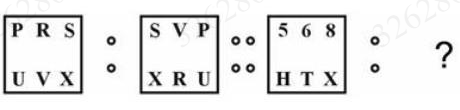
Two figures given on the left side of (::) are related with some logic/rule/relation. Select the missing figure on the right side of (::) from the given alternatives based on the same logic/rule/relation.

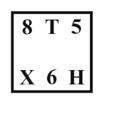
  1. AOption (a)

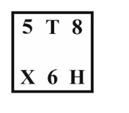
  2. BOption (b)

  3. COption (c)

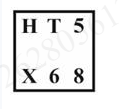
  4. DOption (d)

View answer & explanation

Correct answer

Answer: (a)A.

Why this answer is correct

Pattern followed here is,

Similarly,

Hence, the correct answer is “Option 1”.

Question 18

Select the option that is related to the fifth letter-number cluster in the same way as the second letter-number cluster is related to the first letter-number cluster and fourth letter-number cluster is related to third letter-number cluster. (NOTE: Operations should be performed on the whole numbers, without breaking down the numbers into its constituent digits. E.g.13 - Operations on 13 such as adding /subtracting /multiplying etc. to 13 can be performed. Breaking down 13 into 1 and 3 and then performing mathematical operations on 1 and 3 is not allowed)

FUV1728 : IQA12 :: BIN216 : EES6 :: MRS512 : ?

  1. AOption (a)

    NPX16

  2. BOption (b)

    PNX8

  3. COption (c)

    XNP64

  4. DOption (d)

    PMX8

View answer & explanation

Correct answer

Answer: (b)B.

PNX8

Why this answer is correct

<br> <br>

FUV1728 : IQA12

BIN216 : EES6

Similarly,


MRS512 : ?


Hence, the correct answer is 'Option 2'.

Question 19

Select the option that is related to the first number in the same way as the fourth number is related to the third number and sixth number is related to fifth number. (NOTE: Operations should be performed on the whole numbers, without breaking down the numbers into its constituent digits. E.g.13 - Operations on 13 such as adding /subtracting /multiplying etc. to 13 can be performed. Breaking down 13 into 1 and 3 and then performing mathematical operations on 1 and 3 is not allowed)
3453 : ? :: 5537 : 5574 :: 9439 : 9476

  1. AOption (a)

    3489

  2. BOption (b)

    3490

  3. COption (c)

    3487

  4. DOption (d)

    3492

View answer & explanation

Correct answer

Answer: (b)B.

3490

Why this answer is correct

The logic followed here is:

Logic: Second Number = First Number + 37

For the third pair 5537 : 5574

⇒ 5537 + 37 = 5574.

For the second pair 9439 : 9476

⇒ 9439 + 37 = 9476.

Applying the same logic to the first pair

3453 : ?

⇒ 3453 + 37 = 3490.

Hence, the correct answer is "Option 2".

Question 20

In a certain code language, 'FOUR' is coded as '180', 'REST' is coded as '186'. How will 'TAPE' be coded in that code language?

  1. AOption (a)

    120

  2. BOption (b)

    126

  3. COption (c)

    117

  4. DOption (d)

    129

View answer & explanation

Correct answer

Answer: (b)B.

126

Why this answer is correct

The pattern observed is: (Sum of positional values of letters) × 3.

FOUR is coded as 180 →

Sum of positional values = 6 + 15 + 21 + 18 = 60

Code = 60 × 3 = 180

REST is coded as 186 →

Sum of positional values = 18 + 5 + 19 + 20 = 62

Code = 62 × 3 = 186

Similarly, let us find the code for TAPE:

Sum of positional values = 20 + 1 + 16 + 5 = 42

Code = 42 × 3 = 126

Hence, the correct answer is “Option 2”.

General Knowledge and General Awareness (20 questions)

Question 21

The Prime minister is the real executive under:

  1. AOption (a)

    Presidential system

  2. BOption (b)

    Parliamentary system

  3. COption (c)

    Unitary system

  4. DOption (d)

    Federal system

View answer & explanation

Correct answer

Answer: (b)B.

Parliamentary system

Why this answer is correct

The correct answer is Parliamentary system.

Key Points

  • The Parliamentary system, also known as the Westminster model, is defined by the existence of a dual executive: the Nominal Executive and the Real Executive.
  • In this system, the Prime Minister acts as the Real Executive (De-facto head), exercising actual administrative and political powers on behalf of the government.
  • The Head of State, such as the President in India or the Monarch in Britain, serves as the Nominal Executive (De-jure head), performing ceremonial roles and acting on the aid and advice of the Council of Ministers.
  • The Prime Minister is usually the leader of the party or coalition that secures a majority in the Lower House of the legislature (such as the Lok Sabha in India).
  • A core feature of this system is Collective Responsibility, where the executive is directly accountable to the Legislature for all its acts of omission and commission.

 Additional Information

  • Presidential system:
  • The President serves as both the Head of State and the Head of Government, centralizing real power in a single individual.
  • The executive is not responsible to the legislature and cannot be dismissed by a vote of no confidence, ensuring a fixed tenure (e.g., the United States).
  • Unitary system:
  • All administrative powers are concentrated in the hands of the Central Government.
  • Regional governments exist only at the discretion of the center and exercise powers delegated to them (e.g., United Kingdom, France).
  • Federal system:
  • Characterized by the constitutional division of powers between the central authority and constituent units like states or provinces.
  • It requires a written constitution and an independent judiciary to resolve disputes between different levels of government (e.g., Canada, India).

Question 22

Which of the following cycles does not involve a gaseous phase?

  1. AOption (a)

    Water cycle

  2. BOption (b)

    Carbon cycle

  3. COption (c)

    Nitrogen cycle

  4. DOption (d)

    Phosphorus cycle

View answer & explanation

Correct answer

Answer: (d)D.

Phosphorus cycle

Why this answer is correct

The correct answer is Phosphorus cycle.

Key Points

  • Biogeochemical cycles are classified into two main types based on their primary reservoir: gaseous cycles and sedimentary cycles.
  • The phosphorus cycle is a major sedimentary cycle where the main reservoir is found in the Earth crust, specifically in lithospheric rocks.
  • Unlike carbon or nitrogen, phosphorus does not circulate through the atmosphere; it lacks a significant gaseous phase under normal environmental conditions.
  • In this cycle, phosphorus moves from phosphate-rich rocks to the soil and water through the process of weathering and erosion.
  • Plants absorb orthophosphate ions (PO43−) from the soil, which then enter the biosphere through consumption by herbivores and carnivores.
  • The cycle is completed when decomposers break down organic matter, returning phosphorus to the soil or to marine sediments, where it eventually forms new rocks over geological timescales.

 Additional Information

  • Gaseous Cycles:
  • Nitrogen Cycle: Involves a massive gaseous reservoir as Nitrogen gas (N2) makes up approximately 78% of the Earth atmosphere. It includes stages like nitrogen fixation and denitrification.
  • Carbon Cycle: Carbon exists in the atmosphere primarily as carbon dioxide (CO2) and methane (CH4). It is exchanged through photosynthesis, respiration, and combustion.
  • Water Cycle: Also known as the hydrologic cycle, it involves a prominent gaseous phase as water vapor during evaporation and transpiration from the Earth surface.
  • Biological Importance of Phosphorus:
  • Phosphorus is a critical constituent of nucleic acids (DNA and RNA), ATP (adenosine triphosphate) for energy transfer, and phospholipids in cell membranes.
  • It is also a primary component of bones, teeth, and shells in various animals.

Question 23

What is the typical formation of Santhal dance?

  1. AOption (a)

    Solo dance by women

  2. BOption (b)

    Group dance in a circular or line formation involving both men and women

  3. COption (c)

    Martial dance with swords

  4. DOption (d)

    Dance performed sitting down

View answer & explanation

Correct answer

Answer: (b)B.

Group dance in a circular or line formation involving both men and women

Why this answer is correct

The correct answer is Group dance in a circular or line formation involving both men and women.

Key Points

  • The Santhal dance is a prominent tribal folk dance performed by the Santhal tribe, which is primarily settled in the Indian states of Jharkhand, West Bengal, Odisha, and Bihar.
  • The dance is characterized by a communal formation where participants move in a synchronized circle or a linear pattern, symbolizing the unity and social cohesion of the tribe.
  • Unlike many other regional dances, this performance is highly inclusive, involving both men and women who dance together; women typically interlock their arms in a chain, while men play instruments and dance around them.
  • The movements are guided by the rhythmic beats of traditional percussion instruments, ensuring that the group formation remains intact throughout the performance.
  • The dance is not a solo or sedentary act but an energetic collective display that reflects the tribe's deep connection with nature and their cultural heritage.

 Additional Information

  • Major Occasions and Festivals:
  • The dance is central to festivals like Sarhul (celebrating the Sal tree), Sohrai (harvest festival), Baha (flower festival), and Karam.
  • Musical Accompaniment:
  • Primary instruments include the Madal (a two-sided drum), Nagara (kettledrum), Banam (stringed instrument), and bamboo flutes.
  • The rhythm varies depending on the specific sub-type of Santhal dance, such as the Ened or Lagren.
  • Traditional Attire:
  • Women wear Santhali sarees, usually checkered, and adorn their hair with wildflowers like Hibiscus or Sal.
  • Men often wear a dhoti and may use colorful headgears or feathers during special ceremonial performances.
  • Sociocultural Significance:
  • The lack of a 'lead' dancer highlights the egalitarian structure of Santhal society, where everyone is considered equal in the celebration.

Question 24

The diameter of the eyeball is approximately

  1. AOption (a)

    1.3 cm

  2. BOption (b)

    2.3 cm

  3. COption (c)

    3.3 cm

  4. DOption (d)

    4.3 cm

View answer & explanation

Correct answer

Answer: (b)B.

2.3 cm

Why this answer is correct

The correct answer is 2.3 cm.

Key Points

  • The human eyeball is a specialized sensory organ that is roughly spherical in shape, though not a perfect sphere.
  • The average diameter or the axial length of a healthy adult human eyeball is approximately 2.3 cm (or 23 mm).
  • This measurement specifically refers to the anteroposterior diameter, which is the distance from the front (the cornea) to the back (the retina) of the eye.
  • The vertical diameter is slightly smaller at about 2.3 cm, while the transverse diameter (width) is approximately 2.4 cm.
  • Maintaining this specific diameter is crucial because it ensures that light entering the eye is focused directly onto the fovea centralis of the retina for sharp vision.
  • An eyeball that is longer or shorter than this 2.3 cm average leads to common refractive errors such as nearsightedness or farsightedness.

 Additional Information

  • Refractive Implications:
  • Myopia (Nearsightedness): This condition occurs when the eyeball is longer than 2.3 cm, causing the image of distant objects to form in front of the retina.
  • Hypermetropia (Farsightedness): This occurs when the eyeball is shorter than 2.3 cm, causing the light rays to focus behind the retina.
  • Structural Components:
  • Cornea: The clear outer window of the eye that provides approximately two-thirds of the eye's total optical power.
  • Lens: A biconvex structure that changes shape to help focus light from varying distances.
  • Vitreous Humor: A clear, gel-like substance that fills the space between the lens and the retina, helping to maintain the intraocular pressure and the eyeball's spherical shape.
  • Physical Volume: The total volume of a typical adult eyeball is about 6.5 cubic centimeters, and it weighs approximately 7.5 grams.

Question 25

Which of the following is the best example of a carnivore?

  1. AOption (a)

    Cow

  2. BOption (b)

    Lion

  3. COption (c)

    Crow

  4. DOption (d)

    Tapeworm

View answer & explanation

Correct answer

Answer: (b)B.

Lion

Why this answer is correct

The correct answer is Lion.

Key Points

  • A carnivore is a biological organism that primarily derives its energy and nutrient requirements from a diet consisting of animal tissue, whether through predation or scavenging.
  • The Lion (Panthera leo) is a quintessential example of an obligate carnivore, meaning its biological system is physically adapted to require nutrients found only in animal flesh.
  • Lions function as apex predators in their ecosystems, predominantly the African savannas and the Gir Forest in India, where they regulate the populations of large ungulates.
  • Scientific studies of their anatomy reveal specialized carnassial teeth and powerful jaws designed for shearing meat, alongside a relatively short digestive tract optimized for rapid protein absorption.
  • In the trophic level hierarchy, lions occupy the position of secondary or tertiary consumers, playing a vital role in maintaining the ecological balance of their habitats.

 Additional Information

  • Dietary Classifications of Other Options:
  • Herbivores: Organisms like the Cow feed exclusively on plants. They possess complex ruminant stomachs and flat teeth designed for grinding cellulose.
  • Omnivores: Animals like the Crow have a diverse diet including both plant matter (seeds, fruits) and animal matter (insects, small rodents), allowing them to adapt to various biomes.
  • Parasites: The Tapeworm is an endoparasite that lives within the intestines of a host. Unlike carnivores that hunt and consume prey, parasites absorb pre-digested nutrients directly from the host organism.
  • Ecological Importance:
  • Carnivores prevent overgrazing by controlling the density of primary consumers, which in turn protects the vegetation cover and biodiversity of the region.

Question 26

Which structure in Agra Fort is characterized by its white marble arches and was used by Shah Jahan to view the Taj Mahal?

  1. AOption (a)

    Musamman Burj

  2. BOption (b)

    Moti Masjid

  3. COption (c)

    Nagina Masjid

  4. DOption (d)

    Diwan-i-Khas

View answer & explanation

Correct answer

Answer: (a)A.

Musamman Burj

Why this answer is correct

The correct answer is Musamman Burj.

Key Points

  • The Musamman Burj, also known as the Saman Burj or Shah-burj, is a magnificent octagonal tower situated within the Agra Fort complex in Uttar Pradesh.
  • Built by the Mughal Emperor Shah Jahan between 1631 and 1640, the structure was originally intended for his wife, Mumtaz Mahal, and is celebrated for its white marble arches and Pietra Dura inlay work.
  • The tower is strategically positioned on the riverfront, offering a panoramic and unobstructed view of the Taj Mahal across the Yamuna River.
  • Historically, this structure is significant as the place where Shah Jahan was imprisoned by his son Aurangzeb for the last eight years of his life, during which he gazed at the Taj Mahal until his death in 1666.
  • The pavilion features a sunken fountain in the shape of a lotus and is surrounded by a verandah with beautiful lattice screens (Jalis) carved from marble.

 Additional Information

  • Moti Masjid:
  • Commonly referred to as the Pearl Mosque, it was constructed by Shah Jahan for the royal court and is situated near the Diwan-i-Aam.
  • Nagina Masjid:
  • A small, private mosque built in white marble for the ladies of the Zenana (royal harem), known for its architectural simplicity and elegance.
  • Diwan-i-Khas:
  • The Hall of Private Audience, where the emperor held meetings with high-ranking officials and dignitaries, featuring the famous Pachisi Court and the Takht-i-Taus (Peacock Throne) base.

Question 27

The splitting of white light into colors was first explained by:

  1. AOption (a)

    Isaac Newton

  2. BOption (b)

    Thomas Young

  3. COption (c)

    Huygens

  4. DOption (d)

    Maxwell

View answer & explanation

Correct answer

Answer: (a)A.

Isaac Newton

Why this answer is correct

The correct answer is Isaac Newton.

Key Points

  • In 1666, the English scientist Sir Isaac Newton performed a landmark experiment using a glass prism to investigate the nature of light.
  • He observed that when a narrow beam of sunlight (white light) passed through the prism, it spread out into a multi-colored band called a spectrum.
  • This phenomenon is known as dispersion, which occurs because white light is a mixture of different colors that travel at different speeds through the glass.
  • Newton identified the seven constituent colors as Red, Orange, Yellow, Green, Blue, Indigo, and Violet, often abbreviated as VIBGYOR.
  • He proved that the prism was not coloring the light by using a second inverted prism to recombine the colored rays back into a single beam of white light.
  • The experiment concluded that refraction depends on the wavelength; violet light has a shorter wavelength and bends the most, while red light has a longer wavelength and bends the least.

 Additional Information

  • Thomas Young:
  • Famous for the Double-Slit Experiment conducted in 1801.
  • He demonstrated the interference of light, which provided critical evidence for the wave theory of light.
  • Christiaan Huygens:
  • A Dutch physicist who proposed the wave theory of light in 1678.
  • He developed the Huygens-Fresnel principle, explaining how wavefronts propagate through space.
  • James Clerk Maxwell:
  • Formulated the Maxwell equations in the 1860s, unifying electricity and magnetism.
  • He mathematically proved that light is an electromagnetic wave that travels at the speed of light.

Question 28

By how much was the Indian rupee devalued in July 1991 to tackle the balance of payments crisis?

  1. AOption (a)

    5-7%

  2. BOption (b)

    18-20%

  3. COption (c)

    30-35%

  4. DOption (d)

    50%

View answer & explanation

Correct answer

Answer: (b)B.

18-20%

Why this answer is correct

The correct answer is 18-20%.

Key Points

  • In July 1991, India faced a severe Balance of Payments (BoP) crisis, where foreign exchange reserves had dropped to approximately 1.2 billion dollars, barely enough to sustain two weeks of essential imports.
  • The Reserve Bank of India (RBI) intervened by devaluing the Indian Rupee in two sharp steps to restore economic stability and international confidence.
  • The first downward adjustment occurred on July 1, 1991, when the value of the rupee was reduced by about 9% against major international currencies.
  • The second adjustment followed quickly on July 3, 1991, with a further devaluation of about 11%, bringing the cumulative devaluation to the range of 18-20%.
  • The primary objective of this exchange rate adjustment was to make Indian exports cheaper and more competitive globally while making imports more expensive to curb the widening trade deficit.
  • This measure was a critical component of the structural adjustment program required to secure emergency assistance from the International Monetary Fund (IMF) and the World Bank.

 Additional Information

  • Balance of Payments (BoP) Crisis of 1991:
  • The crisis was exacerbated by the Gulf War (1990-91), which caused a spike in crude oil prices and reduced inward remittances from the Middle East.
  • High fiscal deficits and external debt throughout the 1980s had made the Indian economy vulnerable to external shocks.
  • New Economic Policy (NEP):
  • The devaluation acted as a catalyst for the Liberalization, Privatization, and Globalization (LPG) reforms introduced under the leadership of Prime Minister P.V. Narasimha Rao and Finance Minister Dr. Manmohan Singh.
  • These reforms dismantled the License Raj, reduced import tariffs, and opened the Indian economy to Foreign Direct Investment (FDI).
  • Evolution of Exchange Rate System:
  • Following the 1991 crisis, India moved from a fixed exchange rate regime to a Liberalized Exchange Rate Management System (LERMS) in 1992, and eventually to a managed float system where market forces largely determine the rupee's value.

Question 29

The EXIM Bank of India was set up in:

  1. AOption (a)

    1972

  2. BOption (b)

    1982

  3. COption (c)

    1985

  4. DOption (d)

    1990

View answer & explanation

Correct answer

Answer: (b)B.

1982

Why this answer is correct

The correct answer is 1982.

Key Points

  • The Export-Import Bank of India, commonly known as EXIM Bank, is a specialized financial institution wholly owned by the Government of India.
  • It was established under the Export-Import Bank of India Act, 1981, and commenced its operations in January 1982 to facilitate international trade.
  • The bank serves as the principal financial institution for coordinating the working of various entities engaged in financing export and import activities of goods and services.
  • Its primary mandate is to provide financial assistance to Indian exporters and importers while promoting foreign trade through various innovative credit programs.
  • The EXIM Bank functions under the administrative control of the Ministry of Finance and is headquartered in Mumbai, Maharashtra.
  • It plays a pivotal role in the globalization of Indian business by providing Lines of Credit (LOCs) to foreign governments and financial institutions to support the export of Indian equipment and services.

 Additional Information

  • SIDBI (Small Industries Development Bank of India):
  • Established in 1990 under an Act of the Indian Parliament.
  • It acts as the principal financial institution for the promotion, financing, and development of the Micro, Small, and Medium Enterprises (MSME) sector.
  • NABARD (National Bank for Agriculture and Rural Development):
  • Established on July 12, 1982, based on the recommendations of the B. Sivaraman Committee.
  • It focuses on the development of the rural economy by providing credit and other facilities for agriculture and allied activities.
  • Export Credit Guarantee Corporation (ECGC):
  • Established in 1957 to strengthen the export promotion drive by covering the risk of exports on credit.
  • It provides credit insurance to exporters against losses in the export of goods and services.

Question 30

Which is the largest salt-producing state in India?

  1. AOption (a)

    Maharashtra

  2. BOption (b)

    Tamil Nadu

  3. COption (c)

    Gujarat

  4. DOption (d)

    Rajasthan

View answer & explanation

Correct answer

Answer: (c)C.

Gujarat

Why this answer is correct

The correct answer is Gujarat.

Key Points

  • India is currently the third-largest producer of salt in the world, and within the country, Gujarat is the leading state, contributing approximately 76 percent of the total annual production.
  • The state possesses a massive coastline of about 1,600 kilometers, the longest in India, which provides ideal low-lying areas for establishing massive solar salt pans.
  • The Little Rann of Kutch serves as a major production hub where the Agariya community produces nearly 30 percent of India’s total salt by pumping out underground brine.
  • Favorable meteorological conditions in Gujarat, such as high ambient temperatures, low relative humidity, and high wind velocity, significantly accelerate the solar evaporation process.
  • Major salt-producing districts include Kutch, Jamnagar, Bhavnagar, Bharuch, and Surendranagar, which house numerous large-scale refineries and processing units.

 Additional Information

  • Tamil Nadu:
  • It is the second-largest salt-producing state in India, with major production clusters located in Tuticorin (Thoothukudi), Vedaranyam, and Marakkanam.
  • The state accounts for roughly 11 percent to 12 percent of the national salt output.
  • Rajasthan:
  • As a landlocked state, it ranks third in production, primarily due to the Sambhar Salt Lake, which is the largest inland salt source in the country.
  • Salt is also produced from other saline lakes like Didwana and Pachpadra.
  • Maharashtra:
  • The state contributes a smaller share to the national total, with salt pans predominantly found in coastal regions like Palghar, Thane, and Raigad.
  • Industrial Context:
  • Salt is a vital raw material for the alkali industry, used in the manufacturing of Caustic Soda, Soda Ash, and Chlorine, which are essential for the textile and paper sectors.
  • The Salt Commissioner’s Organization, headquartered in Jaipur, is the nodal agency for the administration and development of the salt industry in India.

Question 31

Copper reacts with moist carbon dioxide in the air, gradually losing its shiny brown surface and developing a:

  1. AOption (a)

    Green coat

  2. BOption (b)

    Black coat

  3. COption (c)

    Red coat

  4. DOption (d)

    Yellow coat

View answer & explanation

Correct answer

Answer: (a)A.

Green coat

Why this answer is correct

The correct answer is Green coat.

Key Points

  • When copper is exposed to the atmosphere for a prolonged period, it undergoes a chemical reaction with moist carbon dioxide and oxygen in the air.
  • The shiny brown surface of the copper metal reacts with these gases to form a layer of basic copper carbonate.
  • Basic copper carbonate is a chemical mixture consisting of copper carbonate (CuCO3) and copper hydroxide (Cu(OH)2), which has a distinctive pale green color.
  • The overall chemical reaction can be represented as: 2Cu + H2O + CO2 + O2 → CuCO3·Cu(OH)2.
  • This process is a type of corrosion where the metal surface is oxidized, causing it to lose its luster and acquire a green coat that actually protects the underlying metal from further deep corrosion.

 Additional Information

  • Black coat:
  • Formed when copper is heated strongly in the presence of oxygen.
  • The reaction results in the formation of copper(II) oxide (CuO), which is a black solid.
  • Silver Corrosion:
  • Silver items develop a black coat over time.
  • This occurs because silver reacts with hydrogen sulfide (H2S) present in the air to form silver sulfide (Ag2S).
  • Iron Rusting:
  • Iron develops a reddish-brown flaky substance called rust.
  • This is caused by the reaction of iron with moisture and oxygen to form hydrated iron(III) oxide (Fe2O3·xH2O).
  • Patina:
  • The green layer on copper is often called a patina and is highly valued in architecture and art, such as on the Statue of Liberty.

Question 32

Which of the following is a flow variable?

  1. AOption (a)

    National income

  2. BOption (b)

    Money supply

  3. COption (c)

    Capital stock

  4. DOption (d)

    Foreign exchange reserves

View answer & explanation

Correct answer

Answer: (a)A.

National income

Why this answer is correct

The correct answer is National income.

Key Points

  • A flow variable is an economic quantity that is measured over a specific period of time, such as a month, a quarter, or a fiscal year.
  • National income represents the total value of all final goods and services produced by the normal residents of a country during an accounting year (usually from April 1 to March 31 in India).
  • It is categorized as a flow because it reflects the continuous generation of value, wages, interest, and profits over a time interval rather than a static amount held at one moment.
  • The measurement of National income involves calculating the Net National Product at Factor Cost (NNP at FC), which requires aggregating economic activities throughout the year.
  • Other prominent examples of flow variables include consumption, investment, interest on capital, exports, and Gross Domestic Product (GDP).

 Additional Information

  • Stock Variables are quantities measured at a particular point in time, representing an accumulation of assets or liabilities at a specific date.
  • Money Supply: This refers to the total volume of monetary assets (like currency and deposits) held by the public at a specific moment; it is a stock because it is measured as a balance on a given day.
  • Capital Stock: This represents the total physical assets, including buildings, machinery, and equipment, available in an economy at a given instant; it is the result of accumulated net investment (a flow).
  • Foreign Exchange Reserves: These are the foreign assets, gold, and Special Drawing Rights (SDRs) held by the Reserve Bank of India (RBI) at a specific point in time to maintain liquidity and stability in the currency market.

Question 33

Which industry is predominantly concentrated around the Damodar Valley due to coal availability?

  1. AOption (a)

    Textile

  2. BOption (b)

    Steel

  3. COption (c)

    chemical

  4. DOption (d)

    Leather

View answer & explanation

Correct answer

Answer: (b)B.

Steel

Why this answer is correct

The correct answer is Steel.

Key Points

  • The Damodar Valley region, encompassing parts of Jharkhand and West Bengal, is recognized as the industrial heartland of India due to its vast mineral reserves.
  • The Steel industry is predominantly concentrated here because the valley contains the richest Gondwana coal deposits in India, specifically the Jharia, Raniganj, and Giridih coalfields.
  • High-grade coking coal, a critical reducing agent and fuel source for blast furnaces, is readily available, significantly reducing the logistics cost for heavy metallurgical operations.
  • Proximity to the Chhota Nagpur Plateau ensures a steady supply of other essential raw materials such as iron ore, manganese, dolomite, and limestone.
  • The establishment of major plants like the Bokaro Steel Plant, Durgapur Steel Plant, and the IISCO Steel Plant at Burnpur highlights the strategic importance of this coal belt.
  • The Damodar Valley Corporation (DVC) supports these industries by providing hydroelectric and thermal power, alongside industrial water required for cooling and processing.

 Additional Information

  • Industrial Infrastructure:
  • The region is well-connected by the Eastern and South Eastern Railway networks, facilitating the movement of finished steel to domestic markets and the Kolkata Port for export.
  • The Ruhr of India is a common nickname for this region, drawing a parallel to the coal-rich Ruhr Valley in Germany.
  • Other Industries:
  • Textile: Primarily thrives in Gujarat (Ahmedabad) and Maharashtra (Mumbai) due to black soil for cotton or in West Bengal for Jute.
  • Chemical: Often located near petroleum refineries in states like Gujarat or Tamil Nadu.
  • Leather: Concentrated in clusters like Kanpur, Agra, and Chennai, where livestock and traditional processing hubs are established.

Question 34

In May 2025, which Indian state was officially declared as fully literate under the ULLAS programme?

  1. AOption (a)

    Haryana

  2. BOption (b)

    Rajasthan

  3. COption (c)

    Mizoram

  4. DOption (d)

    Uttar Pradesh

View answer & explanation

Correct answer

Answer: (c)C.

Mizoram

Why this answer is correct

The correct answer is Mizoram.

Key Points

  • Mizoram has officially achieved the status of being a fully literate state under the ULLAS (Understanding of Lifelong Learning for All in Society) initiative as of May 2025.
  • The ULLAS programme, also known as the New India Literacy Programme (NILP), is a Centrally Sponsored Scheme designed to provide education to non-literates aged 15 years and above who missed out on formal schooling.
  • The state reached this milestone by successfully conducting the Foundational Literacy and Numeracy (FLN) assessment tests across all its districts, ensuring that learners acquired basic reading, writing, and numeracy skills.
  • The implementation strategy in the state relied heavily on volunteerism, where students and community members served as teachers to help achieve the goal of Jan Jan Sakshar (Literacy for every person).

 Additional Information

  • ULLAS Initiative Details:
  • The scheme is aligned with the National Education Policy (NEP) 2020 and is scheduled for implementation from FY 2022 to 2027.
  • It focuses on five pillars: Foundational Literacy and Numeracy, Critical Life Skills (financial, digital, legal literacy), Vocational Skills, Basic Education, and Continuing Education.
  • The ULLAS Mobile App serves as a digital gateway for learners and volunteers to register and access multilingual educational resources.
  • Mizoram Literacy Landscape:
  • Historically, Mizoram has consistently ranked among the top Indian states in literacy, following Kerala, with a Census 2011 literacy rate of 91.33%.
  • The success of literacy drives in the state is often attributed to the strong influence of civil society organizations and local community-led initiatives.

Question 35

Who was considered as most notable of the nine luminaries (navaratna) in Chandragupta II's court?

  1. AOption (a)

    Tulsidas

  2. BOption (b)

    Kalidas

  3. COption (c)

    Surdas

  4. DOption (d)

    Banabhatta

View answer & explanation

Correct answer

Answer: (b)B.

Kalidas

Why this answer is correct

The correct answer is Kalidas.

Key Points

  • Chandragupta II, popularly known as Vikramaditya, was one of the most powerful emperors of the Gupta Empire, ruling from approximately 375 to 415 CE.
  • His court was renowned for the Navaratnas or Nine Gems, a circle of nine distinguished scholars who represented the pinnacle of intellectual and cultural achievement during the Golden Age of India.
  • Kalidas is universally acknowledged as the most illustrious of these nine luminaries, celebrated as a master Sanskrit poet and playwright.
  • His literary excellence earned him a legendary status in Indian history, with his works reflecting the sophisticated urban culture and religious synthesis of the Gupta period.
  • His presence in the court of Chandragupta II highlights the royal patronage extended to the arts, which allowed classical Sanskrit literature to reach its zenith.

 Additional Information

  • Works of Kalidas:
  • Dramas: His masterpiece is Abhijnanashakuntalam, which gained worldwide fame. Other significant plays include Malavikagnimitram and Vikramorvasiyam.
  • Epics: He composed the great mahakavyas Raghuvamsha and Kumarasambhava.
  • Lyrics: Meghaduta and Ritusamhara are his famous lyrical poems.
  • Context of Other Options:
  • Tulsidas: A saint-poet of the Bhakti movement who authored the Ramcharitmanas during the 16th century (Mughal Era), long after the Gupta period.
  • Surdas: A devotional singer and poet famous for Sursagar, who was a contemporary of the Mughal Emperor Akbar in the 16th century.
  • Banabhatta: The Asthana Kavi (court poet) of King Harshavardhana in the 7th century CE, known for writing Harshacharita and Kadambari.

Question 36

Which of the following acts enacted in an effort to silence those newspapers that were critical of the government?

  1. AOption (a)

    Vernacular Press Act, 1878

  2. BOption (b)

    Vernacular Press Act, 1858

  3. COption (c)

    Charter Act, 1833

  4. DOption (d)

    Charter Act, 1813

View answer & explanation

Correct answer

Answer: (a)A.

Vernacular Press Act, 1878

Why this answer is correct

The correct answer is Vernacular Press Act, 1878.

Key Points

  • The Vernacular Press Act was enacted in 1878 during the viceroyalty of Lord Lytton to curtail the freedom of the Indian-language press and prevent the expression of criticism toward British policies. Hence, statement 1 is correct.
  • The act was specifically designed to target non-English publications, providing the government with extensive powers to confiscate printing presses and editorial assets if they published 'seditious' material. Hence, statement 2 is incorrect as the act was passed in 1878, not 1858.
  • The legislation was modeled on the repressive Irish Press Laws and was notoriously referred to as the 'Gagging Act' because it discriminated between the English and the vernacular press.
  • Under this law, a District Magistrate was empowered to call upon the printer and publisher of any vernacular newspaper to enter into a bond undertaking not to cause disaffection against the government.
  • The Amrita Bazar Patrika, a prominent newspaper of the time, famously changed its language from Bengali to English overnight to circumvent the restrictions imposed by this act.

 Additional Information

  • Charter Act, 1833:
  • It redesignated the Governor-General of Bengal as the Governor-General of India, with Lord William Bentinck becoming the first to hold this title.
  • The act ended the East India Company's commercial privileges, transforming it into a purely administrative body under the British Crown.
  • Charter Act, 1813:
  • It abolished the trade monopoly of the East India Company in India, although the monopoly over trade in tea and trade with China was maintained.
  • The act provided for a financial grant of one lakh rupees annually for the revival of Indian literature and the promotion of scientific knowledge.
  • Repeal of the Press Act:
  • The restrictive Vernacular Press Act was eventually repealed in 1882 by Lord Ripon, who is often remembered for his liberal reforms and for restoring the freedom of the press in India.

Question 37

In January 2025, Mantralaya's security was upgraded with facial recognition, RFID cards, and time-slot based visitor entry. In which state is this mantralaya located?

  1. AOption (a)

    Sikkim

  2. BOption (b)

    Bihar

  3. COption (c)

    Maharashtra

  4. DOption (d)

    Madhya Pradesh

View answer & explanation

Correct answer

Answer: (c)C.

Maharashtra

Why this answer is correct

The correct answer is Maharashtra.

Key Points

  • The term Mantralaya refers to the administrative headquarters and the State Secretariat of the Government of Maharashtra, located in the Nariman Point area of Mumbai.
  • In January 2025, the state government implemented a sophisticated security infrastructure to manage the daily influx of nearly 5,000 to 10,000 visitors and prevent unauthorized access.
  • The upgrade features Facial Recognition Technology (FRT), which uses high-resolution cameras to capture and verify the identities of individuals entering the premises against a central database.
  • The introduction of RFID (Radio Frequency Identification) cards for employees and permanent staff allows for automated, contact-free movement through specialized security turnstiles.
  • To mitigate overcrowding and improve public service efficiency, a time-slot based entry system was integrated, requiring visitors to book appointments or receive digital tokens with specific arrival times.

 Additional Information

  • Administrative Importance of Mantralaya:
  • The seven-story building houses the vital offices of the Chief Minister, Deputy Chief Minister, and Chief Secretary of Maharashtra.
  • It was built in 1955 and was formerly known as Sachivalaya before being renamed to Mantralaya in 1980 to reflect the presence of the Council of Ministers.
  • The Home Department of Maharashtra is responsible for the overall surveillance and protocol management of the complex.
  • Following a major fire incident in 2012, the building underwent extensive structural renovations, which paved the way for modernizing its fire safety and digital security protocols.

Question 38

The average number of children a woman expected to give birth during her life was 3.8 in ______ in India.

  1. AOption (a)

    1990

  2. BOption (b)

    2011

  3. COption (c)

    2015

  4. DOption (d)

    1960

View answer & explanation

Correct answer

Answer: (a)A.

1990

Why this answer is correct

The correct answer is 1990.

Key Points

  • The Total Fertility Rate (TFR) represents the average number of children that would be born to a woman over her lifetime if she were to experience the prevailing age-specific fertility rates.
  • In 1990, India recorded a Total Fertility Rate of approximately 3.8 children per woman, reflecting a significant phase in the nation's demographic transition.
  • This period was characterized by a gradual shift from high birth rates to moderate levels due to increased awareness of family planning and improved maternal healthcare services.
  • The 1990 figure of 3.8 served as a crucial benchmark in tracking India's progress toward achieving Replacement Level Fertility.
  • Data from international organizations like the World Bank and India's Sample Registration System (SRS) confirm that the TFR hovered around this value during the late 1980s and early 1990s.

 Additional Information

  • Evolution of India's Fertility Rate:
  • 1960: During this era, India had a very high Total Fertility Rate, estimated at nearly 5.9 children per woman, as the country was in the early stage of the demographic transition.
  • 2011: By the time of the 2011 Census, the fertility rate had dropped significantly to approximately 2.4 children per woman.
  • 2015: According to the National Family Health Survey-4 (NFHS-4) conducted around 2015-16, the TFR was recorded at 2.2, showing a steady decline toward the replacement level.
  • Replacement Level Fertility: This is defined as the level of fertility (typically 2.1 children per woman) at which a population exactly replaces itself from one generation to the next without migration.
  • Current Status: According to NFHS-5 (2019-21), India's overall TFR has further declined to 2.0, which is below the replacement level of 2.1.

Question 39

Tachi-Waza, Koshi-Waza are the term related to which of the following sports?

  1. AOption (a)

    Badminton

  2. BOption (b)

    Kabaddi

  3. COption (c)

    Judo

  4. DOption (d)

    Swimming

View answer & explanation

Correct answer

Answer: (c)C.

Judo

Why this answer is correct

The correct answer is Judo.

Key Points

  • Judo is a modern Japanese martial art and combat sport created by Kano Jigoro in 1882, which emphasizes the use of an opponent's force against themselves.
  • The term Tachi-Waza refers to Standing Techniques. It is the broad category of throwing techniques performed while the practitioner is in a standing position.
  • Koshi-Waza is a specialized sub-category of Tachi-Waza that specifically denotes Hip Techniques. These involve using the hip as a pivot or fulcrum to throw an opponent.
  • The classification of these moves is part of the Gokyo no Waza, the standard syllabus of throwing techniques in Kodokan Judo.
  • In a competitive Judo match, executing these techniques with speed, force, and control on the back can result in an Ippon, which grants an immediate victory.

 Additional Information

  • Nage-Waza (Throwing Techniques):
  • Te-Waza: Hand techniques where the arms and shoulders are the primary tools for the throw (e.g., Seoi-nage).
  • Ashi-Waza: Foot and leg techniques used to trip or sweep the opponent (e.g., Osoto-gari).
  • Sutemi-Waza: Sacrifice techniques where the practitioner falls to the ground to complete the throw.
  • Katame-Waza (Grappling Techniques):
  • Osaekomi-Waza: Pinning or holding techniques used to immobilize the opponent on their back.
  • Shime-Waza: Choking or strangulation techniques applied to the neck.
  • Kansetsu-Waza: Joint lock techniques, primarily targeting the elbow in Judo competition.
  • International Governing Body:
  • The International Judo Federation (IJF) manages international competitions and was established in July 1951.
  • Judo made its Olympic Games debut for men at the 1964 Tokyo Olympics and for women at the 1992 Barcelona Olympics.

Question 40

Which of the following pair of component - process regarding water cycle is correct?

I. Water storage in ice and snow - Evapotranspiration

II. Groundwater storage - Groundwater discharge springs

  1. AOption (a)

    Only I

  2. BOption (b)

    Only II

  3. COption (c)

    Both I and II

  4. DOption (d)

    Neither I nor II

View answer & explanation

Correct answer

Answer: (b)B.

Only II

Why this answer is correct

The correct answer is Only II.

Key Points

  • Water storage in ice and snow refers to the accumulation of frozen freshwater in glaciers, ice caps, and permanent snowfields. Evapotranspiration is the collective process of evaporation from surfaces and transpiration from plants, primarily involving liquid water and biological activity. The direct transition of ice or snow into water vapor is known as sublimation, not evapotranspiration. Hence, statement I is incorrect.
  • Groundwater storage constitutes the water located beneath the Earth's surface in soil pore spaces and the fractures of rock formations, known as aquifers. Groundwater discharge occurs when this subsurface water moves toward the surface; springs are the natural locations where this stored water flows out onto the land or into water bodies. Hence, statement II is correct.

 Additional Information

  • Hydrological Cycle Components:
  • Sublimation: This process allows ice and snow to enter the atmosphere as vapor without melting into liquid water first. It is a critical factor in the mass balance of glaciers.
  • Transpiration: The process by which moisture is carried through plants from roots to small pores on the underside of leaves, where it changes to vapor and is released to the atmosphere.
  • Aquifers: These are permeable layers of sediment or rock that act as underground reservoirs. They are replenished through infiltration and percolation.
  • Water Table: The upper surface of the zone of saturation, where the pressure of groundwater is equal to atmospheric pressure. When the water table meets the land surface, a spring or wetland is formed.

Elementary Mathematics (20 questions)

Question 41

92 - 56 + 78 - (33 + 15) + 27 × 2 = ?

  1. AOption (a)

    147

  2. BOption (b)

    143

  3. COption (c)

    145

  4. DOption (d)

    120

View answer & explanation

Correct answer

Answer: (d)D.

120

Why this answer is correct

Shortcut Trick

Solve the expression by grouping Addition and Subtraction terms after basic operations.

Identify values: 92 − 56 + 78 − (48) + 54.

Sum of positive terms: 92 + 78 + 54 = 224.

Sum of negative terms: 56 + 48 = 104.

Final calculation: 224 − 104 = 120.

∴ The correct answer is 120.

Alternate Method

Given:

92 − 56 + 78 − (33 + 15) + 27 × 2

Method:

We use the BODMAS rule to solve the expression in the correct order: Brackets, Orders, Division, Multiplication, Addition, and Subtraction.

⇒ 92 − 56 + 78 − (48) + 27 × 2 (Solving Bracket)

⇒ 92 − 56 + 78 − 48 + 54 (Solving Multiplication)

⇒ 36 + 78 − 48 + 54 (Performing Subtraction from left to right)

⇒ 114 − 48 + 54 (Performing Addition from left to right)

⇒ 66 + 54 (Performing Subtraction)

⇒ 120 (Final Addition)

∴ The correct answer is 120.

Additional Information

BODMAS Rule

It stands for Brackets ((), {}, []), Of, Division (÷), Multiplication (×), Addition (+), and Subtraction (−). This sequence ensures consistent calculation results.

Left-to-Right Priority

When multiple operations of the same priority level (like Addition and Subtraction) are present, solve them sequentially from the left side to the right side.

Grouping Method

To simplify large expressions, you can group all terms with a plus sign together and all terms with a minus sign together, sum them separately, and then subtract the totals.

Question 42

74 + (19 × 2) - 38 ÷ 2 + 47 - 16 + 25 = ?

  1. AOption (a)

    149

  2. BOption (b)

    143

  3. COption (c)

    145

  4. DOption (d)

    147

View answer & explanation

Correct answer

Answer: (a)A.

149

Why this answer is correct

Shortcut Trick

Apply VBODMAS: Bracket → Division → Multiplication → Addition → Subtraction.

74 + 38 − 19 + 47 − 16 + 25

Group positive and negative terms: (74 + 38 + 47 + 25) − (19 + 16)

184 − 35 = 149

∴ The correct answer is 149.

Alternate Method

Given Expression: 74 + (19 × 2) − 38 ÷ 2 + 47 − 16 + 25

Solving following the BODMAS rule:

⇒ 74 + 38 − 38 ÷ 2 + 47 − 16 + 25 (Solving bracket: 19 × 2 = 38)

⇒ 74 + 38 − 19 + 47 − 16 + 25 (Solving division: 38 ÷ 2 = 19)

⇒ 112 − 19 + 47 − 16 + 25 (Adding 74 + 38 = 112)

⇒ 93 + 47 − 16 + 25 (Subtracting 112 − 19 = 93)

⇒ 140 − 16 + 25 (Adding 93 + 47 = 140)

⇒ 124 + 25 (Subtracting 140 − 16 = 124)

⇒ 149 (Final addition)

∴ The correct answer is 149.

Additional Information

BODMAS Rule

It specifies the order of operations: Brackets, Orders (powers/roots), Division, Multiplication, Addition, and Subtraction.

VBODMAS

The V stands for Vinculum (a bar over numbers), which has the highest priority even before the circular brackets.

Priority of Brackets

When multiple brackets are present, solve them in the order: Parentheses ( ) → Braces { } → Square Brackets [ ].

Question 43

Which of the following is the largest?

  1. AOption (a)

    0.12‾ 0.\overline{12}

  2. BOption (b)

    0.17‾ 0.\overline{17}

  3. COption (c)

    0.21‾ 0.2\overline{1}

  4. DOption (d)

    0.19‾ 0.\overline{19}

View answer & explanation

Correct answer

Answer: (c)C.

0.21‾ 0.2\overline{1}

Why this answer is correct

Shortcut Trick

Expand the decimals to compare digits: 0.1212..., 0.1717..., 0.2111..., 0.1919...

Compare the tenths place (first digit after the decimal).

The digits are 1, 1, 2, and 1 respectively.

Since 2 is the largest digit, 0.2111... must be the largest value.

∴ The correct answer is 0.211... (recurring decimal).

Alternate Method

Given: Four recurring decimals to compare.

Formula: Convert recurring decimals into fractions to compare their magnitudes.

⇒ 0.1212... = 12/99

⇒ 0.1717... = 17/99

⇒ 0.2111... = (21 − 2)/90 = 19/90

⇒ 0.1919... = 19/99

⇒ Comparing 19/90 and 19/99: Since the numerator is the same, the fraction with the smaller denominator is larger.

⇒ 19/90 > 19/99

⇒ Also, 19/99 is clearly larger than 17/99 and 12/99.

∴ The correct answer is 0.211... (recurring decimal).

Additional Information

Pure Recurring Decimals

A decimal where all digits after the point repeat, e.g., 0.ab... = ab/99.

Mixed Recurring Decimals

A decimal where some digits do not repeat, e.g., 0.abc... (bc repeating) = (abc − a)/990.

Comparison Rule

To compare decimals, align the decimal points and compare digits from left to right (tenths, then hundredths, etc.).

Question 44

13+115+135+163+....+1143=? \frac{1}{3}+\frac{1}{15}+\frac{1}{35}+\frac{1}{63}+....+\frac{1}{143}=?

  1. AOption (a)

    6/13

  2. BOption (b)

    12/13

  3. COption (c)

    14/13

  4. DOption (d)

    7/13

View answer & explanation

Correct answer

Answer: (a)A.

6/13

Why this answer is correct

Shortcut Trick

Identify the factors of the denominators: (1×3), (3×5), (5×7), (7×9), (9×11), (11×13).

The total number of terms (n) in this series is 6.

Use the formula: Sum = n / (First factor × Last factor).

Here, First factor = 1 and Last factor = 13.

Sum = 6 / (1 × 13) = 6/13.

∴ The correct answer is 6/13.

Alternate Method

Given: 1/3 + 1/15 + 1/35 + 1/63 + .... + 1/143

Formula Used: 1/(n × (n+d)) = (1/d) × [1/n − 1/(n+d)]

⇒ 1/(1×3) + 1/(3×5) + 1/(5×7) + 1/(7×9) + 1/(9×11) + 1/(11×13)

⇒ (1/2) × [(3−1)/(1×3) + (5−3)/(3×5) + (7−5)/(5×7) + (9−7)/(7×9) + (11−9)/(9×11) + (13−11)/(11×13)]

⇒ (1/2) × [(1/1 − 1/3) + (1/3 − 1/5) + (1/5 − 1/7) + (1/7 − 1/9) + (1/9 − 1/11) + (1/11 − 1/13)]

⇒ (1/2) × [1 − 1/13] (By telescoping cancellation)

⇒ (1/2) × [12/13]

⇒ 6/13

∴ The correct answer is 6/13.

Additional Information

Telescoping Series

A series where intermediate terms cancel each other out, leaving only the first and last components. Formula: Sum = (1/d) × [1/a − 1/l], where d is the difference between factors.

Sum of Consecutive Fractions

For a series 1/(1×2) + 1/(2×3) + ... + 1/(n×(n+1)), the sum is always n/(n+1).

Difference Method

When the difference between the factors in the denominator is not 1, we must multiply the whole sum by 1/Difference to balance the numerator.

Question 45

(54.87)2 - (18.13)2 = ?

  1. AOption (a)

    2682.02

  2. BOption (b)

    2682.20

  3. COption (c)

    2680.02

  4. DOption (d)

    2862.02

View answer & explanation

Correct answer

Answer: (a)A.

2682.02

Why this answer is correct

Shortcut Trick

Apply the Difference of Squares formula: a2 − b2 = (a + b)(a − b).

Here, a = 54.87 and b = 18.13.

Sum (a + b) = 54.87 + 18.13 = 73.

Difference (a − b) = 54.87 − 18.13 = 36.74.

Result = 73 × 36.74 = 2682.02.

∴ The correct answer is 2682.02.

Alternate Method

Given:

Expression = (54.87)2 − (18.13)2

Formula Used:

Algebraic Identity: a2 − b2 = (a + b)(a − b)

Calculations:

⇒ (54.87 + 18.13) × (54.87 − 18.13)

⇒ 73 × 36.74

⇒ 73 × (36 + 0.74)

⇒ (73 × 36) + (73 × 0.74)

⇒ 2628 + 54.02

⇒ 2682.02

∴ The correct answer is 2682.02.

Additional Information

Difference of Squares Identity

The identity a2 − b2 = (a − b)(a + b) is highly effective for simplifying calculations involving squares of decimal numbers or large integers.

Square of a Sum

The formula (a + b)2 = a2 + 2ab + b2 is used to find the square of a number by breaking it into a sum of two easier numbers.

Square of a Difference

The formula (a − b)2 = a2 − 2ab + b2 is used when it is easier to express a number as a difference (e.g., 99 = 100 − 1).

Question 46

The adjacent angles of a parallelogram are in the ratio of 2 : 3. What are the measure (in degrees) of the larger angle?

  1. AOption (a)

    120

  2. BOption (b)

    95

  3. COption (c)

    108

  4. DOption (d)

    125

View answer & explanation

Correct answer

Answer: (c)C.

108

Why this answer is correct

Shortcut Trick

In a parallelogram, the sum of adjacent angles is always 180°.

Ratio of angles = 2 : 3

Total units = 2 + 3 = 5 units

5 units = 180° ⇒ 1 unit = 36°

Larger angle = 3 units = 3 × 36° = 108°.

∴ The correct answer is 108°.

Alternate Method

Given:

Ratio of adjacent angles of a parallelogram = 2 : 3.

Formula Used:

Sum of consecutive interior angles (adjacent angles) of a parallelogram = 180°.

Calculations:

Let the two adjacent angles be 2x and 3x.

⇒ 2x + 3x = 180°

⇒ 5x = 180°

⇒ x = 180° ÷ 5

⇒ x = 36°

⇒ Smaller angle = 2x = 2 × 36° = 72°

⇒ Larger angle = 3x = 3 × 36° = 108°

∴ The correct answer is 108°.

Additional Information

Properties of a Parallelogram

Opposite angles are equal (Angle A = Angle C and Angle B = Angle D). Opposite sides are parallel and equal.

Diagonal Property

The diagonals of a parallelogram bisect each other, but they are not necessarily equal in length unless the figure is a rectangle or square.

Sum of Interior Angles

The sum of all four interior angles of any quadrilateral, including a parallelogram, is always 360°.

Question 47

What is the smallest number that is a multiple of 7, 10, 14 and 20?

  1. AOption (a)

    280

  2. BOption (b)

    140

  3. COption (c)

    420

  4. DOption (d)

    560

View answer & explanation

Correct answer

Answer: (b)B.

140

Why this answer is correct

Shortcut Trick

To find the smallest number that is a multiple of 7, 10, 14, and 20, identify the Least Common Multiple (LCM).

Pick the largest number (20) and check its multiples: 20, 40, 60, 80, 100, 120, 140...

Check divisibility for each: 140 is the first multiple divisible by both 7 and 14.

Since 140 is also divisible by 10, it is the smallest common multiple.

∴ The correct answer is 140.

Alternate Method

Given: Numbers are 7, 10, 14, and 20.

Formula Used: LCM = Product of the highest powers of all prime factors involved.

⇒ Prime factorization of numbers:

⇒ 7 = 71

⇒ 10 = 21 × 51

⇒ 14 = 21 × 71

⇒ 20 = 22 × 51

⇒ LCM = 22 × 51 × 71

⇒ LCM = 4 × 5 × 7 = 140

∴ The correct answer is 140.

Additional Information

Least Common Multiple (LCM)

The LCM of a set of numbers is the smallest integer that is exactly divisible by every number in that set.

Highest Common Factor (HCF)

The HCF is the greatest number that divides two or more numbers without leaving a remainder.

Fundamental Property of LCM and HCF

For any two numbers a and b, the product of the numbers is equal to the product of their HCF and LCM (a × b = HCF × LCM).

Question 48

3 different pieces of iron with lengths 81 cm, 54 cm and 36 cm. Rods are to be made by cutting these pieces. Each rod should be of same length. No iron is to be wasted. What is the length (in cm) of longest such rod?

  1. AOption (a)

    9

  2. BOption (b)

    12

  3. COption (c)

    18

  4. DOption (d)

    27

View answer & explanation

Correct answer

Answer: (a)A.

9

Why this answer is correct

Shortcut Trick

To find the length of the longest rod that divides multiple pieces without waste, calculate the Highest Common Factor (HCF).

HCF of (81, 54, 36)

Difference between 81 and 54 = 27

Difference between 54 and 36 = 18

HCF of differences (27, 18) = 9

∴ The correct answer is 9 cm.

Alternate Method

Given: Lengths of iron pieces are 81 cm, 54 cm, and 36 cm.

Formula Used: Maximum common length = HCF (Length1, Length2, Length3)

Calculations:

⇒ Prime factorization of 81 = 3 × 3 × 3 × 3 = 34

⇒ Prime factorization of 54 = 2 × 3 × 3 × 3 = 2 × 33

⇒ Prime factorization of 36 = 2 × 2 × 3 × 3 = 22 × 32

⇒ HCF = Product of the lowest powers of common prime factors

⇒ HCF = 32

⇒ HCF = 9 cm

∴ The correct answer is 9 cm.

Additional Information

Highest Common Factor (HCF)

Also known as Greatest Common Divisor (GCD), it is the largest positive integer that divides each of the integers without a remainder.

HCF by Difference Method

The HCF of a set of numbers is always a factor of the difference between any two numbers in that set.

Relationship with LCM

For any two numbers a and b: Product of numbers = HCF × LCM. This can be used to verify calculations.

Question 49

When 10 percent of a number is added to 15 percent of the same number, then the result is 3375. What is the value of the number?

  1. AOption (a)

    13500

  2. BOption (b)

    14200

  3. COption (c)

    15600

  4. DOption (d)

    14800

View answer & explanation

Correct answer

Answer: (a)A.

13500

Why this answer is correct

Shortcut Trick

Combine the percentages directly since they apply to the same number: 10% + 15% = 25%.

As per the given condition, 25% of the number → 3375.

We know that 25% is equivalent to the fraction 1/4.

Total number (100%) = 3375 × 4 = 13500.

∴ The correct answer is 13500.

Alternate Method

Given: Sum of 10% and 15% of a number is 3375.

Formula Used: Value = (Percentage ÷ 100) × Original Number

⇒ Let the number be x.

⇒ 10% of x + 15% of x = 3375

⇒ (10 ÷ 100) × x + (15 ÷ 100) × x = 3375

⇒ 0.10x + 0.15x = 3375

⇒ 0.25x = 3375

⇒ x = 3375 ÷ 0.25

⇒ x = (3375 × 100) ÷ 25

⇒ x = 3375 × 4

⇒ x = 13500

∴ The correct answer is 13500.

Additional Information

Percentage Addition Rule

If multiple percentages are calculated on the same base value, they can be added or subtracted directly before performing the multiplication: a% of x + b% of x = (a + b)% of x.

Common Fraction Conversions

Converting percentages to fractions simplifies calculations: 25% = 1/4, 20% = 1/5, 10% = 1/10, and 50% = 1/2.

Finding the Original Value

To find the 100% value (the number itself) when a certain percentage P% is known as value V: Original Number = (V ÷ P) × 100.

Question 50

Selling price of an article is Rs. 510. Loss percentage is 15 percent. What is the cost price of the article?

  1. AOption (a)

    Rs. 660

  2. BOption (b)

    Rs. 600

  3. COption (c)

    Rs. 700

  4. DOption (d)

    Rs. 620

View answer & explanation

Correct answer

Answer: (b)B.

Rs. 600

Why this answer is correct

Shortcut Trick

Convert Loss percentage to fraction: 15% = 3/20.

If Cost Price (CP) = 20 units, then Loss = 3 units.

Selling Price (SP) = CP − Loss = 20 − 3 = 17 units.

Given 17 units = ₹510 ⇒ 1 unit = 510 ÷ 17 = ₹30.

Cost Price = 20 units = 20 × 30 = ₹600.

∴ The correct answer is ₹600.

Alternate Method

Given:

Selling price (SP) = ₹510

Loss percentage (L%) = 15%

Formula Used:

Cost Price (CP) = [100 ÷ (100 − L%)] × SP

Calculations:

⇒ CP = [100 ÷ (100 − 15)] × 510

⇒ CP = [100 ÷ 85] × 510

⇒ CP = [20 ÷ 17] × 510

⇒ CP = 20 × 30

⇒ CP = ₹600

∴ The correct answer is ₹600.

Additional Information

Profit and Loss Percentage

Profit % = (Profit ÷ CP) × 100, where Profit = SP − CP. Loss % = (Loss ÷ CP) × 100, where Loss = CP − SP.

Marked Price and Discount

Discount is always offered on the Marked Price (MP). SP = MP × (100 − Discount%) ÷ 100.

Successive Discounts

For two successive discounts of a% and b%, the effective single discount is (a + b − ab ÷ 100)%.

Question 51

A person sells an article at the profit of 10 percent. Cost price and selling price both are increased by 20 percent. What will be the new profit percentage?

  1. AOption (a)

    10 percent

  2. BOption (b)

    15 percent

  3. COption (c)

    25 percent

  4. DOption (d)

    20 percent

View answer & explanation

Correct answer

Answer: (a)A.

10 percent

Why this answer is correct

Shortcut Trick

If the Cost Price (CP) and Selling Price (SP) are both changed by the same percentage, the Profit Percentage remains unchanged.

Since both CP and SP are increased by 20%, their ratio (SP ÷ CP) remains the same.

Original Profit = 10% → New Profit = 10%.

∴ The correct answer is 10%.

Alternate Method

Given:

Initial Profit = 10%

Increase in CP and SP = 20%

⇒ Let original Cost Price (CP) = 100

⇒ Original Selling Price (SP) = CP + 10% of CP = 100 + 10 = 110

⇒ New CP = 100 + 20% of 100 = 120

⇒ New SP = 110 + 20% of 110 = 110 + 22 = 132

⇒ New Profit = New SP − New CP = 132 − 120 = 12

⇒ New Profit Percentage = (Profit ÷ New CP) × 100

⇒ New Profit % = (12 ÷ 120) × 100 = 10%

∴ The correct answer is 10%.

Additional Information

Profit Percentage Formula

Profit % = [(SP − CP) ÷ CP] × 100. It is always calculated on the Cost Price unless stated otherwise.

Effect of Scaling CP and SP

If both CP and SP are multiplied by the same constant factor (k), the profit or loss percentage remains invariant because the ratio SP/CP stays the same.

Relation between CP, SP and Profit

SP = CP × [ (100 + Profit %) ÷ 100 ] and CP = SP × [ 100 ÷ (100 + Profit %) ].

Question 52

Weight of A and B are in the ratio of 6 : 5. B's weight increases by 20 percent. Total weight of A and B increases by 40 percent. If total weight of them becomes 154 kg, then what is the weight of A after the increment?

  1. AOption (a)

    94 kg

  2. BOption (b)

    78 kg

  3. COption (c)

    82 kg

  4. DOption (d)

    90 kg

View answer & explanation

Correct answer

Answer: (a)A.

94 kg

Why this answer is correct

Shortcut Trick

Let the Initial Weights be 60 kg and 50 kg (Ratio 6 : 5) ⇒ Total Initial Weight = 110 kg.

New Total Weight (40% increase) = 110 × 1.4 = 154 kg. (Matches given data).

New Weight of B (20% increase) = 50 × 1.2 = 60 kg.

Weight of A after increment = New Total − New B = 154 − 60 = 94 kg.

∴ The correct answer is 94 kg.

Alternate Method

Given:

Ratio of weights of A and B = 6 : 5

Increase in B = 20%

Increase in Total Weight = 40%

Final Total Weight = 154 kg

Formula Used:

Final Value = Initial Value × (1 + Percentage Increase ÷ 100)

Calculations:

⇒ Initial Total Weight = 154 ÷ 1.4 = 110 kg

⇒ Sum of Ratio Parts = 6 + 5 = 11 units

⇒ Initial Weight of A = (6 ÷ 11) × 110 = 60 kg

⇒ Initial Weight of B = (5 ÷ 11) × 110 = 50 kg

⇒ Weight of B after 20% increase = 50 + (20% of 50) = 50 + 10 = 60 kg

⇒ Weight of A after increment = New Total Weight − New Weight of B

⇒ Weight of A after increment = 154 − 60 = 94 kg

∴ The correct answer is 94 kg.

Additional Information

Weighted Average in Percentages

The net percentage change of a sum is the weighted average of the percentage changes of its components: Net % = (n1 × p1 + n2 × p2) ÷ (n1 + n2).

Ratio and Proportionality

When quantities are in a ratio a : b, their actual values can be represented as ax and bx, where x is the common multiplier found by dividing the total value by (a + b).

Percentage Multiplier Method

To increase a value by x%, multiply the original value by (1 + x/100). To decrease, multiply by (1 − x/100).

Question 53

R alone can do a work in 10 days. P alone can do the same work in 15 days. G alone can do the same work in 20 days. They started and completed the work together. They received Rs. 26000 for this work. What is the share (in Rs.) of P?

  1. AOption (a)

    8000

  2. BOption (b)

    6000

  3. COption (c)

    7200

  4. DOption (d)

    8400

View answer & explanation

Correct answer

Answer: (a)A.

8000

Why this answer is correct

Shortcut Trick

Ratio of Efficiency (R : P : G) = 1/10 : 1/15 : 1/20

Multiply by LCM(10, 15, 20) = 60 → 6 : 4 : 3

Total units = 6 + 4 + 3 = 13 units → ₹26,000

1 unit = ₹2,000

P's share = 4 units = 4 × 2,000 = ₹8,000

∴ The correct answer is ₹8000.

Alternate Method

Given: Time taken by R = 10 days, P = 15 days, and G = 20 days. Total Wage = ₹26,000.

Formula: Wages are distributed in the ratio of Efficiency when the time period of work is the same for all.

PersonDaysTotal WorkEfficiency
R1060 (LCM)60 ÷ 10 = 6
P1560 ÷ 15 = 4
G2060 ÷ 20 = 3

Calculations:

⇒ Ratio of Efficiency (R : P : G) = 6 : 4 : 3

⇒ Sum of ratio parts = 6 + 4 + 3 = 13

⇒ P's share = (P's Efficiency ÷ Total Efficiency) × Total Wage

⇒ P's share = (4 ÷ 13) × 26000

⇒ P's share = 4 × 2000

⇒ P's share = ₹8,000

∴ The correct answer is ₹8000.

Additional Information

Wage and Efficiency Relationship

When multiple persons work for the same duration, the wages earned are directly proportional to their efficiency: Wage1 : Wage2 = E1 : E2.

Time and Efficiency Relationship

Efficiency is inversely proportional to the time taken to complete the work: Efficiency = 1 ÷ Time.

Work and Wages

If individuals work for different durations, the wage is distributed based on the actual work done (Efficiency × Time).

Question 54

A pipe can fill 5/6 part of a tank in 60 minutes. What part of the same tank it can fill in 30 minutes?

  1. AOption (a)

    1/3

  2. BOption (b)

    1/4

  3. COption (c)

    5/12

  4. DOption (d)

    7/12

View answer & explanation

Correct answer

Answer: (c)C.

5/12

Why this answer is correct

Shortcut Trick

The part filled is directly proportional to the time elapsed when the filling rate is constant.

Given: 60 minutes → 5/6 part

Since 30 minutes is exactly half of 60 minutes, the part filled will also be half.

New Part = (5/6) × (30/60) = (5/6) × (1/2) = 5/12.

∴ The correct answer is 5/12 part.

Alternate Method

Given:

Part of tank filled (P1) = 5/6

Time taken (T1) = 60 min

Target Time (T2) = 30 min

Formula Used:

Rate of filling = Part filled ÷ Time taken

Calculations:

⇒ Rate of filling = (5/6) ÷ 60

⇒ Rate = 5 / (6 × 60) = 5/360 = 1/72 part per minute

⇒ Part filled in 30 minutes = Rate × Time

⇒ Part filled = (1/72) × 30

⇒ Part filled = 30/72

⇒ Dividing numerator and denominator by 6:

⇒ Part filled = 5/12

∴ The correct answer is 5/12 part.

Additional Information

Direct Variation

In filling problems, the quantity (part of the tank) is directly proportional to time (Q ∝ T), provided the rate of the pipe remains constant.

Filling Rate Formula

If a pipe fills a tank in 'x' minutes, its filling rate is 1/x part of the tank per minute.

Combined Pipes Rule

If pipe A fills a tank in 'a' time and pipe B fills it in 'b' time, together they fill (1/a + 1/b) part in unit time.

Question 55

A train of length 300 metres crosses a another train of length 500 metres in 90 seconds. They are travelling in opposite directions. If the speed of both the trains is same, then what is the speed (in km/hr) of each train?

  1. AOption (a)

    15

  2. BOption (b)

    16

  3. COption (c)

    20

  4. DOption (d)

    22

View answer & explanation

Correct answer

Answer: (b)B.

16

Why this answer is correct

Shortcut Trick

Total distance to cover = Sum of train lengths = 300 + 500 = 800 m.

In opposite directions, relative speed = S1 + S2 = 2 × Speed (as speeds are same).

Relative Speed = Distance ÷ Time = 800 ÷ 90 = 80/9 m/s.

Speed of each train = (1/2) × (80/9) × (18/5) km/hr = 16 km/hr.

∴ The correct answer is 16 km/hr.

Alternate Method

Given: Length of first train (L1) = 300 m, Length of second train (L2) = 500 m, Time (T) = 90 sec, Speed of both trains is equal (v).

Formula: Relative Speed = (L1 + L2) ÷ T

Calculations:

⇒ Total Distance = 300 + 500 = 800 m

⇒ Relative Speed (v + v) = 800 ÷ 90

⇒ 2v = 80/9 m/s

⇒ v = 40/9 m/s

⇒ To convert m/s to km/hr, multiply by 18/5:

⇒ Speed (v) = (40 ÷ 9) × (18 ÷ 5)

⇒ v = 8 × 2 = 16 km/hr

∴ The correct answer is 16 km/hr.

Additional Information

Relative Speed in Opposite Directions

When two objects move towards each other, their relative speed is the sum of their individual speeds: Vrel = V1 + V2.

Unit Conversion

To convert speed from m/s to km/hr, multiply by 18/5. To convert from km/hr to m/s, multiply by 5/18.

Crossing Objects with Length

When a train crosses another train or a bridge, the total distance covered is the sum of the lengths of both objects.

Question 56

An article is sold for 10 percent loss. The value of discount given is equal to the (2/7) of the selling price. What is the ratio of the marked price of the article to its cost price?

  1. AOption (a)

    70 : 81

  2. BOption (b)

    81 : 70

  3. COption (c)

    25 : 73

  4. DOption (d)

    73 : 25

View answer & explanation

Correct answer

Answer: (b)B.

81 : 70

Why this answer is correct

Shortcut Trick

Assume Selling Price (SP) is 63 units (LCM of 7 and 9).

At 10% loss, Cost Price (CP) = 63 ÷ 0.9 = 70 units.

Discount = 2/7 × 63 = 18 units.

Marked Price (MP) = SP + Discount = 63 + 18 = 81 units.

Required Ratio MP : CP = 81 : 70.

∴ The correct answer is 81 : 70.

Alternate Method

Given:

Loss Percentage = 10%

Discount = (2/7) × Selling Price (SP)

Formula Used:

  1. SP = CP − Loss
  2. MP = SP + Discount

Calculations:

⇒ Let the Cost Price (CP) be 100.

⇒ Selling Price (SP) = 100 − (10% of 100) = 100 − 10 = 90.

⇒ Discount = (2/7) × 90 = 180 / 7.

⇒ Marked Price (MP) = SP + Discount = 90 + (180 / 7).

⇒ MP = (630 + 180) / 7 = 810 / 7.

⇒ Ratio of MP : CP = (810 / 7) : 100.

⇒ Ratio = 810 : 700 = 81 : 70.

∴ The correct answer is 81 : 70.

Additional Information

Relationship between CP and MP

MP ÷ CP = (100 + Profit%) ÷ (100 − Discount%). For loss, use (100 − Loss%) in the numerator.

Discount Percentage

Discount% = (Discount ÷ Marked Price) × 100. It is always calculated on the Marked Price.

Markup Percentage

Markup% = [(MP − CP) ÷ CP] × 100. It represents how much the price is increased above the Cost Price.

Question 57

Which of the following will have selling price Rs. 3000?

  1. AOption (a)

    Marked price = Rs. 4000 and Discount = 25 percent

  2. BOption (b)

    Marked price = Rs. 4200 and Discount = 40 percent

  3. COption (c)

    Marked price = Rs. 3800 and Discount = 45 percent

  4. DOption (d)

    Marked price = Rs. 3500 and Discount = 12 percent

View answer & explanation

Correct answer

Answer: (a)A.

Marked price = Rs. 4000 and Discount = 25 percent

Why this answer is correct

Shortcut Trick

Target Selling Price (SP) = ₹3000

A Discount of 25% means the SP is 75% (or 3/4) of the Marked Price (MP).

⇒ Check Option 1: 3/4 × ₹4000 = 3 × 1000 = ₹3000

Since the result matches target SP, this is the correct condition.

∴ The correct answer is Marked price = ₹4000 and Discount = 25%.

Alternate Method

Given:

Target Selling Price (SP) = ₹3000

Formula Used:

Selling Price (SP) = Marked Price (MP) − Discount

Discount = (Discount% ÷ 100) × Marked Price (MP)

Calculations:

Evaluating Option 1:

⇒ Marked Price = ₹4000

⇒ Discount = 25% of ₹4000 = (25 ÷ 100) × 4000 = ₹1000

⇒ Selling Price = 4000 − 1000 = ₹3000 (Matches target)

Evaluating other options for verification:

⇒ Option 2: SP = 4200 × 0.60 = ₹2520

⇒ Option 3: SP = 3800 × 0.55 = ₹2090

⇒ Option 4: SP = 3500 × 0.88 = ₹3080

∴ The correct answer is Marked price = ₹4000 and Discount = 25%.

Additional Information

Relationship between MP, CP and Profit

The ratio of Marked Price to Cost Price is given by: MP ÷ CP = (100 + Profit%) ÷ (100 − Discount%).

Successive Discounts

If two successive discounts of x% and y% are applied, the Equivalent Single Discount = [x + y − (x × y ÷ 100)]%.

Discount Percentage Formula

Discount% = (Marked Price − Selling Price) ÷ Marked Price × 100.

Question 58

The marked price of an article is 30 percent more than its cost price. If the profit earned is 10 percent, then what is the discount offered on the article?

  1. AOption (a)

    (200/13) percent

  2. BOption (b)

    (210/13) percent

  3. COption (c)

    (200/11) percent

  4. DOption (d)

    (210/11) percent

View answer & explanation

Correct answer

Answer: (a)A.

(200/13) percent

Why this answer is correct

Shortcut Trick

Let Cost Price (CP) be 100 units.

Marked Price (MP) = 100 + 30% of 100 = 130 units.

Selling Price (SP) = 100 + 10% Profit = 110 units.

Discount offered = MP − SP = 130 − 110 = 20 units.

Discount % = (20 ÷ 130) × 100 = 200/13 %.

∴ The correct answer is (200/13) percent.

Alternate Method

Given:

Markup Percentage = 30%

Profit Percentage = 10%

Formula Used:

  1. Selling Price (SP) = Cost Price (CP) + Profit
  2. Discount = Marked Price (MP) − Selling Price (SP)
  3. Discount % = (Discount ÷ MP) × 100

Calculations:

⇒ Let the Cost Price (CP) of the article be 100.

⇒ Marked Price (MP) = 100 + (30% of 100) = 130.

⇒ Selling Price (SP) = 100 + (10% profit of 100) = 110.

⇒ Discount Amount = MP − SP = 130 − 110 = 20.

⇒ Discount Percentage = (Discount Amount ÷ Marked Price) × 100.

⇒ Discount Percentage = (20 ÷ 130) × 100 = 200/13 %.

∴ The correct answer is (200/13) percent.

Additional Information

Relationship between CP, MP, Profit and Discount

The direct ratio formula is: MP ÷ CP = (100 + Profit %) ÷ (100 − Discount %). This is very useful when any three values are known.

Successive Percentage Method

Profit % = Markup % − Discount % − (Markup % × Discount %) ÷ 100. This treats the markup and discount as successive changes to the CP.

Markup Definition

Markup is the extra price added to the Cost Price to reach the Marked Price, expressed as Markup % = ((MP − CP) ÷ CP) × 100.

Question 59

3.6, 1.2, x and 15 are in proportion. What is the value of x?

  1. AOption (a)

    40

  2. BOption (b)

    25

  3. COption (c)

    45

  4. DOption (d)

    50

View answer & explanation

Correct answer

Answer: (c)C.

45

Why this answer is correct

Shortcut Trick

Ratio of the first two terms = 3.6 : 1.2 = 3 : 1.

Since the numbers are in proportion, the ratio of the last two terms must also be 3 : 1.

x : 15 = 3 : 1 ⇒ x = 15 × 3 = 45.

∴ The correct answer is 45.

Alternate Method

Given: 3.6, 1.2, x, and 15 are in proportion.

Formula Used: If a, b, c, and d are in proportion, then a ÷ b = c ÷ d (or Product of Extremes = Product of Means).

According to the proportionality rule:

⇒ 3.6 ÷ 1.2 = x ÷ 15

⇒ 3 = x ÷ 15

⇒ x = 3 × 15

⇒ x = 45

∴ The correct answer is 45.

Additional Information

Basic Proportion Rule

Four numbers a, b, c, d are in proportion if a : b = c : d, which implies ad = bc.

Mean Proportional

The mean proportional between two numbers a and b is given by √(a × b).

Third Proportional

If a, b, and c are in continued proportion (a : b = b : c), then the third proportional c = b2 ÷ a.

Fourth Proportional

In the proportion a : b = c : d, d is called the fourth proportional and is calculated as (b × c) ÷ a.

Question 60

Which of the following number should be subtracted from the 25, 15, 49 and 27 so that the remaining numbers are in proportion?

  1. AOption (a)

    4

  2. BOption (b)

    5

  3. COption (c)

    7

  4. DOption (d)

    3

View answer & explanation

Correct answer

Answer: (b)B.

5

Why this answer is correct

Shortcut Trick

Test the options to find the number that makes the ratios equal.

Testing Option (2): Subtract 5 from each number.

New numbers: (25 − 5) = 20; (15 − 5) = 10; (49 − 5) = 44; (27 − 5) = 22.

Ratio 1: 20 ÷ 10 = 2; Ratio 2: 44 ÷ 22 = 2.

Since both ratios are equal, the numbers are in proportion.

∴ The correct answer is 5.

Alternate Method

Given: The numbers are 25, 15, 49, and 27.

Formula Used: For four numbers a, b, c, and d to be in proportion after subtracting x, (a − x) ÷ (b − x) = (c − x) ÷ (d − x).

Calculations:

⇒ (25 − x) ÷ (15 − x) = (49 − x) ÷ (27 − x)

⇒ (25 − x)(27 − x) = (15 − x)(49 − x)

⇒ 675 − 25x − 27x + x2 = 735 − 15x − 49x + x2

⇒ 675 − 52x = 735 − 64x

⇒ 64x − 52x = 735 − 675

⇒ 12x = 60

⇒ x = 5

∴ The correct answer is 5.

Additional Information

Proportion Shortcut Formula

For numbers a, b, c, d to be in proportion, the value to be subtracted/added is x = |(ad − bc) ÷ ((a + d) − (b + c))|.

Mean Proportional

The mean proportional between two numbers a and b is calculated as √(a × b).

Continued Proportion

Three numbers a, b, and c are in continued proportion if a ÷ b = b ÷ c, which means b2 = ac.

English (20 questions)

Question 61

Fill in the blank in the following sentence with the correct idiom selecting from the given alternatives.
Judging a modern Bollywood songs and a classical renditions is like comparing __________.

  1. AOption (a)

    apples and custards

  2. BOption (b)

    apples and peaches

  3. COption (c)

    apples and oranges

  4. DOption (d)

    apples and bananas

View answer & explanation

Correct answer

Answer: (c)C.

apples and oranges

Why this answer is correct

The correct answer is 'apples and oranges'.


Key Points

  • The idiom "apples and oranges" is used to describe a comparison between two things that are fundamentally different and cannot be compared in a fair or meaningful way.
  • In this context, modern Bollywood songs (which are often contemporary pop/commercial) and classical renditions (which follow traditional rules and structures) are vastly different musical categories.
  • Therefore, comparing them is logically impossible or unfair, fitting the meaning of the idiom perfectly.

Therefore, the correct answer is 'Option 3'.

Complete Sentence: Judging a modern Bollywood songs and a classical renditions is like comparing apples and oranges.

Additional Information

  • The phrase "comparing apples to oranges" is a standard idiomatic expression in English.
  • The other combinations such as "apples and custards", "apples and peaches", and "apples and bananas" are not established idioms and do not carry the same metaphorical weight of comparing incomparable things.

Question 62

Which of the following words is correctly spelt?

  1. AOption (a)

    Vicisitude

  2. BOption (b)

    vinedictive

  3. COption (c)

    Venerate

  4. DOption (d)

    Vendettaa

View answer & explanation

Correct answer

Answer: (c)C.

Venerate

Why this answer is correct

The correct answer is: Venerate.

Key Points

  • The word 'Venerate' means to regard someone or something with great respect or to revere them deeply, often because of their age, wisdom, or character. (सम्मान करना)
  • Example: Many people venerate the Mahatma Gandhi for his commitment to non-violence and truth.
  • In the context of English orthography, 'Venerate' is the correctly spelled version of the word, composed of the root 'vener' (meaning respect) and the suffix '-ate'. (सही वर्तनी)
  • Example: It is important to venerate the traditions that have been passed down through generations.
  • Hence, we can infer that 'Venerate' is the only word among the provided options that is spelled accurately.

Therefore, the correct answer is: Venerate.

Additional Information

Here are the other options explained along with their meanings and correct spellings:

  • Vicisitude (उतार-चढ़ाव): This is an incorrect spelling. The correct spelling is 'Vicissitude', which refers to a change of circumstances or fortune, typically one that is unwelcome or unpleasant.
  • Example: He had experienced the vicissitudes of life, from extreme wealth to poverty.
  • vinedictive (प्रतिशोधी): This is an incorrect spelling. The correct spelling is 'Vindictive', which describes a person who has a strong or unreasoning desire for revenge.
  • Example: The vindictive judge handed down a sentence that was far harsher than necessary.
  • Vendettaa (प्रतिशोध): This is an incorrect spelling. The correct spelling is 'Vendetta', which refers to a prolonged and bitter feud or campaign of revenge against someone or a group.
  • Example: The two rival gangs were caught in a violent vendetta that lasted for decades.

Question 63

Choose the word that is the most appropriate synonym of the word "courageous".

  1. AOption (a)

    Fearful

  2. BOption (b)

    Bold

  3. COption (c)

    shy

  4. DOption (d)

    Time

View answer & explanation

Correct answer

Answer: (b)B.

Bold

Why this answer is correct

The correct answer is: Bold.

Key Points

  • The word 'courageous' refers to a person who possesses or shows courage and is brave when facing danger or pain. (Saahasi)
  • Example: The courageous firefighters ran into the building to save the trapped family.
  • 'Bold' refers to someone who is confident and courageous, often showing a willingness to take risks. (Nidar)
  • Example: She made a bold decision to start her own company during the economic crisis.
  • Hence, we can infer that 'bold' is the most appropriate synonym for 'courageous'.

Therefore, the correct answer is: Bold.

Additional Information

Here are the other options explained along with their Hindi meanings and example sentences:

  • Fearful (Dara hua): This is a misspelling of fearful, which means feeling or showing fear or anxiety.
  • Example: He was fearful of the consequences of his actions.
  • shy (Sharmila): Being reserved or showing nervousness or timidity in the company of other people.
  • Example: The shy boy sat in the corner during the party.
  • Time (Samay): The indefinite continued progress of existence and events in the past, present, and future.
  • Example: We do not have much time before the flight departs.

Question 64

There are four underlined words in the sentence given below. One of them is misspelt. Choose the option with the misspelt word.
The country pledged to cut emmissions, adopt renewable energy, and fulfil its international obligations under the climate accord.

  1. AOption (a)

    emissions

  2. BOption (b)

    renewable

  3. COption (c)

    international

  4. DOption (d)

    obligations

View answer & explanation

Correct answer

Answer: (a)A.

emissions

Why this answer is correct

The correct answer is emissions.

Key Points

  • The word emmissions used in the sentence is misspelt. The correct spelling is emissions, which is spelled with a single m and a double s.
  • The term is derived from the Latin word emissio, which stems from emittere, meaning to send out or release.
  • In environmental and scientific contexts, emissions refer to the discharge of substances like pollutants or greenhouse gases (such as CO2 and N2O) into the atmosphere.
  • This term is a cornerstone of global climate policy, appearing frequently in documents like the United Nations Framework Convention on Climate Change (UNFCCC) and the IPCC Assessment Reports to quantify carbon footprints.
  • Common usage includes phrases such as zero-emissions vehicles or carbon emissions trading, where the spelling must remain consistent with its etymological roots.

 Additional Information

  • Breakdown of correctly spelled conceptual terms:
  • Renewable:
  • Refers to energy derived from natural processes that are replenished constantly, such as solar, wind, tidal, and geothermal power.
  • It is the opposite of finite resources like fossil fuels (coal, oil, and gas).
  • International:
  • Defined as something existing, occurring, or carried on between two or more nations.
  • It often modifies nouns like law, trade, or agreements to denote global cooperation.
  • Obligations:
  • In a legal context, these are requirements or duties imposed by contracts, treaties, or statutes.
  • Under the climate accord mentioned, countries have binding or non-binding obligations to reduce their environmental impact.

Question 65

Choose the word that is most opposite in meaning to "consistent".

  1. AOption (a)

    Reliable

  2. BOption (b)

    steady

  3. COption (c)

    Uniform

  4. DOption (d)

    Erratic

View answer & explanation

Correct answer

Answer: (d)D.

Erratic

Why this answer is correct

The correct answer is (4) i.e. Erratic.

Key Points

  • The word 'consistent' refers to someone or something that acts or is done in the same way over time, especially so as to be fair or accurate; it implies reliability and steadiness in nature or standard. (सुसंगत/नियमित)
  • Example: The athlete's consistent training schedule allowed him to break the world record.
  • 'Erratic' refers to something that is not even or regular in pattern or movement; it is unpredictable and lacks a fixed course or standard, making it the direct opposite of being consistent. (अनियमित/अनिश्चित)
  • Example: The electricity supply was erratic during the storm, causing the lights to flicker constantly.
  • Hence, we can infer that the opposite of 'consistent' is 'erratic'.

Therefore, the correct answer is- Erratic.

Additional Information

Here are the other options explained along with their Hindi meanings and example sentences:

  • Reliable (विश्वसनीय): Consistently good in quality or performance; able to be trusted.
  • Example: Having a reliable car is essential for his long commute to work.
  • Steady (स्थिर/दृढ़): Firmly fixed, supported, or balanced; regular and even in movement or quality.
  • Example: She maintained a steady rhythm while playing the drums.
  • Uniform (एकसमान): Remaining the same in all cases and at all times; not changing in form or character.
  • Example: The trees were planted at uniform intervals along the road.

Question 66

During a science period, Anvi noticed that the fans and lights were running even after the class had moved to the lab. She informed her teacher, who appreciated her and asked the class to make a "Save Electricity" chart. The class then decided to turn off switches before leaving any room. Within a week, the school's electricity bill reduced slightly. The principal praised their effort during assembly. Anvi felt proud that a small action had made a big difference. She continued the habit at home too and encouraged her siblings to follow it.
What did Anvi notice during the science period?

  1. AOption (a)

    lights were not working

  2. BOption (b)

    Fans were running in the lab

  3. COption (c)

    Electricity was being wasted

  4. DOption (d)

    ACs were broken

View answer & explanation

Correct answer

Answer: (c)C.

Electricity was being wasted

Why this answer is correct

The correct answer is Option 3.


Key Points

  • According to the passage, Anvi noticed that the fans and lights were still running even though the students had already moved to the lab.
  • Leaving electrical appliances on in an empty room is a direct example of energy inefficiency and resource wastage.
  • The teacher's reaction to create a 'Save Electricity' chart further confirms that the observation was related to electricity being wasted.
  • The subsequent reduction in the electricity bill after the students started turning off switches proves that their previous habit was wasteful.

Therefore, the correct answer is Electricity was being wasted.


Additional Information

  • Option 1: The passage implies the lights were working because they were "running," so this option is incorrect.
  • Option 2: The fans were running in the classroom they had just left, not in the lab where they were going.
  • Option 4: There is no mention of ACs (Air Conditioners) being broken or even present in the given text.

Question 67

During a science period, Anvi noticed that the fans and lights were running even after the class had moved to the lab. She informed her teacher, who appreciated her and asked the class to make a "Save Electricity" chart. The class then decided to turn off switches before leaving any room. Within a week, the school's electricity bill reduced slightly. The principal praised their effort during assembly. Anvi felt proud that a small action had made a big difference. She continued the habit at home too and encouraged her siblings to follow it.
How did the teacher respond to Anvi's action?

  1. AOption (a)

    ignored it

  2. BOption (b)

    scolded her

  3. COption (c)

    Appreciated her and took action

  4. DOption (d)

    Asked her to stay silent

View answer & explanation

Correct answer

Answer: (c)C.

Appreciated her and took action

Why this answer is correct

The correct answer is Option 3.


Key Points

  • According to the passage, when Anvi informed her teacher about the lights and fans being left on, the teacher appreciated her for her mindfulness.
  • Beyond verbal praise, the teacher took action by instructing the entire class to create a 'Save Electricity' chart to raise awareness.
  • This response encouraged the students to adopt the habit of turning off switches, which eventually led to a reduction in the school's electricity bill.
  • Therefore, the teacher's response is best described as having appreciated her and took action.

Therefore, the correct answer is Appreciated her and took action.


Additional Information

  • Option 1 (ignored it): This is incorrect because the teacher acknowledged the information and initiated a class activity based on it.
  • Option 2 (scolded her): This is incorrect as the passage explicitly mentions that the teacher appreciated her, indicating a positive reaction.
  • Option 4 (Asked her to stay silent): This is incorrect because the teacher involved the whole class in a discussion and project rather than suppressing the observation.

Question 68

During a science period, Anvi noticed that the fans and lights were running even after the class had moved to the lab. She informed her teacher, who appreciated her and asked the class to make a "Save Electricity" chart. The class then decided to turn off switches before leaving any room. Within a week, the school's electricity bill reduced slightly. The principal praised their effort during assembly. Anvi felt proud that a small action had made a big difference. She continued the habit at home too and encouraged her siblings to follow it.
What activity did the class do to promote saving electricity?

  1. AOption (a)

    Planted trees

  2. BOption (b)

    Made a Save Electricity chart

  3. COption (c)

    Wrote a song

  4. DOption (d)

    Painted walls

View answer & explanation

Correct answer

Answer: (b)B.

Made a Save Electricity chart

Why this answer is correct

The correct answer is Option 2.


Key Points

  • According to the passage, after Anvi informed the teacher about the lights and fans being left on, the teacher decided to involve the entire class in an awareness activity.
  • The text explicitly states that the teacher 'asked the class to make a Save Electricity chart' as a way to promote responsible habits.
  • This initiative was part of a larger effort that included turning off switches before leaving rooms, which ultimately reduced the school's electricity bill.
  • Thus, the specific promotional activity carried out by the class was creating the chart.

Therefore, the correct answer is Option 2.


Correct Context: 'She informed her teacher, who appreciated her and asked the class to make a Save Electricity chart.'


Additional Information

  • Planted trees – While this is a positive environmental action, it is not mentioned in the passage as the activity chosen by the teacher.
  • Wrote a song – The passage focuses on visual and habit-based actions (charts and switches) rather than musical ones.
  • Painted walls – The students were tasked with making a chart, which is a portable display, not a permanent painting on school property.

Question 69

During a science period, Anvi noticed that the fans and lights were running even after the class had moved to the lab. She informed her teacher, who appreciated her and asked the class to make a "Save Electricity" chart. The class then decided to turn off switches before leaving any room. Within a week, the school's electricity bill reduced slightly. The principal praised their effort during assembly. Anvi felt proud that a small action had made a big difference. She continued the habit at home too and encouraged her siblings to follow it.
What result was seen within a week?

  1. AOption (a)

    The fans were removed

  2. BOption (b)

    Electricity bill reduced

  3. COption (c)

    school bought solar panels

  4. DOption (d)

    New teacher joined

View answer & explanation

Correct answer

Answer: (b)B.

Electricity bill reduced

Why this answer is correct

The correct answer is Option 2.


Key Points

  • The passage states that after the teacher's suggestion, the class decided to turn off switches before leaving any room to conserve energy.
  • As a direct consequence of this collective effort, the school's electricity bill reduced slightly.
  • The timeline specified for this result was within a week of implementing the new habit.
  • This success led to Anvi feeling proud and the principal praising the effort during the school assembly.

Therefore, the correct result seen within a week was that the Electricity bill reduced.


Additional Information

  • Option 1: There is no mention of fans being removed; the students simply ensured they were switched off when not in use.
  • Option 3: The passage does not mention the installation of solar panels as a method used by the school.
  • Option 4: The story focuses on an electricity-saving initiative and does not mention a new teacher joining the school.

Question 70

During a science period, Anvi noticed that the fans and lights were running even after the class had moved to the lab. She informed her teacher, who appreciated her and asked the class to make a "Save Electricity" chart. The class then decided to turn off switches before leaving any room. Within a week, the school's electricity bill reduced slightly. The principal praised their effort during assembly. Anvi felt proud that a small action had made a big difference. She continued the habit at home too and encouraged her siblings to follow it.
What did Anvi learn from the experience?

  1. AOption (a)

    Saving power is only for schools

  2. BOption (b)

    Small actions can make a big difference

  3. COption (c)

    Teachers always watch students

  4. DOption (d)

    Electricity is free at school

View answer & explanation

Correct answer

Answer: (b)B.

Small actions can make a big difference

Why this answer is correct

The correct answer is Small actions can make a big difference.

Key Points

  • Anvi’s observation regarding the unnecessary use of fans and lights highlights the importance of environmental consciousness in everyday settings like a school classroom or science lab.
  • The implementation of a Save Electricity chart acted as a behavioral nudge, transforming a simple observation into a collective habit formation among students to turn off switches before leaving.
  • The measurable reduction in the school’s electricity bill within one week provides empirical evidence that small, localized actions can lead to significant economic and resource savings.
  • The Principal’s praise during the assembly and Anvi’s pride emphasize that individual agency plays a critical role in achieving larger sustainability goals.
  • By extending this habit to her home and teaching her siblings, Anvi demonstrated that energy conservation is a universal value that transcends the immediate environment of the school.

 Additional Information

  • Energy Conservation:
  • It involves reducing energy consumption through efficient practices and behavioral changes, such as utilizing natural light or switching off electronic appliances when not in use.
  • Global movements like Earth Hour are based on the same principle that small actions by millions can have a massive impact on climate change.
  • Resource Management in Schools:
  • Schools are major consumers of electricity; initiatives like the one taken by Anvi help in lowering the carbon footprint of educational institutions.
  • Creating visual aids like charts is a proven pedagogical method to reinforce civic sense and social responsibility among young learners.

Question 71

Which of the following options is the most suitable conversion of the following sentence into Passive Voice?
The company will release the new product next week.

  1. AOption (a)

    The new product will be released by the company next week.

  2. BOption (b)

    The new product is going to release by the company next week.

  3. COption (c)

    The new product will have been released by the company next week.

  4. DOption (d)

    The new product was released by the company next week.

View answer & explanation

Correct answer

Answer: (a)A.

The new product will be released by the company next week.

Why this answer is correct

The correct answer is The new product will be released by the company next week.

Key Points

  • The given sentence is in the Active Voice and the Simple Future Tense. The structure of the active sentence is: Subject (The company) + will + V1 (release) + Object (the new product) + Time Reference (next week).
  • To convert a sentence from active to passive voice in the Simple Future Tense, the object of the active sentence becomes the subject of the passive sentence. The auxiliary verb will is followed by be and the Past Participle (V3) form of the main verb.
  • The Past Participle of the verb release is released. Thus, the construction becomes: The new product + will + be + released.
  • In the passive voice, the agent (the original subject) is usually introduced by the preposition by. Therefore, by the company is added after the verb phrase.
  • Combining these elements, the correct passive structure is: The new product will be released by the company next week.

 Additional Information

  • Voice Transformation Rules:
  • Future Perfect Tense: If the active sentence was in the Future Perfect (e.g., will have released), the passive form would use will have been released. This is why option 3 is incorrect for the given sentence.
  • Simple Past Tense: The passive structure was released is reserved for the Simple Past Tense (e.g., The company released the product). Since the original sentence uses will, option 4 is grammatically mismatched in terms of tense.
  • Going to form: While is going to indicates future intent, the phrasing is going to release in option 2 is still in the active voice and lacks the be + V3 structure required for a passive construction.
  • Subject-Object Swap: The primary function of the passive voice is to shift the focus from the performer of the action (The company) to the receiver of the action (The new product).

Question 72

Which of the following options is the most suitable conversion of the following sentence into Passive Voice?
Have you ever tasted traditional Japanese tea?

  1. AOption (a)

    Has traditional Japanese tea ever been tasted by you?

  2. BOption (b)

    Was traditional Japanese tea ever tasted by you?

  3. COption (c)

    Is traditional Japanese tea ever tasted by you?

  4. DOption (d)

    Will traditional Japanese tea ever be tasted by you?

View answer & explanation

Correct answer

Answer: (a)A.

Has traditional Japanese tea ever been tasted by you?

Why this answer is correct

The correct answer is Has traditional Japanese tea ever been tasted by you?.

Key Points

  • The provided sentence is an interrogative sentence in the Present Perfect Tense, which describes an action that happened at an unspecified time before now. The active structure follows: Have/Has + Subject + ever + Past Participle (V3) + Object?
  • In the process of Passive Voice conversion, the Object of the active sentence (traditional Japanese tea) transitions to the Subject position.
  • Because traditional Japanese tea is a singular uncountable noun, the auxiliary verb Have is replaced by Has to ensure proper Subject-Verb Agreement.
  • The formula for the Passive Voice in the Present Perfect interrogative form is: Has/Have + New Subject + ever + been + V3 + by + Agent?
  • The word been is the mandatory auxiliary used in all perfect passive constructions to indicate the passive state of the perfect tense.
  • The agent, which is the original subject you, is placed at the end of the sentence following the preposition by, maintaining the question format.

 Additional Information

  • Analysis of Incorrect Tenses:
  • Simple Past (Option 2): Uses the auxiliary Was. This is incorrect because the Simple Past passive refers to a specific completed point in time, whereas the Present Perfect refers to experience.
  • Simple Present (Option 3): Uses the auxiliary Is. This represents a habitual or general action rather than a completed experience or result.
  • Future Simple (Option 4): Uses the auxiliary Will. This changes the temporal context of the sentence from the past/present to the future.
  • Active vs. Passive Voice:
  • In Active Voice, the focus is on the doer of the action (you).
  • In Passive Voice, the focus shifts to the receiver or the experience itself (traditional Japanese tea).

Question 73

Which of the following options is the most suitable conversion of the following sentence into active voice?
New security measures are being introduced by the airport authorities to ensure passenger safety.

  1. AOption (a)

    The airport authorities introduce new security measures to ensure passenger safety.

  2. BOption (b)

    The airport authorities introduced new security measures to ensure passenger safety.

  3. COption (c)

    The airport authorities are introducing new security measures to ensure passenger safety.

  4. DOption (d)

    The airport authorities have introduced new security measures to ensure passenger safety.

View answer & explanation

Correct answer

Answer: (c)C.

The airport authorities are introducing new security measures to ensure passenger safety.

Why this answer is correct

The correct answer is The airport authorities are introducing new security measures to ensure passenger safety..

Key Points

  • The given sentence is in the Passive Voice and follows the Present Continuous Tense structure, which is identified by the phrase are being introduced.
  • The general rule for Passive Voice in the Present Continuous is: Object + am/is/are + being + V3 (Past Participle) + by + Subject.
  • To convert this into the Active Voice, the Agent of the action (the airport authorities) must become the Subject of the sentence.
  • The Active Voice structure for the Present Continuous Tense is: Subject + am/is/are + V1 + ing (Present Participle) + Object.
  • Applying this rule, are being introduced is transformed into the active form are introducing to maintain the continuous nature of the action.
  • The original subject New security measures shifts to the Object position, following the main verb.

 Additional Information

  • Understanding Tense Consistency in Voice Conversion:
  • Simple Present: Phrases like 'the airport authorities introduce' represent habitual actions or universal truths, which would change the specific context of the original sentence.
  • Simple Past: Using the word 'introduced' implies the action was completed in the past, failing to match the Present Continuous auxiliary being.
  • Present Perfect: The structure 'have introduced' refers to an action that has just been completed, which differs from the ongoing action described in the passive sentence.
  • Infinitive Phrase: The phrase to ensure passenger safety remains unchanged in both active and passive forms as it acts as a prepositional phrase of purpose.

Question 74

Which of the following options is the most suitable conversion of the following sentence into active voice?
The invention of the telescope was followed by rapid discoveries in astronomy.

  1. AOption (a)

    Rapid discoveries in astronomy was followed by the invention of the telescope.

  2. BOption (b)

    Rapid discoveries in astronomy follow the invention of the telescope.

  3. COption (c)

    Rapid discoveries in astronomy were followed by the invention of the telescope.

  4. DOption (d)

    Rapid discoveries in astronomy followed the invention of the telescope.

View answer & explanation

Correct answer

Answer: (d)D.

Rapid discoveries in astronomy followed the invention of the telescope.

Why this answer is correct

The correct answer is Rapid discoveries in astronomy followed the invention of the telescope..

Key Points

  • The original sentence is written in the Passive Voice using the Simple Past Tense structure (Subject + was/were + V3 + by + Object).
  • To convert it into the Active Voice, the object of the passive sentence, rapid discoveries in astronomy, must become the subject of the active sentence.
  • The original subject, the invention of the telescope, moves to the position of the object in the active construction.
  • The verb phrase was followed indicates a Past Indefinite action; therefore, in the active voice, the auxiliary verb was is removed, and the main verb is used in its second form (V2), which is followed.
  • Combining these changes, the active sentence correctly places the doer at the start: Rapid discoveries in astronomy followed the invention of the telescope.

 Additional Information

  • Active vs. Passive Voice Rules:
  • Subject-Object Transition: In active voice, the subject performs the action, whereas in passive voice, the subject receives the action.
  • Removal of Agent Marker: The preposition by is typically used to introduce the agent in passive voice and is deleted when converting back to active voice.
  • Tense Maintenance: The tense of the sentence must remain constant. If the passive uses was/were + V3, the active must use the Simple Past (V2). If it used is/am/are + V3, the active would use the Simple Present.
  • Verb Forms: Only transitive verbs (verbs that take an object) can typically be converted into the passive voice.

Question 75

Select the correct alternative to fill in the blank with the correct preposition in the following sentence.

The online shopping company was fined for being breach of its contract.

  1. AOption (a)

    on

  2. BOption (b)

    in

  3. COption (c)

    by

  4. DOption (d)

    for

View answer & explanation

Correct answer

Answer: (b)B.

in

Why this answer is correct

The correct answer is 'in'.


Key Points

  • The phrase 'in breach of' is a standard idiomatic expression used in legal and formal English.
  • It means to be in a state of breaking a law, a promise, or the terms of a legal agreement or contract.
  • In the given sentence, the company faced a penalty because it failed to comply with its contractual obligations.
  • The other prepositions (on, by, for) do not form the correct idiomatic phrase with 'breach of' in this grammatical structure.

Therefore, the correct answer is Option 2.


Complete Sentence: 'The online shopping company was fined for being in breach of its contract.'


Additional Information

  • Option 1: 'on' is incorrect as it is not used to describe the state of violating a contract.
  • Option 3: 'by' is incorrect; although something can be 'breached by' someone, the construction 'being by breach of' is grammatically invalid.
  • Option 4: 'for' is incorrect; while a company is fined 'for' an offense, the specific phrase needed to describe the violation itself is 'in breach of'.

Question 76

A part of the following sentence is underlined. Choose the option that can replace the underlined part to improve the sentence. If you feel Options A, B, or C do not improve the sentence, then choose Option D: "No improvement required."
Unless traffic rules are not made more stringent, such terrible accidents will continue to occur.

  1. AOption (a)

    If traffic rules are not made more stringent

  2. BOption (b)

    Until traffic rules are not made more stringent

  3. COption (c)

    Till traffic rules are not made more stringent

  4. DOption (d)

    No improvement required

View answer & explanation

Correct answer

Answer: (a)A.

If traffic rules are not made more stringent

Why this answer is correct

The correct answer is If traffic rules are not made more stringent.

Key Points

  • The original sentence contains a double negative error. The word Unless is a subordinating conjunction that means if... not or except if.
  • Since Unless already carries a negative meaning, it should not be followed by another negative word like not in the same clause. Doing so creates a logical contradiction that fails to convey the intended condition.
  • To correct this, we can either remove the word not (e.g., Unless traffic rules are made...) or replace Unless with If while keeping the negative not.
  • The option If traffic rules are not made more stringent correctly establishes the conditional clause. It indicates that the failure to make rules stricter will result in the continuation of accidents.
  • The structure If + subject + negative verb is a standard way to express a negative condition in English grammar, making it the most suitable replacement for the underlined part.

 Additional Information

  • Understanding Conjunctions:
  • Unless: Used to express a negative condition. It is followed by an affirmative verb. Example: Unless you work hard, you will not succeed.
  • If... not: This is the functional equivalent of unless. Example: If you do not work hard, you will not succeed.
  • Until/Till: These are temporal conjunctions used to refer to a point in time or the duration of an action. They mean up to the time that. Using them in this context is incorrect because the sentence requires a condition, not a time limit.
  • Stringent: This adjective means strict, precise, and exacting. In the context of traffic rules, it refers to the implementation of firm regulations to ensure safety.

Question 77

Choose the appropriate one-word substitute.

A person who cares too much about their appearance is called a:

  1. AOption (a)

    Dandy

  2. BOption (b)

    Fool

  3. COption (c)

    Modest

  4. DOption (d)

    Wise

View answer & explanation

Correct answer

Answer: (a)A.

Dandy

Why this answer is correct

The correct answer is Option(1) i.e. Dandy.

Key Points

  • The phrase 'A person who cares too much about their appearance' refers to an individual who is excessively concerned with their physical looks, fashion, and grooming. (अपनी दिखावट का बहुत अधिक ध्यान रखने वाला व्यक्ति)
  • Example: Being a person who cares too much about their appearance, he refused to leave the house until every hair was perfectly in place.
  • 'Dandy' is a one-word substitute for a man who gives exaggerated attention to personal appearance, clothes, and refined language. (अलबेला/बाँका)
  • Example: The dandy was easily spotted in the crowd due to his flamboyant velvet suit and silk cravat.
  • Hence, we can infer that the most appropriate one-word substitute for the given description is 'Dandy'.

Therefore, the correct answer is: Dandy.

Additional Information

Here are the other options explained along with their Hindi meanings and example sentences:

  • Fool (मूर्ख): A person who acts unwisely or imprudently; someone lacking in good judgment.
  • Example: He was a fool to quit his stable job without having another one lined up.
  • Modest (विनम्र/शालीन): Unassuming or moderate in the estimation of one's abilities or achievements; not boastful.
  • Example: Despite winning the prestigious award, the scientist remained modest about her groundbreaking discovery.
  • Wise (बुद्धिमान): Having or showing experience, knowledge, and good judgment.
  • Example: The wise grandmother always knew exactly how to solve her family's problems with a few simple words.

Question 78

Select the correct alternative containing the antonym of the word "Antediluvian".

  1. AOption (a)

    Ancient

  2. BOption (b)

    Antique

  3. COption (c)

    Modern

  4. DOption (d)

    Traditiona

View answer & explanation

Correct answer

Answer: (c)C.

Modern

Why this answer is correct

The correct answer is 'Option (3)' i.e. 'Modern'.

Key Points

  • The word 'Antediluvian' refers to something that is extremely old, antiquated, or out of date; historically, it refers to the period before the biblical Flood. (अत्यंत प्राचीन)
  • Example: The school's antediluvian computer system was prone to crashing and could not run any new software.
  • 'Modern' refers to something that relates to present or recent times as opposed to the remote past; it is characterized by contemporary styles, methods, or technology. (आधुनिक)
  • Example: The architect designed a modern home that featured open floor plans and energy-efficient systems.
  • Hence, we can infer that the opposite of 'Antediluvian' is 'Modern'.

Therefore, the correct answer is- Modern.

Additional Information

Here are the other options explained along with their Hindi meanings and example sentences:

  • Ancient (प्राचीन): Belonging to the very distant past and no longer in existence.
  • Example: We spent the afternoon exploring the ruins of an ancient Greek temple.
  • Antique (पुराना): A collectible object such as a piece of furniture or work of art that has a high value because of its considerable age.
  • Example: She found a rare antique vase at a small shop in the countryside.
  • Traditional (पारंपरिक): Produced, done, or used in accordance with tradition; long-established or handed down from the past.
  • Example: The festival featured traditional music and dancing that has been performed for centuries.

Question 79

In the following question, the first and the last parts of the sentence/passage are numbered 1 and 6. The rest of the sentence/passage is split into four parts - P, Q, R, and S. These four parts are not given in their proper order. Read the sentence/passage and find the most logical order of the parts between 1 and 6.

  1. First, the farmer ploughs the land to make it soft and ready for seeds.

P. Then he sows good quality seeds in the soil.

Q. He waters the field regularly to help the seeds grow.

R. The farmer removes weeds and protects the crops from insects.

S. When the crops are ripe, he harvests them carefully.

  1. Finally, the grains are cleaned, stored, and sent to the market.
  1. AOption (a)

    PQRS

  2. BOption (b)

    PRSQ

  3. COption (c)

    QPRS

  4. DOption (d)

    RQPS

View answer & explanation

Correct answer

Answer: (a)A.

PQRS

Why this answer is correct

The correct answer is Option 1.

Key Points

  • The passage describes the chronological process of farming, starting from soil preparation and ending with the sale of grains.
  • Sentence 1 sets the stage by describing the initial step: ploughing the land to prepare it for seeds.
  • Sentence P follows naturally because it describes the next logical step after the land is ready: sowing the good quality seeds into the soil.
  • Sentence Q follows P because once the seeds are in the ground, they require water regularly to germinate and grow.
  • Sentence R is the next step as it describes the maintenance required during the growth phase: removing weeds and protecting crops from insects.
  • Sentence S follows R because it depicts the final stage of the field cycle: harvesting the crops once they are ripe.
  • Sentence 6 concludes the sequence by explaining what happens after harvest: cleaning, storing, and sending the grains to the market.
  • The correct logical sequence is PQRS.

Coherent paragraph after rearrangement:

First, the farmer ploughs the land to make it soft and ready for seeds. Then he sows good quality seeds in the soil. He waters the field regularly to help the seeds grow. The farmer removes weeds and protects the crops from insects. When the crops are ripe, he harvests them carefully. Finally, the grains are cleaned, stored, and sent to the market.

Question 80

In the following question, the first and the last parts of the sentence/passage are numbered 1 and 6. The rest of the sentence/passage is split into four parts - P, Q, R, and S. These four parts are not given in their proper order. Read the sentence/passage and find the most logical order of the parts between 1 and 6.

  1. Child labour means children are forced to work instead of studying.

P. These children do hard jobs for very little money.

Q. Every child must get education instead of labour.

R. Child labour harms their health and future.

S. Poverty is the main reason why children are made to work.

  1. Stopping child labour helps build a better and safer society.
  1. AOption (a)

    PRSQ

  2. BOption (b)

    PSQR

  3. COption (c)

    SQPR

  4. DOption (d)

    QPRS

View answer & explanation

Correct answer

Answer: (a)A.

PRSQ

Why this answer is correct

The correct answer is Option 1.

Key Points

  • The passage begins with an introductory definition of Child labour, establishing the theme of children being forced to work instead of going to school.
  • Part P is the first part after sentence 1 because it uses the demonstrative phrase 'These children' to directly refer back to the children mentioned in the first sentence:
  • 'These children do hard jobs for very little money.'
  • Part R follows as it describes the consequences of the difficult work mentioned in Part P:
  • 'Child labour harms their health and future.'
  • Part S is the third part because it transitions to the root cause of the problem:
  • 'Poverty is the main reason why children are made to work.'
  • Part Q is the fourth part as it provides the necessary alternative to labour, mirroring the mention of 'studying' in the opening sentence:
  • 'Every child must get education instead of labour.'
  • The final sentence (6) concludes the logical progression by stating the societal benefit of stopping child labour.
  • The correct sequence is PRSQ.

Coherent paragraph after rearrangement:

'Child labour means children are forced to work instead of studying. These children do hard jobs for very little money. Child labour harms their health and future. Poverty is the main reason why children are made to work. Every child must get education instead of labour. Stopping child labour helps build a better and safer society.'

हिंदी (20 questions)

Question 81

निम्न में से शुद्ध शब्द कौन-सा है?

  1. AOption (a)

    आकांक्षा

  2. BOption (b)

    आकाँक्षा

  3. COption (c)

    आकाँक्षा

  4. DOption (d)

    आकांशा

View answer & explanation

Correct answer

Answer: (a)A.

आकांक्षा

Why this answer is correct

शुद्ध शब्द है - आकांक्षा

Key Points

  • दिए गए विकल्पों में 'आकांक्षा' शब्द की वर्तनी शुद्ध है।
  • आकांक्षा शब्द का अर्थ 'इच्छा', 'अभिलाषा' या 'चाह' होता है।
  • वर्तनी: लिखने की रीति को वर्तनी कहते हैं। जब शब्दों में वर्णों का क्रम सही होता है और उचित मात्राओं का प्रयोग किया जाता है, तो उसे शुद्ध वर्तनी कहा जाता है।
  • अन्य विकल्पों में अनुस्वार (ं) के स्थान पर चंद्रबिंदु (ँ) या 'क्ष' के स्थान पर 'श' का प्रयोग करने के कारण वे अशुद्ध हैं।

Additional Information

कुछ अशुद्ध शब्द और शुद्ध शब्द -

अशुद्धशुद्ध
अतिथीअतिथि
आशिर्वादआशीर्वाद
कवियत्रीकवयित्री
उज्जवलउज्ज्वल
ज्योत्सनाज्योत्स्ना
वाल्मीकीवाल्मीकि
सन्यासीसंन्यासी
श्रीमतीश्रीमती
कालीदासकालिदास

Question 82

निम्न में से शुद्ध शब्द कौन-सा है?

  1. AOption (a)

    छत्रिय

  2. BOption (b)

    क्षत्रीय

  3. COption (c)

    क्षत्रिय

  4. DOption (d)

    छत्रीय

View answer & explanation

Correct answer

Answer: (c)C.

क्षत्रिय

Why this answer is correct

शुद्ध शब्द है - क्षत्रिय

Key Points

  • दिए गए विकल्पों में 'क्षत्रिय' शब्द की वर्तनी पूर्णतः शुद्ध है।
  • क्षत्रिय: हिंदू वर्ण व्यवस्था का दूसरा वर्ण या वह जो क्षत्र (विनाश/चोट) से रक्षा करे।
  • हिंदी वर्तनी में 'क्ष' एक संयुक्त व्यंजन है जो 'क्' और 'ष्' के मेल से बना है। उच्चारण साम्य के कारण अक्सर लोग इसके स्थान पर 'छ' का प्रयोग कर देते हैं, जो अशुद्ध है।
  • इस शब्द में 'त्र' वर्ण पर ह्रस्व 'इ' (छोटी इ) की मात्रा का प्रयोग मानक माना जाता है।

Additional Information

कुछ अशुद्ध शब्द और शुद्ध शब्द -

अशुद्धशुद्ध
छमाक्षमा
नर्कनरक
वाल्मीकीवाल्मीकि
कालीदासकालिदास
स्वास्थस्वास्थ्य
ज्योत्सनाज्योत्स्ना
सन्यासीसंन्यासी
स्रिष्टीसृष्टि
अंताक्षरीअंत्याक्षरी
कोतुहलकौतूहल

Question 83

'अदालती समन' का उपयुक्त अंग्रेज़ी पारिभाषिक शब्द है:

  1. AOption (a)

    Warrant

  2. BOption (b)

    Notice

  3. COption (c)

    Summons

  4. DOption (d)

    Decree

View answer & explanation

Correct answer

Answer: (c)C.

Summons

Why this answer is correct

सही उत्तर है- Summons

Key Points

  • अंग्रेजी शब्द 'Summons' का हिंदी अर्थ 'अदालती समन' या 'बुलावा पत्र' होता है।
  • जब किसी न्यायालय द्वारा किसी व्यक्ति को साक्ष्य देने या किसी मामले में उपस्थित होने के लिए आधिकारिक आदेश भेजा जाता है, तो उसे समन कहा जाता है।
  • यह शब्द कानूनी और प्रशासनिक शब्दावली का हिस्सा है, जिसका उपयोग प्रायः न्यायपालिका में होता है।
  • उदाहरण के तौर पर: 'The court issued a summons to the witness.' (न्यायालय ने गवाह को समन जारी किया।)

अन्य विकल्प -

शब्द/विकल्पअर्थअंग्रेजी शब्द
अधिपत्रगिरफ्तारी या तलाशी का अधिकार पत्रWarrant
सूचनाकिसी बात की जानकारी देनाNotice
आज्ञप्ति/डिक्रीन्यायालय का अंतिम निर्णयDecree

Important Points 

 प्रशासनिक और कानूनी शब्दावली का महत्व-

  1. शुद्धता: प्रशासनिक कार्यों में शब्दों का सटीक अर्थ होना अनिवार्य है ताकि कोई भ्रम न रहे।
  2. विशिष्टता: कुछ शब्द सामान्य बोलचाल से भिन्न विशेष अर्थ रखते हैं, जैसे 'समन' का अर्थ केवल बुलावा नहीं बल्कि अदालती बुलावा है।
  3. मानकीकरण: सरकारी कामकाज में एकरूपता लाने के लिए पारिभाषिक शब्दों का प्रयोग किया जाता है।

Additional Information

English Termहिन्दी शब्द
Affidavitशपथ-पत्र
Plaintiffवादी
Defendantप्रतिवादी
Bailजमानत
Verdictनिर्णय
Prosecutionअभियोजन
Evidenceसाक्ष्य
Judgmentन्याय/फैसला

Question 84

निम्नलिखित में से कौन-सा एक उपयुक्त पारिभाषिक शब्द 'अभियोजन की वापसी' के लिए होगा?

  1. AOption (a)

    Discharge

  2. BOption (b)

    Withdrawal

  3. COption (c)

    Acquittal

  4. DOption (d)

    Compromise

View answer & explanation

Correct answer

Answer: (b)B.

Withdrawal

Why this answer is correct

सही उत्तर है- Withdrawal

Key Points

  • 'अभियोजन की वापसी' के लिए सबसे उपयुक्त अंग्रेजी पारिभाषिक शब्द Withdrawal (Withdrawal from Prosecution) है।
  • कानूनी संदर्भ में, जब लोक अभियोजक (Public Prosecutor) न्यायालय की अनुमति से किसी मामले या आरोपों को वापस लेने का निर्णय लेता है, तो उसे अभियोजन की वापसी कहा जाता है।
  • यह प्रक्रिया मुख्य रूप से दंड प्रक्रिया संहिता (CrPC) की धारा 321 के अंतर्गत संचालित होती है।
  • Withdrawal का सामान्य अर्थ 'वापसी' या 'पीछे हटना' होता है, लेकिन विधिक शब्दावली में इसका प्रयोग मुकदमे को वापस लेने हेतु किया जाता है।

अन्य विकल्प -

अंग्रेजी शब्दहिंदी पारिभाषिक अर्थविवरण
Dischargeउन्मोचन / कार्यमुक्तन्यायालय द्वारा आरोपी को आरोप मुक्त करना।
Acquittalदोषमुक्तिसुनवाई के बाद आरोपी को निरपराध घोषित करना।
Compromiseसमझौता / राजीनामादो पक्षों के बीच परस्पर सहमति से विवाद सुलझाना।

Important Points 

 पारिभाषिक शब्दावली के मुख्य क्षेत्र-

  1. विधिक शब्दावली (Legal Terminology): इसमें कानून, न्यायालय और न्याय प्रक्रिया से संबंधित शब्दों का प्रयोग होता है (जैसे- Summons, Warrant, Bail)।
  2. प्रशासनिक शब्दावली (Administrative Terminology): सरकारी कार्यालयों और कामकाज में प्रयुक्त होने वाले शब्द (जैसे- Notification, Gazetted)।
  3. वाणिज्यिक शब्दावली (Commercial Terminology): व्यापार, बैंकिंग और अर्थशास्त्र से संबंधित शब्द (जैसे- Audit, Revenue, Dividend)।

Additional Information

English Law Termsहिन्दी अनुवाद
Plaintiffवादी
Defendantप्रतिवादी / अभियुक्त
Affidavitशपथ-पत्र
Bailजमानत
Evidenceसाक्ष्य / प्रमाण
Summonबुलावा पत्र
Convictionदोषसिद्धि
Tribunalन्यायाधिकरण

Question 85

निम्न में से किस शब्द में 'आ' उपसर्ग का प्रयोग हुआ है?

  1. AOption (a)

    आक्रमण

  2. BOption (b)

    अतिरिक्त

  3. COption (c)

    अधिकार

  4. DOption (d)

    अथाह

View answer & explanation

Correct answer

Answer: (a)A.

आक्रमण

Why this answer is correct

सही उत्तर है- आक्रमण

Key Points

  • आक्रमण शब्द में 'आ' उपसर्ग का प्रयोग हुआ है।
  • आक्रमण का विग्रह 'आ + क्रमण' है, जहाँ 'आ' एक संस्कृत उपसर्ग है जिसका अर्थ 'तक', 'से', 'कम' या 'विपरीत' होता है।
  • उपसर्ग वे शब्दांश होते हैं जो किसी शब्द के पूर्व में जुड़कर उसके अर्थ में विशेषता या परिवर्तन ला देते हैं।
  • 'आ' उपसर्ग के अन्य उदाहरण: आजीवन (आ + जीवन), आरण्य (आ + रण्य), आकण्ठ (आ + कण्ठ)।

अन्य विकल्प -

शब्द/विकल्पविग्रह/अर्थभेद/प्रकार
अतिरिक्तअति + रिक्त'अति' उपसर्ग
अधिकारअधि + कार'अधि' उपसर्ग
अथाहअ + थाह'अ' उपसर्ग

Important Points 
 हिंदी में उपसर्ग के भेद-

  1. संस्कृत के उपसर्ग (तत्सम्)
  2. हिंदी के उपसर्ग (तद्भव)
  3. आगत उपसर्ग (विदेशी - उर्दू, फारसी, अंग्रेजी)

Additional Information

प्रकार/भेदपरिभाषाउदाहरण
संस्कृत उपसर्गये वे उपसर्ग हैं जो संस्कृत भाषा से हिंदी में ज्यों के त्यों आए हैं। इनकी संख्या सामान्यतः 22 मानी जाती है।अनु + शासन = अनुशासन प्र + हार = प्रहार

Question 86

निम्न में से किस शब्द में 'दुर्' उपसर्ग का प्रयोग हुआ है?

  1. AOption (a)

    दुष्कर

  2. BOption (b)

    दुर्गम

  3. COption (c)

    दुश्चरित्र

  4. DOption (d)

    दुबला

View answer & explanation

Correct answer

Answer: (b)B.

दुर्गम

Why this answer is correct

सही उत्तर है- दुर्गम

Key Points

  • 'दुर्गम' शब्द में 'दुर्' उपसर्ग का प्रयोग हुआ है। इसका विग्रह 'दुर् + गम' होता है, जिसका अर्थ है- जहाँ जाना कठिन हो।
  • वे शब्दांश जो किसी शब्द के आरंभ में जुड़कर उसके अर्थ में विशेषता ला देते हैं या अर्थ बदल देते हैं, उन्हें उपसर्ग कहते हैं।
  • 'दुर्' उपसर्ग से बने अ���्य उदाहरण: दुर्लभ (दुर् + लभ), दुर्बल (दुर् + बल)।

अन्य विकल्प -

शब्दविग्रहउपसर्ग
दुष्करदुस् + करदुस्
दुश्चरित्रदुस् + चरित्रदुस्
दुबलादु + बलादु (हिंदी)

Important Points 
 उपसर्ग के भेद-

  1. संस्कृत के उपसर्ग (तत्सम् उपसर्ग)
  2. हिंदी के उपसर्ग (तद्भव उपसर्ग)
  3. आगत/विदेशी उपसर्ग (उर्दू, अंग्रेज़ी आदि)

Additional Information

उपसर्गअर्थउदाहरण
दुर्बुरा, कठिन, हीन अर्थ में प्रयुक्त।दुर्दशा = दुर् + दशा दुर्गुण = दुर् + गुण

Question 87

कर्मचारी की कार्य क्षमता बढ़ाने के लिए क्या आवश्यक है?

  1. AOption (a)

    निर्देश

  2. BOption (b)

    तैनाती

  3. COption (c)

    प्रशिक्षण

  4. DOption (d)

    अवकाश

View answer & explanation

Correct answer

Answer: (c)C.

प्रशिक्षण

Why this answer is correct

सही उत्तर है- प्रशिक्षण

Key Points

  • किसी कर्मचारी की कार्य क्षमता और उत्पादकता को बढ़ाने के लिए प्रशिक्षण (Training) सबसे महत्वपूर्ण उपकरण है। इसके माध्यम से कर्मचारी के मौजूदा कौशल को निखारा जाता है और उसे नए कौशल सिखाए जाते हैं।
  • प्रशिक्षण वह प्रक्रिया है जो कर्मचारियों को उनके वर्तमान कार्य को अधिक प्रभावी ढंग से करने के लिए आवश्यक ज्ञान, कौशल और दृष्टिकोण प्रदान करती है।
  • उदाहरण के लिए, एक सॉफ्टवेयर इंजीनियर को नई प्रोग्रामिंग भाषा सिखाना या एक मशीन ऑपरेटर को सुरक्षा मानकों का प्रशिक्षण देना उनकी कार्यक्षमता बढ़ाता है।

अन्य विकल्प -

विकल्पअर्थप्रभाव
निर्देशकार्य करने के लिए आदेश देना।कार्य का मार्गदर्शन
तैनातीविशेष स्थान पर नियुक्ति करना।कार्यभार सौंपना
अवकाशकार्य से विराम या छुट्टी।शारीरिक पुनप्राप्ति

Important Points 
 कार्य क्षमता वृद्धि के प्रमुख कारक-

  1. नियमित प्रशिक्षण और विकास कार्यक्रम।
  2. उचित कार्य वातावरण और संसाधन।
  3. कर्मचारियों के लिए अभिप्रेरणा (Motivation) और प्रोत्साहन।

Additional Information

प्रकारपरिभाषाउदाहरण
विकास (Development)यह कर्मचारी के सर्वांगीण विकास और भविष्य की चुनौतियों के लिए तैयार करने की प्रक्रिया है।नेतृत्व क्षमता = लीडरशिप सेमिनार प्रबंधन = निर्णय प्रक्रिया प्रशिक्षण

Question 88

सुरक्षा कर्मी का कर्तव्य क्या है?

  1. AOption (a)

    शिकायत करना

  2. BOption (b)

    शांति बनाए रखना

  3. COption (c)

    रिपोर्ट लेना

  4. DOption (d)

    निष्कासन करना

View answer & explanation

Correct answer

Answer: (b)B.

शांति बनाए रखना

Why this answer is correct

सही उत्तर है- शांति बनाए रखना

Key Points

  • एक सुरक्षा कर्मी (Security Guard) का प्राथमिक उत्तरदायित्व किसी भी संस्थान, व्यक्ति या संपत्ति की रक्षा करना होता है।
  • दिए गए विकल्पों में, शांति बनाए रखना सबसे महत्वपूर्ण कर्तव्य है, क्योंकि बिना शांति और अनुशासन के सुरक्षा सुनिश्चित नहीं की जा सकती।
  • सुरक्षा कर्मी का कार्य संदिग्ध गतिविधियों पर नजर रखना और किसी भी प्रकार के विवाद या अशांति को रोकना है।
  • वह कानून और व्यवस्था बनाए रखने में प्रशासन की सहायता करता है और परिसर के भीतर एक सुरक्षित वातावरण प्रदान करता है।

अन्य विकल्प -

विकल्पविवरण/अर्थप्रकार
शिकायत करनाकिसी समस्या या त्रुटि के बारे में सूचित करना।सामान्य प्रक्रिया
रिपोर्ट लेनाघटनाओं का लिखित ब्यौरा प्राप्त करना।प्रशासनिक कार्य
निष्कासन करनाकिसी व्यक्ति को परिसर से बाहर निकालना।दंडात्मक/निवारक

Important Points 
 सुरक्षा कर्मी के मुख्य कार्य-

  1. परिसर की सतत निगरानी और गश्त करना।
  2. अनधिकृत व्यक्तियों के प्रवेश को प्रतिबंधित करना।
  3. आपातकालीन स्थितियों (जैसे आग या चोरी) में त्वरित कार्रवाई करना।

Additional Information

विषयपरिभाषाउदाहरण
सुरक्षा (Security)किसी भी संभावित खतरे, नुकसान या अपराध से बचाव करने की स्थिति।सतर्कता = निगरानी अनुशासन = नियमों का पालन

Question 89

अपराधी की मनोवैज्ञानिक स्थिति को समझने की प्रक्रिया क्या कहलाती है?

  1. AOption (a)

    मानसिक जाँच

  2. BOption (b)

    व्यवहारिक अध्ययन

  3. COption (c)

    साइको प्रोफाइलिंग

  4. DOption (d)

    अपराध विश्लेषण

View answer & explanation

Correct answer

Answer: (c)C.

साइको प्रोफाइलिंग

Why this answer is correct

सही उत्तर है- साइको प्रोफाइलिंग

Key Points

  • साइको प्रोफाइलिंग (Psycho Profiling) एक खोजी तकनीक है जिसका उपयोग किसी अपराधी की मनोवैज्ञानिक स्थिति, व्यक्तित्व और व्यवहारिक लक्षणों का विश्लेषण करने के लिए किया जाता है।
  • इसे अक्सर 'ऑफेंडर प्रोफाइलिंग' या आपराधिक जांच विश्लेषण के रूप में जाना जाता है, जो अपराध करने के तरीके के आधार पर अपराधी के मानसिक खाके को तैयार करने में मदद करती है।
  • इस प्रक्रिया में अपराध स्थल के साक्ष्यों का अध्ययन करके अपराधी की सोच, मंशा और संभावित अगले कदम का अनुमान लगाया जाता है।
  • यह विधि कानून प्रवर्तन एजेंसियों को संदिग्धों की सूची को कम करने और जांच की दिशा निर्धारित करने में महत्वपूर्ण भूमिका निभाती है।

अन्य विकल्प -

विकल्पअर्थविवरण
मानसिक जाँचMental Examinationकिसी व्यक्ति के मानसिक स्वास्थ्य और संज्ञानात्मक क्षमताओं का नैदानिक मूल्यांकन।
व्यवहारिक अध्ययनBehavioral Studyमानव या पशु के सामान्य व्यवहार और प्रतिक्रियाओं का वैज्ञानिक विश्लेषण।
अपराध विश्लेषणCrime Analysisअपराध के पैटर्न, समय और स्थान का अध्ययन करना ताकि भविष्य के अपराधों को रोका जा सके।

Important Points 

 साइको प्रोफाइलिंग के प्रमुख घटक-

  1. अपराध स्थल का विश्लेषण: घटनास्थल पर छोड़े गए सुरागों से अपराधी की मानसिकता को समझना।
  2. पीड़ित विज्ञान (Victimology): पीड़ित के चयन के पीछे के मनोवैज्ञानिक कारणों का अध्ययन करना।
  3. कार्यप्रणाली (Modus Operandi): वह तरीका जिससे अपराधी अपराध को अंजाम देता है।
  4. हस्ताक्षर (Signature): वह विशिष्ट व्यवहार जो अपराधी अपनी भावनात्मक संतुष्टि के लिए करता है।

Additional Information

अंग्रेजी शब्दावलीहिन्दी अनुवाद
Criminal Psychologyआपराधिक मनोविज्ञान
Forensic Scienceन्यायालयिक विज्ञान
Investigationअन्वेषण / जांच
Criminologyअपराधशास्त्र
Suspectसंदिग्ध

Question 90

किसी मामले में आरोपी को निर्दोष सिद्ध करने के लिए जो साक्ष्य दिए जाते हैं, वे क्या कहलाते हैं?

  1. AOption (a)

    नकारात्मक साक्ष्य

  2. BOption (b)

    रक्षात्मक प्रमाण

  3. COption (c)

    बचाव पक्ष प्रमाण

  4. DOption (d)

    खंडन साक्ष्य

View answer & explanation

Correct answer

Answer: (c)C.

बचाव पक्ष प्रमाण

Why this answer is correct

सही उत्तर है- बचाव पक्ष प्रमाण

Key Points

  • विधिक शब्दावली में, आरोपी (Accused) द्वारा अपनी निर्दोषता सिद्ध करने के लिए न्यायालय में प्रस्तुत किए गए साक्ष्यों को 'बचाव पक्ष प्रमाण' (Defense Evidence) कहा जाता है।
  • जब अभियोजन पक्ष (Prosecution) अपना मामला समाप्त कर लेता है, तब अदालत अभियुक्त को अपना बचाव प्रस्तुत करने का अवसर प्रदान करती है।
  • इस प्रक्रिया में अभियुक्त गवाहों को बुला सकता है, दस्तावेज पेश कर सकता है या स्वयं गवाही दे सकता है ताकि वह अपने विरुद्ध लगे आरोपों का खंडन कर सके।
  • भारतीय साक्ष्य अधिनियम के तहत, बचाव पक्ष द्वारा दिए गए प्रमाणों का उतना ही महत्व होता है जितना कि अभियोजन पक्ष के प्रमाणों का।

अन्य विकल्प -

शब्द/विकल्पविग्रह/अर्थअंग्रेजी शब्दावली
नकारात्मक साक्ष्यकिसी तथ्य की अनुपस्थिति सिद्ध करने वाला साक्ष्यNegative Evidence
खंडन साक्ष्यविपक्ष के दावों को झूठा सिद्ध करने वाला साक्ष्यRebuttal Evidence
रक्षात्मक प्रमाणसामान्य अर्थ में रक्षा हेतु प्रस्तुत तथ्यDefensive Proof

Important Points 

 न्यायिक प्रक्रिया के प्रमुख अंग-

  1. अभियोजन पक्ष (Prosecution): वह पक्ष जो किसी व्यक्ति पर अपराध का आरोप लगाता है और उसे दोषी सिद्ध करने का प्रयास करता है।
  2. बचाव पक्ष (Defense): वह पक्ष जो आरोपी का प्रतिनिधित्व करता है और उसे निर्दोष साबित करने के लिए साक्ष्य देता है।
  3. तार्किक संदेह (Reasonable Doubt): आपराधिक मामलों में बचाव पक्ष का कार्य केवल अभियोजन की कहानी में तार्किक संदेह उत्पन्न करना होता है।

Additional Information

English Termहिन्दी शब्द
Acquittalदोषमुक्ति
Convictionदोषसिद्धि
Witnessगवाह / साक्षी
Evidenceसाक्ष्य / प्रमाण
Cross-examinationजिरह / प्रति-परीक्षा
Plaintiffवादी / अभियोगी
Affidavitशपथ-पत्र
Judgmentनिर्णय

अतः, सही विकल्प 3 है।

Question 91

"चेकपॉइंट पर तैनाती" क्यों की जाती है?

  1. AOption (a)

    ध्वनि प्रणाली जांचने के लिए

  2. BOption (b)

    लोगों की पहचान और सामग्री की जांच हेतु

  3. COption (c)

    सजावट करने के लिए

  4. DOption (d)

    तस्वीर खींचने के लिए

View answer & explanation

Correct answer

Answer: (b)B.

लोगों की पहचान और सामग्री की जांच हेतु

Why this answer is correct

सही उत्तर है- लोगों की पहचान और सामग्री की जांच हेतु

Key Points

  • चेकपॉइंट (Checkpoint) एक नियंत्रित स्थान होता है जहाँ सुरक्षा अधिकारी आने-जाने वाले व्यक्तियों और वाहनों की निगरानी करते हैं।
  • इसका प्राथमिक उद्देश्य सुरक्षा सुनिश्चित करना और किसी भी अवैध वस्तु या अनाधिकृत व्यक्ति के प्रवेश को रोकना है।
  • चेकपॉइंट पर मुख्य रूप से दो कार्य किए जाते हैं: पहचान का सत्यापन (ID Verification) और सामग्री की तलाशी (Search of goods)।
  • नियम: सुरक्षा प्रोटोकॉल के अनुसार, किसी भी संवेदनशील क्षेत्र में प्रवेश करने से पहले व्यक्ति की वैधता और उसके सामान की पवित्रता (सुरक्षा की दृष्टि से) की जांच अनिवार्य होती है।
  • उदाहरण के लिए, हवाई अड्डे और अंतर्राष्ट्रीय सीमाओं पर कड़ी सुरक्षा जांच की जाती है ताकि राष्ट्र की सुरक्षा बनी रहे।

अन्य विकल्प -

शब्द/विकल्पविग्रह/अर्थभेद/प्रकार
ध्वनि प्रणाली जांचने के लिएयह ऑडियो उपकरणों की कार्यक्षमता का परीक्षण है।तकनीकी जांच
सजावट करने के लिएस्थान को सुंदर और आकर्षक बनाने की प्रक्रिया।सौंदर्यीकरण
तस्वीर खींचने के लिएकैमरे से चित्र लेने की क्रिया।फोटोग्राफी

Important Points 
 चेकपॉइंट के मुख्य प्रकार-

  1. सीमा चेकपॉइंट: दो देशों या राज्यों के बीच की सीमा पर सुरक्षा जांच।
  2. सुरक्षा चेकपॉइंट: महत्वपूर्ण सरकारी भवनों, बैंकों या मॉल के प्रवेश द्वार पर।
  3. यातायात चेकपॉइंट: पुलिस द्वारा सड़क पर वाहनों के दस्तावेजों और नशे की जांच के लिए।

Additional Information

प्रकार/भेदपरिभाषाउदाहरण
सुरक्षा प्रोटोकॉलसुरक्षा हेतु निर्धारित नियमों और प्रक्रियाओं का समूह।मेटल डिटेक्टर = शरीर की जांच एक्स-रे मशीन = सामान की जांच

Question 92

"क्या, आप घर गए थे?" त्रुटि कहाँ है?

  1. AOption (a)

    'क्या' के बाद अल्पविराम नहीं होना चाहिए

  2. BOption (b)

    प्रश्नवाचक चिन्ह हटाना चाहिए

  3. COption (c)

    'गए' गलत है

  4. DOption (d)

    'घर' हटाना चाहिए

View answer & explanation

Correct answer

Answer: (a)A.

'क्या' के बाद अल्पविराम नहीं होना चाहिए

Why this answer is correct

सही उत्तर है- 'क्या' के बाद अल्पविराम नहीं होना चाहिए

Key Points

  • दिए गए वाक्य में 'क्या' का प्रयोग एक प्रश्नवाचक अव्यय के रूप में हुआ है जो पूरे वाक्य को प्रश्न में बदल रहा है। हिंदी व्याकरण के अनुसार, जब वाक्य 'क्या' से शुरू होता है, तो उसके तुरंत बाद अल्पविराम (,) लगाने की आवश्यकता नहीं होती है क्योंकि वहाँ कोई ठहराव नहीं होता।
  • विराम चिह्न भाषा के लिखित रूप में रुकने के स्थान और भावों को स्पष्ट करने के लिए प्रयुक्त होते हैं। प्रश्नवाचक वाक्यों में यदि प्रश्नवाचक शब्द वाक्य के आरंभ में हो, तो वाक्य का प्रवाह निरंतर रहता है।
  • उदाहरण 1: क्या आप पढ़ रहे हैं? (सही)
  • उदाहरण 2: क्या, आप पढ़ रहे हैं? (गलत)

अन्य विकल्प -

शब्द/विकल्पविग्रह/कारणप्रकार
प्रश्नवाचक चिह्नवाक्य में प्रश्न पूछा गया है, अतः अंत में '?' होना अनिवार्य है।विराम चिह्न
गएयह 'जाना' क्रिया का भूतकालिक रूप है जो यहाँ बिल्कुल सही है।क्रिया
घरयह वाक्य का मुख्य आधार/स्थान है, इसके बिना अर्थ अधूरा रहेगा।संज्ञा

Important Points 
 मुख्य विराम चिह्नों के भेद-

  1. पूर्णविराम (।)
  2. अल्पविराम (,)
  3. प्रश्नवाचक चिह्न (?)
  4. विस्मयादिबोधक चिह्न (!)

Additional Information

प्रकार/भेदपरिभाषाउदाहरण
अल्पविरामजहाँ वाक्य में बहुत कम समय के लिए रुकना पड़ता है।हाँ, मैं चलूँगा।
प्रश्नवाचकजिस वाक्य में किसी कार्य या विषय के बारे में जिज्ञासा प्रकट हो।वह कौन है?

Question 93

"कृपया, ध्यान दीजिए।" इस वाक्य में क्या त्रुटि है?

  1. AOption (a)

    'कृपया' के बाद अल्पविराम नहीं होना चाहिए

  2. BOption (b)

    'ध्यान' शब्द गलत है

  3. COption (c)

    'दीजिए' नहीं 'दें' होना चाहिए

  4. DOption (d)

    वाक्य का भाव अशुद्ध है

View answer & explanation

Correct answer

Answer: (a)A.

'कृपया' के बाद अल्पविराम नहीं होना चाहिए

Why this answer is correct

सही उत्तर है- 'कृपया' के बाद अल्पविराम नहीं होना चाहिए

Key Points

  • दिए गए वाक्य 'कृपया, ध्यान दीजिए।' में विराम चिह्न संबंधी त्रुटि है। यहाँ 'कृपया' के तुरंत बाद अल्पविराम (,) का प्रयोग अनावश्यक है।
  • जब किसी वाक्य की शुरुआत 'कृपया' जैसे अनुरोधवाचक शब्द से होती है, तो साधारणतः उसके बाद ठहराव की आवश्यकता नहीं होती, इसलिए अल्पविराम नहीं लगाया जाता है। शुद्ध रूप होगा- 'कृपया ध्यान दीजिए।'
  • उदाहरण 1: कृपया यहाँ बैठें। (न कि कृपया, यहाँ बैठें।)
  • उदाहरण 2: कृपया मेरी सहायता करें। (न कि कृपया, मेरी सहायता करें।)

अन्य विकल्प -

विकल्पकारण/अर्थप्रकार
'ध्यान' शब्दयह शब्द पूर्णतः शुद्ध है और सही अर्थ में प्रयुक्त है।वर्तनी
'दीजिए'यह क्रिया का आदरसूचक रूप है जो 'कृपया' के अनुकूल है।क्रिया रूप
वाक्य का भाववाक्य का भाव स्पष्ट और व्याकरणिक दृष्टि से सही है।अर्थबोध

Important Points 
 हिंदी में प्रमुख विराम चिह्नों के भेद-

  1. पूर्ण विराम (।) - वाक्य के अंत में।
  2. अल्पविराम (,) - कम ठहराव के लिए।
  3. अर्धविराम (;) - अल्पविराम से अधिक ठहराव के लिए।
  4. प्रश्नवाचक चिह्न (?) - प्रश्न पूछने पर।

Additional Information

विराम चिह्नपरिभाषाउदाहरण
अल्पविराम (Comma)जहाँ वाक्य में बहुत कम ठहराव की आवश्यकता हो या शब्दों को अलग करना हो।राम, श्याम और मोहन आए।
विस्मयादिबोधकहर्ष, शोक, आश्चर्य आदि भावों को व्यक्त करने के लिए।वाह! कितना सुंदर दृश्य है।

Question 94

पुलिस की 'आपातकालीन ड्यूटी' किस स्थिति में होती है?

  1. AOption (a)

    त्योहारों में

  2. BOption (b)

    जब कोई खतरा हो

  3. COption (c)

    परीक्षा के समय

  4. DOption (d)

    स्कूल छुट्टी में

View answer & explanation

Correct answer

Answer: (b)B.

जब कोई खतरा हो

Why this answer is correct

सही उत्तर है- जब कोई खतरा हो

Key Points

  • पुलिस की 'आपातकालीन ड्यूटी' का मुख्य उद्देश्य किसी भी अप्रत्याशित संकट या खतरे की स्थिति में नागरिकों की जान-माल की रक्षा करना है।
  • आपातकालीन शब्द का अर्थ है वह स्थिति जो अचानक उत्पन्न हुई हो और जिसमें तत्काल कार्रवाई की आवश्यकता हो।
  • उदाहरण के लिए: किसी आतंकवादी हमले, प्राकृतिक आपदा या दंगे की स्थिति में पुलिस को तुरंत आपातकालीन ड्यूटी पर तैनात किया जाता है।

अन्य विकल्प -

शब्द/विकल्पविग्रह/अर्थभेद/प्रकार
त्योहारों मेंभीड़ और उत्सवों के दौरान सुरक्षा प्रबंधन करना।विशेष ड्यूटी
परीक्षा के समयकेंद्रों पर शांति व्यवस्था सुनिश्चित करना।प्रशासनिक सहायता
स्कूल छुट्टी मेंसामान्य गश्त और यातायात नियंत्रण।नियमित ड्यूटी

Important Points 
 पुलिस कर्तव्यों के मुख्य भेद-

  1. निवारक कार्य: अपराध को होने से पहले रोकना।
  2. जांच कार्य: घटित अपराधों की छानबीन करना।
  3. सुरक्षात्मक कार्य: संकट के समय नागरिकों को सुरक्षा देना।

Additional Information

प्रकार/भेदपरिभाषाउदाहरण
आपातकालीन सेवाऐसी सेवा जो अति-आवश्यक परिस्थितियों में तुरंत दी जाती है।100/112 नंबर = पुलिस सहायता 101 नंबर = दमकल सेवा

Question 95

'कस्टडी' शब्द का सही अर्थ क्या है?

  1. AOption (a)

    पुलिस के नियंत्रण में

  2. BOption (b)

    जिसने घटना को देखा हो

  3. COption (c)

    जिसके पक्ष में दलील दी जा रही हो

  4. DOption (d)

    सुरक्षा प्रदान करना

View answer & explanation

Correct answer

Answer: (a)A.

पुलिस के नियंत्रण में

Why this answer is correct

सही उत्तर है- पुलिस के नियंत्रण में

Key Points

  • अंग्रेजी शब्द 'Custody' का सही हिंदी अर्थ 'हिरासत' या 'अभिरक्षा' होता है।
  • इसका तात्पर्य किसी व्यक्ति को कानूनी अधिकार या पुलिस के नियंत्रण में रखने से है।
  • जब किसी व्यक्ति को किसी अपराध के संदेह में पकड़ा जाता है, तो उसे कस्टडी (हिरासत) में लिया जाता है।
  • उदाहरण के तौर पर: 'The suspect is in police custody.' (संदिग्ध पुलिस की हिरासत में है।)

अन्य विकल्पों का विश्लेषण -

शब्द/विकल्पविवरणअंग्रेजी शब्दावली
गवाह/साक्षीजिसने घटना को अपनी आँखों से देखा हो।Witness / Eyewitness
मुवक्किलजिसके पक्ष में वकील द्वारा दलील दी जा रही हो।Client
सुरक्षा/संरक्षणकिसी को भय या खतरे से बचाना।Security / Protection

Important Points 

 कस्टडी के मुख्य प्रकार-

  1. पुलिस कस्टडी (Police Custody): जब पुलिस किसी आरोपी को गिरफ्तार कर थाने के लॉकअप में रखती है।
  2. न्यायिक कस्टडी (Judicial Custody): जब आरोपी को मजिस्ट्रेट के आदेश पर जेल में भेजा जाता है।
  3. प्रशासनिक कस्टडी: प्रशासनिक कारणों से किसी को नजरबंद या नियंत्रित करना।

Additional Information

English Legal Termहिन्दी प्रशासनिक शब्द
Arrestगिरफ्तारी
Bailजमानत
Warrantअधिपत्र
Investigationअन्वेषण/जांच
Evidenceसाक्ष्य
Accusedअभियुक्त
Convictदोषसिद्ध/अपराधी
Charge Sheetआरोप-पत्र

फोरेंसिक प्रयोगशालाएँ अपराध जाँच में महत्वपूर्ण भूमिका निभाती हैं। वैज्ञानिक तरीकों से साक्ष्य की जाँच की जाती है। इससे सच्चाई सामने लाने में मदद मिलती है।

Question 96

फोरेंसिक प्रयोगशालाएँ किसमें सहायक होती हैं?

  1. AOption (a)

    शिक्षा में

  2. BOption (b)

    अपराध जाँच में

  3. COption (c)

    खेल में

  4. DOption (d)

    व्यापार में

View answer & explanation

Correct answer

Answer: (b)B.

अपराध जाँच में

Why this answer is correct

इसका सही उत्तर 'अपराध जाँच में' है।

Key Points

गद्यांश के अनुसार:

  • दिए गए गद्यांश में स्पष्ट रूप से उल्लेख किया गया है कि फोरेंसिक प्रयोगशालाएँ अपराधों को सुलझाने की प्रक्रिया में एक अनिवार्य भूमिका निभाती हैं।
  • इन प्रयोगशालाओं का मुख्य कार्य अपराध स्थल से प्राप्त साक्ष्यों का वैज्ञानिक विश्लेषण करना है।
  • इसका उद्देश्य अपराध की जाँच को सटीक बनाना और मामले की सच्चाई को सामने लाना है ताकि न्याय सुनिश्चित हो सके।
  • अतः, फोरेंसिक प्रयोगशालाएँ अपराध जाँच में सहायक होती हैं।

Additional Information अन्य विकल्पों का विश्लेषण:

शिक्षा में:

  • शिक्षा का संबंध ज्ञान अर्जन और शिक्षण विधियों से है। यद्यपि फोरेंसिक एक विषय के रूप में पढ़ाया जाता है, लेकिन प्रयोगशालाओं का मुख्य उपयोग अपराध सुलझाने हेतु होता है।

खेल में:

  • खेल शारीरिक कौशल और प्रतिस्पर्धा से संबंधित हैं। खेलों में डोपिंग परीक्षण जैसी वैज्ञानिक जाँचें होती हैं, लेकिन वे सामान्यतः फोरेंसिक अपराध प्रयोगशालाओं के अंतर्गत नहीं आतीं।

व्यापार में:

  • व्यापार आर्थिक गतिविधियों, विपणन और प्रबंधन पर आधारित है। यहाँ फोरेंसिक ऑडिटिंग जैसे शब्द वित्तीय धोखाधड़ी के संदर्भ में उपयोग किए जाते हैं, परंतु गद्यांश के सामान्य संदर्भ में 'अपराध जाँच' ही सटीक उत्तर है।

Question 97

साक्ष्य की जाँच कैसे की जाती है?

  1. AOption (a)

    परंपरागत तरीकों से

  2. BOption (b)

    अनुमान से

  3. COption (c)

    वैज्ञानिक तरीकों से

  4. DOption (d)

    बातचीत से

View answer & explanation

Correct answer

Answer: (c)C.

वैज्ञानिक तरीकों से

Why this answer is correct

इसका सही उत्तर 'वैज्ञानिक तरीकों से' है।

Key Points

  • गद्यांश के अनुसार, फोरेंसिक प्रयोगशालाओं में साक्ष्यों का विश्लेषण करने के लिए विशिष्ट प्रक्रिया अपनाई जाती है।
  • गद्यांश में स्पष्ट उल्लेख है कि वैज्ञानिक तरीकों से साक्ष्य की जाँच की जाती है, जो आधुनिक तकनीक और वैज्ञानिक सिद्धांतों पर आधारित होती है।
  • इस प्रक्रिया का मुख्य उद्देश्य अपराध जाँच को सटीक बनाना और मामले की सच्चाई को सामने लाना है।

Additional Information

अन्य विकल्पों का विश्लेषण:

  • परंपरागत तरीकों से: ये पुरानी पद्धतियाँ हैं जो आधुनिक फोरेंसिक विज्ञान की तुलना में कम सटीक होती हैं। गद्यांश में इनका समर्थन नहीं किया गया है।
  • अनुमान से: अपराध की जाँच तथ्यों और प्रमाणों पर आधारित होती है, अनुमान या अटकलों पर नहीं, क्योंकि इससे निर्दोष को सजा होने का डर रहता है।
  • बातचीत से: साक्ष्यों की भौतिक जाँच प्रयोगशाला में उपकरणों के माध्यम से होती है, केवल बातचीत या पूछताछ के माध्यम से नहीं।

Question 98

इससे क्या सामने आता है?

  1. AOption (a)

    अफवाह

  2. BOption (b)

    भ्रम

  3. COption (c)

    डर

  4. DOption (d)

    सच्चाई

View answer & explanation

Correct answer

Answer: (d)D.

सच्चाई

Why this answer is correct

इसका सही उत्तर 'सच्चाई' है।

Key Points

गद्यांश के अनुसार:

  • फोरेंसिक प्रयोगशालाएँ अपराध जाँच की प्रक्रिया में एक अनिवार्य हिस्सा हैं।
  • जब साक्ष्यों (evidences) की जाँच वैज्ञानिक तरीकों और आधुनिक उपकरणों से की जाती है, तो परिणामों में सटीकता होती है।
  • इस वैज्ञानिक विश्लेषण का मुख्य परिणाम यह होता है कि घटना की वास्तविक स्थिति या सच्चाई सामने आ जाती है।
  • इसलिए, सही उत्तर सच्चाई है।

Additional Informationअन्य विकल्पों का विश्लेषण:

अफवाह:

  • यह ऐसी जानकारी है जिसका कोई वैज्ञानिक आधार नहीं होता। फोरेंसिक जाँच अफवाहों का खंडन करती है।

भ्रम:

  • वैज्ञानिक साक्ष्य किसी भी प्रकार के संदेह या भ्रम को दूर करने का कार्य करते हैं, न कि उसे उत्पन्न करने का।

डर:

  • जाँच का लक्ष्य अपराधी के मन में कानून का डर पैदा करना हो सकता है, लेकिन प्रक्रिया का प्राथमिक परिणाम तथ्यों का प्रकटीकरण (सच्चाई) होता है।

Question 99

फोरेंसिक जाँच का मुख्य लाभ क्या है?

  1. AOption (a)

    तेज़ मनोरंजन

  2. BOption (b)

    सही पहचान

  3. COption (c)

    प्रचार

  4. DOption (d)

    प्रतियोगिता

View answer & explanation

Correct answer

Answer: (b)B.

सही पहचान

Why this answer is correct

इसका सही उत्तर 'सही पहचान' है।

Key Points

गद्यांश के अनुसार,

  • फोरेंसिक प्रयोगशालाएँ आधुनिक अपराध विज्ञान का एक अभिन्न हिस्सा हैं जो अपराध जाँच में महत्वपूर्ण भूमिका निभाती हैं।
  • जाँच के दौरान वैज्ञानिक तरीकों और तकनीकों (जैसे DNA विश्लेषण, फिंगरप्रिंट, आदि) का उपयोग किया जाता है, जिससे साक्ष्यों की सटीकता बढ़ती है।
  • इन प्रक्रियाओं का मुख्य लाभ अपराधी या व्यक्ति की सही पहचान करना है, जिससे निर्दोष को बचाया जा सके और असली अपराधी को सजा मिल सके।
  • अंततः, यह पूरी प्रक्रिया कानूनी प्रणाली में सच्चाई सामने लाने में सहायक होती है।

Additional Information अन्य विकल्पों का विश्लेषण:

तेज़ मनोरंजन -

  • फोरेंसिक जाँच एक गंभीर वैज्ञानिक प्रक्रिया है, इसका उद्देश्य मनोरंजन करना नहीं होता।

प्रचार -

  • इस जाँच का उद्देश्य वैज्ञानिक तथ्यों को खोजना है, न कि किसी व्यक्ति या संस्था का प्रचार करना।

प्रतियोगिता -

  • यह न्याय और सत्य की खोज के लिए की जाने वाली एक व्यावसायिक सेवा है, इसका किसी प्रतियोगिता से कोई संबंध नहीं है।

Question 100

यह गद्यांश किस प्रक्रिया को दर्शाता है?

  1. AOption (a)

    वैज्ञानिक जाँच प्रक्रिया

  2. BOption (b)

    प्रशासनिक प्रक्रिया

  3. COption (c)

    शिक्षण प्रक्रिया

  4. DOption (d)

    व्यावसायिक प्रक्रिया

View answer & explanation

Correct answer

Answer: (a)A.

वैज्ञानिक जाँच प्रक्रिया

Why this answer is correct

इसका सही उत्तर 'वैज्ञानिक जाँच प्रक्रिया' है।

Key Points

गद्यांश के अनुसार:

  • गद्यांश में फोरेंसिक प्रयोगशालाओं की भूमिका का वर्णन किया गया है, जो मुख्य रूप से अपराध जाँच के क्षेत्र में कार्य करती हैं।
  • इसमें स्पष्ट रूप से उल्लेख है कि साक्ष्य की जाँच के लिए वैज्ञानिक तरीकों का उपयोग किया जाता है।
  • इस प्रक्रिया का मुख्य उद्देश्य वैज्ञानिक विश्लेषण के माध्यम से सच्चाई को सामने लाना है।
  • अतः, यह पूरी प्रक्रिया एक वैज्ञानिक जाँच प्रक्रिया को परिभाषित करती है।

Additional Informationअन्य विकल्प:

प्रशासनिक प्रक्रिया -

  • यह संगठन के प्रबंधन, नियमों के कार्यान्वयन और शासन व्यवस्था से संबंधित होती है, जिसका इस गद्यांश के संदर्भ में वर्णन नहीं है।

शिक्षण प्रक्रिया -

  • यह ज्ञान के आदान-प्रदान, सीखने-सिखाने और कौशल विकास से जुड़ी है। गद्यांश शिक्षा पर आधारित नहीं है।

व्यावसायिक प्रक्रिया -

  • यह व्यापार, लाभ-हानि, उत्पादन और बाजार की गतिविधियों से संबंधित है, जो दिए गए गद्यांश के विषय से अलग है।

100 questions in the full paper