Previous Year Paper

SSC GD Constable 2026 Official Paper (Held On 30 May, 2026 Shift 2) (Previous Year Paper)

Held in 2026

100 questions60 minutes
With answers
Free

Paper last updated:

Practise under exam conditions

Take this paper as a timed mock test. Review your answers after you submit.

Attempt timed test

Questions & answers

Read the paper at your pace. Open an explanation when you need it.

General Intelligence and Reasoning (20 questions)

Question 1

A series is given with one term wrong. Select the wrong term from the given alternatives. -837, -833, -829, -824, -821, -817, -813, -809

  1. AOption (a)

    -824

  2. BOption (b)

    -813

  3. COption (c)

    -837

  4. DOption (d)

    -817

View answer & explanation

Correct answer

Answer: (a)A.

-824

Why this answer is correct

Logic followed here is,

−837 + 4 = −833

−833 + 4 = −829

−829 + 4 = −825 (But −824 is given in the series)

−825 + 4 = −821

−821 + 4 = −817

−817 + 4 = −813

−813 + 4 = −809

Hence, the correct answer is “Option 1”.

Question 2

A series is given with one term missing. Select the correct alternative from the given ones that will complete the series. 87, 258, ?, 2310, 6927, 20778

  1. AOption (a)

    774

  2. BOption (b)

    771

  3. COption (c)

    773

  4. DOption (d)

    781

View answer & explanation

Correct answer

Answer: (b)B.

771

Why this answer is correct

The logic followed here is,

The pattern observed is: (Previous term × 3) − 3.

87 × 3 − 3 = 261 − 3 = 258

258 × 3 − 3 = 774 − 3 = 771

771 × 3 − 3 = 2313 − 3 = 2310

2310 × 3 − 3 = 6930 − 3 = 6927

6927 × 3 − 3 = 20781 − 3 = 20778

Hence, the correct answer is “Option 2”.

Question 3

A series is given with one term missing. Select the correct alternative from the given ones that will complete the series. Q, S, ?, Y, C, E, I, K, O

  1. AOption (a)

    Y

  2. BOption (b)

    W

  3. COption (c)

    Z

  4. DOption (d)

    V

View answer & explanation

Correct answer

Answer: (b)B.

W

Why this answer is correct

<br> <br>

Pattern followed here is,

Hence, the correct answer is “Option 2”.

Question 4

A series is given with one term missing. Select the correct alternative from the given ones that will complete the series. ZQ, CW, FC, II, LO, OU, ?, UG

  1. AOption (a)

    PQ

  2. BOption (b)

    RD

  3. COption (c)

    OA

  4. DOption (d)

    RA

View answer & explanation

Correct answer

Answer: (d)D.

RA

Why this answer is correct

<br> <br>

Pattern followed here is,

Hence, the correct answer is “Option 4”.

Question 5

Runs scored by 5 players B, C, D, E and F are compared. No two players scored same runs. Runs scored by D is minimum. Runs scored by B and C both are more than F but less than E. Which player has scored the maximum runs?

  1. AOption (a)

    B

  2. BOption (b)

    E

  3. COption (c)

    F

  4. DOption (d)

    C

View answer & explanation

Correct answer

Answer: (b)B.

E

Why this answer is correct

Given that 5 players B, C, D, E and F scored different runs.

From the clues, we can deduce the following relationships:

  1. D scored the minimum runs.

→ D is below all other players.

  1. B and C both scored more than F but less than E.

→ E > B > F > D

→ E > C > F > D

  1. Since both B and C scored less than E, E has scored more than B, C, F, and D.

→ The final order (maximum to minimum) can be:

→ E > B/C > B/C > F > D

(The exact order of B and C cannot be determined, but both are below E and above F.)

Thus, the player who scored the maximum runs is E.

Hence, the correct answer is "Option 2".

Question 6

Sales of 6 companies L, M, N, O, P and Q is compared. Sales of no two companies is same. Sales of L is less than only O. Sales of P is more than only Q. Sales of N is more than M. Sales of how many companies is more than M?

  1. AOption (a)

    3

  2. BOption (b)

    1

  3. COption (c)

    2

  4. DOption (d)

    4

View answer & explanation

Correct answer

Answer: (a)A.

3

Why this answer is correct

Given that the sales of 6 companies L, M, N, O, P and Q are all different.

From the given clues, we can deduce the following relationships:

  1. Sales of L is less than only O.

→ Only O has higher sales than L.

→ O > L > _ > _ > _ > _

  1. Sales of P is more than only Q.

→ P is the second lowest and Q is the lowest.

→ _ > _ > _ > L > P > Q

  1. Sales of N is more than M.

→ N > M

  1. Since L is already the second highest and P and Q occupy the last two positions, the remaining positions are occupied by N and M with N > M.

Combining all these facts gives the final order from highest sales to lowest sales:

→ O > L > N > M > P > Q

Companies having more sales than M are: O, L, N.

Thus, the number of companies whose sales are more than M is 3.

Hence, the correct answer is "Option 1".

Question 7

In the given four options, different words are given. Mark the word which cannot be formed using the letters of the word TERRESTRIAL.

  1. AOption (a)

    ALERTS

  2. BOption (b)

    EASIER

  3. COption (c)

    LITERS

  4. DOption (d)

    RELATED

View answer & explanation

Correct answer

Answer: (d)D.

RELATED

Why this answer is correct

Given word: TERRESTRIAL

(1) ALERTS → Can be formed as all the letters are present in the given word.

(2) EASIER → Can be formed as all the letters are present in the given word.

(3) LITERS → Can be formed as all the letters are present in the given word.

(4) RELATED → Can not be formed as the letter "D" is not present in the given word.

Hence, the correct answer is "Option 4".

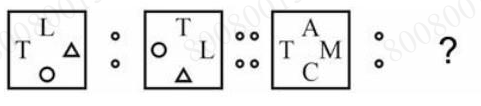
Question 8

Two figures given on the left side of (::) are related with some logic/rule/relation. Select the missing figure on the right side of (::) from the given alternatives based on the same logic/rule/relation.

  1. AOption (a)

  2. BOption (b)

  3. COption (c)

  4. DOption (d)

View answer & explanation

Correct answer

Answer: (c)C.

Why this answer is correct

Pattern followed here is,

<br> <br>

Similarly,

<br> <br>

Hence, the correct answer is “Option 3”.

Question 9

Select the option that is related to the third letter-number cluster in the same way as the second letter-number cluster is related to the first letter-number cluster and sixth letter-number cluster is related to fifth letter-number cluster. (NOTE: Operations should be performed on the whole numbers, without breaking down the numbers into its constituent digits. E.g.13 - Operations on 13 such as adding /subtracting /multiplying etc. to 13 can be performed. Breaking down 13 into 1 and 3 and then performing mathematical operations on 1 and 3 is not allowed)

DK400 : CL372 :: RU128 : ? :: JF178 : IG150

  1. AOption (a)

    QV100

  2. BOption (b)

    VQ108

  3. COption (c)

    QW68

  4. DOption (d)

    VS90

View answer & explanation

Correct answer

Answer: (a)A.

QV100

Why this answer is correct

<br> <br>

DK400 : CL372 → 

JF178 : IG150 →


Similarly,

RU128 : ? → 

Hence, the correct answer is 'Option 1'.

Question 10

Select the option that is related to the third letter-number cluster in the same way as the second letter-number cluster is related to the first letter-number cluster and sixth letter-number cluster is related to fifth letter-number cluster. (NOTE: Operations should be performed on the whole numbers, without breaking down the numbers into its constituent digits. E.g.13 - Operations on 13 such as adding /subtracting /multiplying etc. to 13 can be performed. Breaking down 13 into 1 and 3 and then performing mathematical operations on 1 and 3 is not allowed)

BQR120 : USC180 :: AKT60 : ? :: RFS200 : VHS300

  1. AOption (a)

    AMW90

  2. BOption (b)

    WMC80

  3. COption (c)

    BMW80

  4. DOption (d)

    WMB90

View answer & explanation

Correct answer

Answer: (d)D.

WMB90

Why this answer is correct

<br> <br>

BQR120 : USC180 →

RFS200 : VHS300 →

Similarly,

For, AKT60 ? →

Hence, the correct answer is 'Option 4'.

Question 11

Arrange the given words in the sequence in which they occur in the dictionary.

  1. Inexperience 2. Inexpensive 3. Inexpedient 4. Inexpressible 5. Inexpert
  1. AOption (a)

    23145

  2. BOption (b)

    32154

  3. COption (c)

    32145

  4. DOption (d)

    23154

View answer & explanation

Correct answer

Answer: (b)B.

32154

Why this answer is correct

Dictionary order of given words:

  1. Inexpedient
  2. Inexpensive
  3. Inexperience 
  4. Inexpert
  5. Inexpressible

Correct order is: 32154

Hence, the correct answer is “Option 2”.

Question 12

Select the option that is related to the third number in the same way as the second number is related to the first number and sixth number is related to fifth number. (NOTE: Operations should be performed on the whole numbers, without breaking down the numbers into its constituent digits. E.g.13 - Operations on 13 such as adding /subtracting /multiplying etc. to 13 can be performed. Breaking down 13 into 1 and 3 and then performing mathematical operations on 1 and 3 is not allowed)
78 : -241 :: 223 : ? :: 162 : -157

  1. AOption (a)

    -84

  2. BOption (b)

    -96

  3. COption (c)

    -88

  4. DOption (d)

    -85

View answer & explanation

Correct answer

Answer: (b)B.

-96

Why this answer is correct

The logic followed here is:

Logic: Second Number = First Number − 319

For the first pair 78 : −241

⇒ 78 − 319 = −241.

For the third pair 162 : −157

⇒ 162 − 319 = −157.

Applying the same logic to the second pair

223 : ?

⇒ 223 − 319 = −96.

Hence, the correct answer is 'Option 2'.

Question 13

In a certain coded language 'CURIA' is coded as 'FYQFV' and 'DALES' is coded as 'GEKBN'. How will 'APNEA' be coded in the same code language?

  1. AOption (a)

    DTMBV

  2. BOption (b)

    EUODW

  3. COption (c)

    FTMCT

  4. DOption (d)

    EROZX

View answer & explanation

Correct answer

Answer: (a)A.

DTMBV

Why this answer is correct

CURIA is coded as FYQFV →

DALES is coded as GEKBN →

Similarly,

let's find the code for APNEA:

Hence, the correct answer is “Option 1”.

Question 14

A series is given with one term missing. Select the correct alternative from the given ones that will complete the series. PC356, ?, LY300, JW272, HU244

  1. AOption (a)

    NA328

  2. BOption (b)

    OF327

  3. COption (c)

    NF329

  4. DOption (d)

    OE328

View answer & explanation

Correct answer

Answer: (a)A.

NA328

Why this answer is correct

<br> <br>

Pattern followed here is,

Hence, the correct answer is “Option 1”.

Question 15

A series is given with one term missing. Select the correct alternative from the given ones that will complete the series.

DAS106, ?, FCU288, GDV379, HEW470

  1. AOption (a)

    TEB199

  2. BOption (b)

    BET198

  3. COption (c)

    EBT197

  4. DOption (d)

    BTE196

View answer & explanation

Correct answer

Answer: (c)C.

EBT197

Why this answer is correct

<br> <br>

Pattern followed here is,

Hence, the correct answer is “Option 3”.

Question 16

A clock loses 15 minutes every hour. If after 10 hours the clock shows 5 PM, then what is the actual time (in PM)?

  1. AOption (a)

    10:30

  2. BOption (b)

    6:30

  3. COption (c)

    7:00

  4. DOption (d)

    7:30

View answer & explanation

Correct answer

Answer: (d)D.

7:30

Why this answer is correct

Given that the clock loses 15 minutes every 1 hour.

The duration for which the clock has been running is 10 hours.

Total time lost = Duration × Loss per hour

Total time lost = 10 × 15 minutes = 150 minutes

To convert the lost time from minutes to hours:

Total loss = 150 / 60 hours

Total loss = 2.5 hours

Since 0.5 hours is equal to 30 minutes, the total loss is 2 hours 30 minutes.

The time shown on the clock is 5 PM.

Actual time = Time shown on the clock + Total time lost

Actual time = 5:00 PM + 2 hours 30 minutes

Actual time = 7:30 PM

Hence, the correct answer is “Option 4”.

Question 17

In the following figure series, select the figure which can be placed at the sign of question mark (?) from the given alternatives.

  1. AOption (a)

  2. BOption (b)

  3. COption (c)

  4. DOption (d)

View answer & explanation

Correct answer

Answer: (b)B.

Why this answer is correct

Pattern followed here is,

Hence, the correct answer is “Option 2”.

Question 18

In the following figure series, select the figure which can be placed at the sign of question mark (?) from the given alternatives.

  1. AOption (a)

  2. BOption (b)

  3. COption (c)

  4. DOption (d)

View answer & explanation

Correct answer

Answer: (d)D.

Why this answer is correct

Pattern followed here is,

Hence, the correct answer is “Option 4”.

Question 19

The ratio of present ages of two students is 15 : 8. The difference between their ages is 14 years. What is the age of the elder student?

  1. AOption (a)

    30 years

  2. BOption (b)

    20 years

  3. COption (c)

    45 years

  4. DOption (d)

    40 years

View answer & explanation

Correct answer

Answer: (a)A.

30 years

Why this answer is correct

Let the age of the elder student be 15x and the age of the younger student be 8x.

Elder Student = 15x

Younger Student = 18x

According to the question:

Difference between ages = 15x − 8x

14 = 7x

x = 14 ÷ 7

x = 2

Age of the elder student = 15x

Age of the elder student = 15 × 2 = 30 years

Age of the younger student = 8x

Age of the younger student = 8 × 2 = 16 years

Hence, the correct answer is “Option 1”.

Question 20

P got married 12 years ago from present. The ratio of P's present age and her age at her marriage is 14 : 11 respectively. Her son's present age is (1/4) of her's age at the time of her marriage. After 3 years from present, what will be the age of P's son?

  1. AOption (a)

    14 years

  2. BOption (b)

    10 years

  3. COption (c)

    8 years

  4. DOption (d)

    7 years

View answer & explanation

Correct answer

Answer: (a)A.

14 years

Why this answer is correct

Present Age (Ratio) = 14 units


Age at Marriage (Ratio) = 11 units

<br>

Difference in ratio units = 14 − 11 = 3 units

<br>

According to the question, P got married 12 years ago.

So, 3 units = 12 years

1 unit = 12 ÷ 3 = 4 years

P's age at the time of marriage = 11 units = 11 × 4 = 44 years

P's present age = 14 units = 14 × 4 = 56 years

The son's present age is 1/4 of P's age at the time of her marriage.

Son's present age = (1/4) × 44 = 11 years

To find the age of the son after 3 years from the present:

Son's age after 3 years = 11 + 3 = 14 years

Hence, the correct answer is “Option 1”.

General Knowledge and General Awareness (20 questions)

Question 21

Which of the following novels was written by Mulk Raj Anand and focuses on the life of an untouchable?

  1. AOption (a)

    The Guide

  2. BOption (b)

    Untouchable

  3. COption (c)

    Train to Pakistan

  4. DOption (d)

    The White Tiger

View answer & explanation

Correct answer

Answer: (b)B.

Untouchable

Why this answer is correct

The correct answer is Untouchable.

Key Points

  • The novel Untouchable, published in 1935, is the debut work of Mulk Raj Anand, who is considered one of the pioneers of Indo-Anglian literature.
  • The plot depicts a single, grueling day in the life of Bakha, a young outcaste sweeper and manual scavenger who lives in a cantonment town called Bulashah.
  • The narrative focuses on the psychological and social impact of the caste system and social exclusion in pre-independence India, inspired by the experiences of the author’s own childhood.
  • The book gained international prominence due to its stark social realism and a famous preface written by the English novelist E.M. Forster.
  • The conclusion of the novel presents three possible solutions for the protagonist: conversion to Christianity, the Gandhian path of spiritual reform, or the introduction of the flush toilet to eliminate manual scavenging.

 Additional Information

  • Mulk Raj Anand:
  • A prolific writer and recipient of the Sahitya Akademi Award and Padma Bhushan.
  • His other notable works include Coolie (1936) and Two Leaves and a Bud (1937), both of which deal with the exploitation of the working class.
  • The Guide:
  • Written by R.K. Narayan in 1958, it centers on Raju, a guide in the fictional town of Malgudi, and won the Sahitya Akademi Award.
  • Train to Pakistan:
  • A classic novel by Khushwant Singh (1956) that narrates the human tragedy and violence during the 1947 Partition of India.
  • The White Tiger:
  • Authored by Aravind Adiga, this 2008 novel provides a satirical look at Indias class divide and won the Man Booker Prize.

Question 22

What is the thematic setting of Anita Desai's Clear Light of Day?

  1. AOption (a)

    A remote Himalayan village

  2. BOption (b)

    Bombay during WWII

  3. COption (c)

    A family in Old Delhi grappling with memory and the Partition

  4. DOption (d)

    An American academic in Mexico

View answer & explanation

Correct answer

Answer: (c)C.

A family in Old Delhi grappling with memory and the Partition

Why this answer is correct

The correct answer is A family in Old Delhi grappling with memory and the Partition.

Key Points

  • The novel is primarily set in a large, decaying family bungalow in Old Delhi, which serves as a poignant symbol for the stagnant and fading past of the Das family.
  • The narrative structure relies heavily on memory as a vehicle, moving backward from the post-Independence present to the siblings' childhood and adolescence during the Partition of India in 1947.
  • It explores the thematic core of how historical traumas, specifically the Partition, fractured the family unit, exemplified by the estrangement between Bimla (Bim) and her brother Raja.
  • The thematic setting involves the tension between the characters' current lives and their shared history, emphasizing the difficulty of escaping the weight of the past and the necessity of forgiveness.
  • The Partition is depicted not through direct violence but through its psychological aftermath and the physical displacement of characters like Hyder Ali, which fundamentally alters the family's social landscape.

 Additional Information

  • Anita Desai:
  • Born in 1937, she is an acclaimed Indian novelist who has been shortlisted for the Man Booker Prize three times, including for Clear Light of Day in 1980.
  • She is known for her lyrical prose and deep exploration of the inner consciousness and female subjectivity within the Indian context.
  • Character Dynamics:
  • Bimla (Bim): The eldest sister who remains in the family home, representing resilience and the eventual clarity of understanding.
  • Tara: The younger sister whose return to Delhi from abroad triggers the flood of memories and the process of familial reconciliation.
  • Baba: The youngest brother with an intellectual disability, who remains a constant, silent reminder of the family's vulnerability and stasis.
  • Historical Significance:
  • The novel is a major work of Partition Literature, shifting the focus from political events to the domestic sphere and the lasting emotional scars on individual lives.

Question 23

The purpose of the World Happiness Report is to:

  1. AOption (a)

    Track poverty alone

  2. BOption (b)

    Rank only developing countries

  3. COption (c)

    Provide data for investment decisions

  4. DOption (d)

    Measure well-being and guide policy for human happiness

View answer & explanation

Correct answer

Answer: (d)D.

Measure well-being and guide policy for human happiness

Why this answer is correct

The correct answer is Measure well-being and guide policy for human happiness.

Key Points

  • The World Happiness Report is an annual publication of the United Nations Sustainable Development Solutions Network (SDSN) that measures and ranks global happiness levels across more than 150 countries.
  • Its primary purpose is to provide a comprehensive analysis of subjective well-being, shifting the focus of governments from purely economic indicators like Gross Domestic Product (GDP) toward human-centric development.
  • The report uses data from the Gallup World Poll, where respondents rate their own lives using the Cantril Ladder method, scoring from 0 (worst possible life) to 10 (best possible life).
  • By identifying the factors that lead to higher life satisfaction, the report serves as a tool for policymakers, civil society, and international organizations to draft legislation that fosters a better quality of life.
  • The rankings provide a comparative framework to understand how public policy decisions, such as investments in healthcare or social safety nets, directly correlate with the emotional health and happiness of a population.

 Additional Information

  • The report analyzes six key variables to explain variation in happiness levels across the globe:
  • GDP per capita: Reflects the economic strength and purchasing power of the citizenry.
  • Social Support: The perceived availability of help from friends or relatives during difficult times.
  • Healthy Life Expectancy: The average number of years a person is expected to live in good health, based on World Health Organization (WHO) data.
  • Freedom to make life choices: The degree of individual autonomy and absence of coercion in daily life.
  • Generosity: Calculated by the average of responses regarding charitable donations made in the past month.
  • Perceptions of Corruption: The level of trust in government and business institutions.
  • The initiative originated from the 2011 UN General Assembly resolution, which was heavily influenced by Bhutan and its philosophy of Gross National Happiness (GNH).
  • The first World Happiness Report was released on April 1, 2012, to support the UN High-Level Meeting on Happiness and Well-Being.

Question 24

Under International Hockey Federation (FIH) rules, what is the standard duration of a modern field hockey match?

  1. AOption (a)

    2 halves of 35 mins

  2. BOption (b)

    4 quarters of 15 minutes

  3. COption (c)

    60 minutes of continuous play

  4. DOption (d)

    3 periods of 20 mins each

View answer & explanation

Correct answer

Answer: (b)B.

4 quarters of 15 minutes

Why this answer is correct

The correct answer is 4 quarters of 15 min.

Key Points

  • According to the International Hockey Federation (FIH) rules, the standard duration for a modern field hockey match consists of four quarters lasting 15 minutes each.
  • This format was officially introduced in September 2014 to enhance the intensity of the game and improve the viewing experience for fans and television audiences.
  • The transition replaced the previous structure, which consisted of two halves of 35 minutes each, totaling 70 minutes.
  • The modern 60-minute match includes specific rest intervals: a 2-minute break between the first and second quarters, a 2-minute break between the third and fourth quarters, and a 5-minute half-time interval between the second and third quarters.
  • Specific play stoppages are also integrated into the timing; for instance, the clock is stopped for 40 seconds after a goal is scored and after a penalty corner is awarded to ensure maximum active playing time.

 Additional Information

  • Strategic Objectives:
  • The shift to 15-minute quarters allows teams to maintain a higher tempo and tactical flexibility, as coaches have more opportunities to interact with players during the short breaks.
  • It aligns the sport with other major global team sports that utilize quarter-based systems, such as basketball and American football.
  • Tie-Breaking Procedures:
  • In the event of a draw during the knockout stages of major FIH tournaments, modern rules typically dictate a penalty shootout (8-second run-ins) rather than extra time or golden goals.
  • This ensures that matches adhere to strict broadcasting schedules while providing an exciting conclusion for spectators.

Question 25

Which BRICS summit was held in Beijing in 2022?

  1. AOption (a)

    12th

  2. BOption (b)

    13th

  3. COption (c)

    14th

  4. DOption (d)

    15th

View answer & explanation

Correct answer

Answer: (c)C.

14th

Why this answer is correct

The correct answer is 14th.

Key Points

  • The 14th BRICS Summit was hosted by China on June 23, 2022, in a virtual format due to the global COVID-19 situation.
  • The summit was chaired by Chinese President Xi Jinping and involved leaders from Brazil, Russia, India, China, and South Africa.
  • The theme of the 2022 summit was 'Foster High-quality BRICS Partnership, Usher in a New Era for Global Development'.
  • Key discussions focused on global governance, the 2030 Agenda for Sustainable Development, and strengthening multilateralism to address global challenges.
  • The Beijing Declaration was adopted at the end of the summit, highlighting the bloc's commitment to supporting emerging markets and developing countries.
  • A major highlight was the formal discussion on BRICS expansion, exploring the BRICS Plus cooperation model to include more developing nations.

 Additional Information

  • Chronology of BRICS Summits:
  • 12th BRICS Summit: Hosted virtually by Russia in 2020, with the theme 'BRICS Partnership for Global Stability, Shared Security and Innovative Growth'.
  • 13th BRICS Summit: Hosted by India in 2021 under the chairmanship of Prime Minister Narendra Modi, focusing on 'Intra-BRICS Cooperation for Continuity, Consolidation and Consensus'.
  • 15th BRICS Summit: Held in 2023 in Johannesburg, South Africa, which resulted in the landmark decision to invite six new nations to join the group.
  • Organizational Overview:
  • The BRICS grouping represents about 41 percent of the world population, 24 percent of the global GDP, and 16 percent of world trade.
  • The New Development Bank (NDB), headquartered in Shanghai, and the Contingent Reserve Arrangement (CRA) are the two primary financial mechanisms established by the bloc.
  • The first formal summit was held in Yekaterinburg, Russia, in 2009, and South Africa joined the group in December 2010, attending its first summit in 2011.

Question 26

A deficiency of insulin in the body can lead to:

  1. AOption (a)

    Goitre

  2. BOption (b)

    Diabetes

  3. COption (c)

    Dwarfism

  4. DOption (d)

    Hypertension

View answer & explanation

Correct answer

Answer: (b)B.

Diabetes

Why this answer is correct

The correct answer is Diabetes.

Key Points

  • Insulin is a critical peptide hormone produced and secreted by the beta cells of the islets of Langerhans located in the pancreas.
  • The primary biological role of insulin is to regulate blood glucose levels by facilitating the transport of glucose from the bloodstream into the liver, muscle, and adipose tissues for energy use or storage.
  • A deficiency of insulin, whether absolute (as in Type 1 Diabetes) or relative (as in Type 2 Diabetes), prevents the body from effectively absorbing sugar, leading to hyperglycemia (elevated blood sugar).
  • This metabolic imbalance results in Diabetes Mellitus, a chronic condition that can cause complications such as kidney failure, nerve damage, and cardiovascular diseases if left untreated.

 Additional Information

  • Goitre
  • It is an abnormal enlargement of the thyroid gland, often resulting from a lack of dietary iodine.
  • The deficiency affects the production of thyroxine, leading the pituitary gland to overstimulate the thyroid.
  • Dwarfism
  • This refers to short stature caused by a Growth Hormone (GH) deficiency during childhood.
  • It is associated with the anterior pituitary gland, which fails to secrete enough somatotropin for normal bone development.
  • Hypertension
  • Commonly known as high blood pressure, it is a condition where the force of the blood against the artery walls is persistently too high.
  • While it can be linked to diabetes, it is primarily driven by factors like sodium intake, stress, and obesity.

Question 27

Which event is considered the turning point in Ashoka's life, leading him to embrace dhamma?

  1. AOption (a)

    His coronation ceremony

  2. BOption (b)

    The Kalinga War

  3. COption (c)

    The alliance with Sri Lanka

  4. DOption (d)

    The revolt of Taxila

View answer & explanation

Correct answer

Answer: (b)B.

The Kalinga War

Why this answer is correct

The correct answer is The Kalinga War.

Key Points

  • The Kalinga War, fought in 261 BCE, is recorded in Major Rock Edict XIII and is recognized as the most significant event in the life of Mauryan Emperor Ashoka.
  • The war was waged against the state of Kalinga (modern-day Odisha), a powerful kingdom that controlled the land and sea routes to South India and Southeast Asia.
  • The conflict resulted in staggering casualties, with approximately 1,00,000 deaths and the deportation of 1,50,000 people, causing the Daya River to allegedly turn red with blood.
  • Witnessing the immense suffering and slaughter of both soldiers and innocent civilians triggered a deep sense of remorse and spiritual transformation in Ashoka.
  • This event prompted him to renounce Bherighosha (conquest by war) and adopt Dhammaghosha (conquest by righteousness/piety), leading to his conversion to Buddhism under the influence of the monk Upagupta.

 Additional Information

  • Coronation Ceremony:
  • Ashoka's formal coronation took place in 268 BCE, four years after he claimed the throne following a bitter succession struggle after the death of Bindusara.
  • In the initial years of his reign, he was known as Chandashoka (Fierce Ashoka) due to his ruthless expansionist policies and the construction of a torture chamber known as Ashoka's Hell.
  • Revolt of Taxila:
  • This rebellion occurred during the reign of Bindusara; Ashoka was sent as a Prince (Viceroy) to suppress it, demonstrating his military prowess long before his transformation.
  • Dhamma Policy:
  • The Mauryan Dhamma was a code of social ethics emphasizing Ahimsa (non-violence), tolerance, and kindness, which Ashoka propagated through Dhamma Mahamattas.
  • He sent his son Mahinda and daughter Sanghamitta to Sri Lanka specifically to spread the message of the Buddha, rather than for a purely political alliance.

Question 28

The banking sector reforms (1991) recommended by the Narasimham Committee included:

  1. AOption (a)

    Capital adequacy norms

  2. BOption (b)

    Interest rate deregulation

  3. COption (c)

    Reduction of Non-Performing Assets (NPA)

  4. DOption (d)

    All of these

View answer & explanation

Correct answer

Answer: (d)D.

All of these

Why this answer is correct

The correct answer is All of these.

Key Points

  • The Narasimham Committee I (1991), formally titled the Committee on the Financial System (CFS), was appointed by the Ministry of Finance to address the inefficiencies within the Indian banking sector and enhance its global competitiveness.
  • One of the primary recommendations was the adoption of Capital Adequacy Norms. The committee suggested that banks should achieve a capital to risk-weighted assets ratio (CRAR) of 8 percent in alignment with Bank for International Settlements (BIS) standards, which later led to the adoption of Basel-I norms.
  • The committee advocated for Interest Rate Deregulation, proposing that the Reserve Bank of India (RBI) should cease the administrative fixing of interest rates. This shift allowed market forces to determine rates, fostering a competitive environment and improving the operational efficiency of commercial banks.
  • To clean up bank balance sheets, the committee suggested measures for the Reduction of Non-Performing Assets (NPAs). This included the introduction of standardized Asset Classification and Income Recognition norms, as well as the proposal for an Asset Reconstruction Fund (ARF) to take over bad debts at a discount.

 Additional Information

  • Other major recommendations of the 1991 committee included:
  • A gradual reduction of the Statutory Liquidity Ratio (SLR) from its high levels of 38.5 percent to 25 percent and a reduction in the Cash Reserve Ratio (CRR) to increase the availability of funds for commercial lending.
  • Introduction of a Four-Tier Banking Structure, comprising international banks, national banks, regional banks, and local banks to improve the systemic organization.
  • Abolition of Branch Licensing policies to provide banks with functional autonomy and flexibility in expanding their reach.
  • Enhanced Supervisory Control through the establishment of a quasi-autonomous body under the RBI, which eventually became the Board for Financial Supervision (BFS).

Question 29

What was the primary function of the Ur in Chola administration?

  1. AOption (a)

    Military recruitment

  2. BOption (b)

    Temple construction

  3. COption (c)

    village-level governance

  4. DOption (d)

    Tax collection from foreign merchants

View answer & explanation

Correct answer

Answer: (c)C.

village-level governance

Why this answer is correct

The correct answer is village-level governance.

Key Points

  • The Ur was a general assembly of the residents in the Chola administration, specifically designed to handle village-level governance in ordinary settlements.
  • It primarily consisted of local tax-paying residents and landowners who managed the daily affairs of the village, ensuring smooth local administration.
  • The Ur was responsible for the management of communal resources, including the maintenance of irrigation tanks, village ponds, and grazing lands for cattle.
  • This body acted as a judicial and executive authority at the grass-roots level, resolving land disputes and collecting local dues to be passed to the state.
  • The existence of the Ur signifies the highly decentralized nature of the Chola Empire, where local assemblies enjoyed significant autonomy in decision-making.

 Additional Information

  • Other Local Assemblies:
  • Sabha or Mahasabha: This was an assembly of Brahmin adult males found in Brahmadeya villages (lands gifted to Brahmins). It operated through specialized committees called Variyams.
  • Nagaram: This was an organization of merchants and traders found in commercial towns and trade centers, managing market-related activities and urban taxation.
  • Administrative Structure:
  • The Chola Empire was structured into Mandalams (provinces), which were further divided into Valanadus and Nadus (districts).
  • The Uttaramerur Inscriptions, dating to the reign of Parantaka I, provide comprehensive details about the eligibility criteria and the Kudavolai (lot) system used to elect members to these local bodies.

Question 30

"Stagflation" is a situation of:

  1. AOption (a)

    Inflation + Trade surplus

  2. BOption (b)

    Inflation + Growth in employment

  3. COption (c)

    Inflation + Rising Gross Domestic Product

  4. DOption (d)

    Inflation + Unemployment

View answer & explanation

Correct answer

Answer: (d)D.

Inflation + Unemployment

Why this answer is correct

The correct answer is Inflation + Unemployment.

Key Points

  • Stagflation is a unique economic condition characterized by a combination of stagnant economic growth, high unemployment, and high inflation occurring simultaneously.
  • The term is a portmanteau of stagnation and inflation, famously coined by British politician Iain Macleod during a speech to the House of Commons in 1965.
  • It represents a contradiction in traditional Keynesian economics, which suggests that inflation and unemployment usually have an inverse relationship, as described by the Phillips Curve.
  • In a stagflationary environment, the purchasing power of consumers erodes due to rising prices, while the Gross Domestic Product (GDP) remains flat or declines, leading to widespread job losses.
  • This situation creates a policy dilemma for central banks, as standard measures to curb inflation (like raising interest rates) typically exacerbate unemployment, while measures to boost employment can further fuel inflation.

 Additional Information

  • Primary Causes of Stagflation:
  • Supply Shocks: Sudden constraints in the supply of essential commodities, such as the 1973 Oil Crisis, which led to a spike in energy costs and production expenses globally.
  • Monetary Mismanagement: Excessive expansion of the money supply by a central bank while the economy is facing production bottlenecks.
  • Structural Rigidities: Inefficiencies in the labor market or excessive government regulations that prevent the economy from adjusting to supply-side changes.
  • Economic Indicators:
  • Misery Index: This index is calculated by adding the unemployment rate to the inflation rate, and it reaches peak levels during periods of stagflation.
  • Cost-Push Inflation: Unlike demand-pull inflation, stagflation is often driven by rising input costs (wages, raw materials) rather than excessive consumer demand.

Question 31

Loo is ____ and ____ local wind of northern plane of India.

  1. AOption (a)

    hot, dry

  2. BOption (b)

    cold, dry

  3. COption (c)

    hot, wet

  4. DOption (d)

    cold, wet

View answer & explanation

Correct answer

Answer: (a)A.

hot, dry

Why this answer is correct

The correct answer is hot, dry.

Key Points

  • The Loo is a powerful, gusty, and intense local wind that specifically characterizes the summer climate of the Northern Plains (Indo-Gangetic Plain) of India and Pakistan.
  • It is scientifically classified as a hot and dry wind, usually blowing during the peak summer months of May and June when the thermal gradient is highest.
  • These winds typically originate from the Thar Desert in Rajasthan and the arid regions of Balochistan, gaining heat as they travel across the sun-scorched plains.
  • The temperature of the Loo often ranges between 45°C and 50°C, which is significantly higher than the average ambient temperature, leading to extreme heatwaves.
  • The dryness of the Loo is a result of the wind passing over vast landmasses with minimal moisture, causing rapid evaporation and severe thermal discomfort for all living organisms.
  • Direct exposure to this wind is extremely dangerous and can lead to fatal heatstrokes or hyperthermia due to the body's inability to cool down through sweating in such parched conditions.

 Additional Information

  • Classification of Local Winds:
  • Chinook: Known as the Snow Eater, these are warm, dry winds that descend the eastern slopes of the Rocky Mountains in North America.
  • Mistral: A cold and dry wind that blows from the north through the Rhone Valley toward the Mediterranean Sea during winter.
  • Harmattan: A dry, dusty wind blowing from the Sahara Desert toward the West African coast, known locally as The Doctor for its cooling effect on humid air.
  • Sirocco: A Mediterranean wind that comes from the Sahara and reaches hurricane speeds in North Africa and Southern Europe as a hot, dry wind.
  • Related Indian Phenomena:
  • Mango Showers: Pre-monsoon rainfall in Karnataka and Kerala that assists in the ripening of mangoes and provides relief from the summer heat.
  • Kal Baisakhi: Violent thunderstorms or Nor'westers that occur in West Bengal and Assam, bringing localized rain and cooling.
  • Elephantine: A local wind in the Malabar Coast that marks the transition towards the end of the monsoon season.

Question 32

Which of the following statement regarding the Directive principal of state policy of the Indian constitution is correct?

I. Article 39 is related with State to secure a social order for the promotion of welfare of the people.

II. Article 40 is related with Organisation of village panchayats.

  1. AOption (a)

    Only I

  2. BOption (b)

    Only II

  3. COption (c)

    Both I and II

  4. DOption (d)

    Neither I Nor II

View answer & explanation

Correct answer

Answer: (b)B.

Only II

Why this answer is correct

The correct answer is Only II.

Key Points

  • Article 38 of the Indian Constitution directs the State to secure a social order for the promotion of the welfare of the people by ensuring social, economic, and political justice. Statement I incorrectly attributes this mandate to Article 39. Hence, statement I is incorrect.
  • Article 40 requires the State to take steps to organize village panchayats and endow them with such powers and authority as may be necessary to enable them to function as units of self-government. Hence, statement II is correct.
  • The Directive Principles of State Policy (DPSP) are enshrined in Part IV of the Constitution of India, spanning from Article 36 to Article 51.
  • While the DPSPs are non-justiciable, Article 37 declares that these principles are fundamental in the governance of the country, and it shall be the duty of the State to apply these principles in making laws.

 Additional Information

  • Article 39:
  • It contains specific principles of policy to be followed by the State, such as ensuring adequate means of livelihood for all citizens and the equitable distribution of material resources.
  • It also promotes equal pay for equal work for both men and women and the prevention of concentration of wealth.
  • Classification of DPSP:
  • Socialistic Principles: These aim at establishing a welfare state (e.g., Articles 38, 39, 41, 42, 43, 43A, 47).
  • Gandhian Principles: Based on the ideology of Mahatma Gandhi (e.g., Articles 40, 43, 43B, 46, 47, 48).
  • Liberal-Intellectual Principles: These reflect the ideology of liberalism (e.g., Articles 44, 45, 48, 48A, 49, 50, 51).
  • Constitutional Amendments:
  • The 42nd Amendment Act of 1976 added four new DPSPs: Article 39 (opportunities for healthy development of children), Article 39A (Free legal aid), Article 43A, and Article 48A.
  • The 73rd Amendment Act of 1992 provided a constitutional status to Panchayati Raj institutions, fulfilling the objective of Article 40.

Question 33

The next census of India will be conducted in how many phases?

  1. AOption (a)

    2

  2. BOption (b)

    3

  3. COption (c)

    4

  4. DOption (d)

    5

View answer & explanation

Correct answer

Answer: (a)A.

2

Why this answer is correct

The correct answer is 2.

Key Points

  • The upcoming Census of India is scheduled to be conducted in two distinct phases to ensure systematic data collection across the vast geography of the country.
  • Phase I is the Houselisting and Housing Census. During this phase, enumerators visit every house to record data concerning the structure of the house, available amenities (like water and electricity), and assets owned by the household.
  • Phase II is the Population Enumeration. This is the stage where the actual headcounting of the population takes place, collecting detailed information on demographics, religion, literacy, occupation, and migration.
  • The next census will be the first Digital Census in India, where data will be collected through a mobile application instead of traditional paper forms, allowing for faster processing and analysis.

 Additional Information

  • Administrative Framework:
  • The census is conducted under the Census Act, 1948.
  • The nodal agency is the Office of the Registrar General and Census Commissioner, which operates under the Ministry of Home Affairs.
  • Historical Context:
  • The first non-synchronous census in India was held in 1872 during the tenure of Lord Mayo.
  • The first synchronous census (conducted simultaneously across the country) took place in 1881 under Lord Ripon.
  • Since 1881, the census has been conducted every 10 years without fail until the 2021 cycle was delayed.
  • Significance:
  • Census data is vital for delimitation of constituencies, resource allocation, and framing government welfare policies.

Question 34

On 9th May 2025, who held that it is not the duty of courts to instruct the media to delete or take down content?

  1. AOption (a)

    Allahabad High Court

  2. BOption (b)

    Law Commission of India

  3. COption (c)

    Supreme Court of India

  4. DOption (d)

    Patna High Court

View answer & explanation

Correct answer

Answer: (c)C.

Supreme Court of India

Why this answer is correct

The correct answer is Supreme Court of India.

Key Points

  • On 9th May 2025, the Supreme Court of India emphasized that the judiciary should not assume the role of an editorial board or a content regulator for the media.
  • The bench clarified that it is not the inherent duty of the courts to issue orders for the deletion or takedown of published news content, as this falls under editorial autonomy.
  • This observation reinforces the Freedom of Speech and Expression guaranteed under Article 19(1)(a) of the Constitution of India, protecting the press from judicial censorship.
  • The court highlighted that judicial intervention in removing content should only occur when there is a clear violation of statutory laws, public order, or national security.
  • This ruling promotes judicial restraint and maintains the separation of powers by preventing courts from overstepping into the domain of media regulation and content management.

 Additional Information

  • Supreme Court of India:
  • It is the highest judicial authority in India, established on 28th January 1950.
  • The court exercises Original, Appellate, and Advisory jurisdiction and is the final interpreter of the Constitution.
  • Allahabad High Court:
  • Established in 1866, it is one of the oldest High Courts in India and has the highest number of sanctioned judges.
  • Law Commission of India:
  • An advisory body that works for legal reform and is typically composed of legal experts and headed by a retired judge.
  • Patna High Court:
  • The High Court for the state of Bihar, established in 1916 under the Letters Patent.
  • Article 19(1)(a):
  • Ensures Freedom of Speech and Expression, which includes freedom of the press, subject to reasonable restrictions under Article 19(2).

Question 35

According to the Indian Constitution, which of the following pair of subject – list is correct?

I. Adoption and Succession – State list

II. Trade and Commerce – Concurrent List

  1. AOption (a)

    Only I

  2. BOption (b)

    Only II

  3. COption (c)

    Both I and II

  4. DOption (d)

    Neither I nor II

View answer & explanation

Correct answer

Answer: (d)D.

Neither I nor II

Why this answer is correct

The correct answer is Neither I nor II.

Key Points

  • The Seventh Schedule of the Indian Constitution, under Article 246, distributes legislative powers between the Union and the States through the Union List, State List, and Concurrent List.
  • Adoption and Succession: These subjects are explicitly mentioned under Entry 5 of the Concurrent List (List III), which includes marriage, divorce, infants, minors, adoption, and all matters related to succession and wills. Hence, statement I is incorrect.
  • Trade and Commerce: Entry 26 of the State List (List II) deals with trade and commerce within the state, while Entry 42 of the Union List (List I) covers inter-state trade and commerce; these are not classified as general subjects of the Concurrent List. Hence, statement II is incorrect.

 Additional Information

  • Union List (List I):
  • Includes subjects of national importance such as Defense, Foreign Affairs, Atomic Energy, Banking, and Post and Telegraph.
  • The Parliament has the exclusive power to legislate on the 100 items currently listed.
  • State List (List II):
  • Includes subjects related to local interest such as Public Order, Police, Public Health, Sanitation, and Agriculture.
  • The State Legislature typically has exclusive authority over these 61 items.
  • Concurrent List (List III):
  • Features 52 items where both the Central Government and State Governments share jurisdiction.
  • Examples include Education, Forests, Criminal Law, Protection of Wild Animals and Birds, and Trade Unions.
  • In case of a conflict between Union and State laws on these subjects, the Union Law prevails.

Question 36

In Maharashtra, which festival marks the beginning of the New Year?

  1. AOption (a)

    Baisakhi

  2. BOption (b)

    Ugadi

  3. COption (c)

    Onam

  4. DOption (d)

    Gudhi Padwa

View answer & explanation

Correct answer

Answer: (d)D.

Gudhi Padwa

Why this answer is correct

The correct answer is Gudhi Padwa.

Key Points

  • Gudhi Padwa is the traditional New Year celebrated by the people of Maharashtra and Goa.
  • It is observed on the first day of the Chaitra month, marking the beginning of the Hindu Luni-Solar Calendar.
  • The festival commemorates the day Lord Brahma is believed to have created the universe and the start of the Shalivahana Shaka era following King Shalivahana victory over his enemies.
  • The main ritual involves hoisting the Gudhi, a decorated pole topped with an inverted silver or copper pot (Kalash), wrapped in a silk cloth, and adorned with neem leaves, mango leaves, and garlands of sugar crystals (Gathi).
  • Symbolically, the Gudhi represents the Brahmadhvaja (Brahma flag) or the flag of victory, intended to ward off evil and invite prosperity into the home.
  • Culinary traditions include eating a paste of neem leaves mixed with jaggery to represent the various flavors of life, followed by festive dishes like Puran Poli and Shrikhand.

 Additional Information

  • Baisakhi:
  • It is the harvest festival and New Year for the Sikh community, primarily celebrated in Punjab.
  • It marks the establishment of the Khalsa Panth by Guru Gobind Singh in 1699.
  • Ugadi:
  • Celebrated as the New Year in the southern states of Andhra Pradesh, Telangana, and Karnataka.
  • Similar to Gudhi Padwa, it marks the first day of the Chaitra month but follows different regional customs like the preparation of Ugadi Pachadi.
  • Onam:
  • This is the most significant harvest festival of Kerala.
  • It honors the home-coming of the legendary King Mahabali and features the Vallam Kali (Snake Boat Race) and Pookalam (flower rangoli).

Question 37

What is the lift off weight of ISRO's Small Satellite Launch Vehicle (SSLV)?

  1. AOption (a)

    420 tonnes

  2. BOption (b)

    120 tonnes

  3. COption (c)

    840 tonnes

  4. DOption (d)

    1020 tonnes

View answer & explanation

Correct answer

Answer: (b)B.

120 tonnes

Why this answer is correct

The correct answer is 120 tonnes.

Key Points

  • The Small Satellite Launch Vehicle (SSLV) is a small-lift launch vehicle developed by the Indian Space Research Organisation (ISRO) to deliver satellites into Low Earth Orbit (LEO).
  • The vehicle features a lift-off weight of approximately 120 tonnes, making it a much lighter and more compact rocket compared to the Polar Satellite Launch Vehicle (PSLV) which weighs around 320 tonnes.
  • It stands at a height of 34 meters with a diameter of 2 meters, designed for high flexibility and efficiency in launch operations.
  • The SSLV is specifically engineered for launch-on-demand capability, allowing for a turnaround time of just 72 hours and requiring only 6 people for integration.
  • It is capable of carrying a payload mass of up to 500 kg to a 500 km planar orbit, making it ideal for the commercial small satellite market.

 Additional Information

  • Technical Specifications and Architecture:
  • Propulsion System: The vehicle is a three-stage rocket where all the primary stages utilize solid propulsion technology for simplified logistics and lower costs.
  • Velocity Trimming Module (VTM): It features a liquid-based terminal stage that ensures precise orbital injection and velocity trimming for the payloads.
  • Mission Capability: The SSLV can accommodate multiple satellite deployments, including nanosatellites, microsatellites, and mini-satellites.
  • Strategic Goal: By reducing the cost of access to space, ISRO aims to capture a significant share of the global small satellite launch market through its commercial arm, NewSpace India Limited (NSIL).
  • Historical Milestones: The successful SSLV-D2 mission in February 2023 demonstrated the vehicle's capability by placing the EOS-07, Janus-1, and AzaadiSAT-2 satellites into their intended orbits.

Question 38

Why are the soles of shoes grooved?

  1. AOption (a)

    To make them soft

  2. BOption (b)

    To improve design

  3. COption (c)

    To provide better grip and safety

  4. DOption (d)

    To reduce the weight of shoes

View answer & explanation

Correct answer

Answer: (c)C.

To provide better grip and safety

Why this answer is correct

The correct answer is To provide better grip and safety.

Key Points

  • The primary scientific reason for grooving shoe soles is to increase the frictional force between the shoe and the ground surface.
  • By creating deep patterns and roughness on the sole, the surface area for mechanical interlocking increases, which prevents the foot from sliding forward or backward during movement.
  • In the presence of lubricants like water, oil, or mud, these grooves act as drainage channels to expel the liquid, ensuring that the rubber material maintains direct contact with the solid ground.
  • Increased traction provided by grooved soles is a critical safety requirement for locomotion, as it allows the body to apply a reaction force against the ground to move without falling.
  • This design is essential for preventing accidental slips and injuries, especially on smooth, wet, or uneven surfaces where the coefficient of friction is naturally low.

 Additional Information

  • Frictional Physics:
  • Static Friction: The grooves help maintain a high level of static friction, which is the force that keeps an object at rest when a force is applied.
  • Kinetic Friction: Once in motion, the tread pattern ensures that kinetic friction remains high enough to control stopping distances and direction changes.
  • Specialized Tread Patterns:
  • Herringbone Pattern: Commonly used in basketball shoes to provide maximum grip for quick pivoting and lateral movements on hardwood courts.
  • Lugged Soles: Found in hiking boots, these utilize deep, wide grooves to provide stability on loose soil, rocks, and rugged terrain.
  • Cleats: In sports like football or soccer, the grooves are replaced by large protrusions (studs) to penetrate soft surfaces for extreme grip.
  • Industrial Application:
  • Safety Footwear in factories often follows specific ISO standards for slip resistance, requiring specialized grooving to handle spills of industrial chemicals or grease.
  • Comparison with Tires:
  • Much like shoes, automobile tires utilize a similar concept called tread. A bald tire (one without grooves) is prone to hydroplaning, where a layer of water builds up between the tire and the road, leading to a complete loss of control.

Question 39

Which of the following is NOT an example of Non-Conventional Energy Resource?

  1. AOption (a)

    Wind Energy

  2. BOption (b)

    Solar Energy

  3. COption (c)

    Tidal Energy

  4. DOption (d)

    Thermal Energy

View answer & explanation

Correct answer

Answer: (d)D.

Thermal Energy

Why this answer is correct

The correct answer is Thermal Energy.

Key Points

  • Conventional energy resources are traditional sources of energy that have been used for a long time, are generally non-renewable, and are available in limited quantities in nature.
  • Thermal energy, specifically power generated from the combustion of fossil fuels like coal, petroleum, and natural gas, is a classic example of a conventional energy source because these resources take millions of years to form and cannot be easily replaced once exhausted.
  • Non-conventional energy resources, also known as renewable energy, are those that are replenished by natural processes at a rate equal to or faster than their consumption.
  • Resources such as wind, solar, and tidal energy are categorized as non-conventional because they are inexhaustible, eco-friendly, and have gained prominence recently as alternatives to fossil fuels to combat climate change.
  • While the term 'thermal' can refer to heat in a general sense, in the energy sector, it predominantly identifies large-scale thermal power plants that rely on the chemical energy of carbon-based fuels to produce steam and drive turbines.

 Additional Information

  • Wind Energy:
  • Utilizes wind turbines to convert the kinetic energy of air into electricity.
  • It is a pollution-free source that requires minimal maintenance once the infrastructure is established.
  • Solar Energy:
  • Harnessed from sunlight using photovoltaic cells or concentrated solar power systems.
  • India has a high potential for this resource due to its geographical location in the tropical zone.
  • Tidal Energy:
  • A form of hydropower that converts the energy obtained from tides into useful forms of power, mainly electricity.
  • It is highly predictable compared to wind and solar energy due to the gravitational cycles of the moon and sun.
  • Comparison:
  • Conventional: Coal, Oil, Natural Gas, and Large Hydro (often grouped here due to long-standing use).
  • Non-Conventional: Solar, Wind, Tidal, Geothermal, Biomass, and Hydrogen energy.

Question 40

In which city was the first IPL final played in 2008?

  1. AOption (a)

    Navi Mumbai

  2. BOption (b)

    Chennai

  3. COption (c)

    Jaipur

  4. DOption (d)

    Lucknow

View answer & explanation

Correct answer

Answer: (a)A.

Navi Mumbai

Why this answer is correct

The correct answer is Navi Mumbai.

Key Points

  • The inaugural season of the Indian Premier League (IPL) reached its climax on June 1, 2008, after a series of high-intensity matches featuring eight franchises.
  • The first-ever IPL Final was hosted at the DY Patil Stadium, which is located in Navi Mumbai, Maharashtra, rather than at the traditional Wankhede Stadium.
  • The final match was contested between the Rajasthan Royals, captained by the legendary Australian leg-spinner Shane Warne, and the Chennai Super Kings, led by MS Dhoni.
  • Rajasthan Royals emerged as the champions of the 2008 season by successfully chasing a target of 164 runs, securing victory by 3 wickets on the final ball of the game.
  • This historic event at Navi Mumbai marked the beginning of one of the most successful and lucrative T20 cricket leagues in the world.

 Additional Information

  • DY Patil Stadium:
  • Located in Nerul, Navi Mumbai, it is a multi-purpose sports facility with a capacity of approximately 55,000 spectators.
  • In addition to the 2008 IPL Final, the stadium has also hosted the IPL Final in 2010 and matches for the FIFA U-17 World Cup.
  • Chennai:
  • This city is the home base for the Chennai Super Kings, who play at the M.A. Chidambaram Stadium (Chepauk). While they were the runners-up in 2008, the final was not held here that year.
  • Jaipur:
  • Known as the Pink City, it is the home city for the Rajasthan Royals. Their primary venue is the Sawai Mansingh Stadium, where most of their home matches were played during the 2008 season.
  • Lucknow:
  • While Lucknow is a major cricketing hub today with the Ekana Cricket Stadium and the Lucknow Super Giants franchise, it did not have a team or host any matches during the inaugural IPL season in 2008.

Elementary Mathematics (20 questions)

Question 41

91 + (74 - 23) + 64 - 58 + 35 = ?

  1. AOption (a)

    183

  2. BOption (b)

    179

  3. COption (c)

    185

  4. DOption (d)

    187

View answer & explanation

Correct answer

Answer: (a)A.

183

Why this answer is correct

Shortcut Trick

Solve the bracket first: 74 − 23 = 51.

Group all positive terms and sum them: 91 + 51 + 64 + 35 = 241.

Subtract the negative term: 241 − 58 = 183.

∴ The correct answer is 183.

Alternate Method

Given: 91 + (74 − 23) + 64 − 58 + 35

Using the BODMAS rule (Brackets, Orders, Division, Multiplication, Addition, Subtraction):

⇒ 91 + 51 + 64 − 58 + 35

⇒ 142 + 64 − 58 + 35

⇒ 206 − 58 + 35

⇒ 148 + 35

⇒ 183

∴ The correct answer is 183.

Additional Information

BODMAS Rule

The BODMAS rule determines the sequence of mathematical operations to ensure consistent results: Brackets first, Orders (powers), then Division/Multiplication, followed by Addition/Subtraction.

Addition and Subtraction Priority

Addition and subtraction are of the same priority level and can be performed from left to right or by grouping all positive and negative terms separately.

Question 42

Evaluate: [(0.86 ÷ 0.04)2 + (3.5 + 0.5)3 ÷ (2.5 – 0.5)3] × 2

  1. AOption (a)

    340.5

  2. BOption (b)

    540.5

  3. COption (c)

    740.5

  4. DOption (d)

    940.5

View answer & explanation

Correct answer

Answer: (d)D.

940.5

Why this answer is correct

Shortcut Trick

Solve parts separately: (0.86 ÷ 0.04)2 = 21.52 = 462.25.

For the ratio of cubes: (43 ÷ 23) = (4 ÷ 2)3 = 23 = 8.

Total value within bracket = 462.25 + 8 = 470.25.

Final calculation: 470.25 × 2 = 940.5.

∴ The correct answer is 940.5.

Alternate Method

Given: [(0.86 ÷ 0.04)2 + (3.5 + 0.5)3 ÷ (2.5 − 0.5)3] × 2

Method: Apply the BODMAS rule to solve the operations in the correct sequence.

⇒ [(21.5)2 + (4)3 ÷ (2)3] × 2

⇒ [462.25 + 64 ÷ 8] × 2

⇒ [462.25 + 8] × 2

⇒ 470.25 × 2

⇒ 940.5

∴ The correct answer is 940.5.

Additional Information

BODMAS Rule

The rule defines the order of operations: Brackets, Orders (Exponents/Roots), Division and Multiplication (left to right), and Addition and Subtraction (left to right).

Laws of Exponents

For any numbers a and b with exponent n, the property (an ÷ bn) = (a ÷ b)n can be used to simplify calculations involving squares or cubes.

Decimal Division

When dividing decimals like 0.86 ÷ 0.04, multiply both the numerator and denominator by 100 to convert them into whole numbers (86 ÷ 4) before evaluating.

Question 43

Which of the following is the smallest?

  1. AOption (a)

    10/11

  2. BOption (b)

    11/12

  3. COption (c)

    7/8

  4. DOption (d)

    13/14

View answer & explanation

Correct answer

Answer: (c)C.

7/8

Why this answer is correct

Shortcut Trick

Check the difference between the Denominator and Numerator for each fraction.

For 10/11: 11 − 10 = 1 | For 11/12: 12 − 11 = 1 | For 7/8: 8 − 7 = 1 | For 13/14: 14 − 13 = 1.

When the difference is constant, the fraction with the smallest numerator is the smallest.

Comparing numerators 10, 11, 7, and 13, the smallest is 7.

∴ The correct answer is 7/8.

Alternate Method

Given: Fractions are 10/11, 11/12, 7/8, and 13/14.

Formula Used: Converting fractions to decimals for direct comparison.

Calculations:

⇒ 10 ÷ 11 ≈ 0.909

⇒ 11 ÷ 12 ≈ 0.916

⇒ 7 ÷ 8 = 0.875

⇒ 13 ÷ 14 ≈ 0.928

Comparing the decimal values: 0.875 < 0.909 < 0.916 < 0.928.

⇒ Smallest decimal value = 0.875

∴ The correct answer is 7/8.

Additional Information

Proper Fractions Comparison

For proper fractions (numerator < denominator) with the same difference between numerator and denominator, the fraction with the larger numerator is the largest, and the one with the smaller numerator is the smallest.

Cross-Multiplication Method

To compare a/b and c/d, calculate a × d and b × c. If a × d < b × c, then a/b < c/d.

Improper Fractions Comparison

For improper fractions (numerator > denominator) with the same difference, the rule is reversed: the fraction with the larger numerator is actually the smaller one.

Question 44

Which of the following lies between (13/6) & (9/4)?

  1. AOption (a)

    31/14

  2. BOption (b)

    15/7

  3. COption (c)

    19/8

  4. DOption (d)

    25/9

View answer & explanation

Correct answer

Answer: (a)A.

31/14

Why this answer is correct

Shortcut Trick

Convert the given fractions and options into decimal values for a quick comparison.

Given Range: 13/6 ≈ 2.167 and 9/4 = 2.25.

Option 1: 31/14 ≈ 2.214 (Lies between 2.167 and 2.25).

Option 2: 15/7 ≈ 2.143 | Option 3: 19/8 = 2.375 | Option 4: 25/9 ≈ 2.778.

∴ The correct answer is 31/14.

Alternate Method

Given: Two fractions 13/6 and 9/4.

Formula Used: To find a rational number between two fractions, we can equate denominators or compare their numerical values.

⇒ Lower Bound: 13/6 = 2.1666...

⇒ Upper Bound: 9/4 = 2.25

⇒ Let us check Option 1: 31/14

⇒ 31 ÷ 14 ≈ 2.2142

⇒ Comparing values: 2.167 < 2.214 < 2.25

⇒ Check Option 2: 15/7 ≈ 2.142 (Smaller than 2.167)

⇒ Check Option 3: 19/8 = 2.375 (Larger than 2.25)

⇒ Check Option 4: 25/9 ≈ 2.777 (Larger than 2.25)

∴ The correct answer is 31/14.

Additional Information

Density Property of Rational Numbers

Between any two rational numbers, there exist infinitely many other rational numbers. A simple way to find one is the mean: (a + b) ÷ 2.

Comparing Fractions

To compare a/b and c/d, check the products (a × d) and (b × c). If a × d > b × c, then a/b > c/d.

Common Denominator Method

Convert all fractions to a Least Common Multiple (LCM) of their denominators to make direct comparison of numerators easier.

Question 45

(8+2)2+(8−2)260=? \frac{(\sqrt{8}+\sqrt{2})^2 + (\sqrt{8}-\sqrt{2})^2}{60} = ?

  1. AOption (a)

    1/2

  2. BOption (b)

    1/3

  3. COption (c)

    3/2

  4. DOption (d)

    4/3

View answer & explanation

Correct answer

Answer: (b)B.

1/3

Why this answer is correct

Shortcut Trick

Apply the algebraic identity: (a + b)2 + (a − b)2 = 2(a2 + b2)

Here, a = √8 and b = √2.

Numerator = 2((√8)2 + (√2)2) = 2(8 + 2) = 2 × 10 = 20

Required value = 20 ÷ 60 = 1/3

∴ The correct answer is 1/3.

Alternate Method

Given Expression: [(√8 + √2)2 + (√8 − √2)2] ÷ 60

Method: Expanding the squares using (a ± b)2 = a2 + b2 ± 2ab

⇒ First term: (√8 + √2)2 = (√8)2 + (√2)2 + 2(√8 × √2)

⇒ 8 + 2 + 2√16 = 10 + 2(4) = 18

⇒ Second term: (√8 − √2)2 = (√8)2 + (√2)2 − 2(√8 × √2)

⇒ 8 + 2 − 2√16 = 10 − 2(4) = 2

⇒ Expression = (18 + 2) ÷ 60

⇒ 20 ÷ 60 = 1/3

∴ The correct answer is 1/3.

Additional Information

Algebraic Identity for Sum

The formula (a + b)2 + (a − b)2 = 2(a2 + b2) simplifies calculations where the middle terms (+2ab and −2ab) cancel out.

Algebraic Identity for Difference

The formula (a + b)2 − (a − b)2 = 4ab is used when the squared terms (a2 and b2) cancel out.

Simplifying Surds

Numbers under a square root can be simplified if they have perfect square factors, e.g., √8 = √(4 × 2) = 2√2.

Question 46

The area of a rectangle is 54 square cm. The length of the rectangle is 6 cm. What is the breadth (in cm) of the rectangle?

  1. AOption (a)

    8

  2. BOption (b)

    9

  3. COption (c)

    7

  4. DOption (d)

    6

View answer & explanation

Correct answer

Answer: (b)B.

9

Why this answer is correct

Shortcut Trick

In a Rectangle, the relationship between Area, Length, and Breadth is Area = Length × Breadth.

Given Area = 54 cm2 and Length = 6 cm.

Breadth = 54 ÷ 6 = 9 cm.

∴ The correct answer is 9 cm.

Alternate Method

Given:

Area of the Rectangle = 54 cm2

Length (l) of the Rectangle = 6 cm

Formula Used:

Area of Rectangle = Length × Breadth

Calculations:

⇒ Area = Length × Breadth

⇒ 54 = 6 × Breadth

⇒ Breadth = 54 ÷ 6

⇒ Breadth = 9 cm

∴ The correct answer is 9 cm.

Additional Information

Perimeter of Rectangle

The Perimeter is the total boundary length, calculated as P = 2 × (Length + Breadth).

Diagonal of Rectangle

The Diagonal (d) connects opposite corners and is found using Pythagoras theorem: d = √(Length2 + Breadth2).

Square Property

A Square is a special rectangle where Length equals Breadth, so Area = Side2.

Question 47

The area of a rectangle is 80 square cm. The length of the rectangle is 10 cm. What is the perimeter (in cm) of the rectangle?

  1. AOption (a)

    40

  2. BOption (b)

    32

  3. COption (c)

    36

  4. DOption (d)

    34

View answer & explanation

Correct answer

Answer: (c)C.

36

Why this answer is correct

Shortcut Trick

Breadth = Area ÷ Length = 80 ÷ 10 = 8 cm

Perimeter = 2 × (Length + Breadth)

Perimeter = 2 × (10 + 8) = 2 × 18 = 36 cm

∴ The correct answer is 36 cm.

Alternate Method

Given:

Area of the rectangle = 80 cm2

Length of the rectangle = 10 cm

Formula Used:

Area = Length × Breadth

Perimeter = 2 × (Length + Breadth)

Calculations:

⇒ Area = Length × Breadth

⇒ 80 = 10 × Breadth

⇒ Breadth = 80 ÷ 10 = 8 cm

⇒ Perimeter = 2 × (Length + Breadth)

⇒ Perimeter = 2 × (10 + 8)

⇒ Perimeter = 2 × 18

⇒ Perimeter = 36 cm

∴ The correct answer is 36 cm.

Additional Information

Diagonal of a Rectangle

The diagonal d of a rectangle with length L and breadth B is calculated using the Pythagoras theorem: d = √(L2 + B2).

Relationship with Square

A square is a special type of rectangle where Length = Breadth. Its Area = side2 and Perimeter = 4 × side.

Units of Measurement

Area is always expressed in square units (cm2, m2), while perimeter and diagonal are expressed in linear units (cm, m).

Question 48

Average of 11 numbers is 6. Each number becomes 5 times of itself. What will be the new average of the numbers?

  1. AOption (a)

    40

  2. BOption (b)

    30

  3. COption (c)

    34

  4. DOption (d)

    38

View answer & explanation

Correct answer

Answer: (b)B.

30

Why this answer is correct

Shortcut Trick

If each observation in a data set is multiplied by a constant value k, the new average is also multiplied by the same constant k.

Old Average = 6

Constant factor (k) = 5

New Average = 6 × 5 = 30

∴ The correct answer is 30.

Alternate Method

Given: Average of 11 numbers = 6

Formula Used: Average = Sum of observations ÷ Number of observations

⇒ Sum of 11 numbers = Average × Total numbers

⇒ Original Sum = 6 × 11 = 66

⇒ Since each number is multiplied by 5, the New Sum = 66 × 5 = 330

⇒ New Average = New Sum ÷ Total numbers

⇒ New Average = 330 ÷ 11 = 30

∴ The correct answer is 30.

Additional Information

Effect of Addition/Subtraction on Average

If a constant k is added to or subtracted from each observation, the new average will be (Old Average + k) or (Old Average − k) respectively.

Effect of Division on Average

If each observation is divided by a non-zero constant k, the new average becomes (Old Average ÷ k).

Average of First n Natural Numbers

The average of the first n natural numbers is given by the formula: (n + 1) ÷ 2.

Question 49

The average age of 11 persons is 15 years. If the age of 12th persons is added, then the average remains same. What is the age (in years) of the 12th person?

  1. AOption (a)

    12

  2. BOption (b)

    14

  3. COption (c)

    11

  4. DOption (d)

    15

View answer & explanation

Correct answer

Answer: (d)D.

15

Why this answer is correct

Shortcut Trick

If the average remains same even after adding a new person, the value of the new person must be equal to the original average.

Initial Average = 15 years

Since the average of 12 persons remains 15 years, the age of the 12th person is exactly 15 years.

∴ The correct answer is 15 years.

Alternate Method

Given: Average age of 11 persons = 15 years | Average age of 12 persons = 15 years.

Formula: Total Age = Average × Number of persons

⇒ Total age of 11 persons = 11 × 15 = 165 years

⇒ Total age of 12 persons = 12 × 15 = 180 years

⇒ Age of 12th person = Total age (12 persons) − Total age (11 persons)

⇒ Age of 12th person = 180 − 165 = 15 years

∴ The correct answer is 15 years.

Additional Information

Effect of Adding a Value on Average

If the added value is greater than the average, the new average increases; if less, it decreases; if equal, the average remains constant.

Net Deviation Method

New Value = New Average + (Old Count × Change in Average). Here, Change = 0, so New Value = New Average = 15.

Average Formula

Average = Sum of observations ÷ Total number of observations.

Question 50

The greatest possible length (in cm) which can be used to measure exactly the lengths 6 metres, 2 metres 70 cm, 11 metres 20 cm is ______.

  1. AOption (a)

    5

  2. BOption (b)

    10

  3. COption (c)

    20

  4. DOption (d)

    30

View answer & explanation

Correct answer

Answer: (b)B.

10

Why this answer is correct

Shortcut Trick

Convert all lengths to cm: 600, 270, and 1120.

The greatest measuring length is the HCF of these values.

By inspection, all numbers end in 0, so 10 is a common factor.

Remaining values: 60, 27, and 112.

Since 27 (33) and 112 (24 × 7) have no common prime factors, the HCF is 10.

∴ The correct answer is 10 cm.

Alternate Method

Given:

Length 1 = 6 m = 600 cm

Length 2 = 2 m 70 cm = 270 cm

Length 3 = 11 m 20 cm = 1120 cm

Formula: Greatest possible length = HCF (Highest Common Factor) of all given lengths.

Calculations:

⇒ Prime factorization of 600 = 2 × 2 × 2 × 3 × 5 × 5 = 23 × 3 × 52

⇒ Prime factorization of 270 = 2 × 3 × 3 × 3 × 5 = 2 × 33 × 5

⇒ Prime factorization of 1120 = 2 × 2 × 2 × 2 × 2 × 5 × 7 = 25 × 5 × 7

⇒ Common prime factors are 2 and 5.

⇒ HCF = 21 × 51

⇒ HCF = 10 cm

∴ The correct answer is 10 cm.

Additional Information

Highest Common Factor (HCF)

It is the greatest number that divides two or more numbers without leaving a remainder. For measuring problems, the HCF represents the largest common scale.

Unit Standardization

Always convert all given quantities into the same unit (usually the smallest unit present) before calculating HCF or LCM (1 m = 100 cm).

HCF of Three Numbers

HCF(a, b, c) = HCF(HCF(a, b), c). This property allows breaking down complex calculations into simpler pairs.

Question 51

7 kg of water is mixed in 21 kg of milk. What is the percentage of water in the mixture?

  1. AOption (a)

    35 percent

  2. BOption (b)

    25 percent

  3. COption (c)

    22 percent

  4. DOption (d)

    18 percent

View answer & explanation

Correct answer

Answer: (b)B.

25 percent

Why this answer is correct

Shortcut Trick

Ratio of Water to Milk = 7 : 21 = 1 : 3

Total units in mixture = 1 + 3 = 4 units

Percentage of water = (Water units ÷ Total units) × 100 = (1 ÷ 4) × 100 = 25%

∴ The correct answer is 25 percent.

Alternate Method

Given:

Weight of water = 7 kg

Weight of milk = 21 kg

Formula Used:

Percentage of a component = (Weight of component ÷ Total weight of mixture) × 100

Calculations:

⇒ Total weight of mixture = Weight of water + Weight of milk

⇒ Total weight = 7 + 21 = 28 kg

⇒ Water percentage = (7 ÷ 28) × 100

⇒ Water percentage = (1 ÷ 4) × 100

⇒ Water percentage = 25%

∴ The correct answer is 25 percent.

Additional Information

Mixture Concentration

The percentage of any substance in a mixture is always calculated with respect to the total quantity (Sum of all ingredients).

Ratio to Percentage

If two quantities are in ratio x : y, the percentage of the first quantity is [x ÷ (x + y)] × 100.

Milk Percentage

In this same mixture, the percentage of milk would be (21 ÷ 28) × 100 = 75% or (100% − 25%) = 75%.

Question 52

Cost price of an article is Rs. 6000. The loss percentage is 20 percent. What is the selling price of the article?

  1. AOption (a)

    Rs. 4800

  2. BOption (b)

    Rs. 4500

  3. COption (c)

    Rs. 4200

  4. DOption (d)

    Rs. 5000

View answer & explanation

Correct answer

Answer: (a)A.

Rs. 4800

Why this answer is correct

Shortcut Trick

Loss = 20% = 1/5 → Ratio of CP : SP = 5 : (5 − 1) = 5 : 4

Given, 5 units (CP) = ₹6000

∴ 1 unit = 6000 ÷ 5 = ₹1200

∴ Selling Price = 4 units = 4 × ₹1200 = ₹4800

∴ The correct answer is ₹4800.

Alternate Method

Given:

Cost Price (CP) of the article = ₹6000

Loss Percentage = 20%

Formula Used:

Selling Price (SP) = CP × (100 − Loss%)/100

Calculations:

⇒ SP = 6000 × (100 − 20) ÷ 100

⇒ SP = 6000 × 80 ÷ 100

⇒ SP = 60 × 80

⇒ SP = ₹4800

∴ The correct answer is ₹4800.

Additional Information

Profit and Loss Calculation

Profit occurs when SP > CP, where Profit = SP − CP. Loss occurs when CP > SP, where Loss = CP − SP.

Marked Price and Discount

Discount is the reduction offered on the Marked Price (MP). Selling Price = MP − Discount.

Effective Percentage Change

For successive percentage changes of x% and y%, the total effective change is [x + y + (x × y)/100] %.

Question 53

A person donates 40 percent of his income and deposits 60 percent of the remainder in his bank. If the remaining amount is Rs. 10800 now, then what is the income of the person?

  1. AOption (a)

    Rs. 32000

  2. BOption (b)

    Rs. 48000

  3. COption (c)

    Rs. 45000

  4. DOption (d)

    Rs. 42000

View answer & explanation

Correct answer

Answer: (c)C.

Rs. 45000

Why this answer is correct

Shortcut Trick

Let the Income be 100 units.

Donation = 40% of 100 = 40 units → Remainder = 60 units.

Bank Deposit = 60% of 60 = 36 units → Final Remainder = 60 − 36 = 24 units.

Given: 24 units = Rs. 10800.

1 unit = 10800 ÷ 24 = 450.

Income = 100 units = 100 × 450 = Rs. 45000.

∴ The correct answer is Rs. 45000.

Alternate Method

Given:

Donation Percentage = 40%

Bank Deposit of Remainder = 60%

Final Remaining Amount = Rs. 10800

Let the total income of the person be x.

⇒ Amount after donation = x − (40/100)x = 60/100 × x

⇒ Amount after bank deposit = (60/100 × x) × (100 − 60)/100

⇒ Final Remaining Amount = (60/100 × x) × 40/100

⇒ 10800 = (3/5) × (2/5) × x

⇒ 10800 = 6/25 × x

⇒ x = (10800 × 25) ÷ 6

⇒ x = 1800 × 25

⇒ x = 45000

∴ The correct answer is Rs. 45000.

Additional Information

Successive Percentage Formula

If a value is changed by a% and then the remaining by b%, the effective final value is original value × (1 − a/100) × (1 − b/100).

Percentage Change

To calculate the percentage of a part from the whole: (Part ÷ Whole) × 100.

Base Change in Percentage

When calculating 60% of the remainder, the "base" shifts from the original income to the remainder amount after the first deduction.

Question 54

The ratio of selling price of an article to the cost price of the article is 6 : 5. What is the profit percentage?

  1. AOption (a)

    25 percent

  2. BOption (b)

    30 percent

  3. COption (c)

    20 percent

  4. DOption (d)

    40 percent

View answer & explanation

Correct answer

Answer: (c)C.

20 percent

Why this answer is correct

Shortcut Trick

Given the ratio of Selling Price (SP) to Cost Price (CP) = 6 : 5.

Assume CP = 5 units and SP = 6 units.

Profit = SP − CP = 6 − 5 = 1 unit.

Profit % = (Profit ÷ CP) × 100 = (1 ÷ 5) × 100 = 20%.

∴ The correct answer is 20%.

Alternate Method

Given:

Ratio of Selling Price (SP) to Cost Price (CP) = 6 : 5

Formula Used:

Profit percentage = [(SP − CP) ÷ CP] × 100

Calculations:

⇒ Let the Cost Price be 5x and the Selling Price be 6x.

⇒ Profit = Selling Price − Cost Price

⇒ Profit = 6x − 5x = x

⇒ Profit % = (x ÷ 5x) × 100

⇒ Profit % = (1 ÷ 5) × 100

⇒ Profit % = 20%

∴ The correct answer is 20%.

Additional Information

Loss Percentage

When CP > SP, a loss is incurred. Loss % = [(CP − SP) ÷ CP] × 100.

Marked Price and Discount

Discount is always calculated on the Marked Price (MP). SP = MP − Discount.

CP Calculation from Profit%

If SP and Profit% are known, CP = [SP ÷ (100 + Profit%)] × 100.

Question 55

A, B and C working alone can complete a work in 28, 35 and 42 days respectively. In how many days A, B and C together can complete 3/7 part of the same work?

  1. AOption (a)

    165/39

  2. BOption (b)

    180/37

  3. COption (c)

    180/39

  4. DOption (d)

    165/37

View answer & explanation

Correct answer

Answer: (b)B.

180/37

Why this answer is correct

Shortcut Trick

LCM of 28, 35, and 42 = 420 (Total Work).

Efficiency of A = 15, B = 12, C = 10.

Combined efficiency of A + B + C = 37 units/day.

Work to be completed = 3/7 × 420 = 180 units.

Time taken = 180 ÷ 37 days.

∴ The correct answer is 180/37 days.

Alternate Method

Given: Time taken by A = 28 days, B = 35 days, and C = 42 days.

Formula Used: Total Work = Efficiency × Time

PersonDaysTotal Work (LCM)Efficiency
A2842015
B3512
C4210

⇒ Total combined efficiency of A, B, and C = 15 + 12 + 10 = 37 units/day.

⇒ Required work to be completed = 3/7 × 420 = 180 units.

⇒ Time required by all three together = Work ÷ Combined Efficiency

⇒ Time = 180 ÷ 37 days.

∴ The correct answer is 180/37 days.

Additional Information

Combined Efficiency

When multiple people work together, their individual efficiencies are added to find the net efficiency of the group.

Time and Efficiency Relationship

Efficiency is inversely proportional to the time taken to complete a specific task (Efficiency = 1/Time).

Work Fraction Formula

If 1/n of the work is to be done, the time taken is (Total Work × 1/n) ÷ Total Efficiency.

Question 56

X alone can do a work in 18 days. Y alone can do the same work in 27 days. Z alone can do the same work in 54 days. All three together complete the work. Wages received by X out of total wages received by X, Y and Z are Rs. 7200. What is the absolute difference (in Rs.) between the total wages of Y and Z and total wages of X and Z?

  1. AOption (a)

    2000

  2. BOption (b)

    2200

  3. COption (c)

    2400

  4. DOption (d)

    2600

View answer & explanation

Correct answer

Answer: (c)C.

2400

Why this answer is correct

Shortcut Trick

Ratio of efficiency X : Y : Z = 1/18 : 1/27 : 1/54 = 3 : 2 : 1

Wage of X (3 units) = ₹7200 ⇒ 1 unit = ₹2400

Required Difference = |(Y + Z) − (X + Z)| = |Y − X|

Difference in units = |2 − 3| = 1 unit = ₹2400

∴ The correct answer is ₹2400.

Alternate Method

Given: Time taken by X = 18 days, Y = 27 days, Z = 54 days.

Formula: Efficiency = Total Work ÷ Time; Wage ∝ Efficiency (if time is constant).

PersonDaysTotal WorkEfficiency
X1854 (LCM of 18, 27, 54)3
Y272
Z541

⇒ Ratio of efficiency (and thus wages) X : Y : Z = 3 : 2 : 1

⇒ Given, Wage of X = 3 units = ₹7200

⇒ 1 unit = 7200 ÷ 3 = ₹2400

⇒ Wage of Y = 2 units = 2 × 2400 = ₹4800

⇒ Wage of Z = 1 unit = 1 × 2400 = ₹2400

⇒ Total wages of (Y + Z) = 4800 + 2400 = ₹7200

⇒ Total wages of (X + Z) = 7200 + 2400 = ₹9600

⇒ Absolute difference = |7200 − 9600| = ₹2400

∴ The correct answer is ₹2400.

Additional Information

Work and Wages Rule

Wages are distributed in the ratio of Work Done. If time spent is same for all, it simplifies to the ratio of their efficiencies.

Efficiency and Time Relation

Efficiency is inversely proportional to the time taken (Efficiency = 1/Time) when the total work is constant.

LCM Method for Total Work

To simplify calculations, Total Work is assumed to be the Least Common Multiple (LCM) of the days taken by each person.

Question 57

The speed of a car is 50 km/hr for first 3 hours and 20 km/hr for the next 7 hours. What is the total distance (in km) covered by the car?

  1. AOption (a)

    280

  2. BOption (b)

    210

  3. COption (c)

    290

  4. DOption (d)

    270

View answer & explanation

Correct answer

Answer: (c)C.

290

Why this answer is correct

Shortcut Trick

Total Distance = (Speed1 × Time1) + (Speed2 × Time2)

Total Distance = (50 × 3) + (20 × 7)

Total Distance = 150 + 140 = 290 km

∴ The correct answer is 290 km.

Alternate Method

Given:

Speed1 = 50 km/hr, Time1 = 3 hr

Speed2 = 20 km/hr, Time2 = 7 hr

Formula: Distance = Speed × Time

⇒ Distance1 = 50 × 3 = 150 km

⇒ Distance2 = 20 × 7 = 140 km

⇒ Total Distance = 150 + 140 = 290 km

∴ The correct answer is 290 km.

Additional Information

Average Speed

It is the total distance covered divided by the total time taken: Average Speed = (Total Distance) ÷ (Total Time).

Unit Conversion

To convert speed from km/hr to m/s, multiply by 5/18. To convert from m/s to km/hr, multiply by 18/5.

Distance Formula

Distance (D) = Speed (S) × Time (T). If speed is constant, distance is directly proportional to time.

Question 58

A boat can row 25 km in 5 hours in still water. It can row 56 km downstream and 24 km upstream in total 19 hours. What is the speed (in km/hr) of the stream?

  1. AOption (a)

    4

  2. BOption (b)

    3

  3. COption (c)

    5

  4. DOption (d)

    6

View answer & explanation

Correct answer

Answer: (b)B.

3

Why this answer is correct

Shortcut Trick

Speed of boat in still water (u) = 25 ÷ 5 = 5 km/hr.

Let stream speed be v. Use option elimination in the equation: 56/(5 + v) + 24/(5 − v) = 19.

Try v = 3 from the options:

56/(5 + 3) + 24/(5 − 3) = 56/8 + 24/2 = 7 + 12 = 19.

The equation is satisfied when v = 3 km/hr.

∴ The correct answer is 3 km/hr.

Alternate Method

Given:

Speed of boat in still water (u) = 25 km ÷ 5 hr = 5 km/hr.

Total time taken for downstream and upstream journeys = 19 hr.

Formula Used:

Downstream Speed (D) = u + v | Upstream Speed (U) = u − v

Time = Distance ÷ Speed

Calculations:

⇒ 56 / (5 + v) + 24 / (5 − v) = 19

⇒ [56(5 − v) + 24(5 + v)] / [(5 + v)(5 − v)] = 19

⇒ [280 − 56v + 120 + 24v] / [25 − v2] = 19

⇒ 400 − 32v = 19(25 − v2)

⇒ 400 − 32v = 475 − 19v2

⇒ 19v2 − 32v − 75 = 0

⇒ 19v2 − 57v + 25v − 75 = 0

⇒ 19v(v − 3) + 25(v − 3) = 0

⇒ (19v + 25)(v − 3) = 0

⇒ v = 3 or v = −25/19 (Speed cannot be negative)

⇒ v = 3 km/hr.

∴ The correct answer is 3 km/hr.

Additional Information

Relative Speeds in Water

When rowing downstream, the speeds of the boat and stream add up. When rowing upstream, the stream speed is subtracted from the boat speed.

Speed Formulas

Speed of Boat in Still Water (u) = (Downstream + Upstream) ÷ 2. Speed of Stream (v) = (Downstream − Upstream) ÷ 2.

Quadratic Roots Tip

In Boats and Streams problems, the quadratic equation usually has one positive and one negative root. Always pick the positive value as speed.

Question 59

The marked price of an article is 160 percent of its cost price. Its selling price is 70 percent of the marked price. What is the profit percentage?

  1. AOption (a)

    10 percent

  2. BOption (b)

    12 percent

  3. COption (c)

    20 percent

  4. DOption (d)

    25 percent

View answer & explanation

Correct answer

Answer: (b)B.

12 percent

Why this answer is correct

Shortcut Trick

Effective Multiplier for Selling Price = 1.6 (Markup) × 0.7 (Discount factor)

SP = CP × (1.6 × 0.7) = CP × 1.12

Profit Percentage = (1.12 − 1) × 100 = 12%

∴ The correct answer is 12 percent.

Alternate Method

Given: Marked Price (MP) = 160% of Cost Price (CP) and Selling Price (SP) = 70% of MP.

Assume the Cost Price (CP) of the article is ₹100.

⇒ Marked Price (MP) = 160% of 100 = ₹160.

⇒ Selling Price (SP) = 70% of 160

⇒ SP = (70 ÷ 100) × 160

⇒ SP = 0.7 × 160 = ₹112.

⇒ Profit = Selling Price − Cost Price

⇒ Profit = 112 − 100 = ₹12.

⇒ Profit Percentage = (Profit ÷ CP) × 100

⇒ Profit Percentage = (12 ÷ 100) × 100 = 12%.

∴ The correct answer is 12 percent.

Additional Information

Profit and Loss Formulas

Profit % = [(SP − CP) ÷ CP] × 100. Loss % = [(CP − SP) ÷ CP] × 100. Always calculate on CP unless stated otherwise.

Marked Price and Discount

SP = MP × [1 − (Discount% ÷ 100)]. Discount is always calculated on the Marked Price.

Relationship between CP and MP

MP ÷ CP = (100 + Profit%) ÷ (100 − Discount%). This formula directly links markup and profit with discount.

Successive Percentage Change

If a value is changed by a% and then b%, net change = [a + b + (ab ÷ 100)]%. For markup (+a) and discount (−b), the sign of b is negative.

Question 60

The marked price of an article is 50 percent more than its cost price. What maximum discount percentage can be offered on this article so that there is no loss?

  1. AOption (a)

    33.33 percent

  2. BOption (b)

    66.66 percent

  3. COption (c)

    50 percent

  4. DOption (d)

    25.62 percent

View answer & explanation

Correct answer

Answer: (a)A.

33.33 percent

Why this answer is correct

Shortcut Trick

Let the Cost Price (CP) be 100.

Marked Price (MP) = 100 + 50% of 100 = 150.

For no loss, the minimum Selling Price (SP) must be equal to the CP, which is 100.

Maximum Discount = MP − SP = 150 − 100 = 50.

Max Discount % = (50 ÷ 150) × 100 = 33.33%.

∴ The correct answer is 33.33%.

Alternate Method

Given:

Markup = 50% above Cost Price.

Condition: No loss (implies Selling Price ≥ Cost Price).

Formula Used:

Marked Price (MP) = CP × (1 + Markup%/100)

Discount % = [(MP − SP) ÷ MP] × 100

Calculations:

⇒ Let Cost Price be CP.

⇒ Marked Price (MP) = CP + 0.50CP = 1.5CP.

⇒ To avoid loss, Selling Price (SP) must at least be equal to CP.

⇒ Max Discount = MP − SP = 1.5CP − CP = 0.5CP.

⇒ Max Discount % = (0.5CP ÷ 1.5CP) × 100

⇒ Max Discount % = (1 ÷ 3) × 100

⇒ Max Discount % = 33.33%.

∴ The correct answer is 33.33%.

Additional Information

Markup Percentage

It is the percentage by which the Marked Price is higher than the Cost Price. Formula: [(MP − CP) ÷ CP] × 100.

Break-even Point

In terms of pricing, it is the situation where Selling Price equals Cost Price, resulting in 0% profit and 0% loss.

Successive Discounts

If two discounts d1% and d2% are given, the Equivalent Discount is [d1 + d2 − (d1 × d2) ÷ 100]%.

English (20 questions)

Learning a new language opens up new opportunities for communication and (1). It allows people to connect with others from different cultures and understand their (2) better. Although it can be challenging, regular (3)______ and practice can lead to fluency. Using language apps, watching movies, and speaking with native speakers are some (4)______ ways to improve. Over time, language learning becomes both fun and (5)______.

Question 61

Read the passage below and choose the correct word for each blank.
(1)

  1. AOption (a)

    trave

  2. BOption (b)

    fashion

  3. COption (c)

    cooking

  4. DOption (d)

    fitness

View answer & explanation

Correct answer

Answer: (a)A.

trave

Why this answer is correct

The correct answer is 'trave'.

Key Points

  • The sentence describes how learning a new language provides more than just the ability to speak; it provides various opportunities.
  • Language skills are fundamentally linked to communication and the ability to navigate new environments, making 'trave' (a variant or shorthand for travel) the most logical choice in this context.
  • Acquiring a language allows individuals to explore different regions and interact with locals, which fits the theme of cultural connection mentioned in the next sentence.
  • Options like 'fashion', 'cooking', and 'fitness' are specific fields of interest that do not necessarily derive directly from the general act of language learning.

Therefore, the correct answer is 'Option 1'.

Complete Passage: Learning a new language opens up new opportunities for communication and 1. trave. It allows people to connect with others from different cultures and understand their 2. customs better. Although it can be challenging, regular 3. revision and practice can lead to fluency. Using language apps, watching movies, and speaking with native speakers are some 4. effective ways to improve. Over time, language learning becomes both fun and 5. rewarding.

Additional Information

  • Fashion: Refers to styles of clothing and personal adornment.
  • Cooking: Refers to the practice or skill of preparing food.
  • Fitness: Refers to the condition of being physically fit and healthy.

Question 62

Read the passage below and choose the correct word for each blank.
(2)

  1. AOption (a)

    customs

  2. BOption (b)

    computers

  3. COption (c)

    clothes

  4. DOption (d)

    seasons

View answer & explanation

Correct answer

Answer: (a)A.

customs

Why this answer is correct

The correct answer is 'customs'.

Key Points

  • The passage focuses on the benefits of learning a new language and how it facilitates cross-cultural communication.
  • The sentence mentions connecting with people from different cultures, which naturally leads to gaining a better understanding of their societal norms and traditions.
  • 'Customs' refers to the traditional and widely accepted way of behaving or doing something that is specific to a particular society, place, or time.
  • In the context of understanding a culture, 'customs' is the most logical and appropriate choice among the given options.

Therefore, the correct answer is 'Option 1'.

Complete Passage: Learning a new language opens up new opportunities for communication and (1) trave. It allows people to connect with others from different cultures and understand their (2) customs better. Although it can be challenging, regular (3) revision and practice can lead to fluency. Using language apps, watching movies, and speaking with native speakers are some (4) effective ways to improve. Over time, language learning becomes both fun and (5) rewarding.

Additional Information

  • Computers: Refers to electronic devices for storing and processing data; it does not fit the context of cultural understanding.
  • Clothes: Refers to items worn to cover the body; while part of culture, it is too narrow compared to 'customs'.
  • Seasons: Refers to the four divisions of the year; it is unrelated to the linguistic or cultural benefits discussed.

Question 63

Read the passage below and choose the correct word for each blank.
(3)

  1. AOption (a)

    noise

  2. BOption (b)

    revision

  3. COption (c)

    mistakes

  4. DOption (d)

    translation

View answer & explanation

Correct answer

Answer: (b)B.

revision

Why this answer is correct

The correct answer is 'revision'.

Key Points

  • The passage discusses the process and benefits of learning a new language.
  • The sentence indicates that while learning can be challenging, a combination of two specific habits leads to fluency.
  • 'Revision' refers to the act of reviewing or studying information again to improve knowledge or memory.
  • Pairing 'revision' with 'practice' is contextually correct because both are essential educational strategies for mastering a complex skill like a language.

Therefore, the correct answer is 'Option 2'.

Complete Passage: Learning a new language opens up new opportunities for communication and 1. trave. It allows people to connect with others from different cultures and understand their 2. customs better. Although it can be challenging, regular 3. revision and practice can lead to fluency. Using language apps, watching movies, and speaking with native speakers are some 4. effective ways to improve. Over time, language learning becomes both fun and 5. rewarding.

Additional Information

  • Noise: Unwanted or unpleasant sound, which would hinder rather than help in achieving fluency.
  • Mistakes: Errors or incorrect actions; while they occur during learning, one does not aim for 'regular mistakes' as a path to fluency.
  • Translation: The process of changing something from one language to another; while it is a method, 'revision' is a more general and necessary study habit for overall improvement.

Question 64

Read the passage below and choose the correct word for each blank.
(4)

  1. AOption (a)

    boring

  2. BOption (b)

    active

  3. COption (c)

    effective

  4. DOption (d)

    common

View answer & explanation

Correct answer

Answer: (c)C.

effective

Why this answer is correct

The correct answer is 'effective'.

Key Points

  • The passage discusses the benefits and methods of learning a new language.
  • The target sentence refers to using language apps, watching movies, and speaking with native speakers as tools for improvement.
  • 'Effective' is the most appropriate adjective here as it describes methods that are successful in producing the desired result of language fluency or improvement.
  • Other options like 'boring' (negative), 'active' (less precise for describing results), and 'common' (referring to frequency rather than quality) do not fit the context as well as 'effective'.

Therefore, the correct answer is 'Option 3'.

Complete Passage: Learning a new language opens up new opportunities for communication and (1) trave. It allows people to connect with others from different cultures and understand their (2) customs better. Although it can be challenging, regular (3) revision and practice can lead to fluency. Using language apps, watching movies, and speaking with native speakers are some (4) effective ways to improve. Over time, language learning becomes both fun and (5) rewarding.

Additional Information

  • Boring: Not interesting; tedious.
  • Active: Engaging or ready to engage in physically energetic pursuits or participation.
  • Common: Occurring, found, or done often; prevalent.
  • Effective: Successful in producing a desired or intended result.

Question 65

Read the passage below and choose the correct word for each blank.
(5)

  1. AOption (a)

    rewarding

  2. BOption (b)

    tiring

  3. COption (c)

    expensive

  4. DOption (d)

    lonely

View answer & explanation

Correct answer

Answer: (a)A.

rewarding

Why this answer is correct

The correct answer is 'rewarding'.

Key Points

  • The passage discusses the benefits and the process of learning a new language.
  • The sentence describes how language learning feels over time, using the phrase 'both fun and ______'.
  • The conjunction 'and' suggests that the missing word should be a positive adjective that complements 'fun'.
  • 'Rewarding' is the most appropriate fit as it indicates that the activity provides a sense of satisfaction, achievement, or personal value.

Therefore, the correct answer is 'Option 1'.

Complete Passage: Learning a new language opens up new opportunities for communication and 1. trave. It allows people to connect with others from different cultures and understand their 2. customs better. Although it can be challenging, regular 3. revision and practice can lead to fluency. Using language apps, watching movies, and speaking with native speakers are some 4. effective ways to improve. Over time, language learning becomes both fun and 5. rewarding.

Additional Information

  • Tiring: Means causing exhaustion or fatigue, which is a negative attribute and does not fit the context of a 'fun' experience.
  • Expensive: Refers to the financial cost of learning, which is not the focus of the sentence describing the nature of the progress.
  • Lonely: Implies isolation, which contradicts the earlier mention of 'connecting with others'.

Question 66

Fill in the blank in the following sentence with the correct idiom selecting from the given alternatives.
India is going to win the World Cup ______

  1. AOption (a)

    as I live and eat

  2. BOption (b)

    as I live and grow

  3. COption (c)

    as I live and breathe

  4. DOption (d)

    as I live and die

View answer & explanation

Correct answer

Answer: (c)C.

as I live and breathe

Why this answer is correct

The correct answer is 'as I live and breathe'.


Key Points

  • The idiom 'as I live and breathe' is an emphatic expression used to signify surprise or to emphasize the truth and certainty of a statement.
  • In the given sentence, it is used to express a strong conviction or certainty that India will win the World Cup.
  • The phrases 'as I live and eat', 'as I live and grow', and 'as I live and die' are not standard idiomatic expressions in English and do not fit the context.

Therefore, the correct answer is 'Option 3'.

Complete Sentence: India is going to win the World Cup as I live and breathe.

Additional Information

  • Origin: This expression dates back to the 17th century and was originally 'as I live and speak' or 'as I live and move'. Over time, it evolved into the modern version 'as I live and breathe'.
  • It is often used when seeing someone unexpectedly, for example: 'Well, if it isn't Sarah, as I live and breathe!'

Question 67

Match the word with its closest synonym.
Word: Devote

  1. AOption (a)

    Waste

  2. BOption (b)

    Dedicate

  3. COption (c)

    Ignore

  4. DOption (d)

    Delay

View answer & explanation

Correct answer

Answer: (b)B.

Dedicate

Why this answer is correct

The correct answer is Option(2) i.e. Dedicate.

Key Points

  • The word 'Devote' means to give all or a large part of one's time, effort, or resources to a specific person, activity, or cause. (समर्पित करना )
  • Example: She chose to devote her career to environmental protection.
  • 'Dedicate' refers to committing oneself or one's resources to a particular task or purpose, often with a sense of solemnity or high commitment; it is the closest synonym to devote. (समर्पित करना )
  • Example: The athlete dedicated her victory to her first coach.
  • Hence, we can infer that the closest synonym of 'Devote' is 'Dedicate'.

Therefore, the correct answer is: Dedicate.

Additional Information

Here are the other options explained along with their Hindi meanings and example sentences:

  • Waste (बर्बाद करना): To use, consume, or expend something thoughtlessly, carelessly, or for no useful purpose.
  • Example: You should not waste your energy on arguments that do not matter.
  • Ignore (अनदेखा करना): To intentionally refuse to take notice of or acknowledge someone or something.
  • Example: It is dangerous to ignore the safety protocols at the construction site.
  • Delay (विलंब करना): To make someone or something late or to postpone an action to a later time.
  • Example: Technical issues might delay the launch of the new software.

Question 68

Choose the word that is the most appropriate antonym of the word "optimistic".

  1. AOption (a)

    cheerful

  2. BOption (b)

    Pessimistic

  3. COption (c)

    confident

  4. DOption (d)

    Hopeful

View answer & explanation

Correct answer

Answer: (b)B.

Pessimistic

Why this answer is correct

The correct answer is: Pessimistic.

Key Points

  • The word 'optimistic' refers to someone who is hopeful and confident about the future or the success of something. (आशावादी)
  • Example: She remained optimistic that the team would win the final match despite the odds.
  • 'Pessimistic' is the opposite of optimistic; it refers to a tendency to see the worst aspect of things or believe that the worst will happen. (निराशावादी)
  • Example: After the initial failure, he became pessimistic about the project's ultimate outcome.
  • Hence, we can infer that the most appropriate antonym of 'optimistic' is 'pessimistic'.

Therefore, the correct answer is: Pessimistic.

Additional Information

Here are the other options explained along with their Hindi meanings and example sentences:

  • Cheerful (हंसमुख): Describing someone who is noticeably happy and positive.
  • Example: Her cheerful disposition made her very popular among her colleagues.
  • Confident (आत्मविश्वासी): Feeling or showing certainty and self-assurance in one's own abilities.
  • Example: The candidate gave a confident presentation that impressed the interviewers.
  • Hopeful (आशावान): Feeling or inspiring optimism about a future event.
  • Example: Parents are hopeful that the new school curriculum will benefit their children.

Question 69

Choose the word that is the antonym of Streaming.

  1. AOption (a)

    Flowing

  2. BOption (b)

    Stagnant

  3. COption (c)

    Draining

  4. DOption (d)

    Pouring

View answer & explanation

Correct answer

Answer: (b)B.

Stagnant

Why this answer is correct

The correct answer is Option(2) i.e. Stagnant.

Key Points

  • The word 'Streaming' refers to moving or flowing steadily and continuously in a single direction, much like water in a river or data on the internet. (प्रवाहित)
  • Example: Bright sunlight was streaming through the window early in the morning.
  • 'Stagnant' means something that is motionless, not flowing, or inactive; it often refers to water that has become foul from standing still. (स्थिर)
  • Example: The water in the ditch became stagnant and started to smell bad.
  • Hence, we can infer that the opposite or antonym of 'Streaming' is 'Stagnant'.

Therefore, the correct answer is- Stagnant.

Additional Information

Here are the other options explained along with their Hindi meanings and example sentences:

  • Flowing (बहता हुआ): Moving steadily and freely in a current or stream.
  • Example: The flowing water of the brook was crystal clear.
  • Draining (निकासी): The process of liquid running off or gradually disappearing.
  • Example: The plumber is draining the pipes to fix the leak.
  • Pouring (मूसलाधार/उड़ेलना): Flowing or falling in a heavy and rapid stream.
  • Example: It was pouring with rain, so the football match was cancelled.

Question 70

Which of the following options is the most suitable conversion of the following sentence into Passive Voice?
Will the tourists visit the desert during summer?

  1. AOption (a)

    Has the desert been visited by the tourists during summer?

  2. BOption (b)

    Is the desert visited by the tourists during summer?

  3. COption (c)

    Was the desert visited by the tourists during summer?

  4. DOption (d)

    Will the desert be visited by the tourists during summer?

View answer & explanation

Correct answer

Answer: (d)D.

Will the desert be visited by the tourists during summer?

Why this answer is correct

The correct answer is Will the desert be visited by the tourists during summer?.

Key Points

  • The given sentence is an interrogative sentence in the Future Simple Tense. The active structure is: Will + Subject (the tourists) + Base Verb (visit) + Object (the desert) + Adjunct (during summer)?
  • To convert a Future Simple interrogative sentence into Passive Voice, the structure used is: Will + New Subject (the desert) + be + Past Participle (visited) + by + New Object (the tourists)?
  • In the passive transformation, the Object of the active sentence (the desert) becomes the Subject of the passive sentence.
  • The Subject of the active sentence (the tourists) becomes the agent in the passive sentence, preceded by the preposition by.
  • The verb visit is changed to its third form or past participle, which is visited, and is preceded by the auxiliary be to satisfy the future passive requirement.
  • The time phrase during summer remains unchanged in its position as it functions as an adverbial adjunct.

 Additional Information

  • Understanding the incorrect options based on Tense:
  • Has the desert been visited... is the Present Perfect Passive form, which is used for completed actions with relevance to the present.
  • Is the desert visited... is the Simple Present Passive form, typically used for universal truths or habitual actions.
  • Was the desert visited... is the Simple Past Passive form, used for actions that were completed at a specific time in the past.
  • The original sentence uses will, indicating a future intention or prediction, therefore the passive must maintain the Future Simple construction using will + be + V3.

Question 71

Which of the following options is the most suitable conversion of the following sentence into active voice?
The guests were being served refreshments by the hotel staff when the programme began.

  1. AOption (a)

    The hotel staff served refreshments to the guests when the programme began.

  2. BOption (b)

    The hotel staff were serving refreshments to the guests when the programme began.

  3. COption (c)

    The hotel staff had served refreshments to the guests when the programme began.

  4. DOption (d)

    The hotel staff serve refreshments to the guests when the programme began.

View answer & explanation

Correct answer

Answer: (b)B.

The hotel staff were serving refreshments to the guests when the programme began.

Why this answer is correct

The correct answer is The hotel staff were serving refreshments to the guests when the programme began..

Key Points

  • The original sentence is in the Passive Voice of the Past Continuous Tense, as indicated by the auxiliary structure were being served followed by the past participle of the verb.
  • In the Past Continuous Tense, the Passive Voice structure is: Object + was/were + being + V3 (Past Participle) + by + Subject.
  • To convert this into the Active Voice, the structure must follow: Subject + was/were + V1 + ing (Present Participle) + Object.
  • The Passive Subject (The guests) becomes the Active Object, and the Passive Agent introduced by by (the hotel staff) becomes the Active Subject.
  • The verb phrase were being served is converted to its active continuous form were serving to maintain the ongoing nature of the action in the past.
  • The time-identifying subordinate clause when the programme began remains unchanged as it provides the necessary context for the main action.

 Additional Information

  • Past Continuous Tense Characteristics:
  • It describes an action that was in progress at a specific time in the past or when another action took place.
  • In active sentences with a Collective Noun or plural subject like hotel staff, the plural auxiliary were is used for agreement.
  • The conversion ensures that the Transitive Verb (serve) correctly links the subject to the Direct Object (refreshments) and Indirect Object (the guests).
  • Distinction from Other Tenses:
  • Simple Past (served) would imply a completed action rather than one that was being performed.
  • Past Perfect (had served) would suggest the action was finished before the programme started, altering the original meaning.
  • Simple Present (serve) is grammatically incorrect here as it violates the tense consistency required by the past-tense clause began.

Question 72

Select the correct alternative to fill in the blank with the correct preposition in the following sentence.

The CEO decided to quit the job _______ several reasons.

  1. AOption (a)

    about

  2. BOption (b)

    with

  3. COption (c)

    of

  4. DOption (d)

    for

View answer & explanation

Correct answer

Answer: (d)D.

for

Why this answer is correct

The correct answer is 'for'.


Key Points

  • The preposition 'for' is used to indicate a purpose, reason, or cause.
  • In the given sentence, the CEO is quitting the job, and the phrase following the blank ('several reasons') explains why he made that decision.
  • The standard idiomatic expression in English is to do something 'for a reason' or 'for several reasons.'
  • Options 1, 2, and 3 do not logically or grammatically fit the context of providing a reason for an action.

Therefore, the correct answer is Option 4.


Complete Sentence: 'The CEO decided to quit the job for several reasons.'


Additional Information

  • Option 1: 'about' is generally used to indicate a subject or a topic (e.g., a conversation about work). It does not correctly link a decision to its underlying reasons in this sentence structure.
  • Option 2: 'with' usually indicates accompaniment, manner, or possession (e.g., writing with a pen), which is not applicable here.
  • Option 3: 'of' expresses a relationship between a part and a whole or belonging (e.g., the name of the company). It is grammatically incorrect to use 'of' to introduce the reasons for quitting in this context.

Question 73

A part of the following sentence is underlined. Choose the option which can replace the underlined part to improve the sentence. In case Options A, B and C are not found suitable, choose Option D: "No Improvement Required."
The poor villagers are unable to cope up with the rising cost of living.

  1. AOption (a)

    unable to cope with

  2. BOption (b)

    not able to cope up with

  3. COption (c)

    unable to cope with

  4. DOption (d)

    No improvement required

View answer & explanation

Correct answer

Answer: (a)A.

unable to cope with

Why this answer is correct

The correct answer is unable to cope with.

Key Points

  • The phrase cope with is a standard English phrasal verb that means to deal effectively with something difficult, to manage a stressful situation, or to endure a hardship.
  • The usage of cope up with is a common grammatical error often found in Indian English, likely resulting from a confusion between the two distinct idioms cope with and keep up with.
  • In formal linguistic structures, the preposition up is considered redundant and incorrect when paired with cope; the verb cope is intransitive and traditionally only takes the preposition with to connect to its object.
  • The sentence requires the removal of the unnecessary word up to ensure syntactic precision, making unable to cope with the only grammatically sound replacement for the underlined segment.
  • The context of the sentence involves the struggle of poor villagers against the rising cost of living, which refers to an inflationary pressure or economic challenge that one must manage or endure.

 Additional Information

  • Cope with vs. Keep up with:
  • Cope with: Focuses on the psychological or physical capacity to handle a burden or a difficult task (e.g., coping with grief or financial loss).
  • Keep up with: Focuses on maintaining the same pace, level, or progress as another entity (e.g., keeping up with the neighbors or keeping up with the news).
  • Redundancy in Phrasal Verbs:
  • Many errors in competitive examinations involve superfluous prepositions. Just as cope does not require up, verbs like await do not require for, and comprise does not require of in the active voice.
  • The word cope originates from the Old French word couper (to strike or cut), evolving in English to signify a successful 'contending' or 'struggle' against something.

Question 74

Select the correct alternative to fill in the blank with the correct preposition in the following sentence.

The lady ended up doing the violent act ______ the spur of the moment, but normally she is a calm person.

  1. AOption (a)

    in

  2. BOption (b)

    on

  3. COption (c)

    by

  4. DOption (d)

    for

View answer & explanation

Correct answer

Answer: (b)B.

on

Why this answer is correct

The correct answer is 'on'.


Key Points

  • The correct preposition to fill in the blank is 'on'.
  • The phrase 'on the spur of the moment' is a standard idiomatic expression in English.
  • It means that an action was performed suddenly or impulsively, without any prior planning or thought.
  • In the given sentence, it indicates that the lady's violent act was not premeditated but happened on impulse, contrasting with her normally calm personality.
  • Options 1, 3, and 4 are incorrect because they do not form the standard idiom used in this context.

Therefore, the correct answer is Option 2.


Complete Sentence: 'The lady ended up doing the violent act on the spur of the moment, but normally she is a calm person.'


Additional Information

  • Option 1: 'in' is incorrect because the expression is never used as 'in the spur of the moment'.
  • Option 3: 'by' is incorrect as it does not fit the grammatical structure of this specific idiom.
  • Option 4: 'for' is incorrect because it changes the meaning and does not convey the intended idea of impulsivity.

Question 75

A part of the following sentence is underlined. Choose the option that can replace the underlined part to improve the sentence. If you feel Options A, B, or C do not improve the sentence, then choose Option D: "No improvement required."

The minister's speech was full of facile promises that seemed to appease the crowds, but insiders know they are unlikely to ever be fulfilled.

  1. AOption (a)

    aggravating promises that seemed to placate the crowds

  2. BOption (b)

    frugal promises that seemed to facilitate the crowds

  3. COption (c)

    fervent promises that seemed to enervate the crowds

  4. DOption (d)

    No improvement required

View answer & explanation

Correct answer

Answer: (d)D.

No improvement required

Why this answer is correct

The correct answer is No improvement required.

Key Points

  • The sentence is grammatically and semantically accurate as it stands, making use of the adjective facile to describe the minister's promises.
  • The term facile refers to something that is superficial or simplistic, often ignoring the true complexities of a situation. In political rhetoric, facile promises are those made easily to sound appealing but lack genuine substance or a practical plan for execution.
  • The verb appease, which means to pacify or satisfy someone by meeting their demands or desires, correctly describes the intended effect of the speech on the crowds.
  • The phrase insiders know they are unlikely to ever be fulfilled provides the necessary context to justify the use of facile, indicating that the commitments were shallow and unrealistic.
  • Therefore, the original wording perfectly captures the contrast between the public rhetoric and the private reality known to insiders.

 Additional Information

  • Analysis of incorrect terminology in options:
  • Aggravating vs. Placate: Aggravating means making a problem or situation worse, which is the semantic opposite of the goal to placate or calm a crowd.
  • Frugal: This term describes someone who is economical or sparing with money or food; it is contextually inappropriate for describing the nature of a minister's speech.
  • Facilitate: This means to make an action or process easier, but it does not fit the context of satisfying or managing a crowd's emotions.
  • Fervent vs. Enervate: While fervent means having passionate intensity, the verb enervate means to weaken or drain someone of energy. A fervent speech is designed to inspire, not to enervate the audience.

Question 76

Identify the best one-word substitute.
A person who can speak two languages is called a:

  1. AOption (a)

    Bilingual

  2. BOption (b)

    Linguist

  3. COption (c)

    Translator

  4. DOption (d)

    Interpreter

View answer & explanation

Correct answer

Answer: (a)A.

Bilingual

Why this answer is correct

The correct answer is Option (1) i.e. Bilingual.

Key Points

  • The phrase 'a person who can speak two languages' refers to an individual who has the ability to communicate fluently in two different languages. (द्विभाषी)
  • Example: Being bilingual allows her to work easily in both the United States and Mexico.
  • 'Bilingual' is the specific term used to describe someone who can speak two languages with equal or near-equal proficiency. (द्विभाषी)
  • Example: Many children in Switzerland are bilingual or even multilingual from a young age.
  • Hence, we can infer that the best one-word substitute for the given phrase is 'Bilingual'.

Therefore, the correct answer is- Bilingual.

Additional Information

Here are the other options explained along with their Hindi meanings and example sentences:

  • Linguist (भाषाविद्): A person who studies linguistics, the scientific study of language and its structure.
  • Example: The linguist spent years documenting the unique syntax of the indigenous language.
  • Translator (अनुवादक): A person who converts written text from one language into another.
  • Example: The publisher hired a professional translator to adapt the French novel for English readers.
  • Interpreter (दुभाषिया): A person who translates spoken words or sign language orally for people speaking different languages.
  • Example: The interpreter provided a real-time translation of the diplomat’s speech during the United Nations assembly.

Question 77

Select the correct one-word substitute.
A person who is always ready to believe anything easily is called a:

  1. AOption (a)

    clever

  2. BOption (b)

    Gullible

  3. COption (c)

    skeptical

  4. DOption (d)

    Sensible

View answer & explanation

Correct answer

Answer: (b)B.

Gullible

Why this answer is correct

The correct answer is: Gullible.

Key Points

  • The phrase 'A person who is always ready to believe anything easily' refers to an individual who is exceptionally trusting and lacks skepticism, making them vulnerable to deception. (वह व्यक्ति जो किसी भी बात पर आसानी से विश्वास कर लेता है)
  • Example: His innocent nature made him a person who is always ready to believe anything easily, even the most implausible stories.
  • 'Gullible' is an adjective used to describe someone who is easily persuaded to believe something or is easily fooled because they are overly trusting. (भोला-भाला)
  • Example: The gullible man was tricked into giving his bank details to a scammer.
  • Hence, we can infer that the one-word substitute for the given phrase is 'Gullible'.

Therefore, the correct answer is: Gullible.

Additional Information

Here are the other options explained along with their Hindi meanings and example sentences:

  • Clever (चतुर / चालाक): Mentally quick and resourceful; having the ability to understand and learn things easily.
  • Example: She is clever enough to find a solution to any complex problem.
  • Skeptical (संदेहवादी / शक्की): Having doubts or reservations; not easily convinced about something.
  • Example: The public remains skeptical about the authenticity of the new discovery.
  • Sensible (समझदार): Done or chosen in accordance with wisdom or prudence; having good judgment.
  • Example: It would be sensible to carry an extra set of keys just in case you lose one.

Question 78

Choose the correct meaning of the idiom
"Salt of the earth".

  1. AOption (a)

    A very good and honest person

  2. BOption (b)

    To plan ahead

  3. COption (c)

    To travel far

  4. DOption (d)

    To speak indirectly

View answer & explanation

Correct answer

Answer: (a)A.

A very good and honest person

Why this answer is correct

The correct answer is: A very good and honest person.

Key Points

  • The idiom 'salt of the earth' refers to an individual or a group of people considered to be the most kind, honest, and reliable members of society; it describes someone of great worth and reliability. (बहुत ही भला और ईमानदार व्यक्ति)
  • Example: My grandmother is truly the salt of the earth; she has spent her whole life helping others in the community.
  • 'A very good and honest person' is the direct definition of this idiom, highlighting someone who possesses high moral standards and sincerity. (एक बहुत ही अच्छा और ईमानदार व्यक्ति)
  • Example: We need a leader who is a very good and honest person to guide us through these tough times.
  • Hence, we can infer that the correct meaning of the idiom 'salt of the earth' is 'a very good and honest person'.

Therefore, the correct answer is: A very good and honest person.

Additional Information

Here are the other options explained along with their Hindi meanings and example sentences:

  • To plan ahead (आगे की योजना बनाना): To think about and make arrangements for the future.
  • Example: If you want your business to succeed, you must learn to plan ahead for potential market changes.
  • To travel far (दूर की यात्रा करना): To go on a journey to a distant place.
  • Example: In his youth, he used to travel far across the globe to explore different cultures.
  • To speak indirectly (घुमा-फिराकर बात करना): To avoid getting to the main point, often referred to as beating around the bush.
  • Example: Instead of being honest about the mistake, he started to speak indirectly to avoid taking blame.

Question 79

In the following question, the first and the last parts of the sentence/passage are numbered 1 and 6. The rest of the sentence/passage is split into four parts - P, Q, R, and S. These four parts are not given in their proper order. Read the sentence/passage and find the most logical order of the parts between 1 and 6.

  1. The Sun gives us light and warmth every day.

P. It helps plants grow and make food.

Q. It gives energy to all living things.

R. The Sun controls the weather and seasons.

S. Without the Sun, life on Earth cannot exist.

  1. The Sun is truly the source of life on Earth.
  1. AOption (a)

    PSRQ

  2. BOption (b)

    PQRS

  3. COption (c)

    QPRS

  4. DOption (d)

    PSQR

View answer & explanation

Correct answer

Answer: (b)B.

PQRS

Why this answer is correct

The correct answer is Option 2.

Key Points

  • The passage explores the vital role of the Sun in sustaining various forms of existence on Earth, moving from specific biological processes to broader environmental impacts.
  • Sentence 1 introduces the topic by mentioning the Sun and the basic benefits it provides: light and warmth.
  • Sentence P is the first logical step in the sequence as it describes how plants use that light to grow and produce food through photosynthesis.
  • Sentence Q follows, extending this idea to explain that the Sun is the ultimate provider of energy to all living things (since plants form the base of the food chain).
  • Sentence R transitions to the physical role of the Sun, explaining how its warmth controls the weather and seasons across the globe.
  • Sentence S serves as a final summarizing point of the intermediate section, stating that without the Sun, life on Earth could not exist.
  • The sequence ends with Sentence 6, which reinforces the main theme that the Sun is the source of life.
  • The correct logical sequence is PQRS.

Coherent paragraph after rearrangement:

'The Sun gives us light and warmth every day. It helps plants grow and make food. It gives energy to all living things. The Sun controls the weather and seasons. Without the Sun, life on Earth cannot exist. The Sun is truly the source of life on Earth.'

Question 80

In the following question, the first and the last parts of the sentence/passage are numbered 1 and 6. The rest of the sentence/passage is split into four parts - P, Q, R, and S. These four parts are not given in their proper order. Read the sentence/passage and find the most logical order of the parts between 1 and 6.

  1. Discipline first helps us develop good habits in daily life.

P. It teaches us to manage our time wisely and avoid laziness.

Q. With discipline, we stay focused on our goals without distractions.

R. It makes us responsible for our actions and decisions.

S. Discipline improves our performance in studies, work, and personal life.

  1. Finally, it leads us to success and earns respect from others.
  1. AOption (a)

    PQRS

  2. BOption (b)

    PSRQ

  3. COption (c)

    PQSR

  4. DOption (d)

    QRPS

View answer & explanation

Correct answer

Answer: (a)A.

PQRS

Why this answer is correct

The correct answer is Option 1.

Key Points

  • The passage discusses the role of discipline in personal development and success. It follows a logical progression from habits to actions and finally to outcomes.
  • Sentence 1 introduces the central idea: Discipline helps develop good habits in daily life.
  • Sentence P follows sentence 1 because it provides immediate examples of the good habits mentioned:
  • 'It teaches us to manage our time wisely and avoid laziness.'
  • Sentence Q follows P as it describes the mental state resulting from effective time management and lack of laziness:
  • 'With discipline, we stay focused on our goals without distractions.'
  • Sentence R follows Q by shifting the focus to internal character development and accountability:
  • 'It makes us responsible for our actions and decisions.'
  • Sentence S follows R as it shows the collective impact of focus and responsibility on practical aspects of life:
  • 'Discipline improves our performance in studies, work, and personal life.'
  • Sentence 6 concludes the passage by stating the final rewards of this improved performance: success and respect.
  • The correct sequence is PQRS.

Coherent paragraph after rearrangement:

'Discipline first helps us develop good habits in daily life. It teaches us to manage our time wisely and avoid laziness. With discipline, we stay focused on our goals without distractions. It makes us responsible for our actions and decisions. Discipline improves our performance in studies, work, and personal life. Finally, it leads us to success and earns respect from others.'

हिंदी (20 questions)

Question 81

निम्न में से कौन-सा एक शब्द शुद्ध है?

  1. AOption (a)

    दीवार

  2. BOption (b)

    दिवार्

  3. COption (c)

    द्विवार

  4. DOption (d)

    दीवाल

View answer & explanation

Correct answer

Answer: (a)A.

दीवार

Why this answer is correct

शुद्ध शब्द है - दीवार

Key Points

  • दीवार शब्द की वर्तनी व्याकरणिक रूप से पूरी तरह शुद्ध है।
  • वर्तनी का अर्थ शब्दों में वर्णों के निश्चित क्रम और मात्राओं के उचित प्रयोग से है, जिसे अक्षरी भी कहा जाता है।
  • मानक हिंदी शब्दकोश के अनुसार दीवार शब्द ही मान्य है, जबकि अन्य विकल्प जैसे दिवार्, द्विवार या दीवाल त्रुटिपूर्ण अथवा क्षेत्रीय प्रभाव वाले शब्द हैं।

Additional Information

कुछ अशुद्ध शब्द और शुद्ध शब्द -

अशुद्धशुद्ध
अगामीआगामी
आशिर्वादआशीर्वाद
उज्वलउज्ज्वल
कवियित्रीकवयित्री
ज्योत्सनाज्योत्स्ना
प्रमाणिकप्रामाणिक
सन्यासीसंन्यासी
श्रृंगारशृंगार
निरोगनीरोग
पूज्यनीयपूजनीय

Question 82

निम्न में से कौन-सा एक शब्द शुद्ध है?

  1. AOption (a)

    पुरस्कार

  2. BOption (b)

    पुरूस्कार

  3. COption (c)

    पुरष्कार

  4. DOption (d)

    पुरुष्कार

View answer & explanation

Correct answer

Answer: (a)A.

पुरस्कार

Why this answer is correct

शुद्ध वर्तनी वाला शब्द है - पुरस्कार

Key Points

  • दिए गए विकल्पों में 'पुरस्कार' शब्द की वर्तनी पूर्णतः शुद्ध है।
  • यह शब्द विसर्ग संधि का उदाहरण है। इसका संधि-विच्छेद 'पुर: + कार' होता है, जहाँ विसर्ग का परिवर्तन 'स्' में हो जाता है।
  • इसका अर्थ इनाम, पारितोषिक या किसी को उसके विशिष्ट कार्य के लिए दिया जाने वाला सम्मान होता है।
  • वर्तनी का अर्थ किसी शब्द को लिखने में प्रयुक्त वर्णों के क्रम से है। अशुद्ध उच्चारण के कारण अक्सर वर्तनी में त्रुटियाँ हो जाती हैं।

Additional Information

कुछ अशुद्ध शब्द और शुद्ध शब्द -

अशुद��धशुद्ध
त्यौहारत्योहार
उज्जवलउज्ज्वल
आर्शिवादआशीर्वाद
कवयत्रीकवयित्री
पूज्यनीयपूजनीय
सन्यासीसंन्यासी
ज्योतसनाज्योत्स्ना
द्वारिकाद्वारका
अनाधिकारअनधिकार
अहिल्याअहल्या

Question 83

निम्न में से किसी एक शुद्ध शब्द का चयन करें।

  1. AOption (a)

    घनिष्ठ

  2. BOption (b)

    घनिष्ट

  3. COption (c)

    घनीष्ठ

  4. DOption (d)

    घनीष्ट

View answer & explanation

Correct answer

Answer: (a)A.

घनिष्ठ

Why this answer is correct

शुद्ध शब्द है - घनिष्ठ

Key Points

  • दिए गए विकल्पों में 'घनिष्ठ' शब्द की वर्तनी व्याकरणिक रूप से शुद्ध है।
  • घनिष्ठ शब्द का अर्थ अति समीप, गहरा, प्रगाढ़ या आत्मीय होता है (जैसे- घनिष्ठ मित्र)।
  • हिंदी व्याकरण में शब्दों के लिखने के सही ढंग को वर्तनी या अक्षरी कहते हैं।
  • उच्चारण दोष या क्षेत्रीय प्रभाव के कारण अक्सर लोग 'ठ' के स्थान पर 'ट' का प्रयोग कर 'घनिष्ट' लिख देते हैं, जो अशुद्ध वर्तनी है।

Additional Information

कुछ अशुद्ध शब्द और शुद्ध शब्द -

अशुद्धशुद्ध
आर्शिवादआशीर्वाद
कवियत्रीकवयित्री
उज्जवलउज्ज्वल
ज्योत्सनाज्योत्स्ना
अनाधिकारअनधिकार
द्वारिकाद्वारका
पूज्यनीयपूजनीय
अहिल्याअहल्या
मिष्ठानमिष्ठान्न

Question 84

निम्न में से कौन-सी एक वर्तनी शुद्ध है?

  1. AOption (a)

    खारिज

  2. BOption (b)

    खूद

  3. COption (c)

    खजूर

  4. DOption (d)

    शंकट

View answer & explanation

Correct answer

Answer: (a)A.

खारिज

Why this answer is correct

शुद्ध वर्तनी वाला शब्द है - खारिज

Key Points

  • दिए गए विकल्पों में 'खारिज' शब्द की वर्तनी पूर्णतः शुद्ध है।
  • 'खारिज' का अर्थ होता है - रद्द करना, निकाल देना, अमान्य घोषित करना या अस्वीकार करना (जैसे: याचिका खारिज करना)।
  • यह शब्द मूलतः अरबी भाषा से हिंदी में आया है।
  • वर्तनी का अर्थ शब्दों में वर्णों के लिखने की रीति से है। यदि वर्णों का क्रम या मात्राएँ अशुद्ध हों, तो शब्द का अर्थ बदल सकता है या वह अर्थहीन हो सकता है।

अन्य विकल्प-

अशुद्धशुद्ध
खूदखुद / ख़ुद
शंकटसंकट
खजूरखजूर

Additional Information

कुछ अशुद्ध शब्द और शुद्ध शब्द -

अशुद्धशुद्ध
अतिश्योक्तिअतिशयोक्ति
सन्यासीसंन्यासी
उज्जवलउज्ज्वल
कवियत्रीकवयित्री
आशिर्वादआशीर्वाद
ज्योत्सनाज्योत्स्ना
श्रृंगारशृंगार
पूज्यनीयपूजनीय
तदोपरांततदुपरांत
अहिल्याअहल्या

Question 85

'अभियुक्त की रिहाई' का उपयुक्त अंग्रेज़ी पारिभाषिक शब्द है:

  1. AOption (a)

    Parole

  2. BOption (b)

    Acquittal

  3. COption (c)

    Discharge

  4. DOption (d)

    Release

View answer & explanation

Correct answer

Answer: (d)D.

Release

Why this answer is correct

सही उत्तर है- Release

Key Points

  • अंग्रेजी शब्द 'Release' का हिंदी प्रशासनिक और विधिक अर्थ 'रिहाई', 'मुक्ति' या 'छोड़ना' होता है।
  • जब किसी अभियुक्त (Accused) को हिरासत या जेल से आधिकारिक तौर पर मुक्त किया जाता है, तो इस प्रक्रिया को 'Release of the accused' (अभियुक्त की रिहाई) कहा जाता है।
  • अभियुक्त: वह व्यक्ति जिस पर किसी अपराध या दोष का आरोप लगाया गया हो।
  • रिहाई: किसी व्यक्ति को कानूनी बंधन, कैद या हिरासत से मुक्त करने की क्रिया।

अन्य विकल्प -

विकल्पहिंदी अर्थविवरण
Paroleकारावकाश / पैरोलकैदी की अच्छे व्यवहार की शर्त पर अस्थायी मुक्ति
Acquittalदोषमुक्तिन्यायालय द्वारा किसी को निरपराध घोषित करना
Dischargeउन्मोचनकिसी दायित्व या आरोप से भारमुक्त करना

Important Points 

 प्रशासनिक शब्दावली का महत्व-

  1. निश्चितता: प्रशासनिक और विधिक कार्यों में शब्दों का अर्थ निश्चित और स्पष्ट होना आवश्यक है।
  2. मानकीकरण: सरकारी कामकाज में एकरूपता लाने के लिए मानक पारिभाषिक शब्दों का प्रयोग किया जाता है।
  3. विधिक शुद्धता: अनुवाद करते समय मूल शब्द के कानूनी भाव को बनाए रखना अनिवार्य होता है।

Additional Information

English Termहिन्दी शब्द
Accusedअभियुक्त
Convictसिद्धदोष / अपराधी
Bailजमानत
Custodyअभिरक्षा
Warrantअधिपत्र / वारंट
Witnessसाक्षी / गवाह
Evidenceसाक्ष्य
Jurisdictionक्षेत्राधिकार

Question 86

निम्नलिखित में से कौन-सा एक उपयुक्त पारिभाषिक शब्द 'न्यायिक हिरासत' के लिए होगा?

  1. AOption (a)

    Police custody

  2. BOption (b)

    Judicial custody

  3. COption (c)

    Preventive detention

  4. DOption (d)

    House arrest

View answer & explanation

Correct answer

Answer: (b)B.

Judicial custody

Why this answer is correct

सही उत्तर है- Judicial custody

Key Points

  • हिन्दी शब्द 'न्यायिक हिरासत' का सही अंग्रेजी पारिभाषिक रूप 'Judicial custody' होता है।
  • जब किसी आरोपी को मजिस्ट्रेट या न्यायालय के आदेश पर जेल भेजा जाता है और वह सीधे न्यायालय की देखरेख में होता है, तो उसे न्यायिक हिरासत कहते हैं।
  • Police custody (पुलिस हिरासत) में अभियुक्त को पुलिस थाने के लॉक-अप में रखा जाता है ताकि पुलिस उससे पूछताछ कर सके।
  • कानूनी प्रक्रियाओं में इन दोनों शब्दों का बहुत महत्व है और इनका उपयोग न्यायिक प्रशासन में स्पष्ट रूप से किया जाता है।

अन्य विकल्प -

अंग्रेजी शब्दहिन्दी अर्थविवरण
Police custodyपुलिस हिरासतपुलिस की देखरेख में पूछताछ के लिए कैद।
Preventive detentionनिवारक निरोधअपराध होने से रोकने के लिए की गई गिरफ्तारी।
House arrestनज़रबंदी / गृह निरोधकिसी को उसके अपने घर में ही कैद रखना।

Important Points 

 प्रशासनिक और विधिक शब्दावली की विशेषताएँ-

  1. निश्चितता: पारिभाषिक शब्दों का अर्थ निश्चित और स्पष्ट होता है, इनमें सामान्य शब्दों की तरह अर्थ-विस्तार नहीं होता।
  2. विशिष्ट क्षेत्र: ये शब्द विशेष रूप से विधि (Law), प्रशासन, विज्ञान और वाणिज्य जैसे क्षेत्रों में प्रयुक्त होते हैं।
  3. अनुवाद: आधिकारिक दस्तावेजों में इनका सटीक अनुवाद करना अनिवार्य होता है ताकि भ्रम की स्थिति न बने।

Additional Information

English Law Termहिन्दी पारिभाषिक शब्द
Bailज़मानत
Acquittalदोषमुक्ति
Affidavitशपथ-पत्र
Warrantअधिपत्र
Summonबुलावा पत्र / सम्मन
Plaintiffवादी
Prosecutionअभियोजन
Verdictन���र्णय / फैसला

Question 87

'अभियोजन साक्ष्य समाप्ति' का उपयुक्त अंग्रेज़ी पारिभाषिक शब्द है:

  1. AOption (a)

    Final hearing

  2. BOption (b)

    Closure of evidence

  3. COption (c)

    Judgment reserved

  4. DOption (d)

    Case disposal

View answer & explanation

Correct answer

Answer: (b)B.

Closure of evidence

Why this answer is correct

सही उत्तर है- Closure of evidence

Key Points

  • कानूनी शब्दावली में 'अभियोजन साक्ष्य समाप्ति' का अर्थ है कि अभियोजन पक्ष ने अपने सभी गवाहों और सबूतों को न्यायालय के समक्ष प्रस्तुत करने का कार्य पूर्ण कर लिया है।
  • इसके लिए सटीक अंग्रेजी शब्द 'Closure of evidence' प्रयुक्त होता है।
  • अभियोजन (Prosecution): वह पक्ष जो किसी आरोपी के विरुद्ध मामला चलाता है।
  • साक्ष्य (Evidence): वह प्रमाण या तथ्य जो न्यायालय में सच्चाई सिद्ध करने के लिए दिए जाते हैं।
  • समाप्ति (Closure): किसी कानूनी प्रक्रिया के एक चरण को आधिकारिक रूप से बंद करना।

अन्य विकल्प -

अंग्रेजी शब्दहिंदी अर्थविवरण
Final hearingअंतिम सुनवाईमामले के निर्णय से पहले की अंतिम बहस।
Judgment reservedनिर्णय सुरक्षितजब न्यायाधीश सुनवाई के बाद फैसला बाद में सुनाने के लिए रख लेते हैं।
Case disposalमामले का निस्तारणकिसी मामले को पूर्णतः निपटा देना या समाप्त करना।

Important Points 

 पारिभाषिक शब्दावली का महत्त्व-

  1. सटीकता: कानूनी और प्रशासनिक कार्यों में शब्दों का एक निश्चित और सीमित अर्थ होता है, जो सामान्य भाषा से भिन्न हो सकता है।
  2. अभियोजन पक्ष: फौजदारी मामलों में सरकार की ओर से पैरवी करने वाला पक्ष अभियोजन कहलाता है।
  3. साक्ष्य का महत्त्व: भारतीय साक्ष्य अधिनियम (Indian Evidence Act) के तहत न्यायालय केवल प्रमाणित साक्ष्यों के आधार पर ही निर्णय लेता है।

Additional Information

English Termहिन्दी शब्द
Accusedअभियुक्त/आरोपी
Acquittalदोषमुक्ति
Convictionदोषसिद्धि
Witnessगवाह/साक्षी
Bailजमानत
Summonsसमन/बुलावा पत्र
Pleadingsअभिवाक्
Affidavitशपथ-पत्र

Question 88

निम्न में से कौन-सा एक 'उग्र ' का पर्यायवाची शब्द है?

  1. AOption (a)

    तीव्र

  2. BOption (b)

    हास्य

  3. COption (c)

    तम

  4. DOption (d)

    वचन

View answer & explanation

Correct answer

Answer: (a)A.

तीव्र

Why this answer is correct

'उग्र' का सही उत्तर है: तीव्र

Key Points

  • 'उग्र' शब्द का सही पर्यायवाची शब्द 'तीव्र' है।
  • 'उग्र' शब्द के अन्य पर्यायवाची शब्द — प्रचंड, उत्कट, तेज, महादेव, विकट आदि हैं।
  • 'उग्र' शब्द का अर्थ — जो स्वभाव से बहुत तेज या कठोर हो अथवा प्रचंड।
  • 'तीव्र' शब्द का अर्थ — तेज, प्रखर या द्रुत।
  • पर्यायवाची - ऐसे शब्द जिनके अर्थ समान होते हैं, उन्हें पर्यायवाची या समानार्थी शब्द कहा जाता है।

अन्य विकल्प-

शब्दपर्यायवाची
हास्यपरिहास, मजाक
तमअंधकार, तिमिर
वचनकथन, उक्ति

Additional Information

कुछ अन्य महत्वपूर्ण पर्यायवाची शब्द -

शब्दपर्यायवाची
अमृतसुधा, पीयूष
आकाशगगन, नभ
कमलजलज, पंकज
गंगाभागीरथी, सुरसरि
जलपानी, नीर
तालाबसरोवर, जलाशय
दिनदिवस, वासर
पृथ्वीधरा, भूमि
बादलमेघ, जलद
सूर्यरवि, दिनकर

Question 89

निम्न में से कौन-सा एक 'उचित ' का पर्यायवाची शब्द है?

  1. AOption (a)

    अयोग्य

  2. BOption (b)

    अवमानना

  3. COption (c)

    तर्कसंगत

  4. DOption (d)

    क्लिष्ट

View answer & explanation

Correct answer

Answer: (c)C.

तर्कसंगत

Why this answer is correct

उचित का सही उत्तर है: तर्कसंगत

Key Points

  • 'उचित' शब्द का पर्यायवाची शब्द 'तर्कसंगत' है।
  • 'उचित' शब्द के अन्य प्रमुख पर्यायवाची: ठीक, मुनासिब, वाजिब, न्यायसंगत, उपयुक्त, युक्तिसंगत, सही, योग्य, शास्त्रसम्मत।
  • 'उचित' शब्द का अर्थ है — जो ठीक या सही हो।
  • 'तर्कसंगत' शब्द का अर्थ — जो तर्क के अनुकूल या न्यायोचित हो।
  • पर्यायवाची - जो शब्द समान अर्थ प्रकट करते हैं, उन्हें पर्यायवाची या समानार्थी शब्द कहते हैं।

अन्य विकल्प-

शब्दपर्यायवाची
अयोग्यअनुपयुक्त, नाकाबिल
अवमाननाअनादर, तिरस्कार, अपमान
क्लिष्टकठिन, जटिल, दुरूह

Additional Information

कुछ अन्य महत्वपूर्ण पर्यायवाची शब्द -

शब्दपर्यायवाची
अमृतपीयूष, सुधा, सोम
आकाशगगन, नभ, व्योम
इच्छाअभिलाषा, चाह, कामना
कमलपंकज, जलज, सरोज
गंगाभागीरथी, सुरसरि, मंदाकिनी
घरगृह, सदन, निकेतन
जलनीर, वारि, अंबु
दिनदिवस, वासर, वार
पृथ्वीधरा, वसुंधरा, भूमि
सूर्यदिनकर, रवि, भास्कर

Question 90

जब कर्मी को नियम भंग करने पर रोका जाए, तो वह क्या है?

  1. AOption (a)

    निष्कासन

  2. BOption (b)

    अवकाश

  3. COption (c)

    निलंबन

  4. DOption (d)

    स्थानांतरण

View answer & explanation

Correct answer

Answer: (c)C.

निलंबन

Why this answer is correct

‘जब कर्मी को नियम भंग करने पर रोका जाए’ वाक्यांश के लिए सार्थक शब्द है - निलंबन।

Key Points

  • दिए गए वाक्यांश ‘जब कर्मी को नियम भंग करने पर रोका जाए’ के लिए सही एक शब्द ‘निलंबन’ है।
  • ‘निलंबन’ का अर्थ होता है — किसी पद या कार्य से अस्थायी रूप से अलग कर देना। यह प्रायः अनुशासनहीनता या नियमों के उल्लंघन की स्थिति में किया जाता है।
  • जब किसी विस्तृत वाक्यांश, भाव या विचार को एक ही सार्थक और प्रभावशाली शब्द में संक्षिप्त किया जाता है, तो उसे ‘वाक्यांश के लिए एक शब्द’ कहा जाता है।
  • यह भाषा को अधिक स्पष्ट, संक्षिप्त और प्रभावी बनाने में सहायक होता है।

अन्य विकल्प-

वाक्यांशशब्द
किसी संस्था या देश से बाहर निकाल देनानिष्कासन
कार्य से मिलने वाला विश्राम या छुट्टीअवकाश
एक स्थान से दूसरे स्थान पर भेजा जानास्थानांतरण

Additional Information

कुछ महत्वपूर्ण वाक्यांश के लिए एक शब्द -

वाक्यांशएक शब्द
जिसका कोई शत्रु न जन्मा होअजातशत्रु
जो स्वयं उत्पन्न हुआ होस्वयंभू
हाथ से लिखा हुआहस्तलिखित
जिसकी आयु लंबी होदीर्घायु
जो ईश्वर में विश्वास रखता होआस्तिक
उपकार को मानने वालाकृतज्ञ
दोपहर के बाद का समयअपराह्न
जिसकी थाह न मिल सकेअथाह

Question 91

जब पुलिस अधिकारी घटनास्थल की सीमा को रस्सियों से घेरते हैं, तो वह क्या कहलाता है?

  1. AOption (a)

    सुरक्षा घेरे

  2. BOption (b)

    अपराध पट्टी

  3. COption (c)

    सीलिंग ज़ोन

  4. DOption (d)

    चेतावनी पट्टी

View answer & explanation

Correct answer

Answer: (a)A.

सुरक्षा घेरे

Why this answer is correct

सही उत्तर है- सुरक्षा घेरे

Key Points

  • जब पुलिस अधिकारी किसी घटनास्थल (Crime Scene) पर पहुँचते हैं, तो साक्ष्यों की सुरक्षा के लिए उस क्षेत्र को रस्सियों या रिबन से घेर देते हैं, जिसे सुरक्षा घेरा (Security Cordon) कहा जाता है।
  • सुरक्षा घेरे का प्राथमिक उद्देश्य घटनास्थल पर मौजूद भौतिक साक्ष्यों (जैसे उंगलियों के निशान, रक्त के नमूने, हथियार आदि) को दूषित होने या नष्ट होने से बचाना होता है।
  • यह घेराबंदी अनधिकृत व्यक्तियों और भीड़ को घटनास्थल के अंदर आने से रोकती है ताकि जाँच प्रक्रिया में कोई बाधा न आए।
  • पुलिस मैनुअल के अनुसार, जाँच अधिकारी (I.O.) की यह जिम्मेदारी होती है कि वह फॉरेंसिक टीम के आने तक उस क्षेत्र की पवित्रता बनाए रखे।

अन्य विकल्प -

विकल्पविवरणअंग्रेजी शब्दावली
अपराध पट्टीवह विशिष्ट टेप (अक्सर पीला या लाल) जिस पर चेतावनी लिखी होती है।Crime Scene Tape
सीलिंग ज़ोनकिसी क्षेत्र को कानूनी रूप से पूरी तरह बंद कर देने की प्रक्रिया।Sealed Zone
चेतावनी पट्टीखतरे या सावधानी के लिए उपयोग की जाने वाली सामान्य पट्टी।Warning Strip/Tape

Important Points 

 घटनास्थल सुरक्षा के प्रमुख चरण-

  1. त्वरित प्रतिक्रिया: घटना की सूचना मिलते ही पुलिस का सबसे पहले पहुँचना।
  2. घायलों की सहायता: यदि कोई घायल हो, तो उसे तुरंत चिकित्सीय सहायता उपलब्ध कराना।
  3. सीमांकन: रस्सियों या टेप की मदद से एक परिधि (Perimeter) बनाना।
  4. लॉग बुक: घटनास्थल के अंदर आने और बाहर जाने वाले व्यक्तियों का रिकॉर्ड रखना।

Additional Information

पुलिस शब्दावलीहिन्दी अर्थ
First Information Report (FIR)प्रथम सूचना रिपोर्ट
Investigationअन्वेषण / जाँच
Search Warrantतलाशी वारंट
Evidence Collectionसाक्ष्य संकलन
Custodyअभिरक्षा
Forensic Examinationन्यायालयिक परीक्षण

Question 92

किसी संदिग्ध के पास पाए गए मोबाइल डेटा की जांच क्या कहलाती है?

  1. AOption (a)

    फिंगरप्रिंट जाँच

  2. BOption (b)

    साइबर विश्लेषण

  3. COption (c)

    उपकरण जाँच

  4. DOption (d)

    डिजिटल फॉरेंसिक

View answer & explanation

Correct answer

Answer: (d)D.

डिजिटल फॉरेंसिक

Why this answer is correct

‘किसी संदिग्ध के पास पाए गए मोबाइल डेटा की जांच’ वाक्यांश के लिए सार्थक शब्द है - डिजिटल फॉरेंसिक।

Key Points

  • ‘किसी संदिग्ध के पास पाए गए मोबाइल डेटा की जांच’ के लिए सबसे उपयुक्त शब्द ‘डिजिटल फॉरेंसिक’ है।
  • ‘डिजिटल फॉरेंसिक’ विज्ञान की वह शाखा है जिसमें कंप्यूटर, मोबाइल फोन और अन्य स्टोरेज उपकरणों से डिजिटल साक्ष्य प्राप्त करने और उनका विश्लेषण करने की प्रक्रिया शामिल है।
  • इसका मुख्य उद्देश्य कानूनी प्रक्रियाओं के लिए डिजिटल डेटा को सुरक्षित, पुनर्प्राप्त और प्रस्तुत करना होता है।
  • जब किसी विस्तृत विचार या स्थिति को एक ही प्रभावशाली शब्द में व्यक्त किया जाता है, तो उसे ‘वाक्यांश के लिए एक शब्द’ कहते हैं।

अन्य विकल्प-

वाक्यांशशब्द
उंगलियों के निशानों के आधार पर की जाने वाली जाँचफिंगरप्रिंट जाँच
इंटरनेट या नेटवर्क गतिविधियों का तकनीकी अध्ययनसाइबर विश्लेषण
किसी मशीन या यंत्र की भौतिक स्थिति का परीक्षणउपकरण जाँच

Additional Information

कुछ महत्वपूर्ण वाक्यांश के लिए एक शब्द -

वाक्यांशएक शब्द
जिसका कोई शत्रु न जनमा होअजातशत्रु
जो सब कुछ जानता होसर्वज्ञ
जिस पर अभियोग लगाया गया होअभियुक्त
हाथ से लिखा हुआ लेखहस्तलिखित
जो आँखों के सामने न होपरोक्ष
जानने की प्रबल इच्छाजिज्ञासा
जिसका वर्णन न किया जा सकेअवर्णनीय
जो कानून के विरुद्ध होअवैध

Question 93

"इंटरकॉम प्रणाली" किस कार्य के लिए होती है?

  1. AOption (a)

    चित्र प्रदर्शनी हेतु

  2. BOption (b)

    अंदरूनी संचार सुविधा के लिए

  3. COption (c)

    खाने का आदेश देने के लिए

  4. DOption (d)

    संगीत प्रसारण हेतु

View answer & explanation

Correct answer

Answer: (b)B.

अंदरूनी संचार सुविधा के लिए

Why this answer is correct

सही उत्तर है- अंदरूनी संचार सुविधा के लिए

Key Points

  • इंटरकॉम (Intercom), जिसे इंटरकम्युनिकेशन डिवाइस भी कहा जाता है, एक स्वतंत्र वॉइस कम्युनिकेशन सिस्टम है।
  • इसका प्राथमिक कार्य किसी एक भवन, परिसर या सीमित क्षेत्र के भीतर अंदरूनी संचार (Internal Communication) स्थापित करना होता है।
  • यह प्रणाली द्वि-मार्गी (Two-way) होती है, जिसका अर्थ है कि इससे संदेश भेजा भी जा सकता है और प्राप्त भी किया जा सकता है।
  • इसका उपयोग मुख्य रूप से कार्यालयों, अस्पतालों, अपार्टमेंटों और सुरक्षा चौकियों पर किया जाता है ताकि विभिन्न कमरों के बीच बिना बाहर जाए बात की जा सके।

अन्य विकल्पों का विश्लेषण -

विकल्पविवरण/अर्थ
चित्र प्रदर्शनीयह दृश्य माध्यम है, जो प्रदर्शनियों (Exhibitions) के लिए होता है।
खाने का आदेशयह इंटरकॉम का एक उपयोग (जैसे होटलों में) हो सकता है, लेकिन यह उसकी परिभाषा नहीं है।
संगीत प्रसारणइसके लिए पब्लिक एड्रेस सिस्टम (PA System) का उपयोग होता है।

Important Points 

 इंटरकॉम के विभिन्न प्रकार-

  1. वायर्ड इंटरकॉम: जिसमें तारों के माध्यम से विभिन्न यूनिट्स को जोड़ा जाता है।
  2. वायरलेस इंटरकॉम: जो रेडियो फ्रीक्वेंसी या वाई-फाई पर काम करते हैं।
  3. वीडियो इंटरकॉम: इसमें आवाज के साथ-साथ सामने वाले व्यक्ति का चित्र भी देखा जा सकता है।

Additional Information

English Termहिन्दी शब्द
Transmitterप्रेषित्र
Receiverग्राही
Communicationसंचार
Installationअधिष्ठापन
Networkसंजाल

Question 94

"गोपनीय दस्तावेज़" के साथ कैसा व्यवहार किया जाता है?

  1. AOption (a)

    खुले में रखना चाहिए

  2. BOption (b)

    सुरक्षित रूप से संग्रह करना

  3. COption (c)

    किसी को भी देना

  4. DOption (d)

    जलाना

View answer & explanation

Correct answer

Answer: (b)B.

सुरक्षित रूप से संग्रह करना

Why this answer is correct

सही उत्तर है- सुरक्षित रूप से संग्रह करना

Key Points

  • अंग्रेजी शब्द 'Confidential' का हिंदी अर्थ 'गोपनीय' होता है।
  • गोपनीय दस्तावेज़ वे होते हैं जिनमें ऐसी संवेदनशील जानकारी होती है जिसे केवल अधिकृत व्यक्तियों तक ही सीमित रखा जाना चाहिए।
  • ऐसे दस्तावेज़ों के साथ सबसे उचित व्यवहार उन्हें सुरक्षित रूप से संग्रह करना है, ताकि सूचना की गोपनीयता और अखंडता बनी रहे।
  • प्रशासनिक और व्यावसायिक क्षेत्रों में इन्हें ताले-चाबी या डिजिटल एन्क्रिप्शन के तहत रखा जाता है।

अन्य विकल्पों का विश्लेषण -

विकल्पप्रभाव/अर्थटिप्पणी
खुले में रखनासुरक्षा जोखिमयह सूचना के लीक होने का कारण बन सकता है।
किसी को भी देनाअनधिकृत प्रकटीकरणयह गोपनीयता भंग करने वाला कार्य है।
जलानाविनाश (Destruction)यह केवल दस्तावेज़ के निस्तारण के समय किया जाता है।

Important Points 

 दस्तावेज़ों के वर्गीकरण के प्रकार-

  1. अति गुप्त (Top Secret): जिसकी जानकारी बाहर आने से राष्ट्र या संस्था को अत्यधिक क्षति हो सकती है।
  2. गुप्त (Secret): जिसकी गोपनीयता बनाए रखना अनिवार्य है।
  3. गोपनीय (Confidential): जिसका वितरण केवल विशिष्ट व्यक्तियों तक सीमित होता है।
  4. प्रतिबंधित (Restricted): जो केवल आधिकारिक उपयोग के लिए होते हैं।

Additional Information

English Termहिन्दी शब्द
Documentदस्तावेज़/प्रलेख
Securityसुरक्षा
Privacyनिजता/गोपनीयता
Storageसंग्रह/भंडारण
Recordअभिलेख
Custodyअभिरक्षा
Protocolनयाचार/प्रोटोकॉल
Unauthorizedअनधिकृत

Question 95

नीचे दिए गए शब्द की सही पारिभाषिक शब्दावली क्या होगी:
medal

  1. AOption (a)

    पद

  2. BOption (b)

    पदक

  3. COption (c)

    आराम

  4. DOption (d)

    गहनता

View answer & explanation

Correct answer

Answer: (b)B.

पदक

Why this answer is correct

सही उत्तर है- पदक

Key Points

  • अंग्रेजी शब्द 'medal' का सही हिंदी पारिभाषिक अर्थ 'पदक' होता है।
  • पदक धातु का बना वह प्रतीक या चिह्न होता है, जो किसी व्यक्ति को उसकी विशिष्ट उपलब्धि, बहादुरी या खेलों में विजय प्राप्त करने पर सम्मान स्वरूप प्रदान किया जाता है।
  • उदाहरण के तौर पर: 'The athlete was awarded a gold medal.' (एथलीट को स्वर्ण पदक से सम्मानित किया गया।)
  • एक अन्य उदाहरण: 'He wore his military medals with pride.' (उसने अपने सैन्य पदक गर्व के साथ पहने।)

अन्य विकल्प -

शब्द/विकल्पअर्थअंग्रेजी शब्दावली
पदकिसी कार्यालय में स्थानPost / Position
आरामविश्राम या सुखRest / Comfort
गहनताकिसी विषय की गहराईIntensity / Depth

Important Points 

 पुरस्कार और सम्मान से संबंधित अन्य शब्द-

  1. पुरस्कार (Award): किसी विशेष कार्य या उपलब्धि के लिए दी जाने वाली राशि या वस्तु।
  2. सम्मान (Honor): किसी व्यक्ति के प्रति आदर प्रकट करने की क्रिया।
  3. ट्रॉफी (Trophy): किसी प्रतियोगिता के विजेता को मिलने वाला स्मृति चिह्न।

Additional Information

English Termहिन्दी शब्द
Citationप्रशस्ति पत्र
Nominationनामांकन
Prizeइनाम
Excellenceउत्कृष्टता
Mementoस्मृति चिह्न
Certificateप्रमाण-पत्र
Grantअनुदान
Dignityगरिमा

आपदा प्रबंधन आंतरिक सुरक्षा का महत्वपूर्ण भाग है। बाढ़, आग या भूकंप जैसी आपदाओं में सुरक्षा बल लोगों की सहायता करते हैं। समय पर राहत कार्य से जनहानि कम की जा सकती है।

Question 96

आपदा प्रबंधन किसका भाग है?

  1. AOption (a)

    आंतरिक सुरक्षा

  2. BOption (b)

    शिक्षा व्यवस्था

  3. COption (c)

    खेल व्यवस्था

  4. DOption (d)

    व्यापार व्यवस्था

View answer & explanation

Correct answer

Answer: (a)A.

आंतरिक सुरक्षा

Why this answer is correct

इसका सही उत्तर 'आंतरिक सुरक्षा' है।

Key Points

गद्यांश के अनुसार:

  • दिए गए गद्यांश की पहली पंक्ति के अनुसार, आपादा प्रबंधन आंतरिक सुरक्षा का एक महत्वपूर्ण भाग है।
  • जब भी बाढ़, आग या भूकंप जैसी गंभीर स्थितियाँ उत्पन्न होती हैं, तब देश के सुरक्षा बल ही प्रभावित लोगों की सहायता और बचाव कार्यों के लिए आगे आते हैं।
  • आंतरिक सुरक्षा का उद्देश्य देश की सीमाओं के भीतर शांति, व्यवस्था और नागरिकों के जीवन की रक्षा करना है, जिसमें आपदाओं के समय राहत पहुँचाना भी शामिल है।
  • अतः, आपदा प्रबंधन का सीधा संबंध आंतरिक सुरक्षा व्यवस्था से है।

Additional Information अन्य विकल्पों का विश्लेषण:

शिक्षा व्यवस्था:

  • इसका संबंध मुख्य रूप से अध्यापन, पाठ्यक्रम और साक्षरता से है। यद्यपि आपदा प्रबंधन के बारे में शिक्षा दी जा सकती है, पर यह स्वयं शिक्षा व्यवस्था का भाग नहीं है।

खेल व्यवस्था:

  • यह क्षेत्र खेलकूद प्रतियोगिताओं, खिलाड़ियों और खेल मैदानों के प्रबंधन से संबंधित है।

व्यापार व्यवस्था:

  • इसका संबंध आर्थिक गतिविधियों, वाणिज्य, आयात-निर्यात और बाज़ार संचालन से है।

Question 97

सुरक्षा बल किन परिस्थितियों में सहायता करते हैं?

  1. AOption (a)

    खेल प्रतियोगिता में

  2. BOption (b)

    परीक्षाओं में

  3. COption (c)

    आपदाओं में

  4. DOption (d)

    त्योहारों में

View answer & explanation

Correct answer

Answer: (c)C.

आपदाओं में

Why this answer is correct

इसका सही उत्तर 'आपदाओं में' है।

Key Points

गद्यांश के अनुसार:

  • दिए गए गद्यांश में स्पष्ट उल्लेख है कि बाढ़, आग या भूकंप जैसी परिस्थितियों में सुरक्षा बल लोगों की सहायता करते हैं।
  • ये सभी परिस्थितियाँ (बाढ़, आग, भूकंप) आपदाओं की श्रेणी में आती हैं।
  • आपदा प्रबंधन को आंतरिक सुरक्षा का एक महत्वपूर्ण भाग माना गया है, जिसका उद्देश्य संकट के समय लोगों की जान बचाना है।
  • इसलिए, सही उत्तर आपदाओं में है।

Additional Informationअन्य विकल्पों का विश्लेषण:

  • खेल प्रतियोगिता में - सुरक्षा बल यहाँ कानून-व्यवस्था बनाए रख सकते हैं, लेकिन गद्यांश का मुख्य संदर्भ सहायता और राहत कार्य हेतु आपदाओं से जुड़ा है।
  • परीक्षाओं में - परीक्षाओं का आयोजन एक प्रशासनिक प्रक्रिया है, इसका सीधा संबंध आपदा राहत कार्यों से नहीं है।
  • त्योहारों में - त्योहारों पर भीड़ नियंत्रण महत्वपूर्ण है, परंतु गद्यांश विशेष रूप से आंतरिक सुरक्षा के तहत आपदाओं में दी जाने वाली सहायता पर केंद्रित है।

Question 98

समय पर राहत कार्य से क्या कम होता है?

  1. AOption (a)

    खर्च

  2. BOption (b)

    जनहानि

  3. COption (c)

    शोर

  4. DOption (d)

    भीड़

View answer & explanation

Correct answer

Answer: (b)B.

जनहानि

Why this answer is correct

इसका सही उत्तर 'जनहानि' है।

Key Points

गद्यांश के अनुसार,

  • दिए गए गद्यांश में स्पष्ट रूप से उल्लेख किया गया है कि 'समय पर राहत कार्य से जनहानि कम की जा सकती है'।
  • राहत कार्य का प्राथमिक उद्देश्य संकट या आपदा की स्थिति में लोगों के जीवन को बचाना और उन्हें सुरक्षित स्थानों पर पहुँचाना होता है।
  • त्वरित और प्रभावी प्रबंधन से न केवल मौतों को कम किया जा सकता है, बल्कि घायलों को समय पर चिकित्सा सहायता प्रदान कर उनके जीवन की रक्षा भी की जा सकती है।
  • इसलिए, गद्यांश के संदर्भ में सही उत्तर जनहानि है।

Additional Information अन्य विकल्पों का विश्लेषण:

खर्च -

  • आपदा प्रबंधन और राहत कार्यों में अक्सर बहुत अधिक संसाधनों और धन का व्यय होता है, अतः राहत कार्य से खर्च कम नहीं होता बल्कि यह एक आवश्यक निवेश है।

शोर -

  • राहत कार्य का शोर से कोई सीधा संबंध नहीं है। आपदा के समय शोर प्रबंधन मुख्य प्राथमिकता नहीं होती है।

भीड़ -

  • हालांकि सुरक्षा बल भीड़ नियंत्रण का कार्य करते हैं, लेकिन गद्यांश का मुख्य उद्देश्य और राहत कार्य का सबसे महत्वपूर्ण परिणाम जीवन की रक्षा (जनहानि को रोकना) है।

Question 99

गद्यांश का संबंध किस क्षेत्र से है?

  1. AOption (a)

    पर्यावरण

  2. BOption (b)

    कृषि

  3. COption (c)

    पर्यटन

  4. DOption (d)

    आंतरिक सुरक्षा

View answer & explanation

Correct answer

Answer: (d)D.

आंतरिक सुरक्षा

Why this answer is correct

इसका सही उत्तर 'आंतरिक सुरक्षा' है।

Key Points

गद्यांश के अनुसार:

  • गद्यांश की पहली पंक्ति स्पष्ट रूप से यह उल्लेख करती है कि 'आपदा प्रबंधन आंतरिक सुरक्षा का महत्वपूर्ण भाग है'।
  • इसमें बाढ़, आग और भूकंप जैसी प्राकृतिक आपदाओं के समय सुरक्षा बलों की भूमिका और उनके द्वारा किए जाने वाले राहत कार्यों के बारे में बताया गया है।
  • इसका मुख्य उद्देश्य नागरिकों की सुरक्षा सुनिश्चित करना और जनहानि को कम करना है, जो आंतरिक सुरक्षा का एक अभिन्न अंग है।
  • इसलिए, गद्यांश का सीधा संबंध आंतरिक सुरक्षा क्षेत्र से है।

Additional Informationअन्य विकल्पों का विश्लेषण:

  • पर्यावरण: यद्यपि आपदाएं पर्यावरण से संबंधित हो सकती हैं, लेकिन गद्यांश प्रबंधन और सुरक्षा बलों की भूमिका पर केंद्रित है।
  • कृषि: गद्यांश में खेती, फसलों या कृषि क्षेत्र से संबंधित कोई चर्चा नहीं की गई है।
  • पर्यटन: गद्यांश का पर्यटन या यात्रा उद्योग से कोई प्रत्यक्ष या अप्रत्यक्ष संबंध नहीं है।

Question 100

आपदा प्रबंधन का मुख्य उद्देश्य क्या है?

  1. AOption (a)

    नुकसान बढ़ाना

  2. BOption (b)

    लोगों की सहायता करना

  3. COption (c)

    प्रचार करना

  4. DOption (d)

    भ्रम फैलाना

View answer & explanation

Correct answer

Answer: (b)B.

लोगों की सहायता करना

Why this answer is correct

इसका सही उत्तर 'लोगों की सहायता करना' है।

Key Points

गद्यांश के अनुसार:

  • आपदा प्रबंधन आंतरिक सुरक्षा का एक अभिन्न और अत्यंत महत्वपूर्ण भाग है।
  • जब भी बाढ़, आग या भूकंप जैसी प्राकृतिक या मानव-निर्मित आपदाएँ आती हैं, तो सुरक्षा बल सक्रिय होकर राहत कार्यों में जुट जाते हैं।
  • आपदा प्रबंधन का मुख्य और प्राथमिक उद्देश्य संकट में फँसे लोगों की सहायता करना और उनके जीवन की रक्षा करना है।
  • गद्यांश यह स्पष्ट करता है कि समय पर राहत कार्य करने से जनहानि (जान-माल का नुकसान) को काफी हद तक कम किया जा सकता है।

Additional Information अन्य विकल्पों का विश्लेषण:

नुकसान बढ़ाना -

  • यह आपदा प्रबंधन के मूल सिद्धांतों के पूर्णतः विपरीत है, क्योंकि इसका लक्ष्य हमेशा नुकसान को कम करना होता है।

प्रचार करना -

  • आपदा प्रबंधन एक सेवा और सुरक्षा का कार्य है, इसका उद्देश्य प्रचार करना नहीं बल्कि ज़मीनी स्तर पर मदद पहुँचाना है।

भ्रम फैलाना -

  • संकट के समय सटीक सूचना देना प्रबंधन का हिस्सा है; भ्रम फैलाना केवल स्थिति को और अधिक भयावह बनाता है और यह प्रबंधन का उद्देश्य नहीं हो सकता।

100 questions in the full paper