Previous Year Paper

SSC GD Constable 2025 Official Paper (Held On: 21 Feb, 2025 Shift 3) (Previous Year Paper)

Held in 2025

100 questions60 minutes
With answers
Free

Paper last updated:

Practise under exam conditions

Take this paper as a timed mock test. Review your answers after you submit.

Attempt timed test

Questions & answers

Read the paper at your pace. Open an explanation when you need it.

General Intelligence and Reasoning (20 questions)

Question 1

Based on the English alphabetical order, three of the following four letter-clusters are alike in a certain way and thus form a group. Which letter-cluster DOES NOT belong to that group?

(Note: The odd one out is not based on the number of consonants/vowels or their position in the letter-cluster.)

  1. AOption (a)

    RUO

  2. BOption (b)

    TWS

  3. COption (c)

    LOI

  4. DOption (d)

    PSM

View answer & explanation

Correct answer

Answer: (b)B.

TWS

Why this answer is correct

The logic followed here is:

Hence, the correct answer is "Option 2"

Question 2

A paper is folded and cut as shown below. How will it appear when unfolded?

  1. AOption (a)

  2. BOption (b)

  3. COption (c)

  4. DOption (d)

View answer & explanation

Correct answer

Answer: (d)D.

Why this answer is correct

When the paper is unfolded it will appear like :-

Hence, the correct answer is "Option 4"

Question 3

AR 18 is related to HO 31 in a certain way. In the same way, KN 05 is related to RK 18. To which of the given options is QL 15 related, following the same logic? 

  1. AOption (a)

    XI 27

  2. BOption (b)

    XI 28

  3. COption (c)

    YK 26

  4. DOption (d)

    WJ 28

View answer & explanation

Correct answer

Answer: (b)B.

XI 28

Why this answer is correct

The logic followed here is:

Hence, the correct answer is "Option 2"

Question 4

Select the option that represents the letters that, when sequentially placed from left to right in the blanks below, will complete the letter series.

C _ _ _ B _ _ A X B _ Z

  1. AOption (a)

    XCZACA

  2. BOption (b)

    ZAXCZC

  3. COption (c)

    ACXZCZ

  4. DOption (d)

    CCXAZA

View answer & explanation

Correct answer

Answer: (b)B.

ZAXCZC

Why this answer is correct

Let's check all the options: 

  • Option (1): XCZACA
  • ​C X C Z B / A C A X B / A Z ​
  • It is not logically following.
  • Option (2): ZAXCZC
  • ​C Z A X B / C Z A X B / C Z
  • It is logically repeating pattern.
  • Option (3): ACXZCZ
  • ​C A C X B / Z C A X B / Z Z
  • It is not logically following.
  • Option (4): CCXAZA
  • ​C C C X B / A Z A X B / A Z
  • It is not logically following.

​Hence, the correct answer is "Option 2"

Question 5

In a certain code language, ‘TIDE’ is coded as ‘2986’ and ‘KITE’ is coded as ‘8216’. How is ‘D’ coded in the given language?

  1. AOption (a)

    8

  2. BOption (b)

    6

  3. COption (c)

    2

  4. DOption (d)

    9

View answer & explanation

Correct answer

Answer: (d)D.

9

Why this answer is correct

The logic follows here, 

Hence, the correct answer is "Option 4"

Question 6

Read the given statements and conclusions carefully. Assuming that the information given in the statements is true, even if it appears to be at variance with commonly known facts, decide which of the given conclusions logically follow(s) from the statements.

Statements: All sacks are rugs.

All mugs are rugs.

All pugs are rugs.

Conclusions:

(I): Some pugs are sacks.

(II): Some mugs are pugs.

  1. AOption (a)

    Only conclusion (I) follows.

  2. BOption (b)

    Only conclusion (II) follows.

  3. COption (c)

    Neither conclusion (I) nor (II) follows.

  4. DOption (d)

    Both conclusions (I) and (II) follow.

View answer & explanation

Correct answer

Answer: (c)C.

Neither conclusion (I) nor (II) follows.

Why this answer is correct

The least possible Venn diagram for the given statement is:

Conclusions:

(I): Some pugs are sacks.- False (Their is no direct relation between pugs and sacks may be it is possible but not definite. Hence, it is false)

(II): Some mugs are pugs. - False (Their is no direct relation between pugs and mugs may be it is possible but not definite. Hence, it is false)

Neither conclusion (I) nor (II) follows.

Hence, the correct answer is "Option 3"

Question 7

Six people, F, G, H, I, J and S, are sitting in a straight line facing north (but not necessarily in the same order). No one sits to the right of F. Only three people sit between F and J. Only two people sit between J and G. H sits second to the left of I. How many people sit between H and S?

  1. AOption (a)

    One

  2. BOption (b)

    Two

  3. COption (c)

    Four

  4. DOption (d)

    Three

View answer & explanation

Correct answer

Answer: (b)B.

Two

Why this answer is correct

Six people, F, G, H, I, J and S, are sitting in a straight line facing north (but not necessarily in the same order).

  • No one sits to the right of F.
  • Only three people sit between F and J.
  • Only two people sit between J and G.
  • H sits second to the left of I

The Final Arrangement is, 

Hence, the correct answer is "Option 2"

Question 8

In a certain code language,

'A + B' means ‘A is the daughter of B’,

'A – B' means ‘A is the brother of B’,

'A × B' means ‘A is the wife of B’ and

'A ÷ B' means ‘ A is the father of B’.

Based on the above, how is P related to T if ‘P – Q + R × S ÷ T’?

  1. AOption (a)

    Father

  2. BOption (b)

    Husband

  3. COption (c)

    Son

  4. DOption (d)

    Brother

View answer & explanation

Correct answer

Answer: (d)D.

Brother

Why this answer is correct

Preparing the family tree diagram by using the following symbols:

As per the given information:


Hence, the correct answer is "Option 4"

Question 9

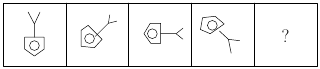
Identify the figure given in the options, which when put in place of the question mark (?) will logically complete the series.

  1. AOption (a)

  2. BOption (b)

  3. COption (c)

  4. DOption (d)

View answer & explanation

Correct answer

Answer: (a)A.

Why this answer is correct

The logic follows here, 

Hence, the correct answer is "Option 1"

Question 10

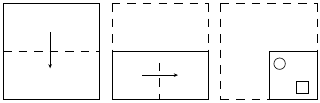
A paper is folded and punched as shown below. How will it appear when unfolded? 

  1. AOption (a)

  2. BOption (b)

  3. COption (c)

  4. DOption (d)

View answer & explanation

Correct answer

Answer: (b)B.

Why this answer is correct

The logic follows here, 

Hence, the correct answer is "Option 2"

Question 11

In a certain code language, 'TNRA' is coded as '28' and 'LOPGVO' is coded as '42'. How is 'JDSHKQB' coded in the given language?

  1. AOption (a)

    49

  2. BOption (b)

    44

  3. COption (c)

    52

  4. DOption (d)

    50

View answer & explanation

Correct answer

Answer: (a)A.

49

Why this answer is correct

Given : TNRA  is coded as '28' and 'LOPGVO' is coded as '42'.

Logic: Number of letters × 7 

  • TNRA → 28
  • Letters = 4
  • Code = 4 × 7 = 28
  • LOPGVO → 42
  • Letters = 6
  • Code = 6 × 7 = 42

Similarly,

  • JDSHKQB
  • Letters = 7
  • Code = 7 × 7 = 49.

Hence, the correct answer is "Option 1"

Question 12

What should come in place of the question mark (?) in the given series based on the English alphabetical order?

BCG EFJ HIM KLP ?

  1. AOption (a)

    QOT

  2. BOption (b)

    NOT

  3. COption (c)

    QOS

  4. DOption (d)

    NOS

View answer & explanation

Correct answer

Answer: (d)D.

NOS

Why this answer is correct

The logic followed here is:

Hence, the correct answer is "Option 4"

Question 13

Select the correct mirror image of the given figure when the mirror is placed at MN as shown below.

  1. AOption (a)

  2. BOption (b)

  3. COption (c)

  4. DOption (d)

View answer & explanation

Correct answer

Answer: (d)D.

Why this answer is correct

The correct mirror image of the given combination when mirror is placed at MN is as shown below:

Hence, the correct answer is "Option 4"

Question 14

 E, F, G, H, J, K and L are sitting around a circular table facing the centre of the table (but not necessarily in the same order). L sits to the immediate right of F. Only three people sit between L and H when counted from the left of L. Only three people sit between F and J when counted from the left of F. E sits to the immediate right of K. How many people sit between F and K when counted from the right of K?

  1. AOption (a)

    Four

  2. BOption (b)

    Two

  3. COption (c)

    Three

  4. DOption (d)

    One

View answer & explanation

Correct answer

Answer: (d)D.

One

Why this answer is correct

E, F, G, H, J, K and L are sitting around a circular table facing the centre of the table (but not necessarily in the same order).

  • L sits to the immediate right of F.
  • Only three people sit between L and H when counted from the left of L.
  • Only three people sit between F and J when counted from the left of F.
  • E sits to the immediate right of K

The Final Arrangement is, 

Hence, the correct answer is "Option 4"

Question 15

Each letter in the word DUMPERS is arranged in the English alphabetical order. How many letters are there in the English alphabetical order between the letter which is fourth from the left end and the one which is second from the right end in the new letter-cluster thus formed?

  1. AOption (a)

    5

  2. BOption (b)

    2

  3. COption (c)

    1

  4. DOption (d)

    3

View answer & explanation

Correct answer

Answer: (b)B.

2

Why this answer is correct

Given : DUMPERS

Letters in DUMPERS

D, U, M, P, E, R, S

Alphabetical order:

D, E, M, P, R, S, U

Left  D, E, M, P, R, S, U  Right

4th from the left = P

2nd from the right = S

Now, count how many letters are in between P and S in alphabetical order.

Letters between them: Q (17), R (18)

So, total = 2 letters.

Hence, the correct answer is "Option 2"

Question 16

What will come in the place of the question mark (?) in the following equation, if ‘+’ and ‘−’ are interchanged and ‘×’ and ‘÷’ are interchanged?

41 + 8 ÷ 6 − 24 × 2 = ?

  1. AOption (a)

    1

  2. BOption (b)

    5

  3. COption (c)

    11

  4. DOption (d)

    16

View answer & explanation

Correct answer

Answer: (b)B.

5

Why this answer is correct

After interchanging the sign in the given equation will be: 

​41 - 8 × 6 + 24 ÷ 2 = ?

41 - 8 × 6 + 12  = ​?

 ​​41 - 48 + 12  = ?

41 + 12 - 48 =  ? 

53 - 48 = ? 

 = 5

Hence, the correct answer is "Option 2"

Question 17

What should come in place of the question mark (?) in the given series?

54 55 58 63 70 ?

  1. AOption (a)

    78

  2. BOption (b)

    80

  3. COption (c)

    79

  4. DOption (d)

    81

View answer & explanation

Correct answer

Answer: (c)C.

79

Why this answer is correct

Logic: The series follows an increasing pattern of odd numbers +1, +3, +5, +7, +9

54 + 1 = 55

55 + 3 = 58

58 + 5 = 63

63 + 7 = 70

So, the next number is 70 + 9 = 79

Hence, the correct answer is "Option 3"

Question 18

Select the Venn diagram that best illustrates the relationship between the following classes.

Cow, Cheetah, Wild animals

  1. AOption (a)

  2. BOption (b)

  3. COption (c)

  4. DOption (d)

View answer & explanation

Correct answer

Answer: (b)B.

Why this answer is correct

The correct Venn diagram representation is,

Cheetah is a subset of Wild Animals → So, Cheetah is inside the Wild Animal circle.

Cow is completely separate, as it does not belong to Wild Animals.

Hence, the correct answer is "Option 2"

Question 19

What should come in place of the question mark (?) in the given series?

53 63 76 92 111 ?

  1. AOption (a)

    143

  2. BOption (b)

    126

  3. COption (c)

    133

  4. DOption (d)

    156

View answer & explanation

Correct answer

Answer: (c)C.

133

Why this answer is correct

The logic follows here,

The differences between terms increase by 3 each time +10, +13, +16, +19, +22

53 + 10 = 63

63 + 13 = 76

76 + 16 = 92

92 + 19 = 111

So, the next number is;

? = 111 + 22 = 133.

Hence, the correct answer is "Option 3"

Question 20

MH 45 is related to KF 40 in a certain way. In the same way, TN 35 is related to RL 30. To which of the following is ZI 25 related following the same logic?

  1. AOption (a)

    XG 20

  2. BOption (b)

    WK 30

  3. COption (c)

    YJ 25

  4. DOption (d)

    XH 25

View answer & explanation

Correct answer

Answer: (a)A.

XG 20

Why this answer is correct

The logic followed here is:

Hence, the correct answer is "Option 1"

General Knowledge and General Awareness (20 questions)

Question 21

Giddha is the folk dance of _____. 

  1. AOption (a)

    Madhya Pradesh 

  2. BOption (b)

    Uttar Pradesh

  3. COption (c)

    Punjab

  4. DOption (d)

    Rajasthan

View answer & explanation

Correct answer

Answer: (c)C.

Punjab

Why this answer is correct

The correct answer is Punjab.

Key Points

  • Giddha is a popular folk dance originating from Punjab, India.
  • It is primarily performed by women during celebrations like festivals, weddings, and other joyous occasions.
  • Giddha is known for its graceful movements, colorful costumes, and rhythmic clapping by performers.
  • The dance is accompanied by traditional folk songs called boliyan, which narrate cultural stories, emotions, and social themes.
  • In Giddha, dancers form a circle or semi-circle, taking turns to perform in the center while others clap and sing.

Additional Information

  • Madhya Pradesh:
  • Madhya Pradesh is known for its rich tribal culture and diverse folk dances like Rai, Grida, and Matki.
  • The dance forms often celebrate agricultural activities, festivals, and social gatherings.
  • Tribal communities like Gonds, Baigas, and Bhils contribute significantly to the folk traditions of the state.
  • Uttar Pradesh:
  • Uttar Pradesh features prominent folk dances such as Raslila, inspired by the mythological tales of Lord Krishna.
  • Other dances include Charkula and Swang, which are performed during festivals and cultural events.
  • These dances are deeply rooted in the traditions and spiritual heritage of the region.
  • Rajasthan:
  • Rajasthan is famous for its colorful folk dances like Ghoomar, Kalbeliya, and Chari.
  • These dances showcase the vibrant culture and traditions of the desert state.
  • They are often performed during festivals, religious ceremonies, and weddings.

Question 22

In which of the following Indian states is the vibrant temple festival Thrissur Pooram celebrated?

  1. AOption (a)

    Andhra Pradesh

  2. BOption (b)

    Kerala

  3. COption (c)

    Tamil Nadu 

  4. DOption (d)

    Maharashtra

View answer & explanation

Correct answer

Answer: (b)B.

Kerala

Why this answer is correct

The correct answer is Kerala.

Key Points

  • The Thrissur Pooram festival is celebrated in the Indian state of Kerala and is one of the most famous temple festivals in the region.
  • This grand festival is held annually at the Vadakkunnathan Temple in Thrissur, during the Malayalam month of Medam (April-May).
  • The festival was introduced by Sakthan Thampuran (Rama Varma IX), the Maharaja of Cochin, in the late 18th century to unify various temple celebrations into one grand event.
  • Key attractions of Thrissur Pooram include the procession of caparisoned elephants, synchronized ceremonial umbrella displays (Kudamattam), traditional drumming performances (Panchavadyam), and a spectacular fireworks display.
  • The festival reflects Kerala's rich cultural heritage and draws visitors from across the globe, showcasing the state's vibrant traditions and rituals.

Additional Information

  • Andhra Pradesh:
  • Andhra Pradesh is renowned for its rich cultural heritage, including classical dance forms like Kuchipudi and unique temple architecture.
  • It is home to famous religious sites such as Tirupati Balaji Temple, one of the most visited pilgrimage destinations globally.
  • The state does not host Thrissur Pooram, but it celebrates festivals like Ugadi, Sankranti, and Brahmotsavam.
  • Tamil Nadu:
  • Tamil Nadu is famous for its Dravidian-style temple architecture and festivals such as Pongal, Thaipusam, and Navaratri.
  • The Madurai Meenakshi Temple and Brihadeeswara Temple are iconic landmarks of Tamil Nadu's religious and cultural heritage.
  • Maharashtra:
  • Maharashtra is known for festivals such as Ganesh Chaturthi, Gudi Padwa, and Dussehra, which reflect its vibrant culture.
  • It is home to famous religious and historical sites like the Ajanta and Ellora Caves and the Siddhivinayak Temple.

Question 23

What is the primary objective of the Atmanirbhar Clean Plant Programme, which was launched in the 2023-24 Union Budget of the Government of India?

  1. AOption (a)

    Promoting clean energy

  2. BOption (b)

    Enhancing the availability of disease-free planting material

  3. COption (c)

    Supporting the defense sector

  4. DOption (d)

    Boosting manufacturing industries 

View answer & explanation

Correct answer

Answer: (b)B.

Enhancing the availability of disease-free planting material

Why this answer is correct

The correct answer is Enhancing the availability of disease-free planting material.

Key Points

  • The Atmanirbhar Clean Plant Programme was launched in the Union Budget 2023-24 by the Government of India to enhance agricultural productivity and quality.
  • The primary focus of the program is to ensure the availability of disease-free and high-quality planting materials for horticultural crops such as fruits and vegetables.
  • This initiative aims to address challenges faced by the horticulture sector, including crop losses due to poor-quality planting materials and diseases.
  • The program is expected to boost the horticulture industry's export potential by providing superior planting materials free from diseases.
  • It aligns with India’s vision of self-reliance (Atmanirbhar Bharat) in agriculture and horticulture, ensuring better crop yields and farmer income.

Additional Information

  • For Horticulture & Quality Inputs:
  • Paramparagat Krishi Vikas Yojana (PKVY): Promotes organic farming, focusing on soil health and producing safe food.
  • National Beekeeping and Honey Mission (NBHM): Aims to develop scientific beekeeping, boosting honey production and exports, under the Atmanirbhar Bharat initiative.
  • For Energy & Sustainability in Agriculture:
  • PM-KUSUM (Pradhan Mantri Kisan Urja Suraksha evam Utthaan Mahabhiyan): Supports solar pumps and solar power generation for farmers, reducing diesel use.
  • National Green Hydrogen Mission: Aims to make India a leader in green hydrogen, impacting fertilizer and transport sectors.

Question 24

Who among the following became the Chief of the Air Staff (CAS) of the Indian Air Force (IAF) in September 2024?

  1. AOption (a)

    Air Chief Marshal Birender Singh Dhanoa

  2. BOption (b)

    Air Chief Marshal Vivek Ram Chaudhari

  3. COption (c)

    Air Chief Marshal AP Singh

  4. DOption (d)

    Air Chief Marshal Rakesh Kumar Singh Bhadauria

View answer & explanation

Correct answer

Answer: (c)C.

Air Chief Marshal AP Singh

Why this answer is correct

The correct answer is Air Chief Marshal AP Singh.

Key Points

  • Air Chief Marshal AP Singh was appointed as the Chief of the Air Staff (CAS) of the Indian Air Force (IAF) in September 2024.
  • He succeeded Air Chief Marshal Vivek Ram Chaudhari, who completed his tenure as the CAS.
  • AP Singh has held various operational, instructional, and staff appointments during his distinguished career in the Indian Air Force.
  • He is a decorated officer, having received awards like the Param Vishisht Seva Medal (PVSM) and Ati Vishisht Seva Medal (AVSM) for his exemplary service.
  • His leadership is expected to play a crucial role in the modernization and operational readiness of the Indian Air Force.

Additional Information

  • Air Chief Marshal Birender Singh Dhanoa:
  • He served as the Chief of the Air Staff from December 31, 2016, to September 30, 2019.
  • Dhanoa is known for his role in leading the IAF during the Balakot airstrikes in February 2019.
  • He was awarded the Param Vishisht Seva Medal (PVSM) and Ati Vishisht Seva Medal (AVSM) for his contributions to the Indian Air Force.
  • Air Chief Marshal Vivek Ram Chaudhari:
  • He served as the Chief of the Air Staff from September 30, 2021, to September 2024.
  • Chaudhari played a significant role in enhancing the operational readiness of the Indian Air Force, especially with the induction of Rafale fighter jets.
  • He was instrumental in promoting the modernization of the IAF and strengthening its air defense capabilities.
  • Air Chief Marshal Rakesh Kumar Singh Bhadauria:
  • He served as the Chief of the Air Staff from September 30, 2019, to September 30, 2021.
  • Bhadauria was closely involved in the induction of the Rafale jets into the Indian Air Force.
  • He is credited for his efforts in bolstering the indigenous defense manufacturing sector under the "Make in India" initiative.

Question 25

According to National Multidimensional Poverty Index 2021, which of the following states recorded the steepest decline in poor? 

  1. AOption (a)

    Bihar

  2. BOption (b)

    Andhra Pradesh

  3. COption (c)

    Gujarat

  4. DOption (d)

    Maharashtra

View answer & explanation

Correct answer

Answer: (a)A.

Bihar

Why this answer is correct

The correct answer is Bihar.

Key Points

  • According to the National Multidimensional Poverty Index (MPI) 2021, Bihar showed the steepest decline in multidimensional poverty among all Indian states.
  • The poverty rate in Bihar fell from 51.9% in 2015-16 to 33.8% in 2019-21, a reduction of 18.1 percentage points.
  • Approximately 13.01 crore people in India were lifted out of multidimensional poverty during this period, with Bihar making a significant contribution.
  • Bihar achieved this progress through improvements in access to basic amenities such as education, nutrition, housing, and sanitation.
  • Despite this achievement, Bihar remains among the states with the highest levels of multidimensional poverty, alongside Uttar Pradesh and Jharkhand.

Additional Information

  • Andhra Pradesh:
  • Andhra Pradesh has shown improvements in multidimensional poverty indicators, especially in sectors like education and health.
  • Key schemes like Nadu-Nedu (focused on school infrastructure) and YSR Aarogyasri (health insurance) contributed to better outcomes.
  • Gujarat:
  • Gujarat has a relatively low poverty rate and has performed well in improving infrastructure and industrial growth.
  • Initiatives like SAUNI Yojana (irrigation) and urban development projects helped improve living standards.
  • Maharashtra:
  • Maharashtra also recorded progress in reducing multidimensional poverty, with significant contributions from urban areas.
  • Programs such as Jal Jeevan Mission and skill development initiatives have improved access to drinking water and employment opportunities.
  • National Multidimensional Poverty Index (MPI):
  • The MPI measures poverty beyond income levels, focusing on factors like health, education, and living standards.
  • It was developed by the Oxford Poverty and Human Development Initiative (OPHI) and adopted in India by NITI Aayog.
  • Indicators include nutrition, child mortality, schooling, sanitation, drinking water, electricity, and housing.
  • The MPI provides policymakers with data to assess the effectiveness of welfare schemes and identify areas needing targeted intervention.

Question 26

In astronomy, Cassiopeia is a constellation in the sky that is easily recognized by its cluster of how many bright stars?

  1. AOption (a)

    3

  2. BOption (b)

    9

  3. COption (c)

    5

  4. DOption (d)

    7

View answer & explanation

Correct answer

Answer: (c)C.

5

Why this answer is correct

The correct answer is 5.

Key Points

  • Cassiopeia is one of the most recognizable constellations in the northern sky and is known for its distinctive ""W"" or ""M"" shape depending on its orientation in the sky.
  • The constellation is formed by a cluster of 5 bright stars, which make up the ""W"" shape. These stars are Alpha Cassiopeiae, Beta Cassiopeiae, Gamma Cassiopeiae, Delta Cassiopeiae, and Epsilon Cassiopeiae.
  • These stars are easily visible to the naked eye, making Cassiopeia a prominent feature in the night sky for observers in the Northern Hemisphere.
  • The constellation is named after Queen Cassiopeia from Greek mythology, who was known for her vanity and boastfulness about her beauty.
  • Cassiopeia is located opposite the Big Dipper across the North Star (Polaris) and is visible throughout the year in the Northern Hemisphere.

Additional Information

  • Details of the Stars in Cassiopeia:
  • Alpha Cassiopeiae (Schedar): This is an orange giant star and the brightest star in Cassiopeia. It is located approximately 230 light-years away from Earth.
  • Beta Cassiopeiae (Caph): A yellow-white giant star located about 54.5 light-years away. It is the second brightest star in the constellation.
  • Gamma Cassiopeiae: A variable star known for its irregular changes in brightness. It is a blue-white subgiant star located approximately 550 light-years away.
  • Delta Cassiopeiae (Ruchbah): A white giant star located roughly 99 light-years away. It is one of the stars that form the ""W"" shape.
  • Epsilon Cassiopeiae: A blue-white giant star that lies approximately 410 light-years from Earth.
  • Observation and Location:
  • Cassiopeia is a circumpolar constellation, meaning it never sets below the horizon in most of the Northern Hemisphere.
  • It is best viewed during the autumn and winter months when it is high in the sky.
  • The constellation is located near the Milky Way and contains several deep-sky objects, including open star clusters like the Messier 52 (M52) and the Heart and Soul Nebulae (IC 1805 and IC 1848).
  • Mythological Significance:
  • In Greek mythology, Cassiopeia was the wife of King Cepheus and the mother of Andromeda. She was placed in the sky as punishment for her vanity.
  • The constellation is often depicted as a queen sitting on her throne, and it is said she spends part of the year upside-down as a reminder of her arrogance.
  • Other Notable Features:
  • Cassiopeia contains the famous radio source Cas A (Cassiopeia A), which is a supernova remnant and one of the strongest radio sources in the sky.
  • The constellation is a useful guide to locate the Andromeda Galaxy (M31) and the North Star (Polaris).

"

Question 27

Which of the following musical instruments was played by Ustad Asad Ali Khan?

  1. AOption (a)

    Tabla

  2. BOption (b)

    Rudra veena

  3. COption (c)

    Sarod 

  4. DOption (d)

    Santur

View answer & explanation

Correct answer

Answer: (b)B.

Rudra veena

Why this answer is correct

The correct answer is Rudra veena.

Key Points

  • Ustad Asad Ali Khan was a renowned exponent of the Rudra veena, a traditional Indian plucked string instrument.
  • He was one of the last practitioners of the Khandar gharana, a highly respected school in the Dhrupad tradition of Hindustani classical music.
  • The Rudra veena is also known as the "Been" and is considered one of the oldest and most revered musical instruments in Indian classical music.
  • Ustad Asad Ali Khan was awarded the Padma Bhushan in 2008 for his immense contributions to Indian classical music.
  • He played a critical role in preserving the legacy of the Rudra veena, which is associated with spiritual and meditative aspects of music.

Additional Information

  • Tabla:
  • The tabla is a percussion instrument widely used in Hindustani classical music, as well as in various popular and devotional genres in India.
  • It consists of two drums – the smaller "dayan" (right drum) and the larger "bayan" (left drum).
  • It is played using the fingers and palms, producing a range of rhythmic patterns and tones.
  • Famous tabla players include Ustad Zakir Hussain and Pandit Kishan Maharaj.
  • Sarod:
  • The sarod is a stringed instrument used in Hindustani classical music, known for its deep, resonant sound.
  • It is fretless, allowing for the smooth gliding of notes (meend), which is a distinctive feature of Indian classical music.
  • Famous sarod players include Ustad Amjad Ali Khan and Ustad Ali Akbar Khan.
  • Santur:
  • The santur is a hammered dulcimer, a string instrument traditionally associated with Kashmiri folk music.
  • It has a trapezoid shape and is played by striking the strings with wooden mallets.
  • Shivkumar Sharma is one of the most prominent musicians credited with bringing the santur to the forefront of Indian classical music.
  • Rudra veena:
  • It is a large plucked string instrument with two large resonating gourds and a long hollow neck.
  • Associated with Hindustani classical music, it is primarily used in the Dhrupad genre.
  • It has deep mythological and historical significance, often linked to Lord Shiva in Indian tradition.

Question 28

In which year was the All India Women’s Conference (AIWC) established?

  1. AOption (a)

    1927

  2. BOption (b)

    1930

  3. COption (c)

    1920

  4. DOption (d)

    1928

View answer & explanation

Correct answer

Answer: (a)A.

1927

Why this answer is correct

The correct answer is 1927.

Key Points

  • The All India Women's Conference (AIWC) was established in 1927 to address issues related to women's rights and socio-economic reform.
  • Margaret Cousins, an Irish theosophist and suffragist, played a pivotal role in founding AIWC and promoting women's empowerment in India.
  • The inaugural session of AIWC took place in Pune, Maharashtra, with a focus on promoting education for women and girls.
  • Initially, AIWC concentrated on education but later expanded its agenda to include women's suffrage, health, equal rights, and social reform.
  • AIWC remains one of India's most significant women's organizations, addressing issues like gender equality, legal reforms, and socio-economic development.

Additional Information

  • 1920:
  • In 1920, the Non-Cooperation Movement was launched by Mahatma Gandhi as a significant protest against British rule.
  • This year marked the beginning of active participation by Indian women in the freedom struggle, laying the foundation for future women's organizations.
  • 1930:
  • The year witnessed the launch of the Civil Disobedience Movement, with women playing a critical role in protests and salt marches.
  • Women leaders like Kasturba Gandhi and Sarojini Naidu emerged as prominent figures in the movement.

Question 29

According to the Indian Constitution, who can reserve a bill passed by the State Legislative Assembly for the assent of the President?

  1. AOption (a)

    Speaker of the State Legislative Assembly

  2. BOption (b)

    Chief Minister

  3. COption (c)

    Governor

  4. DOption (d)

    Opposition parties in the State Legislative

View answer & explanation

Correct answer

Answer: (c)C.

Governor

Why this answer is correct

The correct answer is Governor.

Key Points

  • According to Article 200 of the Indian Constitution, the Governor of a state has the power to reserve a bill passed by the State Legislative Assembly for the assent of the President of India.
  • The Governor exercises this power when the bill in question conflicts with the provisions of the Constitution, central laws, or may affect the larger interests of the country.
  • The Governor can reserve the bill for the President's consideration if it involves matters beyond the legislative competence of the State Legislature or violates the Constitution’s provisions.
  • Once the bill is reserved, the President has the discretion to either grant assent, withhold assent, or send the bill back for reconsideration by the state legislature.
  • This provision ensures a system of checks and balances, maintaining the harmony between the State and the Centre and upholding constitutional supremacy.

Additional Information

  • Speaker of the State Legislative Assembly:
  • The Speaker is responsible for maintaining order and decorum in the Legislative Assembly.
  • The Speaker has no authority to reserve a bill for the President’s assent. This power lies exclusively with the Governor.
  • The Speaker's role is primarily limited to overseeing the legislative process within the Assembly and ensuring adherence to rules and procedures.
  • Chief Minister:
  • The Chief Minister, as the head of the state government, plays a key role in the legislative process, including introducing bills and advising the Governor.
  • However, the Chief Minister does not have the authority to reserve a bill for the President’s assent. This power rests solely with the Governor.
  • The Chief Minister can recommend the Governor to consider reserving a bill, but the final decision lies with the Governor.
  • Opposition Parties in the State Legislative Assembly:
  • Opposition parties serve the role of scrutinizing and questioning the government’s legislative and administrative actions.
  • They do not have any formal authority to reserve a bill for the President’s assent.
  • Their influence is limited to debating and voting on the bill within the Assembly.
  • Governor's Role in the Legislative Process:
  • The Governor is a key constitutional authority in the legislative process of a state.
  • Under Article 200, the Governor can give assent to a bill, withhold assent, return the bill (if it is not a money bill) for reconsideration, or reserve it for the President’s consideration.
  • This role ensures that state legislation aligns with the Constitution and national interests.

Question 30

India initiated its First Five Year Plan in 1951, influenced by the socialist ideals of _________________.

  1. AOption (a)

    Jawaharlal Nehru

  2. BOption (b)

    Lal Bahadur Shastr

  3. COption (c)

    Rajendra Prasad

  4. DOption (d)

    Bhim Rao Ambedkar

View answer & explanation

Correct answer

Answer: (a)A.

Jawaharlal Nehru

Why this answer is correct

The correct answer is Jawaharlal Nehru.

Key Points

  • India's First Five-Year Plan (1951-1956) was heavily influenced by the socialist ideals of Jawaharlal Nehru, who was the first Prime Minister of independent India.
  • Jawaharlal Nehru envisioned a planned economy model to ensure balanced development and address the socio-economic challenges faced by the country post-independence.
  • The First Five-Year Plan focused primarily on agriculture, irrigation, and energy sectors, recognizing these as crucial for India's economic foundation.
  • Inspired by Soviet-style planning, Nehru emphasized industrialization and state-led development to achieve self-reliance and equitable growth.
  • The plan was formulated under the guidance of the Planning Commission, which was established in 1950 with Nehru as its chairman.

Additional Information

  • Planning Commission:
  • It was established in 1950 under the chairmanship of Jawaharlal Nehru to formulate and oversee India's Five-Year Plans.
  • The commission aimed to promote a balanced and sustainable development approach across various sectors of the economy.
  • It was replaced by the NITI Aayog in 2015 to align planning with contemporary economic challenges.
  • Achievements of the First Five-Year Plan:
  • The plan successfully achieved its target, with food grain production increasing significantly.
  • It laid the groundwork for long-term economic planning and development in India.
  • Major irrigation projects like the Bhakra Nangal Dam were initiated during this period.

Question 31

How much of the world's water is estimated to exist as freshwater?

  1. AOption (a)

    5%

  2. BOption (b)

    1%

  3. COption (c)

    2.5%

  4. DOption (d)

    10%

View answer & explanation

Correct answer

Answer: (c)C.

2.5%

Why this answer is correct

The correct answer is 2.5%.

Key Points

  • Freshwater constitutes approximately 2.5% of the total water available on Earth, but the majority is inaccessible as it is locked in glaciers, ice caps, and deep underground reserves.
  • Out of this freshwater, only about 0.025% is accessible for human use, which includes water in rivers, lakes, and shallow groundwater sources.
  • The remaining freshwater is stored in forms that are difficult to extract, such as deep aquifers or polar ice caps.
  • Freshwater is essential for various purposes, including drinking, agriculture, sanitation, and industrial needs, making its sustainable management a global priority.
  • Despite its scarcity, freshwater resources face mounting pressures from climate change, population growth, and pollution, threatening water security worldwide.

Additional Information

  • Global Water Distribution:
  • Approximately 97.5% of Earth's water is saline and found in oceans, making it unsuitable for direct human consumption or use.
  • The remaining 2.5% is freshwater, primarily stored in glaciers (68.7%), groundwater (30.1%), and surface water sources like rivers and lakes (0.3%).
  • Freshwater Ecosystems:
  • Freshwater ecosystems include rivers, lakes, wetlands, and aquifers, which support a wide range of species and biodiversity.
  • These ecosystems play a vital role in regulating the Earth's water cycle and maintaining ecological balance.
  • Water Scarcity:
  • Approximately 1.2 billion people worldwide face physical water scarcity, while another 1.6 billion face economic water shortages due to lack of infrastructure.
  • Water scarcity is exacerbated by factors such as climate change, over-extraction of water resources, and pollution.
  • United Nations Sustainable Development Goal (SDG) 6:
  • SDG 6 aims to ensure availability and sustainable management of water and sanitation for all by 2030.
  • It emphasizes universal access to safe and affordable drinking water and the protection of water-related ecosystems.

Question 32

Who among the following was the last Tirthankara of Jainism? 

  1. AOption (a)

    Naminatha

  2. BOption (b)

    Parsvanatha 

  3. COption (c)

    Ajitanatha

  4. DOption (d)

    Mahavira

View answer & explanation

Correct answer

Answer: (d)D.

Mahavira

Why this answer is correct

The correct answer is Mahavira.

Key Points

  • Mahavira is regarded as the 24th and last Tirthankara (spiritual teacher) of Jainism.
  • He was born in 540 BCE in Kundagrama, near Vaishali in modern-day Bihar, into a royal Kshatriya family.
  • At the age of 30, Mahavira renounced worldly life and became an ascetic, practicing intense meditation and self-discipline to attain Kevala Jnana (omniscience).
  • He emphasized the principles of Ahimsa (non-violence), Satya (truth), Asteya (non-stealing), Brahmacharya (celibacy), and Aparigraha (non-possessiveness), which are the core tenets of Jainism.
  • Mahavira attained Nirvana (liberation) in 468 BCE at Pavapuri, Bihar, which is now a significant pilgrimage site for Jains.

Additional Information

  • Naminatha:
  • Naminatha was the 21st Tirthankara of Jainism.
  • He was born to King Vijay Raja and Queen Vipra Rani in Mithila.
  • Naminatha is said to have attained Nirvana at Sammed Shikhar (modern-day Parasnath Hill).
  • Parsvanatha:
  • Parsvanatha was the 23rd Tirthankara of Jainism and preceded Mahavira.
  • He was born in Varanasi to King Asvasena and Queen Vama.
  • Parsvanatha emphasized the four vows: Ahimsa (non-violence), Satya (truth), Asteya (non-stealing), and Aparigraha (non-possessiveness).
  • He is believed to have attained Nirvana at Sammed Shikhar.
  • Ajitanatha:
  • Ajitanatha was the second Tirthankara of Jainism.
  • He was born in Ayodhya to King Jitashatru and Queen Vijaya.
  • Ajitanatha attained Nirvana at Sammed Shikhar.
  • Jainism and Tirthankaras:
  • Jainism is an ancient Indian religion centered on non-violence, self-discipline, and ascetic practices.
  • The Tirthankaras are revered spiritual teachers who have achieved liberation and guide others on the path of salvation.
  • There are 24 Tirthankaras in Jainism, with Rishabhanatha being the first and Mahavira the last.

Question 33

Rajinder Khanna, Deputy NSA and former chief of India's external intelligence agency Research and Analysis Wing (R&AW), was promoted to the position of _____________ in July 2024.

  1. AOption (a)

    NSA

  2. BOption (b)

    Reserved NSA

  3. COption (c)

    Additional NSA 

  4. DOption (d)

    CAG

View answer & explanation

Correct answer

Answer: (c)C.

Additional NSA 

Why this answer is correct

The correct answer is Additional NSA.

Key Points

  • Rajinder Khanna, a former chief of India's external intelligence agency Research and Analysis Wing (R&AW), was promoted to the position of Additional NSA in July 2024.
  • He previously served as the Deputy National Security Advisor (NSA) of India, contributing significantly to national security and intelligence strategies.
  • The position of Additional NSA is vital for assisting the NSA in managing complex national security matters, including both internal and external threats.
  • This role involves handling specific portfolios such as counter-terrorism, cyber-security, and fostering bilateral strategic relations.
  • Khanna's extensive experience in intelligence operations and strategic planning strengthens India's security framework, making him a valuable asset.

Additional Information

  • National Security Advisor (NSA)
  • The NSA is the principal advisor to the Prime Minister of India on national security and strategic affairs.
  • The position was established in 1998, and the NSA heads the National Security Council (NSC).
  • Ajit Doval has been India's NSA since 2014, playing a key role in strategic decision-making and policy formulation.
  • The NSA is responsible for coordinating security measures across various departments to safeguard India's sovereignty and integrity.
  • Research and Analysis Wing (R&AW)
  • R&AW is India's premier foreign intelligence agency, established in 1968.
  • Its primary objectives include gathering intelligence outside India, counter-terrorism, espionage, and protecting India's international interests.
  • The agency operates under the Cabinet Secretariat and reports directly to the Prime Minister's Office.
  • Rajinder Khanna, as the former chief of R&AW, played a pivotal role in advancing India's intelligence capabilities.
  • Role of Additional NSA
  • The Additional NSA supports the NSA in coordinating national security policies across government agencies.
  • Handles portfolios like counter-terrorism, cyber-security, and strategic relations with other nations.
  • Acts as a bridge between intelligence agencies and the government for cohesive security strategies.
  • This position strengthens India's defense capabilities by providing expertise in policy formulation and intelligence analysis.
  • India’s National Security Framework
  • India's national security framework includes entities like the Ministry of Defence, Ministry of Home Affairs, intelligence agencies (R&AW, IB, NTRO), and armed forces.
  • The National Security Council (NSC) is the apex body for coordinating policies related to internal and external threats.
  • The NSA and Additional NSA play crucial roles in ensuring seamless coordination among these entities.
  • India's evolving geopolitical challenges necessitate a robust and adaptive security framework.

Question 34

Who won the Best Male Athlete of the Year award at the 37th National Games event?

  1. AOption (a)

    Srihari Nataraj

  2. BOption (b)

    Sajan Prakash

  3. COption (c)

    Arokia Rajiv

  4. DOption (d)

    Shivpal Singh 

View answer & explanation

Correct answer

Answer: (a)A.

Srihari Nataraj

Why this answer is correct

The correct answer is Srihari Nataraj.

Key Points

  • Srihari Nataraj, an accomplished Indian swimmer, was honored with the Best Male Athlete of the Year award at the 37th National Games.
  • He showcased exceptional performances in various swimming events during the competition, securing multiple medals.
  • Srihari specializes in backstroke swimming and is widely regarded as one of India’s top swimmers in the sport.
  • His achievements at the National Games have solidified his reputation as a leading figure in Indian aquatic sports.
  • The National Games serve as India’s premier multi-sport event, where athletes from across the country compete at the highest level.

Additional Information

  • Sajan Prakash
  • Sajan Prakash is another prominent Indian swimmer who has represented the country in multiple international events, including the Olympics and Asian Games.
  • He specializes in butterfly stroke and individual medley events.
  • Sajan was the first Indian swimmer to breach the Olympic "A" qualification mark, achieving this feat for the Tokyo 2020 Olympics.
  • Arokia Rajiv
  • Arokia Rajiv is an Indian track and field athlete specializing in the 400-meter sprint.
  • He has been part of India’s 4x400m relay team, winning medals in events like the Asian Games and Commonwealth Games.
  • His contribution to Indian athletics, especially in relay events, has been significant in recent years.
  • Shivpal Singh
  • Shivpal Singh is an Indian javelin thrower who has represented the country in international competitions.
  • He qualified for the Tokyo 2020 Olympics and has consistently performed well in Asian-level competitions.
  • Shivpal is known for his dedication to the sport and his efforts to improve his rankings globally.

Question 35

What was the primary goal of the Green Revolution in India?

  1. AOption (a)

    Increasing agricultural productivity

  2. BOption (b)

    Industrial development

  3. COption (c)

    Promoting foreign trade

  4. DOption (d)

    Reducing population growth 

View answer & explanation

Correct answer

Answer: (a)A.

Increasing agricultural productivity

Why this answer is correct

The correct answer is Increasing agricultural productivity.

Key Points

  • The Green Revolution in India was primarily aimed at increasing agricultural productivity to address food scarcity and ensure food security for the growing population.
  • It introduced high-yielding variety (HYV) seeds, particularly for staple crops like wheat and rice, significantly boosting crop yields.
  • The initiative involved improvements in irrigation infrastructure, use of chemical fertilizers, and application of pesticides to enhance agricultural output.
  • Launched in the 1960s, the Green Revolution transformed India from a food-deficient country to a self-sufficient and food grain-exporting nation.
  • Dr. M.S. Swaminathan, regarded as the "Father of the Green Revolution in India," played a key role in its implementation and success.

Additional Information

  • Green Revolution
  • The Green Revolution brought about a significant transformation in India's agricultural sector by introducing modern farming techniques.
  • While it ensured food security, it also raised concerns about environmental sustainability, regional disparities, and soil and water resource degradation.
  • Key Features & Technologies:
  • High-Yielding Variety (HYV) Seeds: Developed seeds for wheat and rice that produced much more food per acre.
  • Modern Inputs: Extensive use of chemical fertilizers, pesticides, and herbicides.
  • Mechanization: Introduction of tractors, threshers, and irrigation pumps.
  • Improved Irrigation: Expansion of canals, dams, and tube wells to provide consistent water.
  • Multiple Cropping: Shorter maturity periods allowed farmers to grow more crops per year.

Question 36

Handstand, Cast, Splits, Handspring on Vault, Back Handspring, Split Leap and Tap Swing on Bars are terms used in _____.

  1. AOption (a)

    Fencing

  2. BOption (b)

    Skateboarding 

  3. COption (c)

    Archery

  4. DOption (d)

    Gymnastics

View answer & explanation

Correct answer

Answer: (d)D.

Gymnastics

Why this answer is correct

The correct answer is Gymnastics.

Key Points

  • Gymnastics is a sport that involves performing exercises requiring physical strength, flexibility, balance, coordination, and endurance.
  • The terms mentioned—Handstand, Cast, Splits, Handspring on Vault, Back Handspring, Split Leap, and Tap Swing on Bars—are specific techniques or movements performed by gymnasts during routines.
  • Gymnastics events include apparatuses such as vault, uneven bars, balance beam, floor exercise, pommel horse, rings, parallel bars, and horizontal bar.
  • It is governed internationally by the Federation Internationale de Gymnastique (FIG), which sets rules and regulations for competitions.
  • Gymnastics is divided into various disciplines, including Artistic Gymnastics, Rhythmic Gymnastics, Trampoline, Acrobatic Gymnastics, and Aerobic Gymnastics, each with unique features and apparatuses.

Additional Information

  • Fencing
  • Fencing is a combat sport where two opponents fight using swords such as foil, epee, or sabre.
  • It requires precision, strategy, agility, and skill.
  • Key terms in fencing include parry, riposte, lunge, and en garde, which are specific moves used during bouts.
  • It is governed internationally by the Fédération Internationale d'Escrime (FIE).
  • Skateboarding
  • Skateboarding is a recreational activity and sport where riders perform tricks using a skateboard.
  • Key maneuvers include ollies, kickflips, grinds, and aerials.
  • Skateboarding has gained popularity as an extreme sport and became an Olympic sport in 2020.
  • It involves balance, coordination, creativity, and mastery of gravity-defying stunts.
  • Archery
  • Archery is a sport or skill of using a bow to shoot arrows at a target.
  • It requires focus, precision, strength, and control.
  • Key terms include draw weight, bowstring, nocking point, and bullseye.
  • It is governed by the World Archery Federation and is included in the Olympic Games.

Question 37

As per the Human Development Report, 2021-22 (UNDP), which of the following neighbouring countries of India has the highest ranking in the Human Development Index?

  1. AOption (a)

    Bhutan

  2. BOption (b)

    Sri Lanka

  3. COption (c)

    Bangladesh 

  4. DOption (d)

    Nepal

View answer & explanation

Correct answer

Answer: (b)B.

Sri Lanka

Why this answer is correct

The correct answer is Sri Lanka.

Key Points

  • As per the Human Development Report 2021-22 published by the United Nations Development Programme (UNDP), Sri Lanka ranks the highest among India's neighboring countries in the Human Development Index (HDI).
  • Sri Lanka achieved an HDI ranking of 73 out of 191 countries globally, showcasing its significant progress in human development indicators.
  • The HDI measures three primary dimensions: life expectancy, education (mean and expected years of schooling), and standard of living (Gross National Income per capita).
  • Sri Lanka's higher HDI ranking is attributed to its robust healthcare system, high literacy rates, and improved living standards compared to other neighboring countries.
  • Despite facing economic challenges, Sri Lanka has consistently performed well in human development metrics due to sustained investments in education, health, and social welfare initiatives.

Additional Information

  • Bhutan
  • Bhutan ranked 127 in the Human Development Index 2021-22.
  • The country has prioritized Gross National Happiness (GNH) over GDP, focusing on sustainable development and well-being.
  • Bhutan's HDI score reflects its efforts in education and environmental sustainability despite geographical and economic constraints.
  • Bangladesh
  • Bangladesh secured the 129th position in the HDI ranking 2021-22.
  • The country's HDI score is influenced by improvements in healthcare and education, driven by initiatives like universal primary education and healthcare reforms.
  • Economic growth and poverty reduction have contributed to its development; however, challenges like inequality and climate vulnerability remain significant.
  • Nepal
  • Nepal ranked 143 in the HDI 2021-22, reflecting steady progress in human development despite being a landlocked and developing country.
  • Efforts in education, healthcare, and infrastructure development have improved its HDI score over the years.
  • However, Nepal faces challenges in addressing poverty, political instability, and limited access to resources in rural areas.

Important Points

  • Human Development Index (HDI)
  • The HDI is a composite index developed by the UNDP to measure the level of human development across countries.
  • It considers life expectancy, education (mean and expected years of schooling), and Gross National Income (GNI) per capita.
  • Countries are categorized into four groups: Very High, High, Medium, and Low Human Development based on their HDI scores.
  • India ranked 132 out of 191 countries in the HDI 2021-22, reflecting challenges in healthcare and education despite economic growth.

Question 38

Which compound is widely found in coffee and tea that has antioxidant and antiinflammatory activity?

  1. AOption (a)

    Lycopene

  2. BOption (b)

    Chlorogenic Acid 

  3. COption (c)

    Curcumin

  4. DOption (d)

    Anthocyanins 

View answer & explanation

Correct answer

Answer: (b)B.

Chlorogenic Acid 

Why this answer is correct

The correct answer is Chlorogenic Acid.

Key Points

  • Chlorogenic acid is a natural compound abundantly found in coffee and tea, as well as in fruits like apples, pears, and blueberries.
  • It is a powerful antioxidant, helping to neutralize free radicals and protect the body from oxidative stress.
  • Chlorogenic acid is known for its anti-inflammatory properties, which help in reducing inflammation and supporting overall health.
  • It provides numerous health benefits, including aiding in weight management, improving glucose metabolism, and reducing the risk of chronic diseases.
  • Coffee is the richest dietary source of chlorogenic acid, with its concentration depending on the type of coffee and its preparation methods.

Additional Information

  • Lycopene
  • Lycopene is a red carotenoid pigment found in tomatoes, watermelon, guava, and other red or pink fruits.
  • It is a potent antioxidant known for protecting cells from damage caused by free radicals.
  • Lycopene is linked to reducing the risk of certain cancers, particularly prostate cancer, as well as improving heart health.
  • Curcumin
  • Curcumin is the active compound found in turmeric, widely used as a spice and traditional medicine.
  • It exhibits strong anti-inflammatory, antioxidant, and anticancer properties.
  • Curcumin is commonly used to alleviate arthritis symptoms, improve brain function, and support immune health.
  • Anthocyanins
  • Anthocyanins are water-soluble pigments responsible for red, blue, and purple colors in fruits and vegetables like berries, grapes, and eggplants.
  • They are recognized for their antioxidant and anti-inflammatory properties, which help combat oxidative stress and inflammation.
  • Consuming anthocyanins is associated with improved cardiovascular health and reduced risk of chronic diseases.

Question 39

The Right to Freedom of Speech and Expression is guaranteed by which Article of the Indian Constitution?

  1. AOption (a)

    Article 25

  2. BOption (b)

    Article 141(d)

  3. COption (c)

    Article 19(1)(a)

  4. DOption (d)

    Article 21(1)(c)

View answer & explanation

Correct answer

Answer: (c)C.

Article 19(1)(a)

Why this answer is correct

The correct answer is Article 19(1)(a).

Key Points

  • Article 19(1)(a) of the Indian Constitution guarantees the Right to Freedom of Speech and Expression.
  • This fundamental right allows Indian citizens to express their opinions freely through speech, writing, printing, or any other form of communication.
  • The right is not absolute and is subject to reasonable restrictions in areas such as public order, decency, morality, sovereignty, security, and defamation, as provided under Article 19(2).
  • The Right to Freedom of Speech and Expression is a cornerstone of democracy, enabling citizens to voice their views and contribute to public discourse.
  • This right also includes the freedom of the press, ensuring media independence and dissemination of information necessary for a democratic society.

Additional Information

  • Article 25:
  • Article 25 guarantees the Right to Freedom of Religion.
  • It provides the freedom of conscience and the right to freely profess, practice, and propagate religion, subject to public order, morality, and health.
  • However, this right is not absolute and can be restricted in the interest of social welfare and reform.
  • Article 141(d):
  • There is no Article 141(d) in the Indian Constitution.
  • However, Article 141 states that the law declared by the Supreme Court of India shall be binding on all courts within the territory of India.
  • Article 21(1)(c):
  • There is no provision such as Article 21(1)(c) in the Indian Constitution.
  • Article 21 guarantees the Right to Life and Personal Liberty, stating that no person shall be deprived of their life or personal liberty except according to the procedure established by law.
  • Right to Freedom of Speech and Expression:
  • The Right to Freedom of Speech and Expression under Article 19(1)(a) is vital for the functioning of democracy.
  • It has been upheld and expanded by various landmark judgments, including the Maneka Gandhi vs Union of India (1978) and Shreya Singhal vs Union of India (2015) cases.
  • Though the right is broad, the government can impose restrictions under Article 19(2) to maintain public order and protect national interests.

Question 40

Padma Shri awardee Kalamandalam Gopi is recognised globally as the face of which dance form? 

  1. AOption (a)

    Kathakali

  2. BOption (b)

    Mohiniattam 

  3. COption (c)

    Odissi

  4. DOption (d)

    Kuchipudi

View answer & explanation

Correct answer

Answer: (a)A.

Kathakali

Why this answer is correct

The correct answer is Kathakali.

Key Points

  • Kalamandalam Gopi, a Padma Shri awardee, is internationally renowned for his contributions to Kathakali, a classical Indian dance-drama originating from Kerala.
  • Kathakali is known for its elaborate costumes, intricate facial makeup, and storytelling through gestures, facial expressions, and dance.
  • Kalamandalam Gopi is celebrated for his ability to portray romantic and heroic characters, showcasing a mastery of emotive expressions and body language.
  • He trained at Kerala Kalamandalam, a prestigious institution for classical performing arts established in 1930, which played a pivotal role in refining his skills.
  • Kalamandalam Gopi's dedication to Kathakali has brought global recognition to the dance form, making it a celebrated art on the international stage.

Additional Information

  • Mohiniattam
  • Mohiniattam is a graceful classical dance form that also originates from Kerala, India.
  • It is primarily performed by women and is characterized by swaying movements and soft footwork.
  • The dance form is deeply rooted in expressions and storytelling, often revolving around themes of love and devotion.
  • Mohiniattam is often accompanied by Carnatic music, and the lyrics are typically in Malayalam or Sanskrit.
  • Odissi
  • Odissi is one of the oldest classical dance forms in India, originating from Odisha.
  • This dance style is known for its fluid movements, intricate gestures, and sculpturesque poses, often inspired by temple art.
  • Odissi performances are based on spiritual themes, particularly stories from Hindu mythology and devotional poetry.
  • The dance incorporates elements of both pure dance (nritta) and expressive dance (abhinaya).
  • Kuchipudi
  • Kuchipudi is a classical dance form from Andhra Pradesh, India, blending dance, music, and drama.
  • It is unique due to its narrative style, often performed as dance dramas based on Hindu mythology.
  • Kuchipudi performers use elaborate costumes, intricate footwork, and expressions to depict stories from epics like the Mahabharata and Ramayana.
  • This dance form also includes elements of vocal narration and dialogue delivery, making it distinct from other classical styles.

Elementary Mathematics (20 questions)

Question 41

Akshay invests a sum of ₹5400 and Atul invests a sum of ₹9400 at the same rate of simple interest per annum. If, at the end of 6 years, Atul gets ₹360 more interest than Akshay, then find the rate of interest per annum (in percentage). 

  1. AOption (a)

    2.5

  2. BOption (b)

    1.5

  3. COption (c)

    3.5

  4. DOption (d)

    4.5

View answer & explanation

Correct answer

Answer: (b)B.

1.5

Why this answer is correct

Shortcut Trick

The extra interest earned by Atul is due to his extra investment over the same time period.

Extra Principal = 9400 − 5400 = ₹4000

This extra ₹4000 yields an extra simple interest of ₹360 in 6 years.

Rate (R) = (SI × 100) ÷ (P × T)

R = (360 × 100) ÷ (4000 × 6) = 36000 ÷ 24000 = 1.5%

∴ The correct answer is 1.5%.

Alternate Method

Given:

Akshay's Principal, P1 = ₹5400

Atul's Principal, P2 = ₹9400

Time, T = 6 years

Difference in interest = ₹360

Formula Used:

Simple Interest (SI) = (P × R × T) ÷ 100

Investment & Extra Interest Analysis

Akshay

₹5400

Atul

₹5400

  • ₹4000

Yields ₹360 interest in 6 yrs

Calculations:

⇒ SI of Atul − SI of Akshay = 360

⇒ [(9400 × R × 6) ÷ 100] − [(5400 × R × 6) ÷ 100] = 360

⇒ 564R − 324R = 360

⇒ 240R = 360

⇒ R = 360 ÷ 240

⇒ R = 1.5

∴ The correct answer is 1.5%.

Additional Information

Simple Interest Formula

SI = (P × R × T) ÷ 100, where P is the Principal amount, R is the Rate of Interest, and T is the Time period in years.

Simple Interest vs Compound Interest

Simple Interest is calculated only on the initial principal amount. In contrast, Compound Interest is calculated on the principal as well as the accumulated interest of previous periods.

Difference Between SI and CI

For 2 years, the difference between Compound Interest and Simple Interest on a certain principal at the same rate is derived using the formula: Difference = P(R ÷ 100)2.

Question 42

Two trains having lengths of 410 m and 440 m are running at speeds of 60 km/h and 70 km/h, respectively, in the same direction. The time taken (in minutes) by the faster train, coming from behind, to completely cross the other train is:

  1. AOption (a)

    4

  2. BOption (b)

    5

  3. COption (c)

    5.1

  4. DOption (d)

    3.4

View answer & explanation

Correct answer

Answer: (c)C.

5.1

Why this answer is correct

Shortcut Trick

Total distance to cross = Sum of train lengths = 410 + 440 = 850 m.

Relative speed (same direction) = 70 − 60 = 10 km/h.

Convert relative speed to m/s = 10 × (5/18) = 50/18 m/s.

Time in seconds = Distance ÷ Speed = 850 ÷ (50/18) = 850 × (18/50) = 306 seconds.

Time in minutes = 306 ÷ 60 = 5.1 minutes.

∴ The correct answer is 5.1 minutes.

Alternate Method

Train 1 (410 m)

60 km/h

Train 2 (440 m)

70 km/h

Relative Speed = 10 km/h → Total Distance = 850 m

Given:

Length of slower train (L1) = 410 m

Length of faster train (L2) = 440 m

Speed of slower train (S1) = 60 km/h

Speed of faster train (S2) = 70 km/h

Formula Used:

Relative Speed (when travelling in same direction) = S2 − S1

Time Taken = Total Distance Covered ÷ Relative Speed

Calculations:

⇒ Total distance to cross each other = L1 + L2 = 410 + 440 = 850 m

⇒ Relative Speed = 70 − 60 = 10 km/h

⇒ Converting Relative Speed to m/s = 10 × (5/18) = 50/18 = 25/9 m/s

⇒ Time taken (in seconds) = 850 ÷ (25/9)

⇒ Time taken = (850 × 9) ÷ 25

⇒ Time taken = 34 × 9 = 306 seconds

⇒ Converting seconds into minutes = 306 ÷ 60 = 5.1 minutes

∴ The correct answer is 5.1 minutes.

Additional Information

Relative Speed in Opposite Directions

When two objects move towards each other, their relative speed is calculated as the sum of their individual speeds (S1 + S2).

Crossing a Stationary Object (Without Length)

When a train crosses a pole, signal, or a standing man, the distance covered is equal to the length of the train alone.

Crossing a Stationary Object (With Length)

When a train crosses a platform or a bridge, the total distance covered is the sum of the train's length and the platform's length.

Unit Conversions

To convert km/h into m/s, multiply the speed by 5/18. Conversely, to convert m/s into km/h, multiply by 18/5.
Question 43

Anand has ₹1612 with him. He divided it amongst his sons Anil and Ashok and asked them to invest it at 8% rate of interest compounded annually. It was seen that Anil and Ashok got same amount after 11 and 12 years respectively. How much (in ₹) did Anand give to Anil? 

  1. AOption (a)

    775

  2. BOption (b)

    837

  3. COption (c)

    687

  4. DOption (d)

    875

View answer & explanation

Correct answer

Answer: (b)B.

837

Why this answer is correct

Shortcut Trick

For equal Compound Interest amounts, Share ratio (Less time : More time) = (1 + R/100)Time Diff : 1

Anil's share : Ashok's share = (1 + 8/100)12 − 11 : 1 = 108/100 : 1 = 27 : 25

Sum of ratio parts = 27 + 25 = 52

Anil's share = (27 ÷ 52) × 1612

⇒ Anil's share = 27 × 31 = 837

∴ The correct answer is ₹837.

Alternate Method

Given:

Total amount Anand has = ₹1612

Rate of Interest (R) = 8% compounded annually

Time period for Anil (t1) = 11 years

Time period for Ashok (t2) = 12 years

Let Anil's principal be P1 and Ashok's principal be P2.

Formula Used:

Amount in Compound Interest, A = P(1 + R/100)n

Total: ₹1612

Anil (P1) 11 yrs @ 8% CI Amount = A

Ashok (P2) 12 yrs @ 8% CI Amount = A

P1 × (1.08)¹¹ = P2 × (1.08)¹²

Calculations:

Since the final amounts received by both are equal:

⇒ P1(1 + 8/100)11 = P2(1 + 8/100)12

⇒ P1 / P2 = (1 + 8/100)12 − 11

⇒ P1 / P2 = (108 / 100)1

⇒ P1 / P2 = 27 / 25

So, the total amount is divided in the ratio 27 : 25.

⇒ Total ratio parts = 27 + 25 = 52 parts

⇒ 52 parts = 1612

⇒ 1 part = 1612 ÷ 52 = 31

⇒ Anil's share (P1) = 27 parts = 27 × 31 = 837

∴ The correct answer is ₹837.

Additional Information

Equal Amount Division in Compound Interest

When a sum is divided into two parts P1 and P2 such that their respective amounts are equal after t1 and t2 years at R% CI, the parts are in the ratio P1 : P2 = (1 + R/100)t2 − t1 : 1.

Inverse Relationship of Time and Principal

To get equal final amounts, the person investing the money for a shorter time duration must be allocated a proportionally larger share of the initial principal to compensate for the fewer compounding cycles.

Compound Interest Growth

Amount A = P(1 + R/100)n. Compound interest allows geometric growth of investments, as interest is earned on both the starting principal and previously accumulated interest.

Question 44

Find the average of 309, 125, 90, 45, 125 and 104. 

  1. AOption (a)

    133

  2. BOption (b)

    139

  3. COption (c)

    136

  4. DOption (d)

    130

View answer & explanation

Correct answer

Answer: (a)A.

133

Why this answer is correct

Shortcut Trick

Let the assumed average be 100.

Deviations from 100: +209, +25, −10, −55, +25, +4

Sum of deviations = 209 + 25 − 10 − 55 + 25 + 4 = +198

Average deviation = 198 ÷ 6 = +33

Actual Average = Assumed Average + Average Deviation = 100 + 33 = 133

∴ The correct answer is 133.

Alternate Method

Given:

The numbers are 309, 125, 90, 45, 125, and 104.

Formula Used:

Average = (Sum of observations) ÷ (Total number of observations)

309 125 90 45 125 104

Average = 133

Calculations:

⇒ Sum = 309 + 125 + 90 + 45 + 125 + 104

⇒ Sum = 798

⇒ Total numbers = 6

⇒ Average = 798 ÷ 6

⇒ Average = 133

∴ The correct answer is 133.

Additional Information

Weighted Average

When combining multiple groups with distinct averages A1, A2 and sizes n1, n2, the Combined Average = (n1A1 + n2A2) ÷ (n1 + n2).

Properties of Averages

If a constant value 'k' is added, subtracted, multiplied, or divided across all observations, the new average will similarly increase, decrease, be multiplied, or divided by 'k' respectively.

Average of an Arithmetic Progression (AP)

For a sequence of numbers with a constant difference (like consecutive numbers or multiples), the average is simply the exact middle term or can be calculated directly as (First term + Last term) ÷ 2.

Question 45

A shopkeeper bought an article for ₹500. At what price (in ₹) should he sell the article to make 22% profit?

  1. AOption (a)

    622

  2. BOption (b)

    598

  3. COption (c)

    610

  4. DOption (d)

    390

View answer & explanation

Correct answer

Answer: (c)C.

610

Why this answer is correct

Shortcut Trick

Cost Price (CP) is always considered to be 100%.

Selling Price (SP) at 22% profit = 100% + 22% = 122% of CP.

SP = 122% of &rupee;500

SP = 122 × 5 = &rupee;610

∴ The correct answer is &rupee;610.

Alternate Method

Given:

Cost Price (CP) = &rupee;500

Profit = 22%

Formula Used:

Selling Price (SP) = CP × (100 + Profit%) ÷ 100

CP = &rupee;500

SP = &rupee;610

  • 22% Profit Profit = &rupee;110

Calculation:

⇒ SP = 500 × (100 + 22) ÷ 100

⇒ SP = 500 × 122 ÷ 100

⇒ SP = 5 × 122

⇒ SP = &rupee;610

∴ The correct answer is &rupee;610.

Additional Information

Loss Formula

When an article is sold at a loss, SP = CP × (100 − Loss%) ÷ 100.

Marked Price & Discount

Discount is always calculated on the Marked Price (MP). SP = MP × (100 − Discount%) ÷ 100.

Successive Profit

If an article goes through multiple transactions with profits P1% and P2%, Net Profit% = P1 + P2 + (P1 × P2) ÷ 100.

Question 46

Evaluate: (-9) - (-60) ÷ (-12) + (-4) × 6 

  1. AOption (a)

    -37

  2. BOption (b)

    -38

  3. COption (c)

    -40

  4. DOption (d)

    -41

View answer & explanation

Correct answer

Answer: (b)B.

-38

Why this answer is correct

Given:

Expression: (-9) − (-60) ÷ (-12) + (-4) × 6

Formula Used:

Follow BODMAS (Bracket, Division, Multiplication, Addition, Subtraction)

Calculation:

(-9) - (-60) ÷ (-12) + (-4) × 6 

⇒ (-9) - 5 + (-4) × 6 

⇒ (-9) - 5 + -24

⇒ -14 - 24 = -38

∴ The value of the expression is -38.

Question 47

The average weight of Tushar, Salil and Mukund is 46 kg. If the average weight of Tushar and Salil be 40 kg and that of Salil and Mukund be 46 kg, then the weight of Salil (in kg) is: 

  1. AOption (a)

    34

  2. BOption (b)

    54

  3. COption (c)

    49

  4. DOption (d)

    44

View answer & explanation

Correct answer

Answer: (a)A.

34

Why this answer is correct

Shortcut Trick

Weight of Salil = (Sum of Tushar & Salil) + (Sum of Salil & Mukund) − (Sum of Tushar, Salil & Mukund)

⇒ Salil's weight = (2 × 40) + (2 × 46) − (3 × 46)

⇒ Salil's weight = 80 + 92 − 138

⇒ Salil's weight = 172 − 138 = 34

∴ The correct answer is 34 kg.

Alternate Method

Given:

Average weight of Tushar (T), Salil (S), and Mukund (M) = 46 kg

Average weight of Tushar and Salil = 40 kg

Average weight of Salil and Mukund = 46 kg

Formula Used:

Sum of observations = Average × Number of observations

Tushar Salil Mukund

Total = 3 × 46 = 138 kg

T + S = 80 kg

S + M = 92 kg Salil is included in both (T+S) and (S+M)

Calculations:

⇒ Total weight of T + S + M = 46 × 3 = 138 kg

⇒ Total weight of T + S = 40 × 2 = 80 kg

⇒ Total weight of S + M = 46 × 2 = 92 kg

⇒ Sum of weights of (T + S) and (S + M) = 80 + 92 = 172 kg

⇒ T + 2S + M = 172 kg

⇒ S = (T + 2S + M) − (T + S + M)

⇒ S = 172 − 138 = 34 kg

∴ The correct answer is 34 kg.

Additional Information

Average Formula

Average = Sum of all observations ÷ Total number of observations.

Overlapping Groups Concept

When an individual is counted in two intersecting groups, adding their sums includes the common individual twice. Subtracting the total distinct sum from the combined sum gives the value of the overlapping individual.

Combined Average

For two groups of sizes n1 and n2 with averages A1 and A2 respectively, the combined average is (n1 × A1 + n2 × A2) ÷ (n1 + n2).

Question 48

A hemispherical tank has an inner diameter of 1.4 m. Find its capacity. (Take π = 22/7) (Rounded up to two decimal places)

  1. AOption (a)

    0.78 m3

  2. BOption (b)

    0.72 m3

  3. COption (c)

    0.62 m3

  4. DOption (d)

    0.52 m3

View answer & explanation

Correct answer

Answer: (b)B.

0.72 m3

Why this answer is correct

Shortcut Trick

Given the tank diameter is 1.4 m, its radius r = 0.7 m.

Volume of a hemisphere = (2/3) × π × r3.

Volume = (2/3) × (22/7) × (0.7)3

Volume = 2.156 ÷ 3 ≈ 0.7186 m3

Rounding up to two decimal places, we get 0.72 m3.

∴ The correct answer is 0.72 m3.

Alternate Method

Given:

Inner diameter of the hemispherical tank (d) = 1.4 m

Radius (r) = d ÷ 2 = 1.4 ÷ 2 = 0.7 m

Formula Used:

Capacity of a hemispherical tank (Volume) = (2/3) × π × r3

r = 0.7 m

d = 1.4 m

r = 0.7 m

Hemispherical Tank

Calculations:

⇒ Volume = (2/3) × (22/7) × (0.7)3

⇒ Volume = (2/3) × (22/7) × 0.7 × 0.7 × 0.7

⇒ Volume = (2/3) × 22 × 0.1 × 0.49

⇒ Volume = (44 × 0.049) ÷ 3

⇒ Volume = 2.156 ÷ 3

⇒ Volume = 0.71866... m3

⇒ Rounding up to two decimal places, the capacity is 0.72 m3.

∴ The correct answer is 0.72 m3.

Additional Information

Volume of a Full Sphere

The total capacity of a full sphere is calculated using the formula V = (4/3)πr3, which is exactly double the volume of a matching hemisphere.

Surface Areas of a Hemisphere

The Curved Surface Area (CSA) of an open hemisphere is 2πr2. If the hemisphere is completely solid and closed, its Total Surface Area (TSA) becomes 3πr2.

Capacity Conversion

To convert cubic meters into liquid capacity (litres), multiply by 1000 since 1 m3 = 1000 litres. The capacity of this particular tank in litres would be 0.72 × 1000 = 720 litres.

Question 49

The LCM of two numbers is 105 and numbers are in ratio of 5 : 3, then the sum of the numbers is:

  1. AOption (a)

    94

  2. BOption (b)

    49

  3. COption (c)

    65

  4. DOption (d)

    56

View answer & explanation

Correct answer

Answer: (d)D.

56

Why this answer is correct

Shortcut Trick

Let the common multiplier be x, so the numbers are 5x and 3x.

LCM of 5x and 3x = 15x.

Given LCM = 105 ⇒ 15x = 105 ⇒ x = 7.

Sum of the numbers = 5x + 3x = 8x.

Sum = 8 × 7 = 56.

∴ The correct answer is 56.

Alternate Method

Given:

The ratio of the two numbers = 5 : 3

The LCM of the numbers = 105

Ratio of Numbers: 5 : 3

First Number = 5x

Second = 3x

Total Sum = 8x = 56

LCM (5x, 3x) = 15x = 105 → x = 7

Concept Used:

If two numbers are in the ratio a : b, their LCM is a × b × HCF (provided a and b are co-prime).

Calculation:

⇒ Let the numbers be 5x and 3x, where x is their HCF.

⇒ LCM of 5x and 3x = 15x

⇒ We are given that the LCM is 105.

⇒ 15x = 105

⇒ x = 105 ÷ 15 = 7

⇒ First number = 5 × 7 = 35

⇒ Second number = 3 × 7 = 21

⇒ Sum of the numbers = 35 + 21 = 56

∴ The correct answer is 56.

Additional Information

LCM and Ratio Rule

If two numbers are in the ratio a : b (where a and b are co-prime), their LCM is equal to a × b × HCF. The numbers themselves are a × HCF and b × HCF.

Product of Two Numbers

For any two numbers, the product of the numbers is equal to the product of their HCF and LCM. Formula: N1 × N2 = HCF × LCM.

Co-prime Numbers

Two numbers are said to be co-prime if their Highest Common Factor (HCF) is 1. The LCM of two co-prime numbers is simply their product.

Question 50

Pinki, Chinki and Reema started a work and Reema left after 4 days when 46% of the work is completed and then work got completed in 9 more days. In how many days can Reema alone complete the work? 

  1. AOption (a)

    1891118\frac{9}{11}

  2. BOption (b)

    1871118\frac{7}{11}

  3. COption (c)

    1821118\frac{2}{11}

  4. DOption (d)

    1841118\frac{4}{11}

View answer & explanation

Correct answer

Answer: (c)C.

1821118\frac{2}{11}

Why this answer is correct

Shortcut Trick

Let Total Work = 100%.

Combined efficiency of (Pinki + Chinki + Reema) = 46% ÷ 4 days = 11.5% per day.

Combined efficiency of (Pinki + Chinki) = (100% − 46%) ÷ 9 days = 54% ÷ 9 = 6% per day.

Reema's efficiency = 11.5% − 6% = 5.5% per day.

Time taken by Reema alone = 100% ÷ 5.5% = 1000 ÷ 55 = 200/11 = 182/11 days.

∴ The correct answer is 182/11 days.

Alternate Method

Given:

⇒ Let the total work be 100 units.

⇒ Work completed by Pinki, Chinki and Reema in 4 days = 46% of 100 = 46 units.

⇒ Remaining work = 100 − 46 = 54 units.

⇒ Pinki and Chinki completed the remaining 54 units in 9 days.

Calculations:

⇒ Efficiency of (Pinki + Chinki + Reema) = 46 ÷ 4 = 11.5 units/day.

⇒ Days required by them for full work = 100 ÷ 11.5 = 200/23 days.

⇒ Efficiency of (Pinki + Chinki) = 54 ÷ 9 = 6 units/day.

⇒ Days required by them for full work = 100 ÷ 6 = 50/3 days.

PersonDaysTotal WorkEfficiency
Pinki + Chinki + Reema200/2310011.5
Pinki + Chinki50/36

⇒ Efficiency of Reema = Efficiency of (Pinki + Chinki + Reema) − Efficiency of (Pinki + Chinki)

⇒ Efficiency of Reema = 11.5 − 6 = 5.5 units/day.

⇒ Time taken by Reema alone = Total Work ÷ Efficiency

⇒ Time taken = 100 ÷ 5.5 = 1000/55 = 200/11 days.

⇒ 200 ÷ 11 = 18 with a remainder of 2 = 182/11 days.

∴ The correct answer is 182/11 days.

Additional Information

Total Work and Efficiency

Total work is considered as the LCM of the days taken by individuals. Efficiency is inversely proportional to time: Efficiency = Total Work ÷ Time Taken.

Persons Leaving Mid-way

When a person leaves before completing the work, calculate the work done by them during their active days. Subtract this from the total work, and the remaining work is divided by the efficiency of the remaining workers.

Percentage Based Work

When total work is given in percentages instead of days, always assume Total Work = 100% or 100 units to bypass complex fractional calculations.

Question 51

Find the value of \rm \left[(87\div3)\times \left{\frac{52}{2}+\frac{18}{3}\times (9-6)\right}\right]

  1. AOption (a)

    1291

  2. BOption (b)

    1269

  3. COption (c)

    1276

  4. DOption (d)

    1281

View answer & explanation

Correct answer

Answer: (c)C.

1276

Why this answer is correct

Given:

Expression: [(87 ÷ 3) × { 52/2 + (18/3) × (9 − 6) }]

Formula Used:

BODMAS rule

Calculation:

⇒ [(87 ÷ 3) × { 52 ÷ 2 + (18 ÷ 3) × (9 − 6) }]

⇒ [(29) × { 26 + (6) × (3) }]

⇒ [29 × { 26 + 18 }]

⇒ [29 × 44]

⇒ 1276

∴ The value of the expression is 1276.

Question 52

The ratio of male and female employees in a multinational company is 4 : 3. If there are 460 male employees in the company, then find the number of female employees.

  1. AOption (a)

    690

  2. BOption (b)

    345

  3. COption (c)

    230

  4. DOption (d)

    540

View answer & explanation

Correct answer

Answer: (b)B.

345

Why this answer is correct

Shortcut Trick

According to the given ratio, male employees equal 4 parts and female employees equal 3 parts.

Given 4 parts = 460

⇒ 1 part = 460 ÷ 4 = 115

⇒ 3 parts = 115 × 3 = 345

∴ The correct answer is 345.

Alternate Method

Given:

Ratio of male to female employees = 4 : 3

Number of male employees = 460

Male (4 parts) Female (3 parts)

460 Employees

? Employees

Ratio of Employees

Calculations:

Let the number of male and female employees be 4x and 3x respectively.

⇒ 4x = 460

⇒ x = 460 ÷ 4

⇒ x = 115

⇒ Number of female employees = 3x

⇒ 3x = 3 × 115 = 345

∴ The correct answer is 345.

Additional Information

Ratio vs Proportion

A ratio compares two quantities of the same kind, while proportion is an equation stating that two ratios are equal (a : b = c : d).

Inverse Ratio

The inverse or reciprocal ratio of a : b is b : a. When multiplying a ratio by its inverse, the result is always 1.

Duplicate & Triplicate Ratio

For a given ratio a : b, the duplicate ratio is a2 : b2 and the triplicate ratio is a3 : b3.

Question 53

Anand has ₹1218 with him. He divided it amongst his sons Anil and Ashok and asked them to invest it at 10% rate of interest compounded annually. It was seen that Anil and Ashok got same amount after 15 and 16 years respectively. How much (in ₹) did Anand give to Ashok?

  1. AOption (a)

    738

  2. BOption (b)

    430

  3. COption (c)

    580

  4. DOption (d)

    638

View answer & explanation

Correct answer

Answer: (c)C.

580

Why this answer is correct

Shortcut Trick

When amounts are equal under compound interest, the ratio of shares is based on the compounding factor raised to the difference in time.

Difference in time = 16 − 15 = 1 year.

Multiplying factor for 10% = 1 + 10/100 = 11/10.

Ratio of initial shares (Anil : Ashok) = 11 : 10.

Ashok's share = 10 / (11 + 10) × 1218 = 10/21 × 1218 = ₹580.

∴ The correct answer is ₹580.

Alternate Method

Given:

Total amount to be divided = ₹1218

Rate of compound interest (R) = 10% per annum

Time for Anil's investment = 15 years

Time for Ashok's investment = 16 years

Formula Used:

Amount (A) = P(1 + R/100)T

Total: ₹1218

Anil's Share T = 15 yrs

Ashok's Share T = 16 yrs

Equal Amount

Calculations:

⇒ Let the share of Anil be x and the share of Ashok be y.

⇒ x + y = 1218

⇒ According to the question, the amount received by both will be equal.

⇒ x(1 + 10/100)15 = y(1 + 10/100)16

⇒ x(11/10)15 = y(11/10)16

⇒ x = y(11/10)16 − 15

⇒ x = y(11/10)

⇒ x/y = 11/10

⇒ Ratio of shares of Anil and Ashok = 11 : 10

⇒ Sum of ratio parts = 11 + 10 = 21 parts

⇒ 21 parts = 1218

⇒ 1 part = 1218 ÷ 21 = 58

⇒ Ashok's share (y) = 10 parts = 10 × 58 = 580

∴ The correct answer is ₹580.

Additional Information

Equal Amounts in Compound Interest

When a sum is divided into two parts P1 and P2 invested at r% for t1 and t2 years respectively such that their accumulated amounts are equal, the initial sums are in the ratio P1 / P2 = (1 + r/100)t<sub>2</sub> − t<sub>1</sub>.

Effective Compound Multiplier

For a 10% rate of interest, the fractional multiplier is 11/10 or 1.1 per year. This means the total sum grows by 1.1 times its previous year's value every successive compounding cycle.

Sum Distribution based on Ratios

If a total amount T is to be divided in the ratio a : b, the individual respective shares are calculated as a / (a + b) × T and b / (a + b) × T.

Question 54

The price (per litre) of petrol increases by 75%. By what percent should its consumption be reduced such that the expenditure on it increases by 26% only?

  1. AOption (a)

    72%

  2. BOption (b)

    18%

  3. COption (c)

    75%

  4. DOption (d)

    28%

View answer & explanation

Correct answer

Answer: (d)D.

28%

Why this answer is correct

Shortcut Trick

Let initial expenditure be 100.

If consumption is constant, new expenditure due to 75% price hike = 175.

However, the required new expenditure is 126 (as a 26% increase is allowed).

Reduction required in consumption = (175 − 126) ÷ 175 × 100

⇒ Reduction % = (49 ÷ 175) × 100 = 28%

∴ The correct answer is 28%.

Alternate Method

Given:

Price increase = 75%

Expenditure increase = 26%

Formula Used:

Expenditure = Price × Consumption

Base: 100

+75% (Price)

+26% (Exp)

175

126

Reduction Reduction % = (175 − 126) ÷ 175 × 100 = 28%

Calculations:

⇒ Let original price be 100 and original consumption be 100.

⇒ Original Expenditure = 100 × 100 = 10000

⇒ New Price = 100 + 75 = 175

⇒ New Expenditure = 10000 × (100 + 26) ÷ 100 = 12600

⇒ Let new consumption be C.

⇒ 175 × C = 12600

⇒ C = 12600 ÷ 175 = 72

⇒ Reduction in consumption = 100 − 72 = 28

⇒ Reduction percentage = (28 ÷ 100) × 100 = 28%

∴ The correct answer is 28%.

Additional Information

Product Constancy Rule

If the price of a commodity increases by a% and expenditure remains unchanged, consumption must decrease by (a ÷ (100 + a)) × 100%.

Successive Percentage Change

When Price and Consumption both change, the net effect on Expenditure is calculated using the formula: a + b + (a × b) ÷ 100.

Ratio Method

Consumption Ratio = Expenditure Ratio ÷ Price Ratio. This enables solving complex percentage fractions easily by converting them into equivalent simplified ratios.

Question 55

Bipin offers a discount scheme that on buying 7 notebooks, get 3 for free. What will be the sale price (in ₹) of a notebook with a marked price ₹185, if the equivalent percentage discount is applied?

  1. AOption (a)

    129

  2. BOption (b)

    130

  3. COption (c)

    129.50

  4. DOption (d)

    130.50

View answer & explanation

Correct answer

Answer: (c)C.

129.50

Why this answer is correct

Shortcut Trick

In a Buy X Get Y Free scheme, Discount % = Free Items ÷ Total Items × 100

Equivalent Discount % = 3 ÷ (7 + 3) × 100 = 30%

Sale Price = (100% − 30%) of Marked Price

Sale Price = 0.70 × 185 = 129.50

∴ The correct answer is ₹129.50.

Alternate Method

Total = 10 Notebooks

7 Paid Notebooks

3 Free Notebooks

Equivalent Discount = (3 ÷ 10) × 100 = 30%

Given:

⇒ Free items = 3

⇒ Paid items = 7

⇒ Marked Price (MP) of 1 notebook = ₹185

Formula Used:

⇒ Equivalent Discount % = [Free items ÷ (Paid items + Free items)] × 100

⇒ Sale Price (SP) = MP × (100 − Discount%) ÷ 100

Calculation:

⇒ Equivalent Discount % = [3 ÷ (7 + 3)] × 100

⇒ Equivalent Discount % = (3 ÷ 10) × 100 = 30%

⇒ Sale Price of 1 notebook = 185 × (100 − 30) ÷ 100

⇒ Sale Price = 185 × (70 ÷ 100)

⇒ Sale Price = 185 × 0.7

⇒ Sale Price = 129.50

∴ The correct answer is ₹129.50.

Additional Information

Buy X Get Y Free

The effective discount is always calculated on the total number of items received (X + Y), not just the paid items. Discount % = Y ÷ (X + Y) × 100.

Successive Discounts

When multiple discounts are given sequentially (e.g., a% and b%), the effective single discount is calculated as: D = a + b − (a × b ÷ 100).

Marked Price & Selling Price Relation

Selling Price (SP) is obtained after deducting the discount from Marked Price (MP). SP = MP − Discount = MP × (100 − Discount%) ÷ 100.

Question 56

In a circular race track of 1500 meters, runners A and B start simultaneously from the same point in the same direction. If A runs at 45 km/h and B runs at 36 km/h, after how much time will A meet B for the first time?

  1. AOption (a)

    35 min

  2. BOption (b)

    45 min

  3. COption (c)

    10 min

  4. DOption (d)

    50 min

View answer & explanation

Correct answer

Answer: (c)C.

10 min

Why this answer is correct

Shortcut Trick

Relative speed (same direction) = 45 − 36 = 9 km/h

Convert to m/min: 9 × (1000 ÷ 60) = 150 m/min

Time to meet = Track Distance ÷ Relative Speed

Time = 1500 ÷ 150 = 10 min

∴ The correct answer is 10 min.

Alternate Method

Given:

Length of the circular track = 1500 m

Speed of runner A = 45 km/h

Speed of runner B = 36 km/h

Formula Used:

Time to meet (same direction) = Total Distance ÷ Relative Speed

Track = 1500 m

Start Point

A: 45 km/h B: 36 km/h Relative Speed = 45 − 36 = 9 km/h

Calculations:

⇒ Relative speed = Speed of A − Speed of B

⇒ Relative speed = 45 − 36 = 9 km/h

⇒ Convert km/h to m/min = 9 × (1000 ÷ 60) = 150 m/min

⇒ Total distance to cover to meet first time = 1500 m

⇒ Time taken = Distance ÷ Relative speed

⇒ Time taken = 1500 ÷ 150 = 10 min

∴ The correct answer is 10 min.

Additional Information

Meeting Anywhere (Same Direction)

When two bodies run around a circular track in the same direction, they meet for the first time after: Time = Distance ÷ (S1 − S2).

Meeting Anywhere (Opposite Direction)

When two bodies run around a circular track in opposite directions, they meet for the first time after: Time = Distance ÷ (S1 + S2).

Meeting at Starting Point

The time taken to meet for the first time exactly at the starting point is the LCM of the times taken by each to complete one round: Time = LCM(T1, T2).

Question 57

The price of a mobile phone was Rs. 18,000 last year. It has increased by 15.75% next year, what is the value of new price?

  1. AOption (a)

    Rs. 18,880

  2. BOption (b)

    Rs. 20,835

  3. COption (c)

    Rs. 20,000

  4. DOption (d)

    Rs. 19,450

View answer & explanation

Correct answer

Answer: (b)B.

Rs. 20,835

Why this answer is correct

Shortcut Trick

Break down the 15.75% increase into components: 10% + 5% + 0.75%.

10% = 1,800 | 5% = 900 | 0.75% = (3 ÷ 4) of 1% = 135

Total increase = 1,800 + 900 + 135 = 2,835

New Price = Original Price + Increase = 18,000 + 2,835 = 20,835

∴ The correct answer is Rs. 20,835.

Alternate Method

Given:

Original Price = Rs. 18,000

Percentage Increase = 15.75%

Base Price: 18,000

  • 15.75%

New Price = 20,835

Formula Used:

New Value = Original Value × (1 + Percentage Increase ÷ 100)

Calculations:

⇒ Increase = 15.75% of 18,000

⇒ Increase = (15.75 ÷ 100) × 18,000

⇒ Increase = 15.75 × 180

⇒ Increase = 2,835

⇒ New Price = 18,000 + 2,835 = 20,835

∴ The correct answer is Rs. 20,835.

Additional Information

Percentage Change Formula

Percentage change is always determined with respect to the initial value: [(New Value − Old Value) ÷ Old Value] × 100.

Successive Percentage Change

If a value changes by a% and then further changes by b%, the net percentage change is given by the formula: a + b + (a × b) ÷ 100.

Concept of Base in Percentage

In all percentage calculations, the reference point from which the change occurs represents the 100% base value.

Question 58

400 oranges were bought at ₹1250 per hundred and were sold at a profit of ₹1000. Find the selling price (in ₹) per dozen of oranges. 

  1. AOption (a)

    190

  2. BOption (b)

    170

  3. COption (c)

    195

  4. DOption (d)

    180

View answer & explanation

Correct answer

Answer: (d)D.

180

Why this answer is correct

Shortcut Trick

Cost price (CP) of 400 oranges = 4 × ₹1250 = ₹5000

Total Selling Price (SP) = CP + Profit = ₹5000 + ₹1000 = ₹6000

Selling price of 1 orange = ₹6000 ÷ 400 = ₹15

Selling price per dozen (12 oranges) = ₹15 × 12 = ₹180

∴ The correct answer is ₹180.

Alternate Method

Given:

Number of oranges bought = 400

Cost price per 100 oranges = ₹1250

Total profit earned = ₹1000

Formula Used:

Total CP = (CP per 100) × (Total quantity ÷ 100)

Total SP = Total CP + Profit

SP of 1 dozen = (Total SP ÷ Total quantity) × 12

Total CP = ₹5000

Profit = ₹1000

Total SP = ₹6000 (400 oranges)

SP per dozen = (₹6000 ÷ 400) × 12 = ₹180

Profit & Loss Analysis

Calculations:

⇒ Total CP of 400 oranges = ₹1250 × (400 ÷ 100) = ₹5000

⇒ Total SP = ₹5000 + ₹1000 = ₹6000

⇒ Selling price of 1 orange = ₹6000 ÷ 400 = ₹15

⇒ Selling price of one dozen (12 oranges) = ₹15 × 12 = ₹180

∴ The correct answer is ₹180.

Additional Information

Profit and Loss Basics

Profit occurs when the Selling Price (SP) is greater than the Cost Price (CP). The formula to find the profit amount is Profit = SP − CP.

Profit Percentage

Profit % is always calculated based on the Cost Price unless specified otherwise. Formula: Profit % = (Profit ÷ CP) × 100.

Unitary Method

This method involves finding the value of a single unit directly and then multiplying it by the desired quantity to find the final value.

Question 59

The LCM of 26, 34, 221 and 195 is:

  1. AOption (a)

    6590

  2. BOption (b)

    6630

  3. COption (c)

    6627

  4. DOption (d)

    6532

View answer & explanation

Correct answer

Answer: (b)B.

6630

Why this answer is correct

Shortcut Trick

Factorize mentally by extracting visible prime factors like 13 and 17.

26 = 13 × 2, 34 = 17 × 2, 221 = 13 × 17, 195 = 13 × 3 × 5

Pick the highest power of all distinct primes involved: 2, 3, 5, 13, and 17.

LCM = 2 × 3 × 5 × 13 × 17 = 6630.

∴ The correct answer is 6630.

Alternate Method

Given:

The numbers are 26, 34, 221, and 195.

Concept Used:

The Least Common Multiple (LCM) is the product of the highest powers of all prime factors found in the given numbers.

Calculations:

⇒ Prime factorization of 26 = 2 × 13

⇒ Prime factorization of 34 = 2 × 17

⇒ Prime factorization of 221 = 13 × 17

⇒ Prime factorization of 195 = 3 × 5 × 13

⇒ Identifying all prime factors: 2, 3, 5, 13, and 17.

⇒ The maximum power of each prime factor present in any factorization is 1.

⇒ LCM = 21 × 31 × 51 × 131 × 171

⇒ LCM = (2 × 5) × 3 × (13 × 17)

⇒ LCM = 10 × 3 × 221

⇒ LCM = 30 × 221 = 6630

∴ The correct answer is 6630.

Additional Information

Highest Common Factor (HCF)

The largest integer that divides all given numbers without leaving a remainder. It is calculated as the product of the lowest powers of all common prime factors.

Product Rule for Two Numbers

For any two numbers A and B, the product of the numbers is strictly equal to the product of their HCF and LCM: A × B = HCF(A, B) × LCM(A, B).

Co-prime Numbers

Two numbers are considered co-prime if their Highest Common Factor (HCF) is exactly 1. The LCM of two co-prime numbers will always be equal to their direct product.

Question 60

Find the fourth proportional to 20, 24 and 30.

  1. AOption (a)

    36

  2. BOption (b)

    16

  3. COption (c)

    9

  4. DOption (d)

    25

View answer & explanation

Correct answer

Answer: (a)A.

36

Why this answer is correct

Shortcut Trick

For finding the fourth proportional x to the numbers a, b, and c: Product of Extremes = Product of Means

⇒ 20 × x = 24 × 30

⇒ 20x = 720

⇒ x = 36

∴ The correct answer is 36.

Alternate Method

Given:

First term (a) = 20

Second term (b) = 24

Third term (c) = 30

Let the fourth proportional be x.

Formula Used:

If four quantities are in proportion (a : b :: c : d), the product of the extreme terms is equal to the product of the mean terms.

⇒ a × d = b × c

Product of Extremes (20 × x)

Product of Means (24 × 30)

20 1st

:

24 2nd

::

30 3rd

:

x 4th

Calculations:

⇒ 20 × x = 24 × 30

⇒ 20x = 720

⇒ x = 720 ÷ 20

⇒ x = 36

∴ The correct answer is 36.

Additional Information

Fourth Proportional

If four numbers a, b, c, and d are in proportion (a : b :: c : d), then d is called the fourth proportional to a, b, and c. It is found using the relation d = (b × c) ÷ a.

Third Proportional

If three numbers a, b, and c are in a continued proportion (a : b = b : c), then c is considered the third proportional. It is calculated using the formula c = b2 ÷ a.

Mean Proportional

The mean proportional (or geometric mean) between two given numbers a and b is the square root of their product. The direct formula is Mean Proportional = √(a × b).

Componendo & Dividendo Rule

When two fractions are proportional, a / b = c / d, applying the componendo and dividendo property yields the equation (a + b) / (a − b) = (c + d) / (c − d).

English (20 questions)

Question 61

Select the most appropriate option to fill in the blank.

Edible flowers _______ made up of a large group of flowers that have different characteristics.

  1. AOption (a)

    is

  2. BOption (b)

    are

  3. COption (c)

    was

  4. DOption (d)

    were

View answer & explanation

Correct answer

Answer: (b)B.

are

Why this answer is correct

The correct answer is 'are'.


Key Points

  • The subject of the sentence, "Edible flowers," is plural.
  • For plural subjects, the correct verb form is "are."
  • The other options ("is," "was," and "were") do not match the plural subject in this context.

Therefore, the correct answer is Option 2.


Complete Sentence: "Edible flowers are made up of a large group of flowers that have different characteristics."


Additional Information

  • Option 1: "is" is incorrect because "is" is used for singular subjects, and the subject here ("flowers") is plural.
  • Option 3: "was" is incorrect because it is the past tense form, while the sentence requires the present tense.
  • Option 4: "were" is incorrect because it is the past tense form of the verb used for plural subjects, but the sentence requires the present tense.

Question 62

Select the most appropriate synonym of the given word.

Abandon

  1. AOption (a)

    Leave

  2. BOption (b)

    Weave

  3. COption (c)

    Hold

  4. DOption (d)

    Claim

View answer & explanation

Correct answer

Answer: (a)A.

Leave

Why this answer is correct

The correct answer is 'Leave'.


Key Points

  • The word "Abandon" means to leave something or someone behind, often permanently.
  • For example, a person might abandon their old house when moving to a new city.
  • The other options: "Weave," "Hold," and "Claim" do not fit the meaning of the word "Abandon".

​Therefore, the correct answer is 'Option 1'.

Sentence: He decided to abandon his plan of traveling due to unforeseen circumstances.

Additional Information

  • Weave: means to form fabric by interlacing threads.
  • Hold: means to grasp or carry something.
  • Claim: means to assert ownership or right over something.

Question 63

Select the most appropriate ANTONYM of the underlined word in the given sentence.

My family have heard a lot about the clandestine transactions of Nishant’s family.

  1. AOption (a)

    Hush-hush

  2. BOption (b)

    Overt

  3. COption (c)

    Under the table

  4. DOption (d)

    Furtive

View answer & explanation

Correct answer

Answer: (b)B.

Overt

Why this answer is correct

The correct answer is 'Overt'.


Key Points

  • The word "clandestine" means kept secret or done secretively, especially because illicit. (गुप्त)
  • Its most appropriate antonym is "Overt," which means open or not secret. (प्रकट)
  • The other options: "Hush-hush," "Under the table," and "Furtive" are synonyms of "Clandestine" and do not fit as antonyms.

​Therefore, the correct answer is 'Option 2'.

Complete Sentence: My family have heard a lot about the clandestine transactions of Nishant’s family.

Additional Information

  • Hush-hush (गुप्त): means secretive or confidential.
  • Under the table (गुप्त रूप से): means done secretly, especially in an illegal or unethical manner.
  • Furtive (चोरी-छिपे): means attempting to avoid notice or attention, typically because of guilt.

Question 64

Select the most appropriate option to fill in the blanks.

The (1)___ park was filled with (2)___ grass, tall trees and vibrant flowers, creating a (3)___ retreat for the city's busy residents.

  1. AOption (a)

    (1)green ; (2) spacious ; (3) peaceful

  2. BOption (b)

    (1) green ; (2) peaceful ; (3) spacious

  3. COption (c)

    (1) peaceful ; (2) spacious ; (3) green

  4. DOption (d)

    (1) spacious ; (2) green ; (3) peaceful

View answer & explanation

Correct answer

Answer: (d)D.

(1) spacious ; (2) green ; (3) peaceful

Why this answer is correct

The correct answer is 'Option 4'.


Key Points

  • The sentence describes a park that is characterized by its greenery, spaciousness, and peaceful environment.
  • The word "spacious" is used to describe the park in general, while "green" refers to the grass, and "peaceful" reflects the serene retreat it provides.
  • Option 4 places the adjectives in the correct and logical order to maintain coherence in the description.

Therefore, the correct answer is Option 4.


Complete Sentence: "The spacious park was filled with green grass, tall trees and vibrant flowers, creating a peaceful retreat for the city's busy residents."


Additional Information

  • Option 1: "green; spacious; peaceful" is incorrect because it disrupts the logical flow of adjectives in the sentence.
  • Option 2: "green; peaceful; spacious" is incorrect as it fails to maintain coherence in the description.
  • Option 3: "peaceful; spacious; green" is incorrect because "peaceful" does not logically describe the park initially.

Question 65

Select the INCORRECTLY spelt word from the given options.

  1. AOption (a)

    Accompany

  2. BOption (b)

    Automatic

  3. COption (c)

    Attendance

  4. DOption (d)

    Alloting

View answer & explanation

Correct answer

Answer: (d)D.

Alloting

Why this answer is correct

The correct answer is option 4.

Key Points

The misspelled word is 'Alloting'.

  • The correct spelling would be 'Allotting'.
  • The word 'Allotting' is a verb which means 'to distribute or assign something'. (आवंटित करना)
  • For Example -
  • The teacher is allotting different tasks to the students.

Therefore, the correct answer would be 'Alloting'.

Additional Information

Let's understand the meanings of the other given words - 

  • Accompany - go somewhere with someone as a companion (साथ देना)
  • Automatic -  operating by itself without manual intervention (स्वचालित)
  • Attendance - the act of being present at a place (उपस्थिति)

Question 66

Select the INCORRECTLY spelt word.

  1. AOption (a)

    Categorically

  2. BOption (b)

    Couragiously

  3. COption (c)

    Charmingly

  4. DOption (d)

    Concurrently

View answer & explanation

Correct answer

Answer: (b)B.

Couragiously

Why this answer is correct

The correct answer is option 2.

Key Points

The misspelled word is 'Couragiously'.

  • The correct spelling would be 'Courageously'.
  • The word 'Courageously' is an adverb which means 'in a way that shows bravery or determination'. (साहसपूर्वक)
  • For Example -
  • She courageously faced the challenges that came her way.

Therefore, the correct answer would be 'Couragiously'.

Additional Information

Let's understand the meanings of the other correctly spelled words - 

  • Categorically - in a way that is unambiguously explicit and direct (स्पष्टता से)
  • Charmingly - in a delightful or attractive manner (मनोहर ढंग से)
  • Concurrently - occurring or existing simultaneously (एक साथ)

Question 67

Select the most appropriate option to fill in the blank.

She was able to attract the attention of the judges with her intellect and _______ demeanor

  1. AOption (a)

    bewitching

  2. BOption (b)

    repugnant 

  3. COption (c)

    revolting

  4. DOption (d)

    repellent

View answer & explanation

Correct answer

Answer: (a)A.

bewitching

Why this answer is correct

The correct answer is 'bewitching'.


Key Points

  • The word "bewitching" means charming or enchanting, which fits well with the description of her intellect and demeanor.
  • Options 2 (repugnant), 3 (revolting), and 4 (repellent) have negative connotations and are inappropriate in the context.

Therefore, the correct answer is Option 1.


Complete Sentence: "She was able to attract the attention of the judges with her intellect and bewitching demeanor."


Additional Information

  • Option 2: "repugnant" is incorrect because it means distasteful or offensive, which doesn't align with the positive context of the sentence.
  • Option 3: "revolting" is incorrect because it means disgusting or repulsive, which is unsuitable here.
  • Option 4: "repellent" is incorrect because it refers to something that repels or pushes away, which conflicts with the idea of attracting attention.

Question 68

Your colleague suggests you are 'barking up the wrong tree' when you are trying to convince the boss about a project. What does your colleague mean? 

  1. AOption (a)

    Your colleague wants you to climb a tree. 

  2. BOption (b)

    Your colleague thinks you are pursuing the wrong course of action or making a wrong assumption

  3. COption (c)

    Your colleague thinks you are making the right assumptions.

  4. DOption (d)

    Your colleague wants you to stop working on the project. 

View answer & explanation

Correct answer

Answer: (b)B.

Your colleague thinks you are pursuing the wrong course of action or making a wrong assumption

Why this answer is correct

The correct answer is 'Option 2'.


Key Points

  • The phrase 'barking up the wrong tree' means pursuing the wrong course of action or making a wrong assumption.
  • Your colleague implies that the approach or assumption you are making is incorrect.
  • The phrase is often used in situations where someone is going about something in an ineffective or misguided way.

Therefore, the correct answer is 'Option 2'.

Complete Explanation: The idiom 'barking up the wrong tree' originates from hunting, where a dog might mistake the location of its prey. It is metaphorically used to suggest that someone is making an incorrect assumption or following an incorrect approach.

Additional Information

  • Option 1: 'Your colleague wants you to climb a tree' is clearly irrelevant.
  • Option 3: 'Your colleague thinks you are making the right assumptions' does not align with the meaning of the idiom.
  • Option 4: 'Your colleague wants you to stop working on the project' is a misinterpretation of the phrase.

Question 69

The following sentence has been split into four segments. Identify the segment that contains a grammatical error.

(A) He usual jogs in the early morning, / (B) enjoying the fresh air and peaceful atmosphere / (C) while preparing for / (D) the upcoming marathon

  1. AOption (a)

    A

  2. BOption (b)

    B

  3. COption (c)

    D

  4. DOption (d)

    C

View answer & explanation

Correct answer

Answer: (a)A.

A

Why this answer is correct

The correct answer is Option 1.


Key Points

  • The primary issue in the sentence lies in part A.
  • The word "usual" is incorrectly used. The correct term should be "usually" to indicate frequency or habit.
  • Thus, the correct phrase would be "He usually jogs in the early morning."
  • The remaining parts of the sentence (B, C, and D) are grammatically correct.

Therefore, the correct answer is A.


Correct Sentence: "He usually jogs in the early morning, enjoying the fresh air and peaceful atmosphere while preparing for the upcoming marathon."


Additional Information

  • B: "enjoying the fresh air and peaceful atmosphere" – This part of the sentence is grammatically correct and does not require any changes.
  • C: "while preparing for" – This part of the sentence is grammatically correct and does not require any changes.
  • D: "the upcoming marathon" – This part of the sentence is grammatically correct and does not require any changes.

Question 70

Select the most appropriate option to fill in the blank.

Pollution ___________ ecosystems and wildlife.

  1. AOption (a)

    damaging

  2. BOption (b)

    damages

  3. COption (c)

    is damage 

  4. DOption (d)

    damage 

View answer & explanation

Correct answer

Answer: (b)B.

damages

Why this answer is correct

The correct answer is 'damages'.


Key Points

  • The verb "damages" is the correct form of the verb to agree with the singular subject "pollution."
  • Pollution refers to a singular noun, so the verb must be in the singular form ("damages").
  • Options 1, 3, and 4 are grammatically incorrect in this context.

Therefore, the correct answer is Option 2.


Complete Sentence: "Pollution damages ecosystems and wildlife."


Additional Information

  • Option 1: "damaging" is incorrect because it does not agree with the singular subject "pollution."
  • Option 3: "is damage" is incorrect because it is not grammatically appropriate in this sentence structure.
  • Option 4: "damage" is incorrect because it does not agree with the subject and verb form required.

Question 71

The given sentence is divided into four segments. Select the segment with the grammatical error.

Jawed refused politely / a second serving of the custard by / the host at / Hotel Grand yesterday.

  1. AOption (a)

    Jawed refused politely 

  2. BOption (b)

    Hotel Grand yesterday

  3. COption (c)

    a second serving of the custard by 

  4. DOption (d)

    the host at 

View answer & explanation

Correct answer

Answer: (c)C.

a second serving of the custard by 

Why this answer is correct

The correct answer is Option 3.


Key Points

  • The sentence has a grammatical error in the phrase "a second serving of the custard by."
  • The preposition "by" is incorrectly used in this context. It should be replaced with "from" to indicate who is offering the custard.
  • The corrected phrase should be "a second serving of the custard from."
  • Thus, the error is located in part 3 of the sentence.

Therefore, the correct answer is Option 3.


Correct Sentence: "Jawed refused politely a second serving of the custard from the host at Hotel Grand yesterday."


Additional Information

  • Option 1: "Jawed refused politely" – This part is grammatically correct and does not require any changes.
  • Option 2: "Hotel Grand yesterday" – This part is grammatically correct and does not require any changes.
  • Option 4: "the host at" – This part is grammatically correct and does not require any changes.

Question 72

In the sentence 'The explanation provided by the professor was succinct', what is the most appropriate ANTONYM of the word 'succinct'?

  1. AOption (a)

    Long-winded

  2. BOption (b)

    Laconic

  3. COption (c)

    Pithy

  4. DOption (d)

    Concise

View answer & explanation

Correct answer

Answer: (a)A.

Long-winded

Why this answer is correct

The correct answer is 'Long-winded'.


Key Points

  • The word "succinct" means brief and clearly expressed. (संक्षिप्त)
  • The antonym of "succinct" is "Long-winded," which means using too many words or being overly verbose. (लंबा-चौड़ा या शब्दy)
  • The other options: "Laconic," "Pithy," and "Concise" are synonyms of "succinct" and do not fit the context as an antonym.

​Therefore, the correct answer is 'Option 1'.

Complete Sentence: The explanation provided by the professor was succinct, unlike the long-winded explanations given by others.

Additional Information

  • Laconic (मितभाषी): means using very few words.
  • Pithy (सारगर्भित): means concise and full of meaning.
  • Concise (संक्षिप्त): means giving a lot of information clearly and briefly.

Question 73

Select the most appropriate ANTONYM of the given word.

Scarce

  1. AOption (a)

    Heavy

  2. BOption (b)

    Ample

  3. COption (c)

    Tiny

  4. DOption (d)

    Less

View answer & explanation

Correct answer

Answer: (b)B.

Ample

Why this answer is correct

The correct answer is 'Ample'.


Key Points

  • The word "scarce" means insufficient or in short supply. (अपर्याप्त)
  • The opposite of "scarce" is "ample," which means plentiful or sufficient in quantity. (पर्याप्त)
  • The other options: "heavy," "tiny," and "less" do not represent the correct antonym.

​Therefore, the correct answer is 'Option 2'.

Sentence: Resources are scarce in some remote areas, but urban regions often have ample supplies.

Additional Information

  • Heavy (भारी): means having great weight or density.
  • Tiny (छोटा): means very small in size.
  • Less (कम): means smaller in amount or degree.

Question 74

Select the most appropriate synonym for the given word.

Insipid

  1. AOption (a)

    Spicy

  2. BOption (b)

    Tangy

  3. COption (c)

    Flavourful

  4. DOption (d)

    Bland

View answer & explanation

Correct answer

Answer: (d)D.

Bland

Why this answer is correct

The correct answer is 'bland'.


Key Points

  • The word "insipid" means lacking flavor, dull, or uninteresting. (नीरस)
  • In this context, "bland" is the most appropriate synonym for "insipid" as it also means lacking strong taste or character.
  • The other options: "spicy," "tangy," and "flavourful" are antonyms of "insipid" and do not fit the context.

​Therefore, the correct answer is 'Option 4'.

Sentence: The soup was bland, lacking any distinct flavour or spice.

Additional Information

  • Spicy (मसालेदार): means having a strong, pungent flavour due to spices.
  • Tangy (चटपटा): means having a sharp or acidic taste.
  • Flavourful (स्वादिष्ट): means full of flavor or tasty.

Question 75

Select the most appropriate option to fill in the blank.

She ________ a decision to move to a new city after careful consideration.

  1. AOption (a)

    make

  2. BOption (b)

    have

  3. COption (c)

    made

  4. DOption (d)

    do

View answer & explanation

Correct answer

Answer: (c)C.

made

Why this answer is correct

The correct answer is 'made'.


Key Points

  • The verb "made" is the simple past tense form of the verb "make."
  • The sentence describes an action that occurred in the past ("She made a decision"), so the past tense "made" is required.
  • Options 1, 2, and 4 are grammatically incorrect in this context.

Therefore, the correct answer is Option 3.


Complete Sentence: "She made a decision to move to a new city after careful consideration."


Additional Information

  • Option 1: "make" is incorrect because it is in the present tense, while the sentence requires the past tense.
  • Option 2: "have" is incorrect because it does not fit the sentence grammatically.
  • Option 4: "do" is incorrect because it is unrelated to the context of decision-making.

In the following passage, some words have been deleted. Read the passage carefully and select the most appropriate option to fill in each blank. 

The meaning and purpose of life is a/an (1)... quest that many of us indulge in at some point in life. Arthur Schopenhauer gives the purpose of life a subjective hue, rooted in (2)..., kindness and love. His philosophy asserts that acknowledging the (3)... nature of suffering in all living beings fosters a compassionate attitude. Cultivating moral (4)....is a means to transcend the inherent suffering in existence. So, the recognition of shared suffering and the pursuit of moral excellence contribute to a (5)... life.

Question 76

Based on Passage: View directions & passage

Select the most appropriate option to fill in blank no. 1.

  1. AOption (a)

    extrovert

  2. BOption (b)

    superficial

  3. COption (c)

    introspective

  4. DOption (d)

    unthoughtful

View answer & explanation

Correct answer

Answer: (c)C.

introspective

Why this answer is correct

The correct answer is 'introspective'.


Key Points

  • The passage discusses the search for the meaning and purpose of life as a deeply personal and inward journey.
  • The appropriate adjective should describe a quest that involves self-reflection and thoughtfulness.
  • "Introspective" means examining one's own thoughts and feelings, which fits perfectly with the idea of searching for life's meaning.
  • Other options ("extrovert", "superficial", "unthoughtful") do not convey the sense of an inward or thoughtful quest.

Therefore, the correct answer is 'Option 3'.


Complete Passage: The meaning and purpose of life is a/an 1. introspective quest that many of us indulge in at some point in life. Arthur Schopenhauer gives the purpose of life a subjective hue, rooted in 2. compassion, kindness and love. His philosophy asserts that acknowledging the 3. pervasive nature of suffering in all living beings fosters a compassionate attitude. Cultivating moral 4. virtues is a means to transcend the inherent suffering in existence. So, the recognition of shared suffering and the pursuit of moral excellence contribute to a 5. meaningful life.


Additional Information

  • Extrovert: Refers to someone outgoing and socially confident, which does not fit the context of an inward quest.
  • Superficial: Means lacking depth or substance, which is the opposite of what is required in the passage.
  • Unthoughtful: Means lacking consideration or thought, which is not suitable for a quest for meaning and purpose.

In the following passage, some words have been deleted. Read the passage carefully and select the most appropriate option to fill in each blank. 


The meaning and purpose of life is a/an (1)... quest that many of us indulge in at some point in life. Arthur Schopenhauer gives the purpose of life a subjective hue, rooted in (2)..., kindness and love. His philosophy asserts that acknowledging the (3)... nature of suffering in all living beings fosters a compassionate attitude. Cultivating moral (4)....is a means to transcend the inherent suffering in existence. So, the recognition of shared suffering and the pursuit of moral excellence contribute to a (5)... life.

Question 77

Based on Passage: View directions & passage

Select the most appropriate option to fill in blank no. 2.

  1. AOption (a)

    compassion

  2. BOption (b)

    remorse

  3. COption (c)

    ignominy

  4. DOption (d)

    apathy

View answer & explanation

Correct answer

Answer: (a)A.

compassion

Why this answer is correct

The correct answer is 'compassion'.


Key Points

  • The passage refers to the purpose of life being rooted in positive qualities such as kindness and love.
  • The suitable word should align with kindness and love, emphasizing empathy and care for others.
  • "Compassion" means sympathy and concern for the sufferings of others, making it the best fit here.
  • Other options like "remorse" (regret), "ignominy" (disgrace), and "apathy" (lack of interest or concern) do not convey the positive emotion intended in the passage.

Therefore, the correct answer is 'Option 1'.


Complete Passage: The meaning and purpose of life is a/an 1. introspective quest that many of us indulge in at some point in life. Arthur Schopenhauer gives the purpose of life a subjective hue, rooted in 2. compassion, kindness and love. His philosophy asserts that acknowledging the 3. pervasive nature of suffering in all living beings fosters a compassionate attitude. Cultivating moral 4. virtues is a means to transcend the inherent suffering in existence. So, the recognition of shared suffering and the pursuit of moral excellence contribute to a 5. meaningful life.


Additional Information

  • Remorse: Means deep regret or guilt for a wrong committed; not related to kindness and love.
  • Ignominy: Means public shame or disgrace; not relevant to the positive context.
  • Apathy: Means lack of interest or concern; opposite of compassion and kindness.

Question 78

Based on Passage: View directions & passage

Select the most appropriate option to fill in blank no. 3.

  1. AOption (a)

    unfamiliar

  2. BOption (b)

    abrasive

  3. COption (c)

    corrosive

  4. DOption (d)

    pervasive

View answer & explanation

Correct answer

Answer: (d)D.

pervasive

Why this answer is correct

The correct answer is 'pervasive'.


Key Points

  • The passage discusses suffering as something present in all living beings.
  • The correct adjective must describe suffering as widespread or common among all beings.
  • "Pervasive" means spreading widely throughout an area or a group of people, which fits perfectly with the context.
  • Other options ("unfamiliar", "abrasive", "corrosive") do not capture the idea of suffering being everywhere or in everyone.

Therefore, the correct answer is 'Option 4'.


Complete Passage: The meaning and purpose of life is a/an 1. introspective quest that many of us indulge in at some point in life. Arthur Schopenhauer gives the purpose of life a subjective hue, rooted in 2. compassion, kindness and love. His philosophy asserts that acknowledging the 3. pervasive nature of suffering in all living beings fosters a compassionate attitude. Cultivating moral 4. virtues is a means to transcend the inherent suffering in existence. So, the recognition of shared suffering and the pursuit of moral excellence contribute to a 5. meaningful life.


Additional Information

  • Unfamiliar: Means not known or recognized, which does not fit the context of suffering being everywhere.
  • Abrasive: Means harsh or rough, which does not fit the context.
  • Corrosive: Means capable of causing gradual destruction, which does not describe the widespread nature of suffering.

Question 79

Based on Passage: View directions & passage

Select the most appropriate option to fill in blank no. 4.

  1. AOption (a)

    maleficences 

  2. BOption (b)

    virtues

  3. COption (c)

    scourges

  4. DOption (d)

    advantage

View answer & explanation

Correct answer

Answer: (b)B.

virtues

Why this answer is correct

The correct answer is 'virtues'.


Key Points

  • The passage discusses cultivating qualities that help transcend suffering.
  • The blank requires a word that means good moral qualities or excellence.
  • "Virtues" means positive moral qualities, which fits the context perfectly.
  • Other options ("maleficences", "scourges", "advantage") do not fit: "maleficences" means harmful acts, "scourges" means sources of great pain, and "advantage" refers to benefit, not moral quality.

Therefore, the correct answer is 'Option 2'.


Complete Passage: The meaning and purpose of life is a/an 1. introspective quest that many of us indulge in at some point in life. Arthur Schopenhauer gives the purpose of life a subjective hue, rooted in 2. compassion, kindness and love. His philosophy asserts that acknowledging the 3. pervasive nature of suffering in all living beings fosters a compassionate attitude. Cultivating moral 4. virtues is a means to transcend the inherent suffering in existence. So, the recognition of shared suffering and the pursuit of moral excellence contribute to a 5. meaningful life.


Additional Information

  • Maleficences: Means harmful or evil acts, the opposite of virtues.
  • Scourges: Means sources of great pain or suffering, which does not fit here.
  • Advantage: Means a benefit or gain, not a moral quality.

Question 80

Based on Passage: View directions & passage

Select the most appropriate option to fill in blank no. 5.

  1. AOption (a)

    irrational

  2. BOption (b)

    trivial 

  3. COption (c)

    diligent 

  4. DOption (d)

    meaningful 

View answer & explanation

Correct answer

Answer: (d)D.

meaningful 

Why this answer is correct

The correct answer is 'meaningful'.


Key Points

  • The passage explains that recognizing shared suffering and striving for moral excellence lead to a life of value and significance.
  • The word for the blank should reflect the result of such a purposeful and thoughtful approach to life.
  • "Meaningful" means having meaning, purpose, or value, which best fits the context.
  • Other options ("irrational", "trivial", "diligent") do not relate to the context of a purposeful or valuable life.

Therefore, the correct answer is 'Option 4'.


Complete Passage: The meaning and purpose of life is a/an 1. introspective quest that many of us indulge in at some point in life. Arthur Schopenhauer gives the purpose of life a subjective hue, rooted in 2. compassion, kindness and love. His philosophy asserts that acknowledging the 3. pervasive nature of suffering in all living beings fosters a compassionate attitude. Cultivating moral 4. virtues is a means to transcend the inherent suffering in existence. So, the recognition of shared suffering and the pursuit of moral excellence contribute to a 5. meaningful life.


Additional Information

  • Irrational: Means not logical or reasonable, which does not fit the context.
  • Trivial: Means of little value or importance, which is opposite of what the passage implies.
  • Diligent: Means hardworking or careful, which describes a trait, not the quality of life.

हिंदी (20 questions)

Question 81

आम आदमी पार्टी का चुनाव चिन्ह झाडू है। वाक्य में झाडू शब्द है।

  1. AOption (a)

    विदेशी

  2. BOption (b)

    तद्भव

  3. COption (c)

    देशज

  4. DOption (d)

    तत्सम

View answer & explanation

Correct answer

Answer: (c)C.

देशज

Why this answer is correct

आम आदमी पार्टी का चुनाव चिन्ह झाडू है। वाक्य में 'झाडू' शब्द है- देशज

Key Points

  • "झाड़ू" शब्द भारतीय भाषाओं में प्रचलित है और इसका सामान्य उपयोग होता है। यह हिंदी भाषा का देशज शब्द है।
  • वे शब्द जिनकी उत्पत्ति का श्रोत ज्ञात न हो और लेकिन भाषा में उनका प्रचलन भरपूर हो, देशज शब्दों की श्रेणी में आते हैं, 
  • जैसे - लोटा, कटोरा, डोंगा, डिबिया, खिचड़ी, खिड़की, पगड़ी, चिड़िया, जूता, तेंदुआ, फुनगी, कलाई आदि।

Important Points

  विदेशज शब्द-

  • जो शब्द विदेशी भाषा के हैं, परंतु हिंदी में उन शब्दों का प्रचलन हो रहा है, ऐसे शब्द विदेशज शब्द कहे जाते हैं।
  • विदेशी शब्द अरबी, फारसी, तुर्की, अंग्रेजी इत्यादि भाषाओं से लिए गए है। जैसे - लगाम, वापिस, शराब, हिम्मत आदि।

तत्सम - 

  • जिन शब्दों को संस्कृत से बिना किसी परिवर्तन के ले लिया जाता है, उन्हें तत्सम शब्द कहते हैं। 
  • जैसे- ​​अम्लिका, ​कपोत, ​घटिका, चाँदनी, तड़ाग आदि।

तद्भव - 

  • जिन शब्दों में समय और परिस्थितियों के कारण कुछ परिवर्तन होने से जो शब्द बने हैं, उन्हें तद्भव कहते हैं। 
  • जैसे- इमली, कबूतर, ​घड़ी, चाँदनी, तालाब आदि।​

Additional Information

भाषाशब्द
अंग्रेज़ीअफसर, इंजन, डॉक्टर, लालटेन, सिलेट, अस्पताल, टिकस, कप्तान, थेटर, तारपीन, बोतल, मील, आर्डर, इंटर, इयरिंग, एजेंसी,क्रिकेट, काउन्सिल,गार्ड, जेल, चेयरमैन, ट्यूशन, डायरी, डिप्टी, ड्राइवर, पेंसिल, पेन, नंबर आदि।
फ़ारसीअफ़सोस, आबरू, आवारा, आमदनी, आईना, उम्मीद, कमीना, कुश्ती, किनारा, खामोश, खरगोश, खुश, खुराक, गवाह, गिरफ्तार, गुलाब, चाबुक, चादर, चिराग, चश्मा, चेहरा, चाशनी, जहर, जिन्दगी, जोश, तमाशा, तीर, दीवार, दस्तूर, दुकान, नाव, पलंग, पैदावार, पलक, पैमाना, बहरा, बेहूदा, बीमार, मुर्दा, मलीदा, यार, रंग, राह, लश्कर, सरदार, सौदागर, हफ्ता, हजार।
​अरबीआदत, आदमी, दावत, इनाम, इस्तीफ़ा, उम्र, एहसान,  औलाद, किस्मत, किताब, ख्याल, ख़राब, खिदमत, गरीब,जहाज, जालिम, जिक्र, तमाम, तकाजा, तारीख, तमाशा, तादात, तरक्की, दिमाग, दफ्तर, दौलत, नतीजा, नकद, फ़कीर, फैसला, मुहावरा, मामूली, मुक़दमा, मुसाफिर, मशहूर, लिफाफा, लियाकत, लायक, वकील, हाकिम।
​पुर्तगालीआलपीन, आलमारी, बाल्टी, चाबी, फीता, तम्बाकू, आया, इस्पात, इस्तिरी, कमीज, कनस्टर, कमरा, काजू, गमला, गोदाम, गोभी, तौलिया, नीलाम, परत, पिस्तौल, मेज, लबादा, साया, पादरी, परात, इस्पात।
तुर्कीउर्दू, मुग़ल, आका, काबू, कालीन, कैंची, कुली, कुर्की, चेचक, चमचा, तोप, तमगा, तलाश, बेगम, बहादुर, लाश, लफंगा, सौगात, सुराग।

Question 82

'विद्यालय के वार्षिक समारोह में मुख्य अतिथि का मंच पर बहुत आदर किया गया।'

सर्वाधिक उपयुक्त विकल्प चुनकर वाक्य के रेखांकित अंश को बदलें -

  1. AOption (a)

    श्रेष्टता प्रदान

  2. BOption (b)

    भव्य स्वागत

  3. COption (c)

    बहुत उत्साहित

  4. DOption (d)

    बहुत सम्मानित

View answer & explanation

Correct answer

Answer: (b)B.

भव्य स्वागत

Why this answer is correct

सही उत्तर है - भव्य स्वागत

Key Points

  • शुद्ध वाक्य - विद्यालय के वार्षिक समारोह में मुख्य अतिथि का मंच पर बहुत आदर किया गया।
  • दिए गये वाक्य में शब्द-अर्थ प्रयोग की त्रुटि है,
  • ​यहाँ 'बहुत आदर' सार्थक शब्द नहीं है और इससे सही अर्थ प्रकट नहीं हो रहा।
  • ​अत: सार्थक शब्द 'भव्य स्वागत' होना चाहिए।
  • शुद्ध वाक्य - विद्यालय के वार्षिक समारोह में मुख्य अतिथि का मंच पर भव्य स्वागत किया गया।

Additional Information शब्द-अर्थ संबंधी अशुद्धियाँ - 

अशुद्ध वाक्यशुद्ध वाक्य
राम और मोहन घोर मित्र हैं।राम और मोहन घनिष्ठ मित्र हैं।
इस समस्या का औषध मेरे पास है।इस समस्या का समाधान मेरे पास है।
मैंने अपना ग्रहकार्य कर लिया है।मैंने अपना गृहकार्य कर लिया है।
तुम हमेशा बेफ़िजूल की बातें करते हो।तुम हमेशा फ़िजूल की बातें करते हो।
निराला को अभिनंदन ग्रंथ प्रदान किया गया।निराला को अभिनंदन ग्रंथ भेंट किया गया।

Question 83

दिए गए शब्द का उचित विलोम शब्द चुनिए-

सुदूर

  1. AOption (a)

    मुद्गर

  2. BOption (b)

    विदूर

  3. COption (c)

    सन्निकट

  4. DOption (d)

    दूर

View answer & explanation

Correct answer

Answer: (c)C.

सन्निकट

Why this answer is correct

सही उत्तर है - सन्निकट

Key Points

  • 'सुदूर' शब्द का विलोम शब्द 'सन्निकट' होगा।
  • 'सुदूर' का अर्थ- ​बहुत दूर या अत्यंत दूर स्थित।
  • 'सन्निकट' का अर्थ- निकट या पास होना।
  • विलोम - जो शब्द किसी एक शब्द के विपरीत अर्थ को व्यक्त करते हैं, वे विलोम शब्द कहलाते हैं।

अन्य विकल्प-

शब्दविलोम
मुद्गरकोमल या शांति
​विदुरसधवा
दूरनिकट

Additional Information कुछ अन्य महत्वपूर्ण विलोम शब्द -

शब्दविलोम
आलसीउद्यमी
उत्तीर्णअनुत्तीर्ण
विशिष्टसाधारण
​दयालुनिर्दय
सचेतमूर्च्छित
स्वतन्त्रपरतन्त्र
मौखिकलिखित
सज्जनदुर्जन

Question 84

'कुछ ढंग का लिखो पढ़ो तो बात बने, खाली काग़ज़ी घोड़े दौड़ाने से क्या लाभ?'

रेखांकित मुहावरे को वाक्यानुकूल मुहावरा चुनकर प्रतिस्थापित करें-

  1. AOption (a)

    किस्सा खड़ा करने से

  2. BOption (b)

    काग़ज़ काले करने से

  3. COption (c)

    कूच कर जाने से

  4. DOption (d)

    कसौटी पर कसने से

View answer & explanation

Correct answer

Answer: (b)B.

काग़ज़ काले करने से

Why this answer is correct

सही उत्तर है - काग़ज़ काले करने से

Key Points

  • इस वाक्य में "काग़ज़ी घोड़े दौड़ाने से" मुहावरे को "काग़ज़ काले करने से" मुहावरे से प्रतिस्थापित किया गया है, जो कि वाक्यानुकूल भी है।
  • 'कागज काले करना' का अर्थ - बेकार की बातें लिखना।
  • वाक्य प्रयोग - छात्रों को केवल "काग़ज़ काला करने" से ही नंबर नहीं मिलते बल्कि उसके लिए अच्छी तैयारी भी करनी पड़ती है।
  • मुहावरा - ऐसे वाक्यांश, जो सामान्य अर्थ का बोध न कराकर किसी विलक्षण अर्थ को प्रकट करते है, उसे मुहावरा कहते है।
  • उदाहरण के लिए - अंग-अंग ढीला होना- अत्यधिक थक जाना।
  • वाक्य प्रयोग - विवाह के अवसर पर दिन भर मेहमानों के स्वागत में लगे रहने से मेरा "अंग-अंग ढीला हो रहा हैं"।

अन्य विकल्प -

मुहावराअर्थ
खाली कागजी घोड़े दौड़ानाव्यर्थ की बातें करना
​क़िस्सा खड़ा करनाझगड़ा उठाना
​कूच कर जानामर जाना
​कसौटी पर कसना​अच्छी तरह जांच करना होन

Additional Information

मुहावराअर्थवाक्य प्रयोग
​अड्डे पर चहकनाअपने घर पर रौब दिखाना"अड्डे पर चहकते फिरते हो", बाहर निकलो तो तुम्हें देखा जाए।
​इधर की उधर करनाचुगली करके भड़कानामनोज की "इधर की उधर करने" की आदत है, इसलिए उस पर विश्वास मत करना।
​कलेजे पर पत्थर रखनाधैर्य धारण करनागरीब और कमजोर श्यामा को गाँव का चौधरी सबके सामने खरी–खोटी सुना गया, जिसको उसने "कलेजे पर पत्थर रखकर सुना लिया"।
गूलर का फूलअसम्भव बात/अदृश्य होनाआजकल बाजार में शुद्ध देशी घी मिलना "गूलर का फूल हो गया है"।

Question 85

निम्नलिखित वाक्यांश के लिए सार्थक शब्द चुनिए-

संसद में सदस्यता रखने वाला

  1. AOption (a)

    सांसद

  2. BOption (b)

    संसद

  3. COption (c)

    विधायक

  4. DOption (d)

    विधेयक

View answer & explanation

Correct answer

Answer: (a)A.

सांसद

Why this answer is correct

सही उत्तर है - सांसद

Key Points

  • 'संसद में सदस्यता रखने वाला' वाक्यांश के लिए एक शब्द होगा - सांसद
  • वाक्यांश के लिए उपयुक्त शब्द - अनेक शब्दों के लिए एक शब्द को प्रयुक्त करना ही वाक्यांश के लिए एक शब्द कहलाता है।

अन्य विकल्प -

वाक्यांशशब्द
राज्य सभा लोक सभा का संयुक्त रूपसंसद
विधान सभा का सदस्यविधायक
कानून बनाने के लिए संसद में पेश किया गया एक प्रस्ताव​विधेयक

Additional Informationकुछ महत्वपूर्ण वाक्यांश के लिए एक शब्द -

वाक्यांशशब्द
​​जिसका कोई आकार न होनिराकार
जो सब कुछ जानता होसर्वज्ञ
जो देखने योग्य होदर्शनीय
जो कठिनाई से समझ में आएदुर्बोध
जिसके समान कोई दूसरा न होअद्वितीय
जो ईश्वर में विश्वास न रखता होनास्तिक
पुस्तकों की समीक्षा करने वालासमीक्षक

Question 86

निम्नलिखित वाक्यों में से लिंग सम्बन्धी अशुद्धि वाला वाक्य ज्ञात कीजिए-

  1. AOption (a)

    बारिश हो रही है और हवा चल रही है।

  2. BOption (b)

    इस स्थान की परिधि दूर तक है।

  3. COption (c)

    सूर्य की लालिमा आज दर्शनीय है।

  4. DOption (d)

    साड़ी की आँचल उड़ती है ।

View answer & explanation

Correct answer

Answer: (d)D.

साड़ी की आँचल उड़ती है ।

Why this answer is correct

लिंग सम्बन्धी अशुद्धि वाला वाक्य होगा - साड़ी की आँचल उड़ती है।

Key Points 

  • अशुद्ध वाक्य - साड़ी की आँचल उड़ती है।
  • दिए गये वाक्य में लिंग प्रयोग की त्रुटि है,
  • ​यहाँ 'उड़ती है।' सार्थक शब्द नहीं है और इससे सही अर्थ प्रकट नहीं हो रहा।
  • ​अत: सार्थक शब्द 'उड़ रहा है।' होना चाहिए। क्योंकि 'आँचल' पुल्लिंग संज्ञा है।
  • शुद्ध वाक्य - साड़ी का आँचल उड़ रहा है।

Important Points


  • पुल्लिंग - शब्द के जिस रूप से पुरुष जाति का बोध होता है, उसे पुल्लिंग कहते हैं।
  • जैसे- छात्र, चाचा, बूढ़ा, नौकर, शेर, बंदर, ताला आदि।
  • स्त्रीलिंग - शब्द के जिस रूप से व्यक्ति या वस्तु की स्त्री जाति का बोध होता है, उसे स्त्रीलिंग कहते हैं।
  • जैसे - छात्रा, चाची, बुढ़िया, नौकरानी, घास, खिड़की आदि।

Additional Informationलिंग संबंधी अशुद्धियाँ - 

अशुद्ध वाक्यशुद्ध वाक्य
मुझे बहुत गुस्सा आती है।मुझे बहुत गुस्सा आता है।
कोयला जलकर राख हो गई।कोयला जलकर राख हो गया।
बालक ने रोटी खाया।बालक ने रोटी खाई।
हमारे माता जी बाज़ार गए हैं।हमारी माता जी बाजार गई हैं।
उसने अपना पर्स उठाई।उसने अपना पर्स उठाया।

Question 87

दिए गए वाक्य का शुद्ध रूप होगा-

राहुल गेंद से द्वारा खेल रहा है।

  1. AOption (a)

    राहुल पर गेंद खेल रहा है।

  2. BOption (b)

    गेंद राहुल से खेल रहा है।

  3. COption (c)

    राहुल गेंद से खेल रहा है।

  4. DOption (d)

    राहुल गेंद की द्वारा खेल रहा है।

View answer & explanation

Correct answer

Answer: (c)C.

राहुल गेंद से खेल रहा है।

Why this answer is correct

सही उत्तर है - राहुल गेंद से खेल रहा है।

Key Points

  • शुद्ध रूप - राहुल गेंद से द्वारा खेल रहा है।
  • वाक्य में लिंग, वचन, पुरुष, काल, कारक आदि का क्रिया के साथ ठीक-ठीक मेल हो उसे शुद्ध वाक्य कहते है।

Important Points पदक्रम संबंधी नियम -

  • वाक्य में पहले कर्ता, फिर कर्म तथा अन्त में क्रिया आती है।
  • यदि क्रिया अकर्मक है तो वाक्य में पहले कर्ता फिर क्रिया आती है।
  • विस्मयादि बोधक शब्द वाक्य के आरंभ में आते हैं।
  • जहाँ प्रश्नवाचक वाक्यों हाँ/नहीं उत्तर वाले प्रश्नों में 'क्या' प्रश्नवाचक शब्द वाक्य के आरंभ में आते हैं
  • तथा शेष प्रश्नवाचक शब्द प्रायः वाक्य के मध्य में आते हैं।
  • क्रिया-विशेषण शब्द, क्रिया के पूर्व आते हैं।

Additional Informationपदक्रम संबंधी अशुद्धियाँ - 

अशुद्ध वाक्यशुद्ध वाक्य
बच्चे को काटकर फल खिलाओ।बच्चे को फल काटकर खिलाओ।
​भीड़ में चार पटना के व्यक्ति भी थे।भीड़ में पटना के चार व्यक्ति भी थे।
गाय का ताकतवर दूध होता है।गाय का दूध ताकतवर होता है।
शहीदों का देश सदा आभारी रहेगा।देश शहीदों का सदा आभारी रहेगा।

Question 88

'तुम्हारे पास समय की कोई ____  है कि नहीं, कभी तो वक्त पर आओ!'

उचित सार्थक और निरर्थक शब्द-युग्म वाले विकल्प का चयन करके उपरोक्त वाक्य पूर्ण करें-

  1. AOption (a)

    मूल्य-सूल्य

  2. BOption (b)

    कीमत-वीमत

  3. COption (c)

    साठ-गाँठ

  4. DOption (d)

    जरूरत-वरूरत

View answer & explanation

Correct answer

Answer: (b)B.

कीमत-वीमत

Why this answer is correct

उचित सार्थक और निरर्थक शब्द-युग्म होगा - कीमत-वीमत

Key Points

  • तुम्हारे पास समय की कोई कीमत-वीमत है कि नहीं, कभी तो वक्त पर आओ!
  • 'कीमत-वीमत' उचित सार्थक-निरर्थक शब्द-युग्म का उदाहरण है।
  • सार्थक शब्द: "कीमत" - जिसका अर्थ है मूल्य, दाम, या लागत।
  • निरर्थक शब्द: "वीमत" - जिसका कोई वास्तविक अर्थ नहीं है, यह केवल तुकबंदी के लिए उपयोग किया गया है।

अन्य विकल्प -

  • मूल्य-सूल्य:
  • सार्थक शब्द: "मूल्य" - जिसका अर्थ है कीमत, मूल्यांकन या महत्व।
  • निरर्थक शब्द: "सूल्य" - जिसका कोई वास्तविक अर्थ नहीं है, यह केवल तुकबंदी के लिए उपयोग किया गया है।
  • साठ-गाँठ:
  • यह एक युग्म है जोकि सार्थक है; साठ-गाँठ का मतलब होता है मिलकर योजना बनाना या सांठगांठ करना।
  • इसलिए यह युग्म सार्थक-निरर्थक शब्दों का उदाहरण नहीं है।
  • जरूरत-वरूरत:
  • सार्थक शब्द: "जरूरत" - जिसका अर्थ है आवश्यकता।
  • निरर्थक शब्द: "वरूरत" - जिसका कोई वास्तविक अर्थ नहीं है, यह केवल तुकबंदी के लिए उपयोग किया गया है।

Additional Information 

 सार्थक-

  • वे शब्द जिनका कुछ या कोई अर्थ निकलता हो 'सार्थक शब्द' कहते हैं।
  • जैसे- ​घर, विद्यालय, पुस्तक, अलमारी, गाड़ी, वायु, आकाश, मुंबई आदि।

निरर्थक-

  • जिन शब्दों का कोई अर्थ नहीं होता है, उसे निरर्थक शब्द कहते हैं। ​
  • जैसे - जनमो, दआमी, वच्छा, वुड्डा, सड़की, सामग इत्यादि।

Question 89

उसने खाना खाया और मेला देखने चला गया ।' निम्नलिखित विकल्पों में से इस वाक्य के लिए कौन सा एक उचित सरल वाक्य होगा।

  1. AOption (a)

    खाना खाया और मेला देखने चला गया।

  2. BOption (b)

    खाना खाकर उसने मेला देखा।

  3. COption (c)

    खाना खाकर वह मेला देखने चला गया।

  4. DOption (d)

    उसने खाना खाया, मेला देखने चला गया।

View answer & explanation

Correct answer

Answer: (c)C.

खाना खाकर वह मेला देखने चला गया।

Why this answer is correct

उसने खाना खाया और मेला देखने चला गया ।' इस वाक्य के लिए एक उचित सरल वाक्य होगा- खाना खाकर वह मेला देखने चला गया। 

Key Points

  • वाक्य "उसने खाना खाया और मेला देखने चला गया" का उचित सरल वाक्य "खाना खाकर वह मेला देखने चला गया" होगा।
  • इस वाक्य में "और" के स्थान पर "खाकर" का प्रयोग करके वाक्य को सरल वाक्य में परिवर्तित किया गया है, जिससे इसे पढ़ना और समझना आसान हो गया है।

Important Pointsरचना के आधार पर वाक्य भेद -

  • रचना के आधार पर वाक्य तीन प्रकार के होते हैं।
  • सरल वाक्य
  • मिश्रित वाक्य
  • संयुक्त वाक्य

Additional Information

वाक्यपरिभाषाउदाहरण
सरलऐसा वाक्य जिसमे एक ही क्रिया एवं एक ही कर्ता होता है या जिस वाक्य में एक ही उद्देश्य एवं एक ही विधेय होता है, वे वाक्य सरल वाक्य कहलाते हैं।​चिड़िया चहचहा रही है।
मिश्रऐसे वाक्य जिनमें सरल वाक्य के साथ-साथ कोई दूसरा उपवाक्य भी हो, वे वाक्य मिश्र वाक्य कहलाते हैं। मिश्र वाक्य में प्रधान वाक्य को आश्रित उपवाक्य से जोड़ने के लिए जो आपस में कि, जो, क्योंकि, जितना, उतना, जैसा, वैसा, जब, तब, जहाँ, वहाँ, जिधर, उधर, अगर/यदि, तो, यद्यपि, तथापि आदि का प्रयोग किया जाता है।​ यदि तुम मेहनत करोगे तो सफल हो जाओगे।
संयुक्त​ऐसा वाक्य जिसमे दो या दो से अधिक उपवाक्य हो एवं सभी उपवाक्य प्रधान हों, ऐसे वाक्य को सयुंक्त वाक्य कहते हैं।  ​सयुंक्त वाक्य में दो या दो से अधिक सरल वाक्यों को और, एवं, तथा, या, अथवा, इसलिए, अतः, तो, नहीं तो, किन्तु, परन्तु, लेकिन, पर आदि का प्रयोग करके जोड़ा जाता है।वह बीमार था इसलिए स्कूल नहीं गया।

Question 90

'निम्नलिखित वाक्य के किस खंड में अशुद्धि है? भिखारी ने राजा को आशिर्वाद दिया।

  1. AOption (a)

    आशिर्वाद

  2. BOption (b)

    राजा

  3. COption (c)

    दिया

  4. DOption (d)

    भिखारी

View answer & explanation

Correct answer

Answer: (a)A.

आशिर्वाद

Why this answer is correct

वाक्य के खंड में अशुद्धि है- आशिर्वाद

Key Points

  • अशुद्ध वाक्य - भिखारी ने राजा को आशिर्वाद दिया।
  • दिए गये वाक्य में वर्तनी प्रयोग की त्रुटि है,
  • ​यहाँ 'आशिर्वाद' सार्थक शब्द नहीं है और इससे सही अर्थ प्रकट नहीं हो रहा।
  • ​अत: सार्थक शब्द 'आशीर्वाद' होना चाहिए।
  • शुद्ध वाक्य - भिखारी ने राजा को आशीर्वाद दिया।
  • वर्तनी - किसी शब्द में आये हुए अक्षरों को मात्राओं सहित कहने या लिखने की रीति को वर्तनी कहते हैं।

Additional Information वर्तनी संबंधी अशुद्धियाँ - 

अशुद्ध वाक्यशुद्ध वाक्य
आज सुरज बहुत तेज चमक रहा है।आज सूरज बहुत तेज चमक रहा है।
पधार कर अनुग्रहित करें।पधार कर अनुगृहीत करें।
उनके शाषनकाल में दंगे हुए।उनके शासनकाल में दंगे हुए।
महात्मा के सदोपदेश सुनने चाहिए।महात्मा के सदुपदेश सुनने चाहिए।

Question 91

निम्नलिखित वाक्य में रेखांकित पद के बदले कौन सा विकल्प सही है?

वकीलों ने कागजात का निरीक्षण किया।

  1. AOption (a)

    का अवलोकन की

  2. BOption (b)

    ​की देखरेख किया

  3. COption (c)

    की जाँच की

  4. DOption (d)

    के निरीक्षण किए

View answer & explanation

Correct answer

Answer: (c)C.

की जाँच की

Why this answer is correct

सही उत्तर है- की जाँच की

Key Points

  • अशुद्ध वाक्य - वकीलों ने कागजात का निरीक्षण किया।
  • दिए गये वाक्य में शब्द-अर्थ व लिंग प्रयोग की त्रुटि है,
  • ​यहाँ 'का निरीक्षण किया' सार्थक शब्द नहीं है और इससे सही अर्थ प्रकट नहीं हो रहा।
  • ​अत: सार्थक शब्द 'की जाँच की' होना चाहिए। क्योंकि 'जाँच' स्त्रीलिंग शब्द है।
  • शुद्ध वाक्य - वकीलों ने कागजात की जाँच की।

Additional Informationशब्द-अर्थ व लिंग संबंधी अशुद्धियाँ - 

अशुद्ध वाक्यशुद्ध वाक्य
वह बहुत 'निराशाजनक' गायक है।वह बहुत 'प्रेरणादायक' गायक है।
बच्चे खेल के मैदान में 'भिड़' रहे हैं।बच्चे खेल के मैदान में 'खेल' रहे हैं।
​मुंबई में मानसून बहुत जल्दी आ गई।मुंबई में मानसून बहुत जल्दी आ गया।
लड़कों ने मैच देखी।लड़कों ने मैच देखा।

Question 92

निम्नलिखित वाक्य को ध्यानपूर्वक पढ़ें और बताएं कि प्रस्तुत विकल्पों में से कौनसा विकल्प चिन्हित शब्द का विलोम शब्द है?

श्रीमान जी आपने बहुत समय से कुछ खाया नहीं है, कृपया आहार ग्रहण कीजिए ।

  1. AOption (a)

    निराहार

  2. BOption (b)

    अन्न

  3. COption (c)

    नीरहर

  4. DOption (d)

    भोजन

View answer & explanation

Correct answer

Answer: (a)A.

निराहार

Why this answer is correct

सही उत्तर है - निराहार

Key Points

  • वाक्य - श्रीमान जी आपने बहुत समय से कुछ खाया नहीं है, कृपया आहार ग्रहण कीजिए ।
  • 'आहार' शब्द का विलोम शब्द 'निराहार' होगा।
  • 'आहार' का अर्थ- ​भोजन, खाद्य सामग्री, ख़ुराक।
  • 'निराहार' का अर्थ- ​​बिना भोजन के, या जिसने कुछ खाया न हो।
  • विलोम - जो शब्द किसी एक शब्द के विपरीत अर्थ को व्यक्त करते हैं, वे विलोम शब्द कहलाते हैं।

अन्य विकल्प-

शब्दविलोम
अन्नजल
भोजनउपवास

Additional Information 

    कुछ अन्य महत्वपूर्ण विलोम शब्द -

शब्दविलोम
सूक्ष्मस्थूल
क्षणिकशाश्वत
विदुषीअज्ञानी
रचनाविनाश
बीमारनिरोग
नीरससरस
प्राचीननवीन
उत्थानपतन

Question 93

निम्नलिखित वाक्य को ध्यानपूर्वक पढ़ें और बताएं कि वाक्य के किस भाग में वर्तनी संबंधी त्रुटि है ?

तिरंगा हमारा राष्ट्रीय द्यवज है।

  1. AOption (a)

    राष्ट्रीय

  2. BOption (b)

    द्यवज है।

  3. COption (c)

    तिरंगा

  4. DOption (d)

    हमारा

View answer & explanation

Correct answer

Answer: (b)B.

द्यवज है।

Why this answer is correct

वर्तनी संबंधी त्रुटि है- द्यवज है।

Key Points

  • अशुद्ध वाक्य - तिरंगा हमारा राष्ट्रीय द्यवज है।
  • दिए गये वाक्य में वर्तनी प्रयोग की त्रुटि है,
  • ​यहाँ 'द्यवज' सार्थक शब्द नहीं है और इससे सही अर्थ प्रकट नहीं हो रहा।
  • ​अत: सार्थक शब्द '​​ध्वज' होना चाहिए।
  • शुद्ध वाक्य - तिरंगा हमारा राष्ट्रीय ध्वज है।
  • वर्तनी - किसी शब्द में आये हुए अक्षरों को मात्राओं सहित कहने या लिखने की रीति को वर्तनी कहते हैं।

Additional Information 

 कुछ अशुद्ध शब्द और शुद्ध शब्द -

अशुद्धशुद्ध
अनभिग्य​अनभिज्ञ
उहापोहऊहापोह
​एच्छिकऐच्छिक
​काराग्रहकारागृह
​ग्रहकार्यगृहकार्य
​घरोंदाघरौंदा
​ज्योतिषिज्योतिषी
​टिप्पड़ीटिप्पणी

Question 94

'बिजली' का पर्याय निम्न में से है -

  1. AOption (a)

    दामिनी

  2. BOption (b)

    वनिता

  3. COption (c)

    सरिता

  4. DOption (d)

    सविता

View answer & explanation

Correct answer

Answer: (a)A.

दामिनी

Why this answer is correct

'बिजली' का पर्याय है - दामिनी

Key Points

  • 'बिजली' शब्द का पर्यायवाची शब्द 'दामिनी' होगा।
  • 'बिजली' के अन्य पर्यायवाची शब्द - ​​विद्युत, चपला, तड़ित, सौदामिनी और क्षणप्रभा।
  • पर्यायवाची शब्द - ऐसे शब्द जिनके अर्थ समान हों, पर्यायवाची शब्द कहलाते हैं।

अन्य विकल्प -

शब्दपर्यायवाची शब्द
स्त्रीनारी, महिला, औरत, वनिता, कांता, रमणी, कामिनी।
नदीसरिता, तटिनी, तरंगिणी, निर्झरिणी, आपगा, वाहिनी।
सूर्यरवि, दिनकर, ​सविता, भास्कर, प्रभाकर, आदित्य।

Additional Information कुछ अन्य महत्वपूर्ण पर्यायवाची शब्द:-

शब्दपर्यायवाची शब्द
भ्रमर​मधुप, अलि, भौंरा, भृंग, मधुकर, द्विरेफ, मिलिंद।
देवदेवता, अमर, वसु, आदित्य, निर्जर, त्रिदश, गीर्वाण।
हवापवन, वायु, समीर, अनिल, वात, मरुत्, बयार, प्रकंपन।
साँपसर्प, नाग, विषधर, व्याल, भुजंग, उरग, अहि पन्नग।
गृहघर, निकेतन, भवन, आलय, निवास, आवास, निलय।
दानवदैत्य, राक्षस, निशाचर, दनुज, यातुधान, निशिचर।
घोड़ाअश्व, घोटक, तुरंग, तुरग, बाजि, वाजि, सैंधव, हय।

Question 95

'सीधा' शब्द का अर्थ निम्न में से नहीं है-

  1. AOption (a)

    सरल

  2. BOption (b)

    दाहिना

  3. COption (c)

    वाम

  4. DOption (d)

    जो टेढ़ा न हो

View answer & explanation

Correct answer

Answer: (c)C.

वाम

Why this answer is correct

'सीधा' शब्द का अर्थ नहीं है- वाम

Key Points

  • 'सीधा' के अनेकार्थी शब्द - सरल,  ऋजु, सच्चा, जो टेढ़ा न हो, स्पष्ट, और दाहिना।
  • 'वाम' के अनेकार्थी शब्द - बायाँ, प्रतिकूल, स्त्री।
  • अनेकार्थी शब्द - ऐसे शब्द, जिनके अनेक अर्थ होते है, अनेकार्थी शब्द कहलाते है।

Additional Information 

 कुछ प्रमुख अनेकार्थी शब्द:-

शब्दअनेकार्थी शब्द
अरुणलाल, सूर्य, सूर्य का सारथी, प्रभात का सूर्य |
कुंभघड़ा, एक राशि, हाथी का मस्तक |
गुरूशिक्षक, श्रेष्ठ, बड़ा, भारी, दो मात्राएँ (छंद में)।
चक्रअस्त्र, पहिया, गोल वस्तु, चक्कर, भँवर।
घनबादल, अधिक, घना, गणित का घन, हथौड़ा।
वर्णरंग, अक्षर, ब्राह्मण आदि चार वर्ण।
पदपैर, शब्द, छंद, पदवी, अधिकार, स्थान, भाग।

उपरोक्त गद्यांश के आधार पर रिक्त स्थानों की पूर्ति कीजिए-

'यदि विचार सामग्री निबंध की ______ (1) है तो भाषा-शैली निबंध का शरीर एक अच्छे निबंध में शुद्ध, स्पष्ट तथा सुबोध भाषा का प्रयोग करना चाहिए एक ________ (2) निबंध की भाषा का सबसे बड़ा गुण यही है कि वह इतनी _______ (3) हो कि पाठक का मन ही अपनी ओर आकर्षित कर ले भाषा को सशक्त बनाने के लिए ________ (4) मुहावरों और लोकोक्तियों का प्रयोग किया जा सकता है, लेकिन निबंध में अलंकारों, मुहावरों, लोकोक्तियों आदि की  _______ (5) भी नहीं होनी चाहिए ऐसा करने से निबंध में अस्वाभाविकता का समावेश हो जाता है और उसका सारा लालित्य नष्ट हो जाता है '

Question 96

Based on Passage: View directions & passage

गद्यांश के रिक्त स्थान (1) के लिए सर्वाधिक उपयुक्त शब्द होगा-

  1. AOption (a)

    हृदय 

  2. BOption (b)

    मन

  3. COption (c)

    आत्मा

  4. DOption (d)

    विशिष्ट

View answer & explanation

Correct answer

Answer: (c)C.

आत्मा

Why this answer is correct

गद्यांश के रिक्त स्थान (1) के लिए सर्वाधिक उपयुक्त शब्द होगा- आत्मा

Key Points 

  • यदि विचार सामग्री निबंध की आत्मा (1) है तो भाषा-शैली निबंध का शरीर एक अच्छे निबंध में शुद्ध,
  • वाक्य में 'आत्मा' के प्रयोग सार्थक अर्थ हो रहा है।  
  • 'आत्मा' का अर्थ - ​स्वयं, अंतरतम सार या अस्तित्व का मूल।

Additional Information अन्य विकल्प -

  • हृदय - केंद्र, गहराई की भावना, सबसे महत्वपूर्ण हिस्सा।
  • उदाहरण - ​यदि विचार सामग्री निबंध का हृदय है, तो भाषा-शैली निबंध का शरीर है।
  • मन - चैत्तिक गतिविधि, विचार प्रक्रिया।
  • उदाहरण - पठन और लेखन के अभ्यास से मन की क्षमता बढ़ती है।
  • विशिष्ट - खास, अलग या विशेष।
  • ​उदाहरण - हर व्यक्ति की अपनी विशिष्ट पहचान होती है।

Question 97

Based on Passage: View directions & passage

गद्यांश के रिक्त स्थान (2) के लिए सर्वाधिक उपयुक्त शब्द होगा-

  1. AOption (a)

    श्रेष्ठ

  2. BOption (b)

    शुद्ध

  3. COption (c)

    व्यवहार्य

  4. DOption (d)

    क्लिष्ट

View answer & explanation

Correct answer

Answer: (a)A.

श्रेष्ठ

Why this answer is correct

गद्यांश के रिक्त स्थान (2) के लिए सर्वाधिक उपयुक्त शब्द होगा- श्रेष्ठ

Key Points

  • स्पष्ट तथा सुबोध भाषा का प्रयोग करना चाहिए एक श्रेष्ठ (2) निबंध की भाषा का सबसे बड़ा गुण यही है
  • वाक्य में 'श्रेष्ठ' के प्रयोग सार्थक अर्थ हो रहा है।  
  • 'श्रेष्ठ' का अर्थ - ​उत्कृष्ट, सर्वोत्तम, या सबसे अच्छा।

Additional Information

 अन्य विकल्प -

  • शुद्ध - स्वच्छ, निर्दोष, शुद्ध।
  • ​उदाहरण: ​इस निबंध की भाषा शुद्ध और सरल होनी चाहिए।
  • व्यवहार्य - जो उपयोग में सरल हो, आसानी से प्रयोग करने योग्य।
  • ​उदाहरण: ​लेखन की भाषा व्यवहार्य और रोजमर्रा की होनी चाहिए।
  • क्लिष्ट - कठिन, जटिल, उलझी हुई।
  • ​उदाहरण: क्लिष्ट भाषा का प्रयोग पाठकों को भ्रमित कर सकता है।

Question 98

Based on Passage: View directions & passage

गद्यांश के रिक्त स्थान (3) के लिए सर्वाधिक उपयुक्त शब्द होगा-

  1. AOption (a)

    विकुंचित

  2. BOption (b)

    प्रगाढ़

  3. COption (c)

    सशक्त

  4. DOption (d)

    आसक्त

View answer & explanation

Correct answer

Answer: (c)C.

सशक्त

Why this answer is correct

गद्यांश के रिक्त स्थान (3) के लिए सर्वाधिक उपयुक्त शब्द होगा- सशक्त

Key Points

  • कि वह इतनी सशक्त (3) हो कि पाठक का मन ही अपनी ओर आकर्षित कर ले
  • वाक्य में 'सशक्त' के प्रयोग सार्थक अर्थ हो रहा है।  
  • 'सशक्त' का अर्थ - ​​ताकतवर, शक्तिशाली, प्रभावशाली।

Additional Information

  अन्य विकल्प -

  • विकुंचित -  सिकुड़ा हुआ, संकुचित।
  • उदाहरण: ​​विकुंचित शब्दों का प्रयोग न करें, क्योंकि वे प्रभाव को कम कर सकते हैं।"
  • प्रगाढ़ - गहरा, मर्मस्पर्शी।
  • उदाहरण: प्रगाढ़ भावनाएं ही सच्चे साहित्य का सृजन करती हैं।
  • आसक्त - मोहित, आकर्षित।
  • उदाहरण: ​वह उस किताब से आसक्त हो गया।

Question 99

Based on Passage: View directions & passage

गद्यांश के रिक्त स्थान (4) के लिए सर्वाधिक उपयुक्त शब्द होगा-

  1. AOption (a)

    यथाशक्ति

  2. BOption (b)

    यथावत

  3. COption (c)

    यथापूर्व

  4. DOption (d)

    यथावत्

View answer & explanation

Correct answer

Answer: (d)D.

यथावत्

Why this answer is correct

गद्यांश के रिक्त स्थान (4) के लिए सर्वाधिक उपयुक्त शब्द होगा- यथावत्

Key Points

  • भाषा को सशक्त बनाने के लिए यथावत् (4) मुहावरों और लोकोक्तियों का प्रयोग किया जा सकता है,
  • वाक्य में 'यथावत्' के प्रयोग सार्थक अर्थ हो रहा है।  
  • 'यथावत्' का अर्थ - ​​ज्यों का त्यों, जैसे का तैसा।

Additional Information

   अन्य विकल्प -

  • यथाशक्ति - शक्ति या सामर्थ्य के मुताबिक।
  • ​उदाहरण - आपको यथाशक्ति मदद करनी चाहिए।
  • यथावत - यथावत - का शुद्ध रूप यथावत्‌ होता है।
  • अतः सही उत्तर यथावत्‌ होगा।
  • यथापूर्व - पहले जैसा, पूर्ववत।
  • उदाहरण - स्वास्थ्य यथापूर्व होने लगा है।

Question 100

Based on Passage: View directions & passage

गद्यांश के रिक्त स्थान (5) के लिए सर्वाधिक उपयुक्त शब्द होगा-

  1. AOption (a)

    प्रबलता

  2. BOption (b)

    प्रगाढ़ता

  3. COption (c)

    अतिशयता

  4. DOption (d)

    सघनता

View answer & explanation

Correct answer

Answer: (c)C.

अतिशयता

Why this answer is correct

गद्यांश के रिक्त स्थान (5) के लिए सर्वाधिक उपयुक्त शब्द होगा- अतिशयता

Key Points

  • लेकिन निबंध में अलंकारों, मुहावरों, लोकोक्तियों आदि की अतिशयता (5) भी नहीं होनी चाहिए
  • वाक्य में 'अतिशयता' के प्रयोग सार्थक अर्थ हो रहा है।  
  • 'अतिशयता' का अर्थ - ​​'अतिशय' होने की अवस्था या भाव।

Additional Information

    अन्य विकल्प -

  • प्रबलता - शक्ति या प्रभाव की अधिकता।
  • ​उदाहरण: हमें समस्या की प्रबलता को समझना चाहिए।
  • प्रगाढ़ता - गहराई, तीव्रता।
  • उदाहरण: उनके प्रेम की प्रगाढ़ता को महसूस किया जा सकता है।
  • सघनता - घनत्व, द्रढ़ता।
  • उदाहरण: वह क्षेत्र अपनी सघनता के लिए प्रसिद्ध है।

100 questions in the full paper