Previous Year Paper

SSC GD Constable 2025 Official Paper (Held On: 21 Feb, 2025 Shift 1) (Previous Year Paper)

Held in 2025

100 questions60 minutes
With answers
Free

Paper last updated:

Practise under exam conditions

Take this paper as a timed mock test. Review your answers after you submit.

Attempt timed test

Questions & answers

Read the paper at your pace. Open an explanation when you need it.

General Intelligence and Reasoning (20 questions)

Question 1

In a certain code language, ‘RATE’ is coded as ‘7532’ and ‘PART’ is coded as ‘6735’. How is ‘P’ coded in the given language?

  1. AOption (a)

    2

  2. BOption (b)

    6

  3. COption (c)

    5

  4. DOption (d)

    7

View answer & explanation

Correct answer

Answer: (b)B.

6

Why this answer is correct

Given : ‘RATE’ is coded as ‘7532’ and ‘PART’ is coded as ‘6735’.

Hence, the correct answer is "Option 2"

Question 2

In a certain code language, ‘I eat breakfast’ is coded as ‘hk mr lt’ and ‘breakfast is healthy’ is coded as ‘xz hk bd’. How is ‘breakfast’ coded in the given language?

  1. AOption (a)

    mr

  2. BOption (b)

    xz

  3. COption (c)

    ft

  4. DOption (d)

    hk

View answer & explanation

Correct answer

Answer: (d)D.

hk

Why this answer is correct

Given: ‘I eat breakfast’ is coded as ‘hk mr lt’ and ‘breakfast is healthy’ is coded as ‘xz hk bd’

Hence, the correct answer is "Option 4"

Question 3

What will come in the place of the question mark (?) in the following equation, if ‘+’ and ‘ב are interchanged and ‘−’ and ‘÷’ are interchanged?

51 ÷ 6 + 9 × 84 − 4 = ?

  1. AOption (a)

    21

  2. BOption (b)

    18

  3. COption (c)

    25

  4. DOption (d)

    30

View answer & explanation

Correct answer

Answer: (b)B.

18

Why this answer is correct

Given:  51 ÷ 6 + 9 × 84 − 4 = ?

‘+’ and ‘ב are interchanged and ‘−’ and ‘÷’ are interchanged.

Here, we use the BODMAS table given below:

51 - 6 × 9 + 84 ÷ 4 = ?

51 - 6 × 9 + 21 = ?

51 - 54 + 21 = ?

72 - 54 = ?

Hence, the correct answer is "Option 2"

Question 4

A dice has its faces marked by leers A, B, C, D, E and F. Two different positions of the same dice are shown. Select the leer that will be on the face opposite to the one having C?

  1. AOption (a)

    E

  2. BOption (b)

    D

  3. COption (c)

    B

  4. DOption (d)

    F

View answer & explanation

Correct answer

Answer: (d)D.

F

Why this answer is correct

To find the letter on the face opposite to the one having 'C', we need to compare the common letters in the given dice.

Now, the letter 'F' is common in both Dice 1 and Dice 2.

This implies that D is opposite to B, and E is opposite to A.The pairs of opposite faces we found are (D, B) and (E, A). The remaining pair must be the opposite faces.

Therefore, F is opposite to C.

Hence, the correct answer is "Option 4"

Question 5

What should come in place of '?' in the given series based on the English alphabetical order?

EIK IGJ MEI QCH ?

  1. AOption (a)

    UAI

  2. BOption (b)

    UAG

  3. COption (c)

    IUA

  4. DOption (d)

    AUI

View answer & explanation

Correct answer

Answer: (b)B.

UAG

Why this answer is correct

The pattern followed here is

Hence, the correct answer is "Option 2"

Question 6

The position(s) of how many letters will remain unchanged if each of the letters in the word ACTIVITY is arranged in reverse English alphabetical order?

  1. AOption (a)

    Four

  2. BOption (b)

    Three

  3. COption (c)

    One

  4. DOption (d)

    Two

View answer & explanation

Correct answer

Answer: (d)D.

Two

Why this answer is correct

Given word: 'ACTIVITY'

After arranging in reverse English alphabetical order:

AlphabetsACTIVITY
Reverse alphabetical orderYVTTIICA


The alphabet "T" and the alphabet "I" remain unchanged when the letters in the word 'ACTIVITY' are arranged in reverse English alphabetical order.

Hence, the correct answer is "Option 4".

Question 7

Select the Venn diagram that best illustrates the relationship between the following classes.

Tiger, Monkey, Animals

  1. AOption (a)

  2. BOption (b)

  3. COption (c)

  4. DOption (d)

View answer & explanation

Correct answer

Answer: (d)D.

Why this answer is correct

The correct Venn diagram representation is:

Hence, the correct answer is "Option 4"

Question 8

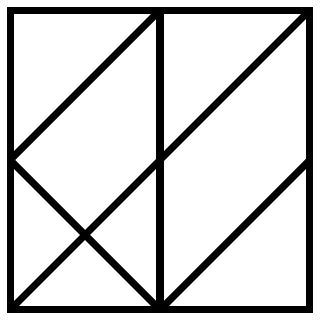
Select the option figure in which the given figure (X) is embedded as its part (rotation is NOT allowed). 

  1. AOption (a)

  2. BOption (b)

  3. COption (c)

  4. DOption (d)

View answer & explanation

Correct answer

Answer: (a)A.

Why this answer is correct

The embedded part of the image is:

Hence, the correct answer is "Option 1"

Question 9

Based on the English alphabetical order, three of the following four letter-clusters are alike in a certain way and thus form a group. Which is the one that DOES NOT belong to that group?

(Note: The odd one out is not based on the number of consonants/vowels or their position in the letter-cluster.)

  1. AOption (a)

    QPR

  2. BOption (b)

    BZC

  3. COption (c)

    NLO

  4. DOption (d)

    PNQ

View answer & explanation

Correct answer

Answer: (a)A.

QPR

Why this answer is correct

The pattern followed here is

Hence, the correct answer is "Option 1"

Question 10

NT 6 is related to QR 1 in a certain way. In the same way, FN 8 is related to IL 3. To which of the following is JL 16 related, following the same logic?

  1. AOption (a)

    NM 10

  2. BOption (b)

    MJ 11

  3. COption (c)

    LJ 10

  4. DOption (d)

    MM 11

View answer & explanation

Correct answer

Answer: (b)B.

MJ 11

Why this answer is correct

The pattern followed here is

Hence, the correct answer is "Option 2"

Question 11

UHAR is related to XKDU in a certain way based on the English alphabetical order. In the same way, SDWC is related to VGZF. To which of the given options is IMOS related, following the same logic?

  1. AOption (a)

    GORT

  2. BOption (b)

    GQTU

  3. COption (c)

    LPRV

  4. DOption (d)

    MOSW

View answer & explanation

Correct answer

Answer: (c)C.

LPRV

Why this answer is correct

The pattern followed here is

Hence, the correct answer is "Option 3"

Question 12

What should come in place of the question mark (?) in the given series?

567 570 575 582 591 ?

  1. AOption (a)

    596

  2. BOption (b)

    599

  3. COption (c)

    602

  4. DOption (d)

    600

View answer & explanation

Correct answer

Answer: (c)C.

602

Why this answer is correct

The logic follows here,

Hence, the correct answer is "Option 3"

Question 13

A, B, C, D, E, F and G are sitting around a circular table facing the centre (but not necessarily in the same order). B sits third to the right of E. E sits second to the left of G. G is to the immediate right of F. G is not an immediate neighbour of E. A sits on the immediate right of B and C sits on the immediate left of E. How many people sit between D and B when counted from the left of D?

  1. AOption (a)

    One

  2. BOption (b)

    Two

  3. COption (c)

    Four

  4. DOption (d)

    Three

View answer & explanation

Correct answer

Answer: (a)A.

One

Why this answer is correct

A, B, C, D, E, F and G are sitting around a circular table facing the centre (but not necessarily in the same order).

  • B sits third to the right of E.
  • E sits second to the left of G.
  • G is to the immediate right of F.
  • G is not an immediate neighbour of E.
  • A sits on the immediate right of B and C sits on the immediate left of E

The Final Arrangement is,

Hence, the correct answer is "Option 1"

Question 14

Six people, D, E, F, Q, R and S, are sitting around a circular table facing the centre (but not necessarily in the same order) . S sits to the immediate right of D. E sits second to the left of Q. Q sits to the immediate left of D. F sits third to the right of Q. How many people sit between R and F when counted from the left of F? 

  1. AOption (a)

    Four

  2. BOption (b)

    Three

  3. COption (c)

    Two

  4. DOption (d)

    One

View answer & explanation

Correct answer

Answer: (b)B.

Three

Why this answer is correct

Six people, D, E, F, Q, R and S, are sitting around a circular table facing the centre (but not necessarily in the same order) .

  • S sits to the immediate right of D.
  • E sits second to the left of Q.
  • Q sits to the immediate left of D.
  • F sits third to the right of Q

The Final Arrangement is,

Hence, the correct answer is "Option 2"

Question 15

Select the combination of letters that when filled in the blanks in the same sequence will make the series logically complete.

BFKG_HMIF_OKHL MJN_

  1. AOption (a)

    CDKQT

  2. BOption (b)

    EFJRS

  3. COption (c)

    EDJQS

  4. DOption (d)

    CFKRT

View answer & explanation

Correct answer

Answer: (c)C.

EDJQS

Why this answer is correct

Given sequence: _ B F K G _ H M I F _ O K H L _ M J N _

By checking options and substituting accordingly.

Option : EDJQS (Follow)​

E B F K G D  H M I F J O  K H  L Q M J  N S

So, the following pattern is: - 3 and + 5 alternately

Hence, the correct answer is "Option 3"

Question 16

What should come in place of the question mark (?) in the given series?

451 460 470 ? 493 506

  1. AOption (a)

    480

  2. BOption (b)

    481

  3. COption (c)

    482

  4. DOption (d)

    479

View answer & explanation

Correct answer

Answer: (b)B.

481

Why this answer is correct

The logic follows here,

Hence, the correct answer is "Option 2"

Question 17

Identify the figure given in the options, which when put in place of the question mark (?) will logically complete the series.

  1. AOption (a)

  2. BOption (b)

  3. COption (c)

  4. DOption (d)

View answer & explanation

Correct answer

Answer: (b)B.

Why this answer is correct

The logic followed in the given figure series is:

Hence, the correct answer is "Option 2"

Question 18

In a certain code language,

'A + B' means ‘A is the daughter of B’,

'A – B' means ‘A is the brother of B’,

'A × B' means ‘A is the wife of B’ and

'A ÷ B' means ‘ A is the father of B’.

Based on the above, how is P related to T if ‘P + Q × R – S ÷ T’?

  1. AOption (a)

    Father's brother's daughter

  2. BOption (b)

    Father's brother's wife 

  3. COption (c)

    Mother's brother's daughter

  4. DOption (d)

    Mother's brother's wife

View answer & explanation

Correct answer

Answer: (a)A.

Father's brother's daughter

Why this answer is correct

According to the given information,

A + B means ‘A is the daughter of B’;

A - B means ‘B is the brother of A’;

A × B means ‘B is the wife of A’;

A ÷ B means ‘A is the father of B’;

Given Expression  -  ‘P + Q × R – S ÷ T’

Hence, the correct answer is "Option 1"

Question 19

A paper is folded and cut as shown below. How will it appear when unfolded?

  1. AOption (a)

  2. BOption (b)

  3. COption (c)

  4. DOption (d)

View answer & explanation

Correct answer

Answer: (b)B.

Why this answer is correct

When the paper is unfolded it will appear like :-

Hence, the correct answer is "Option 2"

Question 20

Read the given statements and conclusions carefully. Assuming that the information given in the statements is true, even if it appears to be at variance with commonly known facts, decide which of the given conclusion(s) logically follow(s) from the statement(s). '

Statements:

All onions are potatoes.

No potato is a tomato.

No potato is a corn.

Conclusions:

(I) No onion is a tomato.

(II): Some corns are tomatoes.

  1. AOption (a)

    Only conclusion (II) follows.

  2. BOption (b)

    Both conclusions (I) and (II) follow.

  3. COption (c)

    Only conclusion (I) follows.

  4. DOption (d)

    Neither conclusion (I) nor (II) follows. 

View answer & explanation

Correct answer

Answer: (c)C.

Only conclusion (I) follows.

Why this answer is correct

The least possible Venn diagram for the given statements is as shown below :


Conclusions:

(I) No onion is a tomato. - True (As their is no relation potato and tomato and all onion is potato. So no onion is a tomato is true.)

(II): Some corns are tomatoes.- False ( As their is no relation potato and tomato and all onion is potato. So no onion is a tomato is true.)

Only conclusion (I) follows.

Hence, the correct answer is "Option 3"

General Knowledge and General Awareness (20 questions)

Question 21

Which Five-Year Plan's implementation was shifted to focus on the Prime Minister's 20- Point Programme during the Emergency?

  1. AOption (a)

    Fifth Plan

  2. BOption (b)

    Fourth Plan

  3. COption (c)

    Third Plan

  4. DOption (d)

    Sixth Plan

View answer & explanation

Correct answer

Answer: (a)A.

Fifth Plan

Why this answer is correct

The correct answer is 1.

Key Points

  • Fifth Five-Year Plan (1974-1979): This plan was disrupted during the Emergency declared in 1975, and its focus was shifted towards implementing the Prime Minister’s 20-Point Programme.
  • The 20-Point Programme was launched by then Prime Minister Indira Gandhi in 1975 with the aim of alleviating poverty and improving the living standards of the poor.
  • The objectives of the plan, such as reducing poverty and inequality, were realigned to work in conjunction with the 20-Point Programme.
  • The plan was originally designed to focus on growth in agriculture, industry, and self-reliance, but during the Emergency, these goals were overshadowed by the emphasis on the 20-Point Programme.
  • The implementation of the 20-Point Programme during the Emergency period is a hallmark of the Fifth Five-Year Plan.

Additional Information

  • The Fifth Five-Year Plan:
  • The plan began in 1974 and was terminated prematurely in 1978 by the Janata government. It aimed at poverty alleviation, self-reliance, and economic stability.
  • The original objectives included increasing national income, achieving self-sufficiency in food production, and reducing regional disparities.
  • Prime Minister’s 20-Point Programme (1975):
  • It included measures for poverty alleviation, control of inflation, and improvement in the quality of life of the underprivileged.
  • Key elements included land reforms, promotion of small and marginal farmers, abolition of bonded labor, and provisions for health, education, and housing.
  • The Emergency (1975-1977):
  • The Emergency was declared by Prime Minister Indira Gandhi, leading to the suspension of civil liberties and prioritization of central government policies like the 20-Point Programme.
  • During this period, the government emphasized poverty alleviation and economic reforms through measures that were part of the 20-Point Programme.
  • Impact of the 20-Point Programme:
  • The programme had a mixed impact, with some success in areas like land reforms and labor welfare, but it also faced criticism for its top-down approach and lack of grassroots implementation.
  • It became a key political and economic strategy during the Emergency to strengthen the government’s development agenda.

Question 22

Which of the following is NOT considered a Fundamental Right under the Indian Constitution?

  1. AOption (a)

    Right to Equality

  2. BOption (b)

    Right to Privacy

  3. COption (c)

    Right to Education 

  4. DOption (d)

    Right to Property

View answer & explanation

Correct answer

Answer: (d)D.

Right to Property

Why this answer is correct

The correct answer is 4) Right to Property.

Key Points

  • Right to Property was originally a Fundamental Right under Article 31 of the Constitution of India.
  • It was removed from the list of Fundamental Rights by the 44th Constitutional Amendment Act, 1978, and made a legal right under Article 300A.
  • Fundamental Rights are guaranteed under Part III of the Constitution, but the Right to Property is not included in this category anymore.
  • The Right to Property, as a legal right, ensures that no person shall be deprived of their property except by the authority of law.
  • Unlike Fundamental Rights, a legal right under Article 300A is not enforceable directly in the Supreme Court under Article 32.

Additional Information

  • Fundamental Rights in India:
  • There are six Fundamental Rights enshrined in the Indian Constitution, which are essential for the development of individuals and protecting them from state encroachment.
  • These include the Right to Equality (Articles 14-18), Right to Freedom (Articles 19-22), Right against Exploitation (Articles 23-24), Right to Freedom of Religion (Articles 25-28), Cultural and Educational Rights (Articles 29-30), and Right to Constitutional Remedies (Article 32).
  • Legal Rights vs. Fundamental Rights:
  • Legal rights are granted by ordinary laws and can be amended or repealed by the legislature, whereas Fundamental Rights are enshrined in the Constitution and are protected from legislative encroachment.
  • Fundamental Rights are enforceable by the Supreme Court under Article 32, but legal rights are enforceable in lower courts.
  • 44th Constitutional Amendment Act, 1978:
  • This amendment abolished the Right to Property as a Fundamental Right and reclassified it as a constitutional legal right under Article 300A.
  • The amendment was introduced to reduce conflicts between the state and individuals over property acquisition for public purposes.
  • Right to Property under Article 300A:
  • It ensures that no person shall be deprived of their property except by the authority of law, providing protection against arbitrary dispossession.
  • However, since it is not a Fundamental Right, violations cannot be directly challenged in the Supreme Court under Article 32.

Question 23

Tamilisai Soundararajan was the Lieutenant Governor of which of the following union territories before resigning to contest the Lok Sabha elections in 2024? 

  1. AOption (a)

    Puducherry

  2. BOption (b)

    Ladakh

  3. COption (c)

    Lakshadweep

  4. DOption (d)

    Jammu and Kashmir

View answer & explanation

Correct answer

Answer: (a)A.

Puducherry

Why this answer is correct

The correct answer is 1) Puducherry.

Key Points

  • Tamilisai Soundararajan served as the Lieutenant Governor of Puducherry from February 2021 to 2024.
  • She assumed the additional charge of Puducherry while also serving as the Governor of Telangana.
  • Her tenure as Lieutenant Governor included efforts to strengthen the administrative framework and promote socio-economic development in Puducherry.
  • Tamilisai Soundararajan resigned from the post of Lieutenant Governor of Puducherry in 2024 to contest in the Lok Sabha elections.
  • Puducherry is one of the eight union territories of India, known for its French colonial history and unique administrative structure.

Additional Information

  • About Tamilisai Soundararajan:
  • Tamilisai Soundararajan is a senior Bharatiya Janata Party (BJP) leader and a trained medical doctor specializing in gynecology.
  • She served as the BJP state president for Tamil Nadu before being appointed as the Governor of Telangana in 2019.
  • Her leadership style is known for grassroots engagement and promoting welfare schemes.
  • About Puducherry:
  • Puducherry is a union territory in India, consisting of four districts: Puducherry, Karaikal, Mahe, and Yanam.
  • It was a former French colony and retains cultural and architectural elements of French influence.
  • It has a legislative assembly and an elected Chief Minister, making it a partially self-governed union territory.
  • Role of Lieutenant Governor:
  • The Lieutenant Governor is the administrative head of a union territory and represents the President of India.
  • In union territories like Puducherry, the Lieutenant Governor plays a key role in coordinating between the union territory government and the central government.
  • The Lieutenant Governor has significant powers in decision-making, especially when there is a conflict between the elected government and the central government.
  • Puducherry's Unique Status:
  • Puducherry is governed under the Government of Union Territories Act, 1963, granting it a unique administrative structure compared to other union territories.
  • It has a dual governance system involving both an elected legislature and the Lieutenant Governor.

Question 24

The Joint Sitting of the parliament is governed by the rules of ___________

  1. AOption (a)

    Lok Sabha

  2. BOption (b)

    Special Rules mentioned by the Cabinet

  3. COption (c)

    Rajya Sabha

  4. DOption (d)

    Special Rules by the President 

View answer & explanation

Correct answer

Answer: (a)A.

Lok Sabha

Why this answer is correct

The correct answer is 1. Lok Sabha.

Key Points

  • Article 108 of the Indian Constitution provides for a Joint Sitting of both Houses of Parliament (Lok Sabha and Rajya Sabha) to resolve disagreements on legislative matters.
  • The Speaker of the Lok Sabha presides over the Joint Sitting, as explicitly mentioned in the Constitution. This is irrespective of whether the bill originated in the Lok Sabha or Rajya Sabha.
  • In the Speaker’s absence, the Deputy Speaker of the Lok Sabha presides. If both are unavailable, the Deputy Chairman of the Rajya Sabha may preside. Hence, Option 1 is correct.
  • The rules of procedure of the Lok Sabha govern the conduct of the Joint Sitting. These rules ensure smooth functioning and decision-making during such sessions.
  • The Joint Sitting provision is used sparingly and is considered a mechanism to address legislative deadlocks in the Indian parliamentary system.

Additional Information

  • Article 108 of the Constitution:
  • This article empowers the President of India to summon a Joint Sitting of Parliament to resolve disagreements between the two Houses on a bill.
  • A Joint Sitting is convened when one House passes a bill, and the other House either rejects it, proposes amendments not agreeable to the originating House, or fails to take any action within six months.
  • Role of Lok Sabha and Speaker:
  • As the Lok Sabha represents the majority of elected representatives, its Speaker presides over the Joint Sitting to ensure democratic representation in decision-making.
  • The Speaker’s role is crucial in maintaining order and ensuring the rules of the Lok Sabha are followed during the Joint Sitting.
  • Historical Instances of Joint Sitting:
  • The first Joint Sitting was held in 1961 to pass the Dowry Prohibition Bill, 1959, which had faced disagreements between the two Houses.
  • Another notable Joint Sitting was held in 2002 to pass the Prevention of Terrorism Act (POTA), which had been a contentious issue between the Houses.
  • Key Features of Joint Sitting:
  • It is a unique provision in India’s bicameral legislature, designed to prevent legislative paralysis.
  • The decision in a Joint Sitting is taken by a majority vote of the members present and voting, ensuring equal participation of both Houses.

Question 25

The Indian Independence Act of 1947 resulted in the partition of India into how many dominions?

  1. AOption (a)

    Four 

  2. BOption (b)

    Three

  3. COption (c)

    One

  4. DOption (d)

    Two

View answer & explanation

Correct answer

Answer: (d)D.

Two

Why this answer is correct

The correct answer is 4.

Key Points

  • The Indian Independence Act of 1947 was passed by the British Parliament to facilitate the partition of British India into two dominions, namely India and Pakistan.
  • The Act received royal assent on July 18, 1947, and the partition was implemented on August 15, 1947.
  • As per the Act, the two new dominions, India and Pakistan, were granted full sovereignty and legislative independence from the British Crown.
  • Pakistan was further divided into two parts: West Pakistan (modern-day Pakistan) and East Pakistan (modern-day Bangladesh).
  • The Act also declared the termination of British rule in India, marking the end of colonial governance. Hence, the correct answer is 4.

Additional Information

  • Key Provisions of the Indian Independence Act 1947:
  • The Act provided for the creation of two separate dominions, India and Pakistan, with complete autonomy to legislate and govern themselves.
  • It abolished the sovereignty of the British Crown over the Indian princely states, allowing them to either join India or Pakistan or remain independent.
  • It established the Partition Council to oversee the division of assets, military, and administrative services between the two dominions.
  • The office of the Viceroy was abolished, and each dominion was to appoint its own Governor-General.
  • Impact of the Partition:
  • The partition led to widespread communal violence, resulting in the displacement of over 10 million people and the loss of an estimated 1–2 million lives.
  • The Radcliffe Line was drawn as the boundary line, dividing Punjab and Bengal into two parts, leading to significant administrative and humanitarian challenges.
  • Princely States:
  • There were approximately 565 princely states under British suzerainty. These states were given the choice to join India or Pakistan or remain independent.
  • Important examples include Hyderabad, Junagadh, and Jammu & Kashmir, which faced complex integration processes.
  • Legacy of the Indian Independence Act:
  • The Act laid the foundation for the establishment of two independent nations, marking the official end of British colonial rule in India.
  • It remains a significant historical milestone, symbolizing the culmination of India's struggle for independence and the birth of Pakistan.

Question 26

Balakrishnabuwa Ichalkaranjikar was associated with which of the following musical gharanas?

  1. AOption (a)

    Jaipur-Atrauli gharana

  2. BOption (b)

    Kirana gharana

  3. COption (c)

    Gwalior gharana 

  4. DOption (d)

    Patiala gharana 

View answer & explanation

Correct answer

Answer: (c)C.

Gwalior gharana 

Why this answer is correct

The correct answer is 3.

Key Points

  • Balakrishnabuwa Ichalkaranjikar was a renowned Hindustani classical vocalist and is often credited as one of the pioneers of the Gwalior gharana.
  • He played a significant role in popularizing the Gwalior gharana style of Hindustani classical music, which is known for its emphasis on the clarity of swaras (notes) and structured compositions.
  • Balakrishnabuwa Ichalkaranjikar received his training from renowned musicians of his era, particularly focusing on the Gwalior style, which was the dominant gharana at the time.
  • He is considered a key figure in introducing and nurturing the Gwalior gharana in Maharashtra, contributing to its spread and prominence in western India.
  • His dedication to Hindustani classical music and his ability to train disciples helped establish the Gwalior gharana as a cornerstone of Indian classical music traditions. Hence, the correct answer is option 3.

Additional Information

  • Gwalior Gharana:
  • The Gwalior gharana is one of the oldest and most prominent gharanas in Hindustani classical music, known for its structured and well-defined approach to ragas.
  • It emphasizes clarity in swaras, the importance of taal (rhythm), and the systematic development of a raga through alap, bandish, and taans (fast melodic patterns).
  • The gharana is also recognized for its khayal singing style, which is the most popular genre in Hindustani classical music today.
  • Role of Balakrishnabuwa Ichalkaranjikar:
  • Balakrishnabuwa was instrumental in training several disciples who went on to become stalwarts in Hindustani classical music.
  • His efforts contributed significantly to the dissemination of the Gwalior gharana's traditions, especially in Maharashtra.
  • Other Major Gharanas:
  • Kirana Gharana: Known for its focus on melody and the intricate ornamentation of notes.
  • Jaipur-Atrauli Gharana: Famous for its complex and rare ragas.
  • Patiala Gharana: Known for its elaborate taans and rich tonal quality.
  • Hindustani Classical Music:
  • It is one of the two main traditions of Indian classical music, the other being Carnatic music.
  • The tradition emphasizes improvisation and exploration within the framework of a raga.
  • Prominent genres include khayal, dhrupad, thumri, and tappa.

Question 27

As per the 2023 statistic, which of the following neighbouring countries of India had the youngest mean population? 

  1. AOption (a)

    Nepal

  2. BOption (b)

    Pakistan

  3. COption (c)

    Bangladesh 

  4. DOption (d)

    Sri Lanka

View answer & explanation

Correct answer

Answer: (b)B.

Pakistan

Why this answer is correct

The correct answer is 2.

Key Points

  • Pakistan had the youngest mean population among India’s neighboring countries as per 2023 statistics.
  • The median age of Pakistan’s population was around 20.2 years in 2023, making it significantly younger compared to other neighboring countries.
  • This is due to Pakistan’s high population growth rate of approximately 2.0%, which has resulted in a larger proportion of younger individuals in its population.
  • In comparison, neighboring countries like Nepal, Bangladesh, and Sri Lanka have higher median ages due to lower population growth rates and better healthcare indicators.
  • Pakistan’s demographic profile reflects a predominantly young population, with over 60% of its population under the age of 30.

Additional Information

  • Mean Population:
  • The mean population represents the average value of a characteristic across an entire group, or population, of interest.
  • It is calculated by summing every value in that population and dividing by the total number of individuals or items
  • Median Age:
  • The median age is the age that divides the population into two numerically equal groups—half of the people are younger than this age, and half are older.
  • Countries with a low median age, like Pakistan, typically have high fertility rates and lower life expectancy.
  • Population Growth Rate:
  • Population growth rate indicates the annual increase in the population. Pakistan’s growth rate is among the highest in South Asia, contributing to its younger population structure.
  • Higher growth rates often lead to a larger workforce in the future but can also strain resources and infrastructure if not managed effectively.
  • Comparison with Neighboring Countries:
  • Nepal and Bangladesh have median ages of approximately 25 and 28 years, respectively, reflecting slower growth rates compared to Pakistan.
  • Sri Lanka, with a median age of around 34 years, has a more mature population due to a consistent decline in fertility rates and improvements in healthcare.
  • Impact of a Young Population:
  • A young population can be an asset if adequately educated and employed, contributing to economic growth and innovation.
  • However, it may also pose challenges such as unemployment, resource shortages, and pressure on education and healthcare systems.

Question 28

Who has been appointed as the Additional Director General (ADG) of the Indo-Tibetan Border Police (ITBP) in August 2024?

  1. AOption (a)

    Sanjeev Raina

  2. BOption (b)

    Dheeraj Sudan

  3. COption (c)

    Bhupesh Raina

  4. DOption (d)

    Dheeraj Pandey 

View answer & explanation

Correct answer

Answer: (a)A.

Sanjeev Raina

Why this answer is correct

The correct answer is 1.

Key Points

  • Sanjeev Raina was appointed as the Additional Director General (ADG) of the Indo-Tibetan Border Police (ITBP) in August 2024.
  • ITBP is a Central Armed Police Force (CAPF) of India that was established primarily to guard the borders between India and Tibet.
  • The ADG rank is one of the senior-most positions in the ITBP, responsible for overseeing and ensuring operational efficiency and strategic deployment of forces. Hence, option 1 is correct.
  • Sanjeev Raina is a seasoned officer with extensive experience in paramilitary forces and has held various critical positions before this appointment.
  • The appointment of senior officers in ITBP is crucial, given its strategic role in securing the nation's borders and managing operations in high-altitude terrains.

Additional Information

  • Indo-Tibetan Border Police (ITBP):
  • ITBP was established in 1962 after the Sino-Indian War to guard the Indo-China border along the Himalayan region.
  • It operates under the Ministry of Home Affairs and is responsible for border security, disaster response, and anti-Naxal operations.
  • ITBP personnel are specially trained to operate in high-altitude regions and extreme climatic conditions.
  • Role of Additional Director General (ADG):
  • ADG oversees the operational readiness and administrative functioning of the force.
  • The role involves coordinating with state and central agencies for border management and law enforcement.
  • ADG plays a strategic role in modernizing the force and implementing advanced technologies for better surveillance.
  • India-China Border:
  • The India-China border, also known as the Line of Actual Control (LAC), stretches over 3,488 kilometers.
  • This region includes difficult terrains like Ladakh, Arunachal Pradesh, and Sikkim, making ITBP's role vital in securing national sovereignty.
  • Challenges in Border Security:
  • The rugged terrain and harsh climate conditions demand specialized training and equipment for personnel.
  • Frequent tensions along the LAC require constant vigilance and preparedness to handle conflicts diplomatically and tactically.

Question 29

Which group of people settled in northwestern India around Taxila in the 1st century BC?

  1. AOption (a)

    Shakas

  2. BOption (b)

    Indo-Greeks

  3. COption (c)

    Kushanas

  4. DOption (d)

    Parthians

View answer & explanation

Correct answer

Answer: (c)C.

Kushanas

Why this answer is correct

The correct answer is 3.

Key Points

  • Kushanas, a Central Asian nomadic group, settled in northwestern India around Taxila during the 1st century BC.
  • The Kushanas were known for their significant contributions to the cultural and political landscape of the Indian subcontinent, including the spread of Buddhism.
  • They established the Kushana Empire, which stretched across present-day Afghanistan, Pakistan, and northern India, with Taxila as a major cultural and trade hub.
  • Taxila became a renowned centre for education, trade, and Buddhist learning under the Kushana rule.
  • The Kushanas were instrumental in promoting cross-cultural exchanges between Central Asia, China, and India, influencing art, religion, and trade routes like the Silk Road.

Additional Information

  • Kushana Empire:
  • The Kushanas were originally part of the Yuezhi tribe, a nomadic group displaced from China and Central Asia.
  • Their empire was established by Kujula Kadphises, with later rulers like Kanishka expanding its boundaries and influence.
  • Taxila:
  • Taxila was an ancient city located in present-day Pakistan and served as a major educational and cultural centre during ancient times.
  • Under the Kushanas, Taxila flourished as a hub of Buddhist learning, attracting scholars, traders, and pilgrims from various regions.
  • Buddhism and Art:
  • The Kushanas played a significant role in the spread of Buddhism to Central Asia and China, with Kanishka being a notable patron of the religion.
  • The Kushan ruler who convened the Fourth Buddhist Council was Kanishka. This council was held in Kashmir around the 1st century CE under his patronage to resolve disputes and compile Buddhist teachings. It was during this council that the Mahayana school of Buddhism gained prominence, and the texts were translated from Pali to Sanskrit.
  • The Gandhara art style, combining Indian and Greco-Roman influences, flourished during the Kushana period, especially in regions like Taxila.
  • Silk Road Influence:
  • The Kushana Empire was strategically located along the Silk Road, facilitating trade and cultural exchanges between East and West.
  • Their rule contributed to the economic prosperity of regions like Taxila, making it a key node in ancient trade networks.

Question 30

An object is thrown upwards. At the highest point of its trajectory, its:

  1. AOption (a)

    both kinetic and potential energy are zero

  2. BOption (b)

    both kinetic and potential energy are maximum

  3. COption (c)

    potential energy is maximum

  4. DOption (d)

    kinetic energy is maximum

View answer & explanation

Correct answer

Answer: (c)C.

potential energy is maximum

Why this answer is correct

The correct answer is 3.

Key Points

  • At the highest point of its trajectory, the velocity of the object in the vertical direction becomes zero. This implies that the object has no kinetic energy in the vertical direction.
  • The object still has potential energy due to its height above the ground, and this potential energy is maximum at the highest point.
  • Kinetic energy at this point is only due to horizontal motion (if any), as the vertical velocity is zero. However, in the absence of horizontal velocity, the kinetic energy would also be zero.
  • The correct interpretation is that the potential energy at the highest point is maximum compared to other points in the trajectory.
  • Hence, the correct answer is option 3.

Additional Information

  • Potential Energy:
  • Potential energy is the energy possessed by an object due to its position in a gravitational field. It is given by the formula PE = mgh, where m is mass, g is acceleration due to gravity, and h is height.
  • At the highest point in an object's trajectory, the height h is maximum, hence the potential energy is also at its maximum.
  • Kinetic Energy:
  • Kinetic energy is the energy possessed by an object due to its motion, calculated as KE = 1/2 mv², where v is the velocity.
  • At the highest point, the vertical component of velocity (vvertical) is zero, reducing the vertical kinetic energy to zero.
  • Trajectory of a Projectile:
  • A projectile follows a parabolic trajectory under the influence of gravity. At the apex (highest point), the vertical velocity is zero, but horizontal velocity (if present) remains constant.
  • The energy transformations during the motion include the conversion of kinetic energy into potential energy as the object rises and vice versa as it descends.
  • Energy Conservation in Projectile Motion:
  • The total mechanical energy (sum of kinetic and potential energy) of the object remains constant throughout its motion, assuming no air resistance.
  • At the highest point, the energy is predominantly potential energy, while at the initial and final points, it is predominantly kinetic energy.

Question 31

In the context of the Five Year Plans, what was a major challenge encountered during the Third Plan period (1961-1966)?

  1. AOption (a)

    Privatization of major industries

  2. BOption (b)

    The Indo-Pakistan War of 1965 

  3. COption (c)

    Excessive focus on space research

  4. DOption (d)

    Overemphasis on urban development

View answer & explanation

Correct answer

Answer: (b)B.

The Indo-Pakistan War of 1965 

Why this answer is correct

The correct answer is 2.

Key Points

  • The Indo-Pakistan War of 1965 posed a significant challenge during the Third Five-Year Plan period as it led to the diversion of resources from planned economic development to defense expenditure.
  • The war caused a strain on India's economy, resulting in increased fiscal deficits and curtailing progress in key sectors like agriculture and industry.
  • The focus of the Third Plan, which emphasized self-reliance and industrial development, was disrupted due to the emergency conditions created by the war.
  • Food shortages worsened during this period due to a combination of droughts and the economic impact of the war, leading to increased reliance on food imports under the PL-480 program.
  • The Indo-Pakistan War shifted priorities from economic growth to national security, leading to the failure of the Third Five-Year Plan in achieving its intended goals.

Additional Information

  • Objectives of the Third Five-Year Plan (1961-1966):
  • The Third Plan aimed to establish a self-reliant and self-sufficient economy with a focus on agriculture and industrial production.
  • It sought to achieve an annual growth rate of 5.6%, emphasizing modernization of industries and improvement in agricultural productivity.
  • Impact of the Indo-Pakistan War (1965):
  • The war led to a surge in defense spending, which diverted funds away from planned developmental projects.
  • It caused disruptions in trade and agriculture, further exacerbating economic challenges faced during the period.
  • Food Crisis of the 1960s:
  • The mid-1960s witnessed severe droughts, leading to a decline in agricultural output and a rise in food imports.
  • India had to depend on the USA’s PL-480 program for food grains, highlighting the urgency for agricultural reforms.
  • Failure of the Third Plan:
  • Due to the war and economic challenges, the plan failed to achieve its growth targets, and India had to shift to an “annual plan” approach thereafter.
  • The failure underscored the need for better planning and resource allocation to handle emergencies effectively.

Question 32

What is the process of ocean acidification?

  1. AOption (a)

    Neutralisation of ocean acidity

  2. BOption (b)

    Decrease in pH due to carbon dioxide absorption

  3. COption (c)

    Rise in sea levels

  4. DOption (d)

    Increase in ocean alkalinity 

View answer & explanation

Correct answer

Answer: (b)B.

Decrease in pH due to carbon dioxide absorption

Why this answer is correct

The correct answer is 2.

Key Points

  • Ocean acidification is the ongoing decrease in the pH of the Earth's oceans caused by the absorption of atmospheric carbon dioxide (CO2).
  • When CO2 dissolves in seawater, it reacts with water to form carbonic acid (H2CO3), which then dissociates into bicarbonate (HCO3-) and hydrogen ions (H+).
  • The increase in hydrogen ions (H+) lowers the pH of seawater, making it more acidic. This is why the correct answer is statement 2.
  • Ocean acidification has significant impacts on marine ecosystems, particularly on organisms like corals, shellfish, and plankton that rely on calcium carbonate for their shells and skeletons.
  • Since the industrial revolution, ocean pH has dropped by approximately 0.1 units, representing a 30% increase in acidity.

Additional Information

  • Process of Ocean Acidification:
  • Carbon dioxide (CO2) from human activities, such as burning fossil fuels and deforestation, is released into the atmosphere.
  • Approximately 25-30% of this CO2 is absorbed by the oceans, where it reacts with seawater to form carbonic acid.
  • Carbonic acid dissociates into bicarbonate ions and hydrogen ions, increasing the acidity of ocean water.
  • Impact on Marine Life:
  • Marine organisms such as corals and mollusks, which depend on calcium carbonate for their shells and skeletons, are particularly vulnerable as acidification reduces the availability of carbonate ions.
  • Reduced calcification rates in these organisms can lead to weaker structures and disrupt marine food chains.
  • pH Scale and Ocean Chemistry:
  • The pH scale measures the acidity or alkalinity of a solution. A decrease in pH indicates an increase in acidity.
  • Pre-industrial ocean pH was approximately 8.2, but current levels have dropped to about 8.1, which may seem small but represents a significant chemical change.
  • Global Implications of Ocean Acidification:
  • It threatens marine biodiversity and ecosystems, particularly coral reefs, which are vital for coastal protection and fisheries.
  • Ocean acidification also has socioeconomic impacts, as it affects fisheries, aquaculture, and tourism sectors that rely on healthy marine ecosystems.

Question 33

Which of the following numbers on the cheque should be noted to check its status?

  1. AOption (a)

    Magnetic Ink Character Recognition number

  2. BOption (b)

    Indian Financial System Code

  3. COption (c)

    Cheque number 

  4. DOption (d)

    Last number on the cheque

View answer & explanation

Correct answer

Answer: (c)C.

Cheque number 

Why this answer is correct

The correct answer is Cheque number.

Key Points

  • Cheque number: This unique identification number is present on every cheque and helps in tracking and verifying the status of the cheque.
  • The cheque number is printed at the bottom-left corner of the cheque and is essential for identifying specific cheques during banking transactions.
  • Banks use the cheque number to check whether a cheque has been cleared, is pending, or has been canceled or bounced. Hence, this is the correct option.
  • The cheque number is linked to an account holder and is stored in banking systems to ensure accurate tracking of transactions.
  • It plays a vital role in preventing fraud, as duplicate or fake cheques can be identified by their number.

Additional Information

  • Magnetic Ink Character Recognition (MICR):
  • MICR is a technology used in banking to read and process cheques. It encodes information such as the bank branch, account number, and cheque number using magnetic ink.
  • While MICR is crucial for automated processing, it does not directly help in tracking the status of a cheque. It is primarily used for sorting and processing cheques faster.
  • Indian Financial System Code (IFSC):
  • IFSC is an alphanumeric code used for identifying bank branches during electronic fund transfers like NEFT, RTGS, and IMPS.
  • It is printed on cheques but does not provide information about the status of a cheque.
  • Other components on a cheque:
  • Details like date, payee name, amount, and signature are essential for cheque validation but are not used to track its status.
  • The cheque number remains the most reliable identifier for checking its status or history.

Question 34

Shigmo festival is celebrated in which of the following states? 

  1. AOption (a)

    Haryana

  2. BOption (b)

    Goa

  3. COption (c)

    Himachal Pradesh

  4. DOption (d)

    Gujarat 

View answer & explanation

Correct answer

Answer: (b)B.

Goa

Why this answer is correct

The correct answer is 2.

Key Points

  • Shigmo festival is one of the most celebrated cultural events in Goa, marking the arrival of spring.
  • It is celebrated by the Konkani community, including farmers and rural residents, as a form of gratitude for harvest and prosperity.
  • The festival involves vibrant street parades, folk dances like Ghode Modni and Romta Mel, and traditional music depicting mythological themes.
  • Shigmo is celebrated in the Holi season (March-April), coinciding with the Hindu lunar month of Phalguna.
  • This festival celebrates Goa's rich cultural heritage, with locals decorating temples and homes, and participating in processions.

Additional Information

  • Historical and Cultural Significance:
  • Shigmo is deeply rooted in the agrarian traditions of Goa, celebrating the harvest season and invoking blessings from deities for future prosperity.
  • It also commemorates the victory of good over evil and celebrates the return of warriors to their villages after battles during ancient times.
  • Celebratory Practices:
  • The festival includes decorated floats depicting scenes from Hindu mythology, presented during street parades.
  • Local dance forms like Fugdi and Dekhni are performed by groups in vibrant costumes.
  • Villages and temples are illuminated, and rituals such as burning effigies representing evil forces are performed.
  • Community Participation:
  • The festival is inclusive, with participation from people of all ages, especially farmers, artists, and temple priests.
  • It fosters community bonding and showcases the traditional art, music, and culture of Goa.
  • Tourism Impact:
  • Shigmo attracts tourists from across India and worldwide, boosting the local economy and promoting Goa as a cultural tourism destination.
  • The festival has gained prominence due to its colorful processions, traditional performances, and unique local customs.

Question 35

Domar Singh Kunwar was awarded the prestigious Padma Shri-2023 for his significant contribution to theatrical dance, he is from which state?

  1. AOption (a)

    Assam

  2. BOption (b)

    Chhattisgarh

  3. COption (c)

    Manipur

  4. DOption (d)

    Jharkhand

View answer & explanation

Correct answer

Answer: (b)B.

Chhattisgarh

Why this answer is correct

The correct answer is 2.

Key Points

  • Domar Singh Kunwar is a renowned practitioner of traditional theatrical dance and has been recognized for his outstanding contributions to this art form.
  • He hails from the state of Chhattisgarh, a region known for its rich cultural heritage and traditional art forms.
  • The Padma Shri award, conferred in 2023, is one of the highest civilian honors in India, recognizing individuals for their significant contributions in various fields, including arts.
  • Chhattisgarh is known for preserving and promoting its folk dances, such as Panthi, Raut Nacha, and Pandwani, which reflect the vibrant traditions of the state.
  • Domar Singh Kunwar's recognition emphasizes the importance of sustaining indigenous art forms and promoting them on national and global platforms.

Additional Information

  • Padma Awards:
  • The Padma Awards are among the highest civilian honors in India, divided into three categories: Padma Vibhushan, Padma Bhushan, and Padma Shri.
  • The Padma Shri is awarded for distinguished service in fields such as art, literature, education, sports, medicine, social service, science, and public affairs.
  • Chhattisgarh's Cultural Heritage:
  • Chhattisgarh is a hub of folk culture, with its traditions deeply rooted in tribal and rural communities.
  • The state is home to various folk dances, including Panthi Dance (performed by the Satnami community) and Pandwani (a musical storytelling tradition).
  • Folk art in Chhattisgarh often reflects themes of mythology, nature, and social values, blending spirituality with creativity.
  • Importance of Theatrical Dance:
  • Theatrical dance combines elements of drama, music, and choreography, creating a visual representation of stories and cultural narratives.
  • These art forms serve as a medium to preserve and promote cultural identity and heritage across generations.
  • Artists like Domar Singh Kunwar play a pivotal role in keeping these traditions alive and inspiring younger generations to appreciate their cultural roots.

Question 36

The Kinnauris of _______________________ perform Losar Shona Chuksam, a Kinnauri dance.

  1. AOption (a)

    Himachal Pradesh

  2. BOption (b)

    Uttar Pradesh 

  3. COption (c)

    Madhya Pradesh

  4. DOption (d)

    Arunachal Pradesh

View answer & explanation

Correct answer

Answer: (a)A.

Himachal Pradesh

Why this answer is correct

The correct answer is 1.

Key Points

  • The Kinnauris are an ethnic group primarily residing in the Kinnaur district of Himachal Pradesh, India.
  • The Kinnauris are known for their unique culture, traditions, and folk dances, which include the Losar Shona Chuksam, a traditional Kinnauri dance performed during the Losar festival.
  • Losar is the Tibetan New Year, celebrated with great enthusiasm in Kinnaur, where the community engages in vibrant dances and festivities. Hence, the correct answer is Himachal Pradesh.
  • The Losar Shona Chuksam dance involves traditional costumes, rhythmic movements, and music, reflecting the region's rich cultural heritage.
  • This dance is also a way to seek blessings for a prosperous year ahead and express gratitude towards nature.

Additional Information

  • Kinnaur District:
  • Kinnaur is a high-altitude district in Himachal Pradesh, known for its picturesque landscapes and unique tribal culture.
  • The district is located near the Indo-Tibetan border and exhibits a blend of Hindu and Buddhist traditions.
  • Losar Festival:
  • Losar, or the Tibetan New Year, is one of the most important festivals in the Himalayan regions, including Kinnaur.
  • The festival is celebrated with traditional dances, music, and rituals to mark the start of the lunar calendar.
  • Traditional Kinnauri Attire:
  • Kinnauris wear traditional woolen garments and distinct headgear, known as the "green Kinnauri cap," during festivals and dances.
  • These attires are designed to withstand the cold climate of the region and reflect their rich cultural identity.
  • Other Folk Dances of Kinnaur:
  • Apart from Losar Shona Chuksam, the Kinnauris also perform other folk dances like Chhanjti and Kayang dance during various occasions.
  • These dances often depict local myths, legends, and traditional lifestyles.

Question 37

Match the following:

A.Citric Acid1.Basic
B.Quicklime2.NaCl
C.Common Salt3.Found in lemons, limes, and oranges
D.Bleaching Powder4.CaOCl2
  1. AOption (a)

    A-2, B-4, C-3, D-1

  2. BOption (b)

    A-3, B-1, C-4, D-2

  3. COption (c)

    A-3, B-1, C-2, D-4

  4. DOption (d)

    A-1, B-3, C-2, D-4

View answer & explanation

Correct answer

Answer: (c)C.

A-3, B-1, C-2, D-4

Why this answer is correct

The correct answer is 3.

Key Points

  • Citric acid (A-3): It is an organic acid found naturally in citrus fruits like lemons, limes, and oranges.
  • Quicklime (B-1): It is chemically calcium oxide (CaO) and is basic in nature. It is commonly used in construction and industrial processes.
  • Common Salt (C-2): Sodium chloride (NaCl) is the chemical composition of common salt, used widely in cooking and food preservation.
  • Bleaching Powder (D-4): Its chemical formula is CaOCl2, and it is used as a disinfectant and bleaching agent.
  • Hence, the correct matching is A-3, B-1, C-2, and D-4, aligning with option 3.

Additional Information

  • Citric Acid:
  • It has the chemical formula C6H8O7 and is widely used as a food additive and preservative due to its sour taste.
  • It is also used in cleaning products to remove hard water stains due to its acidic properties.
  • Quicklime:
  • Produced by heating limestone (CaCO3) in a process called calcination.
  • It reacts with water to form slaked lime (Ca(OH)2), releasing heat in an exothermic reaction.
  • Common Salt:
  • Essential for human health, it helps maintain fluid balance and nerve transmission in the body.
  • It has industrial applications, such as in the production of chlorine, caustic soda, and soda ash.
  • Bleaching Powder:
  • A mixture of calcium hypochlorite, it is commonly used for water purification and disinfection.
  • It is also used in the textile and paper industries for bleaching fabrics and pulp.

Question 38

How many medals did Punjab University win at the Khelo India University Games event held in 2023? 

  1. AOption (a)

    51

  2. BOption (b)

    65

  3. COption (c)

    69

  4. DOption (d)

    57

View answer & explanation

Correct answer

Answer: (c)C.

69

Why this answer is correct

The correct answer is 69.

Key Points

  • Punjab University secured an impressive tally of 69 medals at the Khelo India University Games 2023, showcasing its dominance in the event.
  • The medal haul included 26 gold medals, which were instrumental in propelling Punjab University to the top of the medal table.
  • The university also bagged 17 silver medals and 26 bronze medals, contributing to its overall total.
  • Punjab University’s athletes excelled in various sports, including wrestling, athletics, and shooting, helping the university achieve this remarkable feat.
  • The Khelo India University Games is a platform for nurturing young talent, and Punjab University’s performance highlighted its strong sports culture and infrastructure.

Additional Information

  • Khelo India University Games 2023:
  • It is a flagship event under the Khelo India initiative, aimed at promoting grassroots-level sports and identifying talent for international competitions.
  • The 2023 edition witnessed participation from over 200 universities across India, competing in various disciplines like athletics, wrestling, shooting, and swimming.
  • The event was hosted in multiple cities, including Bengaluru, with significant support from the Ministry of Youth Affairs and Sports.
  • The first edition Khelo India University Games was held in Odisha in 2020 at the Kalinga Institute of Industrial Technology (KIIT) in Bhubaneswar and Cuttack.
  • The third edition was hosted by Uttar Pradesh in 2023. The mascot was 'Jitu', a Barasingha (Swamp Deer), which is the state animal of Uttar Pradesh.
  • 2024 edition: The games were inaugurated in Guwahati, Assam, by the Union Minister for Youth Affairs and Sports, Anurag Singh Thakur.
  • Importance of the Khelo India Initiative:
  • Launched in 2018, the initiative aims to strengthen the sports ecosystem in India by providing financial assistance and infrastructure support.
  • It focuses on the identification and nurturing of young talent through events like the Khelo India Youth Games and University Games.
  • Scholarships and training facilities are provided to athletes under this program to ensure their holistic development.

Question 39

Prime Minister Narendra Modi inaugurated the 141st International Olympic Committee (IOC) Session in which of the following cities?

  1. AOption (a)

    Hyderabad

  2. BOption (b)

    Mumbai

  3. COption (c)

    New Delhi 

  4. DOption (d)

    Bengaluru

View answer & explanation

Correct answer

Answer: (b)B.

Mumbai

Why this answer is correct

The correct answer is Option 2.

Key Points

  • Prime Minister Narendra Modi inaugurated the 141st International Olympic Committee (IOC) Session in Mumbai on October 15, 2023.
  • The IOC Session is a significant event where members of the International Olympic Committee make critical decisions regarding the Olympic Games and sports development globally.
  • Mumbai was selected as the host city for this IOC Session after India won the bid in 2022 during the 139th IOC Session held in Beijing.
  • This marked the first IOC Session held in India in over four decades; the last session was hosted in New Delhi in 1983.
  • The event reinforced India’s commitment to promoting sports and its aspirations to host the Olympic Games in the future.

Additional Information

  • International Olympic Committee (IOC):
  • The IOC is a Switzerland-based organization that oversees the Olympic Movement and ensures the organization of the Olympic Games.
  • Founded in 1894, the IOC works with National Olympic Committees (NOCs) and international sports federations to promote sports worldwide.
  • IOC Sessions:
  • IOC Sessions are annual or extraordinary meetings where key decisions related to the Olympic Games are discussed and voted upon.
  • These sessions cover topics such as host city selection for upcoming Games, policy changes, and updates on sports development programs.
  • India’s Role in Global Sports:
  • India has been actively working to enhance its global sports profile, hosting events such as the Commonwealth Games and bidding for future Olympic Games.
  • The IOC Session in Mumbai has further strengthened India’s position as a global sports hub and its readiness to host international events.
  • Significance of the IOC Session in Mumbai:
  • The event showcased India’s infrastructure capabilities and its commitment to promoting sports at both grassroots and international levels.
  • It also provided a platform for Indian sports officials to interact with global leaders and discuss future collaborations in the sports domain.

Question 40

Which Indian labour law and social security measure aims to guarantee the 'right to work'?

  1. AOption (a)

    Mahatma Gandhi National Rural Employment Guarantee Act 

  2. BOption (b)

    Citizenship Act

  3. COption (c)

    Indian Institutes of Management Act

  4. DOption (d)

    The Employees’ Provident Funds and Miscellaneous Provisions Act 

View answer & explanation

Correct answer

Answer: (a)A.

Mahatma Gandhi National Rural Employment Guarantee Act 

Why this answer is correct

The correct answer is 1) Mahatma Gandhi National Rural Employment Guarantee Act.

Key Points

  • The Mahatma Gandhi National Rural Employment Guarantee Act (MGNREGA): Enacted in 2005, it aims to enhance the livelihood security of rural households in India by providing at least 100 days of guaranteed wage employment in a financial year to every rural household.
  • MGNREGA is a demand-driven law, meaning that work is provided upon request by eligible rural households. This ensures that the "right to work" is upheld as a legal guarantee.
  • Under MGNREGA, unskilled manual labor is provided for public works projects, including water conservation, afforestation, and rural infrastructure development.
  • The Act empowers local institutions like Gram Panchayats to plan and implement projects, ensuring community participation and transparency.
  • MGNREGA mandates timely wage payments and promotes gender equity by ensuring equal wages for men and women. Hence, option 1 is correct.

Additional Information

  • Key Features of MGNREGA:
  • The Act provides a legal guarantee for wage employment, making it unique among welfare schemes globally. If employment is not provided within 15 days of application, the applicant is entitled to an unemployment allowance.
  • The types of work permissible under MGNREGA focus on sustainable development, such as construction of check dams, rural roads, and irrigation canals.
  • Social audits are conducted to ensure transparency and accountability in the implementation of MGNREGA projects.
  • Significance of MGNREGA:
  • It has contributed significantly to poverty reduction, rural development, and empowerment of marginalized communities.
  • The program provides a critical safety net during economic crises, such as the COVID-19 pandemic, when rural employment opportunities were severely impacted.
  • Challenges in Implementation:
  • Delays in wage payments and inadequate funding have been persistent issues, affecting the program’s efficiency and credibility.
  • Instances of corruption, including fake job cards and misappropriation of funds, have been reported in some areas.
  • Despite its challenges, MGNREGA remains a cornerstone of India’s social security framework.

Elementary Mathematics (20 questions)

Question 41

A dishonest shopkeeper promises to sell his goods at cost price. However, he uses a weight that actually weighs 48% less than what is written on it. Find his profit percentage. 

  1. AOption (a)

    91413%91\frac{4}{13}\%

  2. BOption (b)

    94813%94\frac{8}{13}\%

  3. COption (c)

    93513%93\frac{5}{13}\%

  4. DOption (d)

    92413%92\frac{4}{13}\%

View answer & explanation

Correct answer

Answer: (d)D.

92413%92\frac{4}{13}\%

Why this answer is correct

Shortcut Trick

Let the claimed weight be 100 units.

The shopkeeper uses 48% less weight, so the actual weight given is 100 − 48 = 52 units.

Cost Price (CP) is for 52 units, while Selling Price (SP) is charged for 100 units.

Profit = SP − CP = 100 − 52 = 48 units.

Profit % = (48 ÷ 52) × 100 = (12 ÷ 13) × 100 = 1200 ÷ 13 = 924/13%.

∴ The correct answer is 924/13%.

Alternate Method

Given:

The shopkeeper promises to sell goods at Cost Price (CP).

He uses a weight that is 48% less than the marked weight.

Formula Used:

Profit % = [Error ÷ (True Value − Error)] × 100

Profit % = [(Claimed Weight − Actual Weight) ÷ Actual Weight] × 100

Actual: 52g (CP) Error: 48g (Profit)

Claimed Weight: 100g (SP) Dishonest Shopkeeper Weight Distribution

Calculations:

⇒ Let the claimed weight be 100 g.

⇒ The actual weight used = 100 − 48 = 52 g.

⇒ Let the cost price of 1 g be ₹1.

⇒ Selling Price (SP) charged to the customer = ₹100 (for 100 g).

⇒ Cost Price (CP) incurred by the shopkeeper = ₹52 (for 52 g).

⇒ Profit earned = SP − CP = 100 − 52 = ₹48.

⇒ Profit % = (Profit ÷ CP) × 100

⇒ Profit % = (48 ÷ 52) × 100

⇒ Profit % = (12 ÷ 13) × 100

⇒ Profit % = 1200 ÷ 13 %

⇒ Profit % = 924/13%

∴ The correct answer is 924/13%.

Additional Information

Dishonest Dealer (Selling at CP)

When a shopkeeper sells goods at cost price but uses a false weight, his profit percentage is given by: Profit % = [Error ÷ (True Value − Error)] × 100.

Dishonest Dealer (With Markup)

If a shopkeeper marks up his goods by x% and also uses a false weight, the net profit is calculated by finding the successive percentage effect of the price markup and the weight ratio.

Cheating During Buying and Selling

If a dealer cheats by x% while buying (gets extra weight) and y% while selling (gives lesser weight), his overall profit ratio is determined by combining the two effects: (100 + x) ÷ (100 − y).

Question 42

The price (per litre) of petrol increases by 50%. By what percent should its consumption be reduced such that the expenditure on it increases by 32% only? 

  1. AOption (a)

    88%

  2. BOption (b)

    12%

  3. COption (c)

    95%

  4. DOption (d)

    8%

View answer & explanation

Correct answer

Answer: (b)B.

12%

Why this answer is correct

Shortcut Trick

Assume initial price and expenditure as 100.

Expected expenditure at new price = 100 + 50% = 150.

Target allowed expenditure = 100 + 32% = 132.

Reduction % = [(Expected − Target) ÷ Expected] × 100

⇒ Reduction % = (150 − 132) ÷ 150 × 100 = 12%

∴ The correct answer is 12%.

Alternate Method

Given:

Increase in petrol price = 50%

Increase in expenditure = 32%

Formula Used:

Expenditure = Price × Consumption

Percentage change = [(Final Value − Initial Value) ÷ Initial Value] × 100

Initial Exp. = 100

Expected Exp. = 150

Allowed Exp. = 132

18

Reduction % = (150 − 132) ÷ 150 = 18 ÷ 150 × 100 = 12%

Calculations:

⇒ Let the initial price be 100 and initial consumption be 100 units.

⇒ Initial Expenditure = 100 × 100 = 10,000

⇒ New Price = 100 + (50 ÷ 100) × 100 = 150

⇒ Allowed Expenditure = 10,000 + (32 ÷ 100) × 10,000 = 13,200

⇒ Let the new consumption be C units.

⇒ New Price × New Consumption = Allowed Expenditure

⇒ 150 × C = 13,200

⇒ C = 13,200 ÷ 150 = 88 units

⇒ Reduction in consumption = Initial Consumption − New Consumption

⇒ Reduction = 100 − 88 = 12 units

⇒ % Reduction = (12 ÷ 100) × 100 = 12%

∴ The correct answer is 12%.

Additional Information

Price-Consumption Relationship

When overall expenditure remains constant, Price and Consumption are inversely proportional: P1 × C1 = P2 × C2.

Successive Percentage Change

If a value undergoes two successive percentage changes of x% and y%, the net percentage change is given by the formula: Net % = x + y + (xy ÷ 100).

Percentage Change Formula

To calculate the percentage increase or decrease in a value relative to its original base: % Change = [(Final Value − Initial Value) ÷ Initial Value] × 100.

Question 43

There are 50 students in a class. If the average weight of 39 students is 32 kg and the average weight of the entire class is 34 kg, then what is the average weight (in kg) of rest of the 11 students of the class? (Correct up to two decimal places)

  1. AOption (a)

    43.08

  2. BOption (b)

    41.09

  3. COption (c)

    40.19

  4. DOption (d)

    42.18

View answer & explanation

Correct answer

Answer: (b)B.

41.09

Why this answer is correct

Shortcut Trick

Total deviation of 39 students from the overall average = 39 × (32 − 34) = −78 kg.

To maintain the overall average, the remaining 11 students must balance this with an opposite deviation of +78 kg.

Average deviation for these 11 students = +78 ÷ 11 ≈ +7.09 kg.

Required average of the 11 students = Overall Average + Deviation = 34 + 7.09 = 41.09 kg.

∴ The correct answer is 41.09 kg.

Alternate Method

Given:

Total number of students = 50

Overall average weight of the class = 34 kg

Average weight of 39 students = 32 kg

Number of remaining students = 50 − 39 = 11

Formula Used:

Sum of observations = Average × Number of observations

Total: 50 Students | Overall Avg: 34 kg

39 Students Avg Weight: 32 kg

11 Students Avg: ?

Total Weight = 50 × 34 = 1700 kg Part 1 Weight = 39 × 32 = 1248 kg Remaining Weight = 1700 − 1248 = 452 kg

Calculations:

⇒ Total weight of all 50 students = 50 × 34 = 1700 kg

⇒ Total weight of 39 students = 39 × 32 = 1248 kg

⇒ Total weight of the remaining 11 students = 1700 − 1248 = 452 kg

⇒ Average weight of the remaining 11 students = 452 ÷ 11

⇒ Average weight = 41.0909... ≈ 41.09 kg

∴ The correct answer is 41.09 kg.

Additional Information

Weighted Average

Used when combining groups of different sizes to find the central value. Formula: Aw = (n1A1 + n2A2) ÷ (n1 + n2).

Deviation Method

The net sum of deviations of all elements from their mean is always zero. This property provides a highly effective shortcut for finding missing values in a group.

Replacement Concept in Averages

When a new member replaces an existing one, the change in the total sum equals the difference in their values. New Value = Old Value + (Total Members × Change in Average).

Question 44

The simple interest on a principal amount (in ₹) is ₹540 for a period of 4 years at the rate of 2% per annum. The principal amount (in ₹) is:

  1. AOption (a)

    6745

  2. BOption (b)

    6750

  3. COption (c)

    6755

  4. DOption (d)

    6743

View answer & explanation

Correct answer

Answer: (b)B.

6750

Why this answer is correct

Shortcut Trick

The total effective simple interest rate for 4 years = Rate × Time

Effective Rate = 2% × 4 = 8%

This means 8% of the Principal amounts to the total Simple Interest.

⇒ 8% of P = 540

⇒ P = (540 × 100) ÷ 8 = 6750

∴ The correct answer is ₹6750.

Alternate Method

P = ?

SI = ₹540

Rate = 2% p.a. Time = 4 years

Total SI = 2% × 4 = 8% of P

Given:

Simple Interest (SI) = ₹540

Rate of Interest (R) = 2% per annum

Time (T) = 4 years

Formula Used:

Simple Interest = (Principal × Rate × Time) ÷ 100

Calculations:

⇒ 540 = (P × 2 × 4) ÷ 100

⇒ 540 = (P × 8) ÷ 100

⇒ P = (540 × 100) ÷ 8

⇒ P = 54000 ÷ 8

⇒ P = 6750

∴ The correct answer is ₹6750.

Additional Information

Total Amount in Simple Interest

The final amount is the sum of the principal and the interest earned: A = P + SI, which can also be written as A = P[1 + (RT ÷ 100)].

Direct Formulas for Rate and Time

You can easily find missing variables by rearranging the base SI formula: R = (SI × 100) ÷ (P × T) and T = (SI × 100) ÷ (P × R).

Simple vs Compound Interest

Simple Interest is always calculated on the original principal amount, whereas Compound Interest is calculated on the principal plus any accumulated interest from previous periods.

Question 45

Mahesh has ₹1617 with him. He divided it amongst his sons Vijay and Ajay and asked them to invest it at 10% rate of interest compounded annually. It was seen that Vijay and Ajay got same amount after 19 and 20 years respectively. How much (in ₹) did Mahesh give to Vijay?

  1. AOption (a)

    770

  2. BOption (b)

    870

  3. COption (c)

    847

  4. DOption (d)

    697

View answer & explanation

Correct answer

Answer: (c)C.

847

Why this answer is correct

Shortcut Trick

When amounts are equal after different times, the person with less time gets more principal to start with.

Ratio of Vijay's to Ajay's share = (100 + R) / 100 raised to the difference in time.

Vijay : Ajay = (110/100)20 − 19 = 11 : 10

Vijay's share = (11 ÷ 21) × 1617 = 847

∴ The correct answer is ₹847.

Alternate Method

Given:

Total principal = ₹1617

Rate of interest (R) = 10% compounded annually

Time for Vijay = 19 years

Time for Ajay = 20 years

Formula Used:

Amount = P(1 + R/100)T

Total = ₹1617

Vijay (V)

Ajay (A)

19 Years @ 10%

20 Years @ 10%

Equal Amount V(1.1)^19 = A(1.1)^20

Ratio → V : A = 11 : 10

Calculations:

⇒ Let the amount given to Vijay be V and to Ajay be A.

⇒ V + A = 1617

⇒ Amount of Vijay after 19 years = Amount of Ajay after 20 years

⇒ V(1 + 10/100)19 = A(1 + 10/100)20

⇒ V/A = (1 + 10/100)20 ÷ (1 + 10/100)19

⇒ V/A = (1 + 10/100)1

⇒ V/A = 110/100 = 11/10

⇒ Ratio of shares of Vijay to Ajay = 11 : 10

⇒ Total ratio parts = 11 + 10 = 21

⇒ Value of 21 parts = 1617

⇒ Value of 1 part = 1617 ÷ 21 = 77

⇒ Vijay's share = 11 parts = 11 × 77 = 847

∴ The correct answer is ₹847.

Additional Information

Division of Sum for Equal Amounts

When a sum is divided into two parts P1 and P2 invested for T1 and T2 years respectively at the same CI rate R, the ratio to receive equal amounts is P1/P2 = (1 + R/100)T<sub>2</sub> − T<sub>1</sub>.

Compound Interest Formula

The amount after T years is calculated as A = P(1 + R/100)T, where P is the principal and R is the rate of interest per annum.

Difference Between CI and SI

For 2 years, the difference is CI − SI = P(R/100)2. For 3 years, CI − SI = P(R/100)2(3 + R/100).

Question 46

Ajit and Bimal can do a piece of work in 5, and 8 days, respectively, while Chandan can destroy the same work in 12 days. Ajit works on the 1st day, Bimal works on the 2nd day, Chandan works on the 3rd day and so on. They follow the same pattern until the work gets completed. How many days will it take for the work to be completed the first time?

  1. AOption (a)

    102510\frac{2}{5}

  2. BOption (b)

    9459\frac{4}{5}

  3. COption (c)

    9189\frac{1}{8}

  4. DOption (d)

    103510\frac{3}{5}

View answer & explanation

Correct answer

Answer: (d)D.

103510\frac{3}{5}

Why this answer is correct

Shortcut Trick

Let Total Work = LCM(5, 8, 12) = 120 units.

1 cycle (3 days) work = Ajit + Bimal + Chandan = 24 + 15 − 10 = 29 units.

Work completed in 3 full cycles (9 days) = 3 × 29 = 87 units.

On 10th day, Ajit adds 24 units ⇒ Total work = 87 + 24 = 111 units.

Remaining 9 units are done by Bimal on 11th day in 9 ÷ 15 = 3/5 day.

∴ The correct answer is 10 3/5 days.

Alternate Method

Given:

Time taken by Ajit = 5 days

Time taken by Bimal = 8 days

Time taken by Chandan (destroying work) = 12 days

Formula Used:

Total Work = LCM of time taken

Efficiency = Total Work ÷ Time

PersonDaysTotal WorkEfficiency
Ajit512024
Bimal815
Chandan12−10

Calculations:

⇒ Work done in a 3-day cycle = 24 + 15 − 10 = 29 units.

⇒ In alternating positive-negative work, reserve the peak positive capacity to avoid over-calculating.

⇒ Peak positive continuous work in a cycle = 24 (Ajit) + 15 (Bimal) = 39 units.

⇒ Work to complete safely using full cycles = 120 − 39 = 81 units.

⇒ Number of full 3-day cycles needed = 81 ÷ 29 ≈ 2.79 ⇒ safely take 3 full cycles.

⇒ Work done in 3 cycles (9 days) = 3 × 29 = 87 units.

⇒ Remaining work = 120 − 87 = 33 units.

⇒ On the 10th day, Ajit works and completes 24 units.

⇒ Work left after 10 days = 33 − 24 = 9 units.

⇒ On the 11th day, Bimal works. Time taken by Bimal = 9 ÷ 15 = 3/5 day.

⇒ Total time taken = 10 + 3/5 = 10 3/5 days.

∴ The correct answer is 10 3/5 days.

Additional Information

Alternating Work with Negative Efficiency

When positive and negative work alternate, always subtract the maximum positive continuous work from the total work. Use the remaining work to find the number of full cycles needed to safely approach completion without exceeding the total work.

Total Work using LCM

For multiple individuals working at different rates, Total Work is assumed to be the LCM of their individual time to ensure calculations remain in whole numbers, and Efficiency is calculated as Total Work ÷ Time.

Question 47

Tirupati travels 120 km at the speed of 48 km/hr and another 180 km at the speed 45 km/hr. What is Tirupati’s average speed (in km/hr) during the entire journey? (correct up to two decimal places)

  1. AOption (a)

    46.15

  2. BOption (b)

    46.51

  3. COption (c)

    45.51

  4. DOption (d)

    47.15

View answer & explanation

Correct answer

Answer: (a)A.

46.15

Why this answer is correct

Shortcut Trick

Average Speed = Total Distance ÷ Total Time

Total Distance = 120 + 180 = 300 km

Total Time = (120 ÷ 48) + (180 ÷ 45) = 2.5 + 4 = 6.5 hours

Average Speed = 300 ÷ 6.5 = 600 ÷ 13 ≈ 46.15 km/hr

∴ The correct answer is 46.15 km/hr.

Alternate Method

Given:

Distance of first part (D1) = 120 km, Speed (S1) = 48 km/hr

Distance of second part (D2) = 180 km, Speed (S2) = 45 km/hr

Formula Used:

Average Speed = Total Distance ÷ Total Time

Time = Distance ÷ Speed

Total Distance = 300 km

120 km 48 km/hr Time = 2.5 hr 180 km 45 km/hr Time = 4 hr Total Time = 6.5 hr Average Speed ≈ 46.15 km/hr

Calculation:

⇒ Time for the first part (T1) = 120 ÷ 48 = 2.5 hours

⇒ Time for the second part (T2) = 180 ÷ 45 = 4 hours

⇒ Total Distance = 120 + 180 = 300 km

⇒ Total Time = 2.5 + 4 = 6.5 hours

⇒ Average Speed = 300 ÷ 6.5

⇒ Average Speed = 3000 ÷ 65 = 600 ÷ 13

⇒ Average Speed ≈ 46.1538 km/hr

∴ The correct answer is 46.15 km/hr.

Additional Information

Average Speed

Average Speed is the ratio of total distance covered to the total time taken. If equal distances are covered at speeds a and b, Average Speed = 2ab ÷ (a + b).

Relative Speed

If two bodies move in the same direction at speeds a and b (a > b), Relative Speed = (a − b). If moving in opposite directions, Relative Speed = (a + b).

Conversion of Units

To convert km/hr to m/s, multiply by 5 ÷ 18. To convert m/s to km/hr, multiply by 18 ÷ 5.

Question 48

Find the value of \rm \left[(16\div8)\times \left{\frac{40}{2}+\frac{11}{6}\times (8-2)\right}\right]

  1. AOption (a)

    68

  2. BOption (b)

    62

  3. COption (c)

    76

  4. DOption (d)

    78

View answer & explanation

Correct answer

Answer: (b)B.

62

Why this answer is correct

Given:

(16 ÷ 8) × { 40 ÷ 2 + (11 ÷ 6) × (8 − 2) }

Formula Used:

Simplify brackets first

Multiply and divide from left to right

Calculation:

(16 ÷ 8) × { 40 ÷ 2 + (11 ÷ 6) × (8 − 2) }

⇒ (2) × { 20 + (11 ÷ 6) × (6) }

⇒ (2) × { 20 + 11 }

⇒ 2 × 31 = 62

∴ The correct answer is 62.

Question 49

The area of a triangle is 250 cm2 . The ratio of its base to its height is 5 : 4. Find the length of its base.

  1. AOption (a)

    25 cm

  2. BOption (b)

    20 cm

  3. COption (c)

    50 cm

  4. DOption (d)

    40 cm

View answer & explanation

Correct answer

Answer: (a)A.

25 cm

Why this answer is correct

Shortcut Trick

Area of a triangle = 1/2 × Base × Height.

Product in ratio terms = 1/2 × 5 units × 4 units = 10 units2.

Given area = 250 cm2, so 10 units2 = 250.

1 unit2 = 25 ⇒ 1 unit = 5 cm.

Base = 5 units = 5 × 5 = 25 cm.

∴ The correct answer is 25 cm.

Alternate Method

Given:

Area of the triangle = 250 cm2

Ratio of base to height = 5 : 4

Formula Used:

Area of a triangle = 1/2 × Base × Height

4x Base = 5x Area = 250 cm² A B C D

Calculations:

Let the base of the triangle be 5x and the height be 4x.

⇒ Area = 1/2 × 5x × 4x

⇒ 250 = 1/2 × 20x2

⇒ 250 = 10x2

⇒ x2 = 250 ÷ 10

⇒ x2 = 25

⇒ x = √25 = 5

⇒ Length of the base = 5x = 5 × 5 = 25 cm.

∴ The correct answer is 25 cm.

Additional Information

Area of Equilateral Triangle

If all three sides are equal (side = a), Area = (√3 ÷ 4) × a2.

Heron's Formula

For a triangle with sides a, b, c and semi-perimeter s = (a+b+c)/2, Area = √(s(s−a)(s−b)(s−c)).

Area of Right-Angled Triangle

If the triangle has a 90° angle, Area = 1/2 × Perpendicular × Base.

Question 50

If 50 bananas be sold for ₹160 at a loss of 20%. How many bananas should he sell for ₹1,540 so as to make 10% profit?

  1. AOption (a)

    350

  2. BOption (b)

    320

  3. COption (c)

    360

  4. DOption (d)

    300

View answer & explanation

Correct answer

Answer: (a)A.

350

Why this answer is correct

Shortcut Trick

Direct formula: (Price1 ÷ Qty1) ÷ (100 − L%) = (Price2 ÷ Qty2) ÷ (100 + P%)

⇒ (160 ÷ 50) ÷ 80 = (1540 ÷ N) ÷ 110

⇒ 3.2 ÷ 80 = 14 ÷ N

⇒ 0.04 = 14 ÷ N

⇒ N = 14 ÷ 0.04 = 350

∴ The correct answer is 350 bananas.

Alternate Method

Given:

Selling price of 50 bananas (SP1) = ₹160, Loss percentage = 20%

Target selling price (Total SP2) = ₹1,540, Target profit percentage = 10%

CP = ₹4/unit

SP1 = ₹3.2/unit

SP2 = ₹4.4/unit

−20% (Loss)

+10% (Profit)

Total Bananas (N) = 1540 ÷ 4.4 = 350

Calculations:

⇒ Selling price of 1 banana (SP1) = 160 ÷ 50 = ₹3.2

⇒ Since loss is 20%, SP1 is exactly 80% of Cost Price (CP).

⇒ Cost price of 1 banana (CP) = (3.2 × 100) ÷ 80 = ₹4

⇒ To make a 10% profit, the new selling price per banana (SP2) must be 110% of CP.

⇒ SP2 = (4 × 110) ÷ 100 = ₹4.4

⇒ Number of bananas to sell (N) = Total SP2 ÷ SP2 per banana

⇒ N = 1540 ÷ 4.4

⇒ N = 15400 ÷ 44 = 350

∴ The correct answer is 350 bananas.

Additional Information

Cost Price & Selling Price Relationship

When Profit occurs: SP = CP × (100 + P%) ÷ 100. When Loss occurs: SP = CP × (100 − L%) ÷ 100.

Equating Quantities (Unitary Method)

For problems involving varying quantities and prices, always find the Cost Price (CP) or Selling Price (SP) of 1 individual unit first, then scale up to the target amount to avoid calculation errors.

Successive Percentage Changes

If an item's price is marked up by A% and then a discount of B% is given, the overall net profit or loss percentage is given by the formula (A − B − AB ÷ 100)%.

Question 51

What is the smallest number that should be added to 40 so that the result is the third proportional to 16 and 28?

  1. AOption (a)

    10

  2. BOption (b)

    7

  3. COption (c)

    8

  4. DOption (d)

    9

View answer & explanation

Correct answer

Answer: (d)D.

9

Why this answer is correct

Shortcut Trick

The third proportional to any two numbers a and b is given by b2 ÷ a.

Third proportional to 16 and 28 = (28 × 28) ÷ 16 = 784 ÷ 16 = 49.

Required number to be added to 40 = 49 − 40 = 9.

∴ The correct answer is 9.

Alternate Method

Given:

Two numbers are 16 and 28.

The result of adding a specific number to 40 is the third proportional to 16 and 28.

Formula Used:

If y is the third proportional to a and b, then a : b :: b : y, which gives y = b2 ÷ a.

Calculation:

a = 16

b = 28

y = 49

Ratio × 1.75 Ratio × 1.75

40 + x = 49 → x = 9

⇒ Let the third proportional to 16 and 28 be y.

⇒ 16 : 28 :: 28 : y

⇒ y = (28 × 28) ÷ 16

⇒ y = 784 ÷ 16

⇒ y = 49

⇒ Let the smallest number to be added to 40 be x.

⇒ 40 + x = 49

⇒ x = 49 − 40

⇒ x = 9

∴ The correct answer is 9.

Additional Information

Third Proportional

If three quantities a, b, and c are in continued proportion (a : b :: b : c), then c is called the third proportional, and its value is given by c = b2 ÷ a.

Mean Proportional

The mean proportional between two numbers a and b is given by √(ab).

Fourth Proportional

If four quantities a, b, c, and d are in proportion (a : b :: c : d), then d is called the fourth proportional, and its value is given by d = (b × c) ÷ a.

Question 52

The greatest number that divides 210, 1245 and 2160 is: 

  1. AOption (a)

    10

  2. BOption (b)

    15

  3. COption (c)

    20

  4. DOption (d)

    25

View answer & explanation

Correct answer

Answer: (b)B.

15

Why this answer is correct

Shortcut Trick

Check the given options to quickly find the greatest number that divides all three numbers.

The number 1245 does not end in 0, so it cannot be divided by 10 or 20.

The number 210 does not end in 00, 25, 50, or 75, so it cannot be divided by 25.

By elimination, the only remaining option that can divide all three numbers is 15.

∴ The correct answer is 15.

Alternate Method

Given:

The numbers are 210, 1245, and 2160.

Formula Used:

The greatest number that divides the given numbers exactly is their Highest Common Factor (HCF).

Calculations:

⇒ Prime factorization of 210 = 2 × 3 × 5 × 7

⇒ Prime factorization of 1245 = 3 × 5 × 83

⇒ Prime factorization of 2160 = 24 × 33 × 5

⇒ The common prime factors for all three numbers are 3 and 5.

⇒ HCF = Product of the lowest powers of all common prime factors

⇒ HCF = 31 × 51 = 15

∴ The correct answer is 15.

Additional Information

Divisibility Rule of 3 and 5

A number is divisible by 3 if the sum of its digits is a multiple of 3. It is divisible by 5 if its last digit is 0 or 5.

Divisibility Rule of 25

A number is divisible by 25 only if its last two digits are 00, 25, 50, or 75.

Highest Common Factor (HCF)

The HCF is the largest positive integer that divides two or more numbers without leaving a remainder. It is also known as the Greatest Common Divisor (GCD).

Question 53

The length of a rectangle increases by 15%. Find the percentage decrease in the breadth in order to maintain the area constantly. (Rounded off to 2 decimal places)

  1. AOption (a)

    66.67%

  2. BOption (b)

    13.04%

  3. COption (c)

    86.96%

  4. DOption (d)

    23.33%

View answer & explanation

Correct answer

Answer: (b)B.

13.04%

Why this answer is correct

Shortcut Trick

If the value of one quantity increases by R%, to keep the product constant, the percentage reduction in the other quantity is:

⇒ Percentage Decrease = [R ÷ (100 + R)] × 100

⇒ Percentage Decrease = [15 ÷ (100 + 15)] × 100

⇒ Percentage Decrease = (15 ÷ 115) × 100 = 300 ÷ 23

⇒ Percentage Decrease ≈ 13.04%

∴ The correct answer is 13.04%.

Alternate Method

L = 100 B = 100 Area = 10000

+15% Length −13.04% Breadth

L' = 115 B' = 86.96 Area = 10000

Given:

The length of a rectangle increases by 15%.

The area of the rectangle remains constant.

Formula Used:

Area of Rectangle = Length × Breadth

Calculations:

⇒ Let Original Length = 100 units and Original Breadth = 100 units

⇒ Original Area = 100 × 100 = 10000 sq. units

⇒ New Length = 100 + 15 = 115 units

⇒ Let New Breadth be B'

⇒ New Area = 115 × B' = 10000

⇒ B' = 10000 ÷ 115 = 2000 ÷ 23 = 86.956... units

⇒ Decrease in Breadth = 100 − (2000 ÷ 23) = (2300 − 2000) ÷ 23 = 300 ÷ 23 units

⇒ Percentage decrease = [(300 ÷ 23) ÷ 100] × 100 = 13.043...%

⇒ Percentage decrease ≈ 13.04%

∴ The correct answer is 13.04%.

Additional Information

Constant Product Rule

When the product of two variables is constant (e.g., Area = Length × Breadth, or Expenditure = Price × Consumption), an increase in one variable by R% requires a decrease in the other by [R ÷ (100 + R)] × 100 %.

Successive Percentage Change

If the length is changed by a% and breadth is changed by b%, the net percentage change in the area is calculated using the formula: Net Change % = a + b + (a × b) ÷ 100.

Question 54

The average weight of Tushar, Salil and Mukund is 45 kg. If the average weight of Tushar and Salil be 43 kg and that of Salil and Mukund be 44 kg, then the weight of Salil (in kg) is: 

  1. AOption (a)

    39

  2. BOption (b)

    49

  3. COption (c)

    59

  4. DOption (d)

    54

View answer & explanation

Correct answer

Answer: (a)A.

39

Why this answer is correct

Shortcut Trick

Use the Net Deviation Method taking the overall average (45 kg) as the base.

Deviation of Tushar and Salil = (43 − 45) × 2 = −4

Deviation of Salil and Mukund = (44 − 45) × 2 = −2

Since Salil is included in both groups, his weight = Base Average + Total Deviation

Salil's weight = 45 + (−4) + (−2) = 39 kg

∴ The correct answer is 39 kg.

Alternate Method

Given:

Average weight of Tushar (T), Salil (S), and Mukund (M) = 45 kg

Average weight of T and S = 43 kg

Average weight of S and M = 44 kg

Tushar Salil Mukund

T + S = 86

S + M = 88

T + S + M = 135

Salil = (86 + 88) - 135 = 39 kg

Calculations:

⇒ Total weight of T, S, and M = 45 × 3 = 135 kg     ... (Equation 1)

⇒ Total weight of T and S = 43 × 2 = 86 kg     ... (Equation 2)

⇒ Total weight of S and M = 44 × 2 = 88 kg     ... (Equation 3)

⇒ Adding Equations 2 and 3:

⇒ (T + S) + (S + M) = 86 + 88 = 174 kg

⇒ T + 2S + M = 174 kg

⇒ Substituting the value of (T + S + M) from Equation 1:

⇒ 135 + S = 174

⇒ S = 174 − 135 = 39 kg

∴ The correct answer is 39 kg.

Additional Information

Overlapping Groups in Averages

If an element is counted twice by overlapping groups, its value = (Sum of overlapping groups) − (Total sum of all elements).

Combined Average

When two groups of sizes n1 and n2 have averages A1 and A2, the combined average = (n1A1 + n2A2) ÷ (n1 + n2).

Net Deviation Method

The sum of deviations of all individual values from the exact average is always zero. Missing values can be found quickly by balancing the net deviation.

Question 55

Bhanu travels from City A to City B. If Bhanu drives his car at 14\frac{1}{4} of his normal speed, then he reaches City B 51 minutes late. Find the time (in minutes) that Bhanu would have taken to travel from City A to City B if he drove at his normal speed.

  1. AOption (a)

    20

  2. BOption (b)

    17

  3. COption (c)

    15

  4. DOption (d)

    12

View answer & explanation

Correct answer

Answer: (b)B.

17

Why this answer is correct

Shortcut Trick

When distance is constant, Speed and Time are inversely proportional.

Ratio of Normal Speed to New Speed = 4 : 1

Ratio of Normal Time to New Time = 1 : 4

Difference in time = 4 − 1 = 3 units

Given 3 units = 51 minutes ⇒ 1 unit = 17 minutes.

∴ The correct answer is 17 minutes.

Alternate Method

City A City B

Distance (D) is Constant

Normal Speed (S) → Normal Time (T)

New Speed (S/4) → New Time (T + 51)

Given:

New speed = 1/4 of normal speed.

Time difference (late by) = 51 minutes.

Formula Used:

Distance = Speed × Time

Calculation:

Let the normal speed be S and the normal time taken be T minutes.

Distance traveled normally = S × T

⇒ New speed = S ÷ 4

⇒ New time taken = (T + 51) minutes

⇒ Distance traveled now = (S ÷ 4) × (T + 51)

Since the distance between City A and City B remains constant:

⇒ S × T = (S ÷ 4) × (T + 51)

Canceling S from both sides:

⇒ T = (T + 51) ÷ 4

⇒ 4 × T = T + 51

⇒ 4T − T = 51

⇒ 3T = 51

⇒ T = 51 ÷ 3 = 17 minutes.

∴ The correct answer is 17 minutes.

Additional Information

Inverse Proportionality of Speed and Time

When the distance is constant, Speed is inversely proportional to Time. If speed becomes a/b times, the time taken becomes b/a times.

Average Speed for Equal Distances

If two equal distances are covered at speeds of x and y, the average speed for the entire journey is (2 × x × y) ÷ (x + y).

Relative Speed

When two objects move in the same direction, relative speed = (S1 − S2). When they move in opposite directions towards each other, relative speed = (S1 + S2).

Question 56

Evaluate: 16 + 12 ÷ 4 - 2 × 3

  1. AOption (a)

    15

  2. BOption (b)

    16

  3. COption (c)

    12

  4. DOption (d)

    13

View answer & explanation

Correct answer

Answer: (d)D.

13

Why this answer is correct

Given:

16 + 12 ÷ 4 - 2 × 3

Formula Used:

Perform division (÷) first.

Then multiplication (×).

Follow addition (+) and subtraction (-) in order.

Calculation:

⇒ 16 + (12 ÷ 4) - (2 × 3)

⇒ 16 + 3 - 6

⇒ 19 - 6

⇒ 13

∴ The correct answer is 13.

Question 57

Atul has two grandsons Baban and Rakesh. 11 year old Baban gets some money from Atul’s wealth and 12 year old Rakesh gets rest of the money. But Baban and Rakesh will get money only when they turn 24 years old. Till then the money is in a bank getting interest at rate 5% compounded annually. When both turn 24, they receive the same amount. How much had Atul given Rakesh (in ₹) initially, if total money with Atul was ₹24600?

  1. AOption (a)

    12950

  2. BOption (b)

    11750

  3. COption (c)

    12000

  4. DOption (d)

    12600

View answer & explanation

Correct answer

Answer: (d)D.

12600

Why this answer is correct

Shortcut Trick

Time period for Baban = 24 − 11 = 13 years.

Time period for Rakesh = 24 − 12 = 12 years.

Ratio of their initial shares = 1 : (1 + 5/100)13 − 12 = 1 : 21/20 = 20 : 21.

Total parts = 20 + 21 = 41 parts → ₹24600.

1 part = ₹24600 ÷ 41 = ₹600.

Rakesh's share = 21 parts = 21 × 600 = ₹12600.

∴ The correct answer is ₹12600.

Alternate Method

Given:

Total money with Atul = ₹24600

Rate of interest (R) = 5% compounded annually

Baban's age = 11 years, Rakesh's age = 12 years

Maturity age for both = 24 years

Formula Used:

Amount in compound interest: A = P(1 + R/100)n

Baban (B)

Age 11

Age 24

t = 13 yrs

Rakesh (R)

Age 12

Age 24

t = 12 yrs

A = A

Calculations:

⇒ Time for Baban (t1) = 24 − 11 = 13 years

⇒ Time for Rakesh (t2) = 24 − 12 = 12 years

⇒ Let Baban's initial share be B and Rakesh's share be R.

⇒ Amount received by Baban = Amount received by Rakesh

⇒ B(1 + 5/100)13 = R(1 + 5/100)12

⇒ B(1 + 1/20)13 = R(1 + 1/20)12

⇒ B(21/20) = R

⇒ R / B = 21 / 20

⇒ Let Rakesh's share be 21x and Baban's share be 20x.

⇒ Total money = 21x + 20x = 41x

⇒ 41x = 24600

⇒ x = 24600 ÷ 41 = 600

⇒ Rakesh's share = 21x = 21 × 600 = ₹12600

∴ The correct answer is ₹12600.

Additional Information

Dividing a Sum into Parts for Equal Amounts

When a sum P is divided into two parts P1 and P2 such that their amounts are equal after t1 and t2 years respectively at compound interest rate R, the ratio of their initial shares is inversely proportional to their multiplying factors: P1 : P2 = (1 + R/100)t<sub>2</sub> : (1 + R/100)t<sub>1</sub>.

Compound Interest Formula

The final maturity amount after n years at compound interest is calculated as A = P(1 + R/100)n, where P is principal, R is rate of interest, and n is the compounding time period.

Simple Interest vs Compound Interest

For the first compounding period, SI and CI are equal. From the second period onwards, CI grows exponentially faster because interest is earned on both the initial principal and the accumulated interest of previous periods.

Question 58

The value of 79 - 2 × [ 10 + 8 × { 16 - 8 ( 6 - 5 ) × 2} ÷ 37] is: 

  1. AOption (a)

    63

  2. BOption (b)

    49

  3. COption (c)

    69

  4. DOption (d)

    59

View answer & explanation

Correct answer

Answer: (d)D.

59

Why this answer is correct

Given:

79 - 2 × [ 10 + 8 × { 16 - 8 ( 6 - 5 ) × 2} ÷ 37]

Formula Used:

79 - 2 × [10 + 8 × {16 - 8 × (6 - 5) × 2} ÷ 37]

Calculation:

⇒ 79 - 2 × [10 + 8 × {16 - 8 × 1 × 2} ÷ 37]

⇒ 79 - 2 × [10 + 8 × {16 - 16} ÷ 37]

⇒ 79 - 2 × [10 + 8 × 0 ÷ 37]

⇒ 79 - 2 × [10 + 0]

⇒ 79 - 2 × 10

⇒ 79 - 20

⇒ 59

∴ The correct answer is 59.

Question 59

What percentage above the cost price of an article should be marked so as to gain 25% after allowing a discount of 20%?

  1. AOption (a)

    65.25%

  2. BOption (b)

    56.25%

  3. COption (c)

    36.25%

  4. DOption (d)

    63.25% 

View answer & explanation

Correct answer

Answer: (b)B.

56.25%

Why this answer is correct

Shortcut Trick

CP : MP = (100 − Discount%) : (100 + Profit%)

⇒ CP : MP = (100 − 20) : (100 + 25) = 80 : 125

Required Markup % = [(125 − 80) ÷ 80] × 100

⇒ (45 ÷ 80) × 100 = 56.25%

∴ The correct answer is 56.25%.

Alternate Method

Given:

Profit = 25%

Discount = 20%

Calculations:

Let the Cost Price (CP) of the article be 100.

Since the profit earned is 25%, Selling Price (SP) = CP + 25% of CP

⇒ SP = 100 + 25 = 125

Discount is calculated on Marked Price (MP), so SP = MP − 20% of MP

⇒ 125 = 80% of MP = 0.8 × MP

⇒ MP = 125 ÷ 0.8 = 156.25

CP = 100

MP = 156.25

SP = 125

Markup %

+25% Profit

−20% Discount

Markup = 156.25 − 100 = 56.25%

Markup value = MP − CP = 156.25 − 100 = 56.25

Markup % = (Markup value ÷ CP) × 100

⇒ Markup % = (56.25 ÷ 100) × 100 = 56.25%

∴ The correct answer is 56.25%.

Additional Information

Direct CP to MP Relation

MP ÷ CP = (100 + Profit%) ÷ (100 − Discount%). This directly gives the ratio without finding the intermediate Selling Price.

Marked Price & Discount Rules

Discount is always calculated on the Marked Price (MP), while Profit or Loss is calculated on the Cost Price (CP). Selling Price connects both values: SP = MP − Discount = CP + Profit.

Successive Discounts

If two successive discounts D1% and D2% are given, the single equivalent discount percentage = D1 + D2 − (D1 × D2) ÷ 100.

Question 60

T1 and T2 are the third proportional to 16, 36 and 24, 60, respectively. Find the ratio of T1 to T2

  1. AOption (a)

    20 : 33

  2. BOption (b)

    14 : 19

  3. COption (c)

    32 : 41

  4. DOption (d)

    27 : 50

View answer & explanation

Correct answer

Answer: (d)D.

27 : 50

Why this answer is correct

Shortcut Trick

The third proportional to a and b is given by b2 ÷ a.

T1 = (36 × 36) ÷ 16 = 81

T2 = (60 × 60) ÷ 24 = 150

Required ratio = T1 : T2 = 81 : 150 = 27 : 50

∴ The correct answer is 27 : 50.

Alternate Method

Given:

First two numbers for T1 = 16, 36

First two numbers for T2 = 24, 60

Formula Used:

If c is the third proportional to a and b, then c = b2 ÷ a.

Third Proportional T1 36×36 ÷ 16 = 81

Third Proportional T2 60×60 ÷ 24 = 150

Ratio (T1 : T2) 27 : 50

Calculation:

⇒ T1 = (36)2 ÷ 16

⇒ T1 = (36 × 36) ÷ 16 = 1296 ÷ 16 = 81

⇒ T2 = (60)2 ÷ 24

⇒ T2 = (60 × 60) ÷ 24 = 3600 ÷ 24 = 150

⇒ Ratio of T1 to T2 = 81 : 150

⇒ Dividing both sides by 3

⇒ Ratio = 27 : 50

∴ The correct answer is 27 : 50.

Additional Information

Mean Proportional

The mean proportional between two numbers a and b is given by √(a × b).

Third Proportional

If three quantities a, b, and c are in continued proportion (a : b = b : c), then c is called the third proportional to a and b. Formula: c = b2 ÷ a.

Fourth Proportional

If four quantities a, b, c, and d are in proportion (a : b = c : d), then d is called the fourth proportional to a, b, and c. Formula: d = (b × c) ÷ a.

Componendo and Dividendo

If a : b = c : d, then by the rule of Componendo and Dividendo, we have (a + b) : (a − b) = (c + d) : (c − d).

English (20 questions)

Question 61

Select the most appropriate option that can substitute the underlined segment in the given sentence.

I always make sure to like and comment by my friends’ posts.

  1. AOption (a)

    of my friends’ posts

  2. BOption (b)

    in my friends’ posts

  3. COption (c)

    on my friends’ posts

  4. DOption (d)

    around my friends’ posts

View answer & explanation

Correct answer

Answer: (c)C.

on my friends’ posts

Why this answer is correct

The correct answer is 'on my friends’ posts'.


Key Points

  • The correct preposition to use with "like and comment" in the context of social media is "on".
  • We say "like and comment on a post" to indicate the action is performed regarding that post.
  • Options 1, 2, and 4 do not fit standard English usage in this context.

Therefore, the correct answer is Option 3.


Complete Sentence: "I always make sure to like and comment on my friends’ posts."


Additional Information

  • Option 1: "of my friends’ posts" is incorrect because "comment of" is not standard usage.
  • Option 2: "in my friends’ posts" is incorrect, as "comment in" is not typically used for social media posts.
  • Option 4: "around my friends’ posts" is incorrect; it does not convey the intended meaning.

Question 62

The following sentence has been split into four segments. Identify the segment that contains an error.

A) The beauty pageant has / B) been postponed farther due to / C) limited representation coming / D) from other states.

  1. AOption (a)

    A

  2. BOption (b)

    B

  3. COption (c)

    D

  4. DOption (d)

    C

View answer & explanation

Correct answer

Answer: (b)B.

B

Why this answer is correct

The correct answer is Option 2.


Key Points

  • The primary error lies in part B of the sentence, where the word "farther" is incorrectly used.
  • The word "farther" is typically used to indicate physical distance, whereas "further" is used for abstract or metaphorical contexts.
  • Since the delay is not related to physical distance, the correct word here should be "further."
  • Thus, the error is located in part B of the sentence.

Therefore, the correct answer is Option 2.


Correct Sentence: "The beauty pageant has been postponed further due to limited representation coming from other states."


Additional Information

  • A: "The beauty pageant has" – This part of the sentence is grammatically correct and does not require any changes.
  • C: "limited representation coming" – This part of the sentence is grammatically correct and does not require any changes.
  • D: "from other states." – This part of the sentence is grammatically correct and does not require any changes.

Question 63

Select the most appropriate ANTONYM of the given word.

Sagacious

  1. AOption (a)

    Obtuse

  2. BOption (b)

    Sage

  3. COption (c)

    Sensible

  4. DOption (d)

    Discerning

View answer & explanation

Correct answer

Answer: (a)A.

Obtuse

Why this answer is correct

The correct answer is: Obtuse.

Key Points

  • The word "Sagacious" means having or showing keen mental discernment and good judgment; it refers to being wise or shrewd. (बुद्धिमान)
  • Example: The sagacious leader guided his team through difficult times with wisdom and foresight.
  • "Obtuse" refers to someone who is slow to understand or perceive, lacking sharpness of intellect or discernment. (मंदबुद्धि)
  • Example: Despite repeated explanations, his obtuse nature prevented him from grasping the concept clearly.
  • Hence, we can infer that the opposite of 'sagacious' is 'obtuse'.

Therefore, the correct answer is: Obtuse.

Additional Information

Here are the other options explained along with their Hindi meanings and example sentences:

  • Sage (संत): A wise person, often revered for their insight and knowledge.
  • Example: The sage offered profound advice that helped the villagers resolve their disputes.
  • Sensible (सामान्य ज्ञान वाला): Practical and reasonable, showing good judgment.
  • Example: She made a sensible decision to invest her savings wisely.
  • Discerning (सूझबूझ वाला): Showing good judgment and insight.
  • Example: As a discerning customer, she always chooses quality over quantity.

Question 64

Select the most appropriate ANTONYM of the given word.

Prudent

  1. AOption (a)

    Unwise 

  2. BOption (b)

    Careful

  3. COption (c)

    Probable

  4. DOption (d)

    Sensible

View answer & explanation

Correct answer

Answer: (a)A.

Unwise 

Why this answer is correct

The correct answer is: Unwise.

Key Points

  • The word "Prudent" refers to someone who acts with care and thought for the future, showing good judgment and wisdom. (विवेकी, समझदार)
  • Example: It was prudent of her to save money for emergencies.
  • "Unwise" is the opposite of prudent and refers to someone who lacks judgment or acts without careful thought. (अविवेकी, मूर्खतापूर्ण)
  • Example: It would be unwise to invest all your money in one risky venture.
  • Hence, we can infer that the opposite of 'prudent' is 'unwise'.

Therefore, the correct answer is: Unwise.

Additional Information

Here are the other options explained along with their Hindi meanings and example sentences:

  • Careful (सावधान): Someone who avoids risks or potential dangers and acts with caution.
  • Example: She was careful while crossing the busy road.
  • Probable (संभावित): Something that is likely to happen or be true.
  • Example: It is probable that the meeting will be rescheduled.
  • Sensible (समझदार): Showing good judgment and practicality.
  • Example: It was a sensible decision to cancel the outdoor event due to the rain.

Question 65

Select the most appropriate ANTONYM of the given word.

Brazen

  1. AOption (a)

    Timid

  2. BOption (b)

    Anxious

  3. COption (c)

    Concerned

  4. DOption (d)

    Distinct

View answer & explanation

Correct answer

Answer: (a)A.

Timid

Why this answer is correct

The correct answer is: Timid.

Key Points

  • The word "Brazen" means bold and without shame; it can also refer to something done in an open and shocking way without concern for the reaction. (धृष्ट, बेहया)
  • Example: He made a brazen attempt to cheat during the exam, disregarding the consequences.
  • "Timid" refers to someone who is shy, lacking confidence, or easily frightened. It is the opposite of "Brazen," which implies boldness. (डरपोक, संकोची)
  • Example: The timid child hid behind her mother when strangers approached.
  • Hence, we can infer that the antonym of "Brazen" is "Timid".

Therefore, the correct answer is: Timid.

Additional Information

Here are the other options explained along with their Hindi meanings and example sentences:

  • Anxious (चिंतित): Feeling worried or uneasy about something uncertain.
  • Example: She felt anxious about her upcoming job interview.
  • Concerned (चिंतित): Showing worry or interest in something.
  • Example: He was deeply concerned about the environmental impact of the construction project.
  • Distinct (स्पष्ट): Clearly different or easily distinguishable.
  • Example: The two paintings have distinct styles that set them apart.

Question 66

Select the INCORRECTLY spelt word

  1. AOption (a)

    Precise

  2. BOption (b)

    Leisure

  3. COption (c)

    Harmony

  4. DOption (d)

    Conveinient

View answer & explanation

Correct answer

Answer: (d)D.

Conveinient

Why this answer is correct

The correct answer is option 4.

Key Points

The misspelled word is 'Conveinient'.

  • The correct spelling would be 'Convenient'.
  • The word 'Convenient' is an adjective which means 'suitable or fitting for a particular purpose; easy to use or access'. (सुविधाजनक)
  • For Example -
  • This app makes it convenient to order food online.

Therefore, the correct answer would be 'Conveinient'.

Additional Information

Let's understand the meanings of the other marked words -

  • Precise - marked by exactness and accuracy of expression or detail (सटीक)
  • Leisure - free time when one is not working or occupied (अवकाश)
  • Harmony - agreement or concord (सामंजस्य)

Question 67

Select the most appropriate option to fill in the blank.

Fungi are tiny organisms found everywhere—in nature, in our homes and even in and on _______ bodies.

  1. AOption (a)

    their

  2. BOption (b)

    our

  3. COption (c)

    your

  4. DOption (d)

    my

View answer & explanation

Correct answer

Answer: (b)B.

our

Why this answer is correct

The correct answer is 'our'.


Key Points

  • The blank in the sentence refers to "bodies" that include humans collectively. Hence, the possessive pronoun "our" is appropriate.
  • Options 1 ("their"), 3 ("your"), and 4 ("my") do not fit the context because the sentence is talking about humans in general.
  • Option 2 ("our") correctly indicates collective ownership of the bodies being referred to.

Therefore, the correct answer is Option 2.


Complete Sentence: "Fungi are tiny organisms found everywhere—in nature, in our homes and even in and on our bodies."


Additional Information

  • Option 1 ("their"): Incorrect because "their" implies ownership by another group, which does not match the context of the sentence.
  • Option 3 ("your"): Incorrect because "your" refers to the person being spoken to, which does not fit the general statement.
  • Option 4 ("my"): Incorrect because "my" refers to the speaker's own body, which limits the general scope of the sentence.

Question 68

Select the most appropriate option to fill in the blank.

They _________ a problem with the internet connection, but it’s fixed now.

  1. AOption (a)

    had

  2. BOption (b)

    make

  3. COption (c)

    do

  4. DOption (d)

    have

View answer & explanation

Correct answer

Answer: (a)A.

had

Why this answer is correct

The correct answer is 'had'.


Key Points

  • The verb "had" is the simple past tense form of the verb "have."
  • The sentence states that there was a problem in the past that has now been resolved, so the past tense "had" is appropriate.
  • Options 2, 3, and 4 are grammatically incorrect and do not fit the context of the sentence.

Therefore, the correct answer is Option 1.


Complete Sentence: "They had a problem with the internet connection, but it’s fixed now."


Additional Information

  • Option 2: "make" is incorrect because "make" does not fit the context of the sentence describing a past issue.
  • Option 3: "do" is incorrect as it is not used to describe having a problem.
  • Option 4: "have" is incorrect because the sentence refers to a completed action in the past, requiring the past tense "had."

Question 69

Select the most appropriate option to fill in the blank.

Most of the students in the first year were unable to score good marks due to their __________ nature.

  1. AOption (a)

    deliberate

  2. BOption (b)

    concerned

  3. COption (c)

    nonchalant

  4. DOption (d)

    enthusiastic

View answer & explanation

Correct answer

Answer: (c)C.

nonchalant

Why this answer is correct

The correct answer is 'nonchalant'.


Key Points

  • The word "nonchalant" means feeling or appearing casually calm and relaxed. (बेख़बर)
  • A nonchalant attitude may lead to a lack of attention and poor performance in academics.
  • The other options: "deliberate," "concerned," and "enthusiastic" do not fit the context as appropriately.

​Therefore, the correct answer is 'Option 3'.

Complete Sentence: Most of the students in the first year were unable to score good marks due to their nonchalant nature.

Additional Information

  • Deliberate (सोच-समझ कर किया गया): done consciously and intentionally.
  • Concerned (चिंतित): worried, troubled, or anxious.
  • Enthusiastic (उत्साही): having or showing intense and eager enjoyment, interest, or approval.

Question 70

Select the most appropriate ANTONYM of the underlined word in the given sentence.

I found my neighbour frequently upbraiding his 5-year-old son for being playful all the time.

  1. AOption (a)

    beating

  2. BOption (b)

    blaming

  3. COption (c)

    criticising

  4. DOption (d)

    extolling

View answer & explanation

Correct answer

Answer: (d)D.

extolling

Why this answer is correct

The correct answer is: Option 4 (extolling).

Key Points

  • The word "upbraiding" means scolding, criticising, or reproaching someone harshly, especially for wrongdoing or bad behavior. (फटकारना)
  • Example: The teacher was upbraiding the student for not completing the homework on time.
  • "Extolling" refers to praising or glorifying someone or something enthusiastically. (प्रशंसा करना)
  • Example: The coach was extolling the team for their outstanding performance in the tournament.
  • The antonym of "upbraiding" (scolding or criticising) is "extolling" (praising or glorifying).

Therefore, the correct answer is: Option 4 (extolling).

Additional Information

Here are the other options explained along with their Hindi meanings and example sentences:

  • Beating (मारना): Hitting someone repeatedly to cause physical harm.
  • Example: The boxer received a beating during the intense match.
  • Blaming (दोष देना): Assigning responsibility for a fault or wrong to someone.
  • Example: Instead of solving the issue, they kept blaming each other for the mistake.
  • Criticising (आलोचना करना): Finding faults in someone or something in a disapproving way.
  • Example: The manager kept criticising the new employee's work instead of providing constructive feedback.

Question 71

The following sentence has been divided into parts. One of them may contain an error. Select the part that contains the error from the given options. If you don’t find any error, mark ‘No error’ as your answer.

I am happy/ to know that/ her brother speaks German good.

  1. AOption (a)

     her brother speaks German good. 

  2. BOption (b)

     I am happy

  3. COption (c)

    to know that

  4. DOption (d)

    No error.

View answer & explanation

Correct answer

Answer: (a)A.

 her brother speaks German good. 

Why this answer is correct

The correct answer is Option 1.


Key Points

  • The error lies in the phrase "her brother speaks German good."
  • The word "good" is an adjective, but the context requires the use of an adverb to modify the verb "speaks."
  • The correct word to use here is "well" instead of "good."
  • Thus, the correct phrase should be "her brother speaks German well."

Therefore, the correct answer is Option 1.


Correct Sentence: "I am happy to know that her brother speaks German well."


Additional Information

  • Part 2: "I am happy" – This part is grammatically correct and does not contain any errors.
  • Part 3: "to know that" – This part is grammatically correct and does not require any changes.
  • Part 4: "No error" – This option would be correct if there were no mistakes in the sentence, but there is an error in part 1.

Question 72

Select the INCORRECTLY spelt word

  1. AOption (a)

    Dedication

  2. BOption (b)

    Committee

  3. COption (c)

    Expressed 

  4. DOption (d)

    Apreciation

View answer & explanation

Correct answer

Answer: (d)D.

Apreciation

Why this answer is correct

The correct answer is option 4.

Key Points

The misspelled word is 'Apreciation'.

  • The correct spelling would be 'Appreciation'.
  • The word 'Appreciation' is a noun which means 'recognition and enjoyment of the good qualities of someone or something'. (सराहना)
  • For Example -
  • The teacher expressed her appreciation for the student’s hard work.

Therefore, the correct answer would be 'Apreciation'.

Additional Information

Let's understand the meanings of the other marked words - 

  • Dedication - the quality of being committed to a task or purpose (समर्पण)
  • Committee - a group of people appointed for a specific function (समिति)
  • Expressed - to convey a thought or feeling in words (प्रकट किया)

Question 73

Select the most appropriate meaning of the given idiom.

Never judge a book by its cover

  1. AOption (a)

    Beautiful things are always valuable. 

  2. BOption (b)

    Appearances can be deceiving.

  3. COption (c)

    First impressions are always accurate.

  4. DOption (d)

    You should always judge people based on their possessions. 

View answer & explanation

Correct answer

Answer: (b)B.

Appearances can be deceiving.

Why this answer is correct

The correct answer is: Option 2.

Key Points

  • The idiom "Never judge a book by its cover" means that appearances can be deceptive and one should not evaluate someone or something based solely on external looks. (कभी भी किसी को उसके बाहरी रूप से मत आंकें)
  • Example: Though the house looked shabby from the outside, it was beautifully furnished and luxurious inside.
  • "Appearances can be deceiving" implies that external looks do not always reflect the true nature or value of something. (दिखावा हमेशा सच नहीं होता)
  • Example: She seemed unfriendly at first, but she turned out to be one of the kindest people I have ever met.
  • Hence, the idiom emphasizes not judging or making assumptions based on superficial appearances.

Therefore, the correct answer is: Option 2.

Additional Information

Here are the other options explained along with their Hindi meanings and example sentences:

  • Option 1: Beautiful things are always valuable (सुंदर चीजें हमेशा मूल्यवान होती हैं): This statement is incorrect as beauty does not necessarily equate to value.
  • Example: The painting was beautiful, but it had no real historical or monetary value.
  • Option 3: First impressions are always accurate (पहला प्रभाव हमेशा सही होता है): This is false as first impressions often fail to reveal the true nature of someone or something.
  • Example: At first, I thought he was unfriendly, but later I realized he was just shy.
  • Option 4: You should always judge people based on their possessions (आपको हमेशा लोगों को उनकी संपत्ति के आधार पर आंकना चाहिए): This is incorrect as possessions do not define a person’s character or worth.
  • Example: Though he had few belongings, his generosity and kindness showed his true nature.

Question 74

Select the most appropriate synonym of the given word.

Exquisite

  1. AOption (a)

    Ordinary

  2. BOption (b)

    Crude

  3. COption (c)

    Beautiful 

  4. DOption (d)

    Rough

View answer & explanation

Correct answer

Answer: (c)C.

Beautiful 

Why this answer is correct

The correct answer is: Beautiful.

Key Points

  • The word "Exquisite" means something that is extremely beautiful or carefully designed, often with a fine or delicate quality. (अति सुंदर)
  • Example: She wore an exquisite gown that caught everyone's attention at the party.
  • "Beautiful" refers to something that is aesthetically pleasing or delightful to the senses. (सुंदर)
  • Example: The sunset over the mountains was so beautiful that it left everyone speechless.
  • Hence, the synonym of 'Exquisite' is 'Beautiful'.

Therefore, the correct answer is: Beautiful.

Additional Information

Here are the other options explained along with their Hindi meanings and example sentences:

  • Ordinary (सामान्य): Something that is common, usual, or not special.
  • Example: She wore an ordinary dress to the party.
  • Crude (अपरिष्कृत): Something that is in a natural state or not refined.
  • Example: The artist started with a crude sketch before finalizing the painting.
  • Rough (खुरदुरा): Something that is uneven, not smooth, or harsh in texture.
  • Example: The road was rough and difficult to drive on.

Question 75

Select the most appropriate option that can substitute the underlined segment in the given sentence.

Personal growth involves self-reflection and resilience, leading to a deeper understanding of oneself.

  1. AOption (a)

    in-depth grasp

  2. BOption (b)

    compoundable knowledge 

  3. COption (c)

    expanded aware 

  4. DOption (d)

    thorough analysis

View answer & explanation

Correct answer

Answer: (a)A.

in-depth grasp

Why this answer is correct

The correct answer is 'in-depth grasp'.


Key Points

  • "In-depth grasp" means a comprehensive and thorough understanding, which fits well in the context of personal growth.
  • The phrase matches the intended meaning of "a deeper understanding of oneself."
  • Options 2, 3, and 4 do not convey the correct meaning or are not grammatically appropriate here.

Therefore, the correct answer is Option 1.


Complete Sentence: "Personal growth involves self-reflection and resilience, leading to an in-depth grasp of oneself."


Additional Information

  • Option 2: "compoundable knowledge" is awkward and not a standard phrase.
  • Option 3: "expanded aware" is grammatically incorrect.
  • Option 4: "thorough analysis" does not fit the context of understanding oneself.

In the following passage, some words have been deleted. Read the passage carefully and select the most appropriate option to fill in each blank. 

The widespread use of plastic has become a significant environmental concern due to its impact on ecosystems and human health. Plastic products, (1)__________ are often designed for single use, contribute to massive amounts of waste that persist in landfills and oceans (2)__________ hundreds of years. This persistent waste not only clogs waterways and harms marine life but also breaks down into microplastics that enter the food chain, posing risks to (3)__________ wildlife and humans. The (4)__________ of plastic is overshadowed by its long-term environmental costs, making it imperative to explore sustainable alternatives and reduce plastic consumption. Addressing plastic usage requires (5)__________ collective effort to adopt more eco-friendly practices, support recycling initiatives and invest in innovative materials that minimize environmental impact.

Question 76

Based on Passage: View directions & passage

Select the most appropriate option to fill in blank no. 1.

  1. AOption (a)

    when

  2. BOption (b)

    where

  3. COption (c)

    whose 

  4. DOption (d)

    which 

View answer & explanation

Correct answer

Answer: (d)D.

which 

Why this answer is correct

The correct answer is 'which'.


Key Points

  • The passage refers to "Plastic products, (1)__________ are often designed for single use," which requires a relative pronoun that connects "plastic products" to the describing clause.
  • "Which" is the correct relative pronoun to introduce a non-defining relative clause providing extra information about "Plastic products."
  • Other options like "when," "where," and "whose" do not fit grammatically or contextually in the sentence.
  • Therefore, "which" fits well and maintains the grammatical structure and clarity of the passage.

Therefore, the correct answer is 'Option 4'.


Complete Passage: The widespread use of plastic has become a significant environmental concern due to its impact on ecosystems and human health. Plastic products, (1). which are often designed for single use, contribute to massive amounts of waste that persist in landfills and oceans (2)__________ hundreds of years. This persistent waste not only clogs waterways and harms marine life but also breaks down into microplastics that enter the food chain, posing risks to (3)__________ wildlife and humans. The (4)__________ of plastic is overshadowed by its long-term environmental costs, making it imperative to explore sustainable alternatives and reduce plastic consumption. Addressing plastic usage requires (5)__________ collective effort to adopt more eco-friendly practices, support recycling initiatives and invest in innovative materials that minimize environmental impact.


Additional Information

  • When: Used to refer to time, does not fit the context of describing "plastic products."
  • Where: Used for places/locations, not suitable here.
  • Whose: Used to indicate possession, which is not required in this sentence.
  • Which: Correctly introduces additional information about "plastic products."

Question 77

Based on Passage: View directions & passage

Select the most appropriate option to fill in blank no. 2. 

  1. AOption (a)

    among

  2. BOption (b)

    since

  3. COption (c)

    for

  4. DOption (d)

    across

View answer & explanation

Correct answer

Answer: (c)C.

for

Why this answer is correct

The correct answer is 'for'.


Key Points

  • The blank is part of the phrase "persist in landfills and oceans (2)__________ hundreds of years," which requires a preposition indicating duration.
  • "For" is the correct preposition to express the length of time (hundreds of years) that plastic waste remains in the environment.
  • Other options like "among," "since," and "across" do not fit grammatically or contextually in this sentence.
  • "For" clearly indicates the duration that the waste persists, making it the most appropriate choice.

Therefore, the correct answer is 'Option 3'.


Complete Passage: The widespread use of plastic has become a significant environmental concern due to its impact on ecosystems and human health. Plastic products, (1). which are often designed for single use, contribute to massive amounts of waste that persist in landfills and oceans (2). for hundreds of years. This persistent waste not only clogs waterways and harms marine life but also breaks down into microplastics that enter the food chain, posing risks to (3)__________ wildlife and humans. The (4)__________ of plastic is overshadowed by its long-term environmental costs, making it imperative to explore sustainable alternatives and reduce plastic consumption. Addressing plastic usage requires (5)__________ collective effort to adopt more eco-friendly practices, support recycling initiatives and invest in innovative materials that minimize environmental impact.


Additional Information

  • Among: Used for being included or surrounded by, not suitable for expressing time duration.
  • Since: Refers to a starting point in time, not a duration.
  • For: Correct preposition to indicate a period of time ("for hundreds of years").
  • Across: Used to indicate movement from one side to another, not time duration.

Question 78

Based on Passage: View directions & passage

Select the most appropriate option to fill in blank no. 3. 

  1. AOption (a)

    both

  2. BOption (b)

    yet

  3. COption (c)

    but

  4. DOption (d)

    because

View answer & explanation

Correct answer

Answer: (a)A.

both

Why this answer is correct

The correct answer is 'both'.


Key Points

  • The phrase "posing risks to (3)__________ wildlife and humans" requires a word that connects both groups affected by plastic pollution.
  • "Both" is the correct choice as it is used to refer to two entities together—here, wildlife and humans.
  • Other options like "yet," "but," and "because" do not fit grammatically or contextually in this sentence.
  • "Both wildlife and humans" clearly indicates that risks apply to the two mentioned groups.

Therefore, the correct answer is 'Option 1'.


Complete Passage: The widespread use of plastic has become a significant environmental concern due to its impact on ecosystems and human health. Plastic products, (1). which are often designed for single use, contribute to massive amounts of waste that persist in landfills and oceans (2). for hundreds of years. This persistent waste not only clogs waterways and harms marine life but also breaks down into microplastics that enter the food chain, posing risks to (3). both wildlife and humans. The (4)__________ of plastic is overshadowed by its long-term environmental costs, making it imperative to explore sustainable alternatives and reduce plastic consumption. Addressing plastic usage requires (5)__________ collective effort to adopt more eco-friendly practices, support recycling initiatives and invest in innovative materials that minimize environmental impact.


Additional Information

  • Yet: Means "however," not suitable for connecting two nouns.
  • But: Used for contrast, not to connect two subjects equally affected.
  • Because: Used to show reason, not suitable here.
  • Both: Correctly joins two entities (wildlife and humans) equally impacted by the risks.

Question 79

Based on Passage: View directions & passage

Select the most appropriate option to fill in blank no. 4. 

  1. AOption (a)

    conveniency

  2. BOption (b)

    convenience

  3. COption (c)

    conveniently

  4. DOption (d)

    conveniences

View answer & explanation

Correct answer

Answer: (b)B.

convenience

Why this answer is correct

The correct answer is 'convenience'.


Key Points

  • The sentence is: "The (4)__________ of plastic is overshadowed by its long-term environmental costs..."
  • The correct noun form to indicate the quality of being convenient is "convenience."
  • "Conveniency" is an incorrect/obsolete form, "conveniently" is an adverb, and "conveniences" is the plural noun, which does not fit the singular context here.
  • "Convenience" properly refers to the ease or benefit that plastic provides, making it the most suitable choice.

Therefore, the correct answer is 'Option 2'.


Complete Passage: The widespread use of plastic has become a significant environmental concern due to its impact on ecosystems and human health. Plastic products, (1). which are often designed for single use, contribute to massive amounts of waste that persist in landfills and oceans (2). for hundreds of years. This persistent waste not only clogs waterways and harms marine life but also breaks down into microplastics that enter the food chain, posing risks to (3). both wildlife and humans. The (4). convenience of plastic is overshadowed by its long-term environmental costs, making it imperative to explore sustainable alternatives and reduce plastic consumption. Addressing plastic usage requires (5)__________ collective effort to adopt more eco-friendly practices, support recycling initiatives and invest in innovative materials that minimize environmental impact.


Additional Information

  • Conveniency: Incorrect/obsolete noun form.
  • Convenience: Correct singular noun form for the quality of being convenient.
  • Conveniently: Adverb, not suitable here.
  • Conveniences: Plural noun, not appropriate for this context.

Question 80

Based on Passage: View directions & passage

Select the most appropriate option to fill in blank no. 5.

  1. AOption (a)

    a

  2. BOption (b)

    an

  3. COption (c)

    the

  4. DOption (d)

    No article required

View answer & explanation

Correct answer

Answer: (a)A.

a

Why this answer is correct

The correct answer is 'a'.


Key Points

  • The blank is part of the phrase "requires (5)__________ collective effort to adopt more eco-friendly practices..."
  • "Collective effort" is a singular, countable noun phrase, so it requires the indefinite article "a" before it.
  • "An" is used before words with a vowel sound, but "collective" starts with a consonant sound.
  • "The" is used for something specific or previously mentioned, but here it refers to any collective effort in general.
  • No article is not correct, as the phrase needs an article before the singular countable noun "effort."

Therefore, the correct answer is 'Option 1'.


Complete Passage: The widespread use of plastic has become a significant environmental concern due to its impact on ecosystems and human health. Plastic products, (1). which are often designed for single use, contribute to massive amounts of waste that persist in landfills and oceans (2). for hundreds of years. This persistent waste not only clogs waterways and harms marine life but also breaks down into microplastics that enter the food chain, posing risks to (3). both wildlife and humans. The (4). convenience of plastic is overshadowed by its long-term environmental costs, making it imperative to explore sustainable alternatives and reduce plastic consumption. Addressing plastic usage requires (5). a collective effort to adopt more eco-friendly practices, support recycling initiatives and invest in innovative materials that minimize environmental impact.


Additional Information

  • A: Correct indefinite article for "collective effort."
  • An: Used before vowel sounds, not suitable here.
  • The: Refers to specific things, not general collective effort.
  • No article: Not grammatically correct with singular countable noun "effort."

हिंदी (20 questions)

Question 81

निम्नलिखित वाक्य के किस खंड में अशुद्धि है?

शत्रु उस पर टूट गए।

  1. AOption (a)

    टूट

  2. BOption (b)

    गए

  3. COption (c)

    शत्रु 

  4. DOption (d)

    उस

View answer & explanation

Correct answer

Answer: (b)B.

गए

Why this answer is correct

वाक्य के किस खंड में अशुद्धि है - गए

Key Points

  • अशुद्ध वाक्य - शत्रु उस पर टूट गए।
  • दिए गये वाक्य में क्रिया प्रयोग की त्रुटि है,
  • ​यहाँ 'गए' सार्थक शब्द नहीं है और इससे सही अर्थ प्रकट नहीं हो रहा।
  • ​अत: सार्थक शब्द 'पड़े' होना चाहिए।
  • शुद्ध वाक्य - शत्रु उस पर टूट पड़े।
  • (वाक्य में लिंग,वचन, पुरुष, काल, कारक आदि का क्रिया के साथ ठीक ठीक मेल हो, उसे शुद्ध वाक्य कहते है।)

Additional Information क्रिया संबंधी अशुद्धियाँ - 

अशुद्ध वाक्यशुद्ध वाक्य
वह लड़का मोटर हाँक सकता है।वह लड़का मोटर चला सकता है।
छोटी उम्र शिक्षा लेने के लिए है।छोटी उम्र शिक्षा पाने के लिए है।
अपना हस्ताक्षर लगा दो।अपना हस्ताक्षर कर दो।
उपस्थित लोगों ने संकल्प लिया।उपस्थित लोगों ने संकल्प किया।

Question 82

'सुआ' पर्याय है- 

  1. AOption (a)

    तोते का

  2. BOption (b)

    मोर का

  3. COption (c)

    कोयल का

  4. DOption (d)

    मुर्गे का

View answer & explanation

Correct answer

Answer: (a)A.

तोते का

Why this answer is correct

'सुआ' पर्याय है- तोते का

Key Points

  • 'तोते' का पर्यायवाची शब्द - 'सुआ' होगा।
  • 'तोते' के अन्य पर्यायवाची शब्द - सुग्गा, शुक, कीर, दाड़िमप्रिय, और तुंड।
  • पर्यायवाची - जो शब्द समान अर्थ के कारण किसी दूसरे शब्द की जगह ले लेते हैं, उन्हें पर्यायवाची शब्द कहते हैं।

अन्य विकल्प -

शब्दपर्यायवाची शब्द
​मोरकेकी, मयूर, सारंग, कलापी, नीलकण्ठ।
कोयल​कोकिला, पिक, काकपाली, बसंतदूत, श्यामा, कुहुकिनी।
मुर्गे​कुक्कुट, ताम्रचूड़, अरुणशिखा, मुर्गा, और शिखावलंबन।

Additional Information 

 कुछ महत्वपूर्ण पर्यायवाची शब्द  -

शब्दपर्यायवाची शब्द
मछलीमीन, मत्स्य, शफरी, मकर, झख, झष, जलीय जीव।
​साँप​सर्प, नाग, विषधर, व्याल, भुजंग, उरग, अहि पन्नग।
अश्वघोड़ा, हय, तुरंग, वाजी, घोटक, सैंधव।
इंद्रसुरपति, देवराज, मघवा, देवेश, वासव, सुरेश।
हाथीकुंजर, गज, द्विप, करी, हस्ती।
सिंहशेर, वनराज, शार्दूल, मृगराज, व्याघ्र, पंचमुख, मृगेंद्र,।
गदहाखर, गर्दभ, धूसर, रासभ, बेशर, चक्रीवान्, वैशाखनंदन।
​पक्षीविहंग, विहग, खग, पखेरू, परिंदा, चिड़िया, शकुंत

Question 83

निम्न में से 'होनी' का विलोम है- 

  1. AOption (a)

    अनहोनी

  2. BOption (b)

    असत्य

  3. COption (c)

    होनहार

  4. DOption (d)

    अहोनी

View answer & explanation

Correct answer

Answer: (a)A.

अनहोनी

Why this answer is correct

सही उत्तर है - अनहोनी

Key Points 

  • 'होनी' शब्द का विलोम शब्द 'अनहोनी' होगा।
  • 'होनी' का अर्थ- ​भाग्य, नियति, या होने वाली घटना।
  • 'अनहोनी' का अर्थ- ​जो संभव न हो, असंभव।
  • विलोम - जो शब्द किसी एक शब्द के विपरीत अर्थ को व्यक्त करते हैं, वे विलोम शब्द कहलाते हैं।

अन्य विकल्प-

शब्दविलोम
असत्यसत्य
होनहारनालायक

Additional Information 

     कुछ अन्य महत्वपूर्ण विलोम शब्द -

शब्दविलोम
अनुत्तीर्णउत्तीर्ण
उत्कर्षअपकर्ष
एकतंत्रबहुतंत्र
निष्कर्मसकर्म
काबिलनाकाबिल
घटियाबढ़िया
चालाकबेवकूफ
जाग्रतसुषुप्त
परमात्माजीवात्मा

Question 84

'गाल फुलाना' मुहावरे का सही अर्थ इनमें से क्या होगा?

  1. AOption (a)

    भूख लगना

  2. BOption (b)

    गुस्सा करना

  3. COption (c)

    अधिक खा लेना

  4. DOption (d)

    रूठ जाना

View answer & explanation

Correct answer

Answer: (d)D.

रूठ जाना

Why this answer is correct

'गाल फुलाना' मुहावरे का सही अर्थ इनमें से होगा- रूठ जाना

Key Points

  • 'गाल फुलाना' का अर्थ - रूठ जाना।
  • वाक्य प्रयोग - माँ ने उसे डांटा तो वह "गाल फुलाकर" कमरे में चली गई।
  • मुहावरा - ऐसे वाक्यांश, जो सामान्य अर्थ का बोध न कराकर किसी विलक्षण अर्थ को प्रकट करते है, उसे मुहावरा कहते है।
  • उदाहरण के लिए - 'कलई खुलना' का अर्थ - भेद प्रकट होना। वाक्य प्रयोग - चोर की करतूतों की "कलई खुल गई", जब पुलिस ने उसे पकड़ा।

अन्य विकल्प-

मुहावराअर्थ
​पेट में चूहे कूदना​बहुत तेज़ भूख लगना
आग बबूला होना​अत्यंत क्रोधित होना

Additional Information 

मुहावराअर्थवाक्य प्रयोग
​अढाई दिन की हुकूमतकुछ दिनों की शानो-शौकतजनाब, जरा होशियारी से काम लें। यह "अढाई दिन की हुकूमत जाती रहेगी"।
​इधर-उधर की हाँकनाबेकार की बातें करना या गप मारनामहेश हमेशा "इधर-उधर की हाँकता रहता हैं", कभी बैठकर पढ़ता नहीं।
उँगलियों पर नचानावश में करनाइब्राहीम की पत्नी तो उसे अपनी "उँगलियों पर नचाती है"।
कफ़न सिर से बाँधनालड़ने-मरने के लिए तैयार होनाहमारे सैनिक "सिर से कफ़न बाँधकर" ही देश की रक्षा करते हैं।

Question 85

रिक्त स्थान की पूर्ति तत्सम शब्द से करें-

प्राचीन काल से पानी के घड़ों का निर्माण... से होता है।

  1. AOption (a)

    मिट्टी

  2. BOption (b)

    मृत्तिका

  3. COption (c)

    सोना

  4. DOption (d)

    लोहा

View answer & explanation

Correct answer

Answer: (b)B.

मृत्तिका

Why this answer is correct

सही उत्तर है - मृत्तिका

Key Points

  • 'मृत्तिका' एक तत्सम शब्द है, जबकि इसका तद्भव शब्द 'मिट्टी' होगा।
  • तत्सम - जिन शब्दों को संस्कृत से बिना किसी परिवर्तन के ले लिया जाता है, उन्हें तत्सम शब्द कहते हैं। 
  • जैसे- आम्र, इक्षु, गृह, उष्ट्र आदि।
  • तद्भव - जिन शब्दों में समय और परिस्थितियों के कारण कुछ परिवर्तन होने से जो शब्द बने हैं, उन्हें तद्भव कहते हैं। 
  • जैसे- आम, ईंख, घर, ऊँट आदि।​

अन्य विकल्प-​ 

तत्समतद्भव
स्वर्ण​सोना
लौहलोहा

Additional Information 

 कुछ अन्य तत्सम और तद्भव शब्द -

तत्समतद्भव
गोमयगोबर
मौक्तिकमोती
आश्रमआसरा
​उद्वर्तनउबटन
​कच्छपकछुआ
​घटिकाघड़ी
​चतुष्पदचौपाया
​दौहित्रदोहिता
​निष्ठुरनिठुर

Question 86

अरे भगवान मेरी रक्षा करो।' वाक्य शुद्धि हेतु रेखाकिंत स्थान पर उचित कारक होगा-

  1. AOption (a)

    हे

  2. BOption (b)

    से

  3. COption (c)

    के लिए

  4. DOption (d)

    पर

View answer & explanation

Correct answer

Answer: (a)A.

हे

Why this answer is correct

अरे भगवान मेरी रक्षा करो।' वाक्य शुद्धि हेतु रेखाकिंत स्थान पर उचित कारक होगा- हे

Key Points

  • अशुद्ध वाक्य - अरे भगवान मेरी रक्षा करो।
  • दिए गये वाक्य में कारक प्रयोग की त्रुटि है,
  • ​यहाँ 'अरे' सार्थक शब्द नहीं है और इससे सही अर्थ प्रकट नहीं हो रहा।
  • ​अत: सार्थक शब्द 'हे' होना चाहिए।
  • शुद्ध वाक्य - हे भगवान मेरी रक्षा करो।

Important Points 

 हिन्दी में आठ कारक’ हैं -

कारकविभक्तियाँ
कर्ताने
कर्मको
करणसे, द्वारा
सम्प्रदानको, के लिये, हेतु
अपादानसे (अलग होने के अर्थ में)
सम्बन्धका, की, के, रा, री, रे
अधिकरणमें, पर
सम्बोधनहे! अरे! ऐ! ओ! हाय!

Additional Information कारक संबंधी अशुद्धियाँ - 

अशुद्ध वाक्यशुद्ध वाक्य
हिन्दी भारत का राष्ट्रभाषा है।हिन्दी भारत की राष्ट्रभाषा है।
मोहन आज कॉलेज से अनुपस्थित है।मोहन आज कॉलेज में अनुपस्थित है।
​किसान ने खेत पर बीज बोया है।किसान ने खेत में बीज बोया है।
शिष्य यज्ञ को लकड़ी लाया।शिष्य यज्ञ के लिए लकड़ी लाया।
मैं शीतल जल को पी रहा हूँ।मैं शीतल जल पी रहा हूँ।

Question 87

निम्नलिखित में से किस वाक्य में एक दूसरे के उचित विलोम शब्द का प्रयोग नहीं किया गया है?

  1. AOption (a)

    यश अपयश कर्म पर निर्भर करता है।

  2. BOption (b)

    विशिष्ट शिष्ट मेहमान के लिए विशेष प्रबंध है।

  3. COption (c)

    श्रृंगार के दो भेद हैं- संयोग और वियोग

  4. DOption (d)

    स्थावर और जंगम एक दूसरे के विलोम शब्द हैं।

View answer & explanation

Correct answer

Answer: (b)B.

विशिष्ट शिष्ट मेहमान के लिए विशेष प्रबंध है।

Why this answer is correct

वाक्य में एक दूसरे के उचित विलोम शब्द का प्रयोग नहीं किया गया है- विशिष्ट शिष्ट मेहमान के लिए विशेष प्रबंध है।

Key Points

  • 'विशिष्ट' शब्द का विलोम शब्द '​सामान्य' होगा।
  • '​शिष्ट' शब्द का विलोम शब्द 'अशिष्ट' है।
  • '​शिष्ट' का अर्थ- ​जो अच्छे व्यवहार वाला हो या जो संस्कार वाला हो।
  • 'अशिष्ट' का अर्थ- ​​असभ्य, अभद्र, या शिष्टाचारहीन।
  • विलोम - जो शब्द किसी एक शब्द के विपरीत अर्थ को व्यक्त करते हैं, वे विलोम शब्द कहलाते हैं।

अन्य विकल्प-

शब्दविलोम
यशअपयश
संयोगवियोग
स्थावरजंगम

Additional Information  कुछ अन्य महत्वपूर्ण विलोम शब्द -

शब्दविलोम
आशानिराशा
प्रकाशअंधकार
स्वतंत्रपरतंत्र
उन्नतिअवनति
सुंदरकुरूप
कृतज्ञकृतघ्न
अर्वाचीनप्राचीन
संशयअसंशय
​क्षणिकशाश्वत

Question 88

रेखांकित शब्द के स्थान पर सर्वोचित विकल्प चुनिए ।

आज के नेताओं और स्वतंत्रता प्राप्ति के पहले के नेताओं की कोई बराबरी नहीं हो सकती ।

  1. AOption (a)

    समता

  2. BOption (b)

    तुलना

  3. COption (c)

    समरूपता

  4. DOption (d)

    समीपता

View answer & explanation

Correct answer

Answer: (b)B.

तुलना

Why this answer is correct

सही उत्तर है - तुलना 

Key Points

  • शुद्ध वाक्य - आज के नेताओं और स्वतंत्रता प्राप्ति के पहले के नेताओं की कोई बराबरी नहीं हो सकती।
  • दिए गये वाक्य में शब्द-अर्थ प्रयोग की त्रुटि है,
  • ​यहाँ 'बराबरी' सार्थक शब्द नहीं है और इससे सही अर्थ प्रकट नहीं हो रहा।
  • ​अत: सार्थक शब्द 'तुलना' होना चाहिए।
  • शुद्ध वाक्य - आज के नेताओं और स्वतंत्रता प्राप्ति के पहले के नेताओं की कोई तुलना नहीं हो सकती ।

अन्य विकल्प -

  • समता - समानता या बराबरी।
  • जैसे - समाज में आर्थिक समता लाना आवश्यक है।
  • समरूपता - एक जैसा रूप, आकार या संरचना होना।
  • जैसे - फूलों की पंखुड़ियों में समरूपता होती है।
  • समीपता - करीब या निकट होना। 
  • जैसे - नदी की समीपता में कई गाँव बसे हुए हैं।

Additional Information शब्द-अर्थ संबंधी अशुद्धियाँ - 

अशुद्ध वाक्यशुद्ध वाक्य
वह "अपशब्दों" से बात करता है।वह "शालीनता" से बात करता है।
सुबह की "शाम" बहुत सुहानी थी।सुबह की "हवा" बहुत सुहानी थी।
उसने अपने "समय" का पालन किया।उसने अपने "वचन" का पालन किया।
हमने नदी के किनारे एक "रेगिस्तान" देखा।हमने नदी के किनारे एक "सवाद" देखा।
निराला को अभिनंदन ग्रंथ प्रदान किया गया ।निराला को सम्मान ग्रंथ भेंट किया गया।

Question 89

'मैंने अपने पूज्य पिताजी को एक पत्र लिखकर यहाँ की स्थिती से अवगत करा दिया है।'

उपरोक्त वाक्य के किस भाग में वर्तनी सम्बन्धी अशुद्धि है?

  1. AOption (a)

    मैंने अपने पूज्य पिताजी को

  2. BOption (b)

    एक पत्र लिखकर

  3. COption (c)

    यहाँ की स्थिती से

  4. DOption (d)

    अवगत करा दिया है।

View answer & explanation

Correct answer

Answer: (c)C.

यहाँ की स्थिती से

Why this answer is correct

सही उत्तर है - यहाँ की स्थिती से

Key Points

  • अशुद्ध वाक्य - मैंने अपने पूज्य पिताजी को एक पत्र लिखकर यहाँ की स्थिती से अवगत करा दिया है।
  • दिए गये वाक्य में वर्तनी प्रयोग की त्रुटि है,
  • ​यहाँ 'यहाँ की स्थिती से' सार्थक शब्द नहीं है और इससे सही अर्थ प्रकट नहीं हो रहा।
  • ​अत: सार्थक शब्द 'यहाँ की स्थिति से' होना चाहिए।
  • शुद्ध वाक्य - मैंने अपने पूज्य पिताजी को एक पत्र लिखकर यहाँ की स्थिति से अवगत करा दिया है।
  • वर्तनी - भाषा के किसी शब्द को को लिखने में प्रयुक्त वर्णों के सही क्रम को वर्तनी कहते हैं।

Additional Informationकुछ अशुद्ध शब्द और शुद्ध शब्द -

अशुद्धशुद्ध
दुनियाँदुनिया
निरोगनीरोग
​प्रविनप्रवीण
​भाष्करभास्कर
​मुहूर्त्तमुहूर्त
​यथेष्ठयथेष्ट
रबिंद्ररवींद्र
​लिवरलीवर
शिषर्कशीर्षक

Question 90

दिए गए वाक्यांश के लिए एक शब्द होगा—

आगे बढ़कर स्वागत करना-

  1. AOption (a)

    अगुआना

  2. BOption (b)

    अगुआ

  3. COption (c)

    अग्रगामी

  4. DOption (d)

    अगवानी

View answer & explanation

Correct answer

Answer: (d)D.

अगवानी

Why this answer is correct

सही उत्तर है - अगवानी

Key Points

  • 'आगे बढ़कर स्वागत करना' वाक्यांश के लिए एक शब्द होगा - ​अगवानी
  • वाक्यांश के लिए उपयुक्त शब्द - अनेक शब्दों के लिए एक शब्द को प्रयुक्त करना ही वाक्यांश के लिए एक शब्द कहलाता है।

अन्य विकल्प -

वाक्यांशशब्द
अग्रणी होने की क्रियाअगुआना
​दूसरों के आगे चलने वाला​अगुआ
आगे रहने या चलने वालाअग्रगामी

Additional Information कुछ महत्वपूर्ण वाक्यांश के लिए एक शब्द -

वाक्यांशशब्द
​खुले हाथ से दान देने वालामुक्तहस्त
​शत्रु का नाश करने वालाशत्रुघ्न
​युद्ध करने की इच्छायुयुत्सा
​प्रमाण द्वारा सिद्ध करने योग्यप्रमेय
​जो उत्तर न दे सकेनिरुत्तर
​जो सब कुछ जानता होसर्वज्ञ

Question 91

निम्नलिखित वाक्यांश के लिए सार्थक शब्द चुनिए-

जो चिरकाल तक रहे

  1. AOption (a)

    अस्थाई

  2. BOption (b)

    लगातार

  3. COption (c)

    निरंतर

  4. DOption (d)

    चिरस्थायी

View answer & explanation

Correct answer

Answer: (d)D.

चिरस्थायी

Why this answer is correct

सही उत्तर है - चिरस्थायी

Key Points

  • 'जो चिरकाल तक रहे' वाक्यांश के लिए एक शब्द होगा - ​चिरस्थायी
  • वाक्यांश के लिए उपयुक्त शब्द - अनेक शब्दों के लिए एक शब्द को प्रयुक्त करना ही वाक्यांश के लिए एक शब्द कहलाता है।

अन्य विकल्प -

वाक्यांशशब्द
​जो सदा बना रहने वाला न होअस्थाई
​बिना किसी रुकावट के, निरंतर रूप सेलगातार, निरंतर

Additional Informationकुछ महत्वपूर्ण वाक्यांश के लिए एक शब्द -

वाक्यांशशब्द
​जिसे बुलाया न गया होअनाहूत
​किसी को मारने की इच्छाजिघांसा
​जिसने अपना ऋण पूरा चुका दिया होउऋण
​उत्तर और पूर्व के बीच की दिशाईशान
​जिसने मृत्यु को जीत लिया होमृत्युंजय
​जो कठिनाई से समझ में आता होदुर्बोध

Question 92

'आधे से अधिक लोगों की मिलकर एक राय'

उपरोक्त वाक्यांश के लिए एक शब्द होगा-

  1. AOption (a)

    अल्पमत

  2. BOption (b)

    बहुमल

  3. COption (c)

    लोकतंत्र

  4. DOption (d)

    बहुमत

View answer & explanation

Correct answer

Answer: (d)D.

बहुमत

Why this answer is correct

सही उत्तर है - बहुमत

Key Points

  • ''आधे से अधिक लोगों की मिलकर एक राय'' वाक्यांश के लिए एक शब्द होगा - बहुमत
  • वाक्यांश के लिए उपयुक्त शब्द - अनेक शब्दों के लिए एक शब्द को प्रयुक्त करना ही वाक्यांश के लिए एक शब्द कहलाता है।

अन्य विकल्प -

वाक्यांशशब्द
बहुत कम लोगों का मतअल्पमत
​किसी समूह का आधा से अधिक हिस्साबहुमल
लोगों का शासन या जनता का शासनलोकतंत्र

Additional Information

  कुछ महत्वपूर्ण वाक्यांश के लिए एक शब्द -

वाक्यांशशब्द
​जिसे कठिनाई से जाना जा सकेदुर्ज्ञेय
​जिसने मृत्यु को जीत लिया होमृत्युंजय
​जिसका कोई आदि और अंत न होशाश्वत
​जिस स्त्री का विवाह अभी हुआ होनवोढ़ा
​पर्वत के नीचे तलहटी की भूमिउपत्यका
मार्ग में खाने के लिए भोजनपाथेय

Question 93

निम्नलिखित में से किस विकल्प में उभयलिंगी शब्द उपस्थित है?

  1. AOption (a)

    प्रत्येक वस्तु का एक निश्चित मूल्य होता है।

  2. BOption (b)

    सभी अक्षर ठीक से लिखे गए हैं।

  3. COption (c)

    हमारी आकाशगंगा में पुच्छल तारा भी है।

  4. DOption (d)

    मंद-मंद पवन का चलना अच्छा लगता है।

View answer & explanation

Correct answer

Answer: (d)D.

मंद-मंद पवन का चलना अच्छा लगता है।

Why this answer is correct

उभयलिंगी शब्द उपस्थित है- मंद-मंद पवन का चलना अच्छा लगता है।

Key Points

  • वाक्य में "पवन" शब्द उभयलिंगी शब्द है। "पवन" का उपयोग हिंदी भाषा में वायु के लिए किया जाता है,
  • लेकिन इसका उपयोग किसी व्यक्ति के रूप में भी किया जा सकता है, जो कि एक नर के लिए या मादा के लिए होता है।
  • जब नर तथा मादा लैंगिक अंग एक ही जीव में पाये जाते हैं, तो उसे उभयलिंगी कहते हैं।
  • जैसे- केंचुआ, तारामीन, फीताकृमि।

अन्य विकल्प -

  • प्रत्येक वस्तु का एक निश्चित मूल्य होता है।
  • इस वाक्य में "वस्तु" शब्द उभ���लिंगी नहीं है क्योंकि यह किसी चीज़ या सामग्री को संदर्भित करता है।
  • "मूल्य" एक निर्जीव वस्तु की गुणवत्ता या क़ीमत को दर्शाता है। इसमें नर और मादा दोनों को संदर्भित करने वाला कोई शब्द नहीं है।
  • सभी अक्षर ठीक से लिखे गए हैं।
  • इस वाक्य में "अक्षर" शब्द भी उभयलिंगी नहीं है। यह वर्णमाला के वर्णों को दर्शाता है। यह शब्द भी नर या मादा होने का कोई संकेत नहीं देता है।
  • हमारी आकाशगंगा में पुच्छल तारा भी है।
  • "पुच्छल तारा" शब्द खगोल विज्ञान से संबंधित है और इसका अर्थ धूमकेतु है। यह शब्द भी नर या मादा का संदर्भ नहीं देता है।

Important Pointsहिंदी में लिंग दो प्रकार के होते हैं-

  1. पुल्लिंग
  2. स्त्रीलिंग

Additional Information

  • पुल्लिंग - शब्द के जिस रूप से पुरुष जाति का बोध होता है, उसे पुल्लिंग कहते हैं।
  • जैसे- छात्र, चाचा, बूढ़ा, नौकर, शेर, बंदर आदि।
  • स्त्रीलिंग - शब्द के जिस रूप से व्यक्ति या वस्तु की स्त्री जाति का बोध होता है, उसे स्त्रीलिंग कहते हैं।
  • जैसे - छात्रा, चाची, बुढ़िया, नौकरानी, घास आदि।

Question 94

'मेज पर एक डिब्बा रखा है, जिसमें मिठाई रखी है।' वाक्य में प्रयुक्त कौन सा शब्द देशज है?

  1. AOption (a)

    रखी

  2. BOption (b)

    डिब्बा

  3. COption (c)

    मिठाई

  4. DOption (d)

    मेज

View answer & explanation

Correct answer

Answer: (b)B.

डिब्बा

Why this answer is correct

'मेज पर एक डिब्बा रखा है, जिसमें मिठाई रखी है।' वाक्य में प्रयुक्त शब्द देशज है- डिब्बा

Key Points

  • 'डिब्बा' शब्द हिंदी भाषा में आम बोलचाल की भाषा का हिस्सा है और इसे व्यापक रूप से समझा जाता है।
  • वे शब्द जिनकी उत्पत्ति का श्रोत ज्ञात न हो और लेकिन भाषा में उनका प्रचलन भरपूर हो, देशज शब्दों की श्रेणी में आते हैं, 
  • जैसे - लोटा, कटोरा, डोंगा, डिबिया, खिचड़ी, खिड़की, पगड़ी, चिड़िया, जूता, तेंदुआ, फुनगी, कलाई आदि।

अन्य विकल्प -

  • मेज (अरबी भाषा)
  • रखी (तद्भव शब्द)
  • मिठाई (तद्भव शब्द)

Important Points 

 विदेशज शब्द-

  • जो शब्द विदेशी भाषा के हैं, परंतु हिंदी में उन शब्दों का प्रचलन हो रहा है, ऐसे शब्द विदेशज शब्द कहे जाते हैं।
  • विदेशी शब्द अरबी, फारसी, तुर्की, अंग्रेजी इत्यादि भाषाओं से लिए गए है। जैसे - लगाम, वापिस, शराब, हिम्मत आदि।

तत्सम - 

  • जिन शब्दों को संस्कृत से बिना किसी परिवर्तन के ले लिया जाता है, उन्हें तत्सम शब्द कहते हैं। 
  • जैसे- ​अक्षोट, ​इष्टिका, उज्ज्वल, कंटक आदि।

तद्भव - 

  • जिन शब्दों में समय और परिस्थितियों के कारण कुछ परिवर्तन होने से जो शब्द बने हैं, उन्हें तद्भव कहते हैं। 
  • जैसे- अखरोट, ईंट, उजला, काँटा आदि।​

Additional Information 

भाषाशब्द
अंग्रेज़ीअफसर, इंजन, डॉक्टर, लालटेन, सिलेट, अस्पताल, टिकस, कप्तान, थेटर, तारपीन, बोतल, मील, आर्डर, इंटर, इयरिंग, एजेंसी,क्रिकेट, काउन्सिल,गार्ड, जेल, चेयरमैन, ट्यूशन, डायरी, डिप्टी, ड्राइवर, पेंसिल, पेन, नंबर आदि।
फ़ारसीअफ़सोस, आबरू, आवारा, आमदनी, आईना, उम्मीद, कमीना, कुश्ती, किनारा, खामोश, खरगोश, खुश, खुराक, गवाह, गिरफ्तार, गुलाब, चाबुक, चादर, चिराग, चश्मा, चेहरा, चाशनी, जहर, जिन्दगी, जोश, तमाशा, तीर, दीवार, दस्तूर, दुकान, नाव, पलंग, पैदावार, पलक, पैमाना, बहरा, बेहूदा, बीमार, मुर्दा, मलीदा, यार, रंग, राह, लश्कर, सरदार, सौदागर, हफ्ता, हजार।
​अरबीआदत, आदमी, दावत, इनाम, इस्तीफ़ा, उम्र, एहसान,  औलाद, किस्मत, किताब, ख्याल, ख़राब, खिदमत, गरीब,जहाज, जालिम, जिक्र, तमाम, तकाजा, तारीख, तमाशा, तादात, तरक्की, दिमाग, दफ्तर, दौलत, नतीजा, नकद, फ़कीर, फैसला, मुहावरा, मामूली, मुक़दमा, मुसाफिर, मशहूर, लिफाफा, लियाकत, लायक, वकील, हाकिम।
​पुर्तगालीआलपीन, आलमारी, बाल्टी, चाबी, फीता, तम्बाकू, आया, इस्पात, इस्तिरी, कमीज, कनस्टर, कमरा, काजू, गमला, गोदाम, गोभी, तौलिया, नीलाम, परत, पिस्तौल, मेज, लबादा, साया, पादरी, परात, इस्पात।
तुर्कीउर्दू, मुग़ल, आका, काबू, कालीन, कैंची, कुली, कुर्की, चेचक, चमचा, तोप, तमगा, तलाश, बेगम, बहादुर, लाश, लफंगा, सौगात, सुराग।

Question 95

'सरस' शब्द का विलोम शब्द क्या होगा?

  1. AOption (a)

    सरल

  2. BOption (b)

    नीरस

  3. COption (c)

    कठोर

  4. DOption (d)

    रसिक

View answer & explanation

Correct answer

Answer: (b)B.

नीरस

Why this answer is correct

'सरस' शब्द का विलोम शब्द होगा- नीरस

Key Points

  • 'सरस' शब्द का विलोम शब्द 'नीरस' होगा।
  • 'सरस' शब्द का अर्थ - रस से भरा हुआ।
  • 'नीरस' शब्द का अर्थ - रसहीन, सूखा।
  • विलोम - एक-दूसरे के विपरीत या उल्टा अर्थ देने वाले शब्दों को, विलोम शब्द कहते है।

अन्य विकल्प-

शब्दविलोम
सरल​कठिन
कठोरकोमल
रसिकअरसिक

Additional Information    कुछ अन्य महत्वपूर्ण विलोम शब्द -

शब्दविलोम
अंतरंगबहिरंग
सौभाग्यदुर्भाग्य
क्षणिकशाश्वत
उत्कंठाअनुत्कंठा
केंद्रितविकेंद्रित
​गतिरोधनिर्विरोध
चिरायुअल्पायु
​जागृतिसुषुप्ति

गद्यांश के आधार पर प्रश्न का उत्तर दें।

मनुष्य उत्सवप्रिय होते हैं। उत्सवों का एकमात्र ______ आनंद प्राप्ति है। यह तो सभी जानते हैं कि मनुष्य अपनी आवश्यकता की पूर्ति के लिए आजीवन प्रयत्न करता रहता है। आवश्यकता की ______  होने पर सभी को सुख होता हैं पर, उस सुख और उत्सव के इस आनंद में बड़ा अंतर हैं आवश्यकता अभाव सूचित करती है। उससे यह प्रकट होता है कि हममें किसी बात की कमी है। मनुष्य जीवन ही ऐसा है कि वह किसी भी अवस्था में यह अनुभव नहीं कर सकता कि अब उसके लिए कोई _______ नहीं रह गई है। एक के बाद दूसरी वस्तु की चिंता उसे सताती ही रहती है। इसलिए किसी एक आवश्यकता की पूर्ति से उसे जो सुख होता है, वह अत्यंत ________ होता है; क्योंकि तुरंत ही दूसरी आवश्यकता उपस्थित होजाती है। उत्सव में हम किसी बात की आवश्यकता का अनुभव नहीं करते। यही नहीं, उस दिन हम अपने काम-काज छोड़कर विशद्ध _________ की प्राप्ति करते हैं।

Question 96

Based on Passage: View directions & passage

रिक्त स्थान पर सही शब्द विकल्प का चयन करें।

उत्सवों का एकमात्र ______ आनंद प्रारित है।

  1. AOption (a)

    उद्देश्य

  2. BOption (b)

    ऊपाय

  3. COption (c)

    अर्थ

  4. DOption (d)

    कार्य

View answer & explanation

Correct answer

Answer: (a)A.

उद्देश्य

Why this answer is correct

सही उत्तर है - उद्देश्य

Key Points

  • उत्सवों का एकमात्र उद्देश्य आनंद प्रारित है।
  • वाक्य में 'उद्देश्य' के प्रयोग से सार्थक अर्थ हो रहा है।
  • 'उद्देश्य' का अर्थ - लक्ष्य या मकसद।

Additional Information  अन्य विकल्प -

  • उपाय -
  • अर्थ: समस्या का हल निकलना, समाधान।
  • उदाहरण: उस समस्या का कोई उपाय खोजा जा रहा है।
  • कार्य:
  • अर्थ: काम, कार्यवाही या गतिविधि।
  • उदाहरण: यह कार्य समय पर पूरा होना चाहिए।
  • अर्थ:
  • अर्थ: मतलब, मायना या व्याख्या।
  • उदाहरण: इस कविता का गहराई में अर्थ निकालना कठिन है।

Question 97

Based on Passage: View directions & passage

रिक्त स्थान पर सही शब्द विकल्प का चयन करें

आवश्यकता की ______ होने पर सभी को सुख होता है। पर उस सुख और उत्सव के आनंद में बड़ा अन्तर है।

  1. AOption (a)

    पूरा

  2. BOption (b)

    प्राप्ति

  3. COption (c)

    पूर्ति

  4. DOption (d)

    पूर्ण

View answer & explanation

Correct answer

Answer: (c)C.

पूर्ति

Why this answer is correct

सही उत्तर है - पूर्ति

Key Points

  • आवश्यकता की पूर्ति होने पर सभी को सुख होता है। पर उस सुख और उत्सव के आनंद में बड़ा अन्तर है।
  • वाक्य में 'पूर्ति' के प्रयोग से सार्थक अर्थ हो रहा है।
  • 'पूर्ति' का अर्थ - ​पूरा करने की क्रिया या अवस्था।

Additional Information 

  अन्य विकल्प -

  • पूरा:
  • अर्थ: संपूर्ण या सम्पूर्ण।
  • उदाहरण: उसने पूरा काम समय पर समाप्त किया।
  • प्राप्ति:
  • अर्थ: किसी चीज को पाना या हासिल करना।
  • उदाहरण: उसे कड़ी मेहनत के बाद सफलता की प्राप्ति हुई।
  • पूर्ण:
  • अर्थ: सम्पूर्ण या पूरा किया गया।
  • उदाहरण: यह परियोजना पूर्ण हो गई है।

Question 98

Based on Passage: View directions & passage

रिक्त स्थान पर सही शब्द विकल्प का चयन करें।

मनुष्य जीवन ही ऐसा है कि वह किसी भी अवस्था में यह अनुभव नहीं कर सकता कि अब उसके लिए कोई ______ नहीं रह गई है।

  1. AOption (a)

    महत्ता

  2. BOption (b)

    रास्ता

  3. COption (c)

    आवश्यकता

  4. DOption (d)

    चीज

View answer & explanation

Correct answer

Answer: (c)C.

आवश्यकता

Why this answer is correct

सही उत्तर है - आवश्यकता

Key Points

  • मनुष्य जीवन ही ऐसा है कि वह किसी भी अवस्था में यह अनुभव नहीं कर सकता कि अब उसके लिए कोई आवश्यकता नहीं रह गई है।
  • वाक्य में 'आवश्यकता' के प्रयोग से सार्थक अर्थ हो रहा है।
  • 'आवश्यकता' का अर्थ - ​आवश्यक होने की अवस्था।

Additional Information   अन्य विकल्प -

  • महत्ता:
  • अर्थ: महत्व, महत्वपूर्ण होने की अवस्था।
  • उदाहरण: इस निर्णय की महत्ता समझना आवश्यक है।
  • रास्ता:
  • अर्थ: मार्ग, रास्ता जिससे होकर जाना हो।
  • उदाहरण: हमें मंजिल तक पहुँचने का सही रास्ता पता होना चाहिए।
  • चीज:
  • अर्थ: वस्तु या सामग्री।
  • उदाहरण: उसने बहुत सी चीजें खरीदीं।

Question 99

Based on Passage: View directions & passage

रिक्त स्थान पर सही शब्द विकल्प का चयन करें।

इसलिए किसी एक आवश्यकता की पूर्ति से उसे जो सुख होता है, वह अत्यंत _______ होता है; क्योंकि तुरंत ही दूसरी आवश्यकता उपस्थित हो जाती है।

  1. AOption (a)

    क्षणिक

  2. BOption (b)

    स्थायी

  3. COption (c)

    संतोषप्रद

  4. DOption (d)

    पूर्ण

View answer & explanation

Correct answer

Answer: (a)A.

क्षणिक

Why this answer is correct

सही उत्तर है - क्षणिक

Key Points

  • इसलिए किसी एक आवश्यकता की पूर्ति से उसे जो सुख होता है, वह अत्यंत क्षणिक होता है; क्योंकि तुरंत ही दूसरी आवश्यकता उपस्थित हो जाती है।
  • वाक्य में 'क्षणिक' के प्रयोग से सार्थक अर्थ हो रहा है।
  • 'क्षणिक' का अर्थ - ​​थोड़े समय के लिए रहने वाला, अस्थायी।

Additional Information 

   अन्य विकल्प -

  • स्थायी:
  • अर्थ: हमेशा के लिए रहने वाला, जिसमें परिवर्तन नहीं होता।
  • उदाहरण: इस घर की नींव बहुत मजबूत है, इसलिए यह स्थायी है।
  • संतोषप्रद:
  • अर्थ: जो संतोष या तृप्ति प्रदान करता है।
  • उदाहरण: उसकी कड़ी मेहनत का परिणाम संतोषप्रद रहा।
  • पूर्ण:
  • अर्थ: संपूर्ण, जिसमें किसी प्रकार की कमी न हो।
  • उदाहरण: अपने शोध पत्र में उसने हर पहलू पर विचार किया, इसलिए वह पूर्ण था।

Question 100

Based on Passage: View directions & passage

क्त स्थान पर सही शब्द विकल्प का चयन करें।

यही नहीं उस दिन हम अपने काम-काज छोड़कर विशुद्ध ________ की प्राप्ति करते हैं।

  1. AOption (a)

    सुख

  2. BOption (b)

    आनंद

  3. COption (c)

    संतोष

  4. DOption (d)

    दुःख

View answer & explanation

Correct answer

Answer: (b)B.

आनंद

Why this answer is correct

सही उत्तर है - आनंद

Key Points

  • यही नहीं उस दिन हम अपने काम-काज छोड़कर विशुद्ध आनंद की प्राप्ति करते हैं।
  • वाक्य में 'आनंद' के प्रयोग से सार्थक अर्थ हो रहा है।
  • 'आनंद' का अर्थ - ​​​उल्लास, खुशी, हर्ष।

Additional Information 

 अन्य विकल्प -​

  • सुख:
  • अर्थ: आरम महसूस होना।
  • उदाहरण: अच्छे काम से जीवन में सुख मिलता है।
  • संतोष:
  • अर्थ: तृप्ति या सन्तुष्टि की भावना।
  • उदाहरण: उसे उसकी मेहनत का सही परिणाम मिला, जिससे उसे संतोष हुआ।
  • दुःख:
  • अर्थ: पीड़ा या कष्ट की अवस्था।
  • उदाहरण: उसके प्रियजन की मृत्यु से उसे बहुत दुःख हुआ।

100 questions in the full paper