Previous Year Paper

SSC GD Constable 2025 Official Paper (Held On: 12 Feb, 2025 Shift 3) (Previous Year Paper)

Held in 2025

100 questions60 minutes
With answers
Free

Paper last updated:

Practise under exam conditions

Take this paper as a timed mock test. Review your answers after you submit.

Attempt timed test

Questions & answers

Read the paper at your pace. Open an explanation when you need it.

General Intelligence and Reasoning (20 questions)

Question 1

Seven people, E, F, G, H, K, L and M, are sitting in a row, facing north (but not necessarily in the same order) .

Only two people sit to the right of G. Only two people sit between G and L. Only two people sit between E and M. M sits to the immediate left of G. H sits to the immediate right of K.

Who sits at the third position from the left end of the line?

  1. AOption (a)

    M

  2. BOption (b)

    E

  3. COption (c)

    H

  4. DOption (d)

    F

View answer & explanation

Correct answer

Answer: (d)D.

F

Why this answer is correct

Given:

Seven people, E, F, G, H, K, L and M, are sitting in a row, facing north.

Only two people sit to the right of G. Only two people sit between G and L.

Only two people sit between E and M. M sits to the immediate left of G.

H sits to the immediate right of K.

Thus, F sits at the third position from the left end of the line.

Hence, the correct answer is "Option 4".

Question 2

Identify the figure given in the options which when put in place of the question mark (?) will logically complete the series. 

  1. AOption (a)

  2. BOption (b)

  3. COption (c)

  4. DOption (d)

View answer & explanation

Correct answer

Answer: (c)C.

Why this answer is correct

The pattern followed here is:

Logic: 

 and 

 moving anti-clockwise direction, skipping one block.

Hence, the correct answer is "Option 3".

Question 3

Based on the English alphabetical order, three of the following four letter-clusters are alike in a certain way and thus form a group. Which letter-cluster DOES NOT belong to that group?

(Note: The odd one out is not based on the number of consonants/vowels or their position in the letter-cluster.)

  1. AOption (a)

    OQN

  2. BOption (b)

    HJG

  3. COption (c)

    YXV

  4. DOption (d)

    MOL

View answer & explanation

Correct answer

Answer: (c)C.

YXV

Why this answer is correct

The logic followed here is:

Option (1): OQN

Option (2): HJG

Option (3): YXV

Option (4): MOL

The letter-cluster that DOES NOT belong to the group is: YXV

Hence, the correct answer is "Option 3".

Question 4

Each letter in the word LANGUID is arranged in the English alphabetical order. How many letters are there in the English alphabetical order between the letter which is third from the left end and the one which is first from the right end in the new letter-cluster thus formed?

  1. AOption (a)

    14

  2. BOption (b)

    12

  3. COption (c)

    16

  4. DOption (d)

    13

View answer & explanation

Correct answer

Answer: (d)D.

13

Why this answer is correct

Given word:

LANGUID

First, we arrange the letters of the word LANGUID in English alphabetical order.

The letters are: L, A, N, G, U, I, D

Arranged in alphabetical order, the new cluster is: A D G I L N U.

We identify the letter which is third from the left end and the one which is first from the right end.

The third letter from the left end is G.

The first letter from the right end is U.

The letters between G and U are: H, I, J, K, L, M, N, O, P, Q, R, S, T.

Thus, there are 13 letters.

Hence, the correct answer is "Option 4".

Question 5

ESAW is related to GVCZ in a certain way based on the English alphabetical order. In the same way, TIPD is related to VLRG. To which of the given options is XUNC related, following the same logic?

  1. AOption (a)

    AYQG

  2. BOption (b)

    ZXPF

  3. COption (c)

    YXRH

  4. DOption (d)

    AYRH

View answer & explanation

Correct answer

Answer: (b)B.

ZXPF

Why this answer is correct

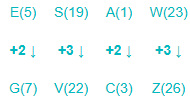
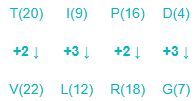
The logic followed here is:​

For 'ESAW' related to 'GVCZ':

For 'TIPD' related to 'VLRG':


Applying the same logic to 'XUNC':

Thus, 'XUNC' will be coded as ZXPF.

Hence, the correct answer is "Option 2".

Question 6

What should come in place of the question mark (?) in the given series?

24 34 54 94 174 ?

  1. AOption (a)

    333

  2. BOption (b)

    334

  3. COption (c)

    336

  4. DOption (d)

    335

View answer & explanation

Correct answer

Answer: (b)B.

334

Why this answer is correct

The logic followed here is:

Hence, the correct answer is "Option 2".

Question 7

Read the given statements and conclusions carefully. Assuming that the information given in the statements is true, even if it appears to be at variance with commonly known facts, decide which of the given conclusions logically follow(s) from the statements.

Statements:

All cucumbers are carrots.

All cucumbers are beans.

Some beans are apples.

Conclusions:

(I): Some apples are cucumbers.

(II): Some beans are carrots.

  1. AOption (a)

    Only conclusion (I) follows. 

  2. BOption (b)

    Only conclusion (II) follows. 

  3. COption (c)

    Both conclusions (I) and (II) follow. 

  4. DOption (d)

    Neither conclusion (I) nor (II) follows. 

View answer & explanation

Correct answer

Answer: (b)B.

Only conclusion (II) follows. 

Why this answer is correct

The least possible venn diagram is:

Conclusions:

(I): Some apples are cucumbers → False (As, there is no direct relation between apples and cucumbers. so it can be a possibility)

(II): Some beans are carrots → True (As,  All cucumbers are carrots, All cucumbers are beans. so, Some beans are carrots holds true)

Thus, Only conclusion (II) follows.

Hence, the correct answer is "Option 2".

Question 8

A square sheet of paper is folded along the dotted line successively along the directions shown and is then punched in the end. How would the paper look when unfolded?

  1. AOption (a)

  2. BOption (b)

  3. COption (c)

  4. DOption (d)

View answer & explanation

Correct answer

Answer: (c)C.

Why this answer is correct

The paper look when unfolded:

Hence, the correct answer is "Option 3".

Question 9

Select the correct mirror image of the given figure when the mirror is placed at MN as shown below. 

  1. AOption (a)

  2. BOption (b)

  3. COption (c)

  4. DOption (d)

View answer & explanation

Correct answer

Answer: (b)B.

Why this answer is correct

The correct mirror image of the given figure is:

Hence, the correct answer is "Option 2".

Question 10

RN 20 is related to SI 4 in a certain way. In the same way, MK 5 is related to NF -11. To which of the following is QV 3 related, following the same logic?

  1. AOption (a)

    RR -11

  2. BOption (b)

    PR -10

  3. COption (c)

    RQ -13

  4. DOption (d)

    PS -12

View answer & explanation

Correct answer

Answer: (c)C.

RQ -13

Why this answer is correct

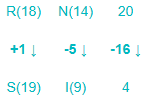
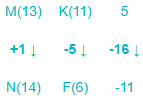
The logic followed here is:​

For 'RN 20' related to 'SI 4':

For 'MK 5' related to 'NF -11':

Applying the same logic to 'QV 3':

Thus, QV 3 is related to RQ -13.

Hence, the correct answer is "Option 3".

Question 11

What should come in place of the question mark (?) in the given series?

4 30 82 160 264 ?

  1. AOption (a)

    394

  2. BOption (b)

    331

  3. COption (c)

    303

  4. DOption (d)

    342

View answer & explanation

Correct answer

Answer: (a)A.

394

Why this answer is correct

The logic followed here is:

Hence, the correct answer is "Option 1".

Question 12

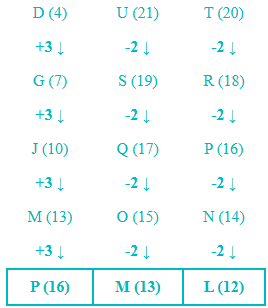
In a certain code language, 'MCOPT' is coded as '20' and 'VSB' is coded as '12'. What is the code for 'JIGETY' in the given language? 

  1. AOption (a)

    18

  2. BOption (b)

    22

  3. COption (c)

    24

  4. DOption (d)

    16

View answer & explanation

Correct answer

Answer: (c)C.

24

Why this answer is correct

The logic followed here is:

Logic: Total number of letter × 4 = Number.

For 'MCOPT' is coded as '20' 

Total letters is 5

5 × 4 = 20

For  'VSB' is coded as '12'

Total letters is 3

3 × 4 = 12

Similarly,

For 'JIGETY'

Total letters is 6

6 × 4 = 24.

Hence, the correct answer is "Option 3".

Question 13

Select the Venn diagram that best illustrates the relationship among the following classes.

Pizza, Pasta, Noodles

  1. AOption (a)

  2. BOption (b)

  3. COption (c)

  4. DOption (d)

View answer & explanation

Correct answer

Answer: (d)D.

Why this answer is correct

Given:

Pizza, Pasta, and Noodles are all considered types of food, but they are distinct from each other.

Hence, the correct answer is "Option 4".

Question 14

What should come in place of '?' in the given series based on the English alphabetical order?

DUT GSR JQP MON ?

  1. AOption (a)

    PML

  2. BOption (b)

    PRQ

  3. COption (c)

    NPO

  4. DOption (d)

    PMO

View answer & explanation

Correct answer

Answer: (a)A.

PML

Why this answer is correct

The logic followed here is:

Thus, 'PML' will be the next in the series.

Hence, the correct answer is "Option 1".

Question 15

A dice has its faces marked by letters M, I, T, A, P and D. Two positions of the same dice are given below. Which face is opposite to face I? 

  1. AOption (a)

    P

  2. BOption (b)

    T

  3. COption (c)

    A

  4. DOption (d)

    M

View answer & explanation

Correct answer

Answer: (b)B.

T

Why this answer is correct

The given dice:

As T is common in both the dice then moving clockwise or anti-clockwise direction from T we get opposite pairs.

Opposite pairs

P ⇔ A

M ⇔ D

T ⇔ I

This, T is opposite to I.

Hence, the correct answer is "Option 2".

Question 16

Six people, B, C, D, E, F and S, are sitting in a row facing north(but not necessarily in the same order). Only two people sit to the left of S. Only two people sit between S and F. Only one person sits between F and C. D sits to the immediate left of E. How many people sit to the right of B?

  1. AOption (a)

    Four

  2. BOption (b)

    One

  3. COption (c)

    Two

  4. DOption (d)

    Three

View answer & explanation

Correct answer

Answer: (b)B.

One

Why this answer is correct

Given:

Six people, B, C, D, E, F and S, are sitting in a row facing north.

Only two people sit to the left of S. Only two people sit between S and F.

Only one person sits between F and C. D sits to the immediate left of E.

Thus, One person sits to the right of B.

Hence, the correct answer is "Option 2".

Question 17

Select the combination of letters that when sequentially placed in the blanks of the given series, will logically complete the series.

XRLQ_PJOT_HMRL KPJ_

  1. AOption (a)

    SVNFD

  2. BOption (b)

    TUMEC

  3. COption (c)

    SUNED

  4. DOption (d)

    TVMFC

View answer & explanation

Correct answer

Answer: (a)A.

SVNFD

Why this answer is correct

The logic followed here

Given Series: _XRLQ_PJOT_HMRL_ KPJ_

Option 1 (SVNFD) by sequentially placing its letters in the blanks:

Resulting series: SXRL QV PJ OTNH MRLF KPJD

Hence, the correct answer is "Option 1".

Question 18

In a certain code language, ‘HIDS’ is coded as ‘1273’ and ‘DISK’ is coded as ‘3210’. What is the code for ‘K’ in the given code language?

  1. AOption (a)

    0

  2. BOption (b)

    1

  3. COption (c)

    3

  4. DOption (d)

    2

View answer & explanation

Correct answer

Answer: (a)A.

0

Why this answer is correct

The given code language is:

Thus, 'K' is coded as '0'.

Hence, the correct answer is "Option 1".

Question 19

Which two numbers should be interchanged to make the given equation correct?

50 × 3 + 12 × 5 – (66 ÷ 2) + 11 × 4 – 22 = 160

(Note: Interchange should be done of entire number and not individual digits of a given number)

  1. AOption (a)

    22 and 2

  2. BOption (b)

    5 and 3

  3. COption (c)

    12 and 11 

  4. DOption (d)

    3 and 2 

View answer & explanation

Correct answer

Answer: (d)D.

3 and 2 

Why this answer is correct

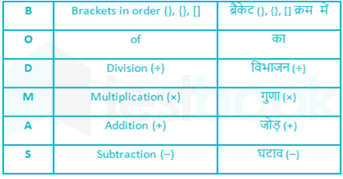
BODMAS Rule:

The given equation is:

50 × 3 + 12 × 5 – (66 ÷ 2) + 11 × 4 – 22 = 160

1) Interchange 22 and 2

New Equation: 50 × 3 + 12 × 5 – (66 ÷ 22) + 11 × 4 – 2 = ?

⇒ 50 × 3 + 12 × 5 – (66 ÷ 22) + 11 × 4 – 2

⇒ 150 + 60 – 3 + 44 – 2

⇒ 210 – 3 + 44 – 2

⇒ 207 + 44 – 2

⇒ 251 – 2   

⇒ 249 ≠ 160 (Incorrect)

2) Interchange 5 and 3

New Equation: 50 × 5 + 12 × 3 – (66 ÷ 2) + 11 × 4 – 22 = ?

⇒ 50 × 5 + 12 × 3 – (66 ÷ 2) + 11 × 4 – 22

⇒ 250 + 36 – 33 + 44 – 22

⇒ 286 – 33 + 44 – 22

⇒ 253 + 44 – 22

⇒ 297 – 22   

⇒ 275 ≠ 160 (Incorrect)

3) Interchange 12 and 11

New Equation: 50 × 3 + 11 × 5 – (66 ÷ 2) + 12 × 4 – 22 = ?

⇒ 50 × 3 + 11 × 5 – (66 ÷ 2) + 12 × 4 – 22

⇒ 150 + 55 – 33 + 48 – 22

⇒ 205 – 33 + 48 – 22

⇒ 172 + 48 – 22

⇒ 220 – 22   

⇒ 198 ≠ 160 (Incorrect)

4) Interchange 3 and 2

New Equation: 50 × 2 + 12 × 5 – (66 ÷ 3) + 11 × 4 – 22 = ?

Perform operations according to BODMAS:

⇒ 50 × 2 + 12 × 5 – (66 ÷ 3) + 11 × 4 – 22

⇒ 100 + 60 – 22 + 44 – 22

⇒ 160 – 22 + 44 – 22 

⇒ 138 + 44 – 22   

⇒ 182 – 22

⇒ 160

160 = 160 (Correct)

Hence, the correct answer is "Option 4".

Question 20

In a certain code language,

'C * Q means 'C is the mother of Q',

'C - Q' means 'C is the father of Q',

'C + Q' means 'C is the sister of Q' and

'C # Q' means 'C is the brother of Q' .

Based on the above, how is L related to U if 'U * F - L # M'?

  1. AOption (a)

    Daughter

  2. BOption (b)

    Brother

  3. COption (c)

    Son's son

  4. DOption (d)

    Son

View answer & explanation

Correct answer

Answer: (c)C.

Son's son

Why this answer is correct

C is
Symbol*-+#
MeaningMotherFatherSisterBrother
of Q

Given Expression: U * F - L # M

U * F: U is the mother of F.

F - L: F is the father of L.

L # M: L is the brother of M.

According to the given information Family Tree Representation:

Thus, L is the Grandson (Son's son) of U.

Hence, the correct answer is "Option 3"

General Knowledge and General Awareness (20 questions)

Question 21

Who took charge as the new Chief Minister of Delhi in September 2024?

  1. AOption (a)

    Manish Sisodia

  2. BOption (b)

    Arvind Kejriwal 

  3. COption (c)

    Sanjay Singh

  4. DOption (d)

    Atishi Marlena

View answer & explanation

Correct answer

Answer: (d)D.

Atishi Marlena

Why this answer is correct

The correct answer is Atishi Marlena.

Key Points

  • Atishi Marlena took charge as the Chief Minister of Delhi in September 2024, succeeding Arvind Kejriwal.
  • She is a prominent member of the Aam Aadmi Party (AAP) and has been a key figure in Delhi's politics.
  • Atishi has been recognized for her contributions to education reforms in Delhi, including the transformation of government schools.
  • Her appointment marks a significant milestone, as she is the first woman Chief Minister of Delhi from the AAP.
  • She played a crucial role in the conceptualization and implementation of initiatives like the "Happiness Curriculum" in schools.

Additional Information

  • Delhi's Administrative Framework
  • Delhi is a Union Territory with a Legislative Assembly, and its Chief Minister oversees areas such as education, health, and public works.
  • However, certain powers such as law enforcement fall under the jurisdiction of the Lieutenant Governor.
  • Aam Aadmi Party (AAP)
  • AAP was founded in 2012 by Arvind Kejriwal and others, focusing on anti-corruption and governance reforms.
  • The party has been in power in Delhi since 2015, with significant focus areas such as education, healthcare, and public welfare.
  • Education Reforms in Delhi
  • Under AAP’s governance, Delhi saw major overhauls in its education system, including infrastructure improvements and teacher training programs.
  • Initiatives like the "Happiness Curriculum" and "Entrepreneurship Mindset Curriculum" have garnered international attention.
  • Women in Leadership
  • Atishi's appointment as Chief Minister adds to the growing number of women in leadership roles in Indian politics.
  • Her leadership is expected to inspire more women to enter public administration and governance.

Question 22

 The FIFA U-17 Women's World Cup was held at _____ venues in India from October 11 to 30, 2022.

  1. AOption (a)

    two

  2. BOption (b)

    five

  3. COption (c)

    three

  4. DOption (d)

    seven

View answer & explanation

Correct answer

Answer: (c)C.

three

Why this answer is correct

The correct answer is three.

Key Points

  • The FIFA U-17 Women's World Cup 2022 was hosted by India from October 11 to October 30, 2022.
  • The tournament matches were held at three venues across the country: Bhubaneswar (Kalinga Stadium), Goa (Pandit Jawaharlal Nehru Stadium, Fatorda), and Navi Mumbai (DY Patil Stadium).
  • This was the seventh edition of the FIFA U-17 Women's World Cup and the first time India hosted the tournament.
  • A total of 16 teams participated in the event, including India as the host nation.
  • The tournament aims to provide a platform to showcase young female football talent globally, promoting women's football.

Additional Information

  • FIFA U-17 Women's World Cup:
  • It is an international football competition organized by FIFA for female players under the age of 17.
  • The tournament began in 2008 and is held every two years.
  • The 2022 edition marked the first time India hosted the tournament, underscoring its growing importance in global women's football.
  • Host Venues in India (2022):
  • Kalinga Stadium, Bhubaneswar: A prominent venue in Odisha known for hosting major sporting events.
  • Pandit Jawaharlal Nehru Stadium, Fatorda: Located in Goa, it is one of the best football stadiums in India.
  • DY Patil Stadium, Navi Mumbai: A multi-purpose stadium that has hosted several international sports events.
  • Women's Football Development:
  • The tournament promotes the development of women's football globally by providing a platform for young players.
  • FIFA and host nations also organize grassroots programs to encourage local participation in women's football.
  • India's Participation:
  • As the host nation, India automatically qualified for the tournament.
  • This was a significant opportunity to showcase Indian women's football talent on a global stage.

Question 23

Bushu, Yemshe and Tokhu Emong are some of the cultural festivals celebrated by the tribal people of which state?

  1. AOption (a)

    Nagaland

  2. BOption (b)

    Sikkim

  3. COption (c)

    Jharkhand 

  4. DOption (d)

    Arunachal Pradesh 

View answer & explanation

Correct answer

Answer: (a)A.

Nagaland

Why this answer is correct

The correct answer is Nagaland.

Key Points

  • Bushu, Yemshe, and Tokhu Emong are major cultural festivals celebrated by the tribal communities of Nagaland.
  • Tokhu Emong is celebrated by the Lotha Naga tribe as a post-harvest festival to mark the end of the agricultural season.
  • Bushu is a festival of the Kachari tribe, celebrated to mark the end of the paddy cultivation cycle.
  • Yemshe is observed by the Pochury tribe as a harvest festival, signifying a time of joy and thanksgiving.
  • Nagaland is known as the ‘Land of Festivals’ due to its diverse tribal communities, each having unique cultural practices and traditions.

Additional Information

  • Nagaland's Tribal Diversity
  • Nagaland is home to 16 major tribes, including Ao, Angami, Sumi, Lotha, Chakhesang, and Konyak tribes, among others.
  • Each tribe has its unique dialect, attire, customs, and festivals, contributing to the state's rich cultural heritage.
  • Hornbill Festival
  • This is the most famous cultural festival of Nagaland, celebrated annually in December.
  • It showcases the cultural vibrancy of all tribes and is often referred to as the ‘Festival of Festivals’.
  • The festival includes traditional dance, music, handicrafts, and cuisine, attracting tourists from around the world.
  • Geography of Nagaland
  • Nagaland is located in Northeast India and shares its borders with Assam, Arunachal Pradesh, Manipur, and Myanmar.
  • Kohima is the state capital, while Dimapur is the largest city and a major commercial hub.
  • Traditional Practices
  • Many festivals in Nagaland are closely linked to agricultural cycles, emphasizing the importance of farming in their livelihood.
  • Traditional attire, dances, and songs during festivals reflect the deep-rooted cultural identity of the tribes.

Question 24

Ostriches were found in India during which period? 

  1. AOption (a)

    Neolithic

  2. BOption (b)

    Chalcolithic 

  3. COption (c)

    Palaeolithic

  4. DOption (d)

    Epipalaeolithic

View answer & explanation

Correct answer

Answer: (c)C.

Palaeolithic

Why this answer is correct

The correct answer is Palaeolithic.

Key Points

  • Ostrich fossils and eggshell fragments have been discovered in several archaeological sites across India, particularly in the Palaeolithic period.
  • Evidence of ostriches in India has been primarily found in regions such as Rajasthan, Gujarat, and Madhya Pradesh.
  • These fossils suggest that ostriches were once a part of the Indian subcontinent's fauna during the late Pleistocene epoch.
  • The Palaeolithic period, which spans from approximately 2.5 million years ago to 10,000 years ago, is marked by the use of stone tools and the emergence of early human behavior.
  • Ostrich remains in India have been studied using radiocarbon dating and other scientific methods to establish their Palaeolithic context.

Additional Information

  • Palaeolithic Period:
  • The Palaeolithic period is also known as the Old Stone Age.
  • It is characterized by the use of crude stone tools and the subsistence lifestyle of hunter-gatherers.
  • This period is divided into three phases: Lower, Middle, and Upper Palaeolithic.
  • Ostrich Evidence in India:
  • Ostrich eggshells and fossilized bones have been unearthed in sites such as Bhimbetka and Patne in India.
  • These findings indicate the presence of ostriches in the Indian subcontinent during the Pleistocene epoch.
  • Scientific Techniques Used:
  • Techniques such as radiocarbon dating and isotopic analysis are used to analyze ostrich remains.
  • These methods help determine the age and environmental conditions of the period.
  • Pleistocene Epoch:
  • The Pleistocene epoch (2.58 million to 11,700 years ago) is a geological timeframe that witnessed significant climatic changes and the evolution of early humans.
  • It coincides with the Palaeolithic period in archaeological terms.

Question 25

Who was the youngest medal winner for India at the Asian Games event held in 2023?

  1. AOption (a)

    Parul Chaudhary

  2. BOption (b)

    Anahat Singh

  3. COption (c)

    Sanjana Bathula

  4. DOption (d)

    Annu Rani

View answer & explanation

Correct answer

Answer: (b)B.

Anahat Singh

Why this answer is correct

The correct answer is Anahat Singh.

Key Points

  • Anahat Singh, a 15-year-old squash player, became the youngest medalist for India at the Asian Games 2023.
  • She won a bronze medal in the women’s squash team event, showcasing her exceptional talent at a young age.
  • Anahat Singh has previously gained recognition at international levels, including winning the Asian Junior Squash Championship.
  • Her contribution to the Indian squash team was pivotal in securing a medal at the prestigious event held in Hangzhou, China.
  • Anahat’s achievement highlights the rise of young athletes in India, especially in sports like squash, which are gaining prominence.

Additional Information

  • Asian Games 2023:
  • The 19th edition of the Asian Games was held in Hangzhou, China from 23 September to 8 October 2023.
  • India achieved its best-ever medal tally at the event, securing 107 medals, including 28 golds, 38 silvers, and 41 bronzes.
  • It was a landmark event for Indian sports, with new records set in athletics, shooting, and other disciplines.
  • Squash in India:
  • Squash is an emerging sport in India, with players like Saurav Ghosal and Joshna Chinappa paving the way for young talents.
  • The Squash Rackets Federation of India (SRFI) governs the sport in the country.
  • India has consistently performed well in squash at the Asian Games, winning medals across multiple editions.
  • Youth in Indian Sports:
  • India has witnessed a surge in young athletes competing at international levels in various sports.
  • Programs such as the Khelo India initiative aim to nurture young talent and provide them with opportunities to excel.
  • Talented young players like Anahat Singh and Neeraj Chopra symbolize the bright future of Indian sports.
  • Asian Games History:
  • The Asian Games, also known as Asiad, is a continental multi-sport event organized by the Olympic Council of Asia.
  • The first Asian Games were held in 1951 in New Delhi, India.
  • It is held every four years, showcasing the top athletes from across Asia.

Question 26

Which of the following is a straight chain alkane composed of 4 carbon atoms that is commonly used as a fuel and aerosol propellant?

  1. AOption (a)

    2, 3-Dimethylbutane

  2. BOption (b)

    Isobutane

  3. COption (c)

    Butane

  4. DOption (d)

    2-Methylbutane

View answer & explanation

Correct answer

Answer: (c)C.

Butane

Why this answer is correct

The correct answer is Butane.

Key Points

  • Butane is a straight-chain alkane composed of 4 carbon atoms (C4H10).
  • It is commonly used as a fuel in lighters and as an aerosol propellant in various industries.
  • Butane is a highly flammable hydrocarbon gas and is part of the liquefied petroleum gas (LPG) used for cooking and heating.
  • It exists in two structural isomers: n-butane (straight chain) and isobutane (branched chain), but the question refers specifically to the straight-chain form.
  • Due to its energy density and portability, butane is widely used in both industrial and household applications.

Additional Information

  • Alkanes:
  • Alkanes are saturated hydrocarbons containing only single bonds between carbon atoms.
  • They follow the general formula CnH2n+2, where "n" represents the number of carbon atoms.
  • Examples of alkanes include methane (CH4), ethane (C2H6), and propane (C3H8).
  • Liquefied Petroleum Gas (LPG):
  • LPG is a mixture of hydrocarbons, primarily propane and butane.
  • It is used as a fuel for cooking, heating, and in vehicles.
  • LPG is stored under pressure in liquid form and vaporizes when released.
  • Aerosol Propellants:
  • Butane is widely used as a propellant in aerosol sprays due to its flammability and ability to vaporize quickly.
  • It is used in products like deodorants, air fresheners, and spray paints.
  • Isomers of Butane:
  • Butane has two isomers: n-butane (straight chain) and isobutane (branched chain).
  • Isobutane is used in the petrochemical industry to produce high-octane gasoline components.

Question 27

As per Census 2011, what was the percentage of scheduled tribes of the total population in India? 

  1. AOption (a)

    8.2%

  2. BOption (b)

    8.6%

  3. COption (c)

    2.4%

  4. DOption (d)

    10.4%

View answer & explanation

Correct answer

Answer: (b)B.

8.6%

Why this answer is correct

The correct answer is 0.086.

Key Points

  • As per Census 2011, the percentage of Scheduled Tribes (ST) in India’s total population was 8.6%.
  • The total Scheduled Tribe population in India was approximately 10.45 crore out of the total population of 121 crore.
  • Scheduled Tribes are officially recognized indigenous communities in India, identified under Article 342 of the Indian Constitution.
  • Madhya Pradesh has the largest population of Scheduled Tribes in India, followed by Maharashtra and Odisha.
  • Among the states, Lakshadweep has the highest proportion of Scheduled Tribe population at 94.8%.

Additional Information

  • Definition of Scheduled Tribes: Scheduled Tribes are socio-economically disadvantaged indigenous groups that have been granted constitutional recognition and protection under Article 342 of the Constitution of India.
  • Reservation Policy: Scheduled Tribes benefit from reservation in education, employment, and political representation to promote their development and inclusion.
  • Tribal Sub-Plan (TSP): TSP is a strategy adopted by the Indian government to allocate funds and resources specifically for the socio-economic development of tribal communities.
  • Geographical Distribution: Scheduled Tribes are primarily concentrated in central, northeastern, and southern regions of India, including states like Madhya Pradesh, Odisha, Chhattisgarh, and Jharkhand.
  • Notable Tribes: Some of the prominent Scheduled Tribes in India include the Gond, Bhil, Santhal, Oraon, and Khasi tribes.

Question 28

According to the Indian Constitution, which of the following powers are NOT vested in Governor?

  1. AOption (a)

    Legislative powers

  2. BOption (b)

    Financial powers 

  3. COption (c)

    Discretionary powers 

  4. DOption (d)

    Writs Issuing powers

View answer & explanation

Correct answer

Answer: (d)D.

Writs Issuing powers

Why this answer is correct

The correct answer is Writs Issuing powers.

Key Points

  • The Governor of a state in India does not have the power to issue writs. Writ-issuing powers are exclusively vested in the Supreme Court and High Courts under Articles 32 and 226 of the Indian Constitution, respectively.
  • The writs include Habeas Corpus, Mandamus, Prohibition, Certiorari, and Quo Warranto, designed to ensure the protection of fundamental rights and maintain justice.
  • Governors exercise various powers, including Legislative, Financial, Executive, and Discretionary powers, but lack judicial powers like issuing writs.
  • Writ jurisdiction is a crucial judicial function and cannot be delegated to executive authorities like the Governor.
  • This separation of powers ensures checks and balances in governance, safeguarding the independence of the judiciary.

Additional Information

  • Article 32:
  • Known as the "Right to Constitutional Remedies," it empowers the Supreme Court to issue writs to enforce fundamental rights.
  • It is considered the heart and soul of the Indian Constitution, as stated by Dr. B.R. Ambedkar.
  • Article 226:
  • Empowers High Courts to issue writs for the enforcement of fundamental rights as well as other legal rights.
  • The scope of writ jurisdiction under Article 226 is broader than under Article 32.
  • Governor's Powers:
  • Legislative Powers: Includes summoning, proroguing, and dissolving the state legislature and reserving bills for the President.
  • Financial Powers: Includes ensuring the presentation of the state budget and recommending money bills.
  • Discretionary Powers: Includes decision-making in cases such as hung assemblies or reserved bills.
  • Judiciary's Independence:
  • The judiciary in India is an independent body, separate from the executive and legislative branches.
  • This ensures the fair and impartial administration of justice and the protection of constitutional rights.

Question 29

Which type of industry uses natural resources with minimal human intervention and is oriented towards nature?

  1. AOption (a)

    Service industry

  2. BOption (b)

    Manufacturing industry

  3. COption (c)

    Genetic industry

  4. DOption (d)

    Primary industry

View answer & explanation

Correct answer

Answer: (d)D.

Primary industry

Why this answer is correct

The correct answer is Primary Industry.

Key Points

  • Primary industries focus on the extraction and harvesting of natural resources directly from nature, such as agriculture, forestry, fishing, and mining.
  • These industries operate with minimal human intervention and rely heavily on natural processes.
  • Examples include farming, logging, fishing, and mineral extraction, which form the base for secondary and tertiary industries.
  • Primary industries are integral to the economy as they provide raw materials for manufacturing and other industrial sectors.
  • They are characterized by their direct interaction with nature, making them highly dependent on environmental conditions and sustainability practices.

Additional Information

  • Types of Industries:
  • Primary Industry: Focuses on the extraction of natural resources (e.g., agriculture, fishing, forestry).
  • Secondary Industry: Involves manufacturing and processing of raw materials into finished goods.
  • Tertiary Industry: Provides services such as retail, transportation, and healthcare.
  • Quaternary Industry: Focuses on knowledge-based services, including information technology, research, and consultancy.
  • Natural Resources:
  • Materials provided by nature that are used in economic activities, such as water, minerals, forests, and soil.
  • Renewable resources (e.g., solar energy, wind energy) can replenish naturally, while non-renewable resources (e.g., fossil fuels, metals) are finite.
  • Environmental Dependency:
  • Primary industries depend heavily on environmental factors like climate, soil fertility, and water availability.
  • Sustainable practices are crucial to ensure long-term viability and prevent resource depletion.
  • Role in Economy:
  • Primary industries are foundational to the economy, providing essential inputs for secondary and tertiary sectors.
  • They contribute significantly to employment, especially in rural areas, and are critical for food security and resource supply.

Question 30

Which Five-Year Plan was interrupted due to the Indo-Pak War and economic crisis?

  1. AOption (a)

    Third Plan

  2. BOption (b)

    First Plan

  3. COption (c)

    Second Plan

  4. DOption (d)

    Fifth Plan

View answer & explanation

Correct answer

Answer: (a)A.

Third Plan

Why this answer is correct

The correct answer is Third Plan.

Key Points

  • The Third Five-Year Plan (1961-1966) aimed to achieve self-reliance in food production and industrial growth in India.
  • This plan was interrupted due to the Indo-China War of 1962 and the Indo-Pak War of 1965, causing economic turmoil.
  • The government shifted focus from planned economic development to defense and emergency management.
  • Severe droughts in 1965-1966 also further disrupted the objectives of the plan, leading to a crisis in agricultural production.
  • The economic challenges during this period necessitated a deviation from the planned targets and resulted in the introduction of annual plans or "Plan Holidays" from 1966 to 1969.

Additional Information

  • Five-Year Plans in India
  • India's Five-Year Plans were a series of centralized economic and social development strategies implemented from 1951 to 2017.
  • The Planning Commission was responsible for formulating these plans until its replacement by the NITI Aayog in 2015.
  • The plans aimed to boost economic growth, improve the standard of living, and address social inequalities.
  • Plan Holidays (1966-1969)
  • Plan Holidays were introduced after the Third Five-Year Plan due to financial constraints caused by wars and droughts.
  • During this period, the government adopted annual plans to address short-term goals and stabilize the economy.
  • Impact of Indo-Pak War on Economy
  • The 1965 Indo-Pak War strained India's financial resources, diverting funds from developmental activities to defense expenditures.
  • It disrupted trade and led to inflation, further complicating economic recovery efforts.
  • Green Revolution
  • The Green Revolution, initiated in the late 1960s, was a response to the agricultural crisis during the Third Plan era.
  • It focused on high-yield crop varieties, modern irrigation techniques, and the use of fertilizers to increase agricultural productivity.

Question 31

In September, the Union Cabinet approved the One Nation, One Poll recommendations proposed by whom among the following? 

  1. AOption (a)

    Dhananjaya Yeshwant Chandrachud

  2. BOption (b)

    Ram Nath Kovind

  3. COption (c)

    Ashwini Vaishnaw 

  4. DOption (d)

    Pratibha Patil 

View answer & explanation

Correct answer

Answer: (b)B.

Ram Nath Kovind

Why this answer is correct

The correct answer is Ram Nath Kovind.

Key Points

  • The Union Cabinet approved the One Nation, One Poll recommendations proposed by a committee led by former President Ram Nath Kovind in September 2023.
  • This initiative seeks to synchronize the timing of Lok Sabha and State Assembly elections to reduce the frequency of elections and associated costs.
  • The government formed the committee under Ram Nath Kovind's chairmanship to examine the feasibility of implementing the "One Nation, One Poll" policy.
  • The proposal aims to enhance administrative efficiency, reduce the burden on security forces, and ensure seamless governance by avoiding frequent imposition of the Model Code of Conduct.
  • The committee includes legal experts, political leaders, and representatives from various government bodies to ensure the recommendations are comprehensive and inclusive.

Additional Information

  • One Nation, One Poll:
  • This concept refers to holding simultaneous elections for the Lok Sabha, State Legislative Assemblies, and local bodies across the country.
  • It aims to reduce election-related expenses and frequent disruptions to development activities caused by repeated imposition of the Model Code of Conduct.
  • The idea was first proposed during the tenure of Prime Minister Atal Bihari Vajpayee and has been discussed multiple times in recent years.
  • Committee Formation:
  • In 2023, the Union Government set up a high-level committee under the chairmanship of Ram Nath Kovind to deliberate on the feasibility of implementing this electoral reform.
  • The committee includes members from political parties, legal experts, and representatives from the Election Commission of India (ECI).
  • Advantages of One Nation, One Poll:
  • Reduction in the cost of conducting frequent elections.
  • Minimization of policy paralysis and disruptions in governance caused by repeated elections.
  • Streamlining of security personnel deployment and efficient management of resources.
  • Challenges:
  • Constitutional amendments are required to synchronize the terms of various legislative bodies.
  • Political consensus is necessary to implement the reform successfully.
  • Logistical challenges such as voter education, preparedness of the Election Commission, and managing simultaneous elections on a large scale.

Question 32

Which climate zone is characterised by hot and humid conditions throughout the year?

  1. AOption (a)

    Tropical 

  2. BOption (b)

    Temperate

  3. COption (c)

    Polar

  4. DOption (d)

    Desert

View answer & explanation

Correct answer

Answer: (a)A.

Tropical 

Why this answer is correct

The correct answer is Tropical.

Key Points

  • Tropical climate zones are characterized by hot and humid conditions throughout the year.
  • They are located near the Equator, between the Tropic of Cancer and Tropic of Capricorn.
  • These regions receive a high amount of solar radiation, resulting in consistently warm temperatures and minimal seasonal variation.
  • Tropical zones experience significant rainfall due to their proximity to Intertropical Convergence Zones (ITCZ), which facilitates frequent precipitation.
  • Examples of tropical climates include the Amazon rainforest, the Congo Basin, and Southeast Asia.

Additional Information

  • Intertropical Convergence Zone (ITCZ)
  • A region near the Equator where trade winds converge, leading to frequent thunderstorms and heavy rainfall.
  • The ITCZ shifts seasonally, influencing precipitation patterns in tropical regions.
  • Rainforest Ecosystem
  • Tropical rainforests are characterized by high biodiversity, with millions of species of plants, animals, and microorganisms.
  • They serve as the Earth's lungs by producing oxygen and absorbing carbon dioxide.
  • Temperature Range
  • In tropical climates, the average monthly temperature typically stays above 18°C (64°F) year-round.
  • This contrasts with other climate zones where seasonal temperature variations are more pronounced.
  • Subtypes of Tropical Climate
  • Tropical rainforest climate: High rainfall throughout the year.
  • Tropical monsoon climate: Seasonal shifts between wet and dry periods.
  • Tropical savanna climate: Wet summers and dry winters.

Question 33

A geographic region that has separate but similar ecosystems characterised by a distinct climate is called a(n) ________.

  1. AOption (a)

    biosphere

  2. BOption (b)

    biome

  3. COption (c)

    ecosystem

  4. DOption (d)

    organism

View answer & explanation

Correct answer

Answer: (b)B.

biome

Why this answer is correct

The correct answer is biome.

Key Points

  • A biome is a large geographic area characterized by specific climatic conditions, flora, and fauna.
  • Biomes are classified based on their distinct ecosystems, such as forests, deserts, grasslands, tundra, and aquatic environments.
  • Factors like temperature, precipitation, altitude, and latitude play a significant role in determining the type of biome.
  • Examples of biomes include the Amazon rainforest (tropical rainforest biome) and the Sahara Desert (desert biome).
  • Unlike ecosystems, which focus on interactions within a smaller area, biomes represent broader climatic and ecological patterns.

Additional Information

  • Ecosystem
  • An ecosystem is a community of living organisms in conjunction with non-living components like air, water, and soil.
  • It focuses on the interactions and energy flow between biotic (living) and abiotic (non-living) components within a specific area.
  • Examples include ponds, forests, coral reefs, and grasslands.
  • Biosphere
  • The biosphere is the global sum of all ecosystems and includes all life forms on Earth.
  • It extends to the atmosphere, lithosphere, and hydrosphere where living organisms exist.
  • The biosphere supports life by cycling nutrients, water, and energy.
  • Climate
  • Climate refers to the long-term average weather conditions in a particular region.
  • It is determined by factors like temperature, humidity, wind patterns, and precipitation over decades.
  • Climate greatly influences the type of biome that forms in a specific area.
  • Organism
  • An organism is any individual living entity, such as a plant, animal, fungus, or microbe.
  • Organisms are the basic unit of life in biology, interacting within ecosystems and biomes.
  • They adapt to their environment to survive and reproduce.

Question 34

Noted Xatriya (Sattriya) and Odissi dance exponent and Sangeet Natak Akademi Award winner, Garima Hazarika belong to the Indian state of _____.

  1. AOption (a)

    Assam

  2. BOption (b)

    Odisha

  3. COption (c)

    Kerala

  4. DOption (d)

    West Bengal

View answer & explanation

Correct answer

Answer: (a)A.

Assam

Why this answer is correct

The correct answer is Assam.

Key Points

  • Garima Hazarika is a well-known exponent of the classical Indian dances, Sattriya and Odissi.
  • The Sattriya dance form is native to the state of Assam and has significant cultural and religious importance.
  • Garima Hazarika has received the prestigious Sangeet Natak Akademi Award for her contributions to Indian classical dance.
  • She is recognized for her efforts in promoting and preserving Assam's Sattriya dance, which was introduced by the Vaishnavite saint Srimanta Sankardeva.
  • Hazarika has been a prominent figure in showcasing Assamese culture on national and international platforms.

Additional Information

  • Sattriya Dance
  • Sattriya is one of the eight classical dance forms of India and originates from Assam.
  • It was introduced in the 15th century by the saint-scholar Srimanta Sankardeva as a medium of religious expression.
  • Sattriya is performed in monasteries called Satras and often narrates mythological stories.
  • In 2000, Sattriya was recognized as a classical dance form by the Sangeet Natak Akademi.
  • Odissi Dance
  • Odissi is one of the oldest surviving dance forms, originating from the state of Odisha.
  • It is characterized by its graceful and lyrical movements, expressing devotion to Lord Jagannath and other deities.
  • Key features include tribhangi (three-bend posture) and intricate hand gestures called mudras.
  • Odissi has a deep connection with temple rituals and is performed as an offering to gods and goddesses.
  • Sangeet Natak Akademi
  • It is India's national academy for music, dance, and drama, established in 1953.
  • The Akademi recognizes and promotes the performing arts through awards, scholarships, and fellowships.
  • The Sangeet Natak Akademi Award is one of the highest honors for artists in the field of performing arts in India.
  • Srimanta Sankardeva
  • He was a 15th-century saint-scholar, social reformer, and cultural icon of Assam.
  • Sankardeva is credited with the creation of Sattriya dance and the establishment of the Neo-Vaishnavite movement in Assam.
  • He used art forms like dance, music, and drama to propagate his teachings and promote unity.

Question 35

Who was the founder of the Tattwabodhini Sabha, a reformist movement in Bengal?

  1. AOption (a)

    Keshab Chandra Sen

  2. BOption (b)

    Debendranath Tagore

  3. COption (c)

    Swami Vivekananda

  4. DOption (d)

    Ishwar Chandra Vidyasagar 

View answer & explanation

Correct answer

Answer: (b)B.

Debendranath Tagore

Why this answer is correct

The correct answer is Debendranath Tagore.

Key Points

  • Debendranath Tagore founded the Tattwabodhini Sabha in Bengal in 1839.
  • The Sabha aimed to revive the principles of the Brahmo Samaj, emphasizing monotheism and the Upanishadic philosophy.
  • The Tattwabodhini Sabha became a hub for discussions on social and religious reforms in Bengal.
  • It also played a significant role in promoting Bengali language and literature by publishing the "Tattwabodhini Patrika," a journal that propagated reformist ideas.
  • Debendranath Tagore, often referred to as the "Maharshi," was a key figure in the Bengal Renaissance and contributed significantly to the intellectual awakening in India.

Additional Information

  • Brahmo Samaj:
  • Founded by Raja Ram Mohan Roy in 1828, it was a socio-religious reform movement that opposed idol worship and emphasized monotheism.
  • The Brahmo Samaj sought to reform Hinduism by eliminating practices like sati, caste discrimination, and child marriage.
  • Tattwabodhini Patrika:
  • This journal was the official publication of the Tattwabodhini Sabha.
  • It served as a medium to disseminate the Sabha's reformist ideas and foster intellectual debates.
  • Debendranath Tagore:
  • He was the father of Rabindranath Tagore, a Nobel laureate in literature.
  • He joined the Brahmo Samaj in 1843 and later played a pivotal role in its revival.
  • Bengal Renaissance:
  • A cultural, social, and intellectual awakening in 19th-century Bengal, spearheaded by luminaries like Raja Ram Mohan Roy, Ishwar Chandra Vidyasagar, and Debendranath Tagore.
  • It aimed to reform traditional Indian society by adopting progressive ideas while retaining the essence of Indian culture.

Question 36

Thanjavur Quartet is best remembered for the revival and codification of which ancient classical dance form? 

  1. AOption (a)

    Kathak

  2. BOption (b)

    Kathakali

  3. COption (c)

    Mohiniattam

  4. DOption (d)

    Bharatanatyam

View answer & explanation

Correct answer

Answer: (d)D.

Bharatanatyam

Why this answer is correct

The correct answer is Bharatanatyam.

Key Points

  • The Thanjavur Quartet refers to four brothers—Chinnayya, Ponnayya, Sivanandam, and Vadivelu—renowned for their contribution to Bharatanatyam.
  • They were instrumental in reviving, codifying, and systematizing Bharatanatyam as a classical art form during the early 19th century.
  • They composed numerous dance pieces, including varnams and padams, that became integral to the Bharatanatyam repertoire.
  • The brothers served in the court of King Serfoji II of Thanjavur and were deeply influenced by his patronage of the arts.
  • Their efforts laid the foundation for the margam (traditional sequence of Bharatanatyam performance), which is still followed today.

Additional Information

  • Bharatanatyam:
  • Bharatanatyam is one of the oldest classical dance forms of India, originating in Tamil Nadu.
  • It combines bhava (expression), raga (melody), tala (rhythm), and natyam (dramatic art).
  • Traditionally performed in temples as an offering to deities, it is deeply rooted in spiritual and religious themes.
  • The dance is accompanied by Carnatic music, and its movements are characterized by intricate footwork and graceful gestures.
  • Thanjavur Quartet's Legacy:
  • The Quartet's compositions are still widely performed and respected in Bharatanatyam recitals.
  • They introduced innovations such as integrating music with dance and enhancing the use of abhinaya (expressive storytelling).
  • Margam:
  • Margam is the traditional sequence of a Bharatanatyam performance, consisting of pieces like alarippu, jatiswaram, varnam, padam, and tillana.
  • This structure was formalized by the Thanjavur Quartet, making it a hallmark of Bharatanatyam.
  • King Serfoji II:
  • King Serfoji II of Thanjavur was a major patron of the arts, encouraging the development of Bharatanatyam under the Thanjavur Quartet.
  • His reign saw a flourishing of Tamil classical music, dance, and literature.

Question 37

A balanced budget refers to a situation where:

  1. AOption (a)

    private revenue equates government expenditure

  2. BOption (b)

    government revenue equates government expenditure

  3. COption (c)

    government revenue equates private expenditure

  4. DOption (d)

    government revenue equates government investment 

View answer & explanation

Correct answer

Answer: (b)B.

government revenue equates government expenditure

Why this answer is correct

The correct answer is government revenue equates government expenditure.

Key Points

  • A balanced budget occurs when government revenue is equal to its expenditure, ensuring no deficit or surplus in the budget.
  • This fiscal arrangement reflects efficient financial management by the government, maintaining economic stability.
  • Balanced budgets are often preferred as they avoid excessive borrowing and ensure sustainability of public finances.
  • Such budgets are typically used as a tool to prevent inflation or deflation in the economy.
  • While balanced budgets are ideal, they may not always be feasible, especially during times of economic recession or financial crises.

Additional Information

  • Budget Deficit:
  • A situation where government expenditure exceeds its revenue.
  • It often requires borrowing or issuing bonds to cover the gap.
  • Budget Surplus:
  • Occurs when government revenue exceeds expenditure.
  • Surpluses can be used for debt repayment or saved for future use.
  • Fiscal Policy:
  • A government strategy for managing its budget through revenue collection (taxes) and expenditure.
  • Fiscal policy plays a crucial role in regulating economic growth and stability.
  • Types of Government Budgets:
  • Balanced Budget: Revenue equals expenditure.
  • Surplus Budget: Revenue exceeds expenditure.
  • Deficit Budget: Expenditure exceeds revenue.
  • Implications of a Balanced Budget:
  • Promotes fiscal discipline and long-term economic stability.
  • May limit the government’s ability to invest in large-scale projects during critical times.

Question 38

Arnab Chakrabarty is associated with which of the following musical instruments?

  1. AOption (a)

    Sarangi

  2. BOption (b)

    Sarod

  3. COption (c)

    Mridangam

  4. DOption (d)

    Surbahar

View answer & explanation

Correct answer

Answer: (b)B.

Sarod

Why this answer is correct

The correct answer is Sarod.

Key Points

  • Arnab Chakrabarty is a renowned Indian classical musician and one of the most prominent Sarod players of his generation.
  • He is known for his profound grasp of Indian classical ragas and his ability to blend traditional styles with contemporary interpretations.
  • Arnab Chakrabarty has trained under distinguished gurus, including Pandit Brij Narayan and Pandit Buddhadev Dasgupta, both legends in the Sarod tradition.
  • His performances have gained global acclaim, especially for their technical brilliance and emotional depth.
  • Arnab Chakrabarty is also dedicated to reviving the authentic construction and sound of the Sarod, often working with instrument makers to refine its tonal quality.

Additional Information

  • Sarod
  • The Sarod is a prominent stringed instrument used in Indian classical music, known for its deep, resonant, and soulful tone.
  • It is played using a plectrum called a jawa and does not have frets, allowing for smooth glides between notes (meend).
  • The Sarod is believed to have evolved from the Afghan Rabab and was further adapted in India.
  • It is primarily associated with Hindustani classical music and features prominently in solo and ensemble performances.
  • Notable Sarod Players
  • Ustad Amjad Ali Khan, a legendary Sarod maestro and one of the most celebrated names in Indian classical music.
  • Ali Akbar Khan, another iconic Sarod virtuoso, was instrumental in popularizing Indian classical music in the West.
  • Sharan Rani, one of the first female Sarod players, earned the title "Sarod Rani."
  • Construction of Sarod
  • The Sarod is made from a single block of wood, typically teak or tun wood, with a goat skin-covered resonator.
  • It has between 17 and 25 strings, divided into melody, drone, and sympathetic strings, enhancing its rich tonal quality.
  • The metal fingerboard allows for intricate sliding techniques unique to the Sarod.
  • Comparison with Sarangi
  • The Sarangi, another Indian classical instrument, is a bowed string instrument, unlike the plucked Sarod.
  • While the Sarangi is primarily used for accompaniment in vocal performances, the Sarod is a dominant solo instrument in classical music.

Question 39

According to the Constitution, India is a _____________.

  1. AOption (a)

    Commonwealth of States

  2. BOption (b)

    Union of States

  3. COption (c)

    Federation of States

  4. DOption (d)

    Confederation of States

View answer & explanation

Correct answer

Answer: (b)B.

Union of States

Why this answer is correct

The correct answer is Union of States.

Key Points

  • According to Article 1 of the Indian Constitution, India is defined as a "Union of States."
  • The term "Union of States" signifies that India is not a federation created by an agreement among states but rather an indestructible union.
  • The Indian Constitution does not describe India as a federation, although it has federal features. It is instead called a "quasi-federal" system.
  • The central government holds more power compared to the states, ensuring a strong unitary character.
  • This structure aims to maintain the unity and integrity of India while allowing states to function within their designated powers under the Constitution.

Additional Information

  • Federal Features of the Indian Constitution:
  • Division of powers between the Union and States through the Union List, State List, and Concurrent List.
  • Independent judiciary with the Supreme Court as the guardian of the Constitution.
  • Written Constitution with rigid provisions requiring special procedures for amendments.
  • Bicameral legislature at the central level (Lok Sabha and Rajya Sabha).
  • Unitary Features:
  • Strong central authority with residuary powers vested in the Union Government.
  • Emergency provisions that convert India into a unitary state during crises.
  • Single citizenship for all Indians, emphasizing unity.
  • Integrated judiciary and administrative system across the country.
  • Terminology:
  • "Union of States" reflects the emphasis on the unity of the nation despite regional diversities.
  • "Quasi-federal" refers to the blend of federal and unitary characteristics in the Indian political system.
  • Historical Context:
  • The framers of the Constitution chose the term "Union" to prevent the possibility of secession by states, unlike in some federations.
  • This was influenced by the partition of India and the need to ensure national integration.

Question 40

 How many indicators were included in National Multidimensional Poverty Index 2021 of India?

  1. AOption (a)

    10

  2. BOption (b)

    14

  3. COption (c)

    12

  4. DOption (d)

    8

View answer & explanation

Correct answer

Answer: (c)C.

12

Why this answer is correct

The correct answer is 12.

Key Points

  • The National Multidimensional Poverty Index (MPI) 2021 of India is based on 12 indicators.
  • These indicators are grouped under three dimensions: Health, Education, and Standard of Living.
  • The MPI report is prepared by NITI Aayog in collaboration with Oxford Poverty and Human Development Initiative (OPHI) and United Nations Development Programme (UNDP).
  • Indicators include nutrition, child mortality, years of schooling, school attendance, cooking fuel, sanitation, drinking water, electricity, housing, assets, and others.
  • The MPI aims to provide a comprehensive measure of poverty beyond income-based metrics.

Additional Information

  • Multidimensional Poverty Index (MPI)
  • It is a measure developed by OPHI and UNDP to capture multidimensional aspects of poverty.
  • MPI complements income-based poverty measures by assessing deprivations across multiple dimensions like health, education, and living standards.
  • It uses household-level data to analyze poverty trends and identify areas requiring policy intervention.
  • NITI Aayog
  • It is the policy think tank of the Government of India, established in 2015 to replace the Planning Commission.
  • NITI Aayog is responsible for promoting cooperative federalism and providing strategic and technical advice to states and central governments.
  • Key Dimensions of MPI in India
  • Health: Includes indicators like nutrition and child mortality.
  • Education: Covers years of schooling and school attendance.
  • Living Standards: Includes indicators like access to electricity, sanitation, drinking water, housing, cooking fuel, and assets.
  • Global MPI
  • The Global Multidimensional Poverty Index is published annually by OPHI and UNDP.
  • It covers more than 100 countries and provides global insights into poverty trends.

Elementary Mathematics (20 questions)

Question 41

The LCM of 23 × 92 × 13, 22 × 132 × 19 and 93 × 132 × 192 is :-

  1. AOption (a)

    23 × 93 × 132 × 192

  2. BOption (b)

    22 × 93 × 13 × 192​

  3. COption (c)

    23 × 92 × 132 × 19

  4. DOption (d)

    22 × 92 × 132 × 193

View answer & explanation

Correct answer

Answer: (a)A.

23 × 93 × 132 × 192

Why this answer is correct

Shortcut Trick

To find the LCM of numbers given in exponential form, identify all the distinct bases.

Then, take the highest power of each distinct base present across all the given expressions.

The highest powers present for each base are: 23, 93, 132, and 192.

Multiply these highest powers together to get the final LCM directly.

∴ The correct answer is 23 × 93 × 132 × 192.

Alternate Method

Given:

First expression = 23 × 92 × 13

Second expression = 22 × 132 × 19

Third expression = 93 × 132 × 192

Formula Used:

LCM of exponential expressions = Product of the highest power of each distinct factor present in the expressions.

Calculations:

⇒ Maximum power of base 2 = max(3, 2, 0) = 3 ⇒ 23

⇒ Maximum power of base 9 = max(2, 0, 3) = 3 ⇒ 93

⇒ Maximum power of base 13 = max(1, 2, 2) = 2 ⇒ 132

⇒ Maximum power of base 19 = max(0, 1, 2) = 2 ⇒ 192

⇒ LCM = 23 × 93 × 132 × 192

∴ The correct answer is 23 × 93 × 132 × 192.

Additional Information

HCF of Exponential Numbers

To find the Highest Common Factor (HCF) of numbers in exponential form, select and multiply the lowest powers of only the common bases present in all expressions.

LCM and HCF of Fractions

LCM of fractions = (LCM of Numerators) ÷ (HCF of Denominators) | HCF of fractions = (HCF of Numerators) ÷ (LCM of Denominators).

Relation between HCF and LCM

For any two numbers a and b, the product of their HCF and LCM is strictly equal to the product of the numbers themselves: HCF(a, b) × LCM(a, b) = a × b.

Question 42

The salary of a worker is first increased by 8% and then it is decreased by 8%. What is the percentage change in his salary?

  1. AOption (a)

    0.81%

  2. BOption (b)

    0.25%

  3. COption (c)

    0.49%

  4. DOption (d)

    0.64%

View answer & explanation

Correct answer

Answer: (d)D.

0.64%

Why this answer is correct

Shortcut Trick

For equal successive percentage increase and decrease of x%, there is always a net decrease.

Net percentage change = −(x2 ÷ 100)%

Here, x = 8%

Net change = −(82 ÷ 100)% = −(64 ÷ 100)% = −0.64%

∴ The correct answer is 0.64%.

Alternate Method

Given:

Initial percentage increase = +8%

Subsequent percentage decrease = −8%

100 Initial Salary

+8%

108

−8%

99.36 Final Salary

Net Change: 100 → 99.36 (−0.64%)

Calculations:

⇒ Let the initial salary of the worker be 100 units.

⇒ After an 8% increase, salary = 100 + 8 = 108 units.

⇒ After an 8% decrease on the new salary, decrease amount = 108 × (8 ÷ 100) = 8.64 units.

⇒ Final salary = 108 − 8.64 = 99.36 units.

⇒ Net decrease in salary = Initial salary − Final salary = 100 − 99.36 = 0.64 units.

⇒ Percentage change = (0.64 ÷ 100) × 100% = 0.64%.

∴ The correct answer is 0.64%.

Additional Information

Successive Percentage Change

When a value is changed successively by x% and y%, the effective percentage change is given by the formula: [x + y + (x × y) ÷ 100]%.

Equal Increase and Decrease

If a number is first increased by x% and then decreased by x%, there is always an overall net decrease equal to (x2 ÷ 100)%.

Multiplier Method

For multiple changes, Final Value = Initial Value × (1 ± x ÷ 100) × (1 ± y ÷ 100). The plus (+) sign is used for an increase and the minus (−) sign is used for a decrease.

Question 43

The value of 40 - 3 × [ 10 + 6 × { 20 - 10 ( 6 - 5 ) × 2} ÷ 47] is:

  1. AOption (a)

    7

  2. BOption (b)

    1

  3. COption (c)

    10

  4. DOption (d)

    5

View answer & explanation

Correct answer

Answer: (c)C.

10

Why this answer is correct

Given:

The value of 40 - 3 × [10 + 6 × {20 - 10 (6 - 5) × 2} ÷ 47]

Formula used:

Follow BODMAS rule (Brackets, Orders, Division, Multiplication, Addition, Subtraction).

Calculation:

40 - 3 × [10 + 6 × {20 - 10 (6 - 5) × 2} ÷ 47]

⇒ 40 - 3 × [10 + 6 × {20 - 10 × 1 × 2} ÷ 47]

⇒ 40 - 3 × [10 + 6 × {20 - 20} ÷ 47]

⇒ 40 - 3 × [10 + 6 × 0 ÷ 47]

⇒ 40 - 3 × [10 + 0]

⇒ 40 - 3 × 10

⇒ 40 - 30

⇒ 10

∴ The correct answer is option (3).

Question 44

There are 30 members in group A, 76 members in group B and 44 members in group C. All the members of these groups went to a restaurant. The average amount spent on each member of group A, B and C is ₹249, ₹168 and ₹498, respectively. The total average amount (in ₹) spent per member is:

  1. AOption (a)

    282

  2. BOption (b)

    281

  3. COption (c)

    284

  4. DOption (d)

    279

View answer & explanation

Correct answer

Answer: (b)B.

281

Why this answer is correct

Shortcut Trick

Convert member counts to ratio: 30 : 76 : 44 = 15 : 38 : 22 (Total parts = 75).

Let the assumed average be ₹250. The deviations for each group are −1, −82, and +248.

Net deviation = (15 × −1) + (38 × −82) + (22 × 248) = −15 − 3116 + 5456 = +2325.

Average deviation = 2325 ÷ 75 = +31.

Actual average = 250 + 31 = ₹281.

∴ The correct answer is ₹281.

Alternate Method

Given:

Members in groups A, B, and C are 30, 76, and 44 respectively.

Average amounts spent are ₹249, ₹168, and ₹498 respectively.

Formula Used:

Combined Average = Total Amount Spent ÷ Total Number of Members

Group A 30 × ₹249

Group B 76 × ₹168

Group C 44 × ₹498

Combined Average 150 Members → ₹281

Calculations:

⇒ Total members = 30 + 76 + 44 = 150

⇒ Total amount spent by Group A = 30 × 249 = 7470

⇒ Total amount spent by Group B = 76 × 168 = 12768

⇒ Total amount spent by Group C = 44 × 498 = 21912

⇒ Total combined amount spent = 7470 + 12768 + 21912 = 42150

⇒ Combined Average = 42150 ÷ 150 = 281

∴ The correct answer is ₹281.

Additional Information

Weighted Average Formula

Combined Average = (N1A1 + N2A2 + N3A3) ÷ (N1 + N2 + N3), where N represents the quantity count and A represents the average for each group.

Assumed Mean / Deviation Method

To avoid large multiplications, select a base average close to the given numbers. Compute the net sum of deviations, divide by total parts, and adjust the base average accordingly.

Ratio Simplification

When base counts are exceptionally large, simplify them into their lowest ratio before applying the assumed mean method. The final average remains mathematically identical.

Question 45

A merchant fixes the marked price of his goods at 60% above the cost price. He sells his goods at 25% discount. His percentage of profit is: 

  1. AOption (a)

    15%

  2. BOption (b)

    20%

  3. COption (c)

    10%

  4. DOption (d)

    25%

View answer & explanation

Correct answer

Answer: (b)B.

20%

Why this answer is correct

Shortcut Trick

We can use the successive percentage formula to find the overall effect: Net Profit % = a + b + (a × b) ÷ 100

Here, markup a = +60% and discount b = −25%.

⇒ Net Profit % = 60 − 25 + [60 × (−25)] ÷ 100

⇒ Net Profit % = 35 − 1500 ÷ 100

⇒ Net Profit % = 35 − 15 = 20%

∴ The correct answer is 20%.

Alternate Method

Given:

Marked Price (MP) = 60% above Cost Price (CP)

Discount = 25% on MP

Formula Used:

Selling Price (SP) = MP × (100 − Discount%) ÷ 100

Profit% = [(SP − CP) ÷ CP] × 100

Profit and Discount Relationship CP → MP → SP

CP: 100

MP: 160

SP: 120

+60% Markup

−25% Discount

+20% Profit

Calculations:

Let the Cost Price (CP) of the goods be 100 units.

⇒ Marked Price (MP) = 100 + 60% of 100 = 160

⇒ Discount = 25% of 160 = (25 ÷ 100) × 160 = 40

⇒ Selling Price (SP) = MP − Discount = 160 − 40 = 120

⇒ Profit = SP − CP = 120 − 100 = 20

⇒ Profit% = (20 ÷ 100) × 100 = 20%

∴ The correct answer is 20%.

Additional Information

Marked Price & Discount Relation

Discount is always calculated strictly on the Marked Price (MP), not on Cost Price (CP). The final transaction price is Selling Price (SP) = MP − Discount.

Successive Discount

When two successive discounts of a% and b% are given, the equivalent single discount can be calculated using the formula: [a + b − (a × b) ÷ 100]%.

Dishonest Dealer Concept

If a merchant sells goods at CP but uses a false weight, the actual Profit % is calculated as: [Error ÷ (True Weight − Error)] × 100.

Question 46

The simple interest on a principal amount (in ₹) is ₹191 for a period of 5 years at the rate of 2% per annum. The principal amount (in ₹) is:

  1. AOption (a)

    1910

  2. BOption (b)

    1913

  3. COption (c)

    1908

  4. DOption (d)

    1914

View answer & explanation

Correct answer

Answer: (a)A.

1910

Why this answer is correct

Shortcut Trick

The total effective interest rate for simple interest is calculated as R × T.

Effective interest rate = 2% × 5 = 10%.

We are given that 10% of the Principal equals ₹191.

To find the total Principal amount (which represents 100%), we multiply the given interest by 10.

Principal = 191 × 10 = 1910

∴ The correct answer is ₹1910.

Alternate Method

Given:

Simple Interest (SI) = ₹191

Time period (T) = 5 years

Rate of interest (R) = 2% per annum

Principal P = ?

Simple Interest ₹191

Time = 5 Years Rate = 2% p.a.

Total Interest = P × R × T ÷ 100

Formula Used:

SI = (P × R × T) ÷ 100

Calculations:

⇒ 191 = (P × 2 × 5) ÷ 100

⇒ 191 = (P × 10) ÷ 100

⇒ 191 = P ÷ 10

⇒ P = 191 × 10

⇒ P = 1910

∴ The correct answer is ₹1910.

Additional Information

Simple Interest (SI)

In simple interest, the interest is calculated only on the initial principal amount throughout the entire period. The fundamental formula is SI = (P × R × T) ÷ 100.

Total Amount (A)

The total amount paid or received at the end of the time period is the sum of the borrowed principal and the interest earned. Formula: A = P + SI.

Compound Interest (CI)

Unlike simple interest, compound interest is calculated on both the initial principal and the accumulated interest from previous periods. Formula: A = P(1 + R/100)T.

Question 47

An aeroplane travels distances 1320 km, 1760 km and 2095 km at the rate of 528 km/h, 352 km/h and 419 km/h, respectively. Find the average speed (in km/h) of the aeroplane.

  1. AOption (a)

    497

  2. BOption (b)

    398

  3. COption (c)

    452

  4. DOption (d)

    414

View answer & explanation

Correct answer

Answer: (d)D.

414

Why this answer is correct

Shortcut Trick

Total Distance = 1320 + 1760 + 2095 = 5175 km.

Total Time = (1320 ÷ 528) + (1760 ÷ 352) + (2095 ÷ 419) = 2.5 + 5 + 5 = 12.5 hours.

Average Speed = Total Distance ÷ Total Time = 5175 ÷ 12.5 = 414 km/h.

∴ The correct answer is 414 km/h.

Alternate Method

Given:

Distance D1 = 1320 km, Speed S1 = 528 km/h

Distance D2 = 1760 km, Speed S2 = 352 km/h

Distance D3 = 2095 km, Speed S3 = 419 km/h

1320 km 1760 km 2095 km

528 km/h 352 km/h 419 km/h

T = 2.5 h T = 5 h T = 5 h

Total Distance = 5175 km

Avg Speed = 5175 ÷ 12.5 = 414 km/h

Formula Used:

Time = Distance ÷ Speed

Average Speed = Total Distance ÷ Total Time

Calculations:

⇒ Total Distance = 1320 + 1760 + 2095 = 5175 km

⇒ Time T1 = 1320 ÷ 528 = 2.5 hours

⇒ Time T2 = 1760 ÷ 352 = 5 hours

⇒ Time T3 = 2095 ÷ 419 = 5 hours

⇒ Total Time = 2.5 + 5 + 5 = 12.5 hours

⇒ Average Speed = 5175 ÷ 12.5

⇒ Average Speed = 51750 ÷ 125 = 414 km/h

∴ The correct answer is 414 km/h.

Additional Information

Average Speed

When multiple parts of a journey are covered at different speeds, Average Speed = Total Distance ÷ Total Time. If the distance covered in two equal parts is the same, Average Speed = (2 × S1 × S2) ÷ (S1 + S2).

Relative Speed

When two objects travel in opposite directions, their relative speed is S1 + S2. When travelling in the same direction, their relative speed is |S1 − S2|.

Speed Conversions

To convert km/h to m/s, multiply the speed by (5 ÷ 18). To convert m/s to km/h, multiply the speed by (18 ÷ 5).

Question 48

David has two grandsons Rodney and Amit. 15 year old Rodney gets some money from David’s wealth and 16 year old Amit gets rest of the money. But Rodney and Amit will get money only when they turn 22 years old. Till then the money is in a bank getting interest at rate 8% compounded annually. When both turn 22, they receive the same amount. How much had David given Amit (in ₹) initially, if total money with David was ₹23400 ?

  1. AOption (a)

    12500

  2. BOption (b)

    11250

  3. COption (c)

    11000

  4. DOption (d)

    12150

View answer & explanation

Correct answer

Answer: (d)D.

12150

Why this answer is correct

Shortcut Trick

Time for Rodney = 22 − 15 = 7 years and Time for Amit = 22 − 16 = 6 years.

Time difference = 1 year. Since Amit's money compounds for 1 year less, his principal must be larger by the 1-year interest multiplier.

Ratio of shares (Amit : Rodney) = (100 + 8) : 100 = 108 : 100 = 27 : 25.

Total ratio parts = 27 + 25 = 52 parts → ₹23400.

Amit's share (27 parts) = (23400 ÷ 52) × 27 = 450 × 27 = ₹12150.

∴ The correct answer is ₹12150.

Alternate Method

Total Wealth = ₹23400

Rodney (15 yrs) Time = 7 years

Amit (16 yrs) Time = 6 years

Rate = 8% CI p.a.

Equal Amount at 22 yrs

Given:

Total money distributed = ₹23400

Rate of interest (R) = 8% per annum compounded annually.

Time for Rodney = 22 − 15 = 7 years.

Time for Amit = 22 − 16 = 6 years.

Formula Used:

Amount in Compound Interest (A) = P × (1 + R/100)n

Calculation:

⇒ Let Amit's initial share be ₹A and Rodney's share be ₹(23400 − A).

⇒ Amount received by Amit after 6 years = A × (1 + 8/100)6

⇒ Amount received by Rodney after 7 years = (23400 − A) × (1 + 8/100)7

⇒ Since both receive the exact same amount when they turn 22, we equate the two values:

⇒ A × (1 + 8/100)6 = (23400 − A) × (1 + 8/100)7

⇒ A ÷ (23400 − A) = (1 + 8/100)1

⇒ A ÷ (23400 − A) = 108 / 100

⇒ A ÷ (23400 − A) = 27 / 25

⇒ 25 × A = 27 × (23400 − A)

⇒ 25A = 631800 − 27A

⇒ 25A + 27A = 631800

⇒ 52A = 631800

⇒ A = 631800 ÷ 52 = 12150

∴ The correct answer is ₹12150.

Additional Information

Ratio of Shares for Equal Amount (CI)

If a given sum is divided into two parts P1 and P2 such that their amounts are equal after t1 and t2 years respectively at R% compound interest, then P1 / P2 = (1 + R/100)t<sub>2</sub> − t<sub>1</sub>.

Effective Rate of Compound Interest

For 2 years, the effective compound interest rate is calculated using the successive percentage formula: R + R + (R × R)/100 = 2R + (R2/100) %.

Difference Between CI and SI

The difference between compound interest and simple interest for exactly 2 years on a principal P at a given rate R% per annum is given by PR2 / 10000.

Question 49

Ayush starts his journey from Chandigarh to Ludhiana with his car at a speed of 77 km/hr and returns at a speed of 63 km/hr. If the distance between Chandigarh and Ludhiana is 97 km, then what is the average speed (in km/hr) of Ayush during his whole journey?

  1. AOption (a)

    68

  2. BOption (b)

    68.2

  3. COption (c)

    69.3

  4. DOption (d)

    69

View answer & explanation

Correct answer

Answer: (c)C.

69.3

Why this answer is correct

Shortcut Trick

When the distance covered is the same for two parts of a journey, the actual distance is not required.

Average Speed = 2xy ÷ (x + y)

⇒ Average Speed = (2 × 77 × 63) ÷ (77 + 63)

⇒ Average Speed = 9702 ÷ 140 = 69.3 km/hr

∴ The correct answer is 69.3 km/hr.

Alternate Method

Given:

Forward Speed (x) = 77 km/hr

Return Speed (y) = 63 km/hr

Distance (D) = 97 km

Chandigarh

Ludhiana

x = 77 km/hr

y = 63 km/hr

D = 97 km Average Speed = 2xy ÷ (x + y)

Formula Used:

Average Speed = Total Distance ÷ Total Time

Total Distance = D + D = 2D

Total Time = (D ÷ x) + (D ÷ y)

Calculations:

⇒ Average Speed = 2D ÷ [D × (1/x + 1/y)]

⇒ Average Speed = 2xy ÷ (x + y)

⇒ Average Speed = (2 × 77 × 63) ÷ (77 + 63)

⇒ Average Speed = (2 × 77 × 63) ÷ 140

⇒ Average Speed = (77 × 63) ÷ 70

⇒ Average Speed = (11 × 63) ÷ 10

⇒ Average Speed = 693 ÷ 10 = 69.3 km/hr

∴ The correct answer is 69.3 km/hr.

Additional Information

Average Speed for 3 Equal Distances

When three equal distances are covered at speeds x, y, and z, the Average Speed = 3xyz ÷ (xy + yz + zx).

Average Speed for Constant Time

If two different speeds x and y are maintained for exactly the same duration of time, the Average Speed = (x + y) ÷ 2.

Relative Speed

For two moving bodies traveling in the same direction, relative speed = (x − y). For two moving bodies traveling in opposite directions, relative speed = (x + y).

Question 50

Find the mean proportional between (4 + √5) and (12 - 2√20)

  1. AOption (a)

    27+52\sqrt{7+\sqrt5}

  2. BOption (b)

    7−5\sqrt{7-\sqrt5}

  3. COption (c)

    39\sqrt{39}

  4. DOption (d)

    27−52\sqrt{7-\sqrt5}

View answer & explanation

Correct answer

Answer: (d)D.

27−52\sqrt{7-\sqrt5}

Why this answer is correct

Shortcut Trick

The mean proportional of two numbers a and b is √(a × b).

⇒ a = 4 + √5, b = 12 − 2√20 = 12 − 4√5

⇒ a × b = (4 + √5) × 4(3 − √5)

⇒ a × b = 4(12 − 4√5 + 3√5 − 5) = 4(7 − √5)

⇒ Mean proportional = √[4(7 − √5)] = 2√(7 − √5)

∴ The correct answer is 2√(7 − √5).

Alternate Method

Given:

First number (a) = 4 + √5

Second number (b) = 12 − 2√20

Formula Used:

Mean proportional (x) between two numbers a and b is x = √(a × b)

a = 4 + √5 b = 12 − 2√20 a × b

x x x2 Mean Proportional: x = √(a × b)

Calculations:

⇒ First, simplify the second number:

⇒ b = 12 − 2√(4 × 5) = 12 − 2 × 2√5 = 12 − 4√5

⇒ Multiply both numbers a and b:

⇒ a × b = (4 + √5) × (12 − 4√5)

⇒ a × b = 48 − 16√5 + 12√5 − 20

⇒ a × b = 28 − 4√5

⇒ Take 4 common from the terms:

⇒ a × b = 4(7 − √5)

⇒ Now calculate the mean proportional x:

⇒ x = √(a × b) = √[4(7 − √5)]

⇒ x = 2√(7 − √5)

∴ The correct answer is 2√(7 − √5).

Additional Information

Mean Proportional

For any two numbers a and b, their mean proportional is the square root of their product, given by x = √(a × b).

Third Proportional

If a, b, and c are in continued proportion (a : b :: b : c), then c is the third proportional, calculated as c = b2 ÷ a.

Fourth Proportional

For three given numbers a, b, and c, the fourth proportional d satisfies a : b :: c : d, calculated as d = (b × c) ÷ a.

Question 51

A and B working separately can finish a work in 18 days and 24 days, respectively. A begins the work and works for two consecutive days, while B works on the 3rd day. This pattern is continued till the work is completed. In how many days will the work be completed?

  1. AOption (a)

    232323\frac{2}{3}

  2. BOption (b)

    162316\frac{2}{3}

  3. COption (c)

    191219\frac{1}{2}

  4. DOption (d)

    143514\frac{3}{5}

View answer & explanation

Correct answer

Answer: (c)C.

191219\frac{1}{2}

Why this answer is correct

Shortcut Trick

Total work = LCM(18, 24) = 72 units.

Efficiency: A = 4 units/day, B = 3 units/day.

Work done in one 3-day cycle (A, A, B) = 4 + 4 + 3 = 11 units.

6 cycles (18 days) complete = 6 × 11 = 66 units. Remaining = 72 − 66 = 6 units.

Day 19: A does 4 units. Remaining = 2 units. Day 20: A takes 2 ÷ 4 = 1/2 day.

∴ The correct answer is 19 1/2 days.

Alternate Method

Given:

Time taken by A = 18 days

Time taken by B = 24 days

Working cycle: A works for 2 consecutive days, and B works on the 3rd day.

Method Used:

We use the LCM method to find the total work and the efficiency of each person.

PersonDaysTotal WorkEfficiency
A18724
B243

Calculations:

⇒ Work done in a single 3-day cycle = (Work by A for 2 days) + (Work by B for 1 day)

⇒ Work done in 3 days = (2 × 4) + (1 × 3) = 8 + 3 = 11 units

⇒ Number of full cycles required to approach the total work = 72 ÷ 11 ≈ 6 cycles

⇒ Work done in 6 cycles (18 days) = 6 × 11 = 66 units

⇒ Remaining work = 72 − 66 = 6 units

⇒ On the 19th day (start of the 7th cycle), A works and completes 4 units of work.

⇒ Work remaining after the 19th day = 6 − 4 = 2 units

⇒ On the 20th day, A works again. Time taken by A to complete the remaining 2 units = 2 ÷ 4 = 1/2 day.

⇒ Total time taken to complete the entire work = 18 + 1 + 1/2 = 19 1/2 days.

∴ The correct answer is 19 1/2 days.

Additional Information

LCM Method for Time & Work

Total work is assumed as the Least Common Multiple (LCM) of the given individual times. Efficiency represents the work done per day, calculated as (Total Work ÷ Total Days).

Cyclic or Alternate Day Work Pattern

For repetitive work patterns, group the days into a single block or cycle where the pattern repeats. Multiply the total work done in one cycle to get as close to the overall work as possible without exceeding it. Then calculate the remaining units manually day-by-day based on who is scheduled to work.

Question 52

Evaluate: (-9) - (-60) ÷ (-15) + (-3) × 9

  1. AOption (a)

    -42

  2. BOption (b)

    -40

  3. COption (c)

    -39

  4. DOption (d)

    -43

View answer & explanation

Correct answer

Answer: (b)B.

-40

Why this answer is correct

Given:

Evaluate: (-9) - (-60) ÷ (-15) + (-3) × 9

Formula used:

Follow BODMAS rule: Brackets, Orders (exponents), Division and Multiplication (from left to right), Addition and Subtraction (from left to right).

Calculation:

Expression: (-9) - (-60) ÷ (-15) + (-3) × 9

⇒ (-9) - [(-60) ÷ (-15)] + [(-3) × 9]

⇒ (-9) - [4] + [-27]

⇒ (-9) - 4 - 27

⇒ -9 - 4 = -13

⇒ -13 - 27 = -40

∴ The correct answer is option (2).

Question 53

The population of a district is 333000, out of which 213000 are males. 71% of the population is literate. If 71% males are literate, then what percentage of females are literate?

  1. AOption (a)

    68%

  2. BOption (b)

    71%

  3. COption (c)

    74%

  4. DOption (d)

    69%

View answer & explanation

Correct answer

Answer: (b)B.

71%

Why this answer is correct

Shortcut Trick

If a group is divided into two parts and the overall percentage is equal to the percentage in one part, then the percentage in the second part must be exactly the same.

⇒ Overall literate population = 71%

⇒ Literate males = 71%

⇒ Literate females must also be = 71%

∴ The correct answer is 71%.

Alternate Method

Given:

⇒ Total population = 333000

⇒ Number of males = 213000

⇒ Overall literate population = 71%

⇒ Literate males = 71%

Total Population = 333,000 Literate = 71%

Males = 213,000 Literate = 71%

Females = 120,000 Literate = ? %

Total Literate = Literate Males + Literate Females

Calculations:

⇒ Total females = Total population − Total males

⇒ Total females = 333000 − 213000 = 120000

⇒ Literate population = (71 ÷ 100) × 333000 = 236430

⇒ Literate males = (71 ÷ 100) × 213000 = 151230

⇒ Literate females = Total literate − Literate males

⇒ Literate females = 236430 − 151230 = 85200

⇒ Percentage of literate females = (Literate females ÷ Total females) × 100

⇒ Percentage = (85200 ÷ 120000) × 100

⇒ Percentage = 0.71 × 100 = 71%

∴ The correct answer is 71%.

Additional Information

Weighted Average in Mixtures

When a group is divided into components A and B, the overall percentage is given by the weighted average formula: Overall % = (ValueA × %A + ValueB × %B) ÷ (ValueA + ValueB).

Constant Percentage Rule

If two different groups have the exact same percentage of a specific characteristic, any combination or total mixture of these groups will naturally possess that exact same percentage without needing further calculation.

Question 54

What is the smallest number which is when increased by 5 is divisible by 18, 30, 36 and 24?

  1. AOption (a)

    355

  2. BOption (b)

    360

  3. COption (c)

    365

  4. DOption (d)

    350

View answer & explanation

Correct answer

Answer: (a)A.

355

Why this answer is correct

Shortcut Trick

The required number when increased by 5 must be perfectly divisible by all the given numbers.

Instead of calculating the LCM, add 5 to the given options and check for divisibility by 18 (i.e., by 9 and 2).

Option 1: 355 + 5 = 360 (Divisible by 9 and 2)

No other option yields a number that is perfectly divisible by 9 and 2 when increased by 5.

∴ The correct answer is 355.

Alternate Method

Given:

The numbers are 18, 30, 36, and 24.

Formula Used:

Required Number = LCM(18, 30, 36, 24) − 5

Calculations:

⇒ Prime factorization of the given numbers:

⇒ 18 = 2 × 32

⇒ 30 = 2 × 3 × 5

⇒ 36 = 22 × 32

⇒ 24 = 23 × 3

⇒ The LCM is the product of the highest powers of all prime factors.

⇒ LCM = 23 × 32 × 5

⇒ LCM = 8 × 9 × 5 = 360

⇒ The required number is 5 less than the LCM.

⇒ Required number = 360 − 5 = 355

∴ The correct answer is 355.

Additional Information

LCM (Least Common Multiple)

The smallest number that is a multiple of two or more given numbers. It contains the highest power of each prime factor involved.

Divisibility Rule of 9

A number is divisible by 9 if the sum of its digits is perfectly divisible by 9. This rule is extremely helpful for quick option elimination without calculating the LCM.

Number System Rule for Remainders

The smallest number which when divided by x, y, z leaves a remainder R in each case is calculated as: LCM(x, y, z) + R.

Question 55

What will be difference in population 3 years ago and 2 years ago of a town, whose current population is 100000 and which is increasing at a rate of 25% every year?

  1. AOption (a)

    12050

  2. BOption (b)

    12800

  3. COption (c)

    12250

  4. DOption (d)

    13150

View answer & explanation

Correct answer

Answer: (b)B.

12800

Why this answer is correct

Shortcut Trick

Since the population increases by 25% (fractional value = 1/4), it becomes 5/4 times each year.

To find the previous years' population, we multiply by the inverse factor 4/5.

Population 2 years ago = 100000 × (4/5) × (4/5) = 64000

Population 3 years ago = 64000 × (4/5) = 51200

Difference = 64000 − 51200 = 12800

∴ The correct answer is 12800.

Alternate Method

Given:

Current population (P0) = 100000

Rate of increase (R) = 25% = 1/4

Multiplying factor for 25% increase = 1 + 1/4 = 5/4

P-3 P-2 P-1 100k

+25% +25% +25%

3 yrs ago 2 yrs ago 1 yr ago Current

Difference = ?

Calculations:

⇒ Let the population 2 years ago be P−2.

⇒ P−2 × (5/4) × (5/4) = P0

⇒ P−2 × (25/16) = 100000

⇒ P−2 = 100000 × (16/25) = 64000

⇒ Let the population 3 years ago be P−3.

⇒ P−3 × (5/4) = P−2

⇒ P−3 × (5/4) = 64000

⇒ P−3 = 64000 × (4/5) = 51200

⇒ Difference = P−2 − P−3 = 64000 − 51200 = 12800

∴ The correct answer is 12800.

Additional Information

Population After n Years

If the current population is P and the annual rate of increase is R%, the population after n years = P × (1 + R/100)n.

Population n Years Ago

If the current population is P and the annual rate of increase is R%, the population n years ago = P ÷ (1 + R/100)n.

Fractional Equivalent

Using fractional values of percentages (e.g., 25% = 1/4) simplifies successive change calculations. An increase of 1/4 means the new value becomes 5/4 of the original value.

Question 56

A dishonest shopkeeper promises to sell his goods at cost price. However, he uses a weight that actually weighs 37% less than what is written on it. Find his profit percentage.

  1. AOption (a)

    584663%58\frac{46}{63}\%

  2. BOption (b)

    594763%59\frac{47}{63}\%

  3. COption (c)

    609263%60\frac{92}{63}\%

  4. DOption (d)

    574663%57\frac{46}{63}\%

View answer & explanation

Correct answer

Answer: (a)A.

584663%58\frac{46}{63}\%

Why this answer is correct

Shortcut Trick

In cases of dishonest weighing where goods are sold at cost price:

Profit % = [Error ÷ (True Value − Error)] × 100

Here, Error = 37% and True Value = 100%

Profit % = [37 ÷ (100 − 37)] × 100 = (37 ÷ 63) × 100

Profit % = 3700 ÷ 63 = 58 46/63%

∴ The correct answer is 58 46/63%.

Alternate Method

Given:

Promised selling price = Cost price (CP)

Weight used = 37% less than the actual written weight

Promised Weight (SP) = 100 units

Actual Weight given = 63 units Cost Price (CP) = ₹63

Cheated = 37 units Profit = ₹37

Total Amount Received (SP) = ₹100

Calculations:

⇒ Let the true weight be 100 units and its Cost Price (CP) be ₹100.

⇒ The shopkeeper promises to sell at CP, so his Selling Price (SP) for 100 units is ₹100.

⇒ However, he uses a weight that is 37% less, meaning he gives 100 − 37 = 63 units.

⇒ The actual Cost Price (CP) of the 63 units given is ₹63.

⇒ So, the shopkeeper spends ₹63 but receives ₹100 from the customer.

⇒ Profit = SP − CP = 100 − 63 = ₹37

⇒ Profit % = (Profit ÷ CP) × 100

⇒ Profit % = (37 ÷ 63) × 100 = 3700 ÷ 63

⇒ 3700 ÷ 63 = 58 with a remainder of 46, which is 58 46/63%

∴ The correct answer is 58 46/63%.

Additional Information

Dishonest Dealer Selling at CP

When a dealer claims to sell at Cost Price but uses false weight: Profit % = [Error ÷ (True Weight − Error)] × 100.

Dishonest Dealer Selling at Markup

If the dealer marks up the price by x% and also uses a false weight, calculate the overall profit by combining the price ratio and weight ratio (Overall Ratio = True Weight ÷ False Weight × Markup Price ÷ Base Price).

Successive Percentage Change

Net Change = a + b + (a × b) ÷ 100. This is useful when multiple percentage changes occur, such as when markup is followed by discount before applying the false weight.

Question 57

Two trains are moving in opposite directions at speeds of 80 km/h and 70 km/h. The length of one train is 180 m. The time taken by them to cross each other is 19 seconds. The length (in m) of the other train, correct to 2 decimal places, is:

  1. AOption (a)

    610.21

  2. BOption (b)

    613.04

  3. COption (c)

    614.03

  4. DOption (d)

    611.66

View answer & explanation

Correct answer

Answer: (d)D.

611.66

Why this answer is correct

Shortcut Trick

Relative speed of trains in opposite directions = 80 + 70 = 150 km/h.

Relative speed in m/s = 150 × (5/18) = 125/3 m/s.

Total distance covered in 19 seconds = Speed × Time = (125/3) × 19 = 2375/3 m ≈ 791.66 m.

Length of the second train = Total distance − Length of the first train.

Length of the second train = 791.66 − 180 = 611.66 m.

∴ The correct answer is 611.66 m.

Alternate Method

Given:

Speed of Train 1 (S1) = 80 km/h

Speed of Train 2 (S2) = 70 km/h

Length of Train 1 (L1) = 180 m

Time taken to cross (T) = 19 s

Formula Used:

Total Distance = Relative Speed × Time

When moving in opposite directions, Relative Speed = S1 + S2

180 m

80 km/h

L2 = ?

70 km/h

Opposite Directions → Speeds Add Up Relative Speed = 150 km/h Time to Cross = 19 s

Calculations:

⇒ Relative Speed = 80 + 70 = 150 km/h

⇒ Relative Speed in m/s = 150 × (5 / 18) = 125 / 3 m/s

⇒ Total Distance = (125 / 3) × 19

⇒ Total Distance = 2375 / 3 m

⇒ L1 + L2 = 791.66 m

⇒ 180 + L2 = 791.66 m

⇒ L2 = 791.66 − 180

⇒ L2 = 611.66 m

∴ The correct answer is 611.66 m.

Additional Information

Relative Speed in Same Direction

When two objects move in the same direction, their relative speed is the difference of their individual speeds. Relative Speed = |S1 − S2|.

Relative Speed in Opposite Direction

When two objects move in opposite directions, their relative speed is the sum of their individual speeds. Relative Speed = S1 + S2.

Crossing a Stationary Object

To cross a stationary pole or a standing man, the distance covered is exactly equal to the length of the train (L). Time taken = L ÷ S.

Speed Conversion

To convert speed from km/h to m/s, multiply the value by 5/18. To convert speed from m/s to km/h, multiply the value by 18/5.

Question 58

A square field has its area equal to 252 m2 . Find its perimeter

  1. AOption (a)

    24√7 m

  2. BOption (b)

    25√7 m

  3. COption (c)

    22√7 m

  4. DOption (d)

    23√7 m

View answer & explanation

Correct answer

Answer: (a)A.

24√7 m

Why this answer is correct

Shortcut Trick

Perimeter of a square = 4 × √Area

Perimeter = 4 × √252

Perimeter = 4 × √(36 × 7)

Perimeter = 4 × 6√7 = 24√7 m

∴ The correct answer is 24√7 m.

Alternate Method

Given:

Area of the square field = 252 m2

Formula Used:

Area of a square = a2 (where a is the side of the square)

Perimeter of a square = 4a

Side (a) = 6√7 m a Area = 252 m² Perimeter = 4 × a = 24√7 m

Calculations:

⇒ a2 = 252

⇒ a = √252

⇒ a = √(36 × 7)

⇒ a = 6√7 m

⇒ Perimeter = 4 × a

⇒ Perimeter = 4 × 6√7

⇒ Perimeter = 24√7 m

∴ The correct answer is 24√7 m.

Additional Information

Diagonal of a Square

The diagonal 'd' of a square with side 'a' is given by d = a√2.

Area in terms of Diagonal

The area of a square can also be calculated directly from its diagonal using the formula Area = d2 ÷ 2.

Incircle and Circumcircle

For a square of side 'a', the radius of the inscribed circle is a ÷ 2, and the radius of the circumscribed circle is a ÷ √2.

Question 59

A profit earned when an item is sold for ₹4,000 is ten times the loss incurred when it is sold for ₹ 2,790. At what price should the item be sold if it is desired to make a profit of 20%?

  1. AOption (a)

    ₹3,860

  2. BOption (b)

    ₹2,900

  3. COption (c)

    ₹3,075

  4. DOption (d)

    ₹3,480

View answer & explanation

Correct answer

Answer: (d)D.

₹3,480

Why this answer is correct

Shortcut Trick

Difference between the two selling prices = ₹4,000 − ₹2,790 = ₹1,210.

Ratio of Profit to Loss = 10 : 1. Total parts = 10 + 1 = 11 parts.

11 parts = 1,210 ⇒ 1 part (Loss) = 1,210 ÷ 11 = ₹110.

Cost Price (CP) = ₹2,790 + ₹110 = ₹2,900.

Selling Price for 20% profit = ₹2,900 × 1.20 = ₹3,480.

∴ The correct answer is ₹3,480.

Alternate Method

Given:

Selling Price 1 (SP1) = ₹2,790 (Loss incurred)

Selling Price 2 (SP2) = ₹4,000 (Profit earned)

Profit = 10 × Loss

SP1 = 2790 CP SP2 = 4000

Loss (L) Profit (10L)

Total Gap = 11L = 1210

Formula Used:

Profit = SP − CP

Loss = CP − SP

Calculations:

⇒ Let the Cost Price be CP.

⇒ Profit = 4000 − CP

⇒ Loss = CP − 2790

⇒ According to the given condition: Profit = 10 × Loss

⇒ 4000 − CP = 10 × (CP − 2790)

⇒ 4000 − CP = 10CP − 27900

⇒ 11CP = 31900

⇒ CP = 31900 ÷ 11 = ₹2,900

⇒ Desired profit = 20%

⇒ New Selling Price = CP × (100 + Profit%) ÷ 100

⇒ New SP = 2900 × (120 ÷ 100) = ₹3,480

∴ The correct answer is ₹3,480.

Additional Information

Profit and Loss Basics

Profit occurs when Selling Price > Cost Price (Profit = SP − CP). Loss occurs when Cost Price > Selling Price (Loss = CP − SP).

Percentage Calculations

Profit % = (Profit ÷ CP) × 100. Loss % = (Loss ÷ CP) × 100. Both are always calculated taking the Cost Price as the base.

Selling Price Formula

When Profit % is given: SP = CP × (100 + Profit%) ÷ 100. When Loss % is given: SP = CP × (100 − Loss%) ÷ 100.

Question 60

If p varies directly to q and p1 = 15, q1 = 630, and p2 = 6, then find the value of q2 .

  1. AOption (a)

    7

  2. BOption (b)

    252

  3. COption (c)

    42

  4. DOption (d)

    84

View answer & explanation

Correct answer

Answer: (b)B.

252

Why this answer is correct

Shortcut Trick

In direct variation, q is a constant multiple of p.

Constant multiple = q1 ÷ p1 = 630 ÷ 15 = 42

Therefore, q2 = p2 × 42

⇒ q2 = 6 × 42 = 252

∴ The correct answer is 252.

Alternate Method

Given:

p1 = 15, q1 = 630

p2 = 6

Formula Used:

If p varies directly to q, then p ∝ q

⇒ p1 / q1 = p2 / q2

p₁ = 15 p₂ = 6 q₁ = 630 q₂ = ?

=

Direct Variation : p₁ / q₁ = p₂ / q₂

Calculation:

⇒ 15 / 630 = 6 / q2

⇒ 1 / 42 = 6 / q2

⇒ q2 = 42 × 6

⇒ q2 = 252

∴ The correct answer is 252.

Additional Information

Direct Variation

When two variables change in the same direction at a constant rate, it is direct variation (e.g., p ∝ q ⇒ p / q = k).

Inverse Variation

When an increase in one variable results in a proportional decrease in the other, it is inverse variation (e.g., p ∝ 1 / q ⇒ p × q = k).

Joint Variation

When a quantity varies directly with the product of two or more other quantities, it is called joint variation (e.g., p ∝ q × r ⇒ p = k × q × r).

English (20 questions)

Question 61

In the sentence, 'Her argument was so convoluted', what is a synonym of the word 'convoluted'?

  1. AOption (a)

    Straightforward

  2. BOption (b)

    Neutral

  3. COption (c)

    Direct

  4. DOption (d)

    Complex

View answer & explanation

Correct answer

Answer: (d)D.

Complex

Why this answer is correct

The correct answer is: Complex.

Key Points

  • The word "convoluted" means something that is extremely complex, intricate, or difficult to understand. (जटिल)
  • Example: The professor's explanation was so convoluted that even the brightest students struggled to understand.
  • "Complex" refers to something that is composed of many interconnected parts, making it complicated or intricate. (जटिल)
  • Example: The plot of the movie was so complex that it required multiple viewings to fully grasp.
  • Hence, we can infer that the synonym of 'convoluted' is 'complex'.

Therefore, the correct answer is: Complex.

Additional Information

Here are the other options explained along with their Hindi meanings and example sentences:

  • Straightforward (सीधा-सादा): Something simple, clear, and easy to understand.
  • Example: The instructions were straightforward, so we completed the task without any issues.
  • Neutral (तटस्थ): Not supporting or favoring any side in a conflict or disagreement.
  • Example: The mediator remained neutral during the heated argument between the two parties.
  • Direct (प्रत्यक्ष): Something that is straight and without deviation.
  • Example: She gave a direct answer to the question without any hesitation.

Question 62

Select the most appropriate meaning of the given idiom.

The proof of the pudding is in the eating

  1. AOption (a)

    One has the evidence if they are alert

  2. BOption (b)

    Trust is built by sharing good food

  3. COption (c)

    Its better to be well-fed than to go hungry

  4. DOption (d)

    A person can only know if something is good or bad by trying it 

View answer & explanation

Correct answer

Answer: (d)D.

A person can only know if something is good or bad by trying it 

Why this answer is correct

The correct answer is: Option 4.

Key Points

  • The idiom "The proof of the pudding is in the eating" means that the real value or quality of something can only be determined by putting it to the test or experiencing it firsthand. (इसका असली मूल्य या गुणवत्ता केवल इसे आजमाने से पता चल सकता है।)
  • Example: He claimed his new recipe was amazing, but the proof of the pudding is in the eating, so I had to taste it to believe him.
  • Explanation of the correct meaning: The idiom suggests that a person can only know if something is good or bad by trying or experiencing it. (किसी चीज़ की अच्छाई या बुराई को केवल अनुभव करके ही जाना जा सकता है।)
  • Example: The new software looks promising, but the proof of the pudding is in the eating; let's use it in real-world scenarios to see how well it works.

Therefore, the correct answer is: Option 4.

Additional Information

Here are the other options explained along with their Hindi meanings and example sentences:

  • Option 1: One has the evidence if they are alert (यदि वे सतर्क हैं, तो उनके पास सबूत होता है।)
  • Explanation: This statement is unrelated to the given idiom.
  • Example: Being alert is important to gather evidence during an investigation.
  • Option 2: Trust is built by sharing good food (भरोसा अच्छे भोजन को साझा करके बनाया जाता है।)
  • Explanation: While food can help people bond, this interpretation does not match the idiom.
  • Example: A warm meal can bring people together, but trust goes beyond just sharing food.
  • Option 3: It's better to be well-fed than to go hungry (भूखे रहने से अच्छा है कि भरपेट खाएं।)
  • Explanation: This option focuses on hunger and does not explain the idiom's true meaning.
  • Example: It's always wise to plan meals so that no one goes hungry.

Question 63

Select the most appropriate ANTONYM of the word in brackets to fill in the blank.

The artist decided to use the ________(traditional) approach in creating a classic-style painting.

  1. AOption (a)

    unique

  2. BOption (b)

    stale

  3. COption (c)

    ancient

  4. DOption (d)

    contemporary

View answer & explanation

Correct answer

Answer: (d)D.

contemporary

Why this answer is correct

The correct answer is: Option 4 (Contemporary).

Key Points

  • The word "traditional" means something that adheres to established customs or long-standing practices. (पारंपरिक)
  • Example: The traditional dress of the region reflects its rich cultural heritage.
  • "Contemporary" refers to something modern or current, often in contrast to traditional practices or styles. (आधुनिक)
  • Example: The artist's contemporary techniques brought a fresh perspective to the classic themes.
  • Hence, the opposite of "traditional" is "contemporary."

Therefore, the correct answer is: Option 4 (Contemporary).

Additional Information

Here are the other options explained along with their Hindi meanings and example sentences:

  • Unique (अद्वितीय): Being the only one of its kind; unlike anything else.
  • Example: Her unique style makes her paintings stand out from the rest.
  • Stale (बासी): Something that is no longer fresh or appealing.
  • Example: The bread had gone stale after being left out overnight.
  • Ancient (प्राचीन): Something very old, often belonging to a distant past.
  • Example: The museum houses ancient artifacts from centuries ago.

Question 64

Identify the sentence with the INCORRECT usage of the adverb.

  1. AOption (a)

    The teacher noticed that all students worked laboriously to complete the project on time

  2. BOption (b)

    The teacher noticed that all students worked strenuous to complete the project on time. 

  3. COption (c)

    The teacher noticed that all students worked hard to complete the project on time. 

  4. DOption (d)

    The teacher noticed that all students worked meticulously to complete the project on time. 

View answer & explanation

Correct answer

Answer: (b)B.

The teacher noticed that all students worked strenuous to complete the project on time. 

Why this answer is correct

The correct answer is Option 2.


Key Points

  • The word "strenuous" is an adjective, not an adverb. It describes something that requires a lot of effort or energy (e.g., "a strenuous task").
  • In the sentence, the verb "worked" requires an adverb to describe how the students worked. Therefore, "strenuous" is grammatically incorrect in this context.
  • A grammatically correct usage would be: "worked strenuously."

Therefore, the correct answer is Option 2.


Correct Usage: "The teacher noticed that all students worked strenuously to complete the project on time."


Additional Information

  • Option 1: "laboriously" – Correct adverb; means with great effort. (कड़ी मेहनत से)
  • Option 3: "hard" – Correct adverb; irregular form of “hardly.” Means with intensity or diligence. (मेहनत से)
  • Option 4: "meticulously" – Correct adverb; means with great attention to detail. (बारीकी से)

Question 65

Select the word that best completes the given sentence. Determine the collocation through the sentence.

Ramesh has been _________ involved in social service for 30 years.

  1. AOption (a)

    exactly

  2. BOption (b)

    brightly

  3. COption (c)

    actively

  4. DOption (d)

    gently

View answer & explanation

Correct answer

Answer: (c)C.

actively

Why this answer is correct

The correct answer is 'Option 3' i.e. actively.


Key Points

  • "Actively involved" is a common collocation, meaning someone is consistently and energetically participating in an activity. (सक्रिय रूप से शामिल)
  • It fits naturally with the phrase “involved in social service,” implying regular and enthusiastic contribution.
  • Example: She has been actively involved in community health programs for decades.

Therefore, the correct answer is 'Option 3'.

Complete Sentence: Ramesh has been actively involved in social service for 30 years.

Additional Information

  • Exactly (सटीक रूप से): Used for precision or accuracy, not suitable before “involved.”
  • Example: That’s exactly what I meant.
  • Brightly (चमकते हुए): Refers to light or color — unrelated to participation.
  • Example: The stars shone brightly in the sky.
  • Gently (धीरे से): Describes a soft or mild manner — doesn't suit the context of social service involvement.
  • Example: She spoke gently to calm the child.

Question 66

The following sentence has been divided into parts. One of them may contain an error. Select the part that contains the error from the given options. If you don’t find any error, mark ‘No error’ as your answer.

In the Director’s party,/ everyone noticed/ that he sings more too faster.

  1. AOption (a)

    everyone noticed

  2. BOption (b)

    In the Director’s party,

  3. COption (c)

    No error. 

  4. DOption (d)

    that he sings more too faster

View answer & explanation

Correct answer

Answer: (d)D.

that he sings more too faster

Why this answer is correct

The correct answer is Option 4.


Key Points

  • The phrase "more too faster" is grammatically incorrect because it contains a redundancy.
  • The word "faster" is already a comparative form of "fast" and does not require "more" or "too" before it simultaneously.
  • You can say either "too fast" or "much faster", but "more too faster" is incorrect.
  • The corrected sentence should read: "that he sings too fast" or "that he sings much faster."

Therefore, the correct answer is Option 4.


Correct Sentence: "In the Director’s party, everyone noticed that he sings too fast."


Additional Information

  • Option 1: "everyone noticed" – grammatically correct.
  • Option 2: "In the Director’s party," – grammatically correct prepositional phrase.
  • Option 3: "No error" – incorrect, as Option 4 clearly contains an error.

Question 67

Select the most appropriate ANTONYM of the given word.

Haughty

  1. AOption (a)

    Distracted

  2. BOption (b)

    Ample

  3. COption (c)

    Modest

  4. DOption (d)

    Transient

View answer & explanation

Correct answer

Answer: (c)C.

Modest

Why this answer is correct

The correct answer is: Modest.

Key Points

  • The word "Haughty" refers to being arrogantly superior and disdainful, often showcasing a sense of excessive pride or self-importance. (अहंकारी)
  • Example: Her haughty attitude made it difficult for others to approach her.
  • "Modest" is characterized by humility, not being overly proud or arrogant, and being unassuming. (विनम्र)
  • Example: Despite his great achievements, he remained modest and approachable.
  • Hence, the antonym of 'Haughty' is 'Modest'.

Therefore, the correct answer is: Modest.

Additional Information

Here are the other options explained along with their Hindi meanings and example sentences:

  • Distracted (विचलित): Unable to concentrate or focus due to interruptions or disturbances.
  • Example: He seemed distracted during the meeting and missed the key points.
  • Ample (पर्याप्त): Describes something that is plentiful or more than enough.
  • Example: They had ample time to prepare for the presentation.
  • Transient (क्षणिक): Refers to something temporary or not lasting for a long time.
  • Example: The transient nature of fame means it can disappear quickly.

Question 68

Select the INCORRECTLY spelt word in the following sentence.

The neccessary documents are required for the application process.

  1. AOption (a)

    process

  2. BOption (b)

    required

  3. COption (c)

    application

  4. DOption (d)

    neccessary

View answer & explanation

Correct answer

Answer: (d)D.

neccessary

Why this answer is correct

The correct answer is: Option 4.

Key Points

  • The word "neccessary" is spelled incorrectly. The correct spelling is "necessary".
  • "Neccessary" is not a valid word in English and does not exist in the dictionary. (गलत वर्तनी)
  • Example: The word "neccessary" does not convey any meaning as it is incorrectly spelled.
  • The correct word "necessary" means something that is essential or required. (आवश्यक)
  • Example: It is necessary to bring your identification card for the meeting.
  • Hence, the incorrect spelling "neccessary" should be replaced with the correct spelling "necessary".

Therefore, the correct answer is: Option 4.

Additional Information

Here are the other options explained along with their Hindi meanings and example sentences:

  • Process (प्रक्रिया): A series of actions or steps taken to achieve a particular end.
  • Example: The application process requires careful attention to detail.
  • Required (आवश्यक): Needed or essential for a particular purpose.
  • Example: A passport is required for international travel.
  • Application (आवेदन): A formal request or form for something, such as a job or admission.
  • Example: The application for the scholarship must be submitted by next week.

Question 69

Identify the sentence with the INCORRECTLY spelt word.

  1. AOption (a)

    The team worked hard to complete the project.

  2. BOption (b)

    We visited several historical sites during our trip.

  3. COption (c)

    She enjoyed the delicious dinner and dessert. 

  4. DOption (d)

    The hotel room was very clean and comforble.

View answer & explanation

Correct answer

Answer: (d)D.

The hotel room was very clean and comforble.

Why this answer is correct

The correct answer is: Option 4.

Key Points

  • The word "comforble" is incorrectly spelt. It should be "comfortable." (आरामदायक)
  • English Meaning: Providing physical ease and relaxation; free from stress or discomfort.
  • Hindi Meaning: आरामदायक
  • Example: The sofa in the living room is very comfortable to sit on.
  • The correct word is "comfortable."
  • English Meaning: Providing physical ease and relaxation; free from stress or discomfort.
  • Hindi Meaning: आरामदायक
  • Example: The hotel provided comfortable accommodations during our stay.

Therefore, the correct answer is: Option 4.

Additional Information

Here are the other options explained along with their Hindi meanings and example sentences:

  • Option 1: The team worked hard to complete the project. (टीम ने परियोजना को पूरा करने के लिए कड़ी मेहनत की।)
  • Hindi Meaning: कोई गलत वर्तनी नहीं है।
  • Example: The team showed great dedication while completing the project.
  • Option 2: We visited several historical sites during our trip. (हमने अपनी यात्रा के दौरान कई ऐतिहासिक स्थलों का दौरा किया।)
  • Hindi Meaning: कोई गलत वर्तनी नहीं है।
  • Example: The Taj Mahal is one of the historical sites we visited during our trip.
  • Option 3: She enjoyed the delicious dinner and dessert. (उसने स्वादिष्ट रात के खाने और मिठाई का आनंद लिया।)
  • Hindi Meaning: कोई गलत वर्तनी नहीं है।
  • Example: The chocolate cake was the perfect dessert after dinner.

Question 70

Select the most appropriate one-word substute for the underlined segment in the given sentence.

She provided a compact and precise summary of her research work.

  1. AOption (a)

    redundant

  2. BOption (b)

    verbose

  3. COption (c)

    succinct

  4. DOption (d)

    diffuse

View answer & explanation

Correct answer

Answer: (c)C.

succinct

Why this answer is correct

The correct answer is: Succinct.

Key Points

  • The word "succinct" means clearly and briefly expressed, without unnecessary words. (संक्षिप्त)
  • Example: The professor gave a succinct explanation of the complex topic, making it easy for everyone to understand.
  • In the given sentence, the term "compact and precise summary" is best described by the word "succinct." (संक्षिप्त)
  • Example: Her succinct presentation covered all the main points in just five minutes.

Therefore, the correct answer is: Succinct.

Additional Information

Here are the other options explained along with their Hindi meanings and example sentences:

  • Redundant (अतिरिक्त): Something that is unnecessary, repetitive, or no longer needed.
  • Example: The report was filled with redundant information, making it unnecessarily long.
  • Verbose (शब्दाडंबरपूर्ण): Using more words than necessary; wordy.
  • Example: His verbose speech made it difficult to focus on the main point.
  • Diffuse (फैलाना): Spread over a large area; not concentrated or concise.
  • Example: The article was so diffuse that it was hard to understand the key message.

Question 71

Select the most appropriate ANTONYM of the underlined word in the given sentence.

Mrs. Sharma found her husband to be a sloppy dresser.

  1. AOption (a)

    untidy

  2. BOption (b)

    meticulous

  3. COption (c)

    shabby

  4. DOption (d)

    messy

View answer & explanation

Correct answer

Answer: (b)B.

meticulous

Why this answer is correct

The correct answer is: Meticulous.

Key Points

  • The word "sloppy" means careless, untidy, or lacking attention to detail. (असावधान, अस्त-व्यस्त)
  • Example: The sloppy handwriting made the document hard to read.
  • "Meticulous" refers to showing great attention to detail; being very careful and precise. (अत्यंत सावधान, सूक्ष्म दृष्टि वाला)
  • Example: She is meticulous in her work, ensuring everything is done perfectly.
  • Hence, we can infer that the opposite of "sloppy" is "meticulous".

Therefore, the correct answer is: Meticulous.

Additional Information

Here are the other options explained along with their Hindi meanings and example sentences:

  • Untidy (अस्त-व्यस्त): Not neat or organized; messy.
  • Example: His untidy room made it difficult to find anything.
  • Shabby (घिसा-पिटा, जीर्ण): Showing signs of wear and tear; neglected or in poor condition.
  • Example: The shabby sofa had been in the family for generations.
  • Messy (गंदा, अव्यवस्थित): Disorganized or dirty.
  • Example: The messy table was covered with books and papers.

Question 72

Select the most appropriate option to fill in the blank.

The security officer ordered the group ____________ the premises immediately.

  1. AOption (a)

    Left

  2. BOption (b)

    to left

  3. COption (c)

    leaving

  4. DOption (d)

    to leave

View answer & explanation

Correct answer

Answer: (d)D.

to leave

Why this answer is correct

The correct answer is 'to leave'.


Key Points

  • The phrase "ordered someone to do something" is the correct grammatical structure used after reporting verbs like "order", "tell", "ask", etc.
  • Therefore, the verb should be in the infinitive form: to leave, not "left", "leaving", or "to left".
  • This maintains subject-verb agreement and sentence clarity.

Therefore, the correct answer is Option 4.


Complete Sentence: "The security officer ordered the group to leave the premises immediately."


Additional Information

  • Option 1: "Left" is the simple past tense, but it doesn’t follow the correct pattern after "ordered".
  • Option 2: "to left" is grammatically incorrect; "left" cannot follow "to".
  • Option 3: "leaving" is the present participle and does not fit the construction with "ordered".

Question 73

Select the most appropriate option to substitute the underlined segment in the given sentence.

Somebody have left dirty clothes on the bed.

  1. AOption (a)

    has left

  2. BOption (b)

    have been left 

  3. COption (c)

    was left

  4. DOption (d)

    were left 

View answer & explanation

Correct answer

Answer: (a)A.

has left

Why this answer is correct

The correct answer is Option 1.


Key Points

  • The subject "Somebody" is a singular indefinite pronoun, so it must be followed by a singular verb.
  • The correct singular verb form of "have" is "has", making the correct phrase: "Somebody has left".
  • The original sentence incorrectly uses the plural verb "have" with a singular subject.

Therefore, the correct answer is Option 1.


Correct Sentence: "Somebody has left dirty clothes on the bed."


Additional Information

  • Option 2: "have been left" – Incorrect as it is passive voice and also mismatches with the singular subject "Somebody".
  • Option 3: "was left" – Incorrect tense and passive voice; also doesn’t match with the plural object "dirty clothes".
  • Option 4: "were left" – Also passive and does not match with the singular subject "Somebody".

Question 74

Select the most appropriate option to fill in the blank.

3D printing is an exciting new technology _______ promises to very quickly create anything people can design.

  1. AOption (a)

    the

  2. BOption (b)

    then

  3. COption (c)

    than

  4. DOption (d)

    that

View answer & explanation

Correct answer

Answer: (d)D.

that

Why this answer is correct

The correct answer is 'that'.


Key Points

  • The word "that" is a relative pronoun used to introduce a defining clause, giving essential information about the noun it follows — in this case, "technology."
  • The clause "that promises to very quickly create anything people can design" describes the function of 3D printing.
  • Thus, "that" correctly connects the noun "technology" with the action it performs.

Therefore, the correct answer is Option 4.


Complete Sentence: "3D printing is an exciting new technology that promises to very quickly create anything people can design."


Additional Information

  • Option 1: "the" – Incorrect article; does not connect clauses.
  • Option 2: "then" – An adverb used for sequencing, not for introducing a relative clause.
  • Option 3: "than" – Used in comparisons, not appropriate here.

Question 75

Select the most appropriate synonym of the given word.

Brutal

  1. AOption (a)

    Active

  2. BOption (b)

    Heroic

  3. COption (c)

    Ruthless

  4. DOption (d)

    Notable

View answer & explanation

Correct answer

Answer: (c)C.

Ruthless

Why this answer is correct

The correct answer is: Ruthless.

Key Points

  • The word "Brutal" means harsh, cruel, or extremely violent. It is used to describe actions or behavior lacking compassion or mercy. (क्रूर)
  • Example: The dictator's brutal policies led to widespread suffering among the people.
  • "Ruthless" refers to showing no pity or compassion for others. It is synonymous with "Brutal" as both imply a lack of mercy or kindness. (निर्दयी)
  • Example: The ruthless leader crushed any opposition to his rule without hesitation.
  • Hence, we can infer that the synonym of "Brutal" is "Ruthless".

Therefore, the correct answer is: Ruthless.

Additional Information

Here are the other options explained along with their Hindi meanings and example sentences:

  • Active (सक्रिय): Energetic or involved in action.
  • Example: She is very active in community service and volunteers regularly.
  • Heroic (वीरता): Showing courage and determination, often in challenging situations.
  • Example: His heroic efforts saved many lives during the disaster.
  • Notable (उल्लेखनीय): Worthy of attention or significant.
  • Example: The scientist made notable contributions to the field of medicine.

In the following passage, some words have been deleted. Read the passage carefully and select the most appropriate option to fill in each blank.

The farmers in our village were fed up with the birds that used to eat [A] all their harvested grains. They tried to take turns watching, [B] still, they were not able to save the crops. One of the older men in our village suggested that we should build a scarecrow. The idea was well-received. The face of the scarecrow was made using an earthen pot, while bundles of straw [C] to create its arms. Finally, it was accessorised with a hat and a coat to perfect [D] illusion as a man. It was a [E] coat that used to belong to a beggar who stayed near the temple.

Question 76

Based on Passage: View directions & passage

Select the most appropriate option to fill in the blank marked [A]. 

  1. AOption (a)

    up

  2. BOption (b)

    away

  3. COption (c)

    off

  4. DOption (d)

    on

View answer & explanation

Correct answer

Answer: (a)A.

up

Why this answer is correct

The correct answer is 'up'.


Key Points

  • The correct phrasal verb is "eat up", which means to consume something completely or greedily.
  • In the context of the passage, the birds were eating all the harvested grains, leaving none behind — hence, “eat up” is the most appropriate choice.
  • Other options do not form appropriate or meaningful phrasal verbs with "eat" in this context:
  • Eat away: implies gradual erosion, not fast consumption of food.
  • Eat off: means to eat from the surface of something (like a plate).
  • Eat on: not a standard phrasal verb in this context.

Therefore, the correct answer is 'Option 1'.


Complete Sentence: The farmers in our village were fed up with the birds that used to eat up all their harvested grains.


Additional Information

  • Eat up: To consume completely — most suitable in this food-related agricultural context.
  • Eat away: To erode or corrode — more suited to gradual damage.
  • Eat off: To consume food from a surface — incorrect here.
  • Eat on: Not a recognized or meaningful phrasal verb here.

Question 77

Based on Passage: View directions & passage

Select the most appropriate option to fill in the blank marked [B].

  1. AOption (a)

    as

  2. BOption (b)

    for

  3. COption (c)

    but

  4. DOption (d)

    because

View answer & explanation

Correct answer

Answer: (c)C.

but

Why this answer is correct

The correct answer is 'but'.


Key Points

  • The sentence contrasts two ideas: the farmers made an effort to guard the crops, but their efforts failed.
  • In such a scenario, a contrast conjunction like “but” is required to connect the two opposing outcomes.
  • Other options do not convey the contrast appropriately:
  • As: implies cause or reason — not suitable here.
  • For: also gives reason — not appropriate for contrast.
  • Because: denotes causality — incorrect in this context of failure despite effort.

Therefore, the correct answer is 'Option 3'.


Complete Sentence: They tried to take turns watching, but still, they were not able to save the crops.


Additional Information

  • But: Used to show contrast — correct choice in this context.
  • As: Indicates time or reason — incorrect.
  • For: Means "because" — does not express contrast.
  • Because: Used to state a reason — doesn't fit the contrast needed here.

Question 78

Based on Passage: View directions & passage

Select the most appropriate option to fill in the blank marked [C]. 

  1. AOption (a)

    has been used

  2. BOption (b)

    were used

  3. COption (c)

    are used

  4. DOption (d)

    had been used

View answer & explanation

Correct answer

Answer: (b)B.

were used

Why this answer is correct

The correct answer is 'were used'.


Key Points

  • The passage is narrated in the simple past tense (e.g., "were fed up", "tried", "suggested", "was made", "was accessorised").
  • To maintain tense consistency, the correct form for the blank is also in the simple past passive voice: "were used".
  • "Bundles of straw" is the subject receiving the action (being used), so the passive form is appropriate.
  • Other options:
  • Has been used: Present perfect tense — mismatched with past narration.
  • Are used: Simple present — incorrect with the past narrative.
  • Had been used: Past perfect — implies a past-before-past scenario, unnecessary here.

Therefore, the correct answer is 'Option 2'.


Complete Sentence: The face of the scarecrow was made using an earthen pot, while bundles of straw were used to create its arms.


Additional Information

  • Were used: Simple past passive — correct and consistent with the rest of the passage.
  • Has been used: Present perfect — tense mismatch.
  • Are used: Present tense — does not fit past narration.
  • Had been used: Past perfect — unnecessary complexity in this context.

Question 79

Based on Passage: View directions & passage

Select the most appropriate option to fill in the blank marked [D].

  1. AOption (a)

    theirs

  2. BOption (b)

    it's

  3. COption (c)

    their

  4. DOption (d)

    its

View answer & explanation

Correct answer

Answer: (d)D.

its

Why this answer is correct

The correct answer is 'its'.


Key Points

  • The noun being referred to is the scarecrow, which is a singular, non-human object. The correct possessive pronoun for such a subject is "its".
  • The sentence refers to the scarecrow’s illusion — i.e., “to perfect its illusion as a man.”
  • Its is the possessive form of "it", used to show ownership.
  • Incorrect options:
  • It’s: A contraction for “it is” or “it has” — not possessive.
  • Their: Plural possessive — does not match the singular noun "scarecrow".
  • Theirs: A possessive pronoun used without a noun — doesn't fit the sentence structure.

Therefore, the correct answer is 'Option 4'.


Complete Sentence: Finally, it was accessorised with a hat and a coat to perfect its illusion as a man.


Additional Information

  • Its: Possessive pronoun for singular objects — correct choice.
  • It’s: Contraction — incorrect in possessive context.
  • Their: Plural — doesn't agree with singular subject "scarecrow".
  • Theirs: Standalone possessive — not suitable before a noun like “illusion”.

Question 80

Based on Passage: View directions & passage

Select the most appropriate option to fill in the blank marked [E]. 

  1. AOption (a)

    brown, old, tattered

  2. BOption (b)

    old, tattered, brown

  3. COption (c)

    tattered, old, brown

  4. DOption (d)

     brown, tattered, old 

View answer & explanation

Correct answer

Answer: (c)C.

tattered, old, brown

Why this answer is correct

The correct answer is 'tattered, old, brown'.


Key Points

  • While adjective order in English generally follows the structure Opinion → Size → Age → Shape → Colour → Origin → Material → Purpose, stylistic variation is possible for emphasis or narrative effect.
  • In this context, placing “tattered” first emphasizes the poor condition of the coat, which aligns with the background of it belonging to a beggar.
  • The phrase “tattered, old, brown” builds imagery from the most striking trait (tattered) to the least (color), making the sentence more vivid and descriptive.
  • Such usage is accepted in literary or narrative writing where expressive emphasis is prioritized over rigid adjective ordering.

Therefore, the correct answer is 'Option 3'.


Complete Sentence: It was a tattered, old, brown coat that used to belong to a beggar who stayed near the temple.


Additional Information

  • Tattered: Describes the poor condition or opinion — emphasized here for narrative impact.
  • Old: Indicates the age of the coat — secondary descriptor.
  • Brown: Describes the color — placed last for visual closure.

हिंदी (20 questions)

Question 81

समाज के उत्थान के लिए हमें निरन्तर प्रयासरत् रहना होगा। वाक्य में प्रयुक्त उत्थान का विलोमार्थी शब्द है।

  1. AOption (a)

    जागरण

  2. BOption (b)

    विनाश

  3. COption (c)

    आविर्भाव

  4. DOption (d)

    पतन

View answer & explanation

Correct answer

Answer: (d)D.

पतन

Why this answer is correct

समाज के उत्थान के लिए हमें निरन्तर प्रयासरत् रहना होगा। वाक्य में प्रयुक्त 'उत्थान' का विलोमार्थी शब्द है- पतन

Key Points

  • 'उत्थान' शब्द का विलोम शब्द 'पतन' होगा।
  • 'उत्थान' का अर्थ- ऊपर उठना या प्रगति।
  • 'पतन' का अर्थ- गिरना या ह्रास।
  • विलोम - जो शब्द किसी एक शब्द के विपरीत अर्थ को व्यक्त करते हैं, वे विलोम शब्द कहलाते हैं।

अन्य विकल्प-

शब्दविलोम
जागरणनिद्रा
विनाशसृजन
आविर्भावतिरोभाव"

Additional Informatioकुछ अन्य महत्वपूर्ण विलोम शब्द -

शब्दविलोम
अपकारउपकार
इहलोकपरलोक
उन्नतिअवनति
एकतंत्रबहुतंत्र
कंठस्थविस्मरण
घटियाबढ़िया
चालाकबेवकूफ
जातीयविजातीय
डरपोकनिडर
थलचरजलचर

Question 82

आज मध्याह्न के बाद वाले व्याख्यान में अत्यंत निरसता थी ।

उपरोक्त वाक्य के किस भाग में वर्तनी सम्बन्धी अशुद्धि है ?

  1. AOption (a)

    व्याख्यान में

  2. BOption (b)

    आज मध्याह्न

  3. COption (c)

    अत्यंत निरसता थी

  4. DOption (d)

    के बाद वाले

View answer & explanation

Correct answer

Answer: (c)C.

अत्यंत निरसता थी

Why this answer is correct

सही उत्तर है- अत्यंत निरसता थी।

Key Points

  • "निरसता" शब्द में वर्तनी संबंधी अशुद्धि है। सही शब्द "नीरसता" होगा।
  • "नीरसता" का अर्थ है, उबाऊ या बिना रुचि के होना।

Important Points

वाक्य में गलतियाँ अनेक प्रकार से होती हैं –उदाहरण
1. शब्द के निर्माण संबंधी अशुद्धियाँहमें सदैव निःस्वार्थ भाव से सेवा करनी चाहिए l
2. शब्द के चयन संबंधी अशुद्धियाँहमारी प्रधानाचार्य बहुत सख्त है l
3. लिंग के चयन संबंधी अशुद्धियाँकल कृति बाजार जाएगी l
4. वचन के चयन संबंधी अशुद्धियाँएक दर्जन केले लाओ l
5. सर्वनाम के चयन संबंधी अशुद्धियाँमुझे लौकी पसंद नहीं l
6. विशेषण के चयन संबंधी अशुद्धियाँमुझे नीले रंग कि साड़ी पसंद हैं l
7. क्रिया के चयन संबंधी अशुद्धियाँवर्षा नाच रही हैं l
8. संज्ञा के चयन संबंधी अशुद्धियाँमैं गाय का दूध ले आई l

Question 83

'जो अपेक्षाकृत कम बोलता हो' वाक्यांश के लिए एक शब्द होगा-

  1. AOption (a)

    मितभाषी

  2. BOption (b)

    मिथ्यावादी

  3. COption (c)

    मिताहारी

  4. DOption (d)

    मितव्ययी

View answer & explanation

Correct answer

Answer: (a)A.

मितभाषी

Why this answer is correct

दिए गए विकल्पों में से सही उत्तर 'मितभाषी’ है। अन्य विकल्प इसके गलत उत्तर हैं। 

Key Points 

  • 'जो अपेक्षाकृत कम बोलता हो' के लिए एक शब्द 'मितभाषी' होगा।
  • इसके पर्यायवाची शब्द हैं -  मौन, शांत, चुप, खामोश, अल्पभाषी।
  • मितभाषी विशेषण शब्द है।

अन्य विकल्प: 

  1. मिथ्यावादी- झूठ बोलने वाला
  2. मितव्ययी - कम खर्च करने वाला
  3. मिताहारी- कम खाने वाला

Additional Information 

वाक्यांशभाषा को सुंदर, आकर्षक और प्रभावशाली बनाने के लिए अनेक शब्दों के स्थान पर एक शब्द का प्रयोग किया जाता है तो वह वाक्यांश के लिए एक शब्द कहलाता है।

Question 84

बड़े भाई विदा हो गये किन्तु छोटा भाई अभी शेष हैं। 'बड़े भाई के स्थान पर उचित शब्द होगा -

  1. AOption (a)

    अग्रज

  2. BOption (b)

    अनुजा

  3. COption (c)

    अनुज

  4. DOption (d)

    अग्रजा

View answer & explanation

Correct answer

Answer: (a)A.

अग्रज

Why this answer is correct

वाक्य में रेखांकित शब्द के स्थान पर उचित शब्द "अग्रज" होगा। अन्य विकल्प असंगत हैं।

Key Points

  • वाक्य- बड़े भाई विदा हो गए किन्तु छोटा भाई अभी शेष हैं।
  • इस वाक्य में रेखांकित शब्द बड़े भाई के स्थान पर अग्रज शब्द का प्रयोग होगा।
  • सही वाक्य-
  • अग्रज विदा हो गए किन्तु छोटा भाई अभी शेष हैं।
  • अग्रज का अर्थ-
  • बड़ा भाई।

Important Pointsअन्य विकल्प-

शब्दअर्थ
अनुजाछोटी बहन।
अनुजछोटा भाई।
अग्रजाबड़ी बहन।

Question 85

निम्नलिखित वाक्य में वर्तनी संबंधी त्रुटि की पहचान करें।

गंगा नदि मेरे गाँव से छः सात मील पर बहती थी ।

  1. AOption (a)

    छः

  2. BOption (b)

    नदि

  3. COption (c)

    गाँव

  4. DOption (d)

    गंगा

View answer & explanation

Correct answer

Answer: (b)B.

नदि

Why this answer is correct

सही उत्तर है - नदि।

Key Points

  • वाक्य में त्रुटि - गंगा नदि मेरे गाँव से छः सात मील पर बहती थी।
  • दिए गये वाक्य में 'वर्तनी प्रयोग' की त्रुटि है।
  • यहाँ 'नदि' सार्थक शब्द नहीं है और इससे सही अर्थ प्रकट नहीं हो रहा।
  • अत: सार्थक शब्द 'नदी' होना चाहिए।
  • त्रुटिरहित वाक्य- गंगा नदी मेरे गाँव से छः सात मील पर बहती थी।

Additional Informationवर्तनी संबंधी अशुद्धि:-​

अशुद्ध वाक्यशुद्ध वाक्य
बाल्मीकि ने रामायन की रचना की।वाल्मीकि ने रामायण की रचना की।
आचार्य से आर्शिवाद लो।आचार्य से आशीर्वाद लो।
कालीदास का नाम सर्वविदित है।कालिदास का नाम सर्वविदित है।
आध्यात्म मानसिक शांति का प्रदाता है।अध्यात्म मानसिक शांति का प्रदाता है।
कमला की माँग में सिन्दुर नहीं था।कमला की माँग में सिन्दूर नहीं था।

Question 86

निम्नलिखित में से कौन-सा विकल्प नीचे दिए शब्द का पर्यायवाची नहीं है?

पुष्कर

  1. AOption (a)

    सरोवर

  2. BOption (b)

    पुष्ट

  3. COption (c)

    पोखर

  4. DOption (d)

    तड़ाग

View answer & explanation

Correct answer

Answer: (b)B.

पुष्ट

Why this answer is correct

इसका सही उत्तर पुष्ट है।

Key Points

  • पुष्कर शब्द का पर्यायवाची पुष्ट नहीं है
  • पुष्कर के पर्यायवाची शब्द- पोखर, जलवान, सरसी, ताल,तड़ाग, तालाब, सरोवर, जलाशय आदि। 
  • अन्य विकल्प पुष्कर के सही पर्यायवाची शब्द हैं।

Additional Information

पर्यायवाची शब्दएक ही अर्थ में प्रयुक्त होने वाले शब्द, जो बनावट में भले ही अलग हों, पर्यायवाची शब्द कहलाते हैं।‘ पर्यायवाची-शब्द' को 'समानार्थी-शब्द' भी कहा जाता है|जैसे -आग - अनल, पावक, दहन, वह्नि, कृशानु, हुताशनआदि।

कुछ अन्य पर्यायवाची शब्द-

  • असुर – दैत्य, दानव, राक्षस, निशाचर, रजनीचर, दनुज, रात्रिचर, जातुधान, तमीचर
  • कमल – नलिन, अरविन्द, उत्पल, राजीव, पद्म, पंकज
  • कुबेर – यक्षराज, धनाधिप, धनद, धनपति।

Question 87

अयोध्या के राजा राम लक्ष्मण के. _______ भाई थे। '

उपर्युक्त वाक्य में रिक्त स्थान की पूर्ति के लिए उपयुक्त तत्सम शब्द है?

  1. AOption (a)

    ज्येष्ठ

  2. BOption (b)

    सहोदर

  3. COption (c)

    भ्राता

  4. DOption (d)

    कनिष्ठ

View answer & explanation

Correct answer

Answer: (a)A.

ज्येष्ठ

Why this answer is correct

इसका सही उत्तर ज्येष्ठ है l 

Key Points 

  • वाक्य - अयोध्या के राजा राम लक्ष्मण के. _______ भाई थे।
  • 'ज्येष्ठ' एक तत्सम शब्द है, "ज्येष्ठ" का अर्थ है बड़ा भाई।।
  • सही वाक्य -अयोध्या के राजा राम लक्ष्मण के ज्येष्ठ भाई थे।
  • तत्सम - जिन शब्दों को संस्कृत से बिना किसी परिवर्तन के ले लिया जाता है, उन्हें तत्सम शब्द कहते हैं। 
  • जैसे- ताम्र, क्षीर, पक्षी, वत्स आदि।
  • तद्भव - जिन शब्दों में समय और परिस्थितियों के कारण कुछ परिवर्तन होने से जो शब्द बने हैं, उन्हें तद्भव कहते हैं। 
  • जैसे- ताँबा, खीर, पंछी, बच्चा आदि।​

Additional Information अन्य विकल्प:

सहोदर -

  • सहोदर का अर्थ होता है समान माता-पिता से उत्पन्न, यह सही शब्द नहीं है।

भ्राता -

  • भ्राता का अर्थ होता है भाई, लेकिन यह वाक्य में उपयुक्त फिट नहीं होता।

कनिष्ठ -

  • कनिष्ठ का अर्थ होता है छोटा भाई, जो कि इस वाक्य के संदर्भ में सही नहीं है।

कुछ महत्वपूर्ण ​तत्सम और तद्भव शब्द -

तत्समतद्भव
भ्राताभाई
उलूखलओखली
कच्छपकछुआ
​ गृहिणीघरनी
​चंद्रिकाचाँदनी
​तड़ागतालाब
​प्रस्तरपत्थर
​भिक्षुकभिखारी
​विकारबिगाड़ा

Question 88

निम्न में से किस वाक्य में 'ग्रस्त' के सही विलोम शब्द का प्रयोग हुआ है?

  1. AOption (a)

    पक्षी मुक्त हो गया।

  2. BOption (b)

    सभी छात्र अत्यंत त्रस्त थे ।

  3. COption (c)

    रक्षिता ने सभा में प्रशंसा से युक्त वाक्य कहे।

  4. DOption (d)

    अक्षदा के साथ उसके पिता थे।

View answer & explanation

Correct answer

Answer: (a)A.

पक्षी मुक्त हो गया।

Why this answer is correct

इसका सही उत्तर पक्षी मुक्त हो गया है।

Key Points

  • ग्रस्त का अर्थ- बंधन में होना, पीड़ित होना, या किसी के अधीन होना।
  • मुक्त का अर्थ- स्वतंत्र होना, बंधन से छूटना।
  • ग्रस्त का सही विलोम शब्द मुक्त है।
  • सही वाक्य-
  • पक्षी मुक्त हो गया।
  • वाक्य में मुक्त शब्द का प्रयोग 'ग्रस्त' के विलोम के रूप में सटीक है, क्योंकि यह बंधन से छूटने का अर्थ दर्शाता है।

Important Pointsअन्य विकल्प-

वाक्यविश्लेषण
सभी छात्र अत्यंत त्रस्त थे।'त्रस्त' का अर्थ भयभीत या परेशान होना है, जो 'ग्रस्त' का विलोम नहीं है।
रक्षिता ने सभा में प्रशंसा से युक्त वाक्य कहे।'युक्त' का अर्थ संयुक्त या शामिल होना है, जो 'ग्रस्त' का विलोम नहीं है।
अक्षदा के साथ उसके पिता थे।वाक्य में कोई विलोम शब्द नहीं है; यह 'ग्रस्त' से संबंधित नहीं है।

ग्रस्त और मुक्त का वाक्य प्रयोग द्वारा अंतर की पहचान

  • ग्रस्त – वह रोग से ग्रस्त था।
  • मुक्त – उपचार के बाद वह रोग से मुक्त हो गया।

Question 89

'यद्यपि उसने चोरी की तथापि वह पकड़ा नहीं गया ।' निम्नलिखित विकल्पों में से इस वाक्य के लिए कौन सा एक उचित संयुक्त वाक्य होगा?

  1. AOption (a)

    उसने चोरी की पकड़ा नहीं गया |

  2. BOption (b)

    चोरी की वह पकड़ा नहीं गया।

  3. COption (c)

    उसने चोरी की पर वह पकड़ा नहीं गया |

  4. DOption (d)

    वह चोरी की पकड़ा नहीं गया |

View answer & explanation

Correct answer

Answer: (c)C.

उसने चोरी की पर वह पकड़ा नहीं गया |

Why this answer is correct

इसका सही उत्तर उसने चोरी की पर वह पकड़ा नहीं गया है।

Key Points

  • वाक्य - यद्यपि उसने चोरी की तथापि वह पकड़ा नहीं गया।
  • वाक्य का संयुक्त वाक्य रूपांतरण है - उसने चोरी की पर वह पकड़ा नहीं गया।
  • संयुक्त वाक्य में दो या अधिक सरल वाक्यों को 'पर', 'किन्तु', 'तथा', 'अथवा' आदि योजक शब्दों से जोड़ा जाता है। इस वाक्य में 'पर' योजक का प्रयोग उचित है।

Important Pointsअन्य विकल्प-

वाक्यविश्लेषण
उसने चोरी की पकड़ा नहीं गया।वाक्य में योजक शब्द का अभाव है, अतः यह संयुक्त वाक्य नहीं है।
चोरी की वह पकड़ा नहीं गया।वाक्य में योजक शब्द नहीं है और यह संरचनात्मक रूप से अस्पष्ट है।
वह चोरी की पकड़ा नहीं गया।वाक्य में योजक शब्द का अभाव है और यह संयुक्त वाक्य की परिभाषा को पूर्ण नहीं करता।

Additional Information रचना के आधार पर वाक्य भेद -

  • रचना के आधार पर वाक्य तीन प्रकार के होते हैं।
  • सरल वाक्य
  • मिश्रित वाक्य
  • संयुक्त वाक्य
वाक्यपरिभाषाउदाहरण
सरलऐसा वाक्य जिसमे एक ही क्रिया एवं एक ही कर्ता होता है या जिस वाक्य में एक ही उद्देश्य एवं एक ही विधेय होता है, वे वाक्य सरल वाक्य कहलाते हैं।भारतीय किसान मेहनती होते हैं।
मिश्रऐसे वाक्य जिनमें सरल वाक्य के साथ-साथ कोई दूसरा उपवाक्य भी हो, वे वाक्य मिश्र वाक्य कहलाते हैं। मिश्र वाक्य में प्रधान वाक्य को आश्रित उपवाक्य से जोड़ने के लिए जो आपस में कि, जो, क्योंकि, जितना, उतना, जैसा, वैसा, जब, तब, जहाँ, वहाँ, जिधर, उधर, अगर/यदि, तो, यद्यपि, तथापि आदि का प्रयोग किया जाता है।​ यदि तुम मेहनत करोगे तो पास हो जाओगे।
संयुक्त​ऐसा वाक्य जिसमे दो या दो से अधिक उपवाक्य हो एवं सभी उपवाक्य प्रधान हों, ऐसे वाक्य को सयुंक्त वाक्य कहते हैं।  ​सयुंक्त वाक्य में दो या दो से अधिक सरल वाक्यों को और, एवं, तथा, या, अथवा, इसलिए, अतः, तो, नहीं तो, किन्तु, परन्तु, लेकिन, पर आदि का प्रयोग करके जोड़ा जाता है।​मैं बाजार गया, और मैंने फल खरीदे।

Question 90

निम्नलिखित वाक्यांश हेतु सार्थक शब्द की पहचान करें।

जो बिना सोचे समझे विश्वास करें

  1. AOption (a)

    दास

  2. BOption (b)

    अन्धविश्वासी

  3. COption (c)

    परम मित्र

  4. DOption (d)

    विश्वासी

View answer & explanation

Correct answer

Answer: (b)B.

अन्धविश्वासी

Why this answer is correct

इसका सही उत्तर ‘अन्धविश्वासी’ होगा ।

Key Points

  • 'जो बिना सोचे समझे विश्वास करें' वाक्यांश के लिए सार्थक शब्द - अन्धविश्वासी।​
  • वाक्यांश के लिए उपयुक्त शब्द - अनेक शब्दों के लिए एक शब्द को प्रयुक्त करना ही वाक्यांश के लिए एक शब्द कहलाता है।​

Additional Informationकुछ महत्वपूर्ण वाक्यांश के लिए एक शब्द -

वाक्यांशशब्द
​जिस पर किसी ने अधिकार कर लिया होअधिकृत
​कम खर्च करने वालामितव्ययी
उपकार के प्रति किया गया उपकारप्रत्युपकार
​कठिनाई से समझने योग्यदुर्बोध
​किसी वस्तु को प्राप्त करने की तीव्र इच्छाअभीप्सा
कुसंगति के कारण चरित्र पर दोषकलंक
दूसरों के दोष को खोजने वालाछिद्रान्वेषी

Question 91

निम्नलिखित वाक्य में रिक्त स्थान की पूर्ति सार्थक शब्द के माध्यम से करें।

यदि तुमने 50 ______ नहीं पेले तो तुम्हें, _____ मिलेगा।

  1. AOption (a)

    किलो

  2. BOption (b)

    वज़न

  3. COption (c)

    दंड

  4. DOption (d)

    पिटाई

View answer & explanation

Correct answer

Answer: (c)C.

दंड

Why this answer is correct

इसका सही उत्तर दंड है।

Key Points

  • वाक्य - यदि तुमने 50 ______ नहीं पेले तो तुम्हें, _____ मिलेगा।
  • सही शब्दों से पूर्ण वाक्य - यदि तुमने 50 दंड नहीं पेले तो तुम्हें, दंड मिलेगा।
  • दंड का अर्थ - सजा या शारीरिक व्यायाम (जैसे पुश-अप्स)। इस संदर्भ में, 'दंड पेलना' एक व्यायाम (पुश-अप्स) को दर्शाता है, और दूसरा रिक्त स्थान सजा के अर्थ में 'दंड' को दर्शाता है।
  • वाक्य का अर्थ - यदि तुमने 50 पुश-अप्स नहीं किए, तो तुम्हें सजा मिलेगी।

Additional Information अन्य विकल्प-

शब्दविश्लेषण
किलो'किलो' वजन की माप है, जो इस संदर्भ में सार्थक नहीं है।
वज़न'वज़न' भी माप से संबंधित है और वाक्य में सटीक नहीं बैठता।
पिटाई'पिटाई' का अर्थ मारना है, लेकिन पहला रिक्त स्थान व्यायाम के संदर्भ में 'दंड' को दर्शाता है, न कि पिटाई को।

Question 92

'सुनी' का विलोम है- - 

  1. AOption (a)

    अनकही

  2. BOption (b)

    असुनी 

  3. COption (c)

    अनसुनी

  4. DOption (d)

    अनहोनी

View answer & explanation

Correct answer

Answer: (c)C.

अनसुनी

Why this answer is correct

इसका सही उत्तर अनसुनी है।  

Key Points

  • ​'सुनी' का विलोम है- अनसुनी
  • अनकही का विलोम: कही
  • अनहोनी का विलोम: होनी
  • जब कोई एक शब्द किसी दूसरे शब्द का उल्टा या विपरीत अर्थ व्यक्त करे तो उसे विलोम शब्द कहा जाता है।

Additional Information कुछ महत्वपूर्ण विलोम शब्द:-

  • शब्द - विलोम
  • अस्पृश्य - स्पृश्य
  • उद्यमी - आलसी
  • एकांगी - सर्वांगीण
  • निरक्षर - साक्षर
  • मितव्यय - अपव्यय
  • स्वाधीन - पराधीन
  • अमावस्या - पूर्णिमा
  • उन्नयन - अवनयन
  • आसक्त - अनाशक्त
  • ऊर्ध्वमुख - अधोमुख
  • पदावनति - पदोन्नति

Question 93

निम्न में से किस वाक्य में गुणवाचक विशेषण का उचित प्रयोग हुआ है ?

  1. AOption (a)

    दुष्ट राजा ही उत्तम प्रशासन प्रदान कर सकता है। 

  2. BOption (b)

    शांत राजा ही उत्तम प्रशासन प्रदान कर सकता है। 

  3. COption (c)

    सीधा राजा ही उत्तम प्रशासन प्रदान कर सकता है।

  4. DOption (d)

    न्यायी राजा ही उत्तम प्रशासन प्रदान कर सकता है।

View answer & explanation

Correct answer

Answer: (d)D.

न्यायी राजा ही उत्तम प्रशासन प्रदान कर सकता है।

Why this answer is correct

"न्यायी राजा ही उत्तम प्रशासन प्रदान कर सकता है।" यह वाक्य गुणवाचक विशेषण का उचित प्रयोग है।

Key Points

  • वाक्य- न्यायी राजा ही उत्तम प्रशासन प्रदान कर सकता है।
  • न्यायी एक गुणवाचक विशेषण है, जो राजा के गुणों का वर्णन करता है।
  • इसलिए इस वाक्य में गुणवाचक विशेषण का प्रयोग सही तरीके से हुआ है।
  • अन्य विकल्पों में दुष्ट, शांत, और सीधा भी गुणवाचक विशेषण हैं, परंतु वे वाक्य के संदर्भ में उचित नहीं हैं।

Additional Informationविशेषण के चार भेद होते हैं।

विशेषणपरिभाषाउदाहरण
गुणवाचककिसी वाक्य में संज्ञा अथवा सर्वनाम के गुण, दोष, रंग, रूप, आकार, स्वभाव, समय, स्थान या दशा आदि का बोध करवाने वाले शब्दों को गुणवाचक विशेषण कहते हैं।मोहन एक ईमानदार लड़का है।
संख्यावाचकऐसे विशेषण शब्द जो किसी संज्ञा या सर्वनाम की संक्या का बोध कराते हैं, वे संख्यावाचक विशेषण कहलाते हैं।दुनिया में सात अजूबे हैं।
सार्वनामिकऐसे सर्वनाम शब्द जो संज्ञा से पहले लगकर उस संज्ञा शब्द की विशेषण की तरह विशेषता बताते हैं, वे शब्द सार्वनामिक विशेषण कहलाते हैं।इस पानी को गन्दा मत करो।
परिमाणवाचककिसी वाक्य में संज्ञा अथवा सर्वनाम शब्दों की मात्रा, परिमाण, नाप या तौल का बोध करवाने वाले शब्दों को परिमाणवाचक विशेषण कहते हैं।कार में पाँच लीटर पेट्रोल डलवा लेना।

Question 94

'आँखों पर परदा डालना' मुहावरे का सही अर्थ है- 

  1. AOption (a)

    जानबूझकर गलत का पक्ष लेना

  2. BOption (b)

    बुद्धि न काम करना

  3. COption (c)

    सच न देखना

  4. DOption (d)

    दिखाई न देना

View answer & explanation

Correct answer

Answer: (c)C.

सच न देखना

Why this answer is correct

सही उत्तर है - सच न देखना l

Key Points

  • 'आँखों पर परदा डालना' मुहावरे का सही अर्थ - सच न देखना l
  • मुहावरे का वाक्य प्रयोग - "जब मैंने अपने दोस्त की असलियत जानी, तो मेरी आँखों से परदा हट गया और मुझे एहसास हुआ कि वह कितना धोखेबाज है"।

Additional Information

  • ऐसे सुगठित शब्द समूह जिनसे लक्षणाजन्य और कभी कभी व्यंजनाजन्य कुछ विशिष्ट अर्थ निकलता है मुहावरा कहलाते हैं। ये शब्द समूह कई बार व्यंग्यात्मक भी हो सकते है। मुहावरे किसी भाषा को जीवंत, रंगीन और सरस बना देती है।
  • मुहावरों के प्रयोग से भाषा अधिक सशक्त व प्रभावी हो जाती है। इससे भाषा में सहजता व लालित्य का गुण आता है। इनके प्रयोग से कम से कम शब्दों में अधिक भावों को गहराई से व्यक्त किया जाता है।
  • इससे भाषा की अभिव्यंजना शक्ति बढ़ जाती है।
  • कुछ अन्य मुहावरे और उनके अर्थ:-
  • मन हलका होना = मन पर पड़ा हुआ बोझ उतरना
  • फटे में पैर देना = किसी के मामले में दखल देना
  • लोहा मानना = किसी के प्रभाव में आना

Question 95

निम्न में से किस वाक्य में सार्वनामिक विशेषण का प्रयोग नहीं हुआ है-

  1. AOption (a)

    पुराने कपड़े दान कर दीजिए।

  2. BOption (b)

    इन किताबों को पढ़िए । 

  3. COption (c)

    ये पेड़ बहुत अच्छे लगते हैं।

  4. DOption (d)

    वे लोग वहाँ क्यों खड़े हैं?

View answer & explanation

Correct answer

Answer: (a)A.

पुराने कपड़े दान कर दीजिए।

Why this answer is correct

पुराने कपड़े दान कर दीजिए। - में सार्वनामिक विशेषण का प्रयोग नहीं हुआ है।

  • पुराने कपड़े दान कर दीजिए। - इस वाक्य में 'पुराने' शब्द एक गुणवाचक विशेषण है, न कि सार्वनामिक विशेषण।

Key Pointsअन्य विकल्प -

  • इन किताबों को पढ़िए। - सार्वनामिक विशेषण में 'इन' शब्द का प्रयोग हुआ है।
  • ये पेड़ बहुत अच्छे लगते हैं। - सार्वनामिक विशेषण में 'ये' शब्द का प्रयोग हुआ है।
  • वे लोग वहाँ क्यों खड़े हैं? - सार्वनामिक विशेषण में 'वे' शब्द का प्रयोग हुआ है।

Important Pointsसार्वनामिक विशेषण

शब्दपरिभाषाउदाहरण
सार्वनामिक विशेषणवे सर्वनाम शब्द जो संज्ञा से पहले आयें और विशेषण की तरह उस संज्ञा शब्द की विशेषता बताएँ।यह लड़की वही है जिसने मेंरा पेन लिया था।

सार्वनामिक विशेषण के कुछ अन्य उदाहरण -

  • यह कलम राम की है।
  • मेरी कार से कुछ सामान गायब है।
  • कौन आदमी?
  • मेरा नाम रवि है।
  • क्या मैं इसके बारे में जान सकता हूँ।

Additional Informationसार्वनामिक विशेषण भेद -

  1. निश्चयवाचक सार्वनामिक विशेषण
  2. अनिश्चयवाचक सार्वनामिक विशेषण
  3. प्रश्नवाचक सार्वनामिक विशेषण
  4. संबंधवाचक सार्वनामिक विशेषण

गद्यांश के आधार पर प्रश्न का उत्तर दें।

संक्षेप में हम कह सकते हैं कि दूरदर्शन, टेलीविजन या टी. वी. विज्ञान का एक अनोखा तथा ______1 आविष्कार है। विज्ञान ने सारी दुनिया को ________ 2 के बक्से में बंद करके घर-घर तक पहुँचा दिया है। इसके बन गये। वैज्ञानिक इससे आगे भी खोज में लगे हुए हैं। इसमें किसी माध्यम से हम विश्व-परिवार के ________3 और नये चमत्कार की संभावना बनी हुई है। जो भी हो, टेलीविजन ने रेडियो और ______4 को एक करके पूरे विश्व-समुदाय की बड़ी सेवा की है। विश्व की सभी मनुष्य ही नहीं, बल्कि कला, साहित्य, समाज, विज्ञान इत्यादि भी इससे काफी उपकृत हुए हैं तथा उन्हें _______5 में इससे और भी बेहतर सेवा की आशा है।

Question 96

Based on Passage: View directions & passage

गद्यांश के आधार पर उत्तर के रूप में सही विकल्प चुनें।

संक्षेप में हम कह सकते हैं कि दूरदर्शन, टेलीविजन या टी.वी. विज्ञान का एक अनोखा तथा ______आविष्कार है।

  1. AOption (a)

    अद्भुत

  2. BOption (b)

    अनावश्यक

  3. COption (c)

    पुराना

  4. DOption (d)

    चमत्कारी

View answer & explanation

Correct answer

Answer: (d)D.

चमत्कारी

Why this answer is correct

इसका सही उत्तर "चमत्कारी" है।

Key Points

गद्यांश के अनुसार,

  • दूरदर्शन या टेलीविजन विज्ञान का एक अनोखा और चमत्कारी आविष्कार है। यह आविष्कार विभिन्न माध्यमों से पूरे विश्व को एक छोटे से बक्से में दिखा सकता है।
  • यह न केवल मनोरंजन का माध्यम है, बल्कि शिक्षा, समाज, कला और विज्ञान को भी इसमें अपना योगदान दिया है।
  • टेलीविजन ने रेडियो और अन्य माध्यमों को मिलाकर पूरे विश्व-समुदाय को जोड़ने का काम किया है।

Additional Information अन्य विकल्प:

अद्भुत -

  • यह विकल्प भी सही लग सकता है, लेकिन 'चमत्कारी' शब्द यहां अधिक उपयुक्त है क्योंकि यह अधिक विशिष्टता और प्रभाव प्रकट करता है।

अनावश्यक -

  • यह गलत विकल्प है क्योंकि इससे गद्यांश का भाव नहीं मिलता है।

पुराना -

  • यह भी गलत है क्योंकि गद्यांश में टेलीविजन को पुराना नहीं, बल्कि खास और अद्वितीय बताया गया है।

Question 97

Based on Passage: View directions & passage

गद्यांश के आधार पर उत्तर के रूप में सही विकल्प चुनें।

विज्ञान ने सारी दुनिया को _____ के बक्से में बंद करके घर-घर पहुँचा दिया है।

  1. AOption (a)

    कागज

  2. BOption (b)

    टेलीविजन

  3. COption (c)

    फल

  4. DOption (d)

    कलम

View answer & explanation

Correct answer

Answer: (b)B.

टेलीविजन

Why this answer is correct

इसका सही उत्तर "टेलीविजन" है।

Key Points

गद्यांश के अनुसार,

  • विज्ञान ने सारी दुनिया को टेलीविजन के बक्से में बंद करके हर घर तक पहुँचाया है। यह आविष्कार हर किसी के लिए जानने, समझने और देखने के नए तरीकों को प्रस्तुत करता है।
  • टेलीविजन ने रेडियो और अन्य माध्यमों के साथ मिलकर पूरे विश्व-समुदाय की सेवा की है।

Additional Information अन्य विकल्प:

कागज -

  • यह विकल्प गलत है क्योंकि कागज के माध्यम से सारी दुनिया को घर-घर नहीं पहुँचाया जा सकता।

फल -

  • यह गलत विकल्प है क्योंकि फल का यहां कोई संबंध नहीं है।

कलम -

  • यह भी गलत है क्योंकि कलम का उपयोग लेखन के लिए होता है, न कि सारी दुनिया को घर-घर पहुँचाने के लिए।

Question 98

Based on Passage: View directions & passage

गद्यांश के आधार पर उत्तर के रूप में सही विकल्प चुनें।

इसके माध्यम से हम विश्व-परिवार का _______ बन गये।

  1. AOption (a)

    सेवक

  2. BOption (b)

    व्यक्ति

  3. COption (c)

    अतिथि

  4. DOption (d)

    सदस्य

View answer & explanation

Correct answer

Answer: (d)D.

सदस्य

Why this answer is correct

इसका सही उत्तर "सदस्य" है।

Key Points

गद्यांश के अनुसार,

  • इसके माध्यम से हम विश्व-परिवार के सदस्य बन गए हैं। टेलीविजन और अन्य संचार माध्यमों ने हमें एक वैश्विक समाज का हिस्सा बना दिया है।
  • टेलीविजन ने रेडियो और अन्य माध्यमों के साथ मिलकर पूरे विश्व-समुदाय की सेवा की है, जिससे हम सब इस विश्व-परिवार के सदस्य बन चुके हैं।

Additional Information अन्य विकल्प:

सेवक -

  • यह गलत विकल्प है क्योंकि गद्यांश में हमें सेवक के रूप में नहीं, बल्कि सदस्य के रूप में प्रस्तुत किया गया है।

व्यक्ति -

  • यह गलत विकल्प है क्योंकि गद्यांश में व्यक्ति के बजाय सदस्य बनने की बात कही गई है।

अतिथि -

  • यह भी गलत है क्योंकि गद्यांश में अतिथि के बजाय सदस्य बनने की बात कही गई है।

Question 99

Based on Passage: View directions & passage

गद्यांश के आधार पर उत्तर के रूप में सही विकल्प चुनें।

जो भी हो, टेलीविजन ने रेडियो और _______ को एक करके पूरे विश्व समुदाय की बड़ी सेवा की है।

  1. AOption (a)

    नाटक

  2. BOption (b)

    दुनिया

  3. COption (c)

    सिनेमा

  4. DOption (d)

    समाज

View answer & explanation

Correct answer

Answer: (c)C.

सिनेमा

Why this answer is correct

इसका सही उत्तर "सिनेमा" है।

Key Points

गद्यांश के अनुसार,

  • जो भी हो, टेलीविजन ने रेडियो और सिनेमा को एक करके पूरे विश्व समुदाय की बड़ी सेवा की है।
  • टेलीविजन ने विभिन्न माध्यमों को मिलाकर जनसंपर्क और समाजसेवा के कार्यों में महत्वपूर्ण भूमिका निभाई है।

Additional Information अन्य विकल्प:

नाटक -

  • यह विकल्प गलत है क्योंकि टेलीविजन ने मुख्य रूप से रेडियो और सिनेमा को जोड़ने का काम किया है।

दुनिया -

  • यह गलत विकल्प है क्योंकि गद्यांश में दुनिया के बजाय सिनेमा का उल्लेख है।

समाज -

  • यह भी गलत है क्योंकि गद्यांश में समाज के साथ-साथ रेडियो और सिनेमा का उल्लेख विशेष रूप से किया गया है।

Question 100

Based on Passage: View directions & passage

गद्यांश के आधार पर उत्तर के रूप में सही विकल्प चुनें।

विश्व के सभी मनुष्य ही नहीं, बल्कि कला, साहित्य, समाज, विज्ञान इत्यादि भी इससे काफी उपकृत हैं तथा _______ हुए में इससे और भी बेहतर सेवा की आशा है।

  1. AOption (a)

    कृषि

  2. BOption (b)

    समाज

  3. COption (c)

    संसार

  4. DOption (d)

    भविष्य

View answer & explanation

Correct answer

Answer: (d)D.

भविष्य

Why this answer is correct

इसका सही उत्तर "भविष्य" है।

Key Points

गद्यांश के अनुसार,

  • विश्व के सभी मनुष्य ही नहीं, बल्कि कला, साहित्य, समाज, विज्ञान इत्यादि भी इससे काफी उपकृत हैं तथा भविष्य में इससे और भी बेहतर सेवा की आशा है।
  • टेलीविजन ने विभिन्न क्षेत्रों में योगदान किया है और आगे भी इसके माध्यम से बेहतर सेवा की उम्मीद है।

Additional Information अन्य विकल्प:

कृषि -

  • यह विकल्प गलत है क्योंकि गद्यांश में कृषि का इस संदर्भ में उल्लेख नहीं किया गया है।

समाज -

  • यह गलत विकल्प है क्योंकि समाज का उल्लेख पहले ही किया जा चुका है और भविष्य की बात को विशेष रूप से उजागर किया गया है।

संसार -

  • यह विकल्प भी गलत है, क्योंकि गद्यांश में विशेष रूप से भविष्य की और संकेत दिया गया है।

100 questions in the full paper