Shortcut Trick
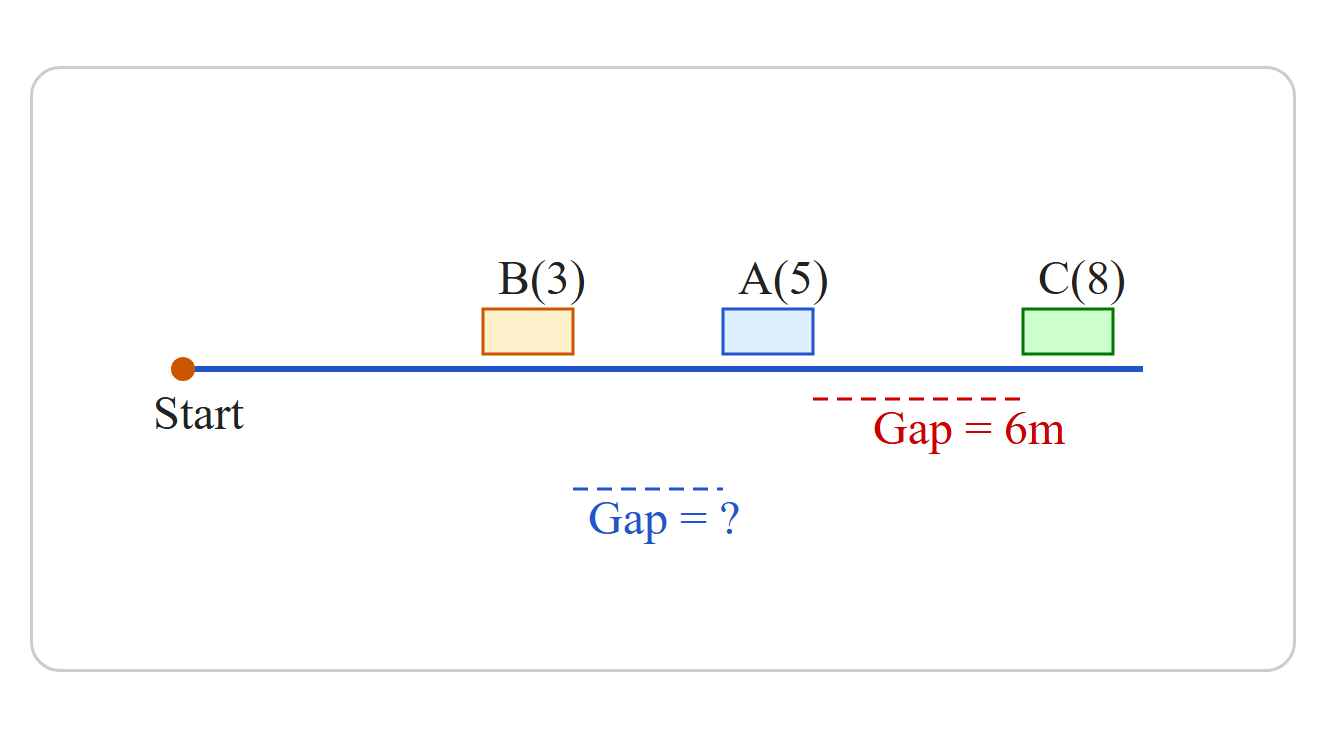
Ram beats Ramesh by 40 sec and Ramesh beats Naresh by 25 sec → Ram beats Naresh by 40 + 25 = 65 sec.
In terms of distance, Ram beats Naresh by 650 m in a 2000 m race.
Speed Ratio (Ram : Naresh) = 2000 : (2000 − 650) = 2000 : 1350 = 40 : 27.
Time Ratio (Ram : Naresh) = 27 : 40 (since distance is constant).
Difference (40 − 27) = 13 units = 65 sec ⇒ 1 unit = 5 sec.
Time taken by Ram = 27 units × 5 = 135 sec = 2 min, 15 sec.
∴ The correct answer is 2 min, 15 sec.

Alternate Method
Given:
Total Distance = 2000 m
Time difference (Ram and Ramesh) = 40 sec
Time difference (Ramesh and Naresh) = 25 sec
Distance difference (Ram and Naresh) = 650 m

Let the time taken by Ram be TRam.
⇒ Time taken by Ramesh = TRam + 40 sec
⇒ Time taken by Naresh = (TRam + 40) + 25 = TRam + 65 sec
When Ram covers 2000 m, Naresh covers (2000 − 650) = 1350 m.
⇒ Ratio of speeds (Ram : Naresh) = 2000 / 1350 = 40 / 27
Since both run the same distance of 2000 m, the time taken is inversely proportional to speed:
⇒ TRam / TNaresh = 27 / 40
⇒ TRam / (TRam + 65) = 27 / 40
⇒ 40 × TRam = 27 × TRam + 27 × 65
⇒ 13 × TRam = 1755
⇒ TRam = 1755 / 13 = 135 sec
⇒ TRam = 2 min, 15 sec
∴ The correct answer is 2 min, 15 sec.

Additional Information
Speed, Distance, and Time Relationship
Distance = Speed × Time. When distance is constant, Speed1 / Speed2 = Time2 / Time1.
Race Winning Concepts
A beats B by 'x' meters means when A reaches the finish line, B is 'x' meters behind. A beats B by 't' seconds means B takes 't' more seconds than A to finish.
Relative Speed in Races
If two people run in the same direction, their relative speed is the difference of their individual speeds (v1 − v2).