Previous Year Paper

SSC CHSL Tier-1 2024: Official Paper (Held On: 09 Jul, 2024 Shift 4) (Previous Year Paper)

Held in 2024

100 questions60 minutes
With answers
Free

Paper last updated:

Practise under exam conditions

Take this paper as a timed mock test. Review your answers after you submit.

Attempt timed test

Questions & answers

Read the paper at your pace. Open an explanation when you need it.

English Language (25 questions)

Question 1

Parts of the following sentence have been given as options. Select the option that contains an error.

There was an gang of thieves spotted at our local bank, make sure to be careful.

  1. AOption (a)

    of thieves spotted

  2. BOption (b)

    There was an gang

  3. COption (c)

    at our local bank

  4. DOption (d)

    make sure to be careful 

View answer & explanation

Correct answer

Answer: (b)B.

There was an gang

Why this answer is correct

The correct answer is Option 2.


Key Points

  • The primary issue in the sentence is the use of the article "an" before a word beginning with a consonant sound ("gang").
  • The correct article to use in this context is "a" instead of "an".
  • The correct phrase should be "There was a gang", ensuring grammatical correctness and clarity.
  • Thus, the error is located in Option 2 of the sentence.

Therefore, the correct answer is Option 2.


Correct Sentence: "There was a gang of thieves spotted at our local bank, make sure to be careful."


Additional Information

  • Option 1: "of thieves spotted" – This part of the sentence is grammatically correct and does not require any changes.
  • Option 3: "at our local bank" – This part of the sentence is grammatically correct and does not require any changes.
  • Option 4: "make sure to be careful" – This part of the sentence is grammatically correct and does not require any changes.


Question 2

The given sentence is divided into four segments. Identify the segment that contains a grammatical error.

A great / culture of hospitality of / the Spanish / is well-known.

  1. AOption (a)

    the Spanish 

  2. BOption (b)

    is well-known. 

  3. COption (c)

    culture of hospitality of

  4. DOption (d)

    A great

View answer & explanation

Correct answer

Answer: (c)C.

culture of hospitality of

Why this answer is correct

The correct answer is Option 3.


Key Points

  • The primary issue in the sentence is the awkward phrasing and wordiness of "culture of hospitality of."
  • It would be more concise and grammatically correct to use "hospitality culture of."
  • Thus, the error is located in Option 3 of the sentence.

Therefore, the correct answer is Option 3.


Correct Sentence: "A great hospitality culture of the Spanish is well-known."


Additional Information

  • Option 1: "the Spanish" – This part of the sentence is grammatically correct and refers to the people of Spain.
  • Option 2: "is well-known." – This part of the sentence is grammatically correct and does not require any changes.
  • Option 4: "A great" – This part of the sentence is grammatically correct and does not require any changes.

Question 3

The following sentence has been split into four segments. Identify the segment that contains a grammatical error.

After a while, / she look up / and saw that / it was getting dark.

  1. AOption (a)

    she look up

  2. BOption (b)

    it was getting dark

  3. COption (c)

    After a while

  4. DOption (d)

    and saw that

View answer & explanation

Correct answer

Answer: (a)A.

she look up

Why this answer is correct

The correct answer is Option 1.


Key Points

  • The primary issue in the sentence is the incorrect verb form "look" instead of "looked."
  • In past tense narratives, the verb should be in the past form.
  • The correct phrase should be "she looked up," ensuring grammatical correctness and clarity.
  • Thus, the error is located in part 1 of the sentence.

Therefore, the correct answer is Option 1.


Correct Sentence: "After a while, she looked up and saw that it was getting dark."


Additional Information

  • After a while, – This part of the sentence is grammatically correct and does not require any changes.
  • and saw that – This part of the sentence is grammatically correct and does not require any changes.
  • it was getting dark. – This part of the sentence is grammatically correct and does not require any changes.

Question 4

Select the option that will improve the given sentence by using the most appropriate verb.

Alexa have being working as a teacher for five years now.

  1. AOption (a)

    Alexa has being working as a teacher for five years now. 

  2. BOption (b)

    Alexa has been working as a teacher for five years now.

  3. COption (c)

    Alexa was been working as a teacher for five years now

  4. DOption (d)

    Alexa is being working as a teacher for five years now.

View answer & explanation

Correct answer

Answer: (b)B.

Alexa has been working as a teacher for five years now.

Why this answer is correct

The correct answer is Option 2.


Key Points

  • The primary issue in the sentence is the incorrect use of the verb form.
  • The correct form is "has been working," indicating the present perfect continuous tense.
  • The appropriate verb phrase clarifies that Alexa has been continuously working as a teacher for five years up to the present moment.

Therefore, the correct answer is Option 2.


Correct Sentence: "Alexa has been working as a teacher for five years now."


Additional Information

  • Option 1: "has being" is incorrect; the correct form is "has been."
  • Option 3: "was been" is incorrect; it should be "has been" for present perfect continuous tense.
  • Option 4: "is being" is incorrect; this structure does not fit the context needing the present perfect continuous tense.

In the following passage, some words have been deleted. Read the passage carefully and select the most appropriate option to fill in each blank.

How does a camel survive in the desert? Many people think that the camel stores water in its hump, but the hump is really made up of fats. When a camel (1)______ find water, it passes less urine to conserve (2)______ small amount of water it has in its body. Furthermore, the camel has a higher body temperature than (3)______ of most mammals. This means that it starts to sweat (4)_______ a higher temperature than that which human beings, for example, (5)_______ to perspire. This also helps it to keep water loss through sweating to a minimal.

Question 5

Select the most appropriate option to fill in blank number 1. 

  1. AOption (a)

    cannot

  2. BOption (b)

    can

  3. COption (c)

    hasn't

  4. DOption (d)

    do not

View answer & explanation

Correct answer

Answer: (a)A.

cannot

Why this answer is correct

The correct answer is Option 1.


Key Points

  • The word "cannot" means is unable to. It indicates a lack of ability or possibility.
  • In the context of the sentence, "cannot" accurately describes the camel's situation when it is unable to find water.
  • The other options: "can," "hasn't," and "do not" do not fit grammatically or contextually with the sentence.

Therefore, the correct answer is 'Option 1'.

Complete Sentence: When a camel cannot find water, it passes less urine to conserve the small amount of water it has in its body.


Additional Information

  • can: Indicates ability or possibility, which doesn't fit because the sentence describes a situation where the camel lacks the ability to find water.
  • hasn't: A contraction of "has not," which is grammatically incorrect in this context.
  • do not: Grammatically incorrect as the subject "camel" requires "does not" instead of "do not".

Question 6

Select the most appropriate option to fill in blank number 2. 

  1. AOption (a)

    very

  2. BOption (b)

    a

  3. COption (c)

    which

  4. DOption (d)

    the

View answer & explanation

Correct answer

Answer: (d)D.

the

Why this answer is correct

The correct answer is Option 4.


Key Points

  • The word "the" is a definite article used before singular and plural nouns when the noun is specific or particular.
  • In the context of the sentence, "the" is used to specify the small amount of water the camel has in its body.
  • The other options: "very," "a," and "which" do not fit grammatically or contextually in this sentence.

​Therefore, the correct answer is 'Option 4'.

Complete Sentence: When a camel cannot find water, it passes less urine to conserve the small amount of water it has in its body.


Additional Information

  • very: An adverb that describes the extent or degree of something, but does not fit the context here.
  • a: An indefinite article used before singular countable nouns when the noun is not specific. It doesn't fit in this context of referring to a specific amount of water.
  • which: A relative pronoun that introduces information about the noun preceding it, which doesn't fit this sentence structure.

Question 7

Select the most appropriate option to fill in blank number 3.

  1. AOption (a)

    all

  2. BOption (b)

    that

  3. COption (c)

    the

  4. DOption (d)

    some

View answer & explanation

Correct answer

Answer: (b)B.

that

Why this answer is correct

The correct answer is: Option 2.

Key Points

  • Explanation: In the sentence, "the camel has a higher body temperature than (3)______ of most mammals," the correct word to complete the comparison is "that." It refers back to "body temperature," making the meaning clear and grammatically correct.
  • ​In summary, option 2, "that," is the correct choice as it accurately completes the comparative statement about the camel's body temperature in relation to that of most mammals. Options 1, 3, and 4 do not work appropriately in the context of this sentence.

Additional Information

  • all: This option is not appropriate because it does not correctly complete the comparison; the phrase "all of most mammals" doesn't make sense in this context.
  • the: This option is incorrect because "the" does not establish a comparison; it needs to be followed by a specific noun when used in this context, which makes the sentence incomplete and unclear.
  • some: This option is incorrect because it would imply partiality, whereas the sentence is making a general comparison between the body temperature of camels and most mammals.

Question 8

Select the most appropriate option to fill in blank number 4.

  1. AOption (a)

    for

  2. BOption (b)

    in

  3. COption (c)

    with

  4. DOption (d)

    at

View answer & explanation

Correct answer

Answer: (d)D.

at

Why this answer is correct

The correct answer is Option 4.


Key Points

  • The word "at" is used to indicate a specific point or time. In the context of the sentence, "at" correctly specifies the temperature point at which the camel starts to sweat.
  • "For", "in", and "with" do not fit grammatically or logically in this context within the sentence structure.

​Therefore, the correct answer is 'Option 4'.

Complete Sentence: This means that it starts to sweat at a higher temperature than that which human beings, for example, start to perspire.


Additional Information

  • for: Generally indicates purpose or function but does not specify a point in time or condition.
  • in: Indicates location or condition but not a specific point of temperature.
  • with: Indicates association or accompaniment but does not specify a condition of starting point.

Question 9

Select the most appropriate option to fill in blank number 5. 

  1. AOption (a)

    start

  2. BOption (b)

    started

  3. COption (c)

    starts

  4. DOption (d)

    starting

View answer & explanation

Correct answer

Answer: (a)A.

start

Why this answer is correct

The correct answer is Option 1.


Key Points

  • The verb "start" is in the present tense, which appropriately matches "than that which human beings" as a general truth or habitual action.
  • The options "started", "starts", and "starting" do not fit as well due to tense inconsistency.

​Therefore, the correct answer is 'Option 1'.

Complete Sentence: This means that it starts to sweat at a higher temperature than that which human beings, for example, start to perspire.


Additional Information

  • Started: Incorrect because it is past tense and does not fit the context of general truth.
  • Starts: Seems redundant given the sentence structure.
  • Starting: Incorrect form to fit the conditional comparison.

Question 10

Select the most appropriate option to substitute the underlined segment in the given sentence.

Shantanu always buries his head in the sand whenever he explains his professional failures to his father.

  1. AOption (a)

    escapes from all the difficulties

  2. BOption (b)

    hides from the truth

  3. COption (c)

    blames the others for his mistakes

  4. DOption (d)

    shows a blind eye against social issues

View answer & explanation

Correct answer

Answer: (b)B.

hides from the truth

Why this answer is correct

The correct option is 'Option 2'.

Key Points

  • The phrase 'bury one's head in the sand' means to try to avoid a situation which is rather unpleasant by pretending that the problem doesn't exist. (मुसीबतों से आँख मूंद लेना)
  • Example- Live with it or bury your head in the sand.
  • Hence we can infer that the most approprate option will be 'Option 2'.

Therefore, the correct answer is 'Hides from the truth'.

Additional Information Here are other options explained along with their Hindi meaning and example sentences.

  • "To show a blind eye/to turn a blind eye" in 'Option 4'(जानबूझकर ध्यान नहीं देना ): To ignore something that you know is wrong.

        It has the almost same meaning as that of 'Option 2', however, "Option 4" will not be appropriate as per the context of the passage.

  • Example- Teachers are turning a blind eye to pupils smoking at school.​

Question 11

Select the most appropriate option that can substitute the underlined segment in the given sentence.

Things that do not come from the ground not safe to compost.

  1. AOption (a)

    is not safe

  2. BOption (b)

    be not safe

  3. COption (c)

    has not been safe

  4. DOption (d)

    are not safe

View answer & explanation

Correct answer

Answer: (d)D.

are not safe

Why this answer is correct

The correct answer is Option 4.


Key Points

  • The primary issue in the sentence is the verb agreement with the plural subject "Things that do not come from the ground."
  • Plural subjects require a plural verb form.
  • The correct phrase should be "are not safe to compost," ensuring grammatical correctness and clarity.

Therefore, the correct answer is Option 4.


Correct Sentence: "Things that do not come from the ground are not safe to compost."


Additional Information

  • Option 1: "is not safe" – Incorrect as it does not agree with the plural subject.
  • Option 2: "be not safe" – Incorrect as it is not grammatically correct in this context.
  • Option 3: "has not been safe" – Incorrect as it changes the tense and meaning of the sentence.

Question 12

Select the INCORRECTLY spelt word in the given sentence.

King Zheng is known to lead an army of a million armoured soldiers, a thousand chariots and ten thousand horses in his misssion to conquer the neighbouring kingdoms.

  1. AOption (a)

    Misssion

  2. BOption (b)

    Chariots

  3. COption (c)

    Kingdoms

  4. DOption (d)

    Thousand

View answer & explanation

Correct answer

Answer: (a)A.

Misssion

Why this answer is correct

The correct answer is: Option 1.

Key Points

  • The word "misssion" is incorrectly spelt. The correct spelling is **"mission". (**मिशन)
  • Example: He was on a mission to find the lost treasure.
  • "Mission" refers to an important task or duty that a person or group of people is sent somewhere to do. (मिशन)
  • Example: The astronauts were on a mission to explore Mars.

Therefore, the correct answer is: Option 1.

Additional Information

Here are the other options explained along with their Hindi meanings and example sentences:

  • Chariots (रथ): A type of ancient two-wheeled vehicle drawn by horses, used in racing and warfare.
  • Example: The ancient soldiers rode into battle on chariots.
  • Kingdoms (राज्य): A country, state, or territory ruled by a king or queen.
  • Example: The medieval kingdoms were often at war with each other.
  • Thousand (हजार): The number equivalent to the product of a hundred and ten.
  • Example: The stadium can hold up to fifty thousand people.

Question 13

Select the most appropriate synonym of the given word.

Luminous

  1. AOption (a)

    Radiant

  2. BOption (b)

    Laborious 

  3. COption (c)

    Amiable

  4. DOption (d)

    Luxurious

View answer & explanation

Correct answer

Answer: (a)A.

Radiant

Why this answer is correct

The correct answer is 'Option 1'.

Key Points

  • The word 'Luminous' means giving off light; bright or shining.(चमकदार)
  • Example- David's watch has luminous numbers.
  • 'Radiant'- Sending out light; shining or glowing brightly.(दीप्तिमान)
  • Example- A bird with radiant green and red plumage.
  • Hence, we can infer that the synonym of "Luminous" is "Radiant".

Therefore, the correct answer is Radiant.

Additional Information Here are a few other options explained along with their Hindi meaning and example sentences.

  • **Laborius(**परिश्रमी): Requiring considerable time and effort.
  • Example: The work is very slow and laborious.
  • **Amiable(**सुशील): Having or displaying a friendly and pleasant manner.
  • Example- Balard had a kind and amiable personality, to which students responded warmly.
  • Luxurious(शान शौकत): Extremely comfortable or elegant, especially when involving great expense.
  • Example- It was one of the most luxurious hotel rooms we've ever stayed in.

Question 14

Select the most appropriate option that can substitute the underlined segment in the given sentence. If there is no need to substitute it, select ‘No substitution required’.

I quietly went out at the door into the veranda.

  1. AOption (a)

    from

  2. BOption (b)

    by

  3. COption (c)

    No substitution required

  4. DOption (d)

    through

View answer & explanation

Correct answer

Answer: (d)D.

through

Why this answer is correct

The correct answer is Option 4.


Key Points

  • The primary issue in the sentence is the use of an incorrect preposition.
  • The phrase "at the door" is not appropriate in this context.
  • The correct phrase should be "through the door," which indicates the action of passing from one side of the door to the other.
  • Thus, "through" is the most appropriate substitution for the underlined segment.

Therefore, the correct answer is Option 4.


Correct Sentence: "I quietly went out through the door into the veranda."


Additional Information

  • No substitution required would be the correct option if the original sentence was already correct, but "at the door" is incorrect in this context.
  • From could indicate direction but does not fit well here.
  • By indicates proximity but not the action of moving through a door.

Question 15

Select the option with the correct spelling to replace the underlined word in the given sentence.

A natural clamity causing huge destruction and loss of life and property.

  1. AOption (a)

    clamanity

  2. BOption (b)

    climanity

  3. COption (c)

    calamitey

  4. DOption (d)

    calamity

View answer & explanation

Correct answer

Answer: (d)D.

calamity

Why this answer is correct

The correct answer is 'Option 4'.

Key Points

  • The word 'Calamity' means an event causing great and often sudden damage or distress; a disaster.(आपदा)
  • Example- We managed to survive the calamity of the fire.

Other options except 'Option 4' are not real words, making 'Option 4' the only suitable option that fits the passage given.

Question 16

Select the most appropriate meaning of the underlined idiom in the given sentence.

He got medals time after time by following the instructions of his mentor.

  1. AOption (a)

    Twice

  2. BOption (b)

    Once

  3. COption (c)

    Repeatedly

  4. DOption (d)

    Rarely

View answer & explanation

Correct answer

Answer: (c)C.

Repeatedly

Why this answer is correct

The correct answer is Option 3.

Key Points

  • The idiom 'time after time' means again and again; repeatedly.(बार - बार)
  • Example - Time after time she gets involved in relationships with the wrong men.
  • 'Repeatedly' means over and over again, or many times.(दोहराते हुए)
  • Example - Ecologists have repeatedly warned us about the effects of global warming.
  • Hence, we can infer that the same meaning of  'time after time' is 'Repeatedly'.

Therefore, the correct answer is 'Repeatedly'.

Additional Information Here are the other options explained along with their Hindi meaning and example sentences:

  • Twice (दो बार) - Means two times.
  • Example - She takes the dog for a walk twice daily.
  • Once (एक बार) - Means one time only; on one occasion.
  • Example - My boss is a nice man once you get to know him
  • Rarely (कभी-कभार) - Means something that happens seldom.
  • Example - He is rarely seen in public.

Question 17

Select the most appropriate option that can substitute the underlined segment in the given sentence.

Grasslands should not be foraged and some places are to be closed for grazing.

  1. AOption (a)

    planted or

  2. BOption (b)

    over-grazed and some areas should be

  3. COption (c)

    grazed and some places is

  4. DOption (d)

    cut and few areas

View answer & explanation

Correct answer

Answer: (b)B.

over-grazed and some areas should be

Why this answer is correct

The correct answer is Option 2.


Key Points

  • The term "over-grazed" addresses the idea that grasslands should not be excessively grazed, which matches the context correctly.
  • The phrase "and some areas should be" suggests an appropriate recommendation for action, fitting grammatically and contextually.

​Therefore, the correct answer is Option 2.


Complete Sentence: Grasslands should not be over-grazed and some areas should be closed for grazing.


Additional Information

  • Planted or: Incorrect as it changes the meaning and doesn't fit the context.
  • Grazed and some places is: Incorrect due to grammatical inconsistency and incorrect verb agreement.
  • Cut and few areas: Incorrect as it changes the meaning and doesn't fit the context.

Question 18

Select the most appropriate option to fill in the blank.

The ________ of the whale is 2 tonnes.

  1. AOption (a)

    weight

  2. BOption (b)

    vet

  3. COption (c)

    wet

  4. DOption (d)

    wait

View answer & explanation

Correct answer

Answer: (a)A.

weight

Why this answer is correct

The correct answer is: Option 1.

Key Points

  • The word "weight" refers to the measure of how heavy an object is. (वजन)
  • Example: The weight of the package was more than expected.
  • "weight" is the correct term to describe the heaviness or mass of the whale. (वजन)
  • Example: The weight of the whale is 2 tonnes.

Therefore, the correct answer is: Option 1.

Additional Information

Here are the other options explained along with their Hindi meanings and example sentences:

  • Vet (पशु चिकित्सक): A veterinarian or animal doctor.
  • Example: The vet examined the injured dog carefully.
  • Wet (गीला): Covered or saturated with water or another liquid.
  • Example: His clothes were wet after the sudden rain.
  • Wait (प्रतीक्षा): The action of staying where one is or delaying action until a particular time or event.
  • Example: Please wait here until I come back.

Question 19

Fill in the blank with the most appropriate ANTONYM of the underlined word.

In spring the leaves are bright green, whereas they appear ______ in autumn.

  1. AOption (a)

    dull

  2. BOption (b)

    gleaming

  3. COption (c)

    dazzling

  4. DOption (d)

    luminous

View answer & explanation

Correct answer

Answer: (a)A.

dull

Why this answer is correct

The correct answer is Option 1.

Key Points

  • The word 'bright' means having a lot of light; (used about a colour) strong and easy to see.(चमकदार)
  • Example - The day was bright and sunny.
  • 'Dull' means not interesting or exciting; boring.(उदासीन)
  • Example - The color of the walls was dull and lifeless.
  • Hence, we can infer that the antonym of 'Bright' is 'Dull'.

Therefore, the correct answer is 'Dull'.

Additional Information Here are the other options explained along with their Hindi meaning and example sentences:

  • Gleaming (चमचमाती) - Appearing to give off light or brightness; radiant; shining brightly.
  • Example - The kitchen is very modern, with gleaming stainless steel surfaces.
  • Dazzling (बहुत चमकीला) - Extremely bright or impressive.
  • Example - The match showed off his dazzling skills as a footballer.
  • Luminous (चमकदार) - Radiating or reflecting light; that shines in the dark.
  • Example - Our theory might predict that the most massive galaxies are the most luminous.

Question 20

Select the most appropriate option to fill in the blank.

It is the ____________ to reach Delhi.

  1. AOption (a)

    fastest route

  2. BOption (b)

    quickest route

  3. COption (c)

    lowest route

  4. DOption (d)

    strongest route

View answer & explanation

Correct answer

Answer: (a)A.

fastest route

Why this answer is correct

The correct answer is: Option 1.

Key Points

  • The word "fastest" means moving or capable of moving at high speed. (सबसे तेज)
  • Example: He took the fastest train to reach the city.
  • "Route" refers to a way or course taken in getting from a starting point to a destination. (मार्ग)
  • Example: The route to the village is scenic and beautiful.
  • Hence, the phrase "fastest route" implies the quickest way to reach a destination.

Therefore, the correct sentence is: It is the fastest route to reach Delhi.

Additional Information

Here are the other options explained along with their Hindi meanings and example sentences:

  • Quickest route (सबसे तेज मार्ग): This phrase is synonymous with "fastest route" and could also be a correct answer.
  • Example: He always searches for the quickest route to avoid traffic.
  • Lowest route (सबसे निचला मार्ग): Indicates the route with the lowest elevation, which is not relevant in this context.
  • Example: The lowest route through the mountains is often the safest during winter.
  • Strongest route (सबसे मजबूत मार्ग): This phrase does not make sense in this context as routes are not described in terms of strength.
  • Example: This sentence does not logically fit the context.

Question 21

Select the most appropriate option to fill in the blank.

The cat’s entry into the store room was ___________.

  1. AOption (a)

    quiet

  2. BOption (b)

    quit

  3. COption (c)

    quite

  4. DOption (d)

    cute

View answer & explanation

Correct answer

Answer: (a)A.

quiet

Why this answer is correct

The correct answer is: Option 1.

Key Points

  • The word "quiet" means making little or no noise; silent or calm. (शांत)
  • Example: The library was so quiet that you could hear a pin drop.
  • "Quiet" suggests an absence of noise or activity, which fits the context of the cat's stealthy entry. (शांत)
  • Example: The quiet cat slipped into the room without anyone noticing.

Therefore, the correct sentence is: The cat’s entry into the store room was quiet

Additional Information

Here are the other options explained along with their Hindi meanings and example sentences:

  • Quit (छोड़ देना): To leave or give up.
  • Example: He decided to quit his job to pursue his passion for painting.
  • Quite (काफी): To a certain or significant extent.
  • Example: She is quite talented in playing the piano.
  • Cute (प्यारा): Attractive in a pretty or endearing way.
  • Example: The kitten looked very cute as it played with the yarn.

Question 22

Select the most appropriate option that can substitute the underlined word in the given sentence.

Modest stores and welcoming residents populated the charming tiny town.

  1. AOption (a)

    hideous

  2. BOption (b)

    nasty

  3. COption (c)

    unpleasant

  4. DOption (d)

    delightful

View answer & explanation

Correct answer

Answer: (d)D.

delightful

Why this answer is correct

The correct answer is Option 4.

Key Points

  • The word 'charming' means very pleasing or attractive.(आकर्षक).
  • Example - Everyone I have met has been charming and attractive.
  • 'Delightful' means very pleasant, attractive, or enjoyable.(रमणीय,आनंदमय).
  • Example - It's a delightful place to spend a holiday.
  • Hence, we can infer that the most appropriate option that can substitute the underlined word of 'charming' is 'delightful'.

Therefore, correct answer is Delightful.

Additional Information Here are the other options explained along with their Hind meaning and example sentences:

  • Hideous (बहुत भद्दा,घृणित) - very ugly or unpleasant.
  • Example - They've just built some hideous new apartment blocks on the waterfront.
  • Nasty (बहुत खराब) - very bad or unpleasant.
  • Example - She has a nasty habit of biting her fingernails.
  • Unpleasant (अप्रिय,अरूचिकर) - causing you to have a bad feeling; not nice.
  • Example - There was an unpleasant smell coming from the basement.

Question 23

Identify the most appropriate ANTONYM of the underlined word in the following sentence.

Harry’s behaviour was very blunt during his school days

  1. AOption (a)

    Excited

  2. BOption (b)

    Curious

  3. COption (c)

    Dull

  4. DOption (d)

    Polite

View answer & explanation

Correct answer

Answer: (d)D.

Polite

Why this answer is correct

The correct answer is: Option 4.

Key Points

  • The word "blunt" means straightforward and unceremoniously frank, often to the point of being rudely abrupt. (स्पष्टवादी)
  • Example: His blunt remarks during the meeting surprised everyone.
  • "Polite" refers to showing good manners towards others, being respectful and considerate. (विनम्र)
  • Example: She was very polite and greeted everyone with a warm smile.

Hence, we can infer that the opposite of 'blunt' is 'polite'.

Additional Information

Here are the other options explained along with their Hindi meanings and example sentences:

  • Excited (उत्साहित): Feeling or showing happiness and enthusiasm.
  • Example: The children were excited about going to the amusement park.
  • Curious (जिज्ञासु): Eager to know or learn something.
  • Example: She was curious about the new student who joined their class.
  • Dull (मंद): Lacking interest or excitement; boring.
  • Example: The lecture was so dull that several students fell asleep.

Question 24

Select the most appropriate synonym of the given word.

Rectify

  1. AOption (a)

    Correct

  2. BOption (b)

    Count

  3. COption (c)

    Consider

  4. DOption (d)

    Connect

View answer & explanation

Correct answer

Answer: (a)A.

Correct

Why this answer is correct

The correct answer is: Option 1.

Key Points

  • The word "Rectify" means to correct something or make it right. (सुधारना)
  • Example: The technician was able to rectify the issue with the computer.
  • "Correct" refers to making something accurate or free from errors. (सही करना)
  • Example: The teacher corrected the mistakes in the student's essay.
  • Therefore, the correct answer is: Correct.

Additional Information

Here are the other options explained along with their Hindi meanings and example sentences:

  • Count (गिनती करना): To determine the total number of something.
  • Example: She can count to ten in five different languages.
  • Consider (विचार करना): To think about something carefully.
  • Example: We need to consider all the options before making a decision.
  • Connect (जोड़ना): To join or link together.
  • Example: The new bridge will connect the two cities.

Question 25

Select the most appropriate ANTONYM of the underlined word.

We should not run after transient pleasures of the world.

  1. AOption (a)

    Sinful

  2. BOption (b)

    Permanent

  3. COption (c)

    Joyful

  4. DOption (d)

    Unnatural

View answer & explanation

Correct answer

Answer: (b)B.

Permanent

Why this answer is correct

The correct answer is: Option 2.

Key Points

  • The word "transient" means something that lasts only for a short time; temporary. (क्षणिक)
  • Example: The transient nature of life makes every moment precious.
  • "Permanent" refers to something that lasts or remains unchanged indefinitely; enduring. (स्थायी)
  • Example: He found a permanent solution to the recurring problem.
  • Hence, we can infer that the opposite of 'transient' is 'permanent'.

Therefore, the correct answer is: Permanent.

Additional Information

Here are the other options explained along with their Hindi meanings and example sentences:

  • Sinful (पापी): Involving or being guilty of immoral actions or behavior.
  • Example: He was punished for his sinful actions.
  • Joyful (खुश): Feeling, expressing, or causing great pleasure and happiness.
  • Example: The joyful celebration lasted all night.
  • Unnatural (अप्राकृतिक): Contrary to the ordinary course of nature; abnormal.
  • Example: The unnatural color of the sky worried the villagers.

General Intelligence (25 questions)

Question 26

What should come in place of the question mark (?) in the given series based on the English alphabetical order?

CEG, FHJ, IKM, LNP, ?

  1. AOption (a)

    OQR

  2. BOption (b)

    QRS

  3. COption (c)

    QTV

  4. DOption (d)

    OQS

View answer & explanation

Correct answer

Answer: (d)D.

OQS

Why this answer is correct

The logic followed here is:

Hence, the correct answer is "OQS".

Question 27

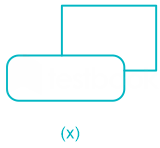
How many rectangles are there in the given figure?

  1. AOption (a)

    9

  2. BOption (b)

    10

  3. COption (c)

    11

  4. DOption (d)

    8

View answer & explanation

Correct answer

Answer: (b)B.

10

Why this answer is correct

The rectangles:

So, '10' rectangles are there in the given figure.

Hence, the correct answer is "10".

Question 28

Select the set in which the numbers are related in the same way as are the numbers of the following sets.

(NOTE: Operations should be performed on the whole numbers, without breaking down the numbers into its constituent digits. E.g. 13 – Operations on 13 such as adding/deleting/multiplying etc. to 13 can be performed. Breaking down 13 into 1 and 3 and then performing mathematical operations on 1 and 3 is not allowed.)

(6, 12, 72)

(8, 16, 96)

  1. AOption (a)

    (11, 24, 144) 

  2. BOption (b)

    (7, 28, 144)

  3. COption (c)

    (12, 24, 144) 

  4. DOption (d)

    (12, 24, 140)

View answer & explanation

Correct answer

Answer: (c)C.

(12, 24, 144) 

Why this answer is correct

The logic followed here is:

Logic: (1st number + 2nd number) × 4 = 3rd number.

Now,

For, (6, 12, 72)

⇒ (6 + 12) × 4 = 18 × 4 = 72.

For, (8, 16, 96)

⇒ (8 + 16) × 4 = 24 × 4 = 96.

Similarly, for (12, 24, 144)

⇒ (12 + 24) × 4 = 36 × 4 = 144.

Hence, the correct answer is "Option 3".

Question 29

What will come in the place of the question mark (?) in the following equation, if ‘+' and ‘-’ are interchanged and ‘×' and '÷' are interchanged? 

15 ÷ 4 - 128 + 123 × 3 = ?

  1. AOption (a)

    167

  2. BOption (b)

    147

  3. COption (c)

    187

  4. DOption (d)

    127

View answer & explanation

Correct answer

Answer: (b)B.

147

Why this answer is correct

Given equation: 15 ÷ 4 - 128 + 123 × 3 = ?

If ‘+' and ‘-’ and ‘×' and '÷' are interchanged then we get:

⇒ 15 × 4 + 128 - 123 ÷ 3 = ?

⇒ 15 × 4 + 128 - 41 = ?

⇒ 60 + 128 - 41 = ?

⇒ 188 - 41 = ? = 147

Hence, the correct answer is "147".

Question 30

What will come in the place of the question mark (?) in the following equation, if '+’ and ‘-' are interchanged and '×' and ‘÷' are interchanged? 

16 ÷ 5 - 24 × 6 + 3 = ?

  1. AOption (a)

    85

  2. BOption (b)

    82

  3. COption (c)

    81

  4. DOption (d)

    80

View answer & explanation

Correct answer

Answer: (c)C.

81

Why this answer is correct

Given equation: 16 ÷ 5 - 24 × 6 + 3 = ?

If ‘+' and ‘-’ and ‘×' and '÷' are interchanged then we get:

⇒ 16 × 5 + 24 ÷ 6 - 3 = ?

⇒ 16 × 5 + 4 - 3 = ?

⇒ 80 + 4 - 3 = ?

⇒ 84 - 3 = ? = 81

Hence, the correct answer is "81".

Question 31

What should come in place of the question mark (?) in the given series based on the English alphabetical order?

RPM, USP, XVS, AYV, ?

  1. AOption (a)

    BYD

  2. BOption (b)

    BDY

  3. COption (c)

    DBY

  4. DOption (d)

    DYB

View answer & explanation

Correct answer

Answer: (c)C.

DBY

Why this answer is correct

The logic followed here is:

Hence, the correct answer is "DBY".

Question 32

Identify the figure in the options that when put in place of the question mark (?) will logically complete the series?

  1. AOption (a)

  2. BOption (b)

  3. COption (c)

  4. DOption (d)

View answer & explanation

Correct answer

Answer: (b)B.

Why this answer is correct

The logic followed here is:

  • Top number = Bottom number + 2;
  • Right number = Top number × Bottom number

Hence, the correct answer is "Option 2".

Question 33

Select the correct mirror image of the given figure when the mirror is placed at MN as shown below. 

  1. AOption (a)

  2. BOption (b)

  3. COption (c)

  4. DOption (d)

View answer & explanation

Correct answer

Answer: (b)B.

Why this answer is correct

The correct mirror image of the given figure is:

Hence, the correct answer is "Option 2".

Question 34

Based on the alphabetical order, three of the following four letter-clusters are alike in a certain way and thus form a group. Which letter-cluster does not belong to that group? (Note: The odd one out is not based on the number of consonants/vowels or their position in the letter cluster.)

  1. AOption (a)

    RTV

  2. BOption (b)

    PRT

  3. COption (c)

    HJL

  4. DOption (d)

    TVY

View answer & explanation

Correct answer

Answer: (d)D.

TVY

Why this answer is correct

The logic followed here is:

Option 1) RTV

Option 2) PRT

Option 3) HJL

Option 4) TVY

Hence, the correct answer is "TVY".

Question 35

Read the given statements and conclusions carefully. Assuming that the information given in the statements is true, even if it appears to be at variance with commonly known facts, decide which of the given conclusions logically follow(s) from the statements.

Statements:

Some sweaters are jackets.

Some jackets are pullovers.

No pullover is a glove.

Conclusions:

(I) No jacket is a glove.

(II) Some sweaters are pullovers.

  1. AOption (a)

    Only conclusion I follows

  2. BOption (b)

    Both conclusions I and II follow

  3. COption (c)

    Only conclusion II follows

  4. DOption (d)

    None of the conclusions follow

View answer & explanation

Correct answer

Answer: (d)D.

None of the conclusions follow

Why this answer is correct

Given Statements:

Some sweaters are jackets.

Some jackets are pullovers.

No pullover is a glove.

The least possible Venn diagram:

Conclusions:

(I) No jacket is a glove. - False (Because, there is no direct relation given between jacket and glove, so it can be possible only)

(II) Some sweaters are pullovers. - False (Because, there is no direct relation given between sweaters and pullovers, so it can be possible only)

So, None of the conclusions follow.

Hence, the correct answer is "None of the conclusions follow".

Question 36

Select the correct mirror image of the given combination when the mirror is placed at MN as shown below.

  1. AOption (a)

  2. BOption (b)

  3. COption (c)

  4. DOption (d)

View answer & explanation

Correct answer

Answer: (b)B.

Why this answer is correct

The correct mirror image of the given figure is:

Hence, the correct answer is "Option 2".

Question 37

Select the option figure in which the given figure (X) is embedded as its part (rotation is NOT allowed). 

  1. AOption (a)

  2. BOption (b)

  3. COption (c)

  4. DOption (d)

View answer & explanation

Correct answer

Answer: (a)A.

Why this answer is correct

The image embedded in given figure is as shown below:

Hence, "Option 1" is the correct answer.

Question 38

DFIK is related to EGJL in a certain way based on the English alphabetical order. In the same way, GILN is related to HJMO. To which of the following is MORT related to, following the same logic? 

  1. AOption (a)

    NPSV

  2. BOption (b)

    NPVS

  3. COption (c)

    NPSU

  4. DOption (d)

    NQSU

View answer & explanation

Correct answer

Answer: (c)C.

NPSU

Why this answer is correct

The logic followed here is:

DFIK is related to EGJL

GILN is related to HJMO.

Similarly, MORT related to

Hence, the correct answer is "NPSU".

Question 39

33 is related to 726 by certain logic. Following the same logic, 43 is related to 946. To which of the following is 53 related, following the same logic?

(NOTE: Operations should be performed on the whole numbers, without breaking down the numbers into its constituent digits. E.g. 13 – Operations on 13 such as adding/subtracting/multiplying etc. to 13 can be performed. Breaking down 13 into 1 and 3 and then performing mathematical operations on 1 and 3 is not allowed.)

  1. AOption (a)

    1060

  2. BOption (b)

    980

  3. COption (c)

    846

  4. DOption (d)

    1166

View answer & explanation

Correct answer

Answer: (d)D.

1166

Why this answer is correct

The logic followed here is:

Logic: (1st number × 22) = 2nd number.

Now,

For, 33 : 726

⇒ 33 × 22 = 726.

For, 43 : 946

⇒ 43 × 22 = 946.

Similarly, for 53 ∶ ?

⇒ 53 × 22 = 1166.

Hence, the correct answer is "Option 4".

Question 40

In a certain code language, ‘time and again’ is coded as ‘zx df mo’ and ‘value your time’ is coded as ‘df pn tv’. How is ‘time’ coded in the given language?

  1. AOption (a)

    mo

  2. BOption (b)

    df

  3. COption (c)

    tv

  4. DOption (d)

    zx

View answer & explanation

Correct answer

Answer: (b)B.

df

Why this answer is correct

According to the given information:

So, the code for 'time' = df.

Hence, the correct answer is "df".

Question 41

Six letters A, R, T, W, Y and Z are written on different faces of a dice, Two positions of this dice are shown in the figure. Which is the letter on the face opposite to the face containing A? 

  1. AOption (a)

    W

  2. BOption (b)

    Z

  3. COption (c)

    Y

  4. DOption (d)

    R

View answer & explanation

Correct answer

Answer: (c)C.

Y

Why this answer is correct

For find the opposite surface of 'A', we need to compare the common surface in the given dices,

Now, Letter 'Z' is given in Dice 1 and Dice 2, 

So, From Dice 1 and Dice 2,

When rotate in clockwise direction then we get:

Z ⇔ Z; A ⇔ Y; R ⇔ T

→ Z is the common surface and A, R, Y, T is the adjacent surface.

So, the remaining 'Y' will be the opposite face of 'Z'.

Hence, the correct answer is "Y".

Question 42

Which of the following numbers will replace the question mark (?) in the given series? 

112 113 122 147 196 ?

  1. AOption (a)

    277

  2. BOption (b)

    294

  3. COption (c)

    253

  4. DOption (d)

    282

View answer & explanation

Correct answer

Answer: (a)A.

277

Why this answer is correct

The logic followed here is:

Hence, the correct answer is "277".

Question 43

What should come in place of the question mark (?) in the given series? 

3, 7, 15, 31, 63, ?

  1. AOption (a)

    127

  2. BOption (b)

    126

  3. COption (c)

    125

  4. DOption (d)

    128

View answer & explanation

Correct answer

Answer: (a)A.

127

Why this answer is correct

The logic followed here is:

Hence, the correct answer is "127".

Question 44

What will come in the place of the question mark (?) in the following equation, if ‘+' and ‘-’ are interchanged and ‘×' and '÷' are interchanged?

14 - 15 ÷ 2 + 56 × 14 = ?

  1. AOption (a)

    30

  2. BOption (b)

    45

  3. COption (c)

    35

  4. DOption (d)

    40

View answer & explanation

Correct answer

Answer: (d)D.

40

Why this answer is correct

Given equation: 14 - 15 ÷ 2 + 56 × 14 = ? 

If ‘+' and ‘-’ and ‘×' and '÷' are interchanged then we get:

⇒ 14 + 15 × 2 - 56 ÷ 14 = ? 

⇒ 14 + 15 × 2 - 4 = ?

⇒ 14 + 30 - 4 = ?

⇒ 44 - 4 = ? = 40

Hence, the correct answer is "40".

Question 45

Select the option figure in which the given figure (X) is embedded as its part (rotation is NOT allowed).

  1. AOption (a)

  2. BOption (b)

  3. COption (c)

  4. DOption (d)

View answer & explanation

Correct answer

Answer: (b)B.

Why this answer is correct

The image embedded in given figure is as shown below:

Hence, "Option 2" is the correct answer.

Question 46

In a certain code language, ‘BACK’ is coded as ‘4162’ and 'CAB’ is coded as ‘214’ What is the code for ‘K’ in that language? 

  1. AOption (a)

    2

  2. BOption (b)

    4

  3. COption (c)

    6

  4. DOption (d)

    1

View answer & explanation

Correct answer

Answer: (c)C.

6

Why this answer is correct

According to the given information:

The code for A/B/C = 1/2/4

So, the code for ‘K’ = 6.

Hence, the correct answer is "6".

Question 47

The position of how many letters will remain unchanged if each of the letters in the word WANDERLUST is arranged from left to right in alphabetical order?

  1. AOption (a)

    One

  2. BOption (b)

    Two

  3. COption (c)

    Three

  4. DOption (d)

    None

View answer & explanation

Correct answer

Answer: (a)A.

One

Why this answer is correct

Given word: 'WANDERLUST'

After arranged in alphabetical order:

AlphabetsWANDERLUST
Alphabetical orderADELNRSTUW


Now,

there is One alphabet "R" that will remain unchanged if each of the letters in the word 'WANDERLUST' is arranged in English alphabetical order.

Hence, the correct answer is "Option 1".

Question 48

‘T + W’ means ‘T is the father of W’

‘T – W’ means ‘T is the wife of W’

‘T × W’ means ‘T is the brother of W’

‘T ÷ W’ means ‘T is the daughter of W’.

What does ‘S + T ÷ U’ mean?

  1. AOption (a)

    S is the brother of U

  2. BOption (b)

    S is the husband of U 

  3. COption (c)

    S is the son of U

  4. DOption (d)

    S is the uncle of U 

View answer & explanation

Correct answer

Answer: (b)B.

S is the husband of U 

Why this answer is correct

Family Chart: 

Decoding the Symbols:

Symbol+-÷×
MeaningFatherWifeDaughterBrother


Given: S + T ÷ U

It means: S is the father of T and T is the daughter of U.


So, S is the husband of U.

Hence, the correct answer is "S is the husband of U".

Question 49

Select the word-pair that best represents a similar relationship to the one expressed in the pair of words given below

(The words must be considered as meaningful English words and must not be related to each other based on the number of letters/number of consonants/vowels in the word.)

Referee : Field

  1. AOption (a)

    Arbitrator : Deadlock 

  2. BOption (b)

    Experimenter : Result

  3. COption (c)

    Judge : Courtroom

  4. DOption (d)

    Gladiator : Ring

View answer & explanation

Correct answer

Answer: (c)C.

Judge : Courtroom

Why this answer is correct

The logic followed here is:

Logic: Occupations and their Places of Work.

Here,

Referee : Field → Referee is a person who works in a Field.

Similarly,

Judge : Courtroom → Judge is a person who works in a Courtroom.

Hence, the correct answer is "Option 3".

Question 50

If 10 days before was a Sunday and 6 days after would be a Tuesday, then what day is it today?

  1. AOption (a)

    Monday

  2. BOption (b)

    Wednesday

  3. COption (c)

    Tuesday

  4. DOption (d)

    Friday

View answer & explanation

Correct answer

Answer: (b)B.

Wednesday

Why this answer is correct

Given: 10 days before was Sunday and 6 days after will be Tuesday.

Now,

We know that 10 days before today was Sunday.

So, today - 10 days = Sunday.

Similarly, 6 days after today will be Tuesday.

So, today + 6 days = Tuesday.

Now, let us calculate the days of the week:

Counting forward from Sunday for 10 days, we get:

10 days = 10/7 = 1 week and 3 odd days,

So, Sunday + 3 = Wednesday.

Counting forward from Wednesday(Today) for 6 days, we get:

Wednesday + 6 = Tuesday.

So, today is Wednesday.

Hence, the correct answer is "Option 2".

Quantitative Aptitude (25 questions)

Question 51

If three sides of a triangle are 6 cm, 8 cm and 10 cm, then the area of the triangle is:

  1. AOption (a)

    12√3 cm2

  2. BOption (b)

    24 cm2

  3. COption (c)

    24√3 cm2

  4. DOption (d)

    30 cm2

View answer & explanation

Correct answer

Answer: (b)B.

24 cm2

Why this answer is correct

Given:

Sides of the triangle: a = 6 cm, b = 8 cm, c = 10 cm

Formula used:

Area of the triangle using Heron's formula:

Area = s(s−a)(s−b)(s−c)\sqrt{s(s-a)(s-b)(s-c)}

Where, s = a+b+c2\dfrac{a + b + c}{2}

Calculation:

s = 6+8+102\dfrac{6 + 8 + 10}{2}

⇒ s = 12 cm

Area = 12(12−6)(12−8)(12−10)\sqrt{12(12-6)(12-8)(12-10)}

⇒ Area = 12×6×4×2\sqrt{12 × 6 × 4 × 2}

⇒ Area = 576\sqrt{576}

⇒ Area = 24 cm2

∴ The correct answer is option 2.

Shortcut Trick 

  6,8,10 is a triplet, making right angle triangle in which 10 is hypotenuse.

So, area of right-angle triangle = 1/2 × 6 × 8 = 24.

Question 52

The strength of a school is 640, with the number of boys being 400. Find the ratio of girls to boys. 

  1. AOption (a)

    4 : 5

  2. BOption (b)

    3 : 5

  3. COption (c)

    8 : 5

  4. DOption (d)

    5 : 6

View answer & explanation

Correct answer

Answer: (b)B.

3 : 5

Why this answer is correct

Given:

The strength of a school is 640, with the number of boys being 400.

Formula used:

Ratio of girls to boys = Number of girls : Number of boys

Calculation:

Number of girls = Total strength - Number of boys

⇒ Number of girls = 640 - 400

⇒ Number of girls = 240

Ratio of girls to boys = 240 : 400

⇒ Ratio of girls to boys = 240400\dfrac{240}{400}

⇒ Ratio of girls to boys = 3 : 5

∴ The correct answer is option 2.

Question 53

If 20% of 35% of a number is 240.8, then 18% of that number (rounded off to 1 decimal place) is:

  1. AOption (a)

    618.2

  2. BOption (b)

    621.2

  3. COption (c)

    619.2

  4. DOption (d)

    623.2

View answer & explanation

Correct answer

Answer: (c)C.

619.2

Why this answer is correct

Given:

20% of 35% of a number = 240.8

Formula used:

Let the number be X. We know:

20% of 35% of X = 240.8

⇒ (20/100) × (35/100) × X = 240.8

Calculation:

⇒ (7/100) × X = 240.8

⇒ X = (240.8 × 100) / 7

⇒ X = 3440

Now, find 18% of X:

⇒ 18% of 3440 = (18/100) × 3440

⇒ 18% of 3440 = 619.2

∴ 18% of the number is 619.2 (rounded off to 1 decimal place).

Question 54

The given table shows the percentage of marks obtained by 5 students in different subjects. Study the table and answer the question that follows. (Maximum marks are given beside subject).

Subjects →PhysicsmathsMusicHindiBotany
Students ↓300300100100200
Ram6080906095
Shyam9070807040
Sohan7090958075
Mohan8060709580
Karn9050858580
<br>

The marks obtained by Ram in Botany are less/more than Karn’s marks in Botany by how much?

  1. AOption (a)

    30 less

  2. BOption (b)

    30 more

  3. COption (c)

    25 more

  4. DOption (d)

    25 less

View answer & explanation

Correct answer

Answer: (b)B.

30 more

Why this answer is correct

Given:

Marks obtained by Ram in Botany = 95% of 200

Marks obtained by Karn in Botany = 80% of 200

Formula used:

Difference in marks = Ram's marks - Karn's marks

Calculation:

Ram's marks in Botany = (95/100) × 200 = 190

Karn's marks in Botany = (80/100) × 200 = 160

Difference in marks = 190 - 160 = 30

∴ Ram's marks in Botany are 30 more than Karn's marks.

Question 55

The speed of a thief is 45\frac{4}{5} times the speed of a policeman. The thief covers a distance of 6 km before he was caught by the policeman in 30 minutes. Initially, what was the distance between the policeman and the thief in km?

  1. AOption (a)

    1.5

  2. BOption (b)

    1.2

  3. COption (c)

    0.8

  4. DOption (d)

    1.0

View answer & explanation

Correct answer

Answer: (a)A.

1.5

Why this answer is correct

Given:

The speed of a thief is (4/5) times the speed of a policeman. The thief covers a distance of 6 km before he was caught by the policeman in 30 minutes. 

Formula used:

Distance = Speed × Time

Calculation:

Let the speed of the policeman be S km/hr.

⇒ Speed of the thief = (4/5)S km/hr

Time taken to catch the thief = 30 minutes = 0.5 hours

Distance covered by the thief = 6 km

⇒ Speed of the thief = Distance / Time

⇒ (4/5)S = 6 / 0.5

⇒ (4/5)S = 12

⇒ S = 12 × (5/4)

⇒ S = 15 km/hr

Speed of the thief = (4/5) × 15 = 12 km/hr

Relative speed of the policeman with respect to the thief = 15 - 12 = 3 km/hr

Distance covered by the policeman to catch the thief = Relative speed × Time

⇒ Distance = 3 × 0.5

⇒ Distance = 1.5 km

∴ The correct answer is option 1.

Question 56

Find the number of paper balls, each 2 cm in diameter, that can be made from a sphere of diameter 18 cm.

  1. AOption (a)

    484

  2. BOption (b)

    625

  3. COption (c)

    1020

  4. DOption (d)

    729

View answer & explanation

Correct answer

Answer: (d)D.

729

Why this answer is correct

Given:

Diameter of larger sphere = 18 cm

Diameter of each paper ball = 2 cm

Formula used:

Volume of a sphere = (4/3)πr3

Calculations:

Radius of larger sphere = 18/2 = 9 cm

Radius of each paper ball = 2/2 = 1 cm

Volume of larger sphere = (4/3)π(9)3

Volume of each paper ball = (4/3)π(1)3

Number of paper balls = Volume of larger sphere / Volume of each paper ball

⇒ Number of paper balls = [(4/3)π(9)3] / [(4/3)π(1)3]

⇒ Number of paper balls = 93 / 13

⇒ Number of paper balls = 729

∴ The correct answer is option (4).

Question 57

The lengths of the three sides of a triangle are 19 cm, 25 cm and y cm. Which of the following options most accurately gives the possible values of ‘y’?

  1. AOption (a)

    6 < y < 44

  2. BOption (b)

    6 ≤ y < 44

  3. COption (c)

    6 < y ≤ 44

  4. DOption (d)

    6 ≤ y ≤ 44

View answer & explanation

Correct answer

Answer: (a)A.

6 < y < 44

Why this answer is correct

Given:

The lengths of the three sides of a triangle are 19 cm, 25 cm and y cm.

Formula used:

For any triangle with sides a, b, and c, the sum of the lengths of any two sides must be greater than the length of the third side.

Therefore, for sides 19 cm, 25 cm, and y cm:

  1. 19 + 25 > y
  2. 19 + y > 25
  3. 25 + y > 19

Calculations:

  1. 19 + 25 > y

⇒ 44 > y

⇒ y < 44

  1. 19 + y > 25

⇒ y > 25 - 19

⇒ y > 6

  1. 25 + y > 19

⇒ This inequality is always true for positive y, so it doesn't provide any new information.

Combining the results from the inequalities:

6 < y < 44

∴ The correct answer is option (1).

Question 58

Simplify

\(\rm \left[6-2\left{3-4\left(4\div \frac{1}{4}-1\right)+2\div \frac{1}{3}\right}-3\times 2\right] \)

  1. AOption (a)

    98

  2. BOption (b)

    96

  3. COption (c)

    92

  4. DOption (d)

    102

View answer & explanation

Correct answer

Answer: (d)D.

102

Why this answer is correct

Given:

[6−23−4(4÷14−1)+2÷13−3×2][6-2{3-4(4\div \frac{1}{4}-1)+2\div \frac{1}{3}}-3\times 2]

Formula used:

BODMAS Rule (Brackets, Of, Division, Multiplication, Addition, Subtraction)

Calculation:

⇒ [6−23−4(4×4−1)+2×3−6][6-2{3-4(4\times 4-1)+2\times 3}-6]

⇒ [6−23−4(15)+6−6][6-2{3-4(15)+6}-6]

⇒ [6−23−60+6−6][6-2{3-60+6}-6]

⇒ [6−2−51−6][6-2{-51}-6]

⇒ [6+102−6][6+102-6]

⇒ 102

∴ The correct answer is option (4).

Question 59

After decreasing 30%, an article costs Rs.3,500. Find its actual cost. 

  1. AOption (a)

    Rs. 4,500

  2. BOption (b)

    Rs. 5,500

  3. COption (c)

    Rs. 5,000

  4. DOption (d)

    Rs. 6,500

View answer & explanation

Correct answer

Answer: (c)C.

Rs. 5,000

Why this answer is correct

Given:

After decreasing 30%, an article costs ₹3,500.

Formula used:

Let the actual cost be ₹x

Cost after decreasing 30% = x - 0.3x = 0.7x

Calculation:

0.7x = 3500

⇒ x = 5000

∴ The correct answer is option 3.

Question 60

By selling 22 items, Rohit gains the selling price of 6 items. His gain per cent is:

  1. AOption (a)

    3713%37\frac{1}{3}\%

  2. BOption (b)

    3312%33\frac{1}{2}\%

  3. COption (c)

    3313%33\frac{1}{3}\%

  4. DOption (d)

    3712%37\frac{1}{2}\%

View answer & explanation

Correct answer

Answer: (d)D.

3712%37\frac{1}{2}\%

Why this answer is correct

Given:

By selling 22 items, Rohit gains the selling price of 6 items.

Formula used:

Gain% = GainCost Price×100\dfrac{\text{Gain}}{\text{Cost Price}} \times 100

Calculation:

Let SP of each item = ₹1

Total SP of 22 items = 22 × 1 = ₹22

Gain = SP of 6 items = ₹6

CP of 22 items = SP of 22 items - Gain = 22 - 6 = ₹16

CP of 1 item = ₹1622\dfrac{16}{22}

⇒ CP of 1 item = ₹811\dfrac{8}{11}

Gain% = 616×100\dfrac{6}{16} \times 100

⇒ Gain% = 38×100\dfrac{3}{8} \times 100

⇒ Gain% = 371/2%

∴ The correct answer is option 4.

Question 61

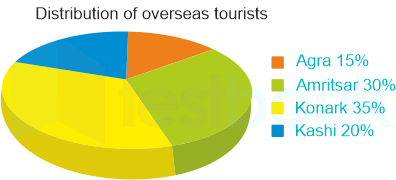
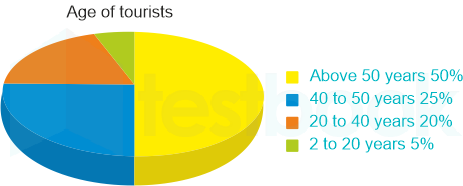
Study the given pie charts and answer the question that follows. 


If A = percentage of tourists who went to Agra, Amritsar and Kashi, and B = percentage of tourists whose age lies between 2 years to 50 years, then what is A : B?

  1. AOption (a)

    10 : 7

  2. BOption (b)

    11 : 13

  3. COption (c)

    10 : 13

  4. DOption (d)

    13 : 10

View answer & explanation

Correct answer

Answer: (d)D.

13 : 10

Why this answer is correct

Given:

The pie charts show the distribution of overseas tourists by destination and by age group.

Find A (Percentage of tourists who went to Agra, Amritsar, and Kashi):

Agra = 15%

Amritsar = 30%

Kashi = 20%

Total percentage for A = 15% + 30% + 20% = 65%

Find B (Percentage of tourists whose age lies between 2 years and 50 years):

2 to 20 years = 5%

20 to 40 years = 20%

40 to 50 years = 25%

Total percentage for B = 5% + 20% + 25% = 50%

Find the ratio A : B

A : B = 65% : 50%

⇒ A : B = 65 : 50

⇒ A : B = 13 : 10

∴ The ratio A : B is 13:10.

Question 62

What will be the amount due on ₹36,000 in 2 years when the rate of simple interest for successive years is 8% and 6%, respectively?

  1. AOption (a)

    ₹41,040

  2. BOption (b)

    ₹38,880

  3. COption (c)

    ₹41,760

  4. DOption (d)

    ₹40,320

View answer & explanation

Correct answer

Answer: (a)A.

₹41,040

Why this answer is correct

Given:

Principal (P) = ₹36,000

Time (t) = 2 years

Rate for 1st year (r1) = 8%

Rate for 2nd year (r2) = 6%

Formula used:

Simple Interest (SI) = P×r×t100 \frac{P \times r \times t}{100}

Amount (A) = Principal (P) + Simple Interest (SI)

Calculation:

SI1 for 1st year = 36000×8×1100 \frac{36000 \times 8 \times 1}{100}

⇒ SI1 = ₹2,880

SI2 for 2nd year = 36000×6×1100 \frac{36000 \times 6 \times 1}{100}

⇒ SI2 = ₹2,160

Total SI = SI1 + SI2

⇒ Total SI = ₹2,880 + ₹2,160 = ₹5,040

Amount (A) = Principal (P) + Total SI

⇒ Amount (A) = ₹36,000 + ₹5,040 = ₹41,040

∴ The correct answer is option 1.

Question 63

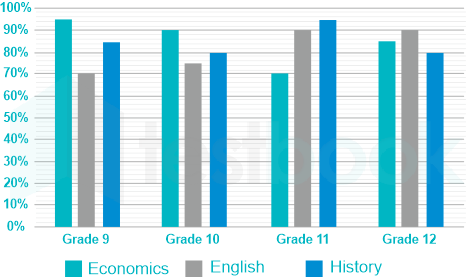
The following bar graph represents the percentage marks obtained in grade 9, 10, 11 and 12 students in Economics, English and History. Study the given bar graph carefully and answer the question that follows.

<br>

If the full marks in Economics is 100, English is 80 and History is 50, then find the total marks obtained by grade 10 students.

  1. AOption (a)

    245

  2. BOption (b)

    220

  3. COption (c)

    200

  4. DOption (d)

    190

View answer & explanation

Correct answer

Answer: (d)D.

190

Why this answer is correct

Given:

For Grade 10, the percentages and full marks are:

Economics: 90% of 100

English: 75% of 80

History: 80% of 50

Calculation:

  1. Economics marks = (90/100) × 100 = 90
  2. English marks = (75/100) × 80 = 60
  3. History marks = (80/100) × 50 = 40

Total Marks:

Total marks = 90 + 60 + 40 = 190

Conclusion:

The total marks obtained by Grade 10 students is 190.

Question 64

A metallic sphere of volume 3136 π cm3 is melted and then, recast into smaller cones, each of radius 3.5 cm and height 4 cm. How many cones are obtained?

  1. AOption (a)

    192

  2. BOption (b)

    148

  3. COption (c)

    172

  4. DOption (d)

    196

View answer & explanation

Correct answer

Answer: (a)A.

192

Why this answer is correct

Given:

A metallic sphere of volume 3136 π cm3 is melted and recast into smaller cones, each of radius 3.5 cm and height 4 cm.

Formula used:

Volume of sphere = Volume of cone × Number of cones

Volume of sphere = 43πr3\frac{4}{3}\pi r^3

Volume of cone = 13πr2h\frac{1}{3}\pi r^2h

Calculation:

Given volume of sphere = 3136 π cm3

Radius of cone (r) = 3.5 cm

Height of cone (h) = 4 cm

Volume of one cone = 13π(3.5)2×4\frac{1}{3}\pi (3.5)^2 \times 4

⇒ Volume of one cone = 13π×12.25×4\frac{1}{3}\pi \times 12.25 \times 4

⇒ Volume of one cone = 13×49π\frac{1}{3} \times 49\pi

⇒ Volume of one cone = 16.33 π cm3

Number of cones = Volume of sphereVolume of one cone\frac{Volume \ of \ sphere}{Volume \ of \ one \ cone}

⇒ Number of cones = 3136π16.33π\frac{3136\pi}{16.33\pi}

⇒ Number of cones = 192

∴ The correct answer is option (1).

Question 65

The price of an electronic watch is first reduced by 25% and then increased by 50%. If the resulting price of the electronic watch is Rs. 7,650, then what was its original price (in Rs.)? 

  1. AOption (a)

    6,900

  2. BOption (b)

    6,800

  3. COption (c)

    6,600

  4. DOption (d)

    6,500

View answer & explanation

Correct answer

Answer: (b)B.

6,800

Why this answer is correct

Given:

The price of an electronic watch is first reduced by 25% and then increased by 50%. The resulting price is ₹7,650.

Formula used:

Let the original price be P.

After a 25% reduction, the price becomes P - 0.25P = 0.75P.

After a 50% increase, the price becomes 0.75P + 0.5(0.75P) = 1.125P.

We know that 1.125P = ₹7,650.

Calculation:

1.125P = 7,650

⇒ P = 6,800

∴ The correct answer is option (2).

Question 66

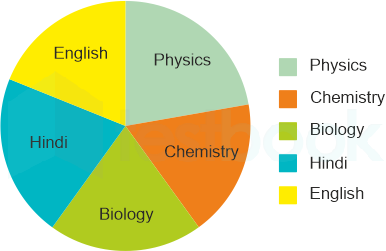
Study the following pie-chart carefully and answer the given question. The pie-chart represents the marks obtained by Sanya in different subjects in class 12. Total marks scored by her in class 12 was 450. 

               Marks obtained

If the total central angles corresponding to the pair of subjects (Physics and Hindi), (Chemistry and Physics) and (Hindi and Chemistry) were 156°, 144° and 140°, respectively, then find the total marks obtained by her in (English and Biology).

  1. AOption (a)

    190

  2. BOption (b)

    175

  3. COption (c)

    160

  4. DOption (d)

    180

View answer & explanation

Correct answer

Answer: (b)B.

175

Why this answer is correct

Given:

Total marks scored by Sanya = 450

Central angles:

  • (Physics and Hindi) = 156°
  • (Chemistry and Physics) = 144°
  • (Hindi and Chemistry) = 140°

Formula used:

Total central angle = 360°

Marks corresponding to a subject = (Central angle of the subject / Total central angle) × Total marks

Calculation:

Sum of central angles for Physics, Chemistry, and Hindi = (156° + 144° + 140°) / 2 = 220°

Central angle for English and Biology = 360° - 220°

⇒ Central angle for English and Biology = 140°

Marks for English and Biology = (140 / 360) × 450

⇒ Marks = (7 / 18) × 450

⇒ Marks = 175

∴ The total marks obtained by Sanya in English and Biology is 175 marks.

Question 67

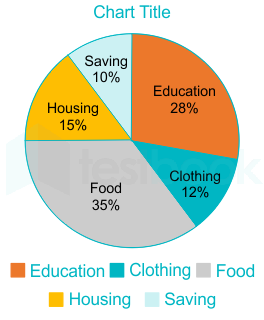
Study the given pie-chart and answer the question that follows. 

The pie-chart shows the monthly expenditure incurred by a family on various items and their savings. 

If the total expenditure on education is Rs. 23,520, then what is the expenditure on clothing (in Rs.)?

  1. AOption (a)

    10080

  2. BOption (b)

    10000

  3. COption (c)

    12300

  4. DOption (d)

    11000

View answer & explanation

Correct answer

Answer: (a)A.

10080

Why this answer is correct

Given:

Total expenditure on education = ₹23,520

Percentage spent on education = 28%

Percentage spent on clothing = 12%

Formula used:

Total Expenditure = (Expenditure on education / Percentage spent on education) × 100

Expenditure on clothing = (Percentage spent on clothing / 100) × Total Expenditure

Calculation:

Total Expenditure = (23,520 / 28) × 100 = 84,000

Expenditure on clothing = (12 / 100) × 84,000

⇒ Expenditure on clothing = 10,080

∴ The expenditure on clothing is ₹10,080.

Question 68

In a circle with center O, the diameter AB extended to the point C, outside the circle. CD is a tangent at the point D on the circle. If the radius of circle is 6 cm and ∠DBC = 120°, then the length of CD is equal to:

  1. AOption (a)

    6√3 cm

  2. BOption (b)

    5√3 cm

  3. COption (c)

    3√3 cm

  4. DOption (d)

    4√3 cm

View answer & explanation

Correct answer

Answer: (a)A.

6√3 cm

Why this answer is correct

Given:

Circle with center O

Diameter AB extended to point C

CD is a tangent at point D

Radius of circle (OD = OB = OA) = 6 cm

∠DBC = 120°

Formula Used:

Angle in a straight line = 180°

Angle between tangent and radius at the point of contact = 90° (∠ODC = 90°)

Sum of angles in a triangle = 180°

Trigonometric ratios in a right-angled triangle: tan(θ) = Opposite side / Adjacent side

Calculation:

∠OBD + ∠DBC = 180° (angles in a straight line)

∠OBD + 120° = 180°

∠OBD = 180° - 120° = 60°

In triangle OBD, OB = OD (radii of the same circle).

∠ODB = ∠OBD = 60°

In triangle OBD, ∠BOD + ∠OBD + ∠ODB = 180° (sum of angles in a triangle)

∠BOD + 60° + 60° = 180°

∠BOD + 120° = 180°

∠BOD = 180° - 120° = 60°

Since all angles in triangle OBD are 60°, triangle OBD is an equilateral triangle.

Therefore, OB = OD = BD = 6 cm.

Using trigonometry in right-angled triangle ODC:

tan(∠DOC) = CD / OD

tan(60°) = CD / 6

3\sqrt{3} = CD / 6

CD = 63\sqrt{3} cm

∴ The length of CD is 636\sqrt{3} cm.

Question 69

What is the maximum value of 7 cos A + 24 sin A + 32?

  1. AOption (a)

    25

  2. BOption (b)

    39

  3. COption (c)

    57

  4. DOption (d)

    32

View answer & explanation

Correct answer

Answer: (c)C.

57

Why this answer is correct

Given:

7 cos A + 24 sin A + 32

Formula used:

Maximum value of a cos θ + b sin θ is a2+b2\sqrt{a^2 + b^2}

Calculation:

Given expression: 7 cos A + 24 sin A + 32

Maximum value of 7 cos A + 24 sin A = 72+242\sqrt{7^2 + 24^2}

⇒ 49+576\sqrt{49 + 576}

⇒ 625\sqrt{625}

⇒ 25

Adding 32 to the maximum value:

⇒ 25 + 32 = 57

∴ The correct answer is option (3).

Question 70

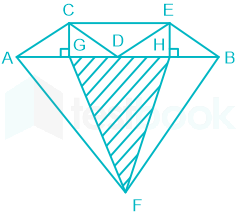
In the diagram, if AB‾∣∣CE‾\rm \overline{AB}||\overline {CE}, AG = GD = DH = HB, then which of the following is correct? 

I. Δ ACG ≅ Δ BEH, II. Δ CDE ≅ Δ DEB, III. Δ HFB ≅ Δ AFG

  1. AOption (a)

    Only I

  2. BOption (b)

    I, II and III 

  3. COption (c)

    I and III

  4. DOption (d)

    I and II

View answer & explanation

Correct answer

Answer: (d)D.

I and II

Why this answer is correct

Given:

In the diagram, AB‾∣∣CE‾\overline{AB}||\overline{CE}, AG = GD = DH = HB

Formula used:

If two lines are parallel, corresponding angles are equal.

Calculation:

I. ΔACG≅ΔBEH\Delta ACG \cong \Delta BEH

Since AB‾∣∣CE‾\overline{AB}||\overline{CE} and AG = GD = DH = HB, the corresponding angles are equal.

⇒ ΔACG≅ΔBEH\Delta ACG \cong \Delta BEH

II. ΔCDE≅ΔDEB\Delta CDE \cong \Delta DEB

Since AB‾∣∣CE‾\overline{AB}||\overline{CE} and AG = GD = DH = HB, the corresponding angles are equal.

⇒ ΔCDE≅ΔDEB\Delta CDE \cong \Delta DEB

III. ΔHFB≅ΔAFG\Delta HFB \cong \Delta AFG

Since AB‾∣∣CE‾\overline{AB}||\overline{CE} and AG = GD = DH = HB, the corresponding angles are equal.

But no relation is given about side AF, BF, or angles of the triangle HFB and AFG,

hence, this statement is not right.

∴ The correct answer is option (4).

Question 71

By decreasing 17° from each angle of a triangle, the ratio of their angles is 3 : 4 : 7. The radian measure of the greatest angle is:

  1. AOption (a)

    163π360\frac{163 \pi}{360}

  2. BOption (b)

    153π360\frac{153 \pi}{360}

  3. COption (c)

    163π180\frac{163 \pi}{180}

  4. DOption (d)

    167π180\frac{167 \pi}{180}

View answer & explanation

Correct answer

Answer: (a)A.

163π360\frac{163 \pi}{360}

Why this answer is correct

Given:

By decreasing 17º from each angle of a triangle, the ratio of their angles is 3:4:7. The radian measure of the greatest angle is:

Formula used:

Sum of angles in a triangle = 180º

Conversion of degrees to radians: π180\frac{\pi}{180}

Calculation:

Let the angles be 3x, 4x, and 7x after decreasing 17º:

3x + 4x + 7x = 180 - 3×17

⇒ 14x = 180 - 51

⇒ 14x = 129

⇒ x = 129/14

Greatest angle = 7x + 17 = 7 × (129/14) + 17

⇒ Greatest angle = 64.5 + 17 = 81.5º

Radian measure: 81.5º × π180\frac{\pi}{180}

⇒ 81.5 × π180\frac{\pi}{180}

⇒ 163π360\frac{163 \pi}{360}

∴ The correct answer is option (1).

Question 72

Simplify the following expression. 

1114÷335×623+16=\rm 11\frac{1}{4}\div 3\frac{3}{5}\times 6\frac{2}{3}+\frac{1}{6}= _________.

  1. AOption (a)

    25

  2. BOption (b)

    21

  3. COption (c)

    23

  4. DOption (d)

    19

View answer & explanation

Correct answer

Answer: (b)B.

21

Why this answer is correct

Given:

1114335×623+16=?\dfrac{11 \dfrac{1}{4}}{3 \dfrac{3}{5}} \times 6 \dfrac{2}{3} + \dfrac{1}{6} = ?

Formula used:

Convert mixed numbers to improper fractions

Calculation:

1114335×623+16=?\dfrac{11 \dfrac{1}{4}}{3 \dfrac{3}{5}} \times 6 \dfrac{2}{3} + \dfrac{1}{6} = ?

111/4 = 45/4

33/5 = 18/5

62/3 = 20/3

⇒ 454÷185×203+16\dfrac{45}{4} \div \dfrac{18}{5} \times \dfrac{20}{3} + \dfrac{1}{6}

⇒ 454×518×203+16\dfrac{45}{4} \times \dfrac{5}{18} \times \dfrac{20}{3} + \dfrac{1}{6}

⇒ 45×5×204×18×3+16\dfrac{45 \times 5 \times 20}{4 \times 18 \times 3} + \dfrac{1}{6}

⇒ 4500216+16\dfrac{4500}{216} + \dfrac{1}{6}

⇒ 4500+36216\dfrac{4500 + 36}{216}

⇒ 4536216\dfrac{4536}{216}

⇒ 2121

∴ The correct answer is option (2).

Question 73

A shopkeeper sells an item at 20% discount on the marked price and earns a profit of 90%. If he sells the same item at 40% discount, then his new profit percentage will be: 

  1. AOption (a)

    42.5%

  2. BOption (b)

    45.8%

  3. COption (c)

    41.8%

  4. DOption (d)

    48.2%

View answer & explanation

Correct answer

Answer: (a)A.

42.5%

Why this answer is correct

Given:

A shopkeeper sells an item at 20% discount on the marked price and earns a profit of 90%. If he sells the same item at 40% discount, then his new profit percentage will be:

Formula used:

Let Marked Price (MP) = 100

Discount = 20%

Selling Price (SP) = MP - Discount

Cost Price (CP) = SP / (1 + Profit%)

New Discount = 40%

New Selling Price (NSP) = MP - New Discount

New Profit % = (NSP - CP) / CP × 100

Calculation:

Let Marked Price (MP) = 100

Discount = 20%

Selling Price (SP) = 100 - 20 = 80

Profit = 90%

Cost Price (CP) = 80 / 1.90

⇒ CP = 42.105

New Discount = 40%

New Selling Price (NSP) = 100 - 40 = 60

New Profit % = (60 - 42.105) / 42.105 × 100

⇒ New Profit % = 17.895 / 42.105 × 100

⇒ New Profit % ≈ 42.5%

∴ The correct answer is option 1.

Question 74

In a class with a certain number of students, if one student weighing 30 kg is added, then the average weight of the class increases by 1 kg. If one more student weighing 30 kg is added, then the average weight of the class increases by 1.5 kg over the original average. What is the original average weight (in kg) of the class?  

  1. AOption (a)

    26.5

  2. BOption (b)

    27

  3. COption (c)

    25.5

  4. DOption (d)

    24

View answer & explanation

Correct answer

Answer: (b)B.

27

Why this answer is correct

Given:

Weight of each added student = 30 kg

Increase in average after first student = 1 kg

Increase in average after second student = 1.5 kg over original average

Formula used:

Let original number of students be n and original average weight be A kg.

After first student is added:

(nA + 30) / (n + 1) = A + 1

After second student is added:

(nA + 60) / (n + 2) = A + 1.5

Calculations:

(nA + 30) / (n + 1) = A + 1

⇒ nA + 30 = (A + 1)(n + 1)

⇒ nA + 30 = An + A + n + 1

⇒ 30 = A + n + 1

⇒ 29 = A + n ... (1)

(nA + 60) / (n + 2) = A + 1.5

⇒ nA + 60 = (A + 1.5)(n + 2)

⇒ nA + 60 = An + 1.5n + 2A + 3

⇒ 60 = 1.5n + 2A + 3

⇒ 57 = 1.5n + 2A ... (2)

From (1): A = 29 - n

Substitute into (2):

57 = 1.5n + 2(29 - n)

⇒ 57 = 1.5n + 58 - 2n

⇒ 57 = 58 - 0.5n

⇒ -1 = -0.5n

⇒ n = 2

From (1): A = 29 - 2

⇒ A = 27

∴ The correct answer is option (2).

Question 75

A can finish a piece of work by working alone in 4 days. B, while working alone, can finish the same work in 12 days. If both of them work together, then in how many days will the work be completed?

  1. AOption (a)

    6

  2. BOption (b)

    8

  3. COption (c)

    4

  4. DOption (d)

    3

View answer & explanation

Correct answer

Answer: (d)D.

3

Why this answer is correct

Given:

A can finish a piece of work by working alone in 4 days.

B, while working alone, can finish the same work in 12 days.

Formula used:

Work rate of A = 1/4

Work rate of B = 1/12

Combined work rate of A and B = (1/4) + (1/12)

Calculation:

Combined work rate of A and B = (1/4) + (1/12)

⇒ Combined work rate of A and B = (3/12) + (1/12)

⇒ Combined work rate of A and B = 4/12

⇒ Combined work rate of A and B = 1/3

⇒ Time taken to complete the work together = 1 / (1/3)

⇒ Time taken to complete the work together = 3 days

∴ The correct answer is option (4).

Alternate Method  L.C.M (4,12) = 12 (Total work)

A does = 12/4 = 3 units of work in one day.

B does = 12/12 = 1 unit of work in one day.

Together A and B do = 3+1 = 4 units of work in one day.

So, they finish work in 12 / 4 = 3 days.

General Awareness (25 questions)

Question 76

Which of the following is NOT an Olympics Sport? (As of March, 2023)

  1. AOption (a)

    Sailing

  2. BOption (b)

    3×3 Basketball

  3. COption (c)

    Cricket

  4. DOption (d)

    Rowing

View answer & explanation

Correct answer

Answer: (c)C.

Cricket

Why this answer is correct

The correct answer is Cricket.

Key Points

  • Cricket is not currently included in the Olympics, but it is scheduled to be included in the 2028 Summer Olympics in Los Angeles.
  • The LA28 Organizing Committee has proposed including cricket in the 2028 games as one of five additional sports.
  • Cricket was originally scheduled to be included in the 1896 Athens Olympics, but was later removed due to a lack of entries.
  • It was included in the 1900 Paris Olympics, where Great Britain won the 12-a-side match over France.

Additional Information

  • 3×3 Basketball made its Olympic debut at the Tokyo 2020 Games, highlighting the evolution of Olympic sports to include new formats.
  • Rowing has been a part of the modern Olympics since 1900, showcasing a long history in the Games.
  • The latest games included in the Olympics are breaking, skateboarding, sport climbing, and surfing, featured in the 2024 Paris Olympic Games.
  • The  International Olympic Council(IOC) also proposed ski mountaineering as a new winter sport for the 2026 Winter Olympics in Milano Cortina.

Important Points

  • International Olympic Committee
  • The IOC was founded on June 23, 1894, by Pierre de Coubertin in Paris, France.
  • The IOC is headquartered in Lausanne, Switzerland.
  • The IOC’s mission is to promote the Olympic Movement, which aims to contribute to building a peaceful and better world through sport.
  • The IOC is responsible for organizing the Summer and Winter Olympic Games, held every four years for each, with the Games alternating every two years.

Question 77

What was the name of the person who has been elected as the Chair of the 62nd session of the United Nations Commission for Social Development?

  1. AOption (a)

    BM Vinod Kumar 

  2. BOption (b)

    Ruchira Kamboj 

  3. COption (c)

    Satinder Kumar Lambah 

  4. DOption (d)

    Nirupama Menon Rao 

View answer & explanation

Correct answer

Answer: (b)B.

Ruchira Kamboj 

Why this answer is correct

The correct answer is Ruchira Kamboj.

Key Points

  • Ruchira Kamboj has been elected as the Chair of the 62nd session of the United Nations Commission for Social Development held from February 5–14, 2024, at the United Nations Headquarters in New York.
  • She is an experienced diplomat, having served in various roles in India’s Ministry of External Affairs.
  • Kamboj is committed to addressing critical social issues, including poverty alleviation, employment, and social integration.
  • She strongly focuses on gender equality and the empowerment of women and children in her policy initiatives.
  • Her leadership position reflects India's active role in international organizations and its commitment to social development.

Additional Information

  • BM Vinod Kumar
  • A seasoned diplomat with experience in international relations, particularly in the field of trade and commerce.
  • He has served in various capacities at the Indian Embassy in different countries, contributing to India’s bilateral relations.
  • Known for his expertise in economic diplomacy and trade negotiations.
  • Has participated in numerous international forums addressing trade and development issues.
  • Satinder Kumar Lambah
  • A retired Indian diplomat, known for his extensive experience in foreign policy and security issues.
  • Former Secretary (East) in the Ministry of External Affairs and India’s Special Envoy for Disarmament.
  • Contributed to various discussions and papers on international relations and strategic studies.
  • Often engaged in think tanks and advisory boards focusing on foreign policy.
  • Nirupama Menon Rao
  • A former Indian Foreign Secretary and Ambassador to the United States and China, with a strong diplomatic background.
  • Advocate for women's rights and empowerment in her diplomatic and public service roles.
  • Actively participates in discussions and seminars on international relations, focusing on South Asian politics.
  • Writes on foreign policy and international affairs, contributing to various publications and forums.

Question 78

Baiga is a folk music of Baiga Tribe from which of the following states?

  1. AOption (a)

    Uttarakhand

  2. BOption (b)

    Madhya Pradesh

  3. COption (c)

    Assam

  4. DOption (d)

    Bihar

View answer & explanation

Correct answer

Answer: (b)B.

Madhya Pradesh

Why this answer is correct

The correct answer is Madhya Pradesh.

Key Points

  • Baiga is a traditional folk music form of the Baiga tribe, which is indigenous to the central region of India.
  • The Baiga tribe is known for its rich cultural heritage, which includes unique music, dance, and art forms.
  • The music often reflects themes related to nature, agriculture, and the daily lives of the Baiga people, showcasing their connection to the environment.
  • Baiga folk music is typically performed during festivals, rituals, and community gatherings, emphasizing the tribe's social cohesion and cultural identity.

Additional Information 

  • Uttarakhand
  • Known for its vibrant folk music and dance forms, including "Garhwali" and "Kumaoni" music, reflecting the region's traditions.
  • Celebrates various festivals with music, such as "Nanda Devi Mela" and "Kumbh Mela," showcasing local artists.
  • Assam
  • Famous for the Bihu festival, which features lively folk songs and dances celebrating the Assamese New Year.
  • Incorporates different styles influenced by various ethnic communities, showcasing a rich musical tapestry.
  • Bihar
  • Known for its folk traditions, including Maithili and Bhojpuri songs, often focusing on themes of love, nature, and social issues.
  • Celebrates festivals like Chhath Puja with traditional music that resonates with local customs and beliefs.

Question 79

Jharkhand and Chhattisgarh states are rich with ___________ material deposits.

  1. AOption (a)

    silicon

  2. BOption (b)

    petroleum

  3. COption (c)

    coal

  4. DOption (d)

    gold

View answer & explanation

Correct answer

Answer: (c)C.

coal

Why this answer is correct

The correct answer is Coal.

Key Points

  • Jharkhand and Chhattisgarh are known for their rich deposits of coal, which play a significant role in India's energy production.
  • Jharkhand houses major coal fields like the Jharia and Bokaro coalfields, while Chhattisgarh has the Korba coalfield.
  • Coal mining is a critical economic activity in both states, contributing significantly to local and national economies.
  • The coal extracted from these regions is primarily used for power generation, supporting various industries across the country.

Additional Information

  • Silicon
  • While silicon is used in various industries, including electronics and solar energy, it is not a major deposit in Jharkhand or Chhattisgarh.
  • Silicon is found in minerals like quartz, but not specifically highlighted as a key resource in these states.
  • Petroleum
  • Jharkhand and Chhattisgarh have some petroleum deposits, but they are not significant compared to other regions in India, such as Assam or Gujarat.
  • Efforts are ongoing to explore and enhance petroleum extraction in these areas, but coal remains the primary resource.
  • Gold
  • Karnataka is the largest producer of gold in India, accounting for 80% of the country's gold production.
  • The Kolar Gold Fields in Karnataka is the largest gold mine in India.

Question 80

How does the CPU distinguish between each memory cell?

  1. AOption (a)

    By its byte size

  2. BOption (b)

    By its capacity

  3. COption (c)

    By its data item

  4. DOption (d)

    By its address

View answer & explanation

Correct answer

Answer: (d)D.

By its address

Why this answer is correct

The correct answer is By its address.

Key Points

  • Each memory cell in a computer's RAM is assigned a unique address that the CPU uses to access and manage data.
  • When the CPU needs to read or write data, it specifies the address of the memory cell involved in the operation.
  • The CPU uses an address bus to send the memory address to the memory, allowing it to communicate with the appropriate memory cell.
  • This addressing scheme enables the CPU to efficiently manage and organize data in memory, ensuring quick access to the required information.

Additional Information

  • By its byte size
  • Byte size refers to the amount of data that can be stored in a memory cell (typically 8 bits).
  • While byte size is important for data representation, it does not help in distinguishing between individual memory cells.
  • By its capacity
  • Capacity refers to the total amount of data that can be stored in memory (e.g., 4GB, 8GB).
  • Capacity is a broader measure and does not specify individual memory locations.
  • By its data item
  • Data items refer to the type of data stored (e.g., integer, character).
  • Different memory cells can store various data items, but this does not provide a unique identifier for each cell.

Question 81

In PPT What method can be used to move among slides if your hands are already on the keyboard?

  1. AOption (a)

    Pressing the Esc key to exit the presentation

  2. BOption (b)

    Scrolling with the mouse wheel

  3. COption (c)

    Clicking on the slide thumbnail in the Slides tab

  4. DOption (d)

    Using the keyboard directional keys

View answer & explanation

Correct answer

Answer: (d)D.

Using the keyboard directional keys

Why this answer is correct

The correct answer is Using the keyboard directional keys.

Key Points

  • The keyboard directional keys (left and right arrows) allow you to move between slides quickly without taking your hands off the keyboard.
  • This method is convenient for presenters who want to maintain focus on their presentation without needing to use a mouse or touchpad.
  • You can use the up and down arrow keys to navigate through the slides in a more controlled manner, allowing for smooth transitions.
  • This method works in various presentation software, including Microsoft PowerPoint, making it a universally applicable technique.

Additional Information

  • Pressing the Esc key to exit the presentation
  • The Esc key is used to exit the presentation mode rather than navigate between slides.
  • This action interrupts the flow of the presentation, making it unsuitable for moving among slides.
  • Scrolling with the mouse wheel
  • While you can scroll through slides in editing mode, this method is not effective during an actual presentation.
  • Presenters typically do not use the mouse wheel for navigation in slideshow mode.
  • Clicking on the slide thumbnail in the Slides tab
  • This method requires you to use the mouse, which goes against the premise of keeping your hands on the keyboard.
  • It is more appropriate for editing or organizing slides rather than during a live presentation

Question 82

In 1955, _____ noted the possibility of using small-scale industries for promoting rural development.

  1. AOption (a)

    Kelkar Committee

  2. BOption (b)

    Sarkaria Committee

  3. COption (c)

    Karve Committee

  4. DOption (d)

    Chakravarty Committee

View answer & explanation

Correct answer

Answer: (c)C.

Karve Committee

Why this answer is correct

The correct answer is Karve Committee.

Key Points

  • The Karve Committee, also known as the Village and Small-Scale Industries Committee, noted the possibility of using small-scale industries for promoting rural development in 1955.
  • The Planning Commission (now NITI AYOG) set up the committee to study the potential of small-scale industries for rural development.
  • The committee was named after its head, Dattatreya Gopal Karve.

Additional Information

  • Sarkaria Committee
  • Formed in 1983 to review the functioning of the Centre-State relations in India.
  • Primarily dealt with constitutional issues rather than rural development or small-scale industries.
  • Kelkar Committee
  • Kelkar committee was formed in India to study and evaluate the extant public-private partnership (PPP) model in India.
  • The committee was set up by India's central government and headed by Vijay Kelkar.

Chakravarty Committee

  • Set up in 1985 to examine the impact of economic reforms on the Indian economy.
  • Primarily dealt with macroeconomic issues and policy recommendations rather than rural development through small-scale industries.

Question 83

The cell wall of bacteria is made up of:

  1. AOption (a)

    glycogen

  2. BOption (b)

    cellulose

  3. COption (c)

    peptidoglycan

  4. DOption (d)

    peptone

View answer & explanation

Correct answer

Answer: (c)C.

peptidoglycan

Why this answer is correct

The correct answer is peptidoglycan.

Key Points

  • Peptidoglycan is a polymer that provides structural support to the bacterial cell wall, helping maintain its shape and integrity.
  • It is composed of sugars and amino acids, forming a mesh-like structure that is unique to bacteria.
  • The amount and structure of peptidoglycan in the cell wall determine whether bacteria are classified as Gram-positive or Gram-negative, affecting their response to antibiotics.
  • The cell wall protects bacteria from osmotic pressure and environmental stresses, making it crucial for their survival.

 Additional Information

  • Glycogen
  • Glycogen is a storage form of glucose in animals and fungi, not found in bacterial cell walls.
  • It is a polysaccharide composed of glucose units, primarily used for energy storage.
  • Cellulose
  • Cellulose is a major component of plant cell walls, providing structural support.
  • It is not a structural component of bacterial cell walls.
  • Peptone
  • Peptone is a protein digest used in culture media for growing bacteria, but it is not a component of the bacterial cell wall.
  • It is made from the digestion of proteins and provides nutrients for bacteria in laboratory settings.

Question 84

Intervention by the monetary authority of a country in the money market to keep money supply stable against exogenous or sometimes external shocks is called _____. 

  1. AOption (a)

    sterilisation

  2. BOption (b)

    conservation

  3. COption (c)

    capitalisation

  4. DOption (d)

    neutralisation

View answer & explanation

Correct answer

Answer: (a)A.

sterilisation

Why this answer is correct

The correct answer is sterilisation.

Key Points

  • Intervention by the monetary authority of a country in the money market to keep money supply stable against exogenous or sometimes external shocks is referred to as sterilisation.
  • The primary goal of sterilisation is to neutralize the effects of capital flows on the domestic money supply.
  • This is achieved by offsetting foreign exchange interventions with domestic monetary operations.
  • For instance, when a central bank buys foreign currency to prevent the appreciation of the local currency, it can sell government bonds to absorb the resulting increase in the money supply.
  • Without sterilisation, such interventions could lead to inflation or other economic imbalances.
  • Therefore, sterilisation helps in maintaining monetary stability and controlling inflation.

Question 85

According to rules laid down by the International Football Association Board (IFAB), what can be the maximum length of a goal line in football?

  1. AOption (a)

    100 m

  2. BOption (b)

    90 m

  3. COption (c)

    40 m

  4. DOption (d)

    50 m

View answer & explanation

Correct answer

Answer: (b)B.

90 m

Why this answer is correct

The correct answer is 90 m

Key Points

  • The International Football Association Board (IFAB) states that the maximum length of a goal line in football is 90 meters (100 yards).
  • The minimum length is 45 meters (50 yards).
  • The IFAB also states that the touchline must be longer than the goal line.
  • The minimum length of a touchline is 90 meters (100 yards), and the maximum is 120 meters (130 yards).
  • The IFAB maintains and updates the 17 laws of soccer.
  • The laws are the only rules of association football that FIFA permits its members to use.

Question 86

Milk of magnesia is a suspension of ____________ in water. 

  1. AOption (a)

    magnesium oxalate

  2. BOption (b)

    magnesium chlorate

  3. COption (c)

    magnesium bromide

  4. DOption (d)

    magnesium hydroxide

View answer & explanation

Correct answer

Answer: (d)D.

magnesium hydroxide

Why this answer is correct

The correct answer is magnesium hydroxide

Key Points

  • Milk of magnesia is a suspension of magnesium hydroxide (Mg(OH)2Mg(OH)2Mg(OH)2Mg(OH)2

    ) in water.

  • It's a milky-white, alkaline (basic) liquid that's used as an antacid and laxative

  • Milk of magnesia is an example of a solid-in-liquid colloid, also known as a sol.

  • Colloids are mixtures where one substance of insoluble particles is suspended throughout another substance

Additional Information

  • Magnesium Oxalate:
  • Chemical Formula: MgC₂O₄
  • It is a salt of oxalic acid and magnesium, commonly found as a white crystalline solid. It
  • It is used in some chemical applications and in the study of oxalate metabolism.
  • Magnesium Chlorate:
  • Chemical Formula: Mg(ClO₃)₂
  • This compound contains magnesium and chlorate ions. It is more commonly associated with chemical reactions and has oxidizing properties.
  • Magnesium chlorate is used in some industrial applications and is not related to the antacid properties of milk of magnesia.
  • Magnesium Bromide:
  • Chemical Formula: MgBr₂
  • This is a salt composed of magnesium and bromide ions, typically existing as a white or colourless crystalline solid.
  • It has applications in pharmaceuticals, particularly as a sedative and for its anticonvulsant properties

Question 87

Which of the following date is observed as a national festival? 

  1. AOption (a)

    2 October 

  2. BOption (b)

    25 October 

  3. COption (c)

    10 October 

  4. DOption (d)

    24 October 

View answer & explanation

Correct answer

Answer: (a)A.

2 October 

Why this answer is correct

The correct answer is 2 October

Key Points

  • The date observed as a national festival in India is  2 October
  • 2 October is celebrated as Gandhi Jayanti, marking the birth anniversary of Mahatma Gandhi, the Father of the Nation.
  • It is a national holiday and is observed as a day of non-violence and peace in India.
  • This date is also observed as the International Day of Non-Violence globall

Question 88

Rouf is the traditional dance of __________, which is practiced on the festive occasions of Eid and during Ramzan days. 

  1. AOption (a)

    Leh

  2. BOption (b)

    Puducherry

  3. COption (c)

    Chandigarh

  4. DOption (d)

    Jammu & Kashmir

View answer & explanation

Correct answer

Answer: (d)D.

Jammu & Kashmir

Why this answer is correct

The correct answer is Jammu and Kashmir​

Key Points

  • Rouf dance form belongs to the state of Jammu and Kashmir.
  • The Rouf is a folk dance which mainly practised by women and originated in the Muslim community of J & K.
  • The dance is simple footwork which is also called Chakri in the local language.
  • Rouf performed on different occasions in Kashmir like Eid, Ramadan, and harvesting season.

Additional Information  Some Important Dance :-

Dance StyleState
BharatanatyamTamil Nadu
KathakUttar Pradesh
OdissiOdisha
ManipuriManipur
KathakaliKerala
KuchipudiAndhra Pradesh
SattriyaAssam
MohiniyattamKerala
GiddhaPunjab
GarbaGujarat
LavaniMaharashtra
GhoomarRajasthan
BhangraPunjab
ChhauJharkhand, Odisha, West Bengal
YakshaganaKarnataka

Question 89

In a test match, the captain of the fielding side may demand a new ball after _______.

  1. AOption (a)

    80 overs

  2. BOption (b)

    70 overs 

  3. COption (c)

    75 overs 

  4. DOption (d)

    85 overs 

View answer & explanation

Correct answer

Answer: (a)A.

80 overs

Why this answer is correct

The correct answer is 80 overs

Key Points

  • According to the rules of cricket, specifically in Test matches, the fielding captain can request a new ball after 80 overs have been bowled.
  • The batting team has the option to decline the new ball if they choose to, but this is rare as most teams prefer to take advantage of the fresh ball.
  • The new ball can be beneficial as it offers bowlers a chance to generate more swing and bounce, making it easier to dismiss batsmen.
  • However, the team must still have bowled 80 overs to be eligible for the new ball.
  • Fast bowlers often prefer the new ball as it can bounce more and may swing in the air, leading to more opportunities for dismissals.
  • Spinners, however, may prefer the old ball, which is softer and easier to grip, allowing for more turn

Question 90

The Big Dipper is an asterism formed by the seven brightest stars in the constellation:

  1. AOption (a)

    Leo Major

  2. BOption (b)

    Cassiopeia

  3. COption (c)

    Ursa Major

  4. DOption (d)

    Orion

View answer & explanation

Correct answer

Answer: (c)C.

Ursa Major

Why this answer is correct

The correct answer is Ursa Major

Key Points

  • The Big Dipper is an asterism made up of the seven brightest stars in the constellation Ursa Major:
  • The Big Dipper is a well-known pattern of stars that's part of the Ursa Major constellation.
  • It's always visible because it's circumpolar, meaning it's in the same direction as the North Star.
  • The Big Dipper is a useful navigational tool because it points to the North Star, which is a celestial pivot point.
  • To find the North Star, you can extend an imaginary line through the front two stars of the Big Dipper, Merak and Dubhe.
  • The Big Dipper is also known by other names, including:
  • The Plough, Charles's Wain, Septentriones, and The Wagon.
  • The Big Dipper is a prominent asterism in the Ursa Major constellation, which is significant in many cultures.
  • In Native American traditions, the stars of Ursa Major are thought to mark the changing seasons and guide spirits

Additional Information

  • Leo Major
  • Likely refers to Leo, a constellation in the night sky, sometimes called "Leo the Lion."
  • Leo Major may be an informal way of distinguishing Leo from the smaller constellation Leo Minor.
  • Leo is one of the 12 zodiac constellations and is visible primarily during the spring in the Northern Hemisphere.
  • Cassiopeia
  • Cassiopeia is a prominent constellation in the northern sky, named after the mythical queen of Ethiopia in Greek mythology.
  • It is easily recognizable by its distinctive W or M shape, formed by five bright stars.
  • Cassiopeia is visible year-round in the Northern Hemisphere and is often used to locate other celestial objects.
  • Orion
  • Orion, also known as "The Hunter," is one of the most recognizable and famous constellations.
  • It features prominent stars like Betelgeuse and Rigel, as well as the Orion Belt, formed by three aligned stars (Alnitak, Alnilam, and Mintaka).
  • Orion is best visible during winter in the Northern Hemisphere and has deep mythological and cultural significance.

Question 91

Who amongst the following Mughal emperors got classical Hindu mythological texts Ramayana and Mahabharata translated into Persian?

  1. AOption (a)

    Akbar

  2. BOption (b)

    Shahjahan

  3. COption (c)

    Jahangir

  4. DOption (d)

    Aurangzeb

View answer & explanation

Correct answer

Answer: (a)A.

Akbar

Why this answer is correct

The correct answer is Akbar.

 Key Points

  • The Mahabharata was translated into Persian at Akbar’s orders, by Faizi and `Abd al-Qadir Bada’uni (c. 1540 – 1615) and named Razmnameh.
  • Akbar
  • Akbar was the third Mughal emperor, who reigned from 1556 to 1605.
  • Akbar succeeded his father, Humayun.
  • Jahangir was his son.
  • His abolition of Jajiya, his new religion Din-i-Ilahi, his land revenue policy, administrative policy etc. were such that his half century rule proved to be one of the brightest chapters in Indian History

Additional Information

  • Jahangir
  • Jahangir was a great patron of art and literature he spent lavishly in building splendid buildings and gardens and mausoleums.
  • He was easily impressed by poets and writers especially those who wrote verses in his praise.
  • Under his rule, he got constructed the Akbar's tomb, Idmaat ud Daulas tomb, and the famous Jahangir Fort.
  • Aurangzeb
  • Aurangzeb was the last important Mughal ruler and after him, the Mughal empire rapidly decayed and was finally put to an end by the British.
  • This King reigned for half a century and died in 1707 leaving behind a war of succession.
  • Humayun
  • Humayun was the second emperor of the Mughal Empire, who ruled over territory in what is now Afghanistan, Pakistan, Northern India, and Bangladesh from 1530 to 1540 and again from 1555 to 1556.

Question 92

Which party won the Jalandhar (a city in Punjab) Lok Sabha bypoll election held in May 2023?

  1. AOption (a)

    Indian National Congress

  2. BOption (b)

    Aam Aadmi Party

  3. COption (c)

    Akali Dal

  4. DOption (d)

    Bharatiya Janata Party

View answer & explanation

Correct answer

Answer: (b)B.

Aam Aadmi Party

Why this answer is correct

The correct answer is Aam Aadmi Party.

Key Points 

  • AAP was formed in November 2012, led by Arvind Kejriwal, after the India Against Corruption movement, to fight for clean governance and transparency.
  • The Aam Aadmi Party (AAP) gained the status of a national party on April 10, 2023.
  • The most recent government formation by the Aam Aadmi Party (AAP) took place in Punjab after the 2022 Assembly elections.
  • A National Party is a political party recognized in four or more states or one that has won at least 11 seats in the Lok Sabha.

Additional Information

  • Indian National Congress (INC)
  • It was founded in 1885, INC played a crucial role in India's independence movement and is one of the oldest political parties in India.
  • Its key figures include Mahatma Gandhi, Jawaharlal Nehru, and Indira Gandhi, who shaped Indian politics and policy.
  • Although it has faced significant challenges in recent elections, INC remains influential in Indian politics, holding a significant number of seats in various state assemblies and the Lok Sabha.
  • Bharatiya Janata Party (BJP)
  • It was founded in 1980, The BJP is rooted in Hindutva ideology and represents right-wing politics in India.
  • Under Prime Minister Narendra Modi, the BJP has implemented significant policies like GST and the Make in India initiative, leading to substantial electoral success.
  • Shiromani Akali Dal (SAD)
  • ​It was founded in 1920, SAD advocates for the rights and interests of the Sikh community in Punjab.
  • The party has formed the government in Punjab multiple times and holds significant influence in state politics.

Question 93

Aajeevika - National Rural Livelihoods Mission (NRLM) - was launched by the Ministry of Rural Development (MoRD), Government of India, in the year ________.

  1. AOption (a)

    2010

  2. BOption (b)

    2011

  3. COption (c)

    2012

  4. DOption (d)

    2013

View answer & explanation

Correct answer

Answer: (b)B.

2011

Why this answer is correct

The correct answer is 2011.

Key Points

  • NRLM aims to reduce poverty by promoting self-employment and organization of rural poor into self-help groups (SHGs).
  • The mission focuses on marginalized and disadvantaged groups, including Scheduled Castes (SCs), Scheduled Tribes (STs), and women, to enhance their livelihood opportunities.
  • NRLM emphasizes skill development and capacity building, facilitating training programs to enhance employability and entrepreneurial skills among rural youth.
  • The mission promotes sustainable livelihoods through various sectors, including agriculture, animal husbandry, and rural crafts, to improve income levels and enhance quality of life in rural areas.

Additional Information

  • Aajeevika Grameen Express Yojana (AGEY)
  • AGEY aims to provide rural livelihood opportunities by facilitating the operation of village-level transport services to improve connectivity and access to markets.
  • The initiative encourages self-employment by supporting individuals or groups to operate transport vehicles, promoting local entrepreneurship in rural areas.
  • Aajeevika Skills
  • Aajeevika Skills focuses on providing skill training to rural youth through the establishment of skill development centers to enhance their employability in various sectors.
  • The program collaborates with various industries to ensure that the training aligns with market needs, enabling better job placements for trainees.
  • Self-Employment through Aajeevika
  • This initiative encourages the formation of micro-enterprises by providing financial assistance, mentorship, and capacity-building support to rural entrepreneurs.
  • It helps connect self-employed individuals with markets by facilitating access to technology, market information, and business development services.
  • Deendayal Antyodaya Yojana (DAY-NRLM)
  • DAY-NRLM focuses on promoting sustainable livelihoods by organizing rural poor into self-help groups (SHGs) and facilitating access to credit and financial services.
  • The scheme provides skill development and training programs to enhance the employability of rural youth and empower them to start their own businesses.

Question 94

Shattantri Veena, meaning a Veena with hundred strings, is the ancient Sanskrit name of which instrument?

  1. AOption (a)

    Sarod

  2. BOption (b)

    Sarangi

  3. COption (c)

    Santoor

  4. DOption (d)

    Tambura/Tanpura

View answer & explanation

Correct answer

Answer: (c)C.

Santoor

Why this answer is correct

The correct answer is Santoor.

Key Points

  • The Santoor is a hammered dulcimer from the family of string instruments.
  • The Santoor is primarily associated with Indian classical music, especially in the Hindustani tradition.
  • Pandit Shivkumar Sharma has received the Padma Vibhushan and Padma Shri for their contributions to music.
  • Santoor has gained popularity in contemporary and fusion music genres, showcasing its versatility.

Additional Information

  • Sarod
  • A fretless string instrument with a deep, rich sound, typically made of wood and played with a plectrum.
  • Renowned players include Ustad Amjad Ali Khan and Ustad Ali Akbar Khan, who have popularized the Sarod in Indian classical music.
  • Sarangi
  • A bowed string instrument known for its emotional expressiveness, often used in Hindustani classical music.
  • Traditionally associated with vocal music accompaniment; famous players include Ustad Sultan Khan and Pandit Ram Narayan.
  • Tambura/Tanpura
  • A long-necked string instrument used primarily as a drone in Indian classical music, providing a harmonic foundation.
  • Renowned musicians like Ustad Vilayat Khan and Pandit Ravi Shankar have included the Tanpura in their performances.

Question 95

What kind of a satellite is CMS-01,that was launched by ISRO in December 2020?

  1. AOption (a)

    Tsunami observation

  2. BOption (b)

    Communication

  3. COption (c)

    Navigation

  4. DOption (d)

    Resource management

View answer & explanation

Correct answer

Answer: (b)B.

Communication

Why this answer is correct

The correct answer is Communication.

Key Points

  • CMS-01 is a communication satellite designed to provide various communication services across India, particularly in the areas of telecommunication, broadcasting, and broadband.
  • The satellite is intended to serve the Indian subcontinent, enhancing connectivity and communication infrastructure in remote and rural areas.
  • CMS-01 was launched on December 17, 2020, aboard the PSLV-C49 rocket from the Satish Dhawan Space Centre, Sriharikota.
  • It operates in the Geostationary Orbit and is equipped with 12 Ku-band transponders, enabling high-quality communication services and data transmission.

Additional Information

  • INSAT Series
  • It was designed for telecommunications, broadcasting, meteorology, and search and rescue operations.
  • The series includes multiple satellites that provide critical data for weather forecasting and disaster management.
  • IRS (Indian Remote Sensing) Satellites
  • It was primarily for earth observation and resource management, including agriculture, forestry, and land-use mapping.
  • Usage: Data from IRS satellites supports planning and monitoring of natural resources and environmental management.
  • NavIC (Navigation with Indian Constellation)
  • A regional navigation satellite system providing accurate positioning services to users in India and surrounding regions.
  • It enhances navigation capabilities and is an alternative to GPS for users in India.
  • Mangalyaan (Mars Orbiter Mission)
  • India's first interplanetary mission, designed to explore Mars and gather data on its surface and atmosphere.
  • It made India the first Asian nation to reach Martian orbit and the fourth space agency globally to do so.
  • GSAT Series
  • Geostationary satellites designed for providing various communication services including TV broadcasting and internet services.
  • It enhances telecommunication infrastructure and digital connectivity across the country.
  • Astrosat
  • India’s first dedicated multi-wavelength space observatory for astronomical observations.
  • It enables detailed study of celestial sources across different wavelengths, contributing to advancements in astrophysics.

Question 96

Warren Hastings became the Governor-General of Bengal from Governor of Bengal after the passing of which of the following Acts?

  1. AOption (a)

    Pitt’s India Act, 1784

  2. BOption (b)

    Regulating Act, of 1773

  3. COption (c)

    Indian Council Act of 1861 

  4. DOption (d)

    Charter Act, 1813

View answer & explanation

Correct answer

Answer: (b)B.

Regulating Act, of 1773

Why this answer is correct

The correct answer is Regulating Act, of 1773.

Key Points

  • It established the office of the Governor-General of Bengal, with Warren Hastings as the first holder.
  • It created the Supreme Court of Judicature at Calcutta, introducing a formal judicial system.
  • It increased government oversight of the British East India Company's activities in India.
  • It formed a Council of four members to assist the Governor-General, ensuring checks and balances.

Additional Information

  • Pitt’s India Act, 1784
  • It established a dual system of governance, separating the political and commercial functions of the East India Company.
  • It created a Board of Control to oversee the Company's administration and ensure accountability to the British government.
  • Charter Act, 1813
  • It renewed the East India Company's charter for another 20 years, allowing it to continue its trade.
  • It ended the Company's monopoly on trade with India, permitting British subjects to trade freely.
  • It provided for the promotion of education and spread of knowledge in India, including the use of English.
  • Indian Council Act of 1861:
  • The Act recognized the portfolio system, which allowed members of the Viceroy's council to oversee specific government departments, marking a shift toward a more organized executive structure.
  • It restored legislative powers to the Bombay and Madras Presidencies, reversing centralization that began with the Regulating Act of 1773, thus enabling more localized governance.
  • The Act empowered the Viceroy to issue ordinances without legislative council approval during emergencies, allowing for swift governance in urgent situations

Question 97

Which of the following Articles of the Indian Constitution are related to Fundamental Rights? 

  1. AOption (a)

    32-51

  2. BOption (b)

    12-36

  3. COption (c)

    12-35

  4. DOption (d)

    14-32

View answer & explanation

Correct answer

Answer: (c)C.

12-35

Why this answer is correct

The correct answer is 12-35.

Key Points

  • Fundamental Rights protect individual freedoms and ensure equality, liberty, and justice as enshrined in the Indian Constitution.
  • They include six main categories, such as the Right to Equality, Right to Freedom, and Right against Exploitation.
  • Fundamental Rights are justiciable, allowing citizens to seek legal recourse for violations through the courts.
  • These rights are not absolute and can be restricted in the interest of public order, morality, and national security.

Additional Information 

  • Directive Principles of State Policy (DPSP)
  • DPSPs aim to promote social and economic justice by reducing inequalities in income, status, and opportunities. This principle supports the idea of a welfare state.
  • They direct the State to provide free and compulsory education for children until the age of 14, ensuring that education is accessible to all citizens.
  • Right to Work: The DPSPs include provisions for securing a living wage and decent working conditions for workers, aiming to ensure that everyone has the right to work and earn a livelihood.
  • Fundamental Duties (FD)
  • Article 51A lists the Fundamental Duties of citizens, including the duty to abide by the Constitution and respect its ideals and institutions, which fosters a sense of responsibility.
  • Environmental Protection: One of the duties includes the responsibility to protect and improve the natural environment, including forests, lakes, rivers, and wildlife, emphasizing the importance of environmental conservation.
  • Promotion of Harmony: The Fundamental Duties encourage citizens to promote harmony and the spirit of common brotherhood amongst all people, transcending religious, linguistic, or regional diversities.

Important Points

  • Article 12: Definition of the "State".
  • Article 13: It declares that any law or ordinance that is inconsistent with the Fundamental Rights guaranteed by the Constitution shall be deemed void.
  • Articles 14-18: Right to equality and prohibition of discrimination.
  • Articles 19-22: Right to freedom, protection against arbitrary arrest, etc.
  • Articles 23-24: Prohibition of trafficking and child labor.
  • Articles 25-32: Freedom of religion and the right to constitutional remedies.
  • Article 32: Right to approach the Supreme Court for enforcement of Fundamental Rights.

Question 98

According to Census 2011, India’s population accounts _________ of the world’s population.

  1. AOption (a)

    10%

  2. BOption (b)

    15%

  3. COption (c)

    20%

  4. DOption (d)

    17.5%

View answer & explanation

Correct answer

Answer: (d)D.

17.5%

Why this answer is correct

The correct answer is 17.5%.

Key Points

  • The Census of India conducted in 2011 reported a population of over 1.2 billion, which contributed to India's significant share of the global population.
  • The Census reported a gender ratio of 940 females for every 1,000 males.
  • According to the 2011 Census, 31.16% of India's population lived in urban areas, a significant increase from 27.81% in 2001.
  • The overall literacy rate in India was recorded at 74.04%, with male literacy at 82.14% and female literacy at 65.46%.
  • The first complete census of India was conducted in 1881, and it was the first synchronous census to be conducted across the entire Indian subcontinent.

Additional Information

  • The population of Scheduled Castes (SC) and Scheduled Tribes (ST) in India accounted for 16.6% and 8.6%, respectively.
  • The Census revealed that children aged 0-6 years constituted about 13.1% of the total population.
  • Uttar Pradesh emerged as the most populous state, with a population exceeding 199 million.
  • Sikkim was recorded as the least populous state, with a population of just over 610,000.
  • The Census identified 122 major languages and 1,599 other languages spoken across the country.
  • The urban sex ratio was recorded at 929 females for every 1,000 males, slightly lower than the overall ratio.
  • The 2011 Census was conducted in two phases: the house listing phase (April to July 2010) and the population enumeration phase (February 9 to 28, 2011).

Question 99

Fundamental duties were introduced in Part IVA of the Constitution by the: 

  1. AOption (a)

    Forty-second Amendment Act, 1976

  2. BOption (b)

    Forty-third Amendment Act, 1977

  3. COption (c)

    Forty-fourth Amendment Act, 1978

  4. DOption (d)

    Forty-first Amendment Act, 1976

View answer & explanation

Correct answer

Answer: (a)A.

Forty-second Amendment Act, 1976

Why this answer is correct

The correct answer is the Forty-second Amendment Act, 1976.

Key Points

  • The Forty-second Amendment Act, enacted in 1976 during the Emergency period, introduced Fundamental Duties in Part IVA of the Indian Constitution.
  • Article 51A outlines Eleven Fundamental Duties that citizens are expected to perform.
  • The idea of Fundamental Duties was influenced by the provisions in the Soviet Constitution.
  • Fundamental Duties in India are not enforceable by the courts, meaning citizens cannot be legally punished for not following them; they are moral responsibilities rather than legal obligations.

Additional Information

YearKey Features
1951First Amendment: Added restrictions on freedom of speech and allowed land reforms.
1976Forty-second Amendment: Introduced Fundamental Duties and altered the preamble.
1978Forty-fourth Amendment: Restored the balance between Fundamental Rights and DPSPs; reduced preventive detention powers.
1985Eighty-third Amendment: Provided for the reservation of seats for SC and ST in Lok Sabha and State Assemblies.
1992Seventy-third Amendment: Strengthened Panchayati Raj institutions for local self-government in rural areas.
2002Eighty-sixth Amendment: Made education a Fundamental Right for children aged 6 to 14 years.
2019One Hundred and First Amendment: Enhanced reservation for the economically weaker sections among the general category.

Question 100

The Union Cabinet, in Aug 2022, approved the enhancement in the limit of Emergency Credit Line Guarantee Scheme (ECLGS) by ________ , with the additional amount being earmarked exclusively for enterprises in hospitality and related sectors.

  1. AOption (a)

    ₹60,000 crore

  2. BOption (b)

    ₹30,000 crore

  3. COption (c)

    ₹10,000 crore

  4. DOption (d)

    ₹50,000 crore 

View answer & explanation

Correct answer

Answer: (d)D.

₹50,000 crore 

Why this answer is correct

The correct answer is 50,000 crore.

Key Points

  • Emergency Credit Line Guarantee Scheme (ECLGS) a part of the Atma Nirbhar Bharat Package in 2020
  • Its objective is to help businesses including MSMEs to meet their operational liabilities and resume businesses the hit caused by the COVID-19 crisis.
  • It provides Member Lending Institutions (MLIs), 100 percent guarantee against any losses suffered by them due to non-repayment of the ECLGS funding by borrowers.
  • The overall ceiling initially was Rs 3 lakh crore which was increased to Rs 4.5 lakh crore.

Additional Information

  • ECLGS is under Department of Financial Services (DFS) in the Ministry of Finance.
  • The R.O.I. is 9.25 percent for Banks and Financial Institutions and 14 percent for Non-Banking Financial Institutions.
  • Loans under the ECLGS are collateral-free, backed by a government guarantee.
  • The scheme is implemented through various scheduled commercial banks, financial institutions, and Non-Banking Financial Companies (NBFCs).

100 questions in the full paper