Official Paper

SSC CHSL Tier-1 2024: Official Paper (Held On: 01 Jul, 2024 Shift 1) (Previous Year Paper)

100 questions · 60 minutes · with answers · free

English Language (25 questions)

1

The following sentence has been split into four segments. Identify the segment that contains a grammatical error.

The couple / preferred to walk / until the last house / of the town.

  1. ((a))

    The couple

  2. ((b))

    preferred to walk

  3. ((c))

    until the last house

  4. ((d))

    of the town

Show Answer
Answer: ((c))

until the last house

The correct answer is ‘3’ i.e. until the last house.

Key Points

  • The phrase 'until the last house' is incorrect in this context.
  • The correct phrase should be 'up to the last house.'
  • The other segments are grammatically correct.
  • 'The couple' correctly refers to two people acting together.
  • 'Preferred to walk' correctly indicates their choice of activity.
  • 'Of the town' correctly indicates the location in question.

Hence, the correct answer is option 3.

Correct sentence: The couple preferred to walk up to the last house of the town.

<br>

Additional Information

  • Using 'until' often implies a continuation of action up to a point in time, while 'up to' is more appropriate for physical distances or locations.
  • Example: We walked up to the park entrance.
2

The following sentence has been divided into four segments. Identify the segment that contains a grammatical error.

Passengers started behaving / violent when / they were asked / to leave the bus station.

  1. ((a))

    Passengers started behaving

  2. ((b))

    violent when

  3. ((c))

    they were asked

  4. ((d))

    to leave the bus station.

Show Answer
Answer: ((b))

violent when

The correct answer is ‘2’ i.e. violent when.

Key Points

  • The phrase 'violent when' is incorrect in this context.
  • The correct phrase should be 'violently when.'
  • This is because 'violently' is the adverb that correctly modifies the verb 'behaving.'
  • The other segments are grammatically correct:
  • 'Passengers started behaving' correctly sets the subject and verb phrase.
  • 'they were asked' correctly indicates the action done to the passengers.
  • 'to leave the bus station' correctly completes the action that the passengers were asked to do.


Hence, the correct answer is option 2.

Correct sentence: Passengers started behaving violently when they were asked to leave the bus station.

<br>

Additional Information

  • Adverbs often end in '-ly' and are used to modify verbs, adjectives, or other adverbs, providing more information about how an action is performed.
  • Example: She sang beautifully.
3

Select the sentence in the future tense.

  1. ((a))

    I could be twenty five next Sunday.

  2. ((b))

    I should be twenty five next Sunday.

  3. ((c))

    I have been twenty five next Sunday.

  4. ((d))

    I will be twenty five next Sunday.

Show Answer
Answer: ((d))

I will be twenty five next Sunday.

The correct answer is ‘4’ i.e. I will be twenty five next Sunday.

Key Points

  • The sentence 'I will be twenty five next Sunday' is in the future tense.
  • The use of 'will be' indicates an event that is certain to happen in the future.
  • The other options are not in the future tense:
  • Option 1: 'I could be twenty five next Sunday' uses 'could,' which indicates possibility but not a certain future event.
  • Option 2: 'I should be twenty five next Sunday' uses 'should,' which indicates obligation or expectation, not a certain future event.
  • Option 3: 'I have been twenty five next Sunday' is grammatically incorrect because it mixes present perfect tense with a future time reference.


Hence, the correct answer is option 4.

Additional Information

  • Future tense in English can be formed using 'will' followed by the base form of the verb.
  • Example: She will arrive tomorrow.
4

The underlined phrase in the given sentence has been used incorrectly. Select the option that can correctly replace the underlined segment.

I am down with her complaints.

  1. ((a))

    passed out with

  2. ((b))

    fed up with

  3. ((c))

    held down with

  4. ((d))

    looked down with

Show Answer
Answer: ((b))

fed up with

The correct answer is ‘2’ i.e. fed up with.

Key Points

  • The phrase 'down with' is incorrect in the given context.
  • The correct phrase should be 'fed up with.'
  • This is because 'fed up with' accurately conveys the feeling of being tired or annoyed with something.
  • The other options do not fit the context:
  • Option 1: 'passed out with' indicates fainting or losing consciousness, which does not make sense in the context of complaints.
  • Option 3: 'held down with' implies being physically restrained or burdened, which is not appropriate here.
  • Option 4: 'looked down with' implies viewing with disapproval or disdain but is not idiomatically correct.


Hence, the correct answer is option 2.

Correct sentence: I am fed up with her complaints.

<br>

Additional Information

  • Idioms like 'fed up with' are used to express specific feelings or situations in a figurative manner.
  • Example: She is fed up with the constant noise.

In the following passage, some words have been deleted. Read the passage carefully and select the most appropriate option to fill in each blank.

As Paul was (1) _______ his supper, Aunt Jenny (2) ________ him questions that have been full of deceit, and had a very deep meaning, for she wanted to trap him. It seemed as if she was endowed with a (3) _________ which could hunt for dark and mysterious tact.

She asked, "Did you now not want to swim, Paul?"

Paul felt an uncomfortable (4) ________.

He (5) ________ Aunt Jennys face; however it informed him nothing. So, he said, "No, ma'am."

5

Select the most appropriate option to fill in blank no. 1.

  1. ((a))

    grazing

  2. ((b))

    churning

  3. ((c))

    feeding

  4. ((d))

    eating

Show Answer
Answer: ((d))

eating

The correct answer is 'eating'.


Key Points

  • The passage describes Paul having his supper, which means he is consuming food.
  • The word "eating" is a commonly used term for consuming food during a meal.
  • "Eating" fits well as it accurately conveys the action of having supper.
  • Other options ("grazing", "churning", "feeding") do not accurately describe the action of having supper in a typical context.

Therefore, the correct answer is 'Option 4'.

6

Select the most appropriate option to fill in blank no. 2.

  1. ((a))

    submitted

  2. ((b))

    demanded

  3. ((c))

    allowed

  4. ((d))

    asked

Show Answer
Answer: ((d))

asked

The correct answer is 'asked'.


Key Points

  • The passage describes Aunt Jenny interacting with Paul by posing questions.
  • The word "asked" accurately conveys the action of posing questions to someone.
  • "Asked" fits well as it naturally describes the act of inquiring or seeking information.
  • Other options ("submitted", "demanded", "allowed") do not appropriately fit the context of posing questions.

Therefore, the correct answer is 'Option 4'.

7

Select the most appropriate option to fill in blank no. 3.

  1. ((a))

    technique

  2. ((b))

    purpose

  3. ((c))

    weakness

  4. ((d))

    talent

Show Answer
Answer: ((d))

talent

The correct answer is 'talent'.


Key Points

  • The passage suggests that Aunt Jenny has a special ability to pose deceitful and meaningful questions to trap Paul.
  • The word "talent" denotes a natural aptitude or skill, fitting well with Aunt Jenny's special ability.
  • "Talent" fits well as it conveys the idea of a unique skill or ability.
  • Other options ("technique", "purpose", "weakness") do not accurately describe a natural ability or skill.

Therefore, the correct answer is 'Option 4'.

8

Select the most appropriate option to fill in blank no. 4.

  1. ((a))

    guess

  2. ((b))

    view

  3. ((c))

    drop

  4. ((d))

    suspicion

Show Answer
Answer: ((d))

suspicion

The correct answer is 'suspicion'.


Key Points

  • The passage describes Paul feeling uneasy due to Aunt Jenny's deceitful questions.
  • The word "suspicion" reflects a state of doubt or mistrust, aligning with Paul's discomfort.
  • "Suspicion" fits well as it accurately conveys Paul's uneasy feeling.
  • Other options ("guess", "view", "drop") do not appropriately describe an uneasy or mistrustful feeling.

Therefore, the correct answer is 'Option 4'.

9

Select the most appropriate option to fill in blank no. 5.

  1. ((a))

    chased

  2. ((b))

    pursued

  3. ((c))

    ruffled

  4. ((d))

    searched

Show Answer
Answer: ((d))

searched

The correct answer is 'searched'.


Key Points

  • The passage depicts Paul looking at Aunt Jenny's face to find any clues about her intentions.
  • The word "searched" accurately describes the action of looking for information or clues.

Here are the options:

  • chased - This implies a physical pursuit, which does not fit the context of looking at someone's face.
  • pursued - This also suggests following something physically or pursuing a goal, which again doesn't fit the context.
  • ruffled - This means disturbed or flustered, which would not make sense in terms of looking at someone's face.
  • searched - This means looking carefully in an attempt to find something, which fits the context of examining Aunt Jenny's face for information.

Therefore, the correct answer is 'Option 4'.

10

Select the most appropriate option that can substitute the underlined segment in the given sentence.

The skunk had a conspicuous spinal stripe.

  1. ((a))

    charming

  2. ((b))

    faint

  3. ((c))

    obscure

  4. ((d))

    noticeable

Show Answer
Answer: ((d))

noticeable

The correct answer is: Option 4.

Key Points

  • The word "conspicuous" means something that is clearly visible or noticeable; it stands out and attracts attention. (स्पष्ट रूप से दिखाई देने वाला)
  • Example: The red umbrella was conspicuous among the sea of black ones.
  • "Noticeable" refers to something that is easily seen or noticed; it is prominent and attracts attention. (ध्यान देने योग्य)
  • Example: There was a noticeable improvement in his performance.
  • Hence, we can infer that "conspicuous" and "noticeable" are synonymous.

Therefore, the correct answer is: Option 4.

Additional Information

Here are the other options explained along with their Hindi meanings and example sentences:

  • Charming (आकर्षक): Pleasant or attractive.
  • Example: The charming village was a perfect holiday destination.
  • Faint (मंद): Weak or barely perceptible.
  • Example: She gave a faint smile before leaving.
  • Obscure (अस्पष्ट): Not clearly expressed or easily understood.
  • Example: The message was obscure and difficult to interpret.
11

Select the most appropriate meaning of the given idiom.

Black and white

  1. ((a))

    Doubtful

  2. ((b))

    In dispute

  3. ((c))

    In writing

  4. ((d))

    A false invention

Show Answer
Answer: ((c))

In writing

The correct answer is: Option 3 i.e. In writing.

Key Points

  • The idiom "black and white" refers to something that is written down or printed, making it clear and unambiguous. (लिखित में)
  • Example: The terms of the agreement were laid out in black and white.
  • "In writing" means something that is documented or recorded in text. (लिखित में)
  • Example: She made sure to get the contract in writing before starting the project.

Therefore, the correct answer is: Option 3 i.e. In writing.

Additional Information

Here are the other options explained along with their Hindi meanings and example sentences:

  • Doubtful (संदेहपूर्ण): Not certain or confident about something.
  • Example: He was doubtful about the success of the new venture.
  • In dispute (विवाद में): Subject to disagreement or argument.
  • Example: The ownership of the land was in dispute for many years.
  • A false invention (झूठी आविष्कार): Something that is fabricated or not true.
  • Example: The story about the haunted house was just a false invention.
12

Select the most appropriate ANTONYM of the underlined word.

Would you please support me for once in your life?

  1. ((a))

    disclaim

  2. ((b))

    document

  3. ((c))

    refute

  4. ((d))

    establish

Show Answer
Answer: ((c))

refute

The correct answer is: Option 3 i.e. refute.

Key Points

  • The word "support" means to give assistance to, or to back someone or something. (समर्थन करना)
  • Example: She always supports her friends during tough times.
  • "Refute" means to prove a statement or theory to be wrong or false; to disprove. (खंडन करना)
  • Example: The lawyer refuted the allegations against his client with strong evidence.
  • Hence, we can infer that the opposite of 'support' is 'refute'.

Therefore, the correct answer is: Option 3 i.e. refute.

Additional Information

Here are the other options explained along with their Hindi meanings and example sentences:

  • Disclaim (त्याग करना): To refuse to acknowledge or deny any connection with.
  • Example: He disclaimed any responsibility for the error.
  • Document (दस्तावेज़): To record something in written, photographic, or other form.
  • Example: She documented all her travels in a journal.
  • Establish (स्थापित करना): To set up on a firm or permanent basis.
  • Example: They established a new company to market their product.
13

Select the most appropriate meaning of the underlined idiom.

The realtors of the new venture sold plots like hot cakes.

  1. ((a))

    Sold illegally

  2. ((b))

    Sold innovatively

  3. ((c))

    Sold with great difficulty

  4. ((d))

    Sold quickly and in large numbers

Show Answer
Answer: ((d))

Sold quickly and in large numbers

The correct answer is: Option 4 i.e. Sold quickly and in large numbers.

Key Points

  • The idiom "sold like hot cakes" means something that is sold very quickly and in large quantities. (बहुत तेजी से और बड़ी मात्रा में बेचा गया)
  • Example: The new smartphone model sold like hot cakes on the first day of its release.
  • "Sold quickly and in large numbers" refers to items being sold at a rapid pace and in significant quantities. (बहुत तेजी से और बड़ी मात्रा में बेचा गया)
  • Example: The concert tickets sold quickly and in large numbers, leaving many fans disappointed.

Therefore, the correct answer is: Option 4 i.e. Sold quickly and in large numbers.

Additional Information

Here are the other options explained along with their Hindi meanings and example sentences:

  • Sold illegally (अवैध रूप से बेचा गया): Items being sold in a manner that is against the law.
  • Example: The black market goods were sold illegally to avoid taxes.
  • Sold innovatively (नवीन तरीके से बेचा गया): Items being sold using new and creative methods.
  • Example: The startup sold its products innovatively through social media campaigns.
  • Sold with great difficulty (बहुत कठिनाई से बेचा गया): Items being sold with a lot of effort and challenges.
  • Example: The outdated technology products were sold with great difficulty in the modern market.
14

Select the INCORRECTLY spelt word.

  1. ((a))

    Illusion

  2. ((b))

    Encraoch

  3. ((c))

    Delegate

  4. ((d))

    Obtain

Show Answer
Answer: ((b))

Encraoch

The correct answer is: Option 2.

Key Points

  • The word "Encraoch" is incorrectly spelt. The correct spelling is "Encroach". (अतिक्रमण करना)
  • Example: The new construction encroaches on the park's land.
  • "Encroach" means to intrude on (a person's territory, rights, personal life, etc.). (अतिक्रमण करना)
  • Example: The weeds encroach upon the garden every spring.

Therefore, the correct answer is: Option 2.

Additional Information

Here are the other options explained along with their Hindi meanings and example sentences:

  • Illusion (भ्रम): A thing that is or is likely to be wrongly perceived or interpreted by the senses.
  • Example: The magician's performance was full of fascinating illusions.
  • Delegate (प्रतिनिधि): A person sent or authorized to represent others, in particular, an elected representative sent to a conference.
  • Example: Each country sent a delegate to the summit.
  • Obtain (प्राप्त करना): To get, acquire, or secure (something).
  • Example: She managed to obtain a visa for her trip.
15

Select the most appropriate option to fill in the blank.

In both countries we have leaders of ______ ability.

  1. ((a))

    compelling

  2. ((b))

    exceptional

  3. ((c))

    powerful

  4. ((d))

    almighty

Show Answer
Answer: ((b))

exceptional

The correct answer is ‘2’ i.e. exceptional.

Key Points

  • The phrase 'leaders of exceptional ability' is the most appropriate because 'exceptional' describes someone who is outstanding or superior in ability.
  • This phrase indicates that the leaders have abilities far above the norm.
  • The other options do not fit as well in this context:
  • Option 1: 'compelling' refers to something that evokes interest, attention, or admiration but does not necessarily relate to ability.
  • Option 3: 'powerful' describes someone with great power or influence but does not specifically highlight their ability.
  • Option 4: 'almighty' refers to having complete power, often used in a divine context, and is not typically used to describe human ability.


Hence, the correct answer is option 2.

Correct sentence: In both countries we have leaders of exceptional ability.

<br>

Additional Information

  • Choosing the right adjective to describe a noun helps convey the exact quality being emphasized.
  • Example: She has an exceptional talent for painting.
16

Select the most appropriate option that can substitute the underlined segment in the given sentence. If there is no need to substitute it, select 'No substitution required'.

The little boy cried with pain when he burnt his fingers.

  1. ((a))

    No substitution required

  2. ((b))

    when he burns his fingers

  3. ((c))

    while he burn his fingers

  4. ((d))

    as he burning his fingers

Show Answer
Answer: ((a))

No substitution required

The correct answer is ‘1’ i.e. No substitution required.

Key Points

  • The phrase 'when he burnt his fingers' is correct and does not require substitution.
  • The past tense 'burnt' matches with the past tense 'cried,' maintaining the grammatical consistency of the sentence.
  • The other options are incorrect:
  • Option 2: 'when he burns his fingers' uses present tense 'burns,' which is inconsistent with the past tense 'cried.'
  • Option 3: 'while he burn his fingers' is grammatically incorrect because 'burn' should be 'burns' for the present tense or 'burned/burnt' in the past tense.
  • Option 4: 'as he burning his fingers' is grammatically incorrect because it is missing an auxiliary verb and should be 'as he was burning his fingers.'


Hence, the correct answer is option 1.

Correct sentence: The little boy cried with pain when he burnt his fingers.

<br>

Additional Information

  • Maintaining verb tense consistency in a sentence is crucial for clarity and grammatical accuracy.
  • Example: She laughed when she heard the joke.
17

Select the most appropriate ANTONYM of the given word.

Glory

  1. ((a))

    Shame

  2. ((b))

    Delight

  3. ((c))

    Honour

  4. ((d))

    Gluttony

Show Answer
Answer: ((a))

Shame

The correct answer is: Option 1.

Key Points

  • The word "Glory" means high renown or honor won by notable achievements. (महिमा)
  • Example: The athlete basked in the glory of his Olympic victory.
  • "Shame" refers to a painful feeling of humiliation or distress caused by the consciousness of wrong or foolish behavior. (शर्म)
  • Example: He felt deep shame after being caught cheating on the exam.
  • Hence, we can infer that the opposite of 'Glory' is 'Shame'.

Therefore, the correct answer is: Option 1.

Additional Information

Here are the other options explained along with their Hindi meanings and example sentences:

  • Delight (आनंद): Great pleasure.
  • Example: The children screamed with delight when they saw the ice cream truck.
  • Honour (सम्मान ): High respect; great esteem.
  • Example: He received an award in honor of his contributions to the field.
  • Gluttony (पेटूपन): Habitual greed or excess in eating.
  • Example: His gluttony at the buffet was embarrassing to watch.
18

Select the most appropriate option to fill in the blank.

Yesterday, I ate only a _______ of apples for my dinner.

  1. ((a))

    pare

  2. ((b))

    pair

  3. ((c))

    pier

  4. ((d))

    pear

Show Answer
Answer: ((b))

pair

The correct answer is ‘2’ i.e. pair.

Key Points

  • The word 'pair' is the most appropriate option because it correctly denotes two of something, in this case, apples.
  • The phrase 'a pair of apples' indicates that you ate two apples for dinner.
  • The other options are incorrect:
  • Option 1: 'pare' means to trim off the outer skin of something and does not make sense in this context.
  • Option 3: 'pier' refers to a structure projecting into the water, often where boats dock, and is unrelated to apples.
  • Option 4: 'pear' is a type of fruit and is not the correct word for indicating two apples.


Hence, the correct answer is option 2.

Correct sentence: Yesterday, I ate only a pair of apples for my dinner.

<br>

Additional Information

  • Choosing the correct homophone is important for clarity in writing.
  • Example: I bought a new pair of shoes.
19

Select the most appropriate ANTONYM of the underlined word in the given sentence.

How can you be so joyless on hearing the news?

  1. ((a))

    Dubious

  2. ((b))

    Rapt

  3. ((c))

    Blissful

  4. ((d))

    Beaming

Show Answer
Answer: ((c))

Blissful

The correct answer is: Blissful.

Key Points

  • The word "joyless" means lacking joy or happiness; feeling or expressing no joy. (उदासीन)
  • Example: She felt joyless after hearing the bad news.
  • "Blissful" refers to being extremely happy; full of joy. (आनंदमय)
  • Example: The couple had a blissful honeymoon in the Maldives.
  • Hence, we can infer that the opposite of 'joyless' is 'blissful'.

Therefore, the correct answer is: Blissful.

Additional Information

Here are the other options explained along with their Hindi meanings and example sentences:

  • Dubious (संदेहपूर्ण): Hesitating or doubting.
  • Example: He was dubious about the success of the new project.
  • Rapt (मग्न): Completely fascinated by what one is seeing or hearing.
  • Example: The audience was rapt during the entire performance.
  • Beaming (मुस्कुराते हुए): Smiling broadly; grinning.
  • Example: She was beaming with joy after winning the award.
20

Select the most appropriate ANTONYM of the given word.

Trivial

  1. ((a))

    Lavish

  2. ((b))

    Essential

  3. ((c))

    Vain

  4. ((d))

    Liable

Show Answer
Answer: ((b))

Essential

The correct answer is: Option 2.

Key Points

  • The word "Trivial" means something that is of little value or importance. (तुच्छ)
  • Example: She often gets upset over trivial matters.
  • "Essential" refers to something that is absolutely necessary or extremely important. (आवश्यक)
  • Example: Water is essential for all forms of life.
  • Hence, we can infer that the opposite of 'Trivial' is 'Essential'.

Therefore, the correct answer is: Option 2.

Additional Information

Here are the other options explained along with their Hindi meanings and example sentences:

  • Lavish (शानदार): Rich, elaborate, or luxurious.
  • Example: They threw a lavish party for their anniversary.
  • Vain (अभिमानी): Having or showing an excessively high opinion of one's appearance, abilities, or worth.
  • Example: He is so vain that he checks his reflection in every mirror he passes.
  • Liable (उत्तरदायी): Responsible by law; legally answerable.
  • Example: The company is liable for any damages caused by their product.
21

Select the most appropriate synonym of the bracketed word in the following sentence to fill in the blank.

The documentary explored the historical and cultural significance of the ________ (antique) ruins in the region.

  1. ((a))

    contemporary

  2. ((b))

    ancient

  3. ((c))

    obsolete

  4. ((d))

    modern

Show Answer
Answer: ((b))

ancient

The correct answer is: Option 2.

Key Points

  • The word "antique" means something that is old and often valuable because of its age. (प्राचीन)
  • Example: She collects antique furniture from the 18th century.
  • "Ancient" refers to something belonging to the very distant past and no longer in existence. (प्राचीन)
  • Example: The ancient pyramids of Egypt are a marvel of engineering.
  • Hence, we can infer that the synonym of 'antique' is 'ancient'.

Therefore, the correct answer is: Option 2.

Additional Information

Here are the other options explained along with their Hindi meanings and example sentences:

  • Contemporary (समकालीन): Belonging to the same period of time as something else.
  • Example: She enjoys contemporary art.
  • Obsolete (पुराना): No longer produced or used; out of date.
  • Example: Typewriters have become obsolete in the digital age.
  • Modern (आधुनिक): Relating to the present or recent times.
  • Example: Modern technology has revolutionized the way we communicate.
22

Select the most appropriate option that can substitute the underlined words in the given sentence.

It is a general belief that the female ostrich guard the nest at night.

  1. ((a))

    is guarding the nest at night

  2. ((b))

    guards the nest at night

  3. ((c))

    does guard the nest in night

  4. ((d))

    guarded the nest at night

Show Answer
Answer: ((b))

guards the nest at night

The correct answer is: Option 2.

Key Points

  • The word "guard" means to keep watch over something to protect or control it. (रक्षा करना)
  • Example: The soldiers guard the border diligently.
  • "Guards" is the simple present tense of "guard" and is used to indicate a habitual action or a general truth. (रक्षा करता है)
  • Example: The security guard guards the building every night.

Therefore, the correct answer is: Option 2.

Additional Information

Here are the other options explained along with their Hindi meanings and example sentences:

  • Option 1: is guarding the nest at night (रात को घोंसले की रक्षा कर रही है): This is in the present continuous tense, which indicates an action that is currently ongoing.
  • Example: She is guarding the nest at night.
  • Option 3: does guard the nest in night (रात में घोंसले की रक्षा करती है): This is an emphatic form of the simple present tense, but "in night" is incorrect; it should be "at night."
  • Example: She does guard the nest at night.
  • Option 4: guarded the nest at night (रात को घोंसले की रक्षा की): This is in the past tense, indicating an action that happened in the past.
  • Example: She guarded the nest at night last year.
23

Select the most appropriate option that can substitute the underlined segment in the given sentence.

Rahul had strong pain in his stomach.

  1. ((a))

    strict

  2. ((b))

    deep

  3. ((c))

    severe

  4. ((d))

    high

Show Answer
Answer: ((c))

severe

The correct answer is: Option 3 i.e. severe.

Key Points

  • The word "strong" means having great physical power and ability; it can also describe something intense or forceful. (मजबूत)
  • Example: He has a strong grip, which makes him a good wrestler.
  • "Severe" refers to something very intense or serious, often used to describe pain or weather conditions. (तीव्र)
  • Example: She was rushed to the hospital due to severe chest pain.
  • Hence, we can infer that the most appropriate word to replace "strong" in the context of pain is "severe".

Therefore, the correct answer is: Option 3 i.e. severe.

Additional Information

Here are the other options explained along with their Hindi meanings and example sentences:

  • Strict (सख्त): Demanding that rules concerning behavior are obeyed and observed.
  • Example: The teacher is very strict about homework deadlines.
  • Deep (गहरा): Extending far down from the top or surface.
  • Example: The lake is very deep in the middle.
  • High (ऊँचा): Of great vertical extent.
  • Example: The mountain is very high.
24

Select the most appropriate option that can substitute the underlined segment in the given sentence.

This is best book for children to read.

  1. ((a))

    This is good book

  2. ((b))

    This is very good book

  3. ((c))

    This is the best book

  4. ((d))

    This is very best book

Show Answer
Answer: ((c))

This is the best book

The correct answer is ‘3’ i.e. This is the best book.

Key Points

  • The phrase 'This is the best book' is the most appropriate option because 'the best' is the superlative form of 'good,' which is needed here to indicate that this book stands out as the best among all.
  • The other options are incorrect:
  • Option 1: 'This is good book' has a missing article 'a' before 'good,' which makes it grammatically incorrect.
  • Option 2: 'This is very good book' also lacks the article 'a' and doesn't convey the superlative degree needed to indicate this book is outstanding among others.
  • Option 4: 'This is very best book' is incorrect because 'very' should not be used directly before a superlative adjective.


Hence, the correct answer is option 3.

Correct sentence: This is the best book for children to read.

25

The following sentence has been split into four segments. Identify the segment that contains a spelling error.

I begged him / to reconcider / the decision but / he refused to yield.

  1. ((a))

    he refused to yield.

  2. ((b))

    I begged him

  3. ((c))

    to reconcider

  4. ((d))

    the decision but

Show Answer
Answer: ((c))

to reconcider

The correct answer is ‘3’ i.e. to reconcider.

Key Points

  • The word 'reconcider' is incorrectly spelled. The correct spelling is 'reconsider.'
  • Here are the correct segments:
  • Option 1: 'he refused to yield.' — This segment is correct.
  • Option 2: 'I begged him' — This segment is correct.
  • Option 4: 'the decision but' — This segment is correct.

Hence, the correct answer is option 3.

Correct sentence: I begged him to reconsider the decision but he refused to yield.

<br>

Additional Information

  • Correct spelling is crucial for effective written communication.
  • Example: Please reconsider your decision.

General Intelligence (25 questions)

26

Select the pair which follows the same pattern as that followed by the two set of pairs given below. Both pairs follow the same pattern.

DFG : IKL

MOP : RTU

  1. ((a))

    PST : KHG

  2. ((b))

    WYZ : GIJ

  3. ((c))

    FHI : EGH

  4. ((d))

    TVW : YAB

Show Answer
Answer: ((d))

TVW : YAB

The logic followed here is,

DFG: IKL

MOP: RTU

Let's check each option,

  1. PST: KHG

  1. WYZ: GIJ

  1. FHI: EGH

  1. TVW: YAB


Follows the logic.

Hence, the correct answer is "TVW: YAB".

27

96 is related to 16 following a certain logic. Following the same logic, 156 is related to 26. To which of the following is 228 related following the same logic?

(NOTE : Operations should be performed on the whole numbers, without breaking down the numbers into its constituent digits. E.g. 13-Operations on 13 such as adding /deleting /multiplying etc., to 13 can be performed. Breaking down 13 into 1 and 3 and then performing mathematical operations on 1 and 3 is not allowed.)

  1. ((a))

    1.42

  2. ((b))

    38

  3. ((c))

    36

  4. ((d))

    34

Show Answer
Answer: ((b))

38

The logic followed here is:

Logic: 1st number ÷ 6 = 2nd number.

Now,

For, 96 : 16

⇒ 96 ÷ 6 = 16.

For, 156 : 26

⇒ 156 ÷ 6 = 26.

Similarly, for 228 ∶ ?

⇒ 228 ÷ 6 = 38.

Hence, the correct answer is "Option 2".

28

In a certain code language, BEAM is coded as 2349 and MEAN is coded as 4327. What is the code for N in that language?

  1. ((a))

    2

  2. ((b))

    4

  3. ((c))

    7

  4. ((d))

    3

Show Answer
Answer: ((c))

7

The logic followed here is,

Here, we can see that the code for 'N' is 7.

Hence, the correct answer is "7".

29

Identify the figure given in the options that when put in place of the question mark (?) will logically complete the series.

  1. ((a))

  2. ((b))

  3. ((c))

  4. ((d))

Show Answer
Answer: ((a))

The logic followed here is,

Hence, the correct answer is "Option 1".

30

Select the set in which the numbers are related in the same way as are the numbers of the following sets.

(NOTE: Operations should be performed on the whole numbers, without breaking down the numbers into its constituent digits. E.g., 13 - Operations on 13 such as adding/deleting/multiplying etc. to 13 can be performed. Breaking down 13 into 1 and 3 and then performing mathematical operations on 1 and 3 is not allowed.)

(10, 5, 20)

(14, 7, 28)

  1. ((a))

    (48, 24, 58)

  2. ((b))

    (54, 18, 72)

  3. ((c))

    (22, 11, 44)

  4. ((d))

    (33, 11, 44)

Show Answer
Answer: ((c))

(22, 11, 44)

The logic followed here is:

Logic: (1st number - 2nd number) × 4 = 3rd number.

Now,

For, (10, 5, 20)

⇒ (10 - 5) × 4 = 5 × 4 = 20.

For, (14, 7, 28)

⇒ (14 - 7) × 4 = 7 × 4 = 28.

Now let's check the options:

Option 1: (48, 24, 58)

⇒ (48 - 24) × 4 = 24 × 4 = 96 ≠ 58.

Option 2: (54, 18, 72)

⇒ (54 - 18) × 4 = 36 × 4 = 144 ≠ 72.

Option 3: (22, 11, 44)

⇒ (22 - 11) × 4 = 11 × 4 = 44.

Option 4: (33, 11, 44)

⇒ (33 - 11) × 4 = 22 × 4 = 88 ≠ 44.

Hence, the correct answer is "Option 3".

31

What would be the symbol on the opposite side of '≠' if the given sheet is folded to form a cube?

  1. ((a))

    μ 

  2. ((b))

    %

  3. ((c))

    ∞ 

  4. ((d))

    ¥

Show Answer
Answer: ((b))

%

Opposite surface of the open dice can be found by the below methods: -

  • Alternate surfaces are opposite to each other.
  • No two opposite surface are touched by side or by corners.

So, by using the above rule we can find the opposite surface of open dice.

Below are the opposite surfaces: -

Here, we can see that the symbol on the opposite side of '≠' is '%'.

Hence, the correct answer is "%".

32

Select the correct mirror image of the given figure when the mirror is placed at MN as shown below.

  1. ((a))

  2. ((b))

  3. ((c))

  4. ((d))

Show Answer
Answer: ((b))

The correct mirror image of the given figure is:

Hence, the correct answer is "Option 2".

33

Read the given statements and conclusions carefully. Assuming that the information given in the statements is true, even if it appears to be at variance with commonly known facts, decide which of the given conclusions logically follow(s) from the statements.

Statements:

Some keys are chains.

All chains are locks.

No lock is a rock.

Conclusions: 

(I) No rock is a key.

(II) At least some keys are locks.

  1. ((a))

    Both conclusions I and II follow

  2. ((b))

    Only conclusion II follows

  3. ((c))

    Only conclusion I follows

  4. ((d))

    None of the conclusion follow

Show Answer
Answer: ((b))

Only conclusion II follows

The least possible venn diagram is shown below,

Conclusions: 

(I) No rock is a key → False (Some keys are chains, all chains are locks and no lock is a rock implies that some rock can be key. This is possible but not definite).

(II) At least some keys are locks → True (Some keys are chains, all chains are locks implies that some keys which are chains are also locks).

Hence, the correct answer is "Only conclusion II follows".

34

What would be the letter on the opposite side of 'Y' if the given sheet is folded to form a cube?

  1. ((a))

    W

  2. ((b))

    Z

  3. ((c))

    X

  4. ((d))

    V

Show Answer
Answer: ((b))

Z

Opposite surface of the open dice can be found by the below methods: -

  • Alternate surfaces are opposite to each other.
  • No two opposite surface are touched by side or by corners.

So, by using the above rule we can find the opposite surface of open dice.

Below are the opposite surfaces: -

Here, we can see that the letter on the opposite side of 'Y' is 'Z'.

Hence, the correct answer is "Z".

35

Select the correct mirror image of the given figure when the mirror is placed at MN as shown below.

  1. ((a))

  2. ((b))

  3. ((c))

  4. ((d))

Show Answer
Answer: ((c))

The correct mirror image of the given figure is:

Hence, the correct answer is "Option 3".

36

Three of the following four are alike in a certain way and thus form a group. Which is the one that does NOT belong to that group?

(Note: The odd one out is not based on the number of consonants/vowels or their position in the letter cluster.)

  1. ((a))

    MVC

  2. ((b))

    OXC

  3. ((c))

    ENU

  4. ((d))

    AJQ

Show Answer
Answer: ((b))

OXC

Let's check each option,

  1. MVC

  1. OXC


Different from others.

  1. ENU

  1. AJQ

Hence, the correct answer is "OXC".

37

‘A + B’ means ‘A is the brother of B’.

‘A – B’ means ‘A is the wife of B’.

‘A × B’ means ‘A is the father of B’.

‘A ÷ B’ means ‘A is the sister of B’.

In ‘T × X ÷ Y + Z’, how is T related to Z using the same meaning of the mathematical operators as given above?

  1. ((a))

    Father

  2. ((b))

    Brother

  3. ((c))

    Father-in-law

  4. ((d))

    Daughter

Show Answer
Answer: ((a))

Father

Preparing the family tree using the following symbol,

Given equation: T × X ÷ Y + Z

Code+-×÷
RelationBrotherWifeFatherSister

The family tree can be drawn using the given information,

Here, we can see that T is the father of Z.

Hence, the correct answer is "Father".

38

If the year is NOT a leap year, then how is the last day of the year and first day of the same year related?

  1. ((a))

    They are the same.

  2. ((b))

    First day is Sunday, last day is Friday

  3. ((c))

    First day is Sunday, last day is Saturday

  4. ((d))

    First day is Tuesday, last day is Saturday

Show Answer
Answer: ((a))

They are the same.

Given: If the year is NOT a leap year

Then, 

In non-leap year the number of days = 365 days

In, 365 days → 52 week and 1 odd day,

So, the week starts on any day will same for the next odd day after that week,

Therefore, The first and last day will be same in a non leap year.

Hence, the correct answer is "Option 1".

39

Which two numbers should be interchanged to make the given equation correct?

74 – 52 + (39 ÷ 13) × 16 + (14 ÷ 2) = 106

(NOTE: Numbers must be interchanged and not the constituent digits e.g. if 2 and 3 are to be interchanged in the equation 43 × 3 + 4 ÷ 2, then interchanged equation is 43 × 2 + 4 ÷ 3)

  1. ((a))

    74 and 52

  2. ((b))

    52 and 39

  3. ((c))

    14 and 52

  4. ((d))

    14 and 16

Show Answer
Answer: ((b))

52 and 39

Given equation: 74 – 52 + (39 ÷ 13) × 16 + (14 ÷ 2) = 106

Let's check each option,

1) 74 and 52

→ 52 – 74 + (39 ÷ 13) × 16 + (14 ÷ 2) = 106

→ 52 – 74 + 3 × 16 + 7 = 106

→ 52 – 74 + 48 + 7 = 106

→ 107 – 74 = 106

→ 33 ≠ 106

LHS ≠ RHS

2) 52 and 39

→ 74 – 39 + (52 ÷ 13) × 16 + (14 ÷ 2) = 106

→ 74 – 39 + 4 × 16 + 7 = 106

→ 74 – 39 + 64 + 7 = 106

→ 145 – 39 = 106

→ 106 = 106

LHS = RHS ⇒ Satisfies the equation.

3) 14 and 52

→ 74 – 14 + (39 ÷ 13) × 16 + (52 ÷ 2) = 106

→ 74 – 14 + 3 × 16 + 26 = 106

→ 74 – 14 + 48 + 26 = 106

→ 148 - 14 = 106

→ 134 ≠ 106

→ LHS ≠ RHS

4) 14 and 16

→ 74 – 52 + (39 ÷ 13) × 14 + (16 ÷ 2) = 106

→ 74 – 52 + 3 × 14 + 8 = 106

→ 74 – 52 + 48 + 8 = 106

→ 130 – 52 = 106

→ 78 ≠ 106

LHS ≠ RHS

Hence, the correct answer is "52 and 39".

40

The position of how many letters will remain unchanged if each of the letters in the word 'VIRTUAL' is arranged in English alphabetical order?

  1. ((a))

    One

  2. ((b))

    Three

  3. ((c))

    None

  4. ((d))

    More than three

Show Answer
Answer: ((a))

One

Given word: 'VIRTUAL'

After arranged in alphabetical order:

AlphabetsVIRTUAL
Alphabetical orderAILRTUV


Now,

there is One alphabet "I" will remain unchanged if each of the letters in the word 'VIRTUAL' is arranged in English alphabetical order.

Hence, the correct answer is "Option 3".

41

In a certain code language, 'strong and mighty' is written as 'ui yv tk' and 'soft yet strong' is written as 'hd tk bw'. How is 'strong' written in the given language?

  1. ((a))

    ui

  2. ((b))

    hd

  3. ((c))

    tk

  4. ((d))

    bw

Show Answer
Answer: ((c))

tk

According to the given information,

Here, we can see that the code for 'strong' is "tk".

Hence, the correct answer is "tk".

42

If ‘U’ stands for ‘÷’, ‘D’ stands for ‘×’, ‘B’ stands for ‘+’ and ‘T’ stands for ‘–’, what will come in place of the question mark (?) in the following equation?

13 T 26 U 13 D 24 B 7 = ?

  1. ((a))

    –43

  2. ((b))

    –56

  3. ((c))

    –28

  4. ((d))

    –87

Show Answer
Answer: ((c))

–28

Given Equation: 13 T 26 U 13 D 24 B 7 = ?

BODMAS Rule:

Decoding the given information:

AlphabetUDBT
Meaning÷×+-


Now replacing the sign from left to right using BODMAS Rule, we get:

⇒ 13 - 26 ÷ 13 × 24 + 7 = ?

⇒ 13 - 2 × 24 + 7 = ?

13 - 48  + 7 = ?

⇒ 20 - 48 = -28.

Hence, the correct option is "Option 3".

43

Select the combination of letters that when sequentially placed in the blanks of the given series will logically complete the series.

A _ A _ C A B _ B _ A _ _ B C A B A _ C

  1. ((a))

    BABACBA

  2. ((b))

    BBABBCB

  3. ((c))

    BBACABB

  4. ((d))

    BBACBAB

Show Answer
Answer: ((d))

BBACBAB

The logic followed here is:

Given Sequence: A _ A _ C A B _ B _ A _ _ B C A B A _ C

Now, putting the letters in the blank spaces given in the option one by one:

Option 1) B, A, B, A, C, B, A → A B A A C / A B B B A / A C B B C / A B A A C

Option 2) B, B, A, B, B, C, B → A B A B C / A B A B B / A B C B C / A B A B C

Option 3) B, B, A, C, A, B, B → A B A B C / A B A B C / A A B B C / A B A B C

Option 4) B, B, A, C, B, A, B → A B A B C / A B A B C / A B A B C / A B A B C

Here, 'Option 4' followed a pattern of 'ABABC'.

Hence, the correct answer is "Option 4".

44

What will come in the place of the question mark (?) in the following equation, if '+' and '-' are interchanged and '×' and '÷' are interchanged?

162 × 9 - 452 + 7 ÷ 9 = ?

  1. ((a))

    507

  2. ((b))

    407

  3. ((c))

    607

  4. ((d))

    707

Show Answer
Answer: ((b))

407

BODMAS Table: 

Given equation: 162 × 9 - 452 + 7 ÷ 9 = ?

Now, if ‘+’ and ‘-‘ and ‘×' and '÷’ are interchanged, then:

⇒ 162 ÷ 9 + 452 - 7 × 9 = ?

⇒ 18 + 452 - 7 × 9 = ?

⇒ 18 + 452 - 63 = ?

⇒ 470 - 63 = 407.

Hence, the correct answer is "Option 2".

45

Six numbers 1, 3, 5, 6, 7 and 8 are written on different faces of a dice. Two positions of this dice are shown in the figure. Which is the number on the face opposite to the face containing 6?

  1. ((a))

    8

  2. ((b))

    7

  3. ((c))

    5

  4. ((d))

    3

Show Answer
Answer: ((d))

3

In first and second dice,

Logic: If two dice have the same face value in the given image then their clockwise or anticlockwise wise number are known as opposite numbers in dice.

In the first dice and second dice. The number 3 is common.

The left numbers will be opposite each other writing them anticlockwise starting from 3.

NumberOpposite
85
17


So, the number opposite to 6 is 3.

Hence, the correct answer is "3".

46

How many triangles are there in the given figure?

  1. ((a))

    11

  2. ((b))

    15

  3. ((c))

    13

  4. ((d))

    14

Show Answer
Answer: ((d))

14

Let's count the number of triangles,

Hence, the correct answer is "14".

47

What should come in place of the question mark (?) in the given series?

40, ?, 18, 10, 4, 0

  1. ((a))

    30

  2. ((b))

    28

  3. ((c))

    25

  4. ((d))

    22

Show Answer
Answer: ((b))

28

The logic followed here is,

Hence, the correct answer is "28".

48

LBXF is related to SYCM in a certain way based on the English alphabetical order. In the same way, TGFY is related to AGHF. To which of the following is ZDMK related, following the same logic?

  1. ((a))

    GREN

  2. ((b))

    GNER

  3. ((c))

    GNRE

  4. ((d))

    GRNE

Show Answer
Answer: ((b))

GNER

The logic followed here is:

LBXF: SYCM

TGFY: AGHF

Similarly,

ZDMK: ?

Hence, the correct answer is "GNER".

49

What should come in place of? in the given series based on the English alphabetical order?

FNV LUE ? XIW DPF

  1. ((a))

    RBN

  2. ((b))

    HRY

  3. ((c))

    GQZ

  4. ((d))

    UWZ

Show Answer
Answer: ((a))

RBN

The logic followed here is,

Hence, the correct answer is "RBN".

50

What should come in place of the question mark (?) in the given series?

129, 128, 124, 115, 99, ?

  1. ((a))

    74

  2. ((b))

    72

  3. ((c))

    71

  4. ((d))

    73

Show Answer
Answer: ((a))

74

The logic followed here is,

Hence, the correct answer is "74".

Quantitative Aptitude (25 questions)

51

A man spent 60% of his salary on household expenses, 20% of his salary on rent and out of remaining salary, he donated 80% to a trust. If he is left with ₹20,000, then what is his salary?

  1. ((a))

    ₹50,000

  2. ((b))

    ₹5,50,000

  3. ((c))

    ₹4,00,000

  4. ((d))

    ₹5,00,000

Show Answer
Answer: ((d))

₹5,00,000

Shortcut Trick

Remaining percentage after expenses and rent = 100% − (60% + 20%) = 20%.

Out of this 20%, he donated 80%, so 20% was left: 20% × 20% = 4% of total salary.

4% of Salary = ₹20,000 ⇒ 1% = ₹5,000.

100% Salary = ₹5,00,000.

∴ The correct answer is ₹5,00,000.

Alternate Method

Given:

Household Expenses = 60% | Rent = 20% | Remaining = 100% − 80% = 20%.

Donation = 80% of Remaining | Saving = ₹20,000.

Calculations:

⇒ Let total Salary be S.

Remaining Salary after expenses = S × (100 − 60 − 20)% = 0.20S.

Final Saving = Remaining Salary × (100 − 80)% = 0.20S × 0.20.

⇒ 0.04S = 20,000.

⇒ S = 20,000 ÷ 0.04.

⇒ S = 5,00,000.

∴ The correct answer is ₹5,00,000.

Additional Information

Successive Percentage Change

When values change sequentially on the remaining balance, the effective factor is product of individual factors: Final = Initial × (1−r1/100) × (1−r2/100).

Base Change Property

Always identify if the percentage is applied to the Total Salary or the Remaining Salary before calculating.

52

A and B can do a work in 10 days and 40 days, respectively. How long will it take together to complete the work?

  1. ((a))

    20 days

  2. ((b))

    12 days

  3. ((c))

    8 days

  4. ((d))

    15 days

Show Answer
Answer: ((c))

8 days

Shortcut Trick

Use the direct formula for two people working together: Time = (X × Y) ÷ (X + Y).

Here X = 10 days and Y = 40 days.

Combined Time = (10 × 40) ÷ (10 + 40) = 400 ÷ 50 = 8 days.

∴ The correct answer is 8 days.

Alternate Method

Given: A = 10 days, B = 40 days.

Formula Used: Total Work = LCM of individual days; Efficiency = Total Work ÷ Days.

PersonDaysTotal WorkEfficiency
A1040 units40 ÷ 10 = 4
B4040 ÷ 40 = 1

Total Efficiency of (A + B) = 4 + 1 = 5 units/day.

Time taken together = Total Work ÷ Total Efficiency

Time taken = 40 ÷ 5 = 8 days.

∴ The correct answer is 8 days.

Additional Information

Work and Efficiency Relation

Efficiency is inversely proportional to the Time taken to complete a work. If the ratio of time is a:b, the ratio of efficiency is b:a.

Pipes and Cisterns

This concept is identical to Time and Work, where an inlet pipe does positive work and a leakage/outlet pipe does negative work.

Work and Wages

Wages are always distributed in the ratio of the Work Done by the individuals, which is usually the ratio of their Efficiencies if they work for the same duration.

53

Two parallel chords on the same side of the centre of a circle are 12 cm and 20 cm long and the radius of the circle is 5√13 cm. What is the distance between the chords?

  1. ((a))

    5 cm

  2. ((b))

    4 cm

  3. ((c))

    3 cm

  4. ((d))

    2 cm

Show Answer
Answer: ((d))

2 cm

Given:

Length of the first chord = 12 cm

Length of the second chord = 20 cm

Radius of the circle = 5√13 cm

Calculation:

OB = OD = 5 √13 cm

AB = 12 cm, CD = 20 cm, AM = MB = 12/2 = 6 cm and CN = ND = 20/2 = 10 cm

In Δ MBO

OB2 = MB2 + MO2

⇒ (5 √13)2 = 62 + OM2

⇒ OM2 = 325 – 36 = 289

⇒ OM = √289 = 17

In Δ NDO

OD2 = ND2 + NO2

⇒ (5 √13)2 = 102 + NO2

⇒ ON2 = 325 – 100 = 225

ON = √225 = 15

As we know,

OM = MN + ON

⇒ 17 = MN + 15

⇒ MN = 17 – 15 = 2 cm

∴ The correct answer is option (4).

54

A company has five plants for manufacturing spare parts. Each plant manufactures local quality and export quality. 

What is the ratio of the production of local quality and export quality units of the highest manufacturing plant?

  1. ((a))

    3 : 1

  2. ((b))

    4 : 1

  3. ((c))

    7 : 3

  4. ((d))

    2 : 11

Show Answer
Answer: ((a))

3 : 1

Calculation:

Manufacturing capacity of plant A = 420 + 140 = 560

Manufacturing capacity of plant B = 350 + 150 = 500

Manufacturing capacity of plant C = 360 + 120 = 480

Manufacturing capacity of plant D = 440 + 80 = 520

Manufacturing capacity of plant E = 440 + 110 = 550

So,

Plant A has the highest manufacturing capacity.

In Plant A:

Local Quality = 420

Export Quality = 140

Thus, 

Local quality : Export quality

⇒ 420 : 140 = 3 : 1

∴ The correct answer is option (1).

55

The surface area of a cube is 486 cm2. Find the volume.

  1. ((a))

    512 cm3

  2. ((b))

    486 cm3

  3. ((c))

    625 cm3

  4. ((d))

    729 cm3

Show Answer
Answer: ((d))

729 cm3

Given:

Surface area of a cube = 486 cm2

Formula Used:

Surface area of a cube = 6a2

Volume of a cube = a3

Calculation:

Surface area of a cube = 6a2

⇒ 486 = 6a2

⇒ a2 = 486 / 6

⇒ a2 = 81

⇒ a = √81

⇒ a = 9 cm

Volume of the cube = a3

⇒ Volume = 93

⇒ Volume = 729 cm3

The volume of the cube is 729 cm3.

56

Given that the perimeters of two similar triangles, ∆ABC and ∆DEF, are 24 cm and 9 cm, respectively, and DE = 3 cm, what is the ratio between the area of ∆ABC and that of ∆DEF?

  1. ((a))

    54 : 7

  2. ((b))

    64 : 7

  3. ((c))

    64 : 9

  4. ((d))

    54 : 9

Show Answer
Answer: ((c))

64 : 9

Given:

Perimeter of ∆ABC = 24 cm

Perimeter of ∆DEF = 9 cm

DE = 3 cm

Formula Used:

Ratio of areas of similar triangles = (Ratio of perimeters)2

Calculation:

Ratio of perimeters = 24 / 9

Ratio of perimeters = 8 / 3

Ratio of areas = (8 / 3)2

Ratio of areas = 64 / 9

The ratio between the area of ∆ABC and that of ∆DEF is 64 : 9.

57

Which of the following is a correct statement?

  1. ((a))

    Equal chords are equidistant from the centre of the circle but not always subtend equal angle at centre of the circle

  2. ((b))

    If two circles touch each other, the point of contact lies on the line joining the two centres.

  3. ((c))

    Angles subtended by the arc in the same segment of the circle are in ratio of 2 : 1.

  4. ((d))

    The sum of the angles of a cyclic quadrilateral is always 180º.

Show Answer
Answer: ((b))

If two circles touch each other, the point of contact lies on the line joining the two centres.

Calculation:

Option 1: Equal chords are equidistant from the centre of the circle but not always subtend equal angle at centre of the circle.

This statement is incorrect as equal chords subtend equal angles at the centre of the circle.

Option 2: If two circles touch each other, the point of contact lies on the line joining the two centres.

This statement is correct as the point of contact must lie on the line joining the centres of two touching circles.

Option 3: Angles subtended by the arc in the same segment of the circle are in ratio of 2:1.

This statement is incorrect as angles subtended by the same arc are equal.

Option 4: The sum of the angles of a cyclic quadrilateral is always 180º.

This statement is incorrect as the sum of the angles of a cyclic quadrilateral is always 360º.

The correct statement is Option 2.

58

What will be the least value of x so that the 5-digit number 627x5 becomes divisible by 9?

  1. ((a))

    9

  2. ((b))

    3

  3. ((c))

    7

  4. ((d))

    4

Show Answer
Answer: ((c))

7

Given:

5-digit number: 627x5

Concept used:

Divisibility rule for 9: A number is divisible by 9 if the sum of its digits is divisible by 9.

Calculation:

Sum of digits of 627x5 = 6 + 2 + 7 + x + 5

Sum of digits = 20 + x

For 627x5 to be divisible by 9: (20 + x) must be divisible by 9.

from the option:

x = 7, 

Sum = 20 + x = 20 + 7 = 27, it is divisible by 9.

So, the least value of x = 7

Hence, the correct answer is option 3.

59

The ratio of the diameters of two spheres is given as 1 : 4. The larger sphere is melted and 125 identical spheres are made out of the molten material. The smaller sphere is melted and 27 identical spheres are made out of the molten material. If the ratio of the volume of each of the 125 identical spheres to the volume of each of the 27 identical spheres is given as 1 : m, what is the value of m?

  1. ((a))

    (1728)/(125)

  2. ((b))

    (64)/(3375)

  3. ((c))

    (125)/(1728)

  4. ((d))

    (27)/(8000)

Show Answer
Answer: ((c))

(125)/(1728)

Given:

Ratio of diameters of two spheres = 1 : 4

Number of identical spheres made from the larger sphere = 125

Number of identical spheres made from the smaller sphere = 27

Ratio of the volume of each of the 125 identical spheres to the volume of each of the 27 identical spheres = 1 : m

Formula Used:

Volume of a sphere = (\frac{4}{3}\pi r^3)

Volume ratio of spheres = (\left(\frac{d_1}{d_2}\right)^3 )

Calculation:

Let the diameter of the smaller sphere be d. Then the diameter of the larger sphere is 4d.

Let the radius of the smaller sphere be r. Then the radius of the larger sphere is 4r.

Volume of the smaller sphere = (\frac{4}{3}\pi r^3)

Volume of the larger sphere = (\frac{4}{3}\pi (4r)^3)

⇒ Volume of the larger sphere = (\frac{4}{3}\pi (64r^3))

⇒ Volume of the larger sphere = (\frac{256}{3}\pi r^3)

Volume of each of the 125 identical spheres = (\frac{\frac{256}{3}\pi r^3}{125})

⇒ Volume of each of the 125 identical spheres =( \frac{256\pi r^3}{375})

Volume of each of the 27 identical spheres = ( \frac{\frac{4}{3}\pi r^3}{27})

⇒ Volume of each of the 27 identical spheres = (\frac{4\pi r^3}{81})

Ratio of the volume of each of the 125 identical spheres to the volume of each of the 27 identical spheres = (\frac{\frac{256\pi r^3}{375}}{\frac{4\pi r^3}{81}})

⇒ Ratio = (\frac{256\pi r^3}{375} \times \frac{81}{4\pi r^3})

⇒ Ratio = ( \frac{256 \times 81}{375 \times 4})

⇒ Ratio = (\frac{20736}{1500})

⇒ Ratio = 1728/125

⇒ Ratio = 1 : m

⇒ m = (\frac{125}{1728})

The correct answer is Option 3).

60

A motorcycle covered the first 60 km of its journey at an average speed of 40 km/h. The speed of the motorcycle for covering the rest of the journey, i.e. 90 km, was 45 km/h. During the whole journey, the overall average speed of the motorcycle was:

  1. ((a))

    (42\frac{1}{7}) km/h

  2. ((b))

    (42\frac{1}{2}) km/h

  3. ((c))

    42 km/h

  4. ((d))

    (42\frac{6}{7}) km/h

Show Answer
Answer: ((d))

(42\frac{6}{7}) km/h

Given:

First part distance = 60 km

First part speed = 40 km/h

Second part distance = 90 km

Second part speed = 45 km/h

Formula Used:

Average speed = Total distance / Total time

Calculation:

Time taken for the first part = Distance / Speed = 60 / 40

Time taken for the first part = 1.5 hours

Time taken for the second part = Distance / Speed = 90 / 45

Time taken for the second part = 2 hours

Total distance = 60 km + 90 km

Total distance = 150 km

Total time = 1.5 hours + 2 hours

Total time = 3.5 hours

Average speed = Total distance / Total time

Average speed = 150 km / 3.5 hours

Average speed = (\frac{150}{3.5})

Average speed = (\frac{1500}{35})

Average speed = 42 (\frac{6}{7}) km/h

The overall average speed of the motorcycle is 42 (\frac{6}{7}) km/h.

61

Simplify the following expression.

3 + 28 ÷ 35 × 15 + 4 - 3 × 4

  1. ((a))

    26

  2. ((b))

    10

  3. ((c))

    7

  4. ((d))

    64

Show Answer
Answer: ((c))

7

Given:

Simplify the following expression: 3 + 28 ÷ 35 × 15 + 4 - 3 × 4

Formula Used:

Order of Operations (PEMDAS/BODMAS): Parentheses/Brackets, Exponents/Orders, Multiplication and Division (from left to right), Addition and Subtraction (from left to right).

Calculation:

Start with the expression: 3 + 28 ÷ 35 × 15 + 4 - 3 × 4

Step 1: Division and Multiplication from left to right.

⇒ 3 + (28 ÷ 35) × 15 + 4 - 3 × 4

⇒ 3 + (0.8) × 15 + 4 - 3 × 4

⇒ 3 + 12 + 4 - 12

Step 2: Addition and Subtraction from left to right.

⇒ (3 + 12) + 4 - 12

⇒ 15 + 4 - 12

⇒ 19 - 12

⇒ 7

The simplified value of the given expression is 7.

62

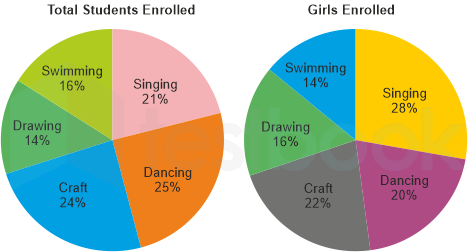
The percentage of students enrolled in different activities in a school which are displayed in the left side pie chart. The total number of students is 5000.

In the right-side pie chart, the total number of girls is 1550 and their percentage breakup enrolled in these activities.

The number of girls enrolled in Craft forms what per cent of the total number of students in the school?

  1. ((a))

    7.11%

  2. ((b))

    6.82%

  3. ((c))

    5.81%

  4. ((d))

    5.82%

Show Answer
Answer: ((b))

6.82%

Given:

Total number of students = 5000

Total number of girls = 1550

Percentage of girls enrolled in Craft = 22%

Calculations:

Number of girls enrolled in Craft = 22% of 1550

⇒ Number of girls enrolled in Craft = 0.22 × 1550

⇒ Number of girls enrolled in Craft = 341

Percentage of the total number of students in the school:

⇒ Percentage = (Number of girls enrolled in Craft / Total number of students) × 100

⇒ Percentage = (341 / 5000) × 100

⇒ Percentage = 6.82%

∴ The number of girls enrolled in Craft forms 6.82% of the total number of students in the school.

63

In right-angled triangle ABC, ∠B = 90º and angle A and angle C are acute angles. If cosecA = 2√2, then find the value of sinA . cosC + cosA . sinC.

  1. ((a))

    0

  2. ((b))

    2√2

  3. ((c))

    1

  4. ((d))

    √2

Show Answer
Answer: ((c))

1

Given:

In right-angled triangle ABC, ∠B = 90º and angle A and angle C are acute angles.

cosecA = 2√2

Formula Used:

sinA . cosC + cosA . sinC = sin(A + C)

In a right-angled triangle, A + C = 90º

sin(A + C) = sin(90º) = 1

Calculation:

Given cosecA = 2√2

⇒ sinA = 1 / (2√2)

Since A + C = 90º, C = 90º - A

⇒ cosC = cos(90º - A) = sinA

⇒ sinC = sin(90º - A) = cosA

Now, sinA . cosC + cosA . sinC = sinA . sinA + cosA . cosA

⇒ (1 / (2√2)) . (1 / (2√2)) + cosA . cosA

⇒ (1 / (8)) + cosA . cosA

Since sin2A + cos2A = 1

⇒ cos2A = 1 - sin2A

⇒ cos2A = 1 - (1 / (8))

⇒ cos2A = 7 / 8

⇒ sinA . cosC + cosA . sinC = (1 / 8) + (7 / 8)

⇒ 1

The value of sinA . cosC + cosA . sinC is 1.

64

If equation of line p is x + y = 5 and that of line q is x - y = 3, what are the coordinates of the point common to both the lines?

  1. ((a))

    (4, 1)

  2. ((b))

    (2, 3)

  3. ((c))

    (1, 4)

  4. ((d))

    (2, 1)

Show Answer
Answer: ((a))

(4, 1)

Given:

Equation of line p: x + y = 5

Equation of line q: x - y = 3

Formula Used:

To find the coordinates of the intersection point, solve the system of equations:

  1. x + y = 5
  2. x - y = 3

Calculation:

Adding equations 1 and 2:

x + y + x - y = 5 + 3

⇒ 2x = 8

⇒ x = 8 / 2

⇒ x = 4

Substituting x = 4 into equation 1:

4 + y = 5

⇒ y = 5 - 4

⇒ y = 1

Coordinates of the point common to both lines:

(4, 1)

65

If PQ and PR are the two tangents to a circle with center O, and ∠QOR=150º, then ∠QPR is equal to:

  1. ((a))

    90º

  2. ((b))

    45º

  3. ((c))

    60º

  4. ((d))

    30º

Show Answer
Answer: ((d))

30º

Given:

PQ and PR are the two tangents to a circle with center O.

∠QOR = 150º.

Formula Used:

The angle between the two tangents drawn from an external point to a circle is supplementary to the angle subtended by the line segment joining the points of contact at the center.

i.e. ∠QOR + ∠QPR = 180

Calculation:

∠QOR + ∠QPR = 180

⇒ 150° + ∠QPR = 180

⇒ ∠QPR = 180 - 150

⇒ ∠QPR = 30º

The correct answer is option 4.

66

A shopkeeper marks up the price of the oil by 40% and uses a faulty machine which measures 15% less. If the shopkeeper gives a discount of 32%, the profit/loss percentage is:

  1. ((a))

    12% Profit

  2. ((b))

    25% Profit

  3. ((c))

    15% Loss

  4. ((d))

    18% Loss

Show Answer
Answer: ((a))

12% Profit

Given:

Markup percentage = 40%

Faulty machine measures 15% less

Discount given = 32%

Formula Used:

Profit/Loss percentage = (\left(\frac{\text{Selling Price} - \text{Cost Price}}{\text{Cost Price}}\right) \times 100 %)

Calculation:

Let Cost Price (CP) = 100

Marked Price (MP) = 100 + 40% of 100

⇒ MP = 100 + 40

⇒ MP = 140

Due to faulty machine, the quantity measured is 15% less, hence the quantity sold is 85%

⇒ Selling Price (SP) before discount = 140

Discount given = 32% of 140

⇒ Discount = 32% × 140

⇒ Discount = 0.32 × 140

⇒ Discount = 44.8

SP after discount = 140 - 44.8

⇒ SP = 95.2

Effective quantity sold = 85% of CP = 85% of 100

⇒ Effective quantity sold = 85

Profit/Loss = SP - Effective CP

⇒ Profit/Loss = 95.2 - 85

⇒ Profit = 10.2

Profit percentage = ( \left(\frac{10.2}{85}\right) \times 100 %)

⇒ Profit percentage = 12%

The profit percentage is 12%.

67

The given table shows the percentage of marks obtained by 5 students in different subjects. Study the table and answer the question that follows. (Maximum marks are given beside subject)

Subjects → 
Students ↓
Physics
300
Maths
300
Music
100
Hindi
100
Botany
200
Ram6080906095
Shyam9070807040
Sohan7090958075
Mohan8060709580
Karn9050858580

What are the marks (in percentage) obtained by Mohan?

  1. ((a))

    75.5%

  2. ((b))

    76.5%

  3. ((c))

    74.5%

  4. ((d))

    77.5%

Show Answer
Answer: ((c))

74.5%

Given:

The marks obtained by Mohan in different subjects are as follows:

Physics (300 marks): 80%

Maths (300 marks): 60%

Music (100 marks): 70%

Hindi (100 marks): 95%

Botany (200 marks): 80%

Calculations:

The actual marks obtained by Mohan in each subject.

Physics: (80% \text{ of } 300 = \frac{80}{100} \times 300 = 240 \text{ marks})

Maths: (60% \text{ of } 300 = \frac{60}{100} \times 300 = 180 \text{ marks})

Music: ( 70% \text{ of } 100 = \frac{70}{100} \times 100 = 70 \text{ marks})

Hindi: (95% \text{ of } 100 = \frac{95}{100} \times 100 = 95 \text{ marks})

Botany: (80% \text{ of } 200 = \frac{80}{100} \times 200 = 160 \text{ marks})

Total marks obtained by Mohan = 240 + 180 + 70 + 95 + 160 = 745 marks

Maximum marks = 300 + 300 + 100 + 100 + 200 = 1000 marks

⇒ Percentage = ( \left(\frac{745}{1000}\right) \times 100)

⇒ Percentage = 74.5%

∴ Mohan obtained 74.5% marks.

<br>

Mistake Points 

The total maximum marks are different for all subjects. Marks are given in the percentage.

For example, Mohan's marks in Physics = 80 it's mean 80% of maximum marks = 80% of 300 = 240

Same as, Mohan's marks in Music = 70% of maximum marks of music = 70% of 100 = 70

​So,

Total maximum marks = 1000

and

Marks achieved by Mohan = 745

So,

%Marks = (745/1000) * 100 = 74.5%

68

Radhika requested the cashier of a bank to get her coins in lieu of her cheque worth ₹1,845. Cashier gave her a packet containing ₹5, ₹10 and ₹20 coins in the ratio of 3 : 5 : 7. What is the total worth of the smallest coin received by her?

  1. ((a))

    ₹125

  2. ((b))

    ₹135

  3. ((c))

    ₹105

  4. ((d))

    ₹145

Show Answer
Answer: ((b))

₹135

Shortcut Trick

Value ratio of coins = (₹5 × 3) : (₹10 × 5) : (₹20 × 7) = 15 : 50 : 140

Total value units = 15 + 50 + 140 = 205 units

205 units = ₹1845 ⇒ 1 unit = ₹9

Total worth of smallest coin (₹5) = 15 units = 15 × 9 = ₹135

∴ The correct answer is ₹135.

Alternate Method

Given:

Total amount = ₹1,845

Denominations = ₹5, ₹10 and ₹20

Ratio of number of coins = 3 : 5 : 7

Total Cheque Value = ₹1845

₹5 Ratio: 3x Value: 15x

₹10 Ratio: 5x Value: 50x

₹20 Ratio: 7x Value: 140x

Total Value = 15x + 50x + 140x = 205x 205x = 1845 → x = 9 → ₹5 Value = 15(9) = ₹135

Calculations:

⇒ Let the number of ₹5, ₹10 and ₹20 coins be 3x, 5x and 7x respectively.

⇒ Total worth of ₹5 coins = 5 × 3x = 15x

⇒ Total worth of ₹10 coins = 10 × 5x = 50x

⇒ Total worth of ₹20 coins = 20 × 7x = 140x

⇒ Total amount = 15x + 50x + 140x = 205x

⇒ Given total amount = 1845

⇒ 205x = 1845

⇒ x = 1845 ÷ 205

⇒ x = 9

⇒ The smallest coin is ₹5.

⇒ Total worth of ₹5 coins = 15x = 15 × 9 = ₹135

∴ The correct answer is ₹135.

Additional Information

Coins and Denomination Rule

Total Value of Coins = Value of one coin × Number of coins. Always convert the ratio of the number of coins to the ratio of their total values to equate with the total amount.

Ratio & Proportion

When parts of a whole are given in a ratio (a : b : c), the actual values can be written as ax, bx, and cx where x is a common multiplier. Summing these parts directly connects the ratio to the absolute total quantity.

69

In how many years will the simple interest on a sum of money be equal to the principal at the rate of (2\frac{6}{7}) % per annum?

  1. ((a))

    37 years

  2. ((b))

    33 years

  3. ((c))

    35 years

  4. ((d))

    34 years

Show Answer
Answer: ((c))

35 years

Shortcut Trick

When Simple Interest equals Principal, the product of Rate and Time must be 100%.

Rate (R) = 2 6/7% = 20/7% per annum.

Time (T) = 100 ÷ R = 100 ÷ (20/7)

⇒ T = 100 × 7 ÷ 20 = 5 × 7 = 35 years.

∴ The correct answer is 35 years.

Alternate Method

Given:

Simple Interest (SI) = Principal (P)

Rate (R) = 2 6/7% = (2 × 7 + 6)/7 % = 20/7 % per annum.

Formula Used:

SI = (P × R × T) ÷ 100

Calculations:

⇒ P = (P × (20/7) × T) ÷ 100

⇒ 1 = (20 × T) ÷ (7 × 100)

⇒ 1 = (20 × T) ÷ 700

⇒ 700 = 20 × T

⇒ T = 700 ÷ 20

⇒ T = 35 years.

∴ The correct answer is 35 years.

Additional Information

Simple Interest Concept

Interest calculated only on the initial principal amount throughout the entire period: SI = (P×R×T)/100.

Total Amount

The final value after adding interest to the principal: A = P + SI = P[1 + (R×T)/100].

Interest as a Fraction

If SI is 1/n of the Principal, then the time period T can be directly calculated as 100 / (n×R).

70

Study the given pie-charts and answer the question that follows.

The pie-charts show the data of students' progress after graduation.

Which two combined have the same number of students as the other?

  1. ((a))

    P.G. + M.Phil.

  2. ((b))

    P.G. + Ph.D.

  3. ((c))

    Entrepreneur + P.G.

  4. ((d))

    Entrepreneur + Ph.D.

Show Answer
Answer: ((b))

P.G. + Ph.D.

Shortcut Trick Other = 48%

We have two options: PG + Phd OR PG + M.phil

PG + Phd = 39 + 9 = 48%

PG + M.phil = 39 + 4 = 43%

So, Others = PG + Phd = 48%

∴ The correct answer is Option 2).

Given:

Percentage of students in various categories:

M.Phil = 4%

Ph.D. = 9%

PG = 39%

Other = 48%

Other1 = 34%

Entrepreneur = 14%

Calculation:

Let's check each combination:

  1. M.Phil + Ph.D = 4% + 9% = 13%
  2. M.Phil + PG = 4% + 39% = 43%
  3. M.Phil + Other = 4% + 48% = 52%
  4. M.Phil + Other1 = 4% + 34% = 38%
  5. M.Phil + Entrepreneur = 4% + 14% = 18%
  6. Ph.D + PG = 9% + 39% = 48%
  7. Ph.D + Other = 9% + 48% = 57%
  8. Ph.D + Other1 = 9% + 34% = 43%
  9. Ph.D + Entrepreneur = 9% + 14% = 23%
  10. PG + Other = 39% + 48% = 87%
  11. PG + Other1 = 39% + 34% = 73%
  12. PG + Entrepreneur = 39% + 14% = 53%
  13. Other + Other1 = 48% + 34% = 82%
  14. Other + Entrepreneur = 48% + 14% = 62%
  15. Other1 + Entrepreneur = 34% + 14% = 48%

⇒ The two categories that combined have the same number of students as other are:

Ph.D + PG = Other

∴ The correct answers are Ph.D + PG.

71

If Arun's salary was decreased by 50% and subsequently increased by 50%, then how much per cent did he lose?

  1. ((a))

    10%

  2. ((b))

    36%

  3. ((c))

    25%

  4. ((d))

    40%

Show Answer
Answer: ((c))

25%

Given:

Initial salary of Arun = S

Decrease in salary = 50%

Subsequent increase in salary = 50%

Formula Used:

Final Salary = Initial Salary × (1 - Decrease%) × (1 + Increase%)

Percentage Loss = (\frac{(Initial Salary - Final Salary)}{Initial Salary} \times 100)

Calculation:

Decrease in salary = 50% of S = 0.5S

New salary after decrease = S - 0.5S = 0.5S

Subsequent increase = 50% of 0.5S = 0.25S

Final salary after increase = 0.5S + 0.25S = 0.75S

Percentage Loss = (\frac{(S - 0.75S)}{S} \times 100)

Percentage Loss = (\frac{0.25S}{S} \times 100)

Percentage Loss = 0.25 × 100

Percentage Loss = 25%

Arun lost 25% of his salary.

72

A shopkeeper decides to raise the marked price of an article by 40%. How much percentage discount should he allow to be able to sell the article at the original marked price?

  1. ((a))

    24 (3)/(7) %

  2. ((b))

    28 (4)/(7) %

  3. ((c))

    31 (2)/(7) %

  4. ((d))

    26 (3)/(7) %

Show Answer
Answer: ((b))

28 (4)/(7) %

Given:

Marked price increase = 40%

Formula Used:

Discount percentage required =( \left( \frac{\text{Increase Percentage}}{100 + \text{Increase Percentage}} \right) \times 100)

Calculation:

Increase Percentage = 40%

Discount percentage required = (\left( \frac{40}{100 + 40} \right) \times 100)

Discount percentage required = (\left( \frac{40}{140} \right) \times 100)

Discount percentage required = (\left( \frac{2}{7} \right) \times 100)

Discount percentage required = 28.57%

Discount percentage required = 28 (4/7)%

The discount percentage required is 28 (4/7)%.

73

A largest possible sphere is carved in a cube of side 14 cm. What is its volume in cm3?

  1. ((a))

    205(\frac{1}{3}) cm3

  2. ((b))

    1707(\frac{1}{3})  cm3

  3. ((c))

    1600(\frac{1}{3})  cm3

  4. ((d))

    1437(\frac{1}{3})  cm3

Show Answer
Answer: ((d))

1437(\frac{1}{3})  cm3

Shortcut Trick

For the largest sphere inside a cube, the diameter of the sphere = side of the cube.

Side = 14 cm ⇒ Radius (r) = 7 cm.

Volume of sphere = (4/3) × π × r3 = (4/3) × (22/7) × 7 × 7 × 7.

Volume = (4 × 22 × 49) / 3 = 4312 / 3 = 1437 (1/3) cm3.

∴ The correct answer is 1437 (1/3) cm3.

Alternate Method

Given: Side of cube (a) = 14 cm.

Formula Used: Volume of Sphere = (4/3)πr3; Radius of inscribed sphere = a/2.

⇒ Side of the cube (a) = 14 cm.

Diameter of the largest sphere = 14 cm.

Radius (r) = 14 / 2 = 7 cm.

⇒ Volume = (4/3) × (22/7) × 73

⇒ Volume = (4/3) × (22/7) × 343

⇒ Volume = (4/3) × 22 × 49

⇒ Volume = 4312 / 3

⇒ Volume = 1437 (1/3) cm3.

∴ The correct answer is 1437 (1/3) cm3.

Additional Information

Cube properties

Total Surface Area = 6a2 and Volume = a3, where 'a' is the side length.

Sphere properties

Surface Area = 4πr2 and Volume = (4/3)πr3, where 'r' is the radius.

Cube and Sphere Relationship

For a sphere circumscribing a cube, the diameter is equal to the diagonal of the cube (√3 a).

74

A man walking at the speed of 5 km/h covers a certain distance in 3 hours 45 minutes. If he covers the same distance by a cycle in 2 hours 10 minutes, then the speed of the cycle in km/h is:

  1. ((a))

    (5\frac{11}{26})

  2. ((b))

    (9\frac{11}{26})

  3. ((c))

    (8\frac{17}{26})

  4. ((d))

    (7\frac{16}{26})

Show Answer
Answer: ((c))

(8\frac{17}{26})

Shortcut Trick

For a constant distance, Speed is inversely proportional to Time.

Time 1 (Walk) = 3 h 45 min = 225 min | Time 2 (Cycle) = 2 h 10 min = 130 min

Time Ratio (Walk : Cycle) = 225 : 130 = 45 : 26

Speed Ratio (Walk : Cycle) = 26 : 45

If 26 units = 5 km/h, then 45 units = (5 ÷ 26) × 45 = 225/26 = 8 17/26 km/h.

∴ The correct answer is 8(17)/(26) km/h.

Alternate Method

Given: Walking speed = 5 km/h, Walking time = 3 h 45 min, Cycling time = 2 h 10 min.

Formula Used: Distance = Speed × Time; Speed = Distance ÷ Time

⇒ Walking time = 3 + 45/60 = 3 + 3/4 = 15/4 hours

⇒ Distance = Speed × Time = 5 × (15/4) = 75/4 km

⇒ Cycling time = 2 + 10/60 = 2 + 1/6 = 13/6 hours

⇒ Cycling Speed = Distance ÷ Cycling time = (75/4) ÷ (13/6)

⇒ Cycling Speed = (75/4) × (6/13) = (75 × 3) / (2 × 13) = 225/26

⇒ Cycling Speed = 8 17/26 km/h

∴ The correct answer is 8(17)/(26) km/h.

Additional Information

Speed-Time Relation

When distance is constant, Speed1 × Time1 = Speed2 × Time2.

Unit Conversion

To convert minutes to hours, divide by 60. To convert km/h to m/s, multiply by 5/18.

Average Speed

For the same distance covered at speeds x and y, Average Speed = 2xy/(x + y).

75

Mohan gets 12% increase in his sale amount in the first year and 15% increase in the second year, with that his present sale is ₹1,28,800. What was his sale two years ago?

  1. ((a))

    ₹1,25,000

  2. ((b))

    ₹1,00,000

  3. ((c))

    ₹1,75,000

  4. ((d))

    ₹1,50,000

Show Answer
Answer: ((b))

₹1,00,000

Shortcut Trick

Net multiplier for 12% and 15% increase = 1.12 × 1.15 = 1.288

Sale two years ago = Present Sale ÷ Net Multiplier

Sale = 1,28,800 ÷ 1.288 = 1,00,000

∴ The correct answer is ₹1,00,000.

Alternate Method

Given:

Present Sale = ₹1,28,800

Increase in 1st year (r1) = 12%

Increase in 2nd year (r2) = 15%

Formula Used:

Final Value = Initial Value × (1 + r1/100) × (1 + r2/100)

Initial (x)

+12%

Year 1

+15%

1,28,800

Growth Timeline over 2 Years

Calculations:

⇒ Let the sale two years ago be x.

⇒ Sale after 1st year = x × (1 + 12/100) = 1.12x

⇒ Sale after 2nd year = 1.12x × (1 + 15/100) = 1.12x × 1.15

⇒ 1.288x = 1,28,800

⇒ x = 1,28,800 ÷ 1.288

⇒ x = 1,00,000

∴ The correct answer is ₹1,00,000.

Additional Information

Successive Percentage Change

If a value changes by a% and then by b%, the net effective change is (a + b + ab/100)%.

Reverse Percentage Calculation

To find the original value after an increase, divide the final value by (1 + r/100). For multiple years, divide by the product of multipliers.

Fractional Equivalent

12% = 3/25 (Multiplier 28/25) and 15% = 3/20 (Multiplier 23/20). Initial = 1,28,800 × (25/28) × (20/23).

General Awareness (25 questions)

76

What is the balance of trade of a country?

  1. ((a))

    Number of imports

  2. ((b))

    Number of exports

  3. ((c))

    Ratio of international trade

  4. ((d))

    Difference between imports and exports

Show Answer
Answer: ((d))

Difference between imports and exports

The correct answer is Difference between imports and exports

Key Points

  • The balance of trade of a country is the difference between its imports and exports.
  • If a country exports more than it imports, it has a trade surplus; if it imports more than it exports, it has a trade deficit.
  • The balance of trade is a significant component of a country's current account, indicating whether a country is a net exporter or importer of goods.
  • It is a critical economic indicator used to assess the health of a country's economy and its trade relationships with other nations.

Additional Information

  • A positive balance of trade (trade surplus) can contribute to a country's economic growth, while a negative balance of trade (trade deficit) might indicate economic challenges.
  • The balance of trade can be influenced by various factors such as exchange rates, competitiveness, trade policies, and global economic conditions.
  • Countries often aim to achieve a favorable balance of trade to boost their economic performance and maintain financial stability.
  • The balance of trade is one part of the broader balance of payments, which also includes financial transfers and capital flows.
77

With which of the following states is the Bhatiali folk music, which is mostly sung by the fishermen, associated?

  1. ((a))

    Kerala

  2. ((b))

    Andhra Pradesh

  3. ((c))

    West Bengal

  4. ((d))

    Odisha

Show Answer
Answer: ((c))

West Bengal

The correct answer is West Bengal

Key Points

  • Bhatiali folk music is traditionally associated with the state of West Bengal.
  • This form of music is predominantly sung by fishermen as they navigate the rivers, reflecting the life and culture of the riverine communities.
  • The songs often depict the daily life, struggles, and emotions of the fishermen.
  • Bhatiali music is characterized by its melodic and soulful tunes that resonate with the rhythm of the flowing river.

Additional Information

  • West Bengal has a rich tradition of various forms of folk music, including Baul, Bhawaiya, and Jhumur, besides Bhatiali.
  • The state is known for its cultural heritage and contributions to Indian music, literature, and art.
  • Folk music in West Bengal often serves as a medium to preserve and transmit local history, folklore, and social values.
  • Efforts are being made to preserve and promote these traditional forms of music in the face of modern influences.
78

The growth rate of India's population has been declining since ______.

  1. ((a))

    1991

  2. ((b))

    1981

  3. ((c))

    1951

  4. ((d))

    1971

Show Answer
Answer: ((b))

1981

The correct answer is 1981

Key Points

  • The growth rate of India's population has been declining since 1981.
  • This decline is attributed to various factors including government policies on family planning, increased literacy rates, and improved healthcare services.
  • Efforts to control population growth have included the promotion of contraceptive use, education about family planning, and incentives for smaller families.
  • The decline in the growth rate is a positive indicator of the effectiveness of these policies and the changing socio-economic conditions in the country.

Additional Information

  • India's population policy aims to stabilize the population by the middle of the 21st century.
  • In 1952, India became the first country in the world to launch a national program, emphasizing family planning to the extent necessary for reducing birth rates to stabilize the population at a level consistent with the requirements of the national economy.
  • Population growth rate is a crucial factor in planning for economic and social development.
  • The Total Fertility Rate (TFR) has also been on a decline, indicating fewer children per woman.
  • Various states in India have different rates of population growth, with some states achieving replacement-level fertility.
79

Who has the power to regulate the right of citizenship in India?

  1. ((a))

    Supreme Court

  2. ((b))

    Governor

  3. ((c))

    President

  4. ((d))

    Parliament

Show Answer
Answer: ((d))

Parliament

The correct answer is Parliament

Key Points

  • The power to regulate the right of citizenship in India is vested in the Parliament.
  • According to the Constitution of India, the Parliament has the authority to make laws regarding the acquisition and termination of citizenship and all other matters related to citizenship.
  • Article 11 of the Indian Constitution grants Parliament the power to regulate the right of citizenship by law.
  • Over the years, Parliament has enacted several laws to govern citizenship, including the Citizenship Act of 1955.

Additional Information

  • The Citizenship Act, 1955 provides for the acquisition and determination of Indian citizenship.
  • The Act has been amended multiple times, with significant amendments in 1986, 1992, 2003, 2005, and 2019.
  • Citizenship can be acquired by birth, descent, registration, naturalization, or incorporation of territory.
  • The Constitution of India, adopted on 26th November 1949 and effective from 26th January 1950, laid the foundation for the legal framework of citizenship in India.
80

The peninsular plateau of India was a part of which continent earlier?

  1. ((a))

    South America

  2. ((b))

    North America

  3. ((c))

    Europe

  4. ((d))

    Africa

Show Answer
Answer: ((d))

Africa

The correct answer is Africa

Key Points

  • The peninsular plateau of India was once a part of the ancient supercontinent known as Gondwana.
  • Gondwana included regions that are now part of Africa, South America, Antarctica, Australia, and the Indian subcontinent.
  • Over millions of years, the tectonic plates drifted apart, leading to the present-day geographical formations.
  • This separation and movement of the tectonic plates is explained by the theory of continental drift proposed by Alfred Wegener.

Additional Information

  • The concept of continental drift was further developed into the theory of plate tectonics, which explains the movement of Earth's lithospheric plates.
  • India's collision with the Eurasian plate led to the formation of the Himalayas.
  • The peninsular plateau is characterized by its stable geological structure and is one of the oldest landmasses on Earth.
  • The plateau is rich in minerals and has significant geological and ecological importance.
81

In which year did Johannes Nicolaus Bronsted and Thomas Martin Lowry propose the fundamental concept of acids and bases?

  1. ((a))

    1925

  2. ((b))

    1921

  3. ((c))

    1923

  4. ((d))

    1928

Show Answer
Answer: ((c))

1923

The correct answer is 1923

Key Points

  • Johannes Nicolaus Bronsted and Thomas Martin Lowry proposed the fundamental concept of acids and bases in 1923.
  • The Bronsted-Lowry theory defines an acid as a proton donor and a base as a proton acceptor.
  • This theory expanded the understanding of acid-base reactions beyond the limitations of the Arrhenius theory.
  • It is applicable to a broader range of chemical reactions, including those in non-aqueous solutions.

Additional Information

  • The Bronsted-Lowry theory was independently proposed by both scientists in the same year.
  • This theory is fundamental in the field of chemistry and is widely taught in academic institutions.
  • The concept of conjugate acid-base pairs is also a significant aspect of the Bronsted-Lowry theory.
  • Johannes Nicolaus Bronsted was a Danish physical chemist, while Thomas Martin Lowry was a British chemist.
82

Sakewa is a religious festival celebrated by the Kirat Khambu Rai community of ________.

  1. ((a))

    Goa

  2. ((b))

    Himachal Pradesh

  3. ((c))

    Sikkim

  4. ((d))

    Arunachal Pradesh

Show Answer
Answer: ((c))

Sikkim

The correct answer is Sikkim

Key Points

  • Sakewa is a significant religious festival celebrated by the Kirat Khambu Rai community.
  • This festival is primarily observed in the state of Sikkim.
  • Sakewa is a time when the community comes together to offer prayers and perform rituals to honor nature and their ancestors.
  • The festival holds great cultural and spiritual importance among the Kirat Khambu Rai people.

Additional Information

  • Sikkim is a state in northeastern India, known for its diverse cultural heritage and vibrant traditions.
  • The Kirat Khambu Rai community is one of the indigenous communities of Sikkim, with a rich history and cultural legacy.
  • Besides Sakewa, Sikkim is home to various other festivals and cultural events that reflect its multi-ethnic society.
  • Sakewa is also known as the “Ubhauli” festival in some regions, marking the beginning of the farming season.
83

The five-year plans for India with their duration are given below. Which of the following is correctly matched?

(a)Second five-year plan1956-57 to 1960-61
(b)Third five-year plan1961-62 to 1965-66
(c)Fourth five-year plan1966-67 to 1970-71
  1. ((a))

    Both a and c

  2. ((b))

    Both a and b

  3. ((c))

    Both b and c

  4. ((d))

    Only a

Show Answer
Answer: ((b))

Both a and b

The correct answer is Both a and b

Key Points

  • Second Five-Year Plan (1956-57 to 1960-61): This plan aimed at rapid industrialization and was based on the Mahalanobis model. Hence, a is correctly matched.
  • Third Five-Year Plan (1961-62 to 1965-66): This plan focused on agriculture and improving production to make India self-sufficient in food grains. Hence, b is correctly matched.
  • Fourth Five-Year Plan (1969-74): It aimed at growth with stability and progressive achievement of self-reliance. Note that the given duration (1966-67 to 1970-71) is incorrect. Hence, c is not correctly matched.

Additional Information

  • Five-Year Plans of India:
  • The Five-Year Plans were centralized and integrated national economic programs. The first such plan was launched in 1951, and two subsequent five-year plans were formulated until 1965, when there was a break because of the Indo-Pakistan Conflict. The planning process resumed in 1969, after a gap of three annual plans.
  • The plans aimed at growth, modernization, self-reliance, and social justice.
84

Who among the following was the author of 'Brihat Katha Kosh'?

  1. ((a))

    Kshemendra

  2. ((b))

    Harisena

  3. ((c))

    Dandin

  4. ((d))

    Bhavabhuti

Show Answer
Answer: ((b))

Harisena

The correct answer is Harisena

Key Points

  • Harisena is credited as the author of 'Brihat Katha Kosh'.
  • He was an ancient Indian poet and author known for his contributions to Sanskrit literature.
  • 'Brihat Katha Kosh' is a significant work that belongs to the genre of classical Sanskrit literature.
  • The text is an extensive collection of tales and stories, showcasing the rich cultural and literary heritage of ancient India.

Additional Information

  • Kshemendra was another prominent Sanskrit poet and writer, but he is not the author of 'Brihat Katha Kosh'.
  • Dandin was known for his work 'Dashakumaracharita', a prose romance in Sanskrit.
  • Bhavabhuti was a celebrated dramatist and poet, known for plays like 'Malatimadhava' and 'Uttararama-charita'.
  • 'Brihat Katha Kosh' remains an important source for understanding the literary and narrative traditions of ancient India.
85

Daler Mehndi is primarily a famous singer of pop songs in which Indian language?

  1. ((a))

    Punjabi

  2. ((b))

    Hindi

  3. ((c))

    Bengali

  4. ((d))

    English

Show Answer
Answer: ((a))

Punjabi

The correct answer is Punjabi

Key Points

  • Daler Mehndi is widely recognized for his contributions to Punjabi pop music.
  • He gained immense popularity with his energetic songs and vibrant music videos that often feature traditional Punjabi themes and dance.
  • Some of his most famous tracks include "Bolo Ta Ra Ra," "Tunak Tunak Tun," and "Ho Jayegi Balle Balle."
  • Daler Mehndi's music has not only captivated audiences in India but also garnered a global fanbase.
  • His unique style and powerful voice have made him a prominent figure in the Indian music industry, especially in the genre of Punjabi pop.

Additional Information

  • Daler Mehndi was born on August 18, 1967, in Patna, Bihar, India.
  • He belongs to a family with a rich musical heritage, which influenced his career in music.
  • Besides singing, Daler Mehndi is also known for his philanthropic efforts and involvement in various social causes.
  • He has received numerous awards and accolades for his contributions to music and culture.
  • In addition to Punjabi, he has also sung songs in Hindi and other languages, but his primary fame comes from his Punjabi songs.
86

Where can you find the emoticons in an instant messaging conversation window?

  1. ((a))

    At the middle of the chat window

  2. ((b))

    Any where in the chat window

  3. ((c))

    At the top of the chat window

  4. ((d))

    At the bottom of the chat window

Show Answer
Answer: ((d))

At the bottom of the chat window

The correct answer is At the bottom of the chat window

Key Points

  • Emoticons are typically found at the bottom of the chat window in an instant messaging conversation.
  • They are often displayed as a clickable icon or button that opens a panel with various emoticons to choose from.
  • The placement at the bottom allows users to easily insert emoticons while typing their messages.
  • This design ensures that the emoticons are accessible without obstructing the view of the conversation.

Additional Information

  • Instant messaging platforms often include other features at the bottom of the chat window, such as attachments, voice notes, and send buttons.
  • Emoticons help convey emotions and add a personal touch to text-based communication.
  • Some platforms also support animated emoticons or stickers for more expressive conversations.
  • Users can often customize their emoticon panel with frequently used or favorite emoticons.
  • The integration of emoticons in chat windows enhances user experience by making interactions more engaging and expressive.
87

In the context of DNA, which of the following principles governs the process of transcription?

  1. ((a))

    The principle of complementarity

  2. ((b))

    The transforming principle

  3. ((c))

    Semiconservative nature of DNA

  4. ((d))

    The principle of inheritance

Show Answer
Answer: ((a))

The principle of complementarity

The correct answer is The principle of complementarity

Key Points

  • The principle of complementarity governs the process of transcription in the context of DNA.
  • During transcription, the enzyme RNA polymerase reads the DNA strand and synthesizes a complementary RNA strand.
  • This principle ensures that adenine (A) pairs with uracil (U) in RNA (instead of thymine (T) in DNA), and cytosine (C) pairs with guanine (G).
  • Transcription is the first step in gene expression, where the DNA sequence of a gene is transcribed into RNA.

Additional Information

  • DNA (Deoxyribonucleic acid) is the molecule that carries the genetic instructions used in growth, development, functioning, and reproduction of all known living organisms.
  • The central dogma of molecular biology explains the flow of genetic information within a biological system, which is from DNA to RNA to protein.
  • Transcription is followed by translation, where the RNA is used to produce proteins.
  • Errors in the transcription process can lead to mutations, which may result in genetic disorders or diseases.
  • Understanding transcription is crucial for fields such as genetics, molecular biology, and biotechnology.
88

National Institute of Mountaineering and Adventure Sports (NIMAS) is located at ________.

  1. ((a))

    Mizoram

  2. ((b))

    Himachal Pradesh

  3. ((c))

    Arunachal Pradesh

  4. ((d))

    Nagaland

Show Answer
Answer: ((c))

Arunachal Pradesh

The correct answer is Arunachal Pradesh

Key Points

  • The National Institute of Mountaineering and Adventure Sports (NIMAS) is located in Dirang, Arunachal Pradesh.
  • NIMAS is a premier institute in India providing training in mountaineering, aero, and aqua adventure sports.
  • It was established to develop and promote adventure sports and mountaineering in the country.
  • The institute offers various courses and expeditions to promote adventure tourism and skill development in these fields.

Additional Information

  • Arunachal Pradesh is known for its diverse topography and is a popular destination for adventure sports and mountaineering activities.
  • The state is home to several high-altitude peaks, dense forests, and rivers that provide ample opportunities for various adventure sports.
  • NIMAS collaborates with various national and international organizations to conduct training programs and expeditions.
  • The institute also plays a significant role in promoting eco-tourism and sustainable adventure tourism practices in the region.
89

In which year has India hosted the Asian Games for the first time?

  1. ((a))

    1951

  2. ((b))

    1949

  3. ((c))

    1948

  4. ((d))

    1950

Show Answer
Answer: ((a))

1951

The correct answer is 1951

Key Points

  • India hosted the Asian Games for the first time in the year 1951.
  • The inaugural Asian Games were held in New Delhi from March 4 to March 11, 1951.
  • A total of 489 athletes from 11 nations participated in the first Asian Games.
  • The event featured 57 events across 8 sports disciplines including athletics, aquatics, basketball, cycling, football, and others.
  • New Delhi became the first city to host the Asian Games, setting a precedent for future games.

Additional Information

  • The Asian Games, also known as the Asiad, is a continental multi-sport event held every four years among athletes from all over Asia.
  • The Asian Games are recognized by the International Olympic Committee (IOC) and are described as the second largest multi-sport event after the Olympic Games.
  • India has hosted the Asian Games twice, first in 1951 and again in 1982, both times in New Delhi.
  • The Asian Games Federation was the governing body of the Games until it was replaced by the Olympic Council of Asia (OCA) in 1982.
  • The concept of the Asian Games was first proposed in 1948 during the London Olympic Games by Indian sports official Guru Dutt Sondhi.
90

As of March 2024, who among the following is the Chairperson of the National Green Tribunal?

  1. ((a))

    Lokeshwar Singh Panta

  2. ((b))

    Swatanter Kumar

  3. ((c))

    Prakash Shrivastava

  4. ((d))

    Ajay Narayan Jha

Show Answer
Answer: ((c))

Prakash Shrivastava

The correct answer is Prakash Shrivastava

Key Points

  • As of March 2024, Prakash Shrivastava is the Chairperson of the National Green Tribunal (NGT).
  • The National Green Tribunal was established in 2010 under the National Green Tribunal Act for effective and expeditious disposal of cases relating to environmental protection and conservation of forests and other natural resources.
  • The NGT is tasked with ensuring the enforcement of any legal right relating to the environment and giving relief and compensation for damages to persons and property.

Additional Information

  • The NGT has a specialized jurisdiction in environmental matters and is guided by principles of natural justice and sustainable development.
  • It operates across five zones in India: North, Central, East, South, and West, with its principal bench located in New Delhi.
  • The Tribunal is mandated to dispose of applications or appeals finally within six months of filing.
  • Previous chairpersons of the NGT include Justice Lokeshwar Singh Panta and Justice Swatanter Kumar.
91

Langvir Nritya is a folk dance from the state of ______.

  1. ((a))

    Uttarakhand

  2. ((b))

    Haryana

  3. ((c))

    Uttar Pradesh

  4. ((d))

    Gujarat

Show Answer
Answer: ((a))

Uttarakhand

The correct answer is Uttarakhand

Key Points

  • Langvir Nritya is a traditional folk dance from the state of Uttarakhand.
  • This dance is traditionally performed by men and is known for its acrobatic elements.
  • Langvir Nritya is typically performed to the accompaniment of folk music and traditional instruments such as the dhol and damau.
  • The dance is usually performed during festivals and cultural celebrations in Uttarakhand.
  • It is a vibrant representation of the rich cultural heritage of the Garhwal region in Uttarakhand.

Additional Information

  • Uttarakhand, formerly known as Uttaranchal, is a state in northern India crossed by the Himalayas.
  • The state is known for its Hindu pilgrimage sites, including the famous Char Dham (four shrines) Yamunotri, Gangotri, Kedarnath, and Badrinath.
  • In addition to Langvir Nritya, Uttarakhand is also famous for other folk dances such as Barada Nati, Chholiya, and Jhora.
  • The state's culture is deeply rooted in its traditions, festivals, and dances, which play a significant role in the lives of its people.
92

Which of the following states/UTs has the first 100% fully digital literate Panchayat in India?

  1. ((a))

    Puducherry

  2. ((b))

    Kerala

  3. ((c))

    Delhi

  4. ((d))

    Maharashtra

Show Answer
Answer: ((b))

Kerala

The correct answer is Kerala

Key Points

  • Pullampara Panchayat in Kerala is recognized as the first 100% fully digital literate Panchayat in India.
  • Kerala has been a pioneer in achieving high literacy rates and digital literacy, making significant strides in education and technology.
  • This achievement is a part of Kerala's broader initiatives to enhance digital literacy and e-governance across the state.

Additional Information

  • Kerala has consistently been at the forefront of literacy and digital initiatives in India.
  • The state’s emphasis on education, healthcare, and social welfare has contributed to its high human development index.
  • Kerala's model of development, often referred to as the "Kerala Model," focuses on equitable access to resources and services.
93

Former minister of the state and former president of BJP alliance partner IPFT _______ received the Padma Shri award (posthumously) in 2023.

  1. ((a))

    Narendra Chandra Debbarma

  2. ((b))

    Prabhat Choudhury

  3. ((c))

    Rebati Mohan Das

  4. ((d))

    Pinaki Das Chowdhury

Show Answer
Answer: ((a))

Narendra Chandra Debbarma

The correct answer is Narendra Chandra Debbarma

Key Points

  • Narendra Chandra Debbarma, the former minister of the state and former president of BJP alliance partner IPFT, was posthumously awarded the Padma Shri in 2023.
  • The Padma Shri is one of the highest civilian awards in India, recognizing distinguished contributions in various fields such as arts, education, industry, literature, science, sports, medicine, social service, and public affairs.
  • Narendra Chandra Debbarma played a significant role in Tripura's political landscape and was known for his dedication to the development of the state.
  • The award was conferred posthumously, honoring his lifelong commitment and service to the nation.

Additional Information

  • The Padma Shri award is part of the Padma Awards, which also include the Padma Vibhushan and Padma Bhushan. These awards are announced annually on the eve of Republic Day.
  • The selection process for the Padma Awards involves recommendations from state governments, union territories, ministries, and individuals, which are then reviewed by a committee constituted by the Prime Minister of India.
  • Recipients of the Padma Shri are recognized for their distinguished service in their respective fields, contributing to the growth and development of the country.
  • Narendra Chandra Debbarma's contributions to the political and social development of Tripura were widely acknowledged and celebrated through this prestigious award.
94

According to Census of India 2011, most of the people migrated from ________ to other states of India.

  1. ((a))

    Uttar Pradesh and Bihar

  2. ((b))

    Rajasthan and Gujarat

  3. ((c))

    Maharashtra and Gujarat

  4. ((d))

    Uttar Pradesh and Madhya Pradesh

Show Answer
Answer: ((a))

Uttar Pradesh and Bihar

The correct answer is Uttar Pradesh and Bihar

Key Points

  • Uttar Pradesh and Bihar are the states from which most people had out-migrated according to the Census of India 2011.
  • The Census of India 2011 data provides insights into various demographic aspects including migration patterns across the country.
  • Out-migration from states like Uttar Pradesh and Bihar is often driven by factors such as employment opportunities, education, and better living conditions available in other states.
  • This migration trend has significant implications for both the source and destination states in terms of economic, social, and infrastructural impacts.

Additional Information

  • The Census of India is conducted every ten years and is the most comprehensive source of demographic data in the country.
  • The data collected includes information on population size, density, distribution, and various socio-economic parameters.
  • Migration data helps in understanding the movement of people from one region to another and the factors influencing such movements.
  • Understanding migration patterns is crucial for policy-making, especially in areas related to urban planning, labor markets, and social services.
95

Who was the founder of Arya Samaj?

  1. ((a))

    Rabindranath Tagore

  2. ((b))

    Swami Vivekananda

  3. ((c))

    Keshub Chandra Sen

  4. ((d))

    Dayanand Saraswati

Show Answer
Answer: ((d))

Dayanand Saraswati

The correct answer is Dayanand Saraswati

Key Points

  • Dayanand Saraswati was the founder of the Arya Samaj, a Hindu reform movement, in 1875.
  • The Arya Samaj was established to promote values and practices based on the infallibility of the Vedas.
  • Dayanand Saraswati advocated for monotheism, the rejection of idol worship, and the pursuit of Vedic knowledge.
  • He emphasized the importance of education, equality, and social reforms, including the upliftment of women and the abolition of caste discrimination.

Additional Information

  • Dayanand Saraswati was born as Mool Shankar Tiwari on 12th February 1824 in Tankara, Gujarat.
  • He was a staunch critic of the orthodox practices and superstitions prevalent in Hinduism at the time.
  • Dayanand's motto was "Back to the Vedas," urging people to return to the teachings of the ancient Vedic texts.
  • The Arya Samaj played a significant role in the social and cultural renaissance of India, influencing many leaders and freedom fighters.
  • Dayanand Saraswati's teachings continue to inspire millions and have left a lasting legacy in the form of Arya Samaj institutions and schools.
96

In which part of the Constitution will you find the six broad categories of Fundamental Rights?

  1. ((a))

    Part I

  2. ((b))

    Part III

  3. ((c))

    Part II

  4. ((d))

    Part IV

Show Answer
Answer: ((b))

Part III

The correct answer is Part III

Key Points

  • Part III of the Constitution of India deals with Fundamental Rights.
  • These rights are considered essential for the overall development of individuals and are enforceable by the courts.
  • The six broad categories of Fundamental Rights include the right to equality, the right to freedom, the right against exploitation, the right to freedom of religion, cultural and educational rights, and the right to constitutional remedies.
  • Fundamental Rights are meant to protect individuals from any arbitrary actions by the state and ensure a fair and just society.

Additional Information

  • The Constitution of India was adopted by the Constituent Assembly on 26th November 1949 and came into effect on 26th January 1950.
  • It lays down the framework defining fundamental political principles, establishes the structure, procedures, powers, and duties of government institutions, and sets out fundamental rights, directive principles, and the duties of citizens.
  • The Constitution of India is the longest written constitution of any country in the world.
  • It declares India a sovereign, socialist, secular, and democratic republic, assuring its citizens justice, equality, and liberty, and endeavors to promote fraternity.
  • Amendments to the Constitution can be made through a process outlined in Article 368.
  • The Fundamental Rights have been amended several times to address the changing needs and aspirations of the people.
97

The financial year in India starts from 1st April and ends on ________.

  1. ((a))

    31st July

  2. ((b))

    30th June

  3. ((c))

    31st May

  4. ((d))

    31st March

Show Answer
Answer: ((d))

31st March

The correct answer is 31st March

Key Points

  • The financial year in India starts from 1st April and ends on 31st March of the following year.
  • This period is used by the government and businesses for accounting and tax purposes.
  • The financial year is crucial for the preparation of financial statements, budget reports, and for meeting various statutory requirements.
  • Adhering to this financial year helps in maintaining uniformity and consistency in financial reporting.

Additional Information

  • The concept of a financial year is not unique to India; many countries follow a similar system, although the specific dates may vary.
  • For example, the financial year in the United States runs from 1st October to 30th September of the following year.
  • Changing the financial year requires significant adjustments in accounting systems, financial planning, and statutory compliance.
  • In India, the financial year is also referred to as the fiscal year.
  • Income tax returns, annual financial statements, and other financial reports are typically prepared based on this financial year.
98

Geoid is the ______ of earth.

  1. ((a))

    orbit

  2. ((b))

    shape

  3. ((c))

    colour

  4. ((d))

    axis

Show Answer
Answer: ((b))

shape

The correct answer is shape

Key Points

  • The geoid is the shape that the surface of the Earth's oceans would take under the influence of Earth's gravity and rotation alone, disregarding other influences such as winds and tides.
  • It is an equipotential surface of the Earth's gravitational field, which means that it is a surface on which the gravitational potential is constant.
  • The geoid is used as a reference surface from which to measure the elevation of geographical features.
  • It is often described as the true physical figure of the Earth, as opposed to a simplified mathematical model like an ellipsoid.

Additional Information

  • The geoid concept was first introduced by the German mathematician and astronomer Johann Benedikt Listing in 1873.
  • The geoid is irregular, but it can be approximated by a mathematical model known as an ellipsoid of revolution.
  • Modern satellite geodesy techniques are used to measure the geoid with high precision.
  • Understanding the geoid is crucial for various fields such as oceanography, geophysics, and civil engineering.
99

How many squares are there on a chessboard?

  1. ((a))

    64

  2. ((b))

    67

  3. ((c))

    68

  4. ((d))

    69

Show Answer
Answer: ((a))

64

The correct answer is 64.

Key Points

  • A standard chessboard is an 8x8 grid, making it a total of 64 squares.
  • The chessboard is used for the game of chess, which is a two-player strategy board game.
  • Each player begins with 16 pieces: one king, one queen, two rooks, two knights, two bishops, and eight pawns.
  • The objective of the game is to checkmate the opponent's king, which means putting the king in a position where it cannot escape capture.
  • The 64 squares alternate in color, typically black and white or dark and light.
  • Each square on the board is identified by a unique coordinate from a1 to h8.
  • The game of chess is believed to have originated in India during the Gupta Empire in the 6th century AD.

Additional Information

  • The chessboard is a key component in the game of chess, which is recognized as a global intellectual sport.
  • Chess is governed by the International Chess Federation (FIDE), which sets the rules and organizes world championships.
  • The game has a rich history and has been a part of various cultures and societies around the world.
  • Chess is not only a game but also used as a tool for educational purposes, improving cognitive skills and strategic thinking.
  • 64 squares also symbolize the mathematical precision required in the game, reflecting the importance of planning and foresight.
100

Average function is listed in the drop-down menu of which of the following tools?

  1. ((a))

    Move function

  2. ((b))

    Auto Sum function

  3. ((c))

    Financial function

  4. ((d))

    Insert function

Show Answer
Answer: ((b))

Auto Sum function

The correct answer is Auto Sum function

Key Points

  • Average function is listed in the drop-down menu of the Auto Sum function tool.
  • The Auto Sum function provides quick access to common functions such as Sum, Average, Count, Max, and Min.
  • This tool is commonly found in spreadsheet applications like Microsoft Excel and Google Sheets.
  • Using the Auto Sum function helps users quickly perform calculations without manually entering formulas.

Additional Information

  • Spreadsheet applications allow users to organize, analyze, and store data in tabular form.
  • These applications provide various functions and tools to perform complex calculations and data analysis.
  • Common spreadsheet applications include Microsoft Excel, Google Sheets, and Apple Numbers.
  • Learning to use these functions effectively can significantly improve productivity and data management skills.

Attempt this paper under real exam conditions

Timed interface, section switching, instant scoring, and question-by-question analytics — free.

Start Timed Attempt