Previous Year Paper

SSC CHSL Tier-1 2023: Official Paper (Held On: 14 Aug, 2023 Shift 4) (Previous Year Paper)

Held in 2023

100 questions60 minutes
With answers
Free

Paper last updated:

Practise under exam conditions

Take this paper as a timed mock test. Review your answers after you submit.

Attempt timed test

Questions & answers

Read the paper at your pace. Open an explanation when you need it.

English Language (25 questions)

Question 1

If it was Tuesday on 22 July 1969, then what will be the day of the week on 6 August 1985?

  1. AOption (a)

    Tuesday

  2. BOption (b)

    Thursday

  3. COption (c)

    Monday

  4. DOption (d)

    Wednesday

View answer & explanation

Correct answer

Answer: (a)A.

Tuesday

Why this answer is correct

Given: 22 July 1969 is Tuesday.

Now, 1969 to 1985 = 16 Years.

In 16 years, 4 Leap year and 12 ordinary years.

Total odd days from 22 July 1969 to 22 July 1985 = (4 × 2) + (12 × 1) = 8 + 12 = 20 days.

And, 20 days = 20/7 = 2 week and 6 odd days.

So, 22 July 1985 was = Tuesday + 6 = Monday.

Now, 22 July 1985 to 6 August 1985 = 15 days, 15/7 = 2week and 1 odd day.

Therefore, 6 August 1985 = Monday + 1 = Tuesday.

Hence, the correct option is "Option 1".

Question 2

Each of the letters in the word KINGDOM are arranged in alphabetical order. How many letters are there in the English alphabetical series between the letter which is fourth from the left and the one which is second from the right in the new letter-cluster thus formed? 

  1. AOption (a)

    Three

  2. BOption (b)

    One

  3. COption (c)

    Two

  4. DOption (d)

    None

View answer & explanation

Correct answer

Answer: (c)C.

Two

Why this answer is correct

Given word: KINGDOM 

Now, arranging the word in alphabetical order:

WordKINGDOM
Alphabetical orderDGIKMNO


Now, after arranged in alphabetical order the letter which is fourth from the left is: 'K',

and, the one which is second from the right is: N.

In the English alphabetical series 'Two' letters between 'K' and 'N' i.e: 'L', 'M'.

Hence, the correct answer is "Option 3".

Question 3

What should come in place of the question mark (?) in the given series?

273, 263, 248, ?, 203

  1. AOption (a)

    230

  2. BOption (b)

    338

  3. COption (c)

    228

  4. DOption (d)

    224

View answer & explanation

Correct answer

Answer: (c)C.

228

Why this answer is correct

The logic followed here is:

thus, "228" will replace the question mark in the given series.

Hence, the correct option is "Option 3".

Question 4

DGJH is related to LORP in a certain way based on the English alphabetical order. In the same way, JMPN is related to RUXV. To which of the following is ILOM related to, following the same logic?

  1. AOption (a)

    QTWV

  2. BOption (b)

    QTWU

  3. COption (c)

    PSVT

  4. DOption (d)

    RUXQ

View answer & explanation

Correct answer

Answer: (b)B.

QTWU

Why this answer is correct

The logic followed here is:

For, 'DGJH is related to LORP'

For, 'JMPN is related to RUXV'

Similarly, for 'ILOM'

So, 'ILOM' will be related to 'QTWU'

Hence, the correct answer is "Option 2".

Question 5

SFBV is related to HUYE in a certain way based on a certain relationship between the given letters in the English alphabetical order. In the same way, JQEF is related to QJVU. Which of the given options is CKSW related to following the same logic?

  1. AOption (a)

    BJRV

  2. BOption (b)

    HDPX

  3. COption (c)

    XPHD

  4. DOption (d)

    DLTX

View answer & explanation

Correct answer

Answer: (c)C.

XPHD

Why this answer is correct

The logic followed here is:

For, 'SFBV is related to HUYE'

For, 'JQEF is related to QJVU'

Similarly, for 'CKSW'

So, 'CKSW' will be related to 'XPHD'

Hence, the correct answer is "Option 3".

Question 6

Find out the correct alternative that when filled in the blanks in the same sequence will make the series logically complete.

BV_E _YPL D_US EZZ FHE

  1. AOption (a)

    KCBEG

  2. BOption (b)

    WDEFL

  3. COption (c)

    WCDFK

  4. DOption (d)

    UCCDG

View answer & explanation

Correct answer

Answer: (a)A.

KCBEG

Why this answer is correct

The logic followed here is:

So, 'KCBEG' will be the correct alternative that will complete the series.

Hence, the correct answer is "Option 1".

Question 7

What will come in the place of '?' in the following equation, if '+' and '-' are interchanged and '×' and '÷' are interchanged?

63 ÷ 3 + 14 × 7 - 16 = ?

  1. AOption (a)

    113

  2. BOption (b)

    103

  3. COption (c)

    203 

  4. DOption (d)

    213

View answer & explanation

Correct answer

Answer: (c)C.

203 

Why this answer is correct

BODMAS Table: 

Given equation: 63 ÷ 3 + 14 × 7 - 16 = ?

Now, if ‘+’ and ‘-‘ and ‘×' and '÷’ are interchanged, then:

⇒ 63 × 3 - 14 ÷ 7 + 16 = ?

⇒ 63 × 3 - 2 + 16 = ?

⇒ 189 - 2 + 16 = ?

⇒ 205 - 2 = 203.

Hence, the correct answer is "Option 3".

Question 8

A paper is folded and cut as shown below. How will it appear when unfolded?

  1. AOption (a)

  2. BOption (b)

  3. COption (c)

  4. DOption (d)

View answer & explanation

Correct answer

Answer: (d)D.

Why this answer is correct

The paper when unfolded will appear as shown below:

Hence, 'option 4' is the correct answer.

Question 9

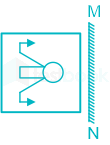
Select the correct mirror image of the given figure when the mirror is placed at MN as shown.

  1. AOption (a)

  2. BOption (b)

  3. COption (c)

  4. DOption (d)

View answer & explanation

Correct answer

Answer: (b)B.

Why this answer is correct

The correct mirror image of the given figure is:

Hence, the correct answer is "Option 2".

Question 10

In a certain code language, 'like the way' is written as 'pl zs kq' and 'on my way' is written as 'kq mk In'. How is 'way' written in the given language? 

  1. AOption (a)

    zs

  2. BOption (b)

    kq

  3. COption (c)

    pl

  4. DOption (d)

    In

View answer & explanation

Correct answer

Answer: (b)B.

kq

Why this answer is correct

The logic followed here is:

‘like the way' is written as 'pl zs kq' 

'on my way' is written as 'kq mk In’,

So, 'way' will be written as 'kq'. 

Hence, the correct answer is "Option 2".

Question 11

What will come in place of the question mark (?) in the following equation if '+' and '-' are interchanged and '×' and '÷' are interchanged?

11 ÷ 4 + 8 × 2 - 1 = ?

  1. AOption (a)

    41

  2. BOption (b)

    40

  3. COption (c)

    39  

  4. DOption (d)

    43

View answer & explanation

Correct answer

Answer: (a)A.

41

Why this answer is correct

BODMAS Table: 

Given equation: 11 ÷ 4 + 8 × 2 - 1 = ?

Now, if ‘+’ and ‘-‘ and ‘×' and '÷’ are interchanged, then:

⇒ 11 × 4 - 8 ÷ 2 + 1 = ?

⇒ 11 × 4 - 4 + 1 = ?

⇒ 44 - 4 + 1 = ?

⇒ 45 - 4 = 41.

Hence, the correct answer is "Option 1".

Question 12

In a certain code language, LRUP is written as RXAV and CILG is written as IORM. How will HNQL be written in that language? 

  1. AOption (a)

    MSVP

  2. BOption (b)

    NTWR

  3. COption (c)

    NSVR

  4. DOption (d)

    NTVR

View answer & explanation

Correct answer

Answer: (b)B.

NTWR

Why this answer is correct

The logic followed here is:

For, ‘LRUP is written as RXAV’,

For, 'CILG is written as IORM',

Similarly, for 'HNQL'

So, 'HNQL' will be written as 'NTWR'.

Hence, the correct answer is "Option 2".

Question 13

Select the set in which the numbers are related in the same way as are the numbers of the following sets.

(NOTE: Operations should be performed on the whole numbers, without breaking down the numbers into its constituent digits. E.g. 13 - Operations on 13 such as adding/ subtracting/multiplying etc. to 13 can be performed. Breaking down 13 into 1 and 3 and then performing mathematical operations on 1 and 3 is not allowed.)

13 - 15 - 7 and 9 - 11 - 5

  1. AOption (a)

    16 - 24 - 10

  2. BOption (b)

    15 - 18 - 9

  3. COption (c)

    26 - 37 - 15

  4. DOption (d)

    22 - 45 - 21

View answer & explanation

Correct answer

Answer: (a)A.

16 - 24 - 10

Why this answer is correct

The logic followed here is:

Logic: (1st number + 2nd number) ÷ 4 = 3rd number.

Given,

13 - 15 - 7

⇒ (13 + 15) ÷ 4

⇒  28 ÷ 4 = 7.

And, 9 - 11 - 5

⇒ (9 + 11) ÷ 4

⇒  20 ÷ 4 = 5.

Similarly, Option 1) 16 - 24 - 10

⇒ (16 + 24) ÷ 4

⇒  40 ÷ 4 = 10.

 Hence, the correct option is "Option 1".

Question 14

Identify the figure given in the options which when put in place of ? will logically complete the series.

  1. AOption (a)

  2. BOption (b)

  3. COption (c)

  4. DOption (d)

View answer & explanation

Correct answer

Answer: (b)B.

Why this answer is correct

The logic followed here is:

Logic: The 'curve' part of the image is getting increase one place to the next images.

So, option 2 will complete the series.

Hence, the correct answer is "Option 2".

Question 15

Based on the alphabetical order, three of the following four letter-clusters are alike in a certain way and thus form a group. Which of the following does NOT belong to that group? 

  1. AOption (a)

    SUT

  2. BOption (b)

    DGE

  3. COption (c)

    WYX

  4. DOption (d)

    FHG

View answer & explanation

Correct answer

Answer: (b)B.

DGE

Why this answer is correct

The logic followed here is:

Option 1) SUT

Option 2) DGE

Option 3) WYX

Option 4) FHG

Here, 'DGE' is odd among the given options.

Hence, the correct answer is "Option 2".

Question 16

Select the option that is related to the fifth term in the same way as the second term is related to the first term and fourth term is related to third term.

20 ∶ 1200 ∶∶ 28 ∶ 2352 ∶∶ 50 ∶ ?

  1. AOption (a)

    7250

  2. BOption (b)

    7500

  3. COption (c)

    7000

  4. DOption (d)

    7550

View answer & explanation

Correct answer

Answer: (b)B.

7500

Why this answer is correct

The logic followed here is:

Logic: (1st number)2 × 3 = 2nd number.

20 ∶ 1200

⇒ (20)2 × 3 

⇒ 400 × 3 = 1200.

28 ∶ 2352

⇒ (28)2 × 3 

⇒ 784 × 3 = 2352.

Similarly, for 50 ∶ ?  

⇒ (50)2 × 3 

⇒ 2500 × 3 = 7500.

Hence, the correct option is "Option 2"

Question 17

Which of the following four options will replace the question mark (?) in the following series?

9, 45, ?, 540, 1080

  1. AOption (a)

    180

  2. BOption (b)

    240

  3. COption (c)

    300

  4. DOption (d)

    360

View answer & explanation

Correct answer

Answer: (a)A.

180

Why this answer is correct

The logic followed here is:

thus, "180" will replace the question mark in the given series.

Hence, the correct option is "Option 1".

Question 18

In a certain code language,

A + B means 'A is the husband of B'

A - B means 'A is the mother of B'

A × B means 'A is the sister of B'

A ÷ B means 'A is the brother of B'

Based on the above, how is S related to W if 'S × T + U - V ÷ W'?

  1. AOption (a)

    Father's sister

  2. BOption (b)

    Mother's sister

  3. COption (c)

    Brother's wife

  4. DOption (d)

    Sister

View answer & explanation

Correct answer

Answer: (a)A.

Father's sister

Why this answer is correct

Family Chart:

Decoding the Symbols:

Symbol+-×÷
MeaningHusbandMotherSisterBrother


Given: S × T + U - V ÷ W

It means: S is the Sister of T, T is the Husband of U, U is the Mother of V, V is the Brother of W.

So, S is the 'Father's sister' of W.

Hence, the correct answer is "Option 1".

Question 19

10 is related to 17 following a certain logic. Following the same logic, 50 is related to 65. To which of the following is 26 related following the same logic?

  1. AOption (a)

    39

  2. BOption (b)

    37

  3. COption (c)

    38

  4. DOption (d)

    35

View answer & explanation

Correct answer

Answer: (b)B.

37

Why this answer is correct

The logic followed here is:

Logic: 1st number - 1 = n2

2nd number - 1 = (n + 1)2 

10 is related to 17

⇒ 10 - 1 = 9 → 32 

⇒ 17 - 1 = 16 → 42 

50 is related to 65

⇒ 50 - 1 = 49 → 72 

⇒ 65 - 1 = 64 → 82 

Similarly, 26 is related to

⇒ 26 - 1 = 25 → 52 

⇒ 37 - 1 = 36 → 62 

So, 26 will be related to 37.

Hence, the correct option is "Option 2"

Question 20

Read the given statements and conclusions carefully. You have to take the given statements to be true even if they seem to be at variance from commonly known facts. You have to decide which conclusion/s logically and definitely follow/s from the given statements.

Statements:

All Eagles are Predators.

All Tigers are Predators.

Some Tigers are Cats.

Conclusions:

(I) All Cats are Predators.

(II) All Eagles are Tigers.

  1. AOption (a)

    Both conclusions (I) and (II) do not follow.

  2. BOption (b)

    Only conclusion (I) follows.

  3. COption (c)

    Only conclusion (II) follows.

  4. DOption (d)

    Both conclusions (I) and (II) follow.

View answer & explanation

Correct answer

Answer: (a)A.

Both conclusions (I) and (II) do not follow.

Why this answer is correct

Given Statements:

All Eagles are Predators.

All Tigers are Predators.

Some Tigers are Cats.

The least possible Venn diagram for the given statement is:


Conclusions:

I. All Cats are Predators - False (Because, only those part of cat which is tigers will predators, but All Cats are Predators can be possible only).

II. All Eagles are Tigers - False (Because, No definite relation given between eagles and tigers, so All Eagles are Tigers can be possible only).

So, Both conclusions (I) and (II) do not follow.

Hence, the correct answer is "Option 1".

Question 21

How many rectangles are there in the given figure? 

  1. AOption (a)

    9

  2. BOption (b)

    11

  3. COption (c)

    12

  4. DOption (d)

    10

View answer & explanation

Correct answer

Answer: (b)B.

11

Why this answer is correct

The Rectangles are:

So, there are '11' Rectangles in the given figure.

Hence, the correct answer is "Option 2".

Question 22

Three of the following four are alike in a certain way and thus form a group. Which is the one that does NOT belong to that group?

(1) 7 - 19

(2) 11 - 30

(3) 14 - 39

(4) 17 - 48

  1. AOption (a)

    3

  2. BOption (b)

    2

  3. COption (c)

    1

  4. DOption (d)

    4

View answer & explanation

Correct answer

Answer: (c)C.

1

Why this answer is correct

The logic followed here is:

Logic: **(**1st number × 3) - 3 = 2nd number

Now,

1) 7 - 19

→ (7 × 3) - 3 

→ 21 - 3 = 18  ≠ 19.

  1. 11 - 30

→ (11 × 3) - 3 

→ 33 - 3 = 30.

  1. 14 - 39

→ (14 × 3) - 3 

→ 42 - 3 = 39.

  1. 17 - 48

→ (17 × 3) - 3 

→ 51 - 3 = 48.

So, odd number pair is '7 - 19'.

Hence, the correct option is "Option 3".

Question 23

Select the term from among the given options that can replace the question mark (?) in the following series based on the English alphabetical order.

GEF, JHI, MKL, PNO, ?

  1. AOption (a)

    TRS

  2. BOption (b)

    SQR

  3. COption (c)

    QRS

  4. DOption (d)

    QRT

View answer & explanation

Correct answer

Answer: (b)B.

SQR

Why this answer is correct

The logic followed here is:

So, 'SQR' will replace the question mark in the given series.

Hence, the correct answer is "Option 2".

Question 24

In a certain code language,

A + B means 'A is the daughter of B',

A - B means 'A is the husband of B',

A × B means 'A is the brother of B' and

A ÷ B means 'A is the father of B'.

Based on the above, how is P related to G if 'V ÷ P - F + G × C' ?

  1. AOption (a)

    Brother's son

  2. BOption (b)

    Wife's brother

  3. COption (c)

    Daughter's husband

  4. DOption (d)

    Daughter's brother

View answer & explanation

Correct answer

Answer: (c)C.

Daughter's husband

Why this answer is correct

Family Chart:

Decoding the Symbols:

Symbol+-×÷
MeaningDaughterHusbandBrotherFather


Given: V ÷ P - F + G × C

It means: V is the Father of P, P is the Husband of F, F is the Daughter of G, G is the Brother of C.

So, P is the 'Daughter's husband' of G.

Hence, the correct answer is "Option 3".

Question 25

In a certain code language, 'stars moon sun satellite planet' is written as 'pit rit kit sit nit', 'moon mars venus mercury' is written as 'mit cit git sit', 'venus stars mercury' is written as 'cit git rit' and 'mercury satellite planet' is written as 'pit cit nit'. How is 'sun' coded in that language?

  1. AOption (a)

    kit

  2. BOption (b)

    rit

  3. COption (c)

    nit

  4. DOption (d)

    pit

View answer & explanation

Correct answer

Answer: (a)A.

kit

Why this answer is correct

The logic followed here is:

‘stars moon sun satellite planet' is written as 'pit rit kit sit nit' 

'moon mars venus mercury' is written as 'mit cit git sit’

'venus stars mercury' is written as 'cit git rit'

'mercury satellite planet' is written as 'pit cit nit'

So, 'sun' will be written as 'kit'. 

Hence, the correct answer is "Option 1".

General Intelligence (25 questions)

Question 26

In 2022, Former Supreme Court Justice ___________ was appointed chairperson of the New Delhi International Arbitration Centre (NDIAC) .

  1. AOption (a)

    Sanjay Kishan Kaul 

  2. BOption (b)

    Hemant Gupta

  3. COption (c)

    Pankaj Mithal

  4. DOption (d)

    Ajay Rastogi

View answer & explanation

Correct answer

Answer: (b)B.

Hemant Gupta

Why this answer is correct

The correct answer is Hemant Gupta.

Key Points

  • In 2022, former Supreme Court judge Hemant Gupta has been appointed as the chairperson of the New Delhi International Arbitration Centre (NDIAC).
  • The Appointments Committee of the Cabinet has approved the appointment of Justice Hemant Gupta (retired) as NDIAC chairperson and that of Ganesh Chandru and Anant Vijay Palli as its part-time members.
  • Justice Gupta, who left the position on October 14, 2022, was a member of the bench that rendered a divided decision in a number of cases contesting the Karnataka High Court's decision from March 15 to uphold the state's prohibition on the hijab in educational institutions.
  • The petitions against the high court ruling upholding the prohibition on the headscarf had been dismissed by Justice Gupta.
  • He was elevated as a top court judge on **November 2, 2018.**​

Additional Information

  • New Delhi International Arbitration Centre (NDIAC):
  • The New Delhi International Arbitration Centre (NDIAC), which replaced the International Centre for Alternative Dispute Resolution (ICADR), is a self-governing organization situated in New Delhi that carries out conciliation, mediation, and arbitration procedures.
  • It was renamed, the India International Arbitration Centre in 2022.
  • It was founded in 2019 and designated by a parliamentary act as an Institute of National Importance.
  • Composition:
  • The NDIAC consists of seven members, including:
  • (i) a Chairperson who may be a Judge of the Supreme Court or a High Court, or an eminent person with special knowledge and experience in the conduct or administration of arbitration;
  • (ii) two eminent persons having substantial knowledge and experience in institutional arbitration;
  • (iii) three ex-officio members, including a nominee from the Ministry of Finance and a Chief Executive Officer (responsible for the day-to-day administration of the NDIAC); and
  • (iv) a representative from a recognised body of commerce and industry, appointed as a part-time member, on a rotational basis.

Question 27

Which of the following was the last invasion by Mahmud Ghazni outside Punjab?

  1. AOption (a)

    Somnath

  2. BOption (b)

    Mathura

  3. COption (c)

    Kalinjar

  4. DOption (d)

    Kanauj

View answer & explanation

Correct answer

Answer: (a)A.

Somnath

Why this answer is correct

The correct answer is Somnath.

Key Points

  • Somnath was the last invasion by Mahmud Ghazni outside Punjab.
  • The Turkish invader Mahmud Ghazni, attacked and raided the temple of Somnath in 1025 AD.
  • Mahmud of Ghazni:
  • He, also known as Sultan Mahmud, ruled the Ghaznavid Empire from 998 to 1030 AD.
  • He was the son of Sebüktigin, the founder of the Ghaznavid dynasty, and ascended the throne in 998 AD at the age of 27.
  • Mahmud Ghazni did raid Mathura in 1018 AD, the city which falls within the historical region of Doab, located between the Ganges and Yamuna rivers.
  • Kalinjar was conquered in 1023 AD, and Kanauj fell to Mahmud Ghazni in 1021 AD.

Additional Information

  • Somnath temple: 
  • The first of India's twelve sacred jyotirlingas is said to have arisen at the elaborately carved honey-colored Somnath temple or Deo Patan, located in Prabhas Patan, Veraval in Gujarat, India.
  • It is said that Shiva manifested there as a blazing column of light.
  • The temples are situated where the Sarasvati, Hiran, and Kapila rivers converge, and the shoreline where they are built is touched by the ebb and flow of the Arabian Sea.
  • Although the timeline of the ancient temple starts in 649 BC, it is thought to be older.
  • Though it's difficult to see them through the foggy glass, vibrant dioramas depicting the Shiva narrative border the north side of the temple grounds.
  • The temple was reconstructed several times in the past after repeated destruction by multiple Muslim invaders and rulers, notably starting with an attack by Mahmud Ghazni in the 11th century.
  • The Pran-Pratistha at the existing temple was done on May 11, 1951, by the then President of India, Dr. Rajendra Prasad.

Question 28

In which year did India win its first Hockey World Cup for Men's? 

  1. AOption (a)

    1971

  2. BOption (b)

    1979

  3. COption (c)

    1975

  4. DOption (d)

    1983

View answer & explanation

Correct answer

Answer: (c)C.

1975

Why this answer is correct

The correct answer is 1975.

Key Points

  • India won its first Hockey World Cup for Men's in 1975, defeating arch-rivals Pakistan in the final held in Kuala Lumpur, Malaysia.
  • 1975 Men's Hockey World Cup:
  • The men's field hockey competition held annually at the Hockey World Cup was in its third iteration in 1975.
  • Malaysia's Kuala Lumpur hosted the event.
  • India won the match against Pakistan with a 2-1 goal differential.
  • Ashok Kumar scored the game-winning goal after Surjit Singh had scored the first important goal.
  • For both countries, it was their second World Cup final participation; India finished second in the 1973 tournament while Pakistan won the first World Cup in 1971.
  • For third place, Germany defeated the hosts, Malaysia, 4-0 on goal differential.

Additional Information

  • Men's Hockey World Cup:
  • The International Hockey Federation (FIH) is the organization that oversees the Men's FIH Hockey World Cup, an international field hockey championship.
  • The competition got underway in 1971.
  • Every four years, it serves as a bridge event between the Summer Olympics every four years.
  • With four tournament victories, Pakistan is the most successful squad.
  • Germany, Australia, and the Netherlands have each taken home three championships.
  • The competition has been won once each by Belgium and India.
  • The 2023 competition took place in Bhubaneswar, India, between January 13 and 29.
  • Germany won their third World Cup title, defeating Belgium 5–4 in a penalty shootout after the game finished in a 3–3 draw.
  • In 2018, the World Cup was extended to sixteen teams.

Question 29

Which colour of light from VIBGYOR has minimum wavelength? 

  1. AOption (a)

    Violet

  2. BOption (b)

    Yellow

  3. COption (c)

    Green

  4. DOption (d)

    Red

View answer & explanation

Correct answer

Answer: (a)A.

Violet

Why this answer is correct

The correct answer is Violet.

Key Points

  • White light is split into seven colors when passing through a triangular prism.
  • The colors that are visible to the human eye are Red, Orange, Yellow, Green, Blue, Indigo, and Violet.
  • These colors are commonly remembered using the acronym VIBGYOR.
  • Typically, the human eye can detect wavelengths from 380 to 700 nanometers.
  • Violet has the minimum wavelength among all, and it deflects the most when passed through a prism.
  • Shorter wavelengths correspond to higher frequencies and higher energy in the visible spectrum.
  • The wavelength of the colour components of white light:
  • | Colour | Wavelength (in nanometers (nm)) | | --- | --- | | Violet | 380-450 | | Indigo | 450-480 | | Blue | 480-500 | | Green | 500-570 | | Yellow | 570-590 | | Orange | 590-620 | | Red | 620-750 |

Additional Information

  • In the 1660s, English physicist and mathematician Isaac Newton began a series of experiments with sunlight and prisms.
  • He demonstrated that clear white light was composed of seven visible colors.
  • One of the greatest scientific books ever written, Opticks, details Newton's findings from his experiments using prisms to bend light.
  • The phenomenon of splitting light into its constituent colors is called dispersion.​
  • The bending of light as it moves from one transparent substance into another is known as refraction.
  • The bending caused by refraction allows us to create rainbows, prisms, magnifying glasses, and lenses.
  • Our eyes are dependent on this light bending as well.

Question 30

Which of these regions received the first wave of the Green Revolution package? 

  1. AOption (a)

    Punjab

  2. BOption (b)

    Kerala

  3. COption (c)

    Western Gujarat

  4. DOption (d)

    Coastal Maharashtra

View answer & explanation

Correct answer

Answer: (a)A.

Punjab

Why this answer is correct

The correct answer is Punjab.

Key Points

  • The first wave of the Green Revolution package was received by more prosperous states of Haryana, Punjab, Andhra Pradesh, Tamil Nadu and Western Uttar Pradesh.
  • The Green Revolution in India:
  • The Green Revolution, which refers to the large-scale introduction of high-yielding varieties of seeds, fertilizers, and pesticides in agriculture, has been criticized for its negative impact on small farmers.
  • The Government of India launched the Green Revolution in 1965 under the Third Five-Year Plan(1961-66).
  • MS Swaminathan is considered the father of the Green Revolution in India.
  • Norman Borlaug is known as the 'Father of Green Revolution' in the world.
  • In India, the aim of this revolution was to increase the productivity of agricultural crops, particularly wheat and rice.
  • The main focused crops were Wheat, Rice, Jowar, Bajra and Maize.
  • In the first phase of the Green Revolution, the use of HYV seeds was limited to the more prosperous states of Haryana, Punjab, Andhra Pradesh, Tamil Nadu and Western Uttar Pradesh.
  • HYV seeds refer to high-yielding varieties of seeds that were developed during the Green Revolution to increase crop yields.
  • These are resistant to insects and diseases and have a high yield capacity.​

Additional Information

  • The Green Revolution was a period of agricultural transformation that took place in the 1960s and 1970s in India.
  • The goal of the Green Revolution was to increase agricultural productivity and food security by introducing high-yielding crop varieties (HYV seeds), modern irrigation systems, and chemical fertilizers and pesticides.
  • It was a significant success in India, as it helped to increase agricultural output (especially wheat and rice) and reduce food shortages.
  • However, it also had some negative impacts, such as environmental degradation, soil erosion, and the loss of traditional farming practices.

Question 31

Which of the following initiatives of the Government of India is aimed at developing and rejuvenating 75 water bodies in each district of the country as a part of the celebration of Azadi ka Amrit Mahotsav?

  1. AOption (a)

    Mission Amrit Clean Water

  2. BOption (b)

    Mission Amrit Water

  3. COption (c)

    Mission Amrit Sarovar

  4. DOption (d)

    Mission Amrit District

View answer & explanation

Correct answer

Answer: (c)C.

Mission Amrit Sarovar

Why this answer is correct

The correct answer is Mission Amrit Sarovar.

Key Points

  • The Government of India initiated Mission Amrit Sarovar, aimed at developing and rejuvenating 75 water bodies in each district of the country, as a part of the celebration of Azadi ka Amrit Mahotsav.
  • The Prime Minister of India, Mr. Modi, has launched it on April 24, 2022.
  • The mission is actively carried out by eight Central ministries and departments: the Department of Rural Development, the Department of Land Resources, the Department of Drinking Water and Sanitation, the Department of Water Resources, the Ministry of Panchayati Raj, the Ministry of Forest, the Ministry of Environment and Climate Changes, the Ministry of Railway, and the Ministry of Road, Transport & Highways.
  • It has enlisted the Bhaskaracharya National Institute for Space Application and Geo-informatics (BISAG-N) as a technical partner.

Additional Information

  • Azadi Ka Amrit Mahotsav (AZAM):
  • It is an initiative of the Government of India to celebrate and commemorate 75 years of independence and the glorious history of its people, culture and achievements.
  • It commenced on March 12, 2021, which started a 75-week countdown to our 75th anniversary of independence and ended on August 15, 2023.
  • The Mahotsav is being celebrated on the basis of its 5 pillars:
  1. Struggle for independence,
  2. Ideas of 75 years,
  3. Achievements of 75 years,
  4. Actions of 75 years and
  5. Resolutions of 75 years.

Question 32

What was the prevalence of self-reported goitre or thyroid disorder in the National Family Health Survey [NFHS - V (2019 - 2021)]? 

  1. AOption (a)

    2.9%

  2. BOption (b)

    3.4%

  3. COption (c)

    4.2%

  4. DOption (d)

    2.1%

View answer & explanation

Correct answer

Answer: (a)A.

2.9%

Why this answer is correct

The correct answer is 2.9%.

Key Points

  • The prevalence of self-reported goitre or thyroid disorder in the National Family Health Survey V {NFHS-V (2019-2021)} was 2.9%.
  • While in NFHS IV (2015-2016), it was 2.2%.
  • It is believed that iodine supplementation can cause a spurt in autoimmune thyroid dysfunction and hypothyroidism by making the thyroid gland more susceptible to damage by the body’s own immune system.

Additional Information

  • The NFHS (National Family Health Survey) is a multi-round, extensive survey that is carried out in a representative sample of Indian households.
  • The International Institute for Population Sciences (IIPS) in Mumbai has been tasked by the Ministry of Health and Family Welfare (MoHFW) as the focal institution for coordinating and providing technical guidance for the survey.
  • The survey provides state and national data for India on : Fertility, Infant and child mortality, The practice of family planning, Maternal and child health, Reproductive health, Nutrition, Anaemia, Utilization and quality of health and family planning services.
  • The first NFHS-1 was conducted in 1992-93.
  • NFHS-5 captured the data during 2019-21 and was conducted in 2 phases.
  • It includes some new topics, such as preschool education, disability, access to a toilet facility, death registration, bathing practices during menstruation, and methods and reasons for abortion.
  • Key findings of National Family Health Survey (NFHS)-V (2019-21):
  • According to NFHS-5 data, the country's sex ratio in India in 2019–2021 was 1,020 women for every 1000 men.
  • Total Fertility Rate (TFR) was 2 in 2019-2021, just below the replacement fertility rate of 2.1.
  • Just five states in India have fertility levels over the replacement threshold of 2.1: Bihar (2.98), Meghalaya (2.91), Uttar Pradesh (2.35), Jharkhand (2.26) and Manipur (2.17).
  • Total Fertility Rate (TFR) shows the expected number of children that a woman can have between the ages of 15 and 49 throughout her reproductive years.
  • Child nutrition statistics indicate a little improvement across the board in India, with stunting falling from 38% to 36%, wasting from 21% to 19%, and underweight falling from 36% to 32%.
  • At the national level, the percentage of institutional births has significantly grown from 79% to 89%.
  • The percentage of children under six months old who receive exclusive breastfeeding improved across India from 55% in 2015-16 to 64% in 2019-21.

Question 33

Which of these is a conventional weaker section lending under formal sector? 

  1. AOption (a)

    Money lenders

  2. BOption (b)

    Self help group bank linkage model

  3. COption (c)

    Micro finance institutions

  4. DOption (d)

    Commercial banks priority sector lending

View answer & explanation

Correct answer

Answer: (d)D.

Commercial banks priority sector lending

Why this answer is correct

The correct answer is Commercial banks priority sector lending.

Key Points

  • Commercial banks priority sector lending (PSL):
  • This refers to mandatory lending requirements imposed by regulatory authorities like the Reserve Bank of India (RBI) on commercial banks.
  • These banks must allocate a specific portion of their loans to specific categories considered "weaker sections," including small and marginal farmers, micro and small enterprises, and weaker sections of society like scheduled castes and scheduled tribes.
  • This makes it the most conventional and widespread form of formal sector lending reaching these groups.
  • Rather of financing only successful industries or locations that are crucial to economic growth, the aim of a PSL project is to give credit to the less fortunate segments of society.
  • Financial assistance is readily available to all key sectors, allowing them to apply for loans that banks are obligated to provide at a reduced interest rate.

Additional Information

  • Money lenders: Traditionally, money lenders operate outside the formal financial system, often charging high interest rates and lacking transparency.
  • While they reach some weaker sections, they are not considered formal sector lending.
  • Self-help group (SHG) bank linkage model: This model connects self-help groups formed by underprivileged individuals with banks, facilitating access to formal credit.
  • Microfinance institutions (MFIs): Although MFIs cater to low-income populations, they are specialized institutions separate from the mainstream banking system.

Question 34

The net worth of any bank is equal to ___________. 

  1. AOption (a)

    liabilities - assets

  2. BOption (b)

    assets (reserves + loans) - liabilities

  3. COption (c)

    interest + liabilities

  4. DOption (d)

    (reserves + loans) + liabilities

View answer & explanation

Correct answer

Answer: (b)B.

assets (reserves + loans) - liabilities

Why this answer is correct

The correct answer is assets (reserves + loans) - liabilities.

Key Points

  • To determine a bank's net worth, you subtract its liabilities from its assets.
  • i.e. Total assets minus total liabilities.
  • Assets: Everything the bank owns (loans, cash, investments, buildings, etc.)
  • Liabilities: Everything the bank owes (customer deposits, loans payable, etc.)
  • Net worth: The difference between assets and liabilities (what the bank truly owns after accounting for all its debts)

Additional Information

  • Reserve Bank of India (RBI) is India’s central bank.
  • In compliance with the terms of the Reserve Bank of India Act, 1934, it was founded on April 1, 1935 in Calcutta.
  • It was permanently moved to Mumbai in 1937.
  • Though originally privately owned, since nationalisation in 1949, the Reserve Bank is fully owned by the Government of India.
  • As a qualitative instrument of monetary policy, the Reserve Bank of India (RBI) employs moral suasion.
  • It regulates the issue of Bank notes and keeping of reserves with a view to securing monetary stability in India and generally to operate the currency and credit system of the country to its advantage.
  • It also monitors the monetary policies through its Monetary Policy Committee (MPC).

Question 35

Who among the following personalities is a Sarod Maestro?

  1. AOption (a)

    Ustad Bismillah Khan

  2. BOption (b)

    Ustad Zakir Hussain

  3. COption (c)

    Hariprasad Chaurasia

  4. DOption (d)

    Ustad Amjad Ali Khan

View answer & explanation

Correct answer

Answer: (d)D.

Ustad Amjad Ali Khan

Why this answer is correct

The correct answer is Ustad Amjad Ali Khan.

Key Points

  • Ustad Amjad Ali Khan:
  • He is a traditional Indian sarod player best recognized for his quick and fluid ekhara taans.
  • Khan has been performing all around the world since the 1960s and was raised in a classical music family.
  • He received the Padma Vibhushan, India's second-highest civilian medal, in 2001; the Padma Bhushan, India's third-highest civilian honor, in 1991; and the Padma Shree in 1975.

Additional Information

  • Ustad Bismillah Khan was an Indian musician credited with popularizing the shehnai, a reeded woodwind instrument.
  • Ustad Zakir Hussain is a globally renowned Tabla player.
  • Hariprasad Chaurasia is a celebrated Bansuri player.
  • ​Some other famous instrumentalists:
InstrumentFamous instrumentalist of India
Flute MusiciansHariprasad Chaurasia
Santoor MusiciansPt. Shiv Kumar Sharma
TablaUstad Zakir Hussain
Sarod MusiciansAmjad Ali Khan
Shehnai MusiciansBismillah Khan
Sitar MusiciansPandit Ravi Shankar
Sarangi MusiciansPt. Ram Narayan
Rudra VeenaUstad Asad Ali Khan
MridangamRamnad V. Raghavan
GhatamT. H. Vinayakram

Question 36

Which of the following metal salts is responsible for permanent hardness in water? 

  1. AOption (a)

    KCI

  2. BOption (b)

    NaCl

  3. COption (c)

    Ca(HCO3)2

  4. DOption (d)

    CaCl2

View answer & explanation

Correct answer

Answer: (d)D.

CaCl2

Why this answer is correct

The correct answer is CaCl2

Key Points

  • CaCl2 (calcium chloride) is responsible for permanent hardness in water.
  • Hard water has a high mineral content.
  • It is formed when water percolates through the deposits of chalk and limestone, which are made up of magnesium and calcium carbonates.
  • It does not lather with soap, so it is not suitable for laundry purposes.
  • It can damage boilers because it causes salt to build and lowers the boiler's performance.
  • Although hard water is safe to drink, consuming it frequently can cause a number of issues, including:
  • skin strain
  • Water appliances have to work harder, which raises the cost of water.
  • Spots show up on linens and clothing.

Additional Information

  • There are two categories of water hardness:
  • 1. Temporary Hardness of Water:
  • Water becomes momentarily hard due to the carbonates of calcium and magnesium present.
  • In this instance, boiling the water will eliminate the hardness.
  • The soluble salts of Mg(HCO3)2 are changed into the insoluble Mg(OH)2 when water is boiled; this precipitates and is eliminated.
  • We obtain soft water as a result of filtration.
    1. Permanent Hardness of Water:
  • The presence of soluble compounds of calcium and magnesium in water in the form of chlorides and sulfides is referred to as permanent hardness because boiling cannot eliminate this hardness.
  • By using washing soda to treat the water, we may get rid of this hardness.
  • When washing soda combines with the calcium and magnesium sulfide and chloride salts, insoluble carbonates are created, turning hard water into soft water.

Question 37

Who among the following personalities coined the term 'Odissi' for Odisha's classical dance? 

  1. AOption (a)

    Kabichandra Kalicharan Patnaik

  2. BOption (b)

    Kelucharan Mohapatra

  3. COption (c)

    Raja Rammohan Roy

  4. DOption (d)

    Rabindranath Tagore

View answer & explanation

Correct answer

Answer: (a)A.

Kabichandra Kalicharan Patnaik

Why this answer is correct

The correct answer is Kabichandra Kalicharan Patnaik.

Key Points

  • Odisha's classical dance style was named "Odissi" by Oriya poet, dramatist, and researcher Kavichandra Kalicharan Pattanayak.
  • Kavichandra Kalicharan Pattanayak:
  • He, was often called Kabichandra, was a renowned Odishan writer and artist.
  • He made contributions to the fields of Odissi theater, dance, and music.
  • Additionally, he made a substantial contribution to the early development of the Odia film.
  • On December 23, 1898, he was born in Badamba, a princely kingdom at the time.
  • The Odissi music and dance community frequently performs his pieces in a variety of traditional ragas.

Additional Information

  • Raja Ram Mohan Roy:
  • ​In Radhanagar, Bengal, on May 22, 1772, Raja Ram Mohan Roy was born into an orthodox Brahman household.
  • He is regarded as the "Father of Modern India" and ‘Father of Indian Renaissance’.
  • In Patna, he studied Persian and Arabic in his early schooling. There, he read the Quran, the writings of Sufi mystic poets, and the Arabic translations of Plato and Aristotle.
  • He read the Vedas and Upnishads and studied Sanskrit in Benaras.
  • When he was sixteen, he penned a logical criticism of Hindu idolatry after returning to his village.
  • He served as Woodforde's and Digby's personal diwan for the East India Company from 1803 until 1814.
  • He left his position in 1814 and relocated to Calcutta to dedicate his life to religious, social, and political reforms.
  • He founded the Atmiya Sabha in 1815, the Calcutta Unitarian Association in 1821, and the Brahmo Sabha in 1828 which later became the Brahmo Samaj.
  • Rabindranath Tagore:
  • Bengali polymath Rabindranath Tagore (7 May 1861 – 7 August 1941) was involved in the Bengal Renaissance.
  • He was a poet, novelist, playwright, composer, philosopher, social reformer, educator, and painter.
  • Using Contextual Modernism in the late 19th and early 20th centuries, he transformed Indian art and music as well as Bengali literature.
  • In 1913, he became the first non-European and the first lyricist to win the Nobel Prize in Literature.
  • He was awarded the Nobel Prize for Literature in recognition of his work Geetanjali.
  • In the 1915, King George V bestowed upon Tagore a knighthood, which he later renounced following the 1919 Jallianwala Bagh massacre.
  • While Tagore's graceful prose and enchanted poetry were immensely well-liked throughout the Indian subcontinent, his poetic songs were perceived as mystical and mercurial.
  • He was a fellow of the Royal Asiatic Society.
  • Tagore was referred as "the Bard of Bengal" and went by the monikers Gurudeb, Kobiguru, and Biswokobi.
  • Geetanjali, Sadhana, Ghare-Baire, Gora and Rabindra Sangeet are among his important works.
  • His works, "Jana Gana Mana" in India and "Amar Shonar Bangla" in Bangladesh, were selected as national anthems by two countries. West Bengal has made "Banglar Mati Banglar Jol" into its official state anthem.
  • In 1901 he founded the famous Shantiniketan which later came to be known as Vishwabharati University.

Question 38

Deepavali is celebrated in which month of Hindu calendar? 

  1. AOption (a)

    Magha

  2. BOption (b)

    Chaitra

  3. COption (c)

    Ashwin

  4. DOption (d)

    Kartika

View answer & explanation

Correct answer

Answer: (d)D.

Kartika

Why this answer is correct

The correct answer is Kartika.

Key Points

  • Kartik (October-November):
  • The Hindu calendar's eighth month, Kartik, is linked to the celebration of Deepavali (Diwali), the festival of lights.
  • The month is also linked to the observance of Karva Chauth, a festival honoring the marriage union of husband and wife.
  • It is also linked with festival of Bhai Dooj.​

Additional Information

  • Chaitra (March-April): 
  • In the Hindu calendar, the first month is Chaitra and is highly fortunate.
  • Occurs in March or April on the Gregorian calendar.
  • The Hindu New Year, known in Maharashtra as Gudi Padwa, in Andhra Pradesh and Telangana as Ugadi, and in other parts of India as Chaitra Navratri, ushers in the month.
  • The month is linked to fresh starts, development, and wealth as well as the start of the spring season.
  • Ashwin (September-October): 
  • According to the Hindu calendar, Ashwin, the seventh month, is connected to the celebration of Navratri, a holiday honoring the divine feminine force.
  • Additionally, the month is linked to the celebration of Dussehra, a festival honoring Lord Rama's victory over the demon king Ravana.

Question 39

According to Census of India 2011, which state in India has the highest population density? 

  1. AOption (a)

    Uttar Pradesh

  2. BOption (b)

    Bihar

  3. COption (c)

    West Bengal

  4. DOption (d)

    Kerala

View answer & explanation

Correct answer

Answer: (b)B.

Bihar

Why this answer is correct

The correct answer is Bihar.

Key Points

  • The highest population density (person per square kilometre), as per the 2011 Census, is in Bihar, with 1106
  • The population density of West Bengal is 1028, Kerala is 860, and Uttar Pradesh is 829.
  • The overall population density of India is 382.
  • Census of India 2011:
  • It started on April 1, 2010.
  • "Our Census, Our Future" was the 2011 census's slogan.
  • India's population, according to the 2011 Census, is estimated to be 1.21 billion.
  • The population density was 382 persons per square kilometer in 2011.
  • India's sex ratio, as per the 2011 census, is 940.
  • India's child sex ratio is 918, the lowest since the country's independence, as per Census 2011.
  • This marked the commencement of the 15th Census of India and the 7th Census of Independent India (2011).
  • The Indian Census Commissioner for 2011 was C. Chandramouli.
  • The 2011 India Census was carried out in two phases:
  • House listing and Housing Census (April to September 2010).
  • Population Enumeration (9th to 28 February 2011).

Additional Information

  • Population density is the number of people per unit of area, usually transcribed as "per square kilometer" or square mile.
  • The 1948 Census Act governs how the census is carried out.
  • The Indian Home Minister at the time, Sardar Vallabhbhai Patel, spearheaded the bill for this Act.
  • The Indian Constitution's Article 246 declares the population census to be a Union subject.
  • It is mentioned in the Seventh Schedule of the Constitution under serial number 69.
  • The Ministry of Home Affairs' Office of the Registrar General and Census Commissioner oversees the decennial census.
  • The first census of India was conducted by Lord Mayo in 1872.
  • The first official census was started by Lord Ripon in 1881.

Question 40

Which of the following features of the Indian Constitution is NOT borrowed from the Canadian constitution? 

  1. AOption (a)

    Advisory jurisdiction of supreme court

  2. BOption (b)

    Federation with strong centre

  3. COption (c)

    Concurrent list

  4. DOption (d)

    Appointment of state governor by the centre

View answer & explanation

Correct answer

Answer: (c)C.

Concurrent list

Why this answer is correct

The correct answer is Concurrent list.

Key Points

  • India's Constitution establishes a crucial framework that defines the nature of the political system, the authorities' responsibilities, and the people's basic rights and obligations to the nation.
  • The protection of peoples' fundamental rights is the primary goal of the constitution.
  • The Indian Constituent Assembly enacted the constitution on November 26, 1949 and became operative on January 26, 1950.
  • Some features of Indian constitution were borrowed from constitutions of different countries of the world.
  • Important provisions adopted from the Constitution of Canada:
  • Centrifugal form of federalism where the centre is stronger than the states.
  • Residuary powers vest with the centre
  • Centre appoints the Governors at the states
  • Advisory jurisdiction of the Supreme Court .
  • Concurrent list was adopted from Australian Constitution.

Additional Information

  • List of Borrowed Features of Indian Constitution:
Name of CountriesBorrowed Features of the Constitution
Britain1. Parliamentary government  2. Rule of Law  3. Legislative procedure  4. Single citizenship  5. Cabinet system  6. Prerogative writs  7. Parliamentary privileges  8. Bicameralism
Ireland1. Directive Principles of State Policy 2. Method of Election of the president 3. Members nomination to the Rajya Sabha by the President
United States of America1. Impeachment of the president 2. Functions of president and vicepresident 3. Removal of Supreme Court and High court judges 4. Fundamental Rights 5. Judicial review 6. Independence of judiciary 7. The preamble of the constitution
Canada1. Centrifugal form of federalism where the centre is stronger than the states. 2. Residuary powers vest with the centre 3. Centre appoints the Governors at the states 4. Advisory jurisdiction of the supreme court
Australia1. Concept of Concurrent list 2. Article 108 i.e. Joint sitting of the two houses 3. Freedom of trade and commerce
USSR (Now Russia)1. Fundamental duties 2. The ideals of justice (social, economic and political),  expressed in the Preamble.
France1. Concept of  “Republic” 2. Ideals of Liberty, Equality and Fraternity(contained in the Preamble)
Germany1. Fundamental Rights are suspended during Emergency
South Africa1. Election of members of the Rajya Sabha 2. Amendment of the Constitution
Japan1. Concept of “procedure established by Law”

Question 41

Which of the following is a kind of Xanthan? 

  1. AOption (a)

    Seed gum

  2. BOption (b)

    Seaweed gum

  3. COption (c)

    Microbial gum

  4. DOption (d)

    Exudate gum

View answer & explanation

Correct answer

Answer: (c)C.

Microbial gum

Why this answer is correct

The correct answer is Microbial gum.

Key Points

  • Xanthan gum is a microbial gum produced by the bacterium Xanthomonas campestris.
  • This polysaccharide finds numerous industrial applications, one of which is as a prevalent food additive.
  • It works well as a stabilizer and thickening agent to keep ingredients from separating.
  • It can be made through fermentation from simple sugars or carbohydrates.
  • It was first identified by US Department of Agriculture researcher Allene Rosalind Jeanes and her team, and in the early 1960s, CP Kelco commercialized it under the brand name Kelzan.

Additional Information

  • Seed gum: This type of gum is extracted from the seeds of various plants like guar beans and locust beans.
  • Examples include guar gum and tara gum.
  • Seaweed gum: This type of gum is extracted from different types of seaweeds.
  • Examples include agar-agar, alginate, and carrageenan.
  • Exudate gum: This type of gum is naturally exuded from trees and other plants as a protective measure.
  • Examples include gum arabic and gum tragacanth.

Question 42

The Muhammedan Literary Society founded in Calcutta in 1863 was founded by: 

  1. AOption (a)

    Nawab Abdul Latif

  2. BOption (b)

    Mirza Ghulam Ahmad

  3. COption (c)

    Sayyid Ahmad

  4. DOption (d)

    Syed Ahmad Khan

View answer & explanation

Correct answer

Answer: (a)A.

Nawab Abdul Latif

Why this answer is correct

The correct answer is Nawab Abdul Latif.

Key Points

  • Muhammedan Literary Society:

  • Muslim writers in British India formed the Mohammedan Literary Society.

  • It was founded in Calcutta in 1863 by Nawab Abdul Latif, and the Muslim Institute of Calcutta took its place in 1930.

  • Latif served as the society's secretary, and Mysore's Prince Mahomed Ruheemoodin served as president.

  • The society used Arabic, English, Persian, and Urdu languages.

  • Nawab Bahadur Qazi Abdul Latif:

  • He was a social worker, professor, and nobleman of Bengali Muslim descent.

  • In 1880, the British bestowed upon him the title Nawab.

  • He was among the first Muslims in India during the 1800s to accept modernity.

Additional Information

  • Sir Syed Ahmed Khan:
  • He was born into a wealthy, aristocratic family with intimate ties to the Mughal court in Delhi, the capital of the Mughal Empire.
  • He received instruction in both science and the Quran.
  • In his insightful pamphlet "Asbab-e-Baghawat-e-Hind" (Reasons for the Indian Revolt of 1857), he identified the main causes of the uprising as British ignorance and aggressive expansionist policies.
  • He supported interfaith harmony as well. In addition, he wrote a book titled "Commentary on the Holy Bible" and was a Christian scholar.
  • In order to further education, he founded a number of educational institutions, the most notable of which was the Muhammadan Anglo-Oriental College (MAOC), founded in 1875.
  • It subsequently evolved into the Aligarh Muslim University.
  • Mirza Ghulam Ahmad:
  • The Ahmadiyya Movement, which he founded, got its start in Punjab, British India, in 1889.
  • It was a movement of modern messianism.
  • It was established on liberal ideas, the belief that religion should be accessible to all people, opposition to jihad, etc.

Question 43

Which of the following states is the largest producer of jowar in India, as of 2020? 

  1. AOption (a)

    Telangana

  2. BOption (b)

    Karnataka

  3. COption (c)

    Andhra Pradesh

  4. DOption (d)

    Maharashtra

View answer & explanation

Correct answer

Answer: (d)D.

Maharashtra

Why this answer is correct

The correct answer is Maharastra.

Key Points

  • Maharastra is the top producer of jowar in India.
  • Jowar:
  • It is a crop that is mostly grown in moist areas and is rainfed; irrigation is rarely necessary.
  • In terms of both production and area, it ranks as the third-most significant food crop.
  • Rainfall: 30-100 cm of moderate rain.
  • Temperatures: high temperatures ranging from 20 to 32°C.
  • Vulnerability of Jowar: Both excessive moisture and prolonged drought are harmful.
  • Soil: Light soils with good drainage are ideal.
  • It is cultivated as the major food crop in semi-arid areas of central and south India.
  • In north India, Jowar is mainly a Kharif crop whereas it is sown as both Kharif and Rabi in the southern states.
  • Maharashtra, Karnataka, Andhra Pradesh, and Madhya Pradesh are the top producers.
  • India is the largest producer of jowar in the world.

Additional InformationList of major millet producing state as of 2024:

RankStateShare of total millet production (%)Major millet
1Rajasthan27Bajra
2Karnataka18Ragi
3Maharastra14Jowar
4Uttar Pradesh12Bajra

Question 44

The structural part of the Indian Constitution is, to a large extent, derived from the Act of ___________. 

  1. AOption (a)

    1909

  2. BOption (b)

    1935

  3. COption (c)

    1947

  4. DOption (d)

    1919

View answer & explanation

Correct answer

Answer: (b)B.

1935

Why this answer is correct

The correct answer is 1935.

Key Points

  • The structural part of the Indian Constitution is, to a large extent, derived from the Government of India Act, 1935.
  • Government of India Act, 1935:
  • There was a growing demand for constitutional reforms in India by Indian leaders.
  • India’s support to Britain in the First World War also aided in British acknowledgment of the need for the inclusion of more Indians in the administration of their own country.
  • The Act was based on
  • Simon Commission Report
  • The recommendations of the Round Table Conferences
  • The White Paper published by the British government in 1933 (based on the Third Round Table Conference)
  • Report of the Joint Select Committees.
  • Features of the Government of India Act 1935: 
  • It provided for the establishment of an All-India Federation consisting of provinces and princely states as units.
  • The Act divided the powers between the Centre and units in terms of three lists - Federal List (for Centre, with 59 items), Provincial List (for provinces, with 54 items) and the Concurrent List (for both, with 36 items).
  • Residuary powers were given to the Viceroy. However, the federation never came into being as the princely states did not join it.
  • It abolished dyarchy in the provinces and introduced ‘provincial autonomy’ in its place.
  • It provided for the establishment of a Reserve Bank of India to control the currency and credit of the country.
  • It provided for the establishment of not only a Federal Public Service Commission but also a Provincial Public Service Commission and Joint Public Service Commission for two or more provinces.
  • It provided for the establishment of a Federal Court.

Additional Information

  • Government of India Act, 1919:
  • It is also known as Montagu-Chelmsford reform or Montford reform.
  • The matters, which were of National importance or related to more than one province were governed at the central level, such as Foreign Affairs, Defence, Political Relations, Communication, Public Debt, Civil and Criminal Laws, Wire services, etc.
  • The Central Legislature was made more powerful and more representative by this Act.
  • The Act introduced a bicameral legislature; the Lower House or Central Legislative Assembly and the Upper House or Council of State.
  • The legislators, under the new reforms, could now ask questions and supplementary, pass adjournment motions, and vote a part of the budget, but 75% of the budget was still not votable.
  • The legislature had virtually no control over the Governor-General and his Executive Council.
  • Indian Councils Act of 1909:
  • It is also called the Morley-Minto Reforms.
  • Important reform measures enacted under it are:
  • The legislative councils at the Centre and the provinces increased in size.
  • Central Legislative Council – from 16 to 60 members.
  • Legislative Councils of Bengal, Madras, Bombay, and United Provinces – 50 members each.
  • Legislative Councils of Punjab, Burma, and Assam – 30 members each.
  • The legislative councils at the Centre and the provinces were to have four categories of members as follows:
  • Ex officio members: Governor-General and members of the executive council.
  • Nominated official members: Government officials who were nominated by the Governor-General.
  • Nominated non-official members: nominated by the Governor-General but were not government officials.
  • Elected members: elected by different categories of Indians.​
  • Indian Independence Act, 1947:
  • India was proclaimed an independent and sovereign state by the Act.
  • On the basis of religious disagreements, it also included provisions for the division of the Indian state into the independent dominions of India and Pakistan.
  • The Secretary of States for India post was eliminated.
  • Along with the elimination of the Viceroy's position, the Act provided for the appointment of two distinct Governors-General—one for each of the dominions of India and Pakistan—on the recommendation of the British Cabinet.
  • Both the dominions' Constituent Assemblies had the authority to draft their own constitutions and to override any British Parliament legislation created for the Indian state, including the Independence Act itself.
  • The Constituent Assemblies were empowered to act as legislative bodies for their respective dominions till the time they could formulate a constitution for their state.
  • It granted authority to the princely states to join either of the dominions or remain independent.
  • The British Monarch no longer had the authority to veto or ask for the bills of the Indian state.

Question 45

Which of the following is a type of vegetation found in the Himalayan region? 

  1. AOption (a)

    Mangrove

  2. BOption (b)

    Pampas

  3. COption (c)

    Savannah

  4. DOption (d)

    Alpine

View answer & explanation

Correct answer

Answer: (d)D.

Alpine

Why this answer is correct

The correct answer is Alpine.

Key Points

  • Alpine is a type of vegetation found in the Himalayan region.
  • Alpine:
  • This type of vegetation is characterized by low-growing plants, grasses, mosses, and lichens adapted to harsh cold and windy conditions at high altitudes.
  • The Himalayas, being a vast mountain range, have extensive alpine zones with diverse flora perfectly suited to this environment.

Additional Information

  • Mangrove: These are salt-tolerant trees and shrubs found in coastal areas and tidal wetlands, mainly in tropical and subtropical regions. The Himalayas are far from the coast and lack the necessary conditions for mangroves to thrive.
  • Pampas: These are tall grasses native to South America, primarily Argentina and Uruguay.
  • Savannah: These are grasslands with scattered trees and shrubs, typically found in Africa.

Question 46

Who among the following won the gold medal in the girls' under 15 category at the Asian Juniors Individual Squash Championship in June 2022? 

  1. AOption (a)

    Athithi Singh

  2. BOption (b)

    Anahat Singh

  3. COption (c)

    Vidhi Goenka

  4. DOption (d)

    Vishwa Thakkar

View answer & explanation

Correct answer

Answer: (b)B.

Anahat Singh

Why this answer is correct

The correct answer is Anahat Singh.

Key Points

  • Anahat Singh:
  • She is an Indian squash player who was born on March 13, 2008.
  • She was the youngest athlete to represent India at the 2022 Commonwealth Games, having turned 14 years old.
  • She took home the Asian Junior Squash Individual Championships Girls U15 championship in June 2022.
  • She emerged victorious at the August 2023 Asian Junior Squash Individual Championships in Dalian, China, winning the Girls U17 division.
  • Subsequently, she won two bronze medals in the women's team event and mixed doubles alongside Abhay Singh in Asian Games, 2022.

Additional Information

  • Squash:
  • It is a racquet and ball sports, but squash's dynamics are very different from other racquet and ball sports like tennis etc.
  • It was created in England in the early 1800s and has quickly become well-liked by players of all skill levels.
  • It is a part of the Asian Games since 1986 and the Commonwealth Games since 1998, although not yet being an Olympic sport.
  • Since the mid-1970s, there have also been high-profile, specialised competitions such as the World Squash Championships.
  • Asians Games:
  • The Asian Games, also known as Asiad, is a multi-sport event held every four years among athletes from across Asia.
  • They were regulated by the Asian Games Federation (AGF) till 1978.
  • The first games were in New Delhi, India, in 1951.
  • Since the breakup of the Asian Games Federation in 1982, the Olympic Council of Asia (OCA) has organized the Games.
  • The Games are recognized by the International Olympic Committee (IOC) and are described as the second largest multi-sport event after the Olympic Games.
  • The next edition is expected to be held in Aichi-Nagoya, Japan in 2026.

Question 47

Padma Bhushan Kumari Kamala is associated with which Indian dance? 

  1. AOption (a)

    Kathakali

  2. BOption (b)

    Kathak

  3. COption (c)

    Odissi

  4. DOption (d)

    Kuchipudi

View answer & explanation

Correct answer

Answer: (b)B.

Kathak

Why this answer is correct

The correct answer is Kathak.

Key Points

  • Kumari Kamala was an exceptional Indian classical Kathak dancer who was born on June 16th, 1934.
  • She made appearances in over 100 Tamil, Kannada, Telegu, and Hindi films as a kid dancer.
  • With the aid of Shankar Rao Vyas, she became well-versed in Hindustani classical music, and Lachhu Maharaj in Bombay trained her in Kathak.
  • With "Nam Iruvar," her film, she achieved great success.
  • She starred in the lead role of "Jagathalaprathapan," a Tamil film.
  • She was asked to play for Queen Elizabeth II's coronation celebrations in 1953, and during the 1950s, she went on tour through China and Japan.
  • Even after receiving the Branta Professorship in 1975, she attended Colgate University for two terms.
  • In 1970, she received the Padma Bhushan.

Additional Information

  • Kathak:
  • The well-known ancient Indian classical dance known as Kathak is said to have originated with the nomadic storytellers from North India known as Kathakars.
  • These Kathakars traveled and told tales using songs, dances, and music that were reminiscent of classical Greek theatre.
  • The foundations of Kathak are rooted in the Natya Shastra, an ancient Sanskrit text written by Bharata Muni.
  • The three chief sections of a Kathak dance are:
  • Invocation: The act of an artist offering a prayer or salutation to God and their guru is known as an invocation.
  • Hindu performers employ mudras, or hand gestures, to convey the same message.
  • On Muslim holidays, the artist presents a "salami."
  • Nritta: The artist's portrayal of pure dancing.
  • He or she begins by moving the neck, wrists, and eyebrows slowly and elegantly.
  • The quick sequences according to "bols" come next. A bol is a brief rhythmic pattern sequence. Here, the artist also demonstrates lively footwork.
  • Nritya: In this piece, the performer uses facial expressions, slow body motions, and vocal and instrumental music to tell a tale or explore a theme.
  • 8 important Classical Dance forms of India:
Dance formsStates relatedFamous Dancers
1. BharatnatyamTamil NaduRukmini Devi, Padma Subrahmanyam, Vyjayanthimala, Sheema Kermani, Padmini.
2. KathakUttar PradeshBirju Maharaj, Nahid Siddiqui, Lacchu Maharaj, Gopi Krishna, Saswati Sen, Manjari Chaturvedi
3. MohiniyattamKeralaKalamandalam Kalyanikutty Amma, Shobhana, Sunanda Nair, Kalamandalam Radhika, Thankamani, Kalamandalam Hymavathy
4. KathakaliKeralaKalamandalam Krishnan Nair
5. KuchipudiAndhra PradeshMallika Sarabhai, V. Satyanarayana Sarma, Deepa Shashindran
6. OdissiOdishaSujata Mohapatra, Madhavi Mudgal, Kelucharan Mohapatra, Surendra Nath Jena, Shobana Sahajananan, Minati Mishra
7. SattriyaAssamGuru Jatin Goswami, Guru Ghanakanta Bora, Bhabananda Barbayan, Late Moniram Dutta, Late Dr. Maheswar Neog Dr Bhupen Hazarika, Sharodi Saikia, Indira PP Bora, Anwesha Mahanta
8. Manipuri dance or JagoiManipurGuru Bipin Singh, Darshana Jhaveri, Jhaveri Sisters, Devjani Chaliha, Amala Shankar

Question 48

SRD Prasad received the Padma Shri in 2023, for his contribution to the sport of ___________.

  1. AOption (a)

    Jallikattu

  2. BOption (b)

    Kalaripayattu

  3. COption (c)

    Boat Racing

  4. DOption (d)

    Seval Sandai

View answer & explanation

Correct answer

Answer: (b)B.

Kalaripayattu

Why this answer is correct

The correct answer is Kalaripayattu.

Key Points

  • SRD Prasad:
  • Padma Shri 2023 has been given to Kerala's Kalaripayattu Acharya SRD Prasad in recognition of his services to sports.
  • The martial technique that SRD Prasad Gurukkal learned from his father, Chirakkal T. Sreedharan Nair, a legendary figure in Kalaripayattu, has been a lifelong study and teaching endeavour for him.
  • Respected and experienced in the world of kalarippayattu, Prasad is also a skilled author and orator with mastery over the martial artform.
  • He is the recipient of the Sangeet Natak Akademy award.
  • He operates the well-known SRD Prasad Gurukul to educate interested parties about the specialised art form.
  • Kalaripayattu:
  • The words "Kalari" (meaning gym or training area) and "payattu" (meaning to battle or exercise) are the origin of the phrase Kalaripayattu.
  • Kerala is where Kalaripayattu, one of the world's oldest and most scientific martial arts, originated.
  • Praised as Kerala's pride, it enjoys international recognition and esteem.
  • The first step of the training is to massage the body with oil until it is supple and agile.
  • Other essential elements of the art form are feats like marichil (somersault), ottam (running), and chattom (jumping).
  • Additionally, there are instruction in the use of weapons such as maces, swords, daggers, spears, and bows and arrows.
  • The ultimate goal is complete mental-body synergy. Kalaripayattu also emphasises specialising in traditional medical methods.

Additional Information

  • Padma Shri:
  • The Padma Shri, which is also written Padma Shree, is the fourth-highest civilian honor granted by the Indian Republic, ranking behind the Bharat Ratna, Padma Vibhushan, and Padma Bhushan.
  • Awardees are chosen for their "distinguished contribution in various spheres of activity including the arts, education, industry, literature, science, acting, medicine, social service and public affairs."
  • The award was established on January 2, 1954.
  • Every year on India's Republic Day, the Indian government bestows this honour.

Question 49

While computing Net Economic Welfare (NEW), which of the following items is subtracted from GNP? 

  1. AOption (a)

    Value of leisure time

  2. BOption (b)

    Adjustments for congestion of urban life

  3. COption (c)

    Do-it-yourself activities

  4. DOption (d)

    The underground economy

View answer & explanation

Correct answer

Answer: (b)B.

Adjustments for congestion of urban life

Why this answer is correct

The correct answer is Adjustments for congestion of urban life.

Key Points

  • Net Economic Welfare (NEW):
  • A suggested national income metric called net economic welfare aims to quantify the expenses associated with crime, pollution, traffic, and other "negative" spillovers in an effort to determine the genuine national income.
  • To date, it has not been widely adopted.
  • It is an adjusted assessment of the entire production of the country that only includes investments and consumption that directly enhance economic well-being.
  • It is computed as deductions for things like environmental harm, adjustments for congestions and other negative externalities from gross national product (GNP) and additions of value of leisure and the black market to the gross national product (GNP).

Additional Information

  • Gross National Product (GNP):
  • It is an estimate of the total value of all the final products and services turned out in a given period by the means of production owned by a country's residents.
  • GNP is commonly calculated by taking the sum of personal consumption expenditures, private domestic investment, government expenditure, net exports, and any income earned by residents from overseas investments, then subtracting income earned by foreign residents.
  • Net exports represent the difference between what a country exports minus any imports of goods and services.
  • ​​Gross National Product (GNP) at Factor Cost or GNPFC :It is referred to as the gross money value of all the final goods and services that are produced by the residents living within the boundaries of a nation during one accounting year excluding the net indirect taxes.
  • It is shown as: GNPFC = GNPMP - Net Indirect Taxes.

Question 50

In India, ___________ fixes the CRR for the banks in the economy. 

  1. AOption (a)

    Reserve Bank of India

  2. BOption (b)

    Ministry of Finance

  3. COption (c)

    Ministry of External Affairs

  4. DOption (d)

    State Bank of India

View answer & explanation

Correct answer

Answer: (a)A.

Reserve Bank of India

Why this answer is correct

The correct answer is Reserve Bank of India.

Key Points

  • In India, the Reserve Bank of India (RBI) fixes the CRR for the banks in the economy.
  • Cash Reserve Ratio (CRR) is an important tool used by the RBI to manage liquidity in the banking system and control inflation.
  • Cash reserve ratio (CRR): 
  • It is a monetary policy tool used by central banks, including the Reserve Bank of India (RBI), to regulate and control the money supply in the economy.
  • CRR is the percentage of total deposits that commercial banks are required to keep as reserves with the central bank.
  • It is a portion of the bank's demand and time liabilities.
  • The primary objective of implementing CRR is to ensure the liquidity and stability of the banking system while controlling inflation and managing credit growth.
  • When the central bank increases the CRR, it reduces the amount of money available for lending by commercial banks.
  • This helps reduce excess liquidity in the economy by controlling inflationary pressures and curbing excessive credit expansion.
  • On the other hand, when the central bank decreases the CRR, it increases the amount of money available for lending by commercial banks.
  • This can stimulate credit growth, promote economic activity, and ease liquidity conditions in the economy.

Additional Information

  • Reserve Bank of India (RBI):
  • It is India’s central bank.
  • In compliance with the terms of the Reserve Bank of India Act, 1934, it was founded on April 1, 1935 in Calcutta.
  • It was permanently moved to Mumbai in 1937.
  • Though originally privately owned, since nationalisation in 1949, the Reserve Bank is fully owned by the Government of India.
  • It also functions as the "lender of last resort" and is considered Banker to Banks.
  • It regulates the issue of Bank notes and keeping of reserves with a view to securing monetary stability in India and generally to operate the currency and credit system of the country to its advantage.
  • It also monitors the monetary policies through its Monetary Policy Committee (MPC).

Quantitative Aptitude (25 questions)

Question 51

A number is first increased by 16% and then increased by 20%. The number so obtained is now decreased by 40%. The net decrease percentage in the original number is:

  1. AOption (a)

    161225% 16 \frac{12}{25} \%

  2. BOption (b)

    15925% 15 \frac{9}{25} \%

  3. COption (c)

    111325% 11 \frac{13}{25} \%

  4. DOption (d)

    13725%13 \frac{7}{25} \%

View answer & explanation

Correct answer

Answer: (a)A.

161225% 16 \frac{12}{25} \%

Why this answer is correct

GIVEN:

A number is first increased = 16%

A number is second increased = 20%

The number so obtained is now decreased = 40%

CALCULATION:

Let, the original number = N

⇒The first increased = N × (116/100) = 29N/25

⇒The second increased = (29N/25) × 120/100 = (29N/25) × (30/25) = 870N/625 = 174N/125

⇒The number so obtained is now decreased = (174N/125) × 60/100 = 522N/625

⇒The net decreased percentage in the original number = (N - 522N/625) × 100 =  625N−522N625625N - 522N \over 625  × 100 = 103N625103N\over 625  × 100 = 412N25412N\over 25  = 16122512\over25%

∴ Option 1 is the correct.

Shortcut Trick Let, original number = 100

Now,

⇒100 × 116100116\over 100 × 120100120\over 100 × 6010060 \over 100 = 83521008352 \over 100 = 2088252088\over 25

⇒100 - 2088252088\over 25 = 41225412\over 25 = 16122512\over25%.

Option 1 is the correct

Question 52

In a circle with centre O, arc CD subtends an angle of 60° at the centre of the circle whose radius is 21 cm. Calculate the length of arc CD. 

  1. AOption (a)

    20 cm

  2. BOption (b)

    18 cm

  3. COption (c)

    24 cm

  4. DOption (d)

    22 cm

View answer & explanation

Correct answer

Answer: (d)D.

22 cm

Why this answer is correct

Given:

Angle θ = 60° 

Radius (r) = 21 cm

Formula used:

The length of arc = 2πr3602\pi r\over 360× θ 

Calculation:

Length of arc (l) = (2× 22722\over7 × 21) / 360 × 60° = 22 cm.

∴ The length of arc CD is 22 cm.

Question 53

Study the following table and answer the question:

Height (in cm)No. of Boys
Less than 15020
Less than 15538
Less than 16052
Less than 16567
Less than 17082
Less than 17598
<br>

What is the number of boys whose height is less than 170?

  1. AOption (a)

    67

  2. BOption (b)

    98

  3. COption (c)

    82

  4. DOption (d)

    52

View answer & explanation

Correct answer

Answer: (c)C.

82

Why this answer is correct

Calculation:

According to the given data,

Number of boys whose height is less than 170 = 82

∴ The correct answer is 82.

Question 54

If ΔPQR ≅ ΔSTR, ∠Q = 50° and ∠P = 70° and PQ is 8 cm. Which of the following options is NOT correct? 

  1. AOption (a)

    ∠TSR = 80°

  2. BOption (b)

    ∠PRQ = 60°

  3. COption (c)

    PR = RS     

  4. DOption (d)

    TR = RQ

View answer & explanation

Correct answer

Answer: (a)A.

∠TSR = 80°

Why this answer is correct

Given:

∠Q = 50°

∠P = 70°

ΔPQR similar to ΔSTR

Concept used:

If two triangles are similar then the ratio of their sides and their corresponding angle will be equal.

Calculation:

⇒ ∠R = 180 - (∠P + ∠Q) = 180 - 120 = 60° 

According to the concept,

∠S = 70°      [∵ ∠P = 70° ]

Similarly, ∠T = 50°      [∵ ∠Q = 50° ]

Also,

PQ = ST, QR = TR, PR = SR, and  ∠PRQ = 60°

But, ∠TSR = 70° 

So ∠TSR = 80° will be not correct. 

∴ The option 1 is NOT correct.

Question 55

Ram can complete a piece of work in 18 days, Reena can complete the same work in 12 days, and with the help of Shyam, they finish the same work in six days. In how many days can Shyam alone complete the same work?

  1. AOption (a)

    42 days

  2. BOption (b)

    36 days

  3. COption (c)

    30 days

  4. DOption (d)

    24 days

View answer & explanation

Correct answer

Answer: (b)B.

36 days

Why this answer is correct

Given:

Time taken by Ram  to complete a work = 18 days

Time taken by Reena to complete a work = 12 days

Time taken by Ram, Reena and Shyam together to complete a work = 6 days

Concept used:

Time taken to complete a work is inversely proportional to efficiency

Calculation:

Total work = 36 (LCM of 18, 12 and 6 = 36)

⇒ Efficiency of Ram = 36 / 18 = 2

⇒ Efficiency of Reena = 36 / 12 = 3

⇒ Efficiency of Ram, Reena and Shyam together = 36 / 6 = 6

⇒ Efficiency of Shyam (alone) = 6 - (2 + 3) = 1

⇒ Time taken by Shyam (alone) to complete a work = Total work / Efficiency of Shyam

⇒ Time taken by Shyam = 36 / 1 = 36 days

∴ The correct answer is 36 days.

Question 56

The curved surface area of a right circular cone of diameter 42 cm is 990 cm2. What is the slant height (in cm) of the cone? [Use π = 227\frac{22}{7}]

  1. AOption (a)

    10

  2. BOption (b)

    15

  3. COption (c)

    24

  4. DOption (d)

    12

View answer & explanation

Correct answer

Answer: (b)B.

15

Why this answer is correct

Given: 

Curved surface area of the cone = 990 cm2

Diameter of the cone = 42 cm.

Formula Used: 

Curved surface area of a right circular cone =   πrl\pi r l

Where, r is the radius and l is the slant height.

Calculation:

Radius of the cone = 42 / 2 = 21 cm

According to the question,

⇒  227×21×l\frac{22}{7}\times 21\times l = 990 

⇒ 15 cm

∴ Slant height of the cone is 15 cm.

Question 57

A shopkeeper marks his goods 35% above cost price. He then allows some discount on it. If he makes a profit of 14%, then the rate of discount is: 

  1. AOption (a)

    17.77%

  2. BOption (b)

    15.55%

  3. COption (c)

    16.66%

  4. DOption (d)

    14.44%

View answer & explanation

Correct answer

Answer: (b)B.

15.55%

Why this answer is correct

Given:

MP = 35% above CP

Profit = 14%

Formula used:

MP(100 - discount%) = CP ( 100 + Profit%)

Calculation:

Let the CP be 100

So, MP = (100 +35)/100 × 100 = 135

⇒ 135(100 - Discount%) = 100 (100 + 14)

⇒ 135(100 - discount%) = 100 × 114

⇒ 135 (100 - Discount%) = 11400

⇒ 100 - Discount% = 84.44

⇒ Discount% = 15.55%

∴ The rate of discount is 15.55%

Question 58

What is the third proportional to 12 and 6√5? 

  1. AOption (a)

    12

  2. BOption (b)

    15

  3. COption (c)

    18

  4. DOption (d)

    21

View answer & explanation

Correct answer

Answer: (b)B.

15

Why this answer is correct

Given:

a = 12

b = 6√5

Formula Used:

Third proportional = b2a\frac{b^2}{a}

Calculation:

Third proportional = (6√5)212\frac{(6√{5})^2}{12}

⇒ 15

∴ Third proportional of 12 and 6√ 5 is 15.

Question 59

A mixture of 70 litres of wine and water contains 10% of water. How much water must be added to make the water 1212%12\frac{1}{2}\% of the resulting mixture?

  1. AOption (a)

    5 litres

  2. BOption (b)

    3 litres

  3. COption (c)

    2 litres

  4. DOption (d)

    4 litres

View answer & explanation

Correct answer

Answer: (c)C.

2 litres

Why this answer is correct

Given :

Quantity of the old mixture = 70 litres

Water in old mixture = 10 %

Calculation:

Amount of water in the old mixture = 10% of 70 = 7 litres

Amount of wine in the old mixture = 70 - 7 = 63 litres

So, Amount of wine in the resulting mixture = 63 litres     [∵ No addition of wine]

Let X litres of water be added to the mixture 

According to the question 

⇒ 7 + X = 9      ------(1)

Now,

⇒ (100 - 12.5)% = 63    

⇒ 87.5 % = 63    

⇒ 1 % = 6387.5%\frac{63}{87.5\%}

So, Water in resulting mixture = 12.5 % = 6387.5%×12.5\frac{63}{87.5\%}\times12.5 = 9 litres

Putting the value of X in equation (1),

⇒ 7 + X = 9

⇒ X = 2 

∴ 2 litres of water must be added.

Question 60

The given expression is equal to: (cot B - tan B) ⋅ sin B ⋅ cos B 

  1. AOption (a)

    1 - 2 sec2B

  2. BOption (b)

    1 - 2 cos2B

  3. COption (c)

    2 cos2B - 1

  4. DOption (d)

    2 sec2B - 1

View answer & explanation

Correct answer

Answer: (c)C.

2 cos2B - 1

Why this answer is correct

Formula Used:

  1. sin θ/cos θ = tan θ
  2. cot θ = 1/tan θ
  3. sin2θ + cos2θ = 1


Calculation :

According to question 

⇒ ( cot B - tan B ) × sin B · cos B

Put the value in the formula

⇒ (cosBsinB−sinBcosB)×sinB.cosB(\frac{cosB}{sinB} -\frac{sinB}{cosB}) × sinB.cosB

⇒ cos2B−sin2BsinB.cosB×sinB.cosB\frac{cos^2B-sin^2B}{sinB.cosB} \times sinB.cosB

⇒ cos2B−(1−cos2B)sinB.cosB\frac{cos^2B-(1-cos^2B)}{sinB.cosB} × sin B.cos B

⇒ cos2B - 1 + cos2B

⇒ 2 cos2 - 1

Hence, the correct option (3).

Question 61

The area of two similar triangles TUV and PQR are 18 cm2 and 32 cm2, respectively. If TU = 6 cm, then PQ is equal to:

  1. AOption (a)

    4 cm

  2. BOption (b)

    8 cm

  3. COption (c)

    2 cm

  4. DOption (d)

    64 cm

View answer & explanation

Correct answer

Answer: (b)B.

8 cm

Why this answer is correct

Given : 

 △\triangle TUV is similar to  △\triangle PQR and areas are 18 cm2 and 32 cm2,  TU = 6 cm,

Concept used : 

In this type of question. If two triangles are similar then their corresponding angles are congruent and corresponding areas as in proportion of square of their respective sides.

Formula used :

Area △\triangle  XYZ: Area △\triangle  ABC = (XY)2 : (AB)2

Calculation : 

Using the above formulas, We get

⇒ (TU)2 : (PQ)2 = 18 : 32

⇒ TU : PQ = √ 9 : √ 16

⇒ 6 : PQ = 3 : 4

⇒ PQ = (4×6)/3

⇒ PQ = 8

Hence, the correct option (2).

Question 62

Percentage distribution of Six different types of Trucks manufactured by a Company over Two Years is shown below.

How much more is the actual distribution of Truck Q in the year 2023 as compared to 2022?

  1. AOption (a)

    23,500

  2. BOption (b)

    22,500

  3. COption (c)

    20,400

  4. DOption (d)

    19,800

View answer & explanation

Correct answer

Answer: (b)B.

22,500

Why this answer is correct

Calculation:

Difference between truck Q in year 2023 to 2022 is given by,

⇒ (20% of 375000) - (15% of 350000)

⇒ 75000 - 52500 = 22500

∴ Truck Q in 2023 as compared to 2022 is 22500 more.

Question 63

If a - b = 5 and ab = 24, find the value of a3 - b3.

  1. AOption (a)

    455

  2. BOption (b)

    485

  3. COption (c)

    385

  4. DOption (d)

    360

View answer & explanation

Correct answer

Answer: (b)B.

485

Why this answer is correct

Given:

a - b = 5 and ab = 24

Formula Used:

a3 - b3 = (a - b) (a2 + ab + b2)

Calculation:

a - b = 5

Squaring both side,

(a - b)2 = 52

⇒ a2 + b2 - 2ab = 25

⇒ a2 + b2 = 25 + 2(24) = 73

a3 - b3 = (a - b) (a2 + ab + b2)

Putting all the values from above,

⇒ a3 - b3 = 5 × (73 + 24) = 5 × 97 = 485

∴ The correct answer is 485.

Question 64

If 11 oranges are bought for Rs 10 and 10 oranges are sold for Rs 11, what is the profit or loss percentage?

  1. AOption (a)

    Gain = 11%

  2. BOption (b)

    Loss = 11%

  3. COption (c)

    Loss = 21%

  4. DOption (d)

    Gain = 21%

View answer & explanation

Correct answer

Answer: (d)D.

Gain = 21%

Why this answer is correct

Given:

Cost price of 11 oranges is Rs.10 

Selling price of 10 oranges is Rs.11 

Formula used:

Gain = Selling price – Cost price 

Gain% = (Gain/CP) × 100

Where CP is the cost price.

Calculations:

Cost price of an orange = 10/11

Selling price of an orange = 11/10 

Gain = (11/10) – (10/11) = 21/110  

Gain% = ((21/110)/(10/11)) × 100

⇒ 21%

∴ The gain percentage is 21%

Question 65

Anil and Arun started for car race from the same point in the same direction and at the same time on a circular track of length 2575 m with speeds 72 km/h and 90 km/h, respectively. After how much time (in seconds) will they meet again for the first time?

  1. AOption (a)

    520

  2. BOption (b)

    525

  3. COption (c)

    510

  4. DOption (d)

    515

View answer & explanation

Correct answer

Answer: (d)D.

515

Why this answer is correct

Given: 

The length of the circular track = 2575 m

Anil's speed = 72 km/h

Arun's speed = 90 km/h

Concept used:

When A and B are moving with x km/h and y km/h, respectively in the same direction,

Relative speed = (x - y) km/h

Formula used:

1 km/h = (5/18) m/s

Speed = Distance / Time

Calculation:

Anil and Anuj are running in the same direction,

Relative speed = (90 - 72) km/h = 18 km/h

⇒ Relative speed = 18 x (5/18) m/s = 5 m/s

Time = Distance / Speed

⇒ Time = 2575 / 5 = 515 s

∴ They will meet again for the first time after 515 seconds.

Question 66

Which of the numbers amongst 25560, 35751, 48168, and 49608 is NOT divisible by 24? 

  1. AOption (a)

    35751

  2. BOption (b)

    48168

  3. COption (c)

    25560

  4. DOption (d)

    49608

View answer & explanation

Correct answer

Answer: (a)A.

35751

Why this answer is correct

Concept Used:

Divisibility rule of 8 = Number formed by the last 3 digits should be divisible by 8

Divisibility rule of 3 = Sum of the digits of the number must be divisible by 3

Calculation:

The number 24 can be expressed as 24 = 3 × 8

A number will be divisible by 24 when it is divisible by both 3 and 8

Option 1: 35751 = 3 + 5 + 7 + 5 + 1 = 21 is divisible by 3

The number formed by the last 3 digits is 751, which is not divisible by 8

So, 35751 is not divisible by 24

Option 2: 48168 = 4 + 8 + 1 + 6 + 8 = 27 is divisible by 3

The number formed by the last 3 digits is 168, which is divisible by 8

So, 48168 is divisible by 24

Option 3: 25560 = 2 + 5 + 5 + 6 + 0 = 18 is divisible by 3

The number formed by its last 3 digits is 560, which is divisible by 8

So, 25560 is divisible by 24

Option 4: 49608 = 4 + 9 + 6 + 0 + 8 = 27 is divisible by 3

The number formed by its last 3 digits is 608, which is divisible by 8

So, 49608 is divisible by 24

∴ The correct answer is option 1

Question 67

The marked price of an article is Rs. 2,500 and selling price is Rs. 1,800, then the discount percentage is: 

  1. AOption (a)

    32%

  2. BOption (b)

    28%

  3. COption (c)

    34%

  4. DOption (d)

    27%

View answer & explanation

Correct answer

Answer: (b)B.

28%

Why this answer is correct

Given:

Marked Price = Rs. 2500

Selling Price = Rs. 1800

Formula Used:

Discount Percentage=DiscountMarked Price×100%\rm Discount\ Percentage = \frac{Discount}{Marked\ Price} \times 100\%

Calculation:

⇒ Discount = Marked Price - Selling Price

⇒ Discount = 2500 - 1800

⇒ Discount = 700

⇒ Discount Percentage = (700 / 2500) × 100

⇒ Discount Percentage = 28%

∴ The discount percentage is 28%.

Question 68

The pie chart below gives the expenses under different heads that a publisher of books has to incur towards the cost of selling a book. All figures are given as percentages of the total expenditure incurred. If the amount spent on printing is Rs. 1,40,000, which of the options given below does NOT give correct information?

  1. AOption (a)

    Cost of paper is Rs. 1,68,000 

  2. BOption (b)

    Cost of editing is Rs. 84,000

  3. COption (c)

    Retailer's margin is Rs. 2,54,000

  4. DOption (d)

    Cost of transportation is Rs. 1,12,000

View answer & explanation

Correct answer

Answer: (c)C.

Retailer's margin is Rs. 2,54,000

Why this answer is correct

Given:

The amount spent on the Printing is Rs. 1,40,000

Calculation:

According to the information,

12.5% = 140000

⇒ 1% = 11200

Now, Expenditure on Paper cost = (11200 × 15) = Rs. 168000

So, option 1 is correct

Expenditure on Editing = (11200 × 7.5) = Rs. 84000

So, option 2 is correct

Expenditure on Retailer's margin = (11200 × 22.5) = Rs. 252000

So, option 3 is incorrect

Expenditure on transportation = (11200 × 10) = Rs. 112000

So, option 4 is correct

∴ The correct answer is option 3

Question 69

If θ is an acute angle and sin θ = 4347\frac{43}{47}, what is the value of cot θ?

  1. AOption (a)

    61047 \frac{6 \sqrt{10}}{47}

  2. BOption (b)

    43610 \frac{43}{6 \sqrt{10}}

  3. COption (c)

    47610 \frac{47}{6 \sqrt{10}}

  4. DOption (d)

    61043 \frac{6 \sqrt{10}}{43}

View answer & explanation

Correct answer

Answer: (d)D.

61043 \frac{6 \sqrt{10}}{43}

Why this answer is correct

Given:

sin⁡θ=4347\sin \theta = \frac{43}{47}

Formula Used:

cot⁡θ=cos⁡θsin⁡θ\cot \theta = \frac{\cos \theta}{\sin \theta}

cos⁡θ=1−sin⁡2θ\cos \theta = \sqrt{1 - \sin^2 \theta}

Calculation:

⇒ sin⁡θ=4347\sin \theta = \frac{43}{47}

⇒ cos⁡θ=1−(4347)2\cos \theta = \sqrt{1 - \left(\frac{43}{47}\right)^2}

⇒ cos⁡θ=1−18492209\cos \theta = \sqrt{1 - \frac{1849}{2209}}

⇒ cos⁡θ=2209−18492209\cos \theta = \sqrt{\frac{2209 - 1849}{2209}}

⇒ cos⁡θ=3602209\cos \theta = \sqrt{\frac{360}{2209}}

⇒ cos⁡θ=61047\cos \theta = \frac{6\sqrt{10}}{47}

⇒ cot⁡θ=610474347\cot \theta = \frac{\frac{6\sqrt{10}}{47}}{\frac{43}{47}}

⇒ cot⁡θ=61043\cot \theta = \frac{6 \sqrt{10}}{43}

∴ The value of cot θ is 61043 \frac{6 \sqrt{10}}{43}.

Question 70

Simplify the expression:

18\frac{1}{8}(\left[\frac{1}{b-1}-\frac{1}{b+1}-\frac{2}{b^2+1}-\frac{4}{b^4+1}\right] \)

  1. AOption (a)

    1b8−1\frac{1}{b^8-1}

  2. BOption (b)

    8b8+1\frac{8}{b^8+1}

  3. COption (c)

    8b8−1\frac{8}{b^8-1}

  4. DOption (d)

    1b8+1\frac{1}{b^8+1}

View answer & explanation

Correct answer

Answer: (a)A.

1b8−1\frac{1}{b^8-1}

Why this answer is correct

Concept Used:

a2 - b2 = (a + b) (a - b)

Calculation:

18[1b−1−1b+1−2b2+1−4b4+1]\frac{1}{8}\left[\frac{1}{b-1}-\frac{1}{b+1}-\frac{2}{b^2+1}-\frac{4}{b^4+1}\right]

⇒ 18[(b+1−b+1)b2−1−2b2+1−4b4+1]\frac{1}{8}[\frac{(b+1-b+1)}{b^2-1}-\frac{2}{b^2+1}-\frac{4}{b^4+1}]

⇒ 18[2b2−1−2b2+1−4b4+1]\frac{1}{8}[\frac{2}{b^2-1}-\frac{2}{b^2+1}-\frac{4}{b^4+1}]

⇒ 18[2b2+2−2b2+2b4−1−4b4−1]\frac{1}{8}[\frac{2b^2+2-2b^2+2}{b^4-1}-\frac{4}{b^4-1}]

⇒ 18[4b4−1−4b4+1]\frac{1}{8}[\frac{4}{b^4-1}-\frac{4}{b^4+1}]

⇒ 18[4b4+4−4b4+4b8−1]\frac{1}{8}[\frac{4b^4+4-4b^4+4}{b^8-1}]

⇒ 18[8b8−1]\frac{1}{8}[\frac{8}{b^8-1}]

⇒ 1b8−1\frac{1}{b^8-1}

∴ The correct answer is option 1

Question 71

If cosec θ = 1715\frac{17}{15}, then what will be the value of cos θ?

  1. AOption (a)

    717\frac{7}{17}

  2. BOption (b)

    1

  3. COption (c)

    817\frac{8}{17}

  4. DOption (d)

    1517\frac{15}{17}

View answer & explanation

Correct answer

Answer: (c)C.

817\frac{8}{17}

Why this answer is correct

Given:

cosec θ =1715\frac{17}{15}

Formula used:

cosec θ = HypotenusePerpendicular\frac{Hypotenuse}{Perpendicular}

cos θ = BaseHypotenuse\frac{Base}{Hypotenuse}

Pythagoras theorem says,

Hypotenuse2 = Base2 + Perpendicular2

Calculation:

According to the question,   

cosec θ =1715\frac{17}{15}

As we know,

cosec θ = HypotenusePerpendicular\frac{Hypotenuse}{Perpendicular}

⇒cosec θ =HypotenusePerpendicular\frac{Hypotenuse}{Perpendicular}=1715\frac{17}{15}

Then,

Hypotenuse = 17

Perpendicular = 15

Applying the Pythagoras theorem to find the Base,

Hypotenuse2 = Base2 + Perpendicular2

⇒ 172 = Base2 + 152

⇒ Base2 = 172 - 152

⇒ Base2 = 289 - 225

⇒ Base2 = 64

⇒ Base = 64\sqrt{64}

⇒ Base = 8 

As we know,

cos θ = BaseHypotenuse\frac{Base}{Hypotenuse}

⇒cos θ = BaseHypotenuse\frac{Base}{Hypotenuse} = 817\frac{8}{17}

∴ The value of cos θ is 817\frac{8}{17}

Question 72

If a2 + b2 + c2 = 160 and a + b + c = 16, find ab + bc + ca.

  1. AOption (a)

    96

  2. BOption (b)

    84

  3. COption (c)

    48

  4. DOption (d)

    42

View answer & explanation

Correct answer

Answer: (c)C.

48

Why this answer is correct

Given:

a2 + b2  + c2 = 160

a + b + c = 16

Formula Used:

(a + b + c)2 = a2 + b2 + c2  + 2(ab + bc + ca)

Calculation:

(a + b + c)2 = a2 + b2 + c2  + 2(ab + bc + ca)

⇒ 162 = 160 + 2(ab + bc + ca)

⇒ 2(ab + bc + ca) = 256 - 160 = 96

⇒  ab + bc + ca = 96

∴ The value of (ab + bc + ca) is 48.

Question 73

In 't' years, the simple interest earned on a certain amount at the rate of 10% per annum is 5/8th of the principal amount. If the rate of interest is made three-fourth of 10% and the simple interest remains the same, which of the following statements is true about the changed value of time?

  1. AOption (a)

    It remains the same as 't'.

  2. BOption (b)

    It becomes three-fourth of the time 't'.

  3. COption (c)

    It increases to 813\frac{1}{3} years.

  4. DOption (d)

    It decreases to 512\frac{1}{2} years.

View answer & explanation

Correct answer

Answer: (c)C.

It increases to 813\frac{1}{3} years.

Why this answer is correct

Given:

The rate of Interest is 10% and in 't' years received interest is 5/8th of the principal amount

Concept Used:

Simple Interest (SI) = (P × R × t) / 100

Where, P = Principal, R = rate of interest and, t = time

Calculation:

Let, the principal = 8a and the interest received = 5a

Now, if the rate of interest is 3/4th of 10% then R = 10% × 3/4 = 7.5%

According to the formula,

Required time (t) = (5a × 100) / (8a × 7.5) = 25/3 = 813\frac{1}{3} years

∴ The correct answer is option 3

Question 74

An equilateral triangle has sides of 18 cm each. The ratio of the inradius to circumradius of the triangle is:

  1. AOption (a)

    2 ∶ 1

  2. BOption (b)

    3 ∶ 2

  3. COption (c)

    3 ∶ 4  

  4. DOption (d)

    1 ∶ 2

View answer & explanation

Correct answer

Answer: (d)D.

1 ∶ 2

Why this answer is correct

Given : 

 An equilateral triangle each side = 18 cm 

Formula used : 

inradius of equilateral triangle = Side/2√3

circumradius of equilateral  triangle =  Side/√3

Calculation :

inradius of equilateral triangle = Side/2√3

⇒ Inradius = 18/2√3 

 circumradius of equilateral  triangle =  Side/√3

⇒ circumradius = 18/√3

The ratio of the inradius to circumradius of the triangle 

⇒ 18/2√3 : 18/√3 = 1 : 2

Hence, the correct option (4).

Question 75

The population of a certain village increases by 5 per cent annually. Its present population is 8200. After two year the population will be (approximately):

  1. AOption (a)

    9200

  2. BOption (b)

    9246

  3. COption (c)

    9040

  4. DOption (d)

    9161

View answer & explanation

Correct answer

Answer: (c)C.

9040

Why this answer is correct

Given :

Population increasing with the rate r = 5%

Current Population P0 = 8200

Time t = 2 years

Formula Used :

P = P0 (1 + r/100)t

Calculation :

Population after 2 years P = 8200 (1 + 5/100)2

⇒ P = 8200 × 21×2120×20\frac{21 \times 21}{20 \times 20}

⇒ P = 9040.5 = 9040 (approx)

∴ The population of the village after 2 years = 9040 (approx).

General Awareness (25 questions)

Question 76

Select the most appropriate ANTONYM of the underlined word.

This novelist is known for his verbosity.

  1. AOption (a)

    Vengeance

  2. BOption (b)

    Succinctness

  3. COption (c)

    Humility

  4. DOption (d)

    Candour

View answer & explanation

Correct answer

Answer: (b)B.

Succinctness

Why this answer is correct

The correct answer is: Succinctness.

Key Points

  • The word "verbosity" refers to the quality of using more words than needed; wordiness. (शब्दाडंबरपूर्ण)
  • Example: The professor's lecture was criticized for its unnecessary verbosity, making it difficult for students to pinpoint the main ideas.
  • "Succinctness" refers to the quality of expressing what needs to be said clearly and without unnecessary words; brevity. (संक्षिप्तता)
  • Example: Her explanation was marked by its succinctness, making complex topics easily understandable.
  • Hence, we can infer that the opposite of 'verbosity' is 'succinctness'.

Therefore, the correct answer is: Succinctness.

Additional Information

Here are the other options explained along with their Hindi meanings and example sentences:

  • Vengeance (प्रतिशोध): Punishment inflicted or retribution exacted for an injury or wrong.
  • Example: The hero sought vengeance against the villains for their crimes against his family.
  • Humility (विनम्रता): The quality of having a modest or low view of one's importance.
  • Example: Despite his many achievements, he approached every conversation with humility.
  • Candour (निष्ठुरता): The quality of being open and honest; frankness.
  • Example: Her candour about the difficulties of the project won her the respect of her team.

Question 77

Select the most appropriate homophones to fill in the blanks.

I got ________ while replacing the ________.

  1. AOption (a)

    tyre; tire

  2. BOption (b)

    tyred; tire

  3. COption (c)

    tired; tier

  4. DOption (d)

    tired; tyre

View answer & explanation

Correct answer

Answer: (d)D.

tired; tyre

Why this answer is correct

Key Points

  • The correct homophones to fill in the blanks are "tired" and "tyre".
  • The word "tired" refers to feeling a need to rest or sleep, which fits the context of the sentence as it implies physical exertion or fatigue.
  • The word "tyre" is the British spelling for "tire", which refers to the rubber covering, typically inflated or surrounding an inflated inner tube, placed around a wheel to form a soft contact with the road.
  • In the given context, the sentence implies that the speaker became exhausted ("tired") while engaging in the physical activity of replacing a "tyre".

Therefore, the correct answer is- Option 4.

Additional Information

  • Option 1 ("tyre; tire") incorrectly suggests using two words that mean the same thing in different regional spellings, which does not fit the context of the sentence appropriately.
  • Option 2 ("tyred; tire") is incorrect because "tyred" is not a commonly used word, and it does not convey the meaning of becoming exhausted.
  • Option 3 ("tired; tier") is incorrect because "tier" refers to a row or level of a structure, which does not fit the context of replacing a vehicle's wheel.

Question 78

Select the most appropriate ANTONYM for ‘refuse’ in the given sentence.

Shama was allowed to visit the accommodation places for the devotees of the shrine.

  1. AOption (a)

    Allowed

  2. BOption (b)

    Visit

  3. COption (c)

    Accommodation

  4. DOption (d)

    Shrine

View answer & explanation

Correct answer

Answer: (a)A.

Allowed

Why this answer is correct

The correct answer is: Allow.

Key Points

  • The word "refuse" means to indicate or show that one is not willing to do something. (इनकार करना)
  • Example: Despite the cold weather, he refused to wear a coat.
  • "Allow" refers to giving permission for something to happen or agreeing to let someone do something; it is the opposite of refusing. (अनुमति देना)
  • Example: The company allows employees to work from home on Fridays.
  • Hence, we can infer that the opposite of 'refuse' is 'allow'.

Therefore, the correct answer is: Allow.

Additional Information

Here are the other options explained along with their Hindi meanings and example sentences:

  • Visit (यात्रा करना): To go somewhere to spend time with.
  • Example: We plan to visit our grandparents this weekend.
  • Accommodation (आवास ): A place to live, work, stay, etc.
  • Example: The hotel provides accommodation and meals for all its guests.
  • Shrine (तीर्थ): A place regarded as holy because of its associations with a divinity or a sacred person or relic.
  • Example: Many people visit the shrine to pay their respects to the saint.

Question 79

Select the most appropriate option to fill in the blank.

The CEO’s ________ disregard for his employees’ well-being led to high turnover and low morale in the company.

  1. AOption (a)

    calous

  2. BOption (b)

    callus

  3. COption (c)

    callous

  4. DOption (d)

    calus

View answer & explanation

Correct answer

Answer: (c)C.

callous

Why this answer is correct

Key Points

  • The correct word choice is critical for conveying the intended meaning in a sentence.
  • The word "callous" means showing or having an insensitive and cruel disregard for others.
  • "Callous" is the correct spelling when describing someone's lack of empathy or concern.
  • Using "callous" in the sentence accurately describes the CEO's disregard for employee well-being, which is the cause of high turnover and low morale.

Therefore, the correct answer is- Option 3.

Additional Information

  • "Calous" and "calus" are misspellings and do not convey any standard meaning in English.
  • "Callus" refers to a thickened and hardened part of the skin or soft tissue, especially in an area that has been subjected to friction, and is not suitable in this context.
  • Choosing the correct spelling and meaning of words is essential for clear communication.
  • Understanding the nuances of English vocabulary helps in selecting the most appropriate word for a given context.

Question 80

Select the sentence that has a grammatical error.

  1. AOption (a)

    Rama can bowl fastly.

  2. BOption (b)

    Go back to your room.

  3. COption (c)

    Don’t talk so loudly.

  4. DOption (d)

    Run quickly.

View answer & explanation

Correct answer

Answer: (a)A.

Rama can bowl fastly.

Why this answer is correct

The correct answer is 'Option 1' i.e. this part of the sentence has an error.

Key Points

  • The error in the sentence "Rama can bowl fastly" is the use of "fastly" as an adverb modifying the verb "bowl".
  • The correct adverbial form for "fast" remains "fast", not "fastly". "Fast" serves as both an adjective and an adverb.
  • When describing the manner of an action (in this case, the manner in which Rama bowls), the correct adverb should be used.
  • Therefore, the correct form of the sentence should use "fast" as the adverb, resulting in "Rama can bowl fast".

Hence, the correct answer is option 1.

Correct sentence: Rama can bowl fast.

<br>

Additional Information

  • "Go back to your room" is a correct imperative sentence giving a command.
  • "Don’t talk so loudly" is a correct negative imperative sentence advising someone not to do something in a certain way.
  • "Run quickly" is a correct imperative sentence using the adverb "quickly" to describe how to run.

Question 81

Select the most appropriate ANTONYM of the given word.

Raciness

  1. AOption (a)

    Filth

  2. BOption (b)

    Perfection

  3. COption (c)

    Lewdness

  4. DOption (d)

    Obscenity

View answer & explanation

Correct answer

Answer: (b)B.

Perfection

Why this answer is correct

The correct answer is: Perfection.

Key Points

  • The word "Raciness" means lively, entertaining, and typically slightly shocking or sexually explicit. It suggests something that is spirited or slightly improper. (मसालेदार)
  • Example: The new novel’s raciness has caught the attention of both young and mature audiences.
  • "Perfection" refers to the condition, state, or quality of being free or as free as possible from all flaws or defects. It signifies something that is complete and ideal, which is the opposite of something that is racy or slightly improper. (पूर्णता)
  • Example: The artist's pursuit of perfection in his paintings is renowned worldwide.
  • Hence, we can infer that the opposite of 'Raciness' is 'Perfection'.

Therefore, the correct answer is: Perfection.

Additional Information

Here are the other options explained along with their Hindi meanings and example sentences:

  • Filth (गंदगी): Disgusting dirt or refuse. The term is often used to describe something morally dirty or obscene.
  • Example: The movie was criticized for its filth and lack of moral message.
  • Lewdness (अश्लीलता): The quality of being crude and offensive in a sexual way.
  • Example: The author’s lewdness in his writings has sparked controversy.
  • Obscenity (अश्लीलता): The state or quality of being obscene; obscene behavior, language, or images.
  • Example: The court ruled that the book did not constitute obscenity under the law.

Question 82

Sentences of a paragraph are given below in jumbled order. Select the option that arranges the sentences in the correct logical sequence to form a meaningful and coherent paragraph.

A. I once met a gentleman who told me about a game he plays with his grandchildren.

B. He shares a titbit or two and it starts off a conversation.

C. He then asks his teenage grandchildren if they know who those people are.

D. He picks some names of politicians, rock stars or even criminals from his generation.

  1. AOption (a)

    A, B, C, D

  2. BOption (b)

    A, C, B, D

  3. COption (c)

    B, A, C, D

  4. DOption (d)

    A, D, C, B

View answer & explanation

Correct answer

Answer: (d)D.

A, D, C, B

Why this answer is correct

The correct answer is 'Option 4' i.e. the correct sequence to form a coherent paragraph.

Key Points

  • The correct sequence starts with A, introducing the gentleman and his game.
  • Following A, D logically proceeds by explaining what the game involves: picking names from his generation.
  • Next, C follows suit as it details the gentleman asking his grandchildren if they know these people, which is a direct continuation of the game's description.
  • Finally, B concludes the sequence, revealing the outcome of the game, which is starting off a conversation based on the names he mentioned.

Hence, the correct answer is option 4.

Correct sequence: A gentleman plays a game with his grandchildren by picking names from his generation, asking if they know these people, and then starting a conversation..

<br>

Additional Information

  • Option 1 (A, B, C, D) is incorrect because it places the outcome of the game before explaining what the game is.
  • Option 2 (A, C, B, D) disrupts the logical flow by asking the grandchildren about people before introducing the concept of picking names.
  • Option 3 (B, A, C, D) starts incorrectly with the outcome of the game rather than the introduction of the gentleman and his game.

Question 83

The following sentence has been split into four segments. Identify the segment that contains a spelling error.

You cannot / compensate for the / wrongdoings you have / comitted in the past.

  1. AOption (a)

    You cannot

  2. BOption (b)

    comitted in the past.

  3. COption (c)

    wrongdoings you have

  4. DOption (d)

    compensate for the

View answer & explanation

Correct answer

Answer: (b)B.

comitted in the past.

Why this answer is correct

The correct answer is 'Option 2' i.e. this part of the sentence has an error.

Key Points

  • In the second part of the given sentence, the word 'comitted' is incorrectly spelled.
  • The correct spelling is 'committed', which has two 'm's and two 't's.
  • Spelling errors can change the meaning of a sentence or lead to confusion.
  • Correct spelling is crucial for clear communication and to avoid misunderstandings.

Hence, the correct answer is option 2.

Correct sentence: You cannot / compensate for the / wrongdoings you have / committed in the past.

<br>

Additional Information

  • The other segments of the sentence do not contain spelling errors and are grammatically correct.
  • Each segment contributes to the overall meaning of the sentence, which expresses regret or the inability to undo past actions.
  • Correct usage of verbs, nouns, and other parts of speech is crucial for the sentence to be understood as intended.

Question 84

Select the option that expresses the given sentence in active voice.

The snake was killed by Shyam.

  1. AOption (a)

    Shyam killed the snake.

  2. BOption (b)

    Shyam kills the snake.

  3. COption (c)

    Shyam has killed the snake.

  4. DOption (d)

    Shyam had killed the snake.

View answer & explanation

Correct answer

Answer: (a)A.

Shyam killed the snake.

Why this answer is correct

The correct answer is 'Option 1' i.e. Shyam killed the snake is the sentence in active voice.

Key Points

  • The original sentence is in passive voice, where the focus is on the action being done to the subject.
  • Active voice requires the subject to perform the action of the verb.
  • In the active voice, the subject (Shyam) comes before the verb (killed).
  • The correct active voice format for this sentence places the doer of the action before the action, making it clear who is performing the action.

Therefore, the correct answer is- Correct answer

Additional Information

  • Option 2: "Shyam kills the snake." - This is also active voice but uses the simple present tense, which doesn't match the past tense context of the original sentence.
  • Option 3: "Shyam has killed the snake." - This option shifts the tense to present perfect, which is not a direct conversion of the original sentence's past simple tense.
  • Option 4: "Shyam had killed the snake." - This option uses the past perfect tense, implying the action was completed before another past action, which is not indicated in the original sentence.
  • Options 2, 3, and 4 change the tense of the original sentence and are not suitable for a direct conversion to active voice.

Question 85

The following sentence has been split into four segments. Identify the segment that contains a grammatical error.

I brought / an apple from / a place you recommended / me earlier.

  1. AOption (a)

    I brought

  2. BOption (b)

    me earlier

  3. COption (c)

    a place you recommended

  4. DOption (d)

    an apple from

View answer & explanation

Correct answer

Answer: (c)C.

a place you recommended

Why this answer is correct

Key Points

  • After recommended a preposition 'to' is needed here.
  • The correct phrasing should integrate the pronoun smoothly into the sentence, making the sentence flow logically and grammatically.
  • The preposition "to" is missing after "recommended" to correctly direct the recommendation.
  • Change 'a' to 'the'. Because here the "place" is specific as it was recommended earlier.
  • The corrected segment of the sentence should be "a place you recommended to me earlier."

Therefore, the correct answer is- Option 3.

Correct sentence: I brought an apple from the place you recommended to me earlier.

<br>

Additional Information

  • The segment "I brought" is correctly constructed, indicating past action without error.
  • "an apple from" accurately describes the object and origin, free from grammatical errors.
  • "me earlier" is a correctly constructed phrase indicating the time.

Question 86

Parts of a sentence are given below in jumbled order. Arrange the parts in the correct order to form a meaningful sentence.

P. and allows them to come out of their imaginary world

Q. which helps in illuminating and enlightening the dark world

R. of two blind or visually impaired persons

S. eye donation is a very generous act towards society

  1. AOption (a)

    SQPR

  2. BOption (b)

    SRQP

  3. COption (c)

    SPQR

  4. DOption (d)

    SQRP

View answer & explanation

Correct answer

Answer: (d)D.

SQRP

Why this answer is correct

The correct answer is 'SQRP'.

Key Points

  • The correct sequence to form a meaningful sentence is SQRP, which reads as "Eye donation is a very generous act towards society, which helps in illuminating and enlightening the dark world of two blind or visually impaired persons and allows them to come out of their imaginary world."
  • Option 4 starts with S, introducing the topic of eye donation.
  • It is logically followed by Q, which explains the impact of this act.
  • Then comes R, specifying the beneficiaries of the act.
  • Finally, P concludes the sentence by explaining the outcome for those beneficiaries.

Hence, the correct answer is option 4.

Correct sentence: Eye donation is a very generous act towards society, which helps in illuminating and enlightening the dark world of two blind or visually impaired persons and allows them to come out of their imaginary world.

<br>

Additional Information

  • Option 1 (SQPR): This option incorrectly places "R" at the end, disrupting the logical flow of beneficiaries before the outcome.
  • Option 2 (SRQP): This sequence incorrectly suggests that the sentence starts with the beneficiaries, which is illogical as an introduction to the act of eye donation.
  • Option 3 (SPQR): This order places the outcome before explaining who benefits, which makes the sentence confusing.

Question 87

Select the option that expresses the given sentence in active voice.

Let the door be shut.

  1. AOption (a)

    You are requested to shut the door.

  2. BOption (b)

    The door should be shut.

  3. COption (c)

    Let you shut the door.

  4. DOption (d)

    Shut the door.

View answer & explanation

Correct answer

Answer: (d)D.

Shut the door.

Why this answer is correct

The correct answer is "Shut the door."

Key Points

  • The given sentence is in passive voice and involves an implicit requester or command for an action to be performed, where the door is the subject being acted upon.
  • Active voice involves the subject performing the action.
  • An imperative sentence in the passive voice has the following form: Let + object + be + past participle.
  • ​Active: Carry it home.
  • Passive: Let it be carried home.
  • Active: Do it at once.
  • Passive: Let it be done at once.
  • ​When the active voice is in the negative, the passive voice takes the form: Let + object + not + be + past participle.
  • Active: Do not beat the dog.
  • Passive: Let the dog not be beaten.

Therefore, the correct answer is "Option 4".

Question 88

Select the most appropriate ANTONYM of the underlined word in the given sentence.

The loyal nature of the princess was one of the reasons that the king trusted her very much.

  1. AOption (a)

    infamous

  2. BOption (b)

    treacherous

  3. COption (c)

    livid

  4. DOption (d)

    unyielding

View answer & explanation

Correct answer

Answer: (b)B.

treacherous

Why this answer is correct

The correct answer is: Treacherous.

Key Points

  • The word "loyal" means giving or showing firm and constant support or allegiance to a person or institution. (वफादार)
  • Example: The general was known for his loyal service to the country.
  • "Treacherous" refers to someone or something that is guilty of or involving betrayal or deception; it is the opposite of being loyal, as it implies a lack of faithfulness. (विश्वासघाती)
  • Example: The spy was considered treacherous for selling secrets to the enemy.
  • Hence, we can infer that the opposite of 'loyal' is 'treacherous'.

Therefore, the correct answer is: Treacherous.

Additional Information

Here are the other options explained along with their Hindi meanings and example sentences:

  • Infamous (कुख्यात): Having a bad reputation.
  • Example: The pirate Blackbeard was infamous across the seven seas.
  • Livid (बहुत गुस्से में): Extremely angry.
  • Example: She was livid when she found out her brother had taken her car without asking.
  • Unyielding (अडिग): Not giving way under pressure; hard or solid.
  • Example: Despite the criticism, he remained unyielding in his decision.

Question 89

Select the most appropriate option that can substitute the underlined segment in the given sentence.

Amar is very good in mathematics.

  1. AOption (a)

    good at

  2. BOption (b)

    good about

  3. COption (c)

    good on

  4. DOption (d)

    good with

View answer & explanation

Correct answer

Answer: (a)A.

good at

Why this answer is correct

'1' i.e. good at is the correct usage.

Key Points

  • The preposition 'in' is incorrectly used with 'good' when talking about subjects or areas of proficiency.
  • The correct preposition to use with 'good' in this context is 'at,' which indicates an area of skill or proficiency.
  • Prepositions in English are tricky and often fixed in their usage with certain adjectives or verbs.
  • 'Good at' is a commonly used phrase to describe someone's competence or skill in a particular area or activity.

Hence, the correct answer is option 1.

Correct sentence: Amar is very good at mathematics.

<br>

Additional Information

  • 'Good about' is not commonly used to discuss proficiency or skill in a specific area; it might be used to express satisfaction or positive feelings about a situation or outcome.
  • 'Good on' is rarely used in this context and does not fit the intended meaning of being skilled in a particular subject.
  • 'Good with' could be used to describe being skilled in using something or dealing with someone, e.g., "good with computers" or "good with people," but it is not the correct choice for expressing proficiency in an academic subject.

Question 90

Select the most appropriate option that can substitute the underlined words in the given sentence.

The company is planning to cut back few employees.

  1. AOption (a)

    reduce some

  2. BOption (b)

    lay off some

  3. COption (c)

    refuse some

  4. DOption (d)

    lay down some

View answer & explanation

Correct answer

Answer: (b)B.

lay off some

Why this answer is correct

Key Points

  • The phrase "cut back few employees" is incorrect in the context of reducing workforce numbers.
  • The correct phrase for reducing workforce numbers is "lay off some," which means to dismiss employees from their job.
  • "Cut back" typically refers to reducing or diminishing something, but it does not correctly convey the action of dismissing employees.
  • "Lay off" is a specific term used in business and human resources to indicate the termination of employees often due to economic reasons or organizational restructuring.

Hence, the correct answer is option 2.

Correct sentence: The company is planning to lay off some employees.

<br>

Additional Information

  • "Reduce some" could imply decreasing the number of employees but lacks specificity regarding dismissal or termination.
  • "Refuse some" is incorrect as it implies denial rather than termination or reduction of workforce.
  • "Lay down some" does not convey the correct action; "lay down" can mean to establish rules or to physically place something down, not to dismiss employees.

Question 91

Select the most appropriate meaning of the given idiom.

Have a narrow escape

  1. AOption (a)

    Only just succeed in doing something

  2. BOption (b)

    Likely to fall in the near future

  3. COption (c)

    Do something very risky

  4. DOption (d)

    Just manage to avoid danger or trouble

View answer & explanation

Correct answer

Answer: (d)D.

Just manage to avoid danger or trouble

Why this answer is correct

The correct answer is: Option 4.

Key Points

  • The idiom "Have a narrow escape" means to just manage to avoid danger or trouble. (संकट या मुसीबत से बस मुश्किल से बचना)
  • Example: He had a narrow escape when a tree fell right in front of his car during the storm.
  • The correct option, "Just manage to avoid danger or trouble", directly translates to the given idiom's meaning, emphasizing the closeness of the encounter with potential harm. (संकट या मुसीबत से बस मुश्किल से बचना)
  • Example: The hiker had a narrow escape when he almost slipped off the cliff but grabbed onto a branch at the last moment.
  • Therefore, the correct answer is: Option 4.

Therefore, the correct answer is: Option 4.

Additional Information

Here are the other options explained along with their Hindi meanings and example sentences:

  • Only just succeed in doing something (कुछ करने में बस मुश्किल से सफल होना): It refers to achieving something but with great difficulty.
  • Example: She only just succeeded in finishing her project before the deadline.
  • Likely to fall in the near future (निकट भविष्य में गिरने की संभावना): This would imply something or someone is in a precarious situation that might lead to failure or collapse soon.
  • Example: The old tree was likely to fall in the near future, so it was cut down for safety.
  • Do something very risky (कुछ बहुत जोखिम भरा करना): This implies taking actions that involve a high level of risk.
  • Example: Skydiving is considered doing something very risky by many people.

Question 92

Select the INCORRECTLY spelt word from the given sentence.

The city had a hundred thousand inhabitents-some think double as many.

  1. AOption (a)

    Hundred

  2. BOption (b)

    Inhabitents

  3. COption (c)

    Double

  4. DOption (d)

    Thousand

View answer & explanation

Correct answer

Answer: (b)B.

Inhabitents

Why this answer is correct

The correct answer is: Option 2.

Key Points

  • The word "inhabitants" refers to the people who live in a particular place. (निवासी)
  • Example: The inhabitants of the remote island have their own unique culture and traditions.
  • The incorrectly spelt word in the given sentence is "inhabitents", which is a misspelling of "inhabitants". (निवासी)
  • Example: The correct spelling is 'inhabitants', referring to all the people living in a particular area or place.
  • Hence, the misspelled word that needs correction is 'inhabitents'.

Therefore, the correct answer is: Option 2.

Additional Information

Here are the other options explained along with their Hindi meanings and example sentences:

  • Hundred (सौ): A numerical value representing one hundred units.
  • Example: She saved a hundred dollars for her trip.
  • Double (दोगुना): To increase or be increased by twice the amount.
  • Example: The recipe requires double the amount of sugar mentioned in the original.
  • Thousand (हज़ार): A numerical value representing one thousand units.
  • Example: The charity event raised several thousand dollars for the cause.

Question 93

Select the most appropriate idiom for the underlined words in the given sentence.

The childhood days are peaceful days of our life.

  1. AOption (a)

    halcyon days

  2. BOption (b)

    live wire days

  3. COption (c)

    all years

  4. DOption (d)

    hard and fast days

View answer & explanation

Correct answer

Answer: (a)A.

halcyon days

Why this answer is correct

The correct answer is: Halcyon days.

Key Points

  • The phrase "childhood days are peaceful days of our life" evokes a sense of nostalgia and tranquility, reflecting a time of calmness and happiness. (सुखद और शांतिपूर्ण)
  • Example: Looking back, I realize those summer vacations at my grandparents' house were the childhood days are peaceful days of our life.
  • "Halcyon days" refers to a calm and peaceful period of time in the past; an idyllic time remembered for being happy and successful. (स्वर्णिम समय)
  • Example: The early years of their marriage were the halcyon days, filled with joy and devoid of any major worries.
  • Hence, we can infer that the most appropriate idiom for the underlined words in the given sentence is 'halcyon days'.

Therefore, the correct answer is: Halcyon days.

Additional Information

Here are the other options explained along with their Hindi meanings and example sentences:

  • Live wire days (सक्रिय और ऊर्जावान समय): This phrase is not a standard idiom and does not specifically refer to a peaceful or idyllic time. It could imply days full of energy and activity.
  • Example: His college years were his live wire days, always on the move and bursting with new ideas.
  • All years (सभी वर्ष): This option does not form a meaningful idiom in the context of describing a peaceful and tranquil period.
  • Example: This phrase is not commonly used to describe a specific time period in a person's life.
  • Hard and fast days (कठिन और निश्चित समय): This could imply a period of strict rules or difficulties, quite the opposite of a peaceful and idyllic time.
  • Example: The years of struggle were the hard and fast days, but they taught valuable lessons.

Question 94

Parts of a sentence are given below in jumbled order. Arrange the parts in the correct order to form a meaningful sentence.

P. the news of her husband's death

Q. to break to her as gently as possible

R. great care was taken

S. knowing that Mrs. Mallard was afflicted with a heart trouble

  1. AOption (a)

    SPRQ

  2. BOption (b)

    SPQR

  3. COption (c)

    SQPR

  4. DOption (d)

    SRQP

View answer & explanation

Correct answer

Answer: (d)D.

SRQP

Why this answer is correct

The correct answer is SRQP.

Key Points

  • The sentence when correctly arranged tells a coherent story, which requires the parts to be in a logical order that makes sense.
  • The correct sequence of the sentence parts forms a meaningful sentence that begins with the context of Mrs. Mallard's condition, followed by the action taken because of it.
  • The correct sequence, SRQP, starts with 'S' to set the scenario of Mrs. Mallard's heart trouble, then 'R' indicates the caution taken, followed by 'Q' which shows the intent to gently communicate something, and finally 'P' reveals what needed to be communicated gently.
  • This order is logical because it starts by explaining why caution was necessary, describes the caution, then moves to the intention behind the caution, and ends with what was being cautiously communicated.

Hence, the correct answer is option 4.

Correct sentence: Knowing that Mrs. Mallard was afflicted with a heart trouble, great care was taken to break to her as gently as possible the news of her husband's death.

<br>

Additional Information

  • Option 1 (SPRQ): This sequence incorrectly places the reaction before the action, making it less logical.
  • Option 2 (SPQR): This arrangement also does not logically flow as it introduces the news before explaining the care taken to deliver it gently.
  • Option 3 (SQPR): This sequence incorrectly suggests that the intention to communicate gently comes before the explanation of why such care is necessary.

Question 95

Select the most appropriate option that can substitute the underlined words in the given sentence.

No sooner did we arrived at the airport than we got onto our flight to Atlanta.

  1. AOption (a)

    did we arrive at

  2. BOption (b)

    can we arrive by

  3. COption (c)

    have we arrived at

  4. DOption (d)

    had we arrive at

View answer & explanation

Correct answer

Answer: (a)A.

did we arrive at

Why this answer is correct

'Option 1' i.e. 'did we arrive at' is the correct form.

Key Points

  • In the original sentence, the phrase "did we arrived" is incorrect because it uses the past participle form "arrived" instead of the base form "arrive" after "did".
  • The correct construction with "no sooner" requires the auxiliary verb "did" followed by the subject "we" and then the base form of the main verb "arrive".
  • The use of "did" in the sentence puts it in the past tense, eliminating the need for the past tense form of the verb "arrive".
  • The correct phrase should be "did we arrive at" to match the tense and structure required by the use of "no sooner".

Hence, the correct answer is option 1.

Correct sentence: No sooner did we arrive at the airport than we got onto our flight to Atlanta.

<br>

Additional Information

  • "Can we arrive by" (Option 2) changes the meaning and tense inappropriately for the sentence structure.
  • "Have we arrived at" (Option 3) suggests a different tense (present perfect) which doesn't fit the structure initiated by "No sooner".
  • "Had we arrive at" (Option 4) is grammatically incorrect because it mixes the past perfect tense with a base form verb incorrectly.

In the following passage, some words have been deleted. Read the passage carefully and select the most appropriate option to fill in each blank.


Tea prices in the domestic market continue to rule high in the (1)______ year despite the expectation of a higher production as compared to the previous year. According to a preliminary assessment (2)______ on the weather (3)______ in recent months, tea output in the next year may reach to 800 tonnes as (4)______ 780 tonnes last year. During the past three months, tea prices have shown an (5)______. Unlike last year, when tea prices were dramatically low, this year, prices seem to have stabilised at rather high levels.

Question 96

Select the most appropriate option to fill in blank number 1.

  1. AOption (a)

    first

  2. BOption (b)

    current

  3. COption (c)

    second

  4. DOption (d)

    last

View answer & explanation

Correct answer

Answer: (b)B.

current

Why this answer is correct

The correct answer is 'Option 2' i.e. current year.

Key Points

  • The word 'current' correctly indicates the period being discussed in the passage, which is the present or ongoing year.
  • The context of the passage is about comparing tea prices and production of the present year to the previous year.
  • Using the word 'current' helps in clearly distinguishing between the ongoing year and the past year.
  • The passage talks about expectations and preliminary assessments which are typically related to the ongoing or current period.

Hence, the correct answer is option 2.

Correct sentence: Tea prices in the domestic market continue to rule high in the current year despite the expectation of a higher production as compared to the previous year..

<br>

Additional Information

  • The option 'first' could imply the beginning of a sequence but does not specifically indicate the current period in a temporal context.
  • The option 'second' suggests a position in a sequence but is not relevant to indicating the current year without additional context.
  • The option 'last' refers to the final item in a sequence or the most recent period that has ended, which contrasts with the ongoing nature implied by the correct option.

Question 97

Select the most appropriate option to fill in blank number 2.

  1. AOption (a)

    shared

  2. BOption (b)

    based

  3. COption (c)

    flown

  4. DOption (d)

    carried

View answer & explanation

Correct answer

Answer: (b)B.

based

Why this answer is correct

The correct answer is 'Option 2' i.e. 'based' is the most appropriate option to fill in blank number 2..

Key Points

  • The phrase 'based on' is commonly used to indicate the foundation or the reasoning behind an assessment or analysis.
  • In the context of the sentence, the assessment of tea production is being made with consideration to the weather conditions.
  • 'Based on' fits naturally into the sentence structure, maintaining the flow and meaning of the passage.
  • Other options such as 'shared', 'flown', or 'carried' do not logically fit the context of making an assessment based on specific criteria like weather conditions.

Hence, the correct answer is option 2.

Correct sentence: According to a preliminary assessment based on the weather conditions in recent months, tea output in the next year may reach to 800 tonnes as opposed to 780 tonnes last year..

<br>

Additional Information

  • 'Shared' typically means to have a portion of something given to others or to have in common with others, which doesn't fit the context of making an analytical judgment.
  • 'Flown' is primarily used in the context of flying and is irrelevant in the context of an analytical assessment.
  • 'Carried' could imply physically moving something from one place to another or supporting the weight of something, which does not apply to the act of making an assessment based on weather conditions.

Question 98

Select the most appropriate option to fill in blank number 3.

  1. AOption (a)

    outbreak

  2. BOption (b)

    forecast

  3. COption (c)

    condition

  4. DOption (d)

    pattern

View answer & explanation

Correct answer

Answer: (b)B.

forecast

Why this answer is correct

The correct answer is 'Option 2' i.e. 'forecast' is the most appropriate option to fill in blank number 3.

Key Points

  • The word 'forecast' fits the context of predicting or estimating something in the future based on current or past data.
  • The passage is discussing the expected tea output for the next year, which implies a need to predict or estimate based on data.
  • 'Forecast' specifically relates to predictions about weather or future conditions, making it relevant to the agricultural context of tea production.
  • Using 'forecast' correctly indicates that the assessment of tea output is based on weather conditions, which is a common factor affecting agricultural yields.

Hence, the correct answer is option 2.

Correct sentence: In the following passage, some words have been deleted. Read the passage carefully and select the most appropriate option to fill in each blank. Tea prices in the domestic market continue to rule high in the current year despite the expectation of a higher production as compared to the previous year. According to a preliminary assessment based on the weather forecast in recent months, tea output in the next year may reach to 800 tonnes as against 780 tonnes last year. During the past three months, tea prices have shown an increase. Unlike last year, when tea prices were dramatically low, this year, prices seem to have stabilised at rather high levels.

<br>

Additional Information

  • 'Outbreak' refers to a sudden occurrence of something unwelcome, such as a disease or war, which doesn't fit the context of predicting tea production.
  • 'Condition' refers to the state of something with regard to its appearance, quality, or working order. While it could relate to the state of tea plantations, it doesn't convey the predictive aspect as directly as 'forecast' does.
  • 'Pattern' implies a repeated or regular way in which something happens or is done. It could be relevant to discussing historical data but does not directly imply prediction or estimation of future outcomes.

Question 99

Select the most appropriate option to fill in blank number 4.

  1. AOption (a)

    about

  2. BOption (b)

    compared

  3. COption (c)

    against

  4. DOption (d)

    above

View answer & explanation

Correct answer

Answer: (c)C.

against

Why this answer is correct

The correct answer is 'Option 3' i.e. against is the correct word to use.

Key Points

  • The preposition "against" is correctly used to compare the tea output of two different years.
  • "Against" is appropriate for indicating how something is compared to another.
  • It sets up a comparison between the tea output of the next year and that of the last year.
  • The sentence structure implies a comparison, making "against" the most fitting choice.

Therefore, the correct answer is- Correct answer

Additional Information

  • "About" is generally used for discussing the subject matter, not for comparisons.
  • "Compared" could be considered, but it usually requires the preposition "to" in comparisons, and its use alone is not idiomatic in this context.
  • "Above" is used to indicate something at a higher place or level, not for direct comparisons between figures.

Question 100

Select the most appropriate option to fill in blank number 5.

  1. AOption (a)

    decline

  2. BOption (b)

    incline

  3. COption (c)

    upgrade

  4. DOption (d)

    uptrend

View answer & explanation

Correct answer

Answer: (d)D.

uptrend

Why this answer is correct

The correct answer is 'Option 4' i.e. uptrend is the most appropriate option.

Key Points

  • The passage discusses the trend of tea prices in the domestic market.
  • The context provided before and after the blank suggests a positive change in tea prices.
  • The term "uptrend" accurately describes a situation where prices or values are moving upward.
  • Other options do not correctly reflect the positive movement in prices as indicated by the passage context.

Hence, the correct answer is option 4.

Additional Information

  • Decline indicates a decrease, which is opposite to the context provided.
  • Incline can suggest an upward movement but is more commonly used to describe physical slopes rather than trends.
  • Upgrade implies improvement or elevation in quality or status, not specifically related to price trends.

100 questions in the full paper