Shortcut Trick
In Simple Interest, the interest earned is directly proportional to the time period.
Direct Formula: (n1 − 1) ÷ t1 = (n2 − 1) ÷ t2
Given: n1 = 4, t1 = 5 years, t2 = 15 years.
⇒ (4 − 1) ÷ 5 = (n2 − 1) ÷ 15
⇒ 3 ÷ 5 = (n2 − 1) ÷ 15 ⇒ n2 − 1 = 9 ⇒ n2 = 10
∴ The correct answer is 10 times.
Alternate Method
Given:
A sum becomes 4 times of itself in 5 years at simple interest.
Formula Used:
Simple Interest (SI) = (P × R × T) ÷ 100
Amount (A) = P + SI
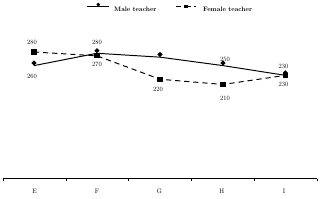
P
4P
7P
10P
0 Yrs
5 Yrs
10 Yrs
15 Yrs
Total Amount at 15 Years = 10P (10 times)
Calculations:
⇒ Let the principal sum be P.
⇒ Amount after 5 years = 4P
⇒ Simple Interest earned in 5 years = 4P − P = 3P
⇒ Rate of Interest (R) = (SI × 100) ÷ (P × T)
⇒ R = (3P × 100) ÷ (P × 5) = 60%
⇒ Now, we need to find the amount after T = 15 years at R = 60%:
⇒ SI = (P × 60 × 15) ÷ 100
⇒ SI = 900P ÷ 100 = 9P
⇒ New Amount = Principal + SI = P + 9P = 10P
⇒ Thus, the sum will become 10 times of itself.
∴ The correct answer is 10 times.
Additional Information
Simple Interest Constant Growth
Unlike compound interest, simple interest grows by a constant amount every year. If a sum earns 3P interest in 5 years, it will earn exactly 3P interest in every subsequent 5-year period.
Direct Formula for Multipliers
When a sum becomes n1 times in t1 years and n2 times in t2 years at simple interest, use the relation: (n1 − 1) ÷ t1 = (n2 − 1) ÷ t2.
Principal and Amount Relation
The amount (A) is the sum of Principal (P) and Simple Interest (SI). Always subtract 1 from the number of times it becomes to get the interest multiplier: SI = (n − 1)P.