Previous Year Paper

SSC CHSL 2025 Tier-1 (Held On: 29 Nov, 2025 Shift 3) (Previous Year Paper)

Held in 2025

100 questions60 minutes
With answers
Free

Paper last updated:

Practise under exam conditions

Take this paper as a timed mock test. Review your answers after you submit.

Attempt timed test

Questions & answers

Read the paper at your pace. Open an explanation when you need it.

English Language (25 questions)

Question 1

Choose the correct option to fill in the blank in the sentence given.

When filling out admission forms, it is ______ to fill up our complete names and date of birth.

  1. AOption (a)

    mandatory

  2. BOption (b)

    voluntary

  3. COption (c)

    optional

  4. DOption (d)

    discretionary

View answer & explanation

Correct answer

Answer: (a)A.

mandatory

Why this answer is correct

The correct answer is 'mandatory'.

 

Key Points

  • The word "mandatory" means something that is required or compulsory.
  • When filling out admission forms, it is important to use our full names and accurate date of birth, which is essential for identification and verification purposes.
  • Options 2, 3, and 4 are incorrect because they suggest the action is voluntary, optional, or left to discretion, which does not align with the context of admission forms.

Therefore, the correct answer is Option 1.


Complete Sentence: "When filling out admission forms, it is mandatory to fill up our complete names and date of birth."

 

Additional Information

  • Option 2: "voluntary" is incorrect because filling out complete names and date of birth is not optional or voluntary; it is required.
  • Option 3: "optional" is incorrect because the context requires mandatory information for forms.
  • Option 4: "discretionary" is incorrect because filling out this information is not left to personal judgment or choice; it is compulsory.
Question 2

Select the alternative which best expresses the meaning of idioms/phrases.

At sixes and sevens

  1. AOption (a)

    If someone is anxious before sitting an examination

  2. BOption (b)

    If someone is in depression

  3. COption (c)

    If someone is in a state of confusion

  4. DOption (d)

    If someone is super happy

View answer & explanation

Correct answer

Answer: (c)C.

If someone is in a state of confusion

Why this answer is correct

The correct answer is: Option 3 i.e. If someone is in a state of confusion.

Key Points

  • The phrase "At sixes and sevens" means to be in a state of confusion or disorder. (अव्यवस्था या भ्रम की स्थिति)
  • Example: After the sudden change in the project plan, the team was at sixes and sevens about how to proceed.
  • The correct meaning aligns with the context of confusion or disorganization. (भ्रम या अव्यवस्था का संदर्भ)
  • Example: The office was at sixes and sevens after the manager announced his resignation.

Therefore, the correct answer is: Option 3 i.e. If someone is in a state of confusion.

Additional Information

Here are the other options explained along with their Hindi meanings and example sentences:

  • Option 1: If someone is anxious before sitting an examination (कोई परीक्षा देने से पहले चिंतित)
  • Example: He was anxious before his final exam but managed to calm down afterward.
  • Option 2: If someone is in depression (कोई अवसाद में है)
  • Example: She has been in depression since the loss of her pet.
  • Option 4: If someone is super happy (कोई बहुत खुश है)
  • Example: He was super happy after receiving the promotion at work.

Question 3

Choose the option that has an error in the sentence.

On the plus side, if this development are getting better, the richer nations will benefit.

  1. AOption (a)

    On the plus side,

  2. BOption (b)

    if this development are getting better,

  3. COption (c)

    the richer nations will benefit.

  4. DOption (d)

    No correction required

View answer & explanation

Correct answer

Answer: (b)B.

if this development are getting better,

Why this answer is correct

The correct answer is Option 2.


Key Points

  • The error lies in the subject-verb agreement within the conditional clause of the sentence.
  • The noun "development" is a singular countable noun in this context, which requires the singular auxiliary verb "is."
  • The use of the plural verb "are" is grammatically incorrect when paired with a singular subject.
  • Therefore, "are getting better" should be corrected to "is getting better" to maintain grammatical consistency.

Therefore, the correct answer is 2.


Correct Sentence: "On the plus side, if this development is getting better, the richer nations will benefit."


Additional Information

  • Option 1: "On the plus side," – This is a correct idiomatic expression used to introduce a positive aspect of a situation.
  • Option 3: "the richer nations will benefit." – This part is grammatically correct. It follows the structure of a First Conditional sentence (If + present tense, will + base verb), which describes a possible future outcome.
  • Subject-Verb Agreement Rule: Always identify the head noun of the subject phrase. Since "development" is singular, the verb must also be singular, regardless of any surrounding descriptive words.

Question 4

Examine the given sentence and pick out the error.

In order to overcome the mental depression and stress (1) adapting meditation, yoga or (2) similar other methods (3) can be helped

  1. AOption (a)

    adapting meditation, yoga or

  2. BOption (b)

    can be helped

  3. COption (c)

    in order to overcome the mental depression and stress

  4. DOption (d)

    similar other methods

View answer & explanation

Correct answer

Answer: (b)B.

can be helped

Why this answer is correct

The correct answer is Option 2.


Key Points

  • The error lies in the phrase "can be helped," which uses the passive voice incorrectly.
  • In this sentence, the practices (meditation, yoga, etc.) are the subjects that perform the action of helping. Therefore, the verb should be in the active voice ("can help").
  • "Can be helped" implies that someone or something is providing assistance to the methods, which makes the sentence logically nonsensical.
  • Additionally, there is a lexical error in Option 1: "adapting" should be "adopting." To "adopt" a practice means to start using it, while to "adapt" means to modify something. However, the structural error in the verb phrase (Option 2) is typically considered the primary grammatical flaw in such tests.

Therefore, the correct answer is 2.


Correct Sentence: "In order to overcome mental depression and stress, adopting meditation, yoga or similar other methods can help."


Additional Information

  • Option 1: "adapting meditation, yoga or" – As noted, "adopting" is the more precise word here, but often in objective tests, the voice error in the predicate is the targeted answer.
  • Option 3: "in order to overcome the mental depression and stress" – This part is grammatically acceptable. While the definite article "the" is optional before "mental depression," its presence is not a technical error.
  • Option 4: "similar other methods" – This phrase correctly serves as a collective category for other activities like meditation and yoga.
  • Grammar Note: Always ensure the subject (the methods) and the verb (help) have a logical relationship. If the subject is the "doer," use active voice.

Question 5

Fill in the blank with the most appropriate preposition:

The proposal was rejected ________ grounds of insufficient evidence.

  1. AOption (a)

    by

  2. BOption (b)

    on

  3. COption (c)

    in

  4. DOption (d)

    under

View answer & explanation

Correct answer

Answer: (b)B.

on

Why this answer is correct

The correct answer is 'on'.


Key Points

  • The preposition "on" is used when referring to the basis or grounds for something, such as a decision or conclusion.
  • In the context of the sentence, "on grounds of insufficient evidence" is the correct phrase to indicate the reason for the rejection.
  • Options 1, 3, and 4 are incorrect as they do not fit the established usage of prepositions in this context.

Therefore, the correct answer is Option 2.


Complete Sentence: "The proposal was rejected on grounds of insufficient evidence."


Additional Information

  • Option 1: "by" is incorrect because "by" is used to indicate the agent performing an action, not the grounds or basis.
  • Option 3: "in" is incorrect as it does not fit the phrase "grounds of insufficient evidence."
  • Option 4: "under" is incorrect because "under" is used to describe rules, conditions, or authority, not the basis of rejection.

Question 6

Choose the odd one out.

  1. AOption (a)

    Knight

  2. BOption (b)

    Night

  3. COption (c)

    Nite

  4. DOption (d)

    Knit

View answer & explanation

Correct answer

Answer: (d)D.

Knit

Why this answer is correct

The correct answer is Option 4.


Key Points

  • The primary distinction between the given words is their phonetic pronunciation.
  • The words Knight, Night, and Nite are all homophones, meaning they are pronounced identically as /naɪt/ despite their different spellings and meanings.
  • The word Knit is pronounced as /nɪt/, utilizing a short "i" vowel sound, which makes it phonetically different from the others.
  • Since it does not share the same pronunciation as the rest of the group, Knit is the odd one out.

Therefore, the correct answer is Option 4.


Additional Information

  • Knight: A historical term for a man-at-arms or a modern title of honor; it contains a silent 'k' and 'gh'.
  • Night: The period from sunset to sunrise; it also contains a silent 'gh'.
  • Nite: An informal or simplified spelling of "night," often used in advertising or branding.
  • Knit: To interlock loops of yarn with needles; while it shares a silent 'k' with "Knight," its vowel sound remains distinct.

Question 7

Choose the correctly spelt word:

  1. AOption (a)

    Facsimile

  2. BOption (b)

    Facsmile

  3. COption (c)

    Facsimily

  4. DOption (d)

    Facsimele

View answer & explanation

Correct answer

Answer: (a)A.

Facsimile

Why this answer is correct

The correct answer is option 1.

Key Points

  • The correctly spelt word is 'Facsimile'.
  • 'Facsimile' is a noun that refers to an exact copy, especially of written or printed material.
  • For Example: The museum had a facsimile of the ancient manuscript on display.

Therefore, the correct answer is 'Facsimile'.

Additional Information

  • Incorrect Options:
  • Option 2: Facsmile - Incorrect due to missing 'i' after 'Facs'.
  • Option 3: Facsimily - Incorrect due to the addition of 'y' at the end.
  • Option 4: Facsimele - Incorrect due to misspelling of the ending 'ile' as 'ele'.

Question 8

Choose the best option to replace the underlined part to improve the given sentence. If no substitution is required, select 'No substitution.'

The two sisters decided to divide the stolen money among themselves.

  1. AOption (a)

    into themselves

  2. BOption (b)

    between themselves

  3. COption (c)

    for themselves

  4. DOption (d)

    No substitution

View answer & explanation

Correct answer

Answer: (b)B.

between themselves

Why this answer is correct

The correct answer is 'between themselves'.


Key Points

  • The phrase "between themselves" is used when referring to an action or division occurring among two individuals or parties.
  • The word "among" is typically used for more than two entities, whereas "between" is appropriate for two.
  • In the context of the sentence, the division of money is happening between the two sisters, making "between themselves" the correct choice.

Therefore, the correct answer is Option 2.


Complete Sentence: "The two sisters decided to divide the stolen money between themselves."


Additional Information

  • Option 1: "into themselves" is incorrect as "into" implies movement inside, which is not applicable in this context.
  • Option 3: "for themselves" is incorrect as it changes the meaning, implying the money was taken for their use, rather than divided.
  • Option 4: "No substitution" is incorrect because the phrase "among themselves" is grammatically inappropriate for two individuals.

Question 9

Choose the best option to replace the underlined part to improve the given sentence. If no substitution is required, select 'No substitution.

'I knew you were cut out on a career in finance due to your sharp analytical skills.

  1. AOption (a)

    Cut out of

  2. BOption (b)

    Cut down to

  3. COption (c)

    Cut out for

  4. DOption (d)

    No substitution

View answer & explanation

Correct answer

Answer: (c)C.

Cut out for

Why this answer is correct

The correct answer is ' cut out for' .


Key Points

  • The phrase "cut out for" is correct in this context, as it means "suited or appropriate for a particular role or task."
  • The sentence highlights the suitability of a career in finance due to sharp analytical skills.
  • Options 1 ("cut out of") and 2 ("cut down to") are incorrect as they do not convey the intended meaning in this context.
  • Option 4 ("No substitution") is incorrect because the original sentence needs improvement for clarity and correctness.

Therefore, the correct answer is Option 3.


Complete Sentence: "I knew you were cut out for a career in finance due to your sharp analytical skills."


Additional Information

  • Option 1: "cut out of" is incorrect because it suggests removal or exclusion, which is not the intended meaning.
  • Option 2: "cut down to" is incorrect as it implies reduction, which does not fit the context of the sentence.
  • Option 4: "No substitution" is incorrect as the phrase "cut out on" is not suitable or commonly used in this context.

Question 10

From the alternatives given below, select the correct passive voice of the following sentence.

The strong current of the river broke through the wall of the earthen dam within no time.

  1. AOption (a)

    The wall of the earthen dam was broken within no time by the strong current of the river.

  2. BOption (b)

    The wall of the earthen dam was broken through within no time by the strong current of the river.

  3. COption (c)

    The wall of the earthen dam had broken through within no time by the strong current of the river.

  4. DOption (d)

    The wall of the earthen dam had been broken through within no time by the strong current of the river.

View answer & explanation

Correct answer

Answer: (b)B.

The wall of the earthen dam was broken through within no time by the strong current of the river.

Why this answer is correct

The correct answer is Option 2.


Key Points

  • Passive voice structure: The object of the active voice sentence becomes the subject of the passive voice sentence.
  • In the active voice, the sentence is: "The strong current of the river broke through the wall of the earthen dam within no time."
  • To convert to passive voice: Place the object "the wall of the earthen dam" at the beginning.
  • Change the active verb form "broke through" to "was broken through" (past simple passive).
  • Add the preposition "by" followed by the original subject "the strong current of the river."
  • Ensure the time phrase "within no time" remains at the end of the sentence for clarity.

Therefore, the correct answer is Option 2.


Correct Sentence: "The wall of the earthen dam was broken through within no time by the strong current of the river."


Additional Information

  • Option 1: "The wall of the earthen dam was broken within no time by the strong current of the river." – Missing "through," incorrect phrasing.
  • Option 3: "The wall of the earthen dam had broken through within no time by the strong current of the river." – Incorrect tense (past perfect active).
  • Option 4: "The wall of the earthen dam had been broken through within no time by the strong current of the river." – Incorrect tense (past perfect passive).

Question 11

Choose the option that is the most appropriate conversion of the following sentence into Active Voice.

The mystery had never been solved by anyone before the detective arrived.

  1. AOption (a)

    No one never solved the mystery before the detective arrived.

  2. BOption (b)

    No one had solved the mystery before the detective arrived.

  3. COption (c)

    No one solves the mystery before the detective arrived.

  4. DOption (d)

    No one has solved the mystery before the detective arrived.

View answer & explanation

Correct answer

Answer: (b)B.

No one had solved the mystery before the detective arrived.

Why this answer is correct

The correct answer is Option 2.


Key Points

  • The sentence provided is in passive voice: "The mystery had never been solved by anyone before the detective arrived."
  • To convert it into active voice, the subject of the passive sentence ("anyone") becomes the active subject.
  • The verb form "had never been solved" must be changed to "had solved" in the past perfect tense.
  • The sentence "No one had solved the mystery before the detective arrived" correctly preserves the original meaning while converting to active voice.
  • Option 2 is grammatically correct and aligns with the tense and context of the original sentence.

Therefore, the correct answer is Option 2.


Correct Sentence: "No one had solved the mystery before the detective arrived."


Additional Information

  • Option 1: "No one never solved the mystery before the detective arrived." – Incorrect due to the use of double negatives ("no one" and "never").
  • Option 3: "No one solves the mystery before the detective arrived." – Incorrect tense ("solves" is present tense, which conflicts with "arrived").
  • Option 4: "No one has solved the mystery before the detective arrived." – Incorrect tense ("has solved" is present perfect, which does not match the past tense of "arrived").

Question 12

Choose the correct indirect narration of the following statement from the given alternatives:

Sairam said, "She has to come to Delhi to me within the next couple of hours to take help to solve the problem she mentioned."

  1. AOption (a)

    Sairam said that she had to come to Delhi to her within the following couple of hours to take help to solve the problem she had mentioned.

  2. BOption (b)

    Sairam said that she had to go to Delhi to him within the next couple of hours to bring help to solve the problem she had mentioned

  3. COption (c)

    Sairam said that she has to go to Delhi to him within the next couple of hours to take help to solve the problem she mentioned.

  4. DOption (d)

    Sairam said that she had to go to Delhi to him within the following couple of hours to take help to solve the problem she had mentioned.

View answer & explanation

Correct answer

Answer: (d)D.

Sairam said that she had to go to Delhi to him within the following couple of hours to take help to solve the problem she had mentioned.

Why this answer is correct

The correct answer is Option 4.


Key Points

  • Indirect Speech: The process of converting direct speech into indirect speech involves changing pronouns, time expressions, and verb tenses accordingly.
  • Key Conversions:
  • "She has to come" becomes "she had to go":
  • The verb "has to" (present obligation) changes to "had to" (past obligation).
  • "come" changes to "go" since the reporting speaker (Sairam) is referring to a location different from his own.
  • "to me" becomes "to him":
  • The pronoun "me" changes to "him" as Sairam is being referred to in the third person.
  • "within the next couple of hours" becomes "within the following couple of hours":
  • Time expressions like "next" change to "following" in indirect speech.
  • Reporting verb:
  • The reporting verb "said" remains unchanged, as it appropriately conveys the statement in indirect speech.
  • Punctuation and Format:
  • Indirect speech does not use quotation marks.
  • The sentence structure is adjusted to align with the grammatical rules of indirect narration.

Therefore, the correct answer is Option 4.


Correct Sentence: Sairam said that she had to go to Delhi to him within the following couple of hours to take help to solve the problem she had mentioned.


Additional Information

  • Option 1: "Sairam said that she had to come to Delhi to her within the following couple of hours to take help to solve the problem she had mentioned."
  • Incorrect pronoun usage: "to her" instead of "to him" disrupts the meaning.
  • "come" should be changed to "go" in indirect narration, as the perspective shifts.
  • Option 2: "Sairam said that she had to go to Delhi to him within the next couple of hours to bring help to solve the problem she had mentioned."
  • Incorrect verb usage: "bring help" instead of "take help" alters the context.
  • Time expression "next" should be "following" in indirect speech.
  • Option 3: "Sairam said that she has to go to Delhi to him within the next couple of hours to take help to solve the problem she mentioned."
  • Incorrect tense: "has to" should be "had to" in indirect speech.
  • Time expression "next" should be "following" in indirect speech.

Question 13

Choose the option that is the most appropriate conversion of the following sentence into Direct Speech.

He exclaimed with regret that he had forgotten his wallet at home.

  1. AOption (a)

    He exclaimed, "Hey! I had forgotten my wallet at home.

  2. BOption (b)

    He said, "Oh no! I have forgotten my wallet at home."

  3. COption (c)

    He exclaimed, "Ah! I have forgot my wallet at home."

  4. DOption (d)

    He said, "I regret I have forgotten my wallet at home."

View answer & explanation

Correct answer

Answer: (b)B.

He said, "Oh no! I have forgotten my wallet at home."

Why this answer is correct

The correct answer is Option 2.


Key Points

  • Direct Speech: The sentence in direct speech must accurately reflect the tone and meaning of the original indirect speech.
  • Key Conversion:
  • Reporting verb: In the indirect speech, "exclaimed with regret" conveys emotion. In direct speech, this is replaced with "Oh no!" to express the same regret in a conversational manner.
  • Tense: The indirect speech uses "had forgotten," which in direct speech is converted to "have forgotten" to match the conversational present perfect tense.
  • Pronouns: The pronoun "he" in indirect speech is replaced with "I" in direct speech to reflect the speaker's perspective.
  • Punctuation and Format:
  • Direct speech is enclosed in quotation marks.
  • Starts with an exclamation "Oh no!" to express regret.
  • Proper sentence structure and tense are maintained.

Therefore, the correct answer is Option 2.


Correct Sentence: "**He said, "Oh no! I have forgotten my wallet at home."


Additional Information

  • Option 1: "Hey! I had forgotten my wallet at home."
  • Incorrect tone. "Hey!" does not convey regret, and "had forgotten" is not appropriate for direct conversational speech.
  • Option 3: "Ah! I have forgot my wallet at home."
  • Incorrect verb form. "forgot" should be "forgotten" in present perfect tense.
  • Option 4: "I regret I have forgotten my wallet at home."
  • Lacks conversational tone and does not fully convey the emotion expressed in the original sentence.

Question 14

The following sentence has two blanks. Choose the most suitable set of prepositions from the given options to fill in the blanks and complete the sentence meaningfully:

The politician distanced himself __________ the scandal and shifted blame __________ his aides.

  1. AOption (a)

    off, to

  2. BOption (b)

    from, onto

  3. COption (c)

    with, over

  4. DOption (d)

    by, upon

View answer & explanation

Correct answer

Answer: (b)B.

from, onto

Why this answer is correct

The correct answer is '2', i.e., 'from, onto'.


Key Points

  • The preposition "from" is used to indicate separation or distancing from something.
  • The preposition "onto" is used to show movement or blame being shifted onto someone or something.
  • In the given sentence, the politician distanced himself from the scandal and shifted blame onto his aides, making this the most suitable choice.

Therefore, the correct answer is Option 2.


Complete Sentence: "The politician distanced himself from the scandal and shifted blame onto his aides."


Additional Information

  • Option 1: "off, to" is incorrect because "off" does not appropriately describe distancing in this context, and "to" is unsuitable for blame shifting.
  • Option 3: "with, over" is incorrect because "with" and "over" do not convey the intended meaning of distancing and shifting blame.
  • Option 4: "by, upon" is incorrect because "by" and "upon" do not fit the context of the sentence.

Question 15

Choose the option that is the most appropriate conversion of the following sentence into Direct Speech.

She told the detective that she had been sleeping when the thieves had broken in.

  1. AOption (a)

    She said to the detective, "I had slept when the thieves had broken in."

  2. BOption (b)

    She said to the detective, "I had slept when the thieves has broken in."

  3. COption (c)

    She told the detective, "I had been sleeping when the thieves broke in."

  4. DOption (d)

    She told the detective, "I had been asleep when the thieves were breaking in."

View answer & explanation

Correct answer

Answer: (c)C.

She told the detective, "I had been sleeping when the thieves broke in."

Why this answer is correct

The correct answer is Option 3.


Key Points

  • Understanding Indirect Speech:
  • Indirect speech converts the original sentence into reported speech, focusing on the meaning rather than the exact words.
  • The tense of verbs in indirect speech is typically adjusted to reflect the time the original statement was made.
  • Direct Speech Conversion:
  • To convert to direct speech, the sentence must reflect the exact words spoken by the subject.
  • In the given sentence, the speaker mentioned: "I had been sleeping when the thieves broke in."
  • Correct Choice: Option 3 accurately converts the indirect speech into direct speech while maintaining tense and context.
  • "I had been sleeping" retains the past perfect continuous tense, reflecting an ongoing action in the past.
  • "The thieves broke in" correctly uses the simple past tense for the action that occurred simultaneously.

Therefore, the correct answer is Option 3.


Correct Sentence: "She told the detective, 'I had been sleeping when the thieves broke in.'"


Additional Information

  • Option 1: "She said to the detective, 'I had slept when the thieves had broken in.'"
  • Incorrect tense usage: "had slept" suggests a completed action before the thieves broke in, which changes the meaning.
  • Option 2: "She said to the detective, 'I had slept when the thieves has broken in.'"
  • Grammatical error: "has broken in" incorrectly uses present perfect tense instead of past tense.
  • Option 4: "She told the detective, 'I had been asleep when the thieves were breaking in.'"
  • Incorrect phrasing: "were breaking in" uses past continuous tense, which suggests the action was ongoing, altering the original meaning.

Question 16

Change the following sentence into the Active form.

The groundbreaking quantum theory should not have been dismissed as mere speculation by the scientific community.

  1. AOption (a)

    The scientific community should not have been dismissing the groundbreaking quantum theory as mere speculation.

  2. BOption (b)

    The scientific community should not have dismissed the groundbreaking quantum theory as mere speculation.

  3. COption (c)

    The groundbreaking quantum theory should not be dismissed as mere speculation by the scientific community.

  4. DOption (d)

    The scientific community should not be dismissing the groundbreaking quantum theory as mere speculation.

View answer & explanation

Correct answer

Answer: (b)B.

The scientific community should not have dismissed the groundbreaking quantum theory as mere speculation.

Why this answer is correct

The correct answer is Option 2.


Key Points

  • Active voice structure: The subject of the sentence performs the action, while the object receives it.
  • The passive voice sentence is: "The groundbreaking quantum theory should not have been dismissed as mere speculation by the scientific community."
  • To convert to active voice: Place the original subject "the scientific community" at the beginning of the sentence.
  • Change the passive verb form "should not have been dismissed" to "should not have dismissed" (active voice form).
  • Ensure the object "the groundbreaking quantum theory" remains after the verb for clarity.

Therefore, the correct answer is Option 2.


Correct Sentence: "The scientific community should not have dismissed the groundbreaking quantum theory as mere speculation."


Additional Information

  • Option 1: "The scientific community should not have been dismissing the groundbreaking quantum theory as mere speculation." – Incorrect because it uses the continuous tense unnecessarily.
  • Option 3: "The groundbreaking quantum theory should not be dismissed as mere speculation by the scientific community." – Incorrect because this is in the present passive voice, not matching the original sentence's tense.
  • Option 4: "The scientific community should not be dismissing the groundbreaking quantum theory as mere speculation." – Incorrect because it uses the present continuous tense unnecessarily.

Question 17

One of these words is spelled incorrectly. Which one is it?

  1. AOption (a)

    Accommodate

  2. BOption (b)

    Recommend

  3. COption (c)

    Occassion

  4. DOption (d)

    Discipline

View answer & explanation

Correct answer

Answer: (c)C.

Occassion

Why this answer is correct

The correct answer is option 3.

Key Points

The misspelled word is 'Occassion'.

  • The correct spelling would be 'Occasion'.
  • The word 'Occasion' is a noun which means 'a particular event or time'. (अवसर)
  • For Example -
  • She wore her best dress for the occasion.

Therefore, the correct answer is 'Occassion'.

Additional Information

Let's understand the meanings of the other marked words - 

  • Accommodate - to provide lodging or make room for someone or something (समायोजित करना)
  • Recommend - to suggest something as being suitable or beneficial (सिफारिश करना)
  • Discipline - the practice of training people to obey rules or a code of behavior (अनुशासन)

Question 18

Choose the correct passive voice transformation of the sentence:

They had not finished the project before the deadline.

  1. AOption (a)

    The project was not finished by them before the deadline.

  2. BOption (b)

    The project has not been finished by them before the deadline.

  3. COption (c)

    The project had not been finished by them before the deadline.

  4. DOption (d)

    The project was not being finished by them before the deadline.

View answer & explanation

Correct answer

Answer: (c)C.

The project had not been finished by them before the deadline.

Why this answer is correct

The correct answer is Option 3.


Key Points

  • Passive voice structure: The object of the active voice sentence becomes the subject of the passive voice sentence.
  • In the active voice, the sentence is: "They had not finished the project before the deadline."
  • To convert to passive voice: Place the object "the project" at the beginning.
  • Change the active verb form "had not finished" to "had not been finished" (past perfect passive).
  • Add the preposition "by" followed by the original subject "them."
  • Ensure the time phrase "before the deadline" remains at the end of the sentence for clarity.

Therefore, the correct answer is Option 3.


Correct Sentence: "The project had not been finished by them before the deadline."


Additional Information

  • Option 1: "The project was not finished by them before the deadline." – Incorrect tense (past simple passive).
  • Option 2: "The project has not been finished by them before the deadline." – Incorrect tense (present perfect passive).
  • Option 4: "The project was not being finished by them before the deadline." – Incorrect tense (past continuous passive).

Read the passage and answer the following question:

Engineering was once considered one of the most prestigious and secure career choices in India. For decades, thousands of students competed fiercely to enter top engineering colleges, believing that a degree would guarantee a stable job and a prosperous future. However, in recent years, this perception has started to change dramatically.

One of the main reasons for the decline in scope is the oversaturation of engineering graduates. With hundreds of private colleges producing lakhs of engineers every year, the job market cannot absorb them all. As a result, many graduates remain unemployed or are forced to accept jobs unrelated to their field of study. Additionally, rapid technological changes demand new skills that traditional curriculums often fail to provide, leaving graduates underprepared for modern industry requirements.

Moreover, industries now prefer candidates with practical knowledge and specialised skills over generic degrees. While there are still opportunities in emerging fields like Artificial Intelligence, Robotics, and Data Science, they require constant upskilling and innovation. Thus, unless the education system reforms its approach and students focus on skill-based learning, the scope for conventional engineering will continue to shrink. (make 2 questions on grammar)

Question 19

Based on Passage: View directions & passage

In the sentence:

"Engineering was once considered one of the most prestigious and secure career choices in India," what is the tense of the verb "was considered"?

  1. AOption (a)

    Present simple

  2. BOption (b)

    Past simple

  3. COption (c)

    Past perfect

  4. DOption (d)

    Present  perfect

View answer & explanation

Correct answer

Answer: (b)B.

Past simple

Why this answer is correct

The correct answer is 'Option 2 (Past simple)'.


Key Points

  • Option 1: Present simple
  • This is incorrect. Present simple would be “is considered,” but the sentence uses “was considered,” which refers to the past.
  • Option 2: Past simple
  • This is correct. “Was considered” is the past simple tense, indicating that engineering was regarded as prestigious in the past, but the perception has changed now.
  • Option 3: Past perfect
  • This is incorrect. Past perfect would be “had been considered,” which is not used here.
  • Option 4: Present perfect
  • This is incorrect. Present perfect would be “has been considered,” but the passage clearly uses “was considered.”

Therefore, the correct answer is Option 2 (Past simple).


Additional Information

  • Past simple tense is used to describe actions or states that happened at a specific time in the past.
  • Example: “She was considered the best student in her class.”
  • In the passage: “Engineering was once considered…” → This shows a past perception that has now changed.

Question 20

Based on Passage: View directions & passage

In the sentence:

"Moreover, industries now prefer candidates with practical knowledge and specialised skills over generic degrees," why is the verb "prefer" used and not "prefers"?

  1. AOption (a)

    Because "candidates" is a plural noun

  2. BOption (b)

    Because "industries" is a plural subject

  3. COption (c)

    Because "skills" is uncountable

  4. DOption (d)

    Because "prefer" is always used with "now"

View answer & explanation

Correct answer

Answer: (b)B.

Because "industries" is a plural subject

Why this answer is correct

The correct answer is 'Option 2 (Because "industries" is a plural subject)'.


Key Points

  • Option 1: Because "candidates" is a plural noun
  • This is incorrect. The verb form depends on the subject, not the object. “Candidates” is the object of the verb “prefer.”
  • Option 2: Because "industries" is a plural subject
  • This is correct. The subject of the sentence is “industries,” which is plural. Therefore, the verb must also be plural: “prefer.” If the subject were singular (“industry”), the verb would be “prefers.”
  • Option 3: Because "skills" is uncountable
  • This is incorrect. “Skills” is plural, not uncountable, and it is part of the object phrase, not the subject.
  • Option 4: Because "prefer" is always used with "now"
  • This is incorrect. The adverb “now” does not affect verb conjugation. Verb form depends solely on the subject.

Therefore, the correct answer is Option 2: Because "industries" is a plural subject.


Additional Information

  • Subject–verb agreement rule: Singular subjects take singular verbs (with -s or -es), while plural subjects take the base verb form.
  • Example: “The company prefers efficiency.” / “Companies prefer efficiency.”
  • In the passage: “Industries prefer candidates…” → plural subject “industries” requires plural verb “prefer.”

Question 21

Based on Passage: View directions & passage

The word "oversaturation" means:

  1. AOption (a)

    Shortage of students

  2. BOption (b)

    Too many graduates for available jobs

  3. COption (c)

    Plenty of job opportunities

  4. DOption (d)

    High salaries for all

View answer & explanation

Correct answer

Answer: (b)B.

Too many graduates for available jobs

Why this answer is correct

The correct answer is: Option 2 i.e. Too many graduates for available jobs.

Key Points

  • The word "oversaturation" means:
  • A situation in which there are too many of a particular thing in relation to demand; in this context, it refers to having too many graduates for the available job opportunities. (एक स्थिति जिसमें मांग के अनुपात में किसी विशेष चीज़ की बहुत अधिकता हो; इस संदर्भ में, उपलब्ध नौकरी के अवसरों के लिए बहुत से स्नातक होना)
  • Example: The oversaturation of the job market has made it difficult for new graduates to find employment.
  • "Correct answer" means:
  • Referring to the specific answer that properly defines or fits the context of the question. (सही उत्तर)
  • Example: The correct answer to the quiz question assured him a perfect score.

Therefore, the word “oversaturation” in the given context means: Too many graduates for available jobs.

Additional Information

Here are the other options explained along with their Hindi meanings and example sentences:

  • Shortage of students (छात्रों की कमी): A situation where there are not enough students enrolled or attending.
  • Example: The school is facing a shortage of students this academic year.
  • Plenty of job opportunities (नौकरी के अवसरों की प्रचुरता): Availability of many job openings for applicants.
  • Example: In the tech industry, there are plenty of job opportunities for skilled professionals.
  • High salaries for all (सभी के लिए उच्च वेतन): Everyone receiving large or substantial wages.
  • Example: The new policy ensures high salaries for all employees in the company.

Question 22

Based on Passage: View directions & passage

The word "up skilling" means:

  1. AOption (a)

    Reducing skills

  2. BOption (b)

    Losing knowledge

  3. COption (c)

    Improving skills to match new demands

  4. DOption (d)

    Quitting studies

View answer & explanation

Correct answer

Answer: (c)C.

Improving skills to match new demands

Why this answer is correct

The correct answer is: Option 3 i.e. Improving skills to match new demands.

Key Points

  • The term "up skilling" refers to:
  • Improving and enhancing one's existing skills to meet new requirements or demands in a particular field or industry. (किसी क्षेत्र या उद्योग में नई आवश्यकताओं या मांगों को पूरा करने के लिए अपने मौजूदा कौशल को सुधारना और बढ़ाना)
  • Example: The company offers training programs to help employees with up skilling for advanced technical roles.
  • "Correct answer" means:
  • Referring to the specific answer that properly defines or fits the context of the question. (सही उत्तर)
  • Example: The correct answer to the quiz question assured him a perfect score.

Therefore, the term “up skilling” in the given context means: Improving skills to match new demands.

Additional Information

Here are the other options explained along with their Hindi meanings and example sentences:

  • Reducing skills (कौशल को कम करना): To make one's abilities or knowledge less effective or competent.
  • Example: Due to lack of practice, she found her language skills reducing over time.
  • Losing knowledge (ज्ञान खोना): Forgetting or becoming unable to recall previously learned information.
  • Example: After years of inactivity in the field, he felt he was losing knowledge related to programming.
  • Quitting studies (अध्ययन छोड़ना): To stop one's education or academic pursuits.
  • Example: Due to personal reasons, she considered quitting studies and starting work immediately.

Question 23

Based on Passage: View directions & passage

According to the passage, what is a major reason for limited scope in engineering today?

  1. AOption (a)

    Lack of students

  2. BOption (b)

    No technological growth

  3. COption (c)

    Too many graduates and out-dated education

  4. DOption (d)

    High salaries for engineers

View answer & explanation

Correct answer

Answer: (c)C.

Too many graduates and out-dated education

Why this answer is correct

The correct answer is 'Option 3 (Too many graduates and out-dated education)'.


Key Points

  • Option 1: Lack of students
  • This is incorrect. The passage highlights oversaturation of graduates, not a shortage of students.
  • Option 2: No technological growth
  • This is incorrect. The passage mentions rapid technological changes, not stagnation. The issue is that curricula fail to keep pace with these changes.
  • Option 3: Too many graduates and out-dated education
  • This is correct. The passage explains that private colleges produce lakhs of engineers every year, leading to oversaturation. At the same time, traditional curriculums fail to provide modern skills, leaving graduates underprepared for industry demands.
  • Option 4: High salaries for engineers
  • This is incorrect. The passage does not mention high salaries as a problem; instead, many engineers remain unemployed or accept unrelated jobs.

Therefore, the correct answer is Option 3: Too many graduates and out-dated education.


Additional Information

  • Oversaturation of engineering graduates has created a mismatch between supply and demand in the job market.
  • Traditional curriculums often fail to adapt to rapid technological changes, leaving graduates under-skilled.
  • Industries now prefer candidates with practical knowledge and specialised skills over generic degrees.
  • Thus, reform in education and focus on skill-based learning is essential to restore scope in engineering careers.

Question 24

What is the antonym of 'Turbulent'?

  1. AOption (a)

    Deceptive

  2. BOption (b)

    Humble

  3. COption (c)

    Calm

  4. DOption (d)

    Satisfied

View answer & explanation

Correct answer

Answer: (c)C.

Calm

Why this answer is correct

The correct answer is: Option 3 i.e. Calm.

Key Points

  • The word "Turbulent" means characterized by disorder, confusion, or unrest; it is often used to describe chaotic situations or unstable conditions. (अराजक/अशांत)
  • Example: The airplane experienced turbulent weather during its flight.
  • "Calm" refers to a state of peace, tranquility, and stability, without any disturbance or chaos. It is the direct opposite of turbulent. (शांत)
  • Example: After the storm passed, the sea returned to its calm state.
  • Hence, we can infer that the antonym of 'Turbulent' is 'Calm'.

Therefore, the correct answer is: Calm.

Additional Information

Here are the other options explained along with their Hindi meanings and example sentences:

  • Deceptive (धोखादायक): Something that misleads or gives a false impression.
  • Example: The advertisement was deceptive and did not represent the true quality of the product.
  • Humble (विनम्र): Modest or having a low view of one's importance.
  • Example: Despite his success, he remains humble and approachable.
  • Satisfied (संतुष्ट): Contented or pleased with something.
  • Example: She was satisfied with the results of her hard work.

Question 25

What is the antonym of "Egalitarian"?

  1. AOption (a)

    Fair

  2. BOption (b)

    Biased

  3. COption (c)

    Democratic

  4. DOption (d)

    Equitable

View answer & explanation

Correct answer

Answer: (b)B.

Biased

Why this answer is correct

The correct answer is: Option 2 i.e. Biased.

Key Points

  • The word "Egalitarian" refers to the belief in or advocacy for equality, especially in terms of rights and opportunities. (समानतावादी)
  • Example: An egalitarian society ensures that everyone has equal access to education and healthcare.
  • The word "Biased" means showing prejudice or favoritism towards one side or group, leading to unequal treatment. (पक्षपाती)
  • Example: The judge's decision was biased, favoring the defendant unfairly over the plaintiff.
  • Hence, the antonym of "Egalitarian" is "Biased."

Therefore, the correct answer is: Option 2 i.e. Biased.

Additional Information

Here are the other options explained along with their Hindi meanings and example sentences:

  • Fair (न्यायपूर्ण): Treating people equally without favoritism or discrimination.
  • Example: The mediator ensured a fair resolution to the dispute.
  • Democratic (लोकतांत्रिक): Relating to a system of government by the whole population or all eligible members.
  • Example: A democratic country allows its citizens to vote freely in elections.
  • Equitable (न्यायसंगत): Fair and impartial, ensuring justice and equal treatment.
  • Example: The distribution of resources should be equitable among all members of society.

General Intelligence (25 questions)

Question 26

Find the next element that replace the ? Logically

7, 4, -2, -14, ?

  1. AOption (a)

    -27

  2. BOption (b)

    -31

  3. COption (c)

    -45

  4. DOption (d)

    -38

View answer & explanation

Correct answer

Answer: (d)D.

-38

Why this answer is correct

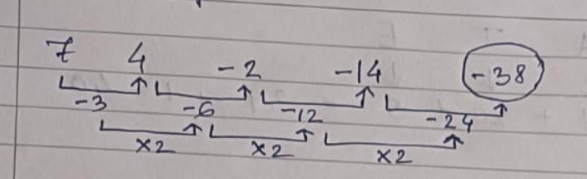
Given: 7, 4, -2, -14, ?

The logic followed here is:

Thus, -38 will be the next element that replace the ? Logically.

Hence, the correct answer is "Option 4".

Question 27

In a row of boys, A is 10th from the left and B is 9th from the right. If A is 5th to the left of B, how many boys are there in the row? 

  1. AOption (a)

    23

  2. BOption (b)

    24

  3. COption (c)

    25

  4. DOption (d)

    26

View answer & explanation

Correct answer

Answer: (a)A.

23

Why this answer is correct

Given: In a row of boys, A is 10th from the left and B is 9th from the right. If A is 5th to the left of B.

Let total number of boys = N

A is 10th from left → position of A = 10

A is 5th to the left of B → position of B = 10 + 5 = 15

B is 9th from right → position of B from left = N − 9 + 1 = N − 8

⇒ N − 8 = 15

⇒ N = 8 + 15

⇒ N = 23

Thus, there are 23 boys in the row.

Hence, the correct answer is "Option 1".

Question 28

Solar lamps line a garden path. The 6th lamp from one end is defective. If there are 15 lamps total, what is its position from the other end?

  1. AOption (a)

    9th

  2. BOption (b)

    10th

  3. COption (c)

    11th

  4. DOption (d)

    8th

View answer & explanation

Correct answer

Answer: (b)B.

10th

Why this answer is correct

Given: Solar lamps line a garden path. The 6th lamp from one end is defective. If there are 15 lamps total.

Total lamps = 15

Position from one end = 6

Position from the other end = 15 − 6 + 1

= 16 - 6

= 10

Thus, the position of 6th lamp is 10th from the other end.

Hence, the correct answer is "Option 2".

Question 29

If 66 # 4 = 12.4 and 12 # 82 = -14, then what is the value of 81 # 14?

  1. AOption (a)

    18.4

  2. BOption (b)

    1.6

  3. COption (c)

    13.4

  4. DOption (d)

    23.4

View answer & explanation

Correct answer

Answer: (c)C.

13.4

Why this answer is correct

Given: If 66 # 4 = 12.4 and 12 # 82 = -14

The logic followed here is:

Logic: a # b = (a − b) ÷ 5

66 # 4 = 12.4 → (66 - 4) ÷ 5 = 62 ÷ 5 = 12.4

12 # 82 = (12 − 82) ÷ 5 = −70 ÷ 5 = −14

Similarly,

81 # 14 = (81 − 14) ÷ 5 = 67 ÷ 5 = 13.4

Hence, the correct answer is "Option 3".

Question 30

If 30 % 3 = 360 and 44 % 32 = 5632, then what is the value of 25 % 6?

  1. AOption (a)

    608

  2. BOption (b)

    600

  3. COption (c)

    596

  4. DOption (d)

    612

View answer & explanation

Correct answer

Answer: (b)B.

600

Why this answer is correct

Given: 30 % 3 = 360 and 44 % 32 = 5632

The logic followed here is:

Logic: a % b = a × b × 4

30 % 3 = 30 × 3 × 4 = 360

44 % 32 = 44 × 32 × 4 = 5632

Similarly,

25 % 6 = 25 × 6 × 4 = 150 × 4 = 600

Hence, the correct answer is "Option 2".

Question 31

Find the next element that replace the ? Logically

3, 21, 93, 381, ?

  1. AOption (a)

    1542

  2. BOption (b)

    1528

  3. COption (c)

    1533

  4. DOption (d)

    1550

View answer & explanation

Correct answer

Answer: (c)C.

1533

Why this answer is correct

Given: 3, 21, 93, 381, ?

The logic followed here is:

3 × 4 + 9 = 12 + 9 = 21

21 × 4 + 9 = 84 + 9 = 93

93 × 4 + 9 = 372 + 9 = 381

381 × 4 + 9 = 1524 + 9 = 1533

Thus, 1533 is next element that replace the ? Logically.

Hence, the correct answer is "Option 3".

Question 32

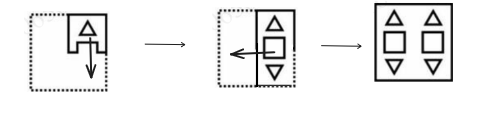
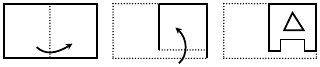
A piece of paper is folded and punched as shown below in the question figures. From the given option figures, indicate how it will appear when opened.

  1. AOption (a)

  2. BOption (b)

  3. COption (c)

  4. DOption (d)

View answer & explanation

Correct answer

Answer: (c)C.

Why this answer is correct

The paper after unfolded will be:

Hence, the correct answer is "Option 3".

Question 33

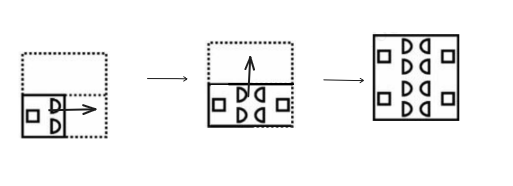
A piece of paper is folded and punched as shown below in the question figures. From the given option figures, indicate how it will appear when opened.

  1. AOption (a)

  2. BOption (b)

  3. COption (c)

  4. DOption (d)

View answer & explanation

Correct answer

Answer: (c)C.

Why this answer is correct

The paper after unfolded will be:

Hence, the correct answer is "Option 3".

Question 34

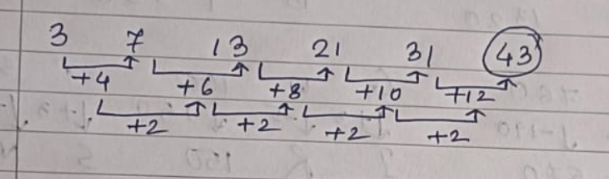
Identify the next number.

3, 7, 13, 21, 31, ?

  1. AOption (a)

    41

  2. BOption (b)

    45

  3. COption (c)

    43

  4. DOption (d)

    49

View answer & explanation

Correct answer

Answer: (c)C.

43

Why this answer is correct

Given: 3, 7, 13, 21, 31, ?

The logic followed here is:

Thus, 43 is the next number.

Hence, the correct answer is "Option 3".

Question 35

In the following question, select the number which can be placed at the sign of question mark (?) from the given alternatives.

72
151


34
18?


56
322
  1. AOption (a)

    2

  2. BOption (b)

    3

  3. COption (c)

    6

  4. DOption (d)

    12

View answer & explanation

Correct answer

Answer: (c)C.

6

Why this answer is correct

The logic followed here is:

1st box: 15 - (7 x 2) = 15 - 14 = 1

3rd box: 32 - (5 x 6) = 32 - 30 = 2

Similarly,

2nd box: 18 - (3 x 4) = 18 - 12 = 6

⇒ 6 = ?

Hence, the correct answer is "Option 3".

Question 36

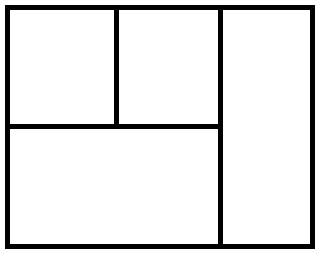
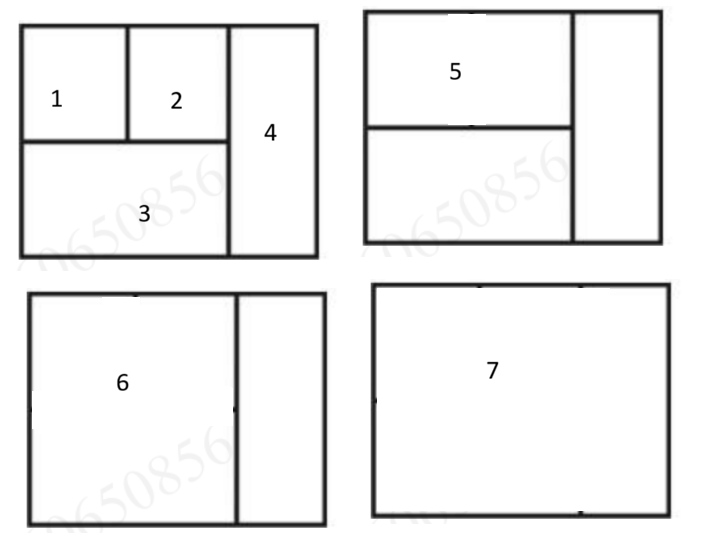
How many quadrilaterals are there in the given figure?

  1. AOption (a)

    7

  2. BOption (b)

    8

  3. COption (c)

    9

  4. DOption (d)

    10

View answer & explanation

Correct answer

Answer: (a)A.

7

Why this answer is correct

Number of quadrilaterals in the given figure is shown below:

Hence, the correct answer is "Option 1".

Question 37

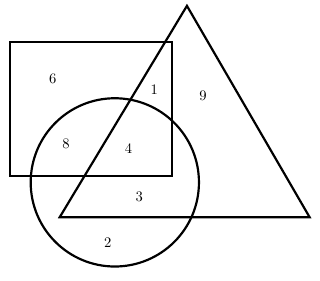
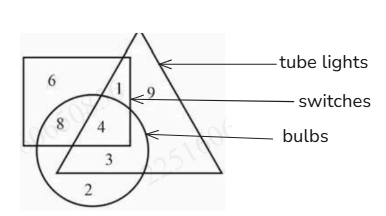
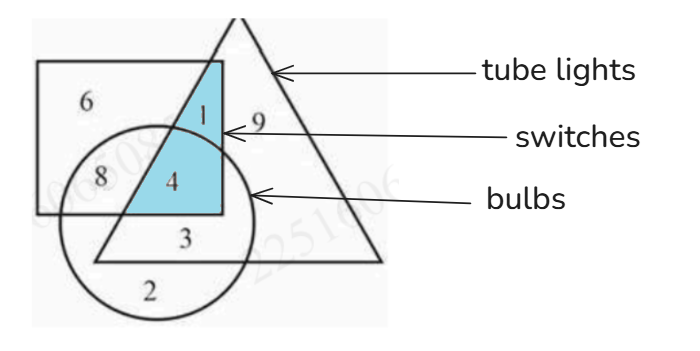
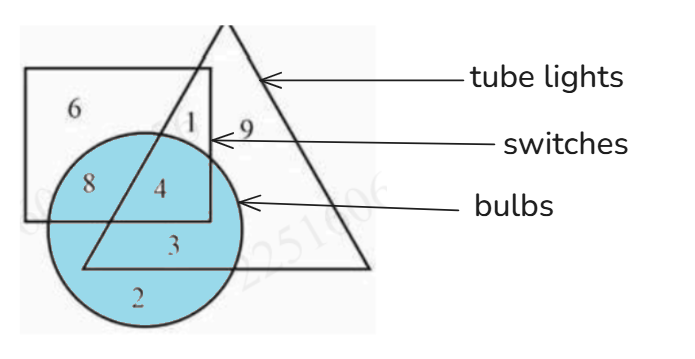
In the figure given below the square represents switches, the triangle represents tube lights and the circle represents bulbs. The number in each area represents the number of items in that area.

Which of the following statement is NOT correct?

I. Number of switches which are tube lights are 5.

II. Total number of bulb are 19 .

  1. AOption (a)

    Only ।

  2. BOption (b)

    Only II

  3. COption (c)

    Both I and II

  4. DOption (d)

    Neither I nor II

View answer & explanation

Correct answer

Answer: (b)B.

Only II

Why this answer is correct

Given: In the figure given below the square represents switches, the triangle represents tube lights and the circle represents bulbs. The number in each area represents the number of items in that area.

I. Number of switches which are tube lights are 5. - True

II. Total number of bulb are 19 - False

Number of bulb 8 + 4 + 3 + 2 = 17

Thus, 'Only II' is not correct.

Hence, the correct answer is "Option 2".

Question 38

Sales of 5 cars A, B, C, D and E is compared. Sales of no two cars is same. Sales of B is less than only A. Sales of D is less than C but more than E. If sales of C is 300 , then what is the possible value of sales of A?

  1. AOption (a)

    310

  2. BOption (b)

    295

  3. COption (c)

    280

  4. DOption (d)

    290

View answer & explanation

Correct answer

Answer: (a)A.

310

Why this answer is correct

Given:

  • Sales are all different
  • B is less than only A → A is highest, B is second highest
  • D < C but D > E → C > D > E
  • C = 300

So order becomes:

A > B > C > D > E

Since C = 300,

B must be greater than 300, and A must be greater than B

So A must be greater than 300.

Hence, any value greater than 300 is possible.

As per given options, only 310 is greater than 300.

Thus, if sales of C is 300 , the possible value of sales of A is 310.

Hence, the correct answer is "Option 1".

Question 39

There are 6 flats on a floor in two rows (three in each row opposite to each other). Flats of one row are facing north. Flats of other row are facing south. These flats are alloted to A, B, C, D, E and F. D and F get diagonally opposite flats. F's flat is next to C's flat. C gets a South facing flat. The direction in which the flats of B and E are facing is same. B's flat is not next to D. Which of the following pair represents people having flats opposite to each other?

  1. AOption (a)

    FC

  2. BOption (b)

    FE

  3. COption (c)

    BA

  4. DOption (d)

    EC

View answer & explanation

Correct answer

Answer: (d)D.

EC

Why this answer is correct

Given: There are 6 flats on a floor in two rows (three in each row opposite to each other). Flats of one row are facing north. Flats of other row are facing south. These flats are alloted to A, B, C, D, E and F. D and F get diagonally opposite flats.

  1. F's flat is next to C's flat.
  2. C gets a South facing flat.

So, F and C have south facing flat.

  1. The direction in which the flats of B and E are facing is same.

So, B and E must be north facing flat.

  1. B's flat is not next to D. 

Therefore, B, D and E are north facing flats.

And F, C and A are south facing flat.

NorthBED
SouthFC

A, the only person left will occupy the vacant position.

NorthBED
SouthFCA

Thus, EC pair represents people having flats opposite to each other.

Hence, the correct answer is "Option 4".

Question 40

Two figures given on the left side of (: :) are related with some logic/rule/relation. Select the missing figure on the right side of (: :) from the given alternatives based on the same logic/rule/relation.

  1. AOption (a)

  2. BOption (b)

  3. COption (c)

  4. DOption (d)

View answer & explanation

Correct answer

Answer: (a)A.

Why this answer is correct

The logic followed here is:

The positions shift clockwise by one step.

Similarly,

Hence, the correct answer is "Option 1".

Question 41

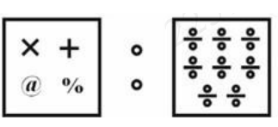
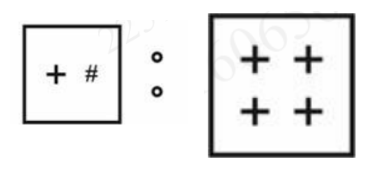
Two figures given on the left side of (: :) are related with some logic/rule/relation. Select the missing figure on the right side of (: :) from the given alternatives based on the same logic/rule/relation.

  1. AOption (a)

  2. BOption (b)

  3. COption (c)

  4. DOption (d)

View answer & explanation

Correct answer

Answer: (c)C.

Why this answer is correct

The logic followed here is:

First pair:

  • Box 1 has 4 symbols: ×, +, @, %
  • Box 2 shows multiple ÷ symbols arranged in 3×3 (9 total)

Pattern:

  • Number of symbols increases from 4 → 9
  • Operation changes all symbols into

Similarly,

Second pair:

  • Box 3 has 2 symbols: + and #

Apply same logic:

  • Increase count using square pattern: 2² = 4
  • Use one common symbol (here + is dominant/simple)

Thus, 4 plus signs arranged in square (2×2).

Hence, the correct answer is "Option 3".

Question 42

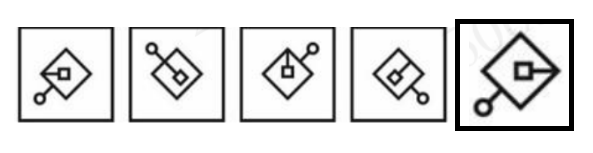
In the following figure series, select the figure which can be placed at the sign of question mark (?) from the given alternatives.

  1. AOption (a)

  2. BOption (b)

  3. COption (c)

  4. DOption (d)

View answer & explanation

Correct answer

Answer: (d)D.

Why this answer is correct

The logic followed here is:

Observe two things changing:

  • Position of the small circle (dot)
  • Orientation of the inner square line

Tracking the dot:

1st → bottom-left

2nd → top-left

3rd → top-right

4th → bottom-right

The dot is moving clockwise around the square

So next position → bottom-left

Tracking the inner line:

  • It rotates along with the figure (same clockwise movement)

Thus, The next figure should have:

  • Dot at bottom-left
  • Inner square aligned accordingly

Hence, the correct answer is "Option 4".

Question 43

After interchanging the given two numbers (not digits), what will be the value of the given equation?

7 and 9

7 × 5 + 9 - 8 ÷ 4 = ?

  1. AOption (a)

    45

  2. BOption (b)

    50

  3. COption (c)

    40

  4. DOption (d)

    35

View answer & explanation

Correct answer

Answer: (b)B.

50

Why this answer is correct

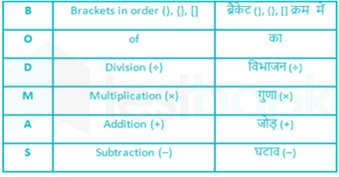
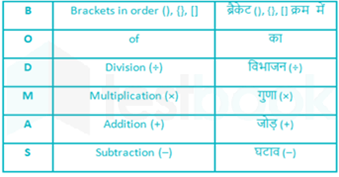
BODMAS Rule:

Given equation: 7 × 5 + 9 - 8 ÷ 4 = ?

Now replacing 7 and 9 from left to right using BODMAS Rule, we get:

⇒ 9 × 5 + 7 - 8 ÷ 4 = ?

⇒ 9 × 5 + 7 - 2 = ?

⇒ 45 + 7 - 2 = ?

⇒ 52 - 2 = ?

⇒ 50 = ?

Hence, the correct answer is "Option 2".

Question 44

Select the correct combination of mathematical signs to replace (*) signs sequentially and to balance the given equation.

99 * 9 * 4 * 46 * 37 = 35

  1. AOption (a)

    ÷ ,+, -, × 

  2. BOption (b)

    ÷, +, ×, -

  3. COption (c)

    ×, -, +, ÷

  4. DOption (d)

    ÷, ×, -, +

View answer & explanation

Correct answer

Answer: (d)D.

÷, ×, -, +

Why this answer is correct

BODMAS Rule:

Given equation: 99 * 9 * 4 * 46 * 37 = 35

Let's check each option one by one.

  1. ÷, +, -, ×

Given: 99 * 9 * 4 * 46 * 37 = 35

After replacing the signs we get;

⇒ 99 ÷ 9 + 4 - 46 × 37 = 35

⇒ 11 + 4 - 46 × 37 = 35

⇒ 11 + 4 - 1702 = 35

⇒ 15 - 1702 = 35

⇒ -1687 ≠ 35

⇒ LHS ≠ RHS

2. ÷, +, ×, -

Given: 99 * 9 * 4 * 46 * 37 = 35

After replacing the signs we get;

⇒ 99 ÷ 9 + 4 × 46 - 37 = 35

⇒ 11 + 4 × 46 - 37 = 35

⇒ 11 + 184 - 37 = 35

⇒ 195 - 37 = 35

⇒ 158 ≠ 35

⇒ LHS ≠ RHS

3. ×, -, +, ÷

Given: 99 * 9 * 4 * 46 * 37 = 35

After replacing the signs we get;

⇒ 99 × 9 - 4 + 46 ÷ 37 = 35

⇒ 99 × 9 - 4 + 1.243 = 35

⇒ 891 - 4 + 1.243 = 35

⇒ 892.243 - 4 = 35

⇒ 888.243 ≠ 35

LHS ≠ RHS

4. ÷, ×, -, +

Given: 99 * 9 * 4 * 46 * 37 = 35

After replacing the signs we get;

⇒ 99 ÷ 9 × 4 - 46 + 37 = 35

⇒ 11 × 4 - 46 + 37 = 35

⇒ 44 - 46 + 37 = 35

⇒ 81 - 46 = 35

⇒ 35 = 35

⇒ LHS = RHS

Hence, the correct answer is "Option 4".

Question 45

In the following question, four letter-number pairs are given. The letter-number on the left side of (-) is related to the letter-number on the right side of (-) with some Logic/Rule/Relation. Three pairs are similar on the basis of same Logic/Rule/Relation. Select the odd one out from the given alternatives.

(NOTE: Operations should be performed on the whole numbers, without breaking down the number into its constituent digits. E.g. 13 - Operations on 13 such as adding/subtracting/multiplying etc. to 13 can be performed. Breaking down 13 into 1 and 3 and then performing mathematical operations on 1 and 3 is not allowed)

  1. AOption (a)

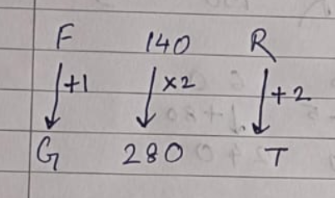
    F140R - G280T

  2. BOption (b)

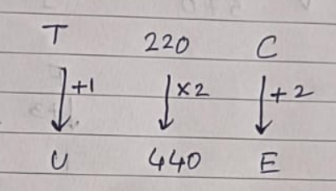
    T220C - U440E

  3. COption (c)

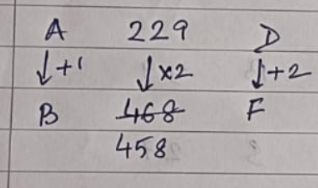
    A229D - B468F

  4. DOption (d)

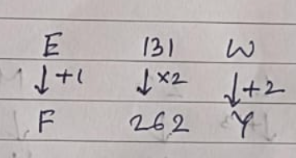
    E131W - F262Y

View answer & explanation

Correct answer

Answer: (c)C.

A229D - B468F

Why this answer is correct

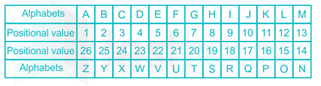
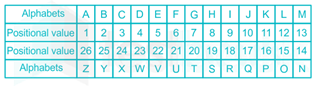
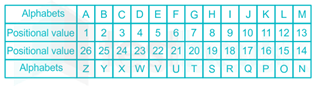
The position and positional values or English Alphabets are:

The pattern followed here is:

Each letter-cluster pair follows the pattern +1, ×2, ×2.

  1. F140R - G280T

This letter-cluster pair follows the pattern +1, ×2, ×2.

2. T220C - U440E

This letter-cluster pair follows the pattern +1, ×2, ×2.

3. A229D - B468F

This letter-cluster pair does not follows the pattern +1, ×2, ×2.

4. E131W - F262Y

This letter-cluster pair follows the pattern +1, ×2, ×2.

Thus, 'A229D - B468F' is the odd one out.

Hence, the correct answer is "Option 3".

Question 46

In the following question, four letter-number pairs are given. The letter-number on the left side of (-) is related to the letter-number on the right side of (-) with some Logic/Rule/Relation. Three pairs are similar on the basis of same Logic/Rule/Relation. Select the odd one out from the given alternatives.

(NOTE: Operations should be performed on the whole numbers, without breaking down the number into its constituent digits. E.g. 13 - Operations on 13 such as adding/subtracting/multiplying etc. to 13 can be performed. Breaking down 13 into 1 and 3 and then performing mathematical operations on 1 and 3 is not allowed)

  1. AOption (a)

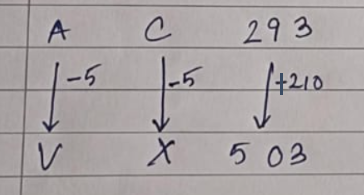
    AC293 - VX503

  2. BOption (b)

    EG307 - ZA517

  3. COption (c)

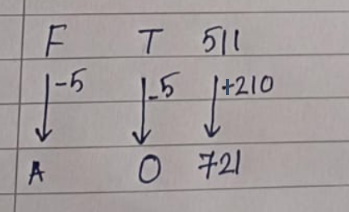
    FT511 - A0721

  4. DOption (d)

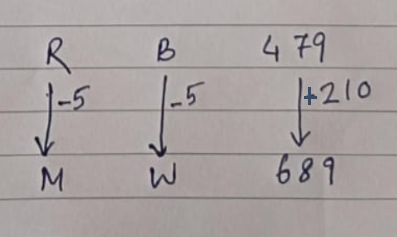
    RB479 - MW689

View answer & explanation

Correct answer

Answer: (b)B.

EG307 - ZA517

Why this answer is correct

The position and positional values or English Alphabets are:

The pattern followed here is:

Each letter-number cluster pair follows the pattern: Letters -5, -5 and Number +210

  1. AC293 - VX503


This letter-number cluster pair follows the pattern -5, -5, +210.


  1. EG307 - ZA517


This letter-number cluster pair does not follow the pattern -5, -5, +210.


  1. FT511 - A0721


This letter-number cluster pair follows the pattern -5, -5, +210.


  1. RB479 - MW689


This letter-number cluster pair follows the pattern -5, -5, +210.


Thus, 'EG307 - ZA517' is the odd one out.

Hence, the correct answer is "Option 2".

Question 47

In the following question, in each alternative a group of numbers is given. The numbers of each group are related to the numbers of the same group by some Logic/Rule/Relation. Select that group of numbers in which numbers are not related by that same Logic/Rule/Relation.

(NOTE: Operations should be performed on the whole numbers, without breaking down the number into its constituent digits. E.g. 13 - Operations on 13 such as adding/subtracting/multiplying etc. to 13 can be performed. Breaking down 13 into 1 and 3 and then performing mathematical operations on 1 and 3 is not allowed)

  1. AOption (a)

    (1132,1098,1064)

  2. BOption (b)

    (1084,1050,1016)

  3. COption (c)

    (1228,1194,1160)

  4. DOption (d)

    (1446,1402,1378)

View answer & explanation

Correct answer

Answer: (d)D.

(1446,1402,1378)

Why this answer is correct

The logic followed here is:

Logic: 1st number - 34 = 2nd number; 2nd number - 34 = 3rd number

  1. (1132, 1098, 1064) → 1132 − 34 = 1098, 1098 − 34 = 1064

  2. (1084, 1050, 1016) → 1084 − 34 = 1050, 1050 − 34 = 1016

  3. (1228, 1194, 1160) → 1228 − 34 = 1194, 1194 − 34 = 116

  4. (1446, 1402, 1378) → 1446 − 34 = 1412 ≠ 1402, 1402 − 34 = 1368 ≠ 1378

Thus, '(1446,1402,1378)' is the odd one out.

Hence, the correct answer is "Option 4".

Question 48

In the following question, in each alternative a group of numbers is given. The numbers of each group are related to the numbers of the same group by some Logic/Rule/Relation. Select that group of numbers in which numbers are not related by that same Logic/Rule/Relation.

(NOTE: Operations should be performed on the whole numbers, without breaking down the number into its constituent digits. E.g. 13 - Operations on 13 such as adding/subtracting/multiplying etc. to 13 can be performed. Breaking down 13 into 1 and 3 and then performing mathematical operations on 1 and 3 is not allowed)

  1. AOption (a)

    (188, 364, 14)

  2. BOption (b)

    (164, 420, 16)

  3. COption (c)

    (126, 450, 18)

  4. DOption (d)

    (142, 542, 20)

View answer & explanation

Correct answer

Answer: (a)A.

(188, 364, 14)

Why this answer is correct

The logic followed here is:

Logic: Second − First = Third²

(188, 364, 14) →  364 − 188 = 176 ≠ 196 = 14²

(164, 420, 16) → 420 − 164 = 256 = 16² 

(126, 450, 18) → 450 − 126 = 324 = 18² 

(142, 542, 20) → 542 − 142 = 400 = 20²

Thus, '(188, 364, 14)' is the odd one out.

Hence, the correct answer is "Option 1".

Question 49

Select the option that is related to the fifth letter-number cluster in the same way as the second letter-number cluster is related to the first letter-number cluster and fourth letter-number cluster is related to third letter-number cluster.

(NOTE: Operations should be performed on the whole numbers, without breaking down the numbers into its constituent digits. E.g. 13 - Operations on 13 such as adding/subtracting/multiplying etc. to 13 can be performed. Breaking down 13 into 1 and 3 and then performing mathematical operations on 1 and 3 is not allowed)

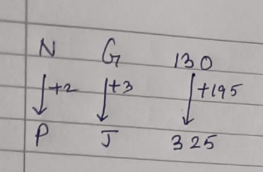
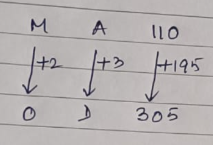
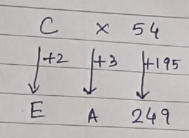
NG130 : PJ325 :: MA110 : OD305 : : CX54 : ?

  1. AOption (a)

    EA249

  2. BOption (b)

    FA249

  3. COption (c)

    FA219

  4. DOption (d)

    EA219

View answer & explanation

Correct answer

Answer: (a)A.

EA249

Why this answer is correct

The position and positional values or English Alphabets are:

Given: NG130 : PJ325 :: MA110 : OD305 : : CX54 : ?

The logic followed here is:

Similarly,

Hence, the correct answer is "Option 1".

Question 50

Select the option that is related to the fifth letter-number cluster in the same way as the second letter-number cluster is related to the first letter-number cluster and fourth letter-number cluster is related to third letter-number cluster.

(NOTE: Operations should be performed on the whole numbers, without breaking down the numbers into its constituent digits. E.g. 13 - Operations on 13 such as adding /subtracting /multiplying etc. to 13 can be performed. Breaking down 13 into 1 and 3 and then performing mathematical operations on 1 and 3 is not allowed)

WN83 : PY250 : : XL44 : NZ133 : : SK56 : ?

  1. AOption (a)

    MU169

  2. BOption (b)

    NU171

  3. COption (c)

    MV169

  4. DOption (d)

    NV171

View answer & explanation

Correct answer

Answer: (a)A.

MU169

Why this answer is correct

The logic followed here is:

For the Letters: The first letter is shifted by +2 Cross and the second letter is shifted by +2 cross.

For the Numbers: (Number × 3) + 1 = Resultant Number

For WN83 to PY250

Correct Cross Logic:

W(23) + 2 = Y(25)
N(14) + 2 = P(16)
(83 × 3) + 1 = 250

For XL44 to NZ133

X(24) + 2 = Z(26)
L(12) + 2 = N(14)
(44 × 3) + 1 = 133

For SK56 to ?

S(19)K(11)56
Cross +2↓ (×3)+1
M(13)U(21)169

Applying the logic:

  1. Second letter K(11) + 2 = M(13)
  2. First letter S(19) + 2 = U(21)
  3. (56 × 3) + 1 = 168 + 1 = 169

The resulting cluster is MU169.

Hence, the correct answer is "MU169".

Quantitative Aptitude (25 questions)

Question 51

In a microchip design, expression for interference signal is [(x + y)2 + (x − y)2]2. Find the simplified expression.

  1. AOption (a)

    4x2 + 4y2

  2. BOption (b)

    16x2 + 16y2

  3. COption (c)

    4x4 + 8x2y2 + 4y4

  4. DOption (d)

    8x2 + 8y2

View answer & explanation

Correct answer

Answer: (c)C.

4x4 + 8x2y2 + 4y4

Why this answer is correct

Given:

((x + y)2 + (x − y)2)2

Formula Used:

(a + b)2 = a2 + 2ab + b2

(a − b)2 = a2 − 2ab + b2

(a + b)2 = a2 + 2ab + b2

Calculation:

⇒ (x + y)2 + (x − y)2 = x2 + 2xy + y2 + x2 − 2xy + y2 = 2x2 + 2y2

⇒ = 2(x2 + y2)

⇒ ((x + y)2 + (x − y)2)2 = [2(x2 + y2)]2

⇒ = 4(x2 + y2)2

⇒ = 4(x4 + 2x2y2 + y4)

⇒ = 4x4 + 8x2y2 + 4y4

∴ The correct answer is 4x4 + 8x2y2 + 4y4.

Question 52

A shopkeeper makes a 20% profit on an article whose cost price is ₹ 250. What is the selling price of the article?

  1. AOption (a)

    ₹280

  2. BOption (b)

    ₹300

  3. COption (c)

    ₹290

  4. DOption (d)

    ₹310

View answer & explanation

Correct answer

Answer: (b)B.

₹300

Why this answer is correct

Given:

Cost Price (CP) = ₹250

Profit = 20%

Formula Used:

Selling Price (SP) = CP + (Profit × CP ÷ 100)

Calculation:

⇒ SP = ₹250 + (20 × ₹250 ÷ 100)

⇒ SP = ₹250 + ₹50

⇒ SP = ₹300

∴ The correct answer is ₹300.

Question 53

Man walks 10 km in 2 hours. Speed?

  1. AOption (a)

    4 km/h

  2. BOption (b)

    5 km/h

  3. COption (c)

    6 km/h

  4. DOption (d)

    7 km/h

View answer & explanation

Correct answer

Answer: (b)B.

5 km/h

Why this answer is correct

Given:

Distance = 10 km

Time = 2 hours

Formula Used:

Speed = Distance ÷ Time

Calculation:

⇒ Speed = 10 ÷ 2

⇒ Speed = 5 km/h

∴ The correct answer is 5 km/h.

Question 54

A is capable of completing a task in 10 days, while B can finish the same task in 15 days. A works alone for the first 4 days and is then joined by B. How many total days will it take to complete the entire task?

  1. AOption (a)

    6 days

  2. BOption (b)

    7.6 days

  3. COption (c)

    8 days

  4. DOption (d)

    9 days

View answer & explanation

Correct answer

Answer: (b)B.

7.6 days

Why this answer is correct

Shortcut Trick

Total work (LCM of 10 and 15) = 30 units

Efficiency: A = 3 and B = 2

Work done by A alone in 4 days = 3 × 4 = 12 units

Remaining work = 30 − 12 = 18 units

Time for (A + B) to finish remaining work = 18 ÷ (3 + 2) = 3.6 days

Total time to complete the task = 4 + 3.6 = 7.6 days

∴ The correct answer is 7.6 days.

Alternate Method

Given: A can complete the work in 10 days, B can complete the work in 15 days. A works for the first 4 days.

Formula: Total Work = Efficiency × Time

PersonDaysTotal Work (LCM)Efficiency
A103030 ÷ 10 = 3
B1530 ÷ 15 = 2

⇒ Work done by A in the first 4 days = Efficiency of A × 4 days

⇒ Work done = 3 × 4 = 12 units

⇒ Remaining work to be done = Total Work − Completed Work

⇒ Remaining work = 30 − 12 = 18 units

⇒ B joins A, so combined efficiency = 3 + 2 = 5 units/day

⇒ Time taken to complete the remaining work = 18 ÷ 5 = 3.6 days

⇒ Total time to complete the entire task = Initial time + Joint time

⇒ Total time = 4 + 3.6 = 7.6 days

∴ The correct answer is 7.6 days.

Additional Information

Efficiency and Time Relation

Efficiency is inversely proportional to the time taken to complete a task. Efficiency = Work ÷ Time.

Combined Efficiency

When multiple people work together, their individual efficiencies are added: Total Efficiency = E1 + E2 + ... + En.

Pipes and Cisterns

This concept follows the same logic where inlet pipe efficiency is positive and outlet pipe efficiency is negative.

Work and Wages

Wages are generally distributed in the ratio of the work done by each individual, which is the product of their efficiency and the time they worked.

Question 55

A moving van has a cargo space shaped like a cuboid: 4 m × 2.5 m × 2 m. If each rectangular sofa occupies 2.5 m3, how many sofas can be transported at once?

  1. AOption (a)

    6

  2. BOption (b)

    7

  3. COption (c)

    9

  4. DOption (d)

    8

View answer & explanation

Correct answer

Answer: (d)D.

8

Why this answer is correct

Given:

Length = 4 m

Breadth = 2.5 m

Height = 2 m

Volume of one sofa = 2.5 m3

Formula Used:

Volume of cuboid = l × b × h

Calculation:

⇒ Volume of van = 4 × 2.5 × 2 = 20 m3

⇒ Number of sofas = 20 ÷ 2.5 = 8

∴ The correct answer is 8.

Question 56

A metal sheet is to be bent into a right prism with a hexagonal base (side 4 cm) and height 6 cm. What is the lateral surface area?

  1. AOption (a)

    288 cm2

  2. BOption (b)

    144 cm2

  3. COption (c)

    96 cm2

  4. DOption (d)

    192 cm2

View answer & explanation

Correct answer

Answer: (b)B.

144 cm2

Why this answer is correct

Given:

Side of hexagon = 4 cm

Height = 6 cm

Formula Used:

Lateral Surface Area of prism = Perimeter of base × Height

Perimeter of hexagon = 6 × side

Calculation:

⇒ Perimeter = 6 × 4 = 24

⇒ Lateral Surface Area = 24 × 6 = 144

∴ The correct answer is 144.

Question 57

In similar triangles, the ratio of their areas is equal to the:

  1. AOption (a)

    Ratio of their perimeters

  2. BOption (b)

    Ratio of corresponding altitudes

  3. COption (c)

    Ratio of corresponding angles

  4. DOption (d)

    Square of the ratio of their corresponding sides

View answer & explanation

Correct answer

Answer: (d)D.

Square of the ratio of their corresponding sides

Why this answer is correct

Given:

In similar triangles

Ratio of their areas

Square of the ratio of their corresponding sides

Formula Used:

Area ratio = (Side ratio)2

Calculation:

⇒ Area ratio = (Side ratio)2

⇒ Square of the ratio of their corresponding sides

∴ The correct answer is Square of the ratio of their corresponding sides.

Question 58

The radius and the height of a cylinder are in the ratio 3 : 4 respectively. If the volume of the cylinder is ____________ cm3, then the curved surface area of the cylinder is __________ cm2 less than the total surface area of the cylinder. (Take π = 3)

The values given in which of the following options will fill the blanks in the same order in which is it given to make the above statement true:

A. 2916,486

B. 864,192

C. 6912,864

D. 13500,1250

  1. AOption (a)

    Only A

  2. BOption (b)

    Only A and C

  3. COption (c)

    Only B, C and D

  4. DOption (d)

    Only A, C and D

View answer & explanation

Correct answer

Answer: (b)B.

Only A and C

Why this answer is correct

Given:

r : h = 3 : 4

π = 3

Formula Used:

Volume = πr2h = 108k3

Difference (TSA − CSA) = 2πr2 = 54k2

Calculation:

⇒ Option A: 108k3 = 2916 ⇒ k3 = 27 ⇒ k = 3

⇒ Difference = 54k2 = 54 × 9 = 486  Correct

⇒ Option B: 108k3 = 864 ⇒ k3 = 8 ⇒ k = 2

⇒ Difference = 54k2 = 54 × 4 = 216 ≠ 192, Wrong

⇒ Option C: 108k3 = 6912 ⇒ k3 = 64 ⇒ k = 4

⇒ Difference = 54k2 = 54 × 16 = 864 Correct

⇒ Option D: 108k3 = 13500 ⇒ k3 = 125 ⇒ k = 5

⇒ Difference = 54k2 = 54 × 25 = 1350 ≠ 1250, Wrong

∴ The correct answers are Only A and C.

Question 59

Rs. 900 is divided among A, B, and C so that A receives one-fourth as much as B, and B receives half as much as C. What is C's share? 

  1. AOption (a)

    Rs. 467.89

  2. BOption (b)

    Rs. 450

  3. COption (c)

    Rs. 553.84

  4. DOption (d)

    Rs. 600

View answer & explanation

Correct answer

Answer: (c)C.

Rs. 553.84

Why this answer is correct

Shortcut Trick

Combine the ratios of A, B, and C using a common term.

Given A : B = 1 : 4 and B : C = 1 : 2 (or 4 : 8 to keep B same).

Combined Ratio A : B : C = 1 : 4 : 8.

Total Ratio parts = 1 + 4 + 8 = 13 units.

C's share = (8 ÷ 13) × 900 = 7200 ÷ 13 ≈ Rs. 553.84.

∴ The correct answer is Rs. 553.84.

Alternate Method

Given:

Total amount to be divided = Rs. 900

A receives one-fourth of B → A = B/4

B receives half of C → B = C/2

Calculations:

⇒ Let C's share be x.

⇒ B's share = x/2.

⇒ A's share = (1/4) × (x/2) = x/8.

⇒ According to the question: x/8 + x/2 + x = 900.

⇒ Taking LCM (8): (x + 4x + 8x) ÷ 8 = 900.

⇒ 13x ÷ 8 = 900.

⇒ 13x = 900 × 8.

⇒ 13x = 7200.

⇒ x = 7200 ÷ 13.

⇒ x = 553.846...

∴ The correct answer is Rs. 553.84.

Additional Information

Combined Ratio Rule

If A : B = m : n and B : C = p : q, then the combined ratio A : B : C is (m×p) : (n×p) : (n×q).

Proportional Division

To find the share of any part k in a total S with ratio a : b : c, use the formula: Share = [part value / (a + b + c)] × S.

Decimal Accuracy

In banking and financial exams, if a division is not exact, the value is typically rounded to two decimal places or chosen based on the closest available option.

Question 60

The ratio of the ages of A and B is 4 : 5. After 6 years, the ratio becomes 5 : 6. What will be the ratio of their ages 6 years ago?

  1. AOption (a)

    3 : 4

  2. BOption (b)

    20 : 22

  3. COption (c)

    14 : 11

  4. DOption (d)

    11 :13

View answer & explanation

Correct answer

Answer: (a)A.

3 : 4

Why this answer is correct

Given:

Present ratio = 4 : 5

Ratio after 6 years = 5 : 6

Formula Used:

Age ∝ Ratio

Calculation:

⇒ Let present ages = 4x and 5x

⇒ (4x + 6) ÷ (5x + 6) = 5 ÷ 6

⇒ 6(4x + 6) = 5(5x + 6)

⇒ 24x + 36 = 25x + 30

⇒ x = 6

⇒ Present ages = 24 and 30

⇒ Ages 6 years ago = 18 and 24

⇒ Ratio = 18 : 24 = 3 : 4

∴ The correct answer is 3 : 4.

Question 61

If the length of a rectangular field is increased by 25%, then by what percentage should its breadth be reduced so that the area of the field remains constant?

  1. AOption (a)

    18%

  2. BOption (b)

    22%

  3. COption (c)

    25%

  4. DOption (d)

    20%

View answer & explanation

Correct answer

Answer: (d)D.

20%

Why this answer is correct

Shortcut Trick

For a constant product (Area = Length × Breadth), if one factor increases by r%, the other must decrease by: [r / (100 + r)] × 100%.

Given Length increase = 25%.

Required Breadth reduction = [25 / (100 + 25)] × 100 = (25 / 125) × 100.

Reduction = (1 / 5) × 100 = 20%.

∴ The correct answer is 20%.

Alternate Method

Given:

Increase in Length = 25%

Area of the rectangular field remains constant.

Formula Used:

Area = Length × Breadth

Calculations:

⇒ Let the initial Length be 100 units and initial Breadth be 100 units.

⇒ Initial Area = 100 × 100 = 10,000 sq. units.

⇒ New Length after 25% increase = 100 + 25 = 125 units.

⇒ Let the new Breadth be 'b'.

⇒ Since Area is constant: 125 × b = 10,000.

⇒ b = 10,000 ÷ 125 = 80 units.

⇒ Reduction in Breadth = 100 − 80 = 20 units.

⇒ Percentage Reduction = (20 / 100) × 100 = 20%.

Therefore, Option 4 is the correct answer.

∴ The correct answer is 20%.

Additional Information

Product Constancy Rule

If the product of two quantities is constant (P = x × y), then an increase in one quantity by a/b requires a decrease in the other by a/(a+b) to keep P unchanged.

Fractional Equivalents

A 25% increase is equivalent to adding 1/4. To balance this, the other factor must decrease by 1/(4+1) = 1/5, which is 20%.

Percentage Change in Area

Net % change in Area = x + y + (xy/100), where x and y are percentage changes in dimensions. For constant area, Net change = 0.

Question 62

A shirt is sold for ₹840 after a discount of 16% is offered on its marked price. What was the original marked price of the shirt?

  1. AOption (a)

    ₹1,500

  2. BOption (b)

    ₹1,000

  3. COption (c)

    ₹6,000

  4. DOption (d)

    ₹2,000

View answer & explanation

Correct answer

Answer: (b)B.

₹1,000

Why this answer is correct

Given:

Selling price (SP) = ₹840

Discount = 16%

Formula Used:

Marked price (MP) = SP ÷ (1 - Discount ÷ 100)

Calculation:

⇒ MP = ₹840 ÷ (1 - 16 ÷ 100)

⇒ MP = ₹840 ÷ (1 - 0.16)

⇒ MP = ₹840 ÷ 0.84

⇒ MP = ₹1,000

∴ The correct answer is ₹1,000.

Question 63

A merchant wants to prepare a wheat blend priced at ₹28 per kilogram by mixing two different qualities of wheat. The first variety costs ₹20 per kilogram, while the second variety costs ₹32 per kilogram. In what weight ratio should these two varieties be combined so that the final mixture meets the desired cost?

  1. AOption (a)

    4 : 1

  2. BOption (b)

    1 : 3

  3. COption (c)

    3 : 1

  4. DOption (d)

    1 : 2

View answer & explanation

Correct answer

Answer: (d)D.

1 : 2

Why this answer is correct

Given:

Cost of first variety = 20

Cost of second variety = 32

Mean price = 28

Formula Used:

Ratio = (Higher price − Mean price) : (Mean price − Lower price)

Calculation:

⇒ Ratio = (32 − 28) : (28 − 20)

⇒ Ratio = 4 : 8

⇒ Ratio = 1 : 2

∴ The correct answer is 1 : 2.

Question 64

A container initially holds a mixture of milk and water in the proportion 4 : 1. Some quantity of this mixture is removed and replaced with an equal quantity of water. After this operation, the new mixture has milk and water in the ratio 2 : 3. What percentage of the original mixture was taken out and substituted with water?

  1. AOption (a)

    50%

  2. BOption (b)

    40%

  3. COption (c)

    30%

  4. DOption (d)

    20%

View answer & explanation

Correct answer

Answer: (a)A.

50%

Why this answer is correct

Given:

Initial ratio = 4 : 1

Final ratio = 2 : 3

Formula Used:

Remaining milk after replacement = Initial milk × (1 − x)

Replacement effect applied proportionally

Calculation:

⇒ Let total quantity = 1

⇒ Initial milk = 4 ÷ 5, water = 1 ÷ 5

⇒ Let fraction removed = x

⇒ Milk left = (4 ÷ 5)(1 − x)

⇒ Water left = (1 ÷ 5)(1 − x) + x

⇒ Ratio = [(4 ÷ 5)(1 − x)] ÷ [(1 ÷ 5)(1 − x) + x] = 2 ÷ 3

⇒ 3 × (4 ÷ 5)(1 − x) = 2 × [(1 ÷ 5)(1 − x) + x]

⇒ (12 ÷ 5)(1 − x) = (2 ÷ 5)(1 − x) + 2x

⇒ (12 ÷ 5 − 2 ÷ 5)(1 − x) = 2x

⇒ (10 ÷ 5)(1 − x) = 2x

⇒ 2(1 − x) = 2x

⇒ 2 − 2x = 2x

⇒ 2 = 4x

⇒ x = 1 ÷ 2

⇒ Percentage = 50%

∴ The correct answer is 50%.

Question 65

A circle is inscribed inside a quadrilateral PQRS, touching each of its four sides. If the side lengths are PQ = 15 cm, QR = 12 cm, and PS = 10 cm, find the length of the remaining side RS.

  1. AOption (a)

    5 cm

  2. BOption (b)

    6 cm

  3. COption (c)

    7 cm

  4. DOption (d)

    8 cm

View answer & explanation

Correct answer

Answer: (c)C.

7 cm

Why this answer is correct

Given:

PQ = 15

QR = 12

PS = 10

Formula Used:

In a tangential quadrilateral: sum of opposite sides are equal

PQ + RS = QR + PS

Calculation:

⇒ 15 + RS = 12 + 10

⇒ 15 + RS = 22

⇒ RS = 22 − 15

⇒ RS = 7

∴ The correct answer is 7 cm.

Question 66

A circle has a chord AB of length 16 cm. The tangent drawn at point A is parallel to the tangent drawn at point B. Find the diameter of the circle.

  1. AOption (a)

    12 cm

  2. BOption (b)

    16 cm

  3. COption (c)

    14 cm

  4. DOption (d)

    18 cm

View answer & explanation

Correct answer

Answer: (b)B.

16 cm

Why this answer is correct

Given:

AB = 16 cm

Formula Used:

Tangent at a point is perpendicular to the radius

Parallel tangents ⇒ corresponding radii are collinear

Diameter = 2 × Radius

Calculation:

⇒ Tangent at A ⟂ OA and tangent at B ⟂ OB

⇒ Tangent at A ∥ Tangent at B ⇒ OA and OB are in same straight line

⇒ Points A and B lie on a straight line through center

⇒ AB = Diameter

⇒ Diameter = 16 cm

∴ The correct answer is 16 cm.

Question 67

The simplified value of: 3√2√6+√3−4√3√6+√2+√6√3+√2\frac{3 √{2}}{√{6}+√{3}}-\frac{4 √{3}}{√{6}+√{2}}+\frac{√{6}}{√{3}+√{2}} is:

  1. AOption (a)

    √2

  2. BOption (b)

    1

  3. COption (c)

    0

  4. DOption (d)

    2√3

View answer & explanation

Correct answer

Answer: (c)C.

0

Why this answer is correct

Given:

326+3−436+2+63+2 \frac{3\sqrt{2}}{\sqrt{6}+\sqrt{3}} - \frac{4\sqrt{3}}{\sqrt{6}+\sqrt{2}} + \frac{\sqrt{6}}{\sqrt{3}+\sqrt{2}}

Formula Used:

ax+y=a(x−y)x−y \frac{a}{\sqrt{x}+\sqrt{y}} = \frac{a(\sqrt{x}-\sqrt{y})}{x-y}

Calculation:

⇒ 32(6−3)6−3−43(6−2)6−2+6(3−2)3−2 \frac{3\sqrt{2}(\sqrt{6}-\sqrt{3})}{6-3} - \frac{4\sqrt{3}(\sqrt{6}-\sqrt{2})}{6-2} + \frac{\sqrt{6}(\sqrt{3}-\sqrt{2})}{3-2}

⇒ 32(6−3)3−43(6−2)4+6(3−2) \frac{3\sqrt{2}(\sqrt{6}-\sqrt{3})}{3} - \frac{4\sqrt{3}(\sqrt{6}-\sqrt{2})}{4} + \sqrt{6}(\sqrt{3}-\sqrt{2})

⇒ 2(6−3)−3(6−2)+6(3−2) \sqrt{2}(\sqrt{6}-\sqrt{3}) - \sqrt{3}(\sqrt{6}-\sqrt{2}) + \sqrt{6}(\sqrt{3}-\sqrt{2})

⇒ (12−6)−(18−6)+(18−12) (\sqrt{12}-\sqrt{6}) - (\sqrt{18}-\sqrt{6}) + (\sqrt{18}-\sqrt{12})

⇒ (23−6)−(32−6)+(32−23) (2\sqrt{3}-\sqrt{6}) - (3\sqrt{2}-\sqrt{6}) + (3\sqrt{2}-2\sqrt{3})

⇒ 23−6−32+6+32−23 2\sqrt{3}-\sqrt{6}-3\sqrt{2}+\sqrt{6}+3\sqrt{2}-2\sqrt{3}

⇒ 0 0

∴ The correct answer is 00.

Question 68

Triangle A has a side length of 6 cm. A similar triangle, Triangle B, has a corresponding side length of 18 cm. If the area of Triangle A is 20 cm2, what is the area of Triangle B?

  1. AOption (a)

    129 cm2

  2. BOption (b)

    180 cm2

  3. COption (c)

    234 cm2

  4. DOption (d)

    157 cm2

View answer & explanation

Correct answer

Answer: (b)B.

180 cm2

Why this answer is correct

Given:

Side ratio = 18 ÷ 6

Area of Triangle A = 20 cm2

Formula Used:

Area ratio = (Side ratio)2

Calculation:

⇒ Side ratio = 18 ÷ 6 = 3

⇒ Area ratio = 32 = 9

⇒ Area of Triangle B = 20 × 9 = 180 cm2

∴ The correct answer is 180 cm2.

Question 69

0.081−0.0060.91+0.05+0.01=?\frac{0.081-0.006}{0.91+0.05+0.01}=?

  1. AOption (a)

    0.075 

  2. BOption (b)

    0.071 

  3. COption (c)

    0.077 

  4. DOption (d)

    0.069

View answer & explanation

Correct answer

Answer: (c)C.

0.077 

Why this answer is correct

Calculation:

0.081−0.0060.91+0.05+0.01\frac{0.081-0.006}{0.91+0.05+0.01}

⇒ 0.0750.97\frac{0.075}{0.97}

⇒ 7597×1001000\frac{75}{97} × \frac{100}{1000}

⇒ 0.773 × 1/10

⇒ 0.0773 ≈ 0.077

Hence, the correct answer is option (3).

Question 70

If x=18+8x=\sqrt{18}+\sqrt{8}, then what is the value of x2?

  1. AOption (a)

    50

  2. BOption (b)

    52

  3. COption (c)

    46

  4. DOption (d)

    49

View answer & explanation

Correct answer

Answer: (a)A.

50

Why this answer is correct

Shortcut Trick

Simplify the individual surds: √18 = 3√2 and √8 = 2√2.

Combine the terms: x = 3√2 + 2√2 = 5√2.

Square the combined value: x2 = (5√2)2 = 25 × 2 = 50.

∴ The correct answer is 50.

Alternate Method

Given: x = √18 + √8

Formula Used: (a + b)2 = a2 + b2 + 2ab

To find the value of x2, we square the entire expression:

⇒ x2 = (√18 + √8)2

⇒ x2 = (√18)2 + (√8)2 + 2 × √18 × √8

⇒ x2 = 18 + 8 + 2√(18 × 8)

⇒ x2 = 26 + 2√144

⇒ x2 = 26 + 2 × 12

⇒ x2 = 26 + 24

⇒ x2 = 50

∴ The correct answer is 50.

Additional Information

Simplifying Surds

A surd can be simplified by factoring out the largest perfect square: √(a2b) = a√b.

Algebraic Identity

The identity (a + b)2 = a2 + 2ab + b2 is fundamental for solving expressions involving sums of radicals.

Product of Radicals

For any non-negative real numbers a and b, the rule √a × √b = √(ab) allows for the consolidation of terms under a single root.

Question 71

The amount received on a certain sum at the same annual rate of interest after 3 years and 5 years on compound interest (compounding annually) is Rs. 15972 and Rs. 19326.12 respectively. What is that sum?

  1. AOption (a)

    Rs. 10000

  2. BOption (b)

    Rs. 12000

  3. COption (c)

    Rs. 11400

  4. DOption (d)

    Rs. 14000

View answer & explanation

Correct answer

Answer: (b)B.

Rs. 12000

Why this answer is correct

Given:

A3 = 15972

A5 = 19326.12

Formula Used:

A = P × (1 + R ÷ 100)n

Calculation:

⇒ A5 ÷ A3 = (1 + R ÷ 100)5 ÷ (1 + R ÷ 100)3

⇒ 19326.12 ÷ 15972 = (1 + R ÷ 100)2

⇒ 19326.12 ÷ 15972 = 1.21

⇒ (1 + R ÷ 100)2 = 1.21

⇒ 1 + R ÷ 100 = √1.21 = 1.1

⇒ R ÷ 100 = 0.1

⇒ R = 10%

⇒ 15972 = P × (1.1)3

⇒ 15972 = P × 1.331

⇒ P = 15972 ÷ 1.331 = 12000

∴ The correct answer is 12000.

Question 72

If a certain sum of money becomes double of itself in 4 years 4 months at simple interest, then what will be the annual rate of interest (approximate)?

  1. AOption (a)

    16.21 percent

  2. BOption (b)

    28.41 percent

  3. COption (c)

    19.41 percent

  4. DOption (d)

    23.07 percent

View answer & explanation

Correct answer

Answer: (d)D.

23.07 percent

Why this answer is correct

Given:

Time = 4 + 4 ÷ 12 = 13 ÷ 3 years

Amount = 2P

Formula Used:

Simple Interest = (P × R × t) ÷ 100

Amount = P + Simple Interest

Calculation:

⇒ 2P = P + (P × R × t) ÷ 100

⇒ P = (P × R × t) ÷ 100

⇒ 1 = (R × t) ÷ 100

⇒ R × t = 100

⇒ R × (13 ÷ 3) = 100

⇒ R = (100 × 3) ÷ 13

⇒ R = 300 ÷ 13 = 23.07%

∴ The correct answer is 23.07%.

Question 73

Average of consecutive even natural numbers from 2 to 'N' is 36. What is the value of 'N'? (where N is an even natural number)

  1. AOption (a)

    72

  2. BOption (b)

    70

  3. COption (c)

    68

  4. DOption (d)

    66

View answer & explanation

Correct answer

Answer: (b)B.

70

Why this answer is correct

Given:

First term = 2

Last term = N

Average = 36

Formula Used:

Average of AP = (First term + Last term) ÷ 2

Calculation:

⇒ 36 = (2 + N) ÷ 2

⇒ 72 = 2 + N

⇒ N = 72 − 2 = 70

∴ The correct answer is 70.

Question 74

4 numbers are in arithmetic progression. Sum of first and last number of this progression is 64. What is the average of these 4 numbers?

  1. AOption (a)

    28

  2. BOption (b)

    34

  3. COption (c)

    24

  4. DOption (d)

    32

View answer & explanation

Correct answer

Answer: (d)D.

32

Why this answer is correct

Shortcut Trick

In any Arithmetic Progression (AP), the Average is always equal to the average of the first term and the last term.

Average = (First term + Last term) ÷ 2

⇒ Average = 64 ÷ 2 = 32

∴ The correct answer is 32.

Alternate Method

Given:

Number of terms (n) = 4

Sum of the first and last number (a + l) = 64

Formula Used:

Total Sum of AP (Sn) = (n ÷ 2) × (First term + Last term)

Average = Total Sum ÷ n

Calculations:

⇒ Total Sum = (4 ÷ 2) × 64

⇒ Total Sum = 2 × 64 = 128

⇒ Average = 128 ÷ 4

⇒ Average = 32

∴ The correct answer is 32.

Additional Information

General Term of AP

The nth term of an AP is given by an = a + (n − 1)d, where 'a' is the first term and 'd' is the common difference.

Sum of Terms Equidistant from Ends

In a finite AP, the sum of terms equidistant from the beginning and the end is always constant and equal to the sum of the first and last terms.

Middle Term Property

If the number of terms 'n' is odd, the average is the middle term. If 'n' is even, the average is the arithmetic mean of the two middle terms.

Question 75

Pipe A, B and C together can fill a tank in 20 minutes. Pipe B and C together can fill the same tank in 30 minutes. Pipe C and A together can fill the same tank in 24 minutes. In how much time (in minutes) pipe B alone can fill the tank?

  1. AOption (a)

    100

  2. BOption (b)

    110

  3. COption (c)

    120

  4. DOption (d)

    130

View answer & explanation

Correct answer

Answer: (c)C.

120

Why this answer is correct

Given:

A + B + C = 1 ÷ 20

B + C = 1 ÷ 30

C + A = 1 ÷ 24

Formula Used:

Work rate = 1 ÷ Time

Calculation:

⇒ LCM of 20, 30, 24 = 120

⇒ Total work = 120 units

⇒ (A + B + C) work = 120 ÷ 20 = 6

⇒ (B + C) work = 120 ÷ 30 = 4

⇒ (C + A) work = 120 ÷ 24 = 5

⇒ A = 6 − 4 = 2

⇒ B = 6 − 5 = 1

⇒ Time taken by B = 120 ÷ 1 = 120 minutes

∴ The correct answer is 120 minutes.

General Awareness (25 questions)

Question 76

Olympic bronze medallist boxer Vijender Singh hails from which Indian state?

  1. AOption (a)

    Odisha

  2. BOption (b)

    Haryana

  3. COption (c)

    Jharkhand

  4. DOption (d)

    Assam

View answer & explanation

Correct answer

Answer: (b)B.

Haryana

Why this answer is correct

The correct answer is Haryana.

Key Points

  • Vijender Singh, an Olympic bronze medallist boxer, hails from the state of Haryana in India.
  • He is a professional boxer who made history by becoming the first Indian boxer to win an Olympic medal in boxing at the 2008 Beijing Olympics.
  • Vijender Singh was born in Kaluwas village, Bhiwani district, Haryana, which is known as the hub of boxing in India and has produced several successful boxers.
  • He has contributed immensely to popularizing boxing in India and has inspired many young athletes from Haryana to take up the sport professionally.
  • The state of Haryana has a rich legacy in sports and has produced numerous athletes who have excelled at the national and international levels.

Additional Information

  • Haryana’s Contribution to Sports:
  • Haryana is known for its sports culture and has a significant number of sports facilities and training centers.
  • The state boasts of producing athletes in various disciplines like boxing, wrestling, hockey, kabaddi, and athletics.
  • Notable athletes from Haryana include Sakshi Malik (Olympic wrestler), Neeraj Chopra (Olympic javelin throw gold medallist), and Rani Rampal (former Indian hockey captain).
  • Olympic Achievements of Vijender Singh:
  • Vijender Singh won the bronze medal in the middleweight category at the 2008 Beijing Olympics.
  • He also represented India in several other international competitions, including the Commonwealth Games and Asian Games.
  • He was honored with prestigious awards like the Rajiv Gandhi Khel Ratna and Padma Shri.
  • Boxing in Haryana:
  • The Bhiwani Boxing Club in Haryana is regarded as the breeding ground for talented Indian boxers.
  • It has produced many international-level boxers, including Vijender Singh and Akhil Kumar.
  • The club has modern facilities and training programs that help athletes achieve excellence.
  • Recognition and Impact:
  • Vijender Singh’s Olympic medal brought immense recognition to Indian boxing and motivated young aspirants to take up the sport.
  • His achievements have led to increased support and funding for boxing infrastructure in India, especially in Haryana.
  • He transitioned into professional boxing in 2015 and has been successful in the international arena.

Question 77

SPREE 2025 is a special initiative aimed at ___________ under the Employees' State Insurance (ESI) Act.

  1. AOption (a)

    providing housing support to middle-income families

  2. BOption (b)

    expanding social security coverage

  3. COption (c)

    launching health insurance for gig workers

  4. DOption (d)

    extending pension benefits to state employees

View answer & explanation

Correct answer

Answer: (b)B.

expanding social security coverage

Why this answer is correct

The correct answer is expanding social security coverage.

Key Points

  • SPREE 2025 is a special initiative launched under the Employees' State Insurance (ESI) Act to enhance and expand social security coverage for workers.
  • The scheme aims to bring more workers, especially those in the unorganized sector, under the ambit of the ESI scheme, ensuring access to benefits like healthcare, sickness benefits, maternity benefits, and disability compensation.
  • The initiative focuses on ensuring that a broader section of the workforce benefits from social security measures, which include medical care and financial assistance during contingencies.
  • Through SPREE 2025, efforts are being made to increase registrations of establishments and employees under the ESI Act, thus enabling access to better social protection mechanisms.
  • The program aligns with the government’s broader goal of achieving inclusive growth and ensuring the welfare of workers by providing them with a secure safety net.

Additional Information

  • Employees' State Insurance (ESI) Act:
  • The ESI Act was enacted in 1948 to provide social security to workers in case of sickness, maternity, injury, or death due to employment-related injuries.
  • It applies to establishments with more than 10 employees in specific industries, including factories and other notified sectors.
  • Under the Act, covered employees and employers contribute a percentage of wages to the ESI fund, which is used to provide benefits.
  • Social Security Coverage in India:
  • Social security schemes in India aim to provide a safety net for workers, especially in times of financial or medical emergencies.
  • Other major schemes include the Atal Pension Yojana (APY), PM-SYM, and National Pension Scheme (NPS).
  • These schemes cover aspects like retirement benefits, health insurance, and disability benefits.
  • Unorganized Sector Workforce:
  • India has over 42 crore workers in the unorganized sector, which constitutes a significant portion of the total workforce.
  • Efforts like SPREE 2025 aim to formalize employment and extend benefits to these workers, ensuring better job security and social welfare.
  • Key Benefits of ESI Scheme:
  • Medical Benefits: Free medical care to insured persons and their families.
  • Sickness Benefits: Cash compensation during certified periods of sickness.
  • Maternity Benefits: Paid leave during pregnancy or childbirth.
  • Disability Benefits: Compensation for temporary or permanent physical disability.

Important Points

  • SPREE 2025: It focuses specifically on enhancing the reach of the ESI scheme and ensuring benefits reach a greater number of employees.
  • Eligibility: The ESI Act applies to employees earning less than a specified wage limit (currently ₹21,000 per month).
  • Implementation: The initiative is being executed by Employees' State Insurance Corporation (ESIC), which oversees the administration of the ESI scheme.
  • Future Goals: SPREE 2025 aims to achieve universal social security coverage for all workers, including those in informal sectors, by the year 2025.

Question 78

In May 2025, who has been appointed as the Chief Justice of India?

  1. AOption (a)

    Justice D.Y. Chandrachud

  2. BOption (b)

    Justice Bhushan Ramkrishna Gavai

  3. COption (c)

    Justice U.U. Lalit

  4. DOption (d)

    Justice N.V. Ramana

View answer & explanation

Correct answer

Answer: (b)B.

Justice Bhushan Ramkrishna Gavai

Why this answer is correct

The correct answer is Justice Bhushan Ramkrishna Gavai.

Key Points

  • Justice Bhushan Ramkrishna Gavai was appointed as the Chief Justice of India (CJI) in May 2025. He succeeded the outgoing Chief Justice, as per the established system of seniority in the Supreme Court of India.
  • Justice Gavai, born on 24 November 1960, hails from Nagpur, Maharashtra, and has had an illustrious career in the Indian judiciary.
  • He was elevated to the Supreme Court of India on 24 May 2019 and has contributed significantly to various landmark judgments during his tenure.
  • Justice Gavai became the second Chief Justice of India from the Scheduled Caste community, following Justice K.G. Balakrishnan.
  • His tenure as the 50th Chief Justice of India is expected to focus on furthering judicial reforms and ensuring timely justice delivery.

Additional Information

  • Chief Justice of India (CJI):
  • The Chief Justice of India is the head of the Supreme Court of India, the highest judicial forum and final court of appeal under the Constitution of India.
  • The CJI is appointed by the President of India based on the principle of seniority among the judges of the Supreme Court.
  • The CJI plays a crucial role in allocating cases to judges and managing the overall functioning of the judiciary in India.
  • The tenure of the CJI depends on the age of retirement, which is 65 years for Supreme Court judges.
  • Justice Bhushan Ramkrishna Gavai's Early Career:
  • Justice Gavai started his legal practice in 1985 at the Nagpur Bench of the Bombay High Court.
  • He was appointed as a Judge of the Bombay High Court on 14 November 2003.
  • He served as the acting Chief Justice of the Bombay High Court before being elevated to the Supreme Court of India.
  • Notable Judgments by Justice Gavai:
  • Justice Gavai has been part of key judgments related to constitutional law, criminal law, and civil rights.
  • One of his important contributions includes rulings on environmental protection and addressing issues of public interest.
  • Importance of the Chief Justice of India:
  • The CJI ensures the independence of the judiciary and upholds the Constitution of India.
  • The CJI also advises the President in judicial appointments and other significant matters under Article 124(2) of the Indian Constitution.
  • He/she has the responsibility of maintaining the highest standards of judicial ethics and integrity.

Important Points

  • Judicial Appointments:
  • The appointment of judges to the Supreme Court and High Courts is governed by the Collegium System, which consists of the CJI and a group of senior judges.
  • This system ensures transparency and merit-based selection of judges.
  • Scheduled Caste Representation:
  • Justice Gavai's appointment as the CJI underscores the importance of inclusivity and representation of marginalized communities in the judiciary.
  • It highlights the judiciary's commitment to diversity and equal opportunities.
  • Judicial Reforms:
  • Justice Gavai's tenure is expected to focus on reducing case pendency and improving the efficiency of the judicial system.
  • He is likely to emphasize the use of technology in courts to enhance accessibility and transparency.

Question 79

Former Prime Minister P.V. Narasimha Rao was posthumously awarded the ___________ in 2024.

  1. AOption (a)

    Bharat Ratna

  2. BOption (b)

    Padma Vibhushan

  3. COption (c)

    Padma Bhushan

  4. DOption (d)

    Gandhi Peace Prize

View answer & explanation

Correct answer

Answer: (a)A.

Bharat Ratna

Why this answer is correct

The correct answer is Bharat Ratna.

Key Points

  • Bharat Ratna is the highest civilian award of the Republic of India, instituted on 2 January 1954. It is awarded in recognition of exceptional service/performance of the highest order in any field of human endeavor.
  • Former Prime Minister P.V. Narasimha Rao was posthumously awarded the Bharat Ratna in 2024 for his outstanding contribution to Indian politics and economic reforms.
  • P.V. Narasimha Rao, often referred to as the "Father of Indian Economic Reforms," is credited with initiating the 1991 economic liberalization reforms that transformed India's economy.
  • The Bharat Ratna is conferred without distinction of race, occupation, position, or sex, and recipients receive a certificate (Sanad) signed by the President and a medallion in the shape of a peepal leaf.
  • The award does not carry any monetary grant, but it is regarded as the highest honor in India, symbolizing immense prestige and recognition.

Additional Information

  • P.V. Narasimha Rao's Contributions:
  • P.V. Narasimha Rao served as the 9th Prime Minister of India from 1991 to 1996, leading the country during a time of economic crisis.
  • He is credited with introducing economic liberalization policies in 1991, which included measures like reducing trade barriers, deregulating industries, and encouraging foreign investment.
  • Rao also focused on improving India's foreign relations and strengthening ties with nations like the U.S., China, and Israel.
  • He was a polyglot and a scholar, fluent in 17 languages, and he made significant contributions to Indian literature and culture.
  • Other Civilian Awards in India:
  • Padma Vibhushan: The second-highest civilian award, given for exceptional and distinguished service in any field, including service rendered by government employees.
  • Padma Bhushan: The third-highest civilian award, awarded for distinguished service of high order in any field.
  • Padma Shri: The fourth-highest civilian award, awarded for distinguished service in any field, with an emphasis on grassroots achievements.
  • Notable Bharat Ratna Recipients:
  • Dr. B.R. Ambedkar: Awarded posthumously in 1990 for his contributions to the Constitution of India and social reforms.
  • Mother Teresa: Awarded in 1980 for her humanitarian work and dedication to the poor and sick.
  • Atal Bihari Vajpayee: Awarded in 2015 for his contributions as a statesman and leader of India.
  • Selection Process for Bharat Ratna:
  • The recommendations for Bharat Ratna are made by the Prime Minister to the President of India, and a maximum of three awards can be conferred in a given year.
  • The recipients are announced in the Republic Day honors list, and the award ceremony is held at the Rashtrapati Bhavan.

Important Points

  • The Bharat Ratna medallion does not have any monetary reward, but the recipients enjoy lifetime free travel on Indian Railways and airlines.
  • The award cannot be used as a title or prefix by the recipients, as per the Constitution of India.
  • A total of 48 individuals (as of 2024) have been conferred with the Bharat Ratna since its inception.
  • The first recipients of Bharat Ratna in 1954 were C. Rajagopalachari, Dr. Sarvepalli Radhakrishnan, and C.V. Raman.

Question 80

In July 2025, The Youth Spiritual Summit culminated in __________.

  1. AOption (a)

    Varanasi

  2. BOption (b)

    Surat

  3. COption (c)

    Ujjain

  4. DOption (d)

    Madurai

View answer & explanation

Correct answer

Answer: (a)A.

Varanasi

Why this answer is correct

The correct answer is Varanasi.

Key Points

  • Varanasi is one of the oldest continuously inhabited cities in the world, located in the state of Uttar Pradesh, India.
  • The city is widely recognized as the spiritual capital of India, attracting pilgrims and seekers from across the globe.
  • Varanasi is famous for its Ghats along the Ganga River, where rituals, prayers, and spiritual practices are performed daily.
  • Several summits and events focusing on spiritual awakening and youth engagement have been held in Varanasi due to its deep-rooted connection with spirituality and enlightenment.
  • The Youth Spiritual Summit in July 2025 culminated in Varanasi, resonating with the city's profound significance in promoting spirituality and cultural heritage.

Additional Information

  • Varanasi's Historical Importance:
  • Varanasi is believed to have been founded by Lord Shiva, making it a sacred city in Hindu mythology.
  • The city has been a center for education, spirituality, and culture since ancient times, with institutions like BHU (Banaras Hindu University) playing pivotal roles.
  • It has been mentioned in several texts like the Rigveda, Mahabharata, and Ramayana, reflecting its spiritual significance.
  • Spiritual Significance of Varanasi:
  • The city is often referred to as the "City of Temples", with thousands of temples including the famous Kashi Vishwanath Temple.
  • Varanasi is also known for its holy rituals along the Ganga River, such as the Ganga Aarti, which attracts devotees and tourists alike.
  • It is considered a place for ultimate liberation (Moksha) in Hindu belief.
  • Other Cities in the Options:
  • Surat: Known as the "Diamond City" of India, located in Gujarat, it is an industrial hub but less significant for spiritual summits.
  • Ujjain: A historical city in Madhya Pradesh famous for the Mahakaleshwar Jyotirlinga, but not the venue for the Youth Spiritual Summit in 2025.
  • Madurai: A city in Tamil Nadu known for its Meenakshi Temple, but not related to the mentioned summit.
  • Cultural Events in Varanasi:
  • Varanasi hosts several spiritual and cultural events, such as the Dev Deepawali and International Yoga Day Celebrations.
  • It is often chosen as the venue for summits and events aimed at promoting spiritual awareness among youth.

Important Points

  • Strategic Significance of Varanasi:
  • Varanasi has been a focal point for spiritual tourism, contributing significantly to India's cultural economy.
  • Its selection for the Youth Spiritual Summit underscores the city's reputation as a hub for spiritual learning and enlightenment.
  • Role of Spiritual Summits:
  • Events like the Youth Spiritual Summit aim to engage young minds with age-old traditions and philosophies.
  • Such summits help revitalize interest in India's rich spiritual heritage and promote global cultural exchange.

Question 81

Which law replaced the Indian Penal Code (IPC), 1860?

  1. AOption (a)

    Bharatiya Nyaya Sanhita (BNS), 2023

  2. BOption (b)

    Bharatiya Nagrik Suraksha Sanhita (BNSS), 2023

  3. COption (c)

    Bharatiya Sakshya Adhiniyam (BSA), 2023

  4. DOption (d)

    Nyaya Danda Adhiniyam, 2023

View answer & explanation

Correct answer

Answer: (a)A.

Bharatiya Nyaya Sanhita (BNS), 2023

Why this answer is correct

The correct answer is Bharatiya Nyaya Sanhita (BNS), 2023.

Key Points

  • The Bharatiya Nyaya Sanhita (BNS), 2023 was introduced by the Government of India to replace the Indian Penal Code (IPC), 1860, which had been in existence for over 160 years.
  • The Indian Penal Code (IPC), 1860 was enacted during the colonial era under British rule by Lord Macaulay. It was considered outdated and needed reforms to align with the current socio-legal landscape.
  • The BNS, 2023 aims to modernize the criminal justice system in India, addressing issues such as gender justice, cybercrime, organized crime, and terrorism, which were inadequately covered under the IPC.
  • The Bharatiya Nyaya Sanhita focuses on a victim-centric approach and emphasizes speedy trials, simplification of legal processes, and enhanced accountability of law enforcement agencies.
  • The introduction of the BNS, 2023 is part of a broader effort to reform criminal laws in India, including the replacement of the Code of Criminal Procedure (CrPC) and the Indian Evidence Act with new legislations.

Additional Information

  • Indian Penal Code (IPC), 1860:
  • Drafted by Lord Macaulay and implemented in 1860, the IPC was the primary criminal code of India.
  • It covered offenses such as theft, murder, assault, and fraud, but lacked provisions for modern crimes like cybercrime and human trafficking.
  • Despite amendments, the IPC was considered rigid and insufficient to address contemporary challenges.
  • Key Features of Bharatiya Nyaya Sanhita (BNS), 2023:
  • Focuses on gender justice by strengthening laws related to sexual offenses and crimes against women.
  • Incorporates provisions to combat cybercrime, terrorism, and organized crime.
  • Ensures faster trials through streamlined procedures and enhanced judicial accountability.
  • Promotes victim-centric justice and aims to reduce delays in the criminal justice system.
  • Bharatiya Sakshya Adhiniyam (BSA), 2023:
  • This legislation replaces the Indian Evidence Act, 1872, providing updated rules for evidence admissibility.
  • Focuses on the use of digital evidence and modern technologies in investigations and trials.
  • Bharatiya Nagrik Suraksha Sanhita (BNSS), 2023:
  • It replaces the Code of Criminal Procedure (CrPC), 1973, modernizing procedural aspects of the criminal justice system.
  • Includes provisions for alternative dispute resolution and enhances the accountability of investigating officers.

Important Points

  • Need for Criminal Law Reform:
  • The colonial-era laws like IPC, CrPC, and Indian Evidence Act were designed to serve British administrative interests and lacked a focus on citizen-centric justice.
  • Growing instances of modern crimes like online fraud, cyberbullying, and terrorism necessitated new legal frameworks.
  • The reforms aim to align India’s criminal laws with its constitutional values and international commitments.
  • Implementation:
  • The new laws will be implemented gradually to ensure a smooth transition from the old legal system.
  • Training programs for judicial officers and law enforcement personnel are being conducted to familiarize them with the new provisions.

Question 82

The India Innovation Index is released by NITI Aayog and ___________.

  1. AOption (a)

    Institute for Competitiveness

  2. BOption (b)

    CSIR

  3. COption (c)

    Ministry of Education

  4. DOption (d)

    Reserve Bank of India

View answer & explanation

Correct answer

Answer: (a)A.

Institute for Competitiveness

Why this answer is correct

The correct answer is Institute for Competitiveness.

Key Points

  • The India Innovation Index is a report released by NITI Aayog, the premier policy think tank of the Government of India, in collaboration with the Institute for Competitiveness.
  • The index evaluates and ranks states and union territories in India based on their innovation performance across various parameters such as human capital, investment, knowledge output, and business environment.
  • The Institute for Competitiveness is a leading academic, research, and policy-based institution in India. It is dedicated to enhancing the country’s competitiveness by fostering innovation and productivity.
  • The India Innovation Index aims to provide a comprehensive framework to measure innovation at the state level, identify challenges, and recommend strategies to enhance innovation-driven growth.
  • The most recent edition of the index was published in 2021, with states categorized into groups such as Major States, North-East and Hill States, and Union Territories/City States, for fair comparison.

Additional Information

  • Institute for Competitiveness:
  • Founded in India and associated with global competitiveness initiatives.
  • Focuses on areas such as innovation, strategy, economic prosperity, and competitiveness.
  • Works collaboratively with policymakers, businesses, and academia to identify challenges and opportunities for economic development.
  • The institute is an affiliate of the Microeconomics of Competitiveness program at Harvard Business School.
  • India Innovation Index:
  • Developed to measure the innovation ecosystem within Indian states and union territories.
  • Considers 70+ parameters including research output, patents filed, infrastructure, and industry linkages.
  • Helps policymakers understand the strengths and weaknesses of their regions in innovation.
  • Encourages states to adopt best practices and align their policies for fostering innovation.
  • Role of NITI Aayog:
  • Established in 2015, replacing the Planning Commission, it functions as a policy think tank for the Government of India.
  • Plays a central role in designing and implementing initiatives aimed at economic growth, inclusive development, and innovation.
  • It actively collaborates with international and domestic organizations to achieve its objectives.
  • Other Contributors to Innovation:
  • Organizations like CSIR (Council for Scientific and Industrial Research) and Ministry of Education also play key roles in fostering innovation in India.
  • These bodies are involved in funding research, establishing educational institutions, and promoting scientific and technological advancements.

Important Points

  • India Innovation Index 2021 Highlights:
  • Karnataka topped the list among Major States for its robust innovation ecosystem.
  • Manipur led the North-East and Hill States category, while Chandigarh ranked highest among Union Territories and City-States.
  • The index highlights areas requiring improvement, such as research and development expenditure, quality of education, and infrastructure.
  • Significance of Innovation:
  • Drives economic growth, improves productivity, and enhances the quality of life.
  • Essential for achieving self-reliance (Atmanirbhar Bharat) and global competitiveness.
  • Encourages investment in science, technology, and research, fostering sustainable development.

Question 83

In July 2024, the National Landslide Forecasting Centre was inaugurated at __________.

  1. AOption (a)

    Patna

  2. BOption (b)

    Kolkata

  3. COption (c)

    Bhopal

  4. DOption (d)

    Raipur

View answer & explanation

Correct answer

Answer: (b)B.

Kolkata

Why this answer is correct

The correct answer is Kolkata.

Key Points

  • The National Landslide Forecasting Centre (NLFC) was inaugurated in July 2024 in Kolkata, India, aiming to address the increasing risks and damages caused by landslides in hilly and mountainous regions of India.
  • The centre is a collaborative effort of the Ministry of Earth Sciences and the Indian Meteorological Department (IMD), focusing on precise and real-time forecasting of landslides.
  • Kolkata was chosen as the location for the centre due to its strategic proximity to vulnerable regions in the eastern and northeastern states of India, where landslides are common due to heavy rainfall and unstable terrain.
  • The NLFC leverages advanced technologies like satellite imagery, artificial intelligence (AI), and geological surveys to predict landslides and mitigate their impact.
  • The establishment of this centre is a part of India's broader strategy to improve disaster risk reduction and ensure better preparedness in the face of natural calamities.

Additional Information

  • National Landslide Forecasting Centre (NLFC):
  • The NLFC is the first centre in India dedicated to forecasting landslides, which are a significant geological hazard in hilly regions.
  • It uses data from remote sensing satellites, seismic activity monitoring, and meteorological observations to predict landslides.
  • The centre aims to provide early warning systems to reduce loss of life and property in disaster-prone areas.
  • Landslides in India:
  • Landslides are common in regions like the Himalayas, Western Ghats, and Northeastern states, often triggered by heavy rainfall, deforestation, and unplanned construction activities.
  • Major landslide-prone states include Uttarakhand, Himachal Pradesh, Arunachal Pradesh, Sikkim, and Kerala.
  • Notable landslide events include the Malin landslide in Maharashtra (2014) and the Chamoli disaster in Uttarakhand (2021).
  • Technologies for Landslide Forecasting:
  • Advanced tools like LiDAR (Light Detection and Ranging), InSAR (Interferometric Synthetic Aperture Radar), and GIS (Geographic Information Systems) are used for landslide mapping and analysis.
  • Machine learning algorithms help identify patterns and improve the accuracy of landslide predictions.
  • Disaster Risk Reduction in India:
  • India has established various institutions like the National Disaster Management Authority (NDMA) and state-level disaster management agencies to address natural disasters.
  • Efforts like the National Landslide Susceptibility Mapping (NLSM) project aim to map and assess landslide risks across the country.

Important Points

  • Causes of Landslides:
  • Natural factors: Heavy rainfall, earthquakes, volcanic eruptions, and snowmelt.
  • Human-induced factors: Deforestation, mining, construction, and improper land use.
  • Government Initiatives:
  • The National Policy on Disaster Management (2009) emphasizes a proactive approach to disaster preparedness and mitigation.
  • Projects like the FLOODNET and DRIP (Dam Rehabilitation and Improvement Project) are aimed at reducing disaster risks in India.
  • Impact of Landslides:
  • Landslides cause significant damage to infrastructure, human lives, and ecosystems.
  • They also disrupt transportation, agriculture, and the economy in affected regions.

Question 84

The Aravalli Green Wall Project aims to spread green cover in the buffer area around the Aravalli range in _________ districts of four states.

  1. AOption (a)

    10

  2. BOption (b)

    19

  3. COption (c)

    29

  4. DOption (d)

    70

View answer & explanation

Correct answer

Answer: (c)C.

29

Why this answer is correct

The correct answer is 29.

Key Points

  • The Aravalli Green Wall Project aims to address environmental degradation and desertification by increasing the green cover in the regions surrounding the Aravalli Range.
  • The project focuses on spreading green cover across the buffer areas of 29 districts in four states: Haryana, Rajasthan, Gujarat, and Delhi.
  • It is a part of India's effort to meet its commitments under the United Nations Convention to Combat Desertification (UNCCD) and to achieve the goals of sustainable development.
  • The initiative includes activities such as afforestation, reforestation, soil conservation, and water harvesting to restore ecological balance.
  • It also targets combating land degradation, improving biodiversity, and reducing the adverse effects of climate change in these regions.

Additional Information

  • Aravalli Range Overview:
  • The Aravalli Range is one of the oldest mountain ranges in the world, stretching across the states of Rajasthan, Haryana, Gujarat, and Delhi.
  • The range plays a crucial role in regulating the climate, preventing desertification, and maintaining ecological balance in the region.
  • It acts as a natural barrier to the spread of the Thar Desert towards the fertile plains of northern India.
  • Challenges in the Aravalli Region:
  • Deforestation and illegal mining have led to land degradation and loss of biodiversity in the region.
  • Urbanization and industrialization have further exacerbated the problem of desertification and environmental degradation.
  • Government Initiatives:
  • The National Afforestation Programme (NAP) and the Green India Mission are key initiatives aimed at increasing forest and tree cover across India, including the Aravalli region.
  • The Compensatory Afforestation Programme under the Compensatory Afforestation Fund Management and Planning Authority (CAMPA) also supports afforestation in degraded areas.
  • Role of UNCCD:
  • India is a signatory to the United Nations Convention to Combat Desertification, which aims to combat desertification and mitigate the effects of drought through international cooperation.
  • The Aravalli Green Wall Project aligns with India's commitment to achieving land degradation neutrality by 2030 under the UNCCD framework.

Important Points

  • Significance of the Aravalli Green Wall Project:
  • It helps in improving soil fertility and water retention capacity in the region.
  • The project contributes to carbon sequestration and helps in mitigating climate change impacts.
  • It promotes sustainable livelihoods for local communities through eco-tourism, agroforestry, and other initiatives.
  • International Context:
  • The project is part of India's efforts to achieve the goals of the United Nations Sustainable Development Goals (SDGs), particularly SDG 13 (Climate Action) and SDG 15 (Life on Land).
  • It aligns with global initiatives such as the Bonn Challenge and the Paris Agreement on climate change.

Question 85

Which of the following Assamese songs is a 'Iullaby'?

  1. AOption (a)

    Bihu-geet

  2. BOption (b)

    Bon-geet

  3. COption (c)

    Biyanaam

  4. DOption (d)

    Nichukoni-geet

View answer & explanation

Correct answer

Answer: (d)D.

Nichukoni-geet

Why this answer is correct

The correct answer is Nichukoni-geet.

Key Points

  • Nichukoni-geet is a type of lullaby song in Assamese culture. It is specifically sung by mothers or caretakers to soothe and lull children to sleep.
  • The word "Nichukoni" itself is associated with the act of putting a child to sleep, making it highly relevant to the concept of lullabies.
  • This genre of songs is typically composed of soft and melodious tunes that are calming, which is a characteristic feature of lullabies.
  • Unlike festive songs like Bihu-geet or nature-inspired songs like Bon-geet, Nichukoni-geet serves a functional purpose in the daily lives of Assamese families.
  • It is deeply rooted in Assamese folk traditions and reflects the emotional bond between a mother and her child.

Additional Information

  • Bihu-geet:
  • Bihu-geet is a genre of traditional Assamese folk songs associated with the Bihu festival, which marks the Assamese New Year.
  • These songs are characterized by their lively and celebratory nature, often accompanied by traditional dance forms.
  • They are not related to lullabies but are instead performed during social and festive gatherings.
  • Bon-geet:
  • Bon-geet, or "forest songs," are inspired by nature and typically reflect the beauty of forests and the natural surroundings of Assam.
  • These songs are more poetic and contemplative in nature rather than functional like lullabies.
  • Biyanaam:
  • Biyanaam refers to traditional wedding songs sung during Assamese marriage ceremonies.
  • Their themes revolve around rituals, emotions, and blessings related to marriage, making them unrelated to lullabies.
  • Characteristics of Lullabies:
  • Lullabies like Nichukoni-geet are characterized by their soft, repetitive, and soothing melodies aimed at calming babies or young children.
  • They often incorporate themes of love, care, and protection, reflecting the intimate bond between the singer and the child.

Important Points

  • In Assamese culture, lullabies like Nichukoni-geet play an important role in nurturing emotional connections within families.
  • They also serve as a means of cultural preservation, as these songs often carry regional dialects, traditional values, and folklore.
  • Lullabies are universal across cultures, but their specific forms and styles are deeply influenced by local traditions and languages.

Question 86

Around which year did the construction of the Red Fort in Delhi began?

  1. AOption (a)

    1605

  2. BOption (b)

    1622

  3. COption (c)

    1639

  4. DOption (d)

    1658

View answer & explanation

Correct answer

Answer: (c)C.

1639

Why this answer is correct

The correct answer is 1639.

Key Points

  • The construction of the Red Fort in Delhi began in the year 1639 during the reign of the Mughal Emperor Shah Jahan.
  • The Red Fort, known as Lal Qila in Hindi, was designed as the main residence of the Mughal emperors and served as the political and ceremonial center of the empire.
  • The architecture of the Red Fort is a striking example of Mughal architecture, blending Persian, Timurid, and Indian styles.
  • The construction of the fort took approximately 9 years to complete, and it was inaugurated in 1648.
  • It was originally called Qila-i-Mubarak (The Blessed Fort) and was part of Shah Jahan's new capital, Shahjahanabad.

Additional Information

  • Historical Significance of the Red Fort:
  • The Red Fort was the main residence of the Mughal emperors for nearly 200 years, until the British colonial era in 1857.
  • It was from the Red Fort that the last Mughal Emperor, Bahadur Shah Zafar, was deposed during the Indian Rebellion of 1857.
  • The fort is a symbol of India's struggle for independence, and the Prime Minister of India hoists the national flag from its ramparts every year on Independence Day (15th August).
  • Architectural Features:
  • The fort is made of red sandstone, which gives it its iconic name and appearance.
  • Key structures inside the Red Fort include the Diwan-i-Aam (Hall of Public Audience), Diwan-i-Khas (Hall of Private Audience), Rang Mahal (Palace of Colors), and Moti Masjid (Pearl Mosque).
  • The fort is surrounded by a 2.5 km-long wall with massive gates, including the famous Lahore Gate and Delhi Gate.
  • UNESCO World Heritage Site:
  • The Red Fort was declared a UNESCO World Heritage Site in 2007.
  • It is one of the most visited tourist destinations in India, attracting millions of visitors each year.
  • Mughal Emperor Shah Jahan:
  • Shah Jahan was the fifth Mughal Emperor, ruling from 1628 to 1658.
  • He is also known for commissioning other iconic structures like the Taj Mahal in Agra and the Jama Masjid in Delhi.
  • Shah Jahan's reign is often referred to as the Golden Age of Mughal Architecture due to the grandeur and scale of the monuments built during his time.

Important Points

  • Construction Details:
  • The Red Fort was constructed using red sandstone, which was a popular choice for Mughal architecture at the time.
  • The fort was designed by the architect Ustad Ahmad Lahori, who also supervised the construction of the Taj Mahal.
  • The total area of the fort complex is around 255 acres.
  • Modern-Day Use:
  • The Red Fort is managed by the Archaeological Survey of India (ASI), which is responsible for its preservation and maintenance.
  • It hosts a sound and light show in the evenings, which narrates the history of the fort and the Mughal Empire.

Question 87

In which Indian state is the folk-dance form 'Terah Taali' traditionally performed?

  1. AOption (a)

    Rajasthan

  2. BOption (b)

    Jharkhand

  3. COption (c)

    Kerala

  4. DOption (d)

    Odisha

View answer & explanation

Correct answer

Answer: (a)A.

Rajasthan

Why this answer is correct

The correct answer is Rajasthan.

Key Points

  • Terah Taali is a traditional folk dance form that originated in the Indian state of Rajasthan. It is primarily performed by the Kamini community, a tribal group in Rajasthan.
  • The name “Terah Taali” translates to "thirteen beats," which refers to the thirteen cymbals (known as “Manjeeras”) used by the performers during the dance.
  • This dance is a form of devotional expression dedicated to Goddess Baba Ramdev, a local deity worshipped in Rajasthan, who is widely revered by the Kamini community.
  • Performers of Terah Taali are adorned in traditional Rajasthani attire, including vibrant ghagras (skirts) and odhnis (scarves), and they skillfully balance the cymbals on various parts of their body, such as their hands, legs, and head, while performing intricate movements.
  • The music accompanying Terah Taali typically involves the use of traditional Rajasthani instruments such as the dholak (a drum) and saarangi (a stringed instrument), enhancing the rhythm and mood of the performance.

Additional Information

  • Terah Taali Performance Characteristics:
  • The dance is performed while sitting on the floor, which is a unique aspect of Terah Taali compared to other Indian folk dances that involve standing or dynamic movements.
  • The dancers create rhythmic beats by striking the Manjeeras tied to their body parts, showcasing remarkable coordination and skill.
  • In some performances, swords are used as props, adding an element of dynamism and showcasing the performers' bravery and dexterity.
  • Rajasthani Folk Culture:
  • Rajasthan is known for its rich cultural heritage, including various folk dances such as Ghoomar, Kalbelia, Bhavai, and Chari.
  • These dances often reflect the vibrant traditions, customs, and stories of the region, making them an integral part of Rajasthan's identity.
  • Other Options Explained:
  • Jharkhand: Known for tribal dances such as Chhau and Santhali dance, but Terah Taali is not performed here.
  • Kerala: Famous for classical dance forms like Kathakali and Mohiniyattam, which are distinct from Rajasthan's folk dances.
  • Odisha: Known for Odissi, a classical dance form, and tribal dances like Ghumura, but not for Terah Taali.
  • Devotional Significance:
  • Terah Taali is often performed during religious ceremonies and festivals in Rajasthan, emphasizing its spiritual and cultural importance.
  • The dance is a way for the community to express their devotion and gratitude to Baba Ramdev, fostering a sense of unity and cultural pride.

Important Points

  • Terah Taali is not only a dance form but also a medium of storytelling, as it often narrates tales from Rajasthani folklore and mythology.
  • The intricate synchronization between the dancers and musicians highlights the depth of practice and tradition involved in preserving this art form.
  • Efforts are being made by cultural organizations and the Rajasthan government to promote and preserve Terah Taali as a significant part of India's intangible cultural heritage.

Question 88

Europa Clipper is the first mission designed to conduct a detailed study of _________'s moon Europa.

  1. AOption (a)

    Mars

  2. BOption (b)

    Jupiter

  3. COption (c)

    Saturn

  4. DOption (d)

    Uranus

View answer & explanation

Correct answer

Answer: (b)B.

Jupiter

Why this answer is correct

The correct answer is Jupiter.

Key Points

  • Europa Clipper is a mission developed by NASA to study Jupiter’s icy moon, Europa, in detail.
  • The mission is specifically aimed at investigating Europa’s subsurface ocean and assessing its potential habitability for life.
  • Europa is one of Jupiter’s Galilean moons, discovered by Galileo Galilei in 1610, and is considered one of the most promising places in our solar system for extraterrestrial life due to its subsurface ocean.
  • The Europa Clipper spacecraft will carry a suite of scientific instruments designed to study Europa’s surface, atmosphere, and internal composition, including its ice crust and liquid water ocean.
  • The mission is expected to be launched in the mid-2020s using NASA’s Space Launch System (SLS) or another commercial rocket.

Additional Information

  • Europa’s Characteristics:
  • Europa is the sixth-largest moon in the solar system and the fourth-largest of Jupiter’s 79 known moons.
  • Its surface is composed mainly of water ice, and it is believed to have a subsurface ocean beneath its icy crust.
  • The moon has a relatively young surface, marked by cracks and ridges but very few craters, indicating active geological processes.
  • Europa Clipper’s Scientific Goals:
  • Investigate the thickness of Europa’s ice shell and the depth and salinity of its subsurface ocean.
  • Examine the moon’s surface composition to identify organic compounds and other materials that could support life.
  • Study the geology of the moon, including surface features like ridges and cracks, to understand its tectonic activity.
  • Analyze Europa’s thin atmosphere, primarily composed of oxygen, to understand its interactions with Jupiter’s magnetosphere.
  • Importance of Studying Europa:
  • Europa’s subsurface ocean may contain more than twice the amount of water found on Earth, making it a prime candidate in the search for extraterrestrial life.
  • The moon’s geological activity, combined with the potential presence of organic molecules, creates an environment that could support microbial life.
  • Understanding Europa could provide insights into the habitability of icy worlds beyond Earth.
  • Other Missions to Jupiter:
  • Galileo Mission: NASA’s spacecraft orbited Jupiter from 1995 to 2003, providing the first evidence of Europa’s subsurface ocean.
  • Juno Mission: Launched in 2011, Juno is currently studying Jupiter’s atmosphere, magnetic field, and auroras.
  • JUICE (Jupiter Icy Moons Explorer): A mission by the European Space Agency (ESA) set to launch in 2023 to study Europa, Ganymede, and Callisto.

Important Points

  • Europa’s Subsurface Ocean: Europa’s ocean is estimated to be 60-150 kilometers deep and is kept liquid due to heat generated by tidal forces from Jupiter’s gravity.
  • Radiation Exposure: Europa’s surface is exposed to intense radiation from Jupiter’s magnetosphere, which might affect the survival of any potential surface organisms.
  • Plume Activity: Observations from the Hubble Space Telescope suggest the presence of water vapor plumes erupting from Europa’s surface, which could provide direct access to the subsurface ocean for analysis.
  • Scientific Collaboration: The Europa Clipper mission involves collaboration between multiple NASA centers and international partners, ensuring a comprehensive study of the moon.

Question 89

Which space agency operates the CryoSat satellite, designed to study polar ice thickness and monitor climate change?

  1. AOption (a)

    NASA

  2. BOption (b)

    ISRO

  3. COption (c)

    JAXA

  4. DOption (d)

    ESA

View answer & explanation

Correct answer

Answer: (d)D.

ESA

Why this answer is correct

The correct answer is ESA (European Space Agency).

Key Points

  • CryoSat is a satellite designed and operated by the European Space Agency (ESA) to study changes in polar ice thickness and monitor climate change.
  • The satellite was launched on 8th April 2010, and it is part of ESA's Earth Explorer program, which focuses on scientific research of Earth's environment.
  • CryoSat uses advanced radar altimetry technology, specifically its SIRAL (Synthetic Aperture Radar Altimeter), to measure ice thickness over both land and ocean.
  • The mission primarily focuses on the polar regions, including the Arctic and Antarctic, where the effects of climate change are most pronounced.
  • CryoSat data is crucial for understanding the impact of global warming on ice sheets and sea ice, as well as its contribution to rising sea levels.
  • The satellite is equipped to measure not only ice thickness but also changes in the elevation of ice-covered areas and ocean surfaces.

Additional Information

  • European Space Agency (ESA):
  • ESA was founded in 1975 and is headquartered in Paris, France.
  • The agency comprises 22 member countries, including Germany, France, and the United Kingdom, among others.
  • ESA focuses on diverse areas such as space exploration, satellite development, Earth observation, and scientific research.
  • It operates missions like Rosetta (comet exploration), Sentinel satellites (Earth observation), and ExoMars (Mars exploration).
  • ESA collaborates with other international agencies like NASA, JAXA, and ISRO for joint missions and research.
  • Key Features of CryoSat:
  • CryoSat's SIRAL instrument is capable of detecting changes in ice elevation with an accuracy of a few centimeters.
  • The satellite orbits at a height of 720 km in a polar orbit, allowing it to cover the entire globe, including challenging polar regions.
  • CryoSat is equipped to monitor both floating sea ice and ice sheets on land, providing comprehensive data for climate studies.
  • Its radar system uses interferometric techniques to measure ice thickness and its variations over time.
  • The satellite's data is used extensively by climate scientists to model and predict future changes in Earth's ice cover.
  • Comparison of Space Agencies (Options):
  • NASA (United States): Known for missions like Apollo, Mars rovers, and the Hubble Space Telescope. While NASA studies climate change, it does not operate CryoSat.
  • ISRO (India): Specializes in satellite launches and missions like Chandrayaan and Mangalyaan. It does not focus on polar ice monitoring.
  • JAXA (Japan): Focuses on Earth observation, space exploration, and international collaboration. It does not operate CryoSat.
  • ESA (European Space Agency): Operates CryoSat, a mission specifically dedicated to monitoring polar ice and climate change.
  • Importance of CryoSat Mission:
  • The mission provides critical data on ice mass balance, which is essential for understanding sea level rise.
  • CryoSat helps identify trends in ice melting, which are directly linked to global warming.
  • The satellite's findings contribute to international climate models and reports, including those from the Intergovernmental Panel on Climate Change (IPCC).
  • Its data is used by researchers, policymakers, and environmental agencies worldwide to address climate-related challenges.

Question 90

The Government introduced the 'Navratna' scheme in _________ to identify and support CPSEs with competitive advantages in their journey to becoming global leaders.

  1. AOption (a)

    2001

  2. BOption (b)

    1993

  3. COption (c)

    1999

  4. DOption (d)

    1997

View answer & explanation

Correct answer

Answer: (d)D.

1997

Why this answer is correct

The correct answer is 1997.

Key Points

  • The 'Navratna' scheme was introduced by the Government of India in 1997 to identify and provide greater autonomy to selected Central Public Sector Enterprises (CPSEs).
  • The goal of the scheme was to enable these enterprises to compete globally and become leaders in their respective industries.
  • Under this scheme, CPSEs that demonstrated strong financial and operational performance were granted enhanced decision-making powers.
  • The 'Navratna' status allows eligible CPSEs to invest up to Rs. 1,000 crore or 15% of their net worth without government approval, enabling faster decision-making.
  • This scheme was part of the larger efforts to reform and liberalize India's public sector enterprises, aligning them with the growing competitive environment following the 1991 economic liberalization policies.

Additional Information

  • Navratna CPSEs:
  • Navratna CPSEs are granted greater financial autonomy compared to other public sector enterprises.
  • They have the freedom to form joint ventures, enter into technology agreements, and make financial investments without requiring prior government approvals.
  • Examples of Navratna companies include Bharat Electronics Limited (BEL), Hindustan Aeronautics Limited (HAL), and Oil India Limited (OIL).
  • Maharatna and Miniratna Status:
  • In addition to Navratna, CPSEs can also achieve Maharatna or Miniratna status based on specific eligibility criteria.
  • Maharatna CPSEs enjoy even greater financial autonomy, allowing them to make investments up to Rs. 5,000 crore without government approval.
  • Miniratna CPSEs are categorized into Category I and Category II, offering limited autonomy based on their financial performance and profitability.
  • Eligibility Criteria for Navratna Status:
  • CPSEs must have a Miniratna Category I status and a consistent record of financial and operational excellence.
  • They should score at least 60 out of 100 on parameters such as net profit, manpower cost, earnings per share, and the ratio of profit before depreciation, interest, and taxes to capital employed.
  • Impact of the Navratna Scheme:
  • The scheme has significantly enhanced the competitiveness of CPSEs in the global market.
  • It has allowed these enterprises to invest in large-scale projects, modernize operations, and expand their market reach.
  • Navratna companies have contributed substantially to India's economic growth and industrial development.

Important Points

  • 1991 Economic Reforms:
  • The Navratna scheme was part of India's broader economic reforms initiated in 1991 to liberalize the economy and reduce government intervention.
  • These reforms aimed to make CPSEs more competitive and efficient, allowing them to operate in a market-driven environment.
  • Global Competitiveness:
  • Navratna status has enabled CPSEs to compete globally by providing them with the flexibility to invest in advanced technology and strategic partnerships.
  • It has also facilitated the expansion of Indian enterprises into international markets, boosting India's presence in global trade.

Question 91

Who among the following was the Governor-General of British India from 1773 to 1785?

  1. AOption (a)

    Warren Hastings

  2. BOption (b)

    Lord Wellesley

  3. COption (c)

    Lord Dalhousie

  4. DOption (d)

    Lord Cornwallis

View answer & explanation

Correct answer

Answer: (a)A.

Warren Hastings

Why this answer is correct

The correct answer is Warren Hastings.

Key Points

  • Warren Hastings served as the first Governor-General of British India from 1773 to 1785.
  • He was appointed under the provisions of the Regulating Act of 1773, which marked the beginning of central administration in India.
  • Hastings implemented significant reforms in administration, revenue collection, and justice to consolidate British authority in India.
  • He played a crucial role in strengthening British control over Bengal, which was the cornerstone of British power in India during that period.
  • Hastings also established a Board of Revenue and reformed the judiciary by introducing the Adalat system, which separated civil and criminal courts.

Additional Information

  • Regulating Act of 1773:
  • This Act was enacted by the British Parliament to address the growing corruption and inefficiency in the East India Company’s administration in India.
  • It established the office of the Governor-General of Bengal, with Warren Hastings as the first incumbent.
  • The Act also created a Supreme Court at Calcutta to ensure justice.
  • Key Contributions of Warren Hastings:
  • He introduced reforms in the revenue collection system, including the system of permanent settlement, which laid the groundwork for later land revenue policies.
  • He promoted the study of Indian culture and languages, initiating translations of Indian texts like the Bhagavad Gita.
  • He strengthened the British military presence in India and dealt with challenges from regional powers like the Marathas and Mysore.
  • Other Options:
  • Lord Wellesley: Served as Governor-General of India from 1798 to 1805 and is known for his policy of Subsidiary Alliances.
  • Lord Dalhousie: Served from 1848 to 1856 and is famous for the Doctrine of Lapse, which allowed the annexation of Indian states.
  • Lord Cornwallis: Served from 1786 to 1793 and introduced the Permanent Settlement of Bengal in 1793.

Important Points

  • The period from 1773 to 1785 under Warren Hastings is regarded as the foundation of British administrative and judicial policies in India.
  • His tenure laid the groundwork for subsequent British consolidation of power in India.
  • Despite his contributions, Hastings faced political opposition in Britain and was impeached on charges of corruption and misconduct, though he was later acquitted in 1795.

Question 92

Fiscal Responsibility and Budget Management Act was enacted in which year?

  1. AOption (a)

    2007

  2. BOption (b)

    2001

  3. COption (c)

    2003

  4. DOption (d)

    2005

View answer & explanation

Correct answer

Answer: (c)C.

2003

Why this answer is correct

The correct answer is 2003.

Key Points

  • The Fiscal Responsibility and Budget Management (FRBM) Act was enacted in the year 2003 to institutionalize financial discipline and reduce India's fiscal deficit.
  • The Act was introduced by the Government of India under the leadership of then Finance Minister Jaswant Singh during the Atal Bihari Vajpayee-led NDA government.
  • The primary objective of the Act was to ensure long-term macroeconomic stability, better coordination between monetary and fiscal policy, and greater transparency in India’s fiscal management system.
  • The FRBM Act sets quantitative fiscal targets such as reducing the fiscal deficit to a certain percentage of GDP and eliminating revenue deficit by a stipulated time.
  • The Act promotes accountability by requiring the government to present an annual Medium-Term Fiscal Policy Statement, Fiscal Policy Strategy Statement, and Macroeconomic Framework Statement to Parliament.

Additional Information

  • Significance of the FRBM Act:
  • The Act was aimed at improving fiscal prudence by reducing India's mounting fiscal and revenue deficits.
  • It mandated the government to limit the fiscal deficit to 3% of GDP and eliminate the revenue deficit by 2008-09. However, this deadline was later extended due to economic challenges, including the global financial crisis of 2008.
  • It enhances transparency and ensures that the government follows a disciplined approach to fiscal management by requiring regular updates and disclosure of fiscal data.
  • Amendments to the FRBM Act:
  • The Act has undergone amendments over time to accommodate changing economic needs. For instance, in 2018, a new fiscal target was introduced under the FRBM (Amendment) Act, requiring the government to keep the fiscal deficit below 3.1% of GDP by 2020-21.
  • It also introduced the concept of a debt-to-GDP ratio, mandating the central government to reduce its debt to 40% of GDP by 2024-25.
  • Exemptions under the FRBM Act:
  • The Act allows exemptions in case of national security concerns, natural calamities, or other exceptional circumstances that require higher government spending.
  • For example, during the COVID-19 pandemic, the government invoked these exemptions to accommodate increased fiscal spending to manage the crisis.
  • Fiscal Terms Defined:
  • Fiscal Deficit: The difference between the government’s total expenditure and its total revenue (excluding borrowings).
  • Revenue Deficit: The gap between the government's revenue receipts and revenue expenditures.
  • Primary Deficit: The fiscal deficit minus interest payments on past borrowings.

Important Points

  • The FRBM Act is often compared to similar legislation in other countries, such as the Gramm-Rudman-Hollings Act in the United States, which also aimed to control fiscal deficits.
  • The 14th Finance Commission recommended a review of the FRBM Act to make it more flexible and adaptable to changing economic scenarios.
  • The NK Singh Committee, formed in 2016, suggested several reforms to the FRBM Act, including the adoption of a debt-to-GDP target and a more realistic fiscal deficit target.
  • The Act has been a cornerstone of India’s fiscal policy, influencing budgetary decisions and long-term economic planning.

Question 93

Which of the following mineral is found in the Himalayan mineral belt of India?

I. Copper

II. Tungsten

  1. AOption (a)

    Only ।

  2. BOption (b)

    Only II

  3. COption (c)

    Both I and II

  4. DOption (d)

    Neither I nor II

View answer & explanation

Correct answer

Answer: (c)C.

Both I and II

Why this answer is correct

The correct answer is Both I and II.

Key Points

  • Copper: The Himalayan mineral belt is rich in a variety of minerals, including copper deposits. Copper is widely used in electrical wiring, plumbing, and industrial machinery. Hence, statement I is correct.
  • Tungsten: Tungsten is also found in the Himalayan mineral belt. It is a high-density metal used in industries such as aerospace, electronics, and defense. Its high melting point makes it valuable for high-temperature applications. Hence, statement II is correct.
  • The Himalayan region is geologically rich due to its tectonic activity and diverse mineral compositions, which include other minerals like lead, zinc, and precious stones.
  • Both copper and tungsten are vital resources and have significant industrial applications, contributing to India's economy.
  • India has undertaken numerous geological surveys in the Himalayan region to identify and extract these mineral resources effectively.

Additional Information

  • Copper Characteristics and Uses:
  • Location: Copper deposits are found in the Himalayan belt, particularly in states like Uttarakhand and Himachal Pradesh.
  • Applications: Copper is used in electrical conductivity, renewable energy systems, and electronic components.
  • Global Context: Chile is the largest producer of copper globally, but India also has significant reserves.
  • Economic Importance: Copper mining contributes to India's industrial growth and is vital for infrastructure development.
  • Tungsten Characteristics and Uses:
  • Location: Tungsten deposits in India are primarily found in Rajasthan and the Himalayan region.
  • Applications: Tungsten is used in military applications, electronic manufacturing, and high-temperature machinery.
  • Global Context: China is the largest producer of tungsten, but India has untapped potential.
  • Durability: Tungsten’s strength and resistance to corrosion make it ideal for industrial uses.
  • Mineral Exploration in India:
  • India conducts geological surveys through organizations like the Geological Survey of India (GSI).
  • The Himalayan belt is a focus area due to its mineral richness.
  • Advanced techniques like remote sensing and geophysical surveys are used for mineral exploration.
  • Economic Importance of Himalayan Minerals:
  • Mineral extraction from the Himalayas contributes to India's GDP.
  • It supports industries like construction, electronics, and defense.
  • Export of minerals like copper and tungsten boosts foreign exchange earnings.

Important Points

  • Geological Survey of India (GSI):
  • The GSI is responsible for mapping India's mineral resources.
  • It conducts surveys in the Himalayan region to identify mineral deposits.
  • Established in 1851, it plays a pivotal role in India's mining sector.
  • Himalayan Mineral Belt:
  • The region is formed by tectonic activity, leading to rich mineral deposits.
  • Other minerals found include lead, zinc, gold, and limestone.
  • It has significant potential for future mining and industrial exploitation.

Question 94

What was the density of India in per square km as per census 1951?

  1. AOption (a)

    77

  2. BOption (b)

    97

  3. COption (c)

    117

  4. DOption (d)

    217

View answer & explanation

Correct answer

Answer: (c)C.

117

Why this answer is correct

The correct answer is 117 per square km.

Key Points

  • The population density of a region is defined as the number of people living per unit area, typically measured in square kilometers.
  • According to the 1951 Census of India, the population density of India was recorded as 117 persons per square kilometer.
  • The 1951 census was the first census conducted in independent India, providing critical demographic data for planning and development.
  • During this period, India's total population was approximately 361 million, spread across a land area of around 3.28 million square kilometers.
  • The population density at that time reflected a relatively low level of urbanization and industrialization compared to the present day.

Additional Information

  • 1951 Census of India:
  • The 1951 census was conducted under the guidance of Registrar General of India, Shri R.A. Gopalaswami.
  • This census marked the beginning of modern demographic data collection in independent India.
  • It provided comprehensive data on parameters like population size, age structure, literacy, and employment.
  • Population Density Trends in India:
  • India's population density has significantly increased over the decades due to rapid population growth and urbanization.
  • From 117 persons per square kilometer in 1951, the density rose to 382 persons per square kilometer in the 2011 Census.
  • The growth in population density highlights challenges in resource distribution, urban planning, and environmental sustainability.
  • Comparison with Global Population Density:
  • In 1951, India's population density was low compared to countries like Japan and the United Kingdom, which had higher levels of urbanization.
  • Today, India ranks among the countries with the highest population densities in the world, especially in states like Bihar and West Bengal.
  • Factors Influencing Population Density:
  • Geographical factors: Fertile plains, river valleys, and favorable climate regions tend to have higher population densities.
  • Economic factors: Industrialization and employment opportunities attract people to specific areas, increasing density.
  • Social and cultural factors: Areas with historical or cultural significance often have higher population densities.

Important Points

  • Post-Independence Urbanization:
  • India's urban areas were less developed in 1951, with a majority of the population living in rural areas.
  • Urbanization and migration to cities for better opportunities contributed to a gradual rise in population density over the years.
  • State-wise Density in 1951:
  • Some states like West Bengal and Kerala had higher population densities due to fertile land and favorable living conditions.
  • On the other hand, regions like Rajasthan and Himachal Pradesh had low population densities due to arid or mountainous terrain.
  • Impact of Population Growth:
  • Rapid population growth in subsequent decades posed challenges for infrastructure, healthcare, and resource management.
  • Government initiatives like family planning programs were introduced to address the rising population.

Question 95

Who was the Chairperson of the Planning Commission when it was formed?

  1. AOption (a)

    Jawaharlal Nehru

  2. BOption (b)

    Morarji Desai

  3. COption (c)

    Sardar Vallabh Bhai Patel

  4. DOption (d)

    K Kamraj

View answer & explanation

Correct answer

Answer: (a)A.

Jawaharlal Nehru

Why this answer is correct

The correct answer is Jawaharlal Nehru.

Key Points

  • The Planning Commission of India was established on 15 March 1950, by a resolution of the Government of India, with the aim of promoting a rapid increase in economic development and improvement in the standard of living of citizens.
  • Jawaharlal Nehru, the first Prime Minister of India, was appointed as the Chairperson of the Planning Commission at its inception.
  • The Planning Commission was tasked with formulating Five-Year Plans to address India's developmental needs, focusing on economic growth, social justice, and modernization.
  • The Commission played a key role in resource allocation, policy formulation, and ensuring the coordinated development of various sectors in the country.
  • Being the Prime Minister, Nehru's leadership and vision were instrumental in shaping the Commission's strategies and goals, emphasizing self-reliance and planned economic growth.

Additional Information

  • Planning Commission:
  • The Planning Commission was established as a non-constitutional and non-statutory body, meaning it was not created by the Constitution of India or any statute.
  • The primary objective of the Planning Commission was to assess available resources and determine the best strategies for their effective utilization in building the nation.
  • The Commission was responsible for creating India's Five-Year Plans, inspired by the Soviet model of centralized economic planning.
  • It focused on sectors such as agriculture, industry, education, health, and infrastructure to achieve balanced economic growth and reduce disparities.
  • Jawaharlal Nehru:
  • Jawaharlal Nehru served as India's first Prime Minister from 15 August 1947 to 27 May 1964.
  • He emphasized scientific temper, industrialization, and self-reliance in India's development strategies, which influenced the Planning Commission's policies.
  • Under Nehru's leadership, the Planning Commission formulated the First Five-Year Plan (1951–56), focusing on agriculture and irrigation.
  • He was a proponent of socialism and believed in state-led economic planning for equitable development.
  • Replacement of the Planning Commission:
  • The Planning Commission was replaced by the NITI Aayog on 1 January 2015, under the leadership of Prime Minister Narendra Modi, to better address the needs of a changing economy.
  • NITI Aayog emphasizes decentralized planning and incorporates state governments as stakeholders in policy formulation.
  • Unlike the Planning Commission, NITI Aayog focuses on policy think-tank functions rather than resource allocation.

Important Points

  • First Five-Year Plan:
  • The First Five-Year Plan (1951–56) focused on agriculture, irrigation, and community development as its primary goals.
  • The plan was influenced by the Harrod-Domar growth model, which emphasized boosting investment for economic growth.
  • The total outlay of the plan was Rs. 2069 crore, and it achieved a growth rate of 3.6%, exceeding its target of 2.1%.
  • Second Five-Year Plan:
  • The Second Five-Year Plan (1956–61) focused on industrialization and was influenced by the Soviet model.
  • It emphasized the development of heavy industries and technological advancements to achieve economic self-reliance.
  • Legacy of Planning Commission:
  • The Planning Commission played a crucial role in India's early economic development and laid the foundation for future policies.
  • Its emphasis on planned development and resource allocation shaped India's growth trajectory in the post-independence era.

Question 96

Which of the following five year plan of India commenced at a time when the global economy was going through a second financial crisis?

  1. AOption (a)

    First

  2. BOption (b)

    Third

  3. COption (c)

    Fourth

  4. DOption (d)

    Twelfth

View answer & explanation

Correct answer

Answer: (d)D.

Twelfth

Why this answer is correct

The correct answer is Twelfth.

Key Points

  • The Twelfth Five-Year Plan of India was from 2012 to 2017.
  • It commenced during a period when the global economy was recovering from the second financial crisis, which occurred in 2008-2009.
  • The plan focused on achieving “Faster, Sustainable, and More Inclusive Growth.”
  • During this time, India faced challenges such as global economic slowdown, inflation, and high fiscal deficit.
  • The Twelfth Plan emphasized sectors like healthcare, education, infrastructure, and energy to strengthen the economy amidst global uncertainties.

Additional Information

  • Global Financial Crisis (2008-2009):
  • The crisis began in the United States due to the collapse of the housing market and spread globally.
  • It led to a severe economic recession, affecting industries, employment, and financial markets worldwide.
  • India experienced a slowdown in export demand and investment inflows due to the global crisis.
  • Focus Areas of the Twelfth Plan:
  • It aimed to achieve a GDP growth rate of 8%, though the actual growth rate was lower due to global economic challenges.
  • Key focus sectors included agriculture, manufacturing, and services.
  • Social inclusion was emphasized with programs for poverty alleviation, skill development, and education.
  • Other Five-Year Plans:
  • First Plan (1951-1956): Focused on agriculture and irrigation to tackle food shortages.
  • Third Plan (1961-1966): Stressed industrial development but was disrupted by India-China and India-Pakistan wars.
  • Fourth Plan (1969-1974): Focused on growth with stability and poverty eradication.
  • Economic Challenges During the Twelfth Plan:
  • High inflation rates impacted consumer purchasing power.
  • Global commodity price volatility affected import costs, especially for oil and gas.
  • India faced a current account deficit due to higher imports than exports.

Important Points

  • Impact of the Financial Crisis on India:
  • India's GDP growth rate dropped from 9% in 2007-08 to 6.7% in 2008-09.
  • Export growth declined significantly, leading to a reduction in foreign exchange reserves.
  • Government policies, such as fiscal stimulus packages, were introduced to revive the economy.
  • Policy Responses During the Twelfth Plan:
  • Emphasis was laid on public-private partnerships (PPP) to attract investment in infrastructure.
  • Programs like Skill India and Digital India were launched to improve human capital and technology adoption.
  • Efforts were made to control inflation through monetary policy adjustments.

Question 97

Which of the following is an example of Administration town in India?

I. Shillong

II. Chandigarh

  1. AOption (a)

    Only ।

  2. BOption (b)

    Only II

  3. COption (c)

    Both I and II

  4. DOption (d)

    Neither I nor II

View answer & explanation

Correct answer

Answer: (c)C.

Both I and II

Why this answer is correct

The correct answer is Both I and II.

Key Points

  • Administration towns are cities that function primarily as the administrative hubs for the country or a region, housing government offices and administrative buildings.
  • Shillong:
  • Shillong is the capital of the northeastern state of Meghalaya in India.
  • It serves as the administrative center for the state and houses the state government offices.
  • As a capital city, it plays a crucial role in governance and administrative operations of Meghalaya. Hence, this is an example of an administrative town.
  • Chandigarh:
  • Chandigarh is a union territory and serves as the capital of two Indian states, Punjab and Haryana.
  • It is known for its planned urban design by Le Corbusier and functions as a significant administrative hub for the region.
  • The city houses numerous government offices and institutions, reinforcing its status as an administrative town. Hence, this is also an example of an administrative town.
  • Both Shillong and Chandigarh are examples of administrative towns in India, as they serve as centers for governance and administration for their respective regions.
  • Hence, the correct answer is Both I and II.

Additional Information

  • Characteristics of Administration Towns:
  • These towns primarily house government offices, administrative buildings, and institutions.
  • They often serve as the capital cities of states or regions.
  • Administrative towns are generally well-planned to accommodate the needs of governance and public administration.
  • Examples of Administrative Towns in India:
  • New Delhi: The national capital and the primary center of government administration in India.
  • Chandigarh: Serves as the capital for two states, Punjab and Haryana, and functions as a union territory.
  • Bhopal: The capital city of Madhya Pradesh, housing the state government offices and institutions.
  • Shillong: The capital of Meghalaya, functioning as the administrative hub of the state.
  • Importance of Administrative Towns:
  • They facilitate governance and decision-making for the region or country.
  • Administrative towns often become hubs for economic, cultural, and political activities due to their importance in governance.
  • They play a vital role in implementing policies and ensuring the smooth functioning of government operations.
  • History of Chandigarh:
  • Chandigarh was designed by the famous architect Le Corbusier in the 1950s as a modern, planned city.

  • It was created to serve as the capital of Punjab after the partition of India in 1947.
  • Later, it also became the capital of Haryana and a union territory.

Important Points

  • Shillong: Known as the "Scotland of the East," Shillong is also a cultural and educational hub in northeastern India.
  • Chandigarh: Apart from being an administrative town, Chandigarh is famous for its modern architecture, green spaces, and high quality of life.
  • Administrative Functions: Administrative towns often host important buildings such as legislative assemblies, secretariats, high courts, and other state or regional administrative offices.
  • Urban Planning: Cities like Chandigarh are examples of well-planned administrative towns, with a focus on functionality and aesthetics.

Question 98

What structures are provided in the upper part of the respiratory tract to remove germs, dust, and other harmful particles from inhaled air in humans?

  1. AOption (a)

    Alveoli

  2. BOption (b)

    Bronchi

  3. COption (c)

    Pleura

  4. DOption (d)

    Cilia

View answer & explanation

Correct answer

Answer: (d)D.

Cilia

Why this answer is correct

The correct answer is Cilia.

Key Points

  • Cilia are microscopic hair-like structures found on the epithelial cells lining the respiratory tract. They play a vital role in trapping and removing harmful particles from inhaled air.
  • Cilia are covered by a layer of mucus produced by goblet cells. The mucus traps germs, dust, and other particulate matter present in the air.
  • The coordinated movement of cilia, known as the "mucociliary escalator," ensures that trapped particles are moved upwards towards the throat, where they can be expelled or swallowed. This mechanism is essential for maintaining respiratory health.
  • Cilia are located in the upper respiratory tract, including the nasal cavity, trachea, and bronchi, making them the first line of defense against airborne contaminants.
  • Damage to cilia, due to smoking or exposure to pollutants, can impair this protective function, leading to increased susceptibility to respiratory infections.

Additional Information

  • Alveoli:
  • Alveoli are tiny air sacs located at the end of bronchioles in the lungs, responsible for gas exchange (oxygen and carbon dioxide) between the blood and the atmosphere.
  • They are not involved in trapping harmful particles or removing germs; their primary function is to facilitate respiration.
  • Bronchi:
  • The bronchi are the main passageways for air entering the lungs. While they transport air, they also contain cilia and mucus to trap and expel harmful particles.
  • However, the bronchi are not the primary structures for filtering inhaled air; cilia take precedence in this function.
  • Pleura:
  • The pleura are two thin layers of tissue surrounding the lungs and lining the chest cavity. They produce pleural fluid, which reduces friction during breathing.
  • Pleura do not play a role in trapping or removing harmful particles from inhaled air.
  • Respiratory Health Facts:
  • Respiratory diseases such as asthma, bronchitis, and chronic obstructive pulmonary disease (COPD) can result from impaired ciliary function.
  • Maintaining clean air quality and avoiding smoking are critical for preserving ciliary function and overall respiratory health.
  • Important Points:
  • Cilia are an essential component of the innate immune system, providing a physical barrier against airborne pathogens.
  • The mucociliary clearance mechanism is a key defense strategy employed by the respiratory system.
  • Regular hydration and a balanced diet support the production of mucus and the proper functioning of cilia.

Question 99

Which of the following sense is detected by gustatory receptors?

  1. AOption (a)

    Sight

  2. BOption (b)

    Smell

  3. COption (c)

    Taste

  4. DOption (d)

    Hearing

View answer & explanation

Correct answer

Answer: (c)C.

Taste

Why this answer is correct

The correct answer is Taste.

Key Points

  • Gustatory receptors are specialized sensory cells responsible for detecting the sensation of taste.
  • These receptors are primarily located on the tongue within taste buds, but they can also be found on the roof of the mouth and throat.
  • The human tongue contains different types of taste buds, categorized into five primary tastes: sweet, salty, sour, bitter, and umami (savory).
  • Each taste bud consists of taste receptor cells, which interact with chemical substances from food to generate a neural signal interpreted as taste by the brain.
  • These receptors are essential for detecting flavors, which help individuals identify nutritious food and avoid harmful substances.

Additional Information

  • Sense of Sight:
  • Sight is detected by photoreceptors located in the retina of the eyes, primarily rods and cones.
  • Photoreceptors capture light and convert it into signals processed by the brain to create visual perception.
  • This sense helps identify objects, colors, and distances, contributing significantly to spatial awareness.
  • Sense of Smell:
  • The sense of smell is governed by olfactory receptors located in the nasal cavity.
  • These receptors detect airborne chemical molecules and send signals to the brain's olfactory bulb for interpretation.
  • Smell plays a vital role in identifying scents and is closely linked to the sense of taste.
  • Sense of Hearing:
  • Hearing is detected by auditory receptors within the cochlea of the inner ear.
  • Sound waves are converted into electrical signals by hair cells in the cochlea, which are transmitted to the brain for processing.
  • This sense enables individuals to perceive and interpret sound, including speech, music, and environmental noises.
  • Function of Gustatory Receptors:
  • Gustatory receptors interact with dissolved food molecules to detect flavors.
  • They work in coordination with olfactory receptors to enhance the perception of taste.
  • These receptors are crucial for distinguishing between edible and harmful substances, aiding survival.

Important Points

  • Gustatory receptors are sensitive to chemical stimuli dissolved in saliva.
  • The taste sensation involves the interaction of multiple senses, including smell, texture, and temperature of food.
  • Humans have approximately 10,000 taste buds, which decrease with age, leading to reduced taste sensitivity.
  • Taste disorders can occur due to damage to taste buds, aging, or medical conditions such as diabetes or neurological disorders.

Question 100

Which Vedic text category explains mantras and sacrificial rituals in prose form?

  1. AOption (a)

    Samhitas

  2. BOption (b)

    Aranyakas

  3. COption (c)

    Brahmanas

  4. DOption (d)

    Upanishads

View answer & explanation

Correct answer

Answer: (c)C.

Brahmanas

Why this answer is correct

The correct answer is Brahmanas.

Key Points

  • The Brahmanas are a category of Vedic texts that provide explanations and instructions for performing mantras and sacrificial rituals in prose form.
  • They serve as a guide for priests, elaborating on the details of rituals, ceremonies, and sacrificial practices associated with the Vedas.
  • The content of the Brahmanas is primarily focused on the symbolic and ritualistic interpretation of mantras found in the Samhitas, which are the earliest Vedic texts.
  • Each Vedic Samhita (e.g., Rigveda, Yajurveda, Samaveda, Atharvaveda) has its associated Brahmanas, such as the Aitareya Brahmana (Rigveda) and the Shatapatha Brahmana (Yajurveda).
  • These texts were integral to the development of the Vedic religion, emphasizing the significance of precise ritual performance for maintaining cosmic order and achieving spiritual objectives.

Additional Information

  • Vedic Literature Categories:
  • Samhitas: These are collections of hymns, prayers, and mantras, such as the Rigveda, Yajurveda, Samaveda, and Atharvaveda.
  • Brahmanas: Prose texts explaining the rituals, their significance, and their practical execution. They are closely tied to the Samhitas.
  • Aranyakas: Known as the "forest texts," these explain rituals in a more symbolic and philosophical manner, serving as a bridge between Brahmanas and Upanishads.
  • Upanishads: These are philosophical texts that focus on metaphysical concepts, such as the nature of reality, the soul (Atman), and the ultimate truth (Brahman).
  • Key Features of Brahmanas:
  • They emphasize the importance of correct pronunciation and procedure in rituals to ensure their efficacy.
  • They provide detailed descriptions of various sacrifices, such as the Agnistoma and Rajasuya.
  • They discuss the significance of the priest's role and the symbolic meaning of ritualistic elements.
  • Examples of Brahmanas:
  • Aitareya Brahmana: Associated with the Rigveda, it elaborates on the Soma sacrifice and other rituals.
  • Shatapatha Brahmana: Linked to the Yajurveda, it is one of the most comprehensive Brahmanas, dealing with sacrifices and cosmological speculations.
  • Taittiriya Brahmana: Associated with the Krishna Yajurveda, it explains sacrificial details and their philosophical interpretations.
  • Comparison with Other Vedic Texts:
  • Samhitas: Focus on hymns and mantras, without detailed explanations of rituals.
  • Aranyakas: Explore rituals symbolically and philosophically, often meant for hermits.
  • Upanishads: Delve into abstract philosophical concepts, moving away from ritualism.

Important Points

  • Evolution of Vedic Texts: The Brahmanas represent a transitional phase in Vedic literature, focusing on ritualistic details while setting the stage for the more philosophical inquiries of the Upanishads.
  • Historical Context: The Brahmanas were composed during the later Vedic period (approximately 1000–600 BCE), reflecting the ritualistic and social dynamics of the time.
  • Linguistic Style: Written in Vedic Sanskrit, the prose of the Brahmanas is distinct from the poetic hymns of the Samhitas.

100 questions in the full paper