Previous Year Paper

SSC CHSL 2025 Tier-1 (Held On: 28 Nov, 2025 Shift 1) (Previous Year Paper)

Held in 2025

100 questions60 minutes
With answers
Free

Paper last updated:

Practise under exam conditions

Take this paper as a timed mock test. Review your answers after you submit.

Attempt timed test

Questions & answers

Read the paper at your pace. Open an explanation when you need it.

English Language (25 questions)

Question 1

Choose the one word substitute for the below sentence.

John asked his neighbor, a person who repairs and maintains machines called?

  1. AOption (a)

    Mechanic

  2. BOption (b)

    Technician

  3. COption (c)

    Engineer

  4. DOption (d)

    Operator

View answer & explanation

Correct answer

Answer: (a)A.

Mechanic

Why this answer is correct

The correct answer is: Option 1 i.e. Mechanic.

Key Points

  • Mechanic refers to a person who repairs and maintains machinery, especially motor vehicles. (मकैनिक: मशीनों की मरम्मत और रखरखाव करने वाला व्यक्ति)
  • Example: The mechanic quickly identified the issue with my car and fixed it within an hour.
  • The role of a mechanic is highly specialized and involves a deep understanding of mechanical systems.

Therefore, the correct answer is: Option 1 i.e. Mechanic.

Additional Information

Here are the other options explained along with their Hindi meanings and example sentences:

  • Technician (तकनीशियन): A person skilled in the technical aspects of a particular field.
  • Example: The technician installed the software on my computer efficiently.
  • Engineer (अभियंता): A professional trained in designing, building, and maintaining structures, machines, or systems.
  • Example: The engineer designed a new bridge to replace the old one.
  • Operator (ऑपरेटर): A person who operates machinery or equipment.
  • Example: The crane operator carefully lifted the heavy steel beams into position.

Question 2

Select the alternative which best expresses the meaning of idiom/phrases.

A white elephant

  1. AOption (a)

    An extinct species

  2. BOption (b)

    A useless possession which is extremely expensive to keep

  3. COption (c)

    Someone belonging to a royal family

  4. DOption (d)

    An endangered species

View answer & explanation

Correct answer

Answer: (b)B.

A useless possession which is extremely expensive to keep

Why this answer is correct

The correct answer is: Option 2 i.e. A useless possession which is extremely expensive to keep.

Key Points

  • The idiom "A white elephant" refers to something that is costly to maintain but has little practical use. (बेकार और महंगा वस्तु)
  • Example: The old palace turned out to be a white elephant for the new owners, as its upkeep was draining their finances.
  • Explanation: Historically, the term originates from Siam (modern-day Thailand), where white elephants were considered sacred but were costly to maintain. (ऐतिहासिक रूप से, यह शब्द थाईलैंड से आया है।)

Therefore, the correct answer is: Option 2 i.e., A useless possession which is extremely expensive to keep.

Additional Information

Here are the other options explained along with their Hindi meanings and example sentences:

  • Option 1: An extinct species (लुप्त प्रजाति)
  • Meaning: Refers to species that no longer exist, like dinosaurs.
  • Example: The Dodo is an example of an extinct species.
  • Option 3: Someone belonging to a royal family (राजघराने का व्यक्ति)
  • Meaning: Refers to individuals who are part of a monarchy or royal lineage.
  • Example: Prince Charles belongs to the British royal family.
  • Option 4: An endangered species (संकटग्रस्त प्रजाति)
  • Meaning: Refers to species that are at risk of extinction due to various factors.
  • Example: Pandas are considered an endangered species.

Question 3

Choose the option that has an error in the sentence.

How important is non-verbal communication, such as facial expressions and gestures, when speaking?

  1. AOption (a)

    How important is non-verbal communication,

  2. BOption (b)

    such as facial expressions and gestures,

  3. COption (c)

    when speaking?

  4. DOption (d)

    No correction required

View answer & explanation

Correct answer

Answer: (d)D.

No correction required

Why this answer is correct

The correct answer is Option 4.


Key Points

  • The sentence is grammatically sound and follows standard English syntax for an interrogative statement.
  • The subject "non-verbal communication" is an uncountable singular noun, which correctly agrees with the singular verb "is."
  • The phrase "such as facial expressions and gestures" is a non-essential (parenthetical) clause providing examples, and it is properly set off by commas.
  • The concluding phrase "when speaking?" correctly establishes the context and ends with the appropriate punctuation.

Therefore, the correct answer is 4.


Correct Sentence: "How important is non-verbal communication, such as facial expressions and gestures, when speaking?"


Additional Information

  • 1: "How important is non-verbal communication," – This part is correct; it uses the proper interrogative word "How" and maintains subject-verb agreement.
  • 2: "such as facial expressions and gestures," – This part is correct; "such as" is used correctly to introduce examples, and commas are placed correctly to separate the non-restrictive phrase.
  • 3: "when speaking?" – This part is correct; it uses a concise gerund phrase to indicate time/context and ends with a question mark.
  • No correction required – This is the correct choice because there are no grammatical, punctuation, or spelling errors in the original sentence.

Question 4

Find the grammatically correct sentence from below options.

  1. AOption (a)

    Scarcely had he arrived when the meeting started.

  2. BOption (b)

    Scarcely he had arrived than the meeting started.

  3. COption (c)

    Scarcely had he arrived than the meeting started.

  4. DOption (d)

    Scarcely he arrived when the meeting started.

View answer & explanation

Correct answer

Answer: (a)A.

Scarcely had he arrived when the meeting started.

Why this answer is correct

The correct answer is option 1.

Key Points

To answer this question, let's break down each sentence to identify the grammatically and contextually correct ones:

  • 1. Scarcely had he arrived when the meeting started.
  • This sentence uses the correct "negative inversion" structure where the auxiliary verb "had" comes before the subject "he."
  • It also uses the correct conjunction "when" which is paired with "scarcely."
  • This sentence is grammatically and contextually correct.
  • 2. Scarcely he had arrived than the meeting started.
  • The sentence is erroneous for two reasons: it lacks inversion (it should be "had he") and it uses the wrong conjunction "than."
  • The correct sentence would be: "Scarcely had he arrived when the meeting started."
  • 3. Scarcely had he arrived than the meeting started.
  • The sentence is erroneous because "scarcely" must be followed by "when" or "before," not "than." "Than" is only used with "No sooner."
  • The correct sentence would be: "Scarcely had he arrived when the meeting started."
  • 4. Scarcely he arrived when the meeting started.
  • The sentence is erroneous because it lacks both the past perfect auxiliary verb "had" and the necessary subject-verb inversion required after an opening negative adverb.
  • The correct sentence would be: "Scarcely had he arrived when the meeting started."
  • So, out of the given options, only sentence 1 is grammatically and contextually correct, while sentences 2, 3, and 4 are erroneous.
  • Therefore, the correct answer is "Option 1."

Question 5

Fill in the blank with the most appropriate preposition:

The delegates conferred ____ the issue for several hours before reaching consensus.

  1. AOption (a)

    and

  2. BOption (b)

    for

  3. COption (c)

    on

  4. DOption (d)

    above

View answer & explanation

Correct answer

Answer: (c)C.

on

Why this answer is correct

The correct answer is 'on'.


Key Points

  • The preposition "on" is used when discussing topics, subjects, or issues.
  • In the given sentence, "on the issue" correctly conveys that the delegates were deliberating about the issue.
  • Options 1, 2, and 4 are incorrect as they do not fit the context or grammatical structure.

Therefore, the correct answer is Option 3.


Complete Sentence: "The delegates conferred on the issue for several hours before reaching consensus."


Additional Information

  • Option 1: "and" is incorrect because "and" is a conjunction, not a preposition, and does not fit in this context.
  • Option 2: "for" is incorrect because "for" implies purpose or benefit, which does not align with the intended meaning.
  • Option 4: "above" is incorrect because "above" refers to physical or positional elevation, which is irrelevant here.

Question 6

Pick the correctly used homonym.

  1. AOption (a)

    She was born in the barn.

  2. BOption (b)

    She was borne in the barn.

  3. COption (c)

    He born the weight easily.

  4. DOption (d)

    The weight was barn by him.

View answer & explanation

Correct answer

Answer: (a)A.

She was born in the barn.

Why this answer is correct

The correct answer is: Option 1 i.e. She was born in the barn.

Key Points

  • The word "born" is used to indicate the act of being brought into existence, especially through birth. (जन्म लेना)
  • Example: She was born in a small village in the countryside.
  • The word "borne" is the past participle of "bear," which means to carry or endure something. (सहन करना या उठाना)
  • Example: The weight of the responsibility was borne by the team leader.
  • The sentence "She was born in the barn" correctly uses the word "born" to indicate her place of birth.

Therefore, the correct answer is: Option 1 i.e. She was born in the barn.

Additional Information

Here are the other options explained along with their Hindi meanings and example sentences:

  • Option 2: She was borne in the barn (सहन करना): This sentence incorrectly uses "borne" instead of "born." "Borne" means to carry or endure and does not fit the context of birth.
  • Example: The team had borne the burden of the project for months.
  • Option 3: He born the weight easily (जन्म लेना): This sentence is incorrect because "born" is not used as a verb to indicate carrying or enduring something. The correct verb form here should be "bore."
  • Example: He bore the weight easily despite his injury.
  • Option 4: The weight was barn by him (गलत): This sentence incorrectly uses "barn," which is a place, not a verb or participle. It does not make grammatical sense.
  • Example: A barn is used for storing hay, but it cannot describe an action.

Question 7

Choose the correctly spelt word:

  1. AOption (a)

    Accessories

  2. BOption (b)

    Accesaries

  3. COption (c)

    Accesories

  4. DOption (d)

    Accesseries

View answer & explanation

Correct answer

Answer: (a)A.

Accessories

Why this answer is correct

The correct answer is option 1.

Key Points

  • The word 'Accessories' is correctly spelled.
  • It refers to items that are supplementary or enhance the functionality or appearance of something. (सामान)
  • For example: "She bought some accessories for her new car."

Therefore, the correct answer is 'Accessories', i.e., option 1.

Additional Information

  • Accesaries: Incorrect spelling. Common mistake due to omission of an extra 's'.
  • Accesories: Incorrect spelling. The extra 's' is omitted, and the word is misspelled.
  • Accesseries: Incorrect spelling. The word is incorrectly formed by adding 'e' after 's'.

Question 8

Choose the best option to replace the underlined part to improve the given sentence. If no substitution is required, select "No substitution."

He put on all his paintings in the attic.

  1. AOption (a)

    put off

  2. BOption (b)

    put away

  3. COption (c)

    put by

  4. DOption (d)

    No substitution

View answer & explanation

Correct answer

Answer: (b)B.

put away

Why this answer is correct

The correct answer is 'put away'.


Key Points

  • The phrasal verb "put away" means to store or place something in its proper location, often for future use.
  • In the context of the sentence, "He put on all his paintings in the attic," the appropriate replacement is "put away" to convey that the paintings were stored in the attic.
  • Options 1, 3, and 4 do not fit the context or meaning required in the sentence.

Therefore, the correct answer is Option 2.


Complete Sentence: "He put away all his paintings in the attic."


Additional Information

  • Option 1: "put off" means to postpone or delay, which does not make sense in the context of the sentence.
  • Option 3: "put by" means to save something for later, usually money, and is not suitable for the context of storing paintings.
  • Option 4: "No substitution" is incorrect because the phrase "put on" does not fit the intended meaning of storing paintings in the attic.

Question 9

Choose the option that is the most appropriate conversion of the following sentence into Active Voice.

the ancient ruins are being preserved by the archaeologists.

  1. AOption (a)

    The archaeologists preserve the ancient ruins.

  2. BOption (b)

    The archaeologists are preserving the ancient ruins.

  3. COption (c)

    The archaeologists were preserving the ancient ruins.

  4. DOption (d)

    The archaeologists have preserved the ancient ruins.

View answer & explanation

Correct answer

Answer: (b)B.

The archaeologists are preserving the ancient ruins.

Why this answer is correct

The correct answer is Option 2.


Key Points

  • Passive voice structure: The object of the active voice sentence becomes the subject of the passive voice sentence.
  • In the passive voice sentence, "The ancient ruins are being preserved by the archaeologists," the verb is in present continuous tense.
  • To convert it into active voice, the subject "The archaeologists" must come first.
  • The verb "are being preserved" changes to "are preserving," which is present continuous active voice.
  • The object "The ancient ruins" remains at the end of the sentence.

Therefore, the correct answer is Option 2.


Correct Sentence: "The archaeologists are preserving the ancient ruins."


Additional Information

  • Option 1: "The archaeologists preserve the ancient ruins." – Incorrect, as the verb tense is simple present, not present continuous.
  • Option 3: "The archaeologists were preserving the ancient ruins." – Incorrect, as the verb tense is past continuous, not present continuous.
  • Option 4: "The archaeologists have preserved the ancient ruins." – Incorrect, as the verb tense is present perfect, not present continuous.

Question 10

Choose the correct indirect narration of the following statement from the given alternatives:

The culprit said to the judge, "I am innocent as I did not commit the crime at all."

  1. AOption (a)

    The culprit told the judge that he is innocent as I had not committed the crime at all.

  2. BOption (b)

    The culprit told the judge that he was innocent as I did not commit the crime at all.

  3. COption (c)

    The culprit told the judge that he is innocent as I did not commit the crime at all.

  4. DOption (d)

    The culprit told the judge that he was innocent as he had not committed the crime at all.

View answer & explanation

Correct answer

Answer: (d)D.

The culprit told the judge that he was innocent as he had not committed the crime at all.

Why this answer is correct

The correct answer is Option 4.


Key Points

  • Direct Speech: The culprit said to the judge, "I am innocent as I did not commit the crime at all."
  • Key Conversions:
  • Reporting verb "said to" becomes "told": When an object (the judge) is mentioned, "said to" is changed to "told" in indirect speech.
  • Pronoun "I" becomes "he": The first-person pronoun "I" changes according to the subject of the reporting verb (the culprit), becoming "he."
  • Tense Shift (Backshifting):
  • "am" (Simple Present) becomes "was" (Simple Past): Present state verbs shift to their past form.
  • "did not commit" (Simple Past) becomes "had not committed" (Past Perfect): Past actions shift to the past perfect in indirect speech.
  • Punctuation and Format:
  • The comma and quotation marks are removed and replaced with the conjunction "that."
  • The sentence ends with a full stop.

Therefore, the correct answer is Option 4.


Correct Sentence: "The culprit told the judge that he was innocent as he had not committed the crime at all."


Additional Information

  • Option 1: "The culprit told the judge that he is innocent as I had not committed the crime at all."
  • Incorrect tense ("is" should be "was") and incorrect pronoun ("I" should be "he").
  • Option 2: "The culprit told the judge that he was innocent as I did not commit the crime at all."
  • Incorrect pronoun ("I" should be "he") and incorrect tense ("did not commit" should be "had not committed").
  • Option 3: "The culprit told the judge that he is innocent as I did not commit the crime at all."
  • Failed to shift tenses ("is," "did not commit") and failed to change the second pronoun ("I").

Question 11

Choose the option that is the most appropriate conversion of the following sentence into Direct Speech.

He suggested that we revise the chapter thoroughly before the test.

  1. AOption (a)

    He suggested, "We will revise the chapter thoroughly before the test."

  2. BOption (b)

    He said, "Revise the chapter thoroughly before the test."

  3. COption (c)

    He said, "Let's revise the chapter thoroughly before the test."

  4. DOption (d)

    He suggested, "We must revise the chapter thoroughly before the test."

View answer & explanation

Correct answer

Answer: (c)C.

He said, "Let's revise the chapter thoroughly before the test."

Why this answer is correct

The correct answer is Option 3.


Key Points

  • Direct Speech: It involves quoting the exact words spoken by a person, enclosed in quotation marks.
  • Conversion Process:
  • Indirect: "He suggested that we revise the chapter thoroughly before the test."
  • Direct: "Let’s revise the chapter thoroughly before the test," he said.
  • The use of "Let’s" in the direct speech conveys the suggestion made in the original sentence.
  • Correct Format:
  • Direct speech must be enclosed in quotation marks.
  • The reporting verb "said" is used appropriately to indicate the suggestion.

Therefore, the correct answer is Option 3.


Correct Sentence: "Let’s revise the chapter thoroughly before the test," he said.


Additional Information

  • Option 1: "We will revise the chapter thoroughly before the test," he suggested.
  • Incorrect because "will" implies future action, not suggestion.
  • Option 2: "Revise the chapter thoroughly before the test," he said.
  • Incorrect as it changes the suggestion into a command.
  • Option 4: "We must revise the chapter thoroughly before the test," he suggested.
  • Incorrect as "must" imposes obligation, not suggestion.

Question 12

The following sentence has two blanks. Choose the most suitable set of prepositions from the given options to fill in the blanks and complete the sentence meaningfully:

She was reprimanded ____ being late and warned ____ further delays.

  1. AOption (a)

    at, of

  2. BOption (b)

    for, against

  3. COption (c)

    on, for

  4. DOption (d)

    from, despite

View answer & explanation

Correct answer

Answer: (b)B.

for, against

Why this answer is correct

The correct answer is '2' i.e. 'for, against'.


Key Points

  • The preposition "for" is used to indicate the reason or cause of an action, such as being reprimanded for something.
  • The preposition "against" is used to indicate warnings or opposition to something.
  • The sentence describes a situation where someone was reprimanded for being late and warned against further delays, making this pair of prepositions the most suitable.

Therefore, the correct answer is Option 2.


Complete Sentence: "She was reprimanded for being late and warned against further delays."


Additional Information

  • Option 1: "at, of" is incorrect because neither "at" nor "of" fits the context of the sentence.
  • Option 3: "on, for" is incorrect because "on" does not indicate the cause of reprimanding, and "for" does not fit with warnings.
  • Option 4: "from, despite" is incorrect because neither "from" nor "despite" fits the context or the grammatical structure of the sentence.

Question 13

Choose the option that is the most appropriate conversion of the following sentence into Direct Speech.

She said that the documents had to be submitted by the next evening.

  1. AOption (a)

    She said, "The documents ought to be submitted by the next evening."

  2. BOption (b)

    She said, "The documents must be submitted by tomorrow evening."

  3. COption (c)

    She said, "The documents need to be submitted by the coming evening."

  4. DOption (d)

    She said, "The documents are to be submitted by the following evening."

View answer & explanation

Correct answer

Answer: (b)B.

She said, "The documents must be submitted by tomorrow evening."

Why this answer is correct

The correct answer is Option 2.


Key Points

  • Direct Speech Conversion: The phrase "had to be submitted by the next evening" in indirect speech is converted to "must be submitted by tomorrow evening" in direct speech.
  • Key Conversions:
  • "had to" becomes "must"
  • In direct speech, "must" indicates a strong necessity or obligation.
  • "next evening" becomes "tomorrow evening"
  • Direct speech uses "tomorrow" to indicate the following day.
  • Punctuation and Format:
  • Direct speech is enclosed within double quotation marks.
  • The reporting verb "said" is followed by a comma before the quoted speech.
  • The quoted speech starts with a capital letter and ends with a period.

Therefore, the correct answer is Option 2.


Correct Sentence: "She said, "The documents must be submitted by tomorrow evening.""


Additional Information

  • Option 1: "She said, 'The documents ought to be submitted by the next evening.'"
  • Incorrect as "ought to" implies moral obligation rather than necessity.
  • Option 3: "She said, 'The documents need to be submitted by the coming evening.'"
  • Incorrect as "coming evening" is ambiguous and does not accurately reflect "next evening."
  • Option 4: "She said, 'The documents are to be submitted by the following evening.'"
  • Incorrect as "are to be" does not match the urgency conveyed by "had to."

Question 14

Which sentence contains a misspelled word?

  1. AOption (a)

    She is able to articulate her ideas clearly.

  2. BOption (b)

    He tried to articualte his feelings but struggled.

  3. COption (c)

    Her speech was very articulate and inspiring.

  4. DOption (d)

    The teacher asked the students to articulate their answers.

View answer & explanation

Correct answer

Answer: (b)B.

He tried to articualte his feelings but struggled.

Why this answer is correct

The correct answer is option 2.

Key Points

The misspelled word is 'articualte'.

  • The correct spelling would be 'articulate'.
  • The word 'articulate' is a verb which means 'express an idea or feeling fluently and coherently'. (स्पष्ट रूप से व्यक्त करना)
  • For Example -
  • She is able to articulate her thoughts with clarity.

Therefore, the correct answer is 'articualte'.

Additional Information

Let's understand why the other options are correct - 

  • Option 1: She is able to articulate her ideas clearly.
  • This sentence uses the correct spelling of 'articulate' and is grammatically correct.
  • Option 3: Her speech was very articulate and inspiring.
  • The word 'articulate' is correctly spelled and used as an adjective to describe her speech.
  • Option 4: The teacher asked the students to articulate their answers.
  • The word 'articulate' is correctly spelled and used as a verb to indicate expressing answers clearly.

Question 15

Change the following sentence into the Active form.

It had been decided that the final exam would not be graded on a curve this semester.

  1. AOption (a)

    They had decided that the final exam would not be graded on a curve this semester.

  2. BOption (b)

    The final exam would not be graded on a curve this semester, it had been decided.

  3. COption (c)

    They have decided that the final exam would not be graded on a curve this semester.

  4. DOption (d)

    The final exam was decided not to be graded on a curve this semester.

View answer & explanation

Correct answer

Answer: (a)A.

They had decided that the final exam would not be graded on a curve this semester.

Why this answer is correct

The correct answer is Option 1.


Key Points

  • To convert from passive voice to active voice, identify the subject performing the action in the sentence.
  • In the given passive sentence, the subject performing the action is implied as "they."
  • Rearrange the sentence so that the subject ("they") comes first, followed by the verb ("had decided"), and then the object ("the final exam would not be graded on a curve this semester").
  • Ensure the verb tense remains consistent (past perfect).

Therefore, the correct answer is Option 1.


Correct Sentence: "They had decided that the final exam would not be graded on a curve this semester."


Additional Information

  • Option 2: "The final exam would not be graded on a curve this semester, it had been decided." – This retains the passive voice structure and is not in active voice.
  • Option 3: "They have decided that the final exam would not be graded on a curve this semester." – Incorrect tense (present perfect instead of past perfect).
  • Option 4: "The final exam was decided not to be graded on a curve this semester." – Incorrect phrasing and passive voice structure.

Question 16

Choose the most suitable option to replace the highlighted part of the sentence:

The ban was imposed by the commercial taxes department on Friday after protests by a certain community, which has threat to burn cinema halls screening the controversial movie.

  1. AOption (a)

    had threats of burning

  2. BOption (b)

    had threaded to burn

  3. COption (c)

    had threatened to burn

  4. DOption (d)

    had threatened to burning

View answer & explanation

Correct answer

Answer: (c)C.

had threatened to burn

Why this answer is correct

The correct answer is 'had threatened to burn'.


Key Points

  • The verb phrase "had threatened to burn" is in the past perfect tense, indicating an action that was completed before another past event ("the ban was imposed").
  • The sentence describes a past situation where a threat was made, so the appropriate verb form is "had threatened."
  • Option 3 is grammatically correct and aligns with the intended meaning of the sentence.

Therefore, the correct answer is Option 3.


Complete Sentence: "The ban was imposed by the commercial taxes department on Friday after protests by a certain community, which had threatened to burn cinema halls screening the controversial movie."


Additional Information

  • Option 1: "had threats of burning" is incorrect because "had threats" is not the correct verb form for describing an action.
  • Option 2: "had threaded to burn" is incorrect because "threaded" is a different word with an unrelated meaning.
  • Option 4: "had threatened to burning" is incorrect because "to burning" is not a grammatically valid construction; the correct form is "to burn."

Question 17

Choose the correct passive voice transformation of the sentence:

Did Sanya pay the dinner bills?

  1. AOption (a)

    The dinner bills did get paid by Sanya?

  2. BOption (b)

    The dinner bills were paid by Sanya?

  3. COption (c)

    Did the dinner bills be paid by Sanya?

  4. DOption (d)

    Were the dinner bills paid by Sanya?

View answer & explanation

Correct answer

Answer: (d)D.

Were the dinner bills paid by Sanya?

Why this answer is correct

The correct answer is Option 4.


Key Points

  • Passive voice structure: The object of the active voice sentence becomes the subject of the passive voice sentence.
  • In the active voice, the sentence is: "Did Sanya pay the dinner bills?"
  • To convert to passive voice: Place the object "the dinner bills" at the beginning.
  • Change the active verb form "did pay" to "were paid" (past simple passive).
  • Add the preposition "by" followed by the original subject "Sanya."
  • Ensure the question form remains intact by starting with "Were" and maintaining proper word order.

Therefore, the correct answer is Option 4.


Correct Sentence: "Were the dinner bills paid by Sanya?"


Additional Information

  • Option 1: "The dinner bills did get paid by Sanya?" – Incorrect structure for passive voice.
  • Option 2: "The dinner bills were paid by Sanya?" – Correct passive voice transformation, but not in question form.
  • Option 3: "Did the dinner bills be paid by Sanya?" – Incorrect verb usage ("be paid" is grammatically incorrect).
  • Option 4: "Were the dinner bills paid by Sanya?" – Correct passive voice transformation in question form.

Question 18

Choose the correct passive voice transformation of the sentence:

Who did you suspect was responsible for leaking the confidential information to the press?

  1. AOption (a)

    Who was suspected by you of being responsible for leaking the confidential information to the press?

  2. BOption (b)

    By whom was it suspected that the confidential information had been leaked to the press?

  3. COption (c)

    Who do you suspect was responsible for the confidential information being leaked to the press?

  4. DOption (d)

    By whom was the confidential information suspected to have been leaked to the press?

View answer & explanation

Correct answer

Answer: (a)A.

Who was suspected by you of being responsible for leaking the confidential information to the press?

Why this answer is correct

The correct answer is Option 1.


Key Points

  • Passive voice structure: The object of the active voice sentence becomes the subject of the passive voice sentence.
  • In the active voice, the sentence is: "Who did you suspect was responsible for leaking the confidential information to the press?"
  • To convert to passive voice: Place the object of the sentence appropriately, and restructure the sentence using the passive voice format.
  • Ensure the meaning remains intact while shifting focus from the subject to the object.
  • Option 1 correctly transforms the sentence into passive voice: "Who was suspected by you of being responsible for leaking the confidential information to the press?"

Therefore, the correct answer is Option 1.


Correct Sentence: "Who was suspected by you of being responsible for leaking the confidential information to the press?"


Additional Information

  • Option 2: "By whom was it suspected that the confidential information had been leaked to the press?" – Incorrect structure for this context.
  • Option 3: "Who do you suspect was responsible for the confidential information being leaked to the press?" – Retains active voice and is not a passive transformation.
  • Option 4: "By whom was the confidential information suspected to have been leaked to the press?" – Incorrect focus and structure for this context.

Read the passage and answer the following question:

Over the past century, the world has witnessed a remarkable evolution in girls' education. In many parts of the world, especially during the early 1900s, girls were often denied access to schools or allowed only basic literacy. Deeprooted social norms and economic barriers restricted girls to household roles, and their potential to contribute equally to society remained untapped.

Gradually, global awareness about gender equality and human rights began to change this scenario. International organisations and local governments worked together to launch initiatives aimed at increasing female literacy rates, building safe schools, and encouraging families to send their daughters to study. Campaigns highlighting the importance of girls' education brought hope to millions.

Despite significant progress, challenges still persist in several developing nations, where poverty, early marriage, and cultural resistance continue to keep girls away from classrooms. However, the success stories of educated women who have become leaders, scientists, and change makers inspire others to break barriers. The evolution of girls' education proves that empowering women through knowledge benefits entire communities and fuels sustainable development.

Question 19

Complete the sentence with the most appropriate preposition:

International organisations worked together to launch initiatives aimed ___ increasing female literacy rates.

  1. AOption (a)

    On

  2. BOption (b)

    For 

  3. COption (c)

    To

  4. DOption (d)

    At

View answer & explanation

Correct answer

Answer: (d)D.

At

Why this answer is correct

The correct answer is 'Option 4 (At)'.


Key Points

  • Option 1: On
  • This is incorrect. “On increasing” is not idiomatic in this context; it would sound awkward and ungrammatical.
  • Option 2: For
  • This is incorrect. “Aimed for increasing” is not standard usage. “For” works with nouns (“aimed for success”), but not with gerunds like “increasing.”
  • Option 3: To
  • This is incorrect. “Aimed to increasing” is grammatically wrong. “To” would require the base verb (“aimed to increase”), not the gerund “increasing.”
  • Option 4: At
  • This is correct. The standard collocation is “aimed at + gerund/noun.” Hence, “aimed at increasing female literacy rates” is the proper construction.

Therefore, the correct answer is Option 4 (At).


Additional Information

  • The verb phrase “aimed at” is a fixed collocation in English, used when describing goals directed toward an action or outcome.
  • Examples: “The policy is aimed at reducing poverty.” / “The campaign is aimed at raising awareness.”
  • This construction highlights the purpose or target of the initiative.

Question 20

Which of the following is the correct passive voice transformation of this sentence from the passage?

“International organisations and local governments worked together to launch initiatives.”

  1. AOption (a)

    Initiatives were launched together by international organisations and local governments.

  2. BOption (b)

    To launch initiatives was worked together by international organisations and local governments.

  3. COption (c)

    Initiatives had launched by international organisations and local governments.

  4. DOption (d)

    International organisations and local governments were being worked together to launch initiatives.

View answer & explanation

Correct answer

Answer: (a)A.

Initiatives were launched together by international organisations and local governments.

Why this answer is correct

The correct answer is 'Option 1'.


Key Points

  • Option 1: Initiatives were launched together by international organisations and local governments.
  • This is correct. It properly transforms the active sentence into passive voice, keeping the meaning intact and grammatical.
  • Option 2: To launch initiatives was worked together by international organisations and local governments.
  • This is incorrect. The structure is awkward and ungrammatical; “to launch initiatives was worked together” is not a valid passive construction.
  • Option 3: Initiatives had launched by international organisations and local governments.
  • This is incorrect. The verb form “had launched” is wrong in passive voice; it should be “had been launched” if past perfect passive were intended.
  • Option 4: International organisations and local governments were being worked together to launch initiatives.
  • This is incorrect. The subject changes meaning, and “were being worked together” is grammatically faulty and illogical.

Therefore, the correct passive transformation is Option 1: “Initiatives were launched together by international organisations and local governments.”


Additional Information

  • In passive voice, the object of the active sentence becomes the subject.
  • The verb form changes to include “be + past participle”.
  • The agent (doer) is introduced with “by” if necessary.
  • Active: “International organisations and local governments worked together to launch initiatives.”

Passive: “Initiatives were launched together by international organisations and local governments.”

Question 21

The word “persist” means:

  1. AOption (a)

    To disappear quickly

  2. BOption (b)

    To continue to exist

  3. COption (c)

    To improve easily

  4. DOption (d)

    To become perfect

View answer & explanation

Correct answer

Answer: (b)B.

To continue to exist

Why this answer is correct

The correct answer is: Option 2 i.e. To continue to exist.

Key Points

  • The word "persist" means:
  • To continue to exist or occur, especially for a longer time than usual. (जारी रहना, विशेष रूप से सामान्य से अधिक समय तक)
  • Example: Despite the challenges, they persisted in their efforts to complete the project.
  • "Correct answer" means:
  • Referring to the specific answer that properly defines or fits the context of the question. (सही उत्तर)
  • Example: The correct answer to the quiz question assured her a perfect score.

Therefore, the word “persist” means: To continue to exist.

Additional Information

Here are the other options explained along with their Hindi meanings and example sentences:

  • To disappear quickly (जल्दी गायब होना): To vanish or cease to exist in a short time.
  • Example: The fog disappeared quickly as the sun rose.
  • To improve easily (आसानी से सुधारना): To make or become better without much effort.
  • Example: He improved easily with consistent practice.
  • To become perfect (संपूर्ण बनना): To reach a state of flawlessness.
  • Example: Her skills became perfect after years of dedication.

Question 22

The word “untapped” means:

  1. AOption (a)

    Fully used

  2. BOption (b)

    Forgotten forever

  3. COption (c)

    Hidden in books

  4. DOption (d)

    Not yet used or developed

View answer & explanation

Correct answer

Answer: (d)D.

Not yet used or developed

Why this answer is correct

The correct answer is: Option 4 i.e. Not yet used or developed.

Key Points

  • The word "untapped" means:
  • Not yet used or developed; not exploited. (अभी तक उपयोग या विकास नहीं किया गया; अप्रयुक्त)
  • Example: The region's untapped natural resources could be a boost to the economy.
  • "Correct answer" means:
  • Referring to the specific answer that properly defines or fits the context of the question. (सही उत्तर)
  • Example: The correct answer to the quiz question assured him a perfect score.

Therefore, the word “untapped” means: Not yet used or developed.

Additional Information

Here are the other options explained along with their Hindi meanings and example sentences:

  • Fully used (पूरी तरह उपयोग किए गए): Used completely, as much as possible.
  • Example: The factory's resources were fully used in the production process.
  • Forgotten forever (हमेशा के लिए भूल जाना): Not remembered at all for an indefinite period.
  • Example: The old methods remained forgotten forever once the new technology was adopted.
  • Hidden in books (पुस्तकों में छिपा): Concealed or kept within the pages of literature.
  • Example: Many historical secrets are hidden in books.

Question 23

Which of the following best describes the main idea of the passage?

  1. AOption (a)

    Girls in developing nations no longer face any problems

  2. BOption (b)

    Girls' education has improved but some barriers still exist

  3. COption (c)

    Boys' education has declined due to girls' education

  4. DOption (d)

    Only rich countries support girls' education

View answer & explanation

Correct answer

Answer: (b)B.

Girls' education has improved but some barriers still exist

Why this answer is correct

The correct answer is 'Option 2'.


Key Points

  • Option 1: Girls in developing nations no longer face any problems
  • This is incorrect. The passage clearly states that challenges such as poverty, early marriage, and cultural resistance still persist.
  • Option 2: Girls' education has improved but some barriers still exist
  • This is correct. The passage highlights the historical denial of education, the progress made through global initiatives, and the continuing obstacles in certain regions. It emphasizes both improvement and remaining challenges.
  • Option 3: Boys' education has declined due to girls' education
  • This is incorrect. The passage does not mention boys’ education at all, nor does it suggest a decline linked to girls’ education.
  • Option 4: Only rich countries support girls' education
  • This is incorrect. The passage mentions both international organisations and local governments across the world, not just rich countries.

Therefore, the correct answer is Option 2: Girls' education has improved but some barriers still exist.


Additional Information

  • The passage traces the evolution of girls’ education from denial in the early 1900s to significant progress today.
  • It acknowledges persistent barriers such as poverty, early marriage, and cultural resistance in developing nations.
  • The broader implication is that empowering women through education benefits entire communities and supports sustainable development.

Question 24

What is the antonym of 'Apathy'?

  1. AOption (a)

    Indifference

  2. BOption (b)

    Enthusiasm

  3. COption (c)

    Laziness

  4. DOption (d)

    Carelessness

View answer & explanation

Correct answer

Answer: (b)B.

Enthusiasm

Why this answer is correct

The correct answer is: Enthusiasm.

Key Points

  • The word "Apathy" refers to a lack of interest, enthusiasm, or concern for something. (उदासीनता)
  • Example: His apathy towards the project was evident as he made no effort to contribute.
  • The correct word, "Enthusiasm", is the antonym of "Apathy". It means intense and eager enjoyment, interest, or approval. (जोश/उत्साह)
  • Example: She approached the new job with great enthusiasm and energy.
  • Hence, the opposite of "Apathy" is "Enthusiasm".

Therefore, the correct answer is: Enthusiasm.

Additional Information

Here are the other options explained along with their Hindi meanings and example sentences:

  • Indifference (उदासीनता): Lack of interest or concern about something.
  • Example: The student's indifference towards his studies worried his teachers.
  • Laziness (आलस्य): The quality of being unwilling to work or use energy.
  • Example: His laziness prevented him from completing the project on time.
  • Carelessness (लापरवाही): Lack of attention or thought about potential risks or consequences.
  • Example: Her carelessness led to the loss of important documents.

Question 25

What is the antonym of "Reprobate"?

  1. AOption (a)

    Rogue

  2. BOption (b)

    Virtuous

  3. COption (c)

    Unprincipled

  4. DOption (d)

    Rakish

View answer & explanation

Correct answer

Answer: (b)B.

Virtuous

Why this answer is correct

The correct answer is: Virtuous.

Key Points

  • The word "Reprobate" refers to a morally unprincipled person, someone who is wicked or sinful. (पथभ्रष्ट व्यक्ति)
  • Example: The city was full of reprobates who cared little about the law or morality.
  • "Virtuous" refers to someone who is morally excellent, righteous, or exhibits high moral standards. (नैतिकतापूर्ण)
  • Example: She led a virtuous life, always helping others and standing up for justice.
  • Hence, we can infer that the antonym of 'Reprobate' is 'Virtuous'.

Therefore, the correct answer is: Virtuous.

Additional Information

Here are the other options explained along with their Hindi meanings and example sentences:

  • Rogue (दुष्ट): A dishonest or unprincipled person.
  • Example: He was known as a rogue trader who bent the rules for personal gain.
  • Unprincipled (अनैतिक): Lacking moral principles or ethics.
  • Example: Their unprincipled behavior led to the company’s downfall.
  • Rakish (घमंडी): Displaying a carefree or self-indulgent attitude, often associated with stylish but morally dubious behavior.
  • Example: His rakish charm made him popular despite his questionable lifestyle.

General Intelligence (25 questions)

Question 26

In a row of girls, Sita is 12th from the left and Radha is 16th from the right. If they interchange their positions, Sita becomes 20th from the left. What is Radha's new position from the right?

  1. AOption (a)

    24th

  2. BOption (b)

    25th

  3. COption (c)

    26th

  4. DOption (d)

    27th

View answer & explanation

Correct answer

Answer: (a)A.

24th

Why this answer is correct

The logic followed here is:

Initial position of Sita from the left = 12th

Initial position of Radha from the right = 16th

After interchanging, Sita's new position from the left = 20th

Increase in Sita's position = 20 - 12 = 8

Since they interchanged positions, Radha's position from the right will increase by the same number of places.

Radha's new position from the right = Initial position from right + Increase in position

= 16 + 8

= 24th.

Hence, the correct answer is "Option 1".

Question 27

In a college students' list, Akash is 15th from the top and 20th from the bottom. How many students are there in the list?

  1. AOption (a)

    34

  2. BOption (b)

    35

  3. COption (c)

    36

  4. DOption (d)

    37

View answer & explanation

Correct answer

Answer: (a)A.

34

Why this answer is correct

The logic followed here is:

Position of Akash from the top = 15th

Position of Akash from the bottom = 20th

So,

Total number of students = (Position from top + Position from bottom) - 1

= (15 + 20) - 1

= 35 - 1 = 34.

Hence, the correct answer is "Option 1".

Question 28

If 31 : 52 = 4836 and 18 : 4 = 216, then what is the value of 51 : 27?

  1. AOption (a)

    4128

  2. BOption (b)

    4131

  3. COption (c)

    4140

  4. DOption (d)

    4134

View answer & explanation

Correct answer

Answer: (b)B.

4131

Why this answer is correct

The logic followed here is:

Logic: (First number × Second number) × 3 = Result

First pair: 31 : 52 = 4836

→ (31 × 52) × 3

→ 1612 × 3 = 4836

Second pair: 18 : 4 = 216

→ (18 × 4) × 3

→ 72 × 3 = 216

Similarly, for the required value:

Value of 51 : 27:

→ (51 × 27) × 3

→ 1377 × 3 = 4131

Hence, the correct answer is "Option 2".

Question 29

Find the next element that replaces the ? Logically.

90, 109, 130, 153, ?

  1. AOption (a)

    185

  2. BOption (b)

    193

  3. COption (c)

    174

  4. DOption (d)

    178

View answer & explanation

Correct answer

Answer: (d)D.

178

Why this answer is correct

The logic followed here is:

Thus, the missing term in the series is 178**.**

Hence, the correct answer is "Option 4".

Question 30

Find the next element that replaces the ? Logically.

30, 41, 54, 69, ?

  1. AOption (a)

    96

  2. BOption (b)

    103

  3. COption (c)

    86

  4. DOption (d)

    84

View answer & explanation

Correct answer

Answer: (c)C.

86

Why this answer is correct

The logic followed here is:

Thus, the missing term in the series is 86**.**

Hence, the correct answer is "Option 3".

Question 31

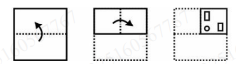
A piece of paper is folded and punched as shown below in the question figures. From the given option figures, indicate how it will appear when opened.

  1. AOption (a)

  2. BOption (b)

  3. COption (c)

  4. DOption (d)

View answer & explanation

Correct answer

Answer: (d)D.

Why this answer is correct

The paper will appear when opened.

Hence, the correct answer is "Option 4".

Question 32

A piece of paper is folded and punched as shown below in the question figures. From the given option figures, indicate how it will appear when opened.

  1. AOption (a)

  2. BOption (b)

  3. COption (c)

  4. DOption (d)

View answer & explanation

Correct answer

Answer: (c)C.

Why this answer is correct

The paper will appear when opened.

Hence, the correct answer is "Option 3".

Question 33

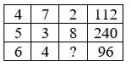
In the following question, select the number which can be placed at the sign of question mark (?) from the given alternatives.

  1. AOption (a)

    2

  2. BOption (b)

    4

  3. COption (c)

    6

  4. DOption (d)

    8

View answer & explanation

Correct answer

Answer: (a)A.

2

Why this answer is correct

The logic followed here is:

In a row: (Product of first three numbers) × 2 = Fourth number

Row 1: (4 × 7 × 2) × 2 → 56 × 2 = 112

Row 2: (5 × 3 × 8) × 2 → 120 × 2 = 240

Similarly,

Row 3: (6 × 4 × ?) × 2 → (24 × ?) × 2 = 96

⇒ 48 × ? = 96

⇒ ? = 96 ÷ 48

⇒ ? = 2

Hence, the correct answer is "Option 1".

Question 34

In the following question, select the number which can be placed at the sign of question mark (?) from the given alternatives.

  1. AOption (a)

    2

  2. BOption (b)

    3

  3. COption (c)

    5

  4. DOption (d)

    4

View answer & explanation

Correct answer

Answer: (b)B.

3

Why this answer is correct

The logic followed here is:

Logic: (Bottom-left number × Top-right number) + Top-left number = Bottom-right number

Box 1: (5 × 3) + 2 → 15 + 2 = 17

Box 2: (7 × 6) + 4 → 42 + 4 = 46

Similarly, in Box 3:

(6 × ?) + 2 = 20

⇒ 6 × ? = 20 - 2

⇒ 6 × ? = 18

⇒ ? = 18 ÷ 6

⇒ ? = 3

Hence, the correct answer is "Option 2".

Question 35

How many triangles are there in the given figure?

  1. AOption (a)

    6

  2. BOption (b)

    7

  3. COption (c)

    8

  4. DOption (d)

    9

View answer & explanation

Correct answer

Answer: (b)B.

7

Why this answer is correct

The total number of triangles in the figure is:

So, the total number of triangles in the figure is 7.

Hence, the correct answer is "Option 2".

Question 36

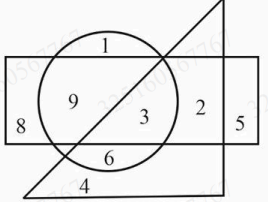
In the figure given below the rectangle represents airplanes, the circle represents white and the triangle represents car. The number in each area represents the number of items in that area.

Which of the following statement is NOT correct?

I. Number of white which are car and airplanes both are 9.

II. Number of airplanes which are not car are 24.

  1. AOption (a)

    Only I

  2. BOption (b)

    Only II

  3. COption (c)

    Both I and II

  4. DOption (d)

    Neither I nor II

View answer & explanation

Correct answer

Answer: (c)C.

Both I and II

Why this answer is correct

I. Number of white which are car and airplanes both are 9.

I. Number of white which are cars and airplanes both are 9.


In the figure, the number in the intersection of all three shapes is 3.

The number 9 is in the circle and rectangle, but outside the triangle.

So, statement I is NOT correct.

II. Number of airplanes which are not car are 24.

"Airplanes that are not car" means the numbers inside the rectangle but outside the triangle.

The numbers inside the rectangle that are not in the triangle are: 8 + 9 = 17.

So, statement I is NOT correct.

Hence, the correct answer is "Option 3".

Question 37

5 persons A, B, C, D and E are sitting around a circular table facing towards the centre (not necessarily in the same order). Only one person is sitting between C and D, considering towards right of D. B is sitting second to the left of D. A is sitting second to the right of C. Who is to the immediate right of D?

  1. AOption (a)

    E

  2. BOption (b)

    B

  3. COption (c)

    A

  4. DOption (d)

    C

View answer & explanation

Correct answer

Answer: (a)A.

E

Why this answer is correct

Given:

  1. Only one person sits between C and D (towards right of D). Since persons face the centre, right is counter-clockwise. So C sits second to the right (counter-clockwise) of D.

    Code
                D C
    
  2. B is second to the left of D. Left is clockwise. So B sits at top-right position.

    Code
         D B C
    
  3. A is second to the right of C. Right is counter-clockwise. So A sits at bottom-right. E fills the remaining seat (top-left), which is immediately to the right of D.

    Code
          D B A C E
    

So, E sits to the immediate right of D.

Hence, the correct answer is "Option 1".

Question 38

Price of 6 toys A, B, C, D, E and F is compared. Price of no two toys is same. Price of B is third highest. Price of E is less than only C. Price of F is less than D but more than A. Price of which two toys is less than B?

  1. AOption (a)

    F and A

  2. BOption (b)

    C and A

  3. COption (c)

    E and F

  4. DOption (d)

    D and E

View answer & explanation

Correct answer

Answer: (a)A.

F and A

Why this answer is correct

Given: The prices of six toys A, B, C, D, E, and F are compared.

1) Price of E is less than only C.

C > E > __ > __ > __ > __

2) Price of B is third highest.

C > E > B > __ > __ > __

3) Price of F is less than D but more than A.


C > E > B > D > F > A

Evaluating the options:

1) F and A (Both are indeed less than B)

  1. C and A (C is more expensive than B)

  2. E and F (E is more expensive than B)

  3. D and E (E is more expensive than B)

Option 1 is the only pair where both toys are cheaper than B.

Hence, the correct answer is "Option 1".

Question 39

If '%' stands for '+', '@' stands for '÷ ', '#' stands for '× ', '*' stands for '-', then find the value of: 3 * 5 # 14 % 15 = ?

  1. AOption (a)

    -53

  2. BOption (b)

    -13

  3. COption (c)

    -52

  4. DOption (d)

    -51

View answer & explanation

Correct answer

Answer: (c)C.

-52

Why this answer is correct

Given:

3 * 5 # 14 % 15 = ?

By using the BODMAS rule:

By, decoding the given symbols we get.

SYMBOLSMEANING
%+
@÷
#×
*-

Substituting the given operator in the given expression:

⇒ 3 * 5 # 14 % 15

⇒ 3 - 5 × 14 + 15

⇒ 3 + 15 - 70

⇒ 18 - 70

⇒ -52

Hence, the correct answer is 'Option 3'.

Question 40

Two figures given on the left side of (::) are related with some logic/rule/relation. Select the missing figure on the right side of (::) from the given alternatives based on the same logic/rule/relation.

  1. AOption (a)

  2. BOption (b)

  3. COption (c)

  4. DOption (d)

View answer & explanation

Correct answer

Answer: (d)D.

Why this answer is correct

The logic followed here is:

Logic: The figure is rotated 135° in the clockwise direction.

For,

Similarly, for

Hence, the correct answer is "Option 4".

Question 41

Two figures given on the left side of (::) are related with some logic/rule/relation. Select the missing figure on the right side of (::) from the given alternatives based on the same logic/rule/relation.

  1. AOption (a)

  2. BOption (b)

  3. COption (c)

  4. DOption (d)

View answer & explanation

Correct answer

Answer: (c)C.

Why this answer is correct

The logic followed here is:

Logic: The figure is rotated 135° in the clockwise direction.

For,

Similarly, for

Hence, the correct answer is "Option 3".

Question 42

In the following figure series, select the figure which can be placed at the sign of question mark (?) from the given alternatives.

  1. AOption (a)

  2. BOption (b)

  3. COption (c)

  4. DOption (d)

View answer & explanation

Correct answer

Answer: (a)A.

Why this answer is correct

The logic followed here is:

Logic: Zig-zag line change to a straight line and vice versa.

The change moves from the bottom line up to the top line in a specific order:

Box 1 to Box 2: The 1st (bottom) line changes. It was a straight line and becomes a  zig-zag line.

Box 2 to Box 3: The 2nd line changes. It was a straight line and became a  zig-zag line.

Box 3 to Box 4: The 3rd line changes. It was a zig-zag and became a straight line.

Box 4 to Box 5 (The Solution): The 4th line changes. It was a straight line and became a zig-zag line.

Hence, the correct answer is "Option 1".

Question 43

 If ‘A’ means ‘+’, ‘B’ means ‘÷ ’, ‘C’ means ‘× ’ and ‘D’ means ‘-’, then 43 A 16 B 4 D 7 C 5 = ?

  1. AOption (a)

    12

  2. BOption (b)

    15

  3. COption (c)

    17

  4. DOption (d)

    21

View answer & explanation

Correct answer

Answer: (a)A.

12

Why this answer is correct

Given:

43 A 16 B 4 D 7 C 5 = ?

By using the BODMAS rule:

By, decoding the given symbols we get.

SYMBOLSMEANING
A+
B÷
C×
D-

Substituting the given operator in the given expression:

⇒ 43 A 16 B 4 D 7 C 5

⇒ 43 + (16 ÷ 4) - 7 × 5

⇒ 43 + 4 - 7 × 5

⇒ 43 + 4 - 35

⇒ 47 - 35

⇒ 12

Hence, the correct answer is 'Option 1'.

Question 44

Select the correct combination of mathematical signs to replace (*) signs sequentially and to balance the given equation.37 * 13 * 48 * 3 * 2 = 18

  1. AOption (a)

    -,÷ ,+.× 

  2. BOption (b)

    +, -,÷ .× 

  3. COption (c)

    × , + , - ,÷ 

  4. DOption (d)

    +, × , ÷ , - 

View answer & explanation

Correct answer

Answer: (b)B.

+, -,÷ .× 

Why this answer is correct

BODMAS Rule:

The given equation is:

37 * 13 * 48 * 3 * 2 = 18

Now, let's check each option by applying the proposed signs sequentially and following BODMAS step-by-step:

1) Signs with -, ÷, +, ×

New Equation: 37 - 13 ÷ 48 + 3 × 2 = ?

⇒ 37 - (13 ÷ 48) + 3 × 2

⇒ 37 - 0.27 + (3 × 2)

⇒ (37 + 6) - 0.27

⇒ 43 - 0.27

⇒ 42.73 ≠ 18 (Incorrect)

2) Signs with +, -, ÷, ×

New Equation: 37 + 13 - 48 ÷ 3 × 2 = ?

Perform operations according to BODMAS/PEMDAS:

⇒ 37 + 13 - (48 ÷ 3) × 2

⇒ 37 + 13 - (16 × 2)

⇒ (37 + 13) - 32

⇒ 50 - 32

⇒ 18

18 = 18 (Correct)

3) Signs with ×, +, -, ÷

New Equation: 37 × 13 + 48 - 3 ÷ 2 = ?

⇒ 37 × 13 + 48 - (3 ÷ 2)

⇒ (37 × 13) + 48 - 1.5

⇒ (481 + 48) - 1.5

⇒ 529 - 1.5

⇒ 527.5 ≠ 18 (Incorrect)

4) Signs with +, ×, ÷, -

New Equation: 37 + 13 × 48 ÷ 3 - 2 = ?

⇒ 37 + 13 × (48 ÷ 3) - 2

⇒ 37 + (13 × 16) - 2

⇒ (37 + 208) - 2

⇒ 245 - 2

⇒ 243 ≠ 18 (Incorrect)

Hence, the correct answer is "Option 2".

Question 45

In the following question, four letter-number pairs are given. The letter-number on the left side of (-) is related to the letter-number on the right side of (-) with some Logic/Rule/Relation. Three pairs are similar on the basis of same Logic/Rule/Relation. Select the odd one out from the given alternatives.(NOTE: Operations should be performed on the whole numbers, without breaking down the number into its constituent digits. E.g. 13 – Operations on 13 such as adding /subtracting /multiplying etc. to 13 can be performed. Breaking down 13 into 1 and 3 and then performing mathematical operations on 1 and 3 is not allowed)

  1. AOption (a)

    108CX – 216DB

  2. BOption (b)

    132DR – 264EU

  3. COption (c)

    244AH – 488BK

  4. DOption (d)

    296PU – 592QX

View answer & explanation

Correct answer

Answer: (a)A.

108CX – 216DB

Why this answer is correct

The logic followed here:

For Option 1) 108CX - 216DB:

For Option 2) 132DR - 264EU:

For Option 3) 244AH - 488BK:

For Option 4) 296PU - 592QX:

Thus, the letter-cluster that DOES NOT belong to that group is 108CX - 216DB.

Hence, the correct answer is "Option 1".

Question 46

In the following question, four letter-number pairs are given. The letter-number on the left side of (–) is related to the letter-number on the right side of (–) with some Logic/Rule/Relation. Three pairs are similar on the basis of same Logic/Rule/Relation. Select the odd one out from the given alternatives.

(NOTE: Operations should be performed on the whole numbers, without breaking down the number into its constituent digits. E.g. 13 – Operations on 13 such as adding /subtracting /multiplying etc. to 13 can be performed. Breaking down 13 into 1 and 3 and then performing mathematical operations on 1 and 3 is not allowed)

  1. AOption (a)

    TR120 – VX180

  2. BOption (b)

    BY246 – DD369

  3. COption (c)

    CD122 – EI183

  4. DOption (d)

    LW310 – NB465

View answer & explanation

Correct answer

Answer: (a)A.

TR120 – VX180

Why this answer is correct

The logic followed here involves a vertical shift in the letter positions and a mathematical operation on the whole numbers within each pair.

For Option 1) TR120 – VX180:

For Option 2) BY246 – DD369:

For Option 3) CD122 – EI183:

For Option 4) LW310 – NB465:

Thus, the letter-number pair that DOES NOT belong to that group is TR120 – VX180.

Hence, the correct answer is "Option 1".

Question 47

In the following question, in each alternative a group of numbers is given. The numbers of each group are related to the numbers of the same group by some Logic/Rule/Relation. Select that group of numbers in which numbers are not related by that same Logic/Rule/Relation.

(NOTE: Operations should be performed on the whole numbers, without breaking down the number into its constituent digits. E.g. 13 – Operations on 13 such as adding /subtracting /multiplying etc. to 13 can be performed. Breaking down 13 into 1 and 3 and then performing mathematical operations on 1 and 3 is not allowed)

  1. AOption (a)

    (208, 174, 140)

  2. BOption (b)

    (412, 378, 344)

  3. COption (c)

    (534, 500, 466)

  4. DOption (d)

    (626, 582, 548)

View answer & explanation

Correct answer

Answer: (d)D.

(626, 582, 548)

Why this answer is correct

The logic followed here is:

The difference between the consecutive numbers in the group is constant.

Option 1: 208 - 174 = 34; 174 - 140 = 34.

Option 2: 412 - 378 = 34; 378 - 344 = 34.

Option 3: 534 - 500 = 34; 500 - 466 = 34.

Whereas,

Option 4: 626 - 582 = 44; 582 - 548 = 34. The first difference is 44 instead of 34.

Hence, the correct answer is "Option 4".

Question 48

In the following question, in each alternative a group of numbers is given. The numbers of each group are related to the numbers of the same group by some Logic/Rule/Relation. Select that group of numbers in which numbers are not related by that same Logic/Rule/Relation.

(NOTE: Operations should be performed on the whole numbers, without breaking down the number into its constituent digits. E.g. 13 – Operations on 13 such as adding /subtracting /multiplying etc. to 13 can be performed. Breaking down 13 into 1 and 3 and then performing mathematical operations on 1 and 3 is not allowed)

  1. AOption (a)

    (141, 285, 426)

  2. BOption (b)

    (169, 341, 510)

  3. COption (c)

    (173, 348, 521)

  4. DOption (d)

    (191, 385, 576)

View answer & explanation

Correct answer

Answer: (c)C.

(173, 348, 521)

Why this answer is correct

Then logic followed here is:

Option 1: (141 × 2) + 3 = 282 + 3 = 285; and 141 + 285 = 426

Option 2: (169 × 2) + 3 = 338 + 3 = 341; and 169 + 341 = 510

Option 4: (191 × 2) + 3 = 382 + 3 = 385; and 191 + 385 = 576

In options 1, 2, and 4, the second number is (First number × 2 + 3) and the third number is the sum of the first two numbers.

Whereas,

Option 3: (173 × 2) + 2 = 346 + 2 = 348. Here, 2 is added instead of 3 to get the second number.

So, Option 3 is the odd one from the given options.

Hence, the correct answer is "Option 3".

Question 49

Select the option that is related to the fifth letter-number cluster in the same way as the second letter-number cluster is related to the first letter-number cluster and fourth letter-number cluster is related to third letter-number cluster.

(Note: Operations should be performed on the whole numbers, without breaking down the number into its constituent digits. E.g. 13 – Operations on 13 such as adding /subtracting /multiplying etc. to 13 can be performed. Breaking down 13 into 1 and 3 and then performing mathematical operations on 1 and 3 is not allowed)

SB760 : PY530 :: AR1040 : XO810 :: FK840 : ?

  1. AOption (a)

    CG590

  2. BOption (b)

    CH590

  3. COption (c)

    CH610

  4. DOption (d)

    BG630

View answer & explanation

Correct answer

Answer: (c)C.

CH610

Why this answer is correct

The logic followed here is:

For SB760 : PY530

For AR1040 : XO810

For FK840 : ?

So, the missing cluster is CH610.

Hence, the correct answer is "Option 3".

Question 50

Select the option that is related to the fifth letter-number cluster in the same way as the second letter-number cluster is related to the first letter-number cluster and fourth letter-number cluster is related to third letter-number cluster.

(Note: Operations should be performed on the whole numbers, without breaking down the number into its constituent digits. E.g. 13 – Operations on 13 such as adding /subtracting /multiplying etc. to 13 can be performed. Breaking down 13 into 1 and 3 and then performing mathematical operations on 1 and 3 is not allowed)

LW72 : UJ215 :: CA93 : YA278 :: FX103 : ?

  1. AOption (a)

    LC308

  2. BOption (b)

    VD308

  3. COption (c)

    TD309

  4. DOption (d)

    UC309

View answer & explanation

Correct answer

Answer: (b)B.

VD308

Why this answer is correct

The logic followed here is,

For, LW72 : UJ215

For, CA93 : YA278

Similarly, for FX103 : ?

Hence, the correct answer is "Option 2".

Quantitative Aptitude (25 questions)

Question 51

The average of 7 numbers is 81. If the average of the first 3 is 87 and last 3 is 78, what is the 4th number?

  1. AOption (a)

    70

  2. BOption (b)

    72

  3. COption (c)

    75

  4. DOption (d)

    78

View answer & explanation

Correct answer

Answer: (b)B.

72

Why this answer is correct

Given:

Average of 7 numbers = 81

Average of first 3 = 87

Average of last 3 = 78

Formula used:

Sum = Average × Number of terms

Calculations:

Total sum of 7 numbers = 81 × 7 = 567

Sum of first 3 = 87 × 3 = 261

Sum of last 3 = 78 × 3 = 234

Sum of known 6 numbers = 261 + 234 = 495

⇒ 4th number = Total − known sum

⇒ = 567 − 495 = 72

∴ 4th number = 72

Question 52

If the price of a product increases by 25%, by what percent should the consumption be reduced to keep the expenditure same?

  1. AOption (a)

    10%

  2. BOption (b)

    15%

  3. COption (c)

    21%

  4. DOption (d)

    20%

View answer & explanation

Correct answer

Answer: (d)D.

20%

Why this answer is correct

Given:

Price increase = 25%

Expenditure remains same

Formula Used:

Reduced consumption (%) = (Price increase ÷ (100 + Price increase)) × 100

Calculation:

⇒ Reduced consumption (%) = (25 ÷ (100 + 25)) × 100

⇒ Reduced consumption (%) = (25 ÷ 125) × 100

⇒ Reduced consumption (%) = 20%

∴ The correct answer is option 4.

Question 53

A 25% discount on an article brings the price to Rs. 600. What is the original price?

  1. AOption (a)

    Rs. 700

  2. BOption (b)

    Rs. 720

  3. COption (c)

    Rs. 750

  4. DOption (d)

    Rs. 800

View answer & explanation

Correct answer

Answer: (d)D.

Rs. 800

Why this answer is correct

Given:

Discount = 25%

Discounted Price = Rs. 600

Formula Used:

Original Price = Discounted Price ÷ (1 - Discount)

Calculation:

⇒ Original Price = 600 ÷ (1 - 0.25)

⇒ Original Price = 600 ÷ 0.75

⇒ Original Price = Rs. 800

∴ The correct answer is Rs. 800.

Question 54

A solution contains 80% acid. How much water must be added to 20 liters of this solution to make acid 50%?

  1. AOption (a)

    12 liters

  2. BOption (b)

    16 liters

  3. COption (c)

    20 liters

  4. DOption (d)

    25 liters

View answer & explanation

Correct answer

Answer: (a)A.

12 liters

Why this answer is correct

Given:

Initial acid concentration = 80%

Initial solution volume = 20 liters

Final acid concentration = 50%

Formula Used:

Acid volume = Initial solution volume × Initial acid concentration

Final solution volume = Acid volume ÷ Final acid concentration

Calculation:

⇒ Acid volume = 20 × 80 ÷ 100

⇒ Acid volume = 16 liters

⇒ Final solution volume = 16 ÷ 50 × 100

⇒ Final solution volume = 32 liters

⇒ Water added = Final solution volume - Initial solution volume

⇒ Water added = 32 - 20

⇒ Water added = 12 liters

∴ The correct answer is 12 liters.

Question 55

A can do a piece of work in 20 days and B in 30 days. They work together for 5 days. How much work is left?

  1. AOption (a)

    1/4

  2. BOption (b)

    1/3

  3. COption (c)

    7/12

  4. DOption (d)

    11/20

View answer & explanation

Correct answer

Answer: (c)C.

7/12

Why this answer is correct

Given:

A can do a piece of work in 20 days.

B can do a piece of work in 30 days.

They work together for 5 days.

Formula Used:

LCM = Total work.

Work = Efficiency × Days.

Calculation:

⇒ LCM of 20 and 30 = 60 (Total work).

⇒ Efficiency of A = 60 ÷ 20 = 3 units/day.

⇒ Efficiency of B = 60 ÷ 30 = 2 units/day.

⇒ Combined efficiency of A and B = 3 + 2 = 5 units/day.

⇒ Work done in 5 days = 5 × 5 = 25 units.

⇒ Work left = Total work - Work done = 60 - 25 = 35 units.

⇒ Fraction of work left = Work left ÷ Total work = 35 ÷ 60 = 7/12.

∴ The correct answer is 7/12.

Question 56

How many cuboid boxes of size 10 cm × 5 cm × 2 cm  can be packed into a carton of size 50 cm × 25 cm × 20cm without leaving any space?

  1. AOption (a)

    220

  2. BOption (b)

    230

  3. COption (c)

    250

  4. DOption (d)

    300

View answer & explanation

Correct answer

Answer: (c)C.

250

Why this answer is correct

Shortcut Trick

Number of boxes = (Length × Breadth × Height)Carton ÷ (length × breadth × height)Box

Number of boxes = (50 × 25 × 20) ÷ (10 × 5 × 2)

Number of boxes = 5 × 5 × 10 = 250

∴ The correct answer is 250.

Alternate Method

Given:

Dimensions of the carton (L, B, H) = 50 cm, 25 cm, 20 cm

Dimensions of the cuboid box (l, b, h) = 10 cm, 5 cm, 2 cm

Formula Used:

Volume of a cuboid = Length × Breadth × Height

Number of objects = Total Volume ÷ Volume of one object

Calculations:

⇒ Volume of the carton = 50 cm × 25 cm × 20 cm

⇒ Volume of the carton = 25,000 cm3

⇒ Volume of one cuboid box = 10 cm × 5 cm × 2 cm

⇒ Volume of one cuboid box = 100 cm3

⇒ Number of boxes = 25,000 ÷ 100

⇒ Number of boxes = 250

∴ The correct answer is 250.

Additional Information

Total Surface Area of Cuboid

The total area covering the outer surface of a cuboid is given by TSA = 2(lb + bh + hl).

Diagonal of a Cuboid

The longest rod that can be placed inside a cuboid is its diagonal, calculated as D = √(l2 + b2 + h2).

Lateral Surface Area

The area of the four side walls (excluding top and bottom) is LSA = 2 × h × (l + b).

Question 57

A triangular road sign has angles50∘ , 60∘ , ans 70∘  Another similar sign has one angle 70∘ . What are the other two?

  1. AOption (a)

    60∘ and 50∘ 

  2. BOption (b)

    55∘  and 55∘ 

  3. COption (c)

    40∘ and 70∘ 

  4. DOption (d)

    60∘  and 60∘ 

View answer & explanation

Correct answer

Answer: (a)A.

60∘ and 50∘ 

Why this answer is correct

Given:

Triangle 1 angles = 50°, 60°, 70°

Triangle 2 is similar and one angle = 70°

Formula used:

In similar triangles, corresponding angles are equal

Calculations:

Triangle 1 angles = 50°, 60°, 70°

Triangle 2 has one angle = 70°

⇒ Remaining angles must be same as other angles of Triangle 1

⇒ Other two angles = 50°, 60°

∴ Required angles = 50° and 60°

Question 58

An interior designer uses a regular pentagon shape for a tabletop. What is the measure of each interior angle?

  1. AOption (a)

    100∘ 

  2. BOption (b)

    108∘

  3. COption (c)

    120∘ 

  4. DOption (d)

    126∘ 

View answer & explanation

Correct answer

Answer: (b)B.

108∘

Why this answer is correct

Given:

Number of sides = 5

Formula Used:

Sum of interior angles = (n - 2) × 180°

Measure of each interior angle = Sum of interior angles ÷ n

Calculation:

⇒ Sum of interior angles = (5 - 2) × 180°

⇒ Sum of interior angles = 3 × 180°

⇒ Sum of interior angles = 540°

⇒ Measure of each interior angle = 540° ÷ 5

⇒ Measure of each interior angle = 108°

∴ The correct answer is 108°.

Question 59

A trader bought 300kg of rice, part at ₹18 per kg and the rest at ₹24 per kg. He sold all at ₹27 per kg and made a total profit of ₹2,100. If the quantity bought at ₹18 was twice that bought at ₹24, find the quantity bought at ₹24 per kg.

  1. AOption (a)

    110 kg

  2. BOption (b)

    130 kg

  3. COption (c)

    140 kg

  4. DOption (d)

    100 kg

View answer & explanation

Correct answer

Answer: (d)D.

100 kg

Why this answer is correct

Given:

Total quantity = 300 kg

Price of part 1 = ₹18 per kg

Price of part 2 = ₹24 per kg

Selling price = ₹27 per kg

Total profit = ₹2,100

Quantity at ₹18 = 2 × Quantity at ₹24

Formula Used:

Profit = Selling Price - Cost Price

Total Cost = (Quantity at ₹18 × ₹18) + (Quantity at ₹24 × ₹24)

Calculation:

⇒ Let quantity at ₹24 = x kg

⇒ Quantity at ₹18 = 2x kg

⇒ Total quantity = Quantity at ₹18 + Quantity at ₹24

⇒ 2x + x = 300

⇒ 3x = 300

⇒ x = 100

⇒ Quantity at ₹24 = 100 kg

⇒ Quantity at ₹18 = 2 × 100 = 200 kg

⇒ Total Cost = (200 × ₹18) + (100 × ₹24)

⇒ Total Cost = ₹3,600 + ₹2,400 = ₹6,000

⇒ Total Selling Price = 300 × ₹27

⇒ Total Selling Price = ₹8,100

⇒ Profit = ₹8,100 - ₹6,000

⇒ Profit = ₹2,100

∴ The correct answer is 100 kg.

Question 60

A pipe has a right prism shape with an equilateral triangle base of side 6 cm and length 40 cm. Find its water-holding capacity.

  1. AOption (a)

    311.7 cm3

  2. BOption (b)

    415.6 cm3

  3. COption (c)

    623.5 cm3

  4. DOption (d)

    778.1 cm3

View answer & explanation

Correct answer

Answer: (c)C.

623.5 cm3

Why this answer is correct

Given:

Side of equilateral triangle base = 6 cm

Length of prism = 40 cm

Formula Used:

Area of equilateral triangle = (√3 / 4) × side2

Volume of prism = Base Area × Length

Calculation:

⇒ Area of equilateral triangle = (√3 / 4) × 62

⇒ Area of equilateral triangle = (√3 / 4) × 36

⇒ Area of equilateral triangle = 9√3 cm2

⇒ Volume of prism = 9√3 × 40

⇒ Volume of prism = 360√3 cm3

⇒ Volume of prism ≈ 623.5 cm3

∴ The correct answer is 623.5 cm3.

Question 61

A circular sprinkler is placed inside a triangular garden with sides 13 m, 14 m, and 15m.  What is the radius of the sprinkler if it touches all three sides of the triangle?

  1. AOption (a)

    4 m

  2. BOption (b)

    3.5 m

  3. COption (c)

    4.5 m

  4. DOption (d)

    5 m

View answer & explanation

Correct answer

Answer: (a)A.

4 m

Why this answer is correct

Given:

Sides of triangle = 13 m, 14 m, 15 m

Formula used:

Radius of incircle = Area ÷ Semi-perimeter

Area (Heron’s formula) = √[s(s − a)(s − b)(s − c)]

Semi-perimeter (s) = (a + b + c) ÷ 2

Calculations:

⇒ s = (13 + 14 + 15) ÷ 2 = 42 ÷ 2 = 21

⇒ Area = √[21 × (21−13) × (21−14) × (21−15)]

⇒ = √[21 × 8 × 7 × 6]

⇒ = √[7056]

⇒ Area = 84 m2

⇒ Radius = Area ÷ s

⇒ r = 84 ÷ 21 = 4 m

∴ Radius of the sprinkler = 4 m.

Question 62

If a : b = 9 : 5, b : c = 4 : 11, Find a : c

  1. AOption (a)

    36 : 55

  2. BOption (b)

    26 : 55

  3. COption (c)

    36 : 53

  4. DOption (d)

    35 : 52

View answer & explanation

Correct answer

Answer: (a)A.

36 : 55

Why this answer is correct

Given:

a : b = 9 : 5

b : c = 4 : 11

Formula used:

Make common term (b) same in both ratios

Calculations:

a : b = 9 : 5

b : c = 4 : 11

LCM of 5 and 4 = 20

⇒ Multiply (9 : 5) by 4 → 36 : 20

⇒ Multiply (4 : 11) by 5 → 20 : 55

⇒ a : b : c = 36 : 20 : 55

⇒ a : c = 36 : 55

∴ a : c = 36 : 55.

Question 63

In triangle PQR, PS is the bisector of  ∠ QPR and PT ⊥  QR with ∠ Q > ∠ R. What is ∠ TPS?

  1. AOption (a)

    (∠ Q + ∠ R)/2

  2. BOption (b)

    (∠ Q - ∠ R)/2

  3. COption (c)

    (∠ Q ×  ∠ R)/2

  4. DOption (d)

    (∠ Q/2)  - (∠ R/2)

View answer & explanation

Correct answer

Answer: (b)B.

(∠ Q - ∠ R)/2

Why this answer is correct

Given:

Triangle PQR

PS = angle bisector of ∠QPR

PT ⟂ QR

∠Q > ∠R

Formula used:

Angle bisector divides ∠P into equal parts

Angle between altitude and bisector = (1/2)(∠Q − ∠R)

Code
P Q R   PS   PT   QR

Calculations:

⇒ ∠QPR = A ⇒ PS divides into A/2 each

⇒ PT ⟂ QR ⇒ forms right angle

⇒ Using triangle geometry relation

⇒ ∠TPS = (1/2)(∠Q − ∠R)

∴ The correct answer is (1/2)(∠Q − ∠R).

Question 64

3 liters of lime syrup are mixed with m liters of water. If the lime syrup is 5% of the mixture, find the value of m.

  1. AOption (a)

    54 litres

  2. BOption (b)

    60 litres

  3. COption (c)

    65 litres

  4. DOption (d)

    57 litres

View answer & explanation

Correct answer

Answer: (d)D.

57 litres

Why this answer is correct

Given:

Lime syrup = 3 L

Water = m L

Lime syrup percentage = 5%

Formula used:

Percentage = (Part ÷ Total) × 100

Calculations:

Total mixture = 3 + m

⇒ (3 ÷ (3 + m)) × 100 = 5

⇒ 300 ÷ (3 + m) = 5

⇒ 300 = 5 × (3 + m)

⇒ 300 = 15 + 5m

⇒ 300 − 15 = 5m

⇒ 285 = 5m

⇒ m = 57 L

∴ Value of m = 57 liters.

Question 65

The angle subtended by a chord at the circumference is 35°. The angle subtended at the center is:

  1. AOption (a)

    35°

  2. BOption (b)

    45°

  3. COption (c)

    70°

  4. DOption (d)

    90°

View answer & explanation

Correct answer

Answer: (c)C.

70°

Why this answer is correct

Given:

Angle subtended by chord at circumference = 35°

Formula Used:

Angle subtended at center = 2 × Angle subtended at circumference

Calculation:

⇒ Angle subtended at center = 2 × 35°

⇒ Angle subtended at center = 70°

∴ The correct answer is 70°.

Question 66

The question consists of two statements numbered "I and II" given below it. You have to decide whether the data provided in the statements is sufficient to answer the question.

Find the time taken by a 400-metre-long train to cross a platform of length 1,600 metres.

Statement I: Train can cross a 1,200-metre-long platform in 80 seconds.

Statement II: Train can cross a pole in 20 seconds.

  1. AOption (a)

    The data in statement I alone are sufficient to answer the question, while the data in statement II alone is not sufficient to answer the question.

  2. BOption (b)

    The data in statement II alone are sufficient to answer the question, while the data in statement I alone is not sufficient to answer the question.

  3. COption (c)

    The data either in statement I alone or in statement II alone is sufficient to answer the question.

  4. DOption (d)

    The data given in both statements I and II together is not sufficient to answer the question.

View answer & explanation

Correct answer

Answer: (c)C.

The data either in statement I alone or in statement II alone is sufficient to answer the question.

Why this answer is correct

Given:

Train length = 400 m

Platform length = 1600 m

Formula used:

Speed = Distance ÷ Time

Total distance = Train length + Platform length

Calculations:

Statement I:

Distance = 400 + 1200 = 1600 m

Time = 80 s

⇒ Speed = 1600 ÷ 80 = 20 m/s

Required distance = 400 + 1600 = 2000 m

⇒ Time = 2000 ÷ 20 = 100 s

⇒ Statement I alone is sufficient ✔


Statement II:

Crossing pole ⇒ Distance = 400 m

Time = 20 s

⇒ Speed = 400 ÷ 20 = 20 m/s

Required distance = 2000 m

⇒ Time = 2000 ÷ 20 = 100 s

⇒ Statement II alone is sufficient ✔

∴ Either statement I alone or statement II alone is sufficient to answer the question.

Question 67

Rationalize and simplify: 5 / (3 + √ 2)

  1. AOption (a)

    [15 + 5√ 2] / 7

  2. BOption (b)

    [15 - 5√ 2] / 7

  3. COption (c)

    [11 - 3√ 2] / 5

  4. DOption (d)

    [11 + 3√ 2] / 5

View answer & explanation

Correct answer

Answer: (b)B.

[15 - 5√ 2] / 7

Why this answer is correct

Given:

Expression = 5 ÷ (3 + √2)

Formula used:

(a + b)(a − b) = a2 − b2

Calculations:

⇒ Multiply numerator and denominator by (3 − √2)

⇒ [5 × (3 − √2)] ÷ [(3 + √2)(3 − √2)]

⇒ = [5(3 − √2)] ÷ (9 − 2)

⇒ = [5(3 − √2)] ÷ 7

⇒ = (15 − 5√2) ÷ 7

∴ Simplified form = (15 − 5√2) /7.

Question 68

A and B invested Rs. 15,000 and Rs. 25,000, respectively. After 6 months, A withdrew Rs. 5,000. If the total profit after 1 year is Rs. 60,000, how much does A receive?

  1. AOption (a)

    Rs. 18,000

  2. BOption (b)

    Rs. 20,000

  3. COption (c)

    Rs. 22,000

  4. DOption (d)

    Rs. 24,000

View answer & explanation

Correct answer

Answer: (b)B.

Rs. 20,000

Why this answer is correct

Given:

A's initial investment = Rs. 15,000

B's investment = Rs. 25,000

A withdrew Rs. 5,000 after 6 months

Total profit = Rs. 60,000

Total duration = 1 year

Formula Used:

Profit sharing ratio = Investment × Time

A's share = (A's ratio ÷ Total ratio) × Total profit

Calculation:

⇒ A's investment for first 6 months = 15,000 × 6 = 90,000

⇒ A's investment for next 6 months = 10,000 × 6 = 60,000

⇒ Total A's ratio = 90,000 + 60,000 = 1,50,000

⇒ B's ratio = 25,000 × 12 = 3,00,000

⇒ Total ratio = 1,50,000 + 3,00,000 = 4,50,000

⇒ A's share = (1,50,000 ÷ 4,50,000) × 60,000

⇒ A's share = 1/3 × 60,000 = Rs. 20,000

∴ The correct answer is Rs. 20,000.

Question 69

A sum of money, when invested at simple interest, amounts to ₹12,000 in 4 years and ₹15,000 in 7 years. What is the original principal amount?

  1. AOption (a)

    ₹5,000

  2. BOption (b)

    ₹8,000

  3. COption (c)

    ₹7,000

  4. DOption (d)

    ₹9,000

View answer & explanation

Correct answer

Answer: (b)B.

₹8,000

Why this answer is correct

Shortcut Trick

Difference in amounts for 3 years (7 − 4) = ₹15,000 − ₹12,000 = ₹3,000.

Interest per year = 3,000 ÷ 3 = ₹1,000.

Interest for 4 years = 1,000 × 4 = ₹4,000.

Principal = Amount after 4 years − Interest for 4 years = 12,000 − 4,000 = ₹8,000.

∴ The correct answer is ₹8,000.

Alternate Method

Given:

Amount after 4 years (A4) = ₹12,000

Amount after 7 years (A7) = ₹15,000

Formula:

Amount (A) = Principal (P) + Simple Interest (SI)

Simple Interest (SI) = (P × R × T) ÷ 100

Calculations:

⇒ Interest for 3 years = A7 − A4

⇒ Interest for 3 years = 15,000 − 12,000 = 3,000

⇒ Interest for 1 year = 3,000 ÷ 3 = 1,000

⇒ Interest for 4 years = 1,000 × 4 = 4,000

⇒ Principal (P) = A4 − Interest for 4 years

⇒ Principal (P) = 12,000 − 4,000 = 8,000

∴ The correct answer is ₹8,000.

Additional Information

Simple Interest Property

In simple interest, the interest earned remains constant every year because it is always calculated on the original principal.

Rate of Interest Formula

The annual rate (R) can be found using R = (SI × 100) ÷ (P × T). In this case, R = (1000 × 100) ÷ (8000 × 1) = 12.5%.

Amount Calculation

The total amount after T years is given by the formula: A = P(1 + RT/100).

Question 70

If p + q = 3 and p - q = 1, find 2p2 + 2q2 - 4pq.

  1. AOption (a)

    2

  2. BOption (b)

    4

  3. COption (c)

    6

  4. DOption (d)

    8

View answer & explanation

Correct answer

Answer: (a)A.

2

Why this answer is correct

Given:

p + q = 3

p − q = 1

Formula used:

2p2 + 2q2 − 4pq = 2(p − q)2

Calculations:

⇒ p − q = 1

⇒ 2(p − q)2 = 2 × 12

⇒ = 2 × 1 = 2

∴ Value = 2.

Question 71

Which of the following options will have sum as 50?

  1. AOption (a)

    1002+12\frac{100}{2} + \frac{1}{2}

  2. BOption (b)

    1503+14 \frac{150}{3} + \frac{1}{4}

  3. COption (c)

    253+1504\frac{25}{3} + \frac{150}{4}

  4. DOption (d)

    753+1004 \frac{75}{3} + \frac{100}{4}

View answer & explanation

Correct answer

Answer: (d)D.

753+1004 \frac{75}{3} + \frac{100}{4}

Why this answer is correct

Given:

Option 1: 100 ÷ 2 and 1 ÷ 2

Option 2: 150 ÷ 3 and 1 ÷ 4

Option 3: 25 ÷ 3 and 150 ÷ 4

Option 4: 75 ÷ 3 and 100 ÷ 4

Formula Used:

Sum = First value + Second value

Calculation:

⇒ Option 1 = 100 ÷ 2 + 1 ÷ 2 = 50 + 0.5 = 50.5

⇒ Option 2 = 150 ÷ 3 + 1 ÷ 4 = 50 + 0.25 = 50.25

⇒ Option 3 = 25 ÷ 3 + 150 ÷ 4 = 8.33 + 37.5 = 45.83

⇒ Option 4 = 75 ÷ 3 + 100 ÷ 4 = 25 + 25 = 50

∴ The correct answer is option 4.

Question 72

If x = √ 45 + √5, then what is the value of x2?

  1. AOption (a)

    160

  2. BOption (b)

    80

  3. COption (c)

    40

  4. DOption (d)

    87

View answer & explanation

Correct answer

Answer: (b)B.

80

Why this answer is correct

Given:

x = √45 + √5

Formula Used:

(a + b)2 = a2 + 2ab + b2

√m × √n = √(m × n)

Calculation:

⇒ x2 = (√45 + √5)2

⇒ x2 = (√45)2 + 2 × √45 × √5 + (√5)2

⇒ x2 = 45 + 2 × √(45 × 5) + 5

⇒ x2 = 45 + 2 × √225 + 5

⇒ x2 = 45 + 2 × 15 + 5

⇒ x2 = 45 + 30 + 5

⇒ x2 = 80

∴ The correct answer is 80.

Question 73

A sum is being lent at 12.5 percent per annum compound interest (compounding annually). What is the ratio of amount at the end of first year to the amount at the end of second year?

  1. AOption (a)

    8 : 9

  2. BOption (b)

    7 : 8

  3. COption (c)

    9 : 11

  4. DOption (d)

    9 : 10

View answer & explanation

Correct answer

Answer: (a)A.

8 : 9

Why this answer is correct

Shortcut Trick

Rate of interest = 12.5% = 1/8 in fraction form.

In Compound Interest, the Amount at the end of any year becomes the Principal for the next year.

Multiplier for one year = (1 + 1/8) = 9/8.

Ratio of Amount1 : Amount2 = 1 : (9/8) = 8 : 9.

∴ The correct answer is 8 : 9.

Alternate Method

Given:

Rate (R) = 12.5% per annum

Compounding period = Annually

Formula Used:

Amount (A) = P(1 + R/100)n, where P is Principal and n is Time.

Calculations:

⇒ Amount at the end of 1st year (A1) = P(1 + 12.5/100)1

⇒ Amount at the end of 2nd year (A2) = P(1 + 12.5/100)2

⇒ Required Ratio = A1 : A2

⇒ Ratio = [P(1 + 12.5/100)1] / [P(1 + 12.5/100)2]

⇒ Ratio = 1 / (1 + 12.5/100)

⇒ Since 12.5/100 = 1/8

⇒ Ratio = 1 / (1 + 1/8) = 1 / (9/8)

⇒ Ratio = 8 / 9

∴ The correct answer is 8 : 9.

Additional Information

Compound Interest Concept

In Compound Interest, the interest earned in the previous year is added to the Principal to calculate interest for the next year. Thus, the ratio of amounts in any two consecutive years is always (1 + R/100).

Effective Rate of Interest

For two years, the Effective Rate of CI can be calculated using the formula: x + y + (xy)/100. For 12.5%, it is 12.5 + 12.5 + (12.5 × 12.5)/100 = 26.5625%.

Difference between SI and CI

The difference between CI and SI for 2 years is given by P(R/100)2. In the 1st year, CI and SI are always equal if compounded annually.

Question 74

The average of 5 consecutive odd natural numbers is 37. Previous 5 consecutive odd natural numbers to these 5 odd natural numbers are also included. What will be the average of newly added numbers?

  1. AOption (a)

    21

  2. BOption (b)

    23

  3. COption (c)

    27

  4. DOption (d)

    19

View answer & explanation

Correct answer

Answer: (c)C.

27

Why this answer is correct

Given:

Average of 5 consecutive odd numbers = 37

Number of terms = 5

Formula Used:

Average of consecutive odd numbers = Middle term

Calculation:

⇒ Middle number = 37

⇒ Numbers = 33, 35, 37, 39, 41

⇒ Previous 5 odd numbers = 23, 25, 27, 29, 31

⇒ Sum of new numbers = 23 + 25 + 27 + 29 + 31 = 135

⇒ Average = 135 ÷ 5

⇒ Average = 27

∴ The correct answer is 27.

Question 75

P, Q and R working alone can complete a work in 24, 30 and 40 days respectively. All three of them started the work together but after 8 days P left the work. Q left the work 6 days before the work was completed. R completed the remaining work alone. In how many days was the total work completed?

  1. AOption (a)

    97/7

  2. BOption (b)

    104/7

  3. COption (c)

    109/7

  4. DOption (d)

    152/7

View answer & explanation

Correct answer

Answer: (b)B.

104/7

Why this answer is correct

Given:

P time = 24 days

Q time = 30 days

R time = 40 days

P works for 8 days

Q leaves 6 days before completion

Formula Used:

Work rate = 1 ÷ Time

Total work = Sum of individual works

Calculation:

⇒ LCM of 24, 30, 40 = 120

⇒ Rate P = 5 ÷ 120

⇒ Rate Q = 4 ÷ 120

⇒ Rate R = 3 ÷ 120

⇒ Work by (P + Q + R) in 8 days = (5 + 4 + 3) ÷ 120 × 8

⇒ Work = 12 ÷ 120 × 8 = 96 ÷ 120

⇒ Remaining work = 120 ÷ 120 − 96 ÷ 120 = 24 ÷ 120

⇒ Let total time = T

⇒ Q works for (T − 6) days

⇒ Work by P = 5 ÷ 120 × 8 = 40 ÷ 120

⇒ Work by Q = 4 ÷ 120 × (T − 6)

⇒ Work by R = 3 ÷ 120 × T

⇒ Total work = 120 ÷ 120

⇒ 40 ÷ 120 + 4(T − 6) ÷ 120 + 3T ÷ 120 = 120 ÷ 120

⇒ 40 + 4T − 24 + 3T = 120

⇒ 7T + 16 = 120

⇒ 7T = 104

⇒ T = 104 ÷ 7

∴ The correct answer is 104 ÷ 7 days.

General Awareness (25 questions)

Question 76

On October 31, India celebrates which day to mark the birth anniversary of Sardar Vallabhbhai Patel?

  1. AOption (a)

    National Science Day

  2. BOption (b)

    National Martyrs' Day

  3. COption (c)

    National Unity Day

  4. DOption (d)

    National Constitution Day

View answer & explanation

Correct answer

Answer: (c)C.

National Unity Day

Why this answer is correct

The correct answer is National Unity Day.

Key Points

  • National Unity Day (Rashtriya Ekta Diwas) is celebrated on October 31st every year in India to commemorate the birth anniversary of Sardar Vallabhbhai Patel, also known as the "Iron Man of India."
  • Sardar Vallabhbhai Patel was instrumental in the integration of over 500 princely states into the Indian Union after independence in 1947, ensuring the unity of the nation.
  • The day was first observed in 2014 as announced by the Government of India under the leadership of Prime Minister Narendra Modi.
  • On this day, various events such as the Run for Unity, pledge-taking ceremonies, and other activities are organized nationwide to promote the message of unity and national integrity.
  • The Statue of Unity, the world's tallest statue located in Kevadia, Gujarat, was inaugurated on October 31, 2018, as a tribute to Sardar Vallabhbhai Patel.

Additional Information

  • Sardar Vallabhbhai Patel:
  • He was born on 31st October 1875 in Nadiad, Gujarat.
  • Patel played a crucial role in India's freedom struggle and was a senior leader of the Indian National Congress.
  • He served as the first Deputy Prime Minister and Home Minister of Independent India.
  • Patel is often referred to as the "Iron Man of India" for his strong leadership and decisive actions in uniting the princely states.
  • Statue of Unity:
  • The Statue of Unity was inaugurated on 31st October 2018 by Prime Minister Narendra Modi.
  • It stands at a height of 182 meters, making it the tallest statue in the world.
  • The statue is located on the Narmada River in Kevadia, Gujarat, and symbolizes Sardar Patel's efforts in unifying India.
  • Run for Unity:
  • The Run for Unity is organized annually on National Unity Day to spread awareness about the importance of unity and harmony in the country.
  • This event sees participation from individuals across different age groups, promoting the ideals of national integration.
  • Other Observances on October 31:
  • While National Unity Day is the primary observance on October 31, it is also remembered as the day of assassination of Indira Gandhi in 1984, the former Prime Minister of India.

Important Points

  • Significance of National Unity Day:
  • The day highlights the importance of national integration in a diverse country like India.
  • It serves as a reminder of Sardar Patel's vision of a united India and his dedication to the cause of national unity.
  • Role of Sardar Patel in Indian History:
  • He was the main architect behind the unification of princely states post-independence.
  • Patel's efforts ensured that India emerged as a strong and united nation, preventing the fragmentation of the country.

Question 77

Who took over as the Governor of the Reserve Bank of India in December 2024?

  1. AOption (a)

    Shaktikanta Das

  2. BOption (b)

    Raghuram Rajan

  3. COption (c)

    Urjit Patel

  4. DOption (d)

    Sanjay Malhotra

View answer & explanation

Correct answer

Answer: (d)D.

Sanjay Malhotra

Why this answer is correct

The correct answer is Sanjay Malhotra.

Key Points

  • Sanjay Malhotra took over as the Governor of the Reserve Bank of India (RBI) in December 2024, succeeding the previous Governor, Shaktikanta Das.
  • He is a senior bureaucrat with extensive experience in the financial and administrative sectors, having served in various capacities in key government ministries.
  • As the 25th Governor of RBI, Sanjay Malhotra is expected to focus on maintaining monetary stability, addressing inflation, and supporting economic growth in India.
  • The appointment of Sanjay Malhotra aligns with the government’s vision of ensuring robust financial management and effective implementation of monetary policies.
  • His tenure will also involve steering the Indian economy through global challenges, including economic slowdowns and geopolitical uncertainties.

Additional Information

  • Reserve Bank of India (RBI):
  • The Reserve Bank of India is India’s central banking institution, which controls the issuance and supply of the Indian rupee.
  • It was established on 1 April 1935, under the Reserve Bank of India Act, 1934.
  • The RBI plays a crucial role in regulating the banking sector, managing the country's monetary policy, and ensuring financial stability.
  • The headquarters of RBI is located in Mumbai, Maharashtra.
  • Some of its major functions include issuing currency, managing foreign exchange reserves, and supervising banks and non-banking financial companies (NBFCs).
  • Role of the RBI Governor:
  • The Governor of the RBI is the chief executive officer and the central authority for India's monetary policies.
  • He/she is responsible for implementing policies to regulate inflation, liquidity, and economic growth.
  • The Governor oversees critical functions such as setting the repo rate, managing forex reserves, and ensuring the smooth functioning of the financial markets.
  • The Governor also represents India at international financial forums like the International Monetary Fund (IMF) and G20 meetings.
  • Previous RBI Governors:
  • Shaktikanta Das: Served from December 2018 to December 2024; played a pivotal role during the COVID-19 pandemic to ensure financial stability.
  • Raghuram Rajan: Served from September 2013 to September 2016; known for his efforts to curb inflation and his proactive measures to stabilize the banking sector.
  • Urjit Patel: Served from September 2016 to December 2018; focused on monetary policy reforms and inflation targeting.
  • Challenges for the New Governor:
  • Maintaining a balance between economic growth and inflation control.
  • Addressing challenges like rising NPAs (Non-Performing Assets) in the banking sector.
  • Ensuring financial inclusion and digital transformation in the banking system.
  • Managing external pressures like global economic uncertainties and exchange rate fluctuations.

Important Points

  • RBI Governors are appointed by the Government of India for a tenure of 3 years, which can be extended based on performance and requirements.
  • The Governor works in coordination with the Deputy Governors, who assist in various functions like banking regulation, financial markets, and monetary policy implementation.
  • The RBI's Monetary Policy Committee (MPC), headed by the Governor, meets periodically to decide on interest rates and other monetary measures.
  • India’s financial stability heavily depends on the effective leadership of the RBI Governor, making this role one of the most critical in the country’s economic governance.

Question 78

In May 2025, Anurag Bhushan has been appointed as India’s next Ambassador to ______.

  1. AOption (a)

    Denmark

  2. BOption (b)

    Sweden

  3. COption (c)

    Australia

  4. DOption (d)

    Canada

View answer & explanation

Correct answer

Answer: (b)B.

Sweden

Why this answer is correct

The correct answer is Sweden.

Key Points

  • Anurag Bhushan has been appointed as India's next Ambassador to Sweden in May 2025.
  • Sweden, a country in northern Europe, is known for its progressive policies, innovation, and strong diplomatic ties with India.
  • India and Sweden share a bilateral relationship that focuses on areas such as trade, technology, sustainable development, and innovation.
  • The appointment of Anurag Bhushan reflects India's efforts to strengthen its diplomatic presence and enhance collaboration with Sweden in strategic sectors.
  • Sweden is an important partner for India in the areas of renewable energy, climate change, and innovation ecosystems.

Additional Information

  • Sweden:
  • Sweden is located in Northern Europe and is a part of the Scandinavian Peninsula.
  • Its capital is Stockholm, and it is known for its high standard of living, innovation, and sustainable practices.
  • Sweden has a strong economy driven by technology, automotive, and renewable energy sectors.
  • India-Sweden Relations:
  • India and Sweden have a long-standing diplomatic relationship, with Sweden being one of the first countries to recognize India’s independence in 1947.
  • Both countries collaborate in areas like trade, technology, innovation, and climate action.
  • Sweden is also a strong proponent of the India-European Union Free Trade Agreement (FTA).
  • Past Diplomatic Representation:
  • India has maintained a strong diplomatic presence in Sweden, with ambassadors facilitating bilateral trade and cultural exchange.
  • Sweden has also been actively involved in promoting green energy and innovation partnerships with India.
  • Relevant Facts About Sweden:
  • Sweden ranks high on the Human Development Index and is known for its welfare policies.
  • It is a member of the European Union and plays an active role in global diplomatic and environmental initiatives.
  • Sweden is home to globally renowned companies like IKEA, Volvo, and Ericsson.

Important Points

  • Bilateral Trade:
  • India and Sweden have a robust trade relationship, with bilateral trade amounting to several billion USD annually.
  • Sweden is also a significant investor in India, especially in sectors like manufacturing, pharmaceuticals, and technology.
  • Technology and Innovation:
  • Sweden is one of the most innovative countries globally and collaborates with India on smart cities, digitalization, and green technology.
  • The India-Sweden Innovation Partnership aims to address global challenges through joint initiatives.
  • Climate Action:
  • Both countries are committed to the Paris Agreement and work together on renewable energy projects and carbon reduction strategies.
  • Sweden has supported India’s International Solar Alliance (ISA) initiative.

Question 79

The Union Budget 2025-26 states that total number of students in 23 IITs has increased 100 per cent from 65,000 to 1.35 lakh in the past ______ years.

  1. AOption (a)

    10

  2. BOption (b)

    11

  3. COption (c)

    8

  4. DOption (d)

    20

View answer & explanation

Correct answer

Answer: (a)A.

10

Why this answer is correct

The correct answer is 10 years.

Key Points

  • The Union Budget 2025-26 highlights the significant growth in the total number of students enrolled in 23 Indian Institutes of Technology (IITs).
  • The number of students has increased 100%, growing from 65,000 to 1.35 lakh over a period of 10 years.
  • This growth demonstrates the rapid expansion and infrastructure development of IITs, as well as the increased focus on higher education in India.
  • The 10-year period indicates a consistent focus on capacity building in premier institutions between the years 2015 and 2025.
  • The increase in student intake also reflects the government’s commitment to enhancing access to quality education in the field of science, engineering, and technology.

Additional Information

  • Indian Institutes of Technology (IITs):
  • IITs are autonomous public technical universities under the jurisdiction of the Ministry of Education, Government of India.
  • As of 2025, there are 23 IITs spread across India, offering undergraduate, postgraduate, and doctoral programs in various engineering, technology, and scientific disciplines.
  • They are globally recognized for their academic excellence and contribute significantly to research and innovation.
  • Expansion of IITs:
  • The government has introduced new IITs in locations such as Tirupati, Palakkad, Bhilai, Jammu, Dharwad, and others under the 11th and 12th Five-Year Plans.
  • This expansion aims to improve access to quality education for students from diverse regions of India.
  • Focus on Education in Union Budgets:
  • Union Budgets in recent years have emphasized education reforms, including increased funding for higher education and research programs.
  • Initiatives like National Education Policy (NEP) 2020 and funding schemes for IITs reflect this focus.
  • Important IIT Statistics:
  • IITs collectively enroll students based on the Joint Entrance Examination (JEE Advanced) and are considered among the most competitive institutions globally.
  • In 2025, the student-to-faculty ratio in IITs is being improved to ensure better academic support and mentorship.

Important Points

  • Global Rankings: IITs are consistently ranked in global university rankings such as QS World University Rankings and Times Higher Education Rankings.
  • Research and Development: IITs are at the forefront of technological innovation, contributing to fields like artificial intelligence, renewable energy, and biotechnology.
  • Government Initiatives: Programs like HEFA (Higher Education Financing Agency) and Prime Minister’s Research Fellowship aim to strengthen IITs' research capabilities.

Question 80

The Waqf (Amendment) Bill 2025 aims to:

I. Abolish Waqf board completely

II. streamline the management of Waqf properties

  1. AOption (a)

    Only I

  2. BOption (b)

    Only II

  3. COption (c)

    Both I and II 

  4. DOption (d)

    Neither I nor II

View answer & explanation

Correct answer

Answer: (b)B.

Only II

Why this answer is correct

The correct answer is Only II.

Key Points

  • The Waqf (Amendment) Bill 2025 aims to streamline the management of Waqf properties, ensuring their better utilization and preventing misuse.
  • The bill seeks to bring transparency and accountability to the administration of Waqf boards, which are responsible for managing properties dedicated for religious or charitable purposes under Islamic law.
  • Statement I, which suggests the complete abolition of Waqf boards, is incorrect. The bill does not propose eliminating Waqf boards but rather focuses on enhancing their functioning.
  • Statement II, which emphasizes streamlining the management of Waqf properties, is correct, as the bill is designed to address inefficiencies and corruption within the current system.
  • The correct option is Only II, as the primary objective of the amendment is improving the operational framework of Waqf boards without abolishing them.

Additional Information

  • Waqf:
  • A Waqf is an endowment made by a Muslim for charitable or religious purposes, including properties such as mosques, schools, or orphanages.
  • Waqf properties are managed by Waqf boards, which are established under the Waqf Act.
  • India has a significant number of Waqf properties, with an estimated 6 lakh registered properties.
  • Waqf Act:
  • The Waqf Act, 1995, governs the administration of Waqf properties in India. The act provides mechanisms for registration, monitoring, and utilization of Waqf properties.
  • State Waqf boards are established under this act to oversee the management of Waqf properties at the state level.
  • Issues with Waqf Management:
  • There have been concerns over corruption, mismanagement, and encroachment of Waqf properties.
  • Lack of transparency and accountability has hindered the effective use of Waqf properties for their intended purposes.
  • Key Features of the Amendment Bill:
  • The bill seeks to enhance transparency by mandating digital records of Waqf properties.
  • It proposes stricter penalties for encroachment or misuse of Waqf properties.
  • The amendment emphasizes improved oversight by state and central governments to ensure better governance.

Important Points

  • Background:
  • Waqf properties have historically played a crucial role in supporting education, healthcare, and community welfare.
  • The government periodically amends the Waqf Act to address emerging challenges and improve management practices.
  • Global Context:
  • Similar systems of endowments, like trusts and foundations, exist in other countries to manage properties for charitable purposes.
  • Countries such as Turkey and Saudi Arabia have well-developed frameworks for managing Waqf properties.
  • Legal Framework in India:
  • The Constitution of India provides provisions for protecting religious and charitable endowments under Article 26.
  • Waqf boards are recognized as statutory bodies under the Waqf Act.
  • Proposed Benefits:
  • The amendment aims to ensure better utilization of Waqf properties for socio-economic development.
  • It seeks to protect Waqf properties from encroachment and ensure their intended use for religious and charitable purposes.

Question 81

In July 2025, ______ launched a national level initiative SOAR (Skilling for AI readiness).

  1. AOption (a)

    Ministry of Education

  2. BOption (b)

    Ministry of Electronics & IT

  3. COption (c)

    Ministry of Skill Development and Entrepreneurship

  4. DOption (d)

    Ministry of Science & Technology

View answer & explanation

Correct answer

Answer: (c)C.

Ministry of Skill Development and Entrepreneurship

Why this answer is correct

The correct answer is Ministry of Skill Development and Entrepreneurship.

Key Points

  • SOAR (Skilling for AI Readiness) is a national-level initiative launched in July 2025 by the Ministry of Skill Development and Entrepreneurship. This program aims to prepare the workforce for Artificial Intelligence (AI)-driven jobs.
  • The initiative focuses on upskilling and reskilling individuals, ensuring they are equipped with the necessary AI-related technical and analytical skills.
  • It aligns with the broader goals of India's Digital India mission, fostering innovation and technological growth through AI adoption.
  • This program targets students, professionals, and young entrepreneurs, aiming to bridge the gap between industry demands and workforce preparedness.
  • The Ministry of Skill Development and Entrepreneurship has been instrumental in launching various programs to enhance the employability of India's youth, making SOAR a significant addition to its portfolio.

Additional Information

  • Ministry of Skill Development and Entrepreneurship:
  • Established in 2014, this ministry focuses on creating a robust skill development framework, ensuring the economic empowerment of individuals.
  • It is responsible for initiatives like Skill India Mission, Pradhan Mantri Kaushal Vikas Yojana (PMKVY), and various other vocational training programs.
  • The ministry emphasizes partnerships with industries and academia to provide job-oriented training.
  • It has collaborated with organizations like National Skill Development Corporation (NSDC) to implement large-scale skilling programs across the country.
  • Artificial Intelligence (AI) in India:
  • AI has emerged as a transformative technology, impacting sectors like healthcare, education, agriculture, and manufacturing.
  • India aims to become a global leader in AI, leveraging initiatives like SOAR to build a skilled workforce.
  • The government has also launched AI research and innovation programs, such as the National AI Portal, to foster growth in this domain.
  • Skill India Mission:
  • Launched in 2015, this mission aims to train over 40 crore individuals by 2022 to meet the demands of various industries.
  • It includes programs like PMKVY, National Apprenticeship Promotion Scheme (NAPS), and Jan Shikshan Sansthan.
  • Global AI Trends:
  • Countries like USA, China, and Germany are leading in AI adoption, focusing on research, innovation, and commercialization.
  • India is rapidly catching up, with government-backed initiatives and industry collaborations driving AI growth.

Important Points

  • AI Readiness:
  • AI readiness refers to the ability of individuals, organizations, and governments to adopt and integrate AI technologies effectively.
  • SOAR addresses the skills gap, ensuring a workforce prepared for AI-based roles.
  • Other Ministries in Context:
  • Ministry of Electronics & IT: Focuses on digital transformation and promoting cybersecurity, but does not primarily handle skill development initiatives.
  • Ministry of Education: Responsible for academic reforms and higher education, but not workforce skilling.
  • Ministry of Science & Technology: Drives research and innovation, focusing on scientific advancements rather than direct skilling programs.
  • National AI Portal:
  • Launched by the Ministry of Electronics and IT in 2020, this portal is a repository of AI-related research, data, and resources.

Question 82

The Export Preparedness Index India is developed by ______.

  1. AOption (a)

    Ministry of Electronics and Information Technology

  2. BOption (b)

    Ministry of Foreign Affairs

  3. COption (c)

    NITI Aayog

  4. DOption (d)

    CSIR

View answer & explanation

Correct answer

Answer: (c)C.

NITI Aayog

Why this answer is correct

The correct answer is NITI Aayog.

Key Points

  • The Export Preparedness Index (EPI) is developed by NITI Aayog in collaboration with the Institute of Competitiveness.
  • The EPI aims to identify challenges and opportunities, enhance the effectiveness of government policies, and promote a facilitative regulatory framework for export growth in India.
  • The first edition of the Export Preparedness Index was released in August 2020, and it aims to rank states and union territories based on their export performance and export ecosystem.
  • The EPI evaluates states on four pillars: Policy, Business Ecosystem, Export Ecosystem, and Export Performance.
  • Gujarat emerged as the top-performing state in the first edition of the EPI, followed by Maharashtra and Tamil Nadu.

Additional Information

  • NITI Aayog:
  • NITI Aayog stands for National Institution for Transforming India.
  • It was established in 2015 as a policy think tank of the Government of India, replacing the Planning Commission.
  • The organization provides strategic and technical advice to the central and state governments.
  • NITI Aayog focuses on fostering cooperative federalism through structured support initiatives and mechanisms with the states.
  • Export Preparedness Index (EPI) Pillars:
  • Policy: Examines export-related policies at the state level to support exports.
  • Business Ecosystem: Evaluates the ease of doing business in a state to promote exports.
  • Export Ecosystem: Analyzes the export-related infrastructure and trade support available in a state.
  • Export Performance: Measures the actual export performance of the states and union territories.
  • Significance of EPI:
  • Helps identify strengths and weaknesses of the export ecosystem at the state level.
  • Encourages healthy competition among states and union territories to improve their export ecosystem.
  • Provides a comprehensive framework to policymakers for boosting exports.
  • Other Related Indices by NITI Aayog:
  • India Innovation Index: Measures innovation performance of states and union territories.
  • Sustainable Development Goals (SDG) Index: Tracks the progress of states and UTs toward achieving SDGs.
  • Health Index: Evaluates the performance of states in the health sector.

Important Points

  • The Export Preparedness Index is India's first comprehensive tool for ranking states and union territories on their export performance and readiness.
  • It encourages state-level initiatives to improve export competitiveness and provides actionable insights for policymakers.
  • Gujarat, with its robust industrial base and export-oriented policies, has consistently performed well in the EPI rankings.
  • The EPI also highlights the role of district-level export hubs in promoting local products and contributing to the national export strategy.
Code

Question 83

The natural host of the Nipah Virus is ______.

  1. AOption (a)

    Mosquitoes

  2. BOption (b)

    Fruit Bats

  3. COption (c)

    Pigs

  4. DOption (d)

    Sand Flies

View answer & explanation

Correct answer

Answer: (b)B.

Fruit Bats

Why this answer is correct

The correct answer is Fruit Bats.

Key Points

  • The natural host of the Nipah Virus (NiV) is fruit bats of the family Pteropodidae, particularly those belonging to the genus Pteropus.
  • Fruit bats are reservoir hosts, meaning the virus naturally exists in these bats without causing them any harm.
  • The Nipah virus is a zoonotic virus, meaning it can spread from animals to humans, and outbreaks have been directly linked to interactions with infected bats or their secretions.
  • Infected bats can shed the virus in their saliva, urine, and excreta, contaminating fruits or other objects that humans or other animals may come in contact with.
  • Although other animals, such as pigs, can act as intermediate hosts, they are not the natural reservoirs of the virus.

Additional Information

  • Nipah Virus (NiV):
  • First identified in 1998 during an outbreak in Malaysia and Singapore.
  • The name "Nipah" comes from Sungai Nipah, a village in Malaysia where cases were first detected.
  • It is a member of the Henipavirus genus in the family Paramyxoviridae.
  • NiV infection can cause a range of illnesses, from asymptomatic infection to acute respiratory illness and fatal encephalitis.
  • Transmission:
  • Humans can contract the virus through direct contact with infected bats, pigs, or other animals.
  • Consumption of raw date palm sap contaminated by bat saliva or urine is a common mode of transmission in certain regions.
  • Human-to-human transmission has also been documented, especially in healthcare settings.
  • Geographical Distribution:
  • Outbreaks have been reported in Southeast Asia, particularly in countries such as Bangladesh, India, Malaysia, and Singapore.
  • Bangladesh has faced repeated outbreaks since 2001, often linked to the consumption of contaminated date palm sap.
  • Symptoms:
  • Initial symptoms include fever, headache, and respiratory issues.
  • Severe cases may progress to encephalitis, causing confusion, seizures, and coma.
  • The disease has a high fatality rate, ranging from 40% to 75%, depending on outbreak management and healthcare infrastructure.
  • Prevention and Control:
  • Avoiding contact with bats and contaminated fruits or sap is crucial for prevention.
  • Strict infection control measures, including personal protective equipment (PPE), are necessary to prevent human-to-human transmission.
  • Public health awareness campaigns are vital in high-risk areas to educate people about safe practices.

Important Points

  • Other Hosts:
  • Pigs: Pigs can act as intermediate hosts, and the 1998 Malaysian outbreak was linked to the transmission of NiV from infected pigs to humans.
  • Humans: Humans are accidental hosts and can contract the virus through direct or indirect contact with infected animals or other humans.
  • Global Concern:
  • The World Health Organization (WHO) has included Nipah virus in its list of priority diseases for research and development.
  • There is no specific treatment or vaccine for Nipah virus, making it a significant public health concern.
  • Recent Outbreaks in India:
  • In 2018, Kerala experienced a Nipah virus outbreak that claimed multiple lives.
  • Since then, Kerala has implemented robust surveillance and response mechanisms to detect and control potential outbreaks.

Question 84

Which of the following state government has planned to develop Jhajjar-Bachauli wildlife sanctuary as first leopard safari destination in the state?

  1. AOption (a)

    Punjab

  2. BOption (b)

    Gujarat

  3. COption (c)

    Andhra Pradesh

  4. DOption (d)

    Telangana

View answer & explanation

Correct answer

Answer: (a)A.

Punjab

Why this answer is correct

The correct answer is Punjab.

Key Points

  • The Jhajjar-Bachauli Wildlife Sanctuary in Punjab is set to be developed as the state’s first leopard safari destination, aiming to boost tourism and wildlife conservation.
  • This initiative is part of Punjab's efforts to promote eco-tourism while ensuring the protection of wildlife in their natural habitats.
  • The sanctuary is located in the Rupnagar district of Punjab, and it is known for its diverse flora and fauna, including leopards and other wildlife species.
  • The leopard safari will be designed to provide visitors with an opportunity to observe leopards in a secure and controlled environment, ensuring their safety and reducing human-wildlife conflicts.
  • The project aligns with the state's broader goal of wildlife conservation, public awareness, and sustainable tourism development.

Additional Information

  • Leopards in India:
  • Leopards are widely distributed across India and are found in various states, including Punjab, Rajasthan, Madhya Pradesh, and Gujarat.
  • They are listed under Schedule I of the Wildlife Protection Act, 1972, which provides them maximum protection.
  • The leopard population in India faces threats due to habitat loss, poaching, and human-wildlife conflicts.
  • Eco-tourism in Punjab:
  • Punjab has been actively promoting eco-tourism by leveraging its natural resources, including wetlands, wildlife sanctuaries, and forests.
  • Popular eco-tourism destinations in Punjab include Harike Wetlands, Kanjli Wetland, and Bir Moti Bagh Wildlife Sanctuary.
  • The state government focuses on balancing tourism development with the conservation of biodiversity.
  • Wildlife Sanctuaries in Punjab:
  • Punjab is home to several wildlife sanctuaries, including Jhajjar-Bachauli Wildlife Sanctuary, Abohar Wildlife Sanctuary, and Bir Bhunerheri Wildlife Sanctuary.
  • These sanctuaries serve as critical habitats for various species, including leopards, blackbucks, and migratory birds.
  • The state government regularly undertakes projects to enhance the facilities and conservation efforts in these sanctuaries.
  • Government Initiatives for Wildlife Conservation:
  • The Wildlife Protection Act, 1972, is the key legislative framework for wildlife conservation in India.
  • Projects like Project Tiger and Project Elephant have been instrumental in protecting endangered species.
  • State governments, including Punjab, are increasingly focusing on community participation and awareness campaigns to mitigate human-wildlife conflicts.

Important Points

  • Eco-tourism Benefits:
  • Promotes sustainable tourism by minimizing environmental impact and conserving wildlife.
  • Generates employment opportunities for local communities.
  • Creates awareness about the importance of biodiversity and wildlife conservation.
  • Human-Wildlife Conflict Mitigation:
  • Measures include setting up protected areas, wildlife corridors, and community awareness programs.
  • State governments often implement compensation schemes for damages caused by wildlife.
  • Use of modern technology, such as camera traps and tracking devices, helps monitor wildlife movements.
  • Wildlife Conservation Challenges:
  • Challenges include poaching, deforestation, and climate change.
  • Increasing urbanization often leads to habitat fragmentation and loss.
  • Collaborative efforts between government, NGOs, and local communities are essential for effective conservation.

Question 85

The Mishras of Bettiah Gharana, renowned for Dhrupad singing, are associated with which Indian state?

  1. AOption (a)

    Bihar

  2. BOption (b)

    Telangana

  3. COption (c)

    Uttarakhand

  4. DOption (d)

    Maharashtra

View answer & explanation

Correct answer

Answer: (a)A.

Bihar

Why this answer is correct

The correct answer is Bihar.

Key Points

  • The Mishras of Bettiah Gharana are a prominent lineage of the Dhrupad singing tradition, which is one of the oldest and most profound forms of Indian classical music.
  • The Bettiah Gharana is deeply rooted in the state of Bihar, specifically in the town of Bettiah, located in the West Champaran district.
  • Dhrupad is a genre of Hindustani classical music with origins in ancient Indian temples. The Bettiah Gharana has played a significant role in preserving and promoting this art form.
  • The Bettiah Gharana is unique for its focus on haveli sangeet, a devotional style of music performed in temples, and it has a rich heritage of compositions in various Indian languages.
  • The Mishra family has contributed immensely to the propagation of this tradition, passing it down through generations and maintaining its authenticity and spiritual essence.

Additional Information

  • Dhrupad Music:
  • Dhrupad is considered one of the oldest and most prestigious forms of Hindustani classical music, with its origins tracing back to the Samaveda.
  • It emphasizes rigorous discipline, the purity of notes, and spiritual devotion, making it a highly meditative and profound art form.
  • The performance typically begins with an elaborate alap (an improvisational exploration of the raga) followed by a composition sung with rhythmic accompaniment.
  • The themes of Dhrupad compositions often revolve around spirituality, nature, and devotion to deities.
  • Bettiah Gharana:
  • This gharana specializes in haveli sangeet, which is devotional music performed in temples.
  • The compositions in Bettiah Gharana are often multilingual, incorporating Sanskrit, Hindi, Maithili, and Braj Bhasha.
  • The Gharana has been instrumental in keeping alive the ancient traditions of Dhrupad music, which is now a UNESCO-recognized art form.
  • Other Prominent Dhrupad Gharanas:
  • Dagur Gharana: Known for its unique singing style with an emphasis on melody.
  • Darbhanga Gharana: Another Bihar-based gharana famous for its vibrant and energetic Dhrupad renditions.
  • Betul Gharana: Known for its contributions to the evolution of Dhrupad music over the centuries.
  • Significance of Dhrupad:
  • Dhrupad is often referred to as the “soul of Indian classical music” due to its spiritual and meditative essence.
  • It is practiced with the accompaniment of instruments like the Rudra Veena, Pakhawaj, and Tanpura.
  • The genre has been preserved through oral traditions and trained under the guru-shishya parampara (teacher-disciple tradition).
  • Important Points:
  • The Bettiah Gharana is one of the few surviving Dhrupad gharanas that uphold the tradition in its purest form, ensuring its legacy for future generations.
  • The cultural and historical significance of the Bettiah Gharana extends beyond Bihar and is recognized globally for its contributions to Indian classical music.

Question 86

The Gwalior Fort was initiated by ______ who finished the fortification system around the plateau in 773 CE.

  1. AOption (a)

    Akbar

  2. BOption (b)

    Rana Sanga

  3. COption (c)

    Raja Sourya Sena

  4. DOption (d)

    Ashoka

View answer & explanation

Correct answer

Answer: (c)C.

Raja Sourya Sena

Why this answer is correct

The correct answer is Raja Sourya Sena.

Key Points

  • The Gwalior Fort is one of the most significant and historic forts in India, located in Madhya Pradesh. It is renowned for its architectural brilliance and historical importance.
  • The fort was initiated by Raja Sourya Sena in 773 CE. He is credited with laying the foundations of this architectural marvel and establishing its fortification system. Hence, this statement is correct.
  • The Gwalior Fort is situated on a steep sandstone plateau and has witnessed various rulers and dynasties over the centuries, adding to its rich history and heritage.
  • Raja Sourya Sena was a ruler who contributed significantly to the early development and defense of the region through this fortification, ensuring the security of his kingdom.
  • Over time, the fort came under the control of several dynasties, including the Tomars, Mughals, Marathas, and British, each leaving their mark on the fort's architecture and history.

Additional Information

  • Architectural Features:
  • The fort comprises several palaces, temples, and water tanks, demonstrating a blend of various architectural styles from different eras.
  • One of the most famous structures within the fort is the Man Singh Palace, built by Tomar king Man Singh in the 15th century. It is renowned for its intricate artwork and tile work.
  • The Saas-Bahu Temple and the Teli Ka Mandir are other notable landmarks within the fort, showcasing unique architectural styles.
  • Historical Significance:
  • The Gwalior Fort has been a site of numerous battles and power struggles, reflecting the turbulent history of the region.
  • It was a strategic stronghold due to its location and fortifications, making it a coveted possession for many rulers.
  • During the Mughal era, the fort served as a prison for political prisoners and royalty.
  • Tourist Attraction:
  • Today, the Gwalior Fort is a popular tourist destination and is often referred to as the “Gibraltar of India” due to its impressive structure and historical significance.
  • The fort offers panoramic views of the surrounding city and is a UNESCO-recognized monument, attracting history enthusiasts and architecture lovers alike.
  • Other Dynasties:
  • The fort was later ruled by the Tomar dynasty, under whom it saw significant architectural developments.
  • It also came under the control of the Mughals, particularly during the reign of Babur and Akbar.
  • The Marathas and later the British also controlled the fort, each adding their own influence to its history.

Important Points

  • Akbar:
  • Mughal emperor Akbar captured the Gwalior Fort in the 16th century. However, he was not responsible for its initiation or original construction.
  • Rana Sanga:
  • Rana Sanga, the Rajput ruler of Mewar, was a significant historical figure known for his resistance against the Mughals but had no direct association with the construction of the Gwalior Fort.
  • Ashoka:
  • Ashoka the Great, the Mauryan emperor, is renowned for his contribution to spreading Buddhism and his edicts, but he was not connected to the Gwalior Fort.

Question 87

"Spao" is a warrior dance performed in which of the following Indian state/Union Territory?

  1. AOption (a)

    Ladakh

  2. BOption (b)

    Uttar Pradesh

  3. COption (c)

    Bihar

  4. DOption (d)

    Puducherry

View answer & explanation

Correct answer

Answer: (a)A.

Ladakh

Why this answer is correct

The correct answer is Ladakh.

Key Points

  • Spao is a traditional warrior dance performed in the Union Territory of Ladakh, India.
  • This dance is deeply rooted in the cultural and historical traditions of the Monpas and other ethnic communities of Ladakh.
  • The dance symbolizes valor and bravery, showcasing the strength and courage of warriors.
  • Performed during festive occasions and cultural events, the dance is accompanied by traditional Ladakhi music and costumes, which reflect the region’s heritage.
  • Spao is not only a dance but also a storytelling method that narrates tales of battles and victories in Ladakhi history.

Additional Information

  • Ladakh:
  • Ladakh became a Union Territory on 31st October 2019 after the abrogation of Article 370 and the bifurcation of Jammu and Kashmir.
  • It is known for its rich cultural heritage, picturesque landscapes, and unique traditions.
  • The region is home to various ethnic groups like Monpas, Dards, Bhotias, and Tibetans.
  • Traditional dances like Spao and music play a significant role in preserving Ladakhi culture.
  • Other Traditional Dances of Ladakh:
  • Shondol: Known as the royal dance performed during the Ladakhi festivals.
  • Yak Dance: A dance that represents the Yak, an important animal in Ladakhi culture.
  • Cham Dance: A mask dance performed by monks during religious ceremonies.
  • Festivals in Ladakh:
  • Ladakh celebrates unique festivals such as Losar, Hemis Festival, and Sindhu Darshan.
  • These festivals often feature traditional dances like Spao to showcase the region's history and spirituality.
  • Important Characteristics of Warrior Dances:
  • Warrior dances are performed to commemorate historical battles and victories.
  • They emphasize strength, coordination, and discipline among performers.
  • Such dances are often accompanied by traditional instruments like drums and horns.

Important Points

  • Geographical Significance: Ladakh’s unique geography influences its culture, including its dances, music, and festivals.
  • Preservation of Heritage: The Spao dance is a medium to preserve and pass down Ladakhi traditions to future generations.
  • Tourism Impact: Traditional dances like Spao attract tourists, contributing to the region’s economy and cultural awareness.

Question 88

In April 2025, which country has launched the 'Three Gorges Antarctic Eye' telescope?

  1. AOption (a)

    China

  2. BOption (b)

    Russia

  3. COption (c)

    India

  4. DOption (d)

    United States

View answer & explanation

Correct answer

Answer: (a)A.

China

Why this answer is correct

The correct answer is China.

Key Points

  • China launched the 'Three Gorges Antarctic Eye' telescope in April 2025, marking a significant leap in astronomical research and exploration.
  • The telescope is designed for observing the universe from the Antarctic region, which is considered one of the best locations for astronomical observations due to minimal atmospheric interference and light pollution.
  • It aims to facilitate high-resolution imaging of celestial phenomena, helping scientists study cosmic evolution, star formation, and other deep space events.
  • The project was led by Chinese scientists and engineers, demonstrating China's growing leadership in cutting-edge scientific infrastructure.
  • The telescope's deployment is part of China's ambition to strengthen its global astronomical footprint and contribute to international scientific collaborations.

Additional Information

  • China's Scientific Achievements:
  • China has developed several advanced observatories, including the Five-hundred-meter Aperture Spherical Radio Telescope (FAST), which is the world's largest single-dish radio telescope.
  • FAST is instrumental in studying pulsars, gravitational waves, and extraterrestrial signals.
  • China's investments in space exploration include the Tianwen-1 mission to Mars and the Chang'e lunar exploration program.
  • Antarctic Region for Astronomy:
  • The Antarctic offers stable atmospheric conditions, low humidity, and extended periods of darkness, making it ideal for astronomical observations.
  • Several countries, including the US and Australia, have utilized Antarctic bases for scientific studies.
  • Global Telescope Projects:
  • Other countries, such as the US and India, have launched large-scale telescope projects like the James Webb Space Telescope and the AstroSat mission.
  • These projects focus on studying phenomena like exoplanets, black holes, and galaxy formations.
  • China's Role in International Collaboration:
  • China participates in collaborative efforts like the Square Kilometre Array (SKA), an international radio telescope project.
  • Its advancements in astronomy contribute to global understanding of fundamental cosmic questions.

Important Points

  • Other Countries in Astronomy:
  • Russia: Known for its advancements in space technology, including the Sputnik satellite and Soyuz spacecraft.
  • India: Operates the AstroSat mission and has contributed significantly to space research through ISRO initiatives like Chandrayaan and Mangalyaan.
  • United States: Leads global efforts in astronomy with projects like the Hubble Space Telescope and James Webb Space Telescope.
  • Significance of Antarctic Research:
  • Antarctic-based telescopes provide unique insights into the formation of stars, galaxies, and cosmic phenomena.
  • They help improve our understanding of dark matter, dark energy, and the origins of the universe.
Code

Question 89

Which IIT launched India's First hyper loop test track in March 2025?

  1. AOption (a)

    IIT Bombay

  2. BOption (b)

    IIT Madras

  3. COption (c)

    IIT Kanpur 

  4. DOption (d)

    IIT Delhi

View answer & explanation

Correct answer

Answer: (b)B.

IIT Madras

Why this answer is correct

The correct answer is IIT Madras.

Key Points

  • IIT Madras launched India's first hyperloop test track in March 2025, marking a significant milestone in India's transportation innovation landscape.
  • The hyperloop test track was developed under the Avishkar Hyperloop Project, a student-led initiative at IIT Madras aimed at developing scalable and sustainable high-speed transportation solutions.
  • The test track is designed to conduct full-scale testing and development of the hyperloop technology, which is a cutting-edge mode of transport capable of achieving speeds up to 1,000 km/h.
  • Hyperloop is a concept popularized by entrepreneur Elon Musk, involving a high-speed train system that operates in near-vacuum tubes, significantly reducing friction and allowing ultra-fast travel.
  • With this launch, India has joined the global race to develop and implement hyperloop technology, putting it on par with countries like the USA and UAE, which are also working on similar projects.

Additional Information

  • What is Hyperloop Technology?:
  • Hyperloop is a high-speed transportation system involving capsules or pods traveling through a tube with low air pressure.
  • The system uses magnetic levitation (maglev) to lift and propel the pods, reducing friction and allowing for rapid speeds.
  • Potential benefits include reduced travel time, energy efficiency, and minimal environmental impact compared to conventional modes of transport.
  • IIT Madras and the Avishkar Hyperloop Team:
  • IIT Madras students formed the Avishkar Hyperloop team in 2018 to develop indigenous hyperloop technology.
  • The team has actively participated in international competitions, including the SpaceX Hyperloop Pod Competition, and has received recognition for their innovative designs.
  • The development of the test track is a significant step toward achieving a functional hyperloop system in India.
  • Global Context:
  • Countries like the United States, United Arab Emirates, and Canada are working on hyperloop technology, with several test tracks already operational.
  • The hyperloop concept was first proposed by Elon Musk in 2013, and companies like Virgin Hyperloop and Hyperloop Transportation Technologies are leading the charge in this domain.
  • Potential Applications:
  • Hyperloop technology has the potential to revolutionize intercity and interstate travel, making it possible to cover large distances in a matter of minutes.
  • It could also play a significant role in logistics and freight transport, enabling faster delivery times.

Important Points

  • Hyperloop vs Traditional Transport:
  • While traditional high-speed trains can reach speeds of up to 320 km/h, hyperloop systems can achieve speeds exceeding 1,000 km/h.
  • Hyperloop is powered by renewable energy sources such as solar and wind energy, making it a greener alternative.
  • The cost of building a hyperloop system is projected to be lower than conventional high-speed rail systems, but it requires significant initial investment and technological expertise.
  • Future Prospects in India:
  • India's hyperloop projects, including the one at IIT Madras, aim to address challenges like traffic congestion and long travel times in densely populated cities.
  • The Maharashtra government has also shown interest in developing a hyperloop corridor between Mumbai and Pune, reducing the travel time to less than 30 minutes.
  • The success of the test track at IIT Madras could pave the way for large-scale implementation of hyperloop systems in India.

Question 90

When a company hires regular service from external sources which was previously provided internally is known as ______.

  1. AOption (a)

    Outsourcing

  2. BOption (b)

    Subsidization

  3. COption (c)

    Cross-Subsidization

  4. DOption (d)

    Globalization

View answer & explanation

Correct answer

Answer: (a)A.

Outsourcing

Why this answer is correct

The correct answer is Outsourcing.

Key Points

  • Outsourcing refers to the practice where a company contracts external organizations or service providers to handle tasks, services, or functions that were previously managed internally by its employees.
  • This process is often adopted to improve efficiency, reduce costs, or focus resources on core business activities.
  • Outsourcing is commonly applied to areas like IT services, customer support, manufacturing, accounting, human resources, and logistics.
  • It enables organizations to leverage specialized expertise or technology from external vendors while freeing up internal resources.
  • Outsourcing can be implemented domestically (within the same country) or internationally (often referred to as offshore outsourcing).

Additional Information

  • Subsidization:
  • Subsidization refers to financial assistance provided by a government or organization to reduce the cost of goods, services, or production for specific groups or industries.
  • It is often employed to support sectors like agriculture, education, renewable energy, or healthcare.
  • Unlike outsourcing, subsidization does not involve delegating tasks to external entities but focuses on monetary aid.
  • Example: Government subsidies for farmers to purchase fertilizers or seeds at reduced costs.
  • Cross-Subsidization:
  • Cross-subsidization occurs when revenue from one product, service, or customer group is used to subsidize another product, service, or customer group.
  • This is a common practice in industries like telecommunications, where profits from urban areas may subsidize services in rural areas.
  • It focuses on balancing costs across different segments rather than outsourcing or external contracting.
  • Example: A mobile service provider charging higher rates for premium services to subsidize basic services for low-income users.
  • Globalization:
  • Globalization refers to the integration of economies, cultures, and societies across the globe through trade, investment, technology, and information exchange.
  • While outsourcing is a result of globalization, the two are distinct concepts. Globalization is a broader phenomenon, while outsourcing is a business strategy within this framework.
  • Example: Companies setting up manufacturing units in foreign countries to benefit from lower labor costs.
  • Important Points:
  • Outsourcing is driven by factors like cost reduction, access to specialized skills, scalability, and focus on core competencies.
  • It can take various forms, including offshore outsourcing (to other countries) and domestic outsourcing (within the same country).
  • Challenges of outsourcing include loss of control, dependency on external vendors, quality concerns, and potential data security risks.
  • Examples of outsourcing include customer service call centers, IT support, payroll processing, and manufacturing of products like electronic components.
  • Major countries for offshore outsourcing include India, China, the Philippines, and Eastern Europe, known for skilled labor at competitive costs.

Question 91

Under which of the following governor-General a new policy of "paramountcy" was initiated?

  1. AOption (a)

    Lord Hastings

  2. BOption (b)

    Lord Cornwallis

  3. COption (c)

    Lord Wellesley

  4. DOption (d)

    Lord Dalhousie

View answer & explanation

Correct answer

Answer: (a)A.

Lord Hastings

Why this answer is correct

The correct answer is Lord Hastings.

Key Points

  • Lord Hastings (1813-1823) was the Governor-General of India during a critical phase of British expansion and consolidation in the Indian subcontinent.
  • He introduced the policy of "paramountcy", which asserted the supreme authority of the British over Indian princely states, overriding traditional treaties and agreements.
  • The policy was aimed at ensuring British dominance and controlling the internal and external affairs of princely states. This was crucial for stabilizing British control over India.
  • The doctrine of paramountcy provided a justification for British intervention in states where misgovernance or instability threatened regional stability.
  • This policy laid the foundation for further consolidation by later Governor-Generals like Lord Dalhousie, who implemented the Doctrine of Lapse based on similar principles.

Additional Information

  • Lord Cornwallis:
  • Served as Governor-General from 1786 to 1793.
  • Known for introducing the Permanent Settlement of Bengal, which fixed land revenue and gave zamindars significant control over peasants.
  • Focused on administrative and judicial reforms, but did not initiate the policy of paramountcy.
  • Lord Wellesley:
  • Served as Governor-General from 1798 to 1805.
  • Implemented the Subsidiary Alliance System, which required Indian states to accept British troops and officers, effectively reducing their sovereignty.
  • The Subsidiary Alliance paved the way for British dominance but was distinct from the policy of paramountcy.
  • Lord Dalhousie:
  • Governor-General from 1848 to 1856.
  • Famous for implementing the Doctrine of Lapse, which allowed the British to annex states without a direct heir.
  • While he expanded British territory significantly, his policies were based on the foundations laid by the policy of paramountcy introduced earlier.
  • Policy of Paramountcy:
  • Asserted British supremacy over Indian princely states.
  • Allowed intervention in cases of misgovernance or instability.
  • Helped the British consolidate their rule and maintain regional stability.

Important Points

  • Subsidiary Alliance vs. Paramountcy:
  • Subsidiary Alliance, introduced by Lord Wellesley, focused on stationing British forces within princely states.
  • Paramountcy, introduced by Lord Hastings, emphasized the supreme authority of the British, allowing broader intervention.
  • Impact of Paramountcy:
  • Led to increased British control over Indian states.
  • Set the stage for later policies like the Doctrine of Lapse.
  • Created dissatisfaction among Indian rulers, contributing to the growing discontent that led to the 1857 Revolt.

Question 92

The 1997 ______ Committee Report on Small Enterprises provided the intellectual foundation as well as a practical roadmap for this important reform.

  1. AOption (a)

    P. L. Tandon

  2. BOption (b)

    K. L. Rekhi

  3. COption (c)

    Abhijit Sen

  4. DOption (d)

    Abid Hussain

View answer & explanation

Correct answer

Answer: (d)D.

Abid Hussain

Why this answer is correct

The correct answer is Abid Hussain.

Key Points

  • The 1997 Abid Hussain Committee Report was a landmark document that provided critical insights into the challenges faced by small enterprises in India and proposed reforms to address them.
  • It highlighted the need for a comprehensive policy framework to support small enterprises, which play a vital role in the Indian economy by generating employment and contributing to GDP.
  • The committee emphasized the importance of reducing regulatory bottlenecks and enhancing access to credit for small enterprises, which often struggle due to financial constraints.
  • It also advocated for the promotion of entrepreneurship development programs to foster innovation and skill development among small business owners.
  • The recommendations of the Abid Hussain Committee laid the foundation for several policy measures aimed at improving the ecosystem for small and medium enterprises (SMEs) in India.

Additional Information

  • Abid Hussain:
  • Abid Hussain was a distinguished economist and a former Indian diplomat who made significant contributions to policy-making in India.
  • He served as the India’s ambassador to the United States from 1990 to 1992 and held several key positions in the Indian government, including as a member of the Planning Commission.
  • His expertise in economics and governance made him a pivotal figure in various committees, including the one on Small Enterprises.
  • Challenges for Small Enterprises:
  • Small enterprises often face challenges such as limited access to credit, high regulatory compliance costs, lack of skilled labor, and inadequate infrastructure.
  • They are also vulnerable to market fluctuations and face stiff competition from larger businesses and multinational corporations.
  • Policy Reforms Post-1997:
  • Following the recommendations of the Abid Hussain Committee, the government introduced measures to simplify registration processes for small enterprises and improve their access to institutional finance.
  • The establishment of dedicated financial institutions like the Small Industries Development Bank of India (SIDBI) was a step in this direction.
  • Programs to promote technology adoption and skill development were also launched to enhance the competitiveness of small enterprises.
  • Comparison of Other Options:
  • P. L. Tandon: Known for the Tandon Committee Report (1974) on working capital management in India, which focused on the banking sector rather than small enterprises.
  • K. L. Rekhi: Not associated with major contributions related to small enterprises or policy frameworks.
  • Abhijit Sen: An economist known for his work in agriculture and rural development but not related to the 1997 committee on small enterprises.

Question 93

"This sector of economic activities involves processing of new materials derived from primary sector into products for sale or consumption." Which sector of the economy is being talked about in the information given above?

  1. AOption (a)

    Secondary

  2. BOption (b)

    Tertiary

  3. COption (c)

    Quaternary

  4. DOption (d)

    Quinary

View answer & explanation

Correct answer

Answer: (a)A.

Secondary

Why this answer is correct

The correct answer is Secondary Sector.

Key Points

  • The Secondary Sector involves the transformation of raw materials obtained from the Primary Sector into finished goods and products. These goods are further distributed for consumption or sale.
  • Examples of activities in the Secondary Sector include manufacturing, construction, and industrial processing, such as factories producing goods like automobiles, textiles, and electronics.
  • This sector is often referred to as the manufacturing sector due to its role in converting basic materials into usable products.
  • The Secondary Sector adds significant value to raw materials through the processes of refining, fabricating, and assembling. For instance, crude oil is refined into petrol, and iron ore is converted into steel.
  • This sector is crucial for economic development as it generates employment opportunities, contributes to export growth, and drives industrialization.

Additional Information

  • Primary Sector:
  • This sector involves the extraction of natural resources directly from the earth, such as agriculture, fishing, forestry, and mining.
  • It serves as the foundation for the economy, providing essential raw materials for further processing in the Secondary Sector.
  • Examples: Farming crops, harvesting timber, extracting minerals, and fishing.
  • Tertiary Sector:
  • Also known as the service sector, it focuses on providing services rather than goods.
  • Activities include retail, transportation, healthcare, education, banking, and entertainment.
  • This sector is vital for ensuring the distribution and consumption of goods produced in the Secondary Sector.
  • Quaternary Sector:
  • This sector deals with knowledge-based activities such as research, development, information technology, and education.
  • It supports innovation and advancement by utilizing data and intellectual expertise.
  • Examples: Scientific research, software development, and higher education services.
  • Quinary Sector:
  • This sector includes high-level decision-making and policy formulation activities.
  • It is associated with executive leadership, government officials, and top-level management in various organizations.
  • Examples: CEOs, government ministers, and heads of international institutions like the United Nations.
  • Industrial Revolution:
  • The Industrial Revolution in the 18th and 19th centuries marked the beginning of large-scale industrial processing and manufacturing in the Secondary Sector.
  • It led to advancements in technology, infrastructure, and factory systems, transforming economies globally.
  • Countries like the UK, USA, Germany, and Japan became industrial powerhouses during this era.

Important Points

  • Role in Economic Growth:
  • The Secondary Sector contributes significantly to a country's GDP by adding value to raw materials.
  • It plays a pivotal role in export-oriented economies, allowing countries to trade finished goods globally.
  • Environmental Concerns:
  • Industrial activities in the Secondary Sector often lead to issues like pollution, resource depletion, and waste generation.
  • Sustainable practices and green technologies are being adopted to minimize environmental impact.
  • Global Examples:
  • Countries with strong Secondary Sectors include China (manufacturing hub), Germany (automobile production), and South Korea (electronics manufacturing).
  • Emerging economies like India are also experiencing growth in this sector, driven by industrialization and urbanization.

Question 94

Rourkela steel plant was established in ______.

  1. AOption (a)

    1954

  2. BOption (b)

    1959

  3. COption (c)

    1969

  4. DOption (d)

    1985

View answer & explanation

Correct answer

Answer: (b)B.

1959

Why this answer is correct

The correct answer is 1959.

Key Points

  • The Rourkela Steel Plant was established in the year 1959, marking a significant milestone in India's industrial development.
  • It was the first public sector steel plant in India to be set up with the technical collaboration of a foreign country, specifically Germany.
  • Located in Rourkela, Odisha, the plant was developed under the second Five-Year Plan to boost the country's steel production capacity.
  • The plant is operated by the Steel Authority of India Limited (SAIL), one of the largest state-owned steel-making companies in India.
  • Rourkela Steel Plant played a vital role in driving India's industrial growth by producing high-quality steel for various sectors such as construction, railways, and heavy engineering.

Additional Information

  • Five-Year Plans and Rourkela Steel Plant:
  • The establishment of the Rourkela Steel Plant was part of India's Second Five-Year Plan (1956-61), which focused on industrialization and self-reliance.
  • The plant was envisioned to support India's growing demand for steel and reduce dependence on imports.
  • Technical Collaboration:
  • The plant was set up with the technical assistance of the German firms Krupp and Demag, showcasing India's willingness to adopt advanced technology from abroad.
  • This collaboration helped in building a strong foundation for India's steel industry.
  • Features of Rourkela Steel Plant:
  • The plant has advanced facilities for hot and cold rolling, as well as a wide range of steel-making processes.
  • It is equipped to produce a variety of steel products such as plates, sheets, and structurals, catering to diverse industrial needs.
  • Importance to Odisha:
  • The establishment of the Rourkela Steel Plant contributed significantly to the economic development of Odisha, creating numerous job opportunities and boosting the state's infrastructure.
  • It also led to the growth of ancillary industries in the region.
  • Other Major Steel Plants in India:
  • Bhilai Steel Plant in Chhattisgarh, established in 1959 with Soviet collaboration.
  • Durgapur Steel Plant in West Bengal, established in 1959 with British collaboration.
  • Bokaro Steel Plant in Jharkhand, established in 1972 with Soviet collaboration.

Important Points

  • Steel Authority of India Limited (SAIL):
  • SAIL is a Maharatna company and one of the largest steel producers in India.
  • It operates major steel plants across India, including Rourkela, Bhilai, Durgapur, Bokaro, and Burnpur.
  • Role in Nation Building:
  • Rourkela Steel Plant has contributed significantly to India's infrastructure development, including the production of steel for railways, bridges, and dams.
  • It has also supported India's defense sector by supplying specialized steel for armored vehicles and missile systems.
  • Economic Impact:
  • The plant has not only generated employment but also facilitated the growth of small and medium-scale industries in the region.
  • It has enhanced India's export potential by producing high-quality steel products for the global market.

Question 95

n India, which two years were known as annual plans before eighth five year plan was launched?

  1. AOption (a)

    1969-1970, 1970-1971

  2. BOption (b)

    1974-1975, 1975-1976

  3. COption (c)

    1985-1986, 1986-1987

  4. DOption (d)

    1990-1991, 1991-1992

View answer & explanation

Correct answer

Answer: (d)D.

1990-1991, 1991-1992

Why this answer is correct

The correct answer is 1990-1991, 1991-1992.

Key Points

  • The period of 1990-1991 and 1991-1992 were termed as Annual Plans in India due to the absence of a formally launched Five-Year Plan during this time.
  • The Eighth Five-Year Plan, scheduled for implementation in 1990, was delayed owing to political instability and economic challenges faced by the country during this period.
  • Instead of launching the Eighth Five-Year Plan, the government decided to implement Annual Plans for these two years to address immediate economic concerns and maintain continuity in planning.
  • During these Annual Plan years, the government focused on short-term strategies to stabilize the economy, which was under significant strain due to the Balance of Payments crisis and other macroeconomic challenges.
  • The Eighth Five-Year Plan (1992–1997) was subsequently launched after resolving the political and economic hurdles, marking a shift toward liberalization and market reforms.

Additional Information

  • Five-Year Plans in India:
  • The concept of Five-Year Plans was introduced in 1951, inspired by the planning models of the Soviet Union.
  • These plans aimed to promote economic growth, social equity, and sectoral development in a systematic manner.
  • The Planning Commission was responsible for formulating and monitoring Five-Year Plans until its replacement by the NITI Aayog in 2015.
  • Reasons for Annual Plans:
  • Political Instability: The early 1990s witnessed frequent changes in government, leading to delays in comprehensive economic planning.
  • Economic Crisis: India faced a Balance of Payments crisis in 1991, necessitating immediate interventions rather than long-term planning.
  • Transition Period: The Annual Plans served as a bridge between the Seventh Five-Year Plan (1985–1990) and the delayed Eighth Five-Year Plan (1992–1997).
  • Eighth Five-Year Plan:
  • Launched in 1992, this plan marked a significant departure from earlier planning models.
  • It emphasized economic liberalization and structural reforms, including privatization and deregulation.
  • Its objectives included poverty reduction, employment generation, and improving infrastructure.
  • Balance of Payments Crisis (1991):
  • This was a critical economic challenge faced by India, characterized by a severe shortage of foreign exchange reserves.
  • The crisis led to policy reforms, including structural adjustments and economic liberalization.
  • India sought assistance from the International Monetary Fund (IMF) to stabilize the economy.

Important Points

  • Annual Plans:
  • Annual Plans are formulated when a Five-Year Plan cannot be launched due to unforeseen circumstances, ensuring continuity in economic planning.
  • They focus on short-term targets and immediate priorities rather than long-term objectives.
  • Planning Commission vs. NITI Aayog:
  • The Planning Commission was responsible for centralized planning and allocation of resources.
  • It was replaced by NITI Aayog in 2015 to promote a more decentralized and participatory planning approach.
  • Economic Liberalization:
  • The reforms initiated during the Eighth Five-Year Plan included opening up the economy to foreign investment and reducing trade barriers.
  • These measures paved the way for India's transformation into a global economic power.

Question 96

The term "Current Weekly Status" in India is related to which of the following?

  1. AOption (a)

    Employment and unemployment status

  2. BOption (b)

    Weekly rainfall measurement

  3. COption (c)

    National nutrition survey

  4. DOption (d)

    Parliamentary attendance reports

View answer & explanation

Correct answer

Answer: (a)A.

Employment and unemployment status

Why this answer is correct

The correct answer is Employment and unemployment status.

Key Points

  • The term Current Weekly Status (CWS) is a measure used in India’s employment and unemployment surveys to analyze the labor force participation of individuals during a short reference period of one week.
  • In CWS, a person is considered employed if they have performed any economic activity for at least one hour during the reference week.
  • The CWS approach provides insights into short-term employment trends, making it a useful tool for understanding the labor market dynamics in India.
  • It is particularly effective in capturing seasonal employment patterns, such as those in agriculture and other informal sectors, where work availability can fluctuate.
  • This measure is widely used by organizations such as the National Statistical Office (NSO) under the Ministry of Statistics and Programme Implementation (MoSPI) for conducting periodic labor force surveys.

Additional Information

  • Measures of Employment in India:
  • The Current Weekly Status (CWS) is one of three main approaches used to measure employment and unemployment in India. The other two are:
  • Usual Principal and Subsidiary Status (UPSS): This measures employment over a longer reference period of one year and is useful for analyzing long-term trends.
  • Daily Status: This method records the labor force status of individuals on each day of the reference week, providing granular data on employment and underemployment.
  • These measures are essential for understanding the diverse work patterns, particularly in a country like India, which has a large informal sector workforce.
  • Employment Surveys Conducted in India:
  • The Periodic Labour Force Survey (PLFS) conducted by the National Statistical Office (NSO) is the key source of employment and unemployment data in India.
  • The PLFS replaced the older Employment-Unemployment Surveys (EUS) conducted by the National Sample Survey Office (NSSO).
  • It provides estimates of various labor force indicators, including Labor Force Participation Rate (LFPR), Worker Population Ratio (WPR), and Unemployment Rate (UR).
  • Significance of CWS:
  • The CWS is particularly useful for capturing employment trends in sectors with seasonal or irregular work patterns, such as agriculture, construction, and informal labor.
  • It helps policymakers identify short-term labor market challenges and design targeted interventions to address issues like underemployment and unemployment.
  • Government Initiatives for Employment:
  • MGNREGA: The Mahatma Gandhi National Rural Employment Guarantee Act guarantees 100 days of wage employment annually to rural households.
  • Skill India Mission: Launched to provide skill training to enhance employability among youth.
  • Startup India: Encourages entrepreneurship and job creation by providing financial and regulatory support to startups.

Question 97

Which of the following is consider as natural cause of population change?

I. Births

II. Migrations

  1. AOption (a)

    Only I

  2. BOption (b)

    Only II

  3. COption (c)

    Both I and II

  4. DOption (d)

    Neither I nor II

View answer & explanation

Correct answer

Answer: (a)A.

Only I

Why this answer is correct

The correct answer is Only I.

Key Points

  • Natural causes of population change are factors that occur biologically or naturally, without human intervention. The two key natural factors are births and deaths.
  • Births (natality) refer to the number of live births occurring in a population during a specific period. It directly increases the population size. Hence, statement I is correct.
  • Migrations are considered a man-made or socio-economic cause of population change, as they involve the movement of people between regions for reasons like jobs, education, or social factors. Hence, statement II is incorrect.
  • Natural increase in population occurs when the birth rate exceeds the death rate, leading to population growth. This is a demographic phenomenon not influenced by migrations.
  • The correct answer is "Only I" because only births are considered a natural cause for population change, whereas migrations are not.

Additional Information

  • Birth Rate:
  • Birth rate is defined as the number of live births per 1,000 individuals in a population in a year.
  • It is a crucial demographic indicator that reflects the growth potential of a population.
  • Countries with high birth rates are often those with developing economies, lower education levels, and limited access to family planning.
  • Death Rate:
  • Death rate refers to the number of deaths per 1,000 individuals in a population in a year.
  • It is influenced by factors such as healthcare access, sanitation, nutrition, and epidemics.
  • Regions with low death rates often have advanced healthcare systems and better living conditions.
  • Migrations:
  • Migration refers to the movement of people from one place to another, either within a country (internal migration) or across countries (international migration).
  • It is influenced by economic opportunities, education, political stability, wars, or natural disasters.
  • Unlike births and deaths, migration is not a natural cause but rather a socio-economic phenomenon.
  • Population Change:
  • Population change is the alteration in the size, composition, or distribution of a population over time.
  • It is influenced by three main factors: births, deaths, and migrations.
  • The natural increase (births minus deaths) directly reflects the biological growth of a population.

Important Points

  • Difference between Natural and Socio-Economic Causes:
  • Natural causes include biological phenomena like births and deaths, which are intrinsic to human existence.
  • Socio-economic causes, such as migrations, are driven by external factors like employment, education, or wars.
  • Global Trends:
  • Countries like India and Nigeria have high birth rates, leading to rapid population growth.
  • Developed nations like Japan and Germany often experience declining birth rates, leading to aging populations.

Question 98

What term is used for the pressure in the artery of human body during relaxation?

  1. AOption (a)

    Diastolic pressure

  2. BOption (b)

    Venous pressure

  3. COption (c)

    Systolic pressure

  4. DOption (d)

    Capillary pressure

View answer & explanation

Correct answer

Answer: (a)A.

Diastolic pressure

Why this answer is correct

The correct answer is Diastolic pressure.

Key Points

  • Diastolic pressure refers to the pressure in the arteries of the human body when the heart muscles are in a state of relaxation (diastole). During this phase, the heart fills with blood coming from the veins.
  • It is the lower of the two blood pressure readings, written as the bottom number in a blood pressure measurement (e.g., 120/80 mmHg, where "80" is the diastolic pressure).
  • Diastolic pressure represents the resistance of the blood vessels to the blood flow when the heart is at rest. It is a critical indicator of cardiovascular health.
  • The normal range for diastolic pressure in a healthy adult is usually between 60 and 80 mmHg. Values consistently higher or lower can indicate underlying health issues, such as hypertension or hypotension.
  • Monitoring diastolic pressure is essential for diagnosing and managing conditions like high blood pressure (hypertension) or other cardiovascular diseases.

Additional Information

  • Systolic Pressure:
  • Systolic pressure is the pressure in the arteries when the heart contracts and pumps blood into the circulatory system.
  • It is the upper number in a blood pressure reading (e.g., 120/80 mmHg, where "120" is the systolic pressure).
  • A normal systolic pressure is generally considered to be between 90 and 120 mmHg.
  • Persistently high systolic pressure can indicate hypertension, which increases the risk of heart disease and stroke.
  • Venous Pressure:
  • Venous pressure refers to the blood pressure within the veins, which is much lower compared to arterial pressure.
  • It is influenced by factors such as venous return, right atrial pressure, and the function of the venous valves.
  • Venous pressure is not typically measured during routine blood pressure readings.
  • Capillary Pressure:
  • Capillary pressure is the pressure exerted by blood within the capillaries, which is vital for the exchange of nutrients, oxygen, and waste products between the blood and tissues.
  • It is relatively low compared to arterial pressure and varies depending on the location and function of the capillaries.
  • Hypertension and Hypotension:
  • Hypertension: A condition in which both systolic and diastolic pressures are consistently higher than normal. For instance, a diastolic pressure above 90 mmHg is considered high.
  • Hypotension: A condition in which blood pressure is abnormally low. A diastolic pressure below 60 mmHg may indicate hypotension, which can lead to dizziness and fainting.

Important Points

  • Blood pressure is measured in millimeters of mercury (mmHg) using a sphygmomanometer.
  • A blood pressure reading consists of two numbers: the systolic pressure (top number) and the diastolic pressure (bottom number).
  • Normal blood pressure for an adult is typically around 120/80 mmHg.
  • Factors affecting blood pressure include age, lifestyle, diet, physical activity, and underlying medical conditions.
  • Regular monitoring of blood pressure is important for maintaining cardiovascular health and preventing complications such as heart attacks, strokes, and kidney disease.

Question 99

Involuntary actions like salivation and vomiting are regulated by which specific part of the hind-brain?

  1. AOption (a)

    Cerebrum

  2. BOption (b)

    Pons

  3. COption (c)

    Medulla

  4. DOption (d)

    Hypothalamus

View answer & explanation

Correct answer

Answer: (c)C.

Medulla

Why this answer is correct

The correct answer is Medulla.

Key Points

  • The medulla oblongata, located in the hindbrain, is responsible for controlling involuntary actions such as salivation, vomiting, breathing, heartbeat, and other autonomic functions.
  • It acts as a control center for reflex activities that are essential for survival, including actions like sneezing, coughing, swallowing, and vomiting.
  • The medulla contains specialized neurons that regulate the autonomic nervous system, helping to maintain internal homeostasis without conscious effort.
  • The medulla also connects the brain to the spinal cord, serving as a pathway for nerve signals between the brain and body.
  • Damage to the medulla can result in critical disruptions to vital processes, showcasing its importance in regulating life-sustaining functions.

Additional Information

  • Role of the Medulla Oblongata:
  • The medulla regulates cardiovascular functions, such as controlling the heart rate and blood pressure, through the autonomic nervous system.
  • It controls the respiratory rhythm, ensuring the body receives enough oxygen and expels carbon dioxide effectively.
  • Functions like vomiting and salivation are triggered by the medulla when specific reflex centers are activated due to stimuli such as toxins or foreign objects.
  • The medulla is also responsible for transmitting sensory and motor signals between the brain and spinal cord.
  • Characteristics of Other Brain Parts (Options):
  • Cerebrum: The cerebrum is the largest part of the brain, responsible for higher-order functions such as thinking, memory, and voluntary movements. It does not regulate involuntary actions like salivation or vomiting.
  • Pons: The pons, located above the medulla, primarily aids in relaying messages between different parts of the brain and plays a role in sleep and respiratory regulation. However, it is not directly responsible for reflex actions like vomiting or salivation.
  • Hypothalamus: The hypothalamus plays a key role in maintaining homeostasis by regulating hormones, body temperature, hunger, and thirst. While it influences involuntary functions, it does not directly control salivation or vomiting.
  • Important Points:
  • Involuntary actions are regulated by the autonomic nervous system, which is divided into the sympathetic and parasympathetic systems. The medulla plays a key role in coordinating these systems.
  • Reflexes like vomiting involve coordination between the medulla and other parts of the brain, such as the chemoreceptor trigger zone (CTZ).
  • Autonomic functions managed by the medulla are critical for survival, making it one of the most vital parts of the brainstem.

Question 100

'Rajagriha' was the capital city of which Mahajanapada in ancient India?

  1. AOption (a)

    Vatsa

  2. BOption (b)

    Kosala

  3. COption (c)

    Matsya

  4. DOption (d)

    Magadh

View answer & explanation

Correct answer

Answer: (d)D.

Magadh

Why this answer is correct

The correct answer is Magadh.

Key Points

  • Rajagriha, also known as Rajgir, was the ancient capital city of the Magadh Mahajanapada.
  • Magadh was one of the most powerful and prominent Mahajanapadas during ancient India, flourishing around the 6th century BCE.
  • Rajagriha was strategically located among hills and was well-fortified, providing security and defense against invasions.
  • It was famous for being a center of political power and intellectual growth, hosting scholars like Gautama Buddha and Mahavira.
  • Later, the capital of Magadh shifted to Pataliputra, which further advanced as a major center of administration and culture.

Additional Information

  • Magadh Mahajanapada:
  • Magadh was situated in the regions of present-day Bihar and parts of Jharkhand.
  • It was bordered by the rivers Ganga and Son, making it fertile and suitable for agriculture.
  • The kingdom was ruled by notable dynasties such as the Haryanka, Shishunaga, Nanda, and Maurya.
  • Significance of Rajagriha:
  • Rajagriha was an important center for the spread of Buddhism and Jainism.
  • It hosted the first Buddhist council after Buddha's death, where his teachings were compiled.
  • The city is surrounded by five hills, which provided natural fortification and protection.
  • Other Mahajanapadas:
  • Vatsa: Capital was Kausambi; it was known for its trade and commerce.
  • Kosala: Capital was Sravasti; it was closely associated with Buddhism and Jainism.
  • Matsya: Capital was Viratnagar; it was primarily a kingdom of fishermen and agriculturalists.
  • Cultural and Political Influence of Magadh:
  • Magadh laid the foundation for the rise of the Maurya Empire, one of the largest empires in Indian history.
  • It contributed significantly to the development of Indian philosophy, religion, and governance.
  • The famous ruler Ajatashatru expanded the kingdom's territory and strengthened its military might.

Important Points

  • Rajgir Today:
  • Rajgir is now a popular tourist destination in Bihar, attracting visitors to its ancient ruins and historical significance.
  • It is home to important sites such as Vulture's Peak, Saptaparni Cave, and Nalanda University nearby.
  • The city also has hot springs and is considered sacred by multiple religions.
  • Magadh's Role in Indian History:
  • The region played a pivotal role in the spread of religions like Buddhism and Jainism.
  • The teachings and philosophies developed here influenced Indian culture and governance for centuries.

100 questions in the full paper