Previous Year Paper

SSC CHSL 2025 Tier-1 (Held On: 27 Nov, 2025 Shift 3) (Previous Year Paper)

Held in 2025

100 questions60 minutes
With answers
Free

Paper last updated:

Practise under exam conditions

Take this paper as a timed mock test. Review your answers after you submit.

Attempt timed test

Questions & answers

Read the paper at your pace. Open an explanation when you need it.

English Language (25 questions)

Question 1

Choose the option which is similar in meaning to the underlined word.

He is a person who understands his obligations and attends to them.

  1. AOption (a)

    Responsibilities

  2. BOption (b)

    Interests

  3. COption (c)

    Tasks

  4. DOption (d)

    Alternatives

View answer & explanation

Correct answer

Answer: (a)A.

Responsibilities

Why this answer is correct

The correct answer is: Responsibilities.


Key Points

  • The word "obligations" refers to duties or commitments that a person is morally or legally bound to fulfill. (कर्तव्य/ज़िम्मेदारी)
  • Example: It is my obligation to ensure that all tasks are completed on time.
  • The word "responsibilities" means the state or fact of having a duty to deal with something or take care of someone. (जिम्मेदारियाँ)
  • Example: Parents have a responsibility to provide education and care for their children.
  • Hence, the word "responsibilities" is synonymous with "obligations."

Therefore, the correct answer is: Responsibilities.


Additional Information

Here are the other options explained along with their Hindi meanings and example sentences:

  • Interests (रुचियाँ): Activities or subjects that a person enjoys or finds engaging.
  • Example: She has a keen interest in photography.
  • Tasks (कार्य): Specific pieces of work to be done or undertaken.
  • Example: The manager assigned me several tasks to complete by the end of the day.
  • Alternatives (विकल्प): One or more things available as another possibility.
  • Example: If the train is delayed, we will need to find an alternative way to travel.

Question 2

Choose the option which is similar in meaning to the underlined word.s

I hope you are not going to abandon your project.

  1. AOption (a)

    Cherish

  2. BOption (b)

    Support

  3. COption (c)

    Accede to

  4. DOption (d)

    Forsake

View answer & explanation

Correct answer

Answer: (d)D.

Forsake

Why this answer is correct

The correct answer is: Option 4 i.e. Forsake.

Key Points

  • The word "abandon" means to leave something or someone behind, often permanently, or to give up on something entirely. (छोड़ देना)
  • Example: He decided to abandon the project due to lack of funding.
  • The word "forsake" has a similar meaning as "abandon." It means to give up, leave, or renounce something important or valued. (त्याग देना)
  • Example: She could never forsake her family, no matter what happened.
  • Hence, the correct synonym for "abandon" is "forsake."

Therefore, the correct answer is: Option 4 i.e. Forsake.


Additional Information

Here are the other options explained along with their Hindi meanings and example sentences:

  • Cherish (संजोना): To hold something dear or value it greatly.
  • Example: She cherishes the memories of her childhood.
  • Support (सहायता करना): To give assistance, encouragement, or approval.
  • Example: They supported their friend during a difficult time.
  • Accede to (सहमति देना): To agree to a demand, request, or treaty.
  • Example: The king acceded to the demands of his subjects.

Question 3

Choose the option that has an error in the sentence.

A bigger budget has been set aside for this years marketing campaign in Asia.

  1. AOption (a)

    A bigger budget

  2. BOption (b)

    has been set aside

  3. COption (c)

    for this years

  4. DOption (d)

    marketing campaign in Asia.

View answer & explanation

Correct answer

Answer: (c)C.

for this years

Why this answer is correct

The correct answer is Option 3.


Key Points

  • The error in the sentence lies in the phrase "for this years."
  • The term "years" should have an apostrophe to indicate possession. The correct form is "this year's."
  • Apostrophes are used to show that something belongs to someone or something, and in this context, the marketing campaign belongs to this year.
  • Thus, the error is located in part 3 of the sentence.

Therefore, the correct answer is Option 3.


Correct Sentence: "A bigger budget has been set aside for this year's marketing campaign in Asia."


Additional Information

  • A: "A bigger budget" – This part of the sentence is grammatically correct and does not require any changes.
  • B: "has been set aside" – This part of the sentence is grammatically correct and does not require any changes.
  • D: "marketing campaign in Asia" – This part of the sentence is grammatically correct and does not require any changes.

Question 4

Identify Spot the error in the given sentence.

"Had I knew the answer, I would have raised my hand."

  1. AOption (a)

    Had I

  2. BOption (b)

    knew the answer

  3. COption (c)

    I would have

  4. DOption (d)

    raised my hand

View answer & explanation

Correct answer

Answer: (b)B.

knew the answer

Why this answer is correct

The correct answer is Option 2.


Key Points

  • The sentence uses the incorrect verb form "knew" after the auxiliary verb "Had."
  • In conditional sentences using the third conditional structure, the correct form of the verb after "Had" is the past participle.
  • The correct phrase should be "Had I known the answer" instead of "Had I knew the answer."
  • Thus, the error is located in Option 2.

Therefore, the correct answer is Option 2.


Correct Sentence: "Had I known the answer, I would have raised my hand."


Additional Information

  • Third Conditional Sentence:
  • Structure: If + Past Perfect, would have + past participle.
  • Example: If she had studied harder, she would have passed the exam.
  • Usage: Refers to unreal past situations and their imagined outcomes.
  • Explanation of Error: The verb "knew" is the past simple form, but the third conditional requires the past participle form "known" after "Had."

Question 5

Fill in the blank with the most appropriate preposition:

The hikers finally emerged _______ the dense forest just before sunset.

  1. AOption (a)

    into

  2. BOption (b)

    out of

  3. COption (c)

    across

  4. DOption (d)

    beyond

View answer & explanation

Correct answer

Answer: (b)B.

out of

Why this answer is correct

The correct answer is '2' i.e. 'out of'.


Key Points

  • The preposition "out of" is used to indicate movement from within something to the outside.
  • In this sentence, the hikers are emerging from the inside of the dense forest to the outside, so "out of" is the most appropriate preposition.
  • Options 1, 3, and 4 are incorrect because they do not convey the correct spatial relationship required in the context.

Therefore, the correct answer is Option 2.


Complete Sentence: "The hikers finally emerged out of the dense forest just before sunset."


Additional Information

  • Option 1: "into" is incorrect as it implies movement towards the inside of something, not exiting.
  • Option 3: "across" is incorrect because it suggests movement over a surface, not emerging from within.
  • Option 4: "beyond" is incorrect as it refers to something further away or at a distance, which doesn't fit the context.

Question 6

Fill in the blank with the most appropriate option:

The CEO's sudden resignation sent _______ through the corporate world.

  1. AOption (a)

    tremors 

  2. BOption (b)

    giggles

  3. COption (c)

    anecdotes 

  4. DOption (d)

    whispers

View answer & explanation

Correct answer

Answer: (a)A.

tremors 

Why this answer is correct

The correct answer is 'tremors'.


Key Points

  • The word "tremors" refers to a shaking or vibrating movement, or in this context, a metaphorical ripple effect caused by a significant event.
  • The sentence suggests that the resignation of the CEO caused a strong, impactful reaction in the corporate world. The word "tremors" fits this context perfectly as it conveys a sense of disturbance or shock.
  • Options 2, 3, and 4 do not fit the context:
  • Option 2: "giggles" is inappropriate as it conveys a sense of humor or amusement, which is not relevant here.
  • Option 3: "anecdotes" refers to short, amusing stories, which do not align with the idea of a significant or shocking reaction.
  • Option 4: "whispers" implies quiet conversations or rumors, which does not convey the impactful nature of the event as effectively as "tremors."

Therefore, the correct answer is Option 1.


Complete Sentence: "The CEO's sudden resignation sent tremors through the corporate world."


Additional Information

  • Option 2: "giggles" is more commonly used in casual or humorous contexts, making it unsuitable in this scenario.
  • Option 3: "anecdotes" typically refers to short, personal stories, which do not match the intensity or impact implied by the sentence.
  • Option 4: "whispers" suggests quiet rumors, which does not capture the widespread or impactful nature of the event as effectively as "tremors."

Question 7

Choose the correctly spelt word:

  1. AOption (a)

    Accommodate

  2. BOption (b)

    Accomodate

  3. COption (c)

    Accomadate

  4. DOption (d)

    Accomodet

View answer & explanation

Correct answer

Answer: (a)A.

Accommodate

Why this answer is correct

The correct answer is option 1 i.e. Accommodate.

Key Points

  • Accommodate is the correct spelling of the word, which means "to provide lodging or sufficient space for someone or something" or "to adapt to a new situation or environment."
  • It is one of the frequently misspelled words in English due to the double 'c' and double 'm'.
  • The other options (Accomodate, Accomadate, Accomodet) are incorrect because they do not follow the correct spelling pattern.

Correct Usage: The hotel can accommodate up to 500 guests at a time.

Additional Information

  • Commonly Confused Words:
  • Separate: Often misspelled as "seperate."
  • Definitely: Often misspelled as "definately."
  • Occurrence: Often misspelled as "ocurrance" or "occurence."
  • Tip for Remembering: In "Accommodate," remember that it accommodates both double 'c' and double 'm' to help you recall the correct spelling.

Question 8

Choose the correctly spelt word:

  1. AOption (a)

    ​Guarantee

  2. BOption (b)

    Guarantiy

  3. COption (c)

    Guarentee

  4. DOption (d)

    Guarantie

View answer & explanation

Correct answer

Answer: (a)A.

​Guarantee

Why this answer is correct

The correct answer is option 1.

Key Points

  • The correct spelling is 'Guarantee'.
  • The word 'Guarantee' is a noun and verb that means 'a formal assurance or promise, typically in writing, that certain conditions will be fulfilled' or 'to provide such an assurance.' (गारंटी)
  • Examples:
  • The company offers a one-year guarantee on all its products.
  • We guarantee that the delivery will be on time.

Additional Information

Explanation of Incorrect Options:

  • Option 2: Guarantiy - This spelling is incorrect as it adds a 'y' instead of the correct 'ee' in 'Guarantee'.
  • Option 3: Guarentee - This spelling is incorrect as it swaps the 'ee' with 'e', which is not the right form.
  • Option 4: Guarantie - This spelling is incorrect as it ends with 'ie' instead of 'ee', which is grammatically wrong.

Question 9

Choose the best option to replace the underlined part to improve the given sentence. If no substitution is required, select 'No substitution.'

She has been working in this organisation since 5 years.

  1. AOption (a)

    till

  2. BOption (b)

    for

  3. COption (c)

    across

  4. DOption (d)

    No substitution

View answer & explanation

Correct answer

Answer: (b)B.

for

Why this answer is correct

The correct answer is 'for'.


Key Points

  • The preposition "for" is used to describe a period or duration of time.
  • The phrase "since 5 years" is incorrect because "since" is used to refer to a specific starting point in time, not a duration.
  • The correct phrase should be "for 5 years" to indicate the duration of time she has been working in the organization.

Therefore, the correct answer is Option 2.


Complete Sentence: "She has been working in this organization for 5 years."


Additional Information

  • Option 1: "till" is incorrect because "till" is used to indicate a point in time when something ends, not a duration.
  • Option 3: "across" is incorrect because "across" is used to indicate movement or position from one side to another, not time.
  • Option 4: "No substitution" is incorrect because the original sentence is grammatically incorrect and needs improvement.

Question 10

Choose the best option to replace ' the underlined part to improve the given sentence. If no substitution is required, select 'No substitution.

The manager was impressed by his dedication on the project.

  1. AOption (a)

    With his dedication to

  2. BOption (b)

    By his dedication with

  3. COption (c)

    With his dedication into

  4. DOption (d)

    No substitution

View answer & explanation

Correct answer

Answer: (a)A.

With his dedication to

Why this answer is correct

The correct answer is '1' i.e. 'With his dedication to'.


Key Points

  • The correct preposition to use in this context is "to", which shows a connection or direction towards the project.
  • The phrase "dedication to" is commonly used to describe someone's commitment or devotion to a cause, task, or objective.
  • Option 2 ("By his dedication with") and Option 3 ("With his dedication into") are grammatically incorrect, as the prepositions "with" and "into" do not fit in this context.
  • Option 4 ("No substitution") is incorrect, as the original phrase "dedication on" is not correct English usage.

Therefore, the correct answer is Option 1.


Complete Sentence: "The manager was impressed with his dedication to the project."


Additional Information

  • Option 2: "By his dedication with" is incorrect because "with" does not properly convey the intended relationship between the manager's impression and the employee's dedication.
  • Option 3: "With his dedication into" is incorrect because "into" suggests movement or direction, which is not applicable in this context.
  • Option 4: "No substitution" is incorrect because "dedication on" is not the correct collocation in English.

Question 11

Choose the correct indirect narration of the following statement from the given alternatives:

Suhani said to the clerk, "I phoned the officer to sign this document, but he just passed it to you."

  1. AOption (a)

     Suhani told the clerk that she phoned the officer to sign that document, but he had just passed it to him.

  2. BOption (b)

    Suhani told the clerk that she had phoned the officer to sign that document, but he just passed it to him.

  3. COption (c)

     Suhani told the clerk that she had phoned the officer to sign that document, but he had just passed it to him.

  4. DOption (d)

    Suhani told the clerk that she phoned the officer to sign that document, but he just passed it to him.

View answer & explanation

Correct answer

Answer: (c)C.

 Suhani told the clerk that she had phoned the officer to sign that document, but he had just passed it to him.

Why this answer is correct

The correct answer is Option 3.


Key Points

  • Reported Speech Rules: When converting direct speech to indirect speech:
  • The reporting verb (e.g., "said to") is changed to "told" if it has an object (e.g., the clerk).
  • The tense of the verbs in the reported clause is shifted back in time (as the reporting happens after the statement).
  • Words indicating proximity (e.g., "this") are changed to indicate distance (e.g., "that").
  • Tense Changes:
  • "phoned" (simple past) changes to "had phoned" (past perfect) in indirect speech.
  • "passed" (simple past) changes to "had passed" (past perfect) in indirect speech.
  • Pronoun and Determiner Changes:
  • "I" becomes "she" as the speaker is Suhani.
  • "this document" becomes "that document" to reflect the shift in context.
  • "to you" remains "to him" as it refers to the clerk.

Therefore, the correct answer is Option 3.


Correct Sentence: Suhani told the clerk that she had phoned the officer to sign that document, but he had just passed it to him.


Additional Information

  • Option 1: Suhani told the clerk that she phoned the officer to sign that document, but he had just passed it to him.
  • Incorrect tense: "phoned" should be "had phoned" in indirect speech.
  • Option 2: Suhani told the clerk that she had phoned the officer to sign that document, but he just passed it to him.
  • Incorrect tense: "just passed" should be "had just passed" in indirect speech.
  • Option 4: Suhani told the clerk that she phoned the officer to sign that document, but he just passed it to him.
  • Incorrect tense: Both "phoned" and "just passed" should be in past perfect form.

Question 12

Change the following sentence into the Active form.

A new computer has been bought for the office.

  1. AOption (a)

    The office bought a new computer.

  2. BOption (b)

    Someone has bought a new computer for the office.

  3. COption (c)

    A new computer was bought for the office

  4. DOption (d)

    Someone is buying a new computer for the office.

View answer & explanation

Correct answer

Answer: (b)B.

Someone has bought a new computer for the office.

Why this answer is correct

The correct answer is Option 2.


Key Points

  • To change a sentence from passive voice to active voice, identify the subject performing the action (often implied or mentioned in the context).
  • The given sentence, "A new computer has been bought for the office," is in the passive voice.
  • The structure of the passive voice is: Subject (receiver) + has/have been + past participle + by/for + agent.
  • In the active voice, the subject performing the action is identified as "someone," and the structure is: Subject (doer) + has + past participle + object.

Therefore, the correct answer is Option 2.


Correct Sentence: "Someone has bought a new computer for the office."


Additional Information

  • Option 1: "The office bought a new computer." – Incorrect because the tense does not match the original sentence (present perfect).
  • Option 3: "A new computer was bought for the office." – Incorrect because it is still in the passive voice and uses past simple tense instead of present perfect.
  • Option 4: "Someone is buying a new computer for the office." – Incorrect because the tense changes to present continuous, which is not equivalent to the original sentence.

Question 13

Choose the option that is the most appropriate conversion of the following sentence into Direct Speech.

The interviewer asked me why I had left my previous job.

  1. AOption (a)

    The interviewer said, "Why did you leave your previous job?"

  2. BOption (b)

    The interviewer said, "Why you have left your previous job

  3. COption (c)

    The interviewer said, "Why you had left your previous job?"

  4. DOption (d)

    The interviewer asked me, "Why you left your previous job?"

View answer & explanation

Correct answer

Answer: (a)A.

The interviewer said, "Why did you leave your previous job?"

Why this answer is correct

The correct answer is Option 1.


Key Points

  • Reported Speech: The given sentence is in indirect speech, where the interviewer is asking a question in the past perfect tense.
  • Direct Speech Conversion: When converting from indirect to direct speech:
  • The reporting verb "asked" changes to "said," as it introduces a direct question.
  • The past perfect tense "had left" changes to the simple past tense "did leave."
  • The question format is used, starting with "Why did" and ending with a question mark.
  • Correct Format:
  • The direct speech is enclosed in quotation marks.
  • The first letter of the quoted sentence is capitalized ("Why").
  • The sentence ends with a question mark inside the quotation marks.

Therefore, the correct answer is Option 1.


Correct Sentence: "The interviewer said, "Why did you leave your previous job?""


Additional Information

  • Option 2: "The interviewer said, "Why you have left your previous job?""
  • This option is incorrect as the verb "have left" is in the present perfect tense, which is not appropriate for the context.
  • Option 3: "The interviewer said, "Why you had left your previous job?""
  • This option is incorrect as it uses "had left," which is in the past perfect tense but is not suitable for direct speech in a question.
  • Option 4: "The interviewer asked me, "Why you left your previous job?""
  • This option is incorrect because it omits the auxiliary verb "did" needed for forming a question in the past tense.

Question 14

One of these sentences does not use the correct spelling of the word meaning "overly sentimental, often tearfully so."Identify the INCORRECT one:

  1. AOption (a)

    After a few drinks, he became maudlin and started crying about his ex.

  2. BOption (b)

    Her moddlin apology didn't seem sincere at all.

  3. COption (c)

    The movie was so maudlin that I rolled my eyes.

  4. DOption (d)

    His speech turned unexpectedly maudlin at the end.

View answer & explanation

Correct answer

Answer: (b)B.

Her moddlin apology didn't seem sincere at all.

Why this answer is correct

The correct answer is option 2.

Key Points

The misspelled word in the sentence is 'moddlin'.

  • The correct spelling is 'maudlin'.
  • The word 'maudlin' is an adjective which means 'overly sentimental, often tearfully so'.
  • For Example:
  • After a few drinks, he became maudlin and started crying about his ex.

Therefore, the correct answer is option 2.

Additional Information

Explanation of the sentences:

  • Option 1: The spelling of 'maudlin' is correct, meaning the sentence is valid.
  • Option 2: The word 'moddlin' is incorrectly spelled. The correct spelling is 'maudlin'.
  • Option 3: The spelling of 'maudlin' is correct, and the usage is appropriate.
  • Option 4: The spelling of 'maudlin' is correct, and the sentence is valid.

Question 15

Choose the correct passive voice transformation of the sentence:

The dedicated students, who had been preparing all night, were answering the difficult questions during the final examination.

  1. AOption (a)

    The difficult questions were answered by the dedicated students during the final examination.

  2. BOption (b)

    The difficult questions were being answered by the dedicated students during the final examination.

  3. COption (c)

    The difficult questions had been answered by the dedicated students during the final examination.

  4. DOption (d)

    The difficult questions are being answered by the dedicated students during the final examination.

View answer & explanation

Correct answer

Answer: (b)B.

The difficult questions were being answered by the dedicated students during the final examination.

Why this answer is correct

The correct answer is Option 2.


Key Points

  • Passive voice structure: The object of the active voice sentence becomes the subject of the passive voice sentence.
  • In the active voice, the sentence is: "The dedicated students, who had been preparing all night, were answering the difficult questions during the final examination."
  • To convert to passive voice: Place the object "the difficult questions" at the beginning of the sentence.
  • Change the active verb form "were answering" to "were being answered" (past continuous passive).
  • Add the preposition "by" followed by the original subject "the dedicated students."
  • Retain the time phrase "during the final examination" at the end of the sentence for clarity.

Therefore, the correct answer is Option 2.


Correct Sentence: "The difficult questions were being answered by the dedicated students during the final examination."


Additional Information

  • Option 1: "The difficult questions were answered by the dedicated students during the final examination." – Incorrect tense (past simple passive instead of past continuous passive).
  • Option 3: "The difficult questions had been answered by the dedicated students during the final examination." – Incorrect tense (past perfect passive).
  • Option 4: "The difficult questions are being answered by the dedicated students during the final examination." – Incorrect tense (present continuous passive instead of past continuous passive).

Read the passage and answer the following questions:

In today's technology-centric era, electronic devices have become indispensable to modern  life. From smartphones and laptops to home appliances, the demand for newer and faster gadgets continues to escalate.

However, this increasing dependence has brought about a critical challenge electronic waste, commonly known as e-waste.

E-waste refers to discarded electrical or electronic equipment that is obsolete or non-functional. Unlike regular waste, it contains hazardous substances such as lead, mercury, and cadmium.

Improper disposal of e-waste allows these toxins to seep into soil and water bodies, causing severe environmental degradation and posing long-term health risks.

Developing nations are particularly vulnerable, as they often receive large volumes of e-waste from wealthier countries. In many cases, informal recycling sectors handle this waste without adequate safety measures.

Workers, including children, dismantle devices manually, exposing themselves to toxic chemicals and dangerous working conditions. On the brighter side, responsible recycling of e-waste enables the recovery of valuable materials like copper, gold, and high-quality plastics. This not only mitigates environmental harm but also reduces the strain on natural resources.

Governments and environmental agencies are advocating for sustainable practices such as repairing old devices, donating functional electronics, and following safe recycling methods. Public awareness, coupled with stringent regulations, is vital for tackling this escalating problem.

In conclusion, managing e-waste effectively demands both individual accountability and collective efforts. Adopting

habits can lead us toward a cleaner, safer, and more sustainable future.

Question 16

Based on Passage: View directions & passage

Identify the type of the following sentence and justify your answer:

"Improper disposal of e-waste allows these toxins to seep into soil and water bodies, causing severe environmental degradation and posing long-term health risks."

  1. AOption (a)

    Simple sentence

  2. BOption (b)

    Compound sentence 

  3. COption (c)

    Complex sentence

  4. DOption (d)

    Compound-complex sentence

View answer & explanation

Correct answer

Answer: (a)A.

Simple sentence

Why this answer is correct

The correct answer is 'Option 1'.


Key Points

  • Option 1: Simple sentence
  • A simple sentence consists of only one independent clause. An independent clause contains a subject and a verb and expresses a complete thought.
  • In this sentence, the subject is "Improper disposal of e-waste" and the main finite verb is "allows."
  • Although the sentence is long, the phrases "causing severe environmental degradation" and "posing long-term health risks" are participle phrases. They do not have their own subjects and finite verbs, so they do not form separate clauses.
  • Option 2: Compound sentence
  • This is incorrect. A compound sentence must have at least two independent clauses joined by a coordinating conjunction (FANBOYS: for, and, nor, but, or, yet, so). This sentence only contains one independent clause.
  • Option 3: Complex sentence
  • This is incorrect. A complex sentence requires one independent clause and at least one dependent (subordinate) clause (usually starting with words like because, although, which, who, that). There is no dependent clause here.
  • Option 4: Compound-complex sentence
  • This is incorrect. This type requires at least two independent clauses and at least one dependent clause.

Therefore, the correct answer is Option 1.


Additional Information

  • Finite vs. Non-finite Verbs: In this sentence, "allows" is a finite verb (it shows tense). "Causing" and "posing" are non-finite verbs (present participles). A clause must have a finite verb; therefore, these participle phrases do not count as clauses.
  • Identifying Simple Sentences: Do not be misled by sentence length. A sentence can be very long due to modifiers, lists, or prepositional phrases, but as long as it contains only one subject-verb pair forming a complete thought, it remains a simple sentence.
  • Context: The passage uses this structure to clearly state the direct consequence of improper e-waste disposal on the environment and health.

Question 17

Based on Passage: View directions & passage

Transform the above assertive sentence into an interrogative sentence.

"Electronic devices have become indispensable to modern life."

  1. AOption (a)

    Why electronic devices have become indispensable to modern life?

  2. BOption (b)

    Had electronic devices have become indispensable to modern life?

  3. COption (c)

    Are electronic devices become indispensable to modern life?

  4. DOption (d)

    Have electronic devices become indispensable to modern life?

View answer & explanation

Correct answer

Answer: (d)D.

Have electronic devices become indispensable to modern life?

Why this answer is correct

The correct answer is 'Option 4'.


Key Points

  • Option 4: Have electronic devices become indispensable to modern life?
  • To transform an assertive sentence into an interrogative (Yes/No) sentence, we move the auxiliary verb to the beginning of the sentence, before the subject.
  • The original sentence is in the Present Perfect Tense ("have become"). Therefore, we move the auxiliary "Have" to the front: Have + Subject (electronic devices) + Verb (become)...?
  • Option 1: Why electronic devices have become...
  • This is incorrect. While it is a question, it lacks the necessary subject-auxiliary inversion. A correct "wh-" question would be: "Why have electronic devices become...?"
  • Option 2: Had electronic devices have become...
  • This is incorrect. It incorrectly changes the tense to Past Perfect ("Had") and includes a redundant auxiliary "have."
  • Option 3: Are electronic devices become...
  • This is incorrect. The auxiliary "are" belongs to the continuous or passive voice, but the main verb "become" requires the auxiliary "have" for the perfect tense used in this context.

Therefore, the correct answer is Option 4.


Additional Information

  • Rule for Transformation: If the assertive sentence has an auxiliary verb (is, are, have, has, will, can), simply swap the position of the subject and the auxiliary.
  • Adding "Do/Does/Did": If the assertive sentence has no auxiliary verb (e.g., "They recycle e-waste"), use a form of "do" to create the question (e.g., "Do they recycle e-waste?").
  • Punctuation: Always remember to replace the full stop (.) with a question mark (?) at the end of the sentence.

Question 18

Based on Passage: View directions & passage

What is the most appropriate meaning of the word "obsolete" as used in the sentence below?

"E-waste refers to discarded electrical or ectronic equipment that is obsolete or non-functional."

  1. AOption (a)

    Modern and efficient

  2. BOption (b)

    Rare and expensive

  3. COption (c)

    Outdated and no longer in use

  4. DOption (d)

    Broken beyond repair

View answer & explanation

Correct answer

Answer: (c)C.

Outdated and no longer in use

Why this answer is correct

The correct answer is 'Option 3'.


Key Points

  • Option 3: Outdated and no longer in use
  • In the context of the passage, obsolete refers to technology that is no longer produced or used because something newer and better has replaced it.
  • The sentence differentiates between "obsolete" and "non-functional." This implies that a device might still work perfectly, but it is considered e-waste simply because its technology is out of date (e.g., an old dial-up modem).
  • Option 1: Modern and efficient
  • This is incorrect. These terms are antonyms (opposites) of obsolete.
  • Option 2: Rare and expensive
  • This is incorrect. While some outdated technology can become rare collectibles, the general definition of e-waste involves mass-produced items that have lost their utility and value.
  • Option 4: Broken beyond repair
  • This is incorrect. This meaning is covered by the term "non-functional" in the same sentence. "Obsolete" specifically targets the age and relevance of the technology rather than its physical condition.

Therefore, the correct answer is Option 3.


Additional Information

  • Synonyms: Outmoded, antiquated, superseded, and archaic.
  • Planned Obsolescence: This is a policy of producing consumer goods that rapidly become obsolete and so require replacing, achieved by frequent changes in design or the use of non-durable materials.
  • Impact: The rapid rate at which technology becomes obsolete is a primary driver of the global e-waste crisis mentioned in the passage.

Question 19

Based on Passage: View directions & passage

Which word is closest in meaning to "mitigate" as used in this sentence?

"This not only mitigates environmental harm but also reduces the strain on natural resources."

  1. AOption (a)

     Increases

  2. BOption (b)

    Explains

  3. COption (c)

    Lessens

  4. DOption (d)

    Delays

View answer & explanation

Correct answer

Answer: (c)C.

Lessens

Why this answer is correct

The correct answer is: Option 3 i.e. Lessens.

Key Points

  • The word "mitigate" means:
  • To make something less severe, serious, or painful. (कम गंभीर, गंभीर या दर्दनाक बनाना; कम करना)
  • Example: Effective policies can mitigate the negative effects of climate change.
  • "Correct answer" means:
  • Referring to the specific answer that properly defines or fits the context of the question. (सही उत्तर)
  • Example: The correct answer to the quiz question assured her a perfect score.

Therefore, the word closest in meaning to "mitigate" in the given sentence is: Lessens.

Additional Information

Here are the other options explained along with their Hindi meanings and example sentences:

  • Increases (बढ़ाना): To become or make greater in size, amount, or degree.
  • Example: The company plans to increase its workforce next year.
  • Explains (समझाना): To make clear or understandable.
  • Example: The teacher explains complex concepts in a simple way.
  • Delays (विलंब करना): To make something happen later than planned.
  • Example: The project was delayed due to unforeseen issues.

Question 20

Based on Passage: View directions & passage

Why are developing countries more vulnerable to the dangers of e-waste, according to the passage?

  1. AOption (a)

     They have advanced recycling technologies.

  2. BOption (b)

    They produce the most e-waste in the world.

  3. COption (c)

    They often receive large volumes of e-waste and lack proper safety measures.

  4. DOption (d)

    Their citizens prefer using outdated electronic devices.

View answer & explanation

Correct answer

Answer: (c)C.

They often receive large volumes of e-waste and lack proper safety measures.

Why this answer is correct

The correct answer is 'Option 3'.


Key Points

  • Option 3: They often receive large volumes of e-waste and lack proper safety measures.
  • The passage explicitly states that developing nations are "particularly vulnerable" because they receive significant amounts of e-waste from wealthier countries.
  • Furthermore, it highlights that the "informal recycling sectors" in these nations handle the waste "without adequate safety measures," leading to direct exposure to toxic chemicals for workers and children.
  • Option 1: They have advanced recycling technologies.
  • This is incorrect. The passage mentions that devices are "dismantled manually" in dangerous working conditions, which is the opposite of using advanced, safe technology.
  • Option 2: They produce the most e-waste in the world.
  • This is incorrect. While they handle a lot of e-waste, the passage emphasizes that they "receive large volumes of e-waste from wealthier countries," implying the source is external.
  • Option 4: Their citizens prefer using outdated electronic devices.
  • This is incorrect. The passage does not mention consumer preferences in developing nations; the vulnerability is linked to waste management and international trade of discarded equipment.

Therefore, the correct answer is Option 3.


Additional Information

  • Toxic Substances: The passage identifies specific hazardous materials in e-waste, including lead, mercury, and cadmium. These toxins seep into the soil and water when disposal is handled improperly.
  • Economic Opportunity: Despite the dangers, the text notes that responsible recycling allows for the recovery of valuable materials like gold and copper, which can reduce the strain on natural resources.
  • Sustainability: The author advocates for repairing and donating electronics as better alternatives to discarding them.

Question 21

Rearrange the following sentences to form a meaningful and grammatically correct paragraph:

P. Its expansive plains and rich soil, perfect for farming and grazing, drew them in.

Q. A surge of settlers started to go west over the American continent in the 19th century.

R. Their difficult voyage was motivated by the prospect of a fresh life and inexpensive land.

S. This large-scale migration permanently altered the region's culture and geography.

  1. AOption (a)

    R, Q, P, S

  2. BOption (b)

    P, R, Q, S

  3. COption (c)

    S, R, P, Q

  4. DOption (d)

    Q, R, P, S

View answer & explanation

Correct answer

Answer: (d)D.

Q, R, P, S

Why this answer is correct

The correct answer is Option 4.

Key Points

  • The paragraph describes the westward expansion in the 19th century and its effects on the American continent.
  • Sentence Q is the first sentence as it introduces the broad context of westward migration:
  • "A surge of settlers started to go west over the American continent in the 19th century."
  • Sentence R follows as it explains the settlers' motivation for their journey:
  • "Their difficult voyage was motivated by the prospect of a fresh life and inexpensive land."
  • Sentence P is the third sentence as it provides additional details about why the land was attractive:
  • "Its expansive plains and rich soil, perfect for farming and grazing, drew them in."
  • Sentence S is the final sentence as it concludes with the impact of the migration:
  • "This large-scale migration permanently altered the region's culture and geography."
  • The correct sequence is Q, R, P, S.

Coherent paragraph after rearrangement:

"A surge of settlers started to go west over the American continent in the 19th century. Their difficult voyage was motivated by the prospect of a fresh life and inexpensive land. Its expansive plains and rich soil, perfect for farming and grazing, drew them in. This large-scale migration permanently altered the region's culture and geography."

Question 22

What is the antonym of "Derelict"?

  1. AOption (a)

    Dilapidated

  2. BOption (b)

    Attentive

  3. COption (c)

    Deserted

  4. DOption (d)

    Ruined

View answer & explanation

Correct answer

Answer: (b)B.

Attentive

Why this answer is correct

The correct answer is: Option 2 i.e. Attentive.

Key Points

  • The word "Derelict" refers to something that is abandoned, neglected, or in a very poor condition. (परित्यक्त)
  • Example: The old factory has been derelict for years, with broken windows and crumbling walls.
  • The word "Attentive" is the antonym of "Derelict". It means being alert, watchful, or showing care and attention. (सतर्क / ध्यान देने वाला)
  • Example: The teacher praised the student for being attentive during the lecture.

Therefore, the correct answer is: Option 2 i.e. Attentive.

Additional Information

Here are the other options explained along with their Hindi meanings and example sentences:

  • Dilapidated (जर्जर): Something that is in a state of ruin or disrepair, often due to neglect or age.
  • Example: The dilapidated house was barely standing after years of neglect.
  • Deserted (सुनसान / परित्यक्त): A place that is empty of people or something that has been abandoned.
  • Example: The streets were deserted after the storm warning was issued.
  • Ruined (बर्बाद): Something that has been destroyed or severely damaged.
  • Example: The ruined castle was a popular tourist attraction despite its condition.

Question 23

Which of the following options is NOT one of the meanings of the homonym 'medium'?

  1. AOption (a)

    A channel or system of communication or information

  2. BOption (b)

    The lowest scale in an evaluation

  3. COption (c)

    A substance through which something is transmitted

  4. DOption (d)

    A person who claims to communicate with spirits

View answer & explanation

Correct answer

Answer: (b)B.

The lowest scale in an evaluation

Why this answer is correct

The correct answer is: Option 2 i.e. The lowest scale in an evaluation.

Key Points

  • The word "medium" has multiple meanings depending on the context. Below are its meanings and usage:
  • Meaning 1: A channel or system of communication or information. (संचार का माध्यम)
  • Example: Television is a popular medium for spreading awareness about social issues.
  • Meaning 2: A substance through which something is transmitted. (संचरण का माध्यम)
  • Example: Water is a medium for sound to travel underwater.
  • Meaning 3: A person who claims to communicate with spirits. (माध्यम, जो आत्माओं से संपर्क करता है)
  • Example: The medium claimed to receive messages from the spirit world during the séance.
  • Incorrect Meaning: The lowest scale in an evaluation. This is not a valid meaning of the word "medium." (यह शब्द "मध्यम" के लिए सही अर्थ नहीं है।)

Therefore, the correct answer is: Option 2 i.e. The lowest scale in an evaluation.

Additional Information

Here are the other options explained along with their Hindi meanings and example sentences:

  • Option 1: A channel or system of communication or information (संचार या सूचना का माध्यम)
  • Example: Social media has become a vital medium for sharing news and updates.
  • Option 3: A substance through which something is transmitted (संचरण का माध्यम)
  • Example: Glass is often used as a medium for light to pass through.
  • Option 4: A person who claims to communicate with spirits (आत्माओं से संवाद करने का दावा करने वाला व्यक्ति)
  • Example: The medium was invited to the haunted house to investigate paranormal activities.

Question 24

Which term describes a person who is overly self-centered? 

  1. AOption (a)

    Altruist

  2. BOption (b)

    Narcissist 

  3. COption (c)

    Philanthropist

  4. DOption (d)

    Optimist

View answer & explanation

Correct answer

Answer: (b)B.

Narcissist 

Why this answer is correct

The correct answer is: Option 2 i.e. Narcissist.

Key Points

  • The word "Narcissist" refers to a person who has an excessive interest in or admiration of themselves. (स्वार्थी व्यक्ति)
  • Example: John is such a narcissist; he spends hours every day admiring himself in the mirror.
  • It describes a self-centered or egotistical individual who often disregards the needs or feelings of others.

Correct term: Narcissist (स्वार्थी व्यक्ति)

  • Example: The narcissist could not understand why people didn’t like his constant boasting.

Therefore, the correct answer is: Narcissist.

Additional Information

Here are the other options explained along with their Hindi meanings and example sentences:

  • Altruist (परोपकारी): Someone who is selfless and concerned with the welfare of others.
  • Example: The altruist spends his weekends volunteering at the local animal shelter.
  • Philanthropist (सद्भावना रखने वाला): A person who seeks to promote the welfare of others, especially by donating money to good causes.
  • Example: The philanthropist donated millions to support education for underprivileged children.
  • Optimist (आशावादी): Someone who always looks at the positive side of things and expects good outcomes.
  • Example: Even in difficult situations, she remains an optimist and believes things will get better.

Question 25

Choose the correct one-word substitution for the italicized phrase.

"The country plunged into chaos after the it was thrown into a state of political instability characterized by the removal of a leader by force."

  1. AOption (a)

    Revolution 

  2. BOption (b)

    Insurrection

  3. COption (c)

    Coup

  4. DOption (d)

    Rebellion

View answer & explanation

Correct answer

Answer: (c)C.

Coup

Why this answer is correct

The correct answer is: Option 3 i.e. Coup.

Key Points

  • The word "Coup" refers to a sudden, violent, and illegal seizure of power from a government. (सरकार का तख्तापलट)
  • Example: The military staged a coup to overthrow the country's democratic government.
  • The given sentence describes a situation of political instability where a leader is removed by force, which aligns with the meaning of "coup."

Therefore, the correct answer is: Option 3 i.e. Coup.

Additional Information

Here are the other options explained along with their Hindi meanings and example sentences:

  • Revolution (क्रांति): A forcible overthrow of a government or social order in favor of a new system.
  • Example: The French Revolution marked a turning point in world history.
  • Insurrection (विद्रोह): A violent uprising against an authority or government.
  • Example: The insurrection was quickly suppressed by the military forces.
  • Rebellion (बगावत): An act of armed resistance to an established government or leader.
  • Example: The rebellion lasted for several years before being quelled.

General Intelligence (25 questions)

Question 26

In a row of 50 students, if Amit's rank is 20th from the top and Priya's rank is 25th from the bottom, how many students are between Amit and Priya?

  1. AOption (a)

    4

  2. BOption (b)

    5

  3. COption (c)

    6

  4. DOption (d)

    7

View answer & explanation

Correct answer

Answer: (b)B.

5

Why this answer is correct

Given: Total students = 50

Amit's rank = 20th from the top → Amit is 20th from the start.

Priya's rank = 25th from the bottom → Priya is (50 - 25 + 1) = 26th from the top.

So, students between Amit and Priya = 26 - 20 - 1 = 5

Hence, the correct answer is "Option 2".

Question 27

In a row of 22 laptops, Laptop P is 7th from the beginning and Laptop Q is 5th from the end. How many laptops are placed between P and Q? 

  1. AOption (a)

    9

  2. BOption (b)

    10

  3. COption (c)

    11

  4. DOption (d)

    12

View answer & explanation

Correct answer

Answer: (b)B.

10

Why this answer is correct

Given: Total laptops = 22

Laptop P = 7th from the beginning → P is 7th from the start.

Laptop Q = 5th from the end → Q is (22 - 5 + 1) = 18th from the start.

So, laptops between P and Q = 18 - 7 - 1 = 10

Hence, the correct answer is "Option 2".

Question 28

A series is given with one term missing. Select the correct alternative from the given ones that will complete the series.

855, ?, 879, 891, 903, 915, 927, 939

  1. AOption (a)

    867

  2. BOption (b)

    866

  3. COption (c)

    869

  4. DOption (d)

    870

View answer & explanation

Correct answer

Answer: (a)A.

867

Why this answer is correct

The logic followed here is:

thus, "867" will replace the question mark in the given series.

Hence, the correct option is "Option 1".

Question 29

A series is given with one term missing. Select the correct alternative from the given ones that will complete the series.

11, 36, 112, 339, ? , 3066, 9202, 27609

  1. AOption (a)

    984

  2. BOption (b)

    510.5

  3. COption (c)

    1021

  4. DOption (d)

    680.67

View answer & explanation

Correct answer

Answer: (c)C.

1021

Why this answer is correct

The logic followed here is:

thus, "1021" will replace the question mark in the given series.

Hence, the correct option is "Option 3".

Question 30

If 31 * 29 = 4495 and 11 * 53 = 2915, then what is the value of 19 * 44?  

  1. AOption (a)

    4190

  2. BOption (b)

    4195

  3. COption (c)

    4165

  4. DOption (d)

    4180

View answer & explanation

Correct answer

Answer: (d)D.

4180

Why this answer is correct

The logic followed here is:

Logic: Multiply the two numbers × 5 = third number.

Given:

31 * 29 = 4495

⇒31 × 29 × 5 = 4495 → 31 × 29 

11 * 53 = 2915 

⇒ 11 × 53 × 5 = 2915

Now,

19 * 44 = ?

19 × 44  × 5 = 4180 

Hence, the correct answer is Option 4.

Question 31

If 555 @ 99 : 11 = 546 and 872 @ 494 : 19 = 846, then what is the value of 244 @ 540 : 27? 

  1. AOption (a)

    219

  2. BOption (b)

    228

  3. COption (c)

    224

  4. DOption (d)

    221

View answer & explanation

Correct answer

Answer: (c)C.

224

Why this answer is correct

The logic followed here is:

Logic: Result = First number − (Second number ÷ Third number)

Given:

555 @ 99 : 11 = 555 − (99 ÷ 11) = 555 − 9 = 546

872 @ 494 : 19 = 872 − (494 ÷ 19) = 872 − 26 = 846

Now,

244 @ 540 : 27 = 244 − (540 ÷ 27) = 244 − 20 = 224

Hence, the correct answer is Option 3.

Question 32

A mirror is placed on the line AB. Out of the option figures which figure will be the right image of the question figure? 

  1. AOption (a)

  2. BOption (b)

  3. COption (c)

  4. DOption (d)

View answer & explanation

Correct answer

Answer: (b)B.

Why this answer is correct

The logic followed here is:

Logic: When a mirror is placed on the right side, the image and each letter is laterally inverted (horizontally flipped).

The correct mirror image of the given figure is:

Hence, the correct answer is "Option 2".

Question 33

A piece of paper is folded and punched as shown below in the question figures. From the given option figures, indicate how it will appear when opened. 

  1. AOption (a)

  2. BOption (b)

  3. COption (c)

  4. DOption (d)

View answer & explanation

Correct answer

Answer: (d)D.

Why this answer is correct

The paper after unfolded will be:

Two long horizontal rectangles in the center and four small vertical rectangles in the corners.

Hence, the correct answer is Option 4.

Question 34

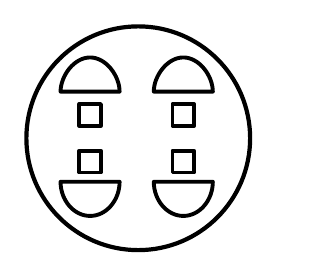
A piece of paper is folded and punched as shown below in the question figures. From the given option figures, indicate how it will appear when opened. 

  1. AOption (a)

  2. BOption (b)

  3. COption (c)

  4. DOption (d)

View answer & explanation

Correct answer

Answer: (a)A.

Why this answer is correct

The paper after unfolded will be:

Semi-circles at the four corners and eight small squares arranged in two vertical columns in the center.

Hence, the correct answer is "Option 1".

Question 35

There are 4 cold drinks - Pepsi, Coke, Sprite and Fanta and, 5 chocolates - Dairy- Milk, Perk, Munch, Kit-Kat and Milky-bar. Out of these, Sam's father chooses 2 cold drinks and 3 chocolates, to give to Sam, based on the following conditions - 

Kit-Kat and Coke cannot be together. -

Sprite and Dairy-Milk cannot be together. -

Fanta and Kit-Kat must be together. -

Munch and Pepsi cannot be together. -

Perk and Dairy-Milk cannot be together.

Which of the following combination Sam may get from his father?

I. (Kit-Kat, Milky-bar, Fanta, Perk, Pepsi)

II. (Coke, Perk, Munch, Sprite, Milky-bar)

III. (Munch, Milky-bar, Perk, Sprite, Pepsi)

  1. AOption (a)

    All the given  

  2. BOption (b)

    Only Il 

  3. COption (c)

    Only I

  4. DOption (d)

    Both I and II

View answer & explanation

Correct answer

Answer: (d)D.

Both I and II

Why this answer is correct

Given:

Kit-Kat and Coke cannot be together.

Sprite and Dairy-Milk cannot be together.

Fanta and Kit-Kat must be together.

Munch and Pepsi cannot be together.

Perk and Dairy-Milk cannot be together.

Combination I: (Kit-Kat, Milky-bar, Fanta, Perk, Pepsi) → All conditions satisfied.

Combination II: (Coke, Perk, Munch, Sprite, Milky-bar) → All conditions satisfied.

Combination III: (Munch, Milky-bar, Perk, Sprite, Pepsi) → Violates Munch and Pepsi cannot be together.

So, only Combination I and II are possible.

Hence, the correct answer is "Option 4".

Question 36

Identify the pattern in the following sequence.

4, 9, 25, 64, 169

What is the next number in the sequence?

  1. AOption (a)

    441

  2. BOption (b)

    483

  3. COption (c)

    450

  4. DOption (d)

    437

View answer & explanation

Correct answer

Answer: (a)A.

441

Why this answer is correct

Given series: 4, 9, 25, 64, 169, ?

Observe the pattern:

4 = 2²

9 = 3²

25 = 5²

64 = 8²

169 = 13²

Check the sequence of bases: 2, 3, 5, 8, 13 → This is the Fibonacci sequence.

Find the next base in Fibonacci sequence:

Next Fibonacci number after 13 → 21

Square the next base:

21² = 441 

Hence, the next number in the sequence is 441.

Hence, the correct answer is "Option 1".

Question 37

In the following question, select the number which can be placed at the sign of question mark (?) from the given alternatives. 

628
25?
342
353963
  1. AOption (a)

    1

  2. BOption (b)

    4

  3. COption (c)

    5

  4. DOption (d)

    8

View answer & explanation

Correct answer

Answer: (b)B.

4

Why this answer is correct

The logic followed here is:

Logic: The pattern in each column is multiply the first three numbers and then subtract 1 to get the fourth number.

Here,

Column 1: 6 × 2 × 3 = 36 → 36 − 1 = 35

Column 2: 2 × 5 × 4 = 40 → 40 − 1 = 39

Column 3: 8 × ? × 2 = 64 → 64 − 1 = 63 → ? = 4

So, the missing number is 4.

Hence, the correct answer is Option 2.

Question 38

How many triangles are there in the given figure? 

  1. AOption (a)

    5

  2. BOption (b)

    6

  3. COption (c)

    7

  4. DOption (d)

    8

View answer & explanation

Correct answer

Answer: (b)B.

6

Why this answer is correct

The logic followed here is:

Logic: Count all individual triangles and then include larger triangles formed by combining smaller ones.

So far, there are 5 individual small triangles and 2 larger triangles formed by combining sections.

Total number of triangles = 6.

Hence, the correct answer is "Option 2".

Question 39

How many quadrilaterals are there in the given figure? 

  1. AOption (a)

    17

  2. BOption (b)

    18

  3. COption (c)

    19

  4. DOption (d)

    20

View answer & explanation

Correct answer

Answer: (b)B.

18

Why this answer is correct

The logic followed here is:

Logic: Count all individual quadrilaterals and then include larger ones formed by combining smaller sections.

So far, there are 6 small quadrilaterals, 7 formed by combining two sections, 2 formed by combining three sections, 2 formed by combining four sections, and 1 large outer quadrilateral.

Total number of quadrilaterals = 18.

Hence, the correct answer is "Option 2".

Question 40

In the figure given below the square represents men, the triangle represents teachers and the circle represents authors. The number in each area represents the number of items in that area. 

How many men are teachers?

  1. AOption (a)

    8

  2. BOption (b)

    6

  3. COption (c)

    14

  4. DOption (d)

    39

View answer & explanation

Correct answer

Answer: (c)C.

14

Why this answer is correct

The logic followed here is:

Logic: Count the values in the overlapping region of men (square) and teachers (triangle).

So far, the overlapping regions contain 8 and 6.

Total number of men who are teachers = 8 + 6 = 14.

Hence, the correct answer is "Option 3".

Question 41

Length of 5 rectangles J, K, L, M and N is compared. Length of no two rectangles is same. Length of K is less than only three rectangles. Length of no rectangle is less than M. Length of L is not more than N but more than J. Length of which rectangle is maximum? 

  1. AOption (a)

    N

  2. BOption (b)

    L

  3. COption (c)

    J

  4. DOption (d)

    M

View answer & explanation

Correct answer

Answer: (a)A.

N

Why this answer is correct

Given:

The lengths of the five rectangles (J, K, L, M, N) 

Length of K is less than only three rectangles:

This means there are exactly 3 rectangles longer than K,

_ > _ > _ > K > _.

Length of no rectangle is less than M:

This means M is the shortest rectangle,

_ > _ > _ > K > M.

Length of L is not more than N but more than J:

This means L is shorter than N but longer than J (N > L > J).

The complete order is: N > L > J > K > M.

Therefore, N has the maximum length.

Hence, the correct answer is "Option1".

Question 42

Price of 6 toys A, B, C, D, E and F is compared. Price of no two toys is same. Price of B is third highest. Price of E is less than only C. Price of F is less than D but more than A. Which toy has highest price? 

  1. AOption (a)

    B

  2. BOption (b)

    C

  3. COption (c)

    D

  4. DOption (d)

    E

View answer & explanation

Correct answer

Answer: (b)B.

C

Why this answer is correct

Given:

Price of B is 3rd highest.

Price of E is less than only C → C is higher than all others.

Price of F is less than D but more than A.

ToyPrice Rank
C1
E2
B3
D4
F5
A6

So, the toy with the highest price is C.

Hence, the correct answer is "Option 2".

Question 43

8 women A, B, C, D, E, F, G and H are sitting around a circular table facing opposite to the centre (not necessarily in the same order). B is second to the left of H. A is third to the left of B. Dis to the immediate right of H. F is fourth to the left of D. C is the immediate neighbour of H and B. G is second to the right of H. Who is to the immediate right of E? 

  1. AOption (a)

    F

  2. BOption (b)

    H

  3. COption (c)

    A

  4. DOption (d)

    B

View answer & explanation

Correct answer

Answer: (a)A.

F

Why this answer is correct

Given: Eight women A, B, C, D, E, F, G and H sit around a circular table facing opposite to the centre.

B is second to the left of H.

A is third to the left of B.

D is to the immediate right of H.

F is fourth to the left of D.

C is an immediate neighbour of both H and B.

G is second to the right of H.

Here, after arranging all according to the given conditions, F is to the immediate right of E.

Hence, the correct answer is "Option 1".

Question 44

If ‘E’ means ‘÷’, ‘R’ means ‘+’, 'G’ means ‘-' and ‘H’ means ‘x’, then 37 G 7 H 3 R 18 E 6 = ? 

  1. AOption (a)

    21

  2. BOption (b)

    19

  3. COption (c)

    25

  4. DOption (d)

    29

View answer & explanation

Correct answer

Answer: (b)B.

19

Why this answer is correct

BODMAS Table: 

Given expression: 37 G 7 H 3 R 18 E 6 = ?

Now, if the operations are applied as:

G → −, H → ×, R → +, E → ÷, then:

⇒ 37 − 7 × 3 + 18 ÷ 6 = ?

⇒ 37 − 21 + 3 = ?

⇒ 16 + 3 = 19

Hence, the correct answer is "Option 2".

Question 45

Select the correct combination of mathematical signs to replace (*) signs sequentially and to balance the given equation.

16 4 100 * 20 * 32 = 37

  1. AOption (a)

    -, ×, +, ÷ 

  2. BOption (b)

    ÷, +, ×, -

  3. COption (c)

    ×, +, ÷, -

  4. DOption (d)

    ×, -, ÷, +

View answer & explanation

Correct answer

Answer: (c)C.

×, +, ÷, -

Why this answer is correct

BODMAS Table: 

Given equation: 16 * 4 * 100 * 20 * 32 = 37

Now, if the * signs are replaced sequentially as: ×, +, ÷, −, then:

⇒ 16 × 4 + 100 ÷ 20 − 32 = ?

⇒ 64 + 5 − 32 = ?

⇒ 69 − 32 = 37

Hence, the correct answer is "Option 3".

Question 46

In the following question, four letter-number pairs are given. The letter-number on the left side of (-) is related to the letter-number on the right side of (-) with some Logic/Rule/Relation, Three pairs are similar on the basis of same Logic/Rule/Relation. Select the odd one out from the given alternatives.

(NOTE: Operations should be performed on the whole numbers, without breaking down the number into its constituent digits. E.g.13 - Operations on 13 such as adding /subtracting /multiplying etc. to 13 can be performed. Breaking down 13 into 1 and 3 and then performing mathematical operations on 1 and 3 is not allowed)

  1. AOption (a)

    A239X - B478Z 

  2. BOption (b)

    E147W - F304Y

  3. COption (c)

    D183R - E366T 

  4. DOption (d)

    G291T - H582V 

View answer & explanation

Correct answer

Answer: (b)B.

E147W - F304Y

Why this answer is correct

The logic followed here is:

Logic: Look at the letter shift and number transformation in each letter-number pair. The rule is: first letter moves forward by 1, last letter moves forward by 2, and the number on the right is double the number on the left.

Option 1) A239X - B478Z

Option 2) E147W - F304Y

Option 3) D183R - E366T

Option 4) G291T - H582V

All pairs follow the same pattern except E147W - F304Y, where the number is not exactly double.

Hence, the odd one out is Option 2.

Question 47

Ina certain coded language 'CRAPS' is coded as 'PLXNZ' and 'DINED' is coded as 'AAKEA'. How will 'INTRO' be coded in the same code language? 

  1. AOption (a)

    NOSJG 

  2. BOption (b)

    LLQHH 

  3. COption (c)

    MPQKE 

  4. DOption (d)

    LNQJF 

View answer & explanation

Correct answer

Answer: (d)D.

LNQJF 

Why this answer is correct

The logic followed here is:

For, ‘CRAPS’ is written as PLXNZ,

For, ‘DINED’ is written as AAKEA,

Similarly, for ‘INTRO’,

So, ‘INTRO’ will be written as LNQJF.

Hence, the correct answer is "Option 4".

Question 48

Ina certain coded language 'ALTARS' is coded as 'EVEXPW' and 'GOGGLE' is coded as 'KPKKSI'. How will 'JARVIS' be coded in the same code language?  

  1. AOption (a)

    MOZWGY 

  2. BOption (b)

    PLAUEW 

  3. COption (c)

    MNATGW 

  4. DOption (d)

    NMZVEW 

View answer & explanation

Correct answer

Answer: (d)D.

NMZVEW 

Why this answer is correct

The logic followed here is:

For, ‘ALTARS’ is written as EVEXPW,

For, ‘GOGGLE’ is written as KPKKSI,

Similarly, for ‘JARVIS’,

So, ‘JARVIS’ will be written as NMZVEW.

Hence, the correct answer is "Option 4".

Question 49

A series is given with one term missing. Select the correct alternative from the given ones that will complete the series.

CR248, BP216, ?, ZL152, VJ120

  1. AOption (a)

    AO178

  2. BOption (b)

    AO186

  3. COption (c)

    AN184

  4. DOption (d)

    AM194

View answer & explanation

Correct answer

Answer: (c)C.

AN184

Why this answer is correct

The logic followed here is:

So, 'AN184' will replace the question mark in the given series.

Hence, the correct answer is "Option 3".

Question 50

A series is given with one term wrong. Select that wrong term from the given alternatives.

GR18, PA72, YJ288, HS1152, QB4808

  1. AOption (a)

    QB4808

  2. BOption (b)

    PA72

  3. COption (c)

    HS1152

  4. DOption (d)

    GR18

View answer & explanation

Correct answer

Answer: (a)A.

QB4808

Why this answer is correct

The logic followed here is:

So, 'QB4808' will replace the question mark in the given series.

Hence, the correct answer is "Option 1".

Quantitative Aptitude (25 questions)

Question 51

20% of a number is 34. What is 50% of that number? 

  1. AOption (a)

    75

  2. BOption (b)

    85

  3. COption (c)

    90

  4. DOption (d)

    95

View answer & explanation

Correct answer

Answer: (b)B.

85

Why this answer is correct

Given:

20% of a number is 34.

Formula Used:

Percentage formula: Part = (Percentage × Total) ÷ 100

Calculation:

⇒ 20% of the number = 34

⇒ (20 × Number) ÷ 100 = 34

⇒ Number = (34 × 100) ÷ 20

⇒ Number = 170

⇒ 50% of the number = (50 × 170) ÷ 100

⇒ 50% of the number = 85

∴ The correct answer is 85.

Question 52

On selling 17 articles, a trader gains the cost price of 3 articles. What is his profit percentage?

  1. AOption (a)

    15% 

  2. BOption (b)

    17.65% 

  3. COption (c)

    20% 

  4. DOption (d)

    21.25% 

View answer & explanation

Correct answer

Answer: (b)B.

17.65% 

Why this answer is correct

Given:

On selling 17 articles, a trader gains the cost price of 3 articles.

Formula Used:

Profit Percentage = (Profit ÷ Cost Price) × 100

Calculation:

⇒ Let the cost price of 1 article = ₹1

⇒ Cost price of 17 articles = 17 × ₹1 = ₹17

⇒ Selling price of 17 articles = Cost price of 17 articles + Profit

⇒ Profit = Cost price of 3 articles = 3 × ₹1 = ₹3

⇒ Selling price of 17 articles = ₹17 + ₹3 = ₹20

⇒ Selling price of 1 article = ₹20 ÷ 17

⇒ Profit per article = Selling price of 1 article - Cost price of 1 article

⇒ Profit per article = (₹20 ÷ 17) - ₹1

⇒ Profit per article = (20 - 17) ÷ 17 = ₹3 ÷ 17

⇒ Profit Percentage = (Profit per article ÷ Cost price of 1 article) × 100

⇒ Profit Percentage = (₹3 ÷ ₹17) × 100

⇒ Profit Percentage = (3 × 100) ÷ 17

⇒ Profit Percentage = 300 ÷ 17

⇒ Profit Percentage = 17.65%

∴ The correct answer is 17.65%.

Question 53

A can complete a task in 10 days, while B can finish the same task in 12 days. They decide to work alternately, with A starting the work on the first day. How many days will it take for them to complete the entire task?  

  1. AOption (a)

    10.5 days 

  2. BOption (b)

    10.2 days 

  3. COption (c)

    10.83 days 

  4. DOption (d)

    10.4 days 

View answer & explanation

Correct answer

Answer: (c)C.

10.83 days 

Why this answer is correct

Given:

A = 10 days

B = 12 days

Formula Used:

Work = Efficiency × Time

Total Work = LCM of given times

Calculation:

⇒ Total Work = LCM of 10 and 12 = 60 units

⇒ Efficiency of A = 60 ÷ 10 = 6 units/day

⇒ Efficiency of B = 60 ÷ 12 = 5 units/day

⇒ Work done in 2 days (A + B) = 6 + 5 = 11 units

⇒ Work done in 10 days (5 cycles) = 11 × 5 = 55 units

⇒ Remaining Work = 60 − 55 = 5 units

⇒ Next turn is A

⇒ Time taken by A to complete 5 units = 5 ÷ 6 = 5/6 day

⇒ Total time = 10 + 5/6 = 10.83 days 

∴ The correct answer is 10.83 days.

Question 54

If a car reduces its speed by 10 km/h, it takes 1 hour more for a journey of 300 km. Find original speed. 

  1. AOption (a)

    50 km/h 

  2. BOption (b)

    60 km/h 

  3. COption (c)

    75 km/h  

  4. DOption (d)

    90 km/h  

View answer & explanation

Correct answer

Answer: (b)B.

60 km/h 

Why this answer is correct

Given:

Distance = 300 km

Decrease in speed = 10 km/h

Increase in time = 1 hour

Formula Used:

Time = Distance ÷ Speed

Calculation:

⇒ Let original speed = x km/h

⇒ Time at original speed = 300 ÷ x

⇒ Time at reduced speed = 300 ÷ (x − 10)

⇒ 300 ÷ (x − 10) − 300 ÷ x = 1

⇒ 300x − 300(x − 10) ÷ x(x − 10) = 1

⇒ (300x − 300x + 3000) ÷ x(x − 10) = 1

⇒ 3000 ÷ x(x − 10) = 1

⇒ x(x − 10) = 3000

⇒ x2 − 10x − 3000 = 0

⇒ x2 − 60x + 50x − 3000 = 0

⇒ x(x − 60) + 50(x − 60) = 0

⇒ (x − 60)(x + 50) = 0

⇒ x = 60

∴ The correct answer is 60 km/h.

Question 55

A sum becomes Rs. 6840 in 3 years at 9% simple interest per annum. What is the original sum? 

  1. AOption (a)

    Rs. 5385.83

  2. BOption (b)

    Rs. 5400

  3. COption (c)

    Rs. 5500

  4. DOption (d)

    Rs. 5600

View answer & explanation

Correct answer

Answer: (a)A.

Rs. 5385.83

Why this answer is correct

Given:

Simple Interest (SI) = 9% per annum, Time (T) = 3 years, Amount (A) = Rs. 6840

Formula Used:

SI = (P × R × T) ÷ 100

A = P + SI

Calculation:

⇒ SI = (P × 9 × 3) ÷ 100 = (27P) ÷ 100

⇒ A = P + SI

⇒ 6840 = P + (27P ÷ 100)

⇒ 6840 = (100P + 27P) ÷ 100

⇒ 6840 = (127P) ÷ 100

⇒ P = (6840 × 100) ÷ 127

⇒ P = 5385.83

∴ The correct answer is Rs. 5385.83.

Question 56

A tank shaped like a rectangular parallelepiped measures 2 m x 1.5 m x 1.2 m. How many liters of water can it hold?  

  1. AOption (a)

    3000 L

  2. BOption (b)

    3400 L

  3. COption (c)

    3800 L

  4. DOption (d)

    3600 L

View answer & explanation

Correct answer

Answer: (d)D.

3600 L

Why this answer is correct

Shortcut Trick

Direct formula for Volume = Length × Width × Height

Volume in cubic meters = 2 × 1.5 × 1.2 = 3.6 m3

Conversion: 1 m3 = 1000 Liters

Capacity = 3.6 × 1000 = 3600 L

∴ The correct answer is 3600 L.

Alternate Method

Given:

Length (l) = 2 m

Width (w) = 1.5 m

Height (h) = 1.2 m

Formula Used:

Volume of a Rectangular Parallelepiped (Cuboid) = l × w × h

Capacity in liters = Volume in m3 × 1000

Calculations:

⇒ Volume = 2 × 1.5 × 1.2 m3

⇒ Volume = 3 × 1.2 m3

⇒ Volume = 3.6 m3

⇒ We know that 1 m3 = 1000 L

⇒ Capacity = 3.6 × 1000 L

⇒ Capacity = 3600 L

∴ The correct answer is 3600 L.

Additional Information

Total Surface Area of Parallelepiped

The total area of all six faces is given by the formula: 2(lw + wh + hl).

Diagonal of a Cuboid

The longest rod that can be placed in the tank is the diagonal: d = √(l2 + w2 + h2).

Common Volume Conversions

1 Liter = 1000 cm3 and 1 m3 = 1,000,000 cm3 = 1000 Liters.

Volume of a Cube

If all sides are equal (a), the volume of a cube is a3.

Question 57

An artist carves an ice sculpture in shape of a right triangular pyramid (base triangle: base 6 cm, height 4 cm, pyramid height 9 cm). What is the volume of ice used? 

  1. AOption (a)

    72 cm3

  2. BOption (b)

    108 cm3

  3. COption (c)

    36 cm3

  4. DOption (d)

    54 cm3

View answer & explanation

Correct answer

Answer: (c)C.

36 cm3

Why this answer is correct

Shortcut Trick

Base Area of the right triangular pyramid = 1/2 × base × height = 1/2 × 6 × 4 = 12 cm2.

Volume of any pyramid = 1/3 × Base Area × Pyramid Height.

Volume = 1/3 × 12 × 9 = 36 cm3.

∴ The correct answer is 36 cm3.

Alternate Method

Given:

Base of the triangular base (b) = 6 cm

Height of the triangular base (h) = 4 cm

Height of the ice sculpture (Pyramid Height, H) = 9 cm

Formula Used:

Volume of Right Triangular Pyramid = 1/3 × [Area of Triangular Base] × Height

Area of Triangle = 1/2 × base × height

Calculations:

⇒ Area of the triangular base = 1/2 × 6 × 4

⇒ Area of the triangular base = 12 cm2

⇒ Volume of the ice sculpture = 1/3 × 12 × 9

⇒ Volume = 4 × 9

⇒ Volume = 36 cm3

∴ The correct answer is 36 cm3.

Additional Information

Volume of a Pyramid

The volume of any pyramid is always 1/3 of the volume of a prism with the same base and height: V = 1/3 × Base Area × Height.

Total Surface Area of a Pyramid

Total Surface Area = Area of the Base + Sum of the areas of all lateral triangular faces.

Regular Tetrahedron

A special triangular pyramid where all four faces are equilateral triangles. Volume = a3/(6√2), where 'a' is the edge length.

Question 58

In triangle ABC, 'D' is a point on BC such that ∠BAD = ∠DAC. If AB = 24, AC = 16 and BC = 12.5, then find the length of BD. 

  1. AOption (a)

    11 cm

  2. BOption (b)

    7.5 cm

  3. COption (c)

    6.5 cm

  4. DOption (d)

    9 cm

View answer & explanation

Correct answer

Answer: (b)B.

7.5 cm

Why this answer is correct

Given:

AB = 24

AC = 16

BC = 12.5

Formula Used:

Angle bisector theorem: BD ÷ DC = AB ÷ AC

Calculation:

⇒ BD ÷ DC = 24 ÷ 16 = 3/2

⇒ Let BD = 3x and DC = 2x

⇒ BC = BD + DC = 3x + 2x = 5x

⇒ 5x = 12.5

⇒ x = 12.5 ÷ 5 = 2.5

⇒ BD = 3x = 3 × 2.5 = 7.5

∴ The correct answer is 7.5.

Question 59

Out of 200 students, 20%failed the exam. Out of the remaining 20% passed the exam with distinction. Find the ratio of the students who passed the exam with distinction to the students who passed the exam without distinction. 

  1. AOption (a)

    1 : 3

  2. BOption (b)

    1 : 4

  3. COption (c)

    1 : 5

  4. DOption (d)

    1 : 6

View answer & explanation

Correct answer

Answer: (b)B.

1 : 4

Why this answer is correct

Given:

Total students = 200

Failed = 20%

Distinction = 20% of remaining

Formula Used:

Percentage = (part ÷ total) × 100

Calculation:

⇒ Failed students = 20% of 200 = 40

⇒ Remaining students = 200 − 40 = 160

⇒ Students with distinction = 20% of 160 = 32

⇒ Students without distinction = 160 − 32 = 128

⇒ Required ratio = 32 : 128

⇒ Divide by 32 ⇒ 1 : 4

∴ The correct answer is 1 : 4.

Question 60

If two right-angled triangles have hypotenuse and one side equal, then the triangles are:  

  1. AOption (a)

    Not always congruent 

  2. BOption (b)

    Congruent by RHS 

  3. COption (c)

    Congruent by ASA 

  4. DOption (d)

    Similar but not congruent

View answer & explanation

Correct answer

Answer: (b)B.

Congruent by RHS 

Why this answer is correct

Given:

Two right-angled triangles with hypotenuse and one side equal.

Formula Used:

RHS (Right angle-Hypotenuse-Side) Congruence Rule.

Calculation:

⇒ In RHS congruence, if the hypotenuse and one side of two right-angled triangles are equal, the triangles are congruent.

⇒ The given condition satisfies the RHS Congruence Rule.

∴ The correct answer is 2.

Question 61

The ratio of the length and breadth of a rectangle is 6 : 5, respectively. It is made from a circular loop of a wire having a radius of 14 cm. Find the sum of the length of the rectangle and the diameter of the loop.  

  1. AOption (a)

    44 cm

  2. BOption (b)

    52 cm

  3. COption (c)

    30 cm

  4. DOption (d)

    40 cm

View answer & explanation

Correct answer

Answer: (b)B.

52 cm

Why this answer is correct

Given:

Ratio of length to breadth = 6:5

Radius of circular loop = 14 cm

Formula Used:

Circumference of circle = 2 × π × radius

Perimeter of rectangle = 2 × (length + breadth)

Length of rectangle = k × 6, Breadth of rectangle = k × 5 (where k is a common multiplier)

Calculation:

⇒ Circumference of circular loop = 2 × π × 14 = 88 cm

⇒ Perimeter of rectangle = Circumference of circular loop = 88 cm

⇒ 2 × (6k + 5k) = 88

⇒ 2 × 11k = 88

⇒ 22k = 88

⇒ k = 88 ÷ 22 = 4

⇒ Length of rectangle = 6k = 6 × 4 = 24 cm

⇒ Breadth of rectangle = 5k = 5 × 4 = 20 cm

⇒ Diameter of loop = 2 × radius = 2 × 14 = 28 cm

⇒ Sum of length of rectangle and diameter of loop = 24 + 28 = 52 cm

∴ The correct answer is 52 cm.

Question 62

If sec(θ) = 2, what is the value of sin(θ). 

  1. AOption (a)

    32\frac{\sqrt3}{2}

  2. BOption (b)

    12\frac{1}{2}

  3. COption (c)

    22\frac{2}{2}

  4. DOption (d)

    13\frac{1}{3}

View answer & explanation

Correct answer

Answer: (a)A.

32\frac{\sqrt3}{2}

Why this answer is correct

Given:

sec(θ) = 2

Formulas Used:

sec(θ) = 1/cos(θ)

sin²(θ) + cos²(θ) = 1

Calculation:

⇒ cos(θ) = 1/sec(θ)

⇒ cos(θ) = 1/2

⇒ cos²(θ) = (1/2)²

⇒ cos²(θ) = 1/4

⇒ sin²(θ) = 1 - cos²(θ)

⇒ sin²(θ) = 1 - 1/4

⇒ sin²(θ) = 3/4

⇒ sin(θ) = √(3/4)

⇒ sin(θ) = √3/2

∴ The correct answer is √3/2.

Question 63

A, B, and C invest in a business. A invests Rs 20,000, B invests Rs 25,000, and C invests Rs 30,000. What is the total profit if the share of B is Rs 5,000?  

  1. AOption (a)

    Rs 15,000 

  2. BOption (b)

    Rs 20,000 

  3. COption (c)

    Rs 25,000 

  4. DOption (d)

    Rs 30,000 

View answer & explanation

Correct answer

Answer: (a)A.

Rs 15,000 

Why this answer is correct

Shortcut Trick

Ratio of investment of A : B : C = 20,000 : 25,000 : 30,000 = 4 : 5 : 6

Total units of profit = 4 + 5 + 6 = 15 units

Given, B’s profit share (5 units) = ₹5,000

1 unit = ₹1,000

Total profit = 15 units × ₹1,000 = ₹15,000

∴ The correct answer is ₹15,000.

Alternate Method

Given:

Investment of A = ₹20,000

Investment of B = ₹25,000

Investment of C = ₹30,000

Share of B in profit = ₹5,000

Formula Used:

In a partnership, Profit Ratio = Ratio of (Investment × Time)

Calculations:

⇒ Profit Ratio (A : B : C) = 20,000 : 25,000 : 30,000

⇒ Profit Ratio = 4 : 5 : 6

⇒ Let the profit shares be 4x, 5x, and 6x respectively.

⇒ Given, B’s share = 5x = 5,000

⇒ x = 5,000 ÷ 5 = 1,000

⇒ Total profit = 4x + 5x + 6x = 15x

⇒ Total profit = 15 × 1,000 = 15,000

∴ The correct answer is ₹15,000.

Additional Information

Ratio of Profits

In any partnership, the ratio of profit distribution is calculated as: P1 : P2 = (I1 × T1) : (I2 × T2), where I is investment and T is time.

Simple Partnership

When the time period for all investments is the same, the profit is shared simply in the ratio of the capitals invested.

Compound Partnership

When partners invest their capital for different time periods, the profit is shared in the ratio of the product of capital and time.

Question 64

Two runners, A and B, start from the same point on a circular track of 400 m. They run in the same direction with speeds of 10 m/s and 7 m/s, respectively. How many times will they cross each other in 15 minutes? 

  1. AOption (a)

    5

  2. BOption (b)

    6

  3. COption (c)

    7

  4. DOption (d)

    8

View answer & explanation

Correct answer

Answer: (b)B.

6

Why this answer is correct

Given:

Track length = 400 m

Speed of A = 10 m/s

Speed of B = 7 m/s

Time = 15 minutes = 900 s

Formula Used:

Relative speed = Difference of speeds (same direction)

Number of crossings = (Relative speed × Time) ÷ Track length

Calculation:

⇒ Relative speed = 10 − 7 = 3 m/s

⇒ Distance covered relatively = 3 × 900 = 2700 m

⇒ Number of crossings = 2700 ÷ 400 = 6.75

⇒ Number of complete crossings = 6

∴ The correct answer is 6.

Question 65

The average marks of 40 students in a class is 72. Later, it was discovered that a student's marks were recorded as 93 instead of 39. What is the correct average?  

  1. AOption (a)

    70.85

  2. BOption (b)

    70.65

  3. COption (c)

    71.95

  4. DOption (d)

    71.85

View answer & explanation

Correct answer

Answer: (b)B.

70.65

Why this answer is correct

Given:

Number of students = 40

Average marks = 72

Incorrect marks = 93

Correct marks = 39

Formula Used:

Correct total marks = Incorrect total marks - Incorrect marks + Correct marks

Correct average = Correct total marks ÷ Number of students

Calculation:

⇒ Incorrect total marks = 72 × 40 = 2880

⇒ Correct total marks = 2880 - 93 + 39 = 2826

⇒ Correct average = 2826 ÷ 40 = 70.65

∴ The correct answer is 70.65.

Question 66

In a company, the monthly salaries of a manager, supervisor, and worker are in the ratio 7 : 5 : 3. If the supervisor earns 25,000, what is the manager's salary? 

  1. AOption (a)

    30,000 

  2. BOption (b)

    32,000 

  3. COption (c)

    35,000  

  4. DOption (d)

    40,000 

View answer & explanation

Correct answer

Answer: (c)C.

35,000  

Why this answer is correct

Given:

Ratios of salaries = 7 : 5 : 3

Supervisor's salary = 25,000

Formula Used:

Manager's salary = (Manager's ratio ÷ Supervisor's ratio) × Supervisor's salary

Calculation:

⇒ Manager's salary = (7 ÷ 5) × 25,000

⇒ Manager's salary = 1.4 × 25,000

⇒ Manager's salary = 35,000

∴ The correct answer is 35,000.

Question 67

In a circle with center O, a tangent touches the circle at point T. A secant drawn from an external point P passes through the center O. The length of the tangent PT is 12 units, and the radius of the circle is 5 units. What is the distance from point P to the nearest point on the circle? 

  1. AOption (a)

    10 units

  2. BOption (b)

    4 units  

  3. COption (c)

    6 units 

  4. DOption (d)

    8 units  

View answer & explanation

Correct answer

Answer: (d)D.

8 units  

Why this answer is correct

Given:

PT = 12

Radius = 5

Formula Used:

PT2 = PO2 − r2

Distance to nearest point = PO − r

Calculation:

⇒ 122 = PO2 − 52

⇒ 144 = PO2 − 25

⇒ PO2 = 169

⇒ PO = 13

⇒ Distance = 13 − 5 = 8

∴ The correct answer is 8.

Question 68

A regular polygon has an interior angle that is 5 times the measure of its exterior angle. How many sides does the polygon have?

  1. AOption (a)

    11

  2. BOption (b)

    12

  3. COption (c)

    15

  4. DOption (d)

    17

View answer & explanation

Correct answer

Answer: (b)B.

12

Why this answer is correct

Shortcut Trick

In a regular polygon, the ratio of the interior angle to the exterior angle is given as 5 : 1.

Since the sum of an interior angle and an exterior angle at any vertex is always 180°:

5 units + 1 unit = 6 units ⇒ 180°

1 unit (Exterior Angle) = 180° ÷ 6 = 30°

Number of sides (n) = 360° ÷ Exterior Angle = 360° ÷ 30° = 12.

∴ The correct answer is 12 sides.

Alternate Method

Given:

Interior angle (I) = 5 × Exterior angle (E)

Formula Used:

  1. Interior Angle + Exterior Angle = 180° (Linear Pair property)
  2. Each Exterior Angle of a regular polygon = 360° ÷ n

Calculations:

⇒ Let the exterior angle be x.

⇒ Then the interior angle is 5x.

⇒ 5x + x = 180°

⇒ 6x = 180°

⇒ x = 180° ÷ 6 = 30°

⇒ Each exterior angle = 30°

⇒ n = 360° ÷ Exterior angle

⇒ n = 360° ÷ 30°

⇒ n = 12

∴ The correct answer is 12 sides.

Additional Information

Sum of Interior Angles

The sum of all interior angles of a polygon with n sides is (n − 2) × 180°.

Sum of Exterior Angles

The sum of exterior angles of any convex polygon, regardless of the number of sides, is always 360°.

Regular Polygon Property

In a regular polygon, all sides and all angles (both interior and exterior) are equal.

Number of Diagonals

The number of diagonals in a polygon with n sides is given by the formula n(n − 3) ÷ 2.

Question 69

If 4x2 + y2 = 40 and xy = 6, find the value of 2x + y and 2x - y.

  1. AOption (a)

    2, 3

  2. BOption (b)

    8, 4

  3. COption (c)

    5, 6

  4. DOption (d)

    9, 8

View answer & explanation

Correct answer

Answer: (b)B.

8, 4

Why this answer is correct

Given:

4x2 + y2 = 40

xy = 6

Formula Used:

(a + b)2 = a2 + b2 + 2ab

(a − b)2 = a2 + b2 − 2ab

Calculation:

⇒ (2x + y)2 = 4x2 + y2 + 4xy

⇒ (2x + y)2 = 40 + 4 × 6 = 40 + 24 = 64

⇒ 2x + y = 8

⇒ (2x − y)2 = 4x2 + y2 − 4xy

⇒ (2x − y)2 = 40 − 24 = 16

⇒ 2x − y = 4

∴ The correct answer is 2x + y = 8 and 2x − y = 4.

Question 70

Simplify the expression: 

(64125)23×84×(827)34\rm \left(\frac{64}{125}\right)^{\frac{2}{3}}\times \sqrt[4]{8}\times \left(\frac{8}{27}\right)^{\frac{3}{4}}

  1. AOption (a)

    345205×334\frac{345}{205\times 3^{\frac{3}{4}}}

  2. BOption (b)

    12825×3\frac{128}{25\times 3}

  3. COption (c)

    1817×312\frac{18}{17\times 3^{\frac{1}{2}}}

  4. DOption (d)

    12825×394\frac{128}{25\times 3^{\frac{9}{4}}}

View answer & explanation

Correct answer

Answer: (d)D.

12825×394\frac{128}{25\times 3^{\frac{9}{4}}}

Why this answer is correct

Given:

(64125)23×84×(827)34 \left(\frac{64}{125}\right)^{\frac{2}{3}} \times \sqrt[4]{8} \times \left(\frac{8}{27}\right)^{\frac{3}{4}}

Formula used:

am/n=(an)m a^{m/n} = (\sqrt[n]{a})^m

am×an=am+n a^m \times a^n = a^{m+n}

Calculation:

(64125)23×84×(827)34 \left(\frac{64}{125}\right)^{\frac{2}{3}} \times \sqrt[4]{8} \times \left(\frac{8}{27}\right)^{\frac{3}{4}}

⇒ (26)2/3(53)2/3×(23)1/4×(23)3/4(33)3/4 \frac{(2^6)^{2/3}}{(5^3)^{2/3}} \times (2^3)^{1/4} \times \frac{(2^3)^{3/4}}{(3^3)^{3/4}}

⇒ 212/352×23/4×29/439/4 \frac{2^{12/3}}{5^2} \times 2^{3/4} \times \frac{2^{9/4}}{3^{9/4}}

⇒ 2425×23/4+9/439/4 \frac{2^4}{25} \times \frac{2^{3/4 + 9/4}}{3^{9/4}}

⇒ 1625×212/439/4 \frac{16}{25} \times \frac{2^{12/4}}{3^{9/4}}

⇒ 1625×2339/4 \frac{16}{25} \times \frac{2^3}{3^{9/4}}

⇒ 12852×39/4 \frac{128}{5^2 \times 3^{9/4}}

∴ The correct answer is option 4.

Question 71

Solve: tan θ sin θ + cos θ

  1. AOption (a)

    cos (θ)

  2. BOption (b)

    sin (θ)

  3. COption (c)

    1

  4. DOption (d)

    sec (θ)

View answer & explanation

Correct answer

Answer: (d)D.

sec (θ)

Why this answer is correct

Given:

tan θ sin θ + cos θ

Formula Used:

tan θ = sin θ ÷ cos θ

Calculation:

⇒ tan θ sin θ + cos θ

⇒ (sin θ ÷ cos θ) × sin θ + cos θ

⇒ (sin² θ ÷ cos θ) + cos θ

⇒ (sin² θ + cos² θ) ÷ cos θ

⇒ 1 ÷ cos θ

⇒ sec θ

∴ The correct answer is sec θ.

Question 72

If two circles intersect at two points, how many common tangents are possible if the circles have the same radius? 

  1. AOption (a)

    1

  2. BOption (b)

    2

  3. COption (c)

    3

  4. DOption (d)

    0

View answer & explanation

Correct answer

Answer: (b)B.

2

Why this answer is correct

Given:

Two circles intersect at two points

Both circles have same radius

Formula Used:

Number of common tangents depends on position of circles

Calculation:

⇒ When two circles intersect at two points, they overlap

⇒ In this case, only direct common tangents exist

⇒ Number of direct common tangents = 2

⇒ Transverse common tangents are not possible

∴ The correct answer is 2.

Question 73

If sin⁡3A=35\rm \sin 3A=\frac{3}{5}, find the values of cos 3A and tan 3A.

  1. AOption (a)

    cos 3A = 6, tan 3A = 8 

  2. BOption (b)

    cos 34 = 5, tan 3A = 9 

  3. COption (c)

    cos⁡3A=56,tan⁡3A=67\rm \cos 3A=\frac{5}{6}, \tan 3A=\frac{6}{7}

  4. DOption (d)

    cos⁡3A=45,tan⁡3A=34\rm \cos 3A=\frac{4}{5}, \tan 3A=\frac{3}{4}

View answer & explanation

Correct answer

Answer: (d)D.

cos⁡3A=45,tan⁡3A=34\rm \cos 3A=\frac{4}{5}, \tan 3A=\frac{3}{4}

Why this answer is correct

Given:

sin3A = 3/5

Formula Used:

sin2θ + cos2θ = 1

tanθ = sinθ ÷ cosθ

Calculation:

⇒ sin3A = 3/5 ⇒ cos3A = √(1 − (3/5)2)

⇒ cos3A = √(1 − 9/25) = √(16/25) = 4/5

⇒ tan3A = sin3A ÷ cos3A = (3/5) ÷ (4/5)

⇒ tan3A = 3/4

∴ The correct answer is cos3A = 4/5 and tan3A = 3/4.

Question 74

What sum will amount to Rs. 23958 in 3 years at the rate of 10 percent per annum at compound interest (cormpounding annually)? 

  1. AOption (a)

    Rs. 18000 

  2. BOption (b)

    Rs. 12000 

  3. COption (c)

    Rs. 16000 

  4. DOption (d)

    Rs. 15000 

View answer & explanation

Correct answer

Answer: (a)A.

Rs. 18000 

Why this answer is correct

Given:

Amount = Rs. 23958

Rate = 10% per annum

Time = 3 years

Formula Used:

Compound Interest Formula: A = P × (1 + r/100)ⁿ

Where:

A = Final Amount

P = Principal

r = Rate of Interest

n = Time Period

Calculation:

⇒ 23958 = P × (1 + 10/100)³

⇒ 23958 = P × (1.1)³

⇒ 23958 = P × 1.331

⇒ P = 23958 ÷ 1.331

⇒ P = 18000

∴ The correct answer is Rs. 18000.

Question 75

Marked price of an article is 140 percent more than the value of discount. Selling price is what percent of the marked price?

  1. AOption (a)

    50.14 percent 

  2. BOption (b)

    58.33 percent 

  3. COption (c)

    55.68 percent 

  4. DOption (d)

    52.76 percent  

View answer & explanation

Correct answer

Answer: (b)B.

58.33 percent 

Why this answer is correct

Given:

Marked Price = 140% more than Discount

Formula Used:

Selling Price = Marked Price − Discount

Percentage = (part ÷ whole) × 100

Calculation:

⇒ Let Discount = 100

⇒ Marked Price = 100 + 140% of 100 = 100 + 140 = 240

⇒ Selling Price = 240 − 100 = 140

⇒ Required % = (140 ÷ 240) × 100

⇒ = 7/12 × 100 = 58.33%

∴ The correct answer is 58.33%.

General Awareness (25 questions)

Question 76

Who wrote the three-volume history of Akbar's reign? 

  1. AOption (a)

    Abul Fazl 

  2. BOption (b)

    Birbal 

  3. COption (c)

    Tansen 

  4. DOption (d)

    Todar Mal 

View answer & explanation

Correct answer

Answer: (a)A.

Abul Fazl 

Why this answer is correct

The correct answer is Abul Fazl.

Key Points

  • Abul Fazl was a prominent courtier, historian, and writer in the court of Mughal Emperor Akbar.
  • He authored the three-volume history of Akbar's reign titled Akbarnama, which is one of the most celebrated chronicles of the Mughal era.
  • The Akbarnama is divided into three parts: the first part deals with Akbar's ancestors, the second part focuses on Akbar's reign, and the third part is the Ain-i-Akbari, a detailed account of the administration and culture of the empire.
  • Abul Fazl's work is considered an authentic and detailed source of Mughal history and administration during Akbar's reign.
  • He was also known for his literary style and contributions to Persian literature. He played a significant role in shaping Akbar's policies and was one of the Nine Gems (Navratnas) of Akbar's court.

Additional Information

  • Akbarnama:
  • It was commissioned by Emperor Akbar himself and took Abul Fazl nearly seven years to complete (between 1590 and 1597).
  • The Ain-i-Akbari, the third part of Akbarnama, is a unique administrative record that details the empire’s political structure, revenue systems, military organization, and cultural aspects.
  • The work is written in Persian, which was the court language of the Mughals, and showcases Abul Fazl's exceptional literary and analytical skills.
  • The Akbarnama remains a critical resource for understanding the governance, culture, and societal norms of the Mughal period.
  • Abul Fazl’s Contributions:
  • He played a key role in Akbar's policy of religious tolerance and the development of the Din-i-Ilahi, a syncretic religious movement initiated by Akbar.
  • Abul Fazl was a skilled diplomat and often represented Akbar in important missions.
  • He was assassinated in 1602 by conspirators who opposed his influence in the Mughal court.
  • Other Navratnas of Akbar’s Court:
  • Akbar’s court included nine distinguished individuals known as the Navratnas. These included Birbal (known for his wit), Tansen (a legendary musician), Raja Todar Mal (finance expert), and others.
  • Each Navratna was highly skilled in their respective fields and contributed significantly to the cultural and administrative achievements of Akbar's reign.
  • Other Historical Sources:
  • Besides Abul Fazl's Akbarnama, other important works documenting Akbar’s reign include the writings of Badauni and the memoirs of Akbar himself, known as Jahangir’s Tuzuk-i-Jahangiri.
  • These sources complement each other in providing a holistic view of the Mughal period.

Important Points

  • Historical Significance of Akbarnama:
  • Akbarnama is not just a biography of Akbar but also a detailed account of the socio-political structure of the Mughal Empire.
  • It provides insights into the reforms initiated by Akbar, such as the abolition of Jizya tax, the introduction of the mansabdari system, and the promotion of art and architecture.
  • The book highlights Akbar’s efforts in uniting his diverse empire through policies of tolerance and inclusivity.
  • It remains one of the most comprehensive sources of medieval Indian history.
  • Legacy of Abul Fazl:
  • His contributions to Mughal historiography and administration have left an enduring legacy in Indian history.
  • Abul Fazl's analytical and detailed approach makes his work invaluable for historians and scholars.

Question 77

Which of the following pair of dynasty - region is correct?

I. Rashtrakuta - Tamil Nadu

Il. Gurjara-Pratihara - Rajasthan

  1. AOption (a)

    Only I

  2. BOption (b)

    Only II

  3. COption (c)

    Both I and II 

  4. DOption (d)

    Neither I nor II

View answer & explanation

Correct answer

Answer: (b)B.

Only II

Why this answer is correct

The correct answer is Only II.

Key Points

  • Statement I: Rashtrakuta - Tamil Nadu
  • The Rashtrakutas were a prominent dynasty in Indian history, ruling from the 8th to 10th century CE.
  • They primarily ruled over the Deccan region, with their empire extending across parts of modern-day Karnataka, Maharashtra, and Andhra Pradesh.
  • They did not have Tamil Nadu as a significant part of their empire. Hence, this statement is incorrect.
  • Statement II: Gurjara-Pratihara - Rajasthan
  • The Gurjara-Pratiharas were a powerful dynasty in northern India, especially during the 8th to 11th centuries.
  • They had a stronghold in parts of modern-day Rajasthan, along with regions of Gujarat, Uttar Pradesh, and Madhya Pradesh.
  • Their capital was initially at Bhinmal (Rajasthan), later shifting to Kanauj, which became a prominent center of their empire. Hence, this statement is correct.
  • Based on the above, only Statement II is correct, making the correct option Only II.

Additional Information

  • Rashtrakutas:
  • The Rashtrakutas were known for their contributions to art and architecture, notably the Kailasa Temple at Ellora, a UNESCO World Heritage site.
  • They ruled from their capital at Manyakheta (modern-day Malkhed in Karnataka).
  • Their empire was known for its tolerance towards different religions, including Hinduism, Jainism, and Buddhism.
  • The Rashtrakutas played a significant role in southern India but did not have Tamil Nadu as a major part of their territory.
  • Gurjara-Pratiharas:
  • The Gurjara-Pratiharas were one of the three major dynasties involved in the tripartite struggle for control over Kanauj, alongside the Rashtrakutas and the Palas.
  • Their capital, Kanauj, became a prominent political and cultural hub during their reign.
  • The Gurjara-Pratiharas are also known for their patronage of art and architecture, including the construction of temples in Rajasthan and other regions.
  • They played a crucial role in defending India against Arab invasions in the early medieval period.
  • Key Characteristics of Tamil Nadu During the Rashtrakuta Period:
  • Tamil Nadu during this period was dominated by the Pallavas and later the Cholas.
  • These dynasties were responsible for some of the iconic Dravidian architecture, including the temples at Mahabalipuram and Thanjavur.
  • The Rashtrakutas had limited influence in Tamil Nadu, focusing more on the Deccan and central India.

Important Points

  • Rashtrakutas: Their empire was at its peak under Amoghavarsha I, who was known for his contributions to Kannada literature.
  • Gurjara-Pratiharas: The dynasty declined after the invasions of the Turks and internal conflicts.
  • Tripartite Struggle: This was a prolonged conflict between the Rashtrakutas, Gurjara-Pratiharas, and Palas for control over northern India.
  • Tamil Nadu: Dominated by the Chola dynasty during the medieval period, which was known for its maritime power and contributions to art and architecture.

Question 78

Article 40 of the Indian constitution is related with  ___________

  1. AOption (a)

    Organization of village panchayats 

  2. BOption (b)

    Free and compulsory education  

  3. COption (c)

    Free housing to the poor  

  4. DOption (d)

    Free medical aid to the citizen 

View answer & explanation

Correct answer

Answer: (a)A.

Organization of village panchayats 

Why this answer is correct

The correct answer is Organization of village panchayats.

Key Points

  • Article 40 of the Indian Constitution is part of the Directive Principles of State Policy (DPSP), which are guidelines for the state to frame laws and policies aimed at establishing social and economic democracy.
  • It directs the state to take measures to organize village panchayats and endow them with such powers and authority to function as units of self-government.
  • The goal of Article 40 is to promote grassroots democracy through the establishment of local self-governance systems across villages in India.
  • The implementation of Article 40 led to the 73rd Constitutional Amendment Act, 1992, which provided constitutional status to Panchayati Raj Institutions (PRIs).
  • Under this amendment, a three-tier Panchayati Raj system was introduced, consisting of Gram Panchayats, Panchayat Samiti, and Zila Parishad, enabling decentralized governance and local decision-making.

Additional Information

  • Directive Principles of State Policy:
  • These principles are enshrined in Part IV (Articles 36-51) of the Constitution of India and aim to create a just and equitable society.
  • They are non-justiciable, meaning they cannot be enforced by courts, but serve as important guidelines for governance.
  • Examples of DPSPs include promoting education, protecting the environment, and establishing village panchayats.
  • 73rd Constitutional Amendment Act, 1992:
  • This amendment added Part IX to the Constitution and provided constitutional status to Panchayati Raj Institutions (PRIs).
  • It mandated the establishment of a three-tier system of Panchayati Raj in villages, intermediate levels, and districts.
  • It introduced provisions for regular elections, reservation for Scheduled Castes (SCs), Scheduled Tribes (STs), and women, and the creation of State Election Commissions.
  • Functions of Panchayati Raj Institutions:
  • PRIs play a crucial role in rural development by implementing schemes related to health, education, sanitation, and agriculture.
  • They also enable participatory governance, where citizens can directly engage in decision-making processes.
  • Related Articles in the Constitution:
  • Article 243: Defines the Panchayati Raj system and its structure.
  • Article 243D: Provides for reservation in PRIs for SCs, STs, and women.
  • Article 243E: Specifies the duration and terms of office for members of Panchayati Raj Institutions.

Important Points

  • Historical Context:
  • India has a long tradition of local self-governance, with village panchayats mentioned in ancient texts like the Manusmriti and Kautilya's Arthashastra.
  • The concept of Panchayati Raj was revived during India's freedom movement, particularly by leaders like Mahatma Gandhi, who emphasized village self-reliance.
  • Challenges in Implementation:
  • Despite constitutional provisions, Panchayati Raj Institutions often face issues like inadequate funding, limited autonomy, and interference by higher authorities.
  • Capacity building and training programs for elected representatives are essential to improve the functioning of PRIs.

Question 79

Provisions of the Sixth Schedule of the Indian constitution does not apply to which of these states? 

  1. AOption (a)

    Assam 

  2. BOption (b)

    Meghalaya 

  3. COption (c)

    Tripura 

  4. DOption (d)

    Manipur 

View answer & explanation

Correct answer

Answer: (d)D.

Manipur 

Why this answer is correct

The correct answer is Manipur.

Key Points

  • The Sixth Schedule of the Indian Constitution was specifically designed to provide autonomy to tribal areas in certain northeastern states of India.
  • It applies to the tribal areas of Assam, Meghalaya, Tripura, and Mizoram.
  • The provisions under the Sixth Schedule allow for the creation of Autonomous District Councils (ADCs), which have legislative, judicial, and executive powers in certain specified areas.
  • Manipur is not covered under the Sixth Schedule. Instead, it has its own distinct arrangements for the governance of tribal areas, such as the Hill Areas Committee and Autonomous District Councils (not under the Sixth Schedule).
  • The absence of Sixth Schedule provisions in Manipur is due to its unique historical and administrative context, where different mechanisms are in place for tribal development and administration.
  • Hence, the correct answer is Manipur.

Additional Information

  • Sixth Schedule and Autonomous District Councils (ADCs):
  • The Sixth Schedule provides for the administration of tribal areas through Autonomous District Councils (ADCs), which have the authority to make laws on certain matters such as land, forest management, village administration, and inheritance of property.
  • Each ADC consists of not more than 30 members, of whom four are nominated by the governor, while the rest are elected members.
  • ADCs have the power to create courts for trial of certain cases and also manage resources within their jurisdiction.
  • Examples of ADCs include the Bodoland Territorial Council in Assam and the Khasi Hills Autonomous District Council in Meghalaya.
  • States Covered under the Sixth Schedule:
  • The states covered under the Sixth Schedule include Assam, Meghalaya, Tripura, and Mizoram.
  • This schedule was incorporated to protect the rights and culture of tribal communities in these states.
  • Manipur and Tribal Governance:
  • Manipur has Autonomous District Councils created under the Manipur (Hill Areas) District Councils Act, 1971, but these councils do not have the same constitutional protection as those under the Sixth Schedule.
  • The Hill Areas Committee, constituted under Article 371C of the Indian Constitution, is responsible for protecting the interests of tribal communities in Manipur.
  • Differences in Governance:
  • While the Sixth Schedule grants legislative and judicial powers to ADCs, the ADCs in Manipur operate under state legislation and have limited powers compared to their counterparts in Sixth Schedule areas.
  • This distinction highlights the unique governance framework adopted in Manipur to address its tribal population's needs.

Important Points

  • Article 244:
  • This article of the Indian Constitution deals with the administration of Scheduled and Tribal Areas.
  • It provides for the application of the Fifth Schedule in other states (excluding northeastern states) and the Sixth Schedule in northeastern states.
  • Role of Governor:
  • The governor plays a significant role in the administration of Sixth Schedule areas and has the power to create or dissolve ADCs and regulate their functioning.
  • Historical Context:
  • The Sixth Schedule was introduced in the Constitution to address the aspirations of tribal communities in the northeastern region, ensuring their autonomy and preserving their unique identity.

Question 80

As of 31st July 2025, which of the following country is the member of the Indian Ocean Rim Association?

I. Australia

Il. Bangladesh

  1. AOption (a)

    Only I

  2. BOption (b)

    Only II

  3. COption (c)

    Both I and II

  4. DOption (d)

    Neither I nor II

View answer & explanation

Correct answer

Answer: (c)C.

Both I and II

Why this answer is correct

The correct answer is Both I and II.

Key Points

  • Indian Ocean Rim Association (IORA): The IORA is an intergovernmental organization established on 7 March 1997 to promote cooperation among countries bordering the Indian Ocean.
  • Membership: As of 31st July 2025, IORA has 23 member states. These include countries located along the Indian Ocean such as Australia, Bangladesh, India, South Africa, and others.
  • Australia: Australia is one of the founding members of the IORA and plays a significant role in regional cooperation, maritime security, and sustainable development. Hence, Statement I is correct.
  • Bangladesh: Bangladesh became a member of the IORA due to its geographical location bordering the Indian Ocean and its active participation in regional initiatives. Hence, Statement II is correct.
  • Purpose: The organization aims to enhance economic cooperation, environmental protection, and maritime safety among member states.

Additional Information

  • Indian Ocean Rim Association (IORA) Overview:
  • The organization comprises 23 member states and 10 dialogue partners, including countries like China, the United States, and the United Kingdom.
  • IORA's headquarters are located in Ebène, Mauritius.
  • The association focuses on six priority areas: maritime safety and security, trade and investment facilitation, fisheries management, disaster risk management, academic and scientific cooperation, and tourism promotion.
  • Australia's Role in IORA:
  • Australia has been a key member since the organization's inception in 1997.
  • It actively contributes to initiatives like maritime security, sustainable development, and capacity building in the region.
  • Australia hosted the 2013 IORA Ministerial Meeting and plays a leading role in combating illegal fishing and promoting blue economy initiatives.
  • Bangladesh's Role in IORA:
  • Bangladesh joined IORA to strengthen its regional ties and enhance cooperation in areas like maritime safety and disaster management.
  • It is actively involved in promoting academic exchanges and sustainable practices among member states.
  • Bangladesh has hosted several workshops and events under IORA's framework, especially focusing on climate resilience and disaster preparedness.
  • Significance of IORA:
  • The Indian Ocean region is home to 2.7 billion people, making it a crucial area for international trade and economic growth.
  • IORA fosters collaboration among member states to address challenges like piracy, illegal fishing, and climate change.
  • The organization supports the development of a blue economy, focusing on sustainable use of ocean resources.

Important Points

  • IORA Strategic Framework:
  • IORA promotes regional economic integration by encouraging free trade agreements among member states.
  • The organization emphasizes academic collaboration through research programs and knowledge-sharing initiatives.
  • IORA has launched projects to enhance maritime security, such as the establishment of regional information-sharing centers.
  • Blue Economy Initiatives:
  • IORA advocates for sustainable use of ocean resources to boost economic growth and preserve marine ecosystems.
  • Member states are encouraged to invest in renewable ocean energy, aquaculture, and marine tourism.
  • Workshops and conferences are held to address challenges such as marine pollution and overfishing.
  • Future Directions:
  • IORA aims to strengthen its influence by expanding partnerships with global organizations like the United Nations and the World Bank.
  • The association plans to focus more on climate resilience and disaster risk reduction in the coming years.
  • Efforts are being made to increase the participation of women in maritime industries and enhance gender equity in the region.

Question 81

Which Indian ruler is famously known as the “Napoleon of India”? 

  1. AOption (a)

    Ashoka 

  2. BOption (b)

    Samudragupta

  3. COption (c)

    Harshavardhana  

  4. DOption (d)

    Chandragupta Maurya 

View answer & explanation

Correct answer

Answer: (b)B.

Samudragupta

Why this answer is correct

The correct answer is Samudragupta.

Key Points

  • Samudragupta, the second ruler of the Gupta Empire, is referred to as the "Napoleon of India" due to his extensive military conquests and strategic prowess.
  • This title was given by the historian Vincent A. Smith, who admired Samudragupta's military achievements and compared him to Napoleon Bonaparte.
  • Samudragupta ruled from approximately 335 CE to 380 CE and expanded the Gupta Empire significantly through his campaigns in both northern and southern India.
  • His conquests are detailed in the Prayaga Prashasti (Allahabad Pillar Inscription), composed by his court poet Harisena, which describes his victories over numerous kings and territories.
  • Samudragupta's campaigns included the annexation of territories in the Ganges valley, subjugation of frontier states, and alliances with southern kingdoms, marking him as one of the greatest military strategists in Indian history.

Additional Information

  • Prayaga Prashasti:
  • The Prayaga Prashasti is an inscription engraved on the Allahabad Pillar by Samudragupta's court poet, Harisena.
  • It provides a detailed account of Samudragupta’s military conquests, administrative policies, and achievements.
  • The inscription is considered a significant historical source for understanding the Gupta Empire's political and military history.
  • Samudragupta's Military Campaigns:
  • Samudragupta defeated nine northern kings, annexing their territories into the Gupta Empire.
  • In his southern campaigns, he subdued twelve kings but allowed them to retain their kingdoms as tributary states, showcasing his strategy of political alliances.
  • Samudragupta's Contributions to Arts and Culture:
  • Samudragupta was not only a warrior but also a patron of arts, music, and culture.
  • He was a skilled poet and musician, often depicted in coins playing the veena (a stringed musical instrument).
  • His reign is considered the golden age of classical Indian culture and art.
  • Comparison with Napoleon:
  • Historian Vincent A. Smith compared Samudragupta to Napoleon due to his ambitious military campaigns and ability to conquer vast territories.
  • Like Napoleon, Samudragupta was a brilliant strategist, but unlike Napoleon, he was also known for his administrative acumen and cultural patronage.

Important Points

  • Gupta Empire: The Gupta Empire (circa 320-550 CE) is known as the Golden Age of India due to advancements in science, art, culture, and administration.
  • Harisena: He was Samudragupta’s court poet and the author of the Prayaga Prashasti, which is an invaluable source for Gupta history.
  • Coins: Samudragupta issued a variety of gold coins depicting him in different roles, such as a warrior, king, and musician, reflecting his multifaceted personality.
  • Administrative Policies: Samudragupta centralized administration, promoted trade, and ensured the prosperity of his empire through efficient governance.

Question 82

In March 2025, who has been appointed as the Private Secretary to Prime Minister Narendra Modi? 

  1. AOption (a)

    P.K. Mishra 

  2. BOption (b)

    Nripendra Mishra 

  3. COption (c)

    Nidhi Tewari  

  4. DOption (d)

    A.K. Sharma 

View answer & explanation

Correct answer

Answer: (c)C.

Nidhi Tewari  

Why this answer is correct

The correct answer is Nidhi Tewari.

Key Points

  • Nidhi Tewari has been appointed as the Private Secretary to Prime Minister Narendra Modi in March 2025.
  • The position of Private Secretary to the Prime Minister is critical for managing the administrative and logistical tasks associated with the Prime Minister's office.
  • Nidhi Tewari is recognized for her experience and expertise in handling high-level administrative roles, which likely contributed to her selection for this prestigious position.
  • The appointment aligns with the tradition of selecting highly qualified individuals to ensure the smooth functioning of the Prime Minister's office.
  • This decision reflects the government’s commitment to maintaining efficiency and professionalism in its operations.

Additional Information

  • Role of Private Secretary:
  • The Private Secretary to the Prime Minister assists in coordinating official schedules, managing communications, and ensuring the seamless execution of administrative tasks.
  • This role involves liaising with various government departments, stakeholders, and international delegations as required.
  • The Private Secretary also plays a key role in drafting, reviewing, and managing correspondence and documentation for the Prime Minister.
  • Prime Minister Narendra Modi:
  • Serving as the 14th Prime Minister of India since May 2014, Narendra Modi is known for his dynamic leadership and transformative policies.
  • He has initiated several flagship programs such as Digital India, Swachh Bharat Abhiyan, and Make in India to boost development and governance.
  • The Prime Minister's office is pivotal in implementing major policy decisions, and the Private Secretary plays a vital role in supporting these functions.
  • Appointment Process:
  • Appointments to key positions such as the Private Secretary to the Prime Minister are generally made based on merit, experience, and suitability for the demands of the role.
  • The selection process involves assessing the candidate’s administrative skills, familiarity with government protocols, and ability to handle high-pressure scenarios.
  • Other Notable Officials:
  • P.K. Mishra: Currently serves as the Principal Secretary to the Prime Minister and has a significant role in policy formulation and advisory functions.
  • Nripendra Mishra: Previously served as the Principal Secretary to the Prime Minister during Narendra Modi's first term in office.
  • A.K. Sharma: Known for his administrative acumen and experience in various government roles, though not appointed as the Private Secretary.

Important Points

  • Eligibility for the Role:
  • The candidate must possess extensive experience in administrative and managerial positions.
  • A thorough understanding of government operations and protocols is essential.
  • Excellent communication and organizational skills are critical for this high-profile role.
  • Significance of the Appointment:
  • The Private Secretary ensures the efficient functioning of the Prime Minister’s daily schedule and operations.
  • This role is integral to implementing the vision and policies outlined by the Prime Minister.
  • Appointments to such positions reflect the government’s focus on professionalism and expertise.

Question 83

Who assumed the Chief Ministership of Odisha in June 2024?

  1. AOption (a)

    Naveen Patnaik 

  2. BOption (b)

    Mohan Charan Majhi 

  3. COption (c)

    Bhajan Lal Sharma 

  4. DOption (d)

    Prem Singh Tamang 

View answer & explanation

Correct answer

Answer: (b)B.

Mohan Charan Majhi 

Why this answer is correct

The correct answer is Mohan Charan Majhi.

Key Points

  • Mohan Charan Majhi assumed the position of the Chief Minister of Odisha in June 2024.
  • He succeeded Naveen Patnaik, who served as the Chief Minister of Odisha for a record-breaking tenure starting from 2000.
  • Mohan Charan Majhi is a leader of the Bharatiya Janata Party (BJP). His appointment marks a significant shift in the state's political dynamics.
  • His leadership focuses on issues such as development, employment generation, and addressing regional disparities in Odisha.
  • The change in leadership is part of the 2024 Odisha State Assembly elections, where BJP emerged with a strong mandate, ending the long-standing rule of the Biju Janata Dal (BJD).

Additional Information

  • Naveen Patnaik:
  • Naveen Patnaik served as the Chief Minister of Odisha for over two decades, leading the Biju Janata Dal (BJD) to multiple electoral victories.
  • His tenure was marked by significant progress in areas such as infrastructure development, disaster management, and healthcare.
  • He implemented schemes like KALIA (Krushak Assistance for Livelihood and Income Augmentation) to support farmers.
  • Mohan Charan Majhi:
  • Mohan Charan Majhi hails from Odisha and has been an active political figure representing the BJP.
  • He has emphasized the importance of improving education, healthcare, and industrialization in Odisha.
  • His party’s victory in the 2024 elections was driven by promises of inclusive governance and development-focused policies.
  • Odisha Politics in 2024:
  • The 2024 elections saw a significant political shift as the BJP gained prominence, ending the dominance of the BJD.
  • Key issues included unemployment, regional development, and better disaster preparedness.
  • The BJP's campaign focused on connecting with grassroots voters and leveraging national-level support.
  • Important State-Level Initiatives:
  • KALIA Scheme: Aimed at providing financial assistance to small and marginal farmers in Odisha.
  • Biju Swasthya Kalyan Yojana: Focused on providing universal health coverage to the people of Odisha.
  • Mission Shakti: Empowering women through self-help groups and entrepreneurship.

Important Points

  • BJP's Emergence:
  • The BJP's strong performance in the 2024 Odisha elections marked a significant political transition in the state.
  • The party focused on regional development and connecting with marginalized communities.
  • Challenges for the New Leadership:
  • Mohan Charan Majhi faces the challenge of maintaining political stability and addressing socio-economic disparities in Odisha.
  • Disaster management remains a critical focus area for the new government.
  • Industrial growth and job creation will be key priorities under his leadership.

Question 84

In 2025, who has directed higher education institutions to monitor any informal WhatsApp groups created to harass juniors? 

  1. AOption (a)

    UGC 

  2. BOption (b)

    NAAC 

  3. COption (c)

    NCERT 

  4. DOption (d)

    AICTE 

View answer & explanation

Correct answer

Answer: (a)A.

UGC 

Why this answer is correct

The correct answer is UGC.

Key Points

  • University Grants Commission (UGC) has directed higher education institutions to monitor informal WhatsApp groups created to harass juniors, ensuring student safety and a harassment-free environment.
  • This directive is aimed at curbing ragging, bullying, and other forms of harassment in educational spaces, promoting a culture of respect and inclusivity among students.
  • UGC, being the apex regulatory body for higher education in India, has the authority to issue guidelines and mandates to universities and colleges across the country.
  • Educational institutions are required to implement strict measures to monitor digital platforms and report any instances of harassment to ensure compliance with UGC's anti-ragging policies.
  • UGC has been actively working on initiatives to foster a safe and conducive environment for students, including the establishment of Anti-Ragging Helpline and stringent anti-ragging measures.

Additional Information

  • University Grants Commission (UGC):
  • Established in 1956, UGC is a statutory body under the Ministry of Education, Government of India.
  • It is responsible for coordinating, determining, and maintaining standards of higher education in India.
  • UGC provides funds and grants to universities and colleges and ensures their adherence to regulations and guidelines.
  • The headquarters of UGC is located in New Delhi.
  • UGC has introduced several schemes like National Fellowship for SC/ST students, Research Projects for Women, and Anti-Ragging Initiatives.
  • Anti-Ragging Measures:
  • UGC has mandated all higher education institutions to take proactive steps to prevent ragging under the UGC Regulations on Curbing the Menace of Ragging in Higher Educational Institutions, 2009.
  • Institutions are required to establish Anti-Ragging Committees and Squads to monitor and address issues related to ragging.
  • UGC has launched a Toll-Free Anti-Ragging Helpline, operational 24/7, to assist students facing harassment.
  • Strict penalties such as suspension, expulsion, and legal action are enforced against students found guilty of ragging.
  • Role of Technology in Monitoring Harassment:
  • UGC emphasizes the use of technology to monitor informal digital platforms like WhatsApp groups, where harassment cases often go unnoticed.
  • Institutions are encouraged to adopt tools for tracking and reporting incidents on social media platforms.
  • Awareness campaigns and workshops on cyberbullying and harassment prevention are promoted by UGC.
  • Strict privacy guidelines are recommended to ensure that monitoring activities respect individual rights and confidentiality.
  • Other Regulatory Bodies:
  • NAAC: National Assessment and Accreditation Council, established in 1994, focuses on assessing and accrediting institutions of higher education in India.
  • NCERT: National Council of Educational Research and Training, established in 1961, develops educational materials and promotes school-level education reforms.
  • AICTE: All India Council for Technical Education, established in 1945, is responsible for regulating technical and professional education in India.

Important Points

  • Legal Framework:
  • The Indian Penal Code (IPC) contains provisions to penalize acts of harassment and ragging under sections like 323, 506, and 509.
  • Institutions failing to comply with UGC guidelines may face penalties, including withdrawal of grants and recognition.
  • Students are encouraged to file complaints through institutional grievance mechanisms and the UGC helpline.
  • Awareness Initiatives:
  • UGC conducts regular campaigns to educate students about their rights and the consequences of engaging in ragging.
  • Collaboration with NGOs and legal bodies helps in spreading awareness and addressing harassment issues effectively.
  • Workshops and seminars on topics like cyberbullying prevention and mental health support are organized for students.

Question 85

In April 2025, the Union Cabinet chaired by the Prime Minister Shri Narendra Modi approved the Vibrant Villages Programme - II (WP - ll) as a ______ percent centre funded scheme.  

  1. AOption (a)

    25

  2. BOption (b)

    50

  3. COption (c)

    75

  4. DOption (d)

    100

View answer & explanation

Correct answer

Answer: (d)D.

100

Why this answer is correct

The correct answer is 100 percent.

Key Points

  • The Vibrant Villages Programme - II (VVP-II) was approved by the Union Cabinet chaired by Prime Minister Narendra Modi in April 2025.
  • It is a 100 percent centrally funded scheme, which means the central government will bear the entire cost of the program. This eliminates any financial burden on state governments.
  • The main objective of the Vibrant Villages Programme - II is to develop and strengthen border villages in strategically important areas, ensuring better infrastructure, connectivity, and socio-economic development.
  • The program aims to counter border challenges by focusing on village development in remote and isolated areas, ensuring improved standards of living for people residing there.
  • The scheme involves multi-sectoral projects such as road connectivity, housing, livelihood generation, and basic amenities to ensure holistic development.

Additional Information

  • Vibrant Villages Programme Background:
  • The Vibrant Villages Programme (VVP) was first launched to address the challenges faced by people living in India's border villages, particularly in areas near the China border in states like Arunachal Pradesh, Himachal Pradesh, Ladakh, Uttarakhand, and Sikkim.
  • The program focuses on community development and reducing out-migration by providing better opportunities and facilities in border areas.
  • VVP-II is an extension of the original program, with increased funding and a broader scope to cover more villages.
  • 100 Percent Centrally Funded Scheme:
  • A 100% centrally funded scheme implies that the entire financial allocation is provided by the Government of India, ensuring uniform implementation across the targeted areas.
  • Such schemes are typically designed for strategically important regions or areas requiring special attention, such as border regions.
  • Strategic Importance of Border Villages:
  • Border villages are often isolated and underdeveloped, making them vulnerable to external influences and challenges related to national security.
  • The development of these villages is critical to ensuring territorial integrity and fostering a sense of belonging among residents.
  • Key Features of VVP-II:
  • Infrastructure Development: Construction of roads, bridges, schools, and healthcare facilities in border villages.
  • Livelihood Opportunities: Promoting skill development, local industries, and tourism to create employment.
  • Connectivity: Enhancing digital and physical connectivity to integrate border areas with the rest of the country.
  • Social Development: Providing access to education, healthcare, and basic amenities like water and sanitation.

Important Points

  • Funding Structure:
  • Unlike schemes with shared funding (e.g., 60:40 ratio between Centre and States), 100% funding means complete financial support from the Centre, ensuring faster implementation.
  • Similar Programs:
  • Border Area Development Programme (BADP): Aimed at improving border infrastructure to enhance security and support local communities.
  • PM Gati Shakti: Focused on improving connectivity and infrastructure across India, including remote areas.
  • National Security Implications:
  • Developing border villages strengthens India's defense capabilities by creating self-reliant communities in remote regions.
  • It also addresses migration issues by providing better opportunities for residents, reducing population decline in critical areas.

Question 86

Technology and innovation report is published by which of the following? 

  1. AOption (a)

    UNCTAD

  2. BOption (b)

    WHO

  3. COption (c)

    ILO

  4. DOption (d)

    World Bank

View answer & explanation

Correct answer

Answer: (a)A.

UNCTAD

Why this answer is correct

The correct answer is UNCTAD.

Key Points

  • Technology and Innovation Report is published by the United Nations Conference on Trade and Development (UNCTAD).
  • UNCTAD is a permanent intergovernmental body established by the United Nations General Assembly in 1964.
  • The Technology and Innovation Report examines the role of science, technology, and innovation in driving sustainable development and reducing inequality across the globe.
  • UNCTAD focuses on how technological advancements can be leveraged by developing countries to bridge the socio-economic gaps with developed nations.
  • The report provides policy recommendations to address challenges related to technology transfer, digital divide, and sustainable innovation.

Additional Information

  • About UNCTAD:
  • UNCTAD stands for United Nations Conference on Trade and Development.
  • It is headquartered in Geneva, Switzerland.
  • The main objective of UNCTAD is to promote inclusive and sustainable economic development, especially in developing nations.
  • It works on areas such as trade policy, investment, technology, and financing for development.
  • Key Features of the Technology and Innovation Report:
  • The report identifies emerging technologies like artificial intelligence (AI), robotics, nanotechnology, and biotechnology that have the potential to transform industries.
  • It emphasizes the importance of bridging the digital divide between developing and developed countries.
  • The report examines policy measures that countries can adopt to align technological advancements with sustainable development goals (SDGs).
  • Other Reports Published by UNCTAD:
  • Trade and Development Report: Focuses on global economic trends and development policies.
  • World Investment Report: Analyzes global foreign direct investment (FDI) trends and policies.
  • Economic Development in Africa Report: Explores key development challenges and opportunities for African nations.
  • UNCTAD’s Role in Technology Development:
  • UNCTAD assists developing countries in adopting digital technologies to enhance trade and economic growth.
  • It supports nations in formulating national innovation policies and promoting technology transfer.

Important Points

  • UNCTAD Membership:
  • UNCTAD has 195 member states, including all members of the United Nations and the Holy See.
  • It operates as a forum for governments to discuss policy issues related to trade, investment, and development.
  • Relation to Sustainable Development Goals (SDGs):
  • UNCTAD supports the achievement of SDG 9 (Industry, Innovation, and Infrastructure) by promoting technological advancements.
  • It also contributes to SDG 8 (Decent Work and Economic Growth) and SDG 17 (Partnerships for the Goals).
  • Global Impact:
  • UNCTAD’s reports and recommendations have influenced global trade policies and development strategies.
  • Its focus on technology ensures that developing countries are not left behind in the Fourth Industrial Revolution.

Question 87

India had a single representative at the Paris _______ Olympics.  

  1. AOption (a)

    1900

  2. BOption (b)

    1908

  3. COption (c)

    1904

  4. DOption (d)

    1896

View answer & explanation

Correct answer

Answer: (a)A.

1900

Why this answer is correct

The correct answer is 1900.

Key Points

  • India's participation in the Olympics: The 1900 Paris Olympics marked India's first-ever representation at the Olympic Games. This was a significant milestone in India's sporting history.
  • Representative: India had a single representative at the 1900 Paris Olympics. Norman Pritchard, an Anglo-Indian athlete, was the sole participant from India.
  • Achievements: Norman Pritchard won two silver medals in athletics – one in the 200 meters sprint and another in the 200 meters hurdles. These were India's first Olympic medals.
  • Historical Significance: Norman Pritchard’s accomplishment in 1900 was the beginning of India's journey in the global sporting arena, laying the foundation for future Olympic participation.
  • Controversy: While Norman Pritchard competed under the Indian flag, there has been some debate about his exact representation. However, the International Olympic Committee (IOC) officially credits his medals to India.

Additional Information

  • Norman Pritchard:
  • Birth: Norman Pritchard was born on 23 June 1875, in Calcutta (now Kolkata), India.
  • Career: Apart from being an athlete, Norman Pritchard later pursued a career in the entertainment industry, becoming an actor in Hollywood under the name Norman Trevor.
  • Paris 1900 Olympics:
  • The 1900 Olympics were held in Paris as part of the World's Fair, and they spanned several months.
  • This edition of the Olympics featured several unique events and was markedly different from modern Olympic Games in terms of structure and organization.
  • India's Olympic History:
  • India officially began sending teams to the Olympics in 1920, starting with the Antwerp Games.
  • India’s early Olympic success largely came through its hockey team, which won multiple gold medals between 1928 and 1956.
  • Other Options Explained:
  • 1896: The first modern Olympics were held in Athens, Greece, but India did not participate.
  • 1904: The Olympics were held in St. Louis, USA; India did not participate.
  • 1908: The Olympics were held in London, but India did not send a delegation.

Important Points

  • India’s Olympic Medal Tally:
  • India has won 35 Olympic medals as of 2023, including gold, silver, and bronze in various categories.
  • India’s first team gold medal was won in 1928 in hockey.
  • Evolution of Indian Sports:
  • India has diversified its participation in sports like badminton, boxing, wrestling, and shooting in recent years.
  • Indian athletes are increasingly making their mark in global competitions, reflecting the country’s growing investment in sports development.

Question 88

Ramayana and Mahabharata have numerous references about which of the following sports?

I. Archery

II. Wrestling

  1. AOption (a)

    Only I

  2. BOption (b)

    Only II

  3. COption (c)

    Both I and II

  4. DOption (d)

    Neither I nor II

View answer & explanation

Correct answer

Answer: (c)C.

Both I and II

Why this answer is correct

The correct answer is Both I and II.

Key Points

  • Archery is frequently referenced in both the Ramayana and the Mahabharata. These epics highlight the skill and importance of archery in warfare and personal prowess. For example:
  • In the Ramayana, Lord Rama is renowned for his exceptional archery skills, which he uses to defeat demons like Ravana and to break Lord Shiva’s bow during Sita’s swayamvar.
  • In the Mahabharata, Arjuna, one of the Pandavas, is considered a master archer. His skills are prominently displayed during battles, especially in the Kurukshetra war.

Hence, statement I is correct.

  • Wrestling is also mentioned in both epics as a key physical skill and a form of combat:
  • In the Ramayana, Hanuman demonstrates wrestling techniques while fighting demons and enemies. Wrestling is also a part of the training of warriors in the kingdom of Ayodhya.
  • In the Mahabharata, Bhima is well-known for his wrestling skills. He engages in several wrestling duels, most notably defeating Jarasandha and Duryodhana during the Kurukshetra war.

Hence, statement II is correct.

  • Both sports—archery and wrestling—are symbolic of physical strength, skill, and strategic combat in ancient Indian culture as depicted in these epics.
  • The importance of these sports reflects the training and preparation of warriors during that era, emphasizing their cultural and historical significance.

Additional Information

  • Archery in Indian Epics:
  • Archery was considered one of the most important skills for warriors in ancient India. It required precision, concentration, and physical strength.
  • Famous archers include Lord Rama, who wielded the bow Kodanda, and Arjuna, who was trained by Guru Dronacharya and possessed the divine bow Gandiva.
  • Archery contests were common in royal courts, as seen in Sita's swayamvar in the Ramayana and Draupadi's swayamvar in the Mahabharata.
  • Wrestling in Indian Epics:
  • Wrestling was not just a sport but also a method of combat used to settle disputes and demonstrate physical strength.
  • Bhima, one of the Pandavas, was known for his immense strength and wrestling ability. He defeated powerful opponents like Duryodhana and Jarasandha through his wrestling skills.
  • In the Ramayana, Hanuman and Sugriva are depicted as skilled wrestlers, using their abilities to defeat adversaries.
  • Relevance of Sports in Indian Epics:
  • Sports like archery and wrestling were integral to the training of Kshatriyas (warrior class) in ancient India. They were essential for self-defense and warfare.
  • These sports were also symbolic of discipline, focus, and the pursuit of excellence, values that were deeply embedded in the culture of the time.
  • Modern Relevance:
  • Both archery and wrestling have evolved into competitive sports and are part of international events like the Olympics.
  • India continues to produce world-class athletes in these sports, drawing inspiration from their historical and cultural roots.

Important Points

  • Key Figures Associated with Archery:
  • Lord Rama: Known for his unparalleled skill in archery, as depicted in the Ramayana.
  • Arjuna: A central figure in the Mahabharata, celebrated for his divine bow Gandiva and his mastery of archery.
  • Karna: Another notable archer from the Mahabharata, known for his loyalty and skills.
  • Key Figures Associated with Wrestling:
  • Bhima: Known for his immense strength and wrestling prowess.
  • Hanuman: Demonstrated exceptional physical strength and wrestling techniques.
  • Duryodhana: While an antagonist in the Mahabharata, he was also a skilled wrestler.
  • Cultural Significance: These sports are not just physical activities but also represent the values of courage, resilience, and discipline in Indian culture.

Question 89

International Solar Alliance (ISA) aims to mobilize _______ trillion dollar in solar investments by 2030. 

  1. AOption (a)

    1

  2. BOption (b)

    5

  3. COption (c)

    3

  4. DOption (d)

    4

View answer & explanation

Correct answer

Answer: (a)A.

1

Why this answer is correct

The correct answer is 1 trillion dollar.

Key Points

  • The International Solar Alliance (ISA) is a global initiative launched on 30 November 2015, during the COP21 climate conference in Paris by India and France.
  • The main aim of ISA is to promote the use of solar energy and scale up solar investments globally to reduce dependence on fossil fuels and combat climate change.
  • ISA has set a target to mobilize 1 trillion dollars in solar investments by 2030 to support the development of solar energy infrastructure, technology innovation, and capacity building.
  • The alliance focuses on countries that lie between the tropics of Cancer and Capricorn, as these regions receive abundant sunlight throughout the year, enabling large-scale solar energy generation.
  • ISA works to promote cooperation among its member countries, share knowledge and technology, and pool financial resources to achieve its ambitious goals.

Additional Information

  • International Solar Alliance (ISA):
  • It aims to bring together countries to work collaboratively on solar technologies, solar financing, and capacity building.
  • ISA has 112 member countries as of 2023, primarily from regions with high solar potential.
  • It facilitates the development of solar projects by offering technical assistance, capacity building, and financial support.
  • India hosts the headquarters of ISA, located in Gurugram, Haryana. This highlights India's leadership role in promoting solar energy.
  • ISA initiatives include programs like Affordable Finance at Scale and Scaling Solar Applications for Agriculture Use to maximize solar energy deployment.
  • Solar Energy Benefits:
  • Solar energy is a renewable energy source and contributes to reducing carbon emissions.
  • It is an effective tool for combating climate change and achieving sustainable development goals.
  • Solar energy helps in reducing dependency on fossil fuels, leading to energy security.
  • It is cost-effective in the long term, provides clean power, and creates employment opportunities in the renewable energy sector.
  • Global Solar Energy Scenario:
  • Countries like India, China, USA, Germany, and Australia are leading in solar energy adoption.
  • The global solar energy market is expected to grow at a compound annual growth rate (CAGR) of 20% from 2023 to 2030.
  • Major solar energy projects include India's Kurnool Ultra Mega Solar Park, China's Tengger Desert Solar Park, and the US's Ivanpah Solar Power Facility.
  • Innovative technologies like solar panels, solar thermal systems, and solar batteries are driving the adoption of solar energy worldwide.

Important Points

  • Paris Agreement: ISA aligns with the objectives of the Paris Agreement, which aims to limit global warming to below 2°C above pre-industrial levels.
  • Solar Energy Potential: Studies indicate that solar energy has the potential to meet global energy demand several times over, making it a crucial resource for sustainable energy transitions.
  • India’s Solar Energy Goals: India has set a target of achieving 500 GW of renewable energy capacity by 2030, including 280 GW from solar energy.
  • Solar Finance: Mobilizing 1 trillion dollars in investment is critical for overcoming barriers like high initial costs, technology gaps, and lack of infrastructure in developing countries.
  • ISA Programs: Key ISA programs include Solar Parks, Solar Mini Grids, and Solar Rooftop Initiatives to promote solar adoption across sectors.

Question 90

In India, the first National Basketball Championship was organised in ________.

  1. AOption (a)

    1904

  2. BOption (b)

    1984

  3. COption (c)

    1934

  4. DOption (d)

    1914

View answer & explanation

Correct answer

Answer: (c)C.

1934

Why this answer is correct

The correct answer is 1934.

Key Points

  • The first National Basketball Championship in India was organized in the year 1934. It marked the formal beginning of competitive basketball in the country.
  • The championship was aimed at promoting basketball as a sport and establishing its popularity across India.
  • Basketball had gained traction globally by the early 20th century, and India joined the trend by organizing its own competitive events.
  • The event laid the foundation for structured basketball tournaments and leagues in India, paving the way for more organized sports culture.
  • This initiative was crucial in introducing modern basketball rules and standards to Indian players and audiences, ensuring alignment with international norms.

Additional Information

  • History of Basketball in India:
  • Basketball was introduced in India during the early 20th century by missionary schools and British officials.
  • The sport quickly gained popularity, especially in educational institutions, where it was played as part of physical education programs.
  • In 1950, the Basketball Federation of India (BFI) was established to oversee the sport’s development and organization at the national level.
  • Global Influence of Basketball:
  • Basketball was invented by Dr. James Naismith in 1891 in Springfield, Massachusetts, USA.
  • The sport gained international recognition and was included in the Olympic Games in 1936.
  • India’s participation in international basketball competitions like the Asian Games and FIBA World Cup has grown over the years.
  • Features of the National Basketball Championship:
  • The championship involves teams from various states competing at national-level tournaments.
  • It serves as a platform for identifying and nurturing talent to represent India in international competitions.
  • The event adheres to international basketball rules established by FIBA (International Basketball Federation).
  • Development of Basketball Infrastructure in India:
  • Over the years, India has developed basketball courts, academies, and training centers to promote the sport.
  • Organizations like the Basketball Federation of India have worked to improve coaching standards and player development programs.
  • Significant efforts have been made to encourage participation from grassroots levels, including school and college tournaments.

Important Points

  • Basketball Federation of India (BFI):
  • Established in 1950, BFI is the governing body for basketball in India.
  • The federation is responsible for organizing national championships and promoting basketball at all levels.
  • It works in collaboration with international organizations like FIBA to ensure alignment with global standards.
  • Role of Educational Institutions:
  • Schools and colleges have played a significant role in popularizing basketball in India.
  • Inter-school and inter-college tournaments act as stepping stones for players to enter professional leagues.
  • Physical education programs have included basketball as a part of curriculum to encourage participation among students.
  • International Participation:
  • India has represented itself in various international basketball tournaments, including the Asian Games and FIBA Championships.
  • Efforts are being made to improve India’s rankings in global basketball through better coaching and training.
  • Indian players have started gaining recognition in international leagues, further boosting the sport’s popularity in the country.

Question 91

Which of the following books has been written by Jnumpa Lahiri? 

  1. AOption (a)

    Whereabouts 

  2. BOption (b)

    The Nowhere Man  

  3. COption (c)

    The Keeper of the Dead 

  4. DOption (d)

    The Nine-Chambered Heart 

View answer & explanation

Correct answer

Answer: (a)A.

Whereabouts 

Why this answer is correct

The correct answer is Whereabouts.

Key Points

  • Whereabouts is a novel written by Jhumpa Lahiri, a Pulitzer Prize-winning author known for her works focusing on themes of identity, displacement, and cultural assimilation.
  • This book was originally written in Italian under the title "Dove Mi Trovo" and later translated into English by the author herself. It showcases her linguistic versatility and literary craftsmanship.
  • The novel was published in 2021 and is structured as a series of vignettes, offering insights into the solitary life of an unnamed narrator who reflects on her surroundings and relationships.
  • Unlike Lahiri’s earlier works, "Whereabouts" delves deeply into the inner psyche of the protagonist, presenting a contemplative narrative that explores themes of solitude, self-discovery, and urban life.
  • This marks a significant shift in Lahiri’s writing, moving away from her earlier focus on immigrant experiences to a more introspective and universal exploration of human emotions.

Additional Information

  • About Jhumpa Lahiri:
  • Jhumpa Lahiri is an Indian-American author born in 1967. She has won several prestigious awards, including the Pulitzer Prize for Fiction in 2000 for her debut short story collection, "Interpreter of Maladies."
  • Her other notable works include "The Namesake" (2003), which was adapted into a successful film, and "Unaccustomed Earth" (2008), a collection of short stories.
  • Lahiri's literary themes often revolve around the experiences of Indian immigrants in America, exploring issues such as identity, cultural displacement, and family dynamics.
  • Other Options Explained:
  • The Nowhere Man: Written by Kamala Markandaya, this novel explores themes of alienation and racial prejudice faced by an Indian immigrant in England.
  • The Keeper of the Dead: Authored by Amal Chatterjee, this book focuses on themes of memory, loss, and familial ties, set against the backdrop of post-independence India.
  • The Nine-Chambered Heart: Penned by Janice Pariat, this novel tells the story of a woman’s life through the perspectives of nine different people who have loved her.
  • Key Themes in "Whereabouts":
  • The novel captures the emotional landscape of its protagonist, offering a deeply personal and introspective narrative style.
  • It explores the concept of solitude in urban settings, presenting a nuanced portrayal of how individuals interact with their environment and the people around them.
  • The book also touches on themes of belonging and self-discovery, reflecting Lahiri’s own experiences of cultural and linguistic transition.

Important Points

  • Translation by the Author: The English version of "Whereabouts" was translated by Jhumpa Lahiri herself, showcasing her mastery over both English and Italian.
  • Literary Style: The novel employs a minimalist and poetic prose style, characteristic of Lahiri’s later works.
  • Critical Reception: "Whereabouts" has been praised for its intimate and evocative portrayal of the protagonist’s inner world, earning widespread critical acclaim.

Question 92

Which of the following is correct regarding the Harappan drainage system?

I. It was only for royal use

Il. It was highly advanced and well planned

  1. AOption (a)

    Only I

  2. BOption (b)

    Only II

  3. COption (c)

    Both I and II

  4. DOption (d)

    Neither I nor II

View answer & explanation

Correct answer

Answer: (b)B.

Only II

Why this answer is correct

The correct answer is Only II.

Key Points

  • The Harappan civilization was renowned for its highly advanced and well-planned drainage system, which reflects their engineering prowess.
  • The drainage system was part of the public infrastructure and was not restricted to royal use. Hence, statement I is incorrect.
  • Each house in the Harappan cities had an access to a drainage system that connected to larger public drains, showcasing standardized urban planning.
  • The drains were often covered with bricks or stone slabs and regularly cleaned, indicating a sophisticated approach to sanitation and hygiene.
  • Harappan drains were designed to carry wastewater out of the city, thereby preventing waterlogging and maintaining cleanliness. Hence, statement II is correct.

Additional Information

  • Harappan Civilization:
  • The Harappan Civilization, also known as the Indus Valley Civilization, flourished from around 2600 BCE to 1900 BCE in the northwestern regions of South Asia.
  • The major cities include Mohenjo-Daro, Harappa, Dholavira, and Kalibangan, which were known for their meticulous urban planning.
  • It is one of the world’s oldest urban civilizations, contemporary to Mesopotamia and Ancient Egypt.
  • Drainage System Features:
  • The drains were made of well-laid bricks and varied in size to accommodate household and public water disposal needs.
  • The main drains ran alongside streets, with smaller drains connecting from individual houses.
  • Maintenance of the drainage system was evident through the presence of manholes and inspection openings.
  • Urban Planning in Harappan Civilization:
  • The cities were built in a grid-like pattern with streets intersecting at right angles.
  • Residential areas were segregated from public areas, and the buildings were constructed using standardized bricks.
  • Public infrastructure such as granaries, wells, and drainage systems demonstrated a focus on collective welfare.
  • Hygiene Practices:
  • The emphasis on sanitation is evident from the presence of bathrooms in many houses.
  • Water was supplied via wells, and waste was efficiently managed through the integrated drainage system.

Important Points

  • Standardization in Harappan Civilization:
  • The Harappan cities displayed a high degree of standardization in construction materials, such as the uniform size of bricks.
  • This standardization extended to their drainage system, ensuring efficiency and uniformity across settlements.
  • Comparison with Other Civilizations:
  • The Harappan drainage system was more advanced compared to other contemporary civilizations like Mesopotamia and Egypt.
  • While Mesopotamian cities had drains, Harappans used systematic, interconnected networks with regular cleaning mechanisms.

Question 93

‘Jiviti Puja’, performed by married women to worship Goddess Parvati, is popular in which state? 

  1. AOption (a)

    Assam 

  2. BOption (b)

    Jharkhand 

  3. COption (c)

    Maharashtra 

  4. DOption (d)

    Himachal Pradesh 

View answer & explanation

Correct answer

Answer: (c)C.

Maharashtra 

Why this answer is correct

The correct answer is Maharashtra.

Key Points

  • Jiviti Puja is a traditional festival observed by married women in the state of Maharashtra. It is a significant cultural and religious ritual deeply rooted in the local traditions.
  • The puja is performed to worship Goddess Parvati, who is considered the epitome of strength, devotion, and marital bliss.
  • During this puja, women pray for the well-being and longevity of their husbands and children. It reflects the values of family and devotion prevalent in Maharashtrian society.
  • The festival typically involves rituals such as offering flowers, fruits, and sacred items to the deity, accompanied by chanting of hymns and mantras dedicated to Goddess Parvati.
  • Jiviti Puja is celebrated with great enthusiasm, especially in the rural and semi-urban regions of Maharashtra, highlighting the state's rich cultural heritage.

Additional Information

  • Goddess Parvati:
  • Goddess Parvati is the consort of Lord Shiva and is revered as the goddess of fertility, marital happiness, and devotion.
  • She symbolizes strength and nurturing qualities, making her an integral part of rituals performed by married women.
  • Parvati is worshipped in various forms across India, such as Durga, Kali, and Annapurna, reflecting the diverse cultural practices in different states.
  • Regional Significance in Maharashtra:
  • Maharashtra is known for its diverse cultural practices, and festivals like Jiviti Puja play a vital role in preserving the state's cultural identity.
  • Religious festivals in Maharashtra often blend traditional rituals with community gatherings, showcasing the state's emphasis on togetherness and spirituality.
  • Other Festivals in Maharashtra:
  • Ganesh Chaturthi: Celebrating the birth of Lord Ganesha with grand processions and rituals.
  • Gudi Padwa: The Maharashtrian New Year, symbolizing prosperity and new beginnings.
  • Diwali: Known for its unique customs such as making faral (traditional sweets and snacks).
  • Importance of Rituals for Married Women:
  • Festivals like Jiviti Puja emphasize the role of women in family and society, fostering values of devotion and care.
  • Such rituals serve as a platform for women to connect spiritually and socially, strengthening community bonds.

Important Points

  • Religious and Cultural Practices:
  • Festivals like Jiviti Puja underline the importance of religion and spirituality in daily life.
  • They play a pivotal role in maintaining cultural heritage and passing traditions down generations.
  • Social Significance:
  • Such festivals foster community bonding and provide an opportunity for collective celebration.
  • They highlight the role of rituals in promoting emotional and social well-being.

Question 94

In July 2025, which country launched the communication satellite, Dror-1? 

  1. AOption (a)

    China 

  2. BOption (b)

    Israel 

  3. COption (c)

    France 

  4. DOption (d)

    Germany 

View answer & explanation

Correct answer

Answer: (b)B.

Israel 

Why this answer is correct

The correct answer is Israel.

Key Points

  • Dror-1 is the first communication satellite designed and built entirely in Israel.
  • The satellite was launched in July 2025 as part of Israel's efforts to enhance its communication and technological capabilities.
  • The project was led by Israel Aerospace Industries (IAI), a prominent organization in aerospace technology, and supported by the Israeli government.
  • The satellite aims to improve national and secure communications, including military and civilian applications.
  • Dror-1 is expected to operate for over a decade, providing advanced communication services to various sectors in Israel.

Additional Information

  • Israel's Aerospace Industry:
  • Israel is a leader in aerospace technology, with significant contributions to satellite development, missile defense systems, and aircraft engineering.
  • Organizations like IAI and Rafael Advanced Defense Systems play a crucial role in developing cutting-edge technologies.
  • The country has previously launched satellites such as Ofek, primarily used for reconnaissance and defense purposes.
  • Applications of Communication Satellites:
  • Communication satellites like Dror-1 are vital for telecommunications, internet services, and broadcasting.
  • They support secure military communications, disaster management, and remote connectivity.
  • Such satellites also enhance capabilities in navigation and surveillance.
  • Other Space Achievements by Israel:
  • Israel became the 8th country in the world to launch satellites with its own technology.
  • It launched the Ofek-1, its first satellite, in 1988.
  • In 2019, Israel attempted to land a spacecraft named Beresheet on the Moon, showcasing its advancements in space exploration.
  • Other Countries Mentioned:
  • China: China is a global leader in space technology with significant achievements like the Chang’e lunar missions and the Tiangong space station.
  • France: France contributes to space exploration through its space agency CNES and collaboration with the European Space Agency (ESA).
  • Germany: Germany is a key player in the ESA and contributes to satellites, spacecraft, and scientific missions.

Important Points

  • Israel Aerospace Industries (IAI):
  • IAI is Israel's largest aerospace and defense company, specializing in satellites, UAVs, radar systems, and more.
  • It has been instrumental in launching satellites like Amos (a series of communication satellites).
  • Strategic Importance of Satellites:
  • Satellites enhance a nation's technological sovereignty and reduce dependence on foreign systems.
  • They play a crucial role in national security, communication infrastructure, and disaster management.

Question 95

Which two countries are collaborating on the ‘TRISHNA' mission launched in June 2024? 

  1. AOption (a)

    India and Russia 

  2. BOption (b)

    India and France  

  3. COption (c)

    India and Japan 

  4. DOption (d)

    India and the United States 

View answer & explanation

Correct answer

Answer: (b)B.

India and France  

Why this answer is correct

The correct answer is India and France.

Key Points

  • TRISHNA (Thermal Infrared Imaging Satellite for High-resolution Natural resource Assessment) is a collaborative mission between India and France.
  • The mission is being jointly developed by Indian Space Research Organisation (ISRO) and the French space agency CNES (Centre National d'Études Spatiales).
  • TRISHNA aims to provide high-resolution thermal infrared data for applications like climate monitoring, water resource management, and agricultural practices.
  • The satellite will help in monitoring land surface temperatures and other critical parameters to address global challenges such as climate change and water scarcity.
  • The mission is scheduled to launch in June 2024, showcasing the ongoing international collaboration in space exploration between India and France.

Additional Information

  • India-France Space Collaboration:
  • India and France have a longstanding partnership in the field of space exploration, dating back to the 1960s.
  • Prominent collaborations include the MEGHA-TROPIQUES mission for studying tropical weather and the SARAL (Satellite with ARgos and ALtiKa) mission for oceanographic studies.
  • Both countries are committed to advancing research in areas like climate change, Earth observation, and interplanetary exploration.
  • Applications of TRISHNA Mission:
  • The satellite will provide data on land surface temperature with high spatial and temporal resolution, aiding in agricultural monitoring, including water stress and crop health.
  • It will support studies on urban heat islands and their impact on climate change.
  • The data can also help in disaster management by monitoring heatwaves, droughts, and forest fires.
  • ISRO's Role:
  • ISRO is responsible for the satellite's development, launch, and mission operations.
  • The space agency has extensive experience in Earth observation missions, including successful launches like the Cartosat and Resourcesat series.
  • CNES's Contribution:
  • CNES will provide the thermal infrared instrument for TRISHNA.
  • The French space agency has expertise in developing advanced instruments for Earth observation and climate studies.

Important Points

  • TRISHNA's Unique Features:
  • The satellite will provide high spatial and temporal resolution data, which will be critical for addressing challenges related to environmental monitoring.
  • It will complement existing missions like NASA's ECOSTRESS, enhancing global understanding of Earth's thermal processes.
  • Global Importance of Thermal Imaging Satellites:
  • Thermal imaging helps in understanding the impact of human activities on natural resources and climate.
  • Such satellites play a key role in monitoring water usage, irrigation efficiency, and forest conservation.
  • India's Growing Role in Space Exploration:
  • India has emerged as a leader in cost-effective satellite launches and space missions.
  • Missions like Mangalyaan, Chandrayaan, and PSLV launches have established ISRO as a major player in space technology.

Question 96

Who was in the combined forces that attacked Tipu Sultan in 1792?

I. The Marathas

ll. The Nizam of Hyderabad

III. The East India Company

  1. AOption (a)

    Only I and II

  2. BOption (b)

    Only II and III

  3. COption (c)

    Only I and III

  4. DOption (d)

    I, II and III

View answer & explanation

Correct answer

Answer: (d)D.

I, II and III

Why this answer is correct

The correct answer is I, II, and III.

Key Points

  • In 1792, Tipu Sultan faced a combined military assault during the Third Anglo-Mysore War.
  • The forces that attacked Tipu Sultan consisted of three major powers: The Marathas, The Nizam of Hyderabad, and The East India Company.
  • Tipu Sultan was forced to sign the Treaty of Seringapatam (1792), where he lost a significant portion of his territory to these combined forces. Hence, statement I, II, and III are correct.
  • The East India Company led the campaign under Lord Cornwallis, who was the Governor-General of India during the time.
  • This coalition was formed to counter Tipu Sultan's growing influence and his alliance with the French, which was seen as a threat by the British and other Indian rulers.

Additional Information

  • Tipu Sultan:
  • Tipu Sultan, also known as the Tiger of Mysore, was the ruler of the Kingdom of Mysore and a prominent figure in Indian history.
  • He was known for his military prowess, administrative reforms, and resistance against British colonial forces.
  • Tipu Sultan introduced new military tactics and modernized his army with the help of French advisors.
  • He was one of the few Indian rulers who actively sought alliances with foreign powers, especially France, to counter British imperialism.
  • The Marathas:
  • The Marathas were a powerful confederacy in India during the 18th century and controlled vast territories across the subcontinent.
  • They joined the coalition against Tipu Sultan, fearing his growing dominance in the region.
  • The Marathas played a crucial role in the Third Anglo-Mysore War, contributing troops and resources to the allied forces.
  • The Nizam of Hyderabad:
  • The Nizam of Hyderabad allied with the British and the Marathas against Tipu Sultan.
  • This alliance was strategic, as the Nizam sought to maintain his own position in the Deccan region.
  • The Nizam provided military assistance to the coalition forces, which ultimately led to Tipu Sultan's defeat.
  • The East India Company:
  • The East India Company, under Lord Cornwallis, played a leading role in the Third Anglo-Mysore War.
  • The Company's primary goal was to curb Tipu Sultan's power and secure its own trade interests in southern India.
  • After Tipu Sultan's defeat, the Company gained significant territorial advantages through the Treaty of Seringapatam.

Important Points

  • Treaty of Seringapatam (1792):
  • As a result of the Third Anglo-Mysore War, Tipu Sultan signed the Treaty of Seringapatam.
  • He had to cede half of his kingdom to the allied forces, including the British, Marathas, and Nizam.
  • Tipu also agreed to pay a substantial war indemnity and surrender two of his sons as hostages.
  • Impact of the Coalition:
  • The coalition weakened Tipu Sultan's position and marked a significant step in British dominance over southern India.
  • It showcased the strategic alliances formed by the East India Company with Indian rulers to expand its influence.
  • The war highlighted the importance of diplomacy and alliances in shaping India's colonial history.

Question 97

Which of the following can recommend the creation of a Legislative Council in an Indian state? 

  1. AOption (a)

    Governor of the state

  2. BOption (b)

    President  

  3. COption (c)

    State Legislative Assembly 

  4. DOption (d)

    Chief Minister of the state 

View answer & explanation

Correct answer

Answer: (c)C.

State Legislative Assembly 

Why this answer is correct

The correct answer is State Legislative Assembly.

Key Points

  • The power to recommend the creation of a Legislative Council in a state lies with the State Legislative Assembly. This is done through the passing of a resolution by the assembly in favor of such a creation.
  • According to Article 169 of the Indian Constitution, the State Legislative Assembly must pass the resolution with a majority of its total membership and by a majority of not less than two-thirds of the members present and voting.
  • Once the resolution is passed, the Parliament is empowered to create or abolish the Legislative Council in the state by enacting a law.
  • The role of the Governor, President, or Chief Minister is not directly involved in the initiation or recommendation process for the creation of the Legislative Council.
  • This provision provides states with the flexibility to decide whether they want a bicameral legislature or not based on their specific administrative and political needs.

Additional Information

  • Article 169 of the Constitution:
  • This article governs the creation or abolition of Legislative Councils in states.
  • It specifies that the creation or abolition of the Legislative Council is not a unilateral decision of the Parliament but requires a recommendation from the concerned state's Legislative Assembly.
  • Legislative Councils:
  • Legislative Councils are the upper houses of state legislatures in India, similar to the Rajya Sabha at the central level.
  • Currently, only a few states in India, such as Uttar Pradesh, Bihar, Maharashtra, Andhra Pradesh, Telangana, and Karnataka, have Legislative Councils.
  • Role of Legislative Councils:
  • They provide an opportunity for experienced and knowledgeable individuals, including experts and professionals, to contribute to the legislative process.
  • However, they have limited powers compared to the Legislative Assembly, as they cannot hold a money bill indefinitely and serve mainly in an advisory capacity.
  • Procedure for Creation:
  • The resolution passed by the State Legislative Assembly is forwarded to the Parliament.
  • The Parliament then enacts a law for the creation or abolition of the Legislative Council in that state.

Important Points

  • Composition of Legislative Councils:
  • According to the Constitution, the size of the Legislative Council cannot exceed one-third of the total membership of the State Legislative Assembly, with a minimum of 40 members.
  • Members of the Legislative Council are elected through various methods, including elections by members of the Legislative Assembly, graduates, teachers, and local authorities, as well as nominations by the Governor.
  • Arguments for and against Legislative Councils:
  • For: They allow for better representation of intellectuals and experts and provide a forum for revising and refining legislation.
  • Against: Critics argue that Legislative Councils are unnecessary, expensive, and can delay the legislative process.

Question 98

What was the aim behind abolition of intermediaries in land reforms in India? 

  1. AOption (a)

    To increase the power of zamindars. 

  2. BOption (b)

    To eliminate government control over agriculture.  

  3. COption (c)

    To establish a direct relationship between tenants and the government. 

  4. DOption (d)

    To encourage landlords to acquire more lands.  

View answer & explanation

Correct answer

Answer: (c)C.

To establish a direct relationship between tenants and the government. 

Why this answer is correct

The correct answer is To establish a direct relationship between tenants and the government.

Key Points

  • The abolition of intermediaries under India's land reforms aimed to remove the zamindari system, which had created a layer of landlords between the government and tenants, leading to exploitation of farmers.
  • The primary objective was to establish a direct relationship between tenants (cultivators) and the government, ensuring better accountability and removing exploitative practices.
  • Intermediaries often collected taxes from tenants while keeping a significant portion for themselves, leaving farmers in financial distress. Abolition helped eliminate this unjust system.
  • The reforms led to the redistribution of land, ensuring that cultivators had ownership or were directly answerable to the government, thereby promoting equity and reducing poverty.
  • This measure also aimed to create a system where farmers could benefit directly from their agricultural work, fostering economic growth and self-sufficiency at the grassroots level.

Additional Information

  • Historical Context:
  • The Zamindari system was established during British rule, where zamindars acted as intermediaries to collect land revenue.
  • Post-independence, the government prioritized land reforms under the First Five-Year Plan (1951-56) to address inequities in land ownership.
  • Key Acts and Policies:
  • The Abolition of Zamindari Acts were implemented in various states, starting with Uttar Pradesh in 1951.
  • These laws provided for the transfer of ownership rights from zamindars to tenants, ensuring farmers' rights to cultivate the land.
  • Impact on Agriculture:
  • Direct government control improved the efficiency of agricultural practices by providing farmers access to schemes and resources.
  • The reforms reduced feudal exploitation, allowing cultivators to invest in their land and increase productivity.
  • Challenges in Implementation:
  • Resistance from zamindars and landlords led to slow implementation of land reform laws in certain regions.
  • Inadequate administrative mechanisms sometimes resulted in improper enforcement, leaving some tenants without proper land rights.

Important Points

  • Article 39(b) and 39(c) of the Indian Constitution:
  • These directives emphasize the state's role in ensuring the equitable distribution of resources and preventing the concentration of wealth.
  • The abolition of intermediaries aligns with these principles, fostering social and economic justice.
  • First Five-Year Plan:
  • The plan highlighted land reforms as a crucial component of agricultural and rural development in India.
  • Approximately 20 million hectares of land were redistributed during the early years of reform.
  • Redistributive Justice:
  • The reforms aimed to reduce the disparity in land ownership, enabling equitable access for marginalized communities.
  • It also sought to empower small and marginal farmers, contributing to their socio-economic upliftment.

Question 99

What is the transport of soluble products of photosynthesis in a plant known as? 

  1. AOption (a)

    Transpiration 

  2. BOption (b)

    Translocation  

  3. COption (c)

    Evaporation 

  4. DOption (d)

    Diffusion

View answer & explanation

Correct answer

Answer: (b)B.

Translocation  

Why this answer is correct

The correct answer is Translocation.

Key Points

  • Translocation refers to the movement of soluble products of photosynthesis, such as sugars, from leaves (source) to other parts of the plant (sink).
  • This process occurs in the phloem tissue, which is specialized for transporting organic nutrients.
  • The products of photosynthesis are transported in the form of sucrose to growing regions, storage organs, seeds, or roots.
  • Translocation is an active process requiring energy in the form of ATP, as it often involves movement against a concentration gradient.
  • The pressure-flow hypothesis explains translocation: sugars are actively loaded into the phloem, creating a high osmotic pressure that drives the flow towards the sink regions.

Additional Information

  • Transpiration:
  • Transpiration is the process by which water evaporates from the surface of leaves, primarily through the stomata.
  • It helps in the uptake of minerals and cooling of the plant but is not related to the transport of photosynthetic products.
  • Evaporation:
  • Evaporation refers to the phase change of water from liquid to vapor, occurring on surfaces exposed to air.
  • This is a physical process and does not involve the transport of nutrients or sugars.
  • Diffusion:
  • Diffusion is the passive movement of particles from a region of higher concentration to lower concentration.
  • While diffusion occurs in plants, it is not the primary mechanism for long-distance transport of photosynthetic products.
  • Phloem Tissue:
  • Phloem consists of specialized cells such as sieve tube elements and companion cells, which facilitate the transport of organic nutrients.
  • The companion cells play a vital role in loading and unloading sugars into sieve tubes.
  • Pressure-Flow Hypothesis:
  • This widely accepted model explains the movement of sugars in plants through the phloem.
  • It describes how osmotic pressure gradients drive the movement of nutrients from source (high sugar concentration) to sink (low sugar concentration).

Important Points

  • Role of ATP in Translocation: ATP is required for the active loading of sucrose into the phloem, particularly in source regions like leaves.
  • Source and Sink: The source refers to the regions where sugars are produced (e.g., leaves), while the sink refers to areas requiring sugars for growth or storage (e.g., roots, fruits).
  • Phloem Loading: Companion cells use active transport mechanisms to load sucrose into sieve tubes, creating a pressure gradient.
  • Bidirectional Transport: Unlike xylem (unidirectional transport of water), translocation in phloem can occur in multiple directions based on the plant's needs.
  • Significance: Translocation ensures the distribution of energy-rich compounds, enabling growth, development, and reproduction in plants.

Question 100

The ‘Tattvarthadhigamasutra’, regarded as the first book on Jaina philosophy, was authored by _______

  1. AOption (a)

    Mahavira 

  2. BOption (b)

    Umasvati

  3. COption (c)

    Bhadrabahu 

  4. DOption (d)

    Rishabhadeva  

View answer & explanation

Correct answer

Answer: (b)B.

Umasvati

Why this answer is correct

The correct answer is Umasvati.

Key Points

  • The 'Tattvarthadhigamasutra' is regarded as the first authoritative text on Jaina philosophy. It is considered a foundational scripture for both the Svetambara and Digambara sects of Jainism.
  • The text was authored by Umasvati, also known as Umasvami, a renowned Jain scholar. He lived around the 2nd to 3rd century CE, making this text a pivotal work of Jain literature.
  • The Tattvarthadhigamasutra is written in Sanskrit and is structured as an aphoristic text, making it concise yet comprehensive in elucidating Jain philosophy and doctrine.
  • The book systematically explains the seven fundamental truths (Tattvas) in Jainism, including concepts like right faith, right knowledge, and right conduct, which are critical for liberation (Moksha).
  • It is one of the few Jain texts written in Sanskrit, as most Jain scriptures are traditionally in Prakrit. Its use of Sanskrit allowed it to reach a broader intellectual audience in ancient India.

Additional Information

  • Umasvati and His Contributions:
  • Umasvati is considered a unifying figure in Jainism, as his work is respected by both major sects of Jainism: Svetambara and Digambara.
  • He is believed to have been born in the Kushan Empire era and is credited with making Jain philosophy accessible to a scholarly audience.
  • Content of the Tattvarthadhigamasutra:
  • The text is divided into 10 chapters, dealing with topics such as the nature of reality, the soul, karma, and liberation.
  • It outlines the path of three jewels (Ratnatraya) in Jainism: Samyak Darshana (Right Faith), Samyak Jnana (Right Knowledge), and Samyak Charitra (Right Conduct).
  • Importance of the Tattvarthadhigamasutra:
  • It serves as a bridge between Jain philosophy and mainstream Indian philosophical thought, engaging with concepts like the nature of the soul and metaphysics.
  • The text has been extensively commented on by later Jain scholars, which further expanded its influence and interpretation.
  • Other Options Explained:
  • Mahavira: Mahavira is the 24th Tirthankara of Jainism and is credited with organizing Jain teachings into a structured form but did not author the Tattvarthadhigamasutra. Hence, this option is incorrect.
  • Bhadrabahu: Bhadrabahu was a Jain monk and scholar, known for his role in preserving Jain texts and traditions, but he was not the author of this text. Hence, this option is incorrect.
  • Rishabhadeva: Rishabhadeva, or Lord Rishabha, is the first Tirthankara of Jainism, revered for introducing the concept of asceticism, but he is not associated with the Tattvarthadhigamasutra. Hence, this option is incorrect.

Important Points

  • Jain Philosophy: Jainism emphasizes the principles of Ahimsa (non-violence), Aparigraha (non-possessiveness), and Satya (truthfulness), forming the ethical core of the religion.
  • Karma in Jainism: Jainism presents a unique perspective on karma, viewing it as a material substance that binds to the soul due to actions, and liberation is achieved by shedding this karma.
  • Role of Tirthankaras: The Tirthankaras are spiritual teachers who achieve liberation and help guide others on the path to Moksha. Mahavira is the most prominent among them.
  • Canonical Texts: Jain scriptures are divided into two categories: Agamas (canonical texts) and Non-Agamas (commentaries and other works). The Tattvarthadhigamasutra falls into the latter category.

100 questions in the full paper