Previous Year Paper

SSC CHSL 2025 Tier-1 (Held On: 27 Nov, 2025 Shift 1) (Previous Year Paper)

Held in 2025

100 questions60 minutes
With answers
Free

Paper last updated:

Practise under exam conditions

Take this paper as a timed mock test. Review your answers after you submit.

Attempt timed test

Questions & answers

Read the paper at your pace. Open an explanation when you need it.

English Language (25 questions)

Question 1

Choose a word that is similar in meaning to the word in bold.

Farmers wash trees infested with insects with any one of the many insecticides not easily obtainable.

  1. AOption (a)

    Acceptable

  2. BOption (b)

    Accessible

  3. COption (c)

    Probable

  4. DOption (d)

    Interminable

View answer & explanation

Correct answer

Answer: (b)B.

Accessible

Why this answer is correct

The correct answer is: Accessible.

Key Points

  • The word "obtainable" means something that can be acquired or gained. (प्राप्त करने योग्य)
  • Example: The information about the new policy is easily obtainable online.
  • The word "accessible" refers to something that is easy to reach, enter, or use. It is often used to describe places, information, or resources that are available for use. (सुलभ)
  • Example: The library is accessible to everyone in the community.
  • In this context, the sentence talks about insecticides that are "not easily obtainable." The closest synonym to "obtainable" is "accessible," as it conveys the same meaning of availability or ease of access.

Therefore, the correct answer is: Accessible.

Additional Information

Here are the other options explained along with their Hindi meanings and example sentences:

  • Acceptable (स्वीकार्य): Something that is satisfactory or suitable in a given situation.
  • Example: The solution provided by the team was acceptable to the client.
  • Probable (संभव): Something that is likely to happen or be true.
  • Example: It is probable that it will rain tomorrow, so carry an umbrella.
  • Interminable (अंतहीन): Something that seems endless or unending.
  • Example: The meeting felt interminable as it dragged on for hours.
Question 2

Choose the option that has an error in the sentence.

Recycling is now an essential measure and it is time for everyone in society to become more responsibility.

  1. AOption (a)

    Recycling is now an essential measure

  2. BOption (b)

    and it is time for everyone

  3. COption (c)

    in society to become

  4. DOption (d)

    more responsibility.

View answer & explanation

Correct answer

Answer: (d)D.

more responsibility.

Why this answer is correct

The correct answer is Option 4.


Key Points

  • The main issue in the sentence lies in part 4, where the word "responsibility" is incorrect in this context.
  • The correct word to use is "responsible", which is an adjective, as it is required to describe the subject.
  • "Responsibility" is a noun and does not fit grammatically in the sentence structure.
  • Thus, the error is found in part 4 of the sentence.

Therefore, the correct answer is Option 4.


Correct Sentence: "Recycling is now an essential measure and it is time for everyone in society to become more responsible."


Additional Information

  • Option 1: "Recycling is now an essential measure" – This part of the sentence is correct and does not contain any grammatical errors.
  • Option 2: "and it is time for everyone" – This part of the sentence is also correct and does not require any changes.
  • Option 3: "in society to become" – This part of the sentence is grammatically correct as well and does not need modification.
  • Option 4: "more responsibility" – This part contains the error as explained above. The correct form should be "more responsible."

Question 3

Choose the correct sentence.

  1. AOption (a)

    He suggested me to take rest.

  2. BOption (b)

    He suggested that I take rest.

  3. COption (c)

    He suggested me that I take rest.

  4. DOption (d)

    He suggested for me to take rest.

View answer & explanation

Correct answer

Answer: (b)B.

He suggested that I take rest.

Why this answer is correct

The correct answer is option 2.

Key Points

To answer this question, let's analyze each option to identify the grammatically and contextually correct sentence:

  • Option 1: He suggested me to take rest.
  • This sentence is incorrect because "suggest" is not followed by "me" when expressing a suggestion. Instead, it is followed by "that + subject + base verb."
  • Option 2: He suggested that I take rest.
  • This sentence is grammatically correct because the verb "suggested" is correctly followed by "that + subject (I) + base verb (take)."
  • Option 3: He suggested me that I take rest.
  • This sentence is incorrect because "suggested" cannot take "me" as an indirect object in this context.
  • Option 4: He suggested for me to take rest.
  • This sentence is incorrect because "suggested" is not followed by "for me to" when giving a suggestion. The correct structure is "suggested that + subject + base verb."

Correct sentence: "He suggested that I take rest."

Additional Information

  • The verb "suggest" is typically followed by:
  • "that + subject + base verb" (e.g., He suggested that she study harder.)
  • Or, directly by a gerund (e.g., He suggested taking a break.)
  • Using "to + infinitive" or "me" with "suggest" is grammatically incorrect in this context.

Question 4

Fill in the blank with the most appropriate preposition:

He was accused ________ misappropriating company funds.

  1. AOption (a)

    for

  2. BOption (b)

    of

  3. COption (c)

    with

  4. DOption (d)

    about

View answer & explanation

Correct answer

Answer: (b)B.

of

Why this answer is correct

The correct answer is '2' i.e. 'of'.


Key Points

  • The word "accused" is typically followed by the preposition "of" to indicate the specific crime or wrongdoing someone is being charged with.
  • The phrase "accused of" is a standard collocation in English grammar.
  • Options 1, 3, and 4 are incorrect because they do not fit the grammatical structure or meaning of the sentence.

Therefore, the correct answer is Option 2.


Complete Sentence: "He was accused of misappropriating company funds."


Additional Information

  • Option 1: "for" is incorrect because "accused for" is not a proper grammatical construction in English.
  • Option 3: "with" is incorrect because "accused with" is not a standard collocation.
  • Option 4: "about" is incorrect because it does not convey the specific charge or wrongdoing.

Question 5

Fill in the blank with the most appropriate option:

The ambassador's tone was ________, balancing diplomacy with quiet authority.

  1. AOption (a)

    belligerent

  2. BOption (b)

    conciliatory

  3. COption (c)

    erratic

  4. DOption (d)

    morose

View answer & explanation

Correct answer

Answer: (b)B.

conciliatory

Why this answer is correct

The correct answer is '2' i.e. conciliatory.


Key Points

  • The word "conciliatory" means intended to pacify or reconcile, which aligns with the ambassador's tone of balancing diplomacy with quiet authority.
  • Option 1, "belligerent," is incorrect as it means hostile or aggressive, which contradicts the tone described in the sentence.
  • Option 3, "erratic," is incorrect because it means unpredictable or inconsistent, which does not align with the description of quiet authority.
  • Option 4, "morose," is incorrect as it means sullen or gloomy, which also does not match the context of diplomacy and authority.

Therefore, the correct answer is Option 2.


Complete Sentence: "The ambassador's tone was conciliatory, balancing diplomacy with quiet authority."


Additional Information

  • Option 1: "Belligerent" refers to aggression and conflict, which is unsuitable for describing diplomatic tone.
  • Option 3: "Erratic" implies inconsistency, which does not fit the context of balancing diplomacy with authority.
  • Option 4: "Morose" denotes gloominess, which is unrelated to the context of the sentence.

Question 6

Choose the correctly spelt word:

  1. AOption (a)

    Adulteration

  2. BOption (b)

    Addulturation

  3. COption (c)

    Adulltration

  4. DOption (d)

    Adulterashion

View answer & explanation

Correct answer

Answer: (a)A.

Adulteration

Why this answer is correct

The correct answer is option 1.

Key Points

The correctly spelt word is 'Adulteration'.

  • Adulteration refers to the process of making something impure by adding inferior or harmful substances.
  • The other options are incorrect because:
  • Option 2: Addulturation - The spelling is incorrect due to the extra 'd'.
  • Option 3: Adulltration - The spelling is incorrect due to the extra 'l'.
  • Option 4: Adulterashion - The spelling is incorrect due to the substitution of 'tion' with 'shion'.
  • Correct Usage: The government has strict laws to prevent the adulteration of food products.

Therefore, the correct answer is 'Adulteration'.

Additional Information

Let's understand the concept of 'Adulteration' further:

  • Definition: Adulteration is the act of adding inferior or harmful substances to a product to increase quantity or reduce production costs.
  • Examples:
  • Adding water to milk is a common form of adulteration.
  • Detection of adulteration is vital to ensure food safety and public health.

Question 7

Choose the correctly spelt word:

  1. AOption (a)

    Minuscule

  2. BOption (b)

    Miniscule

  3. COption (c)

    Miniscuele

  4. DOption (d)

    Minouscule

View answer & explanation

Correct answer

Answer: (a)A.

Minuscule

Why this answer is correct

The correct answer is option 1.

Key Points

  • The word 'Minuscule' is correctly spelled.
  • Meaning: Extremely small or tiny.
  • Example: The amount of error in the calculation was so minuscule that it was negligible.

Additional Information

  • Option 2: Miniscule - Incorrect spelling. Commonly mistaken due to phonetic similarity.
  • Option 3: Miniscuele - Incorrect spelling with an extra 'e'.
  • Option 4: Minouscule - Incorrect spelling with an added 'o'.

Question 8

Choose the best option to replace the underlined part to improve the given sentence. If no substitution is required, select 'No substitution.'

We met at the restaurant at a long time.

  1. AOption (a)

    till a long time

  2. BOption (b)

    after a long time

  3. COption (c)

    before a long time

  4. DOption (d)

    No substitution

View answer & explanation

Correct answer

Answer: (b)B.

after a long time

Why this answer is correct

The correct answer is '2' i.e. after a long time.


Key Points

  • The sentence refers to meeting someone after a considerable gap of time, so the correct preposition to use is "after."
  • The phrase "after a long time" correctly conveys the intended meaning of the sentence.
  • Other options like "till" or "before" are incorrect as they do not fit the context of the sentence.
  • Option 4 (No substitution) is incorrect because the original sentence is grammatically incorrect.

Therefore, the correct answer is Option 2.


Complete Sentence: "We met at the restaurant after a long time."


Additional Information

  • Option 1: "till a long time" is incorrect because "till" is used to indicate a point in time up to which something happens, and it does not fit the context here.
  • Option 3: "before a long time" is incorrect because "before" does not convey the intended meaning in this context.
  • Option 4: "No substitution" is incorrect because the given sentence needs improvement to be grammatically correct.

Question 9

Choose the best option to replace the underlined part to improve the given sentence. If no substitution is required, select 'No substitution.'

He is married with a woman who works in the Navy.

  1. AOption (a)

    Married for

  2. BOption (b)

    Married to

  3. COption (c)

    Married by

  4. DOption (d)

    No substitution

View answer & explanation

Correct answer

Answer: (b)B.

Married to

Why this answer is correct

The correct answer is '2' i.e. 'Married to'.


Key Points

  • The correct preposition to use with the word "married" is "to" when referring to the person someone is married to.
  • The phrase "married with" is incorrect in this context, as it implies something different (e.g., "married with children").
  • The other options ("married for" and "married by") are not appropriate in this sentence, as they do not convey the intended meaning.

Therefore, the correct answer is Option 2.


Complete Sentence: "He is married to a woman who works in the Navy."


Additional Information

  • Option 1: "Married for" is incorrect because "for" is not used to describe the person someone is married to.
  • Option 3: "Married by" is incorrect; this phrase is used to describe who officiated the marriage, not the person someone is married to.
  • Option 4: "No substitution" is incorrect because the original sentence uses the wrong preposition ("with").

Question 10

Choose the correct indirect narration of the following statement from the given alternatives:

The farmer said, "There is a well nearby our village which is filled with different kinds of snails."

  1. AOption (a)

    The farmer said that there was a well nearby their village which had been filled with different kinds of snails.

  2. BOption (b)

    The farmer said that there had been a well nearby their village which was filled with different kinds of snails.

  3. COption (c)

    The farmer said that there was a well nearby their village which was filled with different kinds of snails.

  4. DOption (d)

    The farmer said that there was a well nearby your village which was filled with different kinds of snails.

View answer & explanation

Correct answer

Answer: (c)C.

The farmer said that there was a well nearby their village which was filled with different kinds of snails.

Why this answer is correct

The correct answer is Option 3.


Key Points

  • Indirect Speech: The farmer said that there was a well nearby their village which was filled with different kinds of snails.
  • Key Conversions:
  • "There is" becomes "there was"
  • The reporting verb "said" is in the past tense, so the present tense "is" is converted to the past tense "was" in indirect speech.
  • "nearby our village" becomes "nearby their village"
  • The first-person possessive pronoun "our" is converted to the third-person possessive pronoun "their" to match the perspective in indirect speech.
  • "is filled" becomes "was filled"
  • Since the reporting verb is in the past tense, the present tense "is filled" is converted to the past tense "was filled" in indirect speech.
  • Accuracy of Option 3:
  • The sentence correctly reflects the tense, pronoun, and structure changes required in indirect narration.

Therefore, the correct answer is Option 3.


Correct Sentence: "The farmer said that there was a well nearby their village which was filled with different kinds of snails."


Additional Information

  • Option 1: "The farmer said that there was a well nearby their village which had been filled with different kinds of snails."
  • The phrase "had been filled" is incorrect as it implies a completed past action, which changes the intended meaning.
  • Option 2: "The farmer said that there had been a well nearby their village which was filled with different kinds of snails."
  • The use of "had been" incorrectly suggests the well no longer exists, altering the meaning.
  • Option 4: "The farmer said that there was a well nearby your village which was filled with different kinds of snails."
  • The possessive pronoun "your" is incorrect as it does not match the perspective of indirect speech.

Question 11

Change the following sentence into the Active form.

It was being said that the new policy would be a disaster.

  1. AOption (a)

    The new policy would be a disaster.

  2. BOption (b)

    The news said the new policy would be a disaster.

  3. COption (c)

    People were saying that the new policy would be a disaster.

  4. DOption (d)

    Someone has said that the new policy was a disaster.

View answer & explanation

Correct answer

Answer: (c)C.

People were saying that the new policy would be a disaster.

Why this answer is correct

The correct answer is Option 3.


Key Points

  • The given sentence is in the passive voice: "It was being said that the new policy would be a disaster."
  • To change the sentence into the active voice, we need to identify the implied subject of the action. In this case, the implied subject is "people" or "someone."
  • The structure of the active voice sentence should follow: [Subject] + [was/were saying] + [that clause].
  • "People were saying that the new policy would be a disaster" is the correct active voice conversion because it keeps the meaning intact and follows proper grammatical structure.

Therefore, the correct answer is Option 3.


Correct Sentence: "People were saying that the new policy would be a disaster."


Additional Information

  • Option 1: "The new policy would be a disaster." – This is not an active voice conversion but a standalone statement.
  • Option 2: "The news said the new policy would be a disaster." – This changes the subject to "news," which is not implied in the original sentence.
  • Option 4: "Someone has said that the new policy was a disaster." – Incorrect tense; it uses "has said," which is present perfect, and changes the meaning.

Question 12

Choose the option that is the most appropriate conversion of the following sentence into Direct Speech.

The child said that he was afraid of the dark and requested the lady to stay with him.

  1. AOption (a)

    The child said, "I am afraid of the dark. Please stay with me."

  2. BOption (b)

    The child said, "I was afraid of the dark. Kindly stay with me."

  3. COption (c)

    The child said, "I am afraid of the dark. Will you stay with me?"

  4. DOption (d)

    The child said, "I was afraid of the dark. Stay with me."

View answer & explanation

Correct answer

Answer: (a)A.

The child said, "I am afraid of the dark. Please stay with me."

Why this answer is correct

The correct answer is Option 1.


Key Points

  • Indirect Speech: The child said that he was afraid of the dark and requested the lady to stay with him.
  • Key Conversions:
  • "he was afraid of the dark" becomes "I am afraid of the dark":
  • The pronoun "he" changes to "I" because the child is speaking in direct speech.
  • The verb "was" is changed to "am" to reflect the present tense in direct speech.
  • "requested the lady to stay with him" becomes "Please stay with me":
  • The polite request in indirect speech is transformed into a direct request using "Please."
  • The pronoun "him" is replaced with "me" to align with the speaker's point of view in direct speech.
  • Punctuation and Format:
  • Direct speech is enclosed in quotation marks.
  • The first letter of the sentence starts with a capital letter, and the sentence ends with a period or appropriate punctuation.

Therefore, the correct answer is Option 1.


Correct Sentence: "The child said, "I am afraid of the dark. Please stay with me.""


Additional Information

  • Option 2: "I was afraid of the dark. Kindly stay with me."
  • Incorrect tense: "was" implies past tense, which does not align with the context of the child's current fear.
  • "Kindly" is less commonly used in such contexts compared to "Please."
  • Option 3: "I am afraid of the dark. Will you stay with me?"
  • Incorrect request format: "Will you stay with me?" changes the polite request into a question, altering the intended tone.
  • Option 4: "I was afraid of the dark. Stay with me."
  • Incorrect tense: "was" implies past tense, which does not match the current context of fear.
  • The tone of "Stay with me" is more commanding than a polite request.

Question 13

Which sentence contains a misspelled word?

  1. AOption (a)

    The architect suggested using concrete for the foundation to ensure durability.

  2. BOption (b)

    Without concreet evidence, the theory remains purely speculative.

  3. COption (c)

    She needed more concrete examples to support her argument.

  4. DOption (d)

    The committee asked for a concrete plan before approving the project.

View answer & explanation

Correct answer

Answer: (b)B.

Without concreet evidence, the theory remains purely speculative.

Why this answer is correct

The correct answer is option 2.

Key Points

The misspelled word is 'concreet'.

  • The correct spelling is 'concrete'.
  • The word 'concrete' is an adjective or noun and means something real or tangible, or a type of building material. (ठोस/कंक्रीट)
  • For Example -
  • Adjective: She provided concrete evidence to support her claim.
  • Noun: The sidewalk was made of concrete.

Therefore, the correct answer is 'concreet'.

Additional Information

Let's review the other sentences:

  • Option 1: "The architect suggested using concrete for the foundation to ensure durability." (Correct spelling and usage.)
  • Option 3: "She needed more concrete examples to support her argument." (Correct spelling and usage.)
  • Option 4: "The committee asked for a concrete plan before approving the project." (Correct spelling and usage.)

Question 14

Choose the correct passive voice transformation of the sentence:

The diligent team of researchers, who had been analyzing the data for months, finally published their findings.

  1. AOption (a)

    Their findings were finally published by the diligent team of researchers, who had been analyzing the data for months.

  2. BOption (b)

    Their findings had been finally published by the diligent team of researchers, who had been analyzing the data for months.

  3. COption (c)

    Their findings have been finally published by the diligent team of researchers, who had been analyzing the data for months.

  4. DOption (d)

    The diligent team of researchers was finally published by their findings.

View answer & explanation

Correct answer

Answer: (a)A.

Their findings were finally published by the diligent team of researchers, who had been analyzing the data for months.

Why this answer is correct

The correct answer is Option 1.


Key Points

  • The passive voice structure: The object of the active voice sentence becomes the subject of the passive voice sentence.
  • In the given active voice sentence: "The diligent team of researchers, who had been analyzing the data for months, finally published their findings."
  • The object "their findings" becomes the subject in the passive voice sentence.
  • The correct verb transformation: "published" (past tense) becomes "were published" in the passive voice.
  • The rest of the sentence structure remains unchanged, preserving the original meaning.

Therefore, the correct answer is Option 1.


Correct Sentence: "Their findings were finally published by the diligent team of researchers, who had been analyzing the data for months."


Additional Information

  • Option 2: "Their findings had been finally published by the diligent team of researchers, who had been analyzing the data for months." – Incorrect because "had been published" indicates past perfect tense, which does not align with the original sentence's timeframe.
  • Option 3: "Their findings have been finally published by the diligent team of researchers, who had been analyzing the data for months." – Incorrect because "have been published" (present perfect) does not match the original past tense context.
  • Option 4: "The diligent team of researchers was finally published by their findings." – Incorrect because it reverses the subject-object relationship, leading to a nonsensical sentence.

Read the passage and answer the following questions:

World Handloom Day, observed every year on 7th August, commemorates the launch of the Swadeshi Movement in 1905. It highlights the importance of India's handloom industry, which represents not just craftsmanship but also cultural identity and selfreliance.

India is home to over 43 lakh handloom weavers, many of them women in rural communities. Each region contributes a unique weaving style: such as Chanderi, Pochampally Ikat, and Kanjeevaram, reflecting the stories, rituals, and environments of its people.

Despite its rich legacy, the handloom sector faces significant challenges. With rising demand for machine-made fabrics, traditional weavers are struggling to sustain their livelihoods. Government efforts, like the India Handloom Brand, aim to revive interest and increase the visibility of hand-woven products. However, access to modern markets and digital platforms remains limited for many artisans.

World Handloom Day is more than symbolic. It reminds us that promoting handlooms supports sustainable fashion, local economies, and ecological balance. As consumer awareness grows around eco-friendly choices, handloom garments offer a natural alternative to fast fashion.

By supporting handloom products, we are not only preserving a centuries-old tradition but also empowering artisans and encouraging environmentally conscious living.

Question 15

Based on Passage: View directions & passage

Identify the type of the following sentence from the passage:

"Each region contributes a unique weaving style: such as Chanderi, Pochampally Ikat, and Kanjeevaram, reflecting the stories, rituals, and environments of its people."

  1. AOption (a)

    Simple sentence

  2. BOption (b)

    Compound sentence

  3. COption (c)

    Complex sentence

  4. DOption (d)

    Compound-complex sentence

View answer & explanation

Correct answer

Answer: (a)A.

Simple sentence

Why this answer is correct

The correct answer is 'Option 1'.


Key Points

  • Option 1: Simple sentence
  • A simple sentence contains only one independent clause. An independent clause has a subject and a verb and expresses a complete thought.
  • In the given sentence, the subject is "Each region" and the verb is "contributes." Even though the sentence is long and contains lists and phrases, it only has one main subject-verb pair forming a single independent clause.
  • Option 2: Compound sentence
  • This is incorrect. A compound sentence must have at least two independent clauses joined by a coordinating conjunction (like and, but, or) or a semicolon. There is no second independent clause here.
  • Option 3: Complex sentence
  • This is incorrect. A complex sentence requires one independent clause and at least one dependent (subordinate) clause. The phrase starting with "reflecting" is a participle phrase, not a clause, because it does not have its own subject and finite verb.
  • Option 4: Compound-complex sentence
  • This is incorrect. This type requires at least two independent clauses and one or more dependent clauses. This sentence meets neither requirement.

Therefore, the correct answer is Option 1.


Additional Information

  • Clause vs. Phrase: It is easy to confuse long phrases with clauses. A clause must have a finite verb (a verb that shows tense). "Reflecting" is a present participle (non-finite), so it forms a phrase that modifies the noun "style," not a new clause.
  • The Role of Colons: The colon in this sentence is used to introduce a list of examples. It does not separate two different clauses, so it doesn't change the sentence type.

Question 16

Based on Passage: View directions & passage

What is the tense used in the sentence below, and why is it appropriate?

"World Handloom Day, observed every year on 7th August."

  1. AOption (a)

    Past Continuous - because the event is ongoing

  2. BOption (b)

    Present Perfect - because it has just happened

  3. COption (c)

    Present Simple - because it states a general fact

  4. DOption (d)

    Future Simple - because it refers to a yearly event

View answer & explanation

Correct answer

Answer: (c)C.

Present Simple - because it states a general fact

Why this answer is correct

The correct answer is 'Option 3'.


Key Points

  • Option 3: Present Simple - because it states a general fact
  • The Present Simple tense is the standard choice for expressing general truths, scientific facts, and scheduled or recurring events.
  • The phrase "every year" is a frequency marker that signals a habitual or fixed schedule, making the Present Simple appropriate. Even though "observed" is a past participle here, it functions within a reduced relative clause (e.g., "which is observed"), which is inherently in the Present Simple.
  • Option 1: Past Continuous
  • This is incorrect. Past Continuous (e.g., "was observing") describes an action that was ongoing at a specific time in the past. It does not fit a recurring yearly event.
  • Option 2: Present Perfect
  • This is incorrect. Present Perfect (e.g., "has observed") links the past to the present or describes a recently completed action. It is not used for fixed annual calendar dates.
  • Option 4: Future Simple
  • This is incorrect. While the event will happen again in the future, we use the Present Simple to talk about fixed timetables and recurring celebrations (e.g., "Christmas is on December 25th").

Therefore, the correct answer is Option 3.


Additional Information

  • Main Verb Context: In the original passage, the main verb of this sentence is "commemorates," which is also in the Present Simple tense to show a timeless relationship between the date and the historical movement.
  • Reduced Relative Clauses: In formal writing, "World Handloom Day, observed..." is a shorter way of saying "World Handloom Day, which is observed..." The verb "to be" is omitted, but the underlying tense remains Present Simple.

Question 17

Based on Passage: View directions & passage

What does "ecological balance" most likely refer to in this sentence?

"It reminds us that promoting handlooms supports sustainable fashion, local economies, and ecological balance."

  1. AOption (a)

    Equal distribution of fabric

  2. BOption (b)

    Balance between different cultures

  3. COption (c)

    Stability and health of the environment

  4. DOption (d)

    Government trade regulations

View answer & explanation

Correct answer

Answer: (c)C.

Stability and health of the environment

Why this answer is correct

The correct answer is 'Option 3'.


Key Points

  • Option 3: Stability and health of the environment
  • The term "ecological" pertains to ecology, which is the study of how living organisms interact with their environment. "Balance" refers to a state of equilibrium or stability.
  • In the context of the passage, handlooms are linked to "sustainable fashion" and "eco-friendly choices," suggesting that they do not harm the natural world and help maintain environmental health.
  • Option 1: Equal distribution of fabric
  • This is incorrect. While "distribution" involves "balance" in a literal sense, it has nothing to do with the "eco" (environmental) prefix.
  • Option 2: Balance between different cultures
  • This is incorrect. Although the passage mentions "cultural identity," ecological balance specifically refers to nature and biological systems, not social or cultural ones.
  • Option 4: Government trade regulations
  • This is incorrect. Trade regulations are part of a political or economic framework, whereas ecological balance is a biological and environmental concept.

Therefore, the correct answer is Option 3.


Additional Information

  • Sustainable Fashion: This refers to clothing that is designed, manufactured, and consumed in ways that are environmentally friendly and socially responsible. Handlooms fit this category because they often use natural fibers and involve manual labor rather than high-emission machinery.
  • Ecological Balance in Practice: In the textile industry, this involves using biodegradable materials, reducing water waste, and avoiding toxic dyes that disrupt local ecosystems.

Question 18

Based on Passage: View directions & passage

Which idiom expresses the idea of helping in more than one way at the same time?

  1. AOption (a)

    Burn the midnight oil

  2. BOption (b)

    Kill two birds with one stone

  3. COption (c)

    Add fuel to the fire

  4. DOption (d)

    Let the cat out of the bag

View answer & explanation

Correct answer

Answer: (b)B.

Kill two birds with one stone

Why this answer is correct

The correct answer is: Option 2 i.e. Kill two birds with one stone.

Key Points

  • The idiom "kill two birds with one stone" means:
  • To achieve two different objectives or solve two problems with a single action. (एक पंथ दो काज)
  • Example: By exercising, you can improve your health and reduce stress, killing two birds with one stone.
  • "Correct answer" means:
  • Referring to the specific answer that properly defines or fits the context of the question. (सही उत्तर)
  • Example: The correct answer to the quiz question assured him a perfect score.

Therefore, the correct answer is: Kill two birds with one stone.

Additional Information

Here are the other options explained along with their Hindi meanings and example sentences:

  • Burn the midnight oil (रात देर तक काम करना): To work late into the night.
  • Example: He burned the midnight oil to finish the project on time.
  • Add fuel to the fire (आग में घी डालना): To make a bad situation worse.
  • Example: His rude comments only added fuel to the fire and made the argument worse.
  • Let the cat out of the bag (राज़ खोल देना): To reveal a secret or a surprise by accident.
  • Example: She let the cat out of the bag about the surprise party.

Question 19

Based on Passage: View directions & passage

What is the main purpose of observing World Handloom Day, according to the passage?

  1. AOption (a)

    To promote the export of machine-made textiles

  2. BOption (b)

    To encourage people to wear Western clothing

  3. COption (c)

    To highlight the value of handlooms and support traditional artisans

  4. DOption (d)

    To replace traditional weaving with modern technology

View answer & explanation

Correct answer

Answer: (c)C.

To highlight the value of handlooms and support traditional artisans

Why this answer is correct

The correct answer is 'Option 3'.


Key Points

  • Option 3: To highlight the value of handlooms and support traditional artisans
  • The passage explicitly states that World Handloom Day "highlights the importance of India's handloom industry" and its representation of craftsmanship and cultural identity.
  • It further explains that the day serves to "empower artisans" and reminds the public that supporting these products preserves tradition and supports local economies.
  • Option 1: To promote the export of machine-made textiles
  • This is incorrect. The passage mentions that the rise of machine-made fabrics is actually a "significant challenge" for traditional weavers.
  • Option 2: To encourage people to wear Western clothing
  • This is incorrect. The text promotes handloom garments as a "natural alternative to fast fashion" and emphasizes their role in "sustainable fashion."
  • Option 4: To replace traditional weaving with modern technology
  • This is incorrect. The passage focuses on "preserving a centuries-old tradition" and mentions government efforts to "revive interest" in hand-woven products, not replace them.

Therefore, the correct answer is Option 3.


Additional Information

  • Historical Context: The date, August 7th, is significant because it commemorates the Swadeshi Movement launched in 1905, which was a major step toward Indian self-reliance.
  • Social Impact: The industry is a major source of employment, supporting over 43 lakh weavers, particularly women in rural areas.
  • Environmental Impact: Handlooms are presented as an eco-friendly choice that supports ecological balance compared to the industrial "fast fashion" model.

Question 20

Rearrange the following sentence parts to form a meaningful and grammatically correct paragraph:

P. He removed all old paint and flaws from the whole automobile body by sanding it.

Q. He watched the fresh paint dry to a smooth finish after applying multiple thin, even coats.

R. He shielded the windows and trim from overspray by carefully masking them off.

S. The vehicle had a perfect colour, appeared brand new, and was prepared for driving.

  1. AOption (a)

    Q, R, P, S

  2. BOption (b)

    P, R, Q, S

  3. COption (c)

    S, R Q, P

  4. DOption (d)

    R, P, Q, S

View answer & explanation

Correct answer

Answer: (b)B.

P, R, Q, S

Why this answer is correct

The correct answer is Option 2.

Key Points

  • The paragraph describes the process of repainting a vehicle and its final outcome.
  • Sentence P is the first sentence as it begins the process of repainting the automobile:
  • "He removed all old paint and flaws from the whole automobile body by sanding it."
  • Sentence R follows as it describes the next step in the process, masking the windows and trim:
  • "He shielded the windows and trim from overspray by carefully masking them off."
  • Sentence Q is the third sentence as it explains the application of fresh paint:
  • "He watched the fresh paint dry to a smooth finish after applying multiple thin, even coats."
  • Sentence S concludes the paragraph by describing the final outcome:
  • "The vehicle had a perfect colour, appeared brand new, and was prepared for driving."
  • The correct sequence is P, R, Q, S.

Coherent paragraph after rearrangement:

"He removed all old paint and flaws from the whole automobile body by sanding it. He shielded the windows and trim from overspray by carefully masking them off. He watched the fresh paint dry to a smooth finish after applying multiple thin, even coats. The vehicle had a perfect colour, appeared brand new, and was prepared for driving."

Question 21

What is the antonym of "Laconic"?

  1. AOption (a)

    Elliptical

  2. BOption (b)

    Wordy

  3. COption (c)

    Compendious

  4. DOption (d)

    Clipped

View answer & explanation

Correct answer

Answer: (b)B.

Wordy

Why this answer is correct

The correct answer is: Wordy.

Key Points

  • The word "Laconic" means using very few words; concise or brief in speech or writing. (संक्षिप्त)
  • Example: His laconic reply made it clear that he didn’t want to discuss the matter further.
  • The word "Wordy" refers to someone or something that uses too many words; verbose or long-winded. (शब्दाडंबरपूर्ण)
  • Example: The essay was too wordy and could have been more concise.
  • Since "Laconic" means concise, its antonym would be "Wordy," which means verbose or overly detailed.

Therefore, the correct answer is: Wordy.

Additional Information

Here are the other options explained along with their Hindi meanings and example sentences:

  • Elliptical (संक्षिप्त): Refers to speech or writing that is deliberately obscure or concise by omitting words.
  • Example: His elliptical style of speaking often left others confused.
  • Compendious (संक्षिप्त): Refers to something that is concise but comprehensive.
  • Example: The book provides a compendious overview of world history.
  • Clipped (कटे-छंटे): Refers to speech that is short, often abrupt in tone.
  • Example: Her clipped responses indicated that she was annoyed.

Question 22

Which word is closest in meaning to ghastly?

He made a desperate but only partially successful effort to turn the talk onto a less ghastly topic.

  1. AOption (a)

    Simple

  2. BOption (b)

    Light

  3. COption (c)

    Gruesome

  4. DOption (d)

    Boring

View answer & explanation

Correct answer

Answer: (c)C.

Gruesome

Why this answer is correct

The correct answer is: Option 3 i.e. Gruesome.

Key Points

  • The word "ghastly" means something that is extremely unpleasant, horrible, or shocking. It can also refer to something causing great fear or horror. (डरावना)
  • Example: The ghastly accident left everyone in shock.
  • "Gruesome" is the closest in meaning to "ghastly." It refers to something that causes horror or disgust, often due to its graphic or violent nature. (भयानक)
  • Example: The movie depicted a gruesome murder scene that was hard to watch.
  • Both words are used to describe situations, events, or visuals that are horrifying or deeply unpleasant.

Therefore, the correct answer is: Option 3 i.e. Gruesome.

Additional Information

Here are the other options explained along with their Hindi meanings and example sentences:

  • Simple (सरल): Something that is easy to understand or not complicated.
  • Example: The instructions were so simple that even a child could follow them.
  • Light (हल्का): Something that is not heavy or is easy to carry; can also mean not serious in tone or mood.
  • Example: The bag was light enough for her to carry without any help.
  • Boring (उबाऊ): Something that is dull, uninteresting, or causes a lack of excitement.
  • Example: The lecture was so boring that half the students fell asleep.

Question 23

Which of the following options is NOT one of the meanings of the homonym 'condition'?

  1. AOption (a)

    To improve the hardness and elasticity of things

  2. BOption (b)

    The physical state of something or someone

  3. COption (c)

    To train someone to behave in a certain way

  4. DOption (d)

    A requirement that must be met for something to happen

View answer & explanation

Correct answer

Answer: (a)A.

To improve the hardness and elasticity of things

Why this answer is correct

The correct answer is: 1 i.e. To improve the hardness and elasticity of things.

Key Points

  • The word "condition" has multiple meanings depending on the context in which it is used.
  • One of its meanings refers to "to improve the hardness and elasticity of things". However, this specific meaning is not commonly associated with the primary interpretations of the word "condition" in general language usage. (चीजों की कठोरता और लोच में सुधार करना)
  • Example: The metal was conditioned to withstand extreme temperatures.
  • Another common meaning of "condition" is "a requirement that must be met for something to happen." (शर्त)
  • Example: The loan will be approved under the condition that you provide collateral.
  • Hence, the meaning "To improve the hardness and elasticity of things" is not one of the primary meanings associated with the word "condition."

Therefore, the correct answer is: 1 i.e. To improve the hardness and elasticity of things.

Additional Information

Here are the other options explained along with their Hindi meanings and example sentences:

  • 2. The physical state of something or someone (स्थिति): Refers to the current state or condition of a person or object.
  • Example: The car is in excellent condition after the repairs.
  • 3. To train someone to behave in a certain way (शिक्षित करना): Refers to teaching or training someone to act in a particular manner.
  • Example: Soldiers are conditioned to follow orders without hesitation.
  • 4. A requirement that must be met for something to happen (शर्त): Indicates a stipulation or prerequisite for an event or action.
  • Example: One condition for joining the club is paying the membership fee.

Question 24

What is a procession for a funeral called?

  1. AOption (a)

    Parade

  2. BOption (b)

    Carousal

  3. COption (c)

    Cortege

  4. DOption (d)

    Carnival

View answer & explanation

Correct answer

Answer: (c)C.

Cortege

Why this answer is correct

The correct answer is: Option 3 i.e. Cortege.

Key Points

  • The word "Cortege" refers to a solemn procession, especially for a funeral. (अंतिम यात्रा)
  • Example: The cortege made its way slowly through the streets as mourners paid their respects.
  • This term is specifically used to describe a ceremonial procession, particularly one associated with a funeral.

Therefore, the correct answer is: Option 3 i.e. Cortege.

Additional Information

Here are the other options explained along with their Hindi meanings and example sentences:

  • Parade (परेड): A public procession, typically celebrating a special day or event.
  • Example: The Independence Day parade showcased the country’s cultural diversity.
  • Carousal (महोत्सव/धूमधाम): A noisy or lively drinking party or revelry.
  • Example: The students organized a carousal after their final exams were over.
  • Carnival (मेला/उत्सव): A period of public revelry, entertainment, and festivities, often involving parades and costumes.
  • Example: The Rio Carnival is famous for its vibrant parades and samba music.

Question 25

Choose the correct one-word substitution for the italicized part.

Ravi has always been a person who vehemently opposes authority, control, or tradition, often challenging every rule set before him.

  1. AOption (a)

    Conformist

  2. BOption (b)

    Anarchist

  3. COption (c)

    Optimist

  4. DOption (d)

    Traditionalist

View answer & explanation

Correct answer

Answer: (b)B.

Anarchist

Why this answer is correct

The correct answer is: Option 2 i.e. Anarchist.

Key Points

  • The word "Anarchist" refers to a person who opposes all forms of authority, control, or traditional societal norms and advocates for the absence of government or hierarchical systems. (अराजकतावादी)
  • Example: The anarchist refused to follow the rules set by the government and advocated for self-governance.
  • In the given sentence, Ravi is described as someone who vehemently opposes authority, control, or tradition. This aligns with the definition of an anarchist.

Therefore, the correct answer is: Option 2 i.e. Anarchist.

Additional Information

Here are the other options explained along with their Hindi meanings and example sentences:

  • Conformist (अनुरूपतावादी): A person who conforms to accepted behavior, practices, or established norms.
  • Example: He is a conformist who always follows the rules without questioning them.
  • Optimist (आशावादी): A person who tends to look on the bright side of things and expects positive outcomes.
  • Example: As an optimist, she believes that every challenge is an opportunity to grow.
  • Traditionalist (परंपरावादी): A person who upholds or adheres strictly to traditional ideas, values, or customs.
  • Example: The traditionalist prefers old customs and rituals over modern practices.

General Intelligence (25 questions)

Question 26

In this type of questions, question is provided with substitutes for various mathematical symbols, followed by a question involving calculation of an expression or choosing the correct/incorrect equation. You have to put the real signs in the given equation and then solve the questions as required.

If '&' stands for '+', '^' stands for '-', '!' stands for '÷', '∼' stands for '×', then find the value of: 6 ^ 8 ^ 7 ! 5 = ?

  1. AOption (a)

    -9/5

  2. BOption (b)

    -22/5

  3. COption (c)

    -12/5

  4. DOption (d)

    -17/5

View answer & explanation

Correct answer

Answer: (d)D.

-17/5

Why this answer is correct

By, decoding the given symbols we get.

SYMBOLSMEANING
&+
^-
!÷
∼×

Given:

6 ^ 8 ^ 7 ! 5 = ?

Substituting the given operator in the given expression:

⇒ 6 ^ 8 ^ 7 ! 5

⇒ 6 - 8 - (7 ÷ 5)

⇒ 6 - 8 - 7/5

⇒ -17/5

Hence, the correct answer is 'Option 4'.

Question 27

There are 48 soldiers in a parade line. Soldier M is 23rd from the front and Soldier N is 13th from the back. Find the number of soldiers between M and N.

  1. AOption (a)

    11

  2. BOption (b)

    12

  3. COption (c)

    13

  4. DOption (d)

    14

View answer & explanation

Correct answer

Answer: (b)B.

12

Why this answer is correct

The logic followed here is:

Total number of soldiers in the parade = 48

Position of Soldier M from the front = 23rd

Position of Soldier N from the back = 13th

To find the number of soldiers between M and N:

Soldiers between M and N = Total - (Position of M from front + Position of N from back)

= 48 - (23 + 13)

= 48 - 36

= 12.

Hence, the correct answer is "Option 2".

Question 28

In a rangoli, 12 lamps are in a line. A green lamp is 4th from left. How many lamps are to its right?

  1. AOption (a)

    7

  2. BOption (b)

    8

  3. COption (c)

    6

  4. DOption (d)

    9

View answer & explanation

Correct answer

Answer: (b)B.

8

Why this answer is correct

The logic followed here is:

Total number of lamps in the rangoli = 12

Position of the green lamp from the left = 4th

To find the number of lamps to its right:

Number of lamps to the right = Total lamps - Position from the left

= 12 - 4

= 8.

Hence, the correct answer is "Option 2".

Question 29

A series is given with one term missing. Select the correct alternative from the given ones that will complete the series.

-438, -435, -429, ?, -408, -393, -375, -354

  1. AOption (a)

    -417

  2. BOption (b)

    -419

  3. COption (c)

    -420

  4. DOption (d)

    -416

View answer & explanation

Correct answer

Answer: (c)C.

-420

Why this answer is correct

The logic followed here is:

Thus, the missing term in the series is -420**.**

Hence, the correct answer is "Option 3"

Question 30

A series is given with one term missing. Select the correct alternative from the given ones that will complete the series.

-6, -15, -57, -168, -669, -2004, ?, -24036

  1. AOption (a)

    -8014

  2. BOption (b)

    -8009

  3. COption (c)

    -8017

  4. DOption (d)

    -8013

View answer & explanation

Correct answer

Answer: (d)D.

-8013

Why this answer is correct

The logic followed here is:

Thus, the missing term in the series is -8013**.**

Hence, the correct answer is "Option 4"

Question 31

If 420 ! 21 * 201 = -181 and 728 ! 26 * 905 = -877, then what is the value of 56 ! 2 * 367?

  1. AOption (a)

    -339

  2. BOption (b)

    -344

  3. COption (c)

    -341

  4. DOption (d)

    -335

View answer & explanation

Correct answer

Answer: (a)A.

-339

Why this answer is correct

The logic followed for the second image is:

Symbols decoded: '!' denotes '÷' and '*' denotes '-'

Equation 1: 420 ! 21 * 201

→ (420 ÷ 21) - 201

→ 20 - 201 = -181

Equation 2: 728 ! 26 * 905

→ (728 ÷ 26) - 905

→ 28 - 905 = -877

Similarly, for 56 ! 2 * 367:

→ (56 ÷ 2) - 367

⇒ 28 - 367 = -339

Hence, the correct answer is "Option 1".

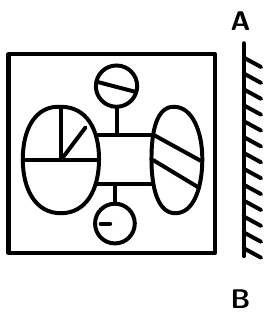
Question 32

A mirror is placed on the line AB. Out of the option figures which figure will be the right image of the question figure?

  1. AOption (a)

  2. BOption (b)

  3. COption (c)

  4. DOption (d)

View answer & explanation

Correct answer

Answer: (a)A.

Why this answer is correct

The correct mirror image is:

Hence, the correct answer is "Option 1".

Question 33

A piece of paper is folded and punched as shown below in the question figures. From the given option figures, indicate how it will appear when opened.

  1. AOption (a)

  2. BOption (b)

  3. COption (c)

  4. DOption (d)

View answer & explanation

Correct answer

Answer: (c)C.

Why this answer is correct

The paper will appear when opened.

Hence, the correct answer is "Option 3".

Question 34

A piece of paper is folded and punched as shown below in the question figures. From the given option figures, indicate how it will appear when opened.

  1. AOption (a)

  2. BOption (b)

  3. COption (c)

  4. DOption (d)

View answer & explanation

Correct answer

Answer: (b)B.

Why this answer is correct

The paper will appear when opened.

Hence, the correct answer is "Option 2".

Question 35

Five persons A, B, C, D, E belong to different cities and have different favorite colours. Cities: Delhi, Jaipur, Mumbai, Chennai, Lucknow

Colours: Red, Blue, Green, Yellow, Black

A - Chennai - Blue

Delhi person likes Red

C ≠ Green/Yellow

B - Mumbai

E - Black, not Jaipur

D - Jaipur

Who lives in Delhi and likes Red?

  1. AOption (a)

    B

  2. BOption (b)

    C

  3. COption (c)

    D

  4. DOption (d)

    E

View answer & explanation

Correct answer

Answer: (b)B.

C

Why this answer is correct

Given: Five persons A, B, C, D, and E belong to different cities and have different favorite colors.

  1. A lives in Chennai and likes Blue.
PersonCityColor
AChennaiBlue
B
C
D
E
  1. B lives in Mumbai and D lives in Jaipur.
PersonCityColor
AChennaiBlue
BMumbai
C
DJaipur
E
  1. E likes Black. Since E cannot live in Jaipur (already taken by D) and his city isn't Delhi (as Delhi likes Red), E must live in Lucknow (the only remaining city besides Delhi).

  2. Now, only one city is left: Delhi. Since A, B, D, and E have assigned cities, C must live in Delhi.

  3. The clue states: "Delhi person likes Red". Therefore, C likes Red.

PersonCityColor
AChennaiBlue
BMumbaiGreen/Yellow
CDelhiRed
DJaipurYellow/Green
ELucknowBlack


Based on the final arrangement, C lives in Delhi and likes Red.

Hence, the correct answer is "Option 2".

Question 36

Find the next number in the sequence.

2, 6, 14, 30, 62, ?

  1. AOption (a)

    126

  2. BOption (b)

    120

  3. COption (c)

    124

  4. DOption (d)

    130

View answer & explanation

Correct answer

Answer: (a)A.

126

Why this answer is correct

The logic followed here is:

Thus, the missing term in the series is 126**.**

Hence, the correct answer is "Option 1".

Question 37

In the following question, select the number which can be placed at the sign of question mark (?) from the given alternatives.

65?180
17342
38296
  1. AOption (a)

    1

  2. BOption (b)

    2

  3. COption (c)

    3

  4. DOption (d)

    6

View answer & explanation

Correct answer

Answer: (c)C.

3

Why this answer is correct

The logic followed here is:

In a row: (Product of first three numbers) × 2 = Fourth number

Row 2: (1 × 7 × 3)  → 21 × 2 = 42

Row 3: (3 × 8 × 2) → 48 × 2 = 96

Similarly,

Row 1: (6 × 5 × ?) × 2 → (30 × ?) × 2 = 180

⇒ 60 × ? = 180

⇒ ? = 180 ÷ 60

⇒ ? = 3

Hence, the correct answer is "Option 3".

Question 38

How many triangles are there in the given figure?

  1. AOption (a)

    5

  2. BOption (b)

    7

  3. COption (c)

    8

  4. DOption (d)

    9

View answer & explanation

Correct answer

Answer: (c)C.

8

Why this answer is correct

The total number of triangles in the figure is:

So, the total number of triangles in the figure is 8.

Hence, the correct answer is "Option 3".

Question 39

How many triangles are there in the given figure?

  1. AOption (a)

    8

  2. BOption (b)

    10

  3. COption (c)

    12

  4. DOption (d)

    14

View answer & explanation

Correct answer

Answer: (c)C.

12

Why this answer is correct

The total number of triangles in the figure is:

So, the total number of triangles in the figure is 12.

Hence, the correct answer is "Option 3".

Question 40

In the figure given below the circle represents colour, the rectangle represents black and the triangle represents pink. The number in each area represents the number of items in that area.

How many colour are pink?

  1. AOption (a)

    5

  2. BOption (b)

    18

  3. COption (c)

    23

  4. DOption (d)

    22

View answer & explanation

Correct answer

Answer: (c)C.

23

Why this answer is correct

To find how many "colour" are "pink", we look for the intersection of the Circle (colour) and the Triangle (pink).

Area inside both the Circle and Triangle contains the numbers: 5 and 18.

Total = 5 + 18 = 23

Hence, the correct answer is "Option 3".

Question 41

Thickness of 5 tyres R, S, T, U and W is compared. Thickness of no two tyres is same. R is thicker than T but not than W. S is thicker than U and U is thicker than W. If thickness of tyre R is 50, then what is the possible thickness of tyre T?

  1. AOption (a)

    52

  2. BOption (b)

    55

  3. COption (c)

    49

  4. DOption (d)

    56

View answer & explanation

Correct answer

Answer: (c)C.

49

Why this answer is correct

Given: Thickness of five tyres R, S, T, U, and W is compared.

1) R is thicker than T but not than W.

W > R > T

2) S is thicker than U and U is thicker than W.

S > U > W.

By merging the two sequences

S > U > W > R > T

Analyzing the thickness:

It is given that the thickness of tyre R = 50.

From our sequence,

Thickness of T < 50.

5) Evaluating the options:

  1. 52 (Greater than 50)

  2. 55 (Greater than 50)

  3. 49 (Less than 50)

  4. 56 (Greater than 50)

The only possible value for the thickness of T that is less than 50 is 49.

Hence, the correct answer is "Option 3".

Question 42

Length of 6 rectangles A, B, C, D, E and F is compared. Length of no two rectangles is same. Length of A is second longest. Length of F is more than C and B but less than D and E. Length of E is not the maximum. Length of how many rectangles is more than F?

  1. AOption (a)

    2

  2. BOption (b)

    3

  3. COption (c)

    1

  4. DOption (d)

    0

View answer & explanation

Correct answer

Answer: (b)B.

3

Why this answer is correct

Given: Length of six rectangles A, B, C, D, E, and F is compared.

1) Length of A is the second longest.

__ > A > __ > __ > __ > __

2) Length of F is more than C and B but less than D and E.

(D, E) > F > (C, B).

3) Length of E is not the maximum.

D > A > E > F > (B or C) > (C or B)

The rectangles longer than F are D, A, and E.

There are 3 rectangles longer than F.

Hence, the correct answer is "Option 2".

Question 43

8 women A, B, C, D, E, F, G and H are sitting around a circular table facing opposite to the centre (not necessarily in the same order). B is second to the left of H. A is third to the left of B. D is to the immediate right of H. F is fourth to the left of D. C is the immediate neighbour of H and B. G is second to the right of H . Who are the immediate neighbours of F?

  1. AOption (a)

    C and E

  2. BOption (b)

    B and E

  3. COption (c)

    G and C

  4. DOption (d)

    H and C

View answer & explanation

Correct answer

Answer: (b)B.

B and E

Why this answer is correct

Given:

  1. D is immediate right of H. G is second to the right of H. So D and G are placed clockwise from H.

                      H D G
    
  2. B is second to the left of H. C is the immediate neighbour of both H and B. So C sits between H and B (counter-clockwise). B at top-left, C at left.

            H D G C B
    
  3. A is third to the left of B. So A at bottom-right. F is fourth to the left of D. So F at bottom-left. E fills the remaining seat at bottom.

             H D G A E F B C
    

So, the immediate neighbours of F are B and E.

Hence, the correct answer is "Option 2".

Question 44

After interchanging the given two numbers (not digits), what will be the value of the given equation?

7 and 6

4 × 7 + 6 - 9 ÷ 3 = ?

  1. AOption (a)

    32

  2. BOption (b)

    28

  3. COption (c)

    38

  4. DOption (d)

    21

View answer & explanation

Correct answer

Answer: (b)B.

28

Why this answer is correct

The given numbers to be interchanged: 7 and 6

The original equation: 4 × 7 + 6 − 9 ÷ 3 = ?

After interchanging the numbers 7 and 6, the new equation is:

4 × 6 + 7 − 9 ÷ 3 = ?

Now, we solve the equation following the BODMAS rule:

4 × 6 + 7 − 9 ÷ 3

⇒ 4 × 6 + 7 − 3

⇒ 24 + 7 − 3 = 28

Hence, the correct answer is "Option 2".

Question 45

Select the correct combination of mathematical signs to replace (*) signs sequentially and to balance the given equation.

64 * 16 * 34 * 8 * 3 = 14

  1. AOption (a)

    ×, -, +, ÷ 

  2. BOption (b)

    ÷, +, -, ×

  3. COption (c)

    ÷, +, ×, -

  4. DOption (d)

    ÷, -,  ×, +

View answer & explanation

Correct answer

Answer: (b)B.

÷, +, -, ×

Why this answer is correct

BODMAS Rule:

The given equation is:

64 * 16 * 34 * 8 * 3 = 14

Now, let's check each option by applying the proposed signs sequentially and following BODMAS step-by-step:

1) Signs with ×, -, +, ÷

New Equation: 64 × 16 - 34 + 8 ÷ 3 = ?

⇒ 64 × 16 - 34 + (8 ÷ 3)

⇒ (64 × 16) - 34 + 2.66...

⇒ (1024 + 2.66...) - 34

⇒ 1026.66... - 34

⇒ 992.66... ≠ 14 (Incorrect)

2) Signs with ÷, +, -, ×

New Equation: 64 ÷ 16 + 34 - 8 × 3 = ?

Perform operations according to BODMAS/PEMDAS:

⇒ (64 ÷ 16) + 34 - 8 × 3

⇒ 4 + 34 - (8 × 3)

⇒ (4 + 34) - 24

⇒ 38 - 24

⇒ 14

14 = 14 (Correct)

3) Signs with ÷, +, ×, -

New Equation: 64 ÷ 16 + 34 × 8 - 3 = ?

⇒ (64 ÷ 16) + 34 × 8 - 3

⇒ 4 + (34 × 8) - 3

⇒ (4 + 272) - 3

⇒ 276 - 3

⇒ 273 ≠ 14 (Incorrect)

4) Signs with ÷, -, ×, +

New Equation: 64 ÷ 16 - 34 × 8 + 3 = ?

⇒ (64 ÷ 16) - 34 × 8 + 3

⇒ 4 - (34 × 8) + 3

⇒ (4 + 3) - 272

⇒ 7 - 272

⇒ -265 ≠ 14 (Incorrect)

Hence, the correct answer is "Option 2".

Question 46

In the following question, four letter-number pairs are given. The letter-number on the left side of (-) is related to the letter-number on the right side of (-) with some Logic/Rule/Relation. Three pairs are similar on the basis of same Logic/Rule/Relation. Select the odd one out from the given alternatives.

(NOTE: Operations should be performed on the whole numbers, without breaking down the number into its constituent digits. E.g. 13 - Operations on 13 such as adding/subtracting/multiplying etc. to 13 can be performed. Breaking down 13 into 1 and 3 and then performing mathematical operations on 1 and 3 is not allowed)

  1. AOption (a)

    XR432 - ZU216

  2. BOption (b)

    FN504 - HQ252

  3. COption (c)

    TC386 - VF193

  4. DOption (d)

    BM290 - DP155

View answer & explanation

Correct answer

Answer: (d)D.

BM290 - DP155

Why this answer is correct

The logic followed here involves two parts: a vertical shift in the letter positions and a mathematical operation on the whole numbers.

For Option 1) XR432 - ZU216:

For Option 2) FN504 - HQ252:

For Option 3) TC386 - VF193:

For Option 4) BM290 - DP155:

Thus, the letter-number pair that DOES NOT belong to that group is BM290 - DP155.

Hence, the correct answer is "Option 4".

Question 47

In a certain coded language 'UPEND' is coded as 'AJBLR' and 'AUDIT' is coded as 'QEAQX'. How will 'AIMED' be coded in the same code language?

  1. AOption (a)

    BBJGW

  2. BOption (b)

    BZLDV

  3. COption (c)

    AAJEX

  4. DOption (d)

    AYKEY

View answer & explanation

Correct answer

Answer: (c)C.

AAJEX

Why this answer is correct

The logic followed here is:

For, 'UPEND' is coded as 'AJBLR'

'AUDIT' is coded as 'QEAQX'

Similarly, for AIMED:

So, 'AIMED' is coded as 'AAJEX'

Hence, the correct answer is "Option 3".

Question 48

In a certain coded language 'BUSBOY' is coded as 'YKYNQT' and 'COMBAT' is coded as 'ZWYHKO'. How will 'ZENANA' be coded in the same code language?

  1. AOption (a)

    WJXIAV

  2. BOption (b)

    YJXIYT

  3. COption (c)

    XLYKYX

  4. DOption (d)

    UJYJAW

View answer & explanation

Correct answer

Answer: (a)A.

WJXIAV

Why this answer is correct

The logic followed here is:

For, 'BUSBOY' is coded as 'YKYNQT'

'COMBAT' is coded as 'ZWYHKO'

Similarly, for ZENANA:

So, 'ZENANA' is coded as 'WJXIAV'

Hence, the correct answer is "Option 1".

Question 49

A series is given with one term missing. Select the correct alternative from the given ones that will complete the series.

AX390, ZU350, YR310, XO270, ?

  1. AOption (a)

    VL230

  2. BOption (b)

    WL230

  3. COption (c)

    WK210

  4. DOption (d)

    VK220

View answer & explanation

Correct answer

Answer: (b)B.

WL230

Why this answer is correct

The logic followed here is:

Thus, the missing term in the series is WL230.

Hence, the correct answer is "Option 2".

Question 50

A series is given with one term wrong. Select that wrong term from the given alternatives.

XL16, ET64, NB256, VJ1024, DR4096

  1. AOption (a)

    VJ1024

  2. BOption (b)

    XL16

  3. COption (c)

    ET64

  4. DOption (d)

    NB256

View answer & explanation

Correct answer

Answer: (c)C.

ET64

Why this answer is correct

The logic followed here is:

Thus, the missing term in the series is ET64.

Hence, the correct answer is "Option 3".

Quantitative Aptitude (25 questions)

Question 51

the expression is simplified from (a2 -b2)2 - (2ab)2. What's the final expression?

  1. AOption (a)

    a4 - 4a2 b2 + b4

  2. BOption (b)

    a4 + 2a2 b2 + b4

  3. COption (c)

    a4 - 6a2 b2 + b4

  4. DOption (d)

    a4 - b4

View answer & explanation

Correct answer

Answer: (c)C.

a4 - 6a2 b2 + b4

Why this answer is correct

Given:

Expression = (a2 − b2)2 − (2ab)2

Formula Used:

(x − y)2 = x2 − 2xy + y2

(a2 − b2)2 = a4 − 2a2b2 + b4

(2ab)2 = 4a2b2

Calculation:

⇒ (a2 − b2)2 = a4 − 2a2b2 + b4

⇒ Subtract (2ab)2

⇒ = a4 − 2a2b2 + b4 − 4a2b2

⇒ = a4 − 6a2b2 + b4

∴ The correct answer is a4 − 6a2b2 + b4.

Question 52

Compare the values: √18, 2√5, and √40. Which is the greatest?

  1. AOption (a)

    √18

  2. BOption (b)

    2√5

  3. COption (c)

    √40

  4. DOption (d)

    All are equal

View answer & explanation

Correct answer

Answer: (c)C.

√40

Why this answer is correct

Given:

√18, 2√5, and √40

Formula Used:

√a = a0.5

2√a = 2 × a0.5

Calculation:

⇒ √18 = 180.5 = 4.24

⇒ 2√5 = 2 × 50.5 = 2 × 2.24 = 4.48

⇒ √40 = 400.5 = 6.32

∴ The correct answer is √40.

Question 53

The ratio of incomes of A and B is 7 : 5 and the ratio of their expenditures is 3 : 2. If both save ₹ 4000 per month, what is A's income?

  1. AOption (a)

    ₹28,000

  2. BOption (b)

    ₹35,000

  3. COption (c)

    ₹32,000

  4. DOption (d)

    ₹30,000

View answer & explanation

Correct answer

Answer: (a)A.

₹28,000

Why this answer is correct

Given:

Income ratio (A : B) = 7 : 5

Expenditure ratio (A : B) = 3 : 2

Savings of each = 4000

Formula Used:

Income − Expenditure = Savings

Calculation:

⇒ Let incomes = 7x and 5x

⇒ Let expenditures = 3y and 2y

⇒ For A: 7x − 3y = 4000

⇒ For B: 5x − 2y = 4000

⇒ Multiply second equation by 3

⇒ 15x − 6y = 12000

⇒ Multiply first equation by 2

⇒ 14x − 6y = 8000

⇒ Subtract

⇒ x = 4000

⇒ A's income = 7x

⇒ A's income = 7 × 4000 = 28000

∴ The correct answer is 28000.

Question 54

What percent of Rs. 300 is Rs. 45?

  1. AOption (a)

    10%

  2. BOption (b)

    15%

  3. COption (c)

    20%

  4. DOption (d)

    25%

View answer & explanation

Correct answer

Answer: (b)B.

15%

Why this answer is correct

Given:

Total amount = Rs. 300

Amount in question = Rs. 45

Formula Used:

Percentage = (Part ÷ Whole) × 100

Calculation:

⇒ Percentage = (45 ÷ 300) × 100

⇒ Percentage = 0.15 × 100

⇒ Percentage = 15%

∴ The correct answer is 15%.

Question 55

A dishonest dealer professes to sell goods at cost price but uses a false weight of 950 g instead of 1 kg. Find his profit percentage.

  1. AOption (a)

    4.76%

  2. BOption (b)

    5.26%

  3. COption (c)

    6.25%

  4. DOption (d)

    7.14%

View answer & explanation

Correct answer

Answer: (b)B.

5.26%

Why this answer is correct

Given:

Cost price weight = 1 kg

False weight used = 950 g

Formula Used:

Profit percentage = [(True weight − False weight) ÷ False weight] × 100

Calculation:

⇒ Profit percentage = [(1000 − 950) ÷ 950] × 100

⇒ Profit percentage = [50 ÷ 950] × 100

⇒ Profit percentage = 0.0526 × 100

⇒ Profit percentage = 5.26%

∴ The correct answer is 5.26%.

Question 56

A person covers a certain distance in 2 hours. If he had moved 5 km/h faster, he would have taken 30 minutes less. Find the original speed.

  1. AOption (a)

    10 km/h

  2. BOption (b)

    12 km/h

  3. COption (c)

    15 km/h

  4. DOption (d)

    20 km/h

View answer & explanation

Correct answer

Answer: (c)C.

15 km/h

Why this answer is correct

Given:

Time = 2 hours

Reduced time = 1.5 hours

Increase in speed = 5 km/h

Formula Used:

Distance = Speed × Time

Calculation:

⇒ Let original speed = x

⇒ Distance = x × 2 = 2x

⇒ New speed = x + 5

⇒ Distance = (x + 5) × 1.5

⇒ 2x = 1.5(x + 5)

⇒ 2x = 1.5x + 7.5

⇒ 2x − 1.5x = 7.5

⇒ 0.5x = 7.5

⇒ x = 7.5 ÷ 0.5

⇒ x = 15

∴ The correct answer is 15 km/h.

Question 57

Two trains start from stations A and B towards each other and meet after 4 hours. Train from A travels 20% faster than train from B. If the distance between A and B is 528 km, find the speed of the slower train.

  1. AOption (a)

    55 km/h

  2. BOption (b)

    60 km/h

  3. COption (c)

    65 km/h

  4. DOption (d)

    70 km/h

View answer & explanation

Correct answer

Answer: (b)B.

60 km/h

Why this answer is correct

Given:

Total distance = 528 km

Time = 4 hours

Speed ratio (A : B) = 1.2 : 1

Formula Used:

Distance = Speed × Time

Total speed = Sum of individual speeds

Calculation:

⇒ Let speed of slower train (B) = x

⇒ Speed of faster train (A) = 1.2x

⇒ Total speed = x + 1.2x = 2.2x

⇒ Distance = Total speed × Time

⇒ 528 = 2.2x × 4

⇒ 528 = 8.8x

⇒ x = 528 ÷ 8.8

⇒ x = 60

∴ The correct answer is 60 km/h.

Question 58

A sum of Rs. 6250 amounts to Rs. 7290 in 2 years at compound interest. Find the rate per annum.

  1. AOption (a)

    8%

  2. BOption (b)

    9%

  3. COption (c)

    10%

  4. DOption (d)

    11%

View answer & explanation

Correct answer

Answer: (a)A.

8%

Why this answer is correct

Given:

Principal = 6250

Amount = 7290

Time = 2 years

Formula Used:

Amount = Principal × (1 + Rate ÷ 100)Time

Calculation:

⇒ 7290 = 6250 × (1 + Rate ÷ 100)2

⇒ (1 + Rate ÷ 100)2 = 7290 ÷ 6250

⇒ (1 + Rate ÷ 100)2 = 1.1664

⇒ 1 + Rate ÷ 100 = √1.1664

⇒ 1 + Rate ÷ 100 = 1.08

⇒ Rate ÷ 100 = 0.08

⇒ Rate = 8

∴ The correct answer is 8%.

Question 59

A and B together can do a piece of work in 20 days. They worked for 8 days, and C completed the remaining in 4 days. How long will C alone take to do the whole work?

  1. AOption (a)

    6 days

  2. BOption (b)

    6.67 days

  3. COption (c)

    8 days

  4. DOption (d)

    10 days

View answer & explanation

Correct answer

Answer: (b)B.

6.67 days

Why this answer is correct

Given:

(A + B) time = 20 days

Working together = 8 days

Remaining work done by C in 4 days

Formula Used:

Work rate = 1 ÷ Time

Total work = Sum of individual works

Calculation:

⇒ LCM of 20 and 4 = 20

⇒ Rate (A + B) = 1 ÷ 20

⇒ Work done in 8 days = 8 ÷ 20

⇒ Remaining work = 20 ÷ 20 − 8 ÷ 20 = 12 ÷ 20

⇒ C completes 12 ÷ 20 work in 4 days

⇒ Rate of C = (12 ÷ 20) ÷ 4

⇒ Rate of C = 12 ÷ 80 = 3 ÷ 20

⇒ Time of C = 20 ÷ 3

⇒ Time of C ≈ 6.67 days

∴ The correct answer is 6.67 days.

Question 60

What sum will amount to ₹ 8800 in 2 years at 10% simple interest per annum?

  1. AOption (a)

    ₹7200

  2. BOption (b)

    ₹7333.33

  3. COption (c)

    ₹7500

  4. DOption (d)

    ₹7600

View answer & explanation

Correct answer

Answer: (b)B.

₹7333.33

Why this answer is correct

Given:

Amount = 8800

Rate = 10%

Time = 2 years

Formula Used:

Amount = Principal × (1 + (Rate × Time) ÷ 100)

Calculation:

⇒ 8800 = Principal × (1 + (10 × 2) ÷ 100)

⇒ 8800 = Principal × (1 + 20 ÷ 100)

⇒ 8800 = Principal × 1.2

⇒ Principal = 8800 ÷ 1.2

⇒ Principal = 7333.33

∴ The correct answer is 7333.33.

Question 61

A skylight is trapezium-shaped with area 84 cm2 and bases 10 cm, 14 cm. What is its height?

  1. AOption (a)

    5

  2. BOption (b)

    7

  3. COption (c)

    6

  4. DOption (d)

    8

View answer & explanation

Correct answer

Answer: (b)B.

7

Why this answer is correct

Given:

Area = 84

Parallel sides = 10 and 14

Formula Used:

Area of trapezium = (1 ÷ 2) × (sum of parallel sides) × height

Calculation:

⇒ 84 = (1 ÷ 2) × (10 + 14) × height

⇒ 84 = (1 ÷ 2) × 24 × height

⇒ 84 = 12 × height

⇒ height = 84 ÷ 12

⇒ height = 7

∴ The correct answer is 7 cm.

Question 62

A metal container is in the shape of a cuboid with dimensions 3 m × 2 m × 1.5 m. What will be the cost of painting its outer surface at the rate of Rs. 15 per square meter?

  1. AOption (a)

    Rs. 390

  2. BOption (b)

    Rs. 405

  3. COption (c)

    Rs. 420

  4. DOption (d)

    Rs. 450

View answer & explanation

Correct answer

Answer: (b)B.

Rs. 405

Why this answer is correct

Given:

Length = 3 m

Breadth = 2 m

Height = 1.5 m

Rate = 15 per m2

Formula Used:

Surface area of cuboid = 2 × (lb + bh + hl)

Cost = Surface area × rate

Calculation:

⇒ Surface area = 2 × (3 × 2 + 2 × 1.5 + 1.5 × 3)

⇒ Surface area = 2 × (6 + 3 + 4.5)

⇒ Surface area = 2 × 13.5

⇒ Surface area = 27

⇒ Cost = 27 × 15

⇒ Cost = 405

∴ The correct answer is 405.

Question 63

A triangular display stand is shaped like a right pyramid with equilateral triangle base of side 12 cm and height 10 cm. What is the volume of the stand?

  1. AOption (a)

    312 cm3

  2. BOption (b)

    254.8 cm3

  3. COption (c)

    374 cm3

  4. DOption (d)

    207.8 cm3

View answer & explanation

Correct answer

Answer: (d)D.

207.8 cm3

Why this answer is correct

Given:

Side of equilateral triangle = 12 cm

Height of pyramid = 10 cm

Formula Used:

Area of equilateral triangle = (√3 ÷ 4) × side2

Volume of pyramid = (1 ÷ 3) × base area × height

Calculation:

⇒ Base area = (√3 ÷ 4) × 122

⇒ Base area = (√3 ÷ 4) × 144

⇒ Base area = 36√3

⇒ Volume = (1 ÷ 3) × 36√3 × 10

⇒ Volume = 12 × 10 × √3

⇒ Volume = 120√3 = 207.8 cm3

∴ The correct answer is 207.8 cm3.

Question 64

In right triangle ABC, right angled at 'B', AB = 18 cm. BD is perpendicular to AC such that AC = 2BD. If ∠BAC = ∠BCA, then find the numerical value of (AC2 - BD2).

  1. AOption (a)

    509

  2. BOption (b)

    412

  3. COption (c)

    356

  4. DOption (d)

    486

View answer & explanation

Correct answer

Answer: (d)D.

486

Why this answer is correct

Given:

AB = 18

Right angle at B

AC = 2 × BD

∠A = ∠C

Formula Used:

In right triangle with ∠A = ∠C ⇒ AB = BC

AC = √(AB2 + BC2)

Altitude to hypotenuse BD = (AB × BC) ÷ AC

Calculation:

⇒ AB = BC = 18

⇒ AC = √(182 + 182)

⇒ AC = √(324 + 324) = √648

⇒ AC = 18√2

⇒ BD = (18 × 18) ÷ (18√2)

⇒ BD = 324 ÷ (18√2)

⇒ BD = 18 ÷ √2 = 9√2

⇒ AC2 = (18√2)2 = 648

⇒ BD2 = (9√2)2 = 162

⇒ AC2 − BD2 = 648 − 162

⇒ AC2 − BD2 = 486

∴ The correct answer is 486.

Question 65

The point equidistant from all triangle sides is called:

  1. AOption (a)

    Centroid

  2. BOption (b)

    Circumcenter

  3. COption (c)

    Incenter

  4. DOption (d)

    Orthocenter

View answer & explanation

Correct answer

Answer: (c)C.

Incenter

Why this answer is correct

Given:

The point equidistant from all triangle sides is called:

Formula Used:

The incenter of a triangle is the point of intersection of its angle bisectors.

It is equidistant from all sides of the triangle.

Calculation:

⇒ The angle bisectors of the triangle meet at a single point, the incenter.

⇒ This point is equidistant from the sides of the triangle.

∴ The correct answer is Incenter.

Question 66

The volume of a right circular cone is 80% of that of a right circular cylinder whose height is 50% more than that of the cone. If the radius of the cone is 36 cm, then find the radius of the cylinder.

  1. AOption (a)

    2√5 cm

  2. BOption (b)

    6√10 cm

  3. COption (c)

    5√12 cm

  4. DOption (d)

    3√7 cm

View answer & explanation

Correct answer

Answer: (b)B.

6√10 cm

Why this answer is correct

Given:

Volume of cone = 0.8 × volume of cylinder

Radius of cone = 36 cm

Height of cylinder = 1.5 × height of cone

Formula Used:

Volume of cone = (1 ÷ 3) × π × r2 × h

Volume of cylinder = π × R2 × H

Calculation:

⇒ (1 ÷ 3) × π × 362 × h = 0.8 × π × R2 × (1.5h)

⇒ (1 ÷ 3) × 1296 × h = 0.8 × 1.5 × R2 × h

⇒ 432h = 1.2 × R2 × h

⇒ 432 = 1.2 × R2

⇒ R2 = 432 ÷ 1.2

⇒ R2 = 360

⇒ R = √360

⇒ R = 6√10

∴ The correct answer is 6√10 cm.

Question 67

If two circles of radii r1 and r2 have n common tangents, and the distance between their centers is less than |r1 - r2|, then n is:

  1. AOption (a)

    0

  2. BOption (b)

    1

  3. COption (c)

    2

  4. DOption (d)

    4

View answer & explanation

Correct answer

Answer: (a)A.

0

Why this answer is correct

Given:

Distance between centers < |r1 − r2|

Formula Used:

If one circle lies completely inside another without touching, number of common tangents = 0

Calculation:

⇒ Distance < difference of radii

⇒ Smaller circle lies completely inside larger circle

⇒ No common tangents exist

∴ The correct answer is 0.

Question 68

Simplify the expression : tan⁡xsec⁡x\frac{\tan x}{\sec x}.

  1. AOption (a)

    cosX

  2. BOption (b)

    cosecx

  3. COption (c)

    1

  4. DOption (d)

    sinx

View answer & explanation

Correct answer

Answer: (d)D.

sinx

Why this answer is correct

Given:

Expression = tan x ÷ sec x

Formula Used:

tan x = sin x ÷ cos x

sec x = 1 ÷ cos x

Calculation:

⇒ tan x ÷ sec x = (sin x ÷ cos x) ÷ (1 ÷ cos x)

⇒ = (sin x ÷ cos x) × (cos x ÷ 1)

⇒ = sin x

∴ The correct answer is sin x.

Question 69

A and B invest in a business in the ratio 3 : 1. If 5% of the total profit goes to charity and A's share is Rs .855, what is the total profit?

  1. AOption (a)

    Rs. 1425

  2. BOption (b)

    Rs. 1200

  3. COption (c)

    Rs. 1537

  4. DOption (d)

    Rs. 1600

View answer & explanation

Correct answer

Answer: (b)B.

Rs. 1200

Why this answer is correct

Given:

Investment ratio (A : B) = 3 : 1

Charity = 5%

A's share = 855

Formula Used:

Profit after charity = Total profit × (95 ÷ 100)

Share of A = (3 ÷ 4) × remaining profit

Calculation:

⇒ Let total profit = x

⇒ Remaining profit = 0.95x

⇒ A's share = (3 ÷ 4) × 0.95x

⇒ (3 ÷ 4) × 0.95x = 855

⇒ 0.7125x = 855

⇒ x = 855 ÷ 0.7125

⇒ x = 1200

∴ The correct answer is 1200.

Question 70

A shopkeeper offers two successive discounts of 10% and 20% on a Rs. 1,200 article. What is the final price after the two discounts?

  1. AOption (a)

    ₹892

  2. BOption (b)

    ₹816

  3. COption (c)

    ₹864

  4. DOption (d)

    ₹965

View answer & explanation

Correct answer

Answer: (c)C.

₹864

Why this answer is correct

Given:

Initial price = ₹1,200

First discount = 10%

Second discount = 20%

Formula Used:

Price after discount = Initial price × (1 - Discount Rate)

Calculation:

⇒ Price after first discount = ₹1,200 × (1 - 10/100)

⇒ Price after first discount = ₹1,200 × 0.9

⇒ Price after first discount = ₹1,080

⇒ Price after second discount = ₹1,080 × (1 - 20/100)

⇒ Price after second discount = ₹1,080 × 0.8

⇒ Price after second discount = ₹864

∴ The correct answer is ₹864.

Question 71

The price of a movie ticket for adults and children is in the ratio 5 : 3. If an adult ticket costs 250, what is the price of a child ticket?

  1. AOption (a)

    100

  2. BOption (b)

    120

  3. COption (c)

    150

  4. DOption (d)

    200

View answer & explanation

Correct answer

Answer: (c)C.

150

Why this answer is correct

Given:

Price ratio of adult ticket to child ticket = 5 : 3

Price of adult ticket = 250

Formula Used:

Price of child ticket = (Price of adult ticket × Child ticket ratio) ÷ Adult ticket ratio

Calculation:

⇒ Price of child ticket = (250 × 3) ÷ 5

⇒ Price of child ticket = 750 ÷ 5

⇒ Price of child ticket = 150

∴ The correct answer is 150.

Question 72

A batsman scored 45, 60, 55, and 40 runs in four matches. In the 5th match, he wants his average to reach exactly 55 runs. How many runs must he score in the 5th match?

  1. AOption (a)

    60

  2. BOption (b)

    65

  3. COption (c)

    70

  4. DOption (d)

    75

View answer & explanation

Correct answer

Answer: (d)D.

75

Why this answer is correct

Given:

Runs in 1st match = 45

Runs in 2nd match = 60

Runs in 3rd match = 55

Runs in 4th match = 40

Desired average after 5 matches = 55

Total matches = 5

Formula Used:

Average = Total runs ÷ Number of matches

Total runs required = Desired average × Total matches

Calculation:

⇒ Total runs required = 55 × 5

⇒ Total runs required = 275

⇒ Runs scored in 4 matches = 45 + 60 + 55 + 40

⇒ Runs scored in 4 matches = 200

⇒ Runs needed in 5th match = Total runs required − Runs scored in 4 matches

⇒ Runs needed in 5th match = 275 − 200

⇒ Runs needed in 5th match = 75

∴ The correct answer is 75.

Question 73

A common internal tangent is drawn to two circles with radii 4 and 9 units. If the length of the tangent segment is 12 units, what is the distance between the centers of the two circles?

  1. AOption (a)

    313 units

  2. BOption (b)

    156 units

  3. COption (c)

    √213 units

  4. DOption (d)

    √313 units

View answer & explanation

Correct answer

Answer: (d)D.

√313 units

Why this answer is correct

Given:

r1 = 4

r2 = 9

Tangent length = 12

Formula Used:

Length of common internal tangent = √(d2 − (r1 + r2)2)

Calculation:

⇒ 12 = √(d2 − (4 + 9)2)

⇒ 122 = d2 − 132

⇒ 144 = d2 − 169

⇒ d2 = 144 + 169 = 313

⇒ d = √313

∴ The correct answer is √313.

Question 74

If sin⁡(x)=35\sin (x)=\frac{3}{5}, find cos (x)

  1. AOption (a)

    45\frac{4}{5}

  2. BOption (b)

    35\frac{3}{5}

  3. COption (c)

    59\frac{5}{9}

  4. DOption (d)

    78\frac{7}{8}

View answer & explanation

Correct answer

Answer: (a)A.

45\frac{4}{5}

Why this answer is correct

Given:

sin(x) = 3/5

Formula Used:

sin²(x) + cos²(x) = 1

Calculation:

⇒ sin²(x) = (3/5)²

⇒ sin²(x) = 9/25

⇒ cos²(x) = 1 - sin²(x)

⇒ cos²(x) = 1 - 9/25

⇒ cos²(x) = 25/25 - 9/25

⇒ cos²(x) = 16/25

⇒ cos(x) = √(16/25)

⇒ cos(x) = 4/5

∴ The correct answer is 4/5.

Question 75

If tan⁡θ=43\tan θ=\frac{4}{3}, find cos2θ-sin2θ.

  1. AOption (a)

    −827\frac{-8}{27}

  2. BOption (b)

    −925\frac{-9}{25}

  3. COption (c)

    −916\frac{-9}{16}

  4. DOption (d)

    −725\frac{-7}{25}

View answer & explanation

Correct answer

Answer: (d)D.

−725\frac{-7}{25}

Why this answer is correct

Given:

tan⁡θ=43 \tan \theta = \frac{4}{3}

Formula Used:

cos⁡2θ−sin⁡2θ=1−tan⁡2θ1+tan⁡2θ \cos^{2}\theta - \sin^{2}\theta = \frac{1 - \tan^{2}\theta}{1 + \tan^{2}\theta}

Calculation:

⇒ tan⁡2θ=(43)2=169 \tan^{2}\theta = \left(\frac{4}{3}\right)^{2} = \frac{16}{9}

⇒ 1−tan⁡2θ1+tan⁡2θ=1−1691+169 \frac{1 - \tan^{2}\theta}{1 + \tan^{2}\theta} = \frac{1 - \frac{16}{9}}{1 + \frac{16}{9}}

⇒ =9−1699+169 = \frac{\frac{9 - 16}{9}}{\frac{9 + 16}{9}}

⇒ =−725 = \frac{-7}{25}

∴ The correct answer is −725 -\frac{7}{25} .

General Awareness (25 questions)

Question 76

Which of the following rulers mobilise a large standing army in Delhi due to the Mongol invasion, which posed a huge administrative challenge?

I. Alauddin Khalji

II. Muhammad Tughluq

  1. AOption (a)

    Only ।

  2. BOption (b)

    Only II

  3. COption (c)

    Both I and II

  4. DOption (d)

    Neither I nor II

View answer & explanation

Correct answer

Answer: (c)C.

Both I and II

Why this answer is correct

The correct answer is Both I and II.

Key Points

  • Alauddin Khalji mobilized a large standing army in Delhi as a response to the Mongol invasions, which posed a serious threat to the Sultanate during his reign. He strengthened the military infrastructure by building forts and increasing the size of the army. Hence, statement I is correct.
  • Muhammad bin Tughluq also faced challenges from Mongol invasions and organized a large standing army. He introduced reforms in administration and taxation to support the military expenses. Hence, statement II is correct.
  • Mongol invasions were frequent during the Delhi Sultanate period, and both rulers had to adapt their strategies to defend their territories effectively.
  • The mobilization of a large army posed administrative challenges, including logistics, financing, and coordination, which both rulers had to address through various reforms.
  • Both I and II are correct as both Alauddin Khalji and Muhammad bin Tughluq played significant roles in countering the Mongol threat through military and administrative measures.

Additional Information

  • Mongol Invasions:
  • The Mongol Empire was one of the largest empires in history, originating from Central Asia under the leadership of Genghis Khan.
  • During the Delhi Sultanate period, Mongol invasions were frequent, targeting northern India, especially the regions around Delhi.
  • These invasions caused widespread destruction and posed a significant threat to the stability of the Sultanate.
  • Alauddin Khalji's Military Reforms:
  • Alauddin Khalji established a large standing army to counter the Mongol threat and maintain the security of his empire.
  • He introduced strict measures to ensure the efficiency of his army, such as regulating the prices of goods to manage the expenses of soldiers.
  • Forts were constructed, and he undertook extensive military campaigns to expand his empire and secure its borders.
  • Muhammad bin Tughluq's Initiatives:
  • Muhammad bin Tughluq faced Mongol invasions and organized a large army, but his methods often led to administrative difficulties.
  • He introduced innovative measures, such as token currency, to fund military operations, though these were not always successful.
  • His reign was marked by ambitious projects, such as shifting the capital to Daulatabad, which created logistical challenges.
  • Impact on Administration:
  • The mobilization of large armies required substantial resources, leading to reforms in taxation and administration.
  • Both rulers faced challenges in maintaining the morale and efficiency of their troops, as well as managing the logistics of warfare.

Important Points

  • Key Challenges:
  • The Mongol invasions highlighted the vulnerability of the Delhi Sultanate and necessitated robust military strategies.
  • Both Alauddin Khalji and Muhammad bin Tughluq demonstrated their ability to adapt to the changing geopolitical landscape through reforms and military actions.
  • Historical Context:
  • The Delhi Sultanate period was marked by frequent foreign invasions, requiring rulers to focus on military strength and administrative efficiency.
  • Both rulers are remembered for their contributions to the defense and administration of the Sultanate, despite facing numerous challenges.

Question 77

In which of the following are the songs of Alvar saints compiled?

  1. AOption (a)

    Divya Prabandham

  2. BOption (b)

    Ettutogai

  3. COption (c)

    Tipitaka

  4. DOption (d)

    Adi-Puran

View answer & explanation

Correct answer

Answer: (a)A.

Divya Prabandham

Why this answer is correct

The correct answer is Divya Prabandham.

Key Points

  • Divya Prabandham is a revered collection of hymns composed by the Alvar saints, who were devotional poets in South India.
  • The term "Divya Prabandham" translates to "Sacred Compilation" in Tamil, emphasizing its spiritual significance.
  • This compilation includes 4,000 hymns (Naalayira Divya Prabandham) written in Tamil, celebrating the glory of Lord Vishnu and his various forms.
  • The Alvar saints were twelve prominent Vaishnavite saints who lived between the 6th and 9th centuries CE and expressed their devotion through poetry.
  • The hymns in the Divya Prabandham cover themes like bhakti (devotion), surrender, and divine love, making it a cornerstone of Tamil Vaishnavism.

Additional Information

  • Ettutogai:
  • Ettutogai is a collection of classical Tamil literary works belonging to the Sangam period (circa 300 BCE–300 CE).
  • It consists of eight anthologies, including works like Ahananuru, Purananuru, Kuruntokai, and others, focusing on themes of love and war.
  • It is not related to Vaishnavite devotional literature but reflects the socio-cultural aspects of ancient Tamil society.
  • Tipitaka:
  • Tipitaka, meaning "Three Baskets," is the sacred scripture of Buddhism, written in the Pali language.
  • It comprises three parts: Vinaya Pitaka (disciplinary rules), Sutta Pitaka (teachings of Buddha), and Abhidhamma Pitaka (philosophical analysis).
  • It is entirely distinct from the Vaishnavite tradition of the Alvar saints.
  • Adi-Puran:
  • Adi-Puran is a Jain scripture written by Jinasena, focusing on the life stories of Rishabhdev, the first Tirthankara.
  • It delves into Jain philosophy and ethics, making it unrelated to the hymns of the Alvar saints.
  • Divya Prabandham:
  • The Divya Prabandham is central to the Tamil Vaishnavite tradition and is recited in temples during rituals and festivals.
  • It forms the basis for the liturgical practices in many Vaishnavite temples, including Sri Rangam, one of the most famous temples dedicated to Lord Vishnu.
  • The hymns are still preserved and celebrated for their linguistic beauty and spiritual depth, showcasing the cultural richness of Tamil Nadu.

Important Points

  • Compilation: The Divya Prabandham is considered a divine revelation and was compiled by Nathamuni, a Vaishnavite scholar, in the 9th century CE.
  • Language: The hymns are written in Tamil, making it accessible to common people while promoting spiritual and cultural values.
  • Themes: The hymns emphasize concepts like surrender (sharanagati), divine grace, and the glory of Vishnu's avatars.
  • Festivals: Many verses from the Divya Prabandham are recited during Vaishnavite festivals like Vaikuntha Ekadashi and temple processions.

Question 78

Which of the following is a Fundamental Duty mentioned in the Indian Constitution?

  1. AOption (a)

    To pay taxes on time

  2. BOption (b)

    To vote in the Lok Sabha election

  3. COption (c)

    To educate child up to 18 years of age

  4. DOption (d)

    To protect the natural environment

View answer & explanation

Correct answer

Answer: (d)D.

To protect the natural environment

Why this answer is correct

The correct answer is To protect the natural environment.

Key Points

  • Fundamental Duties are enshrined in Article 51A of the Indian Constitution, added by the 42nd Amendment Act, 1976.
  • One of the Fundamental Duties explicitly states that it is the duty of every citizen of India to protect and improve the natural environment, including forests, lakes, rivers, and wildlife, and to have compassion for living creatures.
  • The inclusion of Fundamental Duties was inspired by the Constitution of Russia (Soviet Union) to inculcate a sense of responsibility among citizens toward the nation and society.
  • While Fundamental Duties are non-justiciable, they act as moral obligations for citizens to ensure active participation in nation-building.
  • Protecting the environment is critical to addressing issues like climate change, pollution, and loss of biodiversity, thereby ensuring sustainable development.

Additional Information

  • Other Fundamental Duties:
  • To abide by the Constitution and respect its ideals and institutions, the National Flag, and the National Anthem.
  • To cherish and follow the noble ideals that inspired the national struggle for freedom.
  • To uphold and protect the sovereignty, unity, and integrity of India.
  • To defend the country and render national service when called upon to do so.
  • To value and preserve the rich heritage of our composite culture.
  • Environmental Protection in India:
  • The Environment Protection Act, 1986 is one of the key legislative frameworks to safeguard the environment.
  • India is a signatory to international agreements such as the Paris Agreement under the UN Framework Convention on Climate Change.
  • Various government initiatives like National Green Tribunal and Clean India Mission aim to enhance environmental sustainability.
  • Role of Citizens:
  • Active participation in tree plantation drives, waste management, and conservation of water resources.
  • Promoting renewable energy usage and adopting eco-friendly practices in daily life.
  • Awareness campaigns to educate people about the importance of protecting the environment.
  • Global Environmental Efforts:
  • The United Nations Framework Convention on Climate Change (UNFCCC) focuses on global climate action.
  • The Kyoto Protocol and Paris Agreement aim to reduce greenhouse gas emissions globally.
  • Organizations like the World Wildlife Fund (WWF) and Greenpeace work to protect biodiversity and mitigate environmental degradation.

Important Points

  • Constitutional Provisions:
  • Article 48A: The State shall endeavor to protect and improve the environment and safeguard forests and wildlife.
  • Article 51A(g): It is the duty of every citizen to protect the natural environment, including forests, lakes, rivers, and wildlife, and to have compassion for living creatures.
  • 42nd Amendment Act, 1976:
  • This amendment introduced the concept of Fundamental Duties in the Indian Constitution.
  • It was enacted during the tenure of Prime Minister Indira Gandhi.
  • Environmental Challenges:
  • India faces issues like air pollution, deforestation, water scarcity, and waste management.
  • Efforts are needed to balance economic development with environmental conservation.

Question 79

Which of the following amendment act of the Indian constitution made Sikkim a full-fledged State of the India?

  1. AOption (a)

    38th Amendment act, 1975

  2. BOption (b)

    35th Amendment act, 1974

  3. COption (c)

    42nd Amendment act, 1976

  4. DOption (d)

    36th Amendment act, 1975

View answer & explanation

Correct answer

Answer: (d)D.

36th Amendment act, 1975

Why this answer is correct

The correct answer is 36th Amendment Act, 1975.

Key Points

  • The 36th Amendment Act of 1975 was responsible for making Sikkim a full-fledged state of India.
  • Before this amendment, Sikkim was recognized as an associate state of India under the provisions of the 35th Amendment Act, 1974.
  • With the 36th Amendment Act, Sikkim was officially included as the 22nd state of India.
  • The amendment added Article 371F to the Constitution of India to provide special provisions for Sikkim, considering its unique socio-political and cultural characteristics.
  • This amendment was essential to integrate Sikkim into the Indian Union and ensure its governance under the Indian Constitution.

Additional Information

  • Sikkim's Status Before 1975:
  • Sikkim functioned as a protectorate under India since the treaty signed in 1950 between the Indian government and the Chogyal (monarch) of Sikkim.
  • It maintained a unique status and was governed by the Chogyal, with India handling its defense, external affairs, and communications.
  • 35th Amendment Act, 1974:
  • This amendment introduced the concept of an associate state for Sikkim, a status that was unique in the Indian Constitution.
  • It provided limited representation for Sikkim in the Indian Parliament.
  • However, political instability and demands for full integration into India led to the passing of the 36th Amendment Act.
  • Special Provisions Under Article 371F:
  • Article 371F was incorporated to protect customs, laws, and traditions of Sikkim while ensuring its integration into India.
  • It allowed for special provisions regarding the composition of the Legislative Assembly of Sikkim.
  • It recognized the unique rights of the Sikkimese people, including their cultural and social heritage.
  • Geographical Significance:
  • Sikkim is located in the northeastern region of India and shares borders with Bhutan, Nepal, and China (Tibet).
  • Its strategic location is crucial for India's defense and foreign relations in the Himalayan region.

Important Points

  • Historical Context:
  • Sikkim's merger with India was facilitated by a referendum held in 1975, where the majority of Sikkim's population voted for integration.
  • The Chogyal's rule was abolished following the referendum, and Sikkim's monarchy came to an end.
  • Impact of the Amendment:
  • Sikkim's inclusion in India as a state strengthened India's territorial integrity.
  • It ensured that Sikkim's residents enjoyed the rights and privileges of Indian citizens.
  • The state's unique identity and heritage were preserved through the special provisions under Article 371F.
  • Examples of State Reorganization:
  • Similar amendments have been made for other regions, such as the creation of Telangana in 2014.
  • The Indian Constitution provides a framework for the reorganization of states through Article 3.

Question 80

As of 31st July 2025, which of the following country is the member of SAARC?

  1. AOption (a)

    Afghanistan

  2. BOption (b)

    Iraq

  3. COption (c)

    UAE

  4. DOption (d)

    Egypt

View answer & explanation

Correct answer

Answer: (a)A.

Afghanistan

Why this answer is correct

The correct answer is Afghanistan.

Key Points

  • SAARC (South Asian Association for Regional Cooperation) was established in 1985 with the aim of promoting regional cooperation and development in South Asia.
  • The founding members of SAARC were India, Pakistan, Sri Lanka, Nepal, Bhutan, Bangladesh, and Maldives.
  • Afghanistan officially joined SAARC as its eighth member in 2007, during the 14th SAARC Summit held in New Delhi, India.
  • The organization's primary objectives include improving economic growth, social progress, and cultural development among its member states.
  • Countries like Iraq, UAE, and Egypt are not members of SAARC as they do not belong to the South Asian region, which is the geographical focus of the association.

Additional Information

  • SAARC Key Features:
  • SAARC is a regional organization headquartered in Kathmandu, Nepal.
  • The organization operates through a Charter that outlines its objectives, principles, and operational procedures.
  • SAARC's decisions are made by consensus, ensuring that all member states have equal representation and authority.
  • Afghanistan's Membership:
  • Afghanistan joined SAARC in 2007 to strengthen its regional ties and actively participate in South Asian development and cooperation.
  • Its inclusion marked a significant expansion of SAARC, both in terms of geography and geopolitical scope.
  • Non-Members:
  • Iraq: Located in the Middle East, Iraq is part of the Arab League and not eligible for SAARC membership.
  • UAE: Situated in the Gulf region, UAE is a member of the Gulf Cooperation Council (GCC) and does not fall within South Asia's geographical boundaries.
  • Egypt: As an African nation, Egypt primarily participates in African Union activities and is outside the scope of SAARC.
  • SAARC Achievements:
  • Promotes regional integration through initiatives like the SAARC Development Fund and the SAARC Food Bank.
  • Encourages cultural and academic exchange through platforms such as the SAARC Cultural Centre.

Important Points

  • Geographical Focus:
  • SAARC focuses exclusively on South Asia, encompassing countries geographically located in this region.
  • It does not extend its membership to countries outside of South Asia, even if they share cultural or historical ties.
  • Challenges Faced by SAARC:
  • Political tensions between member states, especially India and Pakistan, have often hindered effective cooperation.
  • Economic disparity among member countries makes it challenging to implement uniform policies and programs.
  • Key SAARC Initiatives:
  • The SAARC Regional Centres focus on areas like agriculture, human resource development, and disaster management.
  • SAARC has established SAFTA (South Asian Free Trade Area) to boost intra-regional trade and economic cooperation.

Question 81

In which sport did Praveen Kumar Sobti won medals at the Asian Games? 

  1. AOption (a)

    Long jump

  2. BOption (b)

    Shooting

  3. COption (c)

    Discus throw

  4. DOption (d)

    Wrestling

View answer & explanation

Correct answer

Answer: (c)C.

Discus throw

Why this answer is correct

The correct answer is Discus throw.

Key Points

  • Praveen Kumar Sobti, an Indian athlete, was renowned for his achievements in the Discus throw event.
  • He represented India in various international competitions, including the Asian Games.
  • Praveen Kumar Sobti won two medals in the Asian Games in the Discus throw category:
  • A gold medal at the 1966 Asian Games held in Bangkok.
  • A silver medal at the 1970 Asian Games held in Bangkok.
  • In addition to his success in the Asian Games, he also represented India in the Olympics in 1968 and 1972.
  • Praveen Kumar was not only an athlete but later became famous as an actor, particularly for his role as Bheem in the Indian television series Mahabharat.

Additional Information

  • Discus Throw:
  • The Discus throw is a track and field event where an athlete throws a heavy disc called a discus to achieve the longest distance possible.
  • The sport has its roots in ancient Greece and was part of the original Olympic Games.
  • Athletes require a combination of strength, technique, and agility to excel in this sport.
  • The discus used in competitions typically weighs 2 kilograms for men and 1 kilogram for women.
  • Asian Games:
  • The Asian Games, also known as the Asiad, is a multi-sport event held every four years among athletes from all over Asia.
  • The first Asian Games were held in 1951 in New Delhi, India.
  • India has a strong history of participation in the Asian Games, winning medals in various sports such as athletics, wrestling, shooting, and hockey.
  • Praveen Kumar Sobti’s Career:
  • Born on 6 December 1947 in Punjab, India.
  • He joined the Border Security Force (BSF) at the age of 20 and pursued athletics while serving the nation.
  • Besides his medals in the Asian Games, he also secured four medals at the Commonwealth Games.
  • After retiring from sports, Praveen Kumar Sobti transitioned to acting and politics.
  • Other Sports Options:
  • Long Jump: Involves jumping as far as possible from a take-off point. Not related to Praveen Kumar Sobti.
  • Shooting: A sport involving precision and aiming skills. Praveen Kumar was not associated with this sport.
  • Wrestling: A combat sport involving grappling techniques. While India has a strong wrestling tradition, Praveen Kumar’s achievements were in discus throw.

Question 82

Who has been appointed as the Chairperson of Fertilizer Association of India (FAI) in June 2025?

  1. AOption (a)

    T. Rabi Sankar

  2. BOption (b)

    S. Mahendra Dev

  3. COption (c)

    Sailesh C. Mehta

  4. DOption (d)

    Prashant Kumar

View answer & explanation

Correct answer

Answer: (c)C.

Sailesh C. Mehta

Why this answer is correct

The correct answer is Sailesh C. Mehta.

Key Points

  • Sailesh C. Mehta was appointed as the Chairperson of the Fertilizer Association of India (FAI) in June 2025.
  • The Fertilizer Association of India (FAI) is a non-profit, non-trading organization established to represent the fertilizer sector in India.
  • As Chairperson, Sailesh C. Mehta will focus on driving initiatives related to sustainable agriculture, ensuring efficient fertilizer distribution, and promoting balanced fertilizer use.
  • His appointment is expected to bring innovative strategies to address challenges such as soil health degradation and the need for environmentally friendly fertilizers.
  • FAI plays a critical role in coordinating with the government and industry stakeholders to ensure the availability of fertilizers and promote policies for agricultural growth.

Additional Information

  • Fertilizer Association of India (FAI):
  • Established in 1955, FAI represents the fertilizer sector, including manufacturers, distributors, and importers in India.
  • The organization works towards promoting the efficient and balanced use of fertilizers to enhance crop productivity and soil health.
  • It conducts extensive research, policy advocacy, and training programs to address issues in the fertilizer industry.
  • FAI collaborates with international organizations to adopt global best practices in fertilizer production and usage.
  • Role of Chairperson in FAI:
  • The Chairperson of FAI leads the association, representing the interests of the fertilizer industry at national and international forums.
  • He/she ensures the implementation of policies to improve fertilizer accessibility and usage.
  • The Chairperson plays a key role in promoting sustainable agriculture practices and addressing environmental concerns related to fertilizer use.
  • Challenges in the Fertilizer Industry:
  • India faces challenges such as imbalanced fertilizer use, over-reliance on chemical fertilizers, and soil health deterioration.
  • The need for environmentally friendly fertilizers, such as biofertilizers and organic fertilizers, is growing to address these concerns.
  • Efforts are required to promote awareness among farmers regarding balanced fertilizer application and its benefits.
  • Government Policies on Fertilizers:
  • The Government of India implements subsidy programs to make fertilizers affordable for farmers.
  • It promotes initiatives like Neem-coated urea to reduce wastage and improve efficiency.
  • Programs such as the Soil Health Card Scheme aim to educate farmers about nutrient requirements and improve fertilizer application.

Important Points

  • Balanced Fertilizer Use:
  • Excessive use of chemical fertilizers like nitrogen-based urea can lead to soil degradation and environmental pollution.
  • Balanced fertilization involves using the right mix of nutrients such as nitrogen (N), phosphorus (P), and potassium (K) along with micronutrients.
  • Promoting balanced fertilizer use is crucial for ensuring sustainable agricultural productivity.
  • Environmental Impact:
  • Overuse of fertilizers can lead to issues like eutrophication, groundwater contamination, and greenhouse gas emissions.
  • Sustainable practices, including the use of organic fertilizers and precision farming, can mitigate these impacts.
  • Future Trends:
  • Innovations in fertilizer technology, such as slow-release fertilizers, are being explored to improve nutrient efficiency.
  • Advancements in soil testing and nutrient mapping are helping farmers optimize fertilizer application.

Question 83

As of July 2025, who is the Chairperson of the Lok Sabha Estimates Committee?

  1. AOption (a)

    Rajiv Ranjan Singh

  2. BOption (b)

    Sanjay Jaiswal

  3. COption (c)

    Nishikant Dubey

  4. DOption (d)

    Om Birla

View answer & explanation

Correct answer

Answer: (b)B.

Sanjay Jaiswal

Why this answer is correct

The correct answer is Sanjay Jaiswal.

Key Points

  • The Chairperson of the Estimates Committee in the Lok Sabha as of July 2025 is Sanjay Jaiswal, a prominent Member of Parliament and a senior leader from the Bharatiya Janata Party (BJP).
  • The Estimates Committee is one of the three financial committees in the Indian Parliament, tasked with examining budgetary allocations and ensuring efficient use of public resources.
  • The committee consists of 30 members, all of whom are elected from the Lok Sabha (House of the People) based on proportional representation by means of a single transferable vote.
  • The Chairperson of the committee is always chosen from the ruling party or alliance in the Lok Sabha to ensure effective coordination between the government and the committee.
  • Sanjay Jaiswal has been actively involved in parliamentary proceedings and is known for his expertise in financial oversight and governance matters, making him a suitable choice for this role.

Additional Information

  • Estimates Committee Overview:
  • The Estimates Committee was first constituted in 1950 and is the largest parliamentary committee, consisting of 30 members.
  • Its function is to scrutinize the budget estimates presented by the government to ensure that expenditure aligns with the principles of economy and efficiency.
  • The committee also examines whether the expenditure is within the policy framework approved by Parliament.
  • The committee does not question the policy but focuses on its implementation and financial implications.
  • Eligibility and Membership:
  • Only members of the Lok Sabha can be part of this committee. Members from the Rajya Sabha are not included.
  • The Chairperson is usually a member of the ruling party or coalition, ensuring smooth communication with the executive branch.
  • Sanjay Jaiswal:
  • Sanjay Jaiswal is a senior BJP leader and a Member of Parliament from Paschim Champaran constituency in Bihar.
  • He has been serving as an MP since 2009 and is known for his contributions to parliamentary debates and his leadership roles within the party.
  • His experience and expertise in public administration and financial matters make him a trusted leader for overseeing the functioning of the Estimates Committee.
  • Important Functions of the Estimates Committee:
  • To suggest alternative policies for achieving the efficiency and economy in administration.
  • To examine whether the money is well laid out within the limits of the policy implied in the estimates.
  • To suggest the form in which the estimates shall be presented to Parliament to make them transparent and comprehensible.

Important Points

  • Other Financial Committees:
  • The Public Accounts Committee (PAC) examines the accounts showing the appropriation of funds and ensures transparency in government spending.
  • The Committee on Public Undertakings (COPU) reviews the working of public sector enterprises and evaluates their financial performance.
  • Relevance of the Estimates Committee:
  • This committee plays a crucial role in ensuring that government spending is in line with public welfare and economic development goals.
  • It acts as a watchdog, holding the executive accountable for its financial decisions and implementation.

Question 84

In December 2024, the Union Health Minister said that the TB incidence rate in India has decline to __________ per 100000 population in 2023.

  1. AOption (a)

    222

  2. BOption (b)

    195

  3. COption (c)

    312

  4. DOption (d)

    316

View answer & explanation

Correct answer

Answer: (b)B.

195

Why this answer is correct

The correct answer is 195 per 100,000 population.

Key Points

  • In December 2024, the Union Health Minister announced that the Tuberculosis (TB) incidence rate in India had declined to 195 per 100,000 population in 2023.
  • This decline reflects the success of the government’s initiatives under the National TB Elimination Programme (NTEP).
  • The World Health Organization (WHO) had earlier estimated India's TB incidence rate for 2021 as 210 per 100,000 population, showcasing a significant improvement in disease control efforts.
  • The reduction aligns with India’s commitment to achieve the United Nations Sustainable Development Goals (SDGs) and eliminate TB by 2025, five years ahead of the global target.
  • Various initiatives like the “Nikshay Poshan Yojana” (nutritional support for TB patients) and the introduction of new diagnostic tools have contributed to this progress.

Additional Information

  • Tuberculosis (TB):
  • TB is a contagious disease caused by the bacteria Mycobacterium tuberculosis.
  • It primarily affects the lungs but can also impact other parts of the body, such as the spine, brain, and kidneys.
  • The disease spreads through the air when people with active TB in their lungs cough, sneeze, or spit.
  • National TB Elimination Programme (NTEP):
  • Previously known as the Revised National Tuberculosis Control Programme (RNTCP), it was renamed in 2020 to reflect India’s commitment to eliminating TB.
  • NTEP aims to eliminate TB in India by 2025 through early diagnosis, treatment, and care for patients.
  • Key components include free diagnostic services, drug delivery, and nutritional support through the Nikshay Poshan Yojana.
  • WHO Global TB Report:
  • The World Health Organization (WHO) releases an annual Global TB Report to track progress in eliminating TB worldwide.
  • As per the 2022 report, India accounted for 26% of the global TB burden, but significant strides have been made in reducing the incidence rate.
  • Sustainable Development Goals (SDGs):
  • The SDG 3 aims to ensure healthy lives and promote well-being for all ages, including ending the epidemics of TB by 2030.
  • India has advanced its target to eliminate TB by 2025, showing strong political commitment and implementation of health programs.

Important Points

  • Nikshay Poshan Yojana:
  • Launched in 2018, this scheme provides ₹500 per month to TB patients for nutritional support during their treatment.
  • The funds are directly transferred to patients' bank accounts under the Direct Benefit Transfer (DBT) system.
  • Advanced Diagnostic Tools for TB:
  • India has adopted modern diagnostic techniques like CB-NAAT (Cartridge-Based Nucleic Acid Amplification Test) and TrueNat to detect TB and drug-resistant TB quickly and accurately.
  • These tools have improved early detection rates, helping to reduce TB transmission.
  • Patient-Centric Care:
  • Under the NTEP, patients receive free access to TB drugs and treatment, including for multi-drug resistant TB (MDR-TB).
  • Community engagement and awareness campaigns have been crucial in reducing the stigma associated with TB.

Question 85

During the Union Budget for 2025-26, it was announced that the government will introduce a Rs ___________ crores term loan scheme.

  1. AOption (a)

    8

  2. BOption (b)

    6

  3. COption (c)

    2

  4. DOption (d)

    5

View answer & explanation

Correct answer

Answer: (c)C.

2

Why this answer is correct

The correct answer is 2.

Key Points

  • During the Union Budget for 2025-26, the government announced the introduction of a Rs 2 crores term loan scheme. This initiative aims to provide financial support to specific sectors or individuals.
  • The correct option is 2 crores, as this value aligns with the announcement made during the budget speech for the mentioned fiscal year.
  • The scheme is designed to address financial inclusion and cater to sectors or individuals in need of financial assistance, such as small and medium enterprises, startups, or marginalized groups.
  • Such term loan schemes are typically intended to provide easy credit access with favorable terms, such as lower interest rates or longer repayment periods.
  • These schemes reflect the government's focus on boosting economic growth and supporting key sectors to meet development goals.

Additional Information

  • Union Budget Overview:
  • The Union Budget is an annual financial statement presented by the Government of India, outlining its estimated revenues and expenditures for the upcoming financial year.
  • It is presented by the Finance Minister in Parliament, typically on February 1st.
  • The budget includes provisions for economic growth, social welfare schemes, tax policies, and infrastructure development.
  • Term Loan Schemes:
  • A term loan is a fixed amount of money borrowed for a specific purpose, to be repaid over a set period with interest.
  • Such loans are often used by businesses for expansion, purchasing equipment, or other investments.
  • Government-backed term loan schemes often feature lower interest rates or subsidies to make credit more accessible.
  • Financial Inclusion Initiatives:
  • The government frequently introduces financial schemes to ensure financial inclusion, targeting marginalized groups and underdeveloped sectors.
  • Examples include MUDRA Yojana, Stand Up India, and Startup India, which aim to promote entrepreneurship and economic participation.
  • Importance of Financial Support in Union Budgets:
  • Budgetary allocations for loan schemes indicate the government’s commitment to supporting specific sectors or addressing economic challenges.
  • Such schemes play a crucial role in addressing unemployment, fostering innovation, and improving living standards.

Important Points

  • Role of Union Budget in Economic Growth:
  • The Union Budget is a crucial instrument for achieving economic stability and fostering development.
  • It allocates funds to various sectors like agriculture, healthcare, education, and infrastructure.
  • Special financial schemes like term loans are introduced to address specific challenges and promote inclusive growth.
  • Government Loan Schemes:
  • Loan schemes often include specific terms such as low-interest rates, collateral-free borrowing, or targeted eligibility criteria.
  • They aim to uplift vulnerable groups, promote entrepreneurship, and encourage economic activities in underserved areas.
  • Examples of Government Loan Schemes:
  • Pradhan Mantri Mudra Yojana (PMMY): Provides microfinance to small and medium enterprises.
  • Stand Up India: Supports women and SC/ST entrepreneurs by offering loans between Rs. 10 lakh to Rs. 1 crore.
  • Startup India: Encourages innovation and entrepreneurship through financial and infrastructural support.

Question 86

World Poverty Clock Report is released by which of the following?

  1. AOption (a)

    World Data Lab

  2. BOption (b)

    World Bank

  3. COption (c)

    UNDP

  4. DOption (d)

    IMF

View answer & explanation

Correct answer

Answer: (a)A.

World Data Lab

Why this answer is correct

The correct answer is World Data Lab.

Key Points

  • World Poverty Clock is a tool developed by the World Data Lab to monitor progress against poverty reduction worldwide.
  • It was launched in 2017 and provides data on poverty in real time by estimating the number of people escaping poverty and those entering it.
  • The World Poverty Clock uses data from multiple credible sources, including World Bank, UN, IMF, and national statistics agencies.
  • Its key focus is on tracking progress towards achieving the United Nations Sustainable Development Goal (SDG) 1, which aims to eradicate extreme poverty by 2030.
  • The tool covers data from over 190 countries and provides insights into poverty trends at both the global and regional levels.

Additional Information

  • World Data Lab:
  • World Data Lab is a social enterprise that specializes in building advanced data models and tools to measure global development challenges.
  • It provides forecasts and insights on key indicators such as poverty, demographics, water security, and climate change.
  • The organization is headquartered in Vienna, Austria, and collaborates with global institutions like the UN and World Bank.
  • The World Poverty Clock is one of its flagship projects, helping policymakers and researchers track poverty trends efficiently.
  • World Bank:
  • The World Bank is an international financial institution that provides loans and grants to countries for development projects.
  • It is focused on reducing poverty and promoting sustainable development worldwide.
  • The World Bank publishes key reports such as the Global Economic Prospects and World Development Report that include data on poverty.
  • While the World Bank is an important source of poverty data, it is not the creator of the World Poverty Clock.
  • UNDP:
  • The United Nations Development Programme (UNDP) is the UN's global development network, working to eradicate poverty and reduce inequalities worldwide.
  • UNDP monitors progress on the Sustainable Development Goals (SDGs) and assists countries in implementing policies to achieve these goals.
  • It provides poverty-related data but does not manage the World Poverty Clock.
  • IMF:
  • The International Monetary Fund (IMF) is an organization focused on global monetary cooperation, financial stability, and economic growth.
  • It publishes reports and provides data on macroeconomic indicators, including poverty levels.
  • The IMF contributes to global poverty data but is not directly involved with the World Poverty Clock.

Important Points

  • Key Characteristics of the World Poverty Clock:
  • It uses advanced data modeling techniques to estimate poverty levels in real-time.
  • The tool calculates the number of people escaping poverty per second and identifies regions lagging behind in poverty reduction.
  • It tracks poverty based on the international poverty line of living on less than $1.90 per day.
  • The World Poverty Clock is accessible online and is widely used by researchers, policymakers, and institutions.
  • Connection to SDG 1:
  • The World Poverty Clock aligns its data monitoring with Sustainable Development Goal 1, which focuses on eradicating poverty in all forms.
  • It provides actionable insights to help countries and organizations achieve the SDG targets by 2030$.

Question 87

Who was India's first-ever gold medallist at the Asian Games?

  1. AOption (a)

    KD Jadhav

  2. BOption (b)

    Sachin Nag

  3. COption (c)

    PT Usha

  4. DOption (d)

    Kanti Shah

View answer & explanation

Correct answer

Answer: (b)B.

Sachin Nag

Why this answer is correct

The correct answer is Sachin Nag.

Key Points

  • Sachin Nag was India's first-ever gold medallist at the Asian Games.
  • He achieved this feat in the inaugural Asian Games held in 1951 in New Delhi, India.
  • Sachin Nag won the gold medal in the 100-meter freestyle swimming event, marking a historic moment for Indian sports.
  • The 1951 Asian Games were hosted by India and featured participants from multiple Asian countries, making it a significant event in the region's sports history.
  • His victory was a proud achievement that highlighted India's emerging talent in international sports post-independence.

Additional Information

  • The Asian Games (1951):
  • The Asian Games were held for the first time in 1951 in New Delhi, India.
  • The event was inaugurated by then Prime Minister Jawaharlal Nehru.
  • A total of 11 countries participated in the games, competing in 57 events across 8 sports.
  • India ranked second in the medal tally, winning a total of 51 medals (15 gold, 16 silver, and 20 bronze).
  • Sachin Nag’s Contribution:
  • Sachin Nag was a prominent swimmer and is considered one of the pioneers of Indian swimming.
  • His victory in the 100-meter freestyle was a significant achievement during a period when India was striving to establish itself on the global sports stage.
  • He not only set an example for future athletes but also brought attention to aquatic sports in India.
  • Other Notable Indian Athletes at the 1951 Asian Games:
  • India performed exceptionally well, with athletes winning medals in disciplines like athletics, wrestling, and field hockey.
  • Indian hockey team clinched the gold medal, continuing its dominance in international hockey.
  • Legacy of the Asian Games:
  • The Asian Games have grown significantly since their inception, becoming one of the premier sporting events in the region.
  • India has remained an active participant, consistently contributing to the event’s success.

Important Points

  • KD Jadhav:
  • KD Jadhav was the first Indian to win an individual Olympic medal (bronze in wrestling) at the 1952 Helsinki Olympics, but he did not win a medal at the Asian Games.
  • PT Usha:
  • PT Usha is one of India's most celebrated athletes, famously known as the "Payyoli Express." She excelled in athletics during the 1982 Asian Games and subsequent editions but is not related to the 1951 games.
  • Kanti Shah:
  • Kanti Shah is not associated with sports or the Asian Games. His name might be included erroneously in the context of this question.

Question 88

Surya Namaskar term is related to which of the following?

  1. AOption (a)

    Yoga

  2. BOption (b)

    Cricket

  3. COption (c)

    Lawn Tennis

  4. DOption (d)

    Basketball

View answer & explanation

Correct answer

Answer: (a)A.

Yoga

Why this answer is correct

The correct answer is Yoga.

Key Points

  • Surya Namaskar is a sequence of physical postures and breathing exercises originating from Yoga. It is also known as the "Sun Salutation."
  • The practice includes a series of 12 poses that flow seamlessly and are performed in a sequence. Each pose corresponds to specific movements and breathing techniques.
  • Surya Namaskar is traditionally performed early in the morning while facing the sun, as it is believed to energize the body and mind by harnessing the sun's energy.
  • It combines physical movements with spiritual elements, including chanting and mindfulness, making it a holistic exercise beneficial for physical, mental, and spiritual well-being.
  • Practicing Surya Namaskar regularly can improve flexibility, strength, balance, digestion, and cardiovascular health. It is popular among yoga practitioners worldwide.

Additional Information

  • Yoga:
  • Yoga is an ancient Indian practice that combines physical, mental, and spiritual disciplines to achieve harmony and self-awareness.
  • It originated thousands of years ago and is mentioned in sacred texts like the Vedas and the Upanishads.
  • There are different types of Yoga, including Hatha Yoga, Ashtanga Yoga, and Kundalini Yoga, each focusing on specific techniques and goals.
  • Yoga is recognized globally for its therapeutic benefits, including stress reduction, improved concentration, and better physical fitness.
  • Surya Namaskar Sequence:
  • The 12 poses of Surya Namaskar include Pranamasana (Prayer Pose), Hasta Uttanasana (Raised Arms Pose), Padahastasana (Hand-to-Foot Pose), and others.
  • Each pose is synchronized with controlled breathing techniques, enhancing oxygen intake and energy flow in the body.
  • It is often performed in sets, with repetitions depending on the practitioner’s stamina and goals.
  • In addition to physical benefits, Surya Namaskar is believed to stimulate the chakras, or energy centers, promoting spiritual growth.
  • Benefits of Surya Namaskar:
  • Improves flexibility and strengthens muscles and joints.
  • Promotes better cardiovascular health by increasing heart rate and circulation.
  • Enhances digestion and helps in weight management.
  • Reduces stress and anxiety by calming the mind and improving focus.
  • Boosts overall energy levels and contributes to mental clarity.
  • Global Popularity:
  • Yoga, including Surya Namaskar, has gained worldwide recognition, with International Yoga Day celebrated annually on June 21.
  • Countries like India, USA, Australia, and UK have embraced Yoga as part of physical education and wellness programs.
  • Famous personalities, including PM Narendra Modi, have advocated Yoga as a tool for holistic health.

Important Points

  • Surya Namaskar is suitable for individuals of all ages, with modifications available for beginners and people with health conditions.
  • It is recommended to perform Surya Namaskar on an empty stomach for maximum benefits.
  • The practice can be enhanced by incorporating chants like the Gayatri Mantra or specific Surya Namaskar mantras.
  • Surya Namaskar is a cornerstone of Yoga practices and is often taught as part of introductory Yoga sessions.
  • Regular practice can lead to improved posture, better respiratory health, and increased mindfulness.

Question 89

The Aravalli Green wall Project covers which of the following state?

I. Delhi

II. Bihar

  1. AOption (a)

    Only ।

  2. BOption (b)

    Only II

  3. COption (c)

    Both I and II

  4. DOption (d)

    Neither I nor II 

View answer & explanation

Correct answer

Answer: (a)A.

Only ।

Why this answer is correct

The correct answer is Only I.

Key Points

  • The Aravalli Green Wall Project aims to tackle environmental challenges like desertification, deforestation, and soil erosion by developing a green ecological corridor along the Aravalli mountain range.
  • This project covers states that are part of or near the Aravalli range, which includes Delhi, Haryana, Rajasthan, and Gujarat.
  • Delhi lies at the northern end of the Aravalli range and is one of the regions included in this project to mitigate urban environmental stress. Hence, statement I is correct.
  • Bihar, however, is geographically located in eastern India and is not part of the Aravalli range. The state is not covered under the Aravalli Green Wall Project. Hence, statement II is incorrect.
  • The project aligns with India's commitment to combat land degradation and desertification under the United Nations Convention to Combat Desertification (UNCCD).

Additional Information

  • Aravalli Range:
  • The Aravalli range is one of the oldest mountain ranges in the world, stretching approximately 692 km across parts of Delhi, Haryana, Rajasthan, and Gujarat.
  • It acts as a natural barrier, preventing the expansion of the Thar Desert into the fertile plains of northern India.
  • The range is home to diverse flora and fauna, including many endangered species, and plays a vital role in maintaining ecological balance.
  • Desertification in India:
  • India is one of the most vulnerable countries to desertification, with about 29.32% of its total geographical area affected by land degradation as per the Desertification and Land Degradation Atlas of India (2016).
  • States like Rajasthan, Gujarat, and Haryana are among the most affected due to their proximity to the Thar Desert.
  • United Nations Convention to Combat Desertification (UNCCD):
  • The UNCCD was established in 1994 to address desertification and promote sustainable land management.
  • India is a signatory to the UNCCD and has pledged to achieve land degradation neutrality by 2030 as part of the Sustainable Development Goals (SDGs).
  • Goals of the Aravalli Green Wall Project:
  • To increase forest cover and green areas along the Aravalli range.
  • To improve groundwater recharge and ensure the conservation of biodiversity.
  • To create sustainable livelihoods for local communities through eco-development initiatives.

Important Points

  • Environmental Significance:
  • The Aravalli Green Wall Project aims to combat climate change by sequestering carbon and reducing urban heat island effects in areas like Delhi.
  • It ensures protection against wind erosion and the spread of desertification from the Thar Desert into the fertile northern plains.
  • Policy Alignment:
  • The project aligns with India's National Action Programme to Combat Desertification (NAPCD), which was launched in 2001.
  • It also contributes to India's obligations under the Paris Climate Agreement to enhance forest cover and reduce carbon emissions.
  • Threats to Aravalli Range:
  • Unregulated mining, urbanization, and deforestation are significant threats to the Aravalli range.
  • Efforts like the Green Wall Project aim to restore ecological balance and curb further degradation.

Question 90

Which country will host the International Shooting Sport Federation (ISSF) World Cup in 2027?

  1. AOption (a)

    India

  2. BOption (b)

    France

  3. COption (c)

    England

  4. DOption (d)

    Germany

View answer & explanation

Correct answer

Answer: (a)A.

India

Why this answer is correct

The correct answer is India.

Key Points

  • The International Shooting Sport Federation (ISSF) World Cup is a prestigious global event where the world's best shooters compete in various shooting disciplines like rifle, pistol, and shotgun.
  • India has been chosen as the host country for the 2027 ISSF World Cup, showcasing its capability to host international sporting events.
  • This decision reflects India's growing prominence in the global shooting sports arena, given its consistent performance and increasing infrastructure for shooting sports.
  • India has previously hosted several ISSF World Cup events in cities like New Delhi, which were highly successful and praised for their organization and facilities.
  • Hosting the 2027 ISSF World Cup will further enhance India's reputation in the international sports community and provide Indian shooters with a home advantage to compete on the global stage.

Additional Information

  • ISSF (International Shooting Sport Federation):
  • The ISSF is the governing body for Olympic and non-Olympic shooting sports worldwide.
  • It was founded in 1907 and is headquartered in Munich, Germany.
  • The ISSF organizes events in various disciplines, including rifle, pistol, shotgun, and running target shooting.
  • India's Achievements in Shooting Sports:
  • India has produced renowned shooters like Abhinav Bindra (India's first individual Olympic gold medalist in 2008), Rajyavardhan Singh Rathore, and Manu Bhaker.
  • India won a total of 16 medals in the ISSF World Cup 2021, including 4 gold medals, showcasing its dominance in the sport.
  • The country has been investing significantly in training facilities, shooting ranges, and coaching staff to develop the sport further.
  • Significance of Hosting the ISSF World Cup:
  • The event will provide international exposure to Indian shooters and help in their preparation for major competitions like the Olympics and World Championships.
  • It will boost tourism and economic activity in the host city.
  • Hosting such events enhances India's infrastructure for sports, leading to long-term benefits for athletes and the sports community.
  • Other Candidate Countries:
  • France: Hosts several international events, but it was not selected for the 2027 ISSF World Cup.
  • England: Known for its strong sports history but was not chosen as the host.
  • Germany: The ISSF headquarters is based here, but it was not selected for 2027.

Important Points

  • Previous ISSF Events in India:
  • India has successfully hosted ISSF World Cups in 2017, 2019, and 2021 in New Delhi.
  • These events have helped improve India's reputation as a reliable host for international sports events.
  • Growth of Shooting Sports in India:
  • India has made significant investments in shooting sports through initiatives like the Target Olympic Podium Scheme (TOPS).
  • The country has also established world-class training facilities, such as the Dr. Karni Singh Shooting Range in New Delhi.

Question 91

Who is the author of the book 'Development as Freedom'?

  1. AOption (a)

    Durjoy Datta

  2. BOption (b)

    Bhisham Sahni

  3. COption (c)

    Amartya Sen

  4. DOption (d)

    Vivek Shanbhag

View answer & explanation

Correct answer

Answer: (c)C.

Amartya Sen

Why this answer is correct

The correct answer is Amartya Sen.

Key Points

  • Amartya Sen is the author of the book "Development as Freedom."
  • The book was published in the year 1999 and is considered a seminal work in the field of development economics and philosophy.
  • Amartya Sen, a renowned economist and philosopher, focuses on the idea that development should be viewed as a process of expanding the real freedoms that people enjoy, rather than merely emphasizing economic growth.
  • The book outlines five distinct types of freedom: political freedoms, economic facilities, social opportunities, transparency guarantees, and protective security, which are essential for human development.
  • Amartya Sen received the Nobel Memorial Prize in Economic Sciences in 1998 for his contributions to welfare economics.

Additional Information

  • Overview of the Book:
  • "Development as Freedom" argues that freedom is both the primary end and the principal means of development.
  • Sen emphasizes the importance of removing sources of unfreedom, such as poverty, tyranny, poor economic opportunities, and systematic social deprivation.
  • The book integrates economic theories with practical aspects of human rights, equality, and justice.
  • About Amartya Sen:
  • Amartya Sen is an Indian economist and philosopher, born on 3rd November 1933, in Shantiniketan, West Bengal, India.
  • He is a recipient of the Bharat Ratna, India's highest civilian award, in 1999.
  • His work focuses on social choice theory, welfare economics, development economics, and economic and social justice.
  • He has authored numerous influential books, including "The Idea of Justice," and "Poverty and Famines."
  • Other Related Books by Amartya Sen:
  • "The Idea of Justice" (2009): Focuses on the concept of justice and critiques theories by philosophers like John Rawls.
  • "Poverty and Famines" (1981): Highlights the causes of famines and argues that they are often caused by inequalities in food distribution, rather than a lack of food production.
  • "Inequality Reexamined" (1992): Explores the dimensions and measures of inequality in society.
  • Comparison with Other Options:
  • Durjoy Datta: Known for writing romantic fiction novels, such as "Of Course I Love You!" and "You Were My Crush."
  • Bhisham Sahni: A famous Hindi writer, best known for his novel "Tamas" based on the Partition of India.
  • Vivek Shanbhag: A Kannada writer recognized for his novel "Ghachar Ghochar," which delves into family dynamics and economic transformation.

Important Points

  • Development as Freedom's Key Contributions:
  • Introduced the concept of development as an expansion of human capabilities and freedoms.
  • Emphasized the role of democracy and public participation in achieving development goals.
  • Highlighted the need for social and economic interventions to eliminate poverty and enhance individual freedoms.
  • Critiques the traditional measure of development solely based on Gross Domestic Product (GDP).
  • Recognition of Amartya Sen's Work:
  • Amartya Sen's pioneering work laid the foundation for the Human Development Index (HDI), developed by the United Nations Development Programme (UNDP).
  • His ideas have influenced global policymakers, including the adoption of the Millennium Development Goals (MDGs) and Sustainable Development Goals (SDGs).

Question 92

Which of the following festival is NOT celebrated in Rajasthan?

  1. AOption (a)

    Teej

  2. BOption (b)

    Gangaur

  3. COption (c)

    Karaga

  4. DOption (d)

    Makar Sankranti

View answer & explanation

Correct answer

Answer: (c)C.

Karaga

Why this answer is correct

The correct answer is Karaga.

Key Points

  • Karaga is a traditional festival celebrated in the state of Karnataka, particularly in Bengaluru. It is dedicated to the worship of Goddess Shakti and is not a festival traditionally celebrated in Rajasthan.
  • The festival involves a procession where a priest carries a sacred pot (Karaga) on his head, symbolizing the goddess' power and presence.
  • The Karaga festival is deeply rooted in Karnataka’s cultural and religious traditions and is associated with the Thigala community.
  • In contrast, festivals like Teej, Gangaur, and Makar Sankranti are integral to Rajasthan’s cultural heritage and widely celebrated across the state.
  • Hence, the correct option is Karaga, as it is not associated with Rajasthan's cultural and festival calendar.

Additional Information

  • Teej Festival:
  • Teej is a major festival in Rajasthan, celebrated by women to honor the monsoon season and invoke blessings for marital happiness and prosperity.
  • It involves rituals such as fasting, dressing in traditional attire, and participating in processions where the idol of Goddess Parvati is worshipped.
  • It signifies the reunion of Lord Shiva and Goddess Parvati, symbolizing love and devotion.
  • Gangaur Festival:
  • Gangaur is another prominent festival in Rajasthan, celebrated in honor of Goddess Gauri (Parvati), the consort of Lord Shiva.
  • It is observed by married and unmarried women to pray for marital bliss, good health, and prosperity.
  • The festival features beautifully decorated idols, processions, and cultural performances.
  • Makar Sankranti:
  • Makar Sankranti is celebrated across India, including Rajasthan, marking the transition of the sun into the zodiac sign of Capricorn (Makara).
  • In Rajasthan, it is known for the tradition of kite flying, along with feasting on sweets made from sesame seeds and jaggery.
  • The festival signifies the end of the winter solstice and the beginning of longer days.
  • Karaga Festival:
  • Karaga, celebrated in Karnataka, is deeply connected to the worship of the goddess Draupadi as a form of Shakti.
  • The festival is unique to the Thigala community and showcases a blend of devotion and culture through rituals, music, and dance.
  • The central ritual involves the priest carrying a sacred pot on his head without any support, believed to be a divine act.

Important Points

  • Festivals in Rajasthan: Rajasthan is known for its vibrant festivals that reflect its rich heritage, including Pushkar Camel Fair, Desert Festival, and Holi.
  • Geographical Significance: The state’s festivals often revolve around agriculture, monsoon, and deities associated with prosperity and protection.
  • Regional Diversity: Different states in India have unique cultural practices and festivals, showcasing the country's diversity.
  • Karaga’s Exclusivity: Despite being a renowned festival, Karaga remains exclusive to Karnataka and does not feature in Rajasthan’s cultural calendar.

Question 93

Which Mauryan architectural structure is famous for its beautiful, sculpted gateways?

  1. AOption (a)

    Sanchi Stupa

  2. BOption (b)

    Amaravati Temple

  3. COption (c)

    Ajanta Caves

  4. DOption (d)

    Nalanda University

View answer & explanation

Correct answer

Answer: (a)A.

Sanchi Stupa

Why this answer is correct

The correct answer is Sanchi Stupa.

Key Points

  • Sanchi Stupa, located in Madhya Pradesh, is one of the most renowned Buddhist monuments in India. It is famous for its beautifully sculpted gateways, known as Toranas.
  • The gateways of the Sanchi Stupa are intricately carved and depict various Buddhist symbols, stories from Buddha's life, and Jataka tales that represent the moral and ethical teachings of Buddhism.
  • The structure was commissioned by Emperor Ashoka in the 3rd century BCE during the Mauryan Empire and is considered one of the oldest stone structures in India.
  • The central dome of the Sanchi Stupa symbolizes the enlightenment of the Buddha, while the gateways serve as a representation of the four cardinal directions and provide access to the circular pathway around the stupa.
  • The Sanchi Stupa has been recognized as a UNESCO World Heritage Site since 1989 for its historical, cultural, and architectural significance.

Additional Information

  • Features of Sanchi Stupa:
  • The stupa is a hemispherical dome with a central chamber that houses relics of the Buddha or other revered figures in Buddhism.
  • The Toranas (gateways) are located in the four cardinal directions and are adorned with exquisite carvings depicting various events from the life of Buddha and his teachings.
  • The circular path around the stupa, known as Pradakshina Patha, is meant for circumambulation, a sacred ritual in Buddhist practice.
  • Historical Background:
  • The Sanchi Stupa was commissioned by Emperor Ashoka in the 3rd century BCE and later expanded by the Shunga dynasty.
  • It is a prominent example of Buddhist architecture and art during the Mauryan period.
  • The stupas were used to house relics of the Buddha and serve as a place of meditation and devotion.
  • Other Options Explained:
  • Amaravati Temple: Located in Andhra Pradesh, this site is famous for its Buddhist stupas and sculptures but does not feature sculpted gateways like Sanchi Stupa.
  • Ajanta Caves: Known for their rock-cut Buddhist caves and paintings, these caves are not associated with sculpted gateways.
  • Nalanda University: An ancient center of learning in Bihar, it is renowned for its educational and architectural significance but does not have sculpted gateways like Sanchi Stupa.
  • Significance of Sanchi Stupa:
  • The stupa represents the spread of Buddhism in India during the Mauryan Empire.
  • It serves as an important symbol of peace and enlightenment and is a major pilgrimage site for Buddhists worldwide.
  • The intricate carvings on the gateways provide insights into the artistic and cultural achievements of the Mauryan and post-Mauryan periods.

Important Points

  • Restoration Efforts: The Sanchi Stupa underwent restoration during the colonial period by British officers like Sir John Marshall, ensuring its preservation for future generations.
  • Symbolism of the Stupa: The dome symbolizes the cosmic mountain, and its umbrella-like structure represents the three jewels of Buddhism (Buddha, Dharma, Sangha).
  • Inscriptions: The Sanchi Stupa features inscriptions in the Brahmi script, which provide valuable historical insights.
  • Influence on Later Architecture: The architectural style of the Sanchi Stupa influenced the design of other stupas and Buddhist monuments across Asia.

Question 94

In April 2025, who developed India's first genome edited rice varieties?

  1. AOption (a)

    IARI

  2. BOption (b)

    ICAR

  3. COption (c)

    NIPGR

  4. DOption (d)

    IRRI

View answer & explanation

Correct answer

Answer: (b)B.

ICAR

Why this answer is correct

The correct answer is Indian Council of Agricultural Research (ICAR).

Key Points

  • India’s first genome-edited rice varieties were developed by the Indian Council of Agricultural Research (ICAR) in April 2025.
  • These rice varieties were developed using the CRISPR-Cas9 genome-editing technology, a cutting-edge tool for genetic modification.
  • The genome-edited rice is aimed at improving agronomic traits such as higher yield, pest resistance, and environmental adaptability.
  • This initiative is part of India’s larger efforts to enhance food security and reduce dependency on traditional breeding methods for crop improvement.
  • The ICAR is an autonomous body under the Department of Agricultural Research and Education (DARE), Ministry of Agriculture and Farmers Welfare, Government of India, and has been at the forefront of agricultural innovation.

Additional Information

  • Genome Editing and CRISPR-Cas9 Technology:
  • Genome editing involves modifying the DNA of an organism to add, delete, or alter specific traits.
  • CRISPR-Cas9 is a revolutionary gene-editing technology that allows precise changes to the DNA sequence.
  • This technology is faster, cheaper, and more accurate than traditional genetic engineering methods.
  • It holds potential applications in agriculture, medicine, and biotechnology.
  • Indian Council of Agricultural Research (ICAR):
  • ICAR was established on 16 July 1929, headquartered in New Delhi.
  • It is the apex body responsible for coordinating, guiding, and managing agricultural research and education in India.
  • ICAR has contributed significantly to the Green Revolution, White Revolution, and now supports emerging technologies like genome editing.
  • Importance of Genome-Edited Crops:
  • They can address critical challenges like climate change, pest resistance, and food security.
  • Genome-edited crops have the potential to reduce the use of chemical pesticides and fertilizers, making agriculture more sustainable.
  • They play a significant role in enhancing the nutritional quality of staple crops.
  • Other Research Institutions Involved in Agriculture:
  • International Rice Research Institute (IRRI): Headquartered in the Philippines, it focuses on improving rice productivity and sustainability worldwide.
  • National Institute of Plant Genome Research (NIPGR): Located in New Delhi, it specializes in genomics research for crop improvement.
  • Indian Agricultural Research Institute (IARI): A premier institute under ICAR, known for its contributions to agricultural research and education in India.

Important Points

  • ICAR’s Achievements:
  • ICAR has developed numerous high-yielding and disease-resistant crop varieties.
  • It was instrumental in the success of the Green Revolution in India.
  • The organization also focuses on animal husbandry, fisheries, and soil health management.
  • Regulations for Genome Editing in India:
  • Genome-edited crops are regulated under the Environment Protection Act, 1986, and guidelines are provided by the Genetic Engineering Appraisal Committee (GEAC).
  • ICAR collaborates with national and international bodies to ensure safe and effective use of genome-editing technologies.

Question 95

In October 2024, DRDO developed the 'VSHORADS' system. What is it used for?

  1. AOption (a)

    Underwater mining

  2. BOption (b)

    Missile fuel storage

  3. COption (c)

    Short-range air defence

  4. DOption (d)

    Submarine communication

View answer & explanation

Correct answer

Answer: (c)C.

Short-range air defence

Why this answer is correct

The correct answer is Short-range air defence.

Key Points

  • The VSHORADS (Very Short Range Air Defence System) is an indigenously developed man-portable air defence system by the Defence Research and Development Organisation (DRDO) of India.
  • It is specifically designed to provide short-range air defence capabilities against aerial threats such as fighter aircraft, helicopters, unmanned aerial vehicles (UAVs), and other low-flying platforms.
  • The system uses infrared (IR) homing technology to track and engage targets with high accuracy, ensuring effective defence in diverse environments.
  • VSHORADS is lightweight and portable, making it suitable for deployment in difficult terrains such as mountainous regions and areas with limited infrastructure.
  • The development aligns with the ‘Atmanirbhar Bharat’ (Self-reliant India) initiative, showcasing India’s growing capability in producing advanced defence systems indigenously.

Additional Information

  • Features of the VSHORADS system:
  • The system is equipped with a dual-band infrared seeker, making it effective in both day and night conditions.
  • It is designed to operate in adverse weather conditions and counter modern aerial threats with stealth and jamming capabilities.
  • The missile is powered by a solid rocket motor and can engage targets at close range with high precision.
  • Development and testing:
  • The DRDO successfully tested the VSHORADS missile in September 2022, demonstrating its effectiveness in neutralizing aerial targets.
  • The system has been extensively tested for mobility, launch capabilities, and target acquisition in various terrains, including high-altitude regions.
  • Applications:
  • The VSHORADS system is primarily aimed at defending critical military and civilian infrastructure such as airbases, radar installations, and command centres from aerial threats.
  • It can be deployed with infantry units to provide immediate air defence support in combat zones.
  • Global Context:
  • Similar systems include the FIM-92 Stinger (USA) and 9K38 Igla (Russia), highlighting the importance of short-range air defence systems in modern warfare.
  • The development of VSHORADS places India among the few nations capable of indigenously producing advanced man-portable air defence systems.

Important Points

  • DRDO: The Defence Research and Development Organisation is India’s premier R&D organization under the Ministry of Defence, responsible for developing advanced defence technologies.
  • ‘Atmanirbhar Bharat’ Initiative: This initiative aims to make India self-reliant in defence manufacturing by promoting indigenous technologies and reducing dependence on foreign imports.
  • Significance of Air Defence Systems:
  • Air defence systems play a critical role in protecting a nation’s sovereignty and strategic assets.
  • They provide a layered defence mechanism against a wide range of aerial threats, enhancing national security.

Question 96

Who among the following established close relations with the French and modernized his army with their help?

  1. AOption (a)

    Mahadji Shinde

  2. BOption (b)

    Ali Wardi Khan

  3. COption (c)

    Tipu Sultan

  4. DOption (d)

    Shah Alam II

View answer & explanation

Correct answer

Answer: (c)C.

Tipu Sultan

Why this answer is correct

The correct answer is Tipu Sultan.

Key Points

  • Tipu Sultan, also known as the "Tiger of Mysore," was a ruler of the Kingdom of Mysore in South India. He is known for his military innovations and resistance against British colonization.
  • Tipu Sultan established close relations with the French as part of his strategy to counter British dominance in India. He sought French assistance in modernizing his army.
  • He adopted European military techniques and utilized advanced weaponry, including the use of rockets, which were highly innovative for their time.
  • Tipu Sultan's alliance with France was formalized through diplomatic missions. He even sent emissaries to Napoleon Bonaparte, seeking a joint effort to expel the British from India.
  • He played a pivotal role in the Anglo-Mysore Wars, where his modernized army gave a tough challenge to the British forces.

Additional Information

  • Mahadji Shinde:
  • He was a Maratha ruler and one of the key figures in the Maratha Confederacy during the 18th century.
  • While he maintained relations with Europeans, his primary focus was on consolidating Maratha power rather than modernizing his army with foreign assistance.
  • Ali Wardi Khan:
  • He was the Nawab of Bengal and is known for resisting Maratha incursions into Bengal during his reign.
  • However, he did not establish close ties with the French or modernize his army with their help.
  • Shah Alam II:
  • He was a Mughal Emperor who reigned during a period of decline for the Mughal Empire.
  • He lacked the resources or influence to form alliances with European powers like the French for military modernization.
  • France-India Relations:
  • During the 18th century, the French East India Company was active in India and sought to expand its influence, often allying with Indian rulers like Tipu Sultan.
  • The French provided military training, troops, and equipment to Tipu Sultan in his fight against the British.

Important Points

  • Anglo-Mysore Wars: Tipu Sultan fought four Anglo-Mysore Wars, with the last one (1799) resulting in his death and the fall of Mysore to the British.
  • Military Innovations: Tipu Sultan's army was among the first in the world to use iron-cased rockets, which were later adopted by the British.
  • Napoleon and Tipu: Tipu Sultan's correspondence with Napoleon aimed at forming a coalition to drive out the British from India, but this alliance could not materialize fully.
  • Legacy: Tipu Sultan is remembered as a visionary ruler who aimed to modernize his state and resist colonial domination.

Question 97

Which of the following article of the Indian constitution states that there shall be a Vice-President of India?

  1. AOption (a)

    Article 62

  2. BOption (b)

    Article 63

  3. COption (c)

    Article 68

  4. DOption (d)

    Article 65

View answer & explanation

Correct answer

Answer: (b)B.

Article 63

Why this answer is correct

The correct answer is Article 63.

Key Points

  • Article 63 of the Indian Constitution explicitly states that there shall be a Vice-President of India.
  • The Vice-President is the second-highest constitutional office in India, following the President.
  • The primary role of the Vice-President is to act as the ex-officio Chairman of the Rajya Sabha (Upper House of Parliament).
  • If the office of the President becomes vacant due to death, resignation, removal, or otherwise, the Vice-President acts as the acting President until a new President is elected.
  • The Vice-President is elected by the members of an electoral college consisting of both elected and nominated members of the Lok Sabha and Rajya Sabha.

Additional Information

  • Eligibility Criteria for the Vice-President:
  • A candidate must be a citizen of India.
  • The candidate must be at least 35 years old.
  • The candidate should not hold any office of profit under the Government of India or any state government.
  • Election Process:
  • The Vice-President is elected through a process of proportional representation using a single transferable vote system.
  • The election is conducted by the Election Commission of India.
  • Term and Removal:
  • The Vice-President holds office for a term of 5 years.
  • He/she can be removed from office through a resolution passed by the Rajya Sabha and agreed to by the Lok Sabha.
  • Historical Facts:
  • The first Vice-President of India was Dr. Sarvepalli Radhakrishnan, who later became the President of India.
  • The Vice-President can also act as the Presiding Officer in the absence of the Speaker of Lok Sabha, though this situation is rare.

Important Points

  • Article 62: Deals with the time frame for holding elections to fill a vacancy in the office of the President. It is not related to the Vice-President.
  • Article 68: Deals with the election of the Vice-President but does not state the existence of the office. Hence, it is incorrect.
  • Article 65: Provides provisions for the Vice-President acting as President during temporary vacancies. It does not establish the office of the Vice-President.
  • Article 63: Clearly mentions that "There shall be a Vice-President of India," making it the correct answer.

Question 98

Who was Prime Minister of India during Eighth five year plan?

  1. AOption (a)

    Morarji Desai

  2. BOption (b)

    Indira Gandhi

  3. COption (c)

    ​Chaudhary Charan Singh

  4. DOption (d)

    P.V. Narsimha Rao

View answer & explanation

Correct answer

Answer: (d)D.

P.V. Narsimha Rao

Why this answer is correct

The correct answer is P.V. Narsimha Rao.

Key Points

  • The Eighth Five-Year Plan of India was implemented from 1992 to 1997. This plan marked a shift in economic policy towards liberalization, privatization, and globalization, focusing on sustainable development and economic reforms.
  • P.V. Narsimha Rao, the 9th Prime Minister of India, served from 21 June 1991 to 16 May 1996. He was the Prime Minister during the majority of the Eighth Five-Year Plan period.
  • Rao’s government is renowned for initiating economic liberalization reforms, which opened India's economy to global markets. This was a significant shift from the previous socialist-inspired policies.
  • During the Eighth Five-Year Plan, Rao worked closely with his Finance Minister, Dr. Manmohan Singh, to implement major economic reforms aimed at reducing fiscal deficits and improving industrial productivity.
  • The plan focused on modernization of industries, export promotion, infrastructure development, and creating employment opportunities.

Additional Information

  • P.V. Narsimha Rao:
  • Pamulaparti Venkata Narsimha Rao was born on 28 June 1921 in Vangara, Telangana. He was an accomplished scholar, lawyer, and politician.
  • He is often referred to as the "Father of Indian Economic Reforms" due to his pivotal role in introducing economic liberalization policies during his tenure.
  • Rao's leadership laid the groundwork for India's transition to a market-driven economy, which has significantly boosted its growth over the decades.
  • Eighth Five-Year Plan (1992–1997):
  • The main objectives of the plan were human resource development, poverty alleviation, and achieving higher growth rates in agriculture, industry, and services.
  • It emphasized the importance of modernizing technology, improving education and health services, and promoting self-reliance.
  • The plan also focused on strengthening infrastructure in sectors like energy, transport, and telecommunications.
  • Economic Reforms under P.V. Narsimha Rao:
  • Under Rao’s leadership, India faced a balance of payments crisis, which led to the introduction of policies aimed at liberalizing the economy.
  • Key reforms included reducing import restrictions, lowering taxes, and encouraging foreign direct investment (FDI).
  • These reforms were instrumental in opening up the Indian economy to the global market.
  • Other Key Figures during the Eighth Plan:
  • Dr. Manmohan Singh, the Finance Minister under Rao, played a crucial role in designing and implementing economic policies.
  • Singh’s budget of 1991 introduced several reforms, including dismantling the license raj, which had restricted economic growth for decades.

Important Points

  • Morarji Desai:
  • He served as the 4th Prime Minister of India from 1977 to 1979. His tenure was during the period of the Sixth Five-Year Plan (1974–1979).
  • He was the first Prime Minister not belonging to the Indian National Congress.
  • Indira Gandhi:
  • She served as the Prime Minister of India from 1966–1977 and 1980–1984. Her tenure included the implementation of the Fifth Five-Year Plan and the start of the Sixth Five-Year Plan.
  • She focused on poverty alleviation and nationalizing key industries during her time in office.
  • Chaudhary Charan Singh:
  • He served as the 5th Prime Minister of India from 28 July 1979 to 14 January 1980.
  • His tenure was too short to oversee the implementation of any specific Five-Year Plan.

Question 99

The biological catalysts which help in the breakdown of food in humans known as __________

  1. AOption (a)

    Lymph

  2. BOption (b)

    Mucus

  3. COption (c)

    Enzymes

  4. DOption (d)

    Bile

View answer & explanation

Correct answer

Answer: (c)C.

Enzymes

Why this answer is correct

The correct answer is Enzymes.

Key Points

  • Enzymes are biological catalysts that speed up chemical reactions in the body, including the breakdown of food into simpler molecules for absorption.
  • They are produced by various glands and organs in the digestive system, such as the salivary glands, stomach, pancreas, and intestines.
  • Digestive enzymes include amylase (breaks down carbohydrates), protease (breaks down proteins), and lipase (breaks down fats).
  • Enzymes work by lowering the activation energy required for biochemical reactions, making digestion faster and more efficient.
  • Without enzymes, the human body would struggle to convert complex food substances into absorbable nutrients, leading to nutrient deficiencies and other health issues.

Additional Information

  • Functions of Enzymes:
  • Amylase: Found in saliva and pancreas; converts starch into simple sugars like maltose and glucose.
  • Protease: Found in stomach (pepsin), pancreas, and intestines; breaks down proteins into amino acids.
  • Lipase: Secreted by the pancreas; breaks down fats into fatty acids and glycerol.
  • Lactase: Found in the small intestine; breaks down lactose (milk sugar) into glucose and galactose.
  • Role in Digestion:
  • Enzymes enable the chemical breakdown of macronutrients (carbohydrates, proteins, and fats) into absorbable forms.
  • The process begins in the mouth with salivary enzymes, continues in the stomach with gastric juices, and completes in the intestines with pancreatic and intestinal enzymes.
  • Enzymes also facilitate nutrient absorption in the small intestine by converting food into smaller molecules that can pass through the intestinal wall.
  • Other Options Explained:
  • Lymph: A fluid in the lymphatic system that helps in immune responses and waste removal. It does not aid directly in digestion.
  • Mucus: A protective secretion that lubricates and protects the digestive tract lining but does not break down food.
  • Bile: A digestive fluid produced by the liver and stored in the gallbladder; it emulsifies fats but is not an enzyme.
  • Interesting Facts:
  • The human pancreas secretes approximately 1.5 liters of pancreatic fluid daily, rich in enzymes.
  • Enzymatic activity can be affected by factors such as pH, temperature, and the presence of inhibitors or activators.
  • Diseases like lactose intolerance occur due to enzyme deficiencies (e.g., lack of lactase).

Important Points

  • Enzyme Deficiencies: Conditions like pancreatic insufficiency and lactose intolerance arise due to inadequate enzyme production.
  • Temperature Sensitivity: Enzymes function optimally at specific temperatures (around 37°C in humans) and may denature at extreme temperatures.
  • pH Levels: Different enzymes work best at specific pH levels. For example, pepsin requires an acidic environment, while amylase functions in neutral to slightly alkaline conditions.
  • Applications of Enzymes: Beyond digestion, enzymes are used in industries like food processing, pharmaceuticals, and biofuel production.
  • Research: Ongoing studies aim to develop artificial enzymes for therapeutic and industrial applications.

Question 100

Which two languages flourished alongside Sanskrit in Vedic ancient India?

  1. AOption (a)

    Hindi and Urdu

  2. BOption (b)

    Pali and Prakrit

  3. COption (c)

    Bengali and Tamil

  4. DOption (d)

    English and Persian

View answer & explanation

Correct answer

Answer: (b)B.

Pali and Prakrit

Why this answer is correct

The correct answer is Pali and Prakrit.

Key Points

  • Pali and Prakrit were the two languages that flourished alongside Sanskrit in ancient India during the Vedic and post-Vedic period.
  • Pali was primarily used in the religious texts of Buddhism. It is the language in which the Tripitaka, the sacred Buddhist scriptures, were composed.
  • Prakrit refers to a collection of vernacular languages that were spoken by the common people. It was widely used in Jain and Buddhist texts.
  • While Sanskrit was the language of the elite and intellectuals, Pali and Prakrit catered to the linguistic needs of the common masses, making religious and philosophical teachings more accessible.
  • The adoption of Pali and Prakrit by religious leaders like the Buddha and Mahavira played a crucial role in spreading their teachings across diverse communities.

Additional Information

  • Pali Language:
  • Pali is closely associated with Theravāda Buddhism, and its scriptures are preserved in the Pali Canon, also known as the Tipitaka.
  • It was a lingua franca in ancient India, especially in regions where Buddhism was prevalent.
  • The language helped in the dissemination of Buddha's teachings to a larger audience, as it was simpler compared to Sanskrit.
  • Prakrit Language:
  • Prakrit refers to a group of closely related languages spoken in ancient India. It was the primary spoken language of the masses during the Vedic and post-Vedic periods.
  • It was widely used in Jain texts like the Agamas and in Buddhist literature.
  • Prominent types of Prakrit include Magadhi Prakrit, Ardhamagadhi, and Sauraseni Prakrit.
  • Sanskrit:
  • Sanskrit was the language of Vedic hymns, philosophical texts, and classical literature. It is considered the root of many Indian languages.
  • Texts like the Vedas, Upanishads, Mahabharata, and Ramayana were composed in Sanskrit.
  • Unlike Pali and Prakrit, Sanskrit was primarily used by scholars, priests, and the elite class.
  • Other Options Explained:
  • Hindi and Urdu: These languages developed much later, during the medieval period, and were heavily influenced by Persian and Arabic.
  • Bengali and Tamil: These are regional languages that developed during the later periods of Indian history. Tamil, however, is part of the ancient Dravidian family, but it did not flourish alongside Sanskrit during the Vedic era.
  • English and Persian: These languages became prominent in India during the colonial and medieval periods, respectively, and were not contemporaneous with Sanskrit in ancient India.

100 questions in the full paper