Previous Year Paper

SSC CHSL 2025 Tier-1 (Held On: 26 Nov, 2025 Shift 3) (Previous Year Paper)

Held in 2025

100 questions60 minutes
With answers
Free

Paper last updated:

Practise under exam conditions

Take this paper as a timed mock test. Review your answers after you submit.

Attempt timed test

Questions & answers

Read the paper at your pace. Open an explanation when you need it.

English Language (25 questions)

Question 1

Choose the option that has an error in the sentence.

The more a culture expand, the less chance there is that it will become extinct.

  1. AOption (a)

    The more a culture expand,

  2. BOption (b)

    the less chance there is

  3. COption (c)

    that it will become extinct.

  4. DOption (d)

    No correction required

View answer & explanation

Correct answer

Answer: (a)A.

The more a culture expand,

Why this answer is correct

The correct answer is Option 1.


Key Points

  • The sentence contains a grammatical error in the phrase "The more a culture expand."
  • The verb "expand" should be in its singular form "expands" to agree with the singular subject "a culture."
  • In sentences that follow this comparative structure ("The more... the less"), subject-verb agreement must be maintained for grammatical correctness.
  • Thus, the error lies in Option 1.

Therefore, the correct answer is Option 1.


Correct Sentence: "The more a culture expands, the less chance there is that it will become extinct."


Additional Information

  • Option 2: "the less chance there is" – This part is grammatically correct and does not require any changes.
  • Option 3: "that it will become extinct" – This part is grammatically correct and does not require any changes.
  • Option 4: "No correction required" – This is incorrect because there is an error in Option 1.

Question 2

Choose the sentence with correct usage of "less" and "fewer".

  1. AOption (a)

    She has less books than I do.

  2. BOption (b)

    There are fewer sugar in the jar.

  3. COption (c)

    We need fewer volunteers this time.

  4. DOption (d)

    He has fewer money than his brother.

View answer & explanation

Correct answer

Answer: (c)C.

We need fewer volunteers this time.

Why this answer is correct

The correct answer is Option 3 i.e. We need fewer volunteers this time.

Key Points

  • The word "fewer" is used for countable nouns (things you can count individually, like books, people, or volunteers).
  • The word "less" is used for uncountable nouns (things that are seen as a mass or bulk quantity and cannot be counted individually, like water, sugar, or air).
  • In Option 3, "volunteers" is a countable noun, so "fewer" is the correct grammatical choice.

Therefore, the correct answer is: Option 3.

Additional Information

  • Option 1: "Books" are countable. It should be: "She has fewer books than I do."
  • Option 2: "Sugar" is uncountable. It should be: "There is less sugar in the jar."
  • Option 4: While we count currency, the word "money" itself is treated as an uncountable mass noun. It should be: "He has less money than his brother." (Note: You would use "fewer" for specific units, like "fewer dollars").

Question 3

Fill in the blank with the most appropriate preposition:

The company is under investigation ____ financial irregularities.

  1. AOption (a)

    for

  2. BOption (b)

    over

  3. COption (c)

    on

  4. DOption (d)

    about

View answer & explanation

Correct answer

Answer: (b)B.

over

Why this answer is correct

The correct answer is 'over'.


Key Points

  • The preposition "over" is commonly used to indicate the subject of an investigation, disagreement, or concern.
  • In this sentence, "over" is the most appropriate choice to connect "investigation" with "financial irregularities."
  • Options 1 (for), 3 (on), and 4 (about) are incorrect in this context as they do not fit the intended meaning.

Therefore, the correct answer is Option 2.


Complete Sentence: "The company is under investigation over financial irregularities."


Additional Information

  • Option 1: "for" is incorrect as it implies a purpose or reason, which does not align with the context of an investigation.
  • Option 3: "on" is incorrect as it is less commonly used to describe the subject of an investigation.
  • Option 4: "about" is incorrect because it is too informal and does not fit the formal tone of the sentence.

Question 4

Fill in the blank with the most appropriate idiom:

The politician's speech was full of vague promises but ultimately it was just ____.

  1. AOption (a)

    pulling strings

  2. BOption (b)

    a red herring

  3. COption (c)

    smoke and mirrors

  4. DOption (d)

    The last straw

View answer & explanation

Correct answer

Answer: (c)C.

smoke and mirrors

Why this answer is correct

The correct answer is: Option 3 i.e. smoke and mirrors.

Key Points

  • The phrase "smoke and mirrors" refers to an act of deception, often to make something appear different from what it actually is. (धोखा या भ्रम उत्पन्न करने की क्रिया)
  • Example: The company's promises of huge profits turned out to be nothing but smoke and mirrors.
  • The given sentence highlights how the politician's speech was deceptive and full of illusions but lacked substance.
  • Example: The politician's speech was full of vague promises, but ultimately it was just smoke and mirrors. (राजनेता का भाषण अस्पष्ट वादों से भरा था, लेकिन अंततः यह सिर्फ धोखा था।)

Therefore, the correct answer is: Option 3 i.e. smoke and mirrors.

Additional Information

Here are the other options explained along with their Hindi meanings and example sentences:

  • Pulling strings (रस्सियाँ खींचना): To secretly use influence or power to achieve a goal.
  • Example: He got the job because his father was pulling strings for him. (उसे नौकरी मिली क्योंकि उसके पिता उसके लिए रस्सियाँ खींच रहे थे।)
  • A red herring (ध्यान भटकाने वाली चीज): Something that misleads or distracts from the main issue.
  • Example: The detective realized that the clue was just a red herring to mislead the investigation. (जासूस ने महसूस किया कि सुराग सिर्फ ध्यान भटकाने के लिए था।)
  • The last straw (आखिरी बूँद): The final problem or difficulty that makes a situation unbearable.
  • Example: Her rude comment was the last straw, and I decided to end the friendship. (उसकी अशिष्ट टिप्पणी आखिरी बूँद थी, और मैंने दोस्ती खत्म करने का फैसला किया।)

Question 5

Choose the correctly spelt word:

  1. AOption (a)

    Forcast

  2. BOption (b)

    Forecase

  3. COption (c)

    Forcaust

  4. DOption (d)

    Forecast

View answer & explanation

Correct answer

Answer: (d)D.

Forecast

Why this answer is correct

The correct answer is option 4 i.e., Forecast.

Key Points

  • The word 'Forecast' is correctly spelled and refers to a prediction or estimate of future events, especially weather or financial trends.
  • The other options provided are either misspelled or do not exist in standard English vocabulary.
  • For Example - The weather forecast predicts heavy rain tomorrow.

Additional Information

  • Forcast: Incorrect spelling of 'Forecast'.
  • Forecase: Incorrect spelling and does not have any meaning in English.
  • Forcaust: Incorrect spelling and does not have any meaning in English.

Question 6

Choose the correctly spelt word:

  1. AOption (a)

    Vogue

  2. BOption (b)

    Voug

  3. COption (c)

    Vougue

  4. DOption (d)

    Vog

View answer & explanation

Correct answer

Answer: (a)A.

Vogue

Why this answer is correct

The correct answer is option 1.

Key Points

  • The correctly spelt word among the options is 'Vogue.'
  • Vogue is a noun meaning "the prevailing fashion or style at a particular time" or "general acceptance or favor." (फैशन या लोकप्रियता)
  • Examples of usage:
  • The magazine is famous for showcasing the latest vogue in the fashion industry.
  • The use of eco-friendly products is coming into vogue these days.
  • The other options are incorrect because they are misspellings:
  • Voug: Incorrect spelling.
  • Vougue: Incorrect spelling.
  • Vog: Incorrect spelling.

Additional Information

  • The word Vogue originated from the Old French word "voguer," which means "to sail or to be in fashion."
  • It is widely used in contexts related to fashion, trends, or popularity.
  • Synonyms for vogue include trend, fashion, style, and fad.

Question 7

Choose the best option to replace the underlined part to improve the given sentence. If no substitution is required, select "No substitution."

I watched the paper boat float on the canal towards the lake.

  1. AOption (a)

    down the canal

  2. BOption (b)

    in the canal

  3. COption (c)

    over the canal

  4. DOption (d)

    No substitution

View answer & explanation

Correct answer

Answer: (a)A.

down the canal

Why this answer is correct

The correct answer is '1' i.e. 'down the canal'.


Key Points

  • The phrase "down the canal" is the most appropriate replacement for the underlined part as it indicates the movement of the paper boat along the canal in the direction towards the lake.
  • The option "in the canal" is incorrect because it suggests a general location rather than directional movement.
  • The option "over the canal" is incorrect because it implies the paper boat is floating above the canal, which is contextually inappropriate.
  • The phrase "No substitution" is incorrect because the original sentence lacks the directional clarity provided by "down the canal."

Therefore, the correct answer is Option 1.


Complete Sentence: "I watched the paper boat float down the canal towards the lake."


Additional Information

  • Option 2: "in the canal" is incorrect as it fails to describe directional movement and instead suggests a static location.
  • Option 3: "over the canal" is incorrect because it implies the boat is floating above the canal, which is illogical in this context.
  • Option 4: "No substitution" is incorrect since the original sentence lacks clarity and needs improvement for precision.

Question 8

Select the sentence containing the homonym of the highlighted word:

She dug a well behind the cottage to access groundwater.

  1. AOption (a)

    He was feeling well after a week of illness.

  2. BOption (b)

    The well had dried up due to drought.

  3. COption (c)

    She lowered the bucket into the deep well.

  4. DOption (d)

    They built a stone wall around the old well.

View answer & explanation

Correct answer

Answer: (a)A.

He was feeling well after a week of illness.

Why this answer is correct

The correct answer is: Option 1 i.e. He was feeling well after a week of illness.

Key Points

  • The word "well" has two main meanings:
  • Meaning 1 (Adverb): "Well" means in a good or satisfactory way. (अच्छा)
  • Example: He was feeling well after a week of illness.
  • Meaning 2 (Noun): "Well" refers to a deep hole or shaft dug into the ground to obtain water or oil. (कुआं)
  • Example: The well had dried up due to the drought.
  • In the given sentence, the homonym "well" is used as an adverb, meaning "feeling good or healthy."

Therefore, the correct answer is: Option 1 i.e. He was feeling well after a week of illness.

Additional Information

Here are the other options explained along with their Hindi meanings and example sentences:

  • Option 2: The well had dried up due to drought (कुआं सूखे के कारण सूख गया था।)
  • Here, "well" is used as a noun referring to a water source.
  • Example: The villagers were worried as the well had dried up completely.
  • Option 3: She lowered the bucket into the deep well (उसने बाल्टी को गहरे कुएं में नीचे किया।)
  • In this sentence, "well" is again used as a noun referring to a deep hole for water.
  • Example: The old man showed her how to draw water from the well.
  • Option 4: They built a stone wall around the old well (उन्होंने पुराने कुएं के चारों ओर पत्थर की दीवार बनाई।)
  • Here, "well" is used as a noun referring to the structure for water storage.
  • Example: The stone wall was built to prevent accidents near the well.

Question 9

Choose the correct indirect narration of the following statement from the given alternatives:

The officer said, "The library will be supplied with sufficient number of books within one month."

  1. AOption (a)

    The officer said that the library would be supplied with sufficient number of books within one month.

  2. BOption (b)

    The officer said that the library must be supplied with sufficient number of books within one month.

  3. COption (c)

    The officer said that the library has to be supplied with sufficient number of books within one month.

  4. DOption (d)

    The officer said that the library ought to be supplied with sufficient number of books within one month.

View answer & explanation

Correct answer

Answer: (a)A.

The officer said that the library would be supplied with sufficient number of books within one month.

Why this answer is correct

The correct answer is Option 1.


Key Points

  • Indirect Speech: The sentence provided is in indirect speech, where the reporting verb "said" has been used.
  • Key Conversion:
  • The direct speech, "The library will be supplied with sufficient number of books within one month," is converted to indirect speech by changing "will" to "would" to maintain the sequence of tenses.
  • The phrase "the library will be supplied" becomes "the library would be supplied" in indirect narration.
  • The rest of the sentence remains the same as it does not require additional changes for accurate indirect narration.
  • Punctuation and Format:
  • In indirect speech, quotation marks are removed.
  • The sentence is restructured with the reporting verb followed by the indirect statement.

Therefore, the correct answer is Option 1.


Correct Sentence: The officer said that the library would be supplied with sufficient number of books within one month.


Additional Information

  • Option 2: The officer said that the library must be supplied with sufficient number of books within one month.
  • Incorrect as "must" changes the modality and meaning of the sentence, implying an obligation rather than a statement of future supply.
  • Option 3: The officer said that the library has to be supplied with sufficient number of books within one month.
  • Incorrect as "has to be supplied" uses present tense, which does not align with the past reporting verb "said."
  • Option 4: The officer said that the library ought to be supplied with sufficient number of books within one month.
  • Incorrect as "ought to be supplied" changes the tone of the statement, indicating a suggestion or moral obligation rather than a factual statement.

Question 10

Change the following sentence into the Active form.

The report is being reviewed by the manager.

  1. AOption (a)

    The manager reviews the report.

  2. BOption (b)

    The report is reviewing the manager.

  3. COption (c)

    The manager is reviewing the report.

  4. DOption (d)

    The manager had reviewed the report.

View answer & explanation

Correct answer

Answer: (c)C.

The manager is reviewing the report.

Why this answer is correct

The correct answer is Option 3.


Key Points

  • To convert a sentence from passive voice to active voice, the subject of the passive sentence becomes the object in the active sentence, and the object of the passive sentence becomes the subject.
  • The given sentence in the passive voice is: "The report is being reviewed by the manager."
  • Here, "The report" is the subject in the passive sentence, and "the manager" is the agent performing the action.
  • To convert it to active voice, make "the manager" the subject and "the report" the object.
  • The verb form "is being reviewed" in the passive voice is changed to "is reviewing" in the active voice to maintain the present continuous tense.

Therefore, the correct answer is Option 3.


Correct Sentence: "The manager is reviewing the report."


Additional Information

  • Option 1: "The manager reviews the report." – Incorrect because it changes the tense to present simple instead of maintaining the present continuous tense.
  • Option 2: "The report is reviewing the manager." – Incorrect because it reverses the roles of the subject and object, leading to an illogical sentence.
  • Option 4: "The manager had reviewed the report." – Incorrect because it changes the tense to past perfect instead of present continuous.

Question 11

Choose the option that is the most appropriate conversion of the following sentence into Direct Speech.

He begged me to give him another chance.

  1. AOption (a)

    He said, "Please give me another chance."

  2. BOption (b)

    He begged me, "Can you give me another chance?"

  3. COption (c)

    He begged, "I need another chance please."

  4. DOption (d)

    He said to me, "You should give me another chance."

View answer & explanation

Correct answer

Answer: (a)A.

He said, "Please give me another chance."

Why this answer is correct

The correct answer is Option 1.


Key Points

  • Direct Speech: The sentence is converted from indirect speech to direct speech while keeping the meaning intact.
  • Correct Conversion:
  • Indirect Speech: "He begged me to give him another chance."
  • Direct Speech: "He said, "Please give me another chance.""
  • Here, the word "begged" is appropriately represented by "Please" in the direct speech format.
  • Punctuation and Format:
  • Direct speech is enclosed in quotation marks.
  • The word "Please" conveys the request tone effectively.
  • The reporting clause, "He said," is placed before the quoted speech and is followed by a comma.

Therefore, the correct answer is Option 1.


Correct Sentence: "He said, "Please give me another chance.""


Additional Information

  • Option 2: "He begged me, "Can you give me another chance?""
  • This option changes the tone of the sentence from a request to a question, which is inaccurate.
  • Option 3: "He begged, "I need another chance please.""
  • This option alters the structure of the original sentence and does not accurately convey the request tone.
  • Option 4: "He said to me, "You should give me another chance.""
  • This option changes the meaning of the original sentence by turning it into a suggestion rather than a request.

Question 12

Which sentence contains a misspelled word?

  1. AOption (a)

    The selection committee agreed that the criteria for the award needed to be more specific.

  2. BOption (b)

    One of the citeriya they used was the candidate's ability to adapt to new challenges.

  3. COption (c)

    The criteria outlined in the document must be followed precisely.

  4. DOption (d)

    These criteria are used to measure the success of each project.

View answer & explanation

Correct answer

Answer: (b)B.

One of the citeriya they used was the candidate's ability to adapt to new challenges.

Why this answer is correct

The correct answer is option 2.

Key Points

The misspelled word is 'citeriya'.

  • The correct spelling would be 'criteria'.
  • The word 'criteria' is a noun which means 'a principle or standard by which something may be judged or decided'. (मापदंड)
  • For Example -
  • The criteria for selecting the best candidate include both technical skills and communication abilities.

Therefore, the correct sentence would be:

One of the criteria they used was the candidate's ability to adapt to new challenges.

Additional Information

Let's understand the correct usage of 'criteria':

  • Criteria is the plural form of the word 'criterion', which refers to a single standard or principle.
  • It is incorrect to use 'criteria' when referring to a single standard; instead, 'criterion' should be used.
  • For Example -
  • Correct: The main criterion for this job is experience.
  • Correct: The criteria for the awards are clearly outlined in the document.

Question 13

Choose the most suitable option to replace the highlighted part of the sentence:

The sun is shining bright but it will be possible to go out for a walk.

  1. AOption (a)

    so

  2. BOption (b)

    while

  3. COption (c)

    when

  4. DOption (d)

    hence

View answer & explanation

Correct answer

Answer: (a)A.

so

Why this answer is correct

The correct answer is '1' i.e. 'so'.


Key Points

  • The highlighted sentence describes a cause-and-effect relationship between two clauses: "The sun is shining bright" (cause) and "it will be possible to go out for a walk" (effect).
  • The correct conjunction to establish this cause-and-effect relationship is "so."
  • Options 2, 3, and 4 do not fit the context:
  • Option 2: "while" is used to indicate simultaneous actions or contrast, which is not the case here.
  • Option 3: "when" is used to refer to a specific time, which is irrelevant in this context.
  • Option 4: "hence" is used to indicate a conclusion, but it does not fit the sentence grammatically.

Therefore, the correct answer is Option 1.


Complete Sentence: "The sun is shining bright, so it will be possible to go out for a walk."


Additional Information

  • Option 2: "while" is used to show simultaneous actions or contrast, such as "While I was cooking, she was reading."
  • Option 3: "when" is used to refer to a specific time, such as "I was happy when I won the prize."
  • Option 4: "hence" is used to indicate a conclusion but cannot replace "so" grammatically in this sentence.

Question 14

Choose the correct passive voice transformation of the sentence:

The highly anticipated sequel to the blockbuster movie will have been produced by the esteemed director.

  1. AOption (a)

    The esteemed director will have produced the highly anticipated sequel to the blockbuster movie.

  2. BOption (b)

    The esteemed director will produce the highly anticipated sequel to the blockbuster movie.

  3. COption (c)

    The esteemed director has produced the highly anticipated sequel to the blockbuster movie.

  4. DOption (d)

    The esteemed director will be producing the highly anticipated sequel to the blockbuster movie.

View answer & explanation

Correct answer

Answer: (a)A.

The esteemed director will have produced the highly anticipated sequel to the blockbuster movie.

Why this answer is correct

The correct answer is Option 1.


Key Points

  • The original sentence ("...will have been produced by...") is in the passive voice (Future Perfect Passive).
  • To transform it into the active voice, the agent following "by" (the esteemed director) becomes the subject.
  • The verb form must change from "will have been produced" (passive) to "will have produced" (active) to maintain the Future Perfect tense.
  • The original subject ("The highly anticipated sequel...") becomes the direct object of the active sentence.

Therefore, the correct answer is Option 1.


Correct Sentence (Active): "The esteemed director will have produced the highly anticipated sequel to the blockbuster movie."


Additional Information

  • Option 2: "The esteemed director will produce..." – Incorrect tense (Future Simple).
  • Option 3: "The esteemed director has produced..." – Incorrect tense (Present Perfect).
  • Option 4: "The esteemed director will be producing..." – Incorrect tense (Future Continuous).

Read the passage and answer the following questions:

In the modern world, mental health has emerged as a crucial component of an adult’s overall well-being. Increasingly demanding work schedules, social pressures, and financial responsibilities often lead to stress, anxiety, and even depression among adults. Unfortunately, despite greater awareness today, many individuals hesitate to seek help due to lingering stigma and misconceptions surrounding mental health.

Experts assert that maintaining mental wellness requires conscious effort and self-awareness. Simple practices such as regular exercise, sufficient sleep, and open communication with family or friends can significantly alleviate mental strain. Furthermore, workplaces that foster supportive environments and encourage employees to discuss their mental health challenges tend to witness higher productivity and job satisfaction.

Ultimately, acknowledging the importance of mental health and taking proactive measures can help adults lead more fulfilling and balanced lives, both personally and professionally.

Question 15

“Mental health has emerged as a crucial component of an adult’s overall well-being”.

Rewrite the sentence as a negative sentence without changing its meaning.

  1. AOption (a)

    Mental health has not failed to emerge as a crucial component of an adult’s overall well-being.

  2. BOption (b)

    Mental health has not emerged as a crucial component of an adult’s overall well-being.

  3. COption (c)

    Mental health doesn’t emerge as a crucial component of an adult’s overall well-being.

  4. DOption (d)

    Mental health never emerged as a crucial component of an adult’s overall well-being.

View answer & explanation

Correct answer

Answer: (a)A.

Mental health has not failed to emerge as a crucial component of an adult’s overall well-being.

Why this answer is correct

The correct answer is 'Option 1'.


Key Points

  • Option 1: Mental health has not failed to emerge...
  • To change an affirmative sentence into a negative one without changing its meaning, we often use a double negative or an antonym.
  • The phrase "has not failed to emerge" is logically equivalent to "has emerged." By using "not" + "failed," the sentence becomes grammatically negative while maintaining the original factual statement.
  • Option 2: Mental health has not emerged...
  • This is incorrect because it directly contradicts the original passage. It changes the meaning from "it is a component" to "it is not a component."
  • Option 3: Mental health doesn’t emerge...
  • This is incorrect. Similar to Option 2, it changes the meaning to a negative fact. Additionally, it changes the tense from Present Perfect ("has emerged") to Simple Present ("doesn't emerge").
  • Option 4: Mental health never emerged...
  • This is incorrect. It changes the meaning to suggest that the event never happened at all, which is the opposite of the author's intent.

Therefore, the correct answer is Option 1.


Additional Information

  • Transformation Rules: When converting Affirmative to Negative without changing meaning:
  • Use Not + Antonym: (e.g., "He is a good boy" becomes "He is not a bad boy").
  • Use Double Negatives: (e.g., "I remember you" becomes "I do not forget you").
  • Context: In the passage, the author highlights mental health as a positive, emerging priority. Option 1 is the only one that upholds this perspective while satisfying the grammatical requirement for a negative word ("not").

Question 16

"Experts assert that maintaining mental wellness requires conscious effort and self-awareness."

Rewrite the sentence in passive voice.

  1. AOption (a)

    Conscious effort and self-awareness are asserted by experts to be required for maintaining mental wellness.

  2. BOption (b)

    Maintaining mental wellness is asserted by experts to require conscious effort and self-awareness.

  3. COption (c)

    Maintaining mental wellness has been asserted by experts as requiring conscious effort and self-awareness.

  4. DOption (d)

    Conscious effort and self-awareness require to be asserted by experts for maintaining mental wellness.

View answer & explanation

Correct answer

Answer: (b)B.

Maintaining mental wellness is asserted by experts to require conscious effort and self-awareness.

Why this answer is correct

The correct answer is 'Option 2'.


Key Points

  • Option 2: Maintaining mental wellness is asserted by experts to require conscious effort and self-awareness.
  • This sentence uses the "Personal Passive" structure. When a sentence contains a reporting verb (like assert, believe, say, think) followed by a "that" clause, it can be made passive by taking the subject of the second clause ("Maintaining mental wellness") and making it the subject of the passive sentence.
  • The formula used here is: Subject (of clause) + Passive Reporting Verb + To-Infinitive.
  • Option 1: Conscious effort and self-awareness are asserted...
  • This is incorrect. It attempts to make the objects of the subordinate clause the subject of the entire sentence, which makes the construction awkward and less direct than Option 2.
  • Option 3: Maintaining mental wellness has been asserted...
  • This is incorrect because it changes the tense. The original sentence is in the Simple Present ("assert"), but this option uses the Present Perfect ("has been asserted").
  • Option 4: Conscious effort and self-awareness require to be asserted...
  • This is incorrect as it changes the meaning of the sentence. It suggests that the effort itself needs to be asserted by experts, rather than the experts making a statement about mental wellness.

Therefore, the correct answer is Option 2.


Additional Information

  • Impersonal Passive: Another way to make this sentence passive (though not provided as an option) would be: "It is asserted by experts that maintaining mental wellness requires conscious effort and self-awareness."
  • Voice Consistency: When transforming sentences with multiple clauses, the priority is to maintain the original tense and ensure the logical relationship between the "doer" (experts) and the "action" (asserting) remains clear.

Question 17

Choose the option that best expresses the meaning of “alleviate” as used in the passage.

  1. AOption (a)

    Worsen

  2. BOption (b)

    Relieve

  3. COption (c)

    Increase

  4. DOption (d)

    Prolong

View answer & explanation

Correct answer

Answer: (b)B.

Relieve

Why this answer is correct

The correct answer is: Option 2 i.e. Relieve.

Key Points

  • The word "alleviate" means:
  • To make something less severe or relieve it. (कम करना या राहत देना)
  • Example: The medication helped to alleviate the patient's pain.
  • "Correct answer" means:
  • Referring to the specific answer that properly defines or fits the context of the question. (सही उत्तर)
  • Example: The correct answer to the quiz question assured her a perfect score.
  • CopyCopy

Therefore, the correct answer is: Relieve.

Additional Information

Here are the other options explained along with their Hindi meanings and example sentences:

  • Worsen (बिगाड़ना): To make something worse or more severe.
  • Example: Ignoring the problem will only worsen the situation.
  • Increase (बढ़ाना): To make something larger in quantity, degree, or level.
  • Example: The company plans to increase its production next year.
  • Prolong (लंबा करना): To extend the duration of something.
  • Example: Stress can prolong recovery time after surgery.

Question 18

In the sentence: "...taking proactive measures can help adults lead more fulfilling and balanced lives."

Choose the word that is opposite in meaning to “proactive” as used in the passage.

  1. AOption (a)

    Reactive

  2. BOption (b)

    Positive

  3. COption (c)

    Aggressive

  4. DOption (d)

    Responsible

View answer & explanation

Correct answer

Answer: (a)A.

Reactive

Why this answer is correct

The correct answer is: Option 1 i.e. Reactive.

Key Points

  • The word "proactive" means:
  • Taking action by causing change and not only reacting to change when it happens. (सक्रिय उपाय)
  • Example: The management team is proactive in identifying potential problems and addressing them before they arise.
  • The word "reactive" means:
  • Acting in response to a situation rather than creating or controlling it. (प्रतिक्रियाशील)
  • Example: Instead of being proactive, he prefers to be reactive and deal with issues as they come.

Therefore, the correct answer is: Reactive.

Additional Information

Here are the other options explained along with their Hindi meanings and example sentences:

  • Positive (सकारात्मक): Having a good effect or favorable.
  • Example: She has a positive attitude towards life.
  • Aggressive (आक्रामक): Ready to attack or confront; forcefully pursuing aims.
  • Example: He took an aggressive approach to secure the deal.
  • Responsible (जिम्मेदार): Having an obligation to do something as part of a job or role.
  • Example: Being responsible for the team's success is important.

Question 19

The passage states that "workplaces that foster supportive environments and encourage employees to discuss their mental health challenges tend to witness higher productivity and job satisfaction."

Which of the following inferences can be most reasonably drawn from this statement?

  1. AOption (a)

    Productivity and job satisfaction in workplaces are determined only by the mental health of employees.

  2. BOption (b)

    Encouraging open discussions about mental health at work can have a positive effect on overall work performance.

  3. COption (c)

    Employees will always be productive if they are given a supportive work environment.

  4. DOption (d)

    Workplaces that ignore mental health issues are still likely to have high productivity levels.

View answer & explanation

Correct answer

Answer: (b)B.

Encouraging open discussions about mental health at work can have a positive effect on overall work performance.

Why this answer is correct

The correct answer is 'Option 2'.


Key Points

  • Option 2: Encouraging open discussions about mental health at work can have a positive effect on overall work performance.
  • This is the most reasonable inference. The passage explicitly links "supportive environments" and "discussions" to "higher productivity." Since productivity is a key measure of work performance, the positive correlation is directly supported by the text.
  • Option 1: Productivity and job satisfaction... are determined only by the mental health of employees.
  • This is incorrect. The word "only" makes this statement too absolute. While mental health is a factor, the passage does not suggest it is the sole determinant of productivity.
  • Option 3: Employees will always be productive if they are given a supportive work environment.
  • This is incorrect. The passage uses the phrase "tend to witness," which indicates a general trend or likelihood, not a guaranteed "always."
  • Option 4: Workplaces that ignore mental health issues are still likely to have high productivity levels.
  • This is incorrect. This contradicts the logical flow of the passage, which suggests that addressing mental health is what leads to higher productivity.

Therefore, the correct answer is Option 2.


Additional Information

  • Making Inferences: A valid inference must be logically derived from the facts presented without adding outside information or making the statement more extreme (e.g., changing "tend to" into "always" or "only").
  • Correlation: The passage establishes a positive correlation between employee wellness initiatives and organizational outcomes (productivity and satisfaction).

Question 20

Rearrange the following sentence parts to form a meaningful and grammatically correct paragraph:

P. He heated a bar of steel in the forge until it glowed a bright, brilliant orange.

Q. He hammered the hot metal on the anvil, shaping it into the form he desired.

R. He tempered the finished piece, dipping it in oil to give it strength and durability.

S. The forged object was a strong, beautiful piece, born of fire and brute force.

  1. AOption (a)

    P, Q, S, R

  2. BOption (b)

    R, Q, S, R

  3. COption (c)

    Q, P, S, R

  4. DOption (d)

    S, Q, P, R

View answer & explanation

Correct answer

Answer: (a)A.

P, Q, S, R

Why this answer is correct

The correct answer is Option 1.

Key Points

  • The given sentences describe the process of forging a strong, beautiful piece of metal, and the sequence must reflect the logical order of actions in the process.
  • Sentence P is the first step in the process, where the steel is heated in the forge until it glows bright orange:
  • "He heated a bar of steel in the forge until it glowed a bright, brilliant orange."
  • Sentence Q follows as the second step, where the hot metal is hammered and shaped on the anvil:
  • "He hammered the hot metal on the anvil, shaping it into the form he desired."
  • Sentence S comes next as the third step, where the forged object is described as a strong and beautiful piece, reflecting the result of the forging process:
  • "The forged object was a strong, beautiful piece, born of fire and brute force."
  • Sentence R is the final step, where the finished piece is tempered in oil to enhance its strength and durability:
  • "He tempered the finished piece, dipping it in oil to give it strength and durability."
  • The correct sequence is P, Q, S, R.

Coherent paragraph after rearrangement:

"He heated a bar of steel in the forge until it glowed a bright, brilliant orange. He hammered the hot metal on the anvil, shaping it into the form he desired. The forged object was a strong, beautiful piece, born of fire and brute force. He tempered the finished piece, dipping it in oil to give it strength and durability."

Question 21

What is the antonym of "Indefatigable"?

  1. AOption (a)

    Tenacious

  2. BOption (b)

    Exhausted

  3. COption (c)

    Dogged

  4. DOption (d)

    Relentless

View answer & explanation

Correct answer

Answer: (b)B.

Exhausted

Why this answer is correct

The correct answer is: Exhausted.

Key Points

  • The word "Indefatigable" means someone who is untiring or possesses great stamina and energy to keep going without showing signs of fatigue. (थकान रहित, अथक)
  • Example: Her indefatigable efforts in helping the poor earned her widespread respect.
  • "Exhausted" refers to someone who is extremely tired and drained of energy. (थका हुआ)
  • Example: After running the marathon, he was completely exhausted and needed rest.
  • Hence, "Exhausted" is the antonym of "Indefatigable," as it conveys the opposite meaning of being very tired instead of untiring.

Therefore, the correct answer is: Exhausted.

Additional Information

Here are the other options explained along with their Hindi meanings and example sentences:

  • Tenacious (दृढ़): Refers to someone who is very determined and persistent in achieving their goals.
  • Example: His tenacious attitude helped him overcome all the challenges in his career.
  • Dogged (ज़िद्दी): Means showing persistent determination or stubbornness in pursuing something.
  • Example: Her dogged pursuit of justice finally paid off after years of effort.
  • Relentless (निरंतर, कठोर): Describes someone or something that is unyielding, harsh, or persistent without stopping.
  • Example: The relentless heat of the desert made survival extremely difficult.

Question 22

Which word is nearest in meaning to crescendo? "Her voice rose in a crescendo of desperation."

  1. AOption (a)

    Climax

  2. BOption (b)

    Decline

  3. COption (c)

    Whisper

  4. DOption (d)

    Pause

View answer & explanation

Correct answer

Answer: (a)A.

Climax

Why this answer is correct

The correct answer is: 1) Climax.

Key Points

  • The word "Crescendo" refers to a gradual increase in intensity, force, or loudness, especially in a musical or emotional context. (चढ़ाव/चरम बिंदु)
  • Example: The orchestra's performance reached a crescendo with the final, powerful note.
  • In the given sentence, "Her voice rose in a crescendo of desperation," it implies that her voice progressively grew louder and more intense.
  • The nearest meaning to "crescendo" is "Climax", which refers to the peak or most intense point of something. (पराकाष्ठा)
  • Example: The movie reached its climax during the thrilling final battle scene.

Therefore, the correct answer is: Climax.

Additional Information

Here are the other options explained along with their Hindi meanings and example sentences:

  • Decline (गिरावट): A gradual decrease or reduction in strength, quality, or number.
  • Example: The decline in his health was evident after the accident.
  • Whisper (फुसफुसाहट): To speak very softly using one's breath rather than one's voice, so as to be heard only by a few people.
  • Example: She leaned in to whisper a secret to her friend.
  • Pause (विराम): A temporary stop or break in action or speech.
  • Example: There was a long pause before he answered the question.

Question 23

Which word is nearest in meaning to endeavoured? "Framton Nuttel endeavoured to say the correct something which should duly flatter the niece."

  1. AOption (a)

    Avoided

  2. BOption (b)

    Attempted

  3. COption (c)

    Refused

  4. DOption (d)

    Ignored

View answer & explanation

Correct answer

Answer: (b)B.

Attempted

Why this answer is correct

The correct answer is: Option 2 i.e. Attempted.

Key Points

  • The word "Endeavoured" means to try hard to do or achieve something. (प्रयास करना)
  • Example: The athlete endeavoured to break the world record despite the challenges.
  • "Attempted" is the word closest in meaning to "endeavoured," as it also refers to making an effort to achieve something. (कोशिश करना)
  • Example: She attempted to climb the mountain, but the weather conditions forced her to stop halfway.
  • Hence, the correct word is Attempted (कोशिश करना).

Therefore, the correct answer is: Option 2 i.e. Attempted.

Additional Information

Here are the other options explained along with their Hindi meanings and example sentences:

  • Avoided (बचना): To keep away from or stop oneself from doing something.
  • Example: He avoided answering the difficult question by changing the topic.
  • Refused (इंकार किया): To indicate or show that one is not willing to do something.
  • Example: She refused to participate in the event due to personal reasons.
  • Ignored (अनदेखा करना): To deliberately pay no attention to someone or something.
  • Example: He ignored the warning signs and continued driving recklessly.

Question 24

Which of the following describes water that is safe for drinking?

  1. AOption (a)

    Distilled

  2. BOption (b)

    Potable

  3. COption (c)

    Irrigated

  4. DOption (d)

    Deionized

View answer & explanation

Correct answer

Answer: (b)B.

Potable

Why this answer is correct

The correct answer is: Option 2 i.e. Potable.

Key Points

  • The word "Potable" refers to water that is safe and suitable for drinking. (पेय जल)
  • Example: In many rural areas, access to potable water remains a significant challenge.
  • Potable water is free from harmful chemicals, bacteria, and other contaminants, making it safe for human consumption.

Therefore, the correct answer is: Option 2 i.e. Potable.

Additional Information

Here are the other options explained along with their Hindi meanings and example sentences:

  • Distilled (डिस्टिल्ड): Water that has been purified by boiling it into vapor and then condensing it back into liquid. It is free of impurities but not necessarily safe for drinking as it lacks essential minerals.
  • Example: Distilled water is often used in laboratories and car batteries.
  • Irrigated (सिंचित): Refers to water used for agricultural purposes, typically to supply water to crops.
  • Example: The farmers irrigated their fields using water from the nearby river.
  • Deionized (डिओनाइज्ड): Water that has had its mineral ions removed, often used in industrial applications or laboratories, but it is not necessarily potable.
  • Example: Deionized water is commonly used in car washes to avoid water spots.

Question 25

Choose the correct one-word substitution for the phrase in italics.

"A person who is indifferent to or distrustful of human integrity or morality."

  1. AOption (a)

    Idealist

  2. BOption (b)

    Cynic

  3. COption (c)

    Optimist

  4. DOption (d)

    Humanitarian

View answer & explanation

Correct answer

Answer: (b)B.

Cynic

Why this answer is correct

The correct answer is: Cynic.

Key Points

  • The word "Cynic" refers to a person who believes that people are motivated purely by self-interest rather than acting for honorable or unselfish reasons. (निंदक)
  • Example: A cynic might argue that charity events are just publicity stunts for celebrities.
  • In the given sentence, the phrase describes someone who is distrustful of human integrity or morality, which matches the definition of "Cynic." (निंदक)
  • Example: He was labeled a cynic for doubting the sincerity of the politician's promises.

Therefore, the correct answer is: Cynic.

Additional Information

Here are the other options explained along with their Hindi meanings and example sentences:

  • Idealist (आदर्शवादी): A person who is guided by ideals, often unrealistically, rather than by practical considerations.
  • Example: As an idealist, she believed that education could solve all societal problems.
  • Optimist (आशावादी): A person who tends to be hopeful and confident about the future or the success of something.
  • Example: An optimist would see the glass as half full rather than half empty.
  • Humanitarian (मानवतावादी): A person who seeks to promote human welfare and social reform.
  • Example: The humanitarian was dedicated to providing aid to war-torn regions.

General Intelligence (25 questions)

Question 26

In this type of questions, question is provided with substitutes for various mathematical symbols, followed by a question involving calculation of an expression or choosing the correct/incorrect equation. You have to put the real signs in the given equation and then solve the questions as required.

If '#' stands for '÷', '^' stands for '+', '%' stands for '×', '!' stands for '-', then find the value of: 9 % 8 ^ 5 # 4 = ?

  1. AOption (a)

    77/4

  2. BOption (b)

    289/4

  3. COption (c)

    297/4

  4. DOption (d)

    293/4

View answer & explanation

Correct answer

Answer: (d)D.

293/4

Why this answer is correct

Given Equation: 9 % 8 ^ 5 # 4 = ?

BODMAS Rule:

Decoding the given information:

Symbol#^%!
Meaning÷+×−

Now replacing the signs from left to right using BODMAS Rule, we get:

⇒ 9 × 8 + 5 ÷ 4

⇒ 9 × 8 + 5/4

⇒ 72 + 5/4

⇒ 293/4

Hence, the correct option is "Option 4".

Question 27

In a line of 60 people, Suresh is 22nd from the front and Mahesh is 18th from the back. How many people are standing between Suresh and Mahesh?

  1. AOption (a)

    19

  2. BOption (b)

    20

  3. COption (c)

    21

  4. DOption (d)

    22

View answer & explanation

Correct answer

Answer: (b)B.

20

Why this answer is correct

Given:

Total number of people in the line = 60

Suresh is 22nd from the front.

Mahesh is 18th from the back.

Convert Mahesh’s position from the front:

Position from front = Total people - Position from back + 1

= 60 - 18 + 1

= 43

So, Mahesh is 43rd from the front.

Now, number of people between Suresh and Mahesh:

= 43 - 22 - 1

= 21 - 1

= 20

Hence, the correct answer is "Option 2".

Question 28

A faulty street light is 11th from the left end of a road. If there are 28 lights total, what is its position from the right end?

  1. AOption (a)

    17th

  2. BOption (b)

    18th

  3. COption (c)

    19th

  4. DOption (d)

    16th

View answer & explanation

Correct answer

Answer: (b)B.

18th

Why this answer is correct

Given:

Total street lights = 28

A faulty street light is 11th from the left.

The formula for position from the right is:

Position from Right = Total items - Position from Left + 1

Position from the right = 28 - 11 + 1

= 17 + 1

= 18th

Hence, the correct answer is "Option 2".

Question 29

A series is given with one term missing. Select the correct alternative from the given ones that will complete the series.

-501, -515, -529, -543, -557, -571, -585, ?

  1. AOption (a)

    -601

  2. BOption (b)

    -599

  3. COption (c)

    -595

  4. DOption (d)

    -603

View answer & explanation

Correct answer

Answer: (b)B.

-599

Why this answer is correct

Logic followed here is,

-501 - 14 = -515

-515 - 14 = -529

-529 - 14 = -543

-543 - 14 = -557

-557 - 14 = -571

-571 - 14 = -585

-585 - 14 = -599

Hence, the correct answer is “Option 2”.

Question 30

A series is given with one term missing. Select the correct alternative from the given ones that will complete the series.

16, 35, 74, 151, 306, 615, 1234, ?

  1. AOption (a)

    2473

  2. BOption (b)

    2470

  3. COption (c)

    2467

  4. DOption (d)

    2471

View answer & explanation

Correct answer

Answer: (d)D.

2471

Why this answer is correct

Logic followed here is,

16 × 2 + 3 = 35 

<br>

35 × 2 + 4 = 74

<br>

74 × 2 + 3 = 151

<br>

151 × 2 + 4 = 306

306 × 2 + 3 = 615

<br>

615 × 2 + 4 = 1234

1234 × 2 + 3 = 2468 + 3 = 2471

Hence, the correct answer is “Option 4”.

Question 31

If 689 32!16=691and697 32 ! 16 = 691 and 697 100 ! 10 = 707, then what is the value of 299 $ 39 ! 13?

  1. AOption (a)

    307

  2. BOption (b)

    302

  3. COption (c)

    296

  4. DOption (d)

    308

View answer & explanation

Correct answer

Answer: (b)B.

302

Why this answer is correct

Here,

! → ÷ 

$ → +

689 $ 32 ! 16 = 691 

689 + 32 ÷ 16 = 689 + 2 = 691

697 $ 100 ! 10 = 707

697 + 100 ÷ 10 = 697 + 10 = 707

Similarly,

 299 $ 39 ! 13?

299 + 39 ÷ 13 = 299 + 3 = 302

Hence, the correct answer is “Option 2”.

Question 32

A mirror is placed on the line AB. Out of the option figures which figure will be the right image of the question figure?

  1. AOption (a)

  2. BOption (b)

  3. COption (c)

  4. DOption (d)

View answer & explanation

Correct answer

Answer: (d)D.

Why this answer is correct

Mirror image of the given figure,

Hence, the correct answer is “Option 4”.

Question 33

A piece of paper is folded and punched as shown below in the question figures. From the given option figures, indicate how it will appear when opened.

  1. AOption (a)

    =

  2. BOption (b)

  3. COption (c)

  4. DOption (d)

View answer & explanation

Correct answer

Answer: (b)B.

Why this answer is correct

A piece of paper will appear when opened,

<br> <br>

Hence, the correct answer is “Option 2”.

Question 34

A piece of paper is folded and punched as shown below in the question figures. From the given option figures, indicate how it will appear when opened.

  1. AOption (a)

  2. BOption (b)

  3. COption (c)

  4. DOption (d)

View answer & explanation

Correct answer

Answer: (b)B.

Why this answer is correct

A piece of paper will appear when opened,

<br> <br>

Hence, the correct answer is “Option 2”.

Question 35

Five friends Avi, Ani, Asif, Anu and Asa were born in different consecutive years starting from 2001. Anu was neither born in 2002 nor in 2005. Avi is the oldest of all. Ani is younger than Asa. Asif was born in a leap year. Who was born in 2002?

  1. AOption (a)

    Asa

  2. BOption (b)

    Ani

  3. COption (c)

    Anu

  4. DOption (d)

    Asif

View answer & explanation

Correct answer

Answer: (a)A.

Asa

Why this answer is correct

Five friends Avi, Ani, Asif, Anu and Asa were born in different consecutive years starting from 2001. 

1. Anu was neither born in 2002 nor in 2005. 2. Avi is the oldest of all. 3. Ani is younger than Asa. 4. Asif was born in a leap year. 

2001Avi
2002Asa
2003Anu
2004Asif
2005Ani


Asa born in 2002.

Hence, the correct answer is “Option 1”.

Question 36

Which of the following is the odd one out in the given series?

M30, N40, O25, P35, R15

  1. AOption (a)

    N40

  2. BOption (b)

    O25

  3. COption (c)

    P35

  4. DOption (d)

    R15

View answer & explanation

Correct answer

Answer: (d)D.

R15

Why this answer is correct

<br> <br>

Pattern followed here is,

There should be Q20 in place of R15.

Hence, the correct answer is “Option 4”.

Question 37

Find the next number in the sequence.

2, 6, 12, 20, 30, ?

  1. AOption (a)

    40

  2. BOption (b)

    44

  3. COption (c)

    41

  4. DOption (d)

    42

View answer & explanation

Correct answer

Answer: (d)D.

42

Why this answer is correct

Logic followed here is,

2 + 4 = 6

6 + 6 = 12

12 + 8 = 20

20 + 10 = 30

30 + 12 = 42

Hence, the correct answer is “Option 4”.

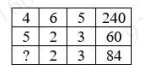
Question 38

In the following question, select the number which can be placed at the sign of question mark (?) from the given alternatives.

  1. AOption (a)

    5

  2. BOption (b)

    7

  3. COption (c)

    9

  4. DOption (d)

    14

View answer & explanation

Correct answer

Answer: (b)B.

7

Why this answer is correct

Logic:

Row wise → First number × second number × third number × 2 = Fourth number

Row 1 →

4 × 6 × 5 × 2 = 240

Row 2 →

5 × 2 × 3 × 2 = 60

Row 3 →

? × 2 × 3 × 2 = 84

? × 12 = 84

? = 84/12

? = 7

Hence, the correct answer is “Option 2”.

Question 39

How many triangles are there in the given figure?

  1. AOption (a)

    8

  2. BOption (b)

    9

  3. COption (c)

    10

  4. DOption (d)

    11

View answer & explanation

Correct answer

Answer: (c)C.

10

Why this answer is correct

Triangles in the given figure,

There are 10 triangles present in the given figure.

Hence, the correct answer is “Option 3”.

Question 40

How many triangles are there in the given figure?

  1. AOption (a)

    6

  2. BOption (b)

    7

  3. COption (c)

    8

  4. DOption (d)

    9

View answer & explanation

Correct answer

Answer: (b)B.

7

Why this answer is correct

Triangles in the given figure,

There are 7 triangles present in the given figure.

Hence, the correct answer is “Option 2”.

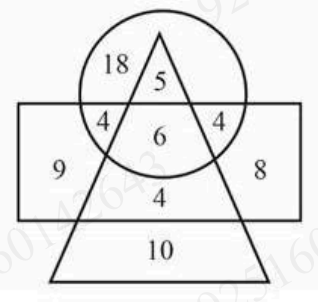
Question 41

In the figure given below the circle represents flowers, the rectangle represents rose and the triangle represents lotus. The number in each area represents the number of items in that area.

How many flowers are lotus?

  1. AOption (a)

    5

  2. BOption (b)

    6

  3. COption (c)

    11

  4. DOption (d)

    14

View answer & explanation

Correct answer

Answer: (c)C.

11

Why this answer is correct

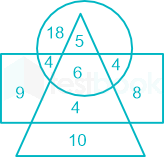
From the given Venn diagram,

There are 11 flowers are lotus.

Hence, the correct answer is “Option 3”.

Question 42

5 persons A, B, C, D and E are sitting around a circular table facing towards the centre (not necessarily in the same order). Only one person is sitting between C and D, considering towards right of D. B is sitting second to the left of D. A is sitting second to the right of C. Who is sitting second to the right of A?

  1. AOption (a)

    D

  2. BOption (b)

    C

  3. COption (c)

    E

  4. DOption (d)

    B

View answer & explanation

Correct answer

Answer: (c)C.

E

Why this answer is correct

5 persons A, B, C, D and E are sitting around a circular table facing towards the centre (not necessarily in the same order).

  1. Only one person is sitting between C and D, considering towards right of D.
  2. B is sitting second to the left of D.
  3. A is sitting second to the right of C. 

E sitting second to the right of A.

Hence, the correct answer is “Option 3”.

Question 43

6 persons A, B, C, D, E and F are sitting in a row facing north (not necessarily in the same order). E is to the immediate left of B. C is the immediate neighbour of A and E. Some persons are to the right of F. D is not at any of the end of the row. Who are sitting at the extreme ends of the row?

  1. AOption (a)

    A and C

  2. BOption (b)

    C and E

  3. COption (c)

    F and E

  4. DOption (d)

    F and B

View answer & explanation

Correct answer

Answer: (d)D.

F and B

Why this answer is correct

6 persons A, B, C, D, E and F are sitting in a row facing north (not necessarily in the same order).

  1. E is to the immediate left of B.
  2. C is the immediate neighbour of A and E.
  3. Some persons are to the right of F.
  4. D is not at any of the end of the row.

F and B are sitting at the extreme ends of the row.

Hence, the correct answer is “Option 4”.

Question 44

8 boys A, B, C, D, E, F, G and H are sitting in a row facing south (not necessarily in the same order). A and H are at extreme ends of the row. E and F are immediate neighbours of B. C is fourth to the left of B. F is to the immediate left of A. D is not the immediate neighbour of C. Who is sitting third to the right of E?

  1. AOption (a)

    B

  2. BOption (b)

    C

  3. COption (c)

    A

  4. DOption (d)

    H

View answer & explanation

Correct answer

Answer: (c)C.

A

Why this answer is correct

8 boys A, B, C, D, E, F, G and H are sitting in a row facing south (not necessarily in the same order).

  1. A and H are at extreme ends of the row.
  2. E and F are immediate neighbours of B.
  3. C is fourth to the left of B.
  4. F is to the immediate left of A.
  5. D is not the immediate neighbour of C. 

A is sitting third to the right of E.

Hence, the correct answer is “Option 3”.

Question 45

If 'P' means '÷', 'Q' means '× ', 'R' means '+ ' and 'S' means '-', then 16  Q  12  P  6  R  2 S  4 = ?

  1. AOption (a)

    30

  2. BOption (b)

    38

  3. COption (c)

    32

  4. DOption (d)

    42

View answer & explanation

Correct answer

Answer: (a)A.

30

Why this answer is correct

Given Equation: 16 Q 12 P 6 R 2 S 4 = ?

BODMAS Rule:

Decoding the given information:

AlphabetPQRS
Meaning÷×+−

Now replacing the signs from left to right using BODMAS Rule, we get:

⇒ 16 × 12 ÷ 6 + 2 - 4

⇒ 192 ÷ 6 + 2 - 4

⇒ 32 + 2 - 4

⇒ 34 - 4

⇒ 30

Hence, the correct option is "Option 1".

Question 46

Select the correct combination of mathematical signs to replace (*) signs sequentially and to balance the given equation.108 * 12 * 9 * 3 * 17 = 19

  1. AOption (a)

    ÷ , +, × , -

  2. BOption (b)

    ÷ , × , - , +

  3. COption (c)

     × , - , + , ÷ 

  4. DOption (d)

     × ,  ÷ ,- , +

View answer & explanation

Correct answer

Answer: (a)A.

÷ , +, × , -

Why this answer is correct

Given equation: 108 * 12 * 9 * 3 * 17 = 19

Let's check each option one by one:

Option 1) ÷ , +, × , -

Equation: 108 ÷ 12 + 9 × 3 - 17 = 19

⇒ 108 ÷ 12 + 9 × 3 - 17

⇒ 9 + 9 × 3 - 17

⇒ 9 + 27 - 17

⇒ 36 - 17

⇒ 19 

LHS = RHS

Option 2) ÷ , × , - , +

Equation: 108 ÷ 12 × 9 - 3 + 17 = 19

⇒ 108 ÷ 12 × 9 - 3 + 17

⇒ 9 × 9 - 3 + 17

⇒ 81 - 3 + 17

⇒ 78 + 17

⇒ 95

LHS ≠ RHS

Option 3) × , - , + , ÷

Equation: 108 × 12 - 9 + 3 ÷ 17 = 19

⇒ 108 × 12 - 9 + 3 ÷ 17

⇒ 108 × 12 - 9 + 0.176

⇒ 1296 - 9 + 0.176

⇒ 1287 + 0.176

⇒1287.176

LHS ≠ RHS 

Option 4) × , ÷ , - , +

Equation: 108 × 12 ÷ 9 - 3 + 17 = 19

⇒ 108 × 12 ÷ 9 - 3 + 17

⇒ 108 × 1.33 - 3 + 17

⇒ 144 - 3 + 17

⇒ 141 + 17

⇒ 158

LHS ≠ RHS

Hence, the correct answer is “Option 1”.

Question 47

In the following question, four letter-number pairs are given. The letter-number on the left side of (–) is related to the letter-number on the right side of (–) with some Logic/Rule/Relation. Three pairs are similar on the basis of same Logic/Rule/Relation. Select the odd one out from the given alternatives.

(NOTE: Operations should be performed on the whole numbers, without breaking down the number into its constituent digits. E.g. 13 – Operations on 13 such as adding /subtracting /multiplying etc. to 13 can be performed. Breaking down 13 into 1 and 3 and then performing mathematical operations on 1 and 3 is not allowed)

  1. AOption (a)

    78AV – 156BY

  2. BOption (b)

    94TC – 198UF

  3. COption (c)

    108LD – 216MG

  4. DOption (d)

    136MI – 272NL

View answer & explanation

Correct answer

Answer: (b)B.

94TC – 198UF

Why this answer is correct

(1) 78AV – 156BY

(2) 94TC – 198UF

(3) 108LD – 216MG

(4) 136MI – 272NL

Hence, the correct answer is “Option 2”.

Question 48

In a certain coded language 'COMPS' is coded as 'NKHKY' and 'ABATE' is coded as 'ZOVXW'. How will 'SMOKY' be coded in the same code language?

  1. AOption (a)

    RHKJN

  2. BOption (b)

    TGKIQ

  3. COption (c)

    SFIKQ

  4. DOption (d)

    TFJIO

View answer & explanation

Correct answer

Answer: (d)D.

TFJIO

Why this answer is correct

<br> <br>

'COMPS' is coded as 'NKHKY' 

'ABATE' is coded as 'ZOVXW'

Similarly,

'SMOKY' be coded as,

Hence, the correct answer is “Option 4”.

Question 49

In a certain coded language 'AMINES' is coded as 'OAJEIW' and 'MERITS' is coded as 'OPENAI'. How will 'JANGLE' be coded in the same code language?

  1. AOption (a)

    CIBJVD

  2. BOption (b)

    ZHEJYD

  3. COption (c)

    AHCJWF

  4. DOption (d)

    BJBHXE

View answer & explanation

Correct answer

Answer: (c)C.

AHCJWF

Why this answer is correct

<br> <br>

 'AMINES' is coded as 'OAJEIW' 

'MERITS' is coded as 'OPENAI'

Similarly,

'JANGLE' be coded as,

Hence, the correct answer is “Option 3”.

Question 50

A series is given with one term missing. Select the correct alternative from the given ones that will complete the series.

LT186, MV206, NX226, ?, PB266

  1. AOption (a)

    OZ246

  2. BOption (b)

    OY236

  3. COption (c)

    OA246

  4. DOption (d)

    OA256

View answer & explanation

Correct answer

Answer: (a)A.

OZ246

Why this answer is correct

<br> <br>

Pattern followed here is,

Hence, the correct answer is “Option 1”.

Quantitative Aptitude (25 questions)

Question 51

If the satellite signal equation is (3x - 4)2, what is the expanded expression?

  1. AOption (a)

    9x2 - 12x + 16

  2. BOption (b)

    9x2 - 24x + 16

  3. COption (c)

    9x2 - 24x - 16

  4. DOption (d)

    6x2 - 24x + 16

View answer & explanation

Correct answer

Answer: (b)B.

9x2 - 24x + 16

Why this answer is correct

Given:

(3x - 4)²

Formula Used:

(a - b)² = a² - 2ab + b²

Calculation:

⇒ (3x - 4)² = (3x)² - 2 × (3x) × 4 + 4²

⇒ (3x - 4)² = 9x² - 24x + 16

∴ The correct answer is 9x² - 24x + 16.

Question 52

A and B start a business. A invests ₹2500 for 12 months, B invests ₹3000 for 10 months. Who gets more profit?

  1. AOption (a)

    A

  2. BOption (b)

    B

  3. COption (c)

    Equal

  4. DOption (d)

    Can't be determined

View answer & explanation

Correct answer

Answer: (c)C.

Equal

Why this answer is correct

Given:

A's investment = ₹2500

A's time = 12 months

B's investment = ₹3000

B's time = 10 months

Formula Used:

Profit share is proportional to Investment × Time

Calculation:

⇒ A's contribution = ₹2500 × 12

⇒ A's contribution = ₹30000

⇒ B's contribution = ₹3000 × 10

⇒ B's contribution = ₹30000

⇒ Ratio of A's contribution to B's contribution = ₹30000 : ₹30000

⇒ Ratio = 1 : 1

∴ The correct answer is Equal.

Question 53

If A : B = 4 : 5 and B : C = 6 : 7, find A : C.

  1. AOption (a)

    24:35

  2. BOption (b)

    4:7

  3. COption (c)

    5:6

  4. DOption (d)

    6:7

View answer & explanation

Correct answer

Answer: (a)A.

24:35

Why this answer is correct

Given:

A : B = 4 : 5

B : C = 6 : 7

Formula Used:

A : C = (A : B) × (B : C)

Calculation:

⇒ A : B = 4 : 5 = 4/5

⇒ B : C = 6 : 7 = 6/7

⇒ A : C = (4/5) × (6/7)

⇒ A : C = (4 × 6) / (5 × 7)

⇒ A : C = 24 / 35

⇒ A : C = 24 : 35

∴ The correct answer is 24 : 35.

Question 54

The average of five numbers is 48. When one number is removed, the average of the remaining four numbers becomes 45. What is the value of the number that was excluded?

  1. AOption (a)

    60

  2. BOption (b)

    63

  3. COption (c)

    65

  4. DOption (d)

    66

View answer & explanation

Correct answer

Answer: (a)A.

60

Why this answer is correct

Given:

The average of five numbers = 48

The average of the remaining four numbers = 45

Formula Used:

Total sum of numbers = Average × Number of terms

Calculation:

⇒ Total sum of five numbers = 48 × 5

⇒ Total sum of five numbers = 240

⇒ Total sum of four numbers = 45 × 4

⇒ Total sum of four numbers = 180

⇒ Excluded number = Total sum of five numbers − Total sum of four numbers

⇒ Excluded number = 240 − 180

⇒ Excluded number = 60

∴ The correct answer is 60.

Question 55

If 60% of a number is 48, what is the number?

  1. AOption (a)

    70

  2. BOption (b)

    75

  3. COption (c)

    80

  4. DOption (d)

    85

View answer & explanation

Correct answer

Answer: (c)C.

80

Why this answer is correct

Shortcut Trick

In percentage terms, 60% of the number is given as 48.

To find the 100% value (the number itself), we use the Unitary Method.

If 60% → 48, then 1% → 48 ÷ 60 = 0.8.

Therefore, 100% → 0.8 × 100 = 80.

∴ The correct answer is 80.

Alternate Method

Given:

Percentage value = 60%

Result of the percentage = 48

Formula Used:

Number = (Given Value × 100) ÷ Percentage

Calculations:

Let the required number be x.

⇒ 60% of x = 48

⇒ (60 ÷ 100) × x = 48

⇒ 0.6 × x = 48

⇒ x = 48 ÷ 0.6

⇒ x = 480 ÷ 6

⇒ x = 80

∴ The correct answer is 80.

Additional Information

Percentage to Fraction Conversion

To convert a percentage into a fraction, divide the value by 100. Example: 60% = 60/100 = 3/5.

Base Number Calculation

When P% of a number is A, the number is always calculated as (A/P) × 100.

Percentage Change Formula

Percentage Change = [(New Value − Original Value) ÷ Original Value] × 100.

Question 56

A vendor sells an item at 10% loss. If he increases the selling price by Rs. 45, he would have made a 5% gain. Find the cost price.

  1. AOption (a)

    Rs. 300

  2. BOption (b)

    Rs. 350

  3. COption (c)

    Rs. 400

  4. DOption (d)

    Rs. 450

View answer & explanation

Correct answer

Answer: (a)A.

Rs. 300

Why this answer is correct

Given:

Loss percentage = 10%

Gain percentage = 5%

Increase in selling price = Rs. 45

Formula Used:

Cost Price (C.P) = Selling Price (S.P) ÷ (1 ± Profit/Loss percentage)

Calculation:

⇒ Let the Cost Price = x

⇒ At 10% loss: S.P = x × (1 - 10/100)

⇒ S.P = x × 0.9

⇒ When selling price is increased by Rs. 45: S.P becomes x × (1 + 5/100)

⇒ x × 0.9 + 45 = x × 1.05

⇒ 1.05x - 0.9x = 45

⇒ 0.15x = 45

⇒ x = 45 ÷ 0.15

⇒ x = 300

∴ The correct answer is Rs. 300.

Question 57

A dealer allows 10% discount and still gains 8%. Find the marked price if the cost price is Rs. 500.

  1. AOption (a)

    Rs. 590

  2. BOption (b)

    Rs. 600

  3. COption (c)

    Rs. 620

  4. DOption (d)

    Rs. 625

View answer & explanation

Correct answer

Answer: (b)B.

Rs. 600

Why this answer is correct

Given:

Cost Price (CP) = Rs. 500

Discount = 10%

Profit = 8%

Formula Used:

Marked Price (MP) = Selling Price ÷ (1 - Discount ÷ 100)

Selling Price (SP) = Cost Price × (1 + Profit ÷ 100)

Calculation:

⇒ SP = 500 × (1 + 8 ÷ 100)

⇒ SP = 500 × 1.08

⇒ SP = Rs. 540

⇒ MP = 540 ÷ (1 - 10 ÷ 100)

⇒ MP = 540 ÷ 0.9

⇒ MP = Rs. 600

∴ The correct answer is Rs. 600.

Question 58

A and B together can complete a work in 12 days. B and C together can complete it in 15 days. C and A together in 20 days. How many days will each take working alone?

  1. AOption (a)

    A = 20, B = 30, C = 60

  2. BOption (b)

    A = 24, B = 40, C = 60

  3. COption (c)

    A = 30, B = 20, C = 60

  4. DOption (d)

    A = 30, B = 24, C = 60

View answer & explanation

Correct answer

Answer: (c)C.

A = 30, B = 20, C = 60

Why this answer is correct

Given:

A + B = 12 days

B + C = 15 days

C + A = 20 days

Formula used:

Work = LCM of days

Efficiency = Work ÷ Time

Calculations:

LCM of 12, 15, 20 = 60

⇒ Total work = 60 units

⇒ (A + B) 1 day work = 60 ÷ 12 = 5 units

⇒ (B + C) 1 day work = 60 ÷ 15 = 4 units

⇒ (C + A) 1 day work = 60 ÷ 20 = 3 units

⇒ Adding all:

⇒ (A + B) + (B + C) + (C + A) = 5 + 4 + 3 = 12 units

⇒ 2(A + B + C) = 12

⇒ A + B + C = 6 units

⇒ A = (A + B + C) − (B + C) = 6 − 4 = 2 units

⇒ B = (A + B + C) − (C + A) = 6 − 3 = 3 units

⇒ C = (A + B + C) − (A + B) = 6 − 5 = 1 unit

⇒ Time taken:

⇒ A = 60 ÷ 2 = 30 days

⇒ B = 60 ÷ 3 = 20 days

⇒ C = 60 ÷ 1 = 60 days

∴ A = 30 days, B = 20 days, C = 60 days

Question 59

A sum of money doubles in 10 years at simple interest. What is the rate of interest per annum?

  1. AOption (a)

    5%

  2. BOption (b)

    8%

  3. COption (c)

    10%

  4. DOption (d)

    12%

View answer & explanation

Correct answer

Answer: (c)C.

10%

Why this answer is correct

Shortcut Trick

To find the Rate of Interest when a sum of money becomes n times its value in T years, use the direct formula:

Rate (R) = [(n − 1) / T] × 100

Given: n = 2 (doubles) and T = 10 years.

R = [(2 − 1) / 10] × 100 = (1 / 10) × 100 = 10%.

∴ The correct answer is 10%.

Alternate Method

Given:

Let the Principal (P) be ₹100.

The sum doubles in 10 years, so Amount (A) = ₹200.

Time (T) = 10 years.

Formula Used:

Simple Interest (SI) = Amount − Principal

SI = (P × R × T) / 100

Calculations:

⇒ SI = 200 − 100 = ₹100

⇒ 100 = (100 × R × 10) / 100

⇒ 100 = 10R

⇒ R = 100 / 10

⇒ R = 10%

∴ The correct answer is 10%.

Additional Information

Simple Interest (SI)

Simple Interest is calculated only on the principal amount for the entire duration. Formula: SI = (P × R × T) / 100.

Relationship between R and T

For a sum to double, the product of Rate (R) and Time (T) must always be 100 (i.e., R × T = 100) under simple interest.

Sum Tripling Condition

If a sum triples (n=3), the formula becomes R × T = (3 − 1) × 100 = 200.

Principal vs Amount

Principal is the initial sum invested, while Amount is the total sum (Principal + Interest) received at the end of the term.

Question 60

Train A running at 72  km/h overtakes Train B (length 200  m) in 36 seconds. If Train A is 300 m long, find Train B's speed.

  1. AOption (a)

    22  km/h

  2. BOption (b)

    24  km/h

  3. COption (c)

    26  km/h

  4. DOption (d)

    28  km/h

View answer & explanation

Correct answer

Answer: (a)A.

22  km/h

Why this answer is correct

Given:

Speed of Train A = 72 km/h

Length of Train A = 300 m

Length of Train B = 200 m

Time taken to overtake = 36 seconds

Formula Used:

Relative speed = (Length of Train A + Length of Train B) ÷ Time taken

Speed of Train B = Speed of Train A - Relative speed

Calculation:

⇒ Length of Train A + Length of Train B = 300 + 200 = 500 m

⇒ Relative speed = 500 ÷ 36 m/s

⇒ Relative speed = 13.89 m/s

⇒ Speed of Train A in m/s = 72 × (1000 ÷ 3600)

⇒ Speed of Train A in m/s = 20 m/s

⇒ Speed of Train B in m/s = 20 - 13.89

⇒ Speed of Train B in m/s = 6.11 m/s

⇒ Speed of Train B in km/h = 6.11 × (3600 ÷ 1000)

⇒ Speed of Train B in km/h = 21.996 km/h

∴ The correct answer is 22 km/h.

Question 61

Two wall clocks are circular, each with radius 3 units. Their centers are 4 units apart. How many common tangents can be drawn?

  1. AOption (a)

    1

  2. BOption (b)

    2

  3. COption (c)

    3

  4. DOption (d)

    0

View answer & explanation

Correct answer

Answer: (b)B.

2

Why this answer is correct

Given:

Radius of each circular clock = 3 units

Distance between centers = 4 units

<br>

Formula Used:

Condition for common tangents:

If distance between centers > sum of radii: 4 tangents

If distance between centers = sum of radii: 3 tangents

If sum of radii > distance between centers > absolute difference of radii: 2 tangents

If distance between centers = absolute difference of radii: 1 tangent

If distance between centers < absolute difference of radii: 0 tangents

Calculation:

⇒ Radius of each clock = 3 units, so sum of radii = 3 + 3 = 6 units

⇒ Absolute difference of radii = |3 - 3| = 0 units

⇒ Distance between centers = 4 units

⇒ Absolute difference of radii < Distance between centers < Sum of radii

⇒ 0 < 4 < 6

⇒ 2 common tangents

<br>

∴ The correct answer is 2.

Question 62

A rectangular solar panel has length 9 cm and breadth 12 cm. What is the length of the diagonal wiring required?

  1. AOption (a)

    15 cm

  2. BOption (b)

    13 cm

  3. COption (c)

    12 cm

  4. DOption (d)

    10 cm

View answer & explanation

Correct answer

Answer: (a)A.

15 cm

Why this answer is correct

Shortcut Trick

The diagonal of a rectangle forms a right-angled triangle with its length and breadth.

Recognize the standard Pythagorean triplet (3, 4, 5).

Multiply the triplet by 3: (3 × 3), (4 × 3), (5 × 3) → (9, 12, 15).

Since the sides are 9 cm and 12 cm, the diagonal must be 15 cm.

∴ The correct answer is 15 cm.

Alternate Method

Given:

Length (L) of the solar panel = 9 cm

Breadth (B) of the solar panel = 12 cm

Formula Used:

Diagonal (D) = √(Length2 + Breadth2)

Calculations:

⇒ Diagonal = √(92 + 122)

⇒ Diagonal = √(81 + 144)

⇒ Diagonal = √225

⇒ Diagonal = 15 cm

∴ The correct answer is 15 cm.

Additional Information

Pythagoras Theorem

In a right-angled triangle, the square of the hypotenuse is equal to the sum of the squares of the other two sides: a2 + b2 = c2.

Pythagorean Triples

Sets of three positive integers that satisfy the theorem. Common examples include (3, 4, 5), (5, 12, 13), (8, 15, 17), and (7, 24, 25).

Rectangle Properties

The diagonals of a rectangle are equal in length and bisect each other. Area = Length × Breadth and Perimeter = 2(Length + Breadth).

Question 63

A wooden box is shaped like a rectangular parallelepiped with dimensions 80 cm × 50 cm × 40 cm. What is its volume in cubic centimeters?

  1. AOption (a)

    120000

  2. BOption (b)

    140000

  3. COption (c)

    160000

  4. DOption (d)

    180000

View answer & explanation

Correct answer

Answer: (c)C.

160000

Why this answer is correct

Given:

Length = 80 cm

Width = 50 cm

Height = 40 cm

Formula Used:

Volume = Length × Width × Height

Calculation:

⇒ Volume = 80 × 50 × 40

⇒ Volume = 4000 × 40

⇒ Volume = 160000 cm3

∴ The correct answer is 160000.

Question 64

A tent is shaped like a right square pyramid with a base side of 4 meters and vertical height of 3 meters. What is the internal volume of the tent?

  1. AOption (a)

    14 m3

  2. BOption (b)

    16 m3

  3. COption (c)

    18 m3

  4. DOption (d)

    20 m3

View answer & explanation

Correct answer

Answer: (b)B.

16 m3

Why this answer is correct

Given:

Base side = 4 m

Vertical height = 3 m

Formula Used:

Volume of pyramid = (1/3) × Base area × Height

Base area = Side × Side

Calculation:

⇒ Base area = 4 × 4

⇒ Base area = 16 m2

⇒ Volume = (1/3) × 16 × 3

⇒ Volume = 16 m3

∴ The correct answer is 16 m3.

Question 65

Triangle ABC and triangle DEF have corresponding sides in 3:5 ratio. If area of triangle ABC is 54 cm², what is the area of triangle DEF?

  1. AOption (a)

    90 cm²

  2. BOption (b)

    150 cm²

  3. COption (c)

    75 cm²

  4. DOption (d)

    30 cm²

View answer & explanation

Correct answer

Answer: (b)B.

150 cm²

Why this answer is correct

Given:

Ratio of corresponding sides = 3:5

Area of triangle ABC = 54 cm2

Formula Used:

Area ratio = (Side ratio)2

Area of triangle DEF = Area of triangle ABC × Area ratio

Calculation:

⇒ Area ratio = (3 ÷ 5)2 = 9 ÷ 25

⇒ Area of triangle DEF = 54 × (25 ÷ 9)

⇒ Area of triangle DEF = 150 cm2

∴ The correct answer is 150 cm2.

Question 66

Two circular water tanks have radii of 5 units and 3 units, respectively. The distance between their centers is 13 units. A direct common tangent is laid to pass by both tanks without crossing through them. What is the length of this direct common tangent?

  1. AOption (a)

    9 units

  2. BOption (b)

    11.06 units

  3. COption (c)

    12.85 units

  4. DOption (d)

    13 units

View answer & explanation

Correct answer

Answer: (c)C.

12.85 units

Why this answer is correct

Given:

Radius of first tank (R) = 5 units

Radius of second tank (r) = 3 units

Distance between centers (d) = 13 units

Formula used:

Length of direct common tangent = √(d2 − (R − r)2)

Calculations:

⇒ Length = √(132 − (5 − 3)2)

⇒ Length = √(169 − 22)

⇒ Length = √(169 − 4)

⇒ Length = √165 = 12.85 units

∴ Length of direct common tangent = 12.85 units.

Question 67

A light beam reflects such that tan A + cot A = 5 and A is an acute angle. Find the value of tan3 A + cot3 A.

  1. AOption (a)

    125

  2. BOption (b)

    85

  3. COption (c)

    110

  4. DOption (d)

    115

View answer & explanation

Correct answer

Answer: (c)C.

110

Why this answer is correct

Shortcut Trick

If x + 1/x = k, then x3 + 1/x3 = k3 − 3k.

In the given question, tan A + cot A = 5 (since cot A = 1/tan A).

Here, k = 5.

Therefore, tan3 A + cot3 A = 53 − 3 × 5 = 125 − 15 = 110.

∴ The correct answer is 110.

Alternate Method

Given:

tan A + cot A = 5

Angle A is an acute angle.

Formula Used:

x3 + y3 = (x + y)3 − 3xy(x + y)

In trigonometry, tan A × cot A = 1.

Calculations:

⇒ Let x = tan A and y = cot A.

⇒ We know that x × y = tan A × cot A = 1.

⇒ Using the identity: tan3 A + cot3 A = (tan A + cot A)3 − 3(tan A × cot A)(tan A + cot A)

⇒ Substitute the values: (5)3 − 3(1)(5)

⇒ 125 − 15

⇒ 110

∴ The correct answer is 110.

Additional Information

Reciprocal Trigonometric Identities

The product of a trigonometric function and its reciprocal is always 1, such as tan A × cot A = 1 and sin A × cosec A = 1.

Sum of Cubes Formula

The algebraic identity for the sum of cubes is a3 + b3 = (a + b)(a2 − ab + b2) or (a + b)3 − 3ab(a + b).

Square Relation

If tan A + cot A = k, then tan2 A + cot2 A = k2 − 2 because (tan A + cot A)2 = tan2 A + cot2 A + 2(tan A × cot A).

Question 68

Ravi invested Rs. 25,000 in two schemes for 3 years. Both schemes offer 12% p.a. interest. One gives simple interest and the other gives compound interest (compounded annually). Find the difference between the interests earned from both schemes.

  1. AOption (a)

    Rs. 1123.2

  2. BOption (b)

    Rs. 1080.25

  3. COption (c)

    Rs. 1536

  4. DOption (d)

    Rs. 1336

View answer & explanation

Correct answer

Answer: (a)A.

Rs. 1123.2

Why this answer is correct

Given:

Principal (P) = Rs. 25,000

Rate of Interest (R) = 12% p.a.

Time (T) = 3 years

Formula Used:

Simple Interest (SI) = (P × R × T) ÷ 100

Compound Interest (CI) = P × (1 + R ÷ 100)T - P

Calculation:

⇒ SI = (25,000 × 12 × 3) ÷ 100

⇒ SI = Rs. 9,000

⇒ CI = 25,000 × (1 + 12 ÷ 100)3 - 25,000

⇒ CI = 25,000 × (1.12)3 - 25,000

⇒ CI = 25,000 × 1.404928 - 25,000

⇒ CI = Rs. 35,123.2 - Rs. 25,000

⇒ CI = Rs. 10,123.2

⇒ Difference = CI - SI

⇒ Difference = Rs. 10,123.2 - Rs. 9,000

⇒ Difference = Rs. 1,123.2

∴ The correct answer is Rs. 1123.2.

Question 69

ABC is a triangle with centroid 'O'. CF, AE and BD are medians of side AB, BC and CA. If ∠COE = 45∘ , and length of CF and AE are 18 cm and 24 cm, respectively, then find the area of the triangle ABC.

  1. AOption (a)

    70√ 3 cm2

  2. BOption (b)

    144 √2 cm2

  3. COption (c)

    90 √ 3 cm2

  4. DOption (d)

    102 √ 2 cm2

View answer & explanation

Correct answer

Answer: (b)B.

144 √2 cm2

Why this answer is correct

Given:

CF = 18 cm, AE = 24 cm

O is centroid

∠COE = 45°

Formula used:

Area of triangle = (1/2) × Base × Height

Centroid divides medians in the ratio 2:1

Calculations:

Centroid divides median in ratio 2 : 1

⇒ CO = (2/3) × CF, OE = (2/3) × AE

Area of triangle using vectors:

Area = (3/2) × CO × OE × sinθ

CO = (2/3) × 18 = 12 cm

OE = (2/3) × 24 = 16 cm

Area = (3/2) × 12 × 16 × sin45°

⇒ Area = (3/2) × 12 × 16 × (1/√2)

⇒ Area = (3/2) × 192 × (1/√2)

⇒ Area = 288 / √2

⇒ Area = 144√2 cm2

∴ Area of triangle ABC = 144√2 cm2

Question 70

A policeman started following a thief who was 1,200 metres ahead of him. The thief is running at 2.5 km/h, while the speed of the policeman is 3.75 km/h. Find the distance covered by the thief (in metres) just when he was caught.

  1. AOption (a)

    2,600 metres

  2. BOption (b)

    2,400 metres

  3. COption (c)

    2,900 metres

  4. DOption (d)

    2,200 metres

View answer & explanation

Correct answer

Answer: (b)B.

2,400 metres

Why this answer is correct

Given:

Distance between policeman and thief = 1,200 metres

Speed of thief = 2.5 km/h

Speed of policeman = 3.75 km/h

Formula Used:

Relative speed = Speed of policeman - Speed of thief

Time = Distance ÷ Relative speed

Distance covered by thief = Speed of thief × Time

Calculation:

⇒ Relative speed = 3.75 - 2.5 = 1.25 km/h

⇒ Relative speed = 1.25 × 1,000 ÷ 60 = 20.83 m/min

⇒ Time = 1,200 ÷ 20.83 = 57.6 minutes

⇒ Distance covered by thief = 2.5 × 1,000 ÷ 60 × 57.6 = 2,400 metres

∴ The correct answer is 2,400 metres.

Question 71

Find the curved surface area of a cylinder with radius 10.5 cm and volume 6,237 cm³.

  1. AOption (a)

    1,260 cm2

  2. BOption (b)

    1,188 cm2

  3. COption (c)

    1,540 cm2

  4. DOption (d)

    1,080 cm2

View answer & explanation

Correct answer

Answer: (b)B.

1,188 cm2

Why this answer is correct

Shortcut Trick

The direct relationship between the Volume (V) and Curved Surface Area (CSA) of a Cylinder is given by the ratio V/CSA = r/2.

⇒ Curved Surface Area (CSA) = (2 × Volume) ÷ Radius (r)

⇒ CSA = (2 × 6237) ÷ 10.5 = 12474 ÷ 10.5

⇒ CSA = 1188 cm2.

∴ The correct answer is 1,188 cm2.

Alternate Method

Given:

Radius (r) = 10.5 cm

Volume (V) = 6,237 cm3

Formula Used:

  1. Volume of Cylinder = πr2h
  2. Curved Surface Area (CSA) = 2πrh

Calculations:

⇒ 6237 = (22/7) × (10.5)2 × h

⇒ 6237 = (22/7) × 110.25 × h

⇒ 6237 = 22 × 15.75 × h

⇒ 6237 = 346.5 × h

⇒ h = 6237 ÷ 346.5 = 18 cm

Now, calculate the Curved Surface Area:

⇒ CSA = 2 × (22/7) × 10.5 × 18

⇒ CSA = 2 × 22 × 1.5 × 18

⇒ CSA = 44 × 27

⇒ CSA = 1188 cm2

∴ The correct answer is 1,188 cm2.

Additional Information

Total Surface Area (TSA)

The Total Surface Area of a Cylinder includes the area of the curved surface and the two circular bases: TSA = 2πr(h + r).

Volume of a Hollow Cylinder

For a Hollow Cylinder with external radius R and internal radius r, the Volume is V = π(R2 − r2)h.

Base Area and Circumference

The area of the base is πr2 and the circumference (base perimeter) is 2πr.

Question 72

If a = √2 - √3, then a2 = ?

  1. AOption (a)

    3 + 2√6

  2. BOption (b)

    5 + 2√6

  3. COption (c)

    5 - 2√6

  4. DOption (d)

    3 - 2√6

View answer & explanation

Correct answer

Answer: (c)C.

5 - 2√6

Why this answer is correct

Given:

a = √2 - √3

Formula Used:

(x - y)2 = x2 + y2 - 2xy

Calculation:

⇒ a2 = (√2 - √3)2

⇒ a2 = (√2)2 + (√3)2 - 2 × √2 × √3

⇒ a2 = 2 + 3 - 2√6

⇒ a2 = 5 - 2√6

∴ The correct answer is 3.

Question 73

Simplify the expression :1−cos⁡2xsin⁡x: \frac{1 - \cos^2 x}{\sin x}

  1. AOption (a)

    sinx

  2. BOption (b)

    cosx

  3. COption (c)

    tanx

  4. DOption (d)

    secx

View answer & explanation

Correct answer

Answer: (a)A.

sinx

Why this answer is correct

Given:

1−cos⁡2xsin⁡x\dfrac{1 - \cos^2 x}{\sin x}

Formula used:

1 − cos2x = sin2x

Calculations:

1−cos⁡2xsin⁡x\dfrac{1 - \cos^2 x}{\sin x}

⇒ sin⁡2xsin⁡x\dfrac{\sin^2 x}{\sin x}

⇒ sin x

∴ Final Answer = sin x

Question 74

A : B = 5 : 6, B : C = 7 : 8, and C : D = 9 : 10 Find the ratio A : D.

  1. AOption (a)

    105 : 160

  2. BOption (b)

    35 : 40

  3. COption (c)

    35 : 80

  4. DOption (d)

    105 : 120

View answer & explanation

Correct answer

Answer: (a)A.

105 : 160

Why this answer is correct

Given:

A : B = 5 : 6

B : C = 7 : 8

C : D = 9 : 10

Formula Used:

Combined Ratio = A : B × B : C × C : D

Simplify ratios by multiplication

Calculation:

⇒ A : B × B : C = (5 : 6) × (7 : 8)

⇒ A : C = (5 × 7) : (6 × 8)

⇒ A : C = 35 : 48

⇒ A : C × C : D = (35 : 48) × (9 : 10)

⇒ A : D = (35 × 9) : (48 × 10)

⇒ A : D = 315 : 480

⇒ Simplify A : D = 105 : 160

∴ The correct answer is 105 : 160.

Question 75

If sin⁡θ=23\sin θ = \frac{2}{3} and θ is an acute angle, what is the value of cos2 θ - sin2 θ

  1. AOption (a)

    59\frac{5}{9}

  2. BOption (b)

    19\frac{1}{9}

  3. COption (c)

    69\frac{6}{9}

  4. DOption (d)

    89\frac{8}{9}

View answer & explanation

Correct answer

Answer: (b)B.

19\frac{1}{9}

Why this answer is correct

Given:

sin θ = 2/3 (θ is acute)

Formula used:

sin2θ + cos2θ = 1

cos2θ − sin2θ

Calculations:

sin θ = 2/3

⇒ sin2θ = (2/3)2 = 4/9

⇒ cos2θ = 1 − 4/9 = 5/9

Now,

cos2θ − sin2θ = 5/9 − 4/9

⇒ = 1/9

∴ Final Answer = 1/9

General Awareness (25 questions)

Question 76

On their mother's side, the Mughals were descendants of which of the following?

  1. AOption (a)

    Timur 

  2. BOption (b)

    Genghis Khan

  3. COption (c)

    Muhammad bin Qasim

  4. DOption (d)

    Sabuktigin

View answer & explanation

Correct answer

Answer: (b)B.

Genghis Khan

Why this answer is correct

The correct answer is Genghis Khan.

Key Points

  • The Mughals were descendants of Genghis Khan through their maternal lineage. Genghis Khan, the founder of the Mongol Empire, is regarded as one of the most powerful rulers in history.
  • The Mughal dynasty's founder, Babur, traced his lineage from Genghis Khan through his mother, Qutlugh Nigar Khanum, who was a descendant of the Mongol ruler.
  • Although the Mughals were descended from Genghis Khan, they distanced themselves from this ancestry because Genghis Khan was associated with the devastation of Islamic lands.
  • On their paternal side, the Mughals were descendants of Timur, a Turco-Mongol conqueror who established the Timurid dynasty. Thus, the Mughals combined both Mongol and Timurid heritage.
  • The Mughal emperors often emphasized their Timurid lineage over their Mongol heritage to gain greater legitimacy among their predominantly Muslim subjects in India.

Additional Information

  • Genghis Khan:
  • Genghis Khan (1162–1227) was the founder of the Mongol Empire, which became the largest contiguous empire in history.
  • He united the Mongol tribes and initiated a series of military campaigns that led to the conquest of vast territories across Asia and Europe.
  • His empire stretched from the Pacific Ocean in the east to Eastern Europe in the west, including parts of China, Central Asia, and the Middle East.
  • Though known for his military conquests, Genghis Khan also promoted trade, cultural exchange, and administrative reforms within his empire.
  • The Mughal Dynasty:
  • The Mughal dynasty was established in India in 1526 by Babur, who defeated Ibrahim Lodi at the First Battle of Panipat.
  • The Mughals ruled India for over three centuries, leaving a profound impact on Indian culture, architecture, and governance.
  • They were known for their contributions to art and architecture, including the construction of the Taj Mahal, the Red Fort, and Fatehpur Sikri.
  • The Mughal Empire reached its zenith during the reign of Akbar, Shah Jahan, and Aurangzeb, but declined in the 18th century.
  • Timur:
  • Timur (1336–1405), also known as Tamerlane, was a Turco-Mongol conqueror and the founder of the Timurid Empire in Central Asia.
  • He claimed descent from Genghis Khan on his maternal side and sought to revive the Mongol Empire's legacy.
  • Timur's military campaigns extended across Persia, India, Russia, and the Middle East, making him one of history's most formidable conquerors.
  • He is also remembered for his patronage of arts and architecture, which influenced the Mughal style in India.
  • Other Options:
  • Muhammad bin Qasim: An Arab general who led the Islamic conquest of Sindh in 712 CE, but he had no direct connection to the Mughal lineage.
  • Sabuktigin: The founder of the Ghaznavid dynasty in the 10th century, but he was not related to the Mughals.

Important Points

  • Mughal Lineage: The Mughals emphasized their Timurid ancestry to gain legitimacy among their Muslim subjects, as Timur was a celebrated Islamic ruler.
  • Mongol Legacy: Despite their Mongol lineage through Genghis Khan, the Mughals avoided highlighting this aspect due to the destruction associated with the Mongol invasions of Islamic lands.
  • Impact on India: The Mughals' unique blend of Persian, Indian, and Central Asian cultures created a rich cultural legacy that continues to influence Indian society today.

Question 77

Virashaiva movement begun in ______ in the mid-twelfth century.

  1. AOption (a)

    Karnataka

  2. BOption (b)

    Assam

  3. COption (c)

    Bengal

  4. DOption (d)

    Maharashtra

View answer & explanation

Correct answer

Answer: (a)A.

Karnataka

Why this answer is correct

The correct answer is Karnataka.

Key Points

  • The Virashaiva movement, also known as the Lingayat movement, originated in the state of Karnataka during the mid-twelfth century.
  • This movement was spearheaded by Basavanna, a philosopher, poet, and statesman, who served as the Prime Minister of the Kalachuri Kingdom.
  • The movement emphasized monotheism and rejected the caste system, idol worship, and ritualistic practices, advocating for social equality and spiritual devotion to Lord Shiva.
  • Virashaivism or Lingayatism gained significant traction among the common people, especially the lower castes, due to its focus on egalitarian principles.
  • The followers of this movement, called Lingayats, carry a small Shiva Linga encased in a pendant, symbolizing their devotion to Lord Shiva.

Additional Information

  • Basavanna and His Teachings:
  • Basavanna was the founder of the Virashaiva movement. He is celebrated for his Vachanas (verses), which propagate a direct connection with God without the need for intermediaries like priests.
  • He advocated for the formation of a society based on equality, rejecting the rigid caste-based hierarchy.
  • Basavanna’s teachings laid the foundation for social reform in medieval India.
  • Philosophy of Virashaivism:
  • Virashaivism is monotheistic, focusing on the worship of Lord Shiva.
  • It emphasizes simple living, ethical conduct, and devotion over ritualistic practices.
  • The movement rejects the authority of the Vedas, caste discrimination, and idol worship.
  • Spread of the Movement:
  • Initially concentrated in Karnataka, the movement later spread to other parts of South India, including Maharashtra and Telangana.
  • The Lingayat community became a significant socio-political force in southern India.
  • Legacy of the Virashaiva Movement:
  • The movement has had a lasting influence on the socio-religious structure of Karnataka and neighboring regions.
  • Modern-day Lingayats continue to be a major community in Karnataka, influencing its culture, politics, and economy.

Important Points

  • Other Movements of the Period:
  • The Bhakti Movement, which flourished during the same time, shared similarities with the Virashaiva movement, such as its rejection of caste and ritualism.
  • Other prominent leaders of the Bhakti Movement included Ramananda, Kabir, and Mirabai, though their philosophies varied from that of the Lingayats.
  • Modern Recognition:
  • In recent years, there has been a movement to recognize the Lingayats as a separate religion, distinct from mainstream Hinduism.
  • The Karnataka government, in 2018, recommended the Lingayat community be granted minority religion status.

Question 78

Which of the following is a Fundamental Duty mentioned in the Indian Constitution?

  1. AOption (a)

    To respect one's parents and teachers

  2. BOption (b)

    To take part in village panchayat

  3. COption (c)

    To respect national Animal

  4. DOption (d)

    To safeguard public property

View answer & explanation

Correct answer

Answer: (d)D.

To safeguard public property

Why this answer is correct

The correct answer is To safeguard public property.

Key Points

  • Fundamental Duties are enshrined in Article 51A of the Indian Constitution, added by the 42nd Amendment Act, 1976. These duties are meant to promote a sense of responsibility and discipline among citizens.
  • The duty “To safeguard public property” is explicitly mentioned under the Fundamental Duties in the Constitution. It emphasizes citizens' role in protecting and conserving public infrastructure and national assets.
  • The Fundamental Duties were inspired by the Soviet Constitution and aim to inculcate civic and moral values in Indian citizens.
  • Examples of safeguarding public property include protecting historical monuments, public transportation, government buildings, and preventing vandalism or misuse.
  • Unlike Fundamental Rights, Fundamental Duties are non-enforceable by law but are crucial for the nation's collective welfare and ethical governance.

Additional Information

  • Article 51A and Fundamental Duties:
  • Article 51A lists 11 Fundamental Duties for Indian citizens. These were introduced through the 42nd Constitutional Amendment Act in 1976.
  • Some of the Fundamental Duties include respecting the Constitution, promoting harmony, protecting the environment, and safeguarding public property.
  • The 86th Amendment Act, 2002 added the duty for parents/guardians to provide opportunities for education to children aged 6-14 years.
  • Historical Context:
  • The idea of Fundamental Duties was inspired by the Constitution of the USSR (Soviet Union) and other socialist countries.
  • They were introduced during the tenure of Prime Minister Indira Gandhi to counteract the growing indiscipline and foster a sense of responsibility among citizens.
  • Legal Framework:
  • Though Fundamental Duties are non-justiciable, laws can be enacted to enforce them indirectly. For instance, laws against vandalism protect public property.
  • Some Fundamental Duties have been linked to legal provisions such as the Environmental Protection Act, 1986, which aligns with the duty to protect the natural environment.
  • Comparison with Fundamental Rights:
  • While Fundamental Rights grant privileges and freedoms to citizens, Fundamental Duties emphasize moral obligations.
  • Rights and Duties are interconnected, as enjoying rights comes with the responsibility to perform duties for the welfare of society.

Important Points

  • Fundamental Duties in Detail:
  • There are a total of 11 Fundamental Duties, which include respecting national symbols, promoting harmony, and protecting the environment.
  • The duty to safeguard public property ensures the integrity and functionality of assets vital to public welfare.
  • Examples of Safeguarding Public Property:
  • Participating in campaigns against vandalism.
  • Ensuring responsible use of public transport and facilities.
  • Encouraging awareness about the importance of conserving national heritage sites.
  • Significance of Fundamental Duties:
  • They act as a moral compass for citizens, promoting national unity and responsibility.
  • They complement Fundamental Rights by instilling a sense of accountability towards the nation.

Question 79

Which of the following statement is correct regarding the directive principles of state policy given in the Indian constitution?

I. They are not enforceable by any court.

II. It shall be the duty of the state to apply these principles in making laws.

  1. AOption (a)

    Only I

  2. BOption (b)

    Only II

  3. COption (c)

    Both I and II

  4. DOption (d)

    Neither I nor II

View answer & explanation

Correct answer

Answer: (c)C.

Both I and II

Why this answer is correct

The correct answer is Both I and II.

Key Points

  • Directive Principles of State Policy (DPSP) are enshrined in Part IV of the Indian Constitution, covering Articles 36 to 51.
  • Statement I: The Directive Principles are not enforceable by any court (Article 37). This means that no individual can approach the judiciary to enforce these principles, as they are not justiciable. Hence, this statement is correct.
  • Statement II: The Constitution explicitly states that it shall be the duty of the state to apply these principles in making laws (Article 37). The DPSPs act as guidelines for the state to promote social and economic welfare. Hence, this statement is also correct.
  • The DPSPs aim to establish a welfare state by addressing areas such as economic justice, social equality, health, education, and more.
  • Although non-justiciable, these principles hold significant moral and political importance and have influenced the formulation of laws in India.

Additional Information

  • Categories of DPSPs:
  • Socialist Principles: Aim at providing socio-economic justice (e.g., Article 39 - equal pay for equal work).
  • Gandhian Principles: Reflect Mahatma Gandhi’s ideals (e.g., Article 48 - organization of agriculture and animal husbandry).
  • Liberal-Intellectual Principles: Ensure individual rights and international peace (e.g., Article 44 - Uniform Civil Code).
  • Purpose: The DPSPs were borrowed from the Irish Constitution and aim to guide the state in establishing a just society.
  • Important Examples:
  • Article 39A: Provides for free legal aid to ensure justice for all.
  • Article 41: Right to work, education, and public assistance in cases of unemployment, old age, sickness, etc.
  • Article 47: Duty of the state to raise the level of nutrition and standard of living.
  • Impact: Several laws have been enacted to fulfill DPSPs, such as the Right to Education Act (2009) and National Food Security Act (2013).

Important Points

  • Difference Between Fundamental Rights and DPSPs:
  • Fundamental Rights: Justiciable and enforceable by courts (e.g., Right to Equality).
  • DPSPs: Non-justiciable but act as guiding principles for the state.
  • Landmark Cases:
  • Kesavananda Bharati Case (1973): Established the principle of harmony and balance between Fundamental Rights and DPSPs.
  • Minerva Mills Case (1980): Declared that the implementation of DPSPs should not override Fundamental Rights.
  • Significance: DPSPs provide a framework for achieving socio-economic democracy and act as a measure for evaluating government performance.

Question 80

As of 31st July 2025, which of the following country is the member of SAARC?

I. Pakistan

II. Nepal

  1. AOption (a)

    Only I

  2. BOption (b)

    Only II

  3. COption (c)

    Both I and II

  4. DOption (d)

    Neither I nor II

View answer & explanation

Correct answer

Answer: (c)C.

Both I and II

Why this answer is correct

The correct answer is Both I and II.

Key Points

  • South Asian Association for Regional Cooperation (SAARC) is a regional intergovernmental organization founded on 8th December 1985, in Dhaka, Bangladesh. Its primary aim is to promote economic and regional integration in South Asia.
  • The member countries of SAARC include Afghanistan, Bangladesh, Bhutan, India, Maldives, Nepal, Pakistan, and Sri Lanka. Pakistan and Nepal are both members of SAARC as of 31st July 2025. Hence, both statements are correct.
  • Pakistan has been a founding member of SAARC since its establishment in 1985. It actively participates in SAARC initiatives despite occasional tensions with other member countries, particularly India.
  • Nepal also holds a significant position in SAARC as the headquarters of SAARC is located in Kathmandu, Nepal. Nepal has actively contributed to SAARC’s objectives and hosted summits, including the 18th SAARC Summit in 2014.
  • SAARC focuses on areas such as economic cooperation, agriculture, rural development, education, health, and technology. All member countries work collaboratively toward regional integration.

Additional Information

  • SAARC Objectives:
  • To promote the welfare of the people of South Asia and improve their quality of life.
  • To accelerate economic growth, social progress, and cultural development in the region.
  • To strengthen collective self-reliance among the countries of South Asia.
  • To contribute to mutual trust, understanding, and appreciation of one another's problems.
  • SAARC Summits:
  • The summits are held biennially, and the member countries take turns hosting them.
  • The last SAARC summit (20th) was scheduled in Pakistan but postponed due to political tensions among member countries.
  • Major achievements of SAARC include agreements on trade, environment, energy, and combating terrorism.
  • SAARC Headquarters:
  • The SAARC Secretariat is located in Kathmandu, Nepal, and coordinates the activities of the association.
  • It was established on 16th January 1987, and the Secretary-General is appointed from member countries for a three-year term.
  • Challenges faced by SAARC:
  • Political tensions between member countries, especially India and Pakistan, have hindered regional cooperation.
  • Unequal economic development among members creates disparities in contribution and benefits.
  • Limited financial resources and inadequate enforcement mechanisms restrict the implementation of agreements.
  • Significance of Nepal and Pakistan in SAARC:
  • Nepal: As the host of the SAARC Secretariat, Nepal plays a pivotal role in facilitating discussions and implementing initiatives.
  • Pakistan: As one of the founding members, Pakistan contributes to regional stability and economic cooperation, despite political disagreements.

Important Points

  • SAARC Regional Centers:
  • SAARC has established regional centers to promote specific areas of cooperation, such as the SAARC Agriculture Centre (Bangladesh) and SAARC Cultural Centre (Sri Lanka).
  • These centers focus on research, policy development, and capacity-building in their respective domains.
  • SAFTA:
  • The South Asian Free Trade Area (SAFTA) agreement was signed in 2004 to promote trade and economic cooperation among member countries.
  • SAFTA aims to reduce tariffs and eliminate trade barriers within the region.
  • SAARC Development Fund (SDF):
  • Established in 2005, SDF provides funding for development projects in areas like health, education, and energy.
  • The fund is headquartered in Thimphu, Bhutan.

Question 81

Who was the first Indian woman to win an Olympic medal?

  1. AOption (a)

    Mary Kom

  2. BOption (b)

    Saina Nehwal

  3. COption (c)

    P.V. Sindhu 

  4. DOption (d)

    Karnam Malleswari

View answer & explanation

Correct answer

Answer: (d)D.

Karnam Malleswari

Why this answer is correct

The correct answer is Karnam Malleswari.

Key Points

  • Karnam Malleswari is the first Indian woman to win an Olympic medal. She achieved this historic feat during the 2000 Sydney Olympics.
  • She won the bronze medal in the sport of weightlifting, competing in the 69 kg category.
  • Her achievement marked a significant milestone for Indian sports, especially for women athletes, and inspired many young women to pursue sports in India.
  • Born on 1 June 1975 in Andhra Pradesh, Karnam Malleswari started her weightlifting career at a young age and trained rigorously to reach the international level.
  • She has also been honored with prestigious awards like the Rajiv Gandhi Khel Ratna in 1995 and the Padma Shri in 1999 for her contributions to Indian sports.

Additional Information

  • Mary Kom:
  • Mary Kom is a renowned Indian boxer who has won multiple world championships and an Olympic bronze medal at the 2012 London Olympics.
  • She is a six-time world champion and widely regarded as one of the greatest boxers in the world.
  • She belongs to Manipur and has been a strong advocate for women’s participation in sports.
  • Saina Nehwal:
  • Saina Nehwal is an Indian badminton player who won a bronze medal at the 2012 London Olympics.
  • She was the first Indian badminton player to win an Olympic medal.
  • Born in Haryana, she has won multiple international titles and inspired the growth of badminton in India.
  • P.V. Sindhu:
  • P.V. Sindhu is an Indian badminton player who won a silver medal at the 2016 Rio Olympics and a bronze medal at the 2020 Tokyo Olympics.
  • She is one of the most successful Indian athletes in badminton and has won several world championships.
  • Sindhu hails from Andhra Pradesh and is a role model for aspiring athletes in India.
  • Significance of Olympic Achievements:
  • The achievements of athletes like Karnam Malleswari, Mary Kom, Saina Nehwal, and P.V. Sindhu have played a crucial role in encouraging young Indian women to participate in sports.
  • These milestones have also highlighted the need for better infrastructure and support for women in sports in India.
  • The success of these athletes has brought international recognition to Indian sports.

Important Points

  • Historical Context: Karnam Malleswari’s bronze medal in the 2000 Sydney Olympics was a turning point for Indian sports, as it was the first Olympic medal won by an Indian woman.
  • Recognition and Awards: Her achievements earned her prestigious awards like the Rajiv Gandhi Khel Ratna and Padma Shri, recognizing her contribution to Indian sports.
  • Inspiration: Karnam Malleswari’s success inspired a generation of Indian women athletes and increased awareness about women’s sports in India.
  • Legacy: Her achievement remains a landmark event in the history of Indian sports, emphasizing the potential of Indian women in the global sports arena.

Question 82

In July 2025, which country conferred its highest civilian award "Officer of the Order of the Star" to Prime Minister Narendra Modi?

  1. AOption (a)

    Ghana

  2. BOption (b)

    Guyana

  3. COption (c)

    Egypt

  4. DOption (d)

     Cyprus

View answer & explanation

Correct answer

Answer: (a)A.

Ghana

Why this answer is correct

The correct answer is Guyana.

Key Points

  • In July 2025, the South American nation Guyana conferred its highest civilian honor, "Officer of the Order of the Star", to Prime Minister Narendra Modi.
  • This prestigious award was bestowed in recognition of PM Modi’s contributions towards fostering stronger diplomatic relations between India and Guyana.
  • Guyana acknowledged the efforts of India under PM Modi's leadership in areas such as education, healthcare, renewable energy, and infrastructural development, which significantly benefited Guyana.
  • The "Order of the Star" is Guyana's highest civilian award and symbolizes the nation's appreciation of global leaders who have positively impacted Guyana's development and international standing.
  • PM Modi's leadership in promoting South-South cooperation and addressing global challenges also played a key role in earning this honor.

Additional Information

  • Guyana:
  • Guyana is located in South America and is bordered by Venezuela, Brazil, and Suriname.
  • It is a former British colony and gained independence in 1966. It is a member of the Commonwealth.
  • The capital of Guyana is Georgetown, and the nation is known for its multicultural heritage and diverse population, including Indo-Guyanese.
  • Guyana is rich in natural resources, particularly oil, gold, and bauxite, which contribute significantly to its economy.
  • The country has strong historical ties with India, especially due to the presence of a large Indian diaspora.
  • International Recognition of PM Narendra Modi:
  • PM Modi has received several international awards, including the United Nations Champions of the Earth Award (2018) and the Legion of Merit from the USA.
  • He has been recognized globally for his leadership in promoting renewable energy, sustainable development, and international cooperation.
  • PM Modi’s initiatives, such as the International Solar Alliance, have been lauded for addressing climate change and fostering global partnerships.
  • His efforts in strengthening India’s bilateral relations with countries across continents have earned him various honors.
  • South-South Cooperation:
  • South-South cooperation refers to the exchange of resources, knowledge, and technology between developing nations in the Global South.
  • India has played a significant role in promoting South-South cooperation, especially with nations in Africa, the Caribbean, and South America.
  • India’s initiatives in areas like capacity building, education, and technology sharing have strengthened ties with partner countries.
  • Guyana has been a key beneficiary of India’s support in sectors such as healthcare, energy, and education.
  • Important Awards Conferred to Global Leaders:
  • Countries often confer civilian honors to international leaders to recognize their contributions to diplomacy and global development.
  • Such awards serve as a symbol of appreciation for fostering bilateral or multilateral partnerships.
  • Examples include the Order of Zayed awarded by the UAE and the King Abdulaziz Sash awarded by Saudi Arabia.
  • PM Modi’s receipt of the "Officer of the Order of the Star" highlights India’s growing global influence under his leadership.

Question 83

Who was appointed as the Governor of Odisha in December 2024?

  1. AOption (a)

    Amrit Mohan Prasad

  2. BOption (b)

    Anusuiya Uikey

  3. COption (c)

    Hari Babu Kambhampati

  4. DOption (d)

    Rajendra Arlekar

View answer & explanation

Correct answer

Answer: (c)C.

Hari Babu Kambhampati

Why this answer is correct

The correct answer is Anusuiya Uikey.

Key Points

  • Anusuiya Uikey was appointed as the Governor of Odisha in December 2024.
  • She has previously served as the Governor of Chhattisgarh, a position she held from July 2019 to December 2024.
  • The appointment of a Governor is done by the President of India under Article 155 of the Indian Constitution.
  • The role of the Governor is largely ceremonial, but they act as a link between the State Government and the Union Government.
  • Anusuiya Uikey is a senior political leader and has been associated with the Bharatiya Janata Party (BJP). Her experience in governance makes her a notable choice for this position.

Additional Information

  • Governor's Appointment Process:
  • The Governor of a state is appointed by the President of India, as per Article 155 of the Indian Constitution.
  • The Governor serves at the pleasure of the President, as mentioned in Article 156. There is no fixed term, but typically, it is for 5 years.
  • The Governor acts on the advice of the Council of Ministers of the state headed by the Chief Minister.
  • Responsibilities of the Governor:
  • The Governor is the constitutional head of the state and exercises powers as per the Constitution of India.
  • They have legislative powers, including the ability to summon, prorogue, or dissolve the State Legislative Assembly.
  • They also have the power to give assent to bills, withhold assent, or reserve the bill for the President's consideration.
  • The Governor oversees the implementation of central schemes in the state and ensures they align with national objectives.
  • Notable Facts about Anusuiya Uikey:
  • She is a prominent leader from Madhya Pradesh and has been a member of the Rajya Sabha.
  • Her tenure as Governor of Chhattisgarh was marked by efforts to strengthen tribal welfare programs and administrative efficiency.
  • Governors in India:
  • The office of the Governor is modeled on the British system of constitutional monarchy, where the monarch is the ceremonial head.
  • India has 28 states and 8 Union Territories, each of which has a Governor or Lieutenant Governor/Administrator.
  • The Governor acts as an intermediary between the State Government and the Central Government.

Important Points

  • Article 153: States that there shall be a Governor for each state in India. One person can be appointed as the Governor for two or more states.
  • Article 154: Specifies that the executive power of the state is vested in the Governor and exercised by them either directly or through subordinate officers.
  • Article 163: The Governor is aided and advised by the Council of Ministers, headed by the Chief Minister, except in situations where the Governor is required to act in their discretionary powers.
  • Examples of Governor's Discretionary Powers:
  • Appointment of the Chief Minister when no political party has a clear majority.
  • Sending a report to the President for imposing President’s Rule under Article 356.
  • Reserving certain bills for the President’s consideration.

Question 84

Parliament has passed the Waqf (Amendment) Bill, 2025, with the Rajya Sabha approving it in ______ 2025.

  1. AOption (a)

    January

  2. BOption (b)

    August

  3. COption (c)

    April

  4. DOption (d)

    July

View answer & explanation

Correct answer

Answer: (c)C.

April

Why this answer is correct

The correct answer is April.

Key Points

  • The Waqf (Amendment) Bill, 2025 was passed by the Parliament of India in April 2025, with the Rajya Sabha giving its approval during this month.
  • The bill aims to amend the existing Waqf Act, 1995, which governs the management and administration of Waqf properties in India.
  • The approval from both houses of Parliament signifies the bill's importance in addressing issues related to the proper utilization and governance of Waqf properties.
  • The amendment seeks to bring in transparency, accountability, and better administration of Waqf properties, which are often large and diverse in India.
  • This legislation is part of the government's ongoing efforts to streamline the functioning of boards that manage religious and charitable properties for the welfare of the community.

Additional Information

  • Waqf:
  • The term Waqf refers to a permanent dedication of movable or immovable property by a Muslim for religious, charitable, or pious purposes, recognized under Islamic law.
  • Waqf properties are managed by State Waqf Boards, which are statutory bodies established under the Waqf Act, 1995.
  • These properties are often used for purposes such as mosques, schools, hospitals, and other community welfare activities.
  • Waqf Act, 1995:
  • The Waqf Act, 1995 was enacted to provide a legal framework for the management and governance of Waqf properties in India.
  • It established the Central Waqf Council and State Waqf Boards for the efficient administration of Waqf properties.
  • The act also includes provisions for the registration of Waqf properties and their protection from encroachments.
  • Importance of the Amendment:
  • The amendment aims to address issues such as mismanagement, encroachments, and underutilization of Waqf properties.
  • By strengthening the legal framework, the amendment seeks to ensure the proper utilization of these properties for the benefit of the community.
  • It also emphasizes transparency and accountability in the functioning of Waqf Boards.
  • Legislative Process in India:
  • A bill in India becomes a law after it is approved by both houses of Parliament—the Lok Sabha and the Rajya Sabha—and receives the President's assent.
  • In this case, the Waqf (Amendment) Bill, 2025, was approved by the Rajya Sabha in April 2025, following its passage in the Lok Sabha.

Important Points

  • Role of Waqf Boards:
  • State Waqf Boards are responsible for the maintenance, preservation, and development of Waqf properties.
  • They ensure that the revenues generated from Waqf properties are used for the welfare of the community in accordance with the donor's intent.
  • Recent Developments:
  • The government has undertaken various initiatives to digitize Waqf records and protect Waqf properties from encroachments.
  • Efforts are also being made to increase awareness about the rights and responsibilities of Waqf Boards.

Question 85

In the budget for the Financial Year (FY) 2025-26, the Government has announced launch of a comprehensive multi-sectoral ______ programme. The programme aims to address under-employment in agriculture through skilling, investment, technology and invigorating the rural economy.

  1. AOption (a)

    Cluster Facilitation

  2. BOption (b)

    Rural Prosperity and Resilience

  3. COption (c)

    Rural Upliftment and Skill

  4. DOption (d)

    Cluster Skill Centres

View answer & explanation

Correct answer

Answer: (b)B.

Rural Prosperity and Resilience

Why this answer is correct

The correct answer is Rural Prosperity and Resilience.

Key Points

  • In the budget for the Financial Year 2025-26, the Government of India has announced the launch of a comprehensive multi-sectoral program named Rural Prosperity and Resilience.
  • The primary aim of this program is to address under-employment in the agriculture sector through a combination of skilling, technology adoption, investment, and boosting the rural economy.
  • This initiative focuses on integrating multiple sectors such as agriculture, rural entrepreneurship, and allied industries to create a sustainable rural ecosystem.
  • The program emphasizes empowering rural youth with new skills and promoting innovations in agricultural practices to enhance productivity and resilience.
  • The scheme also seeks to strengthen infrastructure and support systems in rural areas to foster economic growth and reduce migration to urban centers.

Additional Information

  • Key Features of Rural Prosperity and Resilience Program:
  • The program integrates technology-driven agricultural practices such as precision farming, digital tools, and AI-based solutions.
  • It includes provisions to promote rural entrepreneurship by providing financial support to startups and enterprises focused on rural development.
  • Efforts are made to diversify income sources for farmers by promoting allied sectors like animal husbandry, fisheries, and agro-processing industries.
  • The scheme also strengthens the delivery of skill development programs to enable rural youth to participate in the growing demands of industrial and service sectors.
  • Existing Challenges in Rural India:
  • Rural areas face issues of low agricultural productivity, limited access to technology, and inadequate infrastructure.
  • There is a lack of skill-based employment opportunities, resulting in under-employment or migration to cities.
  • Poor access to credit facilities and market linkages hinders rural economic growth.
  • Other Government Initiatives Supporting Rural Development:
  • Pradhan Mantri Krishi Sinchayee Yojana (PMKSY): Aims to enhance irrigation facilities and water use efficiency in agriculture.
  • Deen Dayal Antyodaya Yojana: Focuses on alleviating rural poverty by promoting self-employment and providing skill training.
  • MGNREGA: Provides guaranteed rural employment of 100 days to improve livelihood security.
  • Global Perspective:
  • Many countries, including China and Brazil, have implemented rural development programs that integrate modern technology and promote sustainable farming practices.
  • For example, China has leveraged e-commerce platforms to connect rural farmers with urban markets, improving incomes and reducing poverty.

Important Points

  • Why Focus on Rural Prosperity?
  • Approximately 65-70% of India’s population resides in rural areas, making rural development essential for overall economic growth.
  • Agriculture, which employs more than 50% of the workforce, is the backbone of rural livelihoods.
  • Empowering rural areas reduces the urban-rural income gap, leading to balanced economic development.
  • Related Facts:
  • The Agriculture Census 2021 revealed that the average landholding size in India is shrinking, which necessitates innovative approaches to improve productivity.
  • India aims to double farmers’ income by 2025 through targeted interventions in agriculture and allied sectors.
  • World Bank Report: Investments in rural infrastructure and technology yield high returns and significantly reduce poverty.

Question 86

Fiscal Health Index (FHI) 2025 has been released by which organization?

  1. AOption (a)

    NITI Aayog

  2. BOption (b)

    Reserve Bank of India

  3. COption (c)

    Ministry of Finance

  4. DOption (d)

    CAG 

View answer & explanation

Correct answer

Answer: (a)A.

NITI Aayog

Why this answer is correct

The correct answer is NITI Aayog.

Key Points

  • Fiscal Health Index (FHI) 2025 has been released by the NITI Aayog, which is India’s premier policy think tank.
  • The Fiscal Health Index is designed to assess the fiscal performance and health of Indian states, enabling better financial planning and governance.
  • The index considers key fiscal parameters such as revenue generation, expenditure management, debt sustainability, and fiscal deficit reduction.
  • This initiative aims to promote transparency and accountability in state finances and encourage states to adopt fiscally responsible practices.
  • The NITI Aayog works in collaboration with state governments, leveraging this index to provide tailored fiscal recommendations and support.

Additional Information

  • About NITI Aayog:
  • Full Form: National Institution for Transforming India.
  • It was established in 2015, replacing the Planning Commission.
  • It acts as a policy think tank for the Indian government, focusing on fostering cooperative federalism.
  • The organization provides strategic and technical advice to the Central and State governments.
  • Purpose of Fiscal Health Index:
  • To identify fiscal challenges faced by states and promote financial discipline.
  • To highlight the revenue and expenditure patterns of states for better fiscal management.
  • To encourage states to implement reforms that ensure long-term fiscal sustainability.
  • Other Key Reports by NITI Aayog:
  • SDG India Index: Tracks progress on Sustainable Development Goals (SDGs) at the national and sub-national levels.
  • Health Index: Measures the health outcomes and systems performance of Indian states and union territories.
  • Export Preparedness Index: Evaluates the export readiness and performance of Indian states.
  • Fiscal Responsibility and Budget Management (FRBM) Act:
  • Enacted in 2003, this act aims to ensure fiscal discipline by reducing fiscal deficits and managing public debt.
  • The FRBM Act sets targets for the fiscal deficit-to-GDP ratio and public debt-to-GDP ratio.

Important Points

  • NITI Aayog’s Role in Fiscal Policy:
  • NITI Aayog plays a vital role in providing state-specific fiscal recommendations to improve financial stability.
  • Its initiatives help promote data-driven decision-making and ensure resource optimization in states.
  • State Fiscal Reforms:
  • Several Indian states have implemented fiscal reforms, such as e-governance systems, GST compliance, and debt management frameworks, to improve fiscal health.
  • States like Maharashtra and Gujarat have been recognized for innovative fiscal management practices.

Question 87

______ won the Raja Bhalindra Singh trophy held in 2025.

  1. AOption (a)

    Services Sports Control Board

  2. BOption (b)

    Maharashtra

  3. COption (c)

    Madhya Pradesh

  4. DOption (d)

    Bihar

View answer & explanation

Correct answer

Answer: (a)A.

Services Sports Control Board

Why this answer is correct

The correct answer is Services Sports Control Board.

Key Points

  • The Raja Bhalindra Singh Trophy is awarded annually for excellence in sports, particularly in events organized at the national level in India.
  • Services Sports Control Board (SSCB) has a strong history of dominance in various sporting events, including athletics, boxing, shooting, and wrestling, owing to the disciplined training programs and resources provided to its athletes.
  • The SSCB consistently wins this prestigious trophy because of its robust infrastructure and support system for nurturing sports talent among members of the armed forces.
  • In the 2025 edition of the Raja Bhalindra Singh Trophy, the SSCB emerged victorious, maintaining its legacy of excellence in sports performance.
  • The trophy is named after Raja Bhalindra Singh, a prominent sports administrator and a key figure in promoting sports in India during the early decades of independence.
  • SSCB's success is attributed to its collaboration with national sports federations, dedicated coaches, and disciplined training regimens.

Additional Information

  • Services Sports Control Board (SSCB):
  • The SSCB operates under the Ministry of Defence and comprises athletes from the Indian Army, Navy, and Air Force.
  • It provides a structured training environment and world-class facilities for athletes, enabling them to excel in national and international competitions.
  • The board has produced several medal-winning athletes in the Olympics, Asian Games, and other global sporting events.
  • SSCB emphasizes discipline and dedication, which are integral qualities of the armed forces personnel competing under its banner.
  • Raja Bhalindra Singh:
  • Raja Bhalindra Singh was a renowned sports administrator and contributed immensely to the growth of sports in India.
  • He served as the president of the Indian Olympic Association (IOA) and played a crucial role in advancing India's participation in global sporting events.
  • The trophy named after him symbolizes excellence and dedication in sports.
  • Other Teams:
  • Maharashtra: Known for its strong presence in cricket and kabaddi, Maharashtra fields competitive teams in several national-level sports events.
  • Madhya Pradesh: Has been growing steadily in sports infrastructure and talent development, particularly in archery and hockey.
  • Bihar: Although still developing its sports programs, Bihar is known for producing athletes in wrestling and athletics.
  • Sports Infrastructure in India:
  • India has been investing heavily in sports infrastructure and talent development, with initiatives like the Khelo India program.
  • National-level events like the Raja Bhalindra Singh Trophy play a key role in fostering competitive sports culture and identifying new talent.

Important Points

  • Significance of the Trophy: The Raja Bhalindra Singh Trophy is not just a symbol of victory but also a platform for recognizing excellence in sports and encouraging athletes to strive for greatness.
  • Role of SSCB: The SSCB's contribution to Indian sports is unparalleled, with its athletes regularly performing at elite levels across diverse sports.
  • India's Sports Policy: The government has been implementing programs to improve sports infrastructure and support athletes, which benefits organizations like SSCB.
  • Historical Wins: SSCB's consistent victories in the Raja Bhalindra Singh Trophy reflect its dominance and commitment to fostering sportsmanship and excellence.

Question 88

Which of the following term is related to Yoga?

I. Agnisara

II. Kapalabhati

  1. AOption (a)

    Only I

  2. BOption (b)

    Only II

  3. COption (c)

    Both I and II 

  4. DOption (d)

    Neither I nor II

View answer & explanation

Correct answer

Answer: (c)C.

Both I and II 

Why this answer is correct

The correct answer is Both I and II.

Key Points

  • Agnisara:
  • Agnisara is a yogic practice that focuses on stimulating the digestive fire (Agni) and improving overall health.
  • It involves rapid contraction and expansion of the abdominal muscles while holding the breath, which improves digestion and strengthens the core.
  • Agnisara kriya is classified under the Shatkarma (six purification techniques) in Hatha Yoga.
  • It is primarily performed to detoxify the body, balance the digestive system, and promote overall vitality. Hence, this statement is correct.
  • Kapalabhati:
  • Kapalabhati is a yogic breathing technique that involves forceful exhalation and passive inhalation.
  • It is one of the Shatkarma (cleansing techniques) in yoga and is often referred to as "skull-shining breathing" due to its cleansing effects on the nasal passages and sinuses.
  • This practice helps in detoxification, improves respiratory efficiency, and enhances mental clarity.
  • Regular practice of Kapalabhati is believed to bring about physical and mental rejuvenation. Hence, this statement is correct.
  • Both Agnisara and Kapalabhati are important practices in yoga that focus on improving physical and mental health through specific techniques.
  • Both terms are integral to traditional yogic practices and are widely acknowledged in modern yoga therapy for their health benefits.
  • Hence, the correct answer is Both I and II.

Additional Information

  • Shatkarma:
  • The Shatkarmas are six purification techniques in Hatha Yoga, namely Neti, Dhauti, Basti, Trataka, Nauli, and Kapalabhati.
  • These practices are designed to purify the body and mind, promoting overall health and balance.
  • Each technique targets specific organs or systems, such as the respiratory, digestive, or nervous systems.
  • Benefits of Agnisara:
  • Improves digestion by stimulating digestive organs and enhancing metabolism.
  • Strengthens abdominal muscles and promotes core stability.
  • Detoxifies the body by removing toxins through improved circulation and digestion.
  • Benefits of Kapalabhati:
  • Improves lung capacity and respiratory efficiency.
  • Detoxifies the nasal passages and sinuses, promoting better breathing.
  • Enhances mental focus, clarity, and alertness.
  • Stimulates the abdominal region, aiding in digestion and metabolism.
  • Modern Applications of Yogic Practices:
  • Yoga techniques like Agnisara and Kapalabhati are used in modern wellness programs for stress relief and improving physical fitness.
  • They are also included in therapeutic yoga practices for managing chronic conditions such as diabetes, hypertension, and respiratory disorders.

Important Points

  • Precautions for Agnisara and Kapalabhati:
  • These practices should be performed on an empty stomach.
  • Individuals with respiratory issues, heart conditions, or abdominal problems should consult a healthcare professional before practicing.
  • Pregnant women should avoid these practices due to their impact on abdominal muscles.
  • Historical Context:
  • Both Agnisara and Kapalabhati originate from ancient Hatha Yoga texts and are integral to yogic traditions.
  • They are described in texts like Hatha Yoga Pradipika and Gheranda Samhita.

Question 89

Table tennis made its Olympic debut in ______ Olympics.

  1. AOption (a)

    Seoul

  2. BOption (b)

    Berlin

  3. COption (c)

    Tokyo

  4. DOption (d)

    Beijing

View answer & explanation

Correct answer

Answer: (a)A.

Seoul

Why this answer is correct

The correct answer is Seoul Olympics.

Key Points

  • Table tennis made its Olympic debut during the 1988 Seoul Olympics.
  • The sport was included in both men's and women's events, featuring singles and doubles competitions.
  • The inclusion of table tennis in the Olympics was a result of its growing popularity worldwide, particularly in Asian countries such as China, Japan, and South Korea.
  • Since its debut in Seoul, table tennis has become one of the most competitive sports in the Olympics, with China dominating the medal tally in subsequent games.
  • The governing body of table tennis, the International Table Tennis Federation (ITTF), played a significant role in advocating for its inclusion in the Olympic program.

Additional Information

  • Historical Background:
  • Table tennis originated in England during the late 19th century as an indoor version of lawn tennis.
  • It became a competitive sport with standardized rules in the early 20th century and spread globally.
  • Features of Table Tennis:
  • It is played on a rectangular table divided by a net, with players using paddles to hit a lightweight ball.
  • The game requires precision, agility, and quick reflexes.
  • Olympic Success:
  • China is the most successful nation in Olympic table tennis history, having won the majority of gold medals since 1988.
  • Other countries such as South Korea, Germany, and Sweden have also performed well in Olympic table tennis events.
  • Key Milestones:
  • The International Table Tennis Federation (ITTF) was founded in 1926, establishing global rules and competitions.
  • The World Table Tennis Championships began in the same year, showcasing international talent.
  • Table tennis was officially recognized by the International Olympic Committee (IOC) in the 1980s.

Important Points

  • China’s Dominance:
  • China has won 28 out of 32 gold medals awarded in table tennis since its inclusion in the Olympics.
  • Top Chinese players such as Ma Long, Deng Yaping, and Li Xiaoxia are celebrated for their Olympic achievements.
  • Olympic Events:
  • Table tennis includes singles and team events for both men and women.
  • The mixed doubles event was added to the Olympic program in the 2020 Tokyo Olympics.
  • Growth of the Sport:
  • Table tennis is now played in over 200 countries, with millions of players worldwide.
  • The game has advanced technologically, with improvements in paddles, balls, and playing surfaces.

Question 90

The below given image is of which of the following animal?

  1. AOption (a)

    Nilgiri tahr

  2. BOption (b)

    Barasingha

  3. COption (c)

    Sambar deer

  4. DOption (d)

    Chital

View answer & explanation

Correct answer

Answer: (a)A.

Nilgiri tahr

Why this answer is correct

The correct answer is Nilgiri Tahr.

Key Points

  • The Nilgiri Tahr (Nilgiritragus hylocrius) is an endemic species found in the Western Ghats of India, particularly in Kerala and Tamil Nadu.
  • This animal is a type of mountain goat known for its unique appearance, with a coarse, short fur coat that is usually brown or gray and a distinctive curved horn.
  • The Nilgiri Tahr is the state animal of Tamil Nadu and is listed as Endangered under the IUCN Red List due to habitat loss and poaching.
  • They are typically found in rugged terrains and grasslands at altitudes of 1,200-2,600 meters, such as the Eravikulam National Park and the Mukurthi National Park.
  • Unlike other species of Tahr, the Nilgiri Tahr prefers open terrain and is known for its excellent climbing skills.

Additional Information

  • Barasingha:
  • The Barasingha (Rucervus duvaucelii), also known as the swamp deer, is found in the marshy grasslands of northern and central India, including regions like Assam, Uttar Pradesh, and Madhya Pradesh.
  • It is recognized by its large antlers that can have up to 12 tines or points.
  • The Barasingha is listed as Vulnerable under the IUCN Red List due to habitat destruction and poaching.
  • Sambar Deer:
  • The Sambar deer (Rusa unicolor) is one of the largest deer species and is native to the Indian subcontinent.
  • It has a thick coat of brown fur and large, rugged antlers. It is commonly found in dense forests and grasslands.
  • This species is listed as Vulnerable in the IUCN Red List but is widely distributed across India.
  • Chital:
  • The Chital (Axis axis), also known as the spotted deer, is one of the most commonly seen deer species in India.
  • It is recognized by its reddish-brown coat with white spots and is found in open grasslands and deciduous forests.
  • The Chital is listed as Least Concern under the IUCN Red List due to its wide distribution and stable population.
  • Conservation Efforts for Nilgiri Tahr:
  • The Nilgiri Tahr is protected under Schedule I of the Wildlife Protection Act, 1972, which ensures the highest level of protection under Indian law.
  • Efforts like habitat restoration and anti-poaching measures are being implemented in areas like the Eravikulam National Park to protect this species.
  • State governments, along with wildlife organizations, regularly conduct population surveys and awareness programs to ensure the long-term survival of the species.

Important Points

  • The Nilgiri Tahr is one of the few species of mountain goats found in South India and is an important part of the ecosystem in the Western Ghats.
  • Its conservation status highlights the critical need for preserving biodiversity hotspots like the Western Ghats, which are under threat from deforestation and human encroachment.
  • Tourism in areas like the Eravikulam National Park has raised awareness about the Nilgiri Tahr but has also led to challenges in balancing conservation with human activities.
  • Programs like the Nilgiri Tahr Conservation Project aim to mitigate the threats faced by this species and ensure its survival for future generations.
Code

Question 91

Who is the author of the book ‘Kitne Pakistan’, which won the Sahitya Akademi Award?

  1. AOption (a)

    Kamleshwar

  2. BOption (b)

    Krishna Sobti

  3. COption (c)

    Amrita Pritam

  4. DOption (d)

    Bhisham Sahni

View answer & explanation

Correct answer

Answer: (a)A.

Kamleshwar

Why this answer is correct

The correct answer is Kamleshwar.

Key Points

  • ‘Kitne Pakistan’ is a critically acclaimed Hindi novel written by Kamleshwar, one of the most prominent writers in modern Hindi literature.
  • The book was published in the year 2000 and earned widespread recognition for its unique narrative style and in-depth exploration of the historical and sociopolitical divisions in the Indian subcontinent.
  • ‘Kitne Pakistan’ won the prestigious Sahitya Akademi Award in 2003, which is one of the highest literary honors in India, awarded by the Sahitya Akademi to recognize outstanding literary works in various Indian languages.
  • The novel delves into themes of partition, religious intolerance, social justice, and the political and cultural history of the Indian subcontinent, making it a masterpiece in Hindi literature.
  • Kamleshwar was a celebrated writer, screenwriter, and journalist who contributed immensely to Hindi literature and Indian cinema. His works often reflected deep socio-political concerns and human emotions.

Additional Information

  • About Kamleshwar:
  • Kamleshwar (1932–2007) was an eminent Hindi writer, screenwriter, and journalist who was a key figure in the modernist literary movement called ‘Nayi Kahani’ (New Story).
  • He authored numerous novels, short stories, and essays, and was known for his bold and thought-provoking themes.
  • Some of his other well-known works include ‘Raja Nirbansiya,’ ‘Kaali Aandhi,’ and ‘Pachpan Khambe Laal Deewarein’.
  • Kamleshwar also worked in the Indian film industry as a screenwriter and contributed to notable movies like ‘Aandhi,’ ‘Mausam,’ and ‘Chhoti Si Baat.’
  • The Sahitya Akademi Award:
  • The Sahitya Akademi Award is a literary honor in India, established in 1954, and presented annually by the Sahitya Akademi, India’s National Academy of Letters.
  • This award recognizes outstanding literary works in 24 Indian languages, including Hindi, English, and various regional languages.
  • Winners receive a plaque and a cash prize, and the award is considered one of the most prestigious literary honors in India.
  • Theme of ‘Kitne Pakistan’:
  • The novel is a fictional courtroom drama where historical figures, events, and ideologies are brought together to debate the reasons and consequences of partition and communalism in South Asia.
  • It critiques the political and social factors that led to the division of the Indian subcontinent and the subsequent violence and suffering.
  • The narrative style is innovative, as it combines history, fiction, and philosophical inquiry to explore the human cost of division and intolerance.
  • Other Options Explained:
  • Krishna Sobti: Krishna Sobti was a renowned Hindi author and Sahitya Akademi Award winner, but she did not write ‘Kitne Pakistan.’ Her notable works include ‘Zindaginama’ and ‘Mitro Marjani.’
  • Amrita Pritam: Amrita Pritam was a celebrated Punjabi and Hindi writer, best known for her poem ‘Ajj Aakhaan Waris Shah Nu’ and novel ‘Pinjar.’ She did not author ‘Kitne Pakistan.’
  • Bhisham Sahni: Bhisham Sahni, another stalwart of Hindi literature, is famous for his novel ‘Tamas,’ which deals with the partition of India. However, he was not the author of ‘Kitne Pakistan.’

Question 92

Which festival involves 'Raas Leela' performances in Mathura?

  1. AOption (a)

    Holi 

  2. BOption (b)

    Diwali

  3. COption (c)

    Chhath Puja

  4. DOption (d)

    Raksha Bandhan

View answer & explanation

Correct answer

Answer: (a)A.

Holi 

Why this answer is correct

The correct answer is Holi.

Key Points

  • 'Raas Leela' performances are a significant cultural and spiritual element of the festival of Holi, particularly in the regions of Mathura and Vrindavan.
  • Holi celebrates the divine love of Lord Krishna and Radha. The festival is deeply rooted in the mythology and traditions of the Braj region, which includes Mathura, the birthplace of Krishna.
  • During Holi, the Raas Leela (a dance-drama based on Krishna's playful and romantic interactions with the Gopis) is performed to reenact scenes from Krishna's life, especially his playful acts with Radha and the Gopis.
  • The performances are accompanied by devotional music, folk songs, and colorful dances, symbolizing love, joy, and the victory of good over evil.
  • Mathura and Vrindavan attract numerous tourists and devotees during Holi due to their vibrant celebrations, which include not only Raas Leela but also events like Phoolon Ki Holi (Holi with flowers) and Lathmar Holi (a playful tradition where women playfully hit men with sticks).

Additional Information

  • Holi:
  • Holi is an ancient Hindu festival celebrated in the month of Phalguna (February-March) as per the Hindu calendar.
  • It is also known as the "Festival of Colors" and signifies the arrival of spring, the end of winter, and the blossoming of love.
  • Holi is associated with several legends, including the story of Prahlad and Holika, symbolizing the victory of good over evil.
  • Major events of Holi include the burning of the effigy of Holika (Holika Dahan) and the play with colors on the following day.
  • Raas Leela:
  • Raas Leela is a traditional Indian folk dance that originated in the Braj region, where Lord Krishna spent his childhood.
  • It is a dramatization of the divine love story of Lord Krishna and Radha, depicting the playful and romantic aspects of their relationship.
  • The dance is performed in a circular formation, symbolizing the eternal bond between the divine and the human soul.
  • Raas Leela is often performed during festivals such as Holi and Janmashtami in temples and cultural programs.
  • Other Festivals Mentioned:
  • Diwali: Known as the Festival of Lights, Diwali celebrates the victory of light over darkness and good over evil. It is not associated with Raas Leela performances.
  • Chhath Puja: This festival is dedicated to the worship of the Sun God and is celebrated primarily in Bihar, Uttar Pradesh, and Nepal. It does not involve Raas Leela.
  • Raksha Bandhan: A festival celebrating the bond between brothers and sisters. It has no connection to Raas Leela.

Important Points

  • Mathura and Vrindavan: These towns are considered sacred in Hinduism due to their association with Lord Krishna. Mathura is believed to be Krishna's birthplace, while Vrindavan is where he spent his childhood.
  • Phoolon Ki Holi: In Vrindavan, Holi is celebrated with flowers instead of colors in the famous Banke Bihari Temple. It attracts devotees from across the globe.
  • Lathmar Holi: Celebrated in Barsana and Nandgaon, this unique Holi tradition involves women playfully hitting men with sticks while men try to shield themselves.
  • Holi in Braj Region: The Braj region's Holi celebrations are deeply rooted in Krishna's legends, making it a significant cultural event.

Question 93

The rock-cut ratha temples at Mahabalipuram were built by the ______.

  1. AOption (a)

    Cholas

  2. BOption (b)

    Cheras

  3. COption (c)

    Mauryas

  4. DOption (d)

    Pallavas

View answer & explanation

Correct answer

Answer: (d)D.

Pallavas

Why this answer is correct

The correct answer is Pallavas.

Key Points

  • The rock-cut ratha temples at Mahabalipuram, also known as the Pancha Rathas, were constructed during the reign of the Pallava dynasty in the 7th century CE.
  • The Pallava king Narasimhavarman I, also called Mamalla, is credited with initiating the construction of these iconic monuments.
  • The temples are carved out of single rock formations (monolithic) and represent early forms of Dravidian architecture.
  • The Pancha Rathas are named after the five Pandava brothers from the Mahabharata—Draupadi Ratha, Arjuna Ratha, Bhima Ratha, Dharmaraja Ratha, and Nakula-Sahadeva Ratha.
  • The structures are a UNESCO World Heritage Site and are known for their intricate carvings and unique architectural style.

Additional Information

  • Pallava Dynasty:
  • The Pallavas ruled parts of southern India from the 3rd to the 9th century CE, with their capital at Kanchipuram.
  • They were renowned for their contributions to art, architecture, and religion, laying the foundations for later Dravidian temple architecture.
  • Other famous architectural works of the Pallavas include the Shore Temple at Mahabalipuram and the Kailasanatha Temple at Kanchipuram.
  • Rock-Cut Architecture:
  • Rock-cut architecture involves the carving of structures directly into natural rock formations, often using a single stone.
  • Examples include the Ajanta and Ellora caves in Maharashtra and the Mahabalipuram temples in Tamil Nadu.
  • Dravidian Architecture:
  • Dravidian architecture is characterized by pyramid-shaped towers (vimanas) and intricate carvings.
  • It became prominent in South India during the Pallava, Chola, and Vijayanagara periods.
  • UNESCO Heritage Sites:
  • The Group of Monuments at Mahabalipuram was designated a UNESCO World Heritage Site in 1984.
  • These monuments are celebrated for their historical significance and architectural brilliance.

Important Points

  • Cholas:
  • The Cholas ruled South India from the 9th to 13th century CE and were known for their grand temples like the Brihadeeswarar Temple in Thanjavur.
  • Cheras:
  • The Cheras were a prominent dynasty in ancient Kerala, known for trade and maritime activities rather than monumental architecture.
  • Mauryas:
  • The Maurya Empire (321–185 BCE) was known for its contributions to Indian art and architecture, such as the rock edicts of Ashoka, but they were not associated with South Indian architecture.

Question 94

In March 2025, which organization developed high-speed microprocessors Vikram 3201 and Kalpana 3201 for space missions?

  1. AOption (a)

    Hindustan Aeronautics Limited

  2. BOption (b)

    DRDO 

  3. COption (c)

    ISRO

  4. DOption (d)

    BEL

View answer & explanation

Correct answer

Answer: (c)C.

ISRO

Why this answer is correct

The correct answer is ISRO.

Key Points

  • ISRO (Indian Space Research Organisation) developed the high-speed microprocessors named Vikram 3201 and Kalpana 3201 in March 2025 to support its advanced space missions.
  • The microprocessors are designed to handle the high computational demands of modern spacecraft, including real-time data processing and autonomous decision-making.
  • These processors are a part of ISRO's broader initiative to achieve self-reliance in space technology, reducing dependency on foreign-made processors.
  • The names "Vikram" and "Kalpana" honor two of India's most significant figures in space exploration: Dr. Vikram Sarabhai, the father of the Indian space program, and Kalpana Chawla, the first woman of Indian origin in space.
  • ISRO has consistently been at the forefront of developing indigenous technologies for satellite communication, navigation, and space exploration, reinforcing India's position as a leading space-faring nation.

Additional Information

  • About ISRO:
  • Founded in 1969 by Dr. Vikram Sarabhai, ISRO is India's premier space agency under the Department of Space, Government of India.
  • ISRO has achieved significant milestones, such as launching the Chandrayaan and Mangalyaan missions, and demonstrating its expertise in low-cost space exploration.
  • Headquartered in Bangalore, Karnataka, ISRO has established numerous centers across India for research, development, and satellite launches.
  • Applications of Vikram 3201 and Kalpana 3201:
  • These microprocessors are critical for onboard computing, enabling satellites to perform autonomous operations and process vast amounts of data in real-time.
  • The processors are optimized for applications like remote sensing, climate monitoring, and interplanetary missions.
  • Comparison with Other Organizations:
  • Hindustan Aeronautics Limited (HAL): Primarily focuses on the design and manufacture of aircraft, helicopters, and related technologies for defense and aerospace.
  • DRDO (Defence Research and Development Organisation): Develops cutting-edge technology for defense systems, including missiles, radars, and combat vehicles.
  • Bharat Electronics Limited (BEL): Specializes in electronic equipment for the Indian Armed Forces, such as radars, communication systems, and electronic warfare devices.
  • Key Features of Vikram 3201 and Kalpana 3201:
  • Built using advanced semiconductor technology for high performance and reliability.
  • Designed to withstand the harsh conditions of space, including extreme temperatures, radiation, and vacuum.
  • Capable of supporting AI-based algorithms for autonomous decision-making in space missions.

Important Points

  • Dr. Vikram Sarabhai: Known as the father of the Indian space program, he laid the foundation for ISRO and emphasized the importance of space technology for societal development.
  • Kalpana Chawla: The first woman of Indian origin to go to space. She was part of NASA's Space Shuttle missions and inspired millions through her achievements.
  • Indigenous Development: The creation of Vikram 3201 and Kalpana 3201 underscores India's commitment to achieving self-reliance in high-end space technologies.
  • Global Recognition: ISRO's efforts in developing such technologies have positioned India as a leading player in space exploration and satellite technology.

Question 95

Which city unveiled South Asia's largest 20-MW Battery Energy Storage System to boost power supply in May 2025?

  1. AOption (a)

    Delhi

  2. BOption (b)

    Mumbai

  3. COption (c)

    Hyderabad

  4. DOption (d)

    Bengaluru

View answer & explanation

Correct answer

Answer: (d)D.

Bengaluru

Why this answer is correct

The correct answer is Bengaluru.

Key Points

  • Bengaluru, the capital of Karnataka, unveiled South Asia's largest 20-MW Battery Energy Storage System (BESS) in May 2025.
  • The project aims to enhance the reliability and efficiency of the power supply system in Bengaluru, addressing challenges such as peak load management and grid stability.
  • The system is part of India's larger efforts toward achieving its renewable energy goals and transitioning to a sustainable energy infrastructure.
  • The Battery Energy Storage System is designed to store surplus power generated during non-peak hours and release it during peak demand, ensuring an uninterrupted power supply.
  • This project aligns with the Government of India's commitment to achieving 500 GW of renewable energy capacity by 2030 under its National Electricity Plan (NEP).

Additional Information

  • Battery Energy Storage System (BESS):
  • BESS is a technology that allows the storage of electrical energy in batteries for later use, particularly during periods of high demand.
  • It plays a significant role in stabilizing the grid, integrating renewable energy sources like solar and wind, and ensuring reliability in power supply.
  • Such systems use advanced battery technologies like lithium-ion batteries, known for their high energy density and efficiency.
  • BESS can help mitigate power outages, improve power quality, and reduce dependency on fossil fuels.
  • Bengaluru's Role in Renewable Energy:
  • Bengaluru, often referred to as the "Silicon Valley of India", is a hub for innovation and technology, making it an ideal location for such advanced energy projects.
  • The city has been at the forefront of implementing smart grid solutions and renewable energy initiatives.
  • India’s Renewable Energy Targets:
  • India has set an ambitious target of achieving 500 GW of non-fossil fuel capacity by 2030 under its commitments to the Paris Climate Agreement.
  • The development of Battery Energy Storage Systems is critical for integrating renewable energy into the national grid and achieving these targets.
  • Global Context:
  • Globally, the use of Battery Energy Storage Systems is increasing due to the shift towards clean energy and the need for reliable grid infrastructure.
  • Countries like the US, China, and Germany are leading in BESS deployment, and India is rapidly catching up with its large-scale renewable energy projects.

Important Points

  • Technological Aspects:
  • The 20-MW BESS in Bengaluru uses state-of-the-art technology, including advanced battery management systems, to optimize performance and ensure safety.
  • It is equipped with features like remote monitoring and predictive maintenance to enhance operational efficiency.
  • Environmental Impact:
  • The system significantly reduces the carbon footprint by minimizing the reliance on coal-based power plants during peak demand.
  • It supports the integration of renewable energy, which is intermittent in nature, into the grid, thereby promoting a sustainable energy ecosystem.
  • Economic Benefits:
  • The deployment of BESS can lead to cost savings by reducing the need for expensive peaker plants, which are typically used during high demand periods.
  • It also opens up opportunities for job creation in the renewable energy and technology sectors.

Question 96

The First Anglo-Maratha War ended with which of the following treaty?

  1. AOption (a)

    Treaty of Surat

  2. BOption (b)

    Treaty of Seringapatam

  3. COption (c)

    Treaty of Salbai 

  4. DOption (d)

    Treaty of Bassein

View answer & explanation

Correct answer

Answer: (c)C.

Treaty of Salbai 

Why this answer is correct

The correct answer is Treaty of Salbai.

Key Points

  • The First Anglo-Maratha War (1775-1782) ended with the signing of the Treaty of Salbai in 1782 between the British East India Company and the Marathas.
  • The treaty was negotiated by Colonel Upton on behalf of the British and was signed between the Governor-General Warren Hastings and the Maratha leader Madhavrao II.
  • The treaty ensured a period of peace between the British and the Marathas for the next 20 years. It marked the end of hostilities between the two powers.
  • Under the terms of the treaty, the Marathas retained control over most of their territories, including Sindhia's territories in North India, while the British gained control over Salsette and adjacent islands near Bombay.
  • The treaty also recognized the Shah Alam II, a Mughal emperor, under Maratha protection, thereby cementing their influence in Northern India.
  • This treaty is considered a significant event in Indian history as it showcased the political diplomacy and balance of power between the British and the Marathas during the late 18th century.

Additional Information

  • First Anglo-Maratha War:
  • The war was primarily triggered by the succession conflict following the death of Maratha ruler Madhavrao I in 1772.
  • The British supported Raghunath Rao (Raghoba), who sought to become the Peshwa, against the legitimate heir Madhav Rao II (Narayanrao's son).
  • It lasted from 1775 to 1782 and involved a series of battles fought in various regions of India, including Maharashtra and Gujarat.
  • The war ended inconclusively, leading to the Treaty of Salbai, which aimed to restore peace and resolve territorial disputes.
  • Treaty of Surat:
  • Signed in 1775, it was an agreement between Raghunath Rao and the British East India Company.
  • Under this treaty, Raghunath Rao promised the British control over Salsette and Bassein in exchange for their military support.
  • This treaty led to the outbreak of the First Anglo-Maratha War, as other Maratha factions opposed British interference.
  • Treaty of Bassein (1802):
  • Signed between the British and the Maratha leader Baji Rao II, this treaty marked the beginning of British dominance over the Maratha Empire.
  • It was a later treaty, not related to the First Anglo-Maratha War, but played a crucial role in the Second Anglo-Maratha War (1803-1805).
  • Under this treaty, the Marathas accepted British protection and control over their foreign affairs.
  • Treaty of Seringapatam (1792):
  • This treaty was signed between the British, the Nizam of Hyderabad, and Tipu Sultan after the Third Anglo-Mysore War.
  • It resulted in Tipu Sultan losing significant territories to the British and their allies.
  • This treaty is unrelated to the First Anglo-Maratha War but is an important event in the history of British expansion in India.

Important Points

  • Significance of the Treaty of Salbai:
  • Ensured a stable political environment and prevented further British-Maratha wars for the next two decades.
  • Strengthened Maratha influence in Northern India while allowing the British to expand their hold in Western India.
  • Reflected the use of diplomacy rather than prolonged warfare to resolve conflicts.
  • Impact on British Expansion:
  • The treaty allowed the British to consolidate their position in Bombay and nearby regions.
  • It marked the beginning of a strategic partnership between the British and certain Indian factions, a pattern seen in later conflicts.

Question 97

Which article of the Indian Constitution is related with the Special address by the Governor?

  1. AOption (a)

    Article 175

  2. BOption (b)

    Article 176

  3. COption (c)

    Article 177

  4. DOption (d)

    Article 178

View answer & explanation

Correct answer

Answer: (b)B.

Article 176

Why this answer is correct

The correct answer is Article 176.

Key Points

  • Article 176 of the Indian Constitution mandates the Governor to address the first session of the State Legislature after a general election and the first session of each year.
  • This is referred to as the "Special Address", where the Governor outlines the policies and programs of the state government for the upcoming year.
  • The address is delivered to a joint session of both the Legislative Assembly and the Legislative Council (if applicable).
  • The content of the Governor's address is prepared by the state government, and it acts as a policy statement, providing a blueprint for legislative and administrative priorities.
  • The discussion on the Governor's address in the legislature allows members to deliberate on the policies and raise concerns or suggestions. Hence, Article 176 is related to the Special Address by the Governor.

Additional Information

  • Article 175:
  • It empowers the Governor to address the Legislative Assembly or both Houses of the Legislature (if it is a bicameral legislature).
  • The Governor can send messages to the legislature with respect to a bill or any other matter and require the legislature to consider it.
  • Article 177:
  • This article allows the Advocate General of the State and Ministers to participate in the proceedings of the State Legislature.
  • However, they do not have the right to vote unless they are members of the legislature themselves.
  • Article 178:
  • It deals with the positions of the Speaker and Deputy Speaker of the Legislative Assembly in each state.
  • The Speaker presides over the sessions of the Legislative Assembly, maintaining order and ensuring the smooth conduct of business.
  • Governor's Role:
  • The Governor is the constitutional head of the state and acts on the advice of the Council of Ministers headed by the Chief Minister.
  • The Governor's address in the legislature is a key constitutional requirement and sets the tone for legislative and executive priorities.

Important Points

  • The Governor's Special Address is an integral part of the parliamentary system and allows the government to communicate its vision and objectives to the legislature.
  • The discussion on the Governor's address is an opportunity for the opposition to scrutinize the government's policies and actions.
  • This address is similar to the President's Address to the Parliament at the commencement of the first session after each general election and the first session of each year under Article 87 of the Indian Constitution.
  • In case of a bicameral legislature, the address is delivered to a joint sitting of both the Legislative Assembly and the Legislative Council.

Question 98

The Karve committee was formed in ______.

  1. AOption (a)

    1948

  2. BOption (b)

    1953

  3. COption (c)

    1955

  4. DOption (d)

    1982

View answer & explanation

Correct answer

Answer: (c)C.

1955

Why this answer is correct

The correct answer is 1955.

Key Points

  • The Karve Committee was established in 1955 to study the implementation of community development programs and the National Extension Service in India.
  • The committee, headed by D.R. Gadgil (popularly known as the Karve Committee), aimed to evaluate the effectiveness of these programs and suggest improvements.
  • It played a crucial role in shaping policies related to rural development and evaluating the reach of government initiatives in rural areas.
  • The committee focused on identifying gaps in resource allocation, administrative efficiency, and the participation of local communities in developmental activities.
  • The recommendations of the Karve Committee laid the foundation for future rural development schemes in India, ensuring equitable distribution and effective program implementation.

Additional Information

  • Community Development Program:
  • Launched in 1952, it was one of the first major initiatives by the Government of India to address rural development.
  • The program aimed to improve living standards in rural areas through agricultural development, health, education, and infrastructure development.
  • The program relied on the active participation of the rural population and emphasized self-reliance.
  • The Karve Committee was formed to assess the program's progress and identify challenges.
  • National Extension Service:
  • Introduced in 1953, the National Extension Service aimed to complement the Community Development Program by providing technical and administrative support.
  • It focused on disseminating knowledge and modern techniques in agriculture, health, and education.
  • The Karve Committee's findings highlighted the need for better coordination between the National Extension Service and local communities.
  • D.R. Gadgil:
  • D.R. Gadgil was a renowned economist and the chairman of the Karve Committee.
  • He played a significant role in shaping India's rural development policies and identifying key areas for improvement.
  • His work emphasized the importance of involving local governance structures like Panchayati Raj Institutions in developmental activities.
  • Impact of Karve Committee Recommendations:
  • The recommendations led to the strengthening of local governance structures and the introduction of targeted rural development programs.
  • It highlighted the need for better resource allocation and increased participation of local communities.
  • The committee's work influenced subsequent policies like the Integrated Rural Development Program (IRDP) and various agricultural extension services.

Important Points

  • Rural Development in India:
  • Rural development is a critical area for ensuring equitable growth and reducing poverty in India.
  • Programs like Mahatma Gandhi National Rural Employment Guarantee Act (MGNREGA), Pradhan Mantri Gram Sadak Yojana (PMGSY), and Integrated Watershed Management Program were influenced by early initiatives like the Community Development Program.
  • The Karve Committee's evaluation of community programs helped shape the direction of rural development policies in independent India.
  • Panchayati Raj Institutions:
  • The committee emphasized the role of local governance structures in rural development.
  • The 73rd Constitutional Amendment Act (1992) later institutionalized the Panchayati Raj system, giving constitutional status to local self-government.
  • These institutions continue to play a key role in the implementation of rural development schemes.

Question 99

Which of the following organisms does NOT use parasitic nutritive strategy?

  1. AOption (a)

    Ticks

  2. BOption (b)

    Lice

  3. COption (c)

    Tapeworm 

  4. DOption (d)

    Yeast

View answer & explanation

Correct answer

Answer: (d)D.

Yeast

Why this answer is correct

The correct answer is Yeast.

Key Points

  • Parasitic nutrition is a mode of nutrition in which an organism (parasite) derives its food from another living organism (host), often harming the host in the process.
  • Organisms like ticks, lice, and tapeworms are classic examples of parasites as they depend on a host for their survival and nutrients. They often harm or weaken the host.
  • Yeast, on the other hand, does not exhibit parasitic nutrition. It follows a saprophytic mode of nutrition, obtaining nutrients from dead or decaying organic matter.
  • Yeast is a unicellular fungus that plays a crucial role in fermentation processes, such as the production of alcohol and bread-making.
  • Unlike parasites, yeast does not rely on living hosts for nutrition, making it fundamentally different from organisms like ticks, lice, and tapeworms.

Additional Information

  • Ticks:
  • Ticks are ectoparasites that feed on the blood of mammals, birds, and sometimes reptiles and amphibians.
  • They can transmit diseases such as Lyme disease and Rocky Mountain spotted fever.
  • Ticks attach themselves to the host's skin and derive nutrients by sucking blood.
  • Lice:
  • Lice are small, wingless insects that live as parasites on the skin of mammals and birds.
  • They feed on the blood of their host and cause itching and irritation.
  • Examples include head lice, body lice, and pubic lice.
  • Tapeworm:
  • Tapeworms are intestinal parasites that live in the digestive tract of vertebrates, including humans.
  • They absorb nutrients directly from the host's digested food through their body surface.
  • Humans can become infected by consuming undercooked or contaminated meat containing tapeworm larvae.
  • Yeast:
  • Yeast is a type of fungus that reproduces asexually by budding.
  • It is used in various industrial processes such as fermentation to produce alcohol and carbon dioxide.
  • Yeast does not harm a living host and instead grows on non-living organic material.
  • An example of yeast is Saccharomyces cerevisiae, commonly used in baking and brewing.

Important Points

  • Parasitic vs. Saprophytic Nutrition:
  • Parasites depend on living hosts for food and often harm the host.
  • Saprophytes, like yeast, obtain nutrients from dead or decaying organic matter.
  • Parasites include organisms like ticks, lice, tapeworms, and certain bacteria. Examples of saprophytes include fungi like yeast and mushrooms.
  • Role of Yeast in Industry:
  • Yeast is extensively used in fermentation processes for producing beer, wine, and bread.
  • It is also used in the biotechnology sector for producing enzymes and bioethanol.
  • Diseases Caused by Parasites:
  • Parasites like ticks and lice can cause diseases such as anemia, skin irritation, and vector-borne illnesses.
  • Tapeworm infections can lead to symptoms like abdominal pain, malnutrition, and weight loss.

Question 100

_______, study human societies and cultures from the oldest times to the present.

  1. AOption (a)

    Palaeontologists

  2. BOption (b)

    Anthropologists

  3. COption (c)

    Geologists

  4. DOption (d)

    Ornithologists

View answer & explanation

Correct answer

Answer: (b)B.

Anthropologists

Why this answer is correct

The correct answer is Anthropologists.

Key Points

  • Anthropologists study human societies, cultures, and their development from the earliest times to the present day.
  • They focus on understanding human behavior, traditions, and evolutionary changes over time, making them experts in analyzing both past and present societies.
  • This field of study involves researching diverse aspects such as customs, rituals, languages, and social norms of human communities worldwide.
  • Anthropologists often use archaeological evidence, written records, oral traditions, and ethnographic studies to construct comprehensive insights into human cultures.
  • Their work contributes to disciplines like history, sociology, psychology, and archaeology, offering a holistic understanding of human civilization.

Additional Information

  • Key Characteristics of Anthropologists:
  • They study human culture, society, and biology to understand how people live and have lived throughout history.
  • Anthropologists specialize in subfields like cultural anthropology, linguistic anthropology, biological anthropology, and archaeology.
  • They often conduct fieldwork, living among the communities they study to gather first-hand information about their subjects.
  • Examples of anthropological studies include research on ancient civilizations, tribal societies, cultural rituals, and the evolution of language.
  • Other Professions in the Options:
  • Palaeontologists: These scientists study fossils to understand the history of life on Earth, focusing on plants, animals, and microorganisms from prehistoric times.
  • Geologists: They study Earth's physical structure, materials, and processes, including the formation of rocks, minerals, and natural resources.
  • Ornithologists: Specialists in the study of birds, including their behavior, migration, physiology, and conservation.
  • Applications of Anthropology:
  • Anthropology helps in understanding cultural diversity and solving social issues like discrimination, poverty, and inequality.
  • It aids in preserving historical artifacts and traditions, ensuring the continuity of cultural heritage.
  • Anthropological research is used in industries like education, healthcare, marketing, and forensics.

Important Points

  • Historical Background of Anthropology:
  • The word "Anthropology" is derived from the Greek words "anthropos" (human) and "logos" (study).
  • Anthropology as a scientific field emerged in the 19th century, influenced by theories of evolution and colonial encounters with diverse cultures.
  • Prominent anthropologists include Franz Boas, known as the "Father of American Anthropology," and Margaret Mead, famous for her work on cultural patterns in Samoa.
  • Modern Relevance: Anthropology is increasingly applied in global issues like climate change, refugee crises, and cultural preservation in a rapidly changing world.

100 questions in the full paper