Previous Year Paper

SSC CHSL 2025 Tier-1 (Held On: 25 Nov, 2025 Shift 3) (Previous Year Paper)

Held in 2025

100 questions60 minutes
With answers
Free

Paper last updated:

Practise under exam conditions

Take this paper as a timed mock test. Review your answers after you submit.

Attempt timed test

Questions & answers

Read the paper at your pace. Open an explanation when you need it.

English Language (25 questions)

Question 1

Choose the one word substitute for the below sentence.

Jennifer asked her colleague, a person who is highly educated in a specific field called?

  1. AOption (a)

    Expert

  2. BOption (b)

    Novice

  3. COption (c)

    Master

  4. DOption (d)

    Prodigy

View answer & explanation

Correct answer

Answer: (a)A.

Expert

Why this answer is correct

The correct answer is '1' i.e. Expert .

Key Points

  • The word "Expert" refers to a person who is highly skilled or knowledgeable in a specific field.
  • The sentence mentions Jennifer asking her colleague, implying someone who has specialized knowledge.
  • Among the options:
  • Option 1: Expert – Correct, as it matches the description of a highly educated person in a specific field.
  • Option 2: Novice – Incorrect, as it means someone who is inexperienced or new to a field.
  • Option 3: Master – While it also signifies a high level of skill, it is not as commonly used in a general context as "Expert."
  • Option 4: Prodigy – Incorrect, as it refers to a young person with exceptional abilities, not necessarily someone highly educated.

Correct sentence: Jennifer asked her colleague, an Expert, for advice about the project.

Additional Information

  • Novice:
  • Meaning: A beginner or someone new to a field or activity.
  • Example: She is a novice in the world of programming.
  • Usage: Refers to inexperience or lack of expertise.
  • Master:
  • Meaning: Someone who has achieved a very high level of skill in a particular area.
  • Example: He is a master of classical music.
  • Usage: Often used in artistic or technical fields.
  • Prodigy:
  • Meaning: A young person with exceptional qualities or abilities.
  • Example: Mozart was a child prodigy in music.
  • Usage: Refers to extraordinary talent, typically in youth.

Question 2

Choose the one word substitute for the below sentence.

Daniel asked his professor, a person who abandons his religion called?

  1. AOption (a)

    Apostate

  2. BOption (b)

    Agnostic

  3. COption (c)

    Heretic

  4. DOption (d)

    Infidel

View answer & explanation

Correct answer

Answer: (a)A.

Apostate

Why this answer is correct

The correct answer is '1' i.e. Apostate .

Key Points

  • The word Apostate is used to refer to a person who abandons or renounces their religion, cause, or political beliefs.
  • The definition aligns with the question, which asks for a one-word substitute for someone who abandons their religion.
  • Other options are incorrect because:
  • Agnostic: Refers to a person who is uncertain about the existence of God or divine beings, not someone who abandons their religion.
  • Heretic: Refers to someone who holds beliefs contrary to the official doctrine of a religion but does not necessarily abandon their religion.
  • Infidel: Refers to someone who does not believe in a particular religion, typically used in a broader or derogatory sense, not specifically someone who has abandoned their faith.

Correct sentence: Daniel asked his professor, a person who abandons his religion is called an Apostate.

Additional Information

  • Key Definitions:
  • Apostate: A person who renounces or abandons a religious or political belief or principle.
  • Agnostic: A person who believes that it is impossible to know whether God exists or not.
  • Heretic: A person whose beliefs or opinions are contrary to the orthodox religious doctrine.
  • Infidel: A person who does not believe in a particular religion, often used in a derogatory sense.
  • Usage in Context:
  • An Apostate is someone who deliberately leaves their religion, while a Heretic may still follow their religion but hold unorthodox views.
  • An Agnostic does not claim to abandon religion but questions the existence of God or the divine.
  • Infidel is a broader term and does not necessarily imply abandonment of religion.

Question 3

Identify the incorrect sentence.

  1. AOption (a)

    The principles of science is difficult to understand.

  2. BOption (b)

    Reactions to the annual play have been favourable.

  3. COption (c)

    The author of the stories in these books is Mary Gomes.

  4. DOption (d)

    Many lines in the poem are especially good.

View answer & explanation

Correct answer

Answer: (a)A.

The principles of science is difficult to understand.

Why this answer is correct

The correct answer is '1' i.e. The principles of science is difficult to understand .

Key Points

  • The sentence "The principles of science is difficult to understand" is grammatically incorrect.
  • The subject of the sentence is "principles", which is a plural noun.
  • In English grammar, a plural subject requires a plural verb. The verb "is" is singular and does not match the plural subject "principles".
  • The correct verb to use with the plural subject is "are".

Correct sentence: The principles of science are difficult to understand.

Additional Information

  • Subject-Verb Agreement Rule:
  • A singular subject takes a singular verb, while a plural subject takes a plural verb.
  • Example (Singular): The dog runs fast.
  • Example (Plural): The dogs run fast.
  • Examples for clarity:
  • Incorrect: The books is on the table.
  • Correct: The books are on the table.

Question 4

Fill in the blank with the most appropriate preposition:

The director insisted ______ absolute silence during the rehearsal.

  1. AOption (a)

    on

  2. BOption (b)

    at

  3. COption (c)

    over

  4. DOption (d)

    with

View answer & explanation

Correct answer

Answer: (a)A.

on

Why this answer is correct

The correct answer is '1' i.e. on .

Key Points

  • The preposition "on" is used to indicate a state or condition in relation to something.
  • In this context, the phrase "insisted on" is a common collocation in English, meaning to demand or emphasize something as a necessity.
  • The other options do not appropriately fit the sentence's context:
  • "At" typically refers to a location or point in time, which is not relevant here.
  • "Over" indicates position or superiority, which is incorrect in this context.
  • "With" is used to show association or accompaniment, which does not fit the meaning of "insisted."

Correct sentence: The director insisted on absolute silence during the rehearsal.

Additional Information

  • Usage of Common Prepositions:
  • "On": Indicates a state, condition, or focus. Example: She insisted on going to the party.
  • "At": Refers to a specific point. Example: He arrived at the station.
  • "Over": Indicates position above or dominance. Example: The plane flew over the city.
  • "With": Indicates association or means. Example: He completed the work with diligence.

Question 5

Choose the best option to replace the underlined part to improve the given sentence. If no substitution is required, select "No substitution."

Everyone clapped as she stepped from the car.

  1. AOption (a)

    stepped out

  2. BOption (b)

    stepped off

  3. COption (c)

    stepped out of

  4. DOption (d)

    No substitution

View answer & explanation

Correct answer

Answer: (c)C.

stepped out of

Why this answer is correct

The correct answer is 'stepped out of'.

Key Points

  • The phrasal verb "step out of" means to leave or exit a vehicle, room, or enclosed place.
  • The expression "stepped from the car" is not the natural or idiomatic choice in this context.
  • Thus, the sentence should read: "Everyone clapped as she stepped out of the car."
  • Option 1 is incorrect because "step out" must be followed by the preposition "of" when referring to leaving a vehicle.
  • Option 2 is incorrect because "step off" is used for platforms, buses, trains, or stages, not for getting out of a car.
  • Option 4 is incorrect because the original expression is not idiomatic.

Therefore, the correct answer is Option 3.

Correct Sentence: "Everyone clapped as she stepped out of the car."

Additional Information

  • Step out of = to leave a vehicle or enclosed space.

Example: He stepped out of the taxi.

  • Step off = to get down from a bus, train, platform, or stage.

Example: She stepped off the bus.

  • Step into = to enter a vehicle or place.

Example: They stepped into the room.

Question 6

Select the sentence containing the homonym of the highlighted word:

She gave him a small wave before leaving.

  1. AOption (a)

    The crowd gave a cheerful wave to the players.

  2. BOption (b)

    A massive wave crashed onto the shore.

  3. COption (c)

    She gave him a friendly wave as she walked out the door.

  4. DOption (d)

    He gave a final wave to his family as the plane took off.

View answer & explanation

Correct answer

Answer: (b)B.

A massive wave crashed onto the shore.

Why this answer is correct

The correct answer is '2' i.e. A massive wave crashed onto the shore .

Key Points

  • The question asks to identify the sentence containing the homonym of the highlighted word in the given sentence: "She gave him a small wave before leaving."
  • A homonym is a word that has the same spelling or pronunciation as another word but differs in meaning.
  • In the given sentence, the highlighted word is "wave." It refers to a hand gesture.
  • We need to find a sentence where the word "wave" is used in a different meaning.
  • Option 2: "A massive wave crashed onto the shore." uses the word "wave" to refer to a large movement of water, which is a different meaning than the highlighted word.

Correct sentence: A massive wave crashed onto the shore.

Additional Information

  • Homonyms: Words that are spelled or pronounced the same way but have different meanings.
  • Examples:
  • Bark: The sound a dog makes (e.g., "The dog’s bark was loud.") vs. the outer layer of a tree (e.g., "The tree’s bark was rough.").
  • Bat: A flying mammal (e.g., "The bat flew across the cave.") vs. a piece of equipment used in sports (e.g., "He hit the ball with a bat.").
  • Other Options: The remaining options use "wave" to describe a hand gesture, which is the same meaning as in the given sentence.

Question 7

From the alternatives given below, select the correct passive voice of the following sentence.

Do not put your hand over the stove lest you should burn your fingers.

  1. AOption (a)

    Let your hand be not put over the stove lest your fingers should be burnt.

  2. BOption (b)

    Lest your hand be not put over the stove let your fingers should be burnt.

  3. COption (c)

    Let your hand not put over the stove lest your fingers should be burnt.

  4. DOption (d)

    Let your hand be not put over the stove lest your fingers should burn.

View answer & explanation

Correct answer

Answer: (a)A.

Let your hand be not put over the stove lest your fingers should be burnt.

Why this answer is correct

The correct answer is '1' i.e. Let your hand be not put over the stove lest your fingers should be burnt .


Key Points

  • The given sentence is in the imperative form, warning the subject not to perform a certain action.
  • When converting an imperative sentence into passive voice, the structure generally begins with "Let" followed by the object and the passive form of the verb.
  • For example:
  • Active: Do not touch the painting.
  • Passive: Let the painting not be touched.
  • In the given sentence:
  • Active: Do not put your hand over the stove lest you should burn your fingers.
  • Passive: Let your hand be not put over the stove lest your fingers should be burnt.
  • The phrase "lest your fingers should be burnt" is retained in the passive voice, as it expresses a hypothetical or undesirable consequence.

Correct sentence: Let your hand be not put over the stove lest your fingers should be burnt.


Additional Information

  • Imperative Sentences in Passive Voice:
  • Structure: Let + object + be + past participle.
  • Example:
  • Active: Do not open the door.
  • Passive: Let the door not be opened.
  • Usage: Used to give orders, instructions, or advice in a formal tone.
  • Key Usage of "Lest":
  • "Lest" is a conjunction used to introduce the idea of preventing something undesirable.
  • It is followed by "should" and a verb in its base form.
  • Example: Work hard lest you should fail.

Question 8

From the alternatives given below, select the correct passive voice of the following sentence.

Let him cover the car with that pink cloth lying on the table.

  1. AOption (a)

    Let the cloth be covered with by him the car with that pink cloth lying on the table.

  2. BOption (b)

    Let the car covered by him with that pink cloth be lying on the table.

  3. COption (c)

    Let the car be covered with that pink cloth by him lying on the table.

  4. DOption (d)

    Let the car be covered by him with that pink cloth lying on the table.

View answer & explanation

Correct answer

Answer: (d)D.

Let the car be covered by him with that pink cloth lying on the table.

Why this answer is correct

The correct answer is '4' i.e. Let the car be covered by him with that pink cloth lying on the table .

Key Points

  • The given sentence is in the active voice, and the task is to convert it into the passive voice.
  • In a sentence starting with "Let," the passive voice construction is formed by using "Let + object + be + past participle + additional details."
  • The sentence "Let him cover the car with that pink cloth lying on the table" is converted to passive voice by making "the car" the subject, followed by the appropriate structure.

Correct sentence: Let the car be covered by him with that pink cloth lying on the table.

Additional Information

  • Active Voice: The subject performs the action. Example: He covers the car.
  • Passive Voice: The subject is acted upon. Example: The car is covered by him.
  • Key Passive Voice Formula: Object of the active voice becomes the subject of the passive voice, and the verb is changed to "be + past participle."

Question 9

Choose the correct indirect narration of the following statement from the given alternatives:

The child said to his mother, "Please help me with my homework."

  1. AOption (a)

    The child requested his mother to help him with his homework.

  2. BOption (b)

    The child requested his mother to please help him with his homework.

  3. COption (c)

    The child requested his mother to help me with his homework.

  4. DOption (d)

    The child requested his mother to help me with my homework.

View answer & explanation

Correct answer

Answer: (a)A.

The child requested his mother to help him with his homework.

Why this answer is correct

The correct answer is '1' i.e. The child requested his mother to help him with his homework .

Key Points

  • The given sentence is an example of changing a direct speech into indirect speech.
  • When converting a polite request from direct to indirect speech:
  • The reporting verb is changed to "requested".
  • The word "please" is removed as it is implied in the word "requested."
  • The first-person pronoun "me" is changed to the third person "him" to match the subject of the reporting clause (the child).
  • Thus, the correct transformation is: "The child requested his mother to help him with his homework."

Correct sentence: The child requested his mother to help him with his homework.

Additional Information

  • Rules for changing direct speech to indirect speech:
  • Remove quotation marks and adjust the sentence structure accordingly.
  • Adjust pronouns to reflect the perspective of the reporting clause.
  • Use the appropriate reporting verb based on the type of sentence (e.g., requested, said, told).
  • Examples:
  • Direct: She said, "Can you help me with this task?"
  • Indirect: She requested him to help her with that task.

Question 10

Choose the correct indirect narration of the following statement from the given alternatives:

She said to Martin, "What is the matter with you that you look so cross today?"

  1. AOption (a)

    She asked Martin what was the matter with him that he looked so cross today.

  2. BOption (b)

    She asked Martin what was the matter with him that he looked so cross that day.

  3. COption (c)

    She asked Martin what was the matter with him that he looks so cross that day.

  4. DOption (d)

    She asked Martin what is the matter with him that he looked so cross that day.

View answer & explanation

Correct answer

Answer: (b)B.

She asked Martin what was the matter with him that he looked so cross that day.

Why this answer is correct

The correct answer is '2' i.e. She asked Martin what was the matter with him that he looked so cross that day. .

Key Points

  • In indirect speech, the tense of the sentence changes depending on the reporting verb and the context of the sentence.
  • Here, the reporting verb is in the past tense (said to → asked), so the tense of the direct sentence must shift accordingly.
  • The present tense verb "is" in the direct sentence changes to the past tense "was" in the indirect sentence.
  • The adverb of time "today" changes to "that day" in indirect speech.
  • To maintain grammatical correctness, look changes to looked since it follows past tense narration.

Correct sentence: She asked Martin what was the matter with him that he looked so cross that day.

Additional Information

  • Rules for Changing Direct to Indirect Speech:
  • Pronouns must be adjusted according to the context (e.g., "you" changes to "him").
  • Tenses shift according to the reporting verb (e.g., present tense → past tense).
  • Time and place indicators change (e.g., "today" → "that day").
  • Question format in direct speech is converted to a statement in indirect speech without using "?".
  • Examples of Tense Changes:
  • Direct: She said, "I am happy today."
  • Indirect: She said that she was happy that day.
  • Direct: He said, "What are you doing now?"
  • Indirect: He asked what I was doing then.

Question 11

Choose the correct indirect narration of the following statement from the given alternatives:

The judge said to the prisoner, "What were you doing in the garage at 10:30 pm on Monday when the incident took place?"

  1. AOption (a)

    The judge asked the prisoner what he was doing in the garage at 10:30 pm on Monday when the incident had taken place.

  2. BOption (b)

    The judge asked the prisoner what he had been doing in the garage at 10:30 pm on Monday when the incident took place.

  3. COption (c)

    The judge asked the prisoner what he had been doing in the garage at 10:30 pm on Monday when the incident had taken place.

  4. DOption (d)

    The judge asked the prisoner what he was doing in the garage at 10:30 pm on Monday when the incident took place.

View answer & explanation

Correct answer

Answer: (c)C.

The judge asked the prisoner what he had been doing in the garage at 10:30 pm on Monday when the incident had taken place.

Why this answer is correct

The correct answer is '3' i.e. The judge asked the prisoner what he had been doing in the garage at 10:30 pm on Monday when the incident had taken place .

Key Points

  • The given sentence is an example of indirect narration, where the direct speech is converted into indirect speech while adhering to the rules of tense and pronoun changes.
  • In indirect narration, the tense of the original sentence often changes to reflect the time frame in which the statement was made.
  • The question in direct speech is in the past continuous tense ("What were you doing"). Therefore, in indirect speech, it should change to past perfect continuous tense ("what he had been doing").
  • Since "when the incident took place" is in simple past tense, it changes to past perfect tense ("had taken place").

Correct sentence: The judge asked the prisoner what he had been doing in the garage at 10:30 pm on Monday when the incident had taken place.

Additional Information

  • Rules for Changing Direct Speech to Indirect Speech:
  • If the reporting verb (e.g., "said," "asked") is in the past tense, the tense of the original statement generally moves one step back in time (e.g., present to past, past to past perfect).
  • In case of questions, the structure changes to a declarative sentence, and the question mark is removed.
  • Pronouns and time expressions are adjusted appropriately (e.g., "you" becomes "he/she," "today" becomes "that day").
  • Examples of Indirect Narration:
  • Direct: He said, "I am reading a book." → Indirect: He said that he was reading a book.
  • Direct: She asked, "Where are you going?" → Indirect: She asked where he was going.
  • Direct: They said, "We will finish our work tomorrow." → Indirect: They said that they would finish their work the next day.

Question 12

Change the following sentence into the Active form.

The award will be given to the winner.

  1. AOption (a)

    They will give the award to the winner.

  2. BOption (b)

    The winner will be given the award.

  3. COption (c)

    The award is given to the winner.

  4. DOption (d)

     The award is given to the winner.

View answer & explanation

Correct answer

Answer: (a)A.

They will give the award to the winner.

Why this answer is correct

The correct answer is '1' i.e. They will give the award to the winner.

Key Points

  • The sentence "The award will be given to the winner" is in the passive voice.
  • To convert a sentence from passive to active voice, identify the subject performing the action.
  • In this case, "They" (assumed subject) is the doer of the action.
  • The structure of the sentence in active voice becomes: Subject + will + base verb + object.

Correct sentence: They will give the award to the winner.

Additional Information

  • Passive to Active Voice Conversion Rules:
  • Identify the subject, verb, and object of the passive sentence.
  • Make the subject of the passive sentence the object in the active sentence.
  • Use the correct tense of the verb to match the original sentence.
  • Example of Passive to Active Conversion:
  • Passive: The letter was written by her.
  • Active: She wrote the letter.

Question 13

Change the following sentence into the Active form.

The experiment had been completed by the scientists.

  1. AOption (a)

    The scientists completed the experiment.

  2. BOption (b)

    The experiment was completed by the scientists.

  3. COption (c)

    The scientists had completed the experiment.

  4. DOption (d)

    The scientists have completed the experiment.

View answer & explanation

Correct answer

Answer: (c)C.

The scientists had completed the experiment.

Why this answer is correct

The correct answer is '3' i.e. The scientists had completed the experiment .

Key Points

  • The given sentence is in the passive voice and needs to be converted into the active voice.
  • In the passive voice, the structure is: Object + had been + past participle + by subject.
  • In the active voice, the structure is: Subject + had + past participle + object.
  • Here, the subject of the active voice is "The scientists," and the object is "the experiment."
  • When converted into the active voice, the sentence becomes: "The scientists had completed the experiment."

Correct sentence: The scientists had completed the experiment.

Additional Information

  • Active and Passive Voice:
  • Active Voice: The subject performs the action on the object.

Example: The teacher explained the lesson.

  • Passive Voice: The object of the action becomes the subject of the sentence.

Example: The lesson was explained by the teacher.

  • Usage: Active voice is more direct and is typically preferred in most forms of writing.
  • When to Use Passive Voice:
  • When the focus is on the action rather than the subject performing it.
  • Example: The experiment had been completed by the scientists (focuses on the completion of the experiment).

Question 14

Choose the option that is the most appropriate conversion of the following sentence into Direct Speech.

The analyst remarked that the statistical data had evidently been misinterpreted, which might have skewed the report.

  1. AOption (a)

    The analyst said, "The statistical data is evidently misinterpreted, which might have skewed the report."

  2. BOption (b)

    The analyst said, "The statistical data had evidently been misinterpreted, which has skewed the report."

  3. COption (c)

    The analyst said, "The statistical data has evidently been misinterpreted, which may have skewed the report."

  4. DOption (d)

    The analyst said, "The statistical data were evidently misinterpreted, which skewed the report."

View answer & explanation

Correct answer

Answer: (c)C.

The analyst said, "The statistical data has evidently been misinterpreted, which may have skewed the report."

Why this answer is correct

The correct answer is '3' i.e. "The analyst said, 'The statistical data has evidently been misinterpreted, which may have skewed the report.'".

Key Points

  • The given sentence is a conversion from indirect speech to direct speech.
  • In the indirect sentence, the verb "had evidently been misinterpreted" is in the past perfect tense. However, while converting to direct speech, the tense aligns based on the context.
  • Option 3 uses the correct sequence of tenses: "has evidently been misinterpreted" (present perfect) and "may have skewed" (possibility in the past). These make the sentence more contextually and grammatically accurate.
  • The other options are incorrect because:
  • Option 1: Incorrect because "is evidently misinterpreted" (present simple) does not align with the context of the misinterpretation having already occurred.
  • Option 2: Incorrect because "had evidently been misinterpreted" (past perfect) does not fit well when directly quoting the analyst.
  • Option 4: Incorrect because "were evidently misinterpreted" (past simple plural) is grammatically incorrect for the singular subject "data."

Correct sentence: "The analyst said, 'The statistical data has evidently been misinterpreted, which may have skewed the report.'"

Additional Information

  • Rules for Indirect to Direct Speech Conversion:
  • Adjust the tense of the verb based on the context and reporting verb.
  • Ensure pronouns, time expressions, and auxiliary verbs are appropriately modified.
  • Present Perfect Tense:
  • Structure: Has/Have + Past Participle.
  • Example: He has completed his work.
  • Usage: Refers to actions that happened at an unspecified time before now.

Read the passage and answer the following question:

In an era dominated by digital devices, regulating children's screen time has become an increasingly complex challenge for parents and educators alike. While screens have revolutionized the way information is accessed and shared, excessive usage can have detrimental effects on young minds. Numerous studies have indicated that unregulated screen exposure may contribute to sleep disturbances, reduced academic performance, and impaired social interaction skills.

Conversely, when used responsibly, digital tools can foster learning, creativity, and global awareness. Hence, experts advocate for a balanced approach, emphasizing the need for clear guidelines and open dialogue between parents and children. Encouraging offline activities, monitoring content, and setting time limits are some strategies recommended to ensure that technology acts as an aid rather than an impediment to a child's development.

Question 15

Based on Passage: View directions & passage

Choose the option that correctly converts this sentence into passive voice:

"Experts advocate for a balanced approach."

  1. AOption (a)

    A balanced approach was advocated by experts.

  2. BOption (b)

    A balanced approach has been advocating by experts.

  3. COption (c)

    A balanced approach is advocated for by experts.

  4. DOption (d)

    A balanced approach advocates experts.

View answer & explanation

Correct answer

Answer: (c)C.

A balanced approach is advocated for by experts.

Why this answer is correct

The correct answer is Option 3.


Key Points

  • Active Voice Structure: Subject (Experts) + Verb (advocate for) + Object (a balanced approach). The sentence is in the Simple Present Tense.
  • Passive Voice Rules for Simple Present: Object + is/am/are + Past Participle (V3) + by + Subject.
  • Crucial Rule (Prepositional Verbs): When a verb is followed by a fixed preposition (like advocate for, laugh at, or look after), that preposition must be retained immediately after the verb in the passive voice.
  • Option 3 correctly follows this: "A balanced approach (Object) + is (Helping Verb) + advocated (V3) + for (Preposition) + by + experts (Subject)."
  • Why other options are incorrect:
  • Option 1: Uses "was," which changes the tense to Simple Past.
  • Option 2: Uses "has been advocating," which is grammatically incorrect for passive voice (should be has been advocated) and changes the tense.
  • Option 4: Incorrectly makes the "approach" the one doing the "advocating," reversing the logical meaning.

Therefore, the correct answer is 3.


Analytical Insight: In competitive exams, examiners often use "Phrasal Verbs" or "Prepositional Verbs" to trick students. Remember: If the preposition is part of the verb's meaning in the active voice, don't drop it in the passive voice!


Additional Information

  • Detrimental: Tending to cause harm. (Synonym: Deleterious, Harmful)
  • Impediment: A hindrance or obstruction in doing something. (Synonym: Obstacle)
  • Conversely: Introducing a statement or idea which reverses one that has just been made.
  • Advocate: To publicly recommend or support a particular cause or policy.

Question 16

Based on Passage: View directions & passage

Which of the following sentences from the passage contains a present perfect tense verb?

  1. AOption (a)

    Regulating children's screen time has become an increasingly complex challenge.

  2. BOption (b)

    Conversely, when used responsibly, digital tools can foster learning.

  3. COption (c)

    Experts advocate for a balanced approach.

  4. DOption (d)

    Encouraging offline activities, monitoring content, and setting time limits are some strategies recommended.

View answer & explanation

Correct answer

Answer: (a)A.

Regulating children's screen time has become an increasingly complex challenge.

Why this answer is correct

The correct answer is Option 1.


Key Points

  • Present Perfect Tense Structure: The standard formula is Subject + has/have + Past Participle (V3). This tense is used for actions that happened at an unspecified time or began in the past and continue to the present.
  • In Option 1, the verb phrase is "has become." Here, "has" is the auxiliary (helping) verb and "become" is the past participle (V3) form (become-became-become).
  • Why other options are incorrect:
  • Option 2: The verb is "can foster," which uses a modal verb ("can") followed by a base verb, indicating Simple Present capability.
  • Option 3: The verb is "advocate," which is in the Simple Present Tense.
  • Option 4: The main verb is "are," which is the Simple Present form of the verb 'to be'. "Recommended" is a past participle acting as an adjective here.

Therefore, the correct answer is 1.


Analytical Insight: In competitive exams, identifying tenses is a core part of the "Spot the Error" and "Sentence Improvement" sections. Always look for the 'has/have' + 'V3' combination to identify the Present Perfect.


Additional Information

  • Detrimental: Tending to cause harm. (Synonym: Deleterious)
  • Impediment: A hindrance or obstruction in doing something. (Synonym: Obstacle)
  • Foster: To encourage or promote the development of something.
  • Conversely: Used to introduce a statement that contrasts with or reverses the preceding one.

Question 17

Based on Passage: View directions & passage

What does the word “detrimental” most nearly mean as used in the passage?

  1. AOption (a)

    Unimportant

  2. BOption (b)

    Beneficial

  3. COption (c)

    Harmful

  4. DOption (d)

    Unpredictable

View answer & explanation

Correct answer

Answer: (c)C.

Harmful

Why this answer is correct

The correct answer is Option 3.


Key Points

  • Detrimental: In the context of the passage, "excessive usage can have detrimental effects on young minds," the word refers to something that causes damage or harm.
  • The passage lists several negative outcomes to support this: "sleep disturbances, reduced academic performance, and impaired social interaction skills." These are all forms of harm.
  • Harmful (Option 3): This is the most appropriate synonym as it means causing or likely to cause harm.
  • Why other options are incorrect:
  • Option 1 (Unimportant): The passage describes these effects as a "complex challenge," implying they are significant, not unimportant.
  • Option 2 (Beneficial): This is the Antonym. Beneficial means resulting in good, which contradicts the negative effects listed.
  • Option 4 (Unpredictable): While digital trends can be unpredictable, the "effects" mentioned (sleep issues, low grades) are specific and documented consequences, not random or unknown ones.

Therefore, the correct answer is 3.


Analytical Insight: In competitive exams, when you encounter a vocabulary question in a passage, look at the examples provided in the following sentence. The list of negative outcomes (sleep issues, poor grades) acts as a direct clue to the meaning of "detrimental."


Additional Information

  • Impediment: A hindrance or obstruction in doing something. (Synonym: Obstacle)
  • Conversely: Introducing a statement or idea which reverses one that has just been made.
  • Foster: To encourage or promote the development of something (usually something good).
  • Revolutionized: Changed something radically or fundamentally.

Question 18

Based on Passage: View directions & passage

Which word is the closest synonym for “impediment” as used in the passage?

  1. AOption (a)

    Barrier

  2. BOption (b)

    Opportunity

  3. COption (c)

    Pathway

  4. DOption (d)

    Solution

View answer & explanation

Correct answer

Answer: (a)A.

Barrier

Why this answer is correct

The correct answer is Option 1.


Key Points

  • Impediment: In the context of the passage ("rather than an impediment to a child's development"), it refers to something that hinders, obstructs, or slows down progress.
  • Barrier (Option 1): This is the closest synonym. A barrier is a fence or other obstacle that prevents movement or access, or more metaphorically, a circumstance or obstacle that keeps people or things apart or prevents progress.
  • Why other options are incorrect:
  • Option 2 (Opportunity): This is an Antonym. An opportunity is a set of circumstances that makes it possible to do something; it helps progress rather than hindering it.
  • Option 3 (Pathway): This implies a way or track for walking or a route. In a developmental sense, it suggests a clear way forward, which is the opposite of an impediment.
  • Option 4 (Solution): A solution is a means of solving a problem or dealing with a difficult situation, which resolves an impediment rather than being one.

Therefore, the correct answer is 1.


Analytical Insight: In competitive exams, questions often place a synonym and its antonym (like "Barrier" and "Opportunity") in the same list. Identifying this "pair of opposites" can often help you narrow down the answer to one of those two.


Additional Information

  • Detrimental: Tending to cause harm.
  • Foster: To encourage or promote the development of (something, typically something regarded as good).
  • Conversely: Introducing a statement or idea which reverses one that has just been made.
  • Advocate: To publicly recommend or support a particular cause or policy.

Question 19

Based on Passage: View directions & passage

According to the passage, what is one way to ensure technology benefits children?

  1. AOption (a)

    Avoid any use of digital tools entirely.

  2. BOption (b)

    Allow unlimited screen time to encourage freedom.

  3. COption (c)

    Monitor content and set clear time limits.

  4. DOption (d)

    Encourage children to use screens late at night.

View answer & explanation

Correct answer

Answer: (c)C.

Monitor content and set clear time limits.

Why this answer is correct

The correct answer is Option 3.


Key Points

  • The passage provides specific recommendations to make technology a positive tool for development. In the final paragraph, it states: "Encouraging offline activities, monitoring content, and setting time limits are some strategies recommended..."
  • Option 3 directly reflects these two strategies: monitoring content and setting clear time limits.
  • Why other options are incorrect:
  • Option 1: The passage advocates for a "balanced approach" and mentions that digital tools can "foster learning," so total avoidance is not recommended.
  • Option 2: The text warns that "excessive usage can have detrimental effects," so unlimited time would be harmful.
  • Option 4: The passage notes that unregulated exposure contributes to "sleep disturbances," implying that late-night usage is a negative factor.

Therefore, the correct answer is 3.


Analytical Insight: In competitive exams, when the question asks "According to the passage," your answer must be a direct reflection of the text. Option 3 is the only one that uses the specific vocabulary ("monitoring," "time limits") found in the concluding sentence.


Additional Information

  • Regulating: Controlling or maintaining the rate or speed of (a machine or process) so that it operates properly.
  • Detrimental: Tending to cause harm.
  • Impediment: A hindrance or obstruction in doing something.
  • Dialogue: A discussion between two or more people or groups, especially one directed towards exploration of a particular subject or resolution of a problem.

Question 20

Which word is nearest in meaning to imbued?

The monkey's paw lay twisted in his grasp, as if imbued with purpose.

  1. AOption (a)

    Lacking

  2. BOption (b)

    Removed

  3. COption (c)

    Deprived

  4. DOption (d)

    Infused

View answer & explanation

Correct answer

Answer: (d)D.

Infused

Why this answer is correct

The correct answer is '4' i.e. Infused .

Key Points

  • The word imbued means to permeate or inspire someone or something with a feeling, quality, or idea.
  • In the given sentence, the monkey’s paw is described as being imbued with purpose, suggesting that it is filled or infused with a sense of intention or purpose.
  • Among the given options:
  • Lacking (Option 1): This is the opposite of what is implied by "imbued," as it means something is missing or absent.
  • Removed (Option 2): This means taken away, which does not align with the meaning of "imbued."
  • Deprived (Option 3): This also indicates a lack or absence, which contrasts with the meaning of "imbued."
  • Infused (Option 4): This is the correct choice, as it means filled or instilled with a quality, idea, or feeling, which is closest to the meaning of "imbued."

Correct sentence: The monkey's paw lay twisted in his grasp, as if imbued with purpose, meaning it seemed infused or filled with a sense of purpose.

Additional Information

  • Synonyms of "Imbued": Infused, suffused, instilled, filled.
  • Antonyms of "Imbued": Deprived, removed, lacking, stripped.
  • Usage in another sentence: She was imbued with a deep sense of justice, which guided her actions throughout her life.

Question 21

Which word can best replace groped?

His hands groped along the wall for the lamp.

  1. AOption (a)

    Dropped

  2. BOption (b)

    Fumbled

  3. COption (c)

    Ignored

  4. DOption (d)

    Directed

View answer & explanation

Correct answer

Answer: (b)B.

Fumbled

Why this answer is correct

The correct answer is '2' i.e. fumbled .

Key Points

  • The word "groped" means to search for something blindly or uncertainly, often using the hands.
  • Among the options:
  • Option 1: Dropped - This means to let something fall, which does not match the context of searching along the wall.
  • Option 2: Fumbled - This means to search or handle something clumsily, often in the dark or without clear vision, making it the most appropriate replacement for "groped."
  • Option 3: Ignored - This means to deliberately pay no attention to something, which is unrelated to the context of searching.
  • Option 4: Directed - This means to guide or aim something in a specific direction, which does not fit the context of the sentence.

Correct sentence: His hands fumbled along the wall for the lamp.

Additional Information

  • Synonyms of Fumbled:
  • Searched clumsily
  • Handled awkwardly
  • Scrambled
  • Usage Example:
  • She fumbled in her bag to find her keys in the dark.

Question 22

Which of the following options is not one of the meanings of the homonym 'content'?

  1. AOption (a)

    The topics or material included within a book or broadcast

  2. BOption (b)

    A state of satisfaction or peaceful happiness

  3. COption (c)

    The amount of a particular substance in something

  4. DOption (d)

    A container used for storing liquids

View answer & explanation

Correct answer

Answer: (d)D.

A container used for storing liquids

Why this answer is correct

The correct answer is '4' i.e. A container used for storing liquids .

Key Points

  • The word 'content' is a homonym, meaning it has multiple meanings depending on its usage in a sentence.
  • The meanings of 'content' provided in the options are:
  • Option 1: The topics or material included within a book or broadcast.
  • Option 2: A state of satisfaction or peaceful happiness.
  • Option 3: The amount of a particular substance in something.
  • Option 4: A container used for storing liquids.
  • Out of these, options 1, 2, and 3 represent valid meanings of the word 'content', while option 4 (A container used for storing liquids) is incorrect.

Correct meaning: The word 'content' does not mean a container used for storing liquids. Its valid meanings include materials within a book, a state of satisfaction, or the amount of a substance in something.

Additional Information

  • Homonyms are words that sound or look alike but have different meanings. Examples include:
  • Bat: An object used in sports or a flying mammal.
  • Bank: A financial institution or the side of a river.
  • Understanding the context of the sentence is crucial in identifying the correct meaning of a homonym.

Question 23

Fill in the blank with the correctly spelt word.

The patient suffered from a rare __________ disease.

  1. AOption (a)

    hemaglobinopathy

  2. BOption (b)

    hemoglobinapathy

  3. COption (c)

    hemoglobinopathy

  4. DOption (d)

    haemoglobinopathi

View answer & explanation

Correct answer

Answer: (c)C.

hemoglobinopathy

Why this answer is correct

The correct answer is '3' i.e. hemoglobinopathy .

Key Points

  • The word hemoglobinopathy refers to a group of genetic disorders affecting the structure or production of hemoglobin.
  • It is the correctly spelled term in medical science and is often used to describe conditions like sickle cell anemia or thalassemia.
  • Incorrect spellings like hemaglobinopathy, hemoglobinapathy, and haemoglobinopathi are not recognized in standard medical terminology.

Correct sentence: The patient suffered from a rare hemoglobinopathy disease.

Additional Information

  • Common Hemoglobinopathies:
  • Sickle Cell Anemia: A condition where red blood cells become misshapen and break down.
  • Thalassemia: A genetic blood disorder that reduces the production of hemoglobin.
  • Importance of Correct Spelling:
  • In medical fields, correct terminology is critical for accurate communication.
  • Misspelling terms can lead to misinterpretation or errors in diagnosis and treatment.

Question 24

Fill in the blank with the correctly spelt word.

The geologist measured the __________ structure of the mountain.

  1. AOption (a)

    stratographic

  2. BOption (b)

    stratigraphic

  3. COption (c)

    strategraphic

  4. DOption (d)

    stratigrafik

View answer & explanation

Correct answer

Answer: (b)B.

stratigraphic

Why this answer is correct

The correct answer is '2' i.e. stratigraphic .

Key Points

  • The word "stratigraphic" is derived from the term "stratigraphy", which refers to the study of rock layers (strata) and layering.
  • This word is often used in geology to describe the structural and compositional arrangement of rock layers.
  • The spelling "stratigraphic" is correct and follows the standard conventions of English spelling.
  • The other options, "stratographic," "strategraphic," and "stratigrafik," are incorrect as they deviate from the correct spelling.

Correct sentence: The geologist measured the stratigraphic structure of the mountain.

Additional Information

  • Importance of Stratigraphy:
  • Stratigraphy is crucial in understanding Earth's history, including the age and formation process of rocks.
  • It is widely used in fields like geology, archaeology, and paleontology.
  • Tips for Correct Spelling:
  • Break the word into parts: "strati-" (layers) + "graphic" (related to writing or description).
  • Practice spelling technical terms to avoid common mistakes in exams or professional use.

Question 25

Which part of the following sentence contains a spelling error?

Her monograph (1) on colonial histriography (2) was lauded for its originality, depth, (3) and interdisciplinary methodology. (4)

  1. AOption (a)

    (4)

  2. BOption (b)

    (3)

  3. COption (c)

    (2)

  4. DOption (d)

    (1)

View answer & explanation

Correct answer

Answer: (c)C.

(2)

Why this answer is correct

The correct answer is '3' i.e. histriography .

Key Points

  • The word "histriography" in the sentence is misspelled.
  • The correct spelling of the word is "historiography", which refers to the study of the writing of history or historical works.
  • It is important to ensure the correct spelling of technical or academic terms in formal writing to maintain clarity and credibility.

Correct sentence: Her monograph on colonial historiography was lauded for its originality, depth, and interdisciplinary methodology.

Additional Information

  • Common Spelling Errors:
  • Double-check for words that are similar in sound but differ in meaning or spelling, such as "histriography" vs. "historiography."
  • Use a dictionary or spell-checking tools when in doubt about the accuracy of a term.
  • Importance of Proofreading:
  • Proofreading helps catch spelling, grammar, and punctuation errors that can undermine the quality of a written piece.
  • Always review academic or professional documents thoroughly before submission.

General Intelligence (25 questions)

Question 26

In this type of questions, question is provided with substitutes for various mathematical symbols, followed by a question involving calculation of an expression or choosing the correct/incorrect equation. You have to put the real signs in the given equation and then solve the questions as required.

If '*' stands for '-', '′standsfor′×′,′!′standsfor′÷′,′ ′standsfor′+′,thenfindthevalueof:14!6∗3∗5=' stands for '× ', '!' stands for '÷ ', '~' stands for '+', then find the value of: 14 ! 6 * 3 * 5 = ?

  1. AOption (a)

    -14/3

  2. BOption (b)

    -20/3

  3. COption (c)

    -11/3

  4. DOption (d)

    -17/3

View answer & explanation

Correct answer

Answer: (d)D.

-17/3

Why this answer is correct

Given:

14 ! 6 * 3 * 5 = ?

By using the BODMAS rule:

By, decoding the given symbols we get.

SYMBOLSMEANING
!÷
*-
$×
~+

Substituting the given operator in the given expression:

⇒ 14 ! 6 * 3 * 5

⇒ (14 ÷ 6) - 3 - 5

⇒ 7/3 - 3 - 5

⇒ 7/3 - (3 + 5)

⇒ 7/3 - 8

⇒ (7 - 24) / 3

⇒ -17/3

Hence, the correct answer is 'Option 4'.$

Question 27

A person walks 4 km north, then 3 km east, and finally 4 km south. In which direction is he from his starting point?

  1. AOption (a)

    North

  2. BOption (b)

    South

  3. COption (c)

    East

  4. DOption (d)

    West

View answer & explanation

Correct answer

Answer: (c)C.

East

Why this answer is correct

Given: A person walks 4 km north,

Then 3 km east,

And finally, 4 km south.

So, he is east of his starting point.

Hence, the correct answer is "Option 3".

Question 28

A piece of paper is folded and punched as shown below in the question figures. From the given option figures, indicate how it will appear when opened.

  1. AOption (a)

  2. BOption (b)

  3. COption (c)

  4. DOption (d)

View answer & explanation

Correct answer

Answer: (d)D.

Why this answer is correct

The paper will appear when opened.

Hence, the correct answer is "Option 4".

Question 29

Directions

Pick the correct options from below.

8, 18, 32, 50, ?

  1. AOption (a)

    80

  2. BOption (b)

    72

  3. COption (c)

    51

  4. DOption (d)

    65

View answer & explanation

Correct answer

Answer: (b)B.

72

Why this answer is correct

The logic followed here is:

Thus, the missing term in the series is 72.

Hence, the correct answer is "Option 2";

Question 30

Five friends Avi, Ani, Asif, Anu and Asa were born in different consecutive years starting from 2001. Anu was neither born in 2002 nor in 2005. Avi is the oldest of all. Ani is younger than Asa. Asif was born in a leap year. Who was born in 2002?

  1. AOption (a)

    Asa

  2. BOption (b)

    Ani

  3. COption (c)

    Anu

  4. DOption (d)

    Asif

View answer & explanation

Correct answer

Answer: (a)A.

Asa

Why this answer is correct

Given : Five friends (Avi, Ani, Asif, Anu, and Asa) were born in different consecutive years starting from 2001 (i.e., 2001, 2002, 2003, 2004, and 2005).

  1. Avi is the oldest of all.

The oldest person must be born in the earliest year. Therefore, Avi was born in 2001.

YearPerson
2001Avi
2002
2003
2004
2005
  1. Asif was born in a leap year.

Between 2001 and 2005, the only leap year is 2004. So, Asif was born in 2004.

YearPerson
2001Avi
2002
2003
2004Asif
2005
  1. Anu was neither born in 2002 nor in 2005.

The remaining years are 2002, 2003, and 2005. Since Anu cannot be in 2002 or 2005, Anu must have been born in 2003.

YearPerson
2001Avi
2002
2003Anu
2004Asif
2005
  1. Ani is younger than Asa.

This means Asa was born in an earlier year than Ani. The remaining years are 2002 and 2005. 

YearPerson
2001Avi
2002Asa
2003Anu
2004Asif
2005Ani


Based on the final arrangement, Asa was born in 2002.

Hence, the correct answer is "Option 1".

Question 31

You are given a Master Address (MA) from official records. Your task is to identify the correct candidate address that matches exactly with the master address in terms of formatting, punctuation, spelling, and structure.

Master Address (MA): FL-10, Block C-3, Royal Enclave, Ashram Road, Ahmedabad - 380009

Candidate Addresses

  1. AOption (a)

    FL-10, Block C-3, Royal Enclave, Ashram Rd., Ahmedabad - 380009

  2. BOption (b)

    F.L.-10, Block C-3, Royal Enclave, Ashram Road, Ahmedabad - 380009

  3. COption (c)

    FL-10, Block C 3, Royal Enclave, Ashram Road, Ahmedabad - 380009

  4. DOption (d)

    FL-10, Block C-3, Royal Enclave, Ashram Road, Ahmedabad - 380009

View answer & explanation

Correct answer

Answer: (d)D.

FL-10, Block C-3, Royal Enclave, Ashram Road, Ahmedabad - 380009

Why this answer is correct

OptionsOriginal AddressDifference
(1) FL-10, Block C-3, Royal Enclave, Ashram Rd., Ahmedabad - 380009FL-10, Block C-3, Royal Enclave, Ashram Road, Ahmedabad - 380009"Road" is abbreviated as "Rd." and contains an extra period.
(2) F.L.-10, Block C-3, Royal Enclave, Ashram Road, Ahmedabad - 380009FL-10, Block C-3, Royal Enclave, Ashram Road, Ahmedabad - 380009Extra periods added in "F.L." instead of "FL".
(3) FL-10, Block C 3, Royal Enclave, Ashram Road, Ahmedabad - 380009FL-10, Block C-3, Royal Enclave, Ashram Road, Ahmedabad - 380009Hyphen (-) is missing between "C" and "3".
(4) FL-10, Block C-3, Royal Enclave, Ashram Road, Ahmedabad - 380009FL-10, Block C-3, Royal Enclave, Ashram Road, Ahmedabad - 380009This address is exactly the same as the given address.


Hence, the correct answer is "Option (4)".

Question 32

Identify the next number in the sequence.

8, 24, 48, 80, 120, ?

  1. AOption (a)

    160

  2. BOption (b)

    168

  3. COption (c)

    172

  4. DOption (d)

    184

View answer & explanation

Correct answer

Answer: (b)B.

168

Why this answer is correct

The logic followed here is:

Thus, the missing term in the series is 168.

Hence, the correct answer is "Option 2";

Question 33

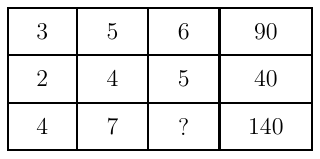
In the following question, select the number which can be placed at the sign of question mark (?) from the given alternatives.

  1. AOption (a)

    3

  2. BOption (b)

    4

  3. COption (c)

    5

  4. DOption (d)

    10

View answer & explanation

Correct answer

Answer: (c)C.

5

Why this answer is correct

The logic followed here is:

Logic: In a row → (Product of first three numbers) = Fourth number

Row 1: (3 × 5 × 6) → 15 × 6 = 90

Row 2: (2 × 4 × 5) → 8 × 5 = 40

Similarly,

Row 3: (4 × 7 × ?) → 28 × ? = 140

⇒ ? = 140 ÷ 28

⇒ ? = 5

Hence, the correct answer is "Option 3".

Question 34

In the following question, select the number which can be placed at the sign of question mark (?) from the given alternatives.

  1. AOption (a)

    2

  2. BOption (b)

    3

  3. COption (c)

    4

  4. DOption (d)

    6

View answer & explanation

Correct answer

Answer: (b)B.

3

Why this answer is correct

The logic followed here is:

In each square: (Top-Left number × Top-Right number) + Bottom-Right number = Bottom-Left number

Square 1: (4 × 3) + 8 → 12 + 8 = 20

Square 2: (4 × 6) + 2 → 24 + 2 = 26

Similarly, in Square 3:

(2 × 5) + ? = 13

⇒ 10 + ? = 13

⇒ ? = 13 - 10

⇒ ? = 3

Hence, the correct answer is "Option 2".

Question 35

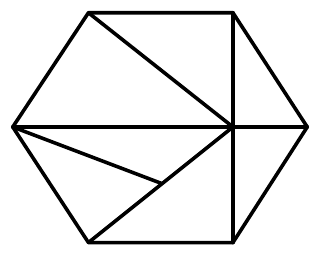
How many triangles are there in the given figure?

  1. AOption (a)

    5

  2. BOption (b)

    9

  3. COption (c)

    11

  4. DOption (d)

    15

View answer & explanation

Correct answer

Answer: (b)B.

9

Why this answer is correct

The number of triangles in the figure:

The number of triangles in the figure is 9.

Hence, the correct answer is "Option 2".

Question 36

How many triangles are there in the given figure?

  1. AOption (a)

    13

  2. BOption (b)

    14

  3. COption (c)

    15

  4. DOption (d)

    16

View answer & explanation

Correct answer

Answer: (c)C.

15

Why this answer is correct

The number of triangles in the figure:

The number of triangles in the figure is 15.

Hence, the correct answer is "Option 3".

Question 37

5 persons A, B, C, D and E are sitting around a circular table facing towards the centre (not necessarily in the same order). B is sitting second to the right of D. A is sitting second to the right of B. C is not an immediate neighbour of A. Who is to the immediate right of A?

  1. AOption (a)

    E

  2. BOption (b)

    B

  3. COption (c)

    C

  4. DOption (d)

    D

View answer & explanation

Correct answer

Answer: (d)D.

D

Why this answer is correct

Given: 5 persons A, B, C, D and E are sitting around a circular table facing towards the centre (not necessarily in the same order).

B is sitting second to the right of D.

A is sitting second to the right of B.

C is not an immediate neighbour of A.

And E sits at the remaining place.

So, D is the immediate right of A.

Hence, the correct answer is "Option 4".

Question 38

5 persons A, B, C, D and E are sitting around a circular table facing towards the centre (not necessarily in the same order). B is sitting second to the right of D. A is sitting second to the right of B. C is not an immediate neighbour of A. Who is sitting third to the right of C?

  1. AOption (a)

    B

  2. BOption (b)

    A

  3. COption (c)

    D

  4. DOption (d)

    E

View answer & explanation

Correct answer

Answer: (b)B.

A

Why this answer is correct

Given: 5 persons A, B, C, D and E are sitting around a circular table facing towards the centre (not necessarily in the same order).

B is sitting second to the right of D.

A is sitting second to the right of B.

C is not an immediate neighbour of A.

And E sits at the remaining place.

So, A is sitting third to the right of C.

Hence, the correct answer is "Option 2".

Question 39

M is facing towards east. By taking which of the following combination of turns, he will be finally facing towards south?

  1. AOption (a)

    Right, Left, Left, Right, Right

  2. BOption (b)

    Right, Left, Right, Left, Left

  3. COption (c)

    Left, Right, Left, Right, Left, Right, Right, Left

  4. DOption (d)

    Left, Left, Left, Left, Right, Right, Right, Right

View answer & explanation

Correct answer

Answer: (a)A.

Right, Left, Left, Right, Right

Why this answer is correct

A Right turn and a Left turn cancel each other out because they return the person to their original direction.

M starts facing East. To face South, he needs a net result of one Right turn (or three Left turns).

The logic followed here is:

Option 1: Right, Left, Left, Right, Right = 3 Right, 2 Left.

Net = 1 Right. (East + 1 Right = South)

Option 2: Right, Left, Right, Left, Left = 2 Right, 3 Left.

Net = 1 Left. (East + 1 Left = North)

Option 3: Left, Right, Left, Right, Left, Right, Right, Left = 4 Right, 4 Left.

Net = 0. (Stays East)

Option 4: Left, Left, Left, Left, Right, Right, Right, Right = 4 Left, 4 Right.

Net = 0. (Stays East)

Whereas,

In Option 1, the sequence results in a net 90° clockwise rotation.

So, Option 1 leads M to face South.

Hence, the correct answer is "Option 1".

Question 40

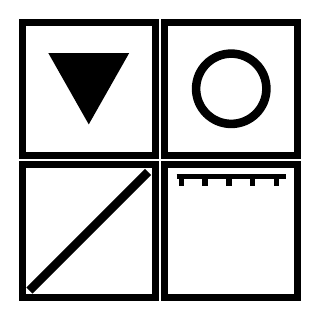
Which option figure will complete the pattern in the question figure? [Rotation is not allowed]

  1. AOption (a)

  2. BOption (b)

  3. COption (c)

  4. DOption (d)

View answer & explanation

Correct answer

Answer: (a)A.

Why this answer is correct

The option figure will complete the pattern in the question figure:

Hence, the correct answer is "Option 1".

Question 41

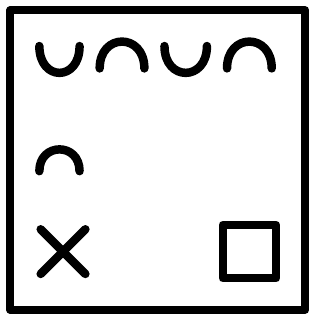
In the following figure series, select the figure which can be placed at the sign of question mark (?) from the given alternatives.

  1. AOption (a)

  2. BOption (b)

  3. COption (c)

  4. DOption (d)

View answer & explanation

Correct answer

Answer: (a)A.

Why this answer is correct

The logic followed here is: 

Logic: The number of brackets increases by one in each step, and they alternate their orientation (facing up vs. facing down).

Hence, the correct answer is "Option 1".

Question 42

In the following figure series, select the figure which can be placed at the sign of question mark (?) from the given alternatives.

  1. AOption (a)

  2. BOption (b)

  3. COption (c)

  4. DOption (d)

View answer & explanation

Correct answer

Answer: (c)C.

Why this answer is correct

The logic followed here is,

Hence, the correct answer is "Option 3".

Question 43

 If 'P' means '+', 'Q' means '÷ ', 'R' means '× ' and 'S' means '-', then 42  Q 7 R  3  P  6  S  2 = ?

  1. AOption (a)

    20

  2. BOption (b)

    22

  3. COption (c)

    28

  4. DOption (d)

    18

View answer & explanation

Correct answer

Answer: (b)B.

22

Why this answer is correct

Given:

42 Q 7 R 3 P 6 S 2 = ?

By using the BODMAS rule:

By, decoding the given symbols we get.

SYMBOLSMEANING
Q÷
R×
P+
S-

Substituting the given operator in the given expression:

⇒ 42 Q 7 R 3 P 6 S 2

⇒ (42 ÷ 7) × 3 + 6 - 2

⇒ 6 × 3 + 6 - 2

⇒ 18 + 6 - 2

⇒ 24 - 2 = 22

Hence, the correct answer is 'Option 2'.

Question 44

By interchanging the given two numbers (not digits) which of the following equation will NOT be correct?

3 and 7

I. 7 ×  9 + 3 - 8 ÷  2 = 30

II. 2 × 3 + 7 - 4 ÷ 1 = 13

  1. AOption (a)

    Only I

  2. BOption (b)

    Only II

  3. COption (c)

    Both I and II

  4. DOption (d)

    Neither I nor II

View answer & explanation

Correct answer

Answer: (d)D.

Neither I nor II

Why this answer is correct

BODMAS Rule:

According to the question, we need to interchange the numbers 3 and 7 and check which equation will NOT be correct:

Equation I: 7 × 9 + 3 - 8 ÷ 2 = 30

After interchanging 3 and 7, the equation becomes:

3 × 9 + 7 − 8 ÷ 2

⇒ 3 × 9 + 7 − 4

⇒ 27 + 7 − 4

⇒ 34 − 4 = 30 (Correct)

Equation II: 2 × 3 + 7 - 4 ÷ 1 = 13

After interchanging 3 and 7, the equation becomes:

2 × 7 + 3 − 4 ÷ 1

⇒ 2 × 7 + 3 − 4

⇒ 14 + 3 − 4

⇒ 17 − 4 = 13 (Correct)

Since both equations are correct after the interchange, neither of them is "not correct".

Hence, the correct answer is "Option 4".

Question 45

In the following question, four number pairs are given. In each pair the number on left side of (-) is related to the number of the right side of (-) with some Logic/Rule/Relation. Three pairs are similar on the basis of same Logic/Rule/Relation. Select the odd one out from the given alternatives.

(NOTE: Operations should be performed on the whole numbers, without breaking down the number into its constituent digits. E.g. 13 — Operations on 13 such as adding/subtracting/multiplying etc. to 13 can be performed. Breaking down 13 into 1 and 3 and then performing mathematical operations on 1 and 3 is not allowed)

  1. AOption (a)

    13 - 169

  2. BOption (b)

    12 - 144

  3. COption (c)

    11 - 121

  4. DOption (d)

    10 - 110

View answer & explanation

Correct answer

Answer: (d)D.

10 - 110

Why this answer is correct

The logic followed here is:

13 - 169 → 132 = 169

12 - 144 → 122 = 144

11 - 121 → 112 = 121

Whereas,

10 - 110 → 102 = 100 ≠110.

So, 10 - 110 is odd from the given options because the right side is not the square of the left side.

Hence, the correct answer is "Option 4".

Question 46

In a certain coded language 'PRAM' is coded as 'KLVG' and 'DENY' is coded as 'YYIS'. How will 'HATS' be coded in the same code language?

  1. AOption (a)

    CUOM

  2. BOption (b)

    EVNL

  3. COption (c)

    BTPN

  4. DOption (d)

    CUPO

View answer & explanation

Correct answer

Answer: (a)A.

CUOM

Why this answer is correct

The logic followed here is:

For PRAM : KLVG

For DENY : YYIS

Applying the pattern to HATS:

The resulting code is CUOM.

Hence, the correct answer is "Option 1".

Question 47

In a certain code language, 'proper culture quality relation' is coded as 'cf du sr tu', 'now quality reliable gate' is coded as 'gn du jk pa', 'focus now relation manner' is coded as 'pa xd tu sa'. How will 'quality relation' be coded in that code language?

  1. AOption (a)

    cf du

  2. BOption (b)

    du tu

  3. COption (c)

    pa tu

  4. DOption (d)

    sr cf

View answer & explanation

Correct answer

Answer: (b)B.

du tu

Why this answer is correct

The logic followed here is,

Comparing Sentence 1 and Sentence 2, the common word is 'quality'. The common code between them is 'du'.

Comparing Sentence 1 and Sentence 3, the common word is 'relation'. The common code between them is 'tu'.

Thus, the code for 'quality relation' is 'du tu'.

Hence, the correct answer is "Option 2".

Question 48

From the given alternatives, select the word that CANNOT be formed by using the letters of the given word.

REVOLUTION

  1. AOption (a)

    ULTRON

  2. BOption (b)

    NOVEL

  3. COption (c)

    RATION

  4. DOption (d)

    INTRO

View answer & explanation

Correct answer

Answer: (c)C.

RATION

Why this answer is correct

Given Word: REVOLUTION

1) ULTRON → Can be formed

2) NOVEL → Can be formed

3) RATION → Cannot be formed (Because the given word does not contain the letter 'A')

4) INTRO → Can be formed

Hence, the correct answer is "Option 3".

Question 49

From the given alternatives, select the word that CANNOT be formed by using the letters of the given word.

INDEPENDENCE

  1. AOption (a)

    DINE

  2. BOption (b)

    PENDING

  3. COption (c)

    NICE

  4. DOption (d)

    PINE

View answer & explanation

Correct answer

Answer: (b)B.

PENDING

Why this answer is correct

Given Word: INDEPENDENCE

1) DINE → Can be formed

2) PENDING → Cannot be formed (Because in the given word there is only one 'G' whereas it has zero — the letter 'G' is missing from INDEPENDENCE)

3) NICE → Can be formed

4) PINE → Can be formed

Hence, the correct answer is "Option 2".

Question 50

A series is given with one term missing. Select the correct alternative from the given ones that will complete the series.

FR120, CO176, ZL232, WI288, ?

  1. AOption (a)

    TE354

  2. BOption (b)

    UF364

  3. COption (c)

    UE374

  4. DOption (d)

    TF344

View answer & explanation

Correct answer

Answer: (d)D.

TF344

Why this answer is correct

The logic followed here is:

Thus, the missing term in the series is TF344.

Hence, the correct answer is "Option 4".

Quantitative Aptitude (25 questions)

Question 51

An article sold for Rs. 765 after a discount of 15%. What was the marked price?

  1. AOption (a)

    Rs. 850

  2. BOption (b)

    Rs. 880

  3. COption (c)

    Rs. 900

  4. DOption (d)

    Rs. 920

View answer & explanation

Correct answer

Answer: (c)C.

Rs. 900

Why this answer is correct

Given:

Selling Price (SP) = Rs. 765

Discount = 15%

Formula Used:

Marked Price (MP) = SP ÷ (1 - Discount/100)

Calculation:

⇒ MP = 765 ÷ (1 - 15/100)

⇒ MP = 765 ÷ (1 - 0.15)

⇒ MP = 765 ÷ 0.85

⇒ MP = Rs. 900

∴ The correct answer is Rs. 900.

Question 52

In a warehouse, 7 crates of goods have an average weight of 84.5 kg. One of the crates, weighing 79.2 kg, is replaced by a new crate. As a result, the average weight becomes 87.1 kg. Later, 3 more crates are added, each weighing 91.3 kg. What is the weight of the new crate that replaced the old one?

  1. AOption (a)

    96.8 kg

  2. BOption (b)

    98.1 kg

  3. COption (c)

    97.4 kg

  4. DOption (d)

    95.7 kg

View answer & explanation

Correct answer

Answer: (c)C.

97.4 kg

Why this answer is correct

Given:

Number of crates = 7

Initial average = 84.5

Old crate weight = 79.2

New average = 87.1

Formula Used:

Total sum = Average × Number of terms

Calculation:

⇒ Initial total = 7 × 84.5 = 591.5

⇒ New total after replacement = 7 × 87.1 = 609.7

⇒ Increase in total = 609.7 − 591.5 = 18.2

⇒ New crate weight = 79.2 + 18.2 = 97.4

∴ The correct answer is 97.4.

Question 53

A right circular cone has a height of 12 cm and a radius of 5 cm. Find its slant height and curved surface area.

  1. AOption (a)

    13 cm and 204.2 cm2

  2. BOption (b)

    17 cm and 104.2 cm2

  3. COption (c)

    11 cm and 304.2 cm2

  4. DOption (d)

    13 cm and 404.2 cm2

View answer & explanation

Correct answer

Answer: (a)A.

13 cm and 204.2 cm2

Why this answer is correct

Given:

Height (h) = 12 cm

Radius (r) = 5 cm

Formula Used:

Slant height (l) = √(h2 + r2)

Curved Surface Area (CSA) = π × r × l

Calculation:

⇒ l = √(122 + 52)

⇒ l = √(144 + 25)

⇒ l = √169

⇒ l = 13 cm

⇒ CSA = π × r × l

⇒ CSA = 3.14 × 5 × 13

⇒ CSA = 204.2 cm2

∴ The correct answer is 13 cm and 204.2 cm2.

Question 54

If in a right-angled triangle, cos A = 5/13, find the value of tan A - sin A.

  1. AOption (a)

    73/109

  2. BOption (b)

    91/87

  3. COption (c)

    88/117

  4. DOption (d)

    96/65

View answer & explanation

Correct answer

Answer: (d)D.

96/65

Why this answer is correct

Given:

cos A = 5 ÷ 13

Formula Used:

sin2A + cos2A = 1

tan A = sin A ÷ cos A

Calculation:

⇒ sin A = √(1 − (5 ÷ 13)2)

⇒ sin A = √(1 − 25 ÷ 169)

⇒ sin A = √(144 ÷ 169) = 12 ÷ 13

⇒ tan A = (12 ÷ 13) ÷ (5 ÷ 13)

⇒ tan A = 12 ÷ 5

⇒ tan A − sin A = (12 ÷ 5) − (12 ÷ 13)

⇒ = (156 − 60) ÷ 65

⇒ = 96 ÷ 65

∴ The correct answer is 96 ÷ 65.

Question 55

Two circles with centers c1 and c2 have radii r1 = 8 cm and r2 = 7 cm, respectively. The distance between their centers is 17 cm. A common internal tangent touches the circles at points P1 and P2. What is the length of the segment P1 P2?

  1. AOption (a)

    15 cm

  2. BOption (b)

    12cm

  3. COption (c)

    8 cm

  4. DOption (d)

    10 cm

View answer & explanation

Correct answer

Answer: (c)C.

8 cm

Why this answer is correct

Given:

r1 = 8

r2 = 7

Distance between centers = 17

Formula Used:

Length of internal tangent = √(d2 − (r1 + r2)2)

Calculation:

⇒ Length = √(172 − (8 + 7)2)

⇒ Length = √(289 − 152)

⇒ Length = √(289 − 225)

⇒ Length = √64 = 8

∴ The correct answer is 8.

Question 56

From point 'P' on the ground, a long metallic cable is laid to the top of a cliff, making an angle of 30∘  with the ground such that the length of the cable laid is 450√3 metres. Find the distance between point 'P' and the foot of the cliff.

  1. AOption (a)

    580 metres

  2. BOption (b)

    625 metres

  3. COption (c)

    675 metres

  4. DOption (d)

    560 metres

View answer & explanation

Correct answer

Answer: (c)C.

675 metres

Why this answer is correct

Given:

Angle = 30

Hypotenuse = 450√3

Formula Used:

cosθ = Base ÷ Hypotenuse

Calculation:

⇒ cos30 = Base ÷ (450√3)

⇒ √3 ÷ 2 = Base ÷ (450√3)

⇒ Base = (450√3 × √3) ÷ 2

⇒ Base = (450 × 3) ÷ 2

⇒ Base = 1350 ÷ 2 = 675

∴ The correct answer is 675.

Question 57

The ratio of gold to copper in a bracelet is 4 : 7. If the price of copper is 1/10th the price of gold, find the cost of the bracelet if the cost of copper in the bracelet is 28000 rupees.

  1. AOption (a)

    Rs. 180000

  2. BOption (b)

    Rs. 190000

  3. COption (c)

    Rs. 188000

  4. DOption (d)

    Rs. 1780000

View answer & explanation

Correct answer

Answer: (c)C.

Rs. 188000

Why this answer is correct

Given:

Ratio of gold to copper = 4 : 7

Price of copper = (1 ÷ 10) × price of gold

Cost of copper = 28000

Formula Used:

Cost ∝ Quantity × Price per unit

Calculation:

⇒ Let price of gold per unit = 10

⇒ Price of copper per unit = 1

⇒ Cost ratio = (4 × 10) : (7 × 1)

⇒ Cost ratio = 40 : 7

⇒ Copper cost (7 parts) = 28000

⇒ 1 part = 28000 ÷ 7 = 4000

⇒ Gold cost (40 parts) = 40 × 4000 = 160000

⇒ Total cost = 160000 + 28000 = 188000

∴ The correct answer is 188000.

Question 58

Rice worth Rs. 120 per kg and Rs. 130 per kg are mixed with a third variety in the ratio 1 : 1 : 2. If the mixture is worth Rs. 150 per kg, what is the price of third variety per kg?

  1. AOption (a)

    175

  2. BOption (b)

    170

  3. COption (c)

    165

  4. DOption (d)

    180

View answer & explanation

Correct answer

Answer: (a)A.

175

Why this answer is correct

Given:

Price1 = 120

Price2 = 130

Ratio = 1 : 1 : 2

Mean price = 150

Formula Used:

Mean price = (Sum of (Price × Quantity)) ÷ Total quantity

Calculation:

⇒ Let price of third variety = x

⇒ Total quantity = 1 + 1 + 2 = 4

⇒ (120 × 1 + 130 × 1 + x × 2) ÷ 4 = 150

⇒ (120 + 130 + 2x) ÷ 4 = 150

⇒ 250 + 2x = 600

⇒ 2x = 350

⇒ x = 175

∴ The correct answer is 175.

Question 59

Aditya is twice as good a workman as Bipin and therefore can finish a job in 30 days less than Bipin. How many days are required to complete the job if working together?

  1. AOption (a)

    18 days

  2. BOption (b)

    20 days

  3. COption (c)

    15 days

  4. DOption (d)

    22 days

View answer & explanation

Correct answer

Answer: (b)B.

20 days

Why this answer is correct

Shortcut Trick

Ratio of Efficiency (Aditya : Bipin) = 2 : 1

Ratio of Time taken (Aditya : Bipin) = 1 : 2

Difference in time = 2 − 1 = 1 unit → 30 days

Aditya takes 30 days and Bipin takes 60 days.

Time together = (30 × 60) ÷ (30 + 60) = 1800 ÷ 90 = 20 days.

∴ The correct answer is 20 days.

Alternate Method

Given: Aditya is twice as efficient as Bipin. Aditya takes 30 days less than Bipin.

Formula Used: Total Work = Efficiency × Time taken; Time taken = Total Work ÷ Efficiency

⇒ Let the time taken by Bipin be 2x days. Then time taken by Aditya is x days.

⇒ According to the question: 2x − x = 30 days

⇒ x = 30 days.

⇒ Aditya's time = 30 days and Bipin's time = 60 days.

PersonDaysTotal WorkEfficiency
Aditya3060 (LCM)2
Bipin601

⇒ Total Efficiency of Aditya and Bipin = 2 + 1 = 3 units/day.

⇒ Total Work to be completed = 60 units.

⇒ Time required together = Total Work ÷ Total Efficiency

⇒ Time = 60 ÷ 3 = 20 days.

∴ The correct answer is 20 days.

Additional Information

Efficiency and Time Relationship

Efficiency is inversely proportional to the time taken to complete a task. If the ratio of efficiency is a:b, the ratio of time taken is b:a.

Combined Work Formula

If person A finishes work in X days and B in Y days, they finish together in (X × Y) ÷ (X + Y) days.

Work and Wages

Wages are distributed in the ratio of work done, which is usually the same as the ratio of efficiencies if they work for the same duration.

Question 60

If tan θ + cot θ = 5, and θ is an acute angle, find the value of tan2 θ + cot2 θ.

  1. AOption (a)

    20

  2. BOption (b)

    21`

  3. COption (c)

    22

  4. DOption (d)

    23

View answer & explanation

Correct answer

Answer: (d)D.

23

Why this answer is correct

Given:

tanθ + cotθ = 5

θ is an acute angle

Formula Used:

tan2θ + cot2θ = (tanθ + cotθ)2 - 2

Calculation:

⇒ tan2θ + cot2θ = (5)2 - 2

⇒ tan2θ + cot2θ = 25 - 2

⇒ tan2θ + cot2θ = 23

∴ The correct answer is 23.

Question 61

A person covers some distance by car, travelling at 45 km/h in 4.6 hours, and the remaining distance by bus, travelling at 37.5 km/h in 4.2 hours. Find the total distance travelled by the person.

  1. AOption (a)

    372.5 km

  2. BOption (b)

    388 km

  3. COption (c)

    367 km

  4. DOption (d)

    364.5 km

View answer & explanation

Correct answer

Answer: (d)D.

364.5 km

Why this answer is correct

Shortcut Trick

Total Distance = (Speed1 × Time1) + (Speed2 × Time2)

Total Distance = (45 × 4.6) + (37.5 × 4.2)

Total Distance = 207 + 157.5 = 364.5 km

∴ The correct answer is 364.5 km.

Alternate Method

Given:

Speed of Car = 45 km/h, Time taken = 4.6 hr

Speed of Bus = 37.5 km/h, Time taken = 4.2 hr

Formula Used:

Distance = Speed × Time

⇒ Distance covered by car = 45 × 4.6

⇒ Distance covered by car = 207 km

⇒ Distance covered by bus = 37.5 × 4.2

⇒ Distance covered by bus = 157.5 km

⇒ Total Distance travelled = 207 + 157.5

⇒ Total Distance travelled = 364.5 km

∴ The correct answer is 364.5 km.

Additional Information

Average Speed Formula

Average Speed = Total Distance ÷ Total Time. In this case, Average Speed = 364.5 ÷ (4.6 + 4.2) km/h.

Speed Conversion Rule

To convert Speed from km/h to m/s, multiply by 5/18. To convert from m/s to km/h, multiply by 18/5.

Relative Speed Concept

When two objects move in the same direction, Relative Speed = S1 − S2. In opposite directions, Relative Speed = S1 + S2.

Question 62

In a circle with center O, AC is a chord. OB is perpendicular to AC, and B is the midpoint of AC. If the angle ∠AOC = 120∘ , and the radius of the circle is 10 cm, what is the length of the chord AC?

  1. AOption (a)

    5√3 cm

  2. BOption (b)

    10√2 cm

  3. COption (c)

    10 cm

  4. DOption (d)

    10 √3 cm

View answer & explanation

Correct answer

Answer: (d)D.

10 √3 cm

Why this answer is correct

Given:

∠AOC = 120°

Radius = 10 cm

Formula Used:

Chord length = 2 × r × sin(θ ÷ 2)

Calculation:

⇒ AC = 2 × 10 × sin(120° ÷ 2)

⇒ AC = 20 × sin60°

⇒ sin60° = √3 ÷ 2

⇒ AC = 20 × (√3 ÷ 2)

⇒ AC = 10√3 cm

∴ The correct answer is 10√3 cm.

Question 63

A solid metallic sphere of radius R is heated so that its radius increases by 10%. Find the approximate percentage increase in its volume.

  1. AOption (a)

    30%

  2. BOption (b)

    33.1%

  3. COption (c)

    31%

  4. DOption (d)

    25%

View answer & explanation

Correct answer

Answer: (b)B.

33.1%

Why this answer is correct

Given:

Increase in radius = 10%

Formula Used:

Volume of sphere = (4 ÷ 3) × π × r3

Percentage change = [(New value − Original value) ÷ Original value] × 100

Calculation:

⇒ Let original radius = r

⇒ New radius = 1.1r

⇒ Original volume = (4 ÷ 3) × π × r3

⇒ New volume = (4 ÷ 3) × π × (1.1r)3

⇒ New volume = (4 ÷ 3) × π × 1.331r3

⇒ Ratio = New ÷ Original = 1.331

⇒ Increase = 1.331 − 1 = 0.331

⇒ Percentage increase = 0.331 × 100

⇒ Percentage increase = 33.1%

∴ The correct answer is 33.1%.

Question 64

In a parallelogram, the diagonals are 26 cm and 10 cm and intersect at right angles. Find the side length and the area of the parallelogram.

  1. AOption (a)

    √ 194 cm and 130 cm2

  2. BOption (b)

    √ 167 cm and 178 cm2

  3. COption (c)

    √ 98 cm and 110 cm2

  4. DOption (d)

    √ 104 cm and 140 cm2

View answer & explanation

Correct answer

Answer: (a)A.

√ 194 cm and 130 cm2

Why this answer is correct

Given:

Diagonal 1 = 26 cm

Diagonal 2 = 10 cm

Diagonals intersect at 90°

Formula Used:

Diagonals bisect each other

Side = √[(d1 ÷ 2)2 + (d2 ÷ 2)2]

Area = (1 ÷ 2) × d1 × d2 × sinθ

Calculation:

⇒ Half of diagonals = 26 ÷ 2 = 13 and 10 ÷ 2 = 5

⇒ Side = √(132 + 52)

⇒ Side = √(169 + 25)

⇒ Side = √194 cm

⇒ Area = (1 ÷ 2) × 26 × 10 × sin90°

⇒ Area = (1 ÷ 2) × 260 × 1

⇒ Area = 130 cm2

∴ The correct answer is Side = √194 cm and Area = 130 cm2.

Question 65

A trader marks up an article by 25% on its cost price. He then offers two successive discounts: 10% followed by 5% on the marked price.If the cost price (CP) is ₹480, what is the final profit or loss percent?

  1. AOption (a)
    • 6.875 %
  2. BOption (b)
    • 6.875 %
  3. COption (c)
    • 5.875 %
  4. DOption (d)
    • 5.875 %
View answer & explanation

Correct answer

Answer: (a)A.
  • 6.875 %

Why this answer is correct

Given:

Cost price = 480

Markup = 25%

First discount = 10%

Second discount = 5%

Formula Used:

Marked price = CP × (1 + markup)

Selling price = MP × (1 − d1) × (1 − d2)

Profit/Loss % = ((SP − CP) ÷ CP) × 100

Calculation:

⇒ MP = 480 × 1.25 = 600

⇒ After 10% discount: 600 × 0.9 = 540

⇒ After 5% discount: 540 × 0.95 = 513

⇒ SP = 513

⇒ Profit = 513 − 480 = 33

⇒ Profit % = (33 ÷ 480) × 100

⇒ Profit % = 6.875%

∴ The correct answer is 6.875% profit.

Question 66

Aman and Binoy enter into a partnership with capitals in the ratio 4:5. If the total profit is Rs 9,000, what will Aman's share be?

  1. AOption (a)

    Rs 3,600

  2. BOption (b)

    Rs 4,000

  3. COption (c)

    Rs 4,500

  4. DOption (d)

    Rs 5,000

View answer & explanation

Correct answer

Answer: (b)B.

Rs 4,000

Why this answer is correct

Given:

Total profit = Rs 9,000

Capital ratio of Aman : Binoy = 4 : 5

Formula Used:

Aman’s share = (Aman's capital ratio ÷ Total ratio) × Total profit

Total ratio = Sum of individual ratios

Calculation:

⇒ Total ratio = 4 + 5 = 9

⇒ Aman’s share = (4 ÷ 9) × 9,000

⇒ Aman’s share = 4 × 1,000 = Rs 4,000

∴ The correct answer is Rs 4,000.

Question 67

The ratio of the length to the width of a rectangle is 7:4. If its perimeter is 88 cm, what is its area?

  1. AOption (a)

    448 cm2

  2. BOption (b)

    224 cm2

  3. COption (c)

    144 cm2

  4. DOption (d)

    100 cm2

View answer & explanation

Correct answer

Answer: (a)A.

448 cm2

Why this answer is correct

Given:

Length to width ratio = 7:4

Perimeter = 88 cm

Formula Used:

Perimeter of rectangle = 2 × (Length + Width)

Area of rectangle = Length × Width

Calculation:

Let Length = 7x and Width = 4x (from the ratio).

⇒ Perimeter = 2 × (7x + 4x)

⇒ 88 = 2 × (11x)

⇒ 88 ÷ 2 = 11x

⇒ x = 4

⇒ Length = 7 × 4 = 28 cm

⇒ Width = 4 × 4 = 16 cm

⇒ Area = Length × Width

⇒ Area = 28 × 16 = 448 cm2

∴ The correct answer is 448 cm2.

Question 68

Ravi's calorie intake for 6 days was 2100, 2200, 2000, 2300, 2400, and 2100. On the 7th day, he forgot to record his food. If the weekly average intake is 2200, how many calories did he consume on the 7th day?

  1. AOption (a)

    2,200

  2. BOption (b)

    2,300

  3. COption (c)

    2,400

  4. DOption (d)

    2,500

View answer & explanation

Correct answer

Answer: (b)B.

2,300

Why this answer is correct

Given:

Calories for 6 days = 2100, 2200, 2000, 2300, 2400, 2100

Weekly average = 2200

Formula Used:

Total sum = Average × Number of days

Calculation:

⇒ Total for 7 days = 2200 × 7 = 15400

⇒ Sum of 6 days = 2100 + 2200 + 2000 + 2300 + 2400 + 2100

⇒ Sum of 6 days = 13100

⇒ Calories on 7th day = 15400 − 13100

⇒ Calories on 7th day = 2300

∴ The correct answer is 2300.

Question 69

In a circle with a radius of 15 cm, a chord measures 18 cm in length. Find the perpendicular distance from the center of the circle to this chord.

  1. AOption (a)

    9 cm

  2. BOption (b)

    12 cm

  3. COption (c)

    15 cm

  4. DOption (d)

    18 cm

View answer & explanation

Correct answer

Answer: (b)B.

12 cm

Why this answer is correct

Given:

Radius = 15 cm

Chord length = 18 cm

Formula Used:

Perpendicular from center bisects the chord

r2 = d2 + (chord ÷ 2)2

Calculation:

⇒ Half chord = 18 ÷ 2 = 9

⇒ 152 = d2 + 92

⇒ 225 = d2 + 81

⇒ d2 = 225 − 81

⇒ d2 = 144

⇒ d = 12 cm

∴ The correct answer is 12 cm.

Question 70

Two chords, AB and CD, cross at point P inside a circle. Segments AP, PB, and CP have lengths of 6 cm, 8 cm, and 4 cm, respectively. How long is the chord CD in total?

  1. AOption (a)

    12 cm

  2. BOption (b)

    16 cm

  3. COption (c)

    8 cm

  4. DOption (d)

    14 cm

View answer & explanation

Correct answer

Answer: (b)B.

16 cm

Why this answer is correct

Given:

AP = 6 cm

PB = 8 cm

CP = 4 cm

Formula Used:

Intersecting chords theorem: AP × PB = CP × PD

Calculation:

⇒ 6 × 8 = 4 × PD

⇒ 48 = 4 × PD

⇒ PD = 48 ÷ 4

⇒ PD = 12 cm

⇒ CD = CP + PD

⇒ CD = 4 + 12

⇒ CD = 16 cm

∴ The correct answer is 16 cm.

Question 71

What is the x-intercept of the line given by 2x - 3y = 12?

  1. AOption (a)

    -4

  2. BOption (b)

    4

  3. COption (c)

    5

  4. DOption (d)

    6

View answer & explanation

Correct answer

Answer: (d)D.

6

Why this answer is correct

Given:

Equation of the line: 2x - 3y = 12

Formula Used:

x-intercept is the value of x when y = 0.

Calculation:

⇒ 2x - 3(0) = 12

⇒ 2x = 12

⇒ x = 12 ÷ 2

⇒ x = 6

∴ The correct answer is 6.

Question 72

A is 20 percent more than B. B is 30 percent more than C. C is 10 percent less than D. D is 30 percent less than E. By how much percentage is A more/less than E?

  1. AOption (a)

    1.72 percent less

  2. BOption (b)

    1.72 percent more

  3. COption (c)

    1.86 percent less

  4. DOption (d)

    1.86 percent more

View answer & explanation

Correct answer

Answer: (a)A.

1.72 percent less

Why this answer is correct

Given:

A is 20% more than B

B is 30% more than C

C is 10% less than D

D is 30% less than E

Formula Used:

New value = Original × (1 ± percentage)

Percentage change = [(A − E) ÷ E] × 100

Calculation:

⇒ Let E = 100

⇒ D = 100 × 0.7 = 70

⇒ C = 70 × 0.9 = 63

⇒ B = 63 × 1.3 = 81.9

⇒ A = 81.9 × 1.2 = 98.28

⇒ Difference = 98.28 − 100 = −1.72

⇒ Percentage change = (−1.72 ÷ 100) × 100

⇒ Percentage change = −1.72%

∴ The correct answer is 1.72% less.

Question 73

If a certain sum of money becomes double of itself in 5 years 6 months at simple interest, then what will be the annual rate of interest (approximate)?

  1. AOption (a)

    9.09 percent

  2. BOption (b)

    11.11 percent

  3. COption (c)

    18.18 percent

  4. DOption (d)

    16.5 percent

View answer & explanation

Correct answer

Answer: (c)C.

18.18 percent

Why this answer is correct

Shortcut Trick

If a sum of money becomes n times of itself in T years, the annual rate of interest R is given by:

R = [100 × (n − 1)] ÷ T

Given: n = 2 (doubles), T = 5.5 years (5 years 6 months)

R = [100 × (2 − 1)] ÷ 5.5 = 100 ÷ 5.5 = 200 ÷ 11 ≈ 18.18%

∴ The correct answer is 18.18 percent.

Alternate Method

Given:

Principal (P) = P

Amount (A) = 2P (since the sum doubles itself)

Time (T) = 5 years 6 months = 5 + 6/12 years = 5.5 years

Formula Used:

Simple Interest (SI) = (P × R × T) ÷ 100

Amount (A) = P + SI

Calculations:

⇒ SI = A − P

⇒ SI = 2P − P = P

⇒ P = (P × R × 5.5) ÷ 100

⇒ 1 = (R × 5.5) ÷ 100

⇒ R = 100 ÷ 5.5

⇒ R = 1000 ÷ 55 = 200 ÷ 11

⇒ R ≈ 18.1818...

∴ The correct answer is 18.18 percent.

Additional Information

Relationship between Rate and Time

For a sum to double under simple interest, the product of Rate (R) and Time (T) must always equal 100 (R × T = 100).

Simple Interest Formula

The amount (A) after time (T) is given by A = P × (1 + RT/100), where P is the principal and R is the annual rate.

Rule of 72 (Compound Interest)

To find the approximate time to double money at compound interest, divide 72 by the annual interest rate (T ≈ 72 ÷ R).

SI vs CI for first year

When the interest is compounded annually, the Simple Interest and Compound Interest for the first year are always equal.

Question 74

The difference between simple interest on a certain sum at the annual rate of 10 percent for 8 years and 10 years is Rs. 80. What is the sum?

  1. AOption (a)

    Rs. 420

  2. BOption (b)

    Rs. 400

  3. COption (c)

    Rs. 550

  4. DOption (d)

    Rs. 500

View answer & explanation

Correct answer

Answer: (b)B.

Rs. 400

Why this answer is correct

Given:

Rate = 10%

Time difference = 10 − 8 = 2 years

Difference in SI = 80

Formula Used:

Simple Interest = (P × R × T) ÷ 100

Calculation:

⇒ Difference in SI = (P × 10 × 2) ÷ 100

⇒ 80 = (P × 20) ÷ 100

⇒ 80 = P ÷ 5

⇒ P = 80 × 5

⇒ P = 400

∴ The correct answer is 400.

Question 75

Pipe A and B together can fill a tank in 16 minutes. Pipe B and C together can fill the same tank in 20 minutes. Pipe C and A together can fill the same tank in 24 minutes. Firstly pipe C is opened. After 'L' minutes, pipes A and B both are also opened. Remaining tank got filled in 4 minutes. What is the value of L?

  1. AOption (a)

    157/7

  2. BOption (b)

    314/7

  3. COption (c)

    332/7

  4. DOption (d)

    166/7

View answer & explanation

Correct answer

Answer: (c)C.

332/7

Why this answer is correct

Given:

A + B = 16 minutes

B + C = 20 minutes

C + A = 24 minutes

Remaining work filled in 4 minutes by A + B + C

Formula Used:

Work rate = 1 ÷ Time

Total work = Sum of individual rates

Calculation:

⇒ A + B = 1 ÷ 16

⇒ B + C = 1 ÷ 20

⇒ C + A = 1 ÷ 24

⇒ Adding all: 2(A + B + C) = 1 ÷ 16 + 1 ÷ 20 + 1 ÷ 24

⇒ LCM = 240

⇒ 1 ÷ 16 = 15 ÷ 240, 1 ÷ 20 = 12 ÷ 240, 1 ÷ 24 = 10 ÷ 240

⇒ 2(A + B + C) = 37 ÷ 240

⇒ A + B + C = 37 ÷ 480

⇒ Work done in last 4 min = 4 × (37 ÷ 480)

⇒ = 148 ÷ 480 = 37 ÷ 120

⇒ Remaining work after C alone = 1 − 37 ÷ 120

⇒ = 83 ÷ 120

⇒ C = (B + C) − B

⇒ First find B

⇒ (A + B + C) − (A + B) = C

⇒ C = 37 ÷ 480 − 1 ÷ 16

⇒ 1 ÷ 16 = 30 ÷ 480

⇒ C = 7 ÷ 480

⇒ Work by C in L min = L × 7 ÷ 480

⇒ L × 7 ÷ 480 = 83 ÷ 120

⇒ L × 7 = (83 ÷ 120) × 480

⇒ L × 7 = 83 × 4 = 332

⇒ L = 332 ÷ 7

⇒ L ≈ 47.43 minutes

∴ The correct answer is 332 ÷ 7 minutes.

General Awareness (25 questions)

Question 76

Who among the following is considered the most powerful Chola ruler?

  1. AOption (a)

    Dantidurga

  2. BOption (b)

    Harshvardhan

  3. COption (c)

    Virarajendra Chola

  4. DOption (d)

    Rajaraja I

View answer & explanation

Correct answer

Answer: (d)D.

Rajaraja I

Why this answer is correct

The correct answer is Rajaraja I.

Key Points

  • Rajaraja I was considered the most powerful and influential ruler of the Chola dynasty, which ruled South India during the medieval period.
  • His reign lasted from 985 AD to 1014 AD, during which he expanded the Chola Empire to its greatest territorial extent.
  • Rajaraja I was known for his administrative efficiency, military conquests, and contributions to art, architecture, and culture. He successfully annexed territories like Sri Lanka, the Maldives, and parts of the Deccan region.
  • One of his most notable achievements was the construction of the Brihadeeswarar Temple at Thanjavur, a UNESCO World Heritage Site, which exemplifies the architectural brilliance of the Chola era.
  • Under his reign, the Chola Empire became a major naval power, enabling trade and cultural exchange with Southeast Asia, including regions like Java, Sumatra, and Malaya.
  • His effective governance and military strategies laid the foundation for the prosperity and dominance of the Chola dynasty for several centuries.

Additional Information

  • Other Options Explained:
  • Dantidurga: He was the founder of the Rashtrakuta dynasty in South India. He ruled during the 8th century and was known for establishing Rashtrakuta dominance in the Deccan region. However, he does not match the legacy of Rajaraja I in terms of territorial expansion or cultural contributions.
  • Harshvardhan: A ruler from North India who belonged to the Pushyabhuti dynasty. He ruled during the 7th century and was renowned for his patronage of art and literature. Harshvardhan's influence was significant in North India but unrelated to the Chola dynasty.
  • Virarajendra Chola: He was a Chola ruler, but his reign came after Rajaraja I and was not as remarkable in terms of military conquests or cultural achievements compared to Rajaraja I.
  • Chola Dynasty:
  • The Chola dynasty was one of the longest-ruling dynasties in Indian history, with its origins dating back to the centuries before the Common Era.
  • It reached its zenith under rulers like Rajaraja I and his successor, Rajendra Chola I, who further expanded the empire.
  • The Chola rulers were known for their contributions to Tamil literature, art, and architecture, leaving behind monumental temples and sculptures.
  • The Chola navy played a crucial role in establishing trade routes and cultural connections with Southeast Asia.
  • Brihadeeswarar Temple:
  • The Brihadeeswarar Temple is also known as the Rajarajeswaram and is located in Thanjavur, Tamil Nadu.
  • It was constructed during the reign of Rajaraja I and is one of the largest temples in India.
  • The temple is dedicated to Lord Shiva and is an architectural marvel, showcasing the grandeur of Tamil temple architecture.
  • It is part of the "Great Living Chola Temples" recognized by UNESCO as a World Heritage Site.
  • Important Points:
  • The Chola dynasty laid the foundation for efficient governance by introducing the village administration system, which was a precursor to modern local self-governance.
  • Their contributions to Tamil literature, including works like Silappatikaram and Manimekalai, were immense.
  • Rajaraja I's reign was marked by significant advancements in art, architecture, and the establishment of a powerful navy.
  • The Cholas also focused on irrigation and agricultural development, ensuring economic prosperity during their rule.

Question 77

After the Tughlaqs, which two dynasties ruled Agra until 1526?

  1. AOption (a)

    Sur and Khaljis

  2. BOption (b)

    Tughlaqs and Mughals

  3. COption (c)

    Khaljis and Lodis

  4. DOption (d)

    Sayyids and Lodis

View answer & explanation

Correct answer

Answer: (d)D.

Sayyids and Lodis

Why this answer is correct

The correct answer is Sayyids and Lodis.

Key Points

  • Sayyid Dynasty (1414–1451):
  • The Sayyid Dynasty succeeded the Tughlaq Dynasty after the fall of Delhi to the Timur invasion in 1398.
  • Founded by Khizr Khan, the Sayyids ruled parts of Northern India, including Agra, though they were relatively weak rulers.
  • They claimed to be descendants of the Prophet Muhammad, which legitimized their rule in the eyes of many Muslims.
  • The Sayyid rulers were not able to consolidate power effectively, and their rule was marked by frequent rebellions and the rise of regional powers.
  • Lodi Dynasty (1451–1526):
  • Founded by Bahlul Khan Lodi, the Lodi Dynasty succeeded the Sayyids and was the last dynasty of the Delhi Sultanate.
  • The Lodis were of Afghan origin and significantly strengthened their hold over regions like Agra.
  • Sikandar Lodi, one of the prominent rulers, founded the city of Agra in 1504 and made it an important political and cultural center.
  • The dynasty's rule ended in 1526 when Ibrahim Lodi was defeated by Babur at the Battle of Panipat, marking the beginning of the Mughal Empire.
  • Connection to Agra:
  • Agra's prominence grew during the Lodi Dynasty, particularly under Sikandar Lodi, who established it as a key administrative and cultural hub.
  • The Sayyids and Lodis collectively ruled Agra during the transition period between the decline of the Tughlaqs and the rise of the Mughals.

Additional Information

  • Sayyid Dynasty:
  • The Sayyid Dynasty had four rulers: Khizr Khan, Mubarak Shah, Muhammad Shah, and Ala-ud-din Alam Shah.
  • They primarily controlled Northern India but were unable to expand their territories significantly due to internal dissent and external threats.
  • Their rule weakened the Delhi Sultanate, paving the way for the Lodis to emerge as strong rulers.
  • Lodi Dynasty:
  • The Lodi Dynasty was the first Afghan dynasty to rule over Delhi and its surrounding regions.
  • They implemented administrative reforms and promoted trade and agriculture to strengthen their economy.
  • Sikandar Lodi was known for his architectural contributions, including the establishment of Agra as a major city.
  • The dynasty's decline was marked by internal conflicts and the inability to resist Babur's forces at Panipat.
  • Historical Context of Agra:
  • Agra was an important city even before the Mughal era, with its significance growing under the Lodis.
  • It became a key strategic location due to its proximity to major trade routes and its fertile surrounding regions.
  • Tughlaq Dynasty (Preceding Era):
  • The Tughlaq Dynasty ruled Delhi from 1320 to 1414 and was known for its architectural innovations and military campaigns.
  • It fell into decline due to administrative inefficiency, rebellions, and the invasion of Timur in 1398, which severely weakened the Sultanate.
  • Battle of Panipat (1526):
  • This battle marked the end of the Lodi Dynasty and the beginning of the Mughal Empire in India.
  • Babur defeated Ibrahim Lodi, bringing significant changes to the political and cultural landscape of Northern India.

Important Points

  • Agra:
  • Founded by Sikandar Lodi in 1504, it became a prominent city during the Lodi Dynasty.
  • It later became the capital of the Mughal Empire and a center for art, culture, and architecture.
  • Transition from Tughlaqs to Mughals:
  • The period between the Tughlaq Dynasty's decline and the rise of the Mughal Empire saw significant political instability in Northern India.
  • The Sayyids and Lodis played a critical role during this transitional phase, maintaining the Delhi Sultanate's legacy until its eventual fall.

Question 78

Which of the following article of Indian Constitution ensures the protection of minority interests?

  1. AOption (a)

    Article 28

  2. BOption (b)

    Article 24

  3. COption (c)

    Article 31

  4. DOption (d)

    Article 29

View answer & explanation

Correct answer

Answer: (d)D.

Article 29

Why this answer is correct

The correct answer is Article 29.

Key Points

  • Article 29 of the Indian Constitution ensures the protection of interests of minorities. It provides any section of the citizens with a distinct language, script, or culture the right to conserve the same.
  • This article guarantees that the state shall not deny admission into educational institutions maintained by it or receiving aid from it on the grounds of religion, race, caste, language, or any of them.
  • Article 29(1): Protects the rights of any group of citizens to conserve their distinct language, script, or culture.
  • Article 29(2): Prevents discrimination in admission to educational institutions based on religion, race, caste, language, or any of them, ensuring educational equality.
  • This provision is significant in safeguarding the cultural and educational rights of minorities in India, contributing to India's diversity and inclusivity.

Additional Information

  • Article 28:
  • Relates to the freedom as to attendance at religious instruction or religious worship in educational institutions.
  • No religious instruction is permitted in institutions wholly maintained by the state.
  • However, religious instruction is allowed in institutions administered by the state but established under any endowment or trust requiring such instruction.
  • Article 24:
  • Prohibits the employment of children below 14 years in factories, mines, or any other hazardous employment.
  • This is a fundamental right aimed at protecting children from exploitation.
  • Article 31:
  • Part of the Right to Property, this article was repealed by the 44th Amendment Act of 1978.
  • It is no longer a fundamental right but exists as a legal right under Article 300A.
  • Importance of Article 29:
  • It plays a crucial role in maintaining India's cultural diversity by allowing minority communities to protect and preserve their unique identity.
  • Ensures that minorities are not discriminated against in educational opportunities, promoting inclusivity and equality.

Important Points

  • Minority Rights in the Indian Constitution:
  • Articles 29 and 30 together constitute the cultural and educational rights of minorities.
  • Article 30 grants minorities the right to establish and administer educational institutions of their choice.
  • National Commission for Minorities:
  • Established in 1992 under the National Commission for Minorities Act, it ensures the safeguarding of minority rights.
  • It monitors the implementation of safeguards for minorities provided in the Constitution and laws enacted by Parliament and state legislatures.
  • UN Declaration on Minorities:
  • Adopted in 1992, the United Nations Declaration on the Rights of Persons Belonging to National or Ethnic, Religious, and Linguistic Minorities highlights the importance of protecting minority rights globally.

Question 79

The National Education Policy 2020 (NEP 2020) completed its 5 years in ______ 2025.

  1. AOption (a)

    January

  2. BOption (b)

    March

  3. COption (c)

    July

  4. DOption (d)

    April

View answer & explanation

Correct answer

Answer: (c)C.

July

Why this answer is correct

The correct answer is July.

Key Points

  • The National Education Policy 2020 (NEP 2020) was officially approved by the Union Cabinet of India on July 29, 2020.
  • The NEP 2020 aims to overhaul India's educational framework and provides a comprehensive framework for both school education and higher education.
  • Considering its approval in July 2020, the 5-year completion mark will fall in July 2025.
  • The policy has introduced several landmark reforms such as multidisciplinary education, flexible curricula, holistic development, and the promotion of regional languages.
  • The month of July is significant for NEP 2020 as it marks a pivotal shift in India's education system, aiming to align it with the 21st-century global standards.

Additional Information

  • Salient Features of NEP 2020:
  • The NEP 2020 emphasizes a 5+3+3+4 structure for school education to replace the traditional 10+2 system, focusing on foundational, preparatory, middle, and secondary stages.
  • It encourages the integration of vocational education from an early stage, starting from Grade 6.
  • The policy aims for a 50% Gross Enrollment Ratio (GER) in higher education by 2035 and proposes a Higher Education Commission of India (HECI) as a single regulatory body.
  • It emphasizes teaching in regional languages wherever possible and the importance of mother tongue as the medium of instruction.
  • NEP 2020 introduces the concept of Academic Bank of Credits (ABC) to facilitate credit transfer and promotes multidisciplinary education.
  • Implementation Timeline:
  • The policy has a long-term implementation timeline, with some reforms such as the common entrance exams for universities already in progress as of 2023.
  • Full implementation of reforms in school and higher education is targeted for 2030.
  • Key Reforms in Higher Education:
  • The policy proposes the creation of large, multidisciplinary universities and colleges with at least 3000 students in each institution.
  • It aims to phase out the system of affiliated colleges and move towards granting autonomy to colleges and universities.
  • Global Alignment:
  • The NEP 2020 aligns Indian education policies with global standards by promoting research, innovation, and fostering international partnerships in education.

Important Points

  • Historical Context:
  • The NEP 2020 replaced the earlier National Policy on Education, 1986, which was modified in 1992.
  • It is the third education policy of independent India, following policies in 1968 and 1986.
  • Focus on Inclusivity:
  • NEP 2020 emphasizes inclusivity by addressing gender gaps, promoting the education of economically disadvantaged groups (EDGs), and ensuring access to quality education for all children.
  • The policy proposes the establishment of a Gender Inclusion Fund to assist in the education of girls and transgender children.
  • Technology Integration:
  • NEP 2020 highlights the importance of digital infrastructure and the use of technology in education.
  • It proposes the establishment of a National Educational Technology Forum (NETF) to enable the use of technology in education planning and learning.

Question 80

How many female cadets passed out in the first-ever batch at National Defence Academy?

  1. AOption (a)

    11

  2. BOption (b)

    17

  3. COption (c)

    19

  4. DOption (d)

    21

View answer & explanation

Correct answer

Answer: (b)B.

17

Why this answer is correct

The correct answer is 17.

Key Points

  • National Defence Academy (NDA) witnessed its first-ever batch of female cadets passing out in 2023.
  • A total of 17 female cadets successfully graduated from the NDA, marking a historic moment in the academy's history.
  • This became possible after the Supreme Court of India in 2021 directed the admission of women into the NDA, ensuring gender equality in defence recruitment.
  • The female cadets were trained alongside their male counterparts, following the same rigorous curriculum that includes physical, academic, and leadership training.
  • The inclusion of women in the NDA is a significant step toward achieving gender inclusivity in the Indian Armed Forces.

Additional Information

  • National Defence Academy (NDA):
  • The NDA is a joint services academy of the Indian Armed Forces, located in Khadakwasla, Pune, Maharashtra.
  • It is the first tri-service academy in the world, where cadets from the Army, Navy, and Air Force train together before moving on to their respective service academies for further pre-commissioning training.
  • Established in 1954, the NDA has been pivotal in shaping some of India's finest military leaders.
  • Supreme Court's Directive for Women:
  • In 2021, the Supreme Court of India passed a landmark judgment allowing women to appear for the NDA entrance exam.
  • This decision was a step forward in ensuring gender equality and providing women with equal opportunities to serve in the armed forces.
  • The judgment aimed at breaking gender stereotypes and encouraging women to participate in key roles in national defence.
  • Training at NDA:
  • The training at the NDA is one of the most rigorous and comprehensive in the world, focusing on physical fitness, academics, and leadership skills.
  • It prepares cadets for their roles as officers in the Indian Armed Forces and instills a sense of discipline, camaraderie, and patriotism.
  • Female cadets undergo the same training regimen as their male counterparts, including obstacle courses, weapon training, and tactical exercises.
  • Impact of Women in Defence:
  • The inclusion of women in the NDA is a significant milestone, paving the way for gender inclusivity in the armed forces.
  • It ensures that women have the opportunity to serve in combat roles and other critical positions, contributing to the nation's security.
  • This initiative aligns with global trends where women are actively participating in defence and security roles in various countries.

Important Points

  • Historical Context:
  • Prior to 2021, women were not eligible to join the NDA and could only enter the armed forces through other routes, such as the Officers Training Academy (OTA) or Short Service Commission (SSC).
  • The Supreme Court's directive was a landmark moment in the history of India's defence recruitment policies.
  • Eligibility for Women in NDA:
  • Women candidates must meet the same eligibility criteria as men, including age, educational qualifications, and physical standards.
  • They must pass the NDA entrance examination conducted by the Union Public Service Commission (UPSC).
  • Global Perspective:
  • Countries like the United States, United Kingdom, and Israel have long included women in their armed forces, with many serving in combat roles.
  • India's decision to allow women into the NDA is aligned with these global practices, showcasing its commitment to gender equality in defence.

Question 81

In July 2025, Indian government launched "SOAR" initiative. This initiative targets______

  1. AOption (a)

    Training women entrepreneurs in e-commerce

  2. BOption (b)

    AI-skilling grades 6–12 school students

  3. COption (c)

    Upskilling artisans under PM Vishwakarma

  4. DOption (d)

    Vocational training for gig workers

View answer & explanation

Correct answer

Answer: (b)B.

AI-skilling grades 6–12 school students

Why this answer is correct

The correct answer is AI-skilling grades 6–12 school students.

Key Points

  • The SOAR initiative, launched by the Indian Government in July 2025, focuses on AI-skilling students from grades 6 to 12, aiming to prepare the younger generation for the future workforce driven by Artificial Intelligence (AI).
  • It specifically targets school students aged between 11–18 years to ensure early exposure to AI technologies and applications, fostering innovation, creativity, and problem-solving skills.
  • The initiative is part of India’s larger strategy to strengthen its position as a global AI hub, ensuring that the youth are equipped with cutting-edge technological knowledge.
  • The program includes AI-specific training modules, hands-on workshops, and real-world problem-solving exercises, making AI concepts accessible and practical for school-aged learners.
  • Implementation partners for this initiative include leading tech companies, educational institutions, and government bodies, ensuring a robust and scalable framework for AI skill development.

Additional Information

  • Artificial Intelligence (AI) in Education:
  • AI in education involves using machine learning algorithms and data-driven technologies to enhance learning experiences.
  • AI applications include personalized learning systems, virtual tutors, adaptive assessments, and gamified learning platforms.
  • Globally, countries like USA, China, and Singapore have implemented AI-education strategies to prepare students for the Fourth Industrial Revolution.
  • India’s National Education Policy (NEP) 2020 also emphasizes the integration of emerging technologies like AI in school curriculums.
  • AI Skilling Initiatives in India:
  • Government programs like Responsible AI for Youth, launched in 2020, aim to train students in AI concepts.
  • Private organizations like Microsoft, Google, and Intel partner with schools to offer AI literacy programs.
  • AI skilling is crucial to meet the growing demand for AI professionals in sectors like healthcare, finance, transportation, and education.
  • Key Features of the SOAR Initiative:
  • Curriculum: The AI curriculum under SOAR focuses on core AI concepts, including machine learning, data analysis, natural language processing, and robotics.
  • Delivery Mode: Training is provided through a combination of online platforms and in-person workshops, ensuring accessibility for students across urban and rural regions.
  • Incentives: Students participating in the program are offered certificates and opportunities to participate in hackathons and innovation challenges.
  • Global AI Education Trends:
  • Countries like Estonia and Finland have integrated AI education into their national curriculums, focusing on AI literacy and coding.
  • UNESCO encourages AI in education to bridge the digital divide and foster equitable learning opportunities.

Important Points

  • Other Options:
  • Training women entrepreneurs in e-commerce: This focuses on enhancing digital literacy and business skills among women. However, it is not related to the SOAR initiative.
  • Upskilling artisans under PM Vishwakarma: This program is meant for traditional artisans and craftspeople to enhance their skills, unrelated to AI training.
  • Vocational training for gig workers: This targets gig economy workers to improve their employability. It does not focus on AI-skilling school students.
  • AI is a rapidly growing field, with applications in healthcare, education, transportation, and finance, making it a crucial area for youth training to meet future demands.
  • The SOAR initiative aligns with India’s vision of becoming a global leader in AI innovation and adoption.

Question 82

With a view to boost technical textiles sector in the country, National Technical Textiles Mission (NTTM) was launched for a period from ______ with an outlay of Rs. 1,480 crores.

  1. AOption (a)

    2022-23 to 2026-27

  2. BOption (b)

    2021-22 to 2024-25

  3. COption (c)

    2020-21 to 2023-24

  4. DOption (d)

    2022-23 to 2025-26

View answer & explanation

Correct answer

Answer: (c)C.

2020-21 to 2023-24

Why this answer is correct

The correct answer is 2020-21 to 2023-24.

Key Points

  • The National Technical Textiles Mission (NTTM) was launched by the Government of India to promote the growth of the technical textiles sector in the country.
  • The mission was approved for a period from 2020-21 to 2023-24 with a total outlay of Rs. 1,480 crore.
  • The mission aims to position India as a global leader in technical textiles and increase the domestic market size from Rs. 40,000 crore to Rs. 2 lakh crore by 2024-25.
  • It focuses on research, innovation, and development in technical textiles, promoting the use of these textiles in various sectors such as agriculture, health, infrastructure, and defense.
  • The mission is divided into four components: Research, Innovation and Development; Promotion and Market Development; Education and Training; and Export Promotion.

Additional Information

  • Technical Textiles:
  • Technical textiles are textile materials and products used for their functional properties rather than aesthetic purposes.
  • Examples include geotextiles, medical textiles, agro-textiles, and protective textiles.
  • These materials are essential for sectors such as construction, agriculture, healthcare, and transportation.
  • Objectives of NTTM:
  • To develop indigenous machinery and promote research in technical textiles.
  • To improve the availability and affordability of raw materials for technical textiles.
  • To provide training and skill development programs to meet the demand for skilled manpower.
  • Market Growth:
  • The global market for technical textiles is estimated to grow at a CAGR of 4%–5%, providing immense opportunities for India.
  • India’s share in the global technical textiles market is expected to increase with the implementation of the mission.
  • Government Support:
  • The mission emphasizes policy support, including the development of standards and regulations to boost the domestic industry.
  • Incentives and subsidies are provided to encourage investment in technical textiles production and innovation.

Important Points

  • Geotextiles: Used in civil engineering projects like road construction and drainage systems to improve soil stability.
  • Medical Textiles: Include products like surgical gowns, bandages, and implants used in healthcare.
  • Agro-textiles: Used in agriculture for crop protection, weed control, and soil stabilization.
  • Protective Textiles: Provide protection against hazards like fire, chemicals, and extreme temperatures, essential for defense and industrial sectors.
  • The National Technical Textiles Mission is a significant step towards making India self-reliant (Aatmanirbhar) in the textile sector and boosting exports.

Question 83

State Mining Readiness Index in India has how many indicators?

  1. AOption (a)

    4

  2. BOption (b)

    6

  3. COption (c)

    7

  4. DOption (d)

    9

View answer & explanation

Correct answer

Answer: (c)C.

7

Why this answer is correct

The correct answer is 7.

Key Points

  • The State Mining Readiness Index is an initiative introduced by the NITI Aayog to evaluate the mining sector's performance across Indian states.
  • The index is based on 7 indicators that collectively measure the mining readiness of states in terms of policies, infrastructure, and governance.
  • These indicators include aspects like geological potential, policy environment, ease of doing business, infrastructure availability, and environmental and social sustainability.
  • The index aims to foster competition among states to improve their mining ecosystems and attract investments in the sector.
  • The evaluation is conducted using a structured framework, ensuring transparency and uniformity across states.
  • This initiative plays a vital role in promoting sustainable mining practices and optimizing resource utilization.

Additional Information

  • Indicators in the State Mining Readiness Index:
  • Geological Potential: Measures the availability and quality of mineral resources in a state.
  • Policy Environment: Evaluates the effectiveness of policies and regulations governing the mining sector.
  • Ease of Doing Business: Assesses the administrative framework and processes that facilitate mining operations.
  • Infrastructure Availability: Looks into transportation, power, and other infrastructure crucial for mining activities.
  • Environmental Sustainability: Reviews measures to minimize environmental degradation caused by mining.
  • Social Sustainability: Examines efforts to ensure community welfare and stakeholder engagement.
  • Financial and Investment Climate: Analyzes the ease of attracting investments into the mining sector.
  • Importance of State Mining Readiness Index:
  • Encourages states to adopt best practices in mining governance.
  • Helps in identifying gaps and improving policies for sustainable mining.
  • Attracts investments by providing a clear performance assessment of states.
  • Facilitates inter-state competition, driving innovation and efficiency in the mining sector.
  • Recent Developments in Indian Mining Sector:
  • The Government of India has introduced reforms such as commercial coal mining and amendments to the Mines and Minerals (Development and Regulation) Act to boost the sector.
  • Investments in technology for exploration and extraction have been prioritized to enhance efficiency.
  • States like Odisha, Chhattisgarh, and Jharkhand are leading in mining activities due to their rich mineral reserves.
  • Global Mining Practices:
  • Countries like Australia and Canada are known for their advanced mining technologies and sustainable practices.
  • India is working towards aligning its mining policies with global standards to improve competitiveness.

Important Points

  • Role of NITI Aayog: NITI Aayog plays a pivotal role in developing frameworks for indices like the State Mining Readiness Index to ensure uniformity and transparency.
  • Focus on Sustainability: The index emphasizes sustainable mining practices, balancing economic growth with environmental and social responsibilities.
  • Strategic Importance: Mining contributes significantly to India's GDP and supports various industries like steel, cement, and power.
  • State Performance: States with better governance, infrastructure, and policies tend to score higher on the index.

Question 84

The first-ever Export Preparedness Index in India was launched in ______.

  1. AOption (a)

    2018

  2. BOption (b)

    2005

  3. COption (c)

    2015

  4. DOption (d)

    2020

View answer & explanation

Correct answer

Answer: (d)D.

2020

Why this answer is correct

The correct answer is 2020.

Key Points

  • The first-ever Export Preparedness Index (EPI) in India was launched in the year 2020 by the NITI Aayog, in collaboration with the Institute of Competitiveness.
  • The Export Preparedness Index aims to evaluate the export readiness of Indian states and Union Territories (UTs).
  • The index is structured around four pillars: Policy, Business Ecosystem, Export Ecosystem, and Export Performance.
  • Gujarat topped the rankings in the inaugural edition of the EPI 2020, followed by Maharashtra and Tamil Nadu.
  • The goal of the index is to foster a competitive and conducive export environment across all states and UTs, thereby helping them identify areas of improvement.

Additional Information

  • Objectives of the Export Preparedness Index:
  • To examine the performance of Indian states and UTs in enhancing export competitiveness.
  • To identify challenges and opportunities to improve state-wise and national export performance.
  • To provide a framework for policy-makers to design and implement export strategies at the sub-national level.
  • Four Pillars of the Index:
  • Policy: Examines the export-related policies of states and their effectiveness in promoting exports.
  • Business Ecosystem: Evaluates the ease of doing business, infrastructure, and the availability of a supportive ecosystem for industries.
  • Export Ecosystem: Assesses the export infrastructure and the specific strategies implemented to boost exports.
  • Export Performance: Analyzes the export trends and growth from the respective states and UTs.
  • Top Performers of EPI 2020:
  • Gujarat: Ranked first due to strong policies and robust infrastructure for exports.
  • Maharashtra: Secured the second position owing to its diverse industrial base and export-oriented policies.
  • Tamil Nadu: Ranked third, benefiting from its strong manufacturing sector and export-friendly environment.
  • Significance of the Index:
  • Helps identify bottlenecks in state-level export promotion strategies.
  • Encourages states to develop export-oriented policies tailored to their unique strengths.
  • Supports the central government's vision of making India a global export hub.

Important Points

  • NITI Aayog:
  • The National Institution for Transforming India (NITI Aayog) was established in 2015 to replace the Planning Commission.
  • It serves as a policy think tank for the Government of India, focusing on sustainable development and inclusive growth.
  • India’s Export Performance:
  • India is one of the world's largest exporters in sectors like textiles, pharmaceuticals, and IT services.
  • The government aims to increase India's share in global trade through initiatives like Make in India and Atmanirbhar Bharat.
  • Export Promotion Schemes:
  • Merchandise Exports from India Scheme (MEIS): A scheme to incentivize exporters by providing duty credit scrips.
  • Remission of Duties and Taxes on Exported Products (RoDTEP): Aims to refund embedded taxes and duties incurred during the production process.

Question 85

Where are the headquarters of the National Anti Doping Agency of India situated?

  1. AOption (a)

    Bengaluru

  2. BOption (b)

    Kolkata

  3. COption (c)

    Mumbai

  4. DOption (d)

    New Delhi

View answer & explanation

Correct answer

Answer: (d)D.

New Delhi

Why this answer is correct

The correct answer is New Delhi.

Key Points

  • The National Anti Doping Agency (NADA) of India has its headquarters located in New Delhi, the capital city of India.
  • NADA was established in 2005 under the Ministry of Youth Affairs and Sports to promote clean sport and combat doping practices in India.
  • The primary role of NADA is to implement the World Anti-Doping Code (WADC) and ensure compliance with international standards for anti-doping activities.
  • NADA's headquarters in New Delhi serves as the central hub for managing doping control programs, athlete testing, and awareness campaigns.
  • New Delhi, as the administrative and political center of India, provides the necessary infrastructure and accessibility for NADA to coordinate with other national and international organizations.

Additional Information

  • National Anti Doping Agency (NADA):
  • NADA operates under the Ministry of Youth Affairs and Sports, Government of India.
  • It is responsible for creating awareness about doping, conducting in-competition and out-of-competition testing, and imposing sanctions on athletes found violating anti-doping rules.
  • NADA India collaborates with international bodies like the World Anti-Doping Agency (WADA) for aligning its policies with global standards.
  • Functions of NADA:
  • Education and awareness programs to inform athletes about the harmful effects of doping.
  • Conducting random drug tests on athletes during events and training camps.
  • Implementation of the Anti-Doping Rules based on the World Anti-Doping Code.
  • Managing results and disciplinary proceedings for doping violations.
  • History and Establishment:
  • NADA was officially established in 2005 to ensure clean and fair competition among Indian athletes.
  • Its establishment followed India's commitment to the International Convention against Doping in Sport, adopted by UNESCO in 2005.
  • Features of Headquarters in New Delhi:
  • Located strategically in the capital city, allowing easy coordination with other government agencies and sports federations.
  • Equipped with state-of-the-art facilities to manage doping control programs and athlete education initiatives.

Important Points

  • World Anti-Doping Agency (WADA):
  • WADA was established in 1999 as an independent international agency to combat doping in sports globally.
  • India is a signatory to the UNESCO International Convention against Doping in Sport, which aligns NADA with WADA standards.
  • Doping Control Process:
  • Samples are collected from athletes during competitions and training sessions for analysis in WADA-accredited laboratories.
  • Athletes are required to adhere to strict guidelines regarding the use of medications and supplements to avoid unintentional doping violations.
  • Anti-Doping Awareness Programs:
  • NADA conducts workshops, seminars, and campaigns to educate athletes and coaches about the risks of doping and the importance of fair play.
  • Programs are tailored to specific sports and target groups, including young athletes and grassroots-level participants.

Question 86

The two bird sanctuaries Sakkarakottai and Therthangal are in which state?

  1. AOption (a)

    Gujarat

  2. BOption (b)

    Goa

  3. COption (c)

    Tamil Nadu

  4. DOption (d)

    Karnataka

View answer & explanation

Correct answer

Answer: (c)C.

Tamil Nadu

Why this answer is correct

The correct answer is Tamil Nadu.

Key Points

  • Sakkarakottai Bird Sanctuary and Therthangal Bird Sanctuary are located in the state of Tamil Nadu, India.
  • Both sanctuaries are well-known for their unique biodiversity and serve as important habitats for a variety of resident and migratory bird species.
  • Sakkarakottai Bird Sanctuary is located in the Ramanathapuram district, and it is a popular site for birdwatching and ecological studies.
  • Therthangal Bird Sanctuary is situated near Karaikudi in Tamil Nadu and is recognized for its serene environment and bird diversity.
  • Tamil Nadu is home to several other prominent bird sanctuaries, including Vedanthangal Bird Sanctuary and Point Calimere Wildlife and Bird Sanctuary, highlighting the state’s commitment to preserving avian biodiversity.

Additional Information

  • Tamil Nadu's Geography and Biodiversity:
  • Tamil Nadu is located in the southern part of India and is characterized by diverse ecosystems, including forests, wetlands, and coastal areas.
  • The state has a rich biodiversity and is home to over 300 bird species, making it a prime destination for ornithologists and nature enthusiasts.
  • Other Bird Sanctuaries in Tamil Nadu:
  • Vedanthangal Bird Sanctuary: Located in the Kancheepuram district, it is one of the oldest bird sanctuaries in India, established in 1798.
  • Point Calimere Wildlife and Bird Sanctuary: Situated in the Nagapattinam district, it is famous for its flamingos, pelicans, and spoonbills.
  • Importance of Bird Sanctuaries:
  • Bird sanctuaries serve as critical habitats for migratory and native birds, offering shelter and breeding grounds.
  • They play a key role in maintaining ecological balance and are vital for research and conservation efforts.
  • Government Initiatives for Conservation:
  • The Tamil Nadu government has implemented several initiatives to promote wildlife conservation, including the establishment of protected areas and eco-tourism projects.
  • These efforts are supported by local communities and environmental organizations.

Important Points

  • Sakkarakottai and Therthangal Sanctuaries: These sanctuaries are unique due to their diverse bird species and contribute significantly to Tamil Nadu’s reputation as a haven for avian life.
  • Tourism and Education: These sanctuaries are not only hotspots for birdwatching but also serve as centers for ecological education and awareness programs.
  • Role in Migration Patterns: Tamil Nadu’s bird sanctuaries are part of important migratory routes for birds, connecting regions across Asia and Africa.

Question 87

The first senior National Handball Championship was held at Rohtak (Haryana) in ______.

  1. AOption (a)

    1992

  2. BOption (b)

    1932

  3. COption (c)

    1942

  4. DOption (d)

    1972

View answer & explanation

Correct answer

Answer: (d)D.

1972

Why this answer is correct

The correct answer is 1972.

Key Points

  • The first Senior National Handball Championship was held in 1972 at Rohtak, Haryana, marking the beginning of organized handball competitions in India.
  • It was conducted under the auspices of the Handball Federation of India (HFI), which was established in the same year, i.e., 1972.
  • The championship aimed to promote the game of handball across the country and encourage participation from various states and regions.
  • The venue, Rohtak, located in Haryana, was chosen due to its infrastructural capacity and active sports culture during that period.
  • The event laid the foundation for the development of handball in India, contributing significantly to the sport’s popularity and structure over the years.

Additional Information

  • Handball Federation of India (HFI):
  • The Handball Federation of India was established in 1972 and is the official governing body for handball in India.
  • It is affiliated with the International Handball Federation (IHF) and the Asian Handball Federation (AHF).
  • The HFI is responsible for organizing national-level championships and selecting players for international tournaments.
  • Development of Handball in India:
  • Handball was introduced in India in the early 1970s and gained traction due to its fast-paced and engaging nature.
  • Since the first Senior National Championship in 1972, the sport has witnessed steady growth with increased participation across states.
  • India has also participated in various international handball events, showcasing its improving skills and competitiveness.
  • Importance of Rohtak in Indian Sports:
  • Rohtak, located in Haryana, is known as a hub for several sports, including wrestling, boxing, and handball.
  • The city has produced numerous national and international athletes due to its focus on sports infrastructure and training facilities.
  • Haryana, as a state, is recognized for its significant contribution to Indian sports culture and achievements.
  • Other Key Milestones in Indian Handball:
  • The Junior National Handball Championship was introduced later to nurture young talent in the sport.
  • The Indian handball teams, both men and women, have represented the nation in several Asian Games and other international tournaments.
  • Efforts are ongoing to popularize handball in schools and colleges to build a strong grassroots foundation.

Important Points

  • Handball as a Sport:
  • Handball is a high-speed, team-based sport that combines elements of basketball, soccer, and water polo.
  • The game is played on a court measuring 40x20 meters, with goals at each end.
  • A standard handball team consists of seven players (six outfield players and a goalkeeper).
  • The objective is to score goals by throwing the ball into the opponent's net, with each game divided into two halves of 30 minutes.
  • Global Handball Events:
  • The World Handball Championship is organized by the International Handball Federation (IHF) for both men and women.
  • Handball has been a part of the Olympic Games since 1936 (official inclusion for men in 1972 and for women in 1976).
  • Countries like Denmark, France, and Norway have dominated the sport on the international stage.

Question 88

From the following authors, who created 'Midnight's Children'?

  1. AOption (a)

    Raj Kamal Jha

  2. BOption (b)

    Salman Rushdie

  3. COption (c)

    Kiran Nagarkar

  4. DOption (d)

    Upamanyu Chatterjee

View answer & explanation

Correct answer

Answer: (b)B.

Salman Rushdie

Why this answer is correct

The correct answer is Salman Rushdie.

Key Points

  • Midnight's Children is a critically acclaimed novel written by Salman Rushdie, an Indian-born British author.
  • Published in 1981, the novel is a landmark in postcolonial literature and explores the journey of India from British colonial rule to independence and partition.
  • The story is narrated by the protagonist, Saleem Sinai, who was born at the exact moment of India's independence on 15 August 1947, making him one of the "Midnight's Children."
  • The novel uses the technique of magical realism, blending fantasy with historical events, making it a unique representation of India's socio-political landscape.
  • It won the prestigious Booker Prize in 1981 and was later awarded the Booker of Bookers in 1993 and 2008, recognizing it as one of the best Booker Prize-winning novels of all time.

Additional Information

  • Salman Rushdie:
  • Born on 19 June 1947 in Bombay (now Mumbai), India, and educated at King's College, Cambridge.
  • Rushdie is known for his literary works that often combine historical fiction with magical realism.
  • His other famous works include The Satanic Verses, Shame, and The Moor's Last Sigh.
  • He has received numerous accolades, including a knighthood from Queen Elizabeth II in 2007 for his services to literature.
  • Midnight's Children - Themes and Style:
  • The novel delves into themes of identity, nationhood, history, and the interplay between personal and political narratives.
  • It uses allegory to link the protagonist's life events with the history of modern India.
  • The use of magical realism allows Rushdie to depict historical events in a surreal yet impactful manner.
  • It also discusses the impact of colonialism, partition, and the cultural diversity of India.
  • Other Options:
  • Raj Kamal Jha: An Indian author and journalist known for novels like The Blue Bedspread, but he is not associated with "Midnight's Children."
  • Kiran Nagarkar: A renowned Indian author known for works like Cuckold, but not the creator of "Midnight's Children."
  • Upamanyu Chatterjee: Famous for his novel English, August: An Indian Story, but not linked to "Midnight's Children."
  • Booker Prize:
  • The Booker Prize is one of the most prestigious literary awards given annually for the best original novel written in English.
  • "Midnight's Children" won the Booker Prize in 1981, and subsequently the Booker of Bookers twice, in 1993 and 2008.

Question 89

Which of the following pair regarding monument – location is correct?

I. Golconda Fort – Rajasthan

II. Bharatpur Fort – Telangana

  1. AOption (a)

    Only I

  2. BOption (b)

    Only II

  3. COption (c)

    Both I and II

  4. DOption (d)

    Neither I nor II

View answer & explanation

Correct answer

Answer: (d)D.

Neither I nor II

Why this answer is correct

The correct answer is 4) Neither I nor II.

Key Points

  • Statement I: Golconda Fort – Rajasthan
  • This statement is incorrect. The Golconda Fort is not located in Rajasthan; it is situated in Hyderabad, Telangana.
  • The fort was originally built by the Kakatiya dynasty in the 13th century and later expanded by the Qutb Shahi dynasty.
  • It is renowned for its advanced acoustics, water supply system, and grand architecture.
  • Rajasthan is known for its historic forts such as Amber Fort, Mehrangarh Fort, and Chittorgarh Fort.
  • Statement II: Bharatpur Fort – Telangana
  • This statement is also incorrect. The Bharatpur Fort, also known as the Lohagarh Fort, is located in Bharatpur, Rajasthan, not Telangana.
  • The fort was built in the early 18th century by Maharaja Suraj Mal and is famous for its impregnable defenses.
  • Telangana, on the other hand, is known for historic sites like Charminar, Golconda Fort, and the Ramappa Temple.
  • As neither of the statements is correct, the answer is 4) Neither I nor II.

Additional Information

  • Golconda Fort:
  • Located in Hyderabad, Telangana, this fort is a prominent tourist attraction in India.
  • The fort served as the capital of the Qutb Shahi dynasty and was known for its production of famous diamonds such as the Koh-i-Noor and Hope Diamond.
  • The fort is surrounded by massive walls with eight gateways and numerous bastions, some of which are over 50 feet high.
  • Its unique acoustic system allowed sound to travel from the entrance to the highest point, used for communication purposes.
  • Bharatpur Fort (Lohagarh Fort):
  • Situated in Bharatpur, Rajasthan, this fort was constructed by Maharaja Suraj Mal in the early 18th century.
  • The name "Lohagarh" means "Iron Fort," reflecting its strength and ability to withstand repeated attacks from the British.
  • The fort is surrounded by a moat filled with water, enhancing its defensive capabilities.
  • It houses important structures such as the Kishori Mahal, Mahal Khas, and Kothi Khas.
  • Historic Forts of Rajasthan:
  • Rajasthan is home to numerous UNESCO World Heritage Sites like the Amber Fort, Jaisalmer Fort, and Chittorgarh Fort.
  • These forts are famous for their architectural grandeur and historical significance, representing the valor of Rajput kings.
  • Major Tourist Attractions in Telangana:
  • Charminar: A 16th-century mosque and monument in Hyderabad, known for its architectural beauty.
  • Ramappa Temple: A UNESCO World Heritage Site located in the Warangal district, famous for its intricate carvings.
  • Ramoji Film City: The largest film studio complex in the world, located in Hyderabad.

Important Points

  • UNESCO World Heritage Sites in India: India is home to 40 UNESCO World Heritage Sites, reflecting its rich cultural and natural heritage.
  • Rajasthan’s Hill Forts: These include the forts of Amber, Chittorgarh, Jaisalmer, Kumbhalgarh, Ranthambore, and Gagron, recognized for their unique Rajput military architecture.
  • Telangana’s Historic Significance: The region has been historically significant due to its association with dynasties like the Satavahanas, Kakatiyas, and Qutb Shahis.
  • Cultural Tourism: Both Rajasthan and Telangana are popular tourist destinations, offering a mix of historical, cultural, and architectural wonders.

Question 90

In the context of Indian satellite launch vehicle, how many stages did GSLV-D1 has?

  1. AOption (a)

    Two

  2. BOption (b)

    Three

  3. COption (c)

    Five

  4. DOption (d)

    Six

View answer & explanation

Correct answer

Answer: (b)B.

Three

Why this answer is correct

The correct answer is Three.

Key Points

  • The Geosynchronous Satellite Launch Vehicle (GSLV-D1) is a three-stage launch vehicle designed and operated by the Indian Space Research Organisation (ISRO) for launching satellites into geostationary orbits.
  • The three stages of the GSLV-D1 are as follows:
  • First Stage (Solid Booster Stage): This stage uses a solid rocket motor called S125/S139 and is augmented by four liquid strap-on boosters (L40).
  • Second Stage (Liquid Core Stage): This stage is powered by the Vikas engine, which uses liquid propellant for propulsion.
  • Third Stage (Cryogenic Upper Stage): This stage uses a cryogenic engine that burns liquid hydrogen (LH2) and liquid oxygen (LOX) as propellants. It is crucial for placing satellites into geostationary transfer orbits (GTO).
  • GSLV-D1 was the first developmental flight of the GSLV series and was launched on April 18, 2001, from the Satish Dhawan Space Centre (SDSC), Sriharikota.
  • It was designed to carry heavier payloads of up to 2,500 kg to geostationary orbits, making it a significant step forward for India's space program.
  • Although the mission partially succeeded due to a malfunction in the cryogenic upper stage, it demonstrated India's technological advancement in launch vehicle systems. The cryogenic stage was critical for future GSLV missions.

Additional Information

  • Stages of GSLV-D1 in Detail:
  • First Stage (S125/S139):
  • Uses solid propellant for initial thrust.
  • Includes four liquid strap-on boosters (L40) for additional lift-off capability.
  • This stage provides the necessary thrust to overcome Earth's gravity and atmospheric drag.
  • Second Stage (Vikas Engine):
  • Powers the core liquid propulsion system using unsymmetrical dimethylhydrazine (UDMH) and nitrogen tetroxide (N2O4).
  • Ensures sustained acceleration after the first stage separation.
  • Third Stage (Cryogenic Upper Stage):
  • Uses cryogenic technology to ensure efficient performance in the vacuum of space.
  • Employs liquid hydrogen (LH2) as fuel and liquid oxygen (LOX) as the oxidizer.
  • Essential for placing satellites into higher orbits like GTO.
  • Applications of GSLV:
  • The GSLV series is used to launch heavier communication satellites into geostationary orbits.
  • It supports various missions, including telecommunication, television broadcasting, and disaster management.
  • GSLV has also been used for launching satellites essential for navigation and meteorology.
  • Development of Cryogenic Technology in India:
  • The cryogenic upper stage was initially developed with Russian assistance but was later indigenized by ISRO.
  • This marked a significant milestone for India in becoming self-reliant in advanced space technology.
  • Comparison with Other Launch Vehicles:
  • Unlike the PSLV (Polar Satellite Launch Vehicle), which is optimized for polar and sun-synchronous orbits, GSLV is specifically designed for geostationary orbits.
  • GSLV can carry heavier payloads compared to PSLV due to its advanced cryogenic stage.

Important Points

  • India's first successful cryogenic engine-powered GSLV flight occurred on January 5, 2014, with the GSLV-D5 mission.
  • The cryogenic upper stage is pivotal for interplanetary missions and launching heavier payloads into higher orbits.
  • GSLV has played a crucial role in launching satellites for missions like GSAT-1, GSAT-9, and Chandrayaan-2.
  • The Satish Dhawan Space Centre (SDSC) in Sriharikota serves as the primary launch site for GSLV missions.

Question 91

What is inertia?

  1. AOption (a)

    The ability of an object to change its velocity

  2. BOption (b)

    The tendency of an object to resist any change in its state of motion

  3. COption (c)

    The force applied by an engine to move a vehicle

  4. DOption (d)

    The force that pulls an object towards the Earth

View answer & explanation

Correct answer

Answer: (b)B.

The tendency of an object to resist any change in its state of motion

Why this answer is correct

The correct answer is The tendency of an object to resist any change in its state of motion.

Key Points

  • Inertia is a fundamental property of matter that describes the tendency of an object to resist changes to its state of motion or rest unless acted upon by an external force.
  • This concept is directly related to Newton's First Law of Motion, which states that an object will remain at rest or in uniform motion in a straight line unless acted upon by an external force.
  • Inertia is not a force but rather a property of mass. Objects with greater mass have greater inertia, meaning they resist changes in their state of motion more than objects with lesser mass.
  • For example, a stationary car resists moving until a sufficient force is applied to overcome its inertia. Similarly, a moving car continues to move in a straight line until brakes (external force) are applied.
  • The correct answer highlights that inertia specifically refers to the resistance to changes in motion, distinguishing it from forces or abilities to change motion.

Additional Information

  • Types of Inertia:
  • Inertia of Rest: The tendency of an object to remain at rest unless acted upon by an external force. For example, a book on a table will not move unless pushed.
  • Inertia of Motion: The tendency of an object to remain in motion with constant velocity unless an external force acts upon it. For instance, passengers in a moving vehicle lurch forward when brakes are suddenly applied.
  • Inertia of Direction: The tendency of an object to continue moving in the same direction unless influenced by an external force. For example, a car turning sharply causes passengers to feel a sideways pull due to inertia.
  • Relation to Mass:
  • The amount of inertia an object possesses is directly proportional to its mass. Larger mass means greater resistance to changes in motion.
  • For example, a heavy truck is harder to start moving or stop compared to a small car.
  • Examples in Daily Life:
  • A person standing in a moving bus tends to fall backward when the bus starts suddenly. This occurs due to the inertia of rest.
  • A rolling ball continues to roll on a smooth surface until friction or another force stops it, illustrating inertia of motion.
  • A stone tied to a string and swung in a circular motion flies off tangentially when the string is released, showcasing inertia of direction.
  • Newton's First Law of Motion:
  • This law is also referred to as the Law of Inertia.
  • It states, "An object at rest stays at rest, and an object in motion stays in motion with the same speed and in the same direction unless acted upon by an external force."

Important Points

  • Incorrect Options:
  • "The ability of an object to change its velocity" is incorrect because inertia resists changes in motion, rather than enabling them.
  • "The force applied by an engine to move a vehicle" refers to an external force, which is unrelated to inertia.
  • "The force that pulls an object towards the Earth" describes gravitational force, not inertia.
  • Historical Context:
  • The concept of inertia was first introduced by Galileo Galilei and later refined by Sir Isaac Newton in his laws of motion.

Question 92

In early 2025, the planets in a 'planetary parade' appeared lined up in the order of their ____.

  1. AOption (a)

    size

  2. BOption (b)

    brightness

  3. COption (c)

    orbital speed

  4. DOption (d)

    distance from the Sun

View answer & explanation

Correct answer

Answer: (d)D.

distance from the Sun

Why this answer is correct

The correct answer is distance from the Sun.

Key Points

  • The alignment of planets in a 'planetary parade' refers to the visual phenomenon where planets appear to line up in the sky, often in their order of distance from the Sun.
  • The correct order based on distance from the Sun is Mercury, Venus, Earth, Mars, Jupiter, Saturn, Uranus, and Neptune.
  • This alignment does not imply that the planets are physically close to one another; it is a perspective view from Earth where they seem to be aligned.
  • The concept of distance from the Sun is determined by each planet's orbital radius, which is the average distance between the planet and the Sun.
  • The phenomenon is rare and depends on the relative positions of the planets in their respective orbits. Hence, the planets appear in the order of their distance from the Sun during such events.

Additional Information

  • Planetary Parade:
  • A planetary parade, also known as planetary alignment, is a celestial event where multiple planets appear close together in the sky from Earth's perspective.
  • These alignments occur due to the orbital mechanics of planets around the Sun.
  • The planets do not actually align in a straight line but appear to be grouped due to their positions relative to Earth.
  • Such events are generally visible to the naked eye or through telescopes and can include inner planets like Mercury and Venus or outer planets like Jupiter and Saturn.
  • Distance from the Sun:
  • The average distance of planets from the Sun is measured in Astronomical Units (AU), where 1 AU is the distance between Earth and the Sun (approximately 149.6 million kilometers).
  • For instance, Mercury is 0.39 AU from the Sun, while Neptune is about 30.07 AU away.
  • Such distances play a critical role in determining the planets' orbital speed and climatic conditions.
  • Orbital Speed:
  • Orbital speed refers to the velocity at which a planet revolves around the Sun. Inner planets like Mercury have higher orbital speeds compared to outer planets like Neptune.
  • For example, Mercury travels at an average speed of 47.87 km/s, while Neptune moves at 5.43 km/s.
  • Orbital speed depends on the planet's distance from the Sun and the gravitational pull exerted by the Sun.
  • Planetary Brightness:
  • The brightness of a planet in the sky depends on factors such as its distance from Earth, size, and reflectivity (albedo).
  • Venus is the brightest planet visible from Earth due to its high albedo and proximity.
  • Brightness is not directly related to the distance from the Sun but rather the alignment and position of the planet relative to Earth.
  • Planetary Size:
  • Planetary size refers to the diameter and mass of the planet. Jupiter is the largest planet in the Solar System, while Mercury is the smallest.
  • The size of a planet does not influence its order in the alignment during a planetary parade.

Important Points

  • Celestial Events: Planetary parades are significant astronomical phenomena that are often studied to understand the motion and alignment of celestial bodies.
  • Scientific Observation: These events provide opportunities for observing the planets through telescopes and understanding their relative positions.
  • Historical Significance: Such alignments have been documented throughout history and are often linked with cultural or astrological beliefs.
  • Visibility: The visibility of a planetary parade depends on the time of year, location, and atmospheric conditions.

Question 93

Nagaur was conquered and annexed by which house of Rajputs during late Mughal period?

  1. AOption (a)

    Mewar

  2. BOption (b)

    Amber

  3. COption (c)

    Bikaner

  4. DOption (d)

    Jodhpur

View answer & explanation

Correct answer

Answer: (d)D.

Jodhpur

Why this answer is correct

The correct answer is Jodhpur.

Key Points

  • Nagaur, a prominent region in Rajasthan, was conquered and annexed by the Jodhpur state during the late Mughal period.
  • The rulers of Jodhpur belonged to the Rathore clan of Rajputs, who were known for their valor and strategic political maneuvers.
  • During the late Mughal period, the central authority of the Mughal Empire weakened, creating opportunities for regional powers like Jodhpur to expand their territories.
  • The Rathores of Jodhpur annexed Nagaur to solidify their control over Rajasthan and to check the influence of rival Rajput clans and neighboring kingdoms.
  • This strategic acquisition played a significant role in enhancing the political and economic influence of Jodhpur in the region.

Additional Information

  • Jodhpur State (Marwar):
  • Jodhpur, also known as Marwar, was one of the largest and most powerful princely states in Rajasthan.
  • The Rathores established their dominance over this region in the 13th century and played a significant role in Rajput politics.
  • Its strategic location in the Thar Desert made it a critical trade and cultural hub during medieval times.
  • Nagaur:
  • Nagaur, historically an important region, was known for its fertile plains and served as a strategic location connecting different parts of Rajasthan.
  • It was contested by various Rajput clans and the Mughals due to its geographic and economic significance.
  • The annexation of Nagaur by Jodhpur further strengthened the Rathore dynasty's influence in Rajasthan.
  • Decline of the Mughal Empire:
  • The decline of the Mughal Empire, particularly after the death of Emperor Aurangzeb in 1707, led to political instability in India.
  • This allowed regional powers, including Rajput kingdoms like Jodhpur, to consolidate power and expand their territories.
  • Rathore Clan:
  • The Rathores are a prominent Rajput clan known for their martial traditions and governance.
  • They ruled over Marwar (Jodhpur) and were influential in shaping the political landscape of Rajasthan.
  • Key rulers like Rao Jodha, the founder of Jodhpur, and others left a lasting legacy in the region.

Important Points

  • Mewar:
  • Mewar, another prominent Rajput kingdom, was ruled by the Sisodia dynasty.
  • It is historically known for its resistance against the Mughals, particularly under Maharana Pratap.
  • Mewar did not annex Nagaur; its focus was primarily on defending its own territory.
  • Amber (Jaipur):
  • The Kachhwaha dynasty ruled Amber and later Jaipur.
  • They were known for their alliances with the Mughals, particularly under Raja Man Singh.
  • Amber did not have control over Nagaur during the late Mughal period.
  • Bikaner:
  • Bikaner, ruled by the Rathore clan, was a smaller Rajput state compared to Jodhpur.
  • Although it shared cultural and familial ties with Jodhpur, it did not annex Nagaur.

Question 94

In India, who was the initial head of the Foreign Investment Promotion Board?

  1. AOption (a)

    Principal Secretary to the Prime Minister

  2. BOption (b)

    Finance Minister

  3. COption (c)

    External Affairs Minister

  4. DOption (d)

    Home Minister

View answer & explanation

Correct answer

Answer: (a)A.

Principal Secretary to the Prime Minister

Why this answer is correct

The correct answer is Principal Secretary to the Prime Minister.

Key Points

  • The Foreign Investment Promotion Board (FIPB) was established in 1991 as part of India's economic liberalization initiatives under the New Industrial Policy to attract foreign investments.
  • The initial head of the FIPB was the Principal Secretary to the Prime Minister, who acted as the chairperson to provide streamlined decision-making and guidance on foreign direct investment (FDI) proposals.
  • The FIPB was tasked with processing and approving proposals for foreign investment in sectors requiring government approval, facilitating the entry of foreign companies into the Indian market.
  • The board functioned under the aegis of the Department of Economic Affairs in the Ministry of Finance, ensuring alignment with India’s economic policies.
  • The FIPB was abolished in 2017 as part of the government's effort to simplify the FDI approval process, transferring its functions to the concerned ministries and departments.

Additional Information

  • Foreign Investment Promotion Board (FIPB):
  • The FIPB was established as part of India’s economic reforms, aimed at attracting foreign investments to support economic growth and development.
  • It provided single-window clearance for FDI proposals in sectors requiring government approval, streamlining the application process.
  • Initially chaired by the Principal Secretary to the Prime Minister, it ensured coordination between various ministries and departments for effective policy implementation.
  • Over time, the board was restructured under the Ministry of Finance, reflecting its growing importance in economic policy-making.
  • FDI in India:
  • Foreign Direct Investment (FDI) refers to investments made by foreign entities in the domestic market, either through equity stakes or setting up businesses.
  • India has progressively liberalized its FDI policies to attract global investors, allowing 100% FDI in many sectors like IT, telecom, and e-commerce.
  • The FDI policy is governed by the Department for Promotion of Industry and Internal Trade (DPIIT) under the Ministry of Commerce and Industry.
  • FDI plays a significant role in boosting India’s GDP, creating jobs, and enhancing infrastructure development.
  • Abolition of FIPB:
  • The FIPB was abolished on 24 May 2017 by the Government of India to simplify the FDI approval process.
  • Its functions were transferred to the concerned ministries responsible for specific sectors, ensuring a more sector-focused approach.
  • This move was part of broader efforts to improve the ease of doing business in India and attract more foreign investments.
  • The abolition reflected the government’s emphasis on self-certification and automatic approval routes for FDI in most sectors.
  • Principal Secretary to the Prime Minister:
  • The Principal Secretary is the chief advisor to the Prime Minister, heading the Prime Minister's Office (PMO).
  • This position is one of the most influential in the Indian administrative structure, coordinating with various ministries and departments.
  • The Principal Secretary plays a crucial role in formulating and implementing policies, including those related to economic reforms and foreign investments.
  • The initial chairmanship of the FIPB by the Principal Secretary highlighted the significance of foreign investment in India’s economic strategy.

Important Points

  • FDI Policies:
  • The Consolidated FDI Policy document, issued annually, provides guidelines for foreign investors.
  • Sectors like defense, media, and real estate require prior government approval, while others like IT and manufacturing fall under the automatic route.
  • Economic Liberalization in India:
  • The 1991 reforms included deregulation, privatization, and liberalization of foreign trade and investment policies.
  • These measures were aimed at overcoming the balance of payments crisis and boosting economic growth.

Question 95

The Banking Codes and Standards Board of India (BCSBI) was set up on 18th February ____.

  1. AOption (a)

    2000

  2. BOption (b)

    2002

  3. COption (c)

    2006

  4. DOption (d)

    2008

View answer & explanation

Correct answer

Answer: (c)C.

2006

Why this answer is correct

The correct answer is 2006.

Key Points

  • The Banking Codes and Standards Board of India (BCSBI) was established on 18th February 2006, with the aim of improving the quality of banking services in India. It is an independent and autonomous body.
  • The BCSBI was constituted as per the recommendations of the Committee on Procedures and Performance Audit on Public Services (CPPAPS), which was chaired by S.S. Tarapore, former Deputy Governor of the Reserve Bank of India (RBI).
  • The primary purpose of BCSBI is to ensure that banks adopt and implement voluntary codes, which set minimum standards for banking practices in India.
  • It works as an independent watchdog to monitor the compliance of member banks with the codes and standards they have committed to follow.
  • The BCSBI is funded by the Reserve Bank of India (RBI) and member banks, and it collaborates closely with the Indian Banks’ Association (IBA).

Additional Information

  • Objectives of BCSBI:
  • To ensure that banks provide fair treatment to their customers and do not discriminate against them.
  • To enhance the transparency in the services provided by banks, ensuring that terms and conditions are clearly communicated to customers.
  • To promote a culture of responsible banking by protecting the rights of customers and resolving grievances efficiently.
  • Key Codes Released by BCSBI:
  • The Code of Bank’s Commitment to Customers: First introduced in 2006, this code lays down minimum service standards that banks should adhere to while dealing with individual customers.
  • The Code of Bank’s Commitment to Micro and Small Enterprises (MSEs): Launched in 2008, this code focuses on supporting the growth of MSEs by ensuring a fair and transparent banking process.
  • Membership:
  • Membership in BCSBI is voluntary, but most scheduled commercial banks, regional rural banks, and urban cooperative banks in India have joined the initiative.
  • Role of RBI:
  • The Reserve Bank of India plays a key role in supporting BCSBI by funding it initially and encouraging banks to become members and adopt the prescribed codes and standards.
  • Importance of BCSBI:
  • BCSBI ensures that banks provide better customer service and adhere to ethical banking practices.
  • It helps in creating awareness among customers about their rights and responsibilities, thereby promoting informed decision-making.

Important Points

  • Background: The need for BCSBI arose after concerns were raised about the lack of transparency and customer-centric practices in the Indian banking sector. The Tarapore Committee report highlighted these issues, leading to the formation of BCSBI.
  • Customer Awareness: BCSBI plays a vital role in educating customers about their rights under the codes and the steps they can take to resolve grievances.
  • Monitoring and Compliance: BCSBI monitors the performance of member banks through surveys and audits, ensuring they adhere to the commitments made under the codes.
  • Grievance Redressal: While BCSBI does not directly handle customer complaints, it ensures that member banks have robust grievance redressal mechanisms in place.
  • Global Standards: BCSBI’s efforts align with international best practices in banking, aiming to improve customer satisfaction and trust in the Indian banking system.

Question 96

Who among the following criticised the Moderates for their "politics of prayer"?

I. Bepin Chandra Pal

II. Bal Gangadhar Tilak

III. Lala Lajpat Rai

  1. AOption (a)

    Only I and II

  2. BOption (b)

    Only II and III

  3. COption (c)

    Only I and III

  4. DOption (d)

    I, II and III

View answer & explanation

Correct answer

Answer: (d)D.

I, II and III

Why this answer is correct

The correct answer is I, II, and III.

Key Points

  • Bepin Chandra Pal, Bal Gangadhar Tilak, and Lala Lajpat Rai were prominent leaders of the Extremist faction in the Indian National Movement. They criticized the Moderates for their approach of petitioning and praying to the British government for reforms instead of taking assertive actions. Hence, all three leaders are correct.
  • The Moderates followed a strategy of peaceful and constitutional methods like petitions, resolutions, speeches, and delegations to achieve their objectives. This was referred to as the "politics of prayer" by their critics.
  • Bepin Chandra Pal: He was a key figure in the Extremist movement and believed in direct action rather than relying on constitutional methods. Pal criticized the Moderates for their lack of urgency and assertiveness. Statement I is correct.
  • Bal Gangadhar Tilak: He advocated for Swaraj (self-rule) and was a proponent of aggressive nationalism. He was one of the most vocal critics of the Moderates and called for mass mobilization and active resistance against colonial rule. Statement II is correct.
  • Lala Lajpat Rai: Known as the "Lion of Punjab," Rai supported the idea of direct action and criticized the Moderates for their reliance on petitions and negotiations with the British. Statement III is correct.

Additional Information

  • Moderates:
  • The Moderates were a faction within the Indian National Congress during its early years (1885–1905).
  • They believed in constitutional methods to achieve political reforms and sought cooperation with the British government.
  • Prominent leaders included Dadabhai Naoroji, Gopal Krishna Gokhale, and Pherozeshah Mehta.
  • Their methods included drafting petitions, presenting memorandums, and holding discussions with British officials.
  • Extremists:
  • The Extremists emerged as a faction within the Congress after 1905, advocating for more radical methods to achieve independence.
  • They believed that the Moderates' methods were ineffective and promoted mass mobilization, boycotts, and Swadeshi (self-reliance).
  • Prominent leaders included Bepin Chandra Pal, Bal Gangadhar Tilak, and Lala Lajpat Rai.
  • They were instrumental in the Swadeshi Movement, especially after the partition of Bengal in 1905.
  • Key Differences Between Moderates and Extremists:
  • Moderates: Believed in gradual reforms through dialogue, cooperation, and constitutional methods.
  • Extremists: Advocated for immediate and complete independence using mass mobilization and direct action.
  • Partition of Bengal (1905):
  • The partition of Bengal by Lord Curzon in 1905 was a major turning point in the Indian National Movement.
  • It led to the rise of the Swadeshi Movement and increased support for the Extremists.
  • The movement focused on boycotting British goods and promoting indigenous industries.

Important Points

  • Formation of Indian National Congress: The Congress was established in 1885 by A.O. Hume with the aim of providing a platform for political dialogue and reform.
  • Swadeshi Movement: Initiated in 1905 as a response to the partition of Bengal, it focused on self-reliance and boycotting British products.
  • Extremist Leaders: Known as the "Lal-Bal-Pal" trio, Lala Lajpat Rai, Bal Gangadhar Tilak, and Bepin Chandra Pal played a crucial role in shaping the Indian independence movement.
  • Delhi Durbar (1903): Held by Lord Curzon to celebrate the coronation of King Edward VII, it showcased the British imperial authority and further alienated Indian sentiments.

Question 97

Which article of the Indian Constitution is related with the Duty of the Union to protect States against external aggression and internal disturbance?

  1. AOption (a)

    Article 348

  2. BOption (b)

    Article 352

  3. COption (c)

    Article 355

  4. DOption (d)

    Article 361

View answer & explanation

Correct answer

Answer: (c)C.

Article 355

Why this answer is correct

The correct answer is Article 355.

Key Points

  • Article 355 of the Indian Constitution states that it is the Duty of the Union to protect every state against external aggression and internal disturbance.
  • This Article is a part of the emergency provisions under Part XVIII of the Constitution.
  • The Article empowers the central government to ensure that the governance of states is carried out in accordance with the provisions of the Constitution.
  • It provides the framework for intervention by the Union government in case of crises such as riots, insurgency, or failure of constitutional machinery in a state.
  • Article 355 is closely linked with the imposition of President’s Rule under Article 356, which can be invoked if the state government fails to uphold constitutional norms.

Additional Information

  • Emergency Provisions in the Indian Constitution:
  • Part XVIII of the Constitution (Articles 352 to 360) deals with emergency provisions.
  • Three types of emergencies are provided: National Emergency (Article 352), State Emergency or President’s Rule (Article 356), and Financial Emergency (Article 360).
  • Article 356:
  • Also known as the provision for President’s Rule, it allows the Union government to take over the governance of a state if it fails to function as per the Constitution.
  • Article 355 is often cited as the justification for invoking Article 356.
  • Article 352:
  • It deals with the proclamation of National Emergency in case of threats to the security of India by war, external aggression, or armed rebellion.
  • Unlike Article 355, Article 352 is a broader provision that applies to the entire nation.
  • Role of the Central Government:
  • Under Article 355, the central government is expected to assist states in maintaining law and order during crises.
  • This provision reinforces the idea of cooperative federalism, ensuring that states are supported by the Union in times of need.

Important Points

  • Key Characteristics of Article 355:
  • It does not directly provide for the imposition of emergency but forms the basis for taking action under Articles 352, 356, or 360.
  • It is an enabling provision that emphasizes the responsibility of the Union toward the states.
  • Comparison of Related Articles:
  • Article 348: Deals with the language to be used in courts and authoritative texts of laws.
  • Article 361: Provides immunity to the President and Governors for acts done in their official capacity.
  • Article 352: Deals with National Emergency, broader in scope compared to Article 355.
  • Practical Applications:
  • Article 355 has been invoked in cases of large-scale violence or insurgency in states like Punjab during the 1980s and Jammu and Kashmir.
  • It ensures the Union’s responsibility to safeguard the constitutional machinery within states.

Question 98

During 1911-1921, what kind of population growth was recorded in India?

  1. AOption (a)

    High population growth

  2. BOption (b)

    Negative population growth

  3. COption (c)

    Steady population growth

  4. DOption (d)

    Population explosion

View answer & explanation

Correct answer

Answer: (b)B.

Negative population growth

Why this answer is correct

The correct answer is Negative population growth.

Key Points

  • During the period of 1911-1921, India experienced negative population growth, which was an unusual demographic trend in the nation's history.
  • This decline in population was primarily due to the occurrence of several major epidemics like the 1918 Spanish Flu, which caused widespread fatalities.
  • Other contributing factors included high mortality rates due to famine, poor healthcare infrastructure, and lack of effective measures to control diseases.
  • The Spanish Flu pandemic alone is estimated to have killed over 12-17 million people in India, making it one of the deadliest events during this decade.
  • This period marked a sharp deviation from the usual steady or slightly increasing population growth rates observed in the preceding and subsequent decades.

Additional Information

  • Spanish Flu Pandemic (1918-1920):
  • The Spanish Flu was a global influenza pandemic that struck during 1918-1920 and is considered one of the deadliest pandemics in human history.
  • In India, the Spanish Flu was referred to as the "Bombay Fever," as it first appeared in the Bombay Presidency.
  • It led to the deaths of approximately 6% of the Indian population, severely impacting the demographic structure.
  • High Mortality Rates:
  • India during this period lacked sufficient healthcare facilities to tackle widespread diseases effectively.
  • Recurring famines, poor sanitation, and limited access to clean water exacerbated the situation.
  • Famine and Malnutrition:
  • Frequent famines, such as the Bengal Famine of 1918, further contributed to high mortality rates.
  • Malnutrition weakened the population, making them more vulnerable to diseases like influenza and cholera.
  • Demographic Trends During 1911-1921:
  • This decade remains the only one in modern Indian history where negative population growth was recorded.
  • After 1921, population growth resumed at a steady pace, marking the beginning of a new demographic phase in India.

Important Points

  • Pre-1921 Population Trends:
  • Before 1921, India's population growth was relatively stable, albeit slow, due to high birth and death rates.
  • This trend changed post-1921, as public health measures improved, leading to a gradual decline in mortality rates.
  • Post-1921 Demographics:
  • 1921 is often referred to as the "Year of the Great Divide" in Indian demography, as it marked the transition from fluctuating population growth to a consistent increase.
  • This shift was driven by better medical advancements, improved sanitation, and famine control measures implemented by the colonial government.
  • Economic Impact:
  • The declining population during 1911-1921 also affected India's labor force and agricultural productivity.
  • Recovery in subsequent decades required significant efforts in healthcare and disaster management.

Question 99

Which of the following tax (now replaced by GST) was levied by Central government?

I. Entertainment tax

II. Entry tax

  1. AOption (a)

    Only I

  2. BOption (b)

    Only II

  3. COption (c)

    Both I and II

  4. DOption (d)

    Neither I nor II

View answer & explanation

Correct answer

Answer: (d)D.

Neither I nor II

Why this answer is correct

The correct answer is 4. Neither I nor II.

Key Points

  • Entertainment Tax:
  • Entertainment Tax was a tax levied on financial transactions related to entertainment activities such as movies, amusement parks, exhibitions, etc.
  • This tax was primarily collected by the state governments and varied across states in India.
  • Since it was under the purview of the state governments, the central government did not levy this tax. Hence, statement I is incorrect.
  • Entry Tax:
  • Entry Tax was imposed on the movement of goods from one state to another and was levied by the state governments to regulate trade and commerce.
  • It was not a tax imposed by the central government but by the states to protect local industries.
  • With the implementation of the Goods and Services Tax (GST), Entry Tax has been subsumed under GST. Hence, statement II is also incorrect.
  • GST Implementation:
  • The Goods and Services Tax (GST), implemented in 2017, replaced multiple indirect taxes, including both Entertainment Tax and Entry Tax.
  • GST is a unified tax system that is levied by both the central and state governments through the mechanism of CGST, SGST, and IGST.
  • Central Government Taxes Pre-GST:
  • Before GST, the central government levied taxes such as Excise Duty, Service Tax, and Customs Duty, among others.
  • Neither Entertainment Tax nor Entry Tax was under the central government’s purview.
  • Final Answer: Neither Entertainment Tax nor Entry Tax was levied by the central government. Both were state taxes, and they have been subsumed under GST. Hence, the correct answer is "4. Neither I nor II."

Additional Information

  • Goods and Services Tax (GST):
  • GST is a comprehensive indirect tax on the manufacture, sale, and consumption of goods and services throughout India.
  • It was introduced on 1st July 2017, replacing a plethora of central and state taxes.
  • GST is structured as a dual system, with the central government levying CGST (Central GST) and the state governments levying SGST (State GST) on intra-state supplies.
  • For inter-state supplies, the central government levies IGST (Integrated GST).
  • Key Taxes Subsumed Under GST:
  • Central Taxes: Excise Duty, Service Tax, Countervailing Duty (CVD), and Special Additional Duty of Customs (SAD).
  • State Taxes: VAT, Entertainment Tax, Entry Tax, Luxury Tax, and Octroi.
  • Benefits of GST:
  • It simplified the tax structure by replacing multiple indirect taxes with a single unified tax.
  • GST reduced the cascading effect of taxes, thereby lowering the overall tax burden on consumers.
  • It improved ease of doing business and increased tax compliance by implementing a transparent system.
  • Important Constitutional Amendments:
  • The implementation of GST required the 101st Constitutional Amendment Act.
  • This amendment introduced key provisions such as Article 246A (empowering both Parliament and state legislatures to make laws on GST) and Article 279A (establishing the GST Council).
  • GST Council:
  • The GST Council is a constitutional body chaired by the Union Finance Minister, with state finance ministers as members.
  • It is responsible for making recommendations on tax rates, exemptions, and other policy matters related to GST.

Important Points

  • Role of GST in Tax Reforms:
  • GST is often regarded as a landmark tax reform in India’s economic history.
  • It replaced a fragmented tax structure with a single national tax, fostering a common market.
  • Challenges in GST Implementation:
  • Initial issues such as technical glitches in the GST Network (GSTN) portal and compliance complexity faced by small businesses.
  • Despite challenges, GST has significantly enhanced tax transparency and compliance.
  • Future Outlook:
  • The government is continuously refining the GST structure to address concerns and improve efficiency.
  • Reduced compliance burden and uniform tax structure are expected to further boost economic growth.

Question 100

____ was an ambassador who was sent to the court of Chandragupta by the Greek ruler of West Asia.

  1. AOption (a)

    Al-Biruni

  2. BOption (b)

    Ibn Battuta

  3. COption (c)

    Marco Polo

  4. DOption (d)

    Megasthenes

View answer & explanation

Correct answer

Answer: (d)D.

Megasthenes

Why this answer is correct

The correct answer is Megasthenes.

Key Points

  • Megasthenes was a Greek historian and ambassador sent by Seleucus I Nicator, the Greek ruler of West Asia, to the court of Chandragupta Maurya in Pataliputra (modern-day Patna).
  • He is best known for his work ‘Indica’, a detailed account of Mauryan administration, society, economy, and culture during Chandragupta’s reign.
  • Megasthenes’ observations provide valuable insights into the political and administrative setup of the Mauryan Empire, which included a well-organized bureaucracy and a strong central government.
  • He described the capital city of Pataliputra as a well-fortified and prosperous urban center, highlighting its grandeur and strategic importance in ancient India.
  • The work of Megasthenes forms one of the earliest sources of information on ancient Indian civilization, making his accounts an essential historical resource.

Additional Information

  • Chandragupta Maurya:
  • He was the founder of the Mauryan Empire in 321 BCE and ruled until 297 BCE.
  • Chandragupta unified most of the Indian subcontinent, creating one of the largest empires in Indian history.
  • He was mentored by Chanakya (Kautilya), the author of the Arthashastra, a treatise on statecraft, economy, and military strategy.
  • Indica by Megasthenes:
  • The work provides an account of Indian society, including descriptions of the caste system, religious practices, and urban planning.
  • Though the original text of Indica is lost, fragments and summaries of it are preserved in the works of later writers such as Strabo, Arrian, and Diodorus Siculus.
  • Seleucus I Nicator:
  • He was one of Alexander the Great’s generals and later established the Seleucid Empire in West Asia after Alexander’s death.
  • Seleucus entered into an alliance with Chandragupta Maurya, ceding territories in exchange for 500 war elephants, which played a significant role in his campaigns.
  • Other Travelers to India:
  • Al-Biruni: A Persian scholar who traveled to India in the 11th century and wrote the famous work ‘Kitab al-Hind’, detailing Indian culture, religion, and science.
  • Ibn Battuta: A Moroccan traveler who visited India during the reign of Muhammad bin Tughlaq in the 14th century and wrote about his observations in his work ‘Rihla’.
  • Marco Polo: A Venetian traveler who visited India in the late 13th century and described the country’s wealth, trade, and culture in his accounts.

Important Points

  • Megasthenes’ Indica:
  • Provides one of the earliest descriptions of the caste system in India, including the division of society into seven classes.
  • Highlights the importance of agriculture, trade, and commerce in the Mauryan economy.
  • Mentions the absence of slavery in Indian society, which was a notable contrast to Greek and Roman societies.
  • Details the Mauryan administrative system, including the role of officials, taxation, and military organization.
  • Legacy of the Mauryan Empire:
  • The Mauryan Empire set the foundation for centralized governance and administration in India.
  • Chandragupta’s reign marked the beginning of a united India, with Pataliputra as its political and cultural center.
  • The influence of Mauryan policies and governance can be seen in later Indian empires.

100 questions in the full paper