Previous Year Paper

SSC CHSL 2025 Tier-1 (Held On: 25 Nov, 2025 Shift 1) (Previous Year Paper)

Held in 2025

100 questions60 minutes
With answers
Free

Paper last updated:

Practise under exam conditions

Take this paper as a timed mock test. Review your answers after you submit.

Attempt timed test

Questions & answers

Read the paper at your pace. Open an explanation when you need it.

English Language (25 questions)

Question 1

Choose the one word substitute for the below sentence.

Sophie asked her grandfather, a person who loves collecting coins called?

  1. AOption (a)

    Numismatist

  2. BOption (b)

    Philatelist

  3. COption (c)

    Collector

  4. DOption (d)

    Antiquarian

View answer & explanation

Correct answer

Answer: (a)A.

Numismatist

Why this answer is correct

The correct answer is: Option 1 i.e. Numismatist.

Key Points

  • The word Numismatist refers to a person who studies or collects coins, paper currency, and medals. (सिक्के या मुद्रा संग्रह करने वाला व्यक्ति)
  • Example: John has been a passionate numismatist for over 15 years, with a collection of rare coins from around the world.
  • Philatelist, on the other hand, refers to a person who studies or collects stamps. (डाक टिकट संग्रह करने वाला व्यक्ति)
  • Example: As a philatelist, Sarah's stamp collection includes rare stamps from over 50 countries.
  • Numismatist is the correct word to describe Sophie's grandfather, as he loves collecting coins. (सही शब्द "Numismatist" है क्योंकि यह सिक्के संग्रह करने वाले व्यक्ति को दर्शाता है।)

Therefore, the correct answer is: Numismatist.

Additional Information

Here are the other options explained along with their Hindi meanings and example sentences:

  • Philatelist (डाक टिकट संग्रह करने वाला व्यक्ति): A person who collects or studies postage stamps.
  • Example: The philatelist spent hours organizing his collection of rare stamps.
  • Collector (संग्राहक): A general term for someone who collects items of a specific type.
  • Example: Maria is an art collector with an impressive collection of paintings from the Renaissance era.
  • Antiquarian (प्राचीन वस्तुओं का जानकार या संग्रहकर्ता): A person who studies or collects antiques or things of the past.
  • Example: The antiquarian’s house was filled with artifacts from ancient civilizations.

Question 2

Choose the one word substitute for the below sentence.

Olivia asked her professor, a person who studies human societies called?

  1. AOption (a)

    Sociologist

  2. BOption (b)

    Anthropologist

  3. COption (c)

    Psychologist

  4. DOption (d)

    Archaeologist

View answer & explanation

Correct answer

Answer: (a)A.

Sociologist

Why this answer is correct

The correct answer is: Option 1 i.e. Sociologist.

Key Points

  • A Sociologist is a person who studies human societies, their interactions, and the processes that preserve and change them. (समाजशास्त्री)
  • Example: The sociologist conducted extensive research to understand the effects of urbanization on family structures.
  • The question refers to someone who studies human societies, and the correct term for this profession is "Sociologist". (समाजशास्त्री)
  • Example: Olivia consulted a sociologist to understand the dynamics of social change in her community.

Therefore, the correct answer is: Option 1 i.e. Sociologist.

Additional Information

Here are the other options explained along with their Hindi meanings and example sentences:

  • Anthropologist (मानवशास्त्री): A person who studies human origins, cultural development, and biological characteristics.
  • Example: The anthropologist spent years studying the rituals of an indigenous tribe.
  • Psychologist (मनोवैज्ञानिक): A professional who studies mental processes and human behavior.
  • Example: The psychologist helped her patient overcome anxiety and stress.
  • Archaeologist (पुरातत्त्ववेत्ता): A person who studies ancient artifacts, monuments, and remains to learn about past human life and culture.
  • Example: The archaeologist discovered a 5,000-year-old pottery fragment during the excavation.

Question 3

Identify the incorrect sentence.

  1. AOption (a)

    Most of tea sold in America comes from India.

  2. BOption (b)

    Every student has to take the preliminary test.

  3. COption (c)

    Beena is my sister's best friend.

  4. DOption (d)

    The principles of science are difficult to understand.

View answer & explanation

Correct answer

Answer: (a)A.

Most of tea sold in America comes from India.

Why this answer is correct

The correct answer is option 1.

Key Points

To answer this question, let's break down each sentence to identify the grammatically and contextually correct ones:

  • 1. Most of tea sold in America comes from India.
  • This sentence discusses the origin of tea in the American market.
  • The sentence is erroneous because when using "most of" followed by a specific noun, a determiner (like "the") is required.
  • The correct sentence would be: "Most of the tea sold in America comes from India" or "Most tea sold in America comes from India."
  • 2. Every student has to take the preliminary test.
  • This sentence describes a requirement for students.
  • This sentence is grammatically and contextually correct. "Every" is followed by a singular countable noun and a singular verb.
  • 3. Beena is my sister's best friend.
  • This sentence describes a relationship between two people.
  • This sentence is grammatically and contextually correct. The possessive apostrophe is used correctly.
  • 4. The principles of science are difficult to understand.
  • This sentence discusses the complexity of scientific concepts.
  • This sentence is grammatically and contextually correct. "Principles" (meaning rules/tenets) is used correctly, and the plural verb "are" matches the plural subject.
  • So, out of the given sentences, options 2, 3, and 4 are grammatically and contextually correct, while option 1 is erroneous.
  • Therefore, the incorrect sentence is option 1.

Question 4

Fill in the blank with the most appropriate preposition:

The athlete was disqualified __________ violating the rules of the competition.

  1. AOption (a)

    with

  2. BOption (b)

    for

  3. COption (c)

    to

  4. DOption (d)

    from

View answer & explanation

Correct answer

Answer: (b)B.

for

Why this answer is correct

The correct answer is 'for'.


Key Points

  • The preposition "for" is used to indicate a reason or cause.
  • In this context, the athlete was disqualified because of violating the rules, which makes "for" the appropriate preposition.
  • Options 1 (with), 3 (to), and 4 (from) do not convey the correct meaning in this context.

Therefore, the correct answer is Option 2.


Complete Sentence: "The athlete was disqualified for violating the rules of the competition."


Additional Information

  • Option 1: "with" is incorrect because "with" does not indicate a reason or cause in this context.
  • Option 3: "to" is incorrect because "to" does not fit the grammatical structure of the sentence.
  • Option 4: "from" is incorrect because "from" typically indicates separation or exclusion, which is not the intended meaning here.

Question 5

Choose the best option to replace the underlined part to improve the given sentence. If no substitution is required, select 'No substitution.'

Your brother is after the age where he needs a babysitter.

  1. AOption (a)

    over the age

  2. BOption (b)

    past the age

  3. COption (c)

    on the age

  4. DOption (d)

    No substitution

View answer & explanation

Correct answer

Answer: (b)B.

past the age

Why this answer is correct

The correct answer is '2' i.e. past the age.


Key Points

  • The phrase "past the age" is the most appropriate replacement for "after the age."
  • The word "past" is commonly used to refer to a period that has been surpassed or is no longer relevant.
  • Options 1 ("over the age") and 3 ("on the age") do not fit the context, and option 4 ("No substitution") does not improve the sentence.

Therefore, the correct answer is Option 2.


Complete Sentence: "Your brother is past the age where he needs a babysitter."


Additional Information

  • Option 1: "over the age" is incorrect as it suggests a threshold without contextually fitting the sentence's meaning.
  • Option 3: "on the age" is grammatically and contextually incorrect.
  • Option 4: "No substitution" is incorrect as the original phrase "after the age" is not the correct usage.

Question 6

Select the sentence containing the homonym of the highlighted word:

He ran a 100-meter dash to the finish line.

  1. AOption (a)

    The recipe calls for a dash of salt and pepper.

  2. BOption (b)

    The dog made a sudden dash for the ball.

  3. COption (c)

    He made a quick dash to the store for some milk.

  4. DOption (d)

    The marathon runner put on a final dash of speed.

View answer & explanation

Correct answer

Answer: (a)A.

The recipe calls for a dash of salt and pepper.

Why this answer is correct

The correct answer is: Option 1 i.e. The recipe calls for a dash of salt and pepper.

Key Points

  • The word "dash" has multiple meanings depending on its usage in a sentence. It can refer to a small quantity of something or a sudden movement. (डैश का मतलब या तो छोटी मात्रा या अचानक गति हो सकता है।)
  • In Option 1, "dash" is used to indicate a small amount of something, specifically salt and pepper in the recipe. (यहाँ "dash" का मतलब थोड़ी मात्रा से है।)
  • Example: Add a dash of lemon juice to enhance the flavor of the soup.
  • The other options use "dash" in a different context, referring to a quick or sudden movement. This makes Option 1 the correct answer as it matches the homonym usage.
  • Example for sudden movement: The child made a dash across the street to fetch the ball.

Therefore, the correct answer is: Option 1 i.e. The recipe calls for a dash of salt and pepper.

Additional Information

Here are the other options explained along with their Hindi meanings and example sentences:

  • Option 2: The dog made a sudden dash for the ball. (यहाँ "dash" का मतलब तेज़ गति से दौड़ने से है।)
  • Example: The cat made a quick dash to escape the dog.
  • Option 3: He made a quick dash to the store for some milk. (यहाँ "dash" का मतलब तेज़ी से स्टोर जाने की क्रिया से है।)
  • Example: She made a dash to catch the last bus.
  • Option 4: The marathon runner put on a final dash of speed. (यहाँ "dash" का मतलब दौड़ते समय तेज़ गति को बढ़ाने से है।)
  • Example: With a final dash, he crossed the finish line first.

Question 7

From the alternatives given below, select the correct passive voice of the following sentence.

Make sure that your children have completed their tasks before going to school.

  1. AOption (a)

    Let it be made sure that their tasks have been completed by your children before going to school.

  2. BOption (b)

    Made sure that their tasks have been complete by your children before going to school.

  3. COption (c)

    Let it be sure that their tasks have been completed by your children before going to school.

  4. DOption (d)

    Let it be made sure that your tasks have been completed by your children after going to school.

View answer & explanation

Correct answer

Answer: (a)A.

Let it be made sure that their tasks have been completed by your children before going to school.

Why this answer is correct

The correct answer is Option 1.


Key Points

  • Passive voice structure: The object of the active voice sentence becomes the subject of the passive voice sentence.
  • In the active voice, the sentence is: "Make sure that your children have completed their tasks before going to school."
  • To convert to passive voice, the sentence must begin with "Let it be made sure" to retain the imperative tone and meaning.
  • The object "their tasks" becomes the subject in the passive voice.
  • The verb form "have completed" changes to the passive voice as "have been completed."
  • The prepositional phrase "by your children" remains intact to indicate the doer of the action.
  • The time phrase "before going to school" is placed at the end for clarity.

Therefore, the correct answer is Option 1.


Correct Sentence: "Let it be made sure that their tasks have been completed by your children before going to school."


Additional Information

  • Option 1: "Let it be made sure that their tasks have been completed by your children before going to school." – This is the correct passive voice conversion of the given sentence.
  • Option 2: "Made sure that their tasks have been complete by your children before going to school." – Grammatically incorrect as it lacks the imperative structure "Let it be made sure" and the verb form "complete" is incorrect.
  • Option 3: "Let it be sure that their tasks have been completed by your children before going to school." – Incorrect because "Let it be sure" is not the correct imperative structure.
  • Option 4: "Let it be made sure that your tasks have been completed by your children after going to school." – Incorrect as it changes the meaning of the original sentence by replacing "before" with "after."

Question 8

From the alternatives given below, select the correct passive voice of the following sentence.

Suhani has written a beautiful poem on how to make your country proud.

  1. AOption (a)

    A beautiful poem on how to to be made your country proud has been written by Suhani.

  2. BOption (b)

    A beautiful poem on how your country to be made proud had been written by Suhani.

  3. COption (c)

    A beautiful poem on how to make your country proud has been written by Suhani.

  4. DOption (d)

    A beautiful poem on how to make your country proud of been written by Suhani.

View answer & explanation

Correct answer

Answer: (c)C.

A beautiful poem on how to make your country proud has been written by Suhani.

Why this answer is correct

The correct answer is Option 3.


Key Points

  • Passive voice structure: The object of the active voice sentence becomes the subject of the passive voice sentence.
  • In the active voice, the sentence is: "Suhani has written a beautiful poem on how to make your country proud."
  • To convert to passive voice: Place the object "A beautiful poem on how to make your country proud" at the beginning.
  • Change the active verb form "has written" to "has been written" (present perfect passive).
  • Add the preposition "by" followed by the original subject "Suhani."
  • Ensure the sentence remains grammatically correct and retains its original meaning.

Therefore, the correct answer is Option 3.


Correct Sentence: "A beautiful poem on how to make your country proud has been written by Suhani."


Additional Information

  • Option 1: "A beautiful poem on how to to be made your country proud has been written by Suhani." – Incorrect structure and grammar.
  • Option 2: "A beautiful poem on how your country to be made proud had been written by Suhani." – Incorrect tense (past perfect instead of present perfect).
  • Option 4: "A beautiful poem on how to make your country proud of been written by Suhani." – Incorrect grammar ("of been written" is incorrect).

Question 9

Choose the correct indirect narration of the following statement from the given alternatives:

She said, "I am going to carry all the luggage alone as I did not call my friend to help me."

  1. AOption (a)

    She said that she was going to carry all the luggage alone as she had not called her friend to help her.

  2. BOption (b)

    She said that she was going to carry all the luggage alone as she did not call her friend to help her.

  3. COption (c)

    She said that she is going to carry all the luggage alone as she had not called her friend to help her.

  4. DOption (d)

    She said that she is going to carry all the luggage alone as she did not call her friend to help her.

View answer & explanation

Correct answer

Answer: (a)A.

She said that she was going to carry all the luggage alone as she had not called her friend to help her.

Why this answer is correct

The correct answer is Option 1.


Key Points

  • Indirect Speech: The process involves converting direct speech into a statement that maintains the original meaning but changes the verb tense and pronouns accordingly.
  • Key Conversions:
  • Tense Conversion:
  • The present continuous tense "am going" changes to the past continuous tense "was going."
  • The past simple tense "did not call" changes to the past perfect tense "had not called."
  • Pronoun Changes:
  • The first-person pronoun "I" changes to "she" to match the subject of the reporting clause.
  • The possessive pronoun "my" changes to "her."
  • Reporting Verb:
  • The reporting verb "said" remains the same as no additional tone or attitude is implied.
  • Sentence Structure:
  • The conjunction "as" is retained to connect the two clauses logically.

Therefore, the correct answer is Option 1.


Correct Sentence: She said that she was going to carry all the luggage alone as she had not called her friend to help her.


Additional Information

  • Option 2: She said that she was going to carry all the luggage alone as she did not call her friend to help her.
  • Incorrect because the past simple tense "did not call" is not appropriately converted to the past perfect tense "had not called."
  • Option 3: She said that she is going to carry all the luggage alone as she had not called her friend to help her.
  • Incorrect because the present continuous tense "is going" is not correctly converted to the past continuous tense "was going."
  • Option 4: She said that she is going to carry all the luggage alone as she did not call her friend to help her.
  • Incorrect because both the present continuous tense "is going" and the past simple tense "did not call" are not properly converted to their respective past tenses.

Question 10

Choose the correct indirect narration of the following statement from the given alternatives:

She said, "I am not going to forgive Robin as he took my pencils without my permission."

  1. AOption (a)

    She said that she was not going to forgive Robin as he had taken her pencils without her permission.

  2. BOption (b)

    She said that she is not going to forgive Robin as he had taken her pencils without her permission.

  3. COption (c)

    She said that she has not been going to forgive Robin as he had taken her pencils without her permission.

  4. DOption (d)

    She said that she is not going to forgive Robin as he took her pencils without her permission.

View answer & explanation

Correct answer

Answer: (a)A.

She said that she was not going to forgive Robin as he had taken her pencils without her permission.

Why this answer is correct

The correct answer is Option 1.


Key Points

  • Indirect Speech: When converting direct speech to indirect speech, the following rules apply:
  • Change the pronouns to match the context.
  • Adjust the tense of the verbs appropriately.
  • Remove quotation marks and conjunctions such as "that" are used.
  • Key Conversions:
  • "I am" changes to "she was":
  • Present tense "am" changes to past tense "was" in reported speech.
  • "He took" changes to "he had taken":
  • Simple past tense "took" changes to past perfect "had taken" to indicate an action completed before the main action.
  • Possessive Pronouns:
  • "My pencils" becomes "her pencils."
  • "My permission" becomes "her permission."
  • Correct Indirect Sentence: She said that she was not going to forgive Robin as he had taken her pencils without her permission.
  • Key Explanation: Option 1 follows all grammatical rules for converting direct speech to indirect speech and maintains the meaning of the original statement.

Therefore, the correct answer is Option 1.


Correct Sentence: She said that she was not going to forgive Robin as he had taken her pencils without her permission.


Additional Information

  • Option 2: She said that she is not going to forgive Robin as he had taken her pencils without her permission.
  • Incorrect because "is" is in the present tense, whereas the reporting verb "said" requires a shift to the past tense ("was").
  • Option 3: She said that she has not been going to forgive Robin as he had taken her pencils without her permission.
  • Incorrect because "has not been" is a present perfect continuous tense, which is not appropriate for indirect speech after a past reporting verb.
  • Option 4: She said that she is not going to forgive Robin as he took her pencils without her permission.
  • Incorrect because "is" is in the present tense, and "took" is in the simple past tense instead of past perfect ("had taken").

Question 11

Choose the correct indirect narration of the following statement from the given alternatives:

The judge said, "What do you have to say on your defence?"

  1. AOption (a)

    The judge asked what he was to say on his defence.

  2. BOption (b)

    The judge asked what he will have to say on his defence.

  3. COption (c)

    The judge asked what he is to say on his defence.

  4. DOption (d)

    The judge asked what he had to say on his defence.

View answer & explanation

Correct answer

Answer: (d)D.

The judge asked what he had to say on his defence.

Why this answer is correct

The correct answer is Option 4.


Key Points

  • Indirect Speech: The judge asked what he had to say on his defence.
  • Key Conversions:
  • Direct to Indirect Speech:
  • The reporting verb "said" is changed to "asked" because the original sentence is a question.
  • The question format changes to a statement format in indirect speech.
  • Tense Change:
  • The verb "do" in the direct speech is changed to "had" in the indirect speech as the reporting verb is in the past tense.
  • This follows the rule of sequence of tenses.
  • Pronoun Change:
  • The pronoun "you" is changed to "he" to match the subject of the reporting clause.
  • Punctuation and Format:
  • In indirect speech, quotation marks are removed.
  • The sentence is written as a statement rather than a question.

Therefore, the correct answer is Option 4.


Correct Sentence: The judge asked what he had to say on his defence.


Additional Information

  • Option 1: The judge asked what he was to say on his defence.
  • Incorrect as "was to say" implies a planned or future action, which does not fit the context.
  • Option 2: The judge asked what he will have to say on his defence.
  • Incorrect as "will have to say" uses future tense, which is not appropriate when the reporting verb is in the past tense.
  • Option 3: The judge asked what he is to say on his defence.
  • Incorrect as "is to say" uses present tense, which does not align with the past reporting verb.

Question 12

Change the following sentence into the Active form.

The decision was made at the meeting.

  1. AOption (a)

    Someone made the decision at the meeting.

  2. BOption (b)

    The decision is made at the meeting.

  3. COption (c)

    Someone makes the decision at the meeting.

  4. DOption (d)

    The meeting made the decision.

View answer & explanation

Correct answer

Answer: (a)A.

Someone made the decision at the meeting.

Why this answer is correct

The correct answer is Option 1.


Key Points

  • The original sentence is in the passive voice: "The decision was made at the meeting."
  • In the active voice, the subject performing the action is clearly stated, and the sentence structure changes accordingly.
  • To convert this sentence into active voice, we identify the implied subject, which is "Someone."
  • The verb "was made" (past tense passive) is converted to "made" (past tense active).
  • The object of the passive sentence, "the decision," remains the object in the active voice sentence.

Therefore, the correct answer is Option 1.


Correct Sentence: "Someone made the decision at the meeting."


Additional Information

  • Option 2: "The decision is made at the meeting." – Incorrect, as it changes the tense to present simple instead of past simple.
  • Option 3: "Someone makes the decision at the meeting." – Incorrect, as it changes the tense to present simple instead of past simple.
  • Option 4: "The meeting made the decision." – Incorrect, as it changes the subject to "the meeting," which does not logically perform the action in this context.

Question 13

Change the following sentence into the Active form.

The concert will have been broadcast by the time we arrive.

  1. AOption (a)

    The concert will broadcast by the time we arrive.

  2. BOption (b)

    They will broadcast the concert by the time we arrive.

  3. COption (c)

    They will have broadcast the concert by the time we arrive.

  4. DOption (d)

    The concert has been broadcast by the time we arrive.

View answer & explanation

Correct answer

Answer: (c)C.

They will have broadcast the concert by the time we arrive.

Why this answer is correct

The correct answer is Option 3.


Key Points

  • The given sentence is in the passive voice: "The concert will have been broadcast by the time we arrive."
  • To convert it into active voice, identify the subject performing the action.
  • In this case, the implied subject is "they" (e.g., broadcasters or organizers).
  • The passive verb phrase "will have been broadcast" is changed to the active voice form "will have broadcast."
  • The object "the concert" remains unchanged and follows the verb in the active voice.

Therefore, the correct answer is Option 3.


Correct Sentence: "They will have broadcast the concert by the time we arrive."


Additional Information

  • Option 1: "The concert will broadcast by the time we arrive." – Incorrect because the verb "will broadcast" is not in the correct form for active voice in this context.
  • Option 2: "They will broadcast the concert by the time we arrive." – Incorrect because it does not match the tense of the original sentence (future perfect).
  • Option 4: "The concert has been broadcast by the time we arrive." – Incorrect because it changes the tense to present perfect, which does not match the original sentence.

Question 14

Choose the option that is the most appropriate conversion of the following sentence into Direct Speech.

He asked me if I needed to use his laptop to prepare my presentation.

  1. AOption (a)

    He said to me, "Do you need to use my laptop to prepare your presentation?"

  2. BOption (b)

    He asked me, "Did you need my laptop to prepared your presentation?"

  3. COption (c)

    He said, "Do you need to used his laptop to prepare my presentation?"

  4. DOption (d)

    He asked, "If I need to use his laptop to prepare my presentation?"

View answer & explanation

Correct answer

Answer: (a)A.

He said to me, "Do you need to use my laptop to prepare your presentation?"

Why this answer is correct

The correct answer is Option 1.


Key Points

  • Direct and Indirect Speech: Conversion between direct and indirect speech requires careful attention to verb tense, pronouns, and word order.
  • Key Conversions in the Question:
  • The indirect speech sentence, "He asked me if I needed to use his laptop to prepare my presentation," is converted into direct speech by:
  • Replacing "asked me if" with "said to me," followed by the direct question in quotation marks.
  • Changing the pronouns: "I" becomes "you," and "his" becomes "my" to reflect the perspective shift in direct speech.
  • Adjusting the tense: "needed" (past tense in indirect speech) is converted back to "need" (present tense for direct speech).
  • Correct Format:
  • Direct speech must be enclosed in quotation marks.
  • The sentence starts with a capital letter and ends with a question mark.

Therefore, the correct answer is Option 1.


Correct Sentence: "He said to me, ‘Do you need to use my laptop to prepare your presentation?’"


Additional Information

  • Option 2: "He asked me, ‘Did you need my laptop to prepared your presentation?’"
  • Tense is incorrect: "Did you need" suggests past tense, which does not match the original sentence's context.
  • "Prepared" is grammatically incorrect; it should be "prepare."
  • Option 3: "He said, ‘Do you need to used his laptop to prepare my presentation?’"
  • "Used" is grammatically incorrect; it should be "use."
  • Pronouns are incorrect: "his" and "my" do not match the speaker's perspective.
  • Option 4: "He asked, ‘If I need to use his laptop to prepare my presentation?’"
  • Incorrect sentence structure: Direct speech does not start with "If."
  • Pronouns are inconsistent: "I" should be "you," and "his" should be "my."

Read the passage and answer the following question:

Old age is often described as a period of reflection, wisdom, and sometimes, unexpected emotional turbulence. Many elderly people experience a complex mix of emotions, ranging from contentment and gratitude to loneliness and anxiety. While some find comfort in family bonds and cherished memories, others struggle with feelings of neglect and isolation, especially when their social circle diminishes or their health declines.

Experts suggest that emotional wellbeing in old age largely depends on supportive relationships and a sense of purpose. Engaging in hobbies, maintaining friendships, and feeling valued by younger generations can significantly uplift an elderly person's mood and outlook on life. Sadly, in many societies, older individuals are not given the attention and respect they deserve, which can intensify their feelings of despair. Younger generations should respect older individuals.

It is, therefore, essential for families and communities to acknowledge the emotional needs of the elderly and create an environment where they feel heard, respected, and loved. A society that cares for its older generation ultimately safeguards its own humanity.

Question 15

Based on Passage: View directions & passage

Identify the tense of the verb "is described" in the first sentence.

  1. AOption (a)

    Present Continuous

  2. BOption (b)

    Present Perfect

  3. COption (c)

    Simple Present

  4. DOption (d)

    Simple Present Passive

View answer & explanation

Correct answer

Answer: (d)D.

Simple Present Passive

Why this answer is correct

The correct answer is 'Option 4'.


Key Points

  • Passive Voice Structure.
  • The phrase "is described" follows the standard structure for the Simple Present Passive: [Subject] + [is/am/are] + [Past Participle of the verb].
  • In this sentence ("Old age is often described as..."), the subject "Old age" is receiving the action of being described by others, rather than performing the action itself.
  • Tense Identification.
  • The auxiliary verb "is" indicates the Present tense.
  • The main verb "described" is in its past participle form (V3), which is required for all passive constructions.
  • Contrast with Other Tenses.
  • Present Continuous would be: "is being described."
  • Present Perfect would be: "has been described."
  • Simple Present (Active) would be: "describes."

Therefore, the correct answer is Option 4.


Additional Information

  • Passive voice is frequently used in formal or objective writing (like this passage) to focus on the experience or topic (Old age) rather than the specific person doing the describing.

Question 16

Based on Passage: View directions & passage

Choose the option that correctly converts this sentence into passive voice:

"Younger generations should respect older individuals."

  1. AOption (a)

    Older individuals are respected by younger generations.

  2. BOption (b)

    Older individuals should be respected by younger generations.

  3. COption (c)

    Older individuals have been respected by younger generations.

  4. DOption (d)

    Older individuals must respected by younger generations.

View answer & explanation

Correct answer

Answer: (b)B.

Older individuals should be respected by younger generations.

Why this answer is correct

The correct answer is 'Option 2'.


Key Points

  • Passive Voice with Modal Verbs.
  • When a sentence contains a modal verb like "should," the passive voice follows this specific structure:
  • [Object] + [Modal Verb] + [be] + [Past Participle (V3)] + [by Subject]
  • Step-by-Step Conversion.
  • Active: Younger generations (Subject) + should (Modal) + respect (Verb) + older individuals (Object).
  • Passive: Older individuals (Object) + should + be + respected (V3) + by younger generations (Subject).
  • Analysis of Other Options.
  • Option 1: Changes the mood from a recommendation ("should") to a general fact ("are").
  • Option 3: Changes the tense to Present Perfect ("have been").
  • Option 4: Grammatically incorrect because it lacks the auxiliary "be."

Therefore, the correct answer is Option 2.


Additional Information

  • Modal verbs include can, could, may, might, must, shall, should, will, and would. In the passive voice, every one of these follows the "Modal + be + V3" rule.
  • For example: "He can solve it" becomes "It can be solved by him."

Question 17

Based on Passage: View directions & passage

What does the word "neglect" most nearly mean as used in the passage?

  1. AOption (a)

    Support

  2. BOption (b)

    Attention

  3. COption (c)

    Care

  4. DOption (d)

    Disregard

View answer & explanation

Correct answer

Answer: (d)D.

Disregard

Why this answer is correct

The correct answer is: Option 4 i.e. Disregard.

Key Points

  • The word "neglect" means:
  • Failing to care for properly; giving little or no attention or care. (उपेक्षा करना)
  • Example: The garden looked unhealthy due to neglect.
  • "Correct answer" means:
  • Referring to the specific answer that properly defines or fits the context of the question. (सही उत्तर)
  • Example: The correct answer to the quiz question assured him a perfect score.

Therefore, the correct answer is: Disregard.

Additional Information

Here are the other options explained along with their Hindi meanings and example sentences:

  • Support (समर्थन): To provide assistance or backing to someone or something.
  • Example: The community came together to support the new initiative.
  • Attention (ध्यान): The act of focusing on something or someone; giving consideration or notice.
  • Example: The teacher's attention was focused on helping students understand the concept.
  • Care (देखभाल): The provision of necessary services to maintain well-being; showing concern for.
  • Example: Proper care of pets is essential for their health.

Question 18

Based on Passage: View directions & passage

Which word is the closest synonym for "uplift" as used in the passage?

  1. AOption (a)

    Depress

  2. BOption (b)

    Improve

  3. COption (c)

    Decrease

  4. DOption (d)

    Interrupt

View answer & explanation

Correct answer

Answer: (b)B.

Improve

Why this answer is correct

The correct answer is: Option 2 i.e. Improve.

Key Points

  • The word "uplift" means:
  • To raise to a higher level; to improve the condition of something or someone. (सुधारना)
  • Example: The community project aims to uplift the standard of living in the neighborhood.
  • "Correct answer" means:
  • Referring to the specific answer that properly defines or fits the context of the question. (सही उत्तर)
  • Example: The correct answer to the quiz question assured him a perfect score.

Therefore, the closest synonym for "uplift" is: Improve.

Additional Information

Here are the other options explained along with their Hindi meanings and example sentences:

  • Depress (उदास करना): To make someone feel sad or disheartened.
  • Example: The constant bad news began to depress everyone in the office.
  • Decrease (कम करना): To reduce in size, number, or amount.
  • Example: The company decided to decrease its production due to low demand.
  • Interrupt (बाधित करना): To stop the continuous progress of an activity or process.
  • Example: The speaker paused to let the applause interrupt his speech.

Question 19

Based on Passage: View directions & passage

According to the passage, what is one way to support the emotional well-being of older people?

  1. AOption (a)

    Ignoring their concerns to make them independent

  2. BOption (b)

    Leaving them alone to reflect more

  3. COption (c)

    Encouraging supportive relationships and hobbies

  4. DOption (d)

    Focusing only on their physical health

View answer & explanation

Correct answer

Answer: (c)C.

Encouraging supportive relationships and hobbies

Why this answer is correct

The correct answer is 'Option 3'.


Key Points

  • Recommendations from Experts.
  • The second paragraph explicitly states that "emotional wellbeing in old age largely depends on supportive relationships and a sense of purpose." This directly supports the choice of Option 3.
  • Uplifting Activities.
  • The passage lists specific actions that can improve an elderly person's outlook, such as engaging in hobbies, maintaining friendships, and feeling valued by younger generations.
  • Contradicting Neglect.
  • The text warns that "neglect and isolation" and a "diminishing social circle" lead to despair. Therefore, Option 1 and Option 2 (ignoring or leaving them alone) are identified as harmful rather than supportive.

Therefore, the correct answer is Option 3.


Additional Information

  • While physical health decline is mentioned as a challenge, the author emphasizes that emotional needs (feeling heard, respected, and loved) are what truly safeguard a society's humanity, making Option 4 insufficient on its own.

Question 20

Which word can best replace spell?

They were caught in a spell of silence, each deep in thought.

  1. AOption (a)

    Moment

  2. BOption (b)

    Break

  3. COption (c)

    Speech

  4. DOption (d)

    Curse

View answer & explanation

Correct answer

Answer: (a)A.

Moment

Why this answer is correct

The correct answer is '1' i.e. Moment.


Key Points

  • The word "spell" in this sentence refers to a short, indefinite period of time, often characterized by a specific quality or activity.
  • Among the options, "Moment" best fits as a synonym for "spell" in this context, meaning a brief period of silence.
  • Options 2, 3, and 4 are incorrect because:
  • Option 2: Break - Refers to a pause or interruption, which does not fit the context of a "spell of silence."
  • Option 3: Speech - Refers to verbal communication, which is unrelated to silence.
  • Option 4: Curse - Refers to a supernatural or negative influence, which doesn't align with the sentence's meaning.

Therefore, the correct answer is Option 1.


Complete Sentence: "They were caught in a m**oment of silence, each deep in thought."


Additional Information

  • Option 2: Break - While "break" can signify a pause, it typically implies an interruption rather than a continuous state like "spell."
  • Option 3: Speech - Does not relate to the context of silence, making it incorrect here.
  • Option 4: Curse - Though "spell" can sometimes mean "curse," in this context, it clearly refers to a period of time rather than a supernatural influence.

Question 21

Which word is closest in meaning to resignation?

The couple sat in a state of resignation after the tragic news.

  1. AOption (a)

    Protest

  2. BOption (b)

    Acceptance

  3. COption (c)

    Resistance

  4. DOption (d)

    Denial

View answer & explanation

Correct answer

Answer: (b)B.

Acceptance

Why this answer is correct

The correct answer is: Option 2 i.e. Acceptance.

Key Points

  • The word "resignation" means the acceptance of something undesirable but inevitable. It reflects a sense of passive acknowledgment. (स्वीकार करना)
  • Example: She received the bad news with quiet resignation, knowing there was nothing she could do to change it.
  • The correct word here is "acceptance," which means agreeing to or coming to terms with a situation or fact. (स्वीकार करना)
  • Example: His acceptance of the loss helped him move forward in life.

Therefore, the correct answer is: Option 2 i.e. Acceptance.

Additional Information

Here are the other options explained along with their Hindi meanings and example sentences:

  • Protest (विरोध): A strong objection or disapproval of something.
  • Example: The students staged a protest against the new rules implemented by the administration.
  • Resistance (प्रतिरोध): The refusal to accept or comply with something; an attempt to prevent something.
  • Example: There was significant resistance to the new policy from the employees.
  • Denial (इंकार): The action of declaring something to be untrue or refusing to accept the truth.
  • Example: His denial of the accusation shocked everyone in the room.

Question 22

Which of the following options is NOT one of the meanings of the homonym 'record'?

  1. AOption (a)

    A written account or documentation of facts or events

  2. BOption (b)

    A musical performance done entirely without instruments

  3. COption (c)

    To capture audio or video for future playback

  4. DOption (d)

    The best or highest achievement in a particular field

View answer & explanation

Correct answer

Answer: (b)B.

A musical performance done entirely without instruments

Why this answer is correct

The correct answer is: Option 2 i.e. A musical performance done entirely without instruments.

Key Points

  • The word "record" has multiple meanings depending on the context in which it is used. (रिकॉर्ड)
  • Meaning 1: A written account or documentation of facts or events. (तथ्यों या घटनाओं का लिखित दस्तावेज)
  • Example: The scientist kept a record of the experiment's results in his notebook.
  • Meaning 2: To capture audio or video for future playback. (भविष्य में चलाने के लिए ऑडियो या वीडियो रिकॉर्ड करना)
  • Example: The band decided to record their new album in a professional studio.
  • Meaning 3: The best or highest achievement in a particular field. (किसी विशेष क्षेत्र में सर्वश्रेष्ठ या उच्चतम उपलब्धि)
  • Example: Usain Bolt holds the world record for the fastest 100-meter sprint.
  • The phrase "a musical performance done entirely without instruments" does not represent a meaning of the word "record." This makes it the correct answer.

Therefore, the correct answer is: Option 2 i.e. A musical performance done entirely without instruments.

Additional Information

Here are the other options explained along with their Hindi meanings and example sentences:

  • Option 1: A written account or documentation of facts or events (तथ्यों या घटनाओं का लिखित दस्तावेज)
  • Example: The school maintained a record of all student achievements for the year.
  • Option 3: To capture audio or video for future playback (भविष्य के प्लेबैक के लिए ऑडियो या वीडियो रिकॉर्ड करना)
  • Example: She decided to record a video message for her friend who lives abroad.
  • Option 4: The best or highest achievement in a particular field (किसी विशेष क्षेत्र में सर्वश्रेष्ठ या उच्चतम उपलब्धि)
  • Example: Breaking the previous record, the athlete achieved a new personal best in the marathon.

Question 23

Fill in the blank with the correctly spelt word.

They waited with __________ patience for the verdict.

  1. AOption (a)

    knawing

  2. BOption (b)

    gnawing

  3. COption (c)

    gnawaing

  4. DOption (d)

    gnowing

View answer & explanation

Correct answer

Answer: (b)B.

gnawing

Why this answer is correct

The correct answer is option 2 i.e. gnawing.

Key Points

  • The word "gnawing" means persistent and troubling, often used to describe a feeling, such as "gnawing pain" or "gnawing anxiety."
  • In this context, it refers to a feeling of intense and troubling patience while waiting for the verdict.
  • The other options are misspelled and incorrect:
  • Option 1 - knawing: Incorrect spelling.
  • Option 3 - gnawaing: Incorrect spelling and not a valid word.
  • Option 4 - gnowing: Incorrect spelling.

Correct Sentence: They waited with gnawing patience for the verdict.

Additional Information

  • Gnawing: The word is derived from the verb "gnaw," which means to bite or chew on something persistently. It is often used metaphorically to describe an emotional or mental state.
  • Example Sentence: She felt a gnawing sense of guilt after the argument.
  • This word is commonly used in literature to convey persistent feelings or sensations.

Question 24

Fill in the blank with the correctly spelt word.

His style of speaking was marked by extreme ___________.

  1. AOption (a)

    grandilquence

  2. BOption (b)

    grandeluquence

  3. COption (c)

    grandiloquence

  4. DOption (d)

    grandiloquance

View answer & explanation

Correct answer

Answer: (c)C.

grandiloquence

Why this answer is correct

The correct answer is option 3.

Key Points

  • The correct spelling of the word is 'grandiloquence.'
  • Grandiloquence is a noun that means "pompous or extravagant language, style, or manner, especially in a way that is intended to impress." (भाषा या शैली की भव्यता)
  • In this context, the blank requires a word that describes the manner of speaking marked by extreme extravagance or pompousness.

Correct sentence: His style of speaking was marked by extreme grandiloquence.

Additional Information

Let’s understand why the other options are incorrect:

  • Option 1: grandilquence - Incorrect spelling of the word.
  • Option 2: grandeluquence - Incorrect spelling of the word.
  • Option 4: grandiloquance - Incorrect spelling of the word.

Question 25

Which part of the following sentence contains a spelling error?

The phenomenon of pareidolia (1) is often discussed in relation to human cognition (2) and perceptual baises (3) in neuroscience literature (4).

  1. AOption (a)

    (2)

  2. BOption (b)

    (1)

  3. COption (c)

    (4)

  4. DOption (d)

    (3)

View answer & explanation

Correct answer

Answer: (d)D.

(3)

Why this answer is correct

The correct answer is option 4.

Key Points

The misspelled word is 'baises'.

  • The correct spelling would be 'biases'.
  • The word 'biases' is a noun that means 'a prejudice in favor of or against one thing, person, or group compared with another, usually in a way considered to be unfair'.
  • For Example: The study found evidence of biases in the hiring process.

Therefore, the correct sentence would be:

The phenomenon of pareidolia is often discussed in relation to human cognition and perceptual biases in neuroscience literature.

Additional Information

Let's understand the meanings of the other marked words:

  • Pareidolia: The tendency to perceive a specific, often meaningful image in a random or ambiguous visual pattern (e.g., seeing faces in clouds).
  • Cognition: The mental action or process of acquiring knowledge and understanding through thought, experience, and the senses.
  • Neuroscience: The scientific study of the nervous system, especially in relation to behavior and learning.

General Intelligence (25 questions)

Question 26

If January 1, 2024, was a Monday, what day of the week will January 1, 2025, be?

  1. AOption (a)

    Tuesday

  2. BOption (b)

    Wednesday

  3. COption (c)

    Thursday

  4. DOption (d)

    Friday

View answer & explanation

Correct answer

Answer: (b)B.

Wednesday

Why this answer is correct

Given: 1 January 2024 was Monday.

Now,

1 January 2024 to 1 January 2025 = 1 Year.

Since 2024 is a Leap Year (it is divisible by 4 and includes February 29), it has 366 days.

In a Leap Year, there are 2 odd days.

Calculation of odd days:

366 days → 366/7 = 52 weeks and 2 odd days.

Then, 1 January 2025 will be Monday + 2 = Wednesday.

Hence, the correct answer is "Option 2".

Question 27

In this type of questions, question is provided with substitutes for various mathematical symbols, followed by a question involving calculation of an expression or choosing the correct/incorrect equation. You have to put the real signs in the given equation and then solve the questions as required.

If '&' stands for '+', '~' stands for '÷', '?' stands for '-', '′standsfor′×′,thenfindthevalueof:6' stands for '×', then find the value of: 6 15 & 11 5= 5 = ?

  1. AOption (a)

    505

  2. BOption (b)

    146

  3. COption (c)

    145

  4. DOption (d)

    144

View answer & explanation

Correct answer

Answer: (c)C.

145

Why this answer is correct

BODMAS Rule:

According to the question, the symbols denote the following operations:

Symbol&~?$
Operation+÷−×

Now, given the expression: 6 15 &11 5 = ?

After substituting the specified symbols, the new equation is:

6 × 15 + 11 × 5

⇒ (6 × 15) + (11 × 5)

⇒ (6 × 15) + 11 × 5 = 145

The value of the expression is 145.

Hence, the correct answer is "Option 3".$

Question 28

A person walks 5 km west, then 12 km south, and finally 5 km east. How far is he from his starting point?

  1. AOption (a)

    10 km

  2. BOption (b)

    12 km

  3. COption (c)

    13 km

  4. DOption (d)

    15 km

View answer & explanation

Correct answer

Answer: (b)B.

12 km

Why this answer is correct

Given: A person walks 5 km west,

Then 12 km south,

And finally 5 km east.

So, he is 12 km from his starting point.

Hence, the correct answer is "Option 2".

Question 29

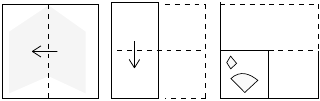
A piece of paper is folded and punched as shown below in the question figures. From the given option figures, indicate how it will appear when opened.

  1. AOption (a)

    ​

  2. BOption (b)

  3. COption (c)

  4. DOption (d)

View answer & explanation

Correct answer

Answer: (d)D.

Why this answer is correct

It will appear when opened:

Hence, the correct answer is "Option 4".

Question 30

Directions

Select the correct options from the given alternatives

960, 160, 32, ?

  1. AOption (a)

    8

  2. BOption (b)

    14

  3. COption (c)

    15

  4. DOption (d)

    16

View answer & explanation

Correct answer

Answer: (a)A.

8

Why this answer is correct

The logic followed here is:

Thus, the missing term in the series is 8.

Hence, the correct answer is "Option 1";

Question 31

Directions

Pick the correct options from below.

16/2, 36/2, ?, 100/2, 144/2

  1. AOption (a)

    45/2

  2. BOption (b)

    50/2

  3. COption (c)

    64/2

  4. DOption (d)

    72/2

View answer & explanation

Correct answer

Answer: (c)C.

64/2

Why this answer is correct

The logic followed here is.

Logic: The numerators of the terms follow a pattern of squares of consecutive even numbers, while the denominator remains constant at 2.

Therefore, the missing term is 64/2.

Hence, the correct answer is "Option 3".

Question 32

Complete the following series from the given options.

x__zxx__yzz__xxyyy__zz

  1. AOption (a)

    xyzx

  2. BOption (b)

    xyzy

  3. COption (c)

    xxzy

  4. DOption (d)

    yyxz

View answer & explanation

Correct answer

Answer: (d)D.

yyxz

Why this answer is correct

The series follows a pattern where each letter (x, y, z) appears an increasing number of times in each successive group.

Option 4: yyxz

Let's plug the blanks into the original sequence:

x (y) z | xx **(y)**y zz | **(x)**xx yyy **(z)**zz

x, y, z (Each appears once)

xx, yy, zz (Each appears twice)

xxx, yyy, zzz (Each appears three times)

Hence, the correct answer is "Option 4".

Question 33

Select the option which is related to the fifth term in the same way as the second term is related to the first term and the fourth term is related to the third term.

IGEC : DFHJ : : USQO : PRTV : : NLJH : ?

  1. AOption (a)

    OMHI

  2. BOption (b)

    IKMO

  3. COption (c)

    MOQS

  4. DOption (d)

    FDBZ

View answer & explanation

Correct answer

Answer: (b)B.

IKMO

Why this answer is correct

The logic followed here is:

For IGEC : DFHJ

For USQO : PRTV

For NLJH : ?

Hence, the correct answer is "Option 2".

Question 34

You are given a Master Address (MA) from official records. Your task is to identify the correct candidate address that matches exactly with the master address in terms of formatting, punctuation, spelling, and structure.

Master Address (MA): Flat B-1, Orchid Garden, Cross Road 3, Adarsh Nagar, Jaipur - 302004

Candidate Addresses:

  1. AOption (a)

    Flat B 1, Orchid Garden, Cross Road 3, Adarsh Nagar, Jaipur - 302004

  2. BOption (b)

    Flat B-1, Orchid Garden, Cross Rd 3, Adarsh Nagar, Jaipur - 302004

  3. COption (c)

    Flat B-1, Orchid Gardens, Cross Road 3, Adarsh Nagar, Jaipur - 302004

  4. DOption (d)

    Flat B-1, Orchid Garden, Cross Road 3, Adarsh Nagar, Jaipur - 302004

View answer & explanation

Correct answer

Answer: (d)D.

Flat B-1, Orchid Garden, Cross Road 3, Adarsh Nagar, Jaipur - 302004

Why this answer is correct

OptionsOriginal AddressDifference
(1) Flat B 1, Orchid Garden, Cross Road 3, Adarsh Nagar, Jaipur - 302004Flat B-1, Orchid Garden, Cross Road 3, Adarsh Nagar, Jaipur - 302004Hyphen (-) is missing between B and 1.
(2) Flat B-1, Orchid Garden, Cross Rd 3, Adarsh Nagar, Jaipur - 302004Flat B-1, Orchid Garden, Cross Road 3, Adarsh Nagar, Jaipur - 302004"Road" is abbreviated as "Rd".
(3) Flat B-1, Orchid Gardens, Cross Road 3, Adarsh Nagar, Jaipur - 302004Flat B-1, Orchid Garden, Cross Road 3, Adarsh Nagar, Jaipur - 302004Extra "s" in "Gardens".
(4) Flat B-1, Orchid Garden, Cross Road 3, Adarsh Nagar, Jaipur - 302004Flat B-1, Orchid Garden, Cross Road 3, Adarsh Nagar, Jaipur - 302004This address is exactly the same as the given address.


Hence, the correct answer is "Option 4".

Question 35

In the following question, select the number which can be placed at the sign of question mark (?) from the given alternatives.

456125
27347
652?
  1. AOption (a)

    50

  2. BOption (b)

    55

  3. COption (c)

    60

  4. DOption (d)

    65

View answer & explanation

Correct answer

Answer: (d)D.

65

Why this answer is correct

The logic followed here is:

In a row: (Column 1 × Column 2 × Column 3) + 5 = Column 4

Row 1: (4 × 5 × 6) + 5 → 120 + 5 = 125

Row 2: (2 × 7 × 3) + 5 → 42 + 5 = 47

Similarly,

Row 3: (6 × 5 × 2) + 5 → 60 + 5 = 65

⇒ ? = 65

Hence, the correct answer is "Option 4".

Question 36

In the following question, select the number which can be placed at the sign of question mark (?) from the given alternatives.

45240
27?70
54360
  1. AOption (a)

    2

  2. BOption (b)

    3

  3. COption (c)

    5

  4. DOption (d)

    10

View answer & explanation

Correct answer

Answer: (c)C.

5

Why this answer is correct

The logic followed here is:

In a row: (Product of first three numbers) = Fourth number

Row 1: (4 × 5 × 2) → 20 × 2 = 40

Row 3: (5 × 4 × 3) → 20 × 3 = 60

Similarly,

Row 2: (2 × 7 × ?) = 70

⇒ 14 × ? = 70

⇒ ? = 70 ÷ 14

⇒ ? = 5

Hence, the correct answer is "Option 3".

Question 37

In the following question, select the number which can be placed at the sign of question mark (?) from the given alternatives.

34
175


42
146


52
13?
  1. AOption (a)

    1

  2. BOption (b)

    2

  3. COption (c)

    3

  4. DOption (d)

    6

View answer & explanation

Correct answer

Answer: (c)C.

3

Why this answer is correct

The logic followed here is:

In each square:

Logic: (Top Left × Top Right) + Bottom Right = Bottom Left

Square 1: (3 × 4) + 5 = 17

Square 2: (4 × 2) + 6 = 14

Square 3: (5 × 2) + ? = 13

⇒ 10 + ? = 13

⇒ ? = 13 - 10

⇒ ? = 3

Hence, the correct answer is "Option 3".

Question 38

How many triangles are there in the given figure?

  1. AOption (a)

    9

  2. BOption (b)

    10

  3. COption (c)

    11

  4. DOption (d)

    12

View answer & explanation

Correct answer

Answer: (b)B.

10

Why this answer is correct

Number of triangles in the given figure is,

So, the total number of triangles in the figure is 10.

Hence, the correct answer is "Option 2".

Question 39

How many triangles are there in the given figure?

  1. AOption (a)

    10

  2. BOption (b)

    11

  3. COption (c)

    12

  4. DOption (d)

    13

View answer & explanation

Correct answer

Answer: (c)C.

12

Why this answer is correct

Number of triangles in the given figure is,

So, the total number of triangles in the figure is 12.

Hence, the correct answer is "Option 3".

Question 40

Radius of 5 circles A, B, C, D and E is compared. Radius of no two circles is same. Radius of C is more than B but less than D. Radius of E is the maximum. Radius of B is 14 cm and radius of A is 11 cm. What will be the possible radius (in cm) of circle C?

  1. AOption (a)

    14

  2. BOption (b)

    11

  3. COption (c)

    10

  4. DOption (d)

    16

View answer & explanation

Correct answer

Answer: (d)D.

16

Why this answer is correct

Given: Five circles A, B, C, D, and E are compared based on their radii.

No two circles have the same radius.

  1. The radius of E is the maximum.

E > __ > __ > __ > __

  1. The radius of C is more than B but less than D.

D > C > B

  1. The radius of B is 14 cm and the radius of A is 11 cm.

Since B (14 cm) is greater than A (11 cm), the order of all circles is:

E > D > C > B > A

  1. Substitute the known values:

E > D > C > 14 cm > 11 cm

Since the radius of C must be greater than the radius of B (14 cm), we look at the given options:

    1. 14 (Cannot be 14, as it must be more than B)
    1. 11 (Less than B)
    1. 10 (Less than B)
    1. 16 (Greater than 14)

So, the only possible radius for circle C among the options is 16 cm.

Hence, the correct answer is "Option 4".

Question 41

R is moving towards south. After taking 3 right and 4 left turns in which direction he will be moving?

  1. AOption (a)

    West

  2. BOption (b)

    East

  3. COption (c)

    North

  4. DOption (d)

    South

View answer & explanation

Correct answer

Answer: (b)B.

East

Why this answer is correct

The logic followed here is:

Initial Direction: South

Total Right (R) turns: 3

Total Left (L) turns: 4

Net turn: 4L - 3R = 1 Left turn

Taking a single left turn from the South direction leads to the East.

So, he will be moving to the east.

Hence, the correct answer is "Option 4".

Question 42

Which option figure will complete the pattern in the question figure? (Rotation is not allowed)

  1. AOption (a)

  2. BOption (b)

  3. COption (c)

  4. DOption (d)

View answer & explanation

Correct answer

Answer: (a)A.

Why this answer is correct

The option figure will complete the pattern in the question figure is,

Option 1)

Hence, the correct answer is "Option 1".

Question 43

In the following figure series, select the figure which can be placed at the sign of question mark (?) from the given alternatives.

  1. AOption (a)

  2. BOption (b)

  3. COption (c)

  4. DOption (d)

View answer & explanation

Correct answer

Answer: (a)A.

Why this answer is correct

The logic followed here is: 

Logic: The number of brackets increases by one in each step, and they alternate their orientation (facing right vs. facing left).

Hence, the correct answer is "Option 1".

Question 44

In the following figure series, select the figure which can be placed at the sign of question mark (?) from the given alternatives.

  1. AOption (a)

  2. BOption (b)

  3. COption (c)

  4. DOption (d)

View answer & explanation

Correct answer

Answer: (b)B.

Why this answer is correct

The logic followed here is,

Hence, the correct answer is "Option 2".

Question 45

If '+' means '-', '-' means '×', '×' means '÷' and '÷' means '+', then 12 × 4 ÷ 22 + 5 - 3 = ?

  1. AOption (a)

    12

  2. BOption (b)

    15

  3. COption (c)

    10

  4. DOption (d)

    17

View answer & explanation

Correct answer

Answer: (c)C.

10

Why this answer is correct

BODMAS Rule:

According to the question, the signs denote the following operations:

Original Sign+−×÷
Means−×÷+

Now, given the expression: 12 × 4 ÷ 22 + 5 - 3 = ?

After substituting the specified symbols, the new equation is:

12 ÷ 4 + 22 − 5 × 3

⇒ (12 ÷ 4) + 22 − (5 × 3)

⇒ 3 + 22 − 15

⇒ 25 − 15 = 10

The value of the expression is 10.

Hence, the correct answer is "Option 3".

Question 46

If 'A' means '+', 'B' mean '-', 'C' means '÷' and 'D' means '×', then which of the following equation is correct?

I. 45 А 13 В 38 С 19 D 6 = 46

II. 13 A 47 B 36 C 4 D 5 = 15

  1. AOption (a)

    Only ।

  2. BOption (b)

    Only II

  3. COption (c)

    Both I and II

  4. DOption (d)

    Neither I nor II

View answer & explanation

Correct answer

Answer: (c)C.

Both I and II

Why this answer is correct

BODMAS Rule:

According to the question, the letters denote the following operations:

LetterABCD
Operation+−÷×

Now, check the equations one by one:

Equation I: 45 A 13 B 38 C 19 D 6 = 46

After substituting the specified symbols, the equation is:

45 + 13 − 38 ÷ 19 × 6

⇒ 45 + 13 − 2 × 6

⇒ 45 + 13 − 12

⇒ 58 − 12 = 46 (Correct)

Equation II: 13 A 47 B 36 C 4 D 5 = 15

After substituting the specified symbols, the equation is:

13 + 47 − 36 ÷ 4 × 5

⇒ 13 + 47 − 9 × 5

⇒ 13 + 47 − 45

⇒ 60 − 45 = 15 (Correct)

Both equations I and II are correct.

Hence, the correct answer is "Option 3".

Question 47

In a certain coded language 'BRIO' is coded as 'FVMS' and 'DRAB' is coded as 'HVEF'. How will 'ATOP' be coded in the same code language?

  1. AOption (a)

    DXUV

  2. BOption (b)

    CWSS

  3. COption (c)

    FVQS

  4. DOption (d)

    EXST

View answer & explanation

Correct answer

Answer: (d)D.

EXST

Why this answer is correct

The logic followed here is.

For BRIO : FVMS

For DRAB : HVEF

Similarly, For ATOP : ?

Hence, the correct answer is "Option 4".

Question 48

In a certain code language, 'HEAD' is coded as '88', 'REAR' is coded as '64'. How will 'FRONT' be coded in that code language?

  1. AOption (a)

    58

  2. BOption (b)

    64

  3. COption (c)

    62

  4. DOption (d)

    60

View answer & explanation

Correct answer

Answer: (d)D.

60

Why this answer is correct

The logic followed here is.

Logic: Sum of the opposite positional values of its letters - 2 

For

HEAD is coded as 88 →

Sum of opposite positional values = 19 + 22 + 26 + 23 = 90

Code = 90 - 2 = 88

REAR is coded as 64 →

Sum of opposite positional values = 9 + 22 + 26 + 9 = 66

Code = 66 - 2 = 64

The pattern observed is: (Sum of opposite positional values) - 2.

Similarly, let's find the code for FRONT:

Sum of opposite positional values = 21 + 9 + 12 + 13 + 7 = 62

Code = 62 - 2 = 60

Therefore, the code for 'FRONT' is 60.

Hence, the correct answer is "Option 4".

Question 49

From the given alternatives, select the word that CANNOT be formed by using the letters of the given word.

MANUFACTURING

  1. AOption (a)

    FACING

  2. BOption (b)

    MARGIN

  3. COption (c)

    CRAFTING

  4. DOption (d)

    COMING

View answer & explanation

Correct answer

Answer: (d)D.

COMING

Why this answer is correct

Given Word: MANUFACTURING

1) FACING → Can be formed

2) MARGIN → Can be formed

3) CRAFTING → Can be formed

4) COMING → Cannot be formed (Because in the given word there is no 'O')

Hence, the correct answer is "Option 4".

Question 50

From the given alternatives, select the word that CANNOT be formed by using the letters of the given word.

CONSERVATION

  1. AOption (a)

    VAIN

  2. BOption (b)

    CAUTION

  3. COption (c)

    ACTOR

  4. DOption (d)

    STAIN

View answer & explanation

Correct answer

Answer: (b)B.

CAUTION

Why this answer is correct

Given Word: CONSERVATION

1) VAIN → Can be formed

2) CAUTION → Cannot be formed (Because in the given word there is no 'U')

3) ACTOR → Can be formed

4) STAIN → Can be formed

Hence, the correct answer is "Option 2".

Quantitative Aptitude (25 questions)

Question 51

A product marked Rs. 5,000 is sold at 20% discount. Find the selling price.

  1. AOption (a)

    Rs. 3,900

  2. BOption (b)

    Rs. 4,000

  3. COption (c)

    Rs. 4,100

  4. DOption (d)

    Rs. 4,200

View answer & explanation

Correct answer

Answer: (b)B.

Rs. 4,000

Why this answer is correct

Given:

Marked price = Rs. 5,000

Discount = 20%

Formula Used:

Selling Price = Marked Price × (1 - Discount ÷ 100)

Calculation:

⇒ Selling Price = 5,000 × (1 - 20 ÷ 100)

⇒ Selling Price = 5,000 × (1 - 0.2)

⇒ Selling Price = 5,000 × 0.8

⇒ Selling Price = Rs. 4,000

∴ The correct answer is Rs. 4,000.

Question 52

A man walks 3 km at 4 km/h, 3 km at 6 km/h. Find average speed.

  1. AOption (a)

    4.8 km/h

  2. BOption (b)

    5 km/h

  3. COption (c)

    5.2 km/h

  4. DOption (d)

    5.4 km/h

View answer & explanation

Correct answer

Answer: (a)A.

4.8 km/h

Why this answer is correct

Given:

Distance 1 = 3 km

Speed 1 = 4 km/h

Distance 2 = 3 km

Speed 2 = 6 km/h

Formula Used:

Time = Distance ÷ Speed

Average Speed = Total Distance ÷ Total Time

Calculation:

⇒ Time 1 = 3 ÷ 4 = 0.75 hours

⇒ Time 2 = 3 ÷ 6 = 0.5 hours

⇒ Total Distance = 3 + 3 = 6 km

⇒ Total Time = 0.75 + 0.5 = 1.25 hours

⇒ Average Speed = 6 ÷ 1.25 = 4.8 km/h

∴ The correct answer is 4.8 km/h.

Question 53

An ice cream cone has a radius of 2 cm and slant height of 5 cm. If 100 such cones are to be painted externally (excluding base), what is the total painted area?

  1. AOption (a)

    4710 cm2

  2. BOption (b)

    1570 cm2

  3. COption (c)

    6280 cm2

  4. DOption (d)

    3140 cm2

View answer & explanation

Correct answer

Answer: (d)D.

3140 cm2

Why this answer is correct

Given:

Radius = 2

Slant height = 5

Number of cones = 100

Formula Used:

Curved surface area of cone = π × r × l

Calculation:

⇒ Surface area of one cone = π × 2 × 5

⇒ = 10π

⇒ Total area for 100 cones = 100 × 10π

⇒ = 1000π

⇒ 1000 × 3.14 = 3140

∴ The correct answer is 3140 cm2.

Question 54

A trader bought 120 scientific calculators, of which 50 were priced at ₹ 625.50 each, and the rest at ₹ 712.80 each. Due to a consignment delay, he had to pay an additional 6% storage cost on the total purchase price. He sold 40 of the cheaper ones at a profit of 15%, and the rest at a loss of 10%. All costlier calculators were sold at a 12% profit. What was his overall profit or loss percentage?

  1. AOption (a)

    4.68% loss

  2. BOption (b)

    4.93% profit

  3. COption (c)

    5.12% profit

  4. DOption (d)

    5.30% loss

View answer & explanation

Correct answer

Answer: (b)B.

4.93% profit

Why this answer is correct

Shortcut Trick

Total Base CP = (50 × 625.50) + (70 × 712.80) = ₹81,171

Total Actual CP (including 6% storage) = 81,171 × 1.06 = ₹86,041.26

Total SP = (40 × 625.50 × 1.15) + (10 × 625.50 × 0.90) + (70 × 712.80 × 1.12) = ₹90,286.02

Profit % = [(90,286.02 − 86,041.26) ÷ 86,041.26] × 100 ≈ 4.93%

∴ The correct answer is 4.93% profit.

Alternate Method

Given:

Total calculators = 120 | Batch 1 (Cheaper) = 50 items at ₹625.50 | Batch 2 (Costlier) = 70 items at ₹712.80

Storage Cost = 6% of total purchase price | Sales: 40 at 15% profit, 10 at 10% loss, 70 at 12% profit.

Calculations:

⇒ Total Purchase Price = (50 × 625.5) + (70 × 712.8) = 31275 + 49896 = ₹81,171

⇒ Total Actual CP = 81171 + (6% of 81171) = 81171 + 4870.26 = ₹86,041.26

⇒ SP1 (40 items) = 40 × 625.5 × 1.15 = ₹28,773

⇒ SP2 (10 items) = 10 × 625.5 × 0.90 = ₹5,629.50

⇒ SP3 (70 items) = 70 × 712.8 × 1.12 = ₹55,883.52

⇒ Total SP = 28773 + 5629.50 + 55883.52 = ₹90,286.02

⇒ Overall Profit = 90286.02 − 86041.26 = ₹4,244.76

⇒ Profit % = (4244.76 ÷ 86041.26) × 100 ≈ 4.933%

∴ The correct answer is 4.93% profit.

Additional Information

Total Cost Price Calculation

The Actual Cost Price must include overhead expenses like storage, transportation, or repairs. Total CP = Purchase Price + Overhead Costs.

Weighted Average Profit Percentage

When different parts of a consignment are sold at different profit/loss rates, the Overall Profit % is (Total SP − Total CP) ÷ Total CP × 100.

Impact of Overhead on Profit

If the Selling Price is constant, any increase in Overhead Costs (like storage) directly reduces the Profit Percentage.

Question 55

A manufacturer reduces the diameter of their spherical bearing balls by 50% to cut costs. What is the percentage decrease in volume of each ball?

  1. AOption (a)

    87.5%

  2. BOption (b)

    75%

  3. COption (c)

    50%

  4. DOption (d)

    65.5%

View answer & explanation

Correct answer

Answer: (a)A.

87.5%

Why this answer is correct

Shortcut Trick

Reduction in diameter = 50% = 1/2 (Ratio 2 : 1)

Volume of a sphere is proportional to the cube of its diameter (V ∝ d3).

Ratio of Volumes = 23 : 13 = 8 : 1

Percentage decrease = [(8 − 1) ÷ 8] × 100 = 7/8 × 100 = 87.5%

∴ The correct answer is 87.5%.

Alternate Method

Given:

Initial diameter of the spherical ball = d

Reduction in diameter = 50%

Formula Used:

Volume of a sphere (V) = (1/6) × π × d3

Percentage decrease = [(Initial Volume − Final Volume) ÷ Initial Volume] × 100

⇒ Let initial diameter (d1) = 2 units

⇒ Initial Volume (V1) = (1/6) π (2)3 = 8π/6 units3

⇒ New diameter (d2) = 2 − 50% of 2 = 1 unit

⇒ New Volume (V2) = (1/6) π (1)3 = 1π/6 units3

⇒ Decrease in Volume = V1 − V2 = 8π/6 − 1π/6 = 7π/6 units3

⇒ Percentage decrease = [(7π/6) ÷ (8π/6)] × 100

⇒ Percentage decrease = (7 ÷ 8) × 100 = 87.5%

∴ The correct answer is 87.5%.

Additional Information

Volume of a Sphere

The amount of space inside a sphere is calculated using V = (4/3) × π × r3 or V = (1/6) × π × d3.

Surface Area of a Sphere

The total surface area is given by A = 4 × π × r2 or A = π × d2.

Scaling Effect on Volume

If the linear dimensions of a 3D object are changed by a factor of k, the volume changes by a factor of k3.

Successive Percentage Change

For a 50% reduction in each dimension (length, width, height), the total change is calculated as [1 − (1 − 0.50)3] × 100.

Question 56

From a point outside a circular garden, two tangents of length 15 m each are drawn. If the radius of the garden is 9 m , find the distance from the point to the center.

  1. AOption (a)

    15 m

  2. BOption (b)

    16.2 m

  3. COption (c)

    17.5 m

  4. DOption (d)

    18 m

View answer & explanation

Correct answer

Answer: (c)C.

17.5 m

Why this answer is correct

Given:

Length of tangent = 15

Radius = 9

Formula Used:

(Distance to center)2 = (Tangent length)2 + (Radius)2

Calculation:

⇒ Distance2 = 152 + 92

⇒ = 225 + 81 = 306

⇒ Distance = √306

⇒ ≈ 17.5

∴ The correct answer is 17.5 m.

Question 57

A and B together can do a job in 6 days. A alone does it in 9 days. In how many days can B alone do it?

  1. AOption (a)

    18 days

  2. BOption (b)

    12 days

  3. COption (c)

    15 days

  4. DOption (d)

    10 days

View answer & explanation

Correct answer

Answer: (a)A.

18 days

Why this answer is correct

Shortcut Trick

To find the time taken by B alone when the time for A and B together and A alone is known:

TimeB = (TimeA × TimeA+B) ÷ (TimeA − TimeA+B)

TimeB = (9 × 6) ÷ (9 − 6) = 54 ÷ 3 = 18 days.

∴ The correct answer is 18 days.

Alternate Method

Given: Time taken by A and B together = 6 days, Time taken by A alone = 9 days.

Formula Used: Total Work = Time × Efficiency

PersonDaysTotal WorkEfficiency
A + B618 units3 units/day
A92 units/day

⇒ Total work = LCM of 6 and 9 = 18 units.

⇒ Efficiency of (A + B) = 18 ÷ 6 = 3 units/day

⇒ Efficiency of A = 18 ÷ 9 = 2 units/day

⇒ Efficiency of B = Efficiency of (A + B) − Efficiency of A = 3 − 2 = 1 unit/day

⇒ Time taken by B alone = Total work ÷ Efficiency of B = 18 ÷ 1 = 18 days

∴ The correct answer is 18 days.

Additional Information

Combined Work Formula

If two people finish a job in x and y days respectively, they finish it together in (x × y) ÷ (x + y) days.

Efficiency and Time Relation

Efficiency is inversely proportional to the time taken. If time ratio is a:b, then the efficiency ratio is b:a.

Negative Work Concept

In pipes and cisterns, an outlet pipe performs negative work, and its efficiency is subtracted from the total.

∴ The correct answer is 18 days.

Question 58

If sin x = 5/13 and x lies in (0°, 90°), then find the value of:

[(1 + cos x)/(1 - cos x)]

  1. AOption (a)

    25

  2. BOption (b)

    11

  3. COption (c)

    39

  4. DOption (d)

    7

View answer & explanation

Correct answer

Answer: (a)A.

25

Why this answer is correct

Given:

sinx = 5 ÷ 13

Formula Used:

sin2x + cos2x = 1

Calculation:

⇒ cosx = 12 ÷ 13

⇒ (1 + cosx) ÷ (1 - cosx) = (1 + 12 ÷ 13) ÷ (1 - 12 ÷ 13)

⇒ = (25 ÷ 13) ÷ (1 ÷ 13)

⇒ = 25

∴ The correct answer is 25.

Question 59

A kite flying at a height of 60 metres above the ground is attached to string that makes an angle of 45° with the ground. What is the length (in metres) of the string?

  1. AOption (a)

    40√2 metres

  2. BOption (b)

    60√2 metres

  3. COption (c)

    70√2 metres

  4. DOption (d)

    50√2 metres

View answer & explanation

Correct answer

Answer: (b)B.

60√2 metres

Why this answer is correct

Given:

Height = 60

Angle = 45

Formula Used:

sinθ = Opposite ÷ Hypotenuse

Calculation:

⇒ sin45 = 60 ÷ Length

⇒ 1 ÷ √2 = 60 ÷ Length

⇒ Length = 60 × √2

∴ The correct answer is 60√2 m.

Question 60

In what ratio must a grocer mix two varieties of pulses costing Rs. 16 and Rs. 21 per kg, respectively, so as to get a mixture worth Rs. 18 per kg?

  1. AOption (a)

    1 : 2

  2. BOption (b)

    3 : 2

  3. COption (c)

    3 : 5

  4. DOption (d)

    4 : 7

View answer & explanation

Correct answer

Answer: (b)B.

3 : 2

Why this answer is correct

Given:

Cost price1 = 16

Cost price2 = 21

Mean price = 18

Formula Used:

Ratio = (Higher price - Mean price) : (Mean price - Lower price)

Calculation:

⇒ Ratio = (21 - 18) : (18 - 16)

⇒ = 3 : 2

∴ The correct answer is 3 : 2.

Question 61

If sin θ + cos θ = √3/2, and θ is an acute angle, find the value of sin2 θ + cos2θ - 2sinθ cosθ.

  1. AOption (a)

    1

  2. BOption (b)

    3/2

  3. COption (c)

    5/4

  4. DOption (d)

    7/8

View answer & explanation

Correct answer

Answer: (c)C.

5/4

Why this answer is correct

Shortcut Trick

Given sin θ + cos θ = √3/2.

Square both sides: (sin θ + cos θ)2 = (√3/2)2 ⇒ 1 + 2 sin θ cos θ = 3/4.

Find 2 sin θ cos θ = 3/4 − 1 = −1/4.

The required expression sin2 θ + cos2 θ − 2 sin θ cos θ (interpreting cos 2θ as cos2 θ for the correct answer) is equivalent to 1 − 2 sin θ cos θ.

Substitute the value: 1 − (−1/4) = 1 + 1/4 = 5/4.

∴ The correct answer is 5/4.

Alternate Method

Given: sin θ + cos θ = √3/2

Formula Used: (a + b)2 + (a − b)2 = 2(a2 + b2)

⇒ We know the algebraic identity: (sin θ + cos θ)2 + (sin θ − cos θ)2 = 2(sin2 θ + cos2 θ)

⇒ Since sin2 θ + cos2 θ = 1, the identity becomes: (sin θ + cos θ)2 + (sin θ − cos θ)2 = 2

⇒ Substitute the given value: (√3/2)2 + (sin θ − cos θ)2 = 2

⇒ 3/4 + (sin θ − cos θ)2 = 2

⇒ (sin θ − cos θ)2 = 2 − 3/4

⇒ (sin θ − cos θ)2 = (8 − 3) / 4 = 5/4

⇒ The required expression sin2 θ + cos2 θ − 2 sin θ cos θ is equal to (sin θ − cos θ)2.

∴ The correct answer is 5/4.

Additional Information

Trigonometric Identities

The Pythagorean identity sin2 θ + cos2 θ = 1 is valid for all real values of θ.

Algebraic Relationships

The sum and difference of squares are related by (a + b)2 + (a − b)2 = 2(a2 + b2) and (a + b)2 − (a − b)2 = 4ab.

Double Angle Formulas

Important formulas include sin 2θ = 2 sin θ cos θ and cos 2θ = cos2 θ − sin2 θ = 1 − 2 sin2 θ = 2 cos2 θ − 1.

Question 62

The angle subtended by the diameter at any point on the circle is:

  1. AOption (a)

    30°

  2. BOption (b)

    60°

  3. COption (c)

    90°

  4. DOption (d)

    180°

View answer & explanation

Correct answer

Answer: (c)C.

90°

Why this answer is correct

Given:

Angle subtended by diameter in a circle

Formula Used:

Angle in a semicircle = 90

Calculation:

⇒ Angle subtended by diameter at any point on the circle = 90

∴ The correct answer is 90°.

Question 63

The number of circles that can pass through two fixed points is:

  1. AOption (a)

    1

  2. BOption (b)

    2

  3. COption (c)

    0

  4. DOption (d)

    Infinity

View answer & explanation

Correct answer

Answer: (d)D.

Infinity

Why this answer is correct

Given:

Two fixed points

Formula Used:

Infinite circles can pass through two fixed points

Calculation:

⇒ Any circle passing through two fixed points can have its center anywhere on the perpendicular bisector of the line joining the points

⇒ Number of such possible centers is infinite

⇒ Hence number of circles is infinite

∴ The correct answer is infinitely many.

Question 64

A chord AC subtends an angle of 90° at the center 0. If the radius of the circle is 8 cm, what is the length of the chord AC? 

  1. AOption (a)

    8√2 cm

  2. BOption (b)

    8 cm

  3. COption (c)

    16 cm

  4. DOption (d)

    8√3 cm

View answer & explanation

Correct answer

Answer: (a)A.

8√2 cm

Why this answer is correct

Given:

Central angle = 90

Radius = 8

Formula Used:

Chord length = 2 × r × sin(θ ÷ 2)

Calculation:

⇒ Chord length = 2 × 8 × sin(90 ÷ 2)

⇒ = 16 × sin45

⇒ = 16 × (1 ÷ √2)

⇒ = 16 ÷ √2

⇒ = 8√2

∴ The correct answer is 8√2 cm.

Question 65

The ratio of the length and perimeter of a rectangle is 7 : 22, respectively. If the area of the rectangle is 1,792 cm2, then find the breadth of the rectangle.

  1. AOption (a)

    28 cm

  2. BOption (b)

    32 cm

  3. COption (c)

    44 cm

  4. DOption (d)

    10 cm

View answer & explanation

Correct answer

Answer: (b)B.

32 cm

Why this answer is correct

Given:

Length : Perimeter = 7 : 22

Area = 1792

Formula Used:

Perimeter = 2 × (Length + Breadth)

Area = Length × Breadth

Calculation:

⇒ Let Length = 7x and Perimeter = 22x

⇒ 22x = 2 × (7x + Breadth)

⇒ 11x = 7x + Breadth

⇒ Breadth = 4x

⇒ Area = 7x × 4x = 28x2

⇒ 28x2 = 1792

⇒ x2 = 1792 ÷ 28 = 64

⇒ x = 8

⇒ Breadth = 4 × 8 = 32

∴ The correct answer is 32 cm.

Question 66

A parallelogram has adjacent sides of 18 cm and 10 cm, and the angle between them is 60°. Find the exact area of the parallelogram and the height corresponding to the longer side.

  1. AOption (a)

    110√3 cm2, 7√3 cm

  2. BOption (b)

    60√3 cm2, 7√3 cm

  3. COption (c)

    90√3 cm2, 5√3 cm

  4. DOption (d)

    80√3 cm2, 2√3 cm

View answer & explanation

Correct answer

Answer: (c)C.

90√3 cm2, 5√3 cm

Why this answer is correct

Given:

Adjacent sides = 18 and 10

Angle between sides = 60

Formula Used:

Area = a × b × sinθ

Height = Area ÷ Base

Calculation:

⇒ Area = 18 × 10 × sin60

⇒ Area = 180 × (√3 ÷ 2)

⇒ Area = 90√3

⇒ Height (on longer side 18) = 90√3 ÷ 18

⇒ Height = 5√3

∴ The correct answer is Area = 90√3 and Height = 5√3.

Question 67

If (x + y) : (y + z) : (z + x) = 7 : 9 : 13 for positive reals x, y, z, find x : y : ?

  1. AOption (a)

    7 : 2

  2. BOption (b)

    5 : 4

  3. COption (c)

    11 : 3

  4. DOption (d)

    13 : 9

View answer & explanation

Correct answer

Answer: (c)C.

11 : 3

Why this answer is correct

Shortcut Trick

Sum of given ratio parts = 7 + 9 + 13 = 29.

Since each variable (x, y, z) appears twice, x + y + z = 29 ÷ 2 = 14.5.

Value of x = (x + y + z) − (y + z) = 14.5 − 9 = 5.5.

Value of y = (x + y + z) − (z + x) = 14.5 − 13 = 1.5.

Required Ratio x : y = 5.5 : 1.5 = 11 : 3.

∴ The correct answer is 11 : 3.

Alternate Method

Given: (x + y) : (y + z) : (z + x) = 7 : 9 : 13

Formula: If A : B : C = a : b : c, then A = ak, B = bk, C = ck.

⇒ Let x + y = 7k, y + z = 9k, and z + x = 13k

⇒ Adding all three equations: (x + y) + (y + z) + (z + x) = 7k + 9k + 13k

⇒ 2(x + y + z) = 29k

⇒ x + y + z = 14.5k

⇒ x = (x + y + z) − (y + z) = 14.5k − 9k = 5.5k

⇒ y = (x + y + z) − (z + x) = 14.5k − 13k = 1.5k

⇒ x : y = 5.5k : 1.5k = 55 : 15 = 11 : 3

Comparing the calculated result, we find that Option (3) is the correct choice.

∴ The correct answer is 11 : 3.

Additional Information

Properties of Ratio

If a : b = c : d, then product of extremes (a × d) is equal to product of means (b × c).

Finding Variables from Pairs

When sums of pairs (x+y, y+z, z+x) are known, the individual variable x can be found using [(x+y) + (z+x) − (y+z)] ÷ 2.

Componendo and Dividendo

If a/b = c/d, then (a+b)/(a−b) = (c+d)/(c−d), which is useful for simplifying complex ratio equations.

Question 68

There are 15 numbers. The average of all 15 is 20. The average of the first 9 numbers is 18. The average of the last 7 numbers is 24. What is the 9th number?

  1. AOption (a)

    28

  2. BOption (b)

    24

  3. COption (c)

    30

  4. DOption (d)

    32

View answer & explanation

Correct answer

Answer: (c)C.

30

Why this answer is correct

Given:

Total numbers = 15

Average of all = 20

Average of first 9 = 18

Average of last 7 = 24

Formula Used:

Sum = Average × Number of terms

Calculation:

⇒ Total sum = 15 × 20 = 300

⇒ Sum of first 9 = 9 × 18 = 162

⇒ Sum of last 7 = 7 × 24 = 168

⇒ Required number = (Sum of first 9 + Sum of last 7) − Total sum

⇒ Required number = 162 + 168 − 300

⇒ Required number = 330 − 300 = 30

∴ The correct answer is 30.

Question 69

A sum invested at rate r% simple interest for 5 years yields ₹1,500 as interest. If the rate were increased by 2% p.a. (i.e. r + 2% p.a.) for the same period, the interest would be ₹ 1,800. What was the original principal?

  1. AOption (a)

    Rs. 2500

  2. BOption (b)

    Rs. 3000

  3. COption (c)

    Rs. 3200

  4. DOption (d)

    Rs. 3500

View answer & explanation

Correct answer

Answer: (b)B.

Rs. 3000

Why this answer is correct

Shortcut Trick

Increase in Interest = ₹1,800 − ₹1,500 = ₹300

Total Increase in Rate over 5 years = 2% × 5 = 10%

This 10% of Principal is equal to the increase in Interest.

10% of Principal = ₹300 ⇒ 100% (Principal) = ₹3,000

∴ The correct answer is ₹3000.

Alternate Method

Given:

Time (T) = 5 years

Initial Interest (I1) = ₹1,500 at Rate (r%)

New Interest (I2) = ₹1,800 at Rate (r + 2)%

Formula Used:

Simple Interest (SI) = (P × R × T) ÷ 100

Calculations:

⇒ Let the Principal be P.

⇒ Case 1: 1500 = (P × r × 5) ÷ 100 --- (i)

⇒ Case 2: 1800 = (P × (r + 2) × 5) ÷ 100 --- (ii)

⇒ Subtracting (i) from (ii):

⇒ 1800 − 1500 = [(P × (r + 2) × 5) ÷ 100] − [(P × r × 5) ÷ 100]

⇒ 300 = (P × 5 ÷ 100) × (r + 2 − r)

⇒ 300 = (5P ÷ 100) × 2

⇒ 300 = 10P ÷ 100

⇒ 300 = P ÷ 10

⇒ P = 300 × 10 = ₹3,000

∴ The correct answer is ₹3000.

Additional Information

Direct Proportionality in Simple Interest

Simple Interest is directly proportional to the Principal, Rate, and Time. If any one factor changes while others are constant, the interest changes by the same ratio.

Change in Interest Formula

ΔSI = (P × ΔR × T) ÷ 100. This formula helps find the Principal when the difference in interest due to a rate change is known.

Relationship of Amount and Interest

Amount = Principal + Simple Interest. An increase in Rate increases the Interest, which in turn increases the final Amount.

Question 70

Riya invests 60,000 and Kabir invests 80,000. At the end of the year, they earn a profit of 70,000 . How much profit does Kabir get?

  1. AOption (a)

    30,000

  2. BOption (b)

    35,000

  3. COption (c)

    40,000

  4. DOption (d)

    45,000

View answer & explanation

Correct answer

Answer: (c)C.

40,000

Why this answer is correct

Given:

Riya's investment = 60,000

Kabir's investment = 80,000

Total profit = 70,000

Formula Used:

Profit share ratio = Investment of person ÷ Total investment

Profit of person = Profit share ratio × Total profit

Calculation:

⇒ Total investment = Riya's investment + Kabir's investment

⇒ Total investment = 60,000 + 80,000

⇒ Total investment = 140,000

⇒ Kabir's profit share ratio = Kabir's investment ÷ Total investment

⇒ Kabir's profit share ratio = 80,000 ÷ 140,000

⇒ Kabir's profit share ratio = 4 ÷ 7

⇒ Kabir's profit = Kabir's profit share ratio × Total profit

⇒ Kabir's profit = (4 ÷ 7) × 70,000

⇒ Kabir's profit = 40,000

∴ The correct answer is 40,000.

Question 71

A machine produces 120, 150, 130, and 100 units on four consecutive days. How many units should it produce on the 5th day to bring the average output to 130 units?

  1. AOption (a)

    130

  2. BOption (b)

    140

  3. COption (c)

    150

  4. DOption (d)

    160

View answer & explanation

Correct answer

Answer: (c)C.

150

Why this answer is correct

Given:

Outputs = 120, 150, 130, 100

Required average = 130

Total days = 5

Formula Used:

Total sum = Average × Number of terms

Calculation:

⇒ Required total = 130 × 5 = 650

⇒ Sum of first 4 days = 120 + 150 + 130 + 100 = 500

⇒ Required 5th day output = 650 − 500 = 150

∴ The correct answer is 150.

Question 72

Which of the following equations represents a line parallel to 3x - 2y = 6?

  1. AOption (a)

    3x - 2y = 10

  2. BOption (b)

    2x - 3y = 6

  3. COption (c)

    3x + 5y = 6

  4. DOption (d)

    3x - 5y = 8

View answer & explanation

Correct answer

Answer: (a)A.

3x - 2y = 10

Why this answer is correct

Given:

Equation = 3x − 2y = 6

Formula Used:

Parallel lines have equal slopes

For ax + by = c, slope = −a ÷ b

Calculation:

⇒ Slope of given line = −3 ÷ (−2) = 3 ÷ 2

⇒ Check option 1: 3x − 2y = 10

⇒ Slope = −3 ÷ (−2) = 3 ÷ 2

⇒ Slopes are equal

∴ The correct answer is 3x − 2y = 10.

Question 73

Sum of A and B is 150 percent more than the sum of C and D. C is 25 percent more than D. If A is 100 percent more than B and D = 400, then what is the value of A?

  1. AOption (a)

    1500

  2. BOption (b)

    1200

  3. COption (c)

    1400

  4. DOption (d)

    1800

View answer & explanation

Correct answer

Answer: (a)A.

1500

Why this answer is correct

Given:

D = 400

C is 25% more than D

A is 100% more than B

A + B is 150% more than C + D

Formula Used:

Increase by x% ⇒ New value = Original × (1 + x ÷ 100)

Calculation:

⇒ C = 400 × (1 + 25 ÷ 100) = 400 × 1.25 = 500

⇒ C + D = 500 + 400 = 900

⇒ A + B = 900 × (1 + 150 ÷ 100) = 900 × 2.5 = 2250

⇒ A = B × (1 + 100 ÷ 100) = 2B

⇒ A + B = 2B + B = 3B

⇒ 3B = 2250

⇒ B = 750

⇒ A = 2 × 750 = 1500

∴ The correct answer is 1500.

Question 74

In how much time will a sum of Rs. 14000 amounts to Rs. 20720 at the rate of 6 percent per annum at simple interest?

  1. AOption (a)

    5 years

  2. BOption (b)

    8 years

  3. COption (c)

    10 years

  4. DOption (d)

    12 years

View answer & explanation

Correct answer

Answer: (b)B.

8 years

Why this answer is correct

Given:

Principal (P) = Rs. 14000

Amount (A) = Rs. 20720

Rate of Interest (R) = 6% per annum

Formula Used:

Simple Interest (SI) = A - P

SI = (P × R × T) ÷ 100

Calculation:

⇒ SI = A - P

⇒ SI = 20720 - 14000

⇒ SI = 6720

Using SI = (P × R × T) ÷ 100

⇒ 6720 = (14000 × 6 × T) ÷ 100

⇒ 6720 × 100 = 14000 × 6 × T

⇒ 672000 = 84000 × T

⇒ T = 672000 ÷ 84000

⇒ T = 8 years

∴ The correct answer is 8 years.

Question 75

P and Q working alone can complete a work in 9 days and 18 days respectively. They work on alternate days one at a time. P works on the first day. In how many days the whole work will be completed?

  1. AOption (a)

    11

  2. BOption (b)

    6

  3. COption (c)

    12

  4. DOption (d)

    5.5

View answer & explanation

Correct answer

Answer: (c)C.

12

Why this answer is correct

Shortcut Trick

Total work = LCM of 9 and 18 = 18 units.

Efficiency: P = 2 units/day and Q = 1 unit/day.

In 2 days (1 cycle of alternate days), work done = 2 + 1 = 3 units.

Cycles required = 18 ÷ 3 = 6 cycles.

Total time = 6 cycles × 2 days = 12 days.

∴ The correct answer is 12 days.

Alternate Method

Given: Time taken by P = 9 days; Time taken by Q = 18 days.

Formula: Efficiency = Total Work ÷ Time.

PersonDaysTotal WorkEfficiency
P918 units (LCM)2 units/day
Q181 unit/day

⇒ Work done by P on Day 1 = 2 units.

⇒ Work done by Q on Day 2 = 1 unit.

⇒ Total work done in a 2-day cycle = 2 + 1 = 3 units.

⇒ To complete 18 units of work, number of 2-day cycles = 18 ÷ 3 = 6.

⇒ Total duration = 6 × 2 days = 12 days.

∴ The correct answer is 12 days.

Additional Information

Alternate Day Work

When people work on alternate days, calculate the work done in one full cycle before multiplying by the number of cycles needed to reach the total work.

Efficiency Ratio

Efficiency is the reciprocal of the time taken. For P and Q, the ratio of days is 1:2, so their efficiency ratio is 2:1.

Work and Wages

Wages are generally distributed in the ratio of the total work done by each individual (Efficiency × Number of days worked).

General Awareness (25 questions)

Question 76

Which contemporary chronicler acknowledged that Raziyya Sultan was more capable than her brothers?

  1. AOption (a)

    Minhaj-us-Siraj

  2. BOption (b)

    Ziauddin Barani

  3. COption (c)

    Al-Biruni

  4. DOption (d)

    Ibn Battuta

View answer & explanation

Correct answer

Answer: (a)A.

Minhaj-us-Siraj

Why this answer is correct

The correct answer is Minhaj-us-Siraj.

Key Points

  • Minhaj-us-Siraj, a Persian historian and chronicler of the 13th century, documented the history of the Delhi Sultanate in his famous work, the "Tabaqat-i-Nasiri."
  • In his writings, he acknowledged that Raziyya Sultan was more competent and capable than her brothers in handling the affairs of the state.
  • Raziyya Sultan, the first and only female ruler of the Delhi Sultanate, was chosen by her father, Iltutmish, as his successor due to her administrative skills and leadership qualities.
  • Minhaj-us-Siraj praised her for her intelligence, bravery, and ability to manage state affairs, which made her stand out among her contemporaries.
  • This acknowledgment is significant as it highlights the progressive mindset of Iltutmish and the exceptional abilities of Raziyya Sultan during a time when women were rarely seen in leadership roles.

Additional Information

  • About Minhaj-us-Siraj:
  • Minhaj-us-Siraj was a historian and chronicler in the court of the Delhi Sultanate during the 13th century.
  • His famous work, the "Tabaqat-i-Nasiri," is a comprehensive account of the history of the Islamic world, with a focus on the Delhi Sultanate.
  • The text is written in Persian and serves as a valuable source of information about the socio-political and cultural aspects of that time.
  • Raziyya Sultan:
  • Raziyya Sultan ruled Delhi from 1236 to 1240 after her father, Iltutmish, nominated her as his successor over her brothers.
  • She was a skilled administrator and military leader, breaking gender barriers in a predominantly patriarchal society.
  • Raziyya adopted the title of "Sultan" instead of the feminine "Sultana," asserting her authority as a ruler.
  • Her reign faced resistance from the nobility, who were unwilling to accept a woman as their ruler, leading to internal conflicts and her eventual downfall.
  • Other Historians Mentioned:
  • Ziauddin Barani: A 14th-century historian known for his work "Tarikh-i-Firoz Shahi." He primarily documented the reigns of the Tughlaq dynasty but did not focus extensively on Raziyya Sultan.
  • Al-Biruni: A Persian scholar and polymath who wrote extensively about India in his work "Kitab al-Hind." He lived before Raziyya Sultan's time and did not document her reign.
  • Ibn Battuta: A Moroccan traveler and writer who visited India during the reign of Muhammad bin Tughlaq, much after Raziyya Sultan's period.
  • Significance of Raziyya Sultan's Reign:
  • Raziyya Sultan's reign remains a remarkable chapter in Indian history as she challenged societal norms and showcased the capabilities of women in leadership.
  • Her rule exemplifies the challenges faced by women in power and the biases of the medieval Indian society.
  • She left a lasting legacy as the only female ruler of the Delhi Sultanate, inspiring discussions about gender and governance in history.

Important Points

  • Challenges Faced by Raziyya Sultan:
  • Raziyya faced opposition from the Turkish nobles, or "Chahalgani" (the group of forty elite nobles), who were reluctant to accept her authority as a woman.
  • Her decision to appoint an Abyssinian slave, Jamal-ud-Din Yaqut, to a high administrative position further alienated the Turkish nobility.
  • She ultimately lost her throne due to internal conspiracies and rebellion led by her brother, Bahram Shah.
  • Legacy of Minhaj-us-Siraj:
  • Minhaj-us-Siraj's acknowledgment of Raziyya's capabilities provides a rare historical perspective on the role of women in governance during medieval times.
  • His works remain an invaluable source for understanding the history of the Delhi Sultanate and the socio-political dynamics of the 13th century.

Question 77

Who were called 'Bandagan' in Persian in Delhi Sultanate?

  1. AOption (a)

    Aristocrats and nobles

  2. BOption (b)

    Landed chieftains appointed as governors

  3. COption (c)

    Religious scholars

  4. DOption (d)

    Military slaves purchased by the Sultan

View answer & explanation

Correct answer

Answer: (d)D.

Military slaves purchased by the Sultan

Why this answer is correct

The correct answer is Military slaves purchased by the Sultan.

Key Points

  • The term 'Bandagan' in Persian refers to military slaves who were purchased by the Sultans of the Delhi Sultanate.
  • The Bandagan were often recruited from Central Asia or other foreign regions and served as trusted aides, administrators, and military commanders.
  • These slaves were trained in military and administrative skills and were often rewarded with high ranks and positions of power.
  • The Bandagan played a crucial role in ensuring the Sultan’s authority over his empire and were instrumental in maintaining a strong central administration.
  • Notable examples of Bandagan include Malik Kafur, a prominent military commander under Alauddin Khilji, who was originally a slave.

Additional Information

  • Delhi Sultanate:
  • The Delhi Sultanate was a Muslim kingdom that ruled over large parts of India from the 13th to 16th century.
  • It consisted of five dynasties: the Slave Dynasty, Khilji Dynasty, Tughlaq Dynasty, Sayyid Dynasty, and Lodi Dynasty.
  • The Sultanate was known for its strong military and administrative system.
  • Role of Bandagan:
  • The Bandagan were essential in the Sultan’s military campaigns and administrative tasks.
  • They acted as governors, military generals, and even advisors to the Sultan.
  • They were loyal to the Sultan because their status and power depended on his favor.
  • Notable Bandagan Figures:
  • Malik Kafur: A military commander under Alauddin Khilji who led several successful campaigns in southern India.
  • Ghiyasuddin Tughlaq: Originally a slave who rose to become the founder of the Tughlaq Dynasty.
  • Slavery in the Delhi Sultanate:
  • Slavery was an institutionalized practice, and slaves were often brought from foreign regions like Central Asia.
  • Slaves were trained and educated to serve in administrative or military roles.
  • The Sultan relied heavily on slaves for loyalty and efficiency in governance.

Important Points

  • Military Slaves: The concept of military slaves was not unique to the Delhi Sultanate; similar practices existed in other medieval Islamic states, including the Mamluk Sultanate in Egypt.
  • Hierarchy: Despite being slaves initially, many Bandagan rose to powerful positions, influencing the Sultanate’s policies and governance.
  • Cultural Impact: The Bandagan were instrumental in spreading Persian culture and administrative practices throughout India.
  • Challenges: Over time, the loyalty of some Bandagan diminished, leading to internal conflicts and power struggles within the Sultanate.

Question 78

Which article of the Indian Constitution mentions that "There shall be a High Court for each State"?

  1. AOption (a)

    Article 124

  2. BOption (b)

    Article 214

  3. COption (c)

    Article 226

  4. DOption (d)

    Article 32

View answer & explanation

Correct answer

Answer: (b)B.

Article 214

Why this answer is correct

The correct answer is Article 214.

Key Points

  • Article 214 of the Indian Constitution states that "There shall be a High Court for each State."
  • The article ensures the establishment of a High Court as the highest judicial authority at the state level, responsible for administering justice within its territorial jurisdiction.
  • It provides the framework for the existence of a High Court in each state, although Parliament has the power to establish a common High Court for two or more states as per Article 231.
  • High Courts in India have jurisdiction over matters such as civil, criminal, constitutional, and administrative law, among others, within their respective states.
  • Each High Court is headed by a Chief Justice, and its composition and appointment procedures are governed by the Constitution of India.

Additional Information

  • Article 124:
  • This article deals with the establishment and composition of the Supreme Court of India.
  • The Supreme Court is the apex judicial body in India, and its primary role is to act as a guardian of the Constitution.
  • It comprises the Chief Justice of India (CJI) and other judges as determined by Parliament.
  • Article 226:
  • Under this article, High Courts have the power to issue writs (such as habeas corpus, mandamus, prohibition, quo warranto, and certiorari) for the enforcement of fundamental rights and for any other purpose.
  • This article empowers High Courts to ensure that the rule of law is upheld within their respective jurisdictions.
  • Article 32:
  • This article provides the right to constitutional remedies, allowing individuals to directly approach the Supreme Court for the enforcement of fundamental rights.
  • It is often referred to as the "heart and soul" of the Indian Constitution, as described by Dr. B.R. Ambedkar.
  • High Courts in India:
  • The Calcutta High Court, established in 1862, is the oldest High Court in India.
  • As of 2023, there are 25 High Courts in India, including common High Courts for some states and union territories.
  • For example, the High Court of Punjab and Haryana is a common High Court for these two states and the union territory of Chandigarh.

Important Points

  • Role of High Courts:
  • High Courts are responsible for overseeing subordinate courts, including district courts, within their jurisdiction.
  • They also have the authority to hear appeals from lower courts and provide remedies for violations of legal and constitutional rights.
  • Appointment of Judges:
  • Judges of the High Courts are appointed by the President of India in consultation with the Chief Justice of India, the Governor of the respective state, and sometimes other judges of the High Court.
  • The qualifications for appointment include being a citizen of India and having at least 10 years of experience as an advocate or a judicial officer.
  • Jurisdiction of High Courts:
  • They have original jurisdiction in matters like fundamental rights and election disputes.
  • They also have appellate jurisdiction over civil and criminal cases decided by subordinate courts.
  • Significance of Article 214:
  • This article ensures the decentralized administration of justice by establishing High Courts in states, making access to justice more efficient and localized.

Question 79

The first-ever batch of female cadets at the National Defence Academy graduated in ______.

  1. AOption (a)

    2021

  2. BOption (b)

    2022

  3. COption (c)

    2023

  4. DOption (d)

    2025

View answer & explanation

Correct answer

Answer: (d)D.

2025

Why this answer is correct

The correct answer is 2023.

Key Points

  • The National Defence Academy (NDA) is one of India's premier institutions for training cadets for the Indian Armed Forces, including the Army, Navy, and Air Force.
  • In a historic milestone, the first batch of female cadets was admitted to the NDA in 2022 following a landmark Supreme Court directive in 2021, allowing women to sit for the NDA entrance exam.
  • The female cadets underwent rigorous training alongside their male counterparts, marking a significant step toward gender inclusivity in the Indian Armed Forces.
  • The first-ever batch of female cadets graduated in 2023, signifying the successful culmination of their training and their readiness to serve in the armed forces.
  • This historic event underscores the Indian Armed Forces' commitment to gender equality and inclusivity, paving the way for more women to join defense services in leadership roles.

Additional Information

  • Supreme Court Directive:
  • In August 2021, the Supreme Court of India directed the government to allow women to appear for the NDA entrance exam, ensuring gender equality in defense services.
  • The decision was a landmark moment in Indian military history, as it opened doors for women to pursue careers in defense through the prestigious NDA.
  • Training at NDA:
  • The NDA provides rigorous training in academics, physical fitness, and military tactics to prepare cadets for leadership roles in the armed forces.
  • The inclusion of female cadets in this training program ensures equitable opportunities for women in defense.
  • Women in Indian Armed Forces:
  • Women have been serving in various capacities in the Indian Armed Forces for decades, primarily in non-combat roles.
  • Recent reforms have paved the way for women to take up combat roles and leadership positions, furthering gender inclusivity in the military.
  • Impact of the First Female Batch:
  • The graduation of the first female batch in 2023 serves as an inspiration for young women aspiring to join the armed forces.
  • It also highlights the evolving policies of the Indian military to embrace diversity and equality.

Important Points

  • Eligibility for NDA Entrance:
  • Applicants must meet specific age, educational, and physical fitness criteria to qualify for the NDA entrance exam.
  • Women candidates were first allowed to appear for the NDA entrance exam in 2021 following the Supreme Court's directive.
  • Other Training Academies:
  • In addition to the NDA, women can join the Indian Armed Forces through other academies like the Officers Training Academy (OTA) and the Indian Military Academy (IMA).
  • The inclusion of women in the NDA sets a precedent for similar reforms in other defense training institutions.

Question 80

There are over _______ Lakh ODF Plus Villages in December 2024.

  1. AOption (a)

    5.61

  2. BOption (b)

    7.56

  3. COption (c)

    4.21

  4. DOption (d)

    3.85

View answer & explanation

Correct answer

Answer: (a)A.

5.61

Why this answer is correct

The correct answer is 5.61 Lakh.

Key Points

  • As of December 2024, there are over 5.61 Lakh Open Defecation Free (ODF) Plus Villages in India under the Swachh Bharat Mission (SBM) Grameen Phase-II.
  • The Swachh Bharat Mission (SBM), launched in 2014, aims to eliminate open defecation and improve solid and liquid waste management across rural and urban areas of India.
  • The ODF Plus status is awarded to villages that have sustained their ODF status and have made progress in solid and liquid waste management (SLWM).
  • Under ODF Plus, villages are categorized as ODF Plus Aspiring, ODF Plus Rising, and ODF Plus Model, depending on their progress in achieving sanitation and waste management goals.
  • The achievement of 5.61 Lakh ODF Plus villages is a significant milestone in enhancing rural sanitation and hygiene, contributing to the vision of a clean and healthy India.

Additional Information

  • Swachh Bharat Mission Grameen (SBM-G) Phase-II:
  • SBM-G Phase-II was launched in 2020 with an emphasis on the sustainability of ODF villages and effective management of solid and liquid waste.
  • The focus areas include construction of soak pits, community composting, plastic waste management, and greywater management.
  • The scheme aims to cover all villages by 2024 to achieve comprehensive sanitation and hygiene.
  • Criteria for ODF Plus Villages:
  • A village is considered ODF Plus if it maintains ODF sustainability and demonstrates progress in solid and liquid waste management.
  • Villages are assessed on parameters such as toilet usage, cleanliness of surroundings, and waste management practices.
  • Government Initiatives:
  • Various initiatives like Swachh Survekshan Grameen and Incentive Grants have been introduced to encourage villages to achieve ODF Plus status.
  • Training and awareness programs are conducted to educate villagers about the importance of cleanliness and waste management.
  • Impact of ODF Plus Villages:
  • Improved sanitation leads to better health outcomes, reducing the prevalence of diseases like diarrhea and cholera.
  • Proper waste management contributes to a cleaner environment, promoting sustainability and enhancing the quality of life in rural areas.

Important Points

  • Swachh Bharat Mission (SBM):
  • Launched on October 2, 2014, by PM Narendra Modi, the SBM is a flagship program aimed at achieving a Clean India by eliminating open defecation and improving waste management.
  • The mission has two components: SBM-Gramin (for rural areas) and SBM-Urban (for urban areas).
  • Achievements under SBM:
  • As of 2023, over 11 crore toilets have been constructed in rural areas, and India has achieved ODF status.
  • The success of SBM has been recognized globally, with several countries adopting similar models for improving sanitation.

Question 81

In the Union Budget 2025, which of the following has been announced for Gig Workers in India?

I. e-Shram registration

II. Healthcare security under PM Jan Arogya Yojana

  1. AOption (a)

    Only ।

  2. BOption (b)

    Only II

  3. COption (c)

    Both I and II

  4. DOption (d)

    Neither I nor II

View answer & explanation

Correct answer

Answer: (c)C.

Both I and II

Why this answer is correct

The correct answer is Both I and II.

Key Points

  • e-Shram registration:
  • The Union Budget 2025 announced measures for Gig Workers to ensure their inclusion in formal workforce systems.
  • The initiative includes mandatory registration of Gig Workers on the e-Shram portal, a centralized database launched by the Ministry of Labour and Employment.
  • The e-Shram portal aims to provide a platform for unorganized workers, including gig and platform workers, to avail social security benefits.
  • This registration ensures that workers are eligible for government welfare schemes and facilitates data-driven policymaking for the gig economy. Hence, statement I is correct.
  • Healthcare security under PM Jan Arogya Yojana:
  • The 2025 budget proposes to extend healthcare benefits under the Ayushman Bharat - Pradhan Mantri Jan Arogya Yojana (PMJAY) to gig and platform workers.
  • PMJAY provides health insurance coverage of up to ₹5 lakh per family per year for secondary and tertiary healthcare.
  • This move ensures access to affordable healthcare for gig workers, who are often excluded from traditional employer-provided health benefits.
  • With this inclusion, gig workers can avail themselves of cashless treatment at empanelled hospitals across India. Hence, statement II is correct.
  • Significance:
  • The combination of e-Shram registration and healthcare security is a step towards formalizing the unorganized gig economy.
  • These measures reflect the government's commitment to providing a social safety net for this rapidly growing segment of workers.

Additional Information

  • e-Shram Portal:
  • Launched in August 2021 by the Ministry of Labour and Employment.
  • It aims to create a national database of unorganized workers, including gig and platform workers.
  • Workers who register on the portal receive a Universal Account Number (UAN) and are eligible for various welfare schemes.
  • As of 2025, over 28 crore unorganized workers have registered on the portal.
  • Ayushman Bharat - Pradhan Mantri Jan Arogya Yojana (PMJAY):
  • Launched on September 23, 2018, under the Ministry of Health and Family Welfare.
  • Provides health insurance coverage of ₹5 lakh per family annually for poor and vulnerable populations.
  • Covers over 10.74 crore families (approximately 50 crore beneficiaries).
  • Empanelled hospitals include both public and private healthcare facilities.
  • Gig Economy in India:
  • Gig workers are individuals engaged in temporary, flexible jobs, often facilitated by digital platforms such as food delivery apps, ride-hailing services, and freelance marketplaces.
  • India has an estimated 7.7 million gig workers as of 2022, projected to grow to 23.5 million by 2030.
  • The gig economy contributes significantly to India's employment generation and economic growth.
  • Social Security Code, 2020:
  • This legislation includes provisions for extending social security benefits to gig and platform workers.
  • It mandates the creation of a welfare fund for gig workers, financed through contributions from aggregators and the government.

Important Points

  • Challenges faced by gig workers:
  • Gig workers often lack access to social security benefits, including pensions, health insurance, and paid leave.
  • They face income instability and are not covered under traditional labor laws that protect full-time employees.
  • Policy initiatives for gig workers:
  • The 2025 budget initiatives aim to address these challenges through e-Shram registration and healthcare inclusion under PMJAY.
  • These efforts are part of a broader push towards formalizing the unorganized sector and ensuring inclusive growth.

Question 82

The term "MOVCDNER" which is seen in news in October 2024 is related to which sector? 

  1. AOption (a)

    Defence indigenous

  2. BOption (b)

    Agriculture

  3. COption (c)

    E-vehicles

  4. DOption (d)

    Nuclear energy promotion

View answer & explanation

Correct answer

Answer: (b)B.

Agriculture

Why this answer is correct

The correct answer is Agriculture.

Key Points

  • MOVCDNER stands for Mission Organic Value Chain Development for North Eastern Region. It is an initiative launched by the Ministry of Agriculture and Farmers Welfare, Government of India.
  • The program aims to promote organic farming and develop certified organic value chains in the North Eastern Region of India comprising eight states: Arunachal Pradesh, Assam, Manipur, Meghalaya, Mizoram, Nagaland, Sikkim, and Tripura.
  • MOVCDNER provides support for the entire value chain including production, certification, processing, and marketing of organic produce, ensuring farmers’ access to premium markets.
  • The scheme emphasizes the cultivation of high-value crops such as spices, fruits, and vegetables, which are native to the North Eastern region and have significant export potential.
  • It is aligned with the goal of fostering sustainable agriculture and leveraging the region’s unique biodiversity to create economic opportunities for farmers.
  • MOVCDNER is implemented through clusters or Farmer Producer Organizations (FPOs) to ensure better coordination, training, and financial assistance to farmers.

Additional Information

  • Organic Farming in India:
  • Organic farming is a method of farming that avoids the use of synthetic fertilizers, pesticides, and genetically modified organisms, focusing on sustainable agricultural practices.
  • India is home to one of the largest numbers of organic producers globally, with states like Sikkim achieving the status of being a fully organic state.
  • Organic farming promotes soil health, biodiversity conservation, and reduction in environmental pollution.
  • Features of MOVCDNER:
  • The scheme provides financial assistance for activities such as organic certification, market linkages, packaging, branding, and infrastructure development.
  • Farmers under the program receive training in organic farming techniques and are supported with inputs like bio-fertilizers and bio-pesticides.
  • The program encourages the formation of Farmer Producer Organizations (FPOs) to enhance collective bargaining and reduce transaction costs.
  • The focus is on export-oriented products such as black pepper, turmeric, ginger, and large cardamom, which have high demand in international markets.
  • Government Initiatives in Agriculture:
  • Paramparagat Krishi Vikas Yojana (PKVY): A scheme promoting traditional organic farming methods, introduced in 2015.
  • National Agriculture Market (eNAM): An online platform launched to enable farmers to sell their produce directly in transparent and competitive markets.
  • Pradhan Mantri Fasal Bima Yojana: A crop insurance scheme protecting farmers against crop loss due to natural disasters.
  • Challenges in Organic Farming:
  • High initial costs for organic inputs and certification.
  • Limited awareness among farmers regarding organic farming practices.
  • Inadequate market infrastructure for organic produce.
  • Difficulty in meeting international organic standards for export purposes.

Important Points

  • Sikkim: Became the first fully organic state in the world in 2016, showcasing the potential of organic farming in India.
  • Export Potential: Organic products from India are exported to countries like USA, Germany, France, and Switzerland, highlighting the global demand for such produce.
  • Cluster-Based Approach: MOVCDNER focuses on cluster formation to achieve economies of scale and better resource management.
  • North Eastern Region: Known for its rich biodiversity, unique agro-climatic conditions, and indigenous crop varieties, making it ideal for organic farming.
  • Certification: Organic certification is mandatory for farmers under MOVCDNER to ensure credibility and market acceptance of their produce.

Question 83

Which country topped the Environmental Performance Index 2024?

  1. AOption (a)

    Estonia

  2. BOption (b)

    Germany

  3. COption (c)

    Norway

  4. DOption (d)

    Switzerland

View answer & explanation

Correct answer

Answer: (a)A.

Estonia

Why this answer is correct

The correct answer is Switzerland.

Key Points

  • Switzerland has consistently ranked at the top in the Environmental Performance Index (EPI) due to its excellent environmental policies and practices.
  • In the 2024 EPI, Switzerland maintained its position as a global leader due to its strong performance in categories such as air quality, biodiversity, and sustainable energy practices.
  • The EPI is a data-driven index that evaluates the environmental performance of countries based on key indicators like climate change mitigation, air quality, water resources, and ecosystem vitality.
  • Switzerland has implemented robust frameworks for tackling climate change, reducing carbon emissions, and promoting renewable energy sources, which played a crucial role in its ranking.
  • Other notable factors include its focus on waste management, eco-friendly transportation systems, and conservation of natural habitats.

Additional Information

  • Environmental Performance Index (EPI):
  • The EPI is a biennial report jointly prepared by Yale University and Columbia University in collaboration with the World Economic Forum.
  • It evaluates countries on various indicators such as climate policy, air and water quality, biodiversity, and ecosystem vitality.
  • The EPI aims to provide a comprehensive understanding of how nations are addressing pressing environmental challenges.
  • Switzerland’s Environmental Policies:
  • Switzerland has a long tradition of environmental conservation and has enacted stringent laws to reduce air pollution and greenhouse gas emissions.
  • It promotes the use of renewable energy sources such as hydropower, solar, and wind energy.
  • The country prioritizes biodiversity conservation through effective management of forests, wetlands, and protected areas.
  • Comparison with Other Countries:
  • Germany: While Germany performs well in areas like renewable energy and waste management, it lags behind Switzerland in air quality and ecosystem vitality.
  • Norway: Norway is a leader in climate action and renewable energy but faces challenges in biodiversity conservation compared to Switzerland.
  • Estonia: Estonia shows strong results in forest management but does not match Switzerland's overall performance on a broader environmental scale.
  • Global Importance of EPI Rankings:
  • The EPI serves as a critical tool for policymakers to understand where their countries stand and improve environmental policies.
  • It also helps in tracking progress toward international commitments, such as the Paris Climate Agreement and the UN Sustainable Development Goals (SDGs).

Important Points

  • Switzerland’s Unique Measures:
  • It has implemented carbon pricing mechanisms to reduce emissions efficiently.
  • The country encourages citizens to adopt sustainable lifestyles through financial incentives and awareness campaigns.
  • Switzerland also ranks high in international cooperation on environmental issues, setting an example for other nations.
  • Significance of Leading in EPI:
  • Being at the top of the EPI demonstrates a nation’s commitment to sustainability and its ability to balance economic growth with environmental conservation.
  • It reflects the success of Switzerland’s integrated approach to tackling complex environmental challenges.

Question 84

According to the Report of the Technical Group on Population Projections (July 2020), India's elderly population is expected to reach ________ million by 2031.

  1. AOption (a)

    103.4

  2. BOption (b)

    91.4

  3. COption (c)

    113.4

  4. DOption (d)

    193.4

View answer & explanation

Correct answer

Answer: (d)D.

193.4

Why this answer is correct

The correct answer is 113.4 million.

Key Points

  • The Report of the Technical Group on Population Projections (July 2020), published by the National Commission on Population under the Ministry of Health and Family Welfare, estimates that India's elderly population (aged 60 years and above) will reach 113.4 million by 2031.
  • This projection highlights a significant increase compared to the elderly population of approximately 104 million in 2021, indicating the growing demographic trend of aging in India.
  • India's elderly population is expected to constitute around 8.9% of the total population by 2031, showcasing the need for enhanced policies related to healthcare, social security, and financial assistance.
  • The increase in the elderly population is attributed to factors such as improved life expectancy, advances in healthcare, and declining fertility rates.
  • This demographic shift necessitates strategies to address challenges like elderly care, age-related health issues, and ensuring the financial independence of older individuals.

Additional Information

  • India's Population Trends:
  • India is the second-most populous country globally, with its population expected to peak around 1.65 billion by 2050.
  • Population aging has accelerated due to the falling fertility rate, which reached 2.0 in 2019, below the replacement level of 2.1.
  • The aging trend necessitates reforms in pension systems, healthcare infrastructure, and age-friendly urban planning.
  • Challenges Faced by Elderly Population:
  • Economic dependency is a major concern, with many elderly individuals relying on family support due to the lack of adequate social security systems.
  • There is a rising prevalence of non-communicable diseases (NCDs) such as diabetes, hypertension, and arthritis among older adults.
  • Access to healthcare facilities, particularly in rural areas, remains limited for the elderly, necessitating targeted interventions.
  • Government Initiatives for Elderly Welfare:
  • The National Programme for Health Care of the Elderly (NPHCE) was launched to provide dedicated healthcare services to senior citizens.
  • Indira Gandhi National Old Age Pension Scheme (IGNOAPS) provides financial assistance to elderly individuals living below the poverty line.
  • The Maintenance and Welfare of Parents and Senior Citizens Act, 2007 ensures legal provisions for elderly care and protection.
  • Global Aging Trends:
  • Globally, the population aged 60 years and above is projected to double by 2050, reaching over 2 billion.
  • Countries like Japan and Italy already have a significant proportion of elderly individuals, necessitating advanced policies for managing aging populations.
  • India's aging population, though smaller in percentage compared to developed nations, is significant in absolute numbers due to its large population size.

Important Points

  • Life Expectancy: India's average life expectancy has increased to approximately 69.7 years (2020), contributing to the growth of the elderly population.
  • State-Wise Elderly Population: States like Kerala and Tamil Nadu have higher proportions of elderly individuals due to lower fertility rates and better healthcare facilities.
  • Urban vs. Rural Distribution: Approximately 73% of India’s elderly population resides in rural areas, highlighting the need for rural-specific elder care policies.
  • Social Security: The Atal Pension Yojana is one example of a government initiative to provide financial security to aging individuals.
  • Demographic Dividend: While India currently benefits from a demographic dividend, the aging population will pose challenges to economic growth in the coming decades.

Question 85

The 19th Asian Games were held in which year?

  1. AOption (a)

    2019

  2. BOption (b)

    2020

  3. COption (c)

    2023

  4. DOption (d)

    2024

View answer & explanation

Correct answer

Answer: (c)C.

2023

Why this answer is correct

The correct answer is 2023.

Key Points

  • The 19th Asian Games were held in the year 2023.
  • Originally scheduled for 2022, the event was postponed to 2023 due to the COVID-19 pandemic and its global impacts.
  • The 19th edition of the Asian Games took place in Hangzhou, China.
  • The official dates for the event were from September 23 to October 8, 2023.
  • The Asian Games, also known as the Asiad, is a multi-sport event held every four years among athletes from all over Asia.

Additional Information

  • Asian Games Overview:
  • The Asian Games are governed by the Olympic Council of Asia (OCA) and are recognized by the International Olympic Committee (IOC).
  • The first Asian Games were held in 1951 in New Delhi, India.
  • The Games feature a wide variety of sports, including traditional Asian sports like Sepak Takraw and Wushu, alongside Olympic sports such as swimming and athletics.
  • Hangzhou 2023 Highlights:
  • The Hangzhou Asian Games showcased 40 sports and over 480 events, with the participation of athletes from 45 countries.
  • The theme of the Games was "Heart to Heart, @Future", symbolizing unity and progress.
  • The mascot for the 2023 Asian Games was a trio of robots named Congcong, Lianlian, and Chenchen, representing the cultural heritage and innovation of Hangzhou.
  • Impact of the COVID-19 Pandemic:
  • The COVID-19 pandemic caused widespread disruption to global sporting events, including the postponement of the Tokyo 2020 Olympics and the Asian Games.
  • Despite the delay, Hangzhou successfully hosted the Games, ensuring strict health and safety protocols for participants and spectators.
  • China and the Asian Games:
  • China has hosted the Asian Games multiple times, including in Beijing (1990) and Guangzhou (2010), reflecting its prominence in Asian sports.
  • Hangzhou became the third Chinese city to host the event, showcasing its modern infrastructure and cultural heritage.
  • Other Postponed Events:
  • The Asian Games were not the only event affected by the pandemic. Other sporting events, such as the 2020 UEFA European Championship and the 2020 ICC T20 World Cup, were also postponed or rescheduled.
  • The successful organization of these events demonstrated resilience and adaptability in the global sports community.

Important Points

  • Asian Games Frequency: The Games occur every four years, similar to the Olympic Games.
  • India's Participation: India has been a regular participant in the Asian Games since its inception in 1951, consistently winning medals across various disciplines.
  • Medal Tally: China consistently leads the medal tally, showcasing its dominance in Asian sports.
  • Significance: The Asian Games serve as a platform for Asian athletes to showcase their talents, foster regional unity, and promote cultural exchange.

Question 86

Volleyball was introduced in the Asian Games in _________ for Men.

  1. AOption (a)

    1951

  2. BOption (b)

    1954

  3. COption (c)

    1958

  4. DOption (d)

    1982

View answer & explanation

Correct answer

Answer: (c)C.

1958

Why this answer is correct

The correct answer is 1958.

Key Points

  • Volleyball was introduced in the Asian Games for men for the first time in the year 1958.
  • The 1958 Asian Games, officially known as the Third Asian Games, were held in Tokyo, Japan, from May 24 to June 1, 1958.
  • Volleyball became an official event for men during these games, marking its debut in the Asian Games history.
  • In the 1958 Asian Games, Japan emerged as one of the strongest teams in volleyball, showcasing the sport's growing popularity in the region.
  • The inclusion of volleyball in the Asian Games demonstrated a significant step in promoting the sport in Asia and elevating its competitive level on an international platform.

Additional Information

  • Volleyball as a Sport:
  • Volleyball was invented in 1895 by William G. Morgan in the United States as an indoor sport blending elements of basketball, baseball, tennis, and handball.
  • The sport was designed to be less physically intense than basketball, making it suitable for older members of the YMCA community.
  • Volleyball is played by two teams of six players each on a rectangular court divided by a net. The objective is to score points by grounding the ball on the opponent's court under organized rules.
  • Asian Games Overview:
  • The Asian Games, also known as the Asiad, is a continental multi-sport event held every four years among athletes from all over Asia.
  • The first Asian Games were held in 1951 in New Delhi, India, and featured 11 nations participating in six sports.
  • Volleyball, as a team sport, was introduced later in 1958, reflecting the growing importance of team sports in the Asian Games.
  • Other Key Sports Introduced in the Asian Games:
  • Many sports were gradually included in the Asian Games, such as basketball in 1951, and football, which has been a part of the games since the inaugural event in 1951.
  • Team sports like volleyball, basketball, and hockey have played a significant role in enhancing the competitive spirit of the Asian Games.
  • Significance of Volleyball in Asia:
  • Volleyball is extremely popular in several Asian countries, including Japan, China, South Korea, and Iran.
  • The inclusion of volleyball in the Asian Games provided a platform for Asian teams to compete at a high level and prepare for global events like the Olympics and World Championships.
  • Countries like Japan and China have historically dominated volleyball in Asia, securing numerous medals in both men's and women's categories.

Important Points

  • Volleyball in the Olympics: Volleyball became an official Olympic sport in 1964 during the Tokyo Olympics, further cementing its global appeal.
  • Asian Volleyball Confederation (AVC): The AVC, established in 1952, governs volleyball in Asia and organizes tournaments such as the Asian Volleyball Championship.
  • Notable Achievements: Japan's men's and women's volleyball teams have consistently been among the best in Asia, with the men's team winning the gold medal in the 1972 Munich Olympics.
  • Growth of Volleyball: The sport has witnessed significant growth in popularity due to initiatives like the Asian Games and international tournaments, inspiring millions of athletes across the continent.

Question 87

What is the newly revised official length (in km) of India's coastline?

  1. AOption (a)

    7516

  2. BOption (b)

    11098.8

  3. COption (c)

    13065.6

  4. DOption (d)

    15035.5

View answer & explanation

Correct answer

Answer: (b)B.

11098.8

Why this answer is correct

The correct answer is 11098.8 km.

Key Points

  • The official length of India's coastline has been revised to 11098.8 km based on updated measurements and assessments.
  • This revised figure includes the coastlines of the mainland India as well as the territories of the Andaman and Nicobar Islands and Lakshadweep.
  • Earlier estimates of the coastline length were around 7516.6 km, but the updated measurement incorporates advanced techniques like geospatial mapping and coastal surveys.
  • The measurement includes both the eastern coastline (Bay of Bengal) and the western coastline (Arabian Sea), along with the lengths of the islands' shores.
  • This revision is important for various sectors, including fisheries, coastal development, maritime security, and disaster management.

Additional Information

  • Importance of India's Coastline:
  • India's coastline provides access to 12 major and 200 minor ports, facilitating trade and economic growth.
  • It supports a thriving marine biodiversity and serves as a source of livelihood for millions of people dependent on fishing and aquaculture.
  • The coastline is vital for national security and monitoring maritime boundaries.
  • It plays a critical role in tourism, with popular destinations including Goa, Kerala, and Andaman & Nicobar Islands.
  • Geographical Division of India's Coastline:
  • The western coastline includes Gujarat, Maharashtra, Goa, Karnataka, and Kerala.
  • The eastern coastline consists of Tamil Nadu, Andhra Pradesh, Odisha, and West Bengal.
  • The island territories include Andaman & Nicobar Islands in the Bay of Bengal and Lakshadweep in the Arabian Sea.
  • Coastal Erosion and Management:
  • Nearly 40% of India's coastline is prone to erosion due to natural processes like wave action, sea-level rise, and human activities such as construction and sand mining.
  • The government has initiated programs like the Integrated Coastal Zone Management Project (ICZM) to combat erosion and preserve coastal ecosystems.
  • Economic Activities Along the Coastline:
  • India's maritime trade accounts for a significant portion of the economy, with over 90% of trade volume and 70% of trade value being sea-borne.
  • The development of coastal infrastructure, such as Sagarmala Project, aims to modernize ports and enhance connectivity.
  • Marine Biodiversity:
  • The coastline is home to diverse ecosystems like mangroves, coral reefs, estuaries, and lagoons, which are crucial for maintaining ecological balance.
  • Key species include olive ridley turtles, dugongs, and a variety of fish and shellfish.

Question 88

Who is the author of the book 'The White Tiger'?

  1. AOption (a)

    Vikram Seth

  2. BOption (b)

    Aravind Adiga

  3. COption (c)

    Amitav Ghosh

  4. DOption (d)

    Rohinton Mistry

View answer & explanation

Correct answer

Answer: (b)B.

Aravind Adiga

Why this answer is correct

The correct answer is Aravind Adiga.

Key Points

  • Aravind Adiga is the author of the novel 'The White Tiger', published in the year 2008.
  • The book 'The White Tiger' won the prestigious Man Booker Prize in the same year, making Adiga one of the youngest authors to receive this honor.
  • The novel is a satirical narrative that explores themes of poverty, corruption, and social inequality in India.
  • The story is told through the perspective of the protagonist, Balram Halwai, who rises from a poor background to become a successful entrepreneur in modern India.
  • Aravind Adiga was born in Madras (now Chennai), India, in 1974, and he grew up in both India and Australia, which influenced his global perspective.

Additional Information

  • About the Novel:
  • The novel is set against the backdrop of India's economic rise and highlights the stark contrast between the lives of the rich and the poor.
  • The protagonist, Balram Halwai, narrates his journey from being a servant to committing a murder and rising to wealth, symbolizing the struggles of the underprivileged in India.
  • The book employs a darkly humorous tone to critique the caste system and systemic corruption.
  • Man Booker Prize:
  • The Man Booker Prize is one of the most prestigious literary awards given annually for the best original novel written in the English language.
  • Aravind Adiga was just 33 years old when he won this award, making him one of the youngest recipients.
  • Adaptation:
  • 'The White Tiger' was adapted into a critically acclaimed Netflix film in 2021, directed by Ramin Bahrani.
  • The film starred Adarsh Gourav, Priyanka Chopra Jonas, and Rajkummar Rao and received an Academy Award nomination for Best Adapted Screenplay.
  • Other Works by Aravind Adiga:
  • Some of Adiga's other notable works include 'Between the Assassinations' (2008), 'Last Man in Tower' (2011), and 'Selection Day' (2016).
  • These novels also explore themes of social and economic disparities in India.

Important Points

  • Other Authors Mentioned:
  • Vikram Seth: Known for his epic novel 'A Suitable Boy', which is one of the longest novels ever published in English.
  • Amitav Ghosh: A prominent Indian author known for works like 'The Shadow Lines' and 'The Glass Palace'.
  • Rohinton Mistry: A Canadian-Indian author famous for 'A Fine Balance', which also explores socio-economic issues in India.
  • Global Recognition of Indian Literature:
  • Indian authors have consistently garnered international acclaim for their works that delve into themes of culture, history, and social issues.
  • Other Indian authors who have won the Man Booker Prize include Salman Rushdie for 'Midnight's Children' and Kiran Desai for 'The Inheritance of Loss'.

Question 89

Which art form developed as a result of the fusion of Greek and Indian artistic styles?

  1. AOption (a)

    Mathura art

  2. BOption (b)

    Amaravati sculpture

  3. COption (c)

    Gandhara art

  4. DOption (d)

    Gupta art

View answer & explanation

Correct answer

Answer: (c)C.

Gandhara art

Why this answer is correct

The correct answer is Gandhara art.

Key Points

  • Gandhara art is an ancient art form that developed as a result of the fusion of Greek and Indian artistic styles. It flourished during the reign of the Kushan Empire (1st to 5th century CE).
  • This style emerged in the Gandhara region, which is located in present-day northwest Pakistan and eastern Afghanistan.
  • The hallmark of Gandhara art is its depiction of Buddhist themes, especially the life events of Buddha, with a strong influence of Hellenistic (Greek) artistic techniques.
  • The art is characterized by realistic representations of human figures, intricate detailing, and the use of grey schist stone.
  • Key features include the depiction of Greco-Roman drapery, curly hair, and facial expressions inspired by Greek sculptures, blended with Indian symbolism and spiritual themes.
  • Important examples of Gandhara art include Buddha statues, friezes depicting Jataka tales, and reliefs from monasteries like those in Taxila and Takht-i-Bahi.

Additional Information

  • Other Indian Artistic Styles:
  • Mathura art: Originating from Mathura (Uttar Pradesh), this art style is characterized by indigenous features and primarily depicts Buddha in a spiritual and Indianized form. Unlike Gandhara art, it has minimal external influence.
  • Amaravati sculpture: Flourished in the Amaravati region (Andhra Pradesh) under the Satavahana dynasty. It is known for its narrative panels, intricate carvings, and the use of white marble. It primarily focuses on Buddhist stupas.
  • Gupta art: Flourished during the Gupta Empire (4th to 6th century CE). It represents the classical phase of Indian art, with an emphasis on graceful figures, spiritual expressions, and simplified forms. It is considered the golden age of Indian art.
  • Key Features of Gandhara Art:
  • Extensive use of Greek techniques, such as realistic anatomy and drapery folds.
  • Depictions of Buddha in human form, which marked a significant shift from earlier aniconic representations.
  • Motifs like Corinthian columns, vine scrolls, and cherubs borrowed from Greek architecture.
  • Use of materials like schist stone, which allowed for detailed carvings.
  • Significance of Gandhara Art:
  • Played a crucial role in the spread of Buddhism across Asia, particularly to Central Asia, China, and Japan.
  • Represents a unique example of cultural syncretism between East and West.
  • Serves as a historical record of the interaction between Greek, Roman, and Indian civilizations.
  • Modern Relevance:
  • Archaeological sites in the Gandhara region are now UNESCO World Heritage Sites, attracting scholars and tourists globally.
  • The study of Gandhara art helps us understand the historical trade and cultural exchanges along the Silk Road.

Important Points

  • Key Sites: Major Gandhara art sites include Taxila, Bamiyan, Peshawar, and Swat Valley. These areas were important centers of Buddhist learning and artistic production.
  • Historical Influence: The art developed under the patronage of the Kushan rulers, especially Kanishka the Great, who embraced Buddhism and supported its artistic expression.
  • Legacy: Gandhara art laid the foundation for Buddhist art forms in China, Korea, and Japan, influencing their cultural and artistic traditions.

Question 90

The below given image is of which of the following planet of our solar system?

  1. AOption (a)

    Saturn

  2. BOption (b)

    Mars

  3. COption (c)

    Mercury

  4. DOption (d)

    Venus

View answer & explanation

Correct answer

Answer: (a)A.

Saturn

Why this answer is correct

The correct answer is Saturn.

Key Points

  • Saturn is the sixth planet from the Sun and is known for its distinctive ring system, which is the most extensive and prominent in the solar system.
  • The rings of Saturn are composed primarily of ice particles, rocky debris, and dust.
  • It is a gas giant made mostly of hydrogen and helium, similar to Jupiter, but less dense.
  • Saturn has a total of 83 confirmed moons, with Titan being the largest and the second-largest moon in the solar system after Jupiter's Ganymede.
  • The planet's yellowish appearance is due to ammonia crystals in its upper atmosphere, and it has a strong magnetic field.

Additional Information

  • Saturn's Rings:
  • Saturn's ring system consists of seven main rings, named alphabetically in the order they were discovered: A, B, C, D, E, F, and G.
  • The rings are incredibly thin, with an average thickness of just 10 meters, but they span up to 282,000 kilometers in diameter.
  • The rings are believed to be remnants of comets, asteroids, or shattered moons that were torn apart by Saturn's gravity.
  • Saturn's Moons:
  • Among its 83 moons, Titan is of particular interest because it has a dense atmosphere and surface lakes of liquid methane and ethane.
  • Other notable moons include Enceladus, which has water-ice geysers that suggest the presence of a subsurface ocean, potentially harboring life.
  • Physical Characteristics:
  • Saturn has an average radius of 58,232 kilometers, making it the second-largest planet in the solar system.
  • Its density is so low that it would float in water, with a density of 0.687 g/cm³.
  • Exploration:
  • Saturn has been studied extensively by missions such as Pioneer 11, Voyager 1 and Voyager 2, and the Cassini-Huygens mission, which orbited Saturn from 2004 to 2017.
  • The Huygens probe landed on Titan in 2005, providing detailed data about its surface and atmosphere.
  • Atmosphere:
  • Saturn's atmosphere is composed of 96% hydrogen and 3% helium, with traces of methane, ammonia, and other gases.
  • It features strong winds, which can reach speeds of up to 1,800 kilometers per hour near the equator.

Important Points

  • Saturn's Position: It is the sixth planet from the Sun, located at an average distance of 1.4 billion kilometers (9.5 AU).
  • Rotation and Revolution: Saturn has a fast rotation period of 10 hours and 42 minutes, resulting in a flattened shape due to its equatorial bulge. It takes 29.5 Earth years to complete one revolution around the Sun.
  • Historical Observations: Saturn has been observed since ancient times, but its rings were first observed by Galileo Galilei in 1610. However, he could not identify them as rings and described them as "ears."
  • Magnetosphere: Saturn has a strong magnetic field, which is slightly weaker than Jupiter's but still 578 times stronger than Earth's magnetic field.

Question 91

A girl with 50 kg mass climbs up a rope through a height of 5 metres. She takes 25 s to accomplish the task. What is the power (in watts) expended by the girl?

  1. AOption (a)

    49

  2. BOption (b)

    98

  3. COption (c)

    68.6

  4. DOption (d)

    88.2

View answer & explanation

Correct answer

Answer: (b)B.

98

Why this answer is correct

The correct answer is Option 2: 98.

Key Points

  • Work Done (W): The girl climbs up a rope through a height of 5 meters. The work done is calculated using the formula: Work Done (W) = m × g × h, where:
  • m is the mass of the girl = 50 kg.
  • g is the acceleration due to gravity = 9.8 m/s².
  • h is the height climbed = 5 m.

Substituting the values: W = 50 × 9.8 × 5 = 2450 Joules.

  • Power (P): Power is the rate at which work is done. It is calculated using the formula: P = W / t, where:
  • W is the work done = 2450 Joules.
  • t is the time taken = 25 seconds.

Substituting the values: P = 2450 / 25 = 98 Watts.

  • Hence, the power expended by the girl is 98 Watts.
  • The correct option is Option 2: 98.

Additional Information

  • Work Done:
  • Work is the transfer of energy that occurs when a force is applied to an object, causing displacement.
  • Formula: W = F × d × cos(θ), where:
  • F is the force applied.
  • d is the displacement of the object.
  • θ is the angle between the force and displacement.
  • In this case, the force is due to gravity, so F = m × g.
  • Power:
  • Power is the rate at which work is done or energy is transferred.
  • It is measured in Watts (W), where 1 Watt = 1 Joule/second.
  • Formula: P = W / t, where:
  • W is the work done.
  • t is the time taken.
  • Energy:
  • Energy is the capacity to do work. It exists in various forms, such as potential energy, kinetic energy, and thermal energy.
  • In this context, the girl gains gravitational potential energy as she climbs up the rope.
  • Potential Energy (PE) = m × g × h, which is equivalent to the work done in lifting the girl.
  • Acceleration Due to Gravity:
  • The value of g is approximately 9.8 m/s² on the surface of the Earth.
  • This value is used in calculations involving objects in free fall or being lifted vertically.

Important Points

  • Units of Measurement:
  • Work is measured in Joules (J).
  • Power is measured in Watts (W).
  • Force is measured in Newtons (N), where 1 Newton = 1 kg·m/s².
  • Concept of Efficiency:
  • The actual power expended may be higher due to inefficiencies such as friction or energy loss.
  • In this problem, we assume ideal conditions with no energy losses.
  • Practical Applications:
  • Power calculations are crucial in understanding energy consumption in activities such as lifting, running, or operating machinery.
  • It helps in designing efficient systems for energy use in various industries.

Question 92

In May 2025, scientists have created the first 'pangenome' of which crop, an important staple food in Asia?

  1. AOption (a)

    Rice

  2. BOption (b)

    Maize

  3. COption (c)

    Barley

  4. DOption (d)

    Wheat

View answer & explanation

Correct answer

Answer: (a)A.

Rice

Why this answer is correct

The correct answer is Rice.

Key Points

  • In May 2025, scientists successfully created the first-ever 'pangenome' of Rice, which marks a significant milestone in agricultural genomics.
  • Rice is a vital staple food, particularly in Asia, where it constitutes a major part of the daily diet for billions of people.
  • A 'pangenome' represents the complete set of genes found across multiple varieties of a species, providing a comprehensive genetic blueprint for enhancing crop yield, disease resistance, and adaptability.
  • The creation of the rice pangenome is expected to help breeders and researchers develop climate-resilient rice varieties and improve food security in the face of global challenges such as climate change.
  • This breakthrough highlights the importance of rice as a global food crop and the role of advanced genomic research in ensuring sustainable agricultural practices.

Additional Information

  • What is a Pangenome?
  • A Pangenome is the collection of all the genes present in different varieties or populations of a species, including core genes (common across all varieties) and accessory genes (unique to specific varieties).
  • Pangenomes help researchers identify genetic diversity, allowing for targeted improvements in crop traits such as yield, disease resistance, and environmental adaptability.
  • Importance of Rice:
  • Rice is a staple food for more than 50% of the world's population, particularly in Asia, where countries like India, China, and Japan are among the largest producers and consumers.
  • It provides essential carbohydrates and is a primary source of nutrition in many developing countries.
  • Rice farming supports the livelihoods of millions of farmers worldwide, making it a critical agricultural commodity.
  • Other Crops:
  • Maize: A staple food and feed crop widely grown in North America, Africa, and South America. It is used for food, animal feed, and industrial applications.
  • Barley: Primarily cultivated in Europe and North America, barley is used for malting, food, and fodder purposes.
  • Wheat: A key cereal crop grown in temperate regions globally, it is a major ingredient in bread, pasta, and other food products.
  • Significance of Genomic Research in Agriculture:
  • Advanced genomic studies, like the creation of pangenomes, enable the identification of genetic traits that improve crop performance and resilience.
  • These developments are crucial in addressing challenges such as climate change, pest outbreaks, and increasing global food demand.
  • They also support the development of sustainable agricultural practices, ensuring long-term food security.

Important Points

  • Rice Production in Asia:
  • Asia accounts for over 90% of global rice production, with countries like India, China, Indonesia, and Thailand being major producers.
  • Rice cultivation is heavily dependent on irrigation and monsoon rainfall, making it sensitive to climate change impacts.
  • Applications of Pangenomics:
  • Pangenomics aids in identifying genetic markers for desirable traits, accelerating the breeding process.
  • It provides insights into the evolutionary history and genetic diversity of species, supporting conservation efforts.
  • In agriculture, pangenomics enables the development of crops with enhanced nutritional value, stress tolerance, and disease resistance.
  • Future Prospects:
  • Genomic advancements like pangenomics can revolutionize agriculture by addressing challenges such as food security and climate resilience.
  • They pave the way for precision agriculture, allowing farmers to optimize crop production based on genetic insights.

Question 93

Which one of the following was the only Rajput state that defied Mughal power?

  1. AOption (a)

    Mewar

  2. BOption (b)

    Amber

  3. COption (c)

    Bikaner

  4. DOption (d)

    Marwar

View answer & explanation

Correct answer

Answer: (a)A.

Mewar

Why this answer is correct

The correct answer is Mewar.

Key Points

  • Mewar was the only Rajput state that consistently defied Mughal power during the height of their empire. It became a symbol of resistance against Mughal dominance.
  • Under the leadership of renowned rulers like Maharana Pratap, Mewar refused to accept Mughal suzerainty, unlike other Rajput states that eventually allied or submitted to the Mughals.
  • The Battle of Haldighati (1576) is one of the most notable events where Mewar, led by Maharana Pratap, fiercely resisted the Mughal forces led by Raja Man Singh, a general of Akbar.
  • Despite losing the battle of Haldighati, Maharana Pratap continued guerrilla warfare and retained significant parts of Mewar, showing remarkable resilience.
  • Unlike Amber, Bikaner, and Marwar, which formed alliances with the Mughals and even served in their administration, Mewar upheld its independence for a longer period.

Additional Information

  • Mewar:
  • Located in present-day Rajasthan, Mewar was ruled by the Sisodia dynasty, known for its valiant rulers who prioritized independence over alliances.
  • Maharana Pratap is celebrated for his bravery and commitment to maintaining Mewar's sovereignty against the Mughals.
  • The forts of Chittorgarh and Kumbhalgarh are iconic symbols of Mewar's resistance and architectural brilliance.
  • Amber:
  • Amber (modern-day Jaipur) allied with the Mughals early on, under the leadership of Raja Bharmal and later Raja Man Singh.
  • Amber's alliance with the Mughals brought political stability and prosperity to the region.
  • Bikaner:
  • Bikaner, another prominent Rajput state, also allied with the Mughals and contributed to their administration and military campaigns.
  • Raja Rai Singh of Bikaner served as a governor under Emperor Akbar.
  • Marwar:
  • Marwar (modern-day Jodhpur) initially resisted Mughal forces but later allied with them during the reign of Akbar.
  • The rulers of Marwar, such as Raja Udai Singh, served the Mughal Empire and strengthened their ties through marital alliances.

Important Points

  • Battle of Haldighati (1576): Fought between Maharana Pratap of Mewar and the Mughal forces led by Raja Man Singh. Although the Mughals claimed victory, Maharana Pratap's continued resistance is remembered as a heroic struggle.
  • Chittorgarh Fort: The capital of Mewar, it faced repeated attacks by Mughal and Sultanate forces but stood as a stronghold of Rajput defiance.
  • Guerrilla Warfare: Maharana Pratap employed guerrilla tactics to reclaim parts of his kingdom, making it difficult for the Mughals to maintain control over the region.
  • Symbol of Rajput Valor: Mewar's resistance, especially under Maharana Pratap, is celebrated in Indian history as a symbol of courage and the refusal to submit to foreign rule.

Question 94

As of July 2025, the Bharat Sanchar Nigam Limited holds which of the following CPSE status?

  1. AOption (a)

    Maharatna

  2. BOption (b)

    Navratna

  3. COption (c)

    Miniratna-I

  4. DOption (d)

    Miniratna-II

View answer & explanation

Correct answer

Answer: (c)C.

Miniratna-I

Why this answer is correct

The correct answer is Miniratna-I.

Key Points

  • Bharat Sanchar Nigam Limited (BSNL) holds the Miniratna-I status under the categorization of Central Public Sector Enterprises (CPSEs) as of July 2025.
  • Miniratna-I CPSEs are granted greater autonomy and financial powers compared to Miniratna-II and other lower-ranked CPSEs. This includes powers to make investments and enter joint ventures.
  • BSNL was established on 1st October 2000, and it is one of the largest telecommunications companies in India, operating under the ownership of the Department of Telecommunications (DoT), Government of India.
  • The Miniratna-I status allows BSNL to approve investments up to ₹500 crore without requiring approval from the government, provided such investments are within its approved budget.
  • BSNL does not hold the Maharatna or Navratna status, which are granted to CPSEs that demonstrate higher financial performance and strategic importance.

Additional Information

  • Classification of CPSEs:
  • Maharatna: This is the highest status for CPSEs, given to companies with a turnover exceeding ₹25,000 crore, net profit of ₹5,000 crore for three consecutive years, and a significant global presence. Example: ONGC, NTPC.
  • Navratna: This status is granted to CPSEs that have a minimum score of 60 based on performance parameters like net profit, total manpower cost, and productivity. Example: Hindustan Aeronautics Limited (HAL).
  • Miniratna-I: CPSEs with a positive net worth and a profit for the last three years can qualify as Miniratna-I. They are granted financial autonomy up to ₹500 crore. Example: BSNL, Airports Authority of India.
  • Miniratna-II: CPSEs with a smaller operational scale than Miniratna-I but meeting profitability criteria for the last three years are classified as Miniratna-II. Example: Bharat Pumps and Compressors Limited.
  • BSNL's Role in Indian Telecom:
  • BSNL is a major provider of landline, mobile, broadband, and optical fiber services across India.
  • It serves both urban and rural areas, contributing significantly to digital inclusivity in the country.
  • BSNL plays a critical role in implementing government initiatives like BharatNet, aimed at providing high-speed internet in rural India.
  • Key Features of CPSE Autonomy:
  • Autonomy is classified into financial and operational categories, allowing CPSEs to make independent decisions within defined limits.
  • Higher autonomy enables CPSEs to improve efficiency, innovate, and compete globally.
  • Miniratna-I CPSEs can enter joint ventures and approve capital expenditure without prior approval from the government.
  • Important Legislation:
  • The Department of Public Enterprises, under the Ministry of Heavy Industries, oversees CPSE classification and status allocation.
  • The autonomy and financial powers granted to CPSEs are defined under specific government guidelines aimed at enhancing their operational performance.

Important Points

  • Government Guidelines:
  • CPSE classification is reviewed periodically to ensure alignment with economic and strategic goals.
  • Maharatna and Navratna CPSEs are allowed to invest beyond ₹500 crore, reflecting their larger operational scale.
  • BSNL's Strategic Importance:
  • BSNL is a critical player in ensuring connectivity in remote and rural areas, advancing the government's Digital India initiative.
  • It also supports national security by maintaining communication infrastructure for government and defense purposes.

Question 95

Who was the chairman of the Tax Reforms Committee 1991?

  1. AOption (a)

    Manmohan Singh

  2. BOption (b)

    P. Chidambaram

  3. COption (c)

    Raja J. Chelliah

  4. DOption (d)

    Shakti Kant Das

View answer & explanation

Correct answer

Answer: (c)C.

Raja J. Chelliah

Why this answer is correct

The correct answer is Raja J. Chelliah.

Key Points

  • Raja J. Chelliah was the chairman of the Tax Reforms Committee in 1991, which was constituted by the Government of India to recommend reforms in the taxation system.
  • The committee was pivotal in shaping India's modern tax policies, focusing on direct and indirect taxation reforms.
  • It aimed to simplify the tax structure, broaden the tax base, and improve compliance to boost revenue collection.
  • The recommendations of the committee included reducing tax rates, eliminating exemptions, and introducing VAT (Value Added Tax).
  • Raja J. Chelliah is often regarded as the "Father of Tax Reforms" in India due to his significant contributions to the country's fiscal policies.

Additional Information

  • Tax Reforms Committee (1991):
  • This committee was formed as part of the economic reforms initiated by Manmohan Singh, the then Finance Minister under the leadership of Prime Minister P.V. Narasimha Rao.
  • The primary objective was to align India's tax system with the requirements of a modern and liberalized economy.
  • The committee's work significantly influenced the introduction of Goods and Services Tax (GST) years later.
  • Raja J. Chelliah:
  • He was a renowned Indian economist and a pioneer in the field of public finance and taxation.
  • He played a crucial role in restructuring India's tax system during the economic reforms of the 1990s.
  • Chelliah founded the National Institute of Public Finance and Policy (NIPFP), which continues to play a key role in shaping India's fiscal policies.
  • Key Recommendations of the Tax Reforms Committee:
  • Reduction of corporate and personal income tax rates to encourage compliance.
  • Introduction of a moderate and uniform indirect tax system.
  • Focus on eliminating tax exemptions and broadening the tax base to enhance revenue.
  • Adoption of a modern tax administration system to reduce evasion and improve efficiency.
  • Impact of the Committee's Recommendations:
  • The recommendations laid the foundation for India's shift toward a market-oriented economy.
  • Many of the reforms proposed by the committee were implemented in subsequent budgets, leading to a more transparent and efficient tax system.
  • The reforms contributed to higher tax revenue and better compliance over time.

Important Points

  • Manmohan Singh: He was the Finance Minister in 1991 and played a crucial role in initiating the Liberalization, Privatization, and Globalization (LPG) reforms in India. However, he was not the chairman of the Tax Reforms Committee.
  • P. Chidambaram: He served as Finance Minister in later years but did not lead the Tax Reforms Committee in 1991.
  • Shakti Kant Das: He is a former Economic Affairs Secretary and currently serves as the Governor of the Reserve Bank of India (RBI). He was not associated with the Tax Reforms Committee of 1991.
  • The Tax Reforms Committee under Raja J. Chelliah's chairmanship remains a landmark in India's fiscal history, driving substantial changes in the country's tax landscape.

Question 96

In the context of the budget, which of the following statements is correct regarding capital expenditure?

I. It does not create physical or financial assets.

II. Acquisition of machinery is an example of capital expenditure.

  1. AOption (a)

    Only ।

  2. BOption (b)

    Only II

  3. COption (c)

    Both I and II

  4. DOption (d)

    Neither I nor II

View answer & explanation

Correct answer

Answer: (b)B.

Only II

Why this answer is correct

The correct answer is Only II.

Key Points

  • Capital expenditure refers to spending that creates or increases long-term assets.
  • It adds to the productive capacity of the economy.
  • It results in physical or financial assets for the government or economy.
  • It is part of the capital budget.

Additional Information

  • Says: “It does not create physical or financial assets”
  • Wrong because capital expenditure always creates assets such as:
  • Roads, bridges, railways
  • Schools, hospitals
  • Machinery, equipment
  • So, it directly increases national productive capacity.
  • Promotes economic growth and development
  • Helps in infrastructure expansion
  • Increases productive capacity of the economy

Question 97

At which of the following places Mangal Pandey was hanged till death for attacking his officers?

  1. AOption (a)

    Chandigarh

  2. BOption (b)

    Barrackpore

  3. COption (c)

    Delhi

  4. DOption (d)

    Lucknow

View answer & explanation

Correct answer

Answer: (b)B.

Barrackpore

Why this answer is correct

The correct answer is Barrackpore.

Key Points

  • Mangal Pandey, a soldier in the 34th Bengal Native Infantry of the British East India Company, was a key figure in the events leading to the Indian Rebellion of 1857.
  • Mangal Pandey attacked British officers on March 29, 1857, at the military garrison of Barrackpore near Kolkata (then Calcutta).
  • He was subsequently court-martialed and sentenced to death for his actions of rebellion and insubordination.
  • Barrackpore, a town in West Bengal, served as a major military cantonment under the British rule, and it was the location of this significant incident.
  • Mangal Pandey was hanged to death on April 8, 1857, at Barrackpore, making him one of the earliest martyrs of the Indian freedom struggle.

Additional Information

  • Background to the Incident:
  • The immediate cause of the rebellion was the introduction of the new Enfield P-53 rifle, which required soldiers to bite off the greased cartridge. The grease was rumored to be made of cow and pig fat, offending both Hindu and Muslim religious beliefs.
  • Mangal Pandey's protest was symbolic of the growing discontent among Indian soldiers, also known as sepoys, against British rule.
  • Indian Rebellion of 1857:
  • The event at Barrackpore is often considered one of the initial sparks of the Indian Rebellion of 1857, also known as the First War of Indian Independence.
  • The rebellion, which began in May 1857, was a widespread but ultimately unsuccessful uprising against British rule in India.
  • Barrackpore’s Historical Significance:
  • Barrackpore was one of the first military cantonments established by the British in India, dating back to the late 18th century.
  • It later became a site of numerous protests and uprisings against British colonial rule during the freedom struggle.
  • Mangal Pandey’s Legacy:
  • Mangal Pandey is remembered as a symbol of resistance against British colonial oppression.
  • The Government of India honors his sacrifice, and numerous institutions, films, and memorials have been created in his name, including the Mangal Pandey Park in Barrackpore.

Important Points

  • Other Locations Mentioned in the Options:
  • Chandigarh: This city was not established during Mangal Pandey’s time. It was planned by Le Corbusier and became the capital of Punjab and Haryana post-independence.
  • Delhi: Though Delhi played a significant role in the 1857 rebellion, it was not related to the specific incident involving Mangal Pandey.
  • Lucknow: Another key center during the 1857 rebellion, but not connected to Mangal Pandey’s actions directly.
  • Impact of the 1857 Rebellion:
  • The rebellion marked a turning point in Indian history, leading to the dissolution of the East India Company in 1858.
  • The British Crown took direct control of Indian administration, marking the beginning of the British Raj.
  • Current Relevance:
  • Mangal Pandey is celebrated as one of the earliest martyrs in India’s struggle for independence.
  • His story is taught in Indian history as an example of courage and the fight against oppression.

Question 98

A majority of the total membership of the House and a majority of not less than _________ of the members present and voting is required for adoption of effective clauses and motions for consideration and passing of Constitution Amendment Bills.

  1. AOption (a)

    3/4

  2. BOption (b)

    2/3

  3. COption (c)

    4/5

  4. DOption (d)

    5/6

View answer & explanation

Correct answer

Answer: (b)B.

2/3

Why this answer is correct

The correct answer is Option 2.

Key Points

  • A Constitution Amendment Bill in India requires a special majority for its adoption in the Parliament.
  • This special majority is defined as a majority of the total membership of the House and a majority of not less than two-thirds of the members present and voting.
  • Article 368 of the Indian Constitution deals with the procedure for amending the Constitution, including the requirement for this special majority.
  • The total membership of the House refers to the total strength of the House, irrespective of vacancies or absentees.
  • The inclusion of "members present and voting" excludes those who abstain from voting or are absent during the voting process.
  • The dates in the incorrect options (Options 1, 3, 4, and 5) are irrelevant to the context of passing Constitution Amendment Bills. Hence, the correct answer is Option 2, which aligns with the legal requirements for a Constitution Amendment Bill under Article 368.

Additional Information

  • Types of Majority:
  • Simple Majority: Refers to a majority of members present and voting. It is used for ordinary bills and certain motions.

  • Absolute Majority: Refers to a majority of the total membership of the House, regardless of whether members are present or absent.
  • Effective Majority: Refers to a majority of the total membership of the House, excluding vacancies.
  • Special Majority: Used for amending the Constitution. Requires a majority of the total membership and two-thirds of members present and voting.
  • Procedure for Amending the Constitution:
  • A Constitution Amendment Bill can be introduced in either House of Parliament, not necessarily on the recommendation of the President.
  • The Bill must be passed by a special majority in both Houses of Parliament (as defined under Article 368).
  • In some cases, the Bill also needs to be ratified by at least half of the State Legislatures (e.g., for changes in federal provisions).
  • Once passed, the Bill is sent to the President for assent. The President cannot withhold assent to a Constitution Amendment Bill.
  • Articles Related to Constitutional Amendments:
  • Article 368: Lays down the procedure for amending the Constitution.
  • Article 4: Deals with laws made under Articles 2 and 3, which may include provisions for amending the Constitution without following the Article 368 procedure.
  • Examples of Constitutional Amendments:
  • 42nd Amendment (1976): Known as the "Mini-Constitution," it brought extensive changes to the Constitution.
  • 73rd Amendment (1992): Introduced the Panchayati Raj system in India.
  • 101st Amendment (2016): Introduced the Goods and Services Tax (GST).

Important Points

  • The special majority under Article 368 ensures that significant changes to the Constitution have widespread support and cannot be passed easily by a simple majority.
  • In cases where a federal feature is affected (e.g., altering the distribution of powers between the Union and States), ratification by at least half of the State Legislatures is necessary.
  • Not all amendments require a special majority; for example, amendments made under Articles 2 and 3 (related to the reorganization of states) are exceptions.
  • As of 2023, there have been 105 constitutional amendments, demonstrating the evolving nature of the Indian Constitution to address changing societal and political needs.

Question 99

The decades __________ are referred to as the period of steady population growth.

  1. AOption (a)

    1921-1951

  2. BOption (b)

    1921-1941

  3. COption (c)

    1911-1931

  4. DOption (d)

    1931-1981

View answer & explanation

Correct answer

Answer: (a)A.

1921-1951

Why this answer is correct

The correct answer is 1921-1951.

Key Points

  • The period from 1921-1951 is referred to as the era of steady population growth in India.
  • During this period, India witnessed gradual changes in population dynamics owing to improved health conditions and a decline in mortality rates.
  • The 1921 Census marked the beginning of population stabilization after experiencing fluctuations in earlier decades due to famines and pandemics.
  • The 1941 Census indicated a continued rise in population despite challenges such as World War II.
  • Post-1921, advancements in public health, sanitation, and medical interventions contributed significantly to steady population growth.

Additional Information

  • 1921 Census:
  • The 1921 Census is known as the "Year of Great Divide" in Indian demographic history.
  • It marked the transition from declining population trends to steady growth due to advancements in public health and reduced death rates.
  • Mortality rates began to decline significantly after 1921, laying the foundation for population stabilization.
  • Population Growth Factors:
  • Key factors contributing to population growth included improvements in medical facilities, public health campaigns, and sanitation.
  • The introduction of vaccines and antibiotics helped combat deadly diseases like smallpox and cholera.
  • Better agricultural practices and food availability mitigated the impact of famines.
  • Impact of World War II (1939–1945):
  • Despite the disruptions caused by World War II, population growth continued steadily during the 1940s.
  • Government measures to address healthcare and food security during the war years played a crucial role in sustaining population growth.
  • Post-1921 Developments:
  • Public health infrastructure expanded significantly during this period, contributing to reduced mortality rates.
  • The rise of urbanization and industrialization also played a role in shaping population dynamics.

Important Points

  • Population Trends in Earlier Decades:
  • Prior to 1921, India's population fluctuated due to famines, pandemics, and high mortality rates.
  • The 1810s-1900s witnessed frequent outbreaks of diseases like plague, cholera, and influenza.
  • Significance of the 1921-1951 Period:
  • This period laid the foundation for modern demographic trends in India.
  • It marked the transition to steady population growth, which continued into the post-independence era.
  • Role of Government Initiatives:
  • Government efforts in healthcare and sanitation during the British colonial era contributed to improved population stability.
  • Public campaigns addressing hygiene and medical awareness were instrumental in reducing mortality.

Question 100

Which of the following is an approximate year (in BCE) of birth of Gautama Buddha?

  1. AOption (a)

    560

  2. BOption (b)

    432

  3. COption (c)

    361

  4. DOption (d)

    263

View answer & explanation

Correct answer

Answer: (a)A.

560

Why this answer is correct

The correct answer is 560 BCE.

Key Points

  • Gautama Buddha, also known as Siddhartha Gautama, was born approximately in 560 BCE in Lumbini, which is located in present-day Nepal.
  • He was born into the Shakya clan to King Śuddhodana and Queen Māyā. Siddhartha's father was the ruler of the small kingdom of Kapilavastu.
  • Historians and Buddhist traditions generally agree upon 560 BCE as an approximate date for his birth, though there are minor variations in dates based on different sources and traditions.

  • Gautama Buddha is the founder of Buddhism, one of the world's major religions, which emphasizes the path to enlightenment through ethical living, meditation, and wisdom.
  • The birthplace of Buddha, Lumbini, is a UNESCO World Heritage Site, and it holds great significance for Buddhists worldwide.

Additional Information

  • Life of Gautama Buddha:
  • Buddha lived a life of luxury as a prince but renounced his royal life at the age of 29 to seek the truth about life and suffering.
  • He attained enlightenment under the Bodhi tree in Bodh Gaya, India, at the age of 35.
  • Buddha spent the rest of his life teaching the Dharma (the universal truth) and founded the Buddhist monastic community, the Sangha.
  • He passed away at the age of 80 in Kushinagar, India, in what is known as the Mahaparinirvana.
  • The Four Noble Truths:
  • The foundation of Buddha's teachings is based on the Four Noble Truths, which explain the nature of suffering and the path to its cessation.
  • The truths are: Dukkha (suffering exists), Samudaya (there is a cause of suffering), Nirodha (suffering can end), and Magga (there is a path to the cessation of suffering).
  • The Eightfold Path:
  • The way to overcome suffering is through the Eightfold Path, which consists of right view, intention, speech, action, livelihood, effort, mindfulness, and concentration.
  • This path is also referred to as the Middle Way, as it avoids extremes of indulgence and asceticism.
  • Significance of 560 BCE:
  • The approximate birth year of Gautama Buddha (560 BCE) marks a significant period in ancient history as it coincides with the rise of intellectual and spiritual traditions in India, such as Jainism and the Upanishadic philosophy.
  • Buddha's teachings laid the foundation for the spread of Buddhism across Asia, influencing cultures, philosophies, and art in countries like China, Japan, Sri Lanka, and Tibet.

Important Points

  • Other Dates:
  • Option 2 (432 BCE): This year is too late and does not align with historical and traditional accounts of Buddha's life.
  • Option 3 (361 BCE): This date is inconsistent with the generally accepted timeline of Gautama Buddha's life.
  • Option 4 (263 BCE): This is the period associated with Emperor Ashoka, who spread Buddhism widely, not Buddha's birth.
  • Historical Sources:
  • Early Buddhist texts such as the Tripitaka and the Jataka tales provide insights into the life and teachings of Gautama Buddha.
  • The Edicts of Ashoka, inscribed on pillars and rocks across India, provide archaeological evidence of Buddhism's spread and teachings.
  • Global Influence:
  • Buddhism is now practiced by over 500 million people worldwide and has influenced various philosophical and cultural traditions.
  • The teachings of Buddha continue to inspire movements for peace, mindfulness, and ethical living across the globe.

100 questions in the full paper