Previous Year Paper

SSC CHSL 2025 Tier-1 (Held On: 24 Nov, 2025 Shift 3) (Previous Year Paper)

Held in 2025

100 questions60 minutes
With answers
Free

Paper last updated:

Practise under exam conditions

Take this paper as a timed mock test. Review your answers after you submit.

Attempt timed test

Questions & answers

Read the paper at your pace. Open an explanation when you need it.

English Language (25 questions)

Question 1

Choose the one word substitute for the below sentence.

Sara asked her geography teacher, a person who travels to distant lands called?

  1. AOption (a)

    Explorer

  2. BOption (b)

    Wanderer

  3. COption (c)

    Adventurer

  4. DOption (d)

    Voyager

View answer & explanation

Correct answer

Answer: (d)D.

Voyager

Why this answer is correct

The correct answer is: Option 4 i.e. Voyager.

Key Points

  • The word "Voyager" refers to a person who travels to distant or unknown places, especially across seas or space. (यात्री)
  • Example: The voyager set sail across the Atlantic in search of new lands.
  • Voyager is the most appropriate word to describe someone who travels to distant lands with the intent of exploration or discovery. (यात्री)
  • Example: Ancient voyagers played a crucial role in mapping the world.

Therefore, the correct answer is: Option 4 i.e. Voyager.

Additional Information

Here are the other options explained along with their Hindi meanings and example sentences:

  • Explorer (अन्वेषक): A person who travels to discover new places or investigate unknown areas.
  • Example: The explorer ventured deep into the Amazon rainforest to study its biodiversity.
  • Wanderer (भटकने वाला): A person who moves about aimlessly or without a fixed destination.
  • Example: The wanderer roamed the streets, searching for inspiration for his next painting.
  • Adventurer (साहसिक यात्री): A person who seeks excitement and takes risks, often in daring journeys or activities.
  • Example: The adventurer climbed the highest peaks and crossed treacherous rivers during his expedition.

Question 2

Choose the option that has an error in the sentence.

When asked why students had enrolled in the geometry class, 85% of them saw it as essentials.

  1. AOption (a)

    When asked why students had enrolled

  2. BOption (b)

    in the geometry class,

  3. COption (c)

    85% of them saw it as essentials.

  4. DOption (d)

    No correction required

View answer & explanation

Correct answer

Answer: (c)C.

85% of them saw it as essentials.

Why this answer is correct

The correct answer is Option 3.


Key Points

  • The error is in the phrase "saw it as essentials."
  • The word "it" refers back to the "geometry class," which is a singular noun.
  • In English, a singular complement should match the singular noun it describes. Therefore, the plural noun "essentials" should be replaced by the singular adjective "essential."
  • Alternatively, if using a noun, one would say "as an essential," but the adjective form "essential" is the most natural fit in this context.

Therefore, the correct answer is Option 3.


Correct Sentence: "When asked why students had enrolled in the geometry class, 85% of them saw it as essential."


Additional Information

  • Option 1: "When asked why students had enrolled" – This part is correct; the Past Perfect tense is used appropriately to describe an action (enrolling) that happened before the asking.
  • Option 2: "in the geometry class," – This prepositional phrase is used correctly to specify the subject of enrollment.
  • Agreement: Always ensure that pronouns (it) and their following descriptors (essential) agree in number with the antecedent (geometry class).

Question 3

Fill in the blank with the most appropriate option:

The professor's remarks were so ________ that even seasoned scholars found them difficult to decipher.

  1. AOption (a)

    translucent

  2. BOption (b)

    enigmatic

  3. COption (c)

    arbitrary

  4. DOption (d)

    verbose

View answer & explanation

Correct answer

Answer: (b)B.

enigmatic

Why this answer is correct

The correct answer is 'enigmatic'.


Key Points

  • The word "enigmatic" means puzzling or mysterious, which fits the context of the professor's remarks being difficult to decipher.
  • Options like "translucent" and "verbose" do not align with the idea of being hard to understand or mysterious.
  • Arbitrary refers to something based on random choice or personal whim, which does not match the context of the sentence.

Therefore, the correct answer is Option 2.


Complete Sentence: "The professor's remarks were so enigmatic that even seasoned scholars found them difficult to decipher."


Additional Information

  • Option 1: "Translucent" refers to allowing light to pass through but not detailed shapes, which does not fit the sentence's meaning.
  • Option 3: "Arbitrary" implies randomness or lack of reason, which does not match the context of the professor's remarks.
  • Option 4: "Verbose" means using more words than necessary, which does not convey the idea of being difficult to decipher in a puzzling way.

Question 4

Select the most appropriate synonym of the word: RENOUNCE

  1. AOption (a)

    Adopt

  2. BOption (b)

    Accept

  3. COption (c)

    Reject

  4. DOption (d)

    Welcome

View answer & explanation

Correct answer

Answer: (c)C.

Reject

Why this answer is correct

The correct answer is: Reject.

Key Points

  • The word "Renounce" means to formally give up or abandon something, such as a right, claim, or possession. (त्यागना)
  • Example: He decided to renounce his inheritance and donate it to charity.
  • "Reject" means to refuse to accept, agree to, or consider something. (अस्वीकार करना)
  • Example: She rejected the job offer because it didn't align with her career goals.
  • Both "Renounce" and "Reject" share similar meanings in the context of refusing or giving up something, making "Reject" the most appropriate synonym for "Renounce."

Therefore, the correct answer is: Reject.

Additional Information

Here are the other options explained along with their Hindi meanings and example sentences:

  • Adopt (अपनाना): To take up or start to use or follow something, such as an idea, method, or behavior.
  • Example: They adopted a new strategy to improve sales.
  • Accept (स्वीकार करना): To consent to receive or agree to something.
  • Example: He accepted the invitation to the wedding graciously.
  • Welcome (स्वागत करना): To greet someone or something in a friendly and positive manner.
  • Example: The host welcomed all the guests warmly.

Question 5

Choose the correct word.

She decided to ________ down and rest for a while.

  1. AOption (a)

    lie

  2. BOption (b)

    lye

  3. COption (c)

    lay

  4. DOption (d)

    lei

View answer & explanation

Correct answer

Answer: (a)A.

lie

Why this answer is correct

The correct answer is 'lie'.


Key Points

  • The word "lie" means to recline or rest in a horizontal position. It is the correct word in this context.
  • The verb "lie" is intransitive, meaning it does not require a direct object.
  • Option 2: "lye" is incorrect because "lye" refers to a chemical substance, not an action.
  • Option 3: "lay" is incorrect because "lay" is a transitive verb that requires an object (e.g., "lay the book on the table").
  • Option 4: "lei" is incorrect because "lei" refers to a Hawaiian garland of flowers, not an action.

Therefore, the correct answer is Option 1.


Complete Sentence: "She decided to lie down and rest for a while."


Additional Information

  • Option 2: "lye" is a noun referring to a chemical substance, not a verb.
  • Option 3: "lay" is often confused with "lie." However, "lay" requires a direct object, whereas "lie" does not.
  • Option 4: "lei" is a noun referring to a Hawaiian garland, and it does not fit the context of the sentence.

Question 6

Select the most appropriate synonym of the word: WISDOM

  1. AOption (a)

    Ignorance

  2. BOption (b)

    Cunning

  3. COption (c)

    Knowledge

  4. DOption (d)

    Foolishness

View answer & explanation

Correct answer

Answer: (c)C.

Knowledge

Why this answer is correct

The correct answer is: Knowledge.

Key Points

  • The word "Wisdom" refers to the quality of having experience, knowledge, and good judgment; it is a deep understanding of life and its complexities. (बुद्धिमत्ता)
  • Example: The wise old man shared his wisdom about the importance of kindness.
  • "Knowledge" signifies information, understanding, and skills acquired through experience or education. It is an integral part of wisdom. (ज्ञान)
  • Example: Her vast knowledge of history helped her excel in her studies.
  • Hence, the synonym of "Wisdom" is "Knowledge".

Therefore, the correct answer is: Knowledge.

Additional Information

Here are the other options explained along with their Hindi meanings and example sentences:

  • Ignorance (अज्ञान): Lack of knowledge, understanding, or awareness.
  • Example: His ignorance about the local customs caused a few misunderstandings.
  • Cunning (चतुराई): Skill in achieving one's ends through deceit or evasion.
  • Example: The fox is often depicted as a cunning animal in fables.
  • Foolishness (मूर्खता): Lack of good sense or judgment; unwise behavior.
  • Example: His foolishness led him to make impulsive decisions that he later regretted.

Question 7

Choose the best option to replace the underlined part to improve the given sentence. If no substitution is required, select 'No substitution.'

The room is 5 meters on 5 meters.

  1. AOption (a)

    by 5 meters

  2. BOption (b)

    of 5 meters

  3. COption (c)

    at 5 meters

  4. DOption (d)

    No substitution

View answer & explanation

Correct answer

Answer: (a)A.

by 5 meters

Why this answer is correct

The correct answer is 'by 5 meters'.


Key Points

  • The correct phrase for describing dimensions of a room is "by", which indicates width and length.
  • The phrase "on" is incorrect for this context as it does not describe dimensions.
  • The phrase "of" is also not suitable, as it does not convey the intended meaning.
  • The phrase "at" is incorrect, as it refers to a location or point, not dimensions.

Therefore, the correct answer is Option 1.


Complete Sentence: "The room is 5 meters by 5 meters."


Additional Information

  • Option 2: "of 5 meters" is incorrect as it suggests ownership or a characteristic, not dimensions.
  • Option 3: "at 5 meters" is incorrect as it refers to a position or point, not dimensions.
  • Option 4: "No substitution" is incorrect because the original sentence does not use the appropriate word.

Question 8

Choose the best option to replace the underlined part to improve the given sentence. If no substitution is required, select 'No substitution.'

He opened the package by a knife.

  1. AOption (a)

    with a knife

  2. BOption (b)

    up a knife

  3. COption (c)

    off a knife

  4. DOption (d)

    No substitution

View answer & explanation

Correct answer

Answer: (a)A.

with a knife

Why this answer is correct

The correct answer is 'with a knife'.


Key Points

  • The preposition "with" is used to indicate the instrument or tool used to perform an action.
  • The sentence describes an action ("opened the package") and specifies the tool ("a knife") used for this action.
  • Options 2, 3, and 4 are grammatically incorrect or inappropriate in this context.

Therefore, the correct answer is Option 1.


Complete Sentence: "He opened the package with a knife."


Additional Information

  • Option 2: "up a knife" is incorrect because "up" does not convey the intended meaning in this context.
  • Option 3: "off a knife" is incorrect because "off" does not fit the sentence grammatically or contextually.
  • Option 4: "No substitution" is incorrect because the original sentence uses the incorrect preposition "by," which should be replaced with "with."

Question 9

Select the sentence containing the homonym of the highlighted word:

The wedding ring was passed down through generations.

  1. AOption (a)

    She wore a diamond ring on her left hand.

  2. BOption (b)

    He proposed with a beautiful engagement ring.

  3. COption (c)

    Police busted a smuggling ring in the area.

  4. DOption (d)

    The golden ring sparkled under the lights.

View answer & explanation

Correct answer

Answer: (c)C.

Police busted a smuggling ring in the area.

Why this answer is correct

The correct answer is: Option 3, i.e. Police busted a smuggling ring in the area.

Key Points

  • The word "ring" is a homonym, which means it has multiple meanings but the same spelling and pronunciation. (समस्वर शब्द)
  • English Meaning: A circular band, typically made of metal, worn as an ornament or a token of marriage or betrothal.
  • Hindi Meaning: अंगूठी
  • Example: She wore a diamond ring on her left hand.
  • In the context of the correct option, "ring" refers to a group of people involved in criminal activities. (गैंग)
  • English Meaning: A group or network, especially one engaging in illegal activities.
  • Hindi Meaning: गिरोह
  • Example: Police uncovered a drug smuggling ring operating in the city.
  • Hence, the homonym of the highlighted word is correctly used in Option 3.

Therefore, the correct answer is: Option 3, i.e. Police busted a smuggling ring in the area.

Additional Information

Here are the other options explained along with their Hindi meanings and example sentences:

  • Option 1: She wore a diamond ring on her left hand. (अंगूठी)
  • Meaning: A circular band worn as jewelry.
  • Example: She bought a gold ring for her engagement.
  • Option 2: He proposed with a beautiful engagement ring. (अंगूठी)
  • Meaning: A circular band symbolizing commitment or marriage.
  • Example: The engagement ring sparkled in the sunlight.
  • Option 4: The golden ring sparkled under the lights. (अंगूठी)
  • Meaning: A circular band made of gold, worn as jewelry.
  • Example: The golden ring was a family heirloom.

Question 10

Choose the correct one-word substitute for:

A state of stunned confusion.

  1. AOption (a)

    Shock

  2. BOption (b)

    Surprise

  3. COption (c)

    Daze

  4. DOption (d)

    Stun

View answer & explanation

Correct answer

Answer: (c)C.

Daze

Why this answer is correct

The correct answer is: Daze.

Key Points

  • The word "Daze" refers to a state of stunned confusion or bewilderment. (अचंभे की स्थिति)
  • Example: After hearing the shocking news, she sat in a daze, unable to react.
  • The word "Daze" is used to describe mental disorientation or a temporary inability to think clearly, often caused by shock or surprise. (स्तब्धता)
  • Example: The sudden accident left him in a daze, struggling to process what had happened.

Therefore, the correct answer is: Daze.

Additional Information

Here are the other options explained along with their Hindi meanings and example sentences:

  • Shock (झटका): A sudden or unexpected event causing emotional or physical disturbance.
  • Example: The news of her resignation came as a shock to everyone.
  • Surprise (आश्चर्य): A feeling of amazement or astonishment caused by something unexpected.
  • Example: The surprise birthday party left her speechless.
  • Stun (स्तब्ध करना): To shock or daze someone, often temporarily making them unable to react.
  • Example: The loud explosion stunned everyone in the area.

Question 11

Choose the correct indirect narration of the following statement from the given alternatives:

The king said to his wife, "I have already conquered all the neighbouring kingdoms and possess all the wealth therein."

  1. AOption (a)

    The king told his wife that he had already conquered all the neighbouring kingdoms and possessed all the wealth therein.

  2. BOption (b)

    The king told his wife that he has already conquered all the neighbouring kingdoms and possessed all the wealth therein.

  3. COption (c)

    The king told his wife that he had already conquered all the neighbouring kingdoms and possesses all the wealth therein.

  4. DOption (d)

    The king told his wife that he has already conquered all the neighbouring kingdoms and possesses all the wealth therein.

View answer & explanation

Correct answer

Answer: (a)A.

The king told his wife that he had already conquered all the neighbouring kingdoms and possessed all the wealth therein.

Why this answer is correct

The correct answer is Option 1.


Key Points

  • Reporting Verb: "Said to" changes to "told" in indirect speech because it is followed by an object ("his wife").
  • Conjunction: The comma and inverted commas are replaced by the conjunction "that".
  • Pronoun Change: The first-person pronoun "I" (referring to the king) changes to the third-person "he".
  • Tense Change: Since the reporting verb is in the past ("told"), the verbs in the reported speech must shift back:
  • Present Perfect "have already conquered" changes to Past Perfect "had already conquered".
  • Present Simple "possess" changes to Past Simple "possessed".

Therefore, the correct answer is Option 1.


Correct Sentence: "The king told his wife that he had already conquered all the neighbouring kingdoms and possessed all the wealth therein."


Additional Information

  • Option 2: Incorrect because it fails to change "has" (which should be "had") to the past perfect, even though it correctly changed "possessed".
  • Option 3: Incorrect because it fails to change "possesses" to the past tense ("possessed").
  • Option 4: Incorrect because it retains the present tense for both verbs ("has" and "possesses"), which is grammatically incorrect when the reporting verb is in the past.

Question 12

Choose the most suitable preposition from the given options to fill in the blank in the following sentence:

He was so absorbed ______ the book that he didn't notice the bell.

  1. AOption (a)

    with

  2. BOption (b)

    in

  3. COption (c)

    at

  4. DOption (d)

    for

View answer & explanation

Correct answer

Answer: (b)B.

in

Why this answer is correct

The correct answer is 'in'.


Key Points

  • The preposition "in" is used to describe being deeply engaged or absorbed in something, such as an activity or object.
  • The sentence indicates that the subject was intensely focused on the book, which makes "in" the most appropriate choice.
  • Option 1: "with" is incorrect because it does not convey the sense of deep absorption.
  • Option 3: "at" is incorrect as it suggests a location or point, not absorption.
  • Option 4: "for" is incorrect because it implies purpose or intention, not absorption.

Therefore, the correct answer is Option 2.


Complete Sentence: "He was so absorbed in the book that he didn't notice the bell."


Additional Information

  • Option 1: "with" is typically used to indicate accompaniment or a tool, and does not fit the context of absorption.
  • Option 3: "at" is used to describe a location or target, which is not applicable here.
  • Option 4: "for" is used to indicate purpose or benefit, which does not align with the context of the sentence.

Question 13

Change the following sentence into the Active form.

The board was made to reconsider the proposal after a strong shareholder backlash.

  1. AOption (a)

    The board reconsidered the proposal after a strong shareholder backlash.

  2. BOption (b)

    A strong shareholder backlash made the board reconsider the proposal.

  3. COption (c)

    A strong shareholder backlash was made to reconsider the proposal.

  4. DOption (d)

    After a strong shareholder backlash, the board was forced to reconsider the proposal.

View answer & explanation

Correct answer

Answer: (b)B.

A strong shareholder backlash made the board reconsider the proposal.

Why this answer is correct

The correct answer is Option 2.


Key Points

  • The original sentence is in the Passive Voice using the Simple Past Tense ("was made").
  • In the passive sentence, "The board" is the receiver of the action, and "a strong shareholder backlash" is the agent/cause of the action.
  • Identify the Tense: The passive structure was/were + made corresponds to the Simple Past active verb "made."
  • Structure Change:
  • Passive: Object + was/were + made + to + infinitive + [agent].
  • Active: Subject (Agent) + made + Object + bare infinitive (without "to").
  • Note that when "make" is used in the active voice as a causative verb, the following verb (reconsider) does not take "to." Therefore, "was made to reconsider" becomes "made the board reconsider."

Therefore, the correct answer is Option 2.


Correct Sentence: "A strong shareholder backlash made the board reconsider the proposal."


Additional Information

  • Option 1: "The board reconsidered..." – Incorrect because it removes the causative element ("made"), changing the meaning from being forced to acting independently.
  • Option 3: "A strong shareholder backlash was made..." – Incorrect because it implies the backlash itself was being forced to reconsider, which is logically backwards.
  • Option 4: "...the board was forced..." – Incorrect because this is still in the Passive Voice.

Question 14

Select the option that expresses the given sentence in indirect voice.

"The workers will be installing the new equipment," the supervisor said.

  1. AOption (a)

    The supervisor said that the workers would be installing the new equipment.

  2. BOption (b)

    The supervisor said that the workers will be installing the new equipment.

  3. COption (c)

    The supervisor said that the workers had been installing the new equipment.

  4. DOption (d)

    The supervisor said that the workers were installing the new equipment.

View answer & explanation

Correct answer

Answer: (a)A.

The supervisor said that the workers would be installing the new equipment.

Why this answer is correct

The correct answer is Option 1.


Key Points

  • Reporting Verb: The reporting verb "said" remains unchanged as there is no specific object (listener) mentioned.
  • Conjunction: The comma and inverted commas are removed, and the conjunction "that" is added to introduce the reported speech.
  • Tense Change: When the reporting verb is in the past tense ("said"), the future continuous tense "will be installing" must be changed to its past equivalent, "would be installing".
  • Sentence Structure: The rest of the sentence ("the workers" and "the new equipment") remains the same as there are no pronouns or time expressions that require shifting in this specific context.

Therefore, the correct answer is Option 1.


Correct Sentence: "The supervisor said that the workers would be installing the new equipment."


Additional Information

  • Option 2: Incorrect because it fails to backshift the modal "will" to "would".
  • Option 3: Incorrect because it changes the tense to Past Perfect Continuous ("had been installing"), which would only be correct if the direct speech was in the Present Perfect Continuous or Past Continuous.
  • Option 4: Incorrect because it changes the tense to Past Continuous ("were installing"), which alters the original future-focused meaning of the supervisor's statement.

Question 15

One of these words is spelled incorrectly. Which one is it?

  1. AOption (a)

    Presentiment

  2. BOption (b)

    Commensurate

  3. COption (c)

    Countanance

  4. DOption (d)

    Deprecate

View answer & explanation

Correct answer

Answer: (c)C.

Countanance

Why this answer is correct

The correct answer is option 3.

Key Points

The misspelled word is 'Countanance'.

  • The correct spelling would be 'Countenance'.
  • The word 'Countenance' is a noun which means 'facial expression or support'. (चेहरा या समर्थन)
  • For Example -
  • Her calm countenance gave no hint of the stress she was under.

Therefore, the correct answer would be 'Countanance'.

Additional Information

Let's understand the meanings of the other marked words - 

  • Presentiment - a feeling that something (usually bad) is about to happen (पूर्वाभास)
  • Commensurate - corresponding in size, degree, or proportion (समानुपातिक)
  • Deprecate - to express disapproval of (निंदा करना)

Question 16

Choose the correct passive voice transformation of the sentence:

They are building a new shopping mall.

  1. AOption (a)

    A new shopping mall has been built by them.

  2. BOption (b)

    A new shopping mall is being built by them.

  3. COption (c)

    A new shopping mall is built by them.

  4. DOption (d)

    A new shopping mall was being built by them.

View answer & explanation

Correct answer

Answer: (b)B.

A new shopping mall is being built by them.

Why this answer is correct

The correct answer is Option 2.


Key Points

  • The original sentence "They are building a new shopping mall" is in the Present Continuous Tense.
  • Identify the Tense: The active form uses is/am/are + verb-ing. When converting this to the passive voice, the structure changes to is/am/are + being + V3 (past participle).
  • Identify the Subject and Object:
  • Subject: They
  • Object: A new shopping mall
  • To convert to passive voice: Place the object "A new shopping mall" at the beginning. Since it is singular, use "is being built."
  • Add the preposition "by" followed by the agent "them" (the objective case of 'they').

Therefore, the correct answer is Option 2.


Correct Sentence: "A new shopping mall is being built by them."


Additional Information

  • Option 1: "A new shopping mall has been built..." – Incorrect because it changes the tense to Present Perfect.
  • Option 3: "A new shopping mall is built..." – Incorrect because it changes the tense to Simple Present.
  • Option 4: "A new shopping mall was being built..." – Incorrect because it changes the tense to Past Continuous.

Question 17

Choose the correct passive voice transformation of the sentence:

Did she read the book?

  1. AOption (a)

    The book was read by her?

  2. BOption (b)

    Had the book been read by her?

  3. COption (c)

    Was the book read by her?

  4. DOption (d)

    Is the book read by her?

View answer & explanation

Correct answer

Answer: (c)C.

Was the book read by her?

Why this answer is correct

The correct answer is Option 3.


Key Points

  • The original sentence "Did she read the book?" is an Interrogative sentence in the Simple Past Tense.
  • Identify the Tense: The active form uses Did + Subject + V1. In the passive voice, the Simple Past structure for questions is Was/Were + Subject + V3 (past participle) + by + Agent?
  • Identify the Subject and Object:
  • Active Subject: She (becomes the agent "her")
  • Active Object: The book (becomes the passive subject)
  • Since "the book" is singular, we use the auxiliary verb "Was."
  • The past participle (V3) of "read" is also spelled "read" (pronounced "red").

Therefore, the correct answer is Option 3.


Correct Sentence: "Was the book read by her?"


Additional Information

  • Option 1: "The book was read by her?" – Incorrect because it follows an Assertive structure (Subject + Verb) instead of the Interrogative structure (Verb + Subject) required for a question.
  • Option 2: "Had the book been read..." – Incorrect because it changes the tense to Past Perfect.
  • Option 4: "Is the book read..." – Incorrect because it changes the tense to Simple Present.

Question 18

Select the option that expresses the given sentence in direct voice.

The scientist told the students that light travels faster than sound.

  1. AOption (a)

    The scientist told the students, "Light travelled faster than sound."

  2. BOption (b)

    The scientist said to the students, "Light travels faster than sound."

  3. COption (c)

    The scientist said, "Light is traveling faster than sound."

  4. DOption (d)

    The scientist said, "Light will travel faster than sound."

View answer & explanation

Correct answer

Answer: (b)B.

The scientist said to the students, "Light travels faster than sound."

Why this answer is correct

The correct answer is Option 2.


Key Points

  • Indirect Speech: The scientist told the students that light travels faster than sound.
  • Universal Truth Rule: If the reported speech expresses a universal truth, scientific fact, or habitual action, the tense of the verb remains unchanged even if the reporting verb is in the past tense. Since "light travels faster than sound" is a scientific fact, the present tense is retained in both direct and indirect speech.
  • Reporting Verb (Indirect to Direct): The verb "told" (followed by an object "the students") typically converts back to "said to" in direct speech.
  • Punctuation: In direct speech, the conjunction "that" is removed, a comma is placed after the reporting clause, and the spoken words are enclosed in quotation marks starting with a capital letter.

Therefore, the correct answer is Option 2.


Correct Sentence: "The scientist said to the students, 'Light travels faster than sound.'"


Additional Information

  • Option 1: Incorrect because it changes the verb to "travelled" (Past Simple). Scientific facts should not be put into the past tense because they remain true in the present.
  • Option 3: Incorrect because it uses "is traveling" (Present Continuous), which suggests a specific instance of travel rather than a general scientific property.
  • Option 4: Incorrect because it uses "will travel" (Future Simple), which implies the fact only applies to the future.

Read the passage and answer the following question:

Despite significant progress in mental health awareness, visiting a psychiatrist remains a taboo for many people in India. Deep rooted cultural beliefs, lack of education about mental illnesses, and the fear of social judgment often prevent individuals from seeking professional help when they need it most. Instead, many people choose to suffer in silence or rely solely on family advice, which may not always be sufficient.

However, mental health experts emphasize that consulting a qualified psychiatrist is not a sign of weakness but a step towards healing and self care. Just as one would visit a doctor for physical ailments, mental health conditions deserve equal attention and professional treatment. Unfortunately, the stigma attached to mental health persists, discouraging open conversations and timely intervention.

Breaking this taboo requires collective effort families, schools, workplaces, and communities must foster an environment where seeking mental health support is normalized and encouraged. Only then can India hope to reduce the burden of untreated mental illnesses and improve overall societal well-being.

Question 19

Based on Passage: View directions & passage

Identify the tense used in the sentence:

"Just as one would visit a doctor for physical ailments; mental health conditions deserve equal attention."

  1. AOption (a)

    Present perfect

  2. BOption (b)

    Simple past

  3. COption (c)

    Present simple

  4. DOption (d)

    Future perfect

View answer & explanation

Correct answer

Answer: (c)C.

Present simple

Why this answer is correct

The correct answer is Option 3 i.e 'Present simple'.

Key Points

  • The verb "deserve" is in the Present simple tense, which is used to state facts, general truths, or professional opinions that are true at any time.
  • In the sentence, the subject "mental health conditions" is plural, so it takes the base form of the verb ("deserve") without an "-s".
  • The Present simple tense is appropriate here as the author is presenting a logical comparison between physical and mental health as a universal principle.
  • The word "would" in the first part of the sentence creates a conditional comparison, but the main declaration of the sentence remains in the present tense.

Therefore, the correct answer is- Option 3.

Additional Information

  • Present perfect: This would require "have deserved" or "has deserved," indicating an action that started in the past and continues or has relevance to the present.
  • Simple past: This would be "deserved," which would imply that the condition of deserving attention is over or happened at a specific past time.
  • Future perfect: This would be "will have deserved," used for an action that will be completed before another point in the future.

Question 20

Based on Passage: View directions & passage

Identify the tense used in the sentence:

"Instead, many people choose to suffer in silence."

  1. AOption (a)

    Passive voice

  2. BOption (b)

    Active voice

  3. COption (c)

    Imperative voice

  4. DOption (d)

    Interrogative voice

View answer & explanation

Correct answer

Answer: (b)B.

Active voice

Why this answer is correct

The correct answer is Option 2 i.e 'Active voice'.

Key Points

  • In the sentence, the subject "many people" is performing the action of the verb "choose," which is the defining characteristic of the Active voice.
  • The structure follows a standard Subject + Verb + Object/Complement pattern (People + choose + to suffer).
  • The verb "choose" is in its base form, indicating that the focus is on the doer of the action rather than the action being done to the subject.
  • Although the question asks for the "tense," the provided options refer to Voice (Active/Passive) and Mood (Imperative/Interrogative). Among these, Active voice is the only grammatically accurate description.

Therefore, the correct answer is- Option 2.

Additional Information

  • Passive voice: In passive voice, the subject receives the action (e.g., "Suffering is chosen by many people"). This is not the case in the original sentence.
  • Imperative voice: This is a mood used for commands or requests (e.g., "Do not suffer in silence!").
  • Interrogative voice: This refers to a sentence that asks a question (e.g., "Do many people choose to suffer in silence?").

Question 21

Based on Passage: View directions & passage

What does the word "taboo" most likely mean in the passage?

  1. AOption (a)

    A law

  2. BOption (b)

    A tradition

  3. COption (c)

    A forbidden or socially unacceptable practice

  4. DOption (d)

    A medical procedure

View answer & explanation

Correct answer

Answer: (c)C.

A forbidden or socially unacceptable practice

Why this answer is correct

The correct answer is: Option 3 i.e. A forbidden or socially unacceptable practice.

Key Points

  • The word "taboo" means:
  • Something that is prohibited or restricted by social custom; socially unacceptable or forbidden practice. (वर्जित)
  • Example: Discussing personal salaries is often considered a taboo topic in many workplaces.
  • "Correct answer" means:
  • Referring to the specific answer that properly defines or fits the context of the question. (सही उत्तर)
  • Example: The correct answer to the quiz question assured him a perfect score.

Therefore, the correct answer is: A forbidden or socially unacceptable practice.

Additional Information

Here are the other options explained along with their Hindi meanings and example sentences:

  • A law (एक कानून): A system of rules recognized by a community or country.
  • Example: The new law was passed to reduce pollution levels in the city.
  • A tradition (एक परंपरा): A long-established custom or belief passed down through generations.
  • Example: Lighting diyas during Diwali is a common tradition in India.
  • A medical procedure (एक चिकित्सा प्रक्रिया): A specific action or set of actions performed for a medical reason.
  • Example: The patient underwent a medical procedure to remove the tumor.

Question 22

Based on Passage: View directions & passage

What does the phrase "suffer in silence" mean in the context of the passage.

  1. AOption (a)

    To speak openly about one's problems

  2. BOption (b)

    To get treatment without anyone knowing

  3. COption (c)

    To discuss mental health with family only

  4. DOption (d)

    To hide one's pain and not seek help

View answer & explanation

Correct answer

Answer: (d)D.

To hide one's pain and not seek help

Why this answer is correct

The correct answer is 'Option 4'.


Key Points

  • A) 'Suffer in silence' refers to enduring mental distress without seeking external or professional help.
  • This is shown in the passage where the author mentions that due to fear of social judgment and cultural beliefs, individuals "choose to suffer in silence" instead of visiting a psychiatrist.
  • B) The phrase highlights the lack of communication regarding mental health struggles.
  • This can be inferred as the passage contrasts this behavior with "seeking professional help" and "open conversations." It implies the pain is kept internal and hidden from the community.
  • C) It is a consequence of the prevailing social stigma and taboo mentioned in the text.
  • This is evident because the passage states that the "stigma attached to mental health persists, discouraging open conversations," leading people to hide their conditions.

Therefore, the correct answer is To hide one's pain and not seek help.


Additional Information

  • Option 1: Incorrect because "speaking openly" is the opposite of suffering in "silence."
  • Option 2: Incorrect because the passage suggests that "suffering in silence" is an alternative to seeking treatment.
  • Option 3: Incorrect because while some may rely on family, the specific phrase "suffer in silence" emphasizes the lack of any effective or professional outreach.

Question 23

Based on Passage: View directions & passage

Why do many people in India avoid visiting a psychiatrist?

  1. AOption (a)

    They prefer traditional medicine

  2. BOption (b)

    Psychiatric treatment is expensive

  3. COption (c)

    Cultural beliefs and fear of social judgment

  4. DOption (d)

    Psychiatrists are not easily available

View answer & explanation

Correct answer

Answer: (c)C.

Cultural beliefs and fear of social judgment

Why this answer is correct

The correct answer is 'Option 3'.


Key Points

  • A) Deep-rooted cultural beliefs and a lack of education act as primary barriers.
  • This is explicitly stated in the first paragraph. The passage mentions that "Deep rooted cultural beliefs" and "lack of education about mental illnesses" prevent individuals from seeking help.
  • B) Social stigma and the fear of judgment create a "taboo" around psychiatry.
  • This is mentioned as a key reason for avoidance. The text states that the "fear of social judgment" and the "stigma attached to mental health" discourage open conversations and timely intervention.
  • C) Societal attitudes lead people to rely on insufficient alternatives like "suffering in silence."
  • This can be inferred from the passage, which notes that instead of professional help, people often rely on family advice or keep their struggles hidden due to these societal pressures.

Therefore, the correct answer is Cultural beliefs and fear of social judgment.


Additional Information

  • Option 1: Incorrect because the passage does not mention a preference for traditional medicine as a reason for avoiding psychiatrists.
  • Option 2: Incorrect because the passage focuses on social and cultural barriers rather than the financial cost of treatment.
  • Option 4: Incorrect because the text addresses the willingness to seek help rather than the availability of doctors.

Question 24

What is the antonym of "Evanescent"?

  1. AOption (a)

    Fleeting

  2. BOption (b)

    Transient

  3. COption (c)

    Enduring

  4. DOption (d)

    Ephemeral

View answer & explanation

Correct answer

Answer: (c)C.

Enduring

Why this answer is correct

The correct answer is: 3 i.e. Enduring.

Key Points

  • The word "Evanescent" means something that is fleeting, vanishing, or lasting for a very short time. (क्षणभंगुर)
  • Example: The beauty of a sunset is evanescent, disappearing as the night takes over.
  • "Enduring" refers to something that lasts for a long time or is permanent, making it the antonym of evanescent. (स्थायी)
  • Example: The enduring love between the couple was evident even after decades of marriage.
  • Hence, we can infer that the opposite of 'evanescent' is 'enduring'.

Therefore, the correct answer is: 3 i.e. Enduring.

Additional Information

Here are the other options explained along with their Hindi meanings and example sentences:

  • Fleeting (क्षणिक): Something that lasts for a very short time, similar to evanescent.
  • Example: Her fleeting smile lit up the room for a moment.
  • Transient (अस्थायी): Refers to something temporary or short-lived, also similar to evanescent.
  • Example: The transient nature of fame means it often fades quickly.
  • Ephemeral (क्षणिक): Something that lasts for a brief period, making it synonymous with evanescent.
  • Example: The flowers bloomed beautifully but were ephemeral, lasting only a day.

Question 25

Which part of the following sentence contains a spelling error?

Although his argument was well-structured (1), the absence of empirecal data (2) rendered it somewhat specious (3) and unsubstantiated (4).

  1. AOption (a)

    (1)

  2. BOption (b)

    (2)

  3. COption (c)

    (3)

  4. DOption (d)

    (4)

View answer & explanation

Correct answer

Answer: (b)B.

(2)

Why this answer is correct

The correct answer is option 2.

Key Points

The misspelled word is 'empirecal'.

  • The correct spelling would be 'empirical'.
  • The word 'empirical' is an adjective that means 'based on observation or experience rather than theory or pure logic'. (अनुभवजन्य)
  • For Example -
  • The scientist provided empirical evidence to support his hypothesis.

Therefore, the correct answer is 'empirecal'.

Additional Information

Let's understand the meanings of the other marked words - 

  • Specious - superficially plausible, but actually wrong (भ्रामक)
  • Unsubstantiated - not supported or proven by evidence (अप्रमाणित)
  • Well-structured - organized in a logical and effective way (सुसंगठित)

General Intelligence (25 questions)

Question 26

In this type of questions, question is provided with substitutes for various mathematical symbols, followed by a question involving calculation of an expression or choosing the correct/incorrect equation. You have to put the real signs in the given equation and then solve the questions as required.

If '*' stands for '-', '&' stands for '×', '%' stands for '+', '@' stands for '÷', then find the value of: 10 & 14 * 15 % 2 = ?

  1. AOption (a)

    127

  2. BOption (b)

    125

  3. COption (c)

    126

  4. DOption (d)

    128

View answer & explanation

Correct answer

Answer: (a)A.

127

Why this answer is correct

BODMAS Table: 

Given equation: 10 & 14 * 15 % 2 = ?

Now, if ‘*’ stands for ‘−’, ‘&’ stands for ‘×’, ‘%’ stands for ‘+’ and ‘@’ stands for ‘÷’, then:

⇒ 10 × 14 − 15 + 2 = ?

⇒ 140 − 15 + 2 = ?

⇒ 125 + 2 = ?

⇒ 127

Hence, the correct answer is Option 1.

Question 27

In this type of questions, question is provided with substitutes for various mathematical symbols, followed by a question involving calculation of an expression or choosing the correct/incorrect equation. You have to put the real signs in the given equation and then solve the questions as required.

If '*' stands for '+', '@' stands for '-', '%' stands for '×', '^' stands for '÷', then find the value of: 4 ^ 9 % 8 % 6 = ?

  1. AOption (a)

    64/3

  2. BOption (b)

    70/3

  3. COption (c)

    67/3

  4. DOption (d)

    61/3

View answer & explanation

Correct answer

Answer: (a)A.

64/3

Why this answer is correct

BODMAS Table: 

Given equation: 4 ^ 9 % 8 % 6 = ?

Now, if ‘*’ stands for ‘+’, ‘@’ stands for ‘−’, ‘%’ stands for ‘×’ and ‘^’ stands for ‘÷’, then:

⇒ 4 ÷ 9 × 8 × 6 = ?

⇒ 4 ÷ 9 × 8 × 6

⇒ (4 × 8 × 6) ÷ 9

⇒ 192 ÷ 9

⇒ 64/3

Hence, the correct answer is Option 1.

Question 28

If A + B means A is the father of B; A - B means A is the wife of B; A × B means A is the brother of B; A ÷ B means A is the daughter of B. Which of the following expressions means 'P is the maternal uncle of Q'?

  1. AOption (a)

    P × R + S ÷ Q

  2. BOption (b)

    P × S - R + Q

  3. COption (c)

    ​Q × R + S ÷ P

  4. DOption (d)

    P × T + S ÷ Q

View answer & explanation

Correct answer

Answer: (b)B.

P × S - R + Q

Why this answer is correct

Family Chart:

Decoding the Symbols:

Symbol+-×÷
MeaningFatherWifeBrotherDaughter

Given: P × S - R + Q

It means:

P is the brother of S,

S is the wife of R,

R is the father of Q.

Therefore, P is the maternal uncle of Q.

Hence, the correct answer is "Option 2".

Question 29

Read the following statement carefully and identify the conclusion that follows.

Statement:

Some students are intelligent.

All intelligent are hard-working.

Conclusions:

I. Some students are hard-working.

II. No student is hard-working.

  1. AOption (a)

    Only conclusion I follows.

  2. BOption (b)

    Only conclusion II follows.

  3. COption (c)

    Either conclusion I or II follows.

  4. DOption (d)

    Neither conclusion I nor II follows.

View answer & explanation

Correct answer

Answer: (a)A.

Only conclusion I follows.

Why this answer is correct

Given Statements:

Some students are intelligent.

All intelligent are hard-working.

The least possible Venn diagram for the given statements is:

Conclusions:

I. Some students are hard-working – True (Since some students are intelligent and all intelligent are hard-working, those students must be hard-working.)

II. No student is hard-working – False (This contradicts the given statement that some students are intelligent and hence hard-working.)

Hence, only conclusion I follows.

The correct answer is Option 1.

Question 30

There are 55 trees planted in a row. Tree A is 19th from the left side and Tree B is 21st from the right side. Find the number of trees between A and B.

  1. AOption (a)

    14

  2. BOption (b)

    15

  3. COption (c)

    16

  4. DOption (d)

    17

View answer & explanation

Correct answer

Answer: (b)B.

15

Why this answer is correct

Given:

Total trees = 55

Tree A = 19th from left

Tree B = 21st from right

Position of B from left:

Position of B from left = Total trees − Position from right + 1

= 55 − 21 + 1 = 35

Number of trees between A and B:

Number of trees between = Position of B from left − Position of A from left − 1

= 35 − 19 − 1 = 15

Hence, the correct answer is Option 2.

Question 31

A mirror is placed on the line AB. Out of the option figures which figure will be the right image of the question figure?

  1. AOption (a)

  2. BOption (b)

  3. COption (c)

  4. DOption (d)

View answer & explanation

Correct answer

Answer: (b)B.

Why this answer is correct

The logic followed here is:

Logic: When a mirror is placed on the right side, the image and each letter is laterally inverted (horizontally flipped).

The correct mirror image of the given figure is:

Hence, the correct answer is "Option 2".

Question 32

A mirror is placed on the line AB. Out of the option figures which figure will be the right image of the question figure?

  1. AOption (a)

  2. BOption (b)

  3. COption (c)

  4. DOption (d)

View answer & explanation

Correct answer

Answer: (b)B.

Why this answer is correct

The logic followed here is:

Logic: When a mirror is placed on the right side, the image and each letter is laterally inverted (horizontally flipped).

The correct mirror image of the given figure is:

Hence, the correct answer is "Option 2".

Question 33

A piece of paper is folded and punched as shown below in the question figures. From the given option figures, indicate how it will appear when opened.

  1. AOption (a)

  2. BOption (b)

  3. COption (c)

  4. DOption (d)

View answer & explanation

Correct answer

Answer: (c)C.

Why this answer is correct

The paper after unfolded will be:

Hence, the correct answer is "Option 3".

Question 34

Directions

Select the correct options from the given alternatives

1 0 4 3 7 6 10 ?

  1. AOption (a)

    10

  2. BOption (b)

    11

  3. COption (c)

    9

  4. DOption (d)

    12

View answer & explanation

Correct answer

Answer: (c)C.

9

Why this answer is correct

The logic followed here is:

thus, "9" will replace the question mark in the given series.

Hence, the correct option is "Option 3".

Question 35

Directions

Select the related letter from the given alternatives

DUCK : CTBJ : : ROBIN : ?

  1. AOption (a)

    QNAHM

  2. BOption (b)

    QNAHN

  3. COption (c)

    QNAHL

  4. DOption (d)

    QNAHO

View answer & explanation

Correct answer

Answer: (a)A.

QNAHM

Why this answer is correct

The logic followed here is:

Logic: Each letter is shifted one step backward in the English alphabetical order.

DUCK →  CTBJ

Similarly,

ROBIN 

⇒ QNAHM

Hence, the correct answer is Option 1.

Question 36

What comes next in the series?

BMX, DNW, FOU, ?

  1. AOption (a)

    GHS

  2. BOption (b)

    HPR

  3. COption (c)

    HQR

  4. DOption (d)

    JRV

View answer & explanation

Correct answer

Answer: (b)B.

HPR

Why this answer is correct

The logic followed here is:

So, 'HPR' will replace the question mark in the given series.

Hence, the correct answer is "Option 2".

Question 37

You are given a Master Address (MA) from official records. Your task is to identify the correct candidate address that matches exactly with the master address in terms of formatting, punctuation, spelling, and structure.

Master Address (MA): Plot No. 20, Phase III, Industrial Area, Noida, Uttar Pradesh - 201305

Candidate Addresses:

  1. AOption (a)

    Plot No 20, Phase III, Industrial Area, Noida, Uttar Pradesh - 201305

  2. BOption (b)

    Plot No. 20, Phase 3, Industrial Area, Noida, Uttar Pradesh - 201305

  3. COption (c)

    Plot No. 20, Phase III, Industrial Area, Noida, U.P. - 201305

  4. DOption (d)

    Plot No. 20, Phase III, Industrial Area, Noida, Uttar Pradesh - 201305

View answer & explanation

Correct answer

Answer: (d)D.

Plot No. 20, Phase III, Industrial Area, Noida, Uttar Pradesh - 201305

Why this answer is correct

The address given in the problem is,

Plot No. 20, Phase III, Industrial Area, Noida, Uttar Pradesh - 201305

Let's match this address with the given options one by one to figure out which one is exactly the same.

OptionAddress in OptionGiven AddressComment
(1)Plot No 20, Phase III, Industrial Area, Noida, Uttar Pradesh - 201305Plot No. 20, Phase III, Industrial Area, Noida, Uttar Pradesh - 201305The address in this option is missing a full stop after 'No'.
(2)Plot No. 20, Phase 3, Industrial Area, Noida, Uttar Pradesh - 201305Plot No. 20, Phase III, Industrial Area, Noida, Uttar Pradesh - 201305The address in this option has 'Phase 3' instead of 'Phase III'.
(3)Plot No. 20, Phase III, Industrial Area, Noida, U.P. - 201305Plot No. 20, Phase III, Industrial Area, Noida, Uttar Pradesh - 201305The address in this option has 'U.P.' instead of 'Uttar Pradesh'.
(4)Plot No. 20, Phase III, Industrial Area, Noida, Uttar Pradesh - 201305Plot No. 20, Phase III, Industrial Area, Noida, Uttar Pradesh - 201305The address is exactly the same as the given address.

So, the address that is exactly the same as the given address is in option (4).

Hence, the correct option is "option (4)".

Question 38

You are given a Master Address (MA) from official records. Your task is to identify the correct candidate address that matches exactly with the master address in terms of formatting, punctuation, spelling, and structure.

Master Address (MA): D-Block, House No. 12, Prahladpuri Colony, Near Main Market, Jaipur - 302001

Candidate Addresses:

  1. AOption (a)

    D-Block, House No 12, Prahladpuri Colony, Near Main Market, Jaipur - 302001

  2. BOption (b)

    D Block, House No. 12, Prahladpuri Colony, Near Main Market, Jaipur - 302001

  3. COption (c)

    D-Block, House No. 12, Prahladpuri Colony, Near Main Market, Jaipur - 302001

  4. DOption (d)

    D-Block, H. No. 12, Prahladpuri Colony, Near Main Market, Jaipur - 302001

View answer & explanation

Correct answer

Answer: (c)C.

D-Block, House No. 12, Prahladpuri Colony, Near Main Market, Jaipur - 302001

Why this answer is correct

The address given in the problem is,

D-Block, House No. 12, Prahladpuri Colony, Near Main Market, Jaipur - 302001

Let's match this address with the given options one by one to figure out which one is exactly the same.

OptionAddress in OptionGiven AddressComment
(1)D-Block, House No 12, Prahladpuri Colony, Near Main Market, Jaipur - 302001D-Block, House No. 12, Prahladpuri Colony, Near Main Market, Jaipur - 302001The address in this option is missing a full stop after 'No'.
(2)D Block, House No. 12, Prahladpuri Colony, Near Main Market, Jaipur - 302001D-Block, House No. 12, Prahladpuri Colony, Near Main Market, Jaipur - 302001The address in this option has 'D Block' instead of 'D-Block'.
(3)D-Block, House No. 12, Prahladpuri Colony, Near Main Market, Jaipur - 302001D-Block, House No. 12, Prahladpuri Colony, Near Main Market, Jaipur - 302001The address is exactly the same as the given address.
(4)D-Block, H. No. 12, Prahladpuri Colony, Near Main Market, Jaipur - 302001D-Block, House No. 12, Prahladpuri Colony, Near Main Market, Jaipur - 302001The address in this option has 'H. No.' instead of 'House No.'.

So, the address that is exactly the same as the given address is in option (3).

Hence, the correct option is "option (3)".

Question 39

In the following question, select the number which can be placed at the sign of question mark (?) from the given alternatives.

586241
248?
754141
  1. AOption (a)

    62

  2. BOption (b)

    63

  3. COption (c)

    64

  4. DOption (d)

    65

View answer & explanation

Correct answer

Answer: (d)D.

65

Why this answer is correct

The logic is based on multiplication of the three numbers and adding 1.

Option 1: 62 – Does not satisfy the pattern.

Option 2: 63 – Incorrect as per rule.

Option 3: 64 – Missing the final +1 step.

Option 4: 65 – Correct as per the pattern.

Check pattern:

Row 1: 5 × 8 × 6 = 240 → 240 + 1 = 241

Row 3: 7 × 5 × 4 = 140 → 140 + 1 = 141

Apply to Row 2:

2 × 4 × 8 = 64 → 64 + 1 = 65

Hence, the correct answer is Option 4.

Question 40

In the following question, select the number which can be placed at the sign of question mark (?) from the given alternatives.

56395
345?
357110
  1. AOption (a)

    55

  2. BOption (b)

    65

  3. COption (c)

    75

  4. DOption (d)

    105

View answer & explanation

Correct answer

Answer: (b)B.

65

Why this answer is correct

The logic is based on the sum of squares of the three numbers.

Option 1: 55 – Does not satisfy the pattern.

Option 2: 65 – Correct as per the pattern.

Option 3: 75 – Incorrect calculation.

Option 4: 105 – Does not fit the rule.

Check pattern:

Row 1: 5² + 6² + 3² = 25 + 36 + 9 = 70 (not 95 → so try another pattern)

Now observe a better pattern:

Multiply first two numbers and add square of third:

Row 1: (5 × 6) + 3² = 30 + 9 = 39 (not 95)

Try: Multiply all and subtract something:

5 × 6 × 3 = 90 → 90 + 5 = 95 

Row 3: 3 × 5 × 7 = 105 → 105 + 5 = 110 

So pattern is:

(Product of three numbers) + 5

Apply to Row 2:

3 × 4 × 5 = 60 → 60 + 5 = 65

Hence, the correct answer is Option 2.

Question 41

Identify the diagram that best represents the relationship among the given classes.

Lawyer, Male, Female

  1. AOption (a)

  2. BOption (b)

  3. COption (c)

  4. DOption (d)

View answer & explanation

Correct answer

Answer: (b)B.

Why this answer is correct

According to the given Venn diagram:

The diagram shows that Male and Female are separate groups, and Lawyer overlaps with both.

So, Lawyer intersects with both Male and Female, but Male and Female do not overlap with each other.

Hence, the correct answer is "Option 2".

Question 42

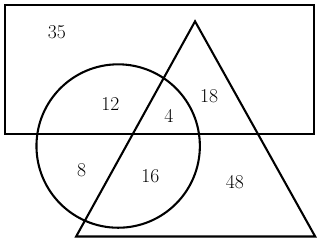
In the figure given below the rectangle represents water, the circle represents spirit and the triangle represents tea. The number in each area represents the number of items in that area.

Which of the following statement is correct?

I. Total number of spirit are 40.

II. Number of tea which are not water are 64.

  1. AOption (a)

    Only ।

  2. BOption (b)

    Only II

  3. COption (c)

    Both I and II

  4. DOption (d)

    Neither I nor II

View answer & explanation

Correct answer

Answer: (c)C.

Both I and II

Why this answer is correct

The logic followed here is:

Logic: Add the numbers inside each required region of the diagram based on the given conditions.

Now,

For Spirit (Circle):

12 + 8 + 10 + 10 = 40 → Statement I is correct

For Tea but not Water (Triangle outside Rectangle):

54 + 10 = 64 → Statement II is correct

Hence, both statements are correct.

Hence, the correct answer is Option 3.

Question 43

R started walking towards north. During his journey, he turned 7 times right and 5 times left. In which direction he will be facing finally?

  1. AOption (a)

    East

  2. BOption (b)

    South

  3. COption (c)

    West

  4. DOption (d)

    North

View answer & explanation

Correct answer

Answer: (b)B.

South

Why this answer is correct

Given:

R starts walking north. He takes 7 right turns and 5 left turns.

Stepwise Analysis:

Each right turn = +90° clockwise

Each left turn = -90° (anticlockwise)

Net turns = 7 right - 5 left = 2 right turns

Starting direction: North

1st right → East

2nd right → South

Hence, R is finally facing South.

Hence, the correct answer is Option 2.

Question 44

Assuming that the data given in the statement are definitely true which of the following conclusions can be logically deducted.

Statement: Either the meeting will be postponed or it will be held online. The meeting will not be postponed.

What conclusion is certain?

  1. AOption (a)

    The meeting might be held online

  2. BOption (b)

    The meeting will definitely be held online

  3. COption (c)

    The meeting will be canceled

  4. DOption (d)

    The meeting will be held in person

View answer & explanation

Correct answer

Answer: (b)B.

The meeting will definitely be held online

Why this answer is correct

Given Statements:

Either the meeting will be postponed or it will be held online.

The meeting will not be postponed.

The statement follows the logic: A or B, and Not A ⇒ Therefore, B

Conclusions:

I. The meeting might be held online – False (It is definite, not just a possibility.)

II. The meeting will definitely be held online – True (Since postponement is not possible, it must be held online.)

Hence, the correct answer is Option 2.

Question 45

Which option figure will complete the pattern in the question figure? (Rotation is not allowed)

  1. AOption (a)

  2. BOption (b)

  3. COption (c)

  4. DOption (d)

View answer & explanation

Correct answer

Answer: (a)A.

Why this answer is correct

The logic followed here is:

Logic: The missing quadrant must contain two parallel diagonal lines sloping upwards from the bottom-left to the top-right to complete the central geometric symmetry.

Hence, the correct answer is Option 4.

Question 46

In the following question, in each option a pair of figures is given. In each pair the figure towards the left of (:) is related by some logic/rule/relation with the figure on the right of (:). Select the odd figure pair from the given alternatives.

  1. AOption (a)

  2. BOption (b)

  3. COption (c)

  4. DOption (d)

View answer & explanation

Correct answer

Answer: (a)A.

Why this answer is correct

The logic followed here is:

Logic: In each valid pair, the positions of shapes remain same but the directions (top/bottom or arrow direction) are reversed or flipped consistently.

Checking options:

Option 1:

Directions of arrows and circle positions are flipped 

Option 2:

Arrow directions and shapes are systematically reversed 

Option 3:

Shapes are inverted (top ↔ bottom) consistently 

Option 4:

The transformation is not consistent (shapes and directions change irregularly) 

Hence, the correct answer is Option 4.

Question 47

In the following figure series, select the figure which can be placed at the sign of question mark (?) from the given alternatives.

  1. AOption (a)

  2. BOption (b)

  3. COption (c)

  4. DOption (d)

View answer & explanation

Correct answer

Answer: (b)B.

Why this answer is correct

The logic followed here is:

Logic: Horizontal and vertical lines are alternately added and removed in a sectional rotation (top-left → middle-right → bottom-left → …).

The next figure continues this toggle pattern.

Hence, the correct answer is Option 3.

Question 48

In the following figure series, select the figure which can be placed at the sign of question mark (?) from the given alternatives.

  1. AOption (a)

  2. BOption (b)

  3. COption (c)

  4. DOption (d)

View answer & explanation

Correct answer

Answer: (d)D.

Why this answer is correct

The logic followed here is:

Logic: The "L" shape and the shaded semi-circle rotate clockwise around the four corners/positions, and the central symbol follows its alternating sequence.

The next figure continues this rotation pattern.

Hence, the correct answer is Option 3.

Question 49

If 'P' means '+', 'Q' means '÷', 'R' means '-' and 'S' means '×', then 15 P 20 R 10 Q 5 S 2 = ?

  1. AOption (a)

    36

  2. BOption (b)

    24

  3. COption (c)

    22

  4. DOption (d)

    31

View answer & explanation

Correct answer

Answer: (d)D.

31

Why this answer is correct

BODMAS Table: 

Given equation: 15 P 20 R 10 Q 5 S 2 = ?

Now, if ‘P’ means ‘+’, ‘Q’ means ‘÷’, ‘R’ means ‘−’ and ‘S’ means ‘×’, then:

⇒ 15 + 20 − 10 ÷ 5 × 2 = ?

⇒ 15 + 20 − 2 × 2 = ?

⇒ 15 + 20 − 4 = ?

⇒ 35 − 4 = ?

⇒ 31

Hence, the correct answer is Option 4.

Question 50

After interchanging the given two signs, what will be the value of the given equation?

× and ÷

45 × 5 ÷ 6 - 48 + 20 = ?

  1. AOption (a)

    26

  2. BOption (b)

    32

  3. COption (c)

    38

  4. DOption (d)

    42

View answer & explanation

Correct answer

Answer: (a)A.

26

Why this answer is correct

BODMAS Table: 

Given equation: 45 × 5 ÷ 6 − 48 + 20 = ?

Now, if ‘×’ and ‘÷’ are interchanged, then:

⇒ 45 ÷ 5 × 6 − 48 + 20 = ?

⇒ 9 × 6 − 48 + 20 = ?

⇒ 54 − 48 + 20 = ?

⇒ 6 + 20 = ?

⇒ 26

Hence, the correct answer is Option 1.

Quantitative Aptitude (25 questions)

Question 51

An item is sold at 25% discount. If the marked price is Rs. 800, what is the selling price?

  1. AOption (a)

    Rs. 600

  2. BOption (b)

    Rs. 620

  3. COption (c)

    Rs. 650

  4. DOption (d)

    Rs. 700

View answer & explanation

Correct answer

Answer: (a)A.

Rs. 600

Why this answer is correct

Given:

Marked price = Rs. 800

Discount = 25%

Formula Used:

Selling Price = Marked Price × (1 - Discount ÷ 100)

Calculation:

⇒ Selling Price = 800 × (1 - 25 ÷ 100)

⇒ Selling Price = 800 × (1 - 0.25)

⇒ Selling Price = 800 × 0.75

⇒ Selling Price = Rs. 600

∴ The correct answer is Rs. 600.

Question 52

What is the discount amount on a Rs. 1,200 item sold at 15% discount?

  1. AOption (a)

    Rs. 150

  2. BOption (b)

    Rs. 160

  3. COption (c)

    Rs. 170

  4. DOption (d)

    Rs. 180

View answer & explanation

Correct answer

Answer: (d)D.

Rs. 180

Why this answer is correct

Given:

Marked Price = Rs. 1200

Discount Percentage = 15%

Formula Used:

Discount Amount = (Marked Price × Discount Percentage) ÷ 100

Calculation:

⇒ Discount Amount = (1200 × 15) ÷ 100

⇒ Discount Amount = 18000 ÷ 100

⇒ Discount Amount = Rs. 180

∴ The correct answer is Rs. 180.

Question 53

In a construction plan, a parallelogram-shaped metal plate has sides (3x - 2) cm and (x + 4) cm. If the perimeter is 48 cm, find x. 

  1. AOption (a)

    4

  2. BOption (b)

    5.5

  3. COption (c)

    6.5

  4. DOption (d)

    7.2

View answer & explanation

Correct answer

Answer: (b)B.

5.5

Why this answer is correct

Given:

Sides of the parallelogram = (3x - 2) cm and (x + 4) cm

Perimeter = 48 cm

Formula Used:

Perimeter of a parallelogram = 2 × (Length + Breadth)

Calculation:

⇒ 48 = 2 × [(3x - 2) + (x + 4)]

⇒ 48 = 2 × (3x - 2 + x + 4)

⇒ 48 = 2 × (4x + 2)

⇒ 48 / 2 = 4x + 2

⇒ 24 = 4x + 2

⇒ 24 - 2 = 4x

⇒ 22 = 4x

⇒ x = 22 / 4

⇒ x = 5.5

∴ The correct answer is 5.5.

Question 54

A cone-shaped nozzle has a volume of 231 cm3 and a base radius of 3.5 cm. Find its slant height.

  1. AOption (a)

    10.5 cm

  2. BOption (b)

    13.4 cm

  3. COption (c)

    18.3 cm

  4. DOption (d)

    15 cm

View answer & explanation

Correct answer

Answer: (c)C.

18.3 cm

Why this answer is correct

Shortcut Trick

First, find the height (h): h = (3 × Volume) ÷ (π × r2) = (3 × 231) ÷ (22/7 × 3.5 × 3.5) = 18 cm.

Now, use the Pythagoras Theorem to find slant height (l): l = √(h2 + r2).

l = √(182 + 3.52) = √(324 + 12.25) = √336.25 ≈ 18.3 cm.

∴ The correct answer is 18.3 cm.

Alternate Method

Given:

Volume (V) of the cone-shaped nozzle = 231 cm3

Base radius (r) = 3.5 cm

Formula Used:

Volume of a cone (V) = (1/3) × π × r2 × h

Slant height (l) = √(r2 + h2)

Calculations:

⇒ 231 = (1/3) × (22/7) × (3.5)2 × h

⇒ 231 = (1/3) × (22/7) × 12.25 × h

⇒ 231 = (22 × 1.75 / 3) × h

⇒ 231 = (38.5 / 3) × h

⇒ h = (231 × 3) / 38.5

⇒ h = 693 / 38.5 = 18 cm

⇒ l = √(3.52 + 182)

⇒ l = √(12.25 + 324)

⇒ l = √336.25

⇒ l ≈ 18.337 cm

∴ The correct answer is 18.3 cm.

Additional Information

Curved Surface Area (CSA) of a Cone

The area of the curved surface is given by the formula CSA = π × r × l, where l is the slant height.

Total Surface Area (TSA) of a Cone

The total surface area includes the base circle: TSA = π × r × (l + r).

Pythagorean Relationship in Cones

The radius (r), vertical height (h), and slant height (l) always form a right-angled triangle such that l2 = r2 + h2.

Question 55

The number of irrational numbers between 1 and 2 is:

  1. AOption (a)

    0

  2. BOption (b)

    1

  3. COption (c)

    Finite

  4. DOption (d)

    Infinite

View answer & explanation

Correct answer

Answer: (d)D.

Infinite

Why this answer is correct

Given:

Range = between 1 and 2

Formula used:

Property of irrational numbers

Calculations:

⇒ Between any two distinct real numbers, there are infinitely many irrational numbers

⇒ Between 1 and 2, examples: √2, √3, π/2, etc.

⇒ These are unlimited

∴ Number of irrational numbers = Infinite

Question 56

A bridge has parallelogram-shaped metal supports where adjacent angles are in a 5 : 4 ratio. What is the measure of the larger angle?

  1. AOption (a)

    100°

  2. BOption (b)

    110°

  3. COption (c)

    120°

  4. DOption (d)

    150°

View answer & explanation

Correct answer

Answer: (a)A.

100°

Why this answer is correct

Given:

Adjacent angles ratio = 5 : 4

Formula used:

In parallelogram, adjacent angles sum = 180°

Calculations:

Let angles = 5x and 4x

⇒ 5x + 4x = 180

⇒ 9x = 180

⇒ x = 20

⇒ Larger angle = 5x = 5 × 20 = 100°

∴ Larger angle = 100°

Question 57

A pavement is tiled in the shape of a triangle with area 84 cm2 and a semi-perimeter of 21 cm. What is the radius of the circle that fits perfectly inside the triangle (inradius)?

  1. AOption (a)

    4 cm

  2. BOption (b)

    3 cm

  3. COption (c)

    5 cm

  4. DOption (d)

    6 cm

View answer & explanation

Correct answer

Answer: (a)A.

4 cm

Why this answer is correct

Given:

Area of triangle = 84 cm²

Semi-perimeter = 21 cm

Formula Used:

Inradius = Area / Semi-perimeter

Calculation:

⇒ Inradius = 84 / 21

⇒ Inradius = 4 cm

∴ The correct answer is 4 cm.

Question 58

Find the volume of a pyramid whose base is an equilateral triangle having each side of length 12 cm, and a height of the pyramid 8 cm.

  1. AOption (a)

    112√2 cm3

  2. BOption (b)

    88√3 cm3

  3. COption (c)

    96√3 cm3

  4. DOption (d)

    65√2 cm3

View answer & explanation

Correct answer

Answer: (c)C.

96√3 cm3

Why this answer is correct

Given:

Side of equilateral triangle = 12 cm

Height of the pyramid = 8 cm

Formula Used:

Volume of pyramid = (1/3) × Base Area × Height

Base Area of equilateral triangle = (√3/4) × side2

Calculation:

⇒ Base Area = (√3/4) × 12 × 12

⇒ Base Area = (√3/4) × 144

⇒ Base Area = 36√3 cm2

⇒ Volume = (1/3) × 36√3 × 8

⇒ Volume = 96√3 cm3

∴ The correct answer is 96√3 cm3.

Question 59

By selling 15 articles, a man gains the selling price of 3 articles. Find the profit percentage.

  1. AOption (a)

    20%

  2. BOption (b)

    25%

  3. COption (c)

    30%

  4. DOption (d)

    15%

View answer & explanation

Correct answer

Answer: (b)B.

25%

Why this answer is correct

Given:

By selling 15 articles, gain = SP of 3 articles

Formula used:

Profit % = (Profit ÷ Cost Price) × 100

Calculations:

Let SP of 1 article = 1 unit

⇒ SP of 15 articles = 15

⇒ Gain = SP of 3 articles = 3

⇒ Total CP of 15 articles = SP − Gain = 15 − 3 = 12

⇒ CP of 1 article = 12 ÷ 15 = 0.8

⇒ Profit per article = 1 − 0.8 = 0.2

⇒ Profit % = (0.2 ÷ 0.8) × 100

⇒ Profit % = 25%

∴ Profit = 25%

Question 60

The compound interest on a certain sum at 20% p.a. for 2½ years, compounded yearly, is ₹ 2920. Find the principal.

  1. AOption (a)

    ₹4,000

  2. BOption (b)

    ₹4,500

  3. COption (c)

    ₹5,000

  4. DOption (d)

    ₹5,500

View answer & explanation

Correct answer

Answer: (c)C.

₹5,000

Why this answer is correct

Shortcut Trick

Effective Rate of Interest for the first 2 years = 20 + 20 + (20 × 20)/100 = 44%.

Effective Rate for the remaining 1/2 year = 10%.

Total Effective Rate = 44 + 10 + (44 × 10)/100 = 58.4%.

Principal (P) = Compound Interest / 58.4% = 2920 / 0.584 = ₹5,000.

∴ The correct answer is ₹5,000.

Alternate Method

Given:

Rate (R) = 20% p.a., Time (n) = 2.5 years, Compound Interest (CI) = ₹2,920.

Formula:

Amount (A) = P × (1 + R/100)n1 × (1 + (R × f)/100), where n1 is the complete years and f is the fraction of the year.

Calculations:

⇒ Total Time = 2 years + 1/2 year

⇒ Rate for the fractional part = 20% × (1/2) = 10%

⇒ Amount (A) = P × (1 + 20/100) × (1 + 20/100) × (1 + 10/100)

⇒ A = P × (6/5) × (6/5) × (11/10)

⇒ A = P × (396 / 250)

⇒ Interest (CI) = A − P = P(396/250 − 1) = P(146 / 250)

⇒ 2920 = P × (146 / 250)

⇒ P = (2920 × 250) / 146

⇒ P = 20 × 250 = ₹5,000

⇒ The Principal is ₹5,000, which corresponds to Option (3).

∴ The correct answer is ₹5,000.

Additional Information

Effective Rate for Fractional Time

When time is in fractions like t = n (a/b) years, use the rate R for n years and (a/b)×R for the remaining fraction of the year.

Successive Percentage Formula

For two successive changes of x% and y%, the net effective change is (x + y + (x × y)/100)%.

Compound Interest vs Simple Interest

The difference between CI and SI for 2 years is P(R/100)2 and for 3 years is P(R/100)2 × (3 + R/100).

Question 61

The least number which is divisible by each of the numbers 14, 21, and 28 is:

  1. AOption (a)

    42

  2. BOption (b)

    140

  3. COption (c)

    84

  4. DOption (d)

    280

View answer & explanation

Correct answer

Answer: (c)C.

84

Why this answer is correct

Given:

Numbers = 14, 21, 28

Formula used:

Least number divisible by given numbers = LCM

Calculations:

14 = 2 × 7

21 = 3 × 7

28 = 22 × 7

⇒ LCM = 22 × 3 × 7

⇒ LCM = 4 × 3 × 7

⇒ LCM = 84

∴ Least number = 84

Question 62

In a college, there are 600 faculty members, out of which 40% are females. The average height of males is 170 cm, and the average height of females is 160 cm. What is the average height of the entire faculty?

  1. AOption (a)

    164 cm

  2. BOption (b)

    166 cm

  3. COption (c)

    169 cm

  4. DOption (d)

    172 cm

View answer & explanation

Correct answer

Answer: (b)B.

166 cm

Why this answer is correct

Shortcut Trick

Ratio of males to females = 60% : 40% = 3 : 2.

Using Weighted Average: [(3 × 170) + (2 × 160)] ÷ (3 + 2)

⇒ (510 + 320) ÷ 5 = 830 ÷ 5 = 166 cm.

∴ The correct answer is 166 cm.

Alternate Method

Given:

Total faculty members = 600

Percentage of females = 40%

Average height of males = 170 cm

Average height of females = 160 cm

Calculations:

⇒ Number of females = 40% of 600 = (40 ÷ 100) × 600 = 240

⇒ Number of males = 600 − 240 = 360

⇒ Total height of males = 360 × 170 = 61200 cm

⇒ Total height of females = 240 × 160 = 38400 cm

⇒ Total height of all faculty members = 61200 + 38400 = 99600 cm

⇒ Average height = 99600 ÷ 600

⇒ Average height = 166 cm

∴ The correct answer is 166 cm.

Additional Information

Weighted Average Formula

The weighted average is calculated as (n1x1 + n2x2) ÷ (n1 + n2), where n represents the quantity and x represents the average value.

Deviation Method

Assume a base average (e.g., 160), calculate deviations for each group, and adjust: 160 + [60% × (170 − 160)] = 160 + 6 = 166 cm.

Ratio Property in Averages

When calculating combined averages, the actual numbers can be replaced by their simplest ratios to simplify the arithmetic.

Question 63

Two buses start from two different cities that are 300 km apart and travel towards each other. The first bus's speed is 50 km/h, and the second bus's speed is 70 km/h. What is the time taken for them to meet?

  1. AOption (a)

    2 hours

  2. BOption (b)

    3 hours

  3. COption (c)

    3.5 hours

  4. DOption (d)

    2.5 hours

View answer & explanation

Correct answer

Answer: (d)D.

2.5 hours

Why this answer is correct

Given:

Distance between the two cities = 300 km

Speed of the first bus = 50 km/h

Speed of the second bus = 70 km/h

Formula Used:

Time taken to meet = Distance ÷ (Speed of first bus + Speed of second bus)

Calculation:

⇒ Total speed = Speed of first bus + Speed of second bus

⇒ Total speed = 50 + 70

⇒ Total speed = 120 km/h

⇒ Time taken = Distance ÷ Total speed

⇒ Time taken = 300 ÷ 120

⇒ Time taken = 2.5 hours

∴ The correct answer is 2.5 hours.

Question 64

Three friends start a mobile app company. Arjun invests 1,20,000, Beena invests 90,000, and Charu invests 1,50,000. After one year, they earn a profit of 72,000. What will Beena's share of the profit be?

  1. AOption (a)

    18,000

  2. BOption (b)

    21,000

  3. COption (c)

    24,000

  4. DOption (d)

    27,000

View answer & explanation

Correct answer

Answer: (a)A.

18,000

Why this answer is correct

Given:

Arjun's investment = 1,20,000

Beena's investment = 90,000

Charu's investment = 1,50,000

Total profit = 72,000

Formula Used:

Profit share = (Individual investment ÷ Total investment) × Total profit

Calculation:

⇒ Total investment = 1,20,000 + 90,000 + 1,50,000

⇒ Total investment = 3,60,000

⇒ Beena's profit share = (90,000 ÷ 3,60,000) × 72,000

⇒ Beena's profit share = (1 ÷ 4) × 72,000

⇒ Beena's profit share = 18,000

∴ The correct answer is 18,000.

Question 65

What is the square root of 7396?

  1. AOption (a)

    80

  2. BOption (b)

    89

  3. COption (c)

    86

  4. DOption (d)

    92

View answer & explanation

Correct answer

Answer: (c)C.

86

Why this answer is correct

Given:

Number = 7396

Formula used:

(a + b)2 = a2 + 2ab + b2

Calculations:

⇒ 7396 = (80 + 6)2

⇒ (80 + 6)2 = 802 + 2 × 80 × 6 + 62

⇒ = 6400 + 960 + 36

⇒ = 7396

⇒ Square root = 80 + 6 = 86

∴ √7396 = 86

Question 66

A 60 litre container holds a mixture of milk and water in the ratio 7 : 3. If 12 litres of this mixture is taken out and replaced with 12 litres of pure milk, what is the new ratio of milk to water?

  1. AOption (a)

    ​19 : 6

  2. BOption (b)

    17 : 5

  3. COption (c)

    15 : 4

  4. DOption (d)

    13 : 3

View answer & explanation

Correct answer

Answer: (a)A.

​19 : 6

Why this answer is correct

Given:

Total mixture = 60 litres

Ratio (Milk : Water) = 7 : 3

Removed = 12 litres mixture

Added = 12 litres milk

Formula used:

Removed मात्रा same ratio में घटेगी

Calculations:

⇒ Initial milk = (7/10) × 60 = 42 litres

⇒ Initial water = (3/10) × 60 = 18 litres

⇒ Removed milk = (7/10) × 12 = 8.4 litres

⇒ Removed water = (3/10) × 12 = 3.6 litres

⇒ Remaining milk = 42 − 8.4 = 33.6 litres

⇒ Remaining water = 18 − 3.6 = 14.4 litres

⇒ Add 12 litres milk:

⇒ New milk = 33.6 + 12 = 45.6 litres

⇒ Water = 14.4 litres

⇒ Ratio = 45.6 : 14.4

⇒ Divide by 14.4

⇒ Ratio = 3.166 : 1

⇒ Multiply by 6 ⇒ 19 : 6

∴ New ratio = 19 : 6

Question 67

In ΔPQR, the angle bisectors intersect at the incenter I. If ∠P = 60° and ∠Q = 70°, what is the measure of ∠PIQ?

  1. AOption (a)

    105°

  2. BOption (b)

    110°

  3. COption (c)

    115°

  4. DOption (d)

    120°

View answer & explanation

Correct answer

Answer: (c)C.

115°

Why this answer is correct

Given:

∠P = 60°

∠Q = 70°

Formula used:

Angle at incenter: ∠PIQ = 90° + (∠R ÷ 2)

Calculations:

⇒ ∠R = 180 − (60 + 70) = 50°

⇒ ∠PIQ = 90 + (50 ÷ 2)

⇒ ∠PIQ = 90 + 25 = 115°

∴ ∠PIQ = 115°

Question 68

Which of the following represents a line perpendicular to the line 4x + 5y = 20?

  1. AOption (a)

    5x - 7y = 8

  2. BOption (b)

    4x + 5y = 12

  3. COption (c)

    y=5x4−3y=\frac{5 x}{4}-3

  4. DOption (d)

    y=−4x5+1y=-\frac{4 x}{5}+1

View answer & explanation

Correct answer

Answer: (c)C.

y=5x4−3y=\frac{5 x}{4}-3

Why this answer is correct

Given:

Line: 4x + 5y = 20

Formula used:

Slope of line ax + by = c ⇒ m = −a/b

Perpendicular slope ⇒ m1 × m2 = −1

Calculations:

⇒ Given line slope = −4/5

⇒ Perpendicular slope = 5/4

Now check options:

5x − 7y = 8 ⇒ slope = 5/7 ✖

4x + 5y = 12 ⇒ slope = −4/5 ✖

y = 5x/4 − 3 ⇒ slope = 5/4 ✔

y = −4x/5 + 1 ⇒ slope = −4/5 ✖

∴ Correct answer: y = 5x/4 − 3

Question 69

Two circles with radii 8 cm and 2 cm are separated by a distance of 13 cm between their centers. From the center of the smaller circle, a tangent is drawn to the larger circle. What is the length of this tangent segment?

  1. AOption (a)

    110 cm\sqrt{110} \mathrm{~cm}

  2. BOption (b)

    120 cm\sqrt{120} \mathrm{~cm}

  3. COption (c)

    105 cm\sqrt{105} \mathrm{~cm}

  4. DOption (d)

    115 cm\sqrt{115} \mathrm{~cm}

View answer & explanation

Correct answer

Answer: (c)C.

105 cm\sqrt{105} \mathrm{~cm}

Why this answer is correct

Given:

Radius of larger circle (R) = 8 cm

Radius of smaller circle (r) = 2 cm

Distance between centers = 13 cm

Formula used:

Length of tangent from external point = √(d2 − R2)

Calculations:

⇒ Length = √(132 − 82)

⇒ = √(169 − 64)

⇒ = √105

∴ Length of tangent = √105 cm

Question 70

Sum of A and B is 100 percent more than the sum of C and D. C is 20 percent more than D. If A is 200 percent more than B and D = 500, then what is the value of A?

  1. AOption (a)

    1200

  2. BOption (b)

    1650

  3. COption (c)

    1700

  4. DOption (d)

    1450

View answer & explanation

Correct answer

Answer: (b)B.

1650

Why this answer is correct

Shortcut Trick

D = 500; C is 20% more ⇒ C = 600.

Sum (C + D) = 1100.

Sum (A + B) is 100% more than 1100 ⇒ A + B = 2200.

A is 200% more than B ⇒ A : B = 3 : 1.

A = (3/4) × 2200 = 1650.

∴ The correct answer is 1650.

Alternate Method

Given: D = 500, C = 120% of D, A + B = 200% of (C + D), A = 300% of B.

Formula: Value increased by x% = Base × (100 + x)/100.

⇒ C = 500 + 20% of 500 = 500 + 100 = 600

⇒ C + D = 600 + 500 = 1100

⇒ A + B = 1100 + 100% of 1100 = 1100 + 1100 = 2200

⇒ A = B + 200% of B = 3B

⇒ 3B + B = 2200 ⇒ 4B = 2200

⇒ B = 550

⇒ A = 3 × 550 = 1650

∴ The correct answer is 1650.

Additional Information

Percentage Increase vs Percentage Of

x% more than y means y × (1 + x/100), whereas x% of y means y × (x/100).

Ratio and Sums

If a sum S is divided in the ratio a:b, the parts are [a/(a+b)] × S and [b/(a+b)] × S.

Multiplication Factor

For a 100% increase, the factor is 2. For a 200% increase, the factor is 3.

Question 71

The amount received on a certain sum at the same annual rate of interest after 3 years and 5 years on compound interest (compounding annually) is Rs. 5324 and Rs. 6442.04 respectively. What is that sum?

  1. AOption (a)

    Rs. 5000

  2. BOption (b)

    Rs. 4200

  3. COption (c)

    Rs. 4000

  4. DOption (d)

    Rs. 4800

View answer & explanation

Correct answer

Answer: (c)C.

Rs. 4000

Why this answer is correct

Given:

Amount after 3 years = ₹5324

Amount after 5 years = ₹6442.04

Formula used:

A = P × (1 + r/100)t

Calculations:

⇒ A5 / A3 = (1 + r/100)5 ÷ (1 + r/100)3

⇒ 6442.04 ÷ 5324 = (1 + r/100)2

⇒ 1.21 = (1 + r/100)2

⇒ 1.1 = (1 + r/100)

⇒ r = 10%

Now find Principal:

⇒ 5324 = P × (1.1)3

⇒ 5324 = P × 1.331

⇒ P = 5324 ÷ 1.331

⇒ P = 4000

∴ Principal = ₹4000

Question 72

The difference between simple interest on a certain sum at the annual rate of 12 percent for 4 years and 7 years is Rs. 72. What is the sum?

  1. AOption (a)

    Rs. 200

  2. BOption (b)

    Rs. 150

  3. COption (c)

    Rs. 180

  4. DOption (d)

    Rs. 220

View answer & explanation

Correct answer

Answer: (a)A.

Rs. 200

Why this answer is correct

Given:

Rate of interest = 12% per annum

Difference in time = 7 years - 4 years = 3 years

Difference in simple interest = Rs. 72

Formula Used:

Simple Interest (SI) = (Principal × Rate × Time) ÷ 100

Calculation:

⇒ Difference in SI = (Principal × Rate × Difference in Time) ÷ 100

⇒ 72 = (Principal × 12 × 3) ÷ 100

⇒ 72 = (Principal × 36) ÷ 100

⇒ Principal = (72 × 100) ÷ 36

⇒ Principal = 7200 ÷ 36

⇒ Principal = 200

∴ The correct answer is Rs. 200.

Question 73

Selling price of an article is 120 percent more than the value of discount. Selling price is what percent of the marked price?

  1. AOption (a)

    70.14 percent

  2. BOption (b)

    64 percent

  3. COption (c)

    62.58 percent

  4. DOption (d)

    68.75 percent

View answer & explanation

Correct answer

Answer: (d)D.

68.75 percent

Why this answer is correct

Given:

Selling price (SP) = 120% more than the value of the discount

Marked price (MP) = SP + Discount

Formula Used:

SP ÷ MP × 100

Calculation:

⇒ Let the discount = x

⇒ SP = x + 120% of x = x + (120 ÷ 100) × x = x + 1.2x = 2.2x

⇒ MP = SP + Discount = 2.2x + x = 3.2x

⇒ SP ÷ MP × 100 = (2.2x ÷ 3.2x) × 100

⇒ (2.2 ÷ 3.2) × 100

⇒ 68.75%

∴ The correct answer is 68.75 percent.

Question 74

P and Q together can complete a work in 24 days. They started the work together but after 8 days P left the work. Remaining work is completed by Q in 20 more days. P alone can complete this entire work in how many days?

  1. AOption (a)

    100

  2. BOption (b)

    110

  3. COption (c)

    120

  4. DOption (d)

    130

View answer & explanation

Correct answer

Answer: (c)C.

120

Why this answer is correct

Given:

P + Q = 24 days

Worked together = 8 days

Remaining work done by Q = 20 days

Formula used:

Work = LCM of days

Efficiency = Work ÷ Time

Calculations:

LCM of 24 and 20 = 120

⇒ Total work = 120 units

⇒ (P + Q) 1 day work = 120 ÷ 24 = 5 units

⇒ Work done in 8 days = 5 × 8 = 40 units

⇒ Remaining work = 120 − 40 = 80 units

⇒ Q completes 80 units in 20 days

⇒ Q’s 1 day work = 80 ÷ 20 = 4 units

⇒ (P + Q) = 5 units

⇒ P = 5 − 4 = 1 unit/day

⇒ Time taken by P alone = 120 ÷ 1 = 120 days

∴ P alone can complete the work in 120 days

Question 75

P and Q working alone can complete a work in 12 days and 24 days respectively. They work on alternate days one at a time. P works on the first day. In how many days the whole work will be completed?

  1. AOption (a)

    9

  2. BOption (b)

    16

  3. COption (c)

    8

  4. DOption (d)

    18

View answer & explanation

Correct answer

Answer: (b)B.

16

Why this answer is correct

Given:

P = 12 days

Q = 24 days

Work alternately, P starts first

Formula used:

Work = LCM of days

Efficiency = Work ÷ Time

Calculations:

LCM of 12 and 24 = 24

⇒ Total work = 24 units

⇒ P’s 1 day work = 24 ÷ 12 = 2 units

⇒ Q’s 1 day work = 24 ÷ 24 = 1 unit

⇒ In 2 days (P + Q): 2 + 1 = 3 units

⇒ In 16 days (8 cycles): 3 × 8 = 24 units

∴ Work will be completed in 16 days

General Awareness (25 questions)

Question 76

In which of the following provinces did NOT have the 'Zabt' system during Akbar's time due to difficulties in land inspection?

  1. AOption (a)

    Punjab and Delhi

  2. BOption (b)

    Agra and Rajasthan

  3. COption (c)

    Malwa and Awadh

  4. DOption (d)

    Bengal and Gujarat

View answer & explanation

Correct answer

Answer: (d)D.

Bengal and Gujarat

Why this answer is correct

The correct answer is Bengal and Gujarat.

Key Points

  • The Zabt system was a land revenue system introduced during the reign of Akbar under the supervision of his finance minister Raja Todar Mal.
  • The system involved the measurement of agricultural land and fixing the revenue based on the average produce and prices over the past 10 years.
  • While the Zabt system was widely implemented in most provinces of the Mughal Empire, it could not be applied effectively in Bengal and Gujarat due to the following challenges:
  • Bengal: The region had a complex riverine landscape, with frequent floods and shifting river courses making land measurement extremely difficult.
  • Gujarat: The region had diverse agricultural practices and terrains, which posed challenges to the uniform application of the Zabt system.
  • Instead of Zabt, other systems like Kankut or Nasaq were used in these areas to estimate land revenue.
  • This highlights the adaptability of the Mughal administration in modifying their policies based on regional conditions.

Additional Information

  • Zabt System:
  • This system was a crucial part of Akbar's revenue reforms and was based on the principles of standardizing land revenue collection.
  • The system required accurate land measurement, categorization of land based on fertility, and fixation of revenue rates based on average produce and prices.
  • It aimed at maximizing revenue collection while ensuring fairness and reducing the burden on peasants.
  • The assessment was conducted in a scientific manner, with records maintained for future references.
  • Kankut System:
  • The Kankut system was another land revenue assessment method used in regions where accurate land measurement was not feasible.
  • Under this system, the estimation of revenue was done based on the inspection of standing crops or mutual agreements between farmers and revenue officers.
  • It was less precise than Zabt but provided a flexible alternative in challenging terrains.
  • Nasaq System:
  • Nasaq was another revenue collection method employed in areas with irregular agricultural activities.
  • Revenue was determined based on past practices or mutual agreements rather than strict measurement or assessments.
  • This system was often used in Bengal and Gujarat, where local conditions demanded flexibility.
  • Challenges in Bengal and Gujarat:
  • Bengal: Frequent flooding, alluvial soil changes, and the deltaic region's dynamic geography made it difficult to implement Zabt.
  • Gujarat: The diversity in agricultural practices, including cash crops like cotton, and the arid regions posed challenges to standardized revenue assessment.
  • Both regions required alternative methods to ensure effective revenue collection and avoid overburdening the population.

Important Points

  • Raja Todar Mal's Reforms:
  • As Akbar's finance minister, Raja Todar Mal introduced several revenue reforms to streamline the administration.
  • He emphasized accurate land measurement, categorized land based on fertility, and standardized revenue rates.
  • Regional Variations:
  • The Mughal administration showed remarkable adaptability in modifying revenue systems to suit regional conditions.
  • This flexibility helped maintain stability and ensured efficient revenue collection across the empire.
  • Legacy:
  • The Zabt system and other revenue reforms laid the foundation for subsequent revenue systems during British rule in India.
  • It demonstrated the importance of scientific and fair revenue practices in maintaining administrative efficiency and peasant welfare.

Question 77

Seventh Schedule of the Indian constitution deals with the ____________.

  1. AOption (a)

    Power, authority, and responsibilities of Panchayats

  2. BOption (b)

    Anti- Defection Law

  3. COption (c)

    Power, authority, and responsibilities of Municipalities

  4. DOption (d)

    Union, State and Concurrent Lists

View answer & explanation

Correct answer

Answer: (d)D.

Union, State and Concurrent Lists

Why this answer is correct

The correct answer is Union, State and Concurrent Lists.

Key Points

  • The Seventh Schedule of the Indian Constitution contains three lists: the Union List, the State List, and the Concurrent List, which delineate the division of powers between the Union and State governments.
  • The Union List includes subjects of national importance such as defense, foreign affairs, atomic energy, banking, and communications. Only the Parliament has the exclusive power to legislate on these matters.
  • The State List comprises subjects of local or state importance such as police, public health, agriculture, and irrigation. Only the State Legislature can make laws on these topics.
  • The Concurrent List includes subjects of mutual interest to both the Union and States, such as education, forests, trade unions, and marriage. Both the Parliament and State Legislatures can legislate on these matters. However, in case of a conflict, the law made by the Parliament prevails.
  • The division of powers under the Seventh Schedule ensures the federal structure of India, where both the Union and State governments operate within their defined jurisdictions.

Additional Information

  • Union List:
  • It contains 100 subjects (originally 97), including areas of national importance like defense, foreign affairs, atomic energy, and railways.
  • Only the Parliament is empowered to make laws on these subjects.
  • Examples: Currency, Citizenship, and International Trade.
  • State List:
  • It contains 61 subjects (originally 66), including areas of state and local importance like police, public health, and agriculture.
  • The State Legislature has exclusive powers to legislate on these subjects.
  • Examples: Law and Order, Fisheries, and Markets.
  • Concurrent List:
  • It contains 52 subjects (originally 47), which are of joint interest to both the Union and States.
  • In case of a conflict between Union and State laws, the Union law prevails.
  • Examples: Education, Marriage, and Bankruptcy.
  • Residue Powers:
  • Any subject not mentioned in the three lists falls under residuary powers, which are vested in the Union Government.
  • Examples: Cyber Laws, Space Research, and Internet-based issues.

Important Points

  • Amendments:
  • The subjects in the lists can be amended by the Parliament under Article 368.
  • For example, the 42nd Amendment Act of 1976 transferred Education from the State List to the Concurrent List.
  • Federal Structure:
  • The Seventh Schedule is a cornerstone of India's quasi-federal structure, ensuring a balance between centralization and decentralization.
  • Judicial Review:
  • Any legislation passed by the Union or State that violates the distribution of powers can be challenged in the Supreme Court or High Courts.

Question 78

Which of the following amendment act of the Indian constitution replaced the term "internal disturbance" with "armed rebellion" in the context of a national emergency?

  1. AOption (a)

    41st Amendment act, 1976

  2. BOption (b)

    44th Amendment act, 1978

  3. COption (c)

    42nd Amendment act, 1976

  4. DOption (d)

    43rd Amendment act, 1977

View answer & explanation

Correct answer

Answer: (b)B.

44th Amendment act, 1978

Why this answer is correct

The correct answer is 44th Amendment Act, 1978.

Key Points

  • The 44th Amendment Act, 1978 replaced the term "internal disturbance" with "armed rebellion" in Article 352 of the Constitution of India.
  • This amendment was introduced to restrict the scope of declaring a national emergency, ensuring it could not be misused for political purposes.
  • The term "internal disturbance" was considered vague and susceptible to misuse, whereas "armed rebellion" is more specific and denotes severe internal conflict involving armed forces.
  • The change was part of the reforms aimed at safeguarding democratic principles after the misuse of emergency powers during the 1975-77 Emergency declared under the leadership of then Prime Minister Indira Gandhi.
  • The 44th Amendment Act also introduced other provisions to make it harder to impose a national emergency, such as requiring the written recommendation of the Cabinet before the President could proclaim an emergency.

Additional Information

  • National Emergency under Article 352:
  • A national emergency can be declared by the President of India under Article 352 when the security of India or any part of its territory is threatened by war, external aggression, or armed rebellion.
  • During a national emergency, the federal structure of governance is altered, and the central government gains sweeping powers over the states.
  • The fundamental rights under Article 19 are suspended during a national emergency.
  • 44th Amendment Act, 1978:
  • This amendment was enacted to restore democracy and prevent the misuse of emergency provisions.
  • It made the imposition of a national emergency more stringent by requiring the written recommendation of the Cabinet.
  • It also ensured that the proclamation of emergency must be approved by both houses of Parliament within one month.
  • The amendment also provided that the duration of a proclamation of emergency would cease to operate after six months unless renewed by Parliament.
  • Comparison of Terms:
  • "Internal Disturbance": A vague term that could include political unrest, protests, or social movements, making it prone to misuse.
  • "Armed Rebellion": A specific term that denotes an organized uprising involving the use of arms against the state.
  • Historical Context:
  • The misuse of emergency provisions during the 1975-77 Emergency led to widespread criticism and calls for constitutional reforms.
  • The 44th Amendment Act was introduced under the leadership of Prime Minister Morarji Desai to address these concerns and protect democratic values.

Important Points

  • Other Key Changes by the 44th Amendment Act:
  • Removed the ability to suspend the right to move the courts for enforcement of fundamental rights under Articles 20 and 21 during an emergency.
  • Made it mandatory for the President to refer the proclamation of emergency to Parliament within one month.
  • Introduced provisions to safeguard against the abuse of preventive detention laws.
  • Reduced the maximum period of preventive detention without obtaining the opinion of an Advisory Board from three months to two months.
  • Significance:
  • The 44th Amendment Act is considered a landmark legislation that strengthened the democratic framework of India.
  • It ensured greater accountability and reduced the scope for authoritarian misuse of emergency powers.

Question 79

Which of the following statement is correct regarding Council of Ministers (COM) of Indian Ocean Rim Association?

I. It is the highest decision-making body of the Organisation.

II. It comprises of the Minister of Finance of all member states.

  1. AOption (a)

    Only ।

  2. BOption (b)

    Only II

  3. COption (c)

    Both I and II

  4. DOption (d)

    Neither I nor II

View answer & explanation

Correct answer

Answer: (a)A.

Only ।

Why this answer is correct

The correct answer is Option 1.

Key Points

  • Statement I: The Council of Ministers (COM) of the Indian Ocean Rim Association (IORA) is indeed the highest decision-making body of the organization. It is composed of the Foreign Ministers of all the member states. Hence, this statement is correct.
  • Statement II: The COM does not consist of the Finance Ministers of the member states. Instead, it comprises the Foreign Ministers who are responsible for policy-level decisions within the IORA framework. Hence, this statement is incorrect.
  • The COM meets annually to discuss and decide on key issues, approve the budget, review progress, and adopt resolutions that guide the organization.
  • The IORA has 23 member states and 10 dialogue partners, and the COM plays a pivotal role in fostering regional cooperation among these countries.
  • The decisions made by the COM are critical for promoting the objectives of the IORA, such as maritime security, trade, disaster risk management, and sustainable development.

Additional Information

  • Indian Ocean Rim Association (IORA):
  • The IORA was established in 1997 and is headquartered in Mauritius.
  • It is an intergovernmental organization aimed at strengthening regional cooperation and sustainable development within the Indian Ocean region.
  • The IORA focuses on key priority areas such as maritime safety and security, trade and investment, fisheries management, disaster risk management, and tourism promotion.
  • Structure of IORA:
  • The Council of Ministers (COM) is the highest decision-making body, followed by the Committee of Senior Officials (CSO).
  • The IORA Secretariat supports the implementation of policies and initiatives approved by the COM.
  • IORA Member States:
  • The organization has 23 member states, including countries like India, Australia, South Africa, Indonesia, and Sri Lanka.
  • It also has 10 dialogue partners, such as China, Japan, and the United States.
  • IORA's Objectives:
  • To promote sustainable economic growth and balanced development in the Indian Ocean region.
  • To ensure the security and prosperity of the region through cooperation on maritime safety and disaster risk reduction.

Important Points

  • The IORA’s vision is to create a peaceful, stable, and prosperous Indian Ocean region.
  • India has played a significant role in the IORA, focusing on areas like blue economy, disaster management, and maritime security.
  • In recent years, the IORA has emphasized addressing challenges like illegal fishing, climate change, and marine pollution.
  • Annual COM meetings often include adopting declarations, such as the “Jakarta Concord” (2017), which reaffirmed the importance of the Indian Ocean region.

Question 80

The Association of Southeast Asian Nations was established in which of the following places?

  1. AOption (a)

    Ho Chi Minh

  2. BOption (b)

    Bangkok

  3. COption (c)

    Naypyidaw

  4. DOption (d)

    Kuala Lumpur

View answer & explanation

Correct answer

Answer: (b)B.

Bangkok

Why this answer is correct

The correct answer is Bangkok.

Key Points

  • The Association of Southeast Asian Nations (ASEAN) was established on 8 August 1967 in Bangkok, Thailand, through the signing of the Bangkok Declaration (also known as the ASEAN Declaration).
  • The founding members of ASEAN include Indonesia, Malaysia, the Philippines, Singapore, and Thailand, who signed the Bangkok Declaration to promote economic cooperation, cultural exchange, and regional stability.
  • The Bangkok Declaration emphasized the principles of equality, partnership, and mutual respect among the member nations, forming the foundation for ASEAN’s objectives.
  • The main goals of ASEAN are to accelerate economic growth, promote social progress, and ensure regional peace and stability.
  • The ASEAN Secretariat, which facilitates the coordination of activities and implementation of decisions, is located in Jakarta, Indonesia.

Additional Information

  • The Bangkok Declaration:
  • The Bangkok Declaration is the founding document of ASEAN, signed on 8 August 1967.
  • It laid the foundation for cooperation in various fields such as economic development, social progress, cultural exchange, and regional stability.
  • It emphasized the importance of non-interference in the internal affairs of member states and the promotion of peaceful dispute resolution.
  • ASEAN Member States:
  • Initially, ASEAN had 5 founding members: Indonesia, Malaysia, the Philippines, Singapore, and Thailand.
  • Over time, additional countries joined ASEAN, including Brunei (1984), Vietnam (1995), Laos and Myanmar (1997), and Cambodia (1999), bringing the total membership to 10.
  • Objectives of ASEAN:
  • To accelerate economic growth, social progress, and cultural development in the region.
  • To promote regional peace and stability through respect for justice and the rule of law.
  • To foster collaboration in various sectors such as trade, agriculture, industry, transportation, and education.
  • ASEAN Charter:
  • The ASEAN Charter was signed in 2007 and came into effect in 2008.
  • It provides a legal framework and institutional structure for ASEAN, making it a rules-based organization.
  • It established key bodies such as the ASEAN Summit and the ASEAN Coordinating Council.
  • Important Summits:
  • The ASEAN Summit is held annually and involves the leaders of member states discussing regional issues and cooperation.
  • Key agreements such as the establishment of the ASEAN Economic Community (AEC) have been signed during these summits.

Important Points

  • Significance of Bangkok:
  • Bangkok, the capital city of Thailand, holds historical importance as the birthplace of ASEAN.
  • The signing of the Bangkok Declaration in this city laid the foundation for regional cooperation in Southeast Asia.
  • ASEAN Economic Community (AEC):
  • The AEC was established in 2015 to create a single market and production base among ASEAN countries.
  • It aims to promote the free flow of goods, services, investment, skilled labor, and capital.
  • ASEAN’s Global Influence:
  • ASEAN has established partnerships with major global powers such as the United States, China, Japan, India, and the European Union.
  • It plays a crucial role in regional forums like the East Asia Summit and ASEAN Regional Forum.

Question 81

In January 2025, who has been appointed as the CEO of the Delhi Waqf Board?

  1. AOption (a)

    Faiz Ahmed Kidwai

  2. BOption (b)

    Azimul Haque

  3. COption (c)

    Ashok Singh Thakur

  4. DOption (d)

    Virat Sunil Diwanji

View answer & explanation

Correct answer

Answer: (b)B.

Azimul Haque

Why this answer is correct

The correct answer is Azimul Haque.

Key Points

  • Azimul Haque has been appointed as the CEO of the Delhi Waqf Board in January 2025. This appointment is significant as the Delhi Waqf Board plays a crucial role in managing waqf properties and ensuring their proper utilization.
  • The Delhi Waqf Board is a statutory body established under the Waqf Act, 1995, which governs waqf properties and related matters in India.
  • Azimul Haque is known for his extensive administrative experience and in-depth understanding of waqf properties, making him an ideal choice for this role.
  • The CEO of the Waqf Board is responsible for overseeing the management, preservation, and development of waqf properties and ensuring their compliance with legal and administrative frameworks.
  • This appointment aligns with the government's commitment to strengthening the functioning of statutory bodies like the Waqf Board and ensuring transparency and accountability in their operations.

Additional Information

  • Delhi Waqf Board:
  • The Delhi Waqf Board is responsible for managing waqf properties in the region, which include mosques, graveyards, dargahs, and other charitable institutions.
  • It ensures that waqf properties are used for purposes aligned with Islamic principles, such as education, welfare, and religious activities.
  • The Board also takes steps to prevent encroachments and misuse of waqf properties and ensures their proper maintenance and revenue generation.
  • Waqf Act, 1995:
  • The Waqf Act, 1995, is a central legislation enacted to provide for the administration and supervision of waqf properties in India.
  • The Act defines waqf as a permanent dedication of movable or immovable property by a Muslim for religious, pious, or charitable purposes.
  • It establishes Waqf Boards at the state level to manage and regulate waqf properties in their respective jurisdictions.
  • Role of the CEO:
  • The CEO of the Waqf Board is a key administrative position responsible for implementing policies, managing staff, and ensuring the proper functioning of the Board.
  • The CEO also liaises with government agencies, legal authorities, and other stakeholders to address issues related to waqf properties.
  • Challenges in Waqf Management:
  • Encroachments on waqf properties and illegal occupation are major challenges faced by Waqf Boards across India.
  • Limited financial resources and lack of skilled personnel often hinder the effective management and development of waqf properties.
  • Efforts are being made to digitize records and introduce modern management practices to address these challenges.

Important Points

  • Encroachment Issues: Waqf Boards in India have been facing challenges due to widespread encroachments on waqf properties. Ensuring proper legal action and recovery of these properties is a major priority for the Board.
  • Digitization: The Government of India has initiated efforts to digitize waqf records under the Waqf Management System of India (WAMSI) to improve transparency and accountability.
  • Role of Central Waqf Council: The Central Waqf Council provides guidance and oversight to state Waqf Boards and also supports them in capacity building and resolving disputes.
  • Revenue Generation: Effective management of waqf properties can generate significant revenue, which can be utilized for community welfare and development programs.
  • Community Welfare: Waqf properties are instrumental in funding educational institutions, healthcare facilities, and other welfare initiatives for the Muslim community in India.

Question 82

In March 2025, who launched PM-YUVA 3.0?

  1. AOption (a)

    Ministry of Education

  2. BOption (b)

    Ministry of Skill Development and Entrepreneurship

  3. COption (c)

    Ministry of Culture

  4. DOption (d)

    Ministry of Home Affairs

View answer & explanation

Correct answer

Answer: (a)A.

Ministry of Education

Why this answer is correct

The correct answer is Ministry of Education.

Key Points

  • The Ministry of Education launched the Pradhan Mantri Yuva Udyamita Vikas Abhiyan (PM-YUVA) 3.0 in March 2025.
  • This initiative aims at fostering a culture of entrepreneurship and innovation in India among the youth.
  • The scheme provides support for training, capacity building, and handholding of aspiring entrepreneurs, especially among students in schools, colleges, and universities.
  • It is a continuation and enhanced version of the earlier phases, PM-YUVA 1.0 and 2.0, which were successful in promoting entrepreneurial skills.
  • The initiative aligns with the National Education Policy (NEP) 2020, which emphasizes vocational training, skill development, and entrepreneurial education.

Additional Information

  • PM-YUVA Scheme Objectives:
  • The scheme focuses on creating an entrepreneurial ecosystem by encouraging innovation and startups among students and youth.
  • It provides access to mentorship, financial assistance, and market linkages for aspiring entrepreneurs.
  • It aims to integrate entrepreneurial education into the curriculum of educational institutions.
  • It also seeks to promote social entrepreneurship to address societal challenges through innovative solutions.
  • National Education Policy (NEP) 2020:
  • The NEP 2020 emphasizes the integration of vocational training and skill development into mainstream education.
  • It aims to create a holistic and multidisciplinary education system that nurtures critical thinking and problem-solving skills.
  • The policy highlights the need for entrepreneurial thinking to prepare students for the challenges of the 21st century.
  • Previous Phases of PM-YUVA:
  • PM-YUVA 1.0: Focused on skill-building and entrepreneurship training for students and young professionals.
  • PM-YUVA 2.0: Expanded the scope to include more institutions and introduced digital learning platforms.
  • Other Similar Initiatives by the Ministry of Education:
  • Atal Innovation Mission (AIM): Promotes a culture of innovation and entrepreneurship through Atal Tinkering Labs in schools.
  • Skill India Mission: Enhances employability and skill development for youth.
  • Startup India Initiative: Provides support for startups, including easier compliance, funding opportunities, and incubation centers.

Important Points

  • Age Group: PM-YUVA targets youth, primarily students in the age group of 15 to 29 years.
  • Entrepreneurship Curriculum: The initiative introduces entrepreneurship-focused courses in schools and colleges.
  • Digital Integration: The scheme uses online platforms for training and mentorship, making it accessible to a larger audience.
  • Global Competitiveness: By fostering innovation, PM-YUVA contributes to making India a global leader in entrepreneurship.

Question 83

In May 2025, Prime Minister Shri Narendra Modi has approved the setting up of ______ National Centres of Excellence for Skilling as a Centrally Sponsored Scheme.

  1. AOption (a)

    5

  2. BOption (b)

    10

  3. COption (c)

    8

  4. DOption (d)

    3

View answer & explanation

Correct answer

Answer: (a)A.

5

Why this answer is correct

The correct answer is 5.

Key Points

  • In May 2025, Prime Minister Shri Narendra Modi approved the establishment of 5 National Centres of Excellence for Skilling as a Centrally Sponsored Scheme.
  • The aim of these centers is to enhance skilling infrastructure and provide high-quality, industry-relevant training to the youth of India.
  • The initiative aligns with the Skill India Mission, which seeks to equip Indian youth with employable skills and bridge the gap between education and employment.
  • The scheme is centrally sponsored, meaning the funding is shared between the central government and state governments, ensuring collaborative implementation.
  • The focus of these centers will be on innovation, technology-driven learning, and industry partnerships to ensure maximum employability of trained individuals.

Additional Information

  • Skill India Mission:
  • Launched by Prime Minister Narendra Modi in 2015, the Skill India initiative aims to train over 40 crore individuals in various skills by 2022.
  • It includes programs like Pradhan Mantri Kaushal Vikas Yojana (PMKVY) and National Skill Development Mission.
  • The mission focuses on improving vocational education, skill development, and entrepreneurship opportunities.
  • National Centres of Excellence for Skilling:
  • These centers are strategically set up to offer specialized training in emerging sectors such as Artificial Intelligence, Robotics, Renewable Energy, Healthcare, and IT.
  • The centers will collaborate with industry experts to design curriculum and provide hands-on experience.
  • The goal is to make India a global hub for skilled manpower, supporting economic growth and innovation.
  • Centrally Sponsored Schemes:
  • A Centrally Sponsored Scheme involves financial contributions from both the central and state governments.
  • Examples include PMAY (Pradhan Mantri Awas Yojana), MGNREGA (Mahatma Gandhi National Rural Employment Guarantee Act), etc.
  • These schemes aim to promote development and welfare across various sectors like education, health, and infrastructure.
  • Importance of Skilling Initiatives:
  • India has one of the youngest populations globally, with a median age of 28 years, making skilling programs critical for employment generation.
  • Skilled manpower contributes to higher productivity, innovation, and economic growth.
  • Initiatives like these help address challenges such as unemployment and underemployment.

Important Points

  • Key Features of National Centres of Excellence for Skilling:
  • Focus on high-demand sectors such as IT, Renewable Energy, Healthcare, and Industry 4.0 technologies.
  • Promotes public-private partnerships for skill training and job placement.
  • Emphasizes hands-on training to ensure industry readiness.
  • Supports the Make in India and Atmanirbhar Bharat initiatives by creating a workforce aligned with global demands.
  • Related Government Schemes:
  • Pradhan Mantri Kaushal Vikas Yojana (PMKVY): Offers free skill training to enhance employability.
  • National Skill Development Mission: Focuses on improving overall skill development infrastructure.
  • Skill India Digital Platform: Provides online learning resources for vocational training.

Question 84

Which of the following sports can be played both at individual level and with a team?

  1. AOption (a)

    Badminton

  2. BOption (b)

    Basketball

  3. COption (c)

    Cricket

  4. DOption (d)

    Hockey

View answer & explanation

Correct answer

Answer: (a)A.

Badminton

Why this answer is correct

The correct answer is Badminton.

Key Points

  • Badminton can be played both as an individual sport (singles) and as a team sport (doubles or mixed doubles).
  • In singles, one player competes against another, focusing on individual skills, agility, and strategy.
  • In doubles or mixed doubles, two players form a team and compete against another team, requiring coordination, communication, and teamwork.
  • Badminton is a highly versatile sport and is governed by the Badminton World Federation (BWF) internationally.
  • The format of the game, whether singles or doubles, remains consistent in terms of rules, court dimensions, and scoring system.

Additional Information

  • Badminton Court Dimensions:
  • The court is 13.4 meters long and 6.1 meters wide for doubles, while it is 5.18 meters wide for singles.
  • The net is placed at a height of 1.55 meters at the edges and 1.524 meters in the center.
  • Scoring System:
  • Badminton follows a rally scoring system, where a point is scored in every rally regardless of who serves.
  • A match is played in a best-of-three games format, with each game going up to 21 points.
  • Equipment:
  • The sport requires a shuttlecock and rackets, which vary in material and weight depending on player preferences.
  • Feather shuttlecocks are commonly used in professional matches, while synthetic ones are used for recreational play.
  • International Tournaments:
  • Prominent tournaments include the All England Open Badminton Championships, Thomas Cup, Uber Cup, and the Olympic Games.
  • India has produced exceptional players such as P. V. Sindhu, Saina Nehwal, and Kidambi Srikanth who have made significant contributions to the sport internationally.

Important Points

  • Comparison with Other Sports:
  • Basketball: A team sport that is not played individually.
  • Cricket: Exclusively a team sport; no individual matches exist in competitive formats.
  • Hockey: A team sport with no provision for individual play.
  • Badminton Popularity:
  • It is one of the fastest racket sports in the world, requiring high levels of fitness and precision.
  • It is immensely popular in countries like China, India, Indonesia, Denmark, and Malaysia.

Question 85

Which sport brought India its first individual Olympic gold?

  1. AOption (a)

    Boxing

  2. BOption (b)

    Wrestling

  3. COption (c)

    Shooting

  4. DOption (d)

    Table tennis

View answer & explanation

Correct answer

Answer: (c)C.

Shooting

Why this answer is correct

The correct answer is Shooting.

Key Points

  • India's first individual Olympic gold medal was won by Abhinav Bindra in the sport of Shooting. He achieved this historic feat at the 2008 Beijing Olympics.
  • Bindra won the gold medal in the Men's 10m Air Rifle event, marking a significant moment in India's Olympic history.
  • This victory made Bindra the first Indian to win an individual gold medal in the Olympics, breaking a long-standing record of India not achieving this feat in the individual categories.
  • Abhinav Bindra's score in the final was 700.5, which included a near-perfect performance in the qualifying rounds and the final.
  • His win brought immense pride to India and inspired the growth of shooting as a popular sport in the country, leading to increased interest and investment in the sport.

Additional Information

  • Abhinav Bindra's Background:
  • He was born on 28 September 1982, in Dehradun, Uttarakhand.
  • Bindra trained extensively at his private shooting range, which was equipped with advanced technology to simulate international conditions.
  • He is a graduate of the University of Colorado, and his dedication to improving his mental and physical abilities contributed significantly to his success.
  • Shooting Sport in India:
  • Shooting is governed by the National Rifle Association of India (NRAI), which oversees the development of the sport in the country.
  • India has been home to several successful shooters, including Rajyavardhan Singh Rathore (2004 silver medalist) and Gagan Narang (2012 bronze medalist).
  • The sport has gained popularity over the years, with increased government support and private sponsorships.
  • Other Significant Indian Gold Medalists:
  • Prior to Bindra's win, India had primarily achieved gold medals in team events, such as Hockey (winning 8 gold medals between 1928 and 1980).
  • In recent years, athletes like Neeraj Chopra (gold in Javelin Throw at the 2021 Tokyo Olympics) have followed in Bindra's footsteps by achieving individual Olympic gold medals.
  • Impact of Bindra's Win:
  • Bindra's historic win has inspired a new generation of Indian shooters, with many of them achieving success at international events.
  • It has led to the establishment of specialized shooting academies and increased funding for athletes in the sport.
  • His autobiography, "A Shot at History," chronicles his journey and serves as a motivational guide for aspiring athletes.

Important Points

  • Significance of the 2008 Beijing Olympics:
  • India's medal tally at the 2008 Olympics included three medals: Abhinav Bindra's gold, a bronze by Vijender Singh in Boxing, and another bronze by Sushil Kumar in Wrestling.
  • This was India's best-ever performance at the Olympics at that time, marking a turning point for Indian sports on the global stage.
  • Growth of Shooting in India:
  • Post-2008, shooting has emerged as one of India's strongest sports in international competitions.
  • India has consistently performed well in events such as the ISSF World Cups and Commonwealth Games.

Question 86

The MATSYA 6000 is associated with which of the following?

  1. AOption (a)

    Aditya L-1 Mission

  2. BOption (b)

    Shukrayaan Mission

  3. COption (c)

    Deep Ocean Mission

  4. DOption (d)

    Gagan Yaan Mission

View answer & explanation

Correct answer

Answer: (c)C.

Deep Ocean Mission

Why this answer is correct

The correct answer is Deep Ocean Mission.

Key Points

  • The MATSYA 6000 is a manned submersible vehicle developed under India's Deep Ocean Mission, an initiative by the Ministry of Earth Sciences.
  • This submersible is designed to reach depths of up to 6,000 meters below sea level, enabling exploration and resource assessment of the deep ocean.
  • The Deep Ocean Mission was launched in 2021 with the aim to harness resources, including polymetallic nodules, from the seabed, particularly in the Indian Ocean.
  • MATSYA 6000 is equipped with advanced technologies to carry three crew members to the depths of the ocean and conduct scientific exploration.
  • The project aligns with India's aspirations to deepen its research in marine biodiversity, seabed mapping, and resource exploitation, enhancing its status as a leader in ocean research.

Additional Information

  • Deep Ocean Mission:
  • This mission aims to explore the deep ocean for minerals, energy, and marine biodiversity.
  • The mission includes the development of technologies for deep-sea mining, underwater vehicles, and underwater robotics.
  • The initiative is part of India's efforts to achieve the United Nations Sustainable Development Goal 14 (Life Below Water), which focuses on conserving marine resources.
  • A key focus area of the mission is the exploration of polymetallic nodules found in the Central Indian Ocean Basin, which are rich in metals like manganese, nickel, cobalt, and copper.
  • MATSYA 6000:
  • The submersible is being developed by the National Institute of Ocean Technology (NIOT), Chennai.
  • It is equipped with life support systems to ensure the safety of scientists for missions lasting up to 12 hours.
  • The submersible uses titanium alloy personnel spheres to withstand high pressure at extreme depths.
  • The MATSYA 6000 is expected to play a crucial role in the study of marine ecosystems and geological processes.
  • Applications of Deep Ocean Mission:
  • Mapping seabed resources for potential mining of valuable minerals.
  • Enhancing understanding of marine biodiversity and its conservation.
  • Strengthening disaster management capabilities by studying underwater seismic activity.
  • Advancing India's research and technology in underwater robotics.
  • Other Missions for Context:
  • Aditya L-1 Mission: Focuses on studying the Sun and its atmosphere.
  • Shukrayaan Mission: A proposed mission to study Venus.
  • Gaganyaan Mission: India's first manned space mission, aiming to send astronauts into space.

Important Points

  • The Deep Ocean Mission has a budget of Rs. 4,077 crore for a five-year period.
  • India is among a handful of countries, including the US, Japan, and China, that are actively working on deep-sea exploration technologies.
  • The mission's success could help India reduce its dependency on imported critical minerals.
  • It involves collaboration with international organizations under the United Nations International Seabed Authority (ISA).

Question 87

Singaji, a saint-poet of Madhya Pradesh, is remembered for his devotional compositions in which style?

  1. AOption (a)

    Khayal

  2. BOption (b)

    Tarana

  3. COption (c)

    Nirguni

  4. DOption (d)

    Dhrupad

View answer & explanation

Correct answer

Answer: (c)C.

Nirguni

Why this answer is correct

The correct answer is Nirguni.

Key Points

  • Singaji was a revered saint-poet from Madhya Pradesh, known for his devotional compositions.
  • His works are rooted in the Nirguni style, which is centered around the worship of a formless and attributeless divine entity, often referred to as Nirguna Brahman.
  • Nirguni tradition emphasizes spiritual liberation through devotion, self-realization, and the renunciation of material attachments.
  • Singaji’s compositions highlighted themes of equality, spirituality, and devotion, and they often critiqued the rigid caste structures and rituals prevalent in society.
  • This style was closely aligned with the Bhakti movement, which sought to simplify spiritual practices and make them accessible to the common people.

Additional Information

  • Nirguni Tradition:
  • The Nirguni tradition belongs to the Bhakti movement, which flourished in India between the 13th and 17th centuries.
  • It focuses on the worship of a formless and attributeless divine entity, rejecting idol worship and ritualistic practices.
  • Prominent Nirguni poets include Kabir, Ravidas, Dadu Dayal, and Singaji.
  • Their teachings emphasized human equality, devotion, and self-awareness.
  • Other Musical Styles (Incorrect Options):
  • Khayal: A form of Hindustani classical music that emphasizes improvisation and flexibility. It originated in the 18th century and is not related to the Bhakti movement.
  • Tarana: A fast-paced vocal style in Hindustani classical music characterized by the use of meaningless syllables. It is primarily a performance style, not a devotional form.
  • Dhrupad: The oldest style of Hindustani classical music, known for its meditative and spiritual depth. While devotional, it is distinct from the Nirguni tradition.
  • Bhakti Movement:
  • The Bhakti movement was a spiritual reform movement that emerged in medieval India, emphasizing devotion (bhakti) to a personal or formless god.
  • It advocated social equality, challenged caste hierarchies, and rejected elaborate rituals.
  • Prominent Bhakti saints include Mirabai, Kabir, Tulsidas, and Surdas.
  • Key Characteristics of Nirguni Compositions:
  • They focus on universal truths and spiritual liberation.
  • Reject materialism, caste distinctions, and idol worship.
  • Use simple language to connect with the masses.

Question 88

Who is the author of the book 'Siddhartha: The Boy Who Became the Buddha', which received the Sahitya Akademi Yuva Puraskar (English) in 2025?

  1. AOption (a)

    Avinuo Kire

  2. BOption (b)

    Advait Kottary

  3. COption (c)

    Tanuj Solanki

  4. DOption (d)

    Kanishk Tharoor

View answer & explanation

Correct answer

Answer: (b)B.

Advait Kottary

Why this answer is correct

The correct answer is Advait Kottary.

Key Points

  • Advait Kottary is the author of the book 'Siddhartha: The Boy Who Became the Buddha', which won the Sahitya Akademi Yuva Puraskar in the English category in 2025.
  • The Sahitya Akademi Yuva Puraskar is awarded annually by the Sahitya Akademi, India's National Academy of Letters, to recognize and encourage young writers under the age of 35.
  • 'Siddhartha: The Boy Who Became the Buddha' is a fictional account inspired by the early life of Siddhartha Gautama, the founder of Buddhism.
  • The book delves into Siddhartha's transformative journey, exploring his struggles, realizations, and eventual enlightenment.
  • Advait Kottary is celebrated for his ability to weave historical and spiritual narratives into engaging literary works, making profound themes accessible to readers.

Additional Information

  • Sahitya Akademi Yuva Puraskar:
  • The Sahitya Akademi Yuva Puraskar was instituted in 2011 to honor young authors for their outstanding contributions to literature.
  • It is awarded in 24 languages recognized by the Sahitya Akademi, including English, Hindi, Bengali, Tamil, and others.
  • Recipients are chosen based on the literary merit of their work, reflecting innovative ideas and artistic excellence.
  • The award includes a cash prize of ₹50,000 along with a citation.
  • About Siddhartha Gautama:
  • Siddhartha Gautama, known as the Buddha, was born in Lumbini (modern-day Nepal) around the 5th-6th century BCE.
  • He renounced his princely life in search of answers to human suffering and attained enlightenment under the Bodhi tree in Bodh Gaya, India.
  • His teachings formed the foundation of Buddhism, a philosophy advocating the Middle Path, mindfulness, and compassion.

  • Other Contemporary Authors:
  • Avinuo Kire: Known for her works reflecting the culture and traditions of Nagaland, such as 'The Power to Forgive'.
  • Tanuj Solanki: Author of acclaimed books such as 'Diaries of a Non-Binary', focusing on modern existential themes.
  • Kanishk Tharoor: Writer of 'Swimmer Among the Stars', which explores themes of history, displacement, and identity.
  • Importance of Literary Awards:
  • Literary awards like the Sahitya Akademi Yuva Puraskar encourage young talent and promote regional and national literature.
  • They play a crucial role in preserving linguistic diversity and fostering creative expression across India.

Important Points

  • Advait Kottary's Book:
  • 'Siddhartha: The Boy Who Became the Buddha' is praised for its vivid storytelling and spiritual depth.
  • The book resonates with readers interested in philosophical inquiries and historical narratives.
  • Sahitya Akademi:
  • The Sahitya Akademi is India's premier institution for promoting literature and fostering literary dialogue among cultures.
  • It organizes workshops, seminars, and awards to recognize excellence in writing across various languages.

Question 89

Meenakshi Amman Temple was constructed by _______.

  1. AOption (a)

    Kulasekhara

  2. BOption (b)

    Karikala Chola

  3. COption (c)

    Pulakeshin I

  4. DOption (d)

    Narasimha Deva I

View answer & explanation

Correct answer

Answer: (a)A.

Kulasekhara

Why this answer is correct

The correct answer is Kulasekhara.

Key Points

  • Meenakshi Amman Temple, located in Madurai, Tamil Nadu, is one of the most iconic landmarks in India and is dedicated to Goddess Meenakshi (a form of Parvati) and Lord Sundareswarar (a form of Shiva).
  • The temple was originally constructed during the reign of the Pandyan king Kulasekhara in the early centuries of the Common Era.
  • It underwent major expansions and renovations during the reign of the Nayak dynasty in the 16th and 17th centuries, particularly under Tirumala Nayaka.
  • The architectural style of the temple is a blend of Dravidian architecture, featuring towering gopurams, intricate sculptures, and vibrant frescoes.
  • The temple complex spans over 14 acres and includes 14 gopurams (gateway towers), multiple shrines, and a sacred pond known as Porthamarai Kulam (Golden Lotus Tank).
  • The temple is renowned for its annual Meenakshi Thirukalyanam festival, which celebrates the divine marriage of Goddess Meenakshi and Lord Sundareswarar.

Additional Information

  • Kulasekhara Dynasty:
  • The Pandyan dynasty, under rulers like Kulasekhara, was one of the three ancient Tamil kingdoms alongside the Chola and Chera dynasties.
  • They were known for their patronage of art, architecture, and literature, particularly in Tamil.
  • The Pandyan kings were instrumental in promoting Shaivism and Vaishnavism, as seen in temples like the Meenakshi Amman Temple.
  • Dravidian Architecture:
  • The Meenakshi Temple is a classic example of Dravidian architecture, characterized by pyramidal gopurams, ornate carvings, and murals depicting Hindu mythology.
  • It follows a symmetrical layout and includes mandapas (pillared halls), vimanas (towering spires over the sanctum), and sacred tanks.
  • Nayak Contributions:
  • While the original construction was by the Pandyan king Kulasekhara, the Nayak rulers expanded the temple significantly in the 16th century.
  • Key features like the Thousand Pillar Hall and ornate frescoes were added during this period.
  • The Nayaks also introduced the iconic Meenakshi Thirukalyanam festival, which draws thousands of devotees annually.
  • Other Options Explained:
  • Karikala Chola: Known for his contributions to irrigation and trade, particularly the construction of the Kallanai Dam, but not associated with the Meenakshi Temple.
  • Pulakeshin I: A ruler of the Chalukya dynasty, famous for his military conquests, but unrelated to the construction of the temple.
  • Narasimha Deva I: A ruler of the Eastern Ganga dynasty, best known for the Sun Temple at Konark, but not linked to the Meenakshi Temple.

Important Points

  • The Meenakshi Amman Temple is a UNESCO Tentative World Heritage Site, highlighting its cultural and historical significance.
  • The temple attracts millions of tourists and devotees annually, making it a major pilgrimage site and a symbol of Tamil Nadu's cultural heritage.
  • Its sculptures and artwork depict scenes from Hindu mythology, including the life of Goddess Meenakshi and her marriage to Lord Shiva.
  • The temple's intricate designs and vibrant colors are a testament to the artistic expertise of ancient Tamil craftsmen.

Question 90

'Dhamoni Urs Fair' is held in which Indian state?

  1. AOption (a)

    West Bengal

  2. BOption (b)

    Maharashtra

  3. COption (c)

    Odisha

  4. DOption (d)

    Madhya Pradesh

View answer & explanation

Correct answer

Answer: (d)D.

Madhya Pradesh

Why this answer is correct

The correct answer is Madhya Pradesh.

Key Points

  • Dhamoni Urs Fair is a popular annual event held in the state of Madhya Pradesh, India.
  • The fair is organized in the town of Dhamoni, located in the Sagar district of Madhya Pradesh.
  • This event is primarily a religious and cultural fair and is dedicated to the memory of revered Sufi saints and their teachings.
  • Devotees from various parts of Madhya Pradesh and neighboring regions gather to celebrate the Urs, which includes prayers, Sufi music, and community feasts.
  • The fair is also an occasion for local artisans and vendors to showcase their crafts, including traditional Madhya Pradesh handicrafts, food, and other cultural items.
  • This festival highlights the spiritual harmony and cultural heritage of the region.

Additional Information

  • Religious Importance of Urs:
  • The term "Urs" is derived from an Arabic word meaning "wedding," symbolizing the union of the soul with the divine.
  • The Urs festival is typically celebrated at the Dargah (shrine) of a Sufi saint and marks the saint's death anniversary.
  • It is a time for spiritual reflection, prayers, and the promotion of Sufi teachings of love, peace, and unity.
  • Cultural Significance of Madhya Pradesh:
  • Madhya Pradesh, often referred to as the "Heart of India," is renowned for its rich cultural and religious heritage.
  • The state is home to several fairs and festivals, including the Khajuraho Dance Festival, Tansen Music Festival, and Kumbh Mela in Ujjain.
  • These events celebrate the state’s diverse traditions, music, dance, and art forms.
  • Other Popular Fairs in Madhya Pradesh:
  • Kartik Mela: Celebrated in Ujjain, this fair is organized during the Kartik month of the Hindu calendar.
  • Malwa Utsav: A cultural festival showcasing the folk dances, music, and crafts of the Malwa region.
  • Bhagoria Festival: A tribal festival celebrated by the Bhil and Bhilala tribes of Madhya Pradesh.
  • Tourism in Madhya Pradesh:
  • The state is famous for its UNESCO World Heritage Sites, such as the Khajuraho Temples, Sanchi Stupa, and Bhimbetka Rock Shelters.
  • It is also home to wildlife sanctuaries and national parks like Kanha, Bandhavgarh, and Pench, which attract nature and wildlife enthusiasts.
  • Madhya Pradesh offers a blend of spiritual, historical, and natural attractions, making it a unique travel destination.

Important Points

  • Geographical Location: Dhamoni is located in the Sagar district of Madhya Pradesh, which is known for its historical significance and cultural richness.
  • Connectivity: Dhamoni is well connected by road, and the nearest railway station is in Sagar, making it accessible for pilgrims and tourists.
  • Historical Significance: Apart from the Urs fair, Dhamoni is known for its ancient fort and architectural heritage, which reflect the region’s history.

Question 91

Shikaar Nritya is a traditional dance of which Indian state?

  1. AOption (a)

    Meghalaya

  2. BOption (b)

    Gujarat

  3. COption (c)

    Andhra Pradesh

  4. DOption (d)

    Haryana

View answer & explanation

Correct answer

Answer: (b)B.

Gujarat

Why this answer is correct

The correct answer is Gujarat.

Key Points

  • Shikaar Nritya is a traditional dance associated with the state of Gujarat.
  • It is a folk dance performed by tribal communities in Gujarat, particularly as part of cultural ceremonies and rituals.
  • The word "Shikaar" translates to "hunt," and the dance often depicts scenes of hunting, bravery, and the relationship between humans and nature.
  • This dance form is performed during festivals and occasions to showcase tribal heritage and their connection to the environment.
  • The music accompanying the dance often involves traditional instruments like drums, flutes, and other percussion instruments to create a rhythmic and energetic atmosphere.

Additional Information

  • Folk Dances of Gujarat:
  • Garba: One of the most famous folk dances of Gujarat, performed during the Navratri festival. It involves circular movements and rhythmic clapping.
  • Dandiya Raas: Another popular dance, performed with sticks (dandiyas), symbolizing the fight between Goddess Durga and Mahishasura.
  • Hudo: A tribal dance of Gujarat, performed during weddings and other celebrations.
  • Padhar Nritya: A dance form of the Padhar community, depicting their way of life and connection to water bodies.
  • Tribal Communities of Gujarat:
  • Gujarat is home to several tribal groups, including the Bhil, Rathwa, Garasia, and Siddis.
  • These communities have preserved their rich cultural heritage through traditional dances, music, and art forms.
  • Traditional Instruments of Gujarat:
  • Common instruments include the tabla, manjira, dhol, pungi, and shehnai, which are often used in folk performances.
  • These instruments add a unique rhythm and melody to the dances, enhancing the overall experience.
  • Importance of Folk Dances:
  • Folk dances like Shikaar Nritya play a crucial role in preserving the culture and traditions of tribal communities.
  • They serve as a medium to educate younger generations about their roots and heritage.

Important Points

  • Shikaar Nritya’s Connection to Nature:
  • The dance reflects the lifestyle of tribal communities, particularly their dependence on nature and hunting for survival.
  • It also highlights their bravery, teamwork, and respect for the environment.
  • Preservation Efforts:
  • Various cultural programs and festivals in Gujarat promote the performance of traditional dances to ensure they are not forgotten.
  • The Gujarat government and cultural organizations often organize events to showcase such art forms on a larger platform.
  • Tourism and Cultural Exchange:
  • Traditional dances like Shikaar Nritya attract tourists and help in promoting Gujarat’s rich cultural heritage globally.
  • They also serve as a medium for cultural exchange, allowing people from different regions to appreciate and learn about tribal traditions.

Question 92

Which type of satellite is mainly used for weather monitoring and forecasting?

  1. AOption (a)

    Geo-stationary satellite

  2. BOption (b)

    Communication satellite

  3. COption (c)

    Reconnaissance satellite

  4. DOption (d)

    Astronomical satellite

View answer & explanation

Correct answer

Answer: (a)A.

Geo-stationary satellite

Why this answer is correct

The correct answer is Geo-stationary satellite.

Key Points

  • Geo-stationary satellites are primarily used for weather monitoring and forecasting. They are positioned in a fixed orbit above the equator, ensuring they remain over the same geographical location.
  • These satellites provide continuous coverage of the same area, making them ideal for tracking weather patterns, cloud formations, and precipitation.
  • They operate at an altitude of approximately 35,786 km above the Earth's surface and match the Earth's rotational speed, ensuring their stationary position relative to the ground.
  • Geo-stationary satellites are equipped with advanced sensors and cameras to capture real-time weather data, including temperature, humidity, wind speed, and atmospheric pressure.
  • Examples of geo-stationary satellites used for weather forecasting include the GOES series (USA), INSAT series (India), and Himawari (Japan).

Additional Information

  • Communication satellites:
  • These satellites are primarily used for telecommunication services, including television broadcasting, internet connectivity, and telephone communication.
  • They are not designed for weather monitoring but play a significant role in enabling global communication networks.
  • Examples include the INTELSAT and Iridium satellite constellations.
  • Reconnaissance satellites:
  • Also known as spy satellites, these are used for military and intelligence purposes, such as surveillance and monitoring enemy activities.
  • They are equipped with high-resolution imaging systems to capture detailed information about specific areas.
  • Examples include the KH-11 and Lacrosse satellites.
  • Astronomical satellites:
  • These satellites are designed for space exploration and studying celestial objects like stars, galaxies, and planets.
  • They are equipped with specialized instruments like telescopes, spectrometers, and cameras.
  • Examples include the Hubble Space Telescope and Chandra X-ray Observatory.
  • INSAT series (India):
  • The INSAT series of satellites, operated by the Indian Space Research Organisation (ISRO), provide a combination of communication, broadcasting, and weather services.
  • The INSAT-3D and INSAT-3DR satellites are equipped with advanced payloads for weather monitoring.

Important Points

  • Geo-stationary satellites' advantages:
  • Continuous coverage of the same area, enabling real-time data collection.
  • Ideal for tracking cyclones, hurricanes, and other severe weather events.
  • Supports disaster management by providing early warnings and post-event analysis.
  • Global examples:
  • GOES series (USA): Managed by NOAA for weather forecasting and monitoring.
  • Himawari series (Japan): Operated by the Japan Meteorological Agency (JMA).
  • Meteosat (Europe): Operated by EUMETSAT for weather and climate studies.

Question 93

Mechanical energy is mainly composed of how many types?

  1. AOption (a)

    2

  2. BOption (b)

    3

  3. COption (c)

    4

  4. DOption (d)

    5

View answer & explanation

Correct answer

Answer: (a)A.

2

Why this answer is correct

The correct answer is 2.

Key Points

  • Mechanical energy is primarily classified into two types: kinetic energy and potential energy.
  • Kinetic energy is the energy an object possesses due to its motion. For example, a moving car or a flowing river has kinetic energy.
  • Potential energy is the energy an object possesses due to its position or configuration. For instance, water stored in a dam at height or a stretched spring has potential energy.
  • The sum of kinetic and potential energy in a system constitutes its total mechanical energy.
  • This classification of mechanical energy into two types is widely accepted in physics and forms the basis for understanding energy transfer in mechanical systems.

Additional Information

  • Kinetic Energy:

  • Mathematically, kinetic energy is expressed as KE=12mv2KE=12mv2KE=12mv2

    , where m is the mass of the object and v is its velocity.

  • Kinetic energy is directly proportional to the mass and square of the velocity, meaning an increase in either will increase the kinetic energy.

  • Examples include moving vehicles, flying airplanes, and running athletes.

  • Potential Energy:

  • Potential energy is calculated using the formula PE=mghPE=mghPE=mgh

    , where m is the mass, g is the acceleration due to gravity, and h is the height.

  • It depends on the object's position relative to a reference point, such as the height of an object above the ground.

  • Examples include water stored in a dam, a compressed spring, or a pendulum at its highest point.

  • Energy Conversion:

  • Mechanical energy can transform between kinetic and potential energy. For example, in a pendulum, energy constantly shifts between these two forms.

  • In a roller coaster, the mechanical energy is conserved as the cars move up and down the tracks, swapping kinetic energy for potential energy and vice versa.

  • Real-World Applications:

  • Mechanical energy is utilized in various machines, engines, and systems such as wind turbines, hydropower plants, and mechanical clocks.

  • It is a fundamental concept in engineering, physics, and various technological applications.

Important Points

  • Conservation of Mechanical Energy:
  • Mechanical energy is conserved in an isolated system where only conservative forces (like gravity) are acting.
  • This principle is fundamental to solving many physics problems, such as calculating the motion of a projectile or the dynamics of a pendulum.
  • Non-Conservative Forces:
  • When non-conservative forces like friction or air resistance act on a system, mechanical energy is not conserved, as some energy is converted into heat or other forms.
  • This explains why a rolling ball eventually comes to a stop or why energy losses occur in real-world machines.

Question 94

Which Indian institute collaborated with the National Financial Reporting Authority (NFRA) for a hackathon on Large Language Models and Generative AI in April 2025?

  1. AOption (a)

    IIT Delhi

  2. BOption (b)

    IIT Kanpur

  3. COption (c)

    IIT Madras

  4. DOption (d)

    IIT Bombay

View answer & explanation

Correct answer

Answer: (b)B.

IIT Kanpur

Why this answer is correct

The correct answer is IIT Kanpur.

Key Points

  • IIT Kanpur collaborated with the National Financial Reporting Authority (NFRA) for a hackathon held in April 2025. This collaboration aimed to explore the advancements in Large Language Models (LLMs) and Generative AI.
  • The hackathon focused on leveraging Artificial Intelligence (AI) to improve financial reporting standards and address challenges in the financial sector.
  • Large Language Models, such as OpenAI's GPT series, have been instrumental in processing and analyzing vast amounts of textual data, making them highly relevant for applications in financial auditing and compliance monitoring.
  • The event provided a platform for researchers, academicians, and industry professionals to develop innovative solutions using Generative AI to enhance decision-making processes in financial reporting.
  • This collaboration reflects IIT Kanpur's commitment to driving innovation and contributing to the nation's technological advancement in critical domains such as financial governance.

Additional Information

  • IIT Kanpur:
  • Located in Kanpur, Uttar Pradesh, IIT Kanpur is one of India's premier institutions for engineering and technology education.
  • Founded in 1959, it has been a leader in fostering research and innovation in diverse fields such as computer science, aerospace engineering, and materials science.
  • The institute has a strong focus on Artificial Intelligence and Machine Learning, with dedicated research centers and labs for advancements in these areas.
  • National Financial Reporting Authority (NFRA):
  • NFRA is an independent regulatory body established under the Companies Act, 2013, responsible for regulating the auditing and accounting standards in India.
  • It aims to enhance the transparency, reliability, and quality of financial reporting in the country.
  • NFRA's collaboration with academic institutions like IIT Kanpur signifies its commitment to adopting technological solutions for improving financial compliance and reporting standards.
  • Large Language Models (LLMs):
  • LLMs, such as GPT-4, are advanced AI systems capable of understanding and generating human-like text based on their training on vast datasets.
  • They find applications in fields like customer support, content generation, and financial data analysis.
  • These models can assist in fraud detection, audit automation, and report generation in the financial domain.
  • Generative AI:
  • Generative AI refers to AI systems that can create new content, such as text, images, or code, based on the input they receive.
  • Applications of Generative AI in finance include scenario analysis, risk modeling, and predictive analytics.
  • By integrating Generative AI, organizations can achieve higher accuracy and efficiency in complex decision-making processes.

Important Points

  • Significance of Hackathons:
  • Hackathons serve as collaborative platforms where participants innovate and develop solutions to real-world challenges within a limited timeframe.
  • They encourage the application of cutting-edge technologies like AI and Machine Learning to address domain-specific problems.
  • Role of Academia-Industry Collaboration:
  • Partnerships between academic institutions and regulatory bodies like NFRA facilitate the exchange of knowledge and promote research-driven innovation.
  • These collaborations help bridge the gap between theoretical research and practical applications, fostering advancements in critical sectors.
  • Future of AI in Financial Reporting:
  • AI technologies like LLMs and Generative AI are expected to revolutionize financial reporting by automating repetitive tasks and enhancing data accuracy.
  • These advancements will lead to more robust financial governance and transparency, ultimately benefiting stakeholders and the economy at large.

Question 95

Who was the father of Baji Rao I?

  1. AOption (a)

    Raghunath Rao

  2. BOption (b)

    Peshwa Balaji Vishwanath

  3. COption (c)

    Shahu ji Maharaj

  4. DOption (d)

    Peshwa Madhavrao

View answer & explanation

Correct answer

Answer: (b)B.

Peshwa Balaji Vishwanath

Why this answer is correct

The correct answer is Peshwa Balaji Vishwanath.

Key Points

  • Peshwa Balaji Vishwanath was the father of Baji Rao I, who served as the Peshwa (Prime Minister) of the Maratha Empire under Chhatrapati Shahu.
  • Balaji Vishwanath was the first Peshwa to gain significant political influence and laid the foundation for the hereditary Peshwa system in the Maratha Empire.
  • Baji Rao I, born on 18 August 1700, succeeded his father Balaji Vishwanath as Peshwa in 1720 and became one of the most notable military leaders in Indian history.
  • Balaji Vishwanath played a key role in stabilizing the Maratha Empire during turbulent times and strengthened the position of the Peshwas, which allowed Baji Rao I to expand the empire further.
  • Balaji Vishwanath was instrumental in signing the Treaty of Delhi (1719), which granted significant rights to the Marathas under the Mughal Empire, including tax collection (chauth and sardeshmukhi).

Additional Information

  • Baji Rao I:
  • Baji Rao I, also known as Thorale Bajirao, was one of the greatest military commanders in Indian history.
  • He never lost a battle during his 20-year career as Peshwa, earning him the title of "Napoleon of India."
  • His conquests and military strategies were instrumental in expanding the Maratha Empire across much of India.
  • He is known for his famous campaigns against the Nizam of Hyderabad and the Mughals, as well as his efforts to establish Maratha dominance in central and northern India.
  • Role of Balaji Vishwanath:
  • Known as the "Second Founder of the Maratha Empire," Balaji Vishwanath transformed the Peshwa position from a ministerial role to a powerful hereditary office.
  • His diplomatic skills and administrative reforms helped restore the financial and political stability of the Maratha Empire after the death of Aurangzeb.
  • He introduced the concept of collecting chauth (25% of revenue) and sardeshmukhi (10% of revenue) from Mughal territories, which became a major source of income for the Marathas.
  • Balaji Vishwanath's legacy paved the way for his descendants, including Baji Rao I and Nana Saheb, to lead the Maratha Empire to its zenith.
  • Important Points About Maratha Empire:
  • The Maratha Empire was a dominant power in India from the late 17th century to the early 19th century, with its peak under the Peshwas.
  • It was founded by Chhatrapati Shivaji Maharaj in 1674, and its administration was based on a highly decentralized system of governance.
  • The Peshwas served as the prime ministers of the Maratha Empire and were responsible for both administrative and military functions.
  • Their influence grew under Peshwas like Balaji Vishwanath and Baji Rao I, who expanded the empire significantly.
  • The Maratha Empire eventually declined after the Third Battle of Panipat (1761) and later fell to British rule in the 19th century.
  • Other Options Explained:
  • Raghunath Rao: He was the younger brother of Nana Saheb (Baji Rao's son) and played a role in Maratha politics after Baji Rao's era. He was not Baji Rao I's father.
  • Shahu ji Maharaj: He was the Chhatrapati (king) under whom Balaji Vishwanath and later Baji Rao I served as Peshwas, but he was not related to Baji Rao by blood.
  • Peshwa Madhavrao: He was the grandson of Baji Rao I and served as Peshwa in the later period of the Maratha Empire.

Question 96

In the context of Budget, which of the following is NOT an example of capital expenditure of government?

  1. AOption (a)

    Acquisition of land

  2. BOption (b)

    Investment in shares

  3. COption (c)

    Building for development

  4. DOption (d)

    Subsidies

View answer & explanation

Correct answer

Answer: (d)D.

Subsidies

Why this answer is correct

The correct answer is Subsidies.

Key Points

  • Capital expenditure refers to spending by the government on assets that have a long-term utility and contribute to the economic growth of the country. Examples include acquiring land, investing in infrastructure, and creating development projects.
  • Subsidies, on the other hand, are classified as revenue expenditure because they are recurring payments made by the government to support specific sectors, individuals, or industries and do not create long-term assets. Hence, subsidies are NOT considered capital expenditure.
  • Expenditures such as acquisition of land, investment in shares, and constructing buildings for development are capital expenditures as they result in the creation of physical or financial assets.
  • Revenue expenditure, including subsidies, is focused on maintaining the daily functioning of the government or providing immediate economic support rather than creating enduring economic value.
  • Subsidies are a form of financial assistance provided by the government to reduce the cost of goods or services, ensuring affordability for certain sectors or the public. They do not contribute to the creation of permanent assets.
  • Hence, the correct answer is Subsidies.

Additional Information

  • Capital expenditure:
  • Capital expenditure is incurred by the government for acquiring assets such as land, buildings, machinery, equipment, or investments that contribute to long-term economic benefits.
  • Examples include infrastructure development, setting up industries, and acquiring physical or financial assets.
  • It is non-recurring in nature and reflects in the country’s balance sheet, improving its economic capacity.
  • Investment in shares: Investing in shares by the government is considered capital expenditure as it leads to the creation of financial assets that may provide future returns.
  • Revenue expenditure:
  • Revenue expenditure refers to expenses incurred for the day-to-day running of government operations and services.
  • It includes payments such as salaries, interest payments, subsidies, and welfare schemes. These expenditures are recurring and do not contribute to asset creation.
  • Subsidies: Subsidies are a classic example of revenue expenditure. These financial aids are provided to support sectors such as agriculture, education, health, and industry.
  • Subsidies are aimed at reducing the cost burden on citizens or businesses but do not result in the creation of physical or financial assets.
  • Building for development: Constructing buildings for development purposes is classified under capital expenditure because it involves the creation of infrastructure that contributes to economic growth.
  • Fiscal policy: The classification of expenditure into capital and revenue categories is critical for fiscal policy. Governments aim to balance these expenditures to ensure economic growth while maintaining fiscal discipline.

Important Points

  • Key characteristics of capital and revenue expenditure:
  • Capital expenditure: Non-recurring, creates assets, contributes to long-term economic benefits.
  • Revenue expenditure: Recurring, supports day-to-day government functions, does not create assets.
  • Government budget classifications: The classification of expenditure is critical in understanding how the government allocates resources and prioritizes economic development versus operational needs.
  • Economic significance: Capital expenditure boosts economic growth by creating infrastructure, while revenue expenditure ensures smooth functioning and immediate welfare benefits.

Question 97

Which of the following statements is correct with reference to the Act passed by the British Parliament in 1858?

I. The Governor-General of India was given the title of Viceroy.

II. The British decided to respect the customary religious and social practices of the people in India.

  1. AOption (a)

    Only ।

  2. BOption (b)

    Only II

  3. COption (c)

    Both I and II

  4. DOption (d)

    Neither I nor II

View answer & explanation

Correct answer

Answer: (c)C.

Both I and II

Why this answer is correct

The correct answer is Option 3 (Both I and II).

Key Points

  • The Act of 1858: The Government of India Act of 1858 was passed by the British Parliament after the Revolt of 1857. It marked the transfer of governance from the East India Company to the British Crown.
  • Statement I: The title of "Governor-General" was replaced with "Viceroy" under this Act. The first Viceroy of India was Lord Canning. This title indicated that the Viceroy was the direct representative of the British Crown. Hence, Statement I is correct.
  • Statement II: The Act also emphasized the British Crown's commitment to respecting the customary religious and social practices of Indians. This was an attempt to pacify the Indian population after the Revolt of 1857. The British assured Indians that their religious and social traditions would not be interfered with. Hence, Statement II is correct.
  • The Act abolished the Board of Control and the Court of Directors, replacing them with a new office called the Secretary of State for India, who was a member of the British Cabinet. This centralized the administration of India under British authority.
  • Thus, the correct answer is Option 3 (Both I and II).

Additional Information

  • Key Provisions of the Government of India Act, 1858:
  • The British Crown assumed direct control over Indian administration, ending the rule of the East India Company.
  • A new position, the Secretary of State for India, was created. The Secretary of State was assisted by a Council of India, which consisted of 15 members.
  • The Governor-General was now designated as the Viceroy of India, signifying his role as the representative of the British Crown.
  • All administrative powers were centralized under the British Government, ensuring uniformity in governance.
  • Background of the Act:
  • The Act was a response to the widespread dissatisfaction and unrest caused by the East India Company's mismanagement, culminating in the Revolt of 1857.
  • The British Government decided to overhaul the administrative structure to prevent future revolts and ensure better governance.
  • Respect for Indian Traditions:
  • The Act assured Indians that their religious and social customs would be respected, aiming to address the grievances that had fueled the Revolt of 1857.
  • This was part of the British strategy to gain the trust and cooperation of Indian subjects.
  • Significance of the Act:
  • The Act marked the beginning of British Crown rule in India, which lasted until India's independence in 1947.
  • It laid the foundation for a more centralized administrative structure under British control.
  • The Act highlighted the importance of addressing the concerns of Indian society to prevent future uprisings.

Important Points

  • Viceroy of India:
  • The first Viceroy of India was Lord Canning.
  • The Viceroy acted as the direct representative of the British Crown in India.
  • Impact on Indian Administration:
  • The Act centralized administrative powers and established a direct link between the British Crown and Indian governance.
  • The introduction of the Secretary of State for India ensured that Indian affairs received direct attention from the British Government.
  • Legacy of the Act:
  • The Government of India Act, 1858, was a significant turning point in Indian history, marking the end of Company rule and the beginning of Crown rule.
  • The administrative structure introduced by the Act continued to influence governance in India until independence.

Question 98

The members of Rajya Sabha are elected for a term of _________.

  1. AOption (a)

    4 years

  2. BOption (b)

    5 years

  3. COption (c)

    6 years

  4. DOption (d)

    Till dissolution

View answer & explanation

Correct answer

Answer: (c)C.

6 years

Why this answer is correct

The correct answer is 6 years.

Key Points

  • The members of the Rajya Sabha are elected for a term of 6 years. This is outlined in the Constitution of India.
  • One-third of the members of the Rajya Sabha retire every two years, ensuring a continuous rotation of its membership.
  • Unlike the Lok Sabha, the Rajya Sabha is not subject to dissolution. It is a permanent body and continues to exist, with vacancies being filled periodically.
  • The Rajya Sabha, also referred to as the Upper House of Parliament, represents the states and union territories of India.
  • The election process for the Rajya Sabha members is indirect. Members are elected by the elected members of the Legislative Assemblies of the states and union territories through a system of proportional representation by means of the single transferable vote.

Additional Information

  • Rajya Sabha Composition:
  • The maximum strength of the Rajya Sabha is 250 members, out of which 238 are elected and 12 are nominated by the President of India.
  • The nominated members are chosen for their expertise in fields such as literature, science, art, and social services.
  • Eligibility Criteria for Rajya Sabha Membership:
  • A candidate must be at least 30 years old to contest elections for the Rajya Sabha.
  • He/she must be an Indian citizen and fulfill other criteria set forth by the Representation of the People Act, 1951.
  • Rajya Sabha’s Role:
  • It acts as the Council of States and provides representation to states and union territories.
  • The Rajya Sabha plays a significant role in legislative matters, except for money bills, which can only originate in the Lok Sabha.
  • It serves as a check on the Lok Sabha and ensures representation of regional interests at the national level.
  • Difference Between Lok Sabha and Rajya Sabha:
  • The Lok Sabha (Lower House) is directly elected by the people, whereas the Rajya Sabha is indirectly elected by the state legislatures.
  • The Lok Sabha has a term of 5 years, while the Rajya Sabha is a permanent body.
  • The Lok Sabha is larger, with a maximum strength of 552 members, compared to the Rajya Sabha's 250 members.

Important Points

  • Proportional Representation System:
  • The members of the Rajya Sabha are elected through the proportional representation system via the single transferable vote.
  • This system ensures that minority groups also get representation in the Rajya Sabha.
  • President’s Role in Rajya Sabha:
  • The Vice President of India serves as the ex-officio Chairman of the Rajya Sabha.
  • The President of India nominates 12 members to the Rajya Sabha based on their contribution to various fields.

Question 99

The Census of India is conducted under the provisions of the Census Act, __________.

  1. AOption (a)

    1948

  2. BOption (b)

    1965

  3. COption (c)

    1932

  4. DOption (d)

    1954

View answer & explanation

Correct answer

Answer: (a)A.

1948

Why this answer is correct

The correct answer is 1948.

Key Points

  • The Census of India is conducted under the Census Act, 1948.
  • It provides the legal framework for collecting, compiling, and publishing population data.
  • The Census is conducted every 10 years (decennial basis).
  • It is carried out by the Office of the Registrar General and Census Commissioner, India under the Ministry of Home Affairs.
  • The Act ensures confidentiality of individual data collected during the census.

Additional Information

  • First complete Census in India was conducted in 1881 during British rule.
  • The modern systematic decennial Census started from 1881 onwards.
  • The latest completed Census was scheduled for 2021, but it was delayed (COVID-19 and administrative reasons).
  • Next Census (as per current plan) is expected to include digital data collection and caste enumeration debate.
  • 1965, 1932, 1954 → No Census Act exists in these years in India.
  • Only 1948 Act provides the statutory basis for Census operations in independent India.

Question 100

What is the primary function of hydrochloric acid in the stomach of humans?

  1. AOption (a)

    To neutralize the food

  2. BOption (b)

    To create an alkaline medium

  3. COption (c)

    To create an acidic medium for enzyme action

  4. DOption (d)

    To avoid digestion of proteins

View answer & explanation

Correct answer

Answer: (c)C.

To create an acidic medium for enzyme action

Why this answer is correct

The correct answer is To create an acidic medium for enzyme action.

Key Points

  • Hydrochloric acid (HCl) in the stomach creates an acidic medium, which is essential for the activation of the enzyme pepsin. Pepsin is responsible for the digestion of proteins into smaller peptides.
  • The pH level in the stomach due to HCl is approximately 1.5 to 3.5, which is highly acidic. This environment is optimal for the functioning of digestive enzymes.
  • HCl also helps in the denaturation of proteins, which means it unfolds the protein structures, making them more accessible for enzymatic breakdown.
  • Another important role of HCl is to act as a defense mechanism by killing harmful bacteria and pathogens present in the food, thereby preventing infections.
  • It does not neutralize food or create an alkaline medium; instead, it ensures an acidic environment for proper digestion. Hence, options 1 and 2 are incorrect.

Additional Information

  • Role of Hydrochloric Acid:
  • It activates pepsinogen (an inactive precursor) into its active form, pepsin, which is crucial for protein digestion.
  • It breaks down the bonds between food particles, making nutrients more accessible for absorption in the intestine.
  • The acidic environment facilitates the absorption of certain nutrients, such as iron and calcium, which require an acidic medium for solubilization.
  • Enzymes in Digestion:
  • Pepsin: Works in the acidic medium to break down proteins into smaller peptides.
  • Amylase: Though it starts carbohydrate digestion in the mouth, its activity is halted in the stomach due to the acidic pH.
  • Lipase: Functions to a limited extent in the stomach to break down fats.
  • Functions of the Stomach:
  • Acts as a temporary reservoir where food is mixed with gastric juices.
  • Releases small amounts of food (chyme) into the small intestine for further digestion and absorption.
  • Produces intrinsic factors necessary for the absorption of Vitamin B12 in the small intestine.
  • Other Relevant Information:
  • Conditions like hypochlorhydria (low stomach acid) can impair digestion and lead to nutrient deficiencies.
  • Excessive production of HCl may cause conditions like acid reflux or ulcers.

Important Points

  • Neutralization of Food: This is incorrect as food is not neutralized in the stomach; instead, it is acidified by HCl for enzymatic action.
  • Alkaline Medium: The stomach does not create an alkaline medium; the small intestine creates an alkaline environment for further digestion.
  • Protein Digestion: Proteins begin to break down in the stomach due to the acidic environment and the action of pepsin.
  • Bacteria and Pathogens: The acidic pH of the stomach is effective in killing many harmful organisms, reducing the risk of infections.
  • Absorption of Nutrients: Certain nutrients such as iron and calcium rely on the acidic environment of the stomach for proper absorption.

100 questions in the full paper