Previous Year Paper

SSC CHSL 2025 Tier-1 (Held On: 24 Nov, 2025 Shift 1) (Previous Year Paper)

Held in 2025

100 questions60 minutes
With answers
Free

Paper last updated:

Practise under exam conditions

Take this paper as a timed mock test. Review your answers after you submit.

Attempt timed test

Questions & answers

Read the paper at your pace. Open an explanation when you need it.

English Language (25 questions)

Question 1

Choose the one word substitute for the below sentence.

Mia asked her cousin, a person who is in charge of a museum called?

  1. AOption (a)

    Curator

  2. BOption (b)

    Conservator

  3. COption (c)

    Director

  4. DOption (d)

    Historian

View answer & explanation

Correct answer

Answer: (a)A.

Curator

Why this answer is correct

The correct answer is: Option 1 i.e. Curator.

Key Points

  • The word "Curator" refers to a person who is in charge of a museum, art collection, or archive. They are responsible for acquiring, caring for, and displaying collections. (संग्रहालय के प्रभारी)
  • Example: The curator organized a special exhibition on ancient Egyptian artifacts.
  • In the given question, Mia asked her cousin about the person in charge of a museum, which directly corresponds to the role of a curator. (संग्रहालय के प्रभारी का कार्य)

Therefore, the correct answer is: Curator.

Additional Information

Here are the other options explained along with their Hindi meanings and example sentences:

  • Conservator (रक्षक): A person responsible for the preservation and repair of works of art, books, or other artifacts.
  • Example: The conservator restored the painting to its original condition.
  • Director (निर्देशक): A person who manages and oversees the operations of an institution, company, or project.
  • Example: The director approved the budget for the museum's expansion project.
  • Historian (इतिहासकार): A person who studies and writes about history.
  • Example: The historian gave a lecture on the impact of World War II on Europe.
Question 2

Identify the incorrect sentence.

  1. AOption (a)

    Ten percent of the students in the class speak three languages.

  2. BOption (b)

    Forty-five minutes is a very long coffee break.

  3. COption (c)

    His advice was perfect for the situation.

  4. DOption (d)

    The academic committee were undivided in their decision to hire the new staff.

View answer & explanation

Correct answer

Answer: (d)D.

The academic committee were undivided in their decision to hire the new staff.

Why this answer is correct

The correct answer is option 4.

Key Points

To identify the incorrect sentence, let's analyze the subject-verb agreement and noun usage in each option:

  • Option 1: Ten percent of the students in the class speak three languages.
  • When a percentage is followed by a plural noun (students), it takes a plural verb (speak).
  • This sentence is grammatically correct.
  • Option 2: Forty-five minutes is a very long coffee break.
  • Units of time, money, and distance are treated as a single collective unit and take a singular verb.
  • This sentence is grammatically correct.
  • Option 3: His advice was perfect for the situation.
  • "Advice" is an uncountable (mass) noun and must always be paired with a singular verb.
  • This sentence is grammatically correct.
  • Option 4: The academic committee were undivided in their decision to hire the new staff.
  • The sentence is erroneous. A collective noun like "committee" takes a singular verb when the group acts as a single, unified entity. The use of the word "undivided" explicitly indicates that the group is acting as one unit.
  • The correct sentence would be: "The academic committee was undivided in its decision to hire the new staff."
  • Therefore, out of the given options, only sentence 4 is grammatically incorrect.

Question 3

Fill in the blank with the most appropriate phrase:

The board's decision to withdraw the bid came completely—————— for the stakeholders.

  1. AOption (a)

    off the wall

  2. BOption (b)

    out of the blue

  3. COption (c)

    behind closed doors

  4. DOption (d)

    under fire

View answer & explanation

Correct answer

Answer: (b)B.

out of the blue

Why this answer is correct

The correct answer is: Option 2 i.e. out of the blue.

Key Points

  • The phrase "out of the blue" means something happening suddenly and unexpectedly, without any prior indication. (अचानक और अप्रत्याशित रूप से)
  • Example: The announcement of her resignation came out of the blue for everyone in the office.
  • In the given context, the board's decision to withdraw the bid was unexpected and surprised the stakeholders, making this phrase the most appropriate choice.

Therefore, the correct answer is: out of the blue.

Additional Information

Here are the other options explained along with their Hindi meanings and example sentences:

  • Off the wall (अजीब या असामान्य): Refers to something unconventional, strange, or eccentric.
  • Example: His idea for the project was so off the wall that no one took it seriously.
  • Behind closed doors (गोपनीय रूप से): Refers to something happening secretly or privately, away from public view.
  • Example: The negotiations were held behind closed doors to avoid media interference.
  • Under fire (आलोचना के घेरे में): Refers to being criticized or under scrutiny.
  • Example: The minister came under fire for his controversial remarks during the debate.

Question 4

Fill in the blank with the most appropriate phrasal verb:

Her speech was so moving that it—————— strong emotions in the audience.

  1. AOption (a)

    put up

  2. BOption (b)

    brought out

  3. COption (c)

    stirred up

  4. DOption (d)

    of gave off

View answer & explanation

Correct answer

Answer: (c)C.

stirred up

Why this answer is correct

The correct answer is '3' i.e. stirred up.


Key Points

  • The phrasal verb "stirred up" means to provoke or arouse strong emotions, reactions, or feelings in someone.
  • In the given sentence, the context implies that the speech evoked strong emotions in the audience, which aligns perfectly with the meaning of "stirred up."
  • Other options such as "put up", "brought out", and "gave off" do not fit the context or meaning of the sentence.

Therefore, the correct answer is Option 3.


Complete Sentence: "Her speech was so moving that it stirred up strong emotions in the audience."


Additional Information

  • Option 1: "put up" is incorrect because it usually means to tolerate or erect something, which does not fit the context.
  • Option 2: "brought out" is incorrect because it means to reveal or highlight something, which is not implied here.
  • Option 4: "gave off" is incorrect because it means to emit or release something (like a smell or light), which is not relevant to the sentence.

Question 5

Select the most appropriate synonym of the word: PERNICIOUS

  1. AOption (a)

    Harmless

  2. BOption (b)

    Benevolen

  3. COption (c)

    Malicious

  4. DOption (d)

    Helpful

View answer & explanation

Correct answer

Answer: (c)C.

Malicious

Why this answer is correct

The correct answer is: Option 3 i.e. Malicious.

Key Points

  • The word "pernicious" means something that is harmful, damaging, or destructive, often in a subtle or gradual way. (हानिकारक)
  • Example: Smoking has a pernicious effect on health, often leading to serious diseases over time.
  • The word "malicious" refers to someone or something that intends to do harm, either physically or emotionally. (दुर्भावनापूर्ण)
  • Example: The malicious rumors spread by her rivals damaged her reputation.
  • Hence, the word "malicious" is the most appropriate synonym for the word "pernicious".

Therefore, the correct answer is: Option 3 i.e. Malicious.

Additional Information

Here are the other options explained along with their Hindi meanings and example sentences:

  • Harmless (निर्दोष): Something that does not cause harm or damage.
  • Example: The stray dog is completely harmless and just wants food.
  • Benevolent (परोपकारी): Someone who is kind, well-meaning, and charitable.
  • Example: The benevolent king was loved by his people for his generosity.
  • Helpful (सहायक): Someone or something that is ready to help or provide assistance.
  • Example: The staff at the hotel were extremely helpful during our stay.

Question 6

Select the most appropriate synonym of the word: EXISTENTIAL

  1. AOption (a)

    Decorative

  2. BOption (b)

    Psychological

  3. COption (c)

    Cosmic

  4. DOption (d)

    Philosophical

View answer & explanation

Correct answer

Answer: (d)D.

Philosophical

Why this answer is correct

The correct answer is: 4) Philosophical.

Key Points

  • The word "existential" relates to existence or the state of being. It is often used to describe ideas, questions, or philosophies about human existence. (अस्तित्व संबंधी)
  • Example: The novel delves into existential questions about the purpose of life and the nature of reality.
  • The word "philosophical" is closely related to existential ideas, as it refers to the study of fundamental questions about life, existence, and reality. (दार्शनिक)
  • Example: She has a philosophical approach to challenges, always seeking deeper meaning and understanding.
  • Hence, the word that best matches the meaning of "existential" is philosophical.

Therefore, the correct answer is: 4) Philosophical.

Additional Information

Here are the other options explained along with their Hindi meanings and example sentences:

  • Decorative (सजावटी): Something that is intended to make something look more attractive, but is not necessarily functional.
  • Example: The decorative vase on the table added a touch of elegance to the room.
  • Psychological (मनोवैज्ञानिक): Related to the mind or mental processes.
  • Example: The psychological effects of stress can impact a person's physical health.
  • Cosmic (ब्रह्मांडीय): Relating to the universe or cosmos, especially as distinct from Earth.
  • Example: The scientist gave a lecture on cosmic phenomena such as black holes and supernovas.

Question 7

Choose the best option to replace the underlined part to improve the given sentence. If no substitution is substitution.'

<br>

​Her birthday is in the 9th of July.

  1. AOption (a)

    on the 9th of July

  2. BOption (b)

    during the 9th of July

  3. COption (c)

    ​at the 9th of July

  4. DOption (d)

    No substitution

View answer & explanation

Correct answer

Answer: (a)A.

on the 9th of July

Why this answer is correct

The correct answer is 'on the 9th of July'.


Key Points

  • The correct preposition to use with dates is "on".
  • The phrase "in the 9th of July" is incorrect because "in" is used for months, years, centuries, or long periods, not specific dates.
  • The correct phrase should be "on the 9th of July", as "on" is used for specific days and dates.

Therefore, the correct answer is Option 1.


Complete Sentence: "Her birthday is on the 9th of July."


Additional Information

  • Option 2: "during the 9th of July" is incorrect because "during" is used to refer to a time span, not a specific date.
  • Option 3: "at the 9th of July" is incorrect because "at" is used for specific points in time or locations, not dates.
  • Option 4: "No substitution" is incorrect because the original phrase is grammatically incorrect and needs to be replaced.

Question 8

Choose the best option to replace the underlined part to improve the  the given sentence. If no substitution is substitution.'

<br>

Please submit your assignments by Friday.

  1. AOption (a)

    till Friday

  2. BOption (b)

    until Friday

  3. COption (c)

    at Friday

  4. DOption (d)

    No substitution

View answer & explanation

Correct answer

Answer: (d)D.

No substitution

Why this answer is correct

The correct answer is 'No substitution'.


Key Points

  • The preposition "by" is used to indicate a deadline or the latest time by which something must be done.
  • In the context of submitting assignments, "by Friday" correctly implies that the work must be submitted at any time before or on Friday.
  • Options 1, 2, and 3 do not follow standard English usage for setting a deadline in this specific sentence structure.

Therefore, the correct answer is Option 4.


Complete Sentence: "Please submit your assignments by Friday."


Additional Information

  • Option 1 & 2: "till" and "until" are used to describe a continuous state or action that lasts up to a certain point (e.g., "I will stay until Friday"). They are not used for one-time completion deadlines.
  • Option 3: "at Friday" is grammatically incorrect; the preposition "at" is used for specific times (e.g., at 3 PM), while "on" is used for days of the week.

Question 9

Select the sentence containing the homonym of the highlighted word: He used a hand file to smooth the metal's rough edges.

  1. AOption (a)

    He used the new file to smooth the

  2. BOption (b)

    The technician used a special file to shape the plastic.

  3. COption (c)

    He had to file his nails before applying the nailpaint.

  4. DOption (d)

    She put all the important papers in a single file.

View answer & explanation

Correct answer

Answer: (d)D.

She put all the important papers in a single file.

Why this answer is correct

The correct answer is: Option 4, i.e., "She put all the important papers in a single file."

Key Points

  • The word "file" is a homonym, meaning it has the same spelling and pronunciation but different meanings depending on the context. (फाइल/दस्तावेज़ रखने का स्थान या उपकरण)
  • English Meaning: In the context of the question, "file" can mean:
  • A tool used for smoothing or shaping materials like metal or plastic.
  • A container or system for organizing documents.
  • Hindi Meaning: फाइल का अर्थ उपकरण (धातु को चिकना करने के लिए) या कागजात रखने की व्यवस्था।
  • Example for the first meaning: He used a metal file to smooth the surface of the rod.
  • Example for the second meaning: She organized all the documents in a single file for easy access.

Therefore, the correct answer is: Option 4, "She put all the important papers in a single file."

Additional Information

Here are the other options explained along with their Hindi meanings and example sentences:

  • Option 1: "He used the new file to smooth the" (इस वाक्य का कोई सही अंत नहीं है। इसका संदर्भ अधूरा है।)
  • Meaning: Refers to using a file as a tool for smoothing metal or another material. (धातु को चिकना करने के लिए फ़ाइल का उपयोग करना)
  • Example: The carpenter used a file to smooth the wooden edges.
  • Option 2: "The technician used a special file to shape the plastic."
  • Meaning: Refers to using a specific file as a tool for shaping plastic. (प्लास्टिक को आकार देने के लिए विशेष उपकरण का उपयोग करना)
  • Example: The technician filed down the edges of the plastic with precision.
  • Option 3: "He had to file his nails before applying the nailpaint."
  • Meaning: Refers to using a nail file to shape or smooth nails. (नाखूनों को आकार देने या चिकना करने के लिए नेल फाइल का उपयोग करना)
  • Example: She bought a new nail file for manicures at home.

Question 10

Choose the correct passive voice transformation of the Sentence:

The old woman watered the plants every morning.

  1. AOption (a)

    The plants was watered by the old woman every morning.

  2. BOption (b)

    The plants were watered by the old woman every morning.

  3. COption (c)

    The plants are watered by the old woman every morning.

  4. DOption (d)

    The plants had been watered by the old woman every morning.

View answer & explanation

Correct answer

Answer: (b)B.

The plants were watered by the old woman every morning.

Why this answer is correct

The correct answer is Option 2.


Key Points

  • Tense Identification: The original sentence "watered" is in the Simple Past tense.
  • Passive Voice Rule: To convert Simple Past to Passive, the structure used is "was/were + past participle (V3)".
  • Subject-Object Swap: The object of the active sentence ("the plants") becomes the subject of the passive sentence.
  • Subject-Verb Agreement: Since the new subject "the plants" is plural, we must use the auxiliary verb "were" instead of "was."
  • Consistency: The frequency phrase "every morning" remains in its position to maintain the original meaning.

Therefore, the correct answer is Option 2.


Correct Sentence: "The plants were watered by the old woman every morning."


Additional Information

  • Option 1: "The plants was watered..." is grammatically incorrect because "was" cannot be used with the plural subject "plants."
  • Option 3: "The plants are watered..." is in the Simple Present Passive, which changes the tense from the past to the present.
  • Option 4: "The plants had been watered..." is in the Past Perfect Passive, which implies the action was completed before another past event.

Question 11

Choose the correct one-word substitute for:

A speech or writing that praises someone excessively

  1. AOption (a)

    Panegyric

  2. BOption (b)

    Eulogy

  3. COption (c)

    Sermon

  4. DOption (d)

    Editorial

View answer & explanation

Correct answer

Answer: (a)A.

Panegyric

Why this answer is correct

The correct answer is: Option 1 i.e. Panegyric.

Key Points

  • The word "Panegyric" refers to a formal public speech or written composition that offers high praise to someone. (स्तुति भाषण)
  • Example: The author delivered a panegyric at the award ceremony, celebrating the scientist's groundbreaking achievements.
  • "Panegyric" is the most appropriate one-word substitute for a speech or writing that praises someone excessively. (अत्यधिक प्रशंसा के लिए उपयुक्त शब्द)
  • Example: The panegyric written for the retiring professor highlighted his immense contributions to the field of education.

Therefore, the correct answer is: Option 1 i.e. Panegyric.

Additional Information

Here are the other options explained along with their Hindi meanings and example sentences:

  • Eulogy (शोकगीत): A speech or piece of writing praising someone, typically someone who has recently died.
  • Example: The eulogy delivered at his funeral was heartfelt and emotional.
  • Sermon (धार्मिक उपदेश): A speech on a religious or moral subject, often delivered during a church service.
  • Example: The priest gave a sermon on the importance of forgiveness.
  • Editorial (संपादकीय): An article expressing the opinion of the editor or publisher on a topical issue.
  • Example: The editorial criticized the government's handling of the crisis.

Question 12

Select the most appropriate synonym of the word:

Foment

  1. AOption (a)

    Flare

  2. BOption (b)

    Bother

  3. COption (c)

    Quash

  4. DOption (d)

    Instigate

View answer & explanation

Correct answer

Answer: (d)D.

Instigate

Why this answer is correct

The correct answer is Option 4.


Key Points

  • Foment means to encourage, provoke, or stir up trouble, conflict, or strong feelings.
  • Instigate means to incite or provoke someone to take a particular action, especially an undesirable one.
  • Since both words convey the idea of provoking or encouraging an action, "instigate" is the most appropriate synonym of "foment".
  • Hence, Option 4 is the correct answer.

Therefore, the correct answer is Instigate.


Additional Information

  • Option 1: Flare – Means to burn brightly or suddenly become intense; it is not a synonym of foment.
  • Option 2: Bother – Means to annoy or trouble someone.
  • Option 3: Quash – Means to suppress, reject, or put an end to something; it is actually an antonym of foment.
  • Option 4: Instigate – Means to provoke, incite, or stir up an action, making it the closest synonym of foment.

Question 13

Choose the correct indirect narration of the following statement from the given alternatives:

The lady said to her friend, "When was the bridge built here on this river?"

  1. AOption (a)

    The lady asked her friend when the bridge had been built there on this river.

  2. BOption (b)

    The lady asked her friend when the bridge had been built there on that river.

  3. COption (c)

    The lady asked her friend when the bridge was built there on that river.

  4. DOption (d)

    The lady asked her friend when the bridge have been built there on that river.

View answer & explanation

Correct answer

Answer: (b)B.

The lady asked her friend when the bridge had been built there on that river.

Why this answer is correct

The correct answer is Option 2.


Key Points

  • Direct Speech: The lady said to her friend, "When was the bridge built here on this river?"
  • Key Conversions:
  • Reporting Verb:
  • The phrase "said to" changes to "asked" because the sentence is an interrogative (a question).
  • Tense Change (Simple Past to Past Perfect):
  • The simple past passive "was built" must be changed to the past perfect passive "had been built" because the reporting verb is in the past tense.
  • Words Expressing Nearness:
  • "here" changes to "there".
  • "this" changes to "that".
  • Sentence Structure:
  • The question format (was the bridge built) changes to an assertive format (the bridge had been built). The question mark is replaced by a full stop.

Therefore, the correct answer is Option 2.


Correct Sentence: "The lady asked her friend when the bridge had been built there on that river."


Additional Information

  • Option 1: Incorrect because it fails to change "this" to "that."
  • Option 3: Incorrect because it retains the simple past tense "was built" instead of back-shifting to the past perfect.
  • Option 4: Incorrect because "have been built" is grammatically wrong in this context and is not a past perfect form.

Question 14

Change the following sentence into the Active form.

It has been being debated for months whether the new enacted or not.

  1. AOption (a)

    They have been debating for months whether the new law will be enacted or not.

  2. BOption (b)

    The new law will be enacted or not, which they have been debating for months.

  3. COption (c)

    Whether the new law will be enacted or not has been debated for months.

  4. DOption (d)

    They have been being debated for months whether the new law will be enacted or not.

View answer & explanation

Correct answer

Answer: (a)A.

They have been debating for months whether the new law will be enacted or not.

Why this answer is correct

The correct answer is Option 1.


Key Points

  • Tense Identification: The original sentence "has been being debated" is in the Present Perfect Continuous Passive voice.
  • Active Voice Rule: To convert Present Perfect Continuous Passive to Active, the structure changes from "has/have been being + V3" to "has/have been + V1-ing".
  • Subject Placement: Since the passive sentence uses the dummy subject "It," we introduce a logical subject like "They" to perform the action in the active voice.
  • Completing the Context: While the original prompt had a slight typo ("whether the new enacted or not"), Option 1 correctly restores the likely intended meaning by adding "law will be."
  • Verb Conversion: "Has been being debated" becomes "have been debating" to match the plural subject "They."

Therefore, the correct answer is Option 1.


Correct Sentence: "They have been debating for months whether the new law will be enacted or not."


Additional Information

  • Option 2: This is a complex sentence that rearranges the clauses but does not properly address the active transformation of the main verb.
  • Option 3: This sentence is still in the Passive Voice ("has been debated"), just using the "whether" clause as the subject.
  • Option 4: "Have been being debated" is still passive and grammatically redundant in this active context.

Question 15

Select the option that expresses the given sentence in indirect voice.

He said, "What are you doing today?"

  1. AOption (a)

    He asked what I was doing that day.

  2. BOption (b)

    He asked what was I doing that day.

  3. COption (c)

    He asked me what I was doing today.

  4. DOption (d)

    He asked what I was doing today.

View answer & explanation

Correct answer

Answer: (a)A.

He asked what I was doing that day.

Why this answer is correct

The correct answer is Option 1.


Key Points

  • Direct Speech: He said, "What are you doing today?"
  • Key Conversions:
  • Reporting Verb:
  • Since the sentence is a question, the reporting verb "said" is changed to "asked".
  • Conjunction:
  • In "Wh-" questions, no external conjunction (like 'that' or 'if') is used. The question word "what" acts as the connector.
  • Pronoun Change:
  • The second-person pronoun "you" is changed based on the object of the reporting verb. Since no object is mentioned, it is common to assume the speaker is talking to "me," so "you" becomes "I".
  • Tense Change (Present Continuous to Past Continuous):
  • The present continuous "are doing" changes to the past continuous "was doing" because the reporting verb is in the past tense.
  • Time Expression:
  • The word "today" is changed to "that day" in indirect speech.
  • Sentence Structure:
  • The interrogative form (Verb + Subject) is changed to an assertive form (Subject + Verb). Therefore, "are you doing" becomes "I was doing."

Therefore, the correct answer is Option 1.


Correct Sentence: "He asked what I was doing that day."


Additional Information

  • Option 2: "He asked what was I doing that day."
  • Incorrect because it maintains the interrogative word order (Verb + Subject) instead of the assertive word order (Subject + Verb).
  • Option 3: "He asked me what I was doing today."
  • Incorrect because it fails to change the time expression "today" to "that day."
  • Option 4: "He asked what I was doing today."
  • Incorrect because it also fails to change "today" to "that day."

Question 16

One of these words is spelled incorrectly. Which one is it?

  1. AOption (a)

    Ubiquitous

  2. BOption (b)

    Magnanimous

  3. COption (c)

    Obfuskate

  4. DOption (d)

    Surreptitious

View answer & explanation

Correct answer

Answer: (c)C.

Obfuskate

Why this answer is correct

The correct answer is option 3.

Key Points

The misspelled word is 'Obfuskate'.

  • The correct spelling is 'Obfuscate'.
  • The word 'Obfuscate' is a verb which means 'to make something unclear or obscure'. (जटिल या अस्पष्ट बनाना)
  • For Example -
  • The politician tried to obfuscate the issue by giving vague answers.

Therefore, the correct answer would be 'Obfuskate'.

Additional Information

Let's understand the meanings of the other options - 

  • Ubiquitous - present, appearing, or found everywhere (सर्वव्यापक)
  • Magnanimous - very generous or forgiving, especially toward a rival or someone less powerful (उदार)
  • Surreptitious - kept secret, especially because it would not be approved of (गुप्त)

Question 17

Choose the correct passive voice transformation of the sentence:

We have visited Paris many times.

  1. AOption (a)

    Paris was visited by us many times.

  2. BOption (b)

    Paris has been visited by us many times.

  3. COption (c)

    Paris had been visited by us many times.

  4. DOption (d)

    Paris is visited by us many times.

View answer & explanation

Correct answer

Answer: (b)B.

Paris has been visited by us many times.

Why this answer is correct

The correct answer is Option 2.


Key Points

  • Tense Identification: The original sentence "have visited" is in the Present Perfect tense.
  • Passive Voice Rule: For the Present Perfect tense, the passive structure is "has/have + been + past participle (V3)".
  • Subject-Object Swap: The object "Paris" moves to the subject position, and the subject "We" becomes the agent "by us."
  • Subject-Verb Agreement: While the original subject "We" used "have," the new subject "Paris" is singular and requires the auxiliary verb "has."
  • Maintaining Adverbs: The phrase "many times" is kept at the end to preserve the original meaning of frequency.

Therefore, the correct answer is Option 2.


Correct Sentence: "Paris has been visited by us many times."


Additional Information

  • Option 1: "was visited" is the Simple Past Passive, which loses the "present relevance" of the original sentence.
  • Option 3: "had been visited" is the Past Perfect Passive, which is used for actions completed before another point in the past.
  • Option 4: "is visited" is the Simple Present Passive, which implies a general fact or habit rather than a completed experience.

Question 18

Select the option that expresses the given sentence in direct voice.

She said that she would not leave her job.

  1. AOption (a)

    She said, "I will not leave my job."

  2. BOption (b)

    She said, "She would not leave her job."

  3. COption (c)

    She said, "I would not leave my job."

  4. DOption (d)

    She said, "She will not leave her job."

View answer & explanation

Correct answer

Answer: (a)A.

She said, "I will not leave my job."

Why this answer is correct

The correct answer is Option 1.


Key Points

  • Indirect Speech: She said that she would not leave her job.
  • Key Conversions from Indirect to Direct:
  • Pronoun Change:
  • The third-person pronoun "she" in the reported speech refers back to the subject of the reporting verb ("She"). Therefore, in direct speech, it reverts to the first-person pronoun "I".
  • Similarly, the possessive adjective "her" reverts to "my".
  • Tense Change (Would to Will):
  • When moving from indirect to direct speech, the conditional/past modal "would" is changed back to the future modal "will" to reflect the speaker's original words.
  • Removal of Conjunction:
  • The conjunction "that" is removed and replaced by a comma and quotation marks.

Therefore, the correct answer is Option 1.


Correct Sentence: "She said, 'I will not leave my job.'"


Additional Information

  • Option 2: Incorrect because it keeps the sentence in the third person ("She") and retains "would," which is essentially just the indirect speech placed in quotes.
  • Option 3: Incorrect because it uses "would" instead of "will." In direct speech, a person expressing a future intention would use "will."
  • Option 4: Incorrect because it uses the third-person pronoun "She," making it sound like she is talking about someone else's job.

Read the passage and answer the following question:

Plastic surgery has become increasingly common in recent years, with millions of people opting for cosmetic procedures to enhance their physical appearance. While advancements in medical technology have made surgeries safer and more accessible, there are still significant risks associated with altering one's body artificially.

One of the major negative effects of plastic surgery is the risk of medical complications such as infections, scarring, and even organ damage in severe cases. Additionally, repeated surgeries can weaken the body's natural healing process. Apart from physical risks, plastic surgery can also have psychological consequences. Many people develop an unrealistic expectations, which often leads to dissatisfaction, anxiety, and low self-esteem when results do not match their ideal image.

Moreover, an excessive focus on outward beauty can promote superficial values in society, encouraging people to judge themselves and others based solely on appearance. In the long run, this obsession may damage mental health and erode genuine self-confidence. Therefore, it is important to weigh the risks and benefits before choosing to undergo cosmetic surgery.

Question 19

Which of the following conjunctions is NOT used in the passage?

  1. AOption (a)

    While

  2. BOption (b)

    Apart from

  3. COption (c)

    Because

  4. DOption (d)

    And

View answer & explanation

Correct answer

Answer: (c)C.

Because

Why this answer is correct

The correct answer is 'Option 3'.


Key Points

  • While is used in the first paragraph of the passage.
  • Example: "While advancements in medical technology have made surgeries safer and more accessible..."
  • Apart from is used in the second paragraph.
  • Example: "Apart from physical risks, plastic surgery can also have psychological consequences."
  • And appears several times in the passage to connect words and ideas.
  • Example: "infections, scarring, and even organ damage"
  • Because does not appear anywhere in the passage.

Therefore, the conjunction that is NOT used in the passage is "Because".


Additional Information

  • While – A subordinating conjunction used to introduce a contrasting idea.
  • Apart from – A phrase used to add additional information besides something already mentioned.
  • And – A coordinating conjunction used to connect words, phrases, or clauses.
  • Because – A subordinating conjunction used to show cause or reason, but it is not used in the given passage.

Question 20

Identify the sentence from the passage that contains a relative pronoun, and choose the correct type of pronoun used.

  1. AOption (a)

    Plastic surgery has become increasingly common in recent years.

  2. BOption (b)

    While advancements in medical technology have made surgeries safer and more accessible...

  3. COption (c)

    Many people develop an unrealistic expectation, which often leads to dissatisfaction...

  4. DOption (d)

    An excessive focus on outward beauty can promote superficial values in society.

View answer & explanation

Correct answer

Answer: (c)C.

Many people develop an unrealistic expectation, which often leads to dissatisfaction...

Why this answer is correct

The correct answer is 'Option 3'.


Key Points

  • Option 3: "Many people develop an unrealistic expectation, which often leads to dissatisfaction..."
  • The word "which" is used in this sentence.
  • "Which" is a relative pronoun because it introduces a relative clause and refers back to the noun phrase "unrealistic expectation".
  • The clause "which often leads to dissatisfaction" gives additional information about the expectation.
  • Option 1: "Plastic surgery has become increasingly common in recent years."
  • This sentence does not contain any pronoun, particularly no relative pronoun.
  • Option 2: "While advancements in medical technology have made surgeries safer and more accessible..."
  • The word "While" is a subordinating conjunction, not a pronoun.
  • Option 4: "An excessive focus on outward beauty can promote superficial values in society."
  • This sentence also does not contain a relative pronoun.

Therefore, the sentence containing a relative pronoun is in Option 3, where "which" functions as a relative pronoun.


Additional Information

  • Relative Pronoun: A pronoun that introduces a relative clause and relates it to a noun mentioned earlier.
  • Common relative pronouns: who, whom, whose, which, and that.
  • Example: "The book which I bought yesterday is very interesting."

Question 21

What does "superficial" mean in this passage?

  1. AOption (a)

    Deep and thoughtful.

  2. BOption (b)

    Focusing only on surface appearance

  3. COption (c)

    Natural beauty

  4. DOption (d)

    Healthy lifestyle

View answer & explanation

Correct answer

Answer: (b)B.

Focusing only on surface appearance

Why this answer is correct

The correct answer is: Option (2) i.e. Focusing only on surface appearance.

Key Points

  • Superficial means existing or occurring at or on the surface level, focusing only on appearance rather than on deeper aspects or details. It implies a lack of depth and thoroughness. (केवल सतही दिखावट पर ध्यान केंद्रित करना)
  • Example: His understanding of the subject was superficial, only concerned with basic facts and appearances.

Therefore, the correct answer is: Focusing only on surface appearance.

Additional Information

Here are the other options explained:

  • Deep and thoughtful (गहन और विचारशील):
  • This phrase means an in-depth and reflective approach or thinking.
  • Example: Her analysis of the poem was deep and thoughtful.
  • Natural beauty (प्राकृतिक सुंदरता):
  • This phrase refers to beauty that is inherent and not artificial or enhanced.
  • Example: The natural beauty of the landscape was breathtaking.
  • Healthy lifestyle (स्वस्थ जीवन शैली):
  • This phrase means living in a way that promotes physical and mental well-being.
  • Example: Eating balanced meals and exercising regularly are part of a healthy lifestyle.

Question 22

The word "obsession" means:

  1. AOption (a)

    A casual interest

  2. BOption (b)

    A healthy habit

  3. COption (c)

    An intense and unhealthy focus

  4. DOption (d)

    A harmless hobby

View answer & explanation

Correct answer

Answer: (c)C.

An intense and unhealthy focus

Why this answer is correct

The correct answer is: Option (3) i.e. An intense and unhealthy focus.

Key Points

  • Obsession refers to a persistent, overwhelming, and unhealthy preoccupation with something or someone. It often implies an irrational or excessive focus that can be detrimental to one's well-being. (तीव्र और अस्वास्थ्यकर ध्यान)
  • Example: His obsession with perfection made it difficult for him to complete any project.

Therefore, the correct answer is: An intense and unhealthy focus.

Additional Information

Here are the other options explained:

  • A casual interest (एक साधारण रुचि):
  • This phrase means a mild or passing interest in something.
  • Example: I have a casual interest in photography, but I am not very passionate about it.
  • A healthy habit (एक स्वस्थ आदत):
  • This phrase refers to behaviors or practices that are beneficial to one's physical or mental health.
  • Example: Brushing your teeth twice a day is a healthy habit.
  • A harmless hobby (एक हानिरहित शौक):
  • This phrase refers to an activity done for enjoyment that does not cause harm or injury.
  • Example: Gardening is a harmless hobby that many people enjoy.

Question 23

What are two major risks associated with plastic surgery, according to the passage?

  1. AOption (a)

    Improved self-confidence and faster healing

  2. BOption (b)

    Increased social approval and career growth

  3. COption (c)

    Medical complications and psychological issues

  4. DOption (d)

    Enhanced physical fitness and reduced anxiety

View answer & explanation

Correct answer

Answer: (c)C.

Medical complications and psychological issues

Why this answer is correct

The correct answer is 'Option 3'.


Key Points

  • Medical complications:
  • The passage explicitly identifies physical risks such as infections, scarring, and organ damage as major negative effects of undergoing plastic surgery.
  • Psychological issues:
  • The text highlights that surgeries can lead to unrealistic expectations, which in turn result in dissatisfaction, anxiety, and low self-esteem if the results do not match an ideal image.

Therefore, the correct answer is Medical complications and psychological issues.


Additional Information

  • Option 1: Incorrect because the passage states that repeated surgeries actually weaken the healing process, rather than making it faster.
  • Option 2: Incorrect because the passage suggests that an obsession with appearance can damage mental health and erode confidence, rather than guaranteeing social approval.
  • Option 4: Incorrect because the passage associates plastic surgery with increased anxiety and physical risks, not enhanced fitness.

Question 24

Which of the following pairs of homonyms can be used to fill in the blanks most suitably?

The girl sat down to——— the letter but kept shivering from the terrible——— seeping in through the broken window.

  1. AOption (a)

    draft; draught

  2. BOption (b)

    draught; draft

  3. COption (c)

    parse; pars

  4. DOption (d)

    pars; parse

View answer & explanation

Correct answer

Answer: (a)A.

draft; draught

Why this answer is correct

The correct answer is: Option 1 i.e. draft; draught.

Key Points

  • The word "draft" refers to a preliminary version of a piece of writing or document. (मसौदा)
  • Example: She prepared a draft of the proposal before submitting the final version.
  • The word "draught" refers to a current of air, usually one that is unpleasantly cold. (ठंडी हवा का झोंका)
  • Example: There was a cold draught coming in through the window.
  • In the given sentence, "draft" fits the context of writing the letter, and "draught" fits the context of the cold air seeping in through the window.

Therefore, the correct answer is: Option 1 i.e. draft; draught.

Additional Information

Here are the other options explained along with their Hindi meanings and example sentences:

  • Option 2: draught; draft
  • Explanation: This reverses the meanings, placing "draught" where "draft" should be and vice versa, which makes the sentence incorrect.
  • Example: Not applicable in this context.
  • Option 3: parse; pars
  • Explanation: "Parse" means to analyze a sentence into its parts and describe their syntactic roles (विश्लेषण करना). "Pars" is not a valid English word.
  • Example: I had to parse the sentence to understand its structure.
  • Option 4: pars; parse
  • Explanation: Again, "pars" is not a valid English word, making this option invalid for the given sentence.
  • Example: Not applicable in this context.

Question 25

Which part of the following sentence contains a spelling error?

The prodigious violinist captivated audiences worldwide (1) with performances that were technically precise (2) and emotionally transcendant (3) in every respect (4).

  1. AOption (a)

    (4)

  2. BOption (b)

    (1)

  3. COption (c)

    (3)

  4. DOption (d)

    (2)

View answer & explanation

Correct answer

Answer: (c)C.

(3)

Why this answer is correct

The correct answer is option 3.

Key Points

The misspelled word is 'transcendant'.

  • The correct spelling is 'transcendent'.
  • The word 'transcendent' is an adjective that means 'surpassing ordinary limits or being exceptional'. (उत्कृष्ट)
  • For Example - The artist's transcendent performance left the audience in awe.

Therefore, the correct part of the sentence with the spelling error is option 3 - transcendant.

Additional Information

Explanation of the other options -

  • Option 1 - 'The prodigious violinist' is correct and has no spelling errors.
  • Option 2 - 'with performances that were technically precise' is correct and has no spelling errors.
  • Option 4 - 'in every respect' is correct and has no spelling errors.

General Intelligence (25 questions)

Question 26

Rohit's mother is the only daughter of Sushma's father. How is Sushma's husband related to Rohit?

  1. AOption (a)

    Uncle

  2. BOption (b)

    Father

  3. COption (c)

    Brother

  4. DOption (d)

    Father-in-law

View answer & explanation

Correct answer

Answer: (b)B.

Father

Why this answer is correct

Family Chart:

Given:

Rohit's mother is the only daughter of Sushma's father.


So, Sushma’s husband is Rohit’s Father.

Hence, the correct answer is Option 1.

Question 27

In this type of questions, question is provided with substitutes for various mathematical symbols, followed by a question involving calculation of an expression or choosing the correct/incorrect equation. You have to put the real signs in the given equation and then solve the questions as required.

If '$' stands for '÷', '%' stands for 'x', '&' stands for '-', '*' stands for '+', then find the value of: 5 $ 12 % 9 * 8=?

  1. AOption (a)

    55/4

  2. BOption (b)

    47/4

  3. COption (c)

    51/4

  4. DOption (d)

    43/4

View answer & explanation

Correct answer

Answer: (b)B.

47/4

Why this answer is correct

BODMAS Table: 

Given equation: 5 $ 12 % 9 * 8

Now, if ‘$’ stands for ‘÷’, ‘%’ stands for ‘×’, ‘&’ stands for ‘−’, and ‘*’ stands for ‘+’, then:

⇒ 5 ÷ 12 × 9 + 8

⇒ 5 ÷ 12 × 9 = 15/4

⇒ 15/4 + 8

⇒ 15/4 + 32/4 = 47/4

Hence, the correct answer is Option 2.

Question 28

Read the following statement carefully and identify the conclusion that follows.

Statements:

Some shirts are pants.

Some pants are trousers.

<br>

Conclusions:

I. Some shirts are trousers.

II. No shirt is a trouser.

  1. AOption (a)

    Only conclusion I follows.

  2. BOption (b)

    Only conclusion II follows.

  3. COption (c)

    Either I or II follows.

  4. DOption (d)

    Neither I nor II follows.

View answer & explanation

Correct answer

Answer: (c)C.

Either I or II follows.

Why this answer is correct

Given Statements:

Some shirts are pants.

Some pants are trousers.

The least possible Venn diagram for the given statement is:

Conclusions:

I. Some shirts are trousers –

False (No definite link is given between shirts and trousers; the “some” parts may be different).

II. No shirt is a trouser –

False (It is also possible that some shirts could be trousers; not निश्चित).

Hence, either conclusion I or II follows.

The correct answer is Option 3.

Question 29

Read the following statement carefully and identify the conclusion that follows.

Statement:

All apples are fruits. 

All fruits are sweet.

Conclusions:

I. All apples are sweet.

II. Some sweet are apples.

  1. AOption (a)

    Only conclusion I follows.

  2. BOption (b)

    Only conclusion II follows.

  3. COption (c)

    Both conclusions I and II follow.

  4. DOption (d)

    Neither conclusion I nor II follows.

View answer & explanation

Correct answer

Answer: (c)C.

Both conclusions I and II follow.

Why this answer is correct

Given Statements:

All apples are fruits.

All fruits are sweet.

The least possible Venn diagram for the given statement is:

Conclusions:

I. All apples are sweet –

True (Apples → Fruits → Sweet, so apples are definitely sweet).

II. Some sweet are apples –

True (Since all apples are sweet, at least some sweet items are apples).

Hence, both conclusions I and II follow.

The correct answer is Option 3.

Question 30

In a queue of 38 customers, Anita is 17th from the beginning and Rita is 9th from the end. How many customers are standing between Anita and Rita?

  1. AOption (a)

    11

  2. BOption (b)

    12

  3. COption (c)

    13

  4. DOption (d)

    14

View answer & explanation

Correct answer

Answer: (b)B.

12

Why this answer is correct

Given: 38 customers.

Anita is 17th from the beginning,

Rita is 9th from the end.

Number of customers between Anita and Rita = 38 − 17 − 9 = 12.

So, there are 12 customers standing between Anita and Rita.

Hence, the correct answer is Option 2.

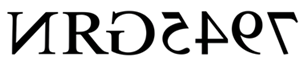
Question 31

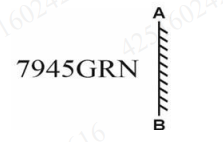
A mirror is placed on the line AB. Out of the option figures which figure will be the right image of the question figure?

  1. AOption (a)

  2. BOption (b)

  3. COption (c)

  4. DOption (d)

View answer & explanation

Correct answer

Answer: (b)B.

Why this answer is correct

The correct mirror image of the given figure is:

Logic: When a mirror is placed on the right side, the sequence gets reversed, and each character is horizontally flipped.

Hence, the correct answer is "Option 2".

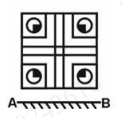
Question 32

A mirror is placed on the line AB. Out of the option figures which figure will be the right image of the question figure?

<br>

  1. AOption (a)

  2. BOption (b)

  3. COption (c)

  4. DOption (d)

View answer & explanation

Correct answer

Answer: (a)A.

Why this answer is correct

The logic followed here is:

Logic: When a mirror is placed on the right side, the image and each letter is laterally inverted (horizontally flipped).

The correct mirror image of the given figure is:

Hence, the correct answer is "Option 1".

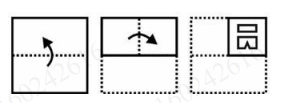
Question 33

A piece of paper is folded and punched as shown below in the question figures. From the given option figures, indicate how it will appear when opened.

  1. AOption (a)

  2. BOption (b)

  3. COption (c)

  4. DOption (d)

View answer & explanation

Correct answer

Answer: (d)D.

Why this answer is correct

The paper after unfolded will be:

Hence, the correct answer is "Option 4".

Question 34

Directions

Select the related letter from the given alternatives

ROSE: VSXJ::LILY:?

  1. AOption (a)

    PMQD

  2. BOption (b)

    PMDQ

  3. COption (c)

    QDPM

  4. DOption (d)

    YLIL

View answer & explanation

Correct answer

Answer: (a)A.

PMQD

Why this answer is correct

The logic followed here is:

Logic: Each letter in the word is shifted forward by a specific number in the alphabet.

ROSE → VSXJ

Similarly, LILY → ?

Hence, the correct answer is Option 1.

Question 35

Directions

Select the correct options from the given alternatives

11,9,22,20,33,31,44,?

  1. AOption (a)

    42

  2. BOption (b)

    46

  3. COption (c)

    38

  4. DOption (d)

    55

View answer & explanation

Correct answer

Answer: (a)A.

42

Why this answer is correct

The logic followed here is:

thus, "42 will replace the question mark in the given series.

Hence, the correct option is "Option 1".

Question 36

What comes next in the selves?

ACEG, CEGI, EGIK, ?

  1. AOption (a)

    GIKM

  2. BOption (b)

    GILM

  3. COption (c)

    GIJN

  4. DOption (d)

    GIMK

View answer & explanation

Correct answer

Answer: (a)A.

GIKM

Why this answer is correct

The logic followed here is:

So, the missing term = GIKM

Hence, the correct answer is Option 1.

Question 37

You are given a Master Address (MA) from official records. Your task is to identify the correct candidate address that matches exactly with the master address in terms of formatting, punctuation, spelling, and structure.

Master Address (MA): 14, Park Avenue, Block C, Green Meadows, Kolkata - 700019

Candidate Addresses:

  1. AOption (a)

    14 Park Avenue, Block C, Green Meadows, Kolkata - 700019

  2. BOption (b)

    14, Park Avenue, Block C, Green Meadows, Kolkata - 700019

  3. COption (c)

    14, Park Avenue, Block C, Green Meadows, Calcutta 700019

  4. DOption (d)

    14, Park Ave., Block C, Green Meadows, Kolkata 700019

View answer & explanation

Correct answer

Answer: (b)B.

14, Park Avenue, Block C, Green Meadows, Kolkata - 700019

Why this answer is correct

The address given in the problem is,

14, Park Avenue, Block C, Green Meadows, Kolkata - 700019

Let's match this address with the given options one by one to figure out which one is exactly the same.

OptionAddress in OptionGiven AddressComment
(1)14 Park Avenue, Block C, Green Meadows, Kolkata - 70001914, Park Avenue, Block C, Green Meadows, Kolkata - 700019The address in this option is missing a comma after '14'.
(2)14, Park Avenue, Block C, Green Meadows, Kolkata - 70001914, Park Avenue, Block C, Green Meadows, Kolkata - 700019The address is exactly the same as the given address.
(3)14, Park Avenue, Block C, Green Meadows, Calcutta 70001914, Park Avenue, Block C, Green Meadows, Kolkata - 700019The address in this option has 'Calcutta' instead of 'Kolkata' and is missing a hyphen before the PIN code.
(4)14, Park Ave., Block C, Green Meadows, Kolkata 70001914, Park Avenue, Block C, Green Meadows, Kolkata - 700019The address in this option has 'Ave.' instead of 'Avenue' and is missing a hyphen before the PIN code.

So, the address that is exactly the same as the given address is in option (2).

Hence, the correct option is "option (2)".

Question 38

You are given a Master Address (MA) from official records. Your task is to identify the correct candidate address that matches exactly with the master address in terms of formatting, punctuation, spelling, and structure.

<br>

Master Address (MA): Office No. 101, 1st Floor, Trade Centre, Bandra-Kurla Complex, Mumbai - 400051

Candidate Addresses:

  1. AOption (a)

    Office No. 101, First Floor, Trade Centre, Bandra-Kurla Complex, Mumbai - 400051

  2. BOption (b)

    Office No. 101, 1st Floor, Trade Center, Bandra-Kurla Complex, Mumbai - 400051

  3. COption (c)

    Office No. 101, 1st Floor, Trade Centre, Bandra Kurla Complex, Mumbai - 400051

  4. DOption (d)

    Office No. 101, 1st Floor, Trade Centre, Bandra-Kurla Complex, Mumbai - 400051

View answer & explanation

Correct answer

Answer: (d)D.

Office No. 101, 1st Floor, Trade Centre, Bandra-Kurla Complex, Mumbai - 400051

Why this answer is correct

The address given in the problem is,

Office No. 101, 1st Floor, Trade Centre, Bandra-Kurla Complex, Mumbai - 400051

Let's match this address with the given options one by one to figure out which one is exactly the same.

OptionAddress in OptionGiven AddressComment
(1)Office No. 101, First Floor, Trade Centre, Bandra-Kurla Complex, Mumbai - 400051Office No. 101, 1st Floor, Trade Centre, Bandra-Kurla Complex, Mumbai - 400051The address in this option has 'First Floor' instead of '1st Floor'.
(2)Office No. 101, 1st Floor, Trade Center, Bandra-Kurla Complex, Mumbai - 400051Office No. 101, 1st Floor, Trade Centre, Bandra-Kurla Complex, Mumbai - 400051The address in this option has 'Center' instead of 'Centre'.
(3)Office No. 101, 1st Floor, Trade Centre, Bandra Kurla Complex, Mumbai - 400051Office No. 101, 1st Floor, Trade Centre, Bandra-Kurla Complex, Mumbai - 400051The address in this option is missing a hyphen in 'Bandra-Kurla'.
(4)Office No. 101, 1st Floor, Trade Centre, Bandra-Kurla Complex, Mumbai - 400051Office No. 101, 1st Floor, Trade Centre, Bandra-Kurla Complex, Mumbai - 400051The address is exactly the same as the given address.

So, the address that is exactly the same as the given address is in option (4).

Hence, the correct option is "option (4)".

Question 39

If + means -, -  means x, x means ÷, and ÷ means +, evaluate: 36÷6 + 4 × 2 - 3 =?

  1. AOption (a)

    30

  2. BOption (b)

    36

  3. COption (c)

    33

  4. DOption (d)

    32

View answer & explanation

Correct answer

Answer: (b)B.

36

Why this answer is correct

BODMAS Table: 

Given equation: 36 ÷ 6 + 4 × 2 − 3

Now, if ‘+’ means ‘−’, ‘−’ means ‘×’, ‘×’ means ‘÷’, and ‘÷’ means ‘+’, then:

⇒ 36 + 6 − 4 ÷ 2 × 3

⇒ 4 ÷ 2 = 2

⇒ 2 × 3 = 6

⇒ 36 + 6 − 6

⇒ 42 − 6 = 36

Hence, the correct answer is Option 2.

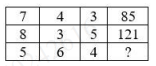
Question 40

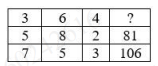
In the following question, select the number which can be placed at the sign of question mark (?) from the given alternatives.

  1. AOption (a)

    120

  2. BOption (b)

    119

  3. COption (c)

    91

  4. DOption (d)

    121

View answer & explanation

Correct answer

Answer: (d)D.

121

Why this answer is correct

The logic followed here is:

Logic: The missing number is obtained by adding the squares of the three given numbers and then adding a constant specific to the row.

Stepwise Analysis:

Row 1: 7² + 4² + 3² + 11 = 49 + 16 + 9 + 11 = 85 

Row 2: 8² + 3² + 5² + 23 = 64 + 9 + 25 + 23 = 121 

Row 3 (Missing Number): 5² + 6² + 4² + 14 = 25 + 36 + 16 + 14 = 91 

Hence, the missing number is Option 3.

Question 41

In the following question, select the number which can be placed at the sign of question mark (?) from the given alternatives.

<br>

  1. AOption (a)

    71

  2. BOption (b)

    72

  3. COption (c)

    73

  4. DOption (d)

    75

View answer & explanation

Correct answer

Answer: (c)C.

73

Why this answer is correct

The logic followed here is:

Logic: In each row, multiply the first three numbers together and then add 1 to get the fourth number.

Stepwise Analysis:

Row 1: (3 × 6 × 4) + 1 = 72 + 1 = 73 

Row 2: (5 × 8 × 2) + 1 = 80 + 1 = 81 

Row 3: (7 × 5 × 3) + 1 = 105 + 1 = 106 

Hence, the missing number is Option 3.

Question 42

Identify the diagram that best represents the relationship among the given classes.

Male, Brother, Husband

  1. AOption (a)

  2. BOption (b)

  3. COption (c)

  4. DOption (d)

View answer & explanation

Correct answer

Answer: (a)A.

Why this answer is correct

According to the given Venn diagram:

The diagram shows that Male is the main set, and Brother and Husband are subsets of Male with some common members.

So, Brother and Husband are inside Male and partially overlap with each other.

Hence, the correct answer is "Option 1".

Question 43

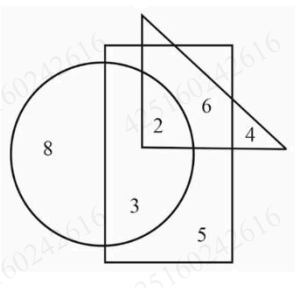
In the figure given below the circle represents doors, the triangle represents windows and the rectangle represents glass. The number in each area represents the number of items in that area.

<br> <br>

Which of the following statement is correct?

I. Total number of glass are 14.

II. Total number of doors are 13.

  1. AOption (a)

    Only I

  2. BOption (b)

    ​Only II

  3. COption (c)

    Both I and II

  4. DOption (d)

    Neither I nor II

View answer & explanation

Correct answer

Answer: (b)B.

​Only II

Why this answer is correct

The logic followed here is:

Logic: Add the numbers present inside each respective shape (including overlapping regions).

Now,

For Glass (Rectangle):

6 + 3 + 2 + 5 = 16 ≠ 14→ Statement I is not correct

For Doors (Circle):

5 + 3 + 1 + 4 = 13 → Statement II is correct

Hence, only II statements are correct.

Hence, the correct answer is Option 2.

Question 44

R is moving towards south. After taking 9 right and 10 left turns in which direction he will be moving?

  1. AOption (a)

    ​West

  2. BOption (b)

    East 

  3. COption (c)

    North 

  4. DOption (d)

    South 

View answer & explanation

Correct answer

Answer: (b)B.

East 

Why this answer is correct

Given:

R is initially moving south.

9 right turns

10 left turns

Since a Right turn cancels out a Left turn, we only need to look at the difference.

Net Result = 10 Left - 9 right = 1 Left

Starting Direction: South

So, if you are facing South and turn Left, you will be facing East.

Hence, the correct answer is Option 2.

Question 45

Which option figure will complete the pattern in the question figure? (Rotation is not allowed)

  1. AOption (a)

  2. BOption (b)

  3. COption (c)

  4. DOption (d)

View answer & explanation

Correct answer

Answer: (c)C.

Why this answer is correct

The figure which is most suitable as the last part of the given figure is shown below:

Thus, option figure 3 completes the given figures.

Hence, "Option 3" is the correct answer.

Question 46

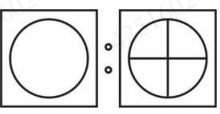
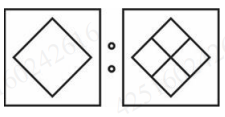
In the following question, in each option a pair of figures is given. In each pair the figure towards the left of (:) is related by some logic/rule/relation with the figure on the right of (:). Select the odd figure pair from the given alternatives.

  1. AOption (a)

  2. BOption (b)

  3. COption (c)

  4. DOption (d)

View answer & explanation

Correct answer

Answer: (b)B.

Why this answer is correct

The logic followed here is:

The image shows four analogy problems where a shape on the left is transformed into a divided version on the right. Here is the logic for each:

The image on the right ⇒ The picture on the right is divided into as many parts as there are sides in the picture on the left.

Option (1): 

Hexagon (side = 6) : Hexagon is divided into 6 parts

Option (2):

Circle (No side) : Circle is divided into 4 parts (Odd)

Option (3):

Heptagon (side = 7) : Heptagon is divided into 7 parts

Option (4): 

Rhombus (side = 4) : Rhombus is divided into 4 parts

Hence, the correct answer is option (2).

Question 47

In the following figure series, select the figure which can be placed at the sign of question mark (?) from the given alternatives.

  1. AOption (a)

  2. BOption (b)

  3. COption (c)

  4. DOption (d)

View answer & explanation

Correct answer

Answer: (d)D.

Why this answer is correct

The logic followed here is:

Logic: The shaded segment moves clockwise, the arm rotates 45° clockwise, and the square and circle alternate positions at the ends of the arm in each step. The next figure continues this combined movement.

Hence, the correct answer is Option 4.

Question 48

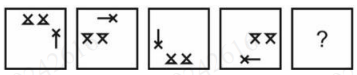
In the following figure series, select the figure which can be placed at the sign of question mark (?) from the given alternatives.

  1. AOption (a)

  2. BOption (b)

  3. COption (c)

  4. DOption (d)

View answer & explanation

Correct answer

Answer: (a)A.

Why this answer is correct

The logic followed here is:

Logic: The black dot moves counter-clockwise from corner to corner, while the "T" shaped element rotates 90° clockwise and shifts to the next side of the square.

The next figure continues this movement and rotation.

Hence, the correct answer is Option 1.

Question 49

If 'A' means '÷', 'B' means '-', 'C' means 'x' and 'D' means '+', then 48 A 16 D 12 B 7 C1=?

  1. AOption (a)

    6

  2. BOption (b)

    12

  3. COption (c)

    8

  4. DOption (d)

    15

View answer & explanation

Correct answer

Answer: (c)C.

8

Why this answer is correct

BODMAS Table: 

Given equation: 48 A 16 D 12 B 7 C 1

Now, if ‘A’ means ‘÷’, ‘B’ means ‘−’, ‘C’ means ‘×’, and ‘D’ means ‘+’, then:

⇒ 48 ÷ 16 + 12 − 7 × 1

⇒ 48 ÷ 16 = 3

⇒ 7 × 1 = 7

⇒ 3 + 12 − 7

⇒ 15 − 7 = 8

Hence, the correct answer is Option 3.

Question 50

If 'A' means '+', 'B' means '÷', 'C' means 'x' and 'D' means '-', then 17 A 9 D 11 C 4 B 2 = ?

  1. AOption (a)

    4

  2. BOption (b)

    6

  3. COption (c)

    8

  4. DOption (d)

    10

View answer & explanation

Correct answer

Answer: (a)A.

4

Why this answer is correct

BODMAS Table: 

Given equation: 17 A 9 D 11 C 4 B 2

Now, if ‘A’ means ‘+’, ‘B’ means ‘÷’, ‘C’ means ‘×’, and ‘D’ means ‘−’, then:

⇒ 17 + 9 − 11 × 4 ÷ 2

⇒ 11 × 4 = 44

⇒ 44 ÷ 2 = 22

⇒ 17 + 9 − 22

⇒ 26 − 22 = 4

Hence, the correct answer is Option 1.

Quantitative Aptitude (25 questions)

Question 51

A and B invested ₹10,000 and ₹15,000 respectively. If the business made a profit of ₹12,000, what is A's share?

  1. AOption (a)

    ₹4000

  2. BOption (b)

    ₹5000

  3. COption (c)

    ₹6000

  4. DOption (d)

    ​₹4800

View answer & explanation

Correct answer

Answer: (d)D.

​₹4800

Why this answer is correct

Given:

A's investment = ₹10,000

B's investment = ₹15,000

Total profit = ₹12,000

Formula Used:

A's share = (A's investment ÷ Total investment) × Total profit

Total investment = A's investment + B's investment

Calculation:

⇒ Total investment = ₹10,000 + ₹15,000

⇒ Total investment = ₹25,000

⇒ A's share = (₹10,000 ÷ ₹25,000) × ₹12,000

⇒ A's share = (0.4) × ₹12,000

⇒ A's share = ₹4,800

∴ The correct answer is ₹4,800.

Question 52

The average of 6 numbers is 18. If two numbers 14 and 22 are removed, what is the new average of the remaining numbers?

  1. AOption (a)

    18

  2. BOption (b)

    17

  3. COption (c)

    16

  4. DOption (d)

    15

View answer & explanation

Correct answer

Answer: (a)A.

18

Why this answer is correct

Given:

Average of 6 numbers = 18

Numbers removed = 14 and 22

Formula Used:

Total sum = Average × Number of values

New average = (New total sum) ÷ (New number of values)

Calculation:

⇒ Total sum of 6 numbers = 18 × 6

⇒ Total sum = 108

⇒ Sum of remaining numbers = Total sum − (Sum of removed numbers)

⇒ Sum of remaining numbers = 108 − (14 + 22)

⇒ Sum of remaining numbers = 108 − 36

⇒ Sum of remaining numbers = 72

⇒ New average = 72 ÷ 4

⇒ New average = 18

∴ The correct answer is 18.

Question 53

If A's income is 20% more than B's and B earns Rs. 50,000, what percent less is B's income than A's?

  1. AOption (a)

    16.66%

  2. BOption (b)

    20%

  3. COption (c)

    18%

  4. DOption (d)

    25%

View answer & explanation

Correct answer

Answer: (a)A.

16.66%

Why this answer is correct

Given:

B's income = 50000

A's income is 20% more than B

Formula Used:

Percentage increase = (Increase ÷ Original) × 100

Percentage decrease = (Difference ÷ Original value) × 100

Calculation:

⇒ Increase in A's income = 20% of 50000

⇒ Increase = (20 ÷ 100) × 50000 = 10000

⇒ A's income = 50000 + 10000 = 60000

⇒ Difference = 60000 − 50000 = 10000

⇒ Percentage less = (10000 ÷ 60000) × 100

⇒ = 16.66%

∴ The correct answer is 16.66%.

Question 54

A discount of 5% is given on an article priced at Rs. 2,000. Find the selling price.

  1. AOption (a)

    Rs. 1,800

  2. BOption (b)

    Rs. 1,900

  3. COption (c)

    Rs. 2,000

  4. DOption (d)

    Rs. 2,100

View answer & explanation

Correct answer

Answer: (b)B.

Rs. 1,900

Why this answer is correct

Given:

Original price = Rs. 2,000

Discount = 5%

Formula Used:

Discount amount = (Discount % × Original price) ÷ 100

Selling price = Original price - Discount amount

Calculation:

⇒ Discount amount = (5 × 2,000) ÷ 100

⇒ Discount amount = 10,000 ÷ 100

⇒ Discount amount = Rs. 100

⇒ Selling price = 2,000 - 100

⇒ Selling price = Rs. 1,900

∴ The correct answer is Rs. 1,900.

Question 55

A rhombus-shaped support structure has sides 10 cm and one diagonal 16 cm. What is the other diagonal?

  1. AOption (a)

    13 cm

  2. BOption (b)

    14 cm

  3. COption (c)

    11 cm

  4. DOption (d)

    12 cm

View answer & explanation

Correct answer

Answer: (d)D.

12 cm

Why this answer is correct

Given:

Side of rhombus = 10 cm

One diagonal = 16 cm

Formula Used:

(d1 ÷ 2)2 + (d2 ÷ 2)2 = side2

Calculation:

⇒ (16 ÷ 2)2 + (d2 ÷ 2)2 = 102

⇒ 82 + (d2 ÷ 2)2 = 100

⇒ 64 + (d2 ÷ 2)2 = 100

⇒ (d2 ÷ 2)2 = 36

⇒ d2 ÷ 2 = 6

⇒ d2 = 12 cm

∴ The correct answer is 12 cm.

Question 56

A pyramid-shaped puzzle piece fits exactly into a square-based hole of depth 4 cm. If the base is 6 cm, what is the volume of the pyramid?

  1. AOption (a)

    42 cm³

  2. BOption (b)

    38 cm3

  3. COption (c)

    52 cm3

  4. DOption (d)

    48 cm3

View answer & explanation

Correct answer

Answer: (d)D.

48 cm3

Why this answer is correct

Shortcut Trick

Base Area of square = side2 = 6 × 6 = 36 cm2.

Volume of pyramid = (1/3) × Base Area × Height.

Volume = (1/3) × 36 × 4 = 12 × 4 = 48 cm3.

∴ The correct answer is 48 cm3.

Alternate Method

Given:

Side of square base (a) = 6 cm

Depth or Vertical Height (h) = 4 cm

Formula Used:

Volume of pyramid = (1/3) × Base Area × Height

Calculations:

⇒ Base Area = a2 = 6 × 6 = 36 cm2

⇒ Volume = (1/3) × 36 × 4

⇒ Volume = 12 × 4

⇒ Volume = 48 cm3

∴ The correct answer is 48 cm3.

Additional Information

Volume Property

A pyramid has exactly one-third the volume of a prism with the same base area and height.

Slant Height (l)

The slant height of a square pyramid is calculated using the Pythagorean theorem: l = √(h2 + (a/2)2).

Surface Area

Total Surface Area = Base Area + (1/2) × Perimeter × Slant Height.

Question 57

A conical flask is perfectly fitted inside a cylindrical container. Both have a base radius of 5 cm and height 12 cm. What is the ratio of the cone's volume to that of the cylinder?

  1. AOption (a)

    (1:2)

  2. BOption (b)

    (1:3)

  3. COption (c)

    (2:3)

  4. DOption (d)

    (3:4)

View answer & explanation

Correct answer

Answer: (b)B.

(1:3)

Why this answer is correct

Given:

Radius = 5 cm

Height = 12 cm

Formula Used:

Volume of cone = (1 ÷ 3) × π × r2 × h

Volume of cylinder = π × r2 × h

Calculation:

⇒ Volume of cone = (1 ÷ 3) × π × 52 × 12

⇒ Volume of cylinder = π × 52 × 12

⇒ Ratio = [(1 ÷ 3) × π × 25 × 12] ÷ [π × 25 × 12]

⇒ Ratio = 1 ÷ 3

∴ The correct answer is 1 : 3.

Question 58

The product of two rational numbers is always: 

  1. AOption (a)

    Rational 

  2. BOption (b)

    Irrational

  3. COption (c)

    Natural

  4. DOption (d)

    Integer

View answer & explanation

Correct answer

Answer: (a)A.

Rational 

Why this answer is correct

Given:

First rational number = a ÷ b

Second rational number = c ÷ d

Formula Used:

Product of two rational numbers = (a ÷ b) × (c ÷ d)

Calculation:

⇒ Product = (a × c) ÷ (b × d)

⇒ a × c is an integer

⇒ b × d is a non-zero integer

⇒ Result is in the form of p ÷ q

∴ The correct answer is Rational number.

Question 59

 A bookstore bought 120 different novels at an average price of 145. It sold 40 novels at 20% profit, 60 novels at 10% loss, and the rest were sold in a combo deal that included a 30% profit on the total cost of those remaining novels. What was the selling price per novel in the combo deal?

  1. AOption (a)

    ₹186.75

  2. BOption (b)

    ₹192.00

  3. COption (c)

    ₹190.25

  4. DOption (d)

    ₹188.50

View answer & explanation

Correct answer

Answer: (d)D.

₹188.50

Why this answer is correct

Given:

Total novels = 120

Average cost price = 145

Sold at 20% profit = 40 novels

Sold at 10% loss = 60 novels

Remaining novels = 20

Formula Used:

Selling price = Cost price × (1 ± profit/loss % ÷ 100)

Total cost = number × cost per item

Calculation:

⇒ Total cost = 120 × 145 = 17400

⇒ Cost of 40 novels = 40 × 145 = 5800

⇒ Selling price = 5800 × (120 ÷ 100) = 6960

⇒ Cost of 60 novels = 60 × 145 = 8700

⇒ Selling price = 8700 × (90 ÷ 100) = 7830

⇒ Cost of remaining 20 novels = 20 × 145 = 2900

⇒ Selling price of remaining = 2900 × (130 ÷ 100) = 3770

⇒ Selling price per novel = 3770 ÷ 20 = 188.50

∴ The correct answer is 188.50.

Question 60

An architect designs a modern building facade using triangular glass panels. Each triangle has angles in the ratio 2:3:7. What is the measure of the largest angle in the panel?

  1. AOption (a)

    90º

  2. BOption (b)

    105º

  3. COption (c)

    108º

  4. DOption (d)

    126º

View answer & explanation

Correct answer

Answer: (b)B.

105º

Why this answer is correct

Shortcut Trick

Total ratio parts = 2 + 3 + 7 = 12 parts.

Total sum of angles in a triangle = 180º.

12 parts = 180º → 1 part = 15º.

Largest angle corresponds to 7 parts.

Measure = 7 × 15º = 105º.

∴ The correct answer is 105º.

Alternate Method

Given:

Ratio of angles in the triangular glass panels = 2 : 3 : 7

Formula Used:

Sum of all internal angles of a triangle = 180º

Calculations:

⇒ Let the angles be 2x, 3x, and 7x.

⇒ 2x + 3x + 7x = 180º

⇒ 12x = 180º

⇒ x = 180º ÷ 12

⇒ x = 15º

⇒ Largest angle = 7x = 7 × 15º

⇒ Largest angle = 105º

∴ The correct answer is 105º.

Additional Information

Angle Sum Property

The sum of all interior angles of any triangle is always 180º, regardless of its shape or size.

Obtuse-Angled Triangle

A triangle is classified as obtuse if one of its angles is greater than 90º. In this panel, 105º > 90º, so it is an obtuse triangle.

Ratio and Proportion in Geometry

To find individual components from a ratio a:b:c, multiply the total value by the fraction [part / (a+b+c)].

Question 61

An artist forms triangle ABC. She connects the midpoints of its sides to form triangle DEF inside it. What is the area of triangle DEF in relation to triangle ABC?

  1. AOption (a)

    1:2

  2. BOption (b)

    1:3

  3. COption (c)

    1:4

  4. DOption (d)

    1:6

View answer & explanation

Correct answer

Answer: (c)C.

1:4

Why this answer is correct

Given:

Triangle DEF is formed by joining midpoints of triangle ABC

Formula Used:

Area of medial triangle = (1 ÷ 4) × Area of original triangle

Calculation:

⇒ Each side of DEF = (1 ÷ 2) of corresponding side of ABC

⇒ Ratio of sides = 1 ÷ 2

⇒ Ratio of areas = (1 ÷ 2)2

⇒ Ratio of areas = 1 ÷ 4

∴ The correct answer is 1 ÷ 4 of triangle ABC.

Question 62

A farmer owns a triangular plot of land with coordinates A(2,3), B(8,3), and C(5,9). He wants to place a scarecrow at the centroid of the field. What are the coordinates of the centroid?

  1. AOption (a)

    (5,5)

  2. BOption (b)

    (4,5)

  3. COption (c)

    (5,6)

  4. DOption (d)

    (4,4)

View answer & explanation

Correct answer

Answer: (a)A.

(5,5)

Why this answer is correct

Given:

A = (2, 3)

B = (8, 3)

C = (5, 9)

Formula Used:

Centroid = ((x1 + x2 + x3) ÷ 3 , (y1 + y2 + y3) ÷ 3)

Calculation:

⇒ x = (2 + 8 + 5) ÷ 3

⇒ x = 15 ÷ 3 = 5

⇒ y = (3 + 3 + 9) ÷ 3

⇒ y = 15 ÷ 3 = 5

∴ The correct answer is (5, 5).

Question 63

A mixture containing 22% of ethanol is mixed with another mixture containing a% of ethanol in the ratio 6: 7. If the percentage of ethanol in the final mixture is 15%, find the value of a.

  1. AOption (a)

    5%

  2. BOption (b)

    13%

  3. COption (c)

    9%

  4. DOption (d)

    11%

View answer & explanation

Correct answer

Answer: (c)C.

9%

Why this answer is correct

Shortcut Trick

By Alligation method, the ratio of the differences is equal to the quantity ratio.

(Higher % − Mean %) : (Mean % − Lower %) = Ratio 2 : Ratio 1

(22 − 15) : (15 − a) = 7 : 6

Since 7 units = 7, then 15 − a = 6.

a = 15 − 6 = 9%.

∴ The correct answer is 9%.

Alternate Method

Given:

Ethanol concentration in Mixture 1 = 22%

Ethanol concentration in Mixture 2 = a%

Mixing ratio = 6 : 7

Resultant concentration = 15%

Formula Used:

Weighted Average = (n1c1 + n2c2) ÷ (n1 + n2)

Calculations:

⇒ Total mixture units = 6 + 7 = 13

⇒ Total Ethanol = (6 × 22) + (7 × a)

⇒ 15 = (132 + 7a) ÷ 13

⇒ 15 × 13 = 132 + 7a

⇒ 195 = 132 + 7a

⇒ 7a = 195 − 132

⇒ 7a = 63

⇒ a = 63 ÷ 7

⇒ a = 9

∴ The correct answer is 9%.

Additional Information

Alligation Rule

It is a shortcut to find the ratio in which two ingredients at given prices/percentages must be mixed to produce a mixture of a desired price/percentage.

Weighted Average Formula

For two groups with averages A1 and A2 and sizes n1 and n2, the combined average is (n1A1 + n2A2) ÷ (n1 + n2).

Mixing of Pure Liquids

When pure water is added to a solution, its ethanol (or solute) percentage is considered 0% for calculation purposes.

Question 64

A sum becomes ₹12100 in 2 years at 10% Compound Interest annually. Find the principal.

  1. AOption (a)

    ₹10000

  2. BOption (b)

    ​₹9900

  3. COption (c)

    ₹10100

  4. DOption (d)

    ₹12100

View answer & explanation

Correct answer

Answer: (a)A.

₹10000

Why this answer is correct

Given:

Amount = 12100

Rate = 10%

Time = 2 years

Formula Used:

Amount = Principal × (1 + r/100)t

Calculation:

⇒ 12100 = P × (1 + 10/100)2

⇒ 12100 = P × (1.1)2

⇒ 12100 = P × 1.21

⇒ P = 12100 ÷ 1.21

⇒ P = 10000

∴ The correct answer is 10000.

Question 65

The LCM and HCF of two numbers are 84 and 21 respectively. If the ratio of the two numbers is 1:4, the larger number is:

  1. AOption (a)

    24

  2. BOption (b)

    48

  3. COption (c)

    88

  4. DOption (d)

    84

View answer & explanation

Correct answer

Answer: (d)D.

84

Why this answer is correct

Given:

LCM = 84

HCF = 21

Ratio = 1 : 4

Formula Used:

Product of two numbers = LCM × HCF

Calculation:

⇒ Let numbers = x and 4x

⇒ Product = x × 4x = 4x2

⇒ 4x2 = 84 × 21

⇒ 4x2 = 1764

⇒ x2 = 1764 ÷ 4 = 441

⇒ x = 21

⇒ Larger number = 4x = 84

∴ The correct answer is 84.

Question 66

 A dog starts chasing a rabbit that is 200 meters away. The dog runs at 25 m/s, and the rabbit runs at 20 m/s. How far will the rabbit have run before the dog catches it?

  1. AOption (a)

    800 m

  2. BOption (b)

    1000 m

  3. COption (c)

    400 m

  4. DOption (d)

    600 m

View answer & explanation

Correct answer

Answer: (a)A.

800 m

Why this answer is correct

Given:

Distance between dog and rabbit = 200 m

Speed of dog = 25 m/s

Speed of rabbit = 20 m/s

Formula Used:

Time taken for dog to catch rabbit = Distance ÷ Relative speed

Distance run by rabbit = Speed of rabbit × Time

Calculation:

⇒ Relative speed = Speed of dog − Speed of rabbit

⇒ Relative speed = 25 − 20

⇒ Relative speed = 5 m/s

⇒ Time taken for dog to catch rabbit = 200 ÷ 5

⇒ Time = 40 s

⇒ Distance run by rabbit = Speed of rabbit × Time

⇒ Distance run by rabbit = 20 × 40

⇒ Distance = 800 m

∴ The correct answer is 800 m.

Question 67

 What is is the square root of 99980001?

  1. AOption (a)

    9999

  2. BOption (b)

    99999

  3. COption (c)

    100000

  4. DOption (d)

    100001

View answer & explanation

Correct answer

Answer: (a)A.

9999

Why this answer is correct

Given:

Number = 99980001

Formula used:

(a − b)2 = a2 − 2ab + b2

Calculations:

⇒ 99980001 = (10000 − 1)2

⇒ (10000 − 1)2 = 100002 − 2 × 10000 × 1 + 1

⇒ = 100000000 − 20000 + 1

⇒ = 99980001

⇒ Square root = 10000 − 1 = 9999

∴ √99980001 = 9999

Question 68

If the equation of a line is y = 2x - 1 what is the slope of the line?

  1. AOption (a)

    -1

  2. BOption (b)

    2

  3. COption (c)

    3

  4. DOption (d)

    -4

View answer & explanation

Correct answer

Answer: (b)B.

2

Why this answer is correct

Given:

Equation of the line: y = 2x - 1

Formula Used:

Slope of the line = Coefficient of x

Calculation:

⇒ Identify the coefficient of x in the equation y = 2x - 1

⇒ Coefficient of x = 2

∴ The correct answer is 2.

Question 69

Two circles, one with a radius of 13 cm and the other with a radius of 5 cm, have their centers 20 cm apart. A direct common tangent is drawn between the two circles. What is the length of this tangent?

  1. AOption (a)

    226\sqrt{226} cm

  2. BOption (b)

    331\sqrt{331} cm

  3. COption (c)

    336\sqrt{336} cm

  4. DOption (d)

    229\sqrt{229} cm

View answer & explanation

Correct answer

Answer: (c)C.

336\sqrt{336} cm

Why this answer is correct

Given:

Radius of larger circle (R) = 13 cm

Radius of smaller circle (r) = 5 cm

Distance between centers (d) = 20 cm

Formula used:

Length of direct common tangent = √(d2 − (R − r)2)

Calculations:

⇒ Length = √(202 − (13 − 5)2)

⇒ √(400 − 82)

⇒ √(400 − 64)

⇒ √336

∴ Length of direct common tangent = √336 cm

Question 70

Sum of A and B is 300 percent more than the sum of C and D. C is 50 percent more than D. If A is 200 percent more than B and D = 200, then what is the value of A?

  1. AOption (a)

    1500

  2. BOption (b)

    1400

  3. COption (c)

    1200

  4. DOption (d)

    1250

View answer & explanation

Correct answer

Answer: (a)A.

1500

Why this answer is correct

Given:

A + B = 300% more than (C + D)

⇒ A + B = 4(C + D)

C = 50% more than D ⇒ C = 1.5D

A = 200% more than B ⇒ A = 3B

D = 200

Formula used:

Percentage relation and substitution

Calculations:

⇒ C = 1.5 × 200 = 300

⇒ C + D = 300 + 200 = 500

⇒ A + B = 4 × 500 = 2000

⇒ A = 3B

⇒ 3B + B = 2000

⇒ 4B = 2000

⇒ B = 500

⇒ A = 3 × 500 = 1500

∴ A = 1500

Question 71

A sum is being lent at 10 percent per annum compound interest (compounding annually). What is the ratio of amount at the end of first year to the amount at the end of second year?

  1. AOption (a)

    10:11

  2. BOption (b)

    9:10

  3. COption (c)

    4:5

  4. DOption (d)

    7:12

View answer & explanation

Correct answer

Answer: (a)A.

10:11

Why this answer is correct

Given:

Rate of interest = 10% per annum

Compounding = Annually

Formula Used:

Amount at the end of n years = Principal × (1 + Rate/100)n

Calculation:

⇒ Let Principal = P

⇒ Amount at the end of the first year = P × (1 + 10/100)

⇒ Amount at the end of the first year = P × 1.1

⇒ Amount at the end of the second year = P × (1 + 10/100)2

⇒ Amount at the end of the second year = P × 1.1 × 1.1

⇒ Amount at the end of the second year = P × 1.21

⇒ Ratio of amount at the end of the first year to the amount at the end of the second year = (P × 1.1) : (P × 1.21)

⇒ Ratio = 1.1 : 1.21

⇒ Ratio = 10 : 11

∴ The correct answer is 10:11.

Question 72

Simple interest on a sum for 6 years is equal to 40 percent of the principal. In how many years interest will be equal to the principal?

  1. AOption (a)

    21 years

  2. BOption (b)

    18 years

  3. COption (c)

    15 years

  4. DOption (d)

    12 years

View answer & explanation

Correct answer

Answer: (c)C.

15 years

Why this answer is correct

Given:

Simple Interest (SI) for 6 years = 40% of Principal (P)

Time (T) = 6 years

SI = P × R × T ÷ 100

Formula Used:

SI = P × R × T ÷ 100

Time when SI = P: T = 100 ÷ R

Calculation:

⇒ 40% of P = P × R × 6 ÷ 100

⇒ 40 = R × 6

⇒ R = 40 ÷ 6

⇒ R = 6.67 (approximately)

Let time when SI = P be T years:

⇒ P = P × R × T ÷ 100

⇒ 100 = R × T

⇒ T = 100 ÷ R

⇒ T = 100 ÷ 6.67

⇒ T = 15 (approximately)

∴ The correct answer is 15 years.

Question 73

The value of discount given on an article is (2/17) of the marked price. What is the ratio of the value of discount to the selling price?

  1. AOption (a)

    15:17

  2. BOption (b)

    2:19

  3. COption (c)

    2:15

  4. DOption (d)

    15:19

View answer & explanation

Correct answer

Answer: (c)C.

2:15

Why this answer is correct

Given:

Discount = (2/17) of Marked Price

Marked Price = 17

Formula Used:

Ratio of Discount to Selling Price = Discount ÷ Selling Price

Calculation:

⇒ Discount = (2/17) × 17 = 2

⇒ Selling Price = Marked Price - Discount

⇒ Selling Price = 17 - 2 = 15

⇒ Ratio of Discount to Selling Price = Discount ÷ Selling Price

⇒ Ratio = 2 ÷ 15

⇒ Ratio = 2 : 15

∴ The correct answer is 2 : 15.

Question 74

Mohit and Rohit undertook a work for Rs. 6600. Mohit alone can do that work in 25 days. Rohit alone can do the same work in 30 days. They work together. What will be the difference in the amount (in Rs.) they receive?

  1. AOption (a)

    650

  2. BOption (b)

    500

  3. COption (c)

    600

  4. DOption (d)

    550

View answer & explanation

Correct answer

Answer: (c)C.

600

Why this answer is correct

Given:

Total money = ₹6600

Mohit = 25 days

Rohit = 30 days

Formula used:

Work = LCM of days

Efficiency = Work ÷ Time

Share ∝ Efficiency

Calculations:

LCM of 25 and 30 = 150

⇒ Total work = 150 units

⇒ Mohit’s 1 day work = 150 ÷ 25 = 6 units

⇒ Rohit’s 1 day work = 150 ÷ 30 = 5 units

⇒ Ratio of work = 6 : 5

⇒ Ratio of money = 6 : 5

⇒ Difference = (6 − 5) parts = 1 part

⇒ Total parts = 11

⇒ 1 part = 6600 ÷ 11 = 600

∴ Difference in amount = ₹600

Question 75

P and Q working alone can complete a work in 5 days and 15 days respectively. They work on alternate days one at a time. P works on the first day. In how many days the whole work will be completed?

  1. AOption (a)

    6

  2. BOption (b)

    7

  3. COption (c)

    7.5

  4. DOption (d)

    3

View answer & explanation

Correct answer

Answer: (b)B.

7

Why this answer is correct

Shortcut Trick

Total work (LCM of 5, 15) = 15 units.

Efficiency: P = 3 units/day, Q = 1 unit/day.

In a 2-day cycle (P + Q), work done = 3 + 1 = 4 units.

In 3 cycles (6 days), work done = 4 × 3 = 12 units.

Remaining 3 units (15 − 12) are completed by P on the 7th day (3 ÷ 3 = 1 day).

∴ The correct answer is 7 days.

Alternate Method

Given:

Time taken by P = 5 days

Time taken by Q = 15 days

Formula: Efficiency = Total Work ÷ Time taken

PersonDaysTotal Work (LCM)Efficiency
P5153
Q151

⇒ Total work done in the first 2 days (P on day 1, Q on day 2) = 3 + 1 = 4 units

⇒ Work done in 6 days (3 cycles) = 4 × 3 = 12 units

⇒ Remaining work to be done after 6 days = 15 − 12 = 3 units

⇒ On the 7th day, it is P's turn to work.

⇒ Time taken by P to finish remaining work = Remaining work ÷ Efficiency of P = 3 ÷ 3 = 1 day

⇒ Total days required = 6 + 1 = 7 days

∴ The correct answer is 7 days.

Additional Information

Alternate Day Work

In alternate work problems, calculate the work done in one full cycle (e.g., 2 days if there are 2 people) and then determine how many full cycles fit into the total work.

Total Work and Efficiency

Total Work = Time × Efficiency. Efficiency is the rate of work done per unit of time and is inversely proportional to the time taken.

Remaining Work Calculation

Time for remaining work = Remaining Work ÷ Efficiency of the person whose turn it is next. Always check who starts the work on the first day.

General Awareness (25 questions)

Question 76

To whom was Gond king Dalpat married?

  1. AOption (a)

    Rudrama Devi

  2. BOption (b)

    Durgawati 

  3. COption (c)

    Ahilyabai

  4. DOption (d)

    Chandramani Devi

View answer & explanation

Correct answer

Answer: (b)B.

Durgawati 

Why this answer is correct

The correct answer is Durgawati.

Key Points

  • Dalpat Shah, a Gond king of the Garha Mandla kingdom, was married to Rani Durgawati, a princess of the Chandel dynasty.
  • Rani Durgawati was renowned for her beauty, valor, and administrative acumen, becoming a symbol of bravery and resistance in Indian history.
  • After the death of Dalpat Shah in 1548, Rani Durgawati ruled the kingdom as regent for her son, Veer Narayan, demonstrating exceptional governance and military capabilities.
  • She fought valiantly against the Mughal forces led by Asaf Khan in 1564, but ultimately sacrificed her life in battle rather than surrendering to the invaders.
  • Her reign is remembered for her efforts to protect the independence of her kingdom and her legacy continues to inspire many as an iconic historical figure.

Additional Information

  • Rani Durgawati's Background:
  • She was born in 1524 in Kalinjar Fort, the stronghold of the Chandel dynasty, known for its architectural marvels like the temples of Khajuraho.
  • The Chandel dynasty was historically influential in the Bundelkhand region of modern-day Madhya Pradesh.
  • Garha Mandla Kingdom:
  • The Garha Mandla kingdom, ruled by the Gond dynasty, was located in present-day Madhya Pradesh.
  • It was known for its rich natural resources, including forests and rivers, and for being a strategically significant region in central India.
  • Rani Durgawati’s Administration:
  • She is celebrated for her effective governance and promotion of agriculture, irrigation, and public welfare in her kingdom.
  • She maintained a strong military force to defend her territory against external threats.
  • Mughal Invasion:
  • In 1564, Rani Durgawati faced an invasion by Mughal forces under Asaf Khan, the governor of Khandesh, acting on orders from Emperor Akbar.
  • Despite being heavily outnumbered, she displayed exceptional courage in leading her army against the Mughal forces.
  • She chose death over surrender and became a symbol of resistance against Mughal imperialism.
  • Legacy:
  • Rani Durgawati’s sacrifice is commemorated in several historical texts and is celebrated as a testament to her bravery and patriotism.
  • The government of Madhya Pradesh honors her memory through various cultural events and institutions named after her.
  • Her life serves as an inspiring story of a woman ruler who stood against mighty odds to protect her kingdom.

Important Points

  • Rudrama Devi: She was a queen of the Kakatiya dynasty in southern India, known for her effective rule and promotion of infrastructure development. This option is incorrect.
  • Ahilyabai Holkar: She was the queen of the Malwa kingdom, famous for her contributions to temple construction and public welfare. This option is incorrect.
  • Chandramani Devi: This name does not have historical significance in the context of Gond king Dalpat Shah. This option is incorrect.
  • The correct answer is Durgawati, as she was the wife of Dalpat Shah and later a regent who played a crucial role in Indian history.

Question 77

Which of the following is a Fundamental Duty mentioned in the Indian Constitution?

  1. AOption (a)

    To value the rich heritage of our composite ​culture

  2. BOption (b)

    To not indulge in corrupt practices

  3. COption (c)

    To help accident victims 

  4. DOption (d)

    To respect freedom of speech of others 

View answer & explanation

Correct answer

Answer: (a)A.

To value the rich heritage of our composite ​culture

Why this answer is correct

The correct answer is To value the rich heritage of our composite culture.

Key Points

  • Fundamental Duties were introduced in the Indian Constitution through the 42nd Amendment Act, 1976, based on the recommendations of the Swaran Singh Committee. They are enshrined in Article 51A.
  • One of the Fundamental Duties includes the obligation to value and preserve the rich heritage of India’s composite culture. This duty aims to inspire citizens to protect and promote India's diverse cultural legacy.
  • The Fundamental Duties are applicable to all Indian citizens, and while they are not enforceable by law, they serve as a moral obligation to uphold the spirit of the Constitution.
  • The statement “To value the rich heritage of our composite culture” is directly mentioned in Article 51A(f), making it a part of the Fundamental Duties.
  • Other duties include respecting the Constitution, promoting harmony, safeguarding public property, and striving for excellence, all of which aim to foster a sense of responsibility among citizens.

Additional Information

  • Fundamental Duties Overview:
  • There are currently 11 Fundamental Duties listed under Article 51A of the Indian Constitution.
  • These duties were inspired by the Constitution of the USSR and aim to promote patriotism and strengthen the unity of the nation.
  • While these duties are non-justiciable, they complement Fundamental Rights and Directive Principles of State Policy.
  • 42nd Amendment Act, 1976:
  • The 42nd Amendment is also known as the “Mini Constitution” due to the extensive changes it brought to the Indian Constitution.
  • Besides introducing Fundamental Duties, it emphasized the importance of Directive Principles and strengthened the powers of the central government.
  • Preservation of Composite Culture:
  • India is known for its diverse culture and heritage, including monuments, art forms, languages, festivals, and traditions.
  • The duty to preserve this heritage encourages citizens to actively participate in cultural preservation initiatives such as protecting historical sites and promoting cultural awareness.
  • Examples include the Clean India Campaign to preserve heritage sites and cultural festivals such as Surajkund Mela and International Yoga Day.
  • Comparison with Fundamental Rights:
  • While Fundamental Rights are enforceable by the judiciary and provide protection to individuals, Fundamental Duties serve as moral obligations for citizens.
  • Both aim to uphold the democratic framework of India and ensure the holistic development of society.

Important Points

  • List of Fundamental Duties: Article 51A lists duties such as respecting the Constitution, cherishing national heritage, promoting harmony, and safeguarding public property.
  • Enforcement: While Fundamental Duties are not legally enforceable, several initiatives like cultural education programs and civic awareness campaigns promote adherence.
  • Global Context: Countries like Japan and Russia also emphasize citizen duties in their constitutions, highlighting the universal importance of moral obligations.
  • Civic Awareness: Schools and colleges in India conduct programs to instill the importance of Fundamental Duties among students.

Question 78

Which of the following writ is issued by a higher court (High Court or Supreme Court) when a lower court has considered a case going beyond its jurisdiction?

  1. AOption (a)

    Habeas corpus

  2. BOption (b)

    Prohibition

  3. COption (c)

    certiorari 

  4. DOption (d)

    Quo- warranto 

View answer & explanation

Correct answer

Answer: (b)B.

Prohibition

Why this answer is correct

The correct answer is Prohibition.

Key Points

  • Prohibition is a writ issued by a higher court, such as the High Court or Supreme Court, to prevent a lower court or tribunal from exceeding its jurisdiction in hearing a case.
  • This writ acts as a tool to ensure that judicial proceedings remain within the boundaries of the legal authority granted to the concerned judicial body.
  • The writ of Prohibition is issued when a lower court or tribunal attempts to act beyond its jurisdiction or violates procedural laws.
  • Prohibition is issued only to prevent an act from being done; it does not correct any action that has already been completed.
  • It is a preventive measure and differs from other writs such as Certiorari, which is corrective in nature.

Additional Information

  • Writs in the Indian Constitution:
  • The Indian Constitution provides for five types of writs under Article 32 (Supreme Court) and Article 226 (High Courts).
  • These writs are Habeas Corpus, Mandamus, Prohibition, Certiorari, and Quo Warranto.
  • These writs serve as tools to enforce fundamental rights and ensure judicial accountability.
  • Explanation of Other Writs:
  • Habeas Corpus: A writ issued to ensure the release of a person unlawfully detained. It protects the personal liberty of individuals.
  • Mandamus: A writ directing a public authority to perform a duty it is legally obligated to fulfill.
  • Certiorari: A writ issued to transfer a case from a lower court to a higher court or to quash an order passed by a lower court that exceeds its jurisdiction.
  • Quo Warranto: A writ questioning the legality of a person's claim to a public office.
  • Key Characteristics of Prohibition:
  • Jurisdictional Aspect: Prohibition ensures that lower courts function within their legal jurisdiction.
  • Preventive Nature: It prevents unlawful actions before they occur, unlike Certiorari, which corrects actions that have already happened.
  • Recipient: It can only be issued to judicial and quasi-judicial bodies, not administrative authorities.
  • Examples:
  • Suppose a lower court decides to hear a matter related to international treaties, which is beyond its jurisdiction. The higher court can issue a writ of Prohibition to stop the proceedings.
  • If a tribunal begins proceedings in violation of procedural rules laid down by statute, Prohibition can be issued to halt such proceedings.

Important Points

  • Article 32 and Article 226:
  • While Article 32 empowers the Supreme Court to issue writs for the enforcement of fundamental rights, Article 226 gives similar powers to High Courts for both fundamental rights and other legal rights.
  • Judicial Review: Prohibition is an integral part of the judicial review mechanism that ensures legal compliance and prevents abuse of power by lower courts and tribunals.
  • Limitations: The writ cannot be issued against legislative bodies, private individuals, or administrative authorities acting in non-judicial capacities.

Question 79

In the context of BBIN motor vehicle agreement, what does "I" stands for?

  1. AOption (a)

    India

  2. BOption (b)

    Indonesia

  3. COption (c)

    Iraq

  4. DOption (d)

    Iran

View answer & explanation

Correct answer

Answer: (a)A.

India

Why this answer is correct

The correct answer is India.

Key Points

  • BBIN Motor Vehicle Agreement: BBIN stands for Bangladesh, Bhutan, India, and Nepal. It is a regional agreement aimed at improving motor vehicle transportation and connectivity between these four countries.
  • The letter "I" in BBIN represents India, which is one of the key participants in the agreement.
  • The agreement was signed on 15th June 2015 in Thimphu, Bhutan, to facilitate seamless movement of passenger, personal, and cargo vehicles across borders.
  • Objective: The BBIN agreement promotes economic integration and trade facilitation by enabling easier and faster movement of goods and people across borders in South Asia.
  • India has been an active proponent of the agreement, recognizing the importance of regional connectivity for boosting trade and cooperation among neighboring countries.

Additional Information

  • Significance of BBIN Agreement:
  • The BBIN Motor Vehicle Agreement is a milestone in regional cooperation in South Asia, ensuring smoother transportation and logistics across borders.
  • It facilitates trade by reducing transportation time and costs, enabling economic growth in the region.
  • The agreement enhances connectivity and cooperation in areas such as tourism, trade, and cultural exchange.
  • Implementation:
  • The agreement allows the transit of goods and passenger vehicles with simplified procedures such as mutual recognition of permits and vehicle registration documents.
  • Each participating country is responsible for implementing the agreement and ensuring that infrastructure and regulatory frameworks align with its objectives.
  • Challenges:
  • The agreement faces challenges due to political and administrative differences among the member countries.
  • Bhutan has expressed reservations about the agreement, citing environmental concerns and other issues.
  • India’s Role:
  • India plays a pivotal role in the BBIN agreement, emphasizing the importance of connectivity for regional development.
  • India has invested in infrastructure development to facilitate the implementation of the agreement, such as improving roads and border facilities.

Important Points

  • Geography: BBIN countries share close geographical proximity, enhancing the need for regional cooperation and connectivity.
  • Trade Statistics: India conducts significant trade with other BBIN countries, making regional transportation vital for economic growth.
  • Environmental Concerns: Bhutan’s hesitation stems from worries about increased vehicular pollution and its impact on the environment.
  • Future Prospects: Successful implementation of the BBIN agreement could pave the way for similar initiatives in other regions, boosting global trade and cooperation.

Question 80

The Shanghai Cooperation Organisation was established in—————.

  1. AOption (a)

    1983

  2. BOption (b)

    2001

  3. COption (c)

    2010

  4. DOption (d)

    2017

View answer & explanation

Correct answer

Answer: (b)B.

2001

Why this answer is correct

The correct answer is 2001.

Key Points

  • The Shanghai Cooperation Organisation (SCO) was officially established on 15 June 2001, in Shanghai, China.
  • The founding members of the SCO include China, Russia, Kazakhstan, Kyrgyzstan, Tajikistan, and Uzbekistan.
  • The SCO emerged from the earlier grouping known as the "Shanghai Five", which was formed in 1996 to address border security issues between China, Russia, and the Central Asian states.
  • The organization was established to strengthen relations between member states, promote regional stability, and enhance cooperation on political, economic, security, and cultural matters.
  • The SCO focuses on combating terrorism, separatism, and extremism, along with fostering collaboration in trade, energy, and cultural exchanges.

Additional Information

  • Objectives of SCO:
  • To strengthen mutual trust and good-neighborly relations among member states.
  • To promote effective cooperation in political, economic, trade, scientific, technical, cultural, and environmental spheres.
  • To ensure regional peace, security, and stability by addressing terrorism, drug trafficking, and cross-border crimes.
  • To create a fair and rational international political and economic order.
  • Current Member States:
  • As of now, the SCO has 9 full members: China, Russia, Kazakhstan, Kyrgyzstan, Tajikistan, Uzbekistan, India, Pakistan, and Iran (added in 2021).
  • India and Pakistan joined as full members in 2017.
  • Observer States:
  • The SCO has several observer states, including Afghanistan, Belarus, and Mongolia, which participate in meetings but do not have voting rights.
  • Key Initiatives of SCO:
  • The SCO promotes projects in energy, infrastructure, and connectivity to boost economic cooperation.
  • It established the Regional Anti-Terrorist Structure (RATS), headquartered in Tashkent, Uzbekistan, to combat terrorism and extremism.
  • Importance of SCO:
  • The SCO covers a significant portion of the Eurasian region, accounting for around 60% of the landmass and nearly 40% of the global population.
  • It serves as a platform for addressing regional issues and building multilateral cooperation among member countries.

Important Points

  • Evolution of SCO:
  • Before its establishment in 2001, the organization functioned as the "Shanghai Five", which included China, Russia, Kazakhstan, Kyrgyzstan, and Tajikistan.
  • Uzbekistan joined in 2001, leading to the creation of the SCO.
  • Significance for India:
  • India's membership in the SCO provides a platform to enhance regional cooperation and address shared challenges like terrorism and extremism.
  • It allows India to engage with Central Asian countries and strengthen ties with China and Russia.

Question 81

In June 2025, who has been appointed as the Director of Prime Ministers Museum and Library (PMML)?

  1. AOption (a)

    Ashwani Lohani

  2. BOption (b)

    Anuj Pandey

  3. COption (c)

    Amitabh Kant

  4. DOption (d)

    R. Doraiswamy

View answer & explanation

Correct answer

Answer: (a)A.

Ashwani Lohani

Why this answer is correct

The correct answer is Ashwani Lohani.

Key Points

  • Ashwani Lohani has been appointed as the Director of the Prime Ministers Museum and Library (PMML) in June 2025. This high-profile appointment reflects his extensive experience in administration and leadership roles.
  • He is a retired officer of the Indian Railway Service of Mechanical Engineers (IRSME) and has previously served as the Chairman and Managing Director (CMD) of Air India.
  • Mr. Lohani is widely recognized for his expertise in managing public sector enterprises and has also headed the Railway Board, the apex body of the Indian Railways.
  • The Prime Ministers Museum and Library (PMML), located in New Delhi, is a premier institution dedicated to preserving and showcasing the contributions of Indian Prime Ministers and their historical significance.
  • His appointment is expected to enhance the strategic vision and operational efficiency of the PMML, further enriching its role as a repository of India’s political and cultural heritage.

Additional Information

  • Prime Ministers Museum and Library (PMML):
  • PMML is located in New Delhi, India, and is a government-run institution committed to preserving the legacy of Indian Prime Ministers.
  • It serves as a repository of documents, photographs, and other memorabilia related to the lives and contributions of India’s Prime Ministers.
  • The museum also houses research facilities and archives that are accessible to scholars and the public.
  • Its objective is to educate future generations about the socio-political history of India and the visionary leadership of its Prime Ministers.
  • Ashwani Lohani’s Previous Roles:
  • He has served as the CMD of Air India, where he played a critical role in stabilizing the operations of the national carrier during a challenging period.
  • As the Chairman of the Railway Board, he oversaw significant reforms in the Indian Railways, including infrastructure development and safety enhancements.
  • He is known for his ability to lead large-scale public sector enterprises with a focus on efficiency and innovation.
  • Functions of PMML:
  • The museum organizes exhibitions, seminars, and workshops to promote awareness about India’s political heritage.
  • It collaborates with national and international institutions for research and academic exchange programs.
  • The library within PMML is a resource-rich center for students, historians, and policymakers interested in Indian political history.

Important Points

  • Significance of PMML:
  • The institution is instrumental in documenting the evolution of India’s democracy and the role of its Prime Ministers in shaping the nation.
  • It provides a platform for citizens to engage with India’s rich political and cultural history.
  • Role of Directors in PMML:
  • The Director oversees the strategic planning and day-to-day operations of the museum and library.
  • They are responsible for curating exhibitions, acquiring new collections, and ensuring the institution’s relevance to contemporary audiences.

Question 82

In June 2025, government of India has organized a National Consultation on Gender Budgeting in————— .

  1. AOption (a)

    Vigyan Bhawan

  2. BOption (b)

    Andhra Bhawan

  3. COption (c)

    Rail Bhawan

  4. DOption (d)

    Hyderabad House

View answer & explanation

Correct answer

Answer: (a)A.

Vigyan Bhawan

Why this answer is correct

The correct answer is Vigyan Bhawan.

Key Points

  • Vigyan Bhawan is an iconic conference center located in New Delhi, India, used for hosting national and international events, seminars, and consultations.
  • The National Consultation on Gender Budgeting organized by the Government of India in June 2025 focused on enhancing strategies to incorporate gender perspectives into budgeting processes.
  • Gender Budgeting is a methodology for analyzing government budgets to ensure equitable resource allocation for women and men, addressing gender inequalities.
  • Vigyan Bhawan has historically been the venue for significant governmental discussions, making it a suitable choice for such consultations.
  • The consultation witnessed participation from policy experts, economists, and government officials to assess the impact of gender-sensitive budgeting practices.

Additional Information

  • Vigyan Bhawan:
  • Constructed in 1956, Vigyan Bhawan serves as a premier venue for government-hosted events, including international conventions and discussions.
  • It is equipped with state-of-the-art facilities such as conference halls, meeting rooms, and a media center, making it ideal for large-scale consultations.
  • Gender Budgeting:
  • Gender Budgeting was first introduced by the Government of India in the 2005-2006 Union Budget.
  • It aims to integrate a gender perspective into financial planning and allocation processes to reduce disparities.
  • Key features include analyzing resource allocation for women-centric programs and addressing systemic issues affecting women’s empowerment.
  • Historical Venues for Government Events:
  • Andhra Bhawan: A residential complex primarily used to accommodate officials and dignitaries from Andhra Pradesh.
  • Rail Bhawan: Headquarters of the Ministry of Railways, primarily used for administrative purposes.
  • Hyderabad House: A heritage building in Delhi, often used for hosting state dinners and bilateral meetings.
  • Importance of Gender Budgeting:
  • Gender Budgeting ensures inclusive growth by addressing gender-specific challenges in areas such as health, education, employment, and social welfare.
  • India’s efforts in gender budgeting have inspired other nations to adopt similar approaches to improve gender equity.

Important Points

  • Government of India Initiatives:
  • Several ministries incorporate gender budgeting cells to ensure targeted resource allocation for addressing women’s issues.
  • Programs like Beti Bachao Beti Padhao, POSHAN Abhiyaan, and STEP (Support to Training and Employment Program for Women) have been strengthened through gender budgeting.
  • Global Perspective:
  • Countries like Australia, South Africa, and the UK have adopted gender budgeting practices to address gender disparities effectively.
  • The UNDP (United Nations Development Programme) supports nations in implementing gender-sensitive approaches in budgeting.

Question 83

Bharatiya Bhasha Pustak Scheme has been launched in Budget 2025. Which ministry is implementing it?

  1. AOption (a)

    Ministry of Culture

  2. BOption (b)

    Ministry of Education

  3. COption (c)

    Ministry of Information and Broadcasting

  4. DOption (d)

    Ministry of Home Affairs

View answer & explanation

Correct answer

Answer: (b)B.

Ministry of Education

Why this answer is correct

The correct answer is Ministry of Education.

Key Points

  • Bharatiya Bhasha Pustak Scheme was introduced in the Budget 2025 with the aim of promoting Indian languages and literature across diverse regions of India.
  • The scheme is being implemented under the Ministry of Education, which is tasked with fostering cultural and linguistic diversity in the educational ecosystem.
  • The scheme focuses on creating educational materials and books in regional Indian languages, contributing to the vision of the National Education Policy (NEP) 2020, which emphasizes multilingual education.
  • The initiative seeks to empower students by providing access to educational resources in their native languages, thereby enhancing inclusivity and learning outcomes.
  • The Ministry of Education plays a pivotal role in coordinating with state governments, educational institutions, and publishers to ensure the successful implementation of this scheme.

Additional Information

  • Ministry of Education:
  • The Ministry of Education was formerly known as the Ministry of Human Resource Development (MHRD) until its renaming in 2020.
  • Its primary responsibilities include policy-making, regulation, and implementation of educational initiatives across the country.
  • The ministry oversees various schemes related to school education, higher education, and skill development, including the Samagra Shiksha Abhiyan, Mid-Day Meal Scheme, and Rashtriya Uchchatar Shiksha Abhiyan (RUSA).
  • It works in alignment with the National Education Policy (NEP) 2020, which emphasizes fostering multilingualism and cultural diversity.
  • National Education Policy (NEP) 2020:
  • The NEP aims to transform the Indian education system by promoting inclusivity, accessibility, and innovation.
  • One of its key focuses is the promotion of Indian languages, encouraging students to learn and preserve their native linguistic heritage.
  • It mandates the inclusion of regional languages in early education to develop cognitive abilities and cultural understanding.
  • The NEP also promotes the translation of academic texts into Indian languages for higher education.
  • Other Ministries Mentioned:
  • Ministry of Culture: Primarily focuses on cultural preservation, heritage, and art, rather than educational resources.
  • Ministry of Information and Broadcasting: Deals with media and communication, including public broadcasting, but does not directly contribute to educational material development.
  • Ministry of Home Affairs: Responsible for internal security and administration, unrelated to educational schemes.
  • Importance of Promoting Indian Languages:
  • Strengthens cultural identity and unity in diversity.
  • Encourages linguistic research and translation of global literature into regional languages.
  • Fosters inclusivity in education, ensuring better learning outcomes for students from diverse linguistic backgrounds.

Important Points

  • Budget 2025: The introduction of Bharatiya Bhasha Pustak Scheme signifies a major step toward promoting linguistic diversity and strengthening regional education systems.
  • Role of States: State governments play a critical role in identifying regional language requirements and facilitating the creation of localized educational materials.
  • Collaboration: The scheme involves partnerships with publishers, scholars, and educational institutions to ensure high-quality content.
  • Impact: The initiative is expected to boost literacy rates, cultural preservation, and accessibility to education for marginalized communities.

Question 84

A Kho-Kho playground (or pitch) is ———— in shape.

  1. AOption (a)

    rectangular

  2. BOption (b)

    circular

  3. COption (c)

    oval

  4. DOption (d)

    square

View answer & explanation

Correct answer

Answer: (a)A.

rectangular

Why this answer is correct

The correct answer is rectangular.

Key Points

  • The Kho-Kho playground is designed to be rectangular in shape, which is the standard and universally accepted dimension for the game.
  • The dimensions of a Kho-Kho field are typically 29 meters in length and 16 meters in width for senior players, as prescribed by the Kho-Kho Federation of India.
  • It includes a central lane (spanning the length of the field) and two poles placed at each end of the field, which are crucial to the gameplay mechanics.
  • The rectangular shape ensures a clear division of space for the chasers and defenders, facilitating smooth gameplay.
  • The rectangular field is marked with eight cross lanes, each 16 meters long, which are perpendicular to the central lane and help in the strategic movement of players.

Additional Information

  • Dimensions and Markings:
  • The total area of the Kho-Kho field is 29 x 16 meters, with an additional free zone of 3 meters at each end of the field.
  • The two poles at either end of the central lane are placed 2.55 meters from the end lines.
  • Game Rules and Use of Field:
  • Khokho is a traditional Indian sport that requires strategic running and agility within the field's boundary.
  • The game is played between two teams, where one team defends while the other chases, utilizing the rectangular field to tag opponents or evade being tagged.
  • Other Field Shapes in Sports:
  • Circular fields are common in sports like kabaddi or athletics.
  • Oval fields are used in cricket and Australian rules football.
  • Square fields are typically uncommon in sports.
  • Historical and Cultural Significance:
  • Kho-Kho originated in India and has been played in its rectangular field design since its formalization in the early 20th century.
  • The sport is now governed internationally by the Asian Kho-Kho Federation and the Kho-Kho Federation of India.

Important Points

  • The rectangular design of the Kho-Kho field allows for optimal gameplay by providing clear zones for chasers and defenders.
  • The central lane and cross lanes are integral to the strategy and movement of players during the game.
  • Kho-Kho is recognized as one of the oldest traditional sports in India and has undergone standardization to ensure uniform gameplay worldwide.
  • The rectangular field shape has been retained across all levels of play, including school, national, and international competitions.

Question 85

As of 31st July 2025, in which event has India won the greatest number of medals at the Asian Games?

  1. AOption (a)

    Wrestling

  2. BOption (b)

    Shooting

  3. COption (c)

    Athletics

  4. DOption (d)

    Hockey

View answer & explanation

Correct answer

Answer: (c)C.

Athletics

Why this answer is correct

The correct answer is Athletics.

Key Points

  • Athletics has been the most successful sport for India at the Asian Games. It has brought the country the highest number of medals in the event's history.
  • The discipline includes a wide variety of events, such as track and field, marathon, racewalking, and relays, providing multiple opportunities for medal wins.
  • India has won numerous gold, silver, and bronze medals in athletics over the years. Prominent athletes like Milkha Singh, P.T. Usha, Neeraj Chopra, and Hima Das have significantly contributed to India's medal tally.
  • India's dominance in athletics at the Asian Games is attributed to its strong performances in events like middle-distance running, javelin throw, and long jump.
  • As of 31st July 2025, athletics remains the discipline where India has consistently excelled and secured the highest number of medals compared to other sports like wrestling, shooting, or hockey.

Additional Information

  • Athletics at the Asian Games:
  • Athletics has been a part of the Asian Games since its inception in 1951.
  • The events are categorized into track events, field events, and road events.
  • India has shown consistent performances in men's and women's track events, particularly in relay races and hurdles.
  • Indian Athletics Legends:
  • Milkha Singh: Known as the "Flying Sikh," he won the gold medal in the 400m race at the 1958 Asian Games.
  • P.T. Usha: She earned the title "Queen of Indian Track and Field" after winning multiple gold medals and setting records at the 1986 Asian Games.
  • Neeraj Chopra: The javelin thrower won gold at the 2018 Asian Games, further solidifying India's legacy in athletics.
  • Comparison with Other Sports:
  • Wrestling: While India has achieved success in wrestling, the number of medals is fewer compared to athletics due to fewer events.
  • Shooting: India has excelled in shooting at recent Asian Games, but it still lags behind athletics in terms of overall medal count.
  • Hockey: India's hockey teams have won multiple gold medals, but the number of events in hockey is limited compared to athletics.
  • Asian Games Performance Data:
  • India has won over 250 medals in athletics at the Asian Games, including 85 gold medals (as of 31st July 2025).
  • The consistent performance in athletics has been a result of government initiatives, training programs, and the emergence of world-class athletes.

Important Points

  • Neeraj Chopra's Achievements: He is the first Indian track and field athlete to win a gold medal at the Olympics, which has further boosted interest in athletics.
  • Infrastructure Development: India has invested in state-of-the-art training facilities, such as the NIS Patiala, to nurture future athletes.
  • Support Programs: Initiatives like the Target Olympic Podium Scheme (TOPS) have been instrumental in supporting athletes financially and technically.
  • Future Prospects: With the emergence of young talent and improved training, India is poised to maintain its dominance in athletics at the Asian Games.

Question 86

A long-lost velvet worm species Typhloperipatus Williamsoni, has been rediscovered after 111 years in ———— .

  1. AOption (a)

    Arunachal Pradesh

  2. BOption (b)

    Kerala

  3. COption (c)

    Madhya Pradesh 

  4. DOption (d)

    Maharashtra

View answer & explanation

Correct answer

Answer: (a)A.

Arunachal Pradesh

Why this answer is correct

The correct answer is Arunachal Pradesh.

Key Points

  • Typhloperipatus Williamsoni, a long-lost species of velvet worm, has been rediscovered after 111 years in the state of Arunachal Pradesh, India.
  • This species belongs to the Onychophora phylum, which is often referred to as "living fossils" due to their evolutionary uniqueness and ancient lineage.
  • The rediscovery of the species highlights the rich biodiversity of Arunachal Pradesh, which is part of the Eastern Himalayas Biodiversity Hotspot.
  • Velvet worms are known for their soft, segmented bodies and unique mode of locomotion through slime secretion, which they use to hunt prey.
  • The rediscovery underscores the importance of conservation efforts and biodiversity studies in remote areas like Arunachal Pradesh, which harbor rare and endemic species.

Additional Information

  • Velvet Worms:
  • Velvet worms belong to the phylum Onychophora, which has existed for over 500 million years, making them one of the most ancient animal groups.
  • They are characterized by their soft, flexible bodies, segmented legs, and the ability to secrete slime for capturing prey.
  • Velvet worms are terrestrial and are typically found in moist environments, such as rainforests and leaf litter.
  • Their rediscovery adds valuable data to evolutionary biology and ecological studies.
  • Biodiversity Hotspots in India:
  • India is home to four major biodiversity hotspots: Himalayas, Indo-Burma, Western Ghats, and Sundaland.
  • Arunachal Pradesh is part of the Eastern Himalayas Biodiversity Hotspot, which is known for its unique flora and fauna.
  • Conservation efforts in these hotspots are crucial for protecting endangered and rare species.
  • Significance of Rediscoveries:
  • Rediscoveries of species like Typhloperipatus Williamsoni highlight the importance of field research and exploring remote areas.
  • Such findings provide insights into species survival, adaptation, and distribution in changing ecosystems.
  • Rediscoveries also emphasize the need for habitat protection to ensure the survival of rare organisms.
  • Conservation in Arunachal Pradesh:
  • Arunachal Pradesh is known for its rich biodiversity and serves as a habitat for several rare and endemic species.
  • The state has numerous wildlife sanctuaries and national parks, such as Namdapha National Park and Mehao Wildlife Sanctuary.
  • Efforts like community-based conservation and environmental awareness programs are essential for preserving its biodiversity.

Important Points

  • Rediscovered Species:
  • The rediscovery of Typhloperipatus Williamsoni highlights the importance of studying lesser-known groups of organisms.
  • It also points to the potential existence of other undiscovered or "lost" species in Arunachal Pradesh.
  • Conservation Challenges:
  • Deforestation, habitat destruction, and climate change pose significant threats to biodiversity in regions like Arunachal Pradesh.
  • Strengthening legislation and promoting sustainable practices are crucial for biodiversity preservation.
  • Scientific Importance:
  • Discoveries like these contribute to our understanding of evolutionary biology, species interactions, and ecosystem dynamics.
  • They provide opportunities for further research and exploration in the field of taxonomy and ecology.

Question 87

The word popularily used for drama in Chhattisgarh is———— .

  1. AOption (a)

    Ponung

  2. BOption (b)

    Gammat 

  3. COption (c)

    Lavani

  4. DOption (d)

    Maand

View answer & explanation

Correct answer

Answer: (b)B.

Gammat 

Why this answer is correct

The correct answer is Gammat.

Key Points

  • Gammat is the term popularly used for drama in Chhattisgarh. It is a local form of theater and entertainment that has cultural significance in the region.
  • Gammat plays are primarily performed in the local dialects of Chhattisgarh, reflecting the folk traditions and customs of the region.
  • This form of drama is known for its humorous elements, making it a popular medium for both entertainment and social commentary.
  • Gammat performances often include songs, dances, and dialogues that resonate with the local audience, showcasing their lifestyle and issues.
  • It plays a significant role in preserving the traditional art forms and regional heritage of Chhattisgarh.

Additional Information

  • Ponung:
  • Ponung is a traditional dance form practiced by the Adi tribes in Arunachal Pradesh.
  • It is a group dance, performed by women, and is usually associated with festive occasions.
  • Ponung is accompanied by songs that convey messages about nature, life, and community values.
  • It is not related to drama or theater in Chhattisgarh.
  • Lavani:
  • Lavani is a traditional folk dance of Maharashtra, known for its graceful movements and expressive storytelling.
  • It is performed on the beats of the dholki, a percussion instrument, and often includes themes of love, social issues, and politics.
  • Lavani is not connected to the drama culture in Chhattisgarh.
  • Maand:
  • Maand is a style of singing that originated in Rajasthan. It is a semi-classical style that reflects the grandeur and romanticism of the region.
  • Maand songs often depict the tales of bravery and sacrifices of Rajput kings and warriors.
  • While Maand is celebrated for its music, it has no connection to drama in Chhattisgarh.

Important Points

  • Gammat and Regional Identity:
  • Gammat is an important cultural element in Chhattisgarh, helping to sustain the folk traditions of the region.
  • It provides a platform for showcasing local issues, traditions, and humor, making it both entertaining and socially relevant.
  • Cultural Preservation:
  • Local art forms like Gammat play a crucial role in preserving regional heritage and fostering a sense of community identity.
  • Efforts to promote and preserve such art forms can help maintain their relevance in modern society.

Question 88

'Nehru's Hero: Dilip Kumar in the Life of India' is a book written by ————.

  1. AOption (a)

    Sunil Khilnan 

  2. BOption (b)

    Vikram Sampath 

  3. COption (c)

    Rajmohan Gandhi 

  4. DOption (d)

    Meghnad Desai 

View answer & explanation

Correct answer

Answer: (d)D.

Meghnad Desai 

Why this answer is correct

The correct answer is Meghnad Desai.

Key Points

  • "Nehru's Hero: Dilip Kumar in the Life of India" is a book written by Meghnad Desai, a renowned economist, academic, and writer.
  • This book explores the life and contributions of Dilip Kumar, one of India's most iconic actors, and connects his journey with the socio-cultural and political landscape of India during the mid-20th century.
  • Meghnad Desai is known for his insightful and analytical writing style, combining historical, political, and cultural perspectives in his works.
  • The book sheds light on the influence of Dilip Kumar on Indian cinema and society, while also drawing parallels with the era of Jawaharlal Nehru, India's first Prime Minister.
  • Meghnad Desai holds a distinguished position as an academic and has authored several books on economics, politics, and Indian culture.

Additional Information

  • About Meghnad Desai:
  • Meghnad Desai was born in Vadodara, India, in 1940. He later moved to the United Kingdom and became a prominent economist and academic.
  • He is a member of the House of Lords in the UK and has contributed significantly to discussions on economics and politics.
  • Desai has authored several books, including "The Rediscovery of India", which examines India's history, politics, and society.
  • About Dilip Kumar:
  • Dilip Kumar, born as Yusuf Khan in Peshawar, British India, in 1922, is considered one of the greatest actors in Indian cinema.
  • Known as the "Tragedy King", his acting style influenced generations of actors, and he starred in iconic films like "Mughal-e-Azam" and "Devdas".
  • Dilip Kumar was honored with numerous awards, including the Dadasaheb Phalke Award and Padma Vibhushan, for his contributions to Indian cinema.
  • Connection Between Nehru and Dilip Kumar:
  • Jawaharlal Nehru, India's first Prime Minister, admired Dilip Kumar for his dedication to Indian culture and cinema.
  • The book highlights the intersection of politics, cinema, and society during the formative years of independent India.
  • Dilip Kumar's portrayal of characters often reflected the aspirations and struggles of the newly independent nation, resonating with Nehruvian ideals.
  • Features of the Book:
  • The book combines biographical elements with an analysis of Indian society and cinema.
  • It provides a unique perspective on how cultural icons like Dilip Kumar shape and reflect national identity.
  • It connects the lives of two influential figures—Jawaharlal Nehru and Dilip Kumar—to India's socio-political evolution.

Important Points

  • Meghnad Desai's Writing Style:
  • His books often bridge the gap between economics, history, and culture, making complex subjects accessible to a wider audience.
  • He is celebrated for his ability to draw connections between historical events and present-day phenomena.
  • Dilip Kumar’s Contribution to Indian Cinema:
  • He is regarded as the first method actor in Indian cinema, inspiring generations of actors.
  • Dilip Kumar's films often addressed social issues, aligning with the ideals of a progressive India envisioned by leaders like Jawaharlal Nehru.
  • Historical Context:
  • The book provides insights into India's socio-political landscape during the mid-20th century.
  • It examines how cultural figures like Dilip Kumar contributed to shaping the identity of post-independence India.

Question 89

The Virupaksha Temple in Hampi, is dedicated to ————.

  1. AOption (a)

    Lord Shiva 

  2. BOption (b)

    Goddess Durga

  3. COption (c)

    Lord Indra

  4. DOption (d)

    Lord Brahma

View answer & explanation

Correct answer

Answer: (a)A.

Lord Shiva 

Why this answer is correct

The correct answer is Lord Shiva.

Key Points

  • The Virupaksha Temple is dedicated to Lord Shiva and is located in Hampi, Karnataka, India.
  • The temple is part of the Group of Monuments at Hampi, a UNESCO World Heritage Site, renowned for its historical and architectural significance.
  • The Virupaksha Temple has been a site of continuous worship since its inception in the 7th century CE, making it one of the oldest functioning temples in India.
  • This temple is associated with the Vijayanagara Empire, which contributed significantly to its expansion and artistic embellishment during the 14th and 15th centuries.
  • The temple features a towering gateway (Gopuram), intricate carvings, and a sacred sanctum that houses the Shiva Linga, symbolizing Lord Shiva.

Additional Information

  • Virupaksha Temple Architecture:
  • The temple follows the Dravidian style of architecture, featuring a towering 50-meter-high Gopuram (gateway tower).
  • The main sanctum enshrines the Shiva Linga, and the temple is adorned with beautifully carved pillars, depicting mythological themes and deities.
  • The temple complex also houses additional shrines dedicated to Goddess Pampa, consort of Lord Shiva.
  • Historical Importance:
  • The Virupaksha Temple is considered the spiritual center of Hampi and has been in use for religious activities for over 1,300 years.
  • It was a prominent site during the reign of the Vijayanagara Empire, which supported its upkeep and development.
  • Hampi and Vijayanagara Empire:
  • Hampi was the capital city of the Vijayanagara Empire, one of the most prosperous empires in Indian history.
  • The empire flourished between the 14th and 16th centuries, leaving behind remarkable monuments, including the Virupaksha Temple.
  • UNESCO Recognition:
  • The Group of Monuments at Hampi, including the Virupaksha Temple, was designated as a UNESCO World Heritage Site in 1986 for its outstanding universal value.
  • These monuments represent architectural and cultural achievements of the Vijayanagara Empire.

Important Points

  • Tourism and Pilgrimage:
  • The Virupaksha Temple is a major attraction for tourists and pilgrims, drawing visitors from across the globe.
  • The annual festival of Mahashivaratri is celebrated with great devotion, attracting thousands of devotees.
  • Nearby Attractions:
  • Other notable monuments in Hampi include the Vittala Temple, Lotus Mahal, and Elephant Stables.
  • Hampi is also famous for its scenic landscapes, created by large granite boulders and lush greenery.

Question 90

The 'Vettukad Festival' celebrated in Kerala is associated with which religious community?

  1. AOption (a)

    Sikhs

  2. BOption (b)

    Jains

  3. COption (c)

    Muslims

  4. DOption (d)

    Christians

View answer & explanation

Correct answer

Answer: (d)D.

Christians

Why this answer is correct

The correct answer is Christians.

Key Points

  • The Vettukad Festival, also known as the Feast of Christ the King, is celebrated by the Christian community in Kerala.
  • This festival is held annually at the Vettukad Church, located near Thiruvananthapuram, Kerala.
  • It is one of the most significant and vibrant celebrations for Christians in the region, attracting thousands of devotees.
  • The festival culminates with a grand procession of the statue of Christ the King, accompanied by hymns, prayers, and devotional activities.
  • During the festival, special masses, novenas, and spiritual gatherings are organized, emphasizing the teachings of Christ and fostering community unity.

Additional Information

  • Significance of Vettukad Church:
  • Vettukad Church, officially known as the Madre De Deus Church, is an important pilgrimage center for Christians in Kerala.
  • It has a historical legacy of over 500 years, showcasing Portuguese architectural influences.
  • The church is renowned for its serene ambiance and spiritual significance, attracting visitors throughout the year.
  • Feast of Christ the King:
  • The Feast of Christ the King is celebrated globally by Christians to honor Jesus Christ as the universal King.
  • It was instituted by Pope Pius XI in 1925, and the festival is observed on the last Sunday of the liturgical calendar.
  • The celebration focuses on the sovereignty of Christ and his teachings of love, compassion, and justice.
  • Christian Festivals in Kerala:
  • Kerala has a vibrant Christian community that celebrates several festivals, including Christmas, Easter, and Good Friday.
  • Churches across Kerala host special prayers, masses, and cultural events during these festivals.
  • Christian festivals in the state often include traditional elements like Malayalam hymns, local cuisine, and processions.
  • Religious Diversity in Kerala:
  • Kerala is known for its religious diversity, with significant populations of Hindus, Muslims, and Christians.
  • The state is home to numerous religious festivals such as Onam, Eid, and Christmas, reflecting its harmonious coexistence.
  • Kerala's rich cultural heritage includes contributions from all religious communities, enhancing its identity as "God's Own Country."

Important Points

  • Portuguese Influence:
  • The Vettukad Church and many other Christian monuments in Kerala reflect Portuguese architectural styles, as Portuguese missionaries played a significant role in spreading Christianity in Kerala.
  • Some churches also contain relics and artifacts from the 16th century, showcasing the historical impact of Portuguese colonization.
  • Ecumenical Celebrations:
  • The Vettukad Festival is not limited to Christians; it often attracts people from other religious communities, showcasing Kerala's secular ethos.
  • The festival fosters unity and cultural exchange among diverse communities.
  • Tourism and Pilgrimage:
  • The Vettukad Festival has become a significant event for religious tourism in Kerala.
  • Devotees and tourists from across India and abroad visit Kerala during the festival to experience its unique cultural and spiritual offerings.
  • It also contributes to the local economy, with stalls and events organized around the festival.

Question 91

Which of the following dance is related to Himachal Pradesh? 

  1. AOption (a)

    Pheiphit Lam

  2. BOption (b)

    Garia

  3. COption (c)

    Hojagiri

  4. DOption (d)

    Chhatrari

View answer & explanation

Correct answer

Answer: (d)D.

Chhatrari

Why this answer is correct

The correct answer is Chhatrari.

Key Points

  • Chhatrari is a traditional dance associated with the state of Himachal Pradesh, specifically performed by the Gaddi tribe in the Chamba region.
  • The dance is deeply rooted in the cultural and religious practices of the region and is often performed during festivals such as Minjar Mela and Manimahesh Yatra.
  • Chhatrari dance is characterized by the use of traditional costumes, including the chola (a long woolen robe) and ornaments like chanki and pichhodi, which are unique to Himachali culture.
  • It features a rhythmic coordination between the dancers, accompanied by folk musical instruments like dafli, nagada, and flute.
  • The dance serves as a medium to narrate stories, often revolving around themes of nature, devotion, and local folklore, showcasing the heritage of Himachal Pradesh.

Additional Information

  • Pheiphit Lam:
  • This is a traditional dance form from Manipur, performed by the Meitei community during various cultural and religious occasions.
  • It is known for its elegant movements and deep connection to Manipuri spiritual practices, especially those related to Vaishnavism.
  • Garia Dance:
  • The Garia dance is a tribal dance from Tripura, performed during the Garia Puja, which is dedicated to the deity Baba Garia.
  • It reflects the agricultural traditions of the region and seeks blessings for a prosperous harvest.
  • Hojagiri:
  • Hojagiri is a traditional dance of the Reang tribe in Tripura.
  • It is known for its unique balancing acts, where female performers balance earthen pots or other objects while dancing on a narrow bamboo or earthen platform.
  • Chhatrari:
  • This dance is a significant cultural expression of the Himachal Pradesh region, showcasing its tribal and folk heritage.
  • It is often performed during religious events and community gatherings, symbolizing unity and devotion.

Important Points

  • Minjar Mela:
  • This is a famous fair in Chamba, Himachal Pradesh, celebrated to honor the harvest and the Ravi River.
  • It features various cultural performances, including the Chhatrari dance, highlighting the local traditions.
  • Manimahesh Yatra:
  • A religious pilgrimage to the Manimahesh Lake in Himachal Pradesh, considered sacred by the Hindus.
  • The Chhatrari dance is performed to seek blessings for a successful journey and to honor Lord Shiva.
  • Traditional Instruments:
  • Instruments like dafli, nagada, and flute play a crucial role in enhancing the rhythm and mood of the Chhatrari dance.
  • These instruments are locally crafted and reflect the musical heritage of Himachal Pradesh.

Question 92

The light of the sun takes about ———— minutes to reach the earth.

  1. AOption (a)

    three

  2. BOption (b)

    Five

  3. COption (c)

    eight

  4. DOption (d)

    fifteen

View answer & explanation

Correct answer

Answer: (c)C.

eight

Why this answer is correct

The correct answer is eight.

Key Points

  • The light from the Sun takes approximately 8 minutes and 20 seconds to travel the distance of about 149.6 million kilometers (the average distance between the Sun and the Earth).
  • This time is calculated based on the speed of light, which is approximately 299,792 kilometers per second in a vacuum.
  • Light travels at a finite speed, so the sunlight we see is slightly delayed, meaning we observe the Sun as it was about 8 minutes ago.
  • The phenomenon is crucial for understanding astronomical observations, as light from distant celestial objects takes years, decades, or even centuries to reach Earth.
  • The 8-minute travel time is an average, as the distance between the Sun and Earth slightly varies due to the elliptical orbit of Earth around the Sun.

Additional Information

  • Speed of Light:
  • The speed of light in a vacuum is a constant and is approximately 299,792 kilometers per second or 186,282 miles per second.
  • This value is a fundamental constant in physics and is denoted by the symbol c.
  • It is the maximum speed at which all energy, matter, and information in the universe can travel.
  • Distance Between Sun and Earth:
  • The average distance from the Sun to Earth is referred to as an Astronomical Unit (AU) and is roughly equal to 149.6 million kilometers.
  • The actual distance varies throughout the year due to Earth's elliptical orbit, ranging from 147 million kilometers (perihelion) to 152 million kilometers (aphelion).
  • Importance of Light Travel Time:
  • Light travel time helps astronomers determine the distance to celestial objects in space.
  • For instance, the light from the Moon takes about 1.3 seconds to reach Earth, while light from the closest star (other than the Sun), Proxima Centauri, takes about 4.24 years.
  • Application in Astronomy:
  • The concept of light travel time allows scientists to observe the past states of celestial bodies, as we are essentially seeing them as they were when the light left them.
  • This delay helps in studying the history and evolution of stars, galaxies, and the universe itself.

Important Points

  • Light Year: A light year is the distance that light travels in one year, approximately 9.46 trillion kilometers. It is a unit often used to measure astronomical distances.
  • Solar Constant: The energy received per unit area from the Sun at the top of Earth's atmosphere is known as the solar constant, approximately 1361 watts per square meter.
  • Relativity of Time: The finite speed of light is a cornerstone of Einstein's theory of relativity, implying that time and space are interlinked and relative to the observer's frame of reference.
  • Implications for Space Exploration: Light travel time affects communication with spacecraft. For instance, signals from Mars take about 13 minutes to reach Earth when the planets are at their farthest distance from each other.
Code

Question 93

What is the change of state directly from gas to solid without changing into liquid state known as?

  1. AOption (a)

    Solidification

  2. BOption (b)

    Deposition

  3. COption (c)

    Freezing

  4. DOption (d)

    Evaporation

View answer & explanation

Correct answer

Answer: (b)B.

Deposition

Why this answer is correct

The correct answer is Deposition.

Key Points

  • Deposition is the process where a substance changes its state directly from a gas to a solid without passing through the liquid phase.
  • This process is the reverse of sublimation, where a solid turns directly into a gas.
  • Deposition occurs under specific conditions, such as when the temperature decreases or pressure changes, and the molecules lose enough energy to bond and form a solid.
  • An example of deposition is the formation of frost on surfaces. Water vapor in the air directly changes to ice crystals on cold surfaces.
  • This phenomenon is commonly observed in nature and is used in industrial processes such as thin-film deposition in semiconductor manufacturing.

Additional Information

  • Solidification:
  • Solidification is the process where a liquid changes its state to a solid, usually by cooling.
  • It is different from deposition because it involves the intermediate liquid state.
  • An example of solidification is the freezing of water to form ice.
  • Freezing:
  • Freezing is specifically the change of a liquid into a solid by lowering the temperature.
  • It is a subset of solidification and does not involve skipping the liquid phase, unlike deposition.
  • Evaporation:
  • Evaporation is the process where a liquid turns into a gas at temperatures below its boiling point.
  • This is the opposite of condensation, and it does not involve the solid state.
  • Applications of Deposition:
  • Used in chemical vapor deposition (CVD) to create thin films on surfaces in the manufacturing of electronics.
  • Helps in the formation of frost and snowflakes in nature.
  • Used in artificial diamond synthesis and coating processes.

Important Points

  • Frost formation: Frost forms through deposition when water vapor in the air directly changes into ice crystals due to cold temperatures.
  • Temperature and pressure effects: Deposition is highly dependent on environmental conditions like temperature and pressure, as they influence the energy of molecules.
  • Industrial usage: Deposition processes like sputtering and vapor deposition are essential for creating thin films, coatings, and advanced materials in industries.
  • Reverse of sublimation: Deposition is the reverse process of sublimation, highlighting the symmetry in phase transitions.

Question 94

Which unconventional clean energy source in Earth's crust, seen as a potential jackpot for 170000 years of power, gained attention in May 2025?

  1. AOption (a)

    Natural hydrogen

  2. BOption (b)

    Helium-3 

  3. COption (c)

    Methane hydrates

  4. DOption (d)

    Grey carbon

View answer & explanation

Correct answer

Answer: (a)A.

Natural hydrogen

Why this answer is correct

The correct answer is Natural hydrogen.

Key Points

  • Natural hydrogen refers to hydrogen gas naturally produced in the Earth's crust, often found as a result of geological processes such as water-rock interaction, radiolysis, or serpentinization of ultramafic rocks.
  • In May 2025, attention surged on natural hydrogen as a potential energy source due to its abundance and sustainability. It is often termed as "white hydrogen" in contrast to industrially-produced hydrogen (green, blue, or grey hydrogen).
  • Studies have indicated that natural hydrogen reservoirs could potentially supply energy for up to 170,000 years, making it a game-changer in renewable energy.
  • Unlike other hydrogen production methods, natural hydrogen extraction has a low-carbon footprint, as it does not require energy-intensive processes like electrolysis or steam methane reforming.
  • Countries like Australia, Brazil, and Mali have already started exploring natural hydrogen deposits, recognizing their potential to reduce reliance on fossil fuels.

Additional Information

  • Natural Hydrogen Characteristics:
  • Often referred to as geological hydrogen or white hydrogen, it is formed naturally in the Earth's crust and mantle.
  • It is associated with processes like serpentinization, where water reacts with certain rock types (e.g., peridotite) to release hydrogen gas.
  • Natural hydrogen can seep to the Earth's surface through fractures and faults, creating hydrogen seeps.
  • Comparison with Other Hydrogen Types:
  • Green hydrogen: Produced through electrolysis powered by renewable energy.
  • Blue hydrogen: Derived from natural gas with carbon capture and storage to reduce emissions.
  • Grey hydrogen: Generated from fossil fuels without carbon capture, leading to high emissions.
  • Global Exploration:
  • In Mali, a natural hydrogen well discovered in 1987 has been operational and producing clean hydrogen for local use.
  • Australia and Brazil have conducted surveys and identified promising sites for natural hydrogen extraction.
  • Research is underway to map global hydrogen seeps and understand the geological conditions necessary for their formation.
  • Advantages of Natural Hydrogen:
  • It is a renewable and low-emission energy source with minimal environmental impact during extraction.
  • Offers a cost-effective alternative to industrially-produced hydrogen due to the absence of energy-intensive production processes.
  • Its abundance in Earth's crust could provide a stable and long-term energy supply.

Important Points

  • Geological Context:
  • Natural hydrogen is often found in cratonic regions (ancient, stable parts of the Earth's crust).
  • Seeps are more common in areas with fractured rocks and tectonic activity.
  • Environmental Impact:
  • Extraction of natural hydrogen has a lower carbon footprint compared to conventional fossil fuels.
  • Does not require significant water resources, unlike green hydrogen production via electrolysis.
  • Economic Potential:
  • Natural hydrogen has the potential to be a cost-effective energy source, reducing dependency on fossil fuels.
  • Investments in exploration and extraction technologies are increasing globally, aiming to harness this resource efficiently.

Question 95

In which year was the third Anglo Mysore war fought?

  1. AOption (a)

    1790-92

  2. BOption (b)

    1767-69

  3. COption (c)

    1763-65

  4. DOption (d)

    1755-57

View answer & explanation

Correct answer

Answer: (a)A.

1790-92

Why this answer is correct

The correct answer is 1790-92.

Key Points

  • The Third Anglo-Mysore War was fought between the years 1790 and 1792. It was one of the four Anglo-Mysore wars fought between the British East India Company and the Kingdom of Mysore.
  • This war was a result of the growing territorial ambitions of both the British East India Company and Tipu Sultan, the ruler of Mysore.
  • The war began due to Tipu Sultan's expansionist activities, including his attack on the Travancore Kingdom, which was a British ally.
  • The war ended with the signing of the Treaty of Seringapatam in 1792, which marked a significant territorial loss for Mysore.
  • Tipu Sultan had to cede almost half of his kingdom to the British and their allies, including parts of modern-day Tamil Nadu, Kerala, and Karnataka.

Additional Information

  • Background of the Anglo-Mysore Wars:
  • The Anglo-Mysore Wars were a series of four wars fought between the Kingdom of Mysore under rulers like Hyder Ali and Tipu Sultan and the British East India Company.
  • The wars were a result of Mysore's growing power in southern India and its alliance with France, which was a rival of Britain.
  • Important Events of the Third Anglo-Mysore War:
  • Tipu Sultan formed alliances with France, the Marathas, and the Nizam of Hyderabad to counter the British.
  • The British formed their own coalition with the Marathas and the Nizam, isolating Tipu Sultan.
  • The war was marked by several battles, including the Battle of Seringapatam, which proved to be decisive.
  • Treaty of Seringapatam:
  • The Treaty of Seringapatam (1792) ended the war, forcing Tipu Sultan to cede half of his territory to the British, the Nizam of Hyderabad, and the Marathas.
  • Tipu Sultan also had to pay a war indemnity of 33 million rupees and send two of his sons as hostages to the British.
  • Impact of the War:
  • The Third Anglo-Mysore War significantly weakened Mysore and enhanced British control in southern India.
  • It marked a strategic victory for the British East India Company, paving the way for further expansion in India.

Important Points

  • Tipu Sultan:
  • Tipu Sultan, also known as the "Tiger of Mysore," was a prominent ruler of Mysore and a staunch opponent of British colonial expansion.
  • He introduced several administrative reforms and promoted trade and technology, especially with France.
  • British East India Company:
  • The British East India Company was a powerful trading corporation that gradually assumed administrative and military control over large parts of India during the 18th and 19th centuries.
  • Its victory in the Anglo-Mysore Wars played a crucial role in the consolidation of British power in southern India.
  • French Involvement:
  • Tipu Sultan's alliance with France was a key factor in the Anglo-Mysore Wars, as France was a rival colonial power to Britain.
  • However, French support was limited, as France was preoccupied with the French Revolution during this period.

Question 96

In which year Indian Arms Act was passed by British Government?

  1. AOption (a)

    1878

  2. BOption (b)

    1897

  3. COption (c)

    1901

  4. DOption (d)

    1907

View answer & explanation

Correct answer

Answer: (a)A.

1878

Why this answer is correct

The correct answer is 1878.

Key Points

  • The Indian Arms Act was passed by the British Government in 1878 during the tenure of Viceroy Lord Lytton.
  • The Act was introduced to disarm the Indian population and maintain British control over the region, especially after the Revolt of 1857.
  • It mandated that Indians needed a license to own, carry, or sell arms and ammunition, while Europeans in India were largely exempt from this restriction.
  • The Act was a key measure to suppress potential uprisings and ensure British dominance by limiting access to weapons.
  • The discrimination embedded in the Act became a symbol of colonial oppression and was later criticized by Indian leaders, including Mahatma Gandhi, during the freedom struggle.

Additional Information

  • Background of the Indian Arms Act (1878):
  • The Act was passed in the aftermath of the First War of Independence (1857), also known as the Sepoy Mutiny, where Indians used arms against British forces.
  • The British Government feared another rebellion and sought to limit the Indian population's ability to access weapons.
  • Provisions of the Act:
  • The Act required Indians to obtain a license for possessing firearms.
  • It imposed harsh penalties for those caught possessing arms without proper authorization.
  • Europeans in India were exempted from these restrictions, highlighting the racial discrimination of colonial policies.
  • Criticism of the Act:
  • Indian leaders and freedom fighters viewed the Act as a tool of oppression and a means to suppress dissent.
  • Mahatma Gandhi referred to the Indian Arms Act as one of the most humiliating pieces of legislation enacted by the British.
  • Impact of the Act:
  • The Act restricted the ability of Indians to defend themselves or organize armed resistance against the British Empire.
  • It remained in force until India gained independence in 1947 and was later replaced by new legislation.

Important Points

  • The Act was part of a broader British strategy to maintain control over India by weakening its military and organizational capabilities.
  • The discriminatory nature of the Act also played a role in fueling nationalist sentiments and demands for equality and self-rule.
  • After independence, the Indian Government replaced colonial-era laws with the Arms Act of 1959, which aimed to regulate arms while respecting citizens' rights.

Question 97

Who among the following holds office during the pleasure of the President of India? 

  1. AOption (a)

    Comptroller and Auditor General of India

  2. BOption (b)

    Attorney general of India

  3. COption (c)

    Chief justice of India

  4. DOption (d)

    Chief Election commissioner of India

View answer & explanation

Correct answer

Answer: (b)B.

Attorney general of India

Why this answer is correct

The correct answer is Attorney General of India.

Key Points

  • The Attorney General of India is the chief legal advisor to the Government of India and is appointed by the President of India under Article 76 of the Constitution.
  • The Attorney General holds office during the pleasure of the President. This means the tenure is not fixed and depends solely on the President's discretion.
  • The Attorney General has the right to participate in the proceedings of both Houses of Parliament but does not have voting rights.
  • The Attorney General is responsible for advising the government on legal matters and performing other legal duties assigned by the President.
  • Unlike other constitutional functionaries, such as the Chief Justice of India or Comptroller and Auditor General, the Attorney General does not enjoy security of tenure, as they serve at the President's pleasure.
  • Hence, the Attorney General of India holds office during the pleasure of the President of India.

Additional Information

  • Comptroller and Auditor General of India (CAG):
  • Appointed under Article 148 of the Indian Constitution, the CAG is responsible for auditing accounts of the government and public sector organizations.
  • The CAG enjoys security of tenure and cannot be removed from office except through a process similar to the impeachment of a Supreme Court judge.
  • The CAG does not hold office during the pleasure of the President.
  • Chief Justice of India (CJI):
  • The CJI is appointed by the President under Article 124 of the Constitution and is the head of the judiciary system in India.
  • The CJI serves until the age of 65 years and cannot be arbitrarily removed by the President, ensuring independence.
  • The Chief Justice does not hold office during the pleasure of the President.
  • Chief Election Commissioner (CEC):
  • Appointed under Article 324 of the Constitution, the CEC oversees free and fair elections in India.
  • The CEC enjoys security of tenure and can only be removed in the manner prescribed for Supreme Court judges.
  • The Chief Election Commissioner does not hold office during the pleasure of the President.
  • Function of the Attorney General:
  • The Attorney General represents the Government of India in legal cases before the Supreme Court and High Courts.
  • They can take part in parliamentary debates and discussions and advise the government on constitutional and legal matters.
  • The Attorney General is not considered a government servant and can engage in private practice, provided it does not conflict with their duties.
  • The position of Attorney General is modeled after the British system, where the Attorney General serves as the chief legal adviser to the Crown.

Important Points

  • Tenure and Removal:
  • The Attorney General does not have a fixed tenure and can be removed or replaced at any time by the President.
  • This flexible arrangement ensures that the Attorney General remains aligned with the government's priorities and policies.
  • Legal Framework:
  • Articles 74, 76, and 88 of the Constitution define the role and powers of the Attorney General.
  • The Attorney General's primary responsibility is to maintain the government's legal integrity and represent it in judicial matters.
  • Eligibility Criteria:
  • The Attorney General must be qualified to be appointed as a judge of the Supreme Court, requiring a minimum of five years of experience as a High Court judge or 10 years of legal practice.
  • Examples:
  • Prominent Attorney Generals of India include M.C. Setalvad (the first Attorney General), Soli Sorabjee, and K.K. Venugopal.

Question 98

The period from ———— is referred to as a period of stagnant or stationary phase of growth of India's population.

  1. AOption (a)

    1901-1921

  2. BOption (b)

    1921-1941

  3. COption (c)

    1911-1931

  4. DOption (d)

    1891-1921

View answer & explanation

Correct answer

Answer: (a)A.

1901-1921

Why this answer is correct

The correct answer is 1901-1921.

Key Points

  • The period 1901-1921 is referred to as the stagnant or stationary phase of India's population growth.
  • During this phase, the population growth rate was almost negligible due to high birth and death rates balancing each other.
  • India experienced frequent famines, epidemics, and pandemics like the influenza pandemic of 1918-19, which caused significant loss of life.
  • The absence of modern healthcare, sanitation, and public health measures further contributed to the high mortality rate during this time.
  • This phase is marked by a low and fluctuating population growth rate, which is why it is termed as the stagnant phase.

Additional Information

  • Demographic Transition in India:
  • India's population growth has been categorized into four phases: stagnant phase (1901-1921), steady growth phase (1921-1951), rapid growth phase (1951-1981), and high but slowing growth phase (1981 onwards).
  • Each phase reflects the impact of economic, social, and healthcare advancements on population dynamics.
  • Reasons for High Mortality in 1901-1921:
  • Frequent famines due to erratic monsoons and poor agricultural practices.
  • Outbreaks of epidemics like plague, cholera, and influenza.
  • Lack of medical infrastructure and modern healthcare practices.
  • Poor sanitation and hygiene in urban and rural areas.
  • The Influenza Pandemic of 1918-19:
  • Known as the Spanish Flu, it caused millions of deaths globally, including a significant impact on India.
  • It is estimated that 12-17 million people died in India due to the pandemic.
  • Population Trends Post-1921:
  • The period after 1921 marks the beginning of steady population growth due to improvements in healthcare and a decline in mortality rates.
  • This is referred to as the "Year of Great Divide" in India's demographic history.

Important Points

  • Key Characteristics of the 1901-1921 Period:
  • High birth rate and high death rate: Both rates were approximately equal, leading to stagnant population growth.
  • Frequent epidemics: Diseases like cholera, smallpox, and plague were rampant.
  • Famine: Poor agricultural output and food distribution led to widespread starvation.
  • Lack of industrialization: Minimal economic development and lack of job opportunities contributed to poor living conditions.
  • Concept of Demographic Transition:
  • The demographic transition model explains the transformation of a country’s population structure from high birth and death rates to low birth and death rates.
  • India’s demographic transition has been significantly influenced by its economic and healthcare policies over time.

Question 99

If the government continues to borrow year after year, it leads to the ———.

  1. AOption (a)

    accumulation of debt

  2. BOption (b)

    accumulation of foreign direct investment

  3. COption (c)

    accumulation of foreign institutional investment

  4. DOption (d)

    contraction of the monetary policy

View answer & explanation

Correct answer

Answer: (a)A.

accumulation of debt

Why this answer is correct

The correct answer is accumulation of debt.

Key Points

  • If the government continues to borrow year after year, it leads to the accumulation of debt. This is due to the fact that borrowed funds need to be repaid, often with interest, thereby increasing the financial liabilities over time.
  • Accumulation of debt can result in a larger portion of the budget being allocated to servicing the debt, leaving less room for essential public spending on areas like education, healthcare, and infrastructure.
  • Excessive borrowing can lead to economic instability, as it may cause inflationary pressures, higher interest rates, and reduced investor confidence in the country's financial stability.
  • Debt traps can occur when the government borrows to repay previous loans, leading to a vicious cycle of borrowing and repayment without addressing the underlying fiscal issues.
  • Countries with high debt levels often face challenges in maintaining sustainable economic growth, as funds that could have been used for development are diverted to debt repayment.

Additional Information

  • Foreign Direct Investment (FDI):
  • FDI refers to investments made by a company or individual in one country into business interests located in another country.
  • Unlike debt, FDI does not directly contribute to the government's liabilities as it involves equity investments rather than loans.
  • FDI is often viewed positively as it can boost economic growth, create jobs, and improve infrastructure.
  • Foreign Institutional Investment (FII):
  • FII refers to investments made by institutions such as mutual funds or pension funds in financial markets outside their country of origin.
  • It is largely portfolio-based and does not lead to direct debt accumulation for the government.
  • FII can increase liquidity in the financial markets but is subject to volatility and quick withdrawal risks.
  • Contraction of Monetary Policy:
  • Contractionary monetary policy involves reducing the money supply and increasing interest rates to control inflation.
  • It is a tool used by central banks and does not directly relate to debt accumulation by the government.
  • This policy is typically implemented during periods of high inflation rather than as a response to excessive borrowing.
  • Accumulation of Debt:
  • Debt accumulation occurs when a government borrows repeatedly over time, leading to a growing financial burden.
  • It is often measured as a percentage of GDP, with higher ratios indicating greater risk.
  • Examples include countries like Japan and Greece, which have faced significant challenges due to high debt-to-GDP ratios.

Important Points

  • Economic Surveys and Reports:
  • Data from the World Bank and International Monetary Fund (IMF) highlight that excessive debt accumulation can hinder economic growth and development.
  • In India, the Fiscal Responsibility and Budget Management (FRBM) Act, 2003 was introduced to control fiscal deficits and government debt.
  • Impact of Debt:
  • High debt levels can lead to reduced credit ratings, making borrowing more expensive.
  • Debt servicing can consume a significant portion of the budget, leaving less for developmental programs.

Question 100

Do Which of the following endocrine gland releases hormone related to puberty in human females? 

  1. AOption (a)

    Ovaries

  2. BOption (b)

    Pancreas

  3. COption (c)

    Pineal gland

  4. DOption (d)

    Hypothalamus 

View answer & explanation

Correct answer

Answer: (a)A.

Ovaries

Why this answer is correct

The correct answer is Ovaries.

Key Points

  • The ovaries are a pair of female reproductive glands located on either side of the uterus in the pelvic cavity. They are part of the endocrine system and play a key role in regulating puberty.
  • Ovaries produce and release sex hormones such as estrogen and progesterone, which are crucial for the development of secondary sexual characteristics during puberty.
  • Estrogen is the primary hormone responsible for the development of female characteristics such as breast development, widening of hips, and the regulation of the menstrual cycle.
  • During puberty, the ovaries also begin releasing mature eggs (ova) through the process of ovulation, which is essential for reproduction.
  • These hormonal changes are initiated under the influence of the hypothalamus and pituitary gland, which release gonadotropins such as luteinizing hormone (LH) and follicle-stimulating hormone (FSH) to stimulate ovarian activity.

Additional Information

  • Pancreas:
  • The pancreas is a mixed gland that functions as both an endocrine and exocrine gland.
  • The endocrine part of the pancreas secretes insulin and glucagon, which regulate blood sugar levels, but it does not play a direct role in puberty.
  • Pineal Gland:
  • The pineal gland is a small endocrine gland located in the brain and is responsible for the production of the hormone melatonin.
  • Melatonin regulates sleep-wake cycles but does not influence puberty in females.
  • Hypothalamus:
  • The hypothalamus is a part of the brain that regulates various hormonal processes by releasing gonadotropin-releasing hormone (GnRH).
  • GnRH stimulates the pituitary gland to release LH and FSH, which in turn stimulate the ovaries. While essential, the hypothalamus itself does not release puberty-specific hormones directly.
  • Ovaries:
  • The ovaries are the primary endocrine glands responsible for the hormonal changes associated with puberty in human females.
  • They produce estrogen, which triggers the development of secondary sexual characteristics and prepares the body for reproduction.

Important Points

  • Role of Estrogen:
  • Estrogen is essential for the development of primary and secondary sexual characteristics such as breast enlargement, fat distribution in hips and thighs, and the growth of the endometrial lining in the uterus.
  • This hormone also regulates the menstrual cycle and supports reproductive health.
  • Age of Puberty:
  • Puberty in females generally begins between the ages of 8 and 13, with significant hormonal changes occurring during this time.
  • Menstrual Cycle:
  • The ovaries play a critical role in the menstrual cycle by releasing eggs and producing hormones like estrogen and progesterone that regulate the cycle.

100 questions in the full paper