Previous Year Paper

SSC CHSL 2025 Tier-1 (Held On: 22 Nov, 2025 Shift 1) (Previous Year Paper)

Held in 2025

100 questions60 minutes
With answers
Free

Paper last updated:

Practise under exam conditions

Take this paper as a timed mock test. Review your answers after you submit.

Attempt timed test

Questions & answers

Read the paper at your pace. Open an explanation when you need it.

English Language (25 questions)

Question 1

Choose the one word substitute for the below sentence.

Despite numerous warnings and opportunities to improve her attendance, Sneha consistently failed to appear at school or work, embodying the very definition of habitual absenteeism.

  1. AOption (a)

    Absentee

  2. BOption (b)

    Truant

  3. COption (c)

    Vagabond

  4. DOption (d)

    Nomad

View answer & explanation

Correct answer

Answer: (b)B.

Truant

Why this answer is correct

The correct answer is: Truant.

Key Points

  • The word "Absentee" refers to someone who is not present at a place where they are expected to be. (अनुपस्थित व्यक्ति)
  • Example: The absentee landlord neglected the property for years.
  • "Truant" refers to someone, especially a student, who stays away from school or work without permission or a valid reason. (अनुपस्थित रहने वाला)
  • Example: Sneha was labeled a truant after missing school for weeks without an excuse.
  • Sneha's actions, as described in the question, align with the definition of "Truant," which specifically refers to habitual absenteeism without valid justification.

Therefore, the correct answer is: Truant.

Additional Information

Here are the other options explained along with their Hindi meanings and example sentences:

  • Absentee (अनुपस्थित व्यक्ति): Refers to someone who is not present.
  • Example: The absentee manager was criticized for not addressing employee concerns.
  • Vagabond (घुमक्कड़): Refers to someone who wanders from place to place without a permanent home.
  • Example: The vagabond spent years traveling across different countries.
  • Nomad (यायावर): Refers to a member of a community that moves from place to place, typically following seasonal patterns.
  • Example: The nomads traveled across the desert in search of water and grazing land.
Question 2

The sentence below has errors in two parts which are highlighted in bold. Identify the same.

It is impossible to count the number of people who are given, (A) and continue to give, (B) their time, efforts, livelihood, (C) and lives in the fight for (D) injustice.

  1. AOption (a)

    BD

  2. BOption (b)

    AB

  3. COption (c)

    AC

  4. DOption (d)

    AD

View answer & explanation

Correct answer

Answer: (d)D.

AD

Why this answer is correct

The correct answer is Option 4.


Key Points

  • The error in Part A lies in the verb tense/voice: "who are given." The context describes people who are actively donating or offering their time. Therefore, the active voice "have given" should be used to match the parallel active verb "continue to give."
  • The error in Part D lies in the preposition: "in the fight for injustice." One does not fight for injustice; one fights against injustice or for justice. In the context of sacrifice (giving lives/livelihood), "against" is the intended meaning.
  • Parts B and C are grammatically correct within the structure of the list.
  • Since both A and D contain errors, Option 4 is the correct choice.

Therefore, the correct answer is AD.


Correct Sentence: "It is impossible to count the number of people who have given, and continue to give, their time, efforts, livelihood, and lives in the fight against injustice."


Additional Information

  • Parallelism: When listing actions (give... and continue to give), the verbs should logically connect to the subject ("people") as the doers of the action. "Are given" makes the people the recipients, which contradicts the rest of the sentence.
  • Contextual Prepositions: Prepositions like for and against completely change the meaning of the word "fight." Always check the noun following the preposition (injustice) to ensure the sentiment is logical.

Question 3

Choose the grammatically correct sentence.  

  1. AOption (a)

    He did nothing but complain.  

  2. BOption (b)

    He did nothing but to complain. 

  3. COption (c)

    He did nothing but complained. 

  4. DOption (d)

    He does nothing than complain.  

View answer & explanation

Correct answer

Answer: (a)A.

He did nothing but complain.  

Why this answer is correct

The correct answer is option 1.

Key Points

To answer this question, let's break down each option to identify the grammatically and contextually correct one:

  • Option 1. He did nothing but complain.
  • In this structure, the word "but" acts as a preposition meaning "except." When preceded by a form of the verb "do" (do, does, did), it is followed by a bare infinitive (the base form of the verb without "to").
  • This sentence is grammatically and contextually correct.
  • Option 2. He did nothing but to complain.
  • The use of the full infinitive "to complain" is incorrect in this specific idiom. After "do nothing but," the "to" must be omitted.
  • The sentence is erroneous.
  • The correct sentence would be: "He did nothing but complain."
  • Option 3. He did nothing but complained.
  • "Complained" is the past tense form. However, the rule for this construction requires the base form of the verb, regardless of the tense of the helping verb "did."
  • The sentence is erroneous.
  • The correct sentence would be: "He did nothing but complain."
  • Option 4. He does nothing than complain.
  • The word "than" is used for comparisons. To express the idea of "except for," the word "but" is the standard choice in this idiomatic phrase.
  • The sentence is erroneous.
  • The correct sentence would be: "He does nothing but complain."
  • So, out of the given sentences, only Option 1 is grammatically and contextually correct, while the others contain errors in verb form or preposition usage.
  • Therefore, the correct answer is "He did nothing but complain."

Question 4

Fill in the blank with the most appropriate phrasal verb:

The deal fell through because the parties couldn't ________ on the terms.

  1. AOption (a)

    take over 

  2. BOption (b)

    put across

  3. COption (c)

    see eye to eye

  4. DOption (d)

    carry on

View answer & explanation

Correct answer

Answer: (c)C.

see eye to eye

Why this answer is correct

The correct answer is: Option 3 i.e. see eye to eye.

Key Points

  • The phrase "see eye to eye" means to agree with someone or share the same perspective or opinion. (सहमत होना)
  • Example: Despite their differences, they finally saw eye to eye on the project proposal.
  • In the given sentence, the deal did not succeed because the parties could not come to an agreement, which aligns with the meaning of "see eye to eye." (सहमति पर नहीं पहुंचे)
  • Example: The manager and the team need to see eye to eye before making a decision.

Therefore, the correct answer is: Option 3 i.e. see eye to eye.

Additional Information

Here are the other options explained along with their Hindi meanings and example sentences:

  • Take over (संभालना या अधिग्रहण करना): To assume control or responsibility for something.
  • Example: After the merger, the larger company took over the smaller one.
  • Put across (व्यक्त करना): To communicate or express an idea effectively.
  • Example: He struggled to put across his point during the meeting.
  • Carry on (जारी रखना): To continue doing something.
  • Example: She decided to carry on with her studies despite the challenges.

Question 5

Fill in the blank with the most appropriate option:

 The novel's protagonist is portrayed as a _______ hero, flawed yet striving for redemption.

  1. AOption (a)

    vindictive  

  2. BOption (b)

    quixotic 

  3. COption (c)

    fallible 

  4. DOption (d)

    truculent 

View answer & explanation

Correct answer

Answer: (c)C.

fallible 

Why this answer is correct

The correct answer is 'fallible'.


Key Points

  • The word "fallible" means capable of making mistakes or being wrong, which fits the description of a flawed hero striving for redemption.
  • The sentence describes the protagonist as imperfect yet attempting to redeem themselves, which aligns with the meaning of "fallible."
  • Options 1, 2, and 4 are incorrect because they do not align with the sentence's context.

Therefore, the correct answer is Option 3.


Complete Sentence: "The novel's protagonist is portrayed as a fallible hero, flawed yet striving for redemption."


Additional Information

  • Option 1: "vindictive" refers to showing a strong desire for revenge, which does not fit the description of a flawed hero seeking redemption.
  • Option 2: "quixotic" refers to being idealistic or unrealistic, which does not align with the sentence's context.
  • Option 4: "truculent" means eager to argue or fight, which does not fit the description of the protagonist.

Question 6

Select the most appropriate synonym of the word:

DREAD

  1. AOption (a)

    Relief

  2. BOption (b)

    Excitement 

  3. COption (c)

    Fear

  4. DOption (d)

    Triumph

View answer & explanation

Correct answer

Answer: (c)C.

Fear

Why this answer is correct

The correct answer is: Fear.

Key Points

  • The word "Dread" refers to a strong feeling of fear or apprehension about something that is expected to happen. (डर)
  • Example: She felt a sense of dread before going on stage to deliver her speech.
  • "Fear" represents the emotion experienced when one is afraid or apprehensive about something unpleasant or dangerous. (भय)
  • Example: He overcame his fear of heights by walking across the suspension bridge.
  • Hence, we can infer that the synonym of "Dread" is "Fear."

Therefore, the correct answer is: Fear.

Additional Information

Here are the other options explained along with their Hindi meanings and example sentences:

  • Relief (राहत): A feeling of relaxation and reassurance after a stressful or difficult situation ends.
  • Example: She felt a sense of relief when she found her lost wallet.
  • Excitement (उत्साह): A feeling of enthusiasm and eagerness.
  • Example: The children were filled with excitement before their school field trip.
  • Triumph (विजय): A great victory or achievement.
  • Example: Winning the championship was a moment of triumph for the team.

Question 7

Choose the correctly spelt word:

  1. AOption (a)

    Obstinant  

  2. BOption (b)

    Obstinate  

  3. COption (c)

    Obstinnate  

  4. DOption (d)

    Obstinette 

View answer & explanation

Correct answer

Answer: (b)B.

Obstinate  

Why this answer is correct

The correct answer is option 2.

Key Points

  • The word 'Obstinate' is correctly spelt.
  • 'Obstinate' is an adjective that means stubbornly refusing to change one's opinion or chosen course of action, despite attempts to persuade one to do so. (हठी)
  • Examples:
  • She can be very obstinate when it comes to admitting she is wrong.
  • His obstinate refusal to compromise caused the negotiations to collapse.

Therefore, the correct answer is 'Obstinate', i.e., option 2.

Additional Information

  • Option 1: Obstinant - This is an incorrect spelling.
  • Option 3: Obstinnate - This is an incorrect spelling.
  • Option 4: Obstinette - This is an incorrect spelling.

Question 8

Which of the following sentences uses the word "trip" with a different meaning from the others? 

  1. AOption (a)

    The unexpected boulder made him trip and fall. 

  2. BOption (b)

    He was so clumsy that he would trip over his own feet. 

  3. COption (c)

    He walked carefully so he wouldn't trip on the uneven pavement. 

  4. DOption (d)

    Our annual family trip to the beach was unforgettable. 

View answer & explanation

Correct answer

Answer: (d)D.

Our annual family trip to the beach was unforgettable. 

Why this answer is correct

The correct solution is 4

Question 9

Select the most appropriate antonym of the word:

Heresy

  1. AOption (a)

    Unorthodoxy 

  2. BOption (b)

    Dogma 

  3. COption (c)

    Orthodoxy 

  4. DOption (d)

    Dissent  

View answer & explanation

Correct answer

Answer: (c)C.

Orthodoxy 

Why this answer is correct

The correct answer is: 3 i.e. Orthodoxy.

Key Points

  • The word "Heresy" refers to beliefs or opinions that go against established religious or societal norms. (विधर्म)
  • Example: In medieval times, individuals who expressed heretical views were often punished severely.
  • "Orthodoxy" refers to adherence to accepted or traditional beliefs, particularly in religion. It is the opposite of heresy. (रूढ़िवादिता)
  • Example: The church emphasized the importance of maintaining orthodoxy in its teachings.
  • Hence, the antonym of 'heresy' is 'orthodoxy'.

Therefore, the correct answer is: Orthodoxy.

Additional Information

Here are the other options explained along with their Hindi meanings and example sentences:

  • Unorthodoxy (अपरंपरागत): Refers to beliefs or practices that deviate from what is considered standard or traditional.
  • Example: Her unorthodoxy in interpreting religious texts sparked debates among scholars.
  • Dogma (सिद्धांत): Refers to a principle or set of principles laid down by an authority as incontrovertibly true.
  • Example: The scientist challenged the dogma that had been accepted for centuries.
  • Dissent (असहमति): Refers to disagreement or refusal to accept commonly held beliefs or practices.
  • Example: His dissent from the group's decision led to intense discussions.

Question 10

Choose the correct one-word substitute for:

A place where soldiers are stationed

  1. AOption (a)

    Barracks

  2. BOption (b)

    Fortification 

  3. COption (c)

    Bastion 

  4. DOption (d)

    Fortress 

View answer & explanation

Correct answer

Answer: (a)A.

Barracks

Why this answer is correct

The correct answer is: Option 1 i.e. Barracks.

Key Points

  • The word "Barracks" refers to buildings or a group of buildings where soldiers live and are stationed. (सैनिकों के रहने का स्थान)
  • Example: The soldiers returned to their barracks after the training exercise.
  • Explanation: Barracks are specifically designed to provide accommodation for military personnel. (सैनिकों के रहने के लिए विशेष रूप से बनाए गए भवन)
  • Example: The barracks were equipped with modern facilities to ensure the comfort of the troops.

Therefore, the correct answer is: Option 1 i.e. Barracks.

Additional Information

Here are the other options explained along with their Hindi meanings and example sentences:

  • Fortification (दुर्ग): A defensive structure built to protect against attacks.
  • Example: The fortification around the castle was designed to withstand enemy invasions.
  • Bastion (गढ़): A stronghold or fortification that serves as a defense mechanism.
  • Example: The ancient city served as a bastion of culture and heritage.
  • Fortress (किला): A large, fortified building or complex used for protection against military attacks.
  • Example: The fortress was surrounded by high walls and a deep moat.

Question 11

Choose the correct indirect narration of the following statement from the given alternatives: 

The manager said, "Will you attend the birthday party of my daughter please?"

  1. AOption (a)

    The manager requested whether they would attend the birthday party of his daughter. 

  2. BOption (b)

    The manager requested if they shall attend the birthday party of his daughter.  

  3. COption (c)

    The manager requested whether they would attended the birthday party of his daughter.  

  4. DOption (d)

    The manager requested whether they would have attended the birthday party of his daughter. 

View answer & explanation

Correct answer

Answer: (a)A.

The manager requested whether they would attend the birthday party of his daughter. 

Why this answer is correct

The correct answer is Option 1.


Key Points

  • Reporting Verb: The presence of the word "please" in the direct speech indicates a request. Therefore, the reporting verb "said" is changed to "requested".
  • Conjunction: For "Yes/No" questions (questions starting with auxiliary verbs like 'Will'), we use "if" or "whether" as the conjunction.
  • Sentence Structure: In indirect speech, the interrogative form (verb + subject) changes to the assertive form (subject + verb). Thus, "Will you" becomes "they would" (assuming "you" refers to a group).
  • Tense Change: The future modal "will" changes to its past form "would" because the reporting verb is in the past tense.
  • Pronoun Change: The first-person possessive "my" (referring to the manager) changes to the third-person "his".
  • Omission: The word "please" is removed because the verb "requested" already conveys the polite tone.

Therefore, the correct answer is Option 1.


Correct Sentence: "The manager requested whether they would attend the birthday party of his daughter."


Additional Information

  • Option 2: Incorrect because it uses "shall," which is the wrong tense for indirect speech when the reporting verb is past.
  • Option 3: Incorrect because "would" must be followed by the base form of the verb ("attend"), not the past form ("attended").
  • Option 4: Incorrect because it uses "would have attended," which changes the tense to the conditional perfect, altering the original meaning.

Question 12

Change the following sentence into the Active form.

His success is said to have been a result of his relentless determination.

  1. AOption (a)

    People say that his success has been a result of his relentless determination. 

  2. BOption (b)

    People said that his success was a result of his relentless determination. 

  3. COption (c)

    They are saying his success was a result of his relentless determination. 

  4. DOption (d)

    His relentless determination caused his success, it is said. 

View answer & explanation

Correct answer

Answer: (a)A.

People say that his success has been a result of his relentless determination. 

Why this answer is correct

The correct answer is Option 1.


Key Points

  • The original sentence is an Impersonal Passive construction: [Subject] + is said + [to + infinitive].
  • To convert this to Active Voice, we typically introduce an indeterminate subject like "People" or "They."
  • Match the Tense: The reporting verb "is said" is in the Simple Present tense. Therefore, the active reporting verb must be "say."
  • Handle the Infinitive: The phrase "to have been" is a perfect infinitive, which indicates a state that occurred in the past or has continued up to the present. In a "that" clause, this translates to "has been" or "was."
  • The structure becomes: People + say + that + [original subject] + [verb phrase].

Therefore, the correct answer is Option 1.


Correct Sentence: "People say that his success has been a result of his relentless determination."


Additional Information

  • Option 2: "People said..." – Incorrect because it changes the reporting verb to the Past Tense, whereas the original "is said" is present.
  • Option 3: "They are saying..." – Incorrect because it uses the Present Continuous tense, changing the aspect of the original sentence.
  • Option 4: "His relentless determination caused..." – This is a paraphrase that changes the focus of the sentence and retains a passive-style tag ("it is said") at the end.

Question 13

Choose the incorrect spelling: 

  1. AOption (a)

    Belligerent 

  2. BOption (b)

    Ineffable 

  3. COption (c)

    Pulchritude  

  4. DOption (d)

    Disconsolat 

View answer & explanation

Correct answer

Answer: (d)D.

Disconsolat 

Why this answer is correct

The correct answer is option 4.

Key Points

The misspelled word is 'Disconsolat'.

  • The correct spelling would be 'Disconsolate'.
  • The word 'Disconsolate' is an adjective which means 'extremely sad or unhappy'. (अत्यंत दुखी)
  • For Example -
  • She was disconsolate after hearing the bad news.

Therefore, the correct answer would be 'Disconsolat'.

Additional Information

Let's understand the meanings of the other marked words - 

  • **Belligerent -**hostile and aggressive (लड़ाकू)
  • Ineffable - too great or extreme to be expressed in words (अवर्णनीय)
  • Pulchritude - physical beauty (सौंदर्य)

Question 14

Select the option that expresses the given sentence in direct voice.

The foreman stated that the team had completed the construction project the previous day.

  1. AOption (a)

    The foreman said, "The team has completed the construction project yesterday."  

  2. BOption (b)

    The foreman stated, "The team had completed the construction project yesterday." 

  3. COption (c)

    The foreman said, "The team completed the construction project yesterday."  

  4. DOption (d)

    The foreman said, "The team completed the construction project the previous day."  

View answer & explanation

Correct answer

Answer: (c)C.

The foreman said, "The team completed the construction project yesterday."  

Why this answer is correct

The correct answer is Option 3.


Key Points

  • Indirect Speech: The foreman stated that the team had completed the construction project the previous day.
  • Tense Change (Indirect to Direct): In indirect speech, the Past Perfect tense ("had completed") usually represents the Simple Past tense ("completed") from the original direct speech. When converting back, we shift the tense forward.
  • Time Expression Change: The phrase "the previous day" in indirect speech is the converted form of "yesterday" in direct speech.
  • Reporting Verb: "Stated" can be converted to "said" or kept as "stated" in direct speech; however, in standard multiple-choice questions, "said" is the most common equivalent.
  • Punctuation: The conjunction "that" is removed, a comma is placed after the reporting verb, and the actual words spoken are enclosed in quotation marks.

Therefore, the correct answer is Option 3.


Correct Sentence: "The foreman said, 'The team completed the construction project yesterday.'"


Additional Information

  • Option 1: Incorrect because it uses "has completed" (Present Perfect). If the direct speech were Present Perfect, the indirect speech would still be Past Perfect, but "yesterday" is grammatically incompatible with "has completed" in direct speech (Simple Past is required for specific past time markers).
  • Option 2: Incorrect because it retains "had completed" (Past Perfect) in direct speech. If the direct speech were already Past Perfect, the indirect speech would remain Past Perfect, but it's a less common conversion for "the previous day."
  • Option 4: Incorrect because it retains the indirect time expression "the previous day" within the quotation marks. Direct speech must use the original time marker ("yesterday").

Question 15

Choose the correct passive voice transformation of the sentence:

You cannot allow such an egregious error in the official report to go unnoticed.

  1. AOption (a)

    Such an egregious error in the official report cannot be allowed to go unnoticed by you.  

  2. BOption (b)

    Such an egregious error in the official report cannot be allowed to be unnoticed by you.  

  3. COption (c)

    It cannot be allowed by you that such an egregious error in the official report goes unnoticed. 

  4. DOption (d)

    Such an egregious error in the official report must not be allowed to go unnoticed by you.  

View answer & explanation

Correct answer

Answer: (a)A.

Such an egregious error in the official report cannot be allowed to go unnoticed by you.  

Why this answer is correct

The correct answer is Option 1.


Key Points

  • The active sentence follows the structure: Subject + Modal (cannot) + Verb (allow) + Object + Infinitive phrase.
  • To convert a sentence with a modal verb into the Passive Voice, the structure is: Object + Modal + be + Past Participle (V3) + [rest of the sentence] + by + Subject.
  • Identify the Object: The complete object is "Such an egregious error in the official report."
  • Transform the Verb: "cannot allow" becomes "cannot be allowed."
  • The infinitive phrase "to go unnoticed" remains unchanged as it describes the state of the error.
  • Adding the agent "by you" completes the passive transformation.

Therefore, the correct answer is Option 1.


Correct Sentence: "Such an egregious error in the official report cannot be allowed to go unnoticed by you."


Additional Information

  • Option 2: "...cannot be allowed to be unnoticed..." – Incorrect because it unnecessarily changes the standard phrase "to go unnoticed" into a passive form that sounds unnatural.
  • Option 3: "It cannot be allowed by you that..." – This is an overly complex and wordy construction that deviates from the direct passive transformation.
  • Option 4: "...must not be allowed..." – Incorrect because it changes the modal verb from "cannot" (lack of ability/permission) to "must not" (prohibition), which alters the original meaning.

Read the passage and answer the following question:  

Special children are those who have physical, emotional, or learning differences that make their development unique. These children may face challenges in communication, movement, social interaction, or understanding academic concepts. However, with proper care, support, and inclusive education, they can thrive and lead fulfilling lives.  

In recent years, there has been a growing shift in society's attitude towards special children. Instead of isolating or ignoring them, schools and communities are now working towards inclusion providing opportunities for them to learn and grow alongside other children. Educators receive special training, and classrooms are being equipped with tools and technologies to support diverse needs. 

Parents, too, play a vital role in the development of special children. Encouragement, patience, and emotional support can help build confidence in these children. Society must continue to create environments where every child, regardless of their abilities, feels respected, valued, and capable.

Question 16

Identify the correct form of the verb:

"Special children are those who __ physical, emotional, or learning differences that make their development unique."

  1. AOption (a)

    have

  2. BOption (b)

    has

  3. COption (c)

    had

  4. DOption (d)

    having

View answer & explanation

Correct answer

Answer: (a)A.

have

Why this answer is correct

The correct answer is 'have'.


Key Points

  • The sentence uses the plural subject "Special children," which requires the plural form of the verb "to have" in the present tense.
  • The word "who" is a relative pronoun referring to "Special children," so the following verb must agree with that plural antecedent.
  • The passage is written in the Simple Present Tense to describe general facts and definitions.

Therefore, the correct answer is Option 1.


Complete Sentence: "Special children are those who have physical, emotional, or learning differences that make their development unique."


Additional Information

  • Option 2: "has" is the singular form of the verb and would be used if the subject were "A special child."
  • Option 3: "had" is the past tense form and does not match the present tense context of the passage ("are," "make").
  • Option 4: "having" is a present participle and cannot function as the main verb of the relative clause without an auxiliary verb.

Read the passage and answer the following question:  

Special children are those who have physical, emotional, or learning differences that make their development unique. These children may face challenges in communication, movement, social interaction, or understanding academic concepts. However, with proper care, support, and inclusive education, they can thrive and lead fulfilling lives.  

In recent years, there has been a growing shift in society's attitude towards special children. Instead of isolating or ignoring them, schools and communities are now working towards inclusion providing opportunities for them to learn and grow alongside other children. Educators receive special training, and classrooms are being equipped with tools and technologies to support diverse needs. 

Parents, too, play a vital role in the development of special children. Encouragement, patience, and emotional support can help build confidence in these children. Society must continue to create environments where every child, regardless of their abilities, feels respected, valued, and capable.

Question 17

Choose the correct preposition:

“However, ________ proper care, support, and inclusive education, they can thrive and lead fulfilling lives”

  1. AOption (a)

    At

  2. BOption (b)

    With

  3. COption (c)

    By

  4. DOption (d)

    On

View answer & explanation

Correct answer

Answer: (b)B.

With

Why this answer is correct

The correct answer is 'With'.


Key Points

  • The preposition "With" is used here to indicate the means or the accompaniment of certain conditions (care, support, and education) that lead to a result.
  • In the context of the sentence, it expresses that the presence of these factors allows the children to "thrive."
  • Options 1, 3, and 4 do not fit the idiomatic or logical structure of the sentence.

Therefore, the correct answer is Option 2.


Complete Sentence: "However, with proper care, support, and inclusive education, they can thrive and lead fulfilling lives."


Additional Information

  • Option 1: "At" is typically used for specific points in time or location (e.g., "at noon," "at the school").
  • Option 3: "By" usually indicates the agent of an action or a method (e.g., "by working hard"), but "with" is the standard choice for describing provided resources or accompaniment.
  • Option 4: "On" is used for surfaces, days, or specific states (e.g., "on the table," "on Monday").

Question 18

The word “inclusive” means: 

  1. AOption (a)

    Allowing everyone to participate 

  2. BOption (b)

    Strict and limited 

  3. COption (c)

    Only for selected people 

  4. DOption (d)

    Unrelated or irrelevant 

View answer & explanation

Correct answer

Answer: (a)A.

Allowing everyone to participate 

Why this answer is correct

The correct answer is: Option 1 i.e. Allowing everyone to participate.

Key Points

  • The word "inclusive" means:
  • Allowing everyone to participate without any restrictions or limitations. (सबको शामिल करने वाला)
  • Example: The company aims to build an inclusive culture that values and respects diverse backgrounds.
  • "Correct answer" means:
  • Referring to the specific answer that properly defines or fits the context of the question. (सही उत्तर)
  • Example: The correct answer to the quiz question assured him a perfect score.

Therefore, the correct answer is: Allowing everyone to participate.

Additional Information

Here are the other options explained along with their Hindi meanings and example sentences:

  • Strict and limited (सख्त और सीमित): Imposing rigorous restrictions; not allowing flexibility or variation.
  • Example: The rules of the competition were strict and limited, allowing no exceptions.
  • Only for selected people (केवल चयनित लोगों के लिए): Accessible or available only to a specific group.
  • Example: The event was exclusive, intended only for selected people within the organization.
  • Unrelated or irrelevant (असंबंधित या अप्रासंगिक): Not connected with or related to the matter at hand.
  • Example: His comments were unrelated or irrelevant, adding no value to the discussion.

Question 19

The word “thrive” most likely means: 

  1. AOption (a)

    Stay quiet  

  2. BOption (b)

    Fail to improve 

  3. COption (c)

    Grow successfully 

  4. DOption (d)

    Remain stuck 

View answer & explanation

Correct answer

Answer: (c)C.

Grow successfully 

Why this answer is correct

The correct answer is: Option 3 i.e. Grow successfully.

Key Points

  • The word "thrive" means:
  • To grow vigorously and healthily; to be successful and prosper. (फलना-फूलना)
  • Example: The small business managed to thrive despite the economic downturn.
  • "Correct answer" means:
  • Referring to the specific answer that properly defines or fits the context of the question. (सही उत्तर)
  • Example: The correct answer to the quiz question assured him a perfect score.

Therefore, the correct answer is: Grow successfully.

Additional Information

Here are the other options explained along with their Hindi meanings and example sentences:

  • Stay quiet (शांत रहना): To remain silent and not make any noise.
  • Example: During the meeting, he decided to stay quiet and not share his opinion.
  • Fail to improve (सुधार करने में असफल होना): To not make any progress or advancement.
  • Example: Despite efforts, the project continued to fail to improve.
  • Remain stuck (फंसे रहना): To be unable to move forward or make progress.
  • Example: Without new strategies, the team will remain stuck in the same old problems.

Question 20

What is the main message of the passage? 

  1. AOption (a)

    Special children should be taught separately 

  2. BOption (b)

    Society should support and include special children 

  3. COption (c)

    Special children cannot learn properly 

  4. DOption (d)

    Parents should let special children stay at home  

View answer & explanation

Correct answer

Answer: (b)B.

Society should support and include special children 

Why this answer is correct

The correct answer is 'Option 2'.


Key Points

  • A) Inclusion and support systems are essential for the growth of special children.
  • This can be inferred from the passage. The text explicitly states that with proper care, support, and inclusive education, special children can "thrive and lead fulfilling lives." It also mentions the importance of tools and teacher training.
  • B) Special children should be kept separate from mainstream society for their own safety.
  • This cannot be inferred from the passage. The passage argues against isolation, stating that society is shifting "instead of isolating or ignoring them" toward "working towards inclusion."
  • C) Parents and the community play a vital role in building the confidence of special children.
  • This can be inferred from the passage. The text highlights that encouragement, patience, and emotional support from parents are vital for building confidence and creating a respectful environment.

Therefore, the correct answer is Society should support and include special children.


Additional Information

  • Option 1: Incorrect because the passage advocates for inclusion and learning "alongside other children" rather than separate teaching.
  • Option 3: Incorrect because the passage states that with support, these children can "thrive" and "understand academic concepts" using proper tools.
  • Option 4: Incorrect because the passage emphasizes the importance of schools and communities providing opportunities rather than staying at home.

Question 21

Rearrange the following sentence parts to form a meaningful and grammatically correct paragraph:

P. In search of the queen bee, he cautiously opened the beehive and examined the frames.

Q. He took out a honey frame and scraped off the wax covers with a knife.

R. He put the frame in an extractor, which used centrifugal force to spin the honey out.

S. As a delightful reward for his labour, he filled jars with the delicious, fresh honey.

  1. AOption (a)

    P, Q, R, S

  2. BOption (b)

    Q, P, R, S

  3. COption (c)

    R, Q, P, S

  4. DOption (d)

    S, Q, R, P

View answer & explanation

Correct answer

Answer: (a)A.

P, Q, R, S

Why this answer is correct

The correct answer is Option 1.

Key Points

  • The given sentences describe the process of extracting honey, starting with the search for the queen bee and ending with the reward of fresh honey.
  • Sentence P is the first sentence as it introduces the action of opening the beehive and examining the frames:
  • "In search of the queen bee, he cautiously opened the beehive and examined the frames."
  • Sentence Q follows as it describes the next logical step in the process, which is extracting the honey from the frames:
  • "He took out a honey frame and scraped off the wax covers with a knife."
  • Sentence R is the third sentence because it details the technical process of spinning the honey out using an extractor:
  • "He put the frame in an extractor, which used centrifugal force to spin the honey out."
  • Sentence S is the last sentence as it concludes the process with the delightful reward of fresh honey:
  • "As a delightful reward for his labour, he filled jars with the delicious, fresh honey."
  • The correct sequence is P, Q, R, S.

Coherent paragraph after rearrangement:

"In search of the queen bee, he cautiously opened the beehive and examined the frames. He took out a honey frame and scraped off the wax covers with a knife. He put the frame in an extractor, which used centrifugal force to spin the honey out. As a delightful reward for his labour, he filled jars with the delicious, fresh honey."

Question 22

Rearrange the following sentences to form a meaningful and grammatically correct paragraph:

P. He turned the board towards the coast when he noticed a nice swell coming.

Q. In search of the ideal wave, he paddled his board out to the deep water.

R. He pushed up onto his feet after paddling hard, cautiously balancing on the board.

S. He rode the wave to the sand for a few beautiful seconds.

  1. AOption (a)

    S, P, Q, R

  2. BOption (b)

    R, P, Q, S

  3. COption (c)

    Q, P, R, S

  4. DOption (d)

    S, P, R, Q

View answer & explanation

Correct answer

Answer: (c)C.

Q, P, R, S

Why this answer is correct

The correct answer is Option 3.

Key Points

  • The question asks for the proper sequence to arrange the sentences into a meaningful and grammatically correct paragraph.
  • To determine the correct sequence, we need to focus on the logical flow of ideas and actions described in the sentences.
  • Sentence Q is the first sentence because it introduces the context and the initial action:
  • "In search of the ideal wave, he paddled his board out to the deep water."
  • Sentence P follows because it describes the next observation made by the subject:
  • "He turned the board towards the coast when he noticed a nice swell coming."
  • Sentence R is the third sentence as it details the action taken after noticing the wave:
  • "He pushed up onto his feet after paddling hard, cautiously balancing on the board."
  • Sentence S is the fourth and final sentence as it concludes the sequence with the outcome:
  • "He rode the wave to the sand for a few beautiful seconds."
  • The correct sequence is Q, P, R, S.

Coherent paragraph after rearrangement:

"In search of the ideal wave, he paddled his board out to the deep water. He turned the board towards the coast when he noticed a nice swell coming. He pushed up onto his feet after paddling hard, cautiously balancing on the board. He rode the wave to the sand for a few beautiful seconds."

Question 23

What is the antonym of "Disparate"? 

  1. AOption (a)

    Distinct 

  2. BOption (b)

    Separate

  3. COption (c)

    Similar

  4. DOption (d)

    Contrasting

View answer & explanation

Correct answer

Answer: (c)C.

Similar

Why this answer is correct

The correct answer is: Option 3 i.e. Similar.

Key Points

  • The word "Disparate" means fundamentally different or distinct in kind; something that cannot be compared due to its differences. (भिन्न)
  • Example: The report highlights the disparate income levels among various regions.
  • "Similar" refers to having qualities or characteristics in common; alike in appearance, nature, or form. (समान)
  • Example: The two paintings are so similar that it's hard to tell them apart.
  • Hence, we can infer that the opposite of 'Disparate' is 'Similar'.

Therefore, the correct answer is: Option 3 i.e. Similar.

Additional Information

Here are the other options explained along with their Hindi meanings and example sentences:

  • Distinct (अलग): Clearly different or separate from something else.
  • Example: There are distinct differences between the two proposals.
  • Separate (अलग-अलग): To divide or keep apart.
  • Example: The two departments are housed in separate buildings.
  • Contrasting (विरोधी): To show a clear difference between two or more things.
  • Example: The artist used contrasting colors to create a vivid painting.

Question 24

Choose the option with the most suitable pair of words to fill in the blanks. 

The researcher ______ the resilience of the hermits to the hardy ________ that survive even in the coldest climates.

  1. AOption (a)

    likens, likens 

  2. BOption (b)

    likens, lichens 

  3. COption (c)

    lichens, likens 

  4. DOption (d)

    lichens, lichens 

View answer & explanation

Correct answer

Answer: (b)B.

likens, lichens 

Why this answer is correct

The correct answer is '2' i.e. likens, lichens.


Key Points

  • The verb "likens" means to compare or relate one thing to another.
  • The word "lichens" refers to hardy organisms that thrive in harsh environments, including cold climates.
  • The correct pair in this context is "likens, lichens" because the researcher is comparing the resilience of hermits to the resilience of lichens.
  • Options 1, 3, and 4 are incorrect because they either misuse the words or do not fit the context of the sentence.

Therefore, the correct answer is Option 2.


Complete Sentence: "The researcher likens the resilience of the hermits to the hardy lichens that survive even in the coldest climates."


Additional Information

  • Option 1: "likens, likens" is incorrect because the second word, "likens," does not refer to the organisms mentioned in the sentence.
  • Option 3: "lichens, likens" is incorrect because the subject-verb agreement is misplaced, and the comparison does not make sense.
  • Option 4: "lichens, lichens" is incorrect because the verb "likens" is required to establish the comparison.

Question 25

Which part of the following sentence contains a spelling error? 

The committee's decision was neither unanimous (1) nor particularly judicious (2), as several members expressed severe misgivings (3) about the proceedure (4).

  1. AOption (a)

    2

  2. BOption (b)

    4

  3. COption (c)

    1

  4. DOption (d)

    3

View answer & explanation

Correct answer

Answer: (b)B.

4

Why this answer is correct

The correct answer is option 2.

Key Points

The misspelled word is 'proceedure'.

  • The correct spelling would be 'procedure'.
  • The word 'procedure' is a noun which means 'an established or official way of doing something'. (प्रक्रिया)
  • For Example -
  • The procedure for applying for a visa is clearly explained on the website.

Therefore, the correct answer is 'proceedure'.

Additional Information

Let's understand the meanings of the other marked words - 

  • Unanimous - fully in agreement or a decision made by everyone involved (सर्वसम्मति)
  • Judicious - having or showing good judgment or sense (विवेकपूर्ण)
  • Misgivings - feelings of doubt or concern about something (शंका)

General Intelligence (25 questions)

Question 26

A contractor hired workers to complete a job in 20 days. After 8 days, 5 workers quit, causing a 4-day delay. How many workers were hired initially?

  1. AOption (a)

    15

  2. BOption (b)

    18

  3. COption (c)

    20

  4. DOption (d)

    25

View answer & explanation

Correct answer

Answer: (c)C.

20

Why this answer is correct

The logic followed here is:

Calculation:

Total work = W × 20 (where W is initial number of workers)

Work done in first 8 days = 8 × W = 2/5 of total work

Remaining work = 3/5 of total work

Remaining workers = W - 5

Remaining time = 16 days (24 - 8)

Equation: 16 × (W - 5)

= 3/5 × (20 × W) → 16(W - 5)

= 12 W → 4 W

= 80 → W = 20

Hence, the correct answer is Option 3.

Question 27

A person walks 6 km east, then 8 km north, and finally 6 km west. In which direction is he from his starting point?

  1. AOption (a)

    North

  2. BOption (b)

    South

  3. COption (c)

    East

  4. DOption (d)

    West

View answer & explanation

Correct answer

Answer: (a)A.

North

Why this answer is correct

Given:

A person walks 6 km east, then 8 km north, and finally 6 km west.

So, east and west cancel each other (6 km east − 6 km west = 0).

He is left with 8 km towards north.

Hence, he is in the North direction from the starting point.

Hence, the correct answer is Option 1.

Question 28

A person walks 10 km west, then 10 km south, and finally 10 km east. How far is he from his starting point?

  1. AOption (a)

    10 km

  2. BOption (b)

    15 km

  3. COption (c)

    20 km

  4. DOption (d)

    5 km

View answer & explanation

Correct answer

Answer: (a)A.

10 km

Why this answer is correct

Given:

A person walks 10 km west, then 10 km south, and finally 10 km east.

West and east cancel each other (10 km west − 10 km east = 0).

He is left with 10 km towards south.

Distance from starting point = 10 km

Hence, the correct answer is Option 1.

Question 29

Directions

Select the related word from the given alternatives.

Book : Knowledge :: Gym : ?

  1. AOption (a)

    Strength

  2. BOption (b)

    Sweat

  3. COption (c)

    Equipment

  4. DOption (d)

    Exercise

View answer & explanation

Correct answer

Answer: (a)A.

Strength

Why this answer is correct

The logic is based on purpose or result.

Option 1: Strength – Result obtained from Gym.

Option 2: Sweat – By-product, not the main purpose.

Option 3: Equipment – Used in Gym, not the result.

Option 4: Exercise – Activity done in Gym.

A Book gives Knowledge (result), similarly a Gym gives Strength (result).

Hence, the correct answer is Option 1.

Question 30

Directions

Pick the correct options from the given alternatives

20 :39 :: 25 : ?

  1. AOption (a)

    50

  2. BOption (b)

    59

  3. COption (c)

    49

  4. DOption (d)

    69

View answer & explanation

Correct answer

Answer: (c)C.

49

Why this answer is correct

The logic followed here is:

20 → 39

20 × 2 = 40 → 40 − 1 = 39

Similarly,

25 × 2 = 50 → 50 − 1 = 49

Hence, the correct answer is Option 3.

Question 31

Directions

Pick the correct options from the given alternatives.

BHUTAN : NATUHB :: LONDON : ?

  1. AOption (a)

    NODNLO

  2. BOption (b)

    NODNLD

  3. COption (c)

    NODLAO

  4. DOption (d)

    NODNOL

View answer & explanation

Correct answer

Answer: (d)D.

NODNOL

Why this answer is correct

The logic followed here is:

BHUTAN → NATUHB (word is reversed)

Similarly,

LONDON → NODNOL

Hence, the correct answer is Option 4.

Question 32

Directions

Select the correct options from the given alternatives

10, 110, 220, 340, ....

  1. AOption (a)

    470

  2. BOption (b)

    450

  3. COption (c)

    460

  4. DOption (d)

    480

View answer & explanation

Correct answer

Answer: (a)A.

470

Why this answer is correct

The logic followed here is:

thus, "470" will replace the question mark in the given series.

Hence, the correct option is "Option 1".

Question 33

Directions

Pick the correct options from below.

37, 53, ?, 97, 125

  1. AOption (a)

    60

  2. BOption (b)

    64

  3. COption (c)

    69

  4. DOption (d)

    73

View answer & explanation

Correct answer

Answer: (d)D.

73

Why this answer is correct

The logic followed here is:

thus, "73" will replace the question mark in the given series.

Hence, the correct option is "Option 4".

Question 34

What comes next in the following series?

A2, Z3, B5, Y7, ?

  1. AOption (a)

    C11

  2. BOption (b)

    x11

  3. COption (c)

    x13

  4. DOption (d)

    c9

View answer & explanation

Correct answer

Answer: (a)A.

C11

Why this answer is correct

The logic followed here is:

Logic: The series alternates between letters from the start (A, B, C…) and letters from the end of the alphabet (Z, Y, X…), while the numbers follow a sequence of prime numbers (2, 3, 5, 7…).

Now,

1st term: A2 → letter from start (A), number 2 (prime)

2nd term: Z3 → letter from end (Z), number 3 (next prime)

3rd term: B5 → letter from start (B), number 5 (next prime)

4th term: Y7 → letter from end (Y), number 7 (next prime)

5th term: C11 → letter from start (C), number 11 (next prime)

Hence, the correct answer is Option 1.

Question 35

Instructions: Carefully examine the Reference Statement. Then, identify the single option among the four alternatives (a, b, c, d) that is an EXACT AND COMPLETE REPLICATION of the Reference Statement. Pay exceptionally close attention to every character, number, symbol, space, and punctuation mark.

Reference: Paris: July 14th, 1789.

  1. AOption (a)

    Paris: July 14.th, 1789.

  2. BOption (b)

    Paris: July 14th, 1789.

  3. COption (c)

    Paris: July 14th, 1798.

  4. DOption (d)

    Pariss: July 14th, 1789.

View answer & explanation

Correct answer

Answer: (b)B.

Paris: July 14th, 1789.

Why this answer is correct

The reference statement given in the problem is:

Paris: July 14th, 1789.

Let’s match this with the given options one by one.

OptionStatement in OptionGiven StatementComment
(1)Paris: July 14.th, 1789.Paris: July 14th, 1789.Extra dot after 14 → Incorrect
(2)Paris: July 14th, 1789.Paris: July 14th, 1789.Exactly same → Correct
(3)Paris: July 14th, 1798.Paris: July 14th, 1789.Year is different → Incorrect
(4)Pariss: July 14th, 1789.Paris: July 14th, 1789.Extra ‘s’ in Paris → Incorrect

So, the statement that exactly matches the given reference is in option (2).

Hence, the correct answer is Option 2.

Question 36

In the following question, select the number can be placed at the sign of question mark (?) from the given alternatives.

37243
586241
439?
  1. AOption (a)

    105

  2. BOption (b)

    109

  3. COption (c)

    107

  4. DOption (d)

    111

View answer & explanation

Correct answer

Answer: (b)B.

109

Why this answer is correct

The logic followed here is:

Row 1: (3 × 7 × 2) + 1 = 42 + 1 = 43 

Row 2: (5 × 8 × 6) + 1 = 240 + 1 = 241 

So,

Row 3: (4 × 3 × 9) + 1 = 108 + 1 = 109

Hence, the correct answer is Option 2.

Question 37

In the following question, select the number which can be placed at the sign of question mark (?) from the given alternatives.

75345
62?36
83548
  1. AOption (a)

    1

  2. BOption (b)

    2

  3. COption (c)

    3

  4. DOption (d)

    4

View answer & explanation

Correct answer

Answer: (d)D.

4

Why this answer is correct

The logic followed here is:

Logic: Sum of three numbers × 3

Row 1: 7, 5, 3 → (7 + 5 + 3) × 3 = 15 × 3 = 45 

Row 3: 8, 3, 5 → (8 + 3 + 5) × 3 = 16 × 3 = 48 

Now for Row 2:

6, 2, ? → (6 + 2 + ?) × 3 = 36

⇒ (8 + ?) × 3 = 36

⇒ 8 + ? = 12

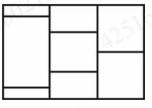
⇒ ? = 4

Hence, the correct answer is Option 4.

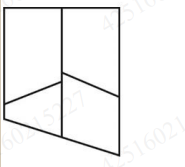
Question 38

How many quadrilaterals are there in the given figure?

  1. AOption (a)

    6

  2. BOption (b)

    7

  3. COption (c)

    8

  4. DOption (d)

    9

View answer & explanation

Correct answer

Answer: (b)B.

7

Why this answer is correct

The logic followed here is:

Logic: Count all the quadrilaterals formed by combining smaller sections of the figure.

Now,

There are 4 small quadrilaterals formed individually by the internal lines.

Combine smaller quadrilaterals to form larger ones:

2 quadrilaterals formed by combining two adjacent smaller quadrilaterals horizontally.

1 quadrilateral formed by combining all four small sections into the largest quadrilateral.

Total quadrilaterals = 4 + 2 + 1 = 7

Hence, the correct answer is Option 2.

Question 39

How many quadrilaterals are there in the given figure?

  1. AOption (a)

    17

  2. BOption (b)

    18

  3. COption (c)

    19

  4. DOption (d)

    20

View answer & explanation

Correct answer

Answer: (b)B.

18

Why this answer is correct

The logic followed here is:

Logic: Count all the quadrilaterals formed by both individual sections and combinations of sections in the figure.

Now,

⇒ Count the individual small quadrilaterals:

Left column: 3 small blocks

Middle column: 3 small blocks

Right column: 2 small blocks

Total small quadrilaterals = 8

⇒ Count quadrilaterals formed by combining adjacent blocks vertically:

Left column: top 2, bottom 2 → 2

Middle column: top 2, bottom 2 → 2

Right column: 2 blocks together → 1

Total = 5

⇒ Count quadrilaterals formed by combining all blocks in a single column:

Left column: all 3 → 1

Middle column: all 3 → 1

Total = 2

⇒ Count quadrilaterals formed by combining blocks horizontally across columns:

Left + Middle → 1

Middle + Right → 1

All three columns → 1

Total = 3

Total quadrilaterals = 8 + 5 + 2 + 3 = 18

Hence, the correct answer is Option 2.

Question 40

G started walking straight from a point X. He turned 5 times right during his journey. Finally, he is facing towards east. In which direction he started walking from X? (He took no left turn)

  1. AOption (a)

    North

  2. BOption (b)

    South

  3. COption (c)

    East

  4. DOption (d)

    West

View answer & explanation

Correct answer

Answer: (a)A.

North

Why this answer is correct

Given:

G started walking straight and turned 5 times right.

Finally, he is facing East.

Now,

Each right turn = 90° clockwise.

5 right turns = 4 + 1 turns → (360° + 90°) = same as 1 right turn.

So, initial direction + 1 right turn = East

Hence, initial direction = North (since North → right turn → East).

Hence, the correct answer is Option 1.

Question 41

P started walking towards north. He turned 7 times right and 7 times left during his journey. In which direction he will be facing finally?

  1. AOption (a)

    West

  2. BOption (b)

    North

  3. COption (c)

    South

  4. DOption (d)

    East

View answer & explanation

Correct answer

Answer: (b)B.

North

Why this answer is correct

Given:

P started walking towards North.

He turned 7 times right and 7 times left.

Now,

Each right turn = +90° and each left turn = −90°.

Total turns = 7 right − 7 left = 0

So, no net change in direction.

Hence, he will still be facing North.

Hence, the correct answer is Option 2.

Question 42

which option figure will complete the pattern in the question figure? (Rotation is not allowed) ?

  1. AOption (a)

  2. BOption (b)

  3. COption (c)

  4. DOption (d)

View answer & explanation

Correct answer

Answer: (d)D.

Why this answer is correct

The logic followed here is:

Logic: The missing quadrant must contain two parallel diagonal lines sloping upwards from the bottom-left to the top-right to complete the central geometric symmetry.

Hence, the correct answer is Option 4.

Question 43

Which option figure will complete the pattern in the question figure? (Rotation is not allowed)?

  1. AOption (a)

  2. BOption (b)

  3. COption (c)

  4. DOption (d)

View answer & explanation

Correct answer

Answer: (a)A.

Why this answer is correct

The logic followed here is:

Logic: The missing quadrant must contain two quarter-circles in the top-left to complete the center and diagonal lines that mirror the top-right quadrant's outer structure.

Hence, the correct answer is Option 1.

Question 44

Two figures given on the left side of (::) are related with some logic/rule/relation. Select the missing figure on the right side of (::) from the given alternatives based on the same logic/rule/relation.

  1. AOption (a)

  2. BOption (b)

  3. COption (c)

  4. DOption (d)

View answer & explanation

Correct answer

Answer: (d)D.

Why this answer is correct

The logic followed here is:

Logic: First figure → Triangle (3 sides)

Second figure → Box containing 6 elements (P, Q, R, +, ×, ✱)

So, pattern:

Number of sides × 2 = Number of elements inside box

Triangle (3 sides) → 3 × 2 = 6 elements

Now, third figure → Square (4 sides)

So, 4 × 2 = 8 elements

We need a box with 8 elements.

Checking options:

Option 1: 

→ 5 elements 

<br>

Option 2: 

→ 9 elements 

<br>

Option 3: 

→ 8 elements 

<br>

Option 4: 

→ Less elements 

Hence, the correct answer is Option 3.

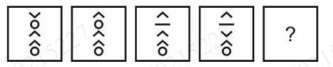
Question 45

In the following figure series, select the figure which can be placed at the sign of question mark (?) from the given alternatives.

  1. AOption (a)

  2. BOption (b)

  3. COption (c)

  4. DOption (d)

View answer & explanation

Correct answer

Answer: (d)D.

Why this answer is correct

The logic followed here is:

Logic: Following the step-by-step inversion of the internal symbols, the top and bottom remain the same while the middle arrows progressively flip downwards. So, the next figure continues this pattern.

Hence, the correct answer is Option 4.

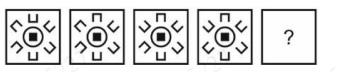
Question 46

In the following figure series, select the figure which can be placed at the sign of question mark (?) from the given alternatives. ?

  1. AOption (a)

  2. BOption (b)

  3. COption (c)

  4. DOption (d)

View answer & explanation

Correct answer

Answer: (c)C.

Why this answer is correct

The logic followed here is:

Logic: The outer U-shaped symbols rotate 45 degrees clockwise in each consecutive step, while the central circle and square remain fixed.

So far, Figures 1 to 4 show consecutive 45° clockwise rotations of all symbols.

The next figure will rotate the symbols another 45° clockwise, with the top symbol now facing Top-Right.

Hence, the correct answer is Option 3.

Question 47

In the following question, four letter-number pairs are given. The letter-number on the left side of (-) is related to the letter-number on the right side of (-) with some Logic/Rule/Relation. Three pairs are similar on the basis of same Logic/Rule/Relation. Select the odd one out from the given alternatives.

(NOTE: Operations should be performed on the whole numbers, without breaking down the number into its constituent digits. E.g.13 - Operations on 13 such as adding /subtracting /multiplying etc. to 13 can be performed. Breaking down 13 into 1 and 3 and then performing mathematical operations on 1 and 3 is not allowed)

  1. AOption (a)

    AH720 - FN1090

  2. BOption (b)

    EM640 - JS1010

  3. COption (c)

    TF810-YL1180

  4. DOption (d)

    VH530-AM900

View answer & explanation

Correct answer

Answer: (d)D.

VH530-AM900

Why this answer is correct

The logic followed here is:

Logic: The pattern involves shifting letters forward in the alphabet and adding a fixed number (370) to the numeric part.

Now, checking  each option:

Option 1) AH720 - FN1090

Option 2) EM640 - JS1010

Option 3)  TF810 - YL1180

Option 4)  VH530 - AM900


Difference: Option 4 deviates in the letter shift pattern, even though the numeric addition matches.

Hence, the odd one out is Option 4.

Question 48

In a certain code language, 'GOAT' is coded as '68', 'POLE' is coded as '63'. How will 'FAIL' be coded in that code language?

  1. AOption (a)

    85

  2. BOption (b)

    83

  3. COption (c)

    80

  4. DOption (d)

    78

View answer & explanation

Correct answer

Answer: (b)B.

83

Why this answer is correct

The logic followed here is:

Logic: Code = Sum of the opposite positions of the letters in the alphabet + 3

GOAT → 68

GOAT → Opposite Word → TLZG + 3

Sum = 20 + 12 + 26 + 7 + 3 = 68

POLE → 63

POLE → Opposite Word → KLOV + 3

Sum = 11 + 12 + 15 + 22 + 3 = 63

So, FAIL → ?

FAIL → Opposite Word → UZRO + 3

Sum = 21 + 26 + 18 + 15 + 3 = 83

Hence, the correct answer is Option (2).

Question 49

In a certain coded language 'APICES' is coded as "WZYCKM' and 'SUITED' is coded as 'OZPCPX". How will 'CASINO' be coded in the same code language?

  1. AOption (a)

    XJFLTK

  2. BOption (b)

    YIEMVI

  3. COption (c)

    AKCOUJ

  4. DOption (d)

    AGENUK

View answer & explanation

Correct answer

Answer: (b)B.

YIEMVI

Why this answer is correct

The logic followed here is:

For, ‘APICES’ is written as WZYCKM,

For, ‘SUITED’ is written as OZPCPX,

Similarly, for ‘CASINO’,

So, ‘CASINO’ will be written as ‘XJFLTK’.

Hence, the correct answer is "Option 1".

Question 50

A word has been given in the question. This word CANNOT be formed by using the letters of the word only. Select that alternative.

WIDER

  1. AOption (a)

    WEIRD

  2. BOption (b)

    WIDEN

  3. COption (c)

    WIRED

  4. DOption (d)

    ​IDREW

View answer & explanation

Correct answer

Answer: (b)B.

WIDEN

Why this answer is correct

Given word: WIDER

WordLetters UsedValid / Not
WEIRDW I D E RValid
WIDENW I D E NN not in WIDER
WIREDW E I R DValid
IDREWI D R E WValid

Original word: W I D E R

Available letters: W, I, D, E, R

WIDEN requires the letter N which is not present in WIDER.

Hence, the correct answer is Option 2.

Quantitative Aptitude (25 questions)

Question 51

Find the average of 10, 20, 30, 40, and 50.

  1. AOption (a)

    30

  2. BOption (b)

    25

  3. COption (c)

    20

  4. DOption (d)

    35

View answer & explanation

Correct answer

Answer: (a)A.

30

Why this answer is correct

Given:

Numbers are 10, 20, 30, 40, and 50.

Formula Used:

Average = (Sum of all numbers) ÷ (Total numbers)

Calculation:

⇒ Sum of numbers = 10 + 20 + 30 + 40 + 50

⇒ Sum of numbers = 150

⇒ Total numbers = 5

⇒ Average = 150 ÷ 5

⇒ Average = 30

∴ The correct answer is 30.

Question 52

A can complete a job in 15 days and B in 20 days. They work together for 5 days. How much work is left?

  1. AOption (a)

    1/3

  2. BOption (b)

    5/12

  3. COption (c)

    7/15

  4. DOption (d)

    1/4

View answer & explanation

Correct answer

Answer: (b)B.

5/12

Why this answer is correct

Given:

A = 15 days

B = 20 days

Time = 5 days

Formula Used:

Work = Efficiency × Time

Total Work = LCM of given times

Calculation:

⇒ Total Work = LCM of 15 and 20 = 60 units

⇒ Efficiency of A = 60 ÷ 15 = 4 units/day

⇒ Efficiency of B = 60 ÷ 20 = 3 units/day

⇒ Combined Efficiency = 4 + 3 = 7 units/day

⇒ Work done in 5 days = 7 × 5 = 35 units

⇒ Remaining Work = 60 − 35 = 25 units

⇒ Remaining Work in fraction = 25/60 = 5/12

∴ The correct answer is 5/12.

Question 53

The decimal expansion of an irrational number is:

  1. AOption (a)

    Terminating decimal

  2. BOption (b)

    Repeating decimal

  3. COption (c)

    Non-terminating, non-repeating decimal

  4. DOption (d)

    Can be either terminating or repeating decimal

View answer & explanation

Correct answer

Answer: (c)C.

Non-terminating, non-repeating decimal

Why this answer is correct

Given:

The decimal expansion of an irrational number.

Formula Used:

An irrational number cannot be expressed as a fraction (p/q), where p and q are integers, and q ≠ 0.

Calculation:

⇒ Irrational numbers have a decimal expansion that is non-terminating.

⇒ Their decimal expansion does not repeat.

⇒ Therefore, the decimal expansion of an irrational number is both non-terminating and non-repeating.

∴ The correct answer is Option 3.

Question 54

By selling a watch at 80% of its marked price, a shopkeeper loses 4%. What would have been his profit percentage if he had sold it at 95% of the marked price?

  1. AOption (a)

    14%

  2. BOption (b)

    12%

  3. COption (c)

    16%

  4. DOption (d)

    18%

View answer & explanation

Correct answer

Answer: (a)A.

14%

Why this answer is correct

Given:

Selling Price₁ = 80% of Marked Price

Loss = 4%

Selling Price₂ = 95% of Marked Price

Formula Used:

Profit/Loss % = (SP − CP) ÷ CP × 100

Marked Price = assumed value

Calculation:

⇒ Let Marked Price = 100 units

⇒ Selling Price₁ = 80% of 100 = 80

⇒ Loss = 4% ⇒ SP₁ = 96% of CP

⇒ 80 = 96/100 × CP

⇒ CP = 80 × 100 ÷ 96 = 8000/96 = 250/3

⇒ Selling Price₂ = 95% of 100 = 95

⇒ Profit = SP₂ − CP = 95 − 250/3

⇒ Profit = (285 − 250)/3 = 35/3

⇒ Profit % = (35/3 ÷ 250/3) × 100

⇒ Profit % = 35/250 × 100 = 14%

∴ The correct answer is 14%.

Question 55

The cost price of a TV set is Rs 14000, and its marked price is Rs 16000. If the shopkeeper sells it at a gain of 8%, then what is the percentage rate of discount offered by him?

  1. AOption (a)

    7.2%

  2. BOption (b)

    4%

  3. COption (c)

    6.5%

  4. DOption (d)

    5.5%

View answer & explanation

Correct answer

Answer: (d)D.

5.5%

Why this answer is correct

Given:

Cost Price (CP) = Rs 14000

Marked Price (MP) = Rs 16000

Gain = 8%

Formula Used:

Selling Price (SP) = CP × (1 + (Gain% ÷ 100))

Discount% = [(MP − SP) ÷ MP] × 100

Calculation:

⇒ SP = 14000 × (1 + 8 ÷ 100)

⇒ SP = 14000 × (108 ÷ 100)

⇒ SP = Rs 15120

⇒ Discount = MP − SP = 16000 − 15120

⇒ Discount = Rs 880

⇒ Discount% = (880 ÷ 16000) × 100

⇒ Discount% = 5.5%

∴ The correct answer is 5.5%.

Question 56

At a shopping center, a 50% discount is offered on all its items. What would be the sale price of a shoe marked at Rs. 5200? 

  1. AOption (a)

    3000

  2. BOption (b)

    2600

  3. COption (c)

    3200

  4. DOption (d)

    2500

View answer & explanation

Correct answer

Answer: (b)B.

2600

Why this answer is correct

Given:

Marked price of the shoe = Rs. 5200

Discount = 50%

Formula Used:

Sale Price = Marked Price × (1 - Discount ÷ 100)

Calculation:

⇒ Sale Price = 5200 × (1 - 50 ÷ 100)

⇒ Sale Price = 5200 × (1 - 0.5)

⇒ Sale Price = 5200 × 0.5

⇒ Sale Price = 2600

∴ The correct answer is 2600.

Question 57

The average marks of 12 students in a mathematics test are 63.5. Later, it was found that one student's score was misread as 56 instead of 65. After correcting this error, another student's marks were removed for being invalid, and the average of the remaining 11 students rose to 64.2. Find the marks of the student whose score was removed.

  1. AOption (a)

    63.5

  2. BOption (b)

    64.2

  3. COption (c)

    64.8

  4. DOption (d)

    65.5

View answer & explanation

Correct answer

Answer: (c)C.

64.8

Why this answer is correct

Given:

Number of students = 12

Average₁ = 63.5

Wrong marks = 56

Correct marks = 65

Remaining students = 11

Average₂ = 64.2

Formula Used:

Total Marks = Average × Number of students

Corrected Total = Old Total + Correction

Calculation:

⇒ Total marks (with wrong value) = 63.5 × 12 = 762

⇒ Correction = 65 − 56 = 9

⇒ Corrected total = 762 + 9 = 771

⇒ Total marks of 11 students = 64.2 × 11 = 706.2

⇒ Marks removed = 771 − 706.2 = 64.8

∴ The correct answer is 64.8.

Question 58

A box in the shape of a right prism has a triangular base with sides 13 cm, 14 cm, and 15 cm. The height of the box is 20 cm. If a packaging company charges Rs. 0.75 per cm3 to fill the box with granules, find the total cost.

  1. AOption (a)

    ₹1200

  2. BOption (b)

    ₹1140

  3. COption (c)

    ₹1260

  4. DOption (d)

    ₹1320

View answer & explanation

Correct answer

Answer: (c)C.

₹1260

Why this answer is correct

Given:

Triangular base sides = 13 cm, 14 cm, 15 cm

Height of the box = 20 cm

Cost per cm³ = Rs. 0.75

Formula Used:

Area of triangular base = √[s(s - a)(s - b)(s - c)], where s = (a + b + c) ÷ 2

Volume of box = Area of triangular base × Height

Total cost = Volume × Cost per cm³

Calculation:

⇒ Semi-perimeter, s = (13 + 14 + 15) ÷ 2 = 42 ÷ 2 = 21 cm

⇒ Area of triangular base = √[21(21 - 13)(21 - 14)(21 - 15)]

⇒ Area of triangular base = √[21 × 8 × 7 × 6]

⇒ Area of triangular base = √[7056]

⇒ Area of triangular base = 84 cm²

⇒ Volume of box = 84 × 20 = 1680 cm³

⇒ Total cost = 1680 × 0.75 = Rs. 1260

∴ The correct answer is ₹1260.

Question 59

A glass manufacturer designs prism-shaped display tanks for exotic fish. Each tank is in the shape of a right prism with a trapezium as the base. The parallel sides of the trapezium are 18 cm and 12 cm, and the distance between them is 10 cm. The height of the prism (tank) is 50 cm. If the company produces 25 such tanks, what is the total volume of glass used in all the tanks?

  1. AOption (a)

    1,75,000 cm3

  2. BOption (b)

    1,87,500 cm3

  3. COption (c)

    1,92,000 cm3

  4. DOption (d)

    2,00,000 cm3

View answer & explanation

Correct answer

Answer: (b)B.

1,87,500 cm3

Why this answer is correct

Given:

Parallel sides = 18 cm, 12 cm

Distance between parallel sides = 10 cm

Height of prism = 50 cm

Number of tanks = 25

Formula Used:

Area of trapezium = 1/2 × (sum of parallel sides) × distance

Volume of prism = Base area × Height

Total Volume = Volume × Number of tanks

Calculation:

⇒ Area of base = 1/2 × (18 + 12) × 10

⇒ Area = 1/2 × 30 × 10 = 150 cm2

⇒ Volume of one tank = 150 × 50 = 7500 cm3

⇒ Total volume = 7500 × 25 = 187500 cm3

∴ The correct answer is 187500 cm3.

Question 60

A circular track of radius 17.5 m is to be covered with a uniform circular band of width 3.5 m to create a jogging path around it. Find the area of the jogging path (the ring-shaped region). (Use π = 3.1416 and provide your answer correct to two decimal places)

  1. AOption (a)

    418.25 m2

  2. BOption (b)

    423.33 m2

  3. COption (c)

    430.15 m2

  4. DOption (d)

    412.00 m2

View answer & explanation

Correct answer

Answer: (b)B.

423.33 m2

Why this answer is correct

Given:

Inner radius = 17.5 m

Width = 3.5 m

π = 3.1416

Formula Used:

Area of ring = π × (R2 − r2)

Calculation:

⇒ Outer radius R = 17.5 + 3.5 = 21

⇒ R2 = 21 × 21 = 441

⇒ r2 = 17.5 × 17.5 = 306.25

⇒ Difference = 441 − 306.25 = 134.75

⇒ Area = 3.1416 × 134.75 = 423.33

∴ The correct answer is 423.33 m2.

Question 61

Find the remainder on dividing (5x3 + 4x2 -10x + 1) by (2x - 4).

  1. AOption (a)

    45

  2. BOption (b)

    37

  3. COption (c)

    11

  4. DOption (d)

    78

View answer & explanation

Correct answer

Answer: (b)B.

37

Why this answer is correct

Shortcut Trick

According to the Remainder Theorem, for a divisor 2x − 4, find the value of x that makes it zero.

2x − 4 = 0 ⇒ 2x = 4 ⇒ x = 2.

Substitute x = 2 directly into the polynomial 5x3 + 4x2 − 10x + 1.

Remainder = 5(2)3 + 4(2)2 − 10(2) + 1 = 40 + 16 − 20 + 1 = 37.

∴ The correct answer is 37.

Alternate Method

Given: Polynomial f(x) = 5x3 + 4x2 − 10x + 1 and Divisor g(x) = 2x − 4.

Formula Used: If a polynomial f(x) is divided by a linear factor (ax − b), the remainder is f(b/a).

⇒ Let 2x − 4 = 0

⇒ 2x = 4

⇒ x = 2

⇒ Remainder = f(2) = 5(2)3 + 4(2)2 − 10(2) + 1

⇒ f(2) = 5 × 8 + 4 × 4 − 20 + 1

⇒ f(2) = 40 + 16 − 20 + 1

⇒ f(2) = 56 − 20 + 1 = 37

∴ The correct answer is 37.

Additional Information

Remainder Theorem

The remainder of a polynomial P(x) divided by (x − a) is exactly P(a).

Factor Theorem

If the remainder f(a) is zero, then (x − a) is a factor of the polynomial f(x).

Polynomial Division

A polynomial f(x) can be expressed as f(x) = g(x) × q(x) + r(x), where g(x) is the divisor, q(x) is the quotient, and r(x) is the remainder.

Question 62

The perpendicular bisectors of the sides of a triangle meet at a a single point called

  1. AOption (a)

    circumcenter

  2. BOption (b)

    centroid

  3. COption (c)

    incenter 

  4. DOption (d)

    orthocenter

View answer & explanation

Correct answer

Answer: (a)A.

circumcenter

Why this answer is correct

Given:

⇒ The perpendicular bisectors of the sides of a triangle meet at a single point.

Formula Used:

⇒ The point of intersection of the perpendicular bisectors of a triangle is called the circumcenter.

Calculation:

⇒ The perpendicular bisectors of the sides of a triangle intersect at one point.

⇒ This point is equidistant from all the vertices of the triangle.

⇒ This point is known as the circumcenter.

∴ The correct answer is option 1 (circumcenter).

Question 63

If cos x/(1 - sin x)+cos x/(1+ sin x) = 4, 0° < x < 90°, then find the value of (tan x + cosec x).

  1. AOption (a)

    5√2/2

  2. BOption (b)

    3√3/3

  3. COption (c)

    7√3/3

  4. DOption (d)

    5√3/3

View answer & explanation

Correct answer

Answer: (d)D.

5√3/3

Why this answer is correct

Shortcut Trick The expression cos x / (1 − sin x) + cos x / (1 + sin x) simplifies to 2 / cos x. Given: 2 / cos x = 4 ⇒ cos x = 2 / 4 = 1/2. In the range 0° < x < 90°, cos x = 1/2 implies x = 60°. Required value: tan 60° + cosec 60° = √3 + 2/√3 = (3 + 2) / √3 = 5/√3 = 5√3/3. ∴ The correct answer is 5√3/3.

Alternate Method Given: cos x / (1 − sin x) + cos x / (1 + sin x) = 4 and 0° < x < 90°. Formula Used: 1 − sin2x = cos2x | tan x = sin x / cos x | cosec x = 1 / sin x.

⇒ cos x [ (1 + sin x + 1 − sin x) / ( (1 − sin x)(1 + sin x) ) ] = 4 ⇒ cos x [ 2 / (1 − sin2x) ] = 4 ⇒ cos x [ 2 / cos2x ] = 4 ⇒ 2 / cos x = 4 ⇒ cos x = 2 / 4 = 1/2 ⇒ x = 60° (Since 0° < x < 90°) ⇒ tan x + cosec x = tan 60° + cosec 60° ⇒ Value = √3 + 1/sin 60° = √3 + 1/(√3/2) ⇒ Value = √3 + 2/√3 = (3 + 2) / √3 = 5/√3 ⇒ Value = (5 × √3) / (√3 × √3) = 5√3/3 ∴ The correct answer is 5√3/3.

Additional Information Trigonometric Identities Fundamental identities include sin2x + cos2x = 1, 1 + tan2x = sec2x, and 1 + cot2x = cosec2x. Standard Values at 60° sin 60° = √3/2, cos 60° = 1/2, tan 60° = √3, and cosec 60° = 2/√3. Rationalization To rationalize a denominator like √a, multiply both numerator and denominator by √a.

Question 64

The area of a circle is 3850 cm2. The circle is inscribed in a square, and the side of the square is half of the side of an equilateral triangle. Find the sum of the perimeter of the square and that of the triangle.

  1. AOption (a)

    700 cm

  2. BOption (b)

    900 cm

  3. COption (c)

    400 cm

  4. DOption (d)

    800 cm

View answer & explanation

Correct answer

Answer: (a)A.

700 cm

Why this answer is correct

Given:

Area of circle = 3850

Formula Used:

Area of circle = π × r2

Side of square = diameter = 2 × r

Perimeter of square = 4 × side

Perimeter of equilateral triangle = 3 × side

Calculation:

⇒ π × r2 = 3850

⇒ 22 ÷ 7 × r2 = 3850

⇒ r2 = 3850 × 7 ÷ 22

⇒ r2 = 1225

⇒ r = 35

⇒ Side of square = 2 × 35 = 70

⇒ Perimeter of square = 4 × 70 = 280

⇒ Side of triangle = 2 × 70 = 140

⇒ Perimeter of triangle = 3 × 140 = 420

⇒ Required sum = 280 + 420

⇒ = 700

∴ The correct answer is 700.

Question 65

In a right-angled triangle XYZ, with a right angle at Y, W is the mid-point of side YZ. XY = 8√3 cm and XZ = 16 cm. Find the length of XW.

  1. AOption (a)

    √5 cm

  2. BOption (b)

    2√3 cm

  3. COption (c)

    4√13 cm

  4. DOption (d)

    √9 cm

View answer & explanation

Correct answer

Answer: (c)C.

4√13 cm

Why this answer is correct

Given:

XY = 8√3

XZ = 16

Formula Used:

Pythagoras theorem: hypotenuse2 = base2 + height2

Distance formula: d = √[(x2 - x1)2 + (y2 - y1)2]

Calculation:

⇒ YZ2 = XZ2 - XY2

⇒ = 162 - (8√3)2

⇒ = 256 - 192

⇒ = 64

⇒ YZ = 8

⇒ Mid-point W divides YZ into 4 and 4

⇒ XW = √[(8√3)2 + 42]

⇒ = √(192 + 16)

⇒ = √208

⇒ = 4√13

∴ The correct answer is 4√13.

Question 66

If the surface area of a sphere is increased by 44%, by what percentage does the volume of the sphere increase?

  1. AOption (a)

    44.21%

  2. BOption (b)

    72.8%

  3. COption (c)

    66.3%

  4. DOption (d)

    20.5%

View answer & explanation

Correct answer

Answer: (b)B.

72.8%

Why this answer is correct

Given:

Increase in surface area = 44%

Formula Used:

Surface area of sphere ∝ r2

Volume of sphere ∝ r3

Calculation:

⇒ New surface area = 144%

⇒ r2 ∝ 144

⇒ r ∝ √144

⇒ r ∝ 12

⇒ Original r ∝ 10

⇒ Increase in radius = (12 - 10) ÷ 10 × 100

⇒ = 20%

⇒ Volume ∝ r3

⇒ New volume ratio = (12 ÷ 10)3

⇒ = (1.2)3

⇒ = 1.728

⇒ Increase = (1.728 - 1) × 100

⇒ = 72.8%

∴ The correct answer is 72.8%.

Question 67

A and B invested Rs. 60,000 and Rs. 90,000, respectively. If the profit at the end of the year is Rs. 1,50,000, what is B's share?

  1. AOption (a)

    Rs. 60,000

  2. BOption (b)

    Rs. 70,000

  3. COption (c)

    Rs. 80,000 

  4. DOption (d)

    Rs. 90,000 

View answer & explanation

Correct answer

Answer: (d)D.

Rs. 90,000 

Why this answer is correct

Shortcut Trick

Profit ratio of A : B = Investment ratio = 60,000 : 90,000 = 2 : 3.

Total units = 2 + 3 = 5 units.

Total profit = ₹1,50,000 ⇒ 5 units = 1,50,000.

1 unit = 30,000.

B's share = 3 units = 3 × 30,000 = ₹90,000.

∴ The correct answer is ₹90,000.

Alternate Method

Given:

Investment of A = ₹60,000

Investment of B = ₹90,000

Total Profit = ₹1,50,000

Time period for both = 1 year

Formula Used:

Profit Share = Investment × Time

When time is constant, Profit Ratio = Investment Ratio.

Calculations:

⇒ Ratio of profits of A and B = 60,000 : 90,000

⇒ Ratio = 6 : 9 = 2 : 3

⇒ Sum of ratio parts = 2 + 3 = 5

⇒ B's profit share = (B's ratio part ÷ Total parts) × Total profit

⇒ B's share = (3 ÷ 5) × 1,50,000

⇒ B's share = 3 × 30,000

⇒ B's share = ₹90,000

∴ The correct answer is ₹90,000.

Additional Information

Simple Partnership

In a simple partnership, all partners invest their capital for the same period of time. The profit is distributed in the ratio of their investments.

Compound Partnership

In a compound partnership, partners invest capital for different periods. The profit ratio is calculated as: (C1 × T1) : (C2 × T2).

Working vs. Sleeping Partner

A working partner manages the business and may receive a fixed salary or percentage of profit before the remaining profit is shared according to the investment ratio.

Question 68

Simplify the expression: cosx cosecxcotx\rm \frac{cos x \ cosec x}{cot x}

  1. AOption (a)

    1

  2. BOption (b)

    sec x

  3. COption (c)

    tan x

  4. DOption (d)

    sin x

View answer & explanation

Correct answer

Answer: (a)A.

1

Why this answer is correct

Given:

cos x × cosec x ÷ cot x

Formula Used:

cosec x = 1 ÷ sin x

cot x = cos x ÷ sin x

Calculation:

⇒ cos x × (1 ÷ sin x) ÷ (cos x ÷ sin x)

⇒ = (cos x ÷ sin x) ÷ (cos x ÷ sin x)

⇒ = 1

∴ The correct answer is 1.

Question 69

What is the value of tan(45°) cot(45°)?

  1. AOption (a)

    2

  2. BOption (b)

    0

  3. COption (c)

    √2

  4. DOption (d)

    1

View answer & explanation

Correct answer

Answer: (d)D.

1

Why this answer is correct

Given:

tan 45° × cot 45°

Formula Used:

tan 45° = 1

cot 45° = 1

Calculation:

⇒ tan 45° × cot 45°

⇒ = 1 × 1

⇒ = 1

∴ The correct answer is 1.

Question 70

24 mango trees, 36 apple trees, and 48 trees have to be planted in rows such that each row contains the same number of trees of the same variety only. The maximum number of trees in a row may be planted in is:

  1. AOption (a)

    4

  2. BOption (b)

    8

  3. COption (c)

    12

  4. DOption (d)

    16

View answer & explanation

Correct answer

Answer: (c)C.

12

Why this answer is correct

Given:

Number of mango trees = 24

Number of apple trees = 36

Number of other trees = 48

Formula Used:

Maximum number of trees per row = HCF of given numbers

Calculation:

⇒ HCF of 24, 36, 48

⇒ 24 = 2 × 2 × 2 × 3

⇒ 36 = 2 × 2 × 3 × 3

⇒ 48 = 2 × 2 × 2 × 2 × 3

⇒ Common factors = 2 × 2 × 3

⇒ = 12

∴ The correct answer is 12.

Question 71

In a class of a certain number of students, if a student weighing 30 kg joins, the average weight increases by 1 kg. If another student weighing 30 kg joins, the average increases by 1.5 kg over the original average. What was the original average weight of the class?

  1. AOption (a)

    24 kg

  2. BOption (b)

    27 kg

  3. COption (c)

    29 kg

  4. DOption (d)

    31 kg

View answer & explanation

Correct answer

Answer: (b)B.

27 kg

Why this answer is correct

Given:

Weight of each new student = 30

Formula Used:

Average = Total sum ÷ Number of students

Calculation:

⇒ Let number of students = n

⇒ Let original average = A

⇒ Total weight = n × A

⇒ (n × A + 30) ÷ (n + 1) = A + 1

⇒ nA + 30 = (n + 1)(A + 1)

⇒ nA + 30 = nA + n + A + 1

⇒ 30 = n + A + 1

⇒ n + A = 29

⇒ A = 29 - n

⇒ (nA + 60) ÷ (n + 2) = A + 1.5

⇒ nA + 60 = (n + 2)(A + 1.5)

⇒ nA + 60 = nA + 2A + 1.5n + 3

⇒ 60 = 2A + 1.5n + 3

⇒ 57 = 2A + 1.5n

⇒ 57 = 2(29 - n) + 1.5n

⇒ 57 = 58 - 2n + 1.5n

⇒ 57 = 58 - 0.5n

⇒ 0.5n = 1

⇒ n = 2

⇒ A = 29 - 2

⇒ = 27

∴ The correct answer is 27.

Question 72

A can do a work in 10 days, B in 15 days, and C in 30 days. If all three work together for 3 days and then A leaves, in how many more days will the remaining work be finished?

  1. AOption (a)

    3 days

  2. BOption (b)

    4 days

  3. COption (c)

    5 days

  4. DOption (d)

    6 days

View answer & explanation

Correct answer

Answer: (b)B.

4 days

Why this answer is correct

Given:

A = 10 days

B = 15 days

C = 30 days

Time together = 3 days

Formula Used:

Work = Efficiency × Time

Total Work = LCM of given times

Calculation:

⇒ Total Work = LCM of 10, 15, 30 = 30 units

⇒ Efficiency of A = 30 ÷ 10 = 3 units/day

⇒ Efficiency of B = 30 ÷ 15 = 2 units/day

⇒ Efficiency of C = 30 ÷ 30 = 1 unit/day

⇒ Combined Efficiency (A + B + C) = 3 + 2 + 1 = 6 units/day

⇒ Work done in 3 days = 6 × 3 = 18 units

⇒ Remaining Work = 30 − 18 = 12 units

⇒ Efficiency of B + C = 2 + 1 = 3 units/day

⇒ Time to finish remaining work = 12 ÷ 3 = 4 days

∴ The correct answer is 4 days.

Question 73

A sum of Rs. 40,000 is borrowed for 4 years at a certain rate of interest. If the total interest paid at the end of 4 years is Rs. 24,000, what the rate of interest?

  1. AOption (a)

    10%

  2. BOption (b)

    12%

  3. COption (c)

    15%

  4. DOption (d)

    16%

View answer & explanation

Correct answer

Answer: (c)C.

15%

Why this answer is correct

Given:

Principal (P) = Rs. 40,000

Time (T) = 4 years

Simple Interest (SI) = Rs. 24,000

Formula Used:

SI = (P × R × T) ÷ 100

Calculation:

⇒ 24,000 = (40,000 × R × 4) ÷ 100

⇒ 24,000 = (1,60,000 × R) ÷ 100

⇒ 24,000 × 100 = 1,60,000 × R

⇒ 24,00,000 = 1,60,000 × R

⇒ R = 24,00,000 ÷ 1,60,000

⇒ R = 15

∴ The correct answer is 15%.

Question 74

if tan θ = 1, find cos2θ.

  1. AOption (a)

    12\frac{1}{2}

  2. BOption (b)

    34\frac{3}{4}

  3. COption (c)

    56\frac{5}{6}

  4. DOption (d)

    67\frac{6}{7}

View answer & explanation

Correct answer

Answer: (a)A.

12\frac{1}{2}

Why this answer is correct

Given:

tanθ = 1

Formula Used:

tanθ = sinθ ÷ cosθ

sin2θ + cos2θ = 1

Calculation:

⇒ tanθ = 1 ⇒ sinθ ÷ cosθ = 1

⇒ sinθ = cosθ

⇒ sin2θ = cos2θ

⇒ sin2θ + cos2θ = 1

⇒ 2cos2θ = 1

⇒ cos2θ = 1/2

∴ The correct answer is 1/2.

Question 75

if tan⁡A=13\rm \tan A=\frac{1}{\sqrt3}, find sin A and cos A.

  1. AOption (a)

    sin⁡A=12,cos⁡A=32\rm \sin A=\frac{1}{2}, \cos A=\frac{\sqrt3}{2}

  2. BOption (b)

    sin⁡A=12,cos⁡A=12\rm \sin A=\frac{1}{\sqrt2}, \cos A=\frac{1}{\sqrt2}

  3. COption (c)

    sin⁡A=1,cos⁡A=12\rm \sin A=1, \cos A=\frac{1}{2}

  4. DOption (d)

    sin⁡A=12,cos⁡A=12\rm \sin A=\frac{1}{\sqrt2}, \cos A=\frac{1}{2}

View answer & explanation

Correct answer

Answer: (a)A.

sin⁡A=12,cos⁡A=32\rm \sin A=\frac{1}{2}, \cos A=\frac{\sqrt3}{2}

Why this answer is correct

Given:

tanA = 1/√3

Formula Used:

tanA = opposite ÷ adjacent

sinA = opposite ÷ hypotenuse

cosA = adjacent ÷ hypotenuse

Calculation:

⇒ tanA = 1/√3 ⇒ opposite = 1, adjacent = √3

⇒ hypotenuse = √(12 + (√3)2) = √(1 + 3) = 2

⇒ sinA = 1 ÷ 2 = 1/2

⇒ cosA = √3 ÷ 2

∴ The correct answer is sinA = 1/2 and cosA = √3/2.

General Awareness (25 questions)

Question 76

Which of the following tribe was very influential in Punjab during the thirteenth and fourteenth century?

  1. AOption (a)

    The Khokhar

  2. BOption (b)

    The Gond

  3. COption (c)

    The Santhal

  4. DOption (d)

    The Bhil

View answer & explanation

Correct answer

Answer: (a)A.

The Khokhar

Why this answer is correct

The correct answer is The Khokhar.

Key Points

  • The Khokhars were a prominent tribe in Punjab during the thirteenth and fourteenth centuries.
  • They played a significant role in resisting the invasions of Muslim rulers, particularly during the reign of Mohammad Ghori.
  • The Khokhars were known for their strong military presence and ability to organize resistance against external forces, especially in areas around modern-day Punjab and northern India.
  • Several rulers, including Ghiyasuddin Balban, undertook campaigns to suppress the Khokhars due to their rebellious activities against the Delhi Sultanate.
  • The Khokhars also contributed to the socio-political dynamics of Punjab, influencing local governance and tribal alliances during the medieval period.

Additional Information

  • Other Tribes in the Region:
  • The Gond: The Gond tribe is primarily found in central India, including regions such as Madhya Pradesh, Chhattisgarh, Maharashtra, and Telangana. They are known for their unique art, culture, and agricultural practices.
  • The Santhal: The Santhals are one of the largest tribal communities in India, predominantly found in states like Jharkhand, West Bengal, Odisha, and Bihar. They are known for their contribution to the Santhal rebellion against British colonial rule in 1855.
  • The Bhil: The Bhils are primarily located in western and central India, including states like Rajasthan, Gujarat, Madhya Pradesh, and Maharashtra. They are renowned for their traditional archery skills and vibrant cultural traditions.
  • Historical Context of Khokhars:
  • The Khokhars were involved in various uprisings against the Delhi Sultanate, showcasing their resistance to foreign domination.
  • They were mentioned in historical records as a fierce and independent tribe that played a crucial role in shaping the political landscape of Punjab during medieval times.
  • The campaigns against the Khokhars by rulers like Balban were significant in consolidating the Sultanate's authority in northern India.
  • Geographical Influence:
  • The Khokhars primarily inhabited areas around the Punjab region, which is known for its fertile plains and strategic location connecting the Indian subcontinent to Central Asia.
  • Their geographical positioning allowed them to have control over important trade routes and military passages.
  • Modern-Day Presence:
  • The Khokhars have descendants who continue to reside in regions of Pakistan and northern India, retaining elements of their historical identity and cultural practices.
  • They are recognized as a significant part of the historical narrative of Punjab and its tribal heritage.

Important Points

  • Mohammad Ghori: The Khokhars were instrumental in defeating the forces of Mohammad Ghori in one of the battles, showcasing their military prowess.
  • Ghiyasuddin Balban: Balban's campaigns against the Khokhars were significant in asserting the authority of the Delhi Sultanate in Punjab.
  • Tribal Influence: The Khokhars influenced local governance and alliances, shaping the socio-political dynamics of medieval Punjab.
  • Legacy: The Khokhars remain a symbol of resistance and independence in the historical context of northern India.

Question 77

Which of the following pairs is correct regarding the campaign years of Akbar at various places?

I. Ranthambore 1569

II. Gujarat - 1572

  1. AOption (a)

    Only I

  2. BOption (b)

    Only II

  3. COption (c)

    Both I and II

  4. DOption (d)

    Neither I nor II

View answer & explanation

Correct answer

Answer: (c)C.

Both I and II

Why this answer is correct

The correct answer is Both I and II.

Key Points

  • Statement I: Ranthambore - 1569
  • The siege of Ranthambore was one of the key military campaigns of Akbar. It took place in 1569.
  • Ranthambore was a strategically important fort in Rajasthan, and its capture was essential for Akbar to consolidate his hold over the region.
  • Akbar’s forces besieged the fort, which was held by Rao Surjan Hada, a Rajput ruler.
  • After intense fighting, Rao Surjan Hada surrendered the fort to Akbar, marking a significant victory for the Mughal Empire. Hence, statement I is correct.
  • Statement II: Gujarat - 1572
  • In 1572, Akbar launched a campaign to conquer Gujarat. This region was important due to its rich resources and strategic coastal trade routes.
  • Akbar personally led the campaign and successfully annexed Gujarat to the Mughal Empire by defeating its ruler. This victory gave the empire access to the flourishing trade and commerce of the region.
  • The famous Buland Darwaza at Fatehpur Sikri was built to commemorate Akbar’s victory in Gujarat. Hence, statement II is correct.
  • Both statements I and II are correct.
  • Akbar’s campaigns in Ranthambore (1569) and Gujarat (1572) were pivotal in expanding and consolidating the Mughal Empire.
  • These victories not only enhanced the empire’s territorial extent but also its economic and strategic strength.

Additional Information

  • Akbar’s Military Campaigns:
  • Akbar, one of the greatest Mughal emperors, carried out several military campaigns to expand his empire across India.
  • His campaigns were characterized by the use of advanced military strategies and artillery.
  • Akbar’s policy of religious tolerance and diplomacy also helped him gain the support of local rulers and consolidate his rule.
  • Significance of Ranthambore:
  • Ranthambore was a crucial fort in Rajasthan due to its strategic location and strong fortifications.
  • Its annexation by Akbar in 1569 marked the beginning of Mughal dominance in the region.
  • Importance of Gujarat:
  • Gujarat was an economically prosperous region due to its coastal trade and access to international markets.
  • Its annexation in 1572 allowed the Mughals to control trade routes and enhance their economic power.
  • The victory in Gujarat also symbolized Akbar’s growing strength as a ruler and military leader.
  • Buland Darwaza:
  • The Buland Darwaza at Fatehpur Sikri was built by Akbar in 1601 to commemorate his victory over Gujarat.
  • It stands as a symbol of Mughal architectural excellence and the empire’s triumphs.

Important Points

  • Akbar’s Policies:
  • Akbar implemented a policy of religious tolerance, which helped him win the loyalty of his subjects.
  • His administrative reforms, such as the mansabdari system, ensured efficient governance and military organization.
  • Consolidation of the Mughal Empire:
  • Akbar’s military campaigns were instrumental in establishing Mughal dominance across northern, central, and western India.
  • His victories in regions like Ranthambore and Gujarat laid the foundation for the empire’s golden age.
  • Legacy of Akbar:
  • Akbar’s reign is considered a period of cultural and economic prosperity in Indian history.
  • His efforts to integrate diverse communities and his patronage of art and architecture have left a lasting impact on Indian culture.

Question 78

Who was the First Indian actress to win an international award at the 1963 Moscow International Film Festival?

  1. AOption (a)

    Nargis Dutt

  2. BOption (b)

    Suchitra Sen

  3. COption (c)

    Zeenat Aman

  4. DOption (d)

    Jaya Prada

View answer & explanation

Correct answer

Answer: (b)B.

Suchitra Sen

Why this answer is correct

The correct answer is Suchitra Sen.

Key Points

  • Suchitra Sen was the first Indian actress to win an international award for her performance at the 1963 Moscow International Film Festival.
  • She received this recognition for her role in the Bengali film Saat Pake Bandha (1963), which showcased her exceptional acting skills and made her internationally renowned.
  • Suchitra Sen was one of the most prominent actresses in Indian cinema, especially in the Bengali film industry, and is often regarded as a cultural icon.
  • The Moscow International Film Festival is one of the oldest and most prestigious film festivals in the world, and winning an award there was a significant achievement for Indian cinema.
  • This award marked a historic milestone for India, highlighting its talent and creativity on the global stage.

Additional Information

  • Suchitra Sen:
  • Born on 6 April 1931 in Pabna District, Bengal Presidency (now in Bangladesh).
  • She was known for her performances in films like Devdas, Aandhi, and Deep Jwele Jai.
  • Her acting was characterized by elegance, emotional depth, and a unique screen presence.
  • She retired from public life in 1978 and became highly reclusive, avoiding all media appearances.
  • Saat Pake Bandha:
  • This Bengali movie was directed by Ajoy Kar and starred Suchitra Sen and Soumitra Chatterjee.
  • The film's plot revolved around the struggles of a newly married couple dealing with familial interference and societal expectations.
  • It is still considered a classic in Indian cinema.
  • Moscow International Film Festival:
  • Established in 1935, the festival aims to celebrate global cinema and foster cultural exchange.
  • The awards include the Golden George as the top prize, among other categories.
  • Suchitra Sen's win in 1963 brought international attention to Indian films and paved the way for future Indian artists to shine globally.
  • Other Indian Actresses and Their Achievements:
  • Nargis Dutt: Known for her iconic role in Mother India, she represented Indian cinema at the Academy Awards but did not win an international award.
  • Zeenat Aman: Renowned for her bold roles in the 1970s but not associated with international awards of this caliber.
  • Jaya Prada: A celebrated actress in Indian cinema but not recognized at the Moscow International Film Festival.

Important Points

  • Significance of Suchitra Sen’s Award:
  • This achievement emphasized the potential of Indian cinema to compete globally and established a benchmark for quality storytelling and acting.
  • Suchitra Sen remains an inspiration for many Indian actresses, showcasing that talent transcends geographical boundaries.
  • Impact on Indian Cinema:
  • Suchitra Sen's win encouraged filmmakers and actors to strive for international recognition and explore global platforms.
  • It also highlighted the importance of Bengali cinema, which played a crucial role in shaping Indian film history.

Question 79

Who was the first Indian to be awarded the Nobel Prize?

  1. AOption (a)

    Amartya Sen

  2. BOption (b)

    Kailash Satyarthi

  3. COption (c)

    Rabindranath Tagore

  4. DOption (d)

    Subramanian Chandrashekar

View answer & explanation

Correct answer

Answer: (c)C.

Rabindranath Tagore

Why this answer is correct

The correct answer is Rabindranath Tagore.

Key Points

  • Rabindranath Tagore was the first Indian to be awarded the Nobel Prize. He won the Nobel Prize in Literature in 1913 for his collection of poems titled Gitanjali.
  • Tagore's Gitanjali was notable for its profound spiritual and emotional depth, which earned international acclaim and led to his Nobel Prize recognition.
  • He was the first non-European to win the Nobel Prize in Literature, marking a significant milestone in the global recognition of Indian literature.
  • Tagore’s achievement symbolized the global acknowledgment of Indian cultural and intellectual heritage, inspiring future generations of Indian writers and thinkers.
  • The Nobel Prize was awarded by the Swedish Academy, which described Gitanjali as a work of immense poetic brilliance.

Additional Information

  • Rabindranath Tagore:
  • Born on 7 May 1861 in Calcutta, India, Tagore was a poet, philosopher, musician, and artist.
  • He is also referred to as Gurudev and is celebrated as the composer of India's national anthem, Jana Gana Mana.
  • Tagore was a strong proponent of education and founded the Visva-Bharati University in Santiniketan, West Bengal, to promote a blend of traditional and modern education.
  • Nobel Prize in Literature:
  • The Nobel Prize in Literature is awarded annually by the Swedish Academy to authors with outstanding contributions to the field of literature.
  • It is one of the six Nobel Prizes established by the will of Alfred Nobel in 1895.
  • Gitanjali:
  • Gitanjali, meaning "Song Offerings", is a collection of 157 poems written by Tagore in Bengali and later translated into English by him.
  • The work explores themes of spirituality, human connection, and devotion, which resonated deeply with a global audience.
  • Other Nobel Laureates from India:
  • Amartya Sen: Awarded the Nobel Prize in Economics in 1998 for his work on welfare economics.
  • Kailash Satyarthi: Received the Nobel Peace Prize in 2014 for his work in child rights and education.
  • Subramanian Chandrasekhar: Won the Nobel Prize in Physics in 1983 for his theoretical studies on the physical processes important to the structure and evolution of stars.

Important Points

  • Legacy of Rabindranath Tagore:
  • Tagore’s works, including Gitanjali, have been translated into multiple languages, spreading Indian literature worldwide.
  • He remains a symbol of India’s cultural renaissance and intellectual legacy.
  • Several institutions and awards in India, such as the Rabindra Puraskar, have been named in his honor.
  • Significance of the Nobel Prize:
  • The Nobel Prize is regarded as one of the most prestigious awards in the world, recognizing exceptional contributions across various fields.
  • Tagore's Nobel Prize win marked a pivotal moment in the global acknowledgment of Indian arts and literature.

Question 80

Swavalambini that was launched in March 2025 is a ________

  1. AOption (a)

    women Entrepreneurship Programme

  2. BOption (b)

    financial Literacy Campaign

  3. COption (c)

    digital Inclusion Project 

  4. DOption (d)

    childcare Support Initiative

View answer & explanation

Correct answer

Answer: (a)A.

women Entrepreneurship Programme

Why this answer is correct

The correct answer is women Entrepreneurship Programme.

Key Points

  • Swavalambini is an initiative launched in March 2025 aimed at promoting women entrepreneurship.
  • The programme seeks to empower women by providing them with training, mentorship, and resources to start and sustain their entrepreneurial ventures.
  • It focuses on fostering economic independence among women, especially in rural and semi-urban areas, through skill development and financial inclusion.
  • The programme aligns with the government’s broader goal of promoting gender equality and increasing the participation of women in the workforce.
  • Under Swavalambini, various schemes such as access to credit, incubation support, and market linkages are provided to budding women entrepreneurs.

Additional Information

  • Importance of Women Entrepreneurship:
  • Women entrepreneurship contributes significantly to the economic growth of a country by creating jobs and driving innovation.
  • Studies show that businesses owned by women tend to employ more women employees, creating a positive cycle of empowerment.
  • Encouraging women entrepreneurs helps bridge the gender gap in the labor force and enhances family incomes.
  • Challenges Faced by Women Entrepreneurs:
  • Access to finance: Many women face difficulties in securing loans or investments due to gender bias in financial institutions.
  • Lack of mentorship: Women often lack access to industry mentors who can guide them in navigating the challenges of entrepreneurship.
  • Social barriers: Cultural and societal norms in certain regions discourage women from taking up entrepreneurial roles.
  • Government Initiatives Supporting Women Entrepreneurs:
  • Stand-Up India: Provides loans to women entrepreneurs for establishing greenfield enterprises in manufacturing, services, or trading sectors.
  • Mahila E-Haat: A digital marketing platform to support women artisans and entrepreneurs in selling their products directly to consumers.
  • Udyogini Scheme: Offers financial assistance and skill training to women entrepreneurs, particularly in rural areas.
  • Examples of Successful Women Entrepreneurs in India:
  • Kiran Mazumdar-Shaw: Founder of Biocon, a leading biotechnology company.
  • Falguni Nayar: Founder of Nykaa, an e-commerce platform for beauty and personal care products.
  • Vineeta Singh: CEO of Sugar Cosmetics, a fast-growing cosmetics brand in India.

Important Points

  • Key Features of Swavalambini:
  • The programme emphasizes inclusive growth by targeting underprivileged and marginalized women.
  • It collaborates with non-governmental organizations (NGOs) and private sector partners to provide holistic support to women entrepreneurs.
  • Special focus is placed on industries like handicrafts, textiles, food processing, and technology-driven startups.
  • The initiative also provides networking opportunities through workshops and conferences to help women connect with investors and industry leaders.

Question 81

In 2025, PM SVANidhi was enhanced with UPI-linked credit cards for street vendors. Which Ministry oversees this?  

  1. AOption (a)

    Ministry of Finance

  2. BOption (b)

    Ministry of Housing & Urban Affairs 

  3. COption (c)

    Ministry of Commerce & Industry 

  4. DOption (d)

    Ministry of MSME

View answer & explanation

Correct answer

Answer: (b)B.

Ministry of Housing & Urban Affairs 

Why this answer is correct

The correct answer is Ministry of Housing & Urban Affairs.

Key Points

  • The PM Street Vendor’s AtmaNirbhar Nidhi (PM SVANidhi) scheme was launched on June 1, 2020 by the Ministry of Housing & Urban Affairs (MoHUA) to provide affordable working capital loans to street vendors.
  • In 2025, the scheme was enhanced by linking UPI-enabled digital credit cards for street vendors, ensuring easier access to digital transactions and formal credit systems.
  • The Ministry of Housing & Urban Affairs is responsible for urban development, including schemes aimed at poverty alleviation and urban livelihood enhancement, which is why it oversees PM SVANidhi.
  • The scheme is aimed at helping street vendors, a crucial part of the informal urban economy, to recover from the economic distress caused by the pandemic and ensure sustainable livelihoods.
  • The MoHUA works in collaboration with banks, digital payment platforms, and municipalities to implement the scheme efficiently.

Additional Information

  • PM SVANidhi Scheme:
  • The scheme was launched during the COVID-19 pandemic to support street vendors by providing collateral-free working capital loans of up to Rs. 10,000 in the first phase.
  • It encourages digital payments and offers cashback incentives for vendors who adopt online transactions.
  • As of 2025, the scheme includes UPI-linked credit cards, providing vendors with access to instant credit for their operational needs.
  • Ministry of Housing & Urban Affairs (MoHUA):
  • The MoHUA is responsible for urban housing, infrastructure, and poverty alleviation programs.
  • The Ministry oversees flagship schemes like Smart Cities Mission, AMRUT, and PMAY-Urban.
  • It plays a pivotal role in urban development and providing livelihood support to vulnerable sections of society.
  • UPI-Linked Credit Cards:
  • UPI-linked credit cards enable real-time digital payments and provide access to formal credit systems for small-scale vendors.
  • This initiative promotes financial inclusion by bringing unbanked vendors into the formal economy.
  • It also facilitates digital literacy and promotes transparency in financial transactions.
  • Role of Street Vendors in Urban Economy:
  • Street vendors contribute significantly to the urban informal sector, providing affordable goods and services to millions of people.
  • They are among the most vulnerable groups, especially during economic disruptions like the COVID-19 pandemic.
  • Supporting street vendors ensures economic resilience and boosts overall urban economic activity.

Important Points

  • Other Ministries Mentioned in the Options:
  • Ministry of Finance: While it oversees financial policies and banking regulations, it does not directly handle urban livelihood schemes like PM SVANidhi.
  • Ministry of Commerce & Industry: This Ministry focuses on trade and industry development, not urban housing or livelihood programs.
  • Ministry of MSME: Though this Ministry supports micro, small, and medium enterprises, street vendors fall under the urban informal economy, managed by MoHUA.

Question 82

In World Press Freedom Index 2025, which of the following countries is worst performer?

  1. AOption (a)

    Eritrea 

  2. BOption (b)

    Pakistan

  3. COption (c)

    Sudan 

  4. DOption (d)

    Nepal

View answer & explanation

Correct answer

Answer: (a)A.

Eritrea 

Why this answer is correct

The correct answer is Eritrea.

Key Points

  • Eritrea has consistently ranked as the worst performer in the World Press Freedom Index. It is often referred to as one of the most repressive countries for journalists and media freedom.
  • The 2025 World Press Freedom Index, published by Reporters Without Borders (RSF), highlights Eritrea’s poor record in press freedom, where independent journalism is virtually non-existent.
  • The country operates under a strict authoritarian regime, with no privately-owned media and all journalists working for state-controlled outlets.
  • Journalists face severe restrictions, including arbitrary arrests, long-term detentions without trial, and harsh prison conditions. Many have been imprisoned for decades for their work.
  • The government of Eritrea, under President Isaias Afwerki, enforces a complete blackout on independent news, making it one of the most censored nations in the world.

Additional Information

  • World Press Freedom Index:
  • The World Press Freedom Index is an annual report published by Reporters Without Borders (RSF) that evaluates the level of press freedom in 180 countries and territories.
  • The index assesses factors like media independence, legislative framework, transparency, and the safety of journalists.
  • In the 2025 edition, countries were categorized into five levels: Good, Satisfactory, Problematic, Difficult, and Very Serious.
  • Eritrea’s Media Landscape:
  • All media outlets in Eritrea are state-owned, and the government strictly controls the flow of information.
  • The last independent media outlets were shut down in 2001, and since then, the government has maintained an iron grip on journalism.
  • Many journalists arrested in 2001 remain in detention, with no official charges or trials.
  • Comparative Analysis of Other Options:
  • Pakistan: While Pakistan faces challenges like harassment of journalists and censorship, it has a more vibrant media landscape compared to Eritrea.
  • Sudan: Sudan has struggled with press freedom issues, especially after political unrest, but its situation is comparatively better than Eritrea.
  • Nepal: Nepal generally enjoys a moderate level of press freedom with occasional restrictions, especially during political crises.
  • Important Facts:
  • Eritrea has ranked last in the World Press Freedom Index multiple times, including in previous years.
  • Reporters Without Borders describes Eritrea as a "black hole for news" due to its lack of transparency and independent journalism.

Important Points

  • Reporters Without Borders (RSF):
  • RSF is a non-governmental organization that advocates for press freedom worldwide.
  • Founded in 1985, it monitors violations of press freedom and supports journalists in danger.
  • Factors Affecting Press Freedom:
  • Government censorship, absence of independent media, and threats to journalists are major factors.
  • Legal frameworks and societal conditions also play a significant role in determining press freedom.
  • Global Context:
  • Countries like Norway and Finland often rank at the top of the index due to their strong commitment to press freedom and democratic principles.
  • In contrast, authoritarian regimes like Eritrea continue to suppress journalistic freedoms.

Question 83

What is the India's cumulative solar power capacity (in GW) as of July 2025? 

  1. AOption (a)

    50

  2. BOption (b)

    67.75

  3. COption (c)

    119.02

  4. DOption (d)

    175

View answer & explanation

Correct answer

Answer: (c)C.

119.02

Why this answer is correct

The correct answer is 119.02 GW.

Key Points

  • As of July 2025, India's cumulative solar power capacity is reported to be 119.02 GW, making it a significant contributor to the country's renewable energy growth.
  • This achievement places India as a global leader in solar energy deployment, showcasing its commitment to sustainable energy sources.
  • The solar power capacity is part of India's broader goal under the National Solar Mission to achieve 280 GW of installed solar capacity by 2030.
  • India's solar power capacity growth has been supported by initiatives like the PM-KUSUM scheme, solar parks, rooftop solar projects, and incentives for developers.
  • With a focus on reducing dependence on fossil fuels, India aims to achieve net-zero carbon emissions by 2070, and solar energy is a cornerstone of this strategy.

Additional Information

  • India's Renewable Energy Goals:
  • India has committed to achieving 500 GW of non-fossil fuel energy capacity by 2030 as part of its commitments under the Paris Agreement.
  • The country has already surpassed its 2022 renewable energy target of 175 GW, with solar energy being the largest contributor.
  • Solar Energy Initiatives:
  • The National Solar Mission, launched in 2010, aims to establish India as a global leader in solar energy by creating an enabling policy framework.
  • The PM-KUSUM scheme supports farmers by providing solar-powered irrigation systems and promoting decentralized solar power generation.
  • Large solar parks such as the Bhadla Solar Park in Rajasthan, with a capacity of 2.245 GW, are examples of successful implementations.
  • Technological Advancements:
  • India is adopting advanced solar technologies like floating solar plants and bifacial solar panels to optimize energy output.
  • Floating solar projects on reservoirs, such as the one at Omkareshwar Dam, are gaining traction for reducing land use and evaporation losses.
  • Global Position in Solar Energy:
  • India is ranked among the top five countries globally for installed solar capacity.
  • It is a founding member of the International Solar Alliance (ISA), which promotes solar energy adoption worldwide.

Important Points

  • Solar Energy Contributions:
  • Solar energy contributes significantly to India's renewable energy mix, reducing dependence on coal and other fossil fuels.
  • The cost of solar power in India has reduced significantly due to advancements in technology and economies of scale, making it competitive with traditional energy sources.
  • Employment Opportunities:
  • The solar energy sector has created numerous jobs in manufacturing, installation, and maintenance, boosting employment in rural areas.
  • Challenges:
  • Despite growth, challenges like land acquisition, grid integration, and financing remain significant hurdles.
  • Innovative solutions such as floating solar plants and grid storage systems are being explored to address these issues.
Code

Question 84

Who is the author of the book 'Speedpost', a collection of personal letters to her children? 

  1. AOption (a)

    Kiran Desai

  2. BOption (b)

    Shobha De

  3. COption (c)

    Jhumpa Lahiri

  4. DOption (d)

    Arundhati Roy

View answer & explanation

Correct answer

Answer: (b)B.

Shobha De

Why this answer is correct

The correct answer is Shobha De.

Key Points

  • Shobha De is the author of the book 'Speedpost', which is a collection of personal letters written to her children.
  • The book reflects her journey as a mother and her insights into parenting, relationships, and life lessons.
  • 'Speedpost' is recognized for its emotional depth, where Shobha De shares real-life experiences and advice to her children in the form of letters.
  • Shobha De is a well-known Indian author, columnist, and journalist, famous for her works that explore modern Indian society, urban culture, and relationships.
  • The book is appreciated for its relatable content, as it addresses common concerns and emotions of parents, making it a timeless piece for families.

Additional Information

  • Shobha De:
  • Born on 7 January 1948, Shobha De is one of India’s most prolific writers and columnists.
  • She has authored over 20 books, including fiction and non-fiction works, that often explore themes of urban life and women's empowerment.
  • Her other notable works include 'Socialite Evenings', 'Starry Nights', and 'Sultry Days'.
  • About 'Speedpost':
  • The book is a collection of letters written by Shobha De to her six children, addressing their individual personalities and challenges.
  • It delves into topics like love, values, self-worth, and societal expectations, offering valuable life lessons.
  • The tone of the book is conversational and heartfelt, making it resonate with readers across generations.
  • Other Options Explained:
  • Kiran Desai: Known for her book 'The Inheritance of Loss', which won the Man Booker Prize in 2006.
  • Jhumpa Lahiri: Author of 'The Namesake' and 'Interpreter of Maladies', which won the Pulitzer Prize for Fiction in 2000.
  • Arundhati Roy: Famous for 'The God of Small Things', which won the Booker Prize in 1997.
  • Importance of Literature on Parenting:
  • Books like 'Speedpost' provide a unique perspective on parenting, showcasing the emotional bond between parents and children.
  • Such literature helps readers navigate the complexities of relationships and learn from the author’s experiences.

Important Points

  • Shobha De’s Writing Style:
  • Her writing is known for its bold, candid, and insightful approach, often addressing taboo or less-discussed topics in Indian society.
  • She uses a conversational and relatable tone, which makes her books accessible to a wide audience.
  • Legacy of 'Speedpost':
  • The book has been praised for its authentic portrayal of motherhood and its ability to connect with readers emotionally.
  • It stands as a testament to Shobha De’s ability to capture the essence of human relationships in her writing.

Question 85

Which of the following period is known as the "Golden age" of Indian temple architecture? 

  1. AOption (a)

    Gupta period 

  2. BOption (b)

    Maurya Period

  3. COption (c)

    Delhi Sultanate Period

  4. DOption (d)

    Mughal Period 

View answer & explanation

Correct answer

Answer: (a)A.

Gupta period 

Why this answer is correct

The correct answer is Gupta Period.

Key Points

  • The Gupta Period (320–550 CE) is referred to as the "Golden Age" of Indian temple architecture. This era witnessed the development of structured temple designs and significant advancements in art, culture, and architecture.
  • The Gupta rulers patronized the construction of Hindu, Jain, and Buddhist temples, which showcased intricate carvings, sculptures, and unique architectural styles.
  • Temple architecture during this period transitioned from earlier rock-cut structures to free-standing temples. Notable examples include the Dashavatara Temple at Deogarh and the Durga Temple at Aihole.
  • The Nagara and Dravida styles of architecture began to evolve during this period, setting the foundation for future temple designs in North and South India.
  • The use of sandstone and granite in temple construction became prevalent, and temples were adorned with decorative motifs, sculptures, and reliefs depicting mythological stories and deities.

Additional Information

  • Gupta Empire:
  • The Gupta Empire, founded by Chandragupta I, is renowned for its contributions to Indian culture, science, and architecture.
  • During this period, significant advancements were made in mathematics, astronomy, literature, and metallurgy. The concept of zero and the decimal system were introduced.
  • The period is marked by the flourishing of Sanskrit literature, including works by Kalidasa, one of India's greatest poets and playwrights.
  • The empire's governance system was highly organized, with emphasis on village administration and land revenue collection.
  • Temple Architecture Styles:
  • Nagara Style: Predominantly found in North India, characterized by beehive-shaped towers or shikharas.
  • Dravida Style: Predominantly seen in South India, with pyramid-shaped towers and ornate gateways (gopurams).
  • Vesara Style: A blend of Nagara and Dravida styles, commonly seen in Karnataka and Andhra Pradesh.
  • Dashavatara Temple at Deogarh:
  • Built during the Gupta period, this temple is an early example of Nagara-style architecture.
  • The temple is dedicated to Lord Vishnu and features intricate carvings depicting scenes from the Ramayana and Mahabharata.
  • Comparison with Other Periods:
  • Maurya Period: Known for rock-cut architecture like the Barabar caves, but temple architecture was not as evolved.
  • Delhi Sultanate Period: Focused on Islamic architecture, with limited development in Indian temple architecture.
  • Mughal Period: Primarily characterized by Indo-Islamic architectural styles, such as the construction of mosques and tombs.

Important Points

  • Gupta Era Art:
  • The Gupta period is regarded as the zenith of Indian sculpture and painting. Terracotta and bronze statues of deities were widely crafted.
  • Famous murals of the Ajanta caves were created during this era, showcasing Buddhist themes and intricate artistry.
  • Decline of the Gupta Empire:
  • The Gupta Empire began to decline due to invasions by the Hunas (White Huns) and internal administrative challenges.
  • Despite its decline, the cultural and architectural legacy of the Gupta era significantly influenced subsequent dynasties.

Question 86

Which of the following is popular dance of the state of Himanchal Pradesh?

  1. AOption (a)

    Fugdi

  2. BOption (b)

    Sattriya

  3. COption (c)

    Jhumar

  4. DOption (d)

    Shand and Shabu

View answer & explanation

Correct answer

Answer: (d)D.

Shand and Shabu

Why this answer is correct

The correct answer is Shand and Shabu.

Key Points

  • Shand and Shabu is a popular folk dance form of Himachal Pradesh, performed primarily in the Lahaul and Spiti district.
  • This dance is performed during festivals and special occasions, especially in celebrations related to nature and harvest.
  • The dance is characterized by graceful movements, traditional costumes, and the use of musical instruments such as drums and flutes.
  • It reflects the cultural heritage and lifestyle of the people of Himachal Pradesh, particularly those living in high-altitude regions.
  • Shand and Shabu embodies the spiritual connection with nature and showcases the rich traditions of the Himalayan region.

Additional Information

  • Fugdi Dance:
  • Fugdi is a traditional folk dance of Goa, performed by women during festivals such as Ganesh Chaturthi and other special occasions.
  • The dance involves circular and linear formations with rhythmic clapping and singing.
  • Sattriya Dance:
  • Sattriya is a classical dance form of Assam, introduced by the saint Srimanta Sankardev in the 15th century.
  • It is performed in monasteries (Sattras) and incorporates narratives from Bhakti movement and Hindu mythology.
  • Jhumar Dance:
  • Jhumar is a folk dance of Punjab, Haryana, and Rajasthan, performed during harvest celebrations and weddings.
  • It is characterized by graceful hand movements, vibrant costumes, and celebratory singing.
  • Shand and Shabu Dance:
  • Shand and Shabu is unique to Himachal Pradesh and is performed in high-altitude regions like Lahaul and Spiti.
  • The dance highlights the deep connection with nature and is often performed during festivals that mark seasonal changes.
  • It is a significant part of the cultural identity of the Himalayan tribes.

Important Points

  • Himachal Pradesh Folk Culture:
  • The state is known for its rich folk traditions, including music, dance, and art forms.
  • Dance forms like Shand and Shabu reflect the connection with nature and the celebration of life in the Himalayan regions.
  • Festivals of Himachal Pradesh:
  • Festivals such as Losar, Phagli, and Minjar are celebrated with folk dances and music.
  • These festivals showcase the diverse traditions and cultural richness of the state.
  • Regional Dance Forms:
  • India has a plethora of regional dance forms, each representing the unique culture and traditions of its people.
  • Examples include Garba from Gujarat, Bihu from Assam, and Chhau from Odisha.

Question 87

Within _______ years from the Big Bang, temperature dropped to 4500K (Kelvin) and gave rise to atomic matter. The universe became transparent.

  1. AOption (a)

    300000

  2. BOption (b)

    3000

  3. COption (c)

    30000

  4. DOption (d)

    300

View answer & explanation

Correct answer

Answer: (a)A.

300000

Why this answer is correct

The correct answer is 300,000 years.

Key Points

  • Approximately 300,000 years after the Big Bang, the universe's temperature dropped to around 4500 K (Kelvin), which allowed the formation of neutral atoms by combining protons and electrons.
  • This process is called recombination, where free electrons combined with nuclei to form stable atoms, primarily hydrogen and helium.
  • Before this phase, the universe was in a state of plasma, where photons were constantly scattered by free electrons, making the universe opaque.
  • As neutral atoms formed, photons could travel freely, leading to the universe becoming transparent. This event is called the decoupling of matter and radiation.
  • The photons released during this process are still observable today as the Cosmic Microwave Background (CMB) radiation, providing crucial evidence for the Big Bang theory.

Additional Information

  • The Big Bang:
  • The Big Bang is the widely accepted theory describing the origin of the universe. It occurred approximately 13.8 billion years ago.
  • It marks the expansion of the universe from an extremely hot and dense state.
  • Initially, the universe was dominated by energy, and fundamental particles started forming within the first seconds.
  • Cosmic Microwave Background (CMB):
  • The CMB is a remnant of the radiation emitted during the recombination era, approximately 300,000 years after the Big Bang.
  • It was first discovered in 1965 by Arno Penzias and Robert Wilson, who won the Nobel Prize in Physics for their discovery.
  • It provides a snapshot of the universe at the time when photons could travel freely.
  • Recombination Era:
  • This era refers to the time when the universe cooled enough (around 4500 K) for free electrons and protons to form neutral hydrogen atoms.
  • It marked the end of the ionized plasma state and the beginning of a transparent universe.
  • Redshift and Expansion:
  • The light from the CMB has been redshifted due to the ongoing expansion of the universe.
  • This redshift helps scientists determine the universe's age and structure.

Important Points

  • Temperature Evolution:
  • After the Big Bang, the universe was extremely hot, with temperatures exceeding billions of Kelvin.
  • As it expanded, the temperature dropped, allowing the formation of quarks, protons, neutrons, and eventually neutral atoms.
  • Observable Universe:
  • The CMB provides a direct observation of the universe's state during the recombination era.
  • It is studied using satellites such as COBE, WMAP, and Planck to understand the universe's early structure.

Question 88

In January 2025, which country has developed the World's Most powerful hydrogen train engine?

  1. AOption (a)

    ​India

  2. BOption (b)

    Germany

  3. COption (c)

    Japan

  4. DOption (d)

    France

View answer & explanation

Correct answer

Answer: (a)A.

​India

Why this answer is correct

The correct answer is India.

Key Points

  • In January 2025, India developed the world's most powerful hydrogen train engine, marking a significant milestone in green transportation technology.
  • This hydrogen-powered train engine is a part of India's commitment to reducing carbon emissions and achieving net-zero carbon footprint targets by the year 2070.
  • The hydrogen engine has been developed by Indian Railways in collaboration with leading technology and engineering firms.
  • It is designed to operate with zero greenhouse gas emissions, using hydrogen as a clean fuel source that only emits water vapor as a byproduct.
  • This development aligns with India's National Hydrogen Mission, which was launched in 2021 to boost the country's hydrogen energy ecosystem.

Additional Information

  • Hydrogen as a Fuel:
  • Hydrogen is a clean energy source that can be used in fuel cells to generate electricity.
  • When hydrogen is burned, it produces water vapor, making it an eco-friendly alternative to fossil fuels.
  • It has a high energy density, making it suitable for heavy-duty transportation applications such as trains, trucks, and ships.
  • National Hydrogen Mission:
  • Launched by the Government of India in 2021, the mission aims to make India a global hub for hydrogen production and export.
  • The mission focuses on developing a green hydrogen ecosystem, promoting renewable energy, and reducing reliance on fossil fuels.
  • It also seeks to create an ecosystem for research, innovation, and manufacturing in the hydrogen energy sector.
  • Importance of Hydrogen Trains:
  • Hydrogen trains are an eco-friendly alternative to diesel-powered trains, helping to reduce the transportation sector's carbon footprint.
  • They are particularly useful in areas without electrified rail networks, as they do not require extensive infrastructure upgrades.
  • Hydrogen trains can achieve higher efficiency and offer a quieter and smoother ride compared to traditional trains.
  • Global Hydrogen Train Initiatives:
  • Germany introduced the world's first hydrogen-powered trains in 2018, developed by Alstom.
  • Japan and France have also made significant strides in developing hydrogen-powered rail systems.
  • India's achievement in 2025 places it among the global leaders in this technology.
  • Applications:
  • Hydrogen trains can be used for passenger transportation, freight services, and even specialized operations in remote areas.
  • They contribute to the decarbonization of the transportation sector and provide a sustainable solution for future energy needs.

Question 89

The object covers unequal distances in equal intervals of time, it is said to be in ____ motion.

  1. AOption (a)

    uniform

  2. BOption (b)

    linear 

  3. COption (c)

    non-uniform 

  4. DOption (d)

    circular

View answer & explanation

Correct answer

Answer: (c)C.

non-uniform 

Why this answer is correct

The correct answer is non-uniform motion.

Key Points

  • In non-uniform motion, an object covers unequal distances in equal intervals of time. This is the defining characteristic of non-uniform motion.
  • Non-uniform motion occurs when the speed of an object is not constant and changes as it moves. This can include acceleration or deceleration.
  • Examples of non-uniform motion include a car speeding up or slowing down, a falling object under gravity, or a ball rolling down a hill.
  • Graphically, the motion is represented by a non-linear path or a curved line when plotting distance versus time.
  • The motion can be influenced by external factors like force, friction, or gravity, which cause changes in speed or direction.

Additional Information

  • Characteristics of Motion:
  • Uniform motion: An object covers equal distances in equal intervals of time. Examples include a car moving at a constant speed or the Earth revolving around the Sun.
  • Non-uniform motion: The speed of the object changes, resulting in unequal distances covered in equal intervals of time. It can include both accelerated and decelerated motion.
  • Factors affecting non-uniform motion:
  • Force: A net external force can cause a change in the velocity, leading to non-uniform motion.
  • Gravity: Objects falling under gravity exhibit non-uniform motion as their speed increases due to acceleration.
  • Friction: Friction can slow down an object, causing non-uniform motion.
  • Examples of non-uniform motion:
  • A car accelerating on a highway or decelerating at a traffic signal.
  • A roller coaster moving along a track with varying speeds and directions.
  • A ball dropped from a height, which gains speed due to gravity.
  • Graphical representation:
  • In non-uniform motion, the distance-time graph is typically a curved line, indicating changes in speed over time.
  • In contrast, the velocity-time graph may show variable slopes depending on acceleration or deceleration.

Important Points

  • Newton’s Laws of Motion:
  • First Law: An object remains in uniform motion or at rest unless acted upon by an external force.
  • Second Law: The acceleration of an object is directly proportional to the net force acting on it and inversely proportional to its mass.
  • Third Law: For every action, there is an equal and opposite reaction.
  • Real-life applications:
  • Understanding non-uniform motion is critical in designing vehicles, braking systems, and amusement park rides.
  • It is essential in calculating trajectories of projectiles and space missions.

Question 90

Which of the following battles was fought in 1761?

  1. AOption (a)

    Third Battle of Panipat

  2. BOption (b)

    First Battle of Panipat 

  3. COption (c)

    Second Battle of Tarain

  4. DOption (d)

    First Battle of Tarain

View answer & explanation

Correct answer

Answer: (a)A.

Third Battle of Panipat

Why this answer is correct

The correct answer is Third Battle of Panipat.

Key Points

  • The Third Battle of Panipat was fought on 14 January 1761 between the Maratha Empire and the forces of the Durrani Empire, led by Ahmad Shah Abdali.
  • It is considered one of the largest and bloodiest battles fought in Indian history, with an estimated hundreds of thousands of casualties.
  • The battle was a defining moment for the Marathas as they faced a decisive defeat, severely weakening their influence in northern India.
  • The Durrani forces were supported by Indian allies such as the Rohillas and Nawab of Awadh, while the Marathas were led by Sadashivrao Bhau.
  • The primary causes of the battle include the expanding territorial ambitions of the Marathas and the invasion of Ahmad Shah Abdali to assert dominance over northern India.

Additional Information

  • First Battle of Panipat:
  • The First Battle of Panipat was fought on 21 April 1526 between Babur (founder of the Mughal Empire) and Ibrahim Lodi, the Sultan of Delhi.
  • This battle marked the beginning of the Mughal Empire in India.
  • Babur's use of advanced tactics and artillery played a crucial role in his victory over the numerically superior forces of Ibrahim Lodi.
  • The battle established Babur as the ruler of Delhi and Agra.
  • Second Battle of Panipat:
  • The Second Battle of Panipat was fought on 5 November 1556 between Akbar's forces and Hemu, a Hindu king who had declared himself ruler of Delhi.
  • Akbar’s forces were led by Bairam Khan, his regent.
  • Akbar's victory in this battle solidified the Mughal rule in northern India.
  • The battle is notable for Hemu’s valiant effort and his eventual capture and execution.
  • Second Battle of Tarain:
  • The Second Battle of Tarain was fought in 1192 between Prithviraj Chauhan and Muhammad Ghori.
  • It resulted in a decisive victory for Muhammad Ghori, paving the way for the establishment of Muslim rule in northern India.
  • Prithviraj Chauhan’s defeat marked the decline of Rajput dominance in the region.
  • First Battle of Tarain:
  • The First Battle of Tarain was fought in 1191 between Prithviraj Chauhan and Muhammad Ghori.
  • Prithviraj Chauhan successfully repelled Muhammad Ghori’s forces in this battle.
  • This victory was short-lived as Muhammad Ghori returned the following year for the Second Battle of Tarain.
  • Impact of the Third Battle of Panipat:
  • The Marathas lost their dominance in northern India, and their expansionist ambitions were curtailed.
  • The battle demonstrated the devastating effects of warfare on the population, leading to widespread suffering and displacement.
  • The Mughal Empire, already in decline, failed to capitalize on the outcome of the battle, leaving a power vacuum in northern India.
  • Ahmad Shah Abdali’s victory was short-lived as he returned to Afghanistan without consolidating his control over India.

Important Points

  • Geographical significance: Panipat, located in present-day Haryana, has been a historically strategic location for battles due to its proximity to Delhi and its open terrain suitable for large-scale warfare.
  • Artillery and tactics: The use of advanced artillery by Ahmad Shah Abdali and the strategic errors by the Maratha leadership played crucial roles in the outcome of the battle.
  • Casualties: The Third Battle of Panipat is remembered for its sheer scale of casualties, with many soldiers and civilians losing their lives.
  • Cultural impact: The battle has been depicted in literature, folklore, and art, symbolizing the resilience and tragedy of the Maratha forces.
  • Historical lessons: The battle underscores the importance of unity and preparedness in the face of external threats, which were lacking among Indian kingdoms at the time.

Question 91

In the context of Budget, the salaries pensions, defence services the comes under ______.

  1. AOption (a)

    revenue expenditure

  2. BOption (b)

    revenue receipts

  3. COption (c)

    capital receipts

  4. DOption (d)

    capital expenditure

View answer & explanation

Correct answer

Answer: (a)A.

revenue expenditure

Why this answer is correct

The correct answer is Revenue Expenditure.

Key Points

  • Revenue Expenditure refers to the expenditure incurred by the government for the day-to-day operations and maintenance of services and other recurring expenses. This includes salaries, pensions, and defense services.
  • It does not result in the creation of assets or reduction of liabilities. For example, paying salaries and pensions is a recurring expense and does not add to the capital assets of the government.
  • As per the classification of government finances, Revenue Expenditure is a major component of the Revenue Budget, which deals with the regular functioning of the government and its services.
  • Expenditures such as interest payments on loans, subsidies, and grants to state governments and other institutions are also included under Revenue Expenditure.
  • Salaries, pensions, and defense services fall under this category because they are recurring operational costs essential for the functioning of the government. Hence, the correct option is Revenue Expenditure.

Additional Information

  • Revenue Receipts:
  • These are the incomes received by the government that do not create liabilities or reduce assets. Examples include tax revenue (like income tax, GST) and non-tax revenue (like interest receipts, dividends).
  • Unlike Revenue Expenditure, Revenue Receipts do not involve any outgoing expenses.
  • Capital Expenditure:
  • This refers to government spending on the creation of assets like infrastructure, buildings, and machinery or the reduction of liabilities.
  • Examples include construction of highways, bridges, and schools.
  • It is non-recurring in nature and contributes to the long-term development of the economy.
  • Capital Receipts:
  • These are receipts that lead to an increase in liabilities or a reduction in assets. Examples include borrowings, disinvestments, and recovery of loans.
  • They are non-recurring in nature and are usually used to finance Capital Expenditure or repay past borrowings.
  • Importance of Revenue Expenditure:
  • It ensures the functioning of essential services like defense, healthcare, education, and public administration.
  • It supports welfare schemes and subsidies that directly benefit the citizens.
  • Revenue Expenditure is critical for maintaining law and order and ensuring national security through defense spending.

Important Points

  • Budget Classification in India:
  • The Union Budget is divided into two main components: Revenue Budget and Capital Budget.
  • The Revenue Budget includes Revenue Receipts and Revenue Expenditure, while the Capital Budget includes Capital Receipts and Capital Expenditure.
  • Examples of Revenue Expenditure: Payment of salaries, pensions, subsidies, interest on loans, and defense expenses.
  • Examples of Capital Expenditure: Construction of infrastructure, acquisition of machinery, and capital investments.
  • Fiscal Policy and Revenue Expenditure: Revenue Expenditure plays a significant role in influencing fiscal policy outcomes, such as stimulating demand in the economy or controlling inflation.
Code

Question 92

The Deepak Parekh committee to look into various aspects of providing affordable housing was set up in which year?

  1. AOption (a)

    2008

  2. BOption (b)

    2001

  3. COption (c)

    2005

  4. DOption (d)

    2011

View answer & explanation

Correct answer

Answer: (a)A.

2008

Why this answer is correct

The correct answer is 2008.

Key Points

  • The Deepak Parekh Committee was formed in 2008 by the Government of India to address the challenges of providing affordable housing to the economically weaker sections (EWS) and low-income groups (LIG) in urban areas.
  • The Committee was tasked with examining various aspects of housing affordability, including funding mechanisms, land availability, and regulatory challenges.
  • It emphasized the importance of public-private partnerships (PPP) in ensuring affordable housing development at scale.
  • The Committee recommended streamlining land acquisition laws, increasing the availability of low-cost housing finance, and ensuring better coordination between government agencies and private developers.
  • One of the key recommendations of the committee was the development of rental housing as a viable solution for urban housing shortages.

Additional Information

  • Deepak Parekh:
  • Deepak Parekh is a renowned Indian banker and the Chairman of Housing Development Finance Corporation (HDFC), one of India’s leading housing finance companies.
  • He is known for his expertise in finance and his contributions to housing and infrastructure development in India.
  • Affordable Housing in India:
  • The term refers to housing that is affordable for individuals belonging to low-income groups (LIG) and economically weaker sections (EWS), typically with a household income below a certain threshold.
  • The Indian government has implemented several schemes to promote affordable housing, such as the Pradhan Mantri Awas Yojana (PMAY), launched in 2015, which aims to provide "Housing for All" by 2022.
  • Affordable housing is a critical issue in India due to the rapid pace of urbanization and the growing demand for housing in cities.
  • Key Recommendations of the Deepak Parekh Committee:
  • Creating a framework for interest rate subsidies on housing loans for low-income groups.
  • Encouraging the use of modern construction technologies to reduce costs and construction time.
  • Promoting rental housing schemes as a temporary solution for urban migrants.
  • Streamlining land acquisition processes and ensuring the availability of land for affordable housing projects.
  • Pradhan Mantri Awas Yojana (PMAY):
  • Launched in 2015, the scheme aims to provide affordable housing to urban and rural poor by 2022.
  • The scheme has two components: PMAY (Urban) and PMAY (Gramin), each targeting specific needs and demographics.
  • It provides financial assistance to beneficiaries, including an interest subsidy under the Credit Linked Subsidy Scheme (CLSS).

Important Points

  • Public-Private Partnerships (PPP):
  • PPP models involve collaboration between the government and private sector to implement affordable housing projects efficiently.
  • Private developers are incentivized through tax benefits, subsidies, and faster project approvals.
  • Challenges in Affordable Housing:
  • High land costs in urban areas make it difficult to develop low-cost housing projects.
  • Limited access to housing finance for low-income groups remains a major hurdle.
  • Regulatory bottlenecks and delays in project approvals impact the timely execution of affordable housing projects.
  • Way Forward:
  • Strengthening urban planning and infrastructure to accommodate affordable housing projects.
  • Promoting green and sustainable construction techniques to reduce costs and environmental impact.
  • Increasing the role of state governments in implementing housing policies effectively.

Question 93

The Hirakud Dam project is a multipurpose scheme intended for flood control, irrigation and power generation. It is built across ______ river.

  1. AOption (a)

    Periyar

  2. BOption (b)

    Krishna

  3. COption (c)

    mahanadi

  4. DOption (d)

    Indus

View answer & explanation

Correct answer

Answer: (c)C.

mahanadi

Why this answer is correct

The correct answer is Mahanadi River.

Key Points

  • The Hirakud Dam is a multipurpose dam built across the Mahanadi River in the state of Odisha, India.
  • The dam is situated about 15 km upstream of Sambalpur and is one of the longest earthen dams in the world, with a total length of 25.8 km, including the dykes.
  • It was constructed with the primary objectives of flood control, providing irrigation to agricultural lands, and generating hydroelectric power.
  • The dam was inaugurated by the then Prime Minister of India, Jawaharlal Nehru, in 1957.
  • The Hirakud Dam reservoir has a capacity of about 5.818 cubic kilometers and provides irrigation to an area of over 436,000 hectares.

Additional Information

  • Mahanadi River:
  • The Mahanadi River is one of the major rivers in East-Central India, originating from Chhattisgarh and flowing through Odisha before emptying into the Bay of Bengal.
  • It has a total length of about 858 km, making it one of the longest rivers in India.
  • The Mahanadi basin is known for its fertile soil, supporting extensive agriculture, especially paddy cultivation.
  • Hirakud Dam's Features:
  • It is a combination of a concrete dam and an earthen dam.
  • The dam has two observation towers, known as "Gandhi Minar" and "Nehru Minar", which provide a panoramic view of the reservoir.
  • The dam has a hydropower generation capacity of about 307.5 MW, contributing significantly to the energy needs of the region.
  • Other Options:
  • Periyar River: Located in Kerala, it is known for the Idukki Dam, primarily used for irrigation and hydroelectric projects.
  • Krishna River: Originating from Maharashtra, it flows through Karnataka, Telangana, and Andhra Pradesh. The Nagarjuna Sagar Dam is built on this river.
  • Indus River: Originating in Tibet, it flows through India and Pakistan. Known for its significance in the Indus Valley Civilization.
  • Significance of Hirakud Dam:
  • The dam is instrumental in mitigating floods in the Mahanadi delta region, which was historically prone to severe flooding.
  • It plays a vital role in boosting agricultural productivity by providing assured irrigation.
  • The reservoir is also a source of livelihood for fishermen and supports biodiversity in the region.

Important Points

  • The Hirakud Dam project was one of the first major multipurpose river valley projects post-independence, aimed at boosting India's economy and infrastructure.
  • It is part of India's vision for utilizing water resources for sustainable development.
  • The reservoir created by the dam is named the Hirakud Reservoir and serves as a major water source for drinking, irrigation, and industrial purposes in Odisha.
  • The dam is a popular tourist attraction, drawing visitors for its scenic beauty and engineering marvel.
Code

Question 94

Which of the following state is rich in sandstone, granite and marble?

  1. AOption (a)

    Kerala

  2. BOption (b)

    Andhra Pradesh

  3. COption (c)

    Odisha

  4. DOption (d)

    Rajasthan

View answer & explanation

Correct answer

Answer: (d)D.

Rajasthan

Why this answer is correct

The correct answer is Rajasthan.

Key Points

  • Rajasthan is the largest state in India and is famously known for its rich deposits of sandstone, granite, and marble.
  • The state is a leading producer of building stones, which are used for construction purposes across the country and internationally.
  • The Makrana marble, sourced from Rajasthan, is globally renowned for its quality and was famously used in the construction of the Taj Mahal.
  • Quarries in regions like Jodhpur, Udaipur, Ajmer, and Chittorgarh are major sources of sandstone and granite.
  • Rajasthan’s geological diversity and its location within the Aravalli mountain range contribute to the availability of these natural stones.

Additional Information

  • Sandstone:
  • Rajasthan is known for its high-quality sandstone used in buildings, sculptures, and monuments.
  • Popular varieties include Jodhpur red sandstone and Dholpur beige sandstone.
  • It is widely used in heritage architecture due to its durability and aesthetic appeal.
  • Granite:
  • Rajasthan produces a variety of granites, such as Black Galaxy Granite and Desert Brown Granite.
  • Granite is extensively used in flooring, countertops, and decorative purposes.
  • The granite reserves are mainly concentrated in regions like Ajmer, Jalore, and Barmer.
  • Marble:
  • Rajasthan is the largest producer of marble in India, accounting for over 90% of the country’s total production.
  • The Makrana marble is highly valued for its fine texture and shine.
  • Other prominent varieties include Andhi, Katni, and Banswara marble.
  • Marble from Rajasthan is used in both domestic and international projects.
  • Uses of Natural Stones:
  • These stones are widely used in construction, sculpture, and decorative applications.
  • They play a significant role in India's export market, particularly in the Middle East, Europe, and the USA.

Important Points

  • Kerala:
  • Known for laterite and clay but not significant in sandstone, granite, or marble production.
  • Andhra Pradesh:
  • Rich in minerals like mica, barytes, and limestone, but not a major producer of sandstone, granite, or marble.
  • Odisha:
  • Known for chromite, iron ore, and bauxite, but not for natural stones like sandstone or marble.

Question 95

What was the literacy rate of India as per census 1951? 

  1. AOption (a)

    18.33%

  2. BOption (b)

    28.33%

  3. COption (c)

    10.33%

  4. DOption (d)

    9.33%

View answer & explanation

Correct answer

Answer: (a)A.

18.33%

Why this answer is correct

The correct answer is 0.1833.

Key Points

  • The literacy rate of India as per the Census of 1951 was 18.33% (0.1833 in decimal form).
  • This marked the first-ever census conducted in independent India, providing a baseline for literacy and other demographic data.
  • Out of the total population, the male literacy rate was 27.16%, while the female literacy rate was significantly lower at 8.86%.
  • The overall literacy rate was calculated by considering individuals aged 7 years and above who could read and write with understanding in any language.
  • The low literacy rate highlighted the need for large-scale educational reforms and policy interventions in post-independence India.

Additional Information

  • Census 1951:
  • The Census of 1951 was the first census conducted after India gained independence in 1947.
  • It provided comprehensive data on various aspects of the population, including literacy, employment, urbanization, and demographic distribution.
  • The census highlighted the stark inequalities in literacy rates between genders and rural-urban areas.
  • Educational Initiatives Post-1951:
  • To address the low literacy rates, the Government of India launched several programs, including the National Literacy Mission in 1988.
  • Other initiatives, like the Right to Education Act (RTE), 2009, were introduced to promote universal access to education.
  • The introduction of schemes like the Mid-Day Meal Scheme aimed to improve school attendance and literacy levels among children in rural and economically disadvantaged areas.
  • Gender Disparities in Literacy:
  • The literacy rate disparity between men and women in 1951 was significant, with men having three times the literacy rate of women.
  • This disparity underscored the need for targeted initiatives to promote women's education, such as the Beti Bachao Beti Padhao program launched later in 2015.
  • UNESCO and Literacy Goals:
  • India is a signatory to UNESCO's Education for All goals, which aim to achieve universal primary education and reduce illiteracy worldwide.
  • In alignment with these goals, India has made significant progress in raising its literacy rate, which was 74.04% as per the 2011 Census.

Important Points

  • Global Context:
  • In 1951, India's literacy rate was one of the lowest in the world, reflecting the challenges of a newly independent nation grappling with widespread poverty and lack of infrastructure.
  • Countries like the United States and the UK had literacy rates exceeding 90% during the same period, highlighting the developmental gap.
  • Constitutional Provisions:
  • The Directive Principles of State Policy in the Indian Constitution emphasize the role of the state in providing free and compulsory education for children up to the age of 14 (Article 45).
  • The 86th Amendment Act of 2002 made education a fundamental right under Article 21A.
  • Current Status:
  • As per the 2011 Census, the literacy rate in India had improved to 74.04%, with a significant narrowing of the gender gap.
  • Programs like Digital India and Skill India are further contributing to the enhancement of literacy and skill development.
Code

Question 96

Which of the following is a sub-field of social geography?

I. Gender Geography

II. Cultural Geography

  1. AOption (a)

    Only I

  2. BOption (b)

    Only II

  3. COption (c)

    Both I and II

  4. DOption (d)

    Neither I nor II

View answer & explanation

Correct answer

Answer: (c)C.

Both I and II

Why this answer is correct

The correct answer is Both I and II.

Key Points

  • Social Geography is a sub-discipline of human geography that focuses on the relationships between society and space. It examines how social processes are spatially organized and how space influences social phenomena.
  • Gender Geography is a significant sub-field of social geography. It explores the spatial dimensions of gender and the ways in which gender roles and inequalities are shaped by and shape spatial environments. Hence, statement I is correct.
  • Cultural Geography is another key sub-field of social geography. It studies the spatial distribution of cultural phenomena, such as language, religion, traditions, and how culture influences and is influenced by the physical environment. Hence, statement II is correct.
  • Both Gender Geography and Cultural Geography fall under the umbrella of social geography because they examine the relationship between social processes and spatial structures.
  • Therefore, the correct answer is Both I and II.

Additional Information

  • Social Geography:
  • It is concerned with understanding how social phenomena, such as class, race, gender, and ethnicity, are organized spatially.
  • It studies both the influence of society on spatial patterns and the impact of spatial arrangements on social processes.
  • Examples include the study of urban segregation, rural-urban migration, and spatial inequalities.
  • Gender Geography:
  • This field examines the role of gender in shaping spatial patterns and societal structures.
  • It addresses issues such as the gendered division of labor, access to resources, and the spatial implications of patriarchy.
  • For example, it studies how urban spaces can either support or hinder women's safety and mobility.
  • Cultural Geography:
  • It focuses on how culture—defined as shared beliefs, practices, and values—interacts with geographic spaces.
  • Key areas of study include the diffusion of cultural practices, the impact of globalization on local traditions, and the spatial patterns of language and religion.
  • For example, it may explore how festivals or religious practices vary across regions.
  • Other Sub-Fields of Social Geography:
  • Economic Geography: Examines the spatial aspects of economic activities, such as trade, industry, and agriculture.
  • Urban Geography: Focuses on spatial structures within cities and urban areas, including housing, transportation, and urban planning.
  • Political Geography: Studies the spatial dimensions of political processes, such as border disputes, electoral geography, and geopolitics.

Important Points

  • Social Geography's Importance:
  • It helps in understanding the spatial dynamics of social inequality, environmental justice, and cultural diversity.
  • Provides insights into urban planning, policy-making, and sustainable development by considering the social dimensions of space.
  • Applications of Gender Geography:
  • Used in designing gender-sensitive urban spaces, such as safe public transportation and accessible infrastructure for women and children.
  • Helps in addressing workplace inequalities and promoting gender equity in resource allocation.
  • Applications of Cultural Geography:
  • Provides a framework for preserving cultural heritage and promoting tourism based on cultural assets.
  • Helps in understanding the impact of globalization on local cultures and traditions.

Question 97

The Fiscal Responsibility and Budget Management Act-2003 mandates the central government to limit the fiscal deficit to not more than _______ of GDP.

  1. AOption (a)

    0.01

  2. BOption (b)

    0.02

  3. COption (c)

    0.03

  4. DOption (d)

    0.08

View answer & explanation

Correct answer

Answer: (c)C.

0.03

Why this answer is correct

The correct answer is 0.03.

Key Points

  • The Fiscal Responsibility and Budget Management (FRBM) Act, 2003 was enacted by the Government of India to institutionalize financial discipline, reduce fiscal deficit, and improve macroeconomic management.
  • One of the key provisions of the FRBM Act mandates the central government to limit the fiscal deficit to a maximum of 3% of the GDP. This target is aimed at ensuring sustainable economic growth and maintaining fiscal responsibility.
  • The fiscal deficit is defined as the difference between the total revenue and total expenditure (excluding borrowings) of the government.
  • The Act aims to ensure that government borrowing remains within manageable limits, thereby reducing the risk of inflationary pressures and maintaining economic stability.
  • In addition to fiscal deficit, the FRBM Act also sets targets for other macroeconomic indicators such as revenue deficit and debt-to-GDP ratio, further strengthening the fiscal discipline framework.

Additional Information

  • Key Objectives of the FRBM Act:
  • To ensure long-term fiscal stability by reducing fiscal deficits and public debt.
  • To improve the transparency and accountability in the fiscal operations of the government.
  • To promote intergenerational equity by reducing the burden of debt on future generations.
  • Amendments to the FRBM Act:
  • In 2018, the FRBM Act was amended to introduce a new set of fiscal targets, including a debt-to-GDP ratio of 40% for the central government by FY 2024-25.
  • The concept of an “escape clause” was introduced, allowing deviation from the fiscal deficit target by up to 0.5% in cases of national emergencies, structural reforms, or severe economic shocks.
  • Fiscal Indicators Defined:
  • Fiscal Deficit: The total borrowings required by the government to meet its expenditure when revenue falls short.
  • Revenue Deficit: The gap between the government’s revenue receipts and revenue expenditure.
  • Debt-to-GDP Ratio: The proportion of a country’s public debt relative to its GDP, indicating the sustainability of borrowing.
  • Recent Developments:
  • In response to the COVID-19 pandemic, the government temporarily deviated from the fiscal deficit target to address the economic disruptions caused by the crisis.
  • For FY 2021-22, the fiscal deficit target was revised to 6.8% of GDP, reflecting the extraordinary measures taken to support the economy.

Important Points

  • Global Fiscal Standards: Many countries have adopted fiscal responsibility laws similar to the FRBM Act. For instance, the European Union sets a fiscal deficit target of 3% of GDP for its member states under the Stability and Growth Pact.
  • Implementation Challenges: Despite its objectives, adherence to FRBM targets has been challenging due to factors such as economic slowdowns, increased expenditure on welfare schemes, and external shocks.
  • Way Forward: Strengthening institutional mechanisms to monitor fiscal performance and improving the efficiency of public spending are crucial for achieving the goals of the FRBM Act.

Question 98

What role do cellular vacuoles play in plant waste management? 

  1. AOption (a)

    They facilitate nutrient absorption

  2. BOption (b)

    They store waste products

  3. COption (c)

    They assist in photosynthesis

  4. DOption (d)

    They help in water transportation

View answer & explanation

Correct answer

Answer: (b)B.

They store waste products

Why this answer is correct

The correct answer is They store waste products.

Key Points

  • Vacuoles are membrane-bound organelles found in both plant and animal cells, but they are larger and more prominent in plant cells.
  • In plants, vacuoles play a critical role in storing waste products, which helps prevent toxic substances from harming other cell components.
  • They act as a storage compartment for metabolic by-products and potentially harmful substances, isolating them from the cytoplasm.
  • By storing waste materials, vacuoles contribute to maintaining the osmotic balance and internal cellular environment, ensuring proper functioning of the cell.
  • Besides waste management, vacuoles also store nutrients, pigments, and other important substances, but waste storage is a significant function in the context of plant waste management.

Additional Information

  • Structure of Vacuoles:
  • Vacuoles are enclosed by a single membrane called the tonoplast.
  • The tonoplast is semi-permeable and helps regulate the movement of ions, nutrients, and other substances into and out of the vacuole.
  • Osmoregulation:
  • In addition to waste storage, vacuoles help in osmoregulation, which is the maintenance of water balance within the cell.
  • This is crucial for maintaining cell turgidity, which supports the structure of plant cells and helps in processes like growth and nutrient absorption.
  • Role in Plant Growth:
  • Vacuoles store water and solutes, contributing to cell enlargement during plant growth.
  • They also store secondary metabolites, such as alkaloids and tannins, which can play protective roles against herbivores and pathogens.
  • Examples of Stored Substances:
  • Vacuoles can store pigments like anthocyanins, which give flowers and fruits their vibrant colors.
  • They may also store toxic substances like alkaloids, which deter herbivores from feeding on the plant.
  • Comparison with Animal Cells:
  • In animal cells, vacuoles are smaller and primarily involved in storage and transportation of substances.
  • In contrast, the large central vacuole in plant cells is multifunctional, with waste storage being one of its primary roles.

Important Points

  • Incorrect Options Explained:
  • Option 1: Vacuoles do not facilitate nutrient absorption; this is primarily the function of roots and specialized cells like root hairs.
  • Option 3: Vacuoles do not assist in photosynthesis; this is carried out by chloroplasts.
  • Option 4: While vacuoles may store water, they do not play a direct role in water transportation, which is managed by xylem tissues in plants.
  • Key Terminology:
  • Tonoplast: The membrane surrounding the vacuole that regulates the exchange of substances.
  • Osmoregulation: The process of maintaining water and ion balance within a cell or organism.
  • Secondary Metabolites: Compounds like alkaloids and tannins produced by plants, stored in vacuoles for defense and other functions.

Question 99

Under the policy of matrimonial alliances, Bimbisara married the sister of which king of Kosala?

  1. AOption (a)

    Chetak

  2. BOption (b)

    Ajatashatru

  3. COption (c)

    Prasenjit

  4. DOption (d)

    Brahmadatta

View answer & explanation

Correct answer

Answer: (c)C.

Prasenjit

Why this answer is correct

The correct answer is Prasenjit.

Key Points

  • Bimbisara, one of the most powerful rulers of the Haryanka dynasty, was known for his policy of matrimonial alliances to expand his political influence.
  • Under this policy, Bimbisara married the sister of Prasenjit, the king of the Kingdom of Kosala. This marriage strengthened the relationship between the kingdoms of Magadha and Kosala.
  • Through this alliance, Bimbisara not only gained political support but also received a part of the Kashi region as dowry, which was an economically significant area due to its fertile land and strategic location.
  • The policy of matrimonial alliances was a strategic tool used by ancient rulers to establish peace, ensure loyalty, and expand their influence without engaging in warfare.
  • Prasenjit was a contemporary of Bimbisara and ruled Kosala during the same period. Their alliance played an important role in maintaining peace and stability between the two powerful kingdoms.

Additional Information

  • Bimbisara's Matrimonial Alliances:
  • Bimbisara married Chellana, a Lichchhavi princess from Vaishali, which strengthened ties with the Lichchhavi republic.
  • He also married a princess from Kashi, which brought economic benefits to Magadha.
  • These alliances consolidated Magadha's position as a powerful kingdom in northern India.
  • Kingdom of Kosala:
  • Kosala was one of the 16 Mahajanapadas (great kingdoms) of ancient India.
  • It was located in the region corresponding to modern-day eastern Uttar Pradesh.
  • The capital of Kosala was Sravasti, and it was known for its prosperity and cultural significance.
  • Prasenjit, the ruler of Kosala during Bimbisara's reign, was a significant figure in ancient Indian history and a contemporary of the Buddha.
  • Bimbisara's Administrative Achievements:
  • Bimbisara is credited with laying the foundation of the Magadha Empire, which later expanded under his successors.
  • He established an efficient administrative system and promoted trade and commerce.
  • He was a patron of Jainism and Buddhism and supported the teachings of Lord Mahavira and Gautama Buddha.
  • Importance of Matrimonial Alliances:
  • Such alliances were common in ancient India as they helped rulers consolidate power and avoid conflicts.
  • They also facilitated cultural exchange and strengthened diplomatic relations between kingdoms.

Important Points

  • Prasenjit and Buddhism:
  • Prasenjit was a follower of Buddhism and had close ties with Gautama Buddha.
  • He played a significant role in the spread of Buddhism in Kosala and neighboring regions.
  • Magadha's Expansion:
  • Under Bimbisara's reign, Magadha emerged as a dominant power in ancient India.
  • His successors, Ajatashatru and others, continued his legacy by further expanding the empire.
  • Kashi's Economic Significance:
  • The Kashi region, received as dowry, was known for its fertile land and rich cultural heritage.
  • This acquisition significantly boosted Magadha's economy and agricultural output.

Question 100

Gautamiputra Satakarni, who ruled in the first century AD, is regarded as the greatest among which dynasty's rulers?

  1. AOption (a)

    Gupta rulers

  2. BOption (b)

    Maurya rulers

  3. COption (c)

    Chola rulers

  4. DOption (d)

    Satavahana rulers

View answer & explanation

Correct answer

Answer: (d)D.

Satavahana rulers

Why this answer is correct

The correct answer is Satavahana rulers.

Key Points

  • Gautamiputra Satakarni is considered the greatest ruler of the Satavahana dynasty, which ruled large parts of the Indian subcontinent during the 1st century AD.
  • He was known for his military conquests, which included defeating the Saka rulers, thereby restoring the pride and sovereignty of Indian rulers over foreign invaders.
  • Under his reign, the Satavahana dynasty reached its zenith, extending its territory across modern-day Maharashtra, Andhra Pradesh, Madhya Pradesh, and Karnataka.
  • He is famous for his efforts to uphold the Brahmanical traditions and for his significant contributions to the revival of Vedic practices in the region.
  • His achievements are well-documented in the Nashik Prashasti (an inscription by his mother, Gautami Balashri), which highlights his valor, administrative skills, and commitment to dharma.

Additional Information

  • Satavahana Dynasty:
  • The Satavahanas were one of the earliest Indian dynasties to rule in the Deccan region, emerging after the decline of the Mauryan Empire around the 2nd century BCE.
  • They are credited with promoting trade and commerce, particularly through maritime routes, and issued a large number of coins, including those in lead, copper, and silver.
  • The Satavahanas played a key role in the spread of Buddhism by patronizing Buddhist monasteries and constructing stupas, such as the famous Amaravati Stupa.
  • Nashik Prashasti:
  • The Nashik Prashasti is an inscription written by Gautami Balashri, the mother of Gautamiputra Satakarni, praising her son's achievements and his role in defending Indian culture and traditions.
  • The inscription describes him as the destroyer of the Saka, Yavana, and Pahlava rulers, emphasizing his efforts to protect indigenous traditions.
  • Military Achievements:
  • Gautamiputra Satakarni successfully defeated the Western Kshatrapas, a group of Saka rulers, and expanded his kingdom.
  • He is credited with unifying large parts of the Deccan and providing a stable administration, which encouraged economic growth and cultural development.
  • Cultural Contributions:
  • The Satavahanas are known for their patronage of art and architecture, including the development of rock-cut caves like those at Ajanta.
  • They also supported the growth of both Brahmanical and Buddhist traditions, creating a syncretic cultural environment.
  • Other Dynasties Mentioned in the Options:
  • Gupta rulers: Known as the "Golden Age of India," the Gupta Empire (4th–6th century CE) was famous for advancements in science, art, and literature.
  • Maurya rulers: The Mauryan Empire (321–185 BCE) was established by Chandragupta Maurya, with Ashoka the Great being its most famous ruler.
  • Chola rulers: The Cholas were a prominent South Indian dynasty known for their naval strength and monumental temple architecture, such as the Brihadeeswara Temple.

100 questions in the full paper