Previous Year Paper

SSC CHSL 2025 Tier-1 (Held On: 14 Nov, 2025 Shift 3) (Previous Year Paper)

Held in 2025

100 questions60 minutes
With answers
Free

Paper last updated:

Practise under exam conditions

Take this paper as a timed mock test. Review your answers after you submit.

Attempt timed test

Questions & answers

Read the paper at your pace. Open an explanation when you need it.

English Language (25 questions)

Question 1

Identify the part of the sentence that contains a grammatical error. A. The final decision was made B. between the two countries C. after long negotiation D. and several meetings.

  1. AOption (a)

    The final decision was made

  2. BOption (b)

    between the two countries

  3. COption (c)

    after long negotiation

  4. DOption (d)

    and several meetings

View answer & explanation

Correct answer

Answer: (c)C.

after long negotiation

Why this answer is correct

The correct answer is '3' i.e. after long negotiation .

Key Points

  • The phrase "after long negotiation" contains a grammatical error. The correct form should be "after long negotiations."
  • The word "negotiation" is a singular noun, but in this context, it should be in plural form because it refers to multiple discussions or instances of negotiating.
  • The correct sentence should be: "The final decision was made between the two countries after long negotiations and several meetings."

Correct sentence: The final decision was made between the two countries after long negotiations and several meetings.

Additional Information

  • When discussing a series of discussions or formal talks, the plural form "negotiations" is commonly used.
  • In English grammar, it is important to match the noun form (singular/plural) with the intended meaning or context.

Question 2

Fill in the blank with the most appropriate preposition:

The archaeologist stumbled ______ an ancient manuscript buried beneath the ruins.

  1. AOption (a)

    across

  2. BOption (b)

    into

  3. COption (c)

    upon

  4. DOption (d)

    over

View answer & explanation

Correct answer

Answer: (c)C.

upon

Why this answer is correct

The correct answer is '3' i.e. upon .

Key Points

  • The phrase "stumbled upon" is a common expression used to describe finding something accidentally or unexpectedly.
  • Among the given options, "upon" is the most appropriate preposition to complete the sentence meaningfully.
  • Other options like "across," "into," or "over" are grammatically correct but do not convey the same sense of accidental discovery as "upon."

Correct sentence: The archaeologist stumbled upon an ancient manuscript buried beneath the ruins.

Additional Information

  • Usage of the preposition "upon":
  • "Upon" is often used in literary or formal contexts to indicate an action happening directly or immediately after something.
  • It is commonly used in phrases like "stumbled upon," "rely upon," or "reflect upon."
  • Other options:
  • "Stumbled across" is also used but is less formal than "stumbled upon."
  • "Stumbled into" might suggest falling into or entering a situation, which does not fit the context of discovery in this sentence.
  • "Stumbled over" typically refers to tripping or losing balance, which does not match the meaning here.

Question 3

Select the most appropriate synonym of the word: TELEOLOGICAL

  1. AOption (a)

    Purpose-driven

  2. BOption (b)

    Random

  3. COption (c)

    Historical

  4. DOption (d)

    Reactive

View answer & explanation

Correct answer

Answer: (a)A.

Purpose-driven

Why this answer is correct

The correct answer is '1' i.e. Purpose-driven .

Key Points

  • The word teleological refers to the explanation of phenomena based on their purpose or goal.
  • It is derived from the Greek word "telos," meaning "end" or "purpose," and "logos," meaning "reason" or "explanation."
  • Among the options, Purpose-driven is the closest synonym as it aligns with the concept of having a goal or purpose.
  • Other options such as Random, Historical, or Reactive do not match the meaning of teleological.

Correct meaning: Teleological thinking focuses on the purpose or final cause behind actions or phenomena..

Additional Information

  • Usage in Philosophy:
  • Teleology is often used in philosophical discussions, especially in ethics and metaphysics.
  • It involves reasoning based on goals or purposes, such as Aristotle's concept of "final cause."
  • Example of Teleological Thinking:
  • A chair is designed for sitting, which is its purpose.

Question 4

Choose the correctly spelt word:

  1. AOption (a)

    Acknowledgement

  2. BOption (b)

    Acknowledment

  3. COption (c)

    Acknowlegdment

  4. DOption (d)

    Acknowlegement

View answer & explanation

Correct answer

Answer: (a)A.

Acknowledgement

Why this answer is correct

The correct answer is '1' i.e. Acknowledgement .

Key Points

  • The word Acknowledgement is the correct spelling, meaning recognition or acceptance of something.
  • The other options contain spelling errors, as follows:
  • Option 2: Acknowledment is missing the "ge" in the middle.
  • Option 3: Acknowlegdment has an incorrect arrangement of letters, "dg" instead of "ge".
  • Option 4: Acknowlegement is missing the second "d".

Correct Usage: The manager expressed his Acknowledgement of the team's hard work..

Additional Information

  • Acknowledgement is a noun used for recognizing or accepting something formally or informally.
  • This word is widely used in formal communication, such as emails, letters, and reports.
  • Correct spelling is critical for maintaining professionalism in written communication.

Question 5

Which of the following sentences uses the word "desert" with the same meaning as in the following sentence? "We had to desert the ship after the engine failed"

  1. AOption (a)

    The Mojave Desert is known for its extreme heat.

  2. BOption (b)

    Many animals that live in the desert are nocturnal.

  3. COption (c)

    We found an oasis in the middle of the vast desert.

  4. DOption (d)

    He would never desert his friends in their time of need.

View answer & explanation

Correct answer

Answer: (d)D.

He would never desert his friends in their time of need.

Why this answer is correct

The correct answer is '4' i.e. He would never desert his friends in their time of need .

Key Points

  • In the given sentence, "desert" means to abandon or leave something behind.
  • The correct answer (Option 4) uses "desert" with the same meaning, referring to abandoning friends during their time of need.
  • Options 1, 2, and 3 use "desert" with a different meaning, referring to a dry and barren land.

Correct sentence: He would never desert his friends in their time of need.

Additional Information

  • Desert as a verb: To leave someone or something behind, especially in difficult circumstances.
  • Desert as a noun: A dry and barren land with little vegetation.

Question 6

Choose the correctly spelt word:

  1. AOption (a)

    Conspicous

  2. BOption (b)

    Conspequos

  3. COption (c)

    Conspqcuous

  4. DOption (d)

    Conspicuous

View answer & explanation

Correct answer

Answer: (d)D.

Conspicuous

Why this answer is correct

The correct answer is '4' i.e. Conspicuous .

Key Points

  • The word Conspicuous means easily seen or noticed; attracting attention.
  • Among the given options, only option 4 is correctly spelled as Conspicuous.
  • All the other options (1, 2, and 3) are incorrect spellings of the word.

Correct sentence: The spelling of the word is Conspicuous, which is used to describe something noticeable or prominent..

Additional Information

  • Examples of usage:
  • She wore a conspicuous red dress to the party, which caught everyone’s attention.
  • The error in the report was conspicuous and needed immediate correction.
  • Synonyms: noticeable, prominent, striking, obvious.
  • Antonyms: inconspicuous, unnoticeable, hidden.

Read the following passage and answer the questions based on it:

The explosive integration of Artificial Intelligence (AI) into the workplace represents a tangled web of ethical issues that need to be carefully addressed. While Al holds out the potential for increased productivity, mechanisation of routine tasks, and new opportunities for economic development, it raises to its highest power fundamental questions regarding job loss, algorithmic bias, and the redefinition of human work. Strong retraining initiatives and proactive legislative responses are necessary to counteract social disruption in the face of the possibility of widespread job losses, particularly in repetitive and predictable tasks. More dangerously, Al programs that learn from historical data have the potential to reinforce and even magnify prevailing cultural biases, leading to biassed performance evaluations or discriminatory hiring practices. This creates issues of fairness and equity in a more automated world. In addition, as Al fills increasing numbers of decision-making positions, the accountability issue is at the forefront: who is accountable when an Al system commits a critical mistake or inflicts harm? Strong retraining initiatives and proactive legislative responses are necessary to counteract social disruption in the face of the possibility of widespread job losses, particularly in repetitive and predictable tasks. More dangerously, Al programs that learn from historical data have the potential to reinforce and even magnify prevailing cultural biases, leading to biassed performance evaluations or discriminatory hiring practices.

Question 7

Based on Passage: View directions & passage

What is one of the main ethical concerns related to the integration of AI into the workplace?

  1. AOption (a)

    Increased job opportunities in all sectors

  2. BOption (b)

    Reinforcement and magnification of cultural biases

  3. COption (c)

    Improved decision-making in human resource management

  4. DOption (d)

    Reduction in the use of technology in decision-making

View answer & explanation

Correct answer

Answer: (b)B.

Reinforcement and magnification of cultural biases

Why this answer is correct

The correct answer is Option 2.


Key Points

  • The passage identifies several ethical issues, specifically highlighting that "AI programs that learn from historical data have the potential to reinforce and even magnify prevailing cultural biases."
  • This magnification of bias can lead to "biased performance evaluations or discriminatory hiring practices," creating fundamental issues of fairness and equity.
  • The text also discusses the accountability issue and potential job loss as major concerns, both of which are ethical in nature.
  • Option 2 directly reflects the text's warning about algorithmic bias, whereas the other options describe benefits or trends not presented as ethical concerns in the passage.

Therefore, the correct answer is Option 2.


Correct Sentence from Text: "More dangerously, Al programs that learn from historical data have the potential to reinforce and even magnify prevailing cultural biases, leading to biassed performance evaluations or discriminatory hiring practices."


Additional Information

  • Option 1: Incorrect. The text warns of "widespread job losses," especially in repetitive tasks, rather than increased opportunities in all sectors.
  • Option 3: Incorrect. While AI has the potential for productivity, the text focuses on the bias it introduces to performance evaluations rather than calling it an "improvement."
  • Option 4: Incorrect. The passage states that AI is filling "increasing numbers of decision-making positions," meaning technology use is increasing, not reducing.

Question 8

Based on Passage: View directions & passage

What is necessary to address social disruption caused by Al in the workplace?

  1. AOption (a)

    Increased automation in decision-making

  2. BOption (b)

    Proactive legislative responses and strong retraining initiatives

  3. COption (c)

    Limiting the use of AI in certain industries

  4. DOption (d)

    Complete removal of AI systems from workplaces

View answer & explanation

Correct answer

Answer: (b)B.

Proactive legislative responses and strong retraining initiatives

Why this answer is correct

The correct answer is Option 2.


Key Points

  • The passage explicitly identifies the solutions needed to manage workplace changes: "Strong retraining initiatives and proactive legislative responses are necessary to counteract social disruption."
  • These measures are specifically recommended to handle the "possibility of widespread job losses," particularly in repetitive and predictable roles.
  • The text emphasizes that legislation is needed to address ethical gaps, while retraining helps humans adapt to the redefinition of work.
  • Option 1 (Increased automation) is mentioned as the cause of the problem, not the solution. Option 4 (Complete removal) is not suggested by the author, who acknowledges AI's potential for productivity.

Therefore, the correct answer is Option 2.


Correct Sentence from Text: "Strong retraining initiatives and proactive legislative responses are necessary to counteract social disruption in the face of the possibility of widespread job losses..."


Additional Information

  • Option 1: Incorrect. The text states that as AI fills decision-making positions, "accountability issues" increase, suggesting automation creates more complexity rather than solving social disruption.
  • Option 3: Incorrect. While the text mentions AI needs to be "carefully addressed," it does not explicitly advocate for limiting its use in specific industries as a primary solution.
  • Option 4: Incorrect. The author notes that AI holds "potential for increased productivity," implying the goal is to manage its integration ethically, not to remove it entirely.

Question 9

Based on Passage: View directions & passage

Which of the following is the primary ethical dilemma associated with AI systems in the workplace, as discussed in the passage?

  1. AOption (a)

    The loss of human creativity in decision-making processes

  2. BOption (b)

    The challenge of determining accountability when AI systems cause harm or errors

  3. COption (c)

    The introduction of highly efficient decision-making processes

  4. DOption (d)

    The complete removal of human oversight in all tasks performed by AI

View answer & explanation

Correct answer

Answer: (b)B.

The challenge of determining accountability when AI systems cause harm or errors

Why this answer is correct

The correct answer is Option 2.


Key Points

  • The passage explicitly highlights the accountability issue as AI takes over more roles: "who is accountable when an Al system commits a critical mistake or inflicts harm?"
  • This is presented as a fundamental ethical dilemma because AI systems are now filling "increasing numbers of decision-making positions," making it harder to assign human responsibility for errors.
  • While other issues like job loss and bias are mentioned, the specific challenge of determining liability and accountability for AI-inflicted harm is a primary focus of the latter half of the text.
  • Option 2 directly captures this dilemma, whereas Option 3 describes a potential benefit and Options 1 and 4 are not explicitly discussed in the text.

Therefore, the correct answer is Option 2.


Correct Sentence from Text: "In addition, as Al fills increasing numbers of decision-making positions, the accountability issue is at the forefront: who is accountable when an Al system commits a critical mistake or inflicts harm?"


Additional Information

  • Option 1: Incorrect. While the text mentions the "redefinition of human work," it does not specifically focus on the loss of human creativity as the primary ethical dilemma.
  • Option 3: Incorrect. The introduction of efficient processes is mentioned as a potential benefit ("increased productivity"), not an ethical dilemma.
  • Option 4: Incorrect. The passage discusses the "accountability issue" rather than claiming that human oversight has been completely removed from all tasks.

Question 10

Based on Passage: View directions & passage

Which of the following statements is grammatically correct?

  1. AOption (a)

    The integration of AI into workplace raises questions regarding job loss, algorithmic bias, and the redefinition of human work.

  2. BOption (b)

    The integration of AI into workplace raise questions regarding job loss, algorithmic bias, and the redefinition of human work.

  3. COption (c)

    The integration of AI into workplace raise questions regarding job losses, algorithmic bias, and redefinition of human work.

  4. DOption (d)

    The integration of AI into workplace raises questions regarding job losses, algorithmic bias, and the redefinition of human work.

View answer & explanation

Correct answer

Answer: (d)D.

The integration of AI into workplace raises questions regarding job losses, algorithmic bias, and the redefinition of human work.

Why this answer is correct

The correct answer is Option 4.


Key Points

  • The subject of the sentence is “integration”, which is a singular noun; therefore, it requires a singular verb form.
  • The correct verb form is “raises”. Hence, sentences using “raise” are grammatically incorrect due to subject–verb disagreement.
  • Options 2 and 3 use the plural verb “raise”, which does not agree with the singular subject “integration.”
  • Option 4 correctly maintains subject–verb agreement and also preserves parallel structure in the list: job losses, algorithmic bias, and the redefinition of human work.

Therefore, the correct answer is Option 4.


Additional Information

  • Option 1 – Uses the correct verb “raises”, but the phrase “job loss” is less appropriate in a general discussion about widespread workplace impacts.
  • Option 2 – Incorrect because the verb “raise” does not agree with the singular subject “integration.”
  • Option 3 – Incorrect due to the use of the plural verb “raise” with the singular subject.
  • Option 4 – Grammatically correct as it maintains proper subject–verb agreement and consistent parallel construction.

Question 11

Based on Passage: View directions & passage

How does the integration of AI into the workplace create a potential risk in terms of social equity, according to the passage?

  1. AOption (a)

    AI will completely replace human decision-makers, leading to universal unemployment

  2. BOption (b)

    AI’s reliance on historical data could perpetuate and exacerbate existing cultural biases.

  3. COption (c)

    AI will make workplace decisions based on ethical considerations rather than data

  4. DOption (d)

    AI’s impact on job roles will primarily benefit low-skill workers

View answer & explanation

Correct answer

Answer: (b)B.

AI’s reliance on historical data could perpetuate and exacerbate existing cultural biases.

Why this answer is correct

The correct answer is Option 2.


Key Points

  • The passage explicitly states that AI programs "learn from historical data" which gives them the "potential to reinforce and even magnify prevailing cultural biases."
  • This specific mechanism is linked to "biased performance evaluations or discriminatory hiring practices," which are direct threats to social equity.
  • The text notes that this process "creates issues of fairness and equity in a more automated world."
  • Option 2 accurately captures this relationship between data reliance and the risk to social equity.

Therefore, the correct answer is Option 2.


Correct Sentence from Text: "More dangerously, Al programs that learn from historical data have the potential to reinforce and even magnify prevailing cultural biases, leading to biassed performance evaluations or discriminatory hiring practices."


Additional Information

  • Option 1: Incorrect. The passage mentions "widespread job losses," but does not claim there will be "universal unemployment" or that AI will "completely replace" all human decision-makers.
  • Option 3: Incorrect. The text argues the opposite; AI raises "fundamental questions" regarding ethics and relies on data that can be culturally biased, rather than inherently ethical.
  • Option 4: Incorrect. The passage states that job losses will occur "particularly in repetitive and predictable tasks," which typically affects low-skill roles negatively rather than benefiting them.

Question 12

Choose the correct meaning of the idiom: See eye to eye

  1. AOption (a)

    To stare at someone intensely

  2. BOption (b)

    To understand a complex visual concept

  3. COption (c)

    To disagree completely with someone

  4. DOption (d)

    To agree fully with someone else

View answer & explanation

Correct answer

Answer: (d)D.

To agree fully with someone else

Why this answer is correct

The correct answer is '4' i.e. To agree fully with someone else .

Key Points

  • The idiom "See eye to eye" means to be in complete agreement with someone.
  • It is often used when two or more people share the same opinion or perspective on a matter.
  • It does not mean to stare at someone, to understand a visual concept, or to disagree with someone, as mentioned in the other options.

Correct sentence: The two leaders finally saw eye to eye on the trade agreement.

Additional Information

  • Origin: The phrase has biblical origins and is said to come from the Book of Isaiah in the Bible, referring to complete agreement or unity.
  • Usage Example: Despite their differences, the team members saw eye to eye on the final strategy for the project.

Question 13

Select the most appropriate antonym of the word: Ponderous

  1. AOption (a)

    Clumsy

  2. BOption (b)

    Light

  3. COption (c)

    Heavy

  4. DOption (d)

    Slow

View answer & explanation

Correct answer

Answer: (b)B.

Light

Why this answer is correct

The correct answer is '2' i.e. Light .

Key Points

  • The word Ponderous means heavy, clumsy, or slow-moving.
  • Its antonym must represent something opposite, such as light or easy to move.
  • Option 2, Light, best fits as the antonym of "Ponderous" since it refers to something not heavy.

Correct answer: The antonym of Ponderous is Light.

Additional Information

  • Synonyms of Ponderous: Heavy, clumsy, cumbersome.
  • Examples:
  • The ponderous furniture was difficult to move.
  • His speech was ponderous and slow.
  • Usage of the antonym (Light):
  • The feather was so light that it floated in the air.
  • Her steps were light and quick as she danced.

Question 14

Choose the correct one-word substitute for:

A person who is in charge of a ship

  1. AOption (a)

    Sailor

  2. BOption (b)

    Captain

  3. COption (c)

    Officer

  4. DOption (d)

    Pilot

View answer & explanation

Correct answer

Answer: (b)B.

Captain

Why this answer is correct

The correct answer is '2' i.e. Captain .

Key Points

  • The question requires identifying a one-word substitute for "a person who is in charge of a ship."
  • The correct answer is Captain, as a captain is the one who has the overall responsibility for the vessel and its crew.
  • Option 1 (Sailor): Refers to a crew member who works on the ship but does not hold the command position.
  • Option 3 (Officer): Refers to someone in a senior position on the ship but not necessarily in charge.
  • Option 4 (Pilot): Refers to someone who navigates an aircraft or assists in navigating a ship in specific waters, not the overall in-charge.

Correct sentence: The person who is in charge of a ship is called a Captain.

Additional Information

  • Captain: The highest authority on a ship, responsible for all operations and safety of the crew and vessel.
  • Sailor: A general term for anyone working on a ship, often referring to the crew.
  • Officer: A ranking member of the crew, often in charge of specific duties but not the overall in-charge.
  • Pilot: A navigator, often specialized for aircraft or a ship navigating through particular waters.

Question 15

Choose the correct one-word substitute for:

A person who studies casually without seriousness.

  1. AOption (a)

    Scholar

  2. BOption (b)

    Dilettante

  3. COption (c)

    Expert

  4. DOption (d)

    Savant

View answer & explanation

Correct answer

Answer: (b)B.

Dilettante

Why this answer is correct

The correct answer is '2' i.e. Dilettante .

Key Points

  • The word 'Dilettante' refers to a person who studies or engages in a subject or art casually, without committing to serious depth or expertise.
  • In contrast, the other options signify individuals with considerable knowledge or skill:
  • Scholar: A person deeply engaged in academic or intellectual pursuits.
  • Expert: Someone with comprehensive knowledge or skill in a particular area.
  • Savant: An individual with profound knowledge, often in a particular field.
  • Therefore, 'Dilettante' is the best fit for the description of someone studying casually or without seriousness.

Additional Information

  • A dilettante often engages in a field for personal pleasure or curiosity rather than professional development or expertise.
  • The term can sometimes carry a slightly negative connotation, implying superficial involvement.

Question 16

Change the following sentence into the Active form.

The national anthem is sung at the beginning of every match.

  1. AOption (a)

    The national anthem sings at the beginning of every match.

  2. BOption (b)

    People sing the national anthem at the beginning of every match.

  3. COption (c)

    They are singing the national anthem at the beginning of every match.

  4. DOption (d)

    The national anthem has been sung at the beginning of every match.

View answer & explanation

Correct answer

Answer: (b)B.

People sing the national anthem at the beginning of every match.

Why this answer is correct

The correct answer is '2' i.e. People sing the national anthem at the beginning of every match.

Key Points

  • The given sentence is in the passive voice in the present simple tense: "The national anthem is sung at the beginning of every match."
  • To convert it into the active voice, the subject must be changed to a doer of the action (in this case, "People").
  • The structure for active voice in present simple tense is: Subject + base verb + object.
  • Thus, the correct active voice sentence is: "People sing the national anthem at the beginning of every match."

Correct sentence: People sing the national anthem at the beginning of every match.

Additional Information

  • Difference between Active and Passive Voice:
  • Active Voice: The subject performs the action (e.g., "People sing the anthem").
  • Passive Voice: The subject receives the action (e.g., "The anthem is sung by people").
  • When to Use Active Voice:
  • To emphasize the doer of the action.
  • To make sentences more direct and concise.

Question 17

Select the most appropriate antonym of the word: Connive

  1. AOption (a)

    Support

  2. BOption (b)

    Oppose

  3. COption (c)

    motivate

  4. DOption (d)

    Reject

View answer & explanation

Correct answer

Answer: (b)B.

Oppose

Why this answer is correct

The correct answer is '2' i.e. Oppose.

Key Points

  • The word Connive means to secretly cooperate or conspire in wrongdoing.
  • The most appropriate antonym for connive would be Oppose, which means to resist or act against something.
  • Other options like Support, Motivate, and Reject do not directly contrast with the meaning of "connive."

Correct sentence: To connive at wrongdoing is to support it secretly, while to oppose it is to act against it openly..

Additional Information

  • Synonyms for Connive: Collaborate, Conspire, Scheme.
  • Antonyms for Connive: Oppose, Resist, Fight against.

Question 18

Select the option that expresses the given sentence in indirect voice.

He said, "I finished my project, and I was working on a new one."

  1. AOption (a)

    He said that he had finished his project and he was working on a new one.

  2. BOption (b)

    He said that he had finished his project and he had been working on a new one.

  3. COption (c)

    He said that he finished his project and he had been working on a new one.

  4. DOption (d)

    He said that he had been finishing his project and he had been working on a new one.

View answer & explanation

Correct answer

Answer: (b)B.

He said that he had finished his project and he had been working on a new one.

Why this answer is correct

The correct answer is '2' i.e. He said that he had finished his project and he had been working on a new one.

Key Points

  • The sentence provided is in direct speech and contains two clauses in the past tense: "I finished my project" and "I was working on a new one."
  • When converting direct speech into indirect speech for past tense sentences, the tense of the verbs typically changes to the past perfect or past perfect continuous.
  • "I finished my project" changes to "he had finished his project" in indirect speech because the past simple tense becomes past perfect tense.
  • "I was working on a new one" changes to "he had been working on a new one" in indirect speech because the past continuous tense becomes past perfect continuous tense.

Correct sentence: He said that he had finished his project and he had been working on a new one.

Additional Information

  • In indirect speech, the pronouns and verbs are adjusted to reflect the perspective of the speaker. For example, "I" becomes "he" or "she" depending on the subject.
  • Time expressions such as "today," "yesterday," or "tomorrow" may also change. However, in this case, there are no time expressions in the original sentence.
  • Option 1 is incorrect because "he was working" is not the appropriate conversion for the past continuous tense in indirect speech.
  • Option 3 is incorrect because "he finished his project" does not reflect the proper change to past perfect tense.
  • Option 4 is incorrect because "he had been finishing his project" implies an ongoing action, which is not conveyed in the original sentence.

Question 19

Choose the most suitable option to replace the highlighted part of the sentence: A part of the rural population are migrated to the cities.

  1. AOption (a)

    A parts of the rural population has migrated

  2. BOption (b)

    A part of the rural populations have migrated

  3. COption (c)

    A part of the rural population were migrated

  4. DOption (d)

    A part of the rural population has migrated

View answer & explanation

Correct answer

Answer: (d)D.

A part of the rural population has migrated

Why this answer is correct

The correct answer is '4' i.e. A part of the rural population has migrated .

Key Points

  • The subject of the sentence is "A part of the rural population", which is singular.
  • A singular subject requires a singular verb, so "has migrated" is the correct verb form.
  • The phrase "are migrated" in the original sentence is incorrect because it uses the plural verb "are" with a singular subject.
  • Option 4 correctly uses the singular verb "has migrated", making the sentence grammatically accurate.

Correct sentence: A part of the rural population has migrated to the cities.

Additional Information

  • Subject-Verb Agreement:
  • The verb must agree with the subject in number (singular or plural).
  • Example: The team has won the match (singular subject).
  • Common Errors:
  • Using plural verbs with singular subjects or vice versa.
  • Incorrect verb form leading to grammatical mistakes.

Question 20

Choose the most suitable option to replace the highlighted part of the sentence:

John , a football player who captained his team in school as well as college, will be inaugurate the match tomorrow in Pune.

  1. AOption (a)

    will inaugurate

  2. BOption (b)

    in inauguration

  3. COption (c)

    will inaugurating

  4. DOption (d)

    is inaugurate

View answer & explanation

Correct answer

Answer: (a)A.

will inaugurate

Why this answer is correct

The correct answer is '1' i.e. will inaugurate .

Key Points

  • The sentence is in the future tense, as it describes something that will happen tomorrow.
  • The correct verb form for future tense is will + base verb, which matches option 1 (will inaugurate).
  • Other options are grammatically incorrect:
  • Option 2 (in inauguration) is a noun phrase and does not fit the context.
  • Option 3 (will inaugurating) is incorrect as it mixes "will" with an -ing verb form.
  • Option 4 (is inaugurate) does not follow proper verb agreement.

Correct sentence: John, a football player who captained his team in school as well as college, will inaugurate the match tomorrow in Pune.

Additional Information

  • Future Tense Structure:
  • Structure: Subject + will + base verb.
  • Example: She will visit the park tomorrow.
  • Usage: Describes actions that will happen in the future.

Question 21

Choose the correct passive voice transformation of the sentence:

The archaeologists, after many years of searching, have discovered a hidden ancient tomb.

  1. AOption (a)

    A hidden ancient tomb was discovered by the archaeologists after many years of searching.

  2. BOption (b)

    A hidden ancient tomb has been discovered by the archaeologists after many years of searching.

  3. COption (c)

    A hidden ancient tomb had been discovered by the archaeologists after many years of searching.

  4. DOption (d)

    A hidden ancient tomb is discovered by the archaeologists after many years of searching.

View answer & explanation

Correct answer

Answer: (b)B.

A hidden ancient tomb has been discovered by the archaeologists after many years of searching.

Why this answer is correct

The correct answer is '2' i.e. A hidden ancient tomb has been discovered by the archaeologists after many years of searching.

Key Points

  • The given sentence is in the present perfect tense, as indicated by "have discovered." In the passive voice, the structure of the present perfect tense is "has/have been + past participle."
  • The correct transformation in the passive voice is: "A hidden ancient tomb has been discovered by the archaeologists after many years of searching."
  • Option 2 reflects this transformation accurately, maintaining the correct tense and meaning of the original sentence.

Correct sentence: A hidden ancient tomb has been discovered by the archaeologists after many years of searching.

Additional Information

  • Active to Passive Voice Transformation Rules:
  • Identify the tense: Determine the tense of the active sentence (in this case, present perfect).
  • Swap subject and object: The object of the active sentence becomes the subject of the passive sentence.
  • Use the appropriate verb structure: For present perfect tense, use "has/have been" followed by the past participle of the verb.
  • Examples of Present Perfect Passive Voice:
  • Active: She has written a book. → Passive: A book has been written by her.
  • Active: They have repaired the car. → Passive: The car has been repaired by them.

Question 22

Choose the correct passive voice transformation of the sentence: Why do they always make such a big fuss about trivial matters?

  1. AOption (a)

    Why is such a big fuss always made about trivial matters?

  2. BOption (b)

    Why such a big fuss is always made about trivial matters?

  3. COption (c)

    Why was such a big fuss always made about trivial matters?

  4. DOption (d)

    Why has such a big fuss always been made about trivial matters?

View answer & explanation

Correct answer

Answer: (a)A.

Why is such a big fuss always made about trivial matters?

Why this answer is correct

The correct answer is '1' i.e. Why is such a big fuss always made about trivial matters? .

Key Points

  • The given sentence is in the active voice: Why do they always make such a big fuss about trivial matters?
  • To transform it into passive voice, the object of the active sentence (such a big fuss) becomes the subject of the passive sentence.
  • The passive structure is formed using is/are + past participle for a present tense question.

Correct sentence: Why is such a big fuss always made about trivial matters?

Additional Information

  • Passive Voice Rule: The subject of the active voice becomes the object in passive voice, and the verb is adjusted accordingly.
  • For questions: The auxiliary verb is placed before the subject in the passive structure.
  • Example: Active: Why do they write letters? → Passive: Why are letters written?

Question 23

Select the option that expresses the given sentence in direct voice. The young boy asked his mother how he could fix his broken toy.

  1. AOption (a)

    The young boy asked, "How could I fix my broken toy?"

  2. BOption (b)

    The young boy said, "How can he fix his broken toy?"

  3. COption (c)

    The young boy said to his mother, "How could he fix his broken toy?"

  4. DOption (d)

    The young boy asked his mother, "How can I fix my broken toy?"

View answer & explanation

Correct answer

Answer: (d)D.

The young boy asked his mother, "How can I fix my broken toy?"

Why this answer is correct

The correct answer is '4' i.e. The young boy asked his mother, "How can I fix my broken toy?".

Key Points

  • The sentence provided is in indirect speech and needs to be expressed in direct speech.
  • In the indirect speech, the subject (the young boy) asked a question to his mother. When converting into direct speech, the question must be enclosed in quotation marks.
  • Option 4 accurately converts the sentence into direct speech by keeping the pronouns and verb tense consistent.
  • In direct speech, the pronoun changes from "he" (third person in indirect speech) to "I" (first person in direct speech), as the young boy is speaking.

Correct sentence: The young boy asked his mother, "How can I fix my broken toy?".

Additional Information

  • Rules for converting indirect to direct speech:
  • Enclose the spoken words in quotation marks.
  • Adjust pronouns, verb tense, and question format appropriately.
  • Ensure the sentence reflects who is speaking and to whom.
  • Examples:
  • Indirect speech: She said that she was tired.
  • Direct speech: She said, "I am tired."

Question 24

Select the option that expresses the given sentence in direct voice.

The judge said that the defendant’s plea of not guilty had been a waste of the court’s time, as the evidence which had been presented by the prosecution had clearly proven that he was guilty.

  1. AOption (a)

    "The defendant’s plea of not guilty was a waste of the court’s time, as the evidence which was presented by the prosecution has clearly proven that he is guilty," the judge said.

  2. BOption (b)

    "The defendant’s plea of not guilty has been a waste of the court’s time, as the evidence which was presented by the prosecution has clearly proven that he is guilty," the judge said.

  3. COption (c)

    "The defendant’s plea of not guilty has been a waste of the court’s time, as the evidence which was presented by the prosecution had clearly proven that he was guilty," the judge said.

  4. DOption (d)

    "The defendant’s plea of not guilty had been a waste of the court’s time, as the evidence which was presented by the prosecution had clearly proven that he was guilty," the judge said.

View answer & explanation

Correct answer

Answer: (b)B.

"The defendant’s plea of not guilty has been a waste of the court’s time, as the evidence which was presented by the prosecution has clearly proven that he is guilty," the judge said.

Why this answer is correct

The correct answer is '2' i.e. "The defendant’s plea of not guilty has been a waste of the court’s time, as the evidence which was presented by the prosecution has clearly proven that he is guilty," the judge said. 

Key Points

  • The question asks for the sentence to be expressed in direct voice, where the speaker’s exact words are quoted.
  • Option 2 retains the direct quotation format and aligns with the original meaning provided in the sentence.
  • The direct voice in Option 2 correctly uses the verb tense to reflect the prosecution's evidence and the defendant's plea.

Correct sentence: "The defendant’s plea of not guilty has been a waste of the court’s time, as the evidence which was presented by the prosecution has clearly proven that he is guilty," the judge said.

Additional Information

  • Direct Voice: Represents the speaker's exact words, enclosed in quotation marks.
  • Indirect Voice: Paraphrases the speaker's words, often with adjustments to verb tense and pronouns.
  • Key Difference: Direct voice maintains the original phrasing, while indirect voice focuses on conveying the meaning.

Question 25

Rearrange the following sentence parts to form a meaningful and grammatically correct paragraph:

P. After laying out a grid across the site, the team started to dig out the topsoil layers gently.

Q. They meticulously documented the location of artefacts as they were gradually unearthed using trowels and brushes.

R. Every item they discovered, including old tools and shattered ceramics, was cleaned and catalogued.

S. The artefacts brought the past of a long-lost culture to life by telling a story.

  1. AOption (a)

    P, S, Q, R

  2. BOption (b)

    Q, P, R, S

  3. COption (c)

    S, Q, R, P

  4. DOption (d)

    P, Q, R, S

View answer & explanation

Correct answer

Answer: (d)D.

P, Q, R, S

Why this answer is correct

The correct answer is '4' i.e. P, Q, R, S .

Key Points

  • The paragraph begins with sentence P, as it introduces the initial action of laying out the grid and starting the excavation.
  • Sentence Q logically follows, describing how the team meticulously documented the artefacts as they were unearthed.
  • Sentence R comes next, explaining what the team did with the items discovered during the excavation.
  • Finally, sentence S concludes the paragraph by highlighting the significance of the artefacts in telling the story of a long-lost culture.

Correct arrangement: P, Q, R, S.

Additional Information

  • When arranging sentence parts, focus on logical progression and coherence.
  • Identify introductory sentences, supporting details, and concluding remarks to create a meaningful paragraph.
  • This question tests comprehension, sequence-building skills, and grammatical correctness.

General Intelligence (25 questions)

Question 26

Each item describes a situation and is followed by four possible responses. Indicate the response you find most appropriate. Choose only one response for each item. The responses will be evaluated based on the level of appropriateness for the given situation.

Vidya has two internship options: one at a top multinational that involves data entry work, and another at a startup where she'll learn coding and project management. She's aiming for a tech career. Which should she choose?

  1. AOption (a)

    The multinational for brand name

  2. BOption (b)

    The startup for hands-on learning

  3. COption (c)

    Do both at the same time

  4. DOption (d)

    Drop internships and self-learn

View answer & explanation

Correct answer

Answer: (b)B.

The startup for hands-on learning

Why this answer is correct

Given problem:

1.Vidya has two internship options:

Top multinational – work involves data entry.

Startup – opportunity to learn coding and project management.

2.Her goal is to pursue a career in tech.

Option 1) The multinational for brand name

⇒ Provides prestige but limited relevant experience for a tech career.

Option 2) The startup for hands-on learning

⇒ Best choice; offers practical skills in coding and project management, directly aligned with her career goals.

Option 3) Do both at the same time

⇒ Impractical; may lead to burnout and reduce learning quality.

Option 4) Drop internships and self-learn

⇒ Self-learning is useful, but internships provide real-world exposure and networking opportunities.

Hence, the correct answer is Option 2.

Question 27

During a multi-cultural project, one member misinterprets a colloquial phrase and feels slighted. What's best?

  1. AOption (a)

    Ignore their feelings

  2. BOption (b)

    Explain the phrase contextually and apologize for misunderstanding

  3. COption (c)

    Tell them they are too sensitive

  4. DOption (d)

    Remove them from project

View answer & explanation

Correct answer

Answer: (b)B.

Explain the phrase contextually and apologize for misunderstanding

Why this answer is correct

Given problem:

During a multi-cultural project, one member misinterprets a colloquial phrase and feels slighted.

Option 1) Ignore their feelings

⇒ Unprofessional and may hurt team cohesion.

Option 2) Explain the phrase contextually and apologize for misunderstanding

⇒ Best approach; clarifies intent, respects feelings, and maintains harmony.

Option 3) Tell them they are too sensitive

⇒ Disrespectful and likely to escalate conflict.

Option 4) Remove them from project

⇒ Extreme and unfair; does not resolve the misunderstanding.

Hence, the correct answer is Option 2.

Question 28

In this type of questions, question is provided with substitutes for various mathematical symbols, followed by a question involving calculation of an expression or choosing the correct/incorrect equation. You have to put the real signs in the given equation and then solve the questions as required.

If '#' stands for 'x', '^' stands for '÷', '!' stands for '-', '&' stands for '+', then find the value of: 3 ! 7 & 14 ! 11 = ?

  1. AOption (a)

    1

  2. BOption (b)

    -2

  3. COption (c)

    -1

  4. DOption (d)

    -3

View answer & explanation

Correct answer

Answer: (c)C.

-1

Why this answer is correct

Given equation: 3 ! 7 & 14 ! 11 = ?

Now, substitute the real mathematical signs:

‘!’ stands for ‘−’

‘&’ stands for ‘+’

⇒ 3 − 7 + 14 − 11 = ?

⇒ (3 − 7) + 14 − 11

⇒ −4 + 14 − 11

⇒ 10 − 11

⇒ −1

Hence, the correct answer is "Option 3".

Question 29

in a row of 50 students, Rahul is 13th from the left and Kajal is 25th from the right. How many students are sitting between Rahul and Kajal?

  1. AOption (a)

    11

  2. BOption (b)

    12

  3. COption (c)

    13

  4. DOption (d)

    14

View answer & explanation

Correct answer

Answer: (b)B.

12

Why this answer is correct

Given:

Rahul is 13th from the left.

Kajal is 25th from the right.

Total number of students in the row = 50

Now, Kajal’s position from the left = Total students − Position from right + 1

= 50 − 25 + 1

= 26

Number of students sitting between Rahul and Kajal = Kajal’s position from left − Rahul’s position from left − 1

= 26 − 13 − 1

= 12

Hence, the correct answer is Option 2.

Question 30

A series is given with one term wrong. Select the wrong term from the given alternatives.

987, 983, 975, 963, 947, 927, 905, 875

  1. AOption (a)

    947

  2. BOption (b)

    963

  3. COption (c)

    905

  4. DOption (d)

    975

View answer & explanation

Correct answer

Answer: (c)C.

905

Why this answer is correct

The logic followed here is:

thus, "905" will replace the question mark in the given series.

Hence, the correct option is "Option 3".

Question 31

In each question below is given a statement followed by two courses of action numbered I and II. You have to assume everything in the statement to be true and on the basis of the information given in the statement, decide which of the suggested courses of action logically follow(s) for pursuing.

Statement: Students are found spending too much time on video games.

Course of Action I: Ban mobile games.

Course of Action II: Encourage students to engage in outdoor activities.

  1. AOption (a)

    Only I follows

  2. BOption (b)

    Only II follows

  3. COption (c)

    Both I and II follow

  4. DOption (d)

    Neither I nor II follows

View answer & explanation

Correct answer

Answer: (b)B.

Only II follows

Why this answer is correct

Given:

Statement:

Students are found spending too much time on video games.

Action:

1.Ban mobile games – Does not follow (Because, banning games is an extreme measure and may not effectively solve the problem. It doesn’t address the underlying issue of time management or habits.)

2.Encourage students to engage in outdoor activities – Follows (Because, promoting outdoor activities provides a healthy alternative and directly helps reduce excessive gaming time.)

So, Only 2 follows.

Hence, the correct answer is "Option 2".

Question 32

Few of the letters are given followed by a question mark (?) these letters are following a specific pattern you have to give the correct option which can replace question mark.

Identify the next term: C, E, G, I, ?

  1. AOption (a)

    K

  2. BOption (b)

    L

  3. COption (c)

    M

  4. DOption (d)

    N

View answer & explanation

Correct answer

Answer: (a)A.

K

Why this answer is correct

The logic followed here is:

thus, "K" will replace the question mark in the given series.

Hence, the correct option is "Option 1".

Question 33

In this question some conditions or circumstances is provided to you, you have to make logical judgement according to mentioned circumstances and mark the correct judgement for question.

An employee discovers confidential documents left unattended in a public space. What is the best course of action?

  1. AOption (a)

    Ignore the papers

  2. BOption (b)

    Warn others not to leave things around

  3. COption (c)

    Hand documents to security supervisor

  4. DOption (d)

    Take a photo and share on social media

View answer & explanation

Correct answer

Answer: (c)C.

Hand documents to security supervisor

Why this answer is correct

Given problem:

An employee discovers confidential documents left unattended in a public space.

Option 1) Ignore the papers

⇒ Unsafe and irresponsible; may lead to a data breach.

Option 2) Warn others not to leave things around

⇒ Helpful advice but does not address the immediate risk.

Option 3) Hand documents to security supervisor

⇒ Correct and responsible action; ensures documents are secured and confidentiality is maintained.

Option 4) Take a photo and share on social media

⇒ Violates confidentiality and is unethical.

Hence, the correct answer is Option 3.

Question 34

Four meaningful words are given in the options you have to check that which of the following words cannot be formed from the letters.

"INTELLIGENCE?

  1. AOption (a)

    CANCEL

  2. BOption (b)

    NEGLECT

  3. COption (c)

    GENTLE

  4. DOption (d)

    INCITE

View answer & explanation

Correct answer

Answer: (a)A.

CANCEL

Why this answer is correct

Given word: INTELLIGENCE

Option 1) CANCEL

Letters needed: C, A, N, C, E, L

The letter A is not present in INTELLIGENCE 

Option 2) NEGLECT

Letters needed: N, E, G, L, E, C, T

All letters are present in INTELLIGENCE 

Option 3) GENTLE

Letters needed: G, E, N, T, L, E

All letters are present in INTELLIGENCE 

Option 4) INCITE

Letters needed: I, N, C, I, T, E

All letters are present in INTELLIGENCE 

Hence, the correct answer is Option 1.

Question 35

A mirror is placed on the line AB. Out of the option figures which figure will be the right image of the question figure?

  1. AOption (a)

  2. BOption (b)

  3. COption (c)

  4. DOption (d)

View answer & explanation

Correct answer

Answer: (a)A.

Why this answer is correct

The correct mirror image of the given figure is:

Hence, the correct answer is "Option 1".

Question 36

In this type of questions, question is provided with some issues/disputes/problem, followed by few methods to resolve the problem in statement choosing the appropriate problem solving method that can be implemented.

An employee is consistently late due to long commute but performing well. Manager wants to maintain discipline. What is the balanced approach?

  1. AOption (a)

    Offer flexible start hours while setting a defined acceptable window

  2. BOption (b)

    Ignore the lateness because performance is good

  3. COption (c)

    Fire the employee for lateness

  4. DOption (d)

    Give repeated warnings without change

View answer & explanation

Correct answer

Answer: (a)A.

Offer flexible start hours while setting a defined acceptable window

Why this answer is correct

Given problem:

An employee is consistently late due to long commute but performing well. Manager wants to maintain discipline.

Option 1) Offer flexible start hours while setting a defined acceptable window

⇒ This balances discipline with understanding the employee’s situation and maintains fairness.

Option 2) Ignore the lateness because performance is good

⇒ Ineffective; it may encourage a disregard for rules.

Option 3) Fire the employee for lateness

⇒ Harsh and unfair given the employee’s good performance.

Option 4) Give repeated warnings without change

⇒ Likely ineffective and may frustrate both employee and manager.

Hence, the correct answer is Option 1.

Question 37

In this type of questions, question is provided with some issues/disputes/problem, followed by few methods to resolve the problem in statement choosing the appropriate problem solving method that can be implemented.

A problem arises in the hospital where resources are misused. What should the administrator do to fix it fairly?

  1. AOption (a)

    Implement transparent tracking and feedback

  2. BOption (b)

    ​Blame a subgroup publicly

  3. COption (c)

    ​Ignore the misuse hoping it stops

  4. DOption (d)

    Increase penalties without explaining

View answer & explanation

Correct answer

Answer: (a)A.

Implement transparent tracking and feedback

Why this answer is correct

Given problem:

Resources are being misused in the hospital.

Option 1) Implement transparent tracking and feedback

⇒ This is a fair and effective method to monitor and correct misuse.

Option 2) Blame a subgroup publicly

⇒ Unfair and can create conflicts.

Option 3) Ignore the misuse hoping it stops

⇒ Ineffective; the problem may worsen.

Option 4) Increase penalties without explaining

⇒ Unfair and may reduce staff morale.

Hence, the correct answer is Option 1.

Question 38

In each of the following questions, there is a certain relationship between two given letter pairs on one side of (::) and pair is given on another side of (::) where another pair is to be found from the given alternatives, having the same relationship with this pair as the pairs of the given pair bear. Choose the best alternative.

CE: VX :: KG:?

  1. AOption (a)

    PT

  2. BOption (b)

    TR

  3. COption (c)

    SP

  4. DOption (d)

    TP

View answer & explanation

Correct answer

Answer: (d)D.

TP

Why this answer is correct

The logic followed here is:

Logic: Each letter in the first pair is replaced by the letter at the same position from the opposite end of the alphabet.

Here, C → V (C is 3rd letter, V is 22nd; 3 + 22 = 25 → near-opposite)

E → X (E is 5th, X is 24th → sum 29; alphabet wrapping, same pattern)

Similarly, for KG:

K (11th letter) → P (16th letter from end, matching the same opposite pattern)

G (7th letter) → T (20th letter from end)

Hence, the correct answer is "Option 4."

Question 39

In three of the following pairs are same by same pattern except one pair. Which pair does not follow this pattern?

  1. AOption (a)

    8,27

  2. BOption (b)

    64,125

  3. COption (c)

    50,125

  4. DOption (d)

    216,343

View answer & explanation

Correct answer

Answer: (c)C.

50,125

Why this answer is correct

The logic followed here is:

Logic: both numbers in the pair are perfect cubes.

8, 27 → 2³ = 8, 3³ = 27 

64, 125 → 4³ = 64, 5³ = 125 

50, 125 → 50 is not a perfect cube 

216, 343 → 6³ = 216, 7³ = 343 

Thus, the pair 50, 125 does not follow the pattern.

Hence, the correct answer is Option (3).

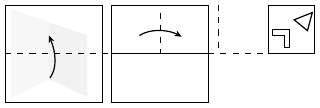
Question 40

A piece of paper is folded and punched as shown below in the question figures. From the given option figures, indicate how it will appear when opened.

  1. AOption (a)

  2. BOption (b)

  3. COption (c)

  4. DOption (d)

View answer & explanation

Correct answer

Answer: (c)C.

Why this answer is correct

The paper after unfolded will be:

Hence, the correct answer is "Option 3".

Question 41

From the given option figures, select the one in which the question figure is hidden/embedded. (Rotation is not allowed)

  1. AOption (a)

  2. BOption (b)

  3. COption (c)

  4. DOption (d)

View answer & explanation

Correct answer

Answer: (c)C.

Why this answer is correct

The image embedded in given figure is as shown below:

Hence, "Option 1" is the correct answer.

Question 42

In the following question, select the number which can be placed at the sign of question mark (?) from the given alternatives.

89544
5?642
127344
  1. AOption (a)

    10

  2. BOption (b)

    11

  3. COption (c)

    12

  4. DOption (d)

    13

View answer & explanation

Correct answer

Answer: (a)A.

10

Why this answer is correct

The logic followed here is;

In a row: (First number + Second number + Third number) × 2 = Fourth number

Row 1: = (8 + 9 + 5) × 2 = 22 × 2 = 44

Row 3: = (12 + 7 + 3) × 2 = 22 × 2 = 44 

Similarly, Row 2: = (5 + 10 + 6) × 2 = 21 × 2 = 42 

So, answer is 10.

Hence, the correct answer is "Option 1".

Question 43

In the figure given below the triangle represents pens, the rectangle represents pencils and the circle represents erasers. Number in each area represents the number of items in that area.

How many pens are pencils?

  1. AOption (a)

    16

  2. BOption (b)

    5

  3. COption (c)

    21

  4. DOption (d)

    31

View answer & explanation

Correct answer

Answer: (c)C.

21

Why this answer is correct

The logic followed here is:

Logic: To find the number of pens that are pencils, we must identify the numbers that fall within the overlapping region of the triangle (pens) and the rectangle (pencils).

Here,

The number 16 is located inside both the triangle and the rectangle. The number 5 is also located inside both the triangle and the rectangle.

Similarly,

 16 + 5 = 21.

So, there are 21 pens that are pencils.

Hence, the correct answer is Option 3.

Question 44

How many triangles are there in the given figure?

  1. AOption (a)

    10

  2. BOption (b)

    11

  3. COption (c)

    12

  4. DOption (d)

    13

View answer & explanation

Correct answer

Answer: (b)B.

11

Why this answer is correct

Triangles in the given figure,

There are 11 triangles present in this figure.

Hence, the correct answer is “Option 2”.

Question 45

Identify the diagram that best represents the relationship among the given classes.

Carpenter, Male, Female

  1. AOption (a)

  2. BOption (b)

  3. COption (c)

  4. DOption (d)

View answer & explanation

Correct answer

Answer: (a)A.

Why this answer is correct

The logic followed here is:

Given:

All Carpenters can be either Male or Female.

Male and Female are mutually exclusive categories.

Therefore, the circle representing Carpenters should overlap with both Male and Female, but Male and Female should not overlap with each other.

Hence, the correct answer is Option 3.

Question 46

Select the option that represents the correct order of the given words as they would appear in an English dictionary.

1.Anniversary

2.Announcement

3.Antibiotic

4.Anthropology

5.Anticipation

  1. AOption (a)

    1, 2, 3, 4, 5

  2. BOption (b)

    2, 1, 3, 4, 5

  3. COption (c)

    1, 2, 4, 3, 5

  4. DOption (d)

    2, 1, 4, 3, 5

View answer & explanation

Correct answer

Answer: (c)C.

1, 2, 4, 3, 5

Why this answer is correct

Correct Option – 3

The correct order of the words as they would appear in the English dictionary is:

Anniversary → 1

Announcement → 2

Anthropology → 4

Antibiotic → 3

Anticipation → 5

The correct order is '1, 2, 4, 3, 5'.

Hence, the correct answer is Option (3).

Question 47

Which option figure will complete the pattern in the question figure? (Rotation is not allowed)

  1. AOption (a)

  2. BOption (b)

  3. COption (c)

  4. DOption (d)

View answer & explanation

Correct answer

Answer: (d)D.

Why this answer is correct

Figure which will complete the pattern in the question figure,

Hence, the correct answer is “Option 4”.

Question 48

In the following question, in each option a pair of figures is given. In each pair the figure towards the left of (:) is related by some logic/rule/relation with the figure on the right of (:). Select the odd figure pair from the given alternatives.

  1. AOption (a)

  2. BOption (b)

  3. COption (c)

  4. DOption (d)

View answer & explanation

Correct answer

Answer: (d)D.

Why this answer is correct

The logic followed here is:

Logic: The number of lines on the right corresponds to the number of sides of the polygon on the left.

Option 1:

Triangle → 3 sides → 3 lines on the right 

Option 2:

Pentagon → 5 sides → 5 lines on the right 

Option 3:

Rectangle → 4 sides → 4 lines on the right 

Option 4:

Rectangle → 4 sides → 5 lines on the right 

Hence, the odd pair is Option 4.

Question 49

In the following figure series, select the figure which can be placed at the sign of question mark (?) from the the given alternatives.

  1. AOption (a)

  2. BOption (b)

  3. COption (c)

  4. DOption (d)

View answer & explanation

Correct answer

Answer: (d)D.

Why this answer is correct

The logic followed here is:

Logic: The letters inside the square are rotated 90 degrees clockwise in each subsequent figure, while the sequence of letters is reversed in order after every second rotation.

​Following the same pattern, the fifth figure should be: A W V

Hence, the correct answer is Option 4.

Question 50

in a certain coded language "TURK' is coded as 'YAWQ' and 'BUFF' is coded as 'GAKL'. How will 'FOGS' be coded in the same code language?

  1. AOption (a)

    KULY

  2. BOption (b)

    JVLW

  3. COption (c)

    IWJA

  4. DOption (d)

    MSJZ

View answer & explanation

Correct answer

Answer: (a)A.

KULY

Why this answer is correct

The logic followed here is:

For, "TURK' is coded as 'YAWQ' 

For, 'BUFF' is coded as 'GAKL'

Similarly, for 'FOGS'

So, 'FOGS' will be related to KULY

Hence, the correct answer is "Option 1".

Quantitative Aptitude (25 questions)

Question 51

A person sells 12 pens for Rs 480\text{Rs }480 and suffers a loss equal to the selling price of 3 pens. What is the cost price of one pen?

  1. AOption (a)

    Rs 50\text{Rs }50

  2. BOption (b)

    Rs 55\text{Rs }55

  3. COption (c)

    Rs 30\text{Rs }30

  4. DOption (d)

    Rs 60\text{Rs }60

View answer & explanation

Correct answer

Answer: (a)A.

Rs 50\text{Rs }50

Why this answer is correct

Given:

Number of pens sold = 12

Total selling price (SP) = ₹480

Loss = Selling price of 3 pens

Formula used:

Loss = Cost price (CP) - Selling price (SP)

Calculation:

SP of 1 pen = ₹480 ÷ 12 = ₹40

Loss = SP of 3 pens = 3 × ₹40 = ₹120

Total CP of 12 pens = Total SP + Loss

⇒ 12 × CP = ₹480 + ₹120 = ₹600

⇒ CP of 1 pen = ₹600 ÷ 12 = ₹50

∴ The correct answer is Option 1.

Question 52

A, B, and C started a business. A invested Rs. 1,20,000, B invested Rs. 80,000, and C invested Rs. 1,00,000. After 6 months, A added Rs. 20,000, and C withdrew Rs. 10,000. If the total profit at the end of 2 years is Rs. 3,60,000, how much will A receive?

  1. AOption (a)

    ₹2,45,78

  2. BOption (b)

    ₹1,58,049

  3. COption (c)

    ₹34,97,812

  4. DOption (d)

    ₹14,87,456

View answer & explanation

Correct answer

Answer: (b)B.

₹1,58,049

Why this answer is correct

Given:

Investments:

A = ₹1,20,000

B = ₹80,000

C = ₹1,00,000

Changes after 6 months:

A adds ₹20,000 ⇒ New investment = ₹1,40,000

C withdraws ₹10,000 ⇒ New investment = ₹90,000

Time period: 24 months

Total profit = ₹3,60,000

Formula used:

Profit distribution is based on investment × time:

Share of Profit = (Investment × Time) ÷ (Sum of all Investments × Time) × Total Profit

Calculations:

Calculate investment × time for each person

A: First 6 months: ₹1,20,000 × 6 = ₹7,20,000

Next 18 months: ₹1,40,000 × 18 = ₹25,20,000

Total = ₹7,20,000 + ₹25,20,000 = ₹32,40,000

B: No change, full 24 months: ₹80,000 × 24 = ₹19,20,000

C: First 6 months: ₹1,00,000 × 6 = ₹6,00,000

Next 18 months: ₹90,000 × 18 = ₹16,20,000

Total = ₹6,00,000 + ₹16,20,000 = ₹22,20,000

Total of all investment × time values

Total = ₹32,40,000 + ₹19,20,000 + ₹22,20,000 = ₹73,80,000

A’s share of profit

⇒ A’s share = (₹32,40,000 ÷ ₹73,80,000) × ₹3,60,000

⇒ A’s share = 0.439 × ₹3,60,000

⇒ A’s share ≈ ₹1,58,049

∴ The correct answer is Option 2.

Question 53

If tanθ=512tan\theta = \frac{5}{12} and θ\theta is in Quadrant III, what is the value of sinθsin\theta?

  1. AOption (a)

    513\frac{5}{13}

  2. BOption (b)

    −513-\frac{5}{13}

  3. COption (c)

    1213\frac{12}{13}

  4. DOption (d)

    −1213-\frac{12}{13}

View answer & explanation

Correct answer

Answer: (b)B.

−513-\frac{5}{13}

Why this answer is correct

Given:

tanθ = 5/12, θ is in Quadrant III

Formula used:

In a right-angled triangle: sinθ = Opposite / Hypotenuse

Also, Hypotenuse = √(Opposite2 + Adjacent2)

Quadrant III: Both sinθ and cosθ are negative

Calculation:

tanθ = Opposite / Adjacent = 5 / 12

Opposite = 5, Adjacent = 12

⇒ Hypotenuse = √(52 + 122)

⇒ Hypotenuse = √(25 + 144) = √169 = 13

⇒ sinθ = Opposite / Hypotenuse

⇒ sinθ = -5 / 13 (negative because θ is in Quadrant III)

∴ The correct answer is option (2): -5/13

Question 54

If m:n=5:11m:n=5:11 and n:p=2:5n:p=2:5, then find m:n:pm:n:p.

  1. AOption (a)

    5:11:25:11:2

  2. BOption (b)

    20:2:1120:2:11

  3. COption (c)

    15:22:5515:22:55

  4. DOption (d)

    10:22:5510:22:55

View answer & explanation

Correct answer

Answer: (d)D.

10:22:5510:22:55

Why this answer is correct

Given:

m:n = 5:11

n:p = 2:5

Formula used:

To find m:n:p, we make the common ratio (n) equal in both given ratios by taking the LCM of their respective values.

Calculation:

LCM of 11 and 2 = 22

For m:n = 5:11:

⇒ Multiply both terms by 2 (to make n = 22):

⇒ m:n = 10:22

For n:p = 2:5:

⇒ Multiply both terms by 11 (to make n = 22):

⇒ n:p = 22:55

Combine m:n:p:

⇒ m:n:p = 10:22:55

∴ The correct answer is m:n:p = 10:22:55.

Question 55

The difference between the compound interest and simple interest on a sum for 2 years at 10% p.a. is ₹15. What is the sum?

  1. AOption (a)

    ₹1,000

  2. BOption (b)

    ₹1,200

  3. COption (c)

    ₹1,500

  4. DOption (d)

    ₹2,000

View answer & explanation

Correct answer

Answer: (c)C.

₹1,500

Why this answer is correct

Given:

Difference between Compound Interest (CI) and Simple Interest (SI) for 2 years = ₹15

Rate (r) = 10% p.a.

Time (t) = 2 years

Formula used:

Difference = P × (r⁄100)2

Where P = Principal

Calculation:

15 = P × (10⁄100)2

⇒ 15 = P × (10 × 10⁄100 × 100)

⇒ 15 = P × (1⁄100)

⇒ P = 15 × 100

⇒ P = ₹1,500

∴ The correct answer is option (3).

Question 56

The amount at the end of the 2nd and 3rd years on a certain principal at CI is ₹9,680\text{₹}9,680 and ₹10,648\text{₹}10,648 respectively. Find the principal.

  1. AOption (a)

    ₹7,000\text{₹}7,000

  2. BOption (b)

    ₹8,000\text{₹}8,000

  3. COption (c)

    ₹8,800\text{₹}8,800

  4. DOption (d)

    ₹9,000\text{₹}9,000

View answer & explanation

Correct answer

Answer: (b)B.

₹8,000\text{₹}8,000

Why this answer is correct

Given:

Amount at the end of the 2nd year (A2) = ₹9,680

Amount at the end of the 3rd year (A3) = ₹10,648

Formula used:

An = P × (1 + r/100)n

Where, P = Principal, r = rate of interest, n = time

Calculation:

A3/A2 = (1 + r/100)3 / (1 + r/100)2

⇒ ₹10,648 / ₹9,680 = 1 + r/100

⇒ 1.1 = 1 + r/100

⇒ r/100 = 0.1

⇒ r = 10%

Now, use A2 to find the principal:

A2 = P × (1 + r/100)2

⇒ ₹9,680 = P × (1.1)2

⇒ ₹9,680 = P × 1.21

⇒ P = ₹9,680 / 1.21

⇒ P = ₹8,000

∴ The correct answer is option (2).

Question 57

The average of 11 numbers is 50. If the first six numbers have an average of 49 and the last six numbers have an average of 52, find the middle number.

  1. AOption (a)

    47

  2. BOption (b)

    56

  3. COption (c)

    53

  4. DOption (d)

    50

View answer & explanation

Correct answer

Answer: (b)B.

56

Why this answer is correct

Given:

Average of 11 numbers = 50

Average of first 6 numbers = 49

Average of last 6 numbers = 52

Formula used:

Sum of numbers = Average × Number of numbers

Middle number = Total sum - (Sum of first 6 numbers + Sum of last 6 numbers)

Calculations:

Sum of all 11 numbers = 50 × 11

⇒ Sum = 550

Sum of first 6 numbers = 49 × 6

⇒ Sum = 294

Sum of last 6 numbers = 52 × 6

⇒ Sum = 312

Middle number = Total sum - (Sum of first 6 numbers + Sum of last 6 numbers)

⇒ Middle number = 550 - (294 + 312)

⇒ Middle number = 550 - 606

⇒ Middle number = -56

∴ The correct answer is option (2).

Question 58

The largest four-digit number which when divided by 4, 7, or 13 leaves a remainder of 3 in each case is:

  1. AOption (a)

    8739

  2. BOption (b)

    9831

  3. COption (c)

    9834

  4. DOption (d)

    9893

View answer & explanation

Correct answer

Answer: (b)B.

9831

Why this answer is correct

Given:

The largest four-digit number when divided by 4, 7, or 13 leaves a remainder of 3 in each case.

Formula used:

Number = LCM(4, 7, 13) × k + Remainder

Where:

  • LCM(4, 7, 13) = Least Common Multiple of 4, 7, and 13
  • Remainder = 3

Calculation:

Find LCM of 4, 7, and 13:

4 = 22, 7 = 71, 13 = 131

LCM = 22 × 7 × 13 = 364

Largest four-digit number = 9999

We need to find the largest number of the form:

Number = 364 × k + 3 (where k is an integer)

⇒ Solve for k:

364 × k + 3 ≤ 9999

⇒ 364 × k ≤ 9996

⇒ k = ⌊9996 ÷ 364⌋

⇒ k = 27

Calculate the largest number:

Number = 364 × 27 + 3

⇒ Number = 9828 + 3

⇒ Number = 9831

∴ The correct answer is option (2): 9831.

Question 59

If the price of a notebook decreases by 25%25\%, then a man can buy 5 more notebooks for Rs. 200. What is the new price (in Rs) of each notebook?

  1. AOption (a)

    20

  2. BOption (b)

    30

  3. COption (c)

    10

  4. DOption (d)

    50

View answer & explanation

Correct answer

Answer: (c)C.

10

Why this answer is correct

Given:

Price of 5 more notebooks = ₹200

Decrease in price = 25%

Formula used:

Old price × Old quantity = New price × New quantity

New price = Old price × (1 - Decrease%)

Calculation:

Let the old price of each notebook be ₹x.

Old quantity = ₹200 ÷ x = 200x\dfrac{200}{x}

New price = x × (1 - 25/100) = 0.75x

New quantity = ₹200 ÷ New price = ₹200 ÷ 0.75x = 2000.75x\dfrac{200}{0.75x}

Difference in quantity = New quantity - Old quantity = 5

⇒ 2000.75x−200x=5\dfrac{200}{0.75x} - \dfrac{200}{x} = 5

⇒ 200x−200(0.75x)0.75x2=5\dfrac{200x - 200(0.75x)}{0.75x^2} = 5

⇒ 200(0.25x)0.75x2=5\dfrac{200(0.25x)}{0.75x^2} = 5

⇒ 500.75x=5\dfrac{50}{0.75x} = 5

⇒ 50 = 5 × 0.75x

⇒ 50 = 3.75x

⇒ x = 503.75\dfrac{50}{3.75}

⇒ x = 13.33

New price = 0.75 × x = 0.75 × 13.33 = ₹10

∴ The correct answer is option (3).

Question 60

A boy cycles to the park at 8 km/h and comes back at 4 km/h. If the total time taken is 1. 5 hours, find the distance between his home and the park.

  1. AOption (a)

    7 km

  2. BOption (b)

    6 km

  3. COption (c)

    5 km

  4. DOption (d)

    4 km

View answer & explanation

Correct answer

Answer: (d)D.

4 km

Why this answer is correct

Given:

Speed to the park = 8 km/h

Speed back = 4 km/h

Total time = 1.5 hours

Formula used:

Total time = Distance/Speed to the park + Distance/Speed back

Calculation:

Let the distance between home and park be D km.

Total time = D/8 + D/4

⇒ 1.5 = D/8 + D/4

⇒ 1.5 = D/8 + 2D/8

⇒ 1.5 = 3D/8

⇒ D = (1.5 × 8)/3

⇒ D = 12/3

⇒ D = 4 km

∴ The correct answer is option (4).

Question 61

A can do a work in 18 days, B in 27 days. They start together, but after 6 days A leaves. In how many more days will B finish the remaining work?

  1. AOption (a)

    10 days

  2. BOption (b)

    11 days

  3. COption (c)

    12 days

  4. DOption (d)

    13 days

View answer & explanation

Correct answer

Answer: (c)C.

12 days

Why this answer is correct

Given:

A can complete the work in 18 days.

B can complete the work in 27 days.

A and B work together for 6 days, after which A leaves.

We need to find how many more days B will take to complete the remaining work.

Formula used:

Work = Efficiency × Time

Total Work = LCM of A and B's time to complete the work.

Efficiency = Total Work ÷ Time.

Calculations:

Total Work = LCM of 18 and 27 = 54 units.

Efficiency of A = Total Work ÷ Time taken by A = 54 ÷ 18 = 3 units/day.

Efficiency of B = Total Work ÷ Time taken by B = 54 ÷ 27 = 2 units/day.

Work done by A and B together in 6 days = (Efficiency of A + Efficiency of B) × 6

⇒ Work done in 6 days = (3 + 2) × 6 = 5 × 6 = 30 units.

Remaining Work = Total Work - Work done in 6 days

⇒ Remaining Work = 54 - 30 = 24 units.

B's efficiency = 2 units/day.

Days required by B to complete the remaining work = Remaining Work ÷ B's efficiency

⇒ Days required = 24 ÷ 2 = 12 days.

∴ The correct answer is option (3).

Question 62

A person borrows ₹20,000 at 8% per annum simple interest for 3 years. What is the total interest he will pay at the end of the 3 years?

  1. AOption (a)

    ₹4,800

  2. BOption (b)

    ₹5,200

  3. COption (c)

    ₹6,000

  4. DOption (d)

    ₹7,200

View answer & explanation

Correct answer

Answer: (a)A.

₹4,800

Why this answer is correct

Given:

Principal (P) = ₹20,000

Rate of Interest (R) = 8% per annum

Time (T) = 3 years

Formula used:

Simple Interest (SI) = (P × R × T) / 100

Calculation:

SI = (20000 × 8 × 3) / 100

⇒ SI = (480000) / 100

⇒ SI = ₹4,800

∴ The correct answer is option (1).

Question 63

A sum of ₹y\text{₹}y amounts to ₹10,920\text{₹}10,920 at 6%6\% per annum in a time in which a sum of ₹12,000\text{₹}12,000 amounts to ₹15,000\text{₹}15,000 at 5%5\% per annum, both at simple interest. The value of yy is:

  1. AOption (a)

    ₹8,100\text{₹}8,100

  2. BOption (b)

    ₹8,400\text{₹}8,400

  3. COption (c)

    ₹7,500\text{₹}7,500

  4. DOption (d)

    ₹8,000\text{₹}8,000

View answer & explanation

Correct answer

Answer: (b)B.

₹8,400\text{₹}8,400

Why this answer is correct

Given:

Principal (P)₁ = ₹12,000

Amount (A)₁ = ₹15,000

Rate (R)₁ = 5% per annum

Principal (P)₂ = ₹y

Amount (A)₂ = ₹10,920

Rate (R)₂ = 6% per annum

Formula used:

Simple Interest (SI) = A - P

SI = P × R × T / 100

Time (T) = SI / (P × R / 100)

Calculation:

SI₁ = ₹15,000 - ₹12,000 = ₹3,000

⇒ Time (T) = ₹3,000 / (₹12,000 × 5 / 100)

⇒ T = ₹3,000 / ₹600

⇒ T = 5 years

Now for the second case:

SI₂ = ₹10,920 - ₹y

⇒ ₹10,920 - ₹y = ₹y × 6 × 5 / 100

⇒ ₹10,920 = ₹y + ₹30y / 100

⇒ ₹10,920 = ₹y × (1 + 0.30)

⇒ ₹10,920 = ₹y × 1.30

⇒ ₹y = ₹10,920 / 1.30

⇒ ₹y = ₹8,400

∴ The correct answer is option (2).

Question 64

What is the integer part of the value of the expression x=1121−120x = \frac{1}{\sqrt{121} - \sqrt{120}}?

  1. AOption (a)

    12

  2. BOption (b)

    11

  3. COption (c)

    21

  4. DOption (d)

    22

View answer & explanation

Correct answer

Answer: (c)C.

21

Why this answer is correct

Given:

x = 1 / (√121 − √120)

Formula used:

1 / (a − b) = (a + b) / (a2 − b2)

Calculations:

x = 1 / (√121 − √120)

⇒ x = (√121 + √120) / (121 − 120)

⇒ x = √121 + √120

⇒ x = 11 + √120

⇒ √120 ≈ 10.95

⇒ x ≈ 11 + 10.95 = 21.95

∴ The integer part of x is 21.

Question 65

A right circular cylinder having the radius of r and height of h is inscribed in a sphere. The sphere's diameter is D. What is the relationship between the height of the cylinder h and its radius r in terms of the sphere's diameter D?

  1. AOption (a)

    h=D2−4r2h = \sqrt{D^2 - 4r^2}

  2. BOption (b)

    2h=5D2−4r22h = \sqrt{5D^2 - 4r^2}

  3. COption (c)

    3h=D2−r23h = \sqrt{D^2 - r^2}

  4. DOption (d)

    h=5D2−r2h = \sqrt{5D^2 - r^2}

View answer & explanation

Correct answer

Answer: (a)A.

h=D2−4r2h = \sqrt{D^2 - 4r^2}

Why this answer is correct

Given:

Radius of cylinder (r) = r

Height of cylinder (h) = h

Diameter of sphere (D) = D

The cylinder is inscribed in the sphere.

Formula used:

Relationship between radius and height of cylinder inscribed in sphere: D2 = h2 + 4r2

Calculation:

Start with the formula:

D2 = h2 + 4r2

⇒ h2 = D2 - 4r2

⇒ h = √(D2 - 4r2)

∴ The correct answer is option (1).

Question 66

A container holds 70 litres of a milk water mixture in which water makes up 10%10\% of the total. How many litres of pure water should be added so that the proportion of water in the mixture increases to 25%25\%?

  1. AOption (a)

    15 liters

  2. BOption (b)

    10 liters

  3. COption (c)

    12 liters

  4. DOption (d)

    14 liters

View answer & explanation

Correct answer

Answer: (d)D.

14 liters

Why this answer is correct

Given:

Initial quantity of mixture = 70 litres

Percentage of water in the mixture = 10%

Target percentage of water in the mixture = 25%

Formula used:

New quantity of water = Initial quantity of water + Added water

Total mixture = 70 + Added water

Percentage of water = (New quantity of water/Total mixture) × 100

Calculation:

Initial quantity of water = 10% of 70 = 70 × (10/100) = 7 litres

Let the quantity of pure water added = x litres

New quantity of water = 7 + x

Total mixture = 70 + x

⇒ (7 + x/70 + x) × 100 = 25

⇒ 7 + x/70 + x = 0.25

⇒ 7 + x = 0.25 × (70 + x)

⇒ 7 + x = 17.5 + 0.25x

⇒ x - 0.25x = 17.5 - 7

⇒ 0.75x = 10.5

⇒ x = 10.5 ÷ 0.75

⇒ x = 14 litres

∴ The correct answer is option (4).

Question 67

A hemispherical bowl is made of iron with a thickness of 0.50.5 cm. The inner radius is 33 cm. Find the volume of iron used to make the bowl.

  1. AOption (a)

    143π11\frac{143\pi}{11} cm3cm^3

  2. BOption (b)

    167π13\frac{167\pi}{13} cm3cm^3

  3. COption (c)

    127π12\frac{127\pi}{12} cm3cm^3

  4. DOption (d)

    123π12\frac{123\pi}{12} cm3cm^3

View answer & explanation

Correct answer

Answer: (c)C.

127π12\frac{127\pi}{12} cm3cm^3

Why this answer is correct

Given:

Inner radius of the hemispherical bowl (r) = 3 cm

Thickness = 0.5 cm

Outer radius (R) = r + thickness = 3 + 0.5 = 3.5 cm

Formula used:

Volume of iron used = Volume of outer hemisphere - Volume of inner hemisphere

Volume of a hemisphere = (2/3)πr3

Calculation:

Volume of outer hemisphere = (2/3)πR3

Volume of inner hemisphere = (2/3)πr3

Volume of iron used = (2/3)πR3 - (2/3)πr3

⇒ Volume of iron used = (2/3)π(3.5)3 - (2/3)π(3)3

⇒ Volume of iron used = (2/3)π(42.875) - (2/3)π(27)

⇒ Volume of iron used = (2/3)π(42.875 - 27)

⇒ Volume of iron used = (2/3)π(15.875)

⇒ Volume of iron used = (31.75π)/3 cm3

⇒ Volume of iron used = (127π)/12 cm3

∴ The correct answer is option (3).

Question 68

Convert the recurring decimal 0. 272727... into a simple fraction in its lowest terms.

  1. AOption (a)

    27100\frac{27}{100}

  2. BOption (b)

    311\frac{3}{11}

  3. COption (c)

    799\frac{7}{99}

  4. DOption (d)

    133\frac{1}{33}

View answer & explanation

Correct answer

Answer: (b)B.

311\frac{3}{11}

Why this answer is correct

Given:

Recurring decimal = 0.272727...

Formula used:

If a recurring decimal is of the form 0.ab (where "ab" repeats), then its fractional form is given by:

Repeating PartSame number of 9s as digits in the repeating part\frac{\text{Repeating Part}}{\text{Same number of 9s as digits in the repeating part}}

Calculations:

Repeating part = 27

Number of digits in the repeating part = 2

⇒ Denominator = 99 (two 9s, since there are 2 repeating digits)

⇒ Fraction = 2799\frac{27}{99}

⇒ Simplify the fraction:

⇒ 2799\frac{27}{99} = 311\frac{3}{11} (divide numerator and denominator by their GCD, 9)

∴ The correct answer is option (2).

Question 69

If (32)4=3x(3^2)^4 = 3^x, what is x?

  1. AOption (a)

    8

  2. BOption (b)

    9

  3. COption (c)

    6

  4. DOption (d)

    7

View answer & explanation

Correct answer

Answer: (a)A.

8

Why this answer is correct

Given:

If (32)4 = 3x, find x.

Formula used:

(ab)c = ab×c

Calculation:

(32)4 = 3x

⇒ 32×4 = 3x

⇒ 38 = 3x

⇒ x = 8

∴ The correct answer is option (1).

Question 70

The coordinates of the vertices of a triangle are A(0,0)A(0,0), B(8,0)B(8,0), and C(0,6)C(0,6). What is the location of the orthocenter?

  1. AOption (a)

    (0,0)(0, 0)

  2. BOption (b)

    (4,3)(4, 3)

  3. COption (c)

    (8,0)(8, 0)

  4. DOption (d)

    (0,6)(0, 6)

View answer & explanation

Correct answer

Answer: (a)A.

(0,0)(0, 0)

Why this answer is correct

Shortcut Trick

For any right-angled triangle, the orthocenter (the point where all three altitudes intersect) always lies exactly at the vertex containing the right angle (90°).

In the triangle with vertices A(0, 0), B(8, 0), and C(0, 6), side AB lies on the x-axis and side AC lies on the y-axis.

Since the x-axis and y-axis are perpendicular at the origin, the right angle is formed at vertex A(0, 0).

Therefore, the orthocenter is (0, 0).

∴ The correct answer is (0, 0).

Alternate Method

Given: Vertices A(0, 0), B(8, 0), and C(0, 6).

Formula used: The orthocenter is the intersection point of the altitudes of a triangle.

⇒ Slope of side AB = (0 − 0) ÷ (8 − 0) = 0 (Horizontal line on x-axis).

⇒ Slope of side AC = (6 − 0) ÷ (0 − 0) = undefined (Vertical line on y-axis).

⇒ Since AB is horizontal and AC is vertical, the angle at A is 90°.

⇒ Altitude from C to AB: A line through C(0, 6) perpendicular to the x-axis is x = 0.

⇒ Altitude from B to AC: A line through B(8, 0) perpendicular to the y-axis is y = 0.

⇒ The intersection of these altitudes (x = 0 and y = 0) is the orthocenter.

⇒ Orthocenter = (0, 0).

∴ The correct answer is (0, 0).

Additional Information

Orthocenter in Triangles

In an acute triangle, the orthocenter lies inside; in an obtuse triangle, it lies outside; and in a right triangle, it is the right-angle vertex.

Circumcenter of a Right Triangle

The circumcenter of a right-angled triangle is the midpoint of the hypotenuse. For this triangle, it would be ((8+0)/2, (0+6)/2) = (4, 3).

Centroid Formula

The centroid G is the average of the coordinates: G = ((x1+x2+x3)/3, (y1+y2+y3)/3). For this triangle: (8/3, 2).

Euler Line

The orthocenter, centroid, and circumcenter are always collinear. The centroid divides the segment between the orthocenter and circumcenter in a 2:1 ratio.

Question 71

Two similar triangles have areas in the ratio of 9:259:25. What is the ratio of their corresponding altitudes?

  1. AOption (a)

    3:53:5

  2. BOption (b)

    9:259:25

  3. COption (c)

    3:253:25

  4. DOption (d)

    81:62581:625

View answer & explanation

Correct answer

Answer: (a)A.

3:53:5

Why this answer is correct

Given:

The ratio of areas of two similar triangles = 9:25

Formula used:

For two similar triangles, the ratio of their areas is equal to the square of the ratio of their corresponding sides or altitudes.

Area1 / Area2 = (Altitude1 / Altitude2)2

Calculation:

Given, Area1 / Area2 = 9 / 25

⇒ (Altitude1 / Altitude2)2 = 9 / 25

⇒ Altitude1 / Altitude2 = √(9 / 25)

⇒ Altitude1 / Altitude2 = 3 / 5

∴ The ratio of their corresponding altitudes is 3:5.

Question 72

Find the equation of a line that is parallel to y=3x−5y = 3x - 5 and passes through the point (1,2)(1, 2).

  1. AOption (a)

    y=3x−1y = 3x - 1

  2. BOption (b)

    y=3x+1y = 3x + 1

  3. COption (c)

    y=3x−2y = 3x - 2

  4. DOption (d)

    y=3x+2y = 3x + 2

View answer & explanation

Correct answer

Answer: (a)A.

y=3x−1y = 3x - 1

Why this answer is correct

Given:

Equation of the line to be parallel to: y = 3x - 5

Point through which the line passes: (1, 2)

Formula used:

For parallel lines, slope (m) is the same. The slope-intercept form of the equation of a line is:

y = mx + c

where m = slope and c = y-intercept.

Calculation:

The slope of the given line y = 3x - 5 is m = 3.

For the new line, slope m = 3, and it passes through the point (1, 2). Substitute these values into the equation y = mx + c to find c.

2 = 3(1) + c

⇒ 2 = 3 + c

⇒ c = 2 - 3

⇒ c = -1

Therefore, the equation of the line is:

y = 3x - 1

∴ The correct answer is option (1).

Question 73

A triangular-shaped park and a model of the park are similar. The ratio of their corresponding side lengths is 1:2001:200. If a path in the park is 100100 meters long, what is the length of the corresponding path in the model?

  1. AOption (a)

    15 cm

  2. BOption (b)

    50 cm

  3. COption (c)

    43 cm

  4. DOption (d)

    29 cm

View answer & explanation

Correct answer

Answer: (b)B.

50 cm

Why this answer is correct

Given:

Ratio of corresponding side lengths = 1:200

Length of the path in the park = 100 meters = 10000 cm

Formula used:

Length of corresponding path in the model = Length of the path in the park/Ratio

Calculation:

⇒ Length of corresponding path in the model = 10000/200

⇒ Length of corresponding path in the model = 50 cm

∴ The correct answer is option (2).

Question 74

Simplify: (a2−b2)3+(b2−c2)3+(c2−a2)3(a−b)3+(b−c)3+(c−a)3\frac{(a^2 - b^2)^3 + (b^2 - c^2)^3 + (c^2 - a^2)^3}{(a - b)^3 + (b - c)^3 + (c - a)^3}

  1. AOption (a)

    (a+b)(b+c)(c+a)(a + b)(b + c)(c + a)

  2. BOption (b)

    (2a+b)(b+c)(3c+a)(2a + b)(b + c)(3c + a)

  3. COption (c)

    (2a+b)(2b+c)(2c+a)(2a + b)(2b + c)(2c + a)

  4. DOption (d)

    (a+3b)(b+3c)(c+3a)(a + 3b)(b + 3c)(c + 3a)

View answer & explanation

Correct answer

Answer: (a)A.

(a+b)(b+c)(c+a)(a + b)(b + c)(c + a)

Why this answer is correct

Given:

(a2−b2)3+(b2−c2)3+(c2−a2)3(a−b)3+(b−c)3+(c−a)3\frac{(a^2 - b^2)^3 + (b^2 - c^2)^3 + (c^2 - a^2)^3}{(a - b)^3 + (b - c)^3 + (c - a)^3}

Formula used:

If x + y + z = 0, then x3 + y3 + z3 = 3 × x × y × z

a2 - b2 = (a - b)(a + b)

Calculation:

Numerator: (a2 - b2) + (b2 - c2) + (c2 - a2) = 0

⇒ Numerator = 3(a2 - b2)(b2 - c2)(c2 - a2)

Denominator: (a - b) + (b - c) + (c - a) = 0

⇒ Denominator = 3(a - b)(b - c)(c - a)

⇒ 3(a2−b2)(b2−c2)(c2−a2)3(a−b)(b−c)(c−a)\frac{3(a^2 - b^2)(b^2 - c^2)(c^2 - a^2)}{3(a - b)(b - c)(c - a)}

⇒ 3(a−b)(a+b)(b−c)(b+c)(c−a)(c+a)3(a−b)(b−c)(c−a)\frac{3(a - b)(a + b)(b - c)(b + c)(c - a)(c + a)}{3(a - b)(b - c)(c - a)}

⇒ (a + b)(b + c)(c + a)

∴ The correct answer is option (1).

Question 75

If tan⁡(x)+cot⁡(x)=2\tan(x) + \cot(x) = 2, find sin⁡(x)cos⁡(x)\sin(x) \cos(x).

  1. AOption (a)

    1

  2. BOption (b)

    67\frac{6}{7}

  3. COption (c)

    12\frac{1}{2}

  4. DOption (d)

    79\frac{7}{9}

View answer & explanation

Correct answer

Answer: (c)C.

12\frac{1}{2}

Why this answer is correct

Given:

tan⁡(x)+cot⁡(x)=2\tan(x) + \cot(x) = 2

Formula used:

tan⁡(x)+cot⁡(x)=sin⁡2(x)+cos⁡2(x)sin⁡(x)cos⁡(x)\tan(x) + \cot(x) = \frac{\sin^2(x)+\cos^2(x)}{\sin(x)\cos(x)}

We know sin⁡2(x)+cos⁡2(x)=1\sin^2(x) + \cos^2(x) = 1

Calculation:

tan⁡(x)+cot⁡(x)=1sin⁡(x)cos⁡(x)\tan(x) + \cot(x) = \frac{1}{\sin(x)\cos(x)}

⇒ 1sin⁡(x)cos⁡(x)=2\frac{1}{\sin(x)\cos(x)} = 2

⇒ sin⁡(x)cos⁡(x)=12\sin(x)\cos(x) = \frac{1}{2}

∴ The correct answer is option (3).

General Awareness (25 questions)

Question 76

Which of the following words is mentioned in the preamble of the Indian constitution regarding ’Justice’?

  1. AOption (a)

    Secular

  2. BOption (b)

    Socialist

  3. COption (c)

    Sovereign

  4. DOption (d)

    Economic

View answer & explanation

Correct answer

Answer: (d)D.

Economic

Why this answer is correct

The correct answer is Economic.

Key Points

  • The Preamble of the Indian Constitution mentions various ideals that the nation strives to achieve, including Justice.
  • Justice in the Preamble is categorized into three forms: Social, Economic, and Political, reflecting the core objectives of the Indian Constitution.
  • Social justice aims to eliminate inequalities among individuals in society and ensure equal treatment for all, regardless of caste, gender, or religion.
  • Economic justice ensures that wealth and resources are distributed fairly and that there is no exploitation of the economically weaker sections of society.
  • Political justice guarantees equal participation in the democratic process, ensuring every citizen has an equal voice in governance.
  • Among the listed options, Economic specifically refers to one of the forms of Justice explicitly mentioned in the Preamble. Hence, this is the correct answer.

Additional Information

  • The Preamble to the Indian Constitution:
  • The Preamble serves as the introductory statement of the Constitution, highlighting the guiding principles and objectives of the nation.
  • It was adopted on 26th November 1949 and came into effect on 26th January 1950.
  • The Preamble declares India as a Sovereign, Socialist, Secular, Democratic Republic.
  • It guarantees citizens Justice, Liberty, Equality, and Fraternity.
  • The ideals mentioned in the Preamble were inspired by the Objectives Resolution proposed by  Jawaharlal Nehru on December 13, 1946
  • Forms of Justice in the Preamble:
  • Social Justice: Elimination of social discrimination and promotion of equality among all citizens.
  • Economic Justice: Fair distribution of wealth and opportunities, ensuring protection against economic exploitation.
  • Political Justice: Equal rights to participate in the political process and governance.
  • Key Features of the Preamble:
  • The Preamble is considered the spirit of the Constitution and provides the framework for its interpretation.
  • It underwent an amendment during the 42nd Constitutional Amendment Act, 1976, which added the terms Socialist, Secular, and Integrity.
  • The Preamble is non-justiciable, meaning its provisions cannot be enforced in a court of law.
  • Important Terms in the Preamble:
  • Sovereign: India has the supreme authority to make decisions without external interference.
  • Socialist: The government strives for social and economic equality.
  • Secular: India does not promote any particular religion and treats all religions equally.
  • Democratic: Power lies with the people, who elect their representatives.
  • Republic: India has an elected head of state (the President) rather than a monarch.

Important Points

  • The 42nd Amendment (1976):
  • Known as the Mini Constitution, this amendment added the words Socialist, Secular, and Integrity to the Preamble.
  • It reinforced the goal of achieving social and economic justice for all citizens.
  • Dr. B.R. Ambedkar’s Contribution:
  • Dr. Ambedkar, the Father of the Indian Constitution, emphasized Justice as a cornerstone for the nation’s development.
  • He advocated for the protection of marginalized communities and the elimination of social inequalities.
  • Judicial Interpretation:
  • The Supreme Court of India has described the Preamble as the key to the Constitution and an essential guide to its interpretation.
  • In the landmark case of Keshavananda Bharati v. State of Kerala (1973), the Preamble was upheld as part of the Constitution’s basic structure.

Question 77

In September 2024, Manish Kumar Gupta has been appointed as Chief Secretary of ____.

  1. AOption (a)

    Bihar

  2. BOption (b)

    Manipur

  3. COption (c)

    Kerala

  4. DOption (d)

    Arunachal Pradesh

View answer & explanation

Correct answer

Answer: (d)D.

Arunachal Pradesh

Why this answer is correct

The correct answer is Arunachal Pradesh.

Key Points

  • Manish Kumar Gupta was appointed as the Chief Secretary of Arunachal Pradesh in September 2024. This is a key administrative position in the state, responsible for overseeing the implementation of government policies and the functioning of the state administration.
  • The Chief Secretary is the senior-most civil servant in a state and acts as the principal advisor to the Chief Minister and the state government. They play a crucial role in policy formulation and ensuring effective governance.
  • Manish Kumar Gupta is an Indian Administrative Service (IAS) officer and has extensive experience in various administrative roles. His appointment is expected to bring effective management to the state's governance.
  • Arunachal Pradesh is a northeastern state in India, known as the "Land of the Rising Sun" because it is the easternmost state of the country. It is strategically significant due to its international borders with China, Bhutan, and Myanmar.
  • The appointment of a Chief Secretary is generally made by the state government in consultation with the Department of Personnel and Training (DoPT), Government of India, and is based on the officer's seniority, experience, and expertise.

Additional Information

  • Arunachal Pradesh:
  • It is the largest state in northeast India by area and has a unique cultural diversity with over 26 major tribes and several sub-tribes.
  • The state capital is Itanagar, and the official language is English.
  • Arunachal Pradesh is known for its rich biodiversity and is home to several national parks, including Namdapha National Park and Mouling National Park.
  • The state's economy is primarily agrarian, but tourism and hydropower projects are emerging sectors.
  • Role of Chief Secretary:
  • The Chief Secretary acts as the head of the state civil services and is responsible for ensuring coordination among various departments.
  • The post involves advising the Chief Minister, implementing policies, and ensuring effective governance in the state.
  • They also play a key role in coordinating with the central government on various issues, including resource allocation and developmental projects.
  • Indian Administrative Service (IAS):
  • The IAS is one of the premier civil services in India, and its officers are recruited through the Union Public Service Commission (UPSC).
  • An IAS officer can hold key positions in the central and state governments, including district magistrates, secretaries, and chief secretaries.
  • They are responsible for policy implementation, administration, and ensuring law and order.
  • Significance of Arunachal Pradesh:
  • The state shares a 1,129 km border with China, making it geopolitically significant for India.
  • It is part of the Act East Policy, which aims to improve economic and strategic relations with Southeast Asian countries.
  • Arunachal Pradesh is also home to the Brahmaputra River, a key water resource for the region.

Important Points

  • Appointment Process: The Chief Secretary is appointed by the state government, but their service conditions are determined by the central government under the All India Services Rules.
  • Administrative Role: The Chief Secretary ensures coordination among state departments and acts as the link between the state and central governments.
  • Geopolitical Importance of Arunachal Pradesh: The state's location makes it vital for India's defense strategy, particularly with its proximity to the Line of Actual Control (LAC) with China.
  • Developmental Focus: Recent efforts in the state have focused on improving infrastructure, education, and healthcare, along with promoting tourism and hydropower generation.

Question 78

In December 2024, as per Ministry of New and Renewable Energy the number of installations under the PM Surya Ghar: Muft Bijli Yojana are expected to reach ________ crores by March 2027.

  1. AOption (a)

    5

  2. BOption (b)

    1

  3. COption (c)

    2.5

  4. DOption (d)

    3

View answer & explanation

Correct answer

Answer: (b)B.

1

Why this answer is correct

The correct answer is Option 2.

Key Points

  • The Ministry of New and Renewable Energy (MNRE) has launched several initiatives to promote solar energy usage in India, including the PM Surya Ghar: Muft Bijli Yojana.
  • As per projections by MNRE, the number of installations under this scheme is expected to reach 1 crore by March 2027. This estimation is based on the pace of implementation and adoption of solar energy technologies in households.
  • The scheme aims to provide free solar electricity to households by encouraging the installation of solar panels on rooftops and other accessible areas.
  • India has been actively working towards achieving its renewable energy targets, with a focus on increasing the contribution of solar energy to its electricity grid. The PM Surya Ghar Yojana is part of this effort to decentralize energy generation and reduce dependency on conventional sources.
  • By March 2027, with the successful implementation of the scheme, it is expected to benefit millions of households by reducing electricity costs and contributing to a greener environment.

Additional Information

  • PM Surya Ghar: Muft Bijli Yojana:
  • The scheme is primarily targeted at promoting solar panel installations in urban and rural households, thereby reducing electricity bills.
  • It aims to make solar energy accessible and affordable for all citizens of India, particularly those in the lower-income groups.
  • Under the initiative, households can install rooftop solar panels at minimal or no cost due to subsidies and financial support provided by the government.
  • The scheme contributes to achieving India's renewable energy goals, including the target of 500 GW non-fossil fuel capacity by 2030 as pledged under the Paris Agreement.
  • India’s Renewable Energy Targets:
  • India has set ambitious targets under its National Solar Mission, aiming for 100 GW of solar energy capacity by 2022. Although this target is yet to be fully achieved, the government continues to push for advancements in solar technology.
  • As of October 2023, India has achieved over 70 GW of solar energy capacity, with ongoing efforts to enhance installations.
  • Adoption of schemes like PM Surya Ghar contributes to decentralized energy generation and strengthens rural electrification efforts.
  • Benefits of Solar Energy:
  • Solar energy is a clean and sustainable source of power that helps reduce carbon emissions.
  • It offers cost savings for households and businesses by reducing dependency on conventional electricity grids.
  • India’s geographical location provides it with ample sunlight, making solar energy highly viable.
  • MNRE’s Role:
  • The Ministry of New and Renewable Energy (MNRE) is the nodal agency responsible for promoting renewable energy initiatives in India.
  • It provides financial support, policy guidelines, and assistance to implement schemes like PM Surya Ghar: Muft Bijli Yojana.
  • MNRE has introduced several other programs, such as KUSUM Scheme and Solar Parks, to enhance solar energy adoption across sectors.

Important Points

  • Option 1 (5 crores): Unrealistic given the current pace of installations and resource availability under the scheme.
  • Option 2 (1 crore): Accurate according to official projections by MNRE for installations under PM Surya Ghar Yojana by March 2027.
  • Option 3 (2.5 crores): Overestimation based on available data and implementation pace.
  • Option 4 (3 crores): Unlikely due to resource constraints and adoption rates.

Question 79

What was India’s rank in the Global Innovation Index 2024?

  1. AOption (a)

    46th

  2. BOption (b)

    19th

  3. COption (c)

    61st

  4. DOption (d)

    39th

View answer & explanation

Correct answer

Answer: (d)D.

39th

Why this answer is correct

The correct answer is 39th.

Key Points

  • India ranked 39th in the Global Innovation Index (GII) 2024, highlighting its significant progress in fostering innovation and technology-driven growth.
  • The Global Innovation Index is published annually by the World Intellectual Property Organization (WIPO). It evaluates the innovation capabilities and performance of countries worldwide.
  • India’s climb to the 39th position marks an improvement compared to previous years, reflecting advancements in areas such as technology, research, and development (R&D), and startup ecosystem.
  • The index assesses various indicators like human capital, infrastructure, market sophistication, and creative outputs, among others.
  • India’s strong performance is attributed to factors such as government initiatives like Startup India, increased R&D spending, and the establishment of innovation hubs and incubators across the country.

Additional Information

  • Global Innovation Index (GII):
  • The GII is an annual ranking system that assesses the innovation capabilities of 132 economies. It is co-published by WIPO, Cornell University, and INSEAD.
  • The index uses 81 indicators to measure innovation, which are grouped under seven pillars: Institutions, Human Capital and Research, Infrastructure, Market Sophistication, Business Sophistication, Knowledge and Technology Outputs, and Creative Outputs.
  • It serves as a tool for policymakers, researchers, and businesses to understand innovation dynamics and improve decision-making.
  • India’s Innovation Progress:
  • India has steadily improved its rank in the GII over the years, moving from the 81st position in 2015 to 39th in 2024.
  • Key contributors include government programs such as Digital India, Make in India, and Atal Innovation Mission.
  • India has emerged as a global hub for startups, ranking among the top three startup ecosystems globally.
  • India’s Achievements in Innovation:
  • India excels in sectors like pharmaceuticals, information technology, and telecommunications.
  • The rise of unicorns and a focus on patents and intellectual property have further boosted India’s innovation landscape.
  • Collaborations between academia, industry, and government have enhanced R&D outputs in various fields.
  • Important Global Comparisons:
  • Countries like Switzerland, Sweden, and the United States continue to dominate the top positions in the GII rankings.
  • India’s performance in specific indicators, such as ICT services exports and knowledge creation, remains strong compared to many developed nations.

Important Points

  • Government Initiatives:
  • Startup India: Launched in 2016 to boost entrepreneurship and innovation.
  • Atal Innovation Mission (AIM): A flagship program to promote innovation and establish Atal Tinkering Labs in schools.
  • Digital India: Focuses on transforming India into a digitally empowered society by improving digital infrastructure.
  • Make in India: Aims to promote manufacturing and innovation in India.
  • Key Sectors Driving Innovation:
  • ICT Services: India remains a global leader in IT services exports.
  • Pharmaceutical Industry: Known as the ‘Pharmacy of the World’, contributing significantly to healthcare innovation.
  • Space Technology: Initiatives like Chandrayaan and Mangalyaan showcase India’s advancements in space exploration.
  • Future Outlook:
  • India’s continued focus on research, skill development, and public-private partnerships is key to further climbing the innovation rankings.
  • Efforts to enhance intellectual property rights (IPR) and increase investments in R&D will be crucial in sustaining its progress.

Question 80

RBI’s Financial Inclusion Index has risen to _______ in 2025.

  1. AOption (a)

    67

  2. BOption (b)

    73

  3. COption (c)

    54

  4. DOption (d)

    41

View answer & explanation

Correct answer

Answer: (a)A.

67

Why this answer is correct

The correct answer is 67.

Key Points

  • The Reserve Bank of India (RBI) introduced the Financial Inclusion Index (FI-Index) in July 2021 to measure the level of financial inclusion across India.
  • The FI-Index is a comprehensive tool that captures financial inclusion in terms of access, usage, and quality of financial services, on a scale ranging from 0 to 100.
  • The FI-Index score for 2025 has risen to 67, indicating significant progress in financial inclusion efforts in India.
  • It is based on three broad parameters: Access to financial services (35%), Usage (45%), and Quality (20%). These parameters include various indicators such as banking penetration, availability of ATMs, digital payments, and grievance redress mechanisms.
  • The increase in the index reflects the impact of various government schemes like Pradhan Mantri Jan Dhan Yojana (PMJDY), digital payment initiatives, and efforts to expand banking services in rural and semi-urban areas.

Additional Information

  • Financial Inclusion Index (FI-Index):
  • Launched by RBI, this index does not have any base year. It is published annually in July.
  • The FI-Index is a composite index derived from 97 indicators that capture various aspects of financial inclusion.
  • The index reflects the cumulative efforts of stakeholders including the government, regulators, and financial institutions.
  • Pradhan Mantri Jan Dhan Yojana (PMJDY):
  • Launched in August 2014, PMJDY is a national mission for financial inclusion to provide universal access to banking facilities.
  • Key features include zero balance accounts, accidental insurance cover, and overdraft facilities.
  • It has significantly contributed to increasing financial penetration in rural and underserved areas.
  • Digital Payment Initiatives:
  • The Indian government and RBI have promoted digital payments through initiatives like UPI, Aadhaar-enabled Payment Systems (AePS), and RuPay cards.
  • These steps have enabled greater access to financial services for individuals in remote and rural areas.
  • Government Schemes:
  • Programs like PM Suraksha Bima Yojana, Atal Pension Yojana, and PM Jeevan Jyoti Bima Yojana have enhanced financial literacy and inclusion.
  • The Stand Up India initiative has promoted entrepreneurship among marginalized communities.

Important Points

  • Access: This parameter measures the availability of financial services such as branches, ATMs, and mobile banking services.
  • Usage: Usage assesses how actively individuals utilize financial services, including savings accounts, credit facilities, and insurance schemes.
  • Quality: Quality evaluates aspects like financial literacy, grievance redress mechanisms, and customer satisfaction in accessing financial services.
  • The FI-Index is aligned with global goals, such as the United Nations Sustainable Development Goals (SDGs), to enhance financial inclusion worldwide.

Question 81

In March 2025, Prime Minister of India laid the foundation stone of National Referral Centre for Wildlife at ______.

  1. AOption (a)

    Kota

  2. BOption (b)

    Udaipur

  3. COption (c)

    Bhopal

  4. DOption (d)

    Junagadh

View answer & explanation

Correct answer

Answer: (d)D.

Junagadh

Why this answer is correct

The correct answer is Junagadh.

Key Points

  • In March 2025, the Prime Minister of India laid the foundation stone of the National Referral Centre for Wildlife at Junagadh, Gujarat.
  • The establishment of this centre aims to provide a dedicated facility for wildlife conservation, research, and management in India.
  • Junagadh was chosen as the location due to its proximity to the Gir National Park, which is renowned for being the last natural habitat of the Asiatic lions.
  • The National Referral Centre for Wildlife will play a critical role in addressing wildlife health issues, conducting research, and enhancing capacities for wildlife protection and care.
  • It is part of the government’s broader agenda to strengthen environmental conservation and promote sustainable development.

Additional Information

  • Junagadh:
  • Junagadh is a city in the state of Gujarat, India, located near the Gir National Park, the only habitat for the Asiatic lions.
  • The city has a rich history, with several ancient monuments like the Uparkot Fort and Junagadh Buddhist Caves.
  • Its proximity to the Gir forest makes it an important location for wildlife conservation and research activities.
  • Gir National Park:
  • The Gir National Park is a wildlife sanctuary located in Gujarat and is the only remaining home of the Asiatic lions in the world.
  • The park spans an area of approximately 1,412 square kilometers and is known for its diverse flora and fauna.
  • It serves as a critical conservation area under the Project Lion, an initiative by the Indian government to protect the Asiatic lion population.
  • National Referral Centre for Wildlife:
  • The centre is envisioned to be a world-class facility for wildlife disease diagnostics, veterinary care, and research on wildlife health.
  • It will focus on preventive health measures, treatment of injuries, and studying disease patterns in wildlife to ensure their safety and well-being.
  • It will also serve as a training hub for wildlife veterinarians and researchers.
  • Other Locations:
  • Kota: Located in Rajasthan, it is famous for its coaching institutes and the Kota Barrage. It is not associated with wildlife conservation on a national scale.
  • Udaipur: Known as the City of Lakes, it is a prominent tourist destination in Rajasthan but has no significant role in wildlife health research.
  • Bhopal: The capital of Madhya Pradesh, it is known for its lakes and the Van Vihar National Park, but it is not the site for the proposed National Referral Centre for Wildlife.

Important Points

  • Wildlife Conservation in India:
  • India is home to a wide variety of flora and fauna, with over 7-8% of the world's biodiversity.
  • Several initiatives, such as Project Tiger and Project Elephant, have been launched to protect endangered species.
  • The Wildlife Protection Act, 1972, provides the legal framework for wildlife conservation in India.
  • Significance of Wildlife Health Centres:
  • Wildlife health centres are crucial for monitoring and controlling zoonotic diseases that can spread to humans.
  • They also aid in maintaining the ecological balance by ensuring the survival of endangered species.

Question 82

Who is the author of the book ’Gandhi in Champaran’, which describes Mahatma Gandhi’s first Satyagraha struggle on Indian soil in 1917?

  1. AOption (a)

    Toru Dutt

  2. BOption (b)

    Rajendra Prasad

  3. COption (c)

    D.G. Tendulkar

  4. DOption (d)

    Kamala Das

View answer & explanation

Correct answer

Answer: (c)C.

D.G. Tendulkar

Why this answer is correct

The correct answer is D.G. Tendulkar.

Key Points

  • D.G. Tendulkar is the author of the book “Gandhi in Champaran”, which provides an in-depth account of Mahatma Gandhi’s first Satyagraha in India in 1917. This book documents Gandhi’s struggle against the oppressive indigo planters in Champaran, Bihar.
  • Champaran was the site where Mahatma Gandhi initiated his first Satyagraha movement in India, addressing the grievances of farmers forced into cultivating indigo under exploitative conditions.
  • The book "Gandhi in Champaran" serves as a vital historical text that highlights Gandhi’s methodology of nonviolent protest and his commitment to the welfare of marginalized farmers.
  • D.G. Tendulkar was a prominent biographer of Gandhi and authored several works documenting Gandhi’s life and philosophy, making his writings a significant resource for understanding Gandhi’s impact on India’s independence movement.
  • The Champaran Satyagraha in 1917 marked a turning point in India’s freedom struggle, as it brought Gandhi into the national spotlight and demonstrated the power of collective nonviolent resistance.

Additional Information

  • Champaran Satyagraha:
  • The Champaran Satyagraha was launched by Gandhi in April 1917 to fight against the exploitation of farmers by British planters who forced them to grow indigo under the Tinkathia system.
  • Under the Tinkathia system, farmers were compelled to cultivate indigo on 15% of their land and sell it at low fixed prices, leading to extreme poverty and debt.
  • Gandhi's intervention involved a detailed investigation into farmers' grievances, followed by peaceful protests and negotiations with British authorities, resulting in the abolition of the oppressive system.
  • This movement established Gandhi’s leadership in India and demonstrated the effectiveness of nonviolent resistance.
  • D.G. Tendulkar:
  • He is widely known for his eight-volume biography of Mahatma Gandhi, titled "Mahatma: Life of Mohandas Karamchand Gandhi."
  • Tendulkar’s works are considered significant contributions to understanding Gandhi's principles of truth, nonviolence, and his role in shaping India’s struggle for independence.
  • His writings provide a detailed and authentic portrayal of Gandhi’s personal and public life, making them valuable resources for historians and scholars.
  • Other Authors:
  • Toru Dutt: A renowned Indian poet and novelist, known for her literary contributions such as "Ancient Ballads and Legends of Hindustan." She did not write about Gandhi or Champaran.
  • Rajendra Prasad: India’s first President, who actively participated in the Champaran movement under Gandhi’s leadership. While he contributed significantly to the movement, he did not author “Gandhi in Champaran.”
  • Kamala Das: An Indian poet and writer famous for her works on feminism and social issues, but she had no connection with the Champaran Satyagraha or related writings.

Important Points

  • Satyagraha: Gandhi’s philosophy of nonviolent resistance, which became a cornerstone of India’s freedom struggle.
  • Indigo Cultivation: The forced cultivation of indigo was a major economic injustice faced by farmers under British rule.
  • Champaran Movement: It was Gandhi’s first successful experiment in Satyagraha on Indian soil and laid the foundation for future movements against colonial oppression.
  • Historical Significance: The Champaran Satyagraha marked the beginning of mass mobilization under Gandhi’s leadership and demonstrated the power of collective action in addressing social and economic injustices.

Question 83

’Bhopa’, a form of folk music, is traditional to which Indian state?

  1. AOption (a)

    Sikkim

  2. BOption (b)

    Odisha

  3. COption (c)

    Rajasthan

  4. DOption (d)

    Tamil Nadu

View answer & explanation

Correct answer

Answer: (c)C.

Rajasthan

Why this answer is correct

The correct answer is Rajasthan.

Key Points

  • Bhopa is a traditional form of folk music and storytelling native to the Indian state of Rajasthan.
  • It is performed by a group of wandering musicians known as Bhopas, who are often associated with the worship of deities, particularly folk deities such as Pabuji.
  • The primary instrument used in Bhopa music is the Ravanhatta, a traditional string instrument that is unique to Rajasthan.
  • Bhopas narrate heroic tales and stories of valor, spirituality, and mythology through their performances, often accompanied by music and dance.
  • This tradition is deeply rooted in the cultural heritage of Rajasthan and serves as a form of oral storytelling, preserving the history and folklore of the region.

Additional Information

  • Rajasthan:
  • Rajasthan is known for its vibrant and diverse cultural traditions, including folk music, dance, and art forms such as Bhopa, Kalbelia, and Ghoomar.
  • It is a state in northwestern India, renowned for its desert landscape, historic palaces, and forts like Mehrangarh Fort and Amber Fort.
  • Rajasthan has a rich tradition of oral storytelling, with folklore and ballads being a central part of its cultural heritage.
  • Ravanhatta Instrument:
  • The Ravanhatta is a string instrument that is crafted from bamboo, wood, and coconut shell, and is played with a bow.
  • It holds significant cultural importance in Rajasthan and is often used by Bhopas to accompany their performances.
  • The instrument is believed to have ancient origins and is named after the mythical figure Ravana from the Indian epic Ramayana.
  • Other Indian Folk Music Traditions:
  • India is home to a variety of folk music traditions, such as Baul from Bengal, Lavani from Maharashtra, and Bihu from Assam.
  • Each region has its unique musical style, instruments, and traditions that reflect the local culture and heritage.
  • Socio-Cultural Significance:
  • Folk music like Bhopa serves as a medium for social communication, cultural expression, and spiritual connection.
  • It is often performed during festivals, religious ceremonies, and community gatherings, bringing people together and fostering a sense of unity.

Important Points

  • Bhopas:
  • Bhopas are wandering musicians and storytellers who play a significant role in preserving Rajasthan's folk traditions.
  • They are often regarded as priests or devotees of folk deities, performing rituals and singing praises of their gods.
  • Cultural Preservation:
  • Efforts are being made to preserve Rajasthan's folk music traditions, including Bhopa, through cultural festivals, academic research, and government initiatives.
  • These traditions are an integral part of India's intangible cultural heritage and require continued support for their survival.

Question 84

'Mohini: The Enchantress' is a mythological fiction authored by ______.

  1. AOption (a)

    Shobha Rao

  2. BOption (b)

    Anita Nair

  3. COption (c)

    Anuja Chandramouli

  4. DOption (d)

    Deepti Naval

View answer & explanation

Correct answer

Answer: (c)C.

Anuja Chandramouli

Why this answer is correct

The correct answer is Anuja Chandramouli.

Key Points

  • 'Mohini: The Enchantress' is authored by Anuja Chandramouli, a prominent writer of Indian mythological fiction.
  • The book explores the mythology and lore surrounding Mohini, the only female avatar of Lord Vishnu, presenting her story with a blend of traditional and modern storytelling.
  • Anuja Chandramouli is known for her literary focus on Indian mythology, and her works include acclaimed books like 'Arjuna: Saga of a Pandava Warrior-Prince' and 'Kartikeya: The Destroyer's Son'.
  • The book delves into themes of love, seduction, and divine intervention, showcasing Mohini's role in Indian mythology, particularly in key events like the churning of the ocean (Samudra Manthan).
  • This work is a part of the growing genre of mythological fiction in India, which reinterprets ancient stories for contemporary readers.

Additional Information

  • About Anuja Chandramouli:
  • Anuja Chandramouli is a widely recognized author specializing in mythological and historical fiction. Her works often reinterpret ancient Indian epics and legends.
  • She is praised for her deep research and ability to blend traditional tales with modern storytelling techniques, making her books appealing to a broad audience.
  • Some of her other notable works include 'Yama's Lieutenant', 'Prithviraj Chauhan: The Emperor of Hearts', and 'Shakti: The Divine Feminine'.
  • About Mohini:
  • Mohini is a significant character in Indian mythology, often described as the only female avatar of Lord Vishnu.
  • She is known for her beauty and charm, which she uses to intervene in critical events, such as tricking the demons (asuras) during the Samudra Manthan to distribute the elixir of immortality (amrita) to the gods (devas).
  • Mohini's tales emphasize themes of illusion, deception, and divine justice, making her a complex and intriguing figure in Indian myths.
  • Other Authors and Their Works:
  • Shobha Rao: Known for her book 'Girls Burn Brighter', a poignant tale about the struggles of women in contemporary India.
  • Anita Nair: Famous for works like 'The Better Man' and 'Ladies Coupe', focusing on societal and feminist themes.
  • Deepti Naval: A noted actress and writer, she has penned works like 'The Mad Tibetan', which is a collection of short stories.
  • Mythological Fiction in India:
  • This genre has gained immense popularity in recent years, with authors reinterpreting ancient texts and epics for modern readers.
  • Popular authors in this genre include Amish Tripathi ('Shiva Trilogy') and Chitra Banerjee Divakaruni ('The Palace of Illusions').
  • Such works offer a fresh perspective on timeless stories, making them relevant and engaging for today's audience.

Important Points

  • Samudra Manthan: A significant event in Indian mythology where gods and demons churn the ocean to obtain amrita (nectar of immortality). Mohini plays a key role in ensuring the nectar reaches the gods.
  • Female Representation: Mohini's character highlights the power and influence of feminine energy in mythology, breaking stereotypical notions of gender roles.
  • Mythology and Modern Literature: Books like 'Mohini: The Enchantress' bridge the gap between traditional myths and contemporary storytelling, making these tales accessible to younger generations.

Question 85

’Jhijhia’ dance is related to which of the following Indian state?

  1. AOption (a)

    Maharashtra

  2. BOption (b)

    Bihar

  3. COption (c)

    Himachal Pradesh

  4. DOption (d)

    Karnataka

View answer & explanation

Correct answer

Answer: (b)B.

Bihar

Why this answer is correct

The correct answer is Bihar.

Key Points

  • Jhijhia Dance is a traditional folk dance performed in Bihar, India, particularly in the Mithila region.
  • It is performed by women as a form of prayer to the rain gods during periods of drought, symbolizing the community's desire for rainfall.
  • The dance involves a unique mix of singing, rhythmic movements, and the use of traditional props such as lamps.
  • Jhijhia dance is typically accompanied by folk songs that express devotion and requests for divine intervention, showcasing the cultural heritage of Bihar.
  • This art form not only reflects the rural lifestyle of Bihar but also emphasizes the importance of agriculture and nature in the lives of its people.

Additional Information

  • Traditional Dances of Bihar:
  • Jhijhia Dance: A prayer dance for rain performed by women during drought.
  • Jat-Jatin Dance: A folk dance depicting marital relationships and social issues, popular in the Mithila region.
  • Sohar Dance: Celebrated during childbirth ceremonies, expressing joy and gratitude.
  • Bidesia Dance: A theatrical dance that addresses social and cultural themes, originated in the Bhojpuri-speaking areas.
  • Significance of Jhijhia:
  • Agricultural Importance: Bihar is predominantly an agricultural state, and dances like Jhijhia emphasize the dependence of its people on rain for cultivation.
  • Cultural Identity: The dance preserves the rich cultural heritage of Bihar, showcasing the community’s traditions and beliefs.
  • Social Unity: Jhijhia is often performed as a group activity, fostering unity and cooperation among villagers.
  • Other States and Their Traditional Dances:
  • Maharashtra: Lavani is a popular folk dance showcasing storytelling through music and expressive movements.
  • Himachal Pradesh: Nati is a traditional dance performed during festivals and celebrations, often accompanied by folk music.
  • Karnataka: Yakshagana is a classical dance-drama combining dance, music, and dialogue, rooted in Karnataka's culture.

Important Points

  • Preservation of Folk Art: Efforts are being made by cultural organizations and the government to preserve traditional dances like Jhijhia through festivals, workshops, and performances.
  • Recognition: Folk dances like Jhijhia contribute to the recognition of Bihar's cultural richness at national and international levels.
  • Impact of Modernization: Modern influences have led to adaptations in traditional dance forms, but efforts continue to retain their authenticity.

Question 86

The Indian national satellite system (INSAT) program was established in _____.

  1. AOption (a)

    1963

  2. BOption (b)

    1972

  3. COption (c)

    1983

  4. DOption (d)

    1997

View answer & explanation

Correct answer

Answer: (c)C.

1983

Why this answer is correct

The correct answer is 1983.

Key Points

  • The Indian National Satellite System (INSAT) was established in 1983 by the Government of India to cater to various needs like telecommunications, broadcasting, meteorology, and disaster warning.
  • INSAT is a joint venture between the Department of Space (DOS) and India Meteorological Department (IMD), alongside other governmental agencies.
  • The program marked the beginning of India’s space-based communication era with INSAT-1B being the first operational satellite launched in 1983 after the failure of INSAT-1A.
  • INSAT satellites are equipped with transponders for telecommunication and broadcasting and provide crucial meteorological data.
  • It is one of the largest domestic communication satellite systems in the Asia-Pacific region and has greatly enhanced India’s telecommunication, television broadcasting, and weather forecasting capabilities.

Additional Information

  • INSAT System Overview:
  • INSAT satellites serve telecommunication, television broadcasting, meteorology, and disaster warning purposes.
  • The system consists of a series of satellites like INSAT-2, INSAT-3, GSAT series, and more, which have contributed to India’s space capabilities over the decades.
  • INSAT satellites are positioned in geostationary orbit, ensuring continuous coverage over the Indian subcontinent.
  • First Operational Satellite - INSAT-1B:
  • INSAT-1B was launched on August 30, 1983, on a Delta rocket from Cape Canaveral, USA.
  • It provided services like telecommunication, television relay, and meteorological observations.
  • It marked the first successful satellite of the INSAT series, paving the way for further satellite launches.
  • Applications of INSAT Satellites:
  • They serve as a backbone for telecommunication networks and television broadcasting across India.
  • Meteorological payloads help in weather forecasting, cyclone warnings, and disaster management.
  • INSAT satellites also support search and rescue operations by relaying distress signals.
  • Evolution of INSAT Program:
  • After the success of INSAT-1B, subsequent satellites like INSAT-2 and INSAT-3 series were launched with enhanced capabilities.
  • Modern satellites like GSAT series have advanced features, including high-throughput communication services.
  • The program has significantly contributed to India’s technological and economic growth.

Important Points

  • Option Analysis:
  • 1963: This was the year India launched its first rocket from the Thumba Equatorial Rocket Launching Station (TERLS). Not relevant to INSAT.
  • 1972: India’s Department of Space was established in this year, laying the groundwork for INSAT but not the actual launch.
  • 1983: This is the correct answer as INSAT became operational with the launch of INSAT-1B, providing communication and meteorological services.
  • 1997: INSAT satellites were operational but this year doesn’t mark the establishment of the program.
  • Significance of INSAT:
  • INSAT has contributed to economic growth by enabling efficient telecommunication and broadcasting.
  • It plays a key role in disaster warning systems, saving thousands of lives during natural calamities.

Question 87

What is the force acting on a unit area of a surface called?

  1. AOption (a)

    Force density

  2. BOption (b)

    Pressure

  3. COption (c)

    Weight

  4. DOption (d)

    Work

View answer & explanation

Correct answer

Answer: (b)B.

Pressure

Why this answer is correct

The correct answer is Pressure.

Key Points

  • Pressure is the force exerted per unit area of a surface. It is a scalar quantity and is mathematically expressed as P = F/A, where P is pressure, F is force, and A is the area over which the force is distributed.
  • Pressure is measured in units of Pascals (Pa) in the SI system, where 1 Pascal is equivalent to 1 Newton per square meter.
  • In practical terms, pressure plays a vital role in various fields such as hydraulics, meteorology, and engineering. For example, atmospheric pressure is critical for weather prediction.
  • Pressure is directly proportional to the force applied and inversely proportional to the area. This explains why sharp objects like knives can easily cut through materials by concentrating force over a small area.
  • Examples of pressure applications include hydraulic systems, blood pressure in the human body, and tire pressure in automobiles.

Additional Information

  • Force Density:
  • Force density refers to the force per unit volume or length in a material. It is commonly used in electromagnetism to describe the distribution of force in a medium.
  • It is not the same as pressure, as pressure is force distributed per unit area, whereas force density considers volume or length.
  • Weight:
  • Weight is the gravitational force exerted on a body and is calculated as W = mg, where m is mass and g is the acceleration due to gravity.
  • Weight differs from pressure because weight is a force, while pressure is the distribution of force over a surface.
  • Work:
  • Work is the energy transfer that occurs when a force is applied to an object causing displacement. It is expressed as W = F × d × cos(θ), where θ is the angle between the force and displacement.
  • Work is not related to pressure, as it involves force and displacement, not the distribution of force over an area.
  • Applications of Pressure:
  • In hydraulic systems, pressure is used to transmit power, such as in car brakes and heavy machinery.
  • In healthcare, blood pressure monitoring is essential for diagnosing cardiovascular conditions.
  • In meteorology, atmospheric pressure measurements help predict weather patterns and cyclones.

Important Points

  • SI Unit: The SI unit of pressure is Pascals (Pa), named after Blaise Pascal, a French mathematician, and physicist.
  • Atmospheric Pressure: At sea level, the standard atmospheric pressure is approximately 101,325 Pa, equivalent to 1 atmosphere (atm).
  • Hydraulic Principle: Pascal's principle states that pressure applied to a confined fluid is transmitted equally in all directions, forming the basis of hydraulic systems.
  • Pressure in Daily Life: Examples include inflating tires, scuba diving, and even the functioning of pressure cookers.

Question 88

In January 2025, which organisation has launched a National Mission on Sustainable Packaging Solutions?

  1. AOption (a)

    CSIR

  2. BOption (b)

    IARI

  3. COption (c)

    ICAR

  4. DOption (d)

    DRDO

View answer & explanation

Correct answer

Answer: (a)A.

CSIR

Why this answer is correct

The correct answer is CSIR (Council of Scientific and Industrial Research).

Key Points

  • The Council of Scientific and Industrial Research (CSIR) is a premier national R&D organization in India, known for its pioneering research in various fields of science and technology.
  • In January 2025, CSIR launched a National Mission on Sustainable Packaging Solutions to address the growing environmental challenges posed by non-biodegradable and single-use packaging materials.
  • The mission aims to develop eco-friendly, biodegradable, and recyclable packaging alternatives to reduce environmental pollution and promote sustainability.
  • Through this initiative, CSIR collaborates with industries, academia, and policymakers to design and implement packaging solutions that align with global sustainability goals.
  • The mission is part of India's broader strategy to achieve its climate and environmental targets, including commitments made under the Paris Agreement.

Additional Information

  • CSIR Overview:
  • Established in 1942, CSIR operates as an autonomous body under the Ministry of Science and Technology, Government of India.
  • It has a network of 37 national laboratories, 39 outreach centers, and several innovation hubs across India.
  • CSIR is involved in diverse areas such as aerospace engineering, environmental science, healthcare, and sustainable development.
  • Importance of Sustainable Packaging:
  • Packaging waste, especially from plastics, is a significant contributor to environmental pollution, with over 300 million tonnes of plastic produced annually worldwide.
  • Sustainable packaging focuses on reducing waste, using renewable materials, and ensuring that products are biodegradable or recyclable.
  • India generates over 3.5 million tonnes of plastic waste annually, which highlights the urgent need for sustainable solutions.
  • Other Organizations Mentioned:
  • IARI (Indian Agricultural Research Institute): Focused on agricultural research, especially in crop improvement, but not directly involved in packaging innovation.
  • ICAR (Indian Council of Agricultural Research): Primarily works on agricultural advancements and food security, with minimal emphasis on packaging solutions.
  • DRDO (Defence Research and Development Organisation): Specializes in defense technology and innovation, unrelated to sustainable packaging.
  • Global Context:
  • The United Nations has emphasized the need for sustainable packaging under its Sustainable Development Goals (SDGs), particularly Goal 12: Responsible Consumption and Production.
  • Many countries, including India, are adopting regulations to ban single-use plastics and promote biodegradable alternatives.

Important Points

  • CSIR’s Past Achievements:
  • Developed the SwasthVayu ventilator during the COVID-19 pandemic.
  • Innovated biodegradable plastics and eco-friendly solutions for various industries.
  • Worked on water purification technologies to provide clean drinking water in rural areas.
  • India’s Commitment to Sustainability:
  • India aims to eliminate single-use plastics by 2025 as part of its national environmental strategy.
  • Initiatives like the Swachh Bharat Abhiyan and Extended Producer Responsibility (EPR) promote waste management and recycling.

Question 89

Which of the following statement is correct regarding Public Goods?

  1. AOption (a)

    Clothes are an example of Public good.

  2. BOption (b)

    It can be provided through the market mechanism.

  3. COption (c)

    It can be provided by the transactions between individual consumers and producers.

  4. DOption (d)

    Generally, the benefits of public goods are available to all.

View answer & explanation

Correct answer

Answer: (d)D.

Generally, the benefits of public goods are available to all.

Why this answer is correct

The correct answer is Generally, the benefits of public goods are available to all..

Key Points

  • Public Goods are characterized by non-excludability and non-rivalry. This means that once a public good is provided, it is available to all individuals regardless of whether they have paid for it or not.
  • The statement "Clothes are an example of Public good" is incorrect. Clothes are a private good as they are both excludable (only available to the person who owns them) and rivalrous (one person’s use reduces availability for others).
  • "It can be provided through the market mechanism" is incorrect. Public goods are generally not efficiently provided by the market mechanism as private firms cannot charge all users or restrict access to non-payers.
  • "It can be provided by the transactions between individual consumers and producers" is incorrect. Public goods are usually provided by the government or funded through taxation since private markets fail to provide them effectively due to the free-rider problem.
  • "Generally, the benefits of public goods are available to all" is correct. Public goods, such as national defense, street lighting, and public parks, benefit all individuals irrespective of their contribution to its provision.

Additional Information

  • Characteristics of Public Goods:
  • Non-excludability: No individual can be excluded from the use of a public good, even if they do not pay for it. For example, national defense protects all citizens regardless of individual contributions.
  • Non-rivalry: The consumption of the good by one individual does not reduce its availability for others. For instance, one person using street lighting does not prevent others from using it.
  • Examples of Public Goods:
  • National defense: A classic example where the safety of one citizen is not diminished by the safety of another.
  • Public parks: Accessible to everyone without reducing the benefit others derive from it.
  • Street lighting: It illuminates streets for all passersby without exclusion.
  • The Free-Rider Problem:
  • Since public goods are non-excludable, individuals may choose not to contribute to their provision, expecting others to bear the cost. This is termed the free-rider problem.
  • For instance, someone may refuse to pay taxes but still benefit from public goods like police protection or infrastructure.
  • Government’s Role in Public Goods:
  • The government typically provides public goods because the private sector lacks incentives to do so due to non-excludability and the free-rider problem.
  • Public goods are funded through taxation to ensure equitable access and provision.

Important Points

  • Market Failure:
  • The private market often fails to provide public goods due to the difficulty in excluding non-payers and the lack of profit incentives.
  • For instance, private firms would not provide national defense as they cannot charge individuals based on usage or restrict access to those who do not pay.
  • Merit Goods vs. Public Goods:
  • Merit goods, like education and healthcare, differ from public goods as they can be excludable and rivalrous but are socially desirable, prompting government intervention.
  • Public goods are inherently non-excludable and non-rivalrous, such as air quality or public broadcasting.
  • Global Public Goods:
  • Some public goods have a global scope, such as climate stability, biodiversity preservation, and international security.
  • These require international cooperation to ensure their provision and management.

Question 90

Who were the parents of Chhatrapati Shivaji Maharaj?

  1. AOption (a)

    Shahaji and Jijabai

  2. BOption (b)

    Sambhaji and Saibai

  3. COption (c)

    Dada Konddev and Jijabai

  4. DOption (d)

    Shahaji and Saibai

View answer & explanation

Correct answer

Answer: (a)A.

Shahaji and Jijabai

Why this answer is correct

The correct answer is Shahaji and Jijabai.

Key Points

  • Shahaji Bhonsle was the father of Chhatrapati Shivaji Maharaj, the founder of the Maratha Empire. He was a Maratha general who served under various Deccan Sultanates, including the Ahmadnagar Sultanate and the Bijapur Sultanate.
  • Jijabai was Shivaji's mother and played a pivotal role in shaping his character. She instilled values of bravery, patriotism, and religious tolerance in him during his formative years.
  • Shahaji and Jijabai hailed from high-ranking Maratha families. Shahaji belonged to the Bhonsle clan, which later became prominent in Indian history.
  • Jijabai acted as Shivaji's guide and mentor, fostering his dream of establishing a sovereign Hindu kingdom and liberating the region from oppressive rule.
  • The upbringing of Shivaji Maharaj under Shahaji's military influence and Jijabai’s spiritual and moral guidance laid the foundation for his leadership qualities and vision for the Maratha Empire.

Additional Information

  • Shahaji Bhonsle:
  • He was a courageous military commander and served as a noble under the Deccan Sultanates.
  • Shahaji was instrumental in carving out semi-independent territories in the Deccan region, which later became the base for Shivaji's empire.
  • He introduced Shivaji to military tactics, administrative strategies, and statecraft.
  • Jijabai:
  • She was an ardent devotee of Lord Rama and often narrated stories of valor and devotion to Shivaji, inspiring him to pursue his vision of an independent kingdom.
  • Jijabai's influence on Shivaji was profound, as she emphasized the values of justice, fairness, and compassion.
  • She also managed the administration of their family estates during Shahaji's military campaigns.
  • Other Influences on Shivaji:
  • Shivaji Maharaj was greatly inspired by the Hindu epics like the Ramayana and Mahabharata, which were introduced to him by Jijabai.
  • He was tutored by Dada Kondadev, a senior administrator, who taught him warfare and administration skills.
  • Shivaji's leadership qualities were honed through the guidance of his parents and mentors, enabling him to establish the Maratha Empire in 1674.
  • Maratha Empire:
  • The Maratha Empire was founded by Shivaji Maharaj in 1674 when he was crowned as the Chhatrapati (King).
  • It played a significant role in resisting Mughal dominance in India, especially under rulers like Shivaji and his descendants.
  • Shivaji's emphasis on governance, military prowess, and cultural heritage remains a cornerstone of Indian history.

Important Points

  • Shahaji’s Legacy: Shahaji’s efforts to establish semi-autonomous regions for the Marathas provided a solid foundation for Shivaji’s aspirations to create a strong and independent kingdom.
  • Jijabai’s Vision: Jijabai's dream of a sovereign Hindu kingdom inspired Shivaji to undertake the mission of liberating the Indian subcontinent from foreign rule.
  • Shivaji’s Coronation: Shivaji was coronated as the Chhatrapati in 1674 at Raigad Fort, marking the formal establishment of the Maratha Empire.
  • Role of Mentors: Figures like Dada Kondadev and other military leaders played a crucial role in shaping Shivaji's administrative and warfare strategies.

Question 91

What was the main purpose of the National Renewal Fund?

  1. AOption (a)

    To attract foreign direct investment in India.

  2. BOption (b)

    To help government for seamless external borrowings.

  3. COption (c)

    To provide assistance to cover the cost of retraining and redeployment of labour.

  4. DOption (d)

    To compensate the natural disaster victims.

View answer & explanation

Correct answer

Answer: (c)C.

To provide assistance to cover the cost of retraining and redeployment of labour.

Why this answer is correct

The correct answer is To provide assistance to cover the cost of retraining and redeployment of labour..

Key Points

  • The National Renewal Fund (NRF) was established in 1992 by the Government of India to address the issues arising from economic reforms and liberalization, particularly to assist workers affected by restructuring and closures of industries.
  • The main aim of the NRF was to provide financial assistance for the retraining and redeployment of workers, especially those displaced due to restructuring, modernization, or privatization.
  • The fund focused on helping workers acquire new skills through skill development and retraining programs to improve their employability.
  • Additionally, the NRF provided severance payments to workers who were laid off or retrenched due to economic transitions or industrial restructuring.
  • The NRF was part of the broader economic reforms initiated during the 1991 liberalization period to manage the social and economic impact of structural changes in industries.

Additional Information

  • Objectives of the National Renewal Fund:
  • The primary objective was to support workers affected by economic restructuring and industrial closures caused by liberalization and privatization policies.
  • It aimed to minimize the social costs of economic reforms by ensuring retraining and redeployment support to displaced workers.
  • The fund also provided financial support for voluntary retirement schemes (VRS) in public sector enterprises.
  • Background of NRF:
  • The NRF was established in the context of India's economic liberalization policies, which began in 1991 under the leadership of Prime Minister P. V. Narasimha Rao and Finance Minister Dr. Manmohan Singh.
  • The rapid economic restructuring during this period led to job losses in certain industries, necessitating support for affected workers.
  • Impact of the National Renewal Fund:
  • The NRF played a significant role in helping workers transition to new jobs by providing skill development and retraining opportunities.
  • However, the fund faced criticism for its limited scope and impact, as the number of workers reached through these programs was relatively small compared to the total affected workforce.
  • Eventually, the NRF was phased out, and its functions were integrated into other government schemes and programs.
  • Other Relevant Government Initiatives:
  • The Skill India Mission, launched in 2015, aims to train over 40 crore workers in India by 2022, focusing on improving employability and skill development.
  • National Skill Development Corporation (NSDC), established in 2009, is another initiative to promote skill development and training in various sectors.
  • Comparison with Other Options:
  • Option 1: Attracting foreign direct investment (FDI) was not the purpose of the NRF. Instead, this was achieved through liberalization policies. Hence, this option is incorrect.
  • Option 2: The NRF did not assist the government with external borrowings. This option is incorrect.
  • Option 4: Compensating victims of natural disasters was not the focus of the NRF. Instead, disaster relief funds are managed by other specific programs. Hence, this option is incorrect.

Important Points

  • The National Renewal Fund was part of the reforms to manage the socio-economic impact of liberalization policies in India.
  • While it contributed to worker retraining and redeployment, the fund was later discontinued and replaced by more comprehensive skill development initiatives.
  • Current programs like Pradhan Mantri Kaushal Vikas Yojana (PMKVY) and the Skill India Mission continue to address the need for skill development and employability enhancement in India.

Question 92

At which of the following places Nana Saheb gathered the armed forces and expelled the British garrison from the city?

  1. AOption (a)

    Delhi

  2. BOption (b)

    Nagpur

  3. COption (c)

    Meerut

  4. DOption (d)

    Kanpur

View answer & explanation

Correct answer

Answer: (d)D.

Kanpur

Why this answer is correct

The correct answer is Kanpur.

Key Points

  • Nana Saheb, also known as Dhondu Pant, was a prominent leader of the Indian Rebellion of 1857. He played a crucial role in organizing the revolt in Kanpur.
  • In June 1857, Nana Saheb gathered armed forces and led an uprising in Kanpur, successfully expelling the British garrison stationed there.
  • The revolt at Kanpur was a significant event in the First War of Indian Independence, demonstrating the widespread discontent against British rule.
  • Kanpur became one of the major centers of the rebellion, where Nana Saheb proclaimed himself as the Peshwa of the Marathas and declared allegiance to the Mughal Emperor Bahadur Shah Zafar.
  • The capture of Kanpur was a morale booster for the rebels, marking an early success in the revolt. However, it also witnessed severe conflicts and reprisals, particularly during the British recapture of the city.

Additional Information

  • Nana Saheb's Role:
  • Nana Saheb was the adopted son of the last Peshwa, Baji Rao II. He was denied a pension by the British under the Doctrine of Lapse policy, which fueled his resentment against them.
  • He emerged as a key leader during the 1857 revolt, particularly in the Kanpur region, where he led one of the most organized uprisings.
  • The Siege of Kanpur:
  • During the revolt, the British forces in Kanpur were besieged by Nana Saheb's troops at the entrenched barracks in what is known as the Siege of Kanpur.
  • The British surrendered on June 27, 1857, but the aftermath saw tragic events, including the massacre at the Satichaura Ghat and the Bibighar incident, which stained the revolt's legacy.
  • Doctrine of Lapse:
  • Introduced by Lord Dalhousie, the Doctrine of Lapse allowed the British to annex princely states if the ruler did not have a biological male heir.
  • This policy was one of the major causes of discontent among Indian rulers and contributed to the outbreak of the 1857 revolt.
  • Impact of the Revolt in Kanpur:
  • The rebellion in Kanpur highlighted the widespread dissatisfaction among Indians with British rule, especially due to economic exploitation and cultural interference.
  • While the revolt was ultimately suppressed, the events in Kanpur became a symbol of the Indian fight for independence, inspiring future generations of freedom fighters.

Important Points

  • Key Figures in the Revolt of 1857:
  • Bahadur Shah Zafar: The last Mughal Emperor and symbolic leader of the revolt.
  • Rani Lakshmibai: The queen of Jhansi, known for her bravery in the rebellion.
  • Tatya Tope: A close associate of Nana Saheb who led guerrilla warfare against the British.
  • Mangal Pandey: A sepoy whose rebellion in Barrackpore is often considered the spark of the 1857 uprising.
  • Causes of the Revolt:
  • Political: Policies like the Doctrine of Lapse, annexation of princely states, and disregard for Indian rulers.
  • Economic: Exploitation of Indian resources and the destruction of traditional industries under British rule.
  • Social and Religious: Interference in Indian customs and imposition of Western practices, such as the introduction of the Enfield rifle cartridges rumored to be greased with cow and pig fat.

Question 93

The Kisan Credit Card (KCC) scheme was introduced in ______ for issue of Kisan Credit Cards to farmers on the basis of their holdings for uniform adoption by the banks.

  1. AOption (a)

    1994

  2. BOption (b)

    1996

  3. COption (c)

    1998

  4. DOption (d)

    1995

View answer & explanation

Correct answer

Answer: (c)C.

1998

Why this answer is correct

The correct answer is 1998.

Key Points

  • The Kisan Credit Card (KCC) scheme was introduced in 1998 by the Government of India to provide easy and timely credit access to farmers.
  • The scheme was initiated by the NABARD (National Bank for Agriculture and Rural Development) based on recommendations from the R.V. Gupta Committee.
  • The main objective of the KCC scheme is to provide credit to farmers for agricultural and allied activities, including crop production, post-harvest requirements, and working capital for maintenance of farm equipment.
  • The scheme allows farmers to avail loans through a simplified process based on their landholding and cropping pattern, ensuring uniform adoption by banks.
  • The KCC scheme has been implemented by commercial banks, cooperative banks, and regional rural banks (RRBs) across India to ensure that farmers get access to financial support without delays.
  • The scheme also provides insurance coverage for crops to safeguard against losses due to natural calamities, pests, and diseases.

Additional Information

  • Key Features of the KCC Scheme:
  • Eligibility: Farmers, including individual farmers, tenant farmers, sharecroppers, and self-help groups (SHGs) engaged in agriculture, can avail the benefits of the KCC scheme.
  • Loan Tenure: Loans are typically sanctioned for a short-term period of 3–5 years, with the option for renewal based on the repayment history.
  • Credit Limit: The credit limit is determined based on the farmer's landholding, cropping pattern, and other financial requirements.
  • Interest Subsidy: The government provides an interest subsidy to reduce the financial burden on farmers. For prompt repayment, an additional interest subvention is offered.
  • Technological Integration:
  • The KCC scheme has been linked with RuPay debit cards, allowing farmers to withdraw funds from ATMs, bank branches, and point-of-sale (POS) terminals.
  • Digital integration has improved transparency, reduced paperwork, and made the entire process more farmer-friendly.
  • Insurance Coverage:
  • The KCC scheme provides crop insurance under the Pradhan Mantri Fasal Bima Yojana (PMFBY) to protect farmers from crop failure due to natural calamities, pests, and diseases.
  • Insurance coverage is extended to crops such as cereals, pulses, oilseeds, and horticultural crops.
  • Benefits for Farmers:
  • Farmers get timely access to credit, reducing dependence on informal money lenders.
  • The scheme provides flexibility in withdrawals and repayments based on the farmer's cash flow and crop cycle.
  • It ensures financial inclusion and promotes better agricultural productivity and rural development.
  • Evolution and Impact:
  • Since its inception in 1998, the KCC scheme has benefited millions of farmers across India, contributing significantly to agricultural growth.
  • Over time, the scheme has been modified to include allied activities such as dairy, poultry, and fisheries, ensuring comprehensive support for rural livelihoods.

Important Points

  • Historical Context:
  • The KCC scheme was launched during the tenure of Prime Minister Atal Bihari Vajpayee as part of efforts to boost agricultural credit and rural development.
  • The R.V. Gupta Committee, set up by NABARD, emphasized the need for a simplified and farmer-centric credit system, leading to the implementation of this scheme.
  • Implementation Agencies:
  • The scheme is implemented through a wide network of commercial banks, cooperative banks, and regional rural banks (RRBs).
  • NABARD plays a key role in monitoring and supporting the implementation of the scheme across the country.
  • Government Initiatives: The government has continuously enhanced the scope and benefits of the KCC scheme, ensuring that farmers get access to affordable and timely credit.

Question 94

Who can dissolve the Indian state Legislative Assembly before its term ends?

  1. AOption (a)

    Chief Minister

  2. BOption (b)

    Speaker

  3. COption (c)

    Governor

  4. DOption (d)

    President

View answer & explanation

Correct answer

Answer: (c)C.

Governor

Why this answer is correct

The correct answer is Governor.

Key Points

  • The Governor has the authority to dissolve the State Legislative Assembly before its term ends. This power is derived from Article 174(2)(b) of the Indian Constitution.
  • The dissolution of the assembly can be done on the advice of the Chief Minister if the latter has majority support in the house.
  • If the Governor believes that the incumbent government has lost its majority or cannot function effectively, they may dissolve the assembly and recommend President's Rule under Article 356 of the Constitution.
  • The Governor exercises this power independently in case of a constitutional breakdown or if no party is able to form a government after elections.
  • It is important to note that the Governor acts as the representative of the President of India in the state and ensures that the governance is carried out as per the constitutional provisions.

Additional Information

  • Role of the Chief Minister:
  • The Chief Minister heads the Council of Ministers in a state and advises the Governor regarding the dissolution of the assembly under normal circumstances.
  • The Governor is generally bound to act on the advice of the Council of Ministers led by the Chief Minister unless there are exceptional circumstances.
  • However, the Chief Minister does not have the power to dissolve the assembly independently. The decision is subject to the Governor's approval.
  • Role of the Speaker:
  • The Speaker of the Legislative Assembly is responsible for conducting the proceedings of the house, maintaining order, and ensuring that legislative business is carried out smoothly.
  • The Speaker does not have the constitutional authority to dissolve the assembly. Their role is limited to the functioning of the house and does not extend to its dissolution.
  • Role of the President:
  • The President of India does not directly dissolve a state legislative assembly. However, the President can impose President's Rule in a state under Article 356 of the Constitution upon receiving a report from the Governor.
  • In such a situation, the legislative assembly is either kept in suspended animation or dissolved, depending on the circumstances.
  • Governor’s Role in Emergency Situations:
  • In case of a political or constitutional crisis, where no party can form a stable government, the Governor may recommend the dissolution of the assembly to the President.
  • The Governor's decision to dissolve the assembly in such cases is subject to judicial review to ensure that it adheres to constitutional principles.

Important Points

  • Article 174:
  • It empowers the Governor to summon, prorogue, or dissolve the state legislature. However, the dissolution is usually done on the advice of the Chief Minister and the Council of Ministers.
  • Article 356:
  • This article allows the President to impose President's Rule in a state upon the Governor's recommendation, leading to the suspension or dissolution of the legislative assembly.
  • Such actions are taken when the state government is unable to function as per constitutional provisions.
  • Judicial Review:
  • The dissolution of a legislative assembly by the Governor can be challenged in courts to check if it was done in compliance with the Constitution.
  • In the SR Bommai case (1994), the Supreme Court laid down guidelines for the imposition of President's Rule and the dissolution of state assemblies.
  • Notable Examples:
  • In 2015, the Bihar Legislative Assembly was dissolved on the advice of the Chief Minister to hold fresh elections.
  • In 2019, the Maharashtra Governor recommended President's Rule due to a political impasse after assembly elections.

Question 95

The Sulaipet and Badampahar mines of Odisha are famous mine for which of the following?

  1. AOption (a)

    Iron ore

  2. BOption (b)

    Dolomite

  3. COption (c)

    Limestone

  4. DOption (d)

    Bauxite

View answer & explanation

Correct answer

Answer: (a)A.

Iron ore

Why this answer is correct

The correct answer is Iron ore.

Key Points

  • The Sulaipet and Badampahar mines are located in the state of Odisha, India.
  • These mines are renowned for their rich deposits of iron ore, which is a critical raw material for the steel industry.
  • Odisha is one of the largest producers of iron ore in India, and these mines significantly contribute to the state's mineral output.
  • The Badampahar mine, in particular, has been a major source of high-grade iron ore, which is essential for industrial and infrastructural development.
  • Iron ore from these mines is used in various industries, particularly in the production of steel, which is vital for construction, automobile, and manufacturing sectors.

Additional Information

  • Iron Ore in India:
  • India is the fourth-largest producer of iron ore globally.
  • The major iron ore-producing states in India include Odisha, Karnataka, Chhattisgarh, Goa, and Jharkhand.
  • Iron ore is primarily used in the production of steel, which is a key material for industrial growth.
  • India exports iron ore to various countries, including China, Japan, and South Korea.
  • Types of Iron Ore:
  • The major types of iron ore found in India include hematite, magnetite, limonite, and siderite.
  • Hematite is the most important iron ore in terms of production and quality, with high iron content.
  • Magnetite has slightly lower iron content than hematite but is valued for its magnetic properties.
  • Importance of Odisha in Mining:
  • Odisha accounts for nearly 50% of India's total iron ore production.
  • The state is endowed with high-grade iron ore reserves, particularly in the districts of Keonjhar, Sundargarh, and Mayurbhanj.
  • It also has significant reserves of other minerals such as bauxite, chromite, and coal.
  • Uses of Iron Ore:
  • Iron ore is primarily used for the production of steel, which is essential for infrastructure, construction, and manufacturing industries.
  • It is also used in the creation of tools, machinery, automobiles, and household appliances.
  • Additional Mining Information:
  • India's iron ore reserves are estimated at approximately 28.5 billion tonnes, according to the Indian Bureau of Mines.
  • The mining sector contributes significantly to India's GDP and employment generation.
  • Iron ore mining is regulated under the Mines and Minerals (Development and Regulation) Act, 1957.

Question 96

The inward looking trade strategy followed by Indian in the few initial five year plans is also known as _____ .

  1. AOption (a)

    Export enhancement

  2. BOption (b)

    Free trade expansion

  3. COption (c)

    Import substitution

  4. DOption (d)

    Foreign investment expansion

View answer & explanation

Correct answer

Answer: (c)C.

Import substitution

Why this answer is correct

The correct answer is Import Substitution.

Key Points

  • Import Substitution, also known as the inward-looking trade strategy, was adopted by India during the initial Five-Year Plans to promote self-reliance and reduce dependency on foreign imports.
  • The strategy aimed at developing domestic industries by restricting imports through high tariffs, quotas, and other trade barriers.
  • India's focus was to produce goods domestically that were otherwise imported, specifically in sectors like capital goods, machinery, and consumer products.
  • This approach was rooted in the belief that protecting domestic industries would help them grow and strengthen the country's industrial base.
  • However, while it led to industrial growth initially, the policy also resulted in inefficiencies, lack of competition, and technological stagnation in the long run.

Additional Information

  • Characteristics of Import Substitution:
  • Focus on domestic production of goods to replace imports.
  • Implementation of protectionist policies such as high tariffs and import quotas.
  • Encouragement of public sector enterprises to lead industrial development.
  • Emphasis on building a self-reliant economy without foreign dependency.
  • Outcome of Import Substitution in India:
  • Initial success in building a strong industrial base, particularly in heavy industries.
  • Limited competition due to protectionism, which led to low-quality production and inefficiencies.
  • Technological stagnation as industries were not exposed to global advancements.
  • Shift in policy during the 1991 economic liberalization when India opened its markets to global trade.
  • Comparison with Other Options:
  • Export Enhancement: This involves promoting exports to strengthen the economy, but India initially focused on restricting imports rather than boosting exports.
  • Free Trade Expansion: This refers to reducing trade barriers and fostering global trade, which was contrary to India's inward-looking approach during the initial Five-Year Plans.
  • Foreign Investment Expansion: Encouraging foreign investments was not a priority during India's early economic policy, as the focus was on domestic production.
  • Economic Liberalization:
  • India moved away from import substitution in 1991 when economic reforms were introduced, including liberalization, privatization, and globalization.
  • These reforms opened up India’s economy to foreign trade and investments, fostering growth and technological advancements.

Important Points

  • Five-Year Plans: India’s Five-Year Plans were initiated in 1951 under the guidance of the Planning Commission to promote economic development.
  • Protectionist Measures: High tariffs and quotas were key tools used to implement import substitution.
  • Public Sector Dominance: Many industries were state-controlled, emphasizing self-reliance.
  • Impact of 1991 Reforms: The shift from protectionist policies to economic liberalization marked a turning point in India’s economic trajectory.
  • Globalization: Post-1991, India integrated into the global economy, boosting exports, foreign investments, and technological growth.

Question 97

The level of urbanisation in India in 2011 was ______.

  1. AOption (a)
    1. 16%
  2. BOption (b)
    1. 16%
  3. COption (c)
    1. 16%
  4. DOption (d)
    1. 16%
View answer & explanation

Correct answer

Answer: (a)A.
  1. 16%

Why this answer is correct

The correct answer is 31.16%.

Key Points

  • The level of urbanisation in India as per the 2011 Census was reported to be 31.16%. This indicates that a little over 31% of India's population resided in urban areas during that time.
  • The urbanisation level is calculated based on the proportion of the total population living in areas categorized as urban regions.
  • Urban areas are defined based on specific criteria such as population size, density, and the presence of certain infrastructure and amenities like roads, electricity, and education facilities.
  • The increase in urbanisation from previous censuses indicates a gradual shift towards urban regions, driven by factors like industrialisation, employment opportunities, and rural-to-urban migration.
  • 2011 Census data is one of the most reliable sources for understanding urbanisation trends in India, conducted by the Registrar General and Census Commissioner of India.

Additional Information

  • Definition of Urban Areas:
  • Urban areas in India are defined by the Registrar General of India using criteria such as a minimum population of 5,000, a population density of at least 400 persons per square kilometer, and at least 75% of the male working population engaged in non-agricultural activities.
  • Urbanisation Trends in India:
  • As per the 2001 Census, the urbanisation level was 27.81%, showing a significant increase by the 2011 Census.
  • Factors contributing to urbanisation include industrial growth, expansion of service industries, and improved transportation and communication networks.
  • State-wise Data:
  • States like Delhi, Goa, and Tamil Nadu show higher levels of urbanisation, while states like Bihar and Odisha have lower urbanisation percentages.
  • Global Context:
  • Globally, urbanisation levels are higher, with the world average at around 55% as per the UN World Urbanisation Prospects Report in 2018.
  • Challenges of Urbanisation:
  • Rapid urbanisation presents challenges such as overcrowding, pollution, inadequate infrastructure, and housing shortages.
  • Government initiatives like Smart Cities Mission and AMRUT aim to address these challenges.

Important Points

  • 2011 Census:
  • The 2011 Census was the 15th Census of India and the 7th Census since Independence.
  • It highlighted the demographic trends, including urbanisation, literacy levels, population growth, and other socio-economic indicators.
  • Future Projections:
  • According to the United Nations, India’s urban population is expected to reach 50% by 2050, signifying a significant demographic transition.
  • Policy Measures:
  • To manage urbanisation effectively, the government has introduced schemes like PMAY (Pradhan Mantri Awas Yojana), RAY (Rajiv Awas Yojana), and JNNURM (Jawaharlal Nehru National Urban Renewal Mission).

Question 98

What is the primary function of an artificial kidney for humans?

  1. AOption (a)

    To produce urine

  2. BOption (b)

    To remove nitrogenous waste products from the blood

  3. COption (c)

    To filter glucose from the blood

  4. DOption (d)

    To increase blood pressure

View answer & explanation

Correct answer

Answer: (b)B.

To remove nitrogenous waste products from the blood

Why this answer is correct

The correct answer is To remove nitrogenous waste products from the blood.

Key Points

  • The primary function of an artificial kidney is to remove nitrogenous waste products such as urea and creatinine from the blood. This process is called dialysis and mimics the natural function of the kidneys.
  • Artificial kidneys are used in patients suffering from kidney failure or end-stage renal disease (ESRD), where the kidneys are no longer capable of filtering waste products efficiently.
  • The artificial kidney works on the principle of diffusion and ultrafiltration. It removes unwanted waste, toxins, and excess fluids from the blood while retaining necessary components like proteins and essential ions.
  • Unlike natural kidneys, artificial kidneys do not produce urine. Instead, the filtered waste and excess fluids are collected in the dialysis machine and disposed of externally. Hence, option 1 is incorrect.
  • The artificial kidney does not filter glucose from the blood unless specifically required, such as in rare cases of glucose regulation during dialysis. Hence, option 3 is incorrect.
  • The device does not play a direct role in increasing blood pressure. Blood pressure regulation in patients undergoing dialysis is managed through medications or other interventions. Hence, option 4 is incorrect.

Additional Information

  • Kidney Functions:
  • Natural kidneys filter around 50 gallons of blood daily, removing waste products, toxins, and extra fluids to form urine.
  • They also regulate essential body functions such as blood pressure, electrolyte balance, and red blood cell production through the secretion of hormones like erythropoietin.
  • Dialysis Process:
  • There are two main types of dialysis: hemodialysis and peritoneal dialysis.
  • Hemodialysis: Blood is drawn from the body, filtered through a dialysis machine, and then returned to the body. It is typically performed in a hospital or dialysis center.
  • Peritoneal Dialysis: Utilizes the peritoneum (a membrane in the abdomen) as a natural filter. A special dialysis fluid is introduced into the abdominal cavity to absorb waste and toxins.
  • Components of an Artificial Kidney (Dialysis Machine):
  • The machine has a dialyzer containing semi-permeable membranes to filter blood.
  • A pump regulates blood flow, and a monitor ensures proper filtration and safety during the procedure.
  • Conditions Requiring Dialysis:
  • Chronic kidney disease (CKD) or end-stage renal disease (ESRD).
  • Acute kidney injury (AKI) due to infection, injury, or other causes.
  • Important Facts:
  • The first successful dialysis was conducted by Willem Kolff in 1943.
  • Dialysis is typically required when kidney function drops below 15%.
  • In India, dialysis is often subsidized under health schemes like Ayushman Bharat.

Question 99

Which of the following organ is part of central nervous system in humans?

I. Heart

II. Spinal cord

  1. AOption (a)

    Only I

  2. BOption (b)

    Only II

  3. COption (c)

    Both I and II

  4. DOption (d)

    Neither I nor II

View answer & explanation

Correct answer

Answer: (b)B.

Only II

Why this answer is correct

The correct answer is Only II.

Key Points

  • The central nervous system (CNS) in humans comprises the brain and the spinal cord.
  • The spinal cord is a crucial part of the CNS, functioning as the communication highway between the brain and the rest of the body. It transmits motor commands from the brain and sensory information from the body.
  • The heart, while vital for pumping blood throughout the body, is part of the circulatory system and not the CNS. Hence, it is not involved in neural processing or control.
  • The spinal cord is responsible for reflex actions and plays a role in the autonomic and voluntary control of movements.
  • Statement I ("Heart") is incorrect as the heart does not belong to the CNS, whereas Statement II ("Spinal cord") is correct as it is a central component of the CNS.

Additional Information

  • Central Nervous System (CNS):
  • The CNS consists of the brain and the spinal cord, which are protected by the skull and vertebral column, respectively.
  • It is responsible for processing sensory data, decision-making, and motor command generation.
  • The CNS is surrounded by protective membranes called the meninges and is cushioned by cerebrospinal fluid.
  • Spinal Cord:
  • The spinal cord is a tubular structure extending from the brainstem to the lower back, enclosed within the vertebral column.
  • It contains nerve tracts that transmit signals to and from the brain.
  • It plays a significant role in reflex actions, which occur without brain involvement.
  • Heart:
  • The heart is part of the circulatory system and functions as the body's pump, circulating oxygen-rich blood.
  • It operates autonomously under the control of the autonomic nervous system, particularly the sympathetic and parasympathetic branches.
  • Although the nervous system influences heart rate, the heart itself is not part of the CNS.
  • Nervous System Division:
  • The human nervous system is divided into the central nervous system (CNS) and the peripheral nervous system (PNS).
  • The CNS includes the brain and spinal cord, while the PNS comprises nerves extending to the rest of the body.

Important Points

  • Reflex Actions:
  • Reflex actions are quick, involuntary responses to stimuli mediated by the spinal cord, bypassing the brain.
  • Examples include the knee-jerk reflex and the withdrawal reflex when touching something hot.
  • Autonomic Nervous System:
  • The autonomic nervous system regulates involuntary functions such as heart rate, digestion, and respiratory rate.
  • It operates independently of conscious control and has two branches: sympathetic (activates fight-or-flight response) and parasympathetic (calms the body).

Question 100

Who authored the treatise ’Arthasastra’ that deals primarily with statecraft?

  1. AOption (a)

    Kautilya

  2. BOption (b)

    Ashoka

  3. COption (c)

    Visakhadatta

  4. DOption (d)

    Megasthenes

View answer & explanation

Correct answer

Answer: (a)A.

Kautilya

Why this answer is correct

The correct answer is Kautilya.

Key Points

  • Kautilya, also known as Chanakya or Vishnugupta, authored the ancient Indian treatise called the ‘Arthasastra’.
  • The ‘Arthasastra’ is a comprehensive work on statecraft, economics, military strategy, and governance, written during the 4th century BCE.
  • Kautilya was the chief advisor to Chandragupta Maurya, the founder of the Mauryan Empire, and played a critical role in establishing and consolidating his empire.
  • The treatise discusses topics like administration, diplomacy, taxation, law, and war strategies, reflecting the sophisticated governance system of that time.
  • The ‘Arthasastra’ is widely regarded as one of the earliest and most influential works on political science and economics in the world.

Additional Information

  • About Kautilya:
  • Kautilya, also known as Chanakya, was a renowned scholar, economist, and political strategist of ancient India.
  • He was associated with the Takshashila University, an ancient center of learning.
  • Kautilya used his knowledge and intellect to assist Chandragupta Maurya in overthrowing the Nanda dynasty and establishing the Mauryan Empire.
  • Content of Arthasastra:
  • The ‘Arthasastra’ is divided into 15 books (Adhikaranas), covering topics like economic policies, governance, military tactics, and legal systems.
  • It provides guidance on the duties of a king, the functioning of the state, and the management of resources.
  • The text also emphasizes the importance of espionage, alliances, and diplomacy in statecraft.
  • Comparison with Other Thinkers:
  • Kautilya is often compared to other great political thinkers like Machiavelli for his pragmatic and strategic approach to governance.
  • Unlike Machiavelli’s ‘The Prince’, the ‘Arthasastra’ provides a more detailed and systematic analysis of state administration.
  • Legacy:
  • The ‘Arthasastra’ remained a key reference for governance and administration in India for centuries.
  • Its rediscovery in the early 20th century by scholar Rudrapatna Shamasastry brought it back into academic and public discourse.
  • Other Options Explained:
  • Ashoka: He was a Mauryan emperor known for his promotion of Buddhism and inscriptions on pillars and rocks, not for writing the ‘Arthasastra’.
  • Visakhadatta: He was a playwright known for works like ‘Mudrarakshasa’, which depicts the rise of the Mauryan Empire, but he did not author the ‘Arthasastra’.
  • Megasthenes: He was a Greek ambassador to the Mauryan court and wrote the ‘Indica’, a detailed account of India, but not the ‘Arthasastra’.

Important Points

  • Rediscovery of Arthasastra:
  • The text was rediscovered in 1905 by Rudrapatna Shamasastry, a Sanskrit scholar and historian.
  • It provided new insights into ancient Indian political and economic systems, showcasing the advanced governance practices of the Mauryan period.
  • Influence on Modern Governance:
  • The principles of the ‘Arthasastra’ are still studied in political science and management for their relevance to modern governance and business strategies.

100 questions in the full paper