Previous Year Paper

SSC CHSL 2025 Tier-1 (Held On: 13 Nov, 2025 Shift 3) (Previous Year Paper)

Held in 2025

100 questions60 minutes
With answers
Free

Paper last updated:

Practise under exam conditions

Take this paper as a timed mock test. Review your answers after you submit.

Attempt timed test

Questions & answers

Read the paper at your pace. Open an explanation when you need it.

English Language (25 questions)

Question 1

Identify the part of the sentence that contains a grammatical error.

A. The main affect B. of the new policy C. will be an increase D. in productivity.

  1. AOption (a)

    The main affect

  2. BOption (b)

    of the new policy

  3. COption (c)

    will be an increase

  4. DOption (d)

    in productivity

View answer & explanation

Correct answer

Answer: (a)A.

The main affect

Why this answer is correct

The correct answer is '1' i.e. The main affect .

Key Points

  • The error in the sentence lies in the word 'affect'. It is incorrectly used as a noun.
  • The correct word should be 'effect', which is the appropriate noun form.
  • In English, 'affect' is primarily used as a verb meaning "to influence," while 'effect' is a noun meaning "a result or outcome."

Correct sentence: The main effect of the new policy will be an increase in productivity.

Additional Information

  • 'Affect' vs 'Effect':
  • Affect (verb): To influence something. Example: The weather affects my mood.
  • Effect (noun): A result or outcome. Example: The medication had a positive effect on her health.
  • Usage Tip: If you're looking for a noun, use "effect." If you're describing an action, use "affect."


Question 2

Fill in the blank with the most appropriate preposition:
His promotion was contingent ____ the outcome of the annual review.

  1. AOption (a)

    upto

  2. BOption (b)

    to

  3. COption (c)

    on

  4. DOption (d)

    into

View answer & explanation

Correct answer

Answer: (c)C.

on

Why this answer is correct

The correct answer is '3' i.e. on .

Key Points

  • The word contingent is often followed by the preposition "on" to indicate dependency or condition.
  • The meaning of the sentence is that his promotion depends on the result of the annual review.
  • Using the correct preposition ensures that the sentence conveys the intended meaning properly.

Correct sentence: His promotion was contingent on the outcome of the annual review.

Additional Information

  • Common usage of "contingent on":
  • Example: Success is contingent on hard work.
  • Meaning: Success depends on hard work.
  • Incorrect options:
  • upto: Indicates a limit or extent, not suitable here.
  • to: Indicates direction or relationship, not dependency.
  • into: Indicates movement or change, not conditional dependence.

Question 3

Select the most appropriate synonym of the word: TRANSHISTORICAL

  1. AOption (a)

    Timeless

  2. BOption (b)

    Ancient

  3. COption (c)

    Recent

  4. DOption (d)

    Futuristic

View answer & explanation

Correct answer

Answer: (a)A.

Timeless

Why this answer is correct

The correct answer is '1' i.e. Timeless .

Key Points

  • The word 'Transhistorical' refers to something that transcends or goes beyond historical boundaries or specific time periods.
  • The most appropriate synonym for this is 'Timeless', as it conveys the idea of being independent of time or not limited by historical periods.
  • The other options do not match the meaning accurately:
  • Ancient: Refers to something very old or from a distant past, not beyond time.
  • Recent: Refers to something that has occurred in the near past, which is not relevant here.
  • Futuristic: Refers to something related to the future, not transcending time.

Correct synonym: Timeless.

Additional Information

  • Timeless: Something that is eternal or beyond the constraints of time.
  • Usage Example: The beauty of the mountains is timeless, captivating people from all eras.

Question 4

Choose the correctly spelt word:

  1. AOption (a)

    Extroversion

  2. BOption (b)

    Extroversoin

  3. COption (c)

    Extroverssion

  4. DOption (d)

    Extroversin

View answer & explanation

Correct answer

Answer: (a)A.

Extroversion

Why this answer is correct

The correct answer is '1' i.e. Extroversion .

Key Points

  • The word Extroversion refers to the quality of being outgoing and socially confident.
  • Among the given options, only option 1, Extroversion, is correctly spelt.
  • Other options contain spelling errors:
  • Option 2: Extroversoin - Incorrect due to misplaced letters.
  • Option 3: Extroverssion - Incorrect due to an extra 's'.
  • Option 4: Extroversin - Incorrect due to missing 'o'.

Correct Usage: The term Extroversion is often used in psychology to describe a personality trait where individuals gain energy from social interactions.

Additional Information

  • Extroversion is the opposite of introversion, which refers to a preference for solitary activities and gaining energy from being alone.
  • The term is widely used in personality studies and is one of the five traits in the Big Five Personality Traits model (OCEAN: Openness, Conscientiousness, Extroversion, Agreeableness, Neuroticism).

Question 5

Which of the following sentences uses the word "minute" with the same meaning as in the following sentence?

"The microscope revealed a minute speck of dust"

  1. AOption (a)

    The meeting will start in a few minutes.

  2. BOption (b)

    I was just a minute away from being late.

  3. COption (c)

    The camera captured every minute detail of the insect’s wing.

  4. DOption (d)

    The alarm went off in exactly sixty seconds, or one minute.

View answer & explanation

Correct answer

Answer: (c)C.

The camera captured every minute detail of the insect’s wing.

Why this answer is correct

The correct answer is '3' i.e. The camera captured every minute detail of the insect’s wing .

Key Points

  • The word "minute" in the given sentence refers to something extremely small or tiny.
  • Option 3 uses the word "minute" with the same meaning, emphasizing the tiny details captured by the camera.
  • Other options, such as 1, 2, and 4, refer to "minute" as a unit of time, which is not the intended meaning in the given sentence.

Correct sentence: The camera captured every minute detail of the insect’s wing.

Additional Information

  • The word "minute" has two distinct meanings:
  • Time-related: Refers to a unit of time equivalent to 60 seconds (e.g., "The meeting will start in a few minutes").
  • Size-related: Refers to something extremely small or detailed (e.g., "A minute speck of dust").
  • Understanding the context of the sentence is crucial to determining the correct meaning of the word.

Question 6

Choose the correctly spelt word:

  1. AOption (a)

    Business

  2. BOption (b)

    Busyness

  3. COption (c)

    Bussiness

  4. DOption (d)

    Buseness

View answer & explanation

Correct answer

Answer: (a)A.

Business

Why this answer is correct

The correct answer is '1' i.e. Business.

Key Points

  • Option 1, "Business," is the correctly spelt word referring to an occupation, profession, or trade.
  • Option 2, "Busyness," refers to the state of being busy, which is unrelated to the intended context of the question.
  • Option 3, "Bussiness," is incorrectly spelt and does not exist in standard English.
  • Option 4, "Buseness," is also incorrectly spelt and does not exist in standard English.

Correct sentence: The correct spelling for the word is Business.

Additional Information

  • Common spelling errors for "Business":
  • "Bussiness" - Includes an extra "s" that is incorrect.
  • "Buseness" - Misses the "i," making it a wrong spelling.
  • Usage of "Business":
  • Example: "She has started her own business."
  • It is used to refer to professional work or a commercial enterprise.

Read the following passage and answer the questions based on it:

The idea of progress has always gone hand in hand with the evolution of human beings and the invention of technology. Each technological revolution has unearthed revolutionary changes that have rewritten the human experience in the past. From the invention of the printing press to the invention of the internet, technological breakthroughs have shaped the manner in which we live, work, and communicate. But with our arrival in an age of artificial intelligence, automation, and biotechnology comes a growing paradox: while these technologies offer unparalleled convenience and power, they also undermine tried-and-true social forms and erode the very notion of what it means to be human. Technological advances, first of all, have provided standards of living much better. Medical advances like gene editing and precision medicine hold the promise to cure diseases that were once thought incurable. Communication technology has made the world think alike in ways that people could not have imagined a couple of decades ago, with people able to work together across borders and cultures with relative ease. But the same technology has profound implications. Automation is taking away jobs for millions of people, particularly where human labor can be automated. The speed of innovation has left millions behind, and with it there is a feeling of disconnection, fear for the future. Secondly, our dependence on technology is creating basic questions regarding privacy, security, and freedom. As we introduce Al into everyday life, do we have to sit back and ask ourselves: are we Master of Technology, or is technology the master of us? The paradox of progress, then, is in its double-edged nature. On one hand, technology comes bearing answers to some of humankind's biggest problems, yet it also brings new issues that human beings must resolve in order to make progress mean a more just and sustainable tomorrow.

Question 7

What is the main paradox introduced in the passage regarding technological advancements?

  1. AOption (a)

    Technology always improves the quality of life

  2. BOption (b)

    Technology eliminates all forms of labor

  3. COption (c)

    Technology offers convenience but also undermines social structures and the notion of being human

  4. DOption (d)

    Technology solves all human problems without consequences

View answer & explanation

Correct answer

Answer: (c)C.

Technology offers convenience but also undermines social structures and the notion of being human

Why this answer is correct

The correct answer is Option 3.


Key Points

  • The passage explicitly defines a "growing paradox" in the first paragraph: "while these technologies offer unparalleled convenience and power, they also undermine tried-and-true social forms and erode the very notion of what it means to be human."
  • The author describes this as the "double-edged nature" of progress—balancing solutions to big problems with the creation of new social and existential issues.
  • The text highlights specific contradictions, such as medical breakthroughs versus job displacement through automation and global connectivity versus feelings of disconnection.
  • Option 3 directly captures both sides of this paradox (convenience vs. social/human erosion), whereas the other options focus only on one side or make exaggerated claims not supported by the text.

Therefore, the correct answer is Option 3.


Correct Sentence from Text: "But with our arrival in an age of artificial intelligence... comes a growing paradox: while these technologies offer unparalleled convenience and power, they also undermine tried-and-true social forms and erode the very notion of what it means to be human."


Additional Information

  • Option 1: Incorrect. While the text says technology provides "standards of living much better," it immediately follows this with the negative "profound implications" like job loss, meaning it doesn't always just improve life.
  • Option 2: Incorrect. The text says automation is taking jobs where "human labor can be automated," not that it eliminates all forms of labor.
  • Option 4: Incorrect. The passage concludes that technology "brings new issues that human beings must resolve," contradicting the idea that there are no consequences.

Question 8

According to the passage, what has been one of the positive impacts of technological advances?

  1. AOption (a)

    Automation has reduced job loss

  2. BOption (b)

    Medical advances such as gene editing and precision medicine promise to cure previously incurable diseases

  3. COption (c)

    Communication technology has caused more isolation

  4. DOption (d)

    Technological advances have had no impact on the standard of living

View answer & explanation

Correct answer

Answer: (b)B.

Medical advances such as gene editing and precision medicine promise to cure previously incurable diseases

Why this answer is correct

The correct answer is Option 2.


Key Points

  • The passage highlights several positive impacts of progress, specifically noting that "Medical advances like gene editing and precision medicine hold the promise to cure diseases that were once thought incurable."
  • It also mentions that technological advances have generally provided "standards of living much better" and improved global cooperation through communication technology.
  • Option 2 directly mirrors the text's description of medical progress as a revolutionary change.
  • Other options represent negative impacts or factually incorrect statements based on the text (e.g., automation is causing job loss, not reducing it).

Therefore, the correct answer is Option 2.


Correct Sentence from Text: "Medical advances like gene editing and precision medicine hold the promise to cure diseases that were once thought incurable."


Additional Information

  • Option 1: Incorrect. The passage states that "Automation is taking away jobs for millions of people," which is a negative impact.
  • Option 3: Incorrect. The text states communication technology has allowed people to "work together across borders," rather than causing isolation.
  • Option 4: Incorrect. The author explicitly states that technological advances "have provided standards of living much better."

Question 9

What negative consequence of technology is mentioned in the passage?

  1. AOption (a)

    It makes life more comfortable

  2. BOption (b)

    It creates a sense of disconnection and fear for the future

  3. COption (c)

    It helps people across borders and cultures

  4. DOption (d)

    It eliminates the need for privacy

View answer & explanation

Correct answer

Answer: (b)B.

It creates a sense of disconnection and fear for the future

Why this answer is correct

The correct answer is Option 2.


Key Points

  • The passage notes that the "speed of innovation has left millions behind," which results in a "feeling of disconnection, fear for the future."
  • This is presented as a negative consequence alongside automation taking away jobs and the erosion of "what it means to be human."
  • The author also points out that our dependence on technology is raising critical concerns regarding "privacy, security, and freedom."
  • Option 2 directly reflects the text's description of the psychological and social impact of rapid technological change.

Therefore, the correct answer is Option 2.


Correct Sentence from Text: "The speed of innovation has left millions behind, and with it there is a feeling of disconnection, fear for the future."


Additional Information

  • Option 1: Incorrect. Making life more comfortable (better standards of living) is described by the author as a positive impact.
  • Option 3: Incorrect. Helping people work together across borders is listed as a positive result of communication technology.
  • Option 4: Incorrect. The passage states that technology creates "questions regarding privacy," not that it eliminates the need for it; rather, it makes privacy more vulnerable.

Question 10

What question does the passage raise about our relationship with technology?

  1. AOption (a)

    How can we make technology more affordable?

  2. BOption (b)

    How can we use technology to solve political conflicts?

  3. COption (c)

    Are we masters of technology, or is technology the master of us?

  4. DOption (d)

    Should we stop using technology altogether?

View answer & explanation

Correct answer

Answer: (c)C.

Are we masters of technology, or is technology the master of us?

Why this answer is correct

The correct answer is Option 3.


Key Points

  • The passage explores the shifting dynamic between humans and their inventions, particularly as AI and automation become deeply integrated into daily life.
  • The author explicitly poses a philosophical question regarding our agency: "are we Master of Technology, or is technology the master of us?"
  • This question arises from the paradox of progress, where our growing dependence on technology creates concerns about privacy, security, and the erosion of human identity.
  • The text suggests that while we use technology to solve problems, the power it holds over social structures makes our control over it a central theme.

Therefore, the correct answer is Option 3.


Correct Sentence from Text: "As we introduce Al into everyday life, do we have to sit back and ask ourselves: are we Master of Technology, or is technology the master of us?"


Additional Information

  • Option 1: Incorrect. The text focuses on the social and ethical implications of technology rather than its economic affordability.
  • Option 2: Incorrect. While the text mentions working across "borders and cultures," it does not specifically discuss political conflicts.
  • Option 4: Incorrect. The author does not suggest a complete rejection of technology; instead, they advocate for resolving new issues to ensure a "more just and sustainable tomorrow."

Question 11

What does the passage suggest is necessary to make progress more just and sustainable?

  1. AOption (a)

    Increasing dependence on technology

  2. BOption (b)

    Resolving the new issues brought by technology

  3. COption (c)

    Limiting technological innovations

  4. DOption (d)

    Relying solely on automation to solve problems

View answer & explanation

Correct answer

Answer: (b)B.

Resolving the new issues brought by technology

Why this answer is correct

The correct answer is Option 2.


Key Points

  • The passage identifies a "double-edged nature" of progress, where technology provides solutions to big problems but simultaneously introduces new, complex challenges.
  • The author explicitly states that for progress to lead to a "more just and sustainable tomorrow," human beings must take the initiative to "resolve" these new issues.
  • These issues include job displacement via automation, privacy and security concerns, and the social disconnection caused by the rapid pace of innovation.
  • Option 2 directly captures the author's concluding argument that human intervention and problem-solving are required to navigate the paradox of technology.

Therefore, the correct answer is Option 2.


Correct Sentence from Text: "On one hand, technology comes bearing answers to some of humankind's biggest problems, yet it also brings new issues that human beings must resolve in order to make progress mean a more just and sustainable tomorrow."


Additional Information

  • Option 1: Incorrect. The text lists "dependence on technology" as a cause of ethical questions regarding freedom and security, not as a requirement for sustainability.
  • Option 3: Incorrect. The passage describes technological breakthroughs as part of "human evolution"; the focus is on resolving the side effects of innovation rather than halting innovation itself.
  • Option 4: Incorrect. The text presents automation as a potential threat to millions of jobs, making it an issue to be managed rather than the primary solution for a just future.

Question 12

Choose the correct meaning of the idiom: Part and parcel

  1. AOption (a)

    A small, unimportant detail

  2. BOption (b)

    A non-essential part of a whole

  3. COption (c)

    An integral and unavoidable component

  4. DOption (d)

    A delivery service for packages

View answer & explanation

Correct answer

Answer: (c)C.

An integral and unavoidable component

Why this answer is correct

The correct answer is '3' i.e. An integral and unavoidable component .

Key Points

  • The idiom "Part and parcel" means an essential or integral part of something.
  • It refers to something that is unavoidable or inherent in a particular situation or process.
  • For example, "Stress is part and parcel of being a doctor," means stress is an unavoidable component of the profession.

Correct sentence: Hard work is part and parcel of success in life.

Additional Information

  • Idioms are phrases or expressions that have a figurative meaning different from their literal meaning.
  • Understanding idioms is essential for improving language fluency and comprehension, as they are commonly used in both spoken and written communication.

Question 13

Select the most appropriate antonym of the word: Credulous

  1. AOption (a)

    Trusting

  2. BOption (b)

    Skeptical

  3. COption (c)

    Gullible

  4. DOption (d)

    Naive

View answer & explanation

Correct answer

Answer: (b)B.

Skeptical

Why this answer is correct

The correct answer is '2' i.e. Skeptical .

Key Points

  • The word Credulous refers to someone who is too willing to believe things without questioning them, often described as gullible or naive.
  • Among the given options:
  • Trusting: Similar to credulous, as it implies belief without doubt.
  • Skeptical: The opposite of credulous, as it refers to someone who is doubtful and questions things.
  • Gullible: Synonymous with credulous, indicating someone easily deceived.
  • Naive: Related to credulous, as it implies a lack of experience or sophistication.
  • Thus, the most appropriate antonym is Skeptical.

Correct sentence: The most appropriate antonym of "Credulous" is Skeptical.

Additional Information

  • Antonyms are words with opposite meanings. In this case:
  • Credulous: Tends to believe things easily.
  • Skeptical: Doubts or questions the truth of things.
  • It is important to distinguish between synonyms (similar meanings) and antonyms (opposite meanings).

Question 14

Choose the correct one-word substitute for:
The killing of one’s own mother.

  1. AOption (a)

    Matricide

  2. BOption (b)

    Patricide

  3. COption (c)

    Homicide

  4. DOption (d)

    Fratricide

View answer & explanation

Correct answer

Answer: (a)A.

Matricide

Why this answer is correct

The correct answer is '1' i.e. Matricide .

Key Points

  • The term Matricide refers to the act of killing one’s own mother.
  • Let us analyze the other options:
  • Patricide: The act of killing one’s own father.
  • Homicide: The act of killing another human being.
  • Fratricide: The act of killing one’s own brother.

Correct answer: The killing of one’s own mother is referred to as Matricide.

Additional Information

  • The word Matricide is derived from the Latin words mater (meaning mother) and -cidium (meaning act of killing).
  • It is important to understand the distinctions between similar terms like Patricide, Fratricide, and Homicide to avoid confusion.

Question 15

Choose the correct one-word substitute for:
A large-scale departure of people from one place

  1. AOption (a)

    Exodus

  2. BOption (b)

    Emigration

  3. COption (c)

    Immigration

  4. DOption (d)

    Migration

View answer & explanation

Correct answer

Answer: (a)A.

Exodus

Why this answer is correct

The correct answer is '1' i.e. Exodus .

Key Points

  • An Exodus refers to a large-scale departure or movement of people from one place to another, usually due to certain circumstances like war, famine, or other crises.
  • The word Emigration (Option 2) refers to leaving one’s own country to settle in another, which is not necessarily on a large scale.
  • The word Immigration (Option 3) refers to coming to live in a country permanently, which is the opposite of emigration.
  • Migration (Option 4) refers to the movement of people or animals from one place to another, but it may not necessarily mean a large-scale departure.

Correct sentence: A large-scale departure of people from one place is called an Exodus.

Additional Information

  • Exodus in History:
  • The term is often associated with the biblical account of the Israelites leaving Egypt under the leadership of Moses, which is considered a significant historical exodus.
  • Modern Examples:
  • Mass departures due to wars, natural disasters, or political instability are often described as exoduses.

Question 16

Change the following sentence into the Active form.

A new bridge is being constructed by the city council.

  1. AOption (a)

    The city council is constructing a new bridge.

  2. BOption (b)

    A new bridge constructed the city council.

  3. COption (c)

    The city council constructed a new bridge.

  4. DOption (d)

    The city council has constructed a new bridge.

View answer & explanation

Correct answer

Answer: (a)A.

The city council is constructing a new bridge.

Why this answer is correct

The correct answer is '1' i.e. The city council is constructing a new bridge .

Key Points

  • The given sentence is in the passive voice. The structure is "A new bridge is being constructed by the city council."
  • To convert a sentence from passive to active voice, the subject (doer of the action) becomes the focus of the sentence.
  • In the active voice, the subject "the city council" is performing the action of constructing the bridge.
  • The correct sentence in the active voice is: "The city council is constructing a new bridge."

Correct sentence: The city council is constructing a new bridge.

Additional Information

  • Active vs. Passive Voice:
  • Active Voice: The subject performs the action. Example: "The cat chased the mouse."
  • Passive Voice: The subject is acted upon. Example: "The mouse was chased by the cat."
  • When to Use Active Voice:
  • Use active voice for clear and direct sentences.
  • Example: "She is writing a book" (active) vs. "A book is being written by her" (passive).

Question 17

Select the most appropriate antonym of the word: Ineffable

  1. AOption (a)

    Expressible

  2. BOption (b)

    Inarticulate

  3. COption (c)

    Unfathomable

  4. DOption (d)

    Indescribable

View answer & explanation

Correct answer

Answer: (a)A.

Expressible

Why this answer is correct

The correct answer is '1' i.e. Expressible.

Key Points

  • The word "Ineffable" means something that is too great or extreme to be expressed or described in words.
  • To find an antonym, we must look for a word that means the opposite – i.e., something that can be expressed or described.
  • Among the given options:
  • 1) Expressible: Means something that can be expressed, making it the correct antonym of "ineffable."
  • 2) Inarticulate: Means unable to express oneself clearly, which is not the opposite of ineffable.
  • 3) Unfathomable: Means difficult or impossible to understand, which is a synonym of ineffable, not an antonym.
  • 4) Indescribable: Means something that cannot be described, which is again a synonym of ineffable.

Correct answer: The most appropriate antonym of "Ineffable" is "Expressible."

Additional Information

  • Synonyms of "Ineffable": Indescribable, unutterable, inexpressible.
  • Antonyms of "Ineffable": Expressible, describable, definable.

Question 18

Select the option that expresses the given sentence in indirect voice.

The manager said, "We will make a decision by Friday."

  1. AOption (a)

    The manager said that they would make a decision by Friday.

  2. BOption (b)

    The manager said that we would make a decision by Friday.

  3. COption (c)

    The manager said that they will make a decision by Friday.

  4. DOption (d)

    The manager said that we will make a decision by Friday.

View answer & explanation

Correct answer

Answer: (a)A.

The manager said that they would make a decision by Friday.

Why this answer is correct

The correct answer is '1' i.e. The manager said that they would make a decision by Friday. .

Key Points

  • The given sentence is in direct speech, and the task is to convert it into indirect speech.
  • In indirect speech, changes are made to the pronouns and tense, and the quotation marks are removed.
  • Here, the direct speech is in the future tense ("We will make"), which changes to the future in the past tense ("they would make").
  • Additionally, the pronoun "we" changes to "they" to match the indirect speech.

Correct sentence: The manager said that they would make a decision by Friday.

Additional Information

  • Changes in tense when converting to indirect speech:
  • Simple present → Simple past
  • Present continuous → Past continuous
  • Future simple ("will") → Future in the past ("would")
  • Pronoun changes:
  • "We" → "They" (depending on the subject).

Question 19

Choose the most suitable option to replace the highlighted part of the sentence:

Twenty minutes has been the time I need to get ready for the party.

  1. AOption (a)

    Twenty minutes are the time

  2. BOption (b)

    Twenty minutes is the time

  3. COption (c)

    Twenty minute is the time

  4. DOption (d)

    Twenty minutes are the time needed

View answer & explanation

Correct answer

Answer: (b)B.

Twenty minutes is the time

Why this answer is correct

The correct answer is '2' i.e. Twenty minutes is the time .

Key Points

  • The subject of the sentence, "Twenty minutes," is considered singular because it refers to a single period of time.
  • When a singular subject is used, the correct verb form is "is", which agrees with the singular subject.
  • The sentence correctly uses "Twenty minutes is the time" because it identifies the specific duration needed.

Correct sentence: Twenty minutes is the time I need to get ready for the party.

Additional Information

  • Singular vs Plural Subject:
  • Singular: Refers to one entity (e.g., "Twenty minutes is the time").
  • Plural: Refers to multiple entities (e.g., "Minutes are passing quickly").
  • Agreement Rules:
  • Ensure the verb agrees with the subject in number and tense.
  • For singular subjects, use singular verbs; for plural subjects, use plural verbs.

Question 20

Choose the most suitable option to replace the highlighted part of the sentence:

Necessity being the mother of invention, he resourcefully modifies the Rover to go on long drives even though it have originally designed for short one.

  1. AOption (a)

    it has originally have been designed for short one

  2. BOption (b)

    it has originally been designed for short ones

  3. COption (c)

    it has originally was designed for short ones

  4. DOption (d)

    it has originally has been designed to short one

View answer & explanation

Correct answer

Answer: (b)B.

it has originally been designed for short ones

Why this answer is correct

The correct answer is '2', i.e. 'it has originally been designed for short ones'.

Key Points

  • The sentence mentions that the Rover was designed for short drives but was modified for long drives, which describes an action that was completed in the past (designing the Rover).
  • The use of “has been” in the correct option highlights the past action of designing the Rover while maintaining relevance to the present context.
  • The word “ones” is used to correctly replace the plural noun "short drives."

Correct sentence: Necessity being the mother of invention, he resourcefully modifies the Rover to go on long drives even though it has originally been designed for short ones.

Additional Information

  • Option 1: "it has originally have been designed for short one" – Incorrect because of the unnecessary use of “have” and the singular form “one” instead of “ones.”
  • Option 3: "it has originally was designed for short ones" – Incorrect because "has" and "was" cannot be used together; they create a grammatical error.
  • Option 4: "it has originally has been designed to short one" – Incorrect because of redundancy in "has" and "has been" and the use of the singular form “one” instead of “ones.”

Question 21

Choose the correct active voice transformation of the sentence:

The renowned author’s newest novel will have been released by the end of the year.

  1. AOption (a)

    The renowned author will have been releasing his newest novel by the end of the year.

  2. BOption (b)

    The renowned author will release his newest novel by the end of the year.

  3. COption (c)

    The renowned author will have released his newest novel by the end of the year.

  4. DOption (d)

    The renowned author has released his newest novel by the end of the year.

View answer & explanation

Correct answer

Answer: (c)C.

The renowned author will have released his newest novel by the end of the year.

Why this answer is correct

The correct answer is '3' i.e. The renowned author will have released his newest novel by the end of the year .

Key Points

  • The given sentence is in the future perfect tense in the active voice.
  • In future perfect tense sentences, the passive voice structure is: Subject + will have + past participle + Object .
  • The correct transformation of the given sentence to active voice is: The renowned author will have released his newest novel by the end of the year.

Correct sentence: The renowned author will have released his newest novel by the end of the year.

Additional Information

  • Active Voice: The renowned author will have released his newest novel by the end of the year.
  • Structure: Subject + will have + past participle + object.
  • Passive Voice: The renowned author’s newest novel will have been released by the end of the year.
  • Structure: Object + will have been + past participle + by + subject.

Question 22

Choose the correct passive voice transformation of the sentence:

You should have kept us informed about the progress of the investigation.

  1. AOption (a)

    We should be kept informed about the progress of the investigation by you.

  2. BOption (b)

    We should have been kept informed about the progress of the investigation by you.

  3. COption (c)

    We should have been keeping informed about the progress of the investigation by you.

  4. DOption (d)

    We should have kept informed about the progress of the investigation by you.

View answer & explanation

Correct answer

Answer: (b)B.

We should have been kept informed about the progress of the investigation by you.

Why this answer is correct

The correct answer is '2' i.e. We should have been kept informed about the progress of the investigation by you.

Key Points

  • The given sentence is in the active voice: "You should have kept us informed about the progress of the investigation."
  • To convert the sentence into the passive voice, the subject ("you") becomes the agent, and the object ("us") becomes the subject of the sentence.
  • The correct passive structure for the sentence is: "We should have been kept informed about the progress of the investigation by you."
  • Option 2 correctly represents this transformation and maintains the tense and meaning of the original sentence.

Correct sentence: We should have been kept informed about the progress of the investigation by you.

Additional Information

  • Active Voice: The subject performs the action (e.g., "You should have kept us informed").
  • Passive Voice: The subject becomes the recipient of the action (e.g., "We should have been kept informed").
  • The passive voice often includes the preposition "by" to indicate the agent performing the action.

Question 23

Select the option that expresses the given sentence in direct speech.

The manager told the team that their hard work and dedication had been noticed and appreciated.

  1. AOption (a)

    The manager said, "Your hard work and dedication had been noticed and appreciated."

  2. BOption (b)

    The manager said, "Your hard work and dedication have been noticed and appreciated."

  3. COption (c)

    The manager told the team, "Their hard work and dedication had been noticed and appreciated."

  4. DOption (d)

    The manager said, "Their hard work and dedication were noticed and appreciated."

View answer & explanation

Correct answer

Answer: (b)B.

The manager said, "Your hard work and dedication have been noticed and appreciated."

Why this answer is correct

The correct answer is '2' i.e. The manager said, "Your hard work and dedication have been noticed and appreciated."

Key Points

  • To express the sentence in direct speech, we need to focus on the exact words spoken by the speaker.
  • The direct speech should retain the original meaning and tense as conveyed in the indirect speech.
  • The indirect sentence states that the manager told the team their hard work and dedication "had been noticed and appreciated," which implies past perfect tense. However, in direct speech, the context changes slightly to present perfect tense, as it reflects the immediate recognition.

Correct sentence: The manager said, "Your hard work and dedication have been noticed and appreciated.".

Additional Information

  • Understanding Direct Speech:
  • Direct speech involves quoting the exact words spoken by a person, enclosed in quotation marks.
  • Example: He said, "I am going to the park."
  • Understanding Indirect Speech:
  • Indirect speech paraphrases what was said, often adjusting tense and pronouns.
  • Example: He said that he was going to the park.

Question 24

Select the option that expresses the given sentence in direct voice.

He asked me if I would have been able to finish the report that day if he had not helped me with the research, which had been a very tedious process.

  1. AOption (a)

    "Would you have been able to finish the report today if I had not helped you with the research, which was a very tedious process?" he asked me.

  2. BOption (b)

    "Will you have been able to finish the report today if I did not help you with the research, which was a very tedious process?" he asked me.

  3. COption (c)

    "Would you have been able to finish the report that day if I had not helped you with the research, which had been a very tedious process?" he asked me.

  4. DOption (d)

    "Could you finish the report today if I had not helped you with the research, which was a very tedious process?" he asked me.

View answer & explanation

Correct answer

Answer: (a)A.

"Would you have been able to finish the report today if I had not helped you with the research, which was a very tedious process?" he asked me.

Why this answer is correct

The correct answer is '1' i.e. "Would you have been able to finish the report today if I had not helped you with the research, which was a very tedious process?" he asked me. .

Key Points

  • The given sentence is in indirect speech, where the speaker asks about a hypothetical situation in the past.
  • To convert this into direct speech, we need to maintain the tense and structure of the original question.
  • The structure in direct speech reflects the use of would in hypothetical situations, as it matches the reported question.

Correct sentence: "Would you have been able to finish the report today if I had not helped you with the research, which was a very tedious process?" he asked me.

Additional Information

  • Direct Speech: Involves quoting the exact words of the speaker, often enclosed in quotation marks.
  • Indirect Speech: Involves paraphrasing the speaker's words without quotation marks, often changing the tense accordingly.
  • Key Rule: In hypothetical questions, "would" is used to express unreal conditions.

Question 25

Rearrange the following sentence parts to form a meaningful and grammatically correct paragraph:

P. She created a decadent batter and baked three layers of cake flawlessly.

Q. The finished cake was a stunning design, prepared for the celebration and the candles.

R. She coated the outside of the entire cake after stacking the layers with icing between them.

S. Before gently levelling each cake layer, she created a light and creamy icing.

  1. AOption (a)

    S, P, R, Q

  2. BOption (b)

    P, S, R, Q

  3. COption (c)

    Q, S, R, P

  4. DOption (d)

    R, S, P, Q

View answer & explanation

Correct answer

Answer: (b)B.

P, S, R, Q

Why this answer is correct

The correct answer is '2' i.e. P, S, R, Q .

Key Points

  • The paragraph should be logically arranged so that the sequence of events flows meaningfully and grammatically.
  • Step 1: Sentence P introduces the preparation of the batter and baking of the cake layers.
  • Step 2: Sentence S describes the preparation of the icing and the leveling of the cake layers.
  • Step 3: Sentence R explains the stacking of the layers with icing and coating the cake.
  • Step 4: Sentence Q concludes the paragraph by describing the finished product—ready for celebration.
  • Thus, the correct sequence is P, S, R, Q.

Correct sentence sequence: P. She created a decadent batter and baked three layers of cake flawlessly. S. Before gently leveling each cake layer, she created a light and creamy icing. R. She coated the outside of the entire cake after stacking the layers with icing between them. Q. The finished cake was a stunning design, prepared for the celebration and the candles.

Additional Information

  • Tips for paragraph arrangement:
  • Identify the introduction, main body, and conclusion of the paragraph.
  • Look for logical connectors or keywords that indicate sequence, such as "first," "then," "after," etc.
  • Ensure the paragraph maintains a coherent flow of ideas.
  • In this case, the sequence of events aligns perfectly with option 2: P, S, R, Q.

General Intelligence (25 questions)

Question 26

Each item describes a situation and is followed by four possible responses. Indicate the response you find most appropriate. Choose only one response for each item. The responses will be evaluated based on the level of appropriateness for the given situation.

Aman's startup faces financial trouble. An investor offers funds but asks Aman to give up majority ownership. Aman is emotionally attached to the startup. What is the most strategic decision?

  1. AOption (a)

    Reject the offer and risk bankruptcy

  2. BOption (b)

    Accept the offer to save the company

  3. COption (c)

    Negotiate to retain some strategic control

  4. DOption (d)

    Quit and look for a job

View answer & explanation

Correct answer

Answer: (c)C.

Negotiate to retain some strategic control

Why this answer is correct

Checking the options

Option 1: Reject the offer and risk bankruptcy

This decision is driven by emotion and may lead to complete business failure.

Option 2: Accept the offer to save the company

This ensures survival but gives up majority ownership without attempting better terms.

Option 3: Negotiate to retain some strategic control

This approach balances survival with ownership interests by attempting a mutually beneficial agreement.

Option 4: Quit and look for a job

This abandons the entrepreneurial effort instead of exploring strategic solutions.

Hence, the correct answer is Option 3.

Question 27

A friend borrows money repeatedly and delays repayment, making you uncomfortable. What is appropriate?

  1. AOption (a)

    Publicly shame them

  2. BOption (b)

    Stop talking to them

  3. COption (c)

    Set clear terms for future lending and politely ask for repayment of existing loan

  4. DOption (d)

    Lend more to avoid conflict

View answer & explanation

Correct answer

Answer: (c)C.

Set clear terms for future lending and politely ask for repayment of existing loan

Why this answer is correct

Checking the options:

Option 1: Publicly shame them

This reaction is emotionally driven and can damage the relationship. Public humiliation does not solve the issue and may create unnecessary conflict.

Option 2: Stop talking to them

This avoids the issue rather than addressing it directly. While it may protect you temporarily, it does not communicate boundaries or resolve the financial concern maturely.

Option 3: Set clear terms for future lending and politely ask for repayment of existing loan

This is a balanced and mature approach. It maintains respect in the relationship while clearly establishing boundaries. It also encourages accountability without aggression.

Option 4: Lend more to avoid conflict

This reinforces irresponsible behavior and increases personal discomfort. It avoids confrontation but worsens the situation.

Hence, the correct answer is Option 3.

Question 28

There are 32 cars parked in a row. Car P is 8th from the left side and Car Q is 14th from the right side. Find the number of cars between P and Q.

  1. AOption (a)

    9

  2. BOption (b)

    10

  3. COption (c)

    11

  4. DOption (d)

    12

View answer & explanation

Correct answer

Answer: (b)B.

10

Why this answer is correct

According to the given information,

There are 32 cars parked in a straight line.

Car P is positioned 8th from the left end.

Car Q is positioned 14th from the right end.

The objective is to determine the number of cars between P and Q.

The most appropriate approach should:

Convert both positions from the same reference point

Identify their exact positions numerically

Calculate the difference accurately

Checking the steps:

Step 1: Determine Q’s position from the left side

Since Q is 14th from the right in a row of 32 cars:

Position from left = 32 − 14 + 1 = 19

So, Q is 19th from the left.

Step 2: Identify positions

P is 8th from the left.

Q is 19th from the left.

Step 3: Find the number of cars between them

Number of cars between P and Q = 19 − 8 − 1 = 10

Hence, the correct answer is 10 cars.

Question 29

In each question below is given a statement followed by two courses of action numbered I and II. You have to assume everything in the statement to be true and on the basis of the information given in the statement, decide which of the suggested courses of action logically follow(s) for pursuing.

Statement: A large number of cyber fraud cases are being reported where people are losing money through fake banking apps.

Course of action I: Ban all online banking services immediately.

Course of action II: Increase cybersecurity measures and run awareness campaigns for users.

  1. AOption (a)

    Only I follows

  2. BOption (b)

    Only II follows

  3. COption (c)

    Both follow

  4. DOption (d)

    Either I or 11 follows

View answer & explanation

Correct answer

Answer: (b)B.

Only II follows

Why this answer is correct

Checking the options:

Course of Action I: Ban all online banking services immediately

This step is extreme and impractical. Online banking is an essential service, and banning it would create widespread inconvenience without directly solving the issue of fraudulent apps. Therefore, this does not logically follow.

Course of Action II: Increase cybersecurity measures and run awareness campaigns for users

This step directly targets the problem by strengthening security systems and educating users about fraud prevention. It is practical, preventive, and logically connected to the issue stated. Therefore, this logically follows.

Hence, only Course of Action II follows.

Question 30

Few of the letters are given followed by a question mark (?) these letters are following a specific pattern you have to give the correct

option which can replace question mark,

What will complete the following: E, H, K, N, ?

  1. AOption (a)

    P 

  2. BOption (b)

    Q

  3. COption (c)

    R

  4. DOption (d)

    S 

View answer & explanation

Correct answer

Answer: (b)B.

Q

Why this answer is correct

The logic followed here is:

Thus, the missing letter in the series is Q.

 Hence, the correct answer is Q.

Question 31

In this question some conditions or circumstances is provided to you, you have to make logical judgement according to mentioned circumstances and mark the correct judgement for question.

A city's pollution levels are rising. To address this, the mayor must act quickly in the public's interest. Which step is most reasonable first?

  1. AOption (a)

    Organize a marathon

  2. BOption (b)

    Introduce stricter emissions regulations

  3. COption (c)

    Paint buildings

  4. DOption (d)

    Open more markets

View answer & explanation

Correct answer

Answer: (b)B.

Introduce stricter emissions regulations

Why this answer is correct

Checking the options:

Option 1: Organize a marathon

This does not reduce pollution levels. It is unrelated to solving the environmental issue.

Option 2: Introduce stricter emissions regulations

This directly targets one of the main causes of pollution (vehicle and industrial emissions). It is a practical and policy-based step that protects public health and addresses the root problem.

Option 3: Paint the buildings

Painting buildings does not reduce pollution. It is unrelated to the core issue.

Option 4: Open more markets

Opening more markets may increase traffic and pollution rather than reduce it.

Hence, the correct answer is Option 2

Question 32

Four meaningful words are given in the options you have to check that which of the following words cannot be formed from the letters.

'ENDEAVORS'?

  1. AOption (a)

    VOTE

  2. BOption (b)

    ROSE

  3. COption (c)

    END

  4. DOption (d)

    ROAD 

View answer & explanation

Correct answer

Answer: (a)A.

VOTE

Why this answer is correct

Given Word: ENDEAVORS

VOTE - Cannot be formed (because The letter T is not present)

ROSE - can be formed.

END - can be formed.

Road - can be formed.

Hence, the correct answer is Option 1 (VOTE).

Question 33

A mirror is placed on the line AB. Out of the option figures which figure will be the right image of the question figure?

  1. AOption (a)

  2. BOption (b)

  3. COption (c)

  4. DOption (d)

View answer & explanation

Correct answer

Answer: (c)C.

Why this answer is correct

Answer

Option 3 :

Question 34

In this type of questions, question is provided with some issues/disputes/problem, followed by few methods to resolve the problem ine statement choosing the appropriate problem solving method that can be implemented.

A politician wants to allocate a limited development budget. Citizens demand all sectors. What is the logical first step?

  1. AOption (a)

    Give everything to his own constituency

  2. BOption (b)

    Delay the decision indefinitely

  3. COption (c)

    Allocate equally regardless of need

  4. DOption (d)

    Conduct a needs assessment and prioritize based on impact

View answer & explanation

Correct answer

Answer: (d)D.

Conduct a needs assessment and prioritize based on impact

Why this answer is correct

Checking the options:

Option 1: Give everything to his own constituency

This is biased and unfair. It ignores the needs of other sectors and does not serve the overall public interest.

Option 2: Delay the decision indefinitely

Avoiding the decision does not solve the problem. It may create dissatisfaction and hinder development.

Option 3: Allocate equally regardless of need

Although it seems fair, it is not practical. Some sectors may require more urgent funding than others. Equal distribution without analysis may reduce overall impact.

Option 4: Conduct a needs assessment and prioritize based on impact

This is a logical and structured approach. It ensures that funds are allocated where they are most needed and will create maximum benefit. It promotes fairness, transparency, and effective use of limited resources.

Hence, the correct answer is Option 4.

Question 35

in this type of questions, question is provided with some issues/disputes/problem, followed by few methods to resolve the problem in statement choosing the appropriate problem solving method that can be implemented.

A government helpline receives many duplicate queries. Most efficient solution?

  1. AOption (a)

    Close helpline

  2. BOption (b)

    Ignore duplicates

  3. COption (c)

    Punish callers

  4. DOption (d)

    Introduce FAQ and automated response system

View answer & explanation

Correct answer

Answer: (d)D.

Introduce FAQ and automated response system

Why this answer is correct

Checking the options:

Option 1: Close helpline

This is extreme and unreasonable. It removes public support instead of improving the system.

Option 2: Ignore duplicates

Ignoring queries can reduce service quality and create dissatisfaction among citizens.

Option 3: Punish callers

This is inappropriate and unfair. Citizens may not be aware that their queries are repetitive.

Option 4: Introduce FAQ and automated response system

This is the most efficient solution. An FAQ section and automated responses can quickly address common queries, reduce workload, and improve service speed while maintaining support access.

Hence, the correct answer is Option 4.

Question 36

In each of the following questions, there is a certain relationship between two given letter pairs on one side of (::) and pair is given on another side of (::) where another pair is to be found from the given alternatives, having the same relationship with this pair as the pairs of the given pair bear. Choose the best alternative.

DC : CB :: FG :?

  1. AOption (a)

    FD

  2. BOption (b)

    GF

  3. COption (c)

    EF

  4. DOption (d)

    FE

View answer & explanation

Correct answer

Answer: (c)C.

EF

Why this answer is correct

The logic followed here is

D → C (–1)

C → B (–1)

Each letter is shifted one step backward in the alphabet.

FG : ?

F → E (–1)

G → F (–1)

Hence, the correct answer is EF.

Question 37

Find the next element that replace the ? Logically 720, 991, 1322, 1719, ?

  1. AOption (a)

    2204

  2. BOption (b)

    2195

  3. COption (c)

    2181

  4. DOption (d)

    2188

View answer & explanation

Correct answer

Answer: (d)D.

2188

Why this answer is correct

The logic followed here is:

The logic is based on the cubes of consecutive numbers starting from 9, subtracted by 9:

93 - 9 = 729 - 9 = 720

103 - 9 = 1000 - 9 = 991

113 - 9 = 1331 - 9 = 1322

123 - 9 = 1728 - 9 = 1719

133 - 9 = 2197 - 9 = 2188

Thus, the missing term in the series is 2188.

Hence, the correct answer is "Option 4".

Question 38

in three of the following pairs are same by same pattern except one pair. Which pair does not follow this pattern?

  1. AOption (a)

    36,49

  2. BOption (b)

    20,9

  3. COption (c)

    25,16

  4. DOption (d)

    81,100

View answer & explanation

Correct answer

Answer: (b)B.

20,9

Why this answer is correct

Logical followed here:

Consecutive perfect squares

Option 1: 36, 49

36 = 6²

49 = 7²

Option 2: 20, 9

20 is not a perfect square

9 = 3²

Option 3: 25, 16

25 = 5²

16 = 4²

Option 4: 81, 100

81 = 9²

100 = 10²

Hence, the correct answer is Option 2 .

Question 39

In this type of questions, question is provided with substitutes for various mathematical symbols, followed by a question involving calculation of an expression or choosing the correct/incorrect equation. You have to put the real signs in the given equation and then solve the questions as required.

If '^' stands for '+', '~' stands for 'x', '@' stands for '÷ ', '?' stands for '-', then find the value of: 7 @ 14 ^ 4 ? 12 = ?

  1. AOption (a)

    -13/2

  2. BOption (b)

    -17/2

  3. COption (c)

    -19/2

  4. DOption (d)

    -15/2

View answer & explanation

Correct answer

Answer: (d)D.

-15/2

Why this answer is correct

Given Equation :  7 @ 14 ^ 4 ? 12 = ? 

Calculation:

7 @ 14 ^ 4 ? 12 = ?

After interchanging the symbol with signs,

7 ÷ 14 + 4 - 12 = ?

⇒ 1/2 + 4 - 12 = ?

⇒ (1 + 8 - 24)/2 = ?

⇒ -15/2 = ?

Hence, the correct answer is -15/2.

Question 40

A piece of paper is folded and punched as shown below in the question figures. From the given option figures, indicate how it will appear when opened.

  1. AOption (a)

  2. BOption (b)

  3. COption (c)

  4. DOption (d)

View answer & explanation

Correct answer

Answer: (a)A.

Why this answer is correct

It will appear when opened:

Hence, the correct answer is "Option 1".

Question 41

From the given option figures, select the one in which the question figure is hidden/embedded. (Rotation is not allowed)

  1. AOption (a)

  2. BOption (b)

  3. COption (c)

  4. DOption (d)

View answer & explanation

Correct answer

Answer: (c)C.

Why this answer is correct

The question figure is hidden/embedded in the following option figure:

Hence, the correct answer is "Option 3".

Question 42

In the following question, select the number which can be placed at the sign of question mark (?) from the given alternatives.

75330
65940
?71036
  1. AOption (a)

    2

  2. BOption (b)

    1

  3. COption (c)

    3

  4. DOption (d)

    4

View answer & explanation

Correct answer

Answer: (b)B.

1

Why this answer is correct

The pattern followed here: 

Row 1

7 + 5 + 3 = 15

15 × 2 = 30 

Row 2

6 + 5 + 9 = 20

20 × 2 = 40 

Similarly, 

Row 3

? + 7 + 10 = ?

Let the missing number be x.

x + 7 + 10 = x + 17

(x + 17) × 2 = 36

x + 17 = 18

x = 1

Hence, 1 is the correct answer

Question 43

How many triangles are there in the given figure?

  1. AOption (a)

    14

  2. BOption (b)

    15

  3. COption (c)

    16

  4. DOption (d)

    17

View answer & explanation

Correct answer

Answer: (b)B.

15

Why this answer is correct

The number of triangles in given figure is as shown below :

∴ Here, there are '15' triangles in given figure.

Hence, the correct answer is "Option 2".

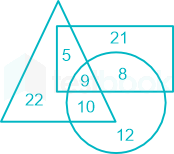
Question 44

In the figure given below the rectangle represents pants, the triangle represents shirts and the circle represents shoes. The number in each area represents the number of items in that area.

<br>

How many shoes are pants?

  1. AOption (a)

    9

  2. BOption (b)

    8

  3. COption (c)

    17

  4. DOption (d)

    39

View answer & explanation

Correct answer

Answer: (c)C.

17

Why this answer is correct

According to the given Venn diagram:

The shaded area represents the number of shoes which are pants → 9 + 8 = 17 

Hence, the correct answer is "Option 3"

Question 45

Identify the diagram that best represents the relationship among the given classes.

Pen, Pencil, Eraser

  1. AOption (a)

  2. BOption (b)

  3. COption (c)

  4. DOption (d)

View answer & explanation

Correct answer

Answer: (d)D.

Why this answer is correct

The logic followed here is

Because none of these items belong to the same category as the others (i.e., there is no overlap in what they are), they must be represented by three separate, non-overlapping circles.

Option 4


Hence, the correct answer is "Option 4".

Question 46

Select the option that represents the correct order of the given words as they would appear in an English dictionary.

1.Metabolism

2.Metamorphosis

  1. Metaphysical

4.Methodology

5.Metropolitan

  1. AOption (a)

    1, 2, 3, 4, 5

  2. BOption (b)

    2, 1, 3, 4, 5

  3. COption (c)

    1, 3, 2, 4, 5

  4. DOption (d)

    2, 3, 1, 4, 5

View answer & explanation

Correct answer

Answer: (a)A.

1, 2, 3, 4, 5

Why this answer is correct

The option that represents the correct order of the given words as they would appear in an English dictionary is shown below:

Metabolism

Metamorphosis

Metaphysical

Methodology

Metropolitan

Hence,  1 → 2 → 3 → 4 → 5 is the correct answer.

Question 47

Which option figure will complete the pattern in the question figure? (Rotation is not allowed) 

  1. AOption (a)

  2. BOption (b)

  3. COption (c)

  4. DOption (d)

View answer & explanation

Correct answer

Answer: (c)C.

Why this answer is correct

The option figure will complete the pattern in the question figure is: 

Option 3  

Hence, the correct answer is "Option 3".

Question 48

In the following question, in each option a pair of figures is given. In each pair the figure towards the left of (:) is related by some logic/rule/relation with the figure on the right of (:). Select the odd figure pair from the given alternatives.

  1. AOption (a)

  2. BOption (b)

  3. COption (c)

  4. DOption (d)

View answer & explanation

Correct answer

Answer: (a)A.

Why this answer is correct

The logic followed here is,

Logic: Number of Sides - 1 = Number of Lines

Option:1


Option 1 has 4 sides and 4 lines

Does not follow the logic.

Hence, the correct answer is "Option 1".

Question 49

In the following figure series, select the figure which can be placed at the sign of question mark (?) from the given alternatives.

  1. AOption (a)

  2. BOption (b)

  3. COption (c)

  4. DOption (d)

View answer & explanation

Correct answer

Answer: (b)B.

Why this answer is correct

The logic followed here is:

Logic: Zig zag line change to straight line and vice versa.

The change moves from the top line down to the bottom line in a specific order:

Box 1 to Box 2: The 1st (top) line changes. It was a zig-zag and becomes a straight line.

Box 2 to Box 3: The 2nd line changes. It was a zig-zag and becomes a straight line.

Box 3 to Box 4: The 3rd line changes. It was a zig-zag and becomes a straight line.

Box 4 to Box 5 (The Solution): The 4th line changes. It was a zig-zag and now becomes a straight line.

Hence, the correct answer is "Option 2".

Question 50

In a certain coded language 'LAST' is coded as 'IXPQ' and 'PREZ' is coded as 'MOBW'. How will 'INTO' be coded in the same code language?

  1. AOption (a)

    EMPL

  2. BOption (b)

    FKQL

  3. COption (c)

    FKPK

  4. DOption (d)

    DLQM

View answer & explanation

Correct answer

Answer: (b)B.

FKQL

Why this answer is correct

The logic followed here is that each letter is shifted 3 positions backward (-3 pattern) in the alphabetical series.

For LAST : IXPQ

For PREZ : MOBW

Applying the same logic to INTO : ?

The resulting code is FKQL.

Hence, the correct answer is "Option 2".

Quantitative Aptitude (25 questions)

Question 51

A bicycle is sold for ₹1800 at a loss of 10%. At what price should it be sold to gain 15%?

  1. AOption (a)

    ₹2000\text{₹}2000

  2. BOption (b)

    ₹2100\text{₹}2100

  3. COption (c)

    ₹2250\text{₹}2250

  4. DOption (d)

    ₹2300\text{₹}2300

View answer & explanation

Correct answer

Answer: (d)D.

₹2300\text{₹}2300

Why this answer is correct

Shortcut Trick

Loss of 10% implies that the Selling Price is 90% of the Cost Price.

Desired gain of 15% implies that the new Selling Price should be 115% of the Cost Price.

Given: 90% → ₹1800

Therefore: 115% → (1800 ÷ 90) × 115 = 20 × 115 = ₹2300.

∴ The correct answer is ₹2300.

Alternate Method

Given:

First Selling Price (SP1) = ₹1800

Loss Percentage (L%) = 10%

Desired Profit Percentage (P%) = 15%

Formula Used:

Cost Price (CP) = [SP × 100] ÷ [100 − Loss%]

New Selling Price (SP2) = [CP × (100 + Profit%)] ÷ 100

Calculations:

⇒ CP = (1800 × 100) ÷ (100 − 10)

⇒ CP = (1800 × 100) ÷ 90

⇒ CP = 20 × 100 = ₹2000

⇒ SP2 = [2000 × (100 + 15)] ÷ 100

⇒ SP2 = [2000 × 115] ÷ 100

⇒ SP2 = 20 × 115 = ₹2300

∴ The correct answer is ₹2300.

Additional Information

Profit and Loss Percentage

Profit % = (Profit ÷ CP) × 100 and Loss % = (Loss ÷ CP) × 100. Both are always calculated on the Cost Price (CP) unless stated otherwise.

Relationship between SP and CP

SP = CP × (100 ± Change%) ÷ 100. Use (+) for Profit and (−) for Loss.

Marked Price and Discount

Selling Price (SP) = Marked Price (MP) − Discount. Discount is always calculated on the Marked Price.

Question 52

A, B, and C started a business. A contributed Rs. 12,000, B contributed Rs. 15,000, and C contributed Rs. 18,000. After 6 months, B withdrew Rs. 5,000, while C added Rs. 10,000. If the total profit at the end of the year is Rs. 54,000, how much did C receive?

  1. AOption (a)

    ₹26,147

  2. BOption (b)

    ₹24,901

  3. COption (c)

    ₹14,000

  4. DOption (d)

    ₹17,890

View answer & explanation

Correct answer

Answer: (a)A.

₹26,147

Why this answer is correct

Given:

A's contribution = Rs. 12,000

B's contribution = Rs. 15,000

C's contribution = Rs. 18,000

B withdraws Rs. 5,000 after 6 months

C adds Rs. 10,000 after 6 months

Total profit = Rs. 54,000

Formula Used:

Profit share = (Investment × Time)

Total profit share ratio = Sum of all individual profit shares

Individual's profit = (Individual share ratio ÷ Total share ratio) × Total profit

Calculation:

⇒ A's share = 12,000 × 12 = 144,000

⇒ B's share (first 6 months) = 15,000 × 6 = 90,000

⇒ B's share (next 6 months) = 10,000 × 6 = 60,000

⇒ Total B's share = 90,000 + 60,000 = 150,000

⇒ C's share (first 6 months) = 18,000 × 6 = 108,000

⇒ C's share (next 6 months) = 28,000 × 6 = 168,000

⇒ Total C's share = 108,000 + 168,000 = 276,000

⇒ Total share ratio = 144,000 + 150,000 + 276,000 = 570,000

⇒ C's profit = (276,000 ÷ 570,000) × 54,000

⇒ C's profit = 0.4842 × 54,000

⇒ C's profit = Rs. 26,147

∴ The correct answer is ₹26,147.

Question 53

Simplify the expression: sinx cotx+cosx tanx\mathrm{sinx~ cotx + cosx~ tanx}.

  1. AOption (a)

    -2

  2. BOption (b)

    sinx cosx\mathrm{sinx ~cosx}

  3. COption (c)

    2 cosx\mathrm{2 ~cosx}

  4. DOption (d)

    sinx+cosx\mathrm{sinx + cosx}

View answer & explanation

Correct answer

Answer: (d)D.

sinx+cosx\mathrm{sinx + cosx}

Why this answer is correct

Given:

Expression: sinx × cotx + cosx × tanx

Formula Used:

cotx = cosx ÷ sinx

tanx = sinx ÷ cosx

Calculation:

⇒ sinx × cotx + cosx × tanx

⇒ sinx × (cosx ÷ sinx) + cosx × (sinx ÷ cosx)

⇒ cosx + sinx

∴ The correct answer is sinx + cosx.

Question 54

If the ratio of chairs to tables is 3:23:2 and there are 30 chairs, how many tables are there?

  1. AOption (a)

    20

  2. BOption (b)

    18

  3. COption (c)

    12

  4. DOption (d)

    15

View answer & explanation

Correct answer

Answer: (a)A.

20

Why this answer is correct

Given:

Ratio of chairs to tables = 3:2

Number of chairs = 30

Formula Used:

Total parts in the ratio = Sum of the ratio terms

Number of tables = (Number of chairs ÷ Ratio of chairs) × Ratio of tables

Calculation:

⇒ Total parts in the ratio = 3 + 2 = 5

⇒ Number of tables = (30 ÷ 3) × 2

⇒ Number of tables = 10 × 2

⇒ Number of tables = 20

∴ The correct answer is 20.

Question 55

The compound interest on ₹8,000\text{₹}8,000 for 1 year 6 months at 20%20\% p.a., compounded half-yearly, is:

  1. AOption (a)

    ₹2,880\text{₹}2,880

  2. BOption (b)

    ₹2,400\text{₹}2,400

  3. COption (c)

    ₹2,648\text{₹}2,648

  4. DOption (d)

    ₹3,000\text{₹}3,000

View answer & explanation

Correct answer

Answer: (c)C.

₹2,648\text{₹}2,648

Why this answer is correct

Shortcut Trick

For half-yearly compounding, the Rate becomes 10% (20% ÷ 2) and Time becomes 3 periods (1.5 years × 2).

Using the Effective Rate for 3 periods at 10%: 10 + 10 + 1 = 21%; 21 + 10 + 2.1 = 33.1%.

Compound Interest = 33.1% of ₹8,000.

CI = 8,000 × 0.331 = ₹2,648.

∴ The correct answer is ₹2,648.

Alternate Method

Given:

Principal (P) = ₹8,000

Rate (R) = 20% p.a.

Time (T) = 1 year 6 months = 1.5 years

Since interest is compounded half-yearly:

⇒ New Rate (r) = 20% ÷ 2 = 10% per half-year

⇒ Number of periods (n) = 1.5 × 2 = 3 half-years

Formula Used: Amount (A) = P(1 + r/100)n

⇒ A = 8,000 × (1 + 10/100)3

⇒ A = 8,000 × (11/10) × (11/10) × (11/10)

⇒ A = 8 × 1,331

⇒ A = ₹10,648

Compound Interest (CI) = Amount − Principal

⇒ CI = 10,648 − 8,000

⇒ CI = ₹2,648

Therefore, Option (3) is the correct answer.

∴ The correct answer is ₹2,648.

Additional Information

Half-Yearly Compounding Rule

When interest is compounded half-yearly, the annual rate is divided by 2 (R' = R/2) and the time in years is multiplied by 2 (n = T × 2).

Quarterly Compounding Rule

For quarterly compounding, the rate is divided by 4 (R' = R/4) and the time in years is multiplied by 4 (n = T × 4).

Compound Interest vs Simple Interest

For the first compounding period, CI is equal to SI. From the second period onwards, CI > SI because interest is earned on previously accumulated interest.

Question 56

A man deposits ₹1,50,000 at a CI rate of 10% p.a. After the first year’s interest is credited, he withdraws 50% of the interest earned. What is his account balance at the end of the second year?

  1. AOption (a)

    ₹1,65,000

  2. BOption (b)

    ₹1,72,000

  3. COption (c)

    ₹1,73,250

  4. DOption (d)

    ₹1,75,000

View answer & explanation

Correct answer

Answer: (c)C.

₹1,73,250

Why this answer is correct

Given:

Principal (P) = ₹1,50,000

Rate of Interest (R) = 10% p.a.

Time (T) = 2 years

50% of the first year’s interest is withdrawn.

Formula Used:

Compound Interest (CI) = P × (1 + R/100)T - P

Amount (A) = Principal + Interest

Calculation:

For the first year:

⇒ Interest for 1st year = ₹1,50,000 × 10 / 100

⇒ Interest for 1st year = ₹15,000

⇒ Amount after 1st year = ₹1,50,000 + ₹15,000

⇒ Amount after 1st year = ₹1,65,000

⇒ Withdrawn = 50% of ₹15,000 = ₹7,500

⇒ Balance after withdrawal = ₹1,65,000 - ₹7,500

⇒ Balance after withdrawal = ₹1,57,500

For the second year:

⇒ Interest for 2nd year = ₹1,57,500 × 10 / 100

⇒ Interest for 2nd year = ₹15,750

⇒ Amount after 2nd year = ₹1,57,500 + ₹15,750

⇒ Amount after 2nd year = ₹1,73,250

∴ The correct answer is ₹1,73,250.

Question 57

The ratio of two numbers is 3:43:4 and their LCM is 120120. What is the sum of the two numbers?

  1. AOption (a)

    70

  2. BOption (b)

    140

  3. COption (c)

    35

  4. DOption (d)

    105

View answer & explanation

Correct answer

Answer: (a)A.

70

Why this answer is correct

Given:

Ratio of two numbers = 3:4

LCM = 120

Formula Used:

Let the numbers be 3x and 4x.

LCM of two numbers = product of the numbers ÷ HCF

Calculation:

⇒ LCM = 120

⇒ Numbers are 3x and 4x.

⇒ Product of numbers = 3x × 4x = 12x2

⇒ HCF of 3x and 4x = x

⇒ LCM = (Product of numbers ÷ HCF) = (12x2 ÷ x) = 12x

⇒ 12x = 120

⇒ x = 10

⇒ Numbers are 3x = 30 and 4x = 40

⇒ Sum of numbers = 30 + 40 = 70

∴ The correct answer is 70.

Question 58

The average age of 20 students is 18 years. A group of 5 new students joins, increasing the average to 20 years. Find the average age of the 5 new students.

  1. AOption (a)

    30

  2. BOption (b)

    32

  3. COption (c)

    28

  4. DOption (d)

    34

View answer & explanation

Correct answer

Answer: (c)C.

28

Why this answer is correct

Given:

Average age of 20 students = 18 years

Total number of students after 5 new students join = 20 + 5 = 25

New average age = 20 years

Formula Used:

Total age = Average age × Number of students

Age of 5 new students = Total age of 25 students - Total age of 20 students

Average age of 5 new students = Total age of 5 new students ÷ 5

Calculation:

⇒ Total age of 20 students = 18 × 20 = 360

⇒ Total age of 25 students = 20 × 25 = 500

⇒ Total age of 5 new students = 500 - 360 = 140

⇒ Average age of 5 new students = 140 ÷ 5 = 28

∴ The correct answer is 28.

Question 59

Which of the following is the least?

  1. AOption (a)

    18% of 450

  2. BOption (b)

    20% of 380

  3. COption (c)

    25% of 300

  4. DOption (d)

    30% of 240

View answer & explanation

Correct answer

Answer: (d)D.

30% of 240

Why this answer is correct

Shortcut Trick To find the least value, quickly calculate each percentage by shifting decimals or simplifying ratios:

  1. 18% × 450 = 9% × 900 = 81
  2. 20% × 380 = 1/5 × 380 = 76
  3. 25% × 300 = 1/4 × 300 = 75
  4. 30% × 240 = 3 × 24 = 72 Comparing 81, 76, 75, and 72, the value 72 is the smallest. ∴ The correct answer is 30% of 240. Alternate Method Given: Four expressions involving Percentage of different base numbers.

Formula Used: Value = (Percentage / 100) × Number Calculating the numerical value for each option: ⇒ Option 1: 18% of 450 = (18 / 100) × 450 = 18 × 4.5 = 81 ⇒ Option 2: 20% of 380 = (20 / 100) × 380 = 2 × 38 = 76 ⇒ Option 3: 25% of 300 = (25 / 100) × 300 = 25 × 3 = 75 ⇒ Option 4: 30% of 240 = (30 / 100) × 240 = 3 × 24 = 72 Comparing the final results: 72 < 75 < 76 < 81. The minimum value obtained is 72, which corresponds to the expression 30% of 240. ∴ The correct answer is 30% of 240. Additional Information Percentage Interchangeability x% of y is always equal to y% of x. For example, 18% of 450 is the same as 450% of 18. Fractional Conversions Using common fractions can speed up calculations: 20% = 1/5, 25% = 1/4, 50% = 1/2, and 75% = 3/4. Comparison Technique When comparing p% of q, if p increases while q decreases significantly, the result may decrease. Actual calculation is safer when the product p × q is close.

Question 60

Ravi goes to school at a speed of 5 km/h and returns home at 3 km/h. If the total time taken is 2 hours, what is the distance between his home and school?

  1. AOption (a)
    1. 75 km
  2. BOption (b)
    1. 25 km
  3. COption (c)
    1. 75 km
  4. DOption (d)
    1. 25 km
View answer & explanation

Correct answer

Answer: (c)C.
  1. 75 km

Why this answer is correct

Given:

Speed while going to school = 5 km/h

Speed while returning home = 3 km/h

Total time taken = 2 hours

Formula Used:

Time = Distance / Speed

Total Time = Time while going + Time while returning

Calculation:

Let the distance between home and school be D km.

Time while going = D ÷ 5

Time while returning = D ÷ 3

Total Time = D ÷ 5 + D ÷ 3

⇒ 2 = D ÷ 5 + D ÷ 3

Take LCM of 5 and 3, which is 15:

⇒ 2 = (3D + 5D) ÷ 15

⇒ 2 = 8D ÷ 15

Multiply through by 15:

⇒ 30 = 8D

⇒ D = 30 ÷ 8

⇒ D = 3.75 km

∴ The correct answer is 3.75 km.

Question 61

A, B, C together finish a job in 8 days. A and B together take 12 days, while B and C together take 16 days. In how many days can C alone finish the job?

  1. AOption (a)

    18 days

  2. BOption (b)

    20 days

  3. COption (c)

    24 days

  4. DOption (d)

    30 days

View answer & explanation

Correct answer

Answer: (c)C.

24 days

Why this answer is correct

Given:

A, B, C together can finish the job in 8 days.

A and B together take 12 days.

B and C together take 16 days.

Formula Used:

Work done in 1 day = 1 ÷ Total days taken.

Individual work rate = Combined work rate - Other individual's work rates.

Calculation:

⇒ Work rate of A, B, C together = 1 ÷ 8 = 1/8.

⇒ Work rate of A and B together = 1 ÷ 12 = 1/12.

⇒ Work rate of B and C together = 1 ÷ 16 = 1/16.

⇒ Work rate of C alone = (Work rate of A, B, C) - (Work rate of A and B).

⇒ Work rate of C alone = 1/8 - 1/12.

⇒ Work rate of C alone = (3 - 2) ÷ 24 = 1/24.

⇒ Total days for C alone = 1 ÷ (Work rate of C alone) = 1 ÷ (1/24) = 24 days.

∴ The correct answer is 24 days.

Question 62

In a sale, a shopkeeper offers a 15%15\text{\%} discount on clothes if you buy more than two items. Priya buys four shirts for ₹2040\text{₹}2040. If the shopkeeper still makes a 20%20\text{\%} profit, find the profit the shopkeeper would make if he had sold the clothes at full price.

  1. AOption (a)

    ₹600\text{₹}600

  2. BOption (b)

    ₹700\text{₹}700

  3. COption (c)

    ₹800\text{₹}800

  4. DOption (d)

    ₹900\text{₹}900

View answer & explanation

Correct answer

Answer: (b)B.

₹700\text{₹}700

Why this answer is correct

Given:

Selling price after 15% discount for 4 shirts = ₹2040

Discount = 15%

Profit = 20%

Formula Used:

Selling Price = Marked Price × (100 − Discount)% ÷ 100

Selling Price = Cost Price × (100 + Profit)% ÷ 100

Profit = Selling Price − Cost Price

Calculation:

⇒ 2040 = Marked Price × 85 ÷ 100

⇒ Marked Price = 2040 × 100 ÷ 85

⇒ Marked Price = 2400

⇒ 2040 = Cost Price × 120 ÷ 100

⇒ Cost Price = 2040 × 100 ÷ 120

⇒ Cost Price = 1700

⇒ Profit at full price = 2400 − 1700

⇒ Profit = 700

∴ The correct answer is 700.

Question 63

At simple interest, a certain amount of money doubles in five years. What is the interest rate?

  1. AOption (a)

    20%

  2. BOption (b)

    25%

  3. COption (c)

    30%

  4. DOption (d)

    40%

View answer & explanation

Correct answer

Answer: (a)A.

20%

Why this answer is correct

Given:

Principal doubles in 5 years.

Time (T) = 5 years

Amount (A) = 2 × Principal (P)

Formula Used:

Simple Interest (SI) = P × R × T ÷ 100

Amount (A) = Principal (P) + Simple Interest (SI)

Calculation:

⇒ A = 2P

⇒ SI = A - P = 2P - P = P

⇒ P × R × T ÷ 100 = P

⇒ R × 5 ÷ 100 = 1

⇒ R ÷ 20 = 1

⇒ R = 20%

∴ The correct answer is 20%.

Question 64

A solid right circular cylinder is melted down and recast into a right circular cone with the same base radius. If the cylinder’s height is h, what is the height of the cone?

  1. AOption (a)

    3h

  2. BOption (b)

    6h

  3. COption (c)

    4h

  4. DOption (d)

    5h

View answer & explanation

Correct answer

Answer: (a)A.

3h

Why this answer is correct

Given:

Solid right circular cylinder is melted and recast into a right circular cone.

Base radius of the cylinder and cone is the same.

Cylinder’s height = h.

Formula Used:

Volume of cylinder = πr2h.

Volume of cone = (1/3)πr2H, where H is the height of the cone.

Calculation:

⇒ Volume of cylinder = Volume of cone (since material is conserved).

⇒ πr2h = (1/3)πr2H.

⇒ h = (1/3)H.

⇒ H = 3h.

∴ The correct answer is 3h.

Question 65

What is the value of the expression (12345)2+12345+12346\sqrt{(12345)^2 + 12345 + 12346}?

  1. AOption (a)

    12345

  2. BOption (b)

    12346

  3. COption (c)

    12347

  4. DOption (d)

    12344

View answer & explanation

Correct answer

Answer: (b)B.

12346

Why this answer is correct

Given:

Expression = √((12345)2 + 12345 + 12346)

Formula Used:

(a + 1)2 = a2 + 2a + 1

Calculation:

⇒ (12345)2 + 12345 + 12346

⇒ (12345)2 + 12345 + (12345 + 1)

⇒ (12345)2 + 2 × 12345 + 1

⇒ (12345)2 + 2 × 12345 + 1

⇒ (12345 + 1)2

⇒ (12346)2

⇒ √((12346)2)

⇒ 12346

∴ The correct answer is 12346.

Question 66

A container can hold 50 liters of milk. First, 5 liters of milk are removed and the same amount of water is poured in to refill the container. The mixture is then thoroughly stirred. This entire process of removing 5 liters of liquid and replacing it with water is carried out once again.

After these two successive operations, how many liters of pure milk remain in the container?

  1. AOption (a)

    40 liters

  2. BOption (b)

    45 liters

  3. COption (c)
    1. 5 liters
  4. DOption (d)
    1. 5 liters
View answer & explanation

Correct answer

Answer: (c)C.
  1. 5 liters

Why this answer is correct

Given:

Initial quantity of milk = 50 liters

Milk removed in each operation = 5 liters

Total operations = 2

Formula Used:

Remaining milk after one operation = Initial quantity × (1 - (milk removed ÷ total volume))

Remaining milk after two operations = Remaining milk after first operation × (1 - (milk removed ÷ total volume))

Calculation:

⇒ After first operation: Remaining milk = 50 × (1 - (5 ÷ 50))

⇒ Remaining milk = 50 × (1 - 0.1)

⇒ Remaining milk = 50 × 0.9

⇒ Remaining milk = 45 liters

⇒ After second operation: Remaining milk = 45 × (1 - (5 ÷ 50))

⇒ Remaining milk = 45 × (1 - 0.1)

⇒ Remaining milk = 45 × 0.9

⇒ Remaining milk = 40.5 liters

∴ The correct answer is 40.5 liters.

Question 67

The numerical value of the volume of a hemisphere is equal to the numerical value of its total surface area. What is the radius of this hemisphere in units?

  1. AOption (a)

    8 units

  2. BOption (b)
    1. 5 units
  3. COption (c)
    1. 5 units
  4. DOption (d)

    6 units

View answer & explanation

Correct answer

Answer: (b)B.
  1. 5 units

Why this answer is correct

Given:

Volume of a hemisphere = Total surface area of the hemisphere

Formula Used:

Volume of a hemisphere = (2/3)πr3

Total surface area of a hemisphere = 3πr2

Calculation:

⇒ (2/3)πr3 = 3πr2

⇒ (2/3)r3 = 3r2 (dividing both sides by π)

⇒ (2/3)r = 3 (dividing both sides by r2)

⇒ r = 3 × (3/2)

⇒ r = 4.5 units

∴ The correct answer is 4.5 units.

Question 68

A car travels at a constant speed. It covers 25\frac{2}{5} of a journey in 2 hours. How long will it take to cover the remaining journey?

  1. AOption (a)

    2 hours

  2. BOption (b)

    5 hours

  3. COption (c)

    4 hours

  4. DOption (d)

    3 hours

View answer & explanation

Correct answer

Answer: (d)D.

3 hours

Why this answer is correct

Given:

Fraction of journey covered = 2/5

Time taken to cover 2/5 of the journey = 2 hours

Formula Used:

Total time for the journey = Time taken for covered part ÷ Fraction of journey covered

Time for remaining journey = Total time - Time taken for covered part

Calculation:

⇒ Total time = 2 ÷ (2/5)

⇒ Total time = 2 × (5/2)

⇒ Total time = 5 hours

⇒ Time for remaining journey = 5 - 2

⇒ Time for remaining journey = 3 hours

∴ The correct answer is 3 hours.

Question 69

In △ABC\triangle ABC, the coordinates of the vertices are A(1,1), B(5,5), and C(1,9). Find the coordinates of the centroid.

  1. AOption (a)

    (2.33, 5.00)

  2. BOption (b)

    (2.00, 5.53)

  3. COption (c)

    (3.32, 4.00)

  4. DOption (d)

    (1.98, 5.23)

View answer & explanation

Correct answer

Answer: (a)A.

(2.33, 5.00)

Why this answer is correct

Shortcut Trick

The Centroid of a triangle is simply the arithmetic mean of the coordinates of its vertices.

x-coordinate ⇒ (1 + 5 + 1) ÷ 3 = 7 ÷ 3 ≈ 2.33

y-coordinate ⇒ (1 + 5 + 9) ÷ 3 = 15 ÷ 3 = 5.00

The Centroid is (2.33, 5.00).

∴ The correct answer is (2.33, 5.00).

Alternate Method

Given:

Vertices of ▵ABC: A(1, 1), B(5, 5), and C(1, 9).

Formula Used:

Centroid G(x, y) = ((x1 + x2 + x3)/3, (y1 + y2 + y3)/3)

Calculations:

⇒ xcentroid = (x1 + x2 + x3) ÷ 3

⇒ xcentroid = (1 + 5 + 1) ÷ 3 = 7 ÷ 3 = 2.333...

⇒ ycentroid = (y1 + y2 + y3) ÷ 3

⇒ ycentroid = (1 + 5 + 9) ÷ 3 = 15 ÷ 3 = 5.00

⇒ G(x, y) = (2.33, 5.00)

∴ The correct answer is (2.33, 5.00).

Additional Information

Centroid Property

The centroid G divides each median of the triangle in the ratio of 2 : 1 from the vertex to the midpoint of the opposite side.

Coordinates of Incenter

The Incenter I is given by ((ax1+bx2+cx3)/(a+b+c), (ay1+by2+cy3)/(a+b+c)) where a, b, c are side lengths.

Area of Triangle (Vertices)

Area = 1/2 |x1(y2 − y3) + x2(y3 − y1) + x3(y1 − y2)| in square units.

Question 70

Two similar triangles have areas in the ratio of 49:8149:81. What is the ratio of their corresponding altitudes?

  1. AOption (a)

    2401:65612401:6561

  2. BOption (b)

    49:8149:81

  3. COption (c)

    7:817:81

  4. DOption (d)

    7:97:9

View answer & explanation

Correct answer

Answer: (d)D.

7:97:9

Why this answer is correct

Given:

Ratio of areas of similar triangles = 49:81

Formula Used:

Ratio of areas of similar triangles = (Ratio of corresponding altitudes)2

Calculation:

⇒ (Ratio of corresponding altitudes)2 = 49:81

⇒ Ratio of corresponding altitudes = √49:√81

⇒ Ratio of corresponding altitudes = 7:9

∴ The correct answer is 7:9.

Question 71

What is the slope of the line that passes through the points (2,4)(2, 4) and (6,10)(6, 10)?

  1. AOption (a)

    2

  2. BOption (b)

    32\frac{3}{2}

  3. COption (c)

    25\frac{2}{5}

  4. DOption (d)

    5

View answer & explanation

Correct answer

Answer: (b)B.

32\frac{3}{2}

Why this answer is correct

Given:

Point 1 = (2, 4)

Point 2 = (6, 10)

Formula Used:

Slope (m) = (y2 − y1) ÷ (x2 − x1)

Calculation:

⇒ m = (10 − 4) ÷ (6 − 2)

⇒ m = 6 ÷ 4

⇒ m = 3 ÷ 2

∴ The correct answer is 3 ÷ 2.

Question 72

Solve:

x(x+1)+1x=3.\frac{x}{(x+1)} + \frac{1}{x} = 3.

  1. AOption (a)

    x=−5+22x = \frac{-5 + \sqrt{2}}{2}

  2. BOption (b)

    x=−1+32x = \frac{-1 + \sqrt{3}}{2}

  3. COption (c)

    x=−3+72x = \frac{-3 + \sqrt{7}}{2}

  4. DOption (d)

    x=−9+52x = \frac{-9 + \sqrt{5}}{2}

View answer & explanation

Correct answer

Answer: (b)B.

x=−1+32x = \frac{-1 + \sqrt{3}}{2}

Why this answer is correct

Given:

x ÷ (x + 1) + 1 ÷ x = 3

Formula Used:

a ÷ b + c ÷ d = (ad + bc) ÷ bd

If two rational expressions are equal, then their numerators are equal when denominators are same

Calculation:

⇒ x ÷ (x + 1) + 1 ÷ x = 3

⇒ (x × x + 1 × (x + 1)) ÷ (x(x + 1)) = 3

⇒ (x2 + x + 1) ÷ (x(x + 1)) = 3

⇒ x2 + x + 1 = 3x(x + 1)

⇒ x2 + x + 1 = 3x2 + 3x

⇒ 0 = 3x2 + 3x − x2 − x − 1

⇒ 0 = 2x2 + 2x − 1

⇒ 2x2 + 2x − 1 = 0

⇒ x = (−2 ± √(22 − 4 × 2 × (−1))) ÷ (2 × 2)

⇒ x = (−2 ± √(4 + 8)) ÷ 4

⇒ x = (−2 ± √12) ÷ 4

⇒ x = (−2 ± 2√3) ÷ 4

⇒ x = (−1 ± √3) ÷ 2

∴ The correct answer is (−1 ± √3) ÷ 2.

Question 73

Two triangles are similar. The ratio of their corresponding side lengths is 3:53:5. If the length of an altitude of the smaller triangle is 6 cm, what is the length of the corresponding altitude of the larger triangle?

  1. AOption (a)

    4 cm

  2. BOption (b)

    7 cm

  3. COption (c)

    10 cm

  4. DOption (d)

    15 cm

View answer & explanation

Correct answer

Answer: (c)C.

10 cm

Why this answer is correct

Shortcut Trick

For similar triangles, the ratio of all corresponding linear dimensions (sides, altitudes, medians, etc.) is equal.

Ratio of sides = 3 : 5

∴ Ratio of altitudes = 3 : 5

Given: Altitude of smaller triangle = 6 cm (corresponds to 3 units)

⇒ 3 units → 6 cm

⇒ 1 unit → 2 cm

⇒ 5 units → 5 × 2 = 10 cm

∴ The correct answer is 10 cm.

Alternate Method

Given:

⇒ Ratio of sides of two similar triangles = 3 : 5

⇒ Altitude of the smaller triangle (h1) = 6 cm

Formula Used:

If two triangles are similar, the ratio of their corresponding altitudes is equal to the ratio of their corresponding side lengths.

⇒ (Altitude1 / Altitude2) = (Side1 / Side2)

Calculations:

⇒ Let the altitude of the larger triangle be h2.

⇒ 6 / h2 = 3 / 5

⇒ 3 × h2 = 6 × 5

⇒ 3 × h2 = 30

⇒ h2 = 30 ÷ 3

⇒ h2 = 10 cm

Thus, the length of the corresponding altitude of the larger triangle is 10 cm, which corresponds to Option (3).

∴ The correct answer is 10 cm.

Additional Information

Properties of Similar Triangles

The ratio of corresponding medians, angle bisectors, and perimeters of two similar triangles is also equal to the ratio of their corresponding sides.

Area Ratio Theorem

The ratio of the areas of two similar triangles is equal to the square of the ratio of their corresponding sides: Area1/Area2 = (s1/s2)2.

AAA Similarity Criterion

Two triangles are similar if their corresponding angles are equal, which automatically makes their corresponding sides proportional.

Question 74

Solve:

163/2+16−3/2=?16^{3/2} + 16^{-3/2} = ?

  1. AOption (a)

    409764\frac{4097}{64}

  2. BOption (b)

    9764\frac{97}{64}

  3. COption (c)

    49714\frac{497}{14}

  4. DOption (d)

    23764\frac{237}{64}

View answer & explanation

Correct answer

Answer: (a)A.

409764\frac{4097}{64}

Why this answer is correct

Given:

163/2

16-3/2

Formula Used:

am = (a1/2)m

a-n = 1 / an

Calculation:

⇒ 163/2 = (161/2)3 = 43 = 64

⇒ 16-3/2 = 1 / 163/2 = 1 / 64

⇒ 163/2 + 16-3/2 = 64 + 1/64

⇒ 64 + 1/64 = (4096 + 1) / 64

⇒ 4097 / 64

∴ The correct answer is 4097/64.

Question 75

Simplify: cos⁡(x)1+sin⁡(x)+sin⁡(x)1+cos⁡(x)\frac{\cos(x)}{1 + \sin(x)} + \frac{\sin(x)}{1 + \cos(x)}.

  1. AOption (a)

    1(1+sin⁡(x))(1+cos⁡(x))\frac{1}{(1 + \sin(x))(1 + \cos(x))}

  2. BOption (b)

    1

  3. COption (c)

    tan(x)

  4. DOption (d)

    cos⁡(x)+sin⁡(x)+1(1+sin⁡(x))(1+cos⁡(x))\frac{\cos(x) + \sin(x) + 1}{(1 + \sin(x))(1 + \cos(x))}

View answer & explanation

Correct answer

Answer: (d)D.

cos⁡(x)+sin⁡(x)+1(1+sin⁡(x))(1+cos⁡(x))\frac{\cos(x) + \sin(x) + 1}{(1 + \sin(x))(1 + \cos(x))}

Why this answer is correct

Given:

Expression = cos(x) ÷ (1 + sin(x)) + sin(x) ÷ (1 + cos(x))

Formula Used:

a ÷ b + c ÷ d = (ad + bc) ÷ bd

sin2(x) + cos2(x) = 1

Calculation:

⇒ cos(x) ÷ (1 + sin(x)) + sin(x) ÷ (1 + cos(x))

⇒ (cos(x)(1 + cos(x)) + sin(x)(1 + sin(x))) ÷ ((1 + sin(x))(1 + cos(x)))

⇒ (cos(x) + cos2(x) + sin(x) + sin2(x)) ÷ ((1 + sin(x))(1 + cos(x)))

⇒ (sin2(x) + cos2(x) + sin(x) + cos(x)) ÷ ((1 + sin(x))(1 + cos(x)))

⇒ (1 + sin(x) + cos(x)) ÷ ((1 + sin(x))(1 + cos(x)))

∴ The correct answer is cos⁡(x)+sin⁡(x)+1(1+sin⁡(x))(1+cos⁡(x))\frac{\cos(x) + \sin(x) + 1}{(1 + \sin(x))(1 + \cos(x))}.

General Awareness (25 questions)

Question 76

Article 51 of the Indian constitution is related with which of the following?

  1. AOption (a)

    Promotion of co-operative societies

  2. BOption (b)

    Promotion of international peace and security

  3. COption (c)

    Uniform Civil Code

  4. DOption (d)

    Organization of Agriculture and Animal Husbandry

View answer & explanation

Correct answer

Answer: (b)B.

Promotion of international peace and security

Why this answer is correct

The correct answer is Promotion of international peace and security.

Key Points

  • Article 51 of the Indian Constitution falls under the Directive Principles of State Policy (Part IV).
  • Its primary objective is the promotion of international peace and security, ensuring harmony between nations.
  • This article explicitly outlines the role of India in fostering respect for international law and treaty obligations in dealings with organized nations.
  • It emphasizes maintaining a just and equitable global order and encourages peaceful coexistence among countries.
  • Article 51 is not enforceable by the courts but serves as a guiding principle for the government in formulating policies and decisions at the international level.

Additional Information

  • Directive Principles of State Policy (DPSP):
  • DPSPs are enumerated in Part IV of the Indian Constitution and are considered fundamental in the governance of the country.
  • They are non-justiciable, meaning they are not enforceable by the courts, but they act as guidelines for the government to create laws and policies.
  • Examples include Article 44 (Uniform Civil Code), Article 48 (Organization of Agriculture and Animal Husbandry), etc.
  • Key Features of Article 51:
  • It directs the state to work for the promotion of international peace and security.
  • Urges maintaining friendly relations with other countries.
  • Encourages respect for international law and treaty obligations.
  • Promotes the resolution of disputes by arbitration instead of conflict.
  • Relation to India’s Foreign Policy:
  • Article 51 aligns with India's vision of non-alignment and peaceful coexistence as propagated by leaders like Jawaharlal Nehru.
  • It is reflected in various international initiatives, including India's role in the United Nations and its emphasis on disarmament and global cooperation.
  • India’s commitment to treaties like the Paris Climate Agreement and active participation in peacekeeping missions showcase adherence to Article 51.
  • Examples of Implementation:
  • India has supported global peace initiatives and participated in United Nations peacekeeping missions.
  • It has advocated for nuclear disarmament and signed treaties promoting global security.
  • India’s foreign policy often reflects respect for international law and the resolution of disputes through peaceful means.

Important Points

  • Article 44: Relates to the Uniform Civil Code, aiming to unify personal laws across all religions in India.
  • Article 48: Deals with the organization of agriculture and animal husbandry, promoting scientific methods and the prohibition of slaughter of certain animals.
  • Article 43: Encourages the promotion of cooperative societies for economic development.
  • These articles reflect the broader goals of the Directive Principles in ensuring equitable development and social justice.

Question 77

In September 2024, who has been appointed as Director General of the Narcotics Control Bureau?

  1. AOption (a)

    Sunil Kakkar

  2. BOption (b)

    Rajneet Kohli

  3. COption (c)

    Ambuj Chandna

  4. DOption (d)

    Anurag Garg

View answer & explanation

Correct answer

Answer: (d)D.

Anurag Garg

Why this answer is correct

The correct answer is Anurag Garg.

Key Points

  • Anurag Garg was appointed as the Director General of the Narcotics Control Bureau (NCB) in September 2024.
  • The Narcotics Control Bureau is India's premier agency responsible for combating drug trafficking and ensuring compliance with the Narcotic Drugs and Psychotropic Substances Act, 1985.
  • Anurag Garg is a senior officer with vast experience in administrative and enforcement roles, making him suitable for this crucial position.
  • The appointment comes at a time when the NCB is focusing on dismantling drug networks and addressing rising drug abuse cases in India.

Additional Information

  • About Narcotics Control Bureau (NCB):
  • The NCB was established in 1986 under the Narcotic Drugs and Psychotropic Substances Act, 1985.
  • Its primary function is to coordinate with various states and international agencies to curb drug trafficking.
  • The agency works under the administrative control of the Ministry of Home Affairs, Government of India.
  • The NCB also monitors India's compliance with international drug control treaties and conventions.
  • Key Functions of NCB:
  • Investigating and prosecuting offenses related to narcotics and psychotropic substances.
  • Coordinating between central and state agencies to strengthen anti-drug efforts.
  • Providing training and resources to law enforcement agencies for better drug crime management.
  • Promoting public awareness campaigns to reduce drug abuse in society.
  • Anurag Garg's Background:
  • Anurag Garg is a highly experienced officer with expertise in enforcement and administrative processes.
  • He has held several senior positions in government and law enforcement agencies, contributing to the development of effective policies.
  • His leadership is expected to address the challenges in drug trafficking and misuse comprehensively.
  • India's Drug Problem:
  • India faces significant challenges with drug trafficking due to its geographical proximity to the "Golden Triangle" and "Golden Crescent" regions.
  • Rising substance abuse cases have made it imperative for agencies like NCB to adopt proactive measures.
  • NCB's role in coordinating efforts at the national and international level is crucial in curbing this menace.

Important Points

  • International Collaboration:
  • NCB partners with agencies like the United Nations Office on Drugs and Crime (UNODC), Interpol, and World Customs Organization to combat drug trafficking.
  • India is a signatory to several international treaties, such as the Single Convention on Narcotic Drugs, 1961, and the United Nations Convention against Illicit Traffic in Narcotic Drugs and Psychotropic Substances, 1988.
  • Drug Awareness and Prevention:
  • NCB conducts awareness campaigns targeting schools, colleges, and communities to educate people about the dangers of drug abuse.
  • Effective rehabilitation programs are promoted to help individuals recover from addiction.

Question 78

On October 2, 2024, the Dharti Aaba Janjatiya Gram Utkarsh Abhiyan was launched in ______.

  1. AOption (a)

    Jharkhand

  2. BOption (b)

    Bihar

  3. COption (c)

    Uttar Pradesh

  4. DOption (d)

    Madhya Pradesh

View answer & explanation

Correct answer

Answer: (a)A.

Jharkhand

Why this answer is correct

The correct answer is Jharkhand.

Key Points

  • The Dharti Aaba Janjatiya Gram Utkarsh Abhiyan was launched on October 2, 2024, in the state of Jharkhand.
  • This initiative focuses on the development and empowerment of tribal communities residing in rural areas of the state.
  • The name “Dharti Aaba” is a tribute to Birsa Munda, a prominent tribal freedom fighter and social reformer from Jharkhand.
  • The program aims to enhance the livelihood, education, and health facilities of tribal communities, ensuring inclusive growth and sustainable development.
  • Jharkhand, being rich in tribal heritage and culture, is a key region for such initiatives that target the socio-economic upliftment of marginalized communities.

Additional Information

  • Jharkhand:
  • It is located in eastern India and was formed on November 15, 2000, carved out of Bihar.
  • The state is known for its tribal population, which constitutes a significant part of its demographic composition.
  • Prominent tribes include Santals, Oraons, Mundas, and Hos.
  • Jharkhand is rich in natural resources, including minerals like coal, iron ore, and mica, which contribute significantly to its economy.
  • Birsa Munda:
  • Birsa Munda is a revered tribal leader, often referred to as “Dharti Aaba,” meaning “Father of the Earth.”
  • He led a tribal uprising against British colonial rule during the late 19th century in the Chotanagpur region.
  • Birsa Munda fought for the rights and dignity of tribal communities, emphasizing the importance of land ownership and cultural preservation.
  • His birth anniversary, November 15, is celebrated as Jharkhand Foundation Day and Tribal Pride Day in India.
  • Tribal Development Programs:
  • Numerous government initiatives are aimed at improving the socio-economic conditions of tribal communities, such as the Vanbandhu Kalyan Yojana and Tribal Sub-Plan.
  • These programs focus on areas like education, healthcare, infrastructure, and livelihood opportunities for tribal populations.
  • Special attention is given to preserving tribal culture and traditions while ensuring access to modern amenities.
  • October 2 Significance:
  • October 2 is celebrated as Gandhi Jayanti, marking the birth anniversary of Mahatma Gandhi, the Father of the Nation.
  • It is also recognized as the International Day of Non-Violence by the United Nations.
  • Launching a tribal development initiative on this date underscores the values of inclusivity, equality, and social justice that Mahatma Gandhi advocated.

Question 79

India ranks at what position in the World Competitiveness Index 2024?

  1. AOption (a)

    46th

  2. BOption (b)

    19th

  3. COption (c)

    61st

  4. DOption (d)

    39th

View answer & explanation

Correct answer

Answer: (d)D.

39th

Why this answer is correct

The correct answer is 39th.

Key Points

  • India ranks 39th in the World Competitiveness Index 2024, improving from its previous rankings due to advancements in key economic sectors.
  • The World Competitiveness Index is published annually by the International Institute for Management Development (IMD), focusing on the competitiveness of nations based on economic performance, government efficiency, business efficiency, and infrastructure.
  • India's performance is attributed to factors such as economic reforms, infrastructure development, and digital transformation, which have significantly enhanced its competitiveness on the global stage.
  • The index evaluates 64 economies worldwide by analyzing over 330 criteria, including both statistical data and survey responses.
  • India’s key strengths include its strong economic growth, large consumer market, and advancements in technology sectors, which contribute to its improved ranking.
  • Key contributors to India's ranking include government initiatives like Make in India, Digital India, and Start-Up India, which have fostered innovation and business growth.

Additional Information

  • World Competitiveness Index:
  • The IMD World Competitiveness Index assesses the ability of countries to create an environment that sustains businesses and drives economic prosperity.
  • It uses a mix of hard statistics (e.g., GDP, employment rates) and survey data from business executives to evaluate performance.
  • The four primary criteria are economic performance, government efficiency, business efficiency, and infrastructure.
  • India’s Economic Growth:
  • India's GDP growth rate is among the highest globally, driven by strong domestic demand and government reforms.
  • Significant investments in infrastructure, digital technologies, and manufacturing have contributed to its competitiveness.
  • India is recognized for its large consumer base, which attracts foreign investments and strengthens market dynamics.
  • Global Trends in Competitiveness:
  • The top-ranked countries in the index often feature strong governance, innovation capacity, and robust infrastructure.
  • In 2024, countries like Switzerland, Sweden, and Singapore continue to lead due to their advanced economies and innovation-driven strategies.
  • India’s ranking reflects an improving position but highlights areas requiring policy focus, such as education, healthcare, and labor market reforms.
  • Government Initiatives Enhancing Competitiveness:
  • Make in India: Promotes manufacturing and aims to position India as a global manufacturing hub.
  • Digital India: Focuses on improving digital infrastructure and increasing internet accessibility to transform India into a digitally empowered society.
  • Start-Up India: Encourages entrepreneurship by providing financial support and reducing bureaucratic hurdles.
  • Comparison with Other Economies:
  • India’s improvement in ranking highlights its growing importance in the global economic landscape.
  • Countries like China and South Korea are close competitors in terms of innovation and efficiency, necessitating continued reforms in India.
  • The index serves as a benchmark for policymakers to identify areas for improvement and align strategies to global standards.

Important Points

  • India’s Position: India ranks 39th, indicating significant improvements but highlighting the need for further reforms in areas such as education, labor markets, and healthcare.
  • Recent Data: Slipped to 41st in 2025.

Question 80

The State of the World’s Children 2024 report was published by which of the following?

  1. AOption (a)

    UNICEF

  2. BOption (b)

    World Bank

  3. COption (c)

    IMF

  4. DOption (d)

    World Economic Forum

View answer & explanation

Correct answer

Answer: (a)A.

UNICEF

Why this answer is correct

The correct answer is UNICEF.

Key Points

  • UNICEF stands for the United Nations International Children's Emergency Fund. It is a global organization responsible for promoting the rights and welfare of children worldwide.
  • The State of the World’s Children is an annual flagship report published by UNICEF. It highlights the challenges and progress in children’s health, education, and rights globally.
  • The 2024 edition of this report focuses on critical issues faced by children, such as poverty, education gaps, healthcare access, and climate change impacts.
  • UNICEF has been producing the State of the World’s Children report since 1980, making it a trusted source for global data and analysis related to child development.
  • This report is integral for guiding policymakers, governments, and organizations in addressing child-specific challenges and achieving sustainable development goals (SDGs) related to children.

Additional Information

  • About UNICEF:
  • UNICEF was established in 1946 after World War II to provide emergency relief to children affected by the war.
  • Its headquarters are located in New York City, USA, and it operates in over 190 countries and territories.
  • UNICEF works in areas such as education, healthcare, nutrition, child protection, and emergency relief.
  • It is funded entirely by voluntary contributions from governments, private donors, and foundations.
  • State of the World’s Children Report:
  • The report covers various themes annually, focusing on issues like child poverty, malnutrition, education, healthcare, and climate change.
  • It provides insights into data trends, challenges, and solutions to ensure the well-being of children globally.
  • The report serves as a basis for governments and organizations to develop child-centric policies.
  • Other Organizations and Reports:
  • World Bank: Focuses on global economic development and publishes reports like the World Development Report.
  • IMF: Specializes in financial stability and economic growth, producing reports such as the World Economic Outlook.
  • World Economic Forum: Known for its Global Competitiveness Report and organizing annual meetings in Davos.
  • UNICEF’s Contributions:
  • Promotes child rights through initiatives such as the UNICEF Innocenti Research Centre.
  • Focuses on improving child survival rates by addressing issues like immunization, sanitation, and nutrition.
  • Advocates for gender equality and the empowerment of girls in education and other areas.

Important Points

  • Sustainable Development Goals (SDGs):
  • UNICEF actively supports achieving SDG 3 (Good Health and Well-being) and SDG 4 (Quality Education).
  • Its reports help monitor progress on SDGs related to children, providing data for global and regional assessments.

Question 81

The Allographa effusosoredica, a newly discovered species in western ghats belong to ____.

  1. AOption (a)

    lichen

  2. BOption (b)

    cat

  3. COption (c)

    bat

  4. DOption (d)

    butterfly

View answer & explanation

Correct answer

Answer: (a)A.

lichen

Why this answer is correct

The correct answer is lichen.

Key Points

  • Allographa effusosoredica is a newly discovered species that belongs to the group of lichens.
  • Lichens are symbiotic associations between a fungus and an alga or cyanobacterium, which work together to survive in various environments.
  • This species was recently discovered in the Western Ghats of India, a biodiversity hotspot known for its rich and unique flora and fauna.
  • The study and discovery of new lichen species like Allographa effusosoredica contribute significantly to understanding ecosystem dynamics and biodiversity.
  • Lichens are considered excellent bioindicators of environmental health as they are sensitive to pollution and changes in their habitat.

Additional Information

  • About Lichens:
  • Lichens are composed of two organisms: a fungus (mycobiont) and a photosynthetic partner, which could be an alga or cyanobacterium (photobiont).
  • They are found in diverse habitats, from arctic tundras to tropical rainforests, and even in extreme environments like deserts.
  • Lichens play a crucial role in the ecosystem by contributing to soil formation and serving as a food source for various animals.
  • Western Ghats:
  • The Western Ghats, a UNESCO World Heritage Site, is one of the eight "hottest hotspots" of biological diversity in the world.
  • It spans the states of Kerala, Tamil Nadu, Karnataka, Goa, Maharashtra, and Gujarat.
  • This region is home to a large number of endemic species, including plants, animals, and fungi, and is a vital area for new species discoveries.
  • Importance of Lichens:
  • Lichens are used as bioindicators to monitor air pollution, as they are highly sensitive to pollutants like sulfur dioxide.
  • They are also used in traditional medicines and dyes. For instance, some species produce unique compounds with antibacterial and antiviral properties.
  • In addition, lichens contribute to carbon cycling in ecosystems by fixing atmospheric carbon dioxide.
  • Other Options Explained:
  • Cat: A domesticated mammal belonging to the family Felidae, with no relation to lichens or the species in question.
  • Bat: A mammal capable of sustained flight, belonging to the order Chiroptera. It is not related to the discovery of Allographa effusosoredica.
  • Butterfly: An insect belonging to the order Lepidoptera, known for its colorful wings and unrelated to lichens.

Important Points

  • Scientific Research: The discovery of Allographa effusosoredica highlights the importance of systematic research in unexplored or under-researched regions like the Western Ghats.
  • Conservation: Understanding lichen diversity is critical for conservation strategies, as these organisms are sensitive to environmental changes and can indicate ecological health.
  • Global Significance: India’s biodiversity, especially in hotspots like the Western Ghats, is significant for global ecological balance and sustainability efforts.

Question 82

Who is the author of the book ’Above Average’?

  1. AOption (a)

    Amit Varma

  2. BOption (b)

    Amitabha Bagchi

  3. COption (c)

    Anita Nair

  4. DOption (d)

    Amish Tripathi

View answer & explanation

Correct answer

Answer: (b)B.

Amitabha Bagchi

Why this answer is correct

The correct answer is Amitabha Bagchi.

Key Points

  • Amitabha Bagchi is an acclaimed Indian author known for his unique storytelling and deep insights into urban and social life.
  • His book ‘Above Average’ is a semi-autobiographical novel that explores the life of a middle-class student navigating the pressures of academics, friendships, and society.
  • The novel is set in Delhi, particularly around the prestigious Indian Institute of Technology (IIT), capturing the struggles and aspirations of students in a competitive educational environment.
  • Amitabha Bagchi uses a humorous yet poignant narrative style to depict the protagonist's journey through adolescence and adulthood.
  • ‘Above Average’ received widespread acclaim for its relatable characters, realistic depiction of middle-class Indian life, and the challenges faced by youth in academic and societal settings.

Additional Information

  • Amitabha Bagchi:
  • He was born in Delhi and has a background in computer science.
  • Bagchi worked as a professor at the Indian Institute of Technology (IIT), Delhi, before transitioning to full-time writing.
  • His works often delve into themes of urban life, middle-class struggles, and the interplay of tradition and modernity in Indian society.
  • Apart from ‘Above Average,’ Bagchi has written other notable books such as ‘The Householder’ and ‘Half the Night is Gone’, the latter winning the 2018 DSC Prize for South Asian Literature.
  • Other Options:
  • Amit Varma: Known for his book ‘My Friend Sancho,’ which is a humorous take on journalism and relationships in urban India.
  • Anita Nair: She is celebrated for her literary works such as ‘Ladies Coupé’ and ‘The Better Man,’ focusing on gender roles and societal norms in India.
  • Amish Tripathi: Famous for his mythological fiction series, including ‘The Shiva Trilogy’ and ‘Ram Chandra Series,’ which reimagines Indian mythology in a modern context.

Question 83

’Mangal’ folk songs are traditional to which Indian state?

  1. AOption (a)

    Goa

  2. BOption (b)

    Maharashtra

  3. COption (c)

    Uttarakhand

  4. DOption (d)

    Telangana

View answer & explanation

Correct answer

Answer: (c)C.

Uttarakhand

Why this answer is correct

The correct answer is Uttarakhand.

Key Points

  • ‘Mangal’ folk songs are deeply rooted in the cultural traditions of Uttarakhand, a northern Indian state known for its Himalayan beauty and cultural richness.
  • These songs are traditionally sung during auspicious occasions such as weddings, childbirth celebrations, and other ceremonies to invoke blessings and celebrate the event.
  • The themes of these songs revolve around devotional, spiritual, and cultural aspects, often praising deities, especially local gods and goddesses, and describing the beauty of nature and human relationships.
  • The folk songs are performed in the Garhwali and Kumaoni languages, which are the primary dialects of the people of Uttarakhand.
  • ‘Mangal’ songs are usually sung in a group, accompanied by traditional musical instruments like the dholak, damau, and harmonium, which add rhythm and vibrancy to the performances.

Additional Information

  • Uttarakhand Culture:
  • Uttarakhand, also known as Devbhoomi (Land of Gods), is famous for its rich cultural heritage, including folk music, dance, and art forms.
  • The state has two main cultural regions: Garhwal and Kumaon, both of which contribute significantly to its folk traditions.
  • Traditional festivals like Harela, Basant Panchami, and Ghee Sankranti are celebrated with folk songs and dances.
  • Garhwali and Kumaoni Folk Music:
  • Garhwali and Kumaoni music forms the backbone of Uttarakhand's folk culture, with songs like Jhoda, Chhopati, and Mangal.
  • These songs are often performed during festivals, social gatherings, and life events, reflecting the region’s natural beauty, mythology, and daily life.
  • Traditional Musical Instruments:
  • Instruments such as dhol, damau, turri, and ransingha are integral to Uttarakhand’s musical tradition.
  • These instruments are used to accompany folk songs, creating a distinctive rhythmic pattern that enhances the overall performance.
  • Significance of ‘Mangal’ Songs:
  • ‘Mangal’ songs are considered auspicious and are an essential part of ceremonies in Uttarakhand.
  • These songs are believed to invoke the blessings of deities and ensure prosperity and happiness for the family.

Important Points

  • Other Folk Traditions in Uttarakhand:
  • Jagar: A ritual song performed to evoke deities or spirits, often used in healing ceremonies.
  • Chhopati: Romantic folk songs sung as duets by men and women.
  • Jhoda: Group songs sung during festivals and fairs, often accompanied by dance.

Question 84

’Pinjar’, a book portraying the trauma of Partition has been written by which Indian author?

  1. AOption (a)

    Krishna Sobti

  2. BOption (b)

    Amrita Pritam

  3. COption (c)

    Ismat Chughtai

  4. DOption (d)

    Mahadevi Verma

View answer & explanation

Correct answer

Answer: (b)B.

Amrita Pritam

Why this answer is correct

The correct answer is Amrita Pritam.

Key Points

  • Amrita Pritam is one of the most celebrated authors of Indian literature, especially in Punjabi and Hindi.
  • She is known for her poignant works that explore themes of love, loss, and the trauma of Partition.
  • Pinjar, published in 1950, is her most iconic novel and portrays the struggles of women during the Partition of India in 1947.
  • The story revolves around a young woman, Puro, who is abducted and faces challenges that reflect the deep scars left by Partition.
  • Amrita Pritam became the first woman to win the prestigious Sahitya Akademi Award in 1956 for her work "Sunehade."

Additional Information

  • Amrita Pritam:
  • She was born on 31 August 1919 in Gujranwala, Punjab (now in Pakistan).
  • She wrote extensively in both Punjabi and Hindi languages.
  • Her career spanned over six decades, and she authored more than 100 books, including poetry, fiction, biographies, essays, and folk songs.
  • She received the Padma Shri in 1969 and the Padma Vibhushan in 2004.
  • She was honored with the Jnanpith Award in 1982, India's highest literary award.
  • Partition of India:
  • The Partition of India in 1947 divided British India into two independent dominions: India and Pakistan.
  • This led to one of the largest migrations in human history, with an estimated 10-15 million people displaced.
  • It caused widespread violence, including riots, massacres, and atrocities, leaving a deep impact on the socio-political fabric of the region.
  • Pinjar:
  • The novel Pinjar is a powerful depiction of the social and psychological consequences of Partition.
  • It highlights the plight of women, who were often victims of abduction, forced marriages, and societal rejection during this tumultuous period.
  • The book was later adapted into a Bollywood movie in 2003, directed by Chandra Prakash Dwivedi.
  • Comparison with Other Authors:
  • Krishna Sobti: Known for her contributions to Hindi literature, but not related to "Pinjar."
  • Ismat Chughtai: Famous for her Urdu writings and bold themes, but did not write "Pinjar."
  • Mahadevi Verma: Renowned as a Hindi poet and a major figure in Chhayavaad poetry, her works differ from the themes of "Pinjar."

Important Points

  • Amrita Pritam's Legacy:
  • She remains an inspiration for her fearless exploration of themes like love, feminism, and social justice.
  • Her poem "Ajj Aakhaan Waris Shah Nu" is a famous lament for the bloodshed during Partition.
  • Her autobiographical works, such as "Rasidi Ticket," provide insight into her personal and professional life.
  • Impact of Partition on Literature:
  • The Partition inspired numerous writers to document its horrors, including Sadat Hasan Manto, Khushwant Singh, and Bapsi Sidhwa.
  • Literature from this period often deals with themes of identity, loss, communal tensions, and resilience.

Question 85

Which of the following is a traditional dance associated with the culture of Sikkim?

  1. AOption (a)

    Loor

  2. BOption (b)

    Dindi

  3. COption (c)

    Padhar

  4. DOption (d)

    Snow Lion

View answer & explanation

Correct answer

Answer: (d)D.

Snow Lion

Why this answer is correct

The correct answer is Snow Lion.

Key Points

  • The Snow Lion dance is a traditional dance of Sikkim, performed during cultural and religious occasions in the region.
  • This dance is deeply rooted in the Buddhist tradition of the state and is part of the rituals and festivities in monasteries.
  • The Snow Lion symbolizes strength, fearlessness, and joy, representing the protector deity of the mountains in Tibetan Buddhism.
  • Performers wear elaborate costumes resembling a lion, and the dance is accompanied by traditional musical instruments like drums and cymbals.
  • It is often performed during Losar celebrations (Tibetan New Year) and other important festivals, highlighting the rich cultural heritage of Sikkim.

Additional Information

  • Loor Dance:
  • Origin: The Loor dance belongs to Haryana and is performed by women during the spring season.
  • Theme: It is a folk dance that narrates tales of love and marriage.
  • Performance: Dancers dress in bright traditional attire and perform with rhythmic movements.
  • Dindi Dance:
  • Origin: The Dindi dance is associated with Maharashtra, performed during religious gatherings.
  • Theme: It represents devotion towards Lord Krishna and features devotional songs.
  • Performance: Dancers move in a circular formation, accompanied by cymbals and drums.
  • Padhar Dance:
  • Origin: The Padhar dance is a folk tradition of the Gujarat region.
  • Theme: It is performed by the Padhar community to depict their lifestyle and relationship with water.
  • Performance: Participants wear colorful attire and perform near water bodies.
  • Snow Lion Dance:
  • Origin: This dance is specific to Sikkim and the Himalayan region, rooted in Tibetan Buddhist culture.
  • Symbolism: The Snow Lion is a mythical creature representing strength, wisdom, and protection.
  • Performance: It is often showcased during Losar and other ceremonial events with performers wearing lion costumes and masks.

Important Points

  • Sikkim:
  • Location: Sikkim is a northeastern state of India bordered by Bhutan, Nepal, and Tibet.
  • Culture: The state has a rich cultural heritage influenced by Buddhism.
  • Festivals: Major festivals include Losar, Saga Dawa, and Pang Lhabsol.
  • Traditional Dances: Apart from the Snow Lion, other popular dances include Gha To Kito and Maruni.
  • Mythical Significance of Snow Lion:
  • In Tibetan Buddhism, the Snow Lion is considered a protector and a symbol of purity and fearlessness.
  • The creature is often depicted in thangka paintings and Buddhist art.
  • It is believed to reside in the mountains, safeguarding the region.
  • Importance of Folk Dances:
  • Folk dances preserve the cultural heritage of a region and its traditions.
  • They often narrate stories, myths, and beliefs specific to the community.
  • These dances are performed during festivals, celebrations, and religious rituals.

Question 86

The most popular argument regarding the origin of the universe is the _______.

  1. AOption (a)

    Big Bang Theory

  2. BOption (b)

    Plate Tectonics

  3. COption (c)

    Quantum Mechanics

  4. DOption (d)

    String Theory

View answer & explanation

Correct answer

Answer: (a)A.

Big Bang Theory

Why this answer is correct

The correct answer is Big Bang Theory.

Key Points

  • Big Bang Theory is the most widely accepted explanation for the origin of the universe. It proposes that the universe began approximately 13.8 billion years ago from an extremely hot and dense singularity.
  • The theory states that the universe expanded rapidly from this singularity, leading to the formation of matter, energy, space, and time.
  • Edwin Hubble's observations in the 1920s provided the first evidence for the Big Bang Theory. He discovered that galaxies are moving away from each other, which implies the universe is expanding.
  • The presence of the cosmic microwave background radiation (CMB), discovered in 1964 by Arno Penzias and Robert Wilson, supports the theory. This radiation is the remnant heat from the initial explosion.
  • The theory also explains the abundance of light elements such as hydrogen and helium, which were formed during the first few minutes after the Big Bang.

Additional Information

  • Plate Tectonics:
  • Plate tectonics is a geological theory explaining the movement of Earth's lithospheric plates. It is unrelated to the origin of the universe.
  • This theory helps explain phenomena such as earthquakes, volcanic activity, and the formation of mountains.
  • It was developed in the 20th century based on evidence from continental drift, seafloor spreading, and fossil records.
  • Quantum Mechanics:
  • Quantum mechanics is a branch of physics that deals with the behavior of particles at atomic and subatomic levels.
  • While it provides insights into the fundamental nature of matter and energy, it does not directly address the origin of the universe.
  • String Theory:
  • String theory is a theoretical framework in physics that attempts to unify all fundamental forces, including gravity, using one-dimensional strings.
  • It is a potential candidate for explaining the universe's fundamental structure but remains speculative and does not directly explain the origin of the universe.
  • Key Scientists and Discoveries:
  • Georges Lemaître, a Belgian astronomer and physicist, first proposed the idea of a universe originating from a "primordial atom," now known as the Big Bang Theory.
  • Edwin Hubble provided observational evidence of an expanding universe through the redshift of galaxies.
  • Robert Wilson and Arno Penzias discovered the cosmic microwave background radiation, further validating the theory.

Important Points

  • Cosmic Microwave Background Radiation (CMB): The CMB is considered the "afterglow" of the Big Bang and provides strong evidence for the theory. It was discovered in 1964 and has been studied extensively using satellites such as COBE, WMAP, and Planck.
  • Expanding Universe: Observations of galaxies moving away from each other indicate that the universe is expanding. This phenomenon is described by the Hubble Law, which states that the velocity of a galaxy is proportional to its distance from us.
  • Light Element Formation: The Big Bang Theory predicts the abundance of light elements such as hydrogen (75%) and helium (25%), formed during the process known as Big Bang Nucleosynthesis.
  • Future Research: Scientists continue to study the universe's origin using advanced telescopes like the James Webb Space Telescope and gravitational wave observatories.

Question 87

What does a change in either the speed or direction of an object signify?

  1. AOption (a)

    A change in its mass

  2. BOption (b)

    A change in its state of motion

  3. COption (c)

    A change in its shape

  4. DOption (d)

    A change in its temperature

View answer & explanation

Correct answer

Answer: (b)B.

A change in its state of motion

Why this answer is correct

The correct answer is A change in its state of motion.

Key Points

  • Change in speed or direction of an object signifies a change in its motion. This is described as a change in the object's state of motion.
  • The state of motion is defined as the object's current velocity, which includes both its speed and direction. Altering either speed or direction implies the object is accelerating.
  • Newton's First Law of Motion (Law of Inertia) states that an object will continue in its state of rest or uniform motion unless acted upon by an external force. Hence, changes in speed or direction occur due to external forces.
  • An example of a change in the state of motion can be observed when a car accelerates, decelerates, or takes a turn. These changes are due to applied forces such as the engine's power or friction from the road.
  • Contrary to options like mass, shape, or temperature, the change in state of motion does not depend on these factors directly. Instead, it is tied to external forces acting on the object.

Additional Information

  • Newton's Laws of Motion:
  • First Law: An object remains at rest or in uniform motion unless acted upon by an external force.
  • Second Law: Force equals mass times acceleration (F = ma), indicating that changes in motion are proportional to the applied force.
  • Third Law: For every action, there is an equal and opposite reaction.
  • Acceleration:
  • Acceleration is the rate of change of velocity of an object.
  • If an object's speed or direction changes, it is said to be accelerating.
  • For example, a car braking or turning exhibits acceleration even if its speed decreases.
  • Force and Motion:
  • Force is the interaction that causes an object to change its motion.
  • Types of forces include gravitational, frictional, tension, and applied forces.
  • Without an external force, an object maintains its current state of motion due to inertia.
  • Velocity:
  • Velocity is the speed of an object in a specific direction.
  • Changes in velocity include alterations in speed, direction, or both.
  • For example, a ball thrown upwards has velocity changes due to gravity.
  • Examples in Everyday Life:
  • A car stopping at a red light indicates a change in its state of motion due to the application of brakes.
  • A cyclist turning a corner changes direction, resulting in a new state of motion.
  • A rocket accelerating during launch demonstrates both an increase in speed and a change in direction.

Important Points

  • Mass:
  • Mass refers to the quantity of matter in an object and remains constant regardless of changes in motion.
  • It is not affected by changes in speed or direction.
  • Shape:
  • Shape changes typically occur due to deformation or applied pressure, not due to changes in motion.
  • For example, stretching a rubber band alters its shape but does not impact its motion directly.
  • Temperature:
  • Temperature changes occur due to energy transfer and do not directly influence an object's motion.
  • For instance, heating water increases its temperature but does not change its physical motion unless external forces act.
  • Examples of Motion:
  • A satellite orbiting Earth changes its direction continuously due to gravitational forces, exemplifying changes in motion.
  • A roller coaster moving along a curved track alters its direction and speed, indicating changes in motion.

Question 88

Which Indian startup has developed the country’s first full-stack 25-qubit quantum computer?

  1. AOption (a)

    QpiAI

  2. BOption (b)

    QNu Labs

  3. COption (c)

    Prenishq

  4. DOption (d)

    QuPrayog

View answer & explanation

Correct answer

Answer: (a)A.

QpiAI

Why this answer is correct

The correct answer is QpiAI.

Key Points

  • QpiAI is an Indian startup that has developed the country’s first full-stack 25-qubit quantum computer. This marks a significant milestone in India's technological advancements in quantum computing.
  • Quantum computing is a revolutionary technology that utilizes quantum mechanics to perform computations exponentially faster than classical computers.
  • QpiAI specializes in developing quantum technologies, including quantum algorithms, hardware, and software, providing a full-stack solution.
  • The quantum computer developed by QpiAI has a 25-qubit architecture, making it capable of solving complex problems across various domains like cryptography, optimization, and machine learning.
  • This development aligns with India's vision to foster innovation and contribute to global advancements in emerging technologies like quantum computing.

Additional Information

  • Quantum Computing:
  • Quantum computing leverages principles like superposition and entanglement to process information in ways that classical computers cannot.
  • It is especially useful in fields requiring high computational power, such as drug discovery, cryptography, and financial modeling.
  • QpiAI:
  • Founded in India, QpiAI is a pioneering startup in the field of quantum computing and artificial intelligence.
  • It focuses on developing scalable and efficient quantum computing solutions for industrial and scientific applications.
  • Other Indian Quantum Initiatives:
  • QNu Labs: Specializes in quantum cryptography and secure communication solutions.
  • QuPrayog: Focuses on quantum research and educational initiatives.
  • Applications of Quantum Computing:
  • Optimization problems in logistics and supply chain management.
  • Enhancing machine learning algorithms and artificial intelligence models.
  • Solving complex cryptographic problems for secure communication.

Important Points

  • Quantum Computing in India:
  • The Indian government has launched initiatives such as the National Quantum Mission to boost quantum research and development.
  • India aims to establish itself as a global leader in quantum technologies by investing in infrastructure, education, and research.
  • Global Context:
  • Countries like the USA, China, and Canada are also heavily investing in quantum computing technologies.
  • Global corporations such as IBM, Google, and Microsoft are leading the development of quantum computing systems.

Question 89

In the late 1980s, the government of India approached an International Bank for Reconstruction and Development to tackle with the economic crisis, that bank is also known as _________.

  1. AOption (a)

    World Bank

  2. BOption (b)

    Asian Development Bank

  3. COption (c)

    World Trade Bank

  4. DOption (d)

    Asian Infrastructure Investment Bank

View answer & explanation

Correct answer

Answer: (a)A.

World Bank

Why this answer is correct

The correct answer is World Bank.

Key Points

  • In the late 1980s, India faced a severe economic crisis, characterized by balance of payment issues, high fiscal deficits, and declining foreign exchange reserves.
  • The Government of India approached the International Bank for Reconstruction and Development (IBRD), commonly known as the World Bank, to seek assistance in stabilizing its economy and addressing structural inefficiencies.
  • The World Bank is an international financial institution established in 1944 to provide financial and technical assistance to developing countries worldwide.
  • The World Bank played a crucial role in designing and implementing structural reforms in India during this period, focusing on liberalization, privatization, and globalization policies.
  • The assistance provided by the World Bank marked a shift in India's economic policy towards a more open and market-oriented economy.

Additional Information

  • World Bank:
  • Established in 1944, the World Bank is headquartered in Washington, D.C., USA.
  • It comprises five institutions, including the IBRD and the International Development Association (IDA).
  • The primary aim is to provide long-term loans and financial assistance to developing countries for developmental projects such as infrastructure, health, and education.
  • India has been one of the largest borrowers from the World Bank, focusing on infrastructure, rural development, and poverty alleviation projects.
  • Asian Development Bank (ADB):
  • Founded in 1966, the ADB is headquartered in Mandaluyong, Philippines.
  • Its primary focus is on promoting social and economic development in the Asia-Pacific region.
  • Unlike the World Bank, ADB has a regional focus and provides financial assistance primarily to countries in Asia.
  • World Trade Bank:
  • No such institution as "World Trade Bank" exists; the term might be mistakenly used to refer to the World Trade Organization (WTO).
  • The WTO focuses on international trade rules and regulations, promoting free trade, and resolving trade disputes.
  • Asian Infrastructure Investment Bank (AIIB):
  • Established in 2016, the AIIB is headquartered in Beijing, China.
  • It focuses on financing infrastructure projects in Asia and beyond, such as transportation, energy, and urban development.
  • India is one of the largest borrowers from the AIIB, with funds directed towards projects like metro development and renewable energy.

Important Points

  • The World Bank differs from regional financial institutions like the Asian Development Bank (ADB) and the Asian Infrastructure Investment Bank (AIIB), as it operates globally and focuses on broader developmental goals.
  • The economic reforms initiated in India during the late 1980s and early 1990s, under the guidance of the World Bank and the International Monetary Fund (IMF), are referred to as the Liberalization, Privatization, and Globalization (LPG) reforms.
  • The World Bank's involvement during this period played a pivotal role in reshaping India's economic trajectory and integrating it into the global economy.

Question 90

As of July 2025, which of the following central public sector enterprise is awarded with "Navratna" status?

  1. AOption (a)

    Rashtriya Chemicals and Fertilizers Limited

  2. BOption (b)

    Steel Authority of India Limited

  3. COption (c)

    Rural Electrification Corporation Limited

  4. DOption (d)

    Hindustan Petroleum Corporation Limited

View answer & explanation

Correct answer

Answer: (a)A.

Rashtriya Chemicals and Fertilizers Limited

Why this answer is correct

The correct answer is Rashtriya Chemicals and Fertilizers Limited.

Key Points

  • Navratna Status is granted to central public sector enterprises (CPSEs) that exhibit exceptional financial performance and operational autonomy under government guidelines.
  • Rashtriya Chemicals and Fertilizers Limited (RCF) achieved Navratna status due to its remarkable contributions in the field of fertilizers and chemicals, ensuring food security for the nation.
  • RCF is one of the leading producers of urea, complex fertilizers, and industrial chemicals, playing a pivotal role in agricultural and industrial development in India.
  • The Navratna status provides RCF with enhanced autonomy in decision-making, allowing it to invest in projects and joint ventures without prior government approval.
  • The enterprise operates under the Ministry of Chemicals and Fertilizers and has demonstrated consistent growth, profitability, and contributions to the Indian economy.

Additional Information

  • Navratna CPSE Criteria:
  • The status is awarded to CPSEs that score at least 60 out of 100 on various performance parameters such as net profit, net worth, and total manpower cost.
  • These enterprises must have a Miniratna Category-I status and must be listed in the stock exchanges.
  • The autonomy provided under Navratna status enables CPSEs to invest up to Rs. 1,000 crore in joint ventures or subsidiaries without government approval.
  • Rashtriya Chemicals and Fertilizers Limited:
  • Established in 1978, RCF is headquartered in Mumbai, Maharashtra.
  • It operates two major manufacturing units: Thal and Trombay, producing fertilizers and industrial chemicals.
  • RCF is involved in the production of eco-friendly fertilizers and promotes sustainable agriculture practices.
  • Other Navratna CPSEs:
  • Steel Authority of India Limited (SAIL): A major steel producer in India, contributing to infrastructure development.
  • Rural Electrification Corporation Limited (REC): Facilitates the financing and development of rural electrification projects.
  • Hindustan Petroleum Corporation Limited (HPCL): Engaged in refining and marketing petroleum products across India.

Important Points

  • Eligibility for Navratna Status:
  • CPSEs must consistently showcase strong financial performance over multiple years.
  • They must adhere to strict government guidelines and maintain transparency in operations.

Question 91

Which Sikh Guru instituted the Khalsa in 1699?

  1. AOption (a)

    Guru Nanak

  2. BOption (b)

    Guru Ramdas

  3. COption (c)

    Guru Tegh Bahadur

  4. DOption (d)

    Guru Gobind Singh

View answer & explanation

Correct answer

Answer: (d)D.

Guru Gobind Singh

Why this answer is correct

The correct answer is Guru Gobind Singh.

Key Points

  • Guru Gobind Singh, the tenth Sikh Guru, established the Khalsa on 13 April 1699, which coincides with the festival of Baisakhi.
  • The Khalsa was created to instill a sense of unity, courage, and justice among Sikhs and to prepare them to defend their faith against oppression.
  • The initiation ceremony, known as Amrit Sanchar, was conducted at Anandpur Sahib, where Guru Gobind Singh baptized the first five Sikhs, known as the Panj Pyare (Five Beloved Ones).
  • The creation of the Khalsa marked a turning point in Sikh history, transforming Sikhs into a community of saint-soldiers committed to protecting the oppressed and upholding justice.
  • The Khalsa was guided by strict principles, including the adoption of the Five Ks (Kesh, Kangha, Kara, Kirpan, and Kachera), which became the identity symbols of the Sikhs.

Additional Information

  • Guru Gobind Singh:
  • Born on 22 December 1666, Guru Gobind Singh was the last of the ten Sikh Gurus.
  • He was a spiritual leader, poet, philosopher, and warrior who dedicated his life to the principles of justice and equality.
  • Guru Gobind Singh compiled the Dasam Granth and declared the Guru Granth Sahib as the eternal Guru of the Sikhs.
  • The Panj Pyare:
  • The Panj Pyare were the first five Sikhs initiated into the Khalsa. Their names were Bhai Daya Singh, Bhai Dharam Singh, Bhai Himmat Singh, Bhai Mohkam Singh, and Bhai Sahib Singh.
  • They voluntarily offered their lives to Guru Gobind Singh during the Khalsa initiation ceremony, symbolizing courage and self-sacrifice.
  • The Five Ks:
  • The Five Ks are the five articles of faith that every baptized Sikh is required to wear:
  • Kesh: Uncut hair, symbolizing spirituality and respect for God’s creation.
  • Kangha: A wooden comb, representing cleanliness and order.
  • Kara: A steel bracelet, signifying restraint and responsibility.
  • Kirpan: A ceremonial sword, symbolizing the duty to protect the weak and uphold justice.
  • Kachera: Cotton undergarments, representing self-discipline and modesty.
  • Anandpur Sahib:
  • Located in modern-day Punjab, Anandpur Sahib is one of the holiest places in Sikhism and the site where the Khalsa was established.
  • It is also home to the Takht Sri Keshgarh Sahib, one of the five temporal seats of authority in Sikhism.
  • Significance of the Khalsa:
  • The Khalsa emphasizes qualities such as courage, discipline, equality, and selflessness.
  • It played a crucial role in defending Sikhism and other oppressed communities during times of persecution.
  • The Khalsa continues to represent the core values of Sikhism, uniting Sikhs worldwide under a shared identity.

Important Points

  • Guru Nanak: The founder of Sikhism and the first Sikh Guru, he emphasized the oneness of God and equality of all beings.
  • Guru Ram Das: The fourth Sikh Guru, credited with founding the city of Amritsar and establishing the spiritual and social institutions of Sikhism.
  • Guru Tegh Bahadur: The ninth Sikh Guru, who sacrificed his life to protect religious freedom and the rights of the oppressed.
  • Guru Gobind Singh: The initiator of the Khalsa, he contributed significantly to the spiritual, social, and military aspects of Sikhism, ensuring its survival against external threats.

Question 92

Which of the following slogans was raised by Bal Gangadhar Tilak?

  1. AOption (a)

    "Satyamev Jayate"

  2. BOption (b)

    "Jai Hind"

  3. COption (c)

    "Give Me Blood, and I Shall Give You Freedom."

  4. DOption (d)

    "Freedom is my birthright and I shall have it!"

View answer & explanation

Correct answer

Answer: (d)D.

"Freedom is my birthright and I shall have it!"

Why this answer is correct

The correct answer is "Freedom is my birthright and I shall have it!".

Key Points

  • Bal Gangadhar Tilak was a prominent leader in India’s struggle for independence. He was one of the first leaders to advocate for complete independence from British rule.
  • The slogan "Freedom is my birthright and I shall have it!" was given by Bal Gangadhar Tilak during the Indian freedom struggle. This slogan became a rallying cry for Indians fighting for independence.
  • Tilak used this slogan to instill a sense of pride and urgency among Indians and encourage them to actively participate in the freedom movement.
  • It was during the 1906 Congress session that Tilak popularized this slogan, emphasizing the need for Swaraj (self-rule) for India.
  • Tilak's fiery speeches and writings, including his use of this slogan, played a pivotal role in mobilizing Indians against British colonialism.

Additional Information

  • About Bal Gangadhar Tilak:
  • Born on 23 July 1856 in Ratnagiri, Maharashtra, he was an Indian nationalist, teacher, and social reformer.
  • He is often referred to as the "Father of Indian Unrest" due to his uncompromising stance against British rule.
  • Tilak was one of the first leaders to articulate the demand for Swaraj, emphasizing that self-rule was essential for India’s progress.
  • Other Contributions by Tilak:
  • He was a founder of the Lal Bal Pal trio, along with Lala Lajpat Rai and Bipin Chandra Pal, which represented the extremist faction of the Indian National Congress.
  • Tilak started two newspapers: "Kesari" (in Marathi) and "The Mahratta" (in English), which became important platforms for spreading nationalist ideas.
  • He authored the book "Gita Rahasya", which analyzed the Bhagavad Gita and inspired Indians to take action for self-rule.
  • Slogans by Other Leaders:
  • "Satyamev Jayate": This phrase, meaning "Truth alone triumphs," is derived from the Mundaka Upanishad. It was adopted as India’s national motto after independence and is inscribed on the national emblem.
  • "Jai Hind": Popularized by Subhas Chandra Bose, this slogan became a salutation and a symbol of national pride.
  • "Give Me Blood, and I Shall Give You Freedom": This was a famous call to action by Subhas Chandra Bose to inspire Indians to join the Indian National Army (INA) in the fight against British rule.
  • Legacy of the Slogan:
  • "Freedom is my birthright and I shall have it!" continues to symbolize the fiery spirit of India’s freedom struggle.
  • It reflects the passion and determination of Indian leaders and the masses in their fight for independence from British colonial rule.

Question 93

Who can dissolve the House of the People of India before its term ends?

  1. AOption (a)

    President on Prime minister’s advice

  2. BOption (b)

    Speaker of the House of the People

  3. COption (c)

    Chief Justice of India

  4. DOption (d)

    Election Commission

View answer & explanation

Correct answer

Answer: (a)A.

President on Prime minister’s advice

Why this answer is correct

The correct answer is President on Prime Minister’s advice.

Key Points

  • Under Article 85(2)(b) of the Constitution of India, the President has the authority to dissolve the House of the People (Lok Sabha) before its term ends, but this action must be taken on the advice of the Prime Minister.
  • The Prime Minister and the Council of Ministers play a crucial role in advising the President in this regard, as India follows a parliamentary system where the President acts on the advice of the government.
  • The term of the House of the People is ordinarily five years, but it can be dissolved earlier if the government loses majority support or other political circumstances arise.
  • The Speaker of the Lok Sabha does not have the power to dissolve the House. The Speaker primarily oversees the functioning of the House and ensures decorum during its proceedings.
  • Similarly, the Chief Justice of India and the Election Commission do not have the constitutional authority to dissolve the Lok Sabha.

Additional Information

  • Role of the President in India:
  • The President of India is the head of state and holds the highest constitutional authority in the country.
  • The President exercises powers based on the advice of the Council of Ministers, led by the Prime Minister, except in certain discretionary situations.
  • The President’s powers include summoning, proroguing, and dissolving the Houses of Parliament as per the Constitution.
  • Article 85 of the Constitution:
  • Article 85(2)(b) specifically states that the President can dissolve the Lok Sabha before the completion of its five-year term, but only on the advice of the Prime Minister.
  • This provision ensures that the President acts in accordance with the principles of a parliamentary democracy.
  • Role of the Speaker:
  • The Speaker is the presiding officer of the Lok Sabha and is responsible for maintaining order during debates and proceedings.
  • The Speaker does not have the power to dissolve the House but plays a crucial role in ensuring the smooth functioning of parliamentary sessions.
  • Functions of the Election Commission:
  • The Election Commission is a constitutional body responsible for conducting free and fair elections in India.
  • Its duties include preparing electoral rolls, ensuring the conduct of elections, and declaring results, but it does not have the power to dissolve the Lok Sabha.
  • Chief Justice of India:
  • The Chief Justice of India is the head of the judiciary and presides over the Supreme Court of India.
  • The Chief Justice has no authority over legislative matters such as dissolving the Lok Sabha.

Important Points

  • Historical Instances:
  • The Lok Sabha has been dissolved prematurely several times in Indian history, such as in 1979, 1991, and 1998, due to political instability and loss of majority by the ruling government.
  • In each case, the President acted on the advice of the Prime Minister.
  • Five-Year Term:
  • The normal term of the Lok Sabha is five years as provided under Article 83(2) of the Constitution.
  • This term can be extended during a national emergency as per Article 352, but it must be dissolved within six months after the emergency ends.

Question 94

Which of the following crop is NOT associated with dryland farming?

  1. AOption (a)

    Guar

  2. BOption (b)

    Bajra

  3. COption (c)

    Jute

  4. DOption (d)

    Ragi

View answer & explanation

Correct answer

Answer: (c)C.

Jute

Why this answer is correct

The correct answer is Jute.

Key Points

  • Dryland farming refers to agricultural practices in regions with limited rainfall, typically less than 500 mm annually. Crops cultivated under dryland farming are drought-resistant and require minimal water.
  • Jute is not associated with dryland farming because it requires a humid climate with high rainfall (typically above 1500 mm annually) for proper growth. It thrives in regions with adequate water supply and is primarily grown in areas like West Bengal, Bihar, and Assam.
  • Guar, also known as cluster bean, is a drought-resistant crop widely grown in arid and semi-arid regions, making it suitable for dryland farming.
  • Bajra (pearl millet) is a staple dryland crop grown in regions with low rainfall. It is heat- and drought-tolerant, making it ideal for dryland farming.
  • Ragi (finger millet) is another dryland crop known for its resilience to drought and ability to grow in poor soils with minimal water requirements.

Additional Information

  • Jute:
  • Climate: Jute requires a warm and humid climate with temperatures between 24°C to 37°C and annual rainfall of 1500-2500 mm.
  • Uses: Jute is primarily used for making ropes, mats, sacks, and other eco-friendly products.
  • Major growing regions: It is cultivated mostly in eastern India, including states like West Bengal, Bihar, Odisha, and Assam.
  • Harvesting: Jute is harvested during the rainy season, and its cultivation is dependent on adequate water availability.
  • Dryland Farming:
  • Definition: Dryland farming refers to agricultural practices in areas with low rainfall and no irrigation facilities. It relies on moisture conservation techniques.
  • Crops: Common crops include millet (bajra), sorghum, ragi, pulses, and oilseeds such as mustard and groundnut.
  • Regions: Dryland farming is prevalent in arid and semi-arid regions such as Rajasthan, Gujarat, Karnataka, and parts of Maharashtra.
  • Techniques: Farmers adopt techniques such as contour plowing, mulching, and planting drought-resistant crop varieties to conserve soil moisture.
  • Guar:
  • Scientific name: Cyamopsis tetragonoloba.
  • Uses: Guar is used in food industries as a thickener and stabilizer. Its gum is also used in oil and gas extraction.
  • Location: Guar is widely grown in Rajasthan and Haryana due to its drought resistance.
  • Bajra:
  • Scientific name: Pennisetum glaucum.
  • Uses: Bajra is rich in nutrients and is used in making various traditional foods such as rotis.
  • Location: It is commonly cultivated in dry regions like Rajasthan, Gujarat, and Maharashtra.
  • Ragi:
  • Scientific name: Eleusine coracana.
  • Uses: Ragi is a highly nutritious cereal crop used for making porridge, bread, and malt.
  • Location: It thrives in Karnataka, Tamil Nadu, and Andhra Pradesh, particularly in dry areas.

Important Points

  • Dryland farming in India:
  • It accounts for nearly 40% of the total cultivated area in India.
  • Dryland areas contribute significantly to the production of millets, pulses, and oilseeds.
  • Regions such as Rajasthan, Maharashtra, and parts of Gujarat are prominent for dryland agriculture.
  • Challenges in dryland farming:
  • Water scarcity: Lack of irrigation facilities makes crop cultivation challenging.
  • Low yields: Dryland crops often have lower yields compared to irrigated crops.
  • Soil erosion: Wind and water erosion can degrade soil quality in dry regions.
  • Government initiatives:
  • National Mission on Sustainable Agriculture (NMSA): Aimed at promoting sustainable farming practices in dryland areas.
  • Pradhan Mantri Krishi Sinchai Yojana (PMKSY): Focuses on water conservation and efficient irrigation to support dryland farming.

Question 95

What was the main purpose of land reforms in India post independence?

  1. AOption (a)

    To change in the ownership of landholdings.

  2. BOption (b)

    To increase urbanisation.

  3. COption (c)

    To increase foreign direct investment in agriculture.

  4. DOption (d)

    To sell all the landholdings to private companies for better compliance.

View answer & explanation

Correct answer

Answer: (a)A.

To change in the ownership of landholdings.

Why this answer is correct

The correct answer is To change in the ownership of landholdings.

Key Points

  • The main purpose of land reforms in India post-independence was to bring about equitable ownership of land by redistributing land from large landholders to landless farmers and tenants.
  • Land reforms aimed at addressing the issue of concentration of land in the hands of a few wealthy individuals, thereby reducing inequality and ensuring social justice.
  • These reforms included measures like abolition of zamindari system, tenancy reforms, and ceilings on landholdings to prevent excessive accumulation of land by individuals.
  • The focus was on empowering small and marginal farmers and ensuring their access to agricultural land to improve their socio-economic conditions.

Additional Information

  • Abolition of Zamindari System:
  • This was one of the earliest measures taken post-independence to eliminate the intermediary system of zamindars who collected revenue on behalf of the British.
  • The Zamindari Abolition Act was implemented in various states to transfer ownership rights to the tillers of the land.
  • It marked a significant step towards reducing feudal practices and empowering cultivators.
  • Tenancy Reforms:
  • Tenancy reforms aimed at securing the rights of tenants by providing protection against arbitrary eviction and granting ownership rights in some cases.
  • Measures like fixation of fair rent and prohibition of subletting were introduced to safeguard tenant farmers.
  • In states like West Bengal and Kerala, tenancy reforms significantly improved the socio-economic status of tenant farmers.
  • Ceilings on Landholdings:
  • Land ceiling laws were enacted to limit the maximum land an individual or family could own, and surplus land was redistributed among landless individuals.
  • The surplus land was allocated to marginalized groups, including Scheduled Castes (SCs) and Scheduled Tribes (STs).
  • This policy aimed at reducing inequality and ensuring equitable distribution of resources.

Important Points

  • Historical Context:
  • Land reforms were introduced as a part of India's social and economic policies post-independence to address the issues of rural poverty and inequality.
  • The First Five-Year Plan (1951-56) emphasized land reforms as a key strategy for rural development.
  • Constitutional Provisions:
  • The Ninth Schedule of the Indian Constitution was introduced to safeguard land reform laws from judicial review.
  • Articles like Article 39(b) and (c) of the Directive Principles of State Policy underline the importance of equitable distribution of resources.

Question 96

Child Budgeting was first time adopted by government of India in ____.

  1. AOption (a)

    2001-02

  2. BOption (b)

    2013-14

  3. COption (c)

    1991-92

  4. DOption (d)

    2008-09

View answer & explanation

Correct answer

Answer: (d)D.

2008-09

Why this answer is correct

The correct answer is 2008-09.

Key Points

  • Child Budgeting was first adopted by the Government of India in 2008. It marked a significant step toward prioritizing the welfare and development of children in national policies and budgets.
  • The concept of child budgeting focuses on identifying and analyzing allocations and expenditures in various sectors that directly or indirectly benefit children.
  • September 1, 2008, is a landmark date when the Indian government first officially implemented this framework for budgetary analysis related to children.
  • This initiative aimed to improve the status of children in areas such as health, education, nutrition, and protection by ensuring adequate resources and monitoring their utilization.
  • It was part of broader efforts to meet India's commitments to international conventions like the United Nations Convention on the Rights of the Child (UNCRC) and achieve better outcomes for child development.

Additional Information

  • What is Child Budgeting?
  • Child Budgeting is the process of tracking and analyzing public spending that benefits children directly or indirectly.
  • This includes expenditures in areas like education, healthcare, nutrition, and protection.
  • It ensures that adequate financial resources are allocated to meet the needs of children, particularly in disadvantaged communities.
  • Significance of Child Budgeting:
  • It enables policymakers to assess how effectively budgets are addressing the needs of children.
  • Child Budgeting aligns with India's commitment to achieving the Sustainable Development Goals (SDGs), particularly SDG 4 (Quality Education) and SDG 3 (Good Health and Well-being).
  • It helps in bridging gaps in resource allocation for marginalized groups, ensuring equitable development.
  • Context of the UNCRC:
  • The United Nations Convention on the Rights of the Child (UNCRC), ratified by India in 1992, emphasizes the importance of allocating public resources for child welfare.
  • Child Budgeting is a practical step toward fulfilling India's international obligations under the UNCRC.
  • Other Key Initiatives for Children in India:
  • Integrated Child Development Services (ICDS): Launched in 1975, this program provides nutrition, education, and healthcare to children under six years of age.
  • Mid-Day Meal Scheme: This initiative aims to improve the nutritional status of school-going children by providing free meals in government and aided schools.
  • National Policy for Children: Adopted in 1974 and revised in 2013, it provides a comprehensive framework for the rights and development of children.

Important Points

  • Why 2008 was chosen:
  • The year 2008 saw increased global focus on the Millennium Development Goals (MDGs), which included child welfare as a key component.
  • The Indian government recognized the importance of dedicated budgeting to ensure sustainable child development and improve social indicators.

Question 97

Which of the following deficit includes only such transactions that affect the current income and expenditure of the government?

  1. AOption (a)

    Primary deficit

  2. BOption (b)

    Revenue deficit

  3. COption (c)

    Trade deficit

  4. DOption (d)

    Fiscal deficit

View answer & explanation

Correct answer

Answer: (b)B.

Revenue deficit

Why this answer is correct

The correct answer is Revenue deficit.

Key Points

  • Revenue deficit includes transactions that affect the current income and expenditure of the government. It shows the shortfall in revenue receipts compared to revenue expenditure during a fiscal year.
  • Revenue deficit is calculated as: Revenue Expenditure - Revenue Receipts. It highlights the inability of the government to meet its regular operational expenses from its revenue.
  • Revenue deficit indicates that the government is unable to cover its day-to-day expenses like salaries, subsidies, and interest payments from its income sources such as tax and non-tax revenues.
  • This deficit is significant as it reflects the government's reliance on borrowings to finance its routine expenditures, which is not sustainable in the long term.
  • In contrast to other deficits such as fiscal or trade deficits, revenue deficit focuses exclusively on the revenue aspect of government finances, excluding capital expenditures.

Additional Information

  • Primary Deficit:
  • It is calculated as: Fiscal Deficit - Interest Payments.
  • Primary deficit shows how much of the government's borrowings are going towards meeting the current year's expenses, excluding interest payments on previous borrowings.
  • It reflects the government's capacity to manage its finances excluding the burden of past debt.
  • Fiscal Deficit:
  • It is the difference between the total expenditure and total revenue (excluding borrowings) of the government.
  • Fiscal deficit reflects the total borrowing requirement of the government to bridge the shortfall in its finances.
  • It includes both revenue and capital expenditures, unlike revenue deficit which only considers current income and expenditure.
  • Trade Deficit:
  • A trade deficit occurs when a country's imports exceed its exports during a specific time period.
  • It is calculated as: Value of Imports - Value of Exports.
  • Trade deficit is not related to government finances but rather to the external trade position of a country.
  • Importance of Revenue Deficit:
  • High revenue deficit indicates fiscal stress as it implies that the government is borrowing not for asset creation but for meeting its operational expenses.
  • Sustained revenue deficits can lead to a rising debt burden and reduced fiscal flexibility.
  • Reducing revenue deficit is crucial for achieving fiscal sustainability and maintaining economic stability.

Important Points

  • Indian Context:
  • The Fiscal Responsibility and Budget Management (FRBM) Act, 2003 aims to reduce revenue deficit and fiscal deficit in India.
  • As per the Union Budget 2023-24, India has been focusing on reducing its revenue deficit through better tax collection mechanisms and rationalized subsidies.
  • The government has also emphasized capital expenditure over revenue expenditure to promote long-term economic growth.
  • Global Examples:
  • Many developed economies, like the USA and Japan, often run high fiscal and revenue deficits due to large-scale welfare programs and defense spending.
  • In contrast, countries like Germany maintain low revenue deficits due to disciplined fiscal policies and robust economic management.

Question 98

How is air initially filtered when it is taken into the human body?

  1. AOption (a)

    By fine hair in the nostrils

  2. BOption (b)

    By tonsils in the throat

  3. COption (c)

    By rings of cartilage

  4. DOption (d)

    By the lungs

View answer & explanation

Correct answer

Answer: (a)A.

By fine hair in the nostrils

Why this answer is correct

The correct answer is By fine hair in the nostrils..

Key Points

  • Fine hair in the nostrils acts as the first line of defense in filtering out dust, dirt, and other particulate matter when air enters the respiratory system. These hairs trap larger particles, ensuring cleaner air reaches the respiratory tract.
  • The nostrils and nasal cavity are lined with mucus membranes that produce mucus. This mucus works alongside the nasal hairs to trap smaller particles like pollen, bacteria, and pollutants.
  • The nasal passages have a moist environment that helps in humidifying the air, which is essential for optimal functioning of the lungs and prevents dryness in the respiratory tract.
  • Air filtration in the nostrils is the first step in the respiratory process, protecting deeper parts of the system such as the throat, trachea, and lungs.
  • This mechanism ensures that the air entering the body is conditioned to be cleaner and more suitable for the intricate gas exchange process in the lungs.

Additional Information

  • Tonsils:
  • Tonsils are lymphatic tissues located at the back of the throat and do not play a role in air filtration. They are involved in immune response and help protect against infections by trapping bacteria and viruses.
  • While they contribute to overall immunity, their primary function is not related to air filtration, making this option incorrect.
  • Rings of cartilage:
  • These rings are found in the trachea (windpipe) and provide structural support to keep the airway open for air passage.
  • They do not perform filtration but ensure that air can flow freely to the lungs without obstruction. Hence, this option is incorrect.
  • Lungs:
  • Lungs are the primary organs for gas exchange and oxygenation of the blood, but they are not involved in filtration of air.
  • Air reaching the lungs has already undergone filtration in the upper respiratory tract (nostrils and nasal passages). This makes this option incorrect.
  • Respiratory System Overview:
  • The respiratory system is composed of the nostrils, nasal cavity, pharynx, larynx, trachea, bronchi, and lungs. Each part has a specific function.
  • The nasal cavity, with its hair and mucus, plays the most significant role in initial air filtration.

Important Points

  • Nasal Hair:
  • Found at the entrance of the nostrils, these hairs are short and coarse, designed to trap larger pollutants and particulate matter.
  • They act as the body's natural filtration system, reducing exposure to harmful airborne particles.
  • Mucus:
  • Produced by the mucus membranes, mucus acts as a sticky trap for smaller particles like bacteria, pollen, and viruses.
  • It also keeps the nasal passages moist, preventing dryness and irritation.
  • Cilia:
  • Microscopic hair-like structures in the respiratory tract move mucus and trapped particles toward the throat, where they can be swallowed or expelled.
  • Cilia work in coordination with nasal hair and mucus to ensure thorough filtration of air.

Question 99

What of the following statement is correct regarding phloem of a plant?

I. The translocation in phloem is achieved by utilizing energy.

II. Material are transferred into phloem tissue using energy from ATP.

  1. AOption (a)

    Only I

  2. BOption (b)

    Only II

  3. COption (c)

    Both I and II

  4. DOption (d)

    Neither I nor II

View answer & explanation

Correct answer

Answer: (c)C.

Both I and II

Why this answer is correct

The correct answer is Both I and II.

Key Points

  • Statement I: The translocation in phloem is achieved by utilizing energy.
  • The process of translocation in the phloem involves the movement of food, primarily in the form of sucrose, from source tissues (like leaves) to sink tissues (like roots, fruits, and seeds).
  • This process is energy-dependent and occurs with the help of active transport.
  • Energy from ATP is used to load sucrose into the phloem sieve tubes at the source, creating a high concentration of solutes.
  • This, in turn, causes water to flow into the sieve tubes by osmosis, generating a pressure gradient that drives the flow of sap. Hence, Statement I is correct.
  • Statement II: Materials are transferred into phloem tissue using energy from ATP.
  • The process of loading materials, particularly sucrose, into the phloem tissue occurs through active transport.
  • Specialized companion cells in the phloem use ATP to actively transport sucrose into the sieve tube elements against the concentration gradient.
  • This ensures that the phloem sap contains a high concentration of sucrose, facilitating its movement to other parts of the plant. Hence, Statement II is correct.
  • As both statements I and II are correct, the correct option is Both I and II.

Additional Information

  • Phloem Structure:
  • Phloem is a vascular tissue in plants responsible for the transport of organic nutrients, particularly sucrose, from the source (leaves) to sink (roots, fruits, and other storage organs).
  • It consists of four main components: sieve tube elements, companion cells, phloem fibers, and phloem parenchyma.
  • The sieve tube elements are the main conducting cells, while the companion cells assist in the loading and unloading of materials.
  • Phloem Transport Process:
  • The movement of solutes in the phloem is called translocation.
  • It follows the pressure-flow hypothesis, which states that osmotic pressure generated by solute loading and unloading drives the flow of the phloem sap.
  • Water enters the sieve tubes at the source due to the high osmotic pressure created by the presence of sugars, generating turgor pressure that pushes the sap towards the sink tissues.
  • Energy Dependency:
  • Unlike xylem transport, which is passive and relies on transpiration pull, phloem transport is an active process that requires energy in the form of ATP.
  • Active transport is crucial for loading sugars into the sieve tubes at the source and unloading them at the sink.
  • Key Functions of Phloem:
  • Phloem primarily transports organic nutrients like sucrose, amino acids, and hormones.
  • It plays a vital role in plant growth and development by distributing the products of photosynthesis to various parts of the plant.
  • Phloem also facilitates communication within the plant by transporting signaling molecules.

Important Points

  • Difference Between Xylem and Phloem:
  • Xylem: Transports water and minerals from roots to aerial parts of the plant. It operates via passive transport and does not require energy.
  • Phloem: Transports organic nutrients like sucrose from source to sink. It requires energy in the form of ATP for active transport.
  • Pressure-Flow Hypothesis:
  • This widely accepted model explains the movement of substances in the phloem.
  • It involves the creation of a pressure gradient between the source (high pressure) and the sink (low pressure).
  • The pressure gradient drives the flow of sap, ensuring efficient distribution of nutrients.
  • Significance of Phloem Transport:
  • Ensures the proper distribution of nutrients required for growth, development, and storage.
  • Plays a crucial role in plant repair and defense by supplying energy-rich compounds to damaged or infected areas.
  • Facilitates the hormonal signaling necessary for coordinating various physiological processes.

Question 100

According to Jaina ethics, the vow of ’aparigraha’ refers to ______.

  1. AOption (a)

    fasting until death

  2. BOption (b)

    refraining from theft

  3. COption (c)

    speaking only the truth

  4. DOption (d)

    non-possession of things more than one’s requirement

View answer & explanation

Correct answer

Answer: (d)D.

non-possession of things more than one’s requirement

Why this answer is correct

The correct answer is non-possession of things more than one’s requirement.

Key Points

  • Aparigraha is one of the core ethical principles in Jainism. It refers to the practice of non-attachment or non-possession of materialistic things beyond what is necessary for an individual’s needs.
  • This vow focuses on the idea of living a life of minimalism and refraining from accumulating excessive wealth or possessions, which can lead to greed and attachment.
  • The concept of Aparigraha teaches that material possessions are temporary and can distract individuals from achieving spiritual growth and liberation (Moksha).
  • It encourages individuals to cultivate a mindset of contentment and to avoid desires that lead to attachment and suffering.
  • This principle is not limited to material possessions but also extends to non-material attachments, such as relationships, emotions, and power.

Additional Information

  • Other Ethical Principles in Jainism:
  • Ahimsa: Non-violence is the most important principle in Jainism. It promotes avoiding harm to any living being in thought, word, or action.
  • Satya: This refers to truthfulness or speaking the truth. A Jain must ensure that their speech does not cause harm to others.
  • Asteya: Non-stealing is another essential vow. Jains must not take anything that does not belong to them or is not willingly given by its owner.
  • Brahmacharya: It promotes celibacy or chastity, urging control over desires and passions.
  • Purpose of Aparigraha:
  • It helps individuals to focus on spiritual liberation (Moksha) by detaching from worldly possessions and desires.
  • Promotes equality by discouraging the accumulation of wealth and resources, ensuring a fair distribution of resources.
  • Encourages sustainable living by minimizing consumption and reducing the exploitation of natural resources.
  • Application in Daily Life:
  • Practicing Aparigraha can involve living a simple lifestyle, free from greed and unnecessary possessions.
  • It teaches individuals to value spiritual growth and inner peace over materialistic pursuits.
  • Modern practitioners of Jainism often adopt practices such as recycling, reusing, and avoiding waste to align with this principle.
  • Relevant Teachings:
  • The teachings of Lord Mahavira, the 24th Tirthankara of Jainism, emphasize Aparigraha as a vital step toward achieving liberation from the cycle of birth and death.
  • Jain monks and nuns take this vow to the extreme by renouncing all material possessions and adopting a life of complete detachment.

Important Points

  • Fasting until death (Sallekhana) is a voluntary religious practice in Jainism but is unrelated to Aparigraha. Hence, this statement is incorrect.
  • Refraining from theft (Asteya) is another ethical principle in Jainism but is distinct from Aparigraha. Hence, this statement is incorrect.
  • Speaking only the truth (Satya) is a vow of truthfulness in Jainism but does not align with the concept of non-possession. Hence, this statement is incorrect.
  • Non-possession of things more than one’s requirement is the correct interpretation of Aparigraha. Hence, this statement is correct.

100 questions in the full paper