Previous Year Paper

SSC CGL Tier 2 Quant Previous Year Paper (Held On: 9 March 2018)

Held in 2018

100 questions120 minutes
With answers
Free

Paper last updated:

Practise under exam conditions

Take this paper as a timed mock test. Review your answers after you submit.

Attempt timed test

Questions & answers

Read the paper at your pace. Open an explanation when you need it.

Quantitative Aptitude (100 questions)

Question 1

How many two digit prime numbers are there between 10 to 100 which remains prime numbers when the order of their digits is reversed?

  1. AOption (a)

    8

  2. BOption (b)

    9

  3. COption (c)

    10

  4. DOption (d)

    12

View answer & explanation

Correct answer

Answer: (b)B.

9

Why this answer is correct

Shortcut Trick

Filter digits: Primes must use digits {1, 3, 7, 9} only; even digits or 5 result in composite numbers when reversed.

Possible primes with these digits: 11, 13, 17, 19, 31, 37, 71, 73, 79, 97.

Verify reversals: 11→11, 13↔31, 17↔71, 37↔73, 79↔97 (all prime). Note 19→91 (7×13).

Total valid numbers: 1 + 2 + 2 + 2 + 2 = 9.

∴ The correct answer is 9 prime numbers.

Alternate Method

Given: Two-digit prime numbers between 10 and 100.

Method: Systematic verification of prime numbers and their reversals.

⇒ List of all prime numbers between 10 to 100: 11, 13, 17, 19, 23, 29, 31, 37, 41, 43, 47, 53, 59, 61, 67, 71, 73, 79, 83, 89, 97.

⇒ If a prime contains an even digit (2, 4, 6, 8) or 5, its reverse will be divisible by 2 or 5. Such primes are excluded (e.g., 23, 53, etc.).

⇒ Testing primes with digits 1, 3, 7, 9:

⇒ 11 reversed is 11 (Prime)

⇒ 13 reversed is 31 (Prime) & 31 reversed is 13 (Prime)

⇒ 17 reversed is 71 (Prime) & 71 reversed is 17 (Prime)

⇒ 19 reversed is 91 (91 = 13 × 7, Not Prime)

⇒ 37 reversed is 73 (Prime) & 73 reversed is 37 (Prime)

⇒ 79 reversed is 97 (Prime) & 97 reversed is 79 (Prime)

⇒ Valid primes: {11, 13, 17, 31, 37, 71, 73, 79, 97}.

⇒ Total count = 9.

∴ The correct answer is 9 prime numbers.

Additional Information

Emirp Primes

An emirp (prime spelled backwards) is a prime number that results in a different prime when its digits are reversed. Examples include 13, 17, 31, 37, 71, 73, 79, and 97.

Palindromic Primes

A prime number that remains the same when its digits are reversed is called a palindromic prime. 11 is the only two-digit palindromic prime.

Twin Primes

Pairs of prime numbers that have a difference of 2 are called twin primes, such as (3, 5), (5, 7), (11, 13), and (17, 19).

Composite Numbers

Numbers that have more than two factors are composite numbers. 1 is neither prime nor composite.
Question 2

How many perfect cubes are there between 1 and 100000 which are divisible by 7?

  1. AOption (a)

    5

  2. BOption (b)

    6

  3. COption (c)

    7

  4. DOption (d)

    15

View answer & explanation

Correct answer

Answer: (b)B.

6

Why this answer is correct

Shortcut Trick For a perfect cube n3 to be divisible by a prime number 7, the base n must also be divisible by 7. The required range is 1 < n3 < 100,000. Taking cube roots: 1 < n < ³√100,000 ≈ 46.41. Multiples of 7 within the range [2, 46.41] are: 7, 14, 21, 28, 35, and 42. Count of such numbers = 6. ∴ The correct answer is 6.

Alternate Method Given: Perfect cubes between 1 and 100,000 divisible by 7. Property Used: If a prime p divides n3, then p must divide n.

⇒ Let the perfect cube be x3. ⇒ 1 < x3 < 100,000 ⇒ Taking cube root on all sides: ³√1 < x < ³√100,000 ⇒ 1 < x < 46.41 (Since 463 = 97,336 and 473 = 103,823) ⇒ Since x3 is divisible by 7, and 7 is prime, x must be a multiple of 7. ⇒ Possible values for x are multiples of 7 between 1 and 46.41. ⇒ x = 7 × 1, 7 × 2, 7 × 3, 7 × 4, 7 × 5, 7 × 6. ⇒ x = 7, 14, 21, 28, 35, 42. ⇒ Total count = 6. ∴ The correct answer is 6.

Additional Information Divisibility of Powers If a prime number p divides an, then p must divide a. This property is essential for finding bases of powers in a given range. Cube Root Estimation To estimate ³√N, find the nearest cubes. For example, 403 = 64,000 and 503 = 125,000. Since 100,000 is between them, the root is between 40 and 50. Multiples in a Range The number of multiples of k in the range [1, N] is given by the floor value of N/k.

Question 3

If A = 0.142857142857 _____ and B = 0.16666 _____, then what is the value of (A + B)/AB?

  1. AOption (a)

    10

  2. BOption (b)

    11

  3. COption (c)

    12

  4. DOption (d)

    13

View answer & explanation

Correct answer

Answer: (d)D.

13

Why this answer is correct

Given:

A = 0.142857142857... = 17\frac{1}{7}

B = 0.16666... = 16\frac{1}{6}

Formula used:

A+BAB=AAB+BAB=1B+1A\frac{A + B}{AB} = \frac{A}{AB} + \frac{B}{AB} = \frac{1}{B} + \frac{1}{A}

Calculations:

A+BAB=1B+1A\frac{A + B}{AB} = \frac{1}{B} + \frac{1}{A}

⇒ 11/6+11/7\frac{1}{1/6} + \frac{1}{1/7}

⇒ 6 + 7

⇒ 13

∴ The correct answer is option (4).

Question 4

If A = 0.abcabc _____, then by what number A should be multiplied so as to get an integeral value?

  1. AOption (a)

    2997

  2. BOption (b)

    1000

  3. COption (c)

    1998

  4. DOption (d)

    Both 2997 and 1998

View answer & explanation

Correct answer

Answer: (d)D.

Both 2997 and 1998

Why this answer is correct

Given:

A = 0.abcabc...

Formula used:

A = 0.\overline{pqr} = pqr999\frac{pqr}{999}

Calculations:

A = 0.abcabc...

⇒ A = 0.\overline{abc}

⇒ A = abc999\frac{abc}{999}

To obtain an integral value, A must be multiplied by a multiple of 999.

⇒ Option (1): 2997 = 999 × 3

⇒ Option (2): 1000 = (Not a multiple of 999)

⇒ Option (3): 1998 = 999 × 2

⇒ Both 2997 and 1998 result in an integral value.

∴ The correct answer is option (4).

Question 5

What is the sum of 112+416+7112+10120...1 \dfrac{1}{2}+ 4\dfrac{1}{6}+ 7 \dfrac{1}{12}+ 10 \dfrac{1}{20}... upto 20 terms?

  1. AOption (a)

    12410/21

  2. BOption (b)

    12412/21

  3. COption (c)

    12433/21

  4. DOption (d)

    1179/2

View answer & explanation

Correct answer

Answer: (a)A.

12410/21

Why this answer is correct

Given:

Series: 112+416+7112+10120…1 \frac{1}{2} + 4 \frac{1}{6} + 7 \frac{1}{12} + 10 \frac{1}{20} \dots

Number of terms (n) = 20

Formula used:

Sum of AP (Sn) = n2[2a+(n−1)d]\frac{n}{2} [2a + (n - 1)d]

Telescoping series: 1n(n+1)=1n−1n+1\frac{1}{n(n+1)} = \frac{1}{n} - \frac{1}{n+1}

Calculation:

⇒ Sum = (1+11×2)+(4+12×3)+(7+13×4)+… to 20 terms(1 + \frac{1}{1 \times 2}) + (4 + \frac{1}{2 \times 3}) + (7 + \frac{1}{3 \times 4}) + \dots \text{ to 20 terms}

⇒ Integer sum = 202[2×1+(20−1)×3]\frac{20}{2} [2 \times 1 + (20 - 1) \times 3]

⇒ Integer sum = 10 \times [2 + 57] = 590

⇒ Fractional sum = (\frac{1}{1} - \frac{1}{2}) + (\frac{1}{2} - \frac{1}{3}) + \dots + (\frac{1}{20} - \frac{1}{21})

⇒ Fractional sum = 1 - \frac{1}{21} = \frac{20}{21}

⇒ Total sum = 590 + \frac{20}{21}

⇒ Total sum = 590×21+2021\frac{590 \times 21 + 20}{21}

⇒ Total sum = 12390+2021=1241021\frac{12390 + 20}{21} = \frac{12410}{21}

∴ The correct answer is option (1).

Question 6

If (1/21)+(1/22)+(1/23)....(1/210)=1/k(1/2^1) + (1/2^2) + (1/2^3)....(1/2^{10})=1/k, then what is the value of k?

  1. AOption (a)

    512/511

  2. BOption (b)

    1024/1023

  3. COption (c)

    511/212

  4. DOption (d)

    1023/1024

View answer & explanation

Correct answer

Answer: (b)B.

1024/1023

Why this answer is correct

Shortcut Trick

For any geometric series of the form (1/21) + (1/22) + ... + (1/2n), the sum is always equal to (2n − 1) / 2n.

Here, n = 10, so the sum S = (210 − 1) / 210.

S = (1024 − 1) / 1024 = 1023 / 1024.

Given 1/k = 1023 / 1024, by reciprocating both sides, we get k = 1024 / 1023.

∴ The correct answer is 1024/1023.

Alternate Method

Given:

Series: (1/21) + (1/22) + (1/23) + ... + (1/210) = 1/k

First term (a) = 1/2

Common ratio (r) = (1/22) ÷ (1/21) = 1/2

Number of terms (n) = 10

Formula Used:

Sum of a Geometric Progression (GP): Sn = a(1 − rn) / (1 − r), where |r| < 1

Calculations:

⇒ 1/k = (1/2) × [1 − (1/2)10] / [1 − 1/2]

⇒ 1/k = (1/2) × [1 − 1/1024] / (1/2)

⇒ 1/k = 1 − 1/1024

⇒ 1/k = (1024 − 1) / 1024

⇒ 1/k = 1023 / 1024

⇒ k = 1024 / 1023

∴ The correct answer is 1024/1023.

Additional Information

Sum of Infinite GP

If the number of terms is infinite and |r| < 1, the sum is given by S∞ = a / (1 − r).

Geometric Progression (GP)

A sequence where each term after the first is found by multiplying the previous term by a fixed, non-zero number called the common ratio (r).

Powers of 2

Commonly used powers include 29 = 512 and 210 = 1024, which are essential for solving binary-based series quickly.

Question 7

Which of the following statement(s) is/are TRUE?

I. 123+234+345>81 \dfrac{2}{3}+2 \dfrac{3}{4}+3 \dfrac{4}{5} > 8

II. 612−534+414>56 \dfrac{1}{2} - 5 \dfrac{3}{4} + 4 \dfrac{1}{4} > 5

  1. AOption (a)

    Only I

  2. BOption (b)

    Only II

  3. COption (c)

    Neither I nor II

  4. DOption (d)

    Both I and II

View answer & explanation

Correct answer

Answer: (a)A.

Only I

Why this answer is correct

p>Given:

I. 123+234+345>81 \frac{2}{3} + 2 \frac{3}{4} + 3 \frac{4}{5} > 8

II. 612−534+414>56 \frac{1}{2} - 5 \frac{3}{4} + 4 \frac{1}{4} > 5

Formula used:

Mixed fraction: abc=a+bca \frac{b}{c} = a + \frac{b}{c}

Calculation:

Statement I:

123+234+3451 \frac{2}{3} + 2 \frac{3}{4} + 3 \frac{4}{5}

⇒ (1+2+3)+(23+34+45)(1 + 2 + 3) + (\frac{2}{3} + \frac{3}{4} + \frac{4}{5})

⇒ LCM of (3, 4, 5) = 60

⇒ 6+(40+45+4860)6 + (\frac{40 + 45 + 48}{60})

⇒ 6+133606 + \frac{133}{60}

⇒ 6+21360=813606 + 2 \frac{13}{60} = 8 \frac{13}{60}

⇒ 81360>88 \frac{13}{60} > 8 (True)

Statement II:

612−534+4146 \frac{1}{2} - 5 \frac{3}{4} + 4 \frac{1}{4}

⇒ (6−5+4)+(12−34+14)(6 - 5 + 4) + (\frac{1}{2} - \frac{3}{4} + \frac{1}{4})

⇒ 5+(2−3+14)5 + (\frac{2 - 3 + 1}{4})

⇒ 5+04=55 + \frac{0}{4} = 5

⇒ 5>55 > 5 (False)

∴ The correct answer is option (1).

Question 8

Which of the following statement(s) is/are TRUE?

I. Highest common factor of (32002 - 1) and (32002 + 1) is 4

II. (484 - 1) is exactly divisible by 5

  1. AOption (a)

    Only I

  2. BOption (b)

    Only II

  3. COption (c)

    Neither I nor II

  4. DOption (d)

    Both I and II

View answer & explanation

Correct answer

Answer: (b)B.

Only II

Why this answer is correct

Shortcut Trick

32002 is an odd number, so (32002 − 1) and (32002 + 1) are consecutive even integers.

The Highest Common Factor (HCF) of any two consecutive even integers is always 2.

For Statement II, 4even always ends in 6; therefore, 484 − 1 ends in 5.

Any integer ending in 5 is exactly divisible by 5, making Statement II TRUE.

∴ The correct answer is Only II.

Alternate Method

Given:

I. A = (32002 − 1), B = (32002 + 1)

II. C = (484 − 1)

Formula/Property Used:

⇒ HCF(x, y) must divide their difference |y − x|.

⇒ (an − bn) is divisible by (a + b) if n is even.

Calculations:

⇒ Difference of terms in Statement I = (32002 + 1) − (32002 − 1) = 2.

⇒ The HCF must be a factor of 2. Since both terms are even, HCF = 2.

⇒ Statement I is FALSE (it claims HCF is 4).

⇒ For Statement II: 484 − 1 = (42)42 − 142 = 1642 − 1.

⇒ Any expression (xn − 1) is divisible by (x − 1).

⇒ 1642 − 1 is divisible by (16 − 1) = 15.

⇒ Since it is divisible by 15, it is also divisible by 5. Statement II is TRUE.

∴ The correct answer is Only II.

Additional Information

HCF of Consecutive Even Integers

For any integer n, the HCF of consecutive even integers 2n and 2n + 2 is always 2.

Divisibility of Polynomial Forms

The form (xn − an) is always divisible by (x − a) for all natural numbers n, and by (x + a) if n is an even number.

Unit Digit of 4n

If n is odd, the unit digit of 4n is 4. If n is even, the unit digit of 4n is 6.

Question 9

Which of the following statement(s) is/are TRUE?

I. 199 + 299 + 399 + 499 + 599 is exactly divisible by 5.

II. 3111 > 1714

  1. AOption (a)

    Only I

  2. BOption (b)

    Only II

  3. COption (c)

    Neither I nor II

  4. DOption (d)

    Both I and II

View answer & explanation

Correct answer

Answer: (a)A.

Only I

Why this answer is correct

Shortcut Trick Statement I: For odd n, (an + bn) is divisible by (a + b). Grouping terms: (199 + 499) + (299 + 399) + 599. ⇒ (1 + 4) = 5 and (2 + 3) = 5. All groups and 599 are divisible by 5. (True) Statement II: Approximate bases to powers of 2. 31 < 25 and 17 > 24. ⇒ 3111 < (25)11 = 255 and 1714 > (24)14 = 256. ⇒ Since 255 < 256, then 3111 < 1714. (False) ∴ The correct answer is Only I. Alternate Method Given: I. 199 + 299 + 399 + 499 + 599 is divisible by 5. II. 3111 > 1714 Method Used: Modular Arithmetic and Power Comparison. Calculations: For Statement I, calculate remainder of each term when divided by 5: ⇒ 199 ≡ 1 (mod 5) ⇒ 299 ≡ (24)24 × 23 ≡ 124 × 8 ≡ 3 (mod 5) [By Fermat's Little Theorem, 24 ≡ 1 mod 5] ⇒ 399 ≡ (34)24 × 33 ≡ 124 × 27 ≡ 2 (mod 5) ⇒ 499 ≡ (−1)99 ≡ −1 ≡ 4 (mod 5) ⇒ 599 ≡ 0 (mod 5) ⇒ Sum of remainders = 1 + 3 + 2 + 4 + 0 = 10 ⇒ 10 ÷ 5 = 2, Remainder = 0. So, Statement I is TRUE. For Statement II, compare using a common base proxy (2): ⇒ 3111 < (32)11 = (25)11 = 255 ⇒ 1714 > (16)14 = (24)14 = 256 ⇒ Since 255 < 256, it follows that 3111 < 1714. So, Statement II is FALSE. ∴ The correct answer is Only I. Additional Information Divisibility Rule for (an + bn) If n is an odd positive integer, then (an + bn) is always divisible by (a + b). If n is even, it is not necessarily divisible by (a + b). Fermat's Little Theorem If p is a prime number and a is not divisible by p, then ap−1 ≡ 1 (mod p). This helps in finding remainders for large powers. Comparison of Exponential Terms To compare ab and cd, try to find a common base or use logarithms. Alternatively, use nearby powers of 2 or 10 as benchmarks. Divisibility of (an − bn) (an − bn) is always divisible by (a − b) for all natural numbers n, and is divisible by (a + b) if n is even.

Question 10

N = 248 - 1 and N are exactly divisible by two numbers between 60 and 70. What is the sum of those two numbers?

  1. AOption (a)

    128

  2. BOption (b)

    256

  3. COption (c)

    64

  4. DOption (d)

    512

View answer & explanation

Correct answer

Answer: (a)A.

128

Why this answer is correct

Shortcut Trick

Identify the power of 2 near the range 60−70, which is 26 = 64.

Rewrite N = 248 − 1 as (26)8 − 1.

Since the exponent 8 is even, (xn − 1) is divisible by both (x − 1) and (x + 1).

Here, x = 26 = 64, so N is divisible by (64 − 1) = 63 and (64 + 1) = 65.

Sum of these two numbers = 63 + 65 = 128.

∴ The correct answer is 128.

Alternate Method

Given: N = 248 − 1. We need to find two factors between 60 and 70.

Formula Used: a2 − b2 = (a − b)(a + b)

⇒ N = 248 − 1

⇒ N = (224)2 − 12 = (224 − 1)(224 + 1)

⇒ N = (212 − 1)(212 + 1)(224 + 1)

⇒ N = (26 − 1)(26 + 1)(212 + 1)(224 + 1)

⇒ 26 − 1 = 64 − 1 = 63

⇒ 26 + 1 = 64 + 1 = 65

⇒ Since 63 and 65 both lie between 60 and 70, these are the required numbers.

⇒ Sum = 63 + 65 = 128

∴ The correct answer is 128.

Additional Information

Divisibility of an − bn

The expression an − bn is always divisible by (a − b) for all natural numbers n. If n is even, it is also divisible by (a + b).

Divisibility of an + bn

The expression an + bn is divisible by (a + b) only if n is an odd natural number.

Factors of 2n − 1

For any expression of the form 2n − 1, if k is a factor of n, then 2k − 1 is a factor of 2n − 1.

Question 11

Which of the following statement(s) is/are TRUE?

I. 625+12964+1024>90\sqrt{625} + \sqrt[4]{1296} + \sqrt{1024} > 90

II. (729)3+(256)4=5\sqrt[3]{(\sqrt{729})} + \sqrt[4]{(\sqrt{256})}=5

  1. AOption (a)

    Only I

  2. BOption (b)

    Only II

  3. COption (c)

    Neither I nor II

  4. DOption (d)

    Both I and II

View answer & explanation

Correct answer

Answer: (b)B.

Only II

Why this answer is correct

Given: I. 625+12964+1024>90\sqrt{625} + \sqrt[4]{1296} + \sqrt{1024} > 90 II. (729)3+(256)4=5\sqrt[3]{(\sqrt{729})} + \sqrt[4]{(\sqrt{256})} = 5 Formula used: xn\sqrt[n]{x} = x1/n Calculation: Statement I: ⇒ 25 + 6 + 32 = 63 ⇒ 63 > 90 (False) Statement II: ⇒ 273+164\sqrt[3]{27} + \sqrt[4]{16} ⇒ 3 + 2 = 5 ⇒ 5 = 5 (True) ∴ The correct answer is option (2).

Question 12

Which of the following statement(s) is/are TRUE?

I. 1+2+3+4+5+6>10\sqrt{1}+ \sqrt{2} + \sqrt{3} + \sqrt{4}+ \sqrt{5} + \sqrt{6} > 10

II. (10)+(12)+(14)>3(12)\sqrt{(10)} + \sqrt{(12)} + \sqrt{(14)} > 3 \sqrt{(12)}

  1. AOption (a)

    Only I

  2. BOption (b)

    Only II

  3. COption (c)

    Neither I nor II

  4. DOption (d)

    Both I and II

View answer & explanation

Correct answer

Answer: (a)A.

Only I

Why this answer is correct

Given:

I. 1+2+3+4+5+6>10\sqrt{1} + \sqrt{2} + \sqrt{3} + \sqrt{4} + \sqrt{5} + \sqrt{6} > 10

II. 10+12+14>312\sqrt{10} + \sqrt{12} + \sqrt{14} > 3\sqrt{12}

Formula used:

Approximate values: 2≈1.414,3≈1.732,5≈2.236,6≈2.449\sqrt{2} \approx 1.414, \sqrt{3} \approx 1.732, \sqrt{5} \approx 2.236, \sqrt{6} \approx 2.449

(a + b)2 = a2 + b2 + 2ab

Calculation:

For Statement I:

⇒ 1+2+3+4+5+6\sqrt{1} + \sqrt{2} + \sqrt{3} + \sqrt{4} + \sqrt{5} + \sqrt{6}

⇒ 1 + 1.414 + 1.732 + 2 + 2.236 + 2.449

⇒ 10.831 > 10 (True)

For Statement II:

⇒ 10+12+14>312\sqrt{10} + \sqrt{12} + \sqrt{14} > 3\sqrt{12}

⇒ 10+14>212\sqrt{10} + \sqrt{14} > 2\sqrt{12}

⇒ (10+14)2>(212)2(\sqrt{10} + \sqrt{14})^2 > (2\sqrt{12})^2

⇒ 10+14+210×14>4×1210 + 14 + 2\sqrt{10 \times 14} > 4 \times 12

⇒ 24+2140>4824 + 2\sqrt{140} > 48

⇒ 2140>242\sqrt{140} > 24

⇒ 140>12\sqrt{140} > 12

⇒ 140 > 144 (False)

∴ The correct answer is option (1).

Question 13

If y2 = y + 7, then what is the value of y3?

  1. AOption (a)

    8y + 7

  2. BOption (b)

    y + 14

  3. COption (c)

    y + 2

  4. DOption (d)

    4y + 7

View answer & explanation

Correct answer

Answer: (a)A.

8y + 7

Why this answer is correct

Shortcut Trick

Multiply the given equation y2 = y + 7 by y on both sides.

y3 = y2 + 7y

Replace y2 with the given value (y + 7).

y3 = (y + 7) + 7y = 8y + 7

∴ The correct answer is 8y + 7.

Alternate Method

Given:

y2 = y + 7

Method Used:

Recursive substitution to reduce the degree of the polynomial expression.

Calculations:

⇒ y3 = y2 × y

⇒ Substituting the given value y2 = y + 7 into the expression:

⇒ y3 = (y + 7) × y

⇒ y3 = y2 + 7y

⇒ Substituting y2 = y + 7 once again to eliminate the squared term:

⇒ y3 = (y + 7) + 7y

⇒ y3 = y + 7 + 7y

⇒ y3 = 8y + 7

∴ The correct answer is 8y + 7.

Additional Information

Laws of Indices

The product rule for exponents states that am × an = am+n. In this problem, y2 × y1 = y3.

Polynomial Substitution

When given a lower-degree identity (like y2 = y + 7), you can find higher powers by repeatedly substituting the known identity into the expression.

Quadratic Equation Roots

The equation y2 − y − 7 = 0 can be solved using the quadratic formula y = (−b ± √(b2 − 4ac)) / 2a, but substitution is faster for expression simplification.

Question 14

If f(x) = (x - 2)(x2 + Px + 4) and (x - 3) is a factor of f(x), then what is the value of P?

  1. AOption (a)

    4

  2. BOption (b)

    -4

  3. COption (c)

    -13/3

  4. DOption (d)

    13/3

View answer & explanation

Correct answer

Answer: (c)C.

-13/3

Why this answer is correct

Shortcut Trick

By Factor Theorem, if (x − 3) is a factor, then f(3) = 0.

Substitute x = 3: (3 − 2)(32 + 3P + 4) = 0

1 × (9 + 3P + 4) = 0 ⇒ 13 + 3P = 0

3P = −13 ⇒ P = −13/3

∴ The correct answer is −13/3.

Alternate Method

Given: f(x) = (x − 2)(x2 + Px + 4) and (x − 3) is a factor.

Formula Used: Factor Theorem states that if (x − a) is a factor of a polynomial f(x), then f(a) = 0.

⇒ Here, (x − 3) is a factor, so a = 3.

⇒ Therefore, f(3) = 0.

⇒ f(3) = (3 − 2)(32 + P × 3 + 4) = 0

⇒ 1 × (9 + 3P + 4) = 0

⇒ 13 + 3P = 0

⇒ 3P = −13

⇒ P = −13/3

∴ The correct answer is −13/3.

Additional Information

Factor Theorem

For any polynomial f(x), (x − a) is a factor if and only if f(a) = 0.

Remainder Theorem

When a polynomial f(x) is divided by (x − a), the remainder is f(a).

Relationship of Roots

If f(x) is a product of linear factors like (x − r1)(x − r2), then r1 and r2 are the roots of the equation f(x) = 0.

Question 15

If [x – (1/x)] = 2, then what is the value of [x6 - (1/x6)]?

  1. AOption (a)

    114√3 + 1 

  2. BOption (b)

    134√2  

  3. COption (c)

    142√2 + 3 

  4. DOption (d)

    140√2 

View answer & explanation

Correct answer

Answer: (d)D.

140√2 

Why this answer is correct

Shortcut Trick

If (x − 1/x) = k, then (x3 − 1/x3) = k3 + 3k.

Given k = 2 ⇒ (x3 − 1/x3) = 23 + 3(2) = 14.

Using (x3 + 1/x3) = √((x3 − 1/x3)2 + 4) = √(142 + 4) = √200 = 10√2.

Value of (x6 − 1/x6) = (x3 − 1/x3)(x3 + 1/x3) = 14 × 10√2 = 140√2.

∴ The correct answer is 140√2.

Alternate Method

Given: x − (1/x) = 2

Formula Used: x6 − 1/x6 = (x2 − 1/x2)(x4 + 1/x4 + 1)

⇒ x − 1/x = 2

⇒ Squaring both sides: x2 + 1/x2 − 2 = 4 ⇒ x2 + 1/x2 = 6

⇒ Again squaring: (x2 + 1/x2)2 = 62 ⇒ x4 + 1/x4 + 2 = 36 ⇒ x4 + 1/x4 = 34

⇒ We know (x + 1/x)2 = (x − 1/x)2 + 4 = 22 + 4 = 8 ⇒ x + 1/x = √8 = 2√2

⇒ Now, x2 − 1/x2 = (x − 1/x)(x + 1/x) = 2 × 2√2 = 4√2

⇒ x6 − 1/x6 = (x2 − 1/x2)(x4 + 1/x4 + 1) = 4√2 × (34 + 1)

⇒ x6 − 1/x6 = 4√2 × 35 = 140√2

∴ The correct answer is 140√2.

Additional Information

Difference of Squares and Cubes

The identity a2 − b2 = (a − b)(a + b) and a3 − b3 = (a − b)(a2 + ab + b2) are fundamental for simplifying higher power expressions like x6 − 1/x6.

Relationship between Sum and Difference

For any non-zero value x, the relation between the sum and difference of reciprocals is given by (x + 1/x)2 − (x − 1/x)2 = 4.

Power Transformations

If x + 1/x = k, then x2 + 1/x2 = k2 − 2 and x3 + 1/x3 = k3 − 3k. These shortcuts allow for quick computation in competitive exams.

Question 16

x, y and z all are positive number. If 3x > 9y and 2y > 4z, then which of the following is TRUE?

  1. AOption (a)

    x > y > z

  2. BOption (b)

    x > z > y

  3. COption (c)

    z > y > x

  4. DOption (d)

    y > x > z

View answer & explanation

Correct answer

Answer: (a)A.

x > y > z

Why this answer is correct

Given: x, y, z > 0 3x > 9y 2y > 4z Formula used: (am)n = am × n If am > an and a > 1, then m > n Calculations: 3x > 9y ⇒ 3x > (32)y ⇒ 3x > 32y ⇒ x > 2y 2y > 4z ⇒ 2y > (22)z ⇒ 2y > 22z ⇒ y > 2z Since x, y, z are positive numbers: ⇒ x > 2y > y ⇒ y > 2z > z ⇒ x > y > z ∴ The correct answer is option (1).

Question 17

If x = (1/8), which of the following has the largest values?

  1. AOption (a)

    x/2

  2. BOption (b)

    x2

  3. COption (c)

    √x 

  4. DOption (d)

    1/x

View answer & explanation

Correct answer

Answer: (d)D.

1/x

Why this answer is correct

Shortcut Trick

For any positive proper fraction x (where 0 < x < 1), the reciprocal 1/x is always greater than 1.

In contrast, the square (x2), sub-multiples (x/2), and square root (√x) of such a fraction will result in values less than 1 (specifically √x < 1).

Given x = 1/8, the value of 1/x = 1 ÷ (1/8) = 8.

Since 8 is the only result greater than 1, it is the largest value.

∴ The correct answer is 8.

Alternate Method

Given: x = 1/8 = 0.125

⇒ Option 1: x/2 = (1/8) ÷ 2 = 1/16 = 0.0625

⇒ Option 2: x2 = (1/8) × (1/8) = 1/64 ≈ 0.0156

⇒ Option 3: √x = √(1/8) = 1/(2√2) ≈ 1/2.828 ≈ 0.3535

⇒ Option 4: 1/x = 1 ÷ (1/8) = 8

⇒ Comparing all values: 8 > 0.3535 > 0.0625 > 0.0156

⇒ Clearly, 1/x = 8 is the largest value among the choices.

∴ The correct answer is 8.

Additional Information

Comparison of Proper Fractions

For any fraction x where 0 < x < 1, the following inequality holds true: x2 < x < √x < 1.

Reciprocal Property

The reciprocal of a positive proper fraction (1/x) is always greater than 1, whereas the reciprocal of an improper fraction is less than or equal to 1.

Power Behavior

As the exponent n increases, the value of xn decreases if 0 < x < 1, and increases if x > 1.

Question 18

If X=11+11+XX=\dfrac{1}{1+\dfrac{1}{1+X}} and Y=22+11+YY=\dfrac{2}{2+\dfrac{1}{1+Y}}, then which of the following can be the value of X + Y?

  1. AOption (a)

    (-√5 - √17 + 3)/4

  2. BOption (b)

    (2√5 + √17 - 3)/4

  3. COption (c)

    (-√5 + √17 + 1)/4

  4. DOption (d)

    (√5 + √17 - 1)/4

View answer & explanation

Correct answer

Answer: (b)B.

(2√5 + √17 - 3)/4

Why this answer is correct

Shortcut Trick Simplify X: X = (1 + X) ÷ (X + 2) ⇒ X2 + X − 1 = 0. Solve for positive X using quadratic formula: X = (−1 + √5) ÷ 2 = (−2 + 2√5) ÷ 4. Simplify Y: Y = (2 + 2Y) ÷ (2Y + 3) ⇒ 2Y2 + Y − 2 = 0. Solve for positive Y using quadratic formula: Y = (−1 + √17) ÷ 4. Calculate sum: X + Y = (−2 + 2√5 − 1 + √17) ÷ 4 = (2√5 + √17 − 3) ÷ 4. ∴ The correct answer is (2√5 + √17 − 3)/4. Alternate Method Given: X = 1 / (1 + 1 / (1 + X)) Y = 2 / (2 + 1 / (1 + Y)) Formula Used: For a quadratic equation ax2 + bx + c = 0, roots are x = (−b ± √(b2 − 4ac)) / 2a Calculation: For X: ⇒ X = 1 ÷ ((1 + X + 1) ÷ (1 + X)) ⇒ X = (1 + X) ÷ (X + 2) ⇒ X(X + 2) = 1 + X ⇒ X2 + 2X − 1 − X = 0 ⇒ X2 + X − 1 = 0 ⇒ X = (−1 ± √(12 − 4 × 1 × (−1))) ÷ (2 × 1) ⇒ X = (−1 ± √5) ÷ 2 For Y: ⇒ Y = 2 ÷ ((2(1 + Y) + 1) ÷ (1 + Y)) ⇒ Y = 2(1 + Y) ÷ (2Y + 2 + 1) ⇒ Y = (2 + 2Y) ÷ (2Y + 3) ⇒ Y(2Y + 3) = 2 + 2Y ⇒ 2Y2 + 3Y − 2 − 2Y = 0 ⇒ 2Y2 + Y − 2 = 0 ⇒ Y = (−1 ± √(12 − 4 × 2 × (−2))) ÷ (2 × 2) ⇒ Y = (−1 ± √17) ÷ 4 Finding X + Y (taking positive roots for both): ⇒ X + Y = [(−1 + √5) ÷ 2] + [(−1 + √17) ÷ 4] ⇒ X + Y = [2(−1 + √5) + (−1 + √17)] ÷ 4 ⇒ X + Y = (−2 + 2√5 − 1 + √17) ÷ 4 ⇒ X + Y = (2√5 + √17 − 3) ÷ 4 ∴ The correct answer is (2√5 + √17 − 3)/4. Additional Information Quadratic Formula The roots of any quadratic equation ax2 + bx + c = 0 are calculated using x = (−b ± √D) / 2a, where D = b2 − 4ac. Continued Fractions Continued fractions that are self-referential can be solved by substituting the recursive part with the variable itself and solving the resulting algebraic equation. Discriminant and Nature of Roots If D > 0 and not a perfect square, the roots are real, irrational, and distinct. These roots often appear in conjugate pairs like p ± √q.

Question 19

If P = 229 × 321 × 58, Q = 227 × 321 × 58, R = 226 × 322 × 58 and S = 225 × 322 × 59, then which of the following is TRUE?

  1. AOption (a)

    P > S > R > Q

  2. BOption (b)

    S > P > R > Q

  3. COption (c)

    P > R > S > Q

  4. DOption (d)

    S > P > Q > R

View answer & explanation

Correct answer

Answer: (a)A.

P > S > R > Q

Why this answer is correct

Given:

P = 229 × 321 × 58

Q = 227 × 321 × 58

R = 226 × 322 × 58

S = 225 × 322 × 59

Formula used:

To compare numbers, divide each by the common factor: 2a × 3b × 5c

Calculation:

Highest Common Factor = 225 × 321 × 58

Divide P, Q, R, and S by the Common Factor:

⇒ P = 229−25×321−21×58−82^{29-25} \times 3^{21-21} \times 5^{8-8}

⇒ P = 24 = 16

⇒ Q = 227−25×321−21×58−82^{27-25} \times 3^{21-21} \times 5^{8-8}

⇒ Q = 22 = 4

⇒ R = 226−25×322−21×58−82^{26-25} \times 3^{22-21} \times 5^{8-8}

⇒ R = 21 × 31 = 6

⇒ S = 225−25×322−21×59−82^{25-25} \times 3^{22-21} \times 5^{9-8}

⇒ S = 31 × 51 = 15

Comparing the simplified values:

⇒ 16 > 15 > 6 > 4

⇒ P > S > R > Q

∴ The correct answer is option (1).

Question 20

If A = 125 and B = 8, then what is the value of (A + B)3 - (A - B)3 - 6B(A2 - B2)?

  1. AOption (a)

    4096

  2. BOption (b)

    4608

  3. COption (c)

    4224

  4. DOption (d)

    3456

View answer & explanation

Correct answer

Answer: (a)A.

4096

Why this answer is correct

Shortcut Trick

Let x = (A + B) and y = (A − B), then (x − y) = 2B and xy = (A2 − B2).

The expression becomes x3 − y3 − 3(x − y)xy, which simplifies to (x − y)3.

Substitute (x − y) = 2B: (2B)3 = 8B3.

Given B = 8, Value = 8 × 83 = 84 = 4096.

∴ The correct answer is 4096.

Alternate Method

Given: A = 125, B = 8

Formula: (x − y)3 = x3 − y3 − 3xy(x − y)

⇒ Expansion of (A + B)3 = A3 + 3A2B + 3AB2 + B3

⇒ Expansion of (A − B)3 = A3 − 3A2B + 3AB2 − B3

⇒ Difference (A + B)3 − (A − B)3 = 6A2B + 2B3

⇒ Third term −6B(A2 − B2) = −6A2B + 6B3

⇒ Total Expression = (6A2B + 2B3) − 6A2B + 6B3 = 8B3

⇒ Substitute value of B: 8 × (8)3 = 8 × 512 = 4096

∴ The correct answer is 4096.

Additional Information

Algebraic Cube Identity

(a − b)3 = a3 − b3 − 3ab(a − b). This is useful for simplifying expressions involving cubes and differences.

Difference of Sum and Difference Cubes

(a + b)3 − (a − b)3 = 6a2b + 2b3, while (a + b)3 + (a − b)3 = 2a3 + 6ab2.

Squares Identity

(a + b)(a − b) = a2 − b2. Often used to substitute terms in cubic expansions.

Question 21

If Xyz=1,Yzx=125X^{y^z}=1, Y^{z^x}=125 and Zyx=243Z^{y^x}=243 (x, y and z are natural numbers), then what is the value of 9x + 10y - 18z?

  1. AOption (a)

    18

  2. BOption (b)

    15

  3. COption (c)

    12

  4. DOption (d)

    5

View answer & explanation

Correct answer

Answer: (d)D.

5

Why this answer is correct

Shortcut Trick

Identify prime bases: 125 = 53 and 243 = 35.

Compare Yzx = 53 ⇒ Y = 5 and zx = 3. Since x, z are natural numbers, z = 3 and x = 1.

Compare Zyx = 35 ⇒ Z = 3 and yx = 5. Since x = 1, y = 5.

Required value = 9x + 10y − 18z = 9(1) + 10(5) − 18(3) = 9 + 50 − 54 = 5.

∴ The correct answer is 5.

Alternate Method

Given Equations:

  1. Xyz = 1

  2. Yzx = 125

  3. Zyx = 243

Where x, y, and z are natural numbers {1, 2, 3, ...}.

From (2): Yzx = 53

⇒ Possible values: (Y = 5, zx = 3) or (Y = 125, zx = 1).

Case 1: If zx = 3, then z = 3 and x = 1 (since 3 is prime).

From (3): Zyx = 243

⇒ Zy1 = 35 (Substituting x = 1)

⇒ Z = 3 and y = 5.

Check with (1): X53 = 1 ⇒ X = 1 (Satisfied as X is a natural number).

Now, substitute x = 1, y = 5, z = 3 in the required expression:

⇒ 9x + 10y − 18z

⇒ 9(1) + 10(5) − 18(3)

⇒ 9 + 50 − 54

⇒ 59 − 54

⇒ 5

∴ The correct answer is 5.

Additional Information

Laws of Indices

For any base 'a', am = an ⇒ m = n (if a ≠ 1). Also, a0 = 1 and 1n = 1 for any n.

Prime Factorization

Expressing a composite number as a product of primes helps in solving exponential equations, e.g., 243 = 3 × 3 × 3 × 3 × 3 = 35.

Natural Numbers

Natural numbers (N) are positive integers starting from 1 {1, 2, 3, ...}. This constraint often limits the possible integer solutions for exponents.

Question 22

If 3x+6y+9z=203,6x+9y+3z=1733x+6y+9z = \dfrac{20}{3}, 6x+9y + 3z = \dfrac{17}{3} and 18x+27y−z=113918x+ 27y - z = \dfrac{113}{9}, then what is the value of 75x+113y ?75x+113y \ ?

  1. AOption (a)

    163/3

  2. BOption (b)

    143/6

  3. COption (c)

    218/9

  4. DOption (d)

    311/3

View answer & explanation

Correct answer

Answer: (a)A.

163/3

Why this answer is correct

Shortcut Trick

Identify a linear combination of the three equations to eliminate variable 'z'.

Target expression 75x + 113y = (Equation 1 + Equation 2 + 12 × Equation 3) ÷ 3.

Substitute values: (20/3 + 17/3 + 12 × 113/9) ÷ 3 = (37/3 + 452/3) ÷ 3.

Final calculation: (489/3) ÷ 3 = 163 ÷ 3 = 163/3.

∴ The correct answer is 163/3.

Alternate Method

Given Equations:

(1) 3x + 6y + 9z = 20/3

(2) 6x + 9y + 3z = 17/3

(3) 18x + 27y − z = 113/9

Multiply Equation (3) by 9 and add to Equation (1) to eliminate 'z':

⇒ (3x + 6y + 9z) + 9(18x + 27y − z) = 20/3 + 9(113/9)

⇒ 3x + 6y + 9z + 162x + 243y − 9z = 20/3 + 113

⇒ 165x + 249y = (20 + 339) ÷ 3 = 359/3 .... (Eq 4)

Multiply Equation (3) by 3 and add to Equation (2) to eliminate 'z':

⇒ (6x + 9y + 3z) + 3(18x + 27y − z) = 17/3 + 3(113/9)

⇒ 6x + 9y + 3z + 54x + 81y − 3z = 17/3 + 113/3

⇒ 60x + 90y = 130/3 .... (Eq 5)

Add Equation 4 and Equation 5:

⇒ (165x + 249y) + (60x + 90y) = 359/3 + 130/3

⇒ 225x + 339y = 489/3 = 163

⇒ 3(75x + 113y) = 163

⇒ 75x + 113y = 163/3

∴ The correct answer is 163/3.

Additional Information

Linear Equations in Three Variables

A system of three linear equations with three variables can be solved by eliminating one variable at a time to reduce the system to two variables, then one.

Method of Elimination

This method involves adding or subtracting equations to cancel out a variable. Multiplying equations by a constant helps align the coefficients for cancellation.

Linear Combination Shortcut

In many competitive exams, the target expression is a specific linear combination (a×Eq1 + b×Eq2 + c×Eq3) of the given equations, designed to eliminate unwanted variables quickly.

Question 23

If sides of a triangle are 12 cm, 15 cm and 21 cm, then what is the inradius (in cm) of the triangle?

  1. AOption (a)

    (5√3)/2

  2. BOption (b)

    4√3

  3. COption (c)

    (3√6 )/2

  4. DOption (d)

    3√3

View answer & explanation

Correct answer

Answer: (c)C.

(3√6 )/2

Why this answer is correct

​

Shortcut Trick

Inradius r = Area ÷ s, where s = semi-perimeter

s = (12 + 15 + 21)/2 = 24

Area = √[24 × 12 × 9 × 3] = 36√6 cm2

r = 36√6 ÷ 24 = (3√6)/2 cm

∴ The correct answer is (3√6)/2 cm.

Alternate Method

Let AB = 12 cm, BC = 15 cm and CA = 21 cm

Let the inradius be r

Area of triangle ABC using Herons formula

s = (a + b + c)/2 = (12 + 15 + 21)/2 = 24

Area = [s (s - a) (s - b) (s - c)]1/2

⇒ [24 × (24 - 12) × (24 - 15) × (24 - 21)]1/2

⇒ [24 × 12 × 9 × 3]1/2 = 36√6 cm2

Area of the triangle ABC = Sum of area of triangles AOC, COB and AOB

36√6 = ½ × 12 × r + ½ × 15 × r + ½ × 21 × r [∵ Area of the triangle = ½ × base × height]

36√6 = 24r

r = (36√6)/24 = (3√6)/2 cm

Additional Information

Inradius of a Right-angled Triangle

For a right-angled triangle with base b, perpendicular p, and hypotenuse h, the inradius is given by r = (p + b − h) ÷ 2.

Circumradius of a Triangle

The circumradius (R) of any triangle with sides a, b, and c is given by R = (abc) ÷ (4 × Area).

Euler's Theorem in Geometry

The distance (d) between the incenter and circumcenter of a triangle is d = √[R(R − 2r)], where R is circumradius and r is inradius.

Question 24

In a triangle ABC, AB = 12, BC = 18 and AC = 15. The medians AX and BY intersect sides BC and AC at X and Y respectively. If AX and BY intersect each other at O, then what is the value of OX?

  1. AOption (a)

    4√23

  2. BOption (b)

    √23

  3. COption (c)

    2√2 3

  4. DOption (d)

    (√23)/(√2)

View answer & explanation

Correct answer

Answer: (d)D.

(√23)/(√2)

Why this answer is correct

Shortcut Trick

Length of median AX = 1/2 √(2AB2 + 2AC2 − BC2)

Centroid O property: OX = 1/3 × Median AX

⇒ AX = 1/2 √(2 × 122 + 2 × 152 − 182) = 1/2 √(288 + 450 − 324) = √414 / 2

⇒ OX = (√414 / 2) ÷ 3 = √414 / 6 = (3√46) / 6 = √46 / 2 = (√23)/(√2)

∴ The correct answer is (√23)/(√2).

Alternate Method

Given: AB = 12, BC = 18, AC = 15. AX and BY are medians. O is the centroid.

Formula: Apollonius Theorem, AB2 + AC2 = 2(AX2 + BX2)

⇒ In triangle ABC, X is the midpoint of BC ∴ BX = 18 ÷ 2 = 9

⇒ By Apollonius Theorem: AB2 + AC2 = 2(AX2 + BX2)

⇒ 122 + 152 = 2(AX2 + 92)

⇒ 144 + 225 = 2(AX2 + 81)

⇒ 369 = 2AX2 + 162

⇒ 2AX2 = 369 − 162 = 207

⇒ AX2 = 207 ÷ 2 ⇒ AX = √(207/2) = 3√(23/2)

⇒ Since O is the centroid, it divides AX in the ratio AO : OX = 2 : 1

⇒ OX = 1/3 × AX = 1/3 × 3√(23/2) = √(23/2) = (√23)/(√2)

∴ The correct answer is (√23)/(√2).

Additional Information

Apollonius Theorem

For any triangle with sides a, b, c and median ma to side a: b2 + c2 = 2(ma2 + (a/2)2).

Centroid Division Property

The centroid (intersection of medians) divides each median in a 2:1 ratio from the vertex to the midpoint of the opposite side.

Sum of Squares of Medians

The relationship between medians (ma, mb, mc) and sides (a, b, c) is given by: 3(a2 + b2 + c2) = 4(ma2 + mb2 + mc2).

Question 25

In a triangle PQR, PX bisects QR. PX is the angle bisector of angle P. If PQ = 12 cm and QX = 3 cm, then what is the area (in cm2) of triangle PQR?

  1. AOption (a)

    12√3

  2. BOption (b)

    8√15

  3. COption (c)

    18√2

  4. DOption (d)

    9√15

View answer & explanation

Correct answer

Answer: (d)D.

9√15

Why this answer is correct

Shortcut Trick

In any triangle, if the angle bisector is also the median, the triangle must be isosceles (PQ = PR = 12 cm).

The angle bisector PX also acts as the altitude (PX ⊥ QR).

Base QR = 2 × QX = 2 × 3 = 6 cm.

Height PX = √(122 − 32) = √(144 − 9) = √135 = 3√15 cm.

Area = 1/2 × base × height = 1/2 × 6 × 3√15 = 9√15 cm2.

∴ The correct answer is 9√15 cm2.

Alternate Method

Given: PQ = 12 cm, QX = 3 cm, PX bisects QR, PX is angle bisector of ∠P.

Formula Used: Internal Angle Bisector Theorem (PQ/PR = QX/XR) and Area = 1/2 × base × height.

⇒ By Angle Bisector Theorem: PQ / PR = QX / XR

⇒ Since PX bisects QR, QX = XR = 3 cm

⇒ 12 / PR = 3 / 3

⇒ PR = 12 cm

⇒ In ΔPQX, using Pythagoras Theorem: PX2 + QX2 = PQ2

⇒ PX2 + 32 = 122

⇒ PX2 + 9 = 144

⇒ PX2 = 135 ⇒ PX = √135 = 3√15 cm

⇒ QR = QX + XR = 3 + 3 = 6 cm

⇒ Area of ΔPQR = 1/2 × QR × PX

⇒ Area = 1/2 × 6 × 3√15

⇒ Area = 3 × 3√15 = 9√15 cm2

∴ The correct answer is 9√15 cm2.

Additional Information

Internal Angle Bisector Theorem

The bisector of an interior angle of a triangle divides the opposite side internally in the ratio of the sides containing the angle: BD/DC = AB/AC.

Isosceles Triangle Properties

In an isosceles triangle, the altitude, median, and angle bisector drawn from the vertex angle to the base all coincide on the same line segment.

Area by Heron's Formula

For any triangle with sides a, b, c and semi-perimeter s, Area = √[s(s−a)(s−b)(s−c)], where s = (a+b+c)/2.

Question 26

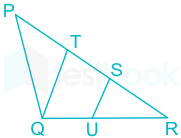
In the given figure PT ∶ TS ∶ SR = 2 ∶ 1 ∶ 1 and SU is parallel to TQ. If RU = 10 cm, RS = 8 cm and SU = 6 cm, then what is the value (in cm) of PQ?


  1. AOption (a)

    12

  2. BOption (b)

    10

  3. COption (c)

    20

  4. DOption (d)

    30

View answer & explanation

Correct answer

Answer: (c)C.

20

Why this answer is correct

Shortcut Trick

Given PT : TS : SR = 2 : 1 : 1 and RS = 8 cm ⇒ TS = 8 cm, PT = 16 cm.

In ΔRSU, 62 + 82 = 102 (100 = 100), so ΔRSU is right-angled at S.

Since SU || TQ, ΔRSU ≈ ΔRTQ ⇒ TQ/SU = RT/RS = (8+8)/8 = 2 ⇒ TQ = 12 cm.

In right-angled ΔPTQ, PQ = √(PT2 + TQ2) = √(162 + 122) = 20 cm.

∴ The correct answer is 20 cm.

Alternate Method

Given: PT : TS : SR = 2 : 1 : 1, RS = 8 cm, RU = 10 cm, SU = 6 cm, SU || TQ.

Formula: Pythagoras Theorem: a2 + b2 = c2 | Similarity: Corresponding sides ratio.

⇒ From PT : TS : SR = 2 : 1 : 1 and RS = 8 cm:

⇒ TS = 8 cm and PT = 16 cm.

⇒ In ΔRSU, RS2 + SU2 = 82 + 62 = 64 + 36 = 100.

⇒ RU2 = 102 = 100. Since RS2 + SU2 = RU2, ∠RSU = 90°.

⇒ Since SU || TQ, corresponding ∠RTQ = ∠RSU = 90°.

⇒ ΔRSU ≈ ΔRTQ (By AA Similarity).

⇒ TQ / SU = RT / RS ⇒ TQ / 6 = (8 + 8) / 8 = 16 / 8 = 2.

⇒ TQ = 6 × 2 = 12 cm.

⇒ In right-angled ΔPTQ, ∠PTQ = 90° (Linear pair with ∠RTQ).

⇒ PQ2 = PT2 + TQ2 = 162 + 122 = 256 + 144 = 400.

⇒ PQ = √400 = 20 cm.

∴ The correct answer is 20 cm.

Additional Information

Pythagorean Triplets

Common triplets like (3, 4, 5), (6, 8, 10), and (5, 12, 13) satisfy the equation a2 + b2 = c2 and form right-angled triangles.

Basic Proportionality Theorem (Thales Theorem)

If a line is parallel to one side of a triangle intersecting the other two sides, it divides those sides in the same ratio.

Similarity Ratios

For two similar triangles, the ratio of any two corresponding linear dimensions (sides, altitudes, medians) is always equal.

Question 27

PQ and RS are two chords of a circle. PQ = 20 cm, RS = 48 cm and PQ is parallel to RS. If the distance between PQ and RS is 34 cm, then what is the area (in cm2) of the circle?

  1. AOption (a)

    729π

  2. BOption (b)

    900π

  3. COption (c)

    676π

  4. DOption (d)

    784π

View answer & explanation

Correct answer

Answer: (c)C.

676π

Why this answer is correct

Shortcut Trick

Identify half-lengths of the chords: a = 20/2 = 10 cm and b = 48/2 = 24 cm.

Identify a Pythagorean triplet involving these values: (10, 24, 26).

Sum of distances from center = 10 + 24 = 34 cm, which matches the given distance.

Thus, the radius (r) of the circle is 26 cm.

Area of circle = π × r2 = π × 262 = 676π cm2.

∴ The correct answer is 676π cm2.

Alternate Method

Given: Chord PQ = 20 cm, Chord RS = 48 cm, Distance between them = 34 cm.

Formula: r2 = (chord/2)2 + (distance from center)2; Area = πr2

⇒ Let O be the center and x be the distance from center to RS.

⇒ In ▵ORN: r2 = x2 + (48/2)2 = x2 + 242 = x2 + 576

⇒ Distance from center to PQ = 34 − x

⇒ In ▵OPM: r2 = (34 − x)2 + (20/2)2 = (34 − x)2 + 100

⇒ Equating r2: x2 + 576 = 1156 − 68x + x2 + 100

⇒ 576 = 1256 − 68x

⇒ 68x = 1256 − 576 = 680

⇒ x = 10 cm

⇒ r2 = 102 + 576 = 100 + 576 = 676

⇒ Area of circle = πr2 = 676π cm2

∴ The correct answer is 676π cm2.

Additional Information

Perpendicular Bisector Property

A perpendicular drawn from the center of a circle to a chord always bisects the chord into two equal parts.

Parallel Chords on Same Side

If two parallel chords of length 2a and 2b are on the same side of the center, the distance between them is |√(r2−a2) − √(r2−b2)|.

Area of Circle Formula

The area of a circle with radius r is given by the formula A = πr2.

Pythagorean Triplet Logic

For quick calculation in circles, use triplets: (3,4,5), (5,12,13), (8,15,17), (7,24,25), (10,24,26), (20,21,29).

Question 28

Centre of two concentric circles is O. The area of two circles is 616 cm2 and 154 cm2 respectively. A tangent is drawn through point A on the larger circle to the smaller circle. This tangent touches small circle at B and intersects larger circle at C. What is the length (in cm) of AC?

  1. AOption (a)

    12√3

  2. BOption (b)

    14√3

  3. COption (c)

    10√6

  4. DOption (d)

    18√2

View answer & explanation

Correct answer

Answer: (b)B.

14√3

Why this answer is correct

Shortcut Trick

Ratio of Areas = 616 : 154 = 4 : 1

Ratio of Radii (R : r) = √4 : √1 = 2 : 1

Since Area 154 → r = 7 cm, then R = 14 cm

Half tangent length AB = √(R2 − r2) = √(142 − 72) = √147 = 7√3 cm

Full length AC = 2 × AB = 14√3 cm

∴ The correct answer is 14√3 cm.

Alternate Method

Given: Area of larger circle = 616 cm2, Area of smaller circle = 154 cm2.

Formula Used: Area of circle = πr2; Pythagoras theorem: a2 + b2 = c2.

⇒ Area of larger circle = πR2 = 616

⇒ (22/7) × R2 = 616

⇒ R2 = (616 × 7) ÷ 22 = 28 × 7 = 196

⇒ R = 14 cm

⇒ Area of smaller circle = πr2 = 154

⇒ (22/7) × r2 = 154

⇒ r2 = (154 × 7) ÷ 22 = 7 × 7 = 49

⇒ r = 7 cm

⇒ In right-angled triangle OBA (where OB ⊥ AC at B):

⇒ AB2 = OA2 − OB2 = R2 − r2

⇒ AB2 = 196 − 49 = 147

⇒ AB = √147 = √(49 × 3) = 7√3 cm

⇒ Since B bisects AC, AC = 2 × AB = 2 × 7√3 = 14√3 cm

∴ The correct answer is 14√3 cm.

Additional Information

Tangent Property

A tangent at any point of a circle is perpendicular to the radius through the point of contact (∠OBA = 90°).

Chord Properties in Concentric Circles

A chord of the larger circle that touches the smaller circle is bisected at the point of contact.

Area and Radius Relationship

The ratio of the areas of two circles is equal to the ratio of the squares of their radii (A1/A2 = R2/r2).

Question 29

PA and PB are two tangents drawn to two circles of radius 3 cm and 5 cm respectively. PA touches the smaller and larger circles at points X and Y respectively. PB touches the smaller and large circle at point U and V respectively. The centres of the smaller and larger circles O and N respectively. If ON = 12 cm, then what is the value (in cm) of PY?

  1. AOption (a)

    5√35

  2. BOption (b)

    7√15

  3. COption (c)

    9√15

  4. DOption (d)

    12√5

View answer & explanation

Correct answer

Answer: (a)A.

5√35

Why this answer is correct

Shortcut Trick

By similarity of triangles formed by radii and common tangents, PN/PO = R/r = 5/3.

Difference in ratio parts = 5 − 3 = 2 units, which corresponds to ON = 12 cm.

1 unit = 6 cm ⇒ Distance PN = 5 × 6 = 30 cm.

In right-angled ▵PNY, PY = √(PN2 − NY2) = √(302 − 52).

PY = √(900 − 25) = √875 = 5√35 cm.

∴ The correct answer is 5√35 cm.

Alternate Method

Given: Radius of smaller circle (r) = 3 cm, Radius of larger circle (R) = 5 cm, Distance between centers (ON) = 12 cm.

Formula: For triangles formed by the intersection of common tangents P, ▵POX ~ ▵PNY. Also, in ▵PNY, PN2 = PY2 + NY2.

⇒ Let PO = x. Since ▵POX and ▵PNY are similar:

⇒ OX / NY = PO / PN

⇒ 3 / 5 = x / (x + 12)

⇒ 3(x + 12) = 5x

⇒ 3x + 36 = 5x

⇒ 2x = 36 ⇒ x = 18 cm

⇒ Total length PN = PO + ON = 18 + 12 = 30 cm

⇒ In right-angled ▵PNY, PY2 = PN2 − NY2

⇒ PY2 = 302 − 52 = 900 − 25 = 875

⇒ PY = √875 = √(25 × 35) = 5√35 cm

∴ The correct answer is 5√35 cm.

Additional Information

Direct Common Tangent (DCT)

The length of the direct common tangent is given by √(D2 − (R−r)2), where D is the distance between centers.

Transverse Common Tangent (TCT)

The length of the transverse common tangent is given by √(D2 − (R+r)2).

Intersection of Tangents

The external common tangents intersect at a point P that divides the line joining the centers externally in the ratio of the radii (R : r).

Question 30

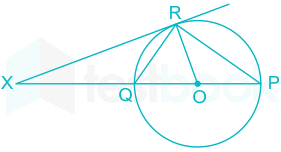
XR is a tangent to the circle. O is the centre of the circle. If ∠XRP = 120°, then what is the value (in degrees) of ∠QOR?


  1. AOption (a)

    80

  2. BOption (b)

    70

  3. COption (c)

    60

  4. DOption (d)

    40

View answer & explanation

Correct answer

Answer: (c)C.

60

Why this answer is correct

Shortcut Trick

In a circle, the radius is perpendicular to the tangent at the point of contact ∴ ∠ORX = 90°.

Given ∠XRP = 120°, then ∠ORP = ∠XRP − ∠ORX = 120° − 90° = 30°.

In ΔOPR, OP = OR (radii), so it is an isosceles triangle ⇒ ∠OPR = ∠ORP = 30°.

Exterior angle ∠QOR of ΔOPR is the sum of opposite interior angles ⇒ ∠QOR = ∠OPR + ∠ORP = 30° + 30° = 60°.

∴ The correct answer is 60°.

Alternate Method

Given:

XR is a tangent to the circle at point R.

O is the centre of the circle, and PQ is the diameter.

∠XRP = 120°.

Formula Used:

  1. Radius ⊥ Tangent at point of contact (∠ORX = 90°).
  2. Angles opposite to equal sides in a triangle are equal.
  3. Exterior Angle Theorem: Exterior angle = Sum of two opposite interior angles.

Calculations:

⇒ ∠ORX = 90° (Radius is perpendicular to tangent at contact point R)

⇒ ∠ORP = ∠XRP − ∠ORX

⇒ ∠ORP = 120° − 90° = 30°

⇒ In ΔOPR, OR = OP (Both are radii of the same circle)

⇒ ∠OPR = ∠ORP = 30° (Angles opposite to equal sides are equal)

⇒ ∠QOR is the exterior angle to ΔOPR at vertex O

⇒ ∠QOR = ∠OPR + ∠ORP

⇒ ∠QOR = 30° + 30° = 60°

∴ The correct answer is 60°.

Additional Information

Radius-Tangent Theorem

The tangent at any point of a circle is perpendicular to the radius through the point of contact (∠Radius, Tangent = 90°).

Alternate Segment Theorem

The angle between a tangent and a chord through the point of contact is equal to the angle subtended by the chord in the alternate segment.

Exterior Angle Property

An exterior angle of a triangle is equal to the sum of its two interior opposite angles (∠Ext = ∠Int1 + ∠Int2).

Central Angle Property

The angle subtended by an arc at the centre is double the angle subtended by it at any point on the remaining part of the circle.

Question 31

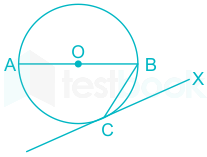
O is the centre of the circle. A tangent is drawn which touches the circle at C. If ∠AOC = 80°, then what is the value (in degrees) of ∠BCX?


  1. AOption (a)

    80

  2. BOption (b)

    30

  3. COption (c)

    40

  4. DOption (d)

    50

View answer & explanation

Correct answer

Answer: (d)D.

50

Why this answer is correct

Shortcut Trick

According to the Alternate Segment Theorem, the angle between a tangent and a chord (∠BCX) is equal to the angle subtended by the chord in the alternate segment (∠BAC).

In ΔAOC, OA = OC (Radii), so it is an isosceles triangle.

∠OAC = (180° − ∠AOC) ÷ 2 = (180° − 80°) ÷ 2 = 100° ÷ 2 = 50°.

∠BAC = ∠OAC = 50°.

By theorem, ∠BCX = ∠BAC = 50°.

∴ The correct answer is 50°.

Alternate Method

Given:

∠AOC = 80°

Formula used:

Angle at the centre = 2 × Angle at the circumference standing on the same chord

Calculation:

AC is a chord of the circle.

⇒ ∠ABC = 1/2 × ∠AOC

⇒ ∠ABC = 1/2 × 80°

⇒ ∠ABC = 40°

In △OBC,

⇒ OB = OC = Radius of the circle

⇒ ∠OBC = ∠OCB = 40°

⇒ ∠XCO = 90°

Radius is perpendicular to the tangent at the point of contact.

⇒ ∠BCX = ∠XCO − ∠OCB

⇒ ∠BCX = 90° − 40°

⇒ ∠BCX = 50°

∴ ∠BCX = 50°.


Additional Information

Alternate Segment Theorem

The angle between a tangent and a chord through the point of contact is equal to the angle in the alternate segment.

Tangent-Radius Property

A tangent to a circle is perpendicular to the radius at the point of contact (∠OCX = 90°).

Angle at Centre and Circumference

The angle subtended by an arc at the centre is double the angle subtended by it at any point on the remaining part of the circle.

Question 32

The distance between the centres of two circles is 24 cm. If the radius of the two circles are 4 cm and 8 cm, then what is the sum of the lengths (in cm) of the direct common tangent and the transverse common tangent?

  1. AOption (a)

    4(3√3 + √5)

  2. BOption (b)

    4(4√35 + 3√3)

  3. COption (c)

    4(√35 + 3√3)

  4. DOption (d)

    4√3(√35 + 3√3)

View answer & explanation

Correct answer

Answer: (c)C.

4(√35 + 3√3)

Why this answer is correct

Shortcut TrickTransverse common tangent = √d2−(r1+r2)2√{d^2 - (r1 + r2)^2}

Transverse common tangent = √242−(4+8)2√{24^2 - (4 + 8)^2}

Transverse common tangent = √576−144√{576 - 144} = √432

Transverse common tangent = 12√3

Direct Common Tangent = √d2−(r1−r2)2√{d^2 - (r1 - r2)^2}

Direct Common Tangent = √242−(8−4)2√{24^2 - (8 - 4)^2}

Direct Common Tangent = √576−16√{576 - 16}

Direct Common Tangent = √560 

Direct Common Tangent = 4√35

Sum = Transverse common tangent + Direct Common Tangent

Sum = 12√3 + 4√35 = 4(√35 + 3√3)

CD is the transverse common tangent and AB in the direct common tangent

Finding CD:

In triangle OCQ and PDQ

∠OCQ = ∠PDQ = 90° [Tangent is perpendicular to the radius]

∠OQC = ∠PQD [Vertically opposite angles are equal]

∴ Triangle OCQ ∼ PDQ

OC/PD = OQ/PQ = CQ/DQ

8/4 = OQ/PQ

∴ OQ = 2PQ

OP = OQ + PQ = 3PQ

24 = 3PQ

∴ PQ = 8 cm

OQ = 2 × 8 = 16 cm

Applying Pythagoras theorem for triangles OCQ

CQ = √(OQ2 - OC2) = √(162 - 82) = √192 = 8√3 cm

DQ = ½ × CQ = 4√3 cm

∴ CD = CQ + DQ = 12√3 cm

Finding AB:

Let us extend the lines AB and OP and let them meet at M

In triangle MBP and MAO

∠M is common

∠MBP = ∠MAO = 90° [Tangent is perpendicular to the radius]

∴ MBP ∼ MAO

BP/AO = MB/MA = MP/MO

4/8 = MB/MA = MP/MO

∴ MA = 2 MB and MO = 2 MP

OP = MO - MP = MP = 24 cm

Applying Pythagoras theorem to triangle MBP

MB = √(MP2 - PB2)

⇒ √(242 - 42) = √560 = 4√35 cm

MA = 2 MB = 8√35 cm

AB = MA - MB = 4√35 cm

Sum of the lengths = CD + AB = 12√3 + 4√35 = 4(√35 + 3√3) cm

Additional Information

Direct Common Tangent (DCT)

A tangent that lies on the same side of the line segment joining the centers. Formula: √[d2 − (R − r)2].

Transverse Common Tangent (TCT)

A tangent that intersects the line segment joining the centers. Formula: √[d2 − (R + r)2].

Number of Common Tangents

If d > R + r, there are 4 common tangents (2 DCT, 2 TCT). If d = R + r, there are 3. If R − r < d < R + r, there are 2 (only DCT).

Question 33

ABC is triangle. AB = 10 cm and BC = 16 cm. AD = 8 cm and is perpendicular to side BC. What is the length (in cm) of side AC?

  1. AOption (a)

    4√41

  2. BOption (b)

    2√41

  3. COption (c)

    2√82

  4. DOption (d)

    4√82

View answer & explanation

Correct answer

Answer: (b)B.

2√41

Why this answer is correct

Shortcut Trick

In right-angled triangle ABD, AB = 10 cm and AD = 8 cm. Using Pythagoras triplet (6, 8, 10), BD = 6 cm.

D is a point on BC (since AD ⊥ BC), thus DC = BC − BD = 16 − 6 = 10 cm.

In right-angled triangle ADC, AC = √(AD2 + DC2) = √(82 + 102).

AC = √(64 + 100) = √164 = 2√41 cm.

∴ The correct answer is 2√41 cm.

Alternate Method

Given: AB = 10 cm, BC = 16 cm, Altitude AD = 8 cm where AD ⊥ BC.

Formula Used: Pythagoras Theorem: Hypotenuse2 = Perpendicular2 + Base2

⇒ In right-angled ΔABD:

⇒ AB2 = AD2 + BD2

⇒ 102 = 82 + BD2

⇒ 100 = 64 + BD2

⇒ BD2 = 100 − 64 = 36

⇒ BD = √36 = 6 cm

⇒ Now, DC = BC − BD

⇒ DC = 16 − 6 = 10 cm

⇒ In right-angled ΔADC:

⇒ AC2 = AD2 + DC2

⇒ AC2 = 82 + 102

⇒ AC2 = 64 + 100 = 164

⇒ AC = √164 = √(4 × 41) = 2√41 cm

∴ The correct answer is 2√41 cm.

Additional Information

Pythagoras Theorem

In a right-angled triangle, the square of the hypotenuse is equal to the sum of the squares of the other two sides: c2 = a2 + b2.

Common Pythagorean Triplets

Standard sets of integers that satisfy the theorem include (3, 4, 5), (5, 12, 13), (8, 15, 17), and their multiples like (6, 8, 10).

Altitude of a Triangle

An altitude is a line segment through a vertex and perpendicular to the opposite side, dividing the triangle into two right-angled triangles.

Question 34

An equilateral triangle of side 12 cm is drawn. What is the area (in cm2) of the largest square which can be drawn inside it?

  1. AOption (a)

    1512 – 864√3

  2. BOption (b)

    3024 – 1728√3

  3. COption (c)

    3024 + 1728√3

  4. DOption (d)

    1512 + 864√3 

View answer & explanation

Correct answer

Answer: (b)B.

3024 – 1728√3

Why this answer is correct

Shortcut Trick

For an equilateral triangle of side a, the height h = (√3/2)a.

The side of the largest inscribed square x = (a × h) / (a + h).

Given a = 12 cm, h = (√3/2) × 12 = 6√3 cm.

x = (12 × 6√3) / (12 + 6√3) = 72√3 / (6(2 + √3)) = 12√3 / (2 + √3).

Rationalizing: x = 12√3(2 − √3) = 24√3 − 36 cm.

Area = (24√3 − 36)2 = 1728 + 1296 − 1728√3 = 3024 − 1728√3 cm2.

∴ The correct answer is 3024 − 1728√3 cm2.

Alternate Method

Given: Side of equilateral triangle (a) = 12 cm.

Formula Used: Side of largest square (x) = (Base × Height) / (Base + Height).

⇒ Height of equilateral triangle (h) = (√3/2) × Side = (√3/2) × 12 = 6√3 cm.

⇒ Side of square (x) = (12 × 6√3) / (12 + 6√3).

⇒ x = 72√3 / [6 × (2 + √3)] = 12√3 / (2 + √3).

⇒ x = [12√3 × (2 − √3)] / [(2 + √3) × (2 − √3)].

⇒ x = 24√3 − 36 cm.

⇒ Area of square = x2 = (24√3 − 36)2.

⇒ Area = (24√3)2 + (36)2 − 2 × 24√3 × 36.

⇒ Area = (576 × 3) + 1296 − 1728√3.

⇒ Area = 1728 + 1296 − 1728√3 = 3024 − 1728√3 cm2.

∴ The correct answer is 3024 − 1728√3 cm2.

Additional Information

General Inscribed Square Formula

For any triangle with base 'b' and height 'h', the side of the largest inscribed square resting on that base is x = (b × h) / (b + h).

Equilateral Triangle Properties

Height = (√3/2)a, Area = (√3/4)a2, In-radius = a/(2√3), and Circum-radius = a/√3.

Square in Right Triangle

For a right triangle with legs P and B and hypotenuse H, the side of the largest square resting on the legs is x = (P × B) / (P + B).

Question 35

PQRS is a rectangle. The ratio of the sides PQ and QR is 3 ∶ 1. If the length of the diagonal PR is 10 cm, then what is the area (in cm2) of the rectangle?

  1. AOption (a)

    15

  2. BOption (b)

    30

  3. COption (c)

    45

  4. DOption (d)

    20

View answer & explanation

Correct answer

Answer: (b)B.

30

Why this answer is correct

Shortcut Trick

Ratio of sides = 3 : 1

Ratio of diagonal squared = 32 + 12 = 10 units

Actual diagonal squared = 102 = 100 cm2

Scale factor for area = 100 ÷ 10 = 10

Required Area = (3 × 1) ratio parts × 10 = 30 cm2

∴ The correct answer is 30 cm2.

Alternate Method

Given: Ratio PQ : QR = 3 : 1 and Diagonal PR = 10 cm

Formula: Diagonal2 = Length2 + Width2 | Area = Length × Width

⇒ Let side PQ = 3x and side QR = x.

⇒ In right-angled ΔPQR, PR2 = PQ2 + QR2

⇒ 102 = (3x)2 + (x)2

⇒ 100 = 9x2 + x2

⇒ 100 = 10x2

⇒ x2 = 10

⇒ Area of rectangle PQRS = PQ × QR = 3x × x = 3x2

⇒ Area = 3 × 10 = 30 cm2

∴ The correct answer is 30 cm2.

Additional Information

Diagonal of a Rectangle

The diagonal d of a rectangle with length l and breadth b is given by d = √(l2 + b2).

Area and Perimeter

Area = Length × Breadth, and Perimeter = 2 × (Length + Breadth).

Pythagorean Theorem

In any right-angled triangle, the square of the hypotenuse is equal to the sum of the squares of the other two sides: a2 + b2 = c2.

Question 36

ABCDEF is a regular hexagon. What is the ratio of the area of triangle ACE and the area of the triangle AEF?

  1. AOption (a)

    6 ∶ 1 

  2. BOption (b)

    4 ∶ 1

  3. COption (c)

    3 ∶ 1

  4. DOption (d)

    5 ∶ 1

View answer & explanation

Correct answer

Answer: (c)C.

3 ∶ 1

Why this answer is correct

Shortcut Trick

In a regular hexagon with side 'a', the area can be divided into 6 equal equilateral triangles of area 'k'.

The area of triangle ACE (formed by connecting alternate vertices) is exactly half the area of the hexagon.

Area of ΔACE = 3 × k

The area of the peripheral triangle AEF = 1 × k (since three such triangles AEF, ABC, and CDE plus ΔACE make the whole hexagon).

Ratio = Area(ΔACE) : Area(ΔAEF) = 3k : 1k = 3 : 1

∴ The correct answer is 3 : 1.

Alternate Method

Given: ABCDEF is a regular hexagon with side length 'a'.

Formula Used: Area of triangle = (1/2) × a × b × sin(θ) | Area of equilateral triangle = (√3/4) × side2

⇒ Interior angle of a regular hexagon = (6 − 2) × 180° ÷ 6 = 120°.

⇒ In ΔAEF, side AF = a, side FE = a, and ∠AFE = 120°.

⇒ Area of ΔAEF = (1/2) × a × a × sin(120°) = (1/2) × a2 × (√3/2) = (√3/4)a2.

⇒ In ΔAEF, by Cosine Rule, side AE2 = a2 + a2 − 2 × a × a × cos(120°).

⇒ AE2 = 2a2 − 2a2 × (−1/2) = 2a2 + a2 = 3a2 ⇒ AE = a√3.

⇒ ΔACE is an equilateral triangle with side length s = a√3.

⇒ Area of ΔACE = (√3/4) × (a√3)2 = (√3/4) × 3a2 = (3√3/4)a2.

⇒ Ratio = Area(ΔACE) : Area(ΔAEF) = [(3√3/4)a2] : [(√3/4)a2].

⇒ Ratio = 3 : 1.

∴ The correct answer is 3 : 1.

Additional Information

Area of Regular Hexagon

The area of a regular hexagon with side 'a' is given by (3√3/2) × a2.

Diagonals of a Hexagon

A regular hexagon has two types of diagonals: Short diagonal = a√3 (e.g., AE) and Long diagonal = 2a (e.g., AD).

Symmetry of ΔACE

Triangle ACE is an equilateral triangle because all its sides are short diagonals of the regular hexagon (AC = CE = EA = a√3).

Interior and Exterior Angles

For a regular n-sided polygon, Interior Angle = [(n−2)×180]/n and Exterior Angle = 360/n.

Question 37

ABCD is a trapezium. Sides AB and CD are parallel to each other. AB = 6 cm, CD = 18 cm, BC = 8 cm and AD = 12 cm. A line parallel to AB divides the trapezium in two parts of equal perimeter. This line cuts BC at E and AD at F. If BE/EC = AF/FD, then what is the value of BE/EC?

  1. AOption (a)

    1/2

  2. BOption (b)

    2

  3. COption (c)

    4

  4. DOption (d)

    1/4

View answer & explanation

Correct answer

Answer: (c)C.

4

Why this answer is correct

Shortcut Trick

For equal perimeters, the sum of non-parallel sides in the top part plus the top base must equal the sum of non-parallel sides in the bottom part plus the bottom base.

Let the ratio BE/EC = AF/FD = k. The shared line EF cancels out on both sides.

Perimeter condition: AB + BE + AF = CD + EC + FD

Substitute values: 6 + [k/(k+1)] × (BC + AD) = 18 + [1/(k+1)] × (BC + AD)

6 + [k/(k+1)] × 20 = 18 + [1/(k+1)] × 20

20(k − 1) / (k + 1) = 12 ⇒ 5k − 5 = 3k + 3 ⇒ 2k = 8 ⇒ k = 4.

∴ The correct answer is 4.

Alternate Method

Given: AB = 6 cm, CD = 18 cm, BC = 8 cm, AD = 12 cm, EF ∥ AB.

Let BE/EC = AF/FD = k. This implies:

⇒ BE = 8k / (k + 1) and EC = 8 / (k + 1)

⇒ AF = 12k / (k + 1) and FD = 12 / (k + 1)

Since the perimeter of ABEF = Perimeter of FECD:

⇒ AB + BE + EF + FA = FE + EC + CD + DF

⇒ AB + BE + AF = EC + CD + FD

⇒ 6 + [8k / (k + 1)] + [12k / (k + 1)] = [8 / (k + 1)] + 18 + [12 / (k + 1)]

⇒ 6 + [20k / (k + 1)] = 18 + [20 / (k + 1)]

⇒ [20k / (k + 1)] − [20 / (k + 1)] = 18 − 6

⇒ 20(k − 1) / (k + 1) = 12

⇒ 5(k − 1) = 3(k + 1)

⇒ 5k − 5 = 3k + 3

⇒ 2k = 8

⇒ k = 4

∴ The correct answer is 4.

Additional Information

Length of Parallel Segment EF

If EF divides the non-parallel sides in ratio k:1 (where k = AF/FD), its length is given by EF = (k×CD + 1×AB) / (k + 1).

Area Bisector Parallel Line

A line parallel to the bases that divides a trapezium into two equal areas has a length of √[(AB2 + CD2) / 2].

Median of a Trapezium

The segment joining the midpoints of the non-parallel sides is parallel to the bases and its length is the average of the bases: (AB + CD) / 2.

Question 38

A rectangular sheet of length 42 cm and breadth 14 cm is cut from a circular sheet. What is the minimum area (in cm2) of circular sheet?

  1. AOption (a)

    3080

  2. BOption (b)

    1540

  3. COption (c)

    770

  4. DOption (d)

    1030

View answer & explanation

Correct answer

Answer: (b)B.

1540

Why this answer is correct

Shortcut Trick

For the minimum area of a circular sheet, the diagonal of the rectangle must be the diameter of the circle.

Radius2 (r2) = (Length2 + Breadth2) ÷ 4

r2 = (422 + 142) ÷ 4 = (1764 + 196) ÷ 4 = 1960 ÷ 4 = 490

Area = πr2 = (22 ÷ 7) × 490 = 22 × 70 = 1540 cm2.

∴ The correct answer is 1540 cm2.

Alternate Method

Given:

Length of the rectangular sheet (l) = 42 cm

Breadth of the rectangular sheet (b) = 14 cm

Formula Used:

Diagonal of rectangle = √(l2 + b2)

Area of circle = π × r2

For the minimum area of the circular sheet, the rectangle should be perfectly inscribed in the circle. Thus, the diagonal of the rectangle serves as the diameter of the circle.

⇒ Diameter (D) = √(422 + 142)

⇒ D = √(1764 + 196)

⇒ D = √1960 cm

⇒ Radius (r) = D ÷ 2 = (√1960) ÷ 2

⇒ Area of circle = π × r2

⇒ Area = (22 ÷ 7) × [(√1960) ÷ 2]2

⇒ Area = (22 ÷ 7) × (1960 ÷ 4)

⇒ Area = (22 ÷ 7) × 490

⇒ Area = 22 × 70

⇒ Area = 1540 cm2

∴ The correct answer is 1540 cm2.

Additional Information

Diagonal of Rectangle

The distance between opposite vertices of a rectangle with length l and breadth b is given by d = √(l2 + b2).

Circumcircle of a Rectangle

The radius of a circle circumscribing a rectangle is always half the length of its diagonal: r = d ÷ 2.

Area of Circle

The area enclosed by a circle of radius r is A = πr2, where π ≈ 22/7 or 3.14.

Question 39

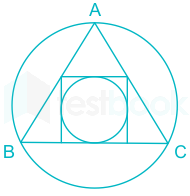
An equilateral triangle ABC is inscribed in a circle as shown in the figure. A square of the largest possible area is made inside this triangle as shown. Another circle made inscribing the square. What is the ratio of the area of the small circle and the large circle?

  1. AOption (a)

    (15 - 12√3) ∶ 1  

  2. BOption (b)

    (63 - 36√3) ∶ 4

  3. COption (c)

    (7 - 4√3) ∶ 8

  4. DOption (d)

    (18 - √3) ∶ 2

View answer & explanation

Correct answer

Answer: (b)B.

(63 - 36√3) ∶ 4

Why this answer is correct

Shortcut Trick

In an equilateral triangle of side a, the side of the largest square x = a√3 ÷ (2 + √3).

Large circle radius R = a ÷ √3 and small circle radius r = x ÷ 2.

Ratio of radii r/R = [a√3 ÷ (2(2 + √3))] ÷ [a ÷ √3] = 3 ÷ (2(2 + √3)).

Ratio of Areas = (r/R)2 = 9 ÷ [4(7 + 4√3)].

Rationalizing: 9(7 − 4√3) ÷ [4(49 − 48)] = (63 − 36√3) ÷ 4.

∴ The correct answer is (63 − 36√3) : 4.

Alternate Method

Given:

Triangle ABC is equilateral and inscribed in a large circle.

A square is inscribed in the triangle, and a small circle is inscribed in that square.

Formula Used:

Circumradius of equilateral triangle R = a ÷ √3

Side of square in equilateral triangle x = (base × height) ÷ (base + height)

Area of Circle = πr2

Calculations:

Let the side of the equilateral triangle be a.

Height of triangle h = (a√3) ÷ 2

⇒ Side of square x = (a × (a√3 ÷ 2)) ÷ (a + (a√3 ÷ 2))

⇒ x = (a2√3 ÷ 2) ÷ (a(2 + √3) ÷ 2) = a√3 ÷ (2 + √3)

⇒ Radius of small circle r = x ÷ 2 = a√3 ÷ [2(2 + √3)]

⇒ Radius of large circle R = a ÷ √3

⇒ Area of small circle = π × (a√3 ÷ [2(2 + √3)])2 = π × [3a2 ÷ (4(7 + 4√3))]

⇒ Area of large circle = π × (a ÷ √3)2 = π × (a2 ÷ 3)

⇒ Ratio = [3a2 ÷ (4(7 + 4√3))] ÷ [a2 ÷ 3]

⇒ Ratio = 9 ÷ [4(7 + 4√3)]

⇒ Ratio = [9 × (7 − 4√3)] ÷ [4 × (7 + 4√3) × (7 − 4√3)]

⇒ Ratio = (63 − 36√3) ÷ [4 × (49 − 48)] = (63 − 36√3) ÷ 4

∴ The correct answer is (63 − 36√3) : 4.

Additional Information

Circumradius and Inradius

For an equilateral triangle of side a, circumradius R = a/√3 and inradius r = a/(2√3). The ratio of areas of circumcircle to incircle is always 4 : 1.

Square Inscribed in a Triangle

The side of the largest square x that can be inscribed in a triangle with base b and height h (with square base on triangle base) is x = (b × h) / (b + h).

Rationalization of Surds

To rationalize a denominator of the form (a + √b), multiply both numerator and denominator by its conjugate (a − √b) to use the identity (x + y)(x − y) = x2 − y2.

Question 40

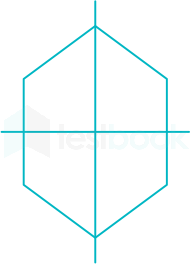
A prism has a regular hexagonal base whose side is 12 cm. The height of the prism is 24 cm. It is cut into 4 equal parts by 2 perpendicular cuts as shown in figure. What is the sum of the total surface area of the four parts?

  1. AOption (a)

    1728 + 432√3

  2. BOption (b)

    2880 + 1008√3

  3. COption (c)

    2880 + 432√3

  4. DOption (d)

    1728 + 1008√3

View answer & explanation

Correct answer

Answer: (b)B.

2880 + 1008√3

Why this answer is correct

Shortcut Trick

Sum of TSA of parts = Original TSA + 2 × (Area of Vertical Cut 1) + 2 × (Area of Vertical Cut 2)

Original TSA = 2 × (216√3) + (72 × 24) = 432√3 + 1728 cm2

Area of Cut 1 (through vertices) = 2 × 12 × 24 = 576 cm2

Area of Cut 2 (through midpoints) = 12√3 × 24 = 288√3 cm2

Total = (432√3 + 1728) + 2(576) + 2(288√3) = 2880 + 1008√3 cm2

∴ The correct answer is 2880 + 1008√3 cm2.

Alternate Method

Given:

Side of regular hexagon (a) = 12 cm

Height of prism (h) = 24 cm

Formula Used:

Area of Hexagon = (3√3 / 2) × a2

TSA of Prism = 2 × Base Area + Perimeter × Height

Surface Area increase per cut = 2 × Area of the cut face

Calculations:

⇒ Base Area of Hexagon = (3√3 / 2) × 122 = (3√3 / 2) × 144 = 216√3 cm2

⇒ Lateral Surface Area = (6 × 12) × 24 = 72 × 24 = 1728 cm2

⇒ Original TSA = 2 × 216√3 + 1728 = 432√3 + 1728 cm2

⇒ Long diagonal of hexagon = 2 × 12 = 24 cm

⇒ Short diagonal of hexagon = 12√3 cm

⇒ Area of Cut Face 1 (Vertical) = 24 × 24 = 576 cm2

⇒ Area of Cut Face 2 (Vertical) = 12√3 × 24 = 288√3 cm2

⇒ Total Surface Area of 4 parts = Original TSA + 2(Area of Cut 1) + 2(Area of Cut 2)

⇒ Sum of TSA = (432√3 + 1728) + 2(576) + 2(288√3)

⇒ Sum of TSA = 432√3 + 1728 + 1152 + 576√3

⇒ Sum of TSA = 2880 + 1008√3 cm2

∴ The correct answer is 2880 + 1008√3 cm2.

Additional Information

Regular Hexagon Properties

A regular hexagon has a long diagonal of 2a and a short diagonal of a√3. Area = (3√3 / 2) × a2.

Surface Area Increase on Cutting

Every plane cut through a solid increases the total surface area by exactly twice the cross-sectional area of that cut.

Prism Volume and Area

Volume = Base Area × Height. Lateral Surface Area = Base Perimeter × Height.

Question 41

Four identical cones each of radius 10.5 cm and height 14 cm are cut from a cuboid of dimensions 30 cm × 32 cm × 40 cm (base of each cone lies on the surface of cuboid). What is the total surface area (in cm2) of the remaining solid?

  1. AOption (a)

    6528

  2. BOption (b)

    7804

  3. COption (c)

    5926

  4. DOption (d)

    6824

View answer & explanation

Correct answer

Answer: (b)B.

7804

Why this answer is correct

Shortcut Trick

Total Surface Area (TSA) of remaining solid = TSA of Cuboid + 4 × (CSA of Cone − Base Area of Cone)

Cuboid TSA = 2(30×32 + 32×40 + 40×30) = 2(960 + 1280 + 1200) = 6880 cm2

Cone Slant Height (l) = √(10.52 + 142) = √(110.25 + 196) = 17.5 cm

Net change per cone = π × r × l − π × r2 = π × r × (l − r) = (22/7) × 10.5 × (17.5 − 10.5) = 33 × 7 = 231 cm2

Total TSA = 6880 + 4 × 231 = 6880 + 924 = 7804 cm2

∴ The correct answer is 7804 cm2.

Alternate Method

Given:

Cuboid: Length (L) = 30 cm, Breadth (B) = 32 cm, Height (H) = 40 cm

Cone: Radius (r) = 10.5 cm, Height (h) = 14 cm, Number (n) = 4

Formula Used:

TSA of Cuboid = 2(LB + BH + LH)

CSA of Cone = πrl | Base Area of Cone = πr2

Slant height (l) = √(r2 + h2)

Calculations:

⇒ Slant height (l) = √(10.52 + 142) = √(110.25 + 196) = √306.25 = 17.5 cm

⇒ TSA of cuboid = 2 × (30 × 32 + 32 × 40 + 40 × 30)

⇒ TSA of cuboid = 2 × (960 + 1280 + 1200) = 2 × 3440 = 6880 cm2

⇒ Base Area of 4 cones = 4 × πr2 = 4 × (22/7) × 10.5 × 10.5 = 4 × 346.5 = 1386 cm2

⇒ CSA of 4 cones = 4 × πrl = 4 × (22/7) × 10.5 × 17.5 = 4 × 577.5 = 2310 cm2

⇒ TSA of remaining solid = TSA of Cuboid − Base Area of cones + CSA of cones

⇒ TSA = 6880 − 1386 + 2310

⇒ TSA = 6880 + 924 = 7804 cm2

∴ The correct answer is 7804 cm2.

Additional Information

Surface Area Modification

When a cavity is removed from a solid, the total surface area increases by the difference between the new internal surface area and the area of the opening: ΔArea = CSA − Base Area.

Cone Relations

Slant height l = √(r2 + h2). Volume of cone = (1/3)πr2h. Volume of remaining solid = Volume of cuboid − n × Volume of cone.

Cuboid Formulas

Total Surface Area = 2(lb + bh + hl). Lateral Surface Area = 2h(l + b). Longest diagonal = √(l2 + b2 + h2).

Question 42

A hollow cylinder of thickness 0.7 cm and height 15 cm is made of iron. If inner radius of cylinder is 3.5 cm, then what is the total surface area (in cm2) of the hollow cylinder?

  1. AOption (a)

    812.12

  2. BOption (b)

    768.42

  3. COption (c)

    759.88

  4. DOption (d)

    828.42

View answer & explanation

Correct answer

Answer: (c)C.

759.88

Why this answer is correct

Shortcut Trick

Inner radius (r) = 3.5 cm and Thickness (t) = 0.7 cm.

Outer radius (R) = 3.5 + 0.7 = 4.2 cm.

Formula for Total Surface Area of hollow cylinder = 2π(R + r)(h + t).

TSA = 2 × (22/7) × (4.2 + 3.5) × (15 + 0.7) = 2 × (22/7) × 7.7 × 15.7.

TSA = 44 × 1.1 × 15.7 = 48.4 × 15.7 = 759.88 cm2.

∴ The correct answer is 759.88 cm2.

Alternate Method

Given:

Inner radius (r) = 3.5 cm

Thickness (t) = 0.7 cm

Height (h) = 15 cm

Formula Used:

Outer radius (R) = r + t

Total Surface Area (TSA) = Inner CSA + Outer CSA + 2 × Area of base ring

TSA = 2πrh + 2πRh + 2π(R2 − r2)

⇒ Outer radius (R) = 3.5 + 0.7 = 4.2 cm

⇒ TSA = 2πh(R + r) + 2π(R + r)(R − r)

⇒ TSA = 2π(R + r) [h + (R − r)]

⇒ TSA = 2 × (22/7) × (4.2 + 3.5) × [15 + (4.2 − 3.5)]

⇒ TSA = 2 × (22/7) × 7.7 × [15 + 0.7]

⇒ TSA = 2 × 22 × 1.1 × 15.7

⇒ TSA = 44 × 1.1 × 15.7

⇒ TSA = 48.4 × 15.7 = 759.88 cm2

∴ The correct answer is 759.88 cm2.

Additional Information

Volume of Hollow Cylinder

The capacity of the material used or the space between the walls: V = π(R2 − r2)h.

Curved Surface Area (CSA)

The sum of inner and outer lateral surface areas: CSA = 2πRh + 2πrh = 2πh(R + r).

Base Area of Hollow Cylinder

Area of the ring-shaped cross-section: Area = π(R2 − r2).

Question 43

A hollow cylinder has height 90 cm and the outer curved surface area is 11880 cm2. It can hold 55440 cm3 of air inside it. What is the thickness (in cm) of this cylinder?

  1. AOption (a)

    10.5

  2. BOption (b)

    14

  3. COption (c)

    7

  4. DOption (d)

    3.5

View answer & explanation

Correct answer

Answer: (c)C.

7

Why this answer is correct

Shortcut Trick

Outer radius R = OCSA ÷ (2 × π × h) = 11880 ÷ (2 × 22/7 × 90) = 21 cm

Inner radius r = √(Volume ÷ (π × h)) = √(55440 ÷ (22/7 × 90)) = √196 = 14 cm

Thickness = Outer Radius (R) − Inner Radius (r) = 21 − 14 = 7 cm

∴ The correct answer is 7 cm.

Alternate Method

Given:

Height (h) = 90 cm

Outer Curved Surface Area (OCSA) = 11880 cm2

Internal Volume (Vin) = 55440 cm3

Formula Used:

Outer Curved Surface Area = 2 × π × R × h

Internal Volume = π × r2 × h

Thickness (T) = R − r

Calculations:

Finding Outer Radius (R):

⇒ 2 × (22/7) × R × 90 = 11880

⇒ (44/7) × 90 × R = 11880

⇒ 3960/7 × R = 11880

⇒ R = (11880 × 7) ÷ 3960

⇒ R = 3 × 7 = 21 cm

Finding Inner Radius (r):

⇒ (22/7) × r2 × 90 = 55440

⇒ r2 = (55440 × 7) ÷ (22 × 90)

⇒ r2 = (55440 × 7) ÷ 1980

⇒ r2 = 28 × 7 = 196

⇒ r = √196 = 14 cm

Calculating Thickness:

⇒ Thickness = R − r

⇒ Thickness = 21 − 14 = 7 cm

∴ The correct answer is 7 cm.

Additional Information

Volume of Material in Hollow Cylinder

The volume of the material (shell) is given by π × (R2 − r2) × h.

Total Surface Area (TSA) of Hollow Cylinder

TSA = Outer CSA + Inner CSA + 2 × Area of Base Ring = 2πRh + 2πrh + 2π(R2 − r2).

Base Area of Hollow Cylinder

The area of the circular cross-section (the ring) is π × (R2 − r2).

Question 44

A hollow sphere is melted to form small identical hollow spheres. The inner and outer radius of the bigger sphere is 4 cm and 6 cm respectively. If the inner and outer radii of the smaller sphere are 2 cm and 3 cm respectively, then how many smaller spheres can be formed?

  1. AOption (a)

    4

  2. BOption (b)

    8

  3. COption (c)

    6

  4. DOption (d)

    12

View answer & explanation

Correct answer

Answer: (b)B.

8

Why this answer is correct

Shortcut Trick

Number of spheres = [R13 − r13] ÷ [R23 − r23]

Large Sphere: 63 − 43 = 216 − 64 = 152

Small Sphere: 33 − 23 = 27 − 8 = 19

Number of spheres = 152 ÷ 19 = 8

∴ The correct answer is 8 spheres.

Alternate Method

Given:

Outer radius of big sphere (R1) = 6 cm

Inner radius of big sphere (r1) = 4 cm

Outer radius of small sphere (R2) = 3 cm

Inner radius of small sphere (r2) = 2 cm

Formula Used:

Volume of hollow sphere = (4/3) × π × (R3 − r3)

Calculations:

⇒ Let the number of smaller spheres be 'n'.

⇒ Volume of big sphere = n × Volume of small sphere

⇒ (4/3) × π × (63 − 43) = n × (4/3) × π × (33 − 23)

⇒ (63 − 43) = n × (33 − 23)

⇒ (216 − 64) = n × (27 − 8)

⇒ 152 = n × 19

⇒ n = 152 ÷ 19

⇒ n = 8

∴ The correct answer is 8 spheres.

Additional Information

Volume of a Solid Sphere

The volume is given by V = (4/3) × π × R3, where R is the radius of the sphere.

Surface Area of a Sphere

The total surface area of a sphere is 4 × π × R2.

Hollow Sphere Logic

A hollow sphere's material volume is the difference between the outer volume and the inner volume: (4/3)π(R3 − r3).

Question 45

A hemispherical dome is open from its base and is made of iron. Thickness of dome is 3.5 meter. Total cost of painting domes outer curved surface is Rs 2464. If the rate of painting is Rs 8 per meter2, then what is the volume (in meter3) of iron used in making dome?

  1. AOption (a)

    656.42 m3

  2. BOption (b)

    614.21 m3

  3. COption (c)

    524.46 m3

  4. DOption (d)

    628.83 m3

View answer & explanation

Correct answer

Answer: (d)D.

628.83 m3

Why this answer is correct

Shortcut Trick

Outer Surface Area = Total Cost ÷ Rate = 2464 ÷ 8 = 308 m2.

2 × (22/7) × R2 = 308 ⇒ R2 = 49 ⇒ Outer Radius (R) = 7 m.

Inner Radius (r) = R − thickness = 7 − 3.5 = 3.5 m.

Volume of iron = 2/3 × π × (R3 − r3) = 2/3 × 22/7 × (73 − 3.53).

Volume = (44/21) × (343 − 42.875) = (44/21) × 300.125 ≈ 628.83 m3.

∴ The correct answer is 628.83 m3.

Alternate Method

Given:

Thickness (t) = 3.5 m

Cost of painting Outer CSA = ₹2464

Rate of painting = ₹8/m2

Formula Used:

Outer CSA of Hemisphere = 2πR2

Volume of Hollow Hemisphere = 2/3 π(R3 − r3)

Calculations:

⇒ Outer CSA = Total Cost ÷ Rate

⇒ 2 × (22/7) × R2 = 2464 ÷ 8

⇒ (44/7) × R2 = 308

⇒ R2 = (308 × 7) ÷ 44

⇒ R2 = 7 × 7 = 49 ⇒ R = 7 m

⇒ Inner radius (r) = R − thickness = 7 − 3.5 = 3.5 m

⇒ Volume of iron = 2/3 × (22/7) × (R3 − r3)

⇒ Volume = 2/3 × 22/7 × (73 − 3.53)

⇒ Volume = 44/21 × (343 − 42.875)

⇒ Volume = 44/21 × 300.125

⇒ Volume ≈ 628.833 m3

∴ The correct answer is 628.83 m3.

Additional Information

Hemisphere Surface Areas

Curved Surface Area (CSA) = 2πr2 and Total Surface Area (TSA) = 3πr2 for a solid hemisphere.

Volume of Sphere and Hemisphere

Volume of Sphere = 4/3 πr3 and Volume of Hemisphere = 2/3 πr3.

Hollow Sphere Volume

The volume of material in a hollow sphere is 4/3 π(R3 − r3), where R is outer and r is inner radius.

Question 46

A solid cuboid has dimensions 14 cm × 18 cm × 24 cm. A hemisphere of radius 3.5 cm is cut from the centre of each face of cuboid. What is the total surface area (in cm2)of the remaining solid?

  1. AOption (a)

    1902

  2. BOption (b)

    1809

  3. COption (c)

    1706

  4. DOption (d)

    2271

View answer & explanation

Correct answer

Answer: (d)D.

2271

Why this answer is correct

Shortcut Trick

Net Surface Area = TSA of cuboid + 6 × (CSA of hemisphere − Area of circle base)

Area added per face = 2πr2 − πr2 = πr2

Total added area = 6 × πr2 = 6 × 38.5 = 231 cm2

Cuboid TSA = 2(432 + 252 + 336) = 2040 cm2

Final TSA = 2040 + 231 = 2271 cm2

∴ The correct answer is 2271 cm2.

Alternate Method

Given: Dimensions of cuboid = 14 cm × 18 cm × 24 cm; Radius of hemisphere (r) = 3.5 cm.

Formula: Total Surface Area (TSA) = 2(lb + bh + hl) + 6(πr2)

⇒ Total Surface Area of original cuboid = 2(24 × 18 + 18 × 14 + 14 × 24)

⇒ Cuboid TSA = 2(432 + 252 + 336) = 2 × 1020 = 2040 cm2

⇒ When a hemisphere is cut out, the circular top area (πr2) is removed from the face, but the curved surface area (2πr2) of the hole is added.

⇒ Net change in surface area for one face = 2πr2 − πr2 = πr2

⇒ For 6 faces, total area added = 6 × πr2

⇒ Total added area = 6 × (22/7) × 3.5 × 3.5 = 6 × 38.5 = 231 cm2

⇒ Surface area of remaining solid = 2040 + 231 = 2271 cm2

∴ The correct answer is 2271 cm2.

Additional Information

Surface Area of Hemisphere

Curved Surface Area (CSA) = 2πr2 and Total Surface Area (TSA) = 3πr2.

Volume of Remaining Solid

Volume = Volume of Cuboid − 6 × (Volume of Hemisphere) = (l × b × h) − 6 × (2/3 πr3).

Diagonal of Cuboid

The longest rod that can be placed in a cuboid is given by √(l2 + b2 + h2).

Question 47

A right pyramid with square base has side of base 12 cm and height 40 cm. It is kept on its base. It is cut into 4 parts of equal heights by 3 cuts parallel to its base. What is the ratio of volume of the four parts?

  1. AOption (a)

    1 ∶ 8 ∶ 27 ∶ 70 

  2. BOption (b)

    1 ∶ 7 ∶ 19 ∶ 47

  3. COption (c)

    1 ∶ 7 ∶ 19 ∶ 37

  4. DOption (d)

    1 ∶ 8 ∶ 27 ∶ 64

View answer & explanation

Correct answer

Answer: (c)C.

1 ∶ 7 ∶ 19 ∶ 37

Why this answer is correct

Shortcut Trick

When a pyramid is cut into equal heights, the ratio of heights from the vertex is 1 : 2 : 3 : 4.

Volume of similar solids is proportional to the cube of their heights: V ∝ h3.

Ratio of volumes of cumulative pyramids from top: 13 : 23 : 33 : 43 = 1 : 8 : 27 : 64.

Ratio of the four individual parts = 1 : (8 − 1) : (27 − 8) : (64 − 27) = 1 : 7 : 19 : 37.

∴ The correct answer is 1 : 7 : 19 : 37.

Alternate Method

Given: Side of square base = 12 cm, Height (H) = 40 cm.

The pyramid is cut into 4 parts of equal heights, so each part has a height of 40 ÷ 4 = 10 cm.

Formula: Volume of similar pyramid ∝ (Height)3

⇒ Let V1, V2, V3, and V4 be the volumes of the pyramids formed from the vertex with heights 10, 20, 30, and 40 cm respectively.

⇒ V1 : V2 : V3 : V4 = (10)3 : (20)3 : (30)3 : (40)3

⇒ V1 : V2 : V3 : V4 = 1000 : 8000 : 27000 : 64000

⇒ V1 : V2 : V3 : V4 = 1 : 8 : 27 : 64

⇒ Volume of 1st part (top) = V1 = 1 unit

⇒ Volume of 2nd part = V2 − V1 = 8 − 1 = 7 units

⇒ Volume of 3rd part = V3 − V2 = 27 − 8 = 19 units

⇒ Volume of 4th part (bottom) = V4 − V3 = 64 − 27 = 37 units

⇒ Ratio of volumes of the four parts = 1 : 7 : 19 : 37

∴ The correct answer is 1 : 7 : 19 : 37.

Additional Information

Volume of Similar Solids

If two similar solids have heights h1 and h2, the ratio of their volumes is V1/V2 = (h1/h2)3.

Surface Area Ratio

The ratio of the lateral or total surface areas of similar solids is equal to the square of the ratio of their corresponding linear dimensions (h1/h2)2.

Volume of a Frustum

The volume of a frustum of a pyramid is given by V = (h/3) × (A1 + A2 + √(A1 × A2)), where A1 and A2 are areas of the two bases.

Question 48

What is the value of 2 sin 15° cos 15° – 4 sin3 15° cos 15°?

  1. AOption (a)

    3/√2

  2. BOption (b)

    √3/2

  3. COption (c)

    √3/4

  4. DOption (d)

    1/2

View answer & explanation

Correct answer

Answer: (c)C.

√3/4

Why this answer is correct

Shortcut Trick

Factor out 2 sin 15° cos 15° from the expression.

Expression = 2 sin 15° cos 15° (1 − 2 sin2 15°)

Apply identities: sin 2θ = 2 sin θ cos θ and cos 2θ = 1 − 2 sin2 θ.

Expression = sin(2 × 15°) × cos(2 × 15°) = sin 30° cos 30°.

Result = (1/2) × (√3/2) = √3/4.

∴ The correct answer is √3/4.

Alternate Method

Given: 2 sin 15° cos 15° − 4 sin3 15° cos 15°

Formulas Used:

  1. sin 2A = 2 sin A cos A
  2. cos 2A = 1 − 2 sin2 A
  3. sin 2A = (1/2) sin 2A (Used for rewriting sin A cos A)

Calculations:

⇒ Expression = 2 sin 15° cos 15° − 4 sin3 15° cos 15°

⇒ Take 2 sin 15° cos 15° as common factor:

⇒ = (2 sin 15° cos 15°) × (1 − 2 sin2 15°)

⇒ Substitute sin 2θ for (2 sin θ cos θ) and cos 2θ for (1 − 2 sin2 θ):

⇒ = sin(2 × 15°) × cos(2 × 15°)

⇒ = sin 30° × cos 30°

⇒ Substitute standard values: sin 30° = 1/2 and cos 30° = √3/2

⇒ = (1/2) × (√3/2)

⇒ = √3/4

∴ The correct answer is √3/4.

Additional Information

Double Angle Identities

sin 2θ = 2 sin θ cos θ and cos 2θ = cos2θ − sin2θ = 2 cos2θ − 1 = 1 − 2 sin2θ.

Product to Sum Formula

sin A cos B = 1/2 [sin(A + B) + sin(A − B)]. For A = B, sin A cos A = 1/2 sin 2A.

Trigonometric Values of 15°

sin 15° = (√6 − √2)/4 and cos 15° = (√6 + √2)/4.

Triple Angle Identity for Sine

sin 3θ = 3 sin θ − 4 sin3 θ. This is often used in problems involving cubic trigonometric terms.

Question 49

If sin x = 1/2 and sin y = 2/3, then what is the value of [(6 cos2 x - 4 cos4 x)/(18 cos2 y - 27 cos4 y)]?

  1. AOption (a)

    27/20

  2. BOption (b)

    15/14

  3. COption (c)

    25/21

  4. DOption (d)

    17/14

View answer & explanation

Correct answer

Answer: (a)A.

27/20

Why this answer is correct

Shortcut Trick

Directly substitute cos2 x ≡ 1 − sin2 x and cos2 y ≡ 1 − sin2 y.

Given sin x = 1/2 ⇒ cos2 x = 1 − 1/4 = 3/4

Given sin y = 2/3 ⇒ cos2 y = 1 − 4/9 = 5/9

Numerator = 6(3/4) − 4(3/4)2 = 18/4 − 9/4 = 9/4

Denominator = 18(5/9) − 27(5/9)2 = 10 − 25/3 = 5/3

Value = (9/4) ÷ (5/3) = 27/20

∴ The correct answer is 27/20.

Alternate Method

Given:

sin x = 1/2

sin y = 2/3

Formula Used:

cos2 θ = 1 − sin2 θ

Calculations:

⇒ cos2 x = 1 − (1/2)2 = 1 − 1/4 = 3/4

⇒ cos2 y = 1 − (2/3)2 = 1 − 4/9 = 5/9

⇒ Numerator = 6 cos2 x − 4 cos4 x = cos2 x (6 − 4 cos2 x)

⇒ Numerator = (3/4) × (6 − 4 × 3/4) = (3/4) × (6 − 3) = 9/4

⇒ Denominator = 18 cos2 y − 27 cos4 y = 9 cos2 y (2 − 3 cos2 y)

⇒ Denominator = 9 × (5/9) × (2 − 3 × 5/9) = 5 × (2 − 5/3) = 5 × (1/3) = 5/3

⇒ Final Value = (9/4) ÷ (5/3) = (9/4) × (3/5) = 27/20

∴ The correct answer is 27/20.

Additional Information

Pythagorean Identities

Fundamental identities include sin2 θ + cos2 θ = 1, 1 + tan2 θ = sec2 θ, and 1 + cot2 θ = cosec2 θ.

Double Angle Formulas

cos 2θ = cos2 θ − sin2 θ = 2 cos2 θ − 1 = 1 − 2 sin2 θ.

Power Reduction

Expressions involving cos4 θ can be solved by substituting (cos2 θ)2 or using half-angle reduction: cos2 θ = (1 + cos 2θ) / 2.

Question 50

What is the value of cos 15° + cos 105°? 

  1. AOption (a)

    √3 

  2. BOption (b)

    1/√2 

  3. COption (c)

    √3/2 

  4. DOption (d)

    1/√3 

View answer & explanation

Correct answer

Answer: (b)B.

1/√2 

Why this answer is correct

Shortcut Trick

Apply the sum-to-product transformation formula: cos C + cos D = 2 cos((C+D)/2) cos((C-D)/2).

The average of the angles is (105° + 15°) ÷ 2 = 60°.

The half-difference of the angles is (105° − 15°) ÷ 2 = 45°.

Result = 2 × cos 60° × cos 45° = 2 × (1/2) × (1/√2) = 1/√2.

∴ The correct answer is 1/√2.

Alternate Method

Given:

Expression = cos 15° + cos 105°

Formula Used:

cos C + cos D = 2 cos((C + D)/2) cos((C − D)/2)

Calculations:

⇒ cos 105° + cos 15°

⇒ 2 cos((105° + 15°)/2) cos((105° − 15°)/2)

⇒ 2 cos(120°/2) cos(90°/2)

⇒ 2 cos 60° cos 45°

⇒ 2 × (1/2) × (1/√2)

⇒ 1 × (1/√2)

⇒ 1/√2

∴ The correct answer is 1/√2.

Additional Information

Trigonometric Sum-to-Product Formulas

cos C − cos D = 2 sin((C+D)/2) sin((D−C)/2) and sin C + sin D = 2 sin((C+D)/2) cos((C−D)/2).

Values of 15° and 75°

sin 15° = cos 75° = (√3 − 1)/(2√2) and cos 15° = sin 75° = (√3 + 1)/(2√2).

Complementary and Supplementary Angles

cos(90° + θ) = −sin θ and cos(180° − θ) = −cos θ.

Question 51

If sin (A - B) = 1/2 and cos (A + B) = 1/2, then what is the value of sin A cos A + sin2 A sin B cos B + cos3 A cos B tan A?

  1. AOption (a)

    1 / 2

  2. BOption (b)

    (6 + √3)/8

  3. COption (c)

    1 / 4

  4. DOption (d)

    3 / 2

View answer & explanation

Correct answer

Answer: (b)B.

(6 + √3)/8

Why this answer is correct

Shortcut Trick

Identify angles: sin (A − B) = 1/2 ⇒ A − B = 30° and cos (A + B) = 1/2 ⇒ A + B = 60°.

Solve for A and B: A = (60 + 30)/2 = 45° and B = (60 − 30)/2 = 15°.

Substitute: (sin 45° cos 45°) + (sin2 45° × 1/2 sin 30°) + (cos3 45° cos 15° tan 45°).

Calculation: 1/2 + (1/2 × 1/4) + (1/(2√2) × (√3 + 1)/(2√2)) = 1/2 + 1/8 + (√3 + 1)/8 = (4 + 1 + √3 + 1)/8 = (6 + √3)/8.

∴ The correct answer is (6 + √3)/8.

Alternate Method

Given: sin (A − B) = 1/2 and cos (A + B) = 1/2.

Formula used: sin 30° = 1/2, cos 60° = 1/2, sin 2θ = 2 sin θ cos θ, cos (X − Y) = cos X cos Y + sin X sin Y.

⇒ A − B = 30° ... (i)

⇒ A + B = 60° ... (ii)

⇒ Adding (i) and (ii): 2A = 90° ⇒ A = 45°

⇒ Subtracting (i) from (ii): 2B = 30° ⇒ B = 15°

⇒ sin A = 1/√2, cos A = 1/√2, tan A = 1

⇒ cos 15° = cos(45° − 30°) = cos 45° cos 30° + sin 45° sin 30° = (1/√2 × √3/2) + (1/√2 × 1/2) = (√3 + 1)/(2√2)

⇒ sin 15° cos 15° = 1/2 sin 30° = 1/2 × 1/2 = 1/4

⇒ Expression = (1/√2 × 1/√2) + (1/√2)2 × (1/4) + (1/√2)3 × [(√3 + 1)/(2√2)] × 1

⇒ Expression = 1/2 + 1/8 + (√3 + 1)/(2 × 2 × 2) = 1/2 + 1/8 + (√3 + 1)/8

⇒ Expression = (4 + 1 + √3 + 1) / 8 = (6 + √3) / 8

∴ The correct answer is (6 + √3)/8.

Additional Information

Compound Angle Formulas

sin(A ± B) = sin A cos B ± cos A sin B and cos(A ± B) = cos A cos B ∓ sin A sin B.

Trigonometric Values of 15° and 75°

sin 15° = cos 75° = (√3 − 1)/(2√2) and cos 15° = sin 75° = (√3 + 1)/(2√2).

Double Angle Identity

sin 2θ = 2 sin θ cos θ, which implies sin θ cos θ = (1/2) sin 2θ.

Question 52

What is the value of cot (90 + 75°)?

  1. AOption (a)

    2 + √3

  2. BOption (b)

    -2 - √3

  3. COption (c)

    √3 + 1

  4. DOption (d)

    -√3 - 1

View answer & explanation

Correct answer

Answer: (b)B.

-2 - √3

Why this answer is correct

Shortcut Trick

Use the allied angle identity: cot (90° + θ) = −tan θ.

Here, θ = 75°, so cot (90° + 75°) = −tan 75°.

The standard value for tan 75° is 2 + √3.

Substitute this value: −(2 + √3) = −2 − √3.

∴ The correct answer is −2 − √3.

Alternate Method

Given: expression cot (90° + 75°)

Formula Used: cot (90° + θ) = −tan θ and tan (A + B) = (tan A + tan B) ÷ (1 − tan A × tan B)

Calculations:

⇒ cot (90° + 75°) = −tan 75°

⇒ tan 75° = tan (45° + 30°)

⇒ tan 75° = (tan 45° + tan 30°) ÷ (1 − tan 45° × tan 30°)

⇒ tan 75° = (1 + 1/√3) ÷ (1 − 1/√3)

⇒ tan 75° = (√3 + 1) ÷ (√3 − 1)

⇒ Rationalizing the denominator: [(√3 + 1)(√3 + 1)] ÷ [(√3 − 1)(√3 + 1)]

⇒ tan 75° = (3 + 1 + 2√3) ÷ (3 − 1) = (4 + 2√3) ÷ 2 = 2 + √3

⇒ cot (90° + 75°) = −tan 75° = −(2 + √3) = −2 − √3

∴ The correct answer is −2 − √3.

Additional Information

Allied Angles Property

For angles in the form (90° ± θ) or (270° ± θ), trigonometric functions change to their co-functions: sin ↔ cos, tan ↔ cot, sec ↔ cosec.

ASTC Rule

In the second quadrant (90° to 180°), only Sine and Cosecant are positive. Tangent and Cotangent are negative.

Common Trig Values

tan 75° = cot 15° = 2 + √3 | tan 15° = cot 75° = 2 − √3.

Question 53

If (A + B + C) = 90°, then what is the value of sin (A / 2) sin [(180 - B - C) / 2] + cos (A / 2) sin (B + C) / 2?

  1. AOption (a)

    1 / 2

  2. BOption (b)

    1

  3. COption (c)

    1 / √2

  4. DOption (d)

    √3 / 2

View answer & explanation

Correct answer

Answer: (c)C.

1 / √2

Why this answer is correct

Shortcut Trick

Use value substitution: Let A = 90°, B = 0°, and C = 0°, which satisfies the condition A + B + C = 90°.

Substitute in the expression: sin(90°/2) sin[(180° − 0° − 0°)/2] + cos(90°/2) sin[(0° + 0°)/2]

⇒ sin 45° sin 90° + cos 45° sin 0°

⇒ (1 / √2) × 1 + (1 / √2) × 0 = 1 / √2

∴ The correct answer is 1 / √2.

Alternate Method

Given: A + B + C = 90°

Formula Used: sin (90° − θ) = cos θ and sin (X + Y) = sin X cos Y + cos X sin Y

⇒ Given expression: sin (A / 2) sin [(180 − (B + C)) / 2] + cos (A / 2) sin [(B + C) / 2]

⇒ sin (A / 2) sin [90° − (B + C) / 2] + cos (A / 2) sin [(B + C) / 2]

⇒ Using sin (90° − θ) = cos θ:

⇒ sin (A / 2) cos [(B + C) / 2] + cos (A / 2) sin [(B + C) / 2]

⇒ This matches the form sin X cos Y + cos X sin Y, where X = A / 2 and Y = (B + C) / 2

⇒ sin [A / 2 + (B + C) / 2] = sin [(A + B + C) / 2]

⇒ Substituting A + B + C = 90°:

⇒ sin (90° / 2) = sin 45° = 1 / √2

∴ The correct answer is 1 / √2.

Additional Information

Sine Addition Formula

The sine of the sum of two angles is given by sin(X + Y) = sin X cos Y + cos X sin Y.

Complementary Angles

Trigonometric ratios of complementary angles follow the rules: sin(90° − θ) = cos θ and cos(90° − θ) = sin θ.

Standard Trigonometric Values

For the angle 45°, both sin 45° and cos 45° are equal to 1 / √2.

Question 54

What is the value of cot (90 - x) sin4 (90 - x) + cot (180 - x) sin4 (180 - x)?

  1. AOption (a)

    (cos 4x) / 4

  2. BOption (b)

    (sin2 2x) / 2

  3. COption (c)

    (cos2 2x) / 2

  4. DOption (d)

    (sin 4x) / 4

View answer & explanation

Correct answer

Answer: (d)D.

(sin 4x) / 4

Why this answer is correct

Shortcut Trick

Apply allied angle reductions: cot(90 − x) = tan x, sin(90 − x) = cos x, cot(180 − x) = −cot x, and sin(180 − x) = sin x.

Expression = tan x cos4 x − cot x sin4 x.

Convert to sin and cos: (sin x / cos x) × cos4 x − (cos x / sin x) × sin4 x = sin x cos3 x − cos x sin3 x.

Factor out common terms: sin x cos x (cos2 x − sin2 x) = (1/2) sin 2x × cos 2x.

Using 2 sin A cos A = sin 2A: (1/4) sin 4x.

∴ The correct answer is (sin 4x) / 4.

Alternate Method

Given: cot (90 − x) sin4 (90 − x) + cot (180 − x) sin4 (180 − x)

Formula Used: Allied angles and double angle identities.

⇒ Term 1: cot (90 − x) sin4 (90 − x) = tan x (cos x)4 = tan x cos4 x

⇒ Term 2: cot (180 − x) sin4 (180 − x) = (−cot x) (sin x)4 = −cot x sin4 x

⇒ Expression = tan x cos4 x − cot x sin4 x

⇒ Expression = (sin x / cos x) × cos4 x − (cos x / sin x) × sin4 x

⇒ Expression = sin x cos3 x − cos x sin3 x

⇒ Expression = sin x cos x (cos2 x − sin2 x)

⇒ Expression = (1/2) × (2 sin x cos x) × (cos2 x − sin2 x)

⇒ Expression = (1/2) sin 2x cos 2x

⇒ Expression = (1/4) (2 sin 2x cos 2x) = (1/4) sin 4x

∴ The correct answer is (sin 4x) / 4.

Additional Information

Allied Angle Relations

Trigonometric ratios change when using (90 ± θ) or (270 ± θ), where sin ↔ cos, tan ↔ cot, and sec ↔ cosec. Ratios remain the same for (180 ± θ) or (360 ± θ), only the sign changes based on the quadrant.

Double and Multiple Angle Identities

Key formulas include sin 2θ = 2 sin θ cos θ and cos 2θ = cos2 θ − sin2 θ = 2 cos2 θ − 1 = 1 − 2 sin2 θ. These allow reducing powers and expanding compound angles like sin 4x.

Fundamental Identities

Recall that sin2 θ + cos2 θ = 1, tan θ = sin θ / cos θ, and cot θ = cos θ / sin θ. These are essential for simplifying rational trigonometric expressions.

Question 55

A flag of height 4 metres is standing on the top of a building. The angle of elevation of the top of the flag from a point X is 45° and the angle of elevation of the top of building from X is 30°. Point X is on the ground level. What is the height (in metres) of the building?

  1. AOption (a)

    √3 + 2

  2. BOption (b)

    2(√3 + 1)

  3. COption (c)

    4(√3 + 1)

  4. DOption (d)

    (√3 + 1)

View answer & explanation

Correct answer

Answer: (b)B.

2(√3 + 1)

Why this answer is correct

Shortcut Trick

Using trigonometry ratios: For 30°, height : base = 1 : √3. For 45°, total height : base = 1 : 1.

To keep the base constant, total height : base = √3 : √3.

Flag height = Total height − Building height = (√3 − 1) units.

Given: (√3 − 1) units = 4 m ⇒ 1 unit (Building height) = 4 ÷ (√3 − 1).

On rationalizing: 4(√3 + 1) ÷ (3 − 1) = 2(√3 + 1) m.

∴ The correct answer is 2(√3 + 1) m.

Alternate Method

Let the height of the building be H and the distance from point X to the building base be D.

Given: Flag height = 4 m. Total height of (Building + Flag) = H + 4.

Angle of elevation to top of building = 30°. Angle of elevation to top of flag = 45°.

In triangle formed by building top and X:

⇒ tan 30° = H ÷ D

⇒ 1 ÷ √3 = H ÷ D

⇒ D = H√3 --- (Equation 1)

In triangle formed by flag top and X:

⇒ tan 45° = (H + 4) ÷ D

⇒ 1 = (H + 4) ÷ D

⇒ D = H + 4 --- (Equation 2)

Equating D from both equations:

⇒ H√3 = H + 4

⇒ H√3 − H = 4

⇒ H(√3 − 1) = 4

⇒ H = 4 ÷ (√3 − 1)

⇒ H = [4 × (√3 + 1)] ÷ [(√3 − 1) × (√3 + 1)]

⇒ H = [4(√3 + 1)] ÷ (3 − 1)

⇒ H = 4(√3 + 1) ÷ 2

⇒ H = 2(√3 + 1) m

∴ The correct answer is 2(√3 + 1) m.

Additional Information

Trigonometric Ratios

tan θ = Perpendicular ÷ Base. Standard values include tan 30° = 1/√3, tan 45° = 1, and tan 60° = √3.

Angle of Elevation

The angle between the horizontal line of sight and the line from the observer's eye to some object above the horizontal level.

Rationalization

To remove the radical from the denominator, multiply both numerator and denominator by the conjugate of the denominator: (a − √b) conjugate is (a + √b).

Question 56

Height of a tower is 120 metres. The angle of elevation of the top of tower from a point B is 75°. Point B is on the ground level. What is the distance (in metres) of point B from the base of tower?

  1. AOption (a)

    120 (2 - √3)

  2. BOption (b)

    180 (3 - √3)

  3. COption (c)

    180 (√3 - 1)

  4. DOption (d)

    150 (√3 - 1)

View answer & explanation

Correct answer

Answer: (a)A.

120 (2 - √3)

Why this answer is correct

Shortcut Trick

The relationship between Height (h) and Distance from base (d) is given by d = h × cot θ.

Given: h = 120 m and θ = 75°.

Standard value: cot 75° = tan 15° = 2 − √3.

Substituting the values: d = 120 × (2 − √3) m.

∴ The correct answer is 120 (2 − √3) m.

Alternate Method

Given: Height of tower (AC) = 120 m, Angle of elevation at point B = 75°.

Formula Used: tan θ = Perpendicular / Base

⇒ tan 75° = 120 / BC

⇒ BC = 120 / tan 75°

⇒ tan 75° = tan(45° + 30°) = (tan 45° + tan 30°) / (1 − tan 45° × tan 30°)

⇒ tan 75° = (1 + 1/√3) / (1 − 1/√3) = (√3 + 1) / (√3 − 1) = 2 + √3

⇒ BC = 120 / (2 + √3)

⇒ BC = [120 / (2 + √3)] × [(2 − √3) / (2 − √3)]

⇒ BC = 120(2 − √3) / (4 − 3) = 120(2 − √3)

∴ The correct answer is 120 (2 − √3) m.

Additional Information

Trigonometric Values for 15° and 75°

tan 15° = cot 75° = 2 − √3 and tan 75° = cot 15° = 2 + √3.

Height and Distance Relation

For an angle of elevation θ, Distance = Height / tan θ. For θ = 45°, Height = Distance.

Rationalization Rule

To rationalize 1/(a + √b), multiply numerator and denominator by (a − √b) to use the identity (a+b)(a−b) = a2 − b2.

Question 57

Mohit is standing at some distance from a 60 meters tall building. Mohit is 1.8 meters tall. When Mohit walks towards the building, then the angle of elevation from his head becomes 60° from 45°. How much distance (in metres) Mohit covered towards the building?

  1. AOption (a)

    18.6 (4 - √3)

  2. BOption (b)

    58.2 - 24.6√3

  3. COption (c)

    19.4 (√3 + 1)

  4. DOption (d)

    19.4 (3 - √3)

View answer & explanation

Correct answer

Answer: (d)D.

19.4 (3 - √3)

Why this answer is correct

Shortcut Trick

Height above Mohit's eye level (h) = 60 − 1.8 = 58.2 m.

Distance covered (d) = h × (cot θ1 − cot θ2), where θ1 = 45° and θ2 = 60°.

d = 58.2 × (cot 45° − cot 60°) = 58.2 × (1 − 1/√3).

d = 58.2 − (58.2/√3) = 19.4 × 3 − 19.4√3.

d = 19.4 (3 − √3) m.

∴ The correct answer is 19.4 (3 − √3) m.

Alternate Method

Given:

Height of building (H) = 60 m

Height of Mohit (hm) = 1.8 m

Initial angle (θ1) = 45° and Final angle (θ2) = 60°

Formula Used:

tan θ = Perpendicular / Base

Calculations:

⇒ Effective height (AB) = Total height − Mohit height = 60 − 1.8 = 58.2 m

⇒ In first position (45°), let base distance be x: tan 45° = 58.2 / x

⇒ 1 = 58.2 / x ⇒ x = 58.2 m

⇒ In second position (60°), let base distance be y: tan 60° = 58.2 / y

⇒ √3 = 58.2 / y ⇒ y = 58.2 / √3 = (58.2 × √3) / 3 = 19.4√3 m

⇒ Distance covered = x − y = 58.2 − 19.4√3 m

⇒ Distance covered = 19.4 (3 − √3) m

∴ The correct answer is 19.4 (3 − √3) m.

Additional Information

Trigonometric Ratios for Heights

tan 45° = 1 and tan 60° = √3. These are the most common values used in height and distance problems.

General Formula for Distance

If an observer moves towards an object and the angle changes from α to β, the distance d = h(cot α − cot β), where h is the relative height.

Angle Observation Rule

As you move closer to a building or tower, the angle of elevation always increases (e.g., from 45° to 60°).

Direction: The table given below shows the ratio of cars and Bikes manufactured by 5 different companies. The table also shows the ratio of three different types of cars C1, C2 and C3 and three different types of bikes B1, B2 and B3 manufactured by these 5 different companies. Total numbers of car and bikes together manufactured by D, E, F, G and H are 300000, 280000, 320000, 400000 and 480000 respectively.

CompanyCar : BikeC1 : C2 : C3B1 : B2 : B3
D1 : 22 : 3 : 52 : 2 : 1
E3 : 11 : 1 : 12 : 3 : 2
F1 : 12 : 1 : 11 : 1 : 2
G3 : 12 : 3 : 11 : 2 : 2
H1 : 21 : 2 : 12 : 1 : 5

Question 58

Total number of bikes manufactured by company D is what percentage of total number of cars of type C1 manufacture by company G?

  1. AOption (a)

    50

  2. BOption (b)

    100

  3. COption (c)

    200

  4. DOption (d)

    150

View answer & explanation

Correct answer

Answer: (c)C.

200

Why this answer is correct

Given :

Total number of bikes manufactured by company D = (2/3) of 300000

⇒ 200000 

Total number of cars manufactured by by company G = (3/4) of 400000

⇒ 300000 

C1 type cars manufactured by G = (2/6) of 300000 

⇒ 100000 

Required percent = (200000/100000) × 100 

⇒ 200% 

∴ option 3 is the correct choice

Question 59

What is the average of the total number of cars of type C1 manufactured by the given 5 companies?

  1. AOption (a)

    58000

  2. BOption (b)

    60000

  3. COption (c)

    56000

  4. DOption (d)

    62000

View answer & explanation

Correct answer

Answer: (d)D.

62000

Why this answer is correct

Calculations :

C1 type car manufactured by D = (2/10) × (1/3) × 300000 =  20000

C1 type car manufactured by E = (3/4) × (1/3) × 280000 = 70000

C1 type car manufactured by F = (1/2) × (2/4) × 320000 = 80000

C1 type car manufactured by G = (3/4) × (2/6) × 400000 = 100000

C1 type car manufactured by H = (1/3) × (1/4) × 480000 = 40000

Total number of cars = 20000 + 70000 + 80000 + 100000 + 40000 = 310000

Average of C1 type of cars produced by all companies = Total number of cars/5

⇒ 310000/5 

⇒ 62000

∴ average of cars of type C1 will be 62000

Question 60

What is the difference between the total number of C3 type car manufactured by company E and G together and the number of bikes of type B1 manufactured by company H?

  1. AOption (a)

    44000

  2. BOption (b)

    40000

  3. COption (c)

    48000

  4. DOption (d)

    42000

View answer & explanation

Correct answer

Answer: (b)B.

40000

Why this answer is correct

Calculations :

Total number of C3 type car manufactured by company E = (3/4) × (1/3) of 280000 = 70000

Total number of C3 type car manufactured by company G = (3/4) × (1/6) of 400000 = 50000

Total number of car of C3​ type manufacture by E and G = 70000 + 50000 = 120000 

Total number of B1 type of bikes manufactured by company H = (2/3) × (2/8) of 480000 = 80000

Required difference = 120000 - 80000 

⇒ 40000 

∴ option 2 is the correct answer

Question 61

H = Total number of B2 type bike manufactured by all the companies.

R = Total number of C1 type car manufactured by company F, G and D together.

What is the value of H / R?

  1. AOption (a)

    0.625

  2. BOption (b)

    1.35

  3. COption (c)

    1.15

  4. DOption (d)

    None of these

View answer & explanation

Correct answer

Answer: (c)C.

1.15

Why this answer is correct

Calculations:

B2 Type bikes manufactured by company D = (2/5) × (2/3) of 300000 = 80000

B2 Type bikes manufactured by company E = (3/7) × (1/4) of 280000 = 30000

B2 Type bikes manufactured by company F = ((1/4) × (1/2) of 320000 = 40000

B2 Type bikes manufactured by company G = (2/5) × (1/4) of 400000 = 40000

B2 Type bikes manufactured by company H = (1/8) × (2/3) of 480000 = 40000

Total bikes of B2 type(H) = 80000 + 30000 + 40000 + 40000 + 40000 = 230000

Now, 

C1 Type of car manufactured by company F = (2/4) × (1/2) of 320000 = 80000

C1 Type of car manufactured by company G = (2/6) × (3/4) of 400000 = 100000

C1 Type of car manufactured by company D = (2/10) × (1/3) of 300000 = 20000 

C1 Total C1 type cars of F, G, and D(R) = 80000 + 100000 + 20000 = 200000 

Now value of H/R  

⇒ H/R = 230000/200000

⇒ 1.15 

∴ the value of H/R is 1.15

Question 62

A = Total number of cars manufactured by all the companies.

K = Difference between the number of C3 type cars manufactured by company H and the number of B3 type bike manufactured by company E.

What is the value of A : K?

  1. AOption (a)

    91 : 2

  2. BOption (b)

    93 : 2

  3. COption (c)

    181 : 4

  4. DOption (d)

    185 : 4

View answer & explanation

Correct answer

Answer: (b)B.

93 : 2

Why this answer is correct

Calculations :

Cars manufactured by D = (1/3) of 300000 = 100000

Cars manufactured by E = (3/4) of 280000 = 210000

Cars manufactured by F = (1/2) of 320000 = 160000 

Cars manufactured by G = (3/4) of 400000 = 300000

Cars manufactured by H = (1/3) of 480000 = 160000 

Total cars (A) = 100000 + 210000 + 160000 + 300000 + 160000 = 930000 

C3 type cars manufactured by company H = (1/4) × (1/3) of 480000 = 40000 

B3 type bikes manufactured by Company E = (2/7) × (1/4) of 280000 = 20000 

K = 40000 - 20000 = 20000 

Now Required ratio 

A : K = 930000 : 20000 

⇒ 93 : 2

∴ thec ratio of A to K is 93 : 2

Question 63

How many litres of water should be added to a 7.5 litre mixture of acid and water containing acid and water in the ratio of 1 : 2 such that the resultant mixture has 20% acid in it?

  1. AOption (a)

    10

  2. BOption (b)

    2.5

  3. COption (c)

    7.5

  4. DOption (d)

    5

View answer & explanation

Correct answer

Answer: (d)D.

5

Why this answer is correct

Shortcut Trick

Initial mixture = 7.5 L, Acid : Water = 1 : 2. Total units = 3.

Acid volume = (1/3) × 7.5 = 2.5 L.

New mixture requires 20% acid. Acid quantity remains constant as only water is added.

20% of New Mixture = 2.5 L ⇒ 100% of New Mixture = 2.5 × 5 = 12.5 L.

Water to be added = New Mixture − Old Mixture = 12.5 − 7.5 = 5 L.

∴ The correct answer is 5 litres.

Alternate Method

Given: Initial Volume = 7.5 L, Initial Ratio (A:W) = 1 : 2, Final Acid % = 20%.

Formula Used: Concentration = (Solute / Total Volume) × 100

⇒ Initial Acid % = (1 / 3) × 100 = 33.33%

⇒ Added Water contains 0% Acid.

⇒ Final Mixture Acid % = 20%.

⇒ By Alligation: (Initial Mix) : (Added Water) = (20 − 0) : (33.33 − 20)

⇒ Ratio = 20 : 13.33 = 3 : 2

⇒ 3 units represent 7.5 L.

⇒ 1 unit = 7.5 ÷ 3 = 2.5 L.

⇒ 2 units (Water Added) = 2 × 2.5 = 5 L.

∴ The correct answer is 5 litres.

Additional Information

Rule of Alligation

It is a rule that enables us to find the ratio in which two or more ingredients at the given price must be mixed to produce a mixture of a specified price.

Concentration Formula

When adding a pure component like water to a mixture, the quantity of the other component (acid) remains unchanged: Initial Quantityacid = Final Quantityacid.

Ratio to Percentage Conversion

If a ratio of A:B is given, the percentage of A is calculated as [A / (A + B)] × 100.

Question 64

In what ratio should cement costing Rs. 250 per bag be mixed with cement costing Rs. 325 per bag so that the cost of the mixture is Rs. 300 per bag. (A bag of cement is 50 kg).

  1. AOption (a)

    1 : 2

  2. BOption (b)

    2 : 1

  3. COption (c)

    3 : 2

  4. DOption (d)

    2 : 3

View answer & explanation

Correct answer

Answer: (a)A.

1 : 2

Why this answer is correct

Shortcut Trick

Apply the Rule of Alligation to find the required ratio.

Ratio = (Cheaper Price Difference) : (Dearer Price Difference)

Ratio = (325 − 300) : (300 − 250)

Ratio = 25 : 50 ⇒ 1 : 2

∴ The correct answer is 1 : 2.

Alternate Method

Given:

Cost of Type 1 cement (C1) = ₹250 per bag

Cost of Type 2 cement (C2) = ₹325 per bag

Mean price of mixture (M) = ₹300 per bag

Calculations:

⇒ Quantity of Type 1 / Quantity of Type 2 = (C2 − M) / (M − C1)

⇒ Ratio = (325 − 300) / (300 − 250)

⇒ Ratio = 25 / 50

⇒ Ratio = 1 / 2

∴ The correct answer is 1 : 2.

Additional Information

Rule of Alligation

It is a rule that enables us to find the ratio in which two or more ingredients at the given price must be mixed to produce a mixture of a desired price.

Mean Price Formula

Mean Price = (Total Cost) ÷ (Total Quantity) or M = (n1c1 + n2c2) ÷ (n1 + n2).

Weighted Average

When quantities have different costs, the average price is the weighted average, where the weights are the quantities of each item.

Question 65

A started a trading firm by investing Rs. 10 lakhs. After 4 months, B joined the business by investing Rs. 15 lakhs then 2 months after when B joined, C also joined them by investing Rs. 20 lakhs. 1 year after A started the business they made Rs. 6,00,000 in profit. What is C's share of the profit (in Rs.)?

  1. AOption (a)

    2,00,000

  2. BOption (b)

    1,00,000

  3. COption (c)

    1,50,000

  4. DOption (d)

    3,00,000

View answer & explanation

Correct answer

Answer: (a)A.

2,00,000

Why this answer is correct

Shortcut Trick

Profit Ratio = (Capital × Time)

Ratio A : B : C = (10 × 12) : (15 × 8) : (20 × 6)

Ratio A : B : C = 120 : 120 : 120 = 1 : 1 : 1

Total units = 1 + 1 + 1 = 3 units = ₹6,00,000

C's share = 1 unit = ₹6,00,000 ÷ 3 = ₹2,00,000

∴ The correct answer is ₹2,00,000.

Alternate Method

Given:

Investment of A = ₹10,00,000 | Time = 12 months

Investment of B = ₹15,00,000 | Time = 12 − 4 = 8 months

Investment of C = ₹20,00,000 | Time = 8 − 2 = 6 months

Total Profit = ₹6,00,000

Formula:

Profit Ratio = (Investment1 × Time1) : (Investment2 × Time2) : (Investment3 × Time3)

Calculations:

⇒ Profit Ratio A : B : C = (10 × 12) : (15 × 8) : (20 × 6)

⇒ Profit Ratio A : B : C = 120 : 120 : 120

⇒ Simplified Ratio = 1 : 1 : 1

⇒ Sum of ratio parts = 1 + 1 + 1 = 3 units

⇒ Total Profit = ₹6,00,000

⇒ Value of 1 unit = 6,00,000 ÷ 3 = ₹2,00,000

⇒ C's share = 1 unit × ₹2,00,000 = ₹2,00,000

∴ The correct answer is ₹2,00,000.

Additional Information

Partnership Profit Rule

In a partnership, the profit is distributed in the ratio of the product of capital and the time period for which it was invested: P1 : P2 = (C1 × T1) : (C2 × T2).

Working vs Sleeping Partner

A working partner manages the business and may receive an additional commission or salary before the remaining profit is shared according to the investment ratio.

Effective Capital

When capital changes during the year, effective capital is calculated as Σ(Capital × Duration) for each period of investment.

Question 66

A and B started a partnership business investing in the ratio of 2 : 5. C joined them after 3 months with an amount equal to 4/5th of B. What was their profit (in Rs.) at the end of the year if A got Rs. 16,800 as his share?

  1. AOption (a)

    56000

  2. BOption (b)

    100800

  3. COption (c)

    84000

  4. DOption (d)

    117600

View answer & explanation

Correct answer

Answer: (c)C.

84000

Why this answer is correct

Shortcut Trick

Investment ratio A : B : C = 2 : 5 : (4/5 × 5) = 2 : 5 : 4.

Profit ratio = (Capital × Time) ratio = (2 × 12) : (5 × 12) : (4 × 9).

Simplifying Profit Ratio A : B : C = 24 : 60 : 36 = 2 : 5 : 3.

Given: 2 units (A's share) = ₹16,800 → 1 unit = ₹8,400.

Total profit = (2 + 5 + 3) = 10 units = 10 × ₹8,400 = ₹84,000.

∴ The correct answer is ₹84,000.

Alternate Method

Given:

Investment of A and B = 2 : 5

Investment of C = 4/5 of B's investment

Time period of A and B = 12 months

Time period of C = 12 − 3 = 9 months

A's profit share = ₹16,800

Formula Used:

Profit Share Ratio = (Investment1 × Time1) : (Investment2 × Time2) : (Investment3 × Time3)

Calculations:

⇒ Let investment of A = 2x and B = 5x.

⇒ Investment of C = 4/5 × 5x = 4x.

⇒ Profit Ratio A : B : C = (2x × 12) : (5x × 12) : (4x × 9)

⇒ Profit Ratio A : B : C = 24x : 60x : 36x

⇒ Dividing by 12x, we get A : B : C = 2 : 5 : 3.

⇒ A's profit share = 2 units = ₹16,800

⇒ 1 unit = 16,800 ÷ 2 = ₹8,400

⇒ Total Profit = (2 + 5 + 3) units = 10 units

⇒ Total Profit = 10 × 8,400 = ₹84,000

∴ The correct answer is ₹84,000.

Additional Information

Partnership Profit Rule

The ratio of profit sharing is always proportional to the product of the capital invested and the time for which it is invested: P1:P2 = C1T1:C2T2.

Working vs Sleeping Partner

A working partner manages the business and may receive a salary or extra profit percentage before the remaining profit is divided.

Compound Partnership

In a compound partnership, different partners invest their money for different periods of time, requiring the use of time-weighted capital.

Question 67

Working alone A can do a work in 72 days and B in 90 days. If they work on it together for 10 days, then what fraction of work is left?

  1. AOption (a)

    1 / 4

  2. BOption (b)

    3 / 5

  3. COption (c)

    1 / 5

  4. DOption (d)

    3 / 4

View answer & explanation

Correct answer

Answer: (d)D.

3 / 4

Why this answer is correct

Shortcut Trick

Combined 1-day work → (1 / 72 + 1 / 90) = (5 + 4) / 360 = 9 / 360 = 1 / 40.

Work done in 10 days → 10 × (1 / 40) = 1 / 4.

Remaining fraction of work → 1 − 1 / 4 = 3 / 4.

∴ The correct answer is 3 / 4.

Alternate Method

Given:

Time taken by A = 72 days

Time taken by B = 90 days

Working duration together = 10 days

Formula Used:

Total Work = LCM of time taken by individuals

Efficiency = Total Work ÷ Time taken

PersonDaysTotal WorkEfficiency
A723605
B904

Calculations:

⇒ Total Efficiency of (A + B) = 5 + 4 = 9 units/day

⇒ Work done in 10 days = 10 × 9 = 90 units

⇒ Remaining Work = Total Work − Completed Work

⇒ Remaining Work = 360 − 90 = 270 units

⇒ Fraction of work left = Remaining Work ÷ Total Work

⇒ Fraction left = 270 ÷ 360 = 3 / 4

∴ The correct answer is 3 / 4.

Additional Information

Pipes and Cisterns

Similar to work problems, but an outlet pipe does negative work. Net efficiency = (Sum of inlet efficiencies) − (Sum of outlet efficiencies).

Work and Wages

Wages are always distributed among workers in the ratio of the work done by them, which is the same as the ratio of their efficiencies if they work for the same duration.

Alternate Day Work

If A and B work on alternate days, calculate the work done in a 2-day cycle first, then find the number of full cycles required to complete the work.

Question 68

A, B and C together can build a wall in 12 days. C is four times as productive as B and A alone can build the wall in 48 days. In how many days A and B working together can build the wall?

  1. AOption (a)

    20

  2. BOption (b)

    30

  3. COption (c)

    80

  4. DOption (d)

    40

View answer & explanation

Correct answer

Answer: (b)B.

30

Why this answer is correct

Shortcut Trick

Total work = LCM(12, 48) = 48 units.

Efficiency of (A+B+C) = 48 ÷ 12 = 4 units/day; Efficiency of A = 48 ÷ 48 = 1 unit/day.

Efficiency of (B+C) = 4 − 1 = 3 units/day.

Given C = 4B, so B + 4B = 3 ⇒ 5B = 3 ⇒ B = 0.6 units/day.

Efficiency (A+B) = 1 + 0.6 = 1.6 units/day → Time = 48 ÷ 1.6 = 30 days.

∴ The correct answer is 30 days.

Alternate Method

Given:

Time taken by (A+B+C) = 12 days

Time taken by A = 48 days

Efficiency ratio C : B = 4 : 1

PersonDaysTotal WorkEfficiency
A + B + C12484
A481

Calculations:

⇒ Total Efficiency (A+B+C) = 4 units/day

⇒ Efficiency of A = 1 unit/day

⇒ Efficiency of (B+C) = Total Efficiency − Efficiency of A = 4 − 1 = 3 units/day

⇒ Since C is 4 times as productive as B, let Efficiency of B = x, then Efficiency of C = 4x

⇒ x + 4x = 3 ⇒ 5x = 3 ⇒ x = 0.6

⇒ Efficiency of B = 0.6 units/day

⇒ Efficiency of (A+B) = Efficiency of A + Efficiency of B = 1 + 0.6 = 1.6 units/day

⇒ Time taken by (A+B) = Total Work ÷ Efficiency of (A+B)

⇒ Time = 48 ÷ 1.6 = 30 days

∴ The correct answer is 30 days.

Additional Information

Efficiency and Time Relationship

Efficiency is inversely proportional to the time taken to complete a task. Efficiency = Work ÷ Time.

Work and Wages

Wages are always distributed in the ratio of the work done by individuals, which is also the ratio of their efficiencies if they work for the same duration.

Combined Work Formula

If A takes 'a' days and B takes 'b' days, together they take (a × b) ÷ (a + b) days to finish the work.

Question 69

Working together A and B can do a job in 36 days, B and C in 10 days and all three together in 9 days. In how many days can B alone do the job?

  1. AOption (a)

    90

  2. BOption (b)

    30

  3. COption (c)

    24

  4. DOption (d)

    60

View answer & explanation

Correct answer

Answer: (d)D.

60

Why this answer is correct

Shortcut Trick

Total Work = LCM of 36, 10, and 9 = 180 units.

Efficiency of (A+B+C) = 180 ÷ 9 = 20 units/day.

Efficiency of (A+B) = 180 ÷ 36 = 5 units/day.

Efficiency of (B+C) = 180 ÷ 10 = 18 units/day.

Efficiency of B = Eff(A+B) + Eff(B+C) − Eff(A+B+C) = 5 + 18 − 20 = 3 units/day.

Time for B = 180 ÷ 3 = 60 days.

∴ The correct answer is 60 days.

Alternate Method

Given:

Time taken by (A + B) = 36 days

Time taken by (B + C) = 10 days

Time taken by (A + B + C) = 9 days

Formula Used:

Efficiency = Total Work ÷ Time

PersonDaysTotal WorkEfficiency
A + B361805
B + C1018
A + B + C920

⇒ Total Work = LCM (36, 10, 9) = 180 units

⇒ Efficiency of C = Efficiency(A+B+C) − Efficiency(A+B)

⇒ Efficiency of C = 20 − 5 = 15 units/day

⇒ Efficiency of A = Efficiency(A+B+C) − Efficiency(B+C)

⇒ Efficiency of A = 20 − 18 = 2 units/day

⇒ Efficiency of B = Efficiency(A+B+C) − [Efficiency(A) + Efficiency(C)]

⇒ Efficiency of B = 20 − [2 + 15] = 20 − 17 = 3 units/day

⇒ Time taken by B alone = Total Work ÷ Efficiency of B

⇒ Time taken by B alone = 180 ÷ 3 = 60 days

∴ The correct answer is 60 days.

Additional Information

Total Work and Efficiency

Work is always considered as the product of Efficiency and Time. If work is constant, Efficiency is inversely proportional to Time.

Combined Efficiency Rule

When multiple people work together, their individual efficiencies are added to find the total efficiency of the group.

LCM Method for Time & Work

Using the LCM of individual time periods as the "Total Work" unit is the fastest way to avoid complex fraction calculations.

Question 70

A can do 1 / 5 of a job in 10 days, B can do 1 / 3 rd of the job in 25 days. In how many days can they do half of the job working together?

  1. AOption (a)

    30

  2. BOption (b)

    45

  3. COption (c)

    15

  4. DOption (d)

    20

View answer & explanation

Correct answer

Answer: (c)C.

15

Why this answer is correct

Shortcut Trick

A takes 10 × 5 = 50 days and B takes 25 × 3 = 75 days for full job.

Total work (LCM of 50, 75) = 150 units.

Combined efficiency of A and B = 3 + 2 = 5 units/day.

Time for full job = 150 ÷ 5 = 30 days.

Time for half job = 30 ÷ 2 = 15 days.

∴ The correct answer is 15 days.

Alternate Method

Given:

A does 1/5 of the job in 10 days.

B does 1/3 of the job in 25 days.

Formula Used:

Total Work = Efficiency × Time; Efficiency = Total Work ÷ Days

⇒ Time taken by A for full job = 10 × 5 = 50 days.

⇒ Time taken by B for full job = 25 × 3 = 75 days.

PersonDaysTotal WorkEfficiency
A501503
B752

⇒ Total Efficiency (A + B) = 3 + 2 = 5 units/day.

⇒ Half of the Total Work = 150 ÷ 2 = 75 units.

⇒ Time taken to complete half job = 75 ÷ 5 = 15 days.

∴ The correct answer is 15 days.

Additional Information

Combined Work Formula

For two people A and B taking 'a' and 'b' days respectively, combined time taken is (a × b) ÷ (a + b).

Work and Efficiency Relation

Efficiency is the reciprocal of the time taken to complete a task. Efficiency ∝ 1 / Time.

Partial Work Rule

If a person completes 1/n part of work in D days, the total time taken for the full work is n × D days.

Question 71

1 bar of chocolate costs Rs. 80 but a box containing 6 bars of the same chocolate costs Rs. 400. What is the effective discount (in %) on the box?

  1. AOption (a)

    20

  2. BOption (b)

    16.67

  3. COption (c)

    25

  4. DOption (d)

    15

View answer & explanation

Correct answer

Answer: (b)B.

16.67

Why this answer is correct

Shortcut Trick

Individual total cost = 6 × 80 = ₹480

Box price (Selling Price) = ₹400

Savings (Discount) = 480 − 400 = ₹80

Effective Discount % = (80 ÷ 480) × 100 = 1/6 × 100 = 16.67%

∴ The correct answer is 16.67%.

Alternate Method

Given:

Cost of 1 chocolate bar = ₹80

Number of bars in a box = 6

Price of the box = ₹400

Formula Used:

Discount % = ((Total Marked Price − Selling Price) ÷ Total Marked Price) × 100

Calculations:

⇒ Total price of 6 bars without box offer = 6 × 80 = ₹480

⇒ Selling Price of the box containing 6 bars = ₹400

⇒ Discount Amount = 480 − 400 = ₹80

⇒ Effective Discount % = (80 ÷ 480) × 100

⇒ Effective Discount % = (1 ÷ 6) × 100

⇒ Effective Discount % = 16.666...% ≈ 16.67%

∴ The correct answer is 16.67%.

Additional Information

Marked Price and Discount

Discount is always calculated on the Marked Price (MP) or the original total cost. SP = MP − Discount.

Successive Discounts

If two discounts d1% and d2% are given, the net discount is (d1 + d2 − (d1 × d2)/100)%.

Effective Price Calculation

Effective Price per unit in a bundle = Total Bundle Price ÷ Total Number of Units.

Question 72

15% discount is offered on a shirt marked at Rs. 1200. But the shirt is sold at Rs. 918 after giving a further cash discount. How much is this cash discount (in %)?

  1. AOption (a)

    10

  2. BOption (b)

    12

  3. COption (c)

    5

  4. DOption (d)

    8

View answer & explanation

Correct answer

Answer: (a)A.

10

Why this answer is correct

Shortcut Trick

Marked Price = ₹1200

Price after first 15% discount = 1200 × 0.85 = ₹1020

Final Selling Price = ₹918

Cash discount amount = 1020 − 918 = ₹102

Cash discount % = (102 ÷ 1020) × 100 = 10%

∴ The correct answer is 10%.

Alternate Method

Given:

Marked Price (MP) = ₹1200

First Discount (d1) = 15%

Final Selling Price (SP) = ₹918

Formula Used:

SP = MP × (1 − d1/100) × (1 − d2/100)

Calculations:

⇒ Price after 15% discount = 1200 − (15/100 × 1200)

⇒ Price after 15% discount = 1200 − 180 = ₹1020

⇒ Let the second discount be x%.

⇒ 918 = 1020 × (1 − x/100)

⇒ 918 ÷ 1020 = (100 − x) ÷ 100

⇒ 0.9 = (100 − x) ÷ 100

⇒ 90 = 100 − x

⇒ x = 10%

∴ The correct answer is 10%.

Additional Information

Successive Discounts Formula

When two discounts d1% and d2% are given, the total effective discount is (d1 + d2 − d1×d2/100)%.

Marked Price and Selling Price Relation

Selling Price = Marked Price × (100 − Discount%)/100. This can be applied multiple times for successive discounts.

Discount Amount

Discount = Marked Price − Selling Price. Always calculate the discount percentage on the previous discounted price for successive cases.

Question 73

A retailer marks up his goods by 30% and offers 15% discount. What will be the selling price (in Rs.) of an item sold by the retailer if its cost to the retailer is Rs. 1,000?

  1. AOption (a)

    1050

  2. BOption (b)

    1105

  3. COption (c)

    805

  4. DOption (d)

    1225

View answer & explanation

Correct answer

Answer: (b)B.

1105

Why this answer is correct

Shortcut Trick

Effective Profit % = [Markup − Discount − (Markup × Discount ÷ 100)] %

Net change = 30 − 15 − (30 × 15 ÷ 100) = 15 − 4.5 = 10.5%

Selling Price = CP × (100 + Net change)%

SP = 1000 × 110.5% = 1105

∴ The correct answer is ₹1105.

Alternate Method

Given: Cost Price (CP) = ₹1000, Markup % = 30%, Discount % = 15%

Formula: Marked Price (MP) = CP × (1 + Markup/100); Selling Price (SP) = MP × (1 − Discount/100)

⇒ Marked Price (MP) = 1000 + (30 ÷ 100) × 1000

⇒ MP = 1000 + 300 = ₹1300

⇒ Selling Price (SP) = 1300 − (15 ÷ 100) × 1300

⇒ SP = 1300 − 195

⇒ SP = ₹1105

∴ The correct answer is ₹1105.

Additional Information

Relationship between CP, MP and SP

MP = CP × (100 + Markup %)/100 and SP = MP × (100 − Discount %)/100. Also, SP = CP × (100 + Profit %)/100.

Successive Percentage Change

When a value is increased by x% and then decreased by y%, the net percentage change is given by (x − y − xy/100)%.

Markup and Discount Ratio

The ratio of MP to CP is given by (100 + Profit %) ÷ (100 − Discount %). This is useful for finding CP or MP when profit and discount are known.

Question 74

The selling price of a smartphone is Rs. 9,600 if the discount on it is 20%. What would be the selling price (in Rs.) of the smartphone if the discount on it was 25%?

  1. AOption (a)

    10240

  2. BOption (b)

    7680

  3. COption (c)

    1200

  4. DOption (d)

    9000

View answer & explanation

Correct answer

Answer: (d)D.

9000

Why this answer is correct

Shortcut Trick

Selling Price (SP) at 20% discount = 80% of Marked Price (MP).

Selling Price (SP) at 25% discount = 75% of MP.

80% → ₹9,600

1% → 9600 ÷ 80 = ₹120

75% → 120 × 75 = ₹9,000

∴ The correct answer is ₹9000.

Alternate Method

Given:

Selling Price1 (SP1) = ₹9,600

Discount1 (D1) = 20%

Discount2 (D2) = 25%

Formula Used:

Marked Price (MP) = SP × 100 ÷ (100 − Discount%)

Selling Price (SP) = MP × (100 − Discount%) ÷ 100

Calculations:

⇒ MP = (SP1 × 100) ÷ (100 − 20)

⇒ MP = (9600 × 100) ÷ 80

⇒ MP = 120 × 100 = ₹12,000

⇒ New Selling Price (SP2) = MP × (100 − 25) ÷ 100

⇒ SP2 = 12000 × 75 ÷ 100

⇒ SP2 = 120 × 75

⇒ SP2 = ₹9,000

∴ The correct answer is ₹9000.

Additional Information

Relationship between MP, SP and Discount

Discount is always calculated on the Marked Price (MP). Discount = MP − SP. Discount % = (Discount ÷ MP) × 100.

Successive Discounts

Two successive discounts of a% and b% are equivalent to a single discount of (a + b − (a × b) ÷ 100)%.

Mark-up Percentage

Mark-up is the amount added to the Cost Price to arrive at the MP. Mark-up % = ((MP − CP) ÷ CP) × 100.

Question 75

The wages of three labourers A, B and C are in the ratio 10 : 12 : 15. A's wage is increased in the ratio 5 : 6, B's wage is increased in the ratio 3 : 4 and C's wage is increased in the ratio 3 : 5. The new ratio of the wages of A : B : C is ___________.

  1. AOption (a)

    15 : 18 : 20

  2. BOption (b)

    12 : 16 : 25

  3. COption (c)

    6 : 7 : 9

  4. DOption (d)

    8 : 6 : 5

View answer & explanation

Correct answer

Answer: (b)B.

12 : 16 : 25

Why this answer is correct

Shortcut Trick

Initial Ratio of A : B : C = 10 : 12 : 15

A's new wage = 10 × (6/5) = 12 units

B's new wage = 12 × (4/3) = 16 units

C's new wage = 15 × (5/3) = 25 units

New Ratio A : B : C = 12 : 16 : 25

∴ The correct answer is 12 : 16 : 25.

Alternate Method

Given:

Original wages ratio A : B : C = 10 : 12 : 15

Increase ratio for A = 5 : 6

Increase ratio for B = 3 : 4

Increase ratio for C = 3 : 5

Let the initial wages of A, B and C be 10k, 12k and 15k respectively.

As A's wage increases in the ratio 5 : 6:

⇒ New wage of A = 10k × (6 ÷ 5)

⇒ New wage of A = 2k × 6 = 12k

As B's wage increases in the ratio 3 : 4:

⇒ New wage of B = 12k × (4 ÷ 3)

⇒ New wage of B = 4k × 4 = 16k

As C's wage increases in the ratio 3 : 5:

⇒ New wage of C = 15k × (5 ÷ 3)

⇒ New wage of C = 5k × 5 = 25k

The new ratio of the wages of A : B : C:

⇒ New Ratio = 12k : 16k : 25k

⇒ New Ratio = 12 : 16 : 25

∴ The correct answer is 12 : 16 : 25.

Additional Information

Ratio Multiplier Method

When a value increases in the ratio x : y, the new value is obtained by multiplying the old value by the factor (y/x).

Compounding Ratios

To find the combined effect of multiple changes, multiply the initial terms of the ratio by their respective change factors.

Simplified Form

A ratio should always be expressed in its simplest form by dividing all parts by their Highest Common Factor (HCF).

Question 76

The ratio of present ages of Ajay and Vijay is 2 : 3. 4 years ago the ratio of their ages was 3 : 5. What is Vijay's present age (in years)?

  1. AOption (a)

    16

  2. BOption (b)

    8

  3. COption (c)

    32

  4. DOption (d)

    24

View answer & explanation

Correct answer

Answer: (d)D.

24

Why this answer is correct

Shortcut Trick

Present ratio (Ajay : Vijay) = 2 : 3 (Difference = 1 unit)

4 years ago ratio = 3 : 5 (Difference = 2 units)

Make differences equal: Multiply present ratio by 2 → New Present Ratio = 4 : 6

Change in units: 6 − 5 = 1 unit. This 1 unit corresponds to 4 years.

Vijay's present age = 6 units = 6 × 4 = 24 years.

∴ The correct answer is 24 years.

Alternate Method

Given: Present ratio of ages = 2 : 3. Ratio 4 years ago = 3 : 5.

Formula Used: Agepast = Agepresent − years.

⇒ Let the present age of Ajay be 2x and Vijay be 3x.

⇒ 4 years ago, Ajay's age = 2x − 4 and Vijay's age = 3x − 4.

⇒ According to the question: (2x − 4) / (3x − 4) = 3 / 5

⇒ 5 × (2x − 4) = 3 × (3x − 4)

⇒ 10x − 20 = 9x − 12

⇒ 10x − 9x = 20 − 12

⇒ x = 8

⇒ Vijay's present age = 3x = 3 × 8 = 24 years.

∴ The correct answer is 24 years.

Additional Information

Ratio Balancing

To balance two ratios with a constant difference over time, multiply the terms of each ratio by the difference between the terms of the other ratio.

Constant Age Difference

The difference between the ages of two people remains constant throughout their lives, regardless of how many years pass.

Cross-Multiplication in Ratios

For any ratio a/b = c/d, the property of cross-multiplication states that a × d = b × c.

Question 77

If 12A = 16B = 15C; find A : B : C.

  1. AOption (a)

    12 : 16 : 15

  2. BOption (b)

    15 : 16 : 12

  3. COption (c)

    20 : 15 : 16

  4. DOption (d)

    16 : 15 : 20

View answer & explanation

Correct answer

Answer: (c)C.

20 : 15 : 16

Why this answer is correct

Shortcut Trick

To find the ratio A : B : C when 12A = 16B = 15C, find the LCM of the coefficients.

The LCM of 12, 16, and 15 is 240.

Divide the LCM by each coefficient: A = 240 ÷ 12, B = 240 ÷ 16, C = 240 ÷ 15.

A : B : C = 20 : 15 : 16.

∴ The correct answer is 20 : 15 : 16.

Alternate Method

Given: 12A = 16B = 15C

Formula Used: If xA = yB = zC = k, then A : B : C = (1/x) : (1/y) : (1/z)

⇒ Let 12A = 16B = 15C = k

⇒ A = k/12, B = k/16, C = k/15

⇒ A : B : C = (1/12) : (1/16) : (1/15)

⇒ To simplify, multiply by the LCM of 12, 16, and 15 (which is 240)

⇒ A : B : C = (240/12) : (240/16) : (240/15)

⇒ A : B : C = 20 : 15 : 16

∴ The correct answer is 20 : 15 : 16.

Additional Information

Inverse Proportion Property

If the product of two variables is constant (xA = yB), then the variables are inversely proportional to their coefficients, i.e., A : B = y : x.

Compound Ratio

The compound ratio of two or more ratios like (a:b), (c:d), and (e:f) is found by multiplying the antecedents and consequents respectively: (ace : bdf).

Fourth Proportional

If a : b = c : d, then d is called the fourth proportional to a, b, and c, calculated as d = (b × c) ÷ a.

Question 78

Find the third proportional to 16 and 20.

  1. AOption (a)

    24

  2. BOption (b)

    25

  3. COption (c)

    32

  4. DOption (d)

    40

View answer & explanation

Correct answer

Answer: (b)B.

25

Why this answer is correct

Shortcut Trick

The third proportional to any two numbers a and b is directly given by b2 ÷ a.

Here, a = 16 and b = 20.

Third proportional = 202 ÷ 16

⇒ 400 ÷ 16 = 25

∴ The correct answer is 25.

Alternate Method

Given:

First number (a) = 16

Second number (b) = 20

Formula Used:

If three numbers a, b, and x are in continued proportion, then a : b :: b : x, which means x = b2 ÷ a.

Continued Proportion: Constant Multiplier

× 1.25 × 1.25

16 First

20 Second

x Third

Ratio: 16 : 20 = 20 : x

Calculations:

⇒ Let the third proportional be x.

⇒ 16 : 20 :: 20 : x

⇒ 16 ÷ 20 = 20 ÷ x

⇒ 16 × x = 20 × 20

⇒ 16x = 400

⇒ x = 400 ÷ 16

⇒ x = 25

∴ The correct answer is 25.

Additional Information

Mean Proportional

The mean proportional between two quantities a and b is calculated as √(a × b).

Fourth Proportional

The fourth proportional to three numbers a, b, and c is x such that a : b :: c : x, giving x = (b × c) ÷ a.

Continued Proportion

Three non-zero numbers a, b, and c are in continued proportion if a : b = b : c. Here, b is called the mean proportional and c is the third proportional.

Question 79

Find the number of students who took an exam if the ratio of those who passed to those who failed in the exam was 10 : 3. If 40 more students had taken the exam and 10 less had failed, then the ratio of those who passed to those who failed in the exam would have been 5 : 1.

  1. AOption (a)

    200

  2. BOption (b)

    250

  3. COption (c)

    300

  4. DOption (d)

    260

View answer & explanation

Correct answer

Answer: (d)D.

260

Why this answer is correct

Shortcut Trick

Ratio of Total : Failed = 13 : 3 (Initial) and 6 : 1 (New, as Passed : Failed = 5 : 1).

Total change = +40, Failed change = −10.

Apply Cross-Product: |(13 × 1) − (6 × 3)| units = |(6 × (−10)) − (1 × 40)|.

5 units = |−60 − 40| = 100.

1 unit = 20 ⇒ Initial Total = 13 units = 13 × 20 = 260.

∴ The correct answer is 260 students.

Alternate Method

Given: Initial Passed : Failed = 10 : 3. New Passed : Failed = 5 : 1. Total increased by 40, Failed decreased by 10.

Formula: Total Students = Passed + Failed.

Let initial Passed = 10x and initial Failed = 3x.

Initial Total Students = 10x + 3x = 13x.

New Total Students = 13x + 40.

New Failed Students = 3x − 10.

New Passed Students = (13x + 40) − (3x − 10) = 10x + 50.

⇒ (10x + 50) ÷ (3x − 10) = 5 ÷ 1

⇒ 10x + 50 = 5 × (3x − 10)

⇒ 10x + 50 = 15x − 50

⇒ 15x − 10x = 50 + 50

⇒ 5x = 100

⇒ x = 20

⇒ Initial Students = 13x = 13 × 20 = 260.

∴ The correct answer is 260 students.

Additional Information

Ratio Definition

A ratio is a comparison of two quantities of the same kind, expressed as a : b or a/b.

Proportion Rule

If a : b = c : d, then product of extremes = product of means (a × d = b × c).

Componendo and Dividendo

If a/b = c/d, then (a+b)/(a−b) = (c+d)/(c−d), used to simplify complex ratios.

Compounded Ratio

The compounded ratio of (a:b) and (c:d) is (ac : bd).

Question 80

The ratio of the bank balance of three brothers A, B and C is 10 : 12 : 5. B transfers Rs. 60,000 from his account to C's. The new ratio of the bank balances becomes 10 : 9 : 8. What is the bank balance of A (in Rs.)?

  1. AOption (a)

    100000

  2. BOption (b)

    200000

  3. COption (c)

    300000

  4. DOption (d)

    400000

View answer & explanation

Correct answer

Answer: (b)B.

200000

Why this answer is correct

Shortcut Trick

Initial ratio (A : B : C) = 10 : 12 : 5

Final ratio (A : B : C) = 10 : 9 : 8

Since money is transferred between B and C, A's balance remains constant (10 units).

Reduction in B's balance = 12 − 9 = 3 units

This 3 units change is due to the transfer of ₹60,000.

3 units = ₹60,000 ⇒ 1 unit = ₹20,000

A's bank balance = 10 units = 10 × ₹20,000 = ₹2,00,000.

∴ The correct answer is ₹2,00,000.

Alternate Method

Given:

Initial ratio of balances A : B : C = 10 : 12 : 5

Final ratio of balances A : B : C = 10 : 9 : 8

Amount transferred from B to C = ₹60,000

Formula:

Ratio value = Constant part × common multiplier (x)

Calculations:

Let the initial balances of A, B, and C be 10x, 12x, and 5x respectively.

After B transfers ₹60,000 to C:

⇒ B's new balance = 12x − 60,000

⇒ C's new balance = 5x + 60,000

⇒ A's balance remains = 10x

According to the new ratio A : B : C = 10 : 9 : 8

⇒ 10x / (12x − 60,000) = 10 / 9

⇒ 1 / (12x − 60,000) = 1 / 9x

⇒ 9x = 12x − 60,000

⇒ 12x − 9x = 60,000

⇒ 3x = 60,000

⇒ x = 20,000

Bank balance of A = 10x

⇒ A = 10 × 20,000

⇒ A = ₹2,00,000

∴ The correct answer is ₹2,00,000.

Additional Information

Constant Sum Concept

When an amount is transferred between two parties, the total sum of their balances remains constant. In this case, (B+C) initial = 12+5 = 17 units, and (B+C) final = 9+8 = 17 units.

Ratio Balancing

If A's share was different in the two ratios, we would multiply the ratios by suitable factors to make A's parts equal before comparing B and C.

Direct Proportion

Ratio represents parts of a whole. If 3 parts = ₹60,000, then 1 part must be ₹20,000 by direct variation (Value = Ratio Part × Unit Value).

Question 81

In a set of three numbers, the average of first two numbers is 21, the average of the last two numbers is 24, and the average of the first and the last numbers is 15. What is the average of three numbers?

  1. AOption (a)

    20

  2. BOption (b)

    60

  3. COption (c)

    25

  4. DOption (d)

    18

View answer & explanation

Correct answer

Answer: (a)A.

20

Why this answer is correct

Shortcut Trick

For a set of three numbers, the average of the numbers is equal to the average of their three pair-wise averages.

Given pair-wise averages are 21, 24, and 15.

Average of three numbers = (21 + 24 + 15) ÷ 3

Average = 60 ÷ 3 = 20

∴ The correct answer is 20.

Alternate Method

Given:

Average of 1st and 2nd numbers = 21

Average of 2nd and 3rd numbers = 24

Average of 1st and 3rd numbers = 15

Formula Used:

Average = Sum of values ÷ Total number of values

Sum = Average × Count

Calculations:

Let the three numbers be x, y, and z.

⇒ (x + y) ÷ 2 = 21 ⇒ x + y = 42 −−− (1)

⇒ (y + z) ÷ 2 = 24 ⇒ y + z = 48 −−− (2)

⇒ (x + z) ÷ 2 = 15 ⇒ x + z = 30 −−− (3)

⇒ Adding (1), (2), and (3):

⇒ (x + y) + (y + z) + (x + z) = 42 + 48 + 30

⇒ 2(x + y + z) = 120

⇒ x + y + z = 120 ÷ 2 = 60

⇒ Average of x, y, z = (x + y + z) ÷ 3

⇒ Average = 60 ÷ 3 = 20

∴ The correct answer is 20.

Additional Information

Sum of Numbers from Pair Averages

If the average of (A, B) is x, (B, C) is y, and (C, A) is z, then the sum (A + B + C) is simply (x + y + z).

Average of Arithmetic Progression

For a set of numbers in AP, the average is always (First term + Last term) ÷ 2 or the middle term.

Weighted Average Formula

The combined average of two groups is (n1×Avg1 + n2×Avg2) ÷ (n1 + n2).

Question 82

In a club there are 12 wrestlers. When a wrestler whose weight is 90 kg leaves the club, he is replaced by a new wrestler then the average weight of this 12 member club increases by 0.75 kg. What is the weight (in kg) of the new wrestler who joined the club?

  1. AOption (a)

    108

  2. BOption (b)

    99

  3. COption (c)

    112

  4. DOption (d)

    100

View answer & explanation

Correct answer

Answer: (b)B.

99

Why this answer is correct

Shortcut Trick

Weight of New Person = Weight of Replaced Person + (Total Members × Increase in Average)

Weight of New Person = 90 + (12 × 0.75)

Weight of New Person = 90 + 9

Weight of New Person = 99 kg

∴ The correct answer is 99 kg.

Alternate Method

Given:

Total wrestlers = 12

Weight of leaving wrestler = 90 kg

Average weight increase = 0.75 kg

Formula:

Weight of new person = Weight of old person + (Total number of persons × Increase in average)

Calculations:

⇒ Total weight increase = Total wrestlers × Increase per wrestler

⇒ Total weight increase = 12 × 0.75 kg

⇒ Total weight increase = 9 kg

⇒ Weight of new wrestler = Weight of wrestler who left + Total increase

⇒ Weight of new wrestler = 90 + 9

⇒ Weight of new wrestler = 99 kg

∴ The correct answer is 99 kg.

Additional Information

Average Replacement Formula

New Value = Old Value ± (n × Change in Average), where n is the number of items and (+) is used for increase, (−) for decrease.

Net Deviation Method

The total increase or decrease in the sum is exactly equal to the difference between the new value and the old value that was replaced.

Successive Average Change

If the average changes over multiple replacements, the total change in the sum is the cumulative sum of (Count × Individual Average Shift) for each step.

Question 83

A zoo has an average of 500 visitors on Sundays and 200 on other days. The average number of visitors per day in a month of 30 days beginning with a Sunday is:

  1. AOption (a)

    225

  2. BOption (b)

    275

  3. COption (c)

    300

  4. DOption (d)

    250

View answer & explanation

Correct answer

Answer: (d)D.

250

Why this answer is correct

Shortcut Trick

Identify the number of Sundays: Month starts on Sunday (1st), so Sundays are on 1, 8, 15, 22, and 29 → Total 5 Sundays.

Use Deviation Method: Assume a base average of 200 visitors for all 30 days.

Extra visitors on Sundays = 500 − 200 = 300 per Sunday.

Total extra visitors = 5 × 300 = 1500.

Average increase for 30 days = 1500 ÷ 30 = 50 visitors.

Final Average = 200 + 50 = 250 visitors.

∴ The correct answer is 250 visitors.

Alternate Method

Given: Average on Sundays = 500, Average on other days = 200, Total days = 30, Month starts with Sunday.

Formula Used: Average = (Total Visitors) ÷ (Total Days)

⇒ Number of Sundays = 5 (1st, 8th, 15th, 22nd, 29th)

⇒ Number of other days = 30 − 5 = 25 days

⇒ Total visitors on Sundays = 5 × 500 = 2500

⇒ Total visitors on other days = 25 × 200 = 5000

⇒ Total visitors in the month = 2500 + 5000 = 7500

⇒ Average number of visitors per day = 7500 ÷ 30 = 250

∴ The correct answer is 250 visitors.

Additional Information

Weighted Average Formula

When a group is divided into two parts, the overall average is A = (n1a1 + n2a2) ÷ (n1 + n2), where n is the number of items and a is the average.

Calendar Rule for Months

In a month of 30 days, the days that fall on the 1st and 2nd of the month occur 5 times. All other days occur 4 times.

Deviation Approach

Average = Assumed Average + (Net Deviation ÷ Total Number). This method simplifies calculations involving large numbers.

Question 84

The average of 35 consecutive even numbers is 44. Find the smallest number.

  1. AOption (a)

    8

  2. BOption (b)

    12

  3. COption (c)

    10

  4. DOption (d)

    14

View answer & explanation

Correct answer

Answer: (c)C.

10

Why this answer is correct

Shortcut Trick

For 'n' consecutive even numbers, the average is the exact middle term.

Smallest number = Average − (n − 1)

Smallest number = 44 − (35 − 1)

Smallest number = 44 − 34 = 10

∴ The correct answer is 10.

Alternate Method

Given: Average of 35 consecutive even numbers = 44

In any Arithmetic Progression (AP), the average is the mean of the first and last terms.

⇒ Let the first term (smallest number) be 'x'.

⇒ The nth term of an AP is given by an = a + (n − 1)d.

⇒ For even numbers, common difference d = 2. So, 35th term = x + (35 − 1) × 2 = x + 68.

⇒ Average = (First term + Last term) ÷ 2

⇒ 44 = (x + x + 68) ÷ 2

⇒ 44 = (2x + 68) ÷ 2

⇒ 44 = x + 34

⇒ x = 44 − 34 = 10

∴ The correct answer is 10.

Additional Information

Middle Term Property

In a series of 'n' consecutive terms in AP, if 'n' is odd, the average is the [(n+1)/2]th term. Here, average 44 is the 18th term.

Difference between Extreme Terms

For any 'n' consecutive even or odd numbers, the difference between the largest and smallest number is always 2 × (n − 1).

Average of Consecutive Integers

For 'n' consecutive integers (difference of 1), the Smallest Number = Average − (n − 1) ÷ 2.

Question 85

If a shopkeeper sells a mixer at Rs.11,400 then he suffers a loss of 5%. At what price (in Rs.) should he sell the mixer to gain 10%?

  1. AOption (a)

    9845

  2. BOption (b)

    10909

  3. COption (c)

    13200

  4. DOption (d)

    11913

View answer & explanation

Correct answer

Answer: (c)C.

13200

Why this answer is correct

Shortcut Trick

Let Cost Price (CP) = 100%

Loss of 5% ⇒ Selling Price (SP1) = 95% = ₹11,400

To gain 10%, Selling Price (SP2) = 110%

SP2 = (11,400 ÷ 95) × 110 = 120 × 110

SP2 = ₹13,200

∴ The correct answer is ₹13200.

Alternate Method

Given:

First Selling Price (SP1) = ₹11,400

Loss Percentage = 5%

Required Profit Percentage = 10%

Formula Used:

CP = [SP × 100] ÷ (100 − Loss%)

New SP = [CP × (100 + Gain%)] ÷ 100

Calculations:

⇒ CP = (11400 × 100) ÷ (100 − 5)

⇒ CP = (11400 × 100) ÷ 95

⇒ CP = 120 × 100 = ₹12,000

⇒ New SP = [12000 × (100 + 10)] ÷ 100

⇒ New SP = (12000 × 110) ÷ 100

⇒ New SP = 120 × 110 = ₹13,200

∴ The correct answer is ₹13200.

Additional Information

Profit and Loss Basics

Profit or Loss is always calculated on the Cost Price (CP) unless stated otherwise. Profit = SP − CP, while Loss = CP − SP.

Cost Price Formula

If an article is sold at a gain of G%, then CP = [SP × 100] ÷ (100 + G). If sold at a loss of L%, then CP = [SP × 100] ÷ (100 − L).

Direct SP Comparison

When CP is constant, SP1 ÷ (100 ± P/L1) = SP2 ÷ (100 ± P/L2). This allows solving without finding CP explicitly.

Question 86

A grain trader has 100 bags of rice. He sold some bags at 10% profit and rest at 20% profit. His overall profit on selling these 100 bags was 14%. How many bags did he sell at 20% profit?

  1. AOption (a)

    40

  2. BOption (b)

    50

  3. COption (c)

    60

  4. DOption (d)

    70

View answer & explanation

Correct answer

Answer: (a)A.

40

Why this answer is correct

Shortcut Trick

Ratio of bags (10% profit : 20% profit) = (20 − 14) : (14 − 10)

Ratio = 6 : 4 = 3 : 2

Total units = 3 + 2 = 5 units

5 units = 100 bags → 1 unit = 20 bags

Bags at 20% profit = 2 units = 2 × 20 = 40 bags

∴ The correct answer is 40 bags.

Alternate Method

Given:

Total number of bags = 100

Profit on first part = 10%

Profit on second part = 20%

Overall profit = 14%

Formula Used:

Rule of Alligation: (Quantity 1 / Quantity 2) = (Value 2 − Mean Value) / (Mean Value − Value 1)

Calculations:

⇒ Let the number of bags sold at 20% profit be 'x'.

⇒ Ratio of bags = (20 − 14) : (14 − 10) = 6 : 4

⇒ Simplified Ratio = 3 : 2

⇒ Sum of ratio parts = 3 + 2 = 5

⇒ Number of bags at 20% profit = (2 ÷ 5) × 100

⇒ Number of bags = 2 × 20

⇒ Number of bags = 40

∴ The correct answer is 40 bags.

Additional Information

Rule of Alligation

Used to find the ratio in which two components of different prices or values are mixed to produce a mixture of a mean price or value.

Weighted Average Method

Overall Value = (n1v1 + n2v2) ÷ (n1 + n2), where n is the quantity and v is the value (profit %, price, etc.).

Profit Percentage

Profit % = (Total Profit ÷ Total Cost Price) × 100. In mixture problems, if cost prices are the same for all items, the profit % acts as the weighted variable.

Question 87

By selling 21 pots at Rs. 2,520, there is a loss equal to the cost price of 3 pots. Find the cost price (in Rs.) of each pot.

  1. AOption (a)

    140

  2. BOption (b)

    150

  3. COption (c)

    160

  4. DOption (d)

    180

View answer & explanation

Correct answer

Answer: (a)A.

140

Why this answer is correct

Shortcut Trick

Loss = CP of 3 pots ⇒ Selling Price of 21 pots = Cost Price of (21 − 3) pots.

SP of 21 pots = CP of 18 pots.

Given SP of 21 pots = ₹2520.

∴ CP of 18 pots = ₹2520.

CP of 1 pot = 2520 ÷ 18 = 140.

∴ The correct answer is ₹140.

Alternate Method

Given:

Total Selling Price (SP) of 21 pots = ₹2,520

Loss incurred = Cost Price (CP) of 3 pots

Formula Used:

Loss = Total CP − Total SP

Calculations:

Let the Cost Price of 1 pot be ₹x.

⇒ Total CP of 21 pots = 21 × x = 21x

⇒ Loss = CP of 3 pots = 3x

⇒ Total SP = Total CP − Loss

⇒ 2520 = 21x − 3x

⇒ 2520 = 18x

⇒ x = 2520 ÷ 18

⇒ x = 140

∴ The correct answer is ₹140.

Additional Information

Basic Profit and Loss Equations

Profit = SP − CP (when SP > CP) and Loss = CP − SP (when CP > SP).

Loss in Terms of Units

If the loss on 'n' items is equal to the CP of 'k' items, then the SP of 'n' items is equal to the CP of (n − k) items.

Cost Price Calculation

CP = (100 ÷ (100 − Loss%)) × SP. In this case, Loss% = (3 ÷ 21) × 100 = 14.28%.

Question 88

The profit margin on a sofa set is 100%. If the cost price of the sofa set falls by 20% then what will be the new profit margin (in %)?

  1. AOption (a)

    150

  2. BOption (b)

    120

  3. COption (c)

    200

  4. DOption (d)

    180

View answer & explanation

Correct answer

Answer: (a)A.

150

Why this answer is correct

Shortcut Trick

Let initial Cost Price (CP) = 100 units.

Profit margin 100% ⇒ Selling Price (SP) = 100 + 100% of 100 = 200 units.

New CP = 100 − 20% of 100 = 80 units (SP remains 200).

New Profit = 200 − 80 = 120 units.

New Profit % = (120 ÷ 80) × 100 = 150%.

∴ The correct answer is 150%.

Alternate Method

Given:

Initial Profit Margin = 100%

Reduction in Cost Price = 20%

Formula Used:

Selling Price (SP) = CP + Profit

Profit % = (Profit ÷ CP) × 100

Calculations:

⇒ Let the initial Cost Price (CP1) = 100

⇒ Initial Profit = 100% of CP1 = 100

⇒ Selling Price (SP) = CP1 + Profit = 100 + 100 = 200

⇒ New Cost Price (CP2) = CP1 − 20% of CP1

⇒ CP2 = 100 − 20 = 80

⇒ New Profit = SP − CP2 = 200 − 80 = 120

⇒ New Profit % = (New Profit ÷ CP2) × 100

⇒ New Profit % = (120 ÷ 80) × 100

⇒ New Profit % = 1.5 × 100 = 150%

∴ The correct answer is 150%.

Additional Information

Profit Margin on SP vs CP

Profit % on CP = (Profit ÷ CP) × 100, while Profit Margin on SP = (Profit ÷ SP) × 100. In general aptitude, unless specified, margin is calculated on CP.

Markup Percentage

Markup % = (Marked Price − CP) ÷ CP × 100. Profit depends on the discount offered on the Marked Price.

Successive Change Rule

If CP changes by a% and SP changes by b%, the net effect on profit can be calculated using the ratio method or basic CP-SP logic.

Question 89

150% of 0.05% of x is 75. Find x.

  1. AOption (a)

    1,00,000

  2. BOption (b)

    75000

  3. COption (c)

    1,25,000

  4. DOption (d)

    1,50,000

View answer & explanation

Correct answer

Answer: (a)A.

1,00,000

Why this answer is correct

Given:

150% of 0.05% of x = 75

Formula used:

a% of b = a100×b\frac{a}{100} \times b

Calculation:

150100×0.05100×x=75\frac{150}{100} \times \frac{0.05}{100} \times x = 75

⇒ 1.5×0.0005×x=751.5 \times 0.0005 \times x = 75

⇒ 0.00075×x=750.00075 \times x = 75

⇒ x=750.00075x = \frac{75}{0.00075}

⇒ x = 1,00,000

∴ The correct answer is option (1).

Question 90

A student multiplied a number by 4/5 instead of 5/4. What is the percentage error in the calculation?

  1. AOption (a)

    16

  2. BOption (b)

    25

  3. COption (c)

    36

  4. DOption (d)

    20

View answer & explanation

Correct answer

Answer: (c)C.

36

Why this answer is correct

Given:

Correct multiplier = 54\frac{5}{4}

Incorrect multiplier = 45\frac{4}{5}

Formula used:

Percentage Error = ErrorCorrect Value×100\frac{\text{Error}}{\text{Correct Value}} \times 100

Calculation:

Let the number be the LCM of 4 and 5 = 20

Correct Value = 20×54=2520 \times \frac{5}{4} = 25

Incorrect Value = 20×45=1620 \times \frac{4}{5} = 16

⇒ Error = 25 - 16 = 9

⇒ Percentage Error = 925×100\frac{9}{25} \times 100

⇒ Percentage Error = 9×49 \times 4 = 36%

∴ The correct answer is option (3).

Question 91

Elections were held in a society to elect a chairman. There were only two candidates A and B. Candidate B got 25% less votes than candidate A. The number of members who did not cast the vote was same as the number of votes that candidate B got. By how many votes did A win if the society had 20,000 members.

  1. AOption (a)

    6000

  2. BOption (b)

    4000

  3. COption (c)

    8000

  4. DOption (d)

    2000

View answer & explanation

Correct answer

Answer: (d)D.

2000

Why this answer is correct

Shortcut Trick

Ratio of votes A : B = 100 : 75 = 4 : 3.

Non-voters = B = 3 units.

Total members = A + B + Non-voters = 4 + 3 + 3 = 10 units.

Total units 10 = 20,000 → 1 unit = 2,000.

Winning margin = A − B = 4 − 3 = 1 unit = 2,000.

∴ The correct answer is 2000.

Alternate Method

Given:

Total members = 20,000

B got 25% less votes than A.

Number of non-voters = Votes of B.

Calculations:

⇒ Let votes obtained by A = x

⇒ Votes obtained by B = x − 25% of x = 0.75x

⇒ Non-voters = 0.75x

⇒ Total members = A + B + Non-voters

⇒ 20,000 = x + 0.75x + 0.75x

⇒ 20,000 = 2.5x

⇒ x = 20,000 ÷ 2.5 = 8,000

⇒ Votes of A = 8,000

⇒ Votes of B = 0.75 × 8,000 = 6,000

⇒ Winning margin = Votes of A − Votes of B

⇒ Margin = 8,000 − 6,000 = 2,000

∴ The correct answer is 2000.

Additional Information

Election Distribution

Total Voters = Votes Cast (Valid + Invalid) + Votes Not Cast.

Percentage to Ratio

If value B is K% less than A, then the ratio A : B is 100 : (100 − K).

Winning Margin

The margin of victory is always calculated as the absolute difference between the votes of the winner and the runner-up.

Question 92

250% of a = b, then b% of 250 is the same as a% of ________.

  1. AOption (a)

    625

  2. BOption (b)

    1000

  3. COption (c)

    100

  4. DOption (d)

    6250

View answer & explanation

Correct answer

Answer: (a)A.

625

Why this answer is correct

Given:

250% of a = b

Formula used:

x% of y = x×y100\frac{x \times y}{100}

Calculations:

b = 250×a100\frac{250 \times a}{100} = 2.5a

⇒ b% of 250 = b×250100\frac{b \times 250}{100}

⇒ 2.5a×250100=625×a100\frac{2.5a \times 250}{100} = \frac{625 \times a}{100}

⇒ 625×a100\frac{625 \times a}{100} = a% of 625

∴ The correct answer is option (1).

Question 93

A bullet shoots 500 m in 0.2 seconds. What is its speed in km / hr?

  1. AOption (a)

    1000

  2. BOption (b)

    900

  3. COption (c)

    100

  4. DOption (d)

    9000

View answer & explanation

Correct answer

Answer: (d)D.

9000

Why this answer is correct

Shortcut Trick

Speed = Distance ÷ Time

Speed = 500 ÷ 0.2 = 2500 m/s

To convert m/s to km/hr, multiply by 18/5.

Speed = 2500 × (18/5) = 500 × 18 = 9000 km/hr

∴ The correct answer is 9000 km/hr.

Alternate Method

Given:

Distance (D) = 500 m

Time (T) = 0.2 s

Formula Used:

Speed = Distance / Time

Conversion: 1 m/s = 18/5 km/hr

Calculations:

⇒ Speed (m/s) = 500 / 0.2

⇒ Speed (m/s) = 5000 / 2 = 2500 m/s

⇒ Speed (km/hr) = 2500 × (18 / 5)

⇒ Speed (km/hr) = 500 × 18

⇒ Speed (km/hr) = 9000 km/hr

∴ The correct answer is 9000 km/hr.

Additional Information

Speed Conversion Factor

To convert km/hr to m/s, multiply the speed by 5/18. To convert m/s to km/hr, multiply the speed by 18/5.

Basic Speed Formula

Speed = Distance / Time. Ensure that all units are consistent (e.g., meters and seconds, or kilometers and hours) before performing calculations.

Average Speed

For a journey with different speeds, Average Speed = Total Distance / Total Time. If distances are equal, Average Speed = 2xy / (x+y).

Question 94

A taxi goes from City A to City B at an average speed of 84 km/hr. In the return journey due to traffic the average speed of the taxi falls to 24 km/hr. Find the average speed of the taxi (in km/hr) for the total journey.

  1. AOption (a)

    122/3

  2. BOption (b)

    142/3

  3. COption (c)

    112/3

  4. DOption (d)

    107/3

View answer & explanation

Correct answer

Answer: (c)C.

112/3

Why this answer is correct

Shortcut Trick

When the distance covered is the same in both directions, Average Speed = (2 × S1 × S2) / (S1 + S2).

Here, S1 = 84 km/hr and S2 = 24 km/hr.

Average Speed = (2 × 84 × 24) / (84 + 24) = (2 × 84 × 24) / 108.

Average Speed = (2 × 84 × 2) / 9 = 336 / 9 = 112/3 km/hr.

∴ The correct answer is 112/3 km/hr.

Alternate Method

Given:

Speed from A to B (S1) = 84 km/hr

Speed from B to A (S2) = 24 km/hr

Formula Used:

Average Speed = Total Distance ÷ Total Time

Assume the distance between City A and City B is the LCM of 84 and 24.

⇒ LCM(84, 24) = 168 km.

⇒ Time taken to go (A to B) = 168 ÷ 84 = 2 hours.

⇒ Time taken to return (B to A) = 168 ÷ 24 = 7 hours.

⇒ Total Distance = 168 + 168 = 336 km.

⇒ Total Time = 2 + 7 = 9 hours.

⇒ Average Speed = 336 ÷ 9

⇒ Average Speed = 112/3 km/hr.

∴ The correct answer is 112/3 km/hr.

Additional Information

Average Speed (Unequal Distances)

When a body covers different distances d1, d2, d3 with speeds s1, s2, s3, Average Speed = (d1 + d2 + d3) / (d1/s1 + d2/s2 + d3/s3).

Speed Conversion

To convert speed from km/hr to m/s, multiply by 5/18. To convert from m/s to km/hr, multiply by 18/5.

Relative Speed

If two objects move in the same direction at speeds u and v, relative speed = |u − v|. If they move in opposite directions, relative speed = u + v.

Question 95

A jogger covered a certain distance at some speed. Had he moved 3 km / hr faster, he would have taken 20 minutes less. If he had moved 1 km / hr slower, he would have taken 10 minutes more. What is the distance (in km) that he jogged?

  1. AOption (a)

    9

  2. BOption (b)

    10

  3. COption (c)

    12

  4. DOption (d)

    8

View answer & explanation

Correct answer

Answer: (c)C.

12

Why this answer is correct

Shortcut Trick

Use the speed-distance relation: Distance d = [s × (s + v1) / v1] × t1 = [s × (s − v2) / v2] × t2

Equating the two: (s + 3) / 3 × 20 = (s − 1) / 1 × 10

⇒ 2(s + 3) = 3(s − 1) ⇒ 2s + 6 = 3s − 3 ⇒ s = 9 km/hr

Distance d = [9 × (9 + 3) / 3] × (20 / 60) = (9 × 12 / 3) × (1 / 3) = 12 km

∴ The correct answer is 12 km.

Alternate Method

Given:

Increase in speed (v1) = 3 km/hr, Time saved (t1) = 20 min = 1/3 hr

Decrease in speed (v2) = 1 km/hr, Time extra (t2) = 10 min = 1/6 hr

Formula Used:

Distance (d) = s × t | d = [s(s + Δs) / Δs] × Δt

Calculations:

⇒ Let original speed = s km/hr and original time = t hours.

⇒ Distance d = s × t

⇒ Case 1: d = (s + 3) × (t − 20/60) = (s + 3)(t − 1/3)

⇒ st = st − s/3 + 3t − 1 ⇒ 3t − s/3 = 1 ⇒ 9t − s = 3 → (Eq. 1)

⇒ Case 2: d = (s − 1) × (t + 10/60) = (s − 1)(t + 1/6)

⇒ st = st + s/6 − t − 1/6 ⇒ t − s/6 = 1/6 ⇒ 6t − s = 1 → (Eq. 2)

⇒ Subtracting (Eq. 2) from (Eq. 1): (9t − s) − (6t − s) = 3 − 1

⇒ 3t = 2 ⇒ t = 2/3 hours

⇒ Putting t = 2/3 in (Eq. 2): 6(2/3) − s = 1 ⇒ 4 − s = 1 ⇒ s = 3 km/hr

⇒ Wait, re-calculating (Eq. 2): st = st + s/6 − t − 1/6 ⇒ t − s/6 = −1/6 ⇒ 6t − s = −1

⇒ Solving again: (9t − s) − (6t − s) = 3 − (−1) ⇒ 3t = 4 ⇒ t = 4/3 hours

⇒ Substitute t in (Eq. 2): 6(4/3) − s = −1 ⇒ 8 − s = −1 ⇒ s = 9 km/hr

⇒ Distance d = s × t = 9 × 4/3 = 12 km

∴ The correct answer is 12 km.

Additional Information

Speed-Time Inverse Relation

When distance is constant, speed is inversely proportional to time (s1/s2 = t2/t1).

Average Speed Formula

For two equal distances covered at speeds x and y, Average Speed = (2 × x × y) ÷ (x + y).

Distance with Time Difference

Distance = [Product of Speeds ÷ Difference of Speeds] × Difference in Time.

Unit Conversion

To convert km/hr to m/s, multiply by 5/18. To convert m/s to km/hr, multiply by 18/5.

Question 96

Ramesh travels by bus from city A to city B at an average speed of 44 km / hr. Suresh travels by taxi from city A to city B at an average speed of 77 km / hr and takes 3 hours lesser than time taken by Ramesh. What is the distance (in km) between the two cities?

  1. AOption (a)

    363

  2. BOption (b)

    308

  3. COption (c)

    280

  4. DOption (d)

    336

View answer & explanation

Correct answer

Answer: (b)B.

308

Why this answer is correct

Shortcut Trick

Ratio of speeds of Ramesh and Suresh = 44 : 77 = 4 : 7.

Since distance is constant, Ratio of time = 7 : 4.

Difference in time ratio = 7 − 4 = 3 units.

Given 3 units = 3 hours ⇒ 1 unit = 1 hour.

Distance = Speed × Time = 44 × 7 = 308 km.

∴ The correct answer is 308 km.

Alternate Method

Given:

Average speed of Ramesh = 44 km/hr

Average speed of Suresh = 77 km/hr

Time difference = 3 hours

Formula Used:

Distance = (S1 × S2) ÷ (S2 − S1) × Δt

Calculations:

⇒ Let the distance be D km.

⇒ D = (44 × 77) ÷ (77 − 44) × 3

⇒ D = (44 × 77) ÷ 33 × 3

⇒ D = (44 × 77) ÷ 11

⇒ D = 4 × 77

⇒ D = 308 km

∴ The correct answer is 308 km.

Additional Information

Speed-Time Relation

When the distance is constant, speed is inversely proportional to the time taken. If speed ratio is a:b, then time ratio is b:a.

Average Speed Formula

If a person travels two equal distances at speeds S1 and S2, the average speed for the whole journey is (2 × S1 × S2) ÷ (S1 + S2).

Unit Conversion

To convert speed from km/hr to m/s, multiply by 5/18. To convert m/s to km/hr, multiply by 18/5.

Question 97

In 4 years at simple interest the principal increases by 12%. Calculate the amount (in Rs.) received at the end of 2 years on Rs. 20,000 at the same rate if compounded annually?

  1. AOption (a)

    21632

  2. BOption (b)

    21218

  3. COption (c)

    22472

  4. DOption (d)

    22400

View answer & explanation

Correct answer

Answer: (b)B.

21218

Why this answer is correct

Shortcut Trick

Yearly Simple Interest Rate = 12% ÷ 4 = 3% p.a.

Effective Compound Interest rate for 2 years = 3 + 3 + (3 × 3)/100 = 6.09%

Total Amount = Principal × (100 + Effective Rate)%

Amount = 20,000 × 106.09% = 20,000 × 1.0609 = 21,218

∴ The correct answer is ₹21,218.

Alternate Method

Given:

Principal (P) = ₹20,000

Simple Interest (SI) growth in 4 years = 12% of Principal

Compound Interest Time (n) = 2 years

Formula Used:

Rate of Interest (R) = (Total SI% ÷ Time)

Amount (A) = P × (1 + R/100)n

Calculations:

⇒ Yearly Rate of Interest (R) = 12% ÷ 4 = 3% per annum.

⇒ For Compound Interest: P = ₹20,000, R = 3%, n = 2 years.

⇒ Amount (A) = 20,000 × (1 + 3/100)2

⇒ A = 20,000 × (1.03)2

⇒ A = 20,000 × 1.0609

⇒ A = 21,218

∴ The correct answer is ₹21,218.

Additional Information

Effective Rate of Compound Interest

For 2 years, the effective interest rate is calculated as r + r + (r2 ÷ 100). For 3%, it is 3 + 3 + 0.09 = 6.09%.

Difference Between CI and SI

For a period of 2 years, the difference between CI and SI is given by the formula: CI − SI = P × (R/100)2.

Compound Interest Formula

The total amount A after n years is A = P(1 + r/100)n, and the CI = Amount − Principal.

Question 98

Find the difference (in Rs.) in the interest earned on Rs. 10,00,000 at 10% in 1 year compounded annually and semi-annually.

  1. AOption (a)

    250

  2. BOption (b)

    1000

  3. COption (c)

    100

  4. DOption (d)

    2500

View answer & explanation

Correct answer

Answer: (d)D.

2500

Why this answer is correct

Shortcut Trick

Effective rate for Annual compounding = 10%.

Effective rate for Semi-annual compounding (5% per 6 months) = 5 + 5 + (5 × 5)/100 = 10.25%.

Difference in Rate = 10.25% − 10% = 0.25%.

Difference in Interest = 0.25% of ₹10,00,000 = ₹2500.

∴ The correct answer is ₹2500.

Alternate Method

Given: Principal (P) = ₹10,00,000, Rate (R) = 10% per annum, Time (T) = 1 year.

Formula Used: CI = P[(1 + r/100)n − 1]

Case 1: Interest Compounded Annually

⇒ Rate = 10% per annum, n = 1 period.

⇒ Annual Interest = 10% of 10,00,000 = (10/100) × 10,00,000 = ₹1,00,000.

Case 2: Interest Compounded Semi-annually

⇒ New Rate = 10% ÷ 2 = 5% per half-year.

⇒ Number of periods (n) = 1 × 2 = 2.

⇒ Semi-annual Amount = 10,00,000 × (1 + 5/100)2

⇒ Amount = 10,00,000 × (1.05)2 = 10,00,000 × 1.1025 = ₹11,02,500.

⇒ Semi-annual Interest = 11,02,500 − 10,00,000 = ₹1,02,500.

Calculating Difference:

⇒ Difference = ₹1,02,500 − ₹1,00,000 = ₹2500.

∴ The correct answer is ₹2500.

Additional Information

Successive Percentage Rule

For two successive percentage changes a% and b%, the effective change is [a + b + (ab/100)]%.

CI and SI Difference for 2 Periods

The difference between CI and SI for 2 years (or 2 compounding periods) is given by P × (R/100)2.

Compounding Frequency Effect

As the compounding frequency increases (annual → semi-annual → quarterly), the effective interest rate and the total interest earned always increase.

Question 99

A bank gives Rs. 25,000 on a saving a certain principal in 2 years at 8% rate of interest. How much will the bank give (in Rs.) on the same principal in 4 years at the same rate of interest compounded annually?

  1. AOption (a)

    27000

  2. BOption (b)

    29000

  3. COption (c)

    29160

  4. DOption (d)

    27080

View answer & explanation

Correct answer

Answer: (c)C.

29160

Why this answer is correct

Shortcut Trick

When the rate is constant, the Amount grows geometrically: A4 = A2 × (1 + r/100)(4-2).

Given Amount after 2 years (A2) = ₹25,000 and Rate (r) = 8%.

Amount after 4 years (A4) = 25000 × (1 + 8/100)2

⇒ A4 = 25000 × (1.08) × (1.08) = 25000 × 1.1664

⇒ A4 = 29160.

∴ The correct answer is ₹29160.

Alternate Method

Given:

Amount after 2 years (A2) = ₹25,000

Rate of Interest (r) = 8% p.a.

Time (t) = 4 years

Formula Used:

Amount (A) = P(1 + r/100)n

Calculations:

⇒ A2 = P(1 + 8/100)2 = 25000

⇒ A4 = P(1 + 8/100)4

⇒ Dividing A4 by A2:

⇒ A4 ÷ A2 = [P(1 + 8/100)4] ÷ [P(1 + 8/100)2]

⇒ A4 / 25000 = (1 + 8/100)2

⇒ A4 / 25000 = (108 / 100) × (108 / 100)

⇒ A4 / 25000 = (27 / 25) × (27 / 25)

⇒ A4 = 25000 × (729 / 625)

⇒ A4 = 40 × 729

⇒ A4 = 29160

∴ The correct answer is ₹29160.

Additional Information

Effective Rate of Interest

For 2 years at r%, the effective compound interest rate is (r + r + r2/100)%.

Geometric Progression in CI

In compound interest, amounts at equal intervals of time (t, 2t, 3t...) form a Geometric Progression (G.P.).

Amount Relation

If An is the amount after n years, then A2n / An = An / P = (1 + r/100)n.

Question 100

Find the rate of interest (in %) if simple interest earned on a certain sum for the 3 years is Rs. 900 and compound interest earned in 2 years is Rs. 636?

  1. AOption (a)

    12

  2. BOption (b)

    10

  3. COption (c)

    9

  4. DOption (d)

    8

View answer & explanation

Correct answer

Answer: (a)A.

12

Why this answer is correct

Shortcut Trick

Simple Interest (SI) for 1 year = 900 ÷ 3 = ₹300.

SI for 2 years = 300 × 2 = ₹600.

Difference (Interest on Interest) for 2 years = 636 − 600 = ₹36.

Rate of Interest (R) = (36 ÷ 300) × 100 = 12%.

∴ The correct answer is 12%.

Alternate Method

Given: Simple Interest (SI) for 3 years = ₹900, Compound Interest (CI) for 2 years = ₹636.

Formula Used: Rate (R) = [(CI2 years − SI2 years) ÷ (SI for 1 year)] × 100

⇒ Simple Interest (SI) for 1 year = 900 ÷ 3 = ₹300

⇒ Simple Interest (SI) for 2 years = 300 × 2 = ₹600

⇒ Difference (D) between CI and SI for 2 years = 636 − 600 = ₹36

⇒ This difference ₹36 is the interest calculated on the 1st year's SI of ₹300.

⇒ Rate of interest (R) = (36 ÷ 300) × 100

⇒ R = 12%

∴ The correct answer is 12%.

Additional Information

Difference between CI and SI for 2 years

The difference D between CI and SI for 2 years is given by the formula: D = PR2 / 1002.

Effective Rate for Compound Interest

For 2 years, the effective compound interest rate is calculated as: R + R + (R × R) / 100.

Relation between CI and SI for 2 years

Compound interest and simple interest for 2 years are related as: CI = SI × (1 + R/200).

100 questions in the full paper