Previous Year Paper

SSC CGL Tier 2 Quant Previous Year Paper (Held On: 8 Aug 2022)

Held in 2022

100 questions120 minutes
With answers
Free

Paper last updated:

Practise under exam conditions

Take this paper as a timed mock test. Review your answers after you submit.

Attempt timed test

Questions & answers

Read the paper at your pace. Open an explanation when you need it.

Quantitative Aptitude (100 questions)

Question 1

The cost price of an article is Rs. 2800. Profit as a percentage of selling price is 20 percent. What is the actual profit (in Rs.) ?

  1. AOption (a)

    Rs. 616

  2. BOption (b)

    Rs. 504

  3. COption (c)

    Rs. 700

  4. DOption (d)

    Rs. 560

View answer & explanation

Correct answer

Answer: (c)C.

Rs. 700

Why this answer is correct

The correct answer is Rs. 700

Key Points

  • According to the question, the Cost Price (CP) of the article is Rs. 2800.
  • The Profit percentage is given as 20% of the Selling Price (SP). This is different from the usual calculation where profit is a percentage of the Cost Price.
  • Let the Selling Price be SP. We know that Profit = SP − CP.
  • As per the condition: Profit = 20% of SP = (20/100) × SP = 0.2 × SP.
  • Substitute the value of Profit in the basic formula: 0.2 × SP = SP − 2800.
  • Rearrange the equation: SP − 0.2 × SP = 2800.
  • This simplifies to: 0.8 × SP = 2800.
  • Calculate SP: SP = 2800 ÷ 0.8 = Rs. 3500.
  • Now, the Actual Profit = SP − CP = 3500 − 2800 = Rs. 700.
  • Alternative Method: Let SP be 100 units. Then Profit = 20 units. CP = SP − Profit = 100 − 20 = 80 units. If 80 units = 2800, then 1 unit = 2800 ÷ 80 = 35. Therefore, Profit (20 units) = 20 × 35 = Rs. 700.

Additional Information

  • Profit Margin: When profit is calculated as a percentage of the Selling Price, it is often referred to as the Profit Margin.
  • Markup: When profit is calculated as a percentage of the Cost Price, it is known as Markup.
  • In most standard arithmetic problems, if it is simply mentioned as Profit Percentage, it is assumed to be calculated on the Cost Price unless specified otherwise.
  • Formula for Profit Percentage on CP: (Profit ÷ CP) × 100.
  • Formula for Profit Percentage on SP: (Profit ÷ SP) × 100.
Question 2

The sum of the curved surface area and total surface area of a solid cylinder is 2068 cm2. If radius of its base is 7 cm, then what is the volume of this cylinder ? (use π = 22/7)

  1. AOption (a)

    2060 cm3

  2. BOption (b)

    2480 cm3

  3. COption (c)

    3080 cm3

  4. DOption (d)

    2760 cm3

View answer & explanation

Correct answer

Answer: (c)C.

3080 cm3

Why this answer is correct

Shortcut Trick

Base Area = πr² = (22/7) × 7 × 7 = 154 cm².

CSA + TSA = 2 × CSA + 2 × Base Area = 2068.

2 × CSA + 2(154) = 2068 ⇒ 2 × CSA = 1760 ⇒ CSA = 880 cm².

CSA = 2πrh = 880 ⇒ 44 × h = 880 ⇒ h = 20 cm.

Volume = Base Area × height = 154 × 20 = 3080 cm³.

∴ The correct answer is 3080 cm3.

Alternate Method

Given: Radius (r) = 7 cm, CSA + TSA = 2068 cm².

Formula Used: CSA = 2πrh | TSA = 2πr(h + r) | Volume = πr²h

⇒ CSA + TSA = 2068

⇒ 2πrh + 2πr(h + r) = 2068

⇒ 2πrh + 2πrh + 2πr² = 2068

⇒ 4πrh + 2πr² = 2068

⇒ 4 × (22/7) × 7 × h + 2 × (22/7) × 7 × 7 = 2068

⇒ 88h + 308 = 2068

⇒ 88h = 2068 − 308 = 1760

⇒ h = 1760 ÷ 88 = 20 cm

⇒ Volume of Cylinder = πr²h

⇒ Volume = (22/7) × 7 × 7 × 20

⇒ Volume = 22 × 7 × 20 = 154 × 20 = 3080 cm³

∴ The correct answer is 3080 cm3.

Additional Information

Curved Surface Area of Cylinder

The area of the curved part of the cylinder is CSA = 2πrh, where r is radius and h is height.

Total Surface Area of Cylinder

The sum of the area of the curved surface and the two circular bases: TSA = 2πr(h + r).

Volume of Cylinder

The capacity or space occupied by the cylinder: Volume = πr²h.

Hollow Cylinder Volume

The volume of material in a hollow cylinder is V = π(R² − r²)h, where R is outer and r is inner radius.

Question 3

If sin θ = (9/41), 0° < θ < 90° then what is the value of cot θ ?

  1. AOption (a)

    39/9

  2. BOption (b)

    47/8

  3. COption (c)

    35/8

  4. DOption (d)

    40/9

View answer & explanation

Correct answer

Answer: (d)D.

40/9

Why this answer is correct

Shortcut Trick Recognize the Pythagorean triplet: 9, 40, 41. Given sin θ = 9/41 = Perpendicular/Hypotenuse. Since the angle is in the first quadrant, all ratios are positive. The Base of the triangle = √(412 − 92) = 40. cot θ = Base ÷ Perpendicular = 40/9. ∴ The correct answer is 40/9.

Alternate Method Given: sin θ = 9/41 and 0° < θ < 90°. Formula Used: sin θ = Perpendicular (P) / Hypotenuse (H); cot θ = Base (B) / Perpendicular (P); H2 = P2 + B2.

⇒ sin θ = 9/41 = P / H ⇒ Let P = 9k and H = 41k ⇒ B2 = H2 − P2 ⇒ B = √((41k)2 − (9k)2) ⇒ B = √(1681k2 − 81k2) = √(1600k2) = 40k ⇒ cot θ = Base / Perpendicular ⇒ cot θ = 40k / 9k = 40/9 ∴ The correct answer is 40/9.

Additional Information Pythagorean Triplets These are sets of three integers (a, b, c) such that a2 + b2 = c2. Standard triples include (3, 4, 5), (5, 12, 13), (7, 24, 25), (8, 15, 17), and (9, 40, 41). Trigonometric Quadrant Signs In the first quadrant (0° to 90°), all trigonometric ratios are positive. In the second, only sin and cosec are positive. Fundamental Identities The key relation between cot and sin is cot2θ = cosec2θ − 1, where cosec θ = 1 ÷ sin θ.

Question 4

Two circles each of radius 36 cm are intersecting each other such that each circle is passing through the centre of the other circle. What is the length of common chord to the two circles ?

  1. AOption (a)

    243\sqrt{3} cm

  2. BOption (b)

    123\sqrt{3} cm

  3. COption (c)

    363\sqrt{3} cm

  4. DOption (d)

    163\sqrt{3} cm

View answer & explanation

Correct answer

Answer: (c)C.

363\sqrt{3} cm

Why this answer is correct

Shortcut Trick

When two equal circles of radius r intersect such that each passes through the other's center, the common chord length is always √3 × r.

Given: Radius (r) = 36 cm.

Length of common chord = 36 × √3 = 36√3 cm.

∴ The correct answer is 36√3 cm.

Alternate Method

Given: Radius of both circles (r) = 36 cm.

Formula: Length of common chord = 2 × √(r2 − (d/2)2), where d is the distance between centers.

Since each circle passes through the center of the other, the distance between centers (d) = Radius (r) = 36 cm.

⇒ Half-distance between centers (O1M) = 36 ÷ 2 = 18 cm.

⇒ Let intersection points be A and B. In right ΔAO1M:

⇒ AM2 = O1A2 − O1M2

⇒ AM2 = 362 − 182

⇒ AM2 = 1296 − 324 = 972

⇒ AM = √972 = 18√3 cm.

⇒ Length of common chord AB = 2 × AM = 2 × 18√3 = 36√3 cm.

∴ The correct answer is 36√3 cm.

Additional Information

Perpendicular Bisector Property

The line joining the centers of two intersecting circles is the perpendicular bisector of the common chord.

Equilateral Triangles in Intersecting Circles

When two circles of equal radius pass through each other's centers, the points of intersection and the two centers form two equilateral triangles.

Area of Common Region

The area of the region common to two such circles is (2/3 × π − √3/2) × r2.

Question 5

ABC is an isosceles right angle triangle. Angle ABC = 90 degree and AB = 12 cm. What is the ratio of the radius of the circle inscribed in it to the radius of the circle circumscribing triangle ABC ?

  1. AOption (a)

    6 − 2\sqrt{2} ∶ 32\sqrt{2}

  2. BOption (b)

    2 − 2\sqrt{2} ∶ 2\sqrt{2}

  3. COption (c)

    6 − 32\sqrt{2} ∶ 12\sqrt{2}

  4. DOption (d)

    6 − 32\sqrt{2} ∶ 62\sqrt{2}

View answer & explanation

Correct answer

Answer: (b)B.

2 − 2\sqrt{2} ∶ 2\sqrt{2}

Why this answer is correct

Shortcut Trick

For an isosceles right triangle with equal sides 'a', Hypotenuse = a√2.

Inradius (r) = (Sum of legs − Hypotenuse) ÷ 2 = (a + a − a√2) ÷ 2 = a(2 − √2) ÷ 2.

Circumradius (R) = Hypotenuse ÷ 2 = a√2 ÷ 2.

Ratio r : R = [a(2 − √2) ÷ 2] : [a√2 ÷ 2] = (2 − √2) : √2.

∴ The correct answer is 2 − √2 : √2.

Alternate Method

Given:

Triangle ABC is an isosceles right-angled triangle with ∠ABC = 90°.

AB = 12 cm, therefore BC = 12 cm (isosceles property).

Formula Used:

Hypotenuse (h) = √(Base2 + Perpendicular2)

Inradius (r) = (Base + Perpendicular − Hypotenuse) ÷ 2

Circumradius (R) = Hypotenuse ÷ 2

Calculations:

⇒ AC = √(122 + 122) = √(144 + 144) = √288 = 12√2 cm

⇒ Inradius (r) = (12 + 12 − 12√2) ÷ 2

⇒ r = (24 − 12√2) ÷ 2 = 12 − 6√2 cm

⇒ Circumradius (R) = (12√2) ÷ 2 = 6√2 cm

⇒ Ratio r : R = (12 − 6√2) : 6√2

⇒ Ratio r : R = 6(2 − √2) : 6√2

⇒ Ratio r : R = (2 − √2) : √2

∴ The correct answer is 2 − √2 : √2.

Additional Information

Inradius of a Right Triangle

The radius of the incircle is calculated as r = (Perpendicular + Base − Hypotenuse) ÷ 2.

Circumradius of a Right Triangle

The radius of the circumcircle is half the length of the hypotenuse, R = Hypotenuse ÷ 2.

Pythagoras Theorem

In any right-angled triangle, the square of the hypotenuse is equal to the sum of the squares of the other two sides: c2 = a2 + b2.

Question 6

A, B and C started a business with initial investments of Rs. 20000, Rs. 25000 and Rs. 10000, respectively. After 5 months from start, A invested Rs. 4000 more. After 6 months from start, C invested Rs. 8000 more. After 4 months from start, B withdrew Rs. 8000. At the end of the year, they will receive a profit of Rs. 'x'. In what ratio they will share the profits ?

  1. AOption (a)

    71 ∶ 57 ∶ 42

  2. BOption (b)

    71 ∶ 59 ∶ 42

  3. COption (c)

    59 ∶ 68 ∶ 42

  4. DOption (d)

    67 ∶ 59 ∶ 42

View answer & explanation

Correct answer

Answer: (d)D.

67 ∶ 59 ∶ 42

Why this answer is correct

Solution:

ABC
Capital invested(20000 x 5) + (24000x7)(25000x4) + (17000 x 8)(10000x6) + (18000x6)
268000236000168000


Profit Ratio = A : B : C = 268 : 236 : 168 = 67 : 59 : 42

Question 7

Which fraction among the following is the least ?

511,712,813,917\frac{5}{11}, \frac{7}{12}, \frac{8}{13}, \frac{9}{17}

  1. AOption (a)

    511\frac{5}{11}

  2. BOption (b)

    712\frac{7}{12}

  3. COption (c)

    917\frac{9}{17}

  4. DOption (d)

    813\frac{8}{13}

View answer & explanation

Correct answer

Answer: (a)A.

511\frac{5}{11}

Why this answer is correct

Given:

Fractions: 511,712,813,917\frac{5}{11}, \frac{7}{12}, \frac{8}{13}, \frac{9}{17}

Formula used:

Fraction comparison by decimal conversion.

Calculation:

⇒ 511≈0.454\frac{5}{11} \approx 0.454

⇒ 712≈0.583\frac{7}{12} \approx 0.583

⇒ 813≈0.615\frac{8}{13} \approx 0.615

⇒ 917≈0.529\frac{9}{17} \approx 0.529

⇒ 0.454<0.529<0.583<0.6150.454 < 0.529 < 0.583 < 0.615

⇒ Least value = 511\frac{5}{11}

∴ The correct answer is option (1).

Question 8

What is the value of 991199+991399+991599+…+99679999\frac{11}{99}+99\frac{13}{99}+99\frac{15}{99}+\ldots+99\frac{67}{99} ?

  1. AOption (a)

    94220/33

  2. BOption (b)

    95120/33

  3. COption (c)

    97120/33

  4. DOption (d)

    96220/33

View answer & explanation

Correct answer

Answer: (b)B.

95120/33

Why this answer is correct

Shortcut Trick

The number of terms (n) in the series 11, 13, ..., 67 is (67 − 11) ÷ 2 + 1 = 29.

Sum = (99 × n) + (Sum of fractional numerators ÷ 99).

Sum of numerators = n ÷ 2 × (first + last) = 29 ÷ 2 × (11 + 67) = 1131.

Total = (99 × 29) + 1131 ÷ 99 = 2871 + 377 ÷ 33.

Total = (2871 × 33 + 377) ÷ 33 = 95120/33.

∴ The correct answer is 95120/33.

Alternate Method

Given: Series = 99(11/99) + 99(13/99) + 99(15/99) + ... + 99(67/99)

Formula Used: Sum of n terms of an AP (Sn) = n ÷ 2 × (a + l); Number of terms (n) = (l − a) ÷ d + 1; Mixed fraction x(a/b) = x + a/b

⇒ Total terms (n) = (67 − 11) ÷ 2 + 1

⇒ n = 56 ÷ 2 + 1 = 29

⇒ Sum = (99 + 99 + ... 29 times) + (11/99 + 13/99 + ... + 67/99)

⇒ Sum = (99 × 29) + [ (11 + 13 + ... + 67) ÷ 99 ]

⇒ Sum of numerators = 29 ÷ 2 × (11 + 67) = 29 ÷ 2 × 78 = 1131

⇒ Total = 2871 + 1131 ÷ 99

⇒ Total = 2871 + 377 ÷ 33

⇒ Total = (94743 + 377) ÷ 33

⇒ Total = 95120/33

∴ The correct answer is 95120/33.

Additional Information

Mixed Fraction Summation

Mixed fractions follow the distributive property: Σ[A + (b/c)] = (ΣA) + (Σb)/c. This simplifies calculations by separating whole numbers from fractions.

Arithmetic Progression (AP)

For any AP with first term a, last term l, and common difference d, the number of terms n = (l − a)/d + 1 and the sum Sn = n/2 × (a + l).

Fraction Simplification

When adding fractions with a common denominator, simply add the numerators. Always check if the resulting fraction can be reduced by dividing the numerator and denominator by their HCF.

Question 9

What is the value of 5 sin2 60° + 7 sin2 45° + 8 cos2 45° ?

  1. AOption (a)

    10

  2. BOption (b)

    57/4

  3. COption (c)

    25

  4. DOption (d)

    45/4

View answer & explanation

Correct answer

Answer: (d)D.

45/4

Why this answer is correct

Shortcut Trick

Substitute standard trigonometric values: sin 60° = √3/2 and sin 45° = cos 45° = 1/√2.

Since sin 45° = cos 45°, the last two terms can be combined: (7 + 8) × (1/√2)2 = 15/2.

The first term is 5 × (√3/2)2 = 15/4.

Total = 15/4 + 15/2 = 15/4 + 30/4 = 45/4.

∴ The correct answer is 45/4.

Alternate Method

Given: 5 sin2 60° + 7 sin2 45° + 8 cos2 45°

Standard Values: sin 60° = √3/2, sin 45° = 1/√2, cos 45° = 1/√2

⇒ 5 × (√3/2)2 + 7 × (1/√2)2 + 8 × (1/√2)2

⇒ 5 × (3/4) + 7 × (1/2) + 8 × (1/2)

⇒ 15/4 + 7/2 + 8/2

⇒ 15/4 + 15/2

⇒ (15 + 30) / 4

⇒ 45/4

∴ The correct answer is 45/4.

Additional Information

Trigonometric Identities

The fundamental identity is sin2θ + cos2θ = 1, which relates the sine and cosine of the same angle.

Complementary Angles

For any angle θ, sin θ = cos(90° − θ). For example, sin 60° = cos 30° and sin 45° = cos 45°.

Standard Trigonometric Values

sin 30° = 1/2, sin 45° = 1/√2, sin 60° = √3/2, and sin 90° = 1.

Question 10

A bus covered a distance of 162 km. If speed of this bus is 15 m/s, then what will be the time taken ?

  1. AOption (a)

    4 hours

  2. BOption (b)

    2 hours

  3. COption (c)

    3 hours

  4. DOption (d)

    5 hours

View answer & explanation

Correct answer

Answer: (c)C.

3 hours

Why this answer is correct

Shortcut Trick

Convert speed from m/s to kmph: 15 × (18/5) = 3 × 18 = 54 kmph.

Time = Distance ÷ Speed = 162 ÷ 54 = 3 hours.

∴ The correct answer is 3 hours.

Alternate Method

Given: Distance = 162 km, Speed = 15 m/s.

Formula Used: Time = Distance ÷ Speed; 1 m/s = 18/5 kmph.

⇒ First, convert speed to kmph:

⇒ Speed = 15 × (18/5) = 54 kmph.

⇒ Time = Distance ÷ Speed

⇒ Time = 162 ÷ 54

⇒ Time = 3 hours.

∴ The correct answer is 3 hours.

Additional Information

Unit Conversion Factor

To convert Speed from m/s to km/h, multiply by 18/5. To convert from km/h to m/s, multiply by 5/18.

Basic Relation

Distance = Speed × Time. Ensure all units are consistent (e.g., km, kmph, hours OR m, m/s, seconds) before calculation.

Average Speed

Average speed for a journey is (Total Distance) ÷ (Total Time taken), not the average of the individual speeds.

Question 11

What is the difference between the average of first 148 even positive numbers and the average of first 129 odd positive numbers ?

  1. AOption (a)

    21

  2. BOption (b)

    20

  3. COption (c)

    23

  4. DOption (d)

    19

View answer & explanation

Correct answer

Answer: (b)B.

20

Why this answer is correct

Shortcut Trick

Average of first n even positive numbers = n + 1

Average of first n odd positive numbers = n

Average of first 148 even numbers = 148 + 1 = 149

Average of first 129 odd numbers = 129

Required difference = 149 − 129 = 20

∴ The correct answer is 20.

Alternate Method

Given:

Number of even numbers (n1) = 148

Number of odd numbers (n2) = 129

Formula Used:

Sum of first n even numbers = n(n + 1)

Sum of first n odd numbers = n2

Average = Sum ÷ Count

Calculations:

⇒ Average of first 148 even numbers = [148 × (148 + 1)] ÷ 148 = 149

⇒ Average of first 129 odd numbers = (129 × 129) ÷ 129 = 129

⇒ Difference = 149 − 129

⇒ Difference = 20

∴ The correct answer is 20.

Additional Information

Sum of first n natural numbers

The sum is calculated as S = n(n + 1) ÷ 2, and the average is (n + 1) ÷ 2.

Sum of squares of first n natural numbers

The sum of squares is given by n(n + 1)(2n + 1) ÷ 6.

Sum of cubes of first n natural numbers

The sum of cubes is [n(n + 1) ÷ 2]2, which is the square of the sum of first n natural numbers.

Question 12

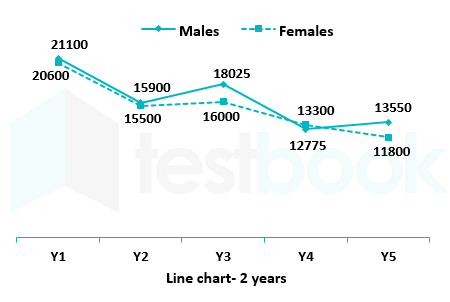
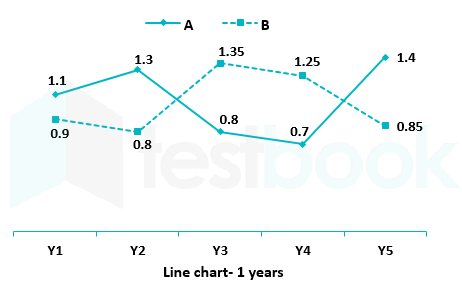
Two line charts are given below. Line chart 1 shows the ratio of number of males to the number of females in two companies A and B for the 5 years. Line chart 2 shows the total number of males (both companies A and B) and total number of females (both companies A and B) for the 5 years.

What is the ratio of number of males of company B in Y1 to the total number of females of company A in Y3 and Y5 ?

  1. AOption (a)

    117 ∶ 218

  2. BOption (b)

    117 ∶ 215

  3. COption (c)

    129 ∶ 215

  4. DOption (d)

    119 ∶ 218

View answer & explanation

Correct answer

Answer: (b)B.

117 ∶ 215

Why this answer is correct

Concept used:

If Ratio of two numbers is given as 1.1 , then the numbers would be written as 11x and 10x where x is HCF of both numbers.

Calculations:

Let the number of males and females in company A in Y1 be 11k and 10k respectively and the number of males and females in company B in Y2 be 9m and 10m respectively.Then,

11k + 9m = 21100 ---------(1)

And 10k + 10m = 20600 ----(2)

On solving (1) and (2), we get:

m = 780

So, The number of males in Company B in Y1 is 9m = 9(780) = 7020

Similarly let is assume the number of males and females in company B in Y3 be 27t and 20t respectively and the number of males and females in company A  in Y3 be 16l and 20l respectively. Then,

27t + 16l = 18025

And 20t + 20l = 16000

On solving (3) and (4), we get:

t = 475 and l = 325

So, Total number of females in company A in Y3 = 20l = 20(325) = 6500

Now, Let the number of males and females in company A in Y5 be 28x and 20x respectively and the number of males and females in company B in Y5 be 17y and 20y respectively.Then,

28x + 17y = 13550 ------------(5)

And 20x + 20y = 11800 ------(6)

On solving equations (5) and (6) , we get :

x = 320 

So, The number of females in company A in Y5

= 20x

= 20(320)

= 6400

Now, required ratio

= 7020 : (6500 + 6400)

= 7020 : 12900

= 117 : 215

Hence,  The Required value is 117 : 215.

Question 13

What is the value of 7+57−5÷14+1014−10+105\frac{\sqrt{7}+\sqrt{5}}{\sqrt{7}−\sqrt{5}} \div \frac{\sqrt{14}+\sqrt{10}}{\sqrt{14}−\sqrt{10}}+\frac{\sqrt{10}}{\sqrt{5}} ?

  1. AOption (a)

    2\sqrt{2} + 2

  2. BOption (b)

    22\sqrt{2} + 2

  3. COption (c)

    2\sqrt{2} + 1

  4. DOption (d)

    22\sqrt{2} + 1

View answer & explanation

Correct answer

Answer: (c)C.

2\sqrt{2} + 1

Why this answer is correct

Given:

7+57−5÷14+1014−10+105\frac{\sqrt{7}+\sqrt{5}}{\sqrt{7}-\sqrt{5}} \div \frac{\sqrt{14}+\sqrt{10}}{\sqrt{14}-\sqrt{10}}+\frac{\sqrt{10}}{\sqrt{5}}

Formula used:

a×b=a×b\sqrt{a \times b} = \sqrt{a} \times \sqrt{b}

ab=ab\frac{\sqrt{a}}{\sqrt{b}} = \sqrt{\frac{a}{b}}

Calculations:

⇒ 7+57−5÷2×7+2×52×7−2×5+105\frac{\sqrt{7}+\sqrt{5}}{\sqrt{7}-\sqrt{5}} \div \frac{\sqrt{2 \times 7}+\sqrt{2 \times 5}}{\sqrt{2 \times 7}-\sqrt{2 \times 5}} + \sqrt{\frac{10}{5}}

⇒ 7+57−5÷2(7+5)2(7−5)+2\frac{\sqrt{7}+\sqrt{5}}{\sqrt{7}-\sqrt{5}} \div \frac{\sqrt{2}(\sqrt{7}+\sqrt{5})}{\sqrt{2}(\sqrt{7}-\sqrt{5})} + \sqrt{2}

⇒ 7+57−5÷7+57−5+2\frac{\sqrt{7}+\sqrt{5}}{\sqrt{7}-\sqrt{5}} \div \frac{\sqrt{7}+\sqrt{5}}{\sqrt{7}-\sqrt{5}} + \sqrt{2}

⇒ 1 + 2\sqrt{2}

∴ The correct answer is option (3).

Question 14

The ratio of milk to water in a 100 litres mixture is 2 ∶ 3. 10 litres of this mixture is withdrawn and replaced with milk. This process is repeated 2 more times, What is the percentage of milk in final mixture ?

  1. AOption (a)

    56.26 percent

  2. BOption (b)

    54.27 percent

  3. COption (c)

    58.21 percent

  4. DOption (d)

    51.24 percent

View answer & explanation

Correct answer

Answer: (a)A.

56.26 percent

Why this answer is correct

Shortcut Trick

Initial Water Percentage = (3/5) × 100 = 60%

In each step, 10/100 = 1/10 of the mixture is replaced, leaving (1 − 1/10) = 9/10 of the water.

After 3 operations, Final Water % = 60 × (9/10) × (9/10) × (9/10) = 43.74%

Final Milk Percentage = 100% − 43.74% = 56.26%

∴ The correct answer is 56.26 percent.

Alternate Method

Given: Total volume = 100 L, Initial Milk:Water = 2:3, Process repeated 3 times total.

Formula for quantity of component not added: Final Qty = Initial Qty × (1 − x/V)n

⇒ Initial Water = (3 / (2 + 3)) × 100 = 60 L

⇒ Final Water = 60 × (1 − 10/100)3

⇒ Final Water = 60 × (0.9)3

⇒ Final Water = 60 × 0.729 = 43.74 L

⇒ Final Milk = Total Volume − Final Water

⇒ Final Milk = 100 − 43.74 = 56.26 L

⇒ Percentage of Milk = (56.26 / 100) × 100 = 56.26%

∴ The correct answer is 56.26 percent.

Additional Information

Successive Replacement Formula

Final Quantity = Initial Quantity × (1 − x/V)n, where x is volume replaced, V is total volume, and n is number of times.

Mixture Concentration

If multiple replacements are made with different volumes x1, x2, ..., the factor becomes (1 − x1/V)(1 − x2/V)...

Relative Removal

When mixture is withdrawn, all components are removed in the same ratio as they exist in the mixture at that moment.

Question 15

ABC is an equilateral triangle. If the area of the triangle is 36√3, then what is the radius of circle circumscribing the triangle ABC ?

  1. AOption (a)

    2√3

  2. BOption (b)

    3√3

  3. COption (c)

    4√3

  4. DOption (d)

    6√3

View answer & explanation

Correct answer

Answer: (c)C.

4√3

Why this answer is correct

Shortcut Trick

Area of equilateral triangle = (√3 / 4) × side2 = 36√3

⇒ side2 = 36 × 4 = 144 ⇒ side = 12

Direct Formula: Circumradius (R) = side / √3

⇒ R = 12 / √3 = 4√3

∴ The correct answer is 4√3.

Alternate Method

Given:

Area of equilateral triangle ABC = 36√3

Formula Used:

  1. Area of equilateral triangle = (√3 / 4) × a2 (where a is the side)
  2. Circumradius (R) of equilateral triangle = a / √3

Calculations:

⇒ Area = (√3 / 4) × a2 = 36√3

⇒ a2 = (36√3 × 4) / √3

⇒ a2 = 144

⇒ a = √144 = 12

⇒ Circumradius (R) = a / √3

⇒ R = 12 / √3

⇒ R = (4 × 3) / √3

⇒ R = 4√3

∴ The correct answer is 4√3.

Additional Information

Inradius of Equilateral Triangle

The radius of the incircle (r) is given by r = a / (2√3). It is exactly half of the circumradius (R = 2r).

Height of Equilateral Triangle

The altitude or height (h) is given by h = (√3 / 2) × a. Note that h = R + r = 3r.

Area in terms of Height

The area of an equilateral triangle can also be calculated as Area = h2 / √3.

Question 16

ABC is a right angle triangle and angle ABC = 90 degrees. BD is a perpendicular on the side AC. What is the value of BD2 ?

  1. AOption (a)

    AD × DC

  2. BOption (b)

    BC × AB

  3. COption (c)

    BC × CD

  4. DOption (d)

    AD × AC

View answer & explanation

Correct answer

Answer: (a)A.

AD × DC

Why this answer is correct

Shortcut Trick

In a right-angled triangle, the altitude drawn to the hypotenuse divides the triangle into two similar triangles.

According to the Right Triangle Altitude Theorem (Geometric Mean Theorem):

The square of the altitude (BD) is equal to the product of the segments of the hypotenuse (AD and DC).

BD2 = AD × DC

∴ The correct answer is AD × DC.

Alternate Method

Given: ABC is a right-angled triangle where ∠ABC = 90° and BD ⊥ AC.

Formula Used: Similarity of triangles (AA criterion) and ratio of corresponding sides.

⇒ In ▵ABD and ▵BCD:

⇒ ∠ADB = ∠BDC = 90° (Since BD ⊥ AC)

⇒ ∠BAD = 90° − ∠ABD (In ▵ABD)

⇒ ∠CBD = 90° − ∠ABD (Since ∠ABC = 90°)

⇒ ∴ ∠BAD = ∠CBD

⇒ By AA Similarity, ▵ABD ∼ ▵BCD

⇒ Corresponding sides are in proportion: BD/AD = DC/BD

⇒ Cross-multiplying: BD × BD = AD × DC

⇒ BD2 = AD × DC

∴ The correct answer is AD × DC.

Additional Information

Leg Rule in Right Triangles

The square of a leg is equal to the product of the hypotenuse and the segment of the hypotenuse adjacent to that leg: AB2 = AD × AC and BC2 = CD × AC.

Area-Altitude Relationship

The product of the legs of a right triangle is equal to the product of the hypotenuse and the altitude to the hypotenuse: AB × BC = AC × BD.

Reciprocal Property

The reciprocal of the square of the altitude is equal to the sum of the reciprocals of the squares of the legs: 1/BD2 = 1/AB2 + 1/BC2.

Question 17

If N3\sqrt[3]{\text{N}} lies between 6 and 7, where N is an integer then how many values N can take ?

  1. AOption (a)

    126

  2. BOption (b)

    127

  3. COption (c)

    128

  4. DOption (d)

    125

View answer & explanation

Correct answer

Answer: (a)A.

126

Why this answer is correct

Shortcut Trick Convert the range of cube roots to the range of the integer N by cubing the limits. Lower limit for N = 63 = 216 Upper limit for N = 73 = 343 Number of integer values between 216 and 343 = (343 − 216 − 1) = 126 ∴ The correct answer is 126 values.

Alternate Method Given: 3√N lies between 6 and 7, where N is an integer. Formula Used: Count of integers strictly between two numbers x and y = (y − x − 1).

⇒ 6 < 3√N < 7 ⇒ Cubing all terms: 63 < (N1/3)3 < 73 ⇒ 216 < N < 343 ⇒ Since N is an integer, N can take any value in the set {217, 218, 219, ..., 342}. ⇒ Total values of N = 342 − 217 + 1 ⇒ Total values = 125 + 1 = 126 ∴ The correct answer is 126 values.

Additional Information Number of Integers in a Range For any two integers a and b (where a < b), the count of integers between them is (b − a − 1) if both are excluded, and (b − a + 1) if both are included. Properties of Powers and Roots If x > 0 and y > 0, then x < y ⇒ xn < yn for any positive power n. This allows us to cube inequalities to find the range of N. Perfect Cubes Table Common cubes for exams: 53=125, 63=216, 73=343, 83=512, 93=729, 103=1000.

Question 18

An article is sold at 25 percent loss. If its cost price is doubled and selling price is increased by Rs. 660, then there is a profit of 20 percent. What is the original cost price of the article ?

  1. AOption (a)

    Rs. 480

  2. BOption (b)

    Rs. 500

  3. COption (c)

    Rs. 400

  4. DOption (d)

    Rs. 360

View answer & explanation

Correct answer

Answer: (c)C.

Rs. 400

Why this answer is correct

Shortcut Trick

Let the original Cost Price (CP1) = 100 units.

Original Selling Price (SP1) = 100 − 25% of 100 = 75 units.

New CP (CP2) = 2 × 100 = 200 units.

New SP (SP2) = 200 + 20% profit = 200 + 40 = 240 units.

Difference in SP = 240 − 75 = 165 units → ₹660.

1 unit = 660 ÷ 165 = ₹4. ∴ Original CP = 100 units = 100 × 4 = ₹400.

∴ The correct answer is ₹400.

Alternate Method

Given: Original Loss = 25%, New CP = 2 × Original CP, SP Increase = ₹660, New Profit = 20%.

Formula: SP = CP × (100 ± P/L)%

⇒ Let original CP = x

⇒ Original SP = x × (100 − 25) / 100 = 0.75x

⇒ New CP = 2 × x = 2x

⇒ New SP = 2x × (100 + 20) / 100 = 2x × 1.2 = 2.4x

⇒ Given: New SP − Original SP = 660

⇒ 2.4x − 0.75x = 660

⇒ 1.65x = 660

⇒ x = 660 ÷ 1.65

⇒ x = 66000 ÷ 165 = 400

∴ The correct answer is ₹400.

Additional Information

Profit and Loss Basics

Profit = SP − CP and Loss = CP − SP. Profit% or Loss% is always calculated on CP unless stated otherwise.

Successive Percentage Change

If CP changes by a% and then profit/loss b% is applied, the effective change from original CP is calculated as [a + b + (ab/100)].

Marked Price and Discount

SP = Marked Price × (100 − Discount)% / 100. Relation: CP/MP = (100 − D%)/(100 + P%).

Question 19

Average age of 7 students of a class is 28 years. Average age of first three students is 30 years. Age of fourth student is 4 years less than the age of fifth student. Ages of last two students is same and is 5 more than the average age of first three students. What is the average age of fourth and fifth student ?

  1. AOption (a)

    20 years

  2. BOption (b)

    36 years

  3. COption (c)

    16 years

  4. DOption (d)

    18 years

View answer & explanation

Correct answer

Answer: (d)D.

18 years

Why this answer is correct

Shortcut Trick

Total sum of ages = 7 × 28 = 196 years.

Sum of first 3 students = 3 × 30 = 90 years.

Age of each of the last 2 students = 30 + 5 = 35 years.

Sum of last 2 students = 2 × 35 = 70 years.

Remaining sum for 4th and 5th student = 196 − (90 + 70) = 36 years.

Average of 4th and 5th student = 36 ÷ 2 = 18 years.

∴ The correct answer is 18 years.

Alternate Method

Given:

Number of students = 7

Average age of 7 students = 28 years

Average age of first 3 students = 30 years

Ages of last 2 students = Average of first 3 + 5

Formula: Average = Sum of observations ÷ Total number of observations

⇒ Total age of 7 students = 7 × 28 = 196 years

⇒ Sum of first 3 students = 3 × 30 = 90 years

⇒ Age of 6th student = Age of 7th student = 30 + 5 = 35 years

⇒ Sum of ages of 6th and 7th student = 35 + 35 = 70 years

⇒ Let age of 5th student be x. Then age of 4th student = x − 4

⇒ Sum of 4th and 5th student = (x − 4) + x = 2x − 4

⇒ 196 = 90 + (2x − 4) + 70

⇒ 196 = 160 + 2x − 4

⇒ 196 = 156 + 2x

⇒ 2x = 196 − 156 = 40

⇒ x = 20 years (Age of 5th student)

⇒ Age of 4th student = 20 − 4 = 16 years

⇒ Average of 4th and 5th student = (16 + 20) ÷ 2 = 36 ÷ 2 = 18 years

∴ The correct answer is 18 years.

Additional Information

Weighted Average

When two or more groups with different averages are combined, the overall average = (n1×a1 + n2×a2) ÷ (n1 + n2).

Sum and Difference Property

If the sum of two numbers is S and their difference is D, then the average of the two numbers is simply S ÷ 2, regardless of the difference.

Effect of Constant Change

If every observation in a set is increased or decreased by a constant k, the average of the set also increases or decreases by k.

Question 20

The compound interest (compounding annually) on a certain sum at the rate of 8 percent per annum for two years is Rs. 6656. What would be the simple interest on the same sum at the same rate of interest for two years?

  1. AOption (a)

    Rs. 5600

  2. BOption (b)

    Rs. 6224

  3. COption (c)

    Rs. 6400

  4. DOption (d)

    Rs. 6336

View answer & explanation

Correct answer

Answer: (c)C.

Rs. 6400

Why this answer is correct

Shortcut Trick

Effective rate of CI for 2 years = R + R + (R × R) / 100 = 8 + 8 + (8 × 8) / 100 = 16.64%

Effective rate of SI for 2 years = R × T = 8 × 2 = 16%

Given: 16.64% of Sum = Rs. 6656

Required: 16% of Sum = (6656 ÷ 16.64) × 16 = 400 × 16 = 6400

∴ The correct answer is Rs. 6400.

Alternate Method

Given:

Compound Interest (CI) = Rs. 6656

Rate of Interest (R) = 8% per annum

Time (T) = 2 years

Formula:

CI = P[(1 + R/100)T − 1]

SI = (P × R × T) ÷ 100

Calculations:

⇒ 6656 = P[(1 + 8/100)2 − 1]

⇒ 6656 = P[(108/100)2 − 1]

⇒ 6656 = P[(27/25)2 − 1]

⇒ 6656 = P[729/625 − 1]

⇒ 6656 = P[(729 − 625) ÷ 625]

⇒ 6656 = P × (104 ÷ 625)

⇒ P = (6656 × 625) ÷ 104

⇒ P = 64 × 625

⇒ P = Rs. 40000

Now, calculate SI on the same sum:

⇒ SI = (40000 × 8 × 2) ÷ 100

⇒ SI = 400 × 16

⇒ SI = Rs. 6400

∴ The correct answer is Rs. 6400.

Additional Information

Difference between CI and SI for 2 years

The difference (D) between CI and SI for a period of 2 years is given by D = P(R/100)2.

Relation between CI and SI for 2 years

CI = SI × (1 + R/200) or SI = CI × [200 ÷ (200 + R)]. For 2 years, CI is always greater than or equal to SI.

Effective Rate of Interest

For Compound Interest, the effective rate for n years can be calculated using successive percentage formula: reff = x + y + (xy/100).

Question 21

Salaries of B, C, D and E are in the ratio of 2 ∶ 3 ∶ 4 ∶ 5 respectively. Their salaries are increased by 20 percent, 30 percent, 40 percent and 50 percent respectively. If the increased salary of D is Rs. 560, then what is the sum of the original salaries of B, C, D and E ?

  1. AOption (a)

    Rs. 1400

  2. BOption (b)

    Rs. 1560

  3. COption (c)

    Rs. 1820

  4. DOption (d)

    Rs. 1260

View answer & explanation

Correct answer

Answer: (a)A.

Rs. 1400

Why this answer is correct

Shortcut Trick

Ratio of B : C : D : E = 2 : 3 : 4 : 5. Total = 14 units.

Increased salary of D = 4 × (100 + 40)% = 4 × 1.4 = 5.6 units.

Given 5.6 units = Rs. 560 ⇒ 1 unit = Rs. 100.

Sum of original salaries = 14 units = 14 × 100 = Rs. 1400.

∴ The correct answer is Rs. 1400.

Alternate Method

Given:

Ratio of salaries = 2 : 3 : 4 : 5

Salary increases = 20%, 30%, 40%, 50%

Increased D salary = Rs. 560

Formula Used:

Increased Value = Original Value × (1 + Increase%/100)

Let original salaries be 2x, 3x, 4x, and 5x.

⇒ Increased salary of D = 4x × (140/100)

⇒ 4x × 1.4 = 560

⇒ 5.6x = 560

⇒ x = 560 ÷ 5.6

⇒ x = 100

⇒ Sum of original salaries = 2x + 3x + 4x + 5x = 14x

⇒ Total Sum = 14 × 100 = 1400

∴ The correct answer is Rs. 1400.

Additional Information

Percentage Increase Formula

To find the new value after a percentage increase r%, use: New Value = Old Value × (1 + r/100).

Ratio and Multiplier

If components A, B, and C are in ratio a:b:c, their actual values can be represented as ak, bk, and ck where k is a common multiplier.

Successive Percentage Change

When a value is increased by x% and then y%, the effective change is [x + y + (xy/100)]%.

Question 22

A person sells an article for a loss of 18 percent. If he increases the selling price by Rs. 144 and decreases the cost price by 30 percent, then there is profit of 20 percent. What is the original selling price ?

  1. AOption (a)

    Rs. 5068

  2. BOption (b)

    Rs. 6036

  3. COption (c)

    Rs. 5904

  4. DOption (d)

    Rs. 6124

View answer & explanation

Correct answer

Answer: (c)C.

Rs. 5904

Why this answer is correct

Shortcut Trick

Assume original CP = 100 units.

Original SP = 100 − 18 = 82 units.

New CP = 100 − 30% = 70 units.

New SP = 120% of 70 = 84 units.

Difference in SP = 84 − 82 = 2 units → Rs. 144.

1 unit = 72 ∴ Original SP = 82 × 72 = Rs. 5904.

∴ The correct answer is Rs. 5904.

Alternate Method

Given:

Initial loss = 18%

Increase in SP = Rs. 144

Decrease in CP = 30%

Final Profit = 20%

Calculations:

Let the original cost price be 100x.

⇒ Original Selling Price = 100x − 18% of 100x = 82x

⇒ New Cost Price = 100x − 30% of 100x = 70x

⇒ New Selling Price = 70x + 20% of 70x

⇒ New Selling Price = 70x + 14x = 84x

⇒ Difference in Selling Prices = New SP − Original SP

⇒ 84x − 82x = 144

⇒ 2x = 144

⇒ x = 72

⇒ Original Selling Price = 82x = 82 × 72

⇒ Original Selling Price = Rs. 5904

∴ The correct answer is Rs. 5904.

Additional Information

Profit and Loss Basic Formulas

Profit = SP − CP; Loss = CP − SP. Profit% = (Profit/CP) × 100; Loss% = (Loss/CP) × 100.

Marked Price and Discount

SP = Marked Price − Discount. Discount% = (Discount/MP) × 100.

Selling Price for Profit/Loss

SP = CP × (100 + Profit%)/100 or SP = CP × (100 − Loss%)/100.

Question 23

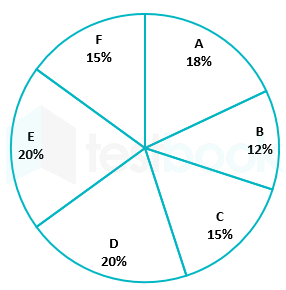
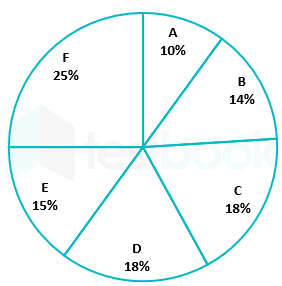
Two pie charts are given below. There are 6 departments in a office. Pie chart 1 shows the number of males in these 6 departments. Number of males in a particular department is shown as a percentage of total number of males in these 6 departments. Pie chart 2 shows the number of females in these 6 departments. Number of females in a particular department is shown as a percentage of total number of females in these 6 departments.

Difference between the number of males in B and C is 600 and difference between the number of females in D and E is 900. What is the sum of number of females in A, B, F and number of males in D, E, A ?

  1. AOption (a)

    26300

  2. BOption (b)

    29400

  3. COption (c)

    26800

  4. DOption (d)

    25700

View answer & explanation

Correct answer

Answer: (a)A.

26300

Why this answer is correct

Given:

Males(B% - C%) = 3% = 600     (∵ The value 3% is taken from given pie chart)

Females(D% - E%) = 3% = 900

Solution:

Male(1%) = 600/3 = 200 males

Females(1%) = 900/3 = 300 females

Now, 

Female(A% + B% + F%) + Male(D% + E% + A%)

= Female(10% + 14% + 25%) + Male(20% + 20% + 18%)

= Female(49%) + Male(58%) = (49 x 300) + (58 x 200) = 26300

Hence, the sum of the number of females in A, B, and F and the number of males in D, E, and A is 26300.

Question 24

The slant height of a cone is 20 cm. If area of its base is 616 cm2, then what is the curved surface area of this cone ? (use π = 22/7)

  1. AOption (a)

    960 cm2

  2. BOption (b)

    440 cm2

  3. COption (c)

    1760 cm2

  4. DOption (d)

    880 cm2

View answer & explanation

Correct answer

Answer: (d)D.

880 cm2

Why this answer is correct

Shortcut Trick

Standard Circle Data: Radius 7 → Area 154 | Radius 14 → Area 616.

Base Area = 616 cm2 ⇒ Radius (r) = 14 cm.

Slant height (l) = 20 cm.

CSA = π × r × l = (22/7) × 14 × 20 = 44 × 20 = 880 cm2.

∴ The correct answer is 880 cm2.

Alternate Method

Given:

Slant height (l) = 20 cm

Area of base = 616 cm2

Value of π = 22/7

Formula Used:

Area of base of cone = πr2

Curved Surface Area (CSA) of cone = πrl

Calculations:

⇒ Area of base = πr2 = 616

⇒ (22/7) × r2 = 616

⇒ r2 = 616 × (7/22)

⇒ r2 = 28 × 7 = 196

⇒ r = √196 = 14 cm

⇒ Curved Surface Area (CSA) = π × r × l

⇒ CSA = (22/7) × 14 × 20

⇒ CSA = 22 × 2 × 20

⇒ CSA = 880 cm2

∴ The correct answer is 880 cm2.

Additional Information

Total Surface Area of Cone

The total surface area includes the curved surface and the base area: TSA = πr(l + r).

Volume of a Cone

The space occupied by the cone is given by: Volume = (1/3) × πr2h, where h is the vertical height.

Slant Height Relation

The relationship between slant height (l), vertical height (h), and radius (r) is: l2 = r2 + h2.

Question 25

The height of a cylinder is 6 cm more than the radius of its base. If its radius is 14 cm, then what will be volume of this cylinder ? (use π = 22/7)

  1. AOption (a)

    13560 cm3

  2. BOption (b)

    14340 cm3

  3. COption (c)

    10440 cm3

  4. DOption (d)

    12320 cm3

View answer & explanation

Correct answer

Answer: (d)D.

12320 cm3

Why this answer is correct

Shortcut Trick

Given: Radius (r) = 14 cm.

Height (h) = Radius + 6 = 14 + 6 = 20 cm.

Volume = πr2h = (22/7) × 14 × 14 × 20.

Volume = 44 × 14 × 20 = 12320 cm3.

∴ The correct answer is 12320 cm3.

Alternate Method

Given:

Radius of base (r) = 14 cm

Height of cylinder (h) = r + 6 cm

Formula Used:

Volume of Cylinder (V) = π × r2 × h

Calculations:

⇒ Radius (r) = 14 cm

⇒ Height (h) = 14 + 6 = 20 cm

⇒ Volume (V) = (22/7) × 14 × 14 × 20

⇒ V = 22 × (14 ÷ 7) × 14 × 20

⇒ V = 22 × 2 × 14 × 20

⇒ V = 44 × 280

⇒ V = 12320 cm3

∴ The correct answer is 12320 cm3.

Additional Information

Curved Surface Area of Cylinder

The area of the curved part of the cylinder is given by CSA = 2πrh.

Total Surface Area of Cylinder

The sum of the areas of the curved surface and the two circular bases: TSA = 2πr(h + r).

Volume Conversion

1 cm3 = 1 mL and 1000 cm3 = 1 Liter.

Question 26

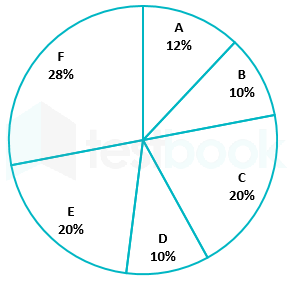
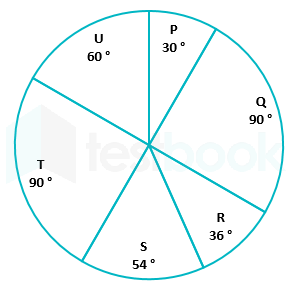
The pie chart given below shows the number of tyres of 6 companies. Number of tyres of a particular company are shown as a percentage of total number of tyres of these 6 companies.

What is the sum of central angles formed by the sectors representing tyres of company F and A ?

  1. AOption (a)

    84 degrees

  2. BOption (b)

    108 degrees

  3. COption (c)

    144 degrees

  4. DOption (d)

    112 degrees

View answer & explanation

Correct answer

Answer: (c)C.

144 degrees

Why this answer is correct

Given:

A% = 12%

F% = 28%

Formula used:

360° = 100%

Solution:

1% = 3.6°

Now, the sum of central angle formed by A & F = 12% + 28% = 40%

40% = 40 x 3.6° = 144°

Hence, the sum of central angles formed by the sectors representing tyres of Company F and A is 144 degrees.

Question 27

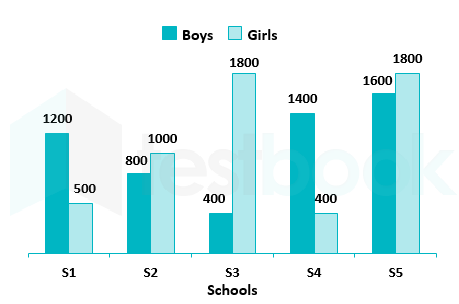
The bar chart given below shows the number of boys and girls in 5 schools.

If the number of boys in school S6 are 30 percent more than the number of girls in school S1, then number of girls in schools S3 and S4 is what percentage of number of boys in schools S6 and S1 ? (correct to two decimal places)

  1. AOption (a)

    110.92

  2. BOption (b)

    140.48

  3. COption (c)

    124.62

  4. DOption (d)

    118.92

View answer & explanation

Correct answer

Answer: (d)D.

118.92

Why this answer is correct

Given:

Boys(S6) = Girls(S1) + 0.3[Girls(S1)]

Girls(S1) = 500

Solution:

Boys(S6) = 500 + 0.3(500) = 650 

Girls(S3 + S4) = m x Boys(S6 + S1)

From the graph,

1800 + 400 = m x (650 + 1200)

2200 = m x (1850)

m = 220/185 = 1.1892

m% = 118.92%

Hence, the number of girls in schools S3 and S4 is 118.92% of the number of boys in schools S6 and S1.

<br>

Confusion point - If the number of boys in school S6 are 30 percent more than the number of girls in school S1 (Clearly mentioned in the question), S6 is not directly given we have to calculate the value of S6 From S1, and by the given relation between them.

Question 28

Volume of a cuboid is 4800 cm3. If the height of this cuboid is 20 cm, then what will be the area of the base of cuboid ?

  1. AOption (a)

    150 cm2

  2. BOption (b)

    240 cm2

  3. COption (c)

    480 cm2

  4. DOption (d)

    120 cm2

View answer & explanation

Correct answer

Answer: (b)B.

240 cm2

Why this answer is correct

Shortcut Trick

Area of base = Volume ÷ Height

Area of base = 4800 ÷ 20

Area of base = 240 cm2

∴ The correct answer is 240 cm2.

Alternate Method

Given:

Volume of the cuboid = 4800 cm3

Height of the cuboid = 20 cm

Formula Used:

Volume of a cuboid = Length × Breadth × Height

Volume of a cuboid = Area of base × Height

Calculations:

⇒ Volume = Area of base × Height

⇒ 4800 = Area of base × 20

⇒ Area of base = 4800 ÷ 20

⇒ Area of base = 240 cm2

∴ The correct answer is 240 cm2.

Additional Information

Total Surface Area of Cuboid

The total area of all six faces is given by 2(lb + bh + hl), where l, b, and h are length, breadth, and height.

Lateral Surface Area of Cuboid

The area of the four side walls (excluding top and bottom) is 2h(l + b).

Diagonal of a Cuboid

The longest rod that can be placed inside a cuboid is its diagonal, calculated as √(l2 + b2 + h2).

Question 29

Radius of a large solid sphere is 14 cm. If is melted to form 8 equal small solid sphere. What is the sum of total surface areas of all the 8 small solid spheres ? (use π = 22/7)

  1. AOption (a)

    3648 cm2

  2. BOption (b)

    4928 cm2

  3. COption (c)

    4244 cm2

  4. DOption (d)

    4158 cm2

View answer & explanation

Correct answer

Answer: (b)B.

4928 cm2

Why this answer is correct

Shortcut Trick

If a large sphere of radius R is melted into n equal small spheres of radius r, then r = R ÷ n1/3.

Here n = 8, so r = 14 ÷ 81/3 = 14 ÷ 2 = 7 cm.

Sum of Surface Areas of n small spheres = n × 4πr2.

Sum = 8 × 4 × (22/7) × 7 × 7 = 32 × 154 = 4928 cm2.

∴ The correct answer is 4928 cm2.

Alternate Method

Given:

Radius of large sphere (R) = 14 cm

Number of small spheres (n) = 8

Formula Used:

Volume of Sphere = (4/3)πr3

Total Surface Area (TSA) of Sphere = 4πr2

Calculations:

⇒ Volume of large sphere = 8 × Volume of one small sphere

⇒ (4/3) × π × (14)3 = 8 × (4/3) × π × r3

⇒ 14 × 14 × 14 = 8 × r3

⇒ r3 = (14 × 14 × 14) ÷ 8

⇒ r3 = 2744 ÷ 8 = 343

⇒ r = √3(343) = 7 cm

⇒ TSA of one small sphere = 4 × (22/7) × 7 × 7

⇒ TSA of one small sphere = 4 × 22 × 7 = 616 cm2

⇒ Sum of TSA of all 8 small spheres = 8 × 616

⇒ Sum of TSA = 4928 cm2

∴ The correct answer is 4928 cm2.

Additional Information

Volume and Surface Area Scaling

If the radius of a sphere is scaled by a factor k, the volume scales by k3 and the surface area scales by k2.

Hemisphere Formulas

For a solid hemisphere of radius r, Volume = (2/3)πr3, Curved Surface Area = 2πr2, and Total Surface Area = 3πr2.

Mass and Density Relation

When an object is melted and recast, its volume remains constant (provided there is no material loss), such that Vinitial = Vfinal.

Question 30

Which of the following is equal to sec A − cos A ?

  1. AOption (a)

    sin A.cot A

  2. BOption (b)

    cot A.cos A

  3. COption (c)

    tan A.sin A

  4. DOption (d)

    cos A.sin A

View answer & explanation

Correct answer

Answer: (c)C.

tan A.sin A

Why this answer is correct

Shortcut Trick

Convert terms into sine and cosine: sec A − cos A = (1/cos A) − cos A

Take the LCM: (1 − cos2 A) / cos A

Using identity sin2 A + cos2 A = 1: sin2 A / cos A

Split the term: (sin A / cos A) × sin A = tan A × sin A

∴ The correct answer is tan A.sin A.

Alternate Method

Given expression: sec A − cos A

Formula used: sec A = 1/cos A; tan A = sin A/cos A; sin2 A + cos2 A = 1

⇒ sec A − cos A = (H/B) − (B/H)

⇒ sec A − cos A = (H2 − B2) / (BH)

⇒ In right triangle, H2 − B2 = P2

⇒ sec A − cos A = P2 / (BH)

⇒ sec A − cos A = (P/B) × (P/H)

⇒ sec A − cos A = tan A × sin A

∴ The correct answer is tan A.sin A.

Additional Information

Fundamental Trigonometric Identities

The three main Pythagorean identities are: sin2 A + cos2 A = 1, 1 + tan2 A = sec2 A, and 1 + cot2 A = cosec2 A.

Reciprocal Relations

Trigonometric ratios are related as: sin A = 1/cosec A, cos A = 1/sec A, and tan A = 1/cot A.

Quotient Identities

The tangent and cotangent can be expressed as: tan A = sin A / cos A and cot A = cos A / sin A.

Question 31

ABC and PQR are two triangles. AB = PQ = 6 cm, BC = QR = 10 cm and AC = PR = 8 cm. If angle ABC = x degree, then what is the value of angle PRQ ?

  1. AOption (a)

    (180 − x) degree

  2. BOption (b)

    x degree

  3. COption (c)

    (90 − x) degree

  4. DOption (d)

    (90 + x) degree

View answer & explanation

Correct answer

Answer: (c)C.

(90 − x) degree

Why this answer is correct

Shortcut Trick

Sides 6, 8, and 10 form a Pythagorean triple because 62 + 82 = 102 (36 + 64 = 100).

Thus, both ΔABC and ΔPQR are right-angled triangles with the longest side (10 cm) as the hypotenuse.

In ΔABC, BC is the hypotenuse ⇒ ∠A = 90°. So, ∠ABC + ∠ACB = 90°.

Since the triangles are congruent (SSS rule), ∠PRQ = ∠ACB.

Given ∠ABC = x, then ∠ACB = 90° − x.

∴ The correct answer is (90 − x) degree.

Alternate Method

Given: AB = PQ = 6 cm, BC = QR = 10 cm, AC = PR = 8 cm, and ∠ABC = x°.

Formula: In a right-angled triangle, the two acute angles are complementary (sum to 90°).

⇒ In ΔABC, sides are 6, 8, 10. Check: 62 + 82 = 36 + 64 = 100 = 102.

⇒ Since BC2 = AB2 + AC2, ∠BAC = 90°.

⇒ In ΔABC, ∠ABC + ∠ACB + ∠BAC = 180°

⇒ x + ∠ACB + 90° = 180° ⇒ ∠ACB = 90° − x.

⇒ Since AB = PQ, BC = QR, and AC = PR, then ΔABC ≅ ΔPQR (By SSS Congruence Rule).

⇒ Corresponding parts of congruent triangles (CPCT) are equal, so ∠PRQ = ∠ACB.

⇒ ∠PRQ = 90° − x.

∴ The correct answer is (90 − x) degree.

Additional Information

SSS Congruence Rule

If three sides of one triangle are equal to the three sides of another triangle, then the two triangles are congruent.

Pythagorean Triplets

Sets of three positive integers (a, b, c) such that a2 + b2 = c2, which always form a right-angled triangle (e.g., 3-4-5, 6-8-10, 5-12-13).

Complementary Angles

In any right-angled triangle, the two non-right angles always add up to 90°, making them complementary to each other.

Question 32

ABCD is a quadrilateral. The length of the diagonal AC is 24 cm. The sum of the perpendicular drawn from vertex B and D on the diagonal AC is 10 cm. What is the area of the quadrilateral?

  1. AOption (a)

    240 cm2

  2. BOption (b)

    180 cm2

  3. COption (c)

    120 cm2

  4. DOption (d)

    90 cm2

View answer & explanation

Correct answer

Answer: (c)C.

120 cm2

Why this answer is correct

Shortcut Trick

Area of a quadrilateral given one diagonal and perpendiculars from opposite vertices is calculated as:

Area = 1/2 × Diagonal × (Sum of perpendiculars)

Area = 1/2 × 24 × 10

Area = 12 × 10 = 120 cm2

∴ The correct answer is 120 cm2.

Alternate Method

Given:

Length of diagonal (AC) = 24 cm

Sum of perpendiculars (h1 + h2) = 10 cm

Formula used:

Area of Quadrilateral = Area of ΔABC + Area of ΔADC

Area = (1/2 × AC × h1) + (1/2 × AC × h2) = 1/2 × AC × (h1 + h2)

Calculations:

⇒ Area = 1/2 × AC × (h1 + h2)

⇒ Area = 1/2 × 24 × 10

⇒ Area = 12 × 10

⇒ Area = 120 cm2

∴ The correct answer is 120 cm2.

Additional Information

Area of Rhombus

If d1 and d2 are the lengths of the two diagonals of a rhombus, then Area = 1/2 × d1 × d2.

Area of Trapezium

Area = 1/2 × (Sum of parallel sides) × Height = 1/2 × (a + b) × h.

Area of Parallelogram

Area = Base × Corresponding Height = b × h.

Question 33

The ratio of monthly incomes of A and B is 4 ∶ 5 respectively. The ratio of monthly savings of A and B is 14 ∶ 19 respectively. If the monthly expenditure of A and B is Rs. 1200 each, then what is the difference between the monthly incomes of A and B?

  1. AOption (a)

    Rs. 2000

  2. BOption (b)

    Rs. 4000

  3. COption (c)

    Rs. 1000

  4. DOption (d)

    Rs. 5000

View answer & explanation

Correct answer

Answer: (c)C.

Rs. 1000

Why this answer is correct

Shortcut Trick

Income Ratio = 4 : 5 | Savings Ratio = 14 : 19 | Constant Expenditure = Rs. 1200

Using Cross-Product Method: (4 × 19) − (5 × 14) = 76 − 70 = 6 units

Equating to Expenditure Change: 1200 × (19 − 14) = 1200 × 5 = Rs. 6000

6 units = Rs. 6000 ⇒ 1 unit = Rs. 1000

Difference in Monthly Incomes (5 − 4) = 1 unit = Rs. 1000

∴ The correct answer is Rs. 1000.

Alternate Method

Given: Monthly Income Ratio A : B = 4 : 5 | Savings Ratio A : B = 14 : 19 | Expenditure A = Expenditure B = Rs. 1200.

Formula: Savings = Income − Expenditure

⇒ Let Monthly Incomes of A and B be 4x and 5x respectively.

⇒ Savings of A = 4x − 1200

⇒ Savings of B = 5x − 1200

⇒ According to the ratio: (4x − 1200) ÷ (5x − 1200) = 14 ÷ 19

⇒ 19 × (4x − 1200) = 14 × (5x − 1200)

⇒ 76x − 22800 = 70x − 16800

⇒ 76x − 70x = 22800 − 16800

⇒ 6x = 6000

⇒ x = 1000

⇒ Difference between Incomes = 5x − 4x = x

⇒ Difference = Rs. 1000

∴ The correct answer is Rs. 1000.

Additional Information

Income and Expenditure Formula

Income = Expenditure + Savings. This basic identity is the foundation for solving problems related to earnings and savings.

Cross Multiplication Trick

For two ratios a:b and c:d where a fixed value K is subtracted/added to both, then 1 unit = |K × (c − d)| ÷ |(a × d) − (b × c)|.

Balanced Ratio Method

If the difference between income and savings units is the same for both individuals, that difference directly represents the expenditure.

Question 34

If (x+1x)2\left(\text{x}+\frac{1}{\text{x}}\right)^{2} = 3, then what is the value of x6 + x−6 ?

  1. AOption (a)

    6

  2. BOption (b)

    2

  3. COption (c)

    −6

  4. DOption (d)

    −2

View answer & explanation

Correct answer

Answer: (d)D.

−2

Why this answer is correct

Shortcut Trick

If (x + 1/x)2 = 3, then x + 1/x = √3.

Standard algebraic property: If x + 1/x = √3, then x6 = −1.

We need to find the value of x6 + x−6, which is x6 + 1/x6.

Substituting x6 = −1, we get −1 + 1/(−1) = −1 − 1 = −2.

∴ The correct answer is −2.

Alternate Method

Given: (x + 1/x)2 = 3

Formula Used: (a + b)3 = a3 + b3 + 3ab(a + b)

⇒ (x + 1/x)2 = 3

⇒ x + 1/x = √3

⇒ Cubing both sides: (x + 1/x)3 = (√3)3

⇒ x3 + 1/x3 + 3 × x × (1/x) × (x + 1/x) = 3√3

⇒ x3 + 1/x3 + 3 × (√3) = 3√3

⇒ x3 + 1/x3 = 3√3 − 3√3 = 0

⇒ (x6 + 1) / x3 = 0

⇒ x6 + 1 = 0 ⇒ x6 = −1

⇒ Now, x6 + x−6 = x6 + 1/x6

⇒ (−1) + 1/(−1) = −1 − 1 = −2

∴ The correct answer is −2.

Additional Information

Special Case for x + 1/x = √3

Whenever x + 1/x = √3 or (x + 1/x)2 = 3, the expression x6 always equals −1.

Algebraic Identity for Cubes

If x + 1/x = k, then x3 + 1/x3 = k3 − 3k. Substituting k = √3 gives (√3)3 − 3(√3) = 0.

Negative Exponents

The term x−n is mathematically defined as the reciprocal 1/xn.

Standard Result for x + 1/x = 1

If x + 1/x = 1, then x2 − x + 1 = 0, which leads to the standard result x3 = −1.

Question 35

What is the simplified value of (x+y+z)(xy+yz+zx)−xyz(x+y)(y+z)(z+x)\frac{(\text{x+y+z})(\text{xy+yz+zx})−\text{xyz}}{(\text{x+y})(\text{y+z})(\text{z+x})} ?

  1. AOption (a)

    y

  2. BOption (b)

    z

  3. COption (c)

    1

  4. DOption (d)

    x

View answer & explanation

Correct answer

Answer: (c)C.

1

Why this answer is correct

Shortcut Trick

Use the substitution method by assuming x = 1, y = 1, and z = 1.

Numerator = (1 + 1 + 1)(1 × 1 + 1 × 1 + 1 × 1) − (1 × 1 × 1) = 3 × 3 − 1 = 8.

Denominator = (1 + 1)(1 + 1)(1 + 1) = 2 × 2 × 2 = 8.

Simplified Value = 8 ÷ 8 = 1.

∴ The correct answer is 1.

Alternate Method

Given expression: ((x + y + z)(xy + yz + zx) − xyz) ÷ ((x + y)(y + z)(z + x))

Expand the Numerator:

⇒ (x + y + z)(xy + yz + zx) − xyz

⇒ x(xy + yz + zx) + y(xy + yz + zx) + z(xy + yz + zx) − xyz

⇒ (x2y + xyz + zx2) + (xy2 + y2z + xyz) + (xyz + yz2 + z2x) − xyz

⇒ x2y + xy2 + y2z + yz2 + z2x + zx2 + 2xyz

Now, expand the Denominator:

⇒ (x + y)(y + z)(z + x) = (xy + xz + y2 + yz)(z + x)

⇒ z(xy + xz + y2 + yz) + x(xy + xz + y2 + yz)

⇒ (xyz + xz2 + y2z + yz2) + (x2y + x2z + xy2 + xyz)

⇒ x2y + xy2 + y2z + yz2 + z2x + zx2 + 2xyz

Dividing Numerator by Denominator:

⇒ Result = (x2y + xy2 + y2z + yz2 + z2x + zx2 + 2xyz) ÷ (x2y + xy2 + y2z + yz2 + z2x + zx2 + 2xyz) = 1

∴ The correct answer is 1.

Additional Information

Algebraic Identity for Product of Sums

(x + y)(y + z)(z + x) = (x + y + z)(xy + yz + zx) − xyz. This identity is a standard result in cyclic algebraic expressions.

Special Case for x + y + z = 0

If x + y + z = 0, the expression simplifies such that (x + y)(y + z)(z + x) = −xyz. Also, x3 + y3 + z3 = 3xyz.

Square of a Trinomial

(x + y + z)2 = x2 + y2 + z2 + 2(xy + yz + zx). This is used to find the sum of products from the sum of variables and the sum of their squares.

Question 36

Which of the following is equal to [cos⁡θsin⁡θ+sin⁡θcos⁡θ]\left[\frac{\cos \theta}{\sin \theta}+\frac{\sin \theta}{\cos \theta}\right] ?

  1. AOption (a)

    cosec θ.sec θ

  2. BOption (b)

    sec θ.tan θ

  3. COption (c)

    cosec θ.tan θ

  4. DOption (d)

    cot θ.sec θ

View answer & explanation

Correct answer

Answer: (a)A.

cosec θ.sec θ

Why this answer is correct

Shortcut Trick

The given expression is cot θ + tan θ.

Standard trigonometric identity: tan θ + cot θ = sec θ × cosec θ.

By cross-multiplying: (sin2θ + cos2θ) ÷ (sin θ cos θ) = 1 ÷ (sin θ cos θ).

Since 1/sin θ = cosec θ and 1/cos θ = sec θ, the result is cosec θ.sec θ.

∴ The correct answer is cosec θ.sec θ.

Alternate Method

Given:

Expression = (cos θ ÷ sin θ) + (sin θ ÷ cos θ)

Formula Used:

  1. sin2θ + cos2θ = 1
  2. sec θ = 1 ÷ cos θ
  3. cosec θ = 1 ÷ sin θ

⇒ [(cos θ × cos θ) + (sin θ × sin θ)] ÷ (sin θ × cos θ)

⇒ (cos2θ + sin2θ) ÷ (sin θ cos θ)

⇒ 1 ÷ (sin θ cos θ) [Using sin2θ + cos2θ = 1]

⇒ (1 ÷ sin θ) × (1 ÷ cos θ)

⇒ cosec θ × sec θ

∴ The correct answer is cosec θ.sec θ.

Additional Information

Pythagorean Identities

Fundamental identities include sin2θ + cos2θ = 1, 1 + tan2θ = sec2θ, and 1 + cot2θ = cosec2θ.

Reciprocal Identities

cosec θ = 1/sin θ, sec θ = 1/cos θ, and cot θ = 1/tan θ.

Ratio Identities

tan θ = sin θ/cos θ and cot θ = cos θ/sin θ.

Question 37

x, y and z are the sides of a triangle. If z is the largest side and x2 + y2 > z2, then the triangle is a :

  1. AOption (a)

    Isosceles right angled triangle

  2. BOption (b)

    Acute angled triangle

  3. COption (c)

    Obtuse angled triangle

  4. DOption (d)

    Right angled triangle

View answer & explanation

Correct answer

Answer: (b)B.

Acute angled triangle

Why this answer is correct

Shortcut Trick For any triangle with sides x, y, and z (where z is the longest side): If x2 + y2 = z2 → Right Angled Triangle If x2 + y2 < z2 → Obtuse Angled Triangle If x2 + y2 > z2 → Acute Angled Triangle Given: x2 + y2 > z2, therefore the triangle must be acute. ∴ The correct answer is Acute angled triangle. Alternate Method Given: Sides of triangle are x, y, and z. z is the largest side. Condition: x2 + y2 > z2. Formula Used: Law of Cosines: cos Z = (x2 + y2 − z2) ÷ (2xy), where Z is the angle opposite to side z.

⇒ According to the Cosine Rule for the largest side z and its opposite angle Z: ⇒ cos Z = (x2 + y2 − z2) ÷ (2xy) ⇒ Since x2 + y2 > z2, then (x2 + y2 − z2) > 0. ⇒ As x and y are lengths of sides, 2xy is always positive. ⇒ ∴ cos Z > 0, which implies that angle Z is less than 90° (0 < Z < 90°). ⇒ Since z is the largest side, Z is the largest angle. If the largest angle is acute, then all angles must be acute. ∴ The correct answer is Acute angled triangle. Additional Information Right Angled Triangle Property A triangle is right-angled if the square of the longest side is exactly equal to the sum of the squares of the other two sides (z2 = x2 + y2). Obtuse Angled Triangle Property A triangle is obtuse-angled if the square of the longest side is greater than the sum of the squares of the other two sides (z2 > x2 + y2). Triangle Inequality Theorem For any triangle to exist, the sum of any two sides must be strictly greater than the third side (x + y > z, y + z > x, and z + x > y).

Question 38

If a + b = 6 and ab = 5, then what is the value of a3 + b3 ?

  1. AOption (a)

    106

  2. BOption (b)

    136

  3. COption (c)

    126

  4. DOption (d)

    116

View answer & explanation

Correct answer

Answer: (c)C.

126

Why this answer is correct

Shortcut Trick

Find two numbers such that their sum is 6 and product is 5.

By inspection, the numbers are 5 and 1 (as 5 + 1 = 6 and 5 × 1 = 5).

Substituting these values: a3 + b3 = 53 + 13

a3 + b3 = 125 + 1 = 126.

∴ The correct answer is 126.

Alternate Method

Given: a + b = 6 and ab = 5

Formula Used: a3 + b3 = (a + b)3 − 3ab(a + b)

⇒ a3 + b3 = (6)3 − 3 × 5 × 6

⇒ a3 + b3 = 216 − 30 × 3

⇒ a3 + b3 = 216 − 90

⇒ a3 + b3 = 126

∴ The correct answer is 126.

Additional Information

Sum of Cubes Identity

a3 + b3 can also be expressed as (a + b)(a2 − ab + b2).

Difference of Cubes Identity

a3 − b3 = (a − b)(a2 + ab + b2) or (a − b)3 + 3ab(a − b).

Square of Sum and Difference

(a + b)2 − (a − b)2 = 4ab, which helps in finding a − b if sum and product are known.

Question 39

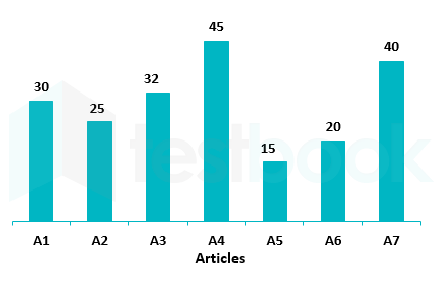
The bar chart given below shows the discount percentage offered by a shopkeeper on seven articles. Selling price of these seven articles: A1, A2, A3, A4, A5, A6 and A7 is Rs. 420, Rs. 600, Rs. 816, Rs. 825, Rs. 425, Rs. 800 and Rs. 840.

Selling price = Marked price [1− Discount percent 100]\left[1−\frac{\text { Discount percent }}{100}\right]

What is the sum of the marked price of these seven articles ?

  1. AOption (a)

    Rs. 6200

  2. BOption (b)

    Rs. 8000

  3. COption (c)

    Rs. 7000

  4. DOption (d)

    Rs. 6500

View answer & explanation

Correct answer

Answer: (c)C.

Rs. 7000

Why this answer is correct

GIVEN:

Selling price and discount percentage of seven different articles from A1 to A7 

FORMULA USED:

 M.P. = 100 S.P. / ( 100  - d) 

Where, S.P. = Selling price , M.P. = Marked price and d = discount%

CALCULATION:

Here, we have 

S.P. of A1  = Rs420 and discount%  = 30 

⇒ M.P. = 100 S.P. / ( 100 -d)  

⇒ M.P. = 100 × 420 / ( 100 - 30) 

⇒ M.P. = 100 × 420/70  = Rs600 

Now, S.P. of A2 = Rs600 and d% = 25 

⇒ M.P. =  100 × 600 / 75 =  Rs800 

Now, S.P.  of A3 = Rs816  and d = 32%

⇒ M.P. = 100 × 816 / 68 = Rs1200 

Now, S.P. of A4  = Rs825 , d = 45% 

⇒ M.P. = 100 × 825/55 = Rs1500 

Now, S.P. of A5 =  Rs425 ,d = 15%

⇒ M.P. = 100 × 425 /85 = Rs500

Now, S.P. of A6 = Rs800 , d = 20%

⇒ M.P. = 100 × 800/80 = Rs1,000

Now, S.P. of A7 = Rs840 ,d = 40%

⇒ M.P. = 100 × 840/60 = Rs1400 

Total Marked Price from A1 to A7 = ( 600 + 800 + 1200 + 1500 + 500 + 1000 + 1400 ) = Rs7,000 

Hence, sum of the marked price of the seven articles is Rs7,000

Question 40

What is the value of 3 sin2 30° + 35\frac{3}{5} cos2 60° − 2 sec2 45° ?

  1. AOption (a)

    −52\frac{−5}{2}

  2. BOption (b)

    −58\frac{−5}{8}

  3. COption (c)

    −3110\frac{−31}{10}

  4. DOption (d)

    −2517\frac{−25}{17}

View answer & explanation

Correct answer

Answer: (c)C.

−3110\frac{−31}{10}

Why this answer is correct

Shortcut Trick

Substitute standard values: sin 30° = 0.5, cos 60° = 0.5, sec 45° = √2

Expression = 3 × (0.5)2 + 0.6 × (0.5)2 − 2 × (√2)2

Expression = 3 × 0.25 + 0.6 × 0.25 − 2 × 2 = 0.75 + 0.15 − 4

Expression = 0.9 − 4 = −3.1

Convert decimal to fraction: −3.1 = −31/10

∴ The correct answer is −31/10.

Alternate Method

Given: 3 sin2 30° + 3/5 cos2 60° − 2 sec2 45°

Values Used:

sin 30° = 1/2

cos 60° = 1/2

sec 45° = √2

Calculations:

⇒ 3 × (1/2)2 + 3/5 × (1/2)2 − 2 × (√2)2

⇒ 3 × (1/4) + 3/5 × (1/4) − 2 × 2

⇒ 3/4 + 3/20 − 4

⇒ (3 × 5)/20 + 3/20 − (4 × 20)/20

⇒ 15/20 + 3/20 − 80/20

⇒ (15 + 3 − 80) / 20

⇒ −62 / 20

⇒ −31 / 10

∴ The correct answer is −31/10.

Additional Information

Standard Trigonometric Ratios

sin 30° = cos 60° = 1/2 and sin 60° = cos 30° = √3/2.

Reciprocal Ratios

sec θ = 1/cos θ. Since cos 45° = 1/√2, then sec 45° = √2.

Pythagorean Identity

sin2 θ + cos2 θ = 1. This can be used to simplify expressions when the angle θ is the same.

BODMAS Rule

Always solve exponents (squares) first, then multiplication/division, and finally addition/subtraction from left to right.

Question 41

What is the value of 29.161.1664+0.2916116.64+0.00360.36\frac{\sqrt{29.16}}{\sqrt{1.1664}}+\frac{\sqrt{0.2916}}{\sqrt{116.64}}+\frac{\sqrt{0.0036}}{\sqrt{0.36}} ?

  1. AOption (a)

    26/5

  2. BOption (b)

    103/20

  3. COption (c)

    27/5

  4. DOption (d)

    101/20

View answer & explanation

Correct answer

Answer: (b)B.

103/20

Why this answer is correct

Shortcut Trick

Identify the ratio between terms using √a / √b = √(a/b).

Term 1: √(29.16 / 1.1664) = √(291600 / 11664) = √25 = 5

Term 2: √(0.2916 / 116.64) = √(2916 / 1166400) = √(1/400) = 1/20

Term 3: √(0.0036 / 0.36) = √(36 / 3600) = √(1/100) = 1/10 = 2/20

Total Sum = 5 + 1/20 + 2/20 = 5 + 3/20 = 103/20.

∴ The correct answer is 103/20.

Alternate Method

Given: Expression = (√29.16 / √1.1664) + (√0.2916 / √116.64) + (√0.0036 / √0.36)

We know that √2916 = 54 and √11664 = 108.

⇒ √29.16 = 5.4

⇒ √1.1664 = 1.08

⇒ √0.2916 = 0.54

⇒ √116.64 = 10.8

⇒ √0.0036 = 0.06

⇒ √0.36 = 0.6

Substitute these values into the expression:

⇒ First term = 5.4 / 1.08 = 540 / 108 = 5

⇒ Second term = 0.54 / 10.8 = 54 / 1080 = 1 / 20

⇒ Third term = 0.06 / 0.6 = 6 / 60 = 1 / 10

⇒ Total = 5 + 1/20 + 1/10

⇒ Total = (100 + 1 + 2) / 20 = 103/20

∴ The correct answer is 103/20.

Additional Information

Square Root of Decimals

When finding the square root of a decimal, the number of decimal places in the result is always half the number of decimal places in the original number.

Ratio Property of Surds

The rule √a / √b = √(a / b) allows for simplifying calculations by dividing the numbers before extracting the square root.

BODMAS Rule

For complex expressions, prioritize Brackets, then Orders (roots/powers), then Division and Multiplication, followed by Addition and Subtraction.

Question 42

If the digits of a two digit number is reversed, then the number is decreased by 36. Which of the following is correct regarding the number ?

I. The difference of the digits is 4.

II. The value of number can be 84.

III. Number is always a composite number.

  1. AOption (a)

    I, II and III

  2. BOption (b)

    II and III

  3. COption (c)

    I and III

  4. DOption (d)

    I and II

View answer & explanation

Correct answer

Answer: (d)D.

I and II

Why this answer is correct

Shortcut Trick

Difference between a two-digit number and its reverse is always 9 × (Difference of digits).

9 × (x − y) = 36 ⇒ x − y = 4. (Statement I is correct)

Possible numbers (x − y = 4): 40, 51, 62, 73, 84, 95.

Since 84 is in the list, Statement II is correct. Since 73 is prime, Statement III is incorrect.

∴ The correct answer is I and II.

Alternate Method

Given: A two-digit number decreases by 36 when digits are reversed.

Let the tens digit be x and the units digit be y. Number = 10x + y.

Reversed number = 10y + x.

⇒ (10x + y) − (10y + x) = 36

⇒ 9x − 9y = 36

⇒ 9(x − y) = 36

⇒ x − y = 4 (This confirms Statement I)

⇒ Possible values for (x, y) where x − y = 4 are: (4,0), (5,1), (6,2), (7,3), (8,4), (9,5).

⇒ Possible numbers: 40, 51, 62, 73, 84, 95.

⇒ Number 84 satisfies the condition (84 − 48 = 36). (This confirms Statement II)

⇒ 73 is a Prime number, so the number is not always composite. (Statement III is False)

∴ The correct answer is I and II.

Additional Information

Sum of Digits Property

The sum of a two-digit number and the number formed by reversing its digits is always divisible by 11. Sum = 11(x + y).

Difference of Digits Property

The difference between a two-digit number and its reverse is always divisible by 9. Difference = 9|x − y|.

Prime vs Composite Numbers

A prime number has exactly two factors (1 and itself). A composite number has more than two factors. For example, 73 is prime, whereas 51 (3 × 17) is composite.

Question 43

What is the value of cos⁡50∘sin⁡40∘+3 cosec 80∘sec⁡10∘\frac{\cos 50^{\circ}}{\sin 40^{\circ}}+\frac{3~\text{cosec}~80^{\circ}}{\sec 10^{\circ}} − 2 cos 50°.cosec 40° ?

  1. AOption (a)

    3

  2. BOption (b)

    2

  3. COption (c)

    5

  4. DOption (d)

    4

View answer & explanation

Correct answer

Answer: (b)B.

2

Why this answer is correct

Shortcut Trick

For complementary angles (A + B = 90°), the ratios sin A / cos B = 1 and cosec A / sec B = 1.

In the expression, 50° + 40° = 90° and 80° + 10° = 90°.

⇒ cos 50° / sin 40° = 1

⇒ 3 cosec 80° / sec 10° = 3 × 1 = 3

⇒ 2 cos 50° cosec 40° = 2 × sin 40° × cosec 40° = 2 × 1 = 2

⇒ Total = 1 + 3 − 2 = 2

∴ The correct answer is 2.

Alternate Method

Given:

Expression: (cos 50° / sin 40°) + (3 cosec 80° / sec 10°) − 2 cos 50° cosec 40°

Formula Used:

  1. cos θ = sin(90° − θ)
  2. cosec θ = sec(90° − θ)
  3. cosec θ = 1 / sin θ

Calculations:

⇒ cos 50° = sin(90° − 50°) = sin 40°

⇒ cosec 80° = sec(90° − 80°) = sec 10°

⇒ Expression = (sin 40° / sin 40°) + (3 sec 10° / sec 10°) − 2 cos 50° cosec 40°

⇒ Expression = 1 + 3 − 2 (sin 40° × (1 / sin 40°))

⇒ Expression = 4 − 2(1)

⇒ Expression = 2

∴ The correct answer is 2.

Additional Information

Complementary Angle Identities

Trigonometric ratios of complementary angles: sin(90° − θ) = cos θ, tan(90° − θ) = cot θ, and sec(90° − θ) = cosec θ.

Reciprocal Identities

Basic reciprocal relations: sin θ × cosec θ = 1, cos θ × sec θ = 1, and tan θ × cot θ = 1.

Pythagorean Identities

Fundamental identities: sin2θ + cos2θ = 1, 1 + tan2θ = sec2θ, and 1 + cot2θ = cosec2θ.

Question 44

If 3\sqrt{3} tan θ = 3 sin θ, then what is the value of sin2 θ − cos2 θ ?

  1. AOption (a)

    1/5

  2. BOption (b)

    1/4

  3. COption (c)

    1/2

  4. DOption (d)

    1/3

View answer & explanation

Correct answer

Answer: (d)D.

1/3

Why this answer is correct

Shortcut Trick

√3 tan θ = 3 sin θ ⇒ √3 (sin θ / cos θ) = 3 sin θ

Canceling sin θ on both sides: √3 / cos θ = 3 ⇒ cos θ = √3 / 3 = 1 / √3

Then, cos2 θ = 1 / 3

Expression: sin2 θ − cos2 θ = (1 − cos2 θ) − cos2 θ = 1 − 2 cos2 θ

Substituting value: 1 − 2(1 / 3) = 1 − 2/3 = 1/3

∴ The correct answer is 1/3.

Alternate Method

Given: √3 tan θ = 3 sin θ

Formula Used: tan θ = sin θ / cos θ; sin2 θ + cos2 θ = 1

⇒ √3 (sin θ / cos θ) = 3 sin θ

⇒ √3 / cos θ = 3

⇒ cos θ = √3 / 3 = 1 / √3

⇒ cos2 θ = (1 / √3)2 = 1/3

⇒ From identity, sin2 θ = 1 − cos2 θ

⇒ sin2 θ = 1 − 1/3 = 2/3

⇒ Required value = sin2 θ − cos2 θ

⇒ Required value = 2/3 − 1/3 = 1/3

∴ The correct answer is 1/3.

Additional Information

Fundamental Trigonometric Identity

The primary identity relates sine and cosine as sin2θ + cos2θ = 1 for any angle θ.

Double Angle Identity for Cosine

cos 2θ = cos2θ − sin2θ. The expression in the question, sin2θ − cos2θ, is equivalent to −cos 2θ.

Tangent Property

The tangent ratio is defined as the quotient of sine and cosine: tan θ = sin θ / cos θ.

Pythagoras Theorem in Trigonometry

For a right-angled triangle, Perpendicular2 + Base2 = Hypotenuse2, which leads to the ratio identities.

Question 45

The base of a prism is a right angle triangle whose sides are 9 cm, 12 cm and 15 cm. Volume of this prism is 648 cm3. What will be the height of prism ?

  1. AOption (a)

    14 cm

  2. BOption (b)

    12 cm

  3. COption (c)

    9 cm

  4. DOption (d)

    16 cm

View answer & explanation

Correct answer

Answer: (b)B.

12 cm

Why this answer is correct

Shortcut Trick

Base area of right-angled triangle = (1/2) × product of smaller sides

Base area = (1/2) × 9 × 12 = 54 cm2

Height of prism = Volume ÷ Base area

Height = 648 ÷ 54 = 12 cm

∴ The correct answer is 12 cm.

Alternate Method

Given:

Sides of the triangular base = 9 cm, 12 cm and 15 cm

Volume of the prism = 648 cm3

Formula Used:

Area of right-angled triangle = 1/2 × base × height

Volume of prism = Area of base × Height of prism

Calculations:

⇒ Area of base = (1/2) × 9 × 12

⇒ Area of base = 9 × 6 = 54 cm2

⇒ Volume = Area of base × Height

⇒ 648 = 54 × Height

⇒ Height = 648 ÷ 54

⇒ Height = 12 cm

∴ The correct answer is 12 cm.

Additional Information

Volume of Prism

The volume of any prism is given by the product of its base area and its vertical height (V = Abase × h).

Lateral Surface Area (LSA) of Prism

LSA = Perimeter of base × Height. For this prism, LSA = (9 + 12 + 15) × 12 = 36 × 12 = 432 cm2.

Total Surface Area (TSA) of Prism

TSA = Lateral Surface Area + 2 × Area of base. TSA = 432 + 2 × 54 = 540 cm2.

Question 46

The cost of a diamond is directly proportional to the square of its weight. The cost of a 14 gm diamond is Rs. 2560. This diamond got broken down into two pieces in the ratio of 5 ∶ 9. How much loss percent is incurred due to this breakage ? (Correct to two decimal places)

  1. AOption (a)

    53.47 percent

  2. BOption (b)

    49.71 percent

  3. COption (c)

    45.92 percent

  4. DOption (d)

    55.41 percent

View answer & explanation

Correct answer

Answer: (c)C.

45.92 percent

Why this answer is correct

Shortcut Trick

Weight ratio = 5 : 9 → Total units = 14

Cost is proportional to square of weight, so let Original Cost = 142 = 196 units

Cost after breakage = (52 + 92) = 25 + 81 = 106 units

Loss in value = 196 − 106 = 90 units

Loss % = (Loss ÷ Original Cost) × 100 = (90 ÷ 196) × 100 ≈ 45.92%

∴ The correct answer is 45.92 percent.

Alternate Method

Given:

Total weight of diamond = 14 gm

Cost of 14 gm diamond = Rs. 2560

Breakage ratio = 5 : 9

Formula Used:

Cost (C) ∝ Weight (W)2 ⇒ C = k × W2

Calculations:

⇒ Let the weights of the two pieces be 5x and 9x.

⇒ Total weight = 5x + 9x = 14x = 14 gm ⇒ x = 1 gm.

⇒ Weights of pieces = 5 gm and 9 gm.

⇒ Since C ∝ W2, we can work directly with units as the constant k cancels out in percentage calculation.

⇒ Original Cost equivalent = 142 = 196

⇒ New Cost equivalent = 52 + 92 = 25 + 81 = 106

⇒ Loss = 196 − 106 = 90

⇒ Loss % = (90 ÷ 196) × 100

⇒ Loss % = (45 ÷ 98) × 100

⇒ Loss % ≈ 45.918...

∴ The correct answer is 45.92 percent.

Additional Information

Direct Proportion of Squares

When a value Y is directly proportional to the square of X (Y ∝ X2), doubling X results in a 4-fold increase in Y, and tripling X results in a 9-fold increase in Y.

Percentage Change in Ratios

Percentage change calculations are independent of the actual values if the entire system scales linearly; here, the Rs. 2560 value was not required to calculate the loss percentage.

Maximum Loss Condition

In breakage problems where C ∝ W2, the maximum loss occurs when the diamond breaks into the maximum number of equal pieces, while minimum loss (zero) occurs if it doesn't break at all.

Question 47

The pie chart given below shows the number of males in 6 departments. Number of males in a particular department are shown in the terms of degrees with respect to the total number of males in all the 6 departments. Number of males in department S are 1080.

J = Total number of males in T and P

K = Difference between the number of males in P and Q

What is the value of J + K ?

  1. AOption (a)

    3600

  2. BOption (b)

    4800

  3. COption (c)

    2400

  4. DOption (d)

    1200

View answer & explanation

Correct answer

Answer: (a)A.

3600

Why this answer is correct

GIVEN:

Pie chart shows number of males  in six department 

Number of males in S = 1080 

CALCULATION:

As, number of males in S = 1080

⇒ 54∘^\circ = 1080 

⇒ 1∘^\circ = 20 

Now, 

Number of males in T department is  90∘^\circ =  90 × 20 = 1800 

Number of males in P department is 30∘^\circ = 30 × 20 = 600 

Number of males in Q department is 90∘^\circ = 90 × 20 = 1800 

As, J = Total number of males in T and P department = ( 1800 + 600 ) = 2400 

Also, K = Difference of number of males in P and Q department = ( 1800 - 600) = 1200 

Now, J + K = ( 2400 + 1200 ) = 3600

Hence, the required value is 3600.

Question 48

ABCDEF is a regular hexagon. Side of the hexagon is 36 cm. What is the area of the triangle AOB ?

  1. AOption (a)

    3243\sqrt{3} cm2

  2. BOption (b)

    3603\sqrt{3} cm2

  3. COption (c)

    2403\sqrt{3} cm2

  4. DOption (d)

    1923\sqrt{3} cm2

View answer & explanation

Correct answer

Answer: (a)A.

3243\sqrt{3} cm2

Why this answer is correct

Shortcut Trick

A regular hexagon is composed of 6 identical equilateral triangles that meet at the center O.

Triangle AOB is one such equilateral triangle where the side is equal to the side of the hexagon.

Given side (a) = 36 cm.

Area of equilateral triangle = (√3/4) × a2 = (√3/4) × 36 × 36.

Area = √3 × 9 × 36 = 324√3 cm2.

∴ The correct answer is 324√3 cm2.

Alternate Method

Given:

Side of regular hexagon ABCDEF = 36 cm

Point O is the center of the regular hexagon.

Formula Used:

In a regular hexagon, the distance from the center to any vertex is equal to the side of the hexagon.

Area of an equilateral triangle with side 'a' = (√3/4) × a2

Calculations:

⇒ In regular hexagon ABCDEF, OA = OB = AB = 36 cm.

⇒ Therefore, ▵AOB is an equilateral triangle with side a = 36 cm.

⇒ Area of ▵AOB = (√3 / 4) × (36)2

⇒ Area = (√3 / 4) × 1296

⇒ Area = 324 × √3

⇒ Area = 324√3 cm2

∴ The correct answer is 324√3 cm2.

Additional Information

Area of Regular Hexagon

The total area of a regular hexagon is 6 × Area of one equilateral triangle = (3√3 / 2) × a2.

Angles of a Regular Hexagon

Each interior angle is 120° and the sum of all interior angles is 720°. Each exterior angle is 60°.

Diagonals of a Regular Hexagon

The longest diagonal (e.g., AD) is 2a, and the shorter diagonal (e.g., AC) is a√3.

Question 49

The selling prices of articles A and B are the same. A is sold at a profit of 28 percent and B is sold at a loss of 24 percent. If the total selling price of the both articles is Rs. 48640, then what is the cost price of A and B, respectively ?

  1. AOption (a)

    Rs. 26000, Rs. 40000

  2. BOption (b)

    Rs. 24000, Rs. 38000

  3. COption (c)

    Rs. 17000, Rs. 28000

  4. DOption (d)

    Rs. 19000, Rs. 32000

View answer & explanation

Correct answer

Answer: (d)D.

Rs. 19000, Rs. 32000

Why this answer is correct

Shortcut Trick

Since both articles have the same selling price, each SP = 48640 ÷ 2 = Rs. 24320.

For article A (28% profit): CPA = SP × (100/128) = 24320 × (25/32) = Rs. 19000.

For article B (24% loss): CPB = SP × (100/76) = 24320 × (25/19) = Rs. 32000.

The respective cost prices are Rs. 19000 and Rs. 32000.

∴ The correct answer is Rs. 19000, Rs. 32000.

Alternate Method

Given:

Total Selling Price (SPA + SPB) = Rs. 48640

Condition: SPA = SPB

Profit on A = 28% | Loss on B = 24%

Formula Used:

CP = (SP × 100) ÷ (100 ± P/L%)

Calculations:

⇒ Individual Selling Price (SP) = 48640 ÷ 2 = Rs. 24320

⇒ For Article A: CPA = (24320 × 100) ÷ (100 + 28)

⇒ CPA = 2432000 ÷ 128 = Rs. 19000

⇒ For Article B: CPB = (24320 × 100) ÷ (100 − 24)

⇒ CPB = 2432000 ÷ 76 = Rs. 32000

∴ The correct answer is Rs. 19000, Rs. 32000.

Additional Information

Direct CP-SP Relation

When SP is constant, the Cost Price is inversely proportional to the (100 ± Gain/Loss%). CP1 × (100 + G1%) = CP2 × (100 − L2%).

Net Profit or Loss Percentage

Total Profit/Loss % = (Total SP − Total CP) ÷ Total CP × 100. In this case, Total CP = 19000 + 32000 = 51000, Net Loss = 51000 − 48640 = 2360.

Same SP, Same % Profit and Loss

If two items are sold at the same price, one at x% profit and another at x% loss, the transaction always results in a loss of (x/10)2 %.

Question 50

What is the sum of all the common terms between the given series S1 and S2 ?

S1 = 2, 9, 16, .........., 632

S2 = 7, 11, 15, .........., 743

  1. AOption (a)

    6974

  2. BOption (b)

    6750

  3. COption (c)

    7140

  4. DOption (d)

    6860

View answer & explanation

Correct answer

Answer: (a)A.

6974

Why this answer is correct

Shortcut Trick

Common difference for S1 (d1) = 9 − 2 = 7 and for S2 (d2) = 11 − 7 = 4.

First common term (a) = 23 (by inspection: 2, 9, 16, 23... and 7, 11, 15, 19, 23...).

Common difference of the series of common terms (D) = LCM(7, 4) = 28.

Number of common terms (n): 23 + (n − 1) × 28 ≤ 632 ⇒ (n − 1) ≤ 21.75 ⇒ n = 22.

Sum = (n ÷ 2) × [2a + (n − 1)D] = 11 × [46 + (21 × 28)] = 11 × 634 = 6974.

∴ The correct answer is 6974.

Alternate Method

Given:

Series S1: 2, 9, 16, ..., 632 (Arithmetic Progression with a1 = 2, d1 = 7)

Series S2: 7, 11, 15, ..., 743 (Arithmetic Progression with a2 = 7, d2 = 4)

Formula Used:

nth term of AP: Tn = a + (n − 1)d

Sum of AP: Sn = (n ÷ 2) × (a + l), where l is the last term.

Calculations:

⇒ For the common series, the first term (a) is the first number that appears in both series. Listing S1: 2, 9, 16, 23, 30... and S2: 7, 11, 15, 19, 23... so a = 23.

⇒ The common difference (D) of common terms is LCM(d1, d2) = LCM(7, 4) = 28.

⇒ The last term (L) of the common series must be ≤ min(632, 743), so L ≤ 632.

⇒ Let the number of common terms be n. Then, Tn = 23 + (n − 1) × 28 ≤ 632.

⇒ 28(n − 1) ≤ 632 − 23 ⇒ 28(n − 1) ≤ 609.

⇒ n − 1 ≤ 609 ÷ 28 ⇒ n − 1 ≤ 21.75.

⇒ n − 1 = 21 ⇒ n = 22.

⇒ Last common term (L) = 23 + (21 × 28) = 23 + 588 = 611.

⇒ Sum = (n ÷ 2) × (a + L) = (22 ÷ 2) × (23 + 611).

⇒ Sum = 11 × 634 = 6974.

∴ The correct answer is 6974.

Additional Information

Common Difference of Intersecting APs

If two arithmetic progressions have common differences d1 and d2, the series formed by their common terms is also an AP with a common difference equal to LCM(d1, d2).

Sum of First n Natural Numbers

The sum of the first n natural numbers is given by Σn = [n × (n + 1)] ÷ 2.

General Term of an AP

The nth term Tn of an AP is calculated as a + (n − 1)d, where a is the first term and d is the common difference.

Question 51

A alone can do 2/5 of a work in 12 days. B is 25 percent more efficient than A. C alone can do the same work in 12 days less than B. D is 25 percent less efficient than C. If they all work together, then the work will be completed in how many days ?

  1. AOption (a)

    240/53

  2. BOption (b)

    180/43

  3. COption (c)

    200/51

  4. DOption (d)

    300/47

View answer & explanation

Correct answer

Answer: (a)A.

240/53

Why this answer is correct

Shortcut Trick

Time for A = 12 × 5 ÷ 2 = 30 days.

B is 25% faster than A ⇒ B's time = 30 ÷ 1.25 = 24 days.

C's time = 24 − 12 = 12 days; D is 25% slower than C ⇒ D's time = 12 ÷ 0.75 = 16 days.

Total Work = LCM(30, 24, 12, 16) = 240 units.

Combined Efficiency = 8 (A) + 10 (B) + 20 (C) + 15 (D) = 53 units/day.

∴ The correct answer is 240/53 days.

Alternate Method

Given:

A completes 2/5 work in 12 days.

B's efficiency = 1.25 × A's efficiency.

C's time = B's time − 12 days.

D's efficiency = 0.75 × C's efficiency.

Formula Used:

Total Work = Time Taken × Efficiency

Efficiency = 1 ÷ Time Taken (when work is constant)

PersonDaysTotal WorkEfficiency
A302408
B2410
C1220
D1615

⇒ Time taken by A for full work = 12 × (5 ÷ 2) = 30 days.

⇒ Since B is 25% more efficient, B's time = 30 ÷ 1.25 = 24 days.

⇒ C's time = 24 − 12 = 12 days.

⇒ Since D is 25% less efficient than C, D's time = 12 ÷ 0.75 = 16 days.

⇒ Let Total Work be LCM(30, 24, 12, 16) = 240 units.

⇒ Total Efficiency (A + B + C + D) = 8 + 10 + 20 + 15 = 53 units/day.

⇒ Time taken together = Total Work ÷ Total Efficiency = 240 / 53 days.

∴ The correct answer is 240/53 days.

Additional Information

Efficiency and Time Relationship

Efficiency is inversely proportional to the time taken to complete a work. If the ratio of efficiency is x:y, the ratio of time taken is y:x.

Work and Wages

Wages are generally distributed in the ratio of the work done by each individual. If they work for the same duration, wages are divided in the ratio of their efficiencies.

Combined Work Formula

If A can do a work in 'a' days and B in 'b' days, together they complete it in (a × b) ÷ (a + b) days.

Question 52

Which of the following given value is greater than 123\sqrt[3]{12} ?

  1. AOption (a)

    1216\sqrt[6]{121}

  2. BOption (b)

    3321412\sqrt[12]{33214}

  3. COption (c)

    605\sqrt[5]{60}

  4. DOption (d)

    15009\sqrt[9]{1500}

View answer & explanation

Correct answer

Answer: (b)B.

3321412\sqrt[12]{33214}

Why this answer is correct

Given: Value = 123\sqrt[3]{12} Formula used: If a > b, then an > bn Calculation: Target value = 121/3 Comparing with Option (2) = 332141/12 Raise both to the power of 12: ⇒ (121/3)12 = 124 ⇒ 124 = 12 × 12 × 12 × 12 = 20736 ⇒ (332141/12)12 = 33214 ⇒ 33214 > 20736 Checking other options: ⇒ Option (1): 1216\sqrt[6]{121} = (112)1/6 = 111/3 < 121/3 ⇒ Option (4): 15009\sqrt[9]{1500} < 17289\sqrt[9]{1728} = (123)1/9 = 121/3 ⇒ Option (3): 121/3 = 2488321/15 and 601/5 = 2160001/15 ∴ The correct answer is option (2).

Question 53

If A = 0.0004×0.0000083160004×1250003×8104\frac{\sqrt{0.0004} \times \sqrt[3]{0.000008}}{\sqrt[4]{16000} \times \sqrt[3]{125000} \times \sqrt[4]{810}} and B = 0.7293×0.001640.16\frac{\sqrt[3]{0.729} \times \sqrt[4]{0.0016}}{\sqrt{0.16}}, then what is A × B ?

  1. AOption (a)

    7 × 10⁻⁷

  2. BOption (b)

    (74)\left(\frac{7}{4}\right) × 10−8

  3. COption (c)

    6 × 10⁻⁸

  4. DOption (d)

    (73)\left(\frac{7}{3}\right) × 10−7

View answer & explanation

Correct answer

Answer: (c)C.

6 × 10⁻⁸

Why this answer is correct

Given:

A = 0.0004×0.0000083160004×1250003×8104\frac{\sqrt{0.0004} \times \sqrt[3]{0.000008}}{\sqrt[4]{16000} \times \sqrt[3]{125000} \times \sqrt[4]{810}}

B = 0.7293×0.001640.16\frac{\sqrt[3]{0.729} \times \sqrt[4]{0.0016}}{\sqrt{0.16}}

Formula used:

xn×yn=xyn\sqrt[n]{x} \times \sqrt[n]{y} = \sqrt[n]{xy}

Calculation:

A = 0.02×0.0216000×8104×50\frac{0.02 \times 0.02}{\sqrt[4]{16000 \times 810} \times 50}

⇒ A = 0.0004129600004×50\frac{0.0004}{\sqrt[4]{12960000} \times 50}

⇒ A = 0.000460×50\frac{0.0004}{60 \times 50}

⇒ A = 4×10−43000\frac{4 \times 10^{-4}}{3000} = 43\frac{4}{3} × 10-7

B = 0.9×0.20.4\frac{0.9 \times 0.2}{0.4}

⇒ B = 0.180.4\frac{0.18}{0.4} = 0.45

A × B = 43\frac{4}{3} × 10-7 × 0.45

⇒ A × B = 1.83\frac{1.8}{3} × 10-7

⇒ A × B = 0.6 × 10⁻⁷

⇒ A × B = 6 × 10⁻⁸

∴ The correct answer is option (3).

Question 54

Which of the following is equal to 1tan⁡θ\frac{1}{\tan \theta} + tan θ ?

  1. AOption (a)

    sec θ.cosec θ

  2. BOption (b)

    1

  3. COption (c)

    cosec θsec⁡θ\frac{\text{cosec}~ \theta}{\sec \theta}

  4. DOption (d)

    tan2 θ

View answer & explanation

Correct answer

Answer: (a)A.

sec θ.cosec θ

Why this answer is correct

Shortcut Trick

Assume θ = 45°.

Expression = 1/tan 45° + tan 45° = 1/1 + 1 = 2.

Check Option (1): sec 45° × cosec 45° = √2 × √2 = 2.

Matches the value of the expression.

∴ The correct answer is sec θ.cosec θ.

Alternate Method

Given: (1 / tan θ) + tan θ

Formula Used: tan θ = sin θ / cos θ, cot θ = cos θ / sin θ, and sin2 θ + cos2 θ = 1.

⇒ 1/tan θ + tan θ = cot θ + tan θ

⇒ (cos θ / sin θ) + (sin θ / cos θ)

⇒ Take LCM of denominators: sin θ × cos θ

⇒ (cos2 θ + sin2 θ) / (sin θ × cos θ)

⇒ 1 / (sin θ × cos θ) [Since sin2 θ + cos2 θ = 1]

⇒ (1 / sin θ) × (1 / cos θ)

⇒ cosec θ × sec θ

∴ The correct answer is sec θ.cosec θ.

Additional Information

Fundamental Trigonometric Identities

There are three primary identities: sin2θ + cos2θ = 1, 1 + tan2θ = sec2θ, and 1 + cot2θ = cosec2θ.

Reciprocal Relations

cosec θ = 1/sin θ, sec θ = 1/cos θ, and cot θ = 1/tan θ.

Complementary Angles

Trigonometric ratios of (90° − θ): sin(90°−θ) = cosθ, tan(90°−θ) = cotθ, and sec(90°−θ) = cosecθ.

Question 55

A, B, and C started a business with the investment of Rs. 100000, Rs. 140000, and Rs. 200000 respectively. After 3 months, C left the business. After 7 more months, B also left the business. At the end of the year, C received his share of the profit as Rs. 1155. What is the total share of profits of A and B?

  1. AOption (a)

    Rs. 6150

  2. BOption (b)

    Rs. 5005

  3. COption (c)

    Rs. 4995

  4. DOption (d)

    Rs. 5555

View answer & explanation

Correct answer

Answer: (b)B.

Rs. 5005

Why this answer is correct

Shortcut Trick

Profit Ratio = (Investment × Time)

A : B : C = (100,000 × 12) : (140,000 × 10) : (200,000 × 3)

A : B : C = (10 × 12) : (14 × 10) : (20 × 3) = 120 : 140 : 60 = 6 : 7 : 3

Given: C's share = 3 units = ₹1155 ⇒ 1 unit = ₹385

A + B total share = (6 + 7) × 385 = 13 × 385 = ₹5005

∴ The correct answer is ₹5005.

Alternate Method

Given:

Investment of A = ₹100,000; Duration = 12 months

Investment of B = ₹140,000; Duration = 10 months (3 + 7)

Investment of C = ₹200,000; Duration = 3 months

Profit share of C = ₹1155

Formula: Profit Ratio = (I1 × T1) : (I2 × T2) : (I3 × T3)

Calculations:

⇒ Ratio of Profit of A, B and C = (100000 × 12) : (140000 × 10) : (200000 × 3)

⇒ Ratio = 1,200,000 : 1,400,000 : 600,000

⇒ Ratio = 12 : 14 : 6 = 6 : 7 : 3

⇒ Let common factor be x.

⇒ Profit share of C = 3x = 1155

⇒ x = 1155 ÷ 3 = 385

⇒ Total share of A and B = 6x + 7x = 13x

⇒ Total share = 13 × 385 = ₹5005

∴ The correct answer is ₹5005.

Additional Information

Partnership Principle

Profit is distributed in the ratio of (Capital × Time). If capitals are C1, C2 for times T1, T2, then Profit Ratio P1:P2 = C1T1 : C2T2.

Working Partner

A partner who manages the business is a working partner. They often receive a fixed percentage of profit or salary before the remaining profit is shared.

Time Calculation

Always ensure all time units are consistent (either all in months or all in years) before calculating the ratio.

Question 56

Sum Rs. 20000 and Rs. 40000 are given on simple interest at the rate of 10 percent and 15 percent per annum respectively for three years. What will be the total simple interest ?

  1. AOption (a)

    Rs. 36000

  2. BOption (b)

    Rs. 24000

  3. COption (c)

    Rs. 32000

  4. DOption (d)

    Rs. 28000

View answer & explanation

Correct answer

Answer: (b)B.

Rs. 24000

Why this answer is correct

Shortcut Trick

Effective interest (%) for P1 = 10% × 3 = 30%

Effective interest (%) for P2 = 15% × 3 = 45%

Total SI = (30% of 20000) + (45% of 40000)

Total SI = 6000 + 18000 = 24000

∴ The correct answer is ₹24000.

Alternate Method

Given:

Principal 1 (P1) = ₹20000, Rate 1 (R1) = 10% p.a., Time (T) = 3 years

Principal 2 (P2) = ₹40000, Rate 2 (R2) = 15% p.a., Time (T) = 3 years

Formula Used:

Simple Interest (SI) = (P × R × T) ÷ 100

Calculations:

⇒ SI1 = (20000 × 10 × 3) ÷ 100

⇒ SI1 = 200 × 10 × 3 = ₹6000

⇒ SI2 = (40000 × 15 × 3) ÷ 100

⇒ SI2 = 400 × 15 × 3 = ₹18000

⇒ Total SI = SI1 + SI2

⇒ Total SI = 6000 + 18000

⇒ Total SI = ₹24000

∴ The correct answer is ₹24000.

Additional Information

Total Amount Formula

The total amount (A) in Simple Interest is given by A = P + SI = P(1 + RT/100).

Difference between SI and CI

The difference between Compound Interest and Simple Interest for 2 years is P(R/100)2.

Effective Rate of Interest

Effective annual rate for SI remains constant each year, whereas for CI it increases due to compounding.

Question 57

Which of the following is equal to [tan⁡θ+sec⁡θ−1tan⁡θ−sec⁡θ+1]\left[\frac{\tan \theta+\sec \theta−1}{\tan \theta−\sec \theta+1}\right] ?

  1. AOption (a)

    1+sin⁡θcos⁡θ\frac{1+\sin \theta}{\cos \theta}

  2. BOption (b)

    1+tan⁡θcot⁡θ\frac{1+\tan \theta}{\cot \theta}

  3. COption (c)

    1+cot⁡θtan⁡θ\frac{1+\cot \theta}{\tan \theta}

  4. DOption (d)

    1+cos⁡θsin⁡θ\frac{1+\cos \theta}{\sin \theta}

View answer & explanation

Correct answer

Answer: (a)A.

1+sin⁡θcos⁡θ\frac{1+\sin \theta}{\cos \theta}

Why this answer is correct

Shortcut Trick

Substitute the identity 1 = sec2 θ − tan2 θ only in the numerator.

Expression = [(tan θ + sec θ) − (sec2 θ − tan2 θ)] ÷ (tan θ − sec θ + 1).

Factor out (sec θ + tan θ) to get: (sec θ + tan θ) [1 − (sec θ − tan θ)] ÷ (tan θ − sec θ + 1).

The term [1 − sec θ + tan θ] cancels out perfectly with the denominator.

Remaining result = sec θ + tan θ = 1/cos θ + sin θ/cos θ.

∴ The correct answer is (1 + sin θ) / cos θ.

Alternate Method

Given: Expression = (tan θ + sec θ − 1) ÷ (tan θ − sec θ + 1)

Formula Used: sec2 θ − tan2 θ = 1

⇒ Expression = [ (tan θ + sec θ) − (sec2 θ − tan2 θ) ] ÷ (tan θ − sec θ + 1)

⇒ Using a2 − b2 = (a − b)(a + b) in the numerator:

⇒ Numerator = (tan θ + sec θ) − [(sec θ − tan θ)(sec θ + tan θ)]

⇒ Factorize (tan θ + sec θ): (tan θ + sec θ) [1 − (sec θ − tan θ)]

⇒ Numerator = (tan θ + sec θ) (1 − sec θ + tan θ)

⇒ Substituting back: [(tan θ + sec θ)(1 − sec θ + tan θ)] ÷ (tan θ − sec θ + 1)

⇒ Since (1 − sec θ + tan θ) = (tan θ − sec θ + 1), the terms cancel out.

⇒ Result = sec θ + tan θ

⇒ Convert to sine and cosine: 1/cos θ + sin θ/cos θ = (1 + sin θ) / cos θ

∴ The correct answer is (1 + sin θ) / cos θ.

Additional Information

Trigonometric Identities

Fundamental identities include sin2θ + cos2θ = 1, 1 + tan2θ = sec2θ, and 1 + cot2θ = cosec2θ.

Specific Result Pattern

For expressions of the form (tan θ + sec θ − 1)/(tan θ − sec θ + 1), the result is always (sec θ + tan θ). Similarly, for cot and cosec, (cot θ + cosec θ − 1)/(cot θ − cosec θ + 1) = cosec θ + cot θ.

Quotient Relations

tan θ = sin θ ÷ cos θ and sec θ = 1 ÷ cos θ are used to convert expressions into primary sine/cosine terms.

Question 58

What is the sum of first 20 terms of the following series ?

1 × 2 + 2 × 3 + 3 × 4 + 4 × 5 + ..........

  1. AOption (a)

    3160

  2. BOption (b)

    2940

  3. COption (c)

    3240

  4. DOption (d)

    3080

View answer & explanation

Correct answer

Answer: (d)D.

3080

Why this answer is correct

Shortcut Trick

The sum of a series where each term is the product of two consecutive integers n(n + 1) up to k terms is given by the formula: Sk = [k × (k + 1) × (k + 2)] ÷ 3.

Here, the number of terms k = 20.

Sum = [20 × (20 + 1) × (20 + 2)] ÷ 3 = [20 × 21 × 22] ÷ 3.

Sum = 20 × 7 × 22 = 140 × 22 = 3080.

∴ The correct answer is 3080.

Alternate Method

Given:

Series: (1 × 2) + (2 × 3) + (3 × 4) + ... up to 20 terms.

The nth term (an) of the series is n(n + 1) = n2 + n.

Formula Used:

Sum of n terms (Sn) = ∑ an = ∑ n2 + ∑ n

Where, ∑ n2 = [n(n + 1)(2n + 1)] ÷ 6 and ∑ n = [n(n + 1)] ÷ 2

Calculations:

⇒ S20 = ∑n=120 n2 + ∑n=120 n

⇒ S20 = [20 × (20 + 1) × (2 × 20 + 1)] ÷ 6 + [20 × (20 + 1)] ÷ 2

⇒ S20 = [20 × 21 × 41] ÷ 6 + [20 × 21] ÷ 2

⇒ S20 = [10 × 7 × 41] + [10 × 21]

⇒ S20 = 2870 + 210

⇒ S20 = 3080

∴ The correct answer is 3080.

Additional Information

Sum of first n natural numbers

The sum of the first n natural numbers is given by ∑ n = n(n + 1) ÷ 2.

Sum of squares of first n natural numbers

The sum of squares of the first n natural numbers is given by ∑ n2 = n(n + 1)(2n + 1) ÷ 6.

General product series formula

For a series of product of r consecutive integers, ∑ n(n+1)...(n+r-1) = [n(n+1)...(n+r)] ÷ (r+1).

Sum of cubes of first n natural numbers

The sum of cubes of the first n natural numbers is given by ∑ n3 = [n(n + 1) ÷ 2]2.

Question 59

When an article is sold at 5 percent discount, then there is a profit of 14 percent. If the discount is 11 percent, then what will be the profit ?

  1. AOption (a)

    7.6 percent

  2. BOption (b)

    8.4 percent

  3. COption (c)

    7.2 percent

  4. DOption (d)

    6.8 percent

View answer & explanation

Correct answer

Answer: (d)D.

6.8 percent

Why this answer is correct

Shortcut Trick

Ratio of MP to CP = (100 + Profit%) ÷ (100 − Discount%)

MP ÷ CP = (100 + 14) ÷ (100 − 5) = 114 ÷ 95 = 6 ÷ 5

Let CP = 500 and MP = 600. New Discount = 11% of 600 = 66.

New SP = 600 − 66 = 534. Profit = 534 − 500 = 34.

Profit% = (34 ÷ 500) × 100 = 6.8%.

∴ The correct answer is 6.8 percent.

Alternate Method

Given:

Initial Discount (D1) = 5%

Initial Profit (P1) = 14%

New Discount (D2) = 11%

Formula Used:

MP ÷ CP = (100 + P%) ÷ (100 − D%)

SP = MP × (100 − D%) ÷ 100

Calculations:

⇒ MP ÷ CP = (100 + 14) ÷ (100 − 5)

⇒ MP ÷ CP = 114 ÷ 95 = 1.2

⇒ Let CP = 100, then MP = 1.2 × 100 = 120

⇒ New SP = 120 × (100 − 11) ÷ 100

⇒ New SP = 120 × 89 ÷ 100 = 1.2 × 89 = 106.8

⇒ New Profit = SP − CP = 106.8 − 100 = 6.8

⇒ Profit% = (6.8 ÷ 100) × 100 = 6.8%

∴ The correct answer is 6.8 percent.

Additional Information

Marked Price and Cost Price Relation

The ratio between Marked Price (MP) and Cost Price (CP) is given by MP ÷ CP = (100 + Profit%) ÷ (100 − Discount%). If there is a loss, Profit% is replaced by −Loss%.

Successive Discounts

When two successive discounts d1% and d2% are given, the equivalent single discount is (d1 + d2 − d1d2 ÷ 100)%.

Net Profit with Discount

Net Profit % = [Markup% − Discount% − (Markup% × Discount%) ÷ 100], where Markup is calculated over CP.

Question 60

The height of a solid cylinder is 35 cm. The circumference of its base is 37 cm more than the radius. What will be the volume of this cylinder ?

  1. AOption (a)

    4740 cm3

  2. BOption (b)

    4850 cm3

  3. COption (c)

    5390 cm3

  4. DOption (d)

    4420 cm3

View answer & explanation

Correct answer

Answer: (c)C.

5390 cm3

Why this answer is correct

Shortcut Trick

In a circle, the ratio of Circumference to Radius is 2π : 1, which is approximately 44/7 : 1.

The difference (Circumference − Radius) = 44/7 − 1 = 37/7 units.

According to the question: 37/7 units = 37 cm ⇒ 1 unit = 7 cm.

So, the radius (r) = 7 cm.

Volume = πr2h = 22/7 × 7 × 7 × 35 = 154 × 35 = 5390 cm3.

∴ The correct answer is 5390 cm3.

Alternate Method

Given:

Height of cylinder (h) = 35 cm

Circumference of base − Radius = 37 cm

Formula used:

Circumference of base = 2πr

Volume of cylinder = πr2h

Step 1: Find the radius (r) using the base property.

⇒ 2πr − r = 37

⇒ r(2π − 1) = 37

⇒ r(2 × 22/7 − 1) = 37

⇒ r(44/7 − 1) = 37

⇒ r(37/7) = 37

⇒ r = 37 × 7/37

⇒ r = 7 cm

Step 2: Calculate the volume of the cylinder.

⇒ Volume = π × r2 × h

⇒ Volume = 22/7 × 7 × 7 × 35

⇒ Volume = 22 × 7 × 35

⇒ Volume = 154 × 35

⇒ Volume = 5390 cm3

∴ The correct answer is 5390 cm3.

Additional Information

Surface Area of Cylinder

The Curved Surface Area (CSA) is 2πrh and the Total Surface Area (TSA) is 2πr(h + r).

Volume of a Cone

The volume of a cone with the same base radius and height is exactly one-third of the cylinder: V = 1/3 × πr2h.

Circle Constants

For a circle with radius 7, the circumference is 44 and the area is 154. These are useful benchmarks for fast calculations.

Question 61

The following bar graph shows the amounts (in Rs. lakhs) invested by a company in purchasing raw materials and the values (in Rs. lakhs) of finished goods sold by the company, from 2012 to 2017.

The difference between the average amount invested in purchasing raw materials during 2012 to 2017 and the average value of sales of finished goods during the same period 2012 to 2017 is :

  1. AOption (a)

    Rs. 86 lakhs

  2. BOption (b)

    Rs. 90 lakhs

  3. COption (c)

    Rs. 80 lakhs

  4. DOption (d)

    Rs. 85 lakhs

View answer & explanation

Correct answer

Answer: (c)C.

Rs. 80 lakhs

Why this answer is correct

Given:

Concept used:

Average = Sum of all the value/Total values

Calculations:

The average amount invested in purchasing raw materials during 2012 to 2017

⇒ A = (140 + 250 + 350 + 325 + 525 + 450)/6

⇒ A = 2040/6 = 340

The average value of sales of finished goods during the same period 2012 to 2017

⇒ A = (220 + 300 + 475 + 400 + 600 + 525)/6

⇒ A = 2520/6 = 420

The difference between the average = 420 - 340 = 80 lakhs

∴ The difference between the average of both purchasing and finished goods is 80 lakhs.

Question 62

Vipul and Manish invested the sum of Rs. 15000 and Rs. 20000 at the rate of 20 percent p.a and 30 percent p.a. respectively on compound interest (compounding annually). If time period is 3 years for both, then what will be the total compound interest earned by Vipul and Manish ?

  1. AOption (a)

    Rs. 32480

  2. BOption (b)

    Rs. 31688

  3. COption (c)

    Rs. 29460

  4. DOption (d)

    Rs. 34860

View answer & explanation

Correct answer

Answer: (d)D.

Rs. 34860

Why this answer is correct

Shortcut Trick

Net effective compound interest rate for 3 years at 20% = 72.8%

Net effective compound interest rate for 3 years at 30% = 119.7%

CI of Vipul = 72.8% of 15000 = 10920

CI of Manish = 119.7% of 20000 = 23940

Total Compound Interest = 10920 + 23940 = 34860

∴ The correct answer is ₹34860.

Alternate Method

Given:

Vipul: Principal (P1) = ₹15000, Rate (R1) = 20%, Time (T) = 3 years

Manish: Principal (P2) = ₹20000, Rate (R2) = 30%, Time (T) = 3 years

Formula Used:

Compound Interest (CI) = P[(1 + R/100)T − 1]

Calculations:

⇒ CIVipul = 15000 × [(1 + 20/100)3 − 1]

⇒ CIVipul = 15000 × [(6/5)3 − 1]

⇒ CIVipul = 15000 × [216/125 − 1] = 15000 × [91/125]

⇒ CIVipul = 120 × 91 = ₹10920

⇒ CIManish = 20000 × [(1 + 30/100)3 − 1]

⇒ CIManish = 20000 × [(1.3)3 − 1]

⇒ CIManish = 20000 × [2.197 − 1] = 20000 × 1.197

⇒ CIManish = ₹23940

⇒ Total CI = 10920 + 23940 = 34860

∴ The correct answer is ₹34860.

Additional Information

Successive Percentage Method

For compound interest, net rate for 2 years = x + y + (xy/100). For 3 years, apply this twice.

CI vs SI for 3 Years

Difference (D) = P(R/100)2 × (3 + R/100).

Effective Rates for 3 Years

10% p.a. = 33.1% | 20% p.a. = 72.8% | 5% p.a. = 15.7625%.

Question 63

Raju spends 10 percent and 20 percent of his income on transport and food respectively. He spends 30 percent of the remaining income on clothing. He saves rest of his income. If his saving is Rs. 26460, then what will be total expenditure on food and clothing together ?

  1. AOption (a)

    Rs. 26420

  2. BOption (b)

    Rs. 24480

  3. COption (c)

    Rs. 22140

  4. DOption (d)

    Rs. 23440

View answer & explanation

Correct answer

Answer: (c)C.

Rs. 22140

Why this answer is correct

Shortcut Trick

Assume Total Income = 100 units.

Spent on Transport + Food = 10 + 20 = 30 units → Remaining = 70 units.

Spent on Clothing = 30% of 70 = 21 units.

Total Savings = 70 − 21 = 49 units.

Given: 49 units = Rs. 26460 ⇒ 1 unit = Rs. 540.

Expenditure on Food + Clothing = 20 + 21 = 41 units = 41 × 540 = Rs. 22140.

∴ The correct answer is Rs. 22140.

Alternate Method

Given: Transport = 10%, Food = 20%, Clothing = 30% of remaining, Savings = Rs. 26460.

Let the total income be Rs. x.

Income spent on Transport and Food = 10% + 20% = 30% of x.

⇒ Remaining Income = x − 30% of x = 70% of x.

Expenditure on Clothing = 30% of (70% of x)

⇒ Clothing Expenditure = 0.30 × 0.70x = 0.21x (or 21% of x).

Total Savings = Remaining − Clothing

⇒ Savings = 70% of x − 21% of x = 49% of x.

⇒ 49% of x = 26460

⇒ 0.49x = 26460

⇒ x = 26460 ÷ 0.49 = 54000.

Now, calculate expenditure on Food and Clothing together:

⇒ Food Expenditure = 20% of 54000 = Rs. 10800.

⇒ Clothing Expenditure = 21% of 54000 = Rs. 11340.

⇒ Total = 10800 + 11340 = Rs. 22140.

∴ The correct answer is Rs. 22140.

Additional Information

Percentage of Remaining Value

When a percentage is spent from the "remaining" amount, it is calculated as: (Percentage ÷ 100) × Remaining Value. Total % = Direct % + [% of (100 − Direct %)].

Successive Percentage Change

If values change by a% and then b% of the remainder, the final value = Initial × (100−a)/100 × (100−b)/100.

Income-Expenditure Rule

Income = Total Expenditure + Savings. Always ensure the base for percentages is clearly identified as "Total Income" or "Remaining Income".

Question 64

A alone can do a work in 14 days. B alone can do the same work in 28 days. C alone can do the same work in 56 days. They start the work together and completed the work such that B was not working on last 2 days and A did not work in last 3 days. In how many days (total) was the work completed ?

  1. AOption (a)

    82/7 days

  2. BOption (b)

    79/7 days

  3. COption (c)

    65/7 days

  4. DOption (d)

    72/7 days

View answer & explanation

Correct answer

Answer: (d)D.

72/7 days

Why this answer is correct

Shortcut Trick

Total Work = LCM of (14, 28, 56) = 56 units.

Efficiencies: A = 4, B = 2, C = 1; Total efficiency = 7 units/day.

Adjustment: Add work of those who left early → A (3 days) and B (2 days).

New Total Work = 56 + (4 × 3) + (2 × 2) = 56 + 12 + 4 = 72 units.

Total time = Adjusted Work ÷ Total Efficiency = 72/7 days.

∴ The correct answer is 72/7 days.

Alternate Method

Given:

Time taken by A = 14 days, B = 28 days, C = 56 days.

Condition: B left 2 days before and A left 3 days before completion.

PersonDaysTotal WorkEfficiency
A14564
B282
C561

Calculations:

Let the total time to complete the work be x days.

⇒ A worked for (x − 3) days.

⇒ B worked for (x − 2) days.

⇒ C worked for x days.

⇒ Total work = (EfficiencyA × days) + (EfficiencyB × days) + (EfficiencyC × days)

⇒ 56 = 4(x − 3) + 2(x − 2) + 1(x)

⇒ 56 = 4x − 12 + 2x − 4 + x

⇒ 56 = 7x − 16

⇒ 7x = 56 + 16

⇒ 7x = 72

⇒ x = 72/7

∴ The correct answer is 72/7 days.

Additional Information

Efficiency and Time Relation

Efficiency is inversely proportional to the time taken. If the ratio of time is a:b, the ratio of efficiency is b:a.

Work and Wages

Wages are always distributed in the ratio of the actual work done by each individual (Efficiency × Days worked).

Leaving Before Completion Trick

If a person leaves 'n' days before completion, add their 'n' days of work to the total work and divide by the sum of efficiencies of all people involved.

Question 65

PQR is an equilateral triangle and the centroid of triangle PQR is point A. If the side of the triangle is 12 cm, then what is the length of PA ?

  1. AOption (a)

    43\sqrt{3} cm

  2. BOption (b)

    83\sqrt{3} cm

  3. COption (c)

    23\sqrt{3} cm

  4. DOption (d)

    3\sqrt{3} cm

View answer & explanation

Correct answer

Answer: (a)A.

43\sqrt{3} cm

Why this answer is correct

Shortcut Trick

In an equilateral triangle, the distance from a vertex to the centroid is equal to the circumradius (R).

Direct Formula: PA = side ÷ √3

PA = 12 ÷ √3

PA = (4 × 3) ÷ √3 = 4√3 cm

∴ The correct answer is 4√3 cm.

Alternate Method

Given: Side of equilateral triangle PQR (a) = 12 cm. Point A is the centroid.

Formula Used: Height (h) of equilateral triangle = (√3/2) × a; Centroid divides the median in the ratio 2 : 1 from the vertex.

⇒ Height (PM) = (√3 / 2) × 12 = 6√3 cm

⇒ In an equilateral triangle, the centroid A lies on the height (median) PM.

⇒ PA : AM = 2 : 1

⇒ PA = (2 / (2 + 1)) × PM

⇒ PA = (2 / 3) × 6√3 cm

⇒ PA = 4√3 cm

∴ The correct answer is 4√3 cm.

Additional Information

Circumradius and Inradius

For an equilateral triangle with side a, the circumradius R = a / √3 and the inradius r = a / (2√3). Note that R = 2r.

Centroid Property

The centroid of any triangle divides each median in a ratio of 2 : 1, where the part connected to the vertex is twice as long as the part connected to the midpoint of the opposite side.

Area of Equilateral Triangle

The area of an equilateral triangle is given by the formula (√3 / 4) × a2.

Question 66

The base of a right prism is an equilateral triangle whose side is 10 cm. If height of this prism is 103\sqrt{3} cm, then what is the total surface area of prism ?

  1. AOption (a)

    1253\sqrt{3} cm2

  2. BOption (b)

    3253\sqrt{3} cm2

  3. COption (c)

    1503\sqrt{3} cm2

  4. DOption (d)

    3503\sqrt{3} cm2

View answer & explanation

Correct answer

Answer: (d)D.

3503\sqrt{3} cm2

Why this answer is correct

Shortcut Trick

LSA = Perimeter of base × Height = (3 × 10) × 10√3 = 300√3 cm2

Base Area = (√3/4) × 102 = 25√3 cm2

TSA = LSA + 2 × Base Area = 300√3 + 2 × 25√3 = 350√3 cm2

∴ The correct answer is 350√3 cm2.

Alternate Method

Given:

Side of equilateral base (a) = 10 cm

Height of prism (h) = 10√3 cm

Formula Used:

Total Surface Area (TSA) = Lateral Surface Area + 2 × Area of Base

Lateral Surface Area (LSA) = Perimeter of base × height

Area of equilateral triangle = (√3/4) × side2

⇒ Area of base = (√3/4) × 10 × 10

⇒ Area of base = 25√3 cm2

⇒ Perimeter of base = 3 × 10 = 30 cm

⇒ LSA = 30 × 10√3 = 300√3 cm2

⇒ TSA = 300√3 + 2 × 25√3

⇒ TSA = 300√3 + 50√3

⇒ TSA = 350√3 cm2

∴ The correct answer is 350√3 cm2.

Additional Information

Volume of Prism

The volume of any right prism is calculated as Area of Base × Height.

Right Prism Definition

A prism in which the joining edges and faces are perpendicular to the base faces. All lateral faces are rectangles.

Area of Equilateral Triangle

For a triangle with side 'a', Area = (√3/4)a2 and Height = (√3/2)a.

Question 67

A mixture of acid and water contains 20 percent acid. When 10 litres of water is added to the mixture, then the percentage of acid becomes 15 percent. What is the original quantity of mixture ?

  1. AOption (a)

    30 litres

  2. BOption (b)

    25 litres

  3. COption (c)

    40 litres

  4. DOption (d)

    35 litres

View answer & explanation

Correct answer

Answer: (a)A.

30 litres

Why this answer is correct

Shortcut Trick

Since the quantity of acid remains constant before and after adding water:

Initial Mixture × 20% = Final Mixture × 15%

Ratio of Initial to Final Mixture = 15 : 20 = 3 : 4

Increase in ratio = 4 − 3 = 1 unit, which equals 10 litres (added water).

Original Quantity = 3 units = 3 × 10 = 30 litres.

∴ The correct answer is 30 litres.

Alternate Method

Given:

Initial percentage of acid = 20%

Quantity of water added = 10 litres

Final percentage of acid = 15%

Initial Mix 20%

Added Water 0%

Final Mix 15%

15 5

Ratio = 15 : 5 = 3 : 1

By Alligation Method:

⇒ Acid percentage in initial mixture = 20%

⇒ Acid percentage in pure added water = 0%

⇒ Acid percentage in final mixture = 15%

⇒ Using alligation, Ratio of Initial Mixture to Added Water = (15 − 0) : (20 − 15) = 15 : 5 = 3 : 1

⇒ Here, 1 unit of ratio represents the added water = 10 litres

⇒ Original quantity of mixture (3 units) = 3 × 10 = 30 litres

∴ The correct answer is 30 litres.

Additional Information

Constant Component Principle

When a pure solvent (like water) is added to a mixture, the quantity of the solute (like acid, sugar or salt) remains completely unchanged. Equating the solute's mass before and after mixing provides a direct equation to solve for unknown quantities.

Rule of Alligation

It states that when two ingredients are mixed, the ratio of their quantities is inversely proportional to the difference of their percentages from the mean percentage. Ratio = (Dearer − Mean) : (Mean − Cheaper).

Successive Replacement

If from V litres of pure liquid, x litres is removed and replaced by water n times, the remaining pure liquid = V(1 − x/V)n.

Question 68

Triangle BAC is similar to triangle PQR. The area of triangle BAC and triangle PQR is 25 cm2 and 36 cm2 respectively. If BA = 4 cm, then what is the length of PQ ?

  1. AOption (a)

    5.8 cm

  2. BOption (b)

    4.2 cm

  3. COption (c)

    4.8 cm

  4. DOption (d)

    5 cm

View answer & explanation

Correct answer

Answer: (c)C.

4.8 cm

Why this answer is correct

Shortcut Trick

Ratio of areas of similar triangles = (Ratio of corresponding sides)2

Area(ΔBAC) : Area(ΔPQR) = 25 : 36

Ratio of sides (BA : PQ) = √25 : √36 = 5 : 6

Given BA = 4 cm, so 5 units → 4 cm ⇒ 1 unit = 0.8 cm

Length of PQ = 6 units = 6 × 0.8 cm = 4.8 cm

∴ The correct answer is 4.8 cm.

Alternate Method

Given:

ΔBAC ∼ ΔPQR

Area(ΔBAC) = 25 cm2

Area(ΔPQR) = 36 cm2

Length of BA = 4 cm

Formula Used:

For two similar triangles, Area1 / Area2 = (Side1 / Side2)2

Calculations:

⇒ Area(ΔBAC) / Area(ΔPQR) = (BA / PQ)2

⇒ 25 / 36 = (4 / PQ)2

⇒ √(25 / 36) = 4 / PQ

⇒ 5 / 6 = 4 / PQ

⇒ 5 × PQ = 4 × 6

⇒ PQ = 24 / 5

⇒ PQ = 4.8 cm

∴ The correct answer is 4.8 cm.

Additional Information

Ratio of Perimeters

For similar triangles, the ratio of perimeters is equal to the ratio of their corresponding sides: P1/P2 = S1/S2.

Ratio of Medians and Altitudes

The ratio of corresponding medians, altitudes, or angle bisectors of two similar triangles is equal to the ratio of their corresponding sides.

Similarity Criteria

Triangles are similar if they satisfy AAA (Angle-Angle-Angle), SSS (Side-Side-Side ratio), or SAS (Side-Angle-Side ratio) conditions.

Question 69

What is the value of 72+113+76+1115+712+1135+…..+7156+11575\frac{7}{2}+\frac{11}{3}+\frac{7}{6}+\frac{11}{15}+\frac{7}{12}+\frac{11}{35}+\ldots..+\frac{7}{156}+\frac{11}{575} ?

  1. AOption (a)

    3917/355

  2. BOption (b)

    3816/325

  3. COption (c)

    3714/345

  4. DOption (d)

    3216/315

View answer & explanation

Correct answer

Answer: (b)B.

3816/325

Why this answer is correct

Given:

72+113+76+1115+712+1135+…+7156+11575\frac{7}{2}+\frac{11}{3}+\frac{7}{6}+\frac{11}{15}+\frac{7}{12}+\frac{11}{35}+\ldots+\frac{7}{156}+\frac{11}{575}

Formula used:

1n(n+k)=1k(1n−1n+k)\frac{1}{n(n+k)} = \frac{1}{k}(\frac{1}{n} - \frac{1}{n+k})

Calculation:

72+113+76+1115+⋯+7156+11575\frac{7}{2}+\frac{11}{3}+\frac{7}{6}+\frac{11}{15}+\dots+\frac{7}{156}+\frac{11}{575} = ?

⇒ (71×2+72×3+⋯+712×13)+(111×3+113×5+⋯+1123×25)(\frac{7}{1 \times 2} + \frac{7}{2 \times 3} + \dots + \frac{7}{12 \times 13}) + (\frac{11}{1 \times 3} + \frac{11}{3 \times 5} + \dots + \frac{11}{23 \times 25})

⇒ 7(1−113)+112(1−125)7(1 - \frac{1}{13}) + \frac{11}{2}(1 - \frac{1}{25})

⇒ 7×1213+112×24257 \times \frac{12}{13} + \frac{11}{2} \times \frac{24}{25}

⇒ 8413+13225\frac{84}{13} + \frac{132}{25}

⇒ 2100+1716325\frac{2100 + 1716}{325}

⇒ ? = 3816325\frac{3816}{325}

∴ The correct answer is option 2.

Question 70

The ratio of the three sides of the triangle are 5 ∶ 13 ∶ 12. What is the largest angle of the triangle ?

  1. AOption (a)

    80 degrees

  2. BOption (b)

    90 degrees

  3. COption (c)

    135 degrees

  4. DOption (d)

    120 degrees

View answer & explanation

Correct answer

Answer: (b)B.

90 degrees

Why this answer is correct

Shortcut Trick Identify the sides ratio: 5, 12, and 13. Recognize the Pythagorean triplet: 52 + 122 = 25 + 144 = 169. Compare with the square of the largest side: 132 = 169. Since 52 + 122 = 132, the triangle must be a right-angled triangle. In any right-angled triangle, the largest angle is always 90 degrees. ∴ The correct answer is 90 degrees. Alternate Method Given: Ratio of sides = 5 : 13 : 12 Formula: If a2 + b2 = c2, then the triangle is right-angled and the largest angle is 90 degrees.

⇒ Let the sides of the triangle be 5x, 12x, and 13x. ⇒ Square of the longest side = (13x)2 = 169x2 ⇒ Sum of squares of other two sides = (5x)2 + (12x)2 ⇒ Sum = 25x2 + 144x2 = 169x2 ⇒ Since (5x)2 + (12x)2 = (13x)2, Pythagoras theorem is satisfied. ⇒ The triangle is a right-angled triangle. ⇒ In a right-angled triangle, the angle opposite the longest side (hypotenuse) is 90 degrees. ∴ The correct answer is 90 degrees. Additional Information Pythagorean Triplets Common triplets include (3, 4, 5), (5, 12, 13), (7, 24, 25), (8, 15, 17), and (9, 40, 41). Any multiple of these ratios also forms a right-angled triangle. Classification of Triangles by Sides If a2 + b2 > c2, it is an acute-angled triangle. If a2 + b2 = c2, it is a right-angled triangle. If a2 + b2 < c2, it is an obtuse-angled triangle. Angle Sum Property The sum of all interior angles of any triangle is always 180 degrees. In a right triangle, the other two angles are complementary (sum to 90 degrees).

Question 71

Price of rice is decreased by 25 percent and therefore a person can purchase 30 kg more rice in the same expenditure. If expenditure is Rs. 5400, then what was the original price of rice per kg ?

  1. AOption (a)

    Rs. 90 per kg

  2. BOption (b)

    Rs. 60 per kg

  3. COption (c)

    Rs. 75 per kg

  4. DOption (d)

    Rs. 50 per kg

View answer & explanation

Correct answer

Answer: (b)B.

Rs. 60 per kg

Why this answer is correct

Shortcut Trick

Price ratio (Original : New) = 100 : 75 = 4 : 3.

Quantity ratio (Original : New) = 3 : 4 (Inverse of price ratio when expenditure is constant).

Increase in quantity = 4 − 3 = 1 unit → 30 kg.

Original quantity = 3 units = 3 × 30 = 90 kg.

Original price = Total Expenditure ÷ Original Quantity = 5400 ÷ 90 = ₹60 per kg.

∴ The correct answer is ₹60 per kg.

Alternate Method

Given:

Total Expenditure = ₹5400

Reduction in price = 25%

Increase in quantity = 30 kg

Formula Used:

Expenditure = Price × Quantity

Let the original price be P per kg.

⇒ Original quantity = 5400 ÷ P

⇒ Reduced price = P − 25% of P = 0.75P

⇒ New quantity = 5400 ÷ 0.75P

⇒ New quantity − Original quantity = 30 kg

⇒ (5400 ÷ 0.75P) − (5400 ÷ P) = 30

⇒ (5400 × 100 ÷ 75P) − (5400 ÷ P) = 30

⇒ (7200 ÷ P) − (5400 ÷ P) = 30

⇒ 1800 ÷ P = 30

⇒ P = 1800 ÷ 30

⇒ P = 60

∴ The correct answer is ₹60 per kg.

Additional Information

Price-Quantity Inverse Relation

When Expenditure remains constant, the ratio of Price is inversely proportional to the ratio of Quantity. If Price changes by x : y, Quantity changes by y : x.

Direct Formula for Reduced Price

Reduced Price = (Percentage × Total Expenditure) ÷ (Extra Quantity × 100). Here, Reduced Price = (25 × 5400) ÷ (30 × 100) = ₹45 per kg.

Direct Formula for Original Price

Original Price = (Percentage × Total Expenditure) ÷ [Extra Quantity × (100 ± Percentage)]. Here, Original Price = (25 × 5400) ÷ (30 × 75) = ₹60 per kg.

Question 72

x, y and z are distinct prime numbers where x < y < z. If x + y + z = 70, then what is the value of z ?

  1. AOption (a)

    29

  2. BOption (b)

    43

  3. COption (c)

    31

  4. DOption (d)

    37

View answer & explanation

Correct answer

Answer: (d)D.

37

Why this answer is correct

Shortcut Trick The sum of three prime numbers is even (70), so one of the primes must be the only even prime, which is 2. Since x < y < z, we have x = 2. Remaining sum: y + z = 70 − 2 = 68. Test options for z: If z = 37, then y = 68 − 37 = 31. Both 31 and 37 are primes and 2 < 31 < 37. ∴ The correct answer is 37.

Alternate Method Given: x, y, z are distinct primes; x < y < z; x + y + z = 70. Method: Sum of 3 numbers is even → either (Even + Even + Even) or (Even + Odd + Odd). Since primes (except 2) are odd, and we need 3 distinct primes, only the (Even + Odd + Odd) case is possible.

⇒ x + y + z = 70 ⇒ Smallest prime x = 2 (as sum of 3 odd primes is always odd, but 70 is even) ⇒ 2 + y + z = 70 ⇒ y + z = 68 ⇒ Possible prime pairs (y, z) such that y + z = 68 and 2 < y < z: ⇒ If y = 7, z = 61 (61 is prime). Here z = 61 (not in options) ⇒ If y = 19, z = 49 (Not prime) ⇒ If y = 31, z = 37 (Both are prime). Here z = 37 (Matches option 4) ∴ The correct answer is 37.

Additional Information Even and Odd Prime Property The number 2 is the only even prime number. All other prime numbers are odd. The sum of three odd numbers is always odd. Parity of Sums Sum of 3 numbers = Even ⇒ One is even and two are odd, OR all three are even. Since only one even prime exists, the first case applies. Goldbach's Conjecture (Related) Every even integer greater than 2 can be expressed as the sum of two prime numbers (e.g., 68 = 31 + 37).

Question 73

Rohit's income is Rs. 32000. If his expenses is 30 per cent of his total income, then what will be the saving of Rohit?

  1. AOption (a)

    Rs. 22400

  2. BOption (b)

    Rs. 19200

  3. COption (c)

    Rs. 24600

  4. DOption (d)

    Rs. 18600

View answer & explanation

Correct answer

Answer: (a)A.

Rs. 22400

Why this answer is correct

Shortcut Trick

Total Income is always considered as 100%.

Saving Percentage = Total Income % − Expense % = 100% − 30% = 70%.

Saving Amount = 70% of ₹32000 = 0.7 × 32000 = ₹22400.

∴ The correct answer is ₹22400.

Alternate Method

Given:

Total Income of Rohit = ₹32000

Percentage of Expenses = 30%

Formula Used:

Saving = Total Income − Total Expenses

Calculations:

⇒ Expenses = 30% of ₹32000

⇒ Expenses = (30 ÷ 100) × 32000

⇒ Expenses = 0.3 × 32000 = ₹9600

⇒ Saving = Total Income − Expenses

⇒ Saving = ₹32000 − ₹9600

⇒ Saving = ₹22400

∴ The correct answer is ₹22400.

Additional Information

Fundamental Income Identity

Income is the sum of Expenditure and Savings (Income = Expenditure + Savings). If any two values are known, the third can be calculated.

Percentage Complement Rule

If a person spends x% of their income, they save (100 − x)% of their income. This allows for direct calculation of savings from total income.

Ratio Method

Percentages can be converted to ratios. For example, 30% expense means the ratio of Expense to Income is 3:10, and Expense to Saving is 3:7.

Question 74

How many numbers are there from 400 to 700 in which the digit 6 occurs exactly twice ?

  1. AOption (a)

    19

  2. BOption (b)

    18

  3. COption (c)

    21

  4. DOption (d)

    20

View answer & explanation

Correct answer

Answer: (d)D.

20

Why this answer is correct

Shortcut Trick

Range 400-599: Numbers of form _66 → 466, 566 (2 numbers).

Range 600-699: Hundreds digit is 6; we need exactly one more 6 in Tens or Units place.

Form 66X (X ≠ 6) → 660, 661, 662, 663, 664, 665, 667, 668, 669 (9 numbers).

Form 6X6 (X ≠ 6) → 606, 616, 626, 636, 646, 656, 676, 686, 696 (9 numbers).

∴ The correct answer is 20.

Alternate Method

Given: Range from 400 to 700. Condition: Digit 6 occurs exactly twice.

Formula Used: Counting by categorization of digit positions.

⇒ Case 1: Numbers in 400s and 500s.

⇒ For exactly two 6s, form must be A66. Numbers: 466, 566. (Total = 2)

⇒ Case 2: Numbers in 600s.

⇒ Hundreds digit is fixed as 6. We need one more 6 in either tens or units place.

⇒ Sub-case (a): 66X (X ≠ 6). X can be any digit from {0, 1, 2, 3, 4, 5, 7, 8, 9}. (Total = 9)

⇒ Sub-case (b): 6X6 (X ≠ 6). X can be any digit from {0, 1, 2, 3, 4, 5, 7, 8, 9}. (Total = 9)

⇒ Total for 600s = 9 + 9 = 18. (Note: 666 is excluded as it has three 6s).

⇒ Final Sum = 2 + 18 = 20.

∴ The correct answer is 20.

Additional Information

Digit Occurrence in Ranges

In any set of 100 consecutive numbers (e.g., 0-99), each digit from 0 to 9 appears exactly 20 times in total across all places.

Counting Exactly 'n' Times

When a digit must appear exactly n times, always subtract cases where it appears more than n times (like 666 in this problem) or fewer than n times.

Number of Integers in Range

The number of integers from a to b (inclusive) is calculated as (b − a) + 1. For 400 to 700, there are 301 numbers.

Question 75

The difference between the areas of two concentric circles is 264 cm2. What is the difference between the square of their radius ? (use π = 227\frac{22}{7})

  1. AOption (a)

    70 cm2

  2. BOption (b)

    140 cm2

  3. COption (c)

    84 cm2

  4. DOption (d)

    64 cm2

View answer & explanation

Correct answer

Answer: (c)C.

84 cm2

Why this answer is correct

Shortcut Trick

Difference in area of concentric circles = π × (R2 − r2)

Given Difference = 264 cm2

(R2 − r2) = Area ÷ π

(R2 − r2) = 264 ÷ (22/7) = 264 × 7 / 22 = 12 × 7 = 84

∴ The correct answer is 84 cm2.

Alternate Method

Given:

Area difference = 264 cm2

π = 22/7

Formula:

Area of circle = πr2

Let the radii of the outer and inner circles be R and r respectively.

⇒ Area of outer circle = πR2

⇒ Area of inner circle = πr2

⇒ Difference = πR2 − πr2 = 264

⇒ π(R2 − r2) = 264

⇒ (22/7) × (R2 − r2) = 264

⇒ (R2 − r2) = 264 × (7/22)

⇒ (R2 − r2) = 12 × 7

⇒ (R2 − r2) = 84 cm2

∴ The correct answer is 84 cm2.

Additional Information

Area of Annulus

The region bounded by two concentric circles is called an annulus, and its area is π(R2 − r2).

Concentric Circles

Circles that share the same center point but have different radii are known as concentric circles.

Width of the Ring

The width or thickness of the circular path between two concentric circles is given by (R − r).

Question 76

What is the value of 3sin⁡58∘cos⁡32∘+3sin⁡42∘cos⁡48∘\frac{3 \sin 58^{\circ}}{\cos 32^{\circ}}+\frac{3 \sin 42^{\circ}}{\cos 48^{\circ}} ?

  1. AOption (a)

    6

  2. BOption (b)

    9

  3. COption (c)

    7

  4. DOption (d)

    8

View answer & explanation

Correct answer

Answer: (a)A.

6

Why this answer is correct

Shortcut Trick

Identify complementary angles: 58° + 32° = 90° and 42° + 48° = 90°.

Shortcut: When A + B = 90°, sin A / cos B = 1.

Required value = 3(1) + 3(1) = 6.

∴ The correct answer is 6.

Alternate Method

Given: (3 sin 58° / cos 32°) + (3 sin 42° / cos 48°)

Formula Used: sin (90° − θ) = cos θ or cos (90° − θ) = sin θ

⇒ Expression = [3 sin 58° / cos (90° − 58°)] + [3 sin 42° / cos (90° − 42°)]

⇒ Expression = [3 sin 58° / sin 58°] + [3 sin 42° / sin 42°]

⇒ Expression = (3 × 1) + (3 × 1)

⇒ Expression = 3 + 3 = 6

∴ The correct answer is 6.

Additional Information

Complementary Angle Identities

Trigonometric ratios of complementary angles: sin(90° − θ) = cos θ, tan(90° − θ) = cot θ, and sec(90° − θ) = cosec θ.

Reciprocal Identities

The primary reciprocal relations are sin θ = 1/cosec θ, cos θ = 1/sec θ, and tan θ = 1/cot θ.

Pythagorean Identities

Key identities include sin2θ + cos2θ = 1, 1 + tan2θ = sec2θ, and 1 + cot2θ = cosec2θ.

Question 77

What is the solution of the following equations ?

2x + 3y = 12 and 3x − 2y = 5

  1. AOption (a)

    x = 3, y = 2

  2. BOption (b)

    x = 2, y = 3

  3. COption (c)

    x = −2, y = 3

  4. DOption (d)

    x = 3, y = −2

View answer & explanation

Correct answer

Answer: (a)A.

x = 3, y = 2

Why this answer is correct

Shortcut Trick

The fastest way to solve systems of linear equations is to verify the given options.

Check Option (1): x = 3, y = 2

In 2x + 3y = 12: 2(3) + 3(2) = 6 + 6 = 12 (Satisfied)

In 3x − 2y = 5: 3(3) − 2(2) = 9 − 4 = 5 (Satisfied)

Since both equations are satisfied, Option (1) is the correct solution.

∴ The correct answer is x = 3, y = 2.

Alternate Method

Given Equations:

2x + 3y = 12 ... (i)

3x − 2y = 5 ... (ii)

Method Used: Elimination Method

⇒ To eliminate y, multiply equation (i) by 2 and equation (ii) by 3:

⇒ 2 × (2x + 3y = 12) → 4x + 6y = 24 ... (iii)

⇒ 3 × (3x − 2y = 5) → 9x − 6y = 15 ... (iv)

⇒ Add equations (iii) and (iv):

⇒ (4x + 9x) + (6y − 6y) = 24 + 15

⇒ 13x = 39

⇒ x = 39 ÷ 13 = 3

⇒ Substitute x = 3 into equation (i):

⇒ 2(3) + 3y = 12

⇒ 6 + 3y = 12

⇒ 3y = 12 − 6 = 6

⇒ y = 6 ÷ 3 = 2

∴ The correct answer is x = 3, y = 2.

Additional Information

Nature of Solutions for a1x + b1y = c1 and a2x + b2y = c2

A unique solution exists if a1/a2 ≠ b1/b2. No solution exists if a1/a2 = b1/b2 ≠ c1/c2 (parallel lines). Infinite solutions exist if a1/a2 = b1/b2 = c1/c2 (coincident lines).

Cramer's Rule

For a system of equations, x = Dx/D and y = Dy/D, where D is the determinant of coefficients and Dx, Dy are determinants replaced by constants.

Substitution Method

Solve one equation for one variable (e.g., x = (12 − 3y)/2) and substitute it into the other equation to find the value of the second variable.

Question 78

A sum of Rs. 1250 has to distributed among A, B, C and D. Total share of B and D is equal to (14/11) of total share of A and C. Share of D is half of share of A. Share of C is 1.2 of share of A. What are the shares of A, B, C and D respectively ?

  1. AOption (a)

    Rs. 250, Rs. 575, Rs. 300, Rs. 125

  2. BOption (b)

    Rs. 350, Rs. 525, Rs. 300, Rs. 125

  3. COption (c)

    Rs. 250, Rs. 525, Rs. 300, Rs. 125

  4. DOption (d)

    Rs. 250, Rs.575, Rs. 300, Rs. 175

View answer & explanation

Correct answer

Answer: (a)A.

Rs. 250, Rs. 575, Rs. 300, Rs. 125

Why this answer is correct

Shortcut Trick

Let share of A = 10 units.

Then C = 1.2 × 10 = 12 units and D = 0.5 × 10 = 5 units.

Given (B + D) = 14/11 × (A + C) ⇒ B + 5 = 14/11 × (10 + 12) ⇒ B + 5 = 28 ⇒ B = 23 units.

Total units = 10 + 23 + 12 + 5 = 50 units.

50 units = Rs. 1250 ⇒ 1 unit = Rs. 25. Therefore, A=250, B=575, C=300, D=125.

∴ The correct answer is Rs. 250, Rs. 575, Rs. 300, Rs. 125.

Alternate Method

Given:

Total Sum = Rs. 1250

Relation 1: (B + D) = (14/11) × (A + C)

Relation 2: D = 0.5A

Relation 3: C = 1.2A

Formula:

Total Sum = A + B + C + D

Calculations:

⇒ Let Share of A = x

⇒ Share of D = 0.5x

⇒ Share of C = 1.2x

⇒ (B + 0.5x) = (14/11) × (x + 1.2x)

⇒ B + 0.5x = (14/11) × 2.2x

⇒ B + 0.5x = 14 × 0.2x

⇒ B + 0.5x = 2.8x

⇒ B = 2.3x

⇒ Total: x + 2.3x + 1.2x + 0.5x = 1250

⇒ 5x = 1250

⇒ x = 250

⇒ A = 250, B = 2.3 × 250 = 575, C = 1.2 × 250 = 300, D = 0.5 × 250 = 125

∴ The correct answer is Rs. 250, Rs. 575, Rs. 300, Rs. 125.

Additional Information

Ratio Distribution

To divide a quantity S in the ratio a:b:c, the shares are S × a/(a+b+c), S × b/(a+b+c), and S × c/(a+b+c).

Variable Standardization

When multiple relations are given, expressing all variables in terms of a single variable (usually the one appearing most often) simplifies the calculation.

Percentage and Decimal Conversion

1.2 of a value is equivalent to 120% or 6/5 of that value. 0.5 is equivalent to 50% or 1/2.

Question 79

Volume of a cone whose radius of a base and height are r and h respectively, is 400 cm3. What will be the volume of a cone whose radius of base and height are 2r cm and h cm respectively ?

  1. AOption (a)

    100 cm3

  2. BOption (b)

    1600 cm3

  3. COption (c)

    1200 cm3

  4. DOption (d)

    800 cm3

View answer & explanation

Correct answer

Answer: (b)B.

1600 cm3

Why this answer is correct

Shortcut Trick

Volume of cone (V) ∝ r2h.

Since height (h) remains constant, Volume ∝ r2.

If radius is doubled (r → 2r), Volume becomes 22 = 4 times.

New Volume = 4 × 400 = 1600 cm3.

∴ The correct answer is 1600 cm3.

Alternate Method

Given:

Initial radius = r, Initial height = h

Initial volume (V1) = 400 cm3

New radius (r′) = 2r, New height (h′) = h

Formula Used:

Volume of a cone = (1/3) × π × r2 × h

Calculations:

⇒ V1 = (1/3) × π × r2 × h = 400

⇒ V2 = (1/3) × π × (r′)2 × h′

⇒ V2 = (1/3) × π × (2r)2 × h

⇒ V2 = (1/3) × π × 4r2 × h

⇒ V2 = 4 × [(1/3) × π × r2 × h]

⇒ V2 = 4 × 400

⇒ V2 = 1600 cm3

∴ The correct answer is 1600 cm3.

Additional Information

Relationship with Cylinder

The volume of a cone is exactly one-third the volume of a cylinder with the same radius and height: V = (1/3)πr2h.

Slant Height of a Cone

The slant height (l) of a right circular cone is given by the Pythagorean theorem: l = √(r2 + h2).

Total Surface Area

Total Surface Area (TSA) = Curved Surface Area + Base Area = πrl + πr2.

Question 80

An person 1.8 metre tall is 303\sqrt{3} metre away from a tower. If the angle of elevation from his eye to the top of the tower is 30 degree, then what is the height (in m) of the tower ?

  1. AOption (a)

    32.5

  2. BOption (b)

    37.8

  3. COption (c)

    30.5

  4. DOption (d)

    31.8

View answer & explanation

Correct answer

Answer: (d)D.

31.8

Why this answer is correct

Shortcut Trick

In a 30°−60°−90° triangle, the height above the observer eye level is calculated as:

Height above eye = Distance × tan 30° = 30√3 × (1/√3) = 30 m

Total Tower Height = Height above eye + Observer height = 30 + 1.8 = 31.8 m

∴ The correct answer is 31.8 m.

Alternate Method

Given:

Height of person (h) = 1.8 m

Distance from tower (d) = 30√3 m

Angle of elevation (θ) = 30°

Formula Used:

tan θ = Perpendicular (x) ÷ Base (d)

Total Height of Tower (H) = x + h

Calculations:

⇒ In right-angled triangle formed above eye level:

⇒ tan 30° = x / 30√3

⇒ 1/√3 = x / 30√3

⇒ x = (30√3) / √3

⇒ x = 30 m

⇒ Total height of the tower (H) = x + height of person

⇒ H = 30 + 1.8

⇒ H = 31.8 m

∴ The correct answer is 31.8 m.

Additional Information

Angle of Elevation

It is the angle between the horizontal line from the observer's eye and the line of sight to an object at a higher level.

Trigonometric Ratios for Standard Angles

tan 30° = 1/√3 | tan 45° = 1 | tan 60° = √3. These are frequently used in height and distance problems.

Observer Height Consideration

When the height of the observer is given, it must be added to the calculated vertical distance from the eye level to find the total height of the object.

Question 81

If x + y = 1, then what is the value of x3 + 3xy + y3 ?

  1. AOption (a)

    −1

  2. BOption (b)

    1

  3. COption (c)

    0

  4. DOption (d)

    2

View answer & explanation

Correct answer

Answer: (b)B.

1

Why this answer is correct

Shortcut Trick

Use the value substitution method for symmetric expressions.

Since x + y = 1, let x = 1 and y = 0.

Substitute these values into the expression: 13 + 3 × 1 × 0 + 03

Result = 1 + 0 + 0 = 1.

∴ The correct answer is 1.

Alternate Method

Given: x + y = 1

Formula used: (x + y)3 = x3 + y3 + 3xy(x + y)

⇒ Consider the given expression: x3 + 3xy + y3

⇒ Rearrange the terms: x3 + y3 + 3xy

⇒ Since x + y = 1, we can write 3xy as 3xy × 1 = 3xy(x + y)

⇒ So, the expression becomes: x3 + y3 + 3xy(x + y)

⇒ From the cubic identity, this is equal to (x + y)3

⇒ Given x + y = 1, substituting this value: (1)3 = 1

∴ The correct answer is 1.

Additional Information

Cubic Expansion Identity

(a + b)3 = a3 + b3 + 3ab(a + b). This identity is frequently used to simplify power-based algebraic expressions.

Value Substitution Method

When an expression is valid for all values of variables satisfying a condition, picking simple integers (like 0 or 1) can solve the problem instantly.

Special Case of x3 + y3 + z3

If x + y + z = 0, then x3 + y3 + z3 = 3xyz. In this question, if we let z = −1, then x + y + z = 1 − 1 = 0.

Question 82

Marked price of an article is Rs. 28000. It can be sold at one of the following ways :

Way A: A single discount of 24 percent.

Way B: Two successive discounts of 16 percent and 10 percent.

Which way will have lowest selling price and what will be the value of it ?

  1. AOption (a)

    Way A, Rs. 21168

  2. BOption (b)

    Way B, Rs. 21280

  3. COption (c)

    Way A, Rs. 21280

  4. DOption (d)

    Way B, Rs. 21168

View answer & explanation

Correct answer

Answer: (d)D.

Way B, Rs. 21168

Why this answer is correct

Shortcut Trick

Way A Discount = 24%

Way B Effective Discount = 16 + 10 − (16 × 10) ÷ 100 = 26 − 1.6 = 24.4%

Higher discount percentage results in a lower Selling Price (SP).

Since 24.4% > 24%, Way B has the lowest SP.

Lowest SP = 28000 × (100 − 24.4)% = 28000 × 75.6% = Rs. 21168.

∴ The correct answer is Way B, Rs. 21168.

Alternate Method

Given: Marked Price (MP) = Rs. 28000

Formula: Selling Price (SP) = MP × (1 − d1/100) × (1 − d2/100)

Calculation for Way A:

⇒ Discount = 24% of 28000 = (24 ÷ 100) × 28000 = 6720

⇒ SPA = 28000 − 6720 = Rs. 21280

Calculation for Way B:

⇒ First Discount = 16% of 28000 = (16 ÷ 100) × 28000 = 4480

⇒ Price after 1st discount = 28000 − 4480 = 23520

⇒ Second Discount = 10% of 23520 = 2352

⇒ SPB = 23520 − 2352 = Rs. 21168

Comparison:

⇒ 21168 < 21280

∴ Way B has the lowest selling price.

∴ The correct answer is Way B, Rs. 21168.

Additional Information

Successive Discount Formula

The net discount for two successive discounts of x% and y% is given by the formula: (x + y − xy/100)%.

Relationship between Discount and SP

For a constant Marked Price, the Selling Price is inversely proportional to the discount percentage. SP = MP × (100 − Discount%) ÷ 100.

Successive vs Single Discount

To compare a single discount of D% with two successive discounts x% and y% where (x+y) = D, the single discount D% is always larger because in the successive case, the term −xy/100 reduces the total discount.

Question 83

If xy = −6 and x3 + y3 = 19 (x and y are integers), then what is the value of 1x−1+1y−1\frac{1}{\text{x}^{−1}}+\frac{1}{\text{y}^{−1}} ?

  1. AOption (a)

    −1

  2. BOption (b)

    −2

  3. COption (c)

    1

  4. DOption (d)

    2

View answer & explanation

Correct answer

Answer: (c)C.

1

Why this answer is correct

Shortcut Trick

Identify integer factors of xy = −6 that satisfy x3 + y3 = 19.

Testing factors (−2, 3): (−2) × (3) = −6.

Checking sum of cubes: (−2)3 + (3)3 = −8 + 27 = 19 (Correct).

The expression 1/x−1 + 1/y−1 simplifies to x + y.

Required value = −2 + 3 = 1.

∴ The correct answer is 1.

Alternate Method

Given: xy = −6 and x3 + y3 = 19 (where x, y are integers).

Formula Used: (x + y)3 = x3 + y3 + 3xy(x + y) and 1/a−n = an.

To find: 1/x−1 + 1/y−1

⇒ 1/x−1 + 1/y−1 = x + y

⇒ Let x + y = k

⇒ k3 = (x + y)3 = x3 + y3 + 3xy(x + y)

⇒ k3 = 19 + 3(−6)(k)

⇒ k3 = 19 − 18k

⇒ k3 + 18k − 19 = 0

⇒ By trial, let k = 1: (1)3 + 18(1) − 19 = 1 + 18 − 19 = 0

⇒ ∴ x + y = 1

∴ The correct answer is 1.

Additional Information

Negative Exponents Rule

Any term with a negative exponent in the denominator becomes positive when moved to the numerator: 1/a−n = an.

Algebraic Identity for Cubes

The sum of cubes is given by x3 + y3 = (x + y)(x2 − xy + y2) or x3 + y3 = (x + y)3 − 3xy(x + y).

Quadratic from Sum and Product

If the sum (S) and product (P) of two numbers are known, the numbers are roots of t2 − St + P = 0.

Question 84

If A=0.312‾A = 0.3\overline{12}, B=0.415‾B = 0.4\overline{15} and C=0.309‾C = 0.30\overline{9} then what is the value of A + B + C ?

  1. AOption (a)

    1141/1100

  2. BOption (b)

    1097/1100

  3. COption (c)

    1211/1100

  4. DOption (d)

    1043/1100

View answer & explanation

Correct answer

Answer: (a)A.

1141/1100

Why this answer is correct

Given:

A = 0.312‾\overline{12}

B = 0.415‾\overline{15}

C = 0.309‾\overline{9}

Formula used:

Recurring decimal conversion: 0.abc‾\overline{bc} = abc−a990\frac{abc - a}{990}

Calculation:

A = 312−3990\frac{312 - 3}{990} = 309990\frac{309}{990}

B = 415−4990\frac{415 - 4}{990} = 411990\frac{411}{990}

C = 309−30900\frac{309 - 30}{900} = 279900\frac{279}{900} = 31100\frac{31}{100}

⇒ A + B + C = 309+411990+31100\frac{309 + 411}{990} + \frac{31}{100}

⇒ A + B + C = 720990+31100\frac{720}{990} + \frac{31}{100}

⇒ A + B + C = 811+31100\frac{8}{11} + \frac{31}{100}

⇒ A + B + C = 8×100+31×111100\frac{8 \times 100 + 31 \times 11}{1100}

⇒ A + B + C = 800+3411100\frac{800 + 341}{1100} = 11411100\frac{1141}{1100}

∴ The correct answer is option (1).

Question 85

Length of a train is 330 metres and it is moving at the speed of 72 km/hr. In how much time will it takes cross a platform of length 710 metres ?

  1. AOption (a)

    52 seconds

  2. BOption (b)

    56 seconds

  3. COption (c)

    72 seconds

  4. DOption (d)

    64 seconds

View answer & explanation

Correct answer

Answer: (a)A.

52 seconds

Why this answer is correct

Shortcut Trick

Total Distance to be covered = Length of Train + Length of Platform = 330 + 710 = 1040 m.

Speed in m/s = 72 × 5/18 = 20 m/s.

Time Taken = Total Distance ÷ Speed = 1040 ÷ 20 = 52 seconds.

∴ The correct answer is 52 seconds.

Alternate Method

Given:

Length of Train (L1) = 330 m

Length of Platform (L2) = 710 m

Speed of Train (v) = 72 km/hr

Formula Used:

Time = Total Distance ÷ Speed

Total Distance = Length of Train + Length of Platform

Speed in m/s = Speed in km/hr × (5/18)

Calculations:

⇒ Convert speed from km/hr to m/s:

⇒ Speed = 72 × (5/18) m/s

⇒ Speed = 4 × 5 = 20 m/s

⇒ Total Distance = 330 + 710 = 1040 m

⇒ Time taken = 1040 ÷ 20

⇒ Time taken = 52 seconds

∴ The correct answer is 52 seconds.

Additional Information

Unit Conversion

To convert km/hr to m/s, multiply by 5/18. To convert m/s to km/hr, multiply by 18/5.

Crossing Stationary Objects

When a train crosses a stationary object of negligible length (pole, man), distance = length of train. When it crosses an object of length L (platform, bridge, tunnel), distance = length of train + L.

Relative Speed

If two objects move in the same direction, relative speed = |u − v|. If they move in opposite directions, relative speed = u + v.

Question 86

Two trains whose lengths are 450 metres and 300 metres are moving towards each other at the speed of 162 km/hr and 108 km/hr respectively. If distance between trains is 300 metres, then in how much time, these trains will cross each other ?

  1. AOption (a)

    14 seconds

  2. BOption (b)

    35 seconds

  3. COption (c)

    28 seconds

  4. DOption (d)

    21 seconds

View answer & explanation

Correct answer

Answer: (a)A.

14 seconds

Why this answer is correct

Shortcut Trick

Relative Speed = (162 + 108) × 5/18 = 270 × 5/18 = 75 m/s.

Total distance to cross = Length 1 + Length 2 + Gap = 450 + 300 + 300 = 1050 m.

Time = Total Distance ÷ Relative Speed = 1050 ÷ 75 = 14 seconds.

∴ The correct answer is 14 seconds.

Alternate Method

Given:

Length of first train (L1) = 450 m

Length of second train (L2) = 300 m

Distance between them (D) = 300 m

Speed of first train (S1) = 162 km/hr

Speed of second train (S2) = 108 km/hr

Calculations:

⇒ Relative Speed (Opposite Direction) = S1 + S2

⇒ Relative Speed = 162 + 108 = 270 km/hr

⇒ Conversion to m/s = 270 × (5/18)

⇒ Relative Speed = 15 × 5 = 75 m/s

⇒ Total Distance to cover for crossing = L1 + L2 + D

⇒ Total Distance = 450 + 300 + 300 = 1050 m

⇒ Time taken = Total Distance ÷ Relative Speed

⇒ Time taken = 1050 ÷ 75

⇒ Time taken = 14 seconds

∴ The correct answer is 14 seconds.

Additional Information

Relative Speed in Opposite Direction

When two objects move towards each other, their relative speed is the sum of their individual speeds: Vrel = V1 + V2.

Unit Conversion (km/hr to m/s)

To convert speed from km/hr to m/s, multiply by 5/18. To convert from m/s to km/hr, multiply by 18/5.

Total Distance for Crossing

To cross each other completely, the trains must cover the initial distance between them plus the sum of their own lengths.

Question 87

A can do 1/4 part of a work in 9 days. B can do 2/3 part of the same work in 28 days. Working together, in how many days can A and B complete the whole work ?

  1. AOption (a)

    262/11 days

  2. BOption (b)

    252/13 days

  3. COption (c)

    261/15 days

  4. DOption (d)

    198/17 days

View answer & explanation

Correct answer

Answer: (b)B.

252/13 days

Why this answer is correct

Shortcut Trick

Total time for A = 9 × 4 = 36 days

Total time for B = 28 × (3/2) = 42 days

Required time (A+B) = (36 × 42) / (36 + 42)

⇒ (36 × 42) / 78 = (6 × 42) / 13 = 252/13 days

∴ The correct answer is 252/13 days.

Alternate Method

Given:

Time for 1/4 work by A = 9 days

Time for 2/3 work by B = 28 days

Calculations:

⇒ Total time for A to finish work = 9 × 4 = 36 days

⇒ Total time for B to finish work = 28 × (3/2) = 14 × 3 = 42 days

⇒ Total Work = LCM(36, 42) = 252 units

PersonDaysTotal WorkEfficiency
A36252252 ÷ 36 = 7
B42252 ÷ 42 = 6

⇒ Combined efficiency of A and B = 7 + 6 = 13 units/day

⇒ Time taken by (A + B) together = Total Work ÷ Total Efficiency

⇒ Time = 252/13 days

∴ The correct answer is 252/13 days.

Additional Information

Combined Work Formula

If A can do a work in 'x' days and B can do it in 'y' days, then together they can do it in (x × y) / (x + y) days.

Efficiency and Time Relationship

Work done is directly proportional to efficiency and time (W = E × T). For a constant work, efficiency is inversely proportional to time (E ∝ 1/T).

Fractional Work Rule

If a person completes a/b part of work in D days, the time taken to complete the full work (1 unit) is D × (b/a) days.

Question 88

An article is sold for Rs. 54120 after two successive discounts of 12 percent and 18 percent. What is the marked price of the article ?

  1. AOption (a)

    Rs. 75000

  2. BOption (b)

    Rs. 78000

  3. COption (c)

    Rs. 72000

  4. DOption (d)

    Rs. 81000

View answer & explanation

Correct answer

Answer: (a)A.

Rs. 75000

Why this answer is correct

Shortcut Trick

Net multiplier after 12% and 18% discounts = 0.88 × 0.82 = 0.7216.

Marked Price (MP) × Net multiplier = Selling Price (SP).

MP × 0.7216 = 54120.

MP = 54120 ÷ 0.7216 = 75000.

∴ The correct answer is Rs. 75000.

Alternate Method

Given:

Selling Price (SP) = Rs. 54120

First Discount (D1) = 12%

Second Discount (D2) = 18%

Formula Used:

SP = MP × (100 − D1)/100 × (100 − D2)/100

Calculations:

⇒ 54120 = MP × (100 − 12)/100 × (100 − 18)/100

⇒ 54120 = MP × (88/100) × (82/100)

⇒ 54120 = MP × 0.88 × 0.82

⇒ 54120 = MP × 0.7216

⇒ MP = 54120 ÷ 0.7216

⇒ MP = 75000

∴ The correct answer is Rs. 75000.

Additional Information

Successive Discount Formula

The effective discount for two successive discounts x% and y% is given by the formula: Effective Discount = [x + y − (x × y)/100]%.

Relationship between MP and SP

Marked Price is the price printed on the article. Discount is always calculated on the MP: SP = MP − Discount or SP = MP × (100 − Discount%)/100.

Mark-up Percentage

Mark-up = Marked Price − Cost Price. Mark-up % = [(MP − CP)/CP] × 100.

Question 89

What will be the simple interest on a sum of Rs. 12000 at the rate of 15 percent per annum for three years ?

  1. AOption (a)

    Rs. 7200

  2. BOption (b)

    Rs. 6000

  3. COption (c)

    Rs. 5400

  4. DOption (d)

    Rs. 4500

View answer & explanation

Correct answer

Answer: (c)C.

Rs. 5400

Why this answer is correct

Shortcut Trick

Total interest percentage for 3 years = Rate × Time = 15% × 3 = 45%.

Simple Interest = 45% of ₹12,000.

SI = (45 ÷ 100) × 12,000 = 45 × 120 = ₹5400.

∴ The correct answer is ₹5400.

Alternate Method

Given: Principal (P) = ₹12,000, Rate (R) = 15%, Time (T) = 3 years.

Formula: Simple Interest (SI) = (P × R × T) ÷ 100.

⇒ SI = (12000 × 15 × 3) ÷ 100

⇒ SI = 120 × 15 × 3

⇒ SI = 1800 × 3

⇒ SI = ₹5400

∴ The correct answer is ₹5400.

Additional Information

Total Amount Formula

The total amount (A) at the end of the period is calculated as A = Principal + Simple Interest = P + (P × R × T / 100).

Relationship between SI and Rate

Simple Interest is directly proportional to Principal, Rate, and Time. If any of these double, the interest also doubles (keeping others constant).

SI vs CI for Year 1

For the first year (when compounded annually), Simple Interest and Compound Interest are always equal.

Question 90

The curved surface area of a solid hemisphere is 22 cm2. What is the total surface area of the hemisphere ? (use π = 22/7)

  1. AOption (a)

    66 cm2

  2. BOption (b)

    44 cm2

  3. COption (c)

    33 cm2

  4. DOption (d)

    30 cm2

View answer & explanation

Correct answer

Answer: (c)C.

33 cm2

Why this answer is correct

Shortcut Trick

For a solid hemisphere, the ratio of Total Surface Area (TSA) to Curved Surface Area (CSA) is direct and constant.

⇒ TSA / CSA = 3πr2 / 2πr2 = 3/2

⇒ TSA = (3/2) × CSA

⇒ TSA = 3/2 × 22 = 33 cm2

∴ The correct answer is 33 cm2.

Alternate Method

Given:

Curved Surface Area (CSA) of solid hemisphere = 22 cm2

Value of π = 22/7

Formula Used:

CSA of Hemisphere = 2πr2

Total Surface Area (TSA) = 3πr2

Calculations:

⇒ 2πr2 = 22

⇒ 2 × (22/7) × r2 = 22

⇒ 44/7 × r2 = 22

⇒ r2 = 22 × 7/44

⇒ r2 = 7/2

⇒ Total Surface Area = 3πr2

⇒ Total Surface Area = 3 × (22/7) × (7/2)

⇒ Total Surface Area = 3 × 11 = 33 cm2

∴ The correct answer is 33 cm2.

Additional Information

Volume of a Hemisphere

The volume of a hemisphere is exactly half of the volume of a sphere. Formula: V = (2/3)πr3.

Surface Area of a Full Sphere

A full sphere does not have any flat surface, meaning its entire area is curved. Formula: A = 4πr2.

Hollow Hemisphere Surface Area

For a hollow hemisphere with negligible thickness, the total surface area equals its curved surface area (2πr2). A solid hemisphere includes an additional flat circular base (πr2).

Question 91

Vinay and Mahesh are 250 metres apart from each other. They are moving towards each other with the speed of 36 km/hr and 54 km hr respectively. In how much time will they meet each other ?

  1. AOption (a)

    12 seconds

  2. BOption (b)

    20 seconds

  3. COption (c)

    10 seconds

  4. DOption (d)

    15 seconds

View answer & explanation

Correct answer

Answer: (c)C.

10 seconds

Why this answer is correct

Shortcut Trick Relative Speed (Opposite Direction) = Sum of Speeds = 36 + 54 = 90 km/hr. Convert Speed to m/s = 90 × (5/18) = 25 m/s. Meeting Time = Total Distance ÷ Relative Speed = 250 ÷ 25 = 10 seconds. ∴ The correct answer is 10 seconds. Alternate Method Given: Distance between Vinay and Mahesh = 250 m Speed of Vinay (S1) = 36 km/hr Speed of Mahesh (S2) = 54 km/hr Formula Used: Relative Speed (Opposite Direction) = S1 + S2 Time = Distance ÷ Relative Speed

Calculations: ⇒ Total Speed in km/hr = 36 + 54 = 90 km/hr ⇒ Conversion to m/s: Speed × (5/18) ⇒ Relative Speed (Srel) = 90 × (5/18) = 5 × 5 = 25 m/s ⇒ Time (T) = Distance (D) ÷ Srel ⇒ T = 250 ÷ 25 ⇒ T = 10 seconds ∴ The correct answer is 10 seconds. Additional Information Relative Speed Cases When moving in opposite directions, relative speed = S1 + S2. When moving in the same direction, relative speed = S1 − S2 (where S1 > S2). Unit Conversion To convert km/hr to m/s, multiply by 5/18. To convert m/s to km/hr, multiply by 18/5. Meeting Time Formula Time = Distance ÷ Relative Speed. This is applicable whether objects move towards each other or one chases another.

Question 92

ABC is an equilateral triangle with side 12 cm. What is the length of the radius of the circle inscribed in it ?

  1. AOption (a)

    23\sqrt{3} cm

  2. BOption (b)

    83\sqrt{3} cm

  3. COption (c)

    43\sqrt{3} cm

  4. DOption (d)

    63\sqrt{3} cm

View answer & explanation

Correct answer

Answer: (a)A.

23\sqrt{3} cm

Why this answer is correct

Shortcut Trick

The inradius (r) of an equilateral triangle with side 'a' is given by r = a ÷ (2√3).

Given side a = 12 cm.

r = 12 ÷ (2√3) = 6 ÷ √3 = 2√3 cm.

∴ The correct answer is 2√3 cm.

Alternate Method

Given:

Side of the equilateral triangle (a) = 12 cm.

Formula:

Inradius (r) = a ÷ (2 × √3)

Calculations:

⇒ a = 12 cm

⇒ r = a ÷ (2 × √3)

⇒ r = 12 ÷ (2 × √3)

⇒ r = 6 ÷ √3

⇒ r = (2 × 3) ÷ √3

⇒ r = 2√3 cm

∴ The correct answer is 2√3 cm.

Additional Information

Circumradius of Equilateral Triangle

The circumradius (R) is the radius of the circle that passes through all vertices, calculated as R = a ÷ √3.

Relationship between R and r

In an equilateral triangle, the circumradius is exactly double the inradius (R = 2r) and the ratio of their areas is 4 : 1.

Height and Inradius

The height (h) of an equilateral triangle is (√3 ÷ 2) × a. The inradius is one-third of the height (r = h ÷ 3).

Question 93

Salary of Mohit is 60 percent more than Vijay. Salary of Vijay is how much percent less than Mohit ?

  1. AOption (a)

    42.5

  2. BOption (b)

    47.5

  3. COption (c)

    45

  4. DOption (d)

    37.5

View answer & explanation

Correct answer

Answer: (d)D.

37.5

Why this answer is correct

Given:

Mohit = Vijay + 60%

Formula used:

Percentage less = x100+x×100\frac{x}{100+x} \times 100

Calculation:

x = 60%

⇒ Percentage less = 60100+60×100\frac{60}{100+60} \times 100

⇒ Percentage less = 60160×100\frac{60}{160} \times 100

⇒ Percentage less = 38×100\frac{3}{8} \times 100

⇒ Percentage less = 37.5%

∴ The correct answer is option (4).

Question 94

AB is the chord of a circle such that AB = 10 cm. If the diameter of the circle is 20 cm, then the angle subtended by the chord at the centre is ________.

  1. AOption (a)

    45 degree

  2. BOption (b)

    60 degree

  3. COption (c)

    30 degree

  4. DOption (d)

    90 degree

View answer & explanation

Correct answer

Answer: (b)B.

60 degree

Why this answer is correct

Shortcut Trick

Radius of the circle (r) = Diameter ÷ 2 = 20 cm ÷ 2 = 10 cm.

Given Chord length (AB) = 10 cm.

In ▵OAB (O is centre), sides are: OA = 10 cm, OB = 10 cm, and AB = 10 cm.

Since all three sides are equal (10 cm), ▵OAB is an equilateral triangle.

Internal angle of an equilateral triangle is always 60 degree.

∴ The correct answer is 60 degree.

Alternate Method

Given:

Chord AB = 10 cm

Diameter = 20 cm

Formula:

Radius (r) = Diameter / 2

In a triangle with sides a, b, and c, if a = b = c, then the triangle is equilateral and the angle is 60°.

Calculations:

⇒ Radius (r) = 20 ÷ 2 = 10 cm

⇒ In ▵OAB, OA = radius = 10 cm

⇒ OB = radius = 10 cm

⇒ AB = chord = 10 cm (Given)

⇒ OA = OB = AB = 10 cm

⇒ Since all sides are equal, ▵OAB is equilateral.

⇒ ∠AOB = 60 degree.

∴ The correct answer is 60 degree.

Additional Information

Angle at Centre and Circumference

The angle subtended by an arc at the centre is double the angle subtended by it at any point on the remaining part of the circle.

Equilateral Triangle Property

In an equilateral triangle, all sides are equal and each interior angle measures exactly 60 degree.

Angle in a Semi-circle

The angle subtended by the diameter (the longest chord) at any point on the circumference is always 90 degree.

Question 95

The radius of a solid sphere is 42 cm. It is melted to form identical small solid spheres whose radius is 7 cm. What is the number of small solid spheres obtained ?

  1. AOption (a)

    64

  2. BOption (b)

    36

  3. COption (c)

    216

  4. DOption (d)

    125

View answer & explanation

Correct answer

Answer: (c)C.

216

Why this answer is correct

Shortcut Trick

Number of smaller spheres (n) = (Radius of larger sphere ÷ Radius of smaller sphere)3

n = (42 ÷ 7)3

n = (6)3

n = 216

∴ The correct answer is 216.

Alternate Method

Given:

Radius of larger solid sphere (R) = 42 cm

Radius of each small solid sphere (r) = 7 cm

Formula Used:

Volume of a sphere = (4/3) × π × radius3

Number of spheres (n) = Volume of larger sphere ÷ Volume of one small sphere

Calculations:

⇒ Volume of larger sphere = (4/3) × π × (42)3

⇒ Volume of smaller sphere = (4/3) × π × (7)3

⇒ n × (4/3) × π × (7)3 = (4/3) × π × (42)3

⇒ n × 7 × 7 × 7 = 42 × 42 × 42

⇒ n = (42 × 42 × 42) ÷ (7 × 7 × 7)

⇒ n = 6 × 6 × 6

⇒ n = 216

∴ The correct answer is 216.

Additional Information

Volume of a Hemisphere

A hemisphere is exactly half of a sphere. Its volume is given by V = (2/3) × π × r3.

Surface Area of a Sphere

The total surface area of a solid sphere is given by A = 4 × π × r2.

Law of Conservation of Volume

When one solid object is melted and recast into another shape(s), the total volume remains constant, provided there is no wastage during the process.

Question 96

The graph of the equation x = a (a ≠ 0) is a _________.

  1. AOption (a)

    line parallel to x axis

  2. BOption (b)

    line parallel to y axis

  3. COption (c)

    line at an angle of 45 degree to y axis

  4. DOption (d)

    line at an angle of 45 degree to x axis

View answer & explanation

Correct answer

Answer: (b)B.

line parallel to y axis

Why this answer is correct

Shortcut Trick

In an equation x = constant, the x-coordinate remains fixed regardless of the y-value.

This definition results in a vertical line on the Cartesian plane.

The y-axis itself is the vertical line defined by x = 0.

Since both lines are vertical, any line x = a (where a ≠ 0) is parallel to the y-axis.

∴ The correct answer is line parallel to y axis.

Alternate Method

Given: The equation x = a (where a ≠ 0).

Concept: For any linear equation in two variables ax + by + c = 0, if b = 0, the line is parallel to the y-axis.

⇒ The given equation is x = a.

⇒ This can be rewritten in general form as: 1×x + 0×y − a = 0.

⇒ For any value of y (y = 1, 2, 3, ...), the x-coordinate will always be a.

⇒ Example points satisfying the equation: (a, 0), (a, 1), (a, −5), (a, 10).

⇒ Connecting these points forms a vertical line that never intersects the y-axis (unless a = 0).

⇒ A vertical line is always parallel to the y-axis.

∴ The correct answer is line parallel to y axis.

Additional Information

Equation of the Axes

The equation of the y-axis is x = 0, and the equation of the x-axis is y = 0.

Horizontal Lines

A line represented by y = b (where b ≠ 0) is a horizontal line and is always parallel to the x-axis.

Slopes of Parallel Lines

Vertical lines (x = a) have an undefined slope, while horizontal lines (y = b) have a slope of 0.

Lines at 45 Degrees

A line at an angle of 45° to the x-axis has a slope (m) of tan(45°) = 1, represented by equations like y = x + c.

Question 97

Three years ago, Raman's salary was Rs. 45000. His salary is increased by 10 percent, A percent and 20 percent in first, second and third year respectively. Raman's present salary is Rs. 83160. What is the value of A ?

  1. AOption (a)

    50

  2. BOption (b)

    30

  3. COption (c)

    54

  4. DOption (d)

    40

View answer & explanation

Correct answer

Answer: (d)D.

40

Why this answer is correct

Shortcut Trick

Net multiplier = (110 ÷ 100) × ((100 + A) ÷ 100) × (120 ÷ 100)

83160 = 45000 × 1.1 × 1.2 × (100 + A) ÷ 100

83160 = 59400 × (100 + A) ÷ 100

1.4 = (100 + A) ÷ 100 ⇒ 140 = 100 + A

A = 40

∴ The correct answer is 40.

Alternate Method

Given: Initial salary = ₹45,000 | Present salary = ₹83,160

Yearly Increases: 10%, A%, 20%

⇒ Salary after 1st year = 45000 + 10% of 45000 = 45000 + 4500 = ₹49,500

⇒ Salary before 3rd year increase = 83160 ÷ (1 + 20/100) = 83160 ÷ 1.2 = ₹69,300

⇒ Increase in 2nd year = 69300 − 49500 = ₹19,800

⇒ A = (Increase in 2nd year ÷ Salary after 1st year) × 100

⇒ A = (19800 ÷ 49500) × 100 = 0.4 × 100 = 40

∴ The correct answer is 40.

Additional Information

Successive Percentage Increase Formula

When a value increases by x% and then y%, the effective increase is (x + y + (x × y)/100)%.

The Multiplier Method

Final Value = Initial Value × M1 × M2 × M3, where M = (100 + r)/100 for each percentage increase r.

Finding Original Value

To find the value before an x% increase, divide the new value by (1 + x/100).

Question 98

The height of a cylinder is 45 cm. If circumference of its base is 132 cm, then what is the curved surface of this cylinder ? (use π = 22/7)

  1. AOption (a)

    6360 cm2

  2. BOption (b)

    6270 cm2

  3. COption (c)

    5720 cm2

  4. DOption (d)

    5940 cm2

View answer & explanation

Correct answer

Answer: (d)D.

5940 cm2

Why this answer is correct

Shortcut Trick

Curved Surface Area (CSA) of a cylinder = Base Circumference × Height

Given Circumference = 132 cm and Height = 45 cm

CSA = 132 × 45

CSA = 132 × (50 − 5) = 6600 − 660 = 5940 cm2

∴ The correct answer is 5940 cm2.

Alternate Method

Given:

Height (h) = 45 cm

Circumference of base (2πr) = 132 cm

Formula Used:

Curved Surface Area (CSA) of Cylinder = 2 × π × r × h

Calculations:

⇒ Base Circumference = 2 × π × r = 132 cm

⇒ Curved Surface Area = (2 × π × r) × h

⇒ CSA = 132 × 45

⇒ CSA = 5940 cm2

∴ The correct answer is 5940 cm2.

Additional Information

Total Surface Area (TSA) of Cylinder

TSA includes the curved surface and the areas of the two circular bases: TSA = 2πr(r + h).

Volume of Cylinder

The space occupied by the cylinder is given by Volume = Base Area × Height = πr2h.

Base Radius Calculation

If required, the radius (r) can be found from circumference: r = Circumference ÷ 2π. For 132 cm, r = (132 × 7) ÷ (2 × 22) = 21 cm.

Question 99

How many composite numbers are there from 53 to 97 ?

  1. AOption (a)

    36

  2. BOption (b)

    38

  3. COption (c)

    37

  4. DOption (d)

    35

View answer & explanation

Correct answer

Answer: (d)D.

35

Why this answer is correct

Shortcut Trick Total integers from 53 to 97 = 97 − 53 + 1 = 45. List primes in the range: 53, 59, 61, 67, 71, 73, 79, 83, 89, 97 (Total 10 primes). Composite numbers = Total numbers − Prime numbers. Composite numbers = 45 − 10 = 35. ∴ The correct answer is 35.

Alternate Method Given: Range of numbers: 53 to 97 (inclusive). Formula Used: Total numbers in range [a, b] = (b − a) + 1 Composite numbers = Total numbers − Prime numbers (for n > 1)

Calculations: ⇒ Total integers between 53 and 97 = 97 − 53 + 1 = 45. ⇒ Prime numbers between 53 and 97 are: 53, 59, 61, 67, 71, 73, 79, 83, 89, 97. ⇒ Count of prime numbers = 10. ⇒ Count of composite numbers = 45 − 10 = 35. ∴ The correct answer is 35.

Additional Information Composite Numbers A composite number is a positive integer greater than 1 that has at least one divisor other than 1 and itself. Prime Numbers A prime number is a natural number greater than 1 that has exactly two factors: 1 and itself. There are 25 prime numbers between 1 and 100. Special Cases The number 1 is neither prime nor composite. The number 2 is the smallest prime number and the only even prime number.

Question 100

A alone can do a work in 11 days. B alone can do the same work in 22 days. C alone can do the same work in 33 days.

They work in the following manner :

Day 1: A and B work.

Day 2: B and C work.

Day 3: C and A work.

Day 4: A and B work. And so on.

In how many days will the work be completed ?

  1. AOption (a)

    9 days

  2. BOption (b)

    12 days

  3. COption (c)

    3 days

  4. DOption (d)

    6 days

View answer & explanation

Correct answer

Answer: (a)A.

9 days

Why this answer is correct

Shortcut Trick

Total Work = LCM(11, 22, 33) = 66 units.

Efficiencies: A = 6, B = 3, C = 2 units/day.

Work in 1 cycle (3 days): (A+B) + (B+C) + (C+A) = (6+3) + (3+2) + (2+6) = 22 units.

Total cycles needed = Total Work ÷ Work per cycle = 66 ÷ 22 = 3 cycles.

Total days = 3 cycles × 3 days/cycle = 9 days.

∴ The correct answer is 9 days.

Alternate Method

Given:

Time taken by A = 11 days

Time taken by B = 22 days

Time taken by C = 33 days

Formula used: Efficiency = Total Work ÷ Time

PersonDaysTotal WorkEfficiency
A11666
B223
C332

Calculations:

⇒ Day 1 Work (A + B) = 6 + 3 = 9 units

⇒ Day 2 Work (B + C) = 3 + 2 = 5 units

⇒ Day 3 Work (C + A) = 2 + 6 = 8 units

⇒ Total work done in 3 days (1 cycle) = 9 + 5 + 8 = 22 units

⇒ Total work to be completed = 66 units

⇒ Number of cycles = 66 ÷ 22 = 3 cycles

⇒ Total time = 3 × 3 = 9 days

∴ The correct answer is 9 days.

Additional Information

Alternate Day Work

In problems where work is done on alternate days or in a specific cyclic pattern, calculate the total work done in one complete cycle first and then divide the total work by the cycle sum.

Work and Wages

Wages are always distributed in the ratio of the actual work done by each individual, which is proportional to their Efficiency × Time.

Pipes and Cisterns

This concept is identical to Time and Work, where an outlet pipe has negative efficiency (emptying work) and an inlet pipe has positive efficiency (filling work).

100 questions in the full paper