Previous Year Paper

SSC CGL Tier 2 Quant Previous Year Paper (Held On: 20 Feb 2018)

Held in 2018

100 questions120 minutes
With answers
Free

Paper last updated:

Practise under exam conditions

Take this paper as a timed mock test. Review your answers after you submit.

Attempt timed test

Questions & answers

Read the paper at your pace. Open an explanation when you need it.

Quantitative Aptitude (100 questions)

Question 1

Which of the following ​statement(s) is/are TRUE?

I. 333 > 333

II. 333 > (33)3

  1. AOption (a)

    Only I

  2. BOption (b)

    Only II

  3. COption (c)

    Both I and II

  4. DOption (d)

    Neither I nor II

View answer & explanation

Correct answer

Answer: (d)D.

Neither I nor II

Why this answer is correct

Given: I. 333 > 333 II. 333 > (33)3 Formula used: (am)n = am × n Calculations: For Statement I: 333 = 33 × 33 × 33 = 35937 333 = (33)11 = 2711 ⇒ 35937 < 2711 ⇒ Statement I is FALSE For Statement II: (33)3 = 33 × 3 = 39 ⇒ 39 = 19683 ⇒ 333 < 19683 ⇒ Statement II is FALSE ∴ The correct answer is option (4).

Question 2

If P = 22 + 62 + 102 + 142 + _______ + 942 and Q = 12 + 52 + 92 + _______ + 812, then what is the value of P – Q?

  1. AOption (a)

    24645

  2. BOption (b)

    26075

  3. COption (c)

    29317

  4. DOption (d)

    31515

View answer & explanation

Correct answer

Answer: (b)B.

26075

Why this answer is correct

Given:

P = 22 + 62 + 102 + 142 + ... + 942

Q = 12 + 52 + 92 + ... + 812

Formula used:

n = l−ad\frac{l - a}{d} + 1

a2 - b2 = (a - b)(a + b)

Sn = n2\frac{n}{2} × (a + l)

Calculation:

n for P = 94−24\frac{94 - 2}{4} + 1 = 24

n for Q = 81−14\frac{81 - 1}{4} + 1 = 21

⇒ P - Q = (22 - 12) + (62 - 52) + ... + (822 - 812) + (862 + 902 + 942)

⇒ P - Q = (2-1)(2+1) + (6-5)(6+5) + ... + (82-81)(82+81) + 7396 + 8100 + 8836

⇒ P - Q = (3 + 11 + 19 + ... + 163) + 24332

⇒ In AP: a = 3, l = 163, n = 21

⇒ Sum = 212\frac{21}{2} × (3 + 163) = 1743

⇒ P - Q = 1743 + 24332 = 26075

∴ The correct answer is option (2).

Question 3

If A = (1/0.4) + (1/0.04) + (1/0.004) + ________ + upto 8 terms, then what is the value of A?

  1. AOption (a)

    27272727.5

  2. BOption (b)

    25252525.5

  3. COption (c)

    27777777.5

  4. DOption (d)

    25555555.5

View answer & explanation

Correct answer

Answer: (c)C.

27777777.5

Why this answer is correct

Given:

A = 10.4+10.04+10.004+…\dfrac{1}{0.4} + \dfrac{1}{0.04} + \dfrac{1}{0.004} + \dots upto 8 terms

Formula used:

Sum of G.P. = \(\dfrac{a(rn - 1)}{r - 1}\)

Calculation:

A = 2.5 + 25 + 250 + …\dots (8 terms)

⇒ a = 2.5, r = 10, n = 8

⇒ A = \(\dfrac{2.5 \times (108 - 1)}{10 - 1}\)

⇒ A = 2.5×999999999\dfrac{2.5 \times 99999999}{9}

⇒ A = 2.5 × 11111111

⇒ A = 27777777.5

∴ The correct answer is option (3).

Question 4

If M = 0.1 + (0.1)2 + (0.01)2 and N = 0.3 + (0.03)2 + (0.003)2, then what is the value of M + N?

  1. AOption (a)

    0.411009

  2. BOption (b)

    0.413131

  3. COption (c)

    0.313131

  4. DOption (d)

    0.131313

View answer & explanation

Correct answer

Answer: (a)A.

0.411009

Why this answer is correct

Given:

M = 0.1 + (0.1)2 + (0.01)2

N = 0.3 + (0.03)2 + (0.003)2

Formula used:

Decimal powers and addition

Calculation:

⇒ M = 0.1 + 0.01 + 0.0001

⇒ M = 0.1101

⇒ N = 0.3 + 0.0009 + 0.000009

⇒ N = 0.300909

⇒ M + N = 0.1101 + 0.300909

⇒ M + N = 0.411009

∴ The correct answer is option (1).

Question 5

If P = 96/ (95 × 97), Q = 97/ (96 × 98) and R = 1/97, then which of the following is TRUE?

  1. AOption (a)

    P < Q < R

  2. BOption (b)

    R < Q < P

  3. COption (c)

    Q < P < R

  4. DOption (d)

    R < P < Q

View answer & explanation

Correct answer

Answer: (b)B.

R < Q < P

Why this answer is correct

Given: P = 96 / (95 × 97) Q = 97 / (96 × 98) R = 1 / 97 Formula used: (a - 1)(a + 1) = a2 - 1 Calculation: P = 96962−1\frac{96}{96^2 - 1} Q = 97972−1\frac{97}{97^2 - 1} R = 197=97972\frac{1}{97} = \frac{97}{97^2} ⇒ 972 - 1 < 972 ⇒ 97972−1>97972\frac{97}{97^2 - 1} > \frac{97}{97^2} ⇒ Q > R ⇒ P = 969215\frac{96}{9215} ⇒ Q = 979408\frac{97}{9408} ⇒ 96 × 9408 > 97 × 9215 ⇒ 903168 > 893855 ⇒ P > Q ⇒ R < Q < P ∴ The correct answer is option (2).

Question 6

Which of the following statement(s) is/are TRUE?

I. 1112+1734−515−2110=4392011\frac{1}{2} + 17\frac{3}{4} - 5\frac{1}{5} - 2\frac{1}{{10}} = \frac{{439}}{{20}} 

II. 91078>111127>121219\frac{9}{{1078}} > \frac{{11}}{{1127}} > \frac{{12}}{{1219}} 

III. 149151>153155>157159\frac{{149}}{{151}} > \frac{{153}}{{155}} > \frac{{157}}{{159}}

  1. AOption (a)

    Only I

  2. BOption (b)

    Only II

  3. COption (c)

    Only III

  4. DOption (d)

    None is true

View answer & explanation

Correct answer

Answer: (a)A.

Only I

Why this answer is correct

Given:

I. 1112+1734−515−2110=4392011\frac{1}{2} + 17\frac{3}{4} - 5\frac{1}{5} - 2\frac{1}{10} = \frac{439}{20}

II. 91078>111127>121219\frac{9}{1078} > \frac{11}{1127} > \frac{12}{1219}

III. 149151>153155>157159\frac{149}{151} > \frac{153}{155} > \frac{157}{159}

Formula used:

Mixed fraction: abc=a+bca\frac{b}{c} = a + \frac{b}{c}

Fraction Rule: For xx+k\frac{x}{x+k} where k > 0, the value increases as x increases.

Calculations:

Statement I:

⇒ (11+17−5−2)+(12+34−15−110)(11 + 17 - 5 - 2) + (\frac{1}{2} + \frac{3}{4} - \frac{1}{5} - \frac{1}{10})

⇒ 21+(10+15−4−220)21 + (\frac{10 + 15 - 4 - 2}{20})

⇒ 21+1920=420+1920=4392021 + \frac{19}{20} = \frac{420 + 19}{20} = \frac{439}{20} (True)

Statement II:

⇒ 91078≈0.0083\frac{9}{1078} \approx 0.0083

⇒ 111127≈0.0097\frac{11}{1127} \approx 0.0097

⇒ 121219≈0.0098\frac{12}{1219} \approx 0.0098

⇒ 0.0083<0.0097<0.00980.0083 < 0.0097 < 0.0098 (False)

Statement III:

⇒ 149149+2,153153+2,157157+2\frac{149}{149+2} , \frac{153}{153+2} , \frac{157}{157+2}

⇒ 149<153<157149 < 153 < 157

⇒ 149151<153155<157159\frac{149}{151} < \frac{153}{155} < \frac{157}{159} (False)

∴ The correct answer is option (1).

Question 7

Which of the following statement(s) is/are TRUE?

I. 235<325<543\frac{2}{{3\sqrt 5 }} < \frac{3}{{2\sqrt 5 }} < \frac{5}{{4\sqrt 3 }} 

II. 325<233<745\frac{3}{{2\sqrt 5 }} < \frac{2}{{3\sqrt 3 }} < \frac{7}{{4\sqrt 5 }}

  1. AOption (a)

    Only I

  2. BOption (b)

    Only II

  3. COption (c)

    Both I and II

  4. DOption (d)

    Neither I nor II

View answer & explanation

Correct answer

Answer: (a)A.

Only I

Why this answer is correct

Given:

I. 235<325<543\frac{2}{3\sqrt{5}} < \frac{3}{2\sqrt{5}} < \frac{5}{4\sqrt{3}}

II. 325<233<745\frac{3}{2\sqrt{5}} < \frac{2}{3\sqrt{3}} < \frac{7}{4\sqrt{5}}

Formula Used:

Comparison of positive terms using squaring: x < y ⇒ x2 < y2

Calculation:

For statement I:

⇒ (235)2<(325)2<(543)2(\frac{2}{3\sqrt{5}})^2 < (\frac{3}{2\sqrt{5}})^2 < (\frac{5}{4\sqrt{3}})^2

⇒ 49×5<94×5<2516×3\frac{4}{9 \times 5} < \frac{9}{4 \times 5} < \frac{25}{16 \times 3}

⇒ 445<920<2548\frac{4}{45} < \frac{9}{20} < \frac{25}{48}

⇒ 0.088 < 0.45 < 0.52 (True)

For statement II:

⇒ 325<233\frac{3}{2\sqrt{5}} < \frac{2}{3\sqrt{3}}

Squaring both sides:

⇒ 32(25)2<22(33)2\frac{3^2}{(2\sqrt{5})^2} < \frac{2^2}{(3\sqrt{3})^2}

⇒ 920<427\frac{9}{20} < \frac{4}{27}

⇒ 9 × 27 < 4 × 20

⇒ 243 < 80 (False)

∴ The correct answer is option (1).

Question 8

Which of the following statement(s) is/are TRUE?

I. The total number of positive factors of 72 is 12.

II. The sum of first 20 odd numbers is 400.

III. Largest two-digit prime number is 97.

  1. AOption (a)

    Only I and II

  2. BOption (b)

    Only II and III

  3. COption (c)

    Only I and III

  4. DOption (d)

    All are true

View answer & explanation

Correct answer

Answer: (d)D.

All are true

Why this answer is correct

Shortcut Trick

I. 72 = 23 × 32 → Factors count = (3+1) × (2+1) = 4 × 3 = 12.

II. Sum of first n odd numbers = n2 → 202 = 400.

III. Primes below 100: 89, 97. Clearly 97 is the largest two-digit prime.

All three statements are verified to be correct.

∴ The correct answer is All are true.

Alternate Method

Statement I: Total number of positive factors of 72.

⇒ Prime factorization: 72 = 8 × 9 = 23 × 32

⇒ Formula: If N = pa × qb, number of factors = (a + 1)(b + 1)

⇒ Factors = (3 + 1) × (2 + 1) = 4 × 3 = 12. (Statement I is TRUE)

Statement II: Sum of first 20 odd numbers.

⇒ The series is 1, 3, 5, ..., up to 20 terms.

⇒ Sum of first n odd numbers = n2

⇒ Sum = 202 = 400. (Statement II is TRUE)

Statement III: Largest two-digit prime number.

⇒ Two-digit numbers end at 99. 99 is 9 × 11 (Composite).

⇒ 98 is even (Composite).

⇒ 97 is not divisible by 2, 3, 5, or 7. (Statement III is TRUE)

∴ The correct answer is All are true.

Additional Information

Number of Factors Formula

For any number N = pa × qb × rc (where p, q, r are primes), the total number of factors is (a+1)(b+1)(c+1).

Arithmetic Progression Sums

Sum of first n even numbers = n(n + 1). Sum of first n natural numbers = n(n + 1) ÷ 2.

Prime Numbers under 100

There are exactly 25 prime numbers between 1 and 100. The smallest is 2 and the largest is 97.

Sum of Factors

Sum of factors for N = pa × qb is [(pa+1 − 1)÷(p − 1)] × [(qb+1 − 1)÷(q − 1)].

Question 9

If M = (3/7) ÷ (6/5) × (2/3) + (1/5) × (3/2) and N = (2/5) × (5/6) ÷ (1/3) + (3/5) × (2/3) ÷ (3/5), then what is the value of M/N?

  1. AOption (a)

    207/560 

  2. BOption (b)

    339/1120

  3. COption (c)

    113/350

  4. DOption (d)

    69/175

View answer & explanation

Correct answer

Answer: (c)C.

113/350

Why this answer is correct

Given:

M = (3/7) ÷ (6/5) × (2/3) + (1/5) × (3/2)

N = (2/5) × (5/6) ÷ (1/3) + (3/5) × (2/3) ÷ (3/5)

Formula used:

BODMAS rule

Calculations:

M = 37×56×23+15×32\frac{3}{7} \times \frac{5}{6} \times \frac{2}{3} + \frac{1}{5} \times \frac{3}{2}

⇒ M = 521+310\frac{5}{21} + \frac{3}{10}

⇒ M = 50+63210=113210\frac{50+63}{210} = \frac{113}{210}

N = 25×56×31+35×23×53\frac{2}{5} \times \frac{5}{6} \times \frac{3}{1} + \frac{3}{5} \times \frac{2}{3} \times \frac{5}{3}

⇒ N = 1+23=531 + \frac{2}{3} = \frac{5}{3}

Value of M/N:

⇒ MN=113210÷53\frac{M}{N} = \frac{113}{210} \div \frac{5}{3}

⇒ MN=113210×35\frac{M}{N} = \frac{113}{210} \times \frac{3}{5}

⇒ MN=11370×5=113350\frac{M}{N} = \frac{113}{70 \times 5} = \frac{113}{350}

∴ The correct answer is option (3).

Question 10

M is the largest 4 digit number, which when divided by 4, 5, 6 and 7 leaves remainder as 2, 3, 4, and 5 respectively. What will be the remainder when M is divided by 9?

  1. AOption (a)

    2

  2. BOption (b)

    1

  3. COption (c)

    3

  4. DOption (d)

    6

View answer & explanation

Correct answer

Answer: (b)B.

1

Why this answer is correct

Shortcut Trick

Common Difference (k) = Divisor − Remainder = 4 − 2 = 5 − 3 = 6 − 4 = 7 − 5 = 2.

LCM(4, 5, 6, 7) = 420.

Largest 4-digit multiple of 420: 9999 ÷ 420 ≈ 23.8 → 420 × 23 = 9660.

M = 9660 − 2 = 9658.

Remainder of 9658 ÷ 9: Sum of digits = 9 + 6 + 5 + 8 = 28 → 28 ÷ 9 leaves remainder 1.

∴ The correct answer is 1.

Alternate Method

Given:

Divisors: 4, 5, 6, 7

Corresponding Remainders: 2, 3, 4, 5

Formula Used:

Number (M) = LCM(Divisors) × n − k (where k is the constant difference between divisor and remainder)

Calculations:

⇒ Common difference (k) = 4 − 2 = 2, 5 − 3 = 2, 6 − 4 = 2, 7 − 5 = 2.

⇒ LCM(4, 5, 6, 7):

⇒ 4 = 22

⇒ 5 = 5

⇒ 6 = 2 × 3

⇒ 7 = 7

⇒ LCM = 22 × 3 × 5 × 7 = 420.

⇒ To find the largest 4-digit number, divide 9999 by 420:

⇒ 9999 ÷ 420 = 23 with remainder 339.

⇒ Largest multiple of 420 below 9999 = 9999 − 339 = 9660.

⇒ Therefore, M = 9660 − 2 = 9658.

⇒ Remainder when M is divided by 9:

⇒ 9658 ÷ 9

⇒ Remainder = 1.

∴ The correct answer is 1.

Additional Information

LCM Remainder Theorem (Constant Difference)

If a number leaves remainders r1, r2... when divided by d1, d2... and (d1 − r1) = (d2 − r2) = k, the number is of the form [LCM(d1, d2...) × n] − k.

Divisibility Rule for 9

A number is divisible by 9 if the sum of its digits is divisible by 9. The remainder when a number is divided by 9 is the same as the remainder when the sum of its digits is divided by 9.

LCM Calculation Tip

To find LCM of small numbers, take the largest number and check its multiples for divisibility by the other numbers: 7, 14, 21... until 420 is reached.

Question 11

Which of the following statement(s) is/are TRUE?

I. √11 + √7 < √10 + √8

II. √17 + √11 > √15 + √13

  1. AOption (a)

    Only I

  2. BOption (b)

    Only II

  3. COption (c)

    Both I and II

  4. DOption (d)

    Neither I nor II

View answer & explanation

Correct answer

Answer: (a)A.

Only I

Why this answer is correct

Shortcut Trick

If (a + b) = (c + d), then (√a + √b) > (√c + √d) if the product (a × b) > (c × d).

Statement I: 11 + 7 = 18 and 10 + 8 = 18. Product 11 × 7 = 77 and 10 × 8 = 80. Since 77 < 80, √11 + √7 < √10 + √8 is True.

Statement II: 17 + 11 = 28 and 15 + 13 = 28. Product 17 × 11 = 187 and 15 × 13 = 195. Since 187 < 195, √17 + √11 < √15 + √13. Thus, II is False.

∴ The correct answer is Only I.

Alternate Method

Given Statements:

I. √11 + √7 < √10 + √8

II. √17 + √11 > √15 + √13

Method: Square both sides of the inequality to compare values.

Evaluating Statement I:

⇒ L.H.S = (√11 + √7)2 = 11 + 7 + 2√(11 × 7) = 18 + 2√77

⇒ R.H.S = (√10 + √8)2 = 10 + 8 + 2√(10 × 8) = 18 + 2√80

⇒ Since 77 < 80, 18 + 2√77 < 18 + 2√80. Statement I is True.

Evaluating Statement II:

⇒ L.H.S = (√17 + √11)2 = 17 + 11 + 2√(17 × 11) = 28 + 2√187

⇒ R.H.S = (√15 + √13)2 = 15 + 13 + 2√(15 × 13) = 28 + 2√195

⇒ Since 187 < 195, 28 + 2√187 < 28 + 2√195. Statement II is False.

∴ The correct answer is Only I.

Additional Information

Comparison Trick for Constant Sum

When (a + b) = (c + d), the sum of roots (√a + √b) is larger when the difference |a − b| is smaller.

Comparison Trick for Constant Difference

When (a − b) = (c − d), the difference of roots (√a − √b) is smaller when the values of a and b are larger.

Square Root Approximation

For quick estimation, use the formula √x ≈ √y + (x − y) ÷ (2√y), where y is the nearest perfect square to x.

Question 12

Which of the following statements (s) is/are TRUE?

I. √12 > ∛16 > ∜24

II. ∛25 > ∜32 > 6√48

III. ∜9 > ∛15 > 6√24

  1. AOption (a)

    Only I and II

  2. BOption (b)

    Only I and III

  3. COption (c)

    Only I

  4. DOption (d)

    All are true

View answer & explanation

Correct answer

Answer: (a)A.

Only I and II

Why this answer is correct

Given: I. √12 > 3√16 > 4√24 II. 3√25 > 4√32 > 6√48 III. 4√9 > 3√15 > 6√24 Formula used: To compare surds, make the indices of the roots equal using the LCM of the root values. Calculation: Statement I: √12, 3√16, 4√24 LCM of indices (2, 3, 4) = 12 ⇒ (121/2)12(12^{1/2})^{12} = 126 = 2,985,984 ⇒ (161/3)12(16^{1/3})^{12} = 164 = 65,536 ⇒ (241/4)12(24^{1/4})^{12} = 243 = 13,824 Since 2,985,984 > 65,536 > 13,824 ⇒ Statement I is TRUE. Statement II: 3√25, 4√32, 6√48 LCM of indices (3, 4, 6) = 12 ⇒ (251/3)12(25^{1/3})^{12} = 254 = 390,625 ⇒ (321/4)12(32^{1/4})^{12} = 323 = 32,768 ⇒ (481/6)12(48^{1/6})^{12} = 482 = 2,304 Since 390,625 > 32,768 > 2,304 ⇒ Statement II is TRUE. Statement III: 4√9, 3√15, 6√24 LCM of indices (4, 3, 6) = 12 ⇒ (91/4)12(9^{1/4})^{12} = 93 = 729 ⇒ (151/3)12(15^{1/3})^{12} = 154 = 50,625 Since 729 < 50,625, the order √49 > √315 is FALSE. ⇒ Statement III is FALSE. ∴ The correct answer is option (1).

Question 13

If x + y + z = 22 and xy + yz + zx = 35, then what is the value of (x – y)2 + (y – z)2 + (z – x)2?

  1. AOption (a)

    793

  2. BOption (b)

    681

  3. COption (c)

    758

  4. DOption (d)

    715

View answer & explanation

Correct answer

Answer: (c)C.

758

Why this answer is correct

Shortcut Trick

Use the direct identity: (x − y)2 + (y − z)2 + (z − x)2 = 2[(x + y + z)2 − 3(xy + yz + zx)]

Given: x + y + z = 22 and xy + yz + zx = 35

Substitute values: 2[(22)2 − 3(35)]

⇒ 2[484 − 105] = 2 × 379 = 758

∴ The correct answer is 758.

Alternate Method

Given: x + y + z = 22, xy + yz + zx = 35

Formula Used: (x + y + z)2 = x2 + y2 + z2 + 2(xy + yz + zx)

⇒ First, find the sum of squares: x2 + y2 + z2

⇒ (22)2 = x2 + y2 + z2 + 2(35)

⇒ 484 = x2 + y2 + z2 + 70

⇒ x2 + y2 + z2 = 484 − 70 = 414

⇒ Now, expand the target expression:

⇒ (x − y)2 + (y − z)2 + (z − x)2 = (x2 − 2xy + y2) + (y2 − 2yz + z2) + (z2 − 2zx + x2)

⇒ Expression = 2(x2 + y2 + z2) − 2(xy + yz + zx)

⇒ Expression = 2(414) − 2(35)

⇒ Expression = 828 − 70 = 758

∴ The correct answer is 758.

Additional Information

Algebraic Identity for Sum of Squares

The relation between the square of a trinomial and its components is: (x+y+z)2 = x2+y2+z2 + 2(xy+yz+zx).

Half-Sum of Squares Difference

The expression x2+y2+z2 − xy − yz − zx is exactly equal to ½[(x−y)2 + (y−z)2 + (z−x)2].

Cubic Expansion Identity

x3+y3+z3 − 3xyz = (x+y+z)(x2+y2+z2 − xy − yz − zx), which can also be written using the differences of terms.

Question 14

If (x + y) /z = 2, then what is the value of [y/ (y – z)] + [x/ (x – z)]?

  1. AOption (a)

    0

  2. BOption (b)

    1

  3. COption (c)

    2

  4. DOption (d)

    -1

View answer & explanation

Correct answer

Answer: (c)C.

2

Why this answer is correct

Shortcut Trick

Pick simple values satisfying (x + y) / z = 2. Avoid values that make denominators zero.

Let z = 2, x = 3, and y = 1. Then (3 + 1) / 2 = 4 / 2 = 2. The condition is satisfied.

Now, substitute these values into the expression [y / (y − z)] + [x / (x − z)]:

⇒ [1 / (1 − 2)] + [3 / (3 − 2)]

⇒ [1 / (−1)] + [3 / 1] = −1 + 3 = 2.

∴ The correct answer is 2.

Alternate Method

Given: (x + y) / z = 2

Formula used: Algebraic simplification and term rearrangement.

⇒ (x + y) / z = 2

⇒ x + y = 2z

⇒ x + y = z + z

⇒ x − z = z − y

⇒ Target Expression = [y / (y − z)] + [x / (x − z)]

⇒ Substitute (x − z) = (z − y) into the second term:

⇒ [y / (y − z)] + [x / (z − y)]

⇒ Since (z − y) = −(y − z):

⇒ [y / (y − z)] − [x / (y − z)]

⇒ (y − x) / (y − z)

⇒ From x + y = 2z, we can also write y − z = z − x, so y = 2z − x

⇒ Numerator: (y − x) = (2z − x − x) = 2z − 2x = 2(z − x)

⇒ Denominator: (y − z) = (2z − x − z) = z − x

⇒ Expression = 2(z − x) / (z − x)

⇒ Expression = 2

∴ The correct answer is 2.

Additional Information

Algebraic Substitution Rule

If an expression must hold true for all variables satisfying a condition, picking specific numerical values (avoiding division by zero) will always yield the correct constant result.

Symmetric Expressions

In many competitive exam questions, if the variables x, y, and z are balanced in the condition (like x + y = 2z), the result often simplifies to a small integer like 0, 1, or 2.

Linear Equation in Three Variables

A single equation with three variables like x + y − 2z = 0 defines a plane in 3D space, allowing two degrees of freedom for value selection.

Question 15

If α and β are the roots of equation x2 – 2x + 4 = 0, then what is the equation whose roots are α3/β2 and β3/α2?

  1. AOption (a)

    x2 – 4x + 8 = 0

  2. BOption (b)

    x2 – 32x + 4 = 0

  3. COption (c)

    x2  - 2x + 4 = 0

  4. DOption (d)

    ​x2 – 16x + 4 = 0

View answer & explanation

Correct answer

Answer: (c)C.

x2  - 2x + 4 = 0

Why this answer is correct

Shortcut Trick

For the equation x2 − 2x + 4 = 0, the sum α + β = 2 and product αβ = 4.

Multiplying by (α + 2), we get α3 + 23 = 0 ⇒ α3 = −8. Similarly, β3 = −8.

New root 1: α3/β2 = −8/β2. Since β = 4/α, Root 1 = −8 ÷ (16/α2) = −α2/2.

From the original equation: α2 = 2α − 4 ⇒ −α2/2 = −(2α − 4)/2 = 2 − α. Since α + β = 2, then 2 − α = β.

The new roots are simply β and α, making the new equation identical to the original.

∴ The correct answer is x2 − 2x + 4 = 0.

Alternate Method

Given equation: x2 − 2x + 4 = 0

Sum of roots (α + β) = 2

Product of roots (αβ) = 4

To find the equation with roots p = α3/β2 and q = β3/α2:

⇒ Sum (S) = p + q = α3/β2 + β3/α2 = (α5 + β5) / (αβ)2

⇒ α2 + β2 = (α + β)2 − 2αβ = 22 − 2(4) = 4 − 8 = −4

⇒ α3 + β3 = (α + β)(α2 + β2 − αβ) = 2(−4 − 4) = −16

⇒ α5 + β5 = (α2 + β2)(α3 + β3) − α2β2(α + β)

⇒ α5 + β5 = (−4)(−16) − (42)(2) = 64 − 32 = 32

⇒ S = 32 / 42 = 32 / 16 = 2

⇒ Product (P) = p × q = (α3/β2) × (β3/α2) = αβ = 4

⇒ Required equation: x2 − Sx + P = 0

⇒ x2 − 2x + 4 = 0

∴ The correct answer is x2 − 2x + 4 = 0.

Additional Information

Relationship between Roots and Coefficients

For a quadratic equation ax2 + bx + c = 0, the sum of roots is −b/a and the product of roots is c/a.

Formation of Quadratic Equation

If the roots are p and q, the quadratic equation is given by x2 − (p + q)x + pq = 0.

Complex Roots of Unity

Equations of the form x2 ± ax + a2 = 0 have roots related to the cube roots of −a3 or a3, involving terms like aω and aω2.

Newton's Sums for Powers

Higher powers of roots can be found using the relation Sn = αn + βn, where aSn + bSn−1 + cSn−2 = 0.

Question 16

If one root of the equation Ax2 + Bx + C = 0 is two and a half times the other, then which of the following is TRUE?

  1. AOption (a)

    7B2 = 3CA

  2. BOption (b)

    7B2 = 4CA

  3. COption (c)

    7B2 = 36CA

  4. DOption (d)

    10B2 = 49CA

View answer & explanation

Correct answer

Answer: (d)D.

10B2 = 49CA

Why this answer is correct

Shortcut Trick If roots of Ax2 + Bx + C = 0 are in ratio m : n, then (m + n)2 / (m × n) = B2 / AC. Given ratio (m : n) = 2.5 : 1 → 5 : 2. Substitute m = 5 and n = 2 in the formula: (5 + 2)2 / (5 × 2) = B2 / AC 72 / 10 = B2 / AC ⇒ 49 / 10 = B2 / AC ∴ The correct answer is 10B2 = 49CA. Alternate Method Given Equation: Ax2 + Bx + C = 0 Let the roots be α and β. Given: α = 2.5β = (5/2)β Sum of roots (α + β) = −B/A ⇒ (5/2)β + β = −B/A ⇒ (7/2)β = −B/A ⇒ β = −2B / 7A Product of roots (α × β) = C/A ⇒ (5/2)β × β = C/A ⇒ (5/2)β2 = C/A Substitute the value of β from above: ⇒ (5/2) × (−2B / 7A)2 = C/A ⇒ (5/2) × (4B2 / 49A2) = C/A ⇒ (10B2 / 49A2) = C/A ⇒ 10B2 = 49A2 × (C/A) ⇒ 10B2 = 49AC ∴ The correct answer is 10B2 = 49CA. Additional Information Nature of Roots The nature depends on the discriminant D = B2 − 4AC. If D > 0 roots are real and distinct; if D = 0 roots are real and equal; if D < 0 roots are imaginary. Roots Ratio Relation If one root is n times the other root, the condition is nB2 = (n + 1)2AC. Sum and Product of Roots For a quadratic equation ax2 + bx + c = 0, sum = −b/a and product = c/a.

Question 17

If x2 - 12x + 33 = 0, then what is the value of (x - 4)2 + [1/ (x - 4)2]?

  1. AOption (a)

    16

  2. BOption (b)

    14

  3. COption (c)

    18

  4. DOption (d)

    20

View answer & explanation

Correct answer

Answer: (b)B.

14

Why this answer is correct

Shortcut Trick Shift the variable: Let (x − 4) = k, which means x = k + 4. Equation becomes (k + 4)2 − 12(k + 4) + 33 = 0. On simplifying: k2 + 8k + 16 − 12k − 48 + 33 = 0 ⇒ k2 − 4k + 1 = 0. Dividing by k gives k + 1/k = 4. Required value k2 + 1/k2 = 42 − 2 = 14. ∴ The correct answer is 14. Alternate Method Given: x2 − 12x + 33 = 0 Formula used: (a − b)2 = a2 − 2ab + b2 and if k + 1/k = n, then k2 + 1/k2 = n2 − 2 ⇒ x2 − 12x + 33 = 0 ⇒ (x2 − 8x + 16) − 4x + 17 = 0 ⇒ (x − 4)2 − 4x + 16 + 1 = 0 ⇒ (x − 4)2 − 4(x − 4) + 1 = 0 ⇒ Let t = (x − 4) ⇒ t2 − 4t + 1 = 0 ⇒ t − 4 + 1/t = 0 ⇒ t + 1/t = 4 ⇒ (t + 1/t)2 = 42 ⇒ t2 + 1/t2 + 2 = 16 ⇒ t2 + 1/t2 = 16 − 2 ⇒ (x − 4)2 + 1/(x − 4)2 = 14 ∴ The correct answer is 14. Additional Information Algebraic Identity for Squares If x + 1/x = k, then x2 + 1/x2 = k2 − 2. This is derived by squaring both sides of the equation. Algebraic Identity for Cubes If x + 1/x = k, then x3 + 1/x3 = k3 − 3k. This is derived using the formula (a + b)3 = a3 + b3 + 3ab(a + b). Discriminant of Quadratic Equation For ax2 + bx + c = 0, the nature of roots is determined by D = b2 − 4ac. If D > 0, roots are real and distinct.

Question 18

If a4 + 1 = [a2/b2](4b2 - b4 - 1) and b =1, then what is the value of a4 + b4?

  1. AOption (a)

    2

  2. BOption (b)

    16

  3. COption (c)

    32

  4. DOption (d)

    64

View answer & explanation

Correct answer

Answer: (a)A.

2

Why this answer is correct

Shortcut Trick

Directly substitute the given value b = 1 into the equation.

a4 + 1 = a2(4(1) − 1 − 1) ⇒ a4 + 1 = 2a2.

Rearrange the terms: a4 − 2a2 + 1 = 0.

This is a perfect square: (a2 − 1)2 = 0, which implies a2 = 1.

Thus, a4 = 1. Therefore, a4 + b4 = 1 + 14 = 2.

∴ The correct answer is 2.

Alternate Method

Given equation: a4 + 1 = [a2/b2](4b2 − b4 − 1)

Given value: b = 1

Substitute b = 1 into the equation:

⇒ a4 + 1 = [a2/12] × (4(1)2 − 14 − 1)

⇒ a4 + 1 = a2 × (4 − 1 − 1)

⇒ a4 + 1 = a2 × 2

⇒ a4 − 2a2 + 1 = 0

Let a2 = x. Then the equation becomes:

⇒ x2 − 2x + 1 = 0

⇒ (x − 1)2 = 0

⇒ x = 1

⇒ a2 = 1

Now, calculate the value of a4 + b4:

⇒ a4 = (a2)2 = 12 = 1

⇒ b4 = 14 = 1

⇒ a4 + b4 = 1 + 1 = 2

∴ The correct answer is 2.

Additional Information

Perfect Square Formula

The expression (x − y)2 = x2 − 2xy + y2 is a fundamental identity used to factorize quadratic equations into perfect squares.

Algebraic Substitution

Substituting known numerical values for variables early in a calculation simplifies complex algebraic expressions and reduces the chance of error.

Quadratic Form

Equations involving higher powers like a4 can often be solved by treating them as quadratics in terms of a squared variable (a2).

Question 19

If 31;−;aa+9=19−3a1;−;a3\sqrt {\frac{{1{\rm{;}} - {\rm{;}}a}}{a}} + 9 = 19 - 3\sqrt {\frac{a}{{1{\rm{;}} - {\rm{;}}a}}} , then what is the value of a?

  1. AOption (a)

    3/10, 7/10

  2. BOption (b)

    1/10, 9/10

  3. COption (c)

    2/5, 3/5

  4. DOption (d)

    1/5, 4/5

View answer & explanation

Correct answer

Answer: (b)B.

1/10, 9/10

Why this answer is correct

Shortcut Trick

Let x = √((1 − a)/a). The equation simplifies to 3x + 9 = 19 − 3/x.

Rearranging gives 3x + 3/x = 10, or x + 1/x = 10/3.

Since 10/3 = 3 + 1/3, it is clear by inspection that x = 3 or x = 1/3.

If √((1 − a)/a) = 3, then (1 − a)/a = 9 ⇒ 1 − a = 9a ⇒ a = 1/10.

If √((1 − a)/a) = 1/3, then (1 − a)/a = 1/9 ⇒ 9 − 9a = a ⇒ a = 9/10.

∴ The correct answer is 1/10, 9/10.

Alternate Method

Given: 3√((1 − a)/a) + 9 = 19 − 3√(a/(1 − a))

Formula: Substitution method for radical equations.

⇒ 3√((1 − a)/a) + 3√(a/(1 − a)) = 19 − 9

⇒ 3√((1 − a)/a) + 3√(a/(1 − a)) = 10

⇒ Let t = √((1 − a)/a). Then √(a/(1 − a)) = 1/t.

⇒ 3t + 3/t = 10

⇒ 3t2 + 3 = 10t

⇒ 3t2 − 10t + 3 = 0

⇒ 3t2 − 9t − t + 3 = 0

⇒ 3t(t − 3) − 1(t − 3) = 0

⇒ (3t − 1)(t − 3) = 0

⇒ t = 3 or t = 1/3

⇒ Case 1: √((1 − a)/a) = 3 → (1 − a)/a = 9 → 1 − a = 9a → 10a = 1 → a = 1/10

⇒ Case 2: √((1 − a)/a) = 1/3 → (1 − a)/a = 1/9 → 9 − 9a = a → 10a = 9 → a = 9/10

∴ The correct answer is 1/10, 9/10.

Additional Information

Substitution Method

Equations involving complex radical terms can be simplified by replacing the radical expression with a single variable, transforming the equation into a solvable polynomial.

Reciprocal Equations

An equation of the form x + 1/x = k + 1/k generally yields roots x = k and x = 1/k. This property is useful for identifying roots by inspection.

Quadratic Roots

The roots of ax2 + bx + c = 0 can be found using the quadratic formula: x = [−b ± √(b2 − 4ac)] / 2a.

Question 20

If a + b = 10 and √[(a/b) - 13] = √[(-b/a) - 11], then what is the value of 3ab + 4a2 + 5b2?

  1. AOption (a)

    450

  2. BOption (b)

    300

  3. COption (c)

    600

  4. DOption (d)

    750

View answer & explanation

Correct answer

Answer: (b)B.

300

Why this answer is correct

Shortcut Trick

Squaring the equation: a/b − 13 = −b/a − 11

⇒ a/b + b/a = 13 − 11 = 2

If x + 1/x = 2, then x = 1 ⇒ a/b = 1 → a = b

Since a + b = 10 and a = b, then a = 5 and b = 5

Target: 3(25) + 4(25) + 5(25) = (3 + 4 + 5) × 25 = 12 × 25 = 300

∴ The correct answer is 300.

Alternate Method

Given:

a + b = 10

√[(a/b) − 13] = √[(−b/a) − 11]

Formula Used:

If x + 1/x = 2, then x = 1

(a − b)2 = a2 + b2 − 2ab

Calculations:

⇒ Square both sides of the equation: √[(a/b) − 13] = √[(−b/a) − 11]

⇒ a/b − 13 = −b/a − 11

⇒ a/b + b/a = 13 − 11

⇒ a/b + b/a = 2

⇒ (a2 + b2) / ab = 2

⇒ a2 + b2 = 2ab

⇒ a2 + b2 − 2ab = 0

⇒ (a − b)2 = 0 ⇒ a = b

Substitute a = b in a + b = 10:

⇒ b + b = 10 ⇒ 2b = 10 ⇒ b = 5

⇒ a = 5

Now, calculate the value of 3ab + 4a2 + 5b2:

⇒ 3(5 × 5) + 4(52) + 5(52)

⇒ 3(25) + 4(25) + 5(25)

⇒ 75 + 100 + 125

⇒ 300

∴ The correct answer is 300.

Additional Information

Reciprocal Identity

If a real number x satisfies x + 1/x = 2, then x must be 1. Similarly, if x + 1/x = −2, then x = −1.

Elimination of Radicals

Equations involving square roots (√f(x) = √g(x)) are solved by squaring both sides to get f(x) = g(x).

Algebraic Expansion

The square of a binomial difference is given by (a − b)2 = a2 − 2ab + b2. If this equals 0, then a = b.

Question 21

If 3x + 4y - 2z + 9 = 17, 7x + 2y + 11z + 8 = 23 and 5x + 9y + 6z - 4 = 18, then what is the value of x + y + z - 34?

  1. AOption (a)

    -28

  2. BOption (b)

    -14

  3. COption (c)

    -31

  4. DOption (d)

    -45

View answer & explanation

Correct answer

Answer: (c)C.

-31

Why this answer is correct

Shortcut Trick

Rearrange equations to isolate variables: 3x + 4y − 2z = 8, 7x + 2y + 11z = 15, and 5x + 9y + 6z = 22.

Observe the sum of coefficients: (3 + 7 + 5) = 15, (4 + 2 + 9) = 15, and (−2 + 11 + 6) = 15.

Summing all equations: 15x + 15y + 15z = 8 + 15 + 22 ⇒ 15(x + y + z) = 45.

So, x + y + z = 3. Therefore, x + y + z − 34 = 3 − 34 = −31.

∴ The correct answer is −31.

Alternate Method

Given Equations:

Eq(1): 3x + 4y − 2z + 9 = 17 ⇒ 3x + 4y − 2z = 8

Eq(2): 7x + 2y + 11z + 8 = 23 ⇒ 7x + 2y + 11z = 15

Eq(3): 5x + 9y + 6z − 4 = 18 ⇒ 5x + 9y + 6z = 22

Calculations:

⇒ Adding Eq(1), Eq(2), and Eq(3):

⇒ (3x + 7x + 5x) + (4y + 2y + 9y) + (−2z + 11z + 6z) = 8 + 15 + 22

⇒ 15x + 15y + 15z = 45

⇒ 15(x + y + z) = 45

⇒ x + y + z = 45 ÷ 15 = 3

⇒ Required value = (x + y + z) − 34

⇒ Required value = 3 − 34 = −31

∴ The correct answer is −31.

Additional Information

Symmetric Coefficients

When the sum of coefficients for each variable is identical across a set of equations, the sum of the variables can be found by adding all equations and dividing by that common sum.

Linear Independence

A system of n linear equations with n variables has a unique solution if the equations are linearly independent (one cannot be formed by a linear combination of others).

Direct Substitution

In competitive exams, always check if summing or subtracting the equations yields the desired expression (like x+y+z) before solving for individual variables x, y, or z.

Question 22

If x + 3y - 2z/4 = 6, x + (2/3)(2y + 3z) = 33 and (1/7)(x + y + z) + 2z = 9, then what is the value of 46x + 131y?

  1. AOption (a)

    414

  2. BOption (b)

    364

  3. COption (c)

    384

  4. DOption (d)

    464

View answer & explanation

Correct answer

Answer: (a)A.

414

Why this answer is correct

Shortcut Trick

Simplify the equations to linear form: 2x + 6y − z = 12, 3x + 4y + 6z = 99, and x + y + 15z = 63.

Eliminate z using pairs: 6 × Eq(1) + Eq(2) → 15x + 40y = 171.

Eliminate z using pairs: 15 × Eq(1) + Eq(3) → 31x + 91y = 243.

Sum the results: (15x + 31x) + (40y + 91y) = 171 + 243 = 414.

∴ The correct answer is 414.

Alternate Method

Given:

  1. (x + 3y − 2z/4) = 6 ⇒ x + 3y − z/2 = 6

  2. x + (2/3)(2y + 3z) = 33

  3. (1/7)(x + y + z) + 2z = 9

Calculations:

⇒ From (1): 2x + 6y − z = 12 ... (Eq. i)

⇒ From (2): 3x + 4y + 6z = 99 ... (Eq. ii)

⇒ From (3): x + y + z + 14z = 63 ⇒ x + y + 15z = 63 ... (Eq. iii)

⇒ Multiply (Eq. i) by 6 and add to (Eq. ii):

⇒ (12x + 36y − 6z) + (3x + 4y + 6z) = 72 + 99

⇒ 15x + 40y = 171 ... (Eq. iv)

⇒ Multiply (Eq. i) by 15 and add to (Eq. iii):

⇒ (30x + 90y − 15z) + (x + y + 15z) = 180 + 63

⇒ 31x + 91y = 243 ... (Eq. v)

⇒ Adding (Eq. iv) and (Eq. v):

⇒ (15x + 31x) + (40y + 91y) = 171 + 243

⇒ 46x + 131y = 414

∴ The correct answer is 414.

Additional Information

System of Linear Equations

A system of three linear equations in three variables requires at least three independent equations to find unique values for x, y, and z.

Elimination Method

This involves multiplying equations by suitable constants so that adding or subtracting them eliminates one variable at a time, reducing the system complexity.

Cramer's Rule

For a system AX = B, the solution is given by x = Dx/D, y = Dy/D, and z = Dz/D, where D is the determinant of the coefficient matrix.

Question 23

In ΔXYZ, G is the centroid. If XY = 11 cm, YZ = 14 cm and XZ = 7 cm, then what is the value (in cm) of GM?

  1. AOption (a)

    6

  2. BOption (b)

    4

  3. COption (c)

    2

  4. DOption (d)

    3

View answer & explanation

Correct answer

Answer: (c)C.

2

Why this answer is correct

Shortcut Trick

In a triangle, the length of median XM = 1/2 √(2(XY2 + XZ2) − YZ2).

Given XY = 11, XZ = 7, YZ = 14.

XM = 1/2 √(2(112 + 72) − 142) = 1/2 √(2(121 + 49) − 196) = 1/2 √(340 − 196).

XM = 1/2 √144 = (1/2) × 12 = 6 cm.

Centroid G divides median XM in ratio XG : GM = 2 : 1, so GM = (1/3) × XM.

GM = (1/3) × 6 = 2 cm.

∴ The correct answer is 2 cm.

Alternate Method

Given: Triangle XYZ with sides XY = 11 cm, YZ = 14 cm, and XZ = 7 cm. G is the centroid and XM is the median to side YZ.

Formula Used: Apollonius Theorem ⇒ 2(XM2 + YM2) = XY2 + XZ2, where M is the midpoint of YZ.

⇒ M is the midpoint of YZ, so YM = YZ ÷ 2 = 14 ÷ 2 = 7 cm.

⇒ By Apollonius Theorem: 2(XM2 + 72) = 112 + 72

⇒ 2(XM2 + 49) = 121 + 49

⇒ 2(XM2 + 49) = 170

⇒ XM2 + 49 = 85

⇒ XM2 = 85 − 49 = 36

⇒ XM = √36 = 6 cm

⇒ Centroid G divides median XM such that XG : GM = 2 : 1

⇒ GM = 1/(2 + 1) × XM = 1/3 × 6 = 2 cm

∴ The correct answer is 2 cm.

Additional Information

Centroid Property

The centroid of a triangle is the intersection point of its three medians and divides each median in the ratio 2 : 1 from the vertex.

Apollonius Theorem

For any triangle with sides a, b, c and median ma to side a: b2 + c2 = 2(ma2 + (a/2)2).

Median Area Property

The three medians divide the triangle into six smaller triangles of equal area.

Question 24

In the given figure, PQRS is a square inscribed in a circle of radius 4 cm. PQ is produced till point Y. From Y a tangent is drawn to the circle at point R. What is the length (in cm) of SY? (Given that QR = QY)

  1. AOption (a)

    4√10

  2. BOption (b)

    2√10

  3. COption (c)

    6√10

  4. DOption (d)

    3√5

View answer & explanation

Correct answer

Answer: (a)A.

4√10

Why this answer is correct

Shortcut Trick

Side of the inscribed square (a) = Radius × √2 = 4 × √2 = 4√2 cm.

Since PQ is produced to Y and QR = QY = a, then PY = PQ + QY = a + a = 2a.

In right-angled triangle SPY, ∠SPY = 90° (as PS ⊥ PQ).

Using Pythagoras theorem: SY = √(SP2 + PY2) = √(a2 + (2a)2) = a√5.

Substituting a = 4√2: SY = 4√2 × √5 = 4√10 cm.

∴ The correct answer is 4√10 cm.

Alternate Method

Given:

Radius of circle (r) = 4 cm

Diagonal of square PQRS = Diameter of circle = 2 × 4 = 8 cm

QR = QY

Formula Used:

Side of square (a) = Diagonal / √2

Pythagoras Theorem: Hypotenuse2 = Base2 + Perpendicular2

Calculations:

⇒ Side of square (PQ = QR = RS = SP) = 8 / √2 = 4√2 cm

⇒ Given QR = QY, so QY = 4√2 cm

⇒ Length PY = PQ + QY = 4√2 + 4√2 = 8√2 cm

⇒ In ▵SPY, ∠SPY = 90° (Since PQRS is a square and PQ is produced to Y)

⇒ SY2 = SP2 + PY2

⇒ SY2 = (4√2)2 + (8√2)2

⇒ SY2 = 32 + 128 = 160

⇒ SY = √160 = √(16 × 10) = 4√10 cm

∴ The correct answer is 4√10 cm.

Additional Information

Inscribed Square Property

When a square is inscribed in a circle, its diagonal coincides with the diameter of the circle. Side a = Diameter / √2 = r√2.

Tangent Property

A tangent at any point on a circle is perpendicular to the radius through the point of contact. Here, radius OR ⊥ tangent RY.

Pythagorean Triplet for a and 2a

In a right triangle with legs in ratio 1:2, the hypotenuse is always √5 × (shorter leg). SY = SP × √5.

Question 25

​In a trapezium, one diagonal divides the other in the ratio 2 ∶ 9. If the length of the larger of the two parallel sides is 45 cm, then what is the length (in cm) of the other parallel side?

  1. AOption (a)

    10

  2. BOption (b)

    5

  3. COption (c)

    18

  4. DOption (d)

    14

View answer & explanation

Correct answer

Answer: (a)A.

10

Why this answer is correct

Shortcut Trick

The ratio of the lengths of the parallel sides of a trapezium is equal to the ratio in which the diagonals divide each other.

Ratio of segments = 2 : 9

Ratio of parallel sides = 2 : 9

Given: Larger side (9 units) = 45 cm

⇒ 1 unit = 45 ÷ 9 = 5 cm

⇒ Smaller side (2 units) = 2 × 5 = 10 cm

∴ The correct answer is 10 cm.

Alternate Method

Given:

Ratio of diagonal segments = 2 : 9

Larger parallel side = 45 cm

Let the trapezium be ABCD with AB || CD and diagonals AC and BD intersecting at O.

⇒ In ΔAOB and ΔCOD:

⇒ ∠OAB = ∠OCD (Alternate interior angles as AB || CD)

⇒ ∠OBA = ∠ODC (Alternate interior angles as AB || CD)

⇒ ΔAOB ≈ ΔCOD (By AA similarity criterion)

⇒ Corresponding sides are proportional:

⇒ AB ÷ CD = OB ÷ OD = OA ÷ OC

⇒ Given the diagonal ratio is 2 : 9, then AB ÷ CD = 2 ÷ 9

⇒ AB ÷ 45 = 2 ÷ 9

⇒ AB = (2 × 45) ÷ 9

⇒ AB = 2 × 5

⇒ AB = 10 cm

∴ The correct answer is 10 cm.

Additional Information

Similarity Property of Diagonals

In any trapezium, the triangles formed by the diagonals and the parallel sides are always similar. The ratio of their areas is the square of the ratio of their parallel sides: Area(ΔAOB) ÷ Area(ΔCOD) = (AB ÷ CD)2.

Area of a Trapezium

The area is calculated using the formula: Area = 1 ÷ 2 × (Sum of parallel sides) × Height.

Median of a Trapezium

The line segment joining the midpoints of the non-parallel sides is called the median. Its length is the average of the two parallel sides: Median = (a + b) ÷ 2.

Question 26

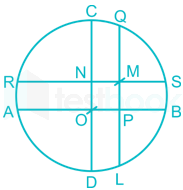
In the given figure, CD and AB are diameters of circle and AB and CD are perpendicular to each other. QL and SR are perpendiculars to AB and CD respectively. Radius of circle is 5 cm, PB ∶ PA = 2 ∶ 3 and CN ∶ ND = 2 : 3. What is the length (in cm) of SM?

  1. AOption (a)

    [(5√3) - 3]

  2. BOption (b)

    [(4√3) - 2]

  3. COption (c)

    [(2√5) - 1]

  4. DOption (d)

    [(2√6) - 1]

View answer & explanation

Correct answer

Answer: (d)D.

[(2√6) - 1]

Why this answer is correct

Shortcut Trick

Total diameter AB = CD = 2 × 5 = 10 cm.

Point P divides AB in 2:3 ratio → PB = (2/5) × 10 = 4 cm. Distance OP = 5 − 4 = 1 cm.

Point N divides CD in 2:3 ratio → CN = (2/5) × 10 = 4 cm. Distance ON = 1 cm.

M is the intersection of perpendiculars, so M is 1 cm from both diameters.

S lies on the circle at a vertical distance of 1 cm from AB → SR = √(52 − 12) = √24 = 2√6 cm.

SM = SR − RM = 2√6 − 1 cm.

∴ The correct answer is (2√6) − 1 cm.

Alternate Method

Given: Radius (r) = 5 cm. Diameters AB and CD are perpendicular.

Let O be the origin (0,0). Then A = (−5,0), B = (5,0), C = (0,5), D = (0,−5).

Ratio PB : PA = 2 : 3. Since length AB = 10 cm:

⇒ PB = (2 / 5) × 10 = 4 cm

⇒ P is at (5 − 4, 0) = (1, 0). So, OP = 1 cm.

Ratio CN : ND = 2 : 3. Since length CD = 10 cm:

⇒ CN = (2 / 5) × 10 = 4 cm

⇒ N is at (0, 5 − 4) = (0, 1). So, ON = 1 cm.

M is the intersection of the perpendicular from P and the perpendicular from N.

⇒ Coordinates of M = (1, 1).

S lies on the circle x2 + y2 = 52 and is on the horizontal line SR (y = 1) passing through N and M.

⇒ x2 + 12 = 25

⇒ x2 = 24

⇒ x = √24 = 2√6 cm.

The point R is the intersection of the horizontal line with diameter CD, so R = (0, 1).

⇒ SR = 2√6 cm and RM = OP = 1 cm.

⇒ SM = SR − RM = 2√6 − 1 cm.

∴ The correct answer is (2√6) − 1 cm.

Additional Information

Equation of a Circle

For a circle with center (h, k) and radius r, the equation is (x − h)2 + (y − k)2 = r2. In this problem, center is (0,0).

Pythagoras Theorem in Circles

Any chord perpendicular to a radius forms a right-angled triangle where r2 = (distance from center)2 + (half chord length)2.

Section Formula

A point dividing a segment with endpoints (x1, y1) and (x2, y2) in ratio m:n has coordinates ((mx2+nx1)/(m+n), (my2+ny1)/(m+n)).

Question 27

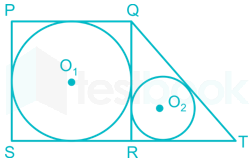
In the given figure, PQRS is a square of side 20 cm and SR is extended to point T. If the length of QT is 25 cm, then what is the distance (in cm) between the centres O1 and O2 of the two circle?

  1. AOption (a)

    5√10

  2. BOption (b)

    4√10

  3. COption (c)

    8√5

  4. DOption (d)

    16√2

View answer & explanation

Correct answer

Answer: (a)A.

5√10

Why this answer is correct

Shortcut Trick

Side of square PQRS = 20 cm → Center O1 is at (10, 10).

In right ▵QRT, QR = 20, QT = 25 ⇒ RT = √(252 − 202) = 15 cm.

Inradius r2 of ▵QRT = (Base + Height − Hypotenuse) ÷ 2 = (20 + 15 − 25) ÷ 2 = 5 cm.

Position of O2 relative to O1: Δx = 10 + 5 = 15 cm, Δy = 10 − 5 = 5 cm.

Distance O1O2 = √(152 + 52) = √(225 + 25) = √250 = 5√10 cm.

∴ The correct answer is 5√10 cm.

Alternate Method

Given:

Side of square (a) = 20 cm

Hypotenuse of ▵QRT (QT) = 25 cm

Formula Used:

Inradius of a right-angled triangle = (Leg1 + Leg2 − Hypotenuse) ÷ 2

Distance between two points (x1, y1) and (x2, y2) = √((x2 − x1)2 + (y2 − y1)2)

Calculations:

Let S be the origin (0, 0).

⇒ Coordinates: S(0, 0), R(20, 0), Q(20, 20), P(0, 20).

⇒ In ▵QRT, QR = 20 cm and QT = 25 cm.

⇒ RT = √(QT2 − QR2) = √(252 − 202) = √(625 − 400) = 15 cm.

⇒ T is on extended SR → T = (20 + 15, 0) = (35, 0).

⇒ O1 is the center of the square incircle → O1 = (20 ÷ 2, 20 ÷ 2) = (10, 10).

⇒ Inradius of ▵QRT (r2) = (20 + 15 − 25) ÷ 2 = 5 cm.

⇒ O2 is shifted from R(20, 0) by r2 along x-axis and r2 along y-axis.

⇒ O2 = (20 + 5, 0 + 5) = (25, 5).

⇒ Distance O1O2 = √((25 − 10)2 + (5 − 10)2)

⇒ O1O2 = √(152 + (−5)2) = √(225 + 25) = √250

⇒ O1O2 = 5√10 cm.

∴ The correct answer is 5√10 cm.

Additional Information

Inradius of a Right-Angled Triangle

The inradius (r) can be calculated using the formula r = (P + B − H) ÷ 2, where P is perpendicular, B is base, and H is hypotenuse.

Distance Formula in Coordinate Geometry

The distance between two points A(x1, y1) and B(x2, y2) is given by AB = √((x2 − x1)2 + (y2 − y1)2).

Center of a Square

The center of a square is the point of intersection of its diagonals and also the center of its inscribed and circumscribed circles.

Question 28

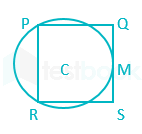
In the given figure, PQSR is a square of side 6 cm. What is the value (in cm) of the radius of the circle?(where M is the point of contact of the tangent QS and the circle).

  1. AOption (a)

    4.25

  2. BOption (b)

    3.75

  3. COption (c)

    3.5

  4. DOption (d)

    4.55

View answer & explanation

Correct answer

Answer: (b)B.

3.75

Why this answer is correct

Shortcut Trick

For a square of side 'a', the radius 'r' of a circle passing through two vertices and tangent to the opposite side is given by r = 5a/8.

Given: Side of square (a) = 6 cm.

Applying the shortcut formula:

r = (5 × 6) ÷ 8 = 30 ÷ 8 = 3.75 cm.

∴ The correct answer is 3.75 cm.

Alternate Method

Given: PQSR is a square with side length a = 6 cm. Circle passes through P and R, and is tangent to side QS at point M.

Formula used: Pythagoras theorem in a circle, r2 = (a − r)2 + (a/2)2.

⇒ Let the radius of the circle be r cm.

⇒ Let the center of the circle be O. Since the circle passes through P and R, O lies on the perpendicular bisector of PR.

⇒ Distance from O to side PR = Side − Radius = 6 − r.

⇒ In the right-angled triangle formed by the center O, the midpoint of PR, and vertex R:

⇒ Hypotenuse = r, Base = 6 − r, Perpendicular = 6/2 = 3.

⇒ r2 = (6 − r)2 + 32

⇒ r2 = 36 + r2 − 12r + 9

⇒ 12r = 45

⇒ r = 45 ÷ 12 = 3.75 cm.

∴ The correct answer is 3.75 cm.

Additional Information

Tangent-Radius Property

The radius of a circle is always perpendicular to the tangent at the point of contact.

Perpendicular Bisector of a Chord

The perpendicular bisector of any chord (like PR in this case) always passes through the center of the circle.

Circle in a Square

If a circle is inscribed in a square of side 'a', its radius is a/2. If it passes through vertices, the radius depends on the specific points of contact or intersection.

Question 29

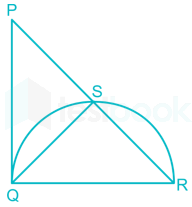
In the given figure, ΔPQR is a right angled triangle at Q. If PQ = 35 cm and QS = 28 cm and a semicircle passes from the point QRS, then what is the value (in cm) of SR?

  1. AOption (a)

    35.33

  2. BOption (b)

    37.33

  3. COption (c)

    41.33

  4. DOption (d)

    43.33

View answer & explanation

Correct answer

Answer: (b)B.

37.33

Why this answer is correct

Shortcut Trick

In a right ΔPQR, altitude QS to hypotenuse PR follows: QS2 = PS × SR.

First, find PS using Pythagoras in ΔPQS: PS = √(352 − 282) = √(1225 − 784) = √441 = 21 cm.

Apply geometric mean theorem: SR = QS2 ÷ PS.

SR = 282 ÷ 21 = 784 ÷ 21 = 37.33 cm.

∴ The correct answer is 37.33 cm.

Alternate Method

Given: PQ = 35 cm, QS = 28 cm, ∠PQR = 90°. Semicircle passes through Q, R, and S.

Formula: In right ΔPQR, if QS ⊥ PR, then PS2 + QS2 = PQ2 and QS2 = PS × SR.

⇒ In ΔPQS, applying Pythagoras theorem:

⇒ PS = √(PQ2 − QS2)

⇒ PS = √(352 − 282)

⇒ PS = √(1225 − 784) = √441 = 21 cm

⇒ For a semicircle to pass through Q, R, S where S lies on the hypotenuse, ∠QSR must be 90° (angle in a semicircle).

⇒ Using property of altitude to hypotenuse: QS2 = PS × SR

⇒ 282 = 21 × SR

⇒ 784 = 21 × SR

⇒ SR = 784 ÷ 21 = 37.333...

∴ The correct answer is 37.33 cm.

Additional Information

Altitude to Hypotenuse Properties

In a right triangle with altitude h to hypotenuse dividing it into segments x and y, h2 = x × y. Also, leg2 = adjacent segment × hypotenuse.

Circle Properties in Triangles

The angle subtended by a diameter at any point on the circumference is 90°. If ∠QSR = 90°, then QR is the diameter of the circle passing through Q, S, and R.

Pythagorean Triplets

Common triplets like 3, 4, 5 can be scaled. Here, 21, 28, 35 is a 3:4:5 triplet multiplied by 7, which helps in quick calculation of PS.

Question 30

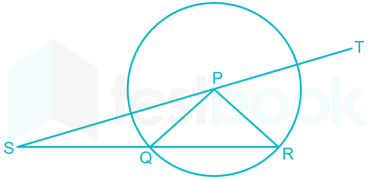
In the given figure, P is the centre of the circle. If QS = PR, then what is the ratio of ∠RSP to the ∠TPR?

  1. AOption (a)

    1 ∶ 4

  2. BOption (b)

    2 ∶ 5

  3. COption (c)

    1 ∶ 3

  4. DOption (d)

    2 ∶ 7

View answer & explanation

Correct answer

Answer: (c)C.

1 ∶ 3

Why this answer is correct

Shortcut Trick

Let ∠RSP = x. Since QS = PR and PR is the radius, QS = Radius = PQ.

In isosceles ΔPQS (PQ = QS), ∠QPS = ∠QSP = x.

Exterior ∠PQR of ΔPQS = ∠QPS + ∠QSP = x + x = 2x.

In isosceles ΔPQR (PQ = PR = radii), ∠PRQ = ∠PQR = 2x.

Exterior ∠TPR of ΔPSR = ∠RSP + ∠PRQ = x + 2x = 3x.

∴ The correct answer is 1 ∶ 3.

Alternate Method

Given:

P is the centre of the circle. PR is the radius. QS = PR. Points S, Q, R are collinear.

Formula Used:

  1. Angles opposite to equal sides in a triangle are equal.
  2. Exterior angle of a triangle is equal to the sum of two opposite interior angles.

Calculations:

⇒ Let ∠RSP = x

⇒ Join PQ. Since PQ and PR are radii, PQ = PR.

⇒ Given QS = PR, ∴ QS = PQ = PR = Radius.

⇒ In ΔPQS, side PQ = side QS ⇒ ∠QPS = ∠QSP = x

⇒ In ΔPQS, exterior ∠PQR = ∠QPS + ∠QSP = x + x = 2x

⇒ In ΔPQR, side PQ = side PR (radii) ⇒ ∠PRQ = ∠PQR = 2x

⇒ In ΔPSR, ∠TPR is the exterior angle at vertex P.

⇒ ∠TPR = ∠RSP + ∠PRQ = x + 2x = 3x

⇒ Ratio = ∠RSP ∶ ∠TPR = x ∶ 3x = 1 ∶ 3

∴ The correct answer is 1 ∶ 3.

Additional Information

Exterior Angle Theorem

The measure of an exterior angle of a triangle is equal to the sum of the measures of its two remote interior angles.

Isosceles Triangle Theorem

In a triangle, if two sides are equal, then the angles opposite to those sides are also equal.

Circle Secant Property

In this specific configuration where the external segment of a secant equals the radius, the intercepted central angle is always three times the external angle.

Question 31

The distance between the centers of two circles is 60 cm and their radii are 35 cm and 24 cm respectively. What is the length (in cm) of the direct common tangent to the circles?

  1. AOption (a)

    (3479) \sqrt(3479)

  2. BOption (b)

    61

  3. COption (c)

    48

  4. DOption (d)

    72

View answer & explanation

Correct answer

Answer: (a)A.

(3479) \sqrt(3479)

Why this answer is correct

Shortcut Trick

Length of Direct Common Tangent (DCT) = √(d2 − (r1 − r2)2)

Here, d = 60 cm, r1 = 35 cm, r2 = 24 cm

Difference in radii (r1 − r2) = 35 − 24 = 11 cm

DCT = √(602 − 112) = √(3600 − 121) = √3479 cm

∴ The correct answer is √3479 cm.

Alternate Method

Given:

Distance between centers (d) = 60 cm

Radius of first circle (r1) = 35 cm

Radius of second circle (r2) = 24 cm

Formula Used:

Length of Direct Common Tangent = √[(Distance between centers)2 − (r1 − r2)2]

Calculations:

⇒ Difference in radii = 35 − 24 = 11 cm

⇒ DCT = √[602 − (11)2]

⇒ DCT = √[3600 − 121]

⇒ DCT = √3479 cm

∴ The correct answer is √3479 cm.

Additional Information

Transverse Common Tangent (TCT)

The length of the transverse common tangent is given by √[d2 − (r1 + r2)2].

Circles touching externally

When two circles touch externally, d = r1 + r2. In this case, DCT = 2√(r1 × r2) and TCT = 0.

Circles touching internally

When two circles touch internally, d = |r1 − r2|. In this case, DCT = 0 and TCT is not defined.

Question 32

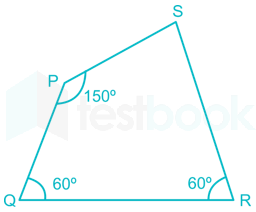
In the given figure, PQRS is a quadrilateral. If QR = 18 cm and PS = 9 cm, then what is the area (in cm2) of quadrilateral PQRS?

  1. AOption (a)

    (64√3)/3

  2. BOption (b)

    (177√3)/2

  3. COption (c)

    (135√3)/2

  4. DOption (d)

    (98√3)/3

View answer & explanation

Correct answer

Answer: (c)C.

(135√3)/2

Why this answer is correct

Shortcut Trick

Extend PQ and RS to meet at a point T to form an equilateral triangle TQR.

Area of ΔTQR (side = 18 cm) = (√3/4) × 182 = 81√3 cm2.

The smaller triangle ΔTPS is a right-angled triangle with ∠S = 90°, ∠T = 60°, and PS = 9 cm.

Area of ΔTPS = 1/2 × PS × (PS / tan 60°) = 1/2 × 9 × (9/√3) = 13.5√3 cm2.

Area of quadrilateral PQRS = Area(ΔTQR) − Area(ΔTPS) = 81√3 − 13.5√3 = 67.5√3 cm2.

∴ The correct answer is (135√3)/2 cm2.

Alternate Method

Given: QR = 18 cm, PS = 9 cm. In quadrilateral PQRS, ∠Q = 60°, ∠R = 60°, and ∠S = 90°.

Formula Used: Area of equilateral Δ = (√3/4) × side2 | Area of right Δ = 1/2 × base × height.

⇒ Extend PQ and RS to meet at point T. Since ∠Q = 60° and ∠R = 60°, ΔTQR is an equilateral triangle.

⇒ Area of ΔTQR = (√3/4) × (18)2 = (√3/4) × 324 = 81√3 cm2.

⇒ In right-angled triangle TPS, ∠S = 90°, ∠T = 60°, and PS = 9 cm (given).

⇒ TS = PS / tan 60° = 9 / √3 = 3√3 cm.

⇒ Area of ΔTPS = 1/2 × PS × TS = 1/2 × 9 × 3√3 = 13.5√3 cm2.

⇒ Area of quadrilateral PQRS = Area of ΔTQR − Area of ΔTPS

⇒ Area PQRS = 81√3 − 13.5√3 = 67.5√3 cm2.

⇒ Area PQRS = (135√3)/2 cm2.

∴ The correct answer is (135√3)/2 cm2.

Additional Information

Area of Equilateral Triangle

The area of an equilateral triangle with side 'a' is given by the formula A = (√3/4) × a2.

Trigonometric Ratios in Right Triangles

In a right-angled triangle, tan θ = Perpendicular / Base. For 60°, tan 60° = √3 and sin 60° = √3/2.

Sum of Angles in a Quadrilateral

The sum of all four interior angles of any quadrilateral is always 360°.

Question 33

PQR is a triangle, whose area is 180 cm2. S is a point on side QR, such that PS is the angle bisector of ∠QPR. If PQ ∶ PR = 2 ∶ 3, then what is the area (in cm2) of ΔPSR?

  1. AOption (a)

    90

  2. BOption (b)

    108

  3. COption (c)

    144

  4. DOption (d)

    72

View answer & explanation

Correct answer

Answer: (b)B.

108

Why this answer is correct

Shortcut Trick

Angle bisector PS divides the base QR in the ratio of sides PQ and PR.

Ratio of Area(ΔPQS) : Area(ΔPSR) = PQ : PR = 2 : 3.

Total ratio parts = 2 + 3 = 5 units.

5 units = 180 cm2 → 1 unit = 36 cm2.

Area of ΔPSR = 3 units = 3 × 36 = 108 cm2.

∴ The correct answer is 108 cm2.

Alternate Method

Given:

Area of ΔPQR = 180 cm2

PQ : PR = 2 : 3

PS is the internal angle bisector of ∠QPR.

Formula Used:

Angle Bisector Theorem: The internal bisector of an angle of a triangle divides the opposite side internally in the ratio of the sides containing the angle. ⇒ QS/SR = PQ/PR

Area of a triangle with constant height is proportional to its base.

Calculations:

According to the Angle Bisector Theorem:

⇒ QS / SR = PQ / PR = 2 / 3

Let QS = 2x and SR = 3x

Triangles ΔPQS and ΔPSR share the same vertex P and their bases QS and SR lie on the same line QR.

Thus, they have the same altitude (h) from P to QR.

⇒ Area(ΔPQS) = (1/2) × QS × h = (1/2) × 2x × h

⇒ Area(ΔPSR) = (1/2) × SR × h = (1/2) × 3x × h

⇒ Area(ΔPQS) : Area(ΔPSR) = 2x : 3x = 2 : 3

Total Area(ΔPQR) = Area(ΔPQS) + Area(ΔPSR)

⇒ 180 = 2k + 3k (where k is a constant)

⇒ 5k = 180

⇒ k = 180 ÷ 5 = 36

Area of ΔPSR = 3k

⇒ Area(ΔPSR) = 3 × 36

⇒ Area(ΔPSR) = 108 cm2

∴ The correct answer is 108 cm2.

Additional Information

Internal Angle Bisector Theorem

In any triangle, the bisector of an interior angle divides the opposite side into segments whose lengths are in the same ratio as the lengths of the other two sides.

Area of Triangles with Same Altitude

If two triangles have the same height, the ratio of their areas is equal to the ratio of their corresponding bases. Area1/Area2 = Base1/Base2.

External Angle Bisector Theorem

For an external angle bisector at P intersecting extended QR at S, the ratio remains the same: QS/SR = PQ/PR.

Question 34

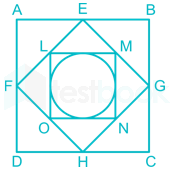
In the given figure, ABCD is a square. EFGH is a square formed by pointing the mid points of sides of ABCD. LMNO is a square formed by joining the mid points of sides of EFGH. A circle is inscribed inside LMNO. If area of circle is 38.5 cm2, then what is the area (in cm2) square ABCD?

  1. AOption (a)

    98

  2. BOption (b)

    196

  3. COption (c)

    122.5

  4. DOption (d)

    171.5

View answer & explanation

Correct answer

Answer: (b)B.

196

Why this answer is correct

Shortcut Trick

Each square formed by joining midpoints has half the area of the outer square.

Area of square LMNO = 1/2 × Area of square EFGH = 1/4 × Area of square ABCD.

Area of innermost square LMNO = (4/π) × Area of inscribed circle.

Area of LMNO = (4 × 38.5) ÷ (22/7) = (4 × 38.5 × 7) ÷ 22 = 49 cm2.

Area of ABCD = 4 × Area of LMNO = 4 × 49 = 196 cm2.

∴ The correct answer is 196 cm2.

Alternate Method

Given:

Area of inscribed circle in LMNO = 38.5 cm2

ABCD, EFGH, and LMNO are nested squares formed by midpoints.

Calculations:

⇒ Area of circle = πr2 = 38.5

⇒ (22/7) × r2 = 38.5

⇒ r2 = (38.5 × 7) ÷ 22 = 12.25

⇒ r = √12.25 = 3.5 cm

⇒ Side of square LMNO = Diameter of circle = 2r = 2 × 3.5 = 7 cm

⇒ Area of square LMNO = 7 × 7 = 49 cm2

⇒ Area of square EFGH = 2 × Area of LMNO = 2 × 49 = 98 cm2

⇒ Area of square ABCD = 2 × Area of EFGH = 2 × 98 = 196 cm2

∴ The correct answer is 196 cm2.

Additional Information

Midpoint Square Area Property

When the midpoints of the sides of a square are joined, a new square is formed whose area is exactly half (1/2) the area of the original square.

Inscribed Circle Relationship

For a circle inscribed in a square of side 's', the radius 'r' of the circle is s/2, meaning the side of the square is equal to the diameter of the circle.

Area Comparison

The ratio of the area of a square to the area of its inscribed circle is always 4 : π, which is approximately 14 : 11.

Question 35

ABCDEF is a regular hexagon of side 12 cm. What is the area (in cm2) of the ΔECD?

  1. AOption (a)

    18√3

  2. BOption (b)

    24√3

  3. COption (c)

    36√3

  4. DOption (d)

    42√3

View answer & explanation

Correct answer

Answer: (c)C.

36√3

Why this answer is correct

Shortcut Trick

Area of a triangle formed by two adjacent sides and a diagonal (like ΔECD) in a regular hexagon is equal to the area of one equilateral triangle of the same side length.

Area of equilateral triangle = (√3 / 4) × (side)2

Area of ΔECD = (√3 / 4) × 122

Area of ΔECD = (√3 / 4) × 144 = 36√3 cm2.

∴ The correct answer is 36√3 cm2.

Alternate Method

Given:

Side of regular hexagon (s) = 12 cm

Formula Used:

Interior angle of a regular hexagon = (n − 2) × 180° / n

Area of triangle = (1/2) × a × b × sin(θ)

Calculations:

⇒ In regular hexagon ABCDEF, internal angle ∠CDE = (6 − 2) × 180° / 6 = 120°

⇒ In ΔECD, CD = 12 cm and DE = 12 cm (sides of regular hexagon)

⇒ Area of ΔECD = (1/2) × CD × DE × sin(∠CDE)

⇒ Area = (1/2) × 12 × 12 × sin(120°)

⇒ sin(120°) = sin(180° − 60°) = sin(60°) = √3 / 2

⇒ Area = (1/2) × 144 × (√3 / 2)

⇒ Area = 72 × (√3 / 2) = 36√3 cm2

∴ The correct answer is 36√3 cm2.

Additional Information

Area of Regular Hexagon

Total area of a regular hexagon with side 's' = 6 × (√3 / 4) × s2 = (3√3 / 2) × s2.

Internal Angle and Diagonals

Each internal angle is 120°. A regular hexagon has 9 diagonals. The longest diagonal (e.g., AD) is 2 × side.

Area Partitioning

A regular hexagon is composed of 6 congruent equilateral triangles meeting at the center.

Question 36

PQRS is a square whose side is 16 cm. What is the value of the side (in cm) of the largest regular octagon that can be cut from the given square?

  1. AOption (a)

    8 - 4√2

  2. BOption (b)

    16 + 8√2

  3. COption (c)

    16√2 - 16

  4. DOption (d)

    16 - 8√2

View answer & explanation

Correct answer

Answer: (c)C.

16√2 - 16

Why this answer is correct

Shortcut Trick

For a square of side 'a', the side of the largest regular octagon 's' is given by the formula: s = a / (√2 + 1).

By rationalizing the denominator, s = a × (√2 − 1).

Given side of square a = 16 cm.

s = 16 × (√2 − 1) = 16√2 − 16 cm.

∴ The correct answer is 16√2 − 16 cm.

Alternate Method

Given: Side of square (a) = 16 cm. Octagon is regular.

Let the length cut from each corner of the square be 'x'.

The hypotenuse of the corner triangle (octagon side) is s = √(x2 + x2) = x√2.

The remaining part on the square edge (octagon side) is s = 16 − 2x.

⇒ x√2 = 16 − 2x

⇒ x√2 + 2x = 16

⇒ x(√2 + 2) = 16

⇒ x = 16 / (2 + √2)

Substitute x in s = x√2:

⇒ s = (16 × √2) / (2 + √2)

⇒ s = (16√2) / [√2(√2 + 1)]

⇒ s = 16 / (√2 + 1)

⇒ s = 16(√2 − 1) / [(√2 + 1)(√2 − 1)]

⇒ s = 16(√2 − 1) / (2 − 1)

⇒ s = 16√2 − 16 cm

∴ The correct answer is 16√2 − 16 cm.

Additional Information

Area of Regular Octagon

The area of a regular octagon with side 's' is given by A = 2(1 + √2)s2.

Interior and Exterior Angles

For a regular octagon, each exterior angle is 360° ÷ 8 = 45° and each interior angle is 180° − 45° = 135°.

Apothem of Regular Octagon

The distance from the center to any side (inradius) is r = (s/2) × (1 + √2).

Question 37

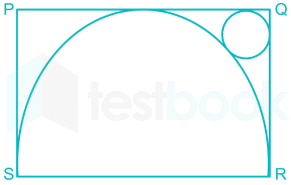
In the given figure, PQRS is a rectangle, a semicircle with SR as the diameter is drawn. A circle is drawn a shown in the figure. If QR = 7 cm, then what is the radius (in cm) of the small circle?

  1. AOption (a)

    21 + 14√2

  2. BOption (b)

    21 - 14√2

  3. COption (c)

    Both 1 and 2

  4. DOption (d)

    None of these

View answer & explanation

Correct answer

Answer: (b)B.

21 - 14√2

Why this answer is correct

Shortcut Trick

Radius of the semicircle (R) = side QR = 7 cm.

The small circle is tangent to the corner of a square of side R and the semicircle.

Shortcut formula for radius (r) in this configuration: r = R × (3 − 2√2).

Substituting R = 7: r = 7 × (3 − 2√2) = 21 − 14√2 cm.

∴ The correct answer is 21 − 14√2 cm.

Alternate Method

Given: QR = 7 cm, Semicircle diameter = SR. PQRS is a rectangle.

Formula: Distance between centers of tangent circles d = R1 + R2.

⇒ Let radius of semicircle be R = 7 cm and radius of small circle be r.

⇒ Let center of semicircle be O(7, 0) and center of small circle be C(14 − r, 7 − r).

⇒ Small circle is tangent to semicircle externally, so OC = R + r = 7 + r.

⇒ Using distance formula: OC2 = (14 − r − 7)2 + (7 − r − 0)2

⇒ (7 + r)2 = (7 − r)2 + (7 − r)2

⇒ 49 + 14r + r2 = 2(49 − 14r + r2)

⇒ 49 + 14r + r2 = 98 − 28r + 2r2

⇒ r2 − 42r + 49 = 0

⇒ Using quadratic formula: r = [42 − √(422 − 4 × 1 × 49)] / 2

⇒ r = [42 − √(1764 − 196)] / 2 = [42 − √1568] / 2

⇒ r = [42 − 28√2] / 2 = 21 − 14√2

∴ The correct answer is 21 − 14√2 cm.

Additional Information

Distance Between Centers of Tangent Circles

For two circles with radii R and r touching externally, distance d = R + r. For internal touch, d = R − r.

Circle in a Corner

The radius r of a circle in the corner of a square of side R, tangent to an inscribed arc of radius R, is given by r = R(3 − 2√2).

Quadratic Formula

For ax2 + bx + c = 0, the roots are x = [−b ± √(b2 − 4ac)] / 2a.

Question 38

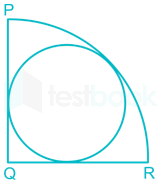
In the given figure, PQR is a quadrant whose radius is 7 cm. A circle is inscribed in the quadrant as shown in the figure. What is the area (in cm2) of the circle?

  1. AOption (a)

    385 - 221√2

  2. BOption (b)

    308 - 154√2

  3. COption (c)

    154 - 77√2

  4. DOption (d)

    462 - 308√2

View answer & explanation

Correct answer

Answer: (d)D.

462 - 308√2

Why this answer is correct

Shortcut Trick

Radius of a circle (r) inscribed in a quadrant of radius R is: r = R × (√2 − 1).

Given R = 7 cm ⇒ r = 7(√2 − 1) cm.

Area of circle = πr2 = (22/7) × [7(√2 − 1)]2.

Area = (22/7) × 49 × (2 + 1 − 2√2) = 154 × (3 − 2√2).

Area = 462 − 308√2 cm2.

∴ The correct answer is 462 − 308√2 cm2.

Alternate Method

Given: Radius of the quadrant (R) = 7 cm.

Formula Used: Radius of inscribed circle r = R / (√2 + 1); Area of circle = πr2.

In the quadrant PQR, let O be the center and r be the radius of the inscribed circle.

⇒ PO = Diagonal of a square of side r = r√2.

⇒ Total radius of quadrant (R) = PO + Radius of circle = r√2 + r.

⇒ 7 = r(√2 + 1).

⇒ r = 7 / (√2 + 1).

Rationalizing the denominator:

⇒ r = [7 × (√2 − 1)] / [(√2 + 1) × (√2 − 1)] = 7(√2 − 1) cm.

⇒ Area of circle = πr2 = (22/7) × [7(√2 − 1)]2.

⇒ Area = (22/7) × 49 × (2 + 1 − 2√2).

⇒ Area = 154 × (3 − 2√2).

⇒ Area = 462 − 308√2 cm2.

∴ The correct answer is 462 − 308√2 cm2.

Additional Information

Radius of Inscribed Circle in a Quadrant

For a quadrant of radius R, the radius r of the largest inscribed circle is given by r = R/(√2 + 1) or r = R(√2 − 1).

Area of Circle and Quadrant

Area of a full circle = πr2, while the area of a quadrant with radius R is (1/4)πR2.

Diagonal of a Square

In geometry, the distance from the vertex of a quadrant to the center of the inscribed circle forms the diagonal of a square of side r, which is always r√2.

Question 39

A prism has a regular hexagonal base with side 6 cm. If the total surface area of prism is 216√3 cm2, then what is the height (in cm) of prism?

  1. AOption (a)

    3√3

  2. BOption (b)

    6√3

  3. COption (c)

    6

  4. DOption (d)

    3

View answer & explanation

Correct answer

Answer: (a)A.

3√3

Why this answer is correct

Shortcut Trick

Base Area of regular hexagon = (3√3 / 2) × side2 = (3√3 / 2) × 62 = 54√3 cm2.

Total Surface Area (TSA) = 2 × Base Area + Perimeter × Height.

216√3 = 2 × (54√3) + (6 × 6) × h.

216√3 = 108√3 + 36h ⇒ 36h = 108√3.

h = 108√3 ÷ 36 = 3√3 cm.

∴ The correct answer is 3√3 cm.

Alternate Method

Given:

Base side (s) = 6 cm

Total Surface Area (TSA) = 216√3 cm2

Formula Used:

Area of regular hexagon = (3√3 / 2) × s2

Perimeter of hexagon = 6 × s

TSA of Prism = 2 × Base Area + Lateral Surface Area (Perimeter × h)

Calculations:

⇒ Base Area = (3√3 / 2) × 62

⇒ Base Area = (3√3 / 2) × 36 = 54√3 cm2

⇒ Perimeter of Base = 6 × 6 = 36 cm

⇒ TSA = 2 × (54√3) + 36 × h

⇒ 216√3 = 108√3 + 36h

⇒ 216√3 − 108√3 = 36h

⇒ 108√3 = 36h

⇒ h = 108√3 ÷ 36

⇒ h = 3√3 cm

∴ The correct answer is 3√3 cm.

Additional Information

Volume of Hexagonal Prism

Volume = Base Area × Height = (3√3 / 2) × s2 × h.

Lateral Surface Area (LSA)

LSA of any prism = Perimeter of base × height of prism.

Regular Hexagon Properties

A regular hexagon can be divided into 6 equilateral triangles of side 's'. Area = 6 × (√3 / 4)s2 = (3√3 / 2)s2.

Question 40

The radius of the base of a solid cone is 9 cm and its height is 21 cm. It cut into 3 parts by two cuts, which are parallel to its base. The cuts are at height of 7 cm and 14 cm from the base respectively. What is the ratio of curved surface areas of top, middle and bottom parts respectively?

  1. AOption (a)

    1 ∶ 4 ∶ 8

  2. BOption (b)

     1 ∶ 3 ∶ 5

  3. COption (c)

    1 ∶ 3 ∶ 9

  4. DOption (d)

    1 ∶ 6 ∶ 12

View answer & explanation

Correct answer

Answer: (b)B.

 1 ∶ 3 ∶ 5

Why this answer is correct

Shortcut Trick

Heights of the three cones from the vertex are h1 = 7 cm, h2 = 14 cm, and h3 = 21 cm.

Ratio of heights (h1 : h2 : h3) = 7 : 14 : 21 = 1 : 2 : 3.

Since CSA ∝ (height)2 for similar cones, ratio of CSAs of cones = 12 : 22 : 32 = 1 : 4 : 9.

Ratio of CSA of parts (top : middle : bottom) = 1 : (4 − 1) : (9 − 4) = 1 : 3 : 5.

∴ The correct answer is 1 : 3 : 5.

Alternate Method

Given:

Total Height (H) = 21 cm, Base Radius (R) = 9 cm.

Cuts are at 7 cm and 14 cm from the base.

Formula:

Curved Surface Area (CSA) of cone = πrl

For similar cones formed by parallel cuts, CSA1 : CSA2 : CSA3 = h12 : h22 : h32

Calculations:

⇒ Height of small cone (top) from vertex = 21 − 14 = 7 cm

⇒ Height of medium cone (top + middle) from vertex = 21 − 7 = 14 cm

⇒ Height of original cone (total) = 21 cm

⇒ Ratio of heights = 7 : 14 : 21 = 1 : 2 : 3

⇒ Ratio of CSA of three cones = 12 : 22 : 32 = 1 : 4 : 9

⇒ CSA of Top part = 1 unit

⇒ CSA of Middle part = CSA of medium cone − CSA of top cone = 4 − 1 = 3 units

⇒ CSA of Bottom part = CSA of total cone − CSA of medium cone = 9 − 4 = 5 units

⇒ Required Ratio = 1 : 3 : 5

∴ The correct answer is 1 : 3 : 5.

Additional Information

Volume Ratio of Similar Cones

If heights are in ratio a : b : c, then the volumes are in ratio a3 : b3 : c3.

CSA of Frustum

CSA of a frustum = π(r1 + r2)l, where r1, r2 are radii of bases and l is the slant height of the frustum.

Slant Height Relationship

For a cone, l = √(r2 + h2). In similar cones, the ratio of slant heights is equal to the ratio of their vertical heights.

Question 41

A right circular cylinder has height 18 cm and radius 7 cm. The cylinder is cut in three equal parts (by 2 cuts parallel to base). What is the percentage increase in total surface area?

  1. AOption (a)

    62

  2. BOption (b)

    56

  3. COption (c)

    48

  4. DOption (d)

    52

View answer & explanation

Correct answer

Answer: (b)B.

56

Why this answer is correct

Shortcut Trick

Each cut parallel to the base creates 2 new circular surfaces (2 × πr2).

For 2 cuts, total added area = 4 × πr2.

Percentage increase = [Total added area ÷ Initial Total Surface Area] × 100.

Shortcut formula: % Increase = [(n × r) ÷ (h + r)] × 100, where n is the number of cuts.

% Increase = [(2 × 7) ÷ (18 + 7)] × 100 = (14 ÷ 25) × 100 = 56%.

∴ The correct answer is 56%.

Alternate Method

Given: Radius (r) = 7 cm, Height (h) = 18 cm. Number of cuts = 2.

Formula: Total Surface Area (TSA) of cylinder = 2πr(h + r). Area of circular base = πr2.

⇒ Initial TSA = 2 × π × 7 × (18 + 7)

⇒ Initial TSA = 2 × π × 7 × 25 = 350π cm2

⇒ Each cut parallel to the base exposes 2 new circular surfaces of radius r.

⇒ Total additional area for 2 cuts = 2 × (2 × πr2) = 4πr2

⇒ Total additional area = 4 × π × 72 = 4 × 49 × π = 196π cm2

⇒ Percentage increase = (Additional Area ÷ Initial TSA) × 100

⇒ Percentage increase = (196π ÷ 350π) × 100

⇒ Percentage increase = (14 ÷ 25) × 100 = 56%

∴ The correct answer is 56%.

Additional Information

TSA and CSA of Cylinder

Curved Surface Area (CSA) = 2πrh. Total Surface Area (TSA) = 2πrh + 2πr2. The CSA remains unchanged when a cylinder is cut parallel to its base.

Cutting Logic

n cuts parallel to the base divide the cylinder into (n + 1) smaller cylinders and create 2n new circular faces, each with area πr2.

Volume Invariance

The sum of the volumes of the individual parts always equals the volume of the original cylinder (πr2h), regardless of how it is cut.

Question 42

The ratio of curved surface area and volume of a cylinder is 1 ∶ 7. The ratio of total surface area and volume is 187 ∶ 770. What is the respective ratio of its base radius and height?

  1. AOption (a)

    5 ∶ 8

  2. BOption (b)

    4 ∶ 9

  3. COption (c)

    3 ∶ 7

  4. DOption (d)

    7 ∶ 10

View answer & explanation

Correct answer

Answer: (d)D.

7 ∶ 10

Why this answer is correct

Shortcut Trick

Ratio of Curved Surface Area (CSA) to Volume (V) = 2πrh / πr2h = 2/r

Given 2/r = 1/7 ⇒ r = 14 units

Ratio of Total Surface Area (TSA) to Volume (V) = 2πr(r + h) / πr2h = 2(r + h) / rh

Substitute r = 14: 2(14 + h) / 14h = 187 / 770 ⇒ (14 + h) / h = (187 × 7) / 770 = 1.7

1 + 14/h = 1.7 ⇒ 14/h = 0.7 ⇒ h = 20 units

∴ The correct answer is 7 ∶ 10.

Alternate Method

Given:

Ratio of CSA to Volume = 1 ∶ 7

Ratio of TSA to Volume = 187 ∶ 770

Formula Used:

Curved Surface Area (CSA) = 2πrh

Total Surface Area (TSA) = 2πr(r + h)

Volume (V) = πr2h

Calculations:

⇒ CSA / V = 2πrh / πr2h = 2/r

⇒ 2/r = 1/7

⇒ r = 14

⇒ TSA / V = [2πr(r + h)] / πr2h = 2(r + h) / rh

⇒ 2(14 + h) / (14 × h) = 187 / 770

⇒ (14 + h) / 7h = 187 / 770

⇒ 14 + h = (187 × 7h) / 770

⇒ 14 + h = (187 × h) / 110

⇒ 14 + h = 1.7h

⇒ 1.7h − h = 14

⇒ 0.7h = 14

⇒ h = 14 / 0.7 = 20

⇒ Required Ratio = r ∶ h = 14 ∶ 20 = 7 ∶ 10

∴ The correct answer is 7 ∶ 10.

Additional Information

Surface Area of Cylinder

Curved Surface Area is the area of the side wall, 2πrh. Total Surface Area adds the two circular bases, 2πrh + 2πr2.

Volume of Cylinder

The volume represents the space inside the cylinder and is calculated as Base Area × Height = πr2h.

Ratio Shortcut for Cylinder

The ratio of TSA to CSA is always (r + h) / h. The ratio of V to CSA is always r / 2.

Question 43

The ratio of total surface area and volume of a sphere is 1 ∶ 7. This sphere is melted to form small spheres of equal size. The radius of each small sphere is 1/6th the radius of the large sphere. What is the sum (in cm2) of curved surface areas of all small spheres?

  1. AOption (a)

    31276

  2. BOption (b)

    36194

  3. COption (c)

    25182

  4. DOption (d)

    33264

View answer & explanation

Correct answer

Answer: (d)D.

33264

Why this answer is correct

Shortcut Trick

For any sphere, the ratio of Surface Area to Volume is 3/R.

Given TSA/Volume = 1/7 ⇒ 3/R = 1/7 ⇒ R = 21 cm.

Radius of small sphere r = R/6 = 21/6 = 3.5 cm.

Number of small spheres (n) = (R/r)3 = 63 = 216.

Sum of CSAs = n × 4πr2 = 216 × 154 = 33264 cm2.

∴ The correct answer is 33264 cm2.

Alternate Method

Given: Ratio of Total Surface Area (TSA) to Volume (V) of large sphere = 1 ∶ 7.

Formula: TSA = 4πR2, Volume = (4/3)πR3, Area of small sphere = 4πr2.

⇒ (4πR2) ÷ (4/3 πR3) = 1/7

⇒ 3/R = 1/7

⇒ R = 21 cm

⇒ Radius of small sphere (r) = R/6 = 21/6 = 3.5 cm

⇒ Total volume remains same: (4/3)πR3 = n × (4/3)πr3

⇒ n = (R/r)3 = (21 / 3.5)3 = 63 = 216

⇒ CSA of one small sphere = 4 × (22/7) × 3.5 × 3.5 = 154 cm2

⇒ Sum of all CSAs = 216 × 154 = 33264 cm2

∴ The correct answer is 33264 cm2.

Additional Information

Sphere Properties

The Total Surface Area (TSA) and Curved Surface Area (CSA) of a sphere are identical, given by the formula 4πr2. The volume is (4/3)πr3.

Melting and Recasting

When a solid object is melted and recast into several smaller objects, the total volume of all new objects is equal to the volume of the original object.

Ratio Shortcut for Sphere

For any sphere, the ratio of Surface Area to Volume is always 3/r. This is useful for quickly finding the radius when the ratio is given.

Question 44

A hemisphere is kept on top of a cube. Its front view is shown in the given figure. The total height of the figure is 21 cm. The ratio of curved surface area of the hemisphere and total surface area of cube is 11 ∶ 42. What is the total volume (in cm 3) of figure?

  1. AOption (a)

    3318.33

  2. BOption (b)

    3462.67

  3. COption (c)

    3154.67

  4. DOption (d)

    3248.33

View answer & explanation

Correct answer

Answer: (b)B.

3462.67

Why this answer is correct

Shortcut Trick

Ratio of CSAHemisphere : TSACube = (2 × 22/7 × r2) : (6 × a2) = 11 : 42

⇒ (44/7 × r2) / 6a2 = 11/42 ⇒ 44r2 / 42a2 = 11/42 ⇒ 4r2 = a2 ⇒ a = 2r

Total Height = a + r = 2r + r = 3r = 21 cm ⇒ r = 7 cm and a = 14 cm

Total Volume = a3 + (2/3)πr3 = 143 + (2/3) × (22/7) × 73 = 2744 + 718.67 = 3462.67 cm3

∴ The correct answer is 3462.67 cm3.

Alternate Method

Given: Total height = 21 cm, Ratio of CSAhemisphere : TSAcube = 11 : 42

Formula Used: CSA of hemisphere = 2πr2, TSA of cube = 6a2, Volume of cube = a3, Volume of hemisphere = (2/3)πr3

⇒ CSAhemisphere / TSAcube = 11 / 42

⇒ (2 × 22/7 × r2) / (6 × a2) = 11 / 42

⇒ (44r2 / 7) / 6a2 = 11 / 42

⇒ 44r2 / 42a2 = 11 / 42

⇒ 44r2 = 11a2

⇒ 4r2 = a2 ⇒ a = 2r

⇒ Total height = side of cube + radius of hemisphere = a + r = 21

⇒ 2r + r = 21 ⇒ 3r = 21 ⇒ r = 7 cm

⇒ a = 2 × 7 = 14 cm

⇒ Volume of cube = 14 × 14 × 14 = 2744 cm3

⇒ Volume of hemisphere = (2/3) × (22/7) × 7 × 7 × 7 = 2156 / 3 = 718.666... cm3

⇒ Total Volume = 2744 + 718.67 = 3462.67 cm3

∴ The correct answer is 3462.67 cm3.

Additional Information

Surface Area and Volume of Sphere

Total surface area of sphere = 4πr2 and Volume = (4/3)πr3. For a hemisphere, CSA = 2πr2 and TSA = 3πr2.

Cube Properties

Lateral surface area of cube = 4a2, Total surface area = 6a2, Volume = a3, and Face Diagonal = a√2.

Composite Solids

When one solid is placed on another, the total volume is the sum of individual volumes, while the total surface area may exclude the contact area.

Question 45

A solid cube has side 8 cm. It is cut along diagonals of top face to get 4 equal parts. What is the total surface area (in cm2) of each part?

  1. AOption (a)

    96 + 64√2

  2. BOption (b)

    80 + 64√2

  3. COption (c)

    96 + 48√2

  4. DOption (d)

    80 + 48√2

View answer & explanation

Correct answer

Answer: (a)A.

96 + 64√2

Why this answer is correct

Shortcut Trick

Each of the 4 parts is a triangular prism with a right-isosceles triangle base.

Area of Top + Bottom faces per part = 2 × (Area of square face ÷ 4) = 2 × (8 × 8 ÷ 4) = 32 cm2.

Area of one vertical outside face = 8 × 8 = 64 cm2.

Area of two internal cut faces = 2 × [Height × (Diagonal ÷ 2)] = 2 × [8 × (8√2 ÷ 2)] = 64√2 cm2.

Total Surface Area = 32 + 64 + 64√2 = 96 + 64√2 cm2.

∴ The correct answer is 96 + 64√2 cm2.

Alternate Method

Given:

Side of cube (a) = 8 cm.

Number of equal parts after diagonal cuts = 4.

Formula Used:

Total Surface Area (TSA) of a part = Sum of areas of all individual faces.

Calculations:

⇒ Area of Top face of one part = (1/4) × Area of square top = (1/4) × 82 = 16 cm2.

⇒ Area of Bottom face of one part = 16 cm2 (identical to top).

⇒ Area of the vertical outer square face = 8 × 8 = 64 cm2.

⇒ Diagonal of the top face = a√2 = 8√2 cm.

⇒ The cut faces are rectangles with height = 8 cm and width = half of diagonal = (8√2)/2 = 4√2 cm.

⇒ Area of one internal cut face = 8 × 4√2 = 32√2 cm2.

⇒ Since each part has 2 such internal faces, Area = 2 × 32√2 = 64√2 cm2.

⇒ Total Surface Area = (Top + Bottom) + Outer Face + Internal Faces

⇒ Total Surface Area = (16 + 16) + 64 + 64√2

⇒ Total Surface Area = 32 + 64 + 64√2 = 96 + 64√2 cm2.

∴ The correct answer is 96 + 64√2 cm2.

Additional Information

Surface Area of Cube

For a cube of side 'a', the Total Surface Area = 6a2 and Lateral Surface Area = 4a2.

Cube Diagonals

Face diagonal of a cube = a√2 and Space diagonal = a√3.

Effect of Cutting

Whenever a solid is cut, the total surface area increases by twice the area of the cutting plane because two new surfaces are created.

Question 46

A regular pyramid has a square base. The height of the pyramid is 22 cm and side of its base is 14 cm. Volume of pyramid is equal to the volume of a sphere. What is the radius (in cm) of the sphere?

  1. AOption (a)

    ∛49

  2. BOption (b)

    7

  3. COption (c)

    14

  4. DOption (d)

    ∛98

View answer & explanation

Correct answer

Answer: (b)B.

7

Why this answer is correct

Shortcut Trick

Volume of Square Pyramid = 1/3 × (Side)2 × Height = 1/3 × 14 × 14 × 22

Volume of Sphere = 4/3 × (22/7) × r3

Equating: 1/3 × 196 × 22 = 4/3 × (22/7) × r3

r3 = (196 × 22 × 7) ÷ (4 × 22) = 196 × 7 ÷ 4 = 49 × 7 = 343

r = ∛343 = 7 cm

∴ The correct answer is 7 cm.

Alternate Method

Given:

Height of square pyramid (h) = 22 cm

Base side of pyramid (a) = 14 cm

Volume of Pyramid = Volume of Sphere

Formula Used:

Volume of Square Pyramid = (1/3) × a2 × h

Volume of Sphere = (4/3) × π × r3

Calculations:

⇒ Volume of Pyramid = (1/3) × 142 × 22

⇒ Volume of Pyramid = (1/3) × 196 × 22 cm3

⇒ Volume of Sphere = (4/3) × (22/7) × r3

⇒ According to the question: (1/3) × 196 × 22 = (4/3) × (22/7) × r3

⇒ 196 × 22 = 4 × (22/7) × r3

⇒ 196 = (4/7) × r3

⇒ r3 = (196 × 7) ÷ 4

⇒ r3 = 49 × 7

⇒ r3 = 343

⇒ r = ∛343 = 7 cm

∴ The correct answer is 7 cm.

Additional Information

Volume of a Cone

The volume of a circular cone is given by V = (1/3) × π × r2 × h, which is exactly one-third of a cylinder with the same base and height.

Surface Area of Sphere

The total surface area of a sphere is 4 π r2, while for a hemisphere, it is 3 π r2 (including the base).

Regular Pyramid Properties

For a regular pyramid, the slant height (l) is related to vertical height (h) and side (a) by l = √(h2 + (a/2)2).

Question 47

What is the value of [sin(y - z) + sin(y + z) + 2siny]/[sin(x - z) + sin(x + z) + 2sinx]?

  1. AOption (a)

    cosx.siny

  2. BOption (b)

    siny/sinx

  3. COption (c)

    sinz

  4. DOption (d)

    sinx.tany

View answer & explanation

Correct answer

Answer: (b)B.

siny/sinx

Why this answer is correct

Shortcut Trick

Use the substitution method by setting the variable z = 0.

Numerator = sin(y − 0) + sin(y + 0) + 2siny = siny + siny + 2siny = 4siny.

Denominator = sin(x − 0) + sin(x + 0) + 2sinx = sinx + sinx + 2sinx = 4sinx.

Expression = 4siny ÷ 4sinx = siny/sinx.

∴ The correct answer is siny/sinx.

Alternate Method

Given: [sin(y − z) + sin(y + z) + 2siny] ÷ [sin(x − z) + sin(x + z) + 2sinx]

Formula Used: sin(A + B) + sin(A − B) = 2 sin A cos B

Applying the formula to the numerator:

⇒ sin(y − z) + sin(y + z) = 2 sin y cos z

⇒ Numerator = 2 sin y cos z + 2 sin y

⇒ Numerator = 2 sin y (cos z + 1)

Applying the formula to the denominator:

⇒ sin(x − z) + sin(x + z) = 2 sin x cos z

⇒ Denominator = 2 sin x cos z + 2 sin x

⇒ Denominator = 2 sin x (cos z + 1)

Now, dividing the numerator by the denominator:

⇒ Value = [2 sin y (cos z + 1)] ÷ [2 sin x (cos z + 1)]

⇒ Value = sin y ÷ sin x

∴ The correct answer is siny/sinx.

Additional Information

Sum to Product Identities

These identities convert sums of sine or cosine functions into products: sin A + sin B = 2 sin((A+B)/2) cos((A−B)/2).

Compound Angle Formulas

Essential for expansion: sin(A ± B) = sin A cos B ± cos A sin B and cos(A ± B) = cos A cos B ∓ sin A sin B.

Pythagorean Identity

The fundamental relation between sine and cosine is sin2θ + cos2θ = 1.

Question 48

What is the value of [sin(x + y) - 2sinx + sin(x - y)]/[cos(x - y) + cos(x + y) - 2cosx] × [(sin 10x - sin 8x)/(cos 10x + cos 8x)]?

  1. AOption (a)

    0

  2. BOption (b)

    tan2x

  3. COption (c)

    1

  4. DOption (d)

    2tanx

View answer & explanation

Correct answer

Answer: (b)B.

tan2x

Why this answer is correct

Shortcut Trick

Simplify first part: Use sin(A+B) + sin(A-B) = 2sinA cosB. Result is [2sinx(cosy − 1)] / [2cosx(cosy − 1)] = tanx.

Simplify second part: Apply (sinC − sinD) / (cosC + cosD) = tan[(C−D)/2]. Result is tan[(10x − 8x)/2] = tanx.

Multiply the results: tanx × tanx = tan2x.

∴ The correct answer is tan2x.

Alternate Method

Given: [sin(x + y) − 2sinx + sin(x − y)] / [cos(x − y) + cos(x + y) − 2cosx] × [(sin 10x − sin 8x) / (cos 10x + cos 8x)]

Formula Used:

  1. sin(A + B) + sin(A − B) = 2sinA cosB
  2. cos(A + B) + cos(A − B) = 2cosA cosB
  3. sinC − sinD = 2cos[(C+D)/2] sin[(C−D)/2]
  4. cosC + cosD = 2cos[(C+D)/2] cos[(C−D)/2]

⇒ Term 1 = [2sinx cos y − 2sinx] / [2cosx cos y − 2cosx]

⇒ Term 1 = [2sinx(cos y − 1)] / [2cosx(cos y − 1)] = sinx / cosx = tanx

⇒ Term 2 = [2cos((10x+8x)/2) sin((10x−8x)/2)] / [2cos((10x+8x)/2) cos((10x−8x)/2)]

⇒ Term 2 = [2cos 9x sin x] / [2cos 9x cos x] = sinx / cosx = tanx

⇒ Expression = tanx × tanx = tan2x

∴ The correct answer is tan2x.

Additional Information

Sum-to-Product Identities

sin C + sin D = 2 sin((C+D)/2) cos((C−D)/2) and cos C − cos D = 2 sin((C+D)/2) sin((D−C)/2).

Compound Angle Identities

sin(A ± B) = sinA cosB ± cosA sinB and cos(A ± B) = cosA cosB ∓ sinA sinB.

Quotient Identity

The expression (sin C − sin D) / (cos C + cos D) always simplifies to tan((C−D)/2).

Question 49

What is the value of [sin(90° - 10θ) - cos(π - 6θ)] / [cos(π/2 - 10θ) - sin(π - 6θ)]?

  1. AOption (a)

    tan 2θ

  2. BOption (b)

    cot 2θ

  3. COption (c)

    cot θ

  4. DOption (d)

    cot 3θ

View answer & explanation

Correct answer

Answer: (b)B.

cot 2θ

Why this answer is correct

Shortcut Trick

Reduce using quadrant rules: sin(90° − 10θ) = cos 10θ and cos(π − 6θ) = −cos 6θ.

Denominator: cos(π/2 − 10θ) = sin 10θ and sin(π − 6θ) = sin 6θ.

Expression becomes (cos 10θ + cos 6θ) ÷ (sin 10θ − sin 6θ).

Apply CD formulas: [2 cos 8θ cos 2θ] ÷ [2 cos 8θ sin 2θ].

Cancel 2 cos 8θ to get cos 2θ ÷ sin 2θ = cot 2θ.

∴ The correct answer is cot 2θ.

Alternate Method

Given: [sin(90° − 10θ) − cos(π − 6θ)] ÷ [cos(π/2 − 10θ) − sin(π − 6θ)]

Formula Used:

  1. sin(90° − A) = cos A | 2. cos(π − A) = −cos A | 3. cos(π/2 − A) = sin A | 4. sin(π − A) = sin A
  2. cos C + cos D = 2 cos((C+D)/2) cos((C−D)/2)
  3. sin C − sin D = 2 cos((C+D)/2) sin((C−D)/2)

⇒ Numerator = sin(90° − 10θ) − cos(π − 6θ)

⇒ Numerator = cos 10θ − (−cos 6θ) = cos 10θ + cos 6θ

⇒ Denominator = cos(π/2 − 10θ) − sin(π − 6θ)

⇒ Denominator = sin 10θ − sin 6θ

⇒ Expression = [2 cos((10θ + 6θ)/2) cos((10θ − 6θ)/2)] ÷ [2 cos((10θ + 6θ)/2) sin((10θ − 6θ)/2)]

⇒ Expression = [2 cos 8θ cos 2θ] ÷ [2 cos 8θ sin 2θ]

⇒ Expression = cos 2θ ÷ sin 2θ = cot 2θ

∴ The correct answer is cot 2θ.

Additional Information

CD Formulas (Sum to Product)

cos C − cos D = 2 sin((C+D)/2) sin((D−C)/2) and sin C + sin D = 2 sin((C+D)/2) cos((C−D)/2).

Quadrant Rules (ASTC Rule)

Trigonometric ratios change (sin → cos, tan → cot) at 90° (π/2) and 270° (3π/2) but remain same at 180° (π) and 360° (2π).

Complementary and Supplementary Angles

sin(90°−θ) = cosθ, cos(90°−θ) = sinθ, sin(180°−θ) = sinθ, and cos(180°−θ) = −cosθ.

Question 50

If secθ(cosθ + sinθ) = √2, then what is the value of 2sinθ/(cosθ - sinθ)?

  1. AOption (a)

    3√2

  2. BOption (b)

    3/√2

  3. COption (c)

    1/√2

  4. DOption (d)

    √2

View answer & explanation

Correct answer

Answer: (d)D.

√2

Why this answer is correct

Shortcut Trick

Expand the given equation: sec θ(cos θ + sin θ) = √2 → 1 + tan θ = √2.

Solving for tan θ, we get tan θ = √2 − 1.

Divide the required expression by cos θ: 2 sin θ / (cos θ − sin θ) = 2 tan θ / (1 − tan θ).

Substitute tan θ = √2 − 1 → 2(√2 − 1) / (1 − (√2 − 1)) = 2(√2 − 1) / (2 − √2) = √2.

∴ The correct answer is √2.

Alternate Method

Given: sec θ(cos θ + sin θ) = √2

Formula Used: sec θ = 1/cos θ | tan θ = sin θ/cos θ

⇒ sec θ cos θ + sec θ sin θ = √2

⇒ (1/cos θ) × cos θ + (1/cos θ) × sin θ = √2

⇒ 1 + tan θ = √2

⇒ tan θ = √2 − 1

⇒ Now, consider the expression: 2sin θ / (cos θ − sin θ)

⇒ Dividing numerator and denominator by cos θ:

⇒ (2sin θ / cos θ) / (cos θ/cos θ − sin θ/cos θ)

⇒ = 2tan θ / (1 − tan θ)

⇒ = 2(√2 − 1) / [1 − (√2 − 1)]

⇒ = 2(√2 − 1) / [2 − √2]

⇒ = 2(√2 − 1) / [√2(√2 − 1)]

⇒ = 2 / √2 = √2

∴ The correct answer is √2.

Additional Information

Trigonometric Definitions

sec θ = 1/cos θ and tan θ = sin θ/cos θ. These identities are used to transform expressions into a single trigonometric ratio.

Rationalization

For any positive number a, a/√a = √a. This is used to simplify fractions with square roots in the denominator.

Special Values

The value tan 22.5° = √2 − 1. Recognizing this can sometimes help in identifying the angle θ directly.

Question 51

What is the value of 1sin⁡4(90−θ)+1[cos⁡2(90−θ)]−1?\frac{1}{{{{\sin }^4}\left( {90 - \theta } \right)}} + \frac{1}{{\left[ {{{\cos }^2}\left( {90 - \theta } \right)} \right] - 1}}?

  1. AOption (a)

    tan2θsec2θ

  2. BOption (b)

    sec4θ

  3. COption (c)

    tan4θ

  4. DOption (d)

    tan2θsin2θ

View answer & explanation

Correct answer

Answer: (a)A.

tan2θsec2θ

Why this answer is correct

Shortcut Trick

Substitute θ = 45° into the expression.

sin(90° − 45°) = sin 45° = 1/√2 and cos(90° − 45°) = cos 45° = 1/√2.

Expression = 1/(1/√2)4 + 1/[(1/√2)2 − 1] = 4 + 1/(−1/2) = 4 − 2 = 2.

Check Option 1: tan245°sec245° = (1)2 × (√2)2 = 1 × 2 = 2.

The value matches the result obtained from the shortcut substitution.

∴ The correct answer is tan2θsec2θ.

Alternate Method

Given: 1/sin4(90° − θ) + 1/[cos2(90° − θ) − 1]

Formula Used: sin(90° − θ) = cosθ, cos(90° − θ) = sinθ, sin2θ + cos2θ = 1, and tanθ = sinθ/cosθ.

⇒ Substitute complementary ratios: sin(90° − θ) = cosθ and cos(90° − θ) = sinθ.

⇒ Expression = 1/cos4θ + 1/(sin2θ − 1)

⇒ Using the identity sin2θ + cos2θ = 1 → sin2θ − 1 = −cos2θ.

⇒ Expression = 1/cos4θ − 1/cos2θ

⇒ Taking 1/cos4θ as common: (1 − cos2θ) / cos4θ

⇒ Expression = sin2θ / cos4θ

⇒ Expression = (sin2θ / cos2θ) × (1 / cos2θ)

⇒ Expression = tan2θ × sec2θ

∴ The correct answer is tan2θsec2θ.

Additional Information

Complementary Angle Identities

For any angle θ, sin(90°−θ) = cosθ, cos(90°−θ) = sinθ, tan(90°−θ) = cotθ, and sec(90°−θ) = cosecθ.

Pythagorean Identities

The three main identities are sin2θ + cos2θ = 1, 1 + tan2θ = sec2θ, and 1 + cot2θ = cosec2θ.

Reciprocal Relations

Secant and Cosine are reciprocals (secθ = 1/cosθ), as are Cosecant/Sine (cosecθ = 1/sinθ) and Cotangent/Tangent (cotθ = 1/tanθ).

Question 52

What is the value of [tan(90 - A) + cot(90 - A)]2/[2sec2(90 - 2A)]?

  1. AOption (a)

    0

  2. BOption (b)

    1

  3. COption (c)

    2

  4. DOption (d)

    -1

View answer & explanation

Correct answer

Answer: (c)C.

2

Why this answer is correct

Shortcut Trick

Pick a specific value for angle A to simplify the expression quickly.

Let A = 22.5°, then 2A = 45° and 90 − A = 67.5°.

Numerator = [tan 67.5° + cot 67.5°]2 = (2 cosec 45°)2 = (2√2)2 = 8.

Denominator = 2 sec2(90 − 45°) = 2 sec2 45° = 2 × (√2)2 = 4.

Final Value = 8 ÷ 4 = 2.

∴ The correct answer is 2.

Alternate Method

Given: [tan(90 − A) + cot(90 − A)]2 ÷ [2sec2(90 − 2A)]

Formula Used: tan(90 − θ) = cot θ; cot(90 − θ) = tan θ; sec(90 − θ) = cosec θ; tan θ + cot θ = 2 cosec 2θ

⇒ Numerator = [tan(90 − A) + cot(90 − A)]2

⇒ Numerator = [cot A + tan A]2

⇒ cot A + tan A = (cos A / sin A) + (sin A / cos A) = (cos2 A + sin2 A) / (sin A cos A) = 1 / (sin A cos A)

⇒ 1 / (sin A cos A) = 2 / (2 sin A cos A) = 2 / sin 2A = 2 cosec 2A

⇒ Numerator = (2 cosec 2A)2 = 4 cosec2 2A

⇒ Denominator = 2 sec2(90 − 2A) = 2 cosec2 2A

⇒ Value = 4 cosec2 2A ÷ 2 cosec2 2A = 2

∴ The correct answer is 2.

Additional Information

Complementary Angle Relations

For any angle θ, sin(90 − θ) = cos θ, tan(90 − θ) = cot θ, and sec(90 − θ) = cosec θ.

Sum of Tan and Cot

The identity tan θ + cot θ = 2 cosec 2θ is derived from 1/(sin θ cos θ) using the double angle formula sin 2θ = 2 sin θ cos θ.

Pythagorean Identity

The fundamental identity sin2 θ + cos2 θ = 1 is often used to simplify fractional sums of trigonometric ratios.

Question 53

What is the value of {sin (90 - x).cos[π - (x - y)]} + {cos(90 - x).sin [π - (y - x)]}?

  1. AOption (a)

    -cos y

  2. BOption (b)

    sin y

  3. COption (c)

    cos x

  4. DOption (d)

    tan y

View answer & explanation

Correct answer

Answer: (a)A.

-cos y

Why this answer is correct

Shortcut Trick

Pick specific values for x and y to simplify the expression quickly.

Let x = 90° and y = 0°.

Expression = {sin(90° − 90°) × cos(π − (90° − 0°))} + {cos(90° − 90°) × sin(π − (0° − 90°))}

= {sin 0° × cos(π/2)} + {cos 0° × sin(3π/2)} = {0 × 0} + {1 × (−1)} = −1.

Evaluating options for y = 0°: Option (1) −cos 0° = −1. This matches our result.

∴ The correct answer is -cos y.

Alternate Method

Given: {sin (90 − x) × cos[π − (x − y)]} + {cos(90 − x) × sin [π − (y − x)]}

Formula Used: Allied angles and compound angle identities.

Applying Allied Angle identities:

⇒ sin(90 − x) = cos x

⇒ cos[π − (x − y)] = −cos(x − y)

⇒ cos(90 − x) = sin x

⇒ sin[π − (y − x)] = sin(y − x)

Substitute these into the expression:

⇒ [cos x × (−cos(x − y))] + [sin x × sin(y − x)]

⇒ −cos x × cos(x − y) + sin x × (−sin(x − y)) [Since sin(y − x) = −sin(x − y)]

⇒ −[cos x × cos(x − y) + sin x × sin(x − y)]

Using the identity cos(A − B) = cos A cos B + sin A sin B, where A = x and B = x − y:

⇒ −[cos(x − (x − y))]

⇒ −[cos(x − x + y)]

⇒ −cos y

∴ The correct answer is -cos y.

Additional Information

Allied Angle Rules (ASTC Rule)

In the 2nd quadrant (π − θ), only sine and cosecant are positive. In the 1st quadrant (90 − θ), all ratios are positive but trig functions change to co-functions (sin → cos, tan → cot, sec → cosec).

Compound Angle Formulas

cos(A − B) = cos A cos B + sin A sin B and sin(A − B) = sin A cos B − cos A sin B. These are fundamental for simplifying multi-variable trig expressions.

Negative Angle Identity

sin(−θ) = −sin θ and cos(−θ) = cos θ. This explains why sin(y − x) = −sin(x − y) while cos(y − x) = cos(x − y).

Question 54

The angle of elevation of an aeroplane from a point on the ground is 60°. After flying for 30 seconds, the angle of elevation changes to 30°. If the aeroplane is flying at a height of 4500 m, then what is the speed (in m/s) of aeroplane?

  1. AOption (a)

    50√3

  2. BOption (b)

    100√3

  3. COption (c)

    200√3

  4. DOption (d)

    300√3

View answer & explanation

Correct answer

Answer: (b)B.

100√3

Why this answer is correct

Shortcut Trick

Distance (D) covered by an object moving at constant height (h) is: D = h(cot θ2 − cot θ1)

Here, h = 4500 m, θ1 = 60°, θ2 = 30°

D = 4500 × (cot 30° − cot 60°) = 4500 × (√3 − 1/√3) = 4500 × (2/√3) = 3000√3 m

Speed = Distance ÷ Time = 3000√3 ÷ 30 = 100√3 m/s

∴ The correct answer is 100√3 m/s.

Alternate Method

Given:

Height of aeroplane (h) = 4500 m

Initial angle of elevation (θ1) = 60°

Final angle of elevation (θ2) = 30°

Time taken (t) = 30 seconds

Formula Used:

tan θ = Perpendicular ÷ Base

Speed = Distance ÷ Time

Calculations:

In the first position (60°):

⇒ tan 60° = 4500 ÷ x

⇒ √3 = 4500 ÷ x

⇒ x = 4500 / √3 = 1500√3 m

In the second position (30°):

⇒ tan 30° = 4500 ÷ (x + D)

⇒ 1/√3 = 4500 ÷ (1500√3 + D)

⇒ 1500√3 + D = 4500√3

⇒ D = 4500√3 − 1500√3 = 3000√3 m

Now, finding the speed:

⇒ Speed = 3000√3 ÷ 30

⇒ Speed = 100√3 m/s

∴ The correct answer is 100√3 m/s.

Additional Information

Angle of Elevation

The angle formed by the line of sight with the horizontal when the object is above the horizontal level.

Trigonometric Ratios for Standard Angles

tan 30° = 1/√3, tan 60° = √3, cot 30° = √3, cot 60° = 1/√3.

Speed-Distance Relation

Speed = Distance ÷ Time. To convert km/h to m/s, multiply by 5/18.

Question 55

A kite is flying in the sky. The length of a string between a point on the ground and the kite is 420 m. The angle of elevation of the string with the ground is 30°. Assuming that there is no slack in the string, then what is the height (in metres) of the kite?

  1. AOption (a)

    210

  2. BOption (b)

    140√3

  3. COption (c)

    210√3

  4. DOption (d)

    150

View answer & explanation

Correct answer

Answer: (a)A.

210

Why this answer is correct

Shortcut Trick

In a 30°−60°−90° right-angled triangle, the ratio of sides is 1 : √3 : 2.

The side opposite to 30° (Height) is always half of the hypotenuse (String length).

Given Hypotenuse (String) = 420 m.

Height = 420 ÷ 2 = 210 m.

∴ The correct answer is 210 m.

Alternate Method

Given:

Length of the string (AC) = 420 m

Angle of elevation (θ) = 30°

Formula Used:

sin θ = Perpendicular ÷ Hypotenuse

Calculations:

In right-angled triangle ABC:

⇒ sin 30° = AB ÷ AC

⇒ 1 ÷ 2 = AB ÷ 420

⇒ AB = 420 × (1 ÷ 2)

⇒ AB = 210 m

∴ The correct answer is 210 m.

Additional Information

Trigonometric Ratios of Standard Angles

Standard values: sin 30° = 1/2, sin 45° = 1/√2, sin 60° = √3/2. These are essential for height and distance problems.

30°-60°-90° Triangle Rule

In such a triangle, the sides are in the ratio 1 : √3 : 2. Side opposite to 30° is x, side opposite to 60° is x√3, and hypotenuse is 2x.

Angle of Elevation

The angle formed by the line of sight with the horizontal when looking up at an object. It is equal to the angle of depression when viewed from the object looking down.

Question 56

A balloon leaves from a point P rises at a uniform speed. After 6 minutes, an observer situated at a distance of 450√3 metres from point P observes that angle of elevation of the balloon is 60°. Assume that the point of observation and point P are on the same level. What is the speed (in m/s) of the balloon?

  1. AOption (a)

    4.25

  2. BOption (b)

    3.75

  3. COption (c)

    4.5

  4. DOption (d)

    3.45

View answer & explanation

Correct answer

Answer: (b)B.

3.75

Why this answer is correct

Shortcut Trick

In a 30°−60°−90° triangle, the sides are in the ratio 1 : √3 : 2.

Side opposite to 30° (Base) = 450√3 m.

Side opposite to 60° (Height) = Base × √3 = 450√3 × √3 = 1350 m.

Total time = 6 minutes = 360 seconds.

Speed = Height ÷ Time = 1350 ÷ 360 = 3.75 m/s.

∴ The correct answer is 3.75 m/s.

Alternate Method

Given:

Distance of observer from point P (Base) = 450√3 m

Angle of elevation (θ) = 60°

Time taken (t) = 6 minutes = 6 × 60 seconds = 360 s

Formula Used:

tan θ = Perpendicular ÷ Base

Speed = Distance ÷ Time

⇒ In right-angled triangle OPB, tan 60° = PB ÷ OP

⇒ √3 = PB ÷ 450√3

⇒ PB = 450√3 × √3

⇒ PB = 450 × 3 = 1350 m

⇒ This height (1350 m) is the distance traveled by the balloon in 360 seconds.

⇒ Speed = 1350 ÷ 360

⇒ Speed = 135 ÷ 36 = 15 ÷ 4

⇒ Speed = 3.75 m/s

∴ The correct answer is 3.75 m/s.

Additional Information

Angle of Elevation

It is the angle formed between the horizontal line and the line of sight when an observer looks upward at an object.

Speed Conversion

To convert speed from km/h to m/s, multiply by 5/18. To convert minutes to seconds, multiply by 60.

Trigonometric Values

Standard values for height and distance: tan 30° = 1/√3, tan 45° = 1, and tan 60° = √3.

Direction: The table given below shows the information about bats manufactured by 6 different companies. Each company manufactures only plastic and wooden bats. Each company labels these bats as Brand A or Brand B. The table shows the number of plastic bats as a percentage of total bats manufactured by each company. It shows the ratio of wooden bats labelled A and B. Each company manufactured a total of 550000 bats.

CompanyPlastic BatsBrand A ∶ Brand B
R55%21 ∶ 4
S70%8 ∶ 7
T45%6 ∶ 19
U75%41 ∶ 14
V60%7 ∶ 15
W40%5 ∶ 6

Question 57

What is the total number of wooden bats of brand A manufactured by company T?

  1. AOption (a)

    23420

  2. BOption (b)

    22990

  3. COption (c)

    68920

  4. DOption (d)

    72600

View answer & explanation

Correct answer

Answer: (d)D.

72600

Why this answer is correct

Total manufactured bats by company T = 550000

Since plastic bats manufactured by T are 45%, wooden bats will be 55%,

⇒ Total no. of wooden bats manufactured by company T = 550000 × 0.55 = 302500

Since the ratio of wooden bats of Brand A and B manufactured by T = 6 ∶ 19

∴ Total number of wooden bats of brand A manufactured by company T = 6/25 × 302500 = 72600

Question 58

N = Wooden bats of Brand B manufactured by U.

M = Total wooden bats manufactured by R and W together.

What is the value of N/M?

  1. AOption (a)

    0.043

  2. BOption (b)

    0.061

  3. COption (c)

    0.125

  4. DOption (d)

    0.087

View answer & explanation

Correct answer

Answer: (b)B.

0.061

Why this answer is correct

N = Wooden bats of Brand B manufactured by U = 14/55 × 0.25 × 550000 = 35000

M = Total wooden bats manufactured by R and W together = (0.45 + 0.6) × 550000 = 577500

∴ N/M = 35000/577500 = 0.061

Question 59

P = Sum of wooden bats of Brand B manufactured by S and wooden bats of Brand A manufactured by W.

Q = Difference of Brand B wooden bats and Brand A wooden bats manufactured by U.

What is the value P - Q?

  1. AOption (a)

    67500

  2. BOption (b)

    177700

  3. COption (c)

    159500

  4. DOption (d)

    123500

View answer & explanation

Correct answer

Answer: (c)C.

159500

Why this answer is correct

P = Sum of wooden bats of Brand B manufactured by S and wooden bats of Brand A manufactured by W,

⇒ P = 7/15 × 0.3 × 550000 + 5/11 × 0.60 × 550000

⇒ P = 77000 + 150000

⇒ P = 227000

Q = Difference of Brand B wooden bats and Brand A wooden bats manufactured by U

⇒ Q = 27/55 × 0.25 × 550000

⇒ Q = 67500

∴ P - Q = 227000 - 67500 = 159500

Question 60

Taking all 6 companies together, how many wooden bats of Brand A have been produced?

  1. AOption (a)

    691000

  2. BOption (b)

    724000

  3. COption (c)

    683000

  4. DOption (d)

    716000

View answer & explanation

Correct answer

Answer: (a)A.

691000

Why this answer is correct

Taking all 6 companies together, wooden bats of Brand A produced,

⇒ 550000 × (21/25 × 0.45 + 8/15 × 0.3 + 6/25 × 0.55 + 41/55 × 0.25 + 7/22 × 0.4 + 5/11 × 0.6)

⇒ 550000 × (0.378 + 0.16 + 0.132 + 0.186 + 0.127 + 0.273)

⇒ 550000 × (1.256)

⇒ 690800 which is approximately 691000

Question 61

X = Average of plastic bats manufactured by V, U and T.

Y = Wooden bats of Brand A manufactured by V.

What is the value X - Y?

  1. AOption (a)

    197600

  2. BOption (b)

    432890

  3. COption (c)

    260000

  4. DOption (d)

    293300

View answer & explanation

Correct answer

Answer: (c)C.

260000

Why this answer is correct

X = Average of plastic bats manufactured by V, U and T,

⇒ X = 1/3 × 550000 × (0.6 + 0.75 + 0.45)

⇒ X = 1/3 × 550000 × 1.8

⇒ X = 330000

Y = Wooden bats of Brand A manufactured by V,

⇒ Y = 7/22 × 550000 × 0.4

⇒ Y = 70000

∴ X - Y = 330000 - 70000 = 260000

Question 62

A drum contains 80 litres of ethanol. 20 litres of this liquid is removed and replaced with water. 20 litres of this mixture is again removed and replaced with water. How much water (in litres) is present in this drum now?

  1. AOption (a)

    45

  2. BOption (b)

    40

  3. COption (c)

    35

  4. DOption (d)

    44

View answer & explanation

Correct answer

Answer: (c)C.

35

Why this answer is correct

Shortcut Trick

Remaining Ethanol = Initial Quantity × [1 − (Replaced Quantity / Initial Quantity)]n

Remaining Ethanol = 80 × [1 − 20/80]2 = 80 × (3/4)2

Remaining Ethanol = 80 × 9/16 = 45 litres.

Water present = Total Mixture − Remaining Ethanol = 80 − 45 = 35 litres.

∴ The correct answer is 35 litres.

Alternate Method

Given: Initial Ethanol = 80 litres, Volume replaced each time = 20 litres, Operations = 2.

⇒ Total volume of drum = 80 litres.

⇒ In the first operation, 20 litres of ethanol is replaced by 20 litres of water.

⇒ Ethanol remaining = 80 − 20 = 60 litres | Water = 20 litres.

⇒ Ratio of Ethanol : Water in the mixture = 60 : 20 = 3 : 1.

⇒ In the second operation, 20 litres of mixture is removed.

⇒ Ethanol removed = (3 / 4) × 20 = 15 litres.

⇒ Final amount of Ethanol = 60 − 15 = 45 litres.

⇒ Total volume remains 80 litres (since 20 litres of water was added again).

⇒ Final amount of Water = 80 − 45 = 35 litres.

∴ The correct answer is 35 litres.

Additional Information

Repeated Replacement Formula

The final quantity of the original liquid after n replacements is given by: Qn = Q0 × (1 − x/V)n, where Q0 is initial quantity, x is volume replaced, and V is total volume.

Mixture Consistency

In replacement problems where the replaced quantity equals the added quantity, the total volume of the mixture remains constant throughout the process.

Ratio Method for Two Components

If the original liquid is reduced by a fraction f in each step, the remaining quantity after n steps is Initial × (1 − f)n. Here f = 20/80 = 1/4.

Question 63

An alloy is made by mixing metal A costing Rs. 2000/kg and metal B costing Rs. 400/kg in the ratio A ∶ B = 3 ∶ 1. What is the cost (in Rs.) of 8 kilograms of this alloy?

  1. AOption (a)

    1600

  2. BOption (b)

    9800

  3. COption (c)

    6400

  4. DOption (d)

    12800

View answer & explanation

Correct answer

Answer: (d)D.

12800

Why this answer is correct

Shortcut Trick

Weighted average cost per kg = [(Ratio A × Cost A) + (Ratio B × Cost B)] ÷ (Total Ratio parts)

Cost per kg = (3 × 2000 + 1 × 400) ÷ (3 + 1) = 6400 ÷ 4 = ₹1600/kg

Total cost for 8 kg alloy = 1600 × 8 = ₹12800

∴ The correct answer is ₹12800.

Alternate Method

Given: Metal A = ₹2000/kg, Metal B = ₹400/kg, Ratio A : B = 3 : 1

Formula: Total Cost = (QuantityA × PriceA) + (QuantityB × PriceB)

⇒ Total ratio parts = 3 + 1 = 4 units ⇒ Weight of 4 units = 8 kg ⇒ Weight of 1 unit = 8 ÷ 4 = 2 kg ⇒ Weight of Metal A = 3 × 2 = 6 kg ⇒ Weight of Metal B = 1 × 2 = 2 kg ⇒ Cost of Metal A = 6 × 2000 = ₹12000 ⇒ Cost of Metal B = 2 × 400 = ₹800 ⇒ Total Cost of 8 kg alloy = 12000 + 800 = ₹12800

∴ The correct answer is ₹12800.

Additional Information

Weighted Average Formula

The average price of a mixture is calculated as (n1c1 + n2c2) ÷ (n1 + n2), where n is quantity and c is cost per unit.

Rule of Alligation

It relates the ratio of quantities to the differences between the mean price and individual prices: (Qty A) ÷ (Qty B) = (Cost B − Mean) ÷ (Mean − Cost A).

Ratio Distribution

To find individual quantities from a total, multiply the total by (Individual Ratio ÷ Sum of Ratios).

Question 64

A, B and C invest to start a restaurant. The total investment was Rs. 3 lakhs. B invested Rs. 50,000 more than A and C invested Rs. 25,000 less than B. If the profit at the end of the year was Rs. 14,400 then what is C's share of the profit (in Rs)?

  1. AOption (a)

    3600

  2. BOption (b)

    4800

  3. COption (c)

    6000

  4. DOption (d)

    7200

View answer & explanation

Correct answer

Answer: (b)B.

4800

Why this answer is correct

Shortcut Trick

Let A invest x. Then B = x + 50,000 and C = (x + 50,000) − 25,000 = x + 25,000.

Total Investment: 3x + 75,000 = 3,00,000 ⇒ 3x = 2,25,000 ⇒ x = 75,000.

Ratio A : B : C = 75,000 : 1,25,000 : 1,00,000 = 3 : 5 : 4.

C's share = (4 / (3 + 5 + 4)) × 14,400 = (1 / 3) × 14,400 = 4,800.

∴ The correct answer is ₹4800.

Alternate Method

Given:

Total Investment = ₹3,00,000

Total Profit = ₹14,400

B = A + 50,000

C = B − 25,000

Formula Used:

Profit Share ∝ Investment × Time (Since time is constant, Profit Ratio = Investment Ratio)

Calculations:

⇒ Let A's investment = x

⇒ B's investment = x + 50,000

⇒ C's investment = (x + 50,000) − 25,000 = x + 25,000

⇒ Total = x + x + 50,000 + x + 25,000 = 3,00,000

⇒ 3x + 75,000 = 3,00,000

⇒ 3x = 2,25,000 ⇒ x = 75,000

⇒ A = ₹75,000; B = ₹1,25,000; C = ₹1,00,000

⇒ Investment Ratio (A : B : C) = 75,000 : 1,25,000 : 1,00,000 = 3 : 5 : 4

⇒ Sum of ratio parts = 3 + 5 + 4 = 12

⇒ C's profit share = (4 / 12) × 14,400

⇒ C's profit share = 1/3 × 14,400 = 4,800

∴ The correct answer is ₹4800.

Additional Information

Basic Partnership Rule

Profit is distributed in the ratio of the product of capital and time: P1 : P2 = C1 × T1 : C2 × T2.

Active vs Sleeping Partner

An active partner manages the business and may receive a salary or fixed percentage of profit before the remaining profit is divided.

Investment Calculation

If profit and time are known, the ratio of investments can be calculated as C1 : C2 = (P1 ÷ T1) : (P2 ÷ T2).

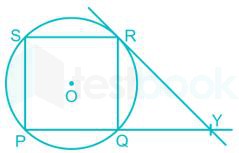
Question 65

Two businessmen A and B invest in a business in the ratio 5 ∶ 8. They decided to reinvest 30% of the profit they earned back into the business. The remaining profit they distributed amongst themselves. If A's share of the profit was Rs. 87,500 then how much profit (in Rs.) did the business make?

  1. AOption (a)

    227000

  2. BOption (b)

    250000

  3. COption (c)

    375000

  4. DOption (d)

    325000

View answer & explanation

Correct answer

Answer: (d)D.

325000

Why this answer is correct

Shortcut Trick

Ratio of Profit A : B = 5 : 8

A's share (5 units) = ₹87,500 → 1 unit = ₹17,500

Total distributed profit (13 units) = 13 × 17,500 = ₹2,27,500

This distributed amount is 70% of total profit (100% − 30% reinvested)

Total Profit = ₹2,27,500 × (100 / 70) = ₹3,25,000

∴ The correct answer is ₹325000.

Alternate Method

Given:

Investment ratio A : B = 5 : 8

Reinvestment percentage = 30%

A's share of distributed profit = ₹87,500

Calculations:

⇒ Let the total profit be P.

⇒ Reinvested amount = 30% of P

⇒ Distributed profit = 100% − 30% = 70% of P = 0.7P

⇒ This 0.7P is shared in the ratio 5 : 8.

⇒ A's share = (5 / (5 + 8)) × 0.7P

⇒ 87,500 = (5 / 13) × 0.7P

⇒ 87,500 × 13 = 3.5P

⇒ 11,37,500 = 3.5P

⇒ P = 11,37,500 ÷ 3.5

⇒ P = ₹3,25,000

∴ The correct answer is ₹325000.

Additional Information

Partnership Profit Sharing Rule

Profit is divided in the ratio of (Investment × Time). If time is same, Profit Ratio = Investment Ratio.

Distributed vs Reinvested Profit

Total Profit = Amount Reinvested + Amount Distributed among partners.

Working Partner vs Sleeping Partner

A working partner may receive an extra commission or salary from the profit before the remaining profit is distributed in the investment ratio.

Question 66

Working alone A can do the task in 27 hours and B can do it in 54 hours. Find C's share (in Rs) if A, B and C get paid Rs. 4,320 for completing a task in 12 hours on which they worked together.

  1. AOption (a)

    1440

  2. BOption (b)

    960

  3. COption (c)

    1920

  4. DOption (d)

    1280

View answer & explanation

Correct answer

Answer: (a)A.

1440

Why this answer is correct

Shortcut Trick

Ratio of work/efficiency: A : B : (A+B+C) = 1/27 : 1/54 : 1/12

Multiplying by LCM 108: A = 4, B = 2, (A+B+C) = 9

Efficiency of C = 9 − (4 + 2) = 3

C's share = (C's efficiency ÷ Total efficiency) × Total wage = (3 ÷ 9) × 4320

C's share = 4320 ÷ 3 = 1440

∴ The correct answer is ₹1440.

Alternate Method

Given:

Time taken by A = 27 hours

Time taken by B = 54 hours

Time taken by A, B, and C together = 12 hours

Total amount paid = ₹4,320

Formula Used:

Efficiency = Total Work ÷ Time

Share of a person ∝ Efficiency (when time of working is same for all)

PersonDaysTotal WorkEfficiency
A27108 (LCM)108 ÷ 27 = 4
B54108 ÷ 54 = 2
A + B + C12108 ÷ 12 = 9

Calculations:

⇒ Efficiency of (A + B + C) = 9

⇒ Efficiency of A = 4

⇒ Efficiency of B = 2

⇒ Efficiency of C = Efficiency of (A + B + C) − Efficiency of (A + B)

⇒ Efficiency of C = 9 − (4 + 2) = 3

⇒ Ratio of efficiency A : B : C = 4 : 2 : 3

⇒ Total ratio units = 4 + 2 + 3 = 9 units

⇒ 9 units = ₹4,320

⇒ 1 unit = 4320 ÷ 9 = ₹480

⇒ C's share = 3 × 480 = ₹1,440

∴ The correct answer is ₹1440.

Additional Information

Work and Wages

Wages are distributed in the ratio of work done by each individual. If they work for the same amount of time, the wage ratio is the same as the efficiency ratio.

Efficiency Relationship

Efficiency is inversely proportional to the time taken to complete a task. Efficiency = 1 ÷ Time.

Total Work Concept

Total work is usually assumed as the LCM (Least Common Multiple) of the individual times to simplify efficiency calculations into integers.

Question 67

If A had worked alone he would have taken 63 hours to do the task. What is B's share, if A and B work together on a task finishing it in 36 hours and they get paid Rs. 5,950 for it?

  1. AOption (a)

    3400

  2. BOption (b)

    3600

  3. COption (c)

    2550

  4. DOption (d)

    2750

View answer & explanation

Correct answer

Answer: (c)C.

2550

Why this answer is correct

Shortcut Trick

Efficiency ratio of A to (A + B) = (1/63) : (1/36) = 36 : 63 = 4 : 7.

Since total efficiency is 7 and A is 4, B's efficiency = 7 − 4 = 3 units.

Ratio of shares A : B = 4 : 3 (as they work together for the same time).

B's share = (3 ÷ 7) × 5950 = 3 × 850 = ₹2550.

∴ The correct answer is ₹2550.

Alternate Method

Given:

Time taken by A alone = 63 hours

Time taken by (A + B) together = 36 hours

Total payment = ₹5,950

Formula Used:

Efficiency = Total Work ÷ Time

Share of wages = (Individual Efficiency × Time) / Total Work. When time is constant, share ∝ Efficiency.

PersonHoursTotal Work (LCM)Efficiency
A632524
A + B367

Calculations:

⇒ Efficiency of B = Efficiency of (A + B) − Efficiency of A

⇒ Efficiency of B = 7 − 4 = 3

⇒ Since they work together for the whole duration, wages are divided in the ratio of their efficiencies.

⇒ Ratio of Share (A : B) = 4 : 3

⇒ Total ratio units = 4 + 3 = 7 units

⇒ 7 units = ₹5,950

⇒ 1 unit = 5950 ÷ 7 = ₹850

⇒ B's share = 3 × 850 = ₹2550

∴ The correct answer is ₹2550.

Additional Information

Work and Wages Principle

Wages are always distributed in the ratio of the work done by each individual. If persons work for the same amount of time, the wage ratio is the same as the efficiency ratio.

Efficiency and Time

Efficiency is inversely proportional to the time taken to complete a piece of work. E1 × T1 = E2 × T2 = Total Work.

Combined Work Rate

If A takes 'a' days and B takes 'b' days, together they take (a × b) ÷ (a + b) days to complete the task.

Question 68

Working together A, B and C can complete a task in 12 days. A and B can do the task in 55 days and 66 days respectively if they worked alone. In how many days can C do the task if he worked alone?

  1. AOption (a)

    22

  2. BOption (b)

    44

  3. COption (c)

    20

  4. DOption (d)

    40

View answer & explanation

Correct answer

Answer: (c)C.

20

Why this answer is correct

Shortcut Trick

Assume Total Work = LCM of (12, 55, 66) = 660 units.

Combined efficiency (A + B + C) = 660 ÷ 12 = 55 units/day.

Efficiency of A = 660 ÷ 55 = 12 units/day; Efficiency of B = 660 ÷ 66 = 10 units/day.

Efficiency of C = (A + B + C) − (A + B) = 55 − (12 + 10) = 33 units/day.

Time taken by C = Total Work ÷ Efficiency of C = 660 ÷ 33 = 20 days.

∴ The correct answer is 20 days.

Alternate Method

Given:

Time taken by (A + B + C) working together = 12 days

Time taken by A alone = 55 days

Time taken by B alone = 66 days

Formula Used:

Total Work = Efficiency × Time taken

Efficiency of C = Efficiency of (A + B + C) − Efficiency of A − Efficiency of B

PersonDaysTotal WorkEfficiency
A + B + C1266055
A5512
B6610

Calculations:

⇒ Efficiency of (A + B) = 12 + 10 = 22 units/day

⇒ Efficiency of C = Efficiency of (A + B + C) − Efficiency of (A + B)

⇒ Efficiency of C = 55 − 22 = 33 units/day

⇒ Time taken by C alone = Total Work ÷ Efficiency of C

⇒ Time taken by C alone = 660 ÷ 33

⇒ Time taken by C alone = 20 days

∴ The correct answer is 20 days.

Additional Information

Combined Work Formula

If individuals take x, y, and z days respectively, the together time T is given by 1/T = 1/x + 1/y + 1/z.

Efficiency and Time Relationship

Efficiency is inversely proportional to the time taken to complete a task (E ∝ 1/T) when work is constant.

LCM Method for Work

Choosing the LCM of given time periods as the total work avoids handling complex fractions during calculation.

Question 69

B would have taken 10 hours more than what A would have taken to complete a task if each of them worked alone. Working together they can complete the task in 12 hours. How many hours would B take to do 50% of the task?

  1. AOption (a)

    30

  2. BOption (b)

    15

  3. COption (c)

    20

  4. DOption (d)

    10

View answer & explanation

Correct answer

Answer: (b)B.

15

Why this answer is correct

Shortcut Trick

For a combined time of 12 hours, standard work pairs are (20, 30) or (15, 60).

The condition states B takes 10 hours more than A, which perfectly matches the (20, 30) pair.

Calculated total time for B = 30 hours.

Time required for B to complete 50% of the task = 30 × 0.5 = 15 hours.

∴ The correct answer is 15 hours.

Alternate Method

Given: Combined time (A + B) = 12 hours; B = A + 10 hours.

Formula: 1 ÷ A + 1 ÷ B = 1 ÷ Total Time

PersonDaysTotal WorkEfficiency
A20603
B302

Calculations:

⇒ Let A take x hours, then B takes (x + 10) hours.

⇒ 1/x + 1/(x + 10) = 1/12

⇒ (x + 10 + x) ÷ (x × (x + 10)) = 1/12

⇒ 12(2x + 10) = x2 + 10x

⇒ 24x + 120 = x2 + 10x

⇒ x2 − 14x − 120 = 0

⇒ (x − 20)(x + 6) = 0

⇒ x = 20 (Time cannot be negative)

⇒ Time taken by B = 20 + 10 = 30 hours

⇒ Time for 50% work by B = 30 ÷ 2 = 15 hours

∴ The correct answer is 15 hours.

Additional Information

Work Rate and Time

The rate of work is inversely proportional to the time taken. If a person completes work in T hours, their efficiency is 1/T per hour.

Combined Work Formula

For two individuals A and B with times ta and tb, the combined time T is given by T = (ta × tb) ÷ (ta + tb).

Efficiency Ratio

Ratio of time taken by A and B is the inverse of the ratio of their efficiencies. If time ratio is x:y, efficiency ratio is y:x.

Question 70

Giving two successive discounts of 20% is same as giving one discount of ________ %.

  1. AOption (a)

    36

  2. BOption (b)

    40

  3. COption (c)

    44

  4. DOption (d)

    50

View answer & explanation

Correct answer

Answer: (a)A.

36

Why this answer is correct

Shortcut Trick

Successive Discount Formula = x + y − (x × y)/100

Given: x = 20 and y = 20

Net Discount = 20 + 20 − (20 × 20)/100

Net Discount = 40 − 400/100

Net Discount = 40 − 4 = 36

∴ The correct answer is 36%.

Alternate Method

Given:

First discount rate (d1) = 20%

Second discount rate (d2) = 20%

Formula Used:

Selling Price (SP) = Marked Price (MP) × (1 − d1/100) × (1 − d2/100)

⇒ Let the Marked Price (MP) be ₹100.

⇒ Price after first discount of 20% = 100 − (20% of 100)

⇒ Price after first discount = 100 − 20 = ₹80.

⇒ Price after second discount of 20% = 80 − (20% of 80)

⇒ Price after second discount = 80 − 16 = ₹64.

⇒ Total discount given = MP − Final Price

⇒ Total discount = 100 − 64 = ₹36.

⇒ Equivalent Discount Percentage = (36/100) × 100 = 36%.

∴ The correct answer is 36%.

Additional Information

Successive Discount for Three Rates

For three successive discounts a%, b%, and c%, the net discount is calculated by applying the formula twice or using: Net Discount = 100 − [100 × (1 − a/100) × (1 − b/100) × (1 − c/100)].

Relation between MP, CP, Profit and Discount

The ratio of Marked Price to Cost Price can be expressed as: MP/CP = (100 + Profit%)/(100 − Discount%).

Successive Percentage Change

The net percentage change for two successive changes of x% and y% is given by [x + y + (xy/100)]%. For discounts, x and y are taken as negative.

Question 71

A retailer marks up his goods by 150% and offers 40% discount. What will be the selling price (in Rs.) if the cost price is Rs. 800?

  1. AOption (a)

    1200

  2. BOption (b)

    1500

  3. COption (c)

    1000

  4. DOption (d)

    2000

View answer & explanation

Correct answer

Answer: (a)A.

1200

Why this answer is correct

Shortcut Trick

SP = CP × (Multiplier for Markup) × (Multiplier for Discount)

Multiplier for 150% markup = (100 + 150)/100 = 2.5

Multiplier for 40% discount = (100 − 40)/100 = 0.6

SP = 800 × 2.5 × 0.6 = 2000 × 0.6 = 1200

∴ The correct answer is ₹1200.

Alternate Method

Given:

Cost Price (CP) = ₹800

Markup % = 150%

Discount % = 40%

Formula Used:

Marked Price (MP) = CP + (Markup % of CP)

Selling Price (SP) = MP − (Discount % of MP)

Calculations:

⇒ CP = ₹800

⇒ Markup = 150% of 800 = (150/100) × 800 = ₹1200

⇒ MP = CP + Markup = 800 + 1200 = ₹2000

⇒ Discount = 40% of MP = (40/100) × 2000 = ₹800

⇒ SP = MP − Discount = 2000 − 800 = ₹1200

∴ The correct answer is ₹1200.

Additional Information

Net Profit Percentage

Net Profit % = Markup % − Discount % − (Markup % × Discount %)/100. In this case: 150 − 40 − (150 × 40)/100 = 110 − 60 = 50%.

Relation between CP and MP

MP/CP = (100 + Profit %)/(100 − Discount %). This formula helps find the required markup to gain a specific profit after offering a discount.

Effective Discount

For successive discounts d1 and d2, the single equivalent discount is (d1 + d2 − (d1 × d2)/100)%.

Question 72

On television of brand A, the discount is 25% and on television of brand B, the discount is 40%. The price of B after discount is Rs. 2,250 greater than the price of A after discount. What is the marked price of A (in Rs.) if the marked price of B is Rs. 35,000?

  1. AOption (a)

    18750

  2. BOption (b)

    21000

  3. COption (c)

    25000

  4. DOption (d)

    17850

View answer & explanation

Correct answer

Answer: (c)C.

25000

Why this answer is correct

Shortcut Trick

SP of Brand B = 60% of MP = 0.60 × 35000 = ₹21,000

SP of Brand A = SP of Brand B − 2250 = 21000 − 2250 = ₹18,750

MP of Brand A = SP ÷ (100% − 25%) = 18750 ÷ 0.75

MP of Brand A = 18750 × (4/3) = 6250 × 4 = ₹25,000

∴ The correct answer is ₹25,000.

Alternate Method

Given: MPB = ₹35,000, DiscountB = 40%, DiscountA = 25%, SPB − SPA = ₹2,250.

Formula: SP = MP × (100 − Discount)%

⇒ SP of B = 35000 × (100 − 40) / 100

⇒ SP of B = 35000 × 0.60 = ₹21,000

⇒ SP of A = SP of B − 2250

⇒ SP of A = 21000 − 2250 = ₹18,750

⇒ SP of A = MPA × (100 − 25) / 100

⇒ 18750 = MPA × 0.75

⇒ MPA = 18750 ÷ 0.75 = 25000

∴ The correct answer is ₹25,000.

Additional Information

Selling Price and Discount

SP = MP − Discount or SP = MP × (1 − d/100), where d is the discount percentage.

Relationship between MP, CP, and Profit

MP/CP = (100 + Profit%) / (100 − Discount%). This is useful when both profit and discount percentages are given.

Successive Discounts

If two successive discounts d1 and d2 are given, the single equivalent discount is (d1 + d2 − (d1 × d2)/100)%.

Question 73

If 60% discount is offered on the marked price and selling price becomes equal to cost price then what was the % mark up?

  1. AOption (a)

    100

  2. BOption (b)

    250

  3. COption (c)

    150

  4. DOption (d)

    40

View answer & explanation

Correct answer

Answer: (c)C.

150

Why this answer is correct

Shortcut Trick

Assume Marked Price (MP) = 100 units.

Selling Price (SP) = 100 − 60% of 100 = 40 units.

Since SP = CP, then Cost Price (CP) = 40 units.

Markup = MP − CP = 100 − 40 = 60 units.

% Markup = (60 ÷ 40) × 100 = 150%.

∴ The correct answer is 150%.

Alternate Method

Given:

Discount % = 60%

Selling Price (SP) = Cost Price (CP)

Formula Used:

SP = MP × (100 − Discount%) ÷ 100

% Markup = [(MP − CP) ÷ CP] × 100

⇒ Let MP = 100

⇒ SP = 100 × (100 − 60) ÷ 100

⇒ SP = 100 × 40 ÷ 100 = 40

⇒ Given SP = CP, ∴ CP = 40

⇒ Markup = MP − CP = 100 − 40 = 60

⇒ % Markup = (60 ÷ 40) × 100

⇒ % Markup = 1.5 × 100 = 150%

∴ The correct answer is 150%.

Additional Information

Relation between CP and MP

CP ÷ MP = (100 − Discount%) ÷ (100 + Profit%). If Profit = 0 (i.e., SP = CP), then CP ÷ MP = (100 − Discount%) ÷ 100.

Markup Percentage

It is the percentage by which the cost price is increased to set the marked price. Markup% = (Markup ÷ CP) × 100.

Net Effect Rule

Profit% = Markup% − Discount% − (Markup% × Discount% ÷ 100). In this case, Profit% = 0.

Question 74

If 3A = 6B = 9C, what is A ∶ B ∶ C?

  1. AOption (a)

    6 ∶ 3 ∶ 1

  2. BOption (b)

    6 ∶ 3 ∶ 2

  3. COption (c)

    9 ∶ 3 ∶ 6

  4. DOption (d)

    9 ∶ 3 ∶ 1

View answer & explanation

Correct answer

Answer: (b)B.

6 ∶ 3 ∶ 2

Why this answer is correct

Shortcut Trick

If k1A = k2B = k3C, then A ∶ B ∶ C = (k2 × k3) ∶ (k1 × k3) ∶ (k1 × k2).

A ∶ B ∶ C = (6 × 9) ∶ (3 × 9) ∶ (3 × 6)

A ∶ B ∶ C = 54 ∶ 27 ∶ 18

Dividing all terms by 9, we get A ∶ B ∶ C = 6 ∶ 3 ∶ 2.

∴ The correct answer is 6 : 3 : 2.

Alternate Method

Given: 3A = 6B = 9C

Formula: If aA = bB = cC = k, then A = k/a, B = k/b, and C = k/c.

⇒ Let 3A = 6B = 9C = k

⇒ A = k/3, B = k/6, C = k/9

⇒ A ∶ B ∶ C = k/3 ∶ k/6 ∶ k/9

⇒ Finding LCM of denominators (3, 6, 9) = 18

⇒ A ∶ B ∶ C = (1/3 × 18) ∶ (1/6 × 18) ∶ (1/9 × 18)

⇒ A ∶ B ∶ C = 6 ∶ 3 ∶ 2

∴ The correct answer is 6 : 3 : 2.

Additional Information

Reciprocal Ratio Property

When quantities are inversely proportional, such as aA = bB, the ratio A ∶ B is equal to the reciprocal of their coefficients, which is 1/a ∶ 1/b or simply b ∶ a.

Ratio and Constant proportionality

If A/x = B/y = C/z, then the ratio A ∶ B ∶ C is directly x ∶ y ∶ z. In contrast, when the coefficients are multiplied (xA = yB), we must use the LCM method.

Compound Ratio

A compound ratio is found by multiplying the corresponding terms of two or more ratios. For ratios a ∶ b and c ∶ d, the compound ratio is ac ∶ bd.

Question 75

How many job applicants had applied if the ratio of selected to unselected was 19 : 17. If 1,200 less had applied and 800 less selected, then the ratio of selected to unselected would have been 1 : 1.

  1. AOption (a)

    6000

  2. BOption (b)

    7200

  3. COption (c)

    8400

  4. DOption (d)

    4800

View answer & explanation

Correct answer

Answer: (b)B.

7200

Why this answer is correct

Shortcut Trick

Initial Ratio (Total : Selected) = 36 : 19 (since 19 + 17 = 36)

Final Ratio (Total : Selected) = 2 : 1 (since 1 : 1 means 1 out of 2 are selected)

Apply Cross-Product: |(36 × 1) − (19 × 2)| units = |(2 × 800) − (1 × 1200)|

|36 − 38| units = |1600 − 1200| ⇒ 2 units = 400

1 unit = 200 ∴ Initial Total = 36 × 200 = 7200

∴ The correct answer is 7200 applicants.

Alternate Method

Given:

Initial Selected : Unselected = 19 : 17

Reduction in Applied = 1200 | Reduction in Selected = 800

Final Selected : Unselected = 1 : 1

Formula Used:

Total Applicants = Selected + Unselected

Let initial Selected = 19x and Unselected = 17x

⇒ Total Applicants = 19x + 17x = 36x

⇒ New Total Applicants = 36x − 1200

⇒ New Selected Applicants = 19x − 800

According to the new ratio (1 : 1), Selected = 1/2 of Total:

⇒ (19x − 800) = 1/2 × (36x − 1200)

⇒ 2 × (19x − 800) = 36x − 1200

⇒ 38x − 1600 = 36x − 1200

⇒ 38x − 36x = 1600 − 1200

⇒ 2x = 400

⇒ x = 200

⇒ Initial Applicants = 36 × 200 = 7200

∴ The correct answer is 7200 applicants.

Additional Information

Compound Ratio

The ratio of the products of the antecedents and the products of the consequents of two or more ratios. For a:b and c:d, it is (ac):(bd).

Componento and Dividendo

If a/b = c/d, then (a+b)/(a-b) = (c+d)/(c-d). This is useful in solving complex ratio equations involving additions or subtractions.

Cross-Multiplication Method

Used when an initial ratio is changed by adding/subtracting specific values to reach a final ratio. It avoids setting up full algebraic equations.

Question 76

What is the third proportional to 10 and 20?

  1. AOption (a)

    30

  2. BOption (b)

    25

  3. COption (c)

    50

  4. DOption (d)

    40

View answer & explanation

Correct answer

Answer: (d)D.

40

Why this answer is correct

Shortcut Trick

In a continued proportion a : b :: b : c, the third proportional c is calculated as b2 ÷ a.

Given a = 10 and b = 20.

Third proportional = (20 × 20) ÷ 10 = 400 ÷ 10 = 40.

∴ The correct answer is 40.

Alternate Method

Given: First number (a) = 10, Second number (b) = 20.

Formula Used: If three numbers a, b, and c are in proportion, then a : b = b : c, where c is the third proportional.

⇒ Let the third proportional be c.

⇒ 10 : 20 = 20 : c

⇒ 10 ÷ 20 = 20 ÷ c

⇒ 10 × c = 20 × 20

⇒ 10c = 400

⇒ c = 400 ÷ 10

⇒ c = 40

∴ The correct answer is 40.

Additional Information

Mean Proportional

The mean proportional between two numbers a and b is calculated as x = √(a × b).

Fourth Proportional

For three numbers a, b, and c, the fourth proportional d satisfies a : b = c : d, which gives d = (b × c) ÷ a.

Continued Proportion Property

Three non-zero numbers a, b, and c are in continued proportion if the ratio of the first to the second equals the ratio of the second to the third (a/b = b/c).

Question 77

The ratio of the sum of the salaries of A and B to the difference of their salaries is 11 : 1 and the ratio of the sum of the salaries of B and C to the difference of their salaries is also 11 : 1. If A's salary is the highest and C's is the lowest then what is B's salary (in Rs) given the total of all their salaries is Rs. 1,82,000?

  1. AOption (a)

    72000

  2. BOption (b)

    60000

  3. COption (c)

    50000

  4. DOption (d)

    86400

View answer & explanation

Correct answer

Answer: (b)B.

60000

Why this answer is correct

Shortcut Trick

By Componendo & Dividendo, if (S+D)/(S−D) = 11/1, then the ratio of terms is (11+1)/(11−1) = 12/10 = 6/5.

So, A : B = 6 : 5 and B : C = 6 : 5.

Combined ratio A : B : C = (6×6) : (5×6) : (5×5) = 36 : 30 : 25.

Total units = 36 + 30 + 25 = 91 units.

91 units = ₹1,82,000 → 1 unit = ₹2,000.

B's salary = 30 units × 2,000 = ₹60,000.

∴ The correct answer is ₹60,000.

Alternate Method

Given:

(A + B) / (A − B) = 11 / 1

(B + C) / (B − C) = 11 / 1

Total salary (A + B + C) = ₹1,82,000

Formula Used:

Componendo and Dividendo: If a/b = c/d, then (a+b)/(a−b) = (c+d)/(c−d)

Calculations:

From (A + B) / (A − B) = 11 / 1:

⇒ Applying Componendo & Dividendo: ((A + B) + (A − B)) / ((A + B) − (A − B)) = (11 + 1) / (11 − 1)

⇒ 2A / 2B = 12 / 10

⇒ A / B = 6 / 5

Similarly, for B and C:

⇒ B / C = 6 / 5

To combine the ratios, make B common:

⇒ A : B = 6 : 5 = (6 × 6) : (5 × 6) = 36 : 30

⇒ B : C = 6 : 5 = (6 × 5) : (5 × 5) = 30 : 25

⇒ A : B : C = 36 : 30 : 25

Sum of ratio parts:

⇒ 36 + 30 + 25 = 91 units

⇒ 91 units = ₹1,82,000

⇒ 1 unit = 1,82,000 ÷ 91 = ₹2,000

Calculate B’s salary:

⇒ B = 30 × 2,000 = ₹60,000

∴ The correct answer is ₹60,000.

Additional Information

Componendo and Dividendo Rule

It is a theorem on proportions that allows for quick calculation of individual variables when the ratio of their sum and difference is known. If a/b = c/d, then (a+b)/(a−b) = (c+d)/(c−d).

Combined Ratio

When two ratios a : b and b : c are given, the combined ratio a : b : c can be found by making the common term 'b' equal in both ratios through multiplication.

Partitive Proportion

It involves dividing a total amount into parts based on a specific ratio. Value of one part = Total Amount ÷ Sum of Ratio Parts.

Question 78

If by increasing the price of a ticket in the ratio 8 : 11 the number of tickets sold fall in the ratio 23 : 21 then what is the increase (in Rs.) in revenue if revenue before increase in price of ticket was Rs. 36,800?

  1. AOption (a)

    21250

  2. BOption (b)

    9400

  3. COption (c)

    7850

  4. DOption (d)

    12850

View answer & explanation

Correct answer

Answer: (b)B.

9400

Why this answer is correct

Shortcut Trick

Revenue Ratio = (Initial Price × Initial Quantity) : (Final Price × Final Quantity)

Revenue Ratio = (8 × 23) : (11 × 21) = 184 : 231

Initial Revenue = 184 units = ₹36,800 ⇒ 1 unit = ₹200

Increase in Revenue = 231 − 184 = 47 units

Required Increase = 47 × 200 = ₹9,400

∴ The correct answer is ₹9400.

Alternate Method

Given:

Initial Price : Final Price = 8 : 11

Initial Tickets : Final Tickets = 23 : 21

Initial Revenue = ₹36,800

Formula Used:

Revenue = Price × Number of Tickets Sold

Calculations:

⇒ Let initial price = 8x and initial quantity = 23y

⇒ Initial Revenue = 8x × 23y = 184xy

⇒ Final Price = 11x and final quantity = 21y

⇒ Final Revenue = 11x × 21y = 231xy

⇒ Given: 184xy = 36800

⇒ xy = 36800 ÷ 184 = 200

⇒ Increase in revenue = Final Revenue − Initial Revenue

⇒ Increase = 231xy − 184xy = 47xy

⇒ Increase = 47 × 200 = ₹9,400

∴ The correct answer is ₹9400.

Additional Information

Product of Ratios

When a quantity depends on the product of two independent variables (like Revenue = Price × Quantity), the ratio of the new quantity to the old is the product of the individual ratios of those variables.

Percentage Change in Product

If one factor increases by a% and the other increases by b%, the net percentage change in the product is given by the formula: [a + b + (ab/100)]%.

Compounding Ratios

To find the combined effect of two ratios a:b and c:d, we multiply them as (a×c):(b×d). This is known as compounding the ratios.

Question 79

The ratio of ages of the father and mother was 11 ∶ 10 when their son was born. The ratio of ages of the father and mother will be 19 ∶ 18 when the son will be twice his present age. What is the ratio of present ages of father and mother?

  1. AOption (a)

    15 ∶ 14

  2. BOption (b)

    14 ∶ 13

  3. COption (c)

    16 ∶ 15

  4. DOption (d)

    17 ∶ 16

View answer & explanation

Correct answer

Answer: (a)A.

15 ∶ 14

Why this answer is correct

Shortcut Trick

Ratio at son's birth (Son = 0) → 11 : 10 (Difference = 1 unit)

Ratio at Son = 2x years → 19 : 18 (Difference = 1 unit)

Since the difference is same, total growth in 2x years = 19 − 11 = 8 units.

Growth for present age (x years) = 8 ÷ 2 = 4 units.

Present ratio = (11 + 4) : (10 + 4) = 15 : 14.

∴ The correct answer is 15 : 14.

Alternate Method

Given:

Initial ratio (Son = 0) = 11 : 10

Future ratio (Son = 2 × present age) = 19 : 18

Formula Used:

Age = Initial age + time elapsed

Calculations:

Let the ages of father and mother at son's birth be 11k and 10k.

Let the son's present age be x.

Ages at the time when son will be 2x years old:

Father's age = 11k + 2x

Mother's age = 10k + 2x

⇒ (11k + 2x) ÷ (10k + 2x) = 19 ÷ 18

⇒ 18 × (11k + 2x) = 19 × (10k + 2x)

⇒ 198k + 36x = 190k + 38x

⇒ 198k − 190k = 38x − 36x

⇒ 8k = 2x

⇒ x = 4k

Present ages:

Father = 11k + x = 11k + 4k = 15k

Mother = 10k + x = 10k + 4k = 14k

⇒ Ratio = 15k : 14k = 15 : 14

∴ The correct answer is 15 : 14.

Additional Information

Constant Age Difference

The difference between the ages of two people always remains the same, regardless of the number of years passed. In ratio problems, always try to equalize this difference.

Ratio Scaling

If the difference between two ratios a:b and c:d is not the same, multiply (a:b) by (d−c) and (c:d) by (b−a) to make the differences equal.

Linear Increment

When everyone in a group grows by 'n' years, their total age increases by (number of people × n) and the average age increases by exactly n years.

Question 80

Of the 3 numbers whose average is 22, the first is 3/8th the sum of other two. What is the first number?

  1. AOption (a)

    16

  2. BOption (b)

    20

  3. COption (c)

    22

  4. DOption (d)

    18

View answer & explanation

Correct answer

Answer: (d)D.

18

Why this answer is correct

Shortcut Trick

Total sum of 3 numbers = 22 × 3 = 66.

Ratio of the 1st number to the sum of the other two = 3 : 8.

Total ratio parts = 3 + 8 = 11 units.

11 units = 66 ⇒ 1 unit = 6.

First number = 3 units = 3 × 6 = 18.

∴ The correct answer is 18.

Alternate Method

Given: Average of 3 numbers = 22.

Condition: 1st number = 3/8 × (Sum of other two).

Formula: Sum = Average × Number of items.

⇒ Let the three numbers be x, y, and z.

⇒ (x + y + z) ÷ 3 = 22

⇒ x + y + z = 22 × 3 = 66

⇒ Given: x = 3/8 × (y + z)

⇒ 8x = 3(y + z) ⇒ (y + z) = 8x/3

⇒ Substitute (y + z) in the sum equation:

⇒ x + 8x/3 = 66

⇒ (3x + 8x) / 3 = 66

⇒ 11x / 3 = 66

⇒ 11x = 198

⇒ x = 198 ÷ 11 = 18

∴ The correct answer is 18.

Additional Information

Definition of Average

Average is the sum of all observations divided by the total number of observations. Formula: Average = ∑x / n.

Ratio and Proportion

If a total quantity S is divided into two parts in the ratio a:b, the first part is [a / (a + b)] × S and the second part is [b / (a + b)] × S.

Sum of Observations

The total sum of n observations can always be found by multiplying the average by n. Sum = Average × n.

Question 81

The average of three consecutive odd numbers is 52 more than 1/3rd of the largest of these numbers. What is the smallest of these numbers?

  1. AOption (a)

    79

  2. BOption (b)

    75

  3. COption (c)

    81

  4. DOption (d)

    77

View answer & explanation

Correct answer

Answer: (d)D.

77

Why this answer is correct

Shortcut Trick

The average of three consecutive odd numbers is the middle number.

Let the middle number be M. The largest number is M + 2.

Given: M = (1/3) × (M + 2) + 52

3M = M + 2 + 156 ⇒ 2M = 158 ⇒ M = 79.

Smallest number = M − 2 = 79 − 2 = 77.

∴ The correct answer is 77.

Alternate Method

Given: Three consecutive odd numbers. The average is 52 more than 1/3rd of the largest number.

Formula Used: Average = Sum of observations ÷ Number of observations.

Let the three consecutive odd numbers be x, x + 2, and x + 4.

⇒ Average = (x + x + 2 + x + 4) ÷ 3

⇒ Average = (3x + 6) ÷ 3 = x + 2

According to the problem:

⇒ x + 2 = (1/3) × (x + 4) + 52

⇒ 3(x + 2) = (x + 4) + (52 × 3)

⇒ 3x + 6 = x + 4 + 156

⇒ 3x + 6 = x + 160

⇒ 3x − x = 160 − 6

⇒ 2x = 154

⇒ x = 77

The smallest number is x = 77.

∴ The correct answer is 77.

Additional Information

Average of Consecutive Numbers

For any arithmetic progression with an odd number of terms, the average is exactly the middle term: Average = (First Term + Last Term) ÷ 2.

Properties of Odd Numbers

Consecutive odd numbers always have a common difference of 2. The sum of n consecutive odd numbers starting from 1 is given by n2.

Average Change Rule

If each number in a set is increased by a constant k, the average also increases by k. If multiplied by k, the average is multiplied by k.

Question 82

A batsman scores 98 runs in the 17th match of his career. His average runs per match increased by 2.5. What is his average before the 17th match?

  1. AOption (a)

    58

  2. BOption (b)

    60.5

  3. COption (c)

    63

  4. DOption (d)

    55.5

View answer & explanation

Correct answer

Answer: (d)D.

55.5

Why this answer is correct

Shortcut Trick

Total matches played including the current one = 17

Increase in average = 2.5

Total increase in runs across all 17 matches = 17 × 2.5 = 42.5

Old average (Average before 17th match) = Score in 17th match − Total increase

Old average = 98 − 42.5 = 55.5

∴ The correct answer is 55.5.

Alternate Method

Given:

Runs in 17th match = 98

Increase in average = 2.5

Formula:

Average = (Total Runs) ÷ (Number of Matches)

Let the average before 17th match be x.

Total runs after 16 matches = 16x

Total runs after 17 matches = 16x + 98

New average after 17 matches = x + 2.5

⇒ (16x + 98) ÷ 17 = x + 2.5

⇒ 16x + 98 = 17(x + 2.5)

⇒ 16x + 98 = 17x + 42.5

⇒ 17x − 16x = 98 − 42.5

⇒ x = 55.5

∴ The correct answer is 55.5.

Additional Information

New Average Formula

New Average = Old Average + (Increase in Average) = 55.5 + 2.5 = 58.

Weighted Average Concept

If an observation is added, New Sum = (Old Average × Old n) + New Observation. The change in average is (New Observation − Old Average) ÷ New n.

Score Calculation

Score of the nth match = New Average + (n − 1) × (Increase in Average).

∴ The correct answer is 55.5.

Question 83

What is the average of all numbers between 100 and 200 which are divisible by 13?

  1. AOption (a)

    147.5

  2. BOption (b)

    145.5

  3. COption (c)

    143.5

  4. DOption (d)

    149.5

View answer & explanation

Correct answer

Answer: (d)D.

149.5

Why this answer is correct

Shortcut Trick

First number divisible by 13 after 100 = 13 × 8 = 104.

Last number divisible by 13 before 200 = 13 × 15 = 195.

For any sequence in Arithmetic Progression (AP), Average = (First term + Last term) ÷ 2.

Average = (104 + 195) ÷ 2 = 299 ÷ 2 = 149.5.

∴ The correct answer is 149.5.

Alternate Method

Given: Numbers between 100 and 200 divisible by 13.

Formula Used: Average of Arithmetic Progression = (a + l) ÷ 2

⇒ Multiples of 13 in the range: 13 × 8, 13 × 9, ..., 13 × 15.

⇒ The series is: 104, 117, 130, 143, 156, 169, 182, 195.

⇒ First term (a) = 104.

⇒ Last term (l) = 195.

⇒ Average = (104 + 195) ÷ 2.

⇒ Average = 299 ÷ 2 = 149.5.

∴ The correct answer is 149.5.

Additional Information

Average of AP Sequence

The average of any sequence in Arithmetic Progression is always the arithmetic mean of the first and last terms, i.e., Average = (a + l) ÷ 2.

Number of Terms in AP

The number of terms 'n' can be calculated using n = [(Last Term − First Term) ÷ Common Difference] + 1.

Sum of AP Terms

The sum of terms in an AP is given by Sn = n × Average = (n ÷ 2) × [First Term + Last Term].

Question 84

A vendor buys 9 bananas for Rs. 8 and sells 8 for Rs. 9. What will be the profit or loss (in %)?

  1. AOption (a)

    13.28% profit

  2. BOption (b)

    26.56% loss

  3. COption (c)

    26.56% profit

  4. DOption (d)

    13.28% loss

View answer & explanation

Correct answer

Answer: (c)C.

26.56% profit

Why this answer is correct

Shortcut Trick

Use the cross-multiplication method for Article vs Price:

CP: 9 articles for ₹8 | SP: 8 articles for ₹9

Cross-multiply: (9 × 9) − (8 × 8) = 81 − 64 = 17 (Profit units)

Profit % = (Difference ÷ Product of inner values) × 100

Profit % = (17 ÷ 64) × 100 = 26.5625% ≈ 26.56%

∴ The correct answer is 26.56% profit.

Alternate Method

Given:

Cost Price (CP) of 9 bananas = ₹8

Selling Price (SP) of 8 bananas = ₹9

To find profit or loss, we equalize the quantity of bananas by taking the LCM of 9 and 8 (LCM = 72).

⇒ CP of 1 banana = 8 ÷ 9

⇒ SP of 1 banana = 9 ÷ 8

⇒ Total CP for 72 bananas = (8 ÷ 9) × 72 = ₹64

⇒ Total SP for 72 bananas = (9 ÷ 8) × 72 = ₹81

⇒ Profit = SP − CP = 81 − 64 = ₹17

⇒ Profit % = (Profit ÷ CP) × 100

⇒ Profit % = (17 ÷ 64) × 100 = 26.5625%

∴ The correct answer is 26.56% profit.

Additional Information

Profit and Loss Percentages

Profit % is always calculated on the Cost Price (CP) unless stated otherwise: Profit % = (Profit ÷ CP) × 100.

Unitary Method for Articles

When quantities are different, find the price of 1 unit or use the LCM of quantities to make them equal for direct comparison.

Marked Price and Discount

Discount is always calculated on the Marked Price (MP): SP = MP − Discount. Effective profit is then calculated from SP and CP.

Question 85

If a stall sells a pizza at Rs. 200 he makes 20% loss if he wants to make 10% profit then at what price (in Rs.) should he sell?

  1. AOption (a)

    250

  2. BOption (b)

    300

  3. COption (c)

    275

  4. DOption (d)

    325

View answer & explanation

Correct answer

Answer: (c)C.

275

Why this answer is correct

Shortcut Trick Direct Ratio: SP1 ÷ (100 − Loss%) = SP2 ÷ (100 + Profit%) 200 ÷ 80 = SP2 ÷ 110 2.5 = SP2 ÷ 110 SP2 = 2.5 × 110 = 275 ∴ The correct answer is ₹275. Alternate Method Given: Initial Selling Price (SP1) = ₹200 Loss Percentage = 20% Desired Profit Percentage = 10% Formula Used: Cost Price (CP) = SP × 100 ÷ (100 − Loss%) New Selling Price (SP2) = CP × (100 + Profit%) ÷ 100

Calculations: ⇒ First, find the Cost Price (CP): ⇒ CP = 200 × 100 ÷ (100 − 20) ⇒ CP = 200 × 100 ÷ 80 ⇒ CP = 20000 ÷ 80 = ₹250 ⇒ Now, calculate the required Selling Price for 10% profit: ⇒ SP2 = 250 × (100 + 10) ÷ 100 ⇒ SP2 = 250 × 110 ÷ 100 ⇒ SP2 = 250 × 1.1 = ₹275 ∴ The correct answer is ₹275. Additional Information Selling Price and Cost Price Relationship Profit occurs when SP > CP. Profit = SP − CP. Profit % = (Profit ÷ CP) × 100. Loss Calculation Loss occurs when CP > SP. Loss = CP − SP. Loss % = (Loss ÷ CP) × 100. Successive Changes If an item is sold through multiple hands, the effective change is calculated as: Net SP = Initial CP × (100 ± r1)/100 × (100 ± r2)/100.

Question 86

A wholesaler had 200 dozens of mangoes. He sold some of these mangoes at 20% profit and the rest at 10% profit, so that he made 13% profit on selling all the mangoes. How many mangoes (in dozens) did he sell at 20% profit?

  1. AOption (a)

    140

  2. BOption (b)

    60

  3. COption (c)

    80

  4. DOption (d)

    120

View answer & explanation

Correct answer

Answer: (b)B.

60

Why this answer is correct

Shortcut Trick

Using Alligation Method:

Profit 1 (20%) vs Profit 2 (10%) with Average (13%).

Ratio of quantities = (13 − 10) : (20 − 13) = 3 : 7.

Total units = 3 + 7 = 10 units → 200 dozens.

Mangoes at 20% profit = 3 units = (200 ÷ 10) × 3 = 60 dozens.

∴ The correct answer is 60 dozens.

Alternate Method

Given:

Total quantity = 200 dozens

Profit on first part = 20%

Profit on second part = 10%

Overall profit = 13%

Calculations:

⇒ Let the quantity sold at 20% profit be Q1 and at 10% profit be Q2.

⇒ By Alligation Rule: Q1 : Q2 = (13 − 10) : (20 − 13)

⇒ Q1 : Q2 = 3 : 7

⇒ Total ratio parts = 3 + 7 = 10 units

⇒ 10 units = 200 dozens

⇒ 1 unit = 200 ÷ 10 = 20 dozens

⇒ Quantity at 20% profit = 3 × 20 dozens

⇒ Quantity at 20% profit = 60 dozens

∴ The correct answer is 60 dozens.

Additional Information

Rule of Alligation

It is used to find the ratio in which two ingredients at given prices/percentages must be mixed to produce a mixture at a given mean price/percentage. Formula: (Quantity of Cheaper) / (Quantity of Dearer) = (CP of Dearer − Mean Price) / (Mean Price − CP of Cheaper).

Weighted Average Method

Overall profit percentage can also be calculated as: Pavg = (n1 × p1 + n2 × p2) / (n1 + n2), where n is the quantity and p is the individual profit percentage.

Profit and Loss Basics

Profit % is always calculated on the Cost Price (CP) unless stated otherwise. Profit % = (Profit / CP) × 100.

Question 87

If the selling price is tripled and the cost price is doubled, the profit would become 65%. What is the present profit (in %)?

  1. AOption (a)

    20

  2. BOption (b)

    15

  3. COption (c)

    25

  4. DOption (d)

    10

View answer & explanation

Correct answer

Answer: (d)D.

10

Why this answer is correct

Shortcut Trick

New Profit is 65% on doubled CP, so New SP = 165% of (2 × CP).

New SP = 3.3 × CP.

Since New SP is 3 times the original SP, then 3 × Original SP = 3.3 × CP.

Original SP = 1.1 × CP.

Original Profit = 1.1 − 1 = 0.1 = 10%.

∴ The correct answer is 10%.

Alternate Method

Given:

Let original Cost Price = CP and original Selling Price = SP.

New Cost Price (CPnew) = 2 × CP

New Selling Price (SPnew) = 3 × SP

New Profit % = 65%

Formula Used:

SP = CP × (100 + Profit %)/100

Calculations:

⇒ Let CP = 100

⇒ New CP = 2 × 100 = 200

⇒ New SP = New CP × (165/100) = 200 × 1.65

⇒ New SP = 330

⇒ Original SP = New SP ÷ 3

⇒ Original SP = 330 ÷ 3 = 110

⇒ Original Profit = SP − CP = 110 − 100 = 10

⇒ Original Profit % = (10 ÷ 100) × 100 = 10%

∴ The correct answer is 10%.

Additional Information

Profit and Loss Basic Formulas

Profit % = (Profit/CP) × 100 | Loss % = (Loss/CP) × 100. Note that profit and loss are always calculated on Cost Price unless stated otherwise.

Marked Price and Discount

Selling Price = Marked Price − Discount. Discount % is always calculated on the Marked Price (MP).

Relation between CP and MP

CP / MP = (100 − Discount %) / (100 + Profit %). This formula is useful for solving questions involving both discount and profit.

Question 88

0.06% of 250% of 1600 is _________.

  1. AOption (a)

    24

  2. BOption (b)

    0.24

  3. COption (c)

    0.024

  4. DOption (d)

    2.4

View answer & explanation

Correct answer

Answer: (d)D.

2.4

Why this answer is correct

Shortcut Trick

Convert percentages into simple decimal multipliers: 0.06% = 0.0006 and 250% = 2.5.

Expression = 0.0006 × 2.5 × 1600

Multiply 0.0006 by 1600 first: 0.0006 × 1600 = 0.96

Then multiply by 2.5: 0.96 × 2.5 = 2.4

∴ The correct answer is 2.4.

Alternate Method

Given: 0.06% of 250% of 1600

Formula used: x% of y = (x ÷ 100) × y

⇒ Result = (0.06 ÷ 100) × (250 ÷ 100) × 1600

⇒ Result = (6 ÷ 10000) × (2.5) × 1600

⇒ Result = (6 × 2.5 × 1600) ÷ 10000

⇒ Result = (15 × 1600) ÷ 10000

⇒ Result = 24000 ÷ 10000

⇒ Result = 2.4

∴ The correct answer is 2.4.

Additional Information

Percentage to Decimal Rule

To remove the % sign, divide the number by 100 or move the decimal point two places to the left.

BODMAS in Percentages

The word 'of' always indicates a multiplication operation. Successive 'of' operations are solved from left to right or simultaneously as products.

Fraction Equivalents

Using fractions can simplify calculations: 250% = 5/2, while 0.06% = 6/10000 = 3/5000.

Question 89

Two numbers are 90% and 75% lesser than a third number. By what % should the first number be increased so that it becomes equal to the second number?

  1. AOption (a)

    250

  2. BOption (b)

    200

  3. COption (c)

    150

  4. DOption (d)

    100

View answer & explanation

Correct answer

Answer: (c)C.

150

Why this answer is correct

Shortcut Trick

Let the third number be 100.

First number = 100 − 90 = 10

Second number = 100 − 75 = 25

Required percentage increase = [(25 − 10) ÷ 10] × 100

⇒ Required percentage increase = (15 ÷ 10) × 100 = 150%

∴ The correct answer is 150%.

Alternate Method

Given:

First number is 90% lesser than the third number.

Second number is 75% lesser than the third number.

Formula Used:

Percentage Increase = [(Final Value − Initial Value) ÷ Initial Value] × 100

Third Number 100 (Base)

Second Number 25 −75%

First Number 10 −90%

+15 Increase

Calculations:

⇒ Let the third number be x.

⇒ First number = x − 90% of x = 10% of x = 0.10x

⇒ Second number = x − 75% of x = 25% of x = 0.25x

⇒ Increase required for the first number to become equal to the second number = 0.25x − 0.10x = 0.15x

⇒ Percentage increase = (0.15x ÷ 0.10x) × 100

⇒ Percentage increase = 1.5 × 100 = 150%

∴ The correct answer is 150%.

Additional Information

Percentage Change

It is the ratio of the difference between the final and initial values to the initial value, expressed as a percentage. Formula: ((New Value − Old Value) ÷ Old Value) × 100.

Successive Percentage Change

If a number is successively changed by a% and b%, the net percentage change is given by the formula: a + b + (a × b ÷ 100)%.

Comparing Two Quantities

If quantity A is x% more than quantity B, then B is less than A by a percentage of (x ÷ (100 + x)) × 100.

Question 90

When a number is increased by 216, it becomes 140% of itself. What is the number?

  1. AOption (a)

    540

  2. BOption (b)

    756

  3. COption (c)

    450

  4. DOption (d)

    675

View answer & explanation

Correct answer

Answer: (a)A.

540

Why this answer is correct

Shortcut Trick

The number becomes 140% of itself, meaning the increase is 40%.

Given that this 40% increase corresponds to the value 216.

40% of Number = 216

100% of Number = (216 ÷ 40) × 100 = 5.4 × 100 = 540

∴ The correct answer is 540.

Alternate Method

Given:

Increase in number = 216

New value = 140% of the original number

Formula Used:

New Value = Original Value + Increase

Calculations:

Let the original number be x.

⇒ x + 216 = 140% of x

⇒ x + 216 = (140 ÷ 100) × x

⇒ x + 216 = 1.4x

⇒ 1.4x − x = 216

⇒ 0.4x = 216

⇒ x = 216 ÷ 0.4

⇒ x = 2160 ÷ 4

⇒ x = 540

∴ The correct answer is 540.

Additional Information

Percentage Increase Formula

Percentage Increase = (Increase ÷ Original Value) × 100. In this case, 40 = (216 ÷ x) × 100.

Fractional Equivalents

40% is equivalent to 2/5. Thus, (2/5) of the number = 216, leading to Number = 216 × 5/2 = 540.

Base Value Concept

In any percentage change problem, the original number is always treated as 100% or the base value 1.

Question 91

A man donates 30% of his wealth to charity. 30% and 25% of the remaining wealth to his wife and son respectively. The rest he divides equally among his three daughters. One of his daughter gets Rs. 42 lakh as her share. What was the man's wealth (in Rs. lakhs)?

  1. AOption (a)

    280

  2. BOption (b)

    400

  3. COption (c)

    500

  4. DOption (d)

    350

View answer & explanation

Correct answer

Answer: (b)B.

400

Why this answer is correct

Shortcut Trick

Remaining wealth after charity = 100% − 30% = 70%.

Total share of Wife and Son from remaining = 30% + 25% = 55%.

Remaining for 3 daughters = 100% − 55% = 45% of the 70% wealth.

Share of one daughter = (45% ÷ 3) × 70% = 15% × 70% = 10.5%.

10.5% = 42 lakh ⇒ 100% = (42 ÷ 10.5) × 100 = 4 × 100 = 400 lakh.

∴ The correct answer is Rs. 400 lakhs.

Alternate Method

Given:

Charity donation = 30% of total wealth.

Wife's share = 30% of remaining wealth.

Son's share = 25% of remaining wealth.

One daughter's share = Rs. 42 lakh (shared equally among 3 daughters).

Formula Used:

Remaining Value = Initial Value × (100 − x)%

Let total wealth be Rs. W lakhs.

⇒ Charity = 0.30 × W

⇒ Remaining Wealth (R1) = W − 0.30W = 0.70W

⇒ Sum of Wife and Son's percentage of R1 = 30% + 25% = 55%

⇒ Rest wealth for daughters = 100% − 55% = 45% of R1

⇒ Total wealth for daughters = 0.45 × 0.70W = 0.315W

⇒ Wealth of one daughter = 0.315W ÷ 3 = 0.105W

⇒ Given: 0.105W = 42

⇒ W = 42 ÷ 0.105

⇒ W = 42000 ÷ 105

⇒ W = 400 lakhs

∴ The correct answer is Rs. 400 lakhs.

Additional Information

Successive Percentage Deduction

When multiple deductions are made from the "remaining" amount, use the formula: Final = Initial × (1 − r1/100) × (1 − r2/100).

Simultaneous Deduction from Same Base

If multiple parts (like wife and son) are taken from the same "remaining" base, their percentages are added together before deduction (e.g., 30% + 25% = 55% of the remainder).

Percentage to Ratio Conversion

10.5% can be written as 10.5/100 = 21/200. If 21 units = 42, then 200 units = 400.

Question 92

A bus travels 720 km in 20 hours. Calculate its average speed in meters/second.

  1. AOption (a)

    12

  2. BOption (b)

    15

  3. COption (c)

    18

  4. DOption (d)

    10

View answer & explanation

Correct answer

Answer: (d)D.

10

Why this answer is correct

Shortcut Trick

Speed in km/h = 720 ÷ 20 = 36 km/h

Conversion: 1 km/h = 5/18 m/s

Speed in m/s = 36 × (5/18) = 2 × 5 = 10 m/s

∴ The correct answer is 10 m/s.

Alternate Method

Given: Total Distance = 720 km, Total Time = 20 hours

Formula: Average Speed = Total Distance ÷ Total Time

⇒ Average Speed (km/h) = 720 ÷ 20

⇒ Average Speed (km/h) = 36 km/h

⇒ Since 1 km = 1000 m and 1 hour = 3600 s,

⇒ 1 km/h = 1000/3600 m/s = 5/18 m/s

⇒ Speed in m/s = 36 × (5 ÷ 18)

⇒ Speed in m/s = 2 × 5 = 10 m/s

∴ The correct answer is 10 m/s.

Additional Information

Unit Conversion Factor

To convert km/h to m/s, multiply by 5/18. To convert m/s to km/h, multiply by 18/5.

Average Speed Formula

When a distance is covered at speed 'x' and the same distance is covered back at speed 'y', the average speed for the whole journey is 2xy ÷ (x + y).

Relationship between Speed, Distance, and Time

Speed = Distance ÷ Time | Distance = Speed × Time | Time = Distance ÷ Speed.

Question 93

If a boat goes upstream at a speed of 21 km/h and comes back the same distance at 28 km/h. What is the average speed (in km/hr) for the total journey?

  1. AOption (a)

    24.5

  2. BOption (b)

    24

  3. COption (c)

    25

  4. DOption (d)

    25.4

View answer & explanation

Correct answer

Answer: (b)B.

24

Why this answer is correct

Shortcut Trick

When the distance covered is the same for two different speeds, use the harmonic mean formula.

Average Speed = (2 × S1 × S2) ÷ (S1 + S2)

Average Speed = (2 × 21 × 28) ÷ (21 + 28)

Average Speed = 1176 ÷ 49 = 24 km/h

∴ The correct answer is 24 km/h.

Alternate Method

Given: Upstream Speed (u) = 21 km/h, Downstream Speed (v) = 28 km/h.

Formula Used: Average Speed = (Total Distance) ÷ (Total Time)

⇒ Let the distance for one way be the LCM of 21 and 28, which is 84 km.

⇒ Total Distance = 84 + 84 = 168 km

⇒ Time taken (Upstream) = Distance ÷ Speed = 84 ÷ 21 = 4 hours

⇒ Time taken (Downstream) = Distance ÷ Speed = 84 ÷ 28 = 3 hours

⇒ Total Time = 4 + 3 = 7 hours

⇒ Average Speed = 168 ÷ 7 = 24 km/h

∴ The correct answer is 24 km/h.

Additional Information

General Average Speed Formula

Average Speed = Total Distance ÷ Total Time. This applies regardless of whether distances or times are equal.

Boat Speed in Still Water

Boat Speed (x) = (Downstream Speed + Upstream Speed) ÷ 2. In this case, x = (28 + 21) ÷ 2 = 24.5 km/h.

Speed of Stream

Stream Speed (y) = (Downstream Speed − Upstream Speed) ÷ 2. In this case, y = (28 − 21) ÷ 2 = 3.5 km/h.

Average Speed for Equal Time

If time taken for both speeds is equal, Average Speed = (S1 + S2) ÷ 2 (Arithmetic Mean).

Question 94

Two runners A and B start running at 12 km/hr and 16 km/hr towards each other. They meet after 1 hour and 30 minutes. How far (in km) were they from each other when they started?

  1. AOption (a)

    42

  2. BOption (b)

    36

  3. COption (c)

    40

  4. DOption (d)

    45

View answer & explanation

Correct answer

Answer: (a)A.

42

Why this answer is correct

Shortcut Trick

Relative Speed (towards each other) = Speed A + Speed B = 12 + 16 = 28 km/hr.

Time = 1 hour 30 minutes = 1.5 hours.

Initial Distance = Relative Speed × Time.

Distance = 28 × 1.5 = 42 km.

∴ The correct answer is 42 km.

Alternate Method

Given:

Speed of runner A (SA) = 12 km/hr

Speed of runner B (SB) = 16 km/hr

Meeting time (T) = 1 hour 30 minutes

Formula:

Total Distance = (Relative Speed) × Time

Calculations:

⇒ Time in hours = 1 + 30/60 = 1.5 hours

⇒ Relative Speed (Opposite Direction) = SA + SB

⇒ Relative Speed = 12 + 16 = 28 km/hr

⇒ Distance = 28 × 1.5

⇒ Distance = 28 × 3/2

⇒ Distance = 14 × 3 = 42 km

∴ The correct answer is 42 km.

Additional Information

Relative Speed Concept

When two objects move towards each other, relative speed is the sum of their individual speeds (S1 + S2). If they move in the same direction, it is the difference (S1 − S2).

Distance-Speed-Time Relation

The basic formula is Distance = Speed × Time. To find time, use Time = Distance ÷ Speed.

Unit Conversion

Always ensure units are consistent. To convert minutes to hours, divide by 60. To convert km/hr to m/s, multiply by 5/18.

Question 95

Flight A usually takes 1 hour more than Flight B to travel a distance of 7200 km. Due to engine trouble, the speed of flight B becomes 5/6 times of its actual speed, so it takes 36 minutes more than Flight A to complete the same journey. What is the speed of Flight A (in km/hr)?

  1. AOption (a)

    800

  2. BOption (b)

    900

  3. COption (c)

    750

  4. DOption (d)

    720

View answer & explanation

Correct answer

Answer: (a)A.

800

Why this answer is correct

Shortcut Trick

Speed ratio of B = 1 : 5/6 = 6 : 5

Time ratio of B = 5 : 6 (since distance is constant)

Difference in B's time = 1 unit = 1 hour (initial lead) + 0.6 hours (later lag) = 1.6 hours

Original time of Flight B = 5 units = 5 × 1.6 = 8 hours

Usual time of Flight A = 8 + 1 = 9 hours

Speed of Flight A = 7200 ÷ 9 = 800 km/hr

∴ The correct answer is 800 km/hr.

Alternate Method

Given:

Total Distance = 7200 km

Usual Time difference: TA − TB = 1 hour

New speed of B = 5/6 × Original speed of B

New time difference: T'B − TA = 36/60 hours = 0.6 hours

Formula Used:

Time = Distance ÷ Speed

When distance is constant, Speed1 × Time1 = Speed2 × Time2

Calculations:

⇒ Total change in time for Flight B = (TA + 0.6) − (TA − 1)

⇒ Total change in time for Flight B = 1.6 hours

⇒ Let usual time for B be TB. New time T'B = (6/5) × TB

⇒ T'B − TB = 1.6

⇒ (6/5)TB − TB = 1.6

⇒ (1/5)TB = 1.6

⇒ TB = 1.6 × 5 = 8 hours

⇒ Usual time of Flight A = TB + 1 = 8 + 1 = 9 hours

⇒ Speed of Flight A = 7200 ÷ 9

⇒ Speed of Flight A = 800 km/hr

∴ The correct answer is 800 km/hr.

Additional Information

Speed-Time Relationship

For a fixed distance, speed is inversely proportional to time. If speed becomes x/y of original, time becomes y/x of original.

Relative Speed

When two objects move in the same direction, relative speed is the difference between their speeds (S1 − S2).

Average Speed

If a journey is divided into two equal distances with speeds x and y, the average speed is 2xy ÷ (x + y).

Question 96

In how many years will Rs. 2,000 yield Rs. 662 as compound interest at 10% per annum compounded annually?

  1. AOption (a)

    3

  2. BOption (b)

    2

  3. COption (c)

    4

  4. DOption (d)

    5

View answer & explanation

Correct answer

Answer: (a)A.

3

Why this answer is correct

Shortcut Trick

Amount (A) = Principal (P) + CI = 2000 + 662 = ₹2662.

Ratio A : P = 2662 : 2000 = 1331 : 1000.

Rate 10% means a growth factor of 11/10.

Observe that 1331/1000 = (11/10)3.

The power 3 directly indicates the time period.

∴ The correct answer is 3 years.

Alternate Method

Given: Principal (P) = ₹2,000, Compound Interest (CI) = ₹662, Rate (R) = 10% p.a.

Formula Used: Amount (A) = P(1 + R/100)n, where n = time in years.

⇒ Amount (A) = P + CI = 2000 + 662 = ₹2662

⇒ 2662 = 2000(1 + 10/100)n

⇒ 2662 / 2000 = (110 / 100)n

⇒ 1331 / 1000 = (11 / 10)n

⇒ (11 / 10)3 = (11 / 10)n

⇒ n = 3 years

∴ The correct answer is 3 years.

Additional Information

Effective Rate of Interest

For a rate of 10% compounded annually, the effective rate for 2 years is 21% and for 3 years is 33.1%.

CI and SI Difference (3 years)

The difference between CI and SI for 3 years is given by D3 = P × (R/100)2 × (3 + R/100).

Compounding Half-Yearly

If interest is compounded half-yearly, the rate becomes R/2 and the time period becomes 2n.

Question 97

What is the compound interest earned on Rs. 80,000 at 40% per annum in 1 year compounded quarterly?

  1. AOption (a)

    28317

  2. BOption (b)

    37128

  3. COption (c)

    18732

  4. DOption (d)

    21387

View answer & explanation

Correct answer

Answer: (b)B.

37128

Why this answer is correct

Shortcut Trick

Quarterly Rate = 40% ÷ 4 = 10%.

Time periods for 1 year = 4 quarters.

Effective interest percentage for 4 cycles of 10% = 46.41%.

Compound Interest = 80,000 × 46.41% = 800 × 46.41 = 37128.

∴ The correct answer is ₹37128.

Alternate Method

Given: Principal (P) = ₹80,000, Annual Rate (R) = 40%, Time (T) = 1 Year.

Formula Used: Amount (A) = P(1 + r/100)n, where r = rate per period and n = number of periods.

⇒ Rate per quarter (r) = 40% ÷ 4 = 10%.

⇒ Number of quarters (n) = 1 × 4 = 4.

⇒ Amount (A) = 80,000 × (1 + 10/100)4

⇒ A = 80,000 × (1.1)4

⇒ A = 80,000 × 1.4641 = ₹1,17,128.

⇒ Compound Interest (CI) = Amount − Principal

⇒ CI = 1,17,128 − 80,000 = ₹37,128.

∴ The correct answer is ₹37128.

Additional Information

Effective Rate of Interest

The effective annual rate when compounded n times a year is [(1 + r/n)n − 1] × 100.

Compounding Frequency Rules

For half-yearly, Rate = R/2 and Time = 2T. For quarterly, Rate = R/4 and Time = 4T.

CI and SI Difference (2 Years)

The difference between CI and SI for 2 years is given by the formula P(r/100)2.

Question 98

An investor invested his saving in the stock market. The value of his investments increased by 12% and 9% in the first year and the second year respectively. If the value of his investments after two years became Rs. 97,664 then how much had he invested (in Rs.)?

  1. AOption (a)

    81000

  2. BOption (b)

    75000

  3. COption (c)

    80000

  4. DOption (d)

    72000

View answer & explanation

Correct answer

Answer: (c)C.

80000

Why this answer is correct

Shortcut Trick

Effective percentage increase = a + b + (a × b)/100

Effective increase = 12 + 9 + (12 × 9)/100 = 21 + 1.08 = 22.08%

Initial investment (100%) = Final value ÷ 122.08%

Investment = (97664 ÷ 122.08) × 100 = 800 × 100 = ₹80000

∴ The correct answer is ₹80000.

Alternate Method

Given:

Rate of increase in Year 1 (R1) = 12%

Rate of increase in Year 2 (R2) = 9%

Final Value after 2 years = ₹97,664

Formula Used:

Final Value = Initial Investment × (1 + R1/100) × (1 + R2/100)

Calculations:

⇒ 97664 = P × (1 + 12/100) × (1 + 9/100)

⇒ 97664 = P × (112/100) × (109/100)

⇒ 97664 = P × (1.12 × 1.09)

⇒ 97664 = P × 1.2208

⇒ P = 97664 ÷ 1.2208

⇒ P = 80000

∴ The correct answer is ₹80000.

Additional Information

Successive Percentage Formula

For two successive changes of x% and y%, the net change is given by [x + y + (xy/100)]%.

Compound Growth

Initial Value × Multiplier1 × Multiplier2 = Final Value, where Multiplier = (1 ± r/100).

Reverse Percentage Calculation

To find the original value when a value is increased by k%, divide the final value by (1 + k/100).

Question 99

What is the rate of interest (in %) if simple interest earned on a certain sum for the 3 years is Rs. 6,000 and compound interest earned for 2 years is Rs. 4,160?

  1. AOption (a)

    9

  2. BOption (b)

    8

  3. COption (c)

    12

  4. DOption (d)

    6

View answer & explanation

Correct answer

Answer: (b)B.

8

Why this answer is correct

Shortcut Trick

SI for 1 year = 6000 ÷ 3 = ₹2000.

SI for 2 years = 2000 × 2 = ₹4000.

CI for 2 years = ₹4160.

Difference (Interest on 1st year SI) = 4160 − 4000 = ₹160.

Rate (R%) = (160 ÷ 2000) × 100 = 8%.

∴ The correct answer is 8%.

Alternate Method

Given: Simple Interest (SI) for 3 years = ₹6000, Compound Interest (CI) for 2 years = ₹4160.

Formula: SI = (P × R × T) ÷ 100; CI for 2 years = 2 × (SI for 1 year) + Interest on SI of 1st year.

⇒ Simple Interest for 1 year = 6000 ÷ 3 = ₹2000

⇒ Simple Interest for 2 years = 2000 × 2 = ₹4000

⇒ Compound Interest for 2 years = ₹4160

⇒ Difference between CI and SI for 2 years = 4160 − 4000 = ₹160

⇒ This difference (₹160) is the interest calculated on the SI of the first year (₹2000) for 1 year.

⇒ Rate of Interest (R) = (Difference × 100) ÷ (SI for 1 year × Time)

⇒ R = (160 × 100) ÷ (2000 × 1)

⇒ R = 16000 ÷ 2000 = 8%

∴ The correct answer is 8%.

Additional Information

Relationship between CI and SI for 2 Years

For a period of 2 years, the ratio of CI to SI is given by CI/SI = (200 + R)/200, where R is the annual rate of interest.

Difference between CI and SI for 2 Years

The difference (D) between CI and SI for 2 years can be calculated using the formula: D = P(R/100)2.

Difference between CI and SI for 3 Years

The difference (D) for 3 years is calculated as: D = [P(R/100)2] × [(300 + R)/100].

Simple Interest Property

Simple interest remains constant for every year if the principal and rate of interest do not change.

Question 100

In the given figure, in ΔSTU, ST = 8 cm, TU = 9 cm and SU = 12 cm. QU = 24 cm, SR = 32 cm and PT = 27 cm. What is the ratio of the area of ΔPQU and area of ΔPTR?

  1. AOption (a)

    4 : 9

  2. BOption (b)

    √3 ∶ √2

  3. COption (c)

    2 ∶ 3

  4. DOption (d)

    3 ∶ 2

View answer & explanation

Correct answer

Answer: (a)A.

4 : 9

Why this answer is correct

Shortcut Trick

From ΔSTU, using Sine Rule: sin U / sin T = ST / SU = 8 / 12 = 2/3.

Calculate extended segments: PU = PT − TU = 27 − 9 = 18 cm and TR = SR − ST = 32 − 8 = 24 cm.

Area Ratio = (PU × QU × sin U) / (PT × TR × sin T).

Ratio = (18 × 24 × sin U) / (27 × 24 × sin T) = (18 / 27) × (sin U / sin T) = 2/3 × 2/3 = 4/9.

∴ The correct answer is 4 : 9.

Alternate Method

Given: ST = 8 cm, TU = 9 cm, SU = 12 cm, QU = 24 cm, SR = 32 cm, PT = 27 cm.

Formula: Area of a triangle = 1/2 × a × b × sin(θ)

⇒ In ΔSTU, by Law of Sines: ST / sin U = SU / sin T

⇒ sin U / sin T = ST / SU = 8 / 12 = 2/3

⇒ From the figure, P, U, T are collinear: PU = PT − TU = 27 − 9 = 18 cm

⇒ S, T, R are collinear: TR = SR − ST = 32 − 8 = 24 cm

⇒ Area(ΔPQU) = 1/2 × PU × QU × sin U = 1/2 × 18 × 24 × sin U

⇒ Area(ΔPTR) = 1/2 × PT × TR × sin T = 1/2 × 27 × 24 × sin T

⇒ Ratio = [1/2 × 18 × 24 × sin U] / [1/2 × 27 × 24 × sin T]

⇒ Ratio = (18 / 27) × (sin U / sin T) = 2/3 × 2/3 = 4/9

∴ The correct answer is 4 : 9.

Additional Information

Law of Sines

In any triangle, the ratio of a side to the sine of its opposite angle is constant: a/sin A = b/sin B = c/sin C.

Area of Triangle (Sine Formula)

The area of a triangle can be calculated as 1/2 × a × b × sin C, where a and b are side lengths and C is the included angle.

Ratio of Areas of Triangles sharing an Angle

If two triangles share a common vertex and their bases are on the same lines, the ratio of their areas depends on the product of the lengths of the sides forming that angle and the sine of the angle.

100 questions in the full paper