Previous Year Paper

SSC CGL Tier 2 Quant Previous Year Paper (Held On: 19 Feb 2018)

Held in 2018

100 questions120 minutes
With answers
Free

Paper last updated:

Practise under exam conditions

Take this paper as a timed mock test. Review your answers after you submit.

Attempt timed test

Questions & answers

Read the paper at your pace. Open an explanation when you need it.

Quantitative Aptitude (100 questions)

Question 1

If N = 1 + 11 + 111 + 1111 + …… + 111111111, then what is the sum of the digits of N?

  1. AOption (a)

    45

  2. BOption (b)

    18

  3. COption (c)

    36

  4. DOption (d)

    5

View answer & explanation

Correct answer

Answer: (a)A.

45

Why this answer is correct

Shortcut Trick

The sum of the series 1 + 11 + 111 + ... up to n terms (where n ≤ 9) results in the number 123...n.

Here, the series has 9 terms (ending at 111,111,111), so N = 123456789.

Sum of digits of N = 1 + 2 + 3 + 4 + 5 + 6 + 7 + 8 + 9.

Using the formula for sum of first n natural numbers: [n × (n + 1)] ÷ 2.

Sum = (9 × 10) ÷ 2 = 45.

∴ The correct answer is 45.

Alternate Method

Given: N = 1 + 11 + 111 + 1111 + 11111 + 111111 + 1111111 + 11111111 + 111111111

Let us align the numbers vertically to find the sum N:

⇒ Total terms = 9

⇒ Sum at units place = 1 + 1 + 1 + 1 + 1 + 1 + 1 + 1 + 1 = 9

⇒ Sum at tens place = 1 + 1 + 1 + 1 + 1 + 1 + 1 + 1 = 8

⇒ Sum at hundreds place = 1 + 1 + 1 + 1 + 1 + 1 + 1 = 7

⇒ Continuing this logic, the number N = 123456789

⇒ Sum of digits of N = 1 + 2 + 3 + 4 + 5 + 6 + 7 + 8 + 9

⇒ Sum = (1 + 9) + (2 + 8) + (3 + 7) + (4 + 6) + 5

⇒ Sum = 10 + 10 + 10 + 10 + 5 = 45

∴ The correct answer is 45.

Additional Information

Sum of first n natural numbers

The sum of the first n natural numbers is given by the formula S = [n(n + 1)] ÷ 2.

Repunit Series Sum

For a series of repunits (numbers with only digit 1), if the number of terms n ≤ 9, the sum is always the integer 123...n. If n > 9, carry-over digits will affect the pattern.

Sum of squares and cubes

Sum of squares ∑n2 = [n(n + 1)(2n + 1)] ÷ 6 and Sum of cubes ∑n3 = [[n(n + 1)] ÷ 2]2.
Question 2

What is the sum of first 40 terms of 1 + 3 + 4 + 5 + 7 + 7 + 10 + 9 + ….?

  1. AOption (a)

    1010

  2. BOption (b)

    1115

  3. COption (c)

    1030

  4. DOption (d)

    1031

View answer & explanation

Correct answer

Answer: (c)C.

1030

Why this answer is correct

Shortcut Trick

The series can be grouped into pairs: (1 + 3) + (4 + 5) + (7 + 7) + (10 + 9) + ...

New paired series: 4 + 9 + 14 + 19 + ... which forms an Arithmetic Progression (AP).

For this AP, first term (a) = 4, common difference (d) = 5, and number of terms (n) = 40 ÷ 2 = 20.

Sum = n/2 [2a + (n − 1)d] ⇒ 20/2 [2 × 4 + (20 − 1) × 5]

Sum = 10 [8 + 95] = 10 × 103 = 1030.

∴ The correct answer is 1030.

Alternate Method

Given series: 1 + 3 + 4 + 5 + 7 + 7 + 10 + 9 + ... up to 40 terms.

This series is a combination of two alternating Arithmetic Progressions (APs).

Formula Used: Sum of n terms (Sn) = (n/2) × [2a + (n − 1)d]

⇒ Total terms = 40. Therefore, each AP has 40 ÷ 2 = 20 terms.

⇒ For Series 1 (1, 4, 7...): a1 = 1, d1 = 3, n = 20

⇒ S20(1) = (20/2) × [2(1) + (20 − 1)3] = 10 × [2 + 57] = 590

⇒ For Series 2 (3, 5, 7...): a2 = 3, d2 = 2, n = 20

⇒ S20(2) = (20/2) × [2(3) + (20 − 1)2] = 10 × [6 + 38] = 440

⇒ Total Sum = 590 + 440 = 1030

∴ The correct answer is 1030.

Additional Information

General Term of an AP

The n-th term of an arithmetic progression is given by Tn = a + (n − 1)d, where 'a' is the first term and 'd' is the common difference.

Arithmetic Progression (AP) Sum Formula

The sum can also be calculated as Sn = (n/2) × (a + l), where 'l' is the last term of the series.

Alternating Series Logic

When a series does not show a single pattern, check for alternating terms (1st, 3rd, 5th...) or group terms in pairs/triplets to find a consistent AP or GP.

Question 3

What is the value of 1/0.2 + 1/0.02 + 1/0.002 + … upto 9 terms?

  1. AOption (a)

    222222222

  2. BOption (b)

    111111111

  3. COption (c)

    555555555

  4. DOption (d)

    525252525

View answer & explanation

Correct answer

Answer: (c)C.

555555555

Why this answer is correct

Shortcut Trick

Term 1: 1 ÷ 0.2 = 5

Term 2: 1 ÷ 0.02 = 50

Term 3: 1 ÷ 0.002 = 500

Pattern: Each term is 10 × the previous term.

Sum of 9 terms: 5 + 50 + 500 + ... (9 terms) = 555,555,555.

∴ The correct answer is 555555555.

Alternate Method

Given: Series is 1/0.2 + 1/0.02 + 1/0.002 + ... upto 9 terms.

Formula: Sum of a Geometric Progression, Sn = a(rn − 1) ÷ (r − 1)

⇒ T1 = 1 ÷ 0.2 = 10 ÷ 2 = 5 ⇒ T2 = 1 ÷ 0.02 = 100 ÷ 2 = 50 ⇒ T3 = 1 ÷ 0.002 = 1000 ÷ 2 = 500 ⇒ Here, first term (a) = 5, common ratio (r) = 10, number of terms (n) = 9. ⇒ S9 = 5 × (109 − 1) ÷ (10 − 1) ⇒ S9 = 5 × (1000000000 − 1) ÷ 9 ⇒ S9 = 5 × 999999999 ÷ 9 ⇒ S9 = 5 × 111111111 ⇒ S9 = 555555555

∴ The correct answer is 555555555.

Additional Information

Geometric Progression (GP)

A sequence where the ratio of any two consecutive terms is constant, known as the common ratio (r).

Sum of n terms in GP

The formula is Sn = a(rn − 1) / (r − 1) for r > 1 and Sn = a(1 − rn) / (1 − r) for r < 1.

Decimal to Fraction Conversion

To convert a decimal like 0.002 to a fraction, divide the significant digits by 10p, where p is the number of decimal places.

Question 4

What is the value of (3.6 × 1.62 + 0.48 × 3.6) / (1.8 × 0.8 + 10.8 × 0.3 - 2.16)?

  1. AOption (a)

    2.4

  2. BOption (b)

    2

  3. COption (c)

    4

  4. DOption (d)

    3

View answer & explanation

Correct answer

Answer: (d)D.

3

Why this answer is correct

Given:

3.6×1.62+0.48×3.61.8×0.8+10.8×0.3−2.16\frac{3.6 \times 1.62 + 0.48 \times 3.6}{1.8 \times 0.8 + 10.8 \times 0.3 - 2.16} = ?

Formula used:

Distributive property: (a × b) + (a × c) = a × (b + c)

Calculation:

3.6×(1.62+0.48)1.44+3.24−2.16\frac{3.6 \times (1.62 + 0.48)}{1.44 + 3.24 - 2.16}

⇒ 3.6×2.14.68−2.16\frac{3.6 \times 2.1}{4.68 - 2.16}

⇒ 7.562.52\frac{7.56}{2.52}

⇒ 3

∴ The correct answer is option 4.

Question 5

Given that:

11+11+11+1x=58\frac{1}{{1 + \frac{1}{{1 + \frac{1}{{1 + \frac{1}{x}}}}}}} = \frac{5}{8}

then what is the value of x?

  1. AOption (a)

    2

  2. BOption (b)

    3

  3. COption (c)

    1

  4. DOption (d)

    4

View answer & explanation

Correct answer

Answer: (a)A.

2

Why this answer is correct

Shortcut Trick

Successively invert the fraction and subtract the integer part (1) to find the nested values.

  1. Invert 5/8 → 8/5 = 1 + 3/5
  2. Invert 3/5 → 5/3 = 1 + 2/3
  3. Invert 2/3 → 3/2 = 1 + 1/2

Comparing 1 + 1/2 with the last nested term 1 + 1/x, we get 1/x = 1/2 ⇒ x = 2.

∴ The correct answer is 2.

Alternate Method

Given: 1 / (1 + 1 / (1 + 1 / (1 + 1/x))) = 5/8

Formula used: If 1 / A = B, then A = 1 / B.

⇒ 1 + 1 / (1 + 1 / (1 + 1/x)) = 8/5

⇒ 1 / (1 + 1 / (1 + 1/x)) = 8/5 − 1 = 3/5

⇒ 1 + 1 / (1 + 1/x) = 5/3

⇒ 1 / (1 + 1/x) = 5/3 − 1 = 2/3

⇒ 1 + 1/x = 3/2

⇒ 1/x = 3/2 − 1 = 1/2

⇒ x = 2

∴ The correct answer is 2.

Additional Information

Continued Fractions

A continued fraction is an expression obtained through an iterative process of representing a number as the sum of its integer part and the reciprocal of another number.

Reciprocal Property

For any fraction a/b, its reciprocal is 1 ÷ (a/b) = b/a. This property is used to 'unpeel' nested fractions from the top level down.

Euclidean Algorithm Connection

The coefficients in a finite continued fraction (like the 1s in this problem) are the quotients obtained when applying the Euclidean algorithm to the numerator and denominator.

Question 6

If (1 + 1/2)(1 + 1/4)(1 + 1/6)(1 + 1/8)(1 - 1/3)(1 - 1/5)(1 - 1/7) = 1 + 1/x , then what is value of x?

  1. AOption (a)

    6

  2. BOption (b)

    8

  3. COption (c)

    5

  4. DOption (d)

    7

View answer & explanation

Correct answer

Answer: (b)B.

8

Why this answer is correct

Shortcut Trick

Observe the reciprocal pairs: (1 + 1/2) × (1 − 1/3) = 3/2 × 2/3 = 1.

Similarly, (1 + 1/4) × (1 − 1/5) = 1 and (1 + 1/6) × (1 − 1/7) = 1.

All pairs cancel out, leaving only the term (1 + 1/8) = 9/8.

Comparing 9/8 = 1 + 1/x ⇒ 1 + 1/8 = 1 + 1/x.

∴ The correct answer is 8.

Alternate Method

Given equation:

(1 + 1/2)(1 + 1/4)(1 + 1/6)(1 + 1/8)(1 − 1/3)(1 − 1/5)(1 − 1/7) = 1 + 1/x

Convert each bracketed term into an improper fraction:

⇒ (3/2) × (5/4) × (7/6) × (9/8) × (2/3) × (4/5) × (6/7) = 1 + 1/x

Group terms to facilitate cancellation:

⇒ [(3/2) × (2/3)] × [(5/4) × (4/5)] × [(7/6) × (6/7)] × (9/8) = 1 + 1/x

Simplifying the products of reciprocals:

⇒ 1 × 1 × 1 × 9/8 = 1 + 1/x

⇒ 9/8 = 1 + 1/x

⇒ 1 + 1/8 = 1 + 1/x

⇒ 1/x = 1/8

⇒ x = 8

∴ The correct answer is 8.

Additional Information

Reciprocal Identity

A fraction multiplied by its reciprocal always equals 1, i.e., (a/b) × (b/a) = 1.

BODMAS Rule

Always solve terms within brackets first before performing multiplication across the series.

Series Cancellation

In telescoping products, look for terms in the numerator of one fraction that match terms in the denominator of another to simplify quickly.

Question 7

What is the value of 13;×;7+17;×;11+111;×;15+…+1899;×;903\frac{1}{{3; \times ;7}} + \frac{1}{{7; \times ;11}} + \frac{1}{{11; \times ;15}} + \ldots + \frac{1}{{899; \times ;903}} ?

  1. AOption (a)

    21/509

  2. BOption (b)

    18/403

  3. COption (c)

    25/301

  4. DOption (d)

    29/31

View answer & explanation

Correct answer

Answer: (c)C.

25/301

Why this answer is correct

Shortcut Trick

Identify the common difference between factors in the denominator: 7 − 3 = 4, 11 − 7 = 4, ..., 903 − 899 = 4.

Direct formula for sum: Sum = (1 ÷ difference) × (1 ÷ first term − 1 ÷ last term)

Sum = (1 ÷ 4) × (1 ÷ 3 − 1 ÷ 903)

Sum = (1 ÷ 4) × (300 ÷ 903) = 75 ÷ 903 = 25 ÷ 301.

∴ The correct answer is 25/301.

Alternate Method

Given series: S = 1/(3 × 7) + 1/(7 × 11) + 1/(11 × 15) + ... + 1/(899 × 903)

Formula used: 1/(a × b) = [1/(b − a)] × (1/a − 1/b)

⇒ Each term can be written as: 1/4 × (1/3 − 1/7) + 1/4 × (1/7 − 1/11) + ... + 1/4 × (1/899 − 1/903)

⇒ S = 1/4 × [(1/3 − 1/7) + (1/7 − 1/11) + (1/11 − 1/15) + ... + (1/899 − 1/903)]

⇒ S = 1/4 × [1/3 − 1/7 + 1/7 − 1/11 + 1/11 − ... − 1/899 + 1/899 − 1/903]

⇒ S = 1/4 × [1/3 − 1/903]

⇒ S = 1/4 × [(301 − 1) ÷ 903]

⇒ S = 1/4 × [300 ÷ 903]

⇒ S = 75 ÷ 903

⇒ S = 25/301

∴ The correct answer is 25/301.

Additional Information

Telescoping Series

A telescoping series is a series where most of the terms cancel each other out, leaving only the first and last parts of the expansion.

General Sum Formula

For a series ∑ 1/[n × (n + d)], the sum of n terms is (1/d) × [1/first − 1/last].

Partial Fraction Decomposition

1/[n(n+k)] = (1/k) × [1/n − 1/(n+k)]. This is the core principle used to break down the terms in such mathematical series.

Question 8

What is the unit digit of 15 + 25 + 35 + … + 205?

  1. AOption (a)

    0

  2. BOption (b)

    5

  3. COption (c)

    2

  4. DOption (d)

    4

View answer & explanation

Correct answer

Answer: (a)A.

0

Why this answer is correct

Shortcut Trick

The unit digit of any number n5 is always the same as the unit digit of n1.

This is because the cyclicity of all digits is 4, and 5 ≡ 1 (mod 4).

Thus, unit digit of 15 + 25 + … + 205 is same as 1 + 2 + … + 20.

Sum of first 20 natural numbers = (20 × 21) ÷ 2 = 210.

The unit digit of 210 is 0.

∴ The correct answer is 0.

Alternate Method

Given: Sum S = 15 + 25 + 35 + … + 205

Concept: The unit digit of a number raised to a power repeats in a cycle of 4. For any digit n, the unit digit of n5 is the same as n5 − 4 = n1.

⇒ Required unit digit = Unit digit of (15 + 25 + 35 + … + 205)

⇒ Unit digit = (Unit digit of 11 + Unit digit of 21 + … + Unit digit of 201) mod 10

⇒ Sum of first 20 natural numbers = [n × (n + 1)] ÷ 2

⇒ Sum = [20 × (20 + 1)] ÷ 2

⇒ Sum = [20 × 21] ÷ 2 = 10 × 21 = 210

⇒ The unit digit of 210 is 0.

∴ The correct answer is 0.

Additional Information

Cyclicity of Digits

Digits 0, 1, 5, 6 have a cyclicity of 1 (unit digit remains same for any power). Digits 4 and 9 have a cyclicity of 2. Digits 2, 3, 7, 8 have a cyclicity of 4.

Power Reduction Rule

To find the unit digit of xy, divide y by 4. If remainder is r, unit digit is xr. If remainder is 0, use unit digit of x4.

Sum of Powers Formula

Sum of first n natural numbers = n(n + 1) ÷ 2. Sum of squares = n(n + 1)(2n + 1) ÷ 6. Sum of cubes = [n(n + 1) ÷ 2]2.

Question 9

x, y and z are prime numbers such that x + y + z = 38. What is the maximum value of x?

  1. AOption (a)

    19

  2. BOption (b)

    23

  3. COption (c)

    31

  4. DOption (d)

    29

View answer & explanation

Correct answer

Answer: (c)C.

31

Why this answer is correct

Shortcut Trick

Sum of three primes (38) is even → At least one prime must be even (2).

Let z = 2, then x + y = 38 − 2 = 36.

To maximize x, test smallest primes for y: 3, 5, 7...

If y = 3, x = 33 (Composite); if y = 5, x = 31 (Prime).

∴ The correct answer is 31.

Alternate Method

Given: x, y, z are prime numbers and x + y + z = 38.

Formula/Property: Sum of 3 odd numbers is always odd. Since 38 is even, one of the primes must be the only even prime, 2.

⇒ Let z = 2

⇒ x + y + 2 = 38

⇒ x + y = 36

⇒ Testing for maximum x (implies minimum prime y):

⇒ If y = 2, x = 34 (Not prime)

⇒ If y = 3, x = 33 (Not prime, divisible by 3)

⇒ If y = 5, x = 31 (Prime number)

⇒ Max value of x = 31

∴ The correct answer is 31.

Additional Information

Even Prime Number

2 is the only prime number that is even. All other prime numbers are odd.

Sum Parity Rules

Odd + Odd = Even | Odd + Even = Odd | Odd + Odd + Odd = Odd.

Definition of Prime

A number greater than 1 with exactly two factors: 1 and itself.

Question 10

N is the smallest three digit prime number. When N is divided by 13, what will be the remainder?

  1. AOption (a)

    8

  2. BOption (b)

    9

  3. COption (c)

    7

  4. DOption (d)

    10

View answer & explanation

Correct answer

Answer: (d)D.

10

Why this answer is correct

Shortcut Trick

Smallest three-digit number is 100, which is even (composite).

Next number 101 is the smallest three-digit prime number (N = 101).

Nearest multiple of 13 to 101 is 13 × 7 = 91.

Remainder = 101 − 91 = 10.

∴ The correct answer is 10.

Alternate Method

Given: N is the smallest three-digit prime number.

Method: Identify N and apply the division algorithm: N = (13 × Quotient) + Remainder.

⇒ Smallest three-digit numbers are 100, 101, 102, ...

⇒ 100 is divisible by 2, 4, 5, 10, 20, 25, 50.

⇒ 101 is not divisible by 2, 3, 5, or 7 (primes less than √101 ≈ 10.05).

⇒ ∴ N = 101.

⇒ Now, divide 101 by 13:

⇒ 101 ÷ 13

⇒ 13 × 7 = 91

⇒ Remainder = 101 − 91 = 10.

∴ The correct answer is 10.

Additional Information

Prime Numbers

A natural number greater than 1 that has no positive divisors other than 1 and itself. 2 is the only even prime number.

Testing for Primality

To check if N is prime, test divisibility by all primes less than or equal to √N. If none divide N, then N is prime.

Divisibility Rule for 13

Multiply the last digit by 4 and add it to the remaining number. If the result is divisible by 13, the original number is also divisible by 13.

Question 11

How many natural numbers are there between √261 and √45109?

  1. AOption (a)

    195

  2. BOption (b)

    197

  3. COption (c)

    198

  4. DOption (d)

    196

View answer & explanation

Correct answer

Answer: (d)D.

196

Why this answer is correct

Shortcut Trick Find the largest integer less than √45109 and the smallest integer greater than √261. Since 162 = 256 and 172 = 289, √261 is approximately 16.15. Smallest integer → 17. Since 2122 = 44944 and 2132 = 45369, √45109 is approximately 212.38. Largest integer → 212. Total numbers = 212 − 17 + 1 = 196. ∴ The correct answer is 196.

Alternate Method Given: Lower limit = √261 Upper limit = √45109

Calculations: ⇒ For lower limit: 162 = 256 and 172 = 289. ⇒ 16 < √261 < 17. The first natural number greater than √261 is 17. ⇒ For upper limit: Let's estimate √45109. Since 2102 = 44100. ⇒ 2122 = (210 + 2)2 = 44100 + 840 + 4 = 44944. ⇒ 2132 = (210 + 3)2 = 44100 + 1260 + 9 = 45369. ⇒ 212 < √45109 < 213. The last natural number smaller than √45109 is 212. ⇒ Total natural numbers from 17 to 212 = (Last number − First number) + 1 ⇒ Count = (212 − 17) + 1 ⇒ Count = 195 + 1 = 196. ∴ The correct answer is 196.

Additional Information Square Root Estimation To find integers between two roots √A and √B, find the perfect squares immediately above A and immediately below B. Number of Terms in AP For a sequence of consecutive natural numbers from 'a' to 'b', the number of terms is given by (b − a + 1). Perfect Square Identification A number ending in 2, 3, 7, or 8 cannot be a perfect square. √45109 is not an integer as it ends in 9 but 2122 ends in 4 and 2132 ends in 9.

Question 12

What is the value of √121 + √12321 + √1234321 + √123454321?

  1. AOption (a)

    12345

  2. BOption (b)

    123456

  3. COption (c)

    12344

  4. DOption (d)

    123454

View answer & explanation

Correct answer

Answer: (c)C.

12344

Why this answer is correct

Given:

121+12321+1234321+123454321\sqrt{121} + \sqrt{12321} + \sqrt{1234321} + \sqrt{123454321}

Formula used:

112 = 121

1112 = 12321

11112 = 1234321

111112 = 123454321

Calculation:

⇒ 121\sqrt{121} = 11

⇒ 12321\sqrt{12321} = 111

⇒ 1234321\sqrt{1234321} = 1111

⇒ 123454321\sqrt{123454321} = 11111

⇒ Sum = 11 + 111 + 1111 + 11111

⇒ Sum = 12344

∴ The correct answer is option (3).

Question 13

If p3 + q3 + r3 - 3pqr = 4 and a = q + r, b = r + p and c = p + q, then what is the value of a3 + b3 + c3 - 3abc?

  1. AOption (a)

    4

  2. BOption (b)

    8

  3. COption (c)

    2

  4. DOption (d)

    12

View answer & explanation

Correct answer

Answer: (b)B.

8

Why this answer is correct

Shortcut Trick Use the value-putting method by assuming p = √3√4, q = 0, and r = 0. Check given condition: p3 + q3 + r3 − 3pqr = (√3√4)3 + 0 + 0 − 0 = 4. (Condition satisfied) Calculate new variables: a = q + r = 0, b = r + p = √3√4, c = p + q = √3√4. Evaluate target: a3 + b3 + c3 − 3abc = 03 + (√3√4)3 + (√3√4)3 − 3(0)(√3√4)(√3√4) = 0 + 4 + 4 − 0 = 8. ∴ The correct answer is 8. Alternate Method Given: p3 + q3 + r3 − 3pqr = 4 and a = q + r, b = r + p, c = p + q Formula Used: x3 + y3 + z3 − 3xyz = (1/2)(x + y + z)[(x − y)2 + (y − z)2 + (z − x)2]

⇒ Calculate sum: a + b + c = (q + r) + (r + p) + (p + q) = 2(p + q + r) ⇒ Calculate differences: (a − b) = (q + r) − (r + p) = (q − p) ⇒ (b − c) = (r + p) − (p + q) = (r − q) ⇒ (c − a) = (p + q) − (q + r) = (p − r) ⇒ Target = (1/2)(2(p + q + r))[(q − p)2 + (r − q)2 + (p − r)2] ⇒ Target = 2 × [(1/2)(p + q + r)((p − q)2 + (q − r)2 + (r − p)2)] ⇒ Target = 2 × (p3 + q3 + r3 − 3pqr) ⇒ Target = 2 × 4 = 8 ∴ The correct answer is 8. Additional Information Algebraic Identity The expression x3 + y3 + z3 − 3xyz is equivalent to (x + y + z)(x2 + y2 + z2 − xy − yz − zx). Zero Sum Case If x + y + z = 0, then the entire expression x3 + y3 + z3 − 3xyz becomes zero, implying x3 + y3 + z3 = 3xyz. Squared Difference Form An alternative representation is (1/2)(x + y + z)[(x − y)2 + (y − z)2 + (z − x)2], which is useful for proving the expression is non-negative when x, y, z > 0.

Question 14

If α and β are the roots of the equation x2 + x - 1 = 0, then what is the equation whose roots are α5 and β5?

  1. AOption (a)

    x2 + 7x - 1 = 0

  2. BOption (b)

    x2 - 7x - 1 = 0

  3. COption (c)

    x2 - 11x - 1 = 0

  4. DOption (d)

    x2 + 11x - 1 = 0

View answer & explanation

Correct answer

Answer: (d)D.

x2 + 11x - 1 = 0

Why this answer is correct

Shortcut Trick From x2 + x − 1 = 0, sum α + β = −1 and product αβ = −1. Using Newton's sum Sn = αn + βn where Sn = −Sn−1 + Sn−2. S1 = −1, S2 = (−1)2 − 2(−1) = 3. S3 = −S2 + S1 = −3 − 1 = −4; S4 = −S3 + S2 = 4 + 3 = 7; S5 = −S4 + S3 = −7 − 4 = −11. New sum = −11, New product = (αβ)5 = (−1)5 = −1. ∴ The correct answer is x2 + 11x − 1 = 0.

Alternate Method Given equation: x2 + x − 1 = 0 Roots: α and β Formula used: Sum of roots = −b/a and Product of roots = c/a ⇒ α + β = −1/1 = −1 ⇒ αβ = −1/1 = −1 ⇒ α2 + β2 = (α + β)2 − 2αβ = (−1)2 − 2(−1) = 1 + 2 = 3 ⇒ α3 + β3 = (α + β)3 − 3αβ(α + β) = (−1)3 − 3(−1)(−1) = −1 − 3 = −4 ⇒ New Sum (S) = α5 + β5 = (α2 + β2)(α3 + β3) − α2β2(α + β) ⇒ S = (3)(−4) − (−1)2(−1) = −12 − (1)(−1) = −12 + 1 = −11 ⇒ New Product (P) = α5β5 = (αβ)5 = (−1)5 = −1 ⇒ Required Equation: x2 − Sx + P = 0 ⇒ x2 − (−11)x + (−1) = 0 ⇒ x2 + 11x − 1 = 0 ∴ The correct answer is x2 + 11x − 1 = 0.

Additional Information Sum and Product of Roots For a quadratic equation ax2 + bx + c = 0, sum α + β = −b/a and product αβ = c/a. Newton's Identities If Sn = αn + βn, then for the equation ax2 + bx + c = 0, the relation is aSn + bSn−1 + cSn−2 = 0. Nature of Roots The nature is determined by discriminant D = b2 − 4ac. If D > 0 roots are real and distinct, if D = 0 roots are real and equal.

Question 15

If x and y are natural numbers such that x + y = 2017, then what is the value of (-1)x + (-1)y?

  1. AOption (a)

    2

  2. BOption (b)

    -2

  3. COption (c)

    0

  4. DOption (d)

    1

View answer & explanation

Correct answer

Answer: (c)C.

0

Why this answer is correct

Shortcut Trick

The sum of two natural numbers x + y = 2017 is an odd number.

For a sum to be odd, one number must be even and the other must be odd.

Property: (−1)even = 1 and (−1)odd = −1.

Required value = (−1)even + (−1)odd = 1 + (−1) = 0.

∴ The correct answer is 0.

Alternate Method

Given: x + y = 2017 where x and y are natural numbers.

Formula used: (−1)n = 1 if n is even, and (−1)n = −1 if n is odd.

⇒ Sum x + y = 2017 (an odd number).

⇒ According to parity rules, an odd sum implies one addend is even and the other is odd.

⇒ If x is even, then y = 2017 − x must be odd.

⇒ If x is odd, then y = 2017 − x must be even.

⇒ The required expression is (−1)x + (−1)y.

⇒ (−1)even + (−1)odd = 1 + (−1) = 0.

∴ The correct answer is 0.

Additional Information

Parity of Sums

The sum of two integers is odd if and only if one integer is even and the other is odd. (Even + Odd = Odd, Even + Even = Even, Odd + Odd = Even).

Powers of Negative Unity

The expression (−1)n equals 1 if n is an even integer and equals −1 if n is an odd integer.

Natural Numbers

Natural numbers are the set of positive integers {1, 2, 3, ...}. Since x + y = 2017, neither x nor y can be zero.

Question 16

If x + (1/x) = (√3 + 1)/2, then what is the value of x4 + (1/x4)?

  1. AOption (a)

    (4√3 - 1)/4

  2. BOption (b)

    (4√3 + 1)/2

  3. COption (c)

    (-4√3 - 1)/4

  4. DOption (d)

    (-4√3 - 1)/2

View answer & explanation

Correct answer

Answer: (c)C.

(-4√3 - 1)/4

Why this answer is correct

Shortcut Trick

If x + 1/x = k, then x2 + 1/x2 = k2 − 2 and x4 + 1/x4 = (x2 + 1/x2)2 − 2.

Given k = (√3 + 1)/2 ⇒ k2 = (3 + 1 + 2√3) / 4 = (4 + 2√3) / 4 = (2 + √3) / 2.

x2 + 1/x2 = (2 + √3)/2 − 2 = (√3 − 2)/2.

x4 + 1/x4 = [(√3 − 2)/2]2 − 2 = (3 + 4 − 4√3)/4 − 2 = (7 − 4√3 − 8)/4 = (−4√3 − 1)/4.

∴ The correct answer is (−4√3 − 1)/4.

Alternate Method

Given: x + (1/x) = (√3 + 1)/2

Formula Used: (a + b)2 = a2 + b2 + 2ab

⇒ [x + (1/x)]2 = [(√3 + 1)/2]2

⇒ x2 + (1/x2) + 2 = (3 + 1 + 2√3) / 4

⇒ x2 + (1/x2) = (4 + 2√3) / 4 − 2 = (2 + √3) / 2 − 2

⇒ x2 + (1/x2) = (2 + √3 − 4) / 2 = (√3 − 2) / 2

⇒ [x2 + (1/x2)]2 = [(√3 − 2) / 2]2

⇒ x4 + (1/x4) + 2 = (3 + 4 − 4√3) / 4

⇒ x4 + (1/x4) = (7 − 4√3) / 4 − 2 = (7 − 4√3 − 8) / 4

⇒ x4 + (1/x4) = (−4√3 − 1) / 4

∴ The correct answer is (−4√3 − 1)/4.

Additional Information

Reciprocal Power Shortcuts

For any value x + 1/x = k, the even powers are found by repeating the operation k2 − 2. For x3 + 1/x3, use k3 − 3k.

Negative Reciprocal Case

If x − 1/x = k, then x2 + 1/x2 = k2 + 2. Note that the sign between terms changes based on the identity expansion.

Power 5 Calculation

To find x5 + 1/x5, use the product of the square and cubic forms: (x2 + 1/x2)(x3 + 1/x3) − (x + 1/x).

Question 17

If a + a2 + a3 - 1 = 0, then what is the value of a3 + (1/a)?

  1. AOption (a)

    1

  2. BOption (b)

    4

  3. COption (c)

    2

  4. DOption (d)

    3

View answer & explanation

Correct answer

Answer: (c)C.

2

Why this answer is correct

Shortcut Trick

Given equation: a + a2 + a3 = 1

Divide the entire equation by 'a': 1 + a + a2 = 1/a

We need to find the value of: a3 + 1/a

Substitute the value of 1/a: a3 + (1 + a + a2)

Group the terms: (a + a2 + a3) + 1 = 1 + 1 = 2

∴ The correct answer is 2.

Alternate Method

Given: a + a2 + a3 − 1 = 0

Formula Used: Algebraic manipulation by isolation and substitution.

⇒ a + a2 + a3 = 1 ... (Eq. 1)

⇒ To find the value of 1/a, divide (Eq. 1) by 'a' on both sides:

⇒ (a + a2 + a3) / a = 1 / a

⇒ (a/a) + (a2/a) + (a3/a) = 1/a

⇒ 1 + a + a2 = 1/a ... (Eq. 2)

⇒ The required expression is a3 + 1/a

⇒ Substituting the value of 1/a from (Eq. 2) into the expression:

⇒ a3 + (1 + a + a2)

⇒ Rearranging the terms: (a + a2 + a3) + 1

⇒ From (Eq. 1), we know that a + a2 + a3 = 1

⇒ Value = 1 + 1 = 2

∴ The correct answer is 2.

Additional Information

Algebraic Rearrangement

When faced with equations involving higher powers of a variable and their reciprocals, always look for ways to relate the reciprocal (1/x) to the polynomial by dividing the main equation by 'x'.

Geometric Progression in Polynomials

Equations of the form a + a2 + a3 + ... + an follow the sum of a geometric series where the first term is 'a' and the common ratio is 'a'. The sum can be represented as a(1 − an) / (1 − a).

Substitution Method

If a specific combination of terms appears in the given equation and the required expression, substitute the known numerical value of that group directly to simplify the calculation.

Question 18

If a - (1/a) = b, b - (1/b) = c and c - (1/c) = a, then what is the value of (1/ab) + (1/bc) + (1/ca)?

  1. AOption (a)

    -3

  2. BOption (b)

    -6

  3. COption (c)

    -1

  4. DOption (d)

    -9

View answer & explanation

Correct answer

Answer: (a)A.

-3

Why this answer is correct

Shortcut Trick

Rewrite the given equations: a − b = 1/a, b − c = 1/b, and c − a = 1/c.

The required expression (1/ab) + (1/bc) + (1/ca) is equal to (a − b)(b − c) + (b − c)(c − a) + (c − a)(a − b).

Expanding this cyclic sum, we get: (ab + bc + ca) − (a2 + b2 + c2).

From the original relations, a(a − b) = 1, b(b − c) = 1, and c(c − a) = 1, adding them gives (a2 + b2 + c2) − (ab + bc + ca) = 3.

The required value is the negative of this sum: −3.

∴ The correct answer is -3.

Alternate Method

Given Equations:

  1. a − (1/a) = b ⇒ a − b = 1/a

  2. b − (1/b) = c ⇒ b − c = 1/b

  3. c − (1/c) = a ⇒ c − a = 1/c

To find: (1/ab) + (1/bc) + (1/ca)

⇒ (1/a)(1/b) + (1/b)(1/c) + (1/c)(1/a)

Substituting the values of 1/a, 1/b, and 1/c:

⇒ (a − b)(b − c) + (b − c)(c − a) + (c − a)(a − b)

⇒ (ab − ac − b2 + bc) + (bc − ba − c2 + ca) + (ca − cb − a2 + ab)

⇒ (ab − ba + ab) + (bc + bc − cb) + (−ac + ca + ca) − (a2 + b2 + c2)

⇒ ab + bc + ca − (a2 + b2 + c2)

From the original equations:

⇒ a2 − 1 = ab ⇒ a2 − ab = 1

⇒ b2 − 1 = bc ⇒ b2 − bc = 1

⇒ c2 − 1 = ca ⇒ c2 − ca = 1

Adding these three equations:

⇒ (a2 + b2 + c2) − (ab + bc + ca) = 1 + 1 + 1 = 3

∴ ab + bc + ca − (a2 + b2 + c2) = −3.

∴ The correct answer is -3.

Additional Information

Cyclic Algebraic Identities

For variables in a cycle, expressions like (a−b)(b−c) + (b−c)(c−a) + (c−a)(a−b) always simplify to −(a2 + b2 + c2 − ab − bc − ca).

Sum of Squared Differences

The identity a2 + b2 + c2 − ab − bc − ca is equal to 1/2 [(a−b)2 + (b−c)2 + (c−a)2].

Reciprocal Difference Property

If x − 1/x = y, then x2 − xy = 1. This property is useful for solving systems with symmetric reciprocal terms.

Question 19

If the roots of the equation a(b - c)x2 + b(c - a)x + c(a - b) = 0 are equal, then which of the following is true?

  1. AOption (a)

    b = (a + c)/ac

  2. BOption (b)

    2/b = (1/a) + (1/c)

  3. COption (c)

    2b = (1/a) + (1/c)

  4. DOption (d)

    abc = ab + bc + ca

View answer & explanation

Correct answer

Answer: (b)B.

2/b = (1/a) + (1/c)

Why this answer is correct

Shortcut Trick For any quadratic equation Ax2 + Bx + C = 0, if the sum of coefficients A + B + C = 0, then one root is always 1. Here, a(b − c) + b(c − a) + c(a − b) = ab − ac + bc − ab + ac − bc = 0. Since roots are equal, both roots must be 1. ∴ Product of roots (C/A) = 1 × 1 = 1. c(a − b) / a(b − c) = 1 ⇒ ac − bc = ab − ac ⇒ 2ac = ab + bc. Dividing throughout by abc, we get: 2/b = 1/c + 1/a. ∴ The correct answer is 2/b = (1/a) + (1/c).

Alternate Method Given Equation: a(b − c)x2 + b(c − a)x + c(a − b) = 0 This is of the form Ax2 + Bx + C = 0, where: A = a(b − c) B = b(c − a) C = c(a − b) Calculating the sum of coefficients: ⇒ A + B + C = a(b − c) + b(c − a) + c(a − b) ⇒ A + B + C = ab − ac + bc − ab + ac − bc = 0 When the sum of coefficients is zero, the roots are 1 and C/A. Given that the roots are equal: ⇒ 1 = C/A ⇒ 1 = [c(a − b)] / [a(b − c)] ⇒ a(b − c) = c(a − b) ⇒ ab − ac = ac − bc ⇒ ab + bc = 2ac Dividing both sides by abc: ⇒ (ab / abc) + (bc / abc) = 2ac / abc ⇒ 1/c + 1/a = 2/b ∴ The correct answer is 2/b = (1/a) + (1/c).

Additional Information Nature of Roots (Discriminant) For any quadratic equation ax2 + bx + c = 0, the discriminant D = b2 − 4ac determines the nature. If D = 0, roots are real and equal. If D > 0, roots are real and distinct. Harmonic Progression (HP) Three numbers a, b, c are in HP if their reciprocals 1/a, 1/b, 1/c are in Arithmetic Progression (AP). This implies 2/b = 1/a + 1/c. Sum and Product of Roots For Ax2 + Bx + C = 0, the sum of roots is −B/A and the product of roots is C/A.

Question 20

If [√(a2 + b2 + ab)] + [√(a2 + b2 - ab)] = 1, then what is the value of (1 - a2)(1 - b2)?

  1. AOption (a)

    1/4

  2. BOption (b)

    4/7

  3. COption (c)

    5/4

  4. DOption (d)

    3/4

View answer & explanation

Correct answer

Answer: (d)D.

3/4

Why this answer is correct

Shortcut Trick

Assume b = 0 to satisfy the given equation easily.

⇒ √(a2 + 0 + 0) + √(a2 + 0 − 0) = 1

⇒ |a| + |a| = 1 ⇒ 2a = 1 ⇒ a = 1/2

⇒ a2 = 1/4

Evaluate (1 − a2)(1 − b2) = (1 − 1/4)(1 − 0) = 3/4.

∴ The correct answer is 3/4.

Alternate Method

Given: √(a2 + b2 + ab) + √(a2 + b2 − ab) = 1

Formula Used: (X + Y)(X − Y) = X2 − Y2

⇒ Let X = √(a2 + b2 + ab) and Y = √(a2 + b2 − ab)

⇒ X + Y = 1 ... (i)

⇒ X2 − Y2 = (a2 + b2 + ab) − (a2 + b2 − ab) = 2ab

⇒ (X + Y)(X − Y) = 2ab ⇒ 1 × (X − Y) = 2ab ⇒ X − Y = 2ab ... (ii)

⇒ Adding (i) and (ii): 2X = 1 + 2ab ⇒ X = (1 + 2ab) / 2

⇒ Squaring both sides: X2 = (1 + 4a2b2 + 4ab) / 4

⇒ a2 + b2 + ab = 1/4 + a2b2 + ab

⇒ a2 + b2 − a2b2 = 1/4

⇒ (1 − a2)(1 − b2) = 1 − a2 − b2 + a2b2 = 1 − (a2 + b2 − a2b2)

⇒ (1 − a2)(1 − b2) = 1 − 1/4 = 3/4

∴ The correct answer is 3/4.

Additional Information

Algebraic Substitution

When an algebraic equation must hold for any values of the variables, substituting simple constants like 0 or 1 can bypass long derivations.

Conjugate Surds

Multiplying the sum of two radicals (√A + √B) by their difference (√A − √B) results in the rational expression (A − B).

Difference of Squares

The identity x2 − y2 = (x − y)(x + y) is fundamental for simplifying complex radical equations by eliminating the square root terms.

Question 21

If 3x + 4y – 11 = 18 and 8x – 6y + 12 = 6, then what is the value of 5x – 3y – 9?

  1. AOption (a)

    18

  2. BOption (b)

    -9

  3. COption (c)

    -27

  4. DOption (d)

    -18

View answer & explanation

Correct answer

Answer: (b)B.

-9

Why this answer is correct

Shortcut Trick

Simplify equations: 3x + 4y = 29 and 4x − 3y = −3.

Equalize coefficients: (3x + 4y = 29) × 3 ⇒ 9x + 12y = 87.

(4x − 3y = −3) × 4 ⇒ 16x − 12y = −12.

Add results: 25x = 75 ⇒ x = 3. Substitute x: 12 − 3y = −3 ⇒ y = 5.

Required value: 5(3) − 3(5) − 9 = 15 − 15 − 9 = −9.

∴ The correct answer is −9.

Alternate Method

Given Equations:

  1. 3x + 4y − 11 = 18

  2. 8x − 6y + 12 = 6

Method: Elimination Method

⇒ 3x + 4y = 18 + 11 ⇒ 3x + 4y = 29 ... (i)

⇒ 8x − 6y = 6 − 12 ⇒ 8x − 6y = −6 ⇒ 4x − 3y = −3 ... (ii)

⇒ Multiply (i) by 3: 9x + 12y = 87 ... (iii)

⇒ Multiply (ii) by 4: 16x − 12y = −12 ... (iv)

⇒ Adding (iii) and (iv): 25x = 75 ⇒ x = 3

⇒ Substituting x = 3 in (ii): 4(3) − 3y = −3

⇒ 12 − 3y = −3 ⇒ 3y = 15 ⇒ y = 5

⇒ Value of 5x − 3y − 9 = 5(3) − 3(5) − 9

⇒ 15 − 15 − 9 = −9

∴ The correct answer is −9.

Additional Information

Simultaneous Linear Equations

A pair of linear equations in two variables a1x + b1y + c1 = 0 and a2x + b2y + c2 = 0 can be solved by elimination, substitution, or cross-multiplication.

Consistency Conditions

Unique solution exists if a1/a2 ≠ b1/b2. No solution exists if a1/a2 = b1/b2 ≠ c1/c2. Infinite solutions exist if a1/a2 = b1/b2 = c1/c2.

Substitution Method

Isolate one variable in one equation and substitute its expression into the second equation to find the value of the other variable.

Question 22

If a + b + c = 7/12, 3a – 4b + 5c = 3/4 and 7a – 11b – 13c = -7/12, then what is the value of a + c?

  1. AOption (a)

    1/2

  2. BOption (b)

    5/12

  3. COption (c)

    3/4

  4. DOption (d)

    1/4

View answer & explanation

Correct answer

Answer: (b)B.

5/12

Why this answer is correct

Shortcut Trick

To find a + c, we can find the value of b and subtract it from the total sum (a + b + c).

From Eq(2) − 3 × Eq(1): −7b + 2c = −1

From Eq(3) − 7 × Eq(1): −18b − 20c = −14/3

Solving these two equations gives b = 1/6.

Since a + b + c = 7/12, then a + c = 7/12 − 1/6 = 7/12 − 2/12 = 5/12.

∴ The correct answer is 5/12.

Alternate Method

Given:

Equation (1): a + b + c = 7/12

Equation (2): 3a − 4b + 5c = 3/4 = 9/12

Equation (3): 7a − 11b − 13c = −7/12

Formula Used:

Method of elimination for solving a system of linear equations.

Calculations:

Eliminate b using Equation (1) and (2):

⇒ 4 × (a + b + c) + (3a − 4b + 5c) = 4 × (7/12) + 9/12

⇒ 4a + 4b + 4c + 3a − 4b + 5c = 28/12 + 9/12

⇒ 7a + 9c = 37/12 — (Equation 4)

Eliminate b using Equation (1) and (3):

⇒ 11 × (a + b + c) + (7a − 11b − 13c) = 11 × (7/12) + (−7/12)

⇒ 11a + 11b + 11c + 7a − 11b − 13c = 77/12 − 7/12

⇒ 18a − 2c = 70/12

⇒ 9a − c = 35/12 — (Equation 5)

From Equation 5, c = 9a − 35/12. Substitute this into Equation 4:

⇒ 7a + 9 × (9a − 35/12) = 37/12

⇒ 7a + 81a − 315/12 = 37/12

⇒ 88a = 352/12

⇒ 88a = 88/3 ⇒ a = 1/3

Substitute a = 1/3 back into Equation 5:

⇒ 9 × (1/3) − c = 35/12

⇒ 3 − c = 35/12

⇒ c = 3 − 35/12 = (36 − 35)/12 = 1/12

Final calculation for a + c:

⇒ a + c = 1/3 + 1/12 = 4/12 + 1/12 = 5/12

∴ The correct answer is 5/12.

Additional Information

System of Linear Equations

A system of three linear equations in three variables can have a unique solution, infinitely many solutions, or no solution based on the determinant of the coefficient matrix.

Elimination Method

This method involves adding or subtracting equations to systematically remove variables until a single-variable equation is reached.

Cramer’s Rule

A formulaic approach using determinants where xi = det(Ai) ÷ det(A), useful for small systems of equations with non-zero determinants.

Question 23

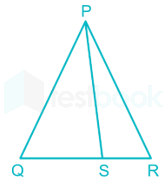
In the given figure, PQ = PS = SR and ∠QPS = 40°, then what is the value of ∠QPR (in degrees)?

  1. AOption (a)

    45°

  2. BOption (b)

    60°

  3. COption (c)

    75°

  4. DOption (d)

    50°

View answer & explanation

Correct answer

Answer: (c)C.

75°

Why this answer is correct

Shortcut Trick

In ΔPQS, PQ = PS ⇒ ∠PSQ = (180° − 40°) ÷ 2 = 70°.

In ΔPSR, PS = SR ⇒ Exterior ∠PSQ = ∠SPR + ∠SRP.

Since PS = SR, ∠SPR = ∠SRP = 70° ÷ 2 = 35°.

Total ∠QPR = ∠QPS + ∠SPR = 40° + 35° = 75°.

∴ The correct answer is 75°.

Alternate Method

Given: PQ = PS = SR and ∠QPS = 40°.

Formula: Angle sum property of triangle = 180°; Isosceles triangle angles opposite to equal sides are equal.

⇒ In ΔPQS, PQ = PS

⇒ ∠PQS = ∠PSQ

⇒ ∠PQS + ∠PSQ + ∠QPS = 180°

⇒ 2 × ∠PSQ + 40° = 180°

⇒ 2 × ∠PSQ = 140° ⇒ ∠PSQ = 70°

⇒ In ΔPSR, PS = SR

⇒ ∠SPR = ∠SRP

⇒ ∠PSQ = ∠SPR + ∠SRP (Exterior angle property)

⇒ 70° = 2 × ∠SPR ⇒ ∠SPR = 35°

⇒ ∠QPR = ∠QPS + ∠SPR

⇒ ∠QPR = 40° + 35° = 75°

∴ The correct answer is 75°.

Additional Information

Isosceles Triangle Property

In a triangle, if two sides are equal, the angles opposite to those sides are always equal.

Exterior Angle Theorem

An exterior angle of a triangle is equal to the sum of its two opposite interior angles.

Angle Sum Property

The sum of all three interior angles of a triangle is 180°.

Question 24

In ΔPQR, C is the centroid. PQ = 30 cm, QR = 36 cm and PR = 50 cm. If D is the midpoint of QR, then what is the length (in cm) of CD?

  1. AOption (a)

    (4√86)/3

  2. BOption (b)

    (2√86)/3

  3. COption (c)

    (5√86)/3

  4. DOption (d)

    (5√86)/2

View answer & explanation

Correct answer

Answer: (a)A.

(4√86)/3

Why this answer is correct

Shortcut Trick

Length of median PD = (1/2)√(2PQ2 + 2PR2 − QR2)

PD = (1/2)√(2(302) + 2(502) − 362) = (1/2)√(1800 + 5000 − 1296) = (1/2)√5504

PD = (1/2) × 8√86 = 4√86 cm

Centroid C divides median PD in ratio 2 : 1, where CD is the part from the midpoint to the centroid.

CD = (1/3) × PD = (1/3) × 4√86 = (4√86)/3 cm

∴ The correct answer is (4√86)/3 cm.

Alternate Method

Given: PQ = 30 cm, PR = 50 cm, QR = 36 cm. D is the midpoint of QR. C is the centroid.

Formula Used: Apollonius' Theorem: PQ2 + PR2 = 2(PD2 + (QR/2)2)

In ΔPQR, D is the midpoint of QR, so QD = DR = 36 ÷ 2 = 18 cm.

⇒ By Apollonius' Theorem: PQ2 + PR2 = 2(PD2 + QD2)

⇒ 302 + 502 = 2(PD2 + 182)

⇒ 900 + 2500 = 2(PD2 + 324)

⇒ 3400 = 2(PD2 + 324)

⇒ 1700 = PD2 + 324

⇒ PD2 = 1700 − 324 = 1376

⇒ PD = √1376 = √(16 × 86) = 4√86 cm

⇒ Centroid C divides PD in the ratio PC : CD = 2 : 1.

⇒ CD = (1/3) × PD

⇒ CD = (1/3) × 4√86 = (4√86)/3 cm

∴ The correct answer is (4√86)/3 cm.

Additional Information

Apollonius' Theorem

Relates the lengths of the sides of a triangle to the length of its median: AB2 + AC2 = 2(AM2 + BM2), where AM is the median to side BC.

Centroid Property

The centroid of a triangle divides each median in the ratio 2 : 1 from the vertex to the midpoint of the opposite side.

Sum of Squares of Medians

3 × (Sum of squares of sides) = 4 × (Sum of squares of medians). For ΔABC: 3(AB2 + BC2 + CA2) = 4(ma2 + mb2 + mc2).

Question 25

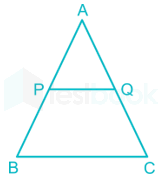
In the given figure, AQ = 4√2 cm, QC = 6√2 cm and AB = 20 cm. If PQ is parallel to BC, then what is the value (in cm) of PB?

  1. AOption (a)

    8

  2. BOption (b)

    12

  3. COption (c)

    6

  4. DOption (d)

    15

View answer & explanation

Correct answer

Answer: (b)B.

12

Why this answer is correct

Shortcut Trick

In triangle ABC, since PQ is parallel to BC, the segments on the sides are proportional (BPT).

Ratio of segments on side AC → AQ : QC = 4√2 : 6√2 = 2 : 3.

By property, the same ratio applies to side AB → AP : PB = 2 : 3.

Total parts for AB = 2 + 3 = 5 parts.

Given AB = 20 cm, so 5 parts = 20 cm ⇒ 1 part = 4 cm.

PB = 3 parts = 3 × 4 = 12 cm.

∴ The correct answer is 12 cm.

Alternate Method

Given: AQ = 4√2 cm, QC = 6√2 cm, AB = 20 cm, PQ || BC.

Formula Used: Basic Proportionality Theorem (BPT) → AP/PB = AQ/QC

Let PB = x cm. Then AP = AB − PB = (20 − x) cm.

According to Basic Proportionality Theorem:

⇒ AP / PB = AQ / QC

⇒ (20 − x) / x = (4√2) / (6√2)

⇒ (20 − x) / x = 4 / 6

⇒ (20 − x) / x = 2 / 3

⇒ 3 × (20 − x) = 2x

⇒ 60 − 3x = 2x

⇒ 5x = 60

⇒ x = 60 ÷ 5

⇒ x = 12 cm.

∴ The correct answer is 12 cm.

Additional Information

Basic Proportionality Theorem (Thales's Theorem)

If a line is drawn parallel to one side of a triangle to intersect the other two sides in distinct points, the other two sides are divided in the same ratio.

Similar Triangles Property (AA Criterion)

When PQ || BC, ΔAPQ ∼ ΔABC. This implies AP/AB = AQ/AC = PQ/BC.

Ratio of Areas

Area(ΔAPQ) / Area(ΔABC) = (AP/AB)2 = (AQ/AC)2 = (PQ/BC)2.

Question 26

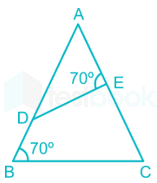
In the given figure, if AD = 12 cm, AE = 8 cm and EC = 14 cm, then what is the value (in cm) of BD?

  1. AOption (a)

    50/3

  2. BOption (b)

    15

  3. COption (c)

    8/3

  4. DOption (d)

    44/3

View answer & explanation

Correct answer

Answer: (c)C.

8/3

Why this answer is correct

Shortcut Trick

In the given triangle, ∠AED = ∠ABC and ∠A is common, so ▵AED ∼ ▵ABC.

By similarity property, the ratio of corresponding sides is equal: AE ÷ AB = AD ÷ AC.

8 ÷ (12 + BD) = 12 ÷ (8 + 14)

8 ÷ (12 + BD) = 12 ÷ 22 ⇒ 2 ÷ (12 + BD) = 3 ÷ 22

12 + BD = 44 ÷ 3 ⇒ BD = 44/3 − 12 = 8/3 cm.

∴ The correct answer is 8/3 cm.

Alternate Method

Given: AD = 12 cm, AE = 8 cm, EC = 14 cm.

Formula: If two angles of one triangle are equal to two angles of another, the triangles are similar (AA similarity).

⇒ Total length AC = AE + EC = 8 + 14 = 22 cm

⇒ In ▵AED and ▵ABC:

⇒ ∠A = ∠A (Common)

⇒ ∠AED = ∠ABC (Given)

⇒ ∴ ▵AED ∼ ▵ABC (AA Similarity)

⇒ AE ÷ AB = AD ÷ AC

⇒ 8 ÷ (AD + BD) = 12 ÷ 22

⇒ 8 ÷ (12 + BD) = 6 ÷ 11

⇒ 6 × (12 + BD) = 8 × 11

⇒ 72 + 6BD = 88

⇒ 6BD = 88 − 72 = 16

⇒ BD = 16 ÷ 6 = 8/3 cm

∴ The correct answer is 8/3 cm.

Additional Information

AA Similarity Criterion

If two angles of one triangle are respectively equal to two angles of another triangle, then the two triangles are similar and their corresponding sides are in the same ratio.

Ratio of Areas of Similar Triangles

The ratio of the areas of two similar triangles is equal to the square of the ratio of their corresponding sides: Area(▵1) ÷ Area(▵2) = (s1 ÷ s2)2.

Basic Proportionality Theorem (Thales Theorem)

If a line is drawn parallel to one side of a triangle to intersect the other two sides in distinct points, the other two sides are divided in the same ratio.

Question 27

Two circles are having radii 9 cm and 12 cm and intersect each other. The distance between their centres is 15 cm. What is the length (in cm) of their common chord?

  1. AOption (a)

    6.8

  2. BOption (b)

    13.6

  3. COption (c)

    7.2

  4. DOption (d)

    14.4

View answer & explanation

Correct answer

Answer: (d)D.

14.4

Why this answer is correct

Shortcut Trick

Check for Pythagorean triplet: 92 + 122 = 81 + 144 = 225 = 152.

Since the radii and the distance between centers form a right-angled triangle, the altitude to the hypotenuse is exactly half of the common chord.

Altitude (h) = (Radius1 × Radius2) ÷ Distance between centres

Length of common chord = 2 × (9 × 12 ÷ 15) = 2 × 10⁸ ÷ 15 = 2 × 7.2 = 14.4 cm.

∴ The correct answer is 14.4 cm.

Alternate Method

Given: Radii r1 = 9 cm, r2 = 12 cm, Distance (d) = 15 cm.

In ΔC1PC2, where P is the intersection point:

⇒ Sides are 9 cm, 12 cm, and 15 cm.

⇒ Since 92 + 122 = 152, ΔC1PC2 is a right-angled triangle with ∠C1PC2 = 90°.

⇒ Area of ΔC1PC2 = (1 ÷ 2) × base × height = (1 ÷ 2) × 9 × 12 = 54 cm2.

⇒ Let h be the perpendicular from P to C1C2. This h is half the common chord.

⇒ Area = (1 ÷ 2) × C1C2 × h

⇒ 54 = (1 ÷ 2) × 15 × h

⇒ 54 = 7.5 × h

⇒ h = 54 ÷ 7.5 = 7.2 cm.

⇒ Length of common chord PQ = 2 × h = 2 × 7.2 = 14.4 cm.

∴ The correct answer is 14.4 cm.

Additional Information

Common Chord Property

The line joining the centres of two intersecting circles is the perpendicular bisector of their common chord.

General Formula

Length of common chord = (2 × Area of triangle formed by radii and distance between centres) ÷ Distance between centres.

Condition for Orthogonal Circles

Two circles are said to be orthogonal if the square of the distance between their centres is equal to the sum of the squares of their radii (d2 = r12 + r22).

Question 28

Two circles touch each other at point X. Two common tangents of the circles meet at point P and none of the tangents passes through X. These tangents touch the larger circle at points B and C. If the radius of the larger circle is 15 cm and CP = 20 cm, then what is the radius (in cm) of the smaller circle?

  1. AOption (a)

    3.5

  2. BOption (b)

    3.75

  3. COption (c)

    4.25

  4. DOption (d)

    4.45

View answer & explanation

Correct answer

Answer: (b)B.

3.75

Why this answer is correct

Shortcut Trick

Calculate distance from larger circle center (O1) to P: O1P = √(152 + 202) = 25 cm.

Distance from point X (where circles touch) to P: XP = O1P − R = 25 − 15 = 10 cm.

Using similarity ratio for radii: r / R = (XP − r) / O1P

r / 15 = (10 − r) / 25 ⇒ 5r = 3(10 − r) ⇒ 8r = 30

r = 3.75 cm.

∴ The correct answer is 3.75 cm.

Alternate Method

Given: Radius of larger circle (R) = 15 cm, Tangent length (CP) = 20 cm. Point X is the point of contact between circles.

Formula: In a right-angled triangle, Hypotenuse2 = Base2 + Perpendicular2. Similar triangles property: Ratio of corresponding sides is equal.

⇒ In right ▵O1CP, O1C = 15 cm and CP = 20 cm.

⇒ O1P = √(O1C2 + CP2) = √(152 + 202) = √(225 + 400) = √625 = 25 cm.

⇒ The distance from the center O1 to the point of contact X is the radius R = 15 cm.

⇒ The distance XP = O1P − O1X = 25 − 15 = 10 cm.

⇒ Let the radius of the smaller circle be r. Then O2X = r and O2P = XP − O2X = 10 − r.

⇒ By similarity of ▵O2DP and ▵O1CP (where D is contact point on smaller circle):

⇒ r / R = O2P / O1P

⇒ r / 15 = (10 − r) / 25

⇒ 25r = 15(10 − r) ⇒ 25r = 150 − 15r

⇒ 40r = 150 ⇒ r = 150 ÷ 40 = 3.75 cm.

∴ The correct answer is 3.75 cm.

Additional Information

Direct Common Tangents (DCT)

Length of DCT = √(d2 − (R − r)2), where d is the distance between centers.

Transverse Common Tangents (TCT)

Length of TCT = √(d2 − (R + r)2). TCTs exist only if d > R + r.

Circles Touching Externally

When two circles touch externally, the distance between their centers d = R + r and they have exactly 3 common tangents.

Question 29

Two circles touch each other at point X. A common tangent touches them at two distinct points Y and Z. If another tangent passing through X cut YZ at A and XA = 16 cm, then what is the value (in cm) of YZ?

  1. AOption (a)

    18

  2. BOption (b)

    24

  3. COption (c)

    16

  4. DOption (d)

    32

View answer & explanation

Correct answer

Answer: (d)D.

32

Why this answer is correct

Shortcut Trick

When two circles touch each other externally, the common internal tangent bisects the segment of the common external tangent.

The point of intersection A of the tangents lies such that AY = AX and AZ = AX.

Therefore, AX is exactly half of the common tangent YZ.

Formula: YZ = 2 × AX

YZ = 2 × 16 = 32 cm.

∴ The correct answer is 32 cm.

Alternate Method

Given:

Length of the internal tangent segment from intersection point A to contact point X, AX = 16 cm.

Formula Used:

The lengths of tangents drawn from an external point to a circle are equal.

Calculations:

⇒ For the first circle, A is an external point. Tangents are AY and AX.

⇒ ∴ AY = AX = 16 cm

⇒ For the second circle, A is an external point. Tangents are AZ and AX.

⇒ ∴ AZ = AX = 16 cm

⇒ The total length of the common tangent YZ = AY + AZ

⇒ YZ = 16 + 16

⇒ YZ = 32 cm

∴ The correct answer is 32 cm.

Additional Information

Length of Direct Common Tangent (DCT)

For two circles with radii r1 and r2 and distance between centers d, DCT = √(d2 − (r1 − r2)2).

Length of Transverse Common Tangent (TCT)

The length of the transverse common tangent is given by TCT = √(d2 − (r1 + r2)2).

Angle Subtended at Point of Contact

When two circles touch externally, the angle subtended by the common tangent segment YZ at the point of contact X is always 90° (∠YXZ = 90°).

Question 30

There are 8 equidistant points A, B, C, D, E, F, G and H (in same order) on a circle. What is the value of ∠FDH (in degrees)?

  1. AOption (a)

    22.5°

  2. BOption (b)

    45°

  3. COption (c)

    30°

  4. DOption (d)

    42.5°

View answer & explanation

Correct answer

Answer: (b)B.

45°

Why this answer is correct

Shortcut Trick

In a circle with 8 equidistant points, each arc segment is 360° ÷ 8 = 45°.

The arc FGH spans 2 segments (FG and GH), so Arc FGH = 2 × 45° = 90°.

The inscribed angle ∠FDH subtends arc FGH.

By the inscribed angle theorem, ∠FDH = ½ × Arc FGH = ½ × 90° = 45°.

∴ The correct answer is 45°.

Alternate Method

Given:

Points A, B, C, D, E, F, G, H are 8 equidistant points on a circle.

Formula:

Angle subtended by an arc at the circumference = ½ × Angle subtended by the same arc at the center.

Calculations:

⇒ Total points = 8

⇒ Central angle of each arc segment (AB, BC, ...) = 360° ÷ 8 = 45°

⇒ Arc FGH = Arc FG + Arc GH

⇒ Arc FGH = 45° + 45° = 90°

⇒ Since ∠FDH is an inscribed angle subtended by Arc FGH:

⇒ ∠FDH = ½ × (Measure of Arc FGH)

⇒ ∠FDH = ½ × 90° = 45°

∴ The correct answer is 45°.

Additional Information

Inscribed Angle Theorem

An angle θ inscribed in a circle is half of the central angle 2θ that subtends the same arc on the circle.

Angles Subtended by Equal Arcs

Equal arcs (or chords) of a circle subtend equal angles at the center and equal angles at any point on the remaining part of the circumference.

Angle in a Semicircle

An angle inscribed in a semicircle is always a right angle (90°), as it subtends an arc of 180°.

Question 31

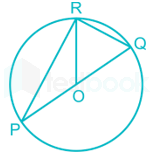
In the given figure, O is the centre of the circle and ∠QOR = 50°, then what is the value of ∠RPQ?

  1. AOption (a)

    15°

  2. BOption (b)

    25°

  3. COption (c)

    20°

  4. DOption (d)

    30°

View answer & explanation

Correct answer

Answer: (b)B.

25°

Why this answer is correct

Shortcut Trick

The angle subtended by an arc at the centre is twice the angle subtended by it at any point on the remaining part of the circle.

Therefore, Angle at Circumference = Angle at Centre ÷ 2

∠RPQ = ∠QOR ÷ 2

∠RPQ = 50° ÷ 2 = 25°

∴ The correct answer is 25°.

Alternate Method

Given: O is the centre of the circle and ∠QOR = 50°.

Formula Used: The angle subtended by an arc at the centre is double the angle subtended by it at any point on the remaining part of the circle.

Calculations:

⇒ ∠QOR = 2 × ∠RPQ

⇒ 50° = 2 × ∠RPQ

⇒ ∠RPQ = 50° ÷ 2

⇒ ∠RPQ = 25°

∴ The correct answer is 25°.

Additional Information

Central Angle Theorem

The angle subtended by an arc at the center is exactly twice the angle it subtends at the circumference (∠Center = 2 × ∠Circumference).

Angles in the Same Segment

All angles subtended by the same arc at any point on the circumference are equal (∠P1 = ∠P2).

Angle in a Semicircle

An angle subtended by the diameter at the circumference is always a right angle (90°).

Cyclic Quadrilateral

In a cyclic quadrilateral, the sum of opposite internal angles is always 180° (∠A + ∠C = 180°).

Question 32

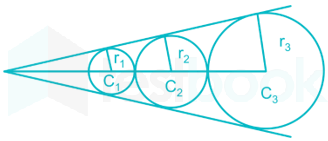
Three circle C1, C2 and C3 with radii r1, r2 and r3 (where r1 < r2 < r3) are placed as shown in the given figure. What is the value of r2?

  1. AOption (a)

    √(r1r3)

  2. BOption (b)

    (r1 + r3)/2

  3. COption (c)

    (2r1r2) / (r1 + r2)

  4. DOption (d)

    √(r1 + r3)

View answer & explanation

Correct answer

Answer: (a)A.

√(r1r3)

Why this answer is correct

Shortcut Trick

When circles are placed such that they touch two converging lines and also touch each other externally, their radii (r1, r2, r3, ...) form a Geometric Progression (G.P.).

For three such circles, the common ratio is constant: r2/r1 = r3/r2.

Applying the G.P. property: r22 = r1 × r3.

Taking square root on both sides: r2 = √(r1r3).

∴ The correct answer is √(r1r3).

Alternate Method

Given: Three circles C1, C2, and C3 with radii r1, r2, and r3 touching two lines and each other.

Formula Used: Similarity of triangles and trigonometric ratios in right-angled triangles.

⇒ Let the angle between the two lines be 2θ. The centers of the circles lie on the angle bisector.

⇒ In the right triangle formed by the vertex O and center of circle Cn: sin θ = rn / dn, where dn is the distance from O to the center.

⇒ d1 = r1 / sin θ and d2 = r2 / sin θ.

⇒ Distance between centers C1 and C2 is r1 + r2.

⇒ d2 − d1 = r1 + r2

⇒ (r2 / sin θ) − (r1 / sin θ) = r1 + r2

⇒ (r2 − r1) / sin θ = r1 + r2 ⇒ sin θ = (r2 − r1) / (r2 + r1)

⇒ Similarly for circles C2 and C3: sin θ = (r3 − r2) / (r3 + r2)

⇒ (r2 − r1) / (r2 + r1) = (r3 − r2) / (r3 + r2)

⇒ (r2 − r1)(r3 + r2) = (r3 − r2)(r2 + r1)

⇒ r2r3 + r22 − r1r3 − r1r2 = r3r2 + r1r3 − r22 − r1r2

⇒ 2r22 = 2r1r3 ⇒ r22 = r1r3

⇒ r2 = √(r1r3)

∴ The correct answer is √(r1r3).

Additional Information

Geometric Progression of Radii

If 'n' circles are inscribed in an angle touching each other and the sides, their radii r1, r2, ..., rn are in G.P. with common ratio k = (1 + sin θ) / (1 − sin θ).

Direct Common Tangent

The length of the direct common tangent between two circles with radii r1 and r2 touching each other externally is 2√(r1r2).

Angle Bisector Property

The centers of all circles that touch two intersecting lines must lie on the angle bisector of those lines.

Question 33

An equilateral triangle of area 300 cm2 is cut from its three vertices to form a regular hexagon. Area of hexagon is what percent of the area of triangle?(Each side of the regular hexagon is 1/3 rd the original side of equilateral triangle)

  1. AOption (a)

    66.66%

  2. BOption (b)

    33.33%

  3. COption (c)

    83.33%

  4. DOption (d)

    56.41%

View answer & explanation

Correct answer

Answer: (a)A.

66.66%

Why this answer is correct

Shortcut Trick

An equilateral triangle of side 3 units can be divided into 9 smaller equilateral triangles of side 1 unit.

Cutting the three vertices (each an equilateral triangle of side 1 unit) leaves a regular hexagon.

Area of Hexagon = Area of Triangle − 3 × (Area of small triangle at vertex).

Area of Hexagon = 9 units − 3 units = 6 units.

Required Percentage = (6 ÷ 9) × 100 = 66.66%.

∴ The correct answer is 66.66%.

Alternate Method

Given:

Area of original equilateral triangle = 300 cm2

Side of the regular hexagon = 1/3 × Side of the original triangle

Formula:

Area of Equilateral Triangle = (√3 ÷ 4) × (side)2

Area of Regular Hexagon = 6 × [(√3 ÷ 4) × (side of hexagon)2]

Calculations:

⇒ Let the side of the original equilateral triangle be a.

⇒ Side of the regular hexagon = a/3.

⇒ Area of original triangle (T) = (√3 ÷ 4) × a2 = 300 cm2.

⇒ The hexagon is made of 6 small equilateral triangles, each with side a/3.

⇒ Area of one small triangle (t) = (√3 ÷ 4) × (a/3)2 = [(√3 ÷ 4) × a2] ÷ 9.

⇒ Area of one small triangle (t) = 300 ÷ 9 = 33.33 cm2.

⇒ Area of Hexagon (H) = 6 × Area of small triangle (t).

⇒ Area of Hexagon (H) = 6 × 33.33 = 200 cm2.

⇒ Required Percentage = (Area of Hexagon ÷ Area of Triangle) × 100.

⇒ Percentage = (200 ÷ 300) × 100 = 66.66%.

∴ The correct answer is 66.66%.

Additional Information

Regular Hexagon Formation

A regular hexagon can be formed by cutting three equilateral triangles of side a/3 from the corners of a larger equilateral triangle of side a.

Area Ratio of Similar Triangles

If the ratio of sides of two equilateral triangles is x:y, then the ratio of their areas is x2:y2.

Regular Hexagon Area

The area of a regular hexagon with side s is given by 3√3/2 × s2, which is equivalent to 6 times the area of an equilateral triangle with the same side.

Question 34

In the given figure, PQR is an equilateral triangle with side as 12 cm. S and T are the mid points of the sides PQ and PR respectively. What is the area (in cm2) of the shaded region?

  1. AOption (a)

    10√3

  2. BOption (b)

    12√3

  3. COption (c)

    9√3

  4. DOption (d)

    14√3

View answer & explanation

Correct answer

Answer: (b)B.

12√3

Why this answer is correct

Shortcut Trick

Area of equilateral ΔPQR = (√3 / 4) × side2 = (√3 / 4) × 12 × 12 = 36√3 cm2.

Since S and T are midpoints, lines QS and RT are medians intersecting at centroid O.

The centroid divides an equilateral triangle into 3 triangles of equal area.

Shaded Area (ΔOQR) = (1/3) × Total Area = (1/3) × 36√3 = 12√3 cm2.

∴ The correct answer is 12√3 cm2.

Alternate Method

Given: Side of equilateral triangle (a) = 12 cm. S and T are midpoints of PQ and PR.

Formula Used: Area of equilateral triangle = (√3/4)a2; Centroid Property: Area(OQR) = Area(PQR)/3.

⇒ Total Area of ΔPQR = (√3 / 4) × (12)2

⇒ Total Area = (√3 / 4) × 144 = 36√3 cm2

⇒ S and T are midpoints, so QS and RT are medians.

⇒ Let O be the point of intersection of medians (Centroid).

⇒ In an equilateral triangle, the centroid O divides it into 3 equal areas: ΔPOQ, ΔPOR, and ΔOQR.

⇒ Shaded Area (ΔOQR) = Total Area ÷ 3

⇒ Shaded Area = 36√3 ÷ 3 = 12√3 cm2

∴ The correct answer is 12√3 cm2.

Additional Information

Area of Equilateral Triangle

The area is given by (√3/4) × a2 and the height is (√3/2) × a, where 'a' is the side length.

Centroid and Area

The centroid divides the triangle into three smaller triangles of equal area and each median into a 2:1 ratio.

Midpoint Theorem

The segment joining the midpoints of two sides of a triangle (ST) is parallel to the third side (QR) and is half its length.

Question 35

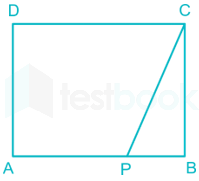
ABCD is a rectangle. P is a point on the side AB as shown in the figure. If DP = 13, CP = 10 and BP = 6, then what is the value of AP?

  1. AOption (a)

    √105

  2. BOption (b)

    √133

  3. COption (c)

    12

  4. DOption (d)

    10

View answer & explanation

Correct answer

Answer: (a)A.

√105

Why this answer is correct

Shortcut Trick

For any point P on or inside a rectangle ABCD, the relation holds: AP2 + CP2 = BP2 + DP2.

Substitute the given values: AP2 + 102 = 62 + 132

⇒ AP2 + 100 = 36 + 169

⇒ AP2 = 205 − 100 = 105

⇒ AP = √105

∴ The correct answer is √105.

Alternate Method

Given:

Rectangle ABCD where DP = 13, CP = 10, BP = 6 and P lies on side AB.

Formula Used:

Pythagoras Theorem: Hypotenuse2 = Base2 + Perpendicular2

Calculations:

In rectangle ABCD, let the height AD = BC = h.

Since ABCD is a rectangle, ∠PBC = 90° and ∠PAD = 90°.

In ▵PBC:

⇒ BC2 + BP2 = CP2

⇒ h2 + 62 = 102

⇒ h2 + 36 = 100

⇒ h2 = 64

In ▵PAD:

⇒ AD2 + AP2 = DP2

⇒ h2 + AP2 = 132

⇒ 64 + AP2 = 169

⇒ AP2 = 169 − 64

⇒ AP2 = 105

⇒ AP = √105

∴ The correct answer is √105.

Additional Information

British Flag Theorem

For any point P in the plane of a rectangle ABCD, the sum of the squares of distances to opposite vertices is equal: PA2 + PC2 = PB2 + PD2.

Rectangle Properties

Opposite sides are equal and parallel (AD = BC, AB = CD), and all interior angles are 90°.

Pythagorean Triplets

Common sets of integers satisfying a2 + b2 = c2 include (3, 4, 5), (6, 8, 10), (5, 12, 13), and (8, 15, 17).

Question 36

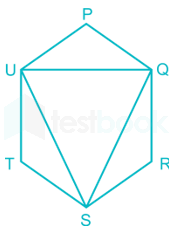
In the given figure, PQRSTU is a regular hexagon of side 12 cm. What is the area (in cm2) of ΔSQU?

  1. AOption (a)

    162√3

  2. BOption (b)

    216√3

  3. COption (c)

    108√3

  4. DOption (d)

    54√3

View answer & explanation

Correct answer

Answer: (c)C.

108√3

Why this answer is correct

Shortcut Trick

The area of a triangle formed by joining alternate vertices of a regular hexagon is always exactly half of the hexagon's total area.

Area of Regular Hexagon = (3√3 ÷ 2) × (side)2

Area of Hexagon = (3√3 ÷ 2) × 122 = (3√3 ÷ 2) × 144 = 216√3 cm2.

Area of ΔSQU = 216√3 ÷ 2 = 108√3 cm2.

∴ The correct answer is 108√3 cm2.

Alternate Method

Given: Side of the regular hexagon (a) = 12 cm.

Formula: Area of an equilateral triangle = (√3 ÷ 4) × (side)2.

⇒ In a regular hexagon, the distance between alternate vertices (longer diagonal) s = a√3.

⇒ Side of equilateral ΔSQU (s) = 12 × √3 = 12√3 cm.

⇒ Area of ΔSQU = (√3 ÷ 4) × (12√3)2

⇒ Area = (√3 ÷ 4) × (144 × 3)

⇒ Area = √3 × 36 × 3

⇒ Area = 108√3 cm2.

∴ The correct answer is 108√3 cm2.

Additional Information

Properties of Regular Hexagon

A regular hexagon has 6 equal sides and 6 equal interior angles of 120° each. Area = (3√3 ÷ 2) × a2.

Hexagon Diagonals

Short diagonal (joining alternate vertices) = a√3. Long diagonal (joining opposite vertices) = 2a.

Internal Triangles

Joining alternate vertices forms one large equilateral triangle. Joining all opposite vertices forms 6 small equilateral triangles.

Question 37

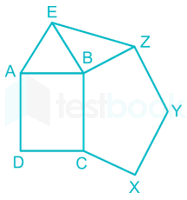
In the given figure, ABCD is a square, BCXYZ is a regular pentagon and ABE is an equilateral triangle. What is the value of ∠EBZ?

  1. AOption (a)

    102°

  2. BOption (b)

    98°

  3. COption (c)

    78°

  4. DOption (d)

    64°

View answer & explanation

Correct answer

Answer: (a)A.

102°

Why this answer is correct

Shortcut Trick

Internal angle of Equilateral Triangle ∠ABE = 60°.

Internal angle of Square ∠ABC = 90°.

Internal angle of Regular Pentagon ∠CBZ = [(5 − 2) × 180°] ÷ 5 = 108°.

Sum of all angles around point B = 360°.

∠EBZ = 360° − (∠ABE + ∠ABC + ∠CBZ) = 360° − (60° + 90° + 108°) = 102°.

∴ The correct answer is 102°.

Alternate Method

Given:

ABCD is a square ⇒ ∠ABC = 90°.

BCXYZ is a regular pentagon ⇒ Interior angle = [(n − 2) × 180°] ÷ n.

ABE is an equilateral triangle ⇒ ∠ABE = 60°.

Formula for interior angle of a regular polygon with n sides = [(n − 2) × 180°] ÷ n

⇒ Interior angle of regular pentagon (n=5) = [(5 − 2) × 180°] ÷ 5

⇒ ∠CBZ = (3 × 180°) ÷ 5 = 540° ÷ 5 = 108°

⇒ For square ABCD, ∠ABC = 90°

⇒ For equilateral triangle ABE, ∠ABE = 60°

⇒ Since angles ∠ABE, ∠ABC, ∠CBZ, and ∠EBZ meet at a single point B:

⇒ ∠EBZ + ∠ABE + ∠ABC + ∠CBZ = 360°

⇒ ∠EBZ + 60° + 90° + 108° = 360°

⇒ ∠EBZ + 258° = 360°

⇒ ∠EBZ = 360° − 258° = 102°

∴ The correct answer is 102°.

Additional Information

Sum of Interior Angles

The sum of the interior angles of any polygon with n sides is given by (n − 2) × 180°.

Exterior Angle of Regular Polygon

Each exterior angle of a regular polygon is 360° ÷ n. The sum of interior and exterior angles at a vertex is always 180°.

Common Polygon Angles

Regular Hexagon (n=6) interior angle = 120°; Regular Octagon (n=8) interior angle = 135°.

Complete Angle

The total angle at a point or around a vertex in a plane is always equal to 360°.

Question 38

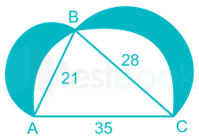
In the given figure, 3 semicircles are drawn on three sides of ΔABC. AB = 21 cm, BC = 28 cm and AC = 35 cm. What is the area (in cm2) of the shaded part?

  1. AOption (a)

    588

  2. BOption (b)

    324

  3. COption (c)

    294

  4. DOption (d)

    286

View answer & explanation

Correct answer

Answer: (c)C.

294

Why this answer is correct

Shortcut Trick

Check for Pythagorean triplet: 21, 28, 35 → (3, 4, 5) × 7. Since 212 + 282 = 352, ΔABC is right-angled at B.

Property: For a right-angled triangle, the area of the lunes (shaded parts) formed by semicircles on the legs is equal to the area of the triangle itself.

Area of shaded part = Area of ΔABC = 1/2 × Base × Height

Area = 1/2 × 21 × 28 = 21 × 14 = 294 cm2.

∴ The correct answer is 294 cm2.

Alternate Method

Given:

Sides of the triangle: AB = 21 cm, BC = 28 cm, AC = 35 cm.

Formula Used:

Area of triangle = 1/2 × Base × Height

Area of semicircle = 1/2 × πr2

Checking the triangle type:

⇒ AB2 + BC2 = 212 + 282 = 441 + 784 = 1225

⇒ AC2 = 352 = 1225

⇒ Since AB2 + BC2 = AC2, ΔABC is a right-angled triangle at B.

Calculating the areas:

⇒ Area of semicircle on AB (S1) = 1/2 × π × (21/2)2

⇒ Area of semicircle on BC (S2) = 1/2 × π × (28/2)2

⇒ Area of semicircle on AC (S3) = 1/2 × π × (35/2)2

⇒ Area of shaded part = (S1 + S2 + Area of ΔABC) − S3

⇒ Since S1 + S2 = S3 (by Pythagoras theorem), the S1, S2 and S3 cancel out.

⇒ Area of shaded part = Area of ΔABC

⇒ Area = 1/2 × 21 × 28 = 294 cm2.

∴ The correct answer is 294 cm2.

Additional Information

Lunes of Hippocrates

This specific geometry problem is based on the Lunes of Hippocrates, which states that the sum of the areas of the two lunes formed on the legs of a right triangle is equal to the area of the triangle.

Pythagorean Triplets

Common triplets like (3, 4, 5), (5, 12, 13), and (7, 24, 25) are essential for identifying right-angled triangles. In this question, (21, 28, 35) is a multiple of (3, 4, 5).

Area of Semicircle

The area of a semicircle is given by A = (πr2)/2 or (πd2)/8, where r is the radius and d is the diameter.

Question 39

The sum of radii of the two circles is 91 cm and the difference between their areas is 2002 cm2. What is the radius (in cm) of the larger circle?

  1. AOption (a)

    56

  2. BOption (b)

    42

  3. COption (c)

    63

  4. DOption (d)

    49

View answer & explanation

Correct answer

Answer: (d)D.

49

Why this answer is correct

Shortcut Trick

Area difference = π(R2 − r2) = π(R + r)(R − r) = 2002.

Given R + r = 91, so (22/7) × 91 × (R − r) = 2002.

22 × 13 × (R − r) = 2002 ⇒ 286 × (R − r) = 2002 ⇒ R − r = 7.

Larger radius R = (Sum + Difference) ÷ 2 = (91 + 7) ÷ 2 = 98 ÷ 2 = 49 cm.

∴ The correct answer is 49 cm.

Alternate Method

Given:

Sum of radii (R + r) = 91 cm

Difference of areas (πR2 − πr2) = 2002 cm2

Formula Used:

Area of circle = πr2 | Algebraic identity: a2 − b2 = (a + b)(a − b)

⇒ πR2 − πr2 = 2002

⇒ π(R2 − r2) = 2002

⇒ (22/7) × (R + r)(R − r) = 2002

⇒ (22/7) × 91 × (R − r) = 2002

⇒ 22 × 13 × (R − r) = 2002

⇒ 286 × (R − r) = 2002

⇒ R − r = 2002 ÷ 286

⇒ R − r = 7 --- (Eq. 1)

⇒ R + r = 91 --- (Eq. 2)

Adding Eq. 1 and Eq. 2:

⇒ 2R = 98

⇒ R = 49 cm

∴ The correct answer is 49 cm.

Additional Information

Area of a Circle

The total space occupied by the circle is given by A = πr2, where π ≈ 22/7 or 3.14.

Area of a Ring (Annulus)

The area between two concentric circles is π(R2 − r2) = π(R + r)(R − r).

Circumference of a Circle

The boundary length of a circle is calculated as C = 2πr or C = πd, where d is the diameter.

Diameter-Radius Relation

The diameter is the longest chord and is exactly twice the radius: d = 2r.

Question 40

A right triangular prism has equilateral triangle as its base. Side of the triangle is 15 cm. Height of the prism is 20√3 cm. What is the volume (in cm3) of the prism?

  1. AOption (a)

    1125

  2. BOption (b)

    6750

  3. COption (c)

    4500

  4. DOption (d)

    3375

View answer & explanation

Correct answer

Answer: (d)D.

3375

Why this answer is correct

Shortcut Trick

Volume of a prism = Base Area × Height

Base is an equilateral triangle with side a = 15 cm.

Base Area = (√3/4) × a2 = (√3/4) × 152 = 225√3/4 cm2

Volume = (225√3/4) × 20√3 = 225 × 5 × (√3 × √3) = 225 × 5 × 3

Volume = 225 × 15 = 3375 cm3

∴ The correct answer is 3375 cm3.

Alternate Method

Given:

Side of equilateral triangular base (a) = 15 cm

Height of the prism (h) = 20√3 cm

Formula Used:

Area of equilateral triangle = (√3/4) × side2

Volume of Prism = Base Area × Height

Calculations:

⇒ Area of the base = (√3/4) × (15)2

⇒ Area of the base = (√3/4) × 225 cm2

⇒ Volume of the prism = [(√3/4) × 225] × 20√3

⇒ Volume = (225 × 20 × √3 × √3) ÷ 4

⇒ Volume = (225 × 20 × 3) ÷ 4

⇒ Volume = 225 × 5 × 3

⇒ Volume = 225 × 15

⇒ Volume = 3375 cm3

∴ The correct answer is 3375 cm3.

Additional Information

Lateral Surface Area (LSA) of Prism

LSA = Perimeter of base × Height of the prism. For this prism, LSA = (3 × 15) × 20√3 = 900√3 cm2.

Total Surface Area (TSA) of Prism

TSA = Lateral Surface Area + 2 × Area of base. TSA = (Perimeter × h) + 2 × [(√3/4) × a2].

Volume of a Pyramid

The volume of a pyramid is exactly 1/3 the volume of a prism with the same base and height: Volume = (1/3) × Base Area × Height.

Question 41

A cone of height 45 cm is cut at a height of 15 cm from its base by a plane parallel to its base. If the volume of the smaller cone is 18480 cm3, then what is the volume (in cm3) of the original cone?

  1. AOption (a)

    34650

  2. BOption (b)

    61600

  3. COption (c)

    36960

  4. DOption (d)

    62370

View answer & explanation

Correct answer

Answer: (d)D.

62370

Why this answer is correct

Shortcut Trick

Height of original cone (H) = 45 cm; Height of smaller cone (h) = 45 − 15 = 30 cm.

Ratio of heights (Small : Large) = 30 : 45 = 2 : 3.

Ratio of volumes = (Height ratio)3 = 23 : 33 = 8 : 27.

Given, 8 units = 18480 cm3 ⇒ 1 unit = 2310 cm3.

Volume of original cone = 27 units = 27 × 2310 = 62370 cm3.

∴ The correct answer is 62370 cm3.

Alternate Method

Given:

Total Height (H) = 45 cm

Cutting Height from base = 15 cm

Volume of smaller cone (v) = 18480 cm3

Formula Used:

Ratio of volumes of two similar cones = (Ratio of their heights)3

Calculations:

⇒ Height of smaller cone (h) = 45 − 15 = 30 cm

⇒ Ratio of heights (k) = h ÷ H = 30 ÷ 45 = 2/3

⇒ Volume of small cone ÷ Volume of large cone = (h/H)3

⇒ 18480 ÷ V = (2/3)3

⇒ 18480 ÷ V = 8/27

⇒ V = (18480 × 27) ÷ 8

⇒ V = 2310 × 27

⇒ V = 62370 cm3

∴ The correct answer is 62370 cm3.

Additional Information

Volume of Frustum

The volume of the bottom part remaining after the cut (frustum) is Vfrustum = (1/3)πh(R2 + r2 + Rr), or simply Vlarge − Vsmall.

Similarity Property of Solids

For any two similar 3D figures, the ratio of their volumes is the cube of the ratio of any corresponding linear dimensions (height, radius, or slant height).

Surface Area Ratio

The ratio of the curved surface areas of the smaller cone to the original cone is (h/H)2. In this case, (2/3)2 = 4/9.

Question 42

The ratio of the curved surface area and total surface area of a right circular cylinder is 2 : 5. If the total surface area is 3080 cm2, then what is the volume (in cm3) of the cylinder?

  1. AOption (a)

    4312√6

  2. BOption (b)

    3822√6

  3. COption (c)

    4522√6

  4. DOption (d)

    4642√6

View answer & explanation

Correct answer

Answer: (a)A.

4312√6

Why this answer is correct

Shortcut Trick

Ratio of CSA : TSA = h : (h + r) = 2 : 5 → h = 2 units, r = 3 units.

Since TSA is 5 units = 3080 cm2, then CSA (2πrh) = 2 units = 1232 cm2.

Area of two bases (2πr2) = TSA − CSA = 3080 − 1232 = 1848 cm2.

πr2 = 924 ⇒ r2 = 294 ⇒ r = 7√6 cm and h = (2/3)r = 14√6 / 3 cm.

Volume = πr2h = 924 × (14√6 / 3) = 4312√6 cm3.

∴ The correct answer is 4312√6 cm3.

Alternate Method

Given:

Total Surface Area (TSA) of cylinder = 3080 cm2

Ratio of Curved Surface Area (CSA) to TSA = 2 : 5

Formula Used:

CSA = 2πrh

TSA = 2πr(h + r)

Volume (V) = πr2h

Calculations:

⇒ CSA / TSA = (2πrh) / [2πr(h + r)] = 2 / 5

⇒ h / (h + r) = 2 / 5

⇒ 5h = 2h + 2r

⇒ 3h = 2r ⇒ h = 2r / 3

⇒ CSA = (2/5) × TSA = (2/5) × 3080 = 1232 cm2

⇒ TSA − CSA = Area of 2 circular bases = 3080 − 1232 = 1848 cm2

⇒ 2πr2 = 1848

⇒ 2 × (22/7) × r2 = 1848

⇒ r2 = (1848 × 7) / 44 = 42 × 7 = 294

⇒ r = √294 = 7√6 cm

⇒ h = (2/3) × 7√6 = 14√6 / 3 cm

⇒ Volume = πr2h = (22/7) × 294 × (14√6 / 3)

⇒ Volume = 924 × (14√6 / 3)

⇒ Volume = 308 × 14√6 = 4312√6 cm3

∴ The correct answer is 4312√6 cm3.

Additional Information

Cylinder Surface Areas

The lateral surface area is 2πrh, and the total surface area includes the top and bottom circles: 2πrh + 2πr2.

Volume Comparison

A cylinder has 3 times the volume of a cone with the same radius and height: Vcylinder = 3 × Vcone = πr2h.

Hollow Cylinder

For a hollow cylinder with outer radius R and inner radius r, Volume = πh(R2 − r2).

Question 43

The radius and height of a solid cylinder are increased by 2% each. What will be the approximate percentage increase in volume?

  1. AOption (a)

    6.76%

  2. BOption (b)

    5.88%

  3. COption (c)

    6.12%

  4. DOption (d)

    3.34%

View answer & explanation

Correct answer

Answer: (c)C.

6.12%

Why this answer is correct

Shortcut Trick

Volume of cylinder depends on r2 and h (V ∝ r × r × h).

Successive % increase of 2% and 2% = 2 + 2 + (2 × 2)/100 = 4.04%.

Successive % increase of 4.04% and 2% = 4.04 + 2 + (4.04 × 2)/100 = 6.04 + 0.0808 = 6.1208%.

Approximate increase ≈ 6.12%.

∴ The correct answer is 6.12%.

Alternate Method

Given: Increase in radius (r) = 2%, Increase in height (h) = 2%.

Formula Used: Volume of cylinder (V) = πr2h

⇒ Let original radius (r) = 100 and original height (h) = 100.

⇒ Original Volume (V1) = π × (100)2 × 100 = 1,000,000π.

⇒ New radius (r') = 100 + 2% of 100 = 102.

⇒ New height (h') = 100 + 2% of 100 = 102.

⇒ New Volume (V2) = π × (102)2 × 102 = π × 10404 × 102 = 1,061,208π.

⇒ Increase in Volume = V2 − V1 = 1,061,208π − 1,000,000π = 61,208π.

⇒ Percentage Increase = (61,208π / 1,000,000π) × 100 = 6.1208%.

⇒ Approximate Percentage Increase ≈ 6.12%.

∴ The correct answer is 6.12%.

Additional Information

Successive Percentage for 3 Variables

For three successive changes a%, b%, and c%, the net change is given by [a + b + c + (ab + bc + ca)/100 + (abc)/10000]%.

Curved Surface Area (CSA) Change

CSA of cylinder = 2πrh. If r and h both increase by x%, the net increase in CSA is (x + x + x2/100)%.

Small Change Approximation

If a quantity depends on xayb and variables change by very small %, the net change is approximately (a × %change in x + b × %change in y).

Question 44

A sphere of radius 21 cm is cut into 8 identical parts by 3 cuts (1 cut along each axis). What will be the total surface area (in cm2) of each part?

  1. AOption (a)

    844.5

  2. BOption (b)

    1732.5

  3. COption (c)

    1039.5

  4. DOption (d)

    1115.6

View answer & explanation

Correct answer

Answer: (b)B.

1732.5

Why this answer is correct

Shortcut Trick

Each octant (1/8th part) has 1/8th of the sphere's curved area and 3 flat quadrant faces.

TSA of 1 part = (1/8 × 4πr2) + (3 × 1/4πr2) = 1.25 × πr2.

Direct Calculation: 1.25 × (22/7) × 21 × 21.

TSA = 1.25 × 1386 = 1732.5 cm2.

∴ The correct answer is 1732.5 cm2.

Alternate Method

Given:

Radius of sphere (r) = 21 cm

Sphere is cut into 8 identical parts by 3 perpendicular cuts passing through the center.

Formula Used:

Curved Surface Area (CSA) of sphere = 4πr2

Total Surface Area (TSA) of each part = (1/8 × CSA of sphere) + Area of 3 flat surfaces

Area of each flat surface = Quarter of a circle = (1/4)πr2

Calculations:

⇒ Area of 1/8th curved surface = (1/8) × 4 × (22/7) × 21 × 21

⇒ Area of 1/8th curved surface = (1/2) × 22 × 3 × 21 = 11 × 63 = 693 cm2

⇒ Area of 3 flat faces = 3 × (1/4) × (22/7) × 21 × 21

⇒ Area of 3 flat faces = (3/4) × 22 × 3 × 21 = (3/2) × 11 × 63 = 2079 / 2 = 1039.5 cm2

⇒ Total Surface Area (TSA) = 693 + 1039.5

⇒ TSA = 1732.5 cm2

∴ The correct answer is 1732.5 cm2.

Additional Information

Surface Area of Sphere and Parts

Total Surface Area of a sphere is 4πr2. When cut into two hemispheres, the TSA of one hemisphere becomes 3πr2 (curved surface 2πr2 + flat base πr2).

Effect of Cuts through Center

Each full circular cut through the center of a sphere adds an additional surface area equal to 2 × (πr2). Three perpendicular cuts create 3 full circular cross-sections, adding 6πr2 to the original 4πr2.

Volume of Sphere Parts

Volume of a full sphere is (4/3)πr3. When cut into 8 identical parts, the volume of each part is simply 1/8 of the total: V = (1/6)πr3.

Question 45

Two identical hemispheres of maximum possible size are cut from a solid cube of side 14 cm. The bases of the hemispheres are part of the two opposite faces of cube. What is the total volume (in cm3) of the remaining part of the cube?

  1. AOption (a)

    1556.33

  2. BOption (b)

    898.5

  3. COption (c)

    1467.33

  4. DOption (d)

    1306.67

View answer & explanation

Correct answer

Answer: (d)D.

1306.67

Why this answer is correct

Shortcut Trick

Side of cube (a) = 14 cm

Radius of maximum hemisphere (r) = a ÷ 2 = 14 ÷ 2 = 7 cm

Volume of 2 hemispheres = Volume of 1 full sphere = (4/3) × π × r3

Remaining Volume = a3 − (4/3) × (22/7) × 73 = 2744 − 1437.33 = 1306.67 cm3

∴ The correct answer is 1306.67 cm3.

Alternate Method

Given:

Side of the solid cube (a) = 14 cm

Number of hemispheres = 2 (cut from opposite faces)

Formula Used:

Volume of Cube = a3

Volume of Hemisphere = (2/3) × π × r3

Calculations:

⇒ For maximum size, the diameter of each hemisphere must be equal to the side of the cube.

⇒ Diameter = 14 cm ⇒ Radius (r) = 14 ÷ 2 = 7 cm

⇒ Volume of the cube = a3 = 14 × 14 × 14 = 2744 cm3

⇒ Volume of one hemisphere = (2/3) × π × r3

⇒ Volume of two hemispheres = 2 × (2/3) × (22/7) × 7 × 7 × 7

⇒ Volume of two hemispheres = (4/3) × 22 × 49 = 4312 ÷ 3 ≈ 1437.33 cm3

⇒ Remaining volume = Volume of cube − Volume of two hemispheres

⇒ Remaining volume = 2744 − 1437.33 = 1306.67 cm3

∴ The correct answer is 1306.67 cm3.

Additional Information

Volume and Surface Area of Hemisphere

Volume = (2/3)πr3, Curved Surface Area = 2πr2, and Total Surface Area = 3πr2.

Maximum Sphere in a Cube

The radius of the largest sphere that can be carved out of a cube of side 'a' is a/2.

Cube Mensuration

Volume = a3, Total Surface Area = 6a2, and Diagonal = a√3.

Question 46

Identical cubes of largest possible size are cut from a solid cuboid of size 65 cm × 26 cm × 3.9 cm. What is the total surface area (in cm2) of all the small cubes taken together?

  1. AOption (a)

    30420

  2. BOption (b)

    15210

  3. COption (c)

    20280

  4. DOption (d)

    16440

View answer & explanation

Correct answer

Answer: (a)A.

30420

Why this answer is correct

Shortcut Trick

Side of the largest possible cube (a) = HCF of 65, 26, and 3.9 = 1.3 cm.

Number of cubes (n) = (65 ÷ 1.3) × (26 ÷ 1.3) × (3.9 ÷ 1.3) = 50 × 20 × 3 = 3000.

Total Surface Area (TSA) of one cube = 6a2 = 6 × (1.3)2 = 6 × 1.69 = 10.14 cm2.

Total TSA of all cubes = n × TSA of one cube = 3000 × 10.14 = 30420 cm2.

∴ The correct answer is 30420 cm2.

Alternate Method

Given:

Dimensions of cuboid (L, B, H) = 65 cm, 26 cm, 3.9 cm.

Formula Used:

  1. Side of largest cube (a) = HCF (L, B, H)
  2. Number of cubes (n) = (Volume of cuboid) ÷ (Volume of one cube)
  3. Total Surface Area of n cubes = n × 6a2

Calculations:

⇒ To find HCF(65, 26, 3.9), convert all to mm: 650 mm, 260 mm, 39 mm.

⇒ 650 = 13 × 50; 260 = 13 × 20; 39 = 13 × 3.

⇒ HCF(650, 260, 39) = 13 mm = 1.3 cm.

⇒ Side of the cube (a) = 1.3 cm.

⇒ Number of cubes (n) = (65 × 26 × 3.9) ÷ (1.3 × 1.3 × 1.3)

⇒ n = (65 ÷ 1.3) × (26 ÷ 1.3) × (3.9 ÷ 1.3) = 50 × 20 × 3 = 3000.

⇒ Total Surface Area = n × 6a2 = 3000 × 6 × (1.3)2

⇒ Total Surface Area = 18000 × 1.69 = 180 × 169

⇒ Total Surface Area = 30420 cm2.

∴ The correct answer is 30420 cm2.

Additional Information

HCF of Decimals

To find the HCF of decimals, multiply them by a power of 10 to make them integers, find the HCF of those integers, and then divide by the same power of 10.

Total Surface Area vs Volume

When a solid is cut into smaller pieces, the total volume remains constant, but the total surface area increases due to the creation of new exposed surfaces.

Mensuration Formulas

Volume of cuboid = L × B × H | Volume of cube = a3 | Surface area of cube = 6a2.

Question 47

A regular triangular pyramid is cut by 2 planes which are parallel to its base. The planes trisect the altitude of the pyramid. Volume of top, middle and bottom part is V1, V2 and V3 respectively. What is the value of V1 : V2 : V3?

  1. AOption (a)

    1 : 8 : 27

  2. BOption (b)

    1 : 8 : 19

  3. COption (c)

    2 : 9 : 27

  4. DOption (d)

    1 : 7 : 19

View answer & explanation

Correct answer

Answer: (d)D.

1 : 7 : 19

Why this answer is correct

Shortcut Trick

Ratio of heights of three similar pyramids formed from the top = 1 : 2 : 3

Ratio of volumes of these nested pyramids = 13 : 23 : 33 = 1 : 8 : 27

V1 (Top part) = 1 unit

V2 (Middle part) = 8 − 1 = 7 units

V3 (Bottom part) = 27 − 8 = 19 units

∴ The correct answer is 1 : 7 : 19.

Alternate Method

Given:

Altitude of the pyramid is trisected by 2 planes parallel to the base.

Let the total height of the pyramid be H.

Heights of the three resulting pyramids (from the apex) are h, 2h, and 3h where h = H/3.

Formula Used:

For similar solids, the ratio of their volumes is the ratio of the cubes of their corresponding heights (V1/V2 = (h1/h2)3).

Calculations:

⇒ Volume of first pyramid (Top) = v1 ∝ h3

⇒ Volume of second pyramid (Top + Middle) = v2 ∝ (2h)3 = 8h3

⇒ Volume of third pyramid (Total) = v3 ∝ (3h)3 = 27h3

⇒ V1 = v1 = 1 unit (assuming h3 = 1)

⇒ V2 = v2 − v1 = 8 − 1 = 7 units

⇒ V3 = v3 − v2 = 27 − 8 = 19 units

⇒ Ratio V1 : V2 : V3 = 1 : 7 : 19

∴ The correct answer is 1 : 7 : 19.

Additional Information

Property of Similar Solids

When a solid is cut by planes parallel to the base, the smaller solids formed are similar to the original. Ratios of side/height = k, Ratios of areas = k2, Ratios of volumes = k3.

Volume of a Pyramid

The volume of any pyramid is given by V = (1/3) × Base Area × Height.

Frustum of a Pyramid

The middle and bottom parts in this question are called frustums. The volume of a frustum with base areas A1 and A2 and height h is (1/3)h(A1 + A2 + √(A1 × A2)).

Question 48

What is the value of [(cos7A + cos5A) / (sin7A – sin 5A)]?

  1. AOption (a)

    tan A

  2. BOption (b)

    tan 4A

  3. COption (c)

    cot 4A

  4. DOption (d)

    cot A

View answer & explanation

Correct answer

Answer: (d)D.

cot A

Why this answer is correct

Shortcut Trick

Apply the Sum-to-Product identities for the numerator and denominator.

Numerator: cos 7A + cos 5A = 2 cos((7A+5A)/2) cos((7A−5A)/2) = 2 cos 6A cos A.

Denominator: sin 7A − sin 5A = 2 cos((7A+5A)/2) sin((7A−5A)/2) = 2 cos 6A sin A.

Dividing Numerator by Denominator: (2 cos 6A cos A) ÷ (2 cos 6A sin A) = cos A / sin A = cot A.

∴ The correct answer is cot A.

Alternate Method

Given: Expression = [(cos 7A + cos 5A) / (sin 7A − sin 5A)]

Formula Used:

  1. cos C + cos D = 2 cos((C + D)/2) cos((C − D)/2)
  2. sin C − sin D = 2 cos((C + D)/2) sin((C − D)/2)

Calculations:

⇒ Let C = 7A and D = 5A.

⇒ Numerator = 2 cos((7A + 5A)/2) cos((7A − 5A)/2)

⇒ Numerator = 2 cos(12A/2) cos(2A/2) = 2 cos 6A cos A

⇒ Denominator = 2 cos((7A + 5A)/2) sin((7A − 5A)/2)

⇒ Denominator = 2 cos(12A/2) sin(2A/2) = 2 cos 6A sin A

⇒ Value = [2 cos 6A cos A] / [2 cos 6A sin A]

⇒ Cancel out common term 2 cos 6A: Value = cos A / sin A

⇒ Value = cot A

∴ The correct answer is cot A.

Additional Information

Sum-to-Product Identities

sin C + sin D = 2 sin((C+D)/2) cos((C-D)/2) and cos C − cos D = 2 sin((C+D)/2) sin((D-C)/2).

Basic Trigonometric Ratios

tan θ = sin θ / cos θ and cot θ = cos θ / sin θ.

Double Angle Formulas

sin 2A = 2 sin A cos A and cos 2A = cos2A − sin2A = 2 cos2A − 1 = 1 − 2 sin2A.

Question 49

What is the value of [1 – sin (90 – 2A)] / [1 + sin (90 + 2A)]?

  1. AOption (a)

    sinA.cosA

  2. BOption (b)

    cot2A

  3. COption (c)

    tan2A

  4. DOption (d)

    sin2A.cos2A

View answer & explanation

Correct answer

Answer: (c)C.

tan2A

Why this answer is correct

Shortcut Trick

Use value substitution: Let A = 30°.

Expression = [1 − sin(90° − 60°)] ÷ [1 + sin(90° + 60°)]

⇒ [1 − sin 30°] ÷ [1 + sin 150°] = [1 − 0.5] ÷ [1 + 0.5]

⇒ 0.5 ÷ 1.5 = 1/3.

Check options: tan2(30°) = (1/√3)2 = 1/3.

∴ The correct answer is tan2A.

Alternate Method

Given: [1 − sin(90 − 2A)] ÷ [1 + sin(90 + 2A)]

Formula Used:

  1. sin(90 − θ) = cos θ
  2. sin(90 + θ) = cos θ
  3. 1 − cos 2θ = 2 sin2θ
  4. 1 + cos 2θ = 2 cos2θ

⇒ Numerator: 1 − sin(90 − 2A) = 1 − cos 2A

⇒ Denominator: 1 + sin(90 + 2A) = 1 + cos 2A

⇒ Expression = (1 − cos 2A) ÷ (1 + cos 2A)

⇒ Using identities: 1 − cos 2A = 2 sin2A and 1 + cos 2A = 2 cos2A

⇒ Value = (2 sin2A) ÷ (2 cos2A)

⇒ Value = sin2A ÷ cos2A = tan2A

∴ The correct answer is tan2A.

Additional Information

Trigonometric Quadrant Rules

In the first quadrant (90 − θ), all ratios are positive. In the second quadrant (90 + θ), only sine and cosecant are positive. Here, sin(90 + θ) changes to cos θ and remains positive.

Double Angle Identities

cos 2A = cos2A − sin2A = 1 − 2 sin2A = 2 cos2A − 1. These are essential for converting linear trig terms into squared terms.

Complementary Angle Formulas

sin(90 − θ) = cos θ, cos(90 − θ) = sin θ, tan(90 − θ) = cot θ.

Question 50

What is the value of sin 75° + sin 15°?

  1. AOption (a)

    √3 

  2. BOption (b)

    2√3

  3. COption (c)

    √(3/2)

  4. DOption (d)

    3/√2

View answer & explanation

Correct answer

Answer: (c)C.

√(3/2)

Why this answer is correct

Shortcut Trick

Apply the Sum-to-Product formula: sin C + sin D = 2 sin((C + D) ÷ 2) cos((C − D) ÷ 2).

Here, C = 75° and D = 15°.

Sum = 2 sin((75° + 15°) ÷ 2) cos((75° − 15°) ÷ 2) = 2 sin 45° cos 30°.

Value = 2 × (1 ÷ √2) × (√3 ÷ 2) = √3 ÷ √2 = √(3/2).

∴ The correct answer is √(3/2).

Alternate Method

Given: sin 75° + sin 15°

Formula Used: sin(A ± B) = sin A cos B ± cos A sin B

⇒ sin 75° = sin(45° + 30°) = sin 45° cos 30° + cos 45° sin 30°

⇒ sin 75° = (1/√2) × (√3/2) + (1/√2) × (1/2) = (√3 + 1) / (2√2)

⇒ sin 15° = sin(45° − 30°) = sin 45° cos 30° − cos 45° sin 30°

⇒ sin 15° = (1/√2) × (√3/2) − (1/√2) × (1/2) = (√3 − 1) / (2√2)

⇒ Sum = [(√3 + 1) / (2√2)] + [(√3 − 1) / (2√2)]

⇒ Sum = (√3 + 1 + √3 − 1) / (2√2) = (2√3) / (2√2) = √3 / √2

⇒ Sum = √(3/2)

∴ The correct answer is √(3/2).

Additional Information

Sum-to-Product Identities

sin C + sin D = 2 sin((C+D)/2) cos((C-D)/2) and sin C − sin D = 2 cos((C+D)/2) sin((C-D)/2).

Complementary Angles

sin θ = cos(90° − θ). Thus, sin 75° = cos 15° and sin 15° = cos 75°.

Values of 15° and 75°

sin 15° = (√3−1)/(2√2) and sin 75° = (√3+1)/(2√2). These are frequently used in competitive exams.

Question 51

What is the value of [(cos3θ + 2cos5θ + cos7θ) ÷ (cosθ + 2cos3θ + cos5θ)] + sin2θ.tan3θ?

  1. AOption (a)

    cos2θ

  2. BOption (b)

    sin2θ

  3. COption (c)

    tan2θ

  4. DOption (d)

    cotθ.sin2θ

View answer & explanation

Correct answer

Answer: (a)A.

cos2θ

Why this answer is correct

Shortcut Trick

Put θ = 0° in the given expression.

Value = [(cos 0° + 2 cos 0° + cos 0°) ÷ (cos 0° + 2 cos 0° + cos 0°)] + sin 0°.tan 0°

⇒ [(1 + 2(1) + 1) ÷ (1 + 2(1) + 1)] + 0 × 0 = [4 ÷ 4] + 0 = 1

Now check options for θ = 0°: (1) cos(2 × 0°) = 1, (2) sin 0° = 0, (3) tan 0° = 0.

Option 1 matches the value.

∴ The correct answer is cos2θ.

Alternate Method

Given Expression: [(cos3θ + 2cos5θ + cos7θ) ÷ (cosθ + 2cos3θ + cos5θ)] + sin2θ.tan3θ

Formula used: cos C + cos D = 2 cos[(C + D)/2] cos[(C − D)/2]

⇒ Numerator = (cos 7θ + cos 3θ) + 2 cos 5θ = 2 cos 5θ cos 2θ + 2 cos 5θ = 2 cos 5θ (cos 2θ + 1)

⇒ Denominator = (cos 5θ + cos θ) + 2 cos 3θ = 2 cos 3θ cos 2θ + 2 cos 3θ = 2 cos 3θ (cos 2θ + 1)

⇒ Fraction = [2 cos 5θ (cos 2θ + 1)] ÷ [2 cos 3θ (cos 2θ + 1)] = cos 5θ ÷ cos 3θ

⇒ Total = (cos 5θ ÷ cos 3θ) + (sin 2θ × sin 3θ ÷ cos 3θ)

⇒ Total = (cos 5θ + sin 2θ sin 3θ) ÷ cos 3θ

⇒ Total = [cos(3θ + 2θ) + sin 2θ sin 3θ] ÷ cos 3θ

⇒ Total = [cos 3θ cos 2θ − sin 3θ sin 2θ + sin 2θ sin 3θ] ÷ cos 3θ

⇒ Total = (cos 3θ cos 2θ) ÷ cos 3θ = cos 2θ

∴ The correct answer is cos2θ.

Additional Information

Sum to Product Formulas

cos C + cos D = 2 cos((C+D)/2) cos((C−D)/2) and cos C − cos D = 2 sin((C+D)/2) sin((D−C)/2).

Compound Angle Identities

cos(A + B) = cos A cos B − sin A sin B and cos(A − B) = cos A cos B + sin A sin B.

Double Angle Formulas

cos 2θ = 2cos2θ − 1 = 1 − 2sin2θ = cos2θ − sin2θ.

Question 52

What is the value of [2sin(45° + θ) sin(45° - θ)]/cos2θ?

  1. AOption (a)

    0

  2. BOption (b)

    tan 2θ

  3. COption (c)

    cot 2θ 

  4. DOption (d)

    1

View answer & explanation

Correct answer

Answer: (d)D.

1

Why this answer is correct

Shortcut Trick

Use the substitution method by assuming θ = 0°.

Numerator = 2 sin(45° + 0°) sin(45° − 0°) = 2 sin 45° sin 45° = 2 × (1/2) = 1.

Denominator = cos(2 × 0°) = cos 0° = 1.

Expression Value = 1 ÷ 1 = 1.

∴ The correct answer is 1.

Alternate Method

Given: [2sin(45° + θ) sin(45° − θ)] ÷ cos 2θ

Formula Used: 2 sin A sin B = cos(A − B) − cos(A + B)

⇒ Let A = 45° + θ and B = 45° − θ

⇒ A − B = (45° + θ) − (45° − θ) = 2θ

⇒ A + B = (45° + θ) + (45° − θ) = 90°

⇒ Numerator = cos(2θ) − cos(90°)

⇒ Numerator = cos 2θ − 0 = cos 2θ

⇒ Expression = cos 2θ ÷ cos 2θ = 1

∴ The correct answer is 1.

Additional Information

Product to Sum Identities

Key conversions: 2 sin A sin B = cos(A−B) − cos(A+B) and 2 cos A cos B = cos(A+B) + cos(A−B).

Double Angle Formulas

cos 2θ = cos2θ − sin2θ = 2 cos2θ − 1 = 1 − 2 sin2θ.

Complementary Angles

For any angle θ, sin(90° − θ) = cos θ and cos(90° − θ) = sin θ.

Question 53

What is the value of sin (90° + 2A)[4 - cos2(90° - 2A)]?

  1. AOption (a)

    2(cos3A - sin3A)

  2. BOption (b)

    2(cos3A + sin3A)

  3. COption (c)

    4(cos6A + sin6A)

  4. DOption (d)

    4(cos6A - sin6A)

View answer & explanation

Correct answer

Answer: (d)D.

4(cos6A - sin6A)

Why this answer is correct

Shortcut Trick

Substitute A = 0° in the expression: sin(90° + 0)[4 − cos2(90° − 0)] = 1 × [4 − 0] = 4.

Check Option (3): 4(cos6 0 + sin6 0) = 4(1 + 0) = 4.

Check Option (4): 4(cos6 0 − sin6 0) = 4(1 − 0) = 4.

Substitute A = 30°: Expression = cos 60°[4 − sin2 60°] = 0.5 × (4 − 0.75) = 1.625.

Check Option (4) for A = 30°: 4[(√3/2)6 − (1/2)6] = 4[27/64 − 1/64] = 26/16 = 1.625.

∴ The correct answer is 4(cos6A − sin6A).

Alternate Method

Given: sin(90° + 2A)[4 − cos2(90° − 2A)]

Formula Used: sin(90° + θ) = cos θ; cos(90° − θ) = sin θ; cos 2A = cos2 A − sin2 A; sin 2A = 2 sin A cos A; a3 − b3 = (a − b)(a2 + ab + b2)

⇒ sin(90° + 2A) = cos 2A

⇒ cos(90° − 2A) = sin 2A

⇒ Expression = cos 2A [4 − sin2 2A]

⇒ Substitute sin 2A = 2 sin A cos A: cos 2A [4 − (2 sin A cos A)2]

⇒ cos 2A [4 − 4 sin2 A cos2 A] = 4 cos 2A [1 − sin2 A cos2 A]

⇒ Substitute cos 2A = cos2 A − sin2 A and 1 = (cos2 A + sin2 A)2

⇒ 4 (cos2 A − sin2 A) [(cos2 A + sin2 A)2 − sin2 A cos2 A]

⇒ 4 (cos2 A − sin2 A) [cos4 A + sin4 A + 2 sin2 A cos2 A − sin2 A cos2 A]

⇒ 4 (cos2 A − sin2 A) [cos4 A + sin4 A + sin2 A cos2 A]

⇒ Since (x − y)(x2 + xy + y2) = x3 − y3, let x = cos2 A and y = sin2 A

⇒ Expression = 4 [(cos2 A)3 − (sin2 A)3] = 4 (cos6 A − sin6 A)

∴ The correct answer is 4(cos6A − sin6A).

Additional Information

Allied Angle Relations

Functions change at 90° and 270° (sin ↔ cos, tan ↔ cot) and signs depend on the quadrant.

Double Angle Identities

cos 2A = cos2 A − sin2 A = 2 cos2 A − 1 = 1 − 2 sin2 A.

Sum and Difference of Cubes

x3 − y3 = (x − y)(x2 + xy + y2) and x3 + y3 = (x + y)(x2 − xy + y2).

Question 54

What is the value of [cos(90° + A) ÷ sec (270° - A)] + [sin (270° + A) ÷ cosec (630° - A)]?

  1. AOption (a)

    3 secA

  2. BOption (b)

    tanA.secA

  3. COption (c)

    0

  4. DOption (d)

    1

View answer & explanation

Correct answer

Answer: (d)D.

1

Why this answer is correct

Shortcut Trick

Apply ASTC (All-Silver-Tea-Cups) quadrant rules for each term.

cos(90° + A) = −sin A and sec(270° + A) → Here expression has sec(270° − A) = −cosec A.

sin(270° + A) = −cos A and cosec(630° − A) = cosec(360° + 270° − A) = cosec(270° − A) = −sec A.

Expression = [−sin A ÷ (−cosec A)] + [−cos A ÷ (−sec A)] = sin2A + cos2A = 1.

∴ The correct answer is 1.

Alternate Method

Given: [cos(90° + A) ÷ sec(270° − A)] + [sin(270° + A) ÷ cosec(630° − A)]

Formula Used: Quadrant transformations and sin2θ + cos2θ = 1.

⇒ Term 1: cos(90° + A) is in the 2nd quadrant. cos changes to sin and is negative.

⇒ cos(90° + A) = −sin A

⇒ Term 2: sec(270° − A) is in the 3rd quadrant. sec changes to cosec and is negative.

⇒ sec(270° − A) = −cosec A

⇒ Term 3: sin(270° + A) is in the 4th quadrant. sin changes to cos and is negative.

⇒ sin(270° + A) = −cos A

⇒ Term 4: cosec(630° − A) = cosec(360° + 270° − A) = cosec(270° − A)

⇒ 270° − A is in the 3rd quadrant. cosec changes to sec and is negative.

⇒ cosec(630° − A) = −sec A

⇒ Expression = [−sin A ÷ (−cosec A)] + [−cos A ÷ (−sec A)]

⇒ Expression = [sin A × sin A] + [cos A × cos A]

⇒ Expression = sin2A + cos2A

⇒ Expression = 1

∴ The correct answer is 1.

Additional Information

ASTC Rule

In the Cartesian plane, Trigonometric ratios are positive as follows: Q-I (All), Q-II (Sine/Cosec), Q-III (Tan/Cot), Q-IV (Cos/Sec).

Transformation at (n × 90° ± θ)

If n is odd, the ratio changes (sin↔cos, tan↔cot, sec↔cosec). If n is even, the ratio remains the same.

Trigonometric Identities

sin2θ + cos2θ = 1 | 1 + tan2θ = sec2θ | 1 + cot2θ = cosec2θ.

Question 55

On walking 100 metres towards a building in a horizontal line, the angle of elevation of its top changes from 45° to 60°. What will be the height (in metres) of the building?

  1. AOption (a)

    50(3 + √3)

  2. BOption (b)

    100(√3 + 1)

  3. COption (c)

    150

  4. DOption (d)

    100√3

View answer & explanation

Correct answer

Answer: (a)A.

50(3 + √3)

Why this answer is correct

Shortcut Trick

Use the direct distance formula: d = h(cot θ1 − cot θ2), where d is distance moved.

Here, d = 100 m, θ1 = 45° and θ2 = 60°.

100 = h(cot 45° − cot 60°) ⇒ 100 = h(1 − 1/√3).

100 = h(√3 − 1)/√3 ⇒ h = 100√3/(√3 − 1).

Rationalizing: h = [100√3 × (√3 + 1)] / 2 = 50(3 + √3).

∴ The correct answer is 50(3 + √3) m.

Alternate Method

Given: Initial angle θ1 = 45°, Final angle θ2 = 60°, Distance moved CD = 100 m.

Formula: tan θ = Perpendicular / Base

⇒ Let the height of the building AB be h and the initial distance BC be x.

⇒ In right-angled ΔABC, tan 60° = AB / BC

⇒ √3 = h / x ⇒ x = h / √3 --- (Equation 1)

⇒ In right-angled ΔABD, tan 45° = AB / BD

⇒ 1 = h / (x + 100) ⇒ h = x + 100 --- (Equation 2)

⇒ Substituting x from Eq 1 into Eq 2: h = (h / √3) + 100

⇒ h − h / √3 = 100 ⇒ h(1 − 1/√3) = 100

⇒ h(√3 − 1) / √3 = 100 ⇒ h = 100√3 / (√3 − 1)

⇒ Rationalizing the denominator: h = [100√3 × (√3 + 1)] / [(√3 − 1) × (√3 + 1)]

⇒ h = [100(3 + √3)] / (3 − 1) ⇒ h = 100(3 + √3) / 2

⇒ h = 50(3 + √3) m.

∴ The correct answer is 50(3 + √3) m.

Additional Information

Distance-Height Relation

When moving towards an object, the relationship is h = d / (cot θ1 − cot θ2). If moving away, h = d / (cot θ2 − cot θ1).

Complementary Angles

If the angles of elevation from two points at distances 'a' and 'b' from the base are complementary, the height h = √(ab).

Standard Trig Ratios

tan 30° = 1/√3, tan 45° = 1, tan 60° = √3. Note that cot θ = 1/tan θ.

Question 56

Upper part of a tree broken over by the wind makes an angle of 60° with the ground. The distance between the root and the point where top of the tree touches the ground is 25 metres. What was the height (in metres) of the tree?

  1. AOption (a)

    84.14

  2. BOption (b)

    93.3

  3. COption (c)

    98.25

  4. DOption (d)

    120.24

View answer & explanation

Correct answer

Answer: (b)B.

93.3

Why this answer is correct

Shortcut Trick

For a broken tree forming angle θ with ground at distance d from the root:

Total Height = d × (tan θ + sec θ)

Given: d = 25 m and θ = 60°

Total Height = 25 × (tan 60° + sec 60°) = 25 × (√3 + 2)

Total Height = 25 × (1.732 + 2) = 25 × 3.732 = 93.3 m

∴ The correct answer is 93.3 m.

Alternate Method

Given:

Distance from root to top on ground (BC) = 25 m

Angle of elevation (θ) = 60°

Formula Used:

tan θ = Perpendicular / Base

cos θ = Base / Hypotenuse

Total height of tree = Vertical part (AB) + Broken part (AC)

In right-angled ΔABC:

⇒ tan 60° = AB / BC

⇒ √3 = AB / 25

⇒ AB = 25 × 1.732 = 43.3 m

⇒ cos 60° = BC / AC

⇒ 1/2 = 25 / AC

⇒ AC = 25 × 2 = 50 m

⇒ Total Height = AB + AC = 43.3 + 50 = 93.3 m

∴ The correct answer is 93.3 m.

Additional Information

Trigonometric Ratios in Broken Tree Problems

The height of the vertical standing part is found using tan θ = h/d, and the length of the fallen part (hypotenuse) is found using cos θ = d/l or sec θ = l/d.

Standard Values for √3 and √2

Commonly used approximations in competitive exams: √3 ≈ 1.732 and √2 ≈ 1.414.

Pythagoras Theorem Relation

For any such problem, the relation (Broken Part)2 = (Remaining Height)2 + (Distance from Root)2 always holds true.

Question 57

The height of a tower is 300 meters. When the top of another tower is seen from this tower, then the angle of depression is 60°. The horizontal distance between the bases of the two towers is 120 metres. What is the height (in metres) of the smaller tower?

  1. AOption (a)

    88.24

  2. BOption (b)

    106.71

  3. COption (c)

    92.15

  4. DOption (d)

    112.64

View answer & explanation

Correct answer

Answer: (c)C.

92.15

Why this answer is correct

Shortcut Trick

Height of taller tower (H) = 300 m

Horizontal distance (d) = 120 m

Difference in height (Δh) = d × tan(60°) = 120 × √3

Δh = 120 × 1.732 = 207.84 m

Height of smaller tower (h) = H − Δh = 300 − 207.84 = 92.16 m

∴ The correct answer is 92.15 m.

Alternate Method

Given:

Height of taller tower (AB) = 300 m

Angle of depression = 60°

Horizontal distance (BD) = 120 m

Let the height of the smaller tower be CD = h.

From the diagram, the distance EC = BD = 120 m.

In ΔAEC, ∠ACE = 60° (Alternate interior angle to the angle of depression).

The height AE = AB − EB = 300 − h.

Using Trigonometric ratio in ΔAEC:

⇒ tan(60°) = AE / EC

⇒ √3 = (300 − h) / 120

⇒ 1.732 × 120 = 300 − h

⇒ 207.84 = 300 − h

⇒ h = 300 − 207.84

⇒ h = 92.16 m

Rounding to the nearest option provided:

∴ The correct answer is 92.15 m.

Additional Information

Angle of Depression

It is the angle formed between the horizontal line of sight and the line of sight to an object below the observer's eye level.

Trigonometric Values

Important values for Height & Distance: tan(30°) = 1/√3, tan(45°) = 1, and tan(60°) = √3.

Complementary Angles Rule

If the angle of elevation from the top of one tower to another is θ1 and the angle of depression is θ2, then the height difference is calculated using the respective tangents of these angles.

Direction: The given table shows the number (in percent) of employees working in different departments of an organization. The table also shows the ratio of males and females and the ratio of employees living in city Z and employees living in city Y. The total number of employees in the organization is 80000.

DepartmentNumber of employeesGenderCity
M : FZ : Y
A10%7 : 31 : 9
B22%13 : 93 : 19
C12%1 : 25 : 1
D20%3 : 21 : 3
E36%8 : 15 : 13

Question 58

How many employees of department A and C together are living in city Z?

  1. AOption (a)

    9000

  2. BOption (b)

    9200

  3. COption (c)

    8800

  4. DOption (d)

    8200

View answer & explanation

Correct answer

Answer: (c)C.

8800

Why this answer is correct

Number of employees of department A = 10% of 80000 = 8000

⇒ Number of employees from city Z = (8000 × 1) / (1 + 9) = 800

Number of employees of department C = 12% of 80000 = 9600

⇒ Number of employees from city Z = (9600 × 5) / (5 + 1) = 8000

∴ Total number of employees from city Z from departments A and C = 800 + 8000 = 8800

Question 59

Male employees of department E is what percent of the employees living in city Z from department A?

  1. AOption (a)

    1600%

  2. BOption (b)

    2400%

  3. COption (c)

    3200%

  4. DOption (d)

    4200%

View answer & explanation

Correct answer

Answer: (c)C.

3200%

Why this answer is correct

Number of employees in department E = 36% of 80000 = 28800

⇒ Number of males = (28800 × 8) / (8 + 1) = 25600

Number of employees of department A = 10% of 80000 = 8000

⇒ Number of employees from city Z = (8000 × 1) / (1 + 9) = 800

∴ Required percentage = (25600/800) × 100 = 3200%

Question 60

What is the ratio of male employee working in department B and D together to female employee working in department A and E together?

  1. AOption (a)

    13 : 8

  2. BOption (b)

    25 : 7

  3. COption (c)

    23 : 9

  4. DOption (d)

    7 : 9

View answer & explanation

Correct answer

Answer: (b)B.

25 : 7

Why this answer is correct

Total number of employees in departments A, B, D and E are 10% of 80000, 22% of 80000, 20% of 80000 and 36% of 80000 i.e. 8000, 17600, 16000, 28800 respectively

⇒ Female population of A = (3/10) × 8000 = 2400

⇒ Female population of department E = 28800 × 1/9 = 3200

⇒ Female population of A + E = 5600

⇒ Male population of B = (13/22) × 17600 = 10400

⇒ Male population of D = (3/5) × 16000 = 9600

⇒ Total male population of B + D = 20000

∴ Required ratio = 20000 : 5600 = 25 : 7

Question 61

On an average how many residents of city Y are working in each department?

  1. AOption (a)

    11360

  2. BOption (b)

    12420

  3. COption (c)

    9130

  4. DOption (d)

    10940

View answer & explanation

Correct answer

Answer: (a)A.

11360

Why this answer is correct

Number of residents of city Y = [Σ {Percentage of employees in that department × Y / (Y + Z)}] / 100 × Total number of employees

= {10 × 9/10 + 22 × 19/22 + 12 × 1/6 + 20 × 3/4 + 36 × 13/18} /100 × 80000

= {9 + 19 + 2 + 15 + 26} × 800 = 56800

Average = 56800/5 = 11360

Question 62

What are the total number of employees in department A and E together?

  1. AOption (a)

    29400

  2. BOption (b)

    17600

  3. COption (c)

    46400

  4. DOption (d)

    36800

View answer & explanation

Correct answer

Answer: (d)D.

36800

Why this answer is correct

⇒ Total percentage of employees in department A + E = 10 + 36 = 46%

Total number of employees = 80000

⇒ Total number of employees in department A + E = 46% of 80000 = 36800

Question 63

In what ratio should tea costing Rs. 300/kg to be mixed with tea costing Rs. 200/kg so that the cost of the mixture is Rs. 225/kg?

  1. AOption (a)

    3 : 1

  2. BOption (b)

    1 : 3

  3. COption (c)

    1 : 4

  4. DOption (d)

    4 : 1

View answer & explanation

Correct answer

Answer: (b)B.

1 : 3

Why this answer is correct

Shortcut Trick

Apply the Alligation cross method:

Tea 1 (Dearer) = 300, Tea 2 (Cheaper) = 200, Mean Price = 225

Difference 1 (225 − 200) = 25

Difference 2 (300 − 225) = 75

Required Ratio = 25 : 75 = 1 : 3

∴ The correct answer is 1 : 3.

Alternate Method

Given:

Cost of Tea 1 = ₹300/kg

Cost of Tea 2 = ₹200/kg

Target Mixture Cost = ₹225/kg

Calculations:

⇒ Let the quantity of Tea 1 be x and Tea 2 be y.

⇒ According to Alligation rule, Ratio (x : y) = (Mean Price − Cost 2) : (Cost 1 − Mean Price)

⇒ Ratio = (225 − 200) : (300 − 225)

⇒ Ratio = 25 : 75

⇒ Ratio = 1 : 3

∴ The correct answer is 1 : 3.

Additional Information

Rule of Alligation

It is used to find the ratio in which two or more ingredients at their respective prices are mixed to produce a mixture of a specified price. Ratio = (Dearer Price − Mean Price) / (Mean Price − Cheaper Price).

Mean Price

The mean price is the cost price of a unit quantity of the mixture. It always lies between the cost price of the cheaper and dearer ingredients.

Replacement Formula

If x liters are removed from a container of C liters of pure liquid and replaced by water, after n operations, Quantity of pure liquid = C × (1 − x/C)n.

Question 64

A and B started a business investing some amount in the ratio of 5 : 6. C joined them after 6 months with an amount equal to 2/3rd of B. What was their total profit (in Rs) at the end of the year, if C got Rs. 21,600 as his share?

  1. AOption (a)

    46800

  2. BOption (b)

    56160 

  3. COption (c)

    70200 

  4. DOption (d)

    140400

View answer & explanation

Correct answer

Answer: (d)D.

140400

Why this answer is correct

Shortcut Trick

Profit Ratio A : B : C = (Investment × Time) for each partner.

Investment Ratio → A : B : C = 5 : 6 : (2/3 × 6) = 5 : 6 : 4.

Profit Ratio → (5 × 12 months) : (6 × 12 months) : (4 × 6 months) = 60 : 72 : 24 = 5 : 6 : 2.

C profit = 2 units = ₹21,600 ⇒ 1 unit = ₹10,800.

Total Profit = (5 + 6 + 2) = 13 units = 13 × 10,800 = ₹140,400.

∴ The correct answer is ₹140,400.

Alternate Method

Given:

Investment ratio of A and B = 5 : 6

C investment = 2/3rd of B investment

Time period for A and B = 12 months (end of year)

Time period for C = 6 months (joined after 6 months)

C profit share = ₹21,600

Calculations:

Let the investments of A and B be 5x and 6x respectively.

⇒ C investment = (2 ÷ 3) × 6x = 4x

⇒ Profit share of A = 5x × 12 = 60x

⇒ Profit share of B = 6x × 12 = 72x

⇒ Profit share of C = 4x × 6 = 24x

⇒ Ratio of Profit A : B : C = 60x : 72x : 24x

⇒ Simplified Ratio = 5 : 6 : 2

⇒ Share of C in profit = 2 ÷ (5 + 6 + 2) = 2/13

⇒ 2/13 × Total Profit = 21,600

⇒ Total Profit = (21,600 × 13) ÷ 2

⇒ Total Profit = 10,800 × 13

⇒ Total Profit = 140,400

∴ The correct answer is ₹140,400.

Additional Information

Basic Partnership Law

Profit is always distributed in the ratio of the product of Capital (Investment) and Time: P1 : P2 = (C1 × T1) : (C2 × T2).

Total Profit Calculation

If the share of one partner is given as 's' out of 'n' total ratio parts, then Total Profit = (Given Share Value ÷ s) × n.

Sleeping Partner Concept

A partner who only invests money but does not participate in management is a sleeping partner. Active partners may sometimes take a salary before the profit is divided.

Question 65

A and B invest in a business in the ratio 2 : 5. If 50% of the total profit goes to charity and A’s share is Rs. 3.6 lakhs, then the total profit is Rs ________ lakhs.

  1. AOption (a)

    12.6 

  2. BOption (b)

    25.2 

  3. COption (c)

    37.8 

  4. DOption (d)

    16.8

View answer & explanation

Correct answer

Answer: (b)B.

25.2 

Why this answer is correct

Shortcut Trick

Investment ratio A : B = 2 : 5 → Total distributed units = 7

A's share = 2 units = 3.6 lakhs

⇒ 1 unit = 1.8 lakhs

Distributed profit (50% of total) = 7 units = 7 × 1.8 = 12.6 lakhs

Total profit (100%) = 12.6 × 2 = 25.2 lakhs

∴ The correct answer is 25.2 lakhs.

Alternate Method

Given:

Investment ratio of A and B = 2 : 5

Charity deduction = 50% of total profit

A's share in remaining profit = ₹3.6 lakhs

Formula Used:

Individual Profit Share = (Individual Investment ÷ Total Investment) × Distributed Profit

Distributed Profit = Total Profit − Charity

Calculations:

⇒ Let the total profit be P lakhs.

⇒ Amount given to charity = 50% of P = 0.5P

⇒ Remaining profit for distribution = P − 0.5P = 0.5P

⇒ Total parts in investment ratio = 2 + 5 = 7 units

⇒ A's share = (2 ÷ 7) × 0.5P

⇒ 3.6 = (2 ÷ 7) × (1 ÷ 2) × P

⇒ 3.6 = (1 ÷ 7) × P

⇒ P = 3.6 × 7

⇒ P = 25.2 lakhs

∴ The correct answer is 25.2 lakhs.

Additional Information

Partnership Investment Rule

Profit is always shared in the ratio of the product of Capital and Time (P1:P2 = C1×T1 : C2×T2).

Net Distributed Profit

When a portion of profit is donated or kept as a reserve, only the remaining amount is divided among partners according to their investment ratio.

Active Partner Salary

If an active partner receives a salary, it is subtracted from the total profit before the rest is shared in the capital ratio.

Question 66

A is thrice as productive as C. Together they can complete a job in 22.5 days. If B joins them after they have worked for 15 days, then in how many days can they finish the rest of the job, while B alone can do the job in 15 days?

  1. AOption (a)

    6

  2. BOption (b)

    3

  3. COption (c)

    9

  4. DOption (d)

    2

View answer & explanation

Correct answer

Answer: (b)B.

3

Why this answer is correct

Shortcut Trick

Efficiency ratio A : C = 3 : 1 → Combined efficiency (A+C) = 4 units/day.

Total Work = (A+C) efficiency × Days = 4 × 22.5 = 90 units.

B efficiency = 90 ÷ 15 = 6 units/day.

Remaining work after (A+C) work for 15 days = 90 − (4 × 15) = 30 units.

Days taken by (A+B+C) to finish = Remaining Work ÷ Total Efficiency = 30 ÷ (4 + 6) = 3 days.

∴ The correct answer is 3 days.

Alternate Method

Given: Efficiency of A = 3 × Efficiency of C. (A+C) time = 22.5 days. B's alone time = 15 days.

Formula Used: Total Work = Efficiency × Time; Remaining Work = Total Work − Work Done.

PersonDaysTotal WorkEfficiency
A + C22.590 units90 ÷ 22.5 = 4
B1590 ÷ 15 = 6

⇒ Total efficiency of (A + C) = 4 units/day.

⇒ Total work = 4 × 22.5 = 90 units.

⇒ Efficiency of B = 90 ÷ 15 = 6 units/day.

⇒ Work done by A and C in 15 days = 4 × 15 = 60 units.

⇒ Remaining work = 90 − 60 = 30 units.

⇒ Combined efficiency when B joins (A + B + C) = 4 + 6 = 10 units/day.

⇒ Time taken to finish remaining work = 30 ÷ 10 = 3 days.

∴ The correct answer is 3 days.

Additional Information

Efficiency and Time Relationship

Efficiency is inversely proportional to the time taken to complete a task. If efficiency ratio is x : y, then time ratio is y : x.

Work and Wages

Wages are always distributed in the ratio of the actual work done by each person (Efficiency × Number of days worked).

Pipes and Cisterns

The same logic applies where efficiency is the rate of filling or emptying a tank per unit of time.

Question 67

If A, B and C can do a job working alone in 12, 18 and 36 days respectively. They all work together for 2 day, then B quits. How many days will A and C take to finish rest of the job?

  1. AOption (a)

    9

  2. BOption (b)

    6

  3. COption (c)

    3

  4. DOption (d)

    4

View answer & explanation

Correct answer

Answer: (b)B.

6

Why this answer is correct

Shortcut Trick

Total Work = LCM(12, 18, 36) = 36 units.

Efficiency: A = 3, B = 2, C = 1 (Combined = 6 units/day).

Work completed in 2 days = 6 × 2 = 12 units.

Remaining work = 36 − 12 = 24 units.

Time required for A and C = 24 ÷ (3 + 1) = 6 days.

∴ The correct answer is 6 days.

Alternate Method

Given:

Time taken by A = 12 days

Time taken by B = 18 days

Time taken by C = 36 days

A, B, and C work together for 2 days, then B quits.

Method Used:

LCM Method for Time & Work

PersonDaysTotal WorkEfficiency
A123636 ÷ 12 = 3
B1836 ÷ 18 = 2
C3636 ÷ 36 = 1

Calculations:

⇒ Total efficiency of A, B, and C = 3 + 2 + 1 = 6 units/day

⇒ Total work done by all three in 2 days = 6 × 2 = 12 units

⇒ Remaining work = Total work − Work done = 36 − 12 = 24 units

⇒ Efficiency of A and C together = 3 + 1 = 4 units/day

⇒ Time taken by A and C to finish remaining work = Remaining work ÷ Combined efficiency

⇒ Time taken = 24 ÷ 4 = 6 days

∴ The correct answer is 6 days.

Additional Information

Pipes & Cisterns

Similar to the Time & Work concept, inlet pipes have positive efficiency while outlet pipes (leaks) have negative efficiency. Total capacity is taken as the LCM of individual fill/empty times.

Work & Wages

Wages are always distributed in the ratio of the total work done by each individual. If workers work for the same number of days, the wages are distributed directly in the ratio of their efficiencies.

Alternate Day Work

Calculate the combined work done in a complete cycle (e.g., 2 days for 2 people). Multiply the cycle to get close to the total work, then assign the remaining work sequentially to find the final time.

Question 68

If A, B and C together do a job in 4 days, A and C together do the job in 4.5 days and B and C together do the job in 12 days, then in how many days can C alone do the job?

  1. AOption (a)

    36

  2. BOption (b)

    6

  3. COption (c)

    18

  4. DOption (d)

    12

View answer & explanation

Correct answer

Answer: (c)C.

18

Why this answer is correct

Shortcut Trick

Assume Total Work = LCM of (4, 4.5, 12) = 36 units.

Efficiency (A+B+C) = 36 ÷ 4 = 9 | Efficiency (A+C) = 36 ÷ 4.5 = 8 | Efficiency (B+C) = 36 ÷ 12 = 3.

Efficiency of B = Eff(A+B+C) − Eff(A+C) = 9 − 8 = 1.

Efficiency of C = Eff(B+C) − Eff(B) = 3 − 1 = 2.

Time taken by C alone = 36 ÷ 2 = 18 days.

∴ The correct answer is 18 days.

Alternate Method

Given:

Time (A+B+C) = 4 days

Time (A+C) = 4.5 days = 9/2 days

Time (B+C) = 12 days

Formula used: Efficiency = Total Work ÷ Time

PersonDaysTotal WorkEfficiency
A + B + C4369
A + C4.58
B + C123

⇒ Efficiency of (A+B+C) = 9 units/day

⇒ Efficiency of (A+C) = 8 units/day

⇒ Efficiency of B = (A+B+C) − (A+C) = 9 − 8 = 1 unit/day

⇒ Efficiency of (B+C) = 3 units/day

⇒ Efficiency of C = (B+C) − B = 3 − 1 = 2 units/day

⇒ Days taken by C alone = Total Work ÷ Efficiency of C

⇒ Days = 36 ÷ 2 = 18 days

∴ The correct answer is 18 days.

Additional Information

Work and Efficiency Relation

Efficiency is inversely proportional to time taken. If time ratio is x:y, the efficiency ratio is y:x.

LCM Method for Fractions

LCM of fractions (a/b, c/d) = LCM(a, c) ÷ HCF(b, d). This is used to find total work when days are in fractions.

Combined Work Formula

If A does a job in x days and B in y days, together they do it in (x × y) ÷ (x + y) days.

Question 69

A alone can do a job in 40 days. In how many days can B alone do the job, if together they can do the job in 8 days?

  1. AOption (a)

    15

  2. BOption (b)

    10

  3. COption (c)

    20

  4. DOption (d)

    25

View answer & explanation

Correct answer

Answer: (b)B.

10

Why this answer is correct

Shortcut Trick

When the time taken by person A and the time taken by (A + B) together are given, time for B is calculated as (Product of days) ÷ (Difference of days).

Time taken by B = (40 × 8) ÷ (40 − 8)

Time taken by B = 320 ÷ 32 = 10 days

∴ The correct answer is 10 days.

Alternate Method

Given: A alone = 40 days, A + B together = 8 days.

Formula: Efficiency = Total Work ÷ Time

PersonDaysTotal WorkEfficiency
A40401
A + B85

⇒ Total Work = LCM(40, 8) = 40 units

⇒ Efficiency of A = 40 ÷ 40 = 1 unit/day

⇒ Combined efficiency (A + B) = 40 ÷ 8 = 5 units/day

⇒ Efficiency of B = (Combined efficiency) − (Efficiency of A)

⇒ Efficiency of B = 5 − 1 = 4 units/day

⇒ Time taken by B = Total Work ÷ Efficiency of B = 40 ÷ 4 = 10 days

∴ The correct answer is 10 days.

Additional Information

Efficiency and Time Relationship

Efficiency is inversely proportional to the time taken. If the ratio of efficiency is x:y, then the ratio of time taken is y:x.

Work and Wages

Wages are always distributed in the ratio of the work done by the individuals, which is same as the ratio of their efficiencies when they work for the same duration.

Combined Work for Three People

If three people A, B, and C can do a job in x, y, and z days respectively, then together they take (x × y × z) ÷ (xy + yz + zx) days.

Question 70

1 bottle of honey costs Rs 240 but a pack of 4 of the same bottles costs Rs 768. What is the effective discount (in %) on the pack?

  1. AOption (a)

    16

  2. BOption (b)

    25

  3. COption (c)

    10

  4. DOption (d)

    20

View answer & explanation

Correct answer

Answer: (d)D.

20

Why this answer is correct

Shortcut Trick

Total Marked Price (MP) for 4 bottles = 240 × 4 = ₹960.

Selling Price (SP) of the pack = ₹768.

Discount = MP − SP = 960 − 768 = ₹192.

Discount % = (Discount ÷ MP) × 100 = (192 ÷ 960) × 100 = 20%.

∴ The correct answer is 20%.

Alternate Method

Given:

Cost of 1 bottle (Marked Price) = ₹240

Number of bottles in a pack = 4

Pack Selling Price = ₹768

Formula Used: Discount % = [(Marked Price − Selling Price) ÷ Marked Price] × 100

⇒ Total Marked Price of 4 bottles = 4 × 240 = ₹960 ⇒ Selling Price of the pack = ₹768 ⇒ Discount Amount = 960 − 768 = ₹192 ⇒ Discount % = (192 ÷ 960) × 100 ⇒ Discount % = (1 ÷ 5) × 100 ⇒ Discount % = 20%

∴ The correct answer is 20%.

Additional Information

Successive Discounts

When multiple discounts are applied one after another, the equivalent discount is given by: a + b − (a × b ÷ 100).

Relation between CP, MP, and SP

Selling Price = MP × (100 − Discount%) ÷ 100 and CP = SP × 100 ÷ (100 + Profit%).

Buy X Get Y Free

In such offers, the discount percentage is calculated as: [Free Items (Y) ÷ Total Items (X + Y)] × 100.

Question 71

If the cost price of an article is Rs. x. It is marked up by 100%. It is sold at Rs. 1, 200 after giving 20% discount. What is value of x?

  1. AOption (a)

    750

  2. BOption (b)

    1500

  3. COption (c)

    1000

  4. DOption (d)

    2000

View answer & explanation

Correct answer

Answer: (a)A.

750

Why this answer is correct

Shortcut Trick

Markup = 100% → Marked Price (MP) = 200% of CP.

Discount = 20% → Selling Price (SP) = 80% of MP.

Effective SP = 80% of 200% of CP = 160% of CP.

Given SP = 1200 ⇒ 160% = 1200.

Value of x (100%) = (1200 ÷ 160) × 100 = 7.5 × 100 = 750.

∴ The correct answer is ₹750.

Alternate Method

Given:

Cost Price (CP) = ₹x

Markup % = 100%

Discount % = 20%

Selling Price (SP) = ₹1200

Formula Used:

MP = CP × (100 + Markup%)/100

SP = MP × (100 − Discount%)/100

Calculations:

⇒ Marked Price (MP) = x + (100% of x) = 2x

⇒ Selling Price (SP) = MP − (20% of MP)

⇒ 1200 = 2x − (20 ÷ 100 × 2x)

⇒ 1200 = 2x − 0.4x

⇒ 1200 = 1.6x

⇒ x = 1200 ÷ 1.6

⇒ x = 750

∴ The correct answer is ₹750.

Additional Information

Markup and Discount Relation

The relationship between Cost Price and Marked Price is given by: CP/MP = (100 − Discount%)/(100 + Profit%).

Effective Profit Percentage

Net Profit% = Markup% − Discount% − (Markup% × Discount% ÷ 100). In this case: 100 − 20 − (100 × 20 ÷ 100) = 60% profit.

Successive Percentage Rule

If a value is increased by a% and then decreased by b%, the net change is [a − b − (ab/100)]%.

Question 72

A Rs. 1000 box of cookies is offered at 10% discount and a Rs. 400 bar of chocolate at 8% discount. If we buy 2 boxes of cookies and 3 bars of chocolate, what is the effective discount we get (in %)?

  1. AOption (a)

    9

  2. BOption (b)

    9.25

  3. COption (c)

    8.75

  4. DOption (d)

    8.5

View answer & explanation

Correct answer

Answer: (b)B.

9.25

Why this answer is correct

Shortcut Trick

Total MP of Cookies = 2 × 1000 = ₹2000

Total MP of Chocolates = 3 × 400 = ₹1200

Ratio of Total MP = 2000 : 1200 = 5 : 3

Effective Discount % (Weighted Average) = (5 × 10% + 3 × 8%) ÷ (5 + 3)

Effective Discount % = (50 + 24) ÷ 8 = 74 ÷ 8 = 9.25%

∴ The correct answer is 9.25%.

Alternate Method

Given:

MP of 1 cookie box = ₹1000, Discount = 10%

MP of 1 chocolate bar = ₹400, Discount = 8%

Quantity: 2 cookie boxes and 3 chocolate bars

⇒ Total MP = (2 × 1000) + (3 × 400) = 2000 + 1200 = ₹3200

⇒ Discount on Cookies = 10% of 2000 = (10/100) × 2000 = ₹200

⇒ Discount on Chocolates = 8% of 1200 = (8/100) × 1200 = ₹96

⇒ Total Discount = 200 + 96 = ₹296

⇒ Effective Discount % = (Total Discount ÷ Total MP) × 100

⇒ Effective Discount % = (296 ÷ 3200) × 100 = 296 ÷ 32 = 9.25%

∴ The correct answer is 9.25%.

Additional Information

Effective Discount Formula

When buying multiple items with different discounts, the effective discount is (Total Discount ÷ Total Marked Price) × 100.

Successive Discounts

If two discounts d1% and d2% are given successively on a single item, the equivalent single discount is (d1 + d2 − d1×d2/100)%.

Relationship between MP, CP, and Profit

MP ÷ CP = (100 + Profit%) ÷ (100 − Discount%). This is useful for finding the markup percentage.

Question 73

The price of a product after getting 20% discount is Rs. 3, 024 which includes 5% tax on selling price. What was the marked price (in Rs.) of the product?

  1. AOption (a)

    3780

  2. BOption (b)

    2742

  3. COption (c)

    3600

  4. DOption (d)

    2880

View answer & explanation

Correct answer

Answer: (c)C.

3600

Why this answer is correct

Shortcut Trick

Effective Multiplier = (1 − Discount%) × (1 + Tax%)

Effective Multiplier = 0.80 × 1.05 = 0.84

Marked Price (MP) = Final Price ÷ 0.84

MP = 3024 ÷ 0.84 = 3600

∴ The correct answer is ₹3600.

Alternate Method

Given:

Final Price (including tax) = ₹3,024

Discount = 20% on MP

Tax = 5% on Selling Price (SP)

Formula Used:

Final Price = SP + (Tax% of SP)

SP = MP − (Discount% of MP)

⇒ Final Price = SP × (1 + 5/100)

⇒ 3024 = SP × 1.05

⇒ SP = 3024 ÷ 1.05 = 2880

⇒ Selling Price (SP) = MP × (1 − 20/100)

⇒ 2880 = MP × 0.80

⇒ MP = 2880 ÷ 0.80

⇒ MP = 3600

∴ The correct answer is ₹3600.

Additional Information

Successive Percentage Change

When multiple changes occur on a base value, the net change is calculated as Result = Base × (1 ± r1/100) × (1 ± r2/100).

Tax on Selling Price

Tax is always calculated on the net selling price (the price after all discounts have been applied) unless stated otherwise.

Marked Price vs Selling Price

Marked Price is the label price, and Selling Price = Marked Price − Discount. The tax is then added to the Selling Price to get the total amount payable.

Question 74

If a dairy mixes cow’s milk which contains 10% fat with buffalo’s milk which contains

20% fat, then the resulting mixture has fat (120/7) % of fat. In what ratio was the

cow’s milk mixed with buffalo’s milk?

  1. AOption (a)

    2 : 5

  2. BOption (b)

    1 : 5

  3. COption (c)

    2 : 3

  4. DOption (d)

    2 : 1

View answer & explanation

Correct answer

Answer: (a)A.

2 : 5

Why this answer is correct

Shortcut Trick

Apply Alligation Rule directly on fat percentages.

Cow Milk Fat = 10% | Buffalo Milk Fat = 20% | Mixture Fat = 120/7 %

Difference 1 (Buffalo − Mix) = 20 − 120/7 = 20/7

Difference 2 (Mix − Cow) = 120/7 − 10 = 50/7

Ratio (Cow : Buffalo) = 20/7 : 50/7 = 2 : 5

∴ The correct answer is 2 : 5.

Alternate Method

Given:

Percentage of fat in Cow milk = 10%

Percentage of fat in Buffalo milk = 20%

Percentage of fat in the resulting mixture = 120/7 %

Formula used: Ratio of ingredients = (Higher Value − Mean Value) : (Mean Value − Lower Value)

⇒ Ratio of Cow milk to Buffalo milk = (20 − 120/7) : (120/7 − 10)

⇒ Ratio = [(140 − 120) / 7] : [(120 − 70) / 7]

⇒ Ratio = (20/7) : (50/7)

⇒ Ratio = 20 : 50

⇒ Ratio = 2 : 5

∴ The correct answer is 2 : 5.

Additional Information

Alligation Method

The rule of alligation states that when two ingredients are mixed, the ratio of the quantity of the cheaper to the quantity of the dearer is (CP of dearer − Mean Price) : (Mean Price − CP of cheaper).

Mean Value Constraint

The mean value or resulting percentage must always lie strictly between the values of the two individual components being mixed.

Weighted Average Formula

Alternatively, the mixture percentage can be calculated as M = (n1v1 + n2v2) ÷ (n1 + n2), where n is the quantity and v is the value/concentration.

Question 75

The price of a movie ticket was increased in the ratio of 9 : 10. What is the increase in the revenue (in Rs.) of the cinema hall, if the original fare was Rs 180 and 2200 tickets were sold?

  1. AOption (a)

    44000

  2. BOption (b)

    440000

  3. COption (c)

    39600

  4. DOption (d)

    396000

View answer & explanation

Correct answer

Answer: (a)A.

44000

Why this answer is correct

Shortcut Trick

Price Ratio = 9 : 10

Original Price (9 units) = ₹180 ⇒ 1 unit = ₹20

Increase in Price = (10 − 9) = 1 unit = ₹20

Total Revenue Increase = Total Tickets × Increase per Ticket = 2200 × ₹20 = ₹44000

∴ The correct answer is ₹44000.

Alternate Method

Given:

Original fare (P1) = ₹180

Price Ratio (P1 : P2) = 9 : 10

Number of tickets sold (Q) = 2200

Formula Used:

Revenue = Price × Quantity

Increase in Revenue = (New Price − Original Price) × Quantity

Calculations:

⇒ Let the prices be 9x and 10x.

⇒ 9x = 180 ⇒ x = 20

⇒ New Price (10x) = 10 × 20 = ₹200

⇒ Increase in Price per ticket = 200 − 180 = ₹20

⇒ Total Revenue Increase = 2200 × 20

⇒ Total Revenue Increase = ₹44,000

∴ The correct answer is ₹44000.

Additional Information

Revenue and Expenditure Relationship

Total Revenue is the product of Price per unit and Quantity sold. If price increases by a ratio a:b and quantity remains constant, revenue also increases in the ratio a:b.

Net Effect Formula

If price changes by x% and quantity changes by y%, the net percentage change in revenue is given by: [x + y + (xy/100)]%.

Ratio Method for Revenue Change

If Price ratio is P1:P2 and Quantity ratio is Q1:Q2, then Revenue ratio is (P1×Q1) : (P2×Q2).

Question 76

If 2A = 3B = 8C; What is A : B : C?

  1. AOption (a)

    8 : 3 : 2

  2. BOption (b)

    8 : 4 : 3

  3. COption (c)

    2 : 3 : 8

  4. DOption (d)

    12 : 8 : 3

View answer & explanation

Correct answer

Answer: (d)D.

12 : 8 : 3

Why this answer is correct

Shortcut Trick

Find the LCM of the coefficients of A, B, and C, which are 2, 3, and 8.

LCM(2, 3, 8) = 24.

Divide the LCM by each coefficient to get the ratio parts:

A = 24 ÷ 2 = 12 | B = 24 ÷ 3 = 8 | C = 24 ÷ 8 = 3.

∴ The correct answer is 12 : 8 : 3.

Alternate Method

Given: 2A = 3B = 8C

Let 2A = 3B = 8C = k

⇒ A = k/2

⇒ B = k/3

⇒ C = k/8

⇒ A : B : C = k/2 : k/3 : k/8

⇒ A : B : C = 1/2 : 1/3 : 1/8

⇒ To simplify, multiply by LCM of denominators (2, 3, 8) = 24

⇒ A : B : C = (24/2) : (24/3) : (24/8)

⇒ A : B : C = 12 : 8 : 3

∴ The correct answer is 12 : 8 : 3.

Additional Information

Reciprocal Ratio Property

If aX = bY = cZ, then the ratio X : Y : Z is equal to 1/a : 1/b : 1/c. This is essentially the inverse relationship between the coefficient and the variable.

Simplifying Ratios with Fractions

A ratio in fractional form (1/x : 1/y : 1/z) is converted to an integer ratio by multiplying all terms by the LCM of the denominators x, y, and z.

Compound Ratio

For two ratios (a : b) and (c : d), the compound ratio is defined as (ac : bd), which is the product of the antecedent and the product of the consequent.

Question 77

What is the number of candidates who had applied, if the ratio of selected to non-selected was 14 : 25? If 35 less had applied and 10 less had been selected, the ratio of selected to applied would have been 3 : 8.

  1. AOption (a)

    195

  2. BOption (b)

    205

  3. COption (c)

    185

  4. DOption (d)

    175

View answer & explanation

Correct answer

Answer: (a)A.

195

Why this answer is correct

Shortcut Trick

Initial Ratio Selected (S) : Applied (A) = 14 : (14 + 25) = 14 : 39

New Ratio Selected (S) : Applied (A) = 3 : 8

Applying Cross-Multiplication Method:

(14 × 8 − 39 × 3) units = (3 × 35 − 8 × 10)

(112 − 117) units = 105 − 80 ⇒ 5 units = 25 ⇒ 1 unit = 5

Total Applied = 39 × 5 = 195

∴ The correct answer is 195 candidates.

Alternate Method

Given:

Initial Ratio (Selected : Non-selected) = 14 : 25

Applied candidates reduced by = 35

Selected candidates reduced by = 10

Final Ratio (Selected : Applied) = 3 : 8

Calculations:

Let Selected (S) = 14x and Non-selected (NS) = 25x

⇒ Total Applied (A) = S + NS = 14x + 25x = 39x

⇒ New Selected = 14x − 10

⇒ New Applied = 39x − 35

According to the condition:

⇒ (14x − 10) ÷ (39x − 35) = 3 ÷ 8

⇒ 8 × (14x − 10) = 3 × (39x − 35)

⇒ 112x − 80 = 117x − 105

⇒ 117x − 112x = 105 − 80

⇒ 5x = 25

⇒ x = 5

⇒ Initial Applied Candidates = 39x = 39 × 5 = 195

∴ The correct answer is 195 candidates.

Additional Information

Ratio Components

In ratio problems, the Total is always the sum of all parts. If Ratio A:B is m:n, then Total = (m + n)x.

Cross-Multiplication Method

Used to solve problems where a ratio changes after specific additions or subtractions: (Initial Ratio Product Diff) units = (Cross Product of Changes).

Proportionality Rule

If a : b = c : d, then product of extremes equals product of means (ad = bc).

Question 78

What is the fourth proportional to 6, 24 and 83?

  1. AOption (a)

    249

  2. BOption (b)

    332

  3. COption (c)

    166

  4. DOption (d)

    498

View answer & explanation

Correct answer

Answer: (b)B.

332

Why this answer is correct

Shortcut Trick

Observe the ratio between the first two terms: 6 : 24 = 1 : 4.

The fourth proportional must maintain the same ratio with the third term.

Ratio 1 : 4 = 83 : x

x = 83 × 4 = 332.

∴ The correct answer is 332.

Alternate Method

Given:

First number (a) = 6

Second number (b) = 24

Third number (c) = 83

Formula Used:

If a, b, c, and d are in proportion (a : b :: c : d), then d is the fourth proportional.

d = (b × c) ÷ a

Calculations:

⇒ Let the fourth proportional be x.

⇒ 6 : 24 :: 83 : x

⇒ 6 ÷ 24 = 83 ÷ x

⇒ 1 ÷ 4 = 83 ÷ x

⇒ x = 83 × 4

⇒ x = 332

∴ The correct answer is 332.

Additional Information

Mean Proportional

The mean proportional between two numbers a and b is given by √(a × b).

Third Proportional

The third proportional to two numbers a and b is x such that a : b :: b : x, calculated as x = b2 ÷ a.

Product Property of Proportion

In any proportion a : b :: c : d, the product of the extremes (a × d) is always equal to the product of the means (b × c).

Question 79

Rs. 10,200 has to be divided between A, B & C so that A gets 2/3 of what B gets and B gets 1/4 of what C gets. How much more does C get over A (in Rs)?

  1. AOption (a)

    6000

  2. BOption (b)

    7200

  3. COption (c)

    1800

  4. DOption (d)

    1200

View answer & explanation

Correct answer

Answer: (a)A.

6000

Why this answer is correct

Shortcut Trick

Ratio of A : B = 2 : 3 and B : C = 1 : 4.

Combine ratios: A : B : C = 2 : 3 : (3 × 4) = 2 : 3 : 12.

Total units = 2 + 3 + 12 = 17 units.

17 units = ₹10,200 ⇒ 1 unit = ₹600.

Difference (C − A) = 12 − 2 = 10 units = 10 × 600 = ₹6000.

∴ The correct answer is ₹6000.

Alternate Method

Given:

Total amount = ₹10,200

A = 2/3 B ⇒ A : B = 2 : 3

B = 1/4 C ⇒ B : C = 1 : 4

Formula Used:

Ratio Normalization: If A:B = x:y and B:C = p:q, then A:B:C = (x×p) : (y×p) : (y×q)

Calculations:

⇒ To equalize B, multiply A:B by 1 and B:C by 3

⇒ A : B = 2 : 3

⇒ B : C = 3 : 12

⇒ Combined Ratio A : B : C = 2 : 3 : 12

⇒ Sum of ratio parts = 2 + 3 + 12 = 17

⇒ 17 units = 10,200

⇒ 1 unit = 10,200 ÷ 17 = 600

⇒ Share of C = 12 × 600 = ₹7,200

⇒ Share of A = 2 × 600 = ₹1,200

⇒ Difference = 7,200 − 1,200 = ₹6,000

∴ The correct answer is ₹6000.

Additional Information

Ratio Balancing

When combining two ratios, ensure the common term has the same value by multiplying the ratios by appropriate constants.

Unitary Method in Ratios

Total Amount ÷ Sum of Ratio Parts gives the value of one ratio unit, which can then be multiplied by any part or difference.

Compound Ratio

A compound ratio is formed by multiplying the antecedents and consequents of two or more given ratios together.

Question 80

Before a battle, the ratio of captains to soldiers was 2 : 7. During the war 25 captains and 100 soldiers were martyred. The new ratio of captains to soldiers became 3 : 10. What is the number of soldiers after the war?

  1. AOption (a)

    250

  2. BOption (b)

    200

  3. COption (c)

    150

  4. DOption (d)

    350

View answer & explanation

Correct answer

Answer: (a)A.

250

Why this answer is correct

Shortcut Trick

Cross Multiplication Method for Ratios:

Initial Ratio = 2 : 7 | Final Ratio = 3 : 10 | Change = −25, −100

1 Unit = |(3 × 100) − (10 × 25)| ÷ |(2 × 10) − (3 × 7)|

1 Unit = |300 − 250| ÷ |20 − 21| = 50 ÷ 1 = 50

Initial Soldiers = 7 × 50 = 350

Soldiers after war = 350 − 100 = 250

∴ The correct answer is 250 soldiers.

Alternate Method

Given:

Initial ratio (Captains : Soldiers) = 2 : 7

Martyred Captains = 25, Martyred Soldiers = 100

Final ratio (Captains : Soldiers) = 3 : 10

Calculations:

Let initial Captains be 2x and initial Soldiers be 7x.

⇒ (2x − 25) ÷ (7x − 100) = 3 ÷ 10

⇒ 10(2x − 25) = 3(7x − 100)

⇒ 20x − 250 = 21x − 300

⇒ 21x − 20x = 300 − 250

⇒ x = 50

⇒ Initial number of soldiers = 7x = 7 × 50 = 350

⇒ Number of soldiers after the war = 350 − 100 = 250

∴ The correct answer is 250 soldiers.

Additional Information

Cross-Product Rule for Ratios

When two ratios a:b and c:d change by specific values p and q, then 1 unit = |(c×q − d×p)| ÷ |(a×d − b×c)|.

Compound Ratio

The compound ratio of (a : b) and (c : d) is (ac : bd), obtained by multiplying corresponding terms.

Invertendo Property

If a : b = c : d, then b : a = d : c. This is useful for rearranging terms to solve for unknown variables.

Question 81

The average marks of 18 students in an examination were 60. It was later found that the marks of one student had been wrongly entered as 63 instead of 36. The correct average is:

  1. AOption (a)

    59

  2. BOption (b)

    59.5

  3. COption (c)

    58

  4. DOption (d)

    58.5

View answer & explanation

Correct answer

Answer: (d)D.

58.5

Why this answer is correct

Shortcut Trick

Net change in marks = Correct value − Wrong value = 36 − 63 = −27

Average correction = Net change ÷ Number of students = −27 ÷ 18 = −1.5

New Average = Old Average + Average correction = 60 − 1.5 = 58.5

∴ The correct answer is 58.5.

Alternate Method

Given:

Number of students = 18

Incorrect average = 60

Wrong entry = 63

Correct entry = 36

Formula: Average = Total Sum ÷ Number of observations

⇒ Total incorrect marks = 18 × 60 = 1080

⇒ Total correct marks = 1080 − 63 + 36

⇒ Total correct marks = 1080 − 27 = 1053

⇒ Correct Average = 1053 ÷ 18

⇒ Correct Average = 58.5

∴ The correct answer is 58.5.

Additional Information

Average Correction Rule

Correct Average = Incorrect Average + [(Correct Value − Incorrect Value) ÷ Number of items].

Weighted Average

When two groups with averages A1 and A2 and sizes n1 and n2 are combined, the new average is (n1A1 + n2A2) ÷ (n1 + n2).

Effect of Change

If every number in a dataset is increased/decreased by a constant 'k', the average also increases/decreases by exactly 'k'.

Question 82

In a class of 60 students, there are 20 girls who scored an average of 40 marks in the test. What is the average marks of the boys if the average of the class is 60 marks?

  1. AOption (a)

    60

  2. BOption (b)

    70

  3. COption (c)

    50

  4. DOption (d)

    80

View answer & explanation

Correct answer

Answer: (b)B.

70

Why this answer is correct

Shortcut Trick

Ratio of Girls : Boys = 20 : 40 = 1 : 2

Class average (Mean) = 60 marks

Girls' average = 40 marks, which is 20 marks below the mean.

Total deficiency for 1 part of girls = 1 × −20 = −20

This deficiency must be balanced by 2 parts of boys: +20 ÷ 2 = +10 per boy part.

Average of boys = 60 + 10 = 70 marks.

∴ The correct answer is 70 marks.

Alternate Method

Given:

Total students = 60

Average of class = 60 marks

Number of girls = 20

Average of girls = 40 marks

Formula Used:

Sum of values = Average × Number of entities

Average = Total Sum ÷ Total Number

⇒ Total marks of the class = 60 × 60 = 3600

⇒ Total marks scored by girls = 20 × 40 = 800

⇒ Number of boys = 60 − 20 = 40

⇒ Total marks scored by boys = Total marks − Girls marks

⇒ Total marks scored by boys = 3600 − 800 = 2800

⇒ Average marks of boys = 2800 ÷ 40

⇒ Average marks of boys = 70 marks

∴ The correct answer is 70 marks.

Additional Information

Weighted Average Formula

The average of a combined group is given by Acombined = (n1a1 + n2a2) ÷ (n1 + n2), where n is the count and a is the average.

Alligation Rule

The ratio of the quantities of two components is inversely proportional to the difference of their averages from the mean average: n1/n2 = (a2 − amean) / (amean − a1).

Deviation Method

Net deviation of all values from the arithmetic mean is always zero. This is useful for finding missing averages in combined groups.

Question 83

The average of 44 consecutive odd numbers is 144. What is the largest number?

  1. AOption (a)

    189

  2. BOption (b)

    191

  3. COption (c)

    187

  4. DOption (d)

    193

View answer & explanation

Correct answer

Answer: (c)C.

187

Why this answer is correct

The correct answer is 187

Key Points

  • In a sequence of consecutive odd numbers or consecutive even numbers, the numbers form an Arithmetic Progression (AP) where the common difference is 2.
  • The Average of an Arithmetic Progression is always the middle term (if the number of terms is odd) or the mean of the two middle terms (if the number of terms is even).
  • For a set of n consecutive odd/even numbers, there is a direct shortcut formula to find the largest and smallest numbers if the average is known:

Largest number = Average + (n − 1)
Smallest number = Average − (n − 1)

  • Given in the question:

Total numbers (n) = 44
Average = 144

  • Applying the shortcut for the Largest number:

Largest number = 144 + (44 − 1)
Largest number = 144 + 43
Largest number = 187

  • The logic holds because the average of 44 terms lies exactly between the 22nd and 23rd terms. Since the numbers are odd, and the average 144 is even, the 22nd term is 143 and the 23rd term is 145. To find the 44th term, we add 2 for every step moving forward from the average position.

Additional Information

  • To find the Smallest number in this series:

Smallest number = Average − (n − 1)
Smallest number = 144 − 43 = 101

  • Verification: The average of the first and last term of an AP is also the average of the whole series.

Average = (101 + 187) ÷ 2
Average = 288 ÷ 2 = 144. This confirms the calculation is correct.

  • The sum of n consecutive odd numbers can be calculated using the formula: Sum = Average × n. In this case, Sum = 144 × 44 = 6336.
  • The concept of Arithmetic Progression is vital for solving problems related to consecutive integers, multiples, and even/odd series efficiently.

Question 84

A batsman makes 100 runs in the 25th match of his career. His average runs per match increases by 1.4. Find his average before the 25th match.

  1. AOption (a)

    65

  2. BOption (b)

    55

  3. COption (c)

    75

  4. DOption (d)

    45

View answer & explanation

Correct answer

Answer: (a)A.

65

Why this answer is correct

Shortcut Trick

Total matches including the current one = 25

Total increase in runs across all matches = 25 × 1.4 = 35

Initial average (before 25th match) = Runs in 25th match − Total increase

Initial average = 100 − 35 = 65

∴ The correct answer is 65.

Alternate Method

Given: Runs in 25th match = 100, Increase in average = 1.4

Formula Used: Average = Total Runs ÷ Number of Matches

⇒ Let the average before the 25th match be x.

⇒ Total runs after 24 matches = 24 × x = 24x

⇒ Total runs after 25 matches = 24x + 100

⇒ New average = x + 1.4

⇒ Total runs after 25 matches = 25 × (x + 1.4)

⇒ 24x + 100 = 25x + 35

⇒ 25x − 24x = 100 − 35

⇒ x = 65

∴ The correct answer is 65.

Additional Information

Net Deviation Concept

The sum of deviations from the average is zero. If a new value is added, New Value = Old Average + (New Total Count × Increase in Average).

Average Calculation for Batsman

Batting Average = (Total Runs Scored) ÷ (Number of times Out). In standard problems, the number of matches is often used as the divisor.

Successive Changes in Average

When the average of n items is A, and one item is replaced by a new item of value x, the new average A' = A + (x − old value) ÷ n.

Question 85

An oil refinery buys 10 barrels at Rs. 36000. There is 10% wastage. If the refinery wants to earn 5% profit then at what price should it sell including 8% tax on selling price? (in Rs. per barrel)

  1. AOption (a)

    3674

  2. BOption (b)

    3711

  3. COption (c)

    4219

  4. DOption (d)

    4536

View answer & explanation

Correct answer

Answer: (d)D.

4536

Why this answer is correct

Shortcut Trick

Usable quantity = 10 − 10% = 9 barrels.

Effective cost price per usable barrel = ₹36000 ÷ 9 = ₹4000.

Selling price with 5% profit = ₹4000 × 1.05 = ₹4200.

Final price with 8% tax = ₹4200 × 1.08 = ₹4536.

∴ The correct answer is ₹4536.

Alternate Method

Given:

Total cost of 10 barrels = ₹36000

Wastage = 10%

Desired Profit = 5%

Tax on Selling Price = 8%

Formula Used:

Final SP = [ (Total CP ÷ Usable Quantity) × (1 + Profit%) ] × (1 + Tax%)

Calculations:

⇒ Usable quantity = 10 barrels − (10% of 10) = 9 barrels

⇒ Cost Price per usable barrel = ₹36000 ÷ 9 = ₹4000

⇒ Target Profit = 5% of ₹4000 = (5 ÷ 100) × 4000 = ₹200

⇒ Base Selling Price (without tax) = ₹4000 + ₹200 = ₹4200

⇒ Tax amount = 8% of ₹4200 = (8 ÷ 100) × 4200 = ₹336

⇒ Final Selling Price (including tax) = ₹4200 + ₹336 = ₹4536

∴ The correct answer is ₹4536.

Additional Information

Wastage Impact on CP

When goods are wasted, the effective Cost Price per unit increases. Effective CP = Total CP ÷ (Initial Quantity − Wasted Quantity).

Tax on Selling Price

Tax is usually applied on the base selling price. Total SP = Base SP × (1 + Tax Rate/100).

Successive Percentage Change

If a value undergoes successive changes of x% and y%, the net effective change is given by [x + y + (xy/100)]%.

Question 86

A vendor sells a coconut at Rs. 24 and suffers 24% loss. If he wants to make 14% profit, then at what price (in Rs.) should he sell?

  1. AOption (a)

    32

  2. BOption (b)

    30

  3. COption (c)

    36

  4. DOption (d)

    28

View answer & explanation

Correct answer

Answer: (c)C.

36

Why this answer is correct

Shortcut Trick

In Profit and Loss, we treat CP as 100 units.

Loss of 24% → First SP = 100 − 24 = 76 units.

Profit of 14% → Required SP = 100 + 14 = 114 units.

Given: 76 units = Rs. 24

Required SP = (24 ÷ 76) × 114 = (6 ÷ 19) × 114 = 6 × 6 = 36.

∴ The correct answer is Rs. 36.

Alternate Method

Given:

Selling Price1 (SP1) = Rs. 24

Loss percentage = 24%

Desired Profit percentage = 14%

Formula Used:

Cost Price (CP) = [SP × 100] ÷ [100 − Loss%]

New Selling Price (SP2) = [CP × (100 + Profit%)] ÷ 100

Calculations:

⇒ CP = (24 × 100) ÷ (100 − 24)

⇒ CP = 2400 ÷ 76 = Rs. 600/19

⇒ SP2 = [ (600/19) × (100 + 14) ] ÷ 100

⇒ SP2 = [ (600/19) × 114 ] ÷ 100

⇒ SP2 = (600 × 6) ÷ 100

⇒ SP2 = 3600 ÷ 100 = Rs. 36

∴ The correct answer is Rs. 36.

Additional Information

Direct Selling Price Relation

When CP is constant, SP1 / (100 ± x1%) = SP2 / (100 ± x2%), where x is the profit or loss percentage.

Marked Price and Discount

Selling Price can also be calculated using Marked Price (MP) and Discount%: SP = MP × (100 − Discount%) ÷ 100.

Profit and Loss on SP

Generally, profit/loss is calculated on CP. If the question specifies it is calculated on SP, then CP = SP − Profit or CP = SP + Loss.

Question 87

A villager buys a goat and a sheep together for Rs. 14,250. He sold the sheep at a profit of 10% and the goat at a loss of 20%. If he sold both the animals at the same price, then what was the cost price of the cheaper animal?

  1. AOption (a)

    8250

  2. BOption (b)

    6600

  3. COption (c)

    7500

  4. DOption (d)

    6000

View answer & explanation

Correct answer

Answer: (d)D.

6000

Why this answer is correct

Shortcut Trick

When Selling Price (SP) is same, the ratio of Cost Prices (CP1 : CP2) is the inverse of the Profit/Loss multipliers.

Ratio of CPSheep : CPGoat = 1/(100 + 10) : 1/(100 − 20) = 1/110 : 1/80 = 8 : 11

Total Ratio = 8 + 11 = 19 units → ₹14,250

1 unit = 14,250 ÷ 19 = ₹750

CP of cheaper animal (Sheep) = 8 units = 8 × 750 = ₹6000

∴ The correct answer is ₹6000.

Alternate Method

Given:

Total CP of Sheep and Goat = ₹14,250

Profit on Sheep = 10% | Loss on Goat = 20%

Condition: SPSheep = SPGoat

Formula:

Selling Price (SP) = Cost Price (CP) × (100 ± P/L)%

Calculations:

⇒ Let CP of Sheep be S and CP of Goat be G.

⇒ SP of Sheep = S × (110 / 100) = 1.1S

⇒ SP of Goat = G × (80 / 100) = 0.8G

⇒ Since SP is same: 1.1S = 0.8G

⇒ S / G = 0.8 / 1.1 = 8 / 11

⇒ Ratio S : G = 8 : 11

⇒ Total CP = 8x + 11x = 19x = 14250

⇒ x = 14250 ÷ 19 = 750

⇒ CP of Sheep (Cheaper) = 8 × 750 = ₹6000

⇒ CP of Goat (Costlier) = 11 × 750 = ₹8250

∴ The correct answer is ₹6000.

Additional Information

Same Selling Price Concept

If two items are sold at the same price, the ratio of their Cost Prices is given by CP1 : CP2 = (100 ± L2/P2) : (100 ± P1/L1).

Profit and Loss Percentage

Profit % = (SP − CP)/CP × 100 and Loss % = (CP − SP)/CP × 100. All percentages are calculated on CP unless stated otherwise.

Overall Profit/Loss on Same SP

If two items are sold at the same SP, one at x% profit and another at x% loss, there is always an overall loss of (x/10)2 %.

Question 88

On a certain item profit is 120%. If the cost price increases by 10% then what will be the new profit margin (in %) if selling price remains the same?

  1. AOption (a)

    50

  2. BOption (b)

    60

  3. COption (c)

    100

  4. DOption (d)

    90

View answer & explanation

Correct answer

Answer: (c)C.

100

Why this answer is correct

Shortcut Trick

Assume initial Cost Price (CP) = 100.

Profit = 120%, so Selling Price (SP) = 100 + 120 = 220.

New CP = 100 + 10% of 100 = 110.

Since SP remains same, New Profit = 220 − 110 = 110.

New Profit % = (110 ÷ 110) × 100 = 100%.

∴ The correct answer is 100%.

Alternate Method

Given:

Initial Profit % = 120%

Increase in Cost Price (CP) = 10%

Selling Price (SP) = Constant

Formula Used:

SP = CP + Profit

Profit % = (Profit ÷ CP) × 100

Calculations:

⇒ Let the initial CP be ₹100.

⇒ Initial Profit = 120% of ₹100 = ₹120.

⇒ SP = CP + Profit = 100 + 120 = ₹220.

⇒ New CP = Initial CP + 10% of CP = 100 + 10 = ₹110.

⇒ New Profit = SP − New CP = 220 − 110 = ₹110.

⇒ New Profit % = (New Profit ÷ New CP) × 100

⇒ New Profit % = (110 ÷ 110) × 100

⇒ New Profit % = 100%.

∴ The correct answer is 100%.

Additional Information

Profit and Loss on CP

Standard profit % or loss % is always calculated on the Cost Price (CP) unless mentioned otherwise.

Effect of Change in CP

If CP increases while SP remains constant, the profit amount decreases and the profit percentage decreases more significantly because the base (CP) has increased.

Selling Price Formula

SP = CP × (100 + Profit %)/100 | SP = CP × (100 − Loss %)/100.

Question 89

In an exam, 35% are the passing marks. A student gets 200 marks yet fails by 24 marks. What are the maximum marks?

  1. AOption (a)

    820

  2. BOption (b)

    550

  3. COption (c)

    640

  4. DOption (d)

    680

View answer & explanation

Correct answer

Answer: (c)C.

640

Why this answer is correct

Shortcut Trick

Passing Marks = Marks obtained + Marks failed by

Passing Marks = 200 + 24 = 224

Since 35% = 224 marks

Then 1% = 224 ÷ 35 = 6.4 marks

Maximum Marks (100%) = 6.4 × 100 = 640 marks

∴ The correct answer is 640 marks.

Alternate Method

Given:

Passing Percentage = 35%

Marks Obtained = 200

Failing Margin = 24 marks

Formula Used:

Passing Marks = (Passing Percentage / 100) × Maximum Marks

⇒ Let the Maximum Marks be x.

⇒ Passing Marks = Marks Obtained + Fail Margin

⇒ Passing Marks = 200 + 24 = 224

⇒ 35% of x = 224

⇒ (35/100) × x = 224

⇒ x = (224 × 100) / 35

⇒ x = (32 × 100) / 5

⇒ x = 32 × 20

⇒ x = 640

∴ The correct answer is 640 marks.

Additional Information

Passing Marks and Percentage

The minimum marks required to pass is always calculated as: Passing Marks = (Passing Percentage × Maximum Marks) ÷ 100.

Finding Maximum Marks from Two Students

If student A fails by 'a' marks and student B gets 'b' marks more than passing marks, then Max Marks = (Difference in Marks ÷ Difference in Percentage) × 100.

Percentage Increase/Decrease

To find the percentage change between two values: % Change = [(New Value − Old Value) ÷ Old Value] × 100.

Question 90

A student gets 22 marks more in French than what she got in German. Her German marks are 28% of the sum of her French and German marks. What are her French marks?

  1. AOption (a)

    14

  2. BOption (b)

    36

  3. COption (c)

    18

  4. DOption (d)

    42

View answer & explanation

Correct answer

Answer: (b)B.

36

Why this answer is correct

Shortcut Trick

Assume Total Marks (French + German) = 100%

German Marks = 28%, so French Marks = 100% − 28% = 72%

Difference in Percentage = 72% − 28% = 44%

Given Difference = 22 marks → 44% = 22 → 1% = 0.5 marks

French Marks = 72% = 72 × 0.5 = 36 marks

∴ The correct answer is 36 marks.

Alternate Method

Given:

French marks (F) − German marks (G) = 22

German marks (G) = 28% of (F + G)

Formula:

Value = (Percentage / 100) × Total Sum

⇒ Let French marks be F and German marks be G.

⇒ G = 0.28 × (F + G)

⇒ G = 0.28F + 0.28G

⇒ G − 0.28G = 0.28F

⇒ 0.72G = 0.28F

⇒ G = (28 / 72) × F = (7 / 18) × F

⇒ Given: F − G = 22

⇒ F − (7 / 18)F = 22

⇒ (11 / 18)F = 22

⇒ F = (22 × 18) / 11

⇒ F = 2 × 18 = 36

∴ The correct answer is 36 marks.

Additional Information

Percentage Base Change

When comparing two quantities, the difference remains constant but the percentage varies based on which quantity is taken as the denominator (base).

Successive Percentage

If a value changes by x% and then by y%, the net change is given by [x + y + (xy / 100)]%.

Relative Value calculation

If A is k% more than B, then B is [k / (100 + k)] × 100% less than A.

Question 91

2% of a = b, then b% of 10 is the same as:

  1. AOption (a)

    200% of a

  2. BOption (b)

    20% of a/100

  3. COption (c)

    20% of a/10

  4. DOption (d)

    200% of a/10

View answer & explanation

Correct answer

Answer: (b)B.

20% of a/100

Why this answer is correct

Shortcut Trick

Given: b = 2% of a ⇒ b = 0.02a

Required: b% of 10 = (b ÷ 100) × 10 = b ÷ 10

Substitute b: (0.02a) ÷ 10 = 0.002a

Check Option (2): 20% of a/100 = (20 ÷ 100) × (a ÷ 100) = 0.2 × 0.01a = 0.002a

∴ The correct answer is 20% of a/100.

Alternate Method

Given: 2% of a = b

Formula Used: x% of y = (x × y) ÷ 100

⇒ b = (2 ÷ 100) × a

⇒ b = 2a ÷ 100

⇒ Required value = b% of 10 = (b ÷ 100) × 10

⇒ Required value = (b × 10) ÷ 100 = b ÷ 10

⇒ Substituting the value of b: (2a ÷ 100) ÷ 10 = 2a ÷ 1000

⇒ Checking Option (2): 20% of a/100 = (20 ÷ 100) × (a ÷ 100) = 20a ÷ 10000 = 2a ÷ 1000

⇒ Since both expressions result in 2a/1000, Option (2) is correct.

∴ The correct answer is 20% of a/100.

Additional Information

Commutative Property of Percentages

x% of y is always equal to y% of x. Formula: (x × y) ÷ 100 = (y × x) ÷ 100.

Percentage to Fraction Conversion

To convert a percentage into a fraction, divide by 100. Example: 2% = 2/100 = 1/50.

Successive Percentages

a% of b% of c = (a × b × c) ÷ 10000. This is useful for multi-step percentage problems.

Question 92

A man’s annual income has increased by Rs. 1.2 lakhs but the tax on income that he has to pay has reduced from 12% to 10%. He now pays the same amount of tax as before. What is his increased income (in Rs. lakhs)?

  1. AOption (a)

    8.4

  2. BOption (b)

    7.2

  3. COption (c)

    9.6

  4. DOption (d)

    6

View answer & explanation

Correct answer

Answer: (b)B.

7.2

Why this answer is correct

Shortcut Trick

Ratio of Tax Rates = 12% : 10% = 6 : 5.

As Tax Amount is constant, Income is inversely proportional to Tax Rate.

Income Ratio = 5 : 6.

Increase in ratio = 6 − 5 = 1 unit = 1.2 lakhs.

Increased Income = 6 units = 6 × 1.2 = 7.2 lakhs.

∴ The correct answer is 7.2 lakhs.

Alternate Method

Given:

Initial tax rate = 12%

New tax rate = 10%

Income increase = ₹ 1.2 lakhs

Tax paid before = Tax paid after

Let the initial income be x lakhs.

Increased income = (x + 1.2) lakhs.

⇒ Tax paid initially = 12% of x = 0.12x

⇒ Tax paid now = 10% of (x + 1.2) = 0.10(x + 1.2)

Since the tax amount is the same:

⇒ 0.12x = 0.10(x + 1.2)

⇒ 12x = 10(x + 1.2)

⇒ 12x = 10x + 12

⇒ 12x − 10x = 12

⇒ 2x = 12

⇒ x = 6 lakhs

Increased income = x + 1.2 = 6 + 1.2 = 7.2 lakhs.

∴ The correct answer is 7.2 lakhs.

Additional Information

Inverse Variation Rule

When the product of two variables is constant (Income × Tax Rate = Total Tax), then the variables are inversely proportional to each other. If the rate decreases by a certain ratio, the income must increase by the reciprocal ratio to keep the tax same.

Percentage Change Logic

If a value is reduced by r%, to restore it to the original value, it must be increased by [r / (100 − r)] × 100%.

Taxable Income

Net Income = Gross Income − Income Tax. In this problem, we dealt with the gross income and the tax rates applied to it.

Question 93

A car travelling at an average speed of 72 km/hr takes 9 minutes to travel a certain distance. By how much should it increase its speed (in km/hr) to travel the same distance in 8 minutes?

  1. AOption (a)

    8

  2. BOption (b)

    9

  3. COption (c)

    7

  4. DOption (d)

    6

View answer & explanation

Correct answer

Answer: (b)B.

9

Why this answer is correct

Shortcut Trick

For a constant distance, Speed is inversely proportional to Time (S ∝ 1/T).

Ratio of Time = 9 : 8

Ratio of Speed = 8 : 9

Initial Speed (8 units) = 72 km/hr ⇒ 1 unit = 9 km/hr

Increase in speed = 9 − 8 = 1 unit = 9 km/hr

∴ The correct answer is 9 km/hr.

Alternate Method

Given:

Initial Speed (S1) = 72 km/hr

Initial Time (T1) = 9 minutes = 9/60 hours

New Time (T2) = 8 minutes = 8/60 hours

Formula: Distance = Speed × Time

⇒ Distance = S1 × T1

⇒ Distance = 72 × (9/60) = 10.8 km

⇒ New Speed (S2) = Distance ÷ T2

⇒ S2 = 10.8 ÷ (8/60) = (10.8 × 60) ÷ 8

⇒ S2 = 648 ÷ 8 = 81 km/hr

⇒ Increase in speed = S2 − S1

⇒ Increase in speed = 81 − 72 = 9 km/hr

∴ The correct answer is 9 km/hr.

Additional Information

Relationship between Speed, Distance, and Time

When distance is constant, speed is inversely proportional to time (S1 × T1 = S2 × T2). If distance varies, then Distance ∝ Speed × Time.

Unit Conversion

To convert km/hr to m/s, multiply by 5/18. To convert m/s to km/hr, multiply by 18/5. To convert minutes to hours, divide by 60.

Average Speed

Average Speed = Total Distance ÷ Total Time. For two equal distances covered at speeds x and y, Average Speed = 2xy ÷ (x + y).

Question 94

Train A takes 1 hour more than train B to travel a distance of 720 km. Due to engine trouble speed of train B falls by one third, so it takes 3 hours more than Train A to complete the same journey. What is the speed of Train A (in km/hr)?

  1. AOption (a)

    80

  2. BOption (b)

    90

  3. COption (c)

    60

  4. DOption (d)

    70

View answer & explanation

Correct answer

Answer: (a)A.

80

Why this answer is correct

Shortcut Trick

Speed ratio for Train B = 1 : (1 − 1/3) = 1 : 2/3 = 3 : 2

Time ratio for Train B = 2 : 3 (Inverse of speed ratio as distance is constant)

Difference in B's time = 3 − 2 = 1 unit

Actual time difference for B = (Time A + 3) − (Time A − 1) = 4 hours

∴ 1 unit = 4 hours → Original time of B = 2 × 4 = 8 hours

Time taken by Train A = 8 + 1 = 9 hours → Speed A = 720 ÷ 9 = 80 km/hr

∴ The correct answer is 80 km/hr.

Alternate Method

Given: Distance = 720 km. Train A time = Train B time + 1 hr. After speed reduction of 1/3, New Train B time = Train A time + 3 hr.

Formula Used: Time = Distance ÷ Speed | Speed ∝ 1/Time (when distance is constant)

Let original speed and time of Train B be Sb and Tb respectively.

⇒ Ta = Tb + 1 --- (Eq. 1)

⇒ New Speed of B = Sb − (1/3)Sb = 2/3 Sb

⇒ New Time of B (Tb') = Distance ÷ (2/3 Sb) = 3/2 (Distance ÷ Sb) = 3/2 Tb

⇒ Tb' = Ta + 3 --- (Eq. 2)

Substitute Ta from Eq. 1 into Eq. 2:

⇒ 3/2 Tb = (Tb + 1) + 3

⇒ 3/2 Tb − Tb = 4

⇒ 1/2 Tb = 4

⇒ Tb = 8 hours

⇒ Ta = 8 + 1 = 9 hours

⇒ Speed of Train A = Distance ÷ Ta = 720 ÷ 9

⇒ Speed of Train A = 80 km/hr

∴ The correct answer is 80 km/hr.

Additional Information

Inverse Relationship of Speed and Time

When the distance is constant, speed is inversely proportional to time (S1/S2 = T2/T1). This allows solving complex speed problems using simple ratios.

Average Speed Formula

Average Speed = Total Distance ÷ Total Time. For two equal distances with speeds x and y, Average Speed = 2xy/(x + y).

Unit Conversions

To convert km/hr to m/s, multiply by 5/18. To convert m/s to km/hr, multiply by 18/5.

Question 95

Two cars A and B travel from one city to another city, at speeds of 60 km/hr and 108 km/hr respectively. If car B takes 2 hours lesser time than car A for the journey, then what is the distance (in km) between the two cities?

  1. AOption (a)

    240

  2. BOption (b)

    270

  3. COption (c)

    300

  4. DOption (d)

    330

View answer & explanation

Correct answer

Answer: (b)B.

270

Why this answer is correct

Shortcut Trick

Distance = (Product of Speeds ÷ Difference of Speeds) × Time Difference

D = (60 × 108 ÷ (108 − 60)) × 2

D = (6480 ÷ 48) × 2

D = 135 × 2 = 270 km

∴ The correct answer is 270 km.

Alternate Method

Given:

Speed of Car A (SA) = 60 km/hr

Speed of Car B (SB) = 108 km/hr

Time difference (Δt) = 2 hours

Ratio Method:

⇒ Speed Ratio (A : B) = 60 : 108

⇒ Speed Ratio (A : B) = 5 : 9

⇒ Since Distance is constant, Time Ratio ∝ 1/Speed Ratio

⇒ Time Ratio (A : B) = 9 : 5

⇒ Difference in time parts = 9 − 5 = 4 units

⇒ 4 units = 2 hours

⇒ 1 unit = 2 ÷ 4 = 0.5 hours

⇒ Total time taken by Car A = 9 units = 9 × 0.5 = 4.5 hours

⇒ Distance = Speed of A × Time of A

⇒ Distance = 60 × 4.5

⇒ Distance = 270 km

∴ The correct answer is 270 km.

Additional Information

Inverse Proportion of Speed and Time

When the distance is constant, speed is inversely proportional to time (S1/S2 = T2/T1).

Distance Formula for Time Difference

Distance = [ (S1 × S2) / |S1 − S2| ] × Total Time Difference (ΔT).

Unit Conversion

To convert km/hr to m/s, multiply the speed by 5/18. To convert m/s to km/hr, multiply by 18/5.

Question 96

B starts 4.5 minutes after A from the same point, for a place at a distance of 3.5 miles from the starting point. A on reaching the destination turns back and walks a mile where he meets B. If A’s speed is a mile in 6 minutes, then B’s speed is a mile in _______ minutes.

  1. AOption (a)

    8

  2. BOption (b)

    10

  3. COption (c)

    12

  4. DOption (d)

    9

View answer & explanation

Correct answer

Answer: (d)D.

9

Why this answer is correct

Shortcut Trick

Total distance covered by A = 3.5 + 1 = 4.5 miles.

Total time taken by A = 4.5 × 6 = 27 minutes.

Time taken by B = 27 − 4.5 = 22.5 minutes.

Distance covered by B = 3.5 − 1 = 2.5 miles.

B’s speed (minutes per mile) = 22.5 ÷ 2.5 = 9 minutes.

∴ The correct answer is 9 minutes.

Alternate Method

Given:

Total distance to destination = 3.5 miles

A's speed = 1 mile in 6 minutes

B starts = 4.5 minutes after A

Meeting point = 1 mile before the destination

Formula Used:

Time = Distance × (Minutes per mile)

Pace (Minutes per mile) = Total Time ÷ Total Distance

Calculations:

⇒ Distance covered by A = 3.5 (to destination) + 1 (return) = 4.5 miles

⇒ Time taken by A = 4.5 miles × 6 minutes/mile = 27 minutes

⇒ Since B starts 4.5 minutes later and meets A at that moment,

⇒ Time taken by B = Time of A − Delay = 27 − 4.5 = 22.5 minutes

⇒ Distance covered by B = Total distance − Distance A walked back

⇒ Distance covered by B = 3.5 − 1 = 2.5 miles

⇒ B’s pace = Time ÷ Distance = 22.5 ÷ 2.5

⇒ B’s pace = 9 minutes per mile

∴ The correct answer is 9 minutes.

Additional Information

Meeting Point Logic

When two people travel towards each other, the time of meeting is the same for both relative to their individual start times, adjusted for any delay.

Speed and Time Relation

Pace is the reciprocal of speed. If speed is S miles/min, then pace is 1/S min/mile. Time = Distance × Pace.

Relative Speed

In this scenario, after A turns back, A and B are moving toward each other. The sum of their distances covered from that moment equals the remaining distance between them.

Question 97

If the compound interest received on a certain amount in the 3rd year is Rs. 12,100, what will be the compound interest (in Rs.) for the 4th year on the same amount, if rate of interest is 9%?

  1. AOption (a)

    17080

  2. BOption (b)

    15669

  3. COption (c)

    13189

  4. DOption (d)

    14376

View answer & explanation

Correct answer

Answer: (c)C.

13189

Why this answer is correct

Shortcut Trick

Compound interest for any year is (100 + R)% of the interest of the previous year.

Interest for 4th year = Interest for 3rd year × (100 + 9)%

Interest for 4th year = 12100 × 1.09 = 13189.

∴ The correct answer is ₹13189.

Alternate Method

Given:

Compound interest for 3rd year = ₹12,100

Rate of interest (R) = 9% per annum

Formula Used:

CI(n+1)th year = CInth year + (CInth year × R ÷ 100)

Calculations:

⇒ Interest on 3rd year CI = 12100 × 9 ÷ 100

⇒ Interest on 3rd year CI = 121 × 9

⇒ Interest on 3rd year CI = 1089

⇒ 4th year CI = 3rd year CI + Interest on 3rd year CI

⇒ 4th year CI = 12100 + 1089

⇒ 4th year CI = 13189

∴ The correct answer is ₹13189.

Additional Information

Consecutive Year Interest Relation

The compound interest for the (n+1)th year is equal to the compound interest of the nth year plus the interest calculated on that amount for one year: CIn+1 = CIn × (1 + R/100).

Difference between SI and CI for 2 years

The difference between Simple Interest and Compound Interest for a period of 2 years on Principal P at Rate R% is given by D = P × (R ÷ 100)2.

Effective Interest Rate

For two successive years with interest rate R%, the effective compound interest rate over the two-year period is (R + R + (R × R) ÷ 100)%.

Question 98

The amount received at 10% per annum compound interest after 3 yrs is Rs. 10,648. What was the principal (in Rs.)?

  1. AOption (a)

    8000

  2. BOption (b)

    9000

  3. COption (c)

    8500

  4. DOption (d)

    7500

View answer & explanation

Correct answer

Answer: (a)A.

8000

Why this answer is correct

Shortcut Trick

Rate of interest = 10% = 1/10.

For Compound Interest, the ratio of Principal (P) to Amount (A) for 1 year is 10 : 11.

For 3 years, the ratio P : A = 103 : 113 = 1000 : 1331.

Given Amount = 1331 units = ₹10,648.

1 unit = 10,648 ÷ 1331 = 8.

Principal = 1000 units = 1000 × 8 = ₹8000.

∴ The correct answer is ₹8000.

Alternate Method

Given:

Amount (A) = ₹10,648

Rate (R) = 10% per annum

Time (n) = 3 years

Formula Used:

A = P(1 + R/100)n

Calculations:

⇒ 10,648 = P(1 + 10/100)3

⇒ 10,648 = P(1 + 1/10)3

⇒ 10,648 = P(11/10)3

⇒ 10,648 = P × (1331 / 1000)

⇒ P = (10,648 × 1000) / 1331

⇒ P = 8 × 1000

⇒ P = ₹8000

∴ The correct answer is ₹8000.

Additional Information

Effective Rate of Interest

For a rate R, the effective CI rate for 3 years is [ (1 + R/100)3 − 1 ] × 100%. For 10%, it is 33.1%.

Difference between CI and SI

For 3 years: Difference = P(R/100)2 × (3 + R/100). For 2 years: Difference = P(R/100)2.

Half-Yearly Compounding

When interest is compounded half-yearly, the rate is halved (R/2) and the time period is doubled (2n).

Question 99

In how many years will Rs. 25,000 yield Rs. 8,275 as compound interest at 10% per annum compounded annually?

  1. AOption (a)

    2

  2. BOption (b)

    4

  3. COption (c)

    3

  4. DOption (d)

    5

View answer & explanation

Correct answer

Answer: (c)C.

3

Why this answer is correct

Shortcut Trick

Ratio of Amount (A) to Principal (P) = (25,000 + 8,275) : 25,000 = 33,275 : 25,000

Simplifying the ratio: 1,331 : 1,000

Expressing as powers: (11)3 : (10)3 = (11/10)3

Since Rate = 10% = 1/10, the annual multiplier is (1 + 1/10) = 11/10

The power 3 directly represents the number of years.

∴ The correct answer is 3 years.

Alternate Method

Given:

Principal (P) = ₹25,000

Compound Interest (CI) = ₹8,275

Rate (R) = 10% per annum

Formula Used:

Amount (A) = P(1 + R/100)n, where n is the time in years.

⇒ Amount = Principal + CI

⇒ A = 25,000 + 8,275 = 33,275

⇒ 33,275 = 25,000 × (1 + 10/100)n

⇒ 33,275 / 25,000 = (11/10)n

⇒ 13,31 / 10,00 = (11/10)n

⇒ (11/10)3 = (11/10)n

⇒ n = 3

∴ The correct answer is 3 years.

Additional Information

Compound Interest Formula

CI = P[(1 + R/100)n − 1]. Interest is calculated on the principal and the accumulated interest of previous periods.

Effective Rate of Interest

For a 10% annual rate compounded annually for 3 years, the effective rate is 33.1%. (25,000 × 33.1% = 8,275).

Difference between CI and SI

For 2 years, the difference is P(R/100)2. For 3 years, the difference is P(R/100)2 × (3 + R/100).

Question 100

What is the rate of interest, if simple interest earned on a certain sum for the 3rd year is Rs. 1,750 and compound interest earned for 2 years is Rs. 3622.5?

  1. AOption (a)

    8

  2. BOption (b)

    9

  3. COption (c)

    10

  4. DOption (d)

    7

View answer & explanation

Correct answer

Answer: (d)D.

7

Why this answer is correct

Shortcut Trick

Simple Interest (SI) is constant every year → SI for 1st year = SI for 3rd year = ₹1,750.

Total SI for 2 years = 1,750 × 2 = ₹3,500.

Difference between CI and SI for 2 years (D) = ₹3,622.5 − ₹3,500 = ₹122.5.

Rate of Interest (R) = (Difference ÷ SI of 1st year) × 100.

R = (122.5 ÷ 1,750) × 100 = 7%.

∴ The correct answer is 7%.

Alternate Method

Given:

Simple interest for 3rd year = ₹1,750

Compound interest for 2 years = ₹3,622.5

Calculations:

⇒ SI for 1 year = SI for 3rd year = ₹1,750

⇒ Total SI for 2 years = 1,750 × 2 = ₹3,500

⇒ Difference (D) = CI2 years − SI2 years

⇒ D = 3,622.5 − 3,500 = ₹122.5

⇒ This difference is the interest calculated on the first year's SI.

⇒ Rate (R) = (D × 100) ÷ (SI for 1 year)

⇒ R = (122.5 × 100) ÷ 1,750

⇒ R = 12,250 ÷ 1,750 = 7%

∴ The correct answer is 7%.

Additional Information

Relationship between CI and SI for 2 years

The ratio of Compound Interest to Simple Interest for 2 years is given by CI/SI = (1 + R/200).

Difference Formula for 2 Years

The difference between CI and SI for 2 years is D = P(R/100)2, where P is the Principal and R is the rate.

Successive Percentage Rule

Effective CI rate for 2 years can be calculated as R + R + (R × R)/100.

100 questions in the full paper